Cambridge IGCSE Food and Nutrition 0648 — 2006 May/June Paper 1 · Variant 1
0648/11/M/J/06 · 100 marks · ≈113 min
The question paper and its mark scheme, free to read here and free to download. This is Cambridge’s own paper, exactly as it was sat.
Question paper12 pages
Mark scheme10 pages
Answers below. Sit the paper first if you are practising.
Paper as text
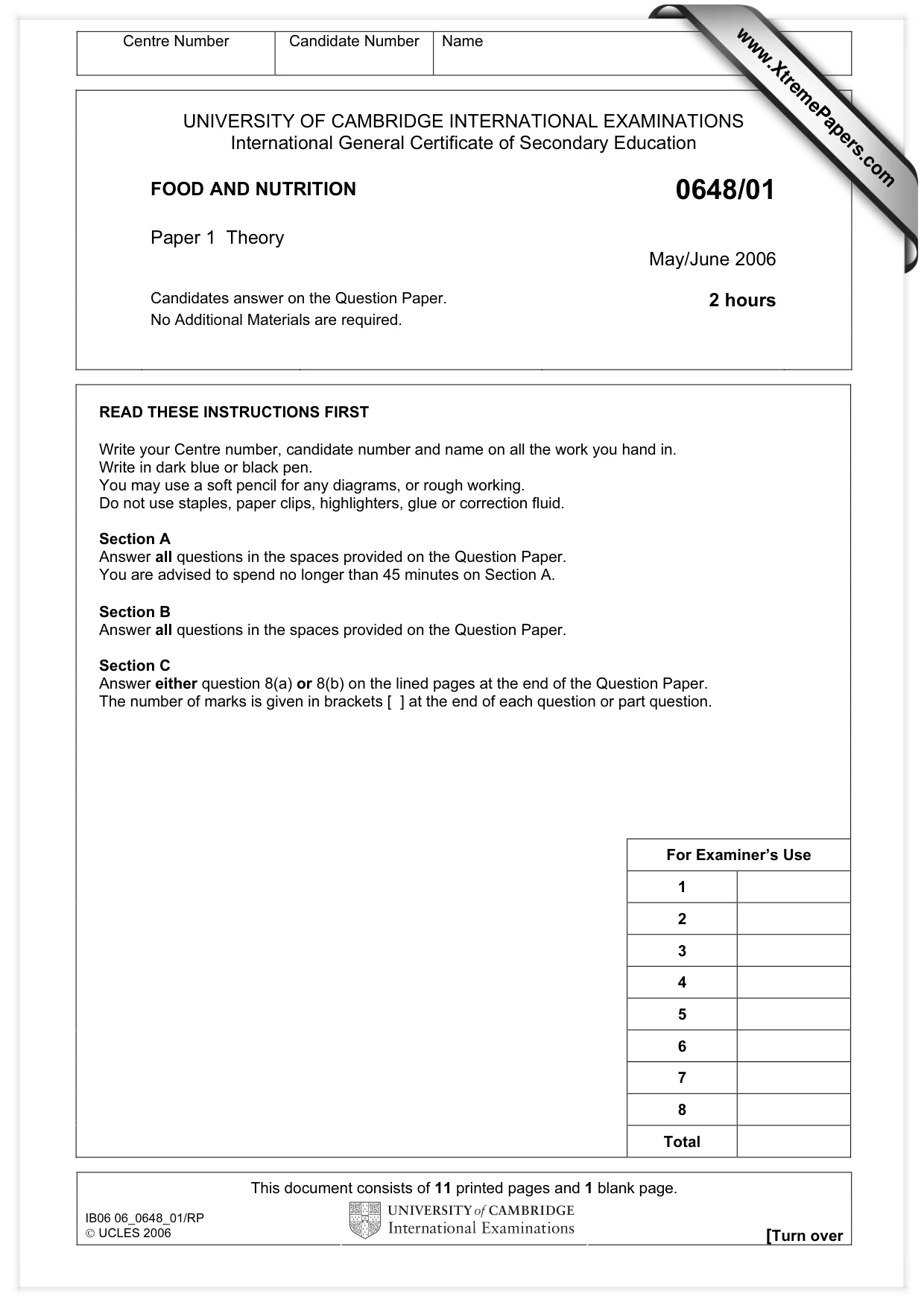
Question paper, page 1
Centre Number Candidate Number Name UNIVERSITY OF CAMBRIDGE INTERNATIONAL EXAMINATIONS International General Certificate of Secondary Education FOOD AND NUTRITION 0648/01 Paper 1 Theory May/June 2006 Candidates answer on the Question Paper. 2 hours No Additional Materials are required. READ THESE INSTRUCTIONS FIRST Write your Centre number, candidate number and name on all the work you hand in. Write in dark blue or black pen. You may use a soft pencil for any diagrams, or rough working. Do not use staples, paper clips, highlighters, glue or correction fluid. Section A Answer all questions in the spaces provided on the Question Paper. You are advised to spend no longer than 45 minutes on Section A. Section B Answer all questions in the spaces provided on the Question Paper. Section C Answer either question 8(a) or 8(b) on the lined pages at the end of the Question Paper. The number of marks is given in brackets [ ] at the end of each question or part question. For Examiner’s Use 1 2 3 4 5 6 7 8 Total This document consists of 11 printed pages and 1 blank page. IB06 06_0648_01/RP UCLES 2006 [Turn over www.XtremePapers.com
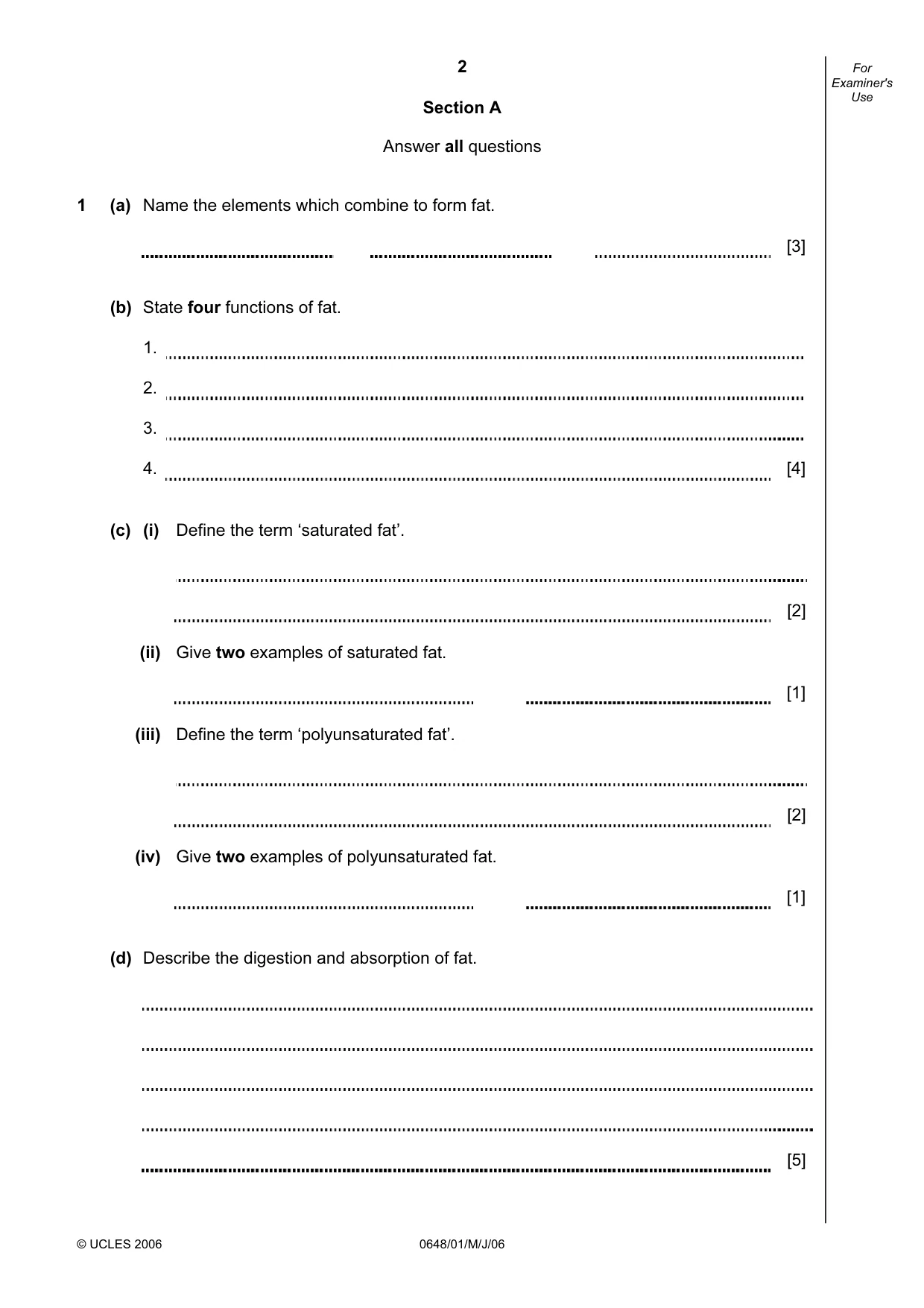
Question paper, page 2
2 © UCLES 2006 0648/01/M/J/06 For Examiner's Use Section A Answer all questions 1 (a) Name the elements which combine to form fat. [3] (b) State four functions of fat. 1. 2. 3. 4. [4] (c) (i) Define the term ‘saturated fat’. [2] (ii) Give two examples of saturated fat. [1] (iii) Define the term ‘polyunsaturated fat’. [2] (iv) Give two examples of polyunsaturated fat. [1] (d) Describe the digestion and absorption of fat. [5]
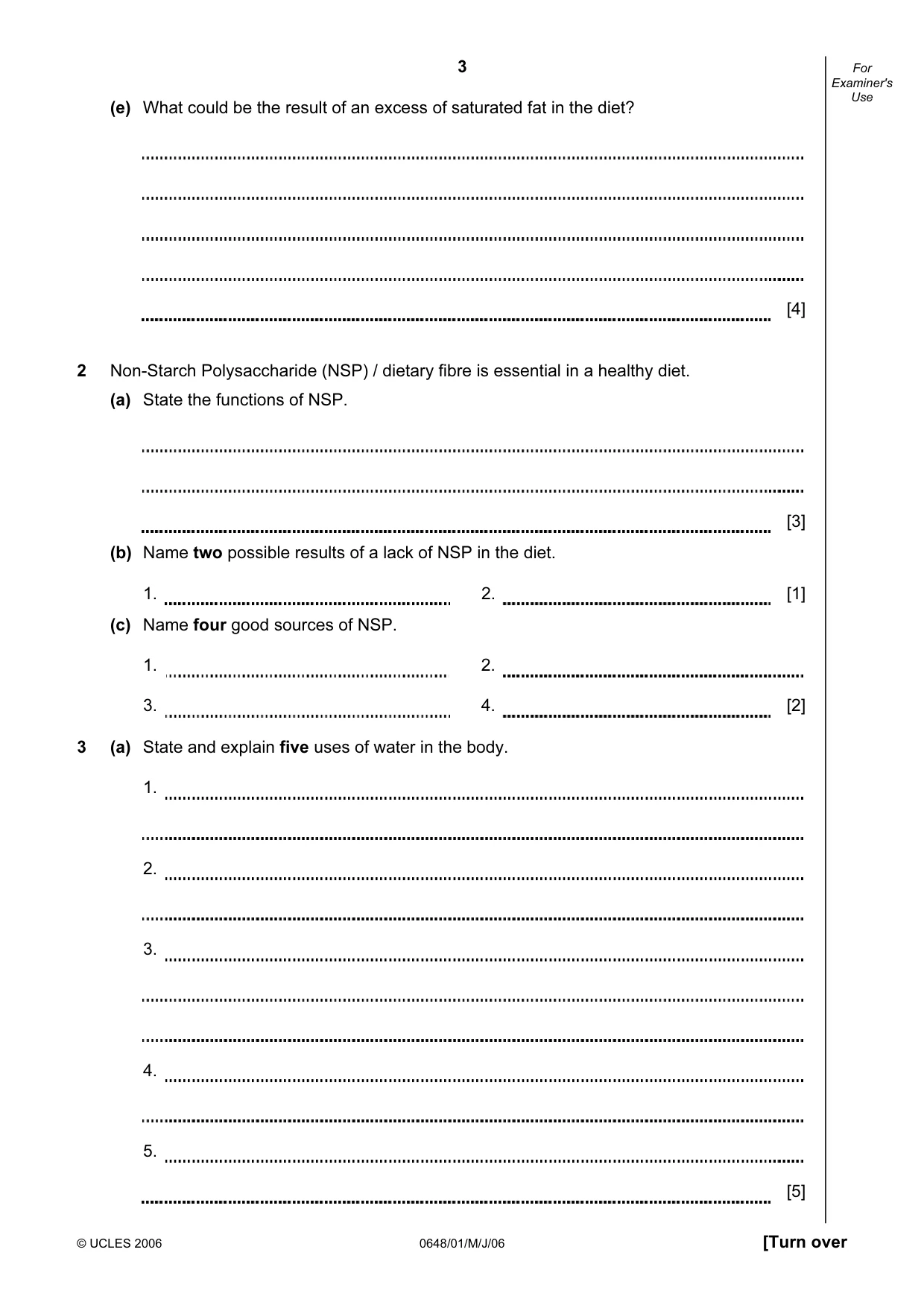
Question paper, page 3
3 © UCLES 2006 0648/01/M/J/06 [Turn over For Examiner's Use (e) What could be the result of an excess of saturated fat in the diet? [4] 2 Non-Starch Polysaccharide (NSP) / dietary fibre is essential in a healthy diet. (a) State the functions of NSP. [3] (b) Name two possible results of a lack of NSP in the diet. 1. 2. [1] (c) Name four good sources of NSP. 1. 2. 3. 4. [2] 3 (a) State and explain five uses of water in the body. 1. 2. 3. 4. 5. [5]
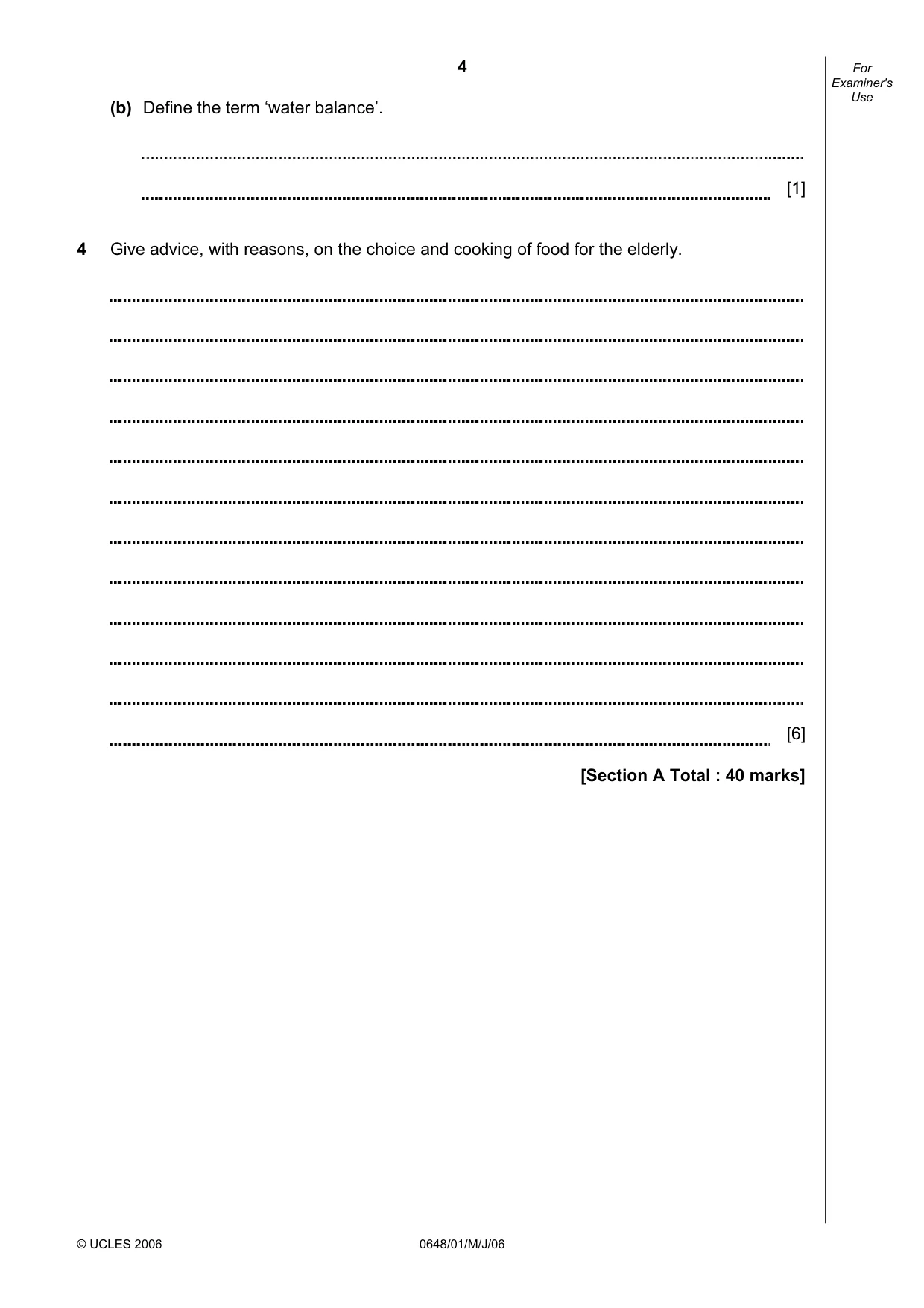
Question paper, page 4
4 © UCLES 2006 0648/01/M/J/06 For Examiner's Use (b) Define the term ‘water balance’. [1] 4 Give advice, with reasons, on the choice and cooking of food for the elderly. [6] [Section A Total : 40 marks]
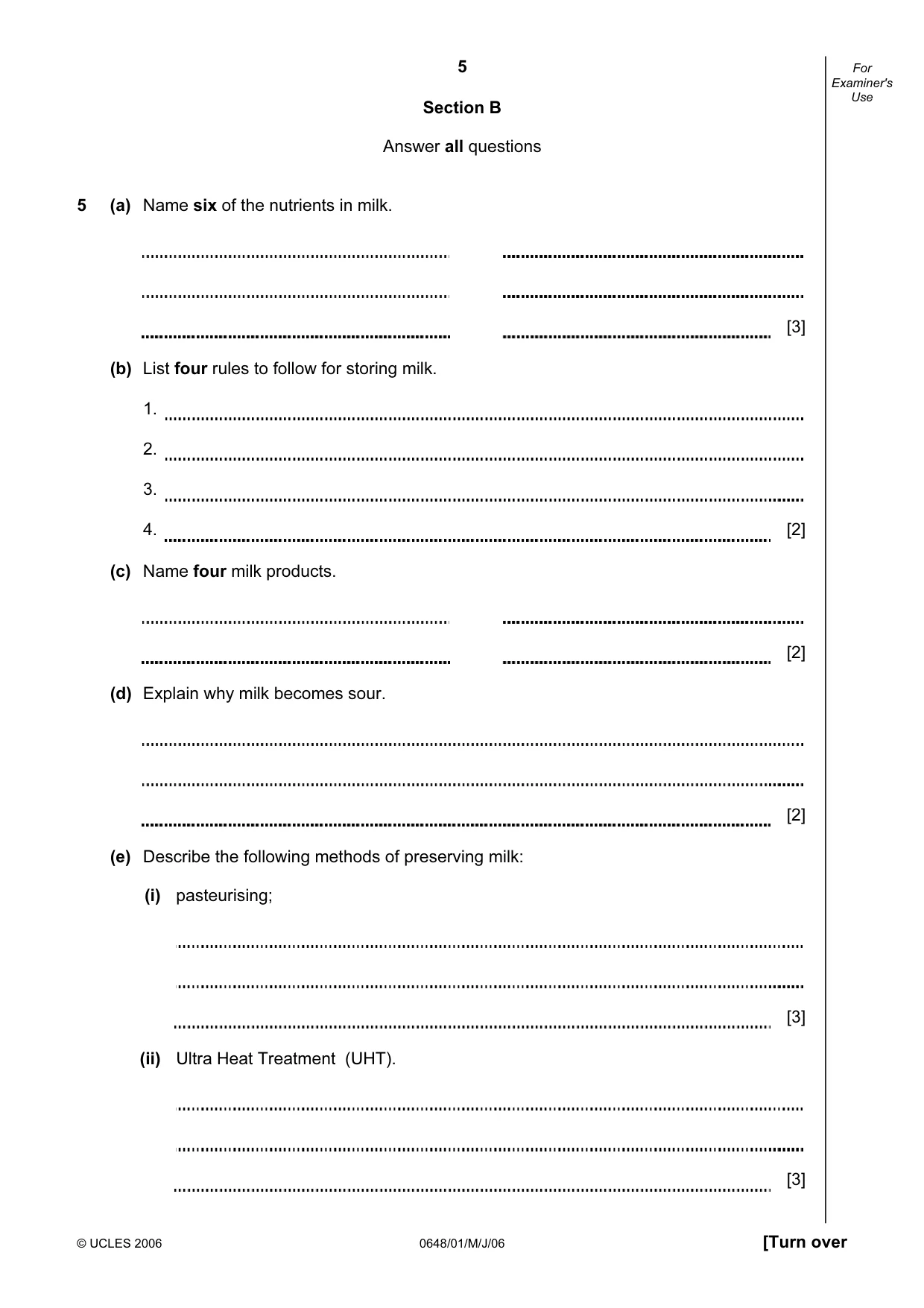
Question paper, page 5
5 © UCLES 2006 0648/01/M/J/06 [Turn over For Examiner's Use Section B Answer all questions 5 (a) Name six of the nutrients in milk. [3] (b) List four rules to follow for storing milk. 1. 2. 3. 4. [2] (c) Name four milk products. [2] (d) Explain why milk becomes sour. [2] (e) Describe the following methods of preserving milk: (i) pasteurising; [3] (ii) Ultra Heat Treatment (UHT). [3]
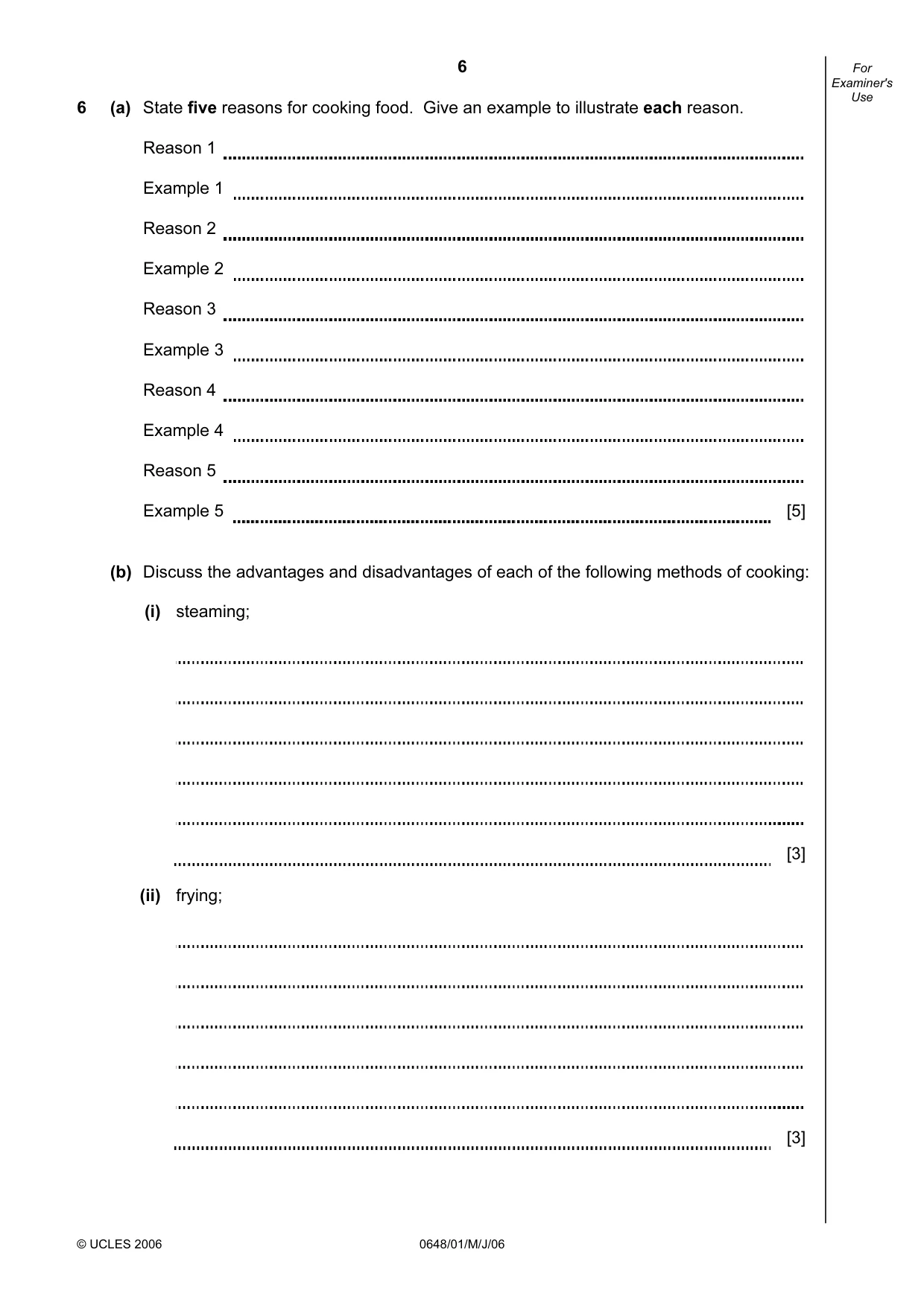
Question paper, page 6
6 © UCLES 2006 0648/01/M/J/06 For Examiner's Use 6 (a) State five reasons for cooking food. Give an example to illustrate each reason. Reason 1 Example 1 Reason 2 Example 2 Reason 3 Example 3 Reason 4 Example 4 Reason 5 Example 5 [5] (b) Discuss the advantages and disadvantages of each of the following methods of cooking: (i) steaming; [3] (ii) frying; [3]
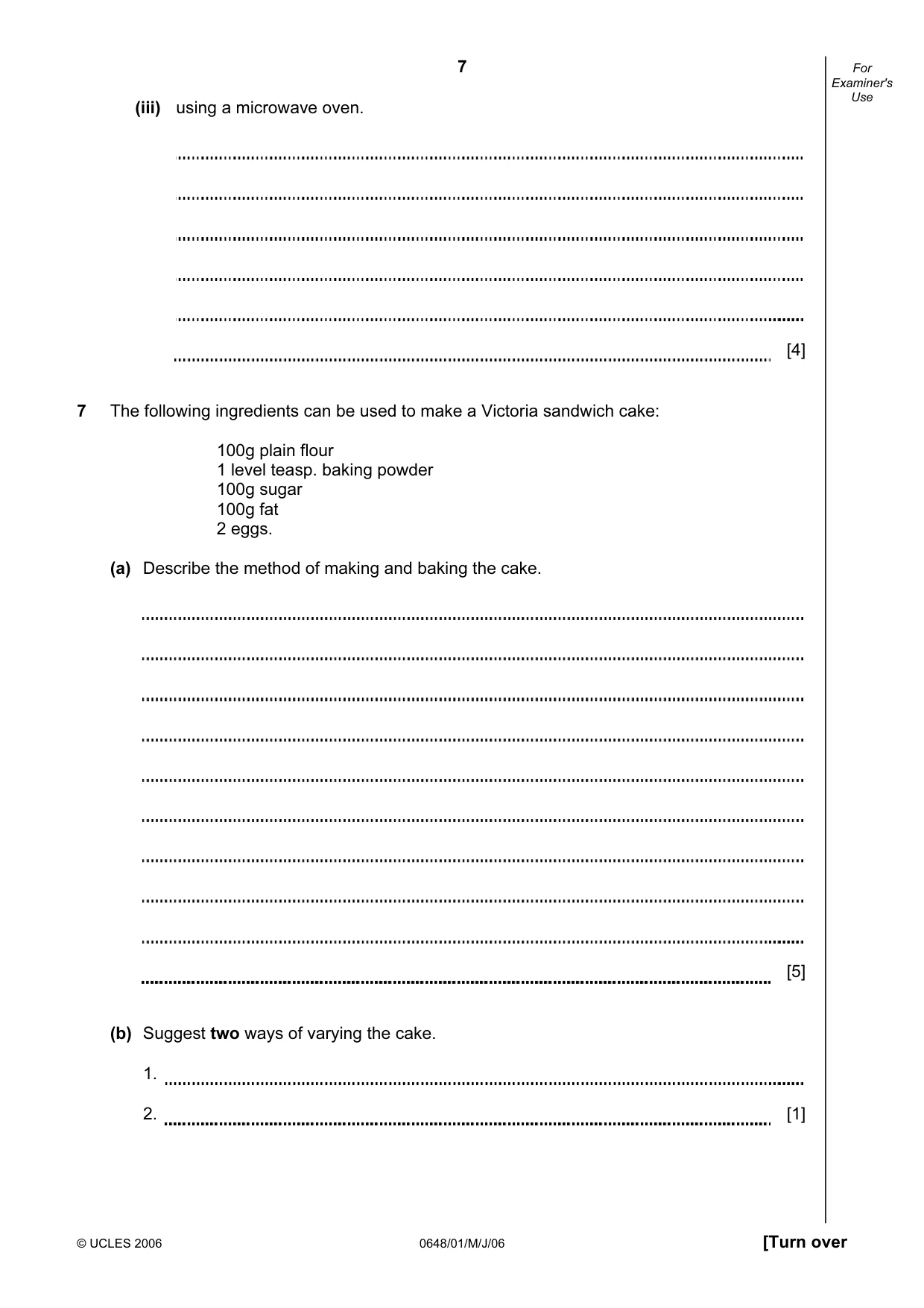
Question paper, page 7
7 © UCLES 2006 0648/01/M/J/06 [Turn over For Examiner's Use (iii) using a microwave oven. [4] 7 The following ingredients can be used to make a Victoria sandwich cake: 100g plain flour 1 level teasp. baking powder 100g sugar 100g fat 2 eggs. (a) Describe the method of making and baking the cake. [5] (b) Suggest two ways of varying the cake. 1. 2. [1]
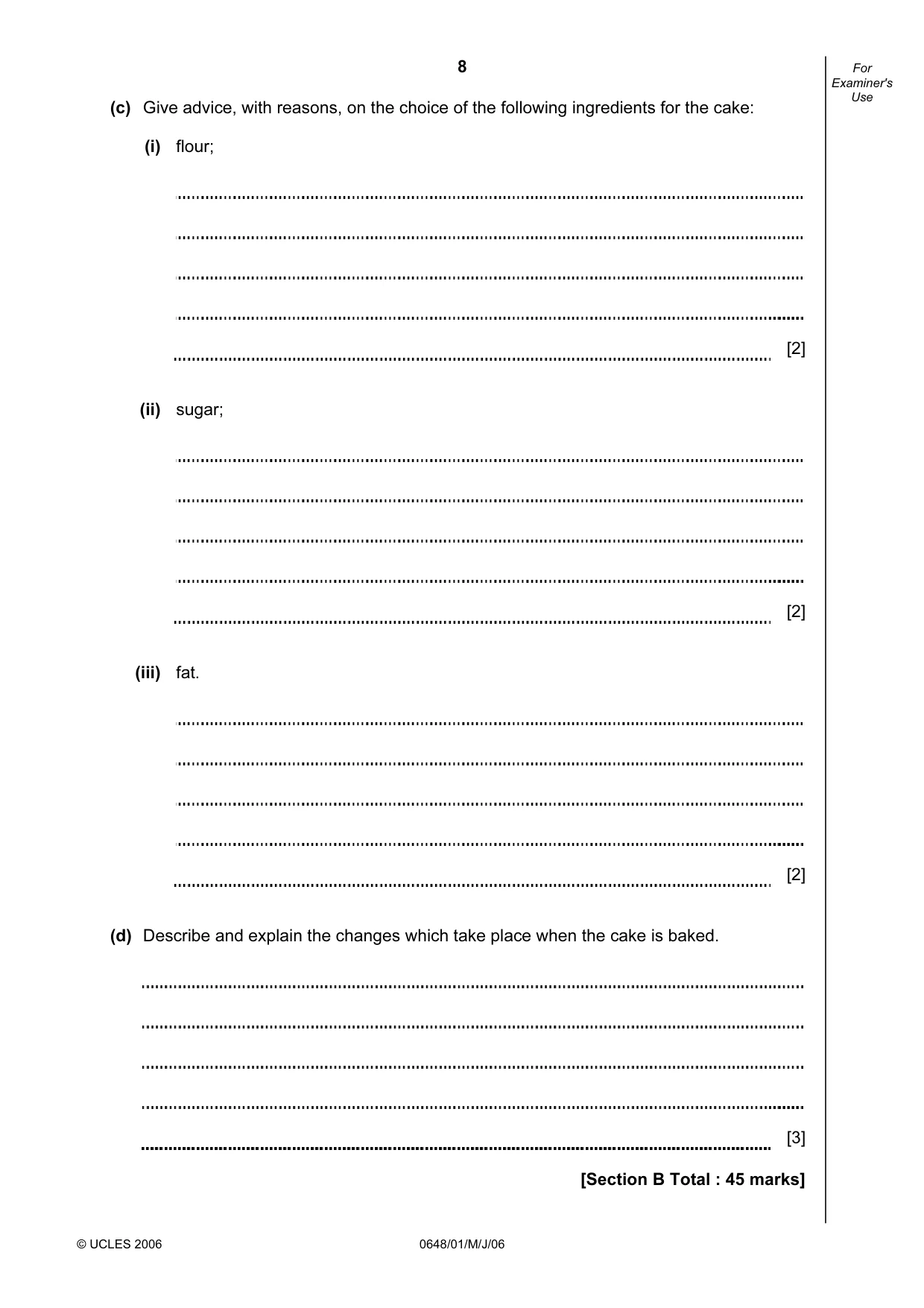
Question paper, page 8
8 © UCLES 2006 0648/01/M/J/06 For Examiner's Use (c) Give advice, with reasons, on the choice of the following ingredients for the cake: (i) flour; [2] (ii) sugar; [2] (iii) fat. [2] (d) Describe and explain the changes which take place when the cake is baked. [3] [Section B Total : 45 marks]
Question paper, page 9
9 © UCLES 2006 0648/01/M/J/06 [Turn over For Examiner's Use Section C Answer either 8(a) or 8(b) 8 (a) Discuss different raising agents and their use in the preparation of dishes. OR (b) Discuss different fats and oils and their use in the preparation of dishes.
Question paper, page 10
10 © UCLES 2006 0648/01/M/J/06 For Examiner's Use
Question paper, page 11
11 © UCLES 2006 0648/01/M/J/06 For Examiner's Use [Section C Total : 15 marks] [Total for Paper: 100]
Question paper, page 12
12 Permission to reproduce items where third-party owned material protected by copyright is included has been sought and cleared where possible. Every reasonable effort has been made by the publisher (UCLES) to trace copyright holders, but if any items requiring clearance have unwittingly been included, the publisher will be pleased to make amends at the earliest possible opportunity. University of Cambridge International Examinations is part of the University of Cambridge Local Examinations Syndicate (UCLES), which is itself a department of the University of Cambridge. 0648/01/M/J/06 BLANK PAGE
Mark scheme, page 1
UNIVERSITY OF CAMBRIDGE INTERNATIONAL EXAMINATIONS International General Certificate of Secondary Education MARK SCHEME for the May/June 2006 question paper 0648 FOOD AND NUTRITION 0648/01 Paper 1 maximum raw mark 100 This mark scheme is published as an aid to teachers and students, to indicate the requirements of the examination. It shows the basis on which Examiners were initially instructed to award marks. It does not indicate the details of the discussions that took place at an Examiners’ meeting before marking began. Any substantial changes to the mark scheme that arose from these discussions will be recorded in the published Report on the Examination. All Examiners are instructed that alternative correct answers and unexpected approaches in candidates’ scripts must be given marks that fairly reflect the relevant knowledge and skills demonstrated. Mark schemes must be read in conjunction with the question papers and the Report on the Examination. The minimum marks in these components needed for various grades were previously published with these mark schemes, but are now instead included in the Report on the Examination for this session. • CIE will not enter into discussion or correspondence in connection with these mark schemes. CIE is publishing the mark schemes for the May/June 2006 question papers for most IGCSE and GCE Advanced Level and Advanced Subsidiary Level syllabuses and some Ordinary Level syllabuses. www.XtremePapers.com
Mark scheme, page 2
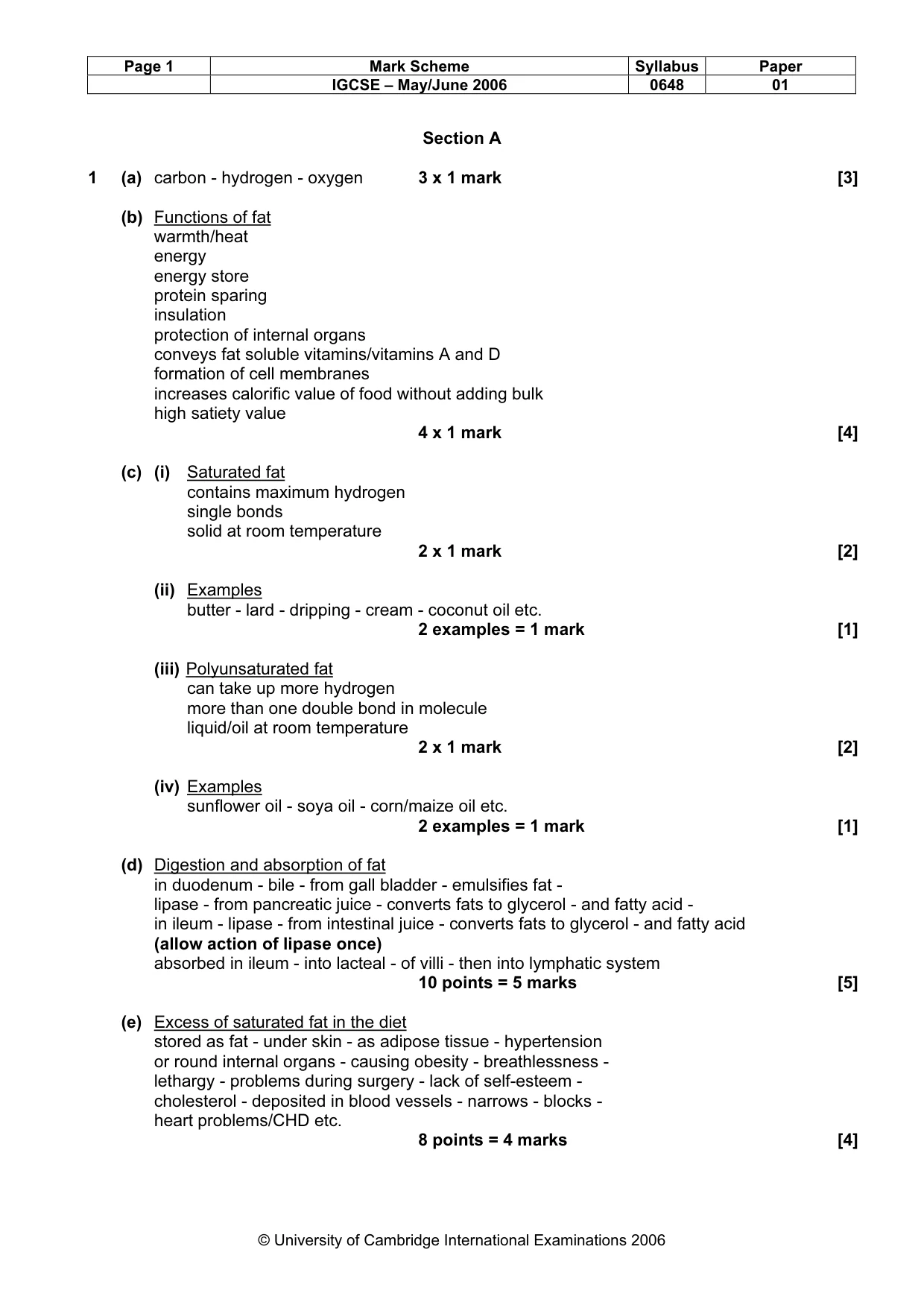
Page 1 Mark Scheme Syllabus Paper IGCSE – May/June 2006 0648 01 © University of Cambridge International Examinations 2006 Section A 1 (a) carbon - hydrogen - oxygen 3 x 1 mark [3] (b) Functions of fat warmth/heat energy energy store protein sparing insulation protection of internal organs conveys fat soluble vitamins/vitamins A and D formation of cell membranes increases calorific value of food without adding bulk high satiety value 4 x 1 mark [4] (c) (i) Saturated fat contains maximum hydrogen single bonds solid at room temperature 2 x 1 mark [2] (ii) Examples butter - lard - dripping - cream - coconut oil etc. 2 examples = 1 mark [1] (iii) Polyunsaturated fat can take up more hydrogen more than one double bond in molecule liquid/oil at room temperature 2 x 1 mark [2] (iv) Examples sunflower oil - soya oil - corn/maize oil etc. 2 examples = 1 mark [1] (d) Digestion and absorption of fat in duodenum - bile - from gall bladder - emulsifies fat - lipase - from pancreatic juice - converts fats to glycerol - and fatty acid - in ileum - lipase - from intestinal juice - converts fats to glycerol - and fatty acid (allow action of lipase once) absorbed in ileum - into lacteal - of villi - then into lymphatic system 10 points = 5 marks [5] (e) Excess of saturated fat in the diet stored as fat - under skin - as adipose tissue - hypertension or round internal organs - causing obesity - breathlessness - lethargy - problems during surgery - lack of self-esteem - cholesterol - deposited in blood vessels - narrows - blocks - heart problems/CHD etc. 8 points = 4 marks [4]
Mark scheme, page 3
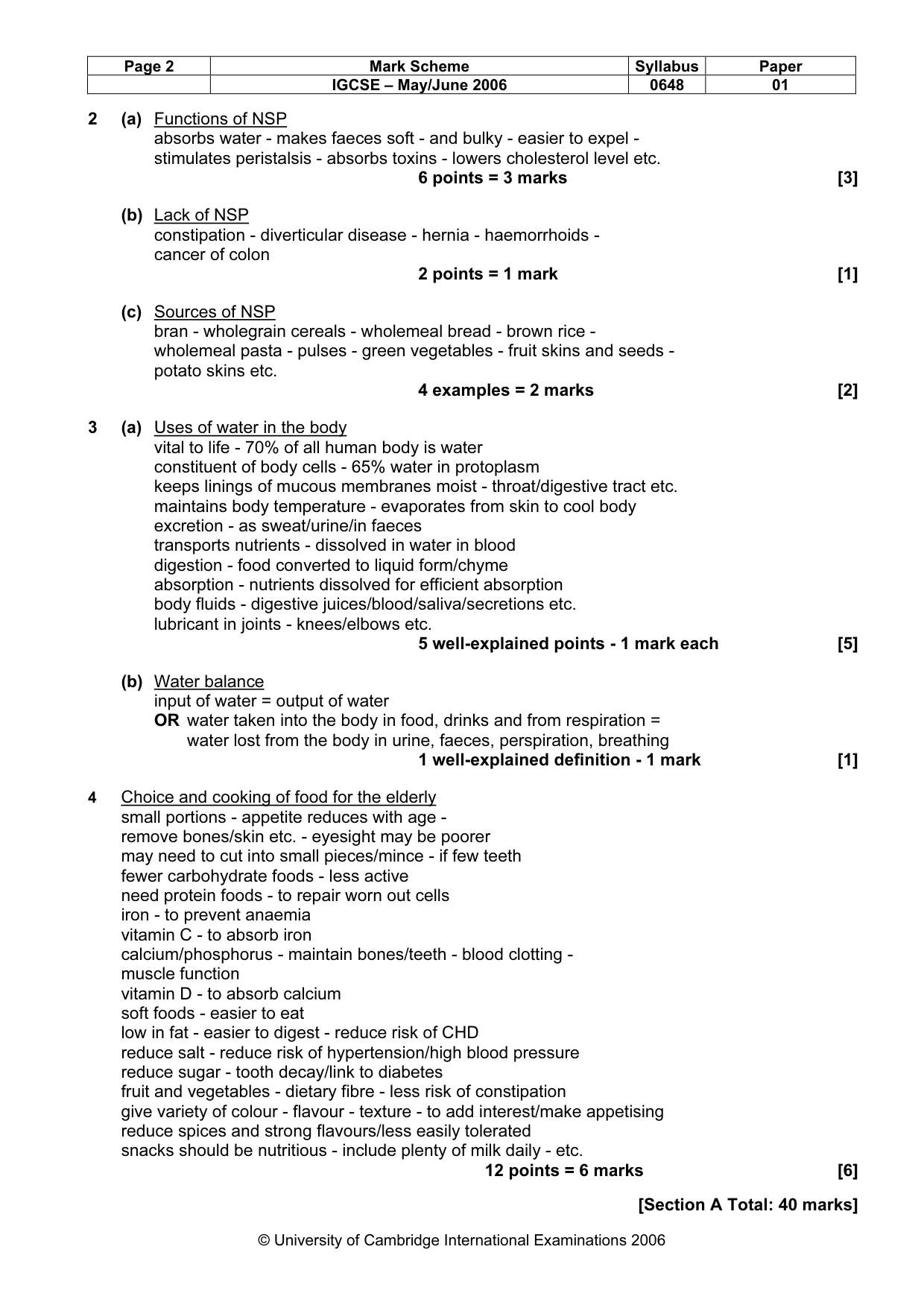
Page 2 Mark Scheme Syllabus Paper IGCSE – May/June 2006 0648 01 © University of Cambridge International Examinations 2006 2 (a) Functions of NSP absorbs water - makes faeces soft - and bulky - easier to expel - stimulates peristalsis - absorbs toxins - lowers cholesterol level etc. 6 points = 3 marks [3] (b) Lack of NSP constipation - diverticular disease - hernia - haemorrhoids - cancer of colon 2 points = 1 mark [1] (c) Sources of NSP bran - wholegrain cereals - wholemeal bread - brown rice - wholemeal pasta - pulses - green vegetables - fruit skins and seeds - potato skins etc. 4 examples = 2 marks [2] 3 (a) Uses of water in the body vital to life - 70% of all human body is water constituent of body cells - 65% water in protoplasm keeps linings of mucous membranes moist - throat/digestive tract etc. maintains body temperature - evaporates from skin to cool body excretion - as sweat/urine/in faeces transports nutrients - dissolved in water in blood digestion - food converted to liquid form/chyme absorption - nutrients dissolved for efficient absorption body fluids - digestive juices/blood/saliva/secretions etc. lubricant in joints - knees/elbows etc. 5 well-explained points - 1 mark each [5] (b) Water balance input of water = output of water OR water taken into the body in food, drinks and from respiration = water lost from the body in urine, faeces, perspiration, breathing 1 well-explained definition - 1 mark [1] 4 Choice and cooking of food for the elderly small portions - appetite reduces with age - remove bones/skin etc. - eyesight may be poorer may need to cut into small pieces/mince - if few teeth fewer carbohydrate foods - less active need protein foods - to repair worn out cells iron - to prevent anaemia vitamin C - to absorb iron calcium/phosphorus - maintain bones/teeth - blood clotting - muscle function vitamin D - to absorb calcium soft foods - easier to eat low in fat - easier to digest - reduce risk of CHD reduce salt - reduce risk of hypertension/high blood pressure reduce sugar - tooth decay/link to diabetes fruit and vegetables - dietary fibre - less risk of constipation give variety of colour - flavour - texture - to add interest/make appetising reduce spices and strong flavours/less easily tolerated snacks should be nutritious - include plenty of milk daily - etc. 12 points = 6 marks [6] [Section A Total: 40 marks]
Mark scheme, page 4
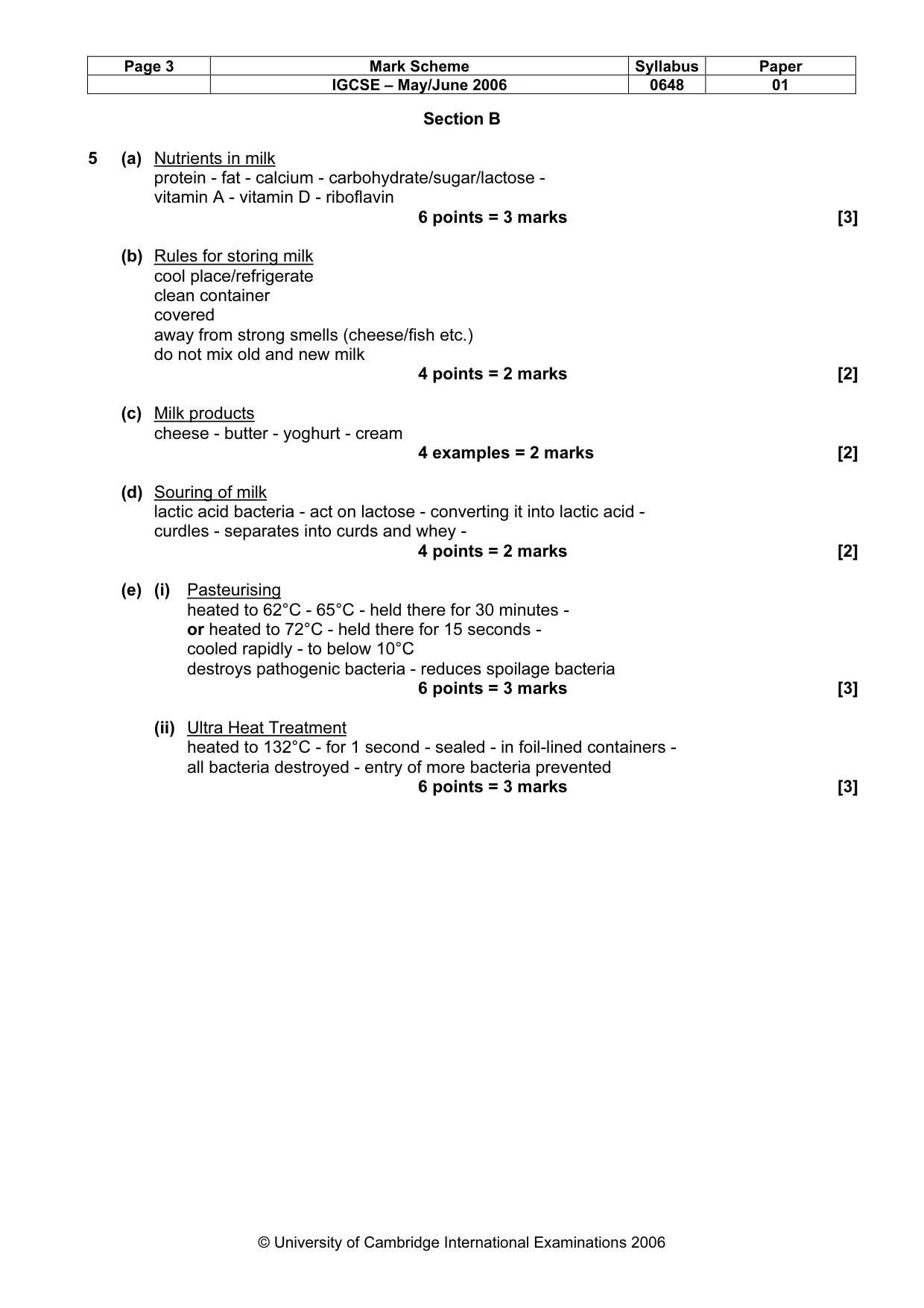
Page 3 Mark Scheme Syllabus Paper IGCSE – May/June 2006 0648 01 © University of Cambridge International Examinations 2006 Section B 5 (a) Nutrients in milk protein - fat - calcium - carbohydrate/sugar/lactose - vitamin A - vitamin D - riboflavin 6 points = 3 marks [3] (b) Rules for storing milk cool place/refrigerate clean container covered away from strong smells (cheese/fish etc.) do not mix old and new milk 4 points = 2 marks [2] (c) Milk products cheese - butter - yoghurt - cream 4 examples = 2 marks [2] (d) Souring of milk lactic acid bacteria - act on lactose - converting it into lactic acid - curdles - separates into curds and whey - 4 points = 2 marks [2] (e) (i) Pasteurising heated to 62°C - 65°C - held there for 30 minutes - or heated to 72°C - held there for 15 seconds - cooled rapidly - to below 10°C destroys pathogenic bacteria - reduces spoilage bacteria 6 points = 3 marks [3] (ii) Ultra Heat Treatment heated to 132°C - for 1 second - sealed - in foil-lined containers - all bacteria destroyed - entry of more bacteria prevented 6 points = 3 marks [3]
Mark scheme, page 5
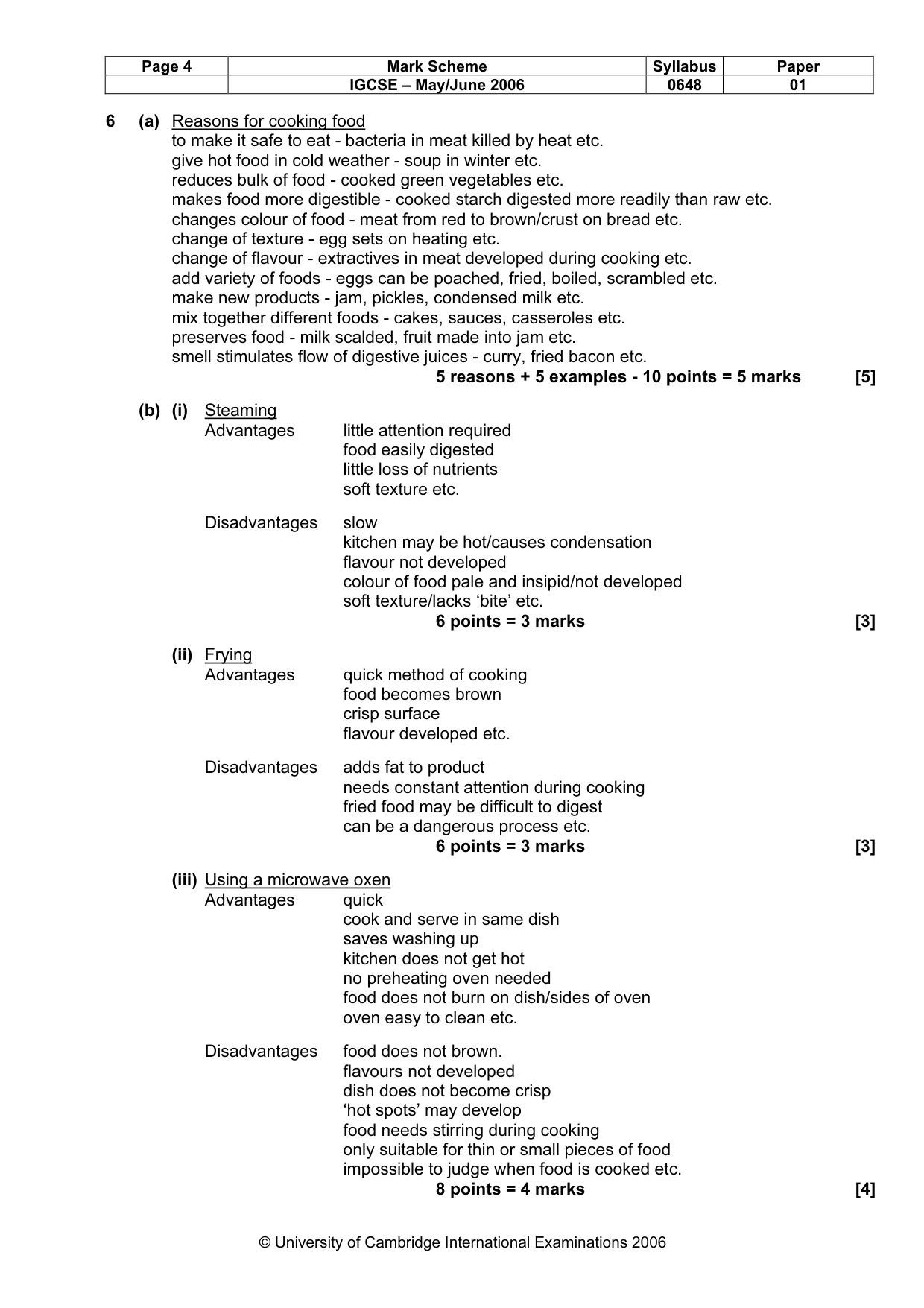
Page 4 Mark Scheme Syllabus Paper IGCSE – May/June 2006 0648 01 © University of Cambridge International Examinations 2006 6 (a) Reasons for cooking food to make it safe to eat - bacteria in meat killed by heat etc. give hot food in cold weather - soup in winter etc. reduces bulk of food - cooked green vegetables etc. makes food more digestible - cooked starch digested more readily than raw etc. changes colour of food - meat from red to brown/crust on bread etc. change of texture - egg sets on heating etc. change of flavour - extractives in meat developed during cooking etc. add variety of foods - eggs can be poached, fried, boiled, scrambled etc. make new products - jam, pickles, condensed milk etc. mix together different foods - cakes, sauces, casseroles etc. preserves food - milk scalded, fruit made into jam etc. smell stimulates flow of digestive juices - curry, fried bacon etc. 5 reasons + 5 examples - 10 points = 5 marks [5] (b) (i) Steaming Advantages little attention required food easily digested little loss of nutrients soft texture etc. Disadvantages slow kitchen may be hot/causes condensation flavour not developed colour of food pale and insipid/not developed soft texture/lacks ‘bite’ etc. 6 points = 3 marks [3] (ii) Frying Advantages quick method of cooking food becomes brown crisp surface flavour developed etc. Disadvantages adds fat to product needs constant attention during cooking fried food may be difficult to digest can be a dangerous process etc. 6 points = 3 marks [3] (iii) Using a microwave oxen Advantages quick cook and serve in same dish saves washing up kitchen does not get hot no preheating oven needed food does not burn on dish/sides of oven oven easy to clean etc. Disadvantages food does not brown. flavours not developed dish does not become crisp ‘hot spots’ may develop food needs stirring during cooking only suitable for thin or small pieces of food impossible to judge when food is cooked etc. 8 points = 4 marks [4]
Mark scheme, page 6
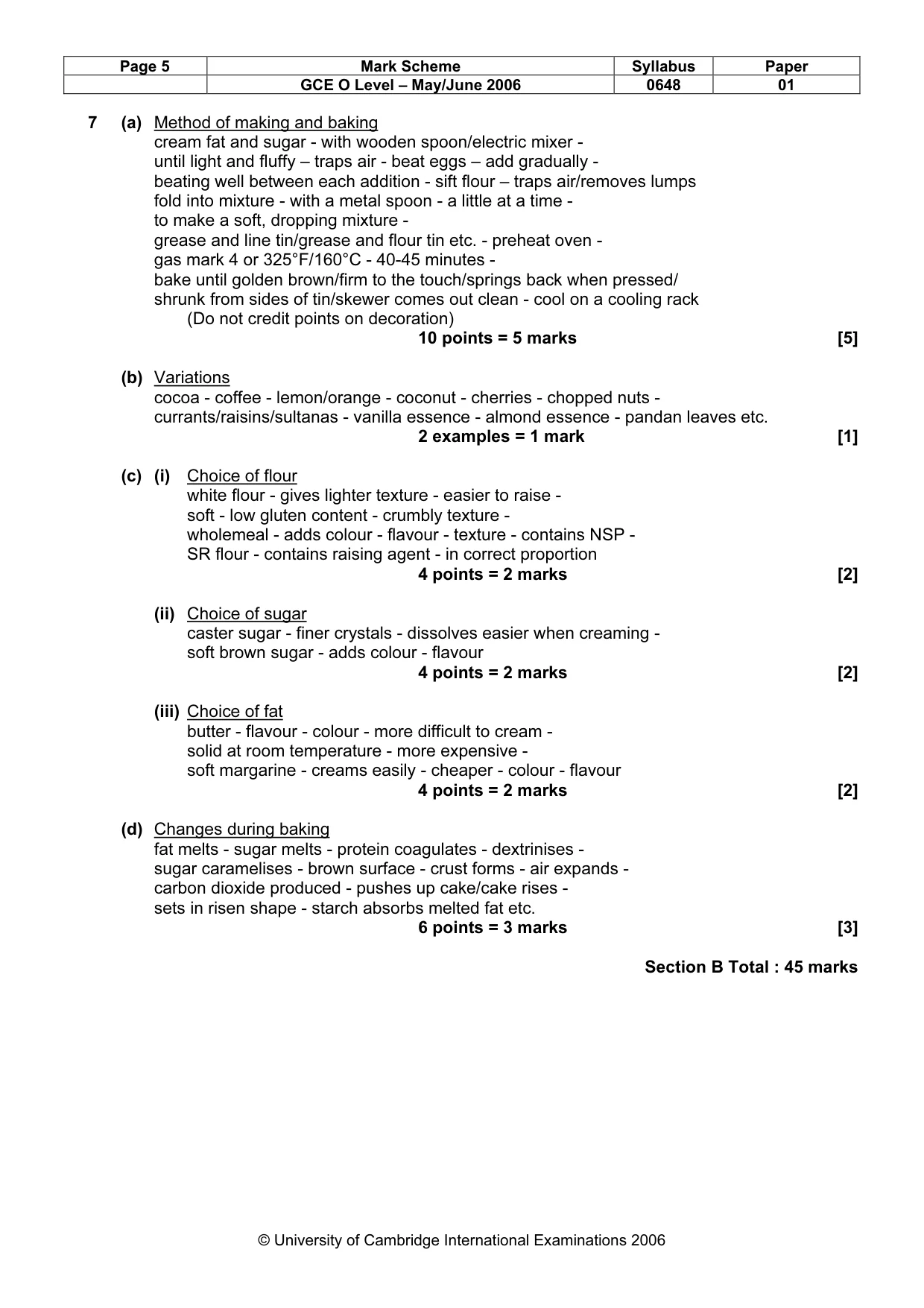
Page 5 Mark Scheme Syllabus Paper GCE O Level – May/June 2006 0648 01 © University of Cambridge International Examinations 2006 7 (a) Method of making and baking cream fat and sugar - with wooden spoon/electric mixer - until light and fluffy – traps air - beat eggs – add gradually - beating well between each addition - sift flour – traps air/removes lumps fold into mixture - with a metal spoon - a little at a time - to make a soft, dropping mixture - grease and line tin/grease and flour tin etc. - preheat oven - gas mark 4 or 325°F/160°C - 40-45 minutes - bake until golden brown/firm to the touch/springs back when pressed/ shrunk from sides of tin/skewer comes out clean - cool on a cooling rack (Do not credit points on decoration) 10 points = 5 marks [5] (b) Variations cocoa - coffee - lemon/orange - coconut - cherries - chopped nuts - currants/raisins/sultanas - vanilla essence - almond essence - pandan leaves etc. 2 examples = 1 mark [1] (c) (i) Choice of flour white flour - gives lighter texture - easier to raise - soft - low gluten content - crumbly texture - wholemeal - adds colour - flavour - texture - contains NSP - SR flour - contains raising agent - in correct proportion 4 points = 2 marks [2] (ii) Choice of sugar caster sugar - finer crystals - dissolves easier when creaming - soft brown sugar - adds colour - flavour 4 points = 2 marks [2] (iii) Choice of fat butter - flavour - colour - more difficult to cream - solid at room temperature - more expensive - soft margarine - creams easily - cheaper - colour - flavour 4 points = 2 marks [2] (d) Changes during baking fat melts - sugar melts - protein coagulates - dextrinises - sugar caramelises - brown surface - crust forms - air expands - carbon dioxide produced - pushes up cake/cake rises - sets in risen shape - starch absorbs melted fat etc. 6 points = 3 marks [3] Section B Total : 45 marks
Mark scheme, page 7
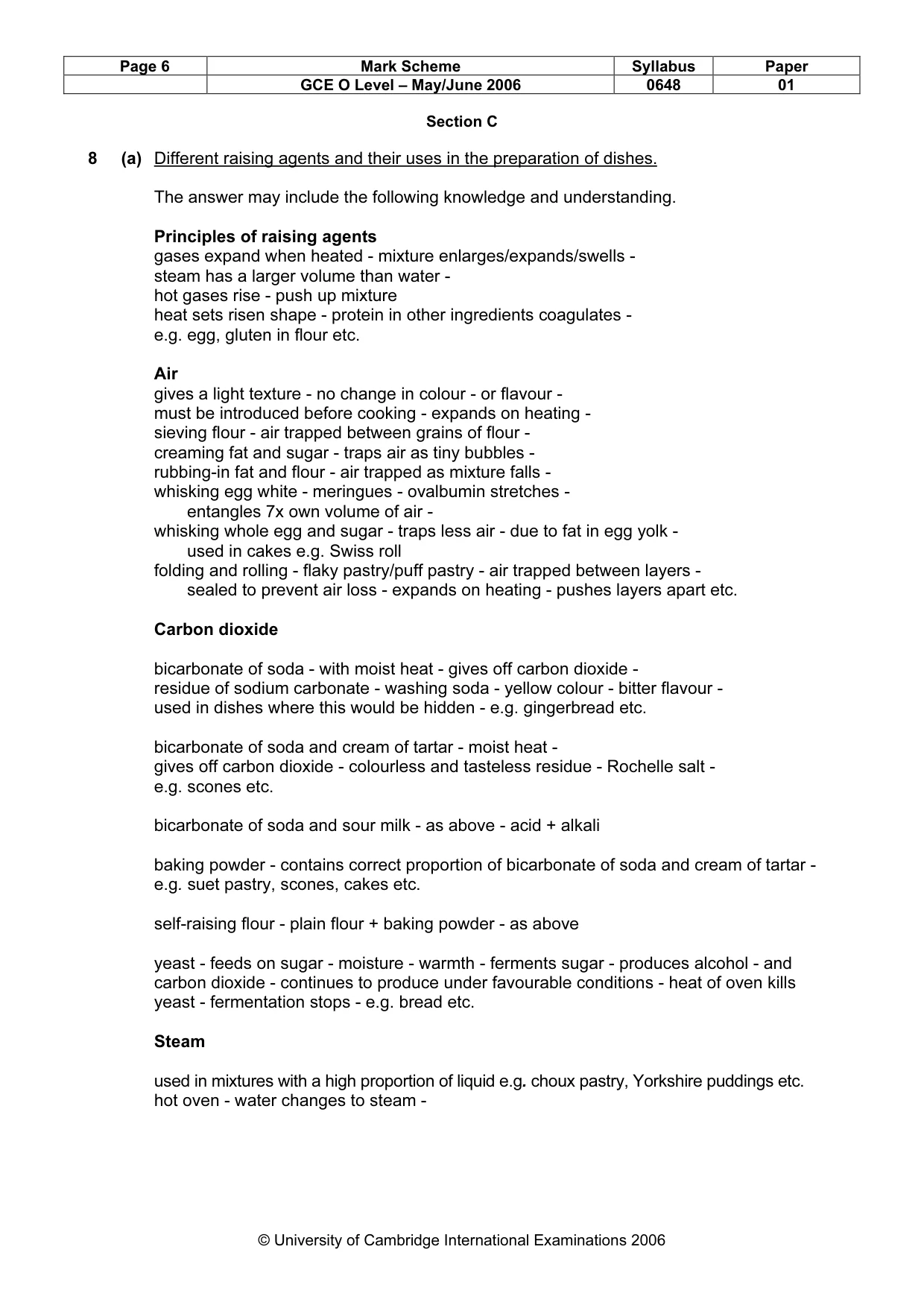
Page 6 Mark Scheme Syllabus Paper GCE O Level – May/June 2006 0648 01 © University of Cambridge International Examinations 2006 Section C 8 (a) Different raising agents and their uses in the preparation of dishes. The answer may include the following knowledge and understanding. Principles of raising agents gases expand when heated - mixture enlarges/expands/swells - steam has a larger volume than water - hot gases rise - push up mixture heat sets risen shape - protein in other ingredients coagulates - e.g. egg, gluten in flour etc. Air gives a light texture - no change in colour - or flavour - must be introduced before cooking - expands on heating - sieving flour - air trapped between grains of flour - creaming fat and sugar - traps air as tiny bubbles - rubbing-in fat and flour - air trapped as mixture falls - whisking egg white - meringues - ovalbumin stretches - entangles 7x own volume of air - whisking whole egg and sugar - traps less air - due to fat in egg yolk - used in cakes e.g. Swiss roll folding and rolling - flaky pastry/puff pastry - air trapped between layers - sealed to prevent air loss - expands on heating - pushes layers apart etc. Carbon dioxide bicarbonate of soda - with moist heat - gives off carbon dioxide - residue of sodium carbonate - washing soda - yellow colour - bitter flavour - used in dishes where this would be hidden - e.g. gingerbread etc. bicarbonate of soda and cream of tartar - moist heat - gives off carbon dioxide - colourless and tasteless residue - Rochelle salt - e.g. scones etc. bicarbonate of soda and sour milk - as above - acid + alkali baking powder - contains correct proportion of bicarbonate of soda and cream of tartar - e.g. suet pastry, scones, cakes etc. self-raising flour - plain flour + baking powder - as above yeast - feeds on sugar - moisture - warmth - ferments sugar - produces alcohol - and carbon dioxide - continues to produce under favourable conditions - heat of oven kills yeast - fermentation stops - e.g. bread etc. Steam used in mixtures with a high proportion of liquid e.g. choux pastry, Yorkshire puddings etc. hot oven - water changes to steam -
Mark scheme, page 8
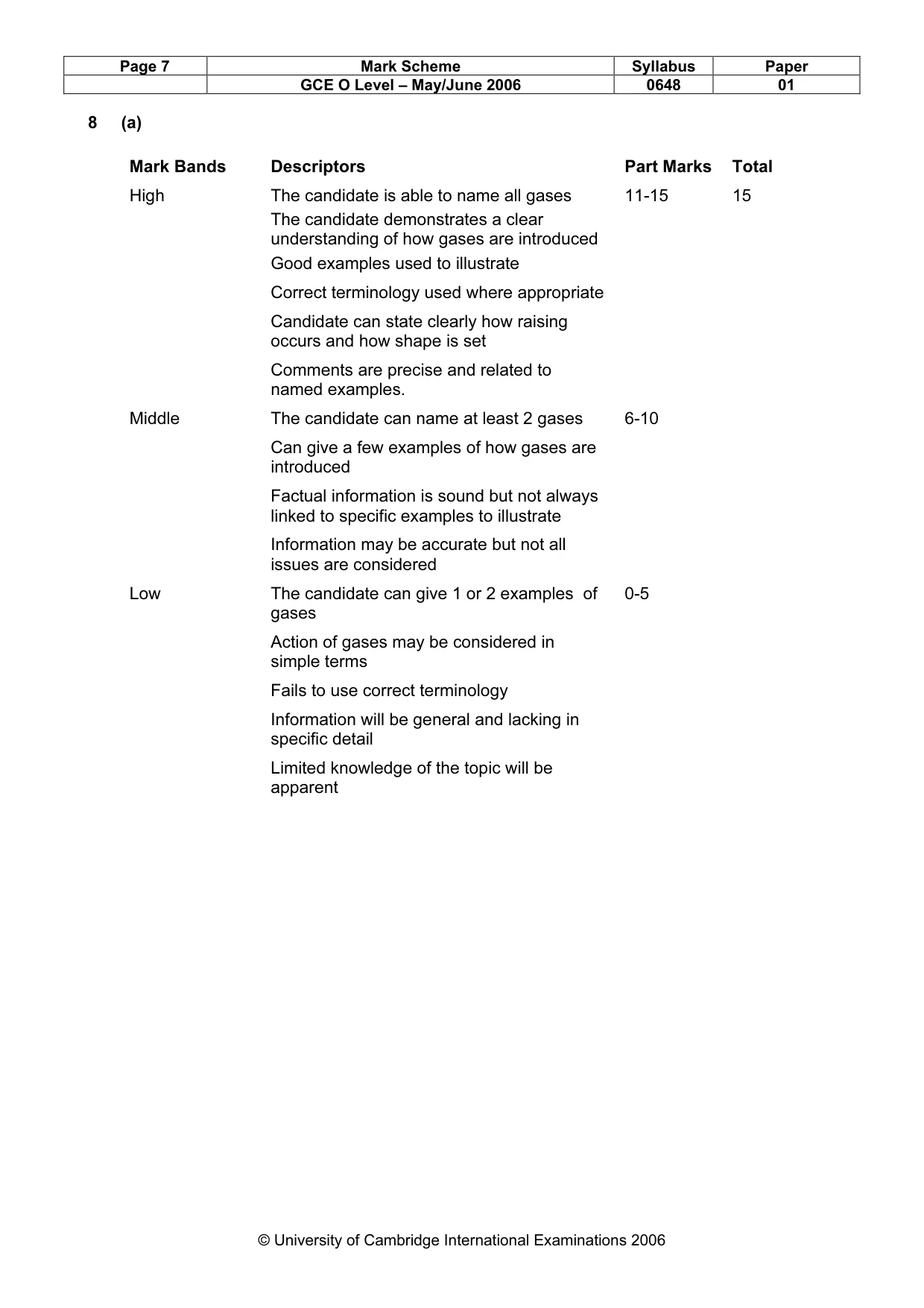
Page 7 Mark Scheme Syllabus Paper GCE O Level – May/June 2006 0648 01 © University of Cambridge International Examinations 2006 8 (a) Mark Bands Descriptors Part Marks Total High The candidate is able to name all gases 11-15 15 The candidate demonstrates a clear understanding of how gases are introduced Good examples used to illustrate Correct terminology used where appropriate Candidate can state clearly how raising occurs and how shape is set Comments are precise and related to named examples. Middle The candidate can name at least 2 gases 6-10 Can give a few examples of how gases are introduced Factual information is sound but not always linked to specific examples to illustrate Information may be accurate but not all issues are considered Low The candidate can give 1 or 2 examples of gases 0-5 Action of gases may be considered in simple terms Fails to use correct terminology Information will be general and lacking in specific detail Limited knowledge of the topic will be apparent
Mark scheme, page 9
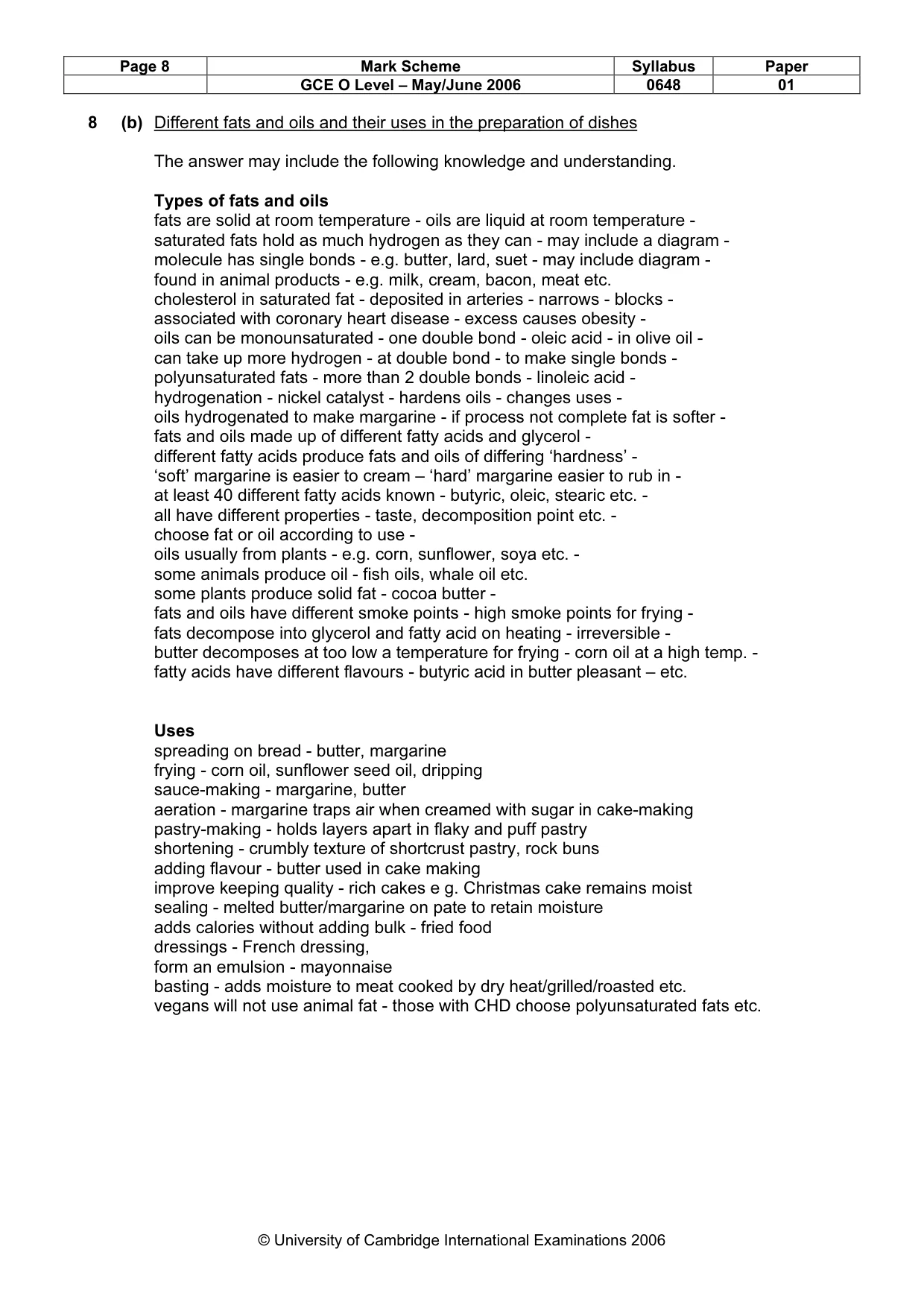
Page 8 Mark Scheme Syllabus Paper GCE O Level – May/June 2006 0648 01 © University of Cambridge International Examinations 2006 8 (b) Different fats and oils and their uses in the preparation of dishes The answer may include the following knowledge and understanding. Types of fats and oils fats are solid at room temperature - oils are liquid at room temperature - saturated fats hold as much hydrogen as they can - may include a diagram - molecule has single bonds - e.g. butter, lard, suet - may include diagram - found in animal products - e.g. milk, cream, bacon, meat etc. cholesterol in saturated fat - deposited in arteries - narrows - blocks - associated with coronary heart disease - excess causes obesity - oils can be monounsaturated - one double bond - oleic acid - in olive oil - can take up more hydrogen - at double bond - to make single bonds - polyunsaturated fats - more than 2 double bonds - linoleic acid - hydrogenation - nickel catalyst - hardens oils - changes uses - oils hydrogenated to make margarine - if process not complete fat is softer - fats and oils made up of different fatty acids and glycerol - different fatty acids produce fats and oils of differing ‘hardness’ - ‘soft’ margarine is easier to cream – ‘hard’ margarine easier to rub in - at least 40 different fatty acids known - butyric, oleic, stearic etc. - all have different properties - taste, decomposition point etc. - choose fat or oil according to use - oils usually from plants - e.g. corn, sunflower, soya etc. - some animals produce oil - fish oils, whale oil etc. some plants produce solid fat - cocoa butter - fats and oils have different smoke points - high smoke points for frying - fats decompose into glycerol and fatty acid on heating - irreversible - butter decomposes at too low a temperature for frying - corn oil at a high temp. - fatty acids have different flavours - butyric acid in butter pleasant – etc. Uses spreading on bread - butter, margarine frying - corn oil, sunflower seed oil, dripping sauce-making - margarine, butter aeration - margarine traps air when creamed with sugar in cake-making pastry-making - holds layers apart in flaky and puff pastry shortening - crumbly texture of shortcrust pastry, rock buns adding flavour - butter used in cake making improve keeping quality - rich cakes e g. Christmas cake remains moist sealing - melted butter/margarine on pate to retain moisture adds calories without adding bulk - fried food dressings - French dressing, form an emulsion - mayonnaise basting - adds moisture to meat cooked by dry heat/grilled/roasted etc. vegans will not use animal fat - those with CHD choose polyunsaturated fats etc.
Mark scheme, page 10
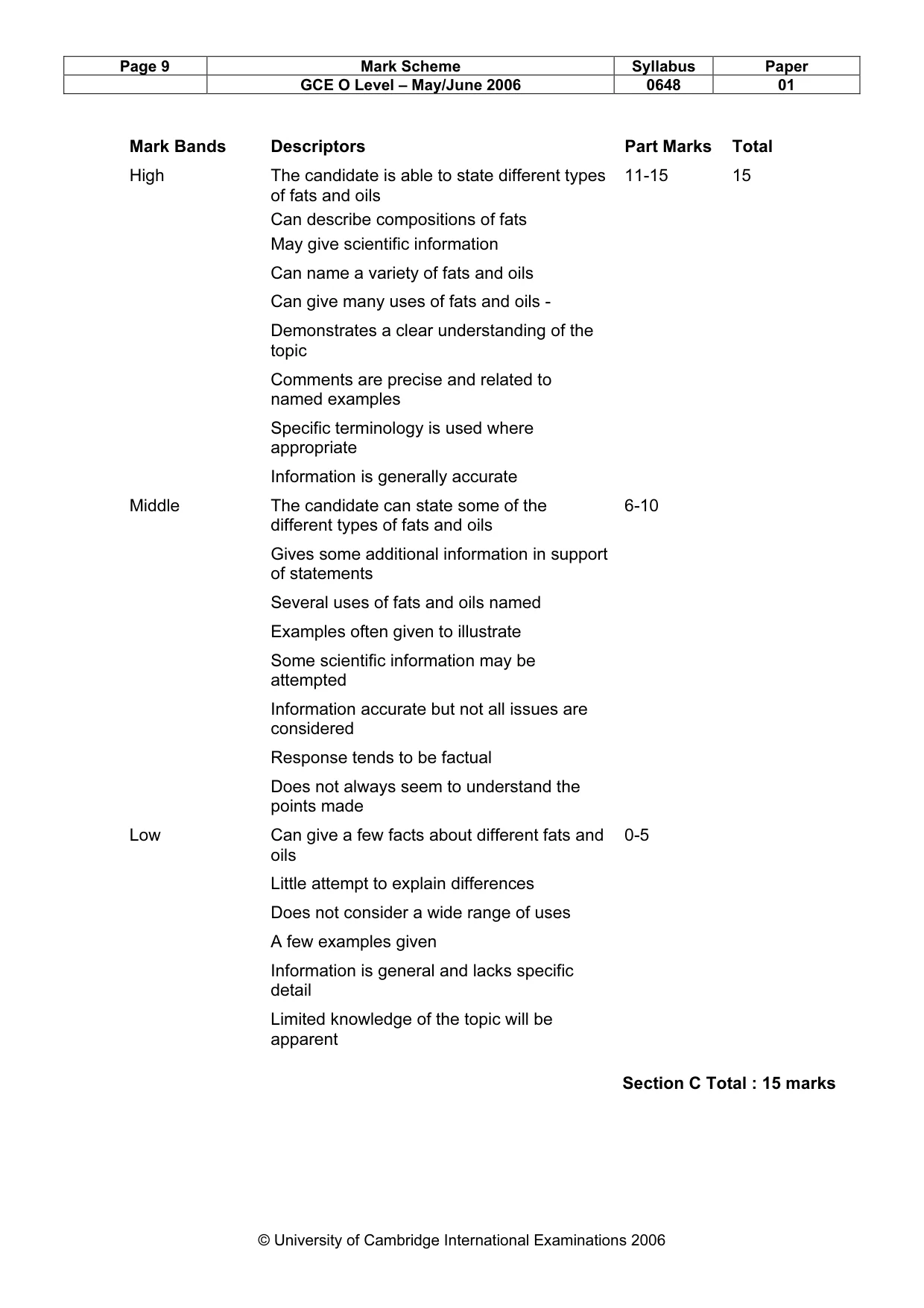
Page 9 Mark Scheme Syllabus Paper GCE O Level – May/June 2006 0648 01 © University of Cambridge International Examinations 2006 Mark Bands Descriptors Part Marks Total High The candidate is able to state different types of fats and oils 11-15 15 Can describe compositions of fats May give scientific information Can name a variety of fats and oils Can give many uses of fats and oils - Demonstrates a clear understanding of the topic Comments are precise and related to named examples Specific terminology is used where appropriate Information is generally accurate Middle The candidate can state some of the different types of fats and oils 6-10 Gives some additional information in support of statements Several uses of fats and oils named Examples often given to illustrate Some scientific information may be attempted Information accurate but not all issues are considered Response tends to be factual Does not always seem to understand the points made Low Can give a few facts about different fats and oils 0-5 Little attempt to explain differences Does not consider a wide range of uses A few examples given Information is general and lacks specific detail Limited knowledge of the topic will be apparent Section C Total : 15 marks
What you needed in this session
Cambridge’s own grade thresholds for 2006 May/June, Paper 1 · Variant 1. A higher threshold means an easier paper — the bar moves with how the cohort did.