Cambridge IGCSE Food and Nutrition 0648 — 2005 Oct/Nov Paper 1 · Variant 1
0648/11/O/N/05
The question paper and its mark scheme, free to read here and free to download. This is Cambridge’s own paper, exactly as it was sat.
Question paper12 pages
Mark scheme11 pages
Answers below. Sit the paper first if you are practising.
Paper as text
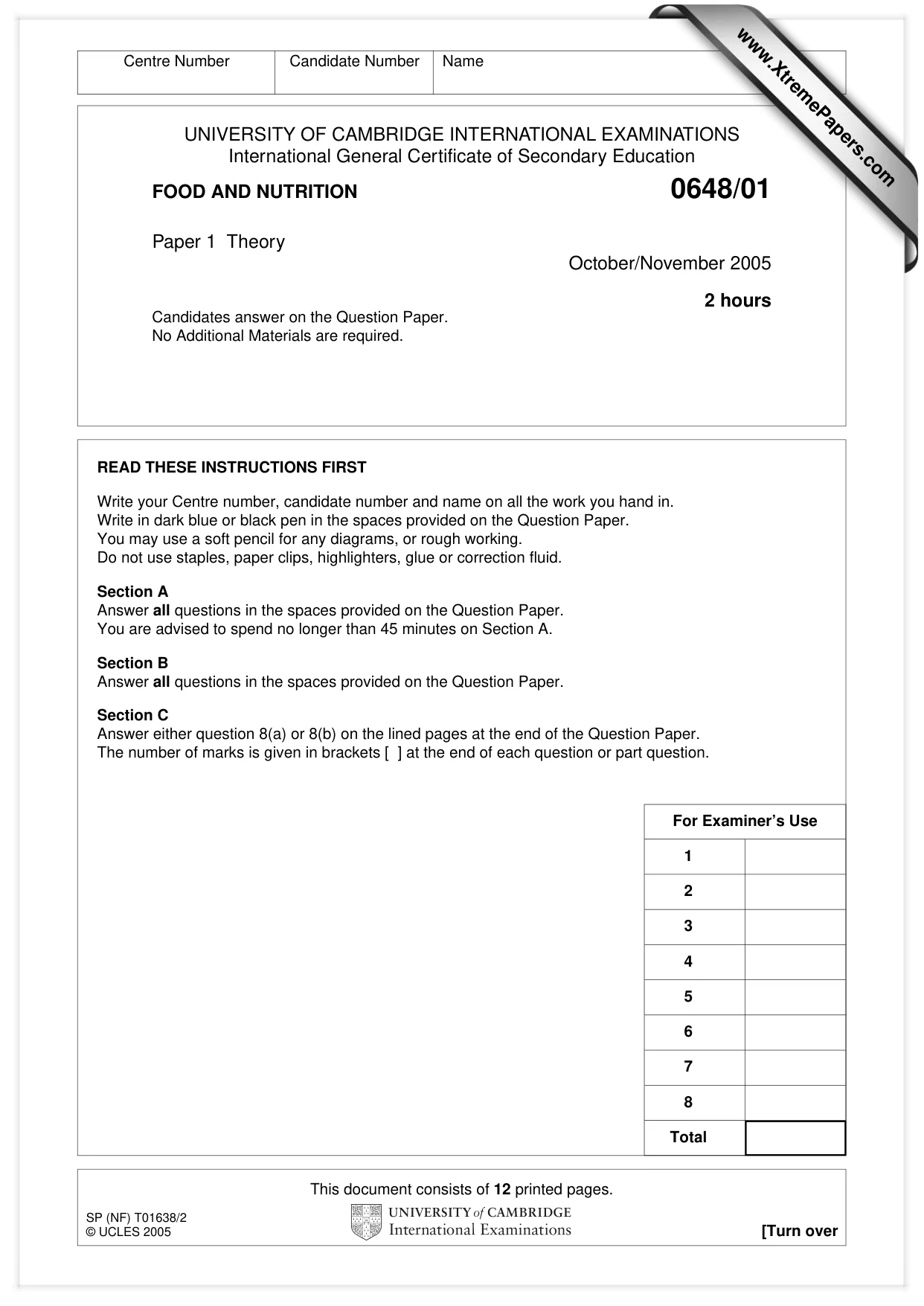
Question paper, page 1
This document consists of 12 printed pages. SP (NF) T01638/2 © UCLES 2005 [Turn over UNIVERSITY OF CAMBRIDGE INTERNATIONAL EXAMINATIONS International General Certificate of Secondary Education FOOD AND NUTRITION 0648/01 Paper 1 Theory October/November 2005 2 hours Candidates answer on the Question Paper. No Additional Materials are required. READ THESE INSTRUCTIONS FIRST Write your Centre number, candidate number and name on all the work you hand in. Write in dark blue or black pen in the spaces provided on the Question Paper. You may use a soft pencil for any diagrams, or rough working. Do not use staples, paper clips, highlighters, glue or correction fluid. Section A Answer all questions in the spaces provided on the Question Paper. You are advised to spend no longer than 45 minutes on Section A. Section B Answer all questions in the spaces provided on the Question Paper. Section C Answer either question 8(a) or 8(b) on the lined pages at the end of the Question Paper. The number of marks is given in brackets [ ] at the end of each question or part question. Centre Number Candidate Number Name For Examiner’s Use 1 2 3 4 5 6 7 8 Total www.XtremePapers.com
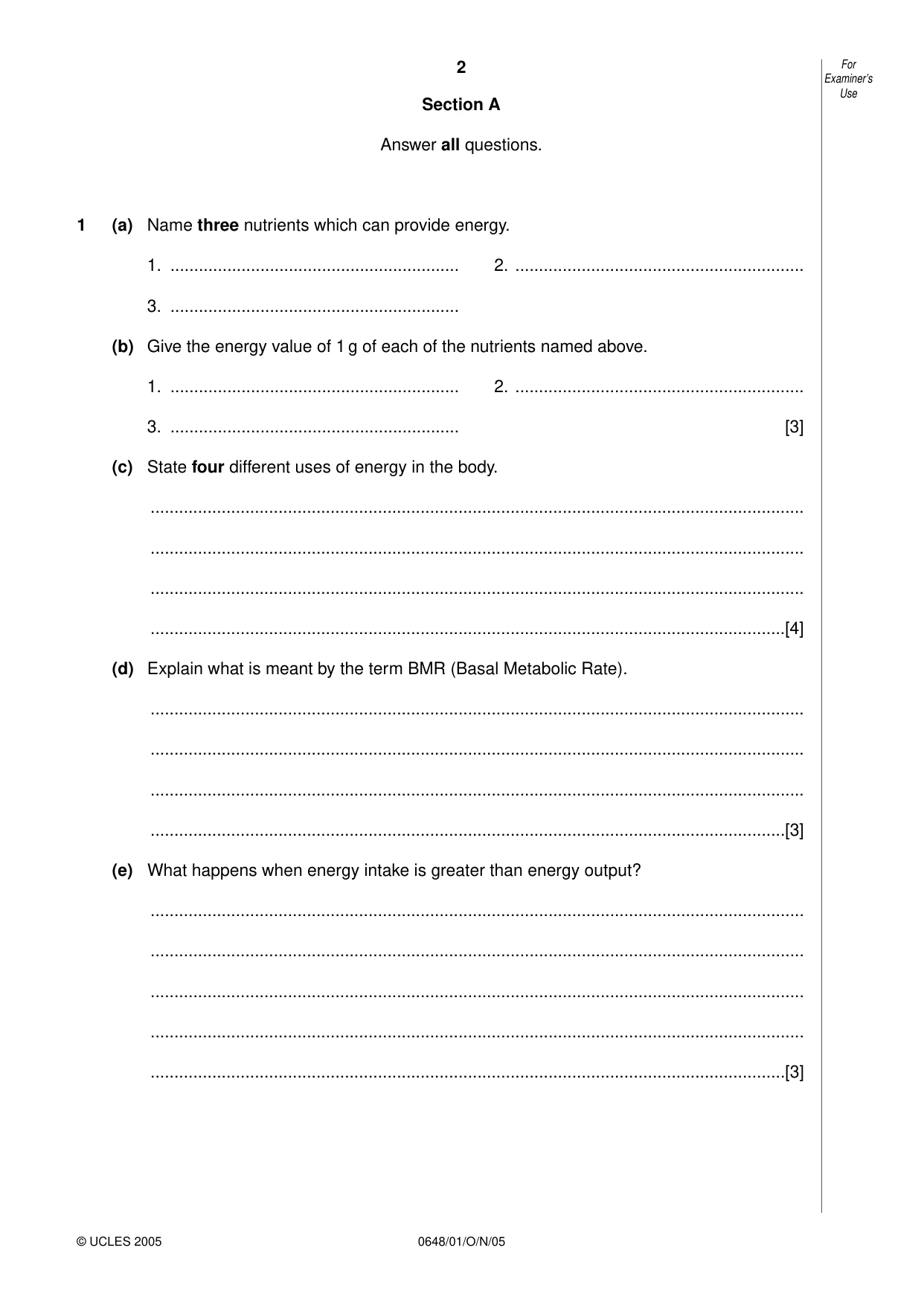
Question paper, page 2
2 0648/01/O/N/05 Section A Answer all questions. 1 (a) Name three nutrients which can provide energy. 1. … 2. … 3. … (b) Give the energy value of 1 g of each of the nutrients named above. 1. … 2. … 3. … [3] (c) State four different uses of energy in the body. … … … …[4] (d) Explain what is meant by the term BMR (Basal Metabolic Rate). … … … …[3] (e) What happens when energy intake is greater than energy output? … … … … …[3] For Examiner’s Use © UCLES 2005
Question paper, page 3
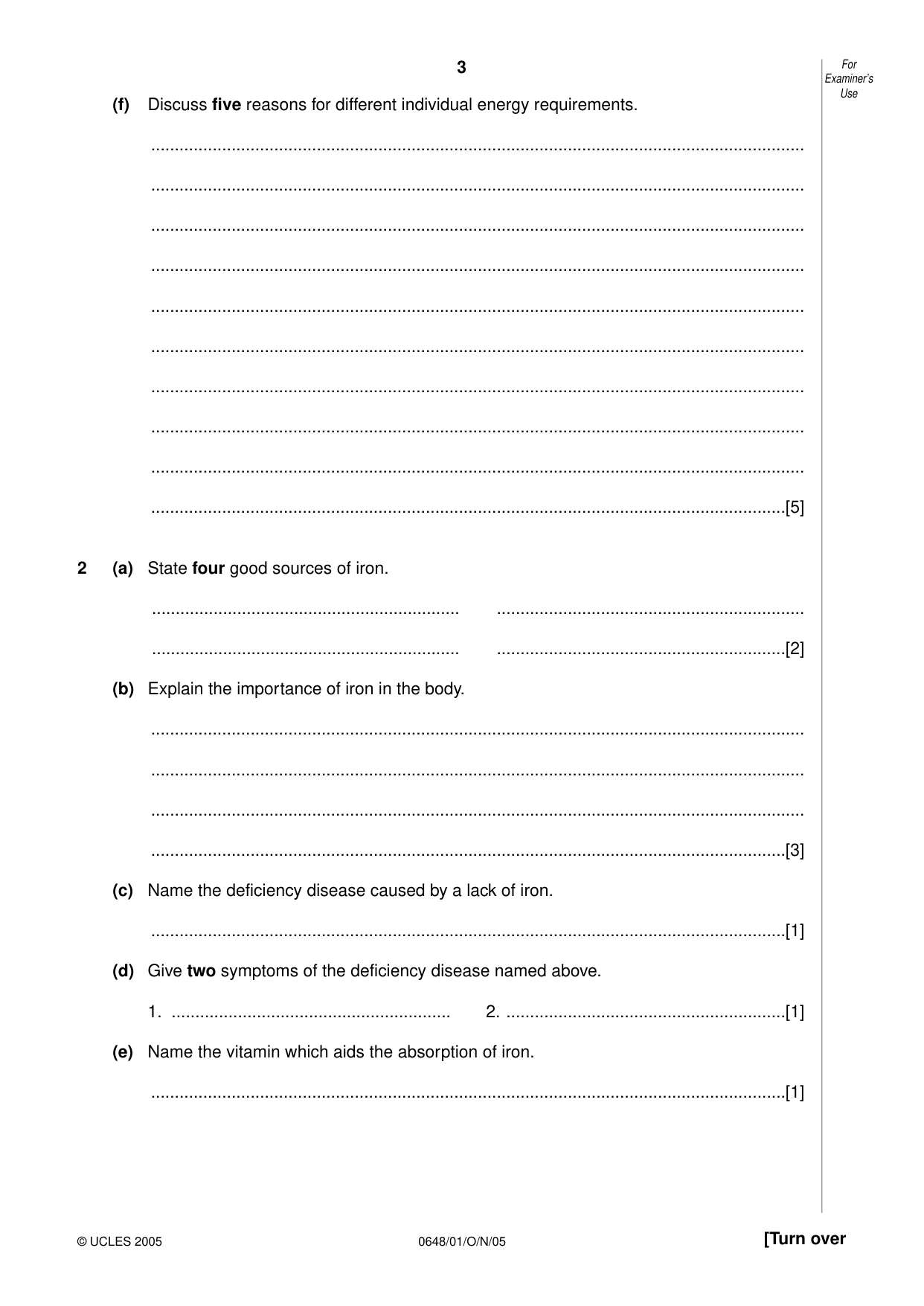
3 0648/01/O/N/05 [Turn over (f) Discuss five reasons for different individual energy requirements. … … … … … … … … … …[5] 2 (a) State four good sources of iron. … … … …[2] (b) Explain the importance of iron in the body. … … … …[3] (c) Name the deficiency disease caused by a lack of iron. …[1] (d) Give two symptoms of the deficiency disease named above. 1. … 2. …[1] (e) Name the vitamin which aids the absorption of iron. …[1] For Examiner’s Use © UCLES 2005
Question paper, page 4
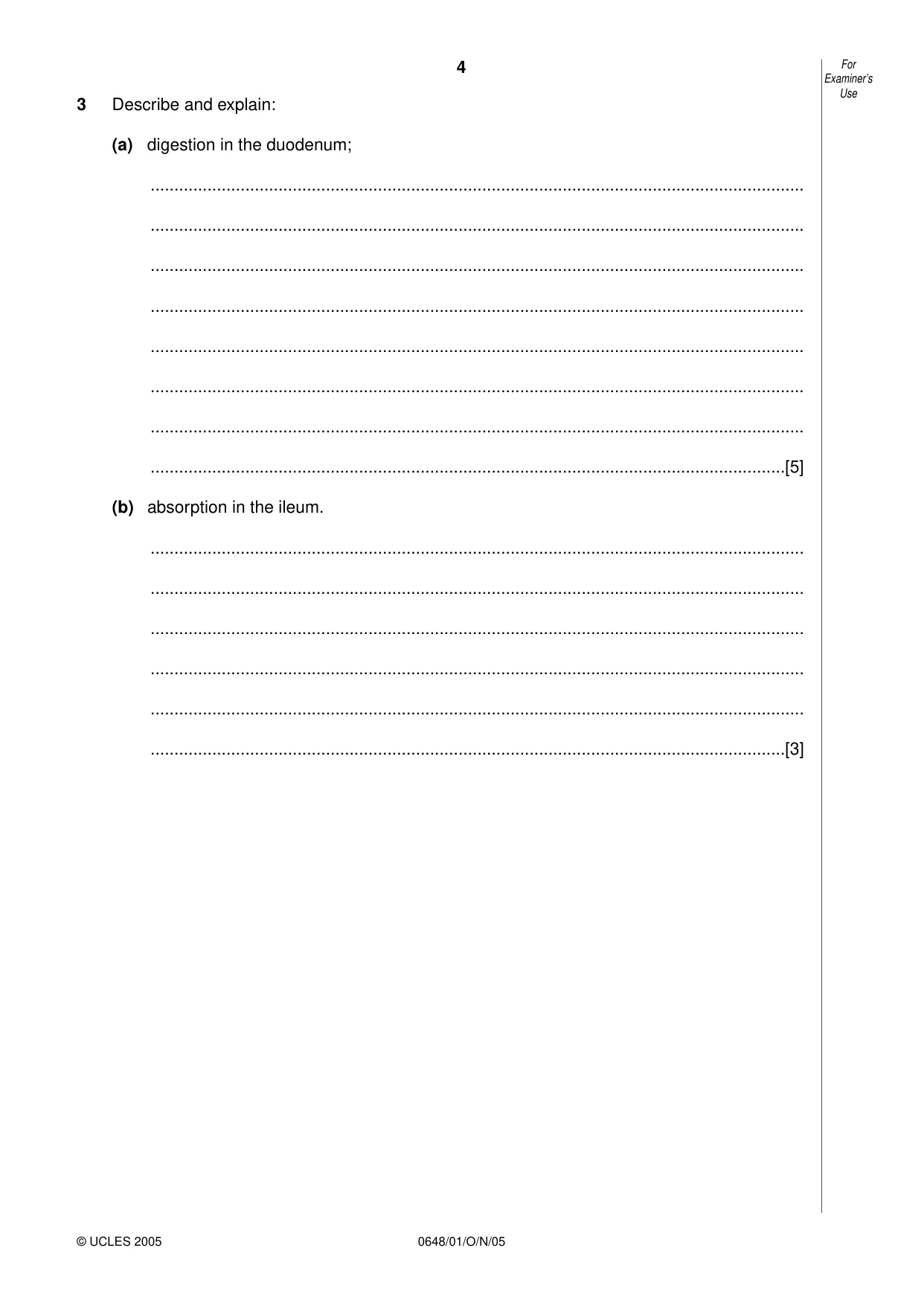
4 0648/01/O/N/05 3 Describe and explain: (a) digestion in the duodenum; … … … … … … … …[5] (b) absorption in the ileum. … … … … … …[3] For Examiner’s Use © UCLES 2005
Question paper, page 5
5 0648/01/O/N/05 [Turn over 4 Current dietary advice is to include fresh fruit and vegetables in the diet each day. (a) Give six reasons for their importance. … … … … … …[3] (b) Suggest how children can be encouraged to eat fresh fruit and vegetables. Give reasons for your suggestions. … … … … … …[3] [Section A Total: 40] For Examiner’s Use © UCLES 2005
Question paper, page 6
6 0648/01/O/N/05 Section B Answer all questions. 5 (a) State four reasons for the importance of cereals in many parts of the world. … … … …[2] (b) Name four cereals. 1. … 2. … 3. … 4. …[2] (c) The following ingredients can be used to make shortcrust pastry. 200 g plain flour 100 g fat 50 ml cold water Describe, with reasons, the method of making shortcrust pastry. … … … … … … … … … …[5] (d) Give the oven temperature for baking shortcrust pastry. …[1] For Examiner’s Use © UCLES 2005
Question paper, page 7
7 0648/01/O/N/05 [Turn over (e) State and explain the changes which take place when the pastry is being baked. … … … … … …[5] 6 Write an informative paragraph on each of the following: (a) soya; … … … … … … … … … … … …[5] For Examiner’s Use © UCLES 2005
Question paper, page 8
8 0648/01/O/N/05 (b) the use of yeast as a raising agent; … … … … … … … … … … … …[5] (c) different uses of sugar. … … … … … … … … … … … …[5] For Examiner’s Use © UCLES 2005
Question paper, page 9
9 0648/01/O/N/05 [Turn over 7 Bacteria can make food unsafe to eat. (a) Name two types of bacteria which cause food poisoning. … …[1] (b) State the effect of the following temperatures on bacteria: (i) –18 °C … (ii) 4 °C … (iii) 37 °C … (iv) 70 °C …[2] (c) Discuss the safe storage, preparation, cooking and serving of meat. … … … … … … … … … …[6] For Examiner’s Use © UCLES 2005
Question paper, page 10
10 0648/01/O/N/05 (d) Discuss ways in which enzymes can bring about changes in foods. … … … … … … … … … …[6] [Section B Total: 45] For Examiner’s Use © UCLES 2005
Question paper, page 11
11 0648/01/O/N/05 Section C Answer either 8(a) or 8(b) 8 (a) Discuss the points to consider when planning meals. Explain the particular nutritional needs of teenagers and suggest how their needs can be met when planning their meals. or (b) Discuss advantages and disadvantages of using convenience foods. Suggest ways in which convenience foods can be used in family meals. … … … … … … … … … … … … … … … … … … … … For Examiner’s Use © UCLES 2005
Question paper, page 12
12 0648/01/O/N/05 … … … … … … … … … … … … … … … … … … … … … … … … [Section C Total: 15] [Total for Paper: 100] For Examiner’s Use © UCLES 2005 Permission to reproduce items where third-party owned material protected by copyright is included has been sought and cleared where possible. Every reasonable effort has been made by the publisher (UCLES) to trace copyright holders, but if any items requiring clearance have unwittingly been included, the publisher will be pleased to make amends at the earliest possible opportunity. University of Cambridge International Examinations is part of the University of Cambridge Local Examinations Syndicate (UCLES), which is itself a department of the University of Cambridge.
Mark scheme, page 1
UNIVERSITY OF CAMBRIDGE INTERNATIONAL EXAMINATIONS International General Certificate of Secondary Education MARK SCHEME for the November 2005 question paper 0648 FOOD AND NUTRITION 0648/01 Paper 1 maximum raw mark 100 This mark scheme is published as an aid to teachers and students, to indicate the requirements of the examination. It shows the basis on which Examiners were initially instructed to award marks. It does not indicate the details of the discussions that took place at an Examiners’ meeting before marking began. Any substantial changes to the mark scheme that arose from these discussions will be recorded in the published Report on the Examination. All Examiners are instructed that alternative correct answers and unexpected approaches in candidates’ scripts must be given marks that fairly reflect the relevant knowledge and skills demonstrated. Mark schemes must be read in conjunction with the question papers and the Report on the Examination. The minimum marks in these components needed for various grades were previously published with these mark schemes, but are now instead included in the Report on the Examination for this session. • CIE will not enter into discussion or correspondence in connection with these mark schemes. CIE is publishing the mark schemes for the November 2005 question papers for most IGCSE and GCE Advanced Level and Advanced Subsidiary Level syllabuses and some Ordinary Level syllabuses. www.XtremePapers.com
Mark scheme, page 2
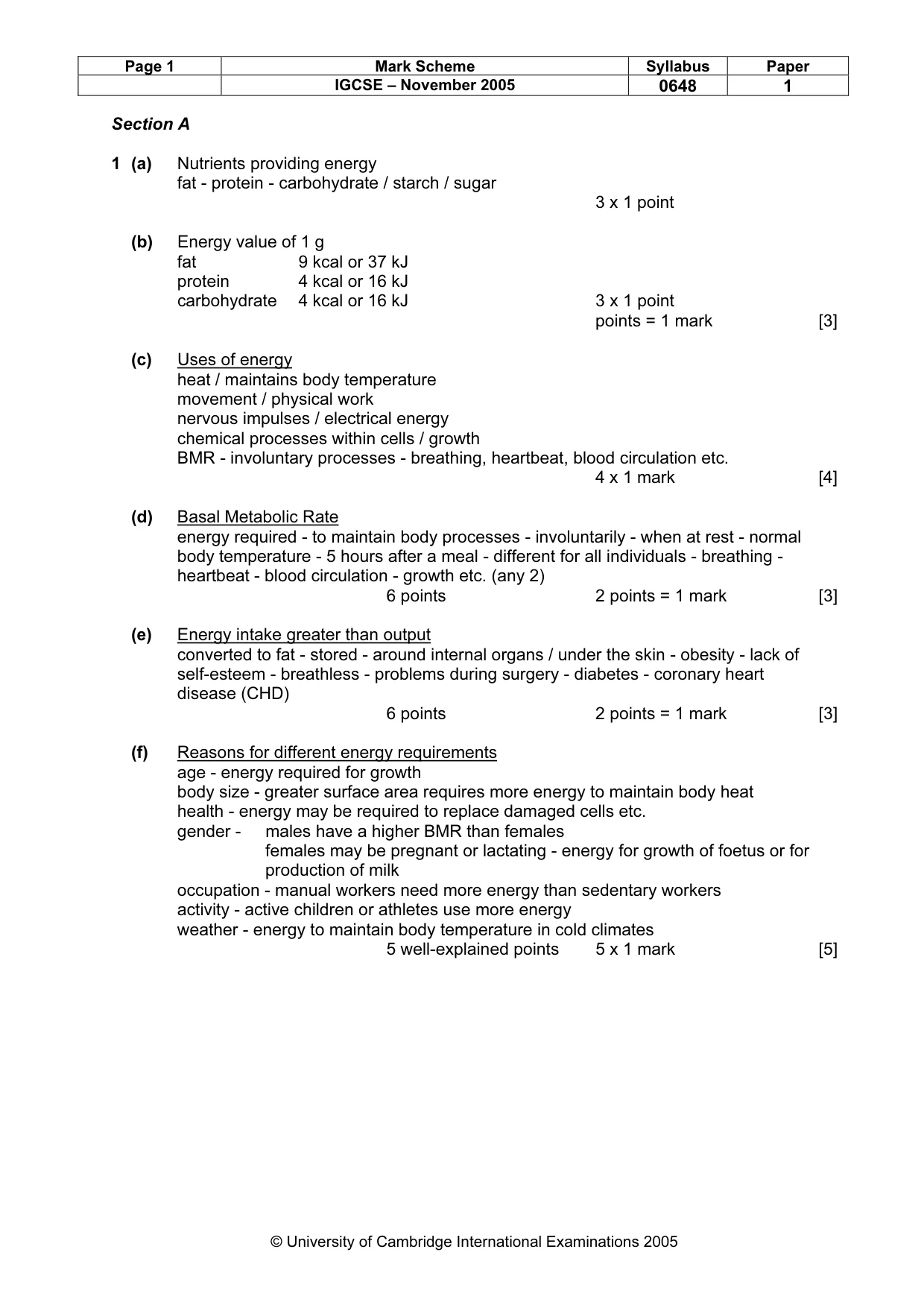
Page 1 Mark Scheme Syllabus Paper IGCSE – November 2005 0648 1 © University of Cambridge International Examinations 2005 Section A 1 (a) Nutrients providing energy fat - protein - carbohydrate / starch / sugar 3 x 1 point (b) Energy value of 1 g fat 9 kcal or 37 kJ protein 4 kcal or 16 kJ carbohydrate 4 kcal or 16 kJ 3 x 1 point points = 1 mark [3] (c) Uses of energy heat / maintains body temperature movement / physical work nervous impulses / electrical energy chemical processes within cells / growth BMR - involuntary processes - breathing, heartbeat, blood circulation etc. 4 x 1 mark [4] (d) Basal Metabolic Rate energy required - to maintain body processes - involuntarily - when at rest - normal body temperature - 5 hours after a meal - different for all individuals - breathing - heartbeat - blood circulation - growth etc. (any 2) 6 points 2 points = 1 mark [3] (e) Energy intake greater than output converted to fat - stored - around internal organs / under the skin - obesity - lack of self-esteem - breathless - problems during surgery - diabetes - coronary heart disease (CHD) 6 points 2 points = 1 mark [3] (f) Reasons for different energy requirements age - energy required for growth body size - greater surface area requires more energy to maintain body heat health - energy may be required to replace damaged cells etc. gender - males have a higher BMR than females females may be pregnant or lactating - energy for growth of foetus or for production of milk occupation - manual workers need more energy than sedentary workers activity - active children or athletes use more energy weather - energy to maintain body temperature in cold climates 5 well-explained points 5 x 1 mark [5]
Mark scheme, page 3
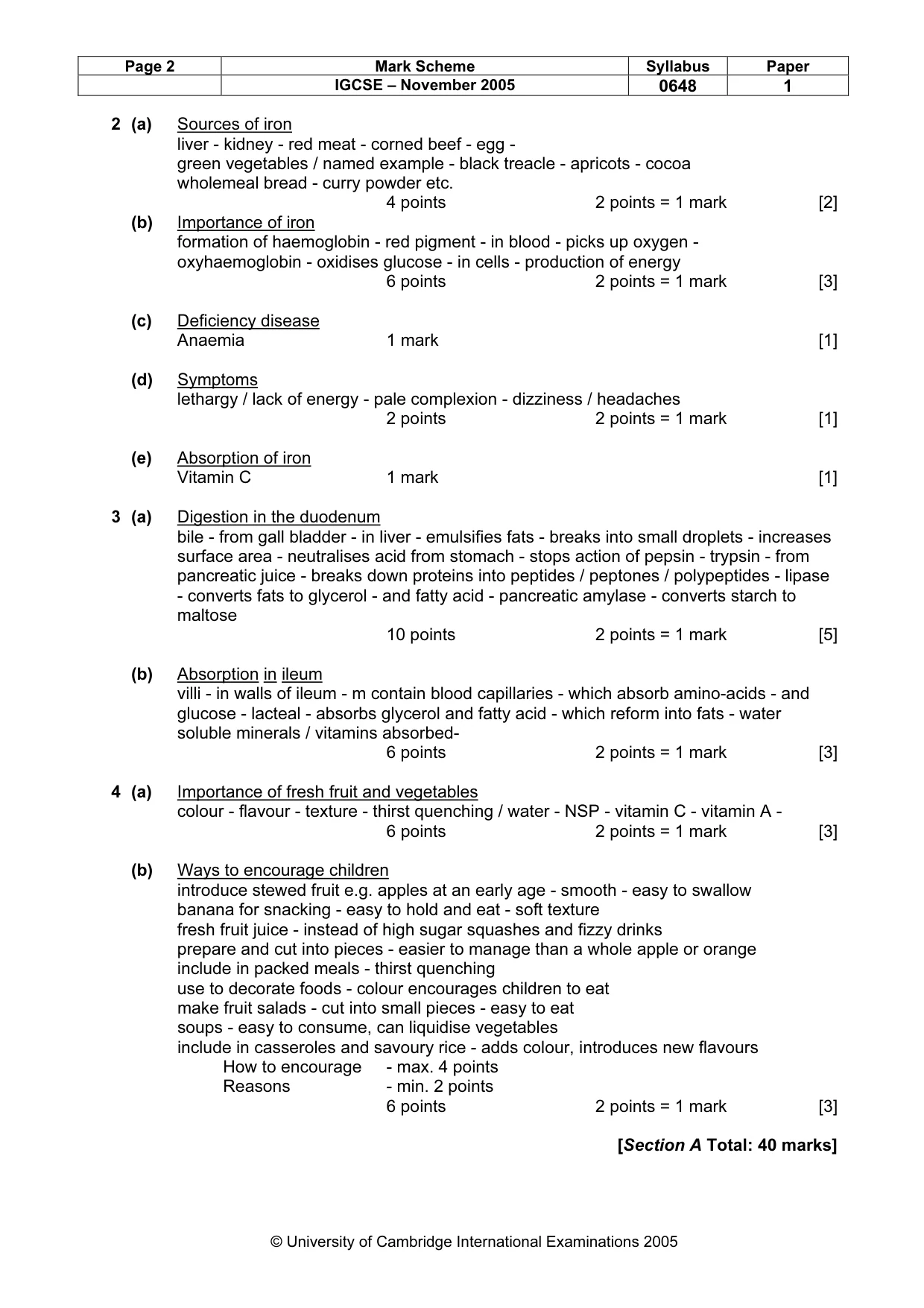
Page 2 Mark Scheme Syllabus Paper IGCSE – November 2005 0648 1 © University of Cambridge International Examinations 2005 2 (a) Sources of iron liver - kidney - red meat - corned beef - egg - green vegetables / named example - black treacle - apricots - cocoa wholemeal bread - curry powder etc. 4 points 2 points = 1 mark [2] (b) Importance of iron formation of haemoglobin - red pigment - in blood - picks up oxygen - oxyhaemoglobin - oxidises glucose - in cells - production of energy 6 points 2 points = 1 mark [3] (c) Deficiency disease Anaemia 1 mark [1] (d) Symptoms lethargy / lack of energy - pale complexion - dizziness / headaches 2 points 2 points = 1 mark [1] (e) Absorption of iron Vitamin C 1 mark [1] 3 (a) Digestion in the duodenum bile - from gall bladder - in liver - emulsifies fats - breaks into small droplets - increases surface area - neutralises acid from stomach - stops action of pepsin - trypsin - from pancreatic juice - breaks down proteins into peptides / peptones / polypeptides - lipase - converts fats to glycerol - and fatty acid - pancreatic amylase - converts starch to maltose 10 points 2 points = 1 mark [5] (b) Absorption in ileum villi - in walls of ileum - m contain blood capillaries - which absorb amino-acids - and glucose - lacteal - absorbs glycerol and fatty acid - which reform into fats - water soluble minerals / vitamins absorbed- 6 points 2 points = 1 mark [3] 4 (a) Importance of fresh fruit and vegetables colour - flavour - texture - thirst quenching / water - NSP - vitamin C - vitamin A - 6 points 2 points = 1 mark [3] (b) Ways to encourage children introduce stewed fruit e.g. apples at an early age - smooth - easy to swallow banana for snacking - easy to hold and eat - soft texture fresh fruit juice - instead of high sugar squashes and fizzy drinks prepare and cut into pieces - easier to manage than a whole apple or orange include in packed meals - thirst quenching use to decorate foods - colour encourages children to eat make fruit salads - cut into small pieces - easy to eat soups - easy to consume, can liquidise vegetables include in casseroles and savoury rice - adds colour, introduces new flavours How to encourage - max. 4 points Reasons - min. 2 points 6 points 2 points = 1 mark [3] [Section A Total: 40 marks]
Mark scheme, page 4
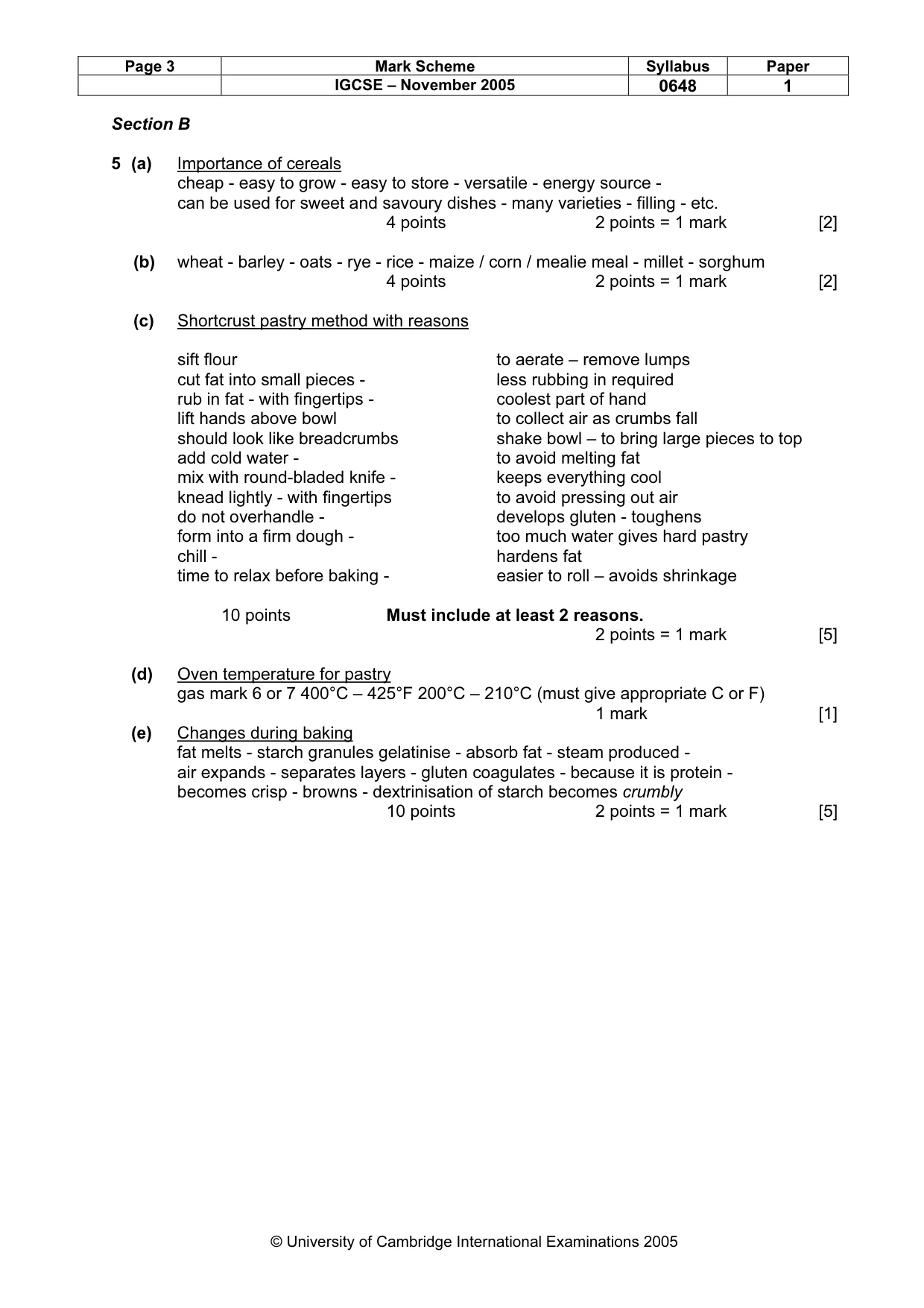
Page 3 Mark Scheme Syllabus Paper IGCSE – November 2005 0648 1 © University of Cambridge International Examinations 2005 Section B 5 (a) Importance of cereals cheap - easy to grow - easy to store - versatile - energy source - can be used for sweet and savoury dishes - many varieties - filling - etc. 4 points 2 points = 1 mark [2] (b) wheat - barley - oats - rye - rice - maize / corn / mealie meal - millet - sorghum 4 points 2 points = 1 mark [2] (c) Shortcrust pastry method with reasons sift flour to aerate – remove lumps cut fat into small pieces - less rubbing in required rub in fat - with fingertips - coolest part of hand lift hands above bowl to collect air as crumbs fall should look like breadcrumbs shake bowl – to bring large pieces to top add cold water - to avoid melting fat mix with round-bladed knife - keeps everything cool knead lightly - with fingertips to avoid pressing out air do not overhandle - develops gluten - toughens form into a firm dough - too much water gives hard pastry chill - hardens fat time to relax before baking - easier to roll – avoids shrinkage 10 points Must include at least 2 reasons. 2 points = 1 mark [5] (d) Oven temperature for pastry gas mark 6 or 7 400°C – 425°F 200°C – 210°C (must give appropriate C or F) 1 mark [1] (e) Changes during baking fat melts - starch granules gelatinise - absorb fat - steam produced - air expands - separates layers - gluten coagulates - because it is protein - becomes crisp - browns - dextrinisation of starch becomes crumbly 10 points 2 points = 1 mark [5]
Mark scheme, page 5
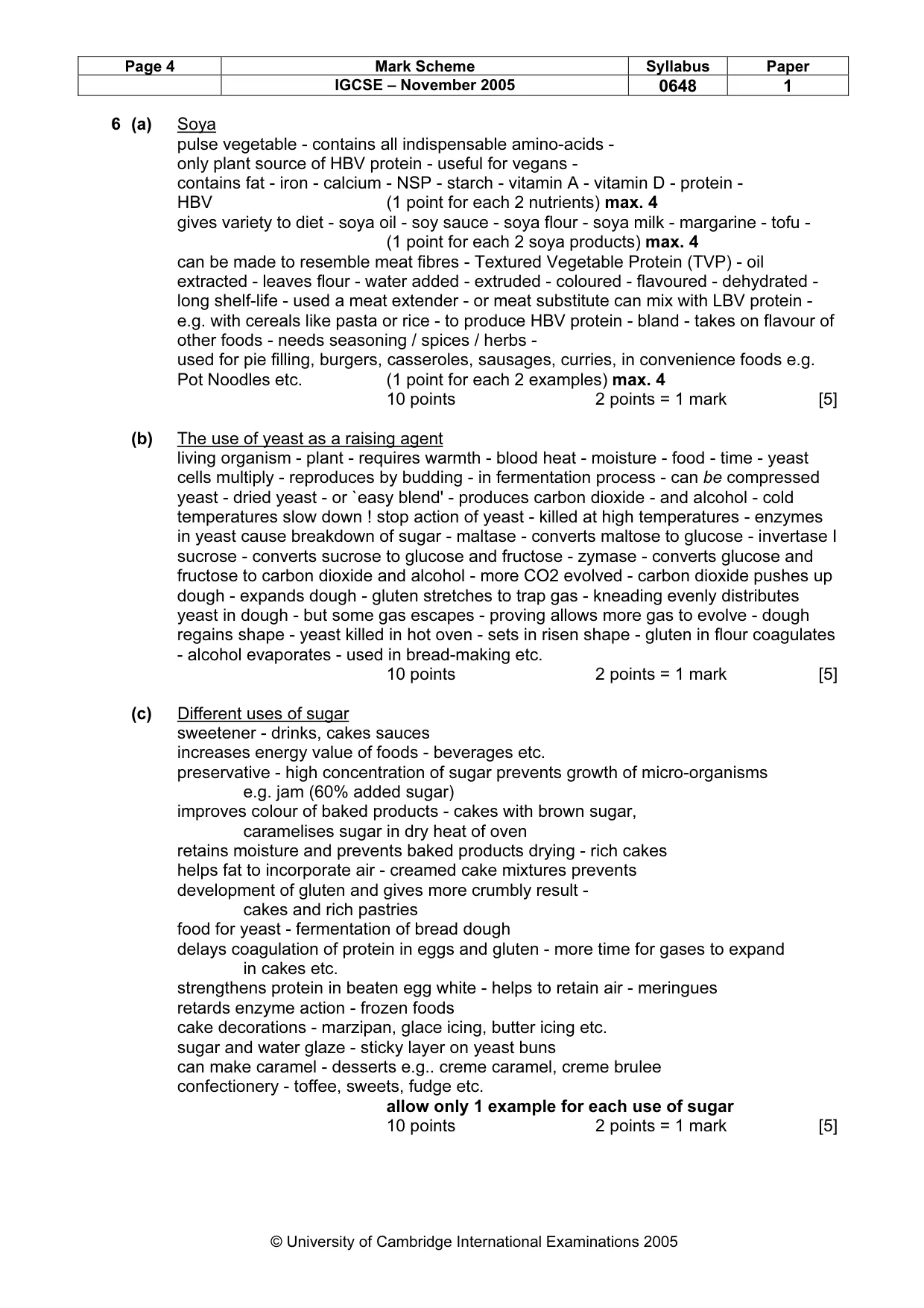
Page 4 Mark Scheme Syllabus Paper IGCSE – November 2005 0648 1 © University of Cambridge International Examinations 2005 6 (a) Soya pulse vegetable - contains all indispensable amino-acids - only plant source of HBV protein - useful for vegans - contains fat - iron - calcium - NSP - starch - vitamin A - vitamin D - protein - HBV (1 point for each 2 nutrients) max. 4 gives variety to diet - soya oil - soy sauce - soya flour - soya milk - margarine - tofu - (1 point for each 2 soya products) max. 4 can be made to resemble meat fibres - Textured Vegetable Protein (TVP) - oil extracted - leaves flour - water added - extruded - coloured - flavoured - dehydrated - long shelf-life - used a meat extender - or meat substitute can mix with LBV protein - e.g. with cereals like pasta or rice - to produce HBV protein - bland - takes on flavour of other foods - needs seasoning / spices / herbs - used for pie filling, burgers, casseroles, sausages, curries, in convenience foods e.g. Pot Noodles etc. (1 point for each 2 examples) max. 4 10 points 2 points = 1 mark [5] (b) The use of yeast as a raising agent living organism - plant - requires warmth - blood heat - moisture - food - time - yeast cells multiply - reproduces by budding - in fermentation process - can be compressed yeast - dried yeast - or `easy blend' - produces carbon dioxide - and alcohol - cold temperatures slow down ! stop action of yeast - killed at high temperatures - enzymes in yeast cause breakdown of sugar - maltase - converts maltose to glucose - invertase I sucrose - converts sucrose to glucose and fructose - zymase - converts glucose and fructose to carbon dioxide and alcohol - more CO2 evolved - carbon dioxide pushes up dough - expands dough - gluten stretches to trap gas - kneading evenly distributes yeast in dough - but some gas escapes - proving allows more gas to evolve - dough regains shape - yeast killed in hot oven - sets in risen shape - gluten in flour coagulates - alcohol evaporates - used in bread-making etc. 10 points 2 points = 1 mark [5] (c) Different uses of sugar sweetener - drinks, cakes sauces increases energy value of foods - beverages etc. preservative - high concentration of sugar prevents growth of micro-organisms e.g. jam (60% added sugar) improves colour of baked products - cakes with brown sugar, caramelises sugar in dry heat of oven retains moisture and prevents baked products drying - rich cakes helps fat to incorporate air - creamed cake mixtures prevents development of gluten and gives more crumbly result - cakes and rich pastries food for yeast - fermentation of bread dough delays coagulation of protein in eggs and gluten - more time for gases to expand in cakes etc. strengthens protein in beaten egg white - helps to retain air - meringues retards enzyme action - frozen foods cake decorations - marzipan, glace icing, butter icing etc. sugar and water glaze - sticky layer on yeast buns can make caramel - desserts e.g.. creme caramel, creme brulee confectionery - toffee, sweets, fudge etc. allow only 1 example for each use of sugar 10 points 2 points = 1 mark [5]
Mark scheme, page 6
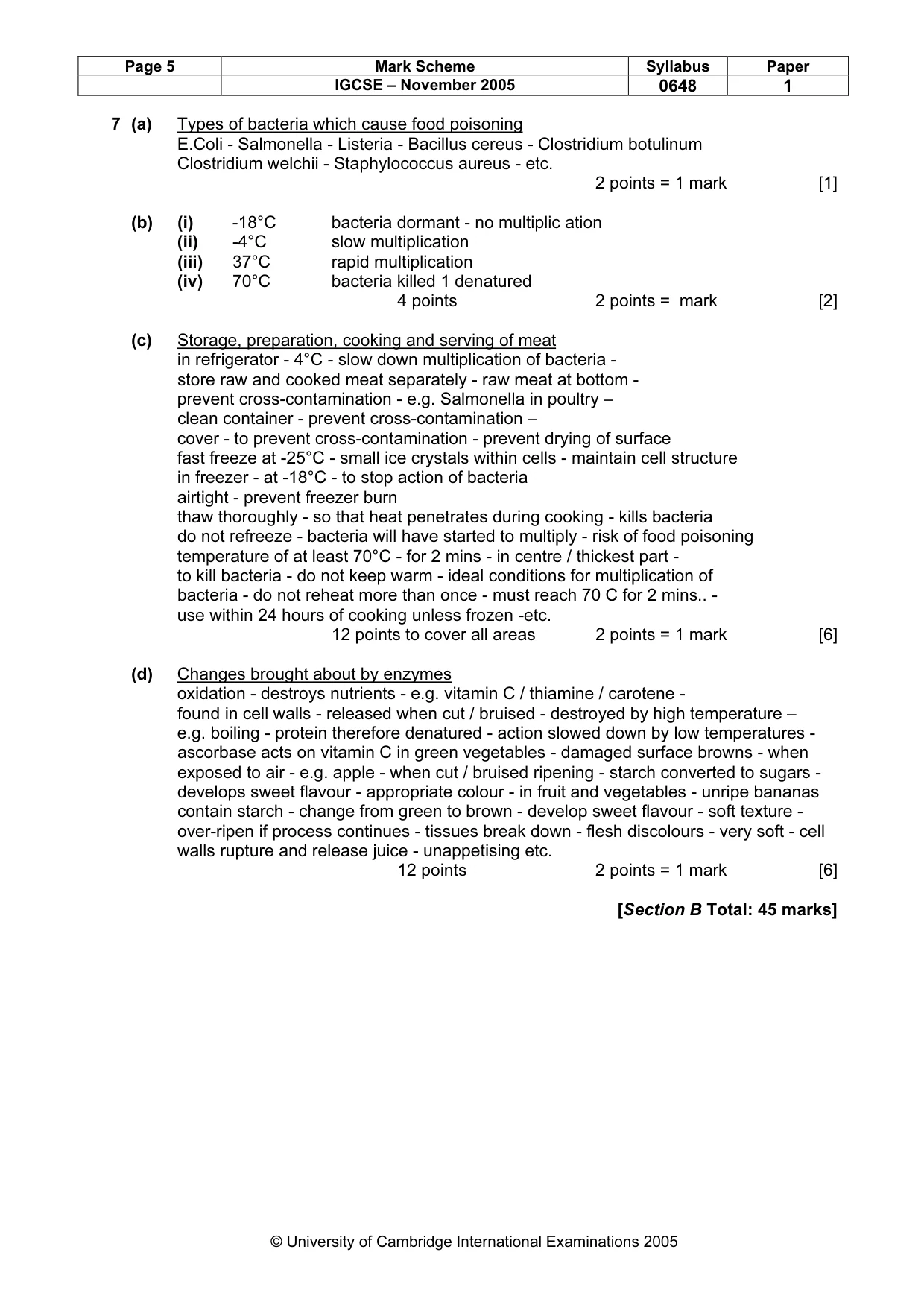
Page 5 Mark Scheme Syllabus Paper IGCSE – November 2005 0648 1 © University of Cambridge International Examinations 2005 7 (a) Types of bacteria which cause food poisoning E.Coli - Salmonella - Listeria - Bacillus cereus - Clostridium botulinum Clostridium welchii - Staphylococcus aureus - etc. 2 points = 1 mark [1] (b) (i) -18°C bacteria dormant - no multiplic ation (ii) -4°C slow multiplication (iii) 37°C rapid multiplication (iv) 70°C bacteria killed 1 denatured 4 points 2 points = mark [2] (c) Storage, preparation, cooking and serving of meat in refrigerator - 4°C - slow down multiplication of bacteria - store raw and cooked meat separately - raw meat at bottom - prevent cross-contamination - e.g. Salmonella in poultry – clean container - prevent cross-contamination – cover - to prevent cross-contamination - prevent drying of surface fast freeze at -25°C - small ice crystals within cells - maintain cell structure in freezer - at -18°C - to stop action of bacteria airtight - prevent freezer burn thaw thoroughly - so that heat penetrates during cooking - kills bacteria do not refreeze - bacteria will have started to multiply - risk of food poisoning temperature of at least 70°C - for 2 mins - in centre / thickest part - to kill bacteria - do not keep warm - ideal conditions for multiplication of bacteria - do not reheat more than once - must reach 70 C for 2 mins.. - use within 24 hours of cooking unless frozen -etc. 12 points to cover all areas 2 points = 1 mark [6] (d) Changes brought about by enzymes oxidation - destroys nutrients - e.g. vitamin C / thiamine / carotene - found in cell walls - released when cut / bruised - destroyed by high temperature – e.g. boiling - protein therefore denatured - action slowed down by low temperatures - ascorbase acts on vitamin C in green vegetables - damaged surface browns - when exposed to air - e.g. apple - when cut / bruised ripening - starch converted to sugars - develops sweet flavour - appropriate colour - in fruit and vegetables - unripe bananas contain starch - change from green to brown - develop sweet flavour - soft texture - over-ripen if process continues - tissues break down - flesh discolours - very soft - cell walls rupture and release juice - unappetising etc. 12 points 2 points = 1 mark [6] [Section B Total: 45 marks]
Mark scheme, page 7
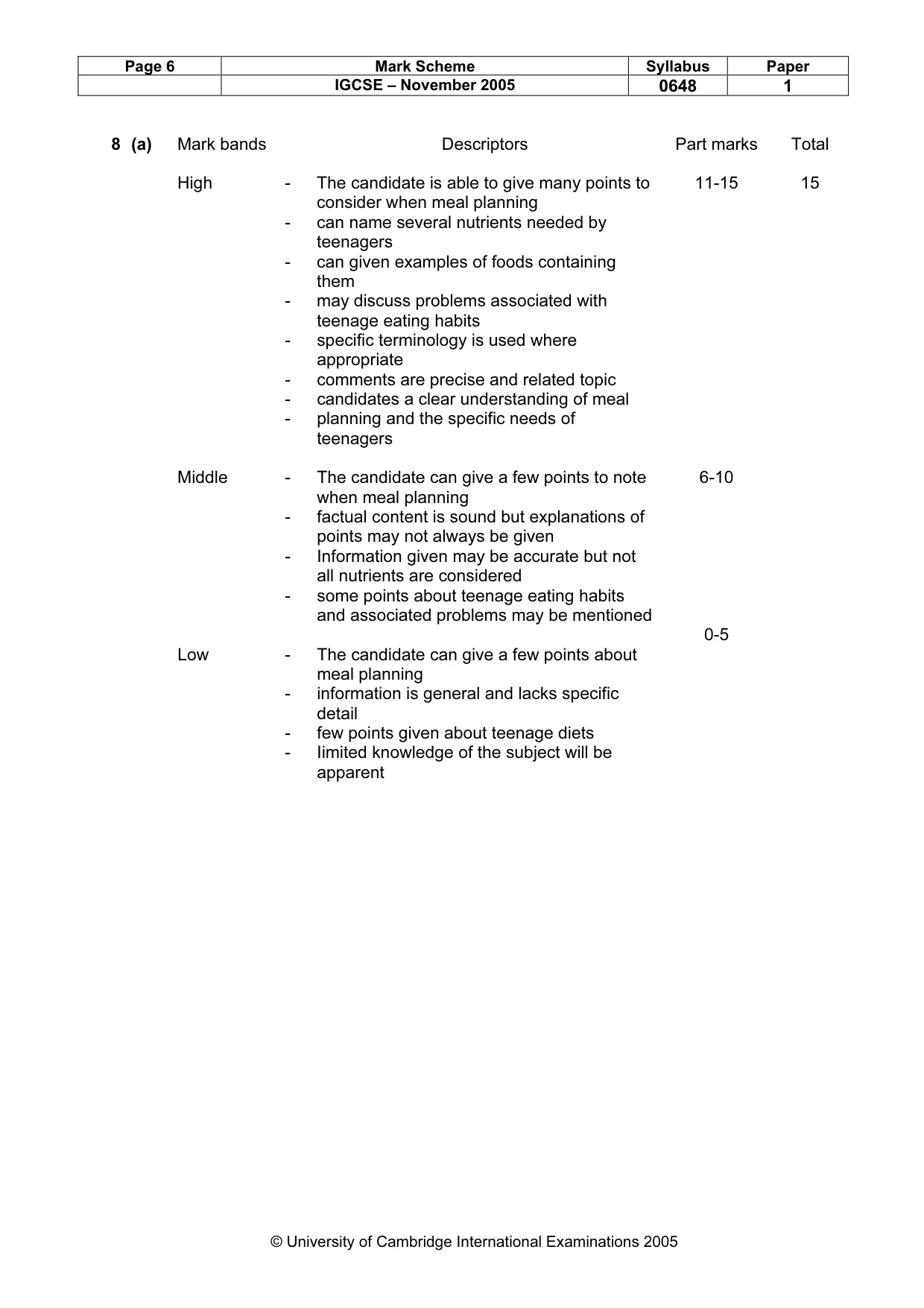
Page 6 Mark Scheme Syllabus Paper IGCSE – November 2005 0648 1 © University of Cambridge International Examinations 2005 8 (a) Mark bands Descriptors Part marks Total High - The candidate is able to give many points to consider when meal planning 11-15 15 - can name several nutrients needed by teenagers - can given examples of foods containing them - may discuss problems associated with teenage eating habits - specific terminology is used where appropriate - comments are precise and related topic - candidates a clear understanding of meal - planning and the specific needs of teenagers Middle - The candidate can give a few points to note when meal planning 6-10 - factual content is sound but explanations of points may not always be given - Information given may be accurate but not all nutrients are considered - some points about teenage eating habits and associated problems may be mentioned 0-5 Low - The candidate can give a few points about meal planning - information is general and lacks specific detail - few points given about teenage diets - Iimited knowledge of the subject will be apparent
Mark scheme, page 8
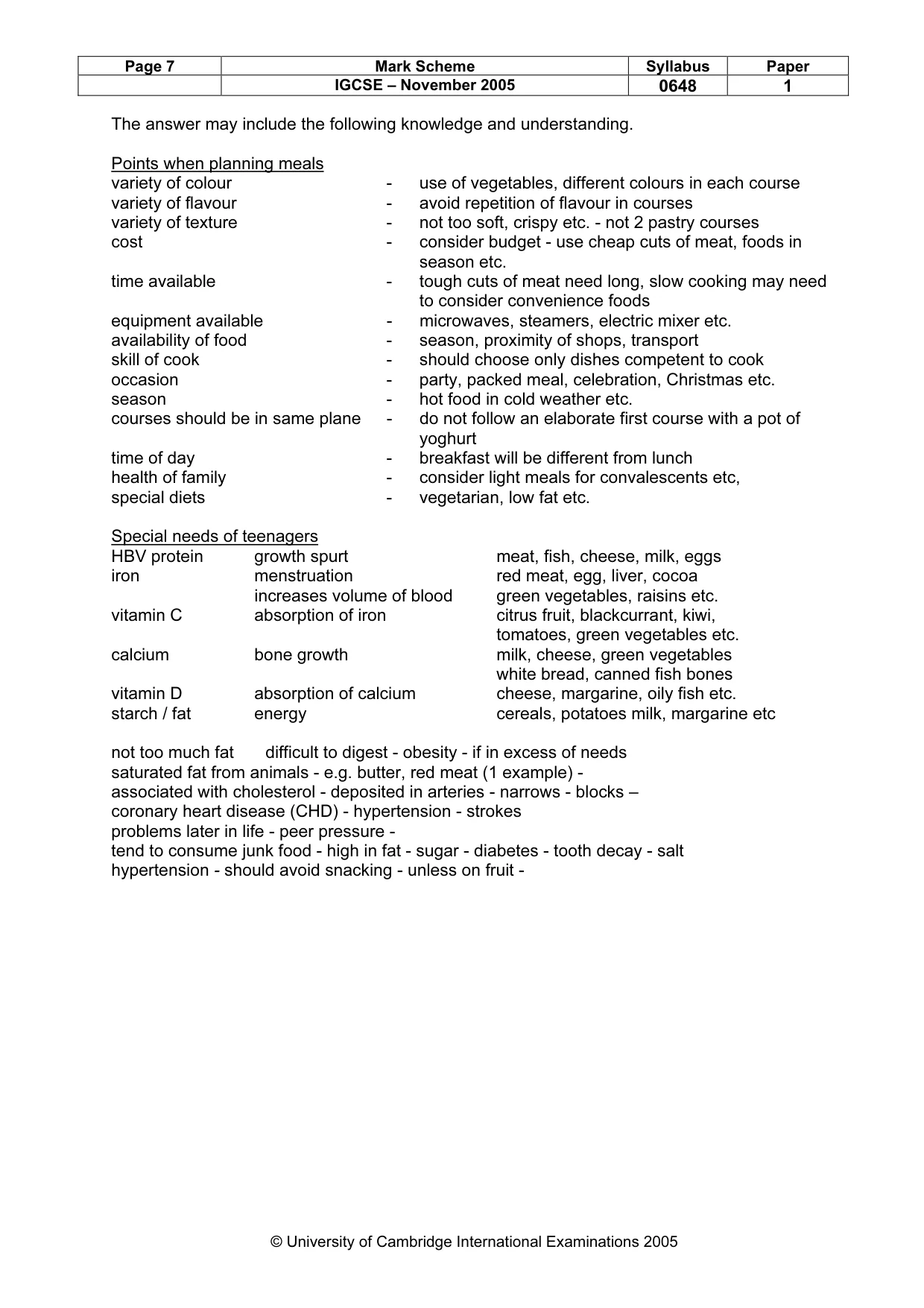
Page 7 Mark Scheme Syllabus Paper IGCSE – November 2005 0648 1 © University of Cambridge International Examinations 2005 The answer may include the following knowledge and understanding. Points when planning meals variety of colour - use of vegetables, different colours in each course variety of flavour - avoid repetition of flavour in courses variety of texture - not too soft, crispy etc. - not 2 pastry courses cost - consider budget - use cheap cuts of meat, foods in season etc. time available - tough cuts of meat need long, slow cooking may need to consider convenience foods equipment available - microwaves, steamers, electric mixer etc. availability of food - season, proximity of shops, transport skill of cook - should choose only dishes competent to cook occasion - party, packed meal, celebration, Christmas etc. season - hot food in cold weather etc. courses should be in same plane - do not follow an elaborate first course with a pot of yoghurt time of day - breakfast will be different from lunch health of family - consider light meals for convalescents etc, special diets - vegetarian, low fat etc. Special needs of teenagers HBV protein growth spurt meat, fish, cheese, milk, eggs iron menstruation red meat, egg, liver, cocoa increases volume of blood green vegetables, raisins etc. vitamin C absorption of iron citrus fruit, blackcurrant, kiwi, tomatoes, green vegetables etc. calcium bone growth milk, cheese, green vegetables white bread, canned fish bones vitamin D absorption of calcium cheese, margarine, oily fish etc. starch / fat energy cereals, potatoes milk, margarine etc not too much fat difficult to digest - obesity - if in excess of needs saturated fat from animals - e.g. butter, red meat (1 example) - associated with cholesterol - deposited in arteries - narrows - blocks – coronary heart disease (CHD) - hypertension - strokes problems later in life - peer pressure - tend to consume junk food - high in fat - sugar - diabetes - tooth decay - salt hypertension - should avoid snacking - unless on fruit -
Mark scheme, page 9
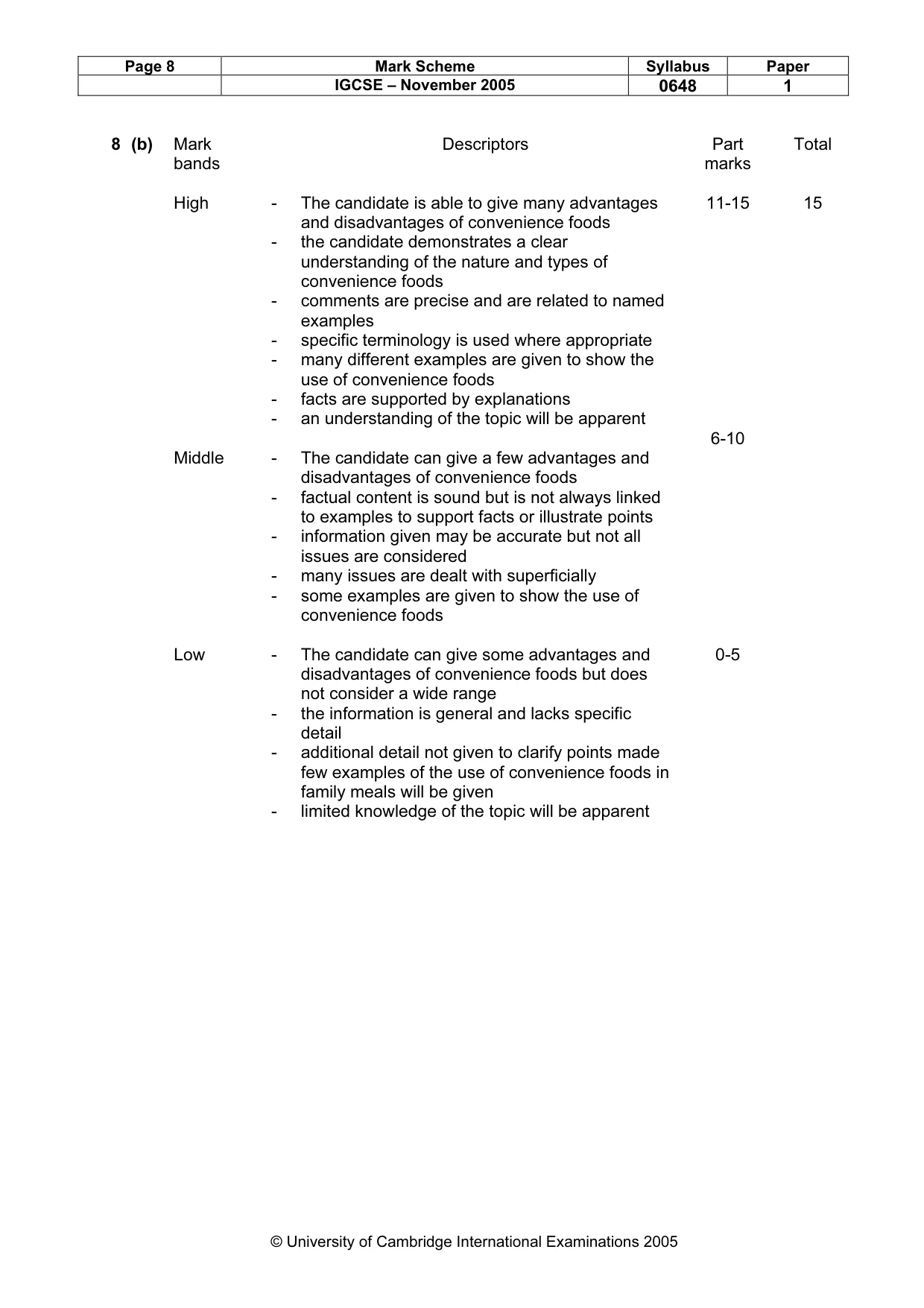
Page 8 Mark Scheme Syllabus Paper IGCSE – November 2005 0648 1 © University of Cambridge International Examinations 2005 8 (b) Mark bands Descriptors Part marks Total High - The candidate is able to give many advantages and disadvantages of convenience foods 11-15 15 - the candidate demonstrates a clear understanding of the nature and types of convenience foods - comments are precise and are related to named examples - specific terminology is used where appropriate - many different examples are given to show the use of convenience foods - facts are supported by explanations - an understanding of the topic will be apparent 6-10 Middle - The candidate can give a few advantages and disadvantages of convenience foods - factual content is sound but is not always linked to examples to support facts or illustrate points - information given may be accurate but not all issues are considered - many issues are dealt with superficially - some examples are given to show the use of convenience foods Low - The candidate can give some advantages and disadvantages of convenience foods but does not consider a wide range 0-5 - the information is general and lacks specific detail - additional detail not given to clarify points made few examples of the use of convenience foods in family meals will be given - limited knowledge of the topic will be apparent
Mark scheme, page 10
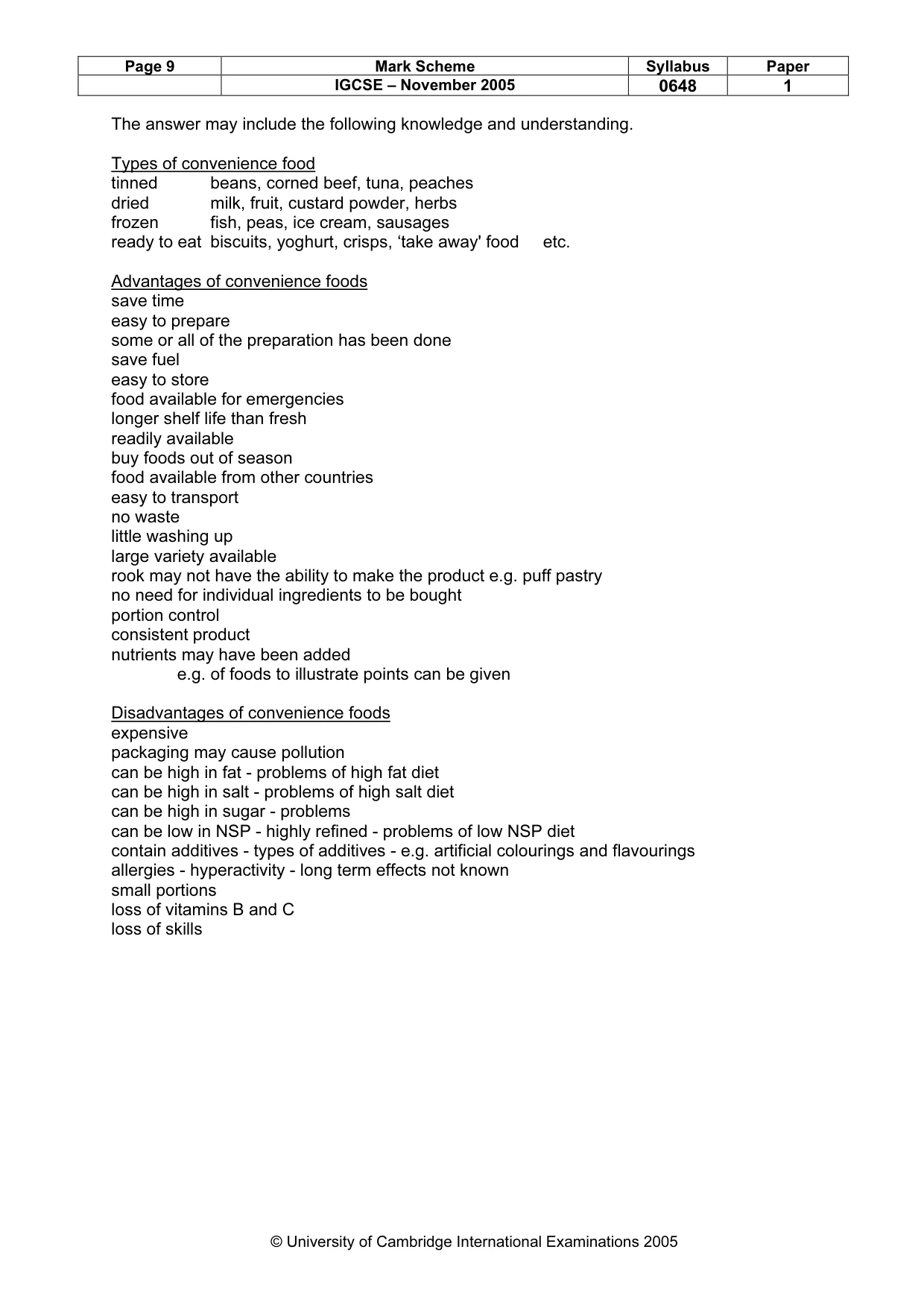
Page 9 Mark Scheme Syllabus Paper IGCSE – November 2005 0648 1 © University of Cambridge International Examinations 2005 The answer may include the following knowledge and understanding. Types of convenience food tinned beans, corned beef, tuna, peaches dried milk, fruit, custard powder, herbs frozen fish, peas, ice cream, sausages ready to eat biscuits, yoghurt, crisps, ‘take away' food etc. Advantages of convenience foods save time easy to prepare some or all of the preparation has been done save fuel easy to store food available for emergencies longer shelf life than fresh readily available buy foods out of season food available from other countries easy to transport no waste little washing up large variety available rook may not have the ability to make the product e.g. puff pastry no need for individual ingredients to be bought portion control consistent product nutrients may have been added e.g. of foods to illustrate points can be given Disadvantages of convenience foods expensive packaging may cause pollution can be high in fat - problems of high fat diet can be high in salt - problems of high salt diet can be high in sugar - problems can be low in NSP - highly refined - problems of low NSP diet contain additives - types of additives - e.g. artificial colourings and flavourings allergies - hyperactivity - long term effects not known small portions loss of vitamins B and C loss of skills
Mark scheme, page 11
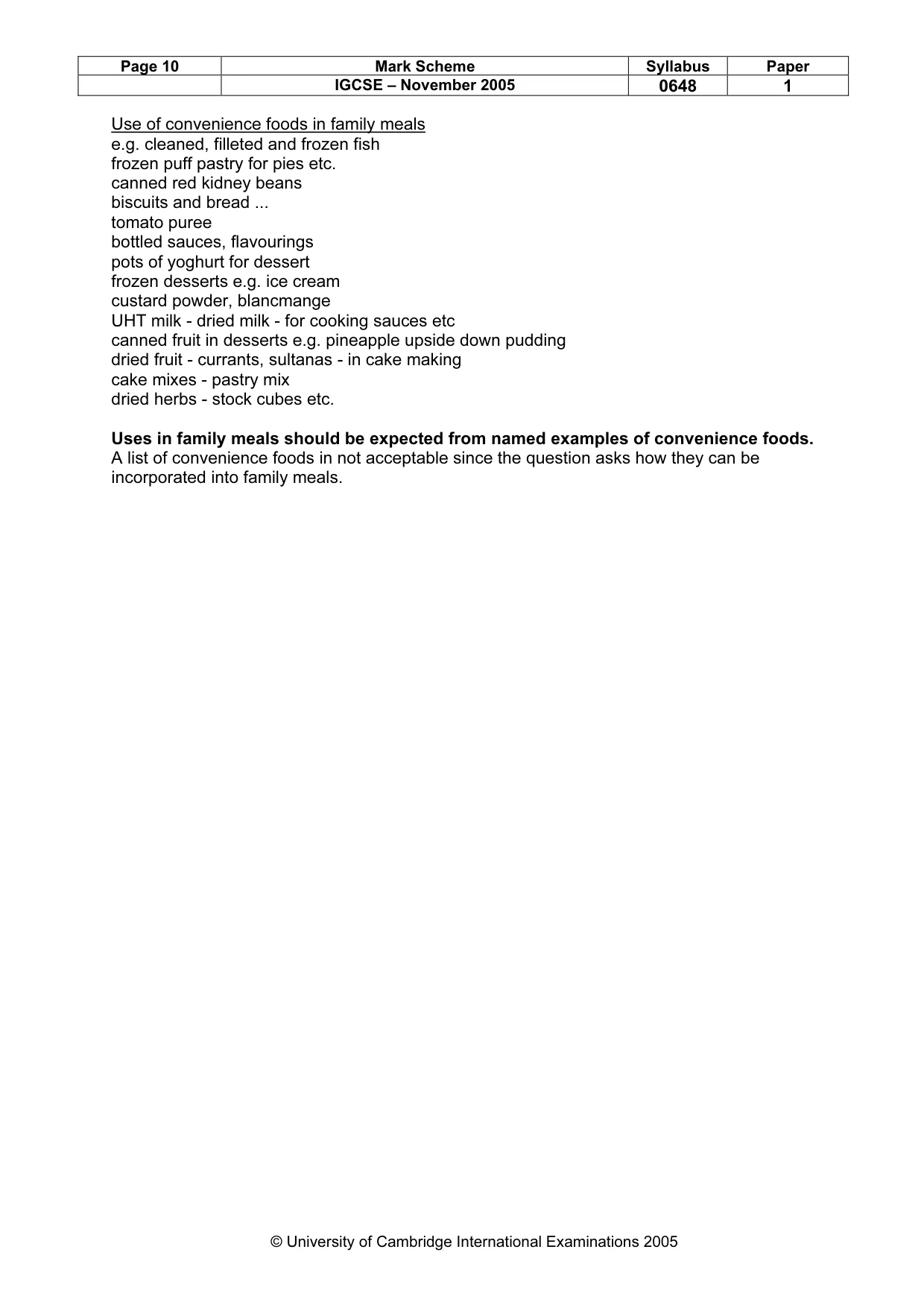
Page 10 Mark Scheme Syllabus Paper IGCSE – November 2005 0648 1 © University of Cambridge International Examinations 2005 Use of convenience foods in family meals e.g. cleaned, filleted and frozen fish frozen puff pastry for pies etc. canned red kidney beans biscuits and bread ... tomato puree bottled sauces, flavourings pots of yoghurt for dessert frozen desserts e.g. ice cream custard powder, blancmange UHT milk - dried milk - for cooking sauces etc canned fruit in desserts e.g. pineapple upside down pudding dried fruit - currants, sultanas - in cake making cake mixes - pastry mix dried herbs - stock cubes etc. Uses in family meals should be expected from named examples of convenience foods. A list of convenience foods in not acceptable since the question asks how they can be incorporated into family meals.