Cambridge IGCSE Food and Nutrition 0648 — 2005 May/June Paper 1 · Variant 1
0648/11/M/J/05
The question paper and its mark scheme, free to read here and free to download. This is Cambridge’s own paper, exactly as it was sat.
Question paper12 pages
Mark scheme13 pages
Answers below. Sit the paper first if you are practising.
Paper as text
Question paper, page 1
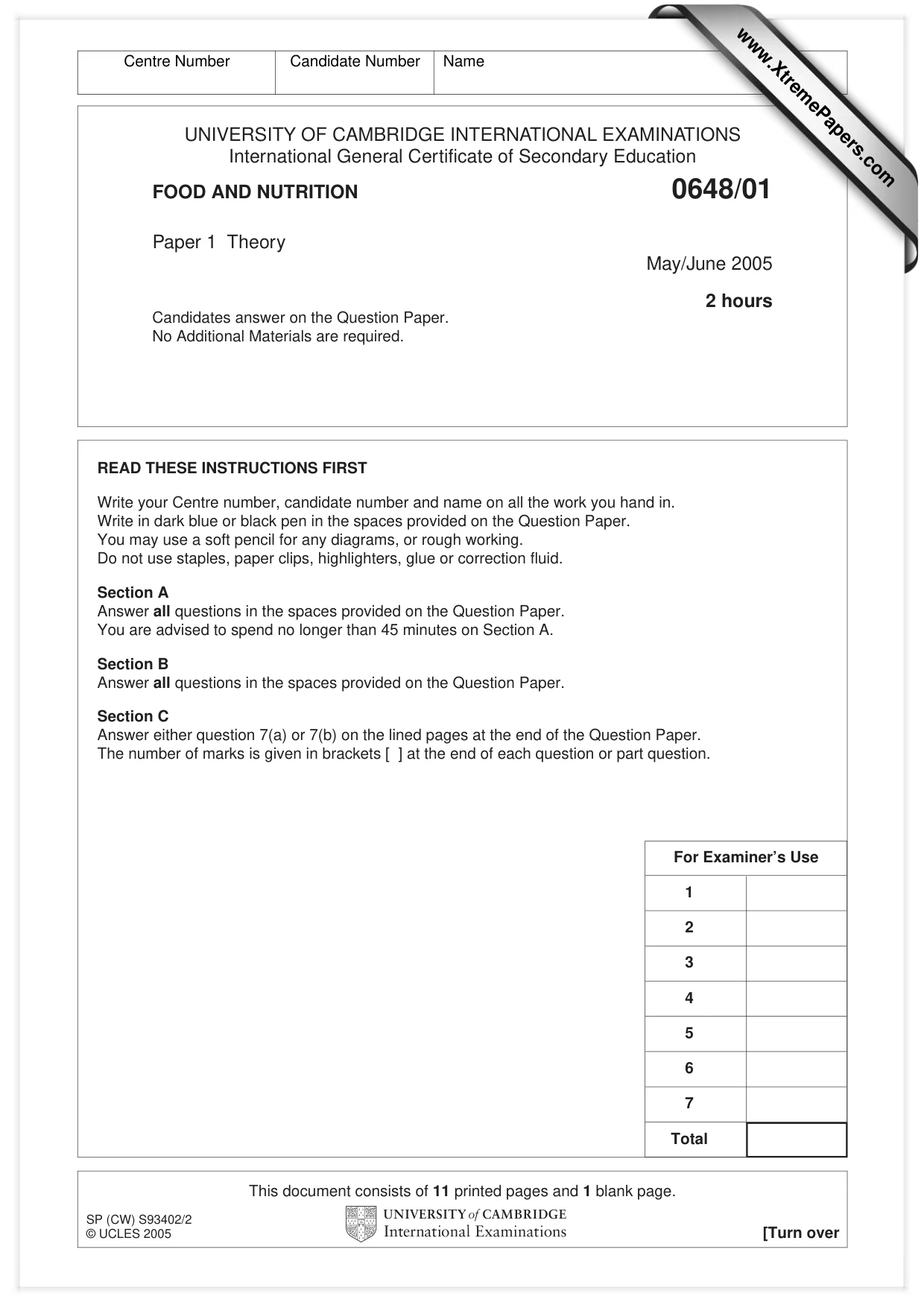
This document consists of 11 printed pages and 1 blank page. SP (CW) S93402/2 © UCLES 2005 [Turn over UNIVERSITY OF CAMBRIDGE INTERNATIONAL EXAMINATIONS International General Certificate of Secondary Education FOOD AND NUTRITION 0648/01 Paper 1 Theory May/June 2005 2 hours Candidates answer on the Question Paper. No Additional Materials are required. Centre Number Candidate Number Name READ THESE INSTRUCTIONS FIRST Write your Centre number, candidate number and name on all the work you hand in. Write in dark blue or black pen in the spaces provided on the Question Paper. You may use a soft pencil for any diagrams, or rough working. Do not use staples, paper clips, highlighters, glue or correction fluid. Section A Answer all questions in the spaces provided on the Question Paper. You are advised to spend no longer than 45 minutes on Section A. Section B Answer all questions in the spaces provided on the Question Paper. Section C Answer either question 7(a) or 7(b) on the lined pages at the end of the Question Paper. The number of marks is given in brackets [ ] at the end of each question or part question. For Examiner’s Use 1 2 3 4 5 6 7 Total www.XtremePapers.com
Question paper, page 2
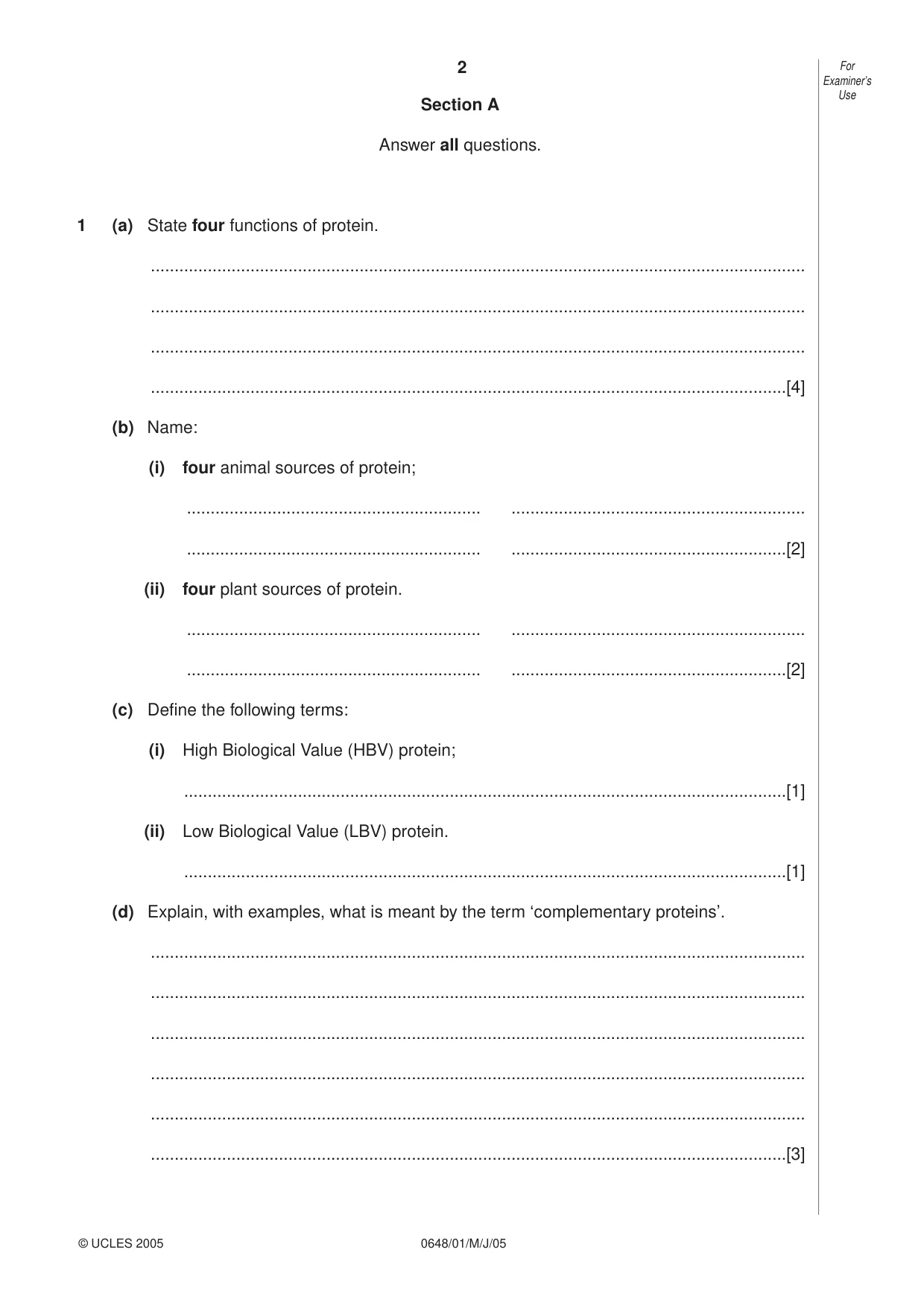
2 © UCLES 2005 0648/01/M/J/05 Section A Answer all questions. 1 (a) State four functions of protein. … … … …[4] (b) Name: (i) four animal sources of protein; … … … …[2] (ii) four plant sources of protein. … … … …[2] (c) Define the following terms: (i) High Biological Value (HBV) protein; …[1] (ii) Low Biological Value (LBV) protein. …[1] (d) Explain, with examples, what is meant by the term ‘complementary proteins’. … … … … … …[3] For Examiner’s Use
Question paper, page 3
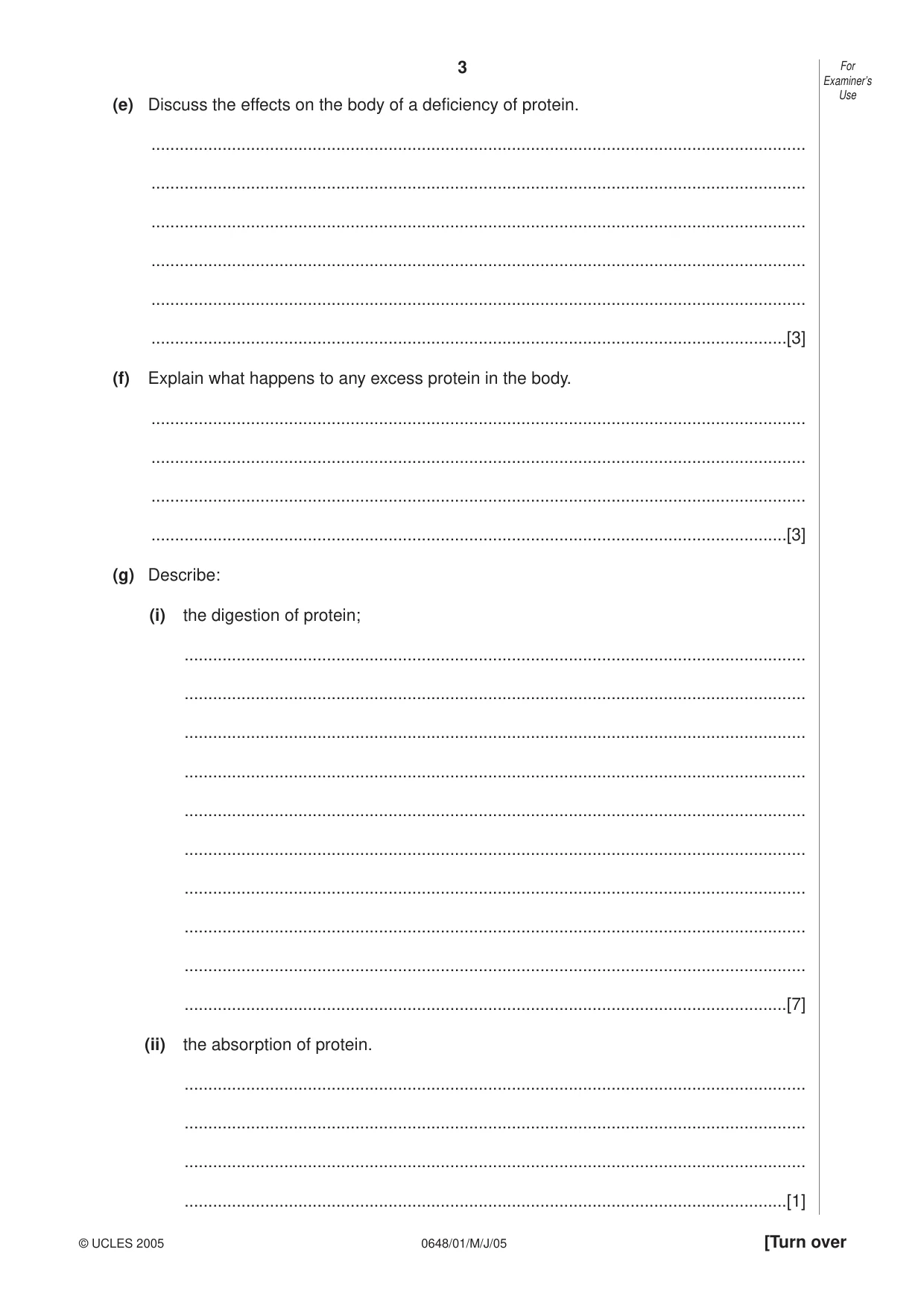
3 © UCLES 2005 0648/01/M/J/05 [Turn over (e) Discuss the effects on the body of a deficiency of protein. … … … … … …[3] (f) Explain what happens to any excess protein in the body. … … … …[3] (g) Describe: (i) the digestion of protein; … … … … … … … … … …[7] (ii) the absorption of protein. … … … …[1] For Examiner’s Use
Question paper, page 4
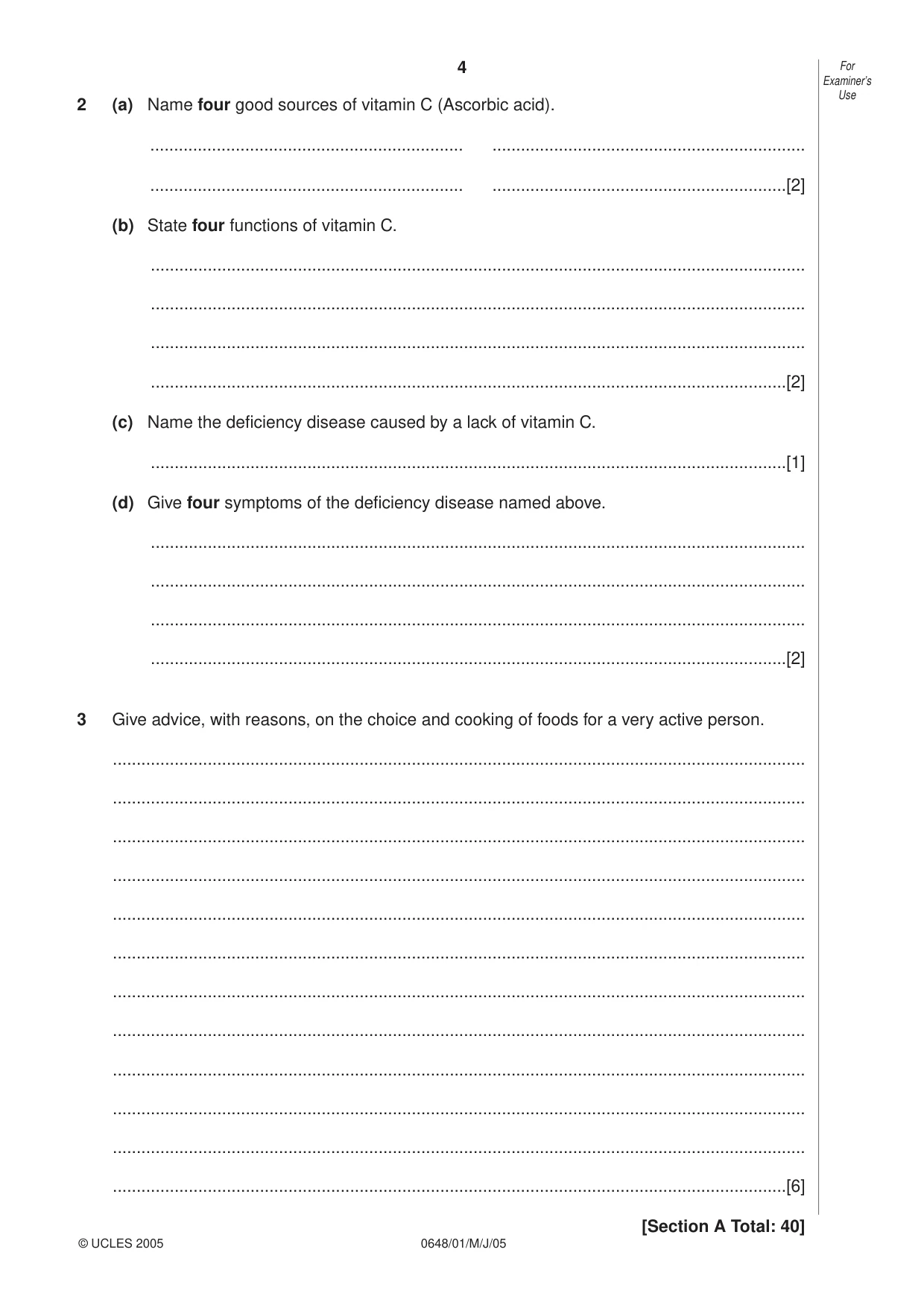
4 © UCLES 2005 0648/01/M/J/05 2 (a) Name four good sources of vitamin C (Ascorbic acid). … … … …[2] (b) State four functions of vitamin C. … … … …[2] (c) Name the deficiency disease caused by a lack of vitamin C. …[1] (d) Give four symptoms of the deficiency disease named above. … … … …[2] 3 Give advice, with reasons, on the choice and cooking of foods for a very active person. … … … … … … … … … … … …[6] [Section A Total: 40] For Examiner’s Use
Question paper, page 5
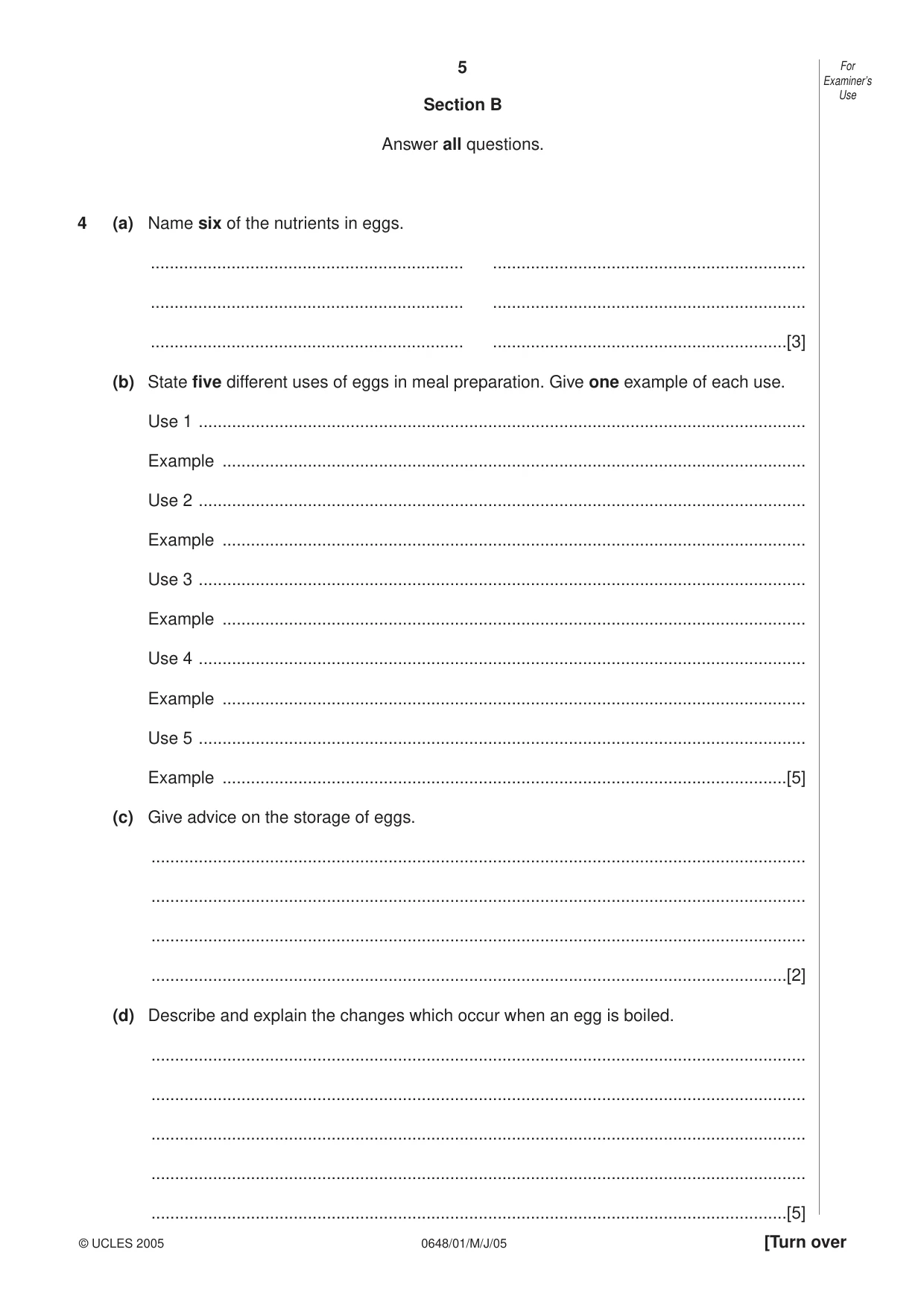
5 © UCLES 2005 0648/01/M/J/05 [Turn over Section B Answer all questions. 4 (a) Name six of the nutrients in eggs. … … … … … …[3] (b) State five different uses of eggs in meal preparation. Give one example of each use. Use 1 … Example … Use 2 … Example … Use 3 … Example … Use 4 … Example … Use 5 … Example …[5] (c) Give advice on the storage of eggs. … … … …[2] (d) Describe and explain the changes which occur when an egg is boiled. … … … … …[5] For Examiner’s Use
Question paper, page 6
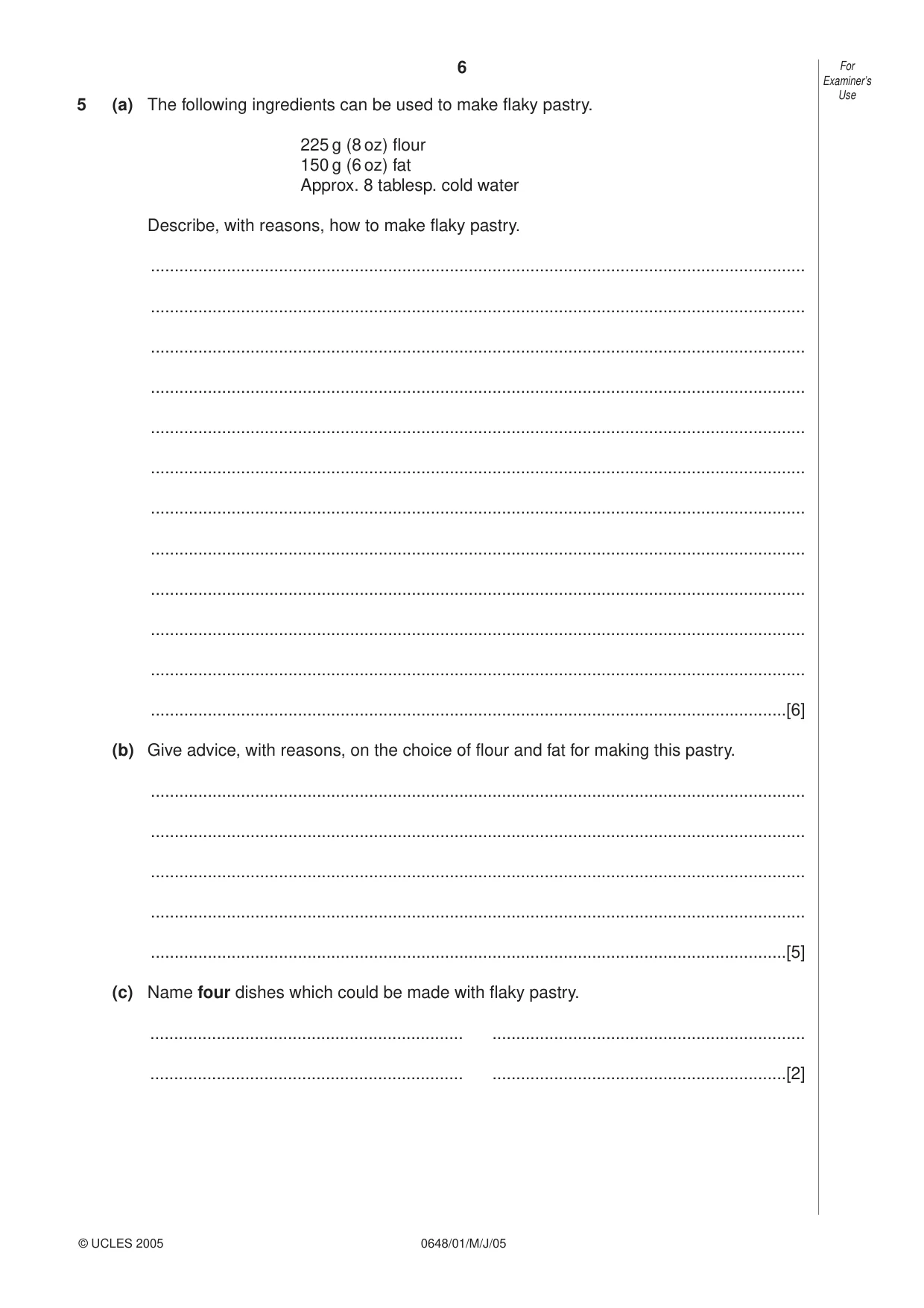
6 © UCLES 2005 0648/01/M/J/05 5 (a) The following ingredients can be used to make flaky pastry. 225 g (8 oz) flour 150 g (6 oz) fat Approx. 8 tablesp. cold water Describe, with reasons, how to make flaky pastry. … … … … … … … … … … … …[6] (b) Give advice, with reasons, on the choice of flour and fat for making this pastry. … … … … …[5] (c) Name four dishes which could be made with flaky pastry. … … … …[2] For Examiner’s Use
Question paper, page 7
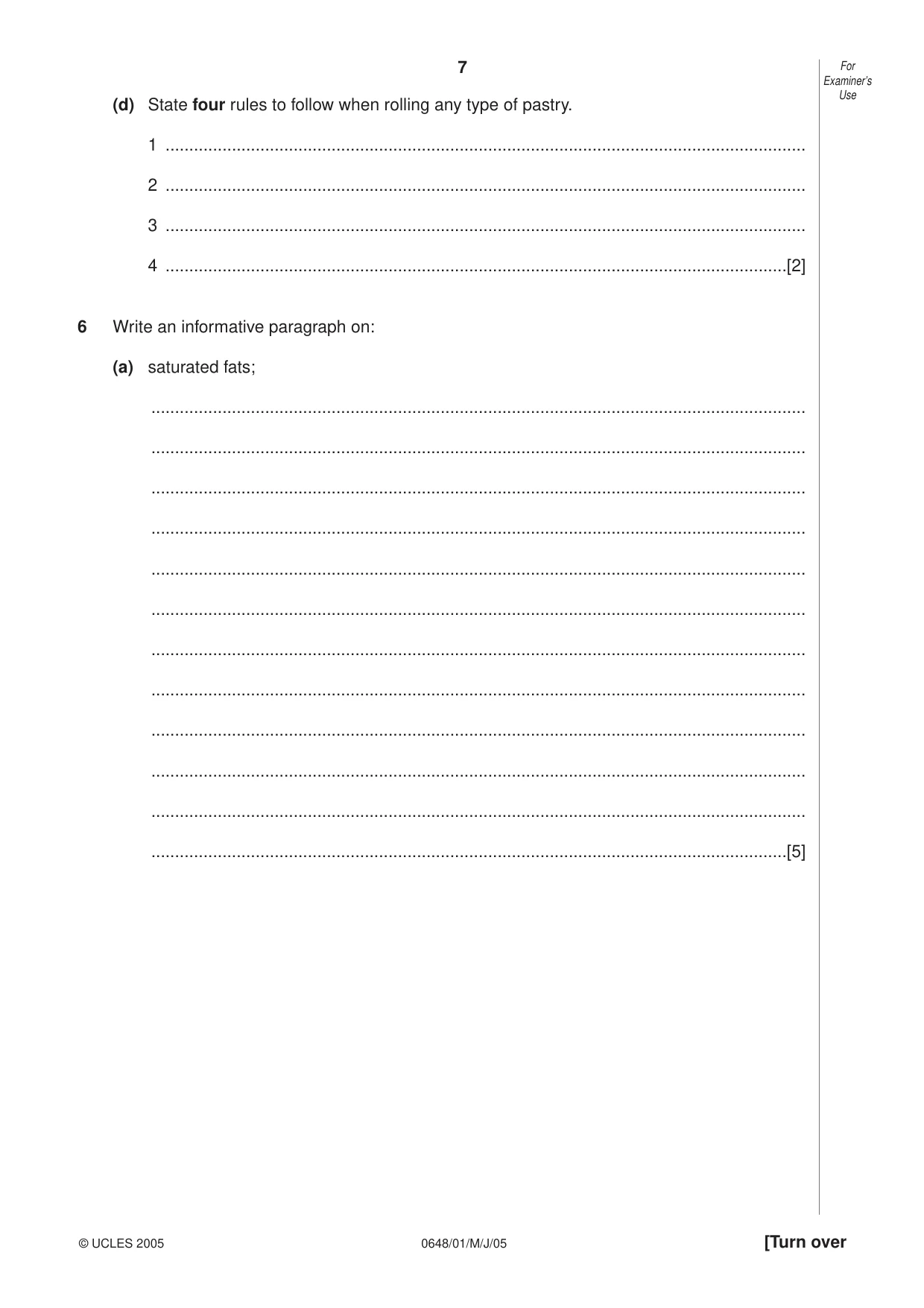
7 © UCLES 2005 0648/01/M/J/05 [Turn over (d) State four rules to follow when rolling any type of pastry. 1 … 2 … 3 … 4 …[2] 6 Write an informative paragraph on: (a) saturated fats; … … … … … … … … … … … …[5] For Examiner’s Use
Question paper, page 8
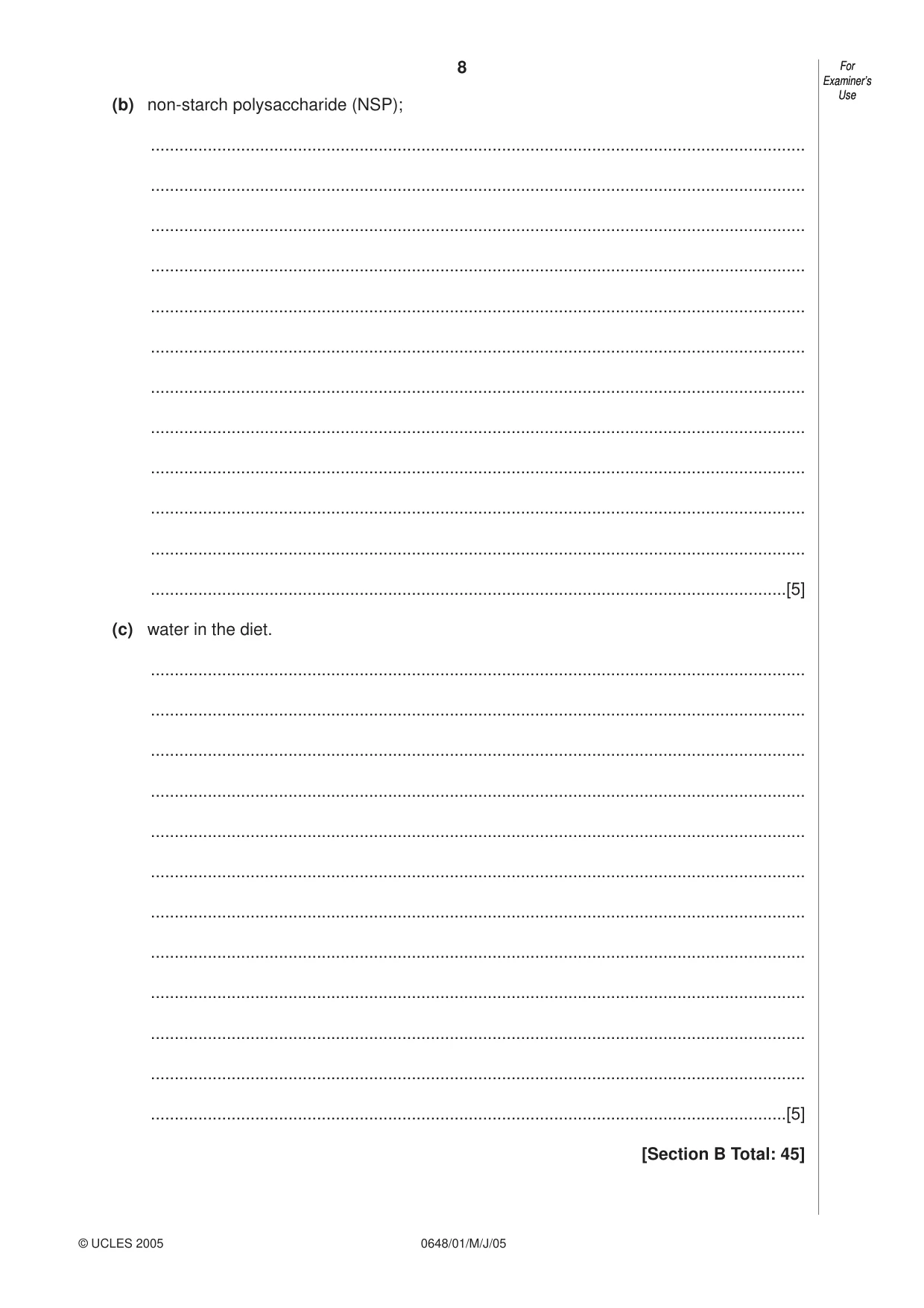
8 © UCLES 2005 0648/01/M/J/05 (b) non-starch polysaccharide (NSP); … … … … … … … … … … … …[5] (c) water in the diet. … … … … … … … … … … … …[5] [Section B Total: 45] For Examiner’s Use For Examiner’s Use
Question paper, page 9
9 © UCLES 2005 0648/01/M/J/05 [Turn over Section C Answer either 7(a) or 7(b) 7 (a) Discuss the reasons for food spoilage. Explain ways of storing and preserving food to improve keeping quality. or (b) Discuss frying as a method of cooking. Explain how good results can be achieved when frying different foods. … … … … … … … … … … … … … … … … … … … … For Examiner’s Use
Question paper, page 10
10 © UCLES 2005 0648/01/M/J/05 … … … … … … … … … … … … … … … … … … … … … … … … … … … … For Examiner’s Use
Question paper, page 11
11 © UCLES 2005 0648/01/M/J/05 … … … … … … … … … … … … … … … … … … … … … … … … … … [Section C Total: 15] [Total for Paper: 100] For Examiner’s Use
Question paper, page 12
12 0648/01/M/J/05 BLANK PAGE Permission to reproduce items where third-party owned material protected by copyright is included has been sought and cleared where possible. Every reasonable effort has been made by the publisher (UCLES) to trace copyright holders, but if any items requiring clearance have unwittingly been included, the publisher will be pleased to make amends at the earliest possible opportunity. University of Cambridge International Examinations is part of the University of Cambridge Local Examinations Syndicate (UCLES), which is itself a department of the University of Cambridge.
Mark scheme, page 1
UNIVERSITY OF CAMBRIDGE INTERNATIONAL EXAMINATIONS International General Certificate of Secondary Education MARK SCHEME for the June 2005 question paper 0648 FOOD AND NUTRITION 0648/01 Paper 1 (Theory), maximum mark 100 This mark scheme is published as an aid to teachers and students, to indicate the requirements of the examination. It shows the basis on which Examiners were initially instructed to award marks. It does not indicate the details of the discussions that took place at an Examiners’ meeting before marking began. Any substantial changes to the mark scheme that arose from these discussions will be recorded in the published Report on the Examination. All Examiners are instructed that alternative correct answers and unexpected approaches in candidates’ scripts must be given marks that fairly reflect the relevant knowledge and skills demonstrated. Mark schemes must be read in conjunction with the question papers and the Report on the Examination. • CIE will not enter into discussion or correspondence in connection with these mark schemes. CIE is publishing the mark schemes for the June 2005 question papers for most IGCSE and GCE Advanced Level and Advanced Subsidiary Level syllabuses and some Ordinary Level syllabuses. www.XtremePapers.com
Mark scheme, page 2
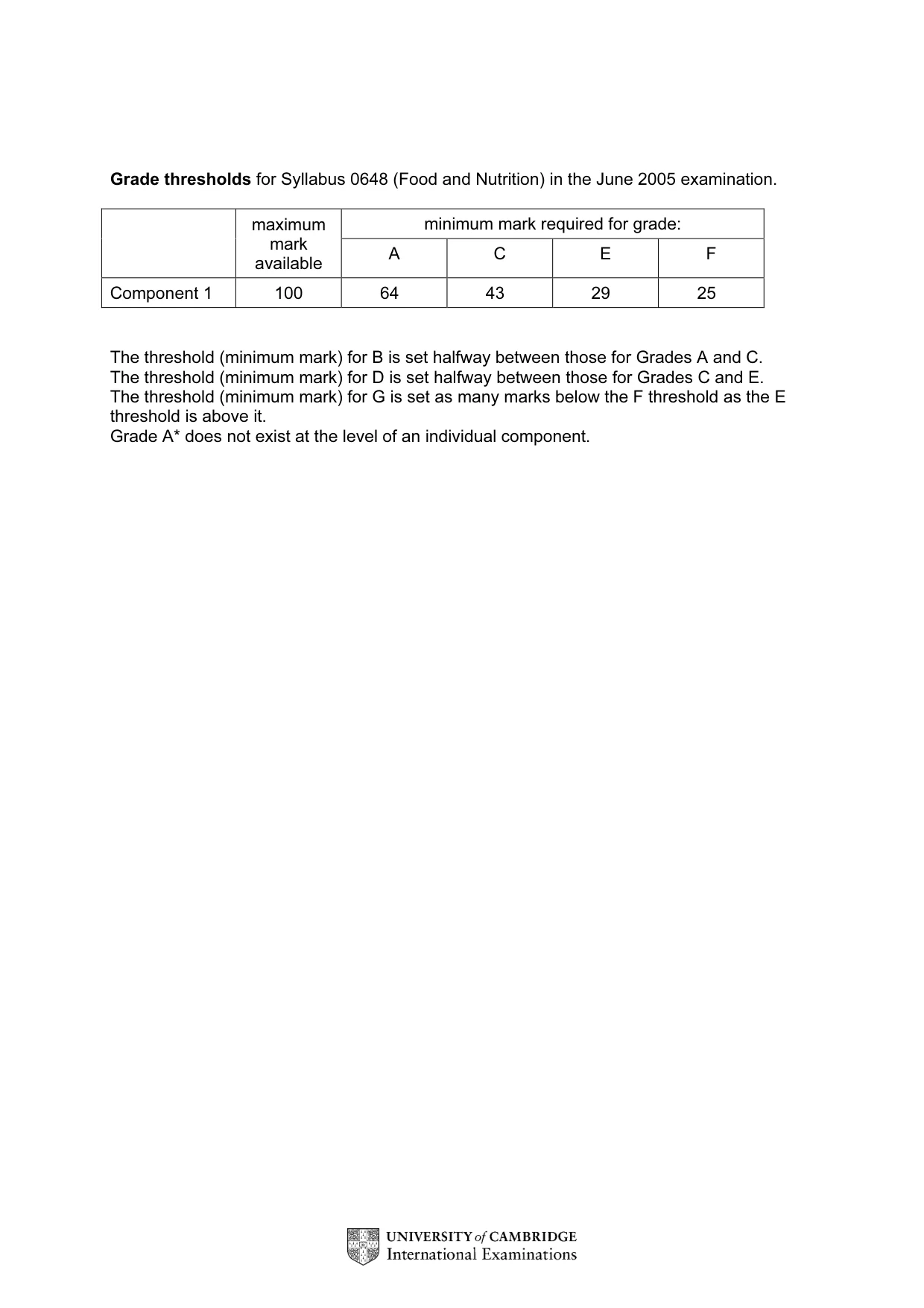
Grade thresholds for Syllabus 0648 (Food and Nutrition) in the June 2005 examination. minimum mark required for grade: maximum mark available A C E F Component 1 100 64 43 29 25 The threshold (minimum mark) for B is set halfway between those for Grades A and C. The threshold (minimum mark) for D is set halfway between those for Grades C and E. The threshold (minimum mark) for G is set as many marks below the F threshold as the E threshold is above it. Grade A* does not exist at the level of an individual component.
Mark scheme, page 3
June 2005 IGCSE MARK SCHEME MAXIMUM MARK: 100 SYLLABUS/COMPONENT: 0648/01 FOOD AND NUTRITION (Theory)
Mark scheme, page 4
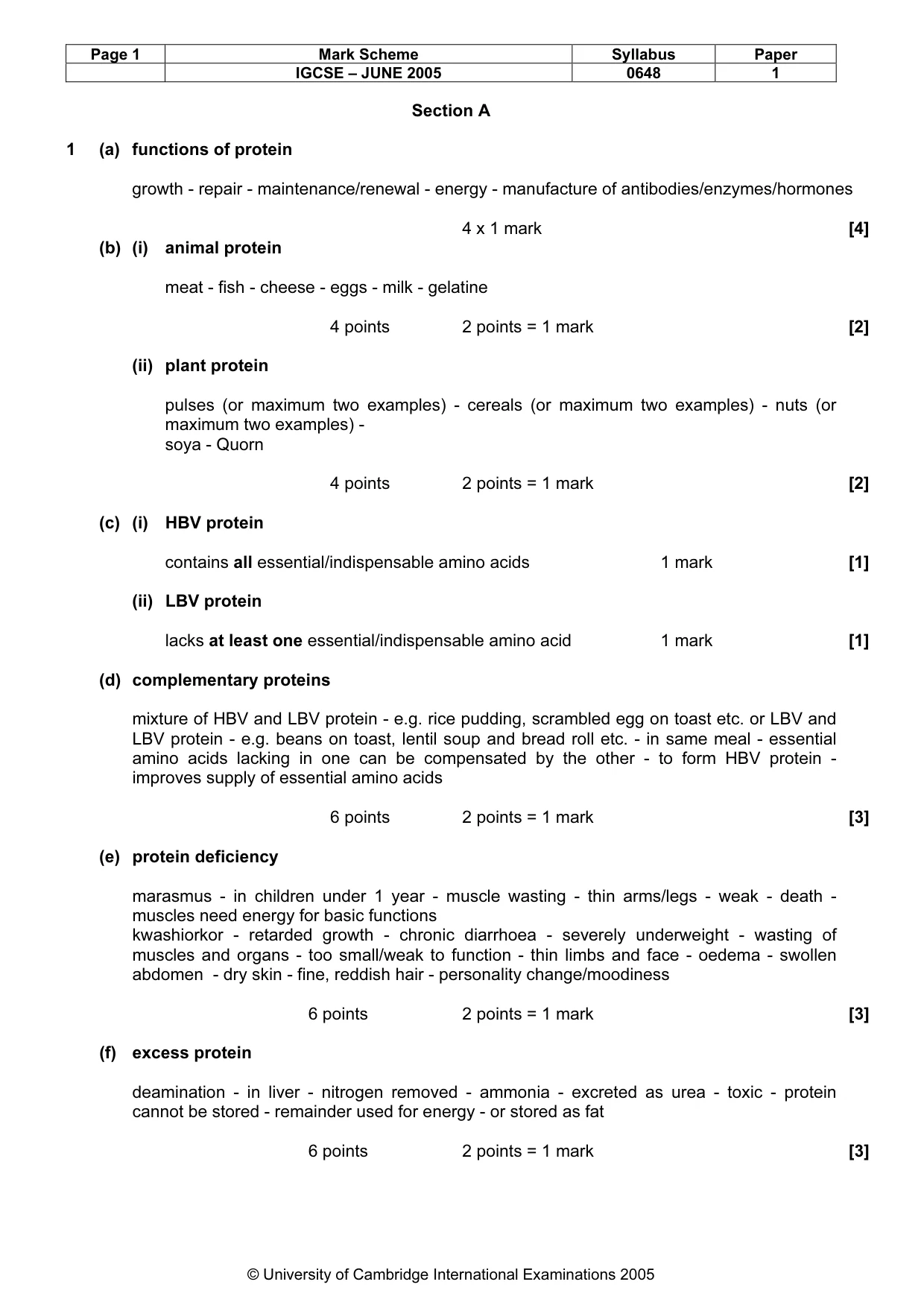
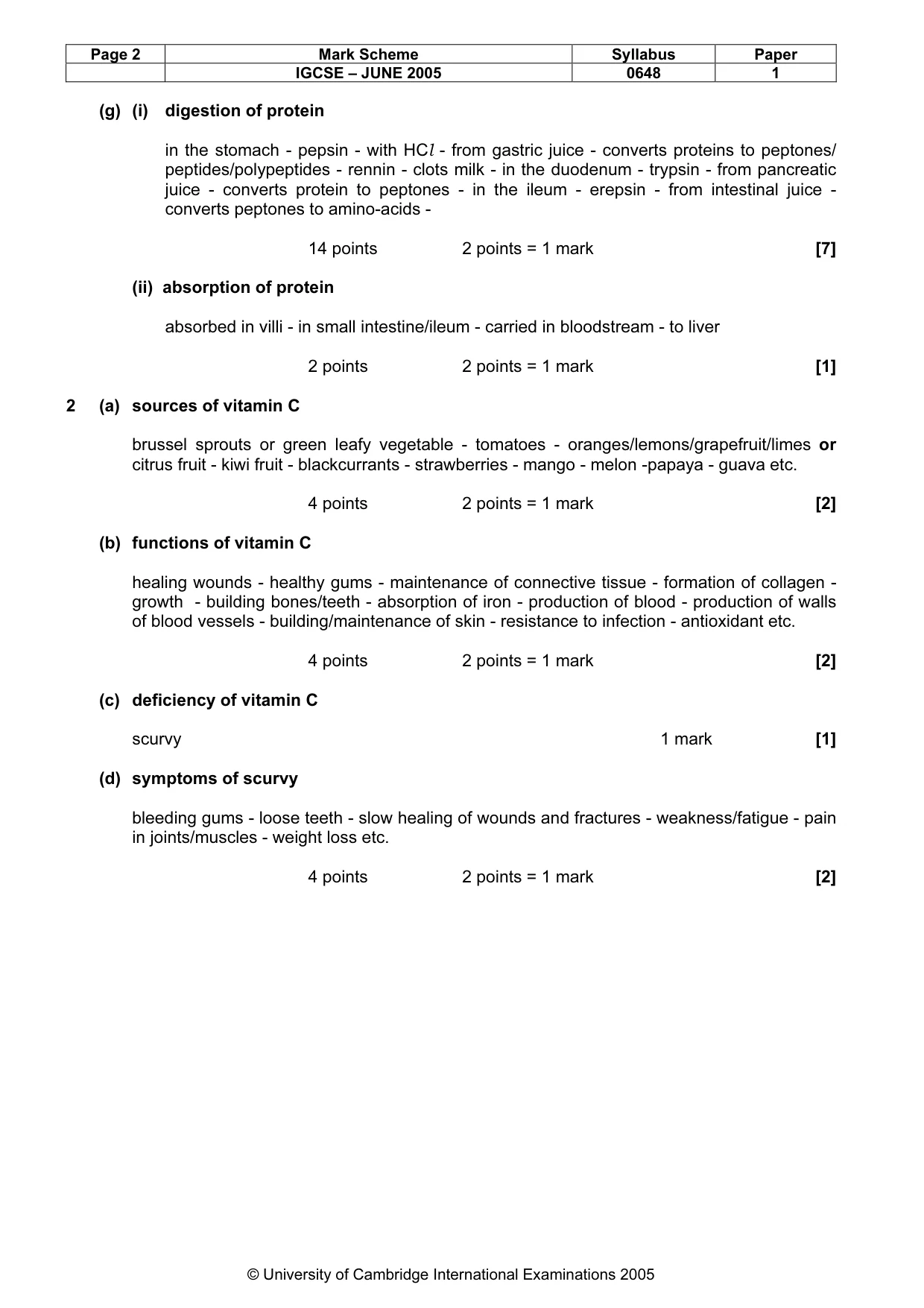
Page 1 Mark Scheme Syllabus Paper IGCSE – JUNE 2005 0648 1 © University of Cambridge International Examinations 2005 Section A 1 (a) functions of protein growth - repair - maintenance/renewal - energy - manufacture of antibodies/enzymes/hormones 4 x 1 mark [4] (b) (i) animal protein meat - fish - cheese - eggs - milk - gelatine 4 points 2 points = 1 mark [2] (ii) plant protein pulses (or maximum two examples) - cereals (or maximum two examples) - nuts (or maximum two examples) - soya - Quorn 4 points 2 points = 1 mark [2] (c) (i) HBV protein contains all essential/indispensable amino acids 1 mark [1] (ii) LBV protein lacks at least one essential/indispensable amino acid 1 mark [1] (d) complementary proteins mixture of HBV and LBV protein - e.g. rice pudding, scrambled egg on toast etc. or LBV and LBV protein - e.g. beans on toast, lentil soup and bread roll etc. - in same meal - essential amino acids lacking in one can be compensated by the other - to form HBV protein - improves supply of essential amino acids 6 points 2 points = 1 mark [3] (e) protein deficiency marasmus - in children under 1 year - muscle wasting - thin arms/legs - weak - death - muscles need energy for basic functions kwashiorkor - retarded growth - chronic diarrhoea - severely underweight - wasting of muscles and organs - too small/weak to function - thin limbs and face - oedema - swollen abdomen - dry skin - fine, reddish hair - personality change/moodiness 6 points 2 points = 1 mark [3] (f) excess protein deamination - in liver - nitrogen removed - ammonia - excreted as urea - toxic - protein cannot be stored - remainder used for energy - or stored as fat 6 points 2 points = 1 mark [3]
Mark scheme, page 5
Page 2 Mark Scheme Syllabus Paper IGCSE – JUNE 2005 0648 1 © University of Cambridge International Examinations 2005 (g) (i) digestion of protein in the stomach - pepsin - with HCl - from gastric juice - converts proteins to peptones/ peptides/polypeptides - rennin - clots milk - in the duodenum - trypsin - from pancreatic juice - converts protein to peptones - in the ileum - erepsin - from intestinal juice - converts peptones to amino-acids - 14 points 2 points = 1 mark [7] (ii) absorption of protein absorbed in villi - in small intestine/ileum - carried in bloodstream - to liver 2 points 2 points = 1 mark [1] 2 (a) sources of vitamin C brussel sprouts or green leafy vegetable - tomatoes - oranges/lemons/grapefruit/limes or citrus fruit - kiwi fruit - blackcurrants - strawberries - mango - melon -papaya - guava etc. 4 points 2 points = 1 mark [2] (b) functions of vitamin C healing wounds - healthy gums - maintenance of connective tissue - formation of collagen - growth - building bones/teeth - absorption of iron - production of blood - production of walls of blood vessels - building/maintenance of skin - resistance to infection - antioxidant etc. 4 points 2 points = 1 mark [2] (c) deficiency of vitamin C scurvy 1 mark [1] (d) symptoms of scurvy bleeding gums - loose teeth - slow healing of wounds and fractures - weakness/fatigue - pain in joints/muscles - weight loss etc. 4 points 2 points = 1 mark [2]
Mark scheme, page 6
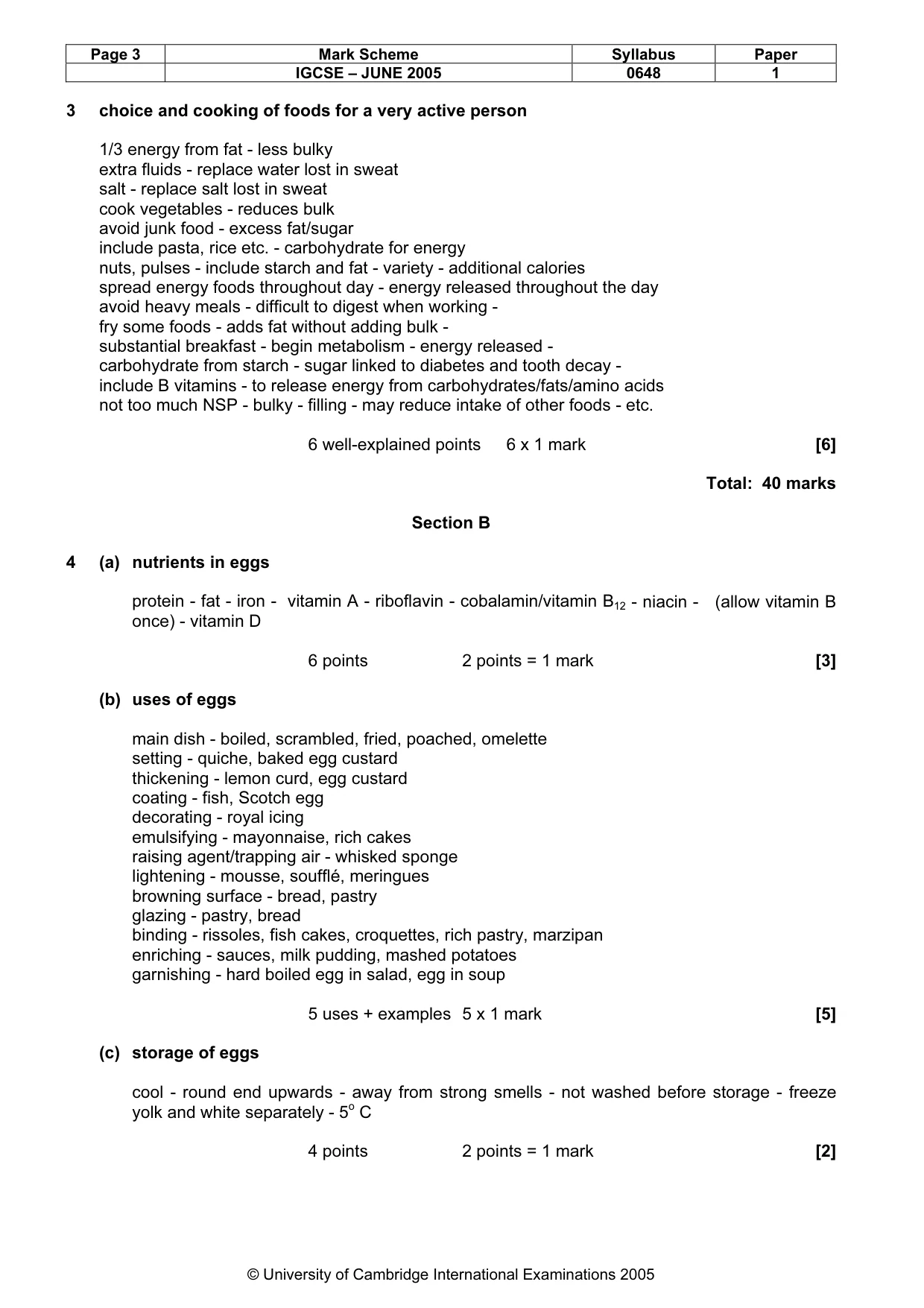
Page 3 Mark Scheme Syllabus Paper IGCSE – JUNE 2005 0648 1 © University of Cambridge International Examinations 2005 3 choice and cooking of foods for a very active person 1/3 energy from fat - less bulky extra fluids - replace water lost in sweat salt - replace salt lost in sweat cook vegetables - reduces bulk avoid junk food - excess fat/sugar include pasta, rice etc. - carbohydrate for energy nuts, pulses - include starch and fat - variety - additional calories spread energy foods throughout day - energy released throughout the day avoid heavy meals - difficult to digest when working - fry some foods - adds fat without adding bulk - substantial breakfast - begin metabolism - energy released - carbohydrate from starch - sugar linked to diabetes and tooth decay - include B vitamins - to release energy from carbohydrates/fats/amino acids not too much NSP - bulky - filling - may reduce intake of other foods - etc. 6 well-explained points 6 x 1 mark [6] Total: 40 marks Section B 4 (a) nutrients in eggs protein - fat - iron - vitamin A - riboflavin - cobalamin/vitamin B12 - niacin - (allow vitamin B once) - vitamin D 6 points 2 points = 1 mark [3] (b) uses of eggs main dish - boiled, scrambled, fried, poached, omelette setting - quiche, baked egg custard thickening - lemon curd, egg custard coating - fish, Scotch egg decorating - royal icing emulsifying - mayonnaise, rich cakes raising agent/trapping air - whisked sponge lightening - mousse, soufflé, meringues browning surface - bread, pastry glazing - pastry, bread binding - rissoles, fish cakes, croquettes, rich pastry, marzipan enriching - sauces, milk pudding, mashed potatoes garnishing - hard boiled egg in salad, egg in soup 5 uses + examples 5 x 1 mark [5] (c) storage of eggs cool - round end upwards - away from strong smells - not washed before storage - freeze yolk and white separately - 5o C 4 points 2 points = 1 mark [2]
Mark scheme, page 7
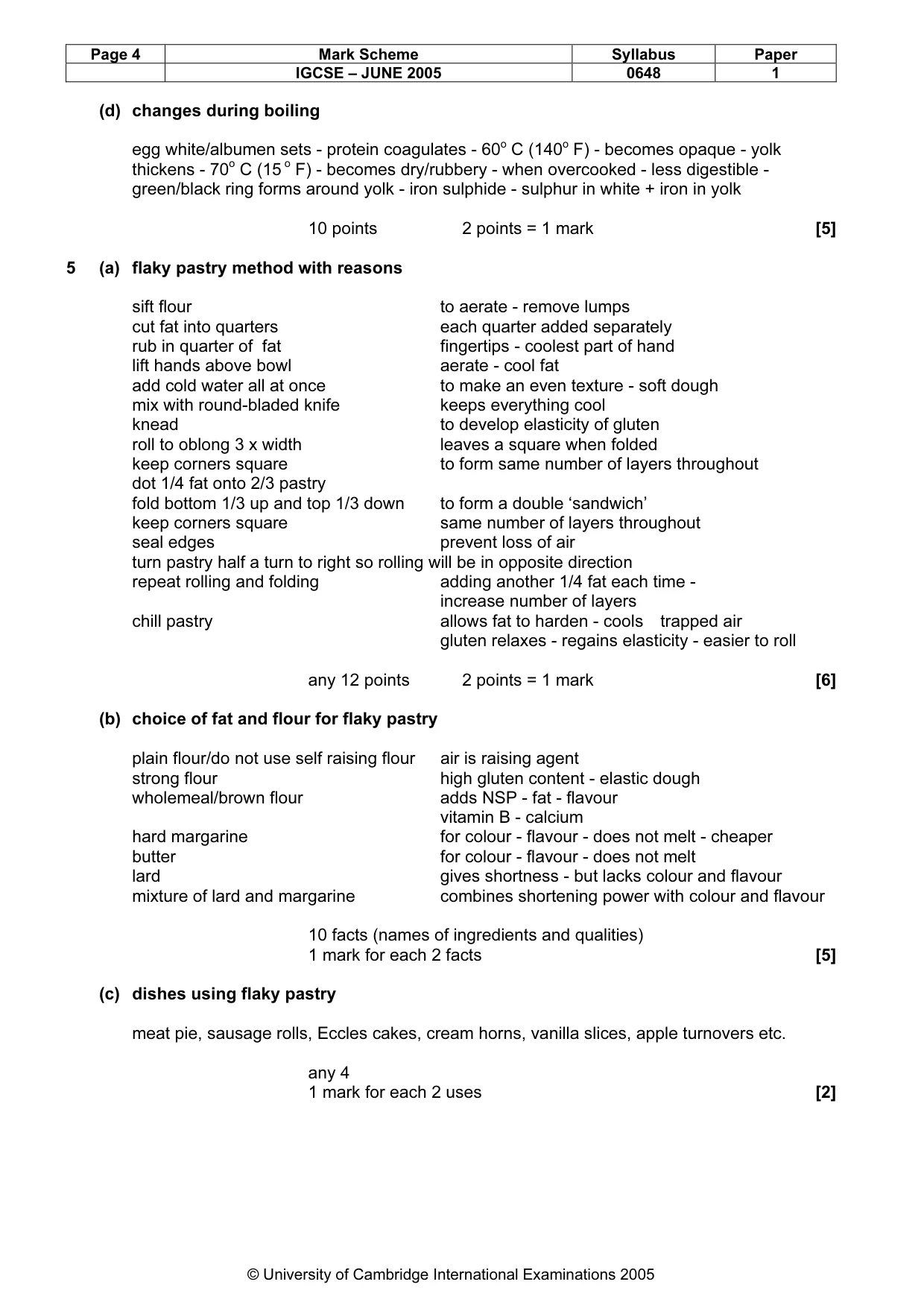
Page 4 Mark Scheme Syllabus Paper IGCSE – JUNE 2005 0648 1 © University of Cambridge International Examinations 2005 (d) changes during boiling egg white/albumen sets - protein coagulates - 60o C (140o F) - becomes opaque - yolk thickens - 70o C (15 o F) - becomes dry/rubbery - when overcooked - less digestible - green/black ring forms around yolk - iron sulphide - sulphur in white + iron in yolk 10 points 2 points = 1 mark [5] 5 (a) flaky pastry method with reasons sift flour to aerate - remove lumps cut fat into quarters each quarter added separately rub in quarter of fat fingertips - coolest part of hand lift hands above bowl aerate - cool fat add cold water all at once to make an even texture - soft dough mix with round-bladed knife keeps everything cool knead to develop elasticity of gluten roll to oblong 3 x width leaves a square when folded keep corners square to form same number of layers throughout dot 1/4 fat onto 2/3 pastry fold bottom 1/3 up and top 1/3 down to form a double ‘sandwich’ keep corners square same number of layers throughout seal edges prevent loss of air turn pastry half a turn to right so rolling will be in opposite direction repeat rolling and folding adding another 1/4 fat each time - increase number of layers chill pastry allows fat to harden - cools trapped air gluten relaxes - regains elasticity - easier to roll any 12 points 2 points = 1 mark [6] (b) choice of fat and flour for flaky pastry plain flour/do not use self raising flour air is raising agent strong flour high gluten content - elastic dough wholemeal/brown flour adds NSP - fat - flavour vitamin B - calcium hard margarine for colour - flavour - does not melt - cheaper butter for colour - flavour - does not melt lard gives shortness - but lacks colour and flavour mixture of lard and margarine combines shortening power with colour and flavour 10 facts (names of ingredients and qualities) 1 mark for each 2 facts [5] (c) dishes using flaky pastry meat pie, sausage rolls, Eccles cakes, cream horns, vanilla slices, apple turnovers etc. any 4 1 mark for each 2 uses [2]
Mark scheme, page 8
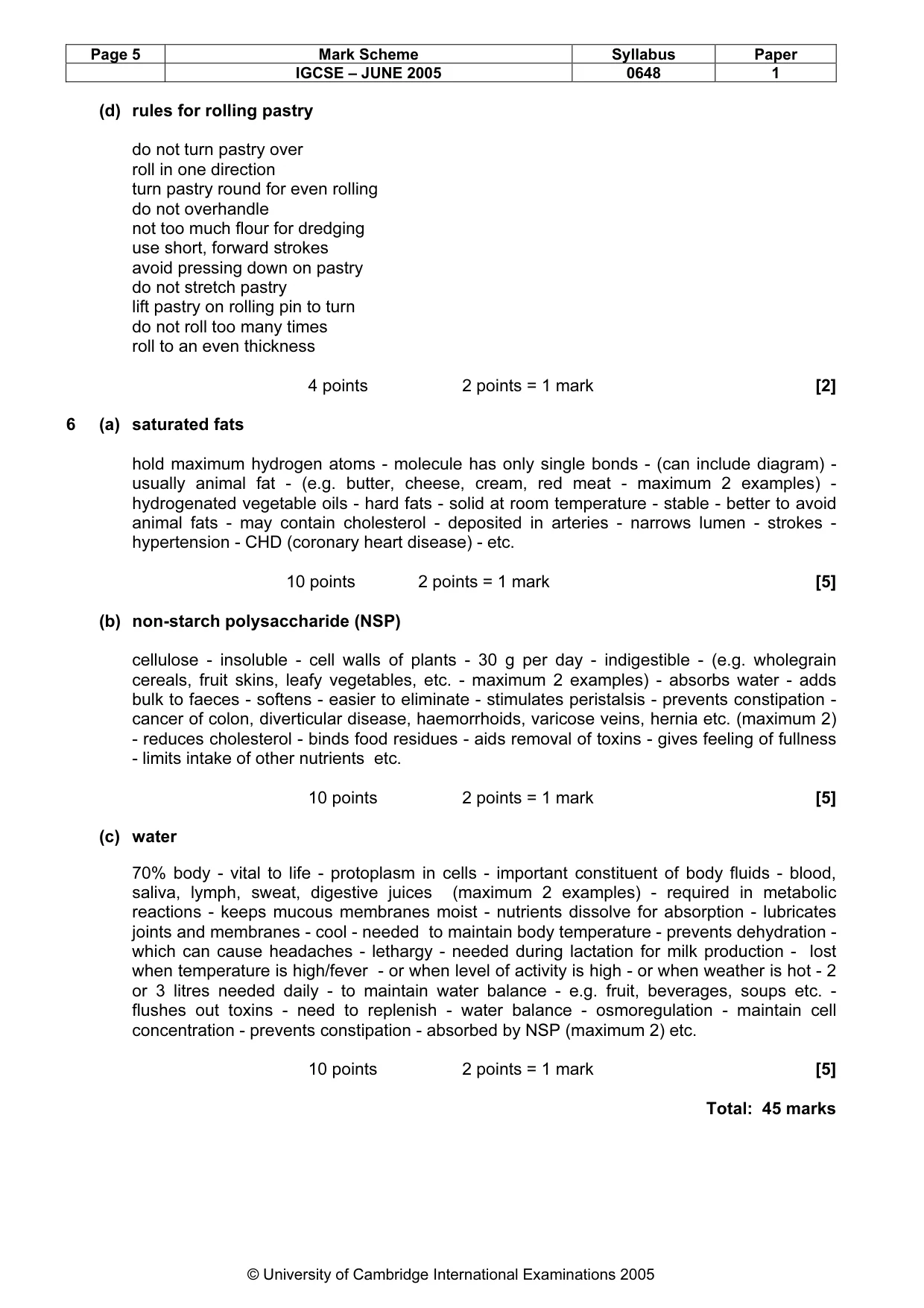
Page 5 Mark Scheme Syllabus Paper IGCSE – JUNE 2005 0648 1 © University of Cambridge International Examinations 2005 (d) rules for rolling pastry do not turn pastry over roll in one direction turn pastry round for even rolling do not overhandle not too much flour for dredging use short, forward strokes avoid pressing down on pastry do not stretch pastry lift pastry on rolling pin to turn do not roll too many times roll to an even thickness 4 points 2 points = 1 mark [2] 6 (a) saturated fats hold maximum hydrogen atoms - molecule has only single bonds - (can include diagram) - usually animal fat - (e.g. butter, cheese, cream, red meat - maximum 2 examples) - hydrogenated vegetable oils - hard fats - solid at room temperature - stable - better to avoid animal fats - may contain cholesterol - deposited in arteries - narrows lumen - strokes - hypertension - CHD (coronary heart disease) - etc. 10 points 2 points = 1 mark [5] (b) non-starch polysaccharide (NSP) cellulose - insoluble - cell walls of plants - 30 g per day - indigestible - (e.g. wholegrain cereals, fruit skins, leafy vegetables, etc. - maximum 2 examples) - absorbs water - adds bulk to faeces - softens - easier to eliminate - stimulates peristalsis - prevents constipation - cancer of colon, diverticular disease, haemorrhoids, varicose veins, hernia etc. (maximum 2) - reduces cholesterol - binds food residues - aids removal of toxins - gives feeling of fullness - limits intake of other nutrients etc. 10 points 2 points = 1 mark [5] (c) water 70% body - vital to life - protoplasm in cells - important constituent of body fluids - blood, saliva, lymph, sweat, digestive juices (maximum 2 examples) - required in metabolic reactions - keeps mucous membranes moist - nutrients dissolve for absorption - lubricates joints and membranes - cool - needed to maintain body temperature - prevents dehydration - which can cause headaches - lethargy - needed during lactation for milk production - lost when temperature is high/fever - or when level of activity is high - or when weather is hot - 2 or 3 litres needed daily - to maintain water balance - e.g. fruit, beverages, soups etc. - flushes out toxins - need to replenish - water balance - osmoregulation - maintain cell concentration - prevents constipation - absorbed by NSP (maximum 2) etc. 10 points 2 points = 1 mark [5] Total: 45 marks
Mark scheme, page 9
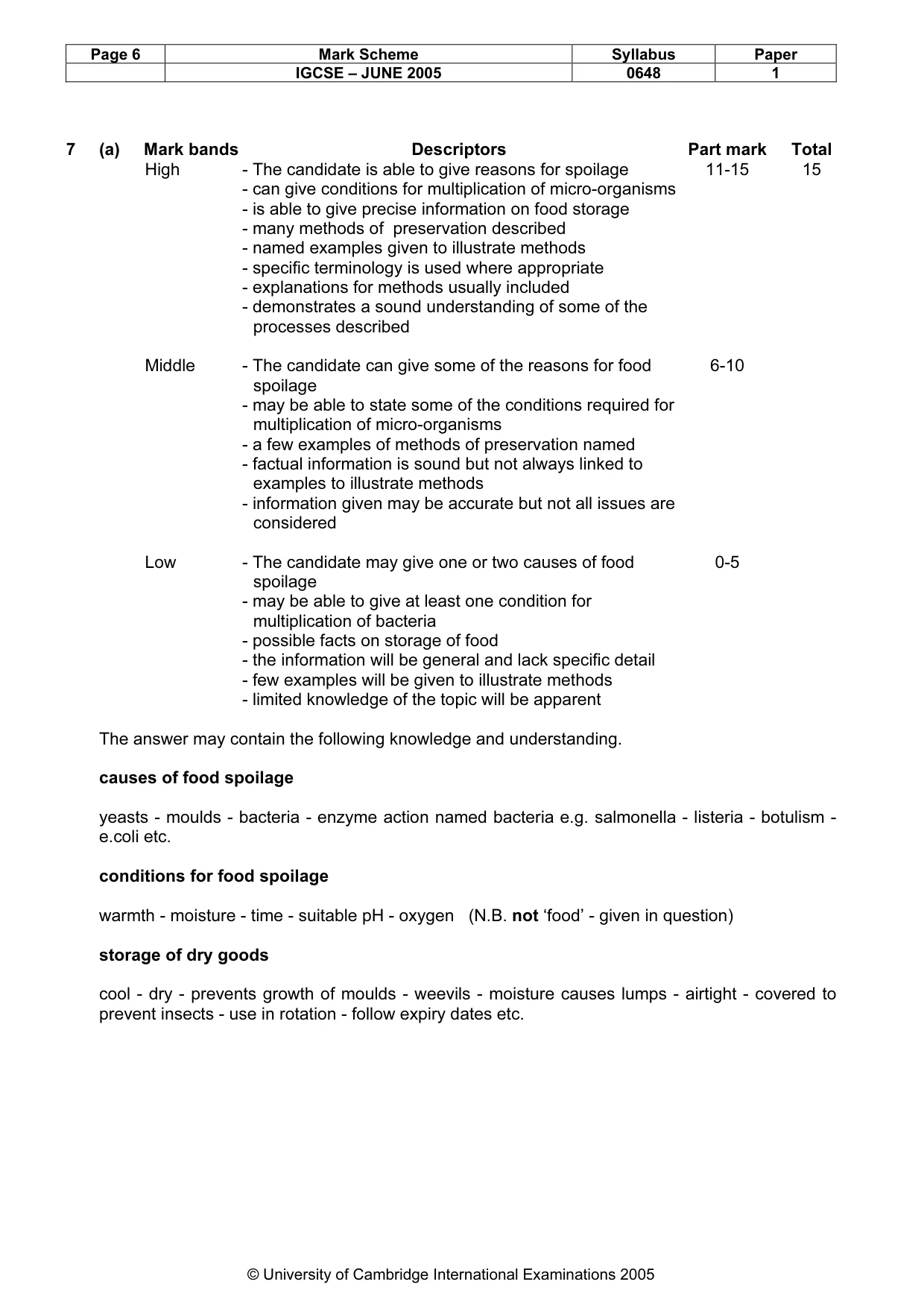
Page 6 Mark Scheme Syllabus Paper IGCSE – JUNE 2005 0648 1 © University of Cambridge International Examinations 2005 7 (a) Mark bands Descriptors Part mark Total High - The candidate is able to give reasons for spoilage - can give conditions for multiplication of micro-organisms - is able to give precise information on food storage - many methods of preservation described - named examples given to illustrate methods - specific terminology is used where appropriate - explanations for methods usually included - demonstrates a sound understanding of some of the processes described 11-15 15 Middle - The candidate can give some of the reasons for food spoilage - may be able to state some of the conditions required for multiplication of micro-organisms - a few examples of methods of preservation named - factual information is sound but not always linked to examples to illustrate methods - information given may be accurate but not all issues are considered 6-10 Low - The candidate may give one or two causes of food spoilage - may be able to give at least one condition for multiplication of bacteria - possible facts on storage of food - the information will be general and lack specific detail - few examples will be given to illustrate methods - limited knowledge of the topic will be apparent 0-5 The answer may contain the following knowledge and understanding. causes of food spoilage yeasts - moulds - bacteria - enzyme action named bacteria e.g. salmonella - listeria - botulism - e.coli etc. conditions for food spoilage warmth - moisture - time - suitable pH - oxygen (N.B. not ‘food’ - given in question) storage of dry goods cool - dry - prevents growth of moulds - weevils - moisture causes lumps - airtight - covered to prevent insects - use in rotation - follow expiry dates etc.
Mark scheme, page 10
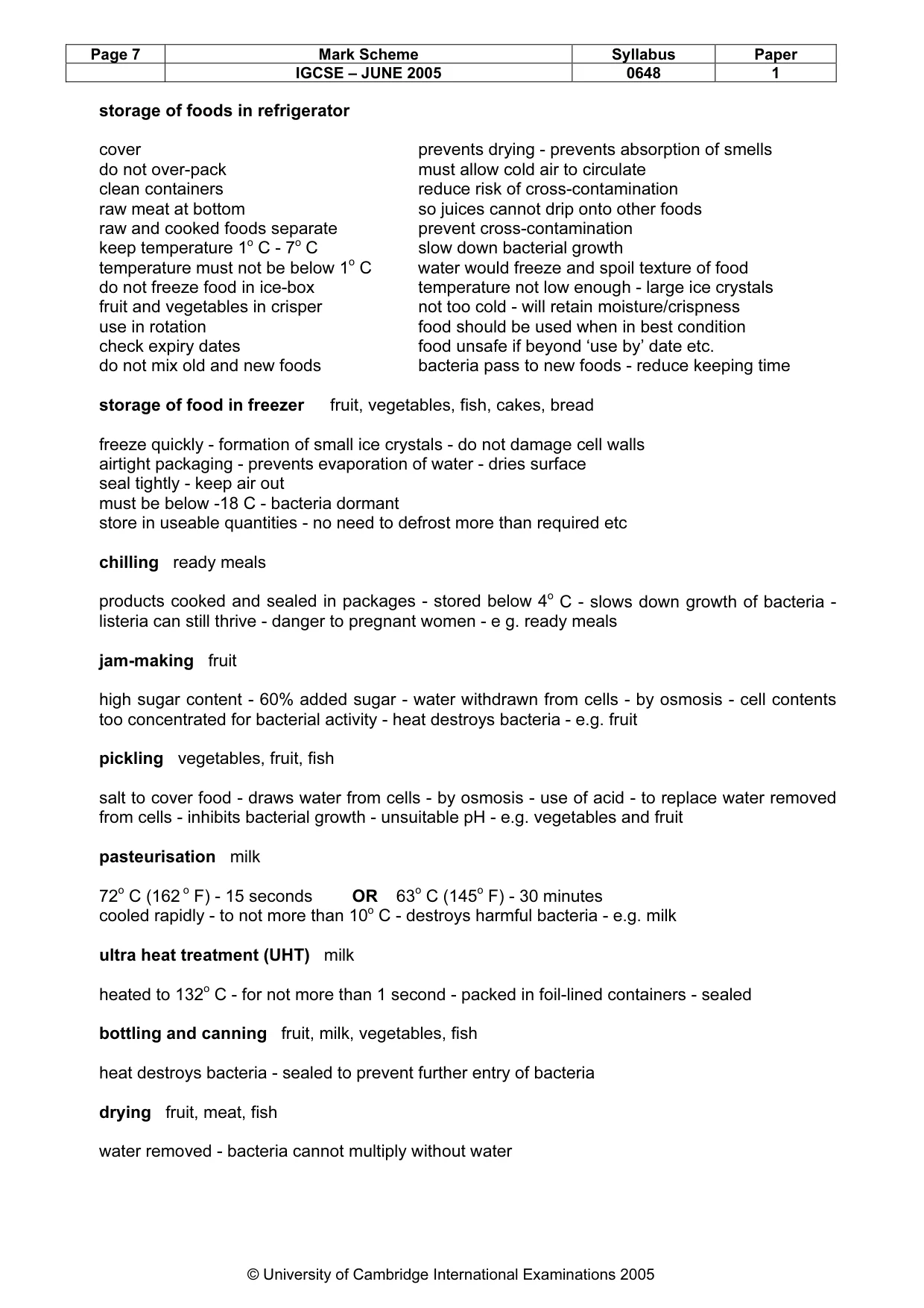
Page 7 Mark Scheme Syllabus Paper IGCSE – JUNE 2005 0648 1 © University of Cambridge International Examinations 2005 storage of foods in refrigerator cover prevents drying - prevents absorption of smells do not over-pack must allow cold air to circulate clean containers reduce risk of cross-contamination raw meat at bottom so juices cannot drip onto other foods raw and cooked foods separate prevent cross-contamination keep temperature 1o C - 7o C slow down bacterial growth temperature must not be below 1o C water would freeze and spoil texture of food do not freeze food in ice-box temperature not low enough - large ice crystals fruit and vegetables in crisper not too cold - will retain moisture/crispness use in rotation food should be used when in best condition check expiry dates food unsafe if beyond ‘use by’ date etc. do not mix old and new foods bacteria pass to new foods - reduce keeping time storage of food in freezer fruit, vegetables, fish, cakes, bread freeze quickly - formation of small ice crystals - do not damage cell walls airtight packaging - prevents evaporation of water - dries surface seal tightly - keep air out must be below -18 C - bacteria dormant store in useable quantities - no need to defrost more than required etc chilling ready meals products cooked and sealed in packages - stored below 4o C - slows down growth of bacteria - listeria can still thrive - danger to pregnant women - e g. ready meals jam-making fruit high sugar content - 60% added sugar - water withdrawn from cells - by osmosis - cell contents too concentrated for bacterial activity - heat destroys bacteria - e.g. fruit pickling vegetables, fruit, fish salt to cover food - draws water from cells - by osmosis - use of acid - to replace water removed from cells - inhibits bacterial growth - unsuitable pH - e.g. vegetables and fruit pasteurisation milk 72o C (162 o F) - 15 seconds OR 63o C (145o F) - 30 minutes cooled rapidly - to not more than 10o C - destroys harmful bacteria - e.g. milk ultra heat treatment (UHT) milk heated to 132o C - for not more than 1 second - packed in foil-lined containers - sealed bottling and canning fruit, milk, vegetables, fish heat destroys bacteria - sealed to prevent further entry of bacteria drying fruit, meat, fish water removed - bacteria cannot multiply without water
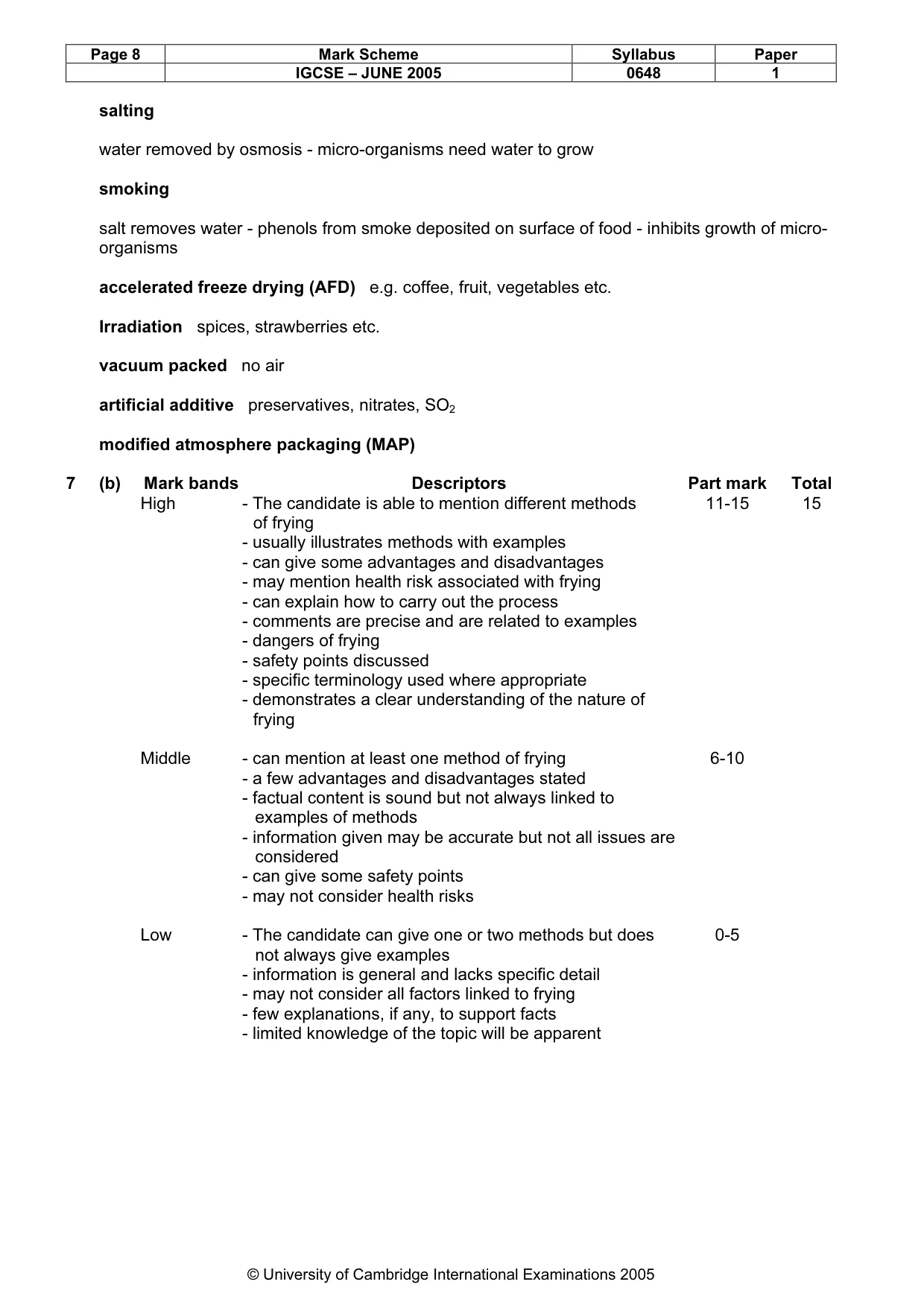
Mark scheme, page 11
Page 8 Mark Scheme Syllabus Paper IGCSE – JUNE 2005 0648 1 © University of Cambridge International Examinations 2005 salting water removed by osmosis - micro-organisms need water to grow smoking salt removes water - phenols from smoke deposited on surface of food - inhibits growth of micro- organisms accelerated freeze drying (AFD) e.g. coffee, fruit, vegetables etc. Irradiation spices, strawberries etc. vacuum packed no air artificial additive preservatives, nitrates, SO2 modified atmosphere packaging (MAP) 7 (b) Mark bands Descriptors Part mark Total High - The candidate is able to mention different methods of frying - usually illustrates methods with examples - can give some advantages and disadvantages - may mention health risk associated with frying - can explain how to carry out the process - comments are precise and are related to examples - dangers of frying - safety points discussed - specific terminology used where appropriate - demonstrates a clear understanding of the nature of frying 11-15 15 Middle - can mention at least one method of frying - a few advantages and disadvantages stated - factual content is sound but not always linked to examples of methods - information given may be accurate but not all issues are considered - can give some safety points - may not consider health risks 6-10 Low - The candidate can give one or two methods but does not always give examples - information is general and lacks specific detail - may not consider all factors linked to frying - few explanations, if any, to support facts - limited knowledge of the topic will be apparent 0-5
Mark scheme, page 12
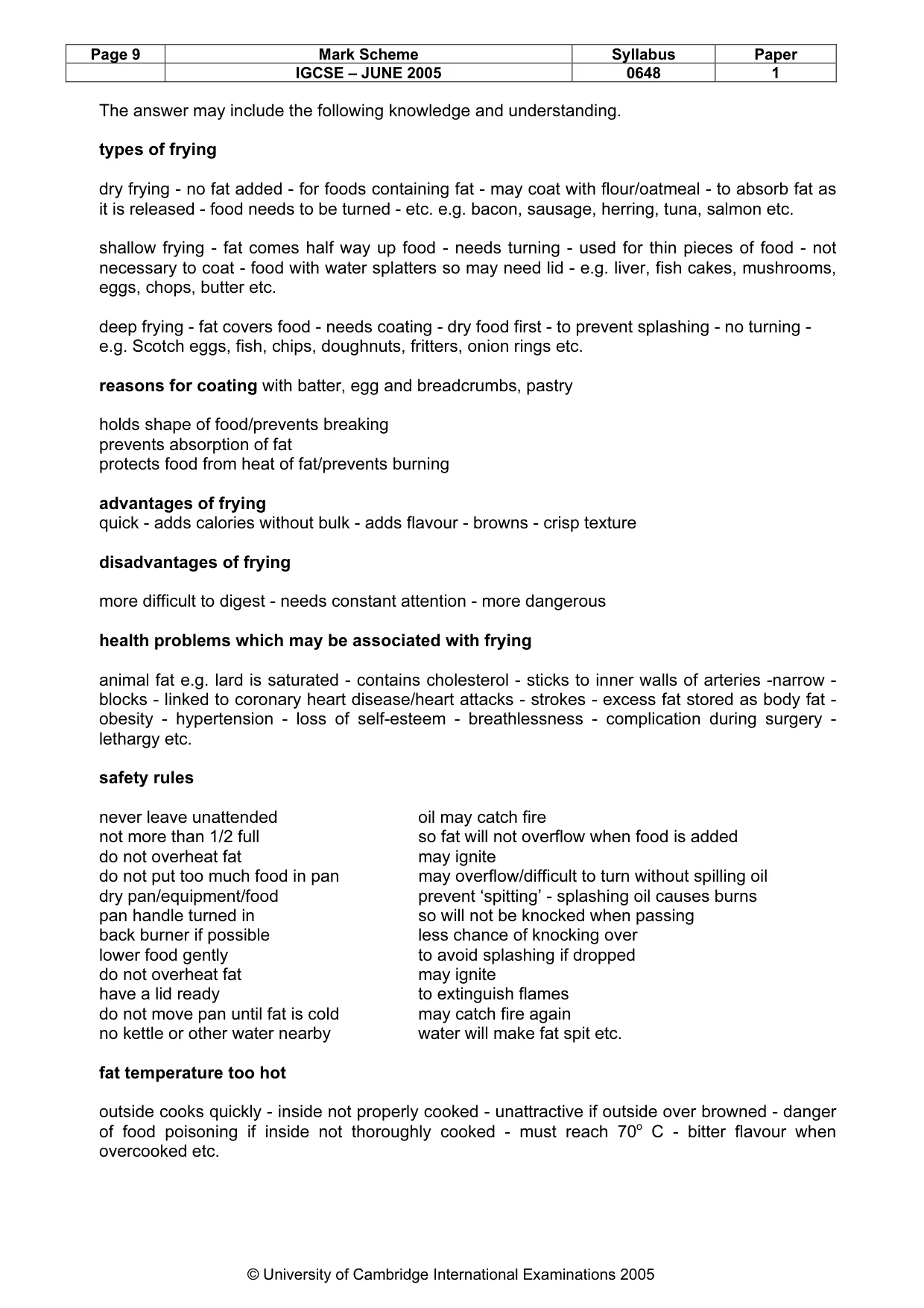
Page 9 Mark Scheme Syllabus Paper IGCSE – JUNE 2005 0648 1 © University of Cambridge International Examinations 2005 The answer may include the following knowledge and understanding. types of frying dry frying - no fat added - for foods containing fat - may coat with flour/oatmeal - to absorb fat as it is released - food needs to be turned - etc. e.g. bacon, sausage, herring, tuna, salmon etc. shallow frying - fat comes half way up food - needs turning - used for thin pieces of food - not necessary to coat - food with water splatters so may need lid - e.g. liver, fish cakes, mushrooms, eggs, chops, butter etc. deep frying - fat covers food - needs coating - dry food first - to prevent splashing - no turning - e.g. Scotch eggs, fish, chips, doughnuts, fritters, onion rings etc. reasons for coating with batter, egg and breadcrumbs, pastry holds shape of food/prevents breaking prevents absorption of fat protects food from heat of fat/prevents burning advantages of frying quick - adds calories without bulk - adds flavour - browns - crisp texture disadvantages of frying more difficult to digest - needs constant attention - more dangerous health problems which may be associated with frying animal fat e.g. lard is saturated - contains cholesterol - sticks to inner walls of arteries -narrow - blocks - linked to coronary heart disease/heart attacks - strokes - excess fat stored as body fat - obesity - hypertension - loss of self-esteem - breathlessness - complication during surgery - lethargy etc. safety rules never leave unattended oil may catch fire not more than 1/2 full so fat will not overflow when food is added do not overheat fat may ignite do not put too much food in pan may overflow/difficult to turn without spilling oil dry pan/equipment/food prevent ‘spitting’ - splashing oil causes burns pan handle turned in so will not be knocked when passing back burner if possible less chance of knocking over lower food gently to avoid splashing if dropped do not overheat fat may ignite have a lid ready to extinguish flames do not move pan until fat is cold may catch fire again no kettle or other water nearby water will make fat spit etc. fat temperature too hot outside cooks quickly - inside not properly cooked - unattractive if outside over browned - danger of food poisoning if inside not thoroughly cooked - must reach 70o C - bitter flavour when overcooked etc.
Mark scheme, page 13
Page 10 Mark Scheme Syllabus Paper IGCSE – JUNE 2005 0648 1 © University of Cambridge International Examinations 2005 fat temperature too low outside surface not sealed - protein not coagulated - in egg - starch in flour - not gelatinised - as soon as food enters oil - oil absorbed by food - unappetising - difficult to digest etc. other points to consider when frying absorbent paper after frying - to soak up surplus fat use fat with high smoke point - will not decompose before correct temperature is reached must be able to be heated to 200o C (400o F) without burning test temperature with sugar thermometer vegetable oils and lard are suitable butter and margarine can be used for shallow frying - frying temperature lower use strong pan with flat base - steady on stove thermostatically controlled electric fryer can be used - controls temperature automatically etc. replace oil from time to time sieve out crumbs - decompose - black specks affect flavour