Cambridge IGCSE Food and Nutrition 0648 — 2004 Oct/Nov Paper 1 · Variant 1
0648/11/O/N/04
The question paper and its mark scheme, free to read here and free to download. This is Cambridge’s own paper, exactly as it was sat.
Question paper12 pages
Mark scheme9 pages
Answers below. Sit the paper first if you are practising.
Paper as text
Question paper, page 1
This document consists of 12 printed pages. SP (NF) S68163 © UCLES 2004 [Turn over UNIVERSITY OF CAMBRIDGE INTERNATIONAL EXAMINATIONS International General Certificate of Secondary Education FOOD AND NUTRITION 0648/01 Paper 1 Theory October/November 2004 2 hours Candidates answer on the Question Paper. No Additional Materials are required. READ THESE INSTRUCTIONS FIRST Write your Centre number, candidate number and name on all the work you hand in. Write in dark blue or black pen. You may use a soft pencil for any diagrams or rough working. Do not use staples, paper clips, highlighters, glue or correction fluid. Answer all questions in the spaces provided on the Question Paper. You are advised to spend no longer than 45 minutes on Section A. At the end of the examination, fasten all your work securely together. The number of marks is given in brackets [ ] at the end of each question or part question. Centre Number Candidate Number Name If you have been given a label, look at the details. If any details are incorrect or missing, please fill in your correct details in the space given at the top of this page. Stick your personal label here, if provided. For Examiner’s Use 1 2 3 4 5 6 7 Total www.XtremePapers.com
Question paper, page 2
2 0648/01/O/N/04 Section A Answer all questions 1 (a) State three functions of protein. … … …[3] (b) Name the elements which combine to form protein. … …[2] (c) (i) Define the term ‘High Biological Value (HBV) protein’. … …[1] (ii) Name four foods which are good sources of HBV protein. … …[2] (d) (i) Define the term ‘Low Biological Value (LBV) protein’. … …[1] (ii) Name four foods which are good sources of LBV protein. … …[2] (e) (i) What are complementary proteins? … …[2] (ii) Give two examples of protein complementation. … …[1] For Examiner’s Use © UCLES 2004
Question paper, page 3
3 0648/01/O/N/04 [Turn over (f) Describe the digestion and absorption of protein. … … … … … … … … … …[6] (g) What is meant by ‘deamination of protein’? … … …[2] 2 An adequate supply of Non-Starch Polysaccharide (NSP) is an essential in a healthy diet. (a) Explain how NSP is used by the body. … … … … … …[4] (b) Name four good sources of NSP. … …[2] For Examiner’s Use © UCLES 2004
Question paper, page 4
4 0648/01/O/N/04 3 (a) State three reasons for including sodium chloride (salt) in the diet. … … …[3] (b) Name two situations in which individuals will require additional salt. Give a reason for each of your answers. … …[2] (c) What would be the result if a diet is lacking in salt? …[1] (d) Give advice, with explanations, on the choice or preparation of foods for those who wish to reduce their intake of salt. … … … … … … … … … … … …[6] [TOTAL for Section A: 40] For Examiner’s Use © UCLES 2004
Question paper, page 5
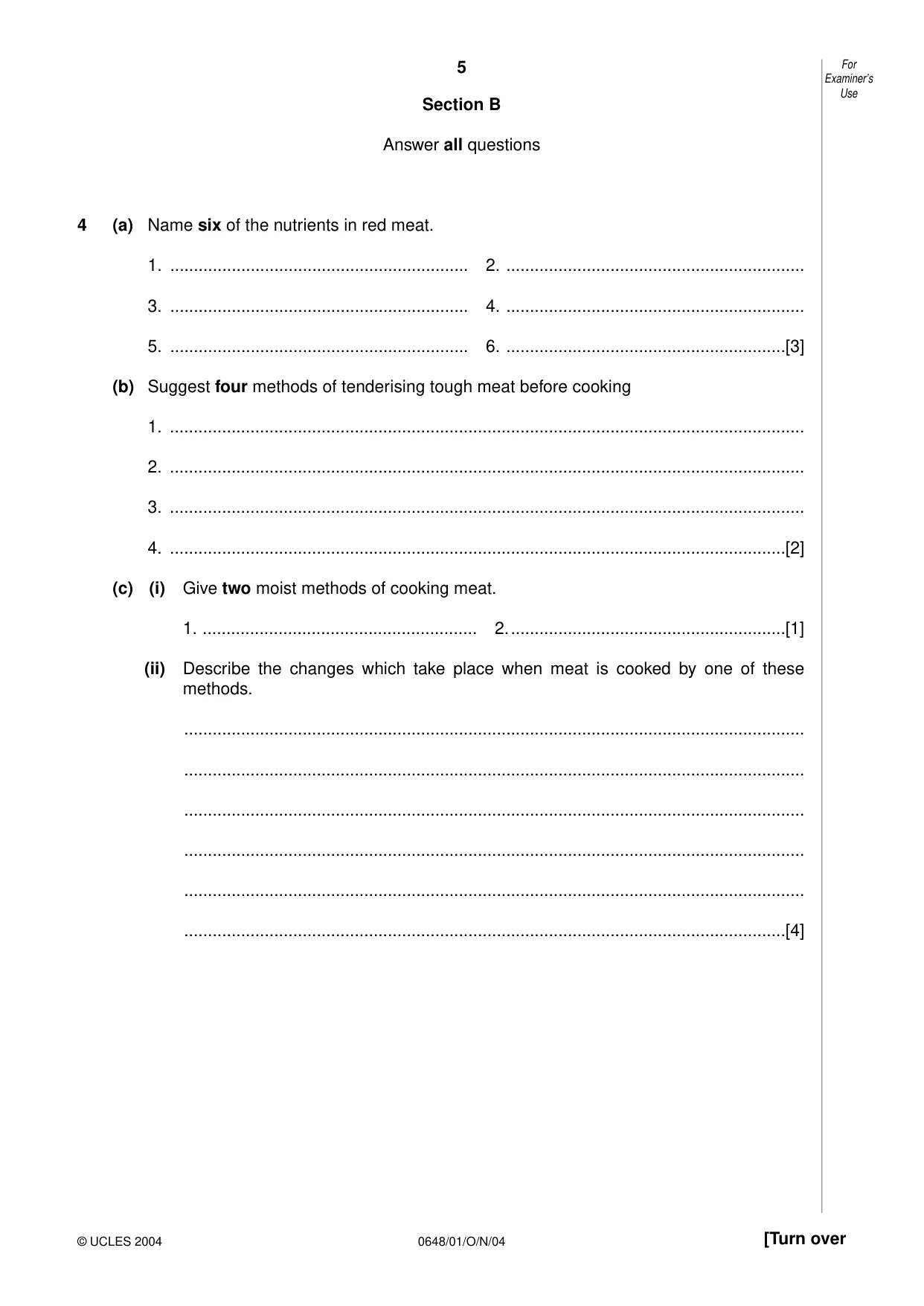
5 0648/01/O/N/04 [Turn over Section B Answer all questions 4 (a) Name six of the nutrients in red meat. 1. … 2. … 3. … 4. … 5. … 6. …[3] (b) Suggest four methods of tenderising tough meat before cooking 1. … 2. … 3. … 4. …[2] (c) (i) Give two moist methods of cooking meat. 1. … 2…[1] (ii) Describe the changes which take place when meat is cooked by one of these methods. … … … … … …[4] For Examiner’s Use © UCLES 2004
Question paper, page 6
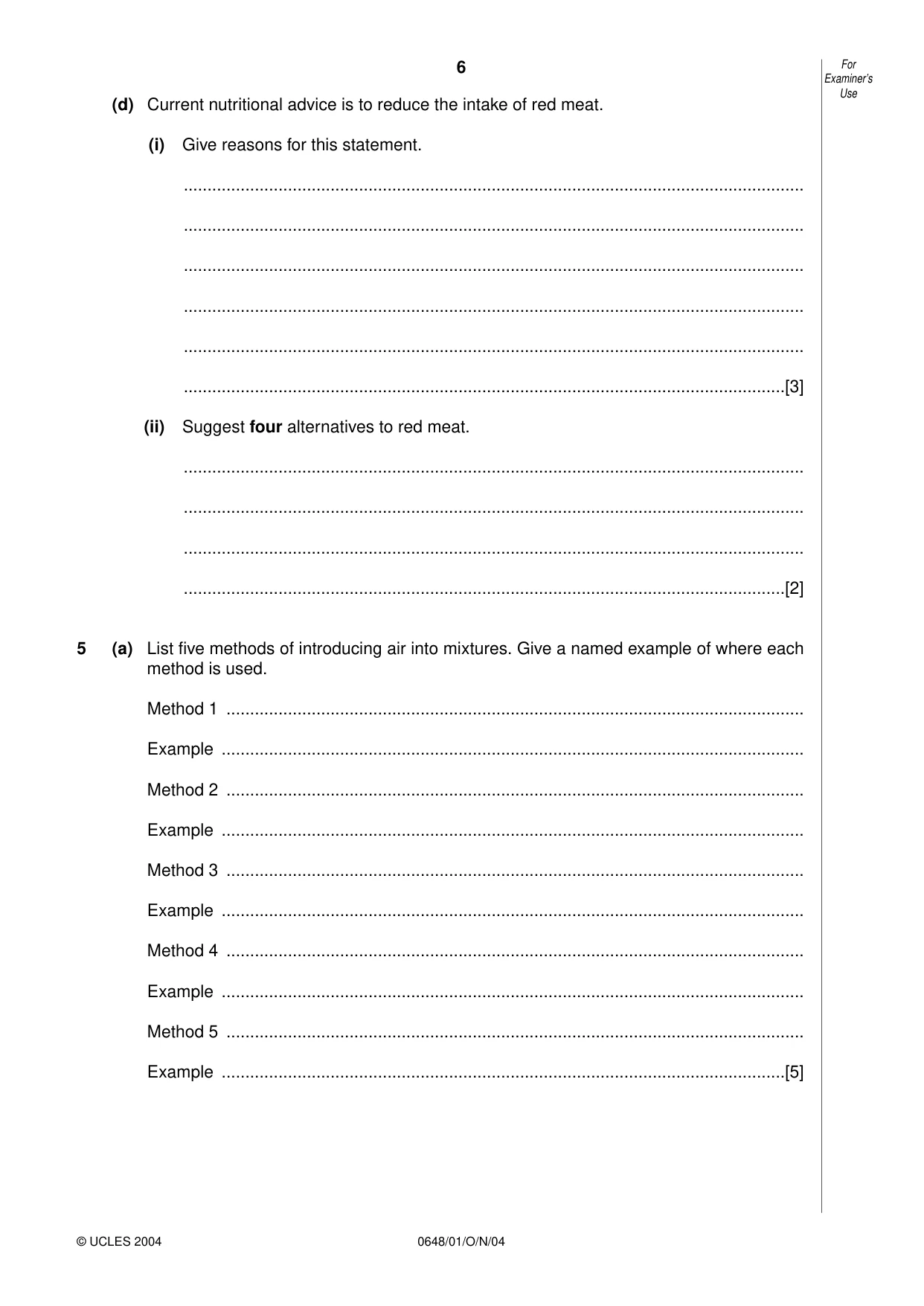
6 0648/01/O/N/04 (d) Current nutritional advice is to reduce the intake of red meat. (i) Give reasons for this statement. … … … … … …[3] (ii) Suggest four alternatives to red meat. … … … …[2] 5 (a) List five methods of introducing air into mixtures. Give a named example of where each method is used. Method 1 … Example … Method 2 … Example … Method 3 … Example … Method 4 … Example … Method 5 … Example …[5] For Examiner’s Use © UCLES 2004
Question paper, page 7
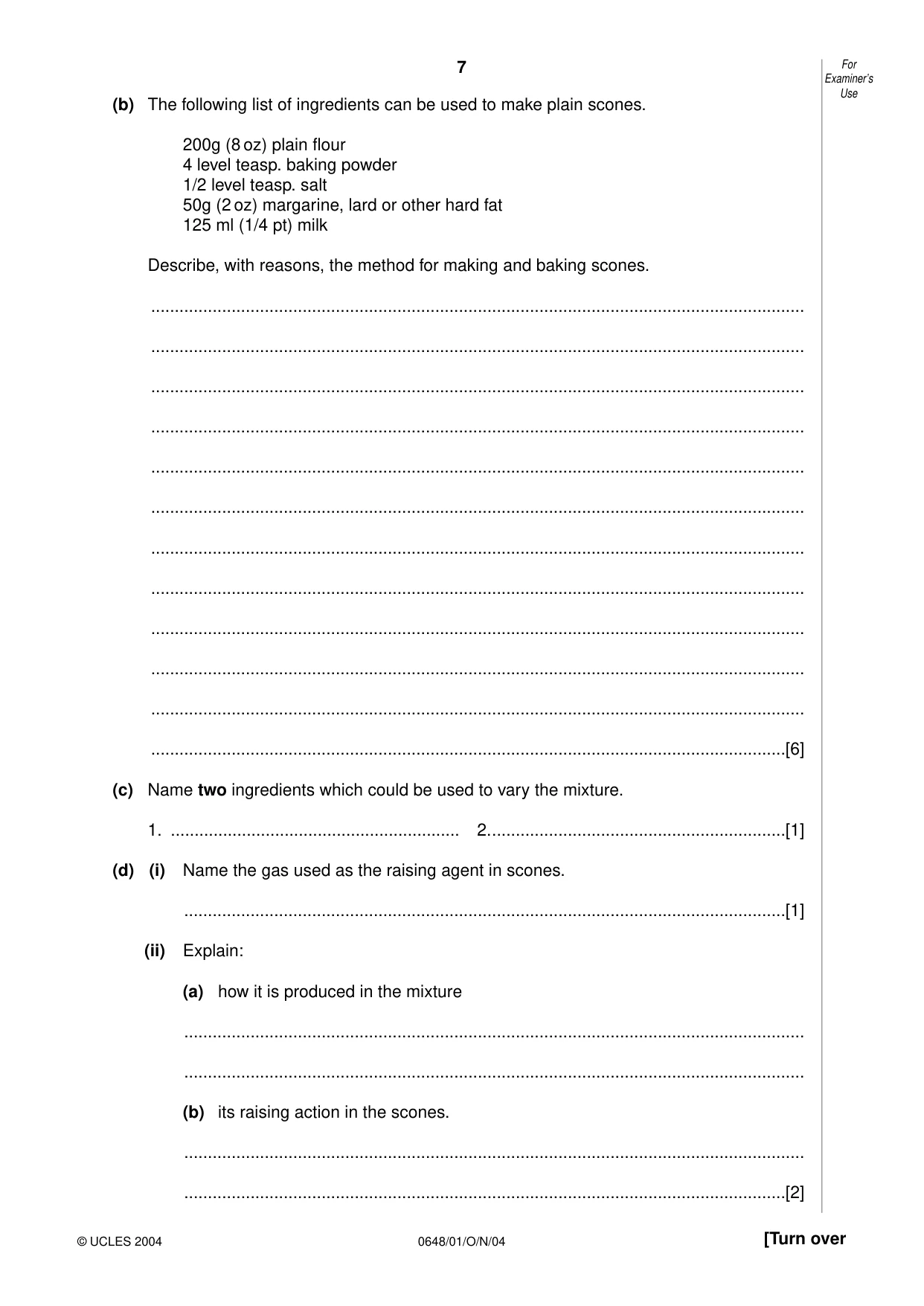
7 0648/01/O/N/04 [Turn over (b) The following list of ingredients can be used to make plain scones. 200g (8 oz) plain flour 4 level teasp. baking powder 1/2 level teasp. salt 50g (2 oz) margarine, lard or other hard fat 125 ml (1/4 pt) milk Describe, with reasons, the method for making and baking scones. … … … … … … … … … … … …[6] (c) Name two ingredients which could be used to vary the mixture. 1. … 2…[1] (d) (i) Name the gas used as the raising agent in scones. …[1] (ii) Explain: (a) how it is produced in the mixture … … (b) its raising action in the scones. … …[2] For Examiner’s Use © UCLES 2004
Question paper, page 8
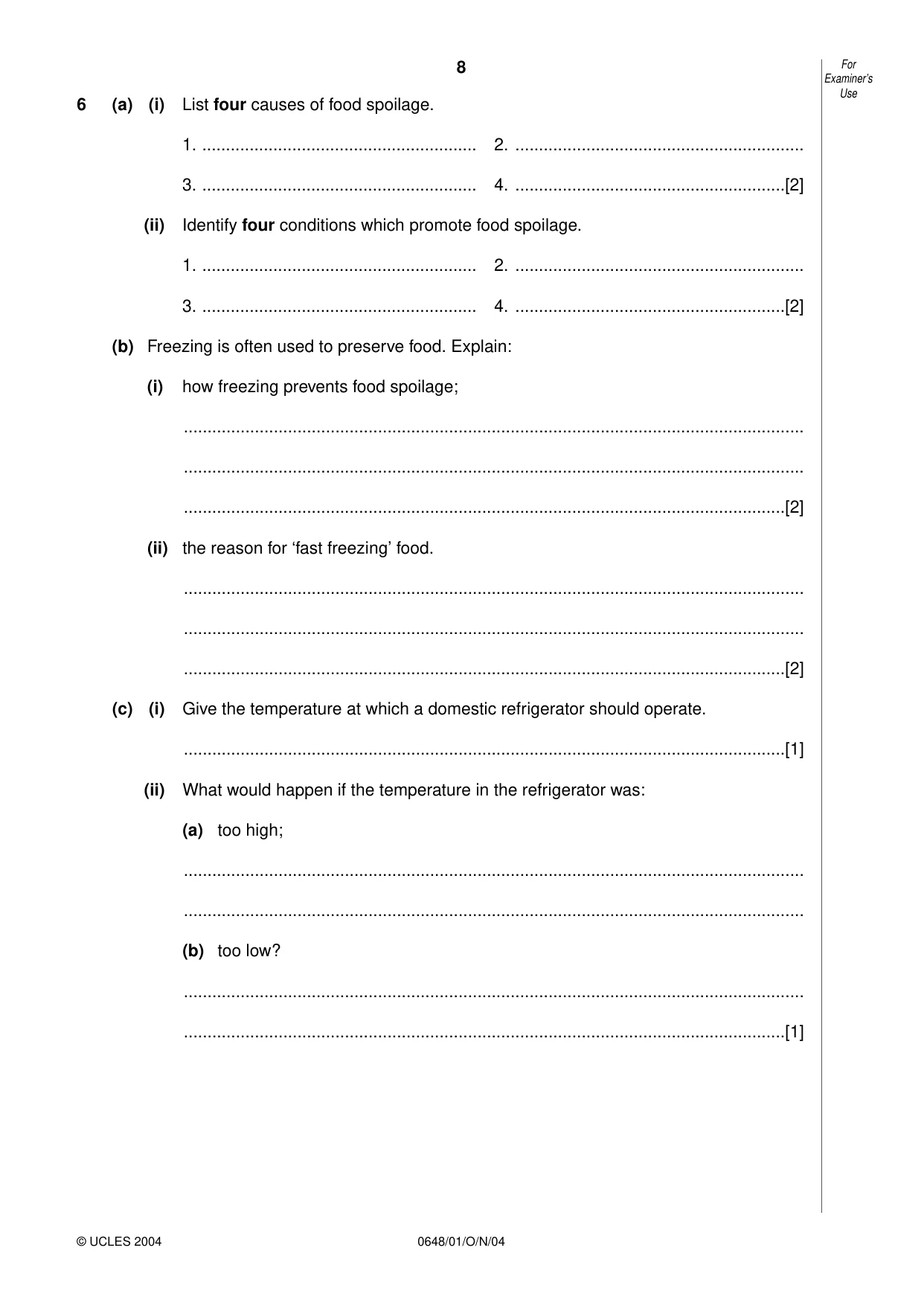
8 0648/01/O/N/04 6 (a) (i) List four causes of food spoilage. 1. … 2. … 3. … 4. …[2] (ii) Identify four conditions which promote food spoilage. 1. … 2. … 3. … 4. …[2] (b) Freezing is often used to preserve food. Explain: (i) how freezing prevents food spoilage; … … …[2] (ii) the reason for ‘fast freezing’ food. … … …[2] (c) (i) Give the temperature at which a domestic refrigerator should operate. …[1] (ii) What would happen if the temperature in the refrigerator was: (a) too high; … … (b) too low? … …[1] For Examiner’s Use © UCLES 2004
Question paper, page 9
9 0648/01/O/N/04 [Turn over (iii) State and explain five rules to observe when storing food in a refrigerator. … … … … … … … … … …[5] [TOTAL for Section B: 45] For Examiner’s Use © UCLES 2004
Question paper, page 10
10 0648/01/O/N/04 Section C Answer either 7(a) or 7(b). 7 (a) Discuss reasons for cooking food Suggest ways of saving money when buying and cooking food. or (b) Discuss the information which could be found on a food label and state why the information is important. … … … … … … … … … … … … … … … … … … … … … … For Examiner’s Use © UCLES 2004
Question paper, page 11
11 0648/01/O/N/04 … … … … … … … … … … … … … … … … … … … … … … … … … … … For Examiner’s Use © UCLES 2004
Question paper, page 12
12 0648/01/O/N/04 … … … … … … … … … … … … … … … … … … … … … … … …[15] [TOTAL for Section C: 15] [Total for Paper: 100] For Examiner’s Use © UCLES 2004 University of Cambridge International Examinations is part of the University of Cambridge Local Examinations Syndicate (UCLES), which is itself a department of the University of Cambridge.
Mark scheme, page 1
UNIVERSITY OF CAMBRIDGE INTERNATIONAL EXAMINATIONS International General Certificate of Secondary Education MARK SCHEME for the November 2004 question paper 0648 FOOD AND NUTRITION 0648/01 Paper 1 (Theory), maximum mark 100 This mark scheme is published as an aid to teachers and students, to indicate the requirements of the examination. It shows the basis on which Examiners were initially instructed to award marks. It does not indicate the details of the discussions that took place at an Examiners’ meeting before marking began. Any substantial changes to the mark scheme that arose from these discussions will be recorded in the published Report on the Examination. All Examiners are instructed that alternative correct answers and unexpected approaches in candidates’ scripts must be given marks that fairly reflect the relevant knowledge and skills demonstrated. Mark schemes must be read in conjunction with the question papers and the Report on the Examination. • CIE will not enter into discussion or correspondence in connection with these mark schemes. CIE is publishing the mark schemes for the November 2004 question papers for most IGCSE and GCE Advanced Level syllabuses. www.XtremePapers.com
Mark scheme, page 2
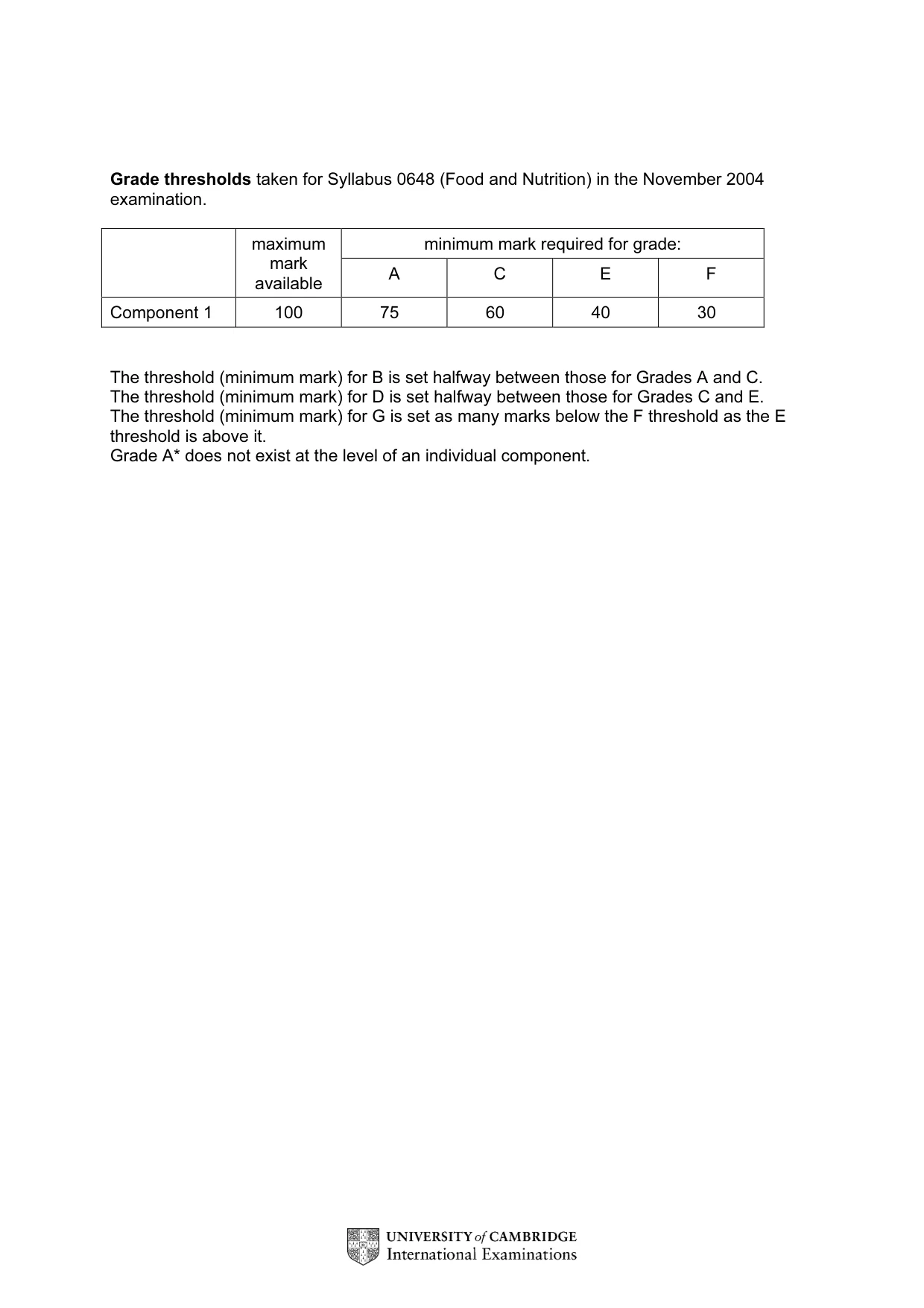
Grade thresholds taken for Syllabus 0648 (Food and Nutrition) in the November 2004 examination. minimum mark required for grade: maximum mark available A C E F Component 1 100 75 60 40 30 The threshold (minimum mark) for B is set halfway between those for Grades A and C. The threshold (minimum mark) for D is set halfway between those for Grades C and E. The threshold (minimum mark) for G is set as many marks below the F threshold as the E threshold is above it. Grade A* does not exist at the level of an individual component.
Mark scheme, page 3
November 2004 INTERNATIONAL GCSE MARK SCHEME MAXIMUM MARK: 100 SYLLABUS/COMPONENT: 0648/01 FOOD AND NUTRITION (Theory)
Mark scheme, page 4
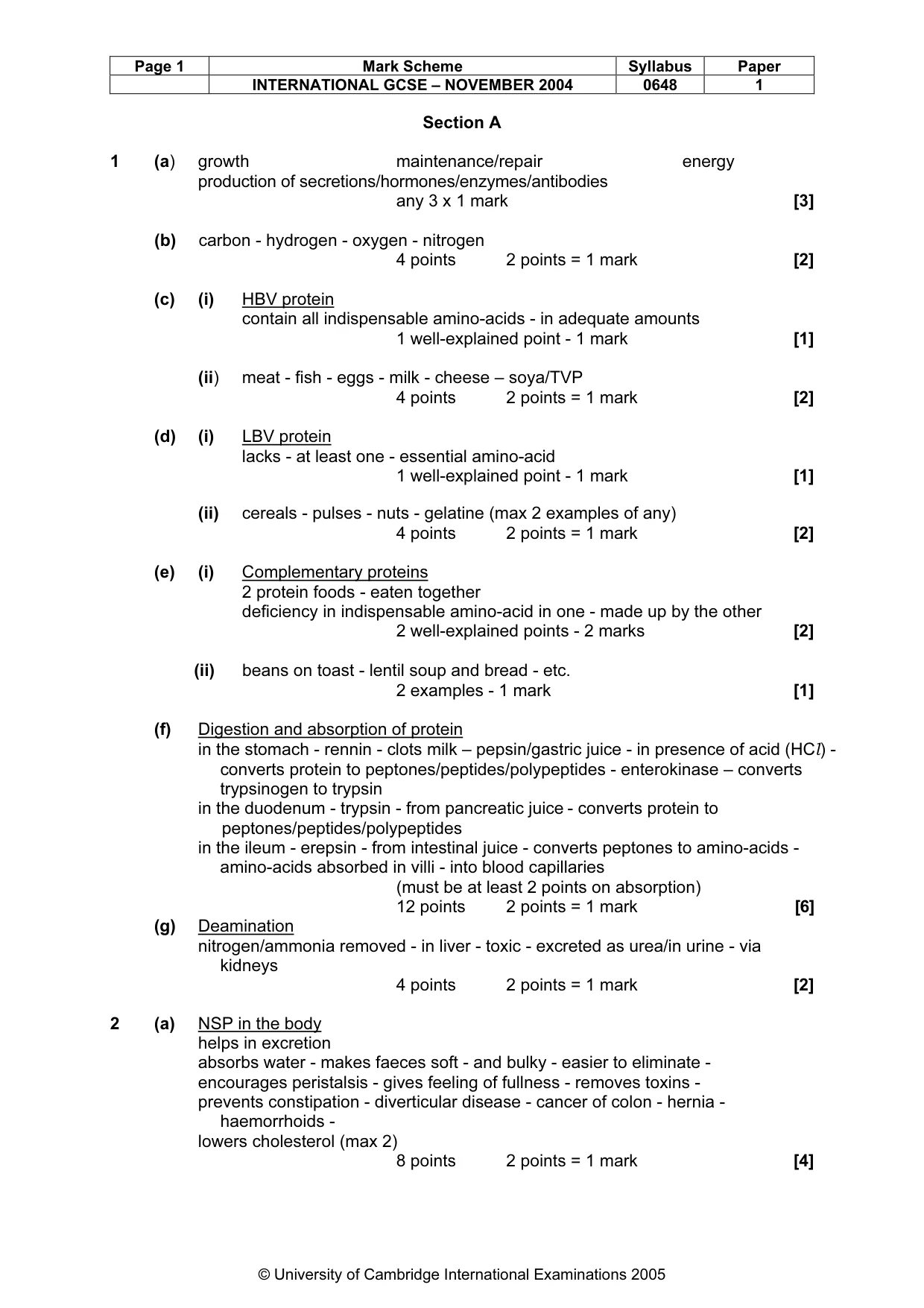
Page 1 Mark Scheme Syllabus Paper INTERNATIONAL GCSE – NOVEMBER 2004 0648 1 © University of Cambridge International Examinations 2005 Section A 1 (a) growth maintenance/repair energy production of secretions/hormones/enzymes/antibodies any 3 x 1 mark [3] (b) carbon - hydrogen - oxygen - nitrogen 4 points 2 points = 1 mark [2] (c) (i) HBV protein contain all indispensable amino-acids - in adequate amounts 1 well-explained point - 1 mark [1] (ii) meat - fish - eggs - milk - cheese – soya/TVP 4 points 2 points = 1 mark [2] (d) (i) LBV protein lacks - at least one - essential amino-acid 1 well-explained point - 1 mark [1] (ii) cereals - pulses - nuts - gelatine (max 2 examples of any) 4 points 2 points = 1 mark [2] (e) (i) Complementary proteins 2 protein foods - eaten together deficiency in indispensable amino-acid in one - made up by the other 2 well-explained points - 2 marks [2] (ii) beans on toast - lentil soup and bread - etc. 2 examples - 1 mark [1] (f) Digestion and absorption of protein in the stomach - rennin - clots milk – pepsin/gastric juice - in presence of acid (HCl) - converts protein to peptones/peptides/polypeptides - enterokinase – converts trypsinogen to trypsin in the duodenum - trypsin - from pancreatic juice - converts protein to peptones/peptides/polypeptides in the ileum - erepsin - from intestinal juice - converts peptones to amino-acids - amino-acids absorbed in villi - into blood capillaries (must be at least 2 points on absorption) 12 points 2 points = 1 mark [6] (g) Deamination nitrogen/ammonia removed - in liver - toxic - excreted as urea/in urine - via kidneys 4 points 2 points = 1 mark [2] 2 (a) NSP in the body helps in excretion absorbs water - makes faeces soft - and bulky - easier to eliminate - encourages peristalsis - gives feeling of fullness - removes toxins - prevents constipation - diverticular disease - cancer of colon - hernia - haemorrhoids - lowers cholesterol (max 2) 8 points 2 points = 1 mark [4]
Mark scheme, page 5
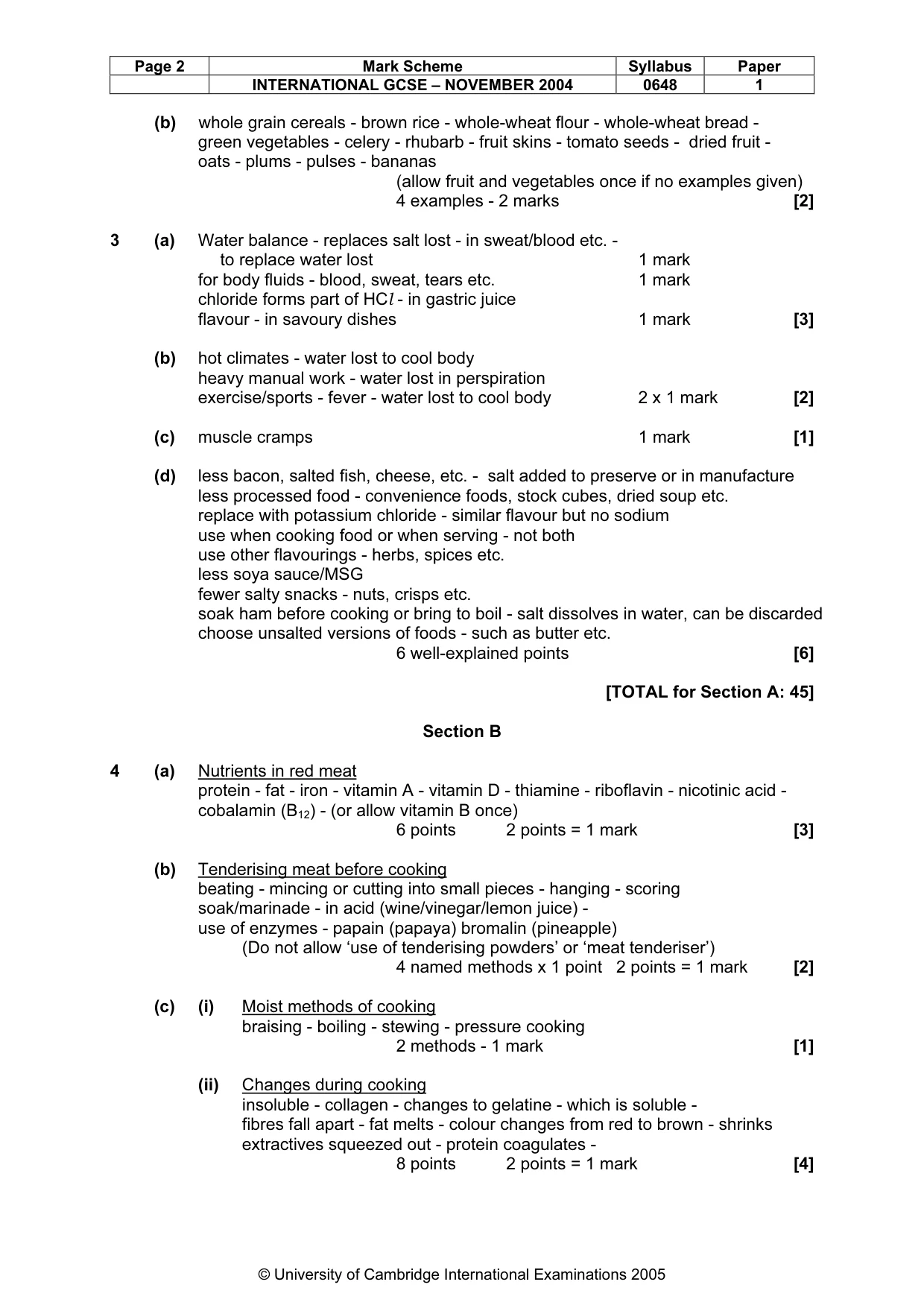
Page 2 Mark Scheme Syllabus Paper INTERNATIONAL GCSE – NOVEMBER 2004 0648 1 © University of Cambridge International Examinations 2005 (b) whole grain cereals - brown rice - whole-wheat flour - whole-wheat bread - green vegetables - celery - rhubarb - fruit skins - tomato seeds - dried fruit - oats - plums - pulses - bananas (allow fruit and vegetables once if no examples given) 4 examples - 2 marks [2] 3 (a) Water balance - replaces salt lost - in sweat/blood etc. - to replace water lost 1 mark for body fluids - blood, sweat, tears etc. 1 mark chloride forms part of HCl - in gastric juice flavour - in savoury dishes 1 mark [3] (b) hot climates - water lost to cool body heavy manual work - water lost in perspiration exercise/sports - fever - water lost to cool body 2 x 1 mark [2] (c) muscle cramps 1 mark [1] (d) less bacon, salted fish, cheese, etc. - salt added to preserve or in manufacture less processed food - convenience foods, stock cubes, dried soup etc. replace with potassium chloride - similar flavour but no sodium use when cooking food or when serving - not both use other flavourings - herbs, spices etc. less soya sauce/MSG fewer salty snacks - nuts, crisps etc. soak ham before cooking or bring to boil - salt dissolves in water, can be discarded choose unsalted versions of foods - such as butter etc. 6 well-explained points [6] [TOTAL for Section A: 45] Section B 4 (a) Nutrients in red meat protein - fat - iron - vitamin A - vitamin D - thiamine - riboflavin - nicotinic acid - cobalamin (B12) - (or allow vitamin B once) 6 points 2 points = 1 mark [3] (b) Tenderising meat before cooking beating - mincing or cutting into small pieces - hanging - scoring soak/marinade - in acid (wine/vinegar/lemon juice) - use of enzymes - papain (papaya) bromalin (pineapple) (Do not allow ‘use of tenderising powders’ or ‘meat tenderiser’) 4 named methods x 1 point 2 points = 1 mark [2] (c) (i) Moist methods of cooking braising - boiling - stewing - pressure cooking 2 methods - 1 mark [1] (ii) Changes during cooking insoluble - collagen - changes to gelatine - which is soluble - fibres fall apart - fat melts - colour changes from red to brown - shrinks extractives squeezed out - protein coagulates - 8 points 2 points = 1 mark [4]
Mark scheme, page 6
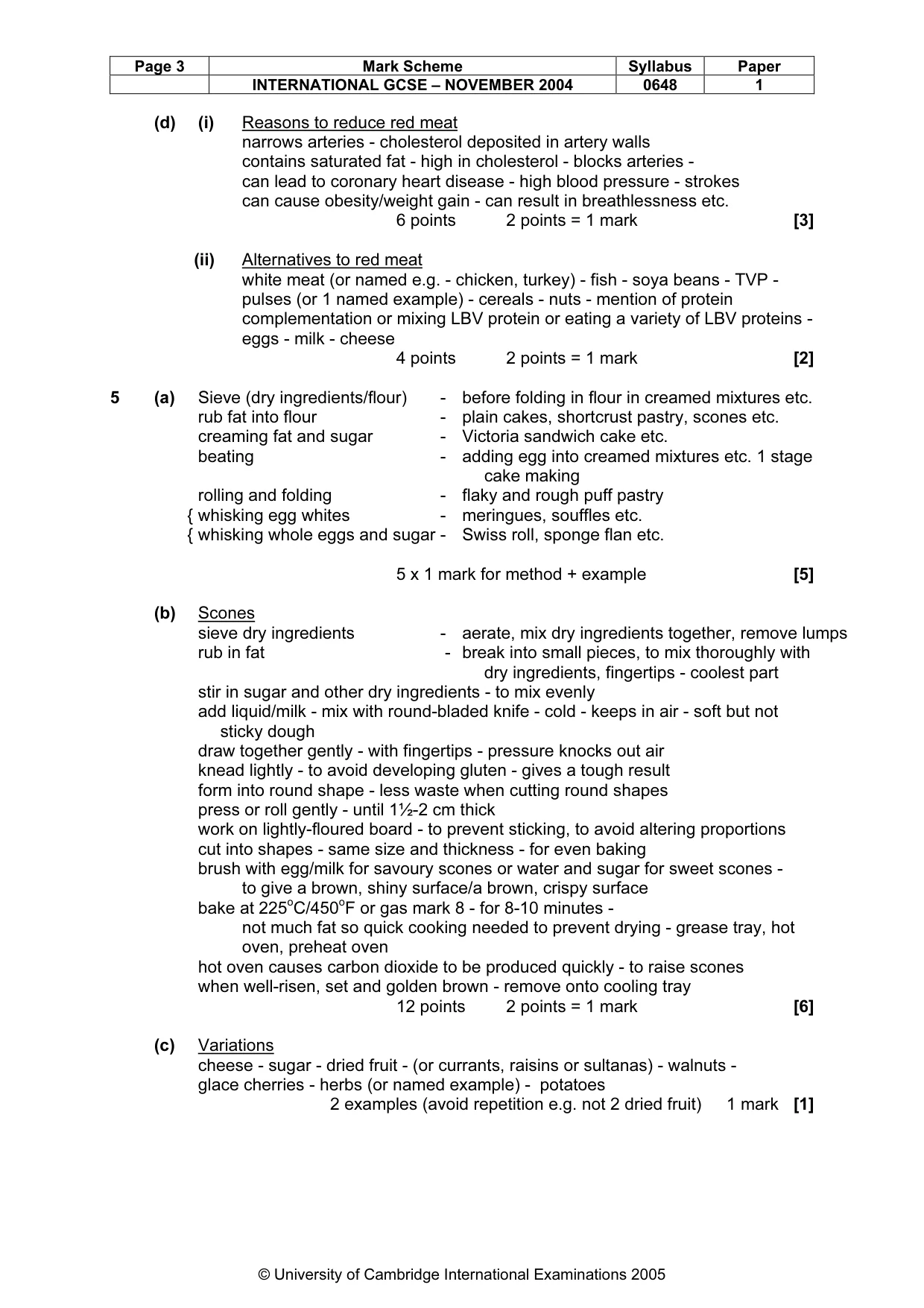
Page 3 Mark Scheme Syllabus Paper INTERNATIONAL GCSE – NOVEMBER 2004 0648 1 © University of Cambridge International Examinations 2005 (d) (i) Reasons to reduce red meat narrows arteries - cholesterol deposited in artery walls contains saturated fat - high in cholesterol - blocks arteries - can lead to coronary heart disease - high blood pressure - strokes can cause obesity/weight gain - can result in breathlessness etc. 6 points 2 points = 1 mark [3] (ii) Alternatives to red meat white meat (or named e.g. - chicken, turkey) - fish - soya beans - TVP - pulses (or 1 named example) - cereals - nuts - mention of protein complementation or mixing LBV protein or eating a variety of LBV proteins - eggs - milk - cheese 4 points 2 points = 1 mark [2] 5 (a) Sieve (dry ingredients/flour) - before folding in flour in creamed mixtures etc. rub fat into flour - plain cakes, shortcrust pastry, scones etc. creaming fat and sugar - Victoria sandwich cake etc. beating - adding egg into creamed mixtures etc. 1 stage cake making rolling and folding - flaky and rough puff pastry { whisking egg whites - meringues, souffles etc. { whisking whole eggs and sugar - Swiss roll, sponge flan etc. 5 x 1 mark for method + example [5] (b) Scones sieve dry ingredients - aerate, mix dry ingredients together, remove lumps rub in fat - break into small pieces, to mix thoroughly with dry ingredients, fingertips - coolest part stir in sugar and other dry ingredients - to mix evenly add liquid/milk - mix with round-bladed knife - cold - keeps in air - soft but not sticky dough draw together gently - with fingertips - pressure knocks out air knead lightly - to avoid developing gluten - gives a tough result form into round shape - less waste when cutting round shapes press or roll gently - until 1½-2 cm thick work on lightly-floured board - to prevent sticking, to avoid altering proportions cut into shapes - same size and thickness - for even baking brush with egg/milk for savoury scones or water and sugar for sweet scones - to give a brown, shiny surface/a brown, crispy surface bake at 225oC/450oF or gas mark 8 - for 8-10 minutes - not much fat so quick cooking needed to prevent drying - grease tray, hot oven, preheat oven hot oven causes carbon dioxide to be produced quickly - to raise scones when well-risen, set and golden brown - remove onto cooling tray 12 points 2 points = 1 mark [6] (c) Variations cheese - sugar - dried fruit - (or currants, raisins or sultanas) - walnuts - glace cherries - herbs (or named example) - potatoes 2 examples (avoid repetition e.g. not 2 dried fruit) 1 mark [1]
Mark scheme, page 7
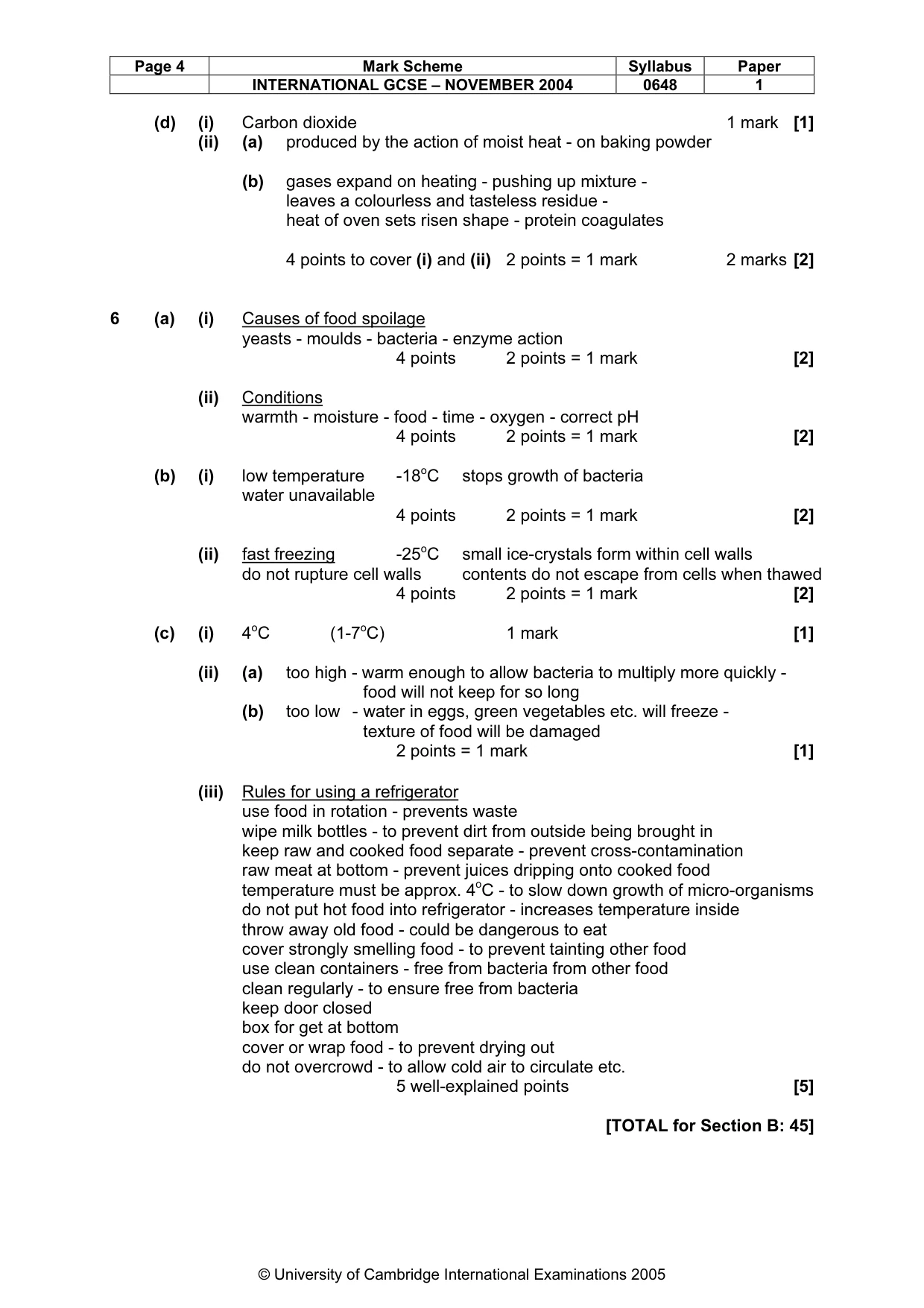
Page 4 Mark Scheme Syllabus Paper INTERNATIONAL GCSE – NOVEMBER 2004 0648 1 © University of Cambridge International Examinations 2005 (d) (i) Carbon dioxide 1 mark [1] (ii) (a) produced by the action of moist heat - on baking powder (b) gases expand on heating - pushing up mixture - leaves a colourless and tasteless residue - heat of oven sets risen shape - protein coagulates 4 points to cover (i) and (ii) 2 points = 1 mark 2 marks [2] 6 (a) (i) Causes of food spoilage yeasts - moulds - bacteria - enzyme action 4 points 2 points = 1 mark [2] (ii) Conditions warmth - moisture - food - time - oxygen - correct pH 4 points 2 points = 1 mark [2] (b) (i) low temperature -18oC stops growth of bacteria water unavailable 4 points 2 points = 1 mark [2] (ii) fast freezing -25oC small ice-crystals form within cell walls do not rupture cell walls contents do not escape from cells when thawed 4 points 2 points = 1 mark [2] (c) (i) 4oC (1-7oC) 1 mark [1] (ii) (a) too high - warm enough to allow bacteria to multiply more quickly - food will not keep for so long (b) too low - water in eggs, green vegetables etc. will freeze - texture of food will be damaged 2 points = 1 mark [1] (iii) Rules for using a refrigerator use food in rotation - prevents waste wipe milk bottles - to prevent dirt from outside being brought in keep raw and cooked food separate - prevent cross-contamination raw meat at bottom - prevent juices dripping onto cooked food temperature must be approx. 4oC - to slow down growth of micro-organisms do not put hot food into refrigerator - increases temperature inside throw away old food - could be dangerous to eat cover strongly smelling food - to prevent tainting other food use clean containers - free from bacteria from other food clean regularly - to ensure free from bacteria keep door closed box for get at bottom cover or wrap food - to prevent drying out do not overcrowd - to allow cold air to circulate etc. 5 well-explained points [5] [TOTAL for Section B: 45]
Mark scheme, page 8
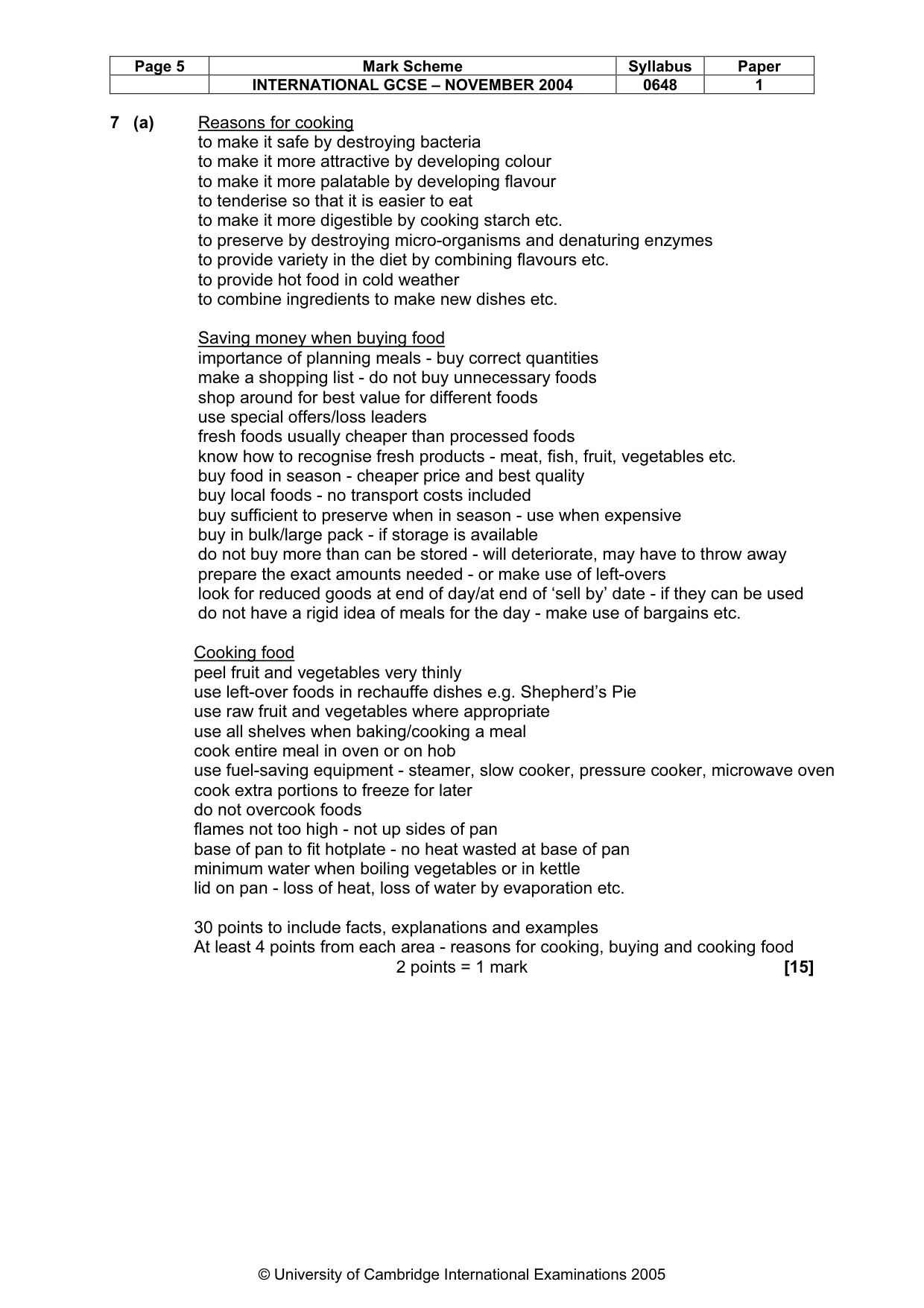
Page 5 Mark Scheme Syllabus Paper INTERNATIONAL GCSE – NOVEMBER 2004 0648 1 © University of Cambridge International Examinations 2005 7 (a) Reasons for cooking to make it safe by destroying bacteria to make it more attractive by developing colour to make it more palatable by developing flavour to tenderise so that it is easier to eat to make it more digestible by cooking starch etc. to preserve by destroying micro-organisms and denaturing enzymes to provide variety in the diet by combining flavours etc. to provide hot food in cold weather to combine ingredients to make new dishes etc. Saving money when buying food importance of planning meals - buy correct quantities make a shopping list - do not buy unnecessary foods shop around for best value for different foods use special offers/loss leaders fresh foods usually cheaper than processed foods know how to recognise fresh products - meat, fish, fruit, vegetables etc. buy food in season - cheaper price and best quality buy local foods - no transport costs included buy sufficient to preserve when in season - use when expensive buy in bulk/large pack - if storage is available do not buy more than can be stored - will deteriorate, may have to throw away prepare the exact amounts needed - or make use of left-overs look for reduced goods at end of day/at end of ‘sell by’ date - if they can be used do not have a rigid idea of meals for the day - make use of bargains etc. Cooking food peel fruit and vegetables very thinly use left-over foods in rechauffe dishes e.g. Shepherd’s Pie use raw fruit and vegetables where appropriate use all shelves when baking/cooking a meal cook entire meal in oven or on hob use fuel-saving equipment - steamer, slow cooker, pressure cooker, microwave oven cook extra portions to freeze for later do not overcook foods flames not too high - not up sides of pan base of pan to fit hotplate - no heat wasted at base of pan minimum water when boiling vegetables or in kettle lid on pan - loss of heat, loss of water by evaporation etc. 30 points to include facts, explanations and examples At least 4 points from each area - reasons for cooking, buying and cooking food 2 points = 1 mark [15]
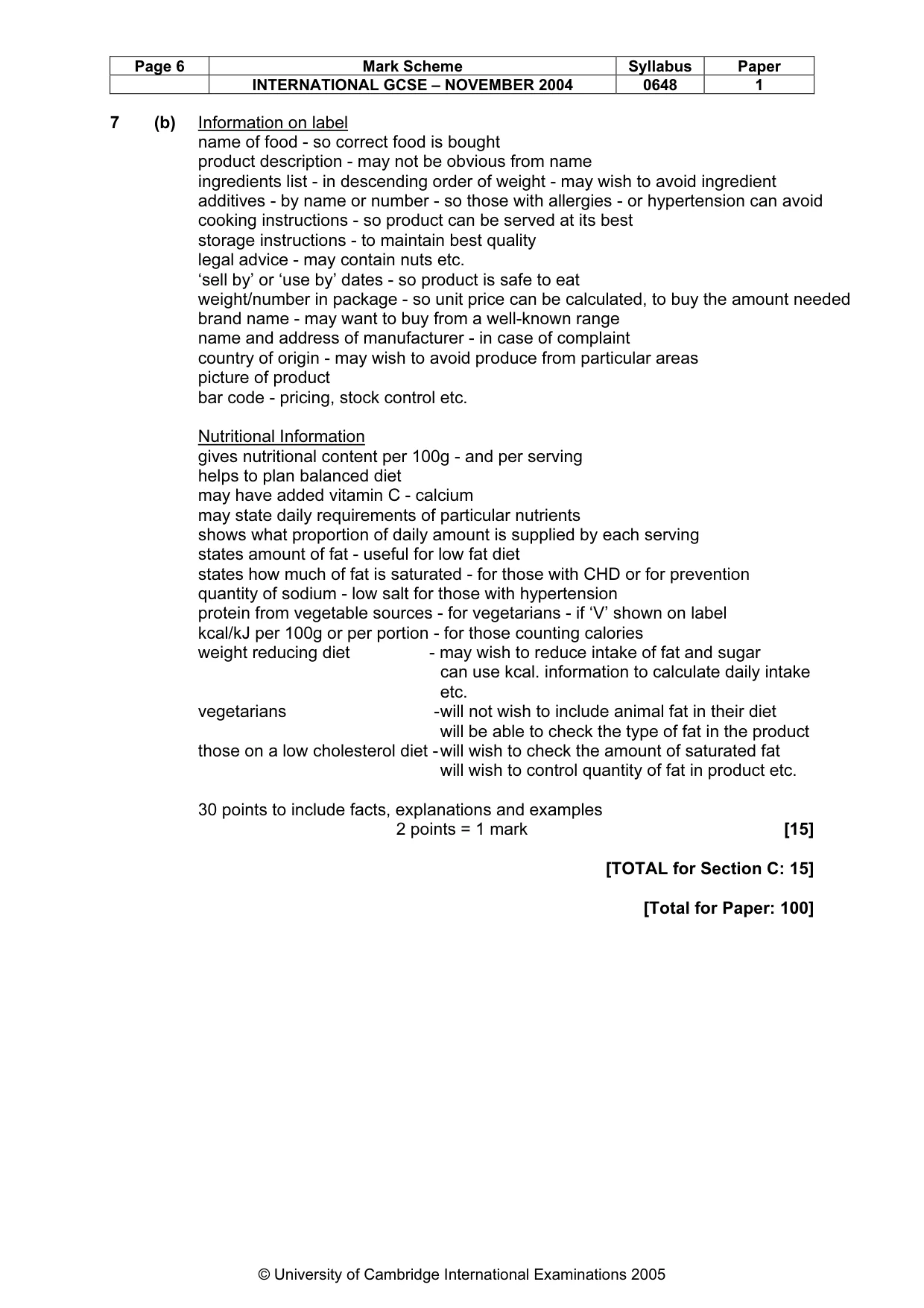
Mark scheme, page 9
Page 6 Mark Scheme Syllabus Paper INTERNATIONAL GCSE – NOVEMBER 2004 0648 1 © University of Cambridge International Examinations 2005 7 (b) Information on label name of food - so correct food is bought product description - may not be obvious from name ingredients list - in descending order of weight - may wish to avoid ingredient additives - by name or number - so those with allergies - or hypertension can avoid cooking instructions - so product can be served at its best storage instructions - to maintain best quality legal advice - may contain nuts etc. ‘sell by’ or ‘use by’ dates - so product is safe to eat weight/number in package - so unit price can be calculated, to buy the amount needed brand name - may want to buy from a well-known range name and address of manufacturer - in case of complaint country of origin - may wish to avoid produce from particular areas picture of product bar code - pricing, stock control etc. Nutritional Information gives nutritional content per 100g - and per serving helps to plan balanced diet may have added vitamin C - calcium may state daily requirements of particular nutrients shows what proportion of daily amount is supplied by each serving states amount of fat - useful for low fat diet states how much of fat is saturated - for those with CHD or for prevention quantity of sodium - low salt for those with hypertension protein from vegetable sources - for vegetarians - if ‘V’ shown on label kcal/kJ per 100g or per portion - for those counting calories weight reducing diet - may wish to reduce intake of fat and sugar can use kcal. information to calculate daily intake etc. vegetarians - will not wish to include animal fat in their diet will be able to check the type of fat in the product those on a low cholesterol diet - will wish to check the amount of saturated fat will wish to control quantity of fat in product etc. 30 points to include facts, explanations and examples 2 points = 1 mark [15] [TOTAL for Section C: 15] [Total for Paper: 100]