Cambridge IGCSE Food and Nutrition 0648 — 2004 May/June Paper 1 · Variant 1
0648/11/M/J/04
The question paper and its mark scheme, free to read here and free to download. This is Cambridge’s own paper, exactly as it was sat.
Question paper12 pages


Mark scheme
No mark scheme is in the library for this paper.
Paper as text
Question paper, page 1
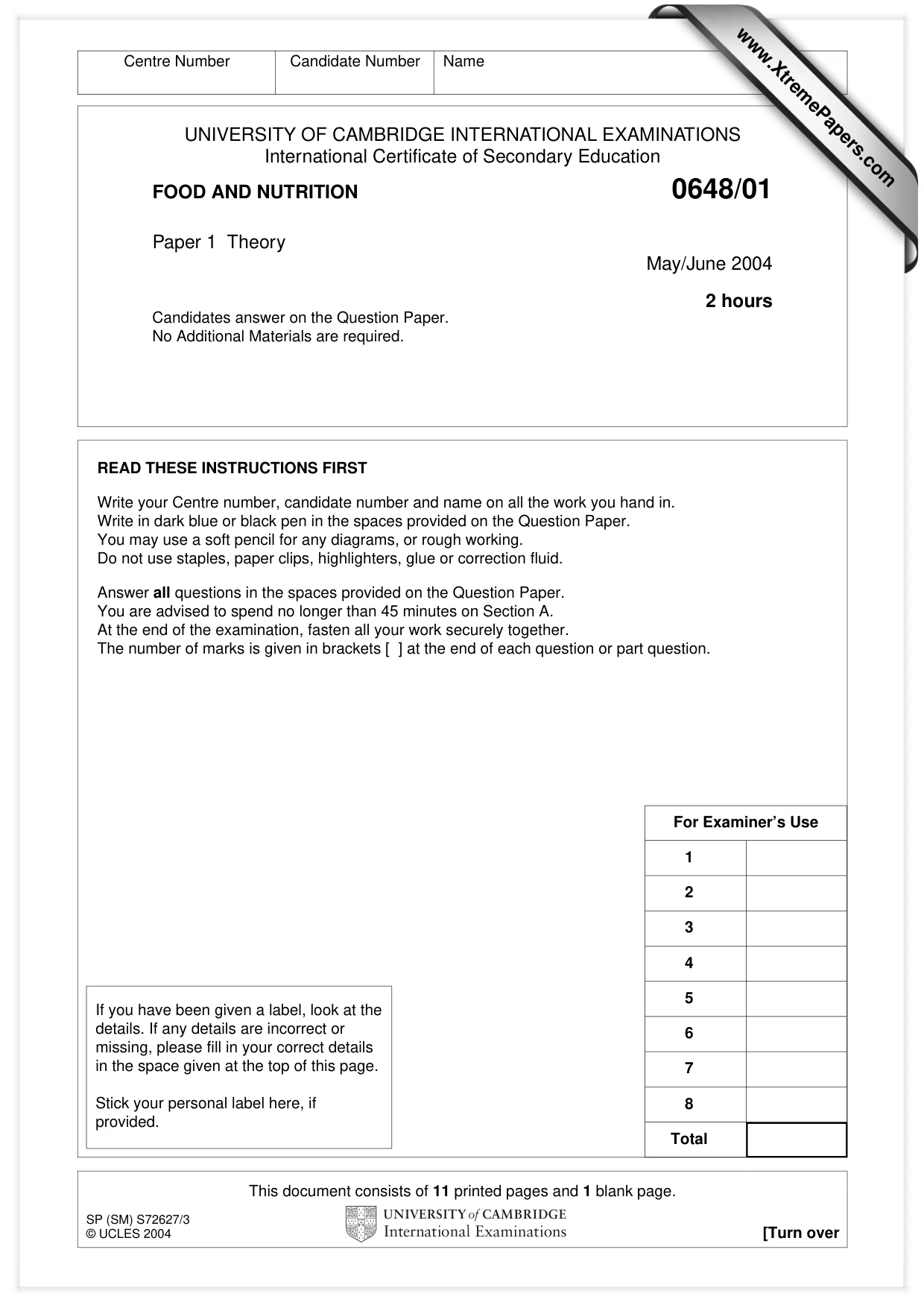
This document consists of 11 printed pages and 1 blank page. SP (SM) S72627/3 © UCLES 2004 [Turn over UNIVERSITY OF CAMBRIDGE INTERNATIONAL EXAMINATIONS International Certificate of Secondary Education FOOD AND NUTRITION 0648/01 Paper 1 Theory May/June 2004 2 hours Candidates answer on the Question Paper. No Additional Materials are required. Centre Number Candidate Number Name If you have been given a label, look at the details. If any details are incorrect or missing, please fill in your correct details in the space given at the top of this page. Stick your personal label here, if provided. READ THESE INSTRUCTIONS FIRST Write your Centre number, candidate number and name on all the work you hand in. Write in dark blue or black pen in the spaces provided on the Question Paper. You may use a soft pencil for any diagrams, or rough working. Do not use staples, paper clips, highlighters, glue or correction fluid. Answer all questions in the spaces provided on the Question Paper. You are advised to spend no longer than 45 minutes on Section A. At the end of the examination, fasten all your work securely together. The number of marks is given in brackets [ ] at the end of each question or part question. For Examiner’s Use 1 2 3 4 5 6 7 8 Total www.XtremePapers.com
Question paper, page 2
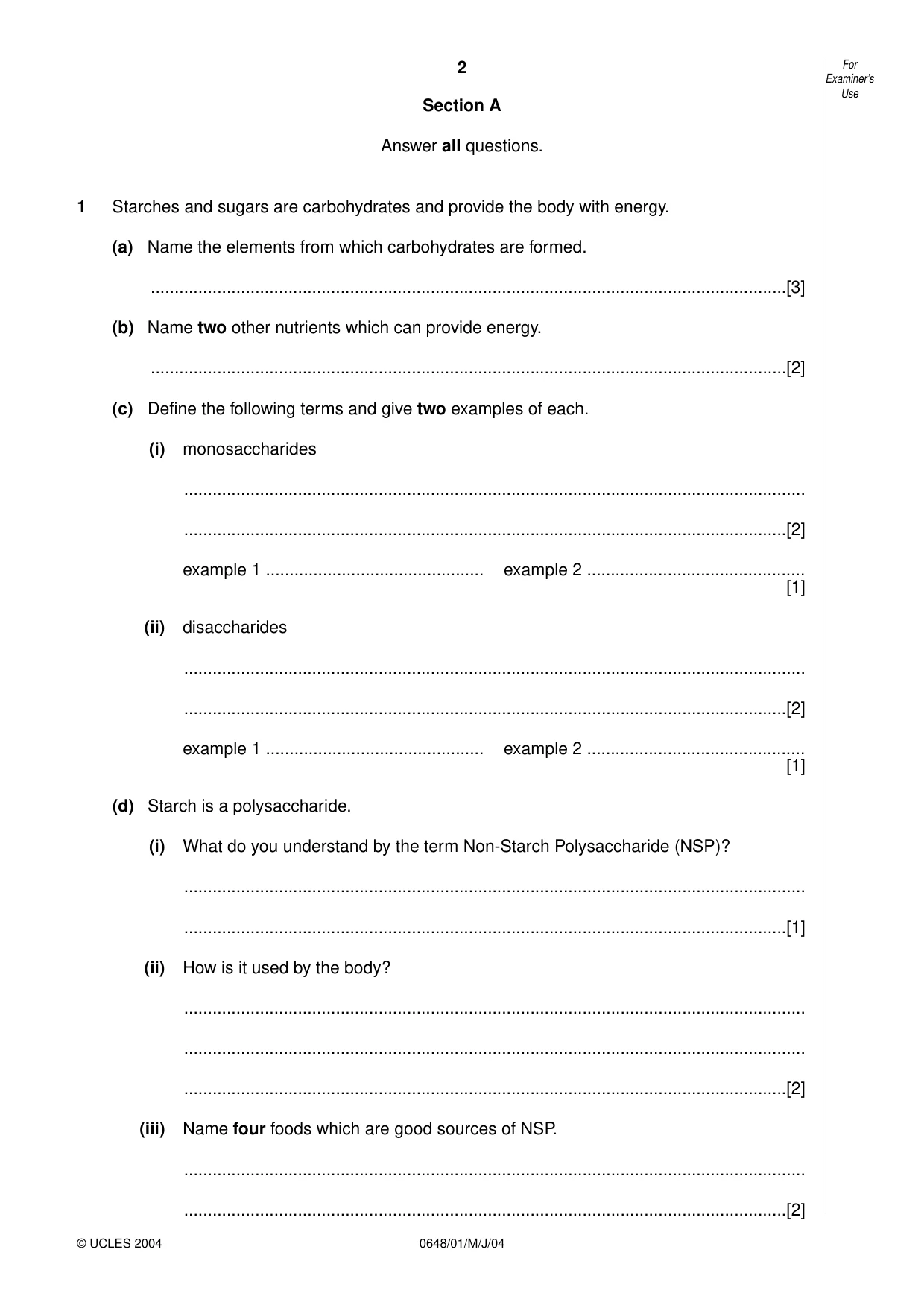
2 © UCLES 2004 0648/01/M/J/04 Section A Answer all questions. 1 Starches and sugars are carbohydrates and provide the body with energy. (a) Name the elements from which carbohydrates are formed. …[3] (b) Name two other nutrients which can provide energy. …[2] (c) Define the following terms and give two examples of each. (i) monosaccharides … …[2] example 1 … example 2 … [1] (ii) disaccharides … …[2] example 1 … example 2 … [1] (d) Starch is a polysaccharide. (i) What do you understand by the term Non-Starch Polysaccharide (NSP)? … …[1] (ii) How is it used by the body? … … …[2] (iii) Name four foods which are good sources of NSP. … …[2] For Examiner’s Use
Question paper, page 3
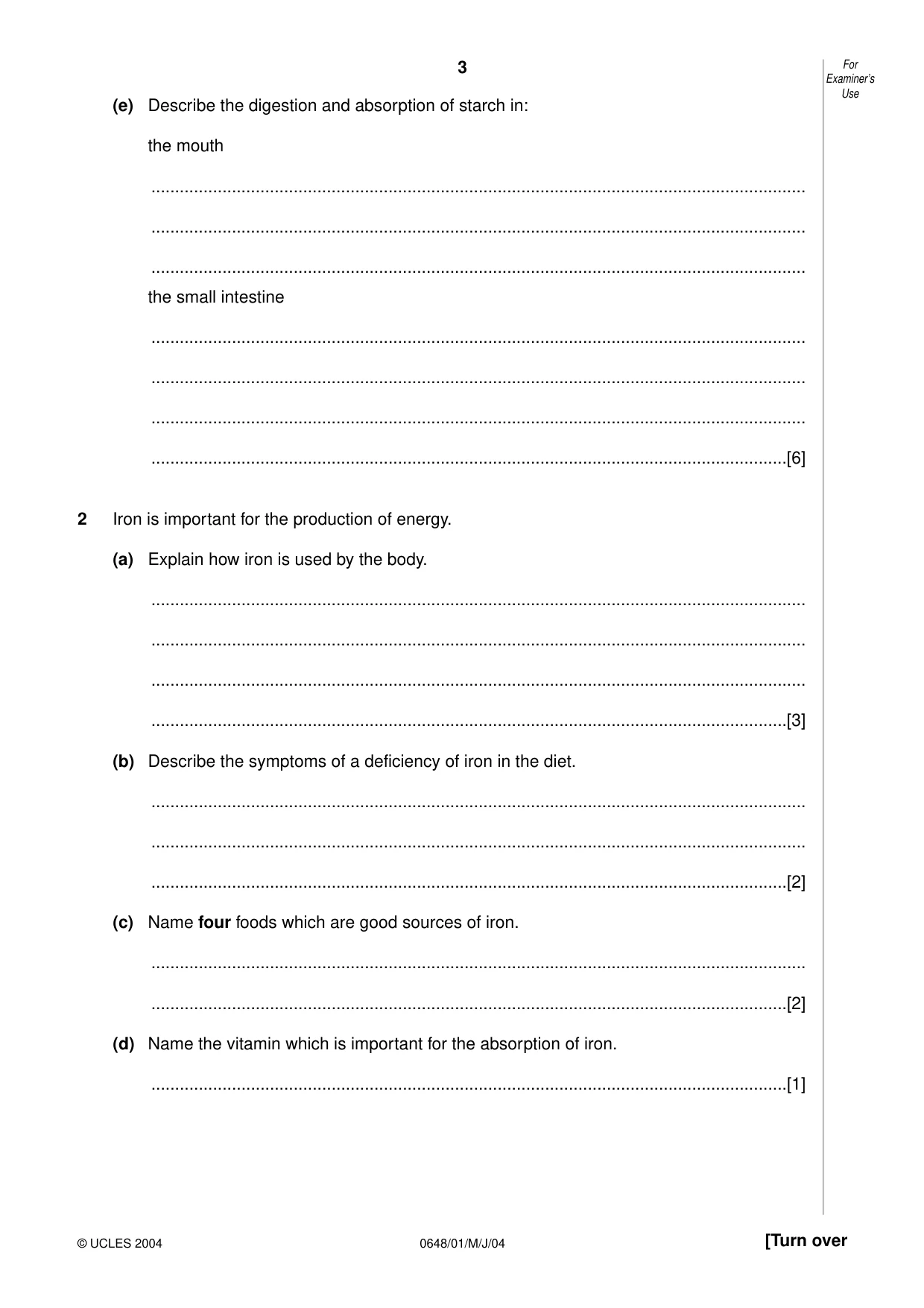
3 © UCLES 2004 0648/01/M/J/04 [Turn over (e) Describe the digestion and absorption of starch in: the mouth … … … the small intestine … … … …[6] 2 Iron is important for the production of energy. (a) Explain how iron is used by the body. … … … …[3] (b) Describe the symptoms of a deficiency of iron in the diet. … … …[2] (c) Name four foods which are good sources of iron. … …[2] (d) Name the vitamin which is important for the absorption of iron. …[1] For Examiner’s Use
Question paper, page 4
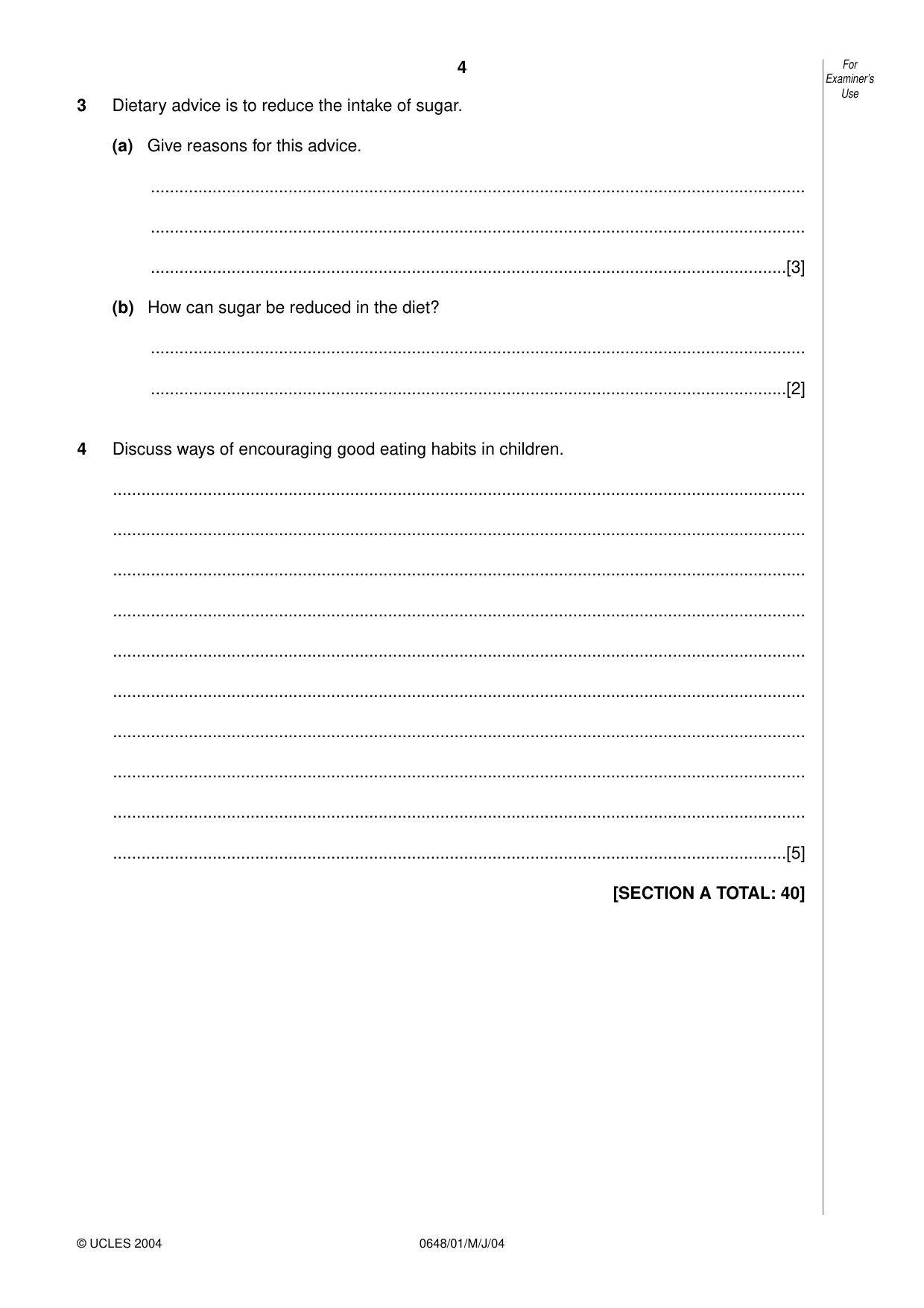
4 © UCLES 2004 0648/01/M/J/04 3 Dietary advice is to reduce the intake of sugar. (a) Give reasons for this advice. … … …[3] (b) How can sugar be reduced in the diet? … …[2] 4 Discuss ways of encouraging good eating habits in children. … … … … … … … … … …[5] [SECTION A TOTAL: 40] For Examiner’s Use
Question paper, page 5
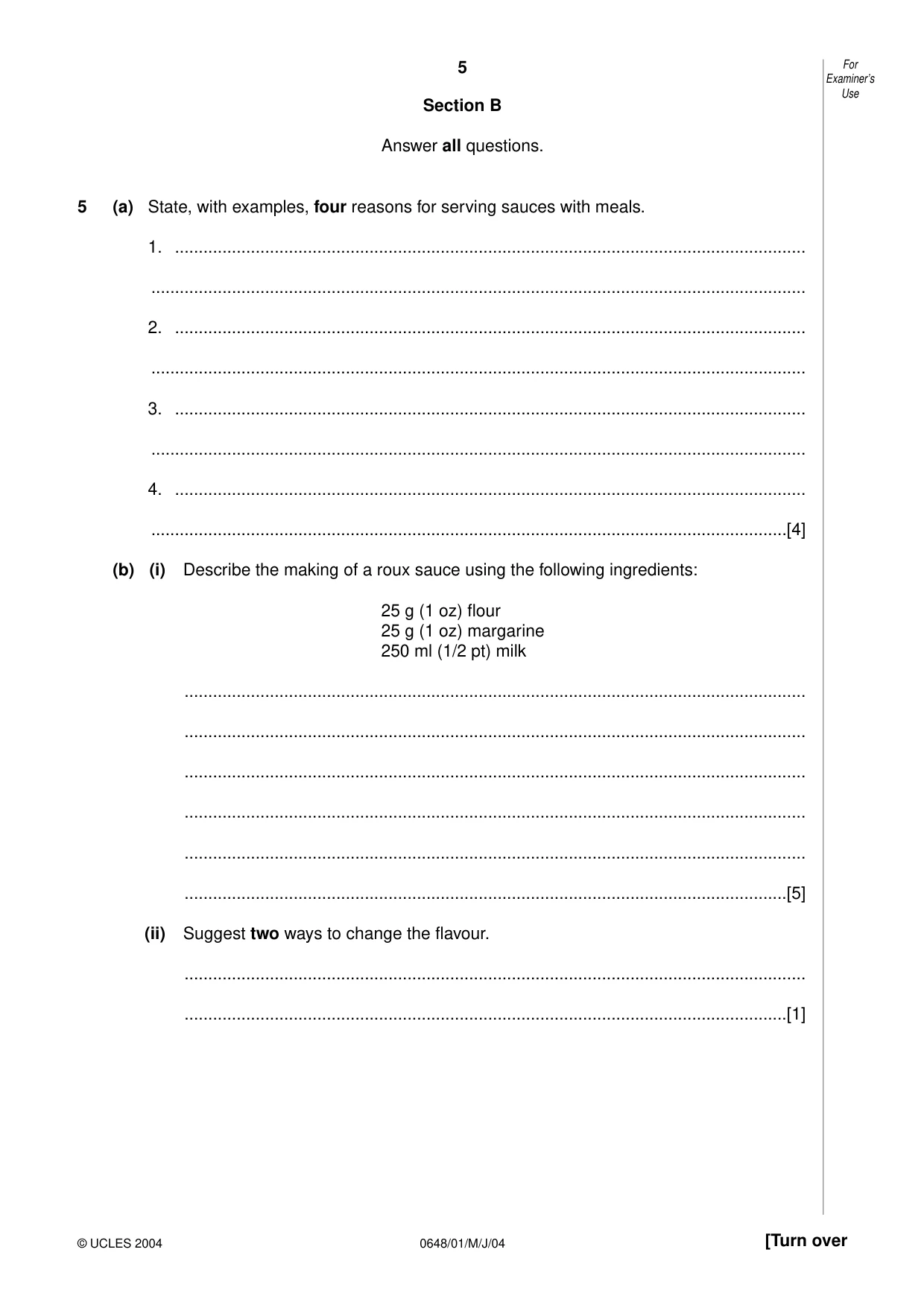
5 © UCLES 2004 0648/01/M/J/04 [Turn over Section B Answer all questions. 5 (a) State, with examples, four reasons for serving sauces with meals. 1. … … 2. … … 3. … … 4. … …[4] (b) (i) Describe the making of a roux sauce using the following ingredients: 25 g (1 oz) flour 25 g (1 oz) margarine 250 ml (1/2 pt) milk … … … … … …[5] (ii) Suggest two ways to change the flavour. … …[1] For Examiner’s Use
Question paper, page 6
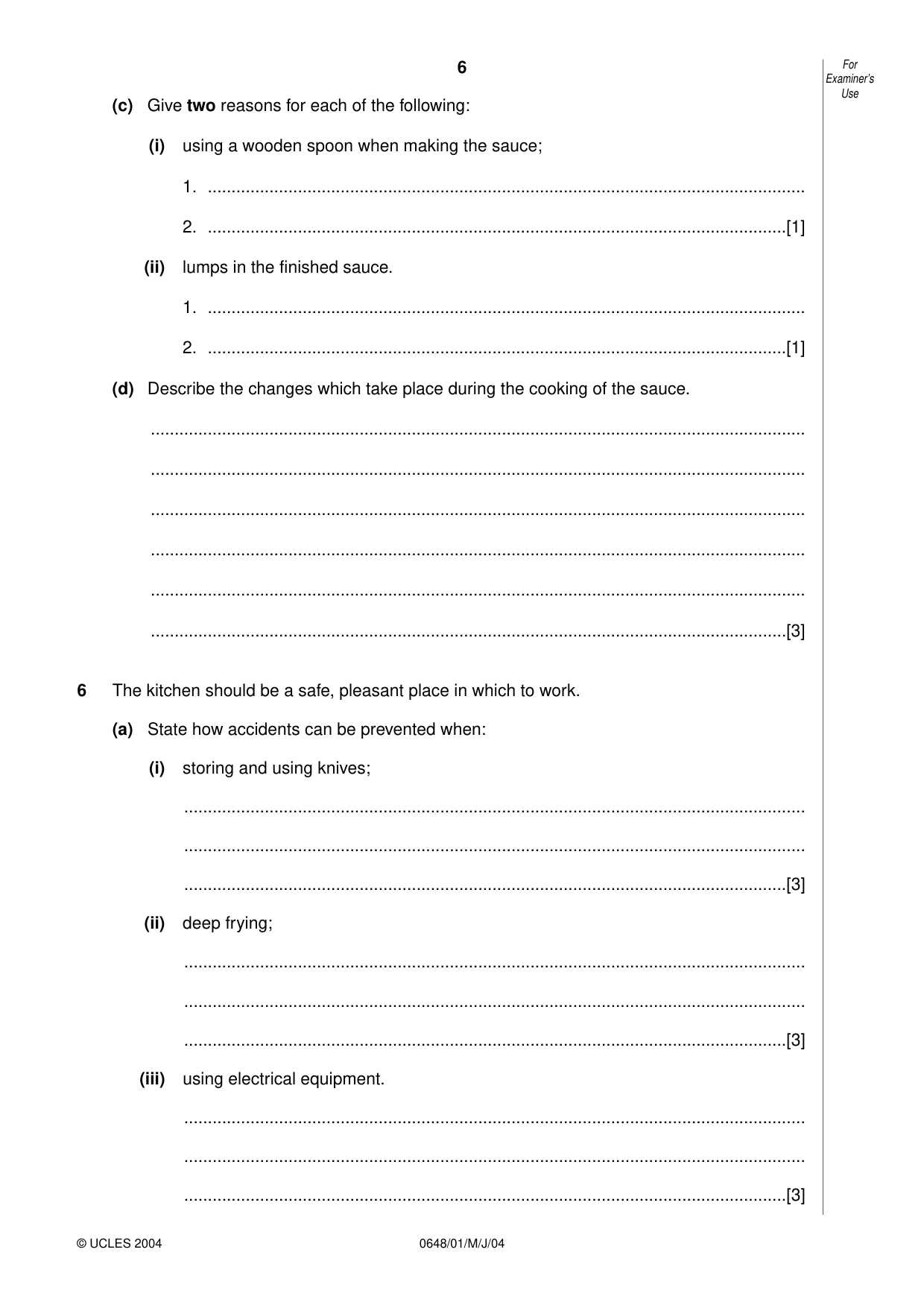
6 © UCLES 2004 0648/01/M/J/04 (c) Give two reasons for each of the following: (i) using a wooden spoon when making the sauce; 1. … 2. …[1] (ii) lumps in the finished sauce. 1. … 2. …[1] (d) Describe the changes which take place during the cooking of the sauce. … … … … … …[3] 6 The kitchen should be a safe, pleasant place in which to work. (a) State how accidents can be prevented when: (i) storing and using knives; … … …[3] (ii) deep frying; … … …[3] (iii) using electrical equipment. … … …[3] For Examiner’s Use
Question paper, page 7
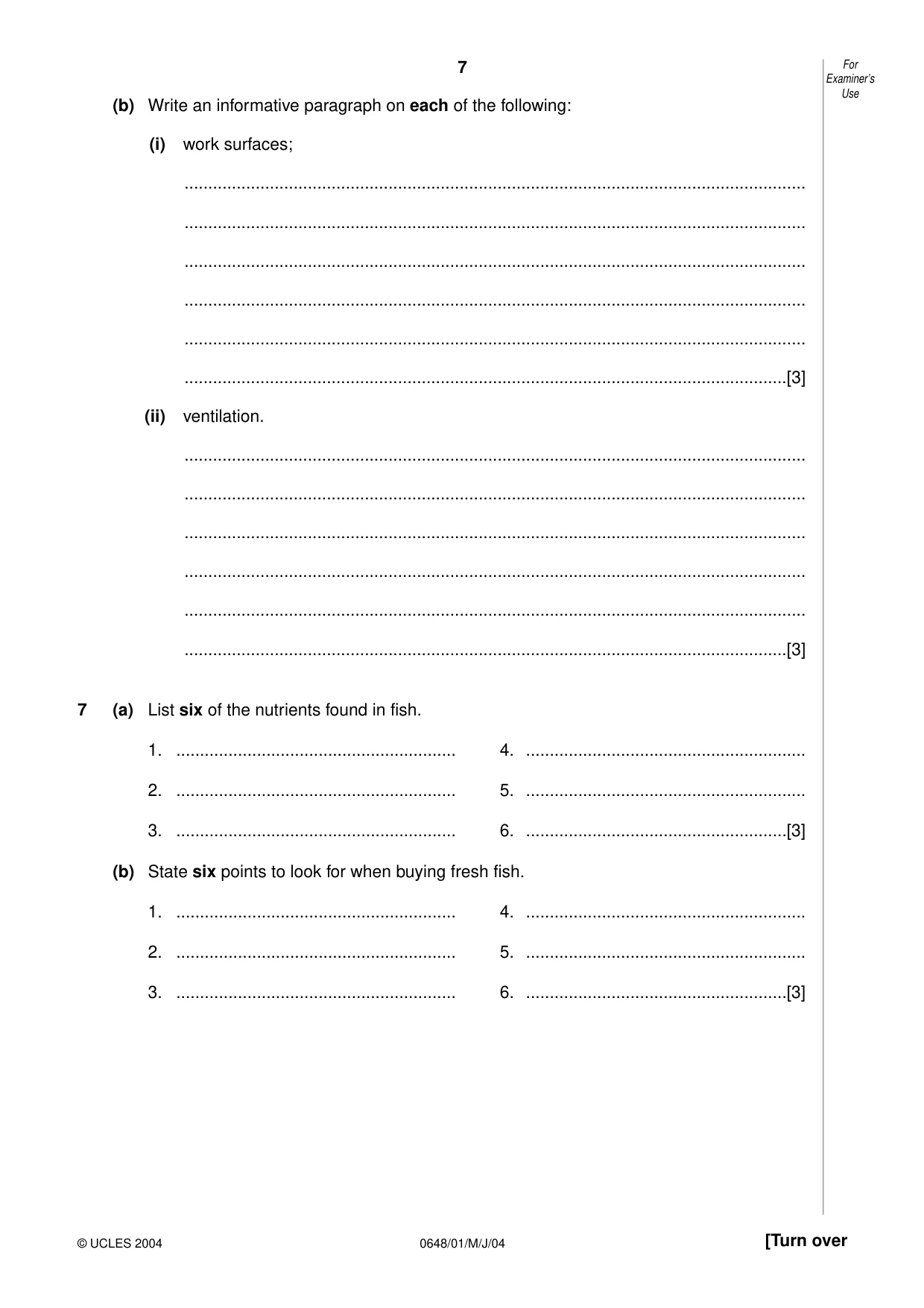
7 © UCLES 2004 0648/01/M/J/04 [Turn over (b) Write an informative paragraph on each of the following: (i) work surfaces; … … … … … …[3] (ii) ventilation. … … … … … …[3] 7 (a) List six of the nutrients found in fish. 1. … 4. … 2. … 5. … 3. … 6. …[3] (b) State six points to look for when buying fresh fish. 1. … 4. … 2. … 5. … 3. … 6. …[3] For Examiner’s Use
Question paper, page 8
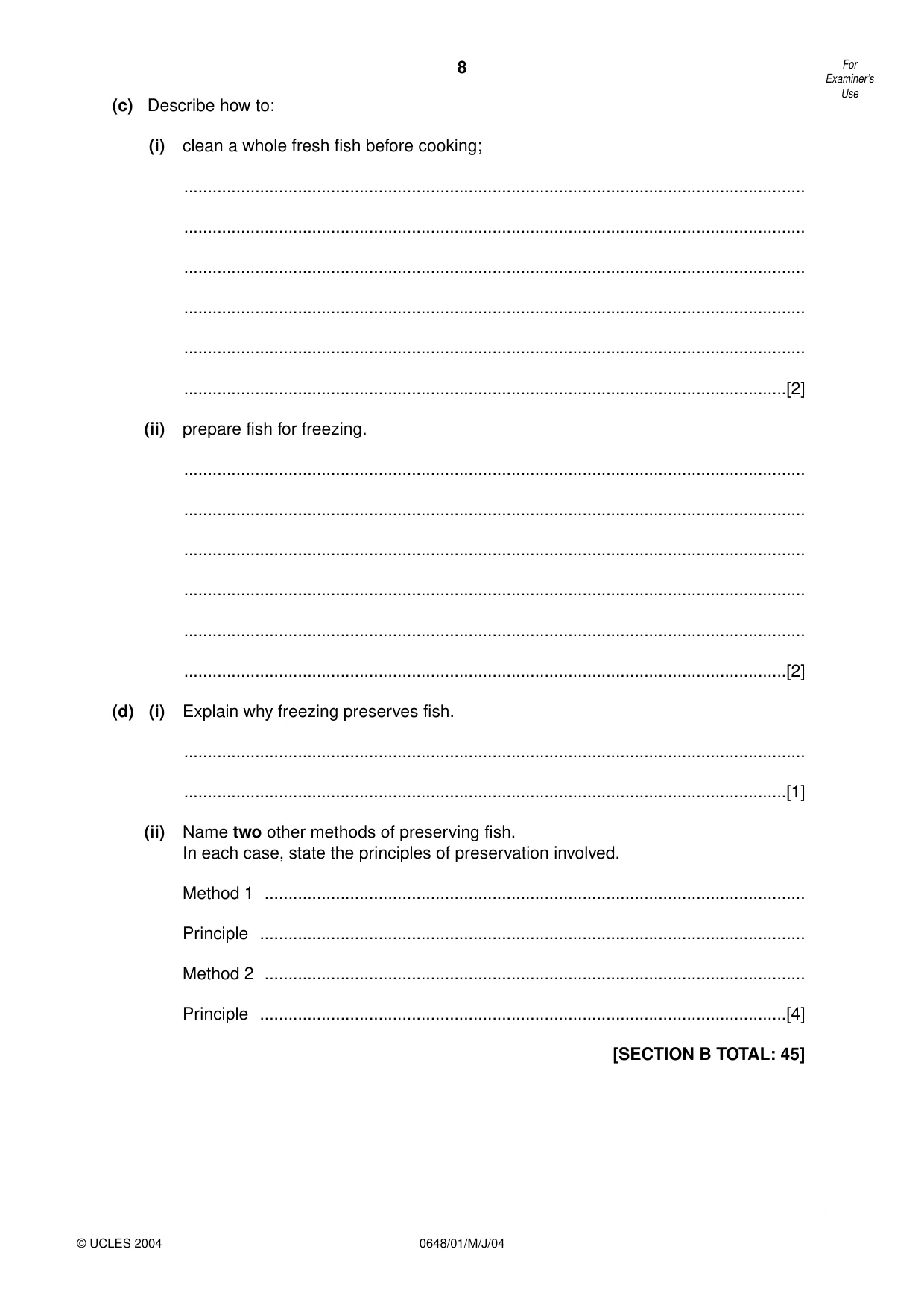
8 © UCLES 2004 0648/01/M/J/04 (c) Describe how to: (i) clean a whole fresh fish before cooking; … … … … … …[2] (ii) prepare fish for freezing. … … … … … …[2] (d) (i) Explain why freezing preserves fish. … …[1] (ii) Name two other methods of preserving fish. In each case, state the principles of preservation involved. Method 1 … Principle … Method 2 … Principle …[4] [SECTION B TOTAL: 45] For Examiner’s Use
Question paper, page 9
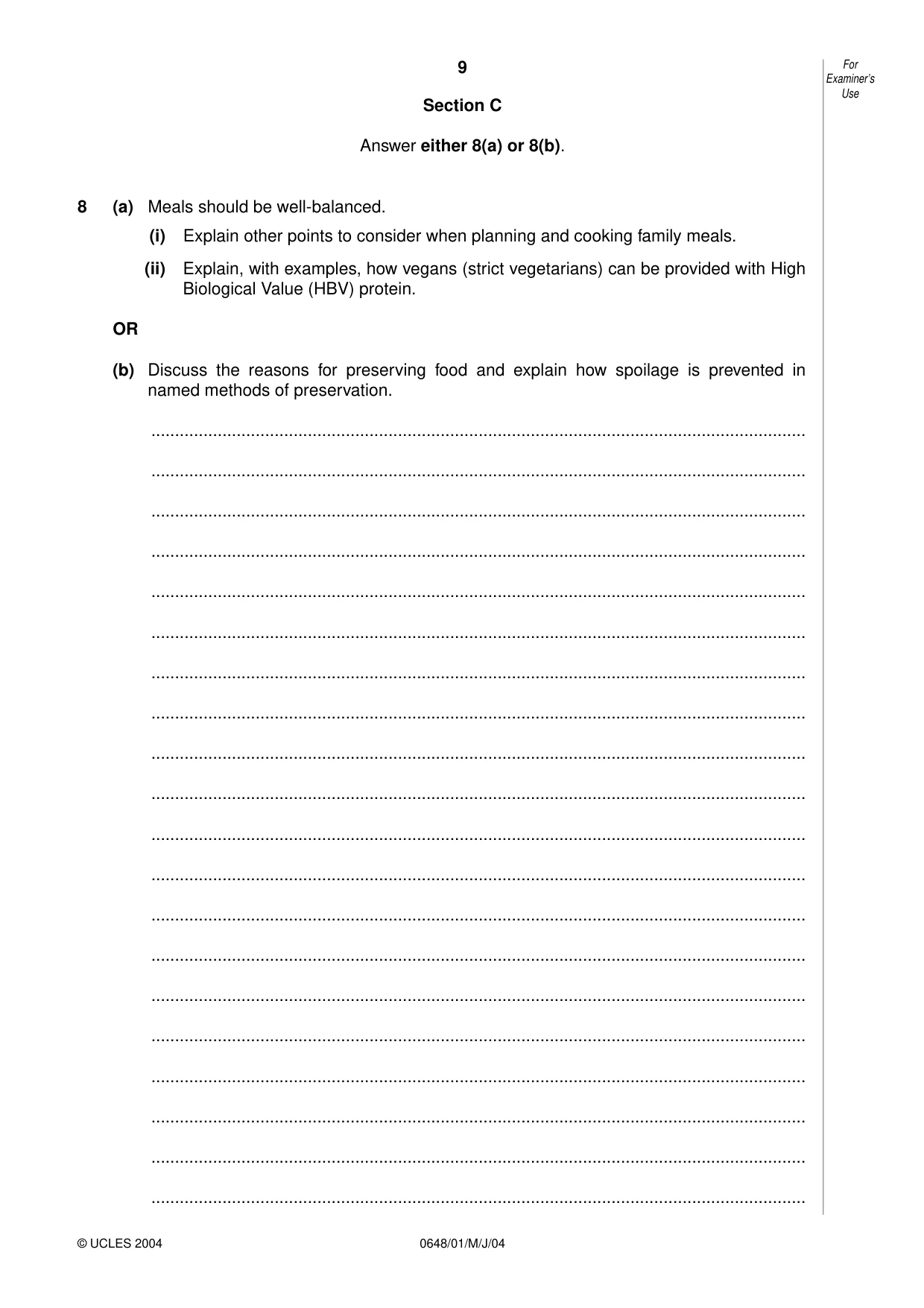
9 © UCLES 2004 0648/01/M/J/04 Section C Answer either 8(a) or 8(b). 8 (a) Meals should be well-balanced. (i) Explain other points to consider when planning and cooking family meals. (ii) Explain, with examples, how vegans (strict vegetarians) can be provided with High Biological Value (HBV) protein. OR (b) Discuss the reasons for preserving food and explain how spoilage is prevented in named methods of preservation. … … … … … … … … … … … … … … … … … … … … For Examiner’s Use
Question paper, page 10
10 © UCLES 2004 0648/01/M/J/04 … … … … … … … … … … … … … … … … … … … … … … … … … … … … For Examiner’s Use
Question paper, page 11
11 © UCLES 2004 0648/01/M/J/04 … … … … … … … … … … … … … … … … … … … … … … … … … …[15] [SECTION C TOTAL: 15] [Total for Paper: 100] For Examiner’s Use
Question paper, page 12
12 © UCLES 2004 0648/01/M/J/04 BLANK PAGE Every reasonable effort has been made to trace all copyright holders where the publishers (i.e. UCLES) are aware that third-party material has been reproduced. The publishers would be pleased to hear from anyone whose rights they have unwittingly infringed. University of Cambridge International Examinations is part of the University of Cambridge Local Examinations Syndicate (UCLES), which is itself a department of the University of Cambridge.