Cambridge IGCSE Environmental Management 0680 — 2012 May/June Paper 1 · Variant 3
0680/13/M/J/12 · 60 marks · ≈68 min
The question paper and its mark scheme, free to read here and free to download. This is Cambridge’s own paper, exactly as it was sat.
Question paper16 pages




Mark scheme6 pages
Answers below. Sit the paper first if you are practising.
Paper as text
Question paper, page 1
This document consists of 13 printed pages and 3 blank pages. DC (SLM/JG) 59605/1 R © UCLES 2012 [Turn over UNIVERSITY OF CAMBRIDGE INTERNATIONAL EXAMINATIONS International General Certificate of Secondary Education * 4 8 4 1 0 9 0 7 2 6 * ENVIRONMENTAL MANAGEMENT 0680/13 Paper 1 May/June 2012 1 hour 30 minutes Candidates answer on the Question Paper. Additional Materials: Ruler READ THESE INSTRUCTIONS FIRST Write your Centre number, candidate number and name on all the work you hand in. Write in dark blue or black pen. You may use a soft pencil for any diagrams, graphs or rough working. Do not use staples, paper clips, highlighters, glue or correction fluid. DO NOT WRITE IN ANY BARCODES. Answer all questions. At the end of the examination, fasten all your work securely together. The number of marks is given in brackets [ ] at the end of each question or part question. www.XtremePapers.com
Question paper, page 2
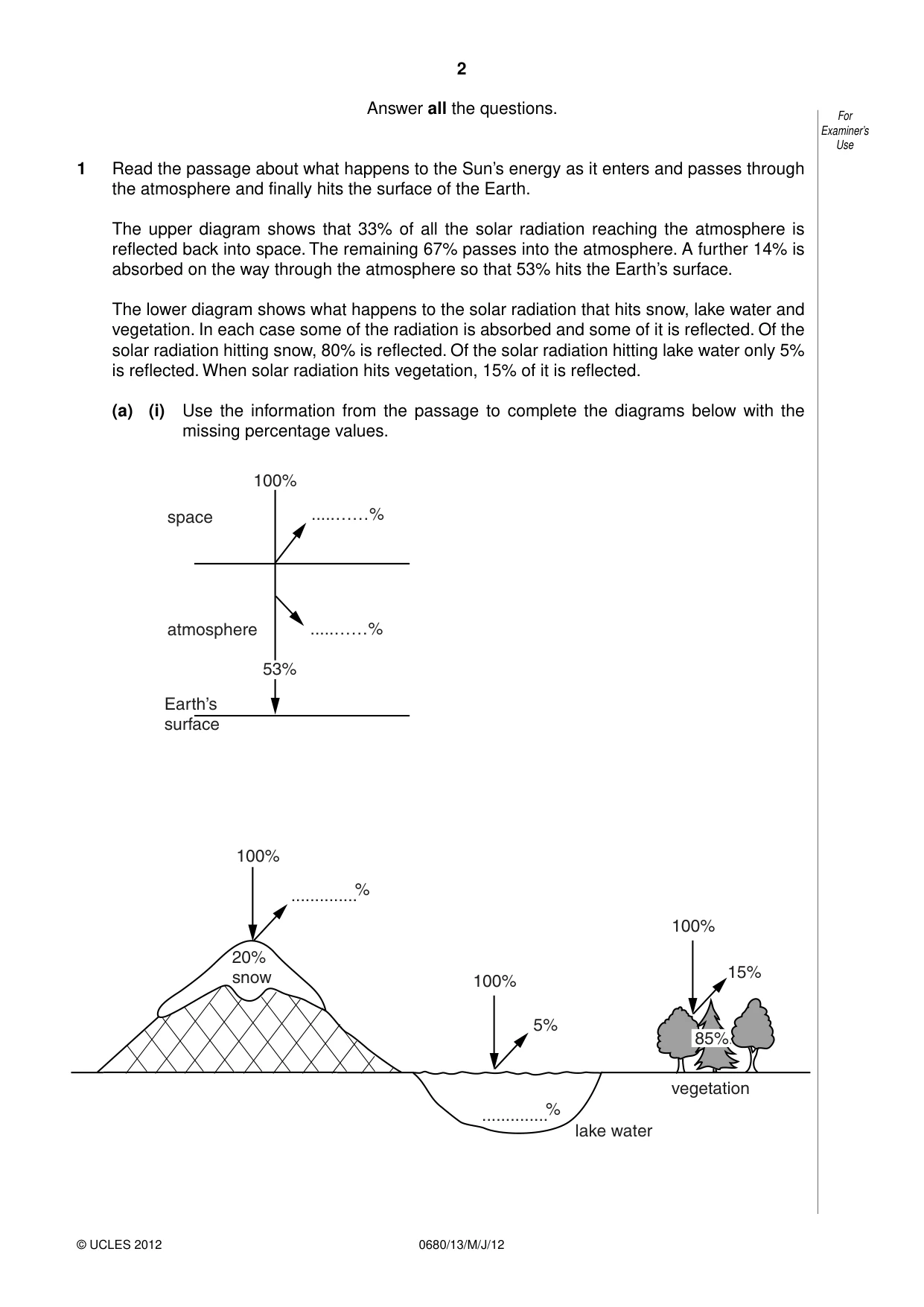
2 0680/13/M/J/12 © UCLES 2012 For Examiner’s Use Answer all the questions. 1 Read the passage about what happens to the Sun’s energy as it enters and passes through the atmosphere and finally hits the surface of the Earth. The upper diagram shows that 33% of all the solar radiation reaching the atmosphere is reflected back into space. The remaining 67% passes into the atmosphere. A further 14% is absorbed on the way through the atmosphere so that 53% hits the Earth’s surface. The lower diagram shows what happens to the solar radiation that hits snow, lake water and vegetation. In each case some of the radiation is absorbed and some of it is reflected. Of the solar radiation hitting snow, 80% is reflected. Of the solar radiation hitting lake water only 5% is reflected. When solar radiation hits vegetation, 15% of it is reflected. (a) (i) Use the information from the passage to complete the diagrams below with the missing percentage values. 100% 100% % 5% 15% 100% 100% ………% ………% Earth’s surface atmosphere space 20% snow lake water vegetation … % … 85% 53%
Question paper, page 3
3 0680/13/M/J/12 © UCLES 2012 [Turn over For Examiner’s Use (ii) What name do we give to the solar radiation received by the Earth? … [1] (b) (i) Reflected long wave radiation can be trapped by gases in the atmosphere which insulate the Earth making it warmer than it would otherwise be. What is the general name for these insulating gases? … Name two of them. … … [2] (ii) Give one strategy that individuals living in urban areas might use to reduce the production of these insulating gases. … … [1] (iii) Describe two human activities which might cause global warming. … … … … … … [4]
Question paper, page 4
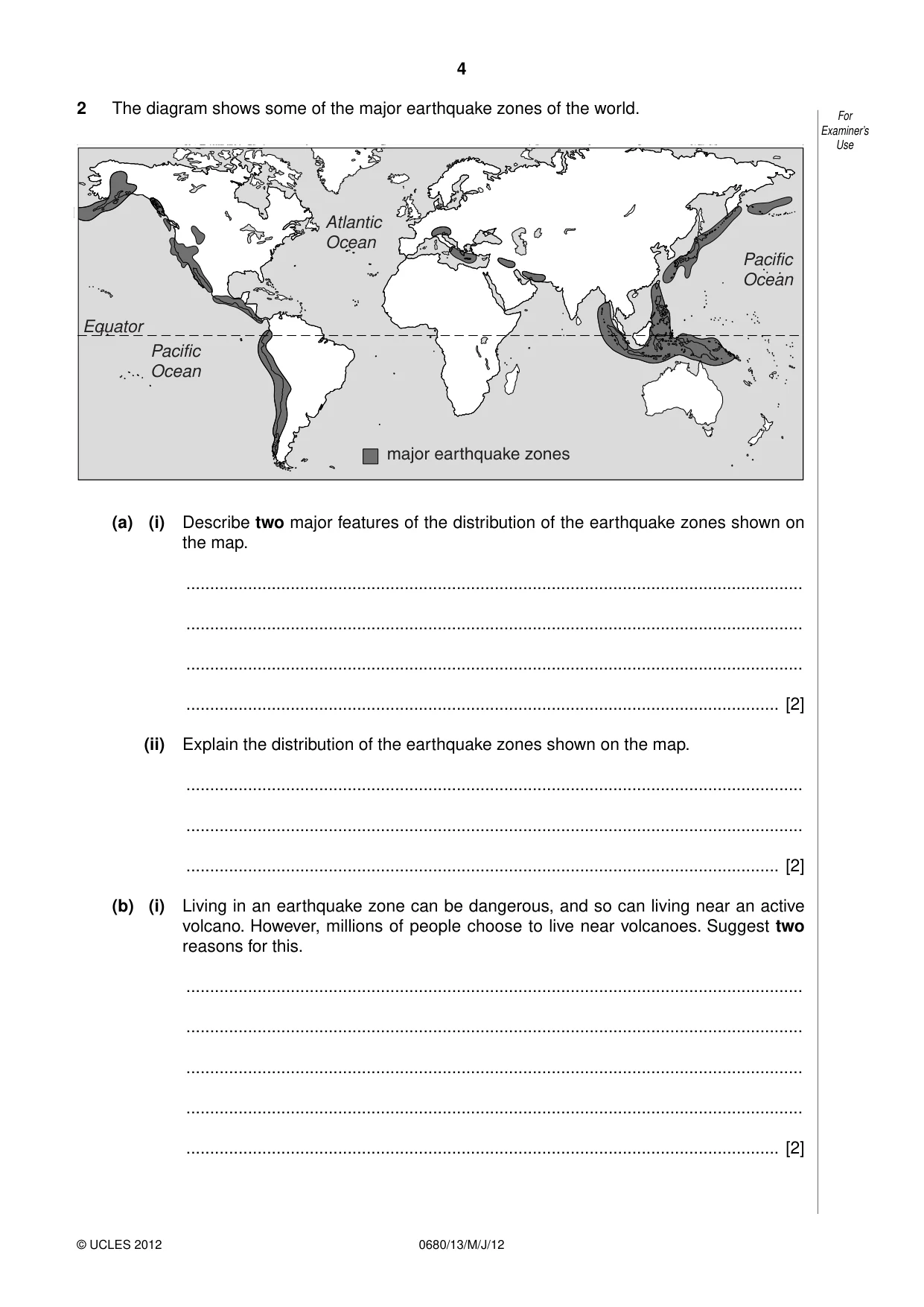
4 0680/13/M/J/12 © UCLES 2012 For Examiner’s Use 2 The diagram shows some of the major earthquake zones of the world. major earthquake zones Equator Pacific Ocean Atlantic Ocean Pacific Ocean (a) (i) Describe two major features of the distribution of the earthquake zones shown on the map. … … … … [2] (ii) Explain the distribution of the earthquake zones shown on the map. … … … [2] (b) (i) Living in an earthquake zone can be dangerous, and so can living near an active volcano. However, millions of people choose to live near volcanoes. Suggest two reasons for this. … … … … … [2]
Question paper, page 5
5 0680/13/M/J/12 © UCLES 2012 [Turn over For Examiner’s Use (ii) Fewer people die from the eruption of volcanoes than from earthquakes. Explain why. … … … … [2] (iii) How can the impacts of volcanic eruptions and earthquakes be reduced? … … … … … … [2]
Question paper, page 6
6 0680/13/M/J/12 © UCLES 2012 For Examiner’s Use 3 Precipitation is water falling onto the Earth’s surface. Some of this precipitation: A does not reach the ground because of trees and plants, B flows over the surface and ends up in streams and rivers, C re-enters the atmosphere, D seeps into the ground. (a) (i) Give the letter to link each of the above pathways of water to the correct term below: evaporation and transpiration … infiltration … interception … run-off … [2] (ii) Describe how plants take up water into their bodies and name the process by which they use it to make food. … … … [2] (b) (i) Water is a precious commodity in many parts of Australia. Look at the table. Water use in one state of Australia (% of total) irrigation 80 domestic 13 industry 7 Key: 0 10 20 30 40 50 60 70 80 90 Complete the pie graph and the key to show water use in one state of Australia. [2]
Question paper, page 7
7 0680/13/M/J/12 © UCLES 2012 [Turn over For Examiner’s Use (ii) Using the pie graph explain why salinisation is likely to be a problem. … … … … [2] (iii) How does salinisation happen? … … … … … [2]
Question paper, page 8
8 0680/13/M/J/12 © UCLES 2012 For Examiner’s Use 4 Look at graph A, showing how the population of humans on Earth has grown over the last 600 years. Compare this with graph B, showing a standard population growth curve for another animal. 1400 1500 1600 1700 1800 1900 2000 0 1 2 3 4 5 6 world population (billions) year graph A time number of individuals graph B (a) (i) Describe two similarities and one difference between the shape of graphs A and B. … … … … … [3]
Question paper, page 9
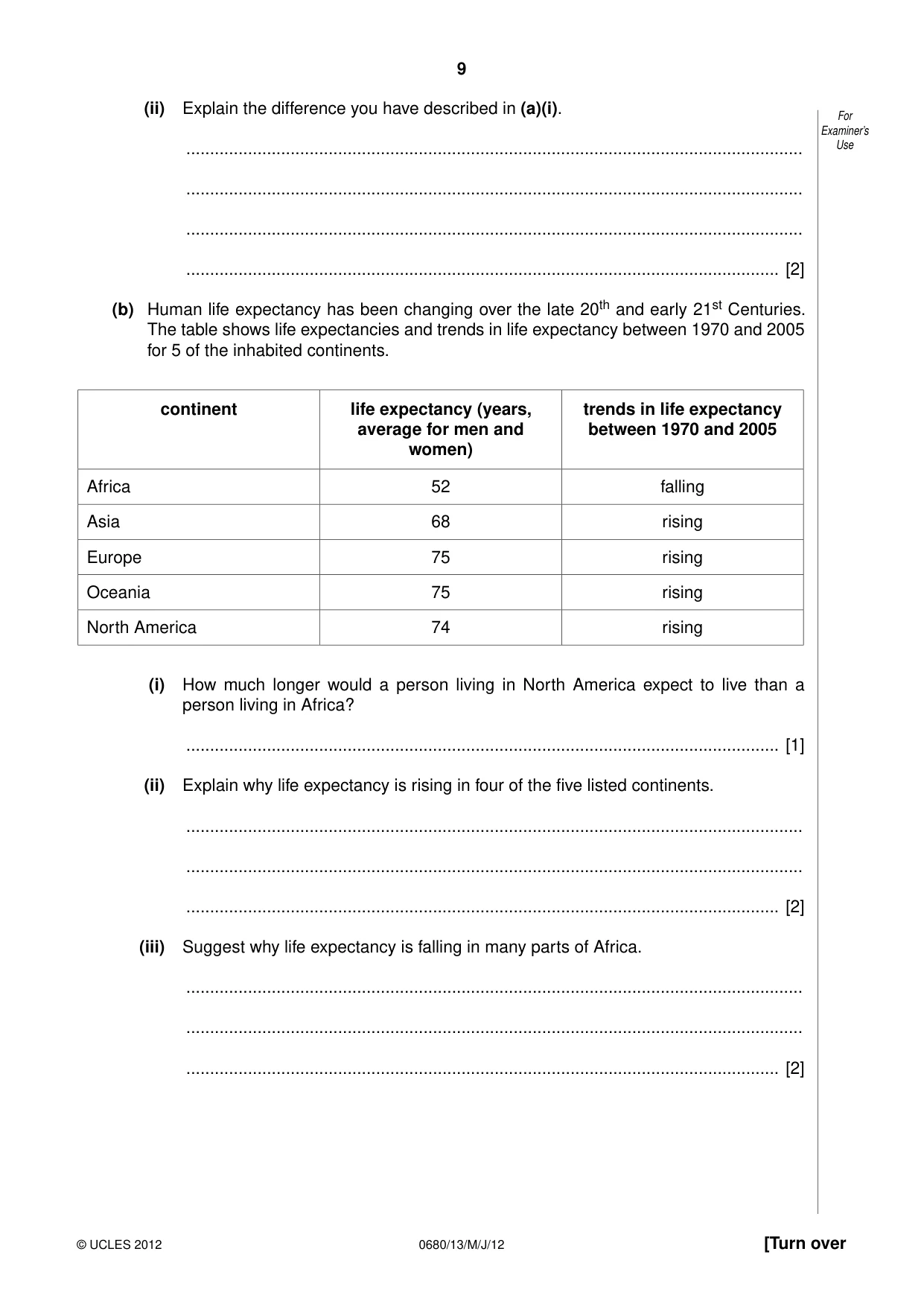
9 0680/13/M/J/12 © UCLES 2012 [Turn over For Examiner’s Use (ii) Explain the difference you have described in (a)(i). … … … … [2] (b) Human life expectancy has been changing over the late 20th and early 21st Centuries. The table shows life expectancies and trends in life expectancy between 1970 and 2005 for 5 of the inhabited continents. continent life expectancy (years, average for men and women) trends in life expectancy between 1970 and 2005 Africa 52 falling Asia 68 rising Europe 75 rising Oceania 75 rising North America 74 rising (i) How much longer would a person living in North America expect to live than a person living in Africa? … [1] (ii) Explain why life expectancy is rising in four of the five listed continents. … … … [2] (iii) Suggest why life expectancy is falling in many parts of Africa. … … … [2]
Question paper, page 10
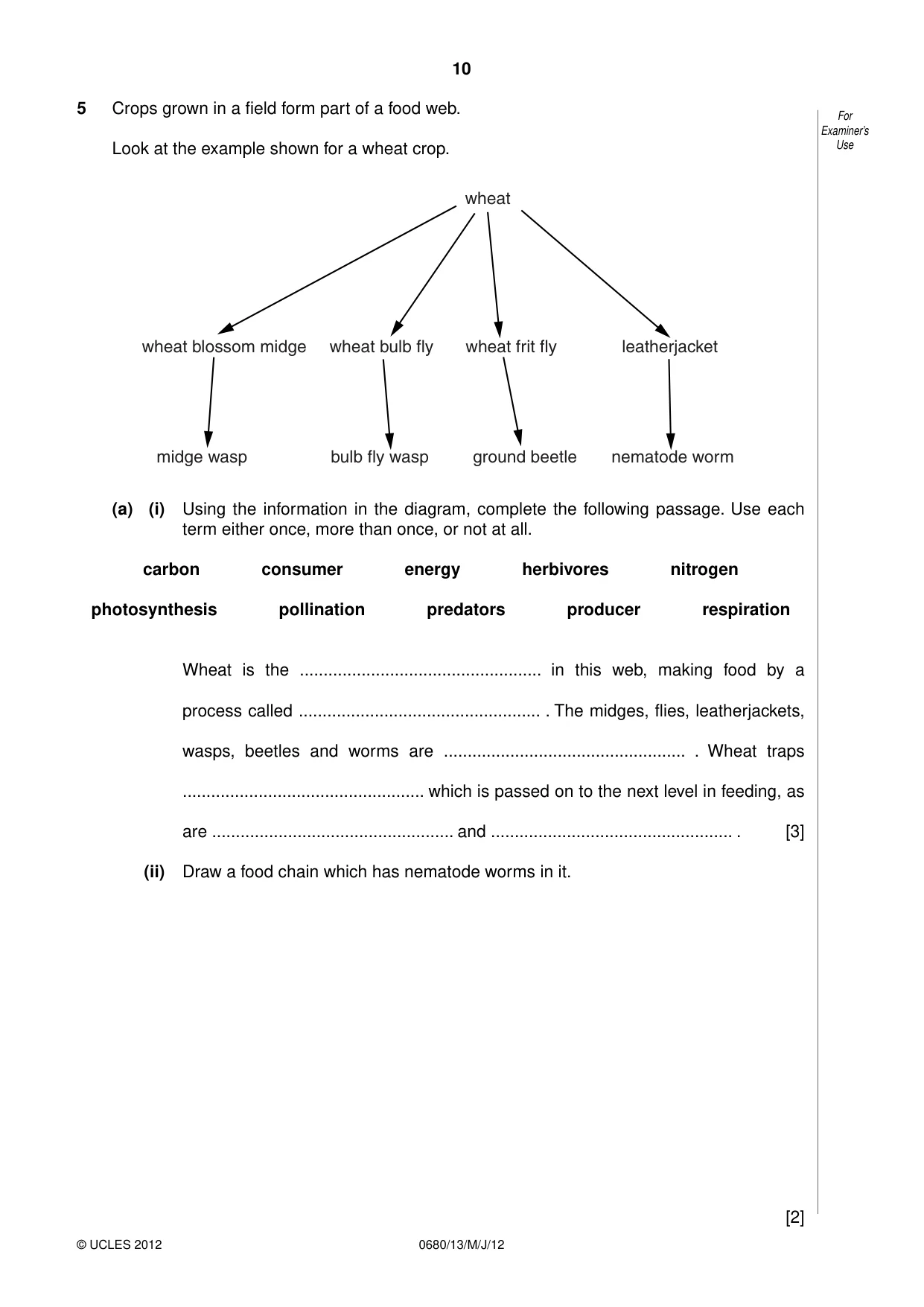
10 0680/13/M/J/12 © UCLES 2012 For Examiner’s Use 5 Crops grown in a field form part of a food web. Look at the example shown for a wheat crop. wheat wheat blossom midge wheat bulb fly wheat frit fly leatherjacket midge wasp bulb fly wasp ground beetle nematode worm (a) (i) Using the information in the diagram, complete the following passage. Use each term either once, more than once, or not at all. carbon consumer energy herbivores nitrogen photosynthesis pollination predators producer respiration Wheat is the … in this web, making food by a process called … . The midges, flies, leatherjackets, wasps, beetles and worms are … . Wheat traps … which is passed on to the next level in feeding, as are … and … . [3] (ii) Draw a food chain which has nematode worms in it. [2]
Question paper, page 11
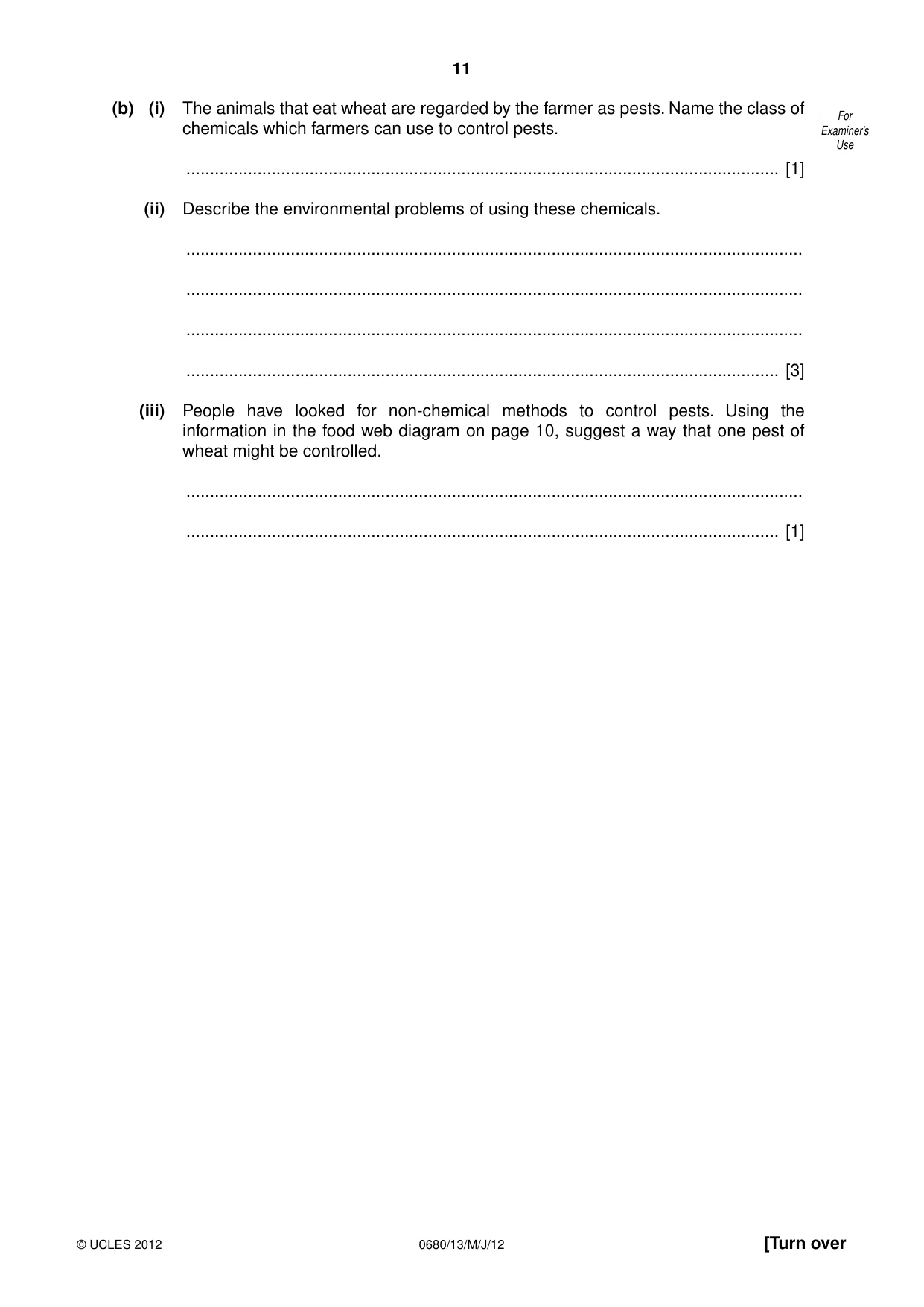
11 0680/13/M/J/12 © UCLES 2012 [Turn over For Examiner’s Use (b) (i) The animals that eat wheat are regarded by the farmer as pests. Name the class of chemicals which farmers can use to control pests. … [1] (ii) Describe the environmental problems of using these chemicals. … … … … [3] (iii) People have looked for non-chemical methods to control pests. Using the information in the food web diagram on page 10, suggest a way that one pest of wheat might be controlled. … … [1]
Question paper, page 12
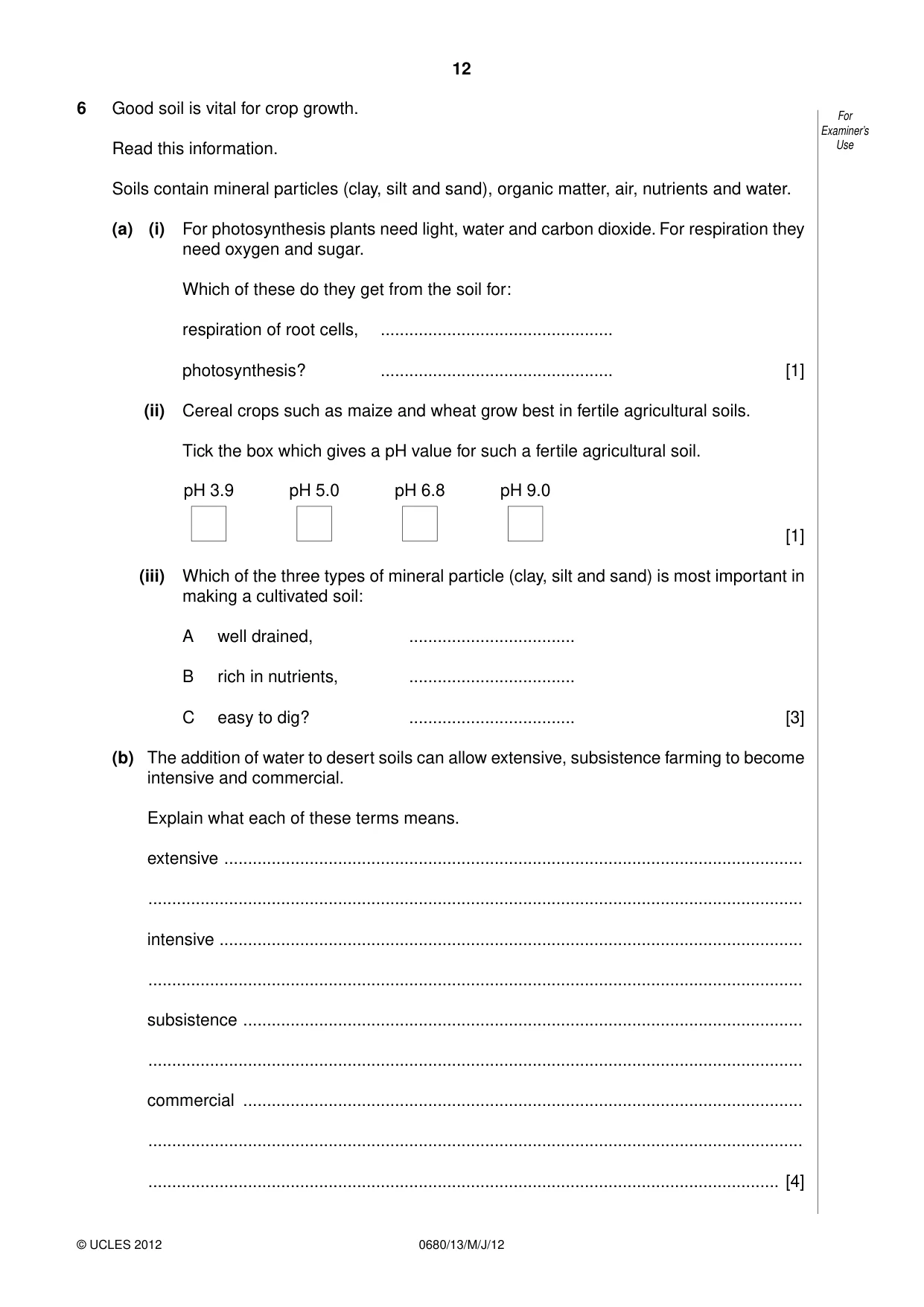
12 0680/13/M/J/12 © UCLES 2012 For Examiner’s Use 6 Good soil is vital for crop growth. Read this information. Soils contain mineral particles (clay, silt and sand), organic matter, air, nutrients and water. (a) (i) For photosynthesis plants need light, water and carbon dioxide. For respiration they need oxygen and sugar. Which of these do they get from the soil for: respiration of root cells, … photosynthesis? … [1] (ii) Cereal crops such as maize and wheat grow best in fertile agricultural soils. Tick the box which gives a pH value for such a fertile agricultural soil. pH 3.9 pH 5.0 pH 6.8 pH 9.0 [1] (iii) Which of the three types of mineral particle (clay, silt and sand) is most important in making a cultivated soil: A well drained, … B rich in nutrients, … C easy to dig? … [3] (b) The addition of water to desert soils can allow extensive, subsistence farming to become intensive and commercial. Explain what each of these terms means. extensive … … intensive … … subsistence … … commercial … … … [4]
Question paper, page 13
13 0680/13/M/J/12 © UCLES 2012 For Examiner’s Use (c) State one way in which the nutrient content of soils might be improved. … … [1]
Question paper, page 14
14 0680/13/M/J/12 © UCLES 2012 BLANK PAGE
Question paper, page 15
15 0680/13/M/J/12 © UCLES 2012 BLANK PAGE
Question paper, page 16
16 0680/13/M/J/12 © UCLES 2012 BLANK PAGE Permission to reproduce items where third-party owned material protected by copyright is included has been sought and cleared where possible. Every reasonable effort has been made by the publisher (UCLES) to trace copyright holders, but if any items requiring clearance have unwittingly been included, the publisher will be pleased to make amends at the earliest possible opportunity. University of Cambridge International Examinations is part of the Cambridge Assessment Group. Cambridge Assessment is the brand name of University of Cambridge Local Examinations Syndicate (UCLES), which is itself a department of the University of Cambridge.
Mark scheme, page 1
UNIVERSITY OF CAMBRIDGE INTERNATIONAL EXAMINATIONS International General Certificate of Secondary Education MARK SCHEME for the May/June 2012 question paper for the guidance of teachers 0680 ENVIRONMENTAL MANAGEMENT 0680/13 Paper 1, maximum raw mark 60 This mark scheme is published as an aid to teachers and candidates, to indicate the requirements of the examination. It shows the basis on which Examiners were instructed to award marks. It does not indicate the details of the discussions that took place at an Examiners’ meeting before marking began, which would have considered the acceptability of alternative answers. Mark schemes must be read in conjunction with the question papers and the report on the examination. • Cambridge will not enter into discussions or correspondence in connection with these mark schemes. Cambridge is publishing the mark schemes for the May/June 2012 question papers for most IGCSE, GCE Advanced Level and Advanced Subsidiary Level syllabuses and some Ordinary Level syllabuses. www.XtremePapers.com
Mark scheme, page 2
Page 2 Mark Scheme: Teachers’ version Syllabus Paper IGCSE – May/June 2012 0680 13 © University of Cambridge International Examinations 2012 General notes Symbols used in Environmental Management mark schemes. / separates alternatives for a marking point – other valid ways of expressing the same idea are also credited ; separates points for the award of a mark [3] indicates the number of marks available [max 3] the number shows the maximum number of marks available for the question where there are more marking points than total marks available [max 3] when part of the marks of a question must come from part of the mark scheme, this is indicated by non-bold marks showing the internal maxima for different parts of the question these non-bold marks are also used to show marks for bands where banded mark schemes are used italic indicates that this is information about the marking points and is not required to gain credit italic text is also used for comments about alternatives that should be accepted, ignored or rejected ora or reverse argument – shows that an argument from an alternative viewpoint will be credited AW alternative wording, sometimes called ‘or words to that effect’ – AW is used when there are many different ways of expressing the same idea ( ) the word / phrase in brackets is not required to gain marks but sets the context of the response for credit e.g. (nuclear) waste – nuclear is not needed but if it was described as a domestic waste then no mark is awarded volcanic underlined words – the answer must contain exactly this word ecf error carried forward – if an incorrect answer is given to part of a question, and this answer is subsequently used by a candidate in later parts of the question, this indicates that the candidate’s incorrect answer will be used as a starting point for marking the later parts of the question
Mark scheme, page 3
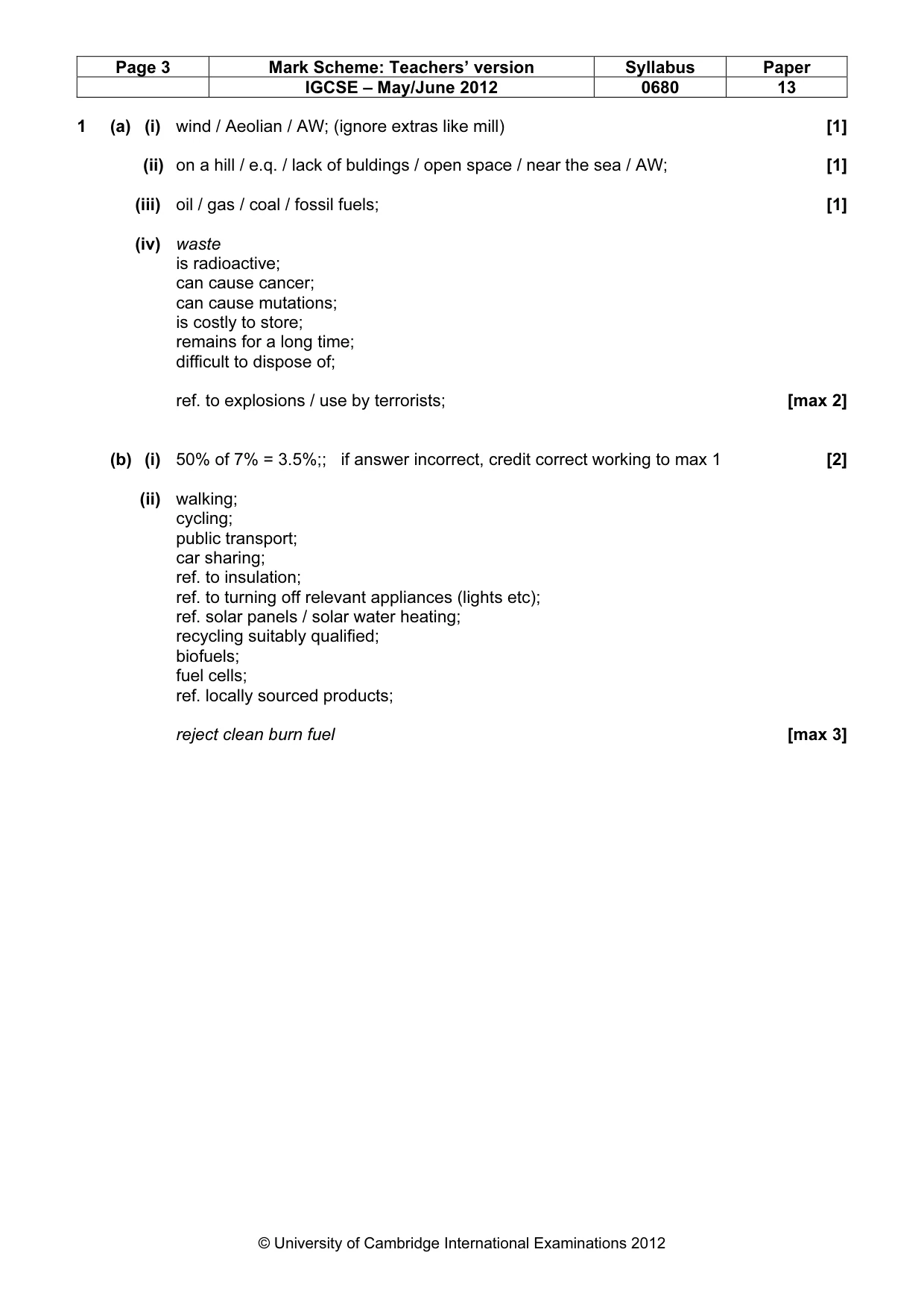
Page 3 Mark Scheme: Teachers’ version Syllabus Paper IGCSE – May/June 2012 0680 13 © University of Cambridge International Examinations 2012 1 (a) (i) wind / Aeolian / AW; (ignore extras like mill) [1] (ii) on a hill / e.q. / lack of buldings / open space / near the sea / AW; [1] (iii) oil / gas / coal / fossil fuels; [1] (iv) waste is radioactive; can cause cancer; can cause mutations; is costly to store; remains for a long time; difficult to dispose of; ref. to explosions / use by terrorists; [max 2] (b) (i) 50% of 7% = 3.5%;; if answer incorrect, credit correct working to max 1 [2] (ii) walking; cycling; public transport; car sharing; ref. to insulation; ref. to turning off relevant appliances (lights etc); ref. solar panels / solar water heating; recycling suitably qualified; biofuels; fuel cells; ref. locally sourced products; reject clean burn fuel [max 3]
Mark scheme, page 4
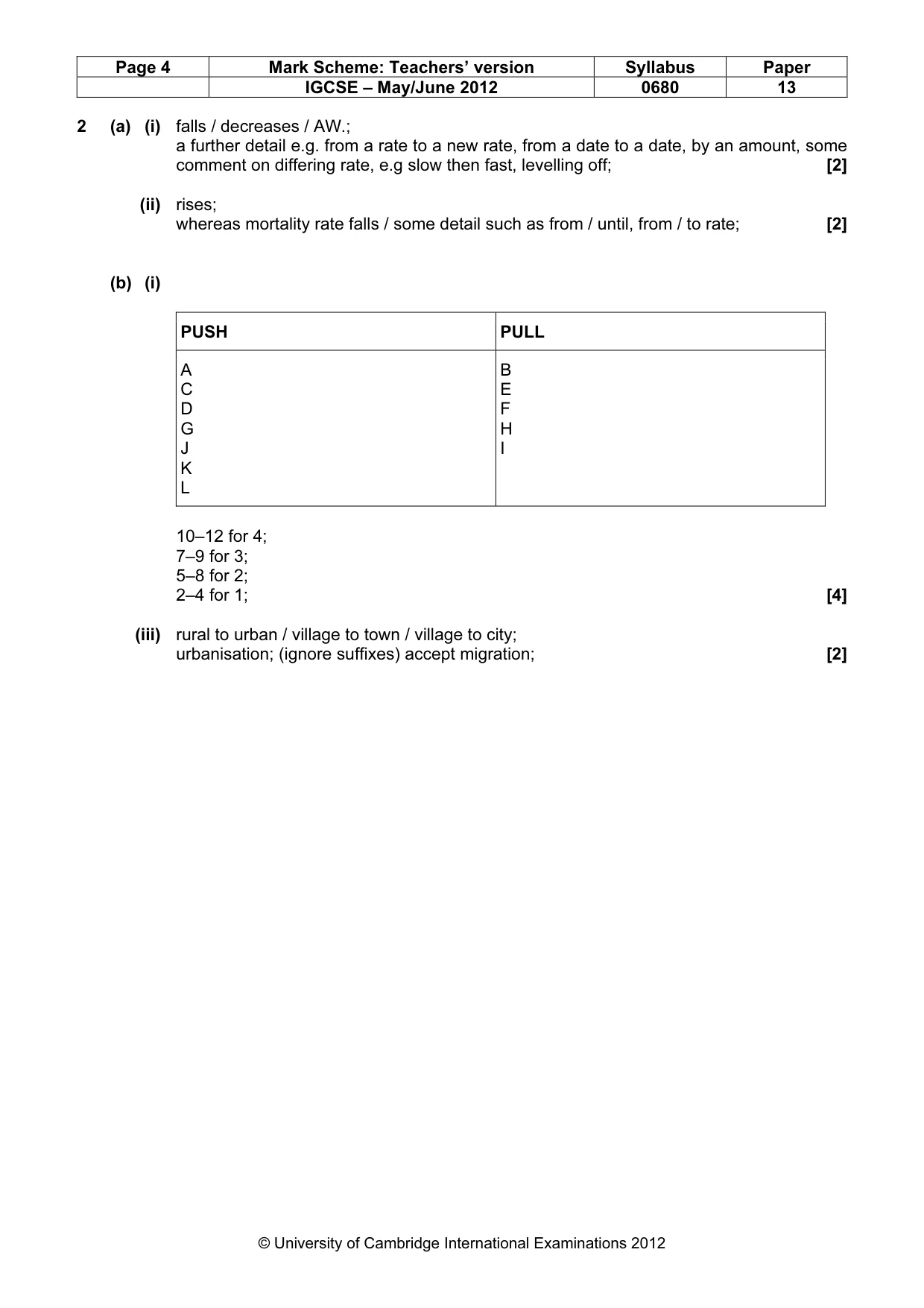
Page 4 Mark Scheme: Teachers’ version Syllabus Paper IGCSE – May/June 2012 0680 13 © University of Cambridge International Examinations 2012 2 (a) (i) falls / decreases / AW.; a further detail e.g. from a rate to a new rate, from a date to a date, by an amount, some comment on differing rate, e.g slow then fast, levelling off; [2] (ii) rises; whereas mortality rate falls / some detail such as from / until, from / to rate; [2] (b) (i) PUSH PULL A C D G J K L B E F H I 10–12 for 4; 7–9 for 3; 5–8 for 2; 2–4 for 1; [4] (iii) rural to urban / village to town / village to city; urbanisation; (ignore suffixes) accept migration; [2]
Mark scheme, page 5
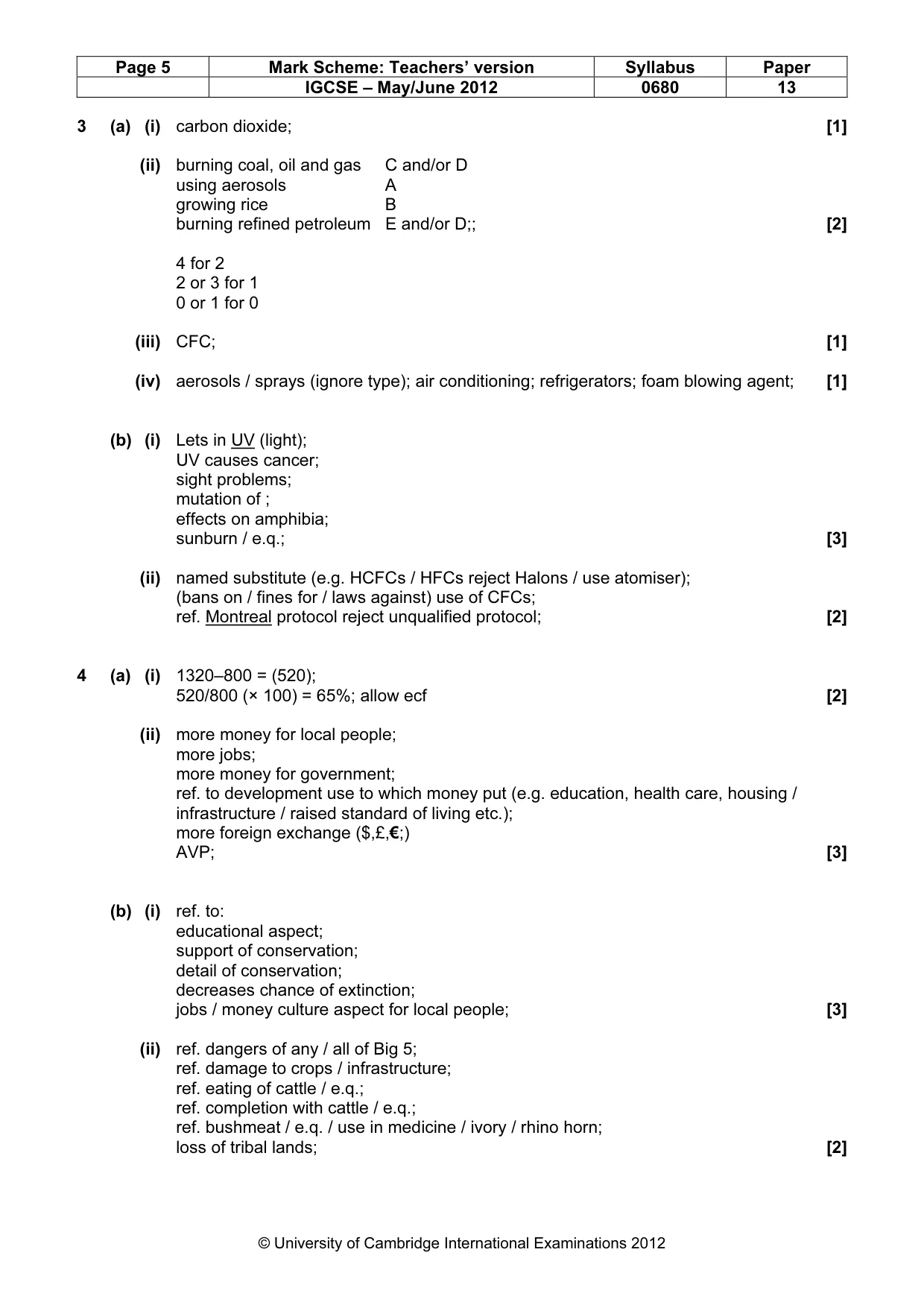
Page 5 Mark Scheme: Teachers’ version Syllabus Paper IGCSE – May/June 2012 0680 13 © University of Cambridge International Examinations 2012 3 (a) (i) carbon dioxide; [1] (ii) burning coal, oil and gas C and/or D using aerosols A growing rice B burning refined petroleum E and/or D;; [2] 4 for 2 2 or 3 for 1 0 or 1 for 0 (iii) CFC; [1] (iv) aerosols / sprays (ignore type); air conditioning; refrigerators; foam blowing agent; [1] (b) (i) Lets in UV (light); UV causes cancer; sight problems; mutation of ; effects on amphibia; sunburn / e.q.; [3] (ii) named substitute (e.g. HCFCs / HFCs reject Halons / use atomiser); (bans on / fines for / laws against) use of CFCs; ref. Montreal protocol reject unqualified protocol; [2] 4 (a) (i) 1320–800 = (520); 520/800 (× 100) = 65%; allow ecf [2] (ii) more money for local people; more jobs; more money for government; ref. to development use to which money put (e.g. education, health care, housing / infrastructure / raised standard of living etc.); more foreign exchange ($,£,€;) AVP; [3] (b) (i) ref. to: educational aspect; support of conservation; detail of conservation; decreases chance of extinction; jobs / money culture aspect for local people; [3] (ii) ref. dangers of any / all of Big 5; ref. damage to crops / infrastructure; ref. eating of cattle / e.q.; ref. completion with cattle / e.q.; ref. bushmeat / e.q. / use in medicine / ivory / rhino horn; loss of tribal lands; [2]
Mark scheme, page 6
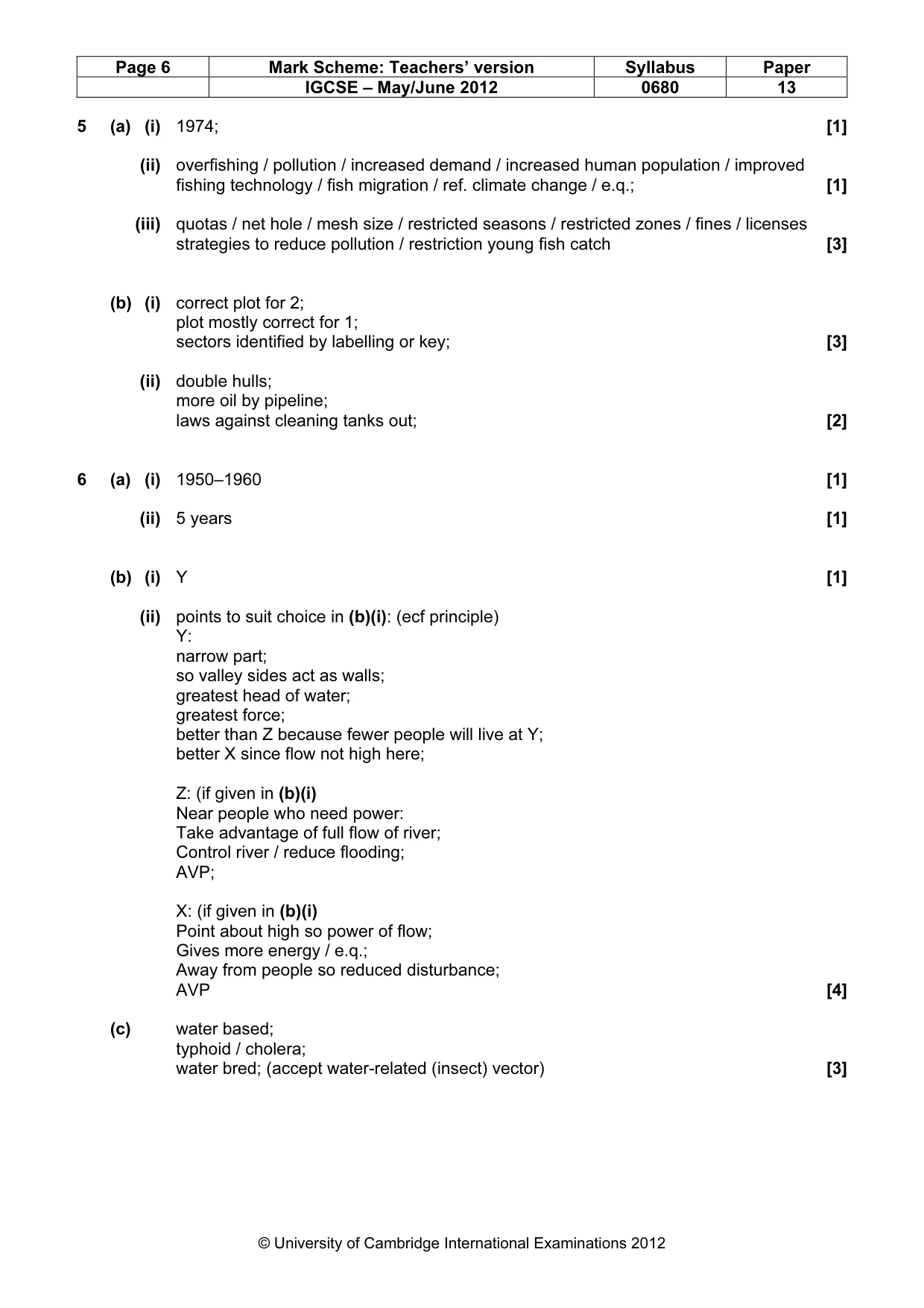
Page 6 Mark Scheme: Teachers’ version Syllabus Paper IGCSE – May/June 2012 0680 13 © University of Cambridge International Examinations 2012 5 (a) (i) 1974; [1] (ii) overfishing / pollution / increased demand / increased human population / improved fishing technology / fish migration / ref. climate change / e.q.; [1] (iii) quotas / net hole / mesh size / restricted seasons / restricted zones / fines / licenses strategies to reduce pollution / restriction young fish catch [3] (b) (i) correct plot for 2; plot mostly correct for 1; sectors identified by labelling or key; [3] (ii) double hulls; more oil by pipeline; laws against cleaning tanks out; [2] 6 (a) (i) 1950–1960 [1] (ii) 5 years [1] (b) (i) Y [1] (ii) points to suit choice in (b)(i): (ecf principle) Y: narrow part; so valley sides act as walls; greatest head of water; greatest force; better than Z because fewer people will live at Y; better X since flow not high here; Z: (if given in (b)(i) Near people who need power: Take advantage of full flow of river; Control river / reduce flooding; AVP; X: (if given in (b)(i) Point about high so power of flow; Gives more energy / e.q.; Away from people so reduced disturbance; AVP [4] (c) water based; typhoid / cholera; water bred; (accept water-related (insect) vector) [3]
What you needed in this session
Cambridge’s own grade thresholds for 2012 May/June, Paper 1 · Variant 3. A higher threshold means an easier paper — the bar moves with how the cohort did.