Cambridge IGCSE Enterprise 0454 — 2022 Oct/Nov Paper 1 · Variant 2
0454/12/O/N/22 · 100 marks · ≈113 min
The question paper and its mark scheme, free to read here and free to download. This is Cambridge’s own paper, exactly as it was sat.
Question paper16 pages








Mark scheme20 pages
Answers below. Sit the paper first if you are practising.
Paper as text
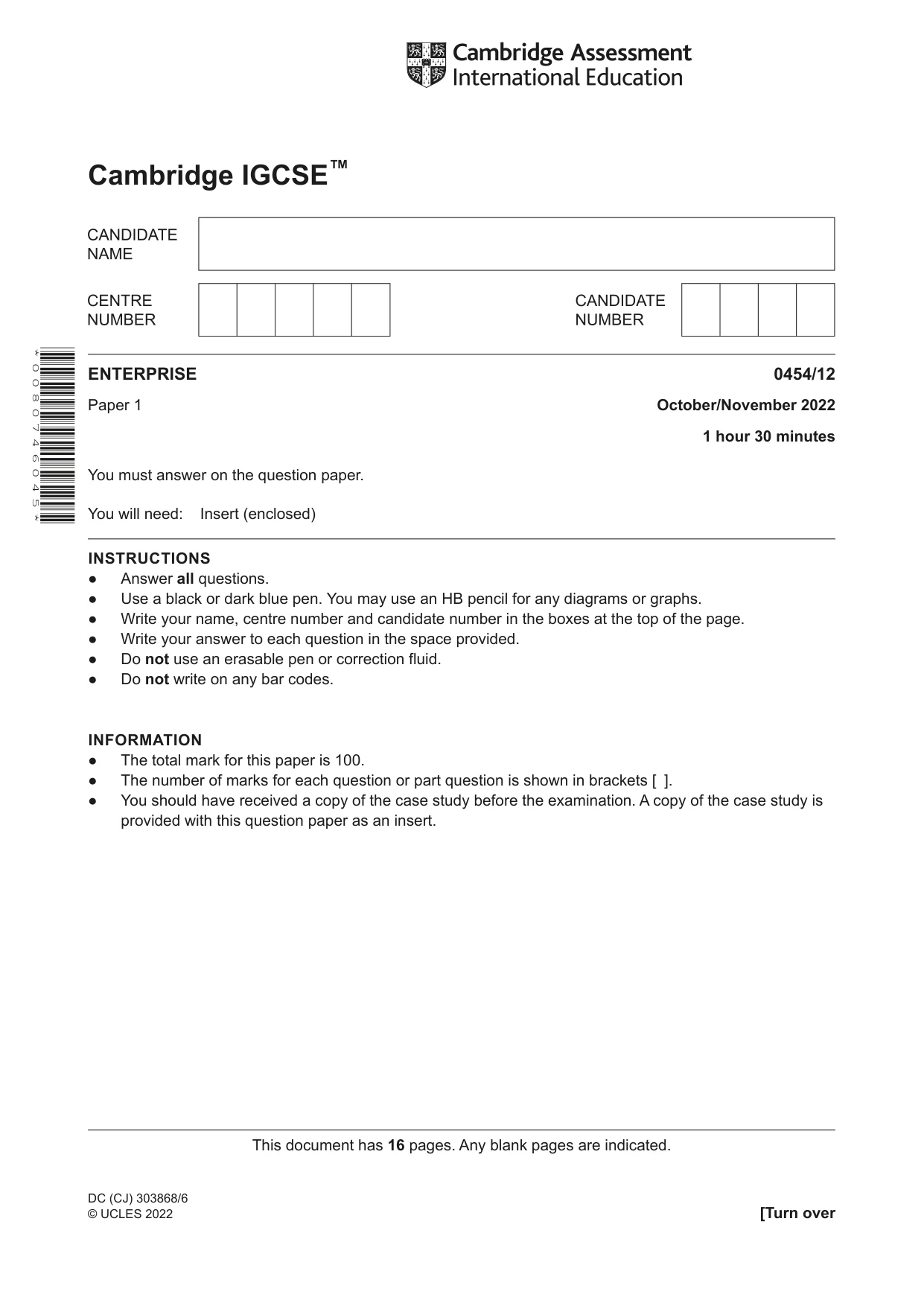
Question paper, page 1
This document has 16 pages. Any blank pages are indicated. [Turn over Cambridge IGCSE™ ENTERPRISE 0454/12 Paper 1 October/November 2022 1 hour 30 minutes You must answer on the question paper. You will need: Insert (enclosed) INSTRUCTIONS ● Answer all questions. ● Use a black or dark blue pen. You may use an HB pencil for any diagrams or graphs. ● Write your name, centre number and candidate number in the boxes at the top of the page. ● Write your answer to each question in the space provided. ● Do not use an erasable pen or correction fluid. ● Do not write on any bar codes. INFORMATION ● The total mark for this paper is 100. ● The number of marks for each question or part question is shown in brackets [ ]. ● You should have received a copy of the case study before the examination. A copy of the case study is provided with this question paper as an insert. * 0 0 8 0 7 4 6 0 4 5 * DC (CJ) 303868/6 © UCLES 2022
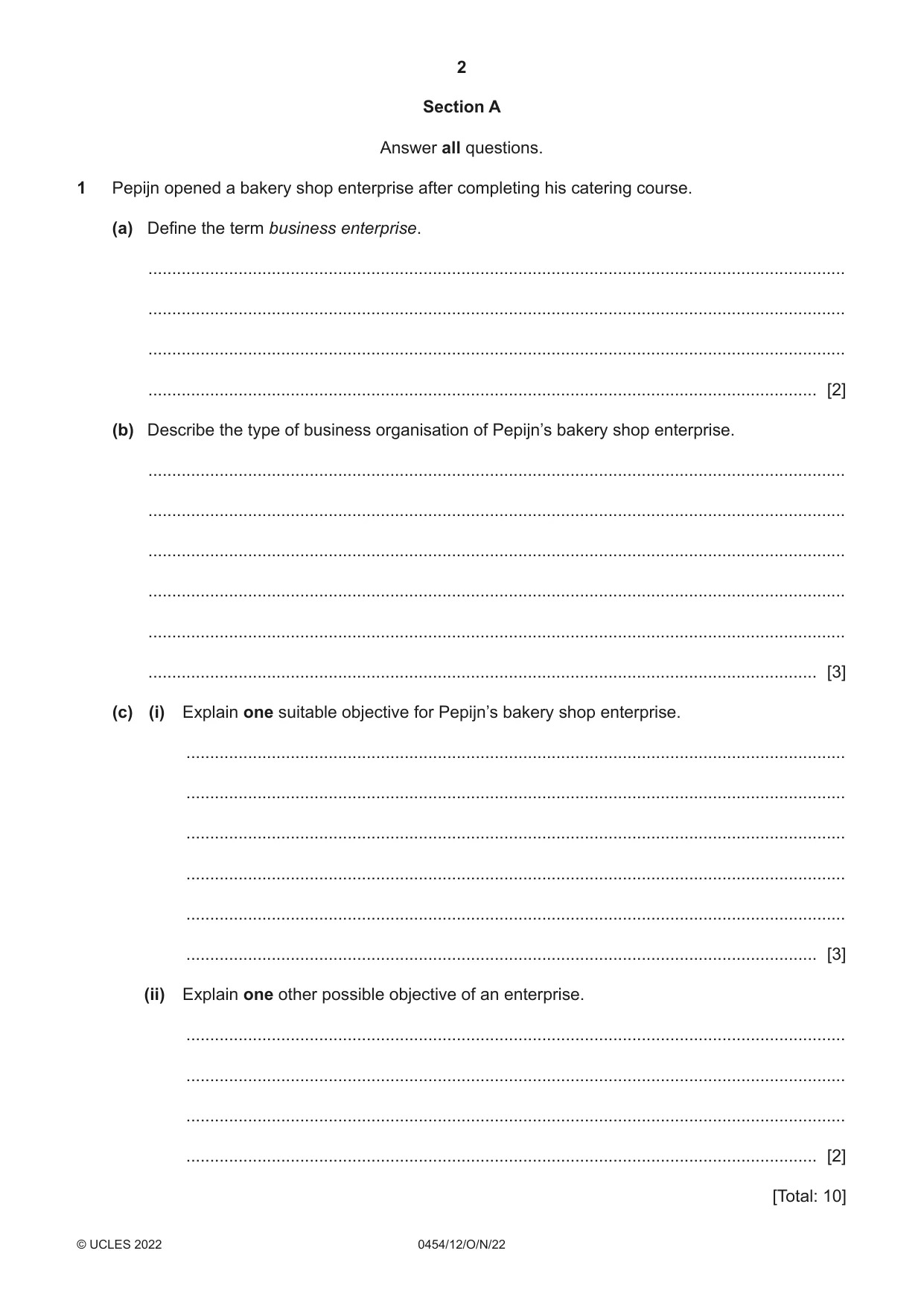
Question paper, page 2
2 0454/12/O/N/22 © UCLES 2022 Section A Answer all questions. 1 Pepijn opened a bakery shop enterprise after completing his catering course. (a) Define the term business enterprise. … … … … [2] (b) Describe the type of business organisation of Pepijn’s bakery shop enterprise. … … … … … … [3] (c) (i) Explain one suitable objective for Pepijn’s bakery shop enterprise. … … … … … … [3] (ii) Explain one other possible objective of an enterprise. … … … … [2] [Total: 10]
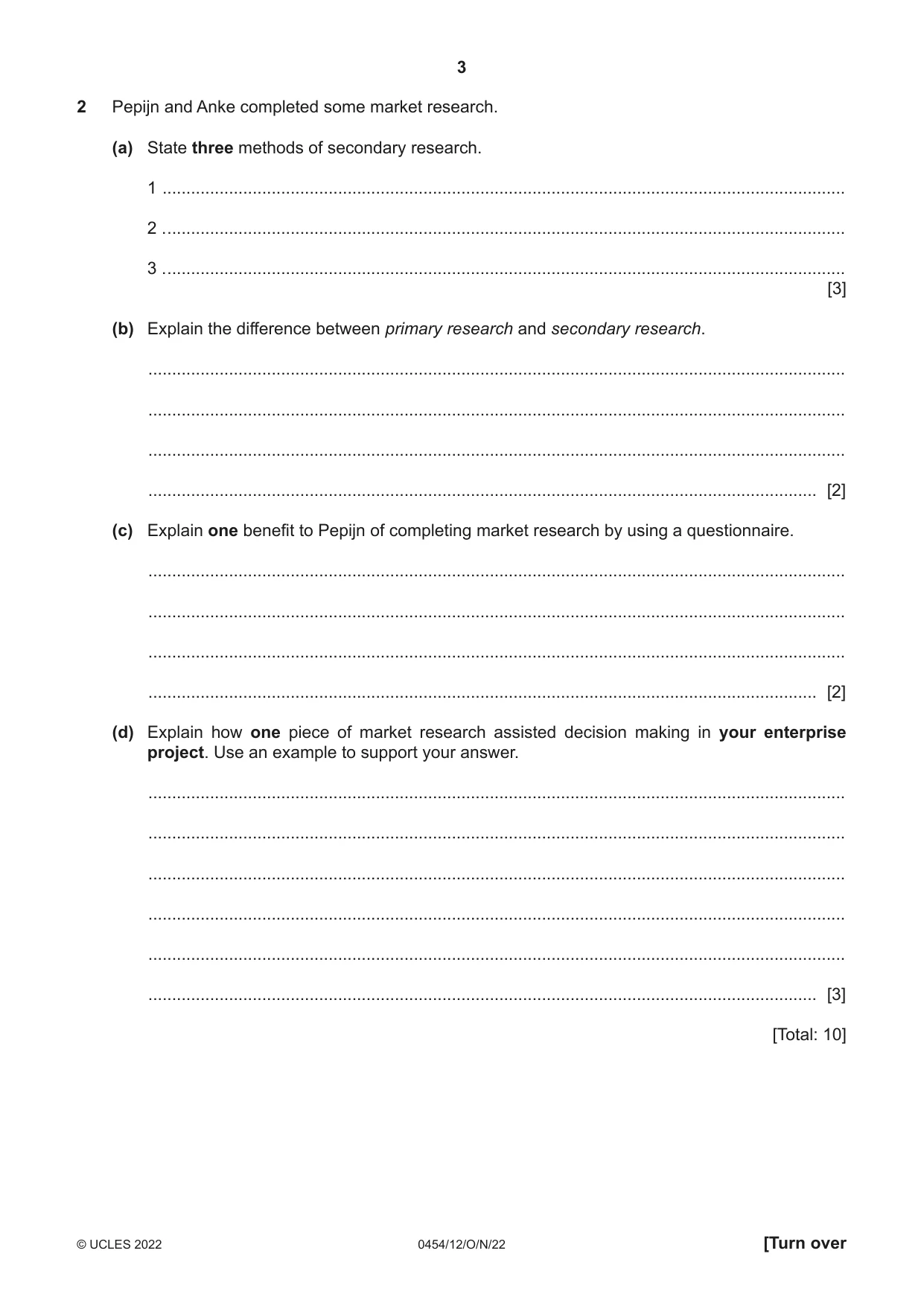
Question paper, page 3
3 0454/12/O/N/22 © UCLES 2022 [Turn over 2 Pepijn and Anke completed some market research. (a) State three methods of secondary research. 1 … 2 . … 3 . … [3] (b) Explain the difference between primary research and secondary research. … … … … [2] (c) Explain one benefit to Pepijn of completing market research by using a questionnaire. … … … … [2] (d) Explain how one piece of market research assisted decision making in your enterprise project. Use an example to support your answer. … … … … … … [3] [Total: 10]
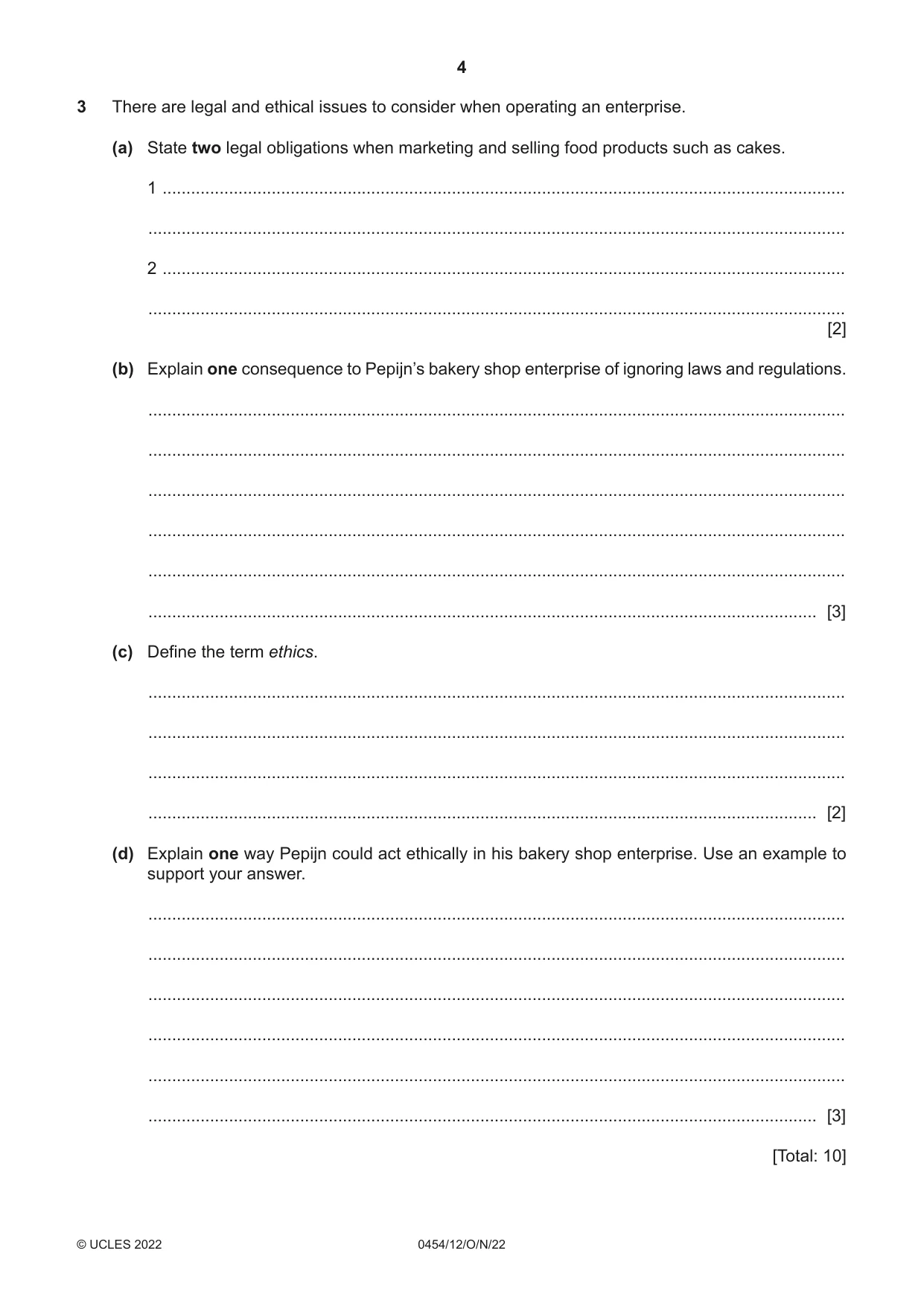
Question paper, page 4
4 0454/12/O/N/22 © UCLES 2022 3 There are legal and ethical issues to consider when operating an enterprise. (a) State two legal obligations when marketing and selling food products such as cakes. 1 … … 2 … … [2] (b) Explain one consequence to Pepijn’s bakery shop enterprise of ignoring laws and regulations. … … … … … … [3] (c) Define the term ethics. … … … … [2] (d) Explain one way Pepijn could act ethically in his bakery shop enterprise. Use an example to support your answer. … … … … … … [3] [Total: 10]
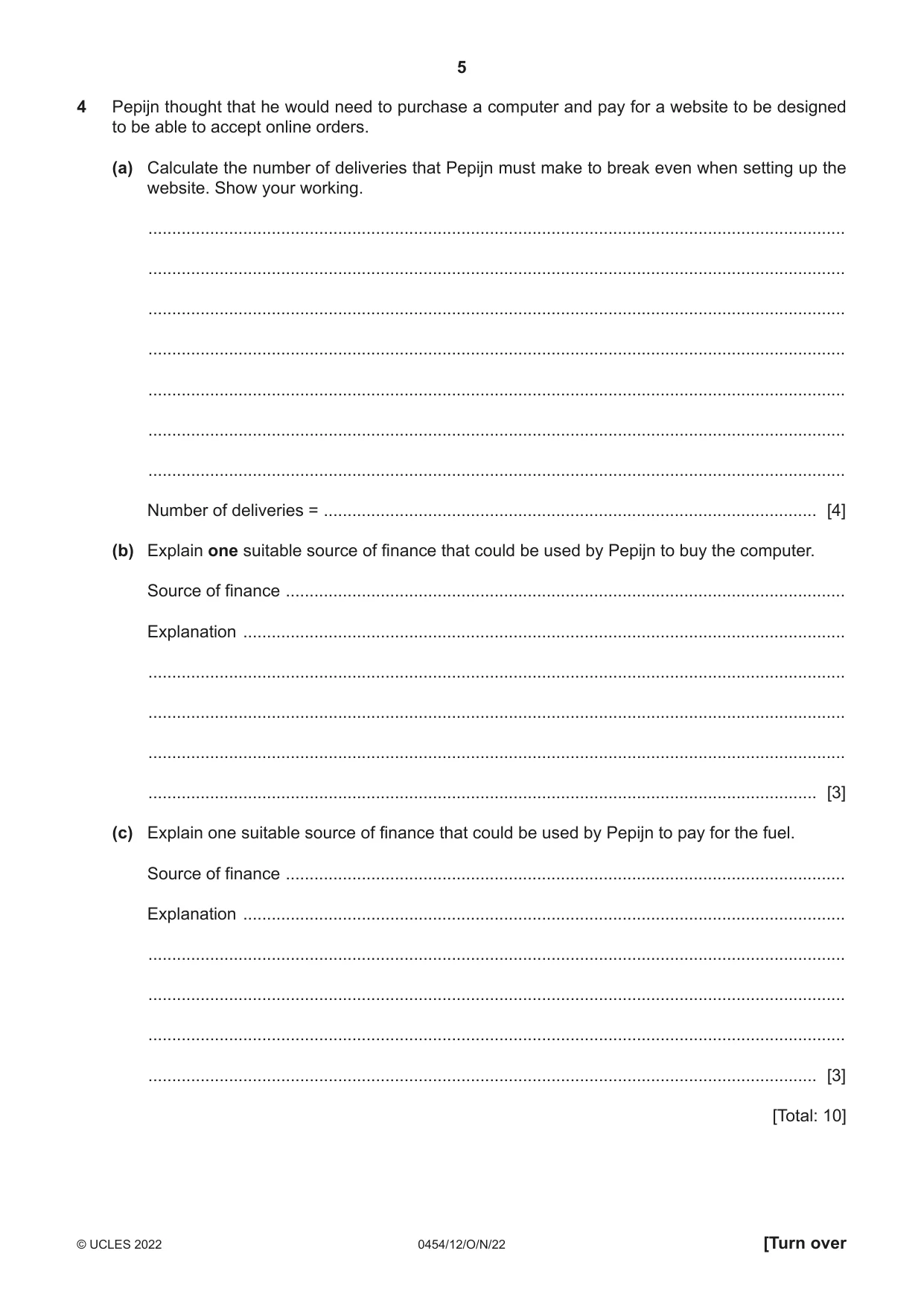
Question paper, page 5
5 0454/12/O/N/22 © UCLES 2022 [Turn over 4 Pepijn thought that he would need to purchase a computer and pay for a website to be designed to be able to accept online orders. (a) Calculate the number of deliveries that Pepijn must make to break even when setting up the website. Show your working. … … … … … … … Number of deliveries = … [4] (b) Explain one suitable source of finance that could be used by Pepijn to buy the computer. Source of finance … Explanation … … … … … [3] (c) Explain one suitable source of finance that could be used by Pepijn to pay for the fuel. Source of finance … Explanation … … … … … [3] [Total: 10]
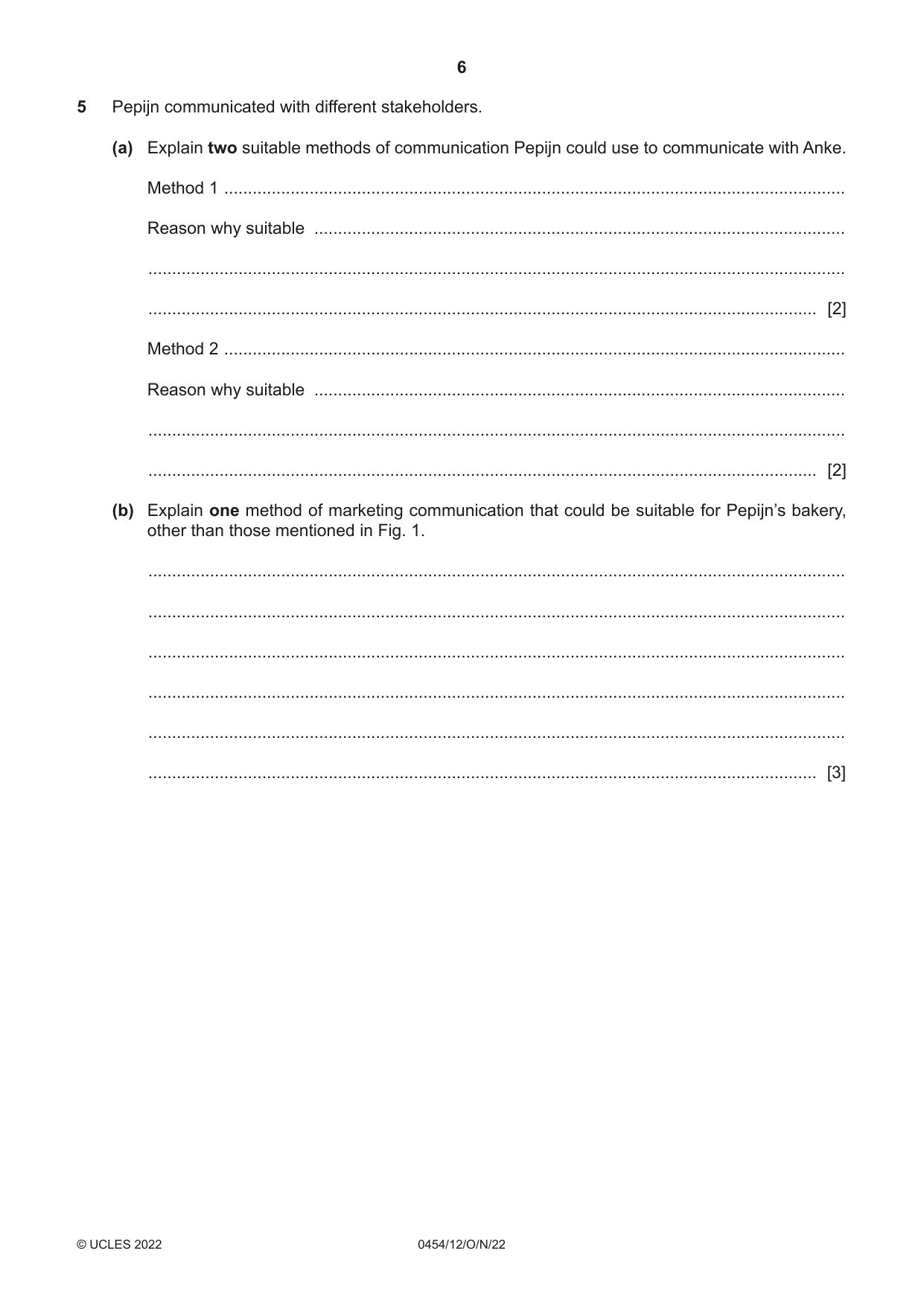
Question paper, page 6
6 0454/12/O/N/22 © UCLES 2022 5 Pepijn communicated with different stakeholders. (a) Explain two suitable methods of communication Pepijn could use to communicate with Anke. Method 1 … Reason why suitable … … … [2] Method 2 … Reason why suitable … … … [2] (b) Explain one method of marketing communication that could be suitable for Pepijn’s bakery, other than those mentioned in Fig. 1. … … … … … … [3]
Question paper, page 7
7 0454/12/O/N/22 © UCLES 2022 [Turn over (c) Explain how non-verbal communication either positively or negatively affected your enterprise project. Use an example to support your answer. … … … … … … [3] [Total: 10]
Question paper, page 8
8 0454/12/O/N/22 © UCLES 2022 BLANK PAGE
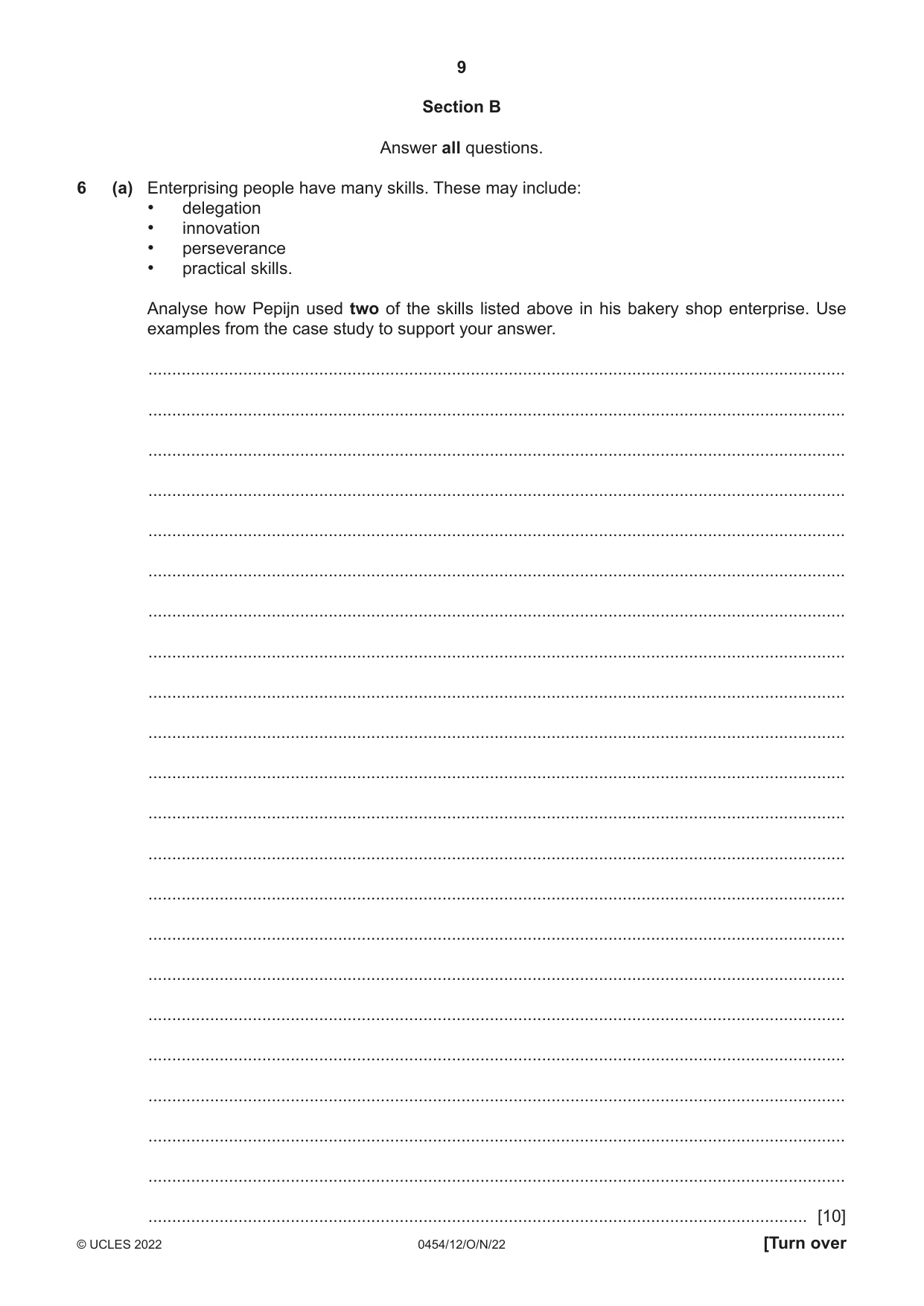
Question paper, page 9
9 0454/12/O/N/22 © UCLES 2022 [Turn over Section B Answer all questions. 6 (a) Enterprising people have many skills. These may include: • delegation • innovation • perseverance • practical skills. Analyse how Pepijn used two of the skills listed above in his bakery shop enterprise. Use examples from the case study to support your answer. … … … … … … … … … … … … … … … … … … … … … … [10]
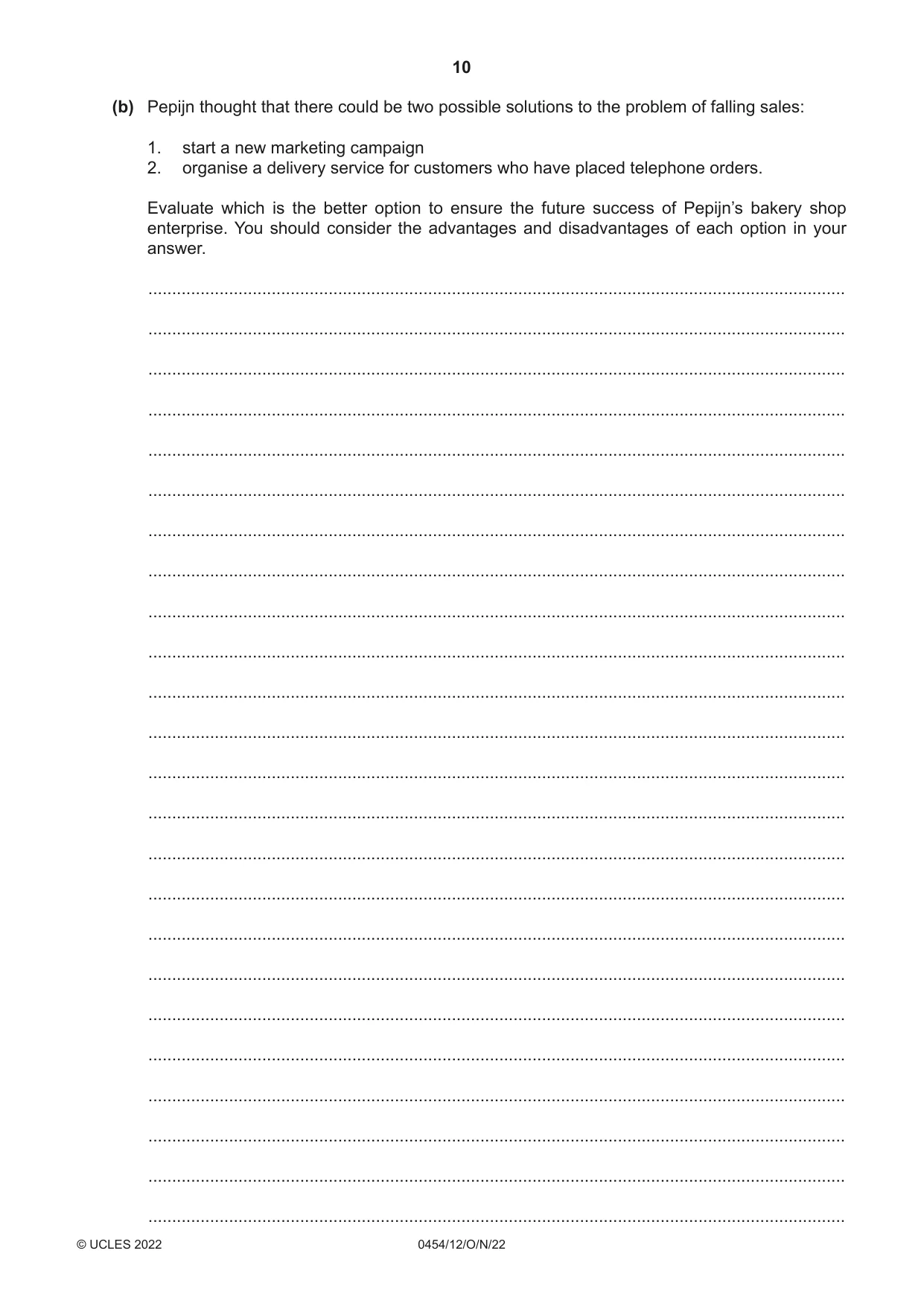
Question paper, page 10
10 0454/12/O/N/22 © UCLES 2022 (b) Pepijn thought that there could be two possible solutions to the problem of falling sales: 1. start a new marketing campaign 2. organise a delivery service for customers who have placed telephone orders. Evaluate which is the better option to ensure the future success of Pepijn’s bakery shop enterprise. You should consider the advantages and disadvantages of each option in your answer. … … … … … … … … … … … … … … … … … … … … … … … …
Question paper, page 11
11 0454/12/O/N/22 © UCLES 2022 [Turn over … … … … … … … … … … … … … … … … … … … … … … … … … … … [15] [Total: 25]
Question paper, page 12
12 0454/12/O/N/22 © UCLES 2022 BLANK PAGE
Question paper, page 13
13 0454/12/O/N/22 © UCLES 2022 [Turn over Now consider your enterprise project. 7 (a) Analyse the success or failure of your enterprise project in meeting the needs and wants of its customers. Use examples to support your answer. … … … … … … … … … … … … … … … … … … … … … … … … … … [10]
Question paper, page 14
14 0454/12/O/N/22 © UCLES 2022 (b) The negotiation process involves three stages. Two of these are: • planning • conducting. Evaluate the importance of the planning and conducting stages to the successful outcome of the negotiation completed in your enterprise project. Use examples to support your answer. … … … … … … … … … … … … … … … … … … … … … … … … …
Question paper, page 15
15 0454/12/O/N/22 © UCLES 2022 … … … … … … … … … … … … … … … … … … … … … … … … … … [15] [Total: 25]
Question paper, page 16
16 0454/12/O/N/22 © UCLES 2022 Permission to reproduce items where third-party owned material protected by copyright is included has been sought and cleared where possible. Every reasonable effort has been made by the publisher (UCLES) to trace copyright holders, but if any items requiring clearance have unwittingly been included, the publisher will be pleased to make amends at the earliest possible opportunity. To avoid the issue of disclosure of answer-related information to candidates, all copyright acknowledgements are reproduced online in the Cambridge Assessment International Education Copyright Acknowledgements Booklet. This is produced for each series of examinations and is freely available to download at www.cambridgeinternational.org after the live examination series. Cambridge Assessment International Education is part of Cambridge Assessment. Cambridge Assessment is the brand name of the University of Cambridge Local Examinations Syndicate (UCLES), which is a department of the University of Cambridge. BLANK PAGE
Mark scheme, page 1
This document consists of 20 printed pages. © UCLES 2022 [Turn over Cambridge IGCSE™ ENTERPRISE 0454/12 Paper 1 October/November 2022 MARK SCHEME Maximum Mark: 100 Published This mark scheme is published as an aid to teachers and candidates, to indicate the requirements of the examination. It shows the basis on which Examiners were instructed to award marks. It does not indicate the details of the discussions that took place at an Examiners’ meeting before marking began, which would have considered the acceptability of alternative answers. Mark schemes should be read in conjunction with the question paper and the Principal Examiner Report for Teachers. Cambridge International will not enter into discussions about these mark schemes. Cambridge International is publishing the mark schemes for the October/November 2022 series for most Cambridge IGCSE™, Cambridge International A and AS Level components and some Cambridge O Level components.
Mark scheme, page 2
0454/12 Cambridge IGCSE – Mark Scheme PUBLISHED October/November 2022 © UCLES 2022 Page 2 of 20 Generic Marking Principles These general marking principles must be applied by all examiners when marking candidate answers. They should be applied alongside the specific content of the mark scheme or generic level descriptors for a question. Each question paper and mark scheme will also comply with these marking principles. GENERIC MARKING PRINCIPLE 1: Marks must be awarded in line with: • the specific content of the mark scheme or the generic level descriptors for the question • the specific skills defined in the mark scheme or in the generic level descriptors for the question • the standard of response required by a candidate as exemplified by the standardisation scripts. GENERIC MARKING PRINCIPLE 2: Marks awarded are always whole marks (not half marks, or other fractions). GENERIC MARKING PRINCIPLE 3: Marks must be awarded positively: • marks are awarded for correct/valid answers, as defined in the mark scheme. However, credit is given for valid answers which go beyond the scope of the syllabus and mark scheme, referring to your Team Leader as appropriate • marks are awarded when candidates clearly demonstrate what they know and can do • marks are not deducted for errors • marks are not deducted for omissions • answers should only be judged on the quality of spelling, punctuation and grammar when these features are specifically assessed by the question as indicated by the mark scheme. The meaning, however, should be unambiguous. GENERIC MARKING PRINCIPLE 4: Rules must be applied consistently, e.g. in situations where candidates have not followed instructions or in the application of generic level descriptors.
Mark scheme, page 3
0454/12 Cambridge IGCSE – Mark Scheme PUBLISHED October/November 2022 © UCLES 2022 Page 3 of 20 GENERIC MARKING PRINCIPLE 5: Marks should be awarded using the full range of marks defined in the mark scheme for the question (however; the use of the full mark range may be limited according to the quality of the candidate responses seen). GENERIC MARKING PRINCIPLE 6: Marks awarded are based solely on the requirements as defined in the mark scheme. Marks should not be awarded with grade thresholds or grade descriptors in mind.
Mark scheme, page 4
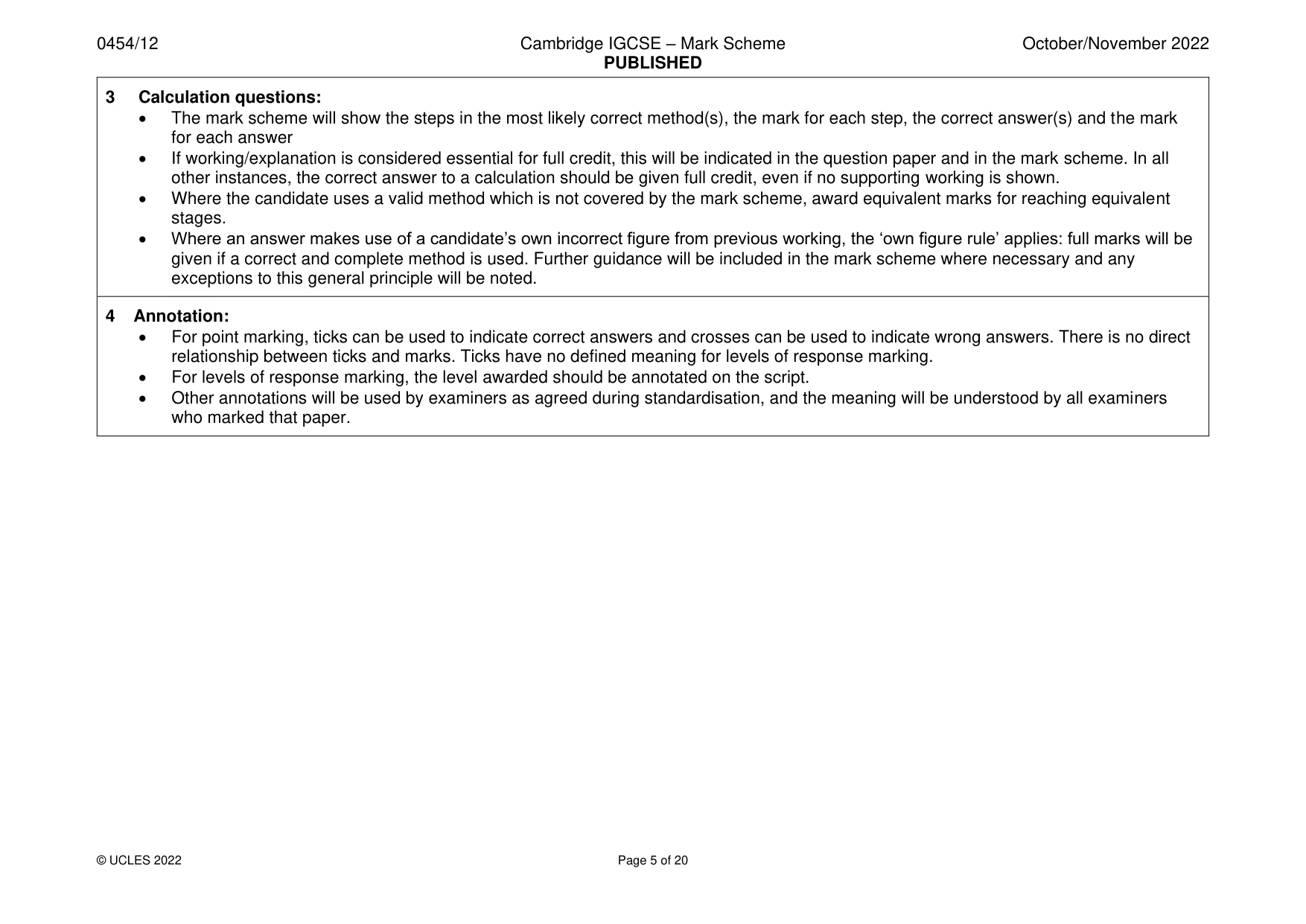
0454/12 Cambridge IGCSE – Mark Scheme PUBLISHED October/November 2022 © UCLES 2022 Page 4 of 20 Social Science-Specific Marking Principles (for point-based marking) 1 Components using point-based marking: • Point marking is often used to reward knowledge, understanding and application of skills. We give credit where the candidate’s answer shows relevant knowledge, understanding and application of skills in answering the question. We do not give credit where the answer shows confusion. From this it follows that we: a DO credit answers which are worded differently from the mark scheme if they clearly convey the same meaning (unless the mark scheme requires a specific term) b DO credit alternative answers/examples which are not written in the mark scheme if they are correct c DO credit answers where candidates give more than one correct answer in one prompt/numbered/scaffolded space where extended writing is required rather than list-type answers. For example, questions that require n reasons (e.g. State two reasons …). d DO NOT credit answers simply for using a ‘key term’ unless that is all that is required. (Check for evidence it is understood and not used wrongly.) e DO NOT credit answers which are obviously self-contradicting or trying to cover all possibilities f DO NOT give further credit for what is effectively repetition of a correct point already credited unless the language itself is being tested. This applies equally to ‘mirror statements’ (i.e. polluted/not polluted). g DO NOT require spellings to be correct, unless this is part of the test. However spellings of syllabus terms must allow for clear and unambiguous separation from other syllabus terms with which they may be confused (e.g. Corrasion/Corrosion) 2 Presentation of mark scheme: • Slashes (/) or the word ‘or’ separate alternative ways of making the same point. • Semi colons (;) bullet points (•) or figures in brackets (1) separate different points. • Content in the answer column in brackets is for examiner information/context to clarify the marking but is not required to earn the mark (except Accounting syllabuses where they indicate negative numbers).
Mark scheme, page 5
0454/12 Cambridge IGCSE – Mark Scheme PUBLISHED October/November 2022 © UCLES 2022 Page 5 of 20 3 Calculation questions: • The mark scheme will show the steps in the most likely correct method(s), the mark for each step, the correct answer(s) and the mark for each answer • If working/explanation is considered essential for full credit, this will be indicated in the question paper and in the mark scheme. In all other instances, the correct answer to a calculation should be given full credit, even if no supporting working is shown. • Where the candidate uses a valid method which is not covered by the mark scheme, award equivalent marks for reaching equivalent stages. • Where an answer makes use of a candidate’s own incorrect figure from previous working, the ‘own figure rule’ applies: full marks will be given if a correct and complete method is used. Further guidance will be included in the mark scheme where necessary and any exceptions to this general principle will be noted. 4 Annotation: • For point marking, ticks can be used to indicate correct answers and crosses can be used to indicate wrong answers. There is no direct relationship between ticks and marks. Ticks have no defined meaning for levels of response marking. • For levels of response marking, the level awarded should be annotated on the script. • Other annotations will be used by examiners as agreed during standardisation, and the meaning will be understood by all examiners who marked that paper.
Mark scheme, page 6
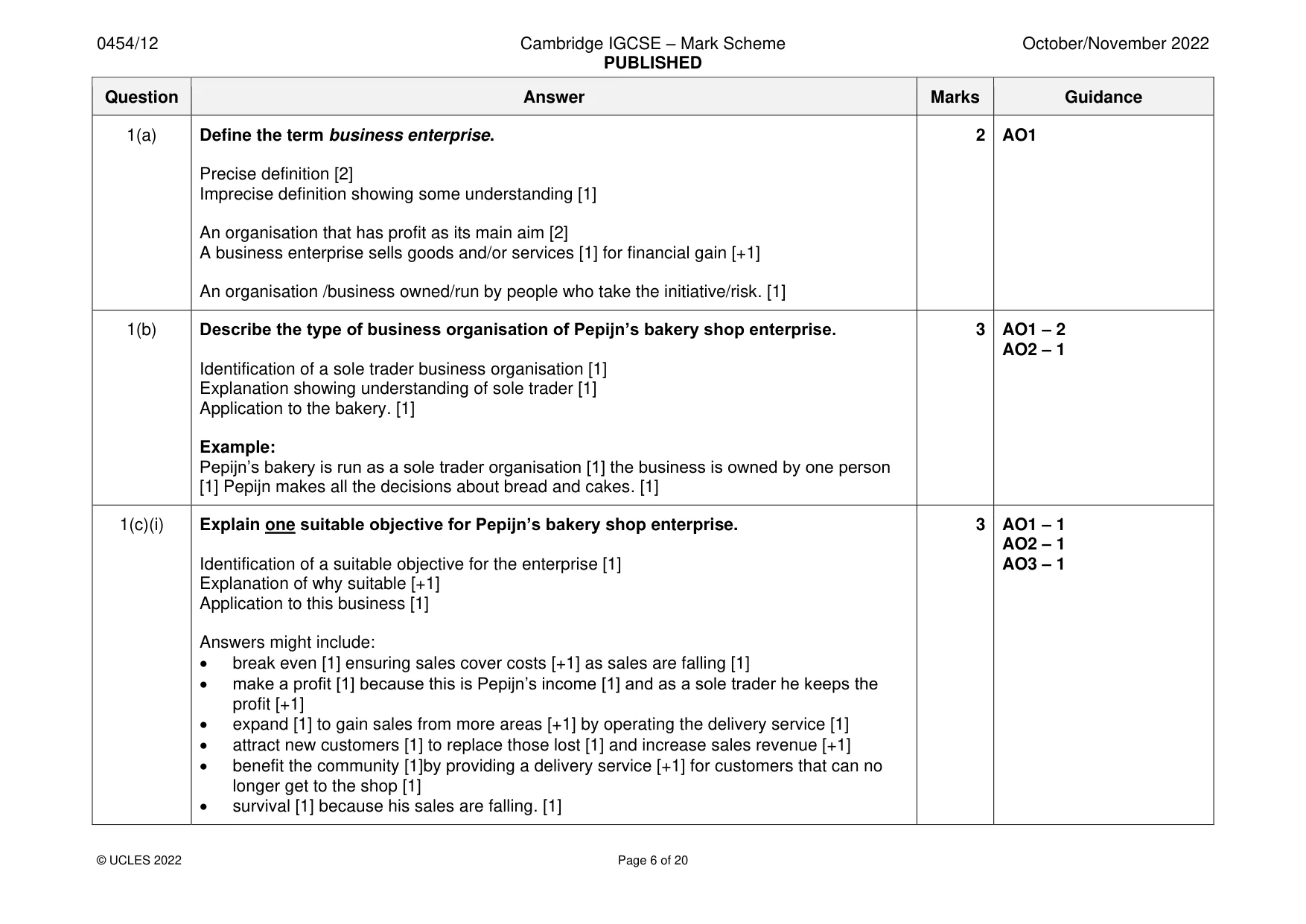
0454/12 Cambridge IGCSE – Mark Scheme PUBLISHED October/November 2022 © UCLES 2022 Page 6 of 20 Question Answer Marks Guidance 1(a) Define the term business enterprise. Precise definition [2] Imprecise definition showing some understanding [1] An organisation that has profit as its main aim [2] A business enterprise sells goods and/or services [1] for financial gain [+1] An organisation /business owned/run by people who take the initiative/risk. [1] 2 AO1 1(b) Describe the type of business organisation of Pepijn’s bakery shop enterprise. Identification of a sole trader business organisation [1] Explanation showing understanding of sole trader [1] Application to the bakery. [1] Example: Pepijn’s bakery is run as a sole trader organisation [1] the business is owned by one person [1] Pepijn makes all the decisions about bread and cakes. [1] 3 AO1 – 2 AO2 – 1 1(c)(i) Explain one suitable objective for Pepijn’s bakery shop enterprise. Identification of a suitable objective for the enterprise [1] Explanation of why suitable [+1] Application to this business [1] Answers might include: • break even [1] ensuring sales cover costs [+1] as sales are falling [1] • make a profit [1] because this is Pepijn’s income [1] and as a sole trader he keeps the profit [+1] • expand [1] to gain sales from more areas [+1] by operating the delivery service [1] • attract new customers [1] to replace those lost [1] and increase sales revenue [+1] • benefit the community [1]by providing a delivery service [+1] for customers that can no longer get to the shop [1] • survival [1] because his sales are falling. [1] 3 AO1 – 1 AO2 – 1 AO3 – 1
Mark scheme, page 7
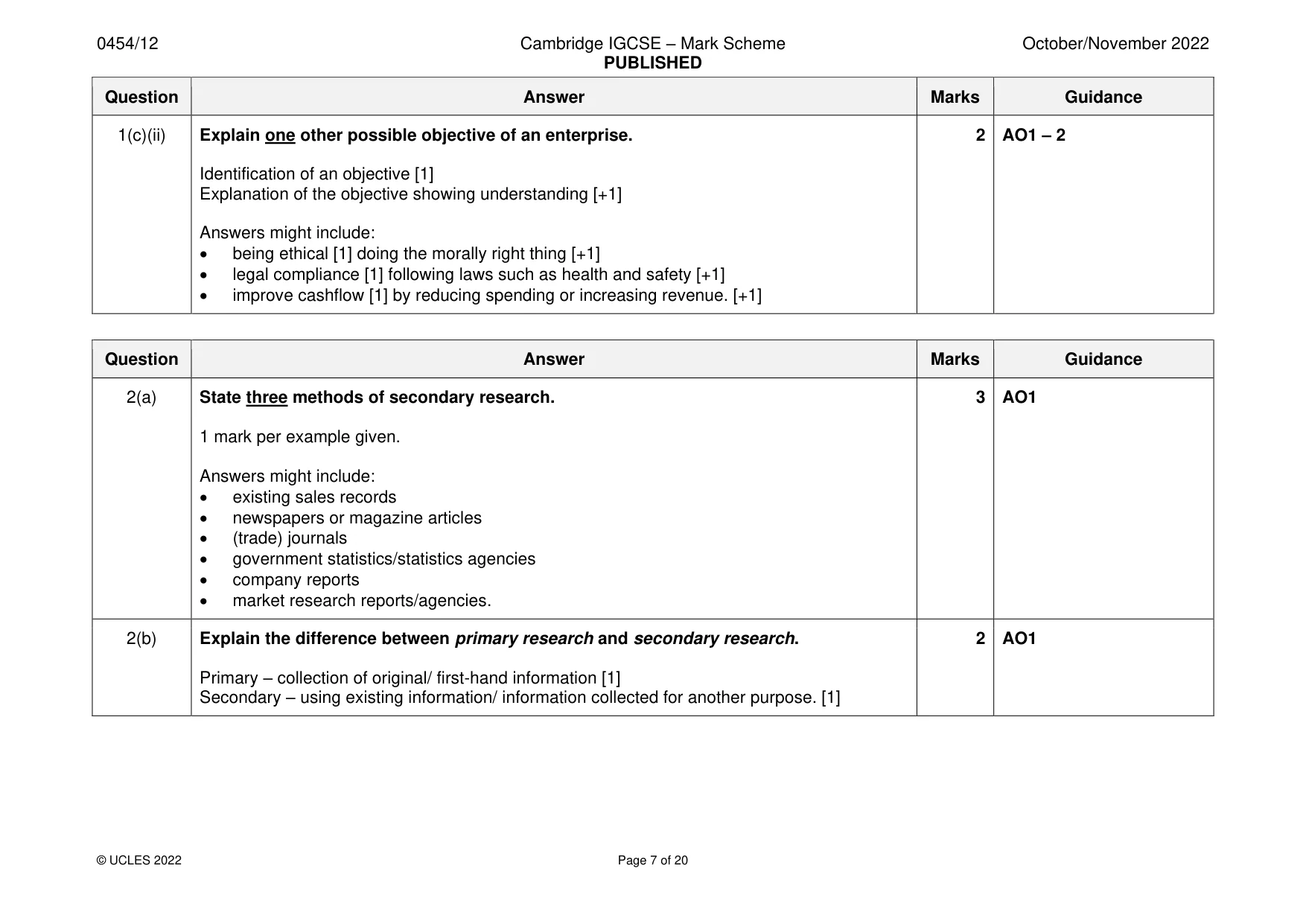
0454/12 Cambridge IGCSE – Mark Scheme PUBLISHED October/November 2022 © UCLES 2022 Page 7 of 20 Question Answer Marks Guidance 1(c)(ii) Explain one other possible objective of an enterprise. Identification of an objective [1] Explanation of the objective showing understanding [+1] Answers might include: • being ethical [1] doing the morally right thing [+1] • legal compliance [1] following laws such as health and safety [+1] • improve cashflow [1] by reducing spending or increasing revenue. [+1] 2 AO1 – 2 Question Answer Marks Guidance 2(a) State three methods of secondary research. 1 mark per example given. Answers might include: • existing sales records • newspapers or magazine articles • (trade) journals • government statistics/statistics agencies • company reports • market research reports/agencies. 3 AO1 2(b) Explain the difference between primary research and secondary research. Primary – collection of original/ first-hand information [1] Secondary – using existing information/ information collected for another purpose. [1] 2 AO1
Mark scheme, page 8
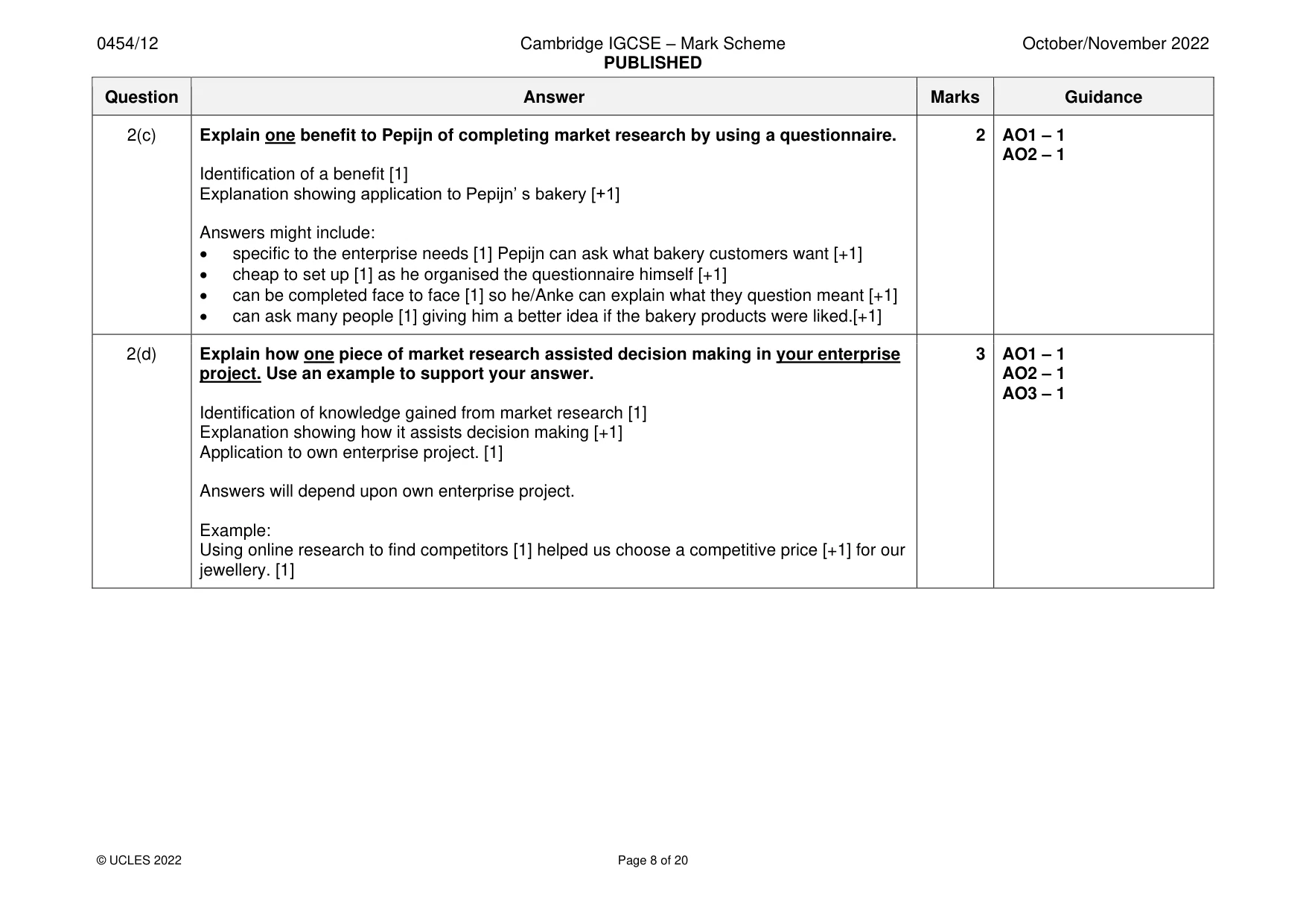
0454/12 Cambridge IGCSE – Mark Scheme PUBLISHED October/November 2022 © UCLES 2022 Page 8 of 20 Question Answer Marks Guidance 2(c) Explain one benefit to Pepijn of completing market research by using a questionnaire. Identification of a benefit [1] Explanation showing application to Pepijn’ s bakery [+1] Answers might include: • specific to the enterprise needs [1] Pepijn can ask what bakery customers want [+1] • cheap to set up [1] as he organised the questionnaire himself [+1] • can be completed face to face [1] so he/Anke can explain what they question meant [+1] • can ask many people [1] giving him a better idea if the bakery products were liked.[+1] 2 AO1 – 1 AO2 – 1 2(d) Explain how one piece of market research assisted decision making in your enterprise project. Use an example to support your answer. Identification of knowledge gained from market research [1] Explanation showing how it assists decision making [+1] Application to own enterprise project. [1] Answers will depend upon own enterprise project. Example: Using online research to find competitors [1] helped us choose a competitive price [+1] for our jewellery. [1] 3 AO1 – 1 AO2 – 1 AO3 – 1
Mark scheme, page 9
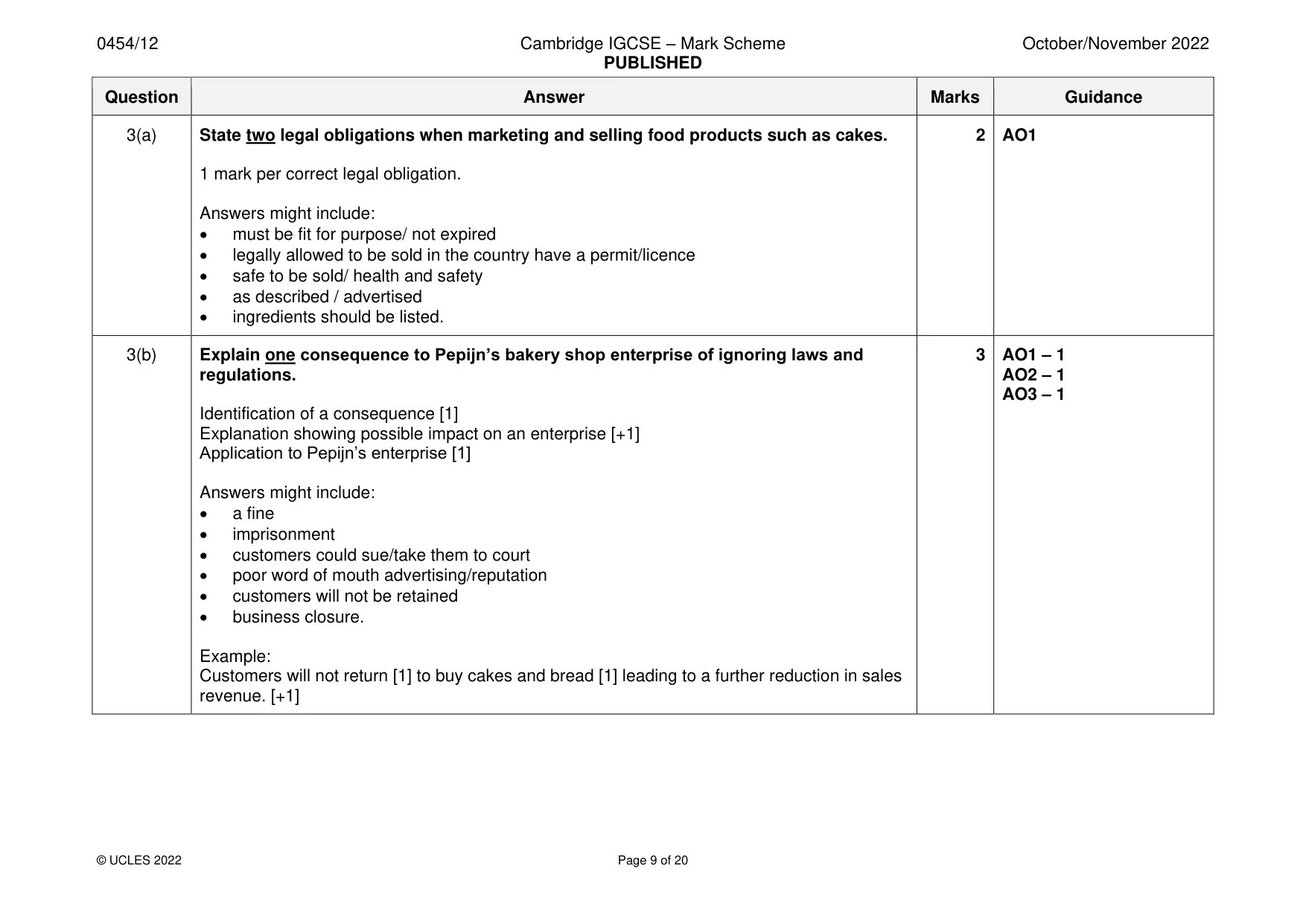
0454/12 Cambridge IGCSE – Mark Scheme PUBLISHED October/November 2022 © UCLES 2022 Page 9 of 20 Question Answer Marks Guidance 3(a) State two legal obligations when marketing and selling food products such as cakes. 1 mark per correct legal obligation. Answers might include: • must be fit for purpose/ not expired • legally allowed to be sold in the country have a permit/licence • safe to be sold/ health and safety • as described / advertised • ingredients should be listed. 2 AO1 3(b) Explain one consequence to Pepijn’s bakery shop enterprise of ignoring laws and regulations. Identification of a consequence [1] Explanation showing possible impact on an enterprise [+1] Application to Pepijn’s enterprise [1] Answers might include: • a fine • imprisonment • customers could sue/take them to court • poor word of mouth advertising/reputation • customers will not be retained • business closure. Example: Customers will not return [1] to buy cakes and bread [1] leading to a further reduction in sales revenue. [+1] 3 AO1 – 1 AO2 – 1 AO3 – 1
Mark scheme, page 10
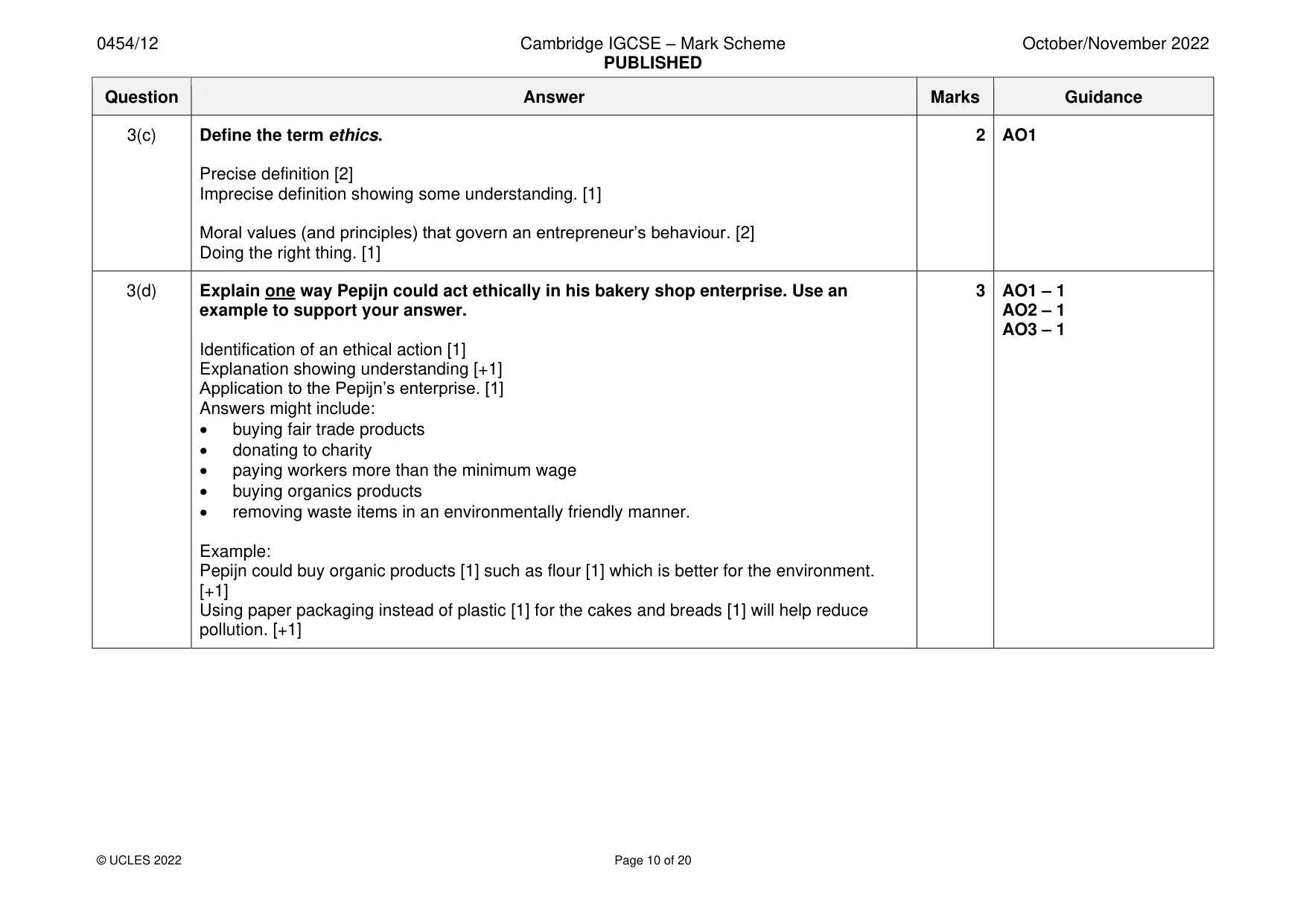
0454/12 Cambridge IGCSE – Mark Scheme PUBLISHED October/November 2022 © UCLES 2022 Page 10 of 20 Question Answer Marks Guidance 3(c) Define the term ethics. Precise definition [2] Imprecise definition showing some understanding. [1] Moral values (and principles) that govern an entrepreneur’s behaviour. [2] Doing the right thing. [1] 2 AO1 3(d) Explain one way Pepijn could act ethically in his bakery shop enterprise. Use an example to support your answer. Identification of an ethical action [1] Explanation showing understanding [+1] Application to the Pepijn’s enterprise. [1] Answers might include: • buying fair trade products • donating to charity • paying workers more than the minimum wage • buying organics products • removing waste items in an environmentally friendly manner. Example: Pepijn could buy organic products [1] such as flour [1] which is better for the environment. [+1] Using paper packaging instead of plastic [1] for the cakes and breads [1] will help reduce pollution. [+1] 3 AO1 – 1 AO2 – 1 AO3 – 1
Mark scheme, page 11
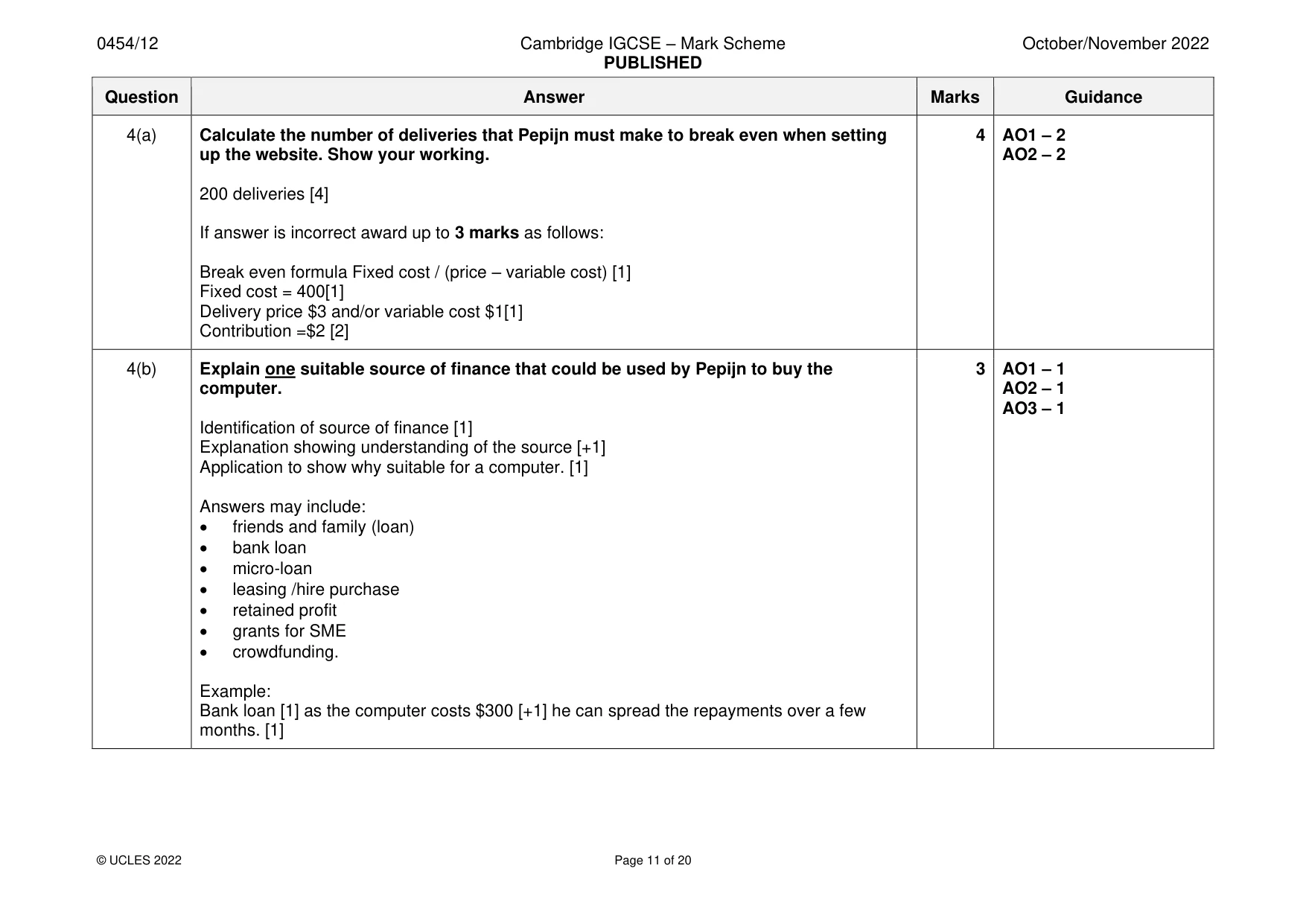
0454/12 Cambridge IGCSE – Mark Scheme PUBLISHED October/November 2022 © UCLES 2022 Page 11 of 20 Question Answer Marks Guidance 4(a) Calculate the number of deliveries that Pepijn must make to break even when setting up the website. Show your working. 200 deliveries [4] If answer is incorrect award up to 3 marks as follows: Break even formula Fixed cost / (price – variable cost) [1] Fixed cost = 400[1] Delivery price $3 and/or variable cost $1[1] Contribution =$2 [2] 4 AO1 – 2 AO2 – 2 4(b) Explain one suitable source of finance that could be used by Pepijn to buy the computer. Identification of source of finance [1] Explanation showing understanding of the source [+1] Application to show why suitable for a computer. [1] Answers may include: • friends and family (loan) • bank loan • micro-loan • leasing /hire purchase • retained profit • grants for SME • crowdfunding. Example: Bank loan [1] as the computer costs $300 [+1] he can spread the repayments over a few months. [1] 3 AO1 – 1 AO2 – 1 AO3 – 1
Mark scheme, page 12
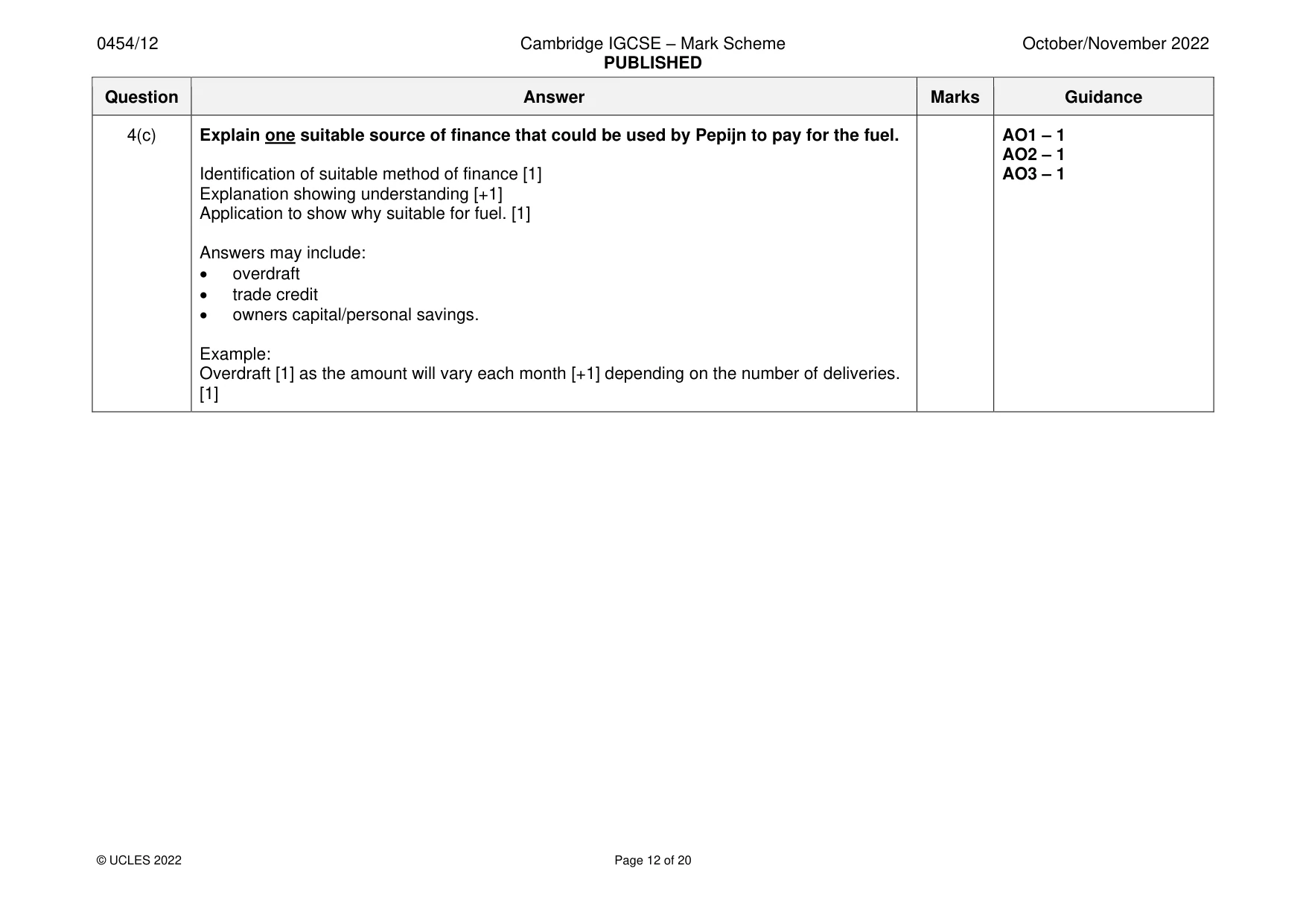
0454/12 Cambridge IGCSE – Mark Scheme PUBLISHED October/November 2022 © UCLES 2022 Page 12 of 20 Question Answer Marks Guidance 4(c) Explain one suitable source of finance that could be used by Pepijn to pay for the fuel. Identification of suitable method of finance [1] Explanation showing understanding [+1] Application to show why suitable for fuel. [1] Answers may include: • overdraft • trade credit • owners capital/personal savings. Example: Overdraft [1] as the amount will vary each month [+1] depending on the number of deliveries. [1] AO1 – 1 AO2 – 1 AO3 – 1
Mark scheme, page 13
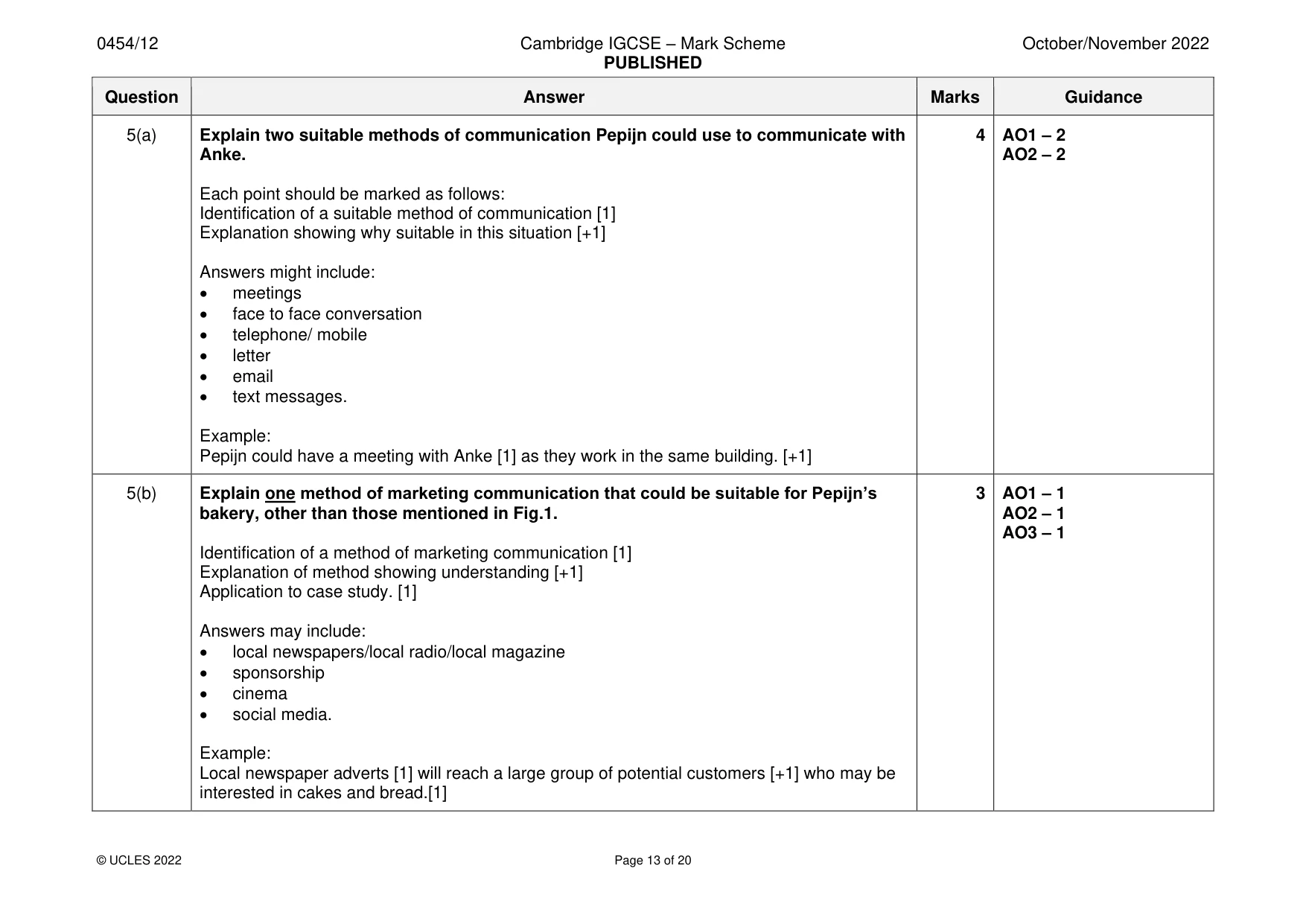
0454/12 Cambridge IGCSE – Mark Scheme PUBLISHED October/November 2022 © UCLES 2022 Page 13 of 20 Question Answer Marks Guidance 5(a) Explain two suitable methods of communication Pepijn could use to communicate with Anke. Each point should be marked as follows: Identification of a suitable method of communication [1] Explanation showing why suitable in this situation [+1] Answers might include: • meetings • face to face conversation • telephone/ mobile • letter • email • text messages. Example: Pepijn could have a meeting with Anke [1] as they work in the same building. [+1] 4 AO1 – 2 AO2 – 2 5(b) Explain one method of marketing communication that could be suitable for Pepijn’s bakery, other than those mentioned in Fig.1. Identification of a method of marketing communication [1] Explanation of method showing understanding [+1] Application to case study. [1] Answers may include: • local newspapers/local radio/local magazine • sponsorship • cinema • social media. Example: Local newspaper adverts [1] will reach a large group of potential customers [+1] who may be interested in cakes and bread.[1] 3 AO1 – 1 AO2 – 1 AO3 – 1
Mark scheme, page 14
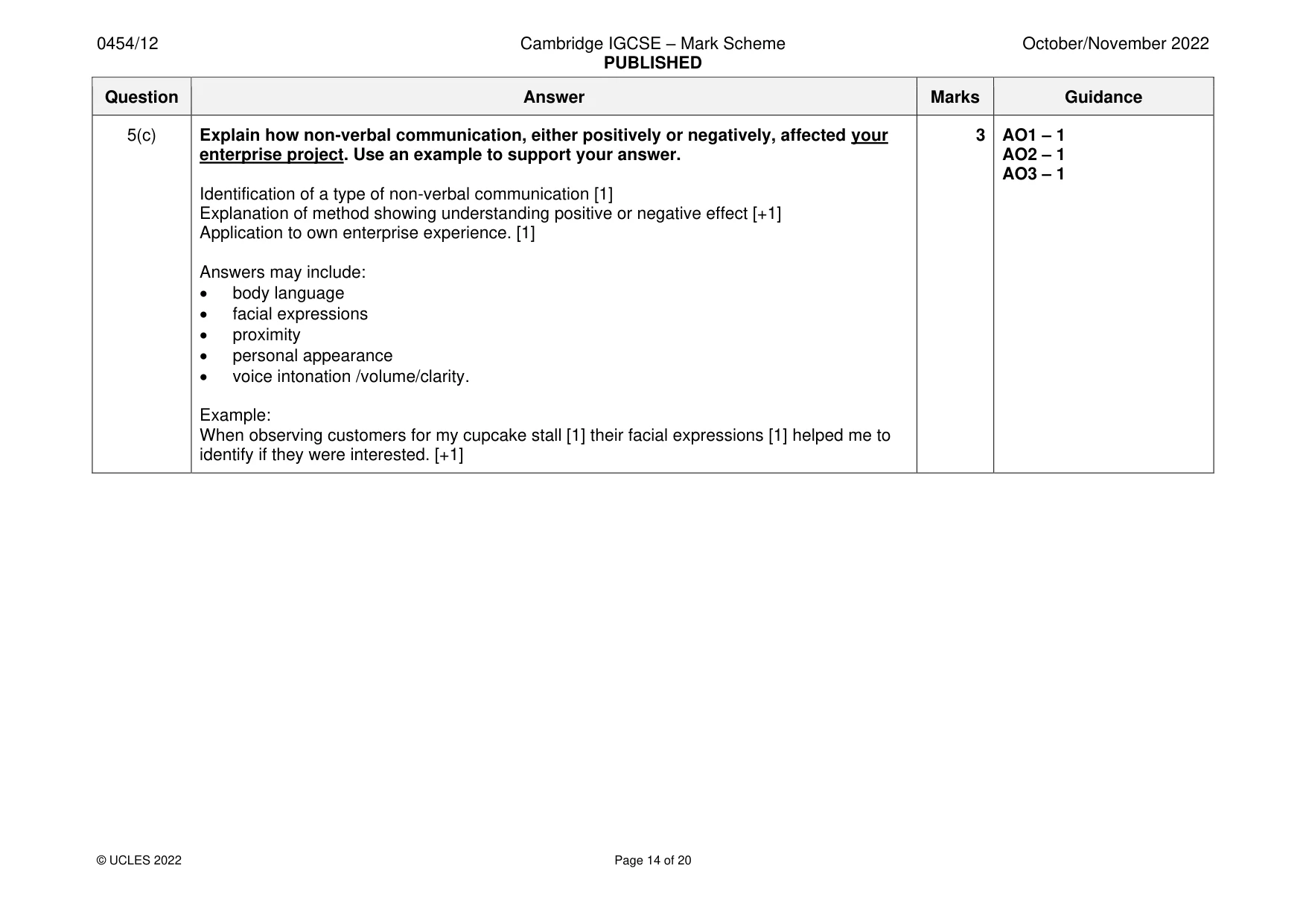
0454/12 Cambridge IGCSE – Mark Scheme PUBLISHED October/November 2022 © UCLES 2022 Page 14 of 20 Question Answer Marks Guidance 5(c) Explain how non-verbal communication, either positively or negatively, affected your enterprise project. Use an example to support your answer. Identification of a type of non-verbal communication [1] Explanation of method showing understanding positive or negative effect [+1] Application to own enterprise experience. [1] Answers may include: • body language • facial expressions • proximity • personal appearance • voice intonation /volume/clarity. Example: When observing customers for my cupcake stall [1] their facial expressions [1] helped me to identify if they were interested. [+1] 3 AO1 – 1 AO2 – 1 AO3 – 1
Mark scheme, page 15
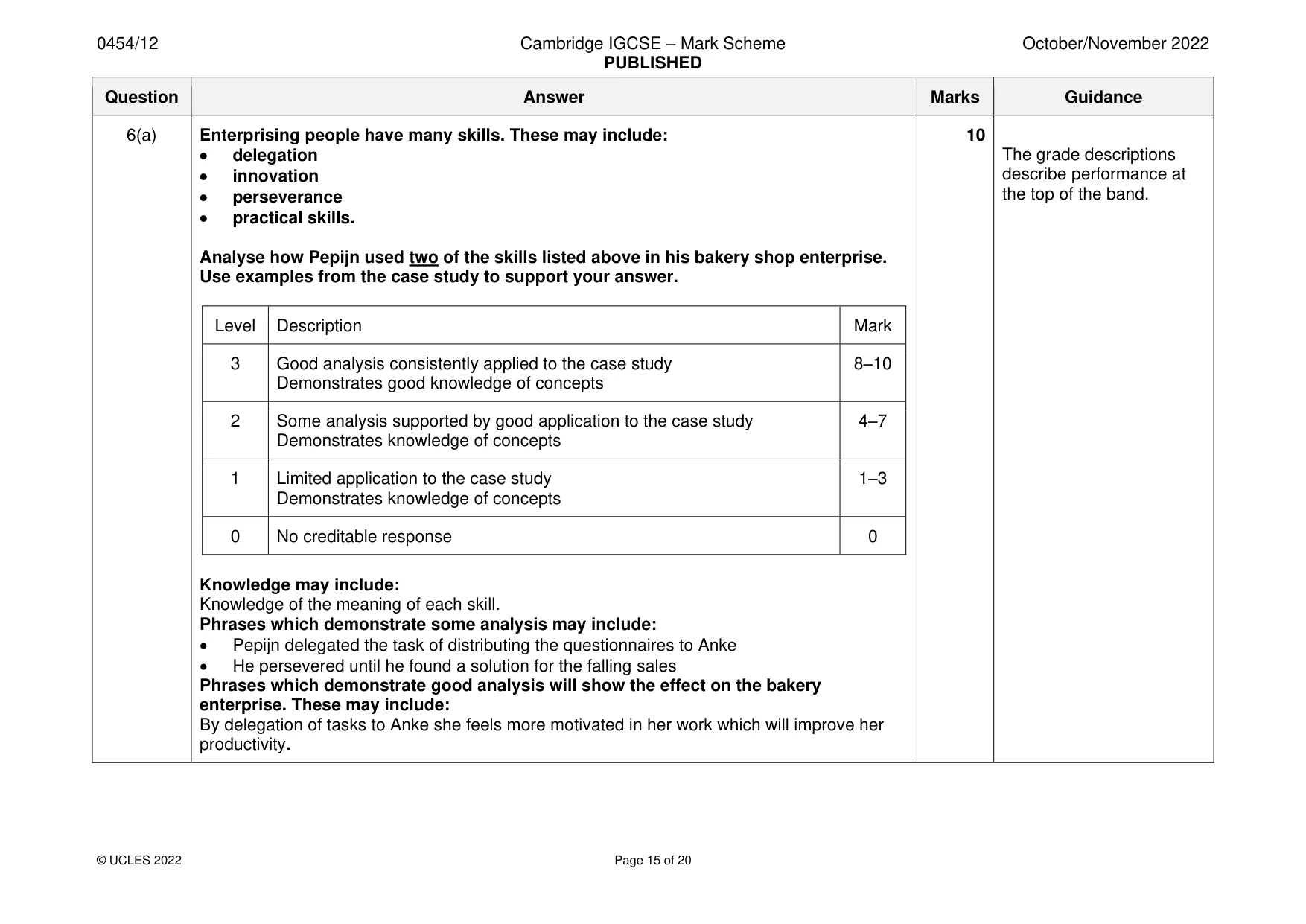
0454/12 Cambridge IGCSE – Mark Scheme PUBLISHED October/November 2022 © UCLES 2022 Page 15 of 20 Question Answer Marks Guidance 6(a) Enterprising people have many skills. These may include: • delegation • innovation • perseverance • practical skills. Analyse how Pepijn used two of the skills listed above in his bakery shop enterprise. Use examples from the case study to support your answer. Level Description Mark 3 Good analysis consistently applied to the case study Demonstrates good knowledge of concepts 8–10 2 Some analysis supported by good application to the case study Demonstrates knowledge of concepts 4–7 1 Limited application to the case study Demonstrates knowledge of concepts 1–3 0 No creditable response 0 Knowledge may include: Knowledge of the meaning of each skill. Phrases which demonstrate some analysis may include: • Pepijn delegated the task of distributing the questionnaires to Anke • He persevered until he found a solution for the falling sales Phrases which demonstrate good analysis will show the effect on the bakery enterprise. These may include: By delegation of tasks to Anke she feels more motivated in her work which will improve her productivity. 10 The grade descriptions describe performance at the top of the band.
Mark scheme, page 16
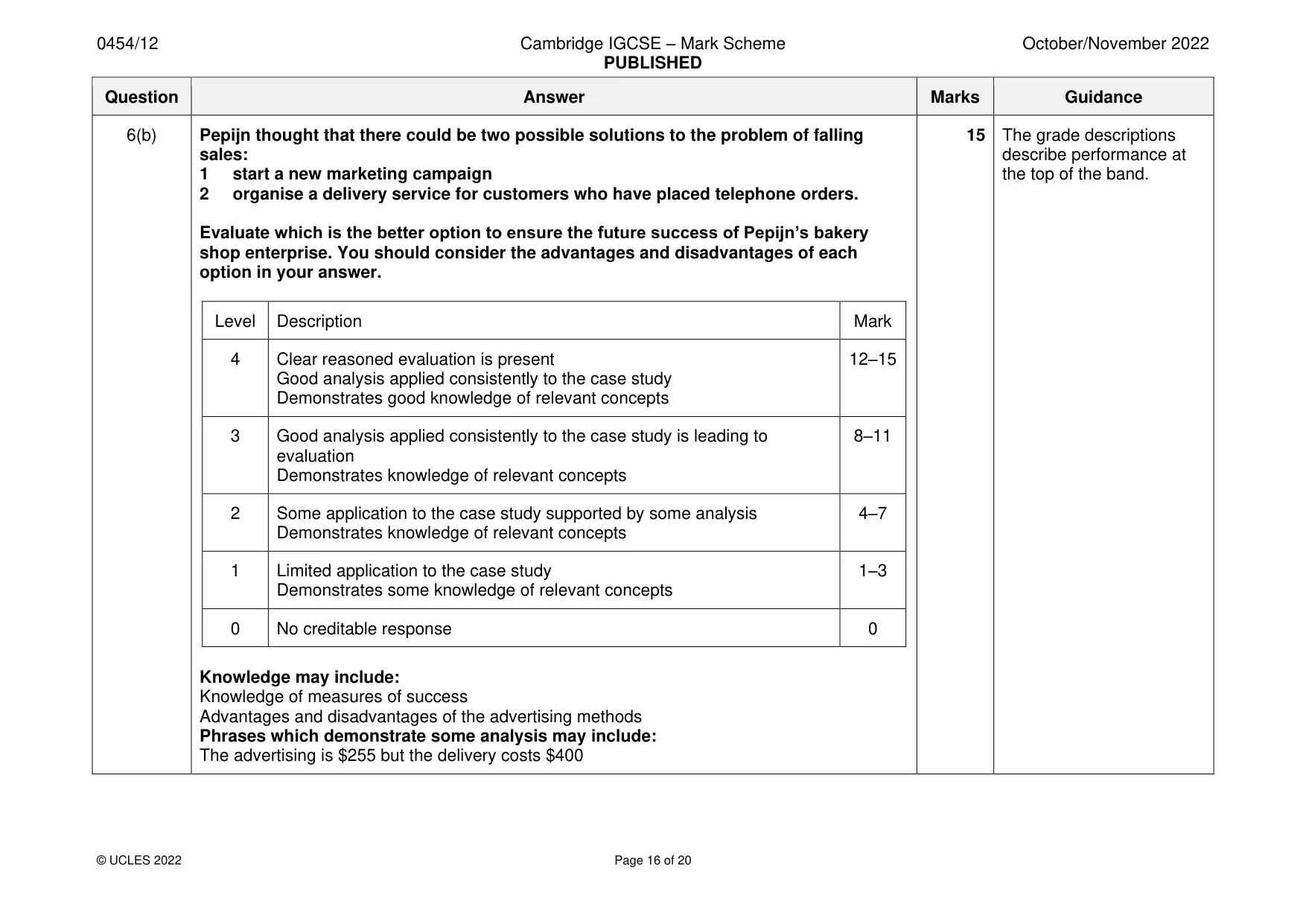
0454/12 Cambridge IGCSE – Mark Scheme PUBLISHED October/November 2022 © UCLES 2022 Page 16 of 20 Question Answer Marks Guidance 6(b) Pepijn thought that there could be two possible solutions to the problem of falling sales: 1 start a new marketing campaign 2 organise a delivery service for customers who have placed telephone orders. Evaluate which is the better option to ensure the future success of Pepijn’s bakery shop enterprise. You should consider the advantages and disadvantages of each option in your answer. Level Description Mark 4 Clear reasoned evaluation is present Good analysis applied consistently to the case study Demonstrates good knowledge of relevant concepts 12–15 3 Good analysis applied consistently to the case study is leading to evaluation Demonstrates knowledge of relevant concepts 8–11 2 Some application to the case study supported by some analysis Demonstrates knowledge of relevant concepts 4–7 1 Limited application to the case study Demonstrates some knowledge of relevant concepts 1–3 0 No creditable response 0 Knowledge may include: Knowledge of measures of success Advantages and disadvantages of the advertising methods Phrases which demonstrate some analysis may include: The advertising is $255 but the delivery costs $400 15 The grade descriptions describe performance at the top of the band.
Mark scheme, page 17
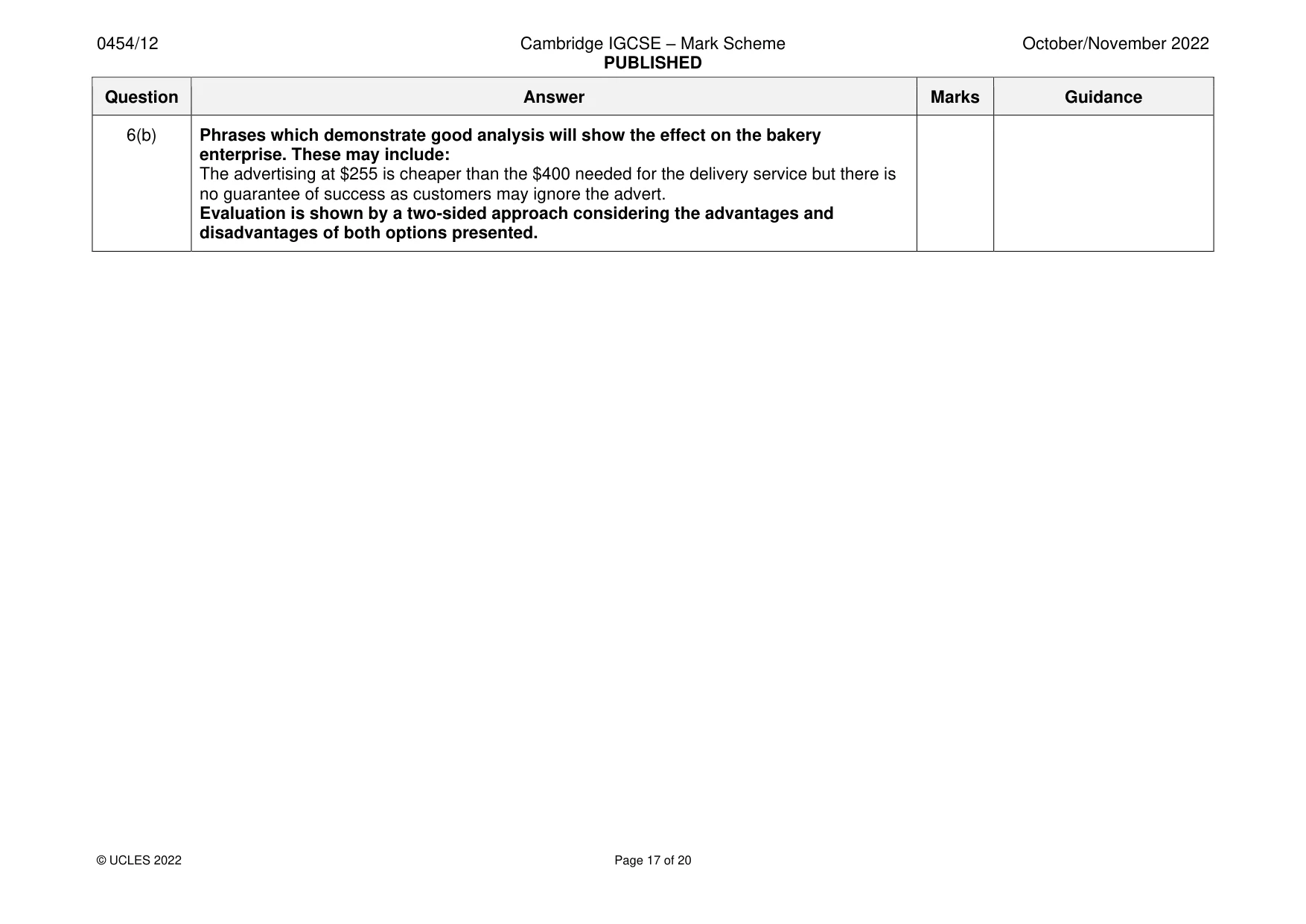
0454/12 Cambridge IGCSE – Mark Scheme PUBLISHED October/November 2022 © UCLES 2022 Page 17 of 20 Question Answer Marks Guidance 6(b) Phrases which demonstrate good analysis will show the effect on the bakery enterprise. These may include: The advertising at $255 is cheaper than the $400 needed for the delivery service but there is no guarantee of success as customers may ignore the advert. Evaluation is shown by a two-sided approach considering the advantages and disadvantages of both options presented.
Mark scheme, page 18
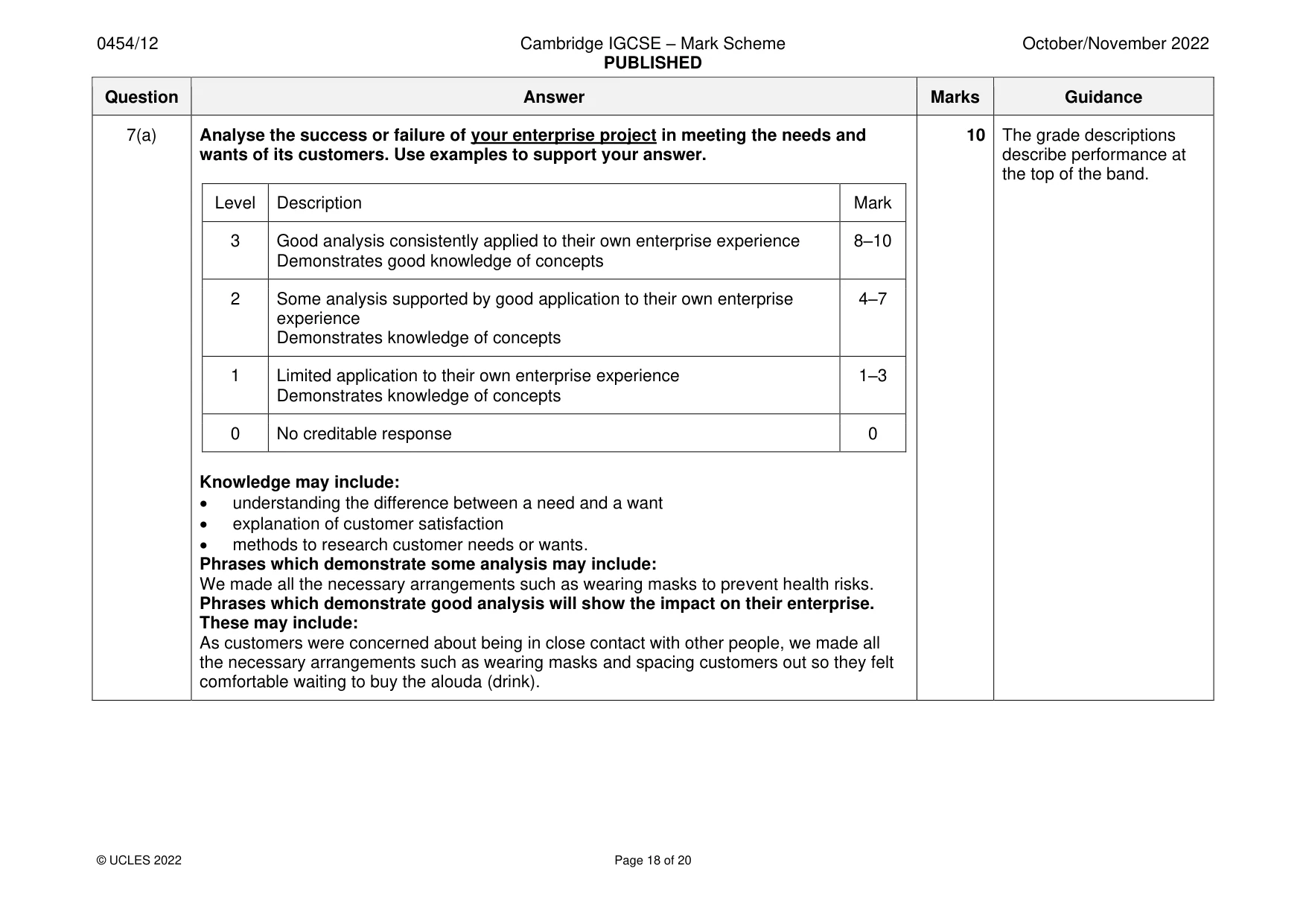
0454/12 Cambridge IGCSE – Mark Scheme PUBLISHED October/November 2022 © UCLES 2022 Page 18 of 20 Question Answer Marks Guidance 7(a) Analyse the success or failure of your enterprise project in meeting the needs and wants of its customers. Use examples to support your answer. Level Description Mark 3 Good analysis consistently applied to their own enterprise experience Demonstrates good knowledge of concepts 8–10 2 Some analysis supported by good application to their own enterprise experience Demonstrates knowledge of concepts 4–7 1 Limited application to their own enterprise experience Demonstrates knowledge of concepts 1–3 0 No creditable response 0 Knowledge may include: • understanding the difference between a need and a want • explanation of customer satisfaction • methods to research customer needs or wants. Phrases which demonstrate some analysis may include: We made all the necessary arrangements such as wearing masks to prevent health risks. Phrases which demonstrate good analysis will show the impact on their enterprise. These may include: As customers were concerned about being in close contact with other people, we made all the necessary arrangements such as wearing masks and spacing customers out so they felt comfortable waiting to buy the alouda (drink). 10 The grade descriptions describe performance at the top of the band.
Mark scheme, page 19
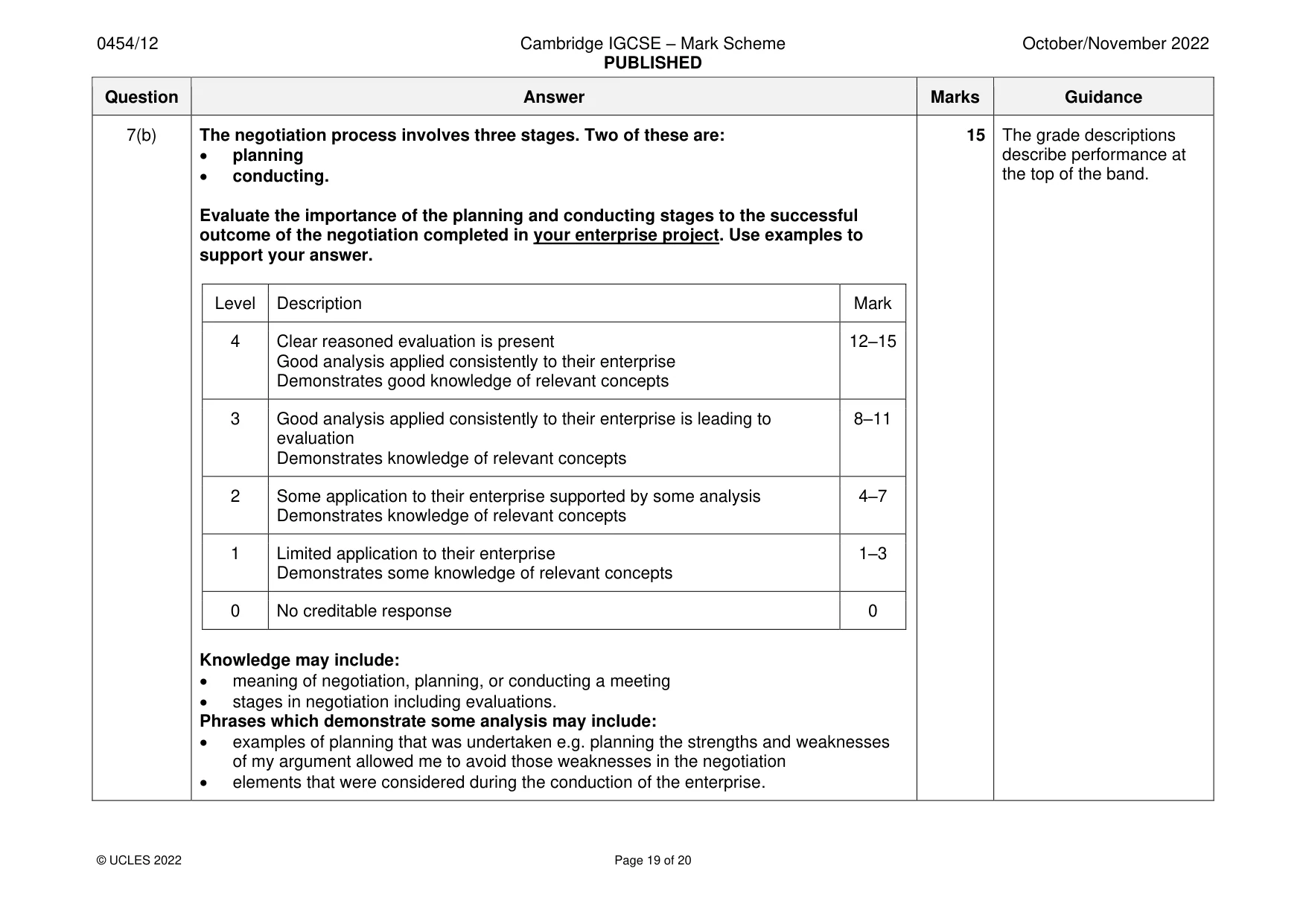
0454/12 Cambridge IGCSE – Mark Scheme PUBLISHED October/November 2022 © UCLES 2022 Page 19 of 20 Question Answer Marks Guidance 7(b) The negotiation process involves three stages. Two of these are: • planning • conducting. Evaluate the importance of the planning and conducting stages to the successful outcome of the negotiation completed in your enterprise project. Use examples to support your answer. Level Description Mark 4 Clear reasoned evaluation is present Good analysis applied consistently to their enterprise Demonstrates good knowledge of relevant concepts 12–15 3 Good analysis applied consistently to their enterprise is leading to evaluation Demonstrates knowledge of relevant concepts 8–11 2 Some application to their enterprise supported by some analysis Demonstrates knowledge of relevant concepts 4–7 1 Limited application to their enterprise Demonstrates some knowledge of relevant concepts 1–3 0 No creditable response 0 Knowledge may include: • meaning of negotiation, planning, or conducting a meeting • stages in negotiation including evaluations. Phrases which demonstrate some analysis may include: • examples of planning that was undertaken e.g. planning the strengths and weaknesses of my argument allowed me to avoid those weaknesses in the negotiation • elements that were considered during the conduction of the enterprise. 15 The grade descriptions describe performance at the top of the band.
Mark scheme, page 20
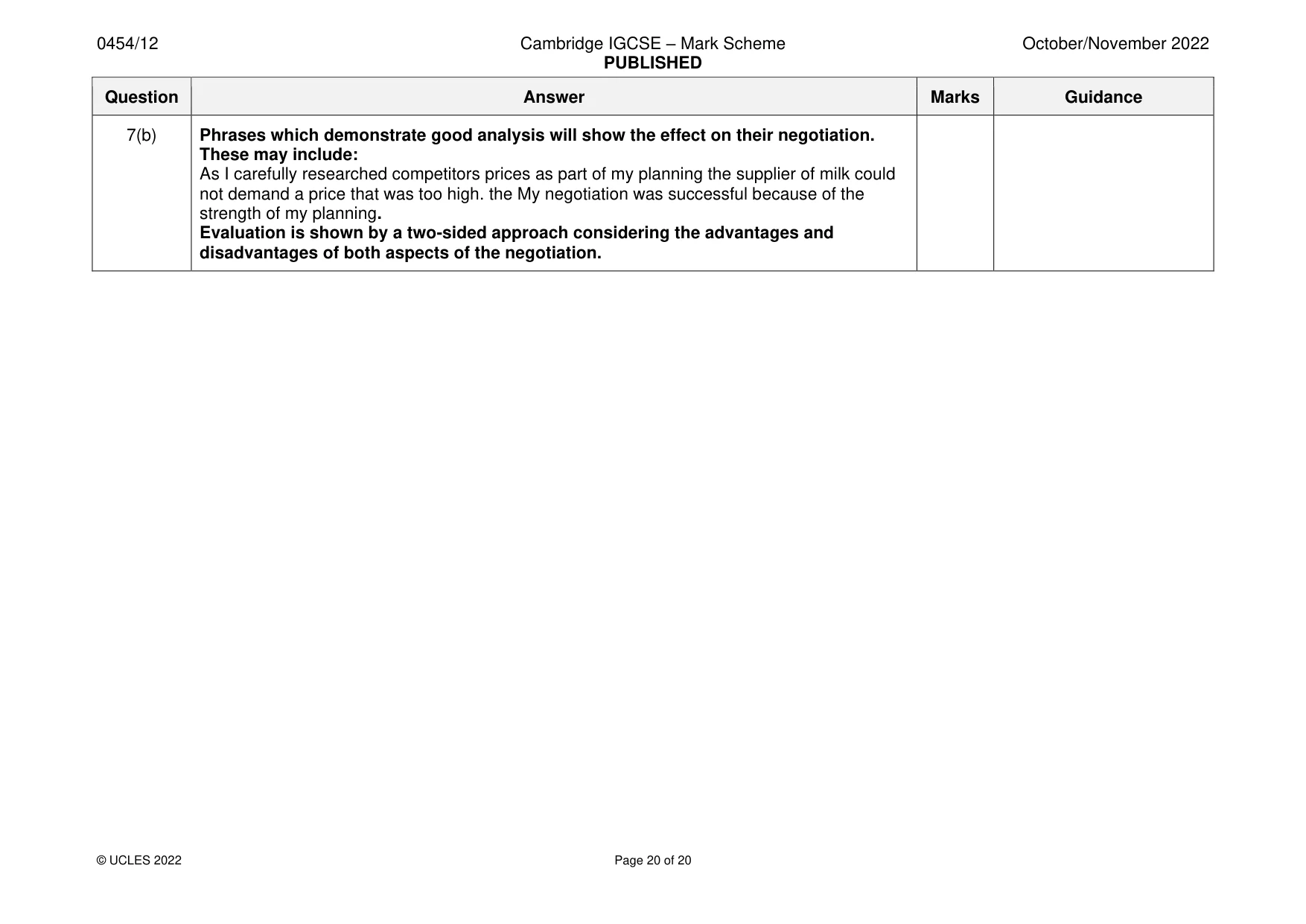
0454/12 Cambridge IGCSE – Mark Scheme PUBLISHED October/November 2022 © UCLES 2022 Page 20 of 20 Question Answer Marks Guidance 7(b) Phrases which demonstrate good analysis will show the effect on their negotiation. These may include: As I carefully researched competitors prices as part of my planning the supplier of milk could not demand a price that was too high. the My negotiation was successful because of the strength of my planning. Evaluation is shown by a two-sided approach considering the advantages and disadvantages of both aspects of the negotiation.
What you needed in this session
Cambridge’s own grade thresholds for 2022 Oct/Nov, Paper 1 · Variant 2. A higher threshold means an easier paper — the bar moves with how the cohort did.