Cambridge IGCSE Enterprise 0454 — 2021 May/June Paper 1 · Variant 2
0454/12/M/J/21 · 100 marks · ≈113 min
The question paper and its mark scheme, free to read here and free to download. This is Cambridge’s own paper, exactly as it was sat.
Question paper16 pages









Mark scheme21 pages
Answers below. Sit the paper first if you are practising.
Paper as text
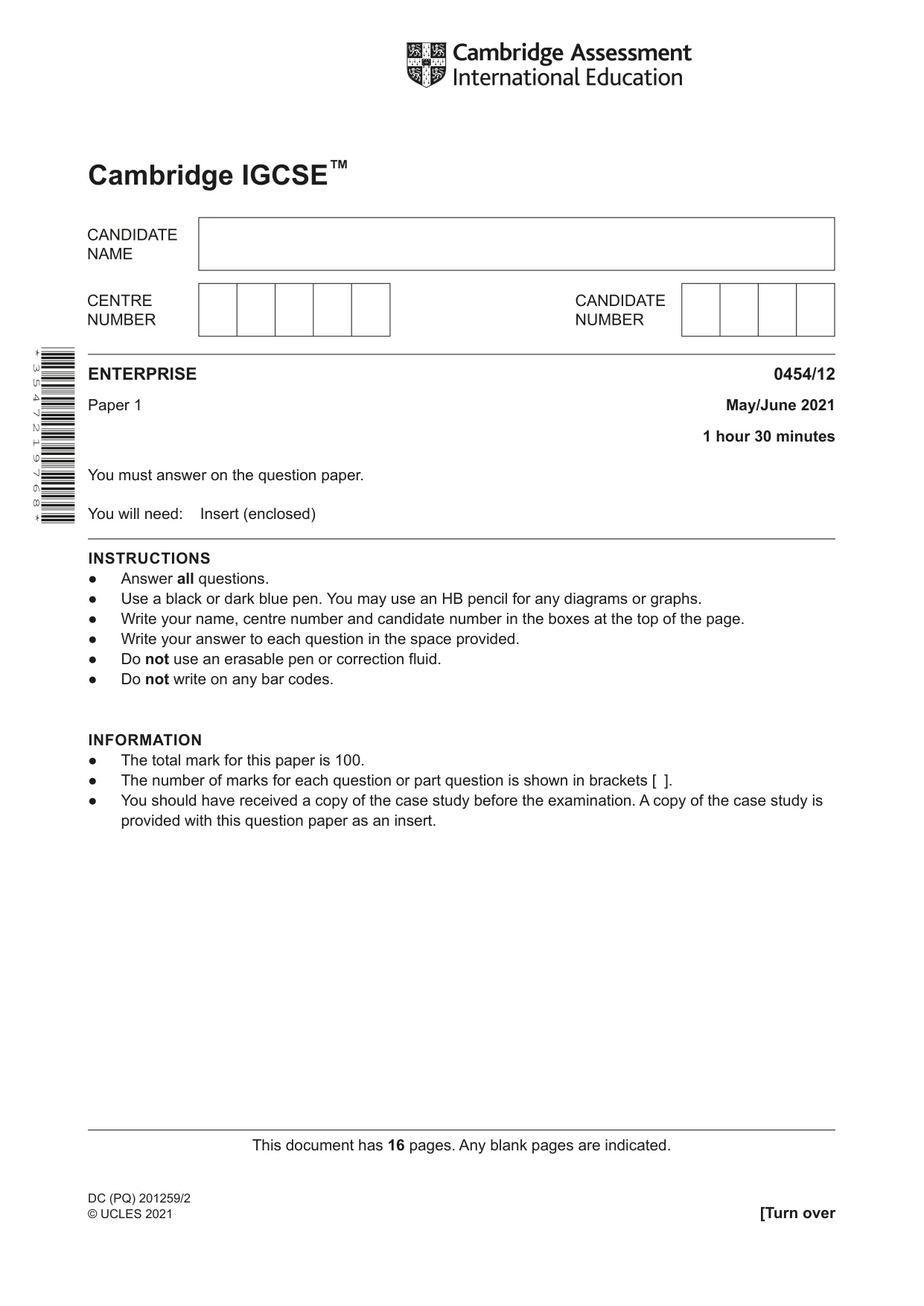
Question paper, page 1
This document has 16 pages. Any blank pages are indicated. Cambridge IGCSE™ * 3 5 4 7 2 1 9 7 6 8 * DC (PQ) 201259/2 © UCLES 2021 [Turn over ENTERPRISE 0454/12 Paper 1 May/June 2021 1 hour 30 minutes You must answer on the question paper. You will need: Insert (enclosed) INSTRUCTIONS ● Answer all questions. ● Use a black or dark blue pen. You may use an HB pencil for any diagrams or graphs. ● Write your name, centre number and candidate number in the boxes at the top of the page. ● Write your answer to each question in the space provided. ● Do not use an erasable pen or correction fluid. ● Do not write on any bar codes. INFORMATION ● The total mark for this paper is 100. ● The number of marks for each question or part question is shown in brackets [ ]. ● You should have received a copy of the case study before the examination. A copy of the case study is provided with this question paper as an insert.
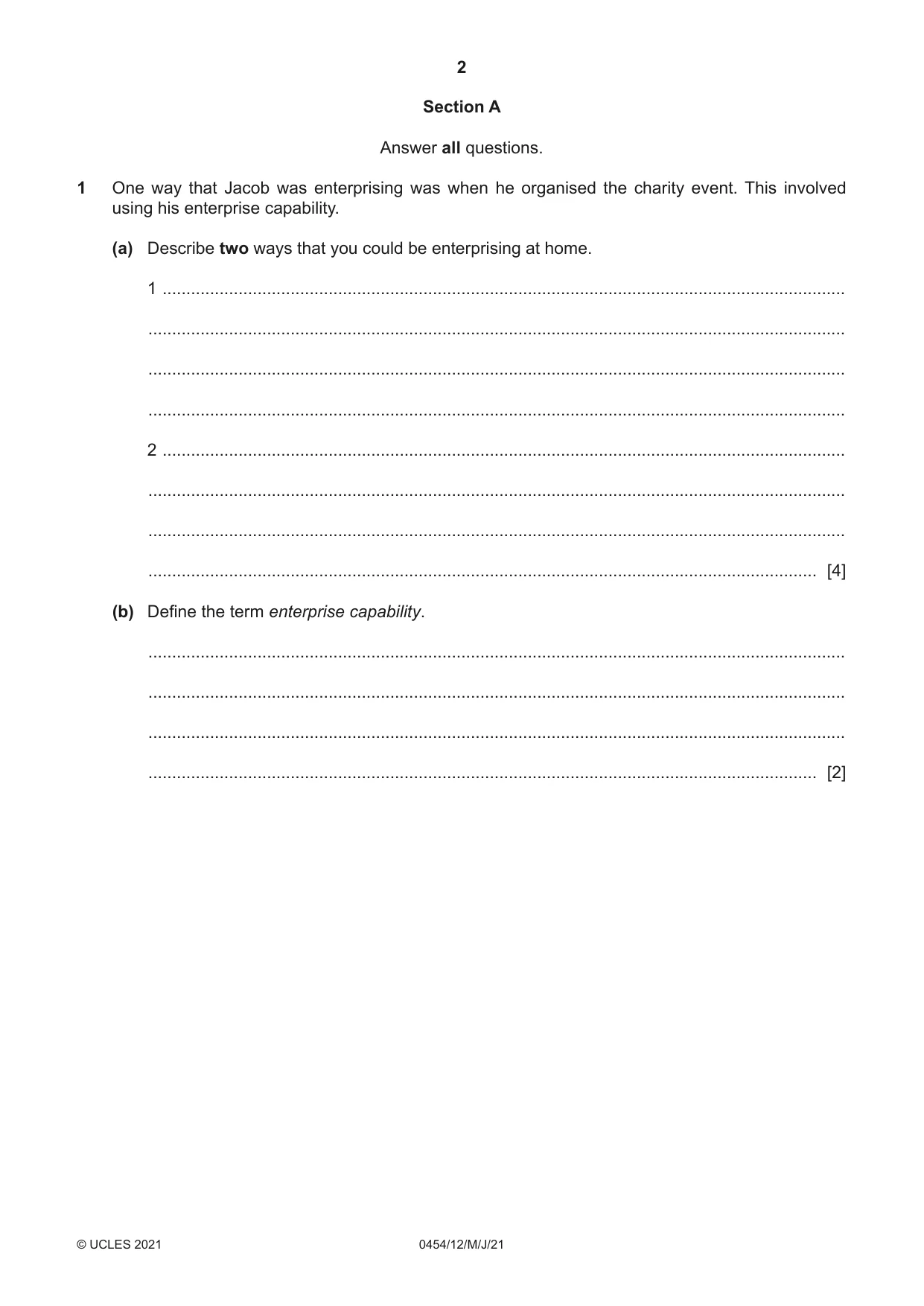
Question paper, page 2
2 0454/12/M/J/21 © UCLES 2021 Section A Answer all questions. 1 One way that Jacob was enterprising was when he organised the charity event. This involved using his enterprise capability. (a) Describe two ways that you could be enterprising at home. 1 … … … … 2 … … … … [4] (b) Define the term enterprise capability. … … … … [2]
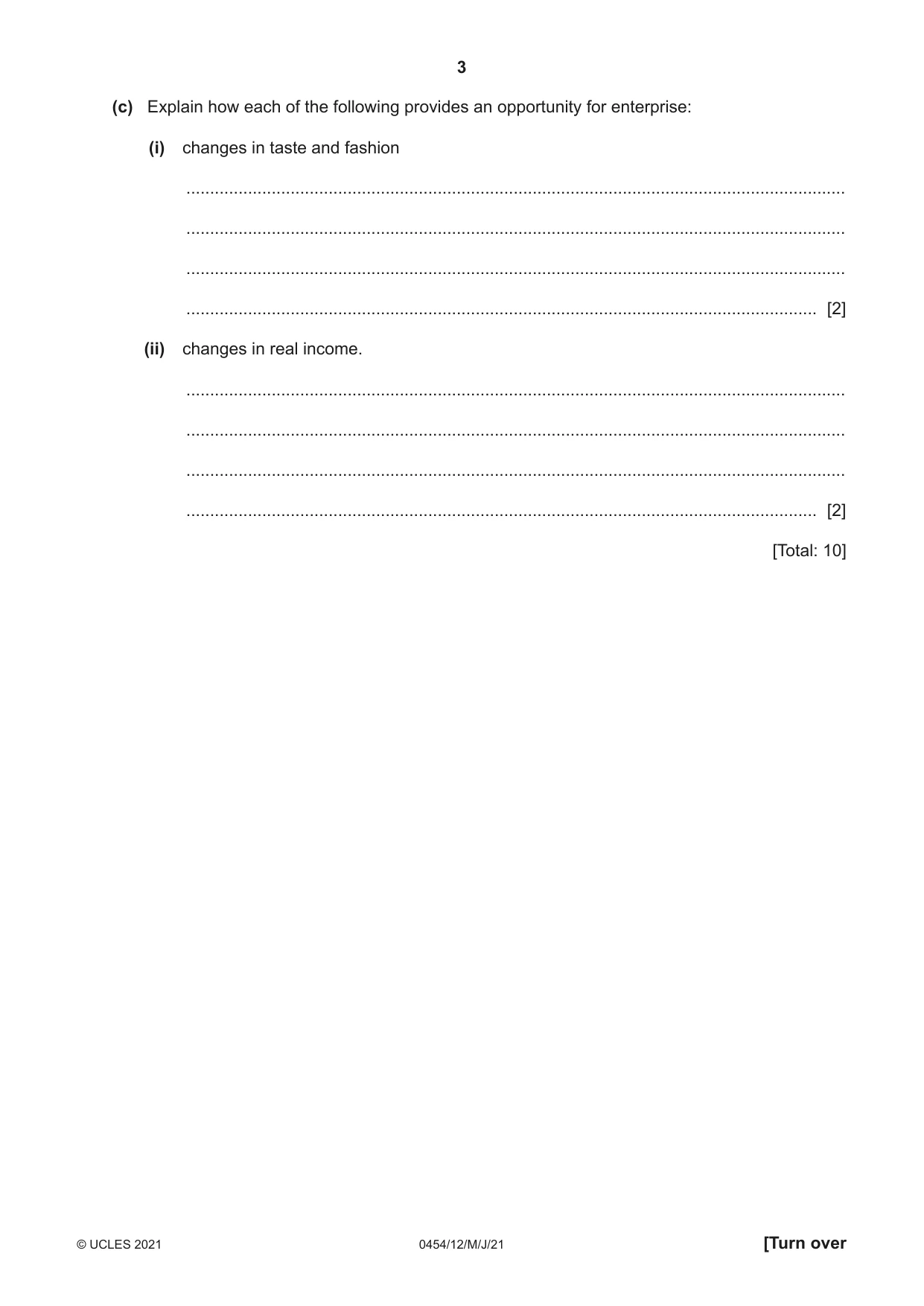
Question paper, page 3
3 0454/12/M/J/21 © UCLES 2021 [Turn over (c) Explain how each of the following provides an opportunity for enterprise: (i) changes in taste and fashion … … … … [2] (ii) changes in real income. … … … … [2] [Total: 10]
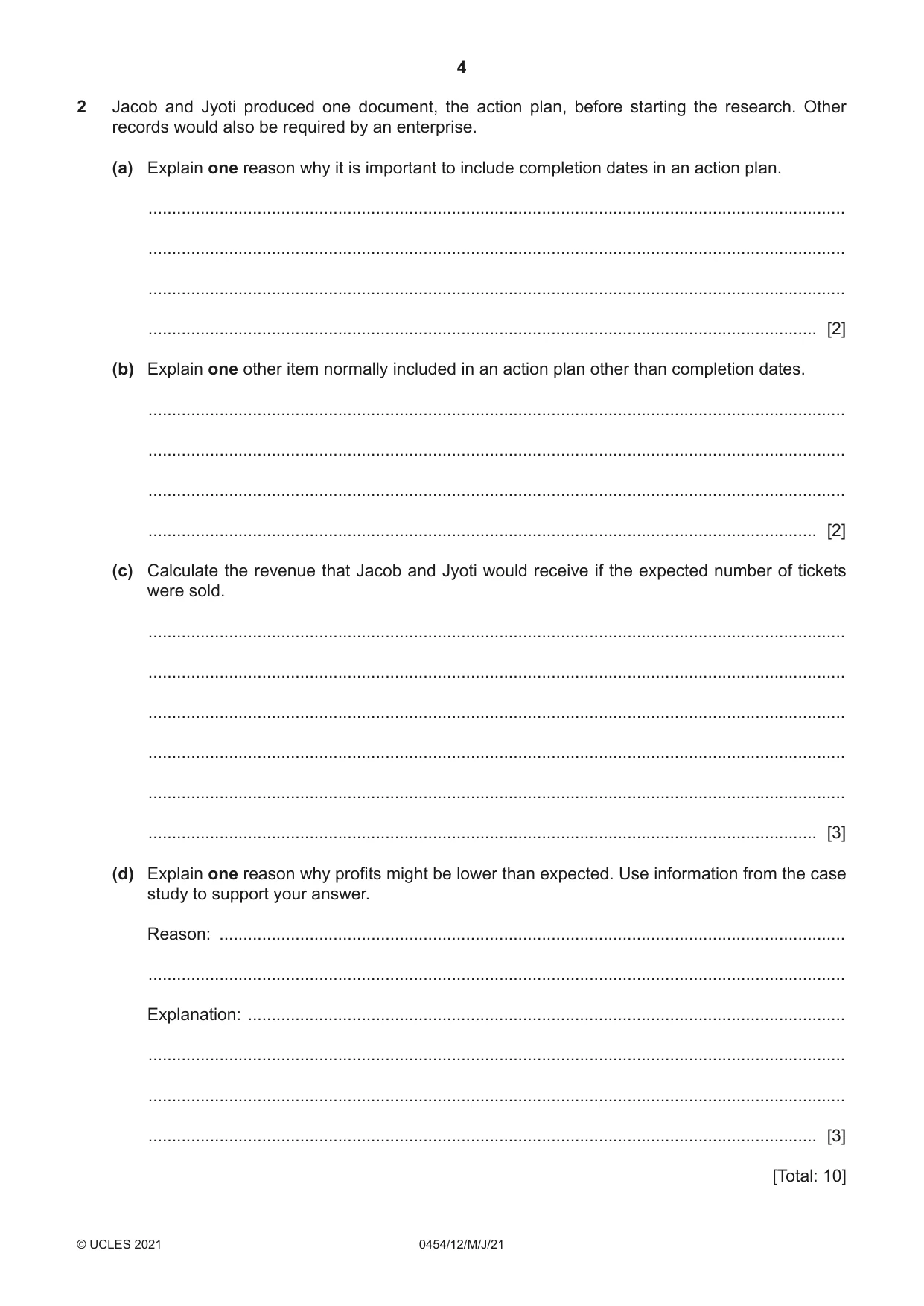
Question paper, page 4
4 0454/12/M/J/21 © UCLES 2021 2 Jacob and Jyoti produced one document, the action plan, before starting the research. Other records would also be required by an enterprise. (a) Explain one reason why it is important to include completion dates in an action plan. … … … … [2] (b) Explain one other item normally included in an action plan other than completion dates. … … … … [2] (c) Calculate the revenue that Jacob and Jyoti would receive if the expected number of tickets were sold. … … … … … … [3] (d) Explain one reason why profits might be lower than expected. Use information from the case study to support your answer. Reason: … … Explanation: … … … … [3] [Total: 10]
Question paper, page 5
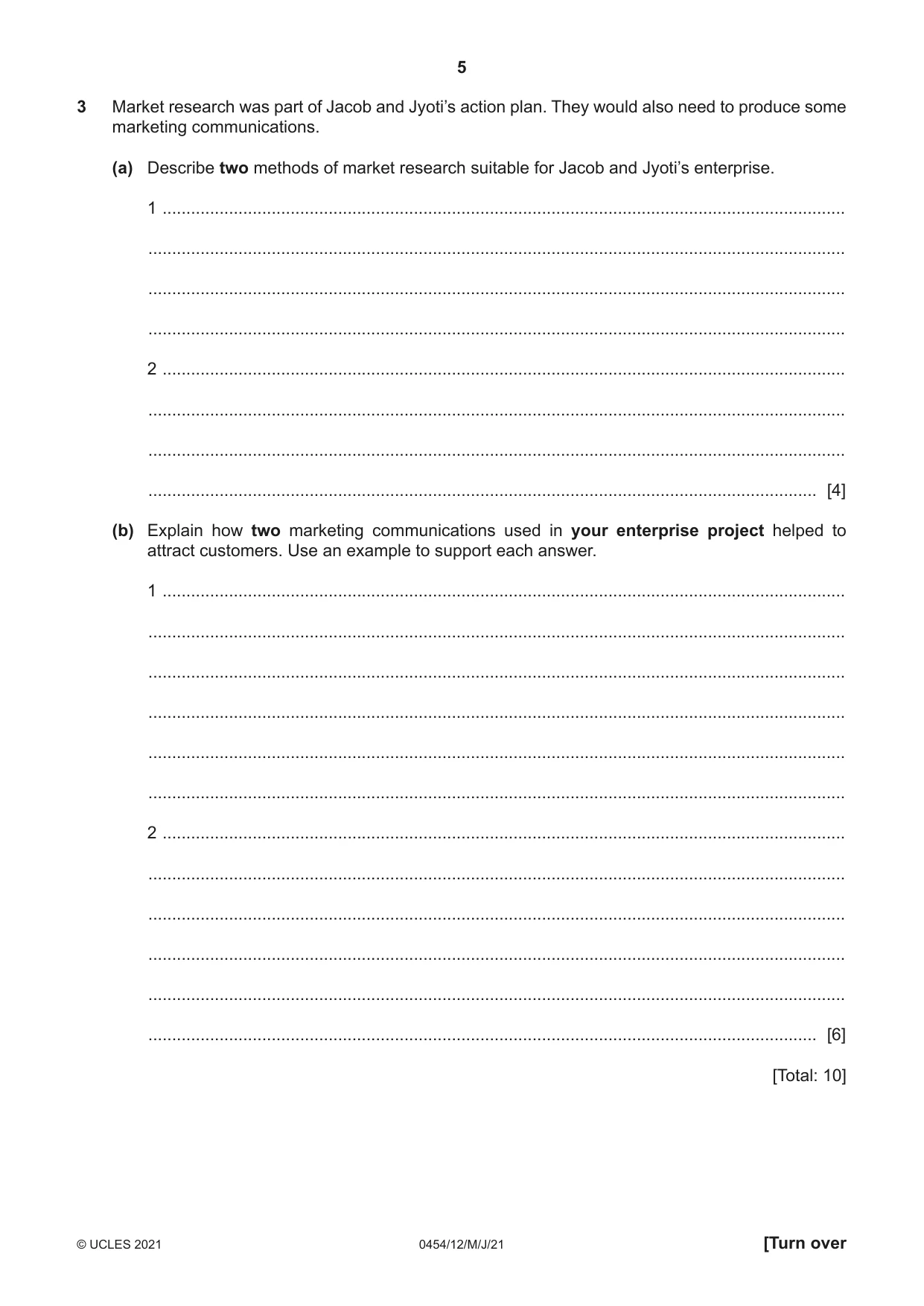
5 0454/12/M/J/21 © UCLES 2021 [Turn over 3 Market research was part of Jacob and Jyoti’s action plan. They would also need to produce some marketing communications. (a) Describe two methods of market research suitable for Jacob and Jyoti’s enterprise. 1 … … … … 2 … … … … [4] (b) Explain how two marketing communications used in your enterprise project helped to attract customers. Use an example to support each answer. 1 … … … … … … 2 … … … … … … [6] [Total: 10]
Question paper, page 6
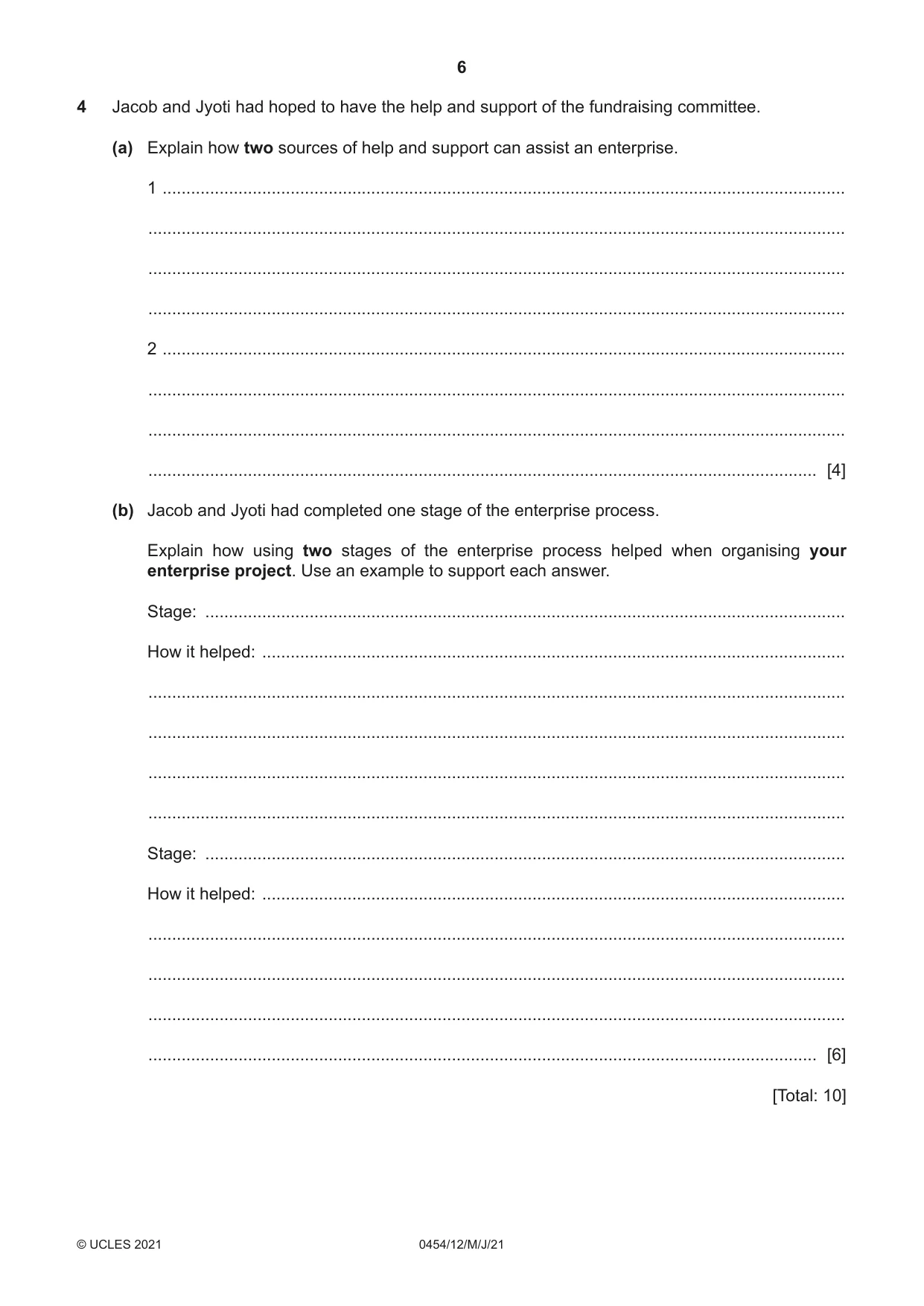
6 0454/12/M/J/21 © UCLES 2021 4 Jacob and Jyoti had hoped to have the help and support of the fundraising committee. (a) Explain how two sources of help and support can assist an enterprise. 1 … … … … 2 … … … … [4] (b) Jacob and Jyoti had completed one stage of the enterprise process. Explain how using two stages of the enterprise process helped when organising your enterprise project. Use an example to support each answer. Stage: … How it helped: … … … … … Stage: … How it helped: … … … … … [6] [Total: 10]
Question paper, page 7
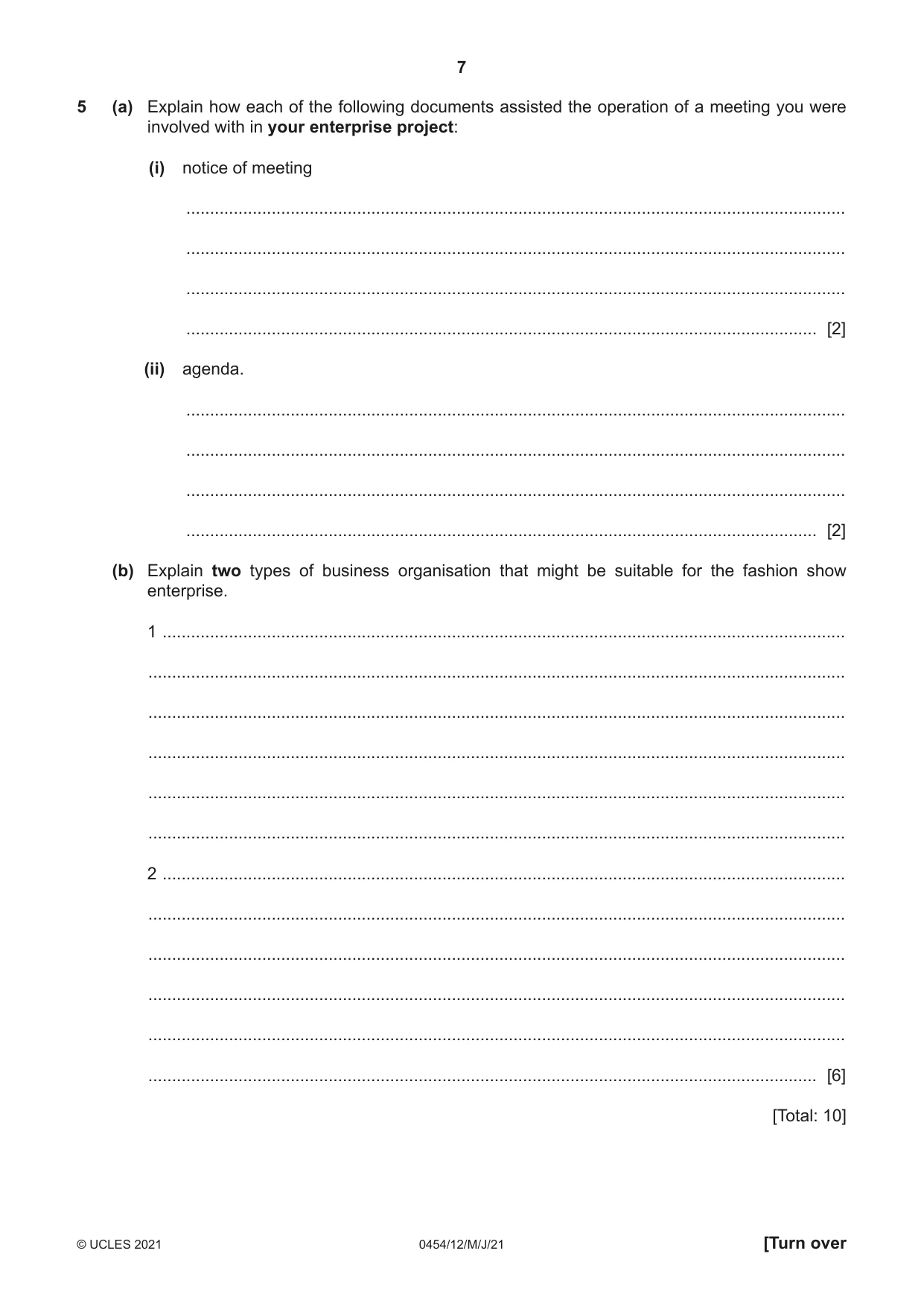
7 0454/12/M/J/21 © UCLES 2021 [Turn over 5 (a) Explain how each of the following documents assisted the operation of a meeting you were involved with in your enterprise project: (i) notice of meeting … … … … [2] (ii) agenda. … … … … [2] (b) Explain two types of business organisation that might be suitable for the fashion show enterprise. 1 … … … … … … 2 … … … … … … [6] [Total: 10]
Question paper, page 8
8 0454/12/M/J/21 © UCLES 2021 Section B Answer all questions. 6 (a) Jyoti had identified clothes shops willing to donate clothing for the fashion show. Discuss the advantages and disadvantages to the clothes shop owners of donating clothing for the fashion show. [10] … … … … … … … … … … … … … … … … … … … … … … … …
Question paper, page 9
9 0454/12/M/J/21 © UCLES 2021 [Turn over (b) Jacob and Jyoti considered possible sources of finance for the fashion show. Their options were: • bank overdrafts • crowdfunding • friends and family. Evaluate which two of these sources of finance would have been most suitable for the fashion show enterprise. Justify your choice, including why you rejected the other source. [15] … … … … … … … … … … … … … … … … … … … … … … … …
Question paper, page 10
10 0454/12/M/J/21 © UCLES 2021 … … … … … … … … … … … … … … … … … … … … … … … … … … … [Total: 25]
Question paper, page 11
11 0454/12/M/J/21 © UCLES 2021 [Turn over 7 Now consider your enterprise project. (a) Analyse how important making profits was in your enterprise project. [10] … … … … … … … … … … … … … … … … … … … … … … … … … …
Question paper, page 12
12 0454/12/M/J/21 © UCLES 2021 (b) There are a number of enterprise skills, including: • determination to succeed • innovation • taking the initiative • the practical skills and knowledge to create products and services. Evaluate the importance of three of these skills to the success or failure of your enterprise project. [15] … … … … … … … … … … … … … … … … … … … … … … … …
Question paper, page 13
13 0454/12/M/J/21 © UCLES 2021 … … … … … … … … … … … … … … … … … … … … … … … … … … … [Total: 25]
Question paper, page 14
14 0454/12/M/J/21 © UCLES 2021 BLANK PAGE
Question paper, page 15
15 0454/12/M/J/21 © UCLES 2021 BLANK PAGE
Question paper, page 16
16 0454/12/M/J/21 © UCLES 2021 Permission to reproduce items where third-party owned material protected by copyright is included has been sought and cleared where possible. Every reasonable effort has been made by the publisher (UCLES) to trace copyright holders, but if any items requiring clearance have unwittingly been included, the publisher will be pleased to make amends at the earliest possible opportunity. To avoid the issue of disclosure of answer-related information to candidates, all copyright acknowledgements are reproduced online in the Cambridge Assessment International Education Copyright Acknowledgements Booklet. This is produced for each series of examinations and is freely available to download at www.cambridgeinternational.org after the live examination series. Cambridge Assessment International Education is part of the Cambridge Assessment Group. Cambridge Assessment is the brand name of the University of Cambridge Local Examinations Syndicate (UCLES), which itself is a department of the University of Cambridge. BLANK PAGE
Mark scheme, page 1
This document consists of 21 printed pages. © UCLES 2021 [Turn over Cambridge IGCSE™ ENTERPRISE 0454/12 Paper 1 Case Study May/June 2021 MARK SCHEME Maximum Mark: 100 Published This mark scheme is published as an aid to teachers and candidates, to indicate the requirements of the examination. It shows the basis on which Examiners were instructed to award marks. It does not indicate the details of the discussions that took place at an Examiners’ meeting before marking began, which would have considered the acceptability of alternative answers. Mark schemes should be read in conjunction with the question paper and the Principal Examiner Report for Teachers. Cambridge International will not enter into discussions about these mark schemes. Cambridge International is publishing the mark schemes for the May/June 2021 series for most Cambridge IGCSE™, Cambridge International A and AS Level components and some Cambridge O Level components.
Mark scheme, page 2
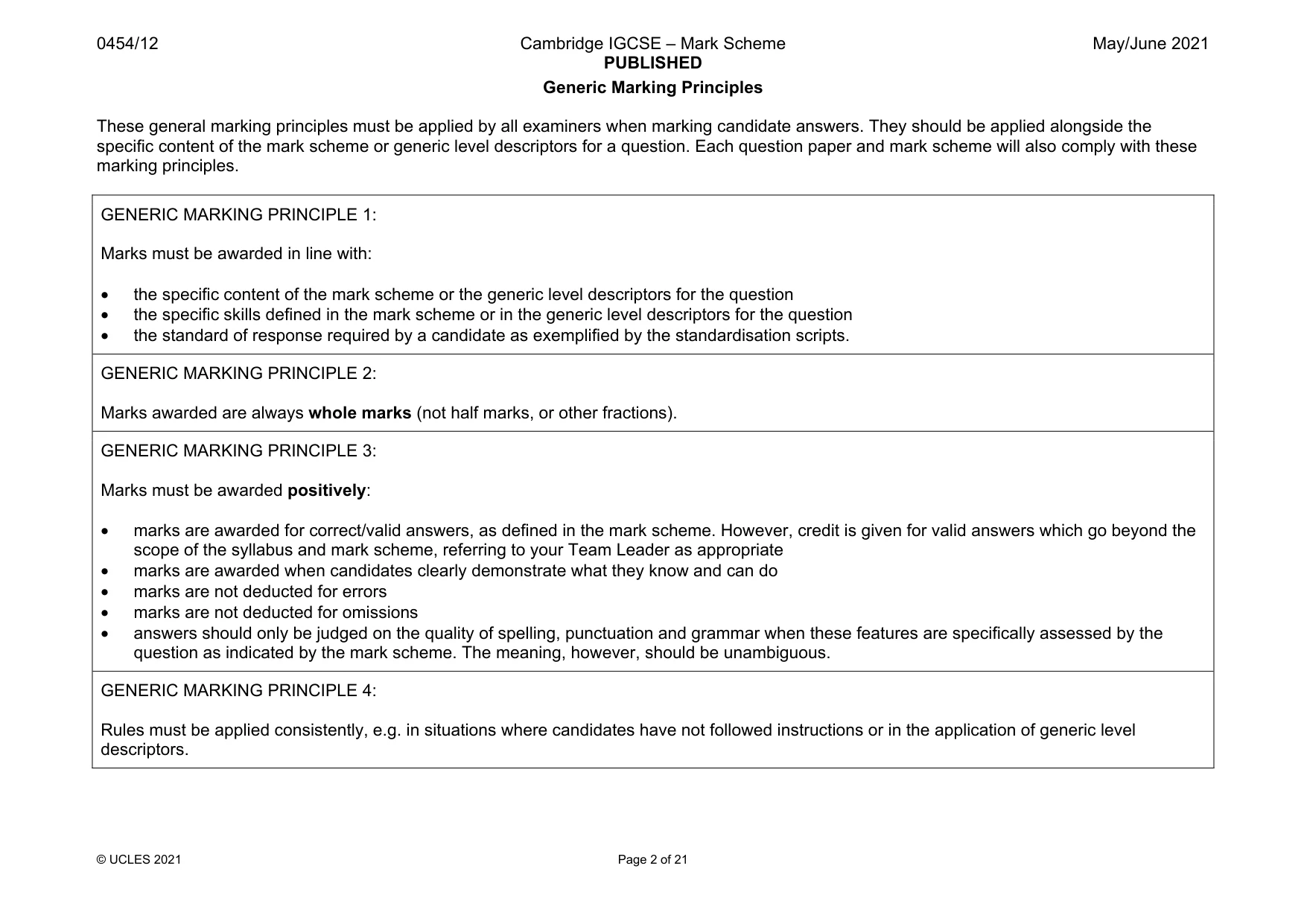
0454/12 Cambridge IGCSE – Mark Scheme PUBLISHED May/June 2021 © UCLES 2021 Page 2 of 21 Generic Marking Principles These general marking principles must be applied by all examiners when marking candidate answers. They should be applied alongside the specific content of the mark scheme or generic level descriptors for a question. Each question paper and mark scheme will also comply with these marking principles. GENERIC MARKING PRINCIPLE 1: Marks must be awarded in line with: • the specific content of the mark scheme or the generic level descriptors for the question • the specific skills defined in the mark scheme or in the generic level descriptors for the question • the standard of response required by a candidate as exemplified by the standardisation scripts. GENERIC MARKING PRINCIPLE 2: Marks awarded are always whole marks (not half marks, or other fractions). GENERIC MARKING PRINCIPLE 3: Marks must be awarded positively: • marks are awarded for correct/valid answers, as defined in the mark scheme. However, credit is given for valid answers which go beyond the scope of the syllabus and mark scheme, referring to your Team Leader as appropriate • marks are awarded when candidates clearly demonstrate what they know and can do • marks are not deducted for errors • marks are not deducted for omissions • answers should only be judged on the quality of spelling, punctuation and grammar when these features are specifically assessed by the question as indicated by the mark scheme. The meaning, however, should be unambiguous. GENERIC MARKING PRINCIPLE 4: Rules must be applied consistently, e.g. in situations where candidates have not followed instructions or in the application of generic level descriptors.
Mark scheme, page 3
0454/12 Cambridge IGCSE – Mark Scheme PUBLISHED May/June 2021 © UCLES 2021 Page 3 of 21 GENERIC MARKING PRINCIPLE 5: Marks should be awarded using the full range of marks defined in the mark scheme for the question (however; the use of the full mark range may be limited according to the quality of the candidate responses seen). GENERIC MARKING PRINCIPLE 6: Marks awarded are based solely on the requirements as defined in the mark scheme. Marks should not be awarded with grade thresholds or grade descriptors in mind.
Mark scheme, page 4
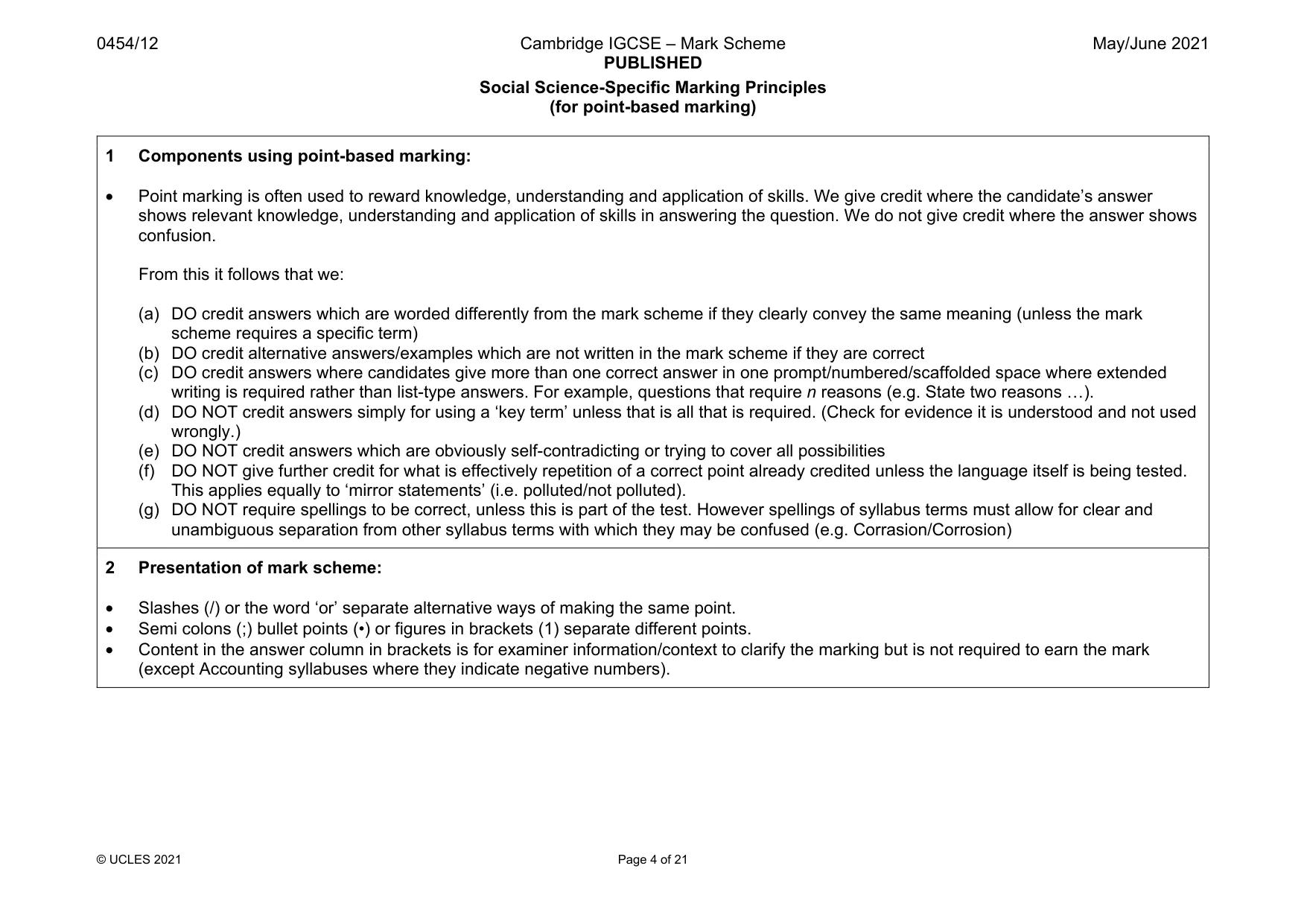
0454/12 Cambridge IGCSE – Mark Scheme PUBLISHED May/June 2021 © UCLES 2021 Page 4 of 21 Social Science-Specific Marking Principles (for point-based marking) 1 Components using point-based marking: • Point marking is often used to reward knowledge, understanding and application of skills. We give credit where the candidate’s answer shows relevant knowledge, understanding and application of skills in answering the question. We do not give credit where the answer shows confusion. From this it follows that we: (a) DO credit answers which are worded differently from the mark scheme if they clearly convey the same meaning (unless the mark scheme requires a specific term) (b) DO credit alternative answers/examples which are not written in the mark scheme if they are correct (c) DO credit answers where candidates give more than one correct answer in one prompt/numbered/scaffolded space where extended writing is required rather than list-type answers. For example, questions that require n reasons (e.g. State two reasons …). (d) DO NOT credit answers simply for using a ‘key term’ unless that is all that is required. (Check for evidence it is understood and not used wrongly.) (e) DO NOT credit answers which are obviously self-contradicting or trying to cover all possibilities (f) DO NOT give further credit for what is effectively repetition of a correct point already credited unless the language itself is being tested. This applies equally to ‘mirror statements’ (i.e. polluted/not polluted). (g) DO NOT require spellings to be correct, unless this is part of the test. However spellings of syllabus terms must allow for clear and unambiguous separation from other syllabus terms with which they may be confused (e.g. Corrasion/Corrosion) 2 Presentation of mark scheme: • Slashes (/) or the word ‘or’ separate alternative ways of making the same point. • Semi colons (;) bullet points (•) or figures in brackets (1) separate different points. • Content in the answer column in brackets is for examiner information/context to clarify the marking but is not required to earn the mark (except Accounting syllabuses where they indicate negative numbers).
Mark scheme, page 5
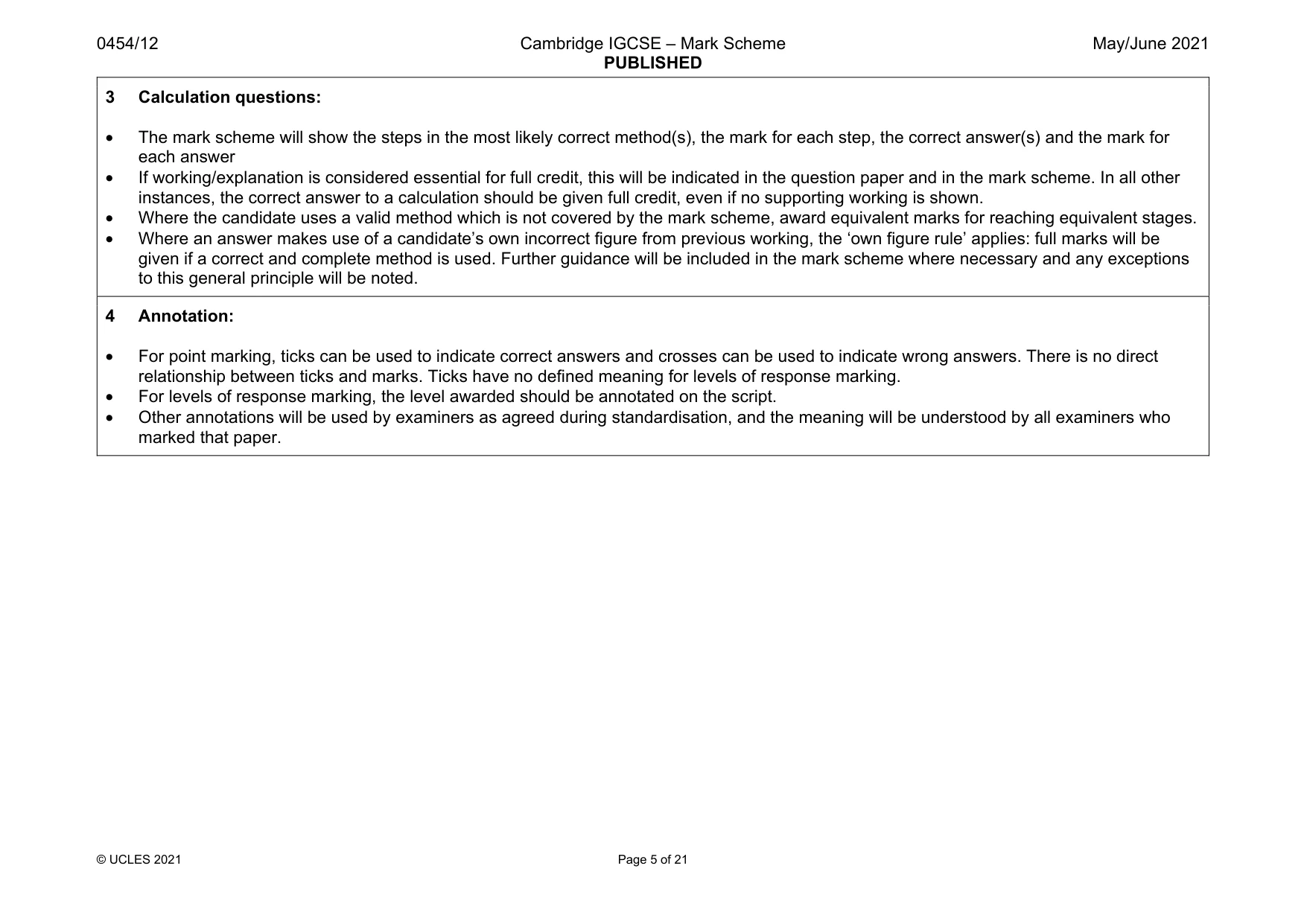
0454/12 Cambridge IGCSE – Mark Scheme PUBLISHED May/June 2021 © UCLES 2021 Page 5 of 21 3 Calculation questions: • The mark scheme will show the steps in the most likely correct method(s), the mark for each step, the correct answer(s) and the mark for each answer • If working/explanation is considered essential for full credit, this will be indicated in the question paper and in the mark scheme. In all other instances, the correct answer to a calculation should be given full credit, even if no supporting working is shown. • Where the candidate uses a valid method which is not covered by the mark scheme, award equivalent marks for reaching equivalent stages. • Where an answer makes use of a candidate’s own incorrect figure from previous working, the ‘own figure rule’ applies: full marks will be given if a correct and complete method is used. Further guidance will be included in the mark scheme where necessary and any exceptions to this general principle will be noted. 4 Annotation: • For point marking, ticks can be used to indicate correct answers and crosses can be used to indicate wrong answers. There is no direct relationship between ticks and marks. Ticks have no defined meaning for levels of response marking. • For levels of response marking, the level awarded should be annotated on the script. • Other annotations will be used by examiners as agreed during standardisation, and the meaning will be understood by all examiners who marked that paper.
Mark scheme, page 6
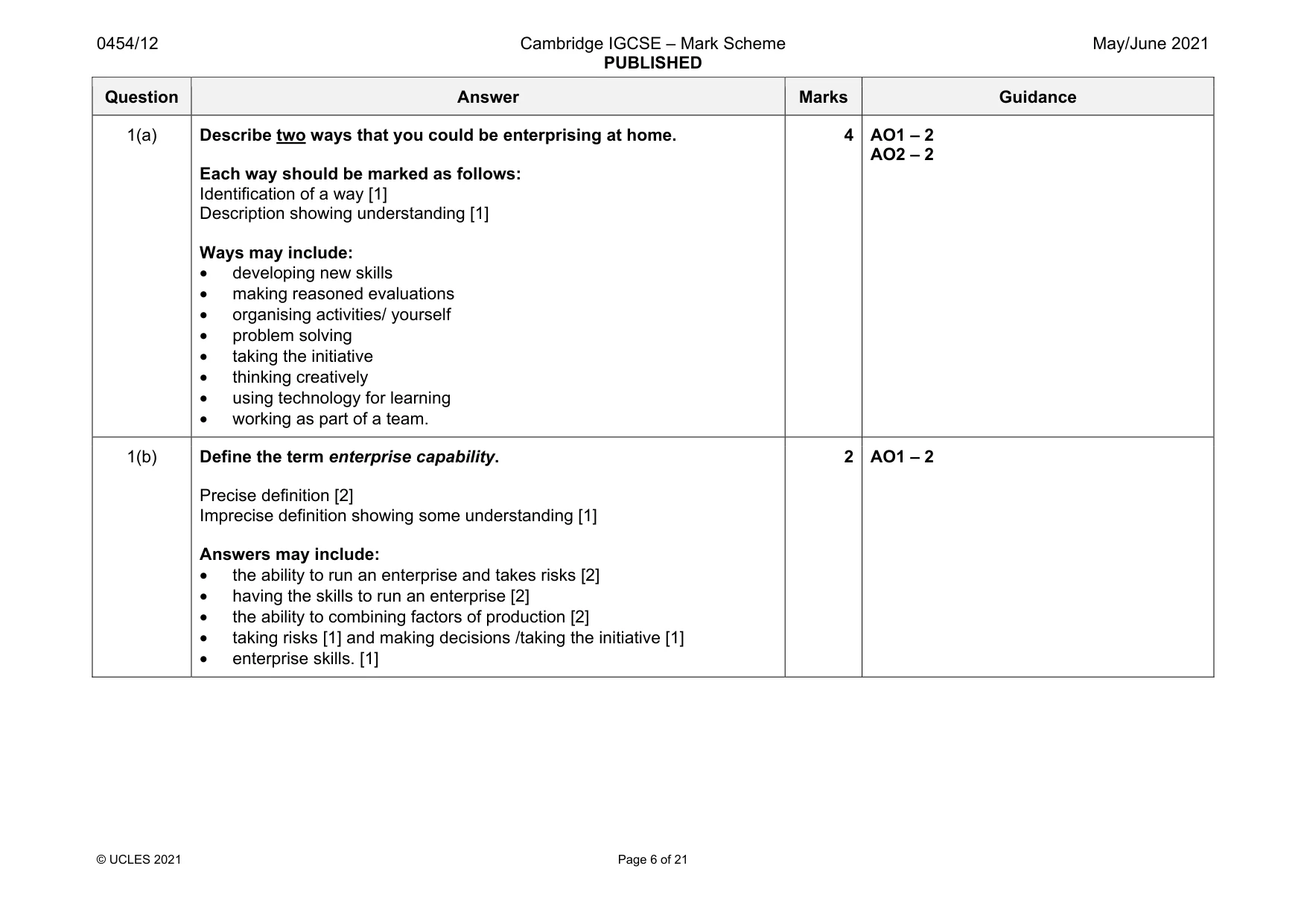
0454/12 Cambridge IGCSE – Mark Scheme PUBLISHED May/June 2021 © UCLES 2021 Page 6 of 21 Question Answer Marks Guidance 1(a) Describe two ways that you could be enterprising at home. Each way should be marked as follows: Identification of a way [1] Description showing understanding [1] Ways may include: • developing new skills • making reasoned evaluations • organising activities/ yourself • problem solving • taking the initiative • thinking creatively • using technology for learning • working as part of a team. 4 AO1 – 2 AO2 – 2 1(b) Define the term enterprise capability. Precise definition [2] Imprecise definition showing some understanding [1] Answers may include: • the ability to run an enterprise and takes risks [2] • having the skills to run an enterprise [2] • the ability to combining factors of production [2] • taking risks [1] and making decisions /taking the initiative [1] • enterprise skills. [1] 2 AO1 – 2
Mark scheme, page 7
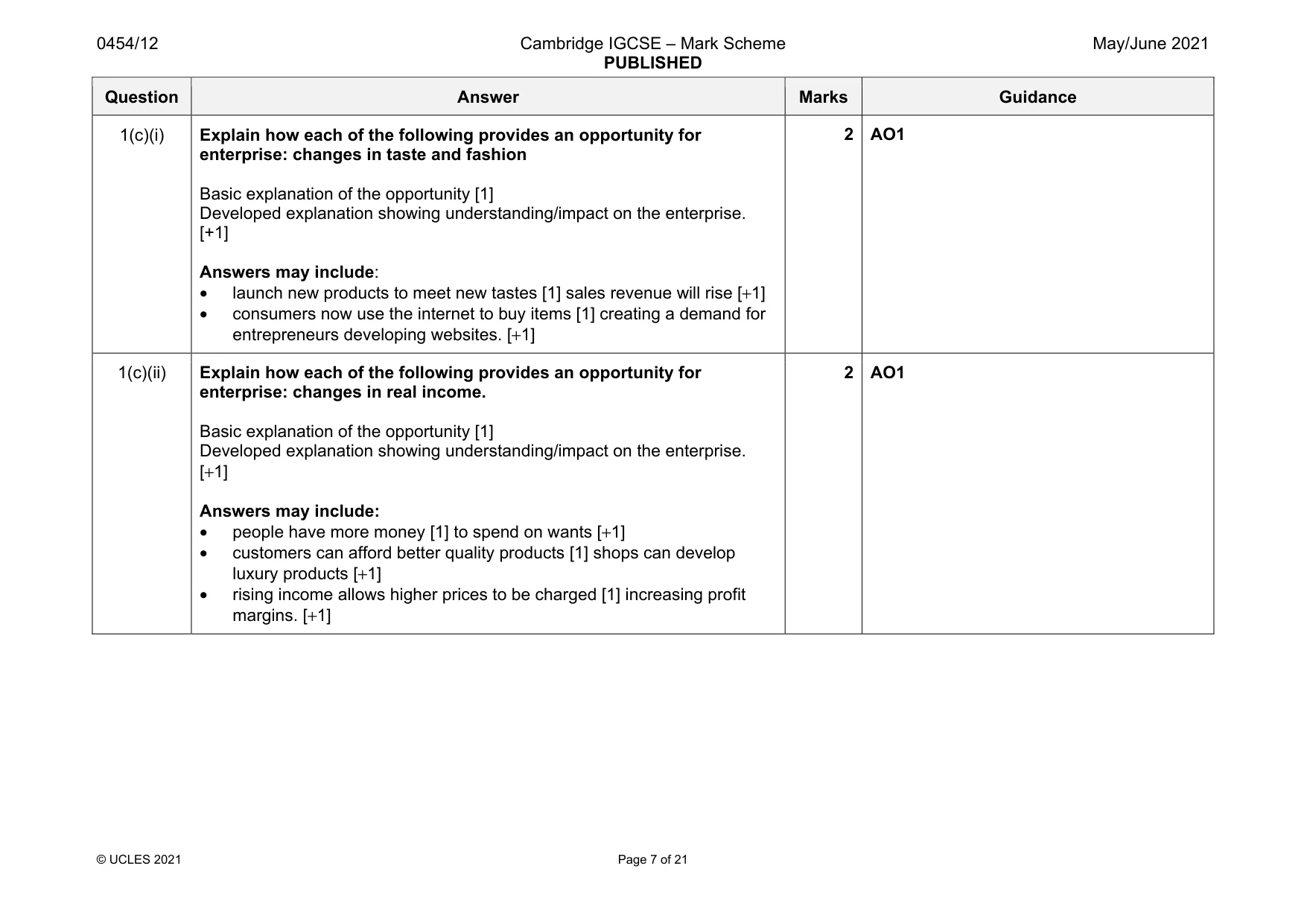
0454/12 Cambridge IGCSE – Mark Scheme PUBLISHED May/June 2021 © UCLES 2021 Page 7 of 21 Question Answer Marks Guidance 1(c)(i) Explain how each of the following provides an opportunity for enterprise: changes in taste and fashion Basic explanation of the opportunity [1] Developed explanation showing understanding/impact on the enterprise. [+1] Answers may include: • launch new products to meet new tastes [1] sales revenue will rise [+1] • consumers now use the internet to buy items [1] creating a demand for entrepreneurs developing websites. [+1] 2 AO1 1(c)(ii) Explain how each of the following provides an opportunity for enterprise: changes in real income. Basic explanation of the opportunity [1] Developed explanation showing understanding/impact on the enterprise. [+1] Answers may include: • people have more money [1] to spend on wants [+1] • customers can afford better quality products [1] shops can develop luxury products [+1] • rising income allows higher prices to be charged [1] increasing profit margins. [+1] 2 AO1
Mark scheme, page 8
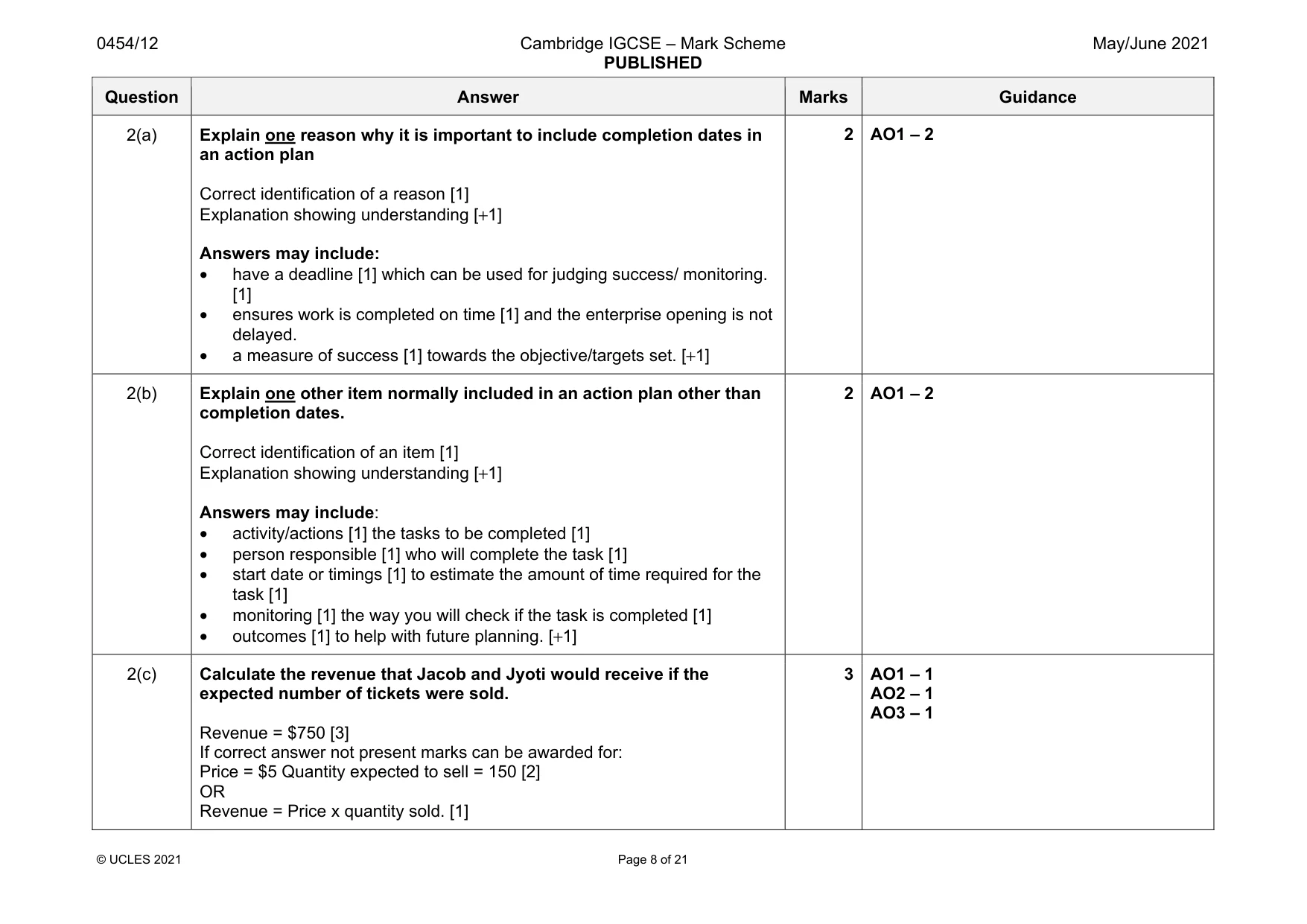
0454/12 Cambridge IGCSE – Mark Scheme PUBLISHED May/June 2021 © UCLES 2021 Page 8 of 21 Question Answer Marks Guidance 2(a) Explain one reason why it is important to include completion dates in an action plan Correct identification of a reason [1] Explanation showing understanding [+1] Answers may include: • have a deadline [1] which can be used for judging success/ monitoring. [1] • ensures work is completed on time [1] and the enterprise opening is not delayed. • a measure of success [1] towards the objective/targets set. [+1] 2 AO1 – 2 2(b) Explain one other item normally included in an action plan other than completion dates. Correct identification of an item [1] Explanation showing understanding [+1] Answers may include: • activity/actions [1] the tasks to be completed [1] • person responsible [1] who will complete the task [1] • start date or timings [1] to estimate the amount of time required for the task [1] • monitoring [1] the way you will check if the task is completed [1] • outcomes [1] to help with future planning. [+1] 2 AO1 – 2 2(c) Calculate the revenue that Jacob and Jyoti would receive if the expected number of tickets were sold. Revenue = $750 [3] If correct answer not present marks can be awarded for: Price = $5 Quantity expected to sell = 150 [2] OR Revenue = Price x quantity sold. [1] 3 AO1 – 1 AO2 – 1 AO3 – 1
Mark scheme, page 9
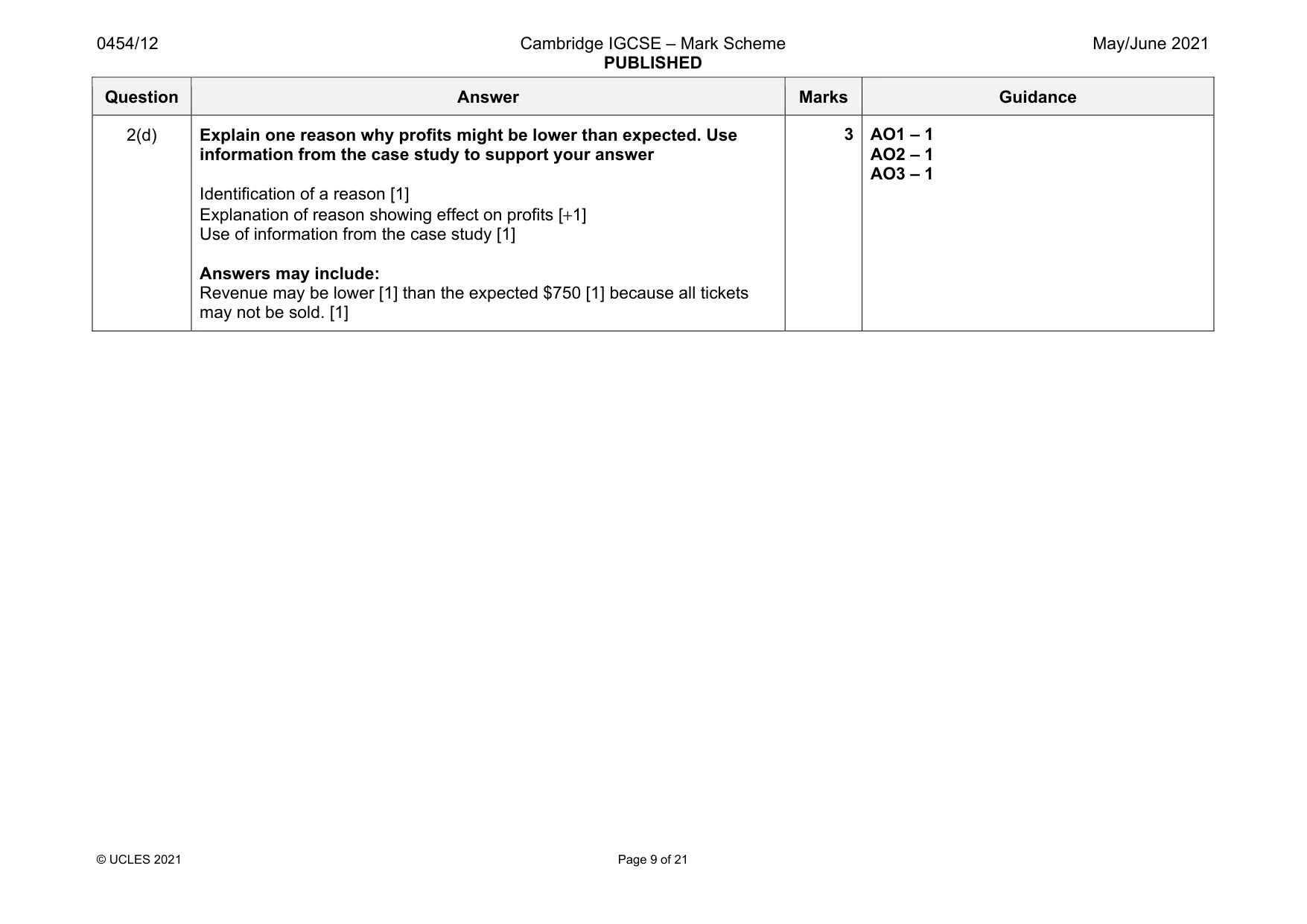
0454/12 Cambridge IGCSE – Mark Scheme PUBLISHED May/June 2021 © UCLES 2021 Page 9 of 21 Question Answer Marks Guidance 2(d) Explain one reason why profits might be lower than expected. Use information from the case study to support your answer Identification of a reason [1] Explanation of reason showing effect on profits [+1] Use of information from the case study [1] Answers may include: Revenue may be lower [1] than the expected $750 [1] because all tickets may not be sold. [1] 3 AO1 – 1 AO2 – 1 AO3 – 1
Mark scheme, page 10
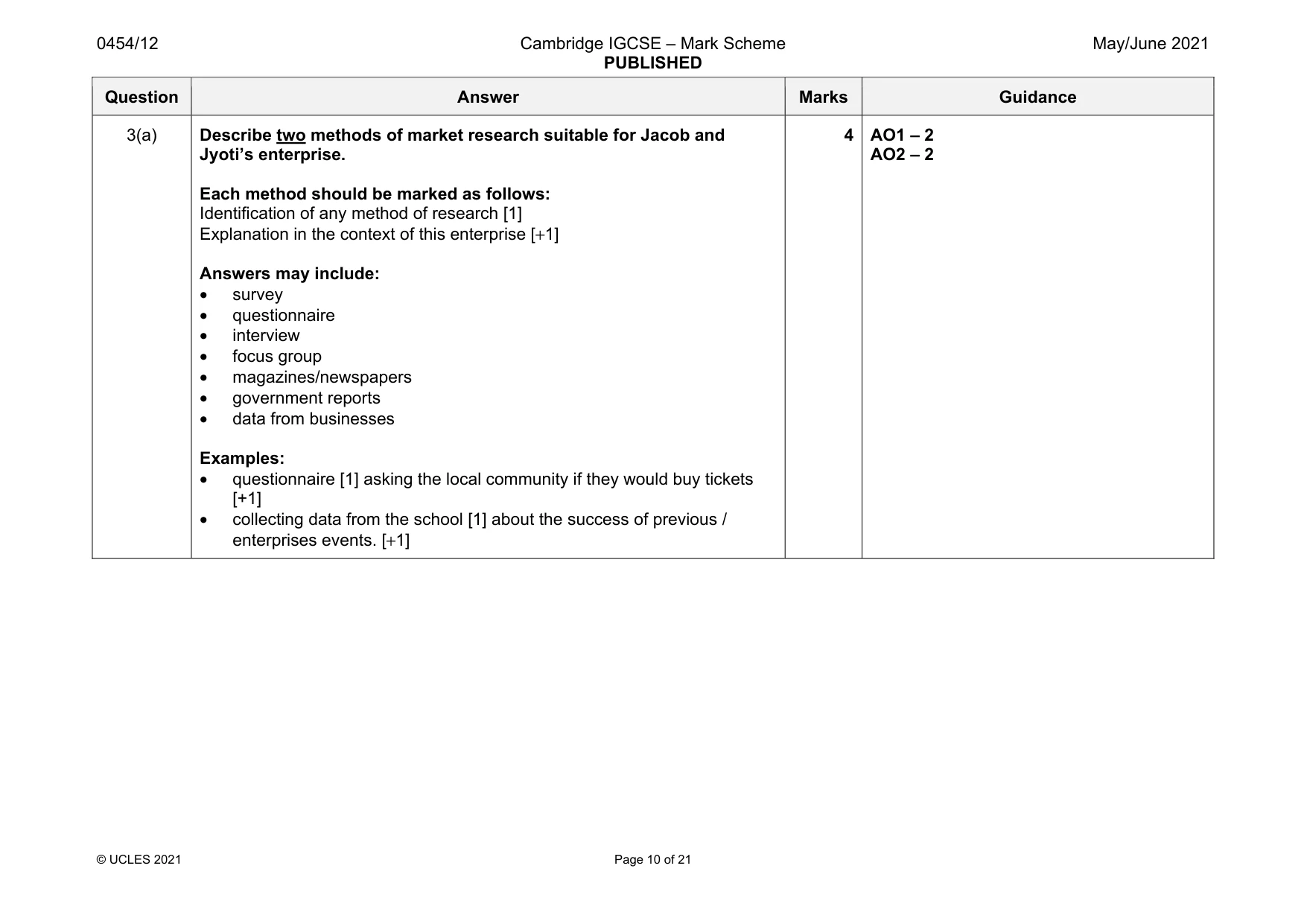
0454/12 Cambridge IGCSE – Mark Scheme PUBLISHED May/June 2021 © UCLES 2021 Page 10 of 21 Question Answer Marks Guidance 3(a) Describe two methods of market research suitable for Jacob and Jyoti’s enterprise. Each method should be marked as follows: Identification of any method of research [1] Explanation in the context of this enterprise [+1] Answers may include: • survey • questionnaire • interview • focus group • magazines/newspapers • government reports • data from businesses Examples: • questionnaire [1] asking the local community if they would buy tickets [+1] • collecting data from the school [1] about the success of previous / enterprises events. [+1] 4 AO1 – 2 AO2 – 2
Mark scheme, page 11
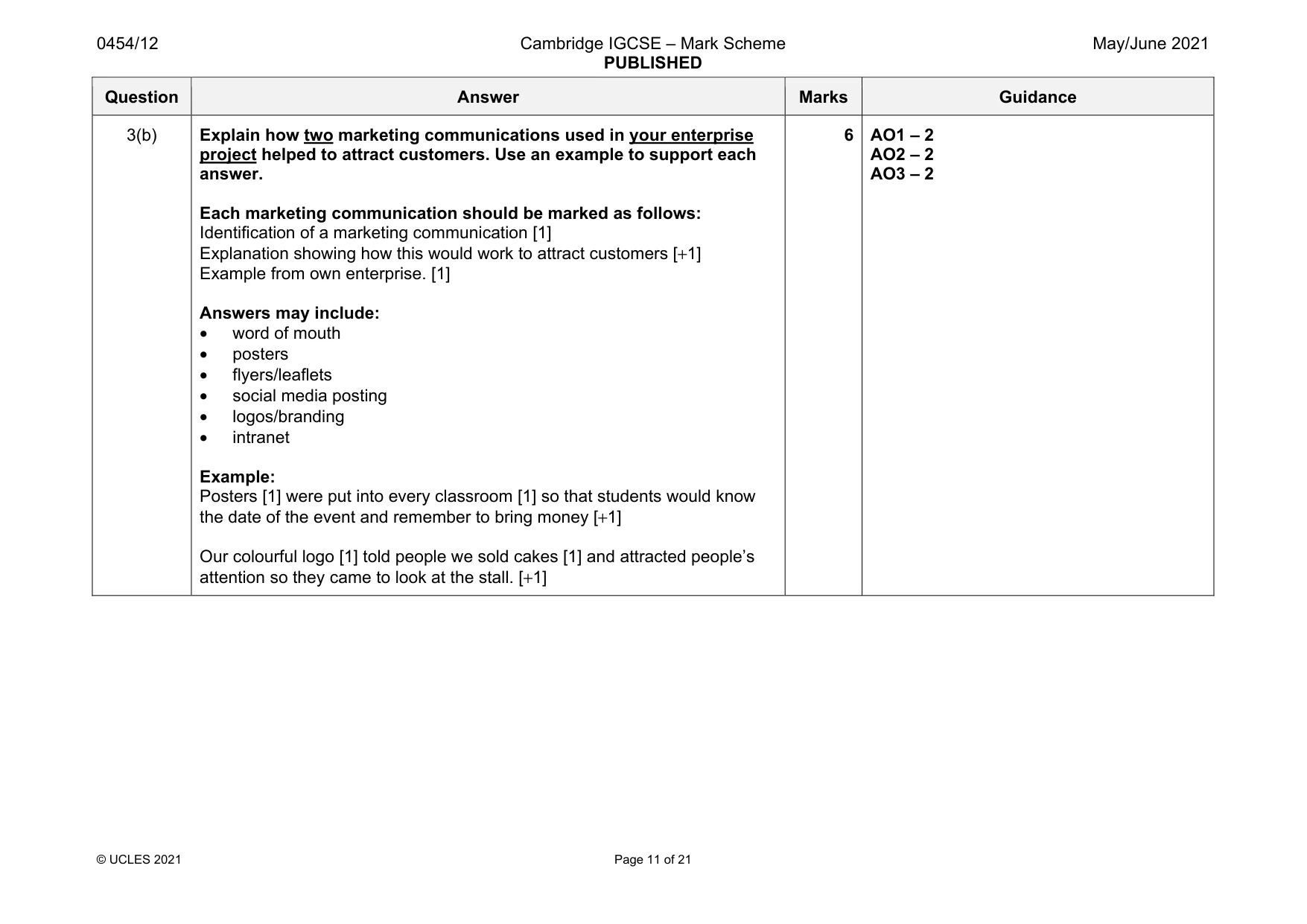
0454/12 Cambridge IGCSE – Mark Scheme PUBLISHED May/June 2021 © UCLES 2021 Page 11 of 21 Question Answer Marks Guidance 3(b) Explain how two marketing communications used in your enterprise project helped to attract customers. Use an example to support each answer. Each marketing communication should be marked as follows: Identification of a marketing communication [1] Explanation showing how this would work to attract customers [+1] Example from own enterprise. [1] Answers may include: • word of mouth • posters • flyers/leaflets • social media posting • logos/branding • intranet Example: Posters [1] were put into every classroom [1] so that students would know the date of the event and remember to bring money [+1] Our colourful logo [1] told people we sold cakes [1] and attracted people’s attention so they came to look at the stall. [+1] 6 AO1 – 2 AO2 – 2 AO3 – 2
Mark scheme, page 12
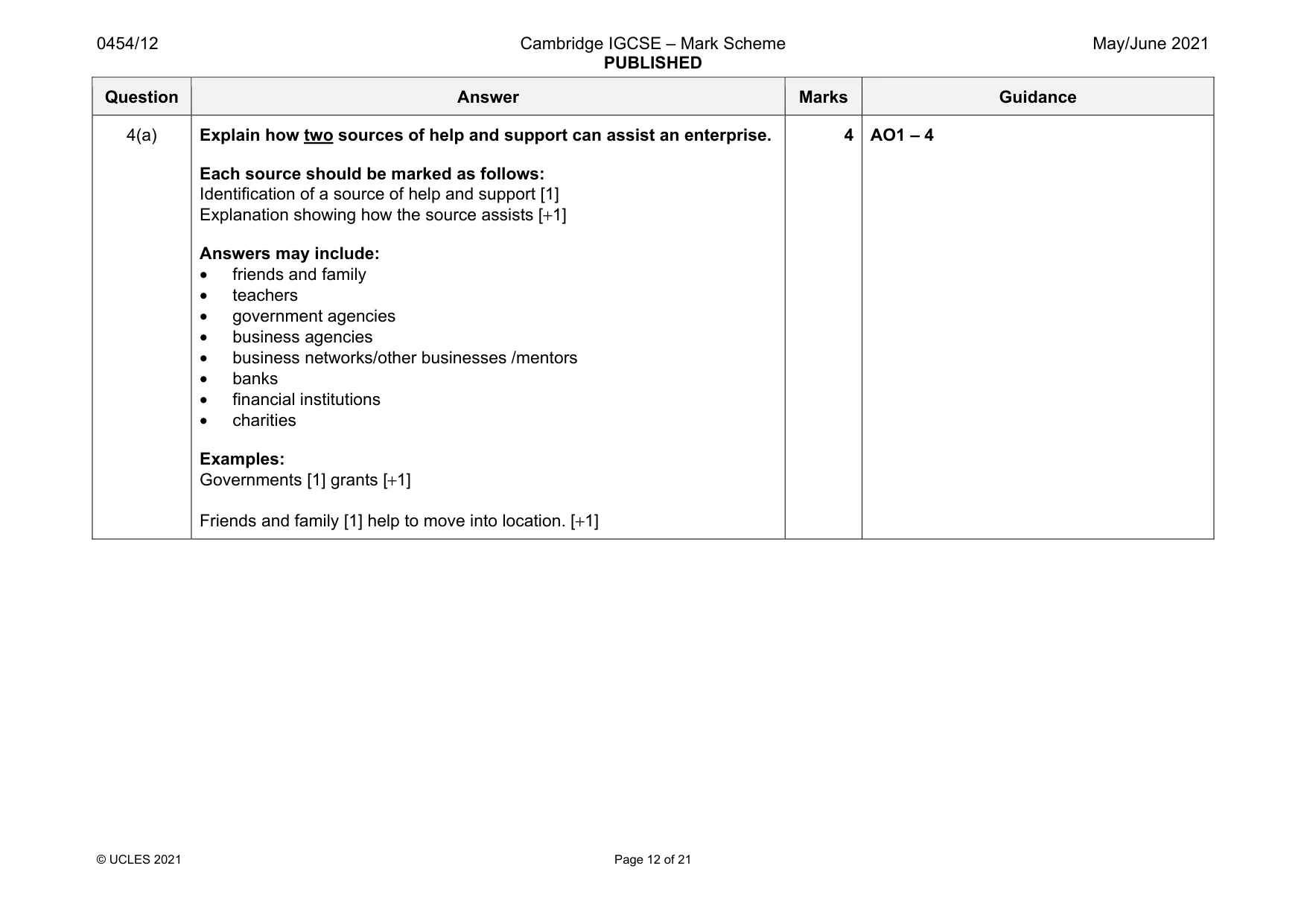
0454/12 Cambridge IGCSE – Mark Scheme PUBLISHED May/June 2021 © UCLES 2021 Page 12 of 21 Question Answer Marks Guidance 4(a) Explain how two sources of help and support can assist an enterprise. Each source should be marked as follows: Identification of a source of help and support [1] Explanation showing how the source assists [+1] Answers may include: • friends and family • teachers • government agencies • business agencies • business networks/other businesses /mentors • banks • financial institutions • charities Examples: Governments [1] grants [+1] Friends and family [1] help to move into location. [+1] 4 AO1 – 4
Mark scheme, page 13
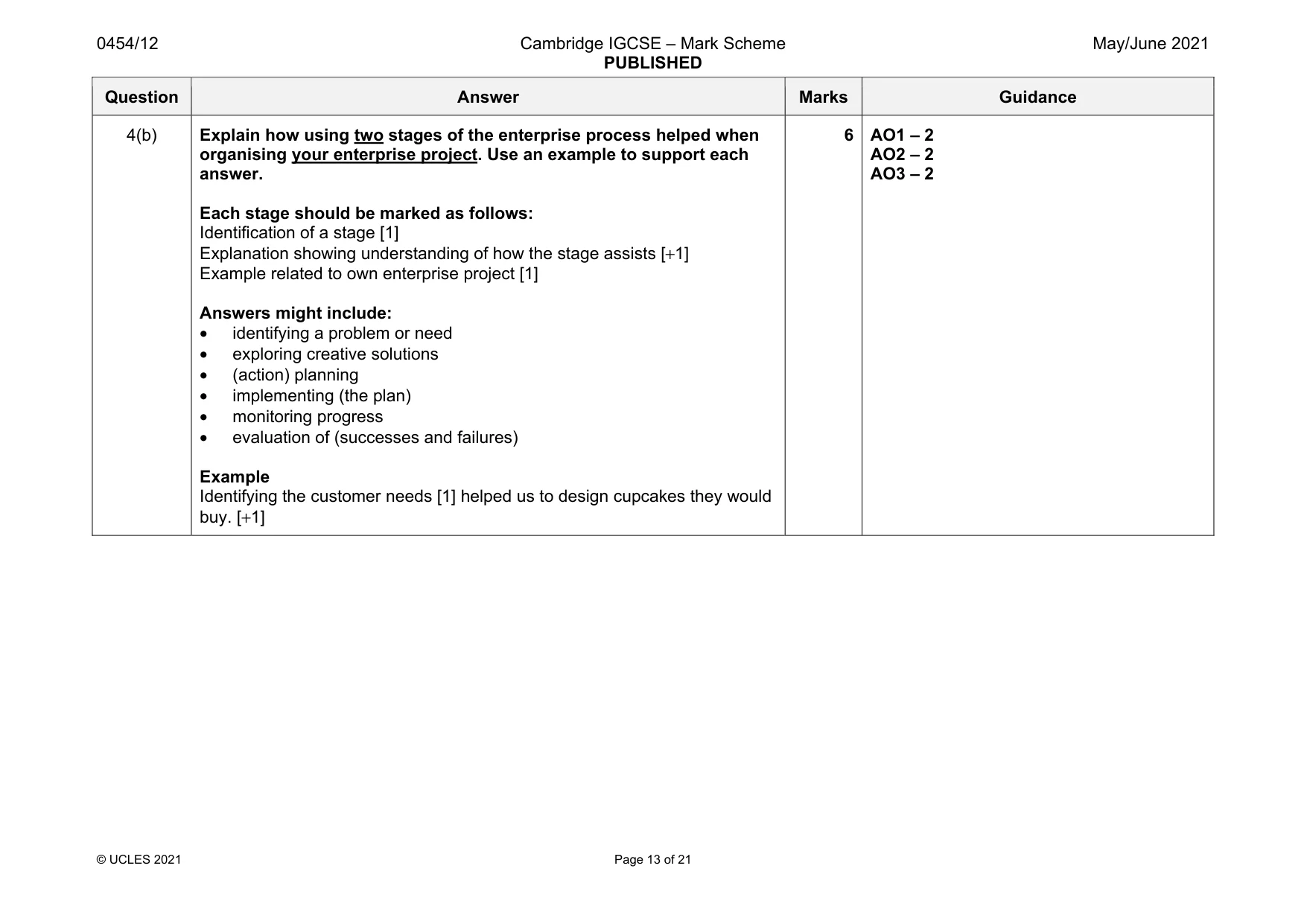
0454/12 Cambridge IGCSE – Mark Scheme PUBLISHED May/June 2021 © UCLES 2021 Page 13 of 21 Question Answer Marks Guidance 4(b) Explain how using two stages of the enterprise process helped when organising your enterprise project. Use an example to support each answer. Each stage should be marked as follows: Identification of a stage [1] Explanation showing understanding of how the stage assists [+1] Example related to own enterprise project [1] Answers might include: • identifying a problem or need • exploring creative solutions • (action) planning • implementing (the plan) • monitoring progress • evaluation of (successes and failures) Example Identifying the customer needs [1] helped us to design cupcakes they would buy. [+1] 6 AO1 – 2 AO2 – 2 AO3 – 2
Mark scheme, page 14
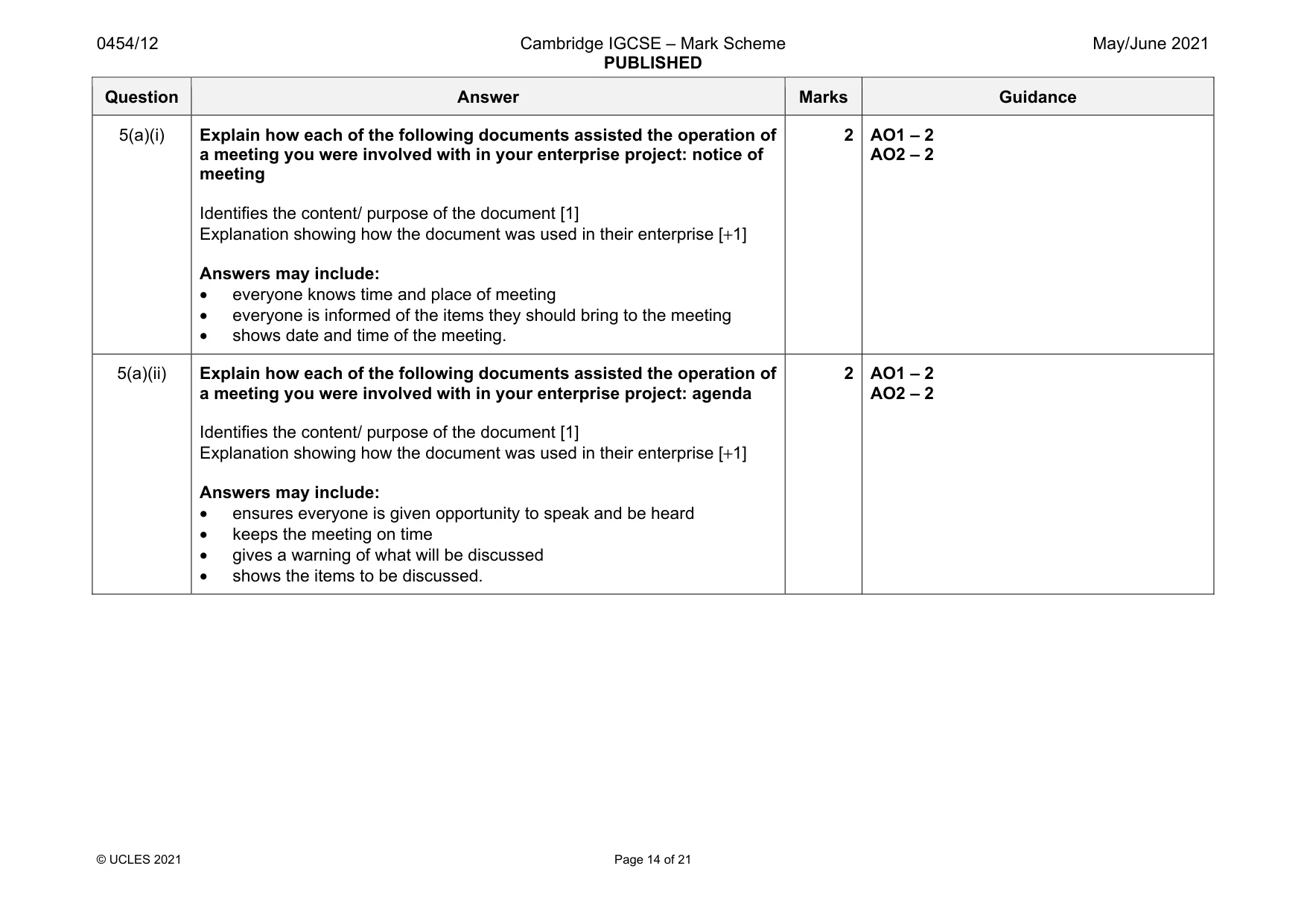
0454/12 Cambridge IGCSE – Mark Scheme PUBLISHED May/June 2021 © UCLES 2021 Page 14 of 21 Question Answer Marks Guidance 5(a)(i) Explain how each of the following documents assisted the operation of a meeting you were involved with in your enterprise project: notice of meeting Identifies the content/ purpose of the document [1] Explanation showing how the document was used in their enterprise [+1] Answers may include: • everyone knows time and place of meeting • everyone is informed of the items they should bring to the meeting • shows date and time of the meeting. 2 AO1 – 2 AO2 – 2 5(a)(ii) Explain how each of the following documents assisted the operation of a meeting you were involved with in your enterprise project: agenda Identifies the content/ purpose of the document [1] Explanation showing how the document was used in their enterprise [+1] Answers may include: • ensures everyone is given opportunity to speak and be heard • keeps the meeting on time • gives a warning of what will be discussed • shows the items to be discussed. 2 AO1 – 2 AO2 – 2
Mark scheme, page 15
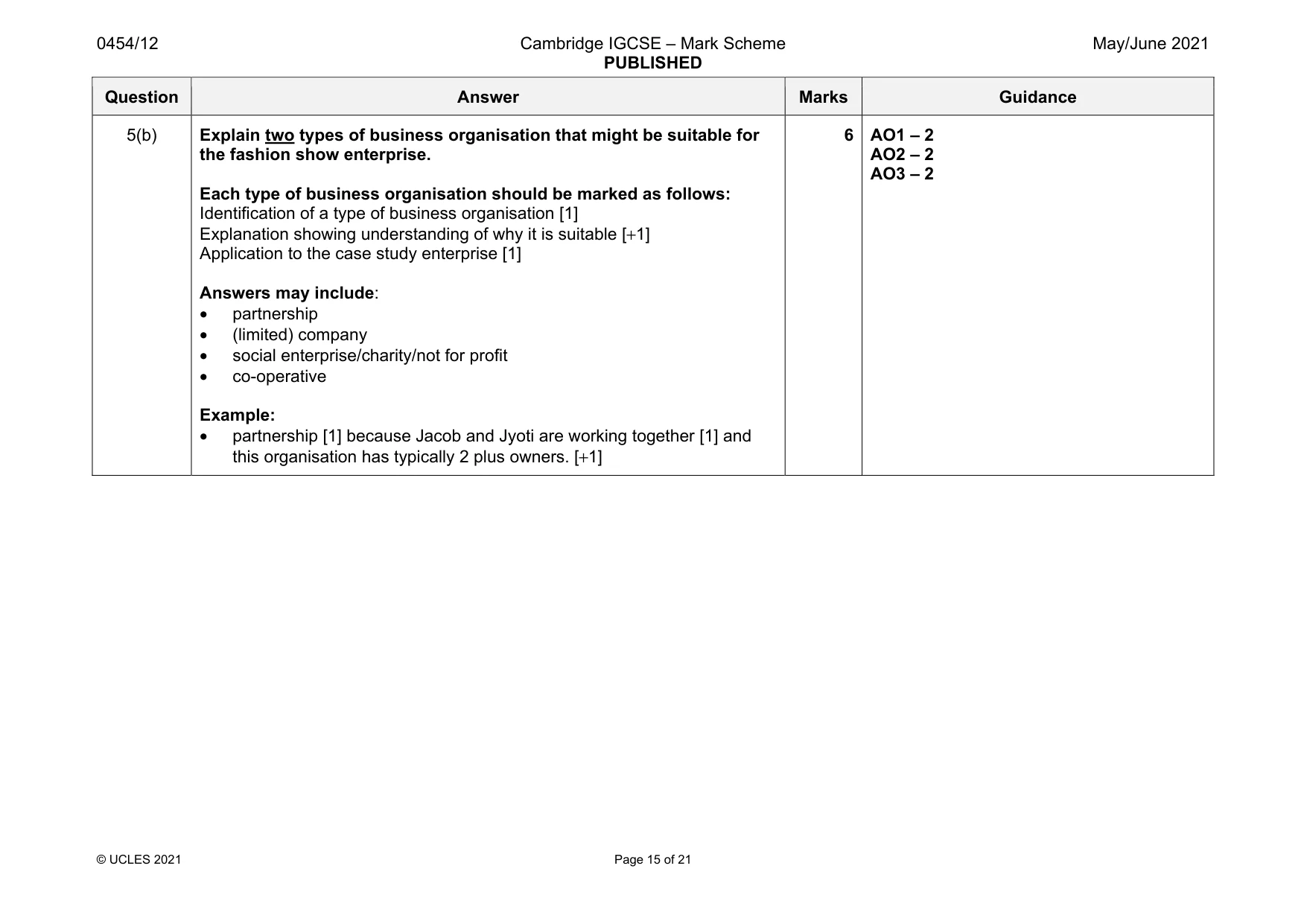
0454/12 Cambridge IGCSE – Mark Scheme PUBLISHED May/June 2021 © UCLES 2021 Page 15 of 21 Question Answer Marks Guidance 5(b) Explain two types of business organisation that might be suitable for the fashion show enterprise. Each type of business organisation should be marked as follows: Identification of a type of business organisation [1] Explanation showing understanding of why it is suitable [+1] Application to the case study enterprise [1] Answers may include: • partnership • (limited) company • social enterprise/charity/not for profit • co-operative Example: • partnership [1] because Jacob and Jyoti are working together [1] and this organisation has typically 2 plus owners. [+1] 6 AO1 – 2 AO2 – 2 AO3 – 2
Mark scheme, page 16
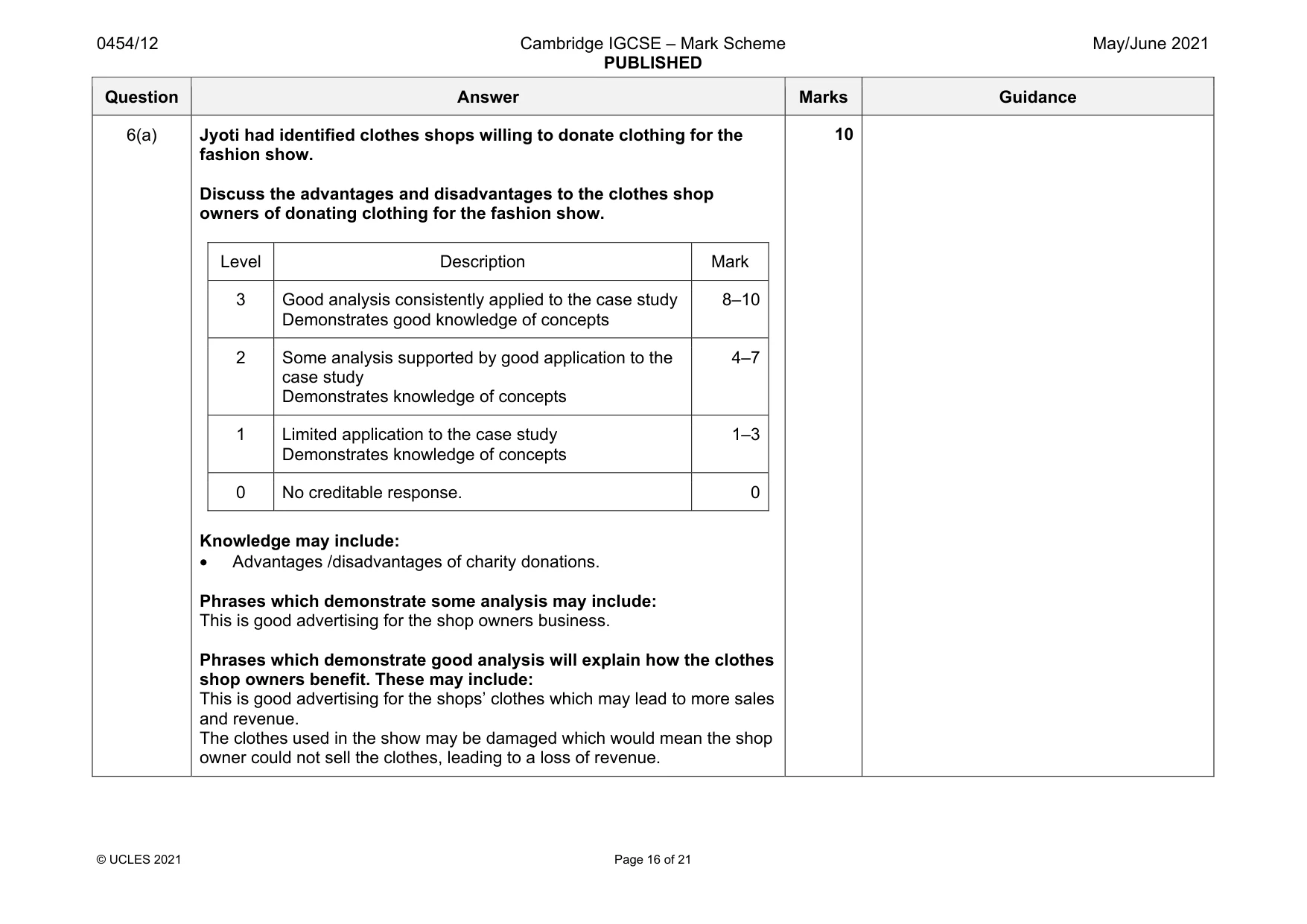
0454/12 Cambridge IGCSE – Mark Scheme PUBLISHED May/June 2021 © UCLES 2021 Page 16 of 21 Question Answer Marks Guidance 6(a) Jyoti had identified clothes shops willing to donate clothing for the fashion show. Discuss the advantages and disadvantages to the clothes shop owners of donating clothing for the fashion show. Level Description Mark 3 Good analysis consistently applied to the case study Demonstrates good knowledge of concepts 8–10 2 Some analysis supported by good application to the case study Demonstrates knowledge of concepts 4–7 1 Limited application to the case study Demonstrates knowledge of concepts 1–3 0 No creditable response. 0 Knowledge may include: • Advantages /disadvantages of charity donations. Phrases which demonstrate some analysis may include: This is good advertising for the shop owners business. Phrases which demonstrate good analysis will explain how the clothes shop owners benefit. These may include: This is good advertising for the shops’ clothes which may lead to more sales and revenue. The clothes used in the show may be damaged which would mean the shop owner could not sell the clothes, leading to a loss of revenue. 10
Mark scheme, page 17
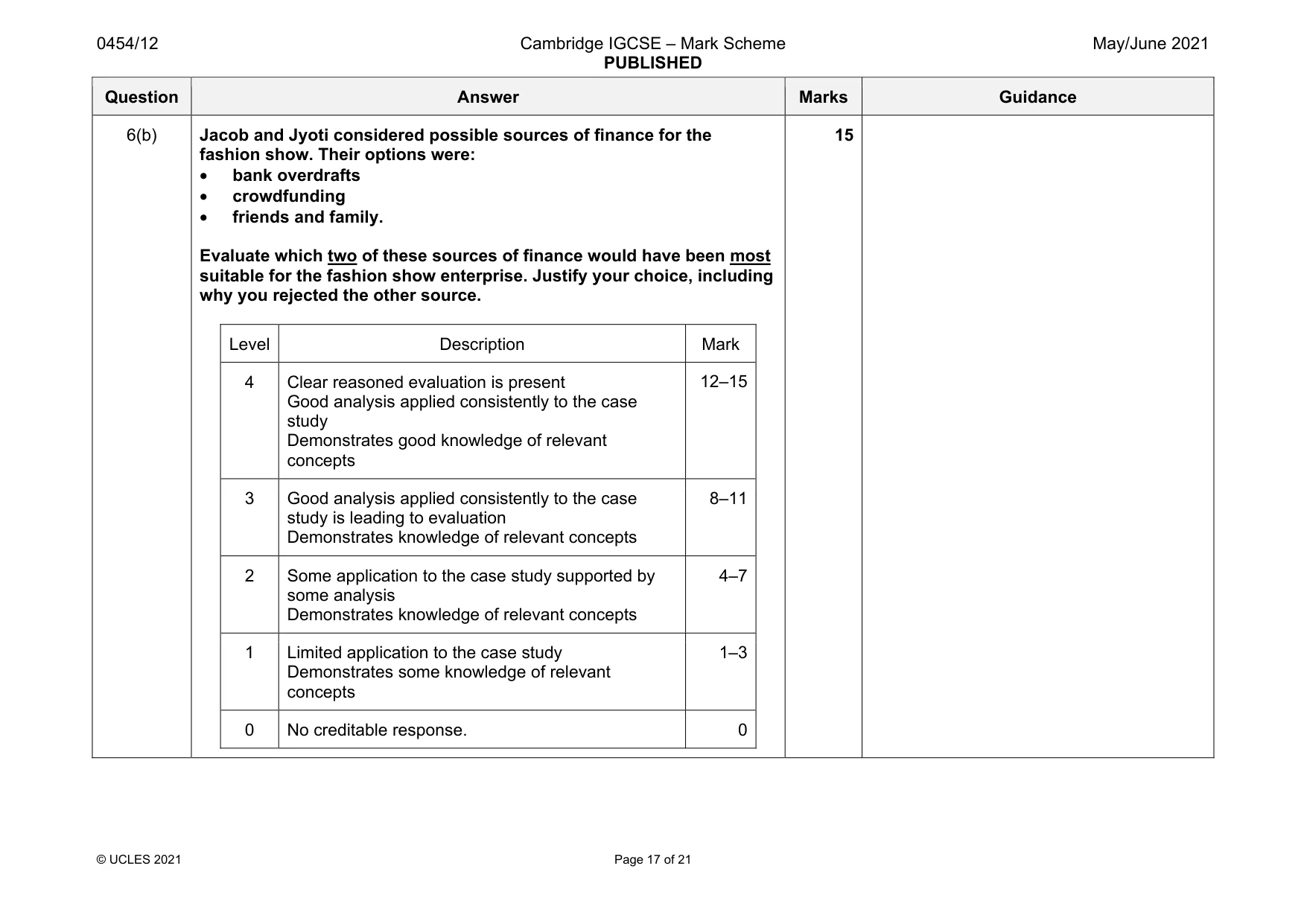
0454/12 Cambridge IGCSE – Mark Scheme PUBLISHED May/June 2021 © UCLES 2021 Page 17 of 21 Question Answer Marks Guidance 6(b) Jacob and Jyoti considered possible sources of finance for the fashion show. Their options were: • bank overdrafts • crowdfunding • friends and family. Evaluate which two of these sources of finance would have been most suitable for the fashion show enterprise. Justify your choice, including why you rejected the other source. Level Description Mark 4 Clear reasoned evaluation is present Good analysis applied consistently to the case study Demonstrates good knowledge of relevant concepts 12–15 3 Good analysis applied consistently to the case study is leading to evaluation Demonstrates knowledge of relevant concepts 8–11 2 Some application to the case study supported by some analysis Demonstrates knowledge of relevant concepts 4–7 1 Limited application to the case study Demonstrates some knowledge of relevant concepts 1–3 0 No creditable response. 0 15
Mark scheme, page 18
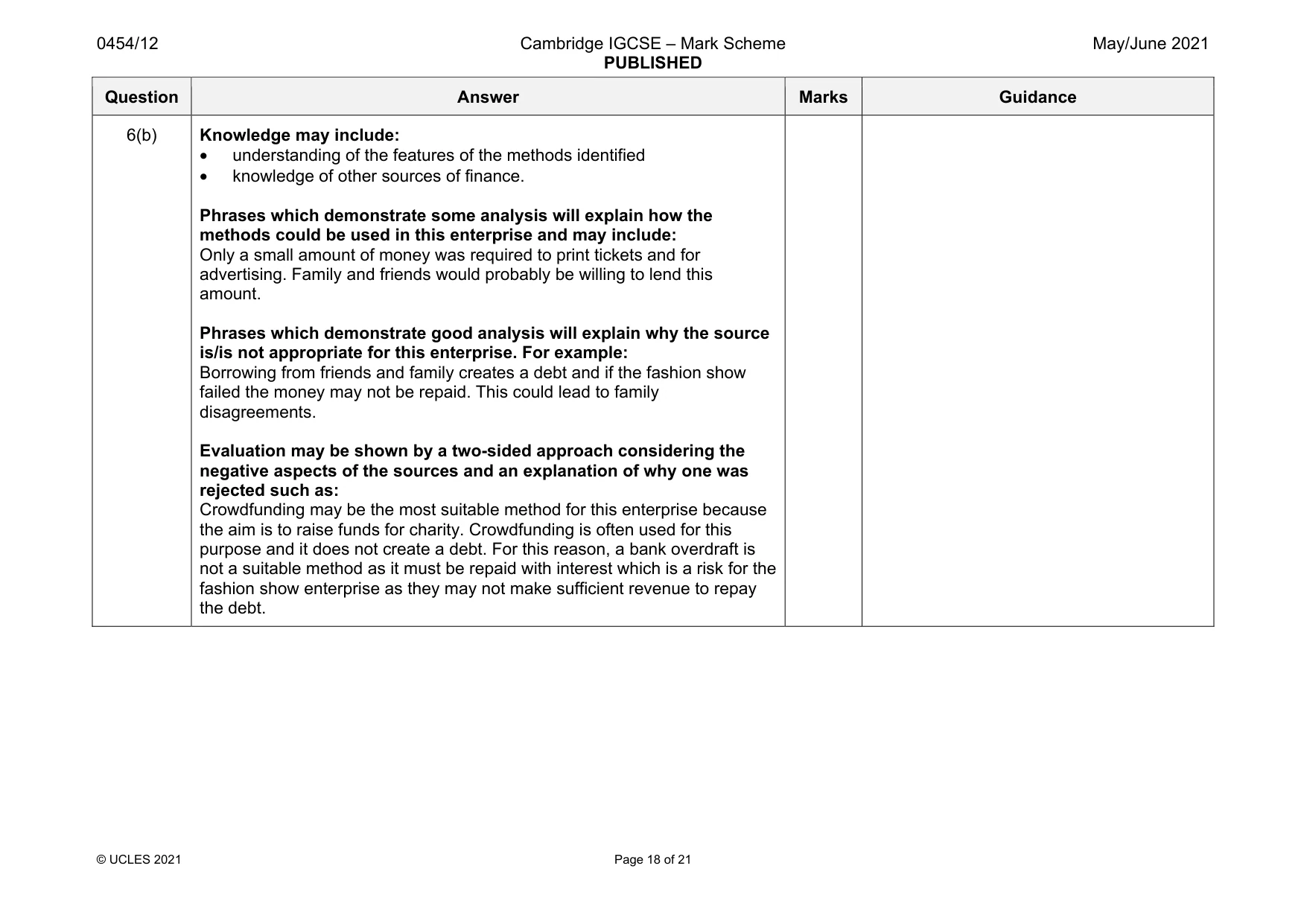
0454/12 Cambridge IGCSE – Mark Scheme PUBLISHED May/June 2021 © UCLES 2021 Page 18 of 21 Question Answer Marks Guidance 6(b) Knowledge may include: • understanding of the features of the methods identified • knowledge of other sources of finance. Phrases which demonstrate some analysis will explain how the methods could be used in this enterprise and may include: Only a small amount of money was required to print tickets and for advertising. Family and friends would probably be willing to lend this amount. Phrases which demonstrate good analysis will explain why the source is/is not appropriate for this enterprise. For example: Borrowing from friends and family creates a debt and if the fashion show failed the money may not be repaid. This could lead to family disagreements. Evaluation may be shown by a two-sided approach considering the negative aspects of the sources and an explanation of why one was rejected such as: Crowdfunding may be the most suitable method for this enterprise because the aim is to raise funds for charity. Crowdfunding is often used for this purpose and it does not create a debt. For this reason, a bank overdraft is not a suitable method as it must be repaid with interest which is a risk for the fashion show enterprise as they may not make sufficient revenue to repay the debt.
Mark scheme, page 19
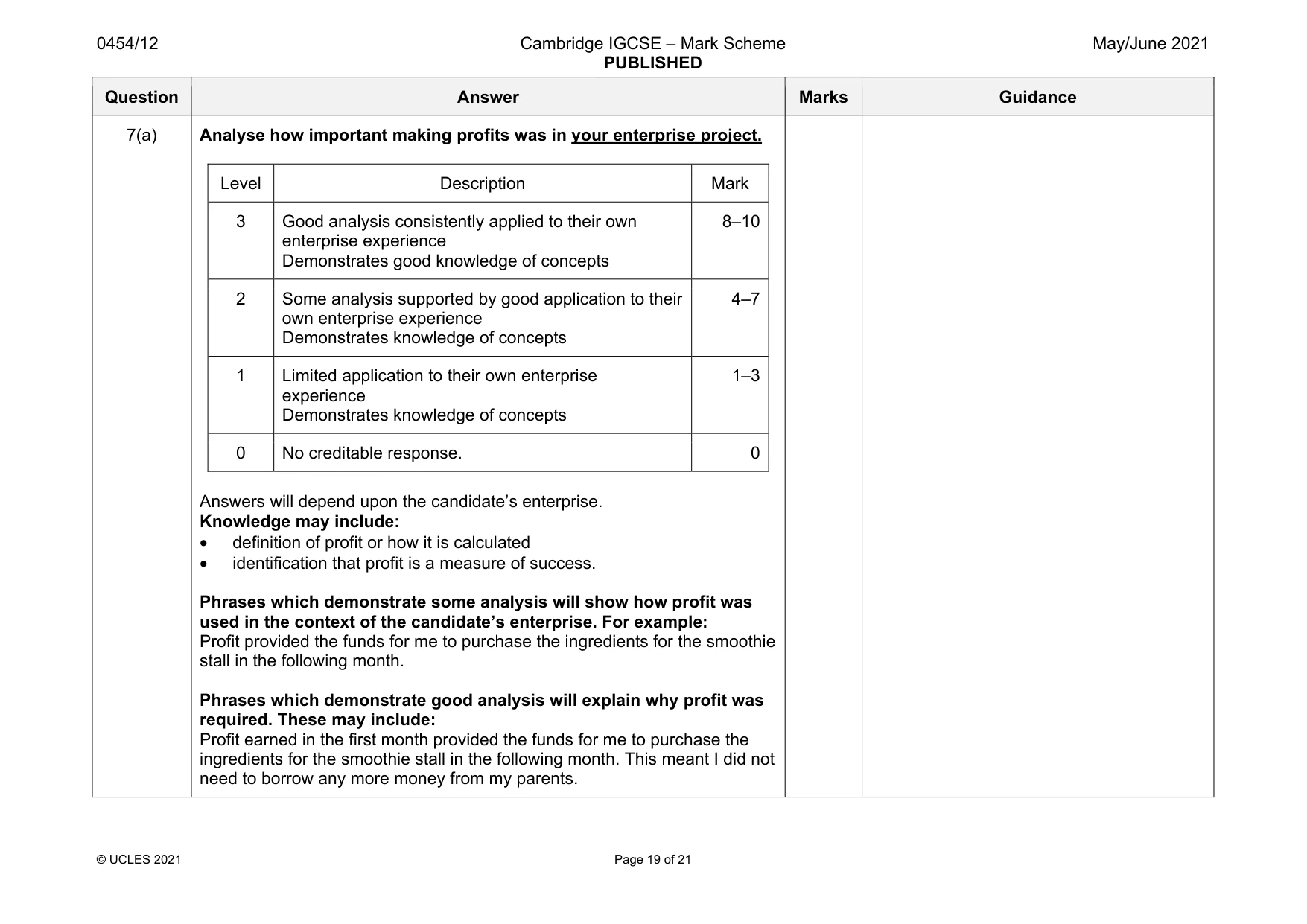
0454/12 Cambridge IGCSE – Mark Scheme PUBLISHED May/June 2021 © UCLES 2021 Page 19 of 21 Question Answer Marks Guidance 7(a) Analyse how important making profits was in your enterprise project. Level Description Mark 3 Good analysis consistently applied to their own enterprise experience Demonstrates good knowledge of concepts 8–10 2 Some analysis supported by good application to their own enterprise experience Demonstrates knowledge of concepts 4–7 1 Limited application to their own enterprise experience Demonstrates knowledge of concepts 1–3 0 No creditable response. 0 Answers will depend upon the candidate’s enterprise. Knowledge may include: • definition of profit or how it is calculated • identification that profit is a measure of success. Phrases which demonstrate some analysis will show how profit was used in the context of the candidate’s enterprise. For example: Profit provided the funds for me to purchase the ingredients for the smoothie stall in the following month. Phrases which demonstrate good analysis will explain why profit was required. These may include: Profit earned in the first month provided the funds for me to purchase the ingredients for the smoothie stall in the following month. This meant I did not need to borrow any more money from my parents.
Mark scheme, page 20
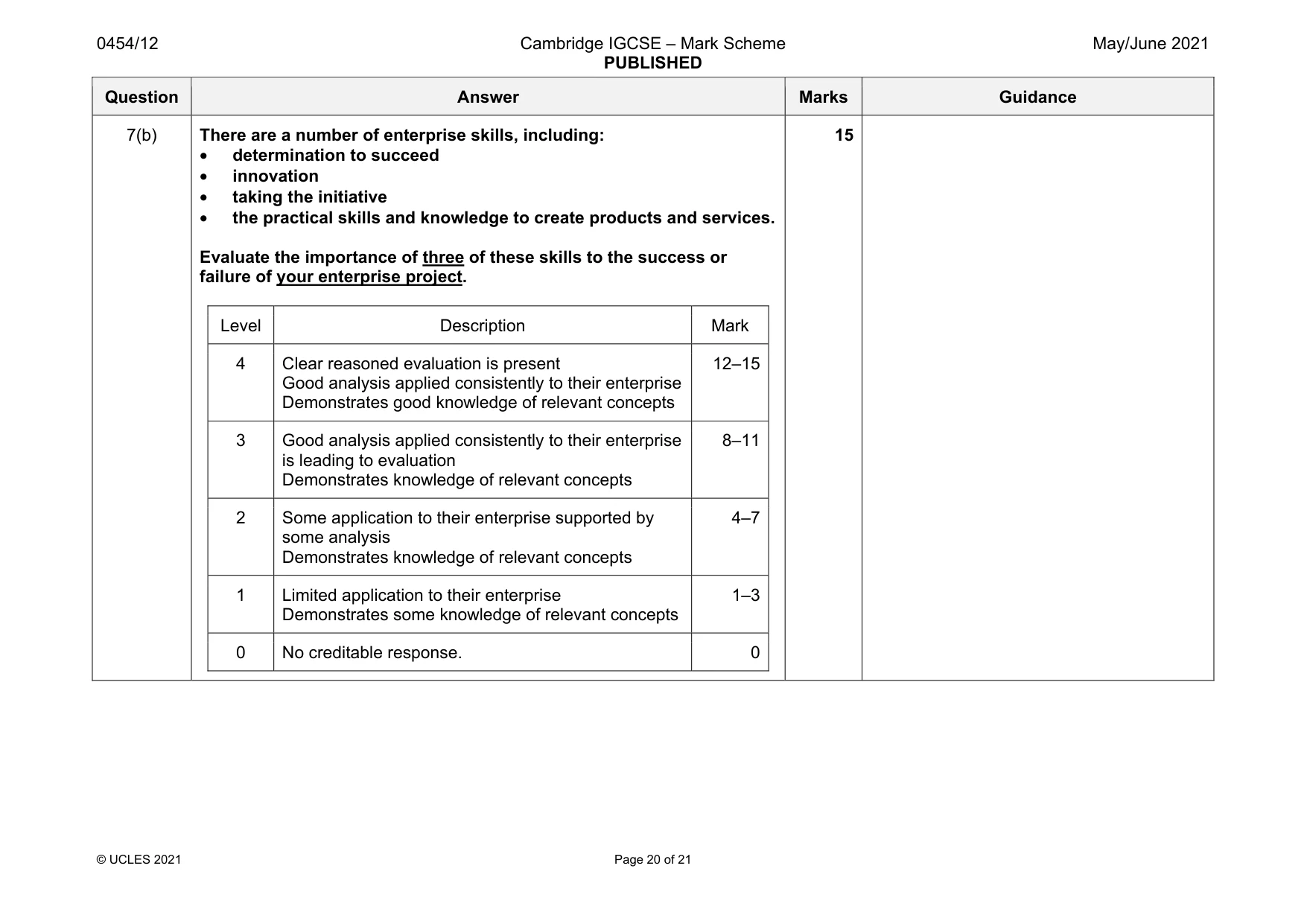
0454/12 Cambridge IGCSE – Mark Scheme PUBLISHED May/June 2021 © UCLES 2021 Page 20 of 21 Question Answer Marks Guidance 7(b) There are a number of enterprise skills, including: • determination to succeed • innovation • taking the initiative • the practical skills and knowledge to create products and services. Evaluate the importance of three of these skills to the success or failure of your enterprise project. Level Description Mark 4 Clear reasoned evaluation is present Good analysis applied consistently to their enterprise Demonstrates good knowledge of relevant concepts 12–15 3 Good analysis applied consistently to their enterprise is leading to evaluation Demonstrates knowledge of relevant concepts 8–11 2 Some application to their enterprise supported by some analysis Demonstrates knowledge of relevant concepts 4–7 1 Limited application to their enterprise Demonstrates some knowledge of relevant concepts 1–3 0 No creditable response. 0 15
Mark scheme, page 21
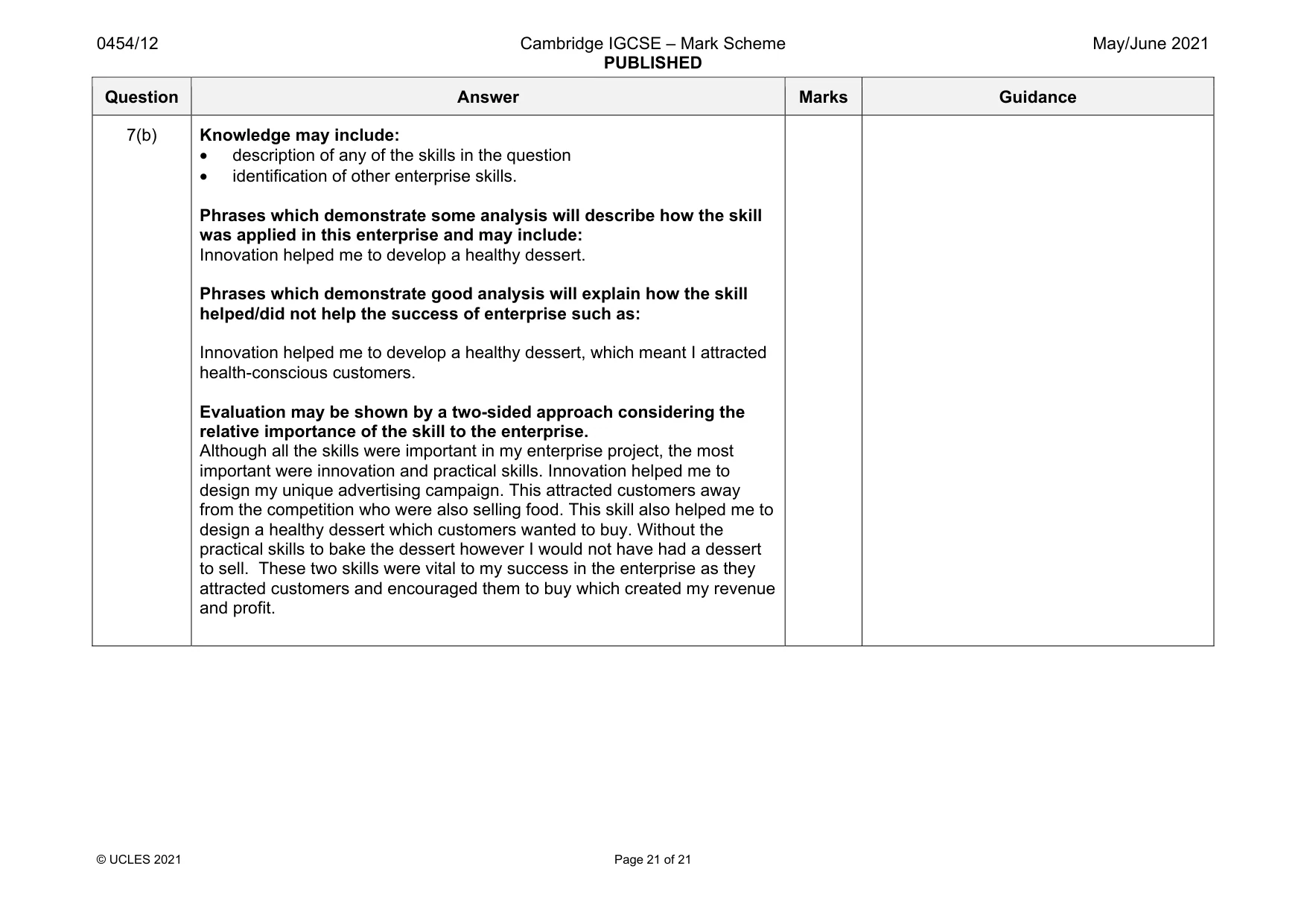
0454/12 Cambridge IGCSE – Mark Scheme PUBLISHED May/June 2021 © UCLES 2021 Page 21 of 21 Question Answer Marks Guidance 7(b) Knowledge may include: • description of any of the skills in the question • identification of other enterprise skills. Phrases which demonstrate some analysis will describe how the skill was applied in this enterprise and may include: Innovation helped me to develop a healthy dessert. Phrases which demonstrate good analysis will explain how the skill helped/did not help the success of enterprise such as: Innovation helped me to develop a healthy dessert, which meant I attracted health-conscious customers. Evaluation may be shown by a two-sided approach considering the relative importance of the skill to the enterprise. Although all the skills were important in my enterprise project, the most important were innovation and practical skills. Innovation helped me to design my unique advertising campaign. This attracted customers away from the competition who were also selling food. This skill also helped me to design a healthy dessert which customers wanted to buy. Without the practical skills to bake the dessert however I would not have had a dessert to sell. These two skills were vital to my success in the enterprise as they attracted customers and encouraged them to buy which created my revenue and profit.
What you needed in this session
Cambridge’s own grade thresholds for 2021 May/June, Paper 1 · Variant 2. A higher threshold means an easier paper — the bar moves with how the cohort did.