Cambridge IGCSE Enterprise 0454 — 2019 Oct/Nov Paper 1 · Variant 2
0454/12/O/N/19 · 100 marks · ≈113 min
The question paper and its mark scheme, free to read here and free to download. This is Cambridge’s own paper, exactly as it was sat.
Question paper16 pages









Mark scheme12 pages
Answers below. Sit the paper first if you are practising.
Paper as text
Question paper, page 1
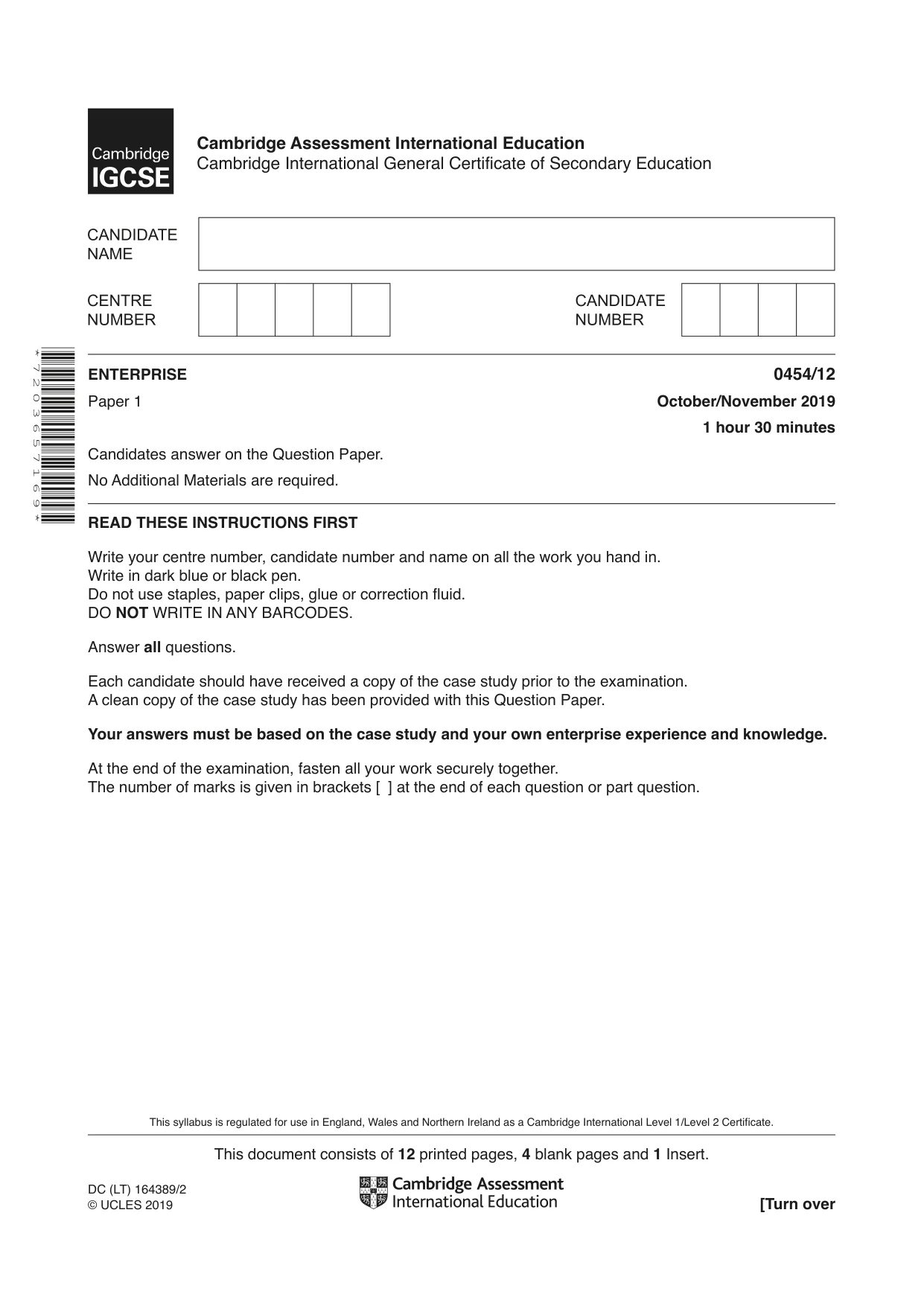
This document consists of 12 printed pages, 4 blank pages and 1 Insert. DC (LT) 164389/2 © UCLES 2019 [Turn over Cambridge Assessment International Education Cambridge International General Certificate of Secondary Education * 7 2 0 3 6 5 7 1 6 9 * This syllabus is regulated for use in England, Wales and Northern Ireland as a Cambridge International Level 1/Level 2 Certificate. ENTERPRISE 0454/12 Paper 1 October/November 2019 1 hour 30 minutes Candidates answer on the Question Paper. No Additional Materials are required. READ THESE INSTRUCTIONS FIRST Write your centre number, candidate number and name on all the work you hand in. Write in dark blue or black pen. Do not use staples, paper clips, glue or correction fluid. DO NOT WRITE IN ANY BARCODES. Answer all questions. Each candidate should have received a copy of the case study prior to the examination. A clean copy of the case study has been provided with this Question Paper. Your answers must be based on the case study and your own enterprise experience and knowledge. At the end of the examination, fasten all your work securely together. The number of marks is given in brackets [ ] at the end of each question or part question.
Question paper, page 2
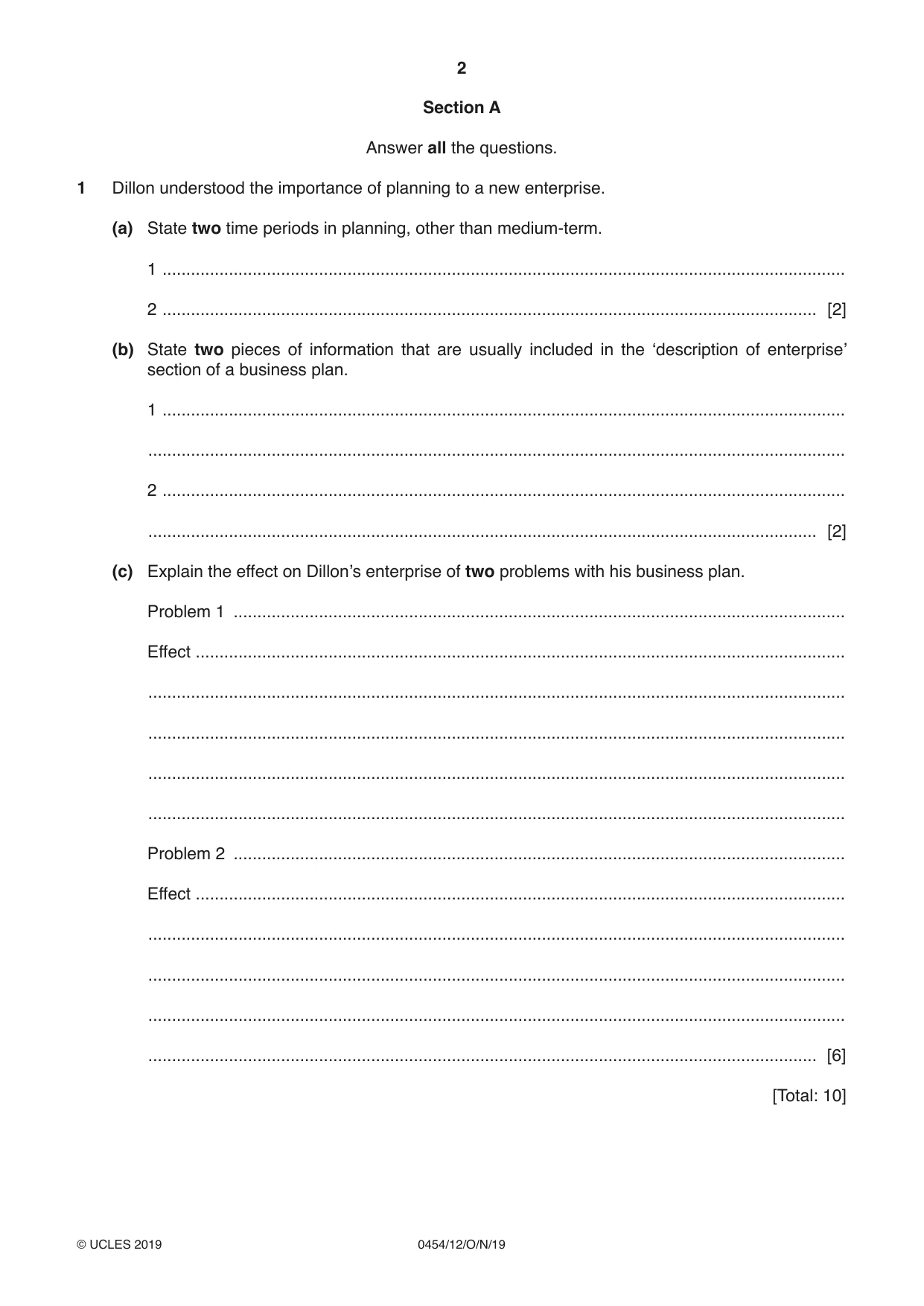
2 0454/12/O/N/19 © UCLES 2019 Section A Answer all the questions. 1 Dillon understood the importance of planning to a new enterprise. (a) State two time periods in planning, other than medium-term. 1 … 2 … [2] (b) State two pieces of information that are usually included in the ‘description of enterprise’ section of a business plan. 1 … … 2 … … [2] (c) Explain the effect on Dillon’s enterprise of two problems with his business plan. Problem 1 … Effect … … … … … Problem 2 … Effect … … … … … [6] [Total: 10]
Question paper, page 3
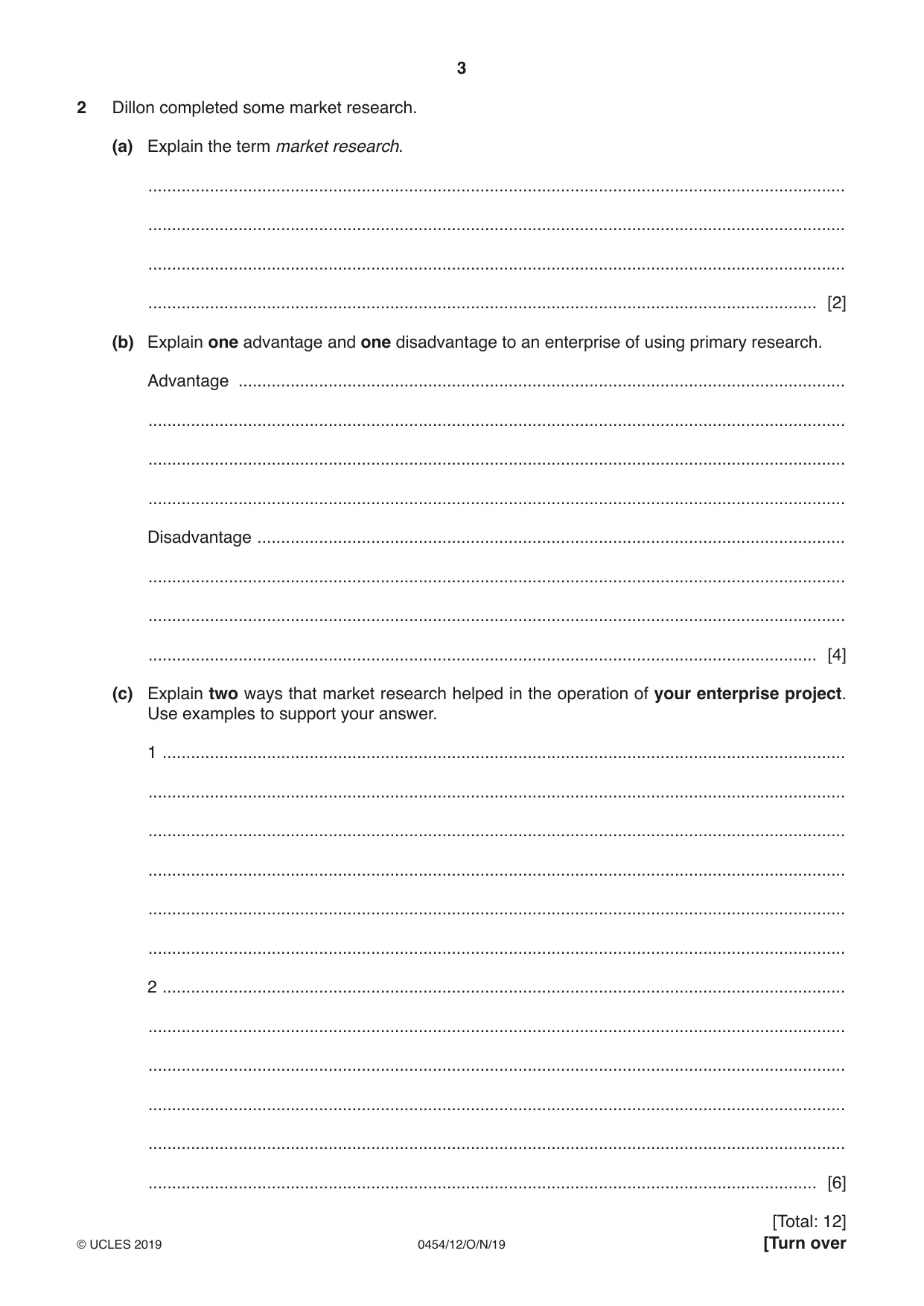
3 0454/12/O/N/19 © UCLES 2019 [Turn over 2 Dillon completed some market research. (a) Explain the term market research. … … … … [2] (b) Explain one advantage and one disadvantage to an enterprise of using primary research. Advantage … … … … Disadvantage … … … … [4] (c) Explain two ways that market research helped in the operation of your enterprise project. Use examples to support your answer. 1 … … … … … … 2 … … … … … … [6] [Total: 12]
Question paper, page 4
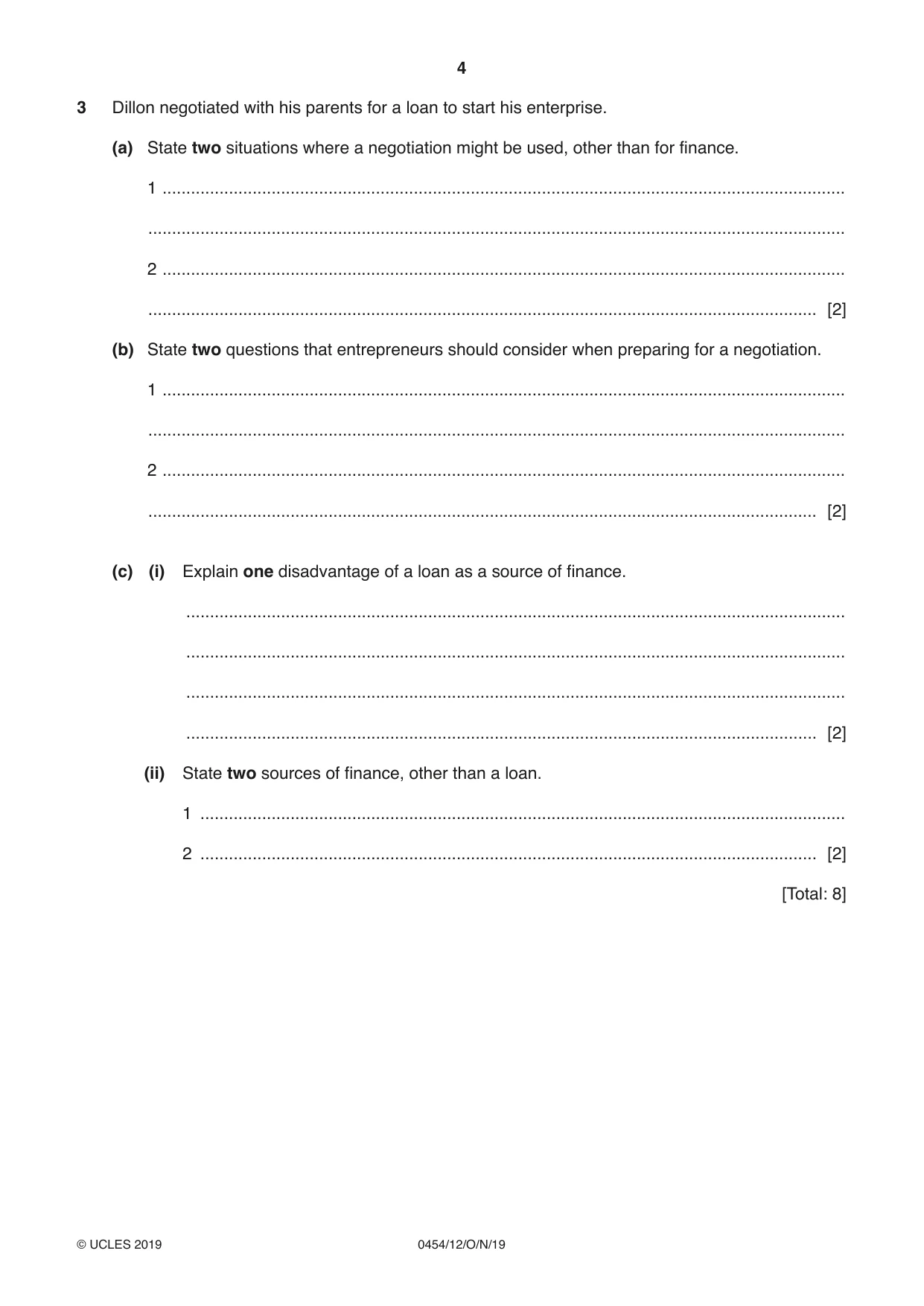
4 0454/12/O/N/19 © UCLES 2019 3 Dillon negotiated with his parents for a loan to start his enterprise. (a) State two situations where a negotiation might be used, other than for finance. 1 … … 2 … … [2] (b) State two questions that entrepreneurs should consider when preparing for a negotiation. 1 … … 2 … … [2] (c) (i) Explain one disadvantage of a loan as a source of finance. … … … … [2] (ii) State two sources of finance, other than a loan. 1 … 2 … [2] [Total: 8]
Question paper, page 5
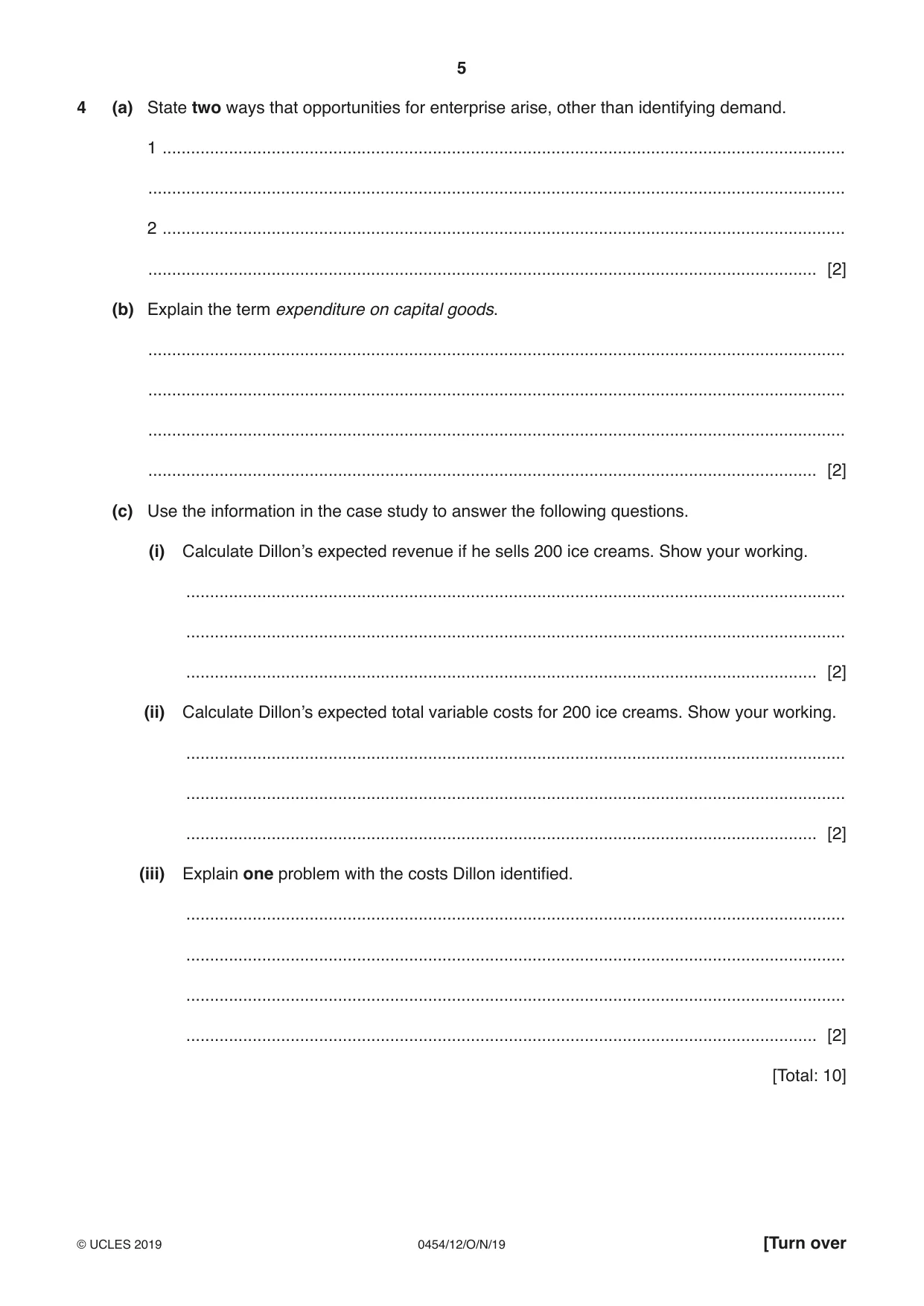
5 0454/12/O/N/19 © UCLES 2019 [Turn over 4 (a) State two ways that opportunities for enterprise arise, other than identifying demand. 1 … … 2 … … [2] (b) Explain the term expenditure on capital goods. … … … … [2] (c) Use the information in the case study to answer the following questions. (i) Calculate Dillon’s expected revenue if he sells 200 ice creams. Show your working. … … … [2] (ii) Calculate Dillon’s expected total variable costs for 200 ice creams. Show your working. … … … [2] (iii) Explain one problem with the costs Dillon identified. … … … … [2] [Total: 10]
Question paper, page 6
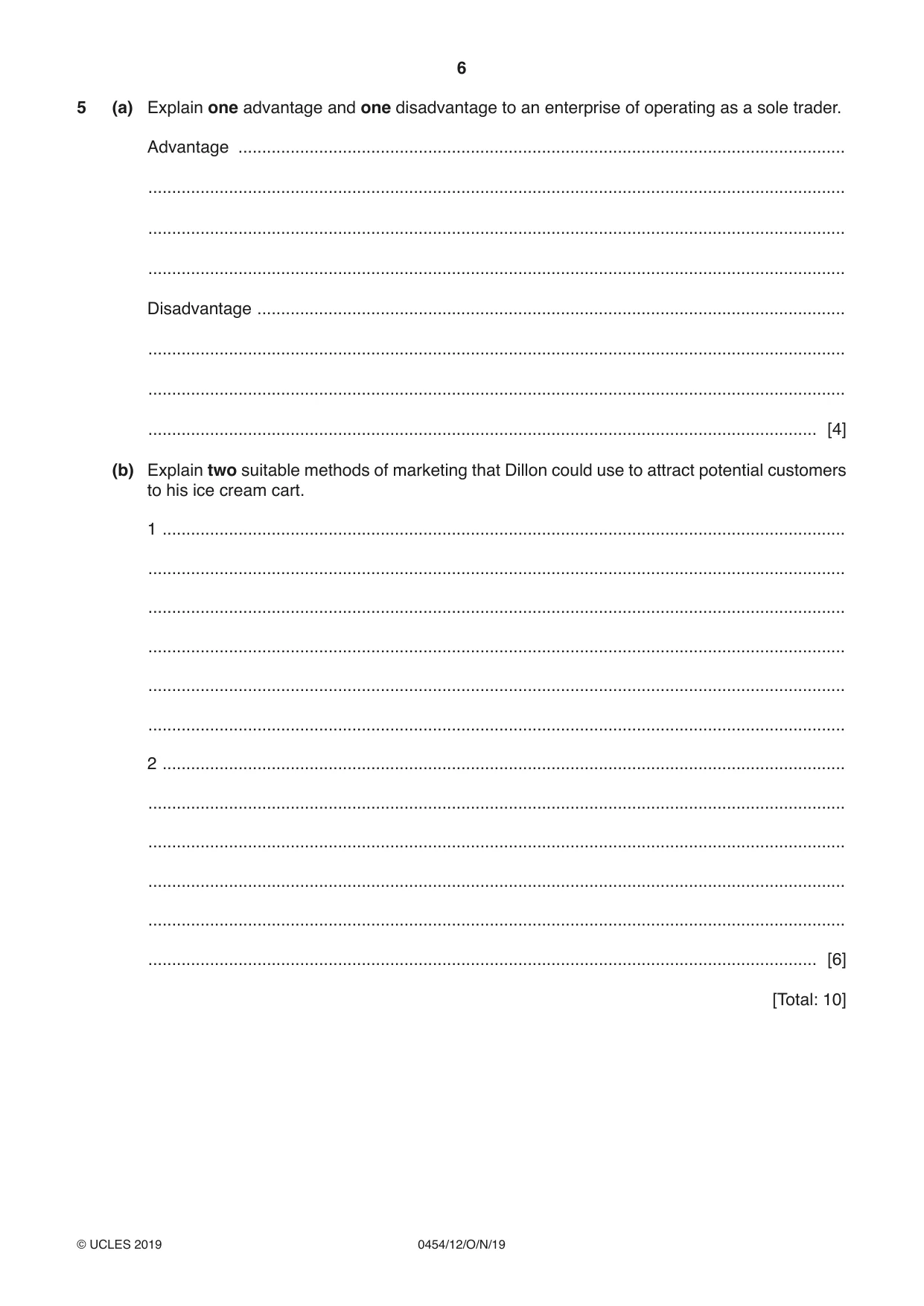
6 0454/12/O/N/19 © UCLES 2019 5 (a) Explain one advantage and one disadvantage to an enterprise of operating as a sole trader. Advantage … … … … Disadvantage … … … … [4] (b) Explain two suitable methods of marketing that Dillon could use to attract potential customers to his ice cream cart. 1 … … … … … … 2 … … … … … … [6] [Total: 10]
Question paper, page 7
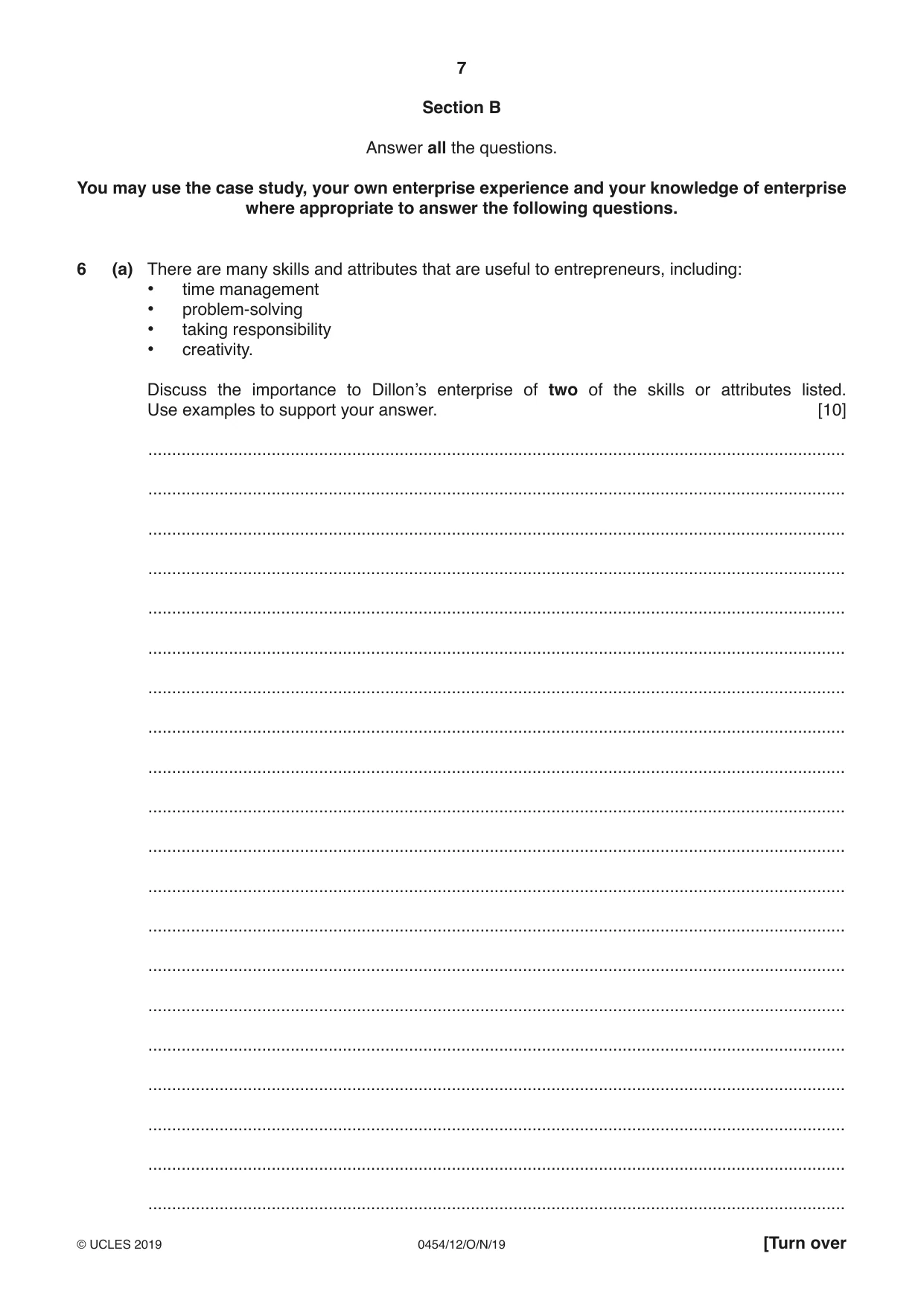
7 0454/12/O/N/19 © UCLES 2019 [Turn over Section B Answer all the questions. You may use the case study, your own enterprise experience and your knowledge of enterprise where appropriate to answer the following questions. 6 (a) There are many skills and attributes that are useful to entrepreneurs, including: • time management • problem-solving • taking responsibility • creativity. Discuss the importance to Dillon’s enterprise of two of the skills or attributes listed. Use examples to support your answer. [10] … … … … … … … … … … … … … … … … … … … …
Question paper, page 8
8 0454/12/O/N/19 © UCLES 2019 (b) Dillon wanted to start an enterprise dealing with food. His enterprise would be affected by a number of laws and regulations, including those in the following areas: • employment • production • selling. Evaluate which two of these areas of laws or regulations would most affect Dillon’s enterprise. Justify your decision. [15] … … … … … … … … … … … … … … … … … … … … … … … …
Question paper, page 9
9 0454/12/O/N/19 © UCLES 2019 [Turn over … … … … … … … … … … … … … … … … … … … … … … … … … … … [Total: 25]
Question paper, page 10
10 0454/12/O/N/19 © UCLES 2019 BLANK PAGE
Question paper, page 11
11 0454/12/O/N/19 © UCLES 2019 [Turn over 7 (a) Dillon’s meeting with his parents was not successful because he had not thoroughly prepared for the negotiation. Discuss how you could have improved the effectiveness of the meetings you were involved in during your enterprise project. Use examples to support your answer. [10] … … … … … … … … … … … … … … … … … … … … … … … … …
Question paper, page 12
12 0454/12/O/N/19 © UCLES 2019 (b) Dillon chose not to work with a partner in his enterprise. Evaluate whether being a partnership business organisation was, or could have been, the best option for your enterprise project. Justify your answer. [15] … … … … … … … … … … … … … … … … … … … … … … … … … …
Question paper, page 13
13 0454/12/O/N/19 © UCLES 2019 … … … … … … … … … … … … … … … … … … … … … … … … … … … [Total: 25]
Question paper, page 14
14 0454/12/O/N/19 © UCLES 2019 BLANK PAGE
Question paper, page 15
15 0454/12/O/N/19 © UCLES 2019 BLANK PAGE
Question paper, page 16
16 0454/12/O/N/19 © UCLES 2019 Permission to reproduce items where third-party owned material protected by copyright is included has been sought and cleared where possible. Every reasonable effort has been made by the publisher (UCLES) to trace copyright holders, but if any items requiring clearance have unwittingly been included, the publisher will be pleased to make amends at the earliest possible opportunity. To avoid the issue of disclosure of answer-related information to candidates, all copyright acknowledgements are reproduced online in the Cambridge Assessment International Education Copyright Acknowledgements Booklet. This is produced for each series of examinations and is freely available to download at www.cambridgeinternational.org after the live examination series. Cambridge Assessment International Education is part of the Cambridge Assessment Group. Cambridge Assessment is the brand name of the University of Cambridge Local Examinations Syndicate (UCLES), which itself is a department of the University of Cambridge. BLANK PAGE
Mark scheme, page 1
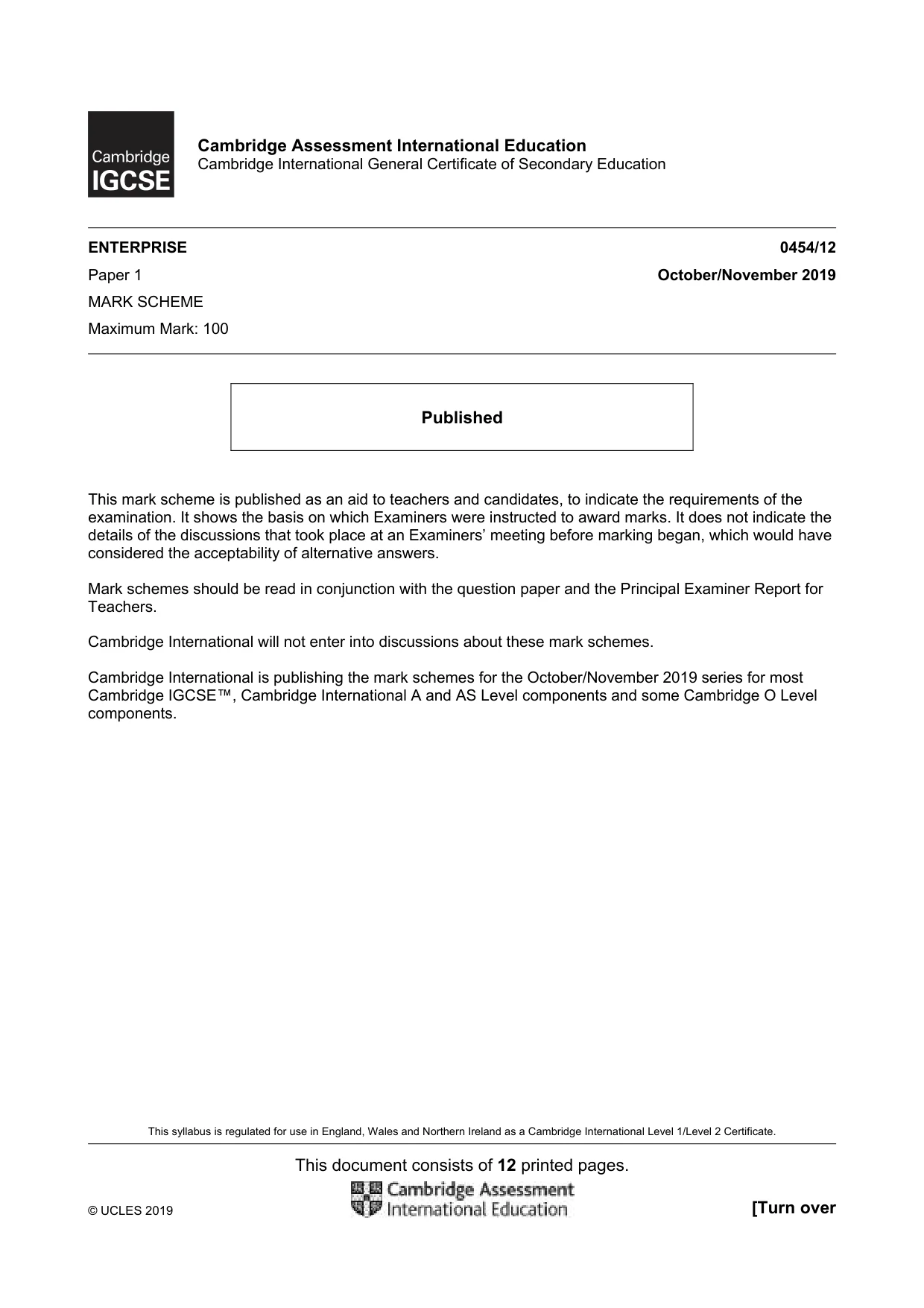
This syllabus is regulated for use in England, Wales and Northern Ireland as a Cambridge International Level 1/Level 2 Certificate. This document consists of 12 printed pages. © UCLES 2019 [Turn over Cambridge Assessment International Education Cambridge International General Certificate of Secondary Education ENTERPRISE 0454/12 Paper 1 October/November 2019 MARK SCHEME Maximum Mark: 100 Published This mark scheme is published as an aid to teachers and candidates, to indicate the requirements of the examination. It shows the basis on which Examiners were instructed to award marks. It does not indicate the details of the discussions that took place at an Examiners’ meeting before marking began, which would have considered the acceptability of alternative answers. Mark schemes should be read in conjunction with the question paper and the Principal Examiner Report for Teachers. Cambridge International will not enter into discussions about these mark schemes. Cambridge International is publishing the mark schemes for the October/November 2019 series for most Cambridge IGCSE™, Cambridge International A and AS Level components and some Cambridge O Level components.
Mark scheme, page 2
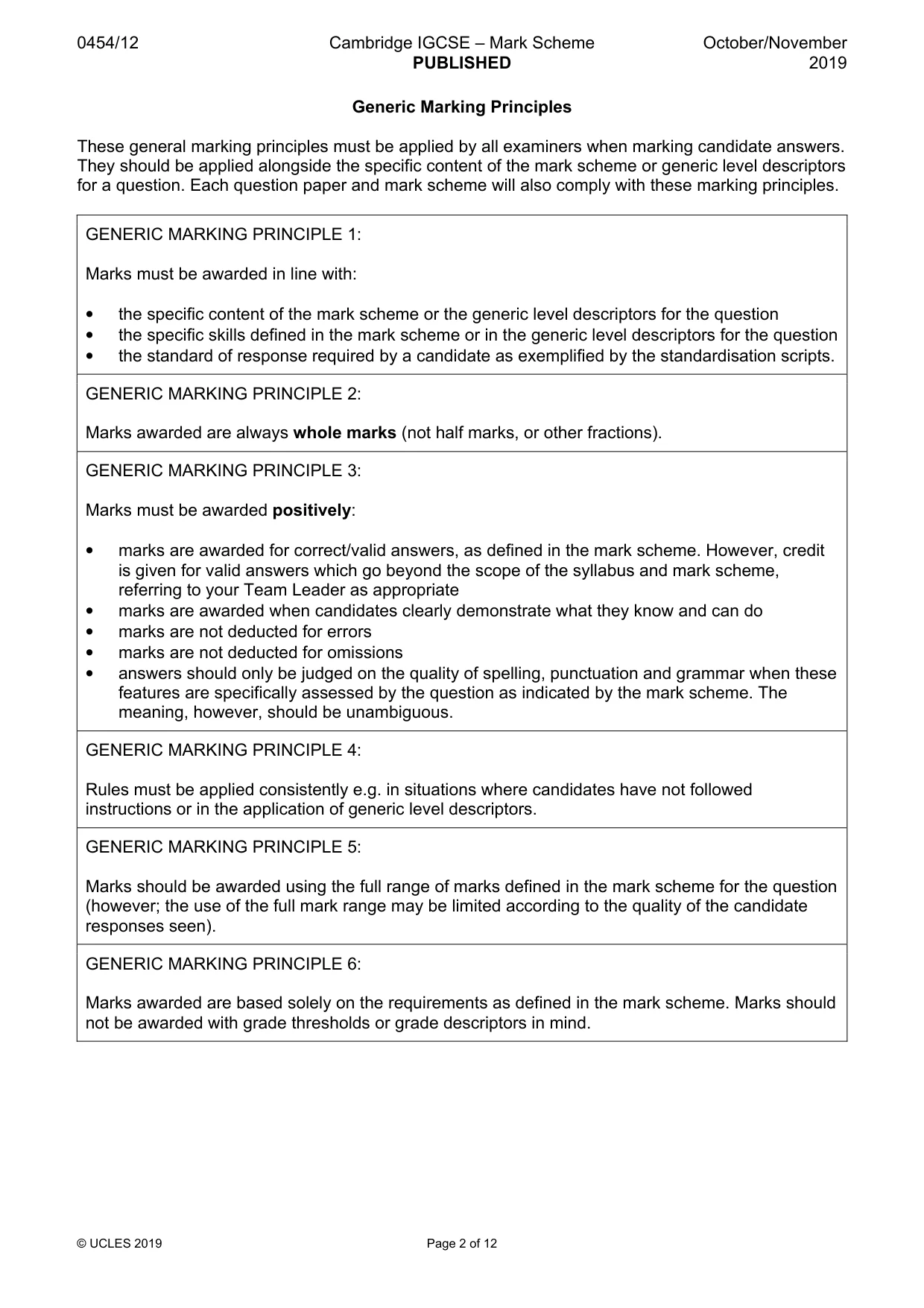
0454/12 Cambridge IGCSE – Mark Scheme PUBLISHED October/November 2019 © UCLES 2019 Page 2 of 12 Generic Marking Principles These general marking principles must be applied by all examiners when marking candidate answers. They should be applied alongside the specific content of the mark scheme or generic level descriptors for a question. Each question paper and mark scheme will also comply with these marking principles. GENERIC MARKING PRINCIPLE 1: Marks must be awarded in line with: • the specific content of the mark scheme or the generic level descriptors for the question • the specific skills defined in the mark scheme or in the generic level descriptors for the question • the standard of response required by a candidate as exemplified by the standardisation scripts. GENERIC MARKING PRINCIPLE 2: Marks awarded are always whole marks (not half marks, or other fractions). GENERIC MARKING PRINCIPLE 3: Marks must be awarded positively: • marks are awarded for correct/valid answers, as defined in the mark scheme. However, credit is given for valid answers which go beyond the scope of the syllabus and mark scheme, referring to your Team Leader as appropriate • marks are awarded when candidates clearly demonstrate what they know and can do • marks are not deducted for errors • marks are not deducted for omissions • answers should only be judged on the quality of spelling, punctuation and grammar when these features are specifically assessed by the question as indicated by the mark scheme. The meaning, however, should be unambiguous. GENERIC MARKING PRINCIPLE 4: Rules must be applied consistently e.g. in situations where candidates have not followed instructions or in the application of generic level descriptors. GENERIC MARKING PRINCIPLE 5: Marks should be awarded using the full range of marks defined in the mark scheme for the question (however; the use of the full mark range may be limited according to the quality of the candidate responses seen). GENERIC MARKING PRINCIPLE 6: Marks awarded are based solely on the requirements as defined in the mark scheme. Marks should not be awarded with grade thresholds or grade descriptors in mind.
Mark scheme, page 3
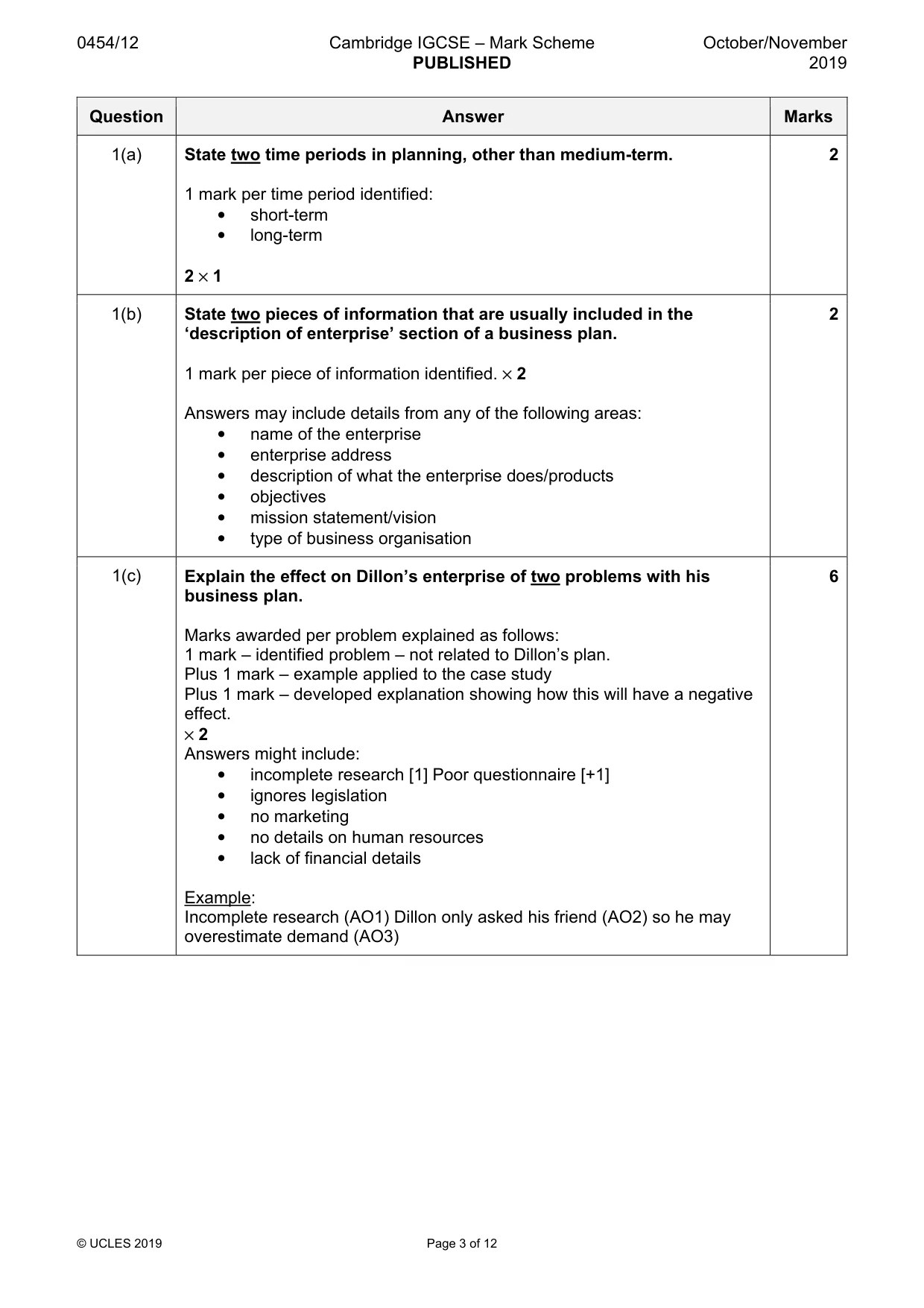
0454/12 Cambridge IGCSE – Mark Scheme PUBLISHED October/November 2019 © UCLES 2019 Page 3 of 12 Question Answer Marks 1(a) State two time periods in planning, other than medium-term. 1 mark per time period identified: • short-term • long-term 2 × 1 2 1(b) State two pieces of information that are usually included in the ‘description of enterprise’ section of a business plan. 1 mark per piece of information identified. × 2 Answers may include details from any of the following areas: • name of the enterprise • enterprise address • description of what the enterprise does/products • objectives • mission statement/vision • type of business organisation 2 1(c) Explain the effect on Dillon’s enterprise of two problems with his business plan. Marks awarded per problem explained as follows: 1 mark – identified problem – not related to Dillon’s plan. Plus 1 mark – example applied to the case study Plus 1 mark – developed explanation showing how this will have a negative effect. × 2 Answers might include: • incomplete research [1] Poor questionnaire [+1] • ignores legislation • no marketing • no details on human resources • lack of financial details Example: Incomplete research (AO1) Dillon only asked his friend (AO2) so he may overestimate demand (AO3) 6
Mark scheme, page 4
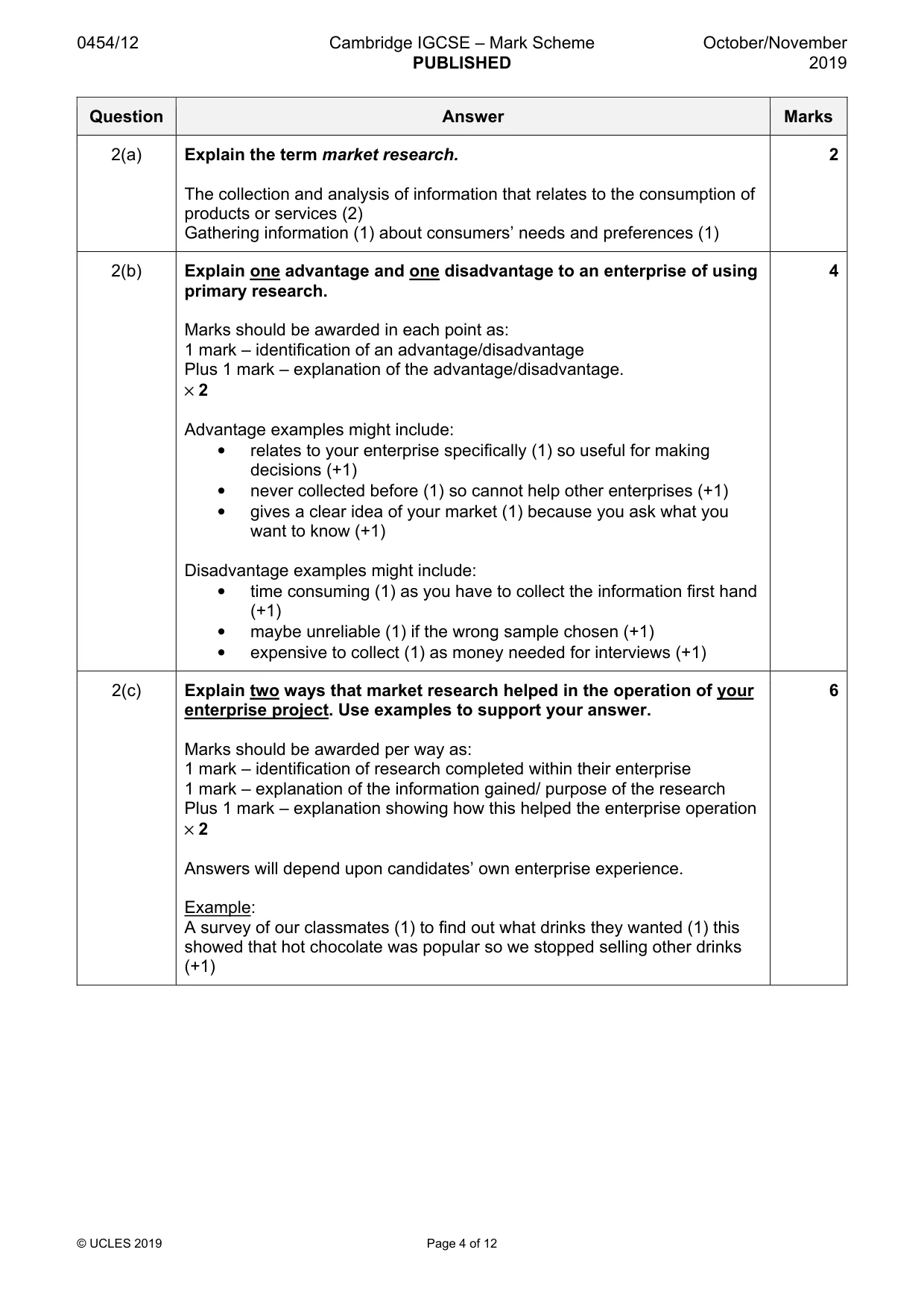
0454/12 Cambridge IGCSE – Mark Scheme PUBLISHED October/November 2019 © UCLES 2019 Page 4 of 12 Question Answer Marks 2(a) Explain the term market research. The collection and analysis of information that relates to the consumption of products or services (2) Gathering information (1) about consumers’ needs and preferences (1) 2 2(b) Explain one advantage and one disadvantage to an enterprise of using primary research. Marks should be awarded in each point as: 1 mark – identification of an advantage/disadvantage Plus 1 mark – explanation of the advantage/disadvantage. × 2 Advantage examples might include: • relates to your enterprise specifically (1) so useful for making decisions (+1) • never collected before (1) so cannot help other enterprises (+1) • gives a clear idea of your market (1) because you ask what you want to know (+1) Disadvantage examples might include: • time consuming (1) as you have to collect the information first hand (+1) • maybe unreliable (1) if the wrong sample chosen (+1) • expensive to collect (1) as money needed for interviews (+1) 4 2(c) Explain two ways that market research helped in the operation of your enterprise project. Use examples to support your answer. Marks should be awarded per way as: 1 mark – identification of research completed within their enterprise 1 mark – explanation of the information gained/ purpose of the research Plus 1 mark – explanation showing how this helped the enterprise operation × 2 Answers will depend upon candidates’ own enterprise experience. Example: A survey of our classmates (1) to find out what drinks they wanted (1) this showed that hot chocolate was popular so we stopped selling other drinks (+1) 6
Mark scheme, page 5
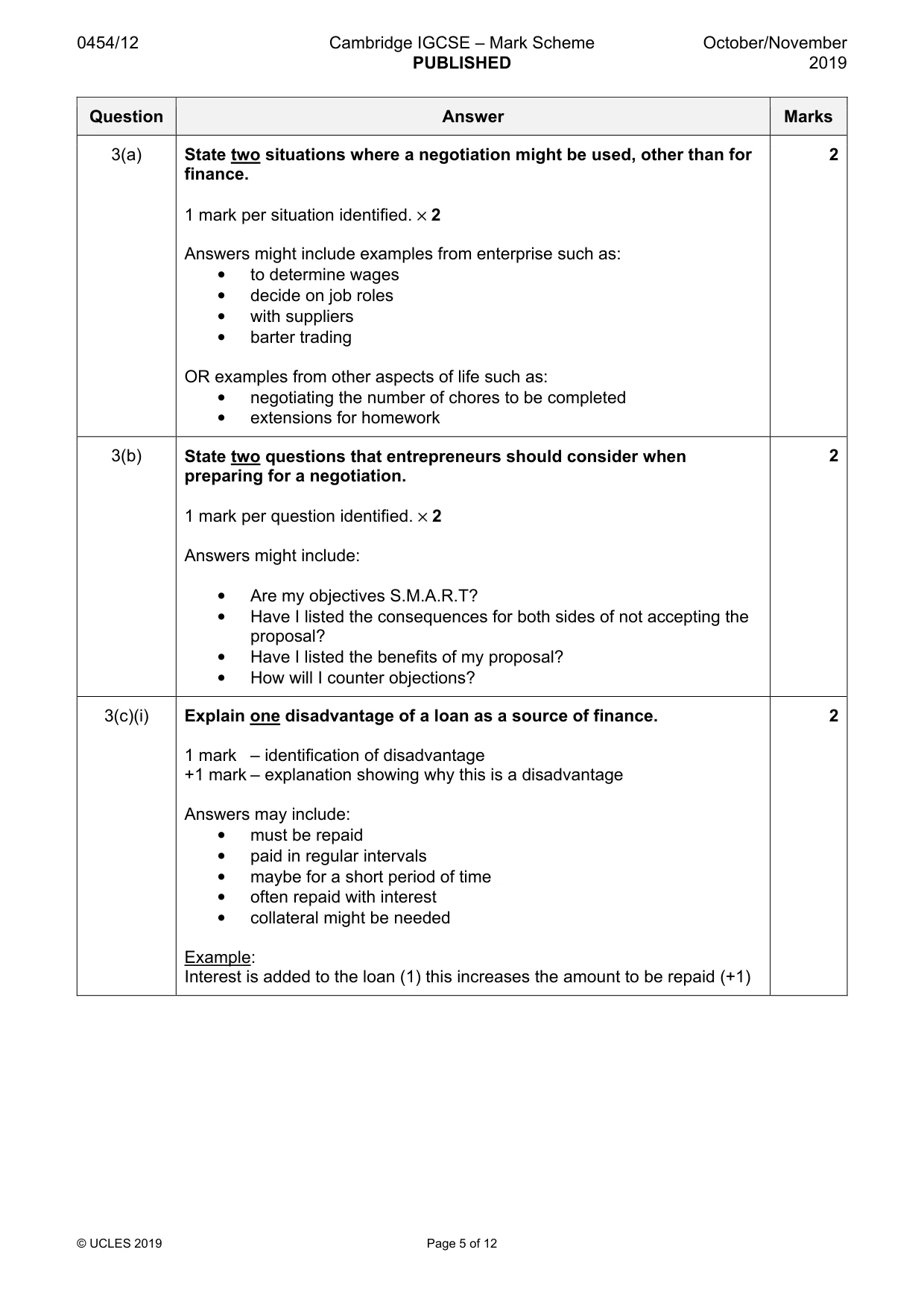
0454/12 Cambridge IGCSE – Mark Scheme PUBLISHED October/November 2019 © UCLES 2019 Page 5 of 12 Question Answer Marks 3(a) State two situations where a negotiation might be used, other than for finance. 1 mark per situation identified. × 2 Answers might include examples from enterprise such as: • to determine wages • decide on job roles • with suppliers • barter trading OR examples from other aspects of life such as: • negotiating the number of chores to be completed • extensions for homework 2 3(b) State two questions that entrepreneurs should consider when preparing for a negotiation. 1 mark per question identified. × 2 Answers might include: • Are my objectives S.M.A.R.T? • Have I listed the consequences for both sides of not accepting the proposal? • Have I listed the benefits of my proposal? • How will I counter objections? 2 3(c)(i) Explain one disadvantage of a loan as a source of finance. 1 mark – identification of disadvantage +1 mark – explanation showing why this is a disadvantage Answers may include: • must be repaid • paid in regular intervals • maybe for a short period of time • often repaid with interest • collateral might be needed Example: Interest is added to the loan (1) this increases the amount to be repaid (+1) 2
Mark scheme, page 6
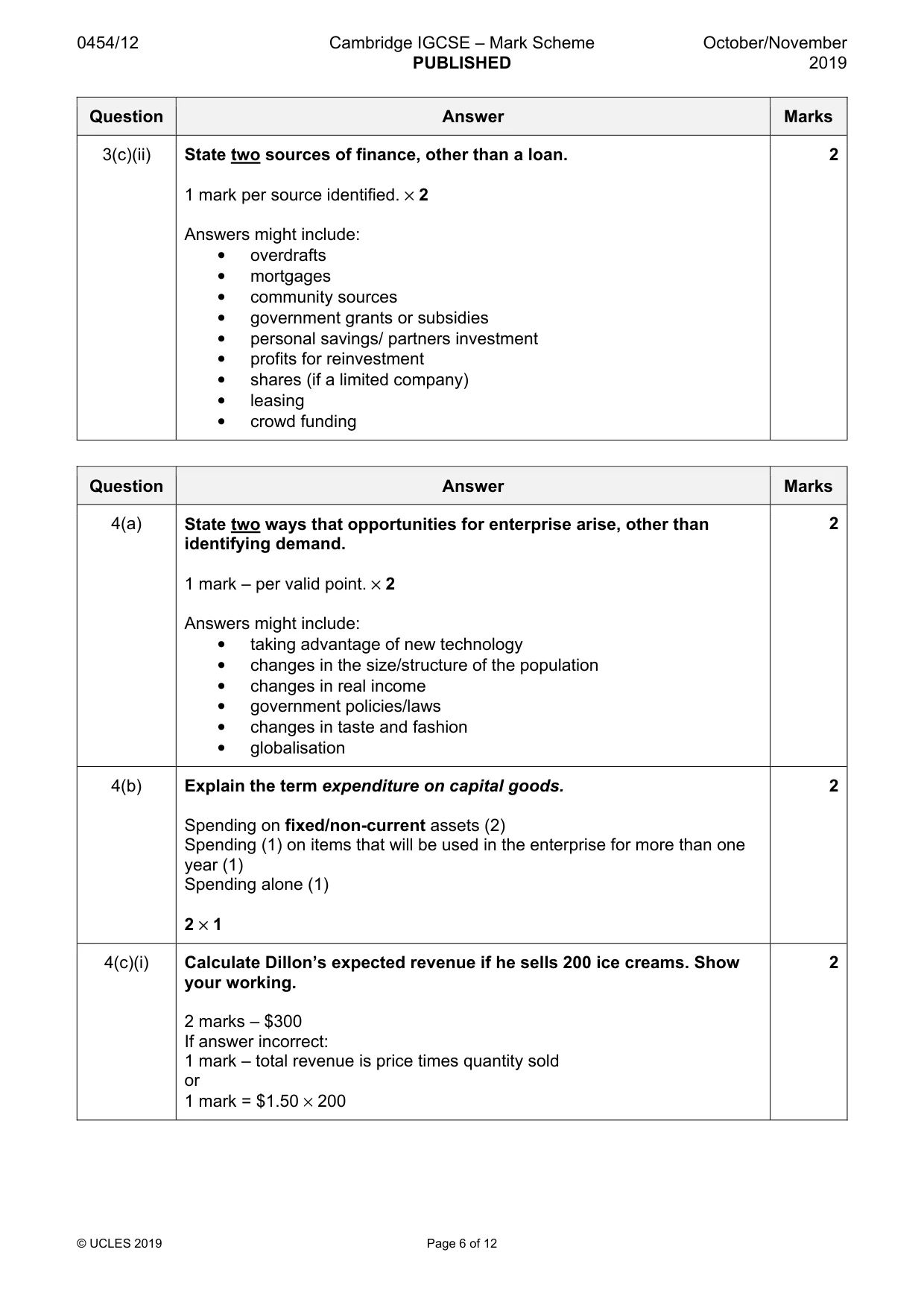
0454/12 Cambridge IGCSE – Mark Scheme PUBLISHED October/November 2019 © UCLES 2019 Page 6 of 12 Question Answer Marks 3(c)(ii) State two sources of finance, other than a loan. 1 mark per source identified. × 2 Answers might include: • overdrafts • mortgages • community sources • government grants or subsidies • personal savings/ partners investment • profits for reinvestment • shares (if a limited company) • leasing • crowd funding 2 Question Answer Marks 4(a) State two ways that opportunities for enterprise arise, other than identifying demand. 1 mark – per valid point. × 2 Answers might include: • taking advantage of new technology • changes in the size/structure of the population • changes in real income • government policies/laws • changes in taste and fashion • globalisation 2 4(b) Explain the term expenditure on capital goods. Spending on fixed/non-current assets (2) Spending (1) on items that will be used in the enterprise for more than one year (1) Spending alone (1) 2 × 1 2 4(c)(i) Calculate Dillon’s expected revenue if he sells 200 ice creams. Show your working. 2 marks – $300 If answer incorrect: 1 mark – total revenue is price times quantity sold or 1 mark = $1.50 × 200 2
Mark scheme, page 7
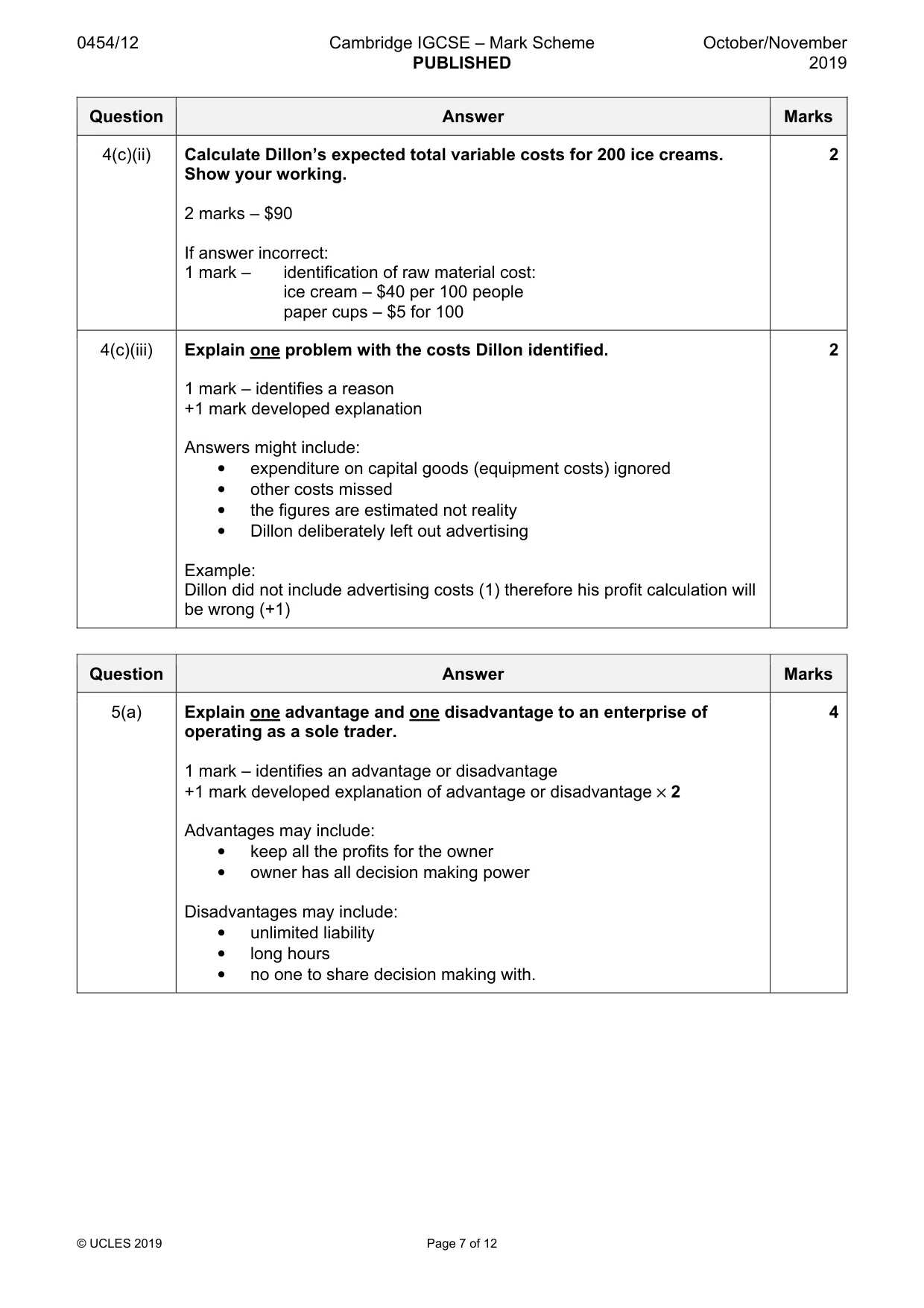
0454/12 Cambridge IGCSE – Mark Scheme PUBLISHED October/November 2019 © UCLES 2019 Page 7 of 12 Question Answer Marks 4(c)(ii) Calculate Dillon’s expected total variable costs for 200 ice creams. Show your working. 2 marks – $90 If answer incorrect: 1 mark – identification of raw material cost: ice cream – $40 per 100 people paper cups – $5 for 100 2 4(c)(iii) Explain one problem with the costs Dillon identified. 1 mark – identifies a reason +1 mark developed explanation Answers might include: • expenditure on capital goods (equipment costs) ignored • other costs missed • the figures are estimated not reality • Dillon deliberately left out advertising Example: Dillon did not include advertising costs (1) therefore his profit calculation will be wrong (+1) 2 Question Answer Marks 5(a) Explain one advantage and one disadvantage to an enterprise of operating as a sole trader. 1 mark – identifies an advantage or disadvantage +1 mark developed explanation of advantage or disadvantage × 2 Advantages may include: • keep all the profits for the owner • owner has all decision making power Disadvantages may include: • unlimited liability • long hours • no one to share decision making with. 4
Mark scheme, page 8
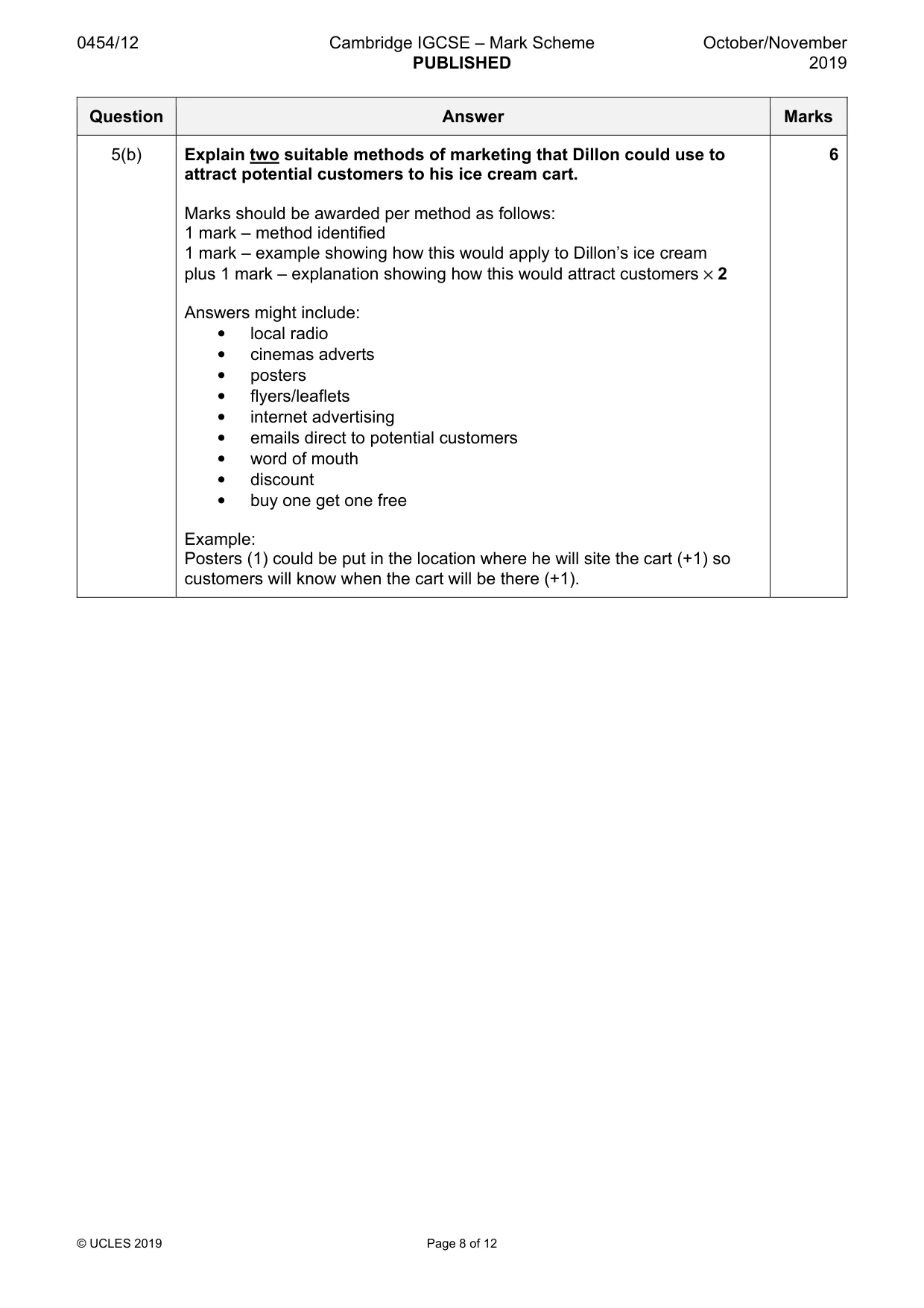
0454/12 Cambridge IGCSE – Mark Scheme PUBLISHED October/November 2019 © UCLES 2019 Page 8 of 12 Question Answer Marks 5(b) Explain two suitable methods of marketing that Dillon could use to attract potential customers to his ice cream cart. Marks should be awarded per method as follows: 1 mark – method identified 1 mark – example showing how this would apply to Dillon’s ice cream plus 1 mark – explanation showing how this would attract customers × 2 Answers might include: • local radio • cinemas adverts • posters • flyers/leaflets • internet advertising • emails direct to potential customers • word of mouth • discount • buy one get one free Example: Posters (1) could be put in the location where he will site the cart (+1) so customers will know when the cart will be there (+1). 6
Mark scheme, page 9
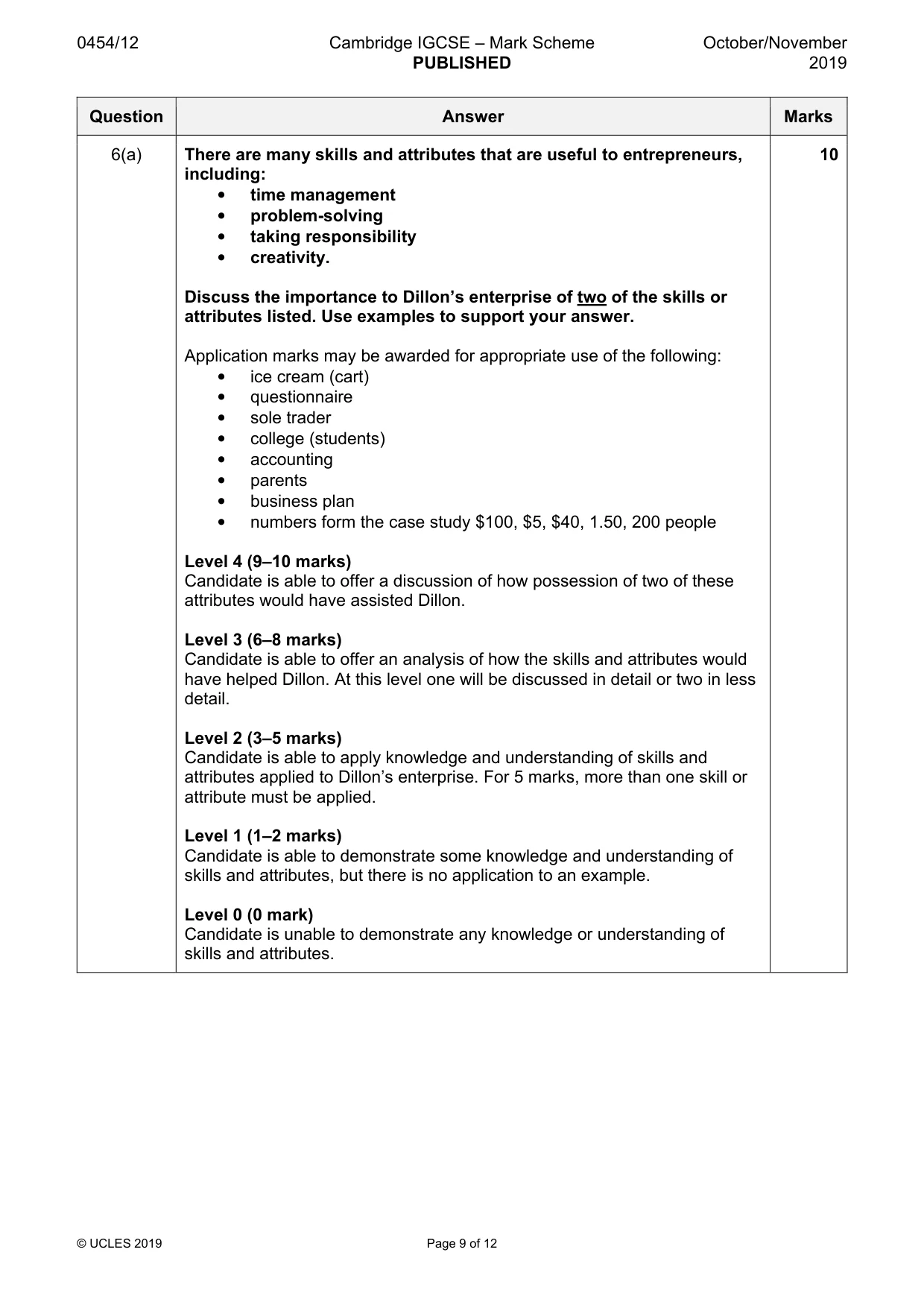
0454/12 Cambridge IGCSE – Mark Scheme PUBLISHED October/November 2019 © UCLES 2019 Page 9 of 12 Question Answer Marks 6(a) There are many skills and attributes that are useful to entrepreneurs, including: • time management • problem-solving • taking responsibility • creativity. Discuss the importance to Dillon’s enterprise of two of the skills or attributes listed. Use examples to support your answer. Application marks may be awarded for appropriate use of the following: • ice cream (cart) • questionnaire • sole trader • college (students) • accounting • parents • business plan • numbers form the case study $100, $5, $40, 1.50, 200 people Level 4 (9–10 marks) Candidate is able to offer a discussion of how possession of two of these attributes would have assisted Dillon. Level 3 (6–8 marks) Candidate is able to offer an analysis of how the skills and attributes would have helped Dillon. At this level one will be discussed in detail or two in less detail. Level 2 (3–5 marks) Candidate is able to apply knowledge and understanding of skills and attributes applied to Dillon’s enterprise. For 5 marks, more than one skill or attribute must be applied. Level 1 (1–2 marks) Candidate is able to demonstrate some knowledge and understanding of skills and attributes, but there is no application to an example. Level 0 (0 mark) Candidate is unable to demonstrate any knowledge or understanding of skills and attributes. 10
Mark scheme, page 10
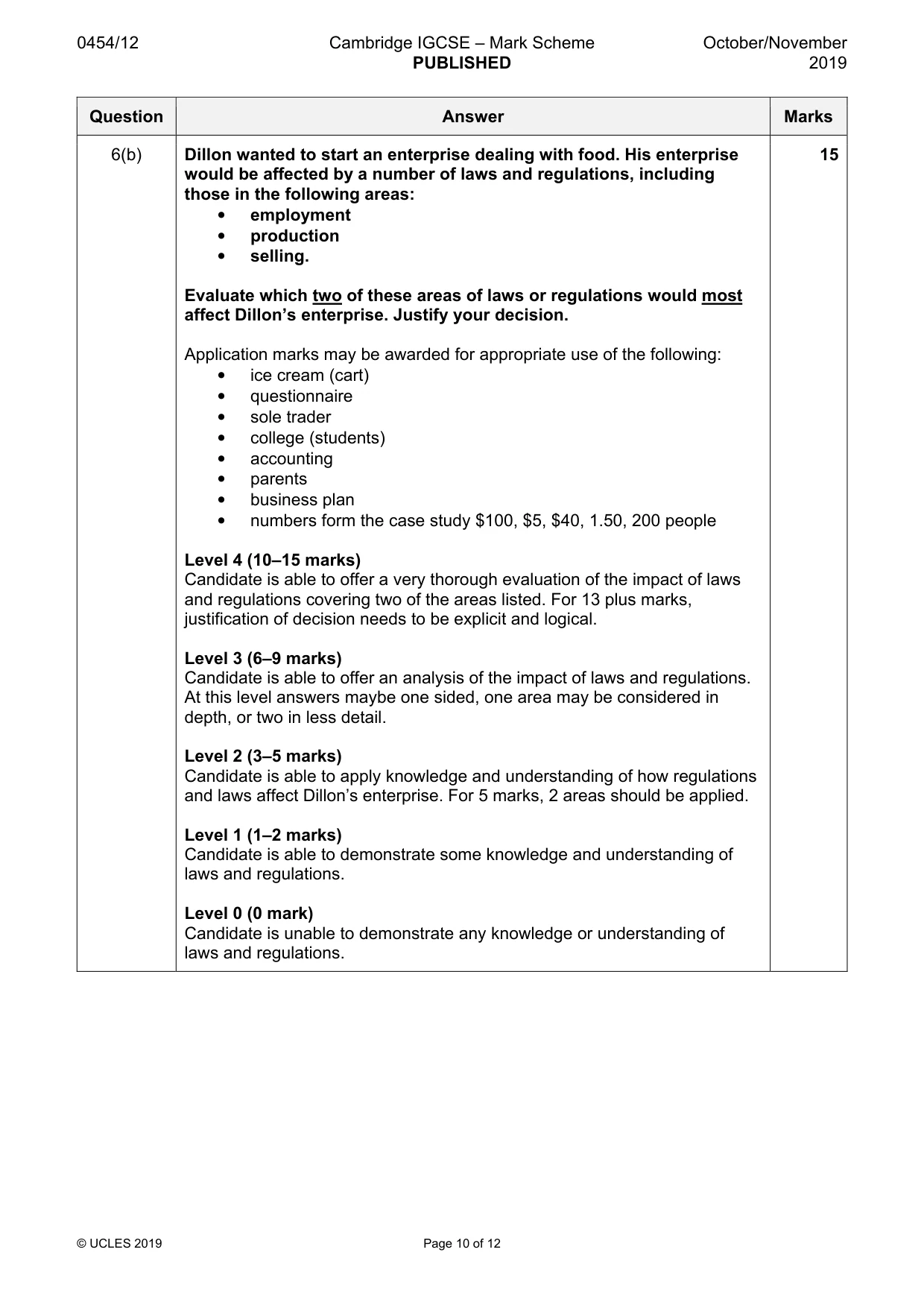
0454/12 Cambridge IGCSE – Mark Scheme PUBLISHED October/November 2019 © UCLES 2019 Page 10 of 12 Question Answer Marks 6(b) Dillon wanted to start an enterprise dealing with food. His enterprise would be affected by a number of laws and regulations, including those in the following areas: • employment • production • selling. Evaluate which two of these areas of laws or regulations would most affect Dillon’s enterprise. Justify your decision. Application marks may be awarded for appropriate use of the following: • ice cream (cart) • questionnaire • sole trader • college (students) • accounting • parents • business plan • numbers form the case study $100, $5, $40, 1.50, 200 people Level 4 (10–15 marks) Candidate is able to offer a very thorough evaluation of the impact of laws and regulations covering two of the areas listed. For 13 plus marks, justification of decision needs to be explicit and logical. Level 3 (6–9 marks) Candidate is able to offer an analysis of the impact of laws and regulations. At this level answers maybe one sided, one area may be considered in depth, or two in less detail. Level 2 (3–5 marks) Candidate is able to apply knowledge and understanding of how regulations and laws affect Dillon’s enterprise. For 5 marks, 2 areas should be applied. Level 1 (1–2 marks) Candidate is able to demonstrate some knowledge and understanding of laws and regulations. Level 0 (0 mark) Candidate is unable to demonstrate any knowledge or understanding of laws and regulations. 15
Mark scheme, page 11
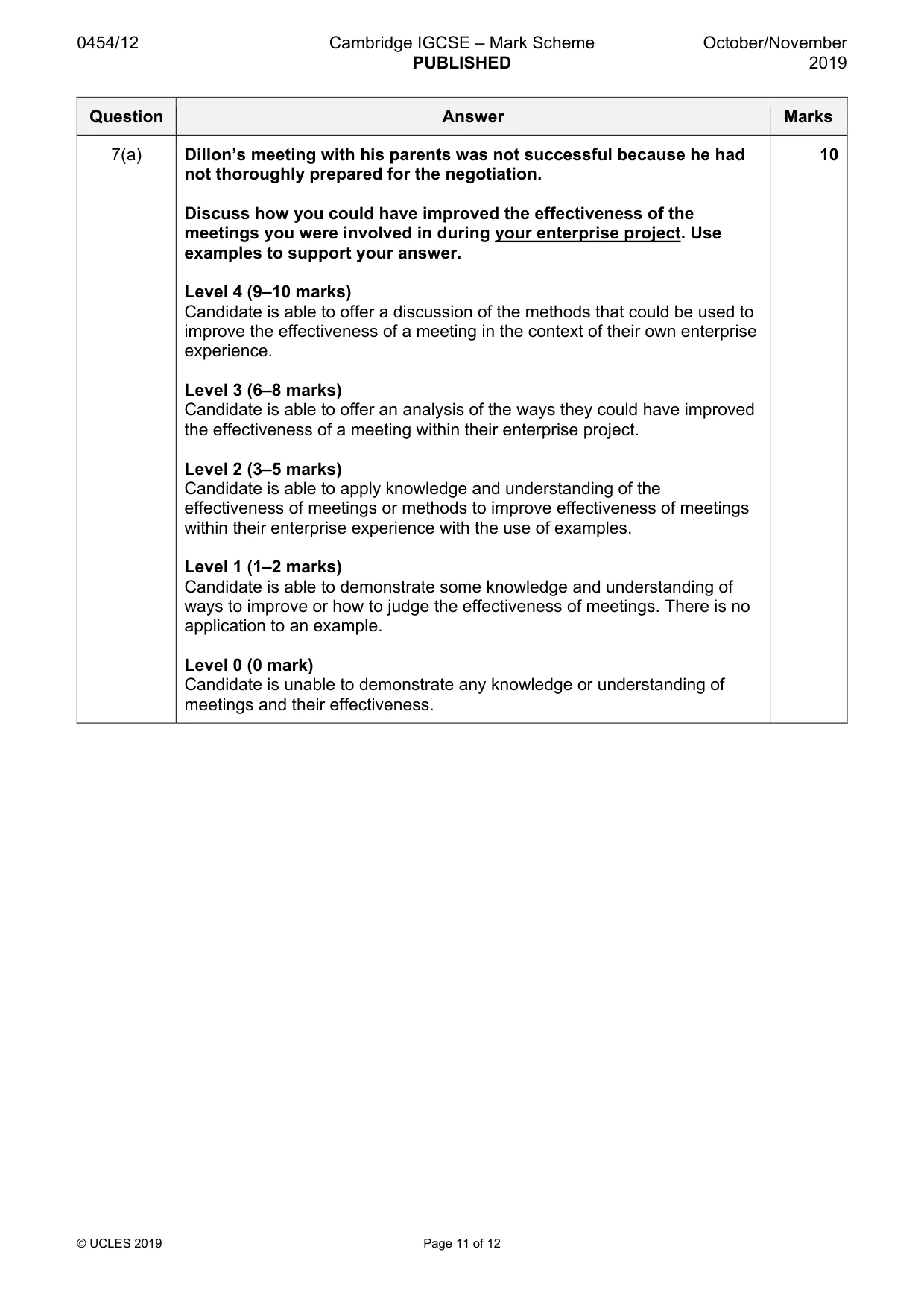
0454/12 Cambridge IGCSE – Mark Scheme PUBLISHED October/November 2019 © UCLES 2019 Page 11 of 12 Question Answer Marks 7(a) Dillon’s meeting with his parents was not successful because he had not thoroughly prepared for the negotiation. Discuss how you could have improved the effectiveness of the meetings you were involved in during your enterprise project. Use examples to support your answer. Level 4 (9–10 marks) Candidate is able to offer a discussion of the methods that could be used to improve the effectiveness of a meeting in the context of their own enterprise experience. Level 3 (6–8 marks) Candidate is able to offer an analysis of the ways they could have improved the effectiveness of a meeting within their enterprise project. Level 2 (3–5 marks) Candidate is able to apply knowledge and understanding of the effectiveness of meetings or methods to improve effectiveness of meetings within their enterprise experience with the use of examples. Level 1 (1–2 marks) Candidate is able to demonstrate some knowledge and understanding of ways to improve or how to judge the effectiveness of meetings. There is no application to an example. Level 0 (0 mark) Candidate is unable to demonstrate any knowledge or understanding of meetings and their effectiveness. 10
Mark scheme, page 12
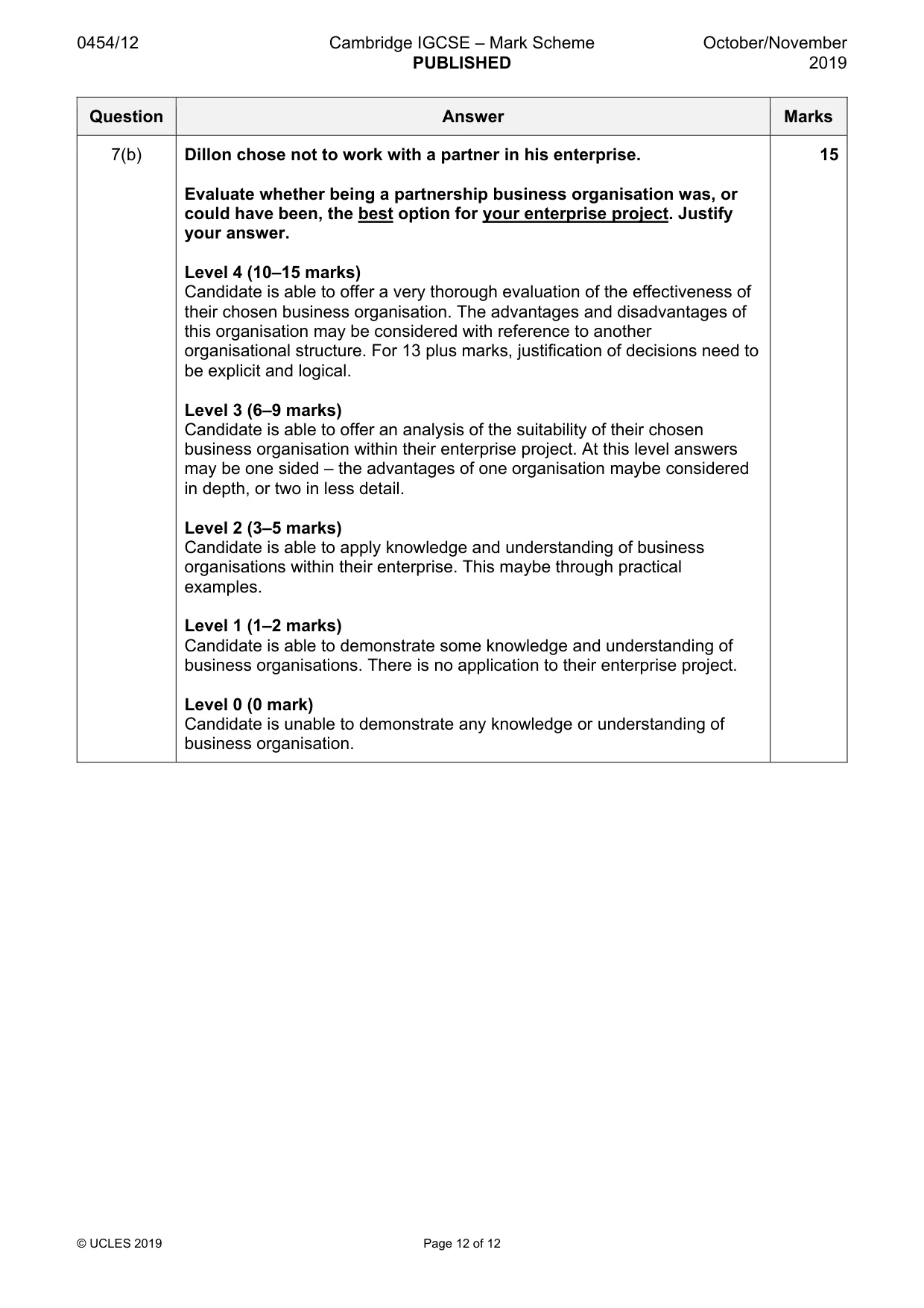
0454/12 Cambridge IGCSE – Mark Scheme PUBLISHED October/November 2019 © UCLES 2019 Page 12 of 12 Question Answer Marks 7(b) Dillon chose not to work with a partner in his enterprise. Evaluate whether being a partnership business organisation was, or could have been, the best option for your enterprise project. Justify your answer. Level 4 (10–15 marks) Candidate is able to offer a very thorough evaluation of the effectiveness of their chosen business organisation. The advantages and disadvantages of this organisation may be considered with reference to another organisational structure. For 13 plus marks, justification of decisions need to be explicit and logical. Level 3 (6–9 marks) Candidate is able to offer an analysis of the suitability of their chosen business organisation within their enterprise project. At this level answers may be one sided – the advantages of one organisation maybe considered in depth, or two in less detail. Level 2 (3–5 marks) Candidate is able to apply knowledge and understanding of business organisations within their enterprise. This maybe through practical examples. Level 1 (1–2 marks) Candidate is able to demonstrate some knowledge and understanding of business organisations. There is no application to their enterprise project. Level 0 (0 mark) Candidate is unable to demonstrate any knowledge or understanding of business organisation. 15
What you needed in this session
Cambridge’s own grade thresholds for 2019 Oct/Nov, Paper 1 · Variant 2. A higher threshold means an easier paper — the bar moves with how the cohort did.