Cambridge IGCSE Enterprise 0454 — 2016 Oct/Nov Paper 1 · Variant 1
0454/11/O/N/16 · 100 marks · ≈113 min
The question paper and its mark scheme, free to read here and free to download. This is Cambridge’s own paper, exactly as it was sat.
Question paper16 pages




Mark scheme14 pages
Answers below. Sit the paper first if you are practising.
Paper as text
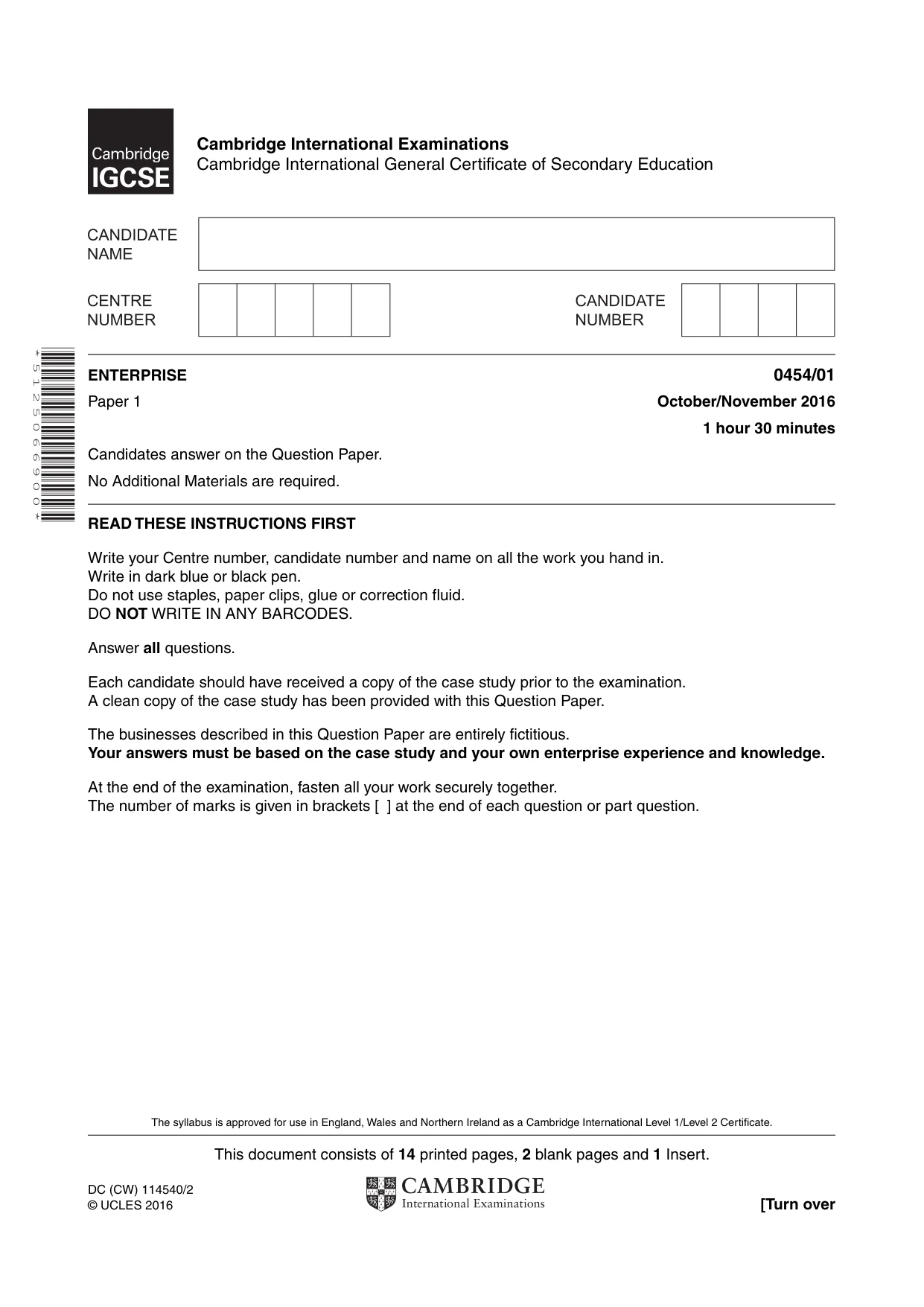
Question paper, page 1
This document consists of 14 printed pages, 2 blank pages and 1 Insert. DC (CW) 114540/2 © UCLES 2016 [Turn over Cambridge International Examinations Cambridge International General Certificate of Secondary Education * 5 1 2 5 0 6 6 9 0 0 * ENTERPRISE 0454/01 Paper 1 October/November 2016 1 hour 30 minutes Candidates answer on the Question Paper. No Additional Materials are required. READ THESE INSTRUCTIONS FIRST Write your Centre number, candidate number and name on all the work you hand in. Write in dark blue or black pen. Do not use staples, paper clips, glue or correction fluid. DO NOT WRITE IN ANY BARCODES. Answer all questions. Each candidate should have received a copy of the case study prior to the examination. A clean copy of the case study has been provided with this Question Paper. The businesses described in this Question Paper are entirely fictitious. Your answers must be based on the case study and your own enterprise experience and knowledge. At the end of the examination, fasten all your work securely together. The number of marks is given in brackets [ ] at the end of each question or part question. The syllabus is approved for use in England, Wales and Northern Ireland as a Cambridge International Level 1/Level 2 Certificate.
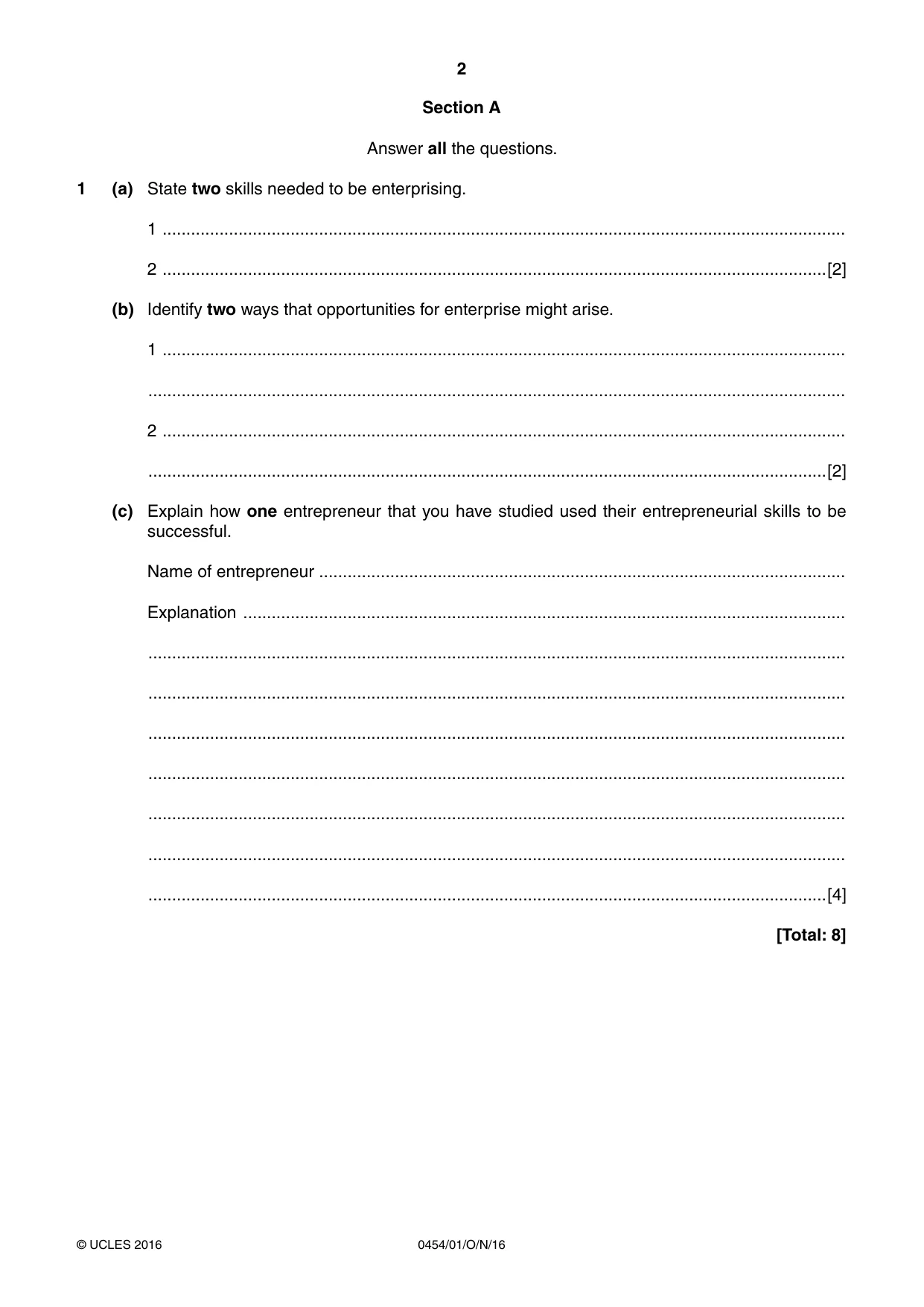
Question paper, page 2
2 0454/01/O/N/16 © UCLES 2016 Section A Answer all the questions. 1 (a) State two skills needed to be enterprising. 1 … 2 …[2] (b) Identify two ways that opportunities for enterprise might arise. 1 … … 2 … …[2] (c) Explain how one entrepreneur that you have studied used their entrepreneurial skills to be successful. Name of entrepreneur … Explanation … … … … … … … …[4] [Total: 8]
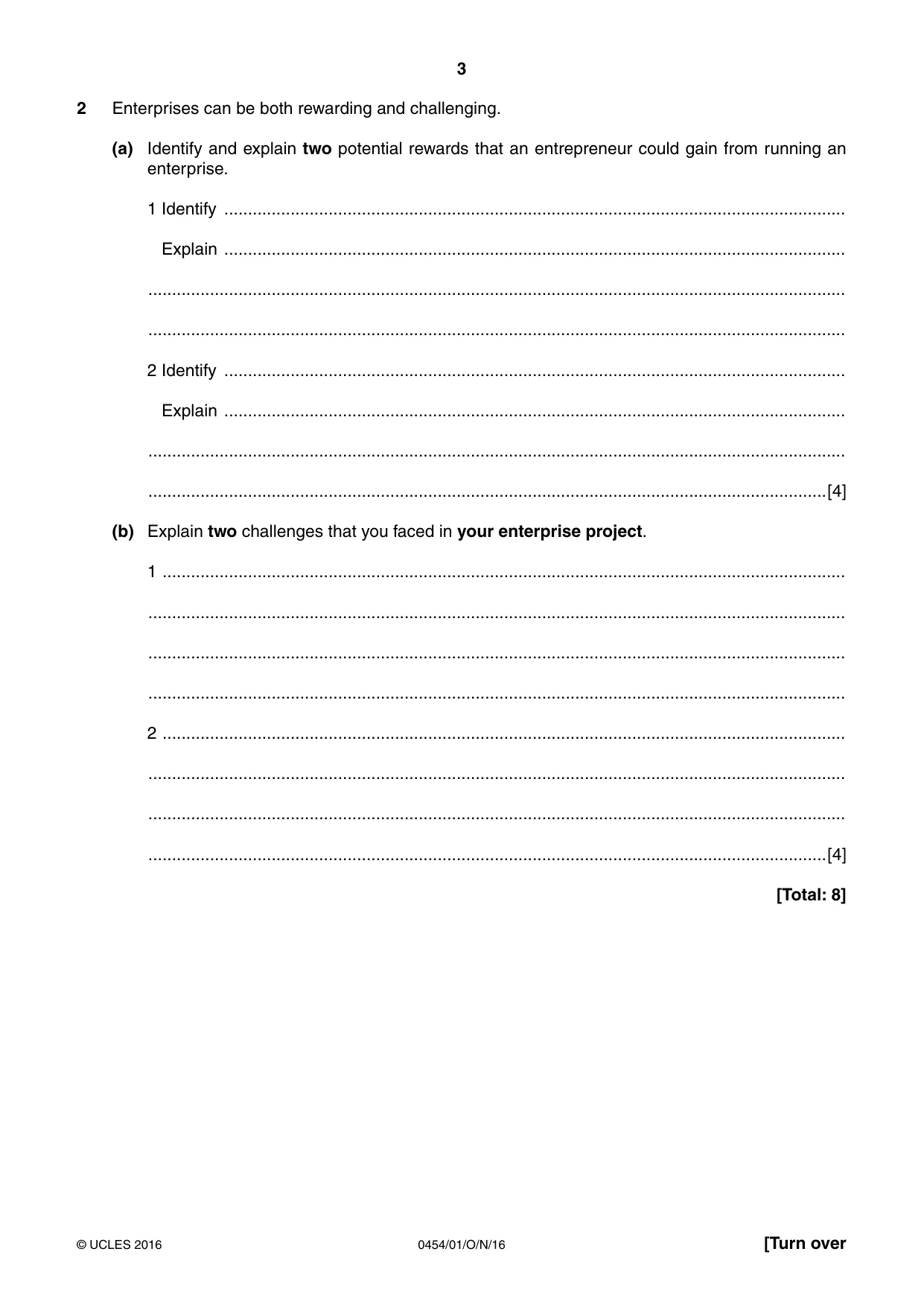
Question paper, page 3
3 0454/01/O/N/16 © UCLES 2016 [Turn over 2 Enterprises can be both rewarding and challenging. (a) Identify and explain two potential rewards that an entrepreneur could gain from running an enterprise. 1 Identify … Explain … … … 2 Identify … Explain … … …[4] (b) Explain two challenges that you faced in your enterprise project. 1 … … … … 2 … … … …[4] [Total: 8]
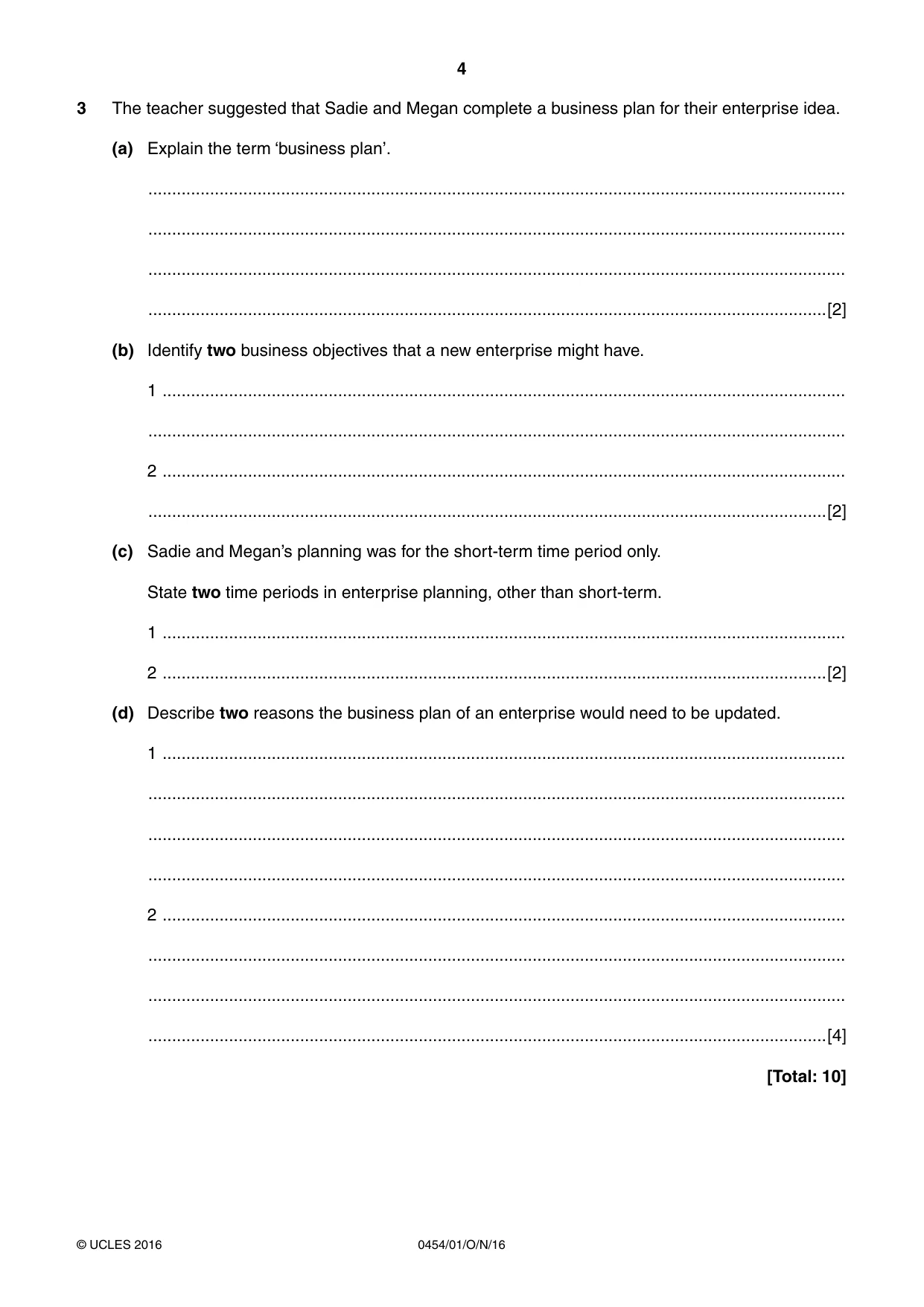
Question paper, page 4
4 0454/01/O/N/16 © UCLES 2016 3 The teacher suggested that Sadie and Megan complete a business plan for their enterprise idea. (a) Explain the term ‘business plan’. … … … …[2] (b) Identify two business objectives that a new enterprise might have. 1 … … 2 … …[2] (c) Sadie and Megan’s planning was for the short-term time period only. State two time periods in enterprise planning, other than short-term. 1 … 2 …[2] (d) Describe two reasons the business plan of an enterprise would need to be updated. 1 … … … … 2 … … … …[4] [Total: 10]
Question paper, page 5
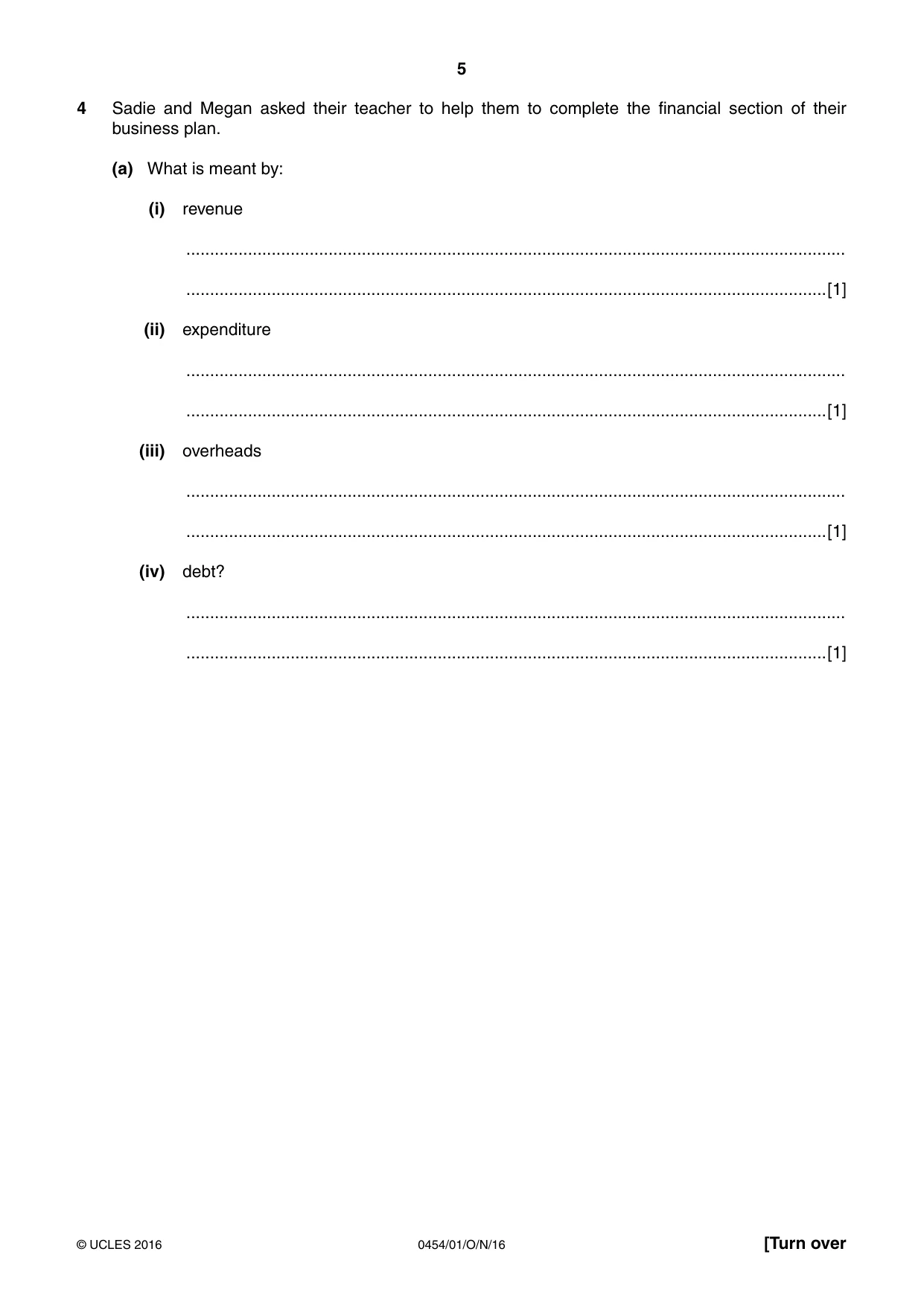
5 0454/01/O/N/16 © UCLES 2016 [Turn over 4 Sadie and Megan asked their teacher to help them to complete the financial section of their business plan. (a) What is meant by: (i) revenue … …[1] (ii) expenditure … …[1] (iii) overheads … …[1] (iv) debt? … …[1]
Question paper, page 6
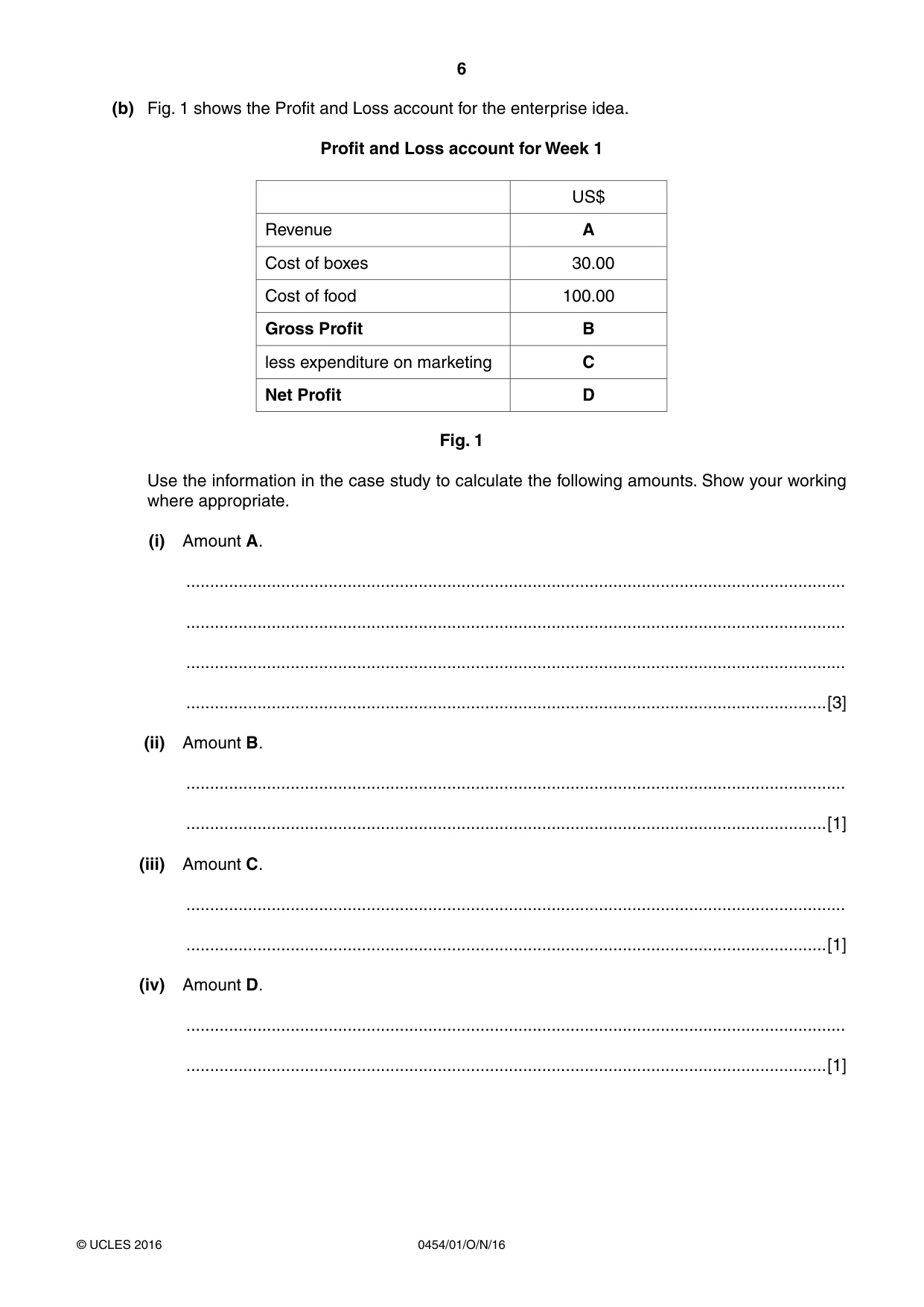
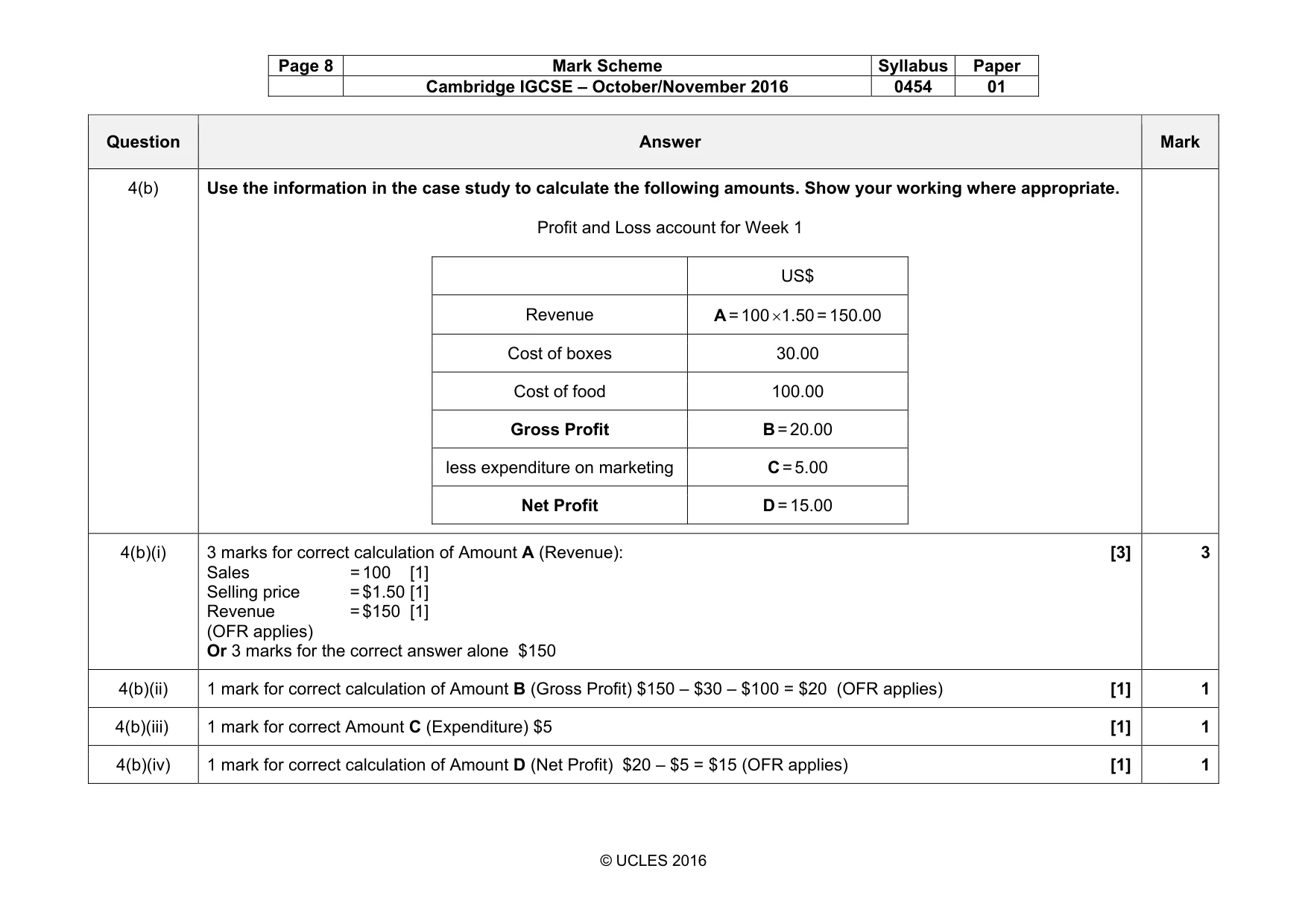
6 0454/01/O/N/16 © UCLES 2016 (b) Fig. 1 shows the Profit and Loss account for the enterprise idea. Profit and Loss account for Week 1 US$ Revenue A Cost of boxes 30.00 Cost of food 100.00 Gross Profit B less expenditure on marketing C Net Profit D Fig. 1 Use the information in the case study to calculate the following amounts. Show your working where appropriate. (i) Amount A. … … … …[3] (ii) Amount B. … …[1] (iii) Amount C. … …[1] (iv) Amount D. … …[1]
Question paper, page 7
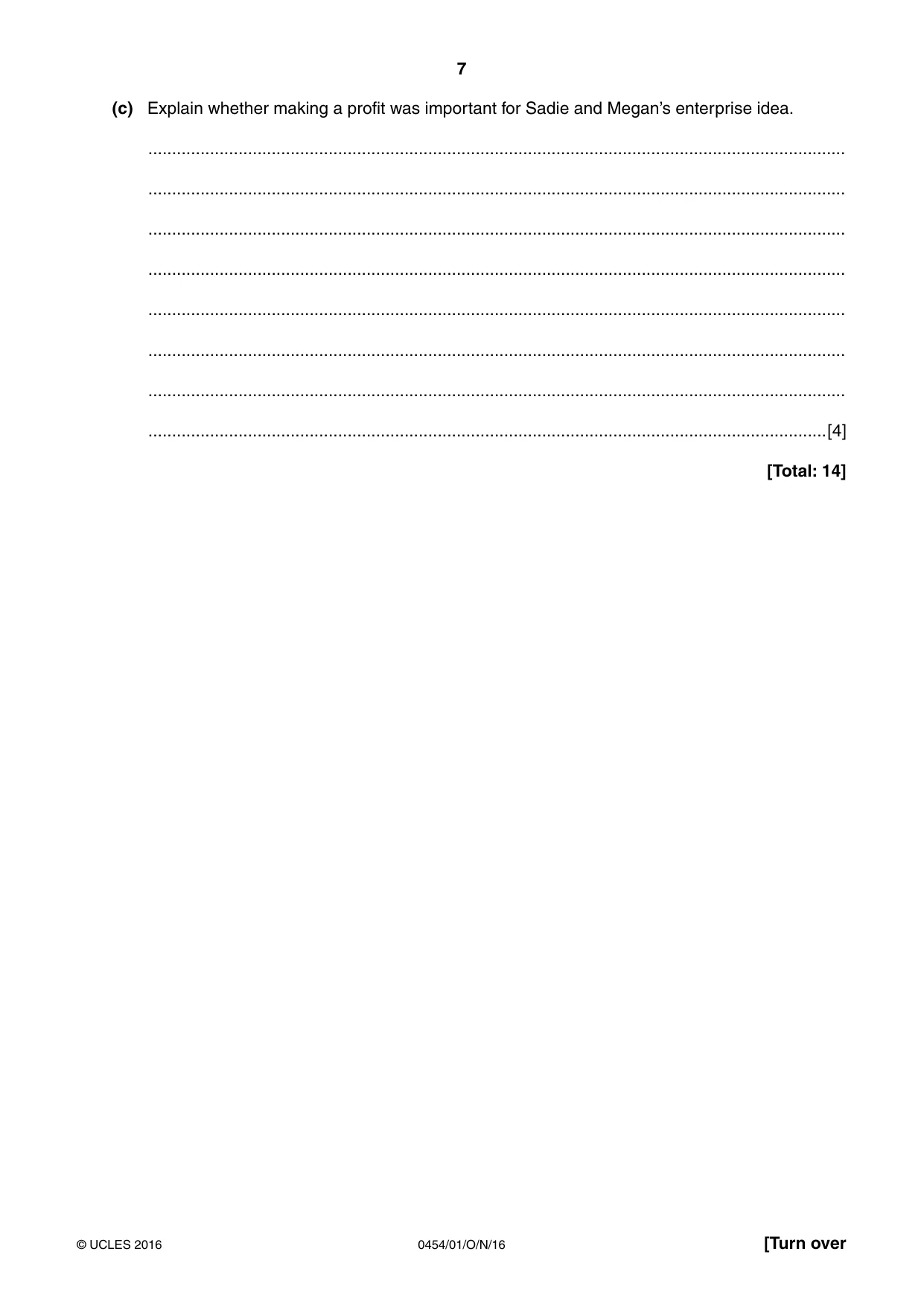
7 0454/01/O/N/16 © UCLES 2016 [Turn over (c) Explain whether making a profit was important for Sadie and Megan’s enterprise idea. … … … … … … … …[4] [Total: 14]
Question paper, page 8
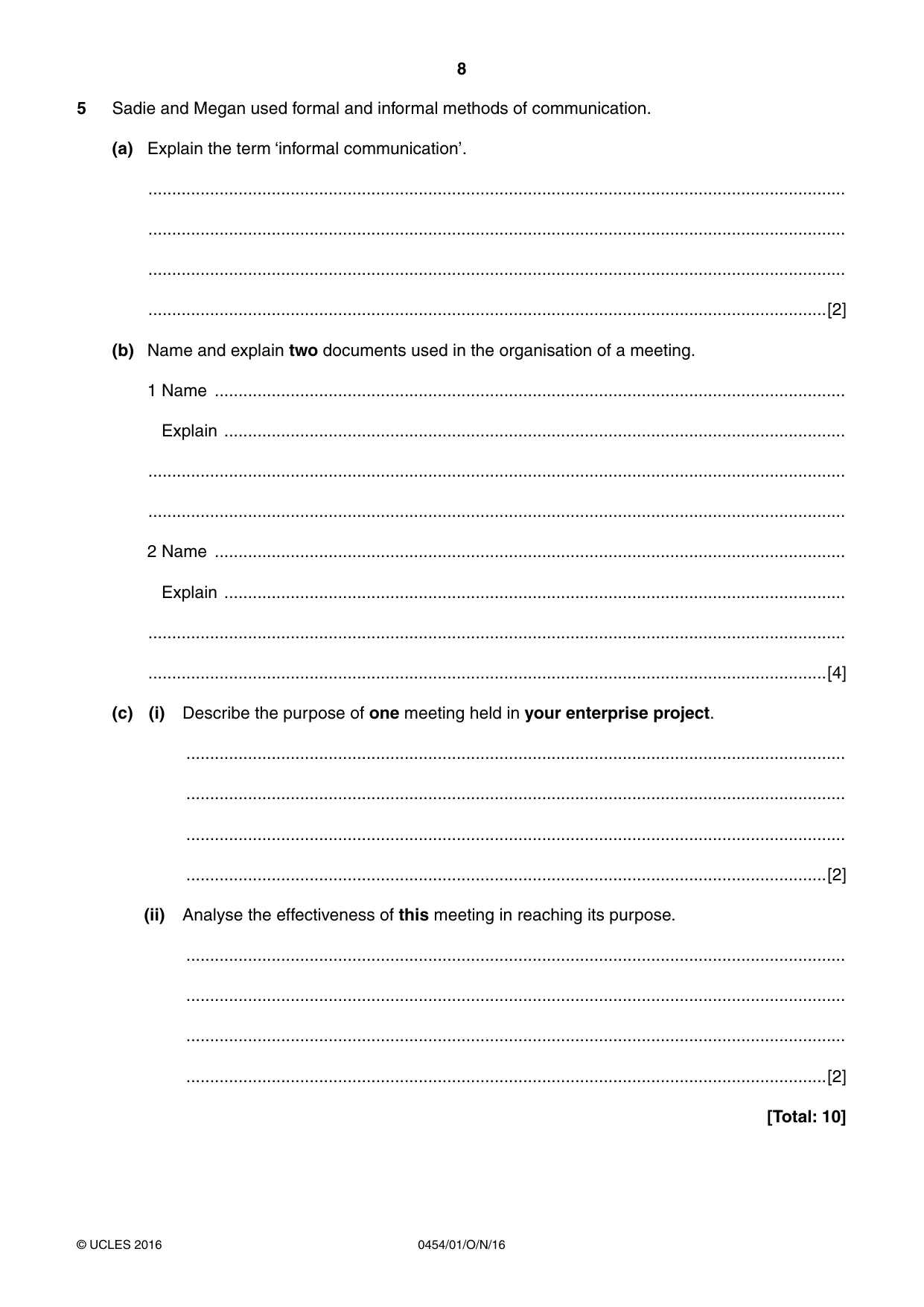
8 0454/01/O/N/16 © UCLES 2016 5 Sadie and Megan used formal and informal methods of communication. (a) Explain the term ‘informal communication’. … … … …[2] (b) Name and explain two documents used in the organisation of a meeting. 1 Name … Explain … … … 2 Name … Explain … … …[4] (c) (i) Describe the purpose of one meeting held in your enterprise project. … … … …[2] (ii) Analyse the effectiveness of this meeting in reaching its purpose. … … … …[2] [Total: 10]
Question paper, page 9
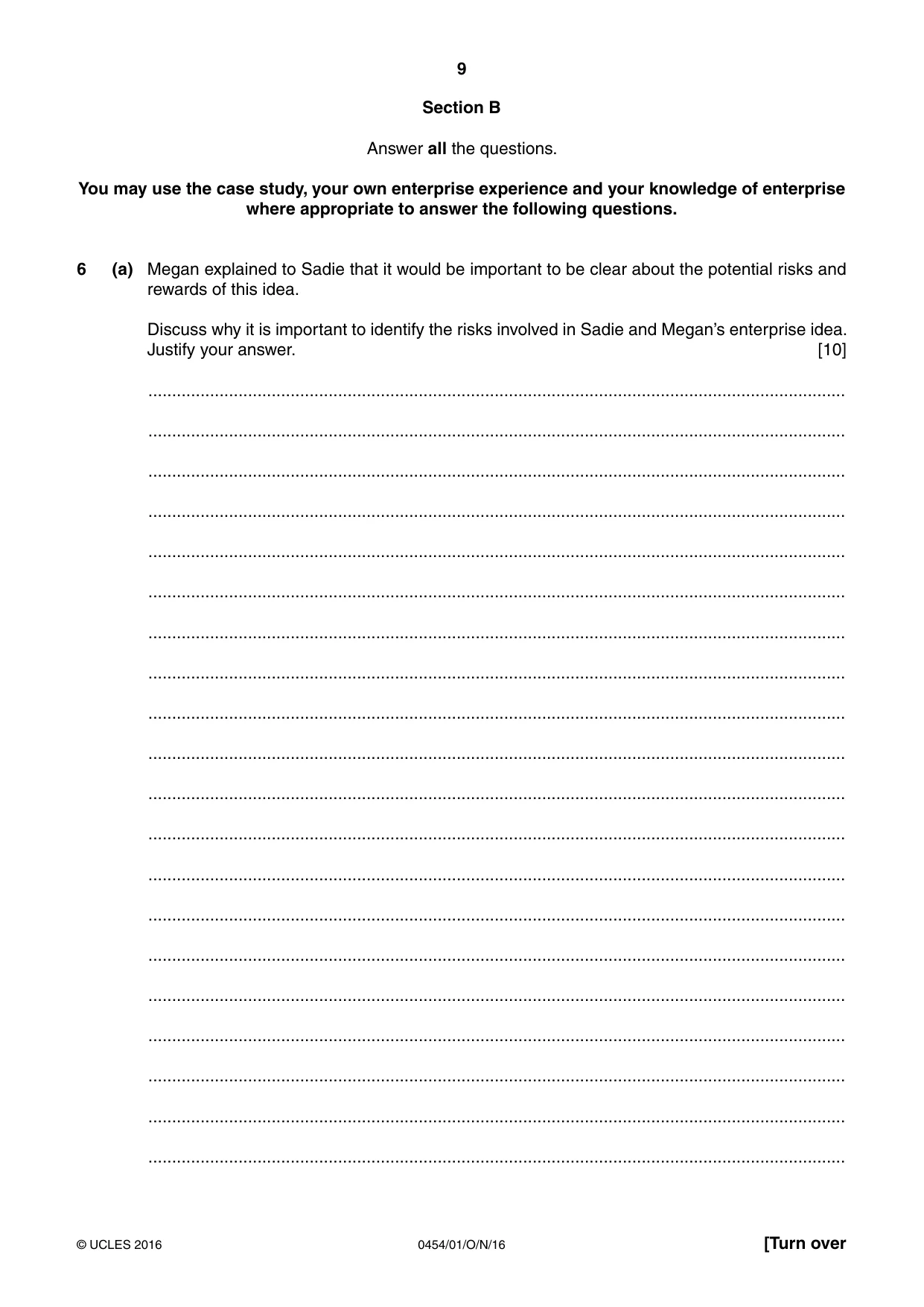
9 0454/01/O/N/16 © UCLES 2016 [Turn over Section B Answer all the questions. You may use the case study, your own enterprise experience and your knowledge of enterprise where appropriate to answer the following questions. 6 (a) Megan explained to Sadie that it would be important to be clear about the potential risks and rewards of this idea. Discuss why it is important to identify the risks involved in Sadie and Megan’s enterprise idea. Justify your answer. [10] … … … … … … … … … … … … … … … … … … … …
Question paper, page 10
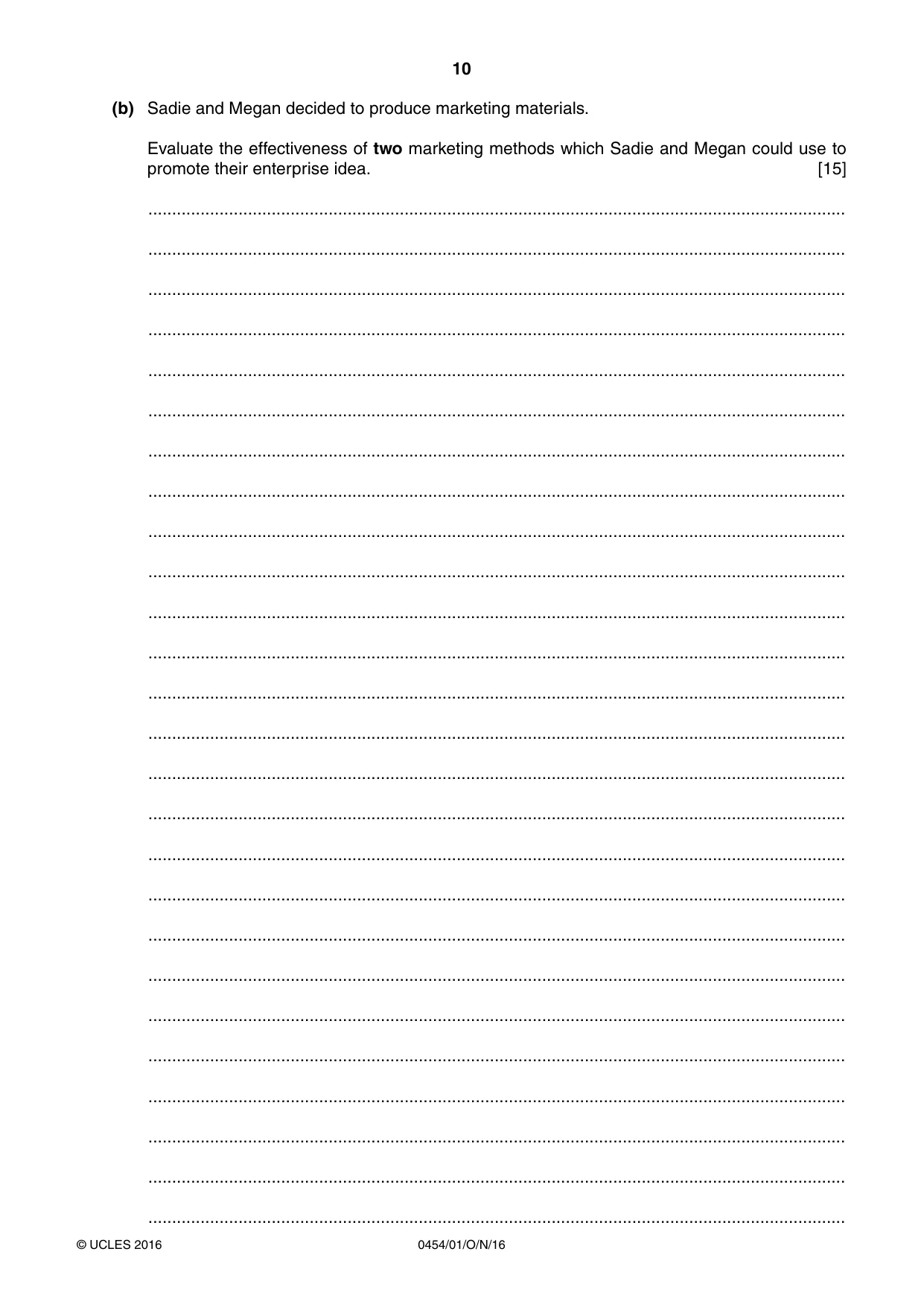
10 0454/01/O/N/16 © UCLES 2016 (b) Sadie and Megan decided to produce marketing materials. Evaluate the effectiveness of two marketing methods which Sadie and Megan could use to promote their enterprise idea. [15] … … … … … … … … … … … … … … … … … … … … … … … … … …
Question paper, page 11
11 0454/01/O/N/16 © UCLES 2016 [Turn over … … … … … … … … … … … … … … … … … … … … … … … … … … … [Total: 25]
Question paper, page 12
12 0454/01/O/N/16 © UCLES 2016 BLANK PAGE
Question paper, page 13
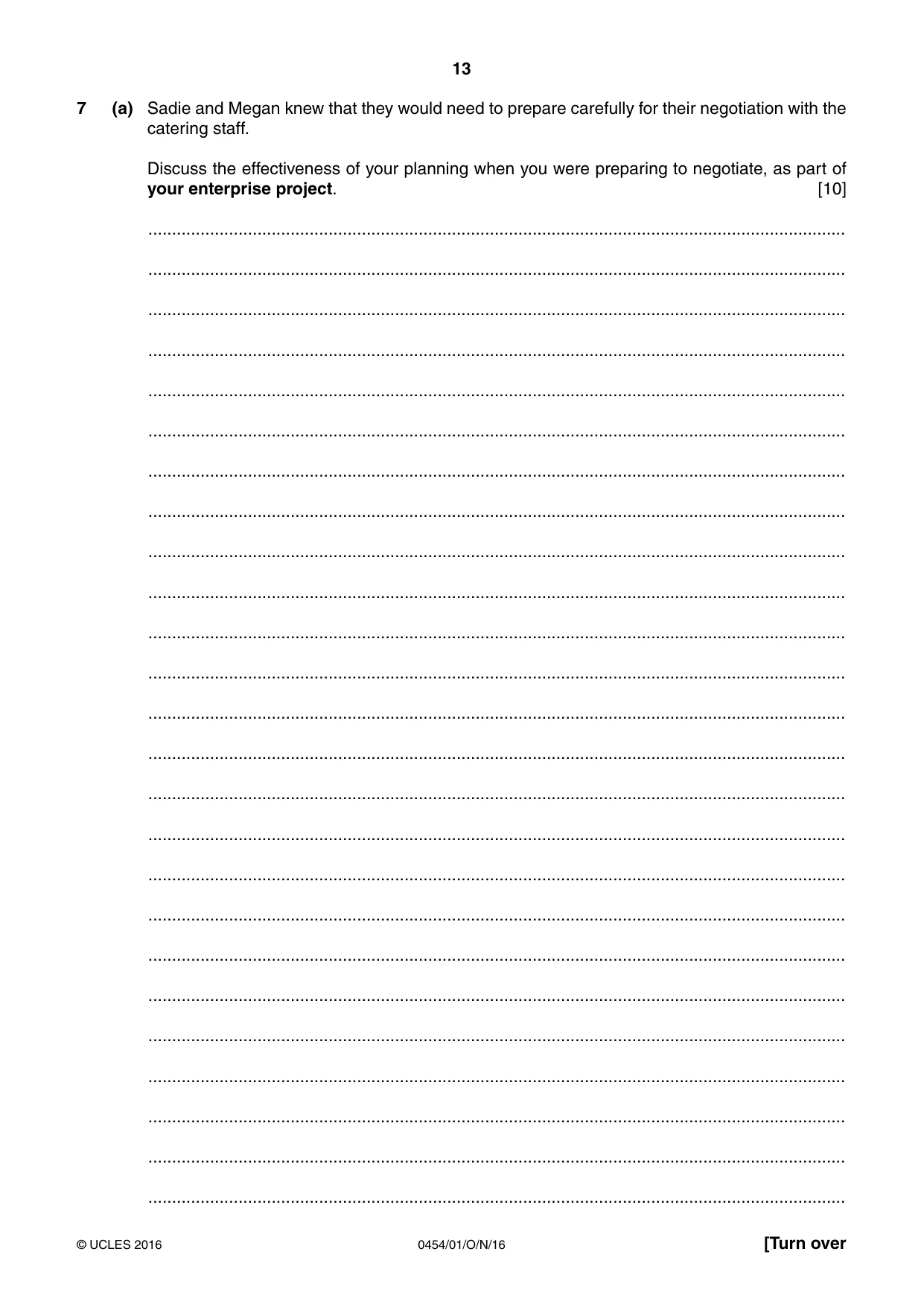
13 0454/01/O/N/16 © UCLES 2016 [Turn over 7 (a) Sadie and Megan knew that they would need to prepare carefully for their negotiation with the catering staff. Discuss the effectiveness of your planning when you were preparing to negotiate, as part of your enterprise project. [10] … … … … … … … … … … … … … … … … … … … … … … … … …
Question paper, page 14
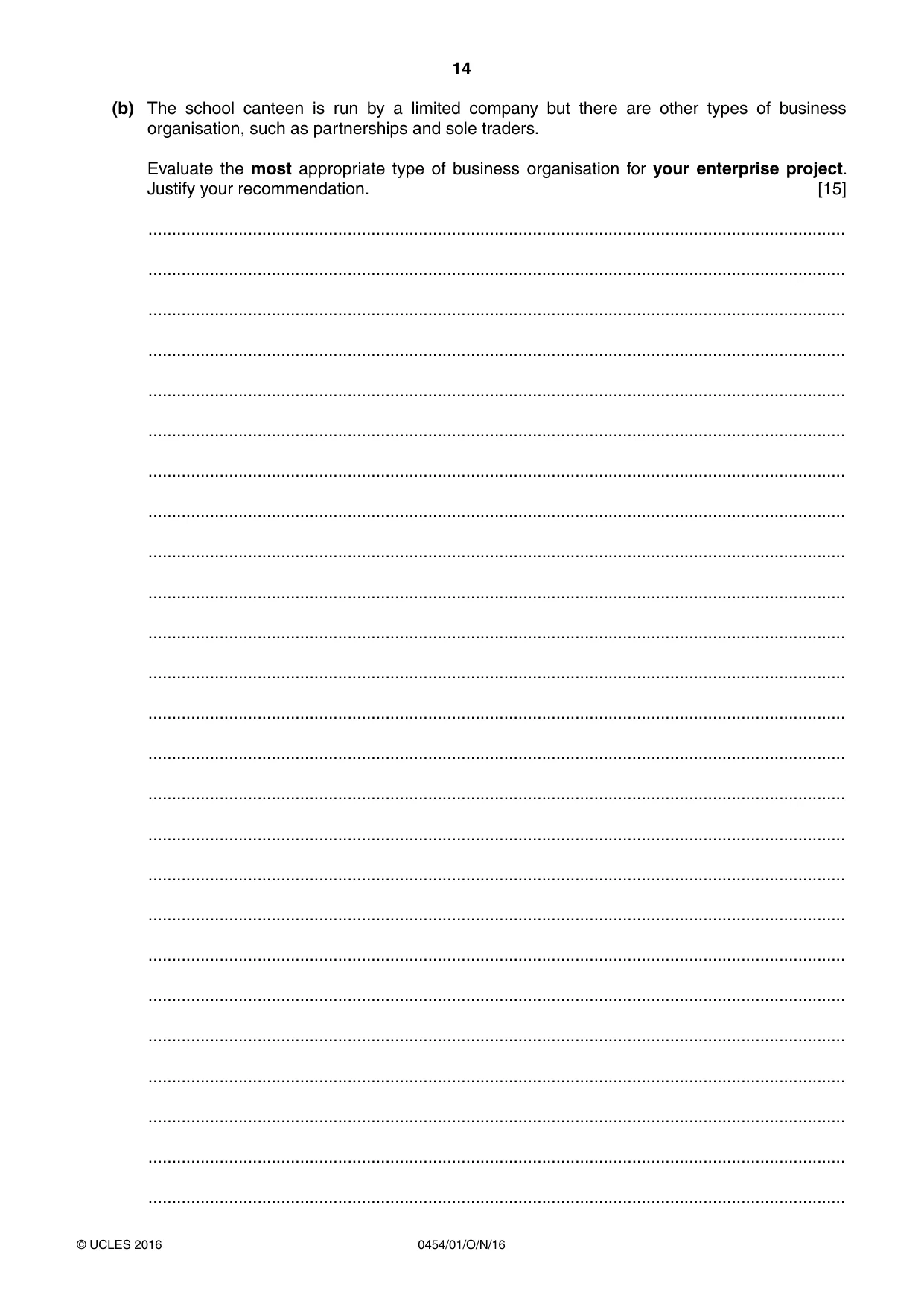
14 0454/01/O/N/16 © UCLES 2016 (b) The school canteen is run by a limited company but there are other types of business organisation, such as partnerships and sole traders. Evaluate the most appropriate type of business organisation for your enterprise project. Justify your recommendation. [15] … … … … … … … … … … … … … … … … … … … … … … … … …
Question paper, page 15
15 0454/01/O/N/16 © UCLES 2016 … … … … … … … … … … … … … … … … … … … … … … … … … … … [Total: 25]
Question paper, page 16
16 0454/01/O/N/16 © UCLES 2016 BLANK PAGE Permission to reproduce items where third-party owned material protected by copyright is included has been sought and cleared where possible. Every reasonable effort has been made by the publisher (UCLES) to trace copyright holders, but if any items requiring clearance have unwittingly been included, the publisher will be pleased to make amends at the earliest possible opportunity. To avoid the issue of disclosure of answer-related information to candidates, all copyright acknowledgements are reproduced online in the Cambridge International Examinations Copyright Acknowledgements Booklet. This is produced for each series of examinations and is freely available to download at www.cie.org.uk after the live examination series. Cambridge International Examinations is part of the Cambridge Assessment Group. Cambridge Assessment is the brand name of University of Cambridge Local Examinations Syndicate (UCLES), which is itself a department of the University of Cambridge.
Mark scheme, page 1
® IGCSE is the registered trademark of Cambridge International Examinations. This syllabus is approved for use in England, Wales and Northern Ireland as a Cambridge International Level 1/Level 2 Certificate. This document consists of 14 printed pages. © UCLES 2016 [Turn over Cambridge International Examinations Cambridge International General Certificate of Secondary Education ENTERPRISE 0454/01 Paper 1 Case Study October/November 2016 MARK SCHEME Maximum Mark: 100 Published This mark scheme is published as an aid to teachers and candidates, to indicate the requirements of the examination. It shows the basis on which Examiners were instructed to award marks. It does not indicate the details of the discussions that took place at an Examiners’ meeting before marking began, which would have considered the acceptability of alternative answers. Mark schemes should be read in conjunction with the question paper and the Principal Examiner Report for Teachers. Cambridge will not enter into discussions about these mark schemes. Cambridge is publishing the mark schemes for the October/November 2016 series for most Cambridge IGCSE®, Cambridge International A and AS Level components and some Cambridge O Level components.
Mark scheme, page 2
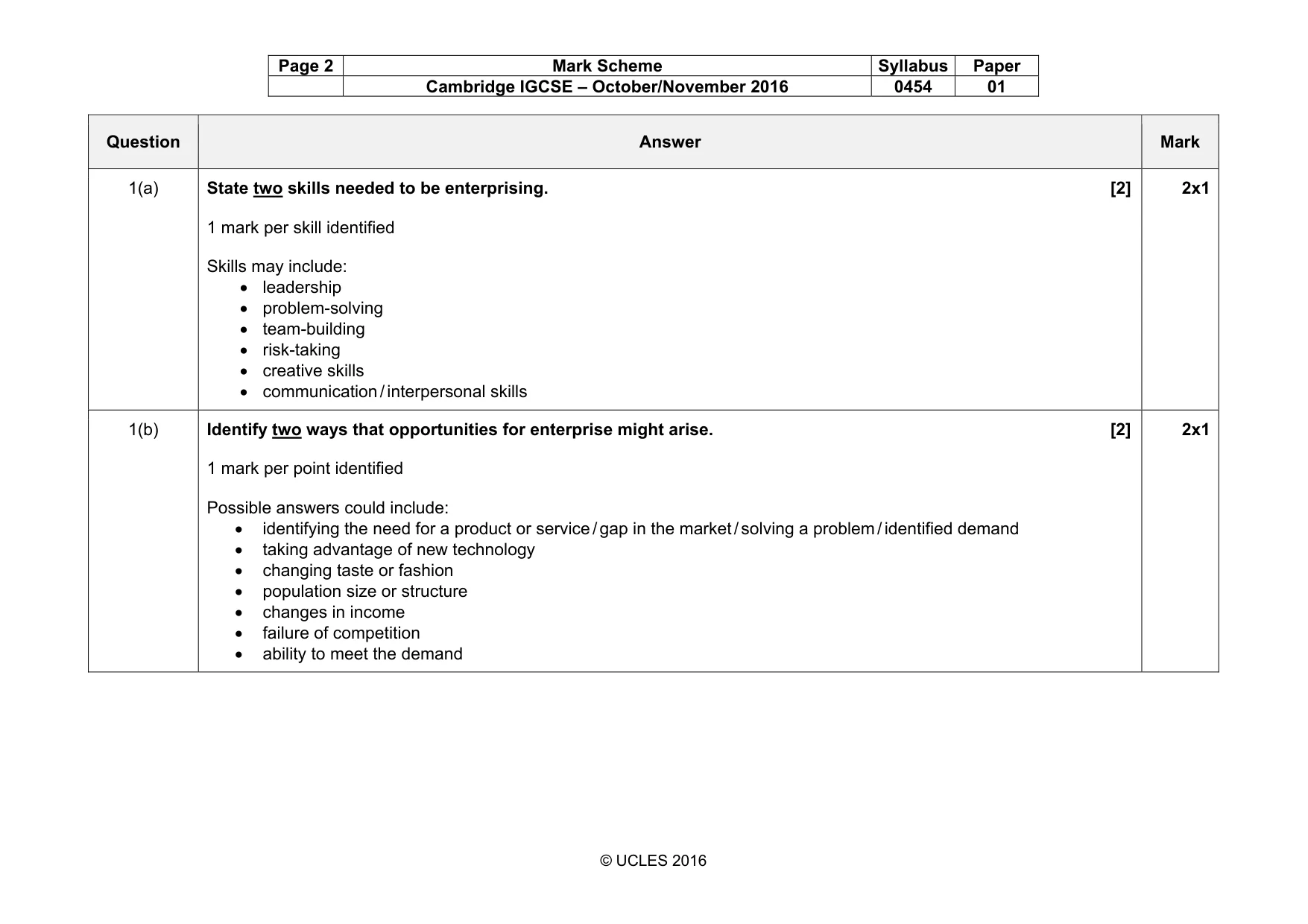
Page 2 Mark Scheme Syllabus Paper Cambridge IGCSE – October/November 2016 0454 01 © UCLES 2016 Question Answer Mark 1(a) State two skills needed to be enterprising. [2] 1 mark per skill identified Skills may include: • leadership • problem-solving • team-building • risk-taking • creative skills • communication / interpersonal skills 2x1 1(b) Identify two ways that opportunities for enterprise might arise. [2] 1 mark per point identified Possible answers could include: • identifying the need for a product or service / gap in the market / solving a problem / identified demand • taking advantage of new technology • changing taste or fashion • population size or structure • changes in income • failure of competition • ability to meet the demand 2x1
Mark scheme, page 3
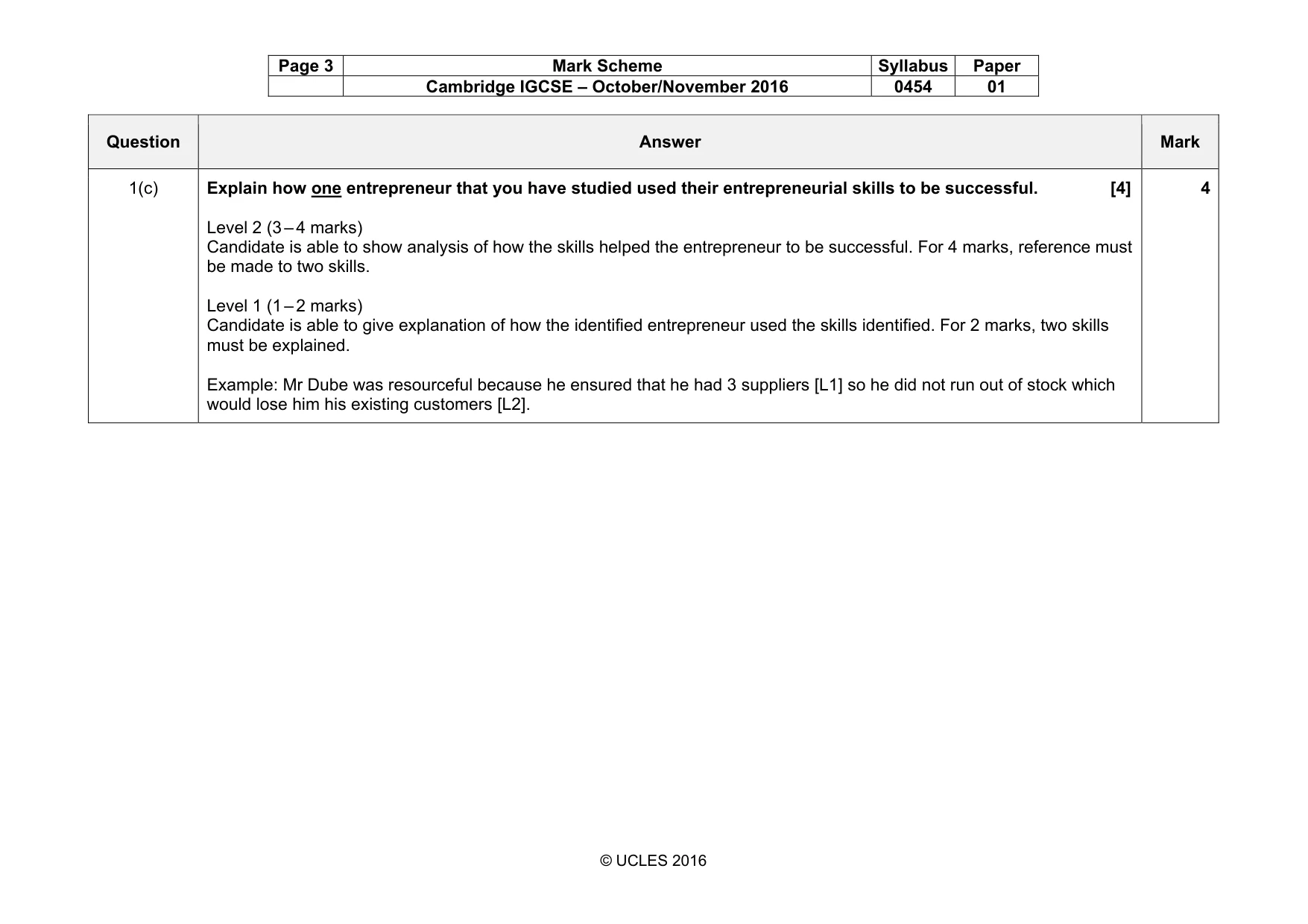
Page 3 Mark Scheme Syllabus Paper Cambridge IGCSE – October/November 2016 0454 01 © UCLES 2016 Question Answer Mark 1(c) Explain how one entrepreneur that you have studied used their entrepreneurial skills to be successful. [4] Level 2 (3 – 4 marks) Candidate is able to show analysis of how the skills helped the entrepreneur to be successful. For 4 marks, reference must be made to two skills. Level 1 (1 – 2 marks) Candidate is able to give explanation of how the identified entrepreneur used the skills identified. For 2 marks, two skills must be explained. Example: Mr Dube was resourceful because he ensured that he had 3 suppliers [L1] so he did not run out of stock which would lose him his existing customers [L2]. 4
Mark scheme, page 4
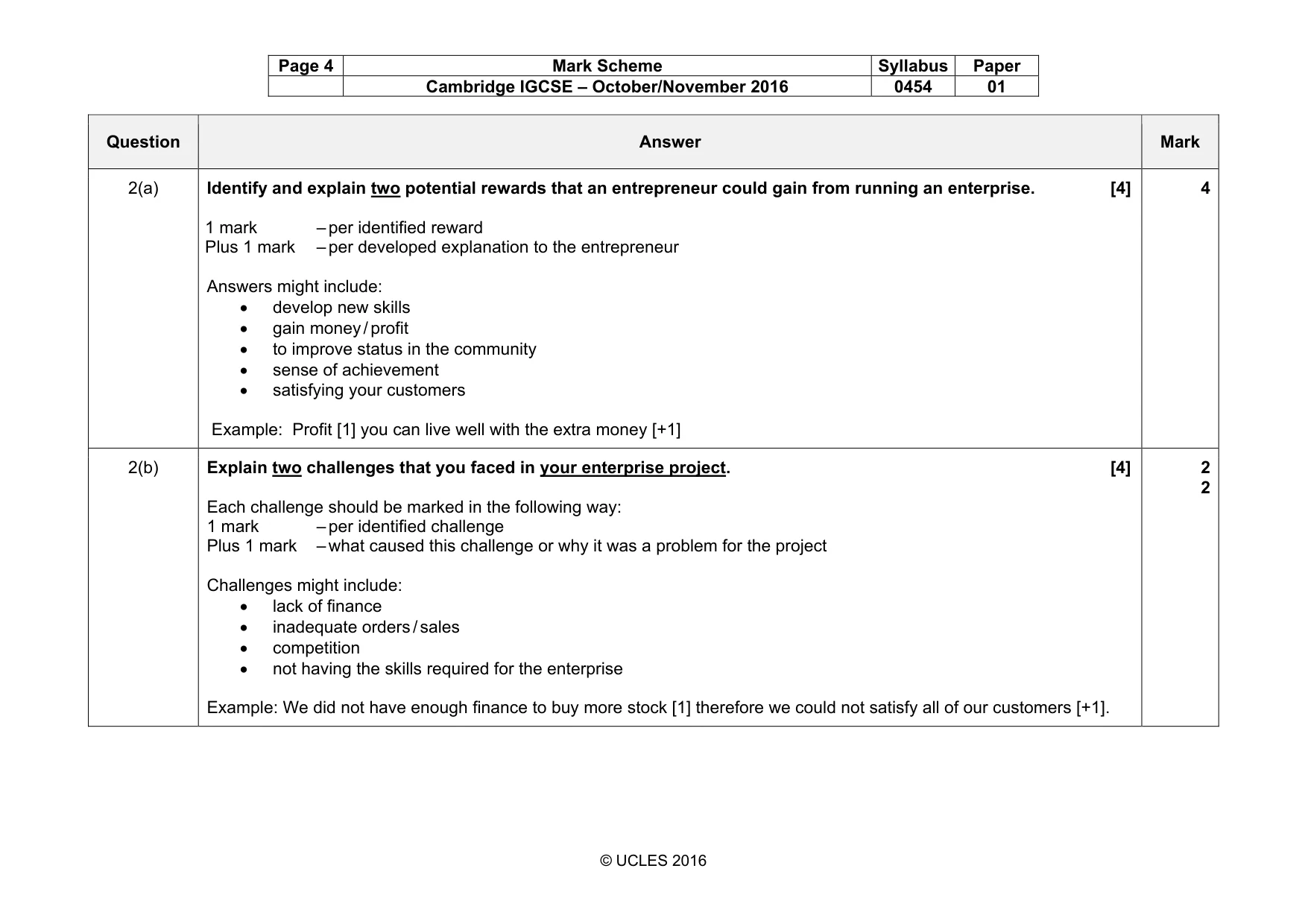
Page 4 Mark Scheme Syllabus Paper Cambridge IGCSE – October/November 2016 0454 01 © UCLES 2016 Question Answer Mark 2(a) Identify and explain two potential rewards that an entrepreneur could gain from running an enterprise. [4] 1 mark – per identified reward Plus 1 mark – per developed explanation to the entrepreneur Answers might include: • develop new skills • gain money / profit • to improve status in the community • sense of achievement • satisfying your customers Example: Profit [1] you can live well with the extra money [+1] 4 2(b) Explain two challenges that you faced in your enterprise project. [4] Each challenge should be marked in the following way: 1 mark – per identified challenge Plus 1 mark – what caused this challenge or why it was a problem for the project Challenges might include: • lack of finance • inadequate orders / sales • competition • not having the skills required for the enterprise Example: We did not have enough finance to buy more stock [1] therefore we could not satisfy all of our customers [+1]. 2 2
Mark scheme, page 5
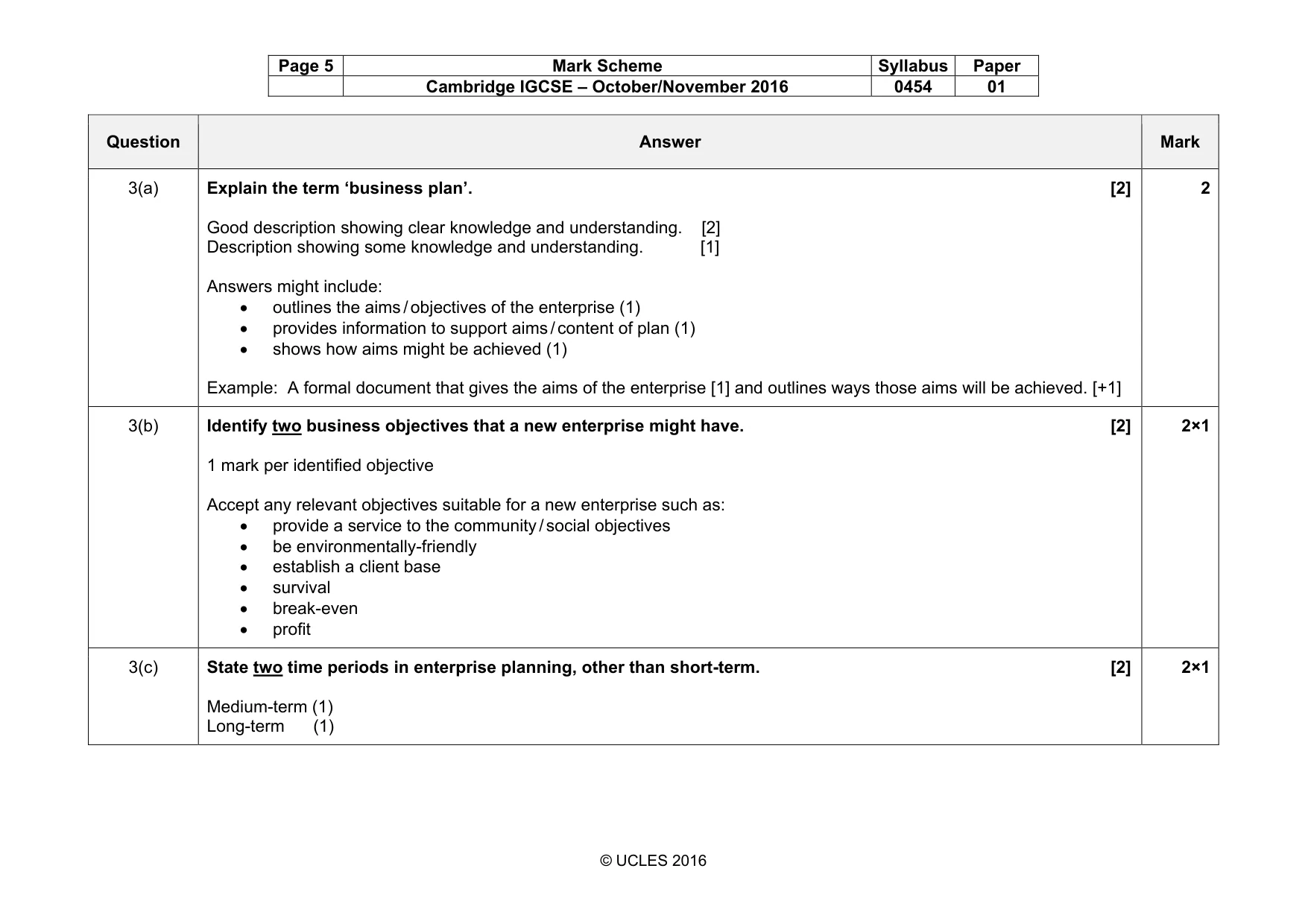
Page 5 Mark Scheme Syllabus Paper Cambridge IGCSE – October/November 2016 0454 01 © UCLES 2016 Question Answer Mark 3(a) Explain the term ‘business plan’. [2] Good description showing clear knowledge and understanding. [2] Description showing some knowledge and understanding. [1] Answers might include: • outlines the aims / objectives of the enterprise (1) • provides information to support aims / content of plan (1) • shows how aims might be achieved (1) Example: A formal document that gives the aims of the enterprise [1] and outlines ways those aims will be achieved. [+1] 2 3(b) Identify two business objectives that a new enterprise might have. [2] 1 mark per identified objective Accept any relevant objectives suitable for a new enterprise such as: • provide a service to the community / social objectives • be environmentally-friendly • establish a client base • survival • break-even • profit 2×1 3(c) State two time periods in enterprise planning, other than short-term. [2] Medium-term (1) Long-term (1) 2×1
Mark scheme, page 6
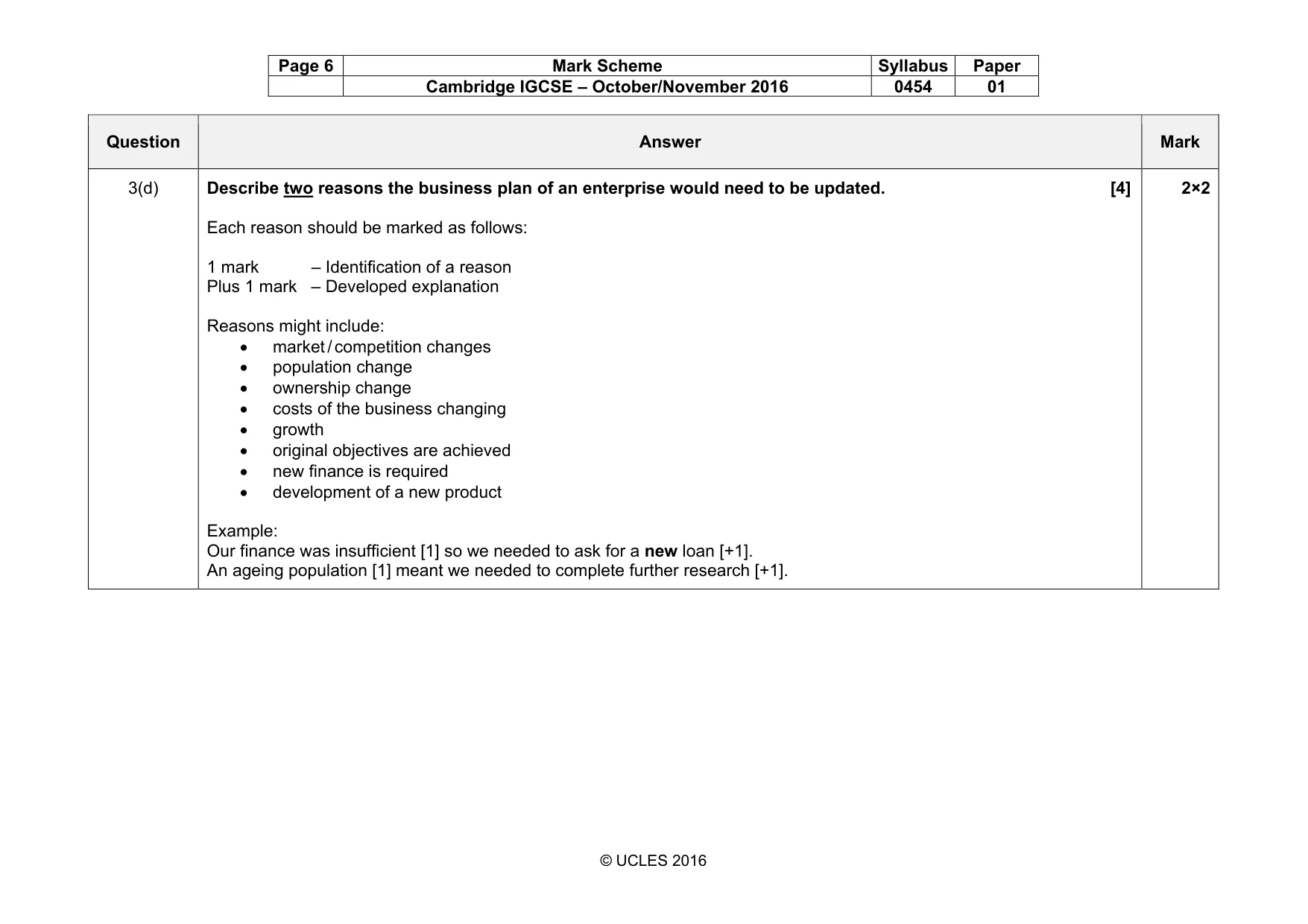
Page 6 Mark Scheme Syllabus Paper Cambridge IGCSE – October/November 2016 0454 01 © UCLES 2016 Question Answer Mark 3(d) Describe two reasons the business plan of an enterprise would need to be updated. [4] Each reason should be marked as follows: 1 mark – Identification of a reason Plus 1 mark – Developed explanation Reasons might include: • market / competition changes • population change • ownership change • costs of the business changing • growth • original objectives are achieved • new finance is required • development of a new product Example: Our finance was insufficient [1] so we needed to ask for a new loan [+1]. An ageing population [1] meant we needed to complete further research [+1]. 2×2
Mark scheme, page 7
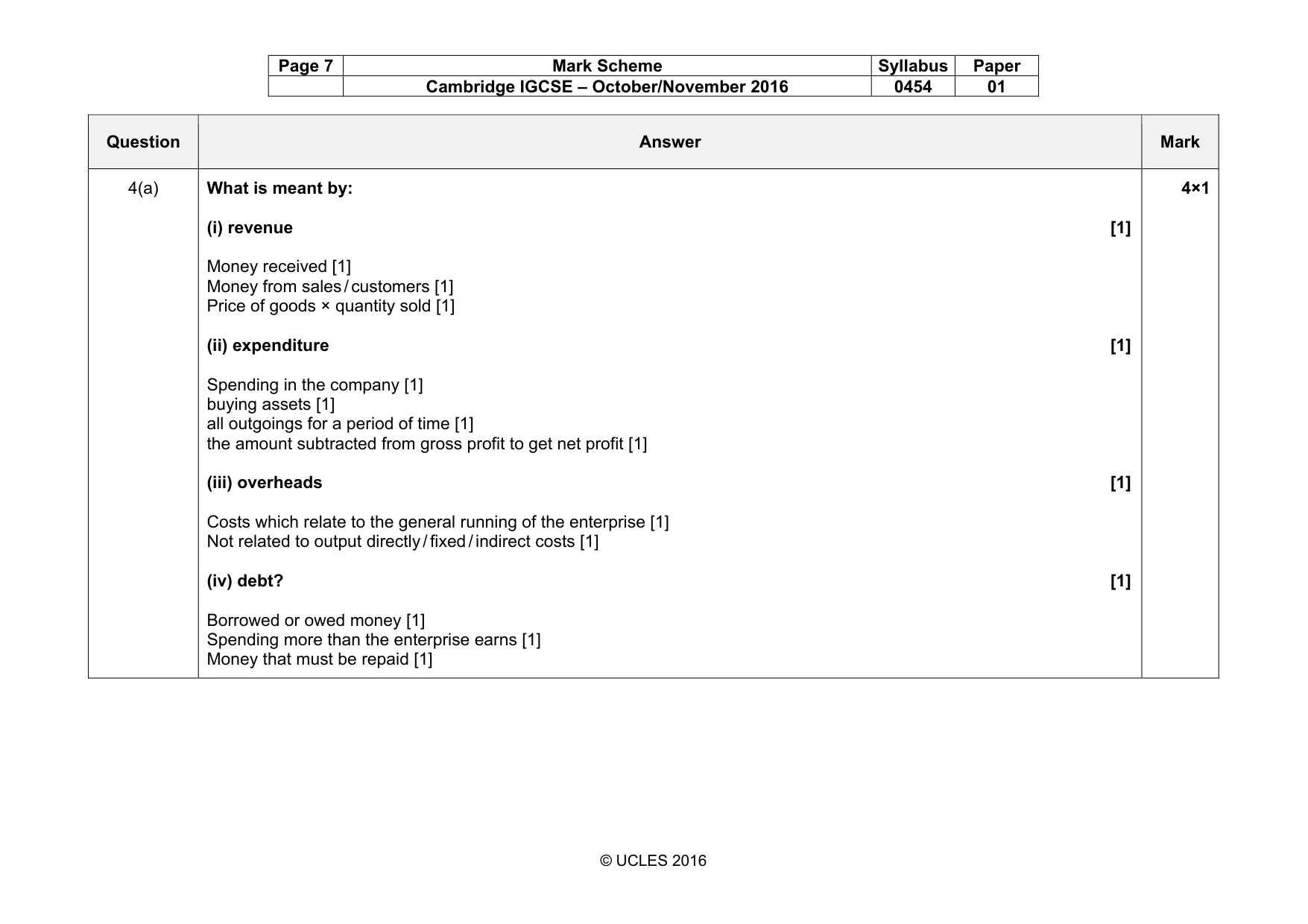
Page 7 Mark Scheme Syllabus Paper Cambridge IGCSE – October/November 2016 0454 01 © UCLES 2016 Question Answer Mark 4(a) What is meant by: (i) revenue [1] Money received [1] Money from sales / customers [1] Price of goods × quantity sold [1] (ii) expenditure [1] Spending in the company [1] buying assets [1] all outgoings for a period of time [1] the amount subtracted from gross profit to get net profit [1] (iii) overheads [1] Costs which relate to the general running of the enterprise [1] Not related to output directly / fixed / indirect costs [1] (iv) debt? [1] Borrowed or owed money [1] Spending more than the enterprise earns [1] Money that must be repaid [1] 4×1
Mark scheme, page 8
Page 8 Mark Scheme Syllabus Paper Cambridge IGCSE – October/November 2016 0454 01 © UCLES 2016 Question Answer Mark 4(b) Use the information in the case study to calculate the following amounts. Show your working where appropriate. Profit and Loss account for Week 1 US$ Revenue A = 100 ×1.50 = 150.00 Cost of boxes 30.00 Cost of food 100.00 Gross Profit B = 20.00 less expenditure on marketing C = 5.00 Net Profit D = 15.00 4(b)(i) 3 marks for correct calculation of Amount A (Revenue): [3] Sales = 100 [1] Selling price = $1.50 [1] Revenue = $150 [1] (OFR applies) Or 3 marks for the correct answer alone $150 3 4(b)(ii) 1 mark for correct calculation of Amount B (Gross Profit) $150 – $30 – $100 = $20 (OFR applies) [1] 1 4(b)(iii) 1 mark for correct Amount C (Expenditure) $5 [1] 1 4(b)(iv) 1 mark for correct calculation of Amount D (Net Profit) $20 – $5 = $15 (OFR applies) [1] 1
Mark scheme, page 9
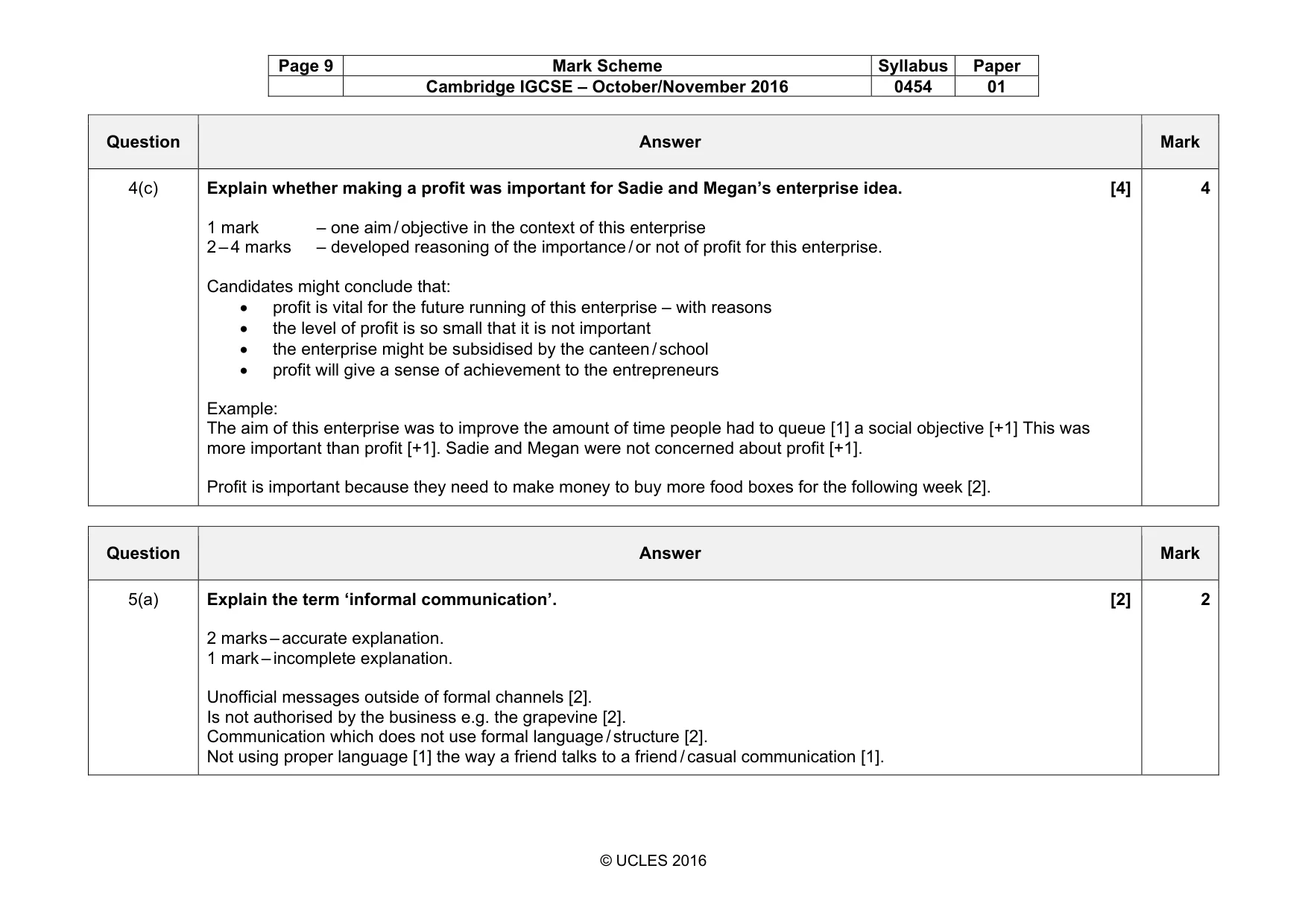
Page 9 Mark Scheme Syllabus Paper Cambridge IGCSE – October/November 2016 0454 01 © UCLES 2016 Question Answer Mark 4(c) Explain whether making a profit was important for Sadie and Megan’s enterprise idea. [4] 1 mark – one aim / objective in the context of this enterprise 2 – 4 marks – developed reasoning of the importance / or not of profit for this enterprise. Candidates might conclude that: • profit is vital for the future running of this enterprise – with reasons • the level of profit is so small that it is not important • the enterprise might be subsidised by the canteen / school • profit will give a sense of achievement to the entrepreneurs Example: The aim of this enterprise was to improve the amount of time people had to queue [1] a social objective [+1] This was more important than profit [+1]. Sadie and Megan were not concerned about profit [+1]. Profit is important because they need to make money to buy more food boxes for the following week [2]. 4 Question Answer Mark 5(a) Explain the term ‘informal communication’. [2] 2 marks – accurate explanation. 1 mark – incomplete explanation. Unofficial messages outside of formal channels [2]. Is not authorised by the business e.g. the grapevine [2]. Communication which does not use formal language / structure [2]. Not using proper language [1] the way a friend talks to a friend / casual communication [1]. 2
Mark scheme, page 10
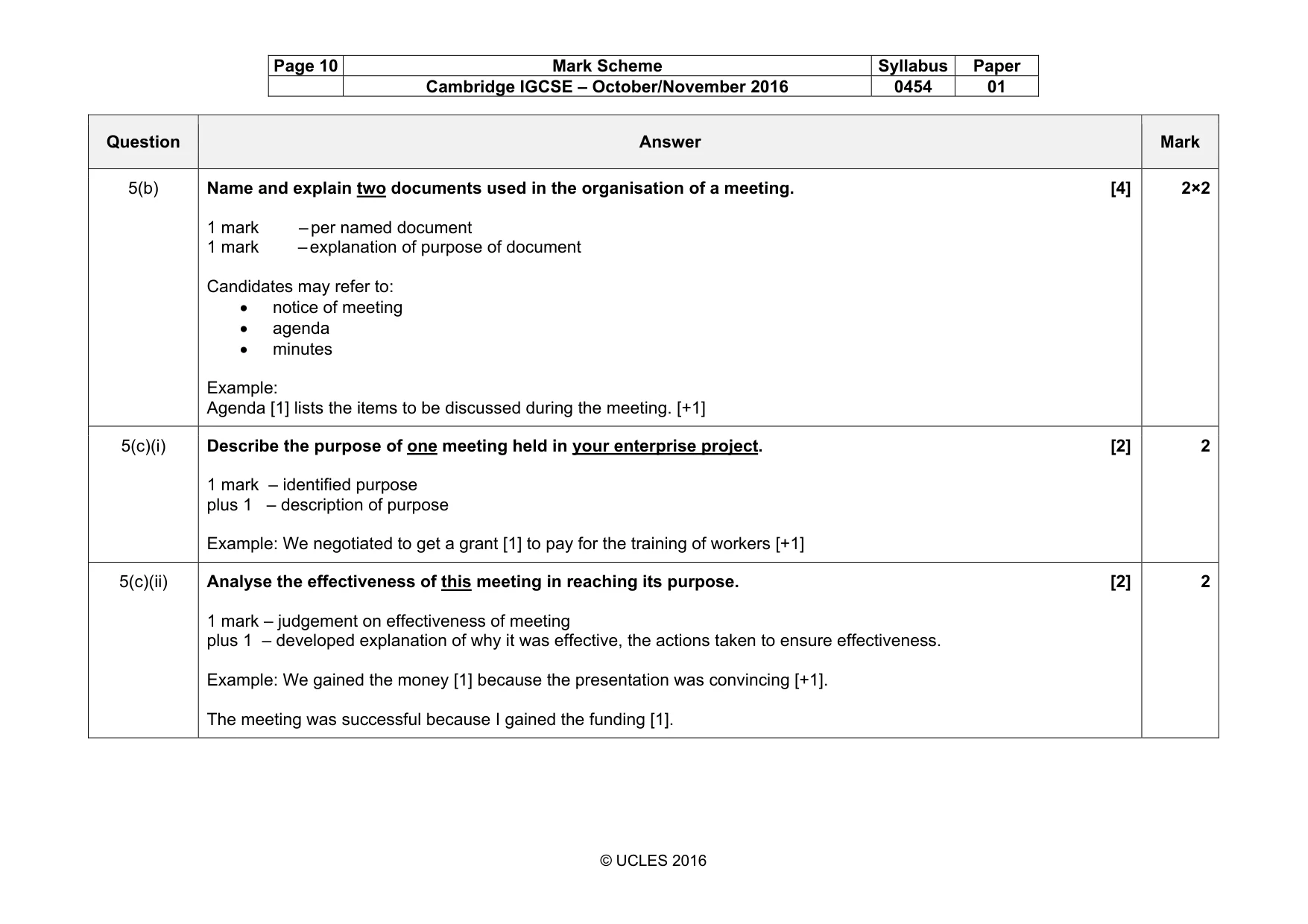
Page 10 Mark Scheme Syllabus Paper Cambridge IGCSE – October/November 2016 0454 01 © UCLES 2016 Question Answer Mark 5(b) Name and explain two documents used in the organisation of a meeting. [4] 1 mark – per named document 1 mark – explanation of purpose of document Candidates may refer to: • notice of meeting • agenda • minutes Example: Agenda [1] lists the items to be discussed during the meeting. [+1] 2×2 5(c)(i) Describe the purpose of one meeting held in your enterprise project. [2] 1 mark – identified purpose plus 1 – description of purpose Example: We negotiated to get a grant [1] to pay for the training of workers [+1] 2 5(c)(ii) Analyse the effectiveness of this meeting in reaching its purpose. [2] 1 mark – judgement on effectiveness of meeting plus 1 – developed explanation of why it was effective, the actions taken to ensure effectiveness. Example: We gained the money [1] because the presentation was convincing [+1]. The meeting was successful because I gained the funding [1]. 2
Mark scheme, page 11
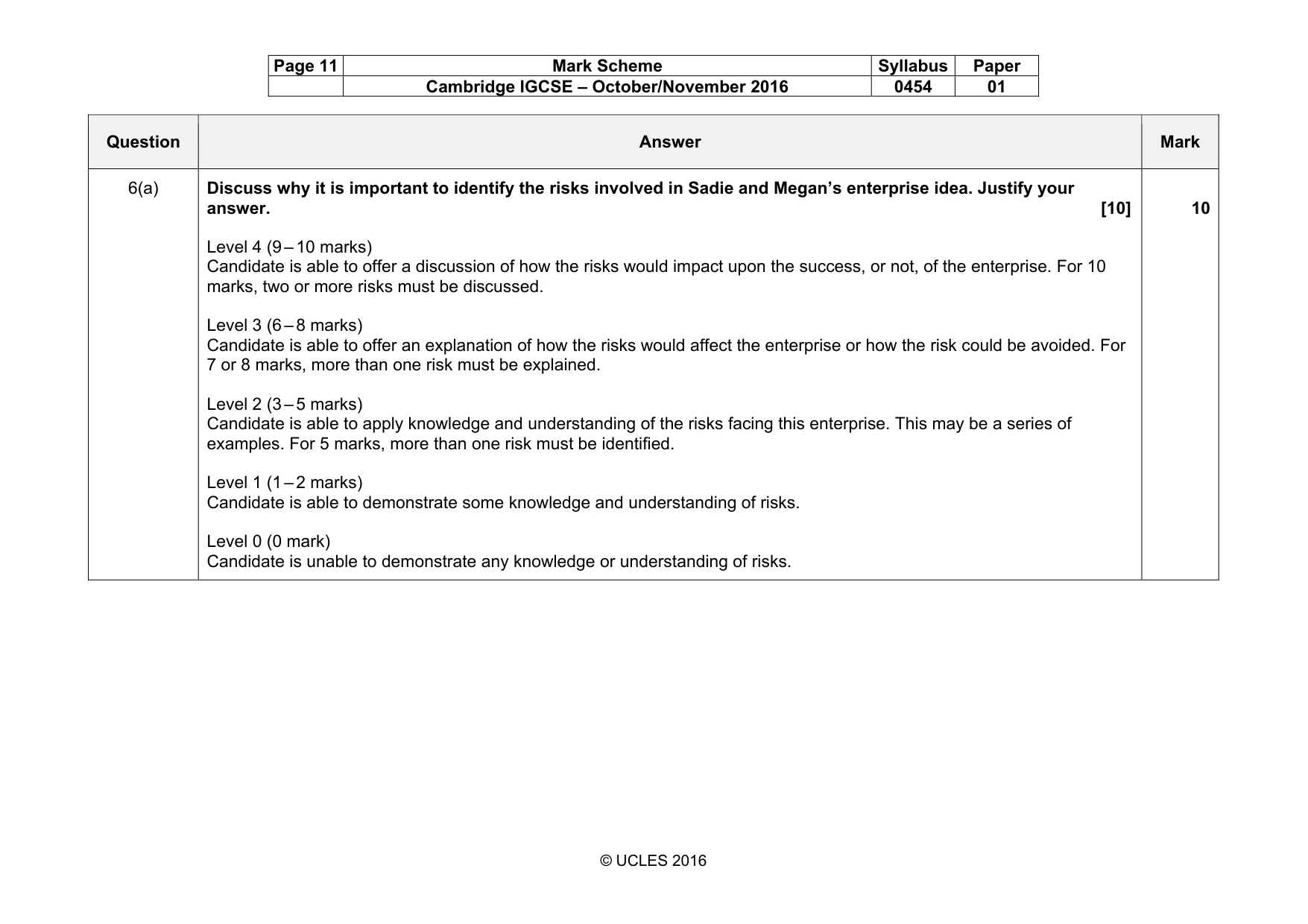
Page 11 Mark Scheme Syllabus Paper Cambridge IGCSE – October/November 2016 0454 01 © UCLES 2016 Question Answer Mark 6(a) Discuss why it is important to identify the risks involved in Sadie and Megan’s enterprise idea. Justify your answer. [10] Level 4 (9 – 10 marks) Candidate is able to offer a discussion of how the risks would impact upon the success, or not, of the enterprise. For 10 marks, two or more risks must be discussed. Level 3 (6 – 8 marks) Candidate is able to offer an explanation of how the risks would affect the enterprise or how the risk could be avoided. For 7 or 8 marks, more than one risk must be explained. Level 2 (3 – 5 marks) Candidate is able to apply knowledge and understanding of the risks facing this enterprise. This may be a series of examples. For 5 marks, more than one risk must be identified. Level 1 (1 – 2 marks) Candidate is able to demonstrate some knowledge and understanding of risks. Level 0 (0 mark) Candidate is unable to demonstrate any knowledge or understanding of risks. 10
Mark scheme, page 12
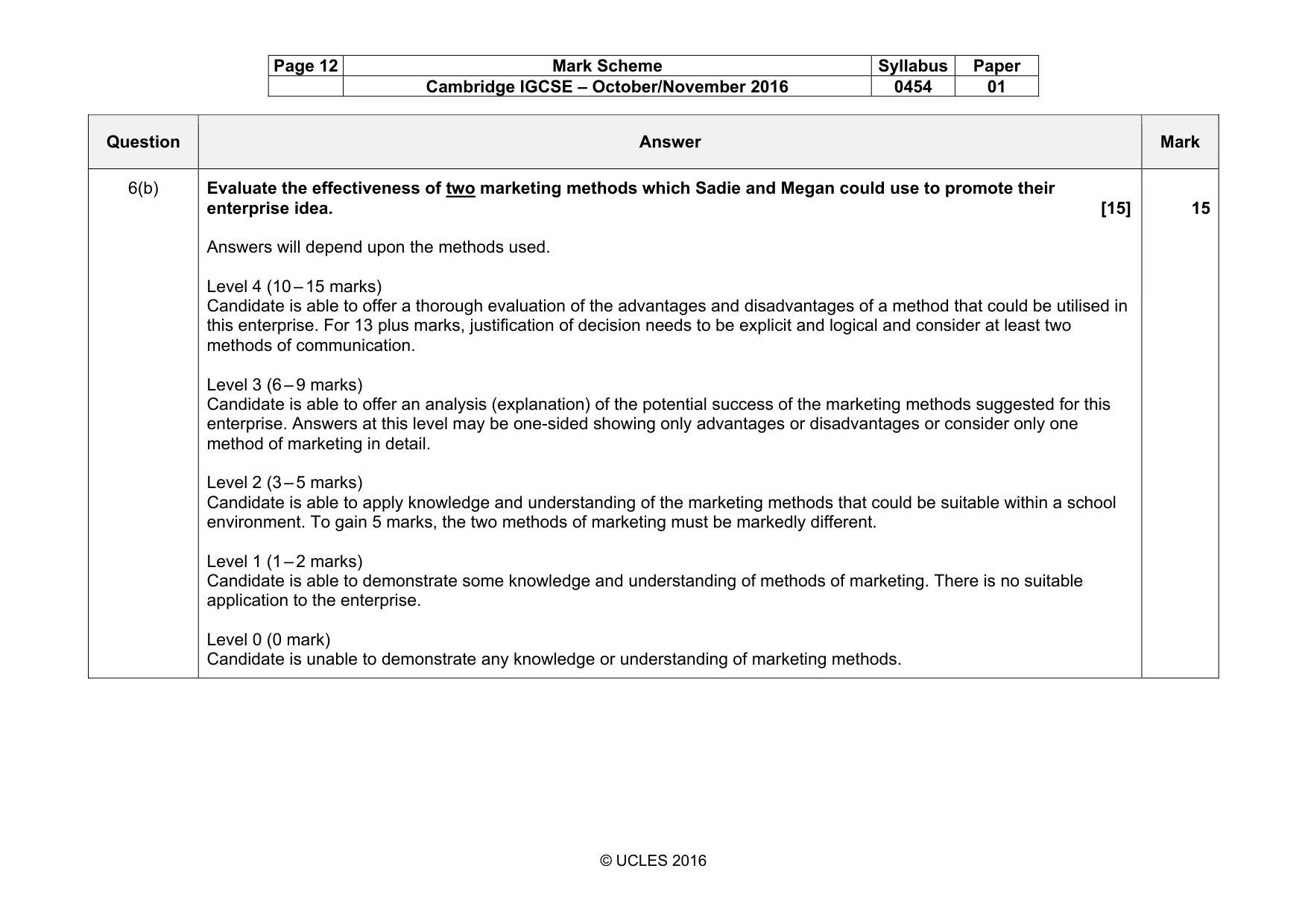
Page 12 Mark Scheme Syllabus Paper Cambridge IGCSE – October/November 2016 0454 01 © UCLES 2016 Question Answer Mark 6(b) Evaluate the effectiveness of two marketing methods which Sadie and Megan could use to promote their enterprise idea. [15] Answers will depend upon the methods used. Level 4 (10 – 15 marks) Candidate is able to offer a thorough evaluation of the advantages and disadvantages of a method that could be utilised in this enterprise. For 13 plus marks, justification of decision needs to be explicit and logical and consider at least two methods of communication. Level 3 (6 – 9 marks) Candidate is able to offer an analysis (explanation) of the potential success of the marketing methods suggested for this enterprise. Answers at this level may be one-sided showing only advantages or disadvantages or consider only one method of marketing in detail. Level 2 (3 – 5 marks) Candidate is able to apply knowledge and understanding of the marketing methods that could be suitable within a school environment. To gain 5 marks, the two methods of marketing must be markedly different. Level 1 (1 – 2 marks) Candidate is able to demonstrate some knowledge and understanding of methods of marketing. There is no suitable application to the enterprise. Level 0 (0 mark) Candidate is unable to demonstrate any knowledge or understanding of marketing methods. 15
Mark scheme, page 13
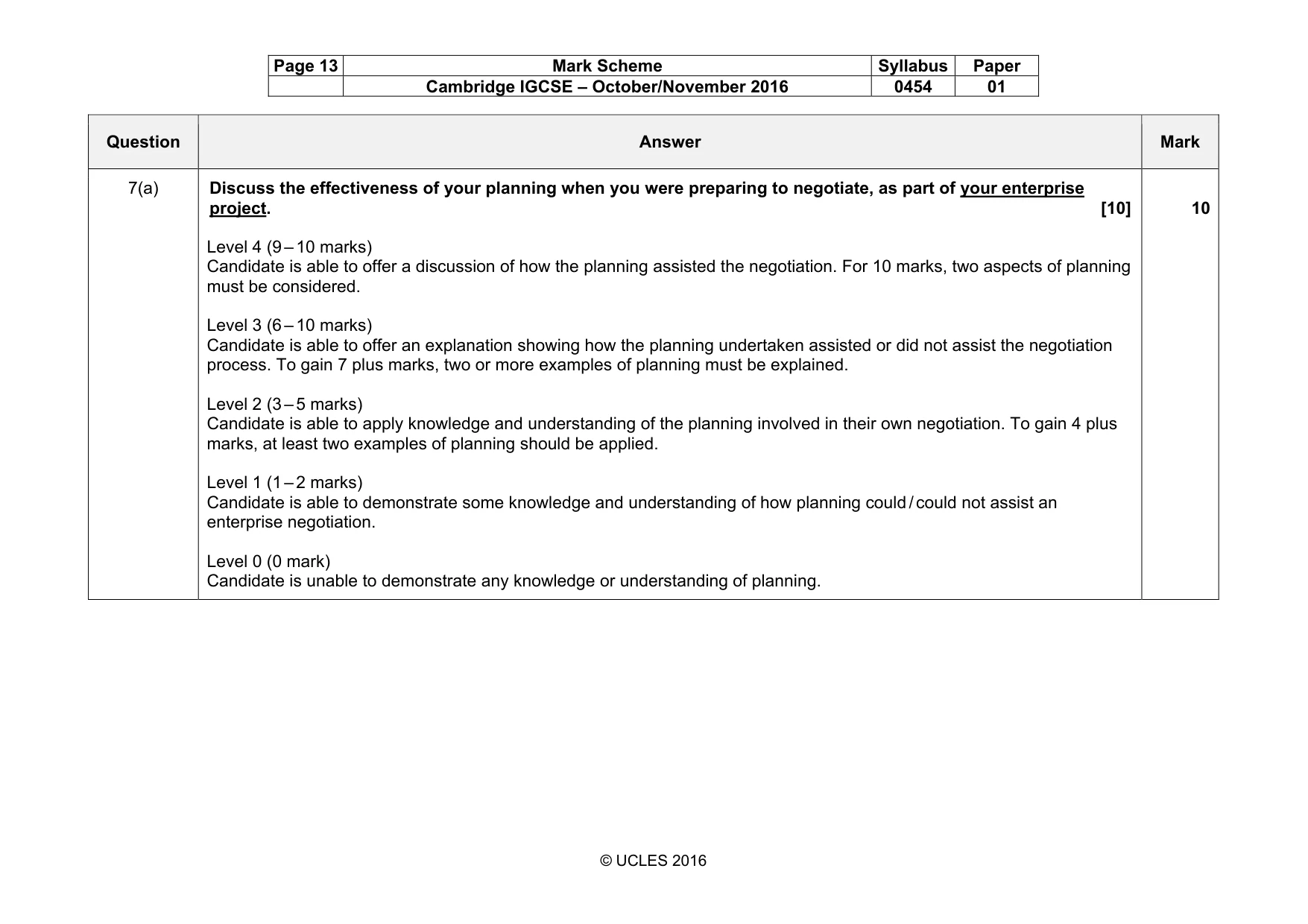
Page 13 Mark Scheme Syllabus Paper Cambridge IGCSE – October/November 2016 0454 01 © UCLES 2016 Question Answer Mark 7(a) Discuss the effectiveness of your planning when you were preparing to negotiate, as part of your enterprise project. [10] Level 4 (9 – 10 marks) Candidate is able to offer a discussion of how the planning assisted the negotiation. For 10 marks, two aspects of planning must be considered. Level 3 (6 – 10 marks) Candidate is able to offer an explanation showing how the planning undertaken assisted or did not assist the negotiation process. To gain 7 plus marks, two or more examples of planning must be explained. Level 2 (3 – 5 marks) Candidate is able to apply knowledge and understanding of the planning involved in their own negotiation. To gain 4 plus marks, at least two examples of planning should be applied. Level 1 (1 – 2 marks) Candidate is able to demonstrate some knowledge and understanding of how planning could / could not assist an enterprise negotiation. Level 0 (0 mark) Candidate is unable to demonstrate any knowledge or understanding of planning. 10
Mark scheme, page 14
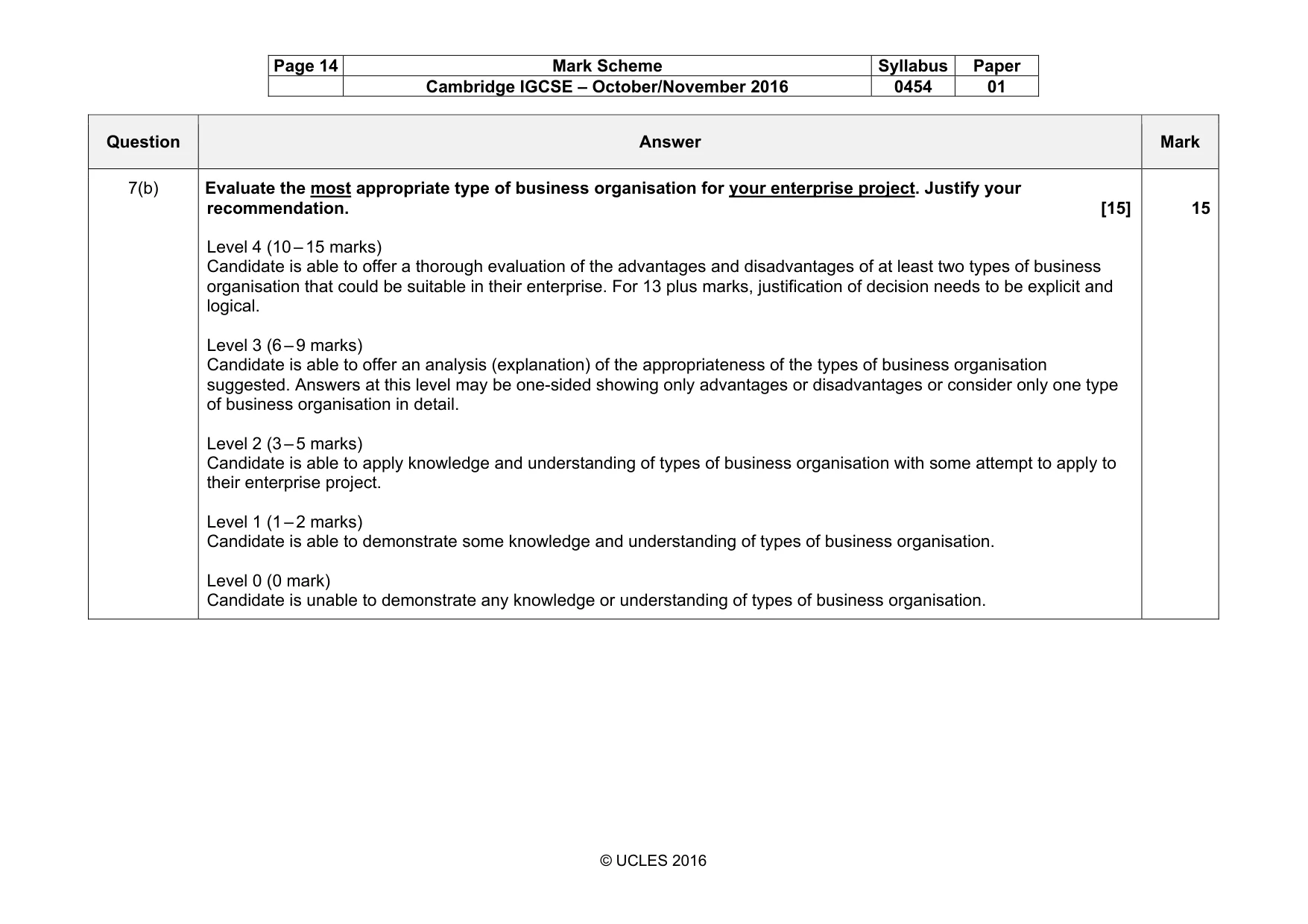
Page 14 Mark Scheme Syllabus Paper Cambridge IGCSE – October/November 2016 0454 01 © UCLES 2016 Question Answer Mark 7(b) Evaluate the most appropriate type of business organisation for your enterprise project. Justify your recommendation. [15] Level 4 (10 – 15 marks) Candidate is able to offer a thorough evaluation of the advantages and disadvantages of at least two types of business organisation that could be suitable in their enterprise. For 13 plus marks, justification of decision needs to be explicit and logical. Level 3 (6 – 9 marks) Candidate is able to offer an analysis (explanation) of the appropriateness of the types of business organisation suggested. Answers at this level may be one-sided showing only advantages or disadvantages or consider only one type of business organisation in detail. Level 2 (3 – 5 marks) Candidate is able to apply knowledge and understanding of types of business organisation with some attempt to apply to their enterprise project. Level 1 (1 – 2 marks) Candidate is able to demonstrate some knowledge and understanding of types of business organisation. Level 0 (0 mark) Candidate is unable to demonstrate any knowledge or understanding of types of business organisation. 15
What you needed in this session
Cambridge’s own grade thresholds for 2016 Oct/Nov, Paper 1 · Variant 1. A higher threshold means an easier paper — the bar moves with how the cohort did.