Cambridge IGCSE Enterprise 0454 — 2016 May/June Paper 1 · Variant 2
0454/12/M/J/16 · 100 marks · ≈113 min
The question paper and its mark scheme, free to read here and free to download. This is Cambridge’s own paper, exactly as it was sat.
Question paper16 pages





Mark scheme11 pages
Answers below. Sit the paper first if you are practising.
Paper as text
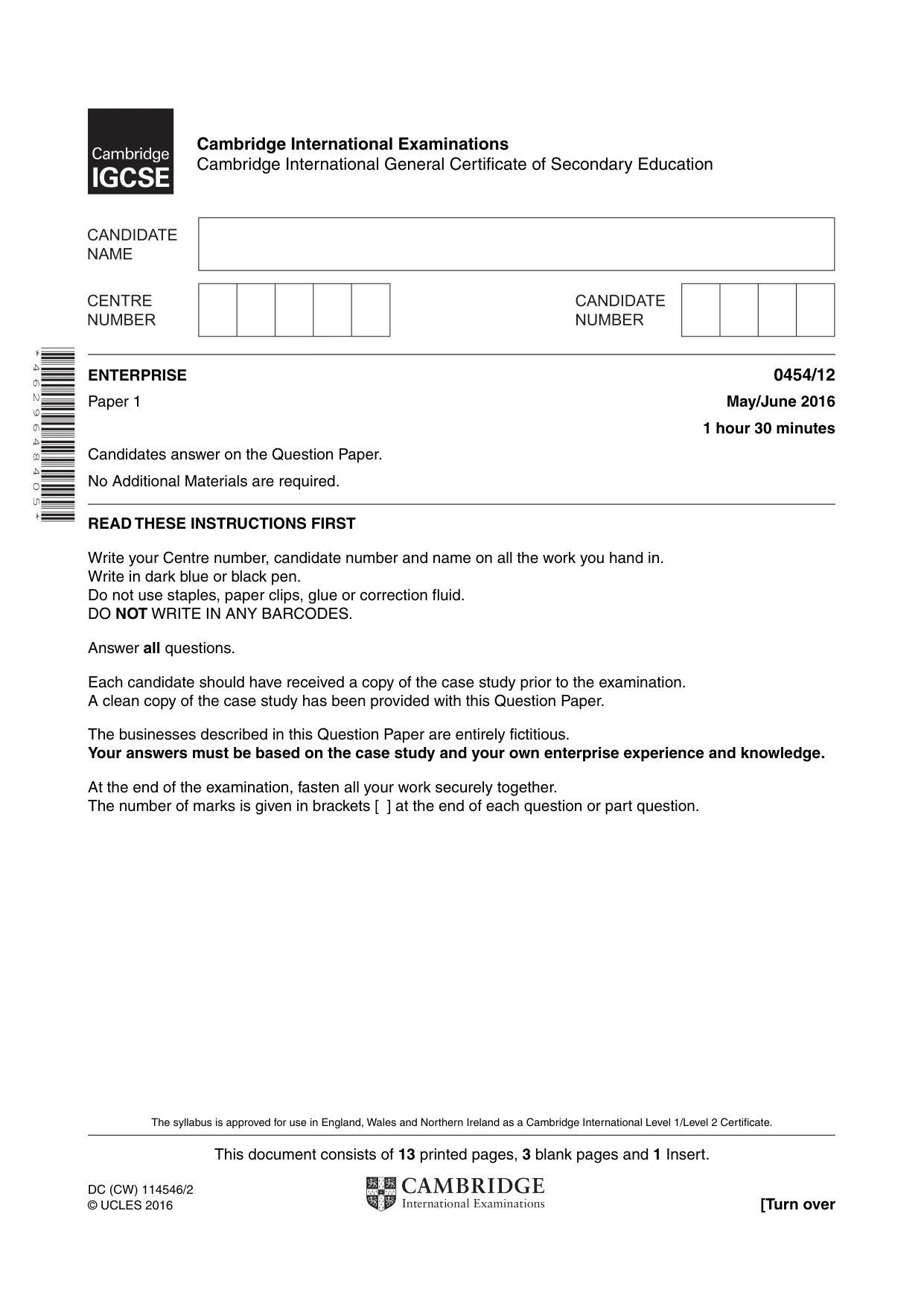
Question paper, page 1
This document consists of 13 printed pages, 3 blank pages and 1 Insert. DC (CW) 114546/2 © UCLES 2016 [Turn over Cambridge International Examinations Cambridge International General Certificate of Secondary Education * 4 6 2 9 6 4 8 4 0 5 * ENTERPRISE 0454/12 Paper 1 May/June 2016 1 hour 30 minutes Candidates answer on the Question Paper. No Additional Materials are required. READ THESE INSTRUCTIONS FIRST Write your Centre number, candidate number and name on all the work you hand in. Write in dark blue or black pen. Do not use staples, paper clips, glue or correction fluid. DO NOT WRITE IN ANY BARCODES. Answer all questions. Each candidate should have received a copy of the case study prior to the examination. A clean copy of the case study has been provided with this Question Paper. The businesses described in this Question Paper are entirely fictitious. Your answers must be based on the case study and your own enterprise experience and knowledge. At the end of the examination, fasten all your work securely together. The number of marks is given in brackets [ ] at the end of each question or part question. The syllabus is approved for use in England, Wales and Northern Ireland as a Cambridge International Level 1/Level 2 Certificate.
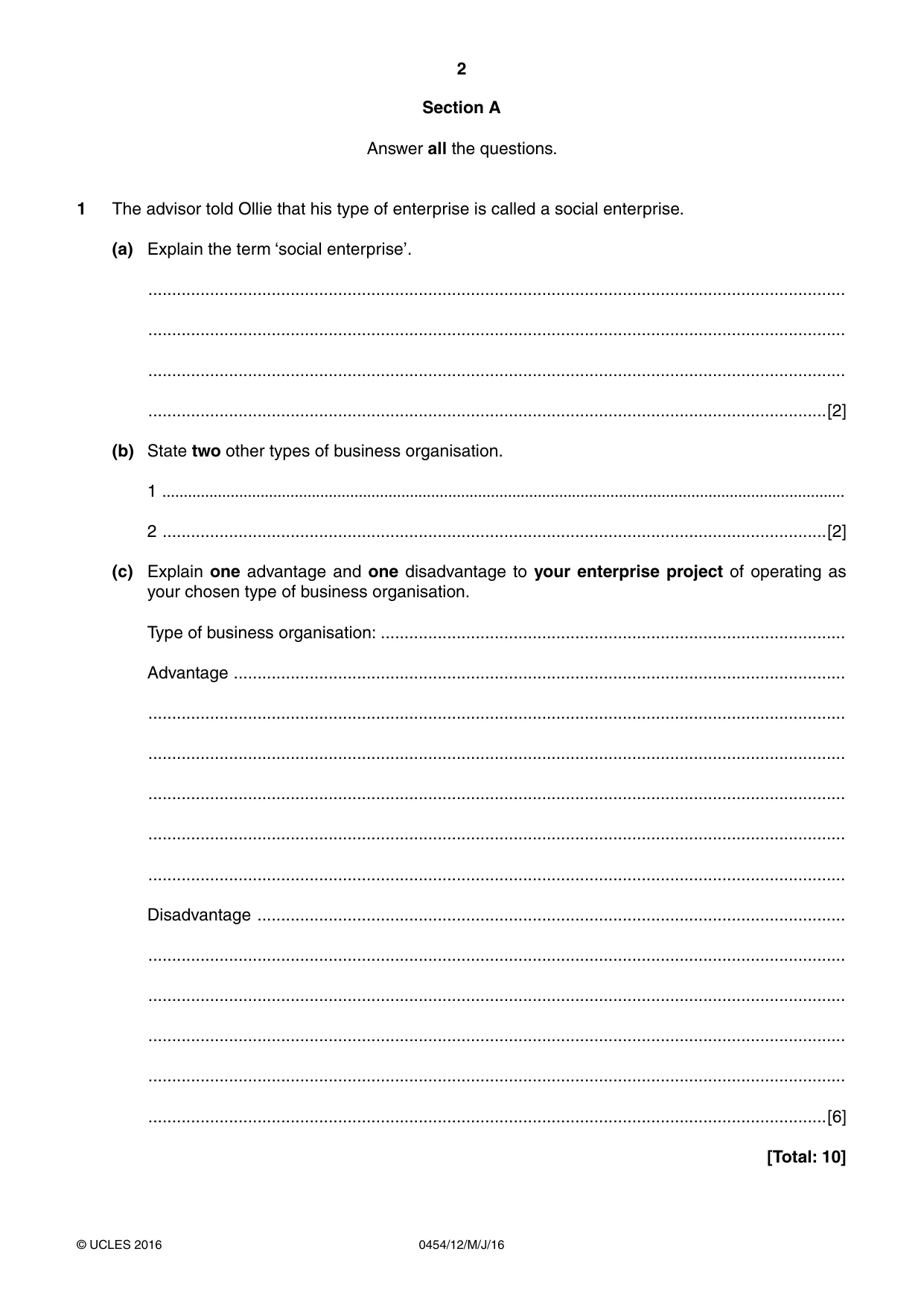
Question paper, page 2
2 0454/12/M/J/16 © UCLES 2016 Section A Answer all the questions. 1 The advisor told Ollie that his type of enterprise is called a social enterprise. (a) Explain the term ‘social enterprise’. … … … …[2] (b) State two other types of business organisation. 1 … 2 …[2] (c) Explain one advantage and one disadvantage to your enterprise project of operating as your chosen type of business organisation. Type of business organisation: … Advantage … … … … … … Disadvantage … … … … … …[6] [Total: 10]
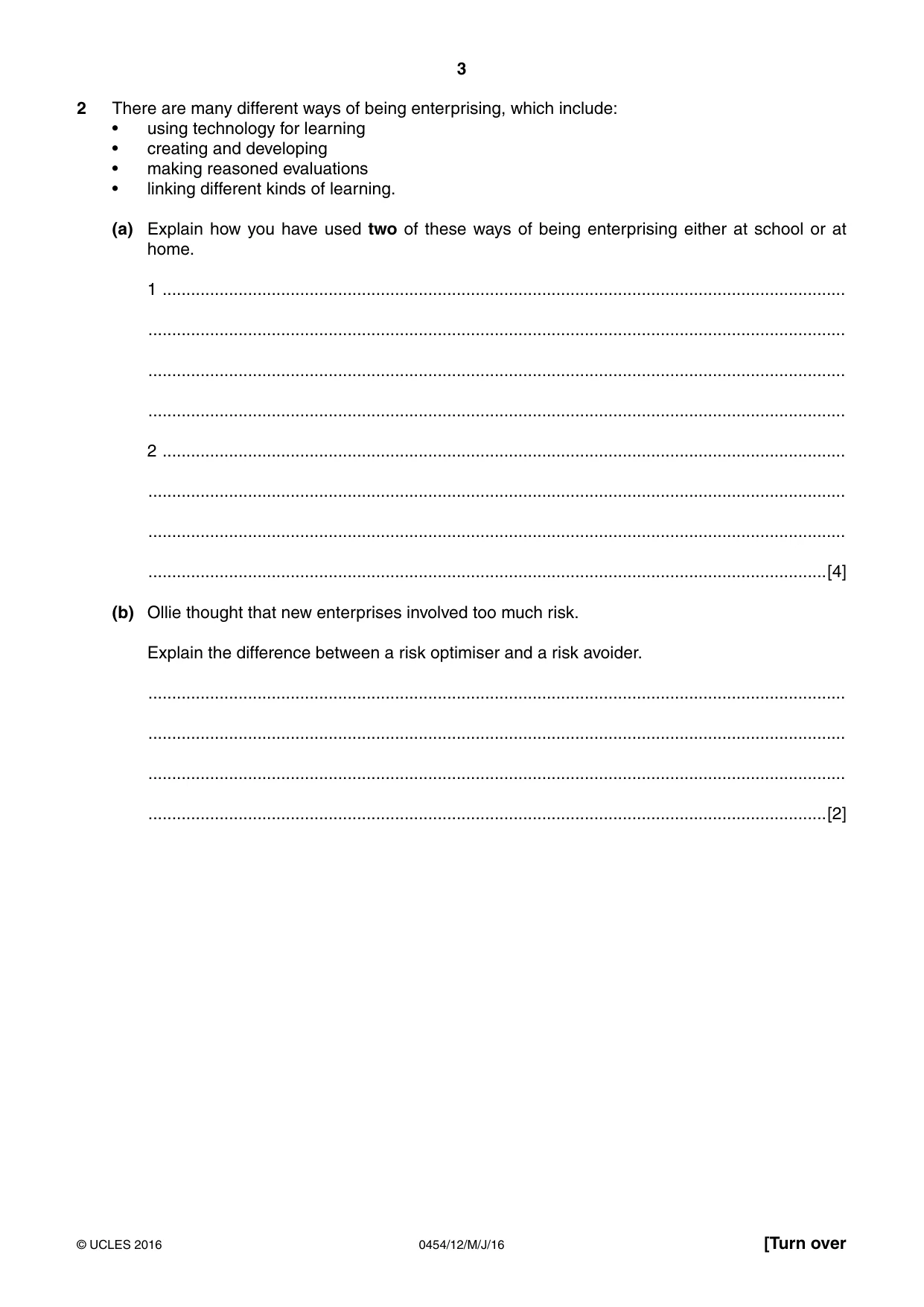
Question paper, page 3
3 0454/12/M/J/16 © UCLES 2016 [Turn over 2 There are many different ways of being enterprising, which include: • using technology for learning • creating and developing • making reasoned evaluations • linking different kinds of learning. (a) Explain how you have used two of these ways of being enterprising either at school or at home. 1 … … … … 2 … … … …[4] (b) Ollie thought that new enterprises involved too much risk. Explain the difference between a risk optimiser and a risk avoider. … … … …[2]
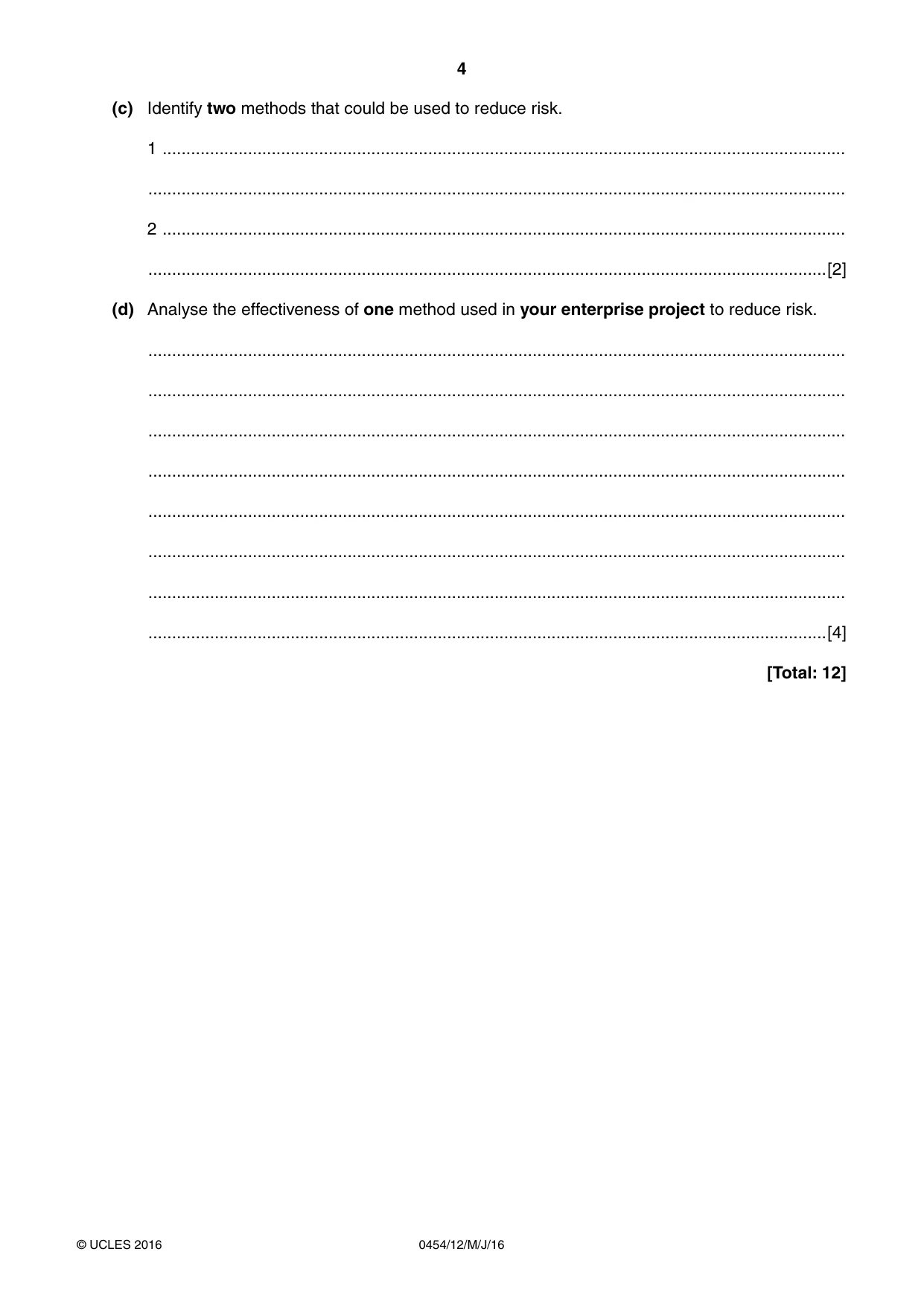
Question paper, page 4
4 0454/12/M/J/16 © UCLES 2016 (c) Identify two methods that could be used to reduce risk. 1 … … 2 … …[2] (d) Analyse the effectiveness of one method used in your enterprise project to reduce risk. … … … … … … … …[4] [Total: 12]
Question paper, page 5
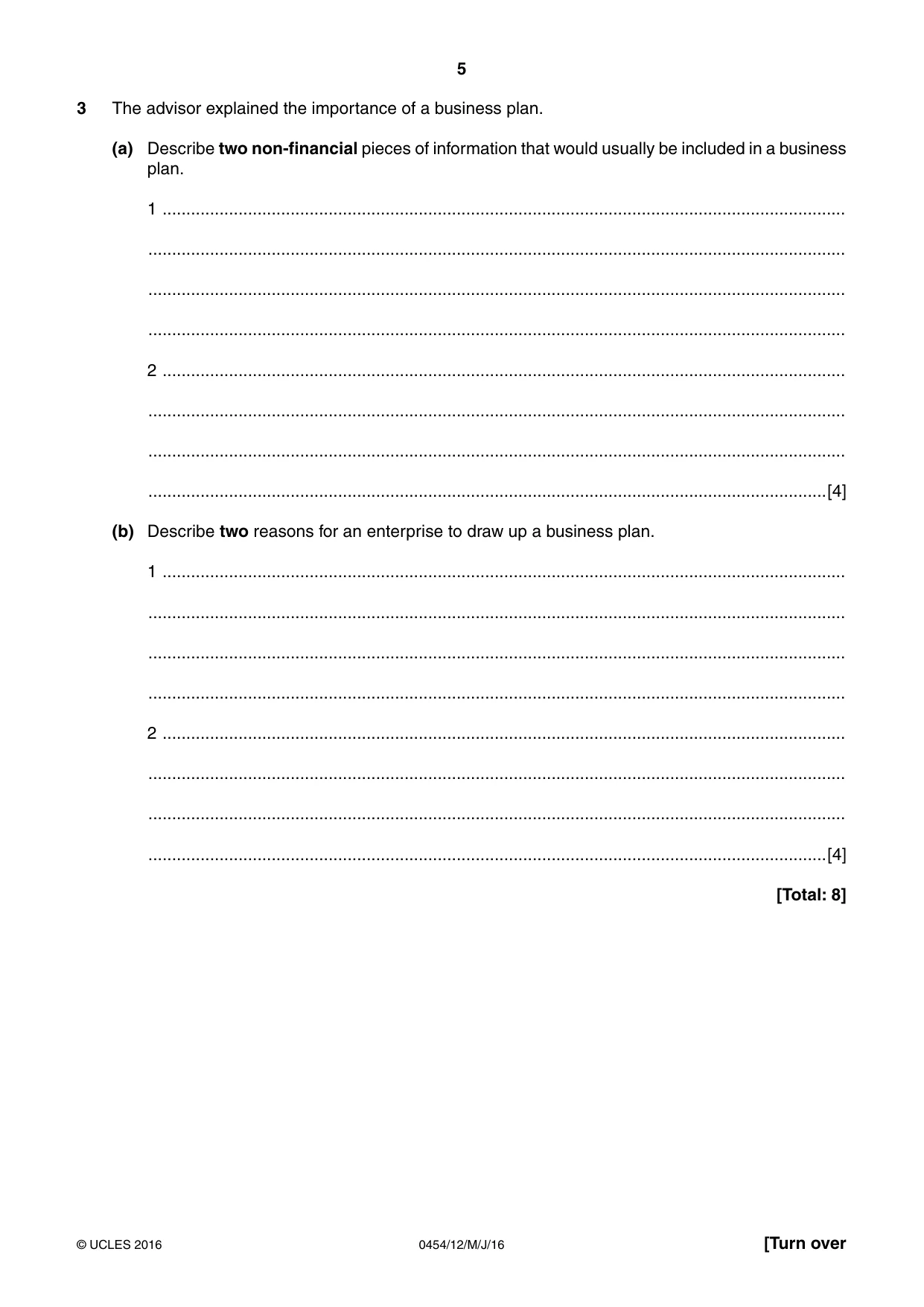
5 0454/12/M/J/16 © UCLES 2016 [Turn over 3 The advisor explained the importance of a business plan. (a) Describe two non-financial pieces of information that would usually be included in a business plan. 1 … … … … 2 … … … …[4] (b) Describe two reasons for an enterprise to draw up a business plan. 1 … … … … 2 … … … …[4] [Total: 8]
Question paper, page 6
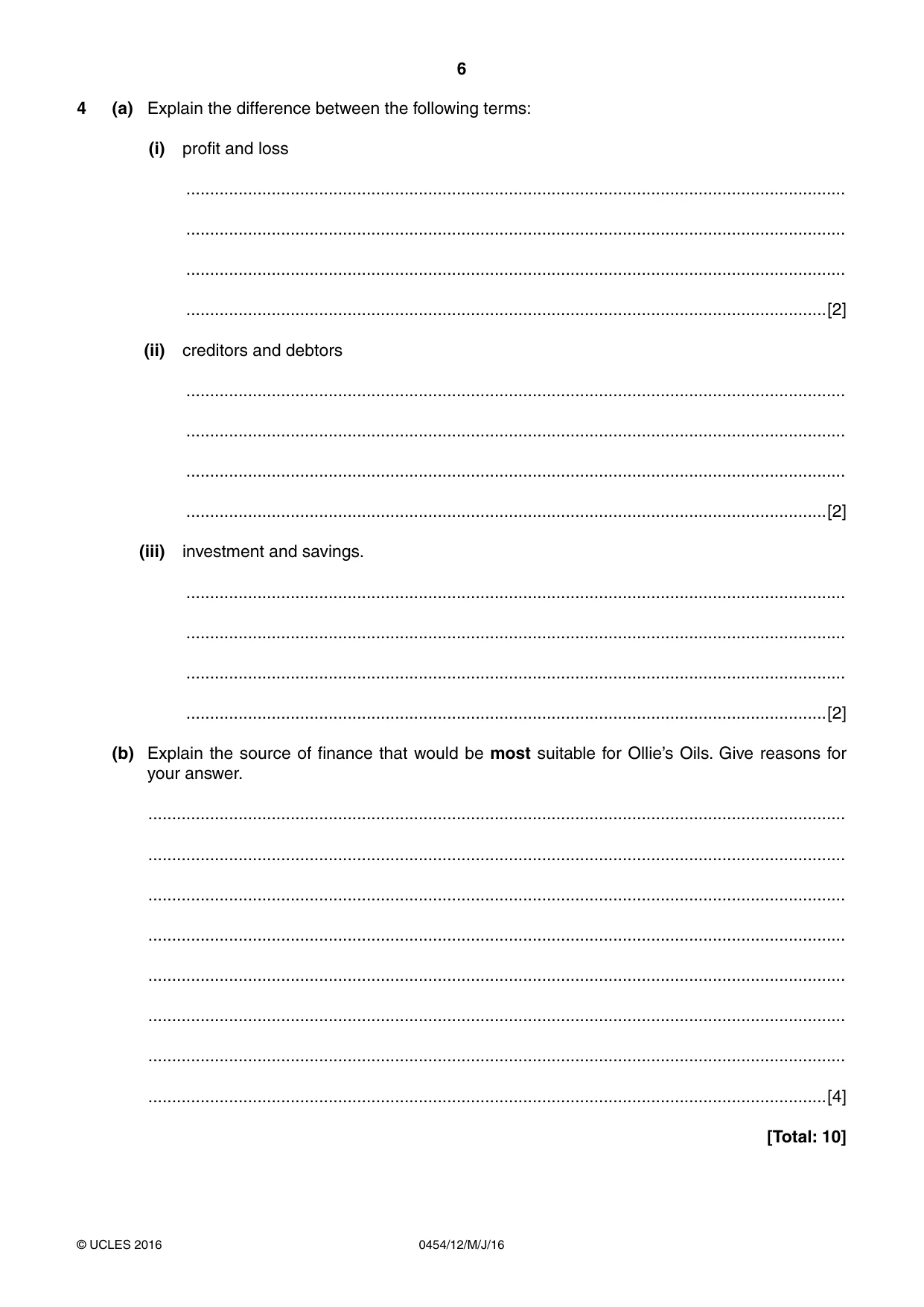
6 0454/12/M/J/16 © UCLES 2016 4 (a) Explain the difference between the following terms: (i) profit and loss … … … …[2] (ii) creditors and debtors … … … …[2] (iii) investment and savings. … … … …[2] (b) Explain the source of finance that would be most suitable for Ollie’s Oils. Give reasons for your answer. … … … … … … … …[4] [Total: 10]
Question paper, page 7
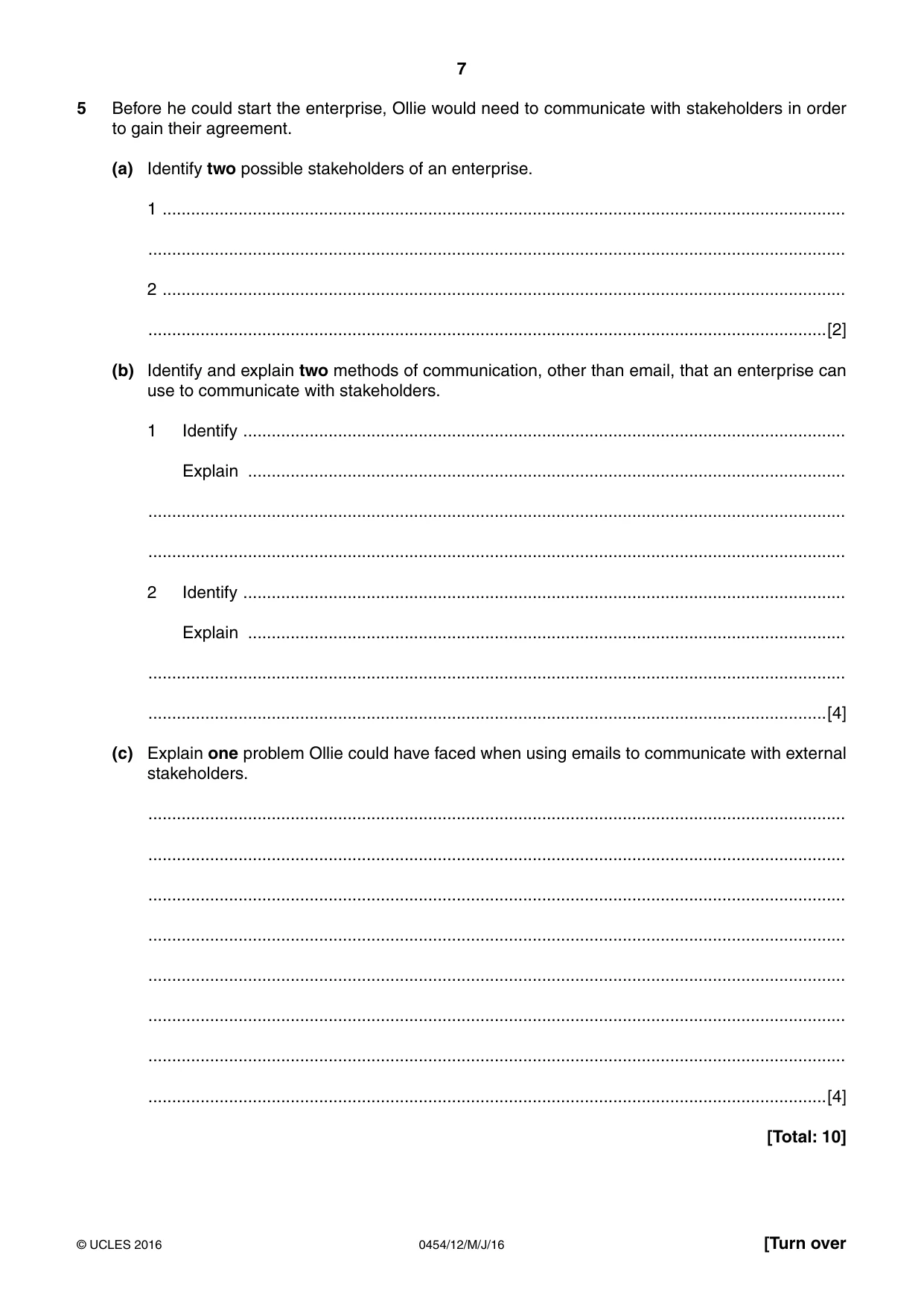
7 0454/12/M/J/16 © UCLES 2016 [Turn over 5 Before he could start the enterprise, Ollie would need to communicate with stakeholders in order to gain their agreement. (a) Identify two possible stakeholders of an enterprise. 1 … … 2 … …[2] (b) Identify and explain two methods of communication, other than email, that an enterprise can use to communicate with stakeholders. 1 Identify … Explain … … … 2 Identify … Explain … … …[4] (c) Explain one problem Ollie could have faced when using emails to communicate with external stakeholders. … … … … … … … …[4] [Total: 10]
Question paper, page 8
8 0454/12/M/J/16 © UCLES 2016 BLANK PAGE
Question paper, page 9
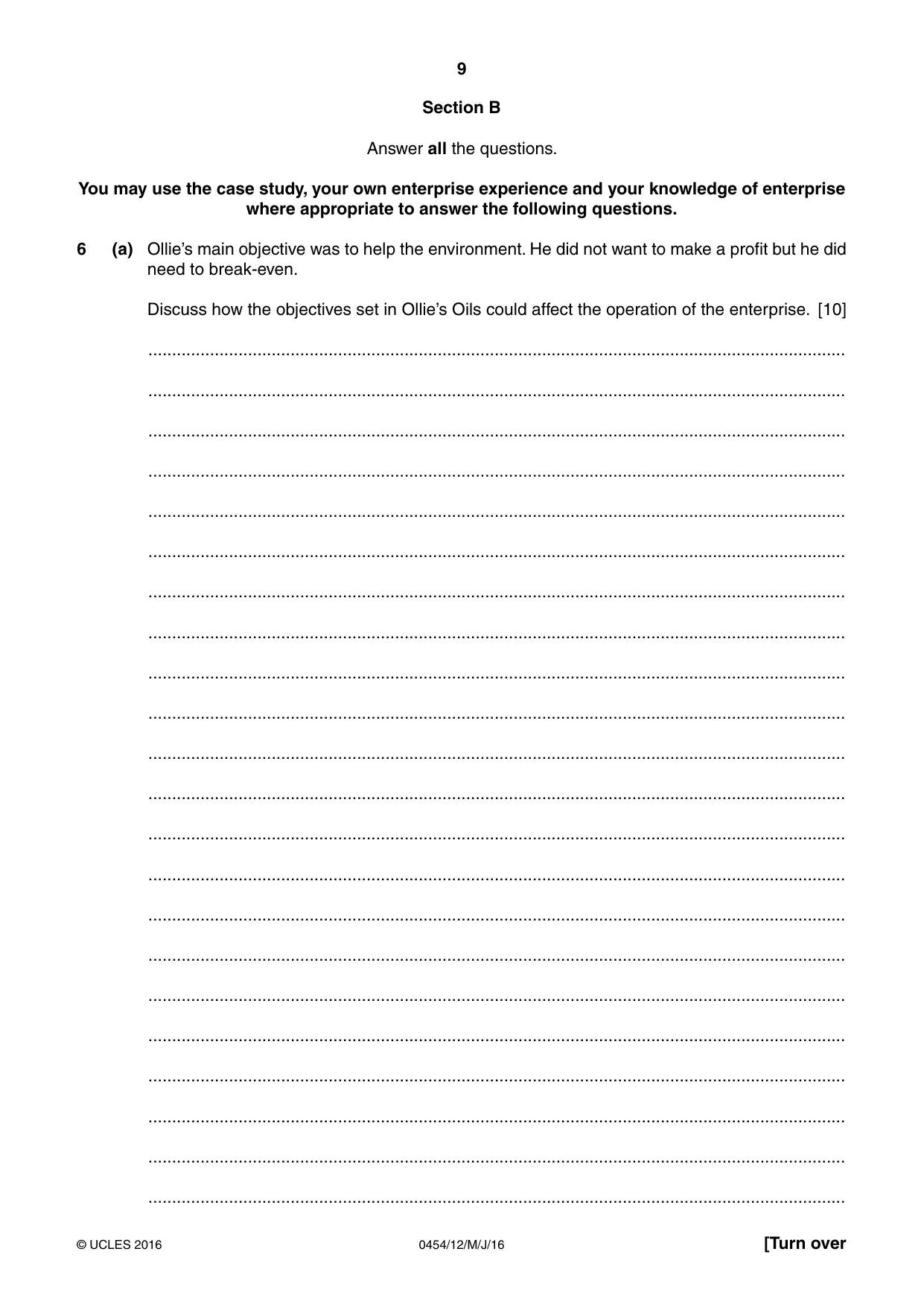
9 0454/12/M/J/16 © UCLES 2016 [Turn over Section B Answer all the questions. You may use the case study, your own enterprise experience and your knowledge of enterprise where appropriate to answer the following questions. 6 (a) Ollie’s main objective was to help the environment. He did not want to make a profit but he did need to break-even. Discuss how the objectives set in Ollie’s Oils could affect the operation of the enterprise. [10] … … … … … … … … … … … … … … … … … … … … … …
Question paper, page 10
10 0454/12/M/J/16 © UCLES 2016 (b) Ollie’s biggest problem would be how to get students and parents interested in his recycling scheme. He was not very good at marketing. Evaluate the different methods of marketing communication that Ollie could use to persuade these people to become involved in the recycling scheme. Use examples to support your answer. [15] … … … … … … … … … … … … … … … … … … … … … … … …
Question paper, page 11
11 0454/12/M/J/16 © UCLES 2016 [Turn over … … … … … … … … … … … … … … … … … … … … … … … … … … … [Total: 25]
Question paper, page 12
12 0454/12/M/J/16 © UCLES 2016 BLANK PAGE
Question paper, page 13
13 0454/12/M/J/16 © UCLES 2016 [Turn over 7 (a) Ollie believed that he would be able to meet the needs and wants of his customer, the factory. Discuss how successful your enterprise project was in meeting the needs and wants of its customers. [10] … … … … … … … … … … … … … … … … … … … … … … … … … …
Question paper, page 14
14 0454/12/M/J/16 © UCLES 2016 (b) Ollie needed a lot of help and support with his new enterprise. Evaluate the effectiveness of the sources of help and support used in your enterprise project. [15] … … … … … … … … … … … … … … … … … … … … … … … … … …
Question paper, page 15
15 0454/12/M/J/16 © UCLES 2016 … … … … … … … … … … … … … … … … … … … … … … … … … … … [Total: 25]
Question paper, page 16
16 0454/12/M/J/16 © UCLES 2016 BLANK PAGE Permission to reproduce items where third-party owned material protected by copyright is included has been sought and cleared where possible. Every reasonable effort has been made by the publisher (UCLES) to trace copyright holders, but if any items requiring clearance have unwittingly been included, the publisher will be pleased to make amends at the earliest possible opportunity. To avoid the issue of disclosure of answer-related information to candidates, all copyright acknowledgements are reproduced online in the Cambridge International Examinations Copyright Acknowledgements Booklet. This is produced for each series of examinations and is freely available to download at www.cie.org.uk after the live examination series. Cambridge International Examinations is part of the Cambridge Assessment Group. Cambridge Assessment is the brand name of University of Cambridge Local Examinations Syndicate (UCLES), which is itself a department of the University of Cambridge.
Mark scheme, page 1
® IGCSE is the registered trademark of Cambridge International Examinations. This syllabus is approved for use in England, Wales and Northern Ireland as a Cambridge International Level 1/Level 2 Certificate. This document consists of 11 printed pages. © UCLES 2016 [Turn over Cambridge International Examinations Cambridge International General Certificate of Secondary Education ENTERPRISE 0454/12 Paper 1 Case Study May/June 2016 MARK SCHEME Maximum Mark: 100 Published This mark scheme is published as an aid to teachers and candidates, to indicate the requirements of the examination. It shows the basis on which Examiners were instructed to award marks. It does not indicate the details of the discussions that took place at an Examiners’ meeting before marking began, which would have considered the acceptability of alternative answers. Mark schemes should be read in conjunction with the question paper and the Principal Examiner Report for Teachers. Cambridge will not enter into discussions about these mark schemes. Cambridge is publishing the mark schemes for the May/June 2016 series for most Cambridge IGCSE®, Cambridge International A and AS Level components and some Cambridge O Level components.
Mark scheme, page 2
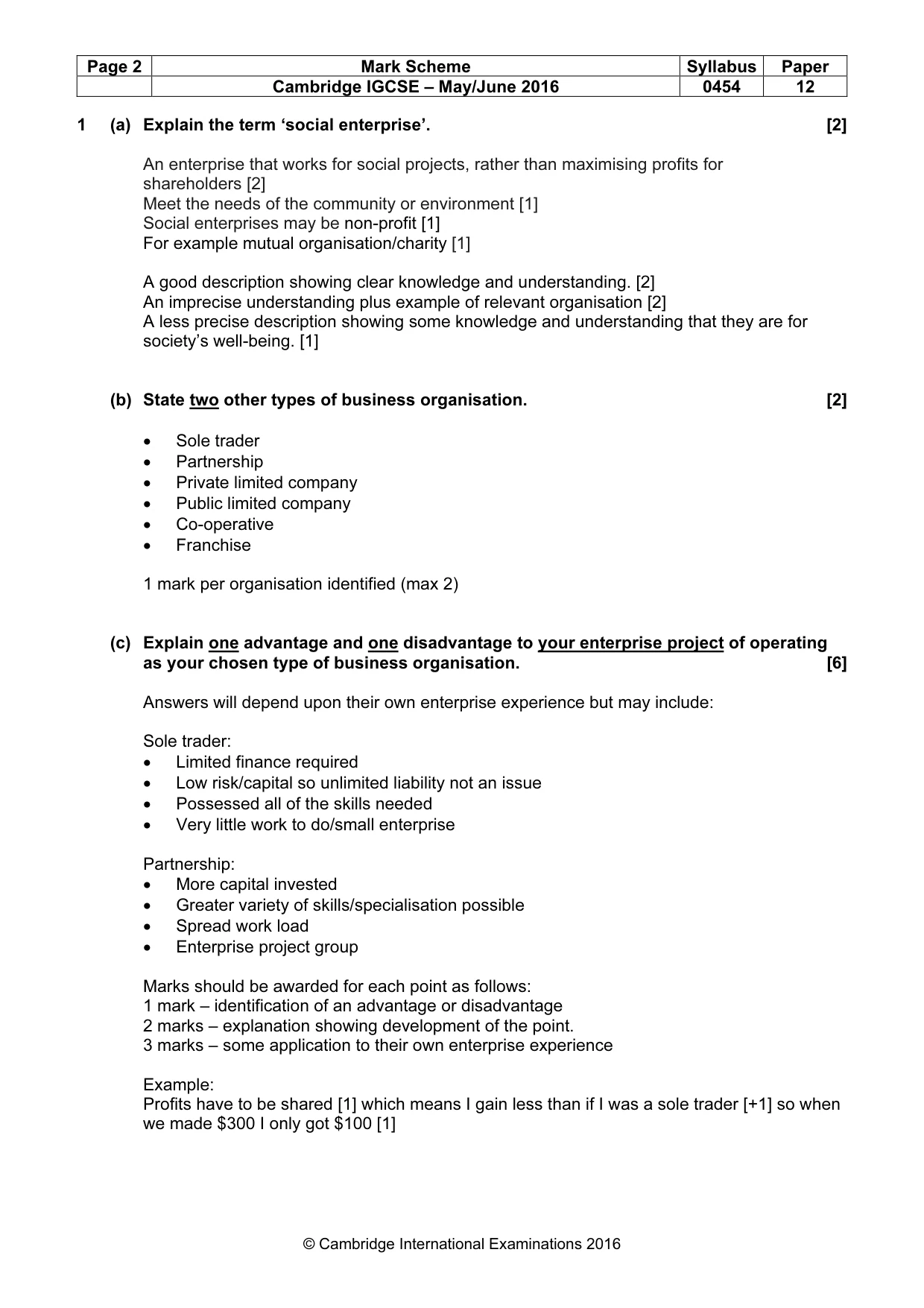
Page 2 Mark Scheme Syllabus Paper Cambridge IGCSE – May/June 2016 0454 12 © Cambridge International Examinations 2016 1 (a) Explain the term ‘social enterprise’. [2] An enterprise that works for social projects, rather than maximising profits for shareholders [2] Meet the needs of the community or environment [1] Social enterprises may be non-profit [1] For example mutual organisation/charity [1] A good description showing clear knowledge and understanding. [2] An imprecise understanding plus example of relevant organisation [2] A less precise description showing some knowledge and understanding that they are for society’s well-being. [1] (b) State two other types of business organisation. [2] • Sole trader • Partnership • Private limited company • Public limited company • Co-operative • Franchise 1 mark per organisation identified (max 2) (c) Explain one advantage and one disadvantage to your enterprise project of operating as your chosen type of business organisation. [6] Answers will depend upon their own enterprise experience but may include: Sole trader: • Limited finance required • Low risk/capital so unlimited liability not an issue • Possessed all of the skills needed • Very little work to do/small enterprise Partnership: • More capital invested • Greater variety of skills/specialisation possible • Spread work load • Enterprise project group Marks should be awarded for each point as follows: 1 mark – identification of an advantage or disadvantage 2 marks – explanation showing development of the point. 3 marks – some application to their own enterprise experience Example: Profits have to be shared [1] which means I gain less than if I was a sole trader [+1] so when we made $300 I only got $100 [1]
Mark scheme, page 3
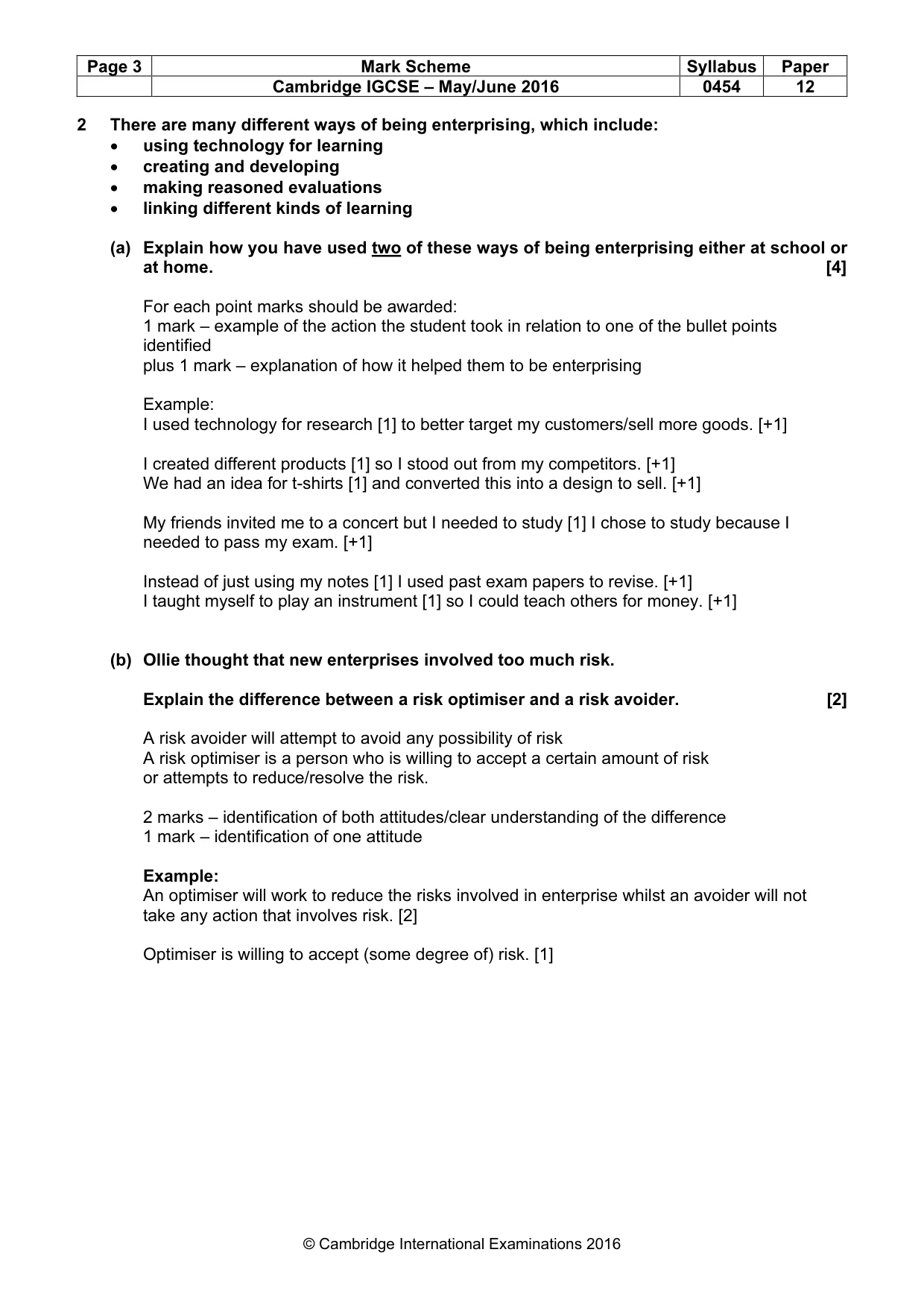
Page 3 Mark Scheme Syllabus Paper Cambridge IGCSE – May/June 2016 0454 12 © Cambridge International Examinations 2016 2 There are many different ways of being enterprising, which include: • using technology for learning • creating and developing • making reasoned evaluations • linking different kinds of learning (a) Explain how you have used two of these ways of being enterprising either at school or at home. [4] For each point marks should be awarded: 1 mark – example of the action the student took in relation to one of the bullet points identified plus 1 mark – explanation of how it helped them to be enterprising Example: I used technology for research [1] to better target my customers/sell more goods. [+1] I created different products [1] so I stood out from my competitors. [+1] We had an idea for t-shirts [1] and converted this into a design to sell. [+1] My friends invited me to a concert but I needed to study [1] I chose to study because I needed to pass my exam. [+1] Instead of just using my notes [1] I used past exam papers to revise. [+1] I taught myself to play an instrument [1] so I could teach others for money. [+1] (b) Ollie thought that new enterprises involved too much risk. Explain the difference between a risk optimiser and a risk avoider. [2] A risk avoider will attempt to avoid any possibility of risk A risk optimiser is a person who is willing to accept a certain amount of risk or attempts to reduce/resolve the risk. 2 marks – identification of both attitudes/clear understanding of the difference 1 mark – identification of one attitude Example: An optimiser will work to reduce the risks involved in enterprise whilst an avoider will not take any action that involves risk. [2] Optimiser is willing to accept (some degree of) risk. [1]
Mark scheme, page 4
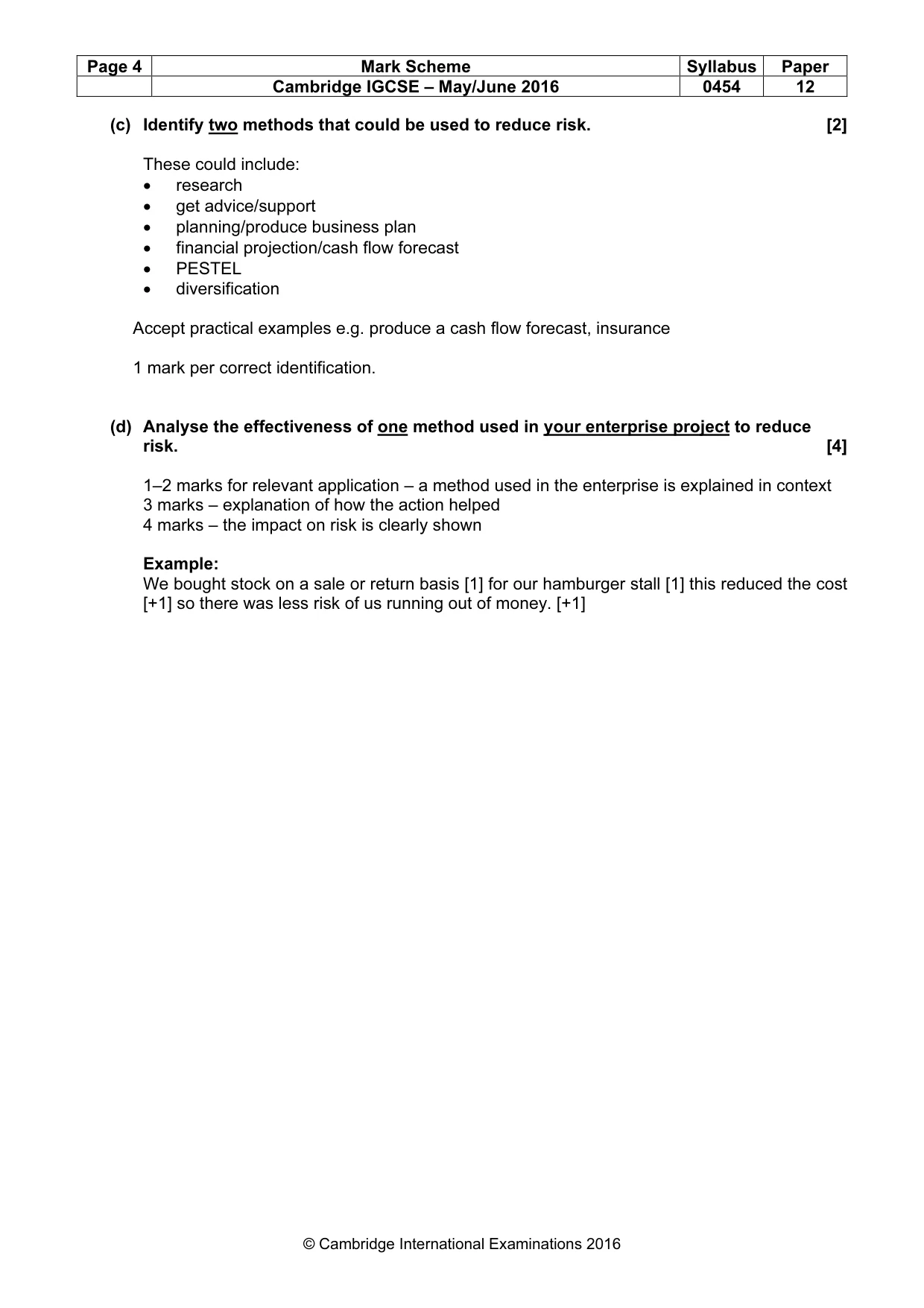
Page 4 Mark Scheme Syllabus Paper Cambridge IGCSE – May/June 2016 0454 12 © Cambridge International Examinations 2016 (c) Identify two methods that could be used to reduce risk. [2] These could include: • research • get advice/support • planning/produce business plan • financial projection/cash flow forecast • PESTEL • diversification Accept practical examples e.g. produce a cash flow forecast, insurance 1 mark per correct identification. (d) Analyse the effectiveness of one method used in your enterprise project to reduce risk. [4] 1–2 marks for relevant application – a method used in the enterprise is explained in context 3 marks – explanation of how the action helped 4 marks – the impact on risk is clearly shown Example: We bought stock on a sale or return basis [1] for our hamburger stall [1] this reduced the cost [+1] so there was less risk of us running out of money. [+1]
Mark scheme, page 5
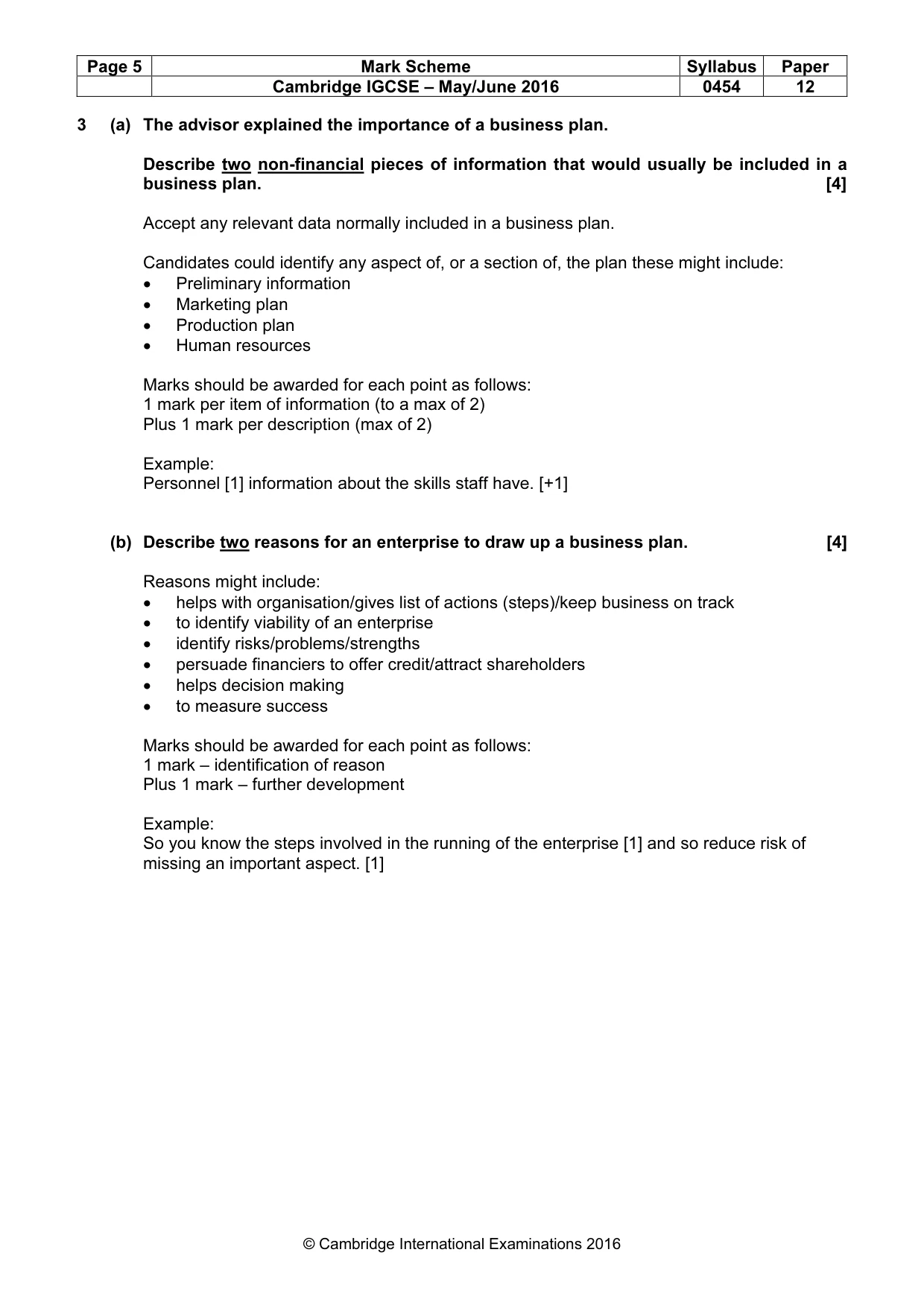
Page 5 Mark Scheme Syllabus Paper Cambridge IGCSE – May/June 2016 0454 12 © Cambridge International Examinations 2016 3 (a) The advisor explained the importance of a business plan. Describe two non-financial pieces of information that would usually be included in a business plan. [4] Accept any relevant data normally included in a business plan. Candidates could identify any aspect of, or a section of, the plan these might include: • Preliminary information • Marketing plan • Production plan • Human resources Marks should be awarded for each point as follows: 1 mark per item of information (to a max of 2) Plus 1 mark per description (max of 2) Example: Personnel [1] information about the skills staff have. [+1] (b) Describe two reasons for an enterprise to draw up a business plan. [4] Reasons might include: • helps with organisation/gives list of actions (steps)/keep business on track • to identify viability of an enterprise • identify risks/problems/strengths • persuade financiers to offer credit/attract shareholders • helps decision making • to measure success Marks should be awarded for each point as follows: 1 mark – identification of reason Plus 1 mark – further development Example: So you know the steps involved in the running of the enterprise [1] and so reduce risk of missing an important aspect. [1]
Mark scheme, page 6
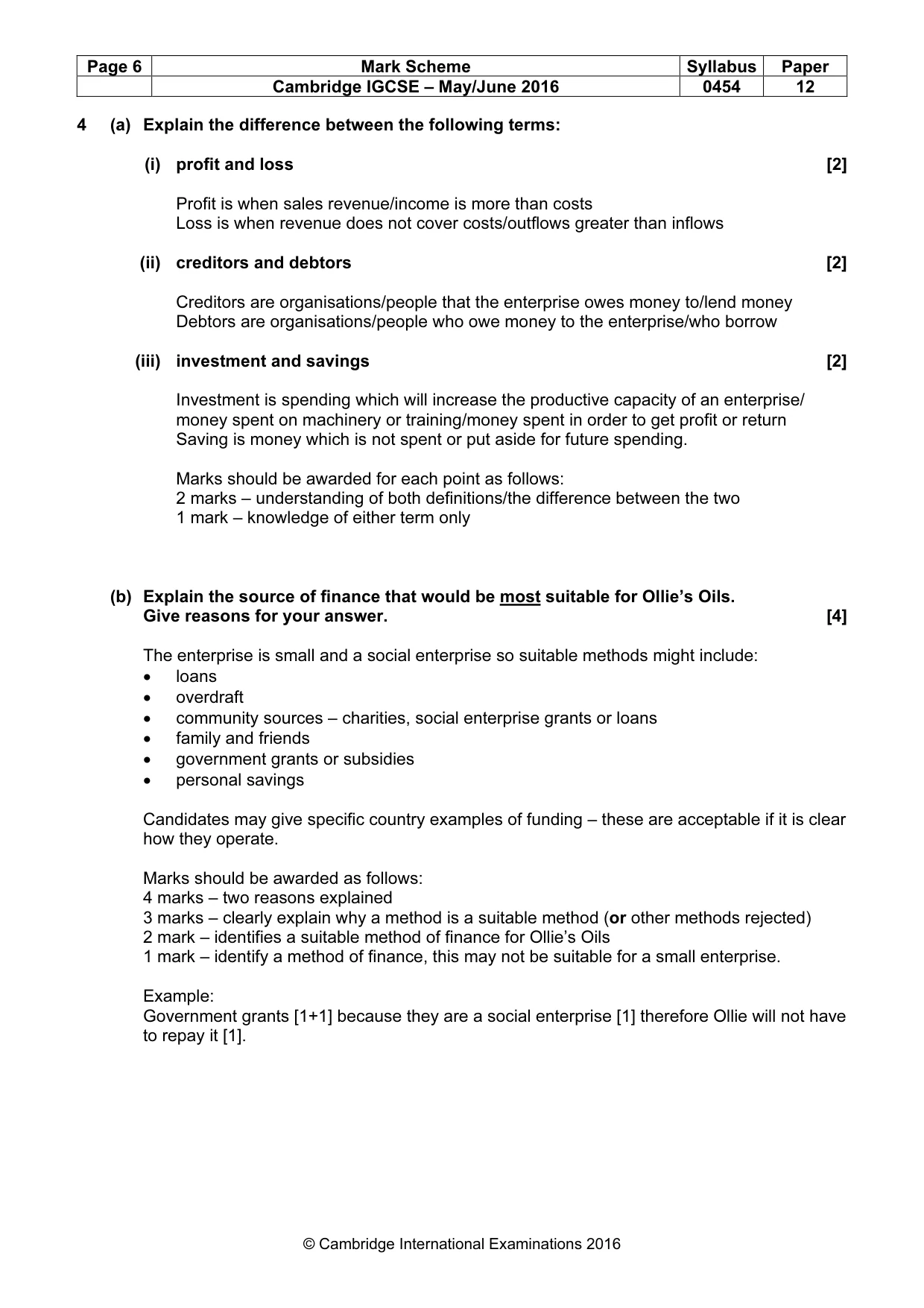
Page 6 Mark Scheme Syllabus Paper Cambridge IGCSE – May/June 2016 0454 12 © Cambridge International Examinations 2016 4 (a) Explain the difference between the following terms: (i) profit and loss [2] Profit is when sales revenue/income is more than costs Loss is when revenue does not cover costs/outflows greater than inflows (ii) creditors and debtors [2] Creditors are organisations/people that the enterprise owes money to/lend money Debtors are organisations/people who owe money to the enterprise/who borrow (iii) investment and savings [2] Investment is spending which will increase the productive capacity of an enterprise/ money spent on machinery or training/money spent in order to get profit or return Saving is money which is not spent or put aside for future spending. Marks should be awarded for each point as follows: 2 marks – understanding of both definitions/the difference between the two 1 mark – knowledge of either term only (b) Explain the source of finance that would be most suitable for Ollie’s Oils. Give reasons for your answer. [4] The enterprise is small and a social enterprise so suitable methods might include: • loans • overdraft • community sources – charities, social enterprise grants or loans • family and friends • government grants or subsidies • personal savings Candidates may give specific country examples of funding – these are acceptable if it is clear how they operate. Marks should be awarded as follows: 4 marks – two reasons explained 3 marks – clearly explain why a method is a suitable method (or other methods rejected) 2 mark – identifies a suitable method of finance for Ollie’s Oils 1 mark – identify a method of finance, this may not be suitable for a small enterprise. Example: Government grants [1+1] because they are a social enterprise [1] therefore Ollie will not have to repay it [1].
Mark scheme, page 7
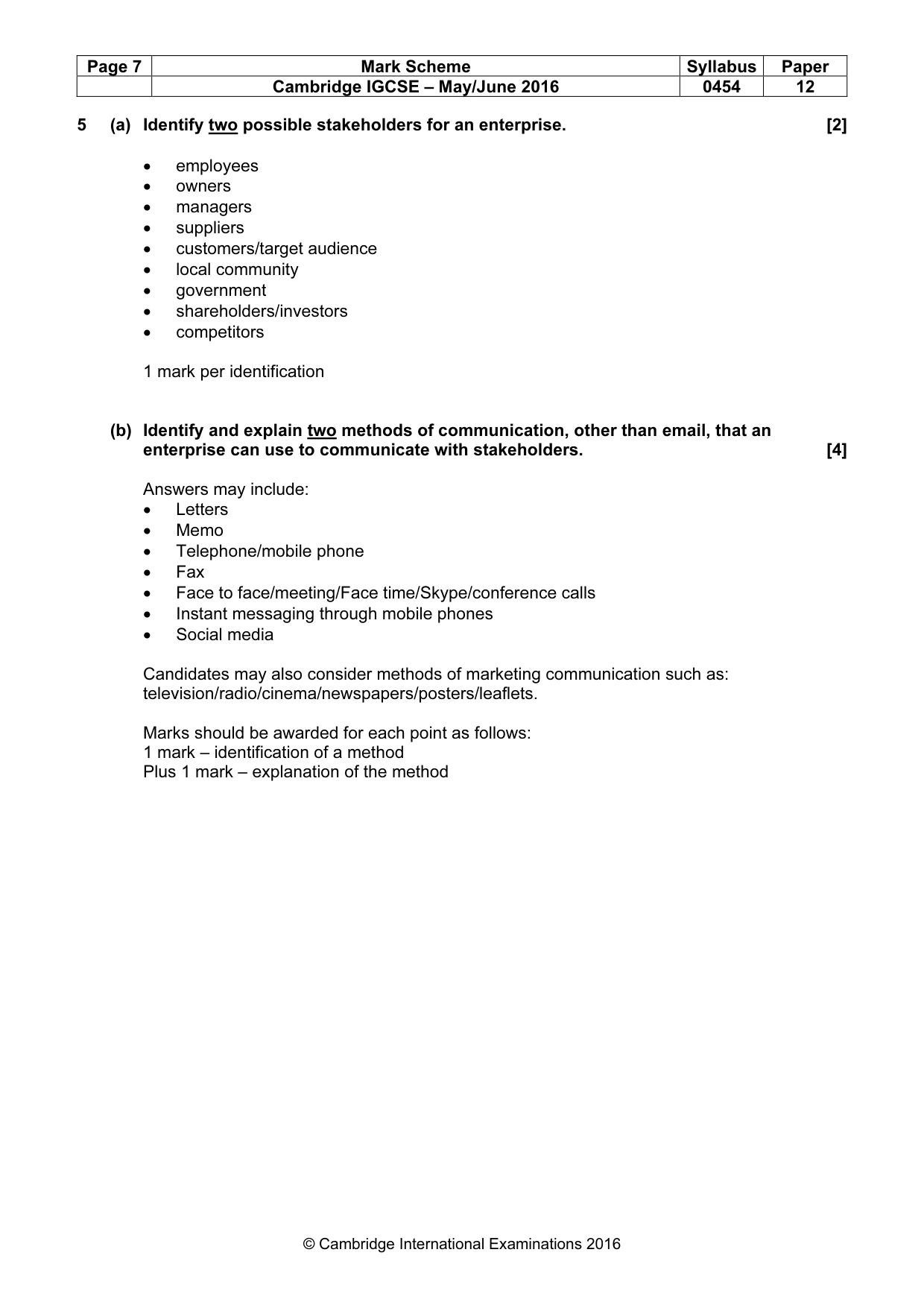
Page 7 Mark Scheme Syllabus Paper Cambridge IGCSE – May/June 2016 0454 12 © Cambridge International Examinations 2016 5 (a) Identify two possible stakeholders for an enterprise. [2] • employees • owners • managers • suppliers • customers/target audience • local community • government • shareholders/investors • competitors 1 mark per identification (b) Identify and explain two methods of communication, other than email, that an enterprise can use to communicate with stakeholders. [4] Answers may include: • Letters • Memo • Telephone/mobile phone • Fax • Face to face/meeting/Face time/Skype/conference calls • Instant messaging through mobile phones • Social media Candidates may also consider methods of marketing communication such as: television/radio/cinema/newspapers/posters/leaflets. Marks should be awarded for each point as follows: 1 mark – identification of a method Plus 1 mark – explanation of the method
Mark scheme, page 8
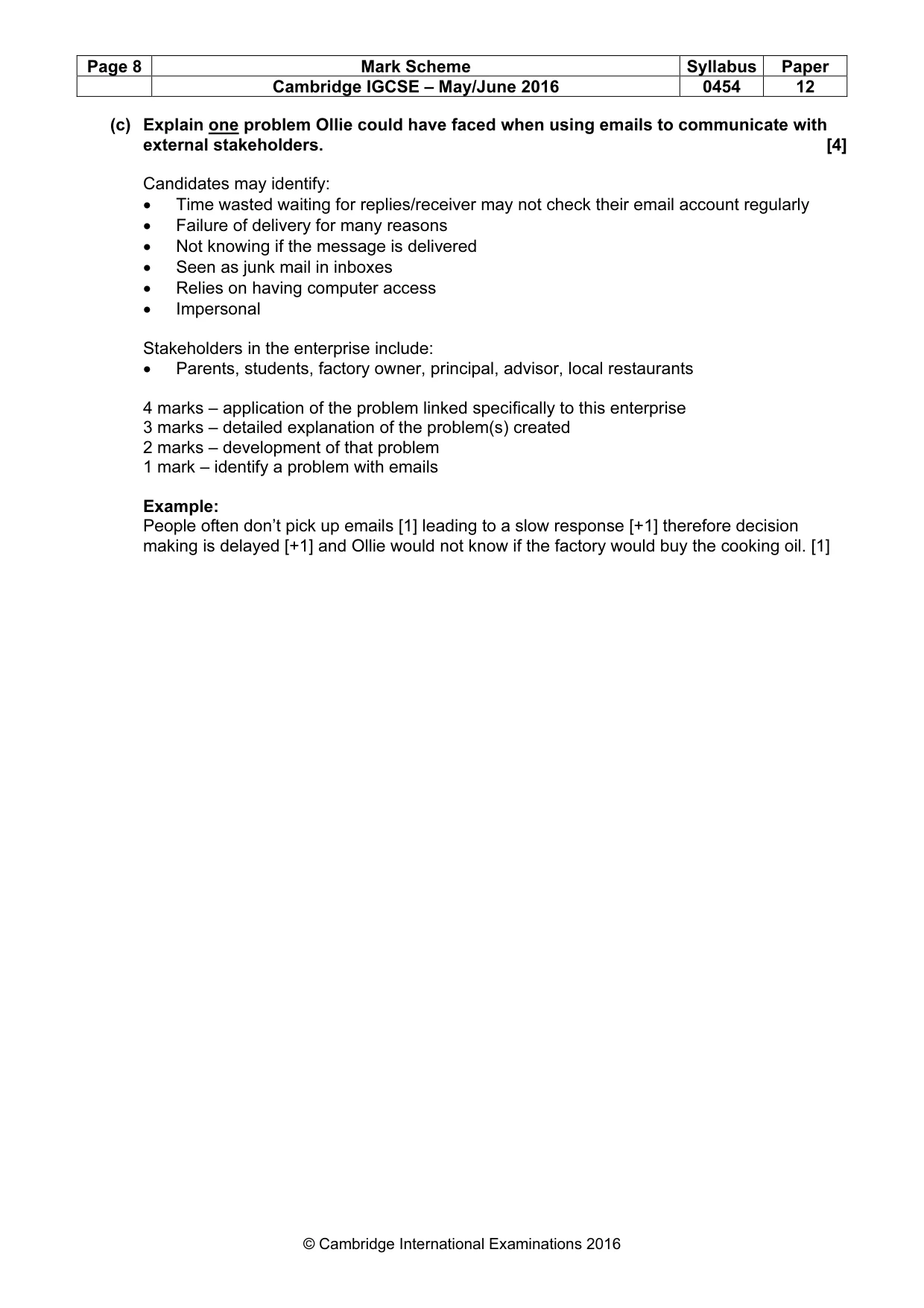
Page 8 Mark Scheme Syllabus Paper Cambridge IGCSE – May/June 2016 0454 12 © Cambridge International Examinations 2016 (c) Explain one problem Ollie could have faced when using emails to communicate with external stakeholders. [4] Candidates may identify: • Time wasted waiting for replies/receiver may not check their email account regularly • Failure of delivery for many reasons • Not knowing if the message is delivered • Seen as junk mail in inboxes • Relies on having computer access • Impersonal Stakeholders in the enterprise include: • Parents, students, factory owner, principal, advisor, local restaurants 4 marks – application of the problem linked specifically to this enterprise 3 marks – detailed explanation of the problem(s) created 2 marks – development of that problem 1 mark – identify a problem with emails Example: People often don’t pick up emails [1] leading to a slow response [+1] therefore decision making is delayed [+1] and Ollie would not know if the factory would buy the cooking oil. [1]
Mark scheme, page 9
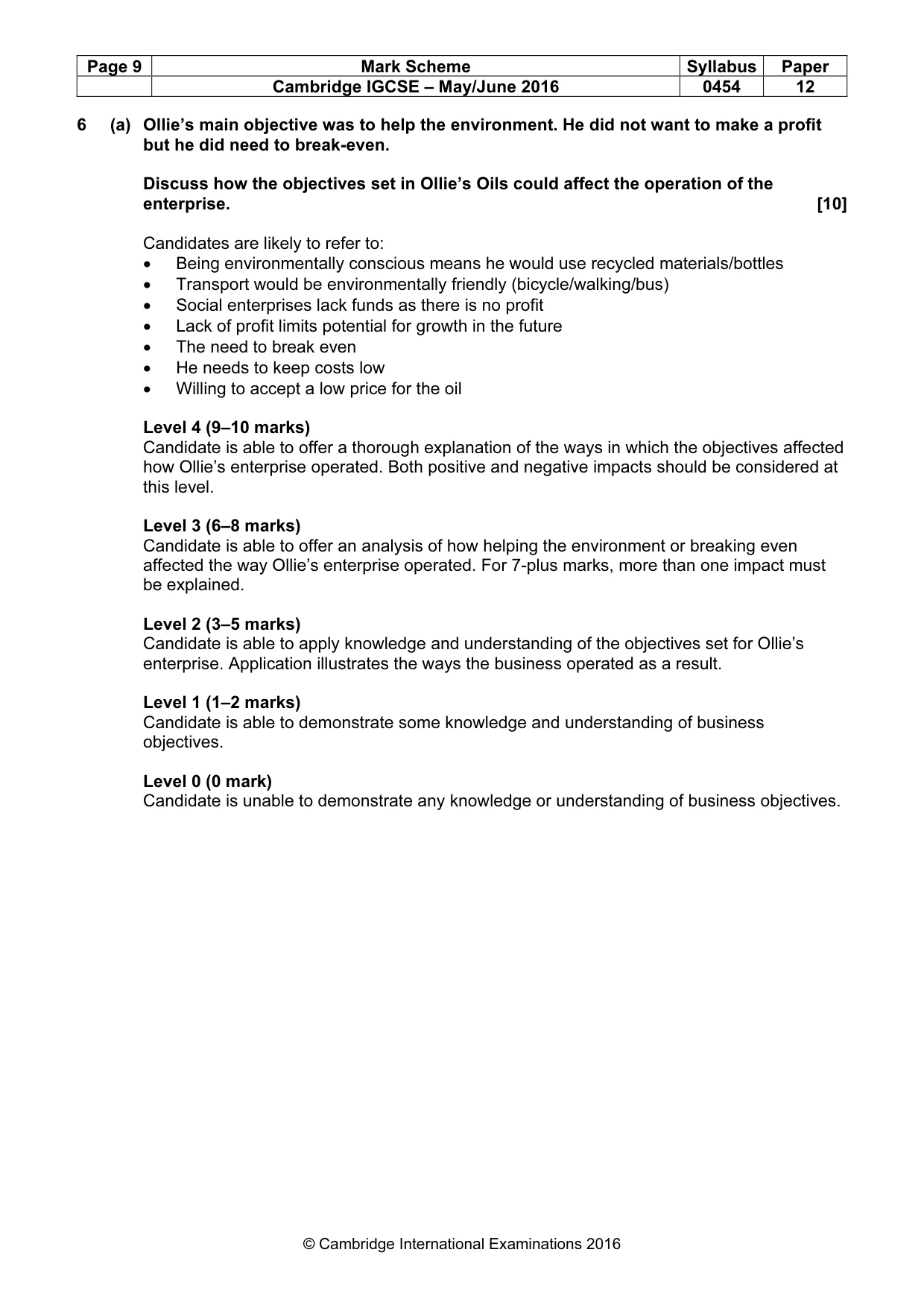
Page 9 Mark Scheme Syllabus Paper Cambridge IGCSE – May/June 2016 0454 12 © Cambridge International Examinations 2016 6 (a) Ollie’s main objective was to help the environment. He did not want to make a profit but he did need to break-even. Discuss how the objectives set in Ollie’s Oils could affect the operation of the enterprise. [10] Candidates are likely to refer to: • Being environmentally conscious means he would use recycled materials/bottles • Transport would be environmentally friendly (bicycle/walking/bus) • Social enterprises lack funds as there is no profit • Lack of profit limits potential for growth in the future • The need to break even • He needs to keep costs low • Willing to accept a low price for the oil Level 4 (9–10 marks) Candidate is able to offer a thorough explanation of the ways in which the objectives affected how Ollie’s enterprise operated. Both positive and negative impacts should be considered at this level. Level 3 (6–8 marks) Candidate is able to offer an analysis of how helping the environment or breaking even affected the way Ollie’s enterprise operated. For 7-plus marks, more than one impact must be explained. Level 2 (3–5 marks) Candidate is able to apply knowledge and understanding of the objectives set for Ollie’s enterprise. Application illustrates the ways the business operated as a result. Level 1 (1–2 marks) Candidate is able to demonstrate some knowledge and understanding of business objectives. Level 0 (0 mark) Candidate is unable to demonstrate any knowledge or understanding of business objectives.
Mark scheme, page 10
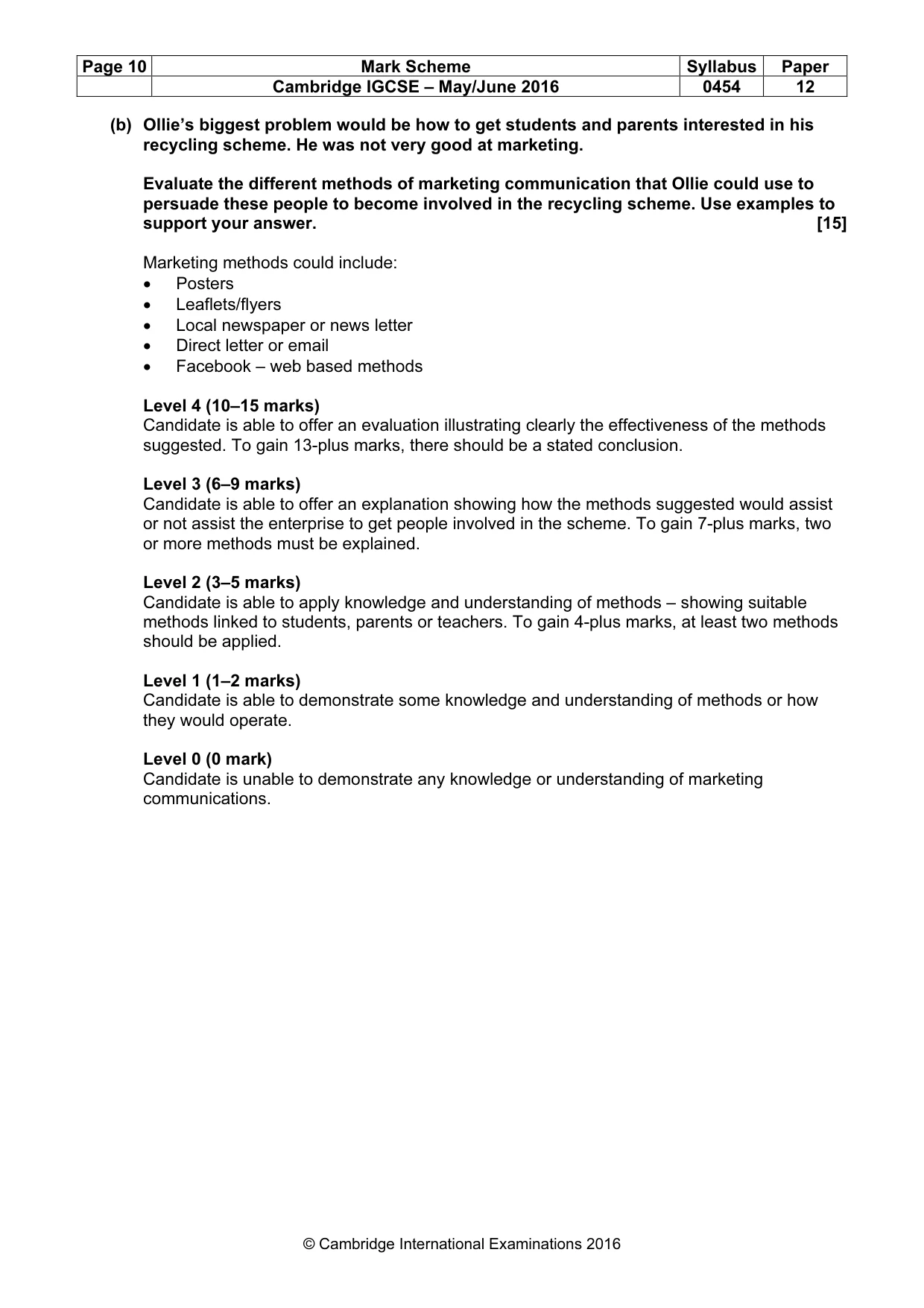
Page 10 Mark Scheme Syllabus Paper Cambridge IGCSE – May/June 2016 0454 12 © Cambridge International Examinations 2016 (b) Ollie’s biggest problem would be how to get students and parents interested in his recycling scheme. He was not very good at marketing. Evaluate the different methods of marketing communication that Ollie could use to persuade these people to become involved in the recycling scheme. Use examples to support your answer. [15] Marketing methods could include: • Posters • Leaflets/flyers • Local newspaper or news letter • Direct letter or email • Facebook – web based methods Level 4 (10–15 marks) Candidate is able to offer an evaluation illustrating clearly the effectiveness of the methods suggested. To gain 13-plus marks, there should be a stated conclusion. Level 3 (6–9 marks) Candidate is able to offer an explanation showing how the methods suggested would assist or not assist the enterprise to get people involved in the scheme. To gain 7-plus marks, two or more methods must be explained. Level 2 (3–5 marks) Candidate is able to apply knowledge and understanding of methods – showing suitable methods linked to students, parents or teachers. To gain 4-plus marks, at least two methods should be applied. Level 1 (1–2 marks) Candidate is able to demonstrate some knowledge and understanding of methods or how they would operate. Level 0 (0 mark) Candidate is unable to demonstrate any knowledge or understanding of marketing communications.
Mark scheme, page 11
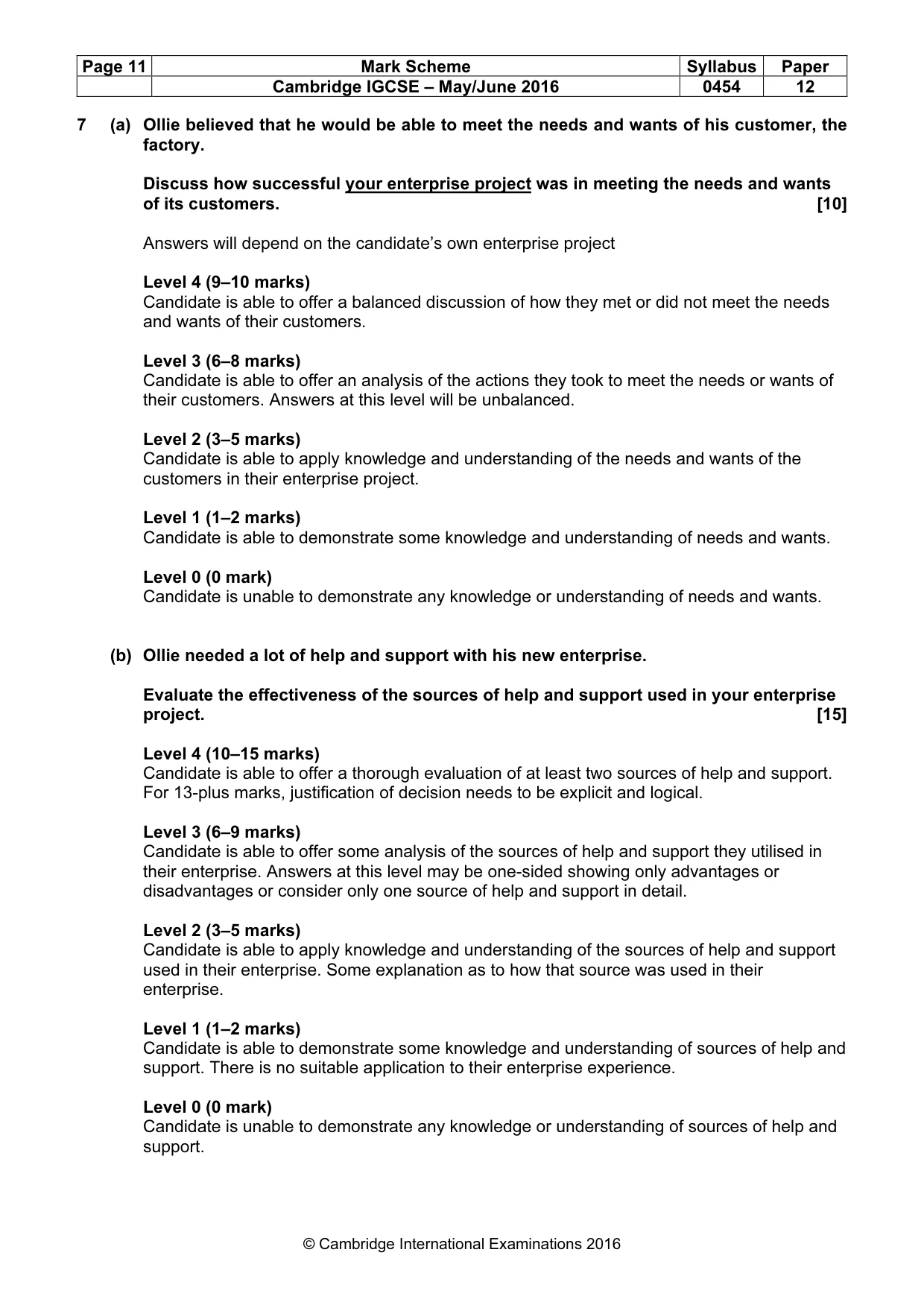
Page 11 Mark Scheme Syllabus Paper Cambridge IGCSE – May/June 2016 0454 12 © Cambridge International Examinations 2016 7 (a) Ollie believed that he would be able to meet the needs and wants of his customer, the factory. Discuss how successful your enterprise project was in meeting the needs and wants of its customers. [10] Answers will depend on the candidate’s own enterprise project Level 4 (9–10 marks) Candidate is able to offer a balanced discussion of how they met or did not meet the needs and wants of their customers. Level 3 (6–8 marks) Candidate is able to offer an analysis of the actions they took to meet the needs or wants of their customers. Answers at this level will be unbalanced. Level 2 (3–5 marks) Candidate is able to apply knowledge and understanding of the needs and wants of the customers in their enterprise project. Level 1 (1–2 marks) Candidate is able to demonstrate some knowledge and understanding of needs and wants. Level 0 (0 mark) Candidate is unable to demonstrate any knowledge or understanding of needs and wants. (b) Ollie needed a lot of help and support with his new enterprise. Evaluate the effectiveness of the sources of help and support used in your enterprise project. [15] Level 4 (10–15 marks) Candidate is able to offer a thorough evaluation of at least two sources of help and support. For 13-plus marks, justification of decision needs to be explicit and logical. Level 3 (6–9 marks) Candidate is able to offer some analysis of the sources of help and support they utilised in their enterprise. Answers at this level may be one-sided showing only advantages or disadvantages or consider only one source of help and support in detail. Level 2 (3–5 marks) Candidate is able to apply knowledge and understanding of the sources of help and support used in their enterprise. Some explanation as to how that source was used in their enterprise. Level 1 (1–2 marks) Candidate is able to demonstrate some knowledge and understanding of sources of help and support. There is no suitable application to their enterprise experience. Level 0 (0 mark) Candidate is unable to demonstrate any knowledge or understanding of sources of help and support.
What you needed in this session
Cambridge’s own grade thresholds for 2016 May/June, Paper 1 · Variant 2. A higher threshold means an easier paper — the bar moves with how the cohort did.