Cambridge IGCSE Enterprise 0454 — 2015 Oct/Nov Paper 1 · Variant 1
0454/11/O/N/15 · 100 marks · ≈113 min
The question paper and its mark scheme, free to read here and free to download. This is Cambridge’s own paper, exactly as it was sat.
Question paper16 pages




Mark scheme10 pages
Answers below. Sit the paper first if you are practising.
Paper as text
Question paper, page 1
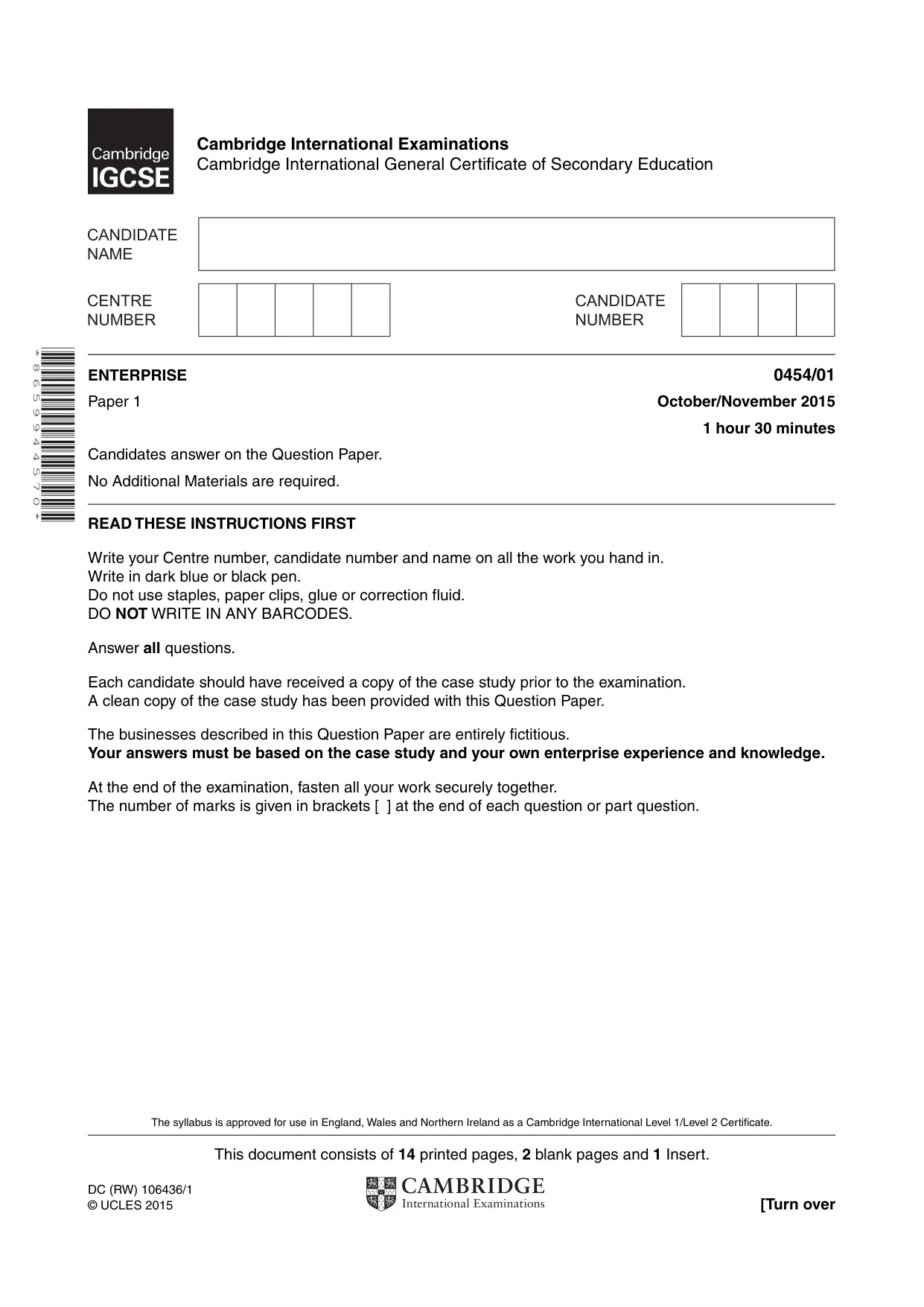
This document consists of 14 printed pages, 2 blank pages and 1 Insert. DC (RW) 106436/1 © UCLES 2015 [Turn over Cambridge International Examinations Cambridge International General Certificate of Secondary Education * 8 6 5 9 9 4 4 5 7 0 * ENTERPRISE 0454/01 Paper 1 October/November 2015 1 hour 30 minutes Candidates answer on the Question Paper. No Additional Materials are required. READ THESE INSTRUCTIONS FIRST Write your Centre number, candidate number and name on all the work you hand in. Write in dark blue or black pen. Do not use staples, paper clips, glue or correction fluid. DO NOT WRITE IN ANY BARCODES. Answer all questions. Each candidate should have received a copy of the case study prior to the examination. A clean copy of the case study has been provided with this Question Paper. The businesses described in this Question Paper are entirely fictitious. Your answers must be based on the case study and your own enterprise experience and knowledge. At the end of the examination, fasten all your work securely together. The number of marks is given in brackets [ ] at the end of each question or part question. The syllabus is approved for use in England, Wales and Northern Ireland as a Cambridge International Level 1/Level 2 Certificate.
Question paper, page 2
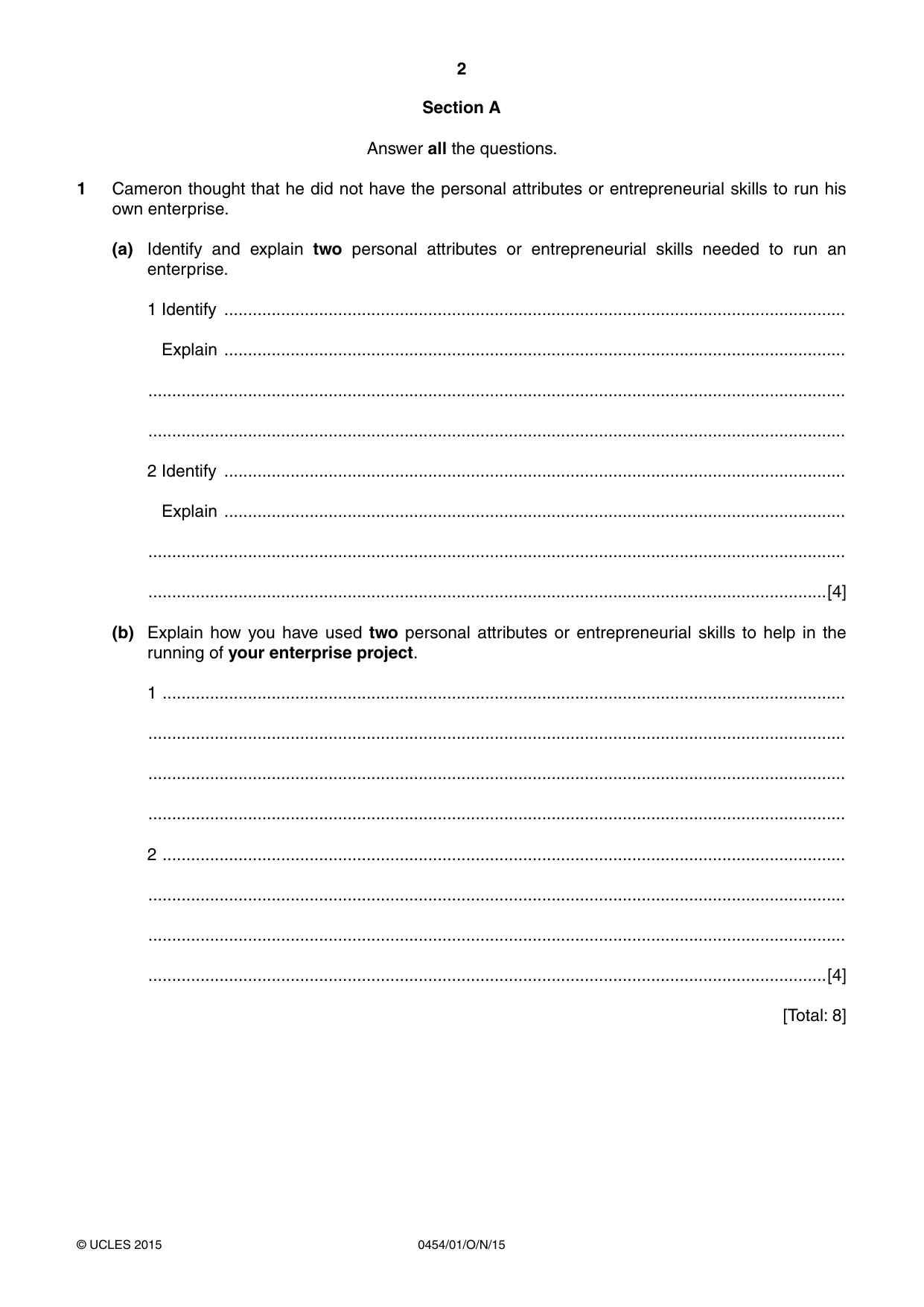
2 0454/01/O/N/15 © UCLES 2015 Section A Answer all the questions. 1 Cameron thought that he did not have the personal attributes or entrepreneurial skills to run his own enterprise. (a) Identify and explain two personal attributes or entrepreneurial skills needed to run an enterprise. 1 Identify … Explain … … … 2 Identify … Explain … … …[4] (b) Explain how you have used two personal attributes or entrepreneurial skills to help in the running of your enterprise project. 1 … … … … 2 … … … …[4] [Total: 8]
Question paper, page 3
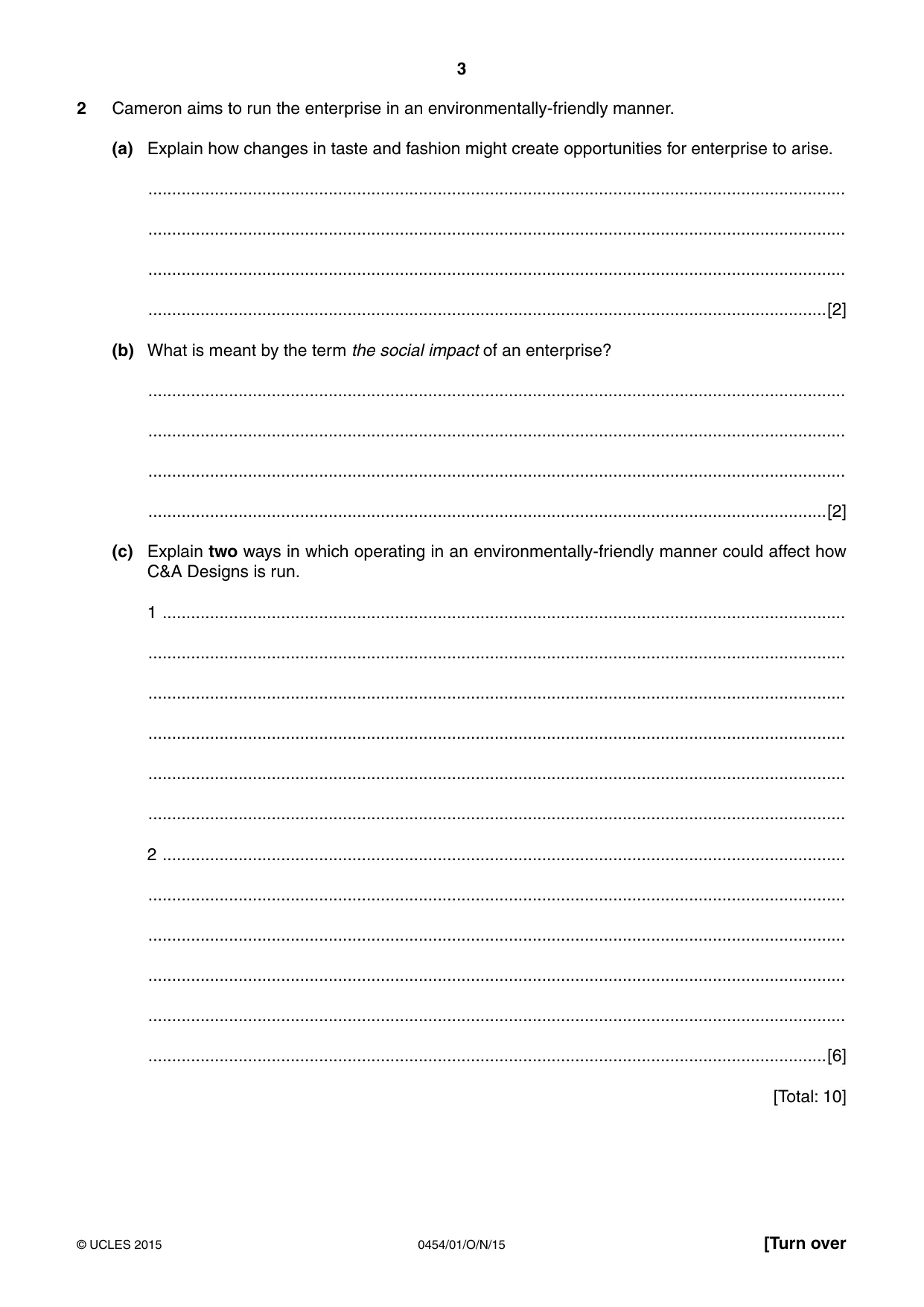
3 0454/01/O/N/15 © UCLES 2015 [Turn over 2 Cameron aims to run the enterprise in an environmentally-friendly manner. (a) Explain how changes in taste and fashion might create opportunities for enterprise to arise. … … … …[2] (b) What is meant by the term the social impact of an enterprise? … … … …[2] (c) Explain two ways in which operating in an environmentally-friendly manner could affect how C&A Designs is run. 1 … … … … … … 2 … … … … … …[6] [Total: 10]
Question paper, page 4
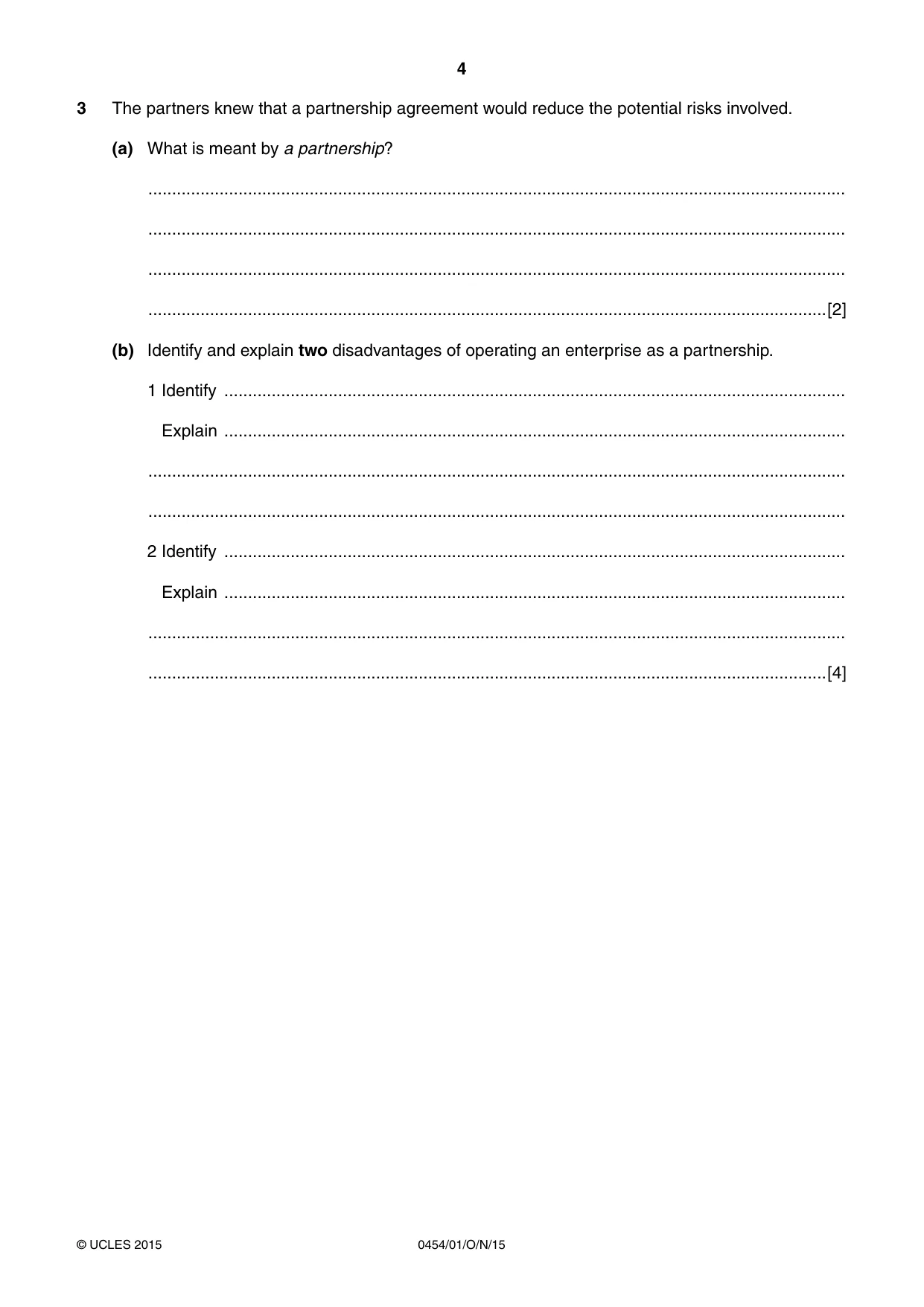
4 0454/01/O/N/15 © UCLES 2015 3 The partners knew that a partnership agreement would reduce the potential risks involved. (a) What is meant by a partnership? … … … …[2] (b) Identify and explain two disadvantages of operating an enterprise as a partnership. 1 Identify … Explain … … … 2 Identify … Explain … … …[4]
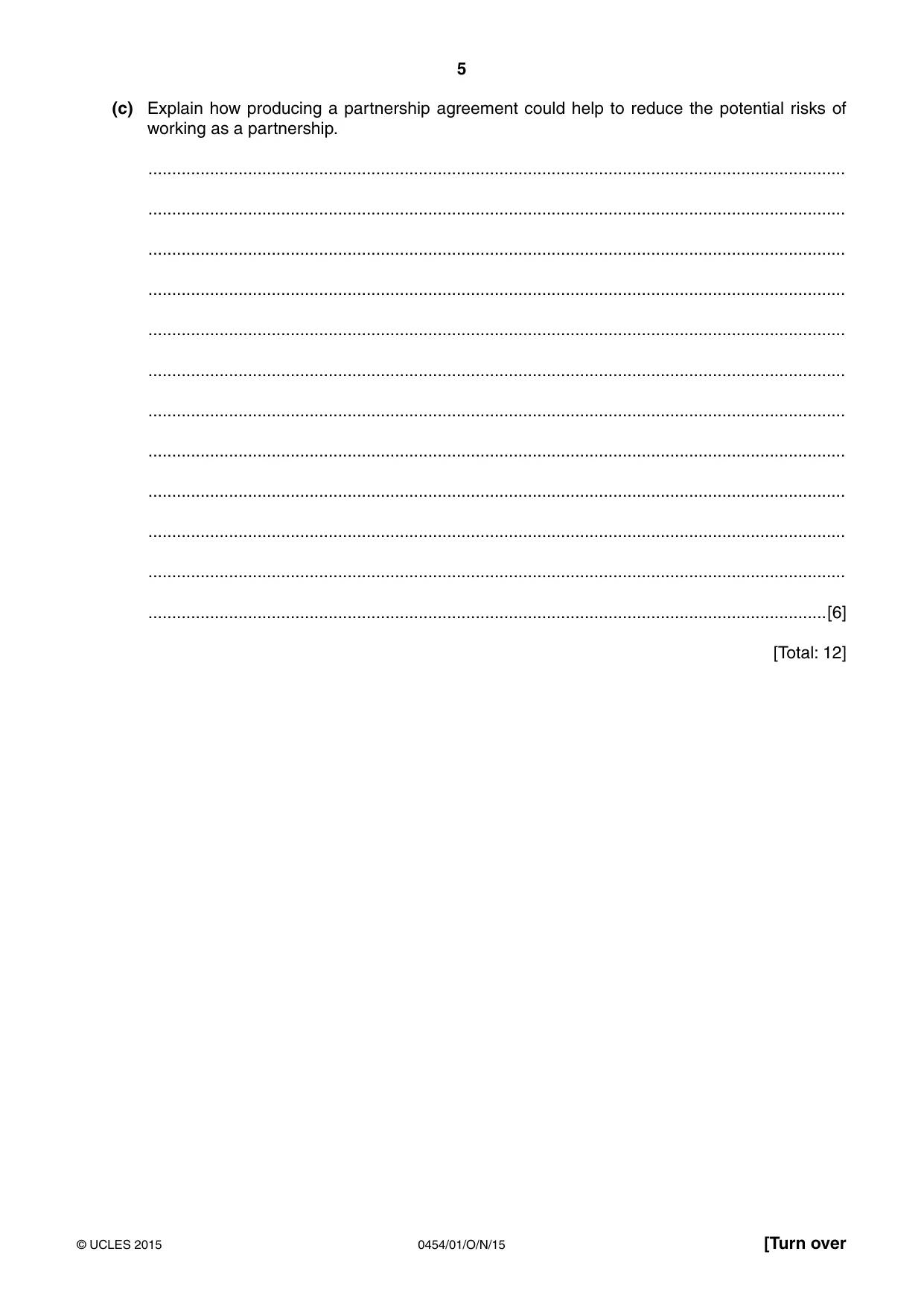
Question paper, page 5
5 0454/01/O/N/15 © UCLES 2015 [Turn over (c) Explain how producing a partnership agreement could help to reduce the potential risks of working as a partnership. … … … … … … … … … … … …[6] [Total: 12]
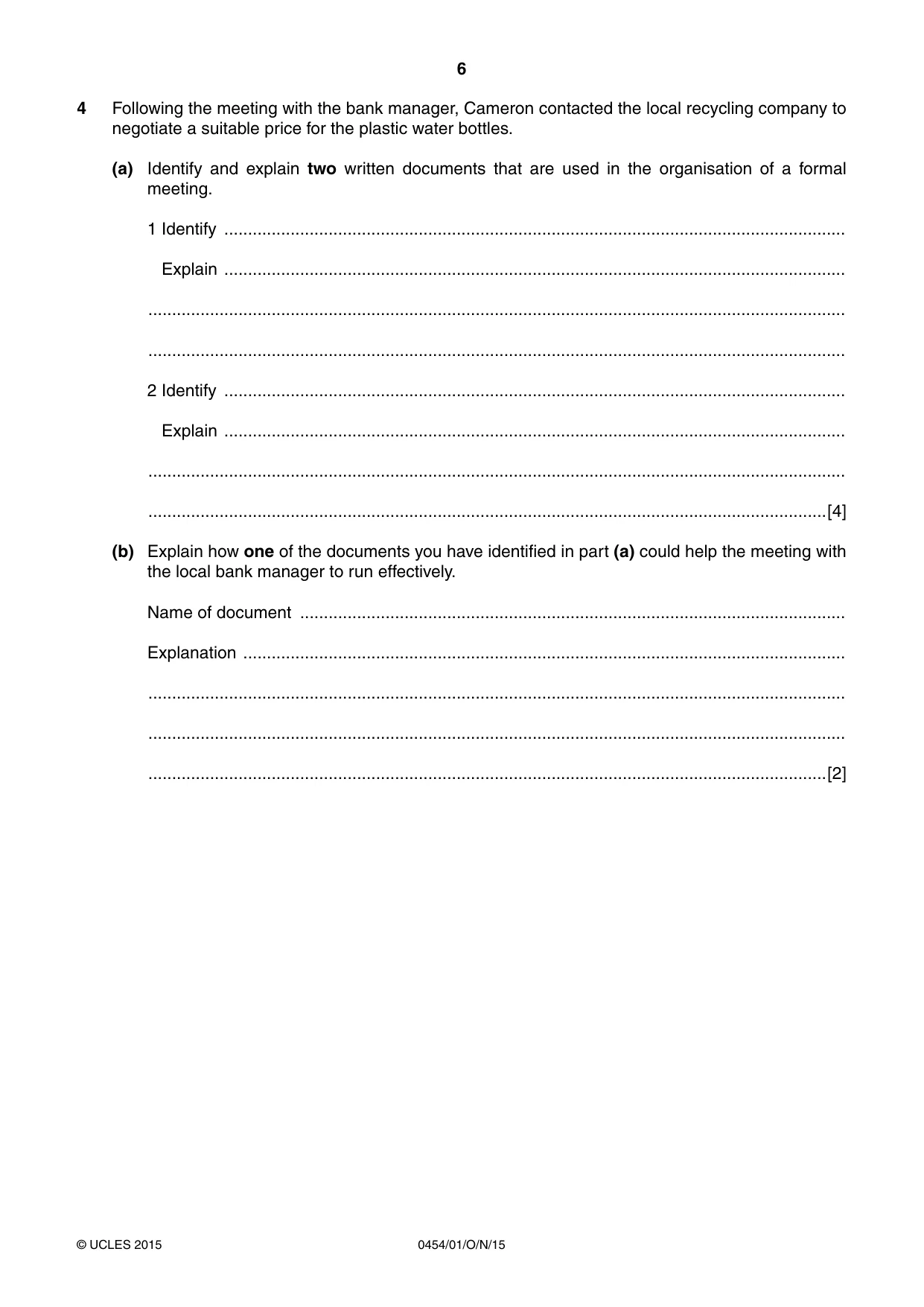
Question paper, page 6
6 0454/01/O/N/15 © UCLES 2015 4 Following the meeting with the bank manager, Cameron contacted the local recycling company to negotiate a suitable price for the plastic water bottles. (a) Identify and explain two written documents that are used in the organisation of a formal meeting. 1 Identify … Explain … … … 2 Identify … Explain … … …[4] (b) Explain how one of the documents you have identified in part (a) could help the meeting with the local bank manager to run effectively. Name of document … Explanation … … … …[2]
Question paper, page 7
7 0454/01/O/N/15 © UCLES 2015 [Turn over (c) Explain how you could have improved the communication within your enterprise project. … … … … … … … … … … … …[6] [Total: 12]
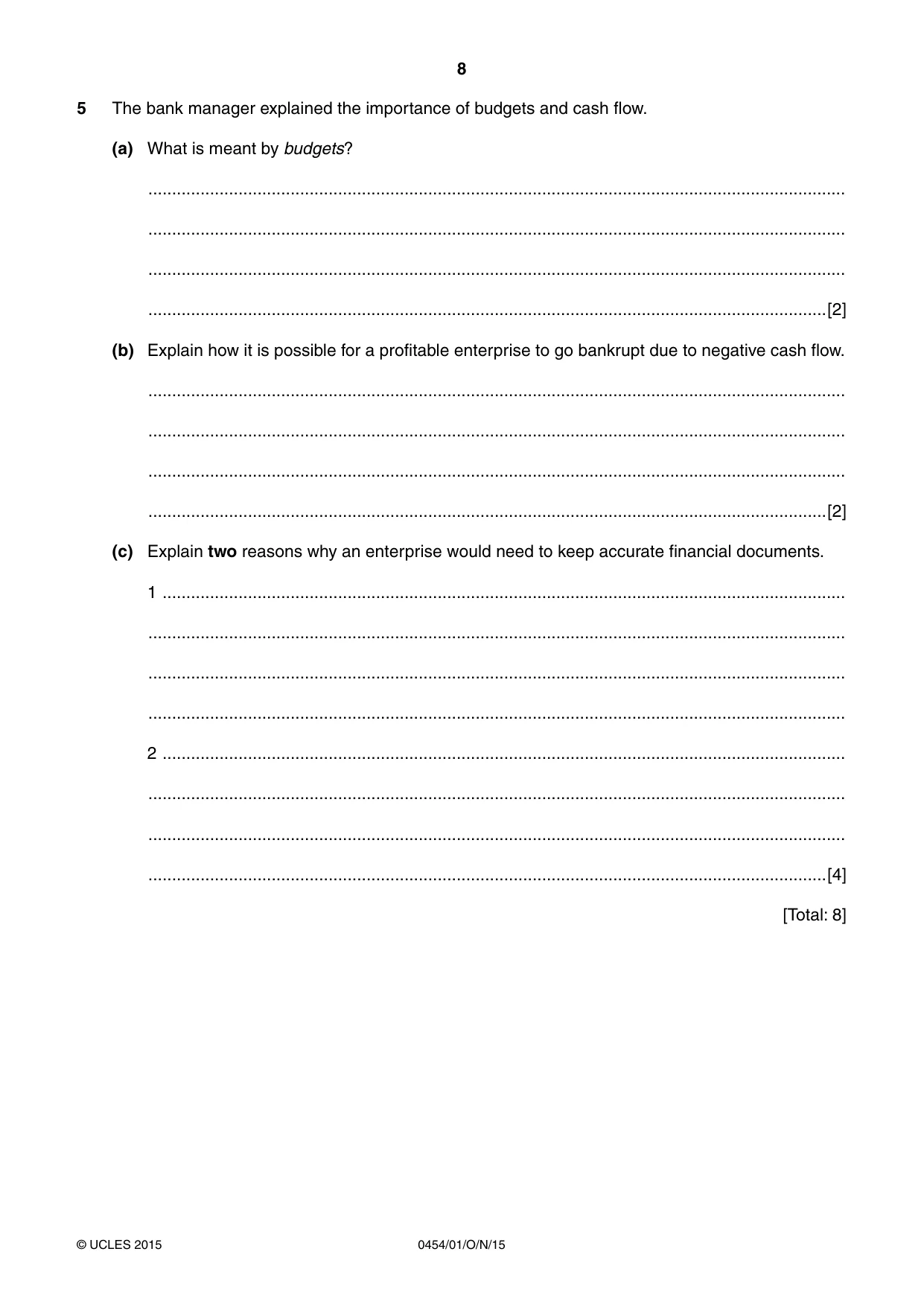
Question paper, page 8
8 0454/01/O/N/15 © UCLES 2015 5 The bank manager explained the importance of budgets and cash flow. (a) What is meant by budgets? … … … …[2] (b) Explain how it is possible for a profitable enterprise to go bankrupt due to negative cash flow. … … … …[2] (c) Explain two reasons why an enterprise would need to keep accurate financial documents. 1 … … … … 2 … … … …[4] [Total: 8]
Question paper, page 9
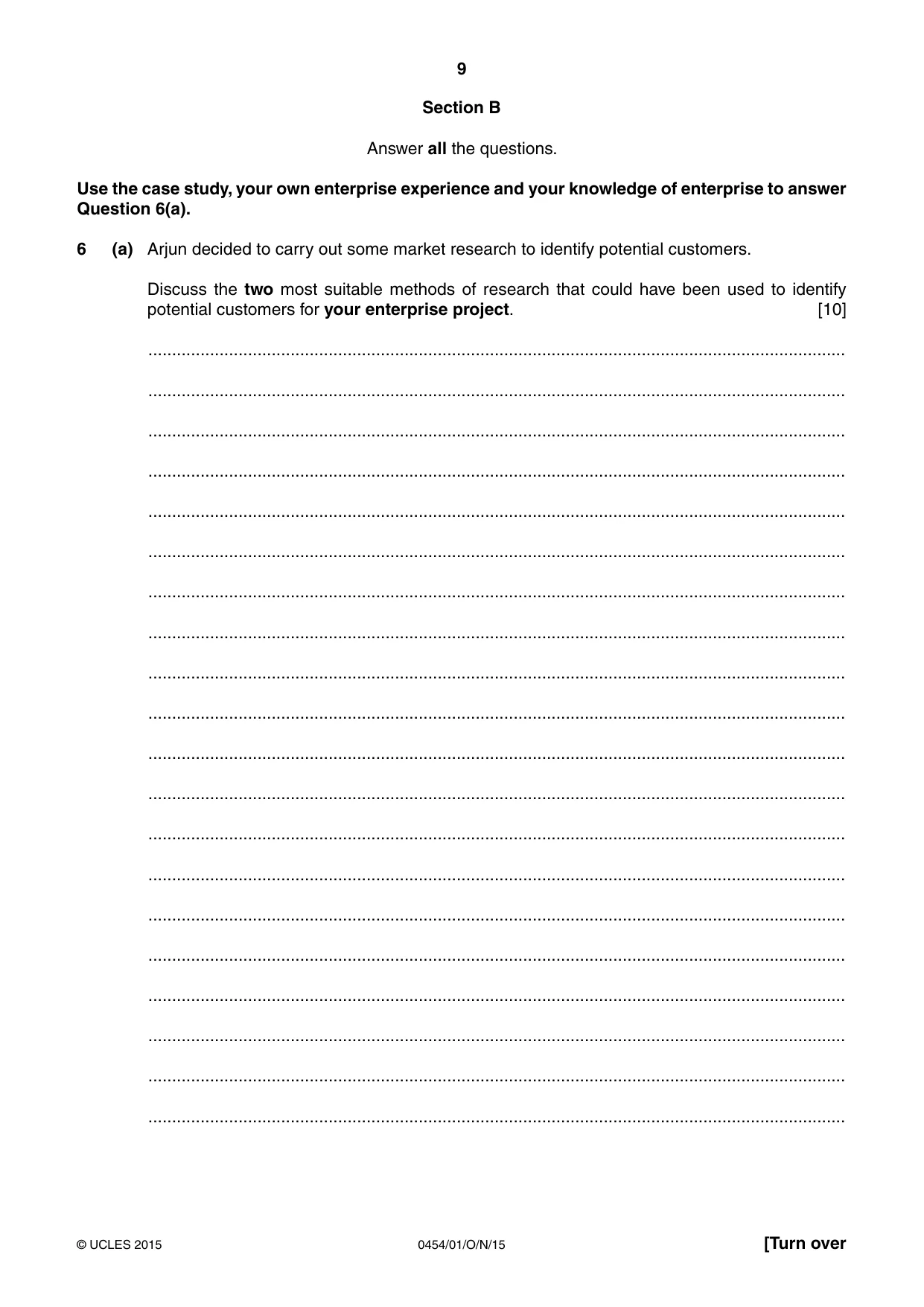
9 0454/01/O/N/15 © UCLES 2015 [Turn over Section B Answer all the questions. Use the case study, your own enterprise experience and your knowledge of enterprise to answer Question 6(a). 6 (a) Arjun decided to carry out some market research to identify potential customers. Discuss the two most suitable methods of research that could have been used to identify potential customers for your enterprise project. [10] … … … … … … … … … … … … … … … … … … … …
Question paper, page 10
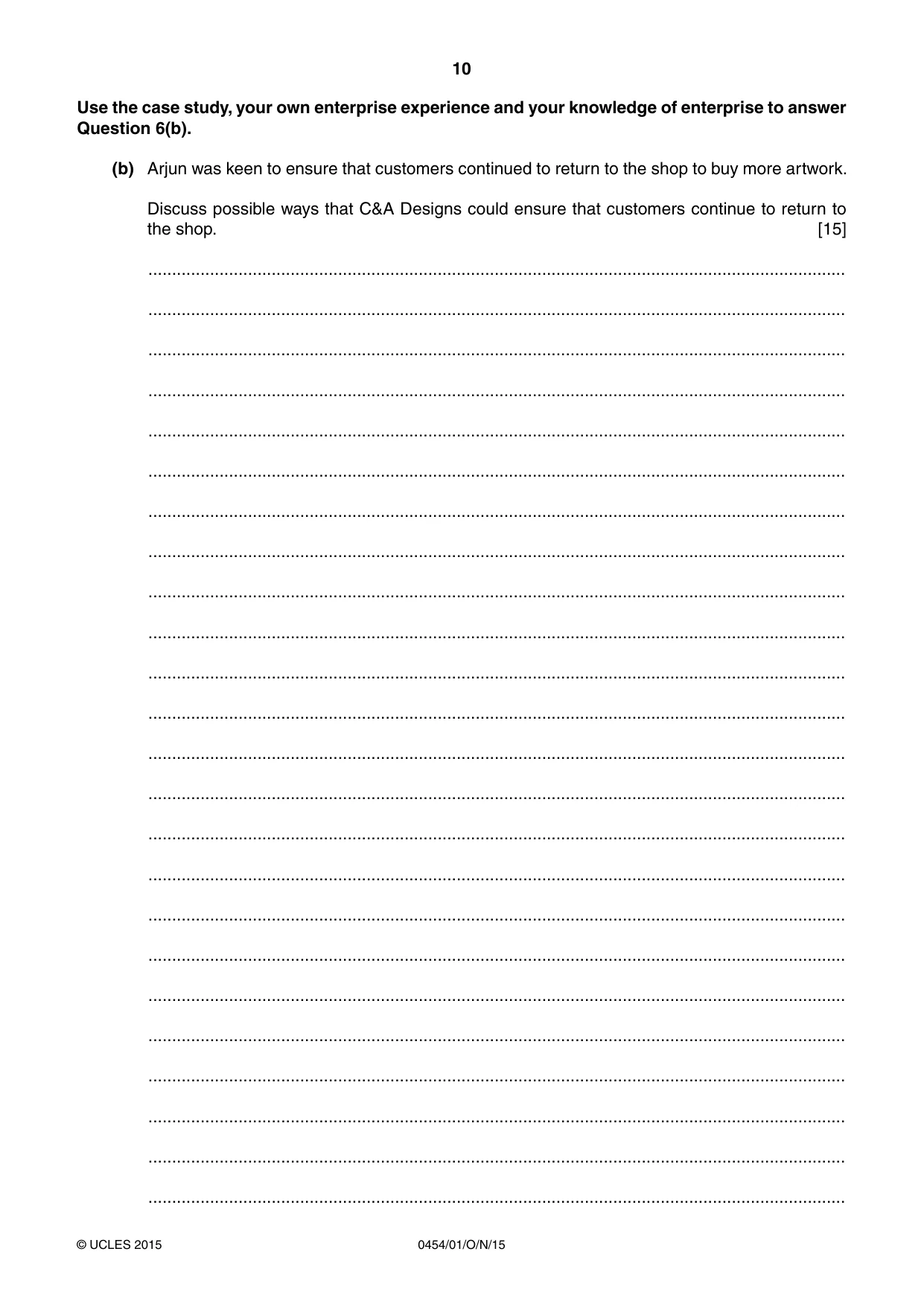
10 0454/01/O/N/15 © UCLES 2015 Use the case study, your own enterprise experience and your knowledge of enterprise to answer Question 6(b). (b) Arjun was keen to ensure that customers continued to return to the shop to buy more artwork. Discuss possible ways that C&A Designs could ensure that customers continue to return to the shop. [15] … … … … … … … … … … … … … … … … … … … … … … … …
Question paper, page 11
11 0454/01/O/N/15 © UCLES 2015 [Turn over … … … … … … … … … … … … … … … … … … … … … … … … [Total: 25]
Question paper, page 12
12 0454/01/O/N/15 © UCLES 2015 BLANK PAGE
Question paper, page 13
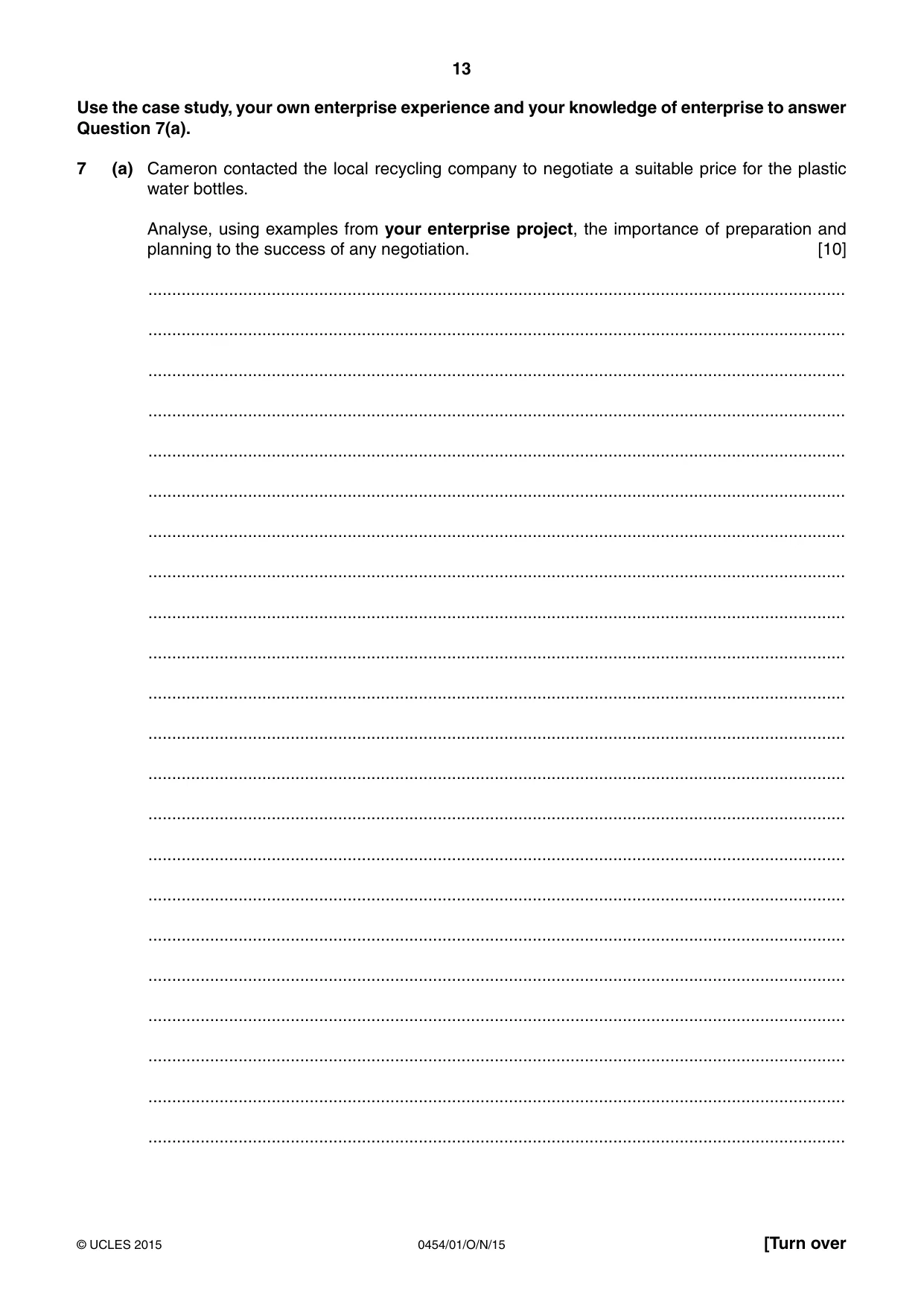
13 0454/01/O/N/15 © UCLES 2015 [Turn over Use the case study, your own enterprise experience and your knowledge of enterprise to answer Question 7(a). 7 (a) Cameron contacted the local recycling company to negotiate a suitable price for the plastic water bottles. Analyse, using examples from your enterprise project, the importance of preparation and planning to the success of any negotiation. [10] … … … … … … … … … … … … … … … … … … … … … …
Question paper, page 14
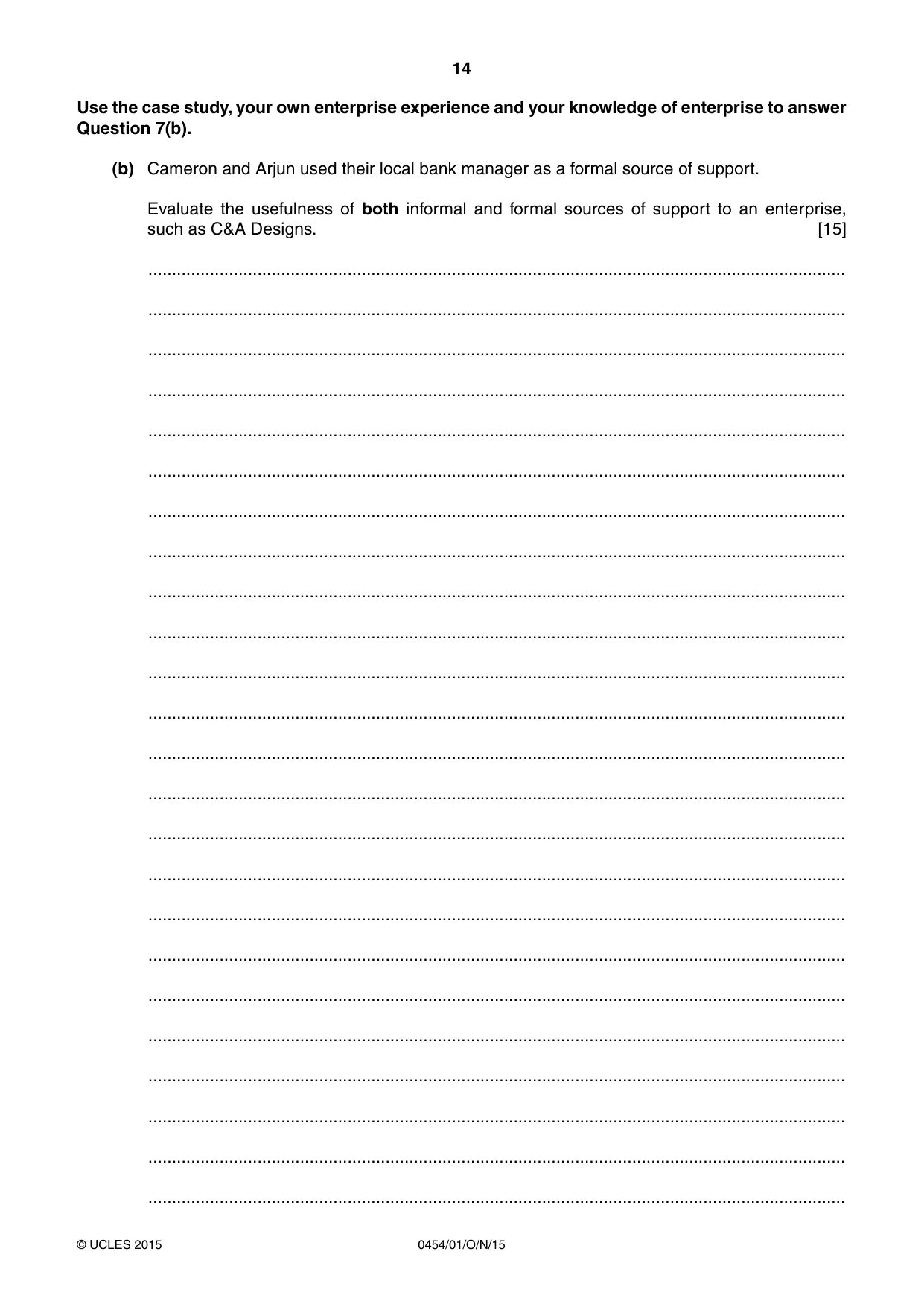
14 0454/01/O/N/15 © UCLES 2015 Use the case study, your own enterprise experience and your knowledge of enterprise to answer Question 7(b). (b) Cameron and Arjun used their local bank manager as a formal source of support. Evaluate the usefulness of both informal and formal sources of support to an enterprise, such as C&A Designs. [15] … … … … … … … … … … … … … … … … … … … … … … … …
Question paper, page 15
15 0454/01/O/N/15 © UCLES 2015 … … … … … … … … … … … … … … … … … … … … … … … … … [Total: 25]
Question paper, page 16
16 0454/01/O/N/15 © UCLES 2015 Permission to reproduce items where third-party owned material protected by copyright is included has been sought and cleared where possible. Every reasonable effort has been made by the publisher (UCLES) to trace copyright holders, but if any items requiring clearance have unwittingly been included, the publisher will be pleased to make amends at the earliest possible opportunity. To avoid the issue of disclosure of answer-related information to candidates, all copyright acknowledgements are reproduced online in the Cambridge International Examinations Copyright Acknowledgements Booklet. This is produced for each series of examinations and is freely available to download at www.cie.org.uk after the live examination series. Cambridge International Examinations is part of the Cambridge Assessment Group. Cambridge Assessment is the brand name of University of Cambridge Local Examinations Syndicate (UCLES), which is itself a department of the University of Cambridge. BLANK PAGE
Mark scheme, page 1
® IGCSE is the registered trademark of Cambridge International Examinations. CAMBRIDGE INTERNATIONAL EXAMINATIONS Cambridge International General Certificate of Secondary Education MARK SCHEME for the October/November 2015 series 0454 ENTERPRISE 0454/01 Paper 1 (Case Study), maximum raw mark 100 This mark scheme is published as an aid to teachers and candidates, to indicate the requirements of the examination. It shows the basis on which Examiners were instructed to award marks. It does not indicate the details of the discussions that took place at an Examiners’ meeting before marking began, which would have considered the acceptability of alternative answers. Mark schemes should be read in conjunction with the question paper and the Principal Examiner Report for Teachers. Cambridge will not enter into discussions about these mark schemes. Cambridge is publishing the mark schemes for the October/November 2015 series for most Cambridge IGCSE®, Cambridge International A and AS Level components and some Cambridge O Level components.
Mark scheme, page 2
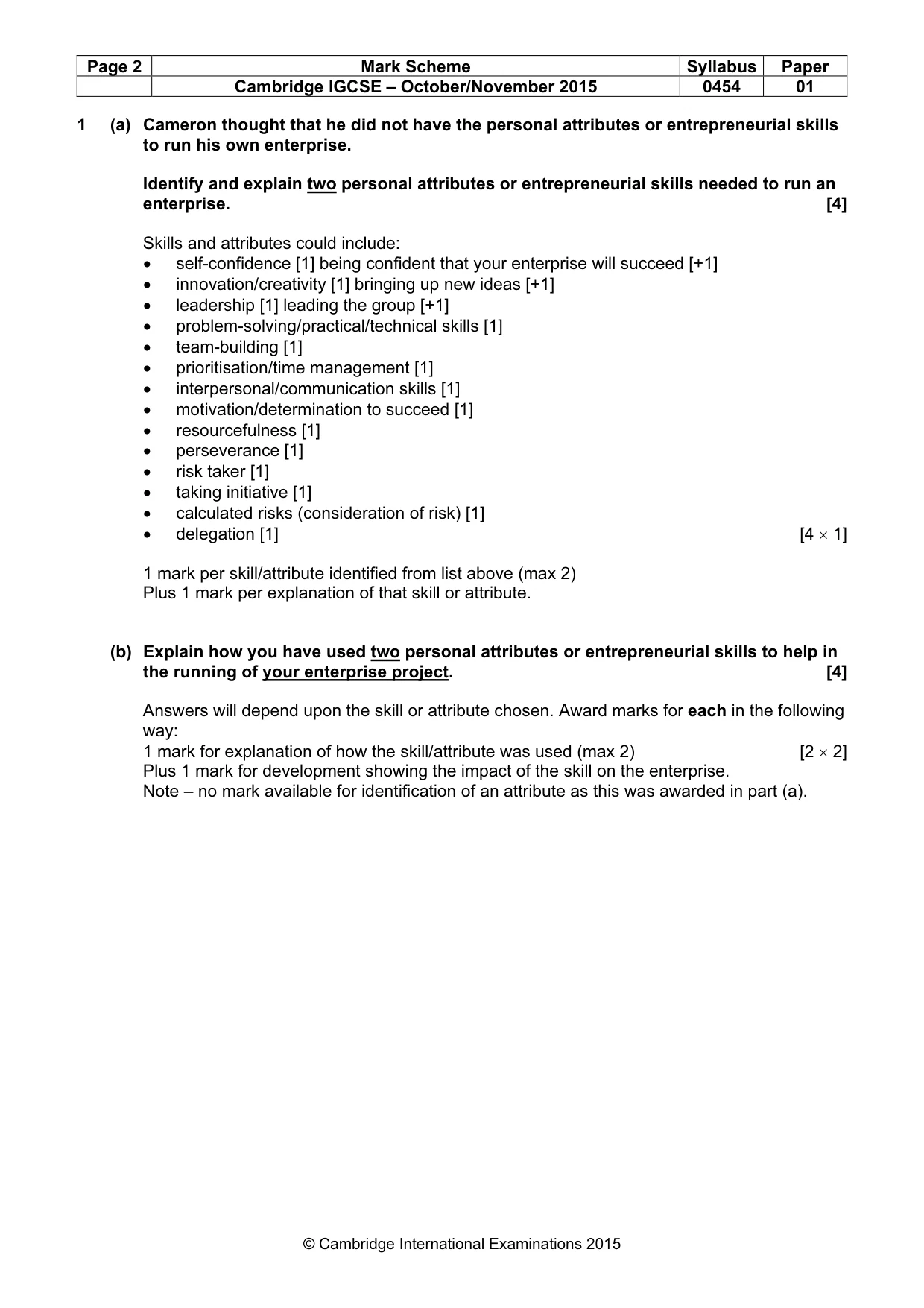
Page 2 Mark Scheme Syllabus Paper Cambridge IGCSE – October/November 2015 0454 01 © Cambridge International Examinations 2015 1 (a) Cameron thought that he did not have the personal attributes or entrepreneurial skills to run his own enterprise. Identify and explain two personal attributes or entrepreneurial skills needed to run an enterprise. [4] Skills and attributes could include: • self-confidence [1] being confident that your enterprise will succeed [+1] • innovation/creativity [1] bringing up new ideas [+1] • leadership [1] leading the group [+1] • problem-solving/practical/technical skills [1] • team-building [1] • prioritisation/time management [1] • interpersonal/communication skills [1] • motivation/determination to succeed [1] • resourcefulness [1] • perseverance [1] • risk taker [1] • taking initiative [1] • calculated risks (consideration of risk) [1] • delegation [1] [4 × 1] 1 mark per skill/attribute identified from list above (max 2) Plus 1 mark per explanation of that skill or attribute. (b) Explain how you have used two personal attributes or entrepreneurial skills to help in the running of your enterprise project. [4] Answers will depend upon the skill or attribute chosen. Award marks for each in the following way: 1 mark for explanation of how the skill/attribute was used (max 2) [2 × 2] Plus 1 mark for development showing the impact of the skill on the enterprise. Note – no mark available for identification of an attribute as this was awarded in part (a).
Mark scheme, page 3
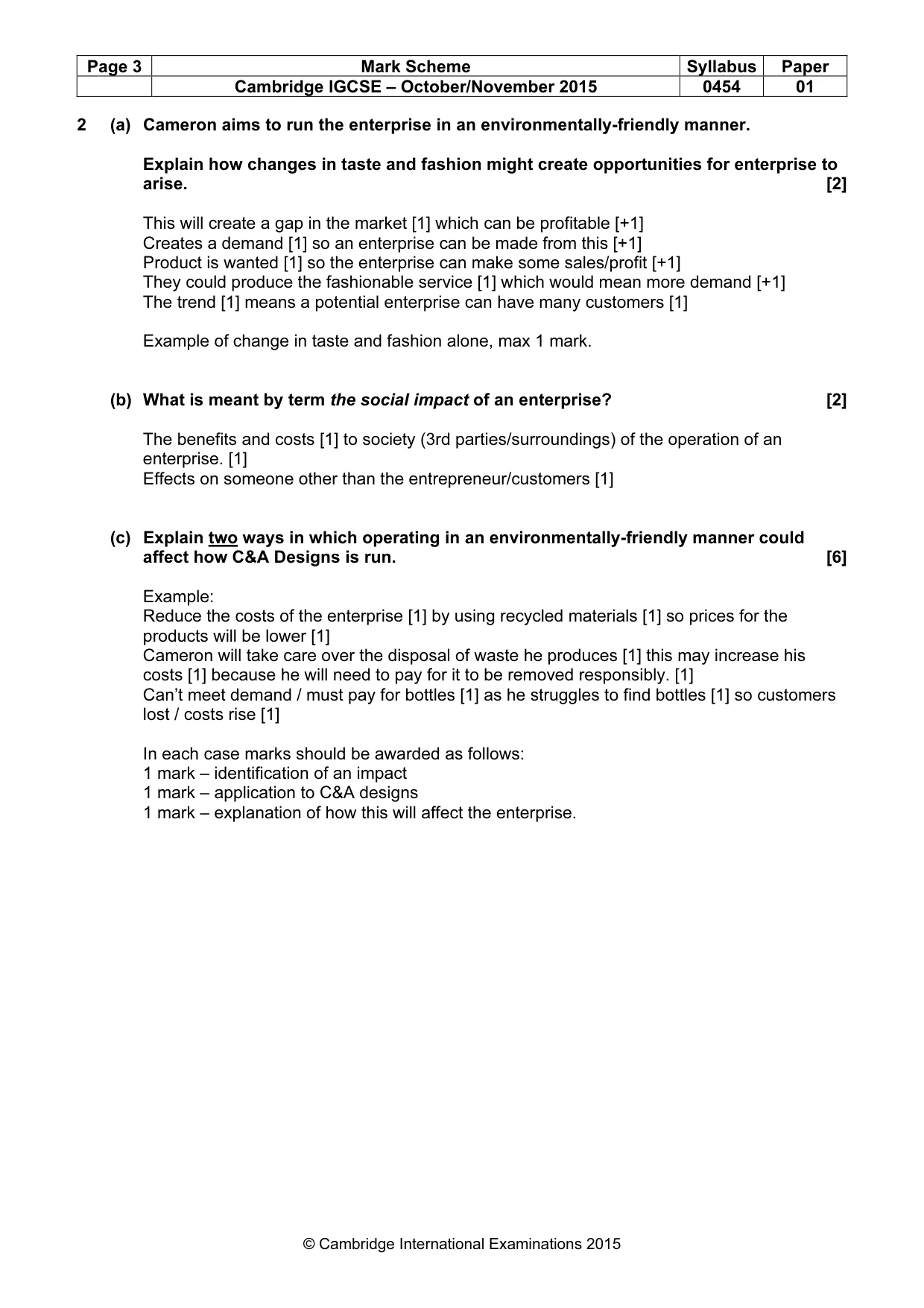
Page 3 Mark Scheme Syllabus Paper Cambridge IGCSE – October/November 2015 0454 01 © Cambridge International Examinations 2015 2 (a) Cameron aims to run the enterprise in an environmentally-friendly manner. Explain how changes in taste and fashion might create opportunities for enterprise to arise. [2] This will create a gap in the market [1] which can be profitable [+1] Creates a demand [1] so an enterprise can be made from this [+1] Product is wanted [1] so the enterprise can make some sales/profit [+1] They could produce the fashionable service [1] which would mean more demand [+1] The trend [1] means a potential enterprise can have many customers [1] Example of change in taste and fashion alone, max 1 mark. (b) What is meant by term the social impact of an enterprise? [2] The benefits and costs [1] to society (3rd parties/surroundings) of the operation of an enterprise. [1] Effects on someone other than the entrepreneur/customers [1] (c) Explain two ways in which operating in an environmentally-friendly manner could affect how C&A Designs is run. [6] Example: Reduce the costs of the enterprise [1] by using recycled materials [1] so prices for the products will be lower [1] Cameron will take care over the disposal of waste he produces [1] this may increase his costs [1] because he will need to pay for it to be removed responsibly. [1] Can’t meet demand / must pay for bottles [1] as he struggles to find bottles [1] so customers lost / costs rise [1] In each case marks should be awarded as follows: 1 mark – identification of an impact 1 mark – application to C&A designs 1 mark – explanation of how this will affect the enterprise.
Mark scheme, page 4
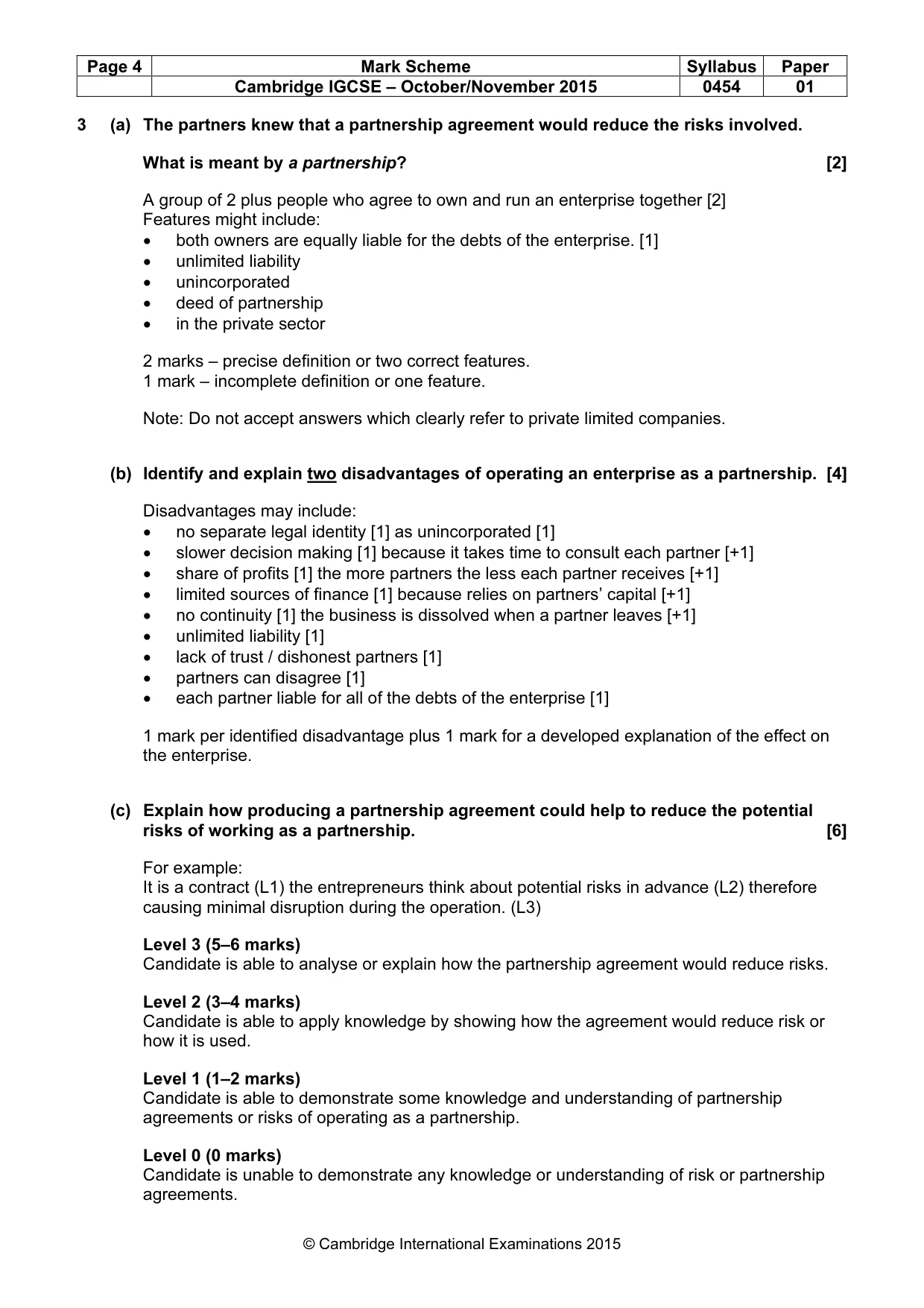
Page 4 Mark Scheme Syllabus Paper Cambridge IGCSE – October/November 2015 0454 01 © Cambridge International Examinations 2015 3 (a) The partners knew that a partnership agreement would reduce the risks involved. What is meant by a partnership? [2] A group of 2 plus people who agree to own and run an enterprise together [2] Features might include: • both owners are equally liable for the debts of the enterprise. [1] • unlimited liability • unincorporated • deed of partnership • in the private sector 2 marks – precise definition or two correct features. 1 mark – incomplete definition or one feature. Note: Do not accept answers which clearly refer to private limited companies. (b) Identify and explain two disadvantages of operating an enterprise as a partnership. [4] Disadvantages may include: • no separate legal identity [1] as unincorporated [1] • slower decision making [1] because it takes time to consult each partner [+1] • share of profits [1] the more partners the less each partner receives [+1] • limited sources of finance [1] because relies on partners’ capital [+1] • no continuity [1] the business is dissolved when a partner leaves [+1] • unlimited liability [1] • lack of trust / dishonest partners [1] • partners can disagree [1] • each partner liable for all of the debts of the enterprise [1] 1 mark per identified disadvantage plus 1 mark for a developed explanation of the effect on the enterprise. (c) Explain how producing a partnership agreement could help to reduce the potential risks of working as a partnership. [6] For example: It is a contract (L1) the entrepreneurs think about potential risks in advance (L2) therefore causing minimal disruption during the operation. (L3) Level 3 (5–6 marks) Candidate is able to analyse or explain how the partnership agreement would reduce risks. Level 2 (3–4 marks) Candidate is able to apply knowledge by showing how the agreement would reduce risk or how it is used. Level 1 (1–2 marks) Candidate is able to demonstrate some knowledge and understanding of partnership agreements or risks of operating as a partnership. Level 0 (0 marks) Candidate is unable to demonstrate any knowledge or understanding of risk or partnership agreements.
Mark scheme, page 5
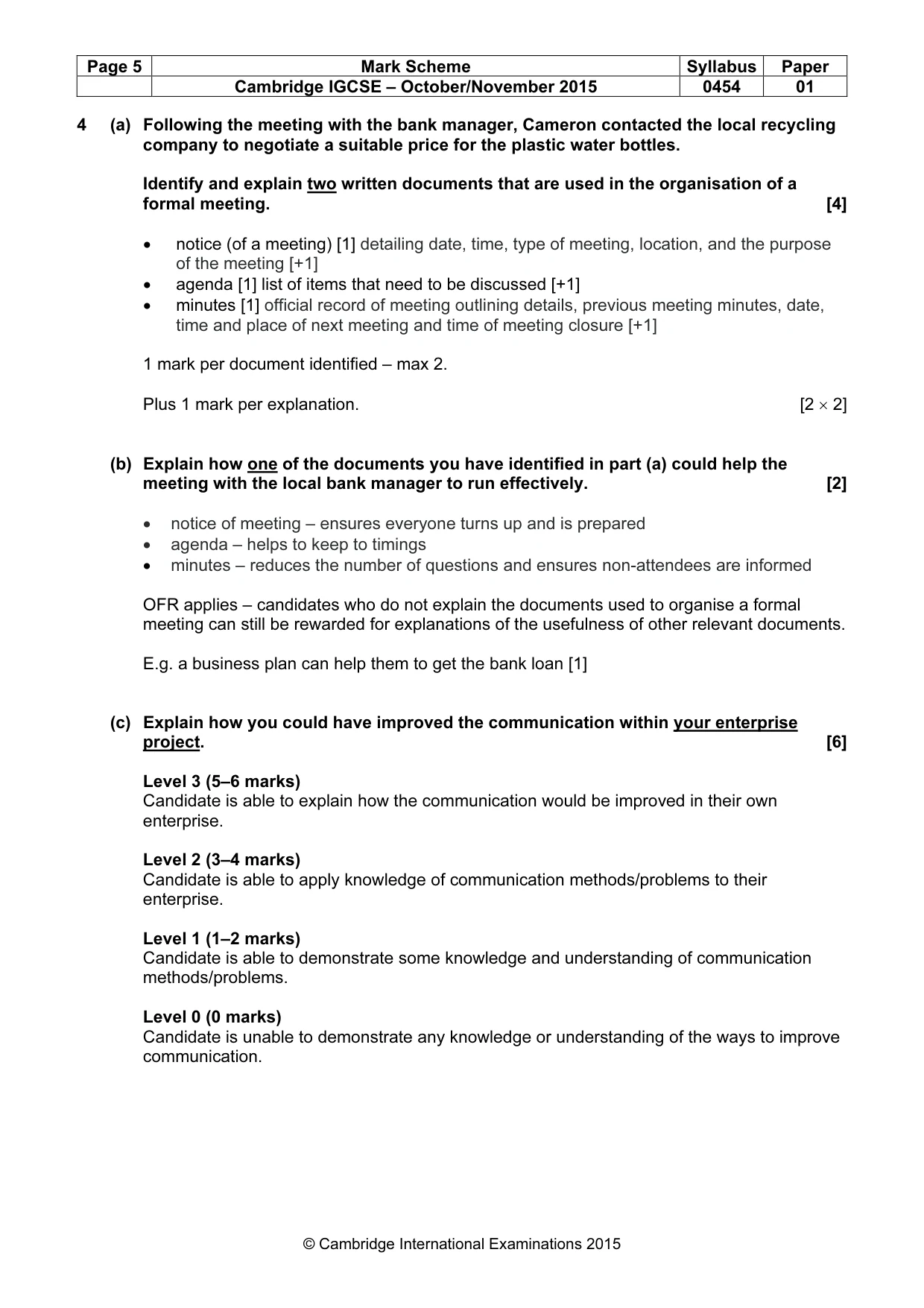
Page 5 Mark Scheme Syllabus Paper Cambridge IGCSE – October/November 2015 0454 01 © Cambridge International Examinations 2015 4 (a) Following the meeting with the bank manager, Cameron contacted the local recycling company to negotiate a suitable price for the plastic water bottles. Identify and explain two written documents that are used in the organisation of a formal meeting. [4] • notice (of a meeting) [1] detailing date, time, type of meeting, location, and the purpose of the meeting [+1] • agenda [1] list of items that need to be discussed [+1] • minutes [1] official record of meeting outlining details, previous meeting minutes, date, time and place of next meeting and time of meeting closure [+1] 1 mark per document identified – max 2. Plus 1 mark per explanation. [2 × 2] (b) Explain how one of the documents you have identified in part (a) could help the meeting with the local bank manager to run effectively. [2] • notice of meeting – ensures everyone turns up and is prepared • agenda – helps to keep to timings • minutes – reduces the number of questions and ensures non-attendees are informed OFR applies – candidates who do not explain the documents used to organise a formal meeting can still be rewarded for explanations of the usefulness of other relevant documents. E.g. a business plan can help them to get the bank loan [1] (c) Explain how you could have improved the communication within your enterprise project. [6] Level 3 (5–6 marks) Candidate is able to explain how the communication would be improved in their own enterprise. Level 2 (3–4 marks) Candidate is able to apply knowledge of communication methods/problems to their enterprise. Level 1 (1–2 marks) Candidate is able to demonstrate some knowledge and understanding of communication methods/problems. Level 0 (0 marks) Candidate is unable to demonstrate any knowledge or understanding of the ways to improve communication.
Mark scheme, page 6
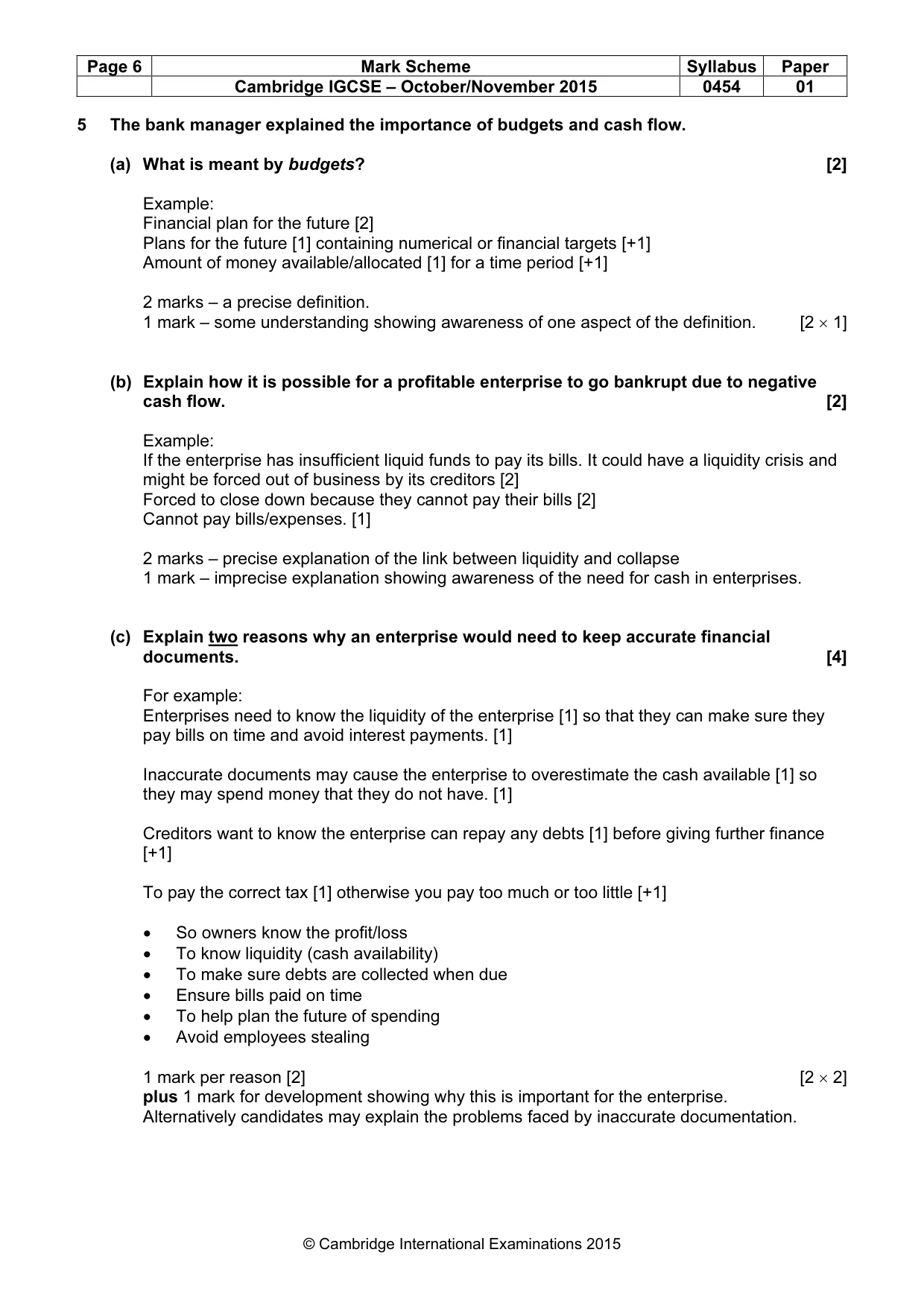
Page 6 Mark Scheme Syllabus Paper Cambridge IGCSE – October/November 2015 0454 01 © Cambridge International Examinations 2015 5 The bank manager explained the importance of budgets and cash flow. (a) What is meant by budgets? [2] Example: Financial plan for the future [2] Plans for the future [1] containing numerical or financial targets [+1] Amount of money available/allocated [1] for a time period [+1] 2 marks – a precise definition. 1 mark – some understanding showing awareness of one aspect of the definition. [2 × 1] (b) Explain how it is possible for a profitable enterprise to go bankrupt due to negative cash flow. [2] Example: If the enterprise has insufficient liquid funds to pay its bills. It could have a liquidity crisis and might be forced out of business by its creditors [2] Forced to close down because they cannot pay their bills [2] Cannot pay bills/expenses. [1] 2 marks – precise explanation of the link between liquidity and collapse 1 mark – imprecise explanation showing awareness of the need for cash in enterprises. (c) Explain two reasons why an enterprise would need to keep accurate financial documents. [4] For example: Enterprises need to know the liquidity of the enterprise [1] so that they can make sure they pay bills on time and avoid interest payments. [1] Inaccurate documents may cause the enterprise to overestimate the cash available [1] so they may spend money that they do not have. [1] Creditors want to know the enterprise can repay any debts [1] before giving further finance [+1] To pay the correct tax [1] otherwise you pay too much or too little [+1] • So owners know the profit/loss • To know liquidity (cash availability) • To make sure debts are collected when due • Ensure bills paid on time • To help plan the future of spending • Avoid employees stealing 1 mark per reason [2] [2 × 2] plus 1 mark for development showing why this is important for the enterprise. Alternatively candidates may explain the problems faced by inaccurate documentation.
Mark scheme, page 7
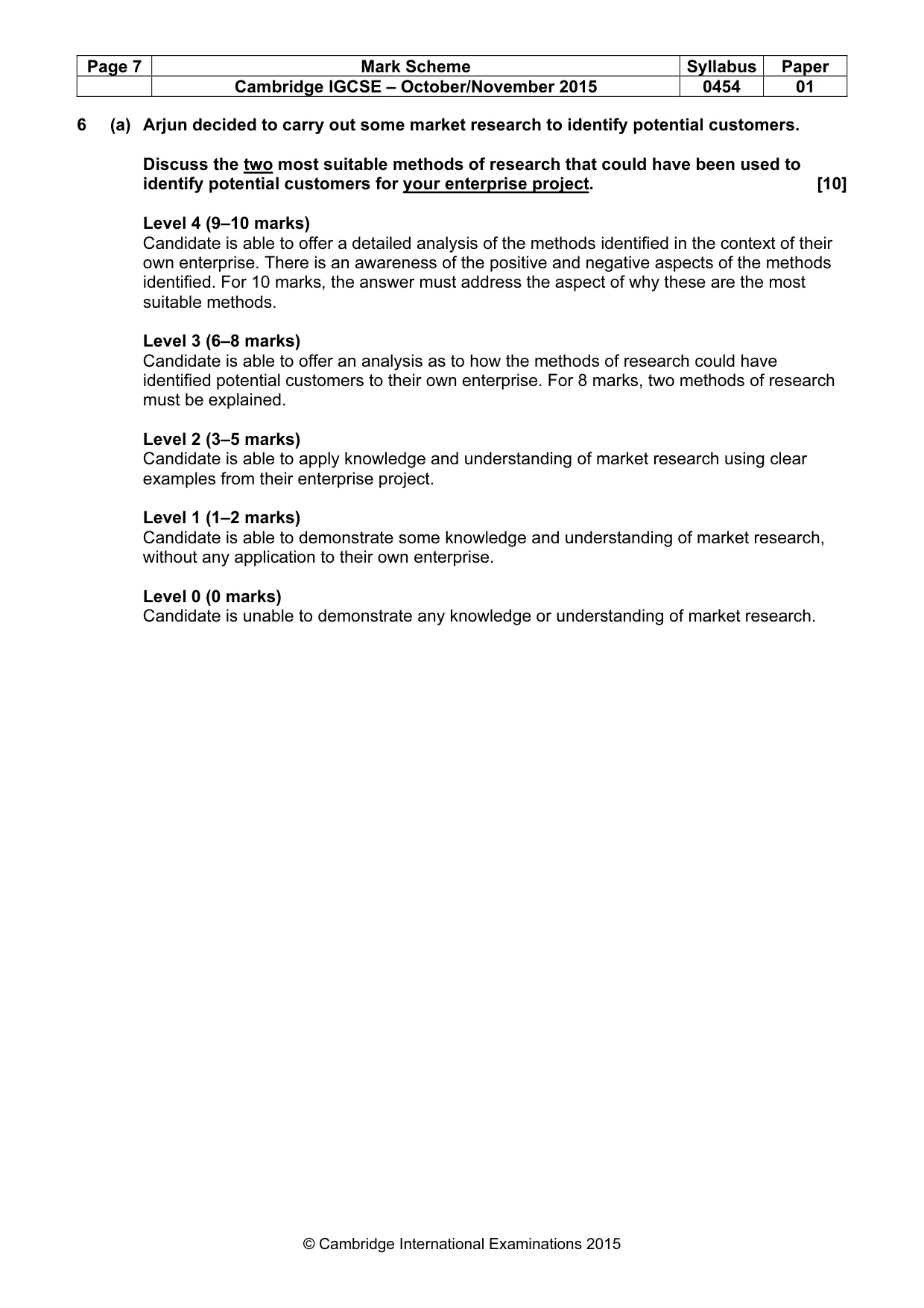
Page 7 Mark Scheme Syllabus Paper Cambridge IGCSE – October/November 2015 0454 01 © Cambridge International Examinations 2015 6 (a) Arjun decided to carry out some market research to identify potential customers. Discuss the two most suitable methods of research that could have been used to identify potential customers for your enterprise project. [10] Level 4 (9–10 marks) Candidate is able to offer a detailed analysis of the methods identified in the context of their own enterprise. There is an awareness of the positive and negative aspects of the methods identified. For 10 marks, the answer must address the aspect of why these are the most suitable methods. Level 3 (6–8 marks) Candidate is able to offer an analysis as to how the methods of research could have identified potential customers to their own enterprise. For 8 marks, two methods of research must be explained. Level 2 (3–5 marks) Candidate is able to apply knowledge and understanding of market research using clear examples from their enterprise project. Level 1 (1–2 marks) Candidate is able to demonstrate some knowledge and understanding of market research, without any application to their own enterprise. Level 0 (0 marks) Candidate is unable to demonstrate any knowledge or understanding of market research.
Mark scheme, page 8
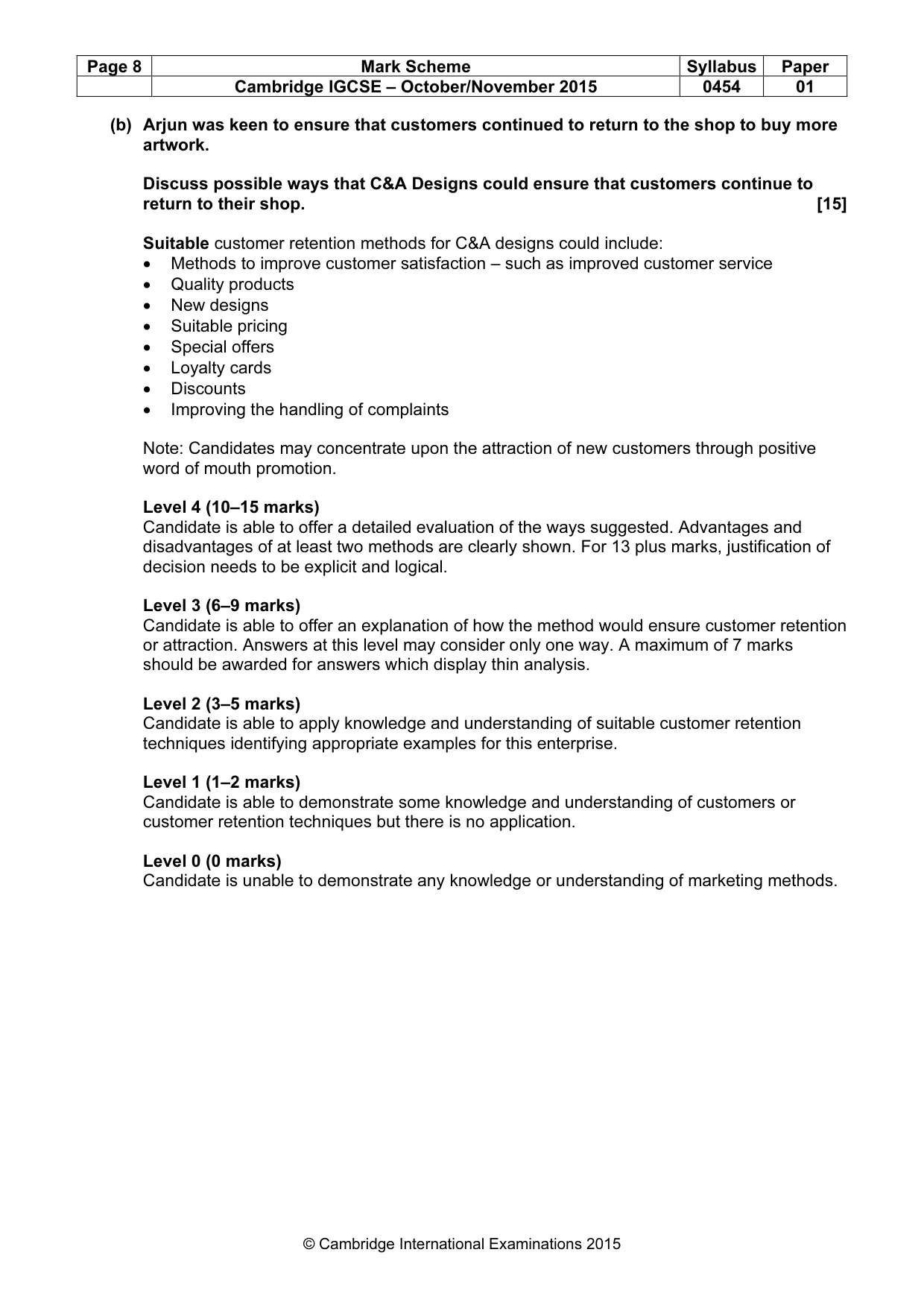
Page 8 Mark Scheme Syllabus Paper Cambridge IGCSE – October/November 2015 0454 01 © Cambridge International Examinations 2015 (b) Arjun was keen to ensure that customers continued to return to the shop to buy more artwork. Discuss possible ways that C&A Designs could ensure that customers continue to return to their shop. [15] Suitable customer retention methods for C&A designs could include: • Methods to improve customer satisfaction – such as improved customer service • Quality products • New designs • Suitable pricing • Special offers • Loyalty cards • Discounts • Improving the handling of complaints Note: Candidates may concentrate upon the attraction of new customers through positive word of mouth promotion. Level 4 (10–15 marks) Candidate is able to offer a detailed evaluation of the ways suggested. Advantages and disadvantages of at least two methods are clearly shown. For 13 plus marks, justification of decision needs to be explicit and logical. Level 3 (6–9 marks) Candidate is able to offer an explanation of how the method would ensure customer retention or attraction. Answers at this level may consider only one way. A maximum of 7 marks should be awarded for answers which display thin analysis. Level 2 (3–5 marks) Candidate is able to apply knowledge and understanding of suitable customer retention techniques identifying appropriate examples for this enterprise. Level 1 (1–2 marks) Candidate is able to demonstrate some knowledge and understanding of customers or customer retention techniques but there is no application. Level 0 (0 marks) Candidate is unable to demonstrate any knowledge or understanding of marketing methods.
Mark scheme, page 9
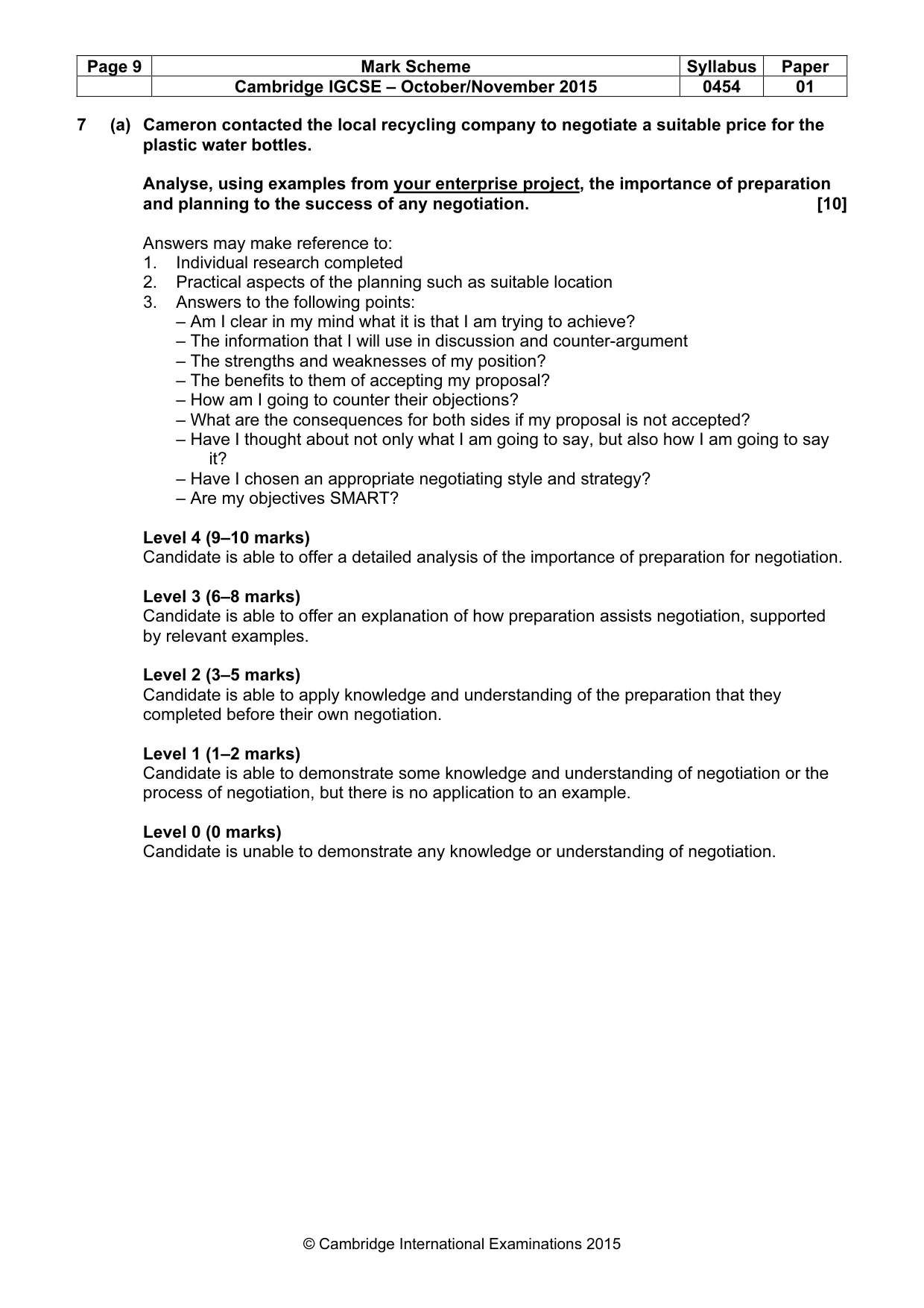
Page 9 Mark Scheme Syllabus Paper Cambridge IGCSE – October/November 2015 0454 01 © Cambridge International Examinations 2015 7 (a) Cameron contacted the local recycling company to negotiate a suitable price for the plastic water bottles. Analyse, using examples from your enterprise project, the importance of preparation and planning to the success of any negotiation. [10] Answers may make reference to: 1. Individual research completed 2. Practical aspects of the planning such as suitable location 3. Answers to the following points: – Am I clear in my mind what it is that I am trying to achieve? – The information that I will use in discussion and counter-argument – The strengths and weaknesses of my position? – The benefits to them of accepting my proposal? – How am I going to counter their objections? – What are the consequences for both sides if my proposal is not accepted? – Have I thought about not only what I am going to say, but also how I am going to say it? – Have I chosen an appropriate negotiating style and strategy? – Are my objectives SMART? Level 4 (9–10 marks) Candidate is able to offer a detailed analysis of the importance of preparation for negotiation. Level 3 (6–8 marks) Candidate is able to offer an explanation of how preparation assists negotiation, supported by relevant examples. Level 2 (3–5 marks) Candidate is able to apply knowledge and understanding of the preparation that they completed before their own negotiation. Level 1 (1–2 marks) Candidate is able to demonstrate some knowledge and understanding of negotiation or the process of negotiation, but there is no application to an example. Level 0 (0 marks) Candidate is unable to demonstrate any knowledge or understanding of negotiation.
Mark scheme, page 10
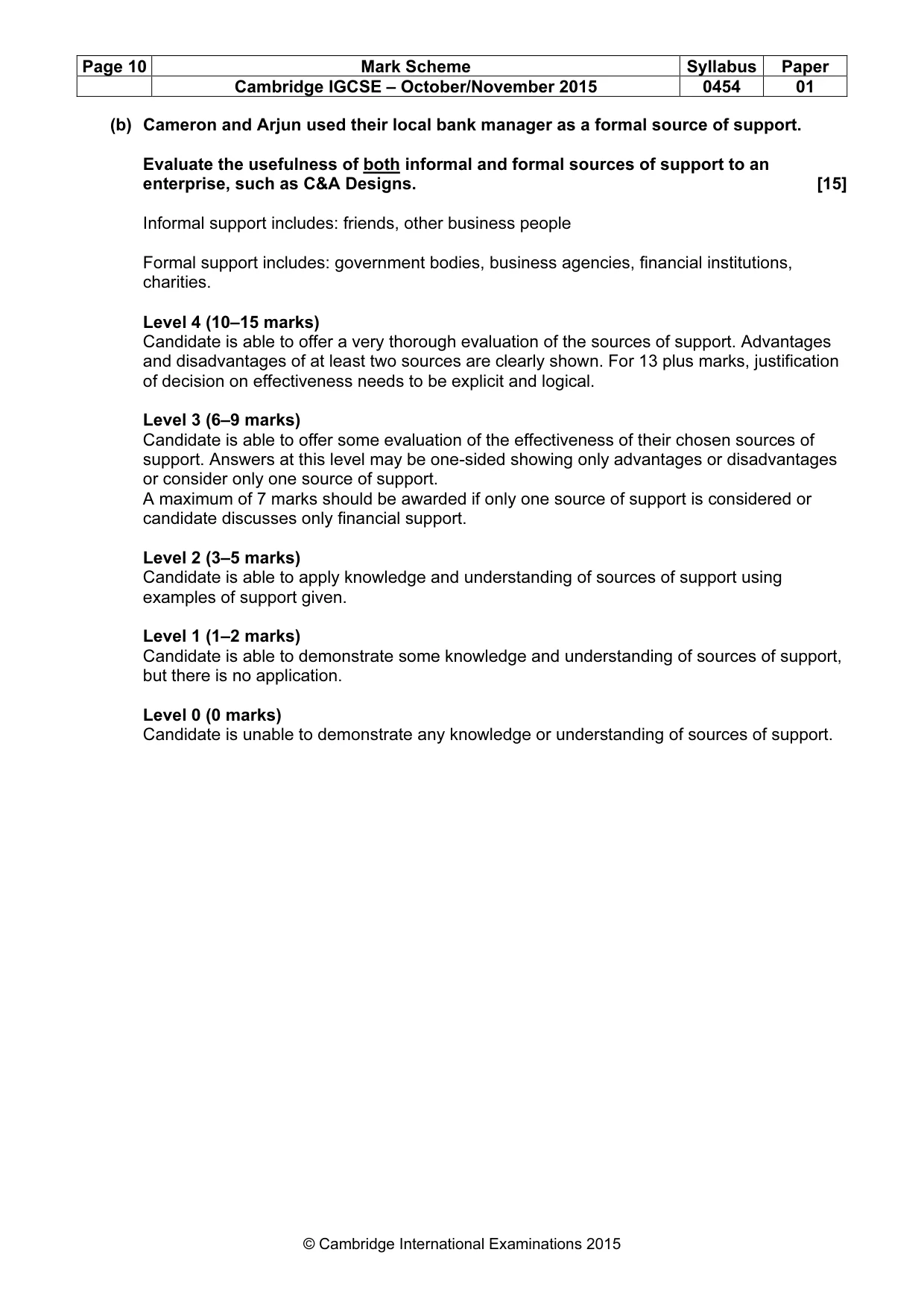
Page 10 Mark Scheme Syllabus Paper Cambridge IGCSE – October/November 2015 0454 01 © Cambridge International Examinations 2015 (b) Cameron and Arjun used their local bank manager as a formal source of support. Evaluate the usefulness of both informal and formal sources of support to an enterprise, such as C&A Designs. [15] Informal support includes: friends, other business people Formal support includes: government bodies, business agencies, financial institutions, charities. Level 4 (10–15 marks) Candidate is able to offer a very thorough evaluation of the sources of support. Advantages and disadvantages of at least two sources are clearly shown. For 13 plus marks, justification of decision on effectiveness needs to be explicit and logical. Level 3 (6–9 marks) Candidate is able to offer some evaluation of the effectiveness of their chosen sources of support. Answers at this level may be one-sided showing only advantages or disadvantages or consider only one source of support. A maximum of 7 marks should be awarded if only one source of support is considered or candidate discusses only financial support. Level 2 (3–5 marks) Candidate is able to apply knowledge and understanding of sources of support using examples of support given. Level 1 (1–2 marks) Candidate is able to demonstrate some knowledge and understanding of sources of support, but there is no application. Level 0 (0 marks) Candidate is unable to demonstrate any knowledge or understanding of sources of support.
What you needed in this session
Cambridge’s own grade thresholds for 2015 Oct/Nov, Paper 1 · Variant 1. A higher threshold means an easier paper — the bar moves with how the cohort did.