Cambridge IGCSE Enterprise 0454 — 2014 Oct/Nov Paper 1 · Variant 1
0454/11/O/N/14 · 100 marks · ≈113 min
The question paper and its mark scheme, free to read here and free to download. This is Cambridge’s own paper, exactly as it was sat.
Question paper16 pages










Mark scheme10 pages
Answers below. Sit the paper first if you are practising.
Paper as text
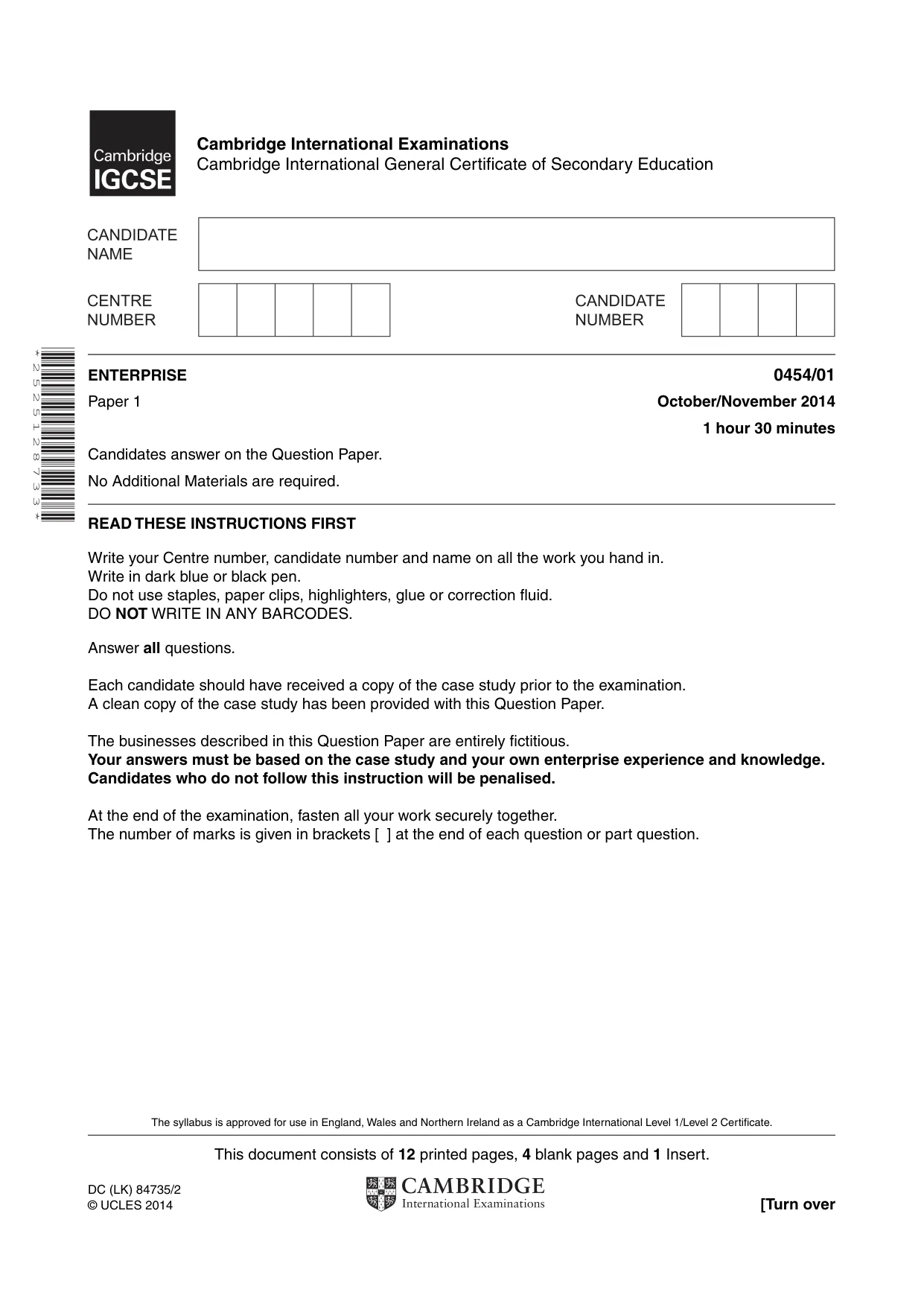
Question paper, page 1
This document consists of 12 printed pages, 4 blank pages and 1 Insert. DC (LK) 84735/2 © UCLES 2014 [Turn over Cambridge International Examinations Cambridge International General Certificate of Secondary Education * 2 5 2 5 1 2 8 7 3 3 * ENTERPRISE 0454/01 Paper 1 October/November 2014 1 hour 30 minutes Candidates answer on the Question Paper. No Additional Materials are required. READ THESE INSTRUCTIONS FIRST Write your Centre number, candidate number and name on all the work you hand in. Write in dark blue or black pen. Do not use staples, paper clips, highlighters, glue or correction fluid. DO NOT WRITE IN ANY BARCODES. Answer all questions. Each candidate should have received a copy of the case study prior to the examination. A clean copy of the case study has been provided with this Question Paper. The businesses described in this Question Paper are entirely fictitious. Your answers must be based on the case study and your own enterprise experience and knowledge. Candidates who do not follow this instruction will be penalised. At the end of the examination, fasten all your work securely together. The number of marks is given in brackets [ ] at the end of each question or part question. The syllabus is approved for use in England, Wales and Northern Ireland as a Cambridge International Level 1/Level 2 Certificate.
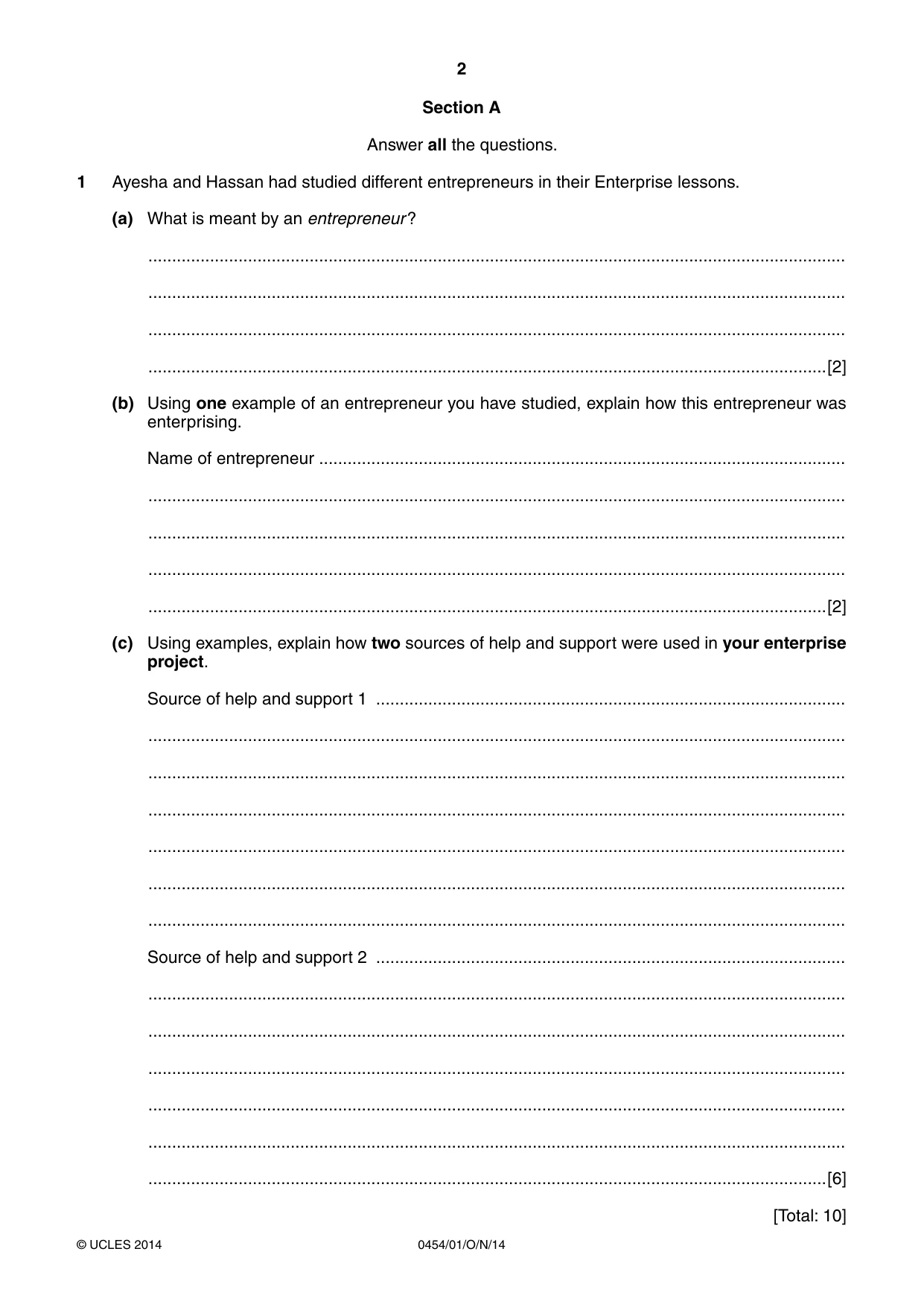
Question paper, page 2
2 0454/01/O/N/14 © UCLES 2014 Section A Answer all the questions. 1 Ayesha and Hassan had studied different entrepreneurs in their Enterprise lessons. (a) What is meant by an entrepreneur ? … … … …[2] (b) Using one example of an entrepreneur you have studied, explain how this entrepreneur was enterprising. Name of entrepreneur … … … … …[2] (c) Using examples, explain how two sources of help and support were used in your enterprise project. Source of help and support 1 … … … … … … … Source of help and support 2 … … … … … … …[6] [Total: 10]
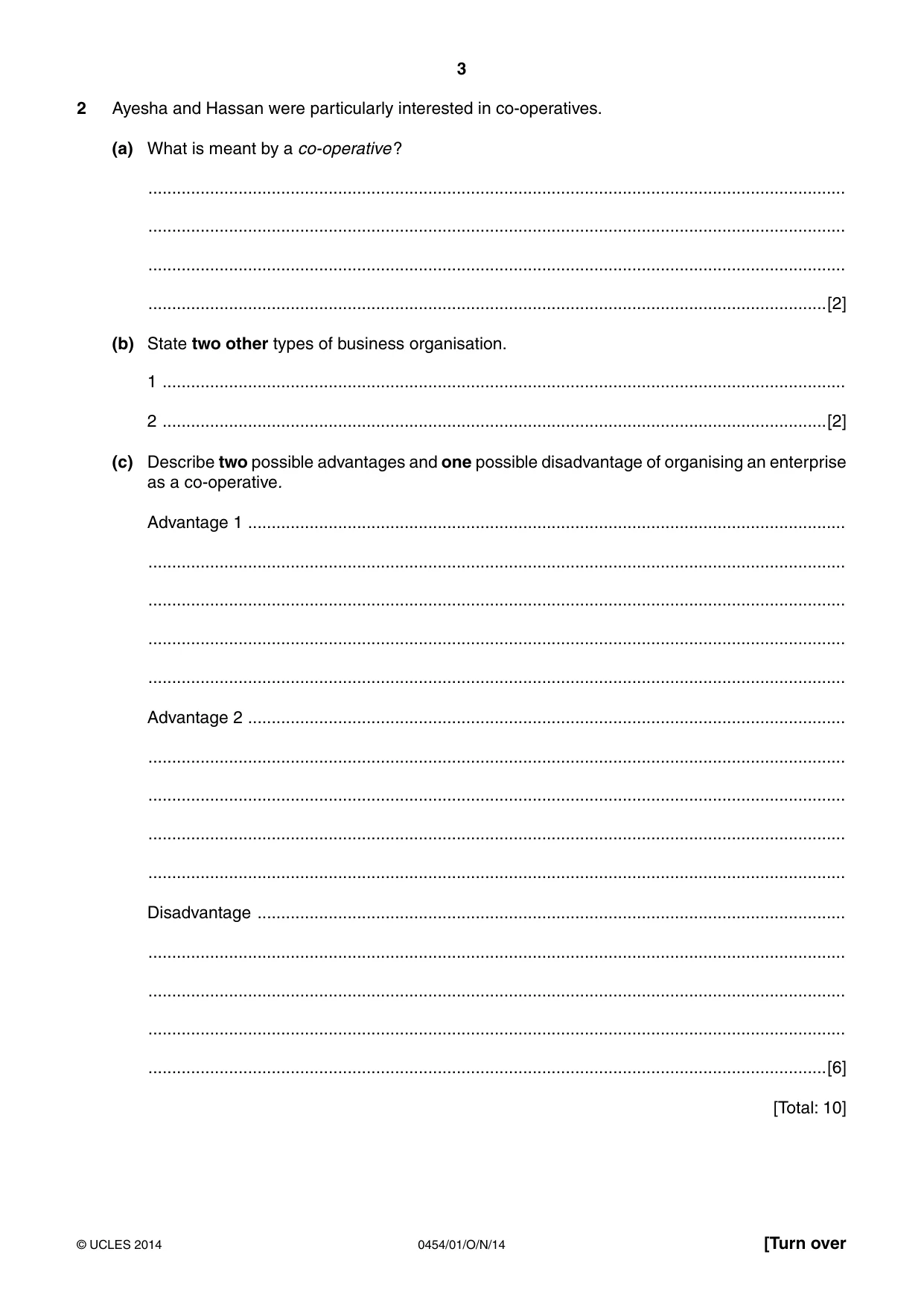
Question paper, page 3
3 0454/01/O/N/14 © UCLES 2014 [Turn over 2 Ayesha and Hassan were particularly interested in co-operatives. (a) What is meant by a co-operative ? … … … …[2] (b) State two other types of business organisation. 1 … 2 …[2] (c) Describe two possible advantages and one possible disadvantage of organising an enterprise as a co-operative. Advantage 1 … … … … … Advantage 2 … … … … … Disadvantage … … … … …[6] [Total: 10]
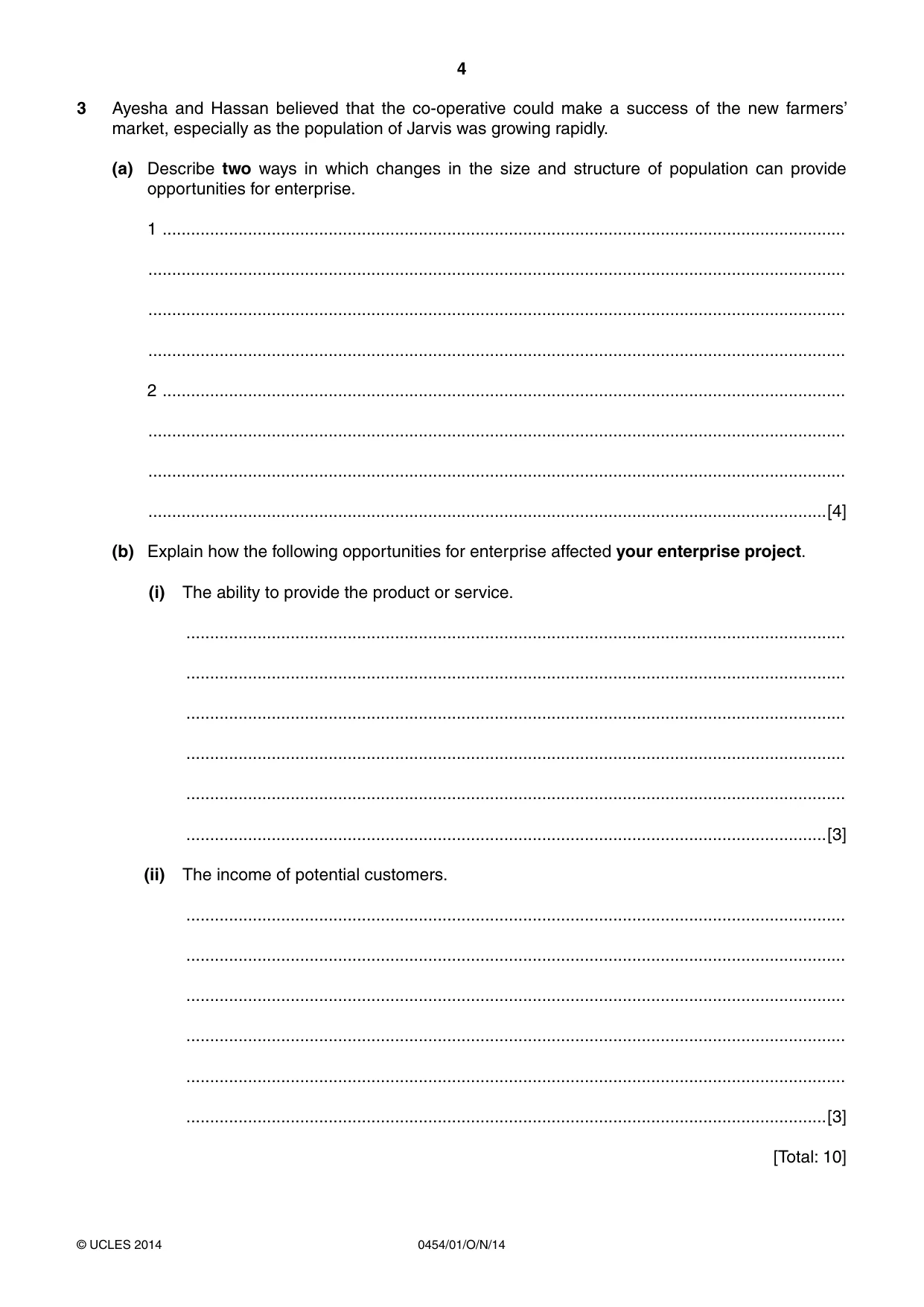
Question paper, page 4
4 0454/01/O/N/14 © UCLES 2014 3 Ayesha and Hassan believed that the co-operative could make a success of the new farmers’ market, especially as the population of Jarvis was growing rapidly. (a) Describe two ways in which changes in the size and structure of population can provide opportunities for enterprise. 1 … … … … 2 … … … …[4] (b) Explain how the following opportunities for enterprise affected your enterprise project. (i) The ability to provide the product or service. … … … … … …[3] (ii) The income of potential customers. … … … … … …[3] [Total: 10]
Question paper, page 5
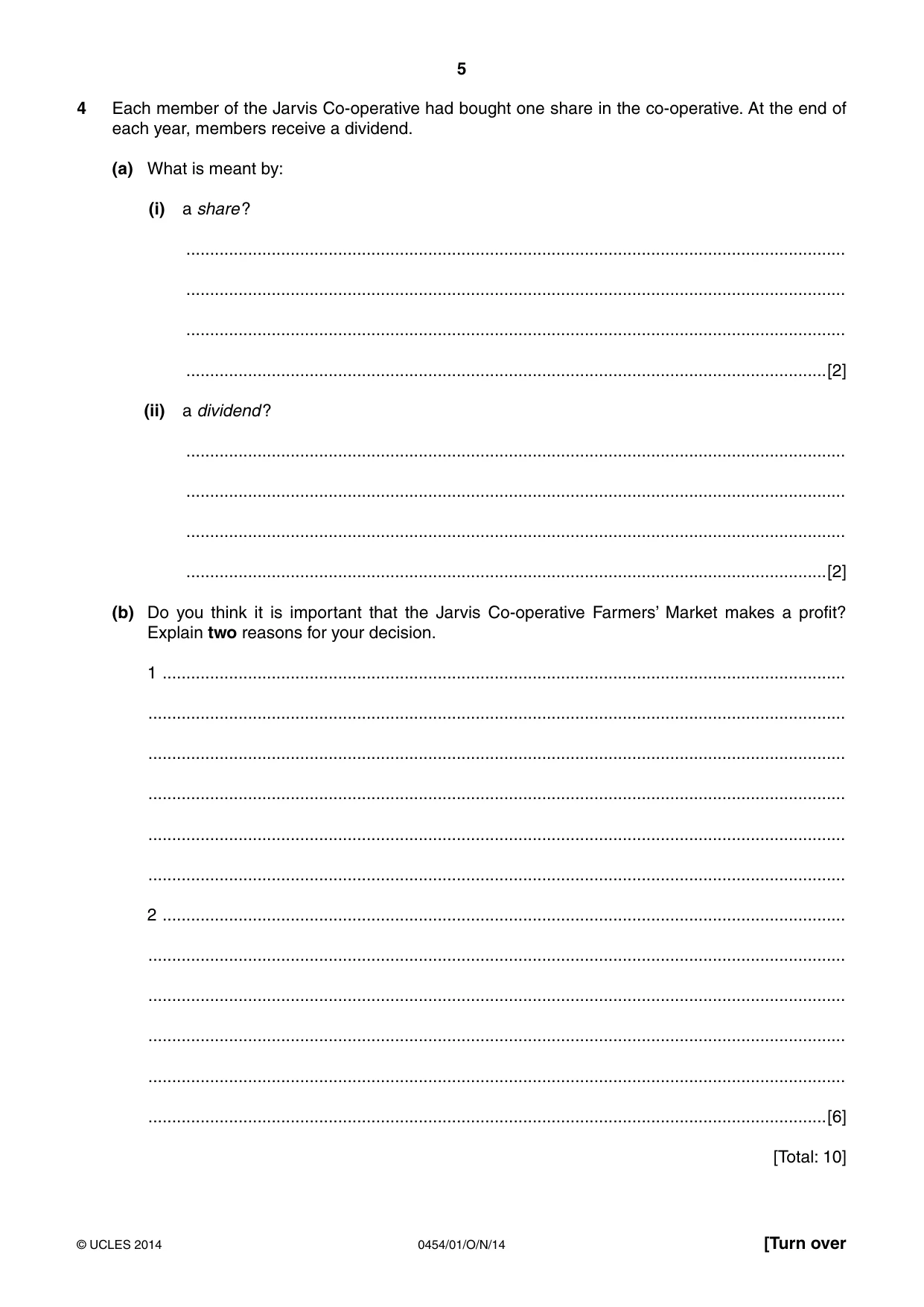
5 0454/01/O/N/14 © UCLES 2014 [Turn over 4 Each member of the Jarvis Co-operative had bought one share in the co-operative. At the end of each year, members receive a dividend. (a) What is meant by: (i) a share ? … … … …[2] (ii) a dividend ? … … … …[2] (b) Do you think it is important that the Jarvis Co-operative Farmers’ Market makes a profit? Explain two reasons for your decision. 1 … … … … … … 2 … … … … … …[6] [Total: 10]
Question paper, page 6
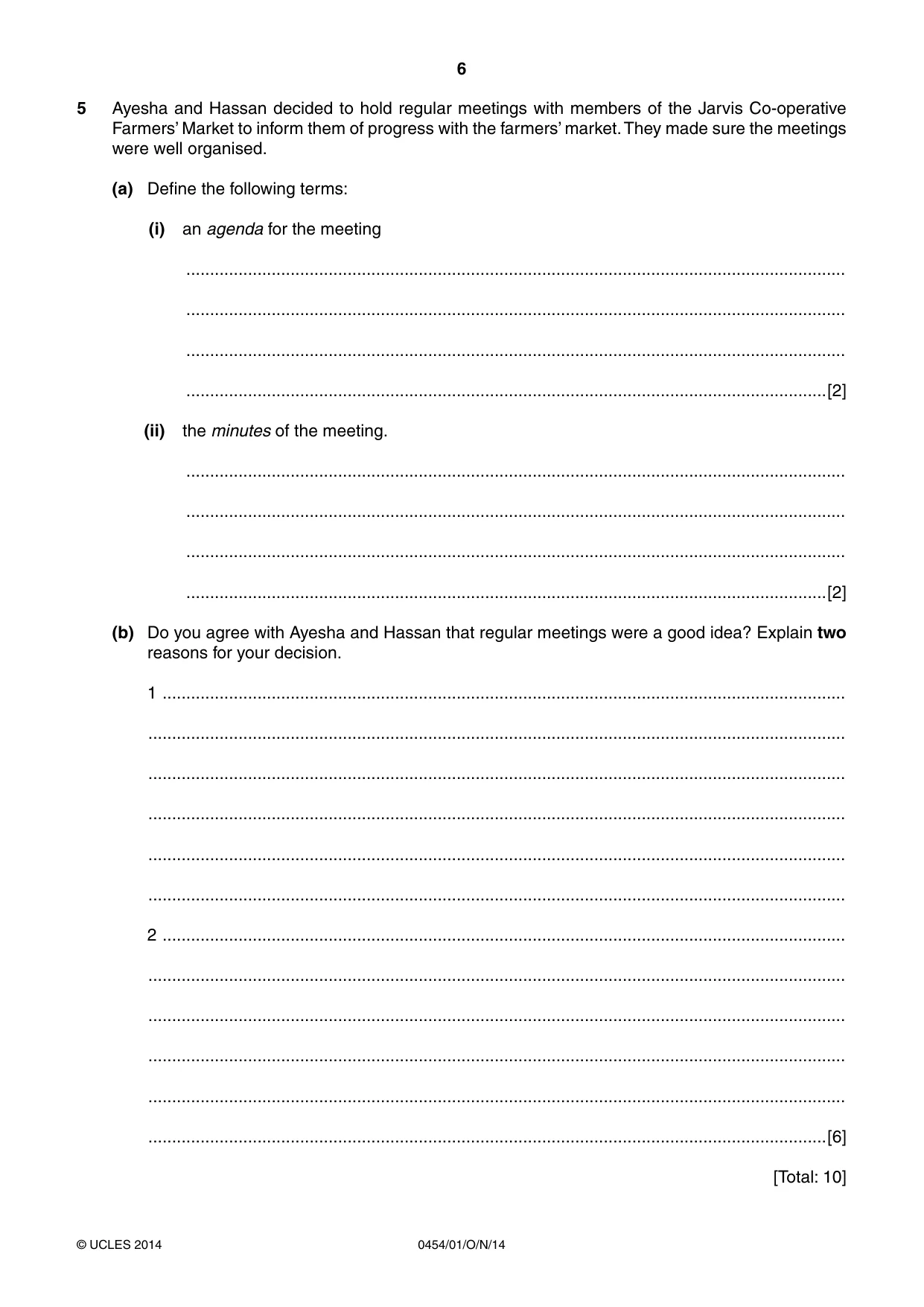
6 0454/01/O/N/14 © UCLES 2014 5 Ayesha and Hassan decided to hold regular meetings with members of the Jarvis Co-operative Farmers’ Market to inform them of progress with the farmers’ market. They made sure the meetings were well organised. (a) Define the following terms: (i) an agenda for the meeting … … … …[2] (ii) the minutes of the meeting. … … … …[2] (b) Do you agree with Ayesha and Hassan that regular meetings were a good idea? Explain two reasons for your decision. 1 … … … … … … 2 … … … … … …[6] [Total: 10]
Question paper, page 7
7 0454/01/O/N/14 © UCLES 2014 [Turn over Section B Answer all the questions. Use the case study, your own enterprise experience and your knowledge of enterprise to answer Question 6(a). 6 (a) Ayesha and Hassan thought that they had the necessary skills to be successful entrepreneurs. Identify two personal attributes or entrepreneurial skills and evaluate their importance to the success of your enterprise project. … … … … … … … … … … … … … … … … … … … … … …[10]
Question paper, page 8
8 0454/01/O/N/14 © UCLES 2014 Use the case study, your own enterprise experience and your knowledge of enterprise to answer Question 6(b). (b) Ayesha and Hassan carried out a variety of methods of market research. Compare the effectiveness of the different methods of market research that could have been used to ensure the success of your enterprise project. [15] … … … … … … … … … … … … … … … … … … … … … … … …
Question paper, page 9
9 0454/01/O/N/14 © UCLES 2014 [Turn over … … … … … … … … … … … … … … … … … … … … … … … … … … … [Total: 25]
Question paper, page 10
10 0454/01/O/N/14 © UCLES 2014 BLANK PAGE
Question paper, page 11
11 0454/01/O/N/14 © UCLES 2014 [Turn over Use the case study, your own enterprise experience and your knowledge of enterprise to answer Question 7(a). 7 (a) The Jarvis Co-operative needed to buy tables for the farmers’ market. The sources of finance considered were: share capital, a bank loan or a bank overdraft. Recommend which one of these three sources of finance should be used. Explain why you did not recommend the other two sources of finance. … … … … … … … … … … … … … … … … … … … … … … … …[10]
Question paper, page 12
12 0454/01/O/N/14 © UCLES 2014 Use the case study, your own enterprise experience and your knowledge of enterprise to answer Question 7(b). (b) Ayesha and Hassan needed to encourage more farmers to rent tables at the Jarvis Co-operative Farmers’ Market. Discuss the ways in which they could do this. Justify your answer. [15] … … … … … … … … … … … … … … … … … … … … … … … …
Question paper, page 13
13 0454/01/O/N/14 © UCLES 2014 … … … … … … … … … … … … … … … … … … … … … … … … … … … [Total: 25]
Question paper, page 14
14 0454/01/O/N/14 © UCLES 2014 BLANK PAGE
Question paper, page 15
15 0454/01/O/N/14 © UCLES 2014 BLANK PAGE
Question paper, page 16
16 0454/01/O/N/14 © UCLES 2014 Permission to reproduce items where third-party owned material protected by copyright is included has been sought and cleared where possible. Every reasonable effort has been made by the publisher (UCLES) to trace copyright holders, but if any items requiring clearance have unwittingly been included, the publisher will be pleased to make amends at the earliest possible opportunity. Cambridge International Examinations is part of the Cambridge Assessment Group. Cambridge Assessment is the brand name of University of Cambridge Local Examinations Syndicate (UCLES), which is itself a department of the University of Cambridge. BLANK PAGE
Mark scheme, page 1
® IGCSE is the registered trademark of Cambridge International Examinations. CAMBRIDGE INTERNATIONAL EXAMINATIONS Cambridge International General Certificate of Secondary Education MARK SCHEME for the October/November 2014 series 0454 ENTERPRISE 0454/01 Paper 1 (Case Study), maximum raw mark 100 This mark scheme is published as an aid to teachers and candidates, to indicate the requirements of the examination. It shows the basis on which Examiners were instructed to award marks. It does not indicate the details of the discussions that took place at an Examiners’ meeting before marking began, which would have considered the acceptability of alternative answers. Mark schemes should be read in conjunction with the question paper and the Principal Examiner Report for Teachers. Cambridge will not enter into discussions about these mark schemes. Cambridge is publishing the mark schemes for the October/November 2014 series for most Cambridge IGCSE®, Cambridge International A and AS Level components and some Cambridge O Level components.
Mark scheme, page 2
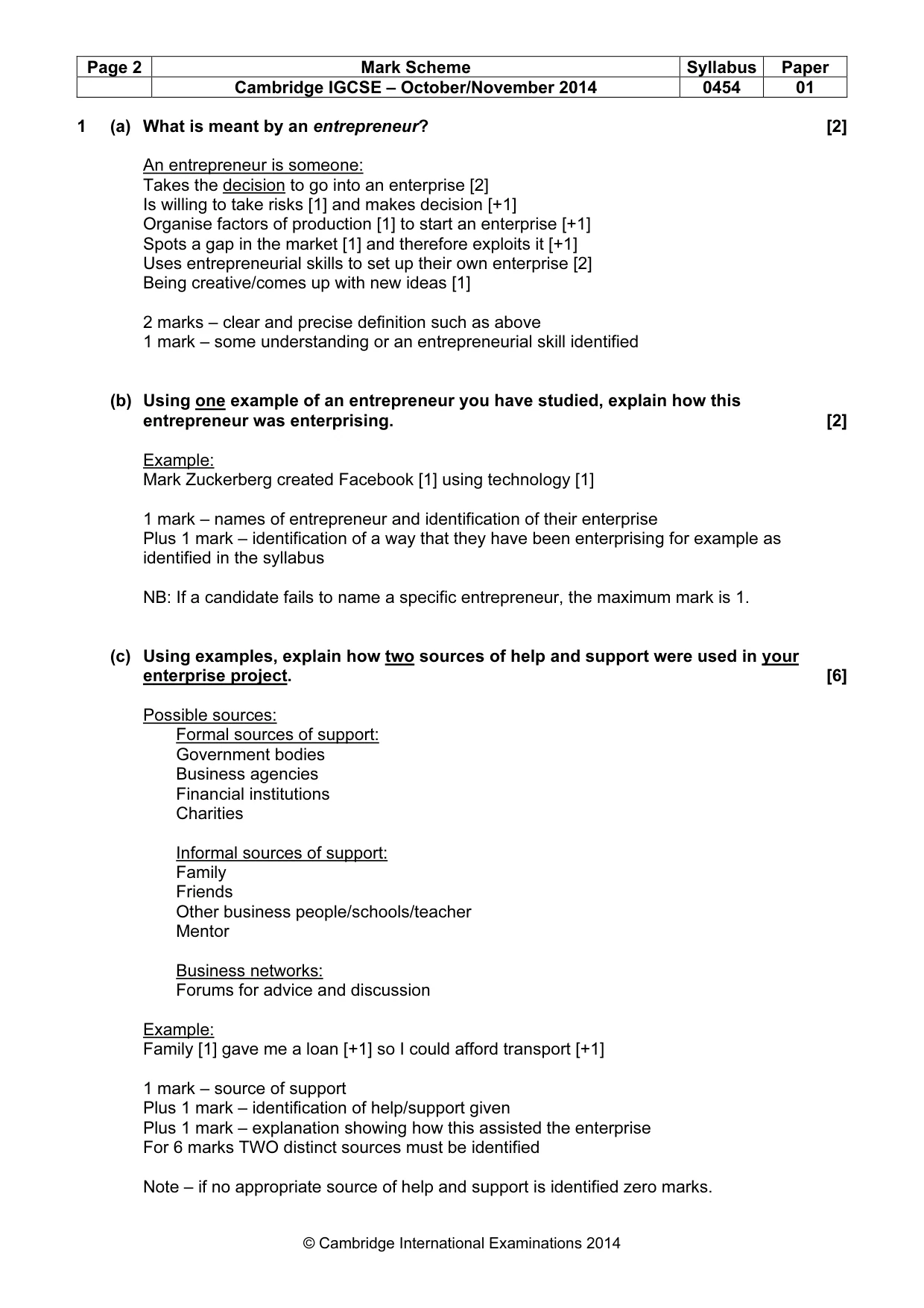
Page 2 Mark Scheme Syllabus Paper Cambridge IGCSE – October/November 2014 0454 01 © Cambridge International Examinations 2014 1 (a) What is meant by an entrepreneur? [2] An entrepreneur is someone: Takes the decision to go into an enterprise [2] Is willing to take risks [1] and makes decision [+1] Organise factors of production [1] to start an enterprise [+1] Spots a gap in the market [1] and therefore exploits it [+1] Uses entrepreneurial skills to set up their own enterprise [2] Being creative/comes up with new ideas [1] 2 marks – clear and precise definition such as above 1 mark – some understanding or an entrepreneurial skill identified (b) Using one example of an entrepreneur you have studied, explain how this entrepreneur was enterprising. [2] Example: Mark Zuckerberg created Facebook [1] using technology [1] 1 mark – names of entrepreneur and identification of their enterprise Plus 1 mark – identification of a way that they have been enterprising for example as identified in the syllabus NB: If a candidate fails to name a specific entrepreneur, the maximum mark is 1. (c) Using examples, explain how two sources of help and support were used in your enterprise project. [6] Possible sources: Formal sources of support: Government bodies Business agencies Financial institutions Charities Informal sources of support: Family Friends Other business people/schools/teacher Mentor Business networks: Forums for advice and discussion Example: Family [1] gave me a loan [+1] so I could afford transport [+1] 1 mark – source of support Plus 1 mark – identification of help/support given Plus 1 mark – explanation showing how this assisted the enterprise For 6 marks TWO distinct sources must be identified Note – if no appropriate source of help and support is identified zero marks.
Mark scheme, page 3
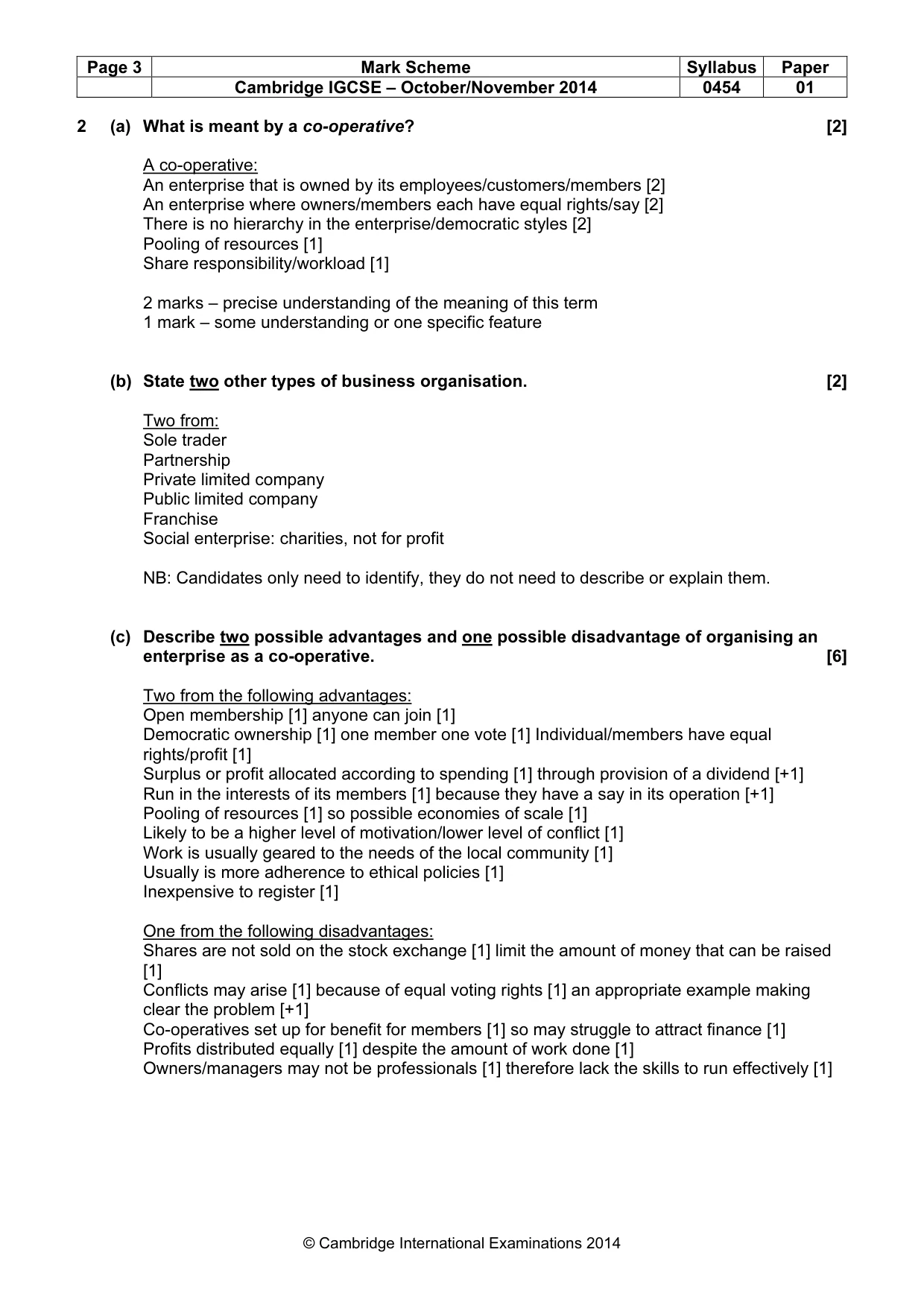
Page 3 Mark Scheme Syllabus Paper Cambridge IGCSE – October/November 2014 0454 01 © Cambridge International Examinations 2014 2 (a) What is meant by a co-operative? [2] A co-operative: An enterprise that is owned by its employees/customers/members [2] An enterprise where owners/members each have equal rights/say [2] There is no hierarchy in the enterprise/democratic styles [2] Pooling of resources [1] Share responsibility/workload [1] 2 marks – precise understanding of the meaning of this term 1 mark – some understanding or one specific feature (b) State two other types of business organisation. [2] Two from: Sole trader Partnership Private limited company Public limited company Franchise Social enterprise: charities, not for profit NB: Candidates only need to identify, they do not need to describe or explain them. (c) Describe two possible advantages and one possible disadvantage of organising an enterprise as a co-operative. [6] Two from the following advantages: Open membership [1] anyone can join [1] Democratic ownership [1] one member one vote [1] Individual/members have equal rights/profit [1] Surplus or profit allocated according to spending [1] through provision of a dividend [+1] Run in the interests of its members [1] because they have a say in its operation [+1] Pooling of resources [1] so possible economies of scale [1] Likely to be a higher level of motivation/lower level of conflict [1] Work is usually geared to the needs of the local community [1] Usually is more adherence to ethical policies [1] Inexpensive to register [1] One from the following disadvantages: Shares are not sold on the stock exchange [1] limit the amount of money that can be raised [1] Conflicts may arise [1] because of equal voting rights [1] an appropriate example making clear the problem [+1] Co-operatives set up for benefit for members [1] so may struggle to attract finance [1] Profits distributed equally [1] despite the amount of work done [1] Owners/managers may not be professionals [1] therefore lack the skills to run effectively [1]
Mark scheme, page 4
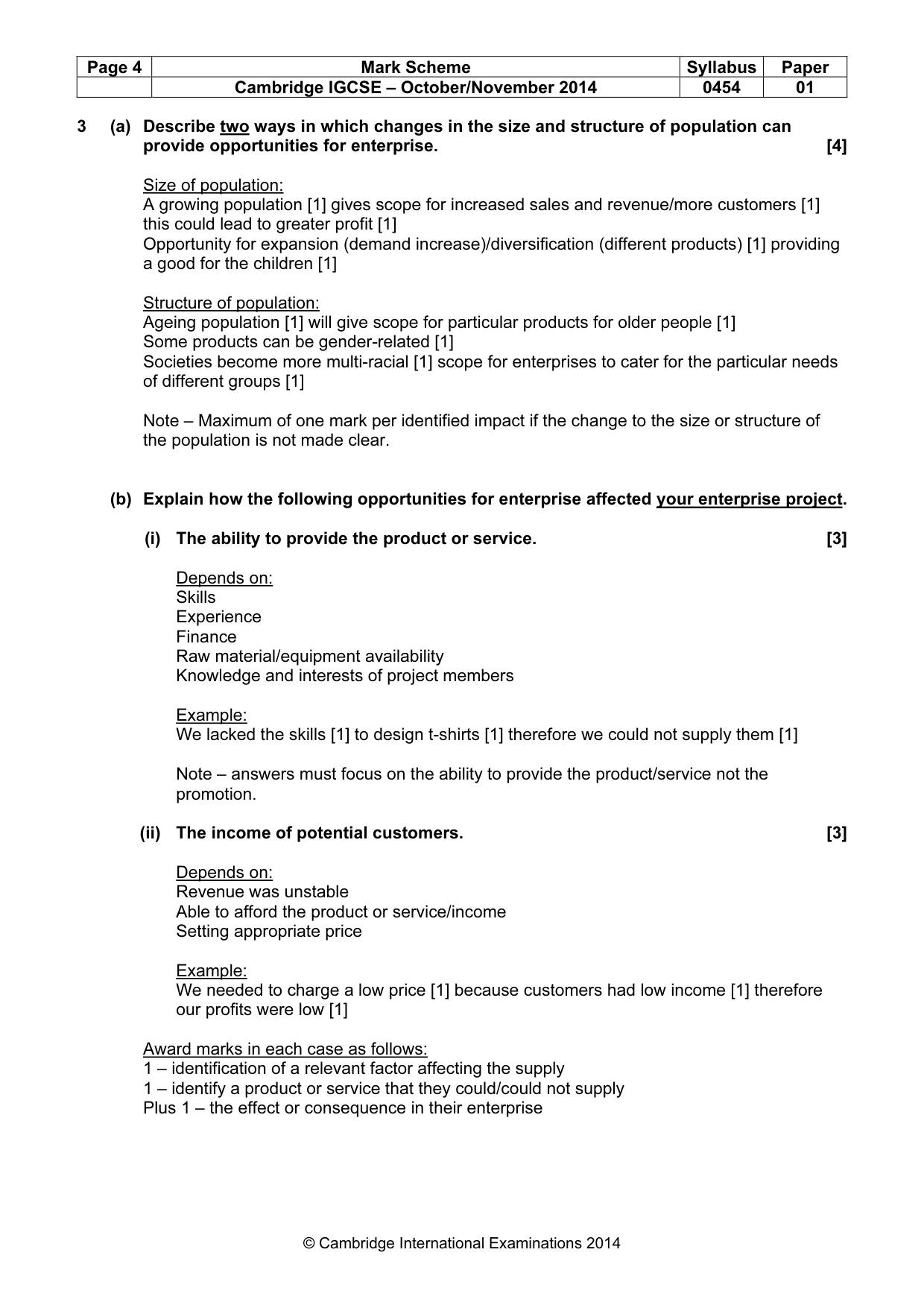
Page 4 Mark Scheme Syllabus Paper Cambridge IGCSE – October/November 2014 0454 01 © Cambridge International Examinations 2014 3 (a) Describe two ways in which changes in the size and structure of population can provide opportunities for enterprise. [4] Size of population: A growing population [1] gives scope for increased sales and revenue/more customers [1] this could lead to greater profit [1] Opportunity for expansion (demand increase)/diversification (different products) [1] providing a good for the children [1] Structure of population: Ageing population [1] will give scope for particular products for older people [1] Some products can be gender-related [1] Societies become more multi-racial [1] scope for enterprises to cater for the particular needs of different groups [1] Note – Maximum of one mark per identified impact if the change to the size or structure of the population is not made clear. (b) Explain how the following opportunities for enterprise affected your enterprise project. (i) The ability to provide the product or service. [3] Depends on: Skills Experience Finance Raw material/equipment availability Knowledge and interests of project members Example: We lacked the skills [1] to design t-shirts [1] therefore we could not supply them [1] Note – answers must focus on the ability to provide the product/service not the promotion. (ii) The income of potential customers. [3] Depends on: Revenue was unstable Able to afford the product or service/income Setting appropriate price Example: We needed to charge a low price [1] because customers had low income [1] therefore our profits were low [1] Award marks in each case as follows: 1 – identification of a relevant factor affecting the supply 1 – identify a product or service that they could/could not supply Plus 1 – the effect or consequence in their enterprise
Mark scheme, page 5
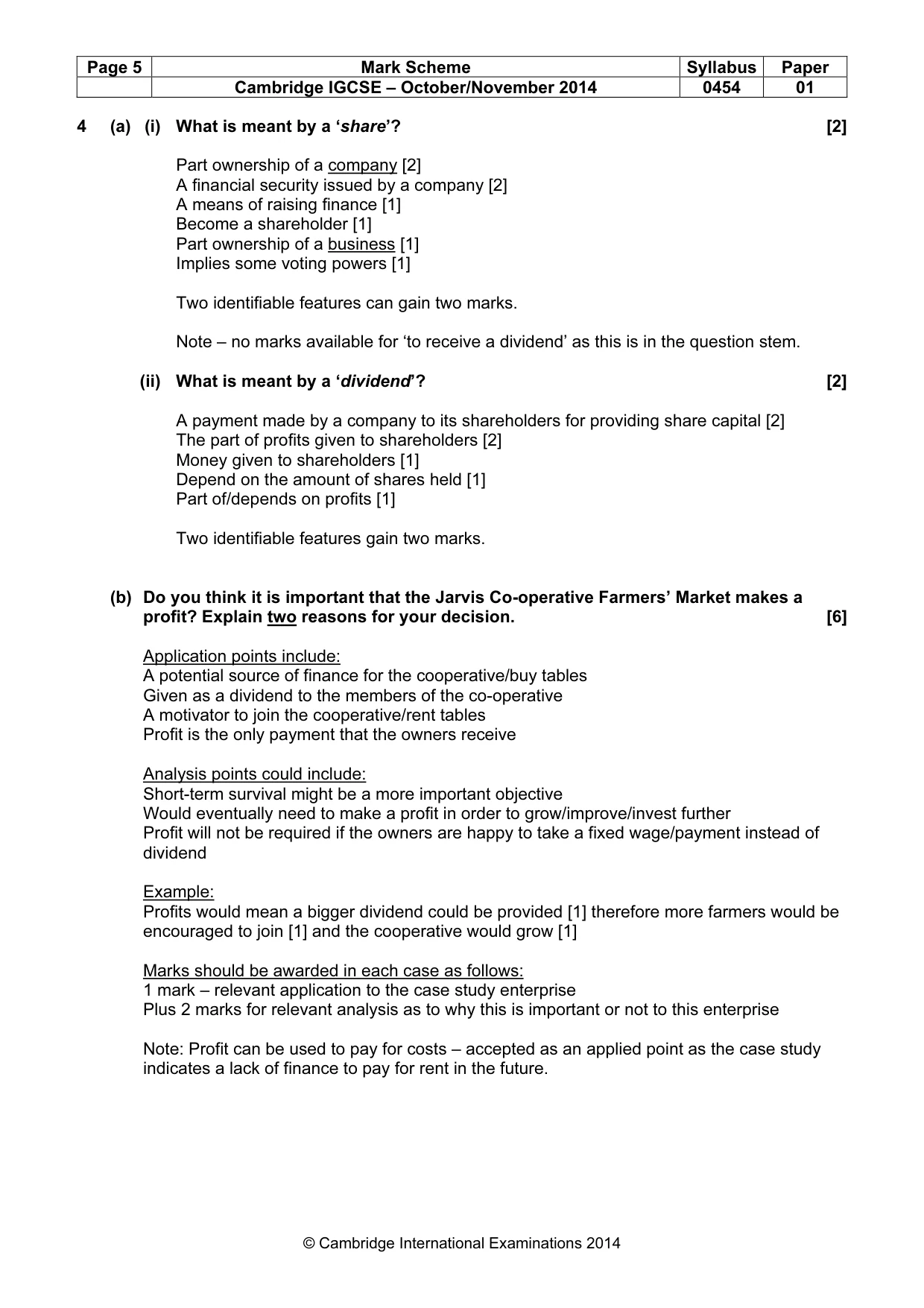
Page 5 Mark Scheme Syllabus Paper Cambridge IGCSE – October/November 2014 0454 01 © Cambridge International Examinations 2014 4 (a) (i) What is meant by a ‘share’? [2] Part ownership of a company [2] A financial security issued by a company [2] A means of raising finance [1] Become a shareholder [1] Part ownership of a business [1] Implies some voting powers [1] Two identifiable features can gain two marks. Note – no marks available for ‘to receive a dividend’ as this is in the question stem. (ii) What is meant by a ‘dividend’? [2] A payment made by a company to its shareholders for providing share capital [2] The part of profits given to shareholders [2] Money given to shareholders [1] Depend on the amount of shares held [1] Part of/depends on profits [1] Two identifiable features gain two marks. (b) Do you think it is important that the Jarvis Co-operative Farmers’ Market makes a profit? Explain two reasons for your decision. [6] Application points include: A potential source of finance for the cooperative/buy tables Given as a dividend to the members of the co-operative A motivator to join the cooperative/rent tables Profit is the only payment that the owners receive Analysis points could include: Short-term survival might be a more important objective Would eventually need to make a profit in order to grow/improve/invest further Profit will not be required if the owners are happy to take a fixed wage/payment instead of dividend Example: Profits would mean a bigger dividend could be provided [1] therefore more farmers would be encouraged to join [1] and the cooperative would grow [1] Marks should be awarded in each case as follows: 1 mark – relevant application to the case study enterprise Plus 2 marks for relevant analysis as to why this is important or not to this enterprise Note: Profit can be used to pay for costs – accepted as an applied point as the case study indicates a lack of finance to pay for rent in the future.
Mark scheme, page 6
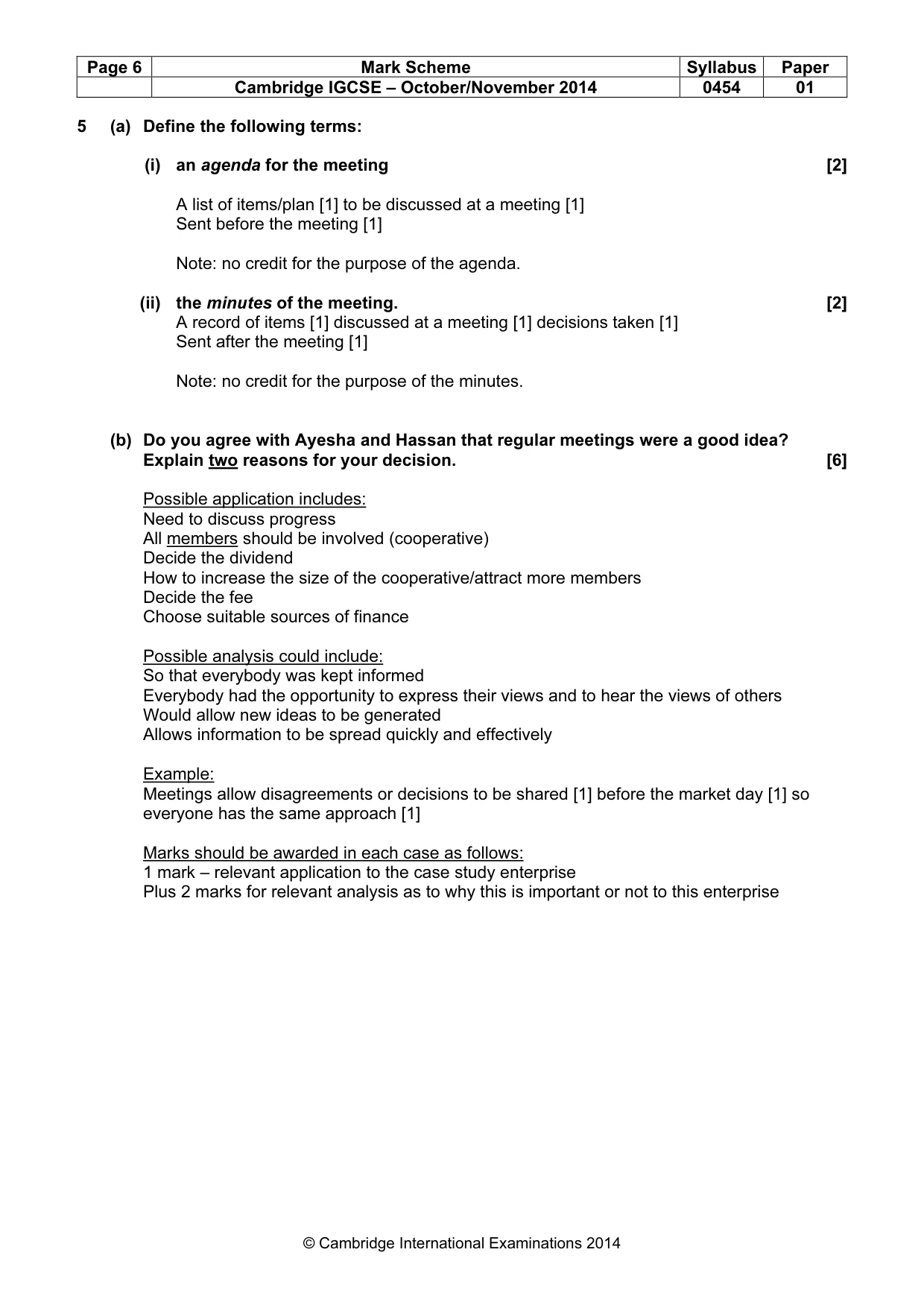
Page 6 Mark Scheme Syllabus Paper Cambridge IGCSE – October/November 2014 0454 01 © Cambridge International Examinations 2014 5 (a) Define the following terms: (i) an agenda for the meeting [2] A list of items/plan [1] to be discussed at a meeting [1] Sent before the meeting [1] Note: no credit for the purpose of the agenda. (ii) the minutes of the meeting. [2] A record of items [1] discussed at a meeting [1] decisions taken [1] Sent after the meeting [1] Note: no credit for the purpose of the minutes. (b) Do you agree with Ayesha and Hassan that regular meetings were a good idea? Explain two reasons for your decision. [6] Possible application includes: Need to discuss progress All members should be involved (cooperative) Decide the dividend How to increase the size of the cooperative/attract more members Decide the fee Choose suitable sources of finance Possible analysis could include: So that everybody was kept informed Everybody had the opportunity to express their views and to hear the views of others Would allow new ideas to be generated Allows information to be spread quickly and effectively Example: Meetings allow disagreements or decisions to be shared [1] before the market day [1] so everyone has the same approach [1] Marks should be awarded in each case as follows: 1 mark – relevant application to the case study enterprise Plus 2 marks for relevant analysis as to why this is important or not to this enterprise
Mark scheme, page 7
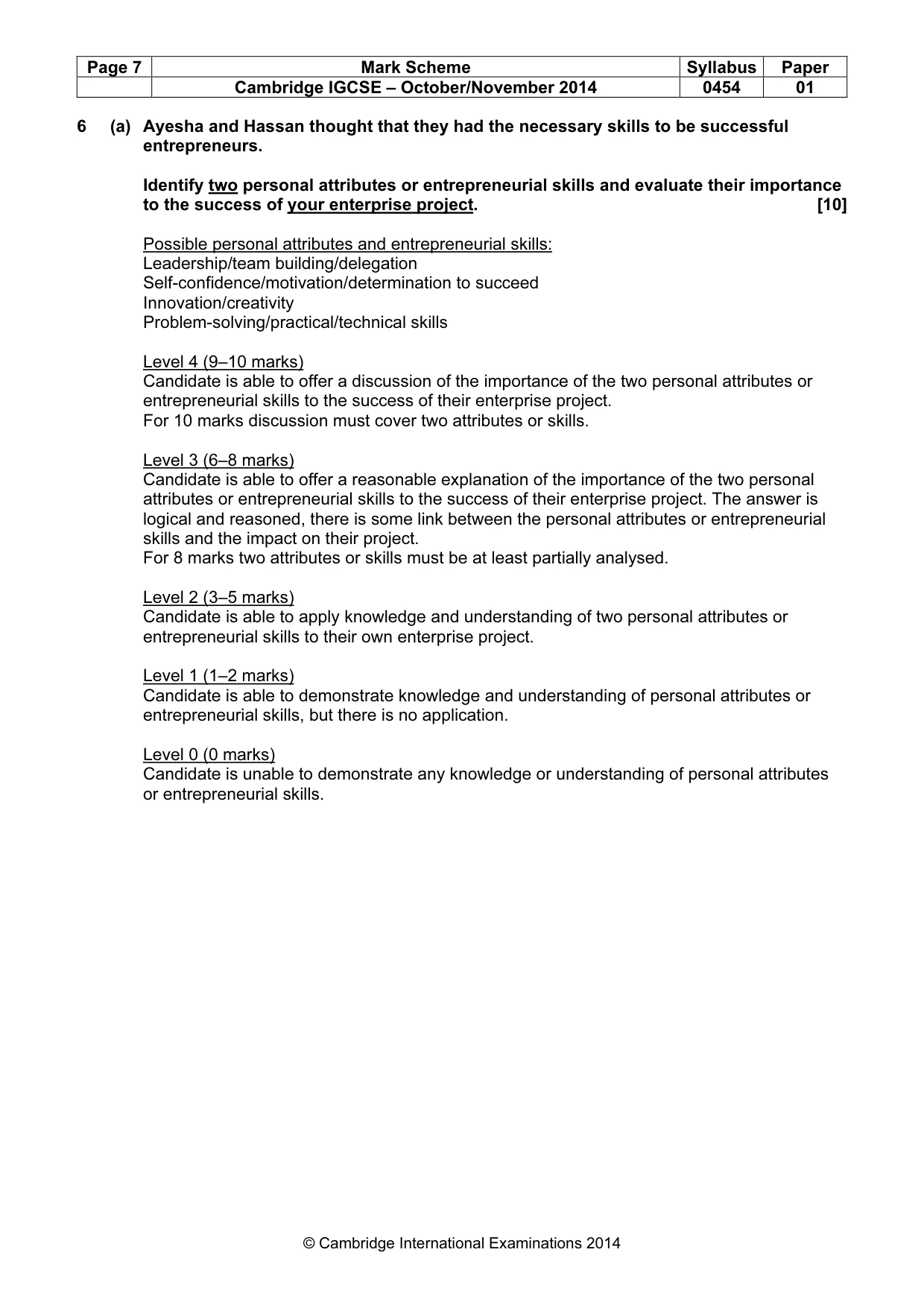
Page 7 Mark Scheme Syllabus Paper Cambridge IGCSE – October/November 2014 0454 01 © Cambridge International Examinations 2014 6 (a) Ayesha and Hassan thought that they had the necessary skills to be successful entrepreneurs. Identify two personal attributes or entrepreneurial skills and evaluate their importance to the success of your enterprise project. [10] Possible personal attributes and entrepreneurial skills: Leadership/team building/delegation Self-confidence/motivation/determination to succeed Innovation/creativity Problem-solving/practical/technical skills Level 4 (9–10 marks) Candidate is able to offer a discussion of the importance of the two personal attributes or entrepreneurial skills to the success of their enterprise project. For 10 marks discussion must cover two attributes or skills. Level 3 (6–8 marks) Candidate is able to offer a reasonable explanation of the importance of the two personal attributes or entrepreneurial skills to the success of their enterprise project. The answer is logical and reasoned, there is some link between the personal attributes or entrepreneurial skills and the impact on their project. For 8 marks two attributes or skills must be at least partially analysed. Level 2 (3–5 marks) Candidate is able to apply knowledge and understanding of two personal attributes or entrepreneurial skills to their own enterprise project. Level 1 (1–2 marks) Candidate is able to demonstrate knowledge and understanding of personal attributes or entrepreneurial skills, but there is no application. Level 0 (0 marks) Candidate is unable to demonstrate any knowledge or understanding of personal attributes or entrepreneurial skills.
Mark scheme, page 8
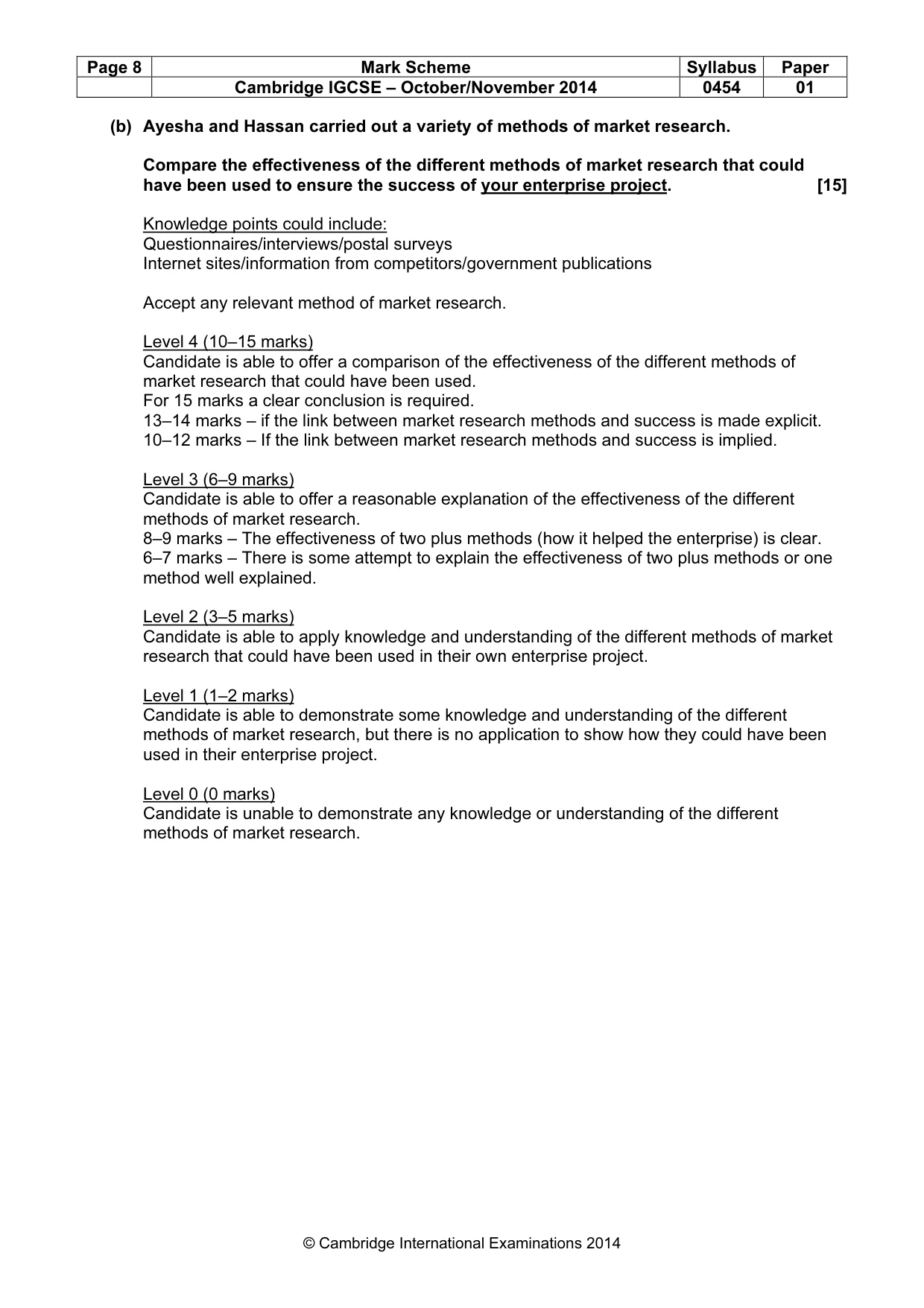
Page 8 Mark Scheme Syllabus Paper Cambridge IGCSE – October/November 2014 0454 01 © Cambridge International Examinations 2014 (b) Ayesha and Hassan carried out a variety of methods of market research. Compare the effectiveness of the different methods of market research that could have been used to ensure the success of your enterprise project. [15] Knowledge points could include: Questionnaires/interviews/postal surveys Internet sites/information from competitors/government publications Accept any relevant method of market research. Level 4 (10–15 marks) Candidate is able to offer a comparison of the effectiveness of the different methods of market research that could have been used. For 15 marks a clear conclusion is required. 13–14 marks – if the link between market research methods and success is made explicit. 10–12 marks – If the link between market research methods and success is implied. Level 3 (6–9 marks) Candidate is able to offer a reasonable explanation of the effectiveness of the different methods of market research. 8–9 marks – The effectiveness of two plus methods (how it helped the enterprise) is clear. 6–7 marks – There is some attempt to explain the effectiveness of two plus methods or one method well explained. Level 2 (3–5 marks) Candidate is able to apply knowledge and understanding of the different methods of market research that could have been used in their own enterprise project. Level 1 (1–2 marks) Candidate is able to demonstrate some knowledge and understanding of the different methods of market research, but there is no application to show how they could have been used in their enterprise project. Level 0 (0 marks) Candidate is unable to demonstrate any knowledge or understanding of the different methods of market research.
Mark scheme, page 9
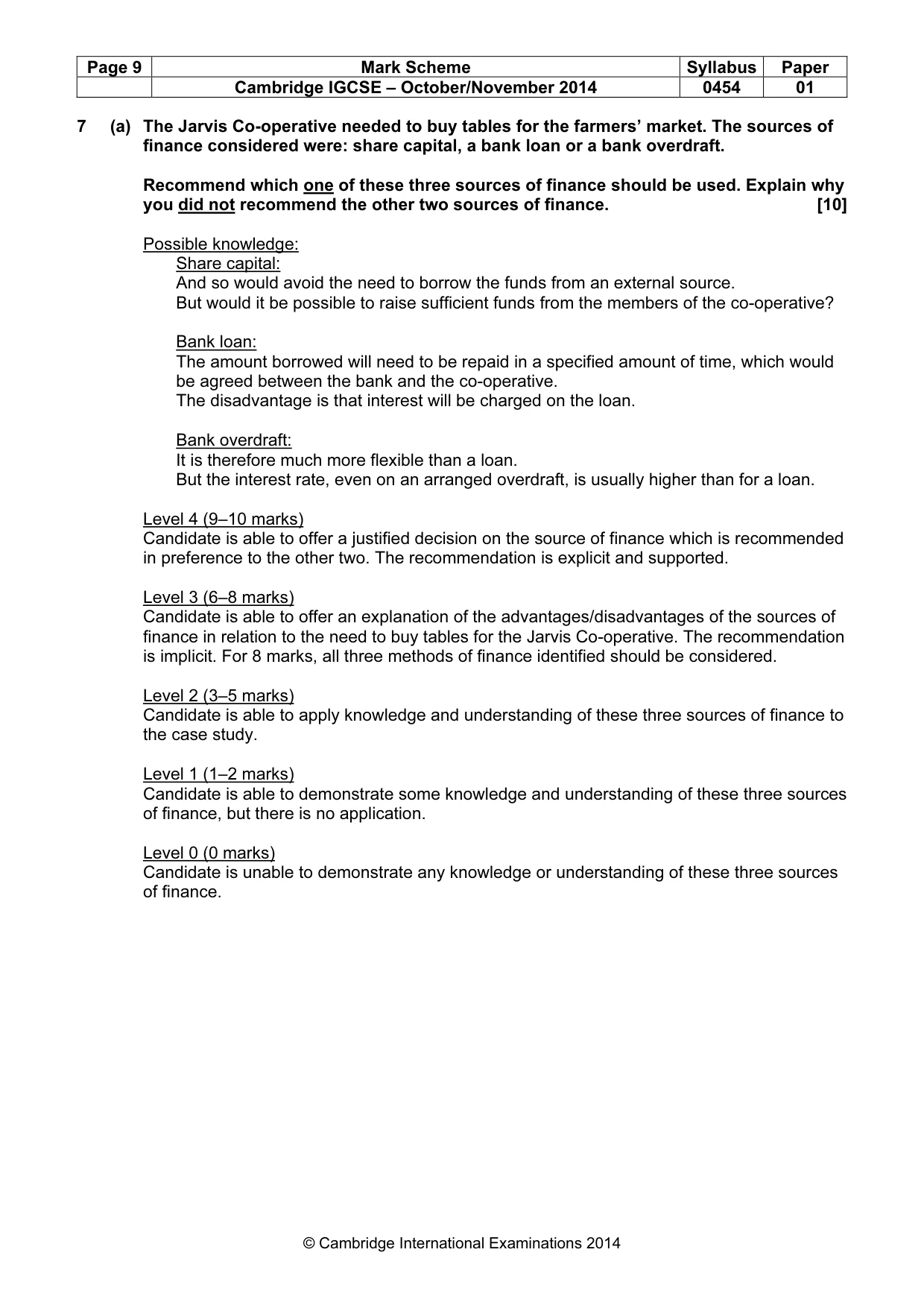
Page 9 Mark Scheme Syllabus Paper Cambridge IGCSE – October/November 2014 0454 01 © Cambridge International Examinations 2014 7 (a) The Jarvis Co-operative needed to buy tables for the farmers’ market. The sources of finance considered were: share capital, a bank loan or a bank overdraft. Recommend which one of these three sources of finance should be used. Explain why you did not recommend the other two sources of finance. [10] Possible knowledge: Share capital: And so would avoid the need to borrow the funds from an external source. But would it be possible to raise sufficient funds from the members of the co-operative? Bank loan: The amount borrowed will need to be repaid in a specified amount of time, which would be agreed between the bank and the co-operative. The disadvantage is that interest will be charged on the loan. Bank overdraft: It is therefore much more flexible than a loan. But the interest rate, even on an arranged overdraft, is usually higher than for a loan. Level 4 (9–10 marks) Candidate is able to offer a justified decision on the source of finance which is recommended in preference to the other two. The recommendation is explicit and supported. Level 3 (6–8 marks) Candidate is able to offer an explanation of the advantages/disadvantages of the sources of finance in relation to the need to buy tables for the Jarvis Co-operative. The recommendation is implicit. For 8 marks, all three methods of finance identified should be considered. Level 2 (3–5 marks) Candidate is able to apply knowledge and understanding of these three sources of finance to the case study. Level 1 (1–2 marks) Candidate is able to demonstrate some knowledge and understanding of these three sources of finance, but there is no application. Level 0 (0 marks) Candidate is unable to demonstrate any knowledge or understanding of these three sources of finance.
Mark scheme, page 10
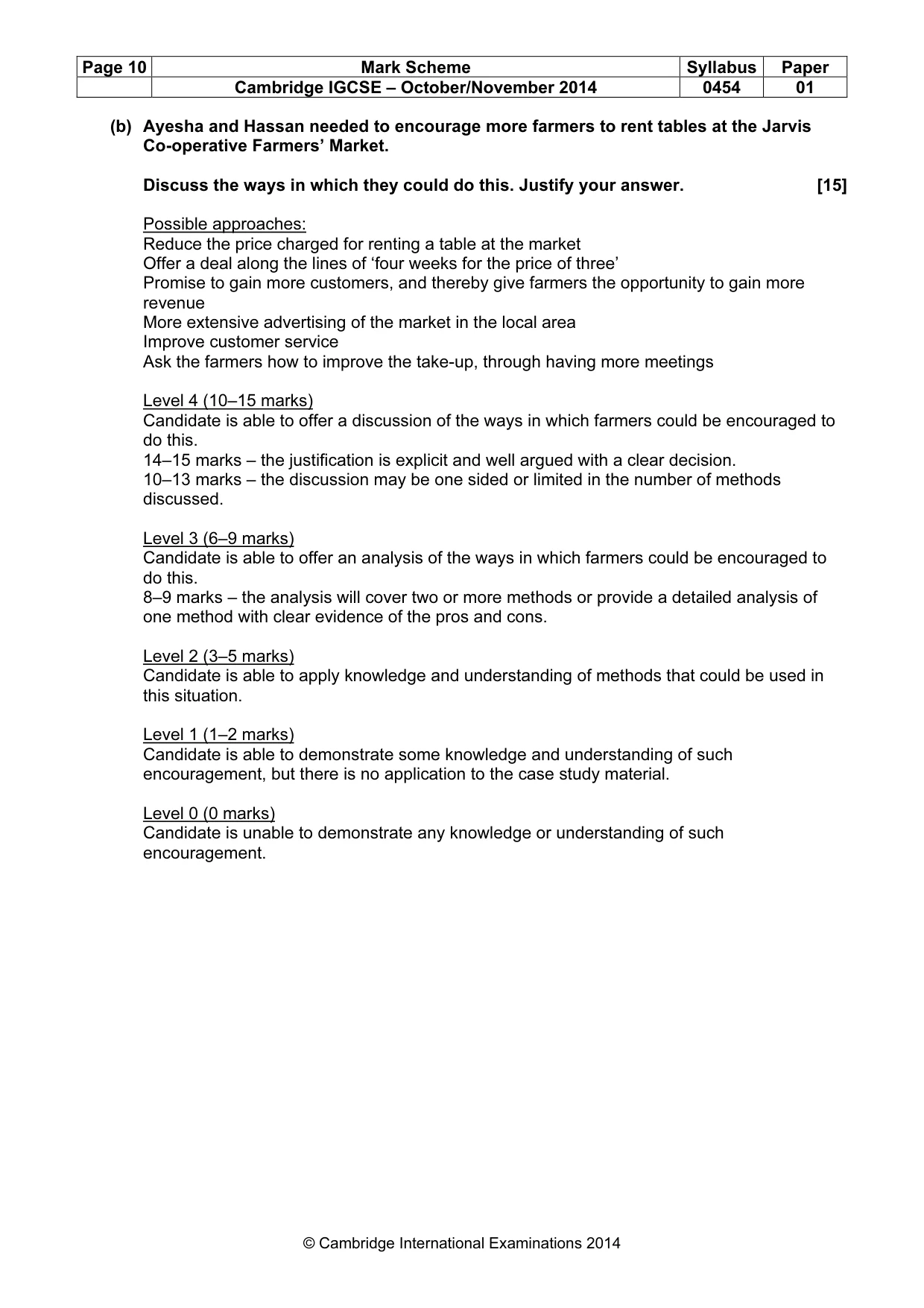
Page 10 Mark Scheme Syllabus Paper Cambridge IGCSE – October/November 2014 0454 01 © Cambridge International Examinations 2014 (b) Ayesha and Hassan needed to encourage more farmers to rent tables at the Jarvis Co-operative Farmers’ Market. Discuss the ways in which they could do this. Justify your answer. [15] Possible approaches: Reduce the price charged for renting a table at the market Offer a deal along the lines of ‘four weeks for the price of three’ Promise to gain more customers, and thereby give farmers the opportunity to gain more revenue More extensive advertising of the market in the local area Improve customer service Ask the farmers how to improve the take-up, through having more meetings Level 4 (10–15 marks) Candidate is able to offer a discussion of the ways in which farmers could be encouraged to do this. 14–15 marks – the justification is explicit and well argued with a clear decision. 10–13 marks – the discussion may be one sided or limited in the number of methods discussed. Level 3 (6–9 marks) Candidate is able to offer an analysis of the ways in which farmers could be encouraged to do this. 8–9 marks – the analysis will cover two or more methods or provide a detailed analysis of one method with clear evidence of the pros and cons. Level 2 (3–5 marks) Candidate is able to apply knowledge and understanding of methods that could be used in this situation. Level 1 (1–2 marks) Candidate is able to demonstrate some knowledge and understanding of such encouragement, but there is no application to the case study material. Level 0 (0 marks) Candidate is unable to demonstrate any knowledge or understanding of such encouragement.
What you needed in this session
Cambridge’s own grade thresholds for 2014 Oct/Nov, Paper 1 · Variant 1. A higher threshold means an easier paper — the bar moves with how the cohort did.