Cambridge IGCSE Enterprise 0454 — 2013 May/June Paper 1 · Variant 1
0454/11/M/J/13 · 100 marks · ≈113 min
The question paper and its mark scheme, free to read here and free to download. This is Cambridge’s own paper, exactly as it was sat.
Question paper16 pages





Mark scheme9 pages
Answers below. Sit the paper first if you are practising.
Paper as text
Question paper, page 1
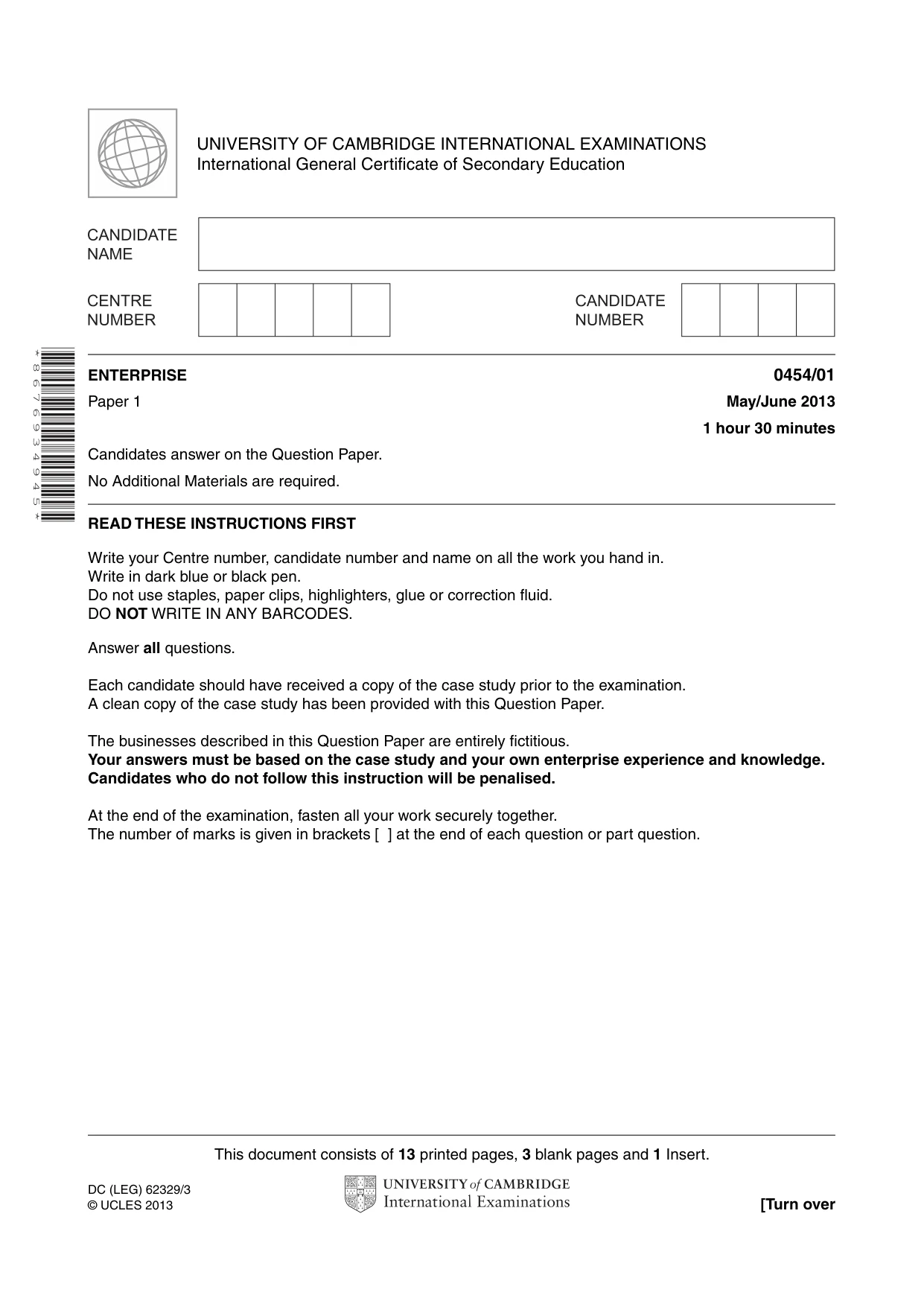
This document consists of 13 printed pages, 3 blank pages and 1 Insert. DC (LEG) 62329/3 © UCLES 2013 [Turn over UNIVERSITY OF CAMBRIDGE INTERNATIONAL EXAMINATIONS International General Certificate of Secondary Education * 8 6 7 6 9 3 4 9 4 5 * ENTERPRISE 0454/01 Paper 1 May/June 2013 1 hour 30 minutes Candidates answer on the Question Paper. No Additional Materials are required. READ THESE INSTRUCTIONS FIRST Write your Centre number, candidate number and name on all the work you hand in. Write in dark blue or black pen. Do not use staples, paper clips, highlighters, glue or correction fluid. DO NOT WRITE IN ANY BARCODES. Answer all questions. Each candidate should have received a copy of the case study prior to the examination. A clean copy of the case study has been provided with this Question Paper. The businesses described in this Question Paper are entirely fictitious. Your answers must be based on the case study and your own enterprise experience and knowledge. Candidates who do not follow this instruction will be penalised. At the end of the examination, fasten all your work securely together. The number of marks is given in brackets [ ] at the end of each question or part question.
Question paper, page 2
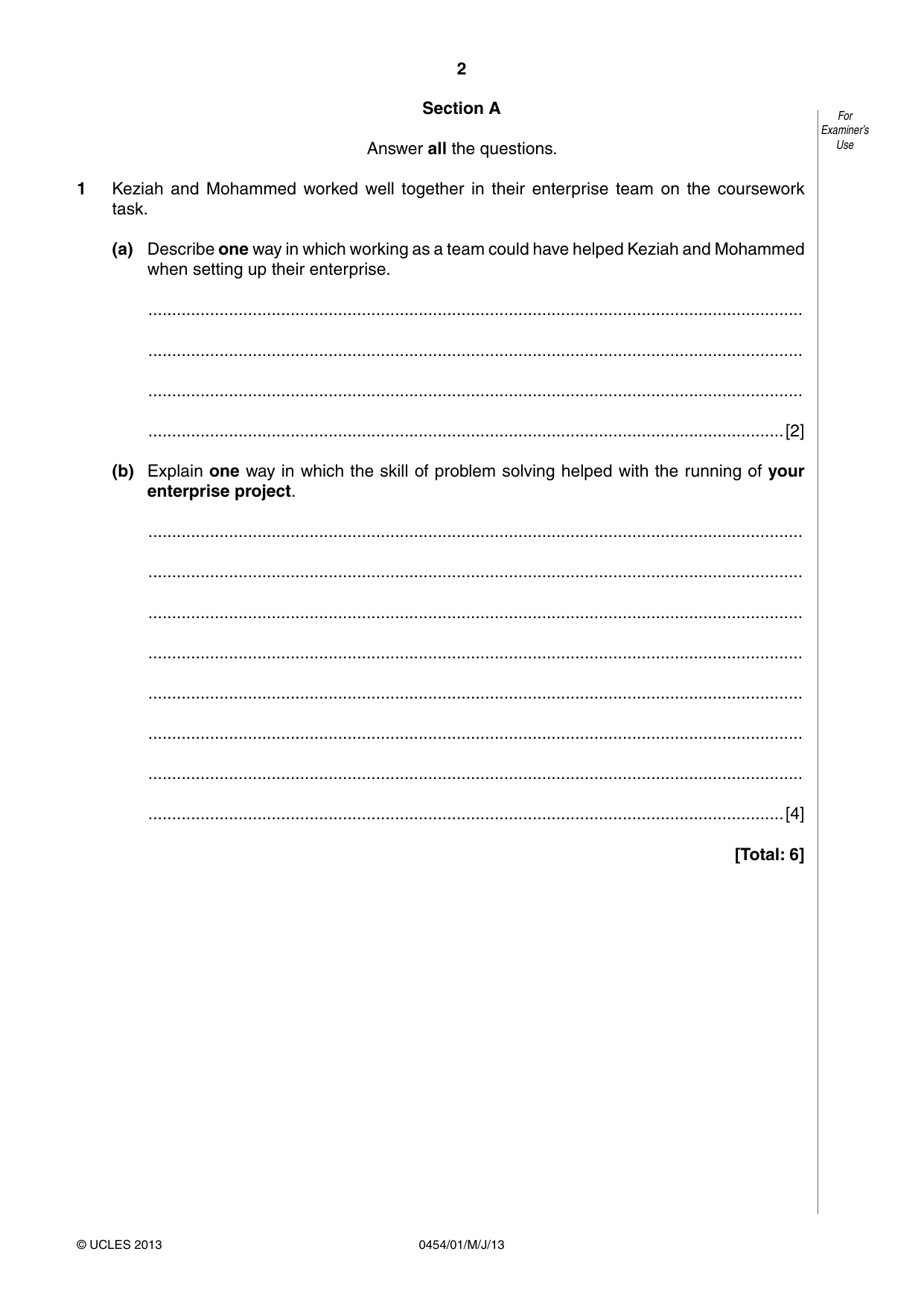
2 0454/01/M/J/13 © UCLES 2013 For Examiner’s Use Section A Answer all the questions. 1 Keziah and Mohammed worked well together in their enterprise team on the coursework task. (a) Describe one way in which working as a team could have helped Keziah and Mohammed when setting up their enterprise. … … … …[2] (b) Explain one way in which the skill of problem solving helped with the running of your enterprise project. … … … … … … … …[4] [Total: 6]
Question paper, page 3
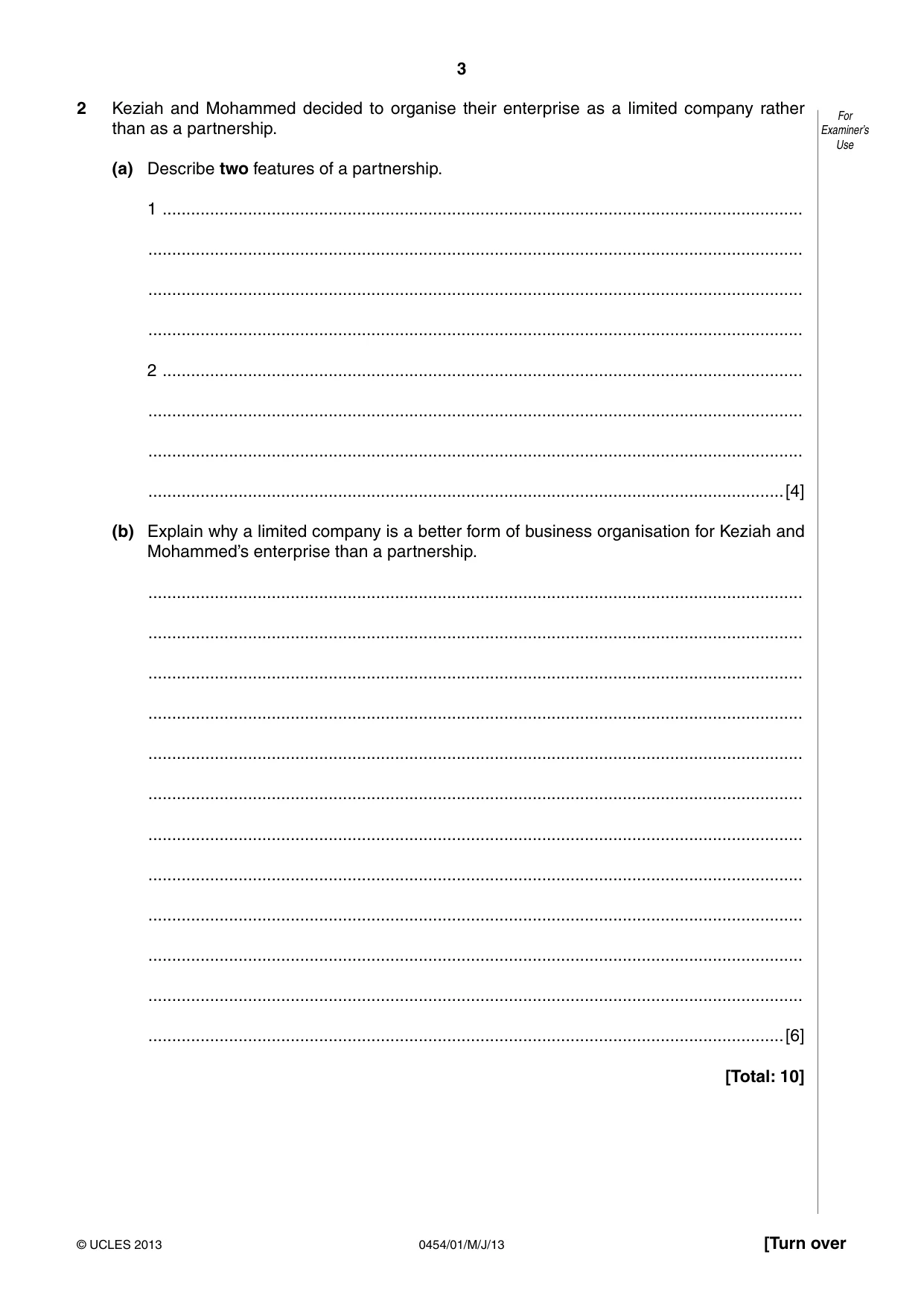
3 0454/01/M/J/13 © UCLES 2013 [Turn over For Examiner’s Use 2 Keziah and Mohammed decided to organise their enterprise as a limited company rather than as a partnership. (a) Describe two features of a partnership. 1 … … … … 2 … … … …[4] (b) Explain why a limited company is a better form of business organisation for Keziah and Mohammed’s enterprise than a partnership. … … … … … … … … … … … …[6] [Total: 10]
Question paper, page 4
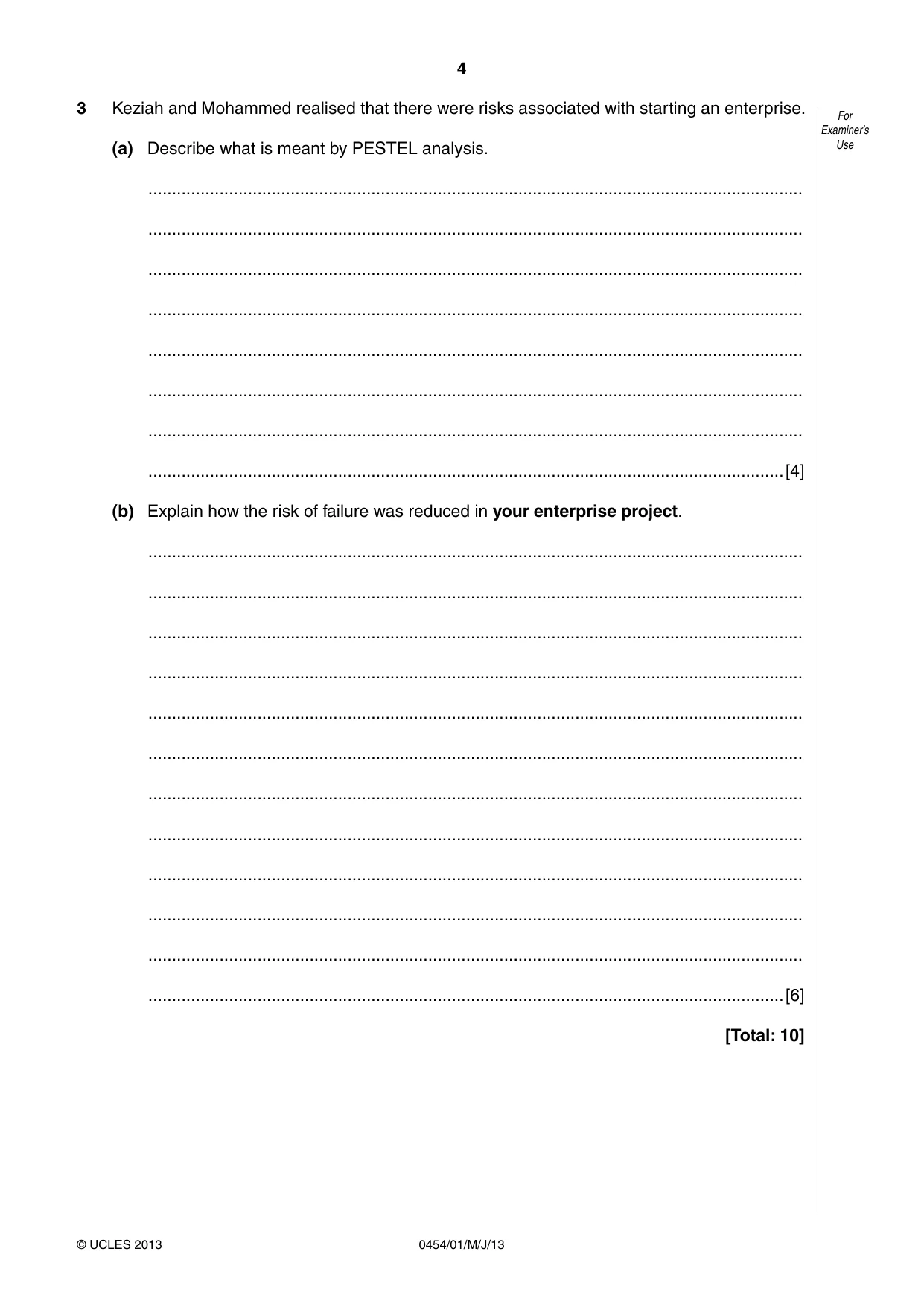
4 0454/01/M/J/13 © UCLES 2013 For Examiner’s Use 3 Keziah and Mohammed realised that there were risks associated with starting an enterprise. (a) Describe what is meant by PESTEL analysis. … … … … … … … …[4] (b) Explain how the risk of failure was reduced in your enterprise project. … … … … … … … … … … … …[6] [Total: 10]
Question paper, page 5
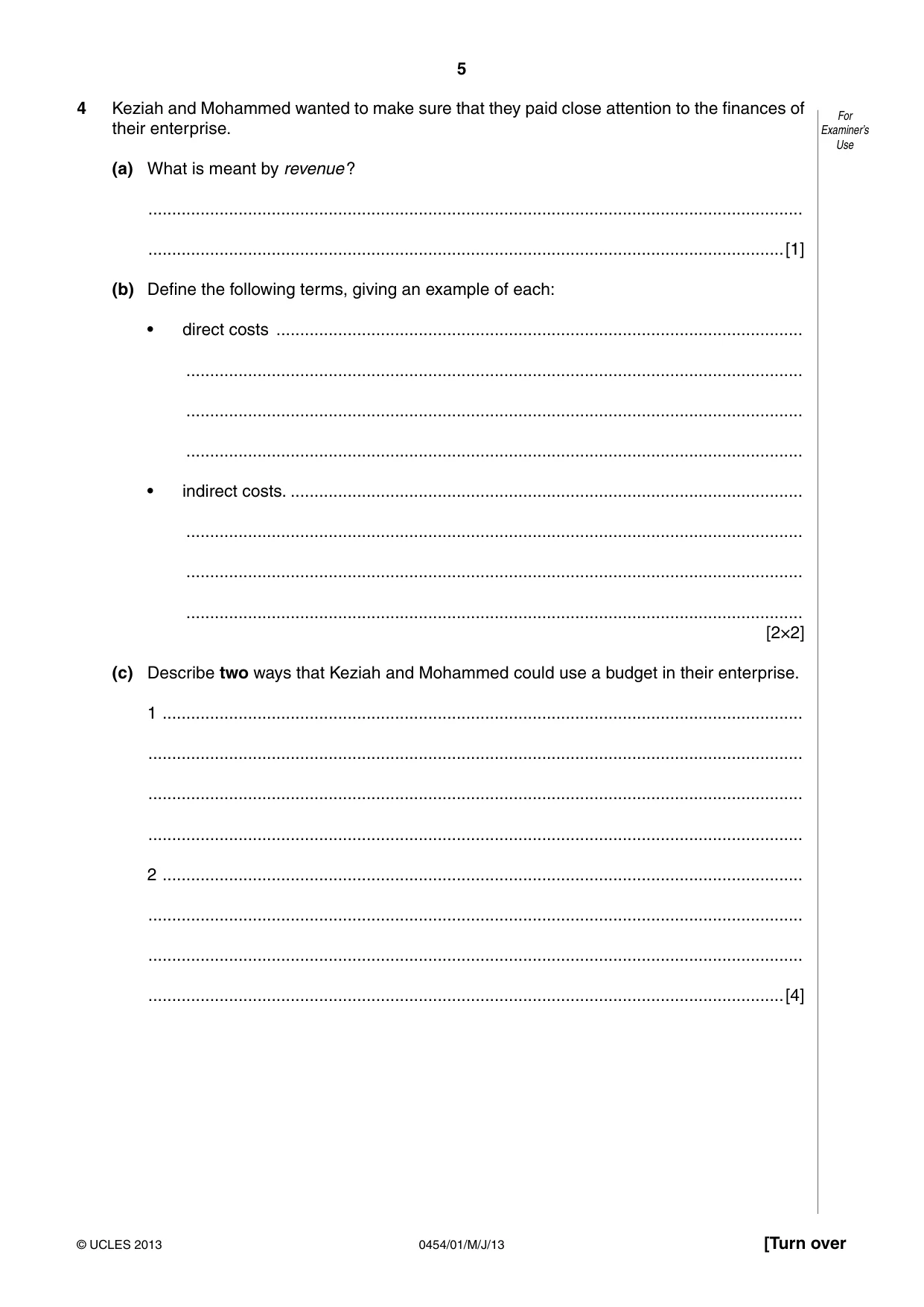
5 0454/01/M/J/13 © UCLES 2013 [Turn over For Examiner’s Use 4 Keziah and Mohammed wanted to make sure that they paid close attention to the finances of their enterprise. (a) What is meant by revenue ? … …[1] (b) Define the following terms, giving an example of each: • direct costs … … … … • indirect costs. … … … … [2×2] (c) Describe two ways that Keziah and Mohammed could use a budget in their enterprise. 1 … … … … 2 … … … …[4]
Question paper, page 6
6 0454/01/M/J/13 © UCLES 2013 For Examiner’s Use (d) Discuss the importance of budgeting in your enterprise project. … … … … … … … … … … … …[6] [Total: 15]
Question paper, page 7
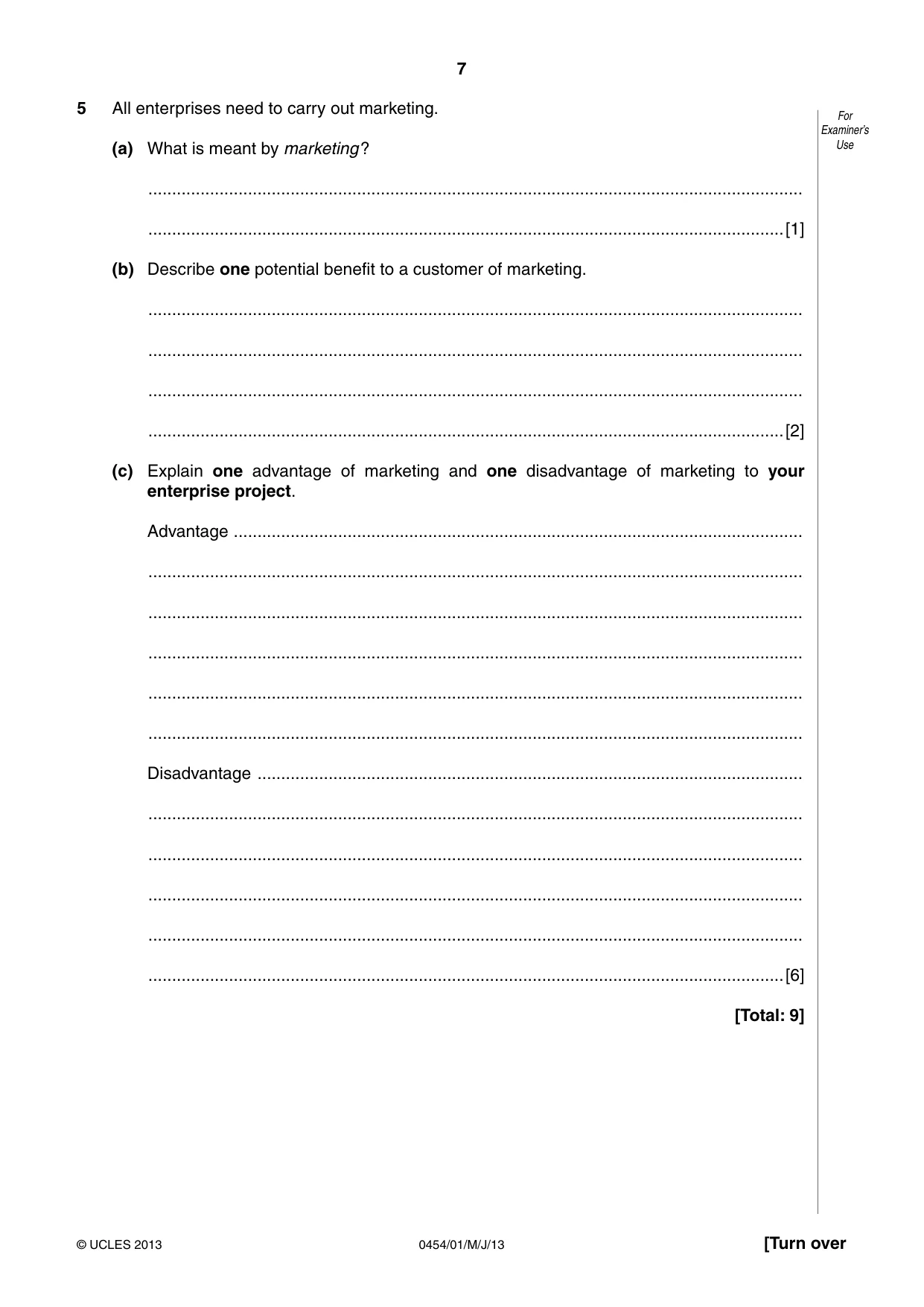
7 0454/01/M/J/13 © UCLES 2013 [Turn over For Examiner’s Use 5 All enterprises need to carry out marketing. (a) What is meant by marketing ? … …[1] (b) Describe one potential benefit to a customer of marketing. … … … …[2] (c) Explain one advantage of marketing and one disadvantage of marketing to your enterprise project. Advantage … … … … … … Disadvantage … … … … … …[6] [Total: 9]
Question paper, page 8
8 0454/01/M/J/13 © UCLES 2013 BLANK PAGE
Question paper, page 9
9 0454/01/M/J/13 © UCLES 2013 [Turn over For Examiner’s Use Section B Answer all the questions. Use the case study, your own enterprise experience and your knowledge of enterprise to answer Question 6(a). 6 (a) Enterprises set business objectives. Discuss how business objectives, such as growth, might affect how Keziah and Mohammed manage the running of K and M Limited. [10] … … … … … … … … … … … … … … … … … … … … … … … …
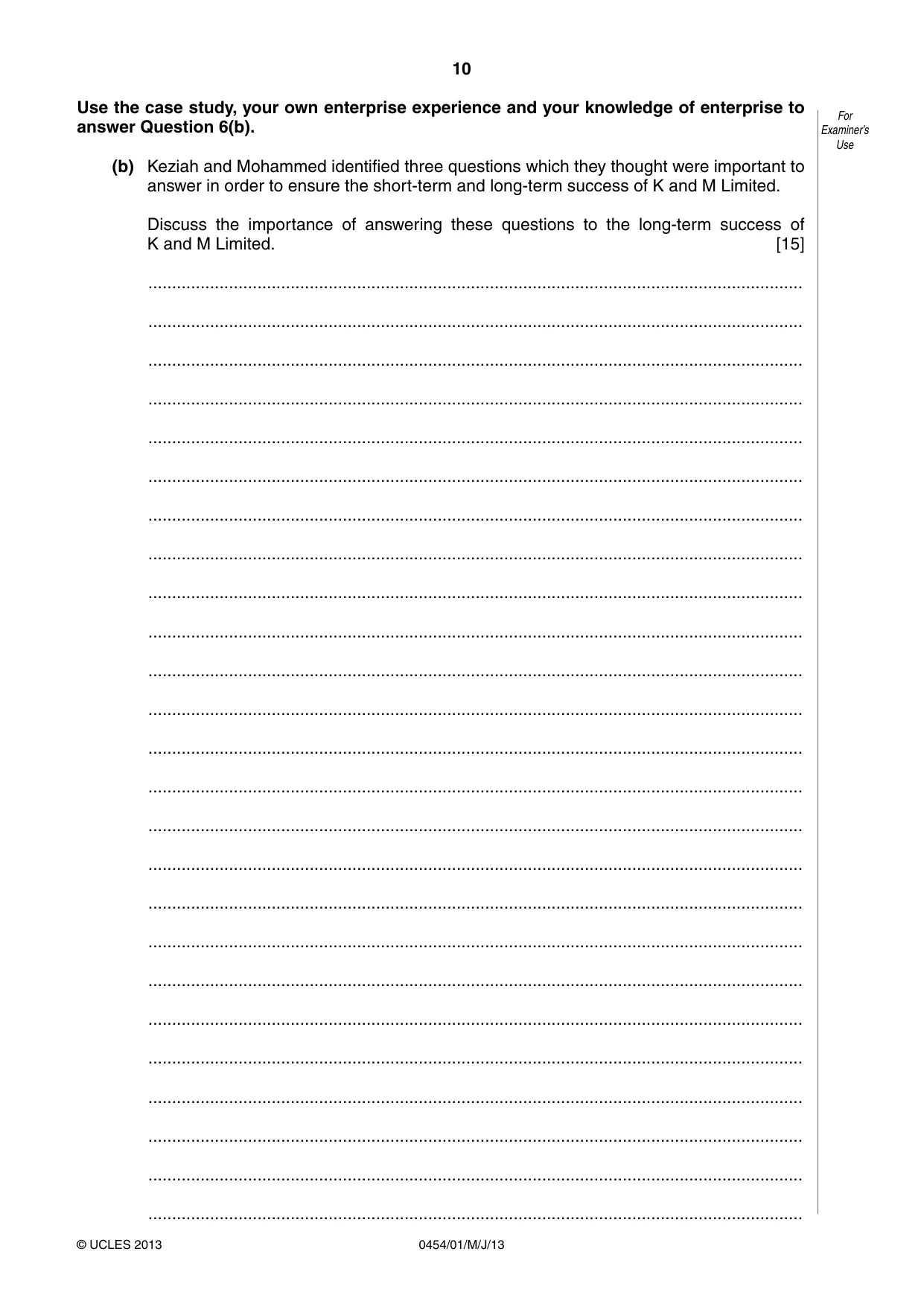
Question paper, page 10
10 0454/01/M/J/13 © UCLES 2013 For Examiner’s Use Use the case study, your own enterprise experience and your knowledge of enterprise to answer Question 6(b). (b) Keziah and Mohammed identified three questions which they thought were important to answer in order to ensure the short-term and long-term success of K and M Limited. Discuss the importance of answering these questions to the long-term success of K and M Limited. [15] … … … … … … … … … … … … … … … … … … … … … … … … …
Question paper, page 11
11 0454/01/M/J/13 © UCLES 2013 [Turn over For Examiner’s Use … … … … … … … … … … … … … … … … … … … … … … … … … … … …
Question paper, page 12
12 0454/01/M/J/13 © UCLES 2013 BLANK PAGE
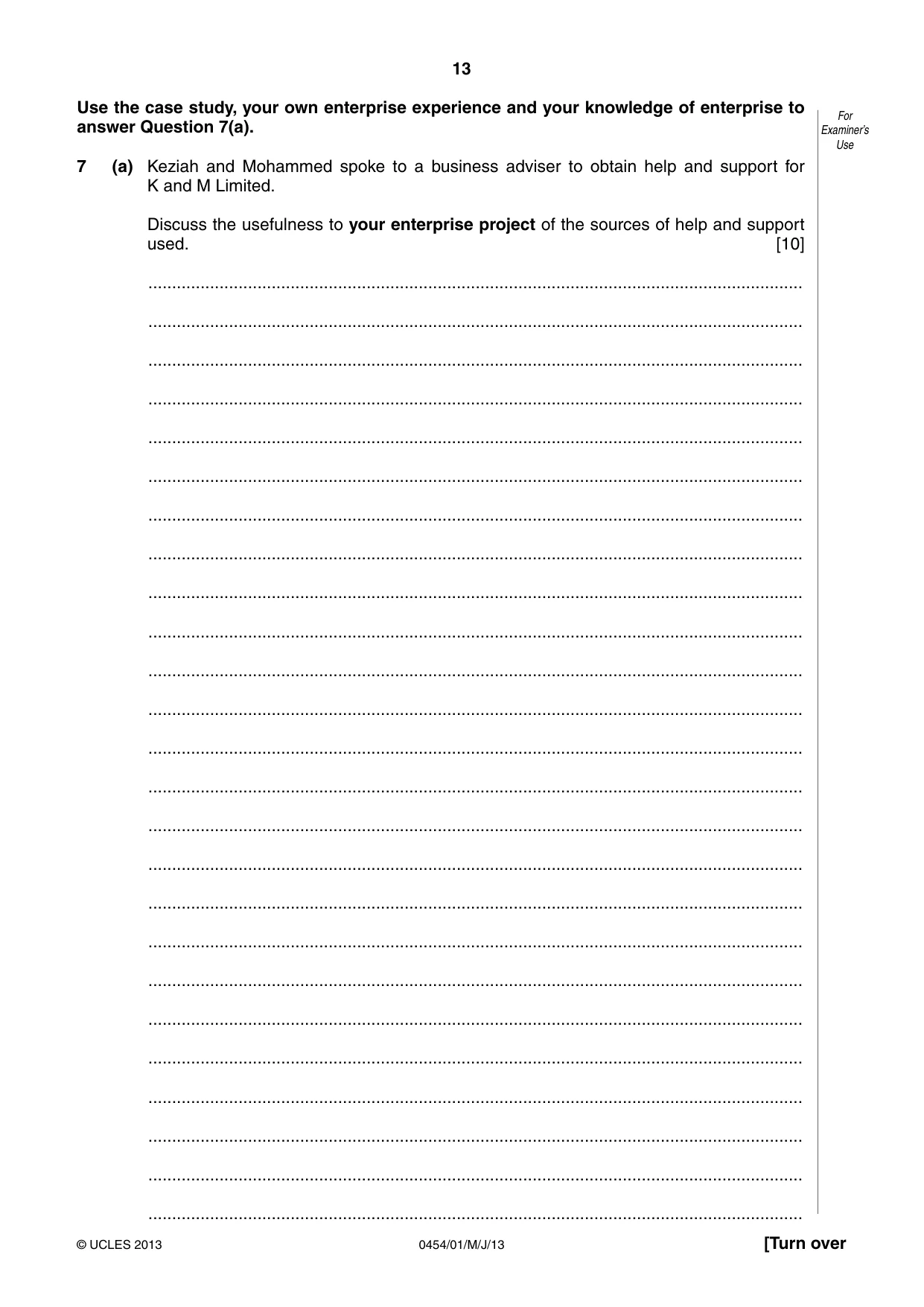
Question paper, page 13
13 0454/01/M/J/13 © UCLES 2013 [Turn over For Examiner’s Use Use the case study, your own enterprise experience and your knowledge of enterprise to answer Question 7(a). 7 (a) Keziah and Mohammed spoke to a business adviser to obtain help and support for K and M Limited. Discuss the usefulness to your enterprise project of the sources of help and support used. [10] … … … … … … … … … … … … … … … … … … … … … … … … …
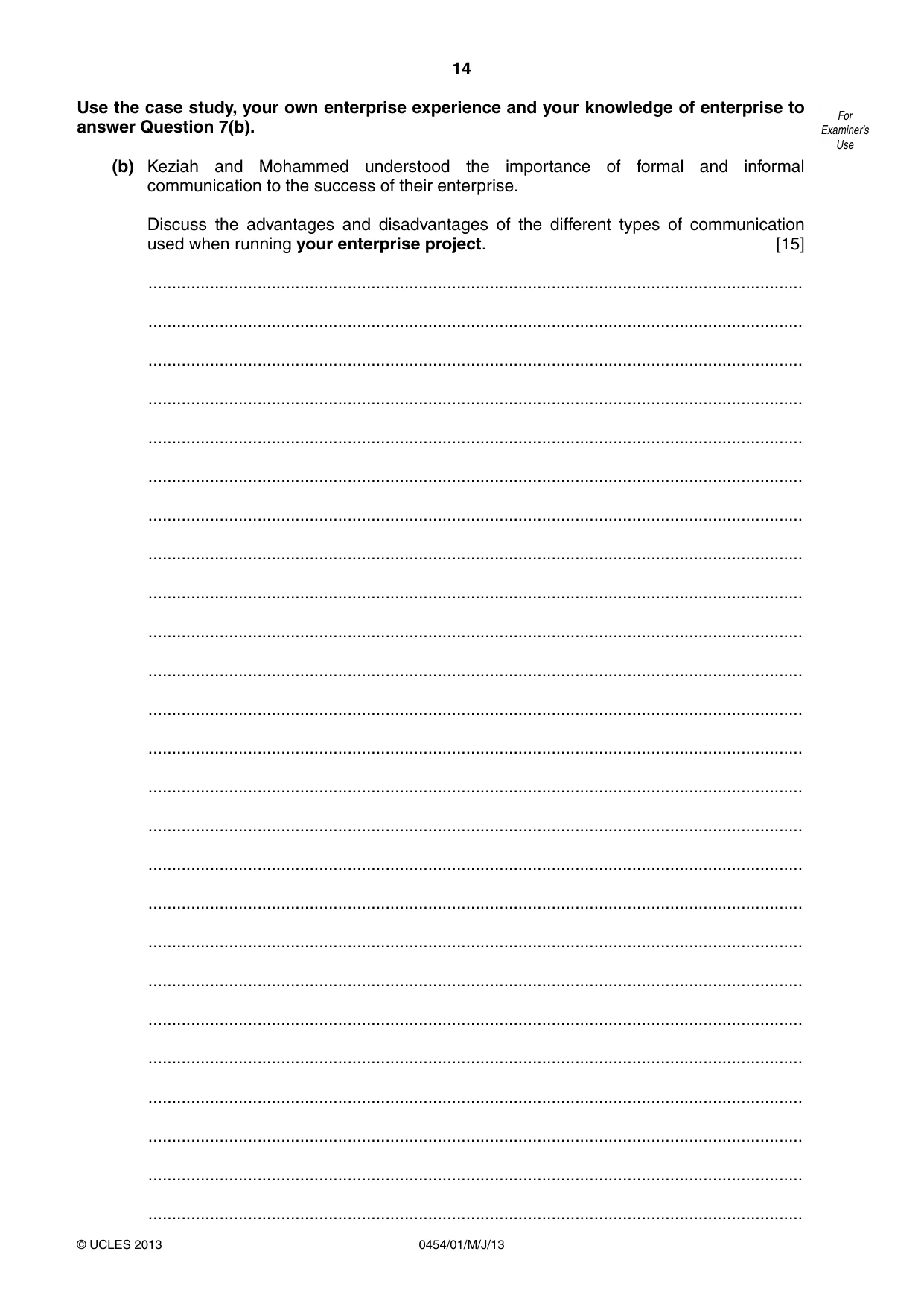
Question paper, page 14
14 0454/01/M/J/13 © UCLES 2013 For Examiner’s Use Use the case study, your own enterprise experience and your knowledge of enterprise to answer Question 7(b). (b) Keziah and Mohammed understood the importance of formal and informal communication to the success of their enterprise. Discuss the advantages and disadvantages of the different types of communication used when running your enterprise project. [15] … … … … … … … … … … … … … … … … … … … … … … … … …
Question paper, page 15
15 0454/01/M/J/13 © UCLES 2013 For Examiner’s Use … … … … … … … … … … … … … … … … … … … … … … … … … … … …
Question paper, page 16
16 0454/01/M/J/13 © UCLES 2013 Permission to reproduce items where third-party owned material protected by copyright is included has been sought and cleared where possible. Every reasonable effort has been made by the publisher (UCLES) to trace copyright holders, but if any items requiring clearance have unwittingly been included, the publisher will be pleased to make amends at the earliest possible opportunity. University of Cambridge International Examinations is part of the Cambridge Assessment Group. Cambridge Assessment is the brand name of University of Cambridge Local Examinations Syndicate (UCLES), which is itself a department of the University of Cambridge. BLANK PAGE
Mark scheme, page 1
CAMBRIDGE INTERNATIONAL EXAMINATIONS International General Certificate of Secondary Education MARK SCHEME for the May/June 2013 series 0454 ENTERPRISE 0454/01 Paper 1 (Case Study), maximum raw mark 100 This mark scheme is published as an aid to teachers and candidates, to indicate the requirements of the examination. It shows the basis on which Examiners were instructed to award marks. It does not indicate the details of the discussions that took place at an Examiners’ meeting before marking began, which would have considered the acceptability of alternative answers. Mark schemes should be read in conjunction with the question paper and the Principal Examiner Report for Teachers. Cambridge will not enter into discussions about these mark schemes. Cambridge is publishing the mark schemes for the May/June 2013 series for most IGCSE, GCE Advanced Level and Advanced Subsidiary Level components and some Ordinary Level components.
Mark scheme, page 2
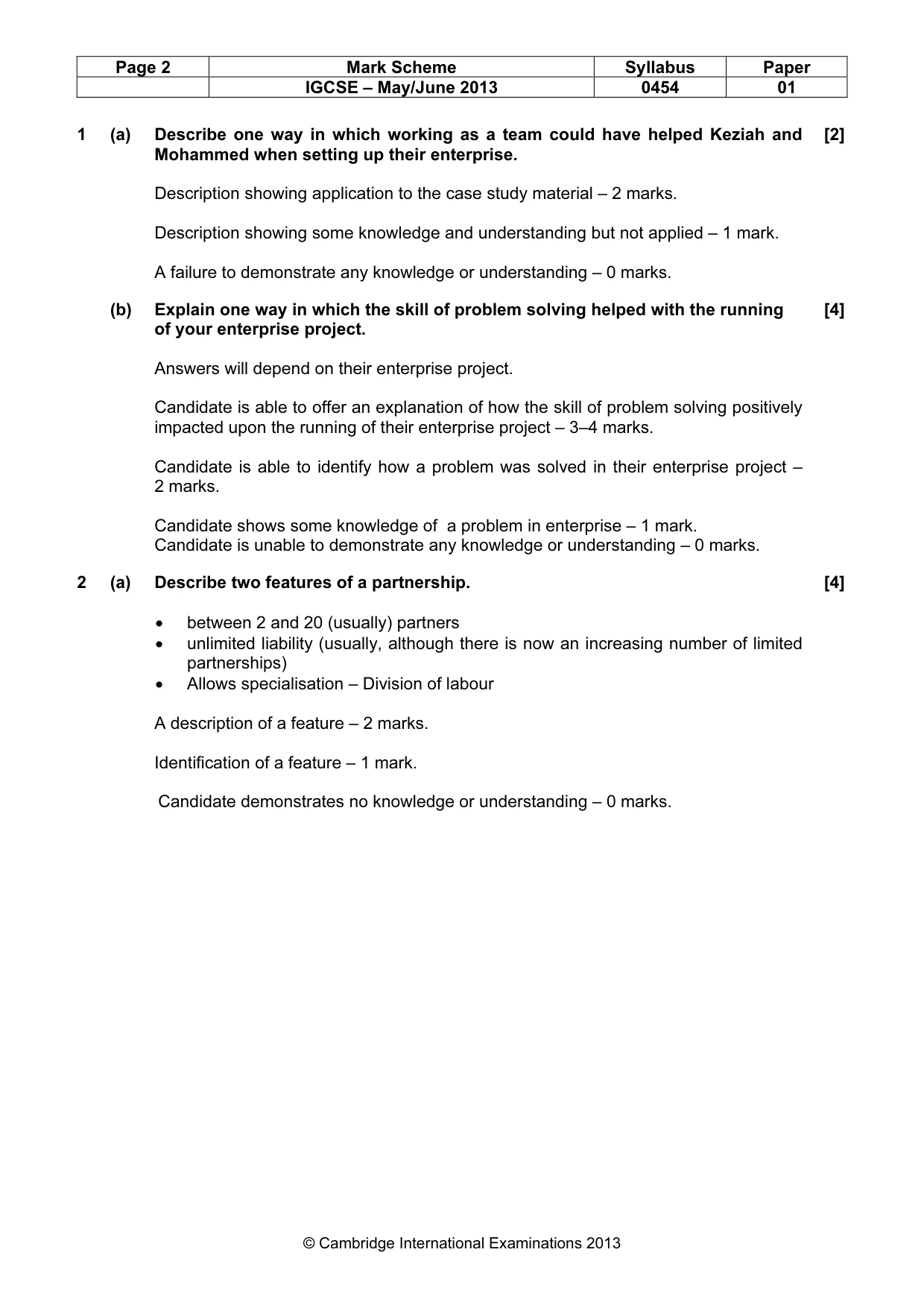
Page 2 Mark Scheme Syllabus Paper IGCSE – May/June 2013 0454 01 © Cambridge International Examinations 2013 1 (a) Describe one way in which working as a team could have helped Keziah and Mohammed when setting up their enterprise. Description showing application to the case study material – 2 marks. Description showing some knowledge and understanding but not applied – 1 mark. A failure to demonstrate any knowledge or understanding – 0 marks. [2] (b) Explain one way in which the skill of problem solving helped with the running of your enterprise project. Answers will depend on their enterprise project. Candidate is able to offer an explanation of how the skill of problem solving positively impacted upon the running of their enterprise project – 3–4 marks. Candidate is able to identify how a problem was solved in their enterprise project – 2 marks. Candidate shows some knowledge of a problem in enterprise – 1 mark. Candidate is unable to demonstrate any knowledge or understanding – 0 marks. [4] 2 (a) Describe two features of a partnership. • between 2 and 20 (usually) partners • unlimited liability (usually, although there is now an increasing number of limited partnerships) • Allows specialisation – Division of labour A description of a feature – 2 marks. Identification of a feature – 1 mark. Candidate demonstrates no knowledge or understanding – 0 marks. [4]
Mark scheme, page 3
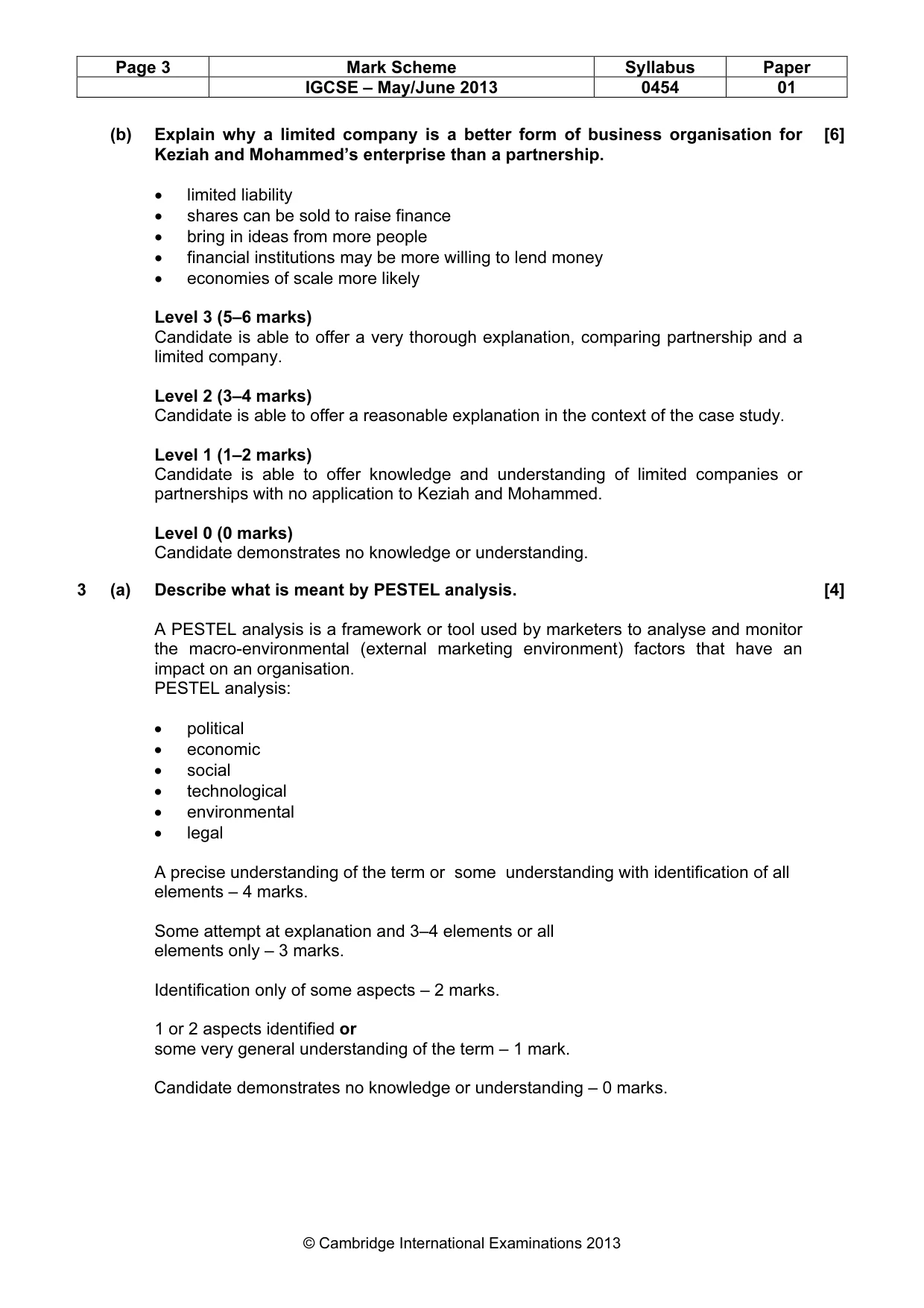
Page 3 Mark Scheme Syllabus Paper IGCSE – May/June 2013 0454 01 © Cambridge International Examinations 2013 (b) Explain why a limited company is a better form of business organisation for Keziah and Mohammed’s enterprise than a partnership. • limited liability • shares can be sold to raise finance • bring in ideas from more people • financial institutions may be more willing to lend money • economies of scale more likely Level 3 (5–6 marks) Candidate is able to offer a very thorough explanation, comparing partnership and a limited company. Level 2 (3–4 marks) Candidate is able to offer a reasonable explanation in the context of the case study. Level 1 (1–2 marks) Candidate is able to offer knowledge and understanding of limited companies or partnerships with no application to Keziah and Mohammed. Level 0 (0 marks) Candidate demonstrates no knowledge or understanding. [6] 3 (a) Describe what is meant by PESTEL analysis. A PESTEL analysis is a framework or tool used by marketers to analyse and monitor the macro-environmental (external marketing environment) factors that have an impact on an organisation. PESTEL analysis: • political • economic • social • technological • environmental • legal A precise understanding of the term or some understanding with identification of all elements – 4 marks. Some attempt at explanation and 3–4 elements or all elements only – 3 marks. Identification only of some aspects – 2 marks. 1 or 2 aspects identified or some very general understanding of the term – 1 mark. Candidate demonstrates no knowledge or understanding – 0 marks. [4]
Mark scheme, page 4
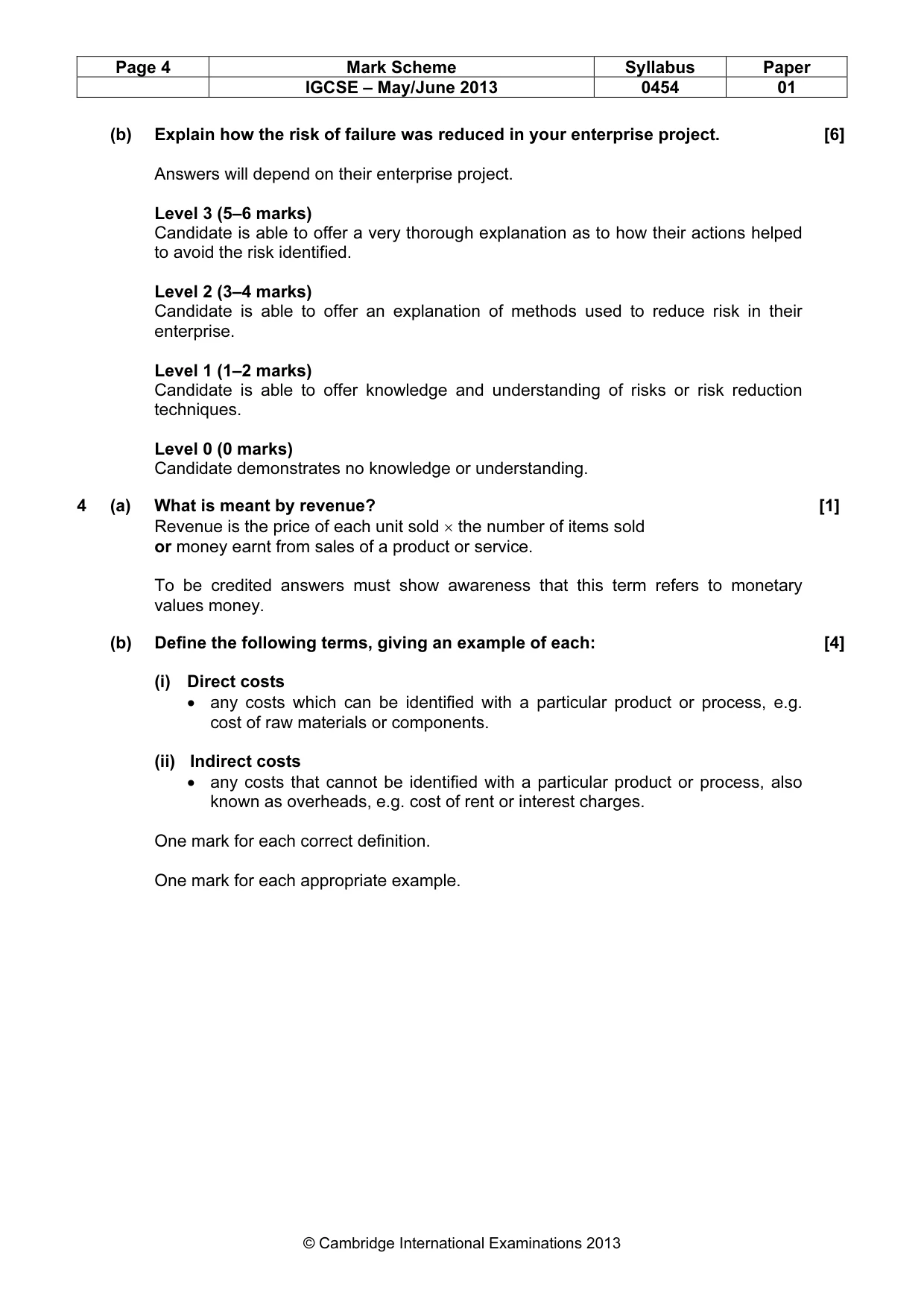
Page 4 Mark Scheme Syllabus Paper IGCSE – May/June 2013 0454 01 © Cambridge International Examinations 2013 (b) Explain how the risk of failure was reduced in your enterprise project. Answers will depend on their enterprise project. Level 3 (5–6 marks) Candidate is able to offer a very thorough explanation as to how their actions helped to avoid the risk identified. Level 2 (3–4 marks) Candidate is able to offer an explanation of methods used to reduce risk in their enterprise. Level 1 (1–2 marks) Candidate is able to offer knowledge and understanding of risks or risk reduction techniques. Level 0 (0 marks) Candidate demonstrates no knowledge or understanding. [6] 4 (a) What is meant by revenue? Revenue is the price of each unit sold × the number of items sold or money earnt from sales of a product or service. To be credited answers must show awareness that this term refers to monetary values money. [1] (b) Define the following terms, giving an example of each: (i) Direct costs • any costs which can be identified with a particular product or process, e.g. cost of raw materials or components. (ii) Indirect costs • any costs that cannot be identified with a particular product or process, also known as overheads, e.g. cost of rent or interest charges. One mark for each correct definition. One mark for each appropriate example. [4]
Mark scheme, page 5
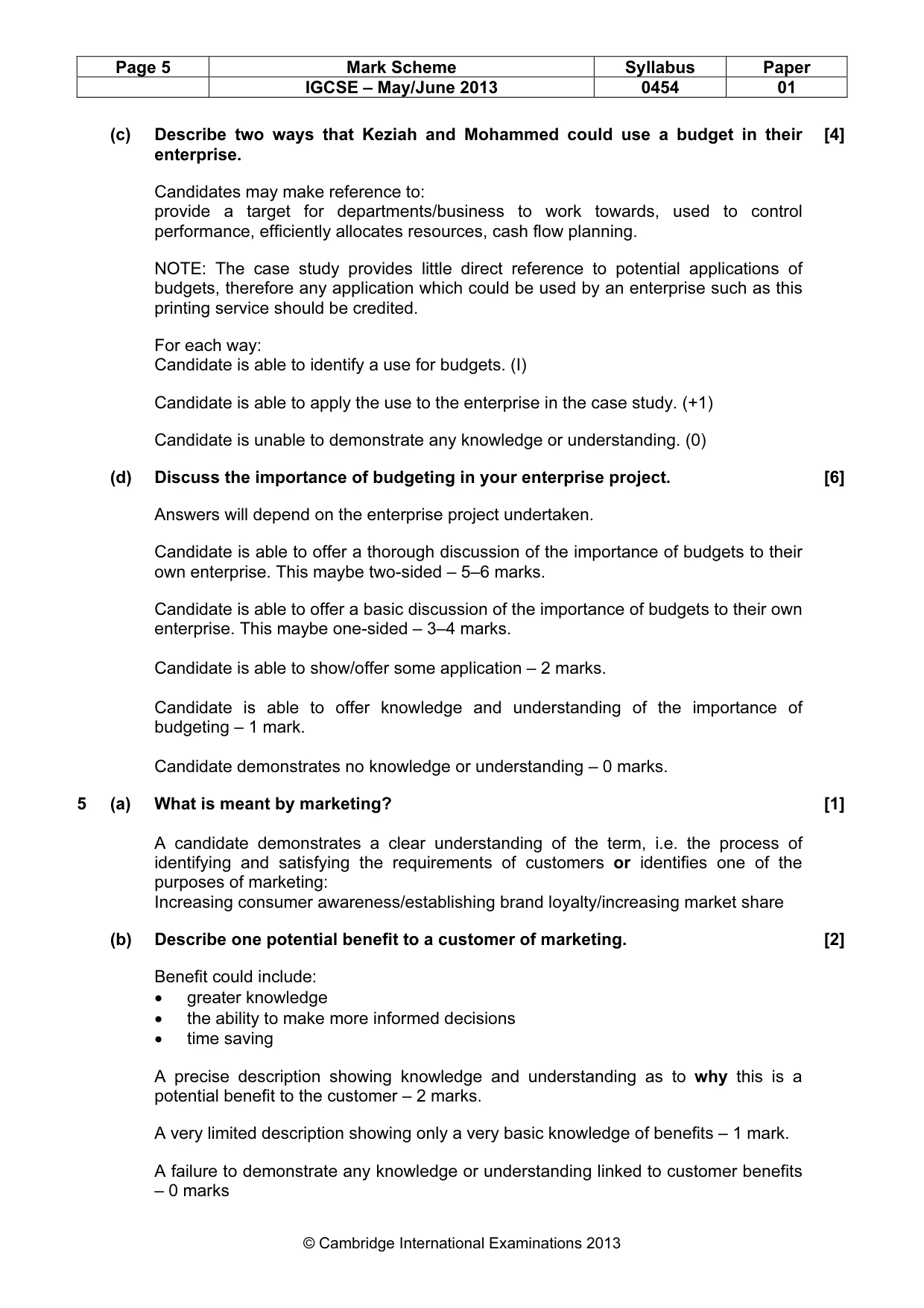
Page 5 Mark Scheme Syllabus Paper IGCSE – May/June 2013 0454 01 © Cambridge International Examinations 2013 (c) Describe two ways that Keziah and Mohammed could use a budget in their enterprise. Candidates may make reference to: provide a target for departments/business to work towards, used to control performance, efficiently allocates resources, cash flow planning. NOTE: The case study provides little direct reference to potential applications of budgets, therefore any application which could be used by an enterprise such as this printing service should be credited. For each way: Candidate is able to identify a use for budgets. (I) Candidate is able to apply the use to the enterprise in the case study. (+1) Candidate is unable to demonstrate any knowledge or understanding. (0) [4] (d) Discuss the importance of budgeting in your enterprise project. Answers will depend on the enterprise project undertaken. Candidate is able to offer a thorough discussion of the importance of budgets to their own enterprise. This maybe two-sided – 5–6 marks. Candidate is able to offer a basic discussion of the importance of budgets to their own enterprise. This maybe one-sided – 3–4 marks. Candidate is able to show/offer some application – 2 marks. Candidate is able to offer knowledge and understanding of the importance of budgeting – 1 mark. Candidate demonstrates no knowledge or understanding – 0 marks. [6] 5 (a) What is meant by marketing? A candidate demonstrates a clear understanding of the term, i.e. the process of identifying and satisfying the requirements of customers or identifies one of the purposes of marketing: Increasing consumer awareness/establishing brand loyalty/increasing market share [1] (b) Describe one potential benefit to a customer of marketing. Benefit could include: • greater knowledge • the ability to make more informed decisions • time saving A precise description showing knowledge and understanding as to why this is a potential benefit to the customer – 2 marks. A very limited description showing only a very basic knowledge of benefits – 1 mark. A failure to demonstrate any knowledge or understanding linked to customer benefits – 0 marks [2]
Mark scheme, page 6
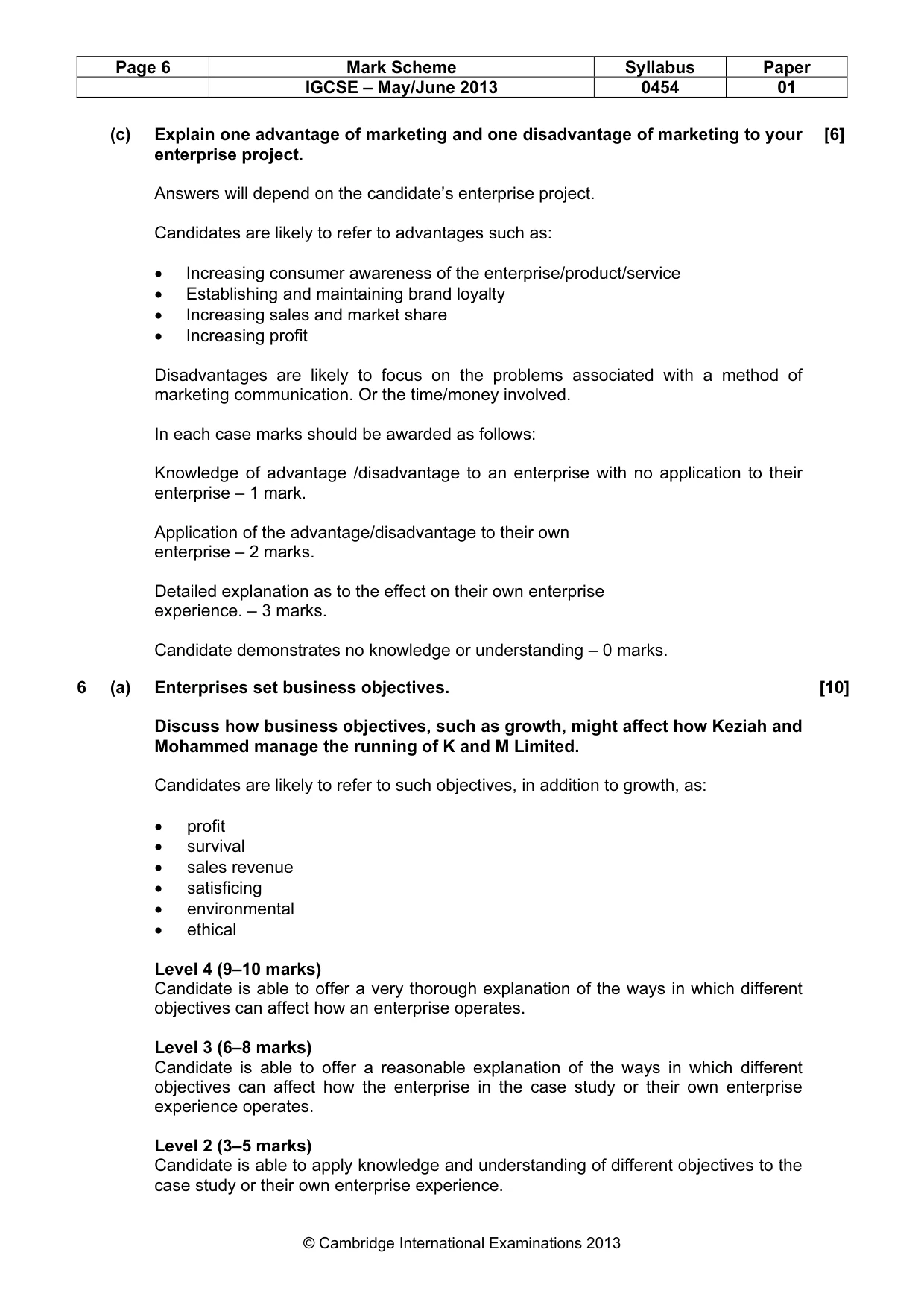
Page 6 Mark Scheme Syllabus Paper IGCSE – May/June 2013 0454 01 © Cambridge International Examinations 2013 (c) Explain one advantage of marketing and one disadvantage of marketing to your enterprise project. Answers will depend on the candidate’s enterprise project. Candidates are likely to refer to advantages such as: • Increasing consumer awareness of the enterprise/product/service • Establishing and maintaining brand loyalty • Increasing sales and market share • Increasing profit Disadvantages are likely to focus on the problems associated with a method of marketing communication. Or the time/money involved. In each case marks should be awarded as follows: Knowledge of advantage /disadvantage to an enterprise with no application to their enterprise – 1 mark. Application of the advantage/disadvantage to their own enterprise – 2 marks. Detailed explanation as to the effect on their own enterprise experience. – 3 marks. Candidate demonstrates no knowledge or understanding – 0 marks. [6] 6 (a) Enterprises set business objectives. Discuss how business objectives, such as growth, might affect how Keziah and Mohammed manage the running of K and M Limited. Candidates are likely to refer to such objectives, in addition to growth, as: • profit • survival • sales revenue • satisficing • environmental • ethical Level 4 (9–10 marks) Candidate is able to offer a very thorough explanation of the ways in which different objectives can affect how an enterprise operates. Level 3 (6–8 marks) Candidate is able to offer a reasonable explanation of the ways in which different objectives can affect how the enterprise in the case study or their own enterprise experience operates. Level 2 (3–5 marks) Candidate is able to apply knowledge and understanding of different objectives to the case study or their own enterprise experience. [10]
Mark scheme, page 7
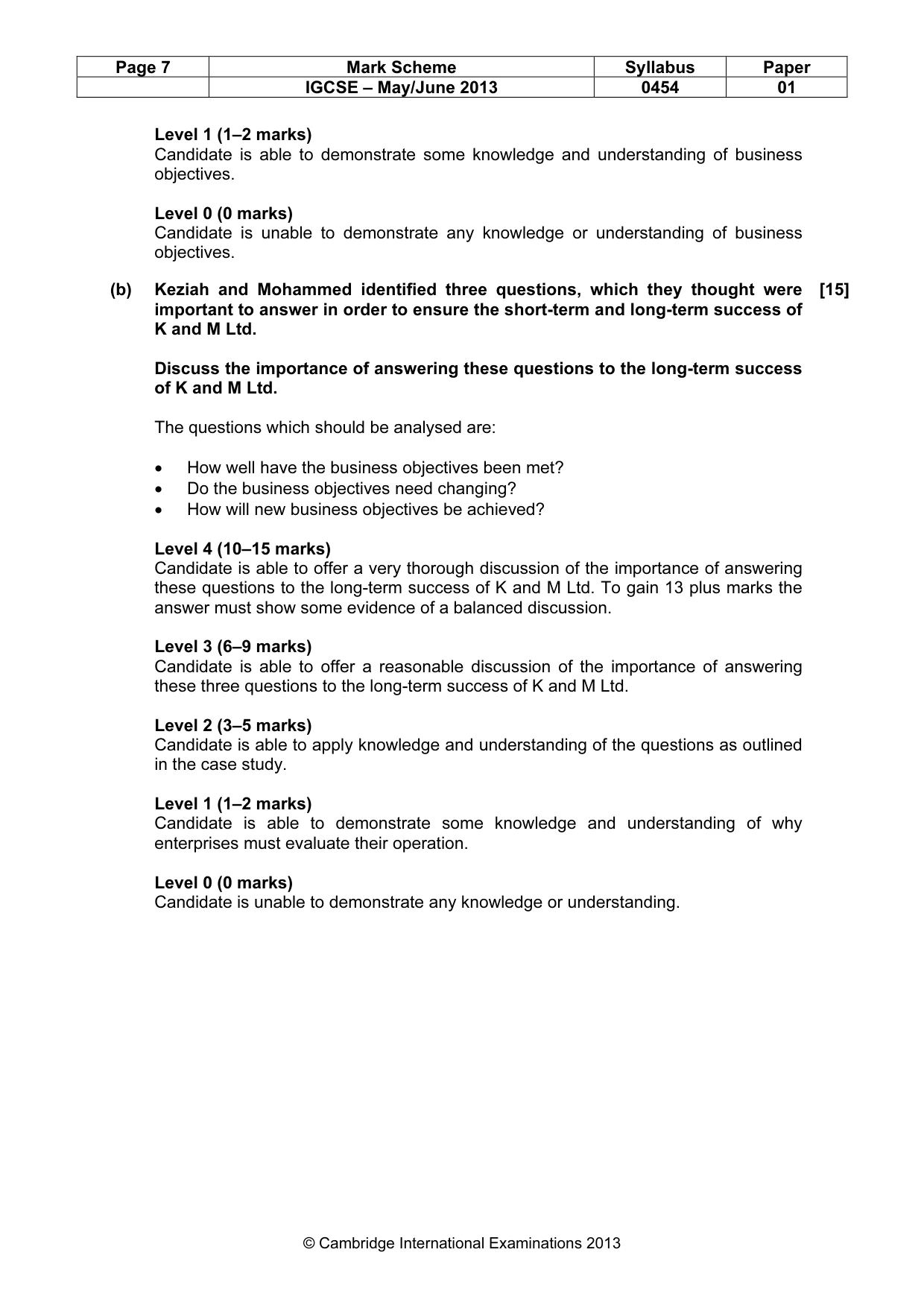
Page 7 Mark Scheme Syllabus Paper IGCSE – May/June 2013 0454 01 © Cambridge International Examinations 2013 Level 1 (1–2 marks) Candidate is able to demonstrate some knowledge and understanding of business objectives. Level 0 (0 marks) Candidate is unable to demonstrate any knowledge or understanding of business objectives. (b) Keziah and Mohammed identified three questions, which they thought were important to answer in order to ensure the short-term and long-term success of K and M Ltd. Discuss the importance of answering these questions to the long-term success of K and M Ltd. The questions which should be analysed are: • How well have the business objectives been met? • Do the business objectives need changing? • How will new business objectives be achieved? Level 4 (10–15 marks) Candidate is able to offer a very thorough discussion of the importance of answering these questions to the long-term success of K and M Ltd. To gain 13 plus marks the answer must show some evidence of a balanced discussion. Level 3 (6–9 marks) Candidate is able to offer a reasonable discussion of the importance of answering these three questions to the long-term success of K and M Ltd. Level 2 (3–5 marks) Candidate is able to apply knowledge and understanding of the questions as outlined in the case study. Level 1 (1–2 marks) Candidate is able to demonstrate some knowledge and understanding of why enterprises must evaluate their operation. Level 0 (0 marks) Candidate is unable to demonstrate any knowledge or understanding. [15]
Mark scheme, page 8
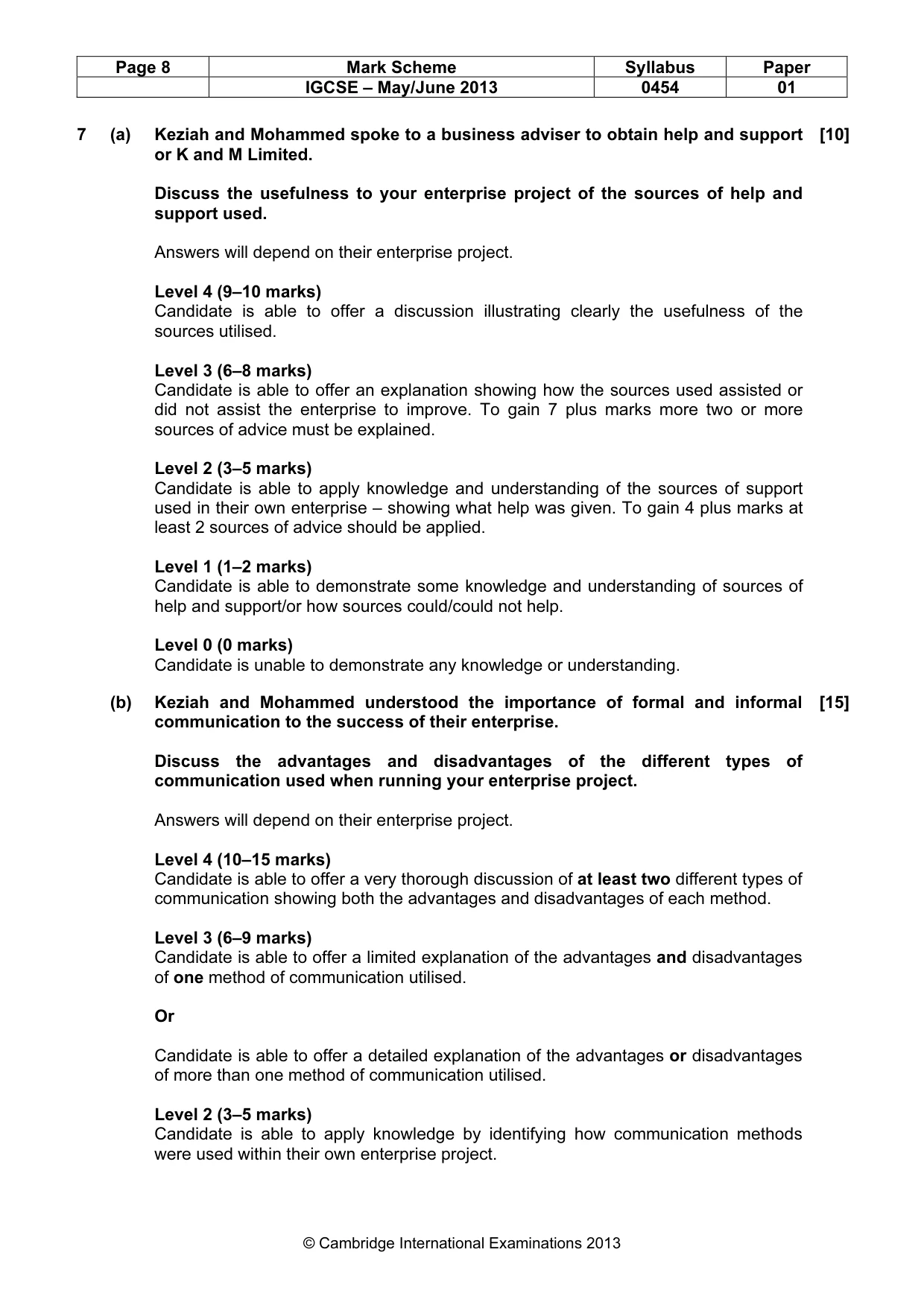
Page 8 Mark Scheme Syllabus Paper IGCSE – May/June 2013 0454 01 © Cambridge International Examinations 2013 7 (a) Keziah and Mohammed spoke to a business adviser to obtain help and support or K and M Limited. Discuss the usefulness to your enterprise project of the sources of help and support used. Answers will depend on their enterprise project. Level 4 (9–10 marks) Candidate is able to offer a discussion illustrating clearly the usefulness of the sources utilised. Level 3 (6–8 marks) Candidate is able to offer an explanation showing how the sources used assisted or did not assist the enterprise to improve. To gain 7 plus marks more two or more sources of advice must be explained. Level 2 (3–5 marks) Candidate is able to apply knowledge and understanding of the sources of support used in their own enterprise – showing what help was given. To gain 4 plus marks at least 2 sources of advice should be applied. Level 1 (1–2 marks) Candidate is able to demonstrate some knowledge and understanding of sources of help and support/or how sources could/could not help. Level 0 (0 marks) Candidate is unable to demonstrate any knowledge or understanding. [10] (b) Keziah and Mohammed understood the importance of formal and informal communication to the success of their enterprise. Discuss the advantages and disadvantages of the different types of communication used when running your enterprise project. Answers will depend on their enterprise project. Level 4 (10–15 marks) Candidate is able to offer a very thorough discussion of at least two different types of communication showing both the advantages and disadvantages of each method. Level 3 (6–9 marks) Candidate is able to offer a limited explanation of the advantages and disadvantages of one method of communication utilised. Or Candidate is able to offer a detailed explanation of the advantages or disadvantages of more than one method of communication utilised. Level 2 (3–5 marks) Candidate is able to apply knowledge by identifying how communication methods were used within their own enterprise project. [15]
Mark scheme, page 9
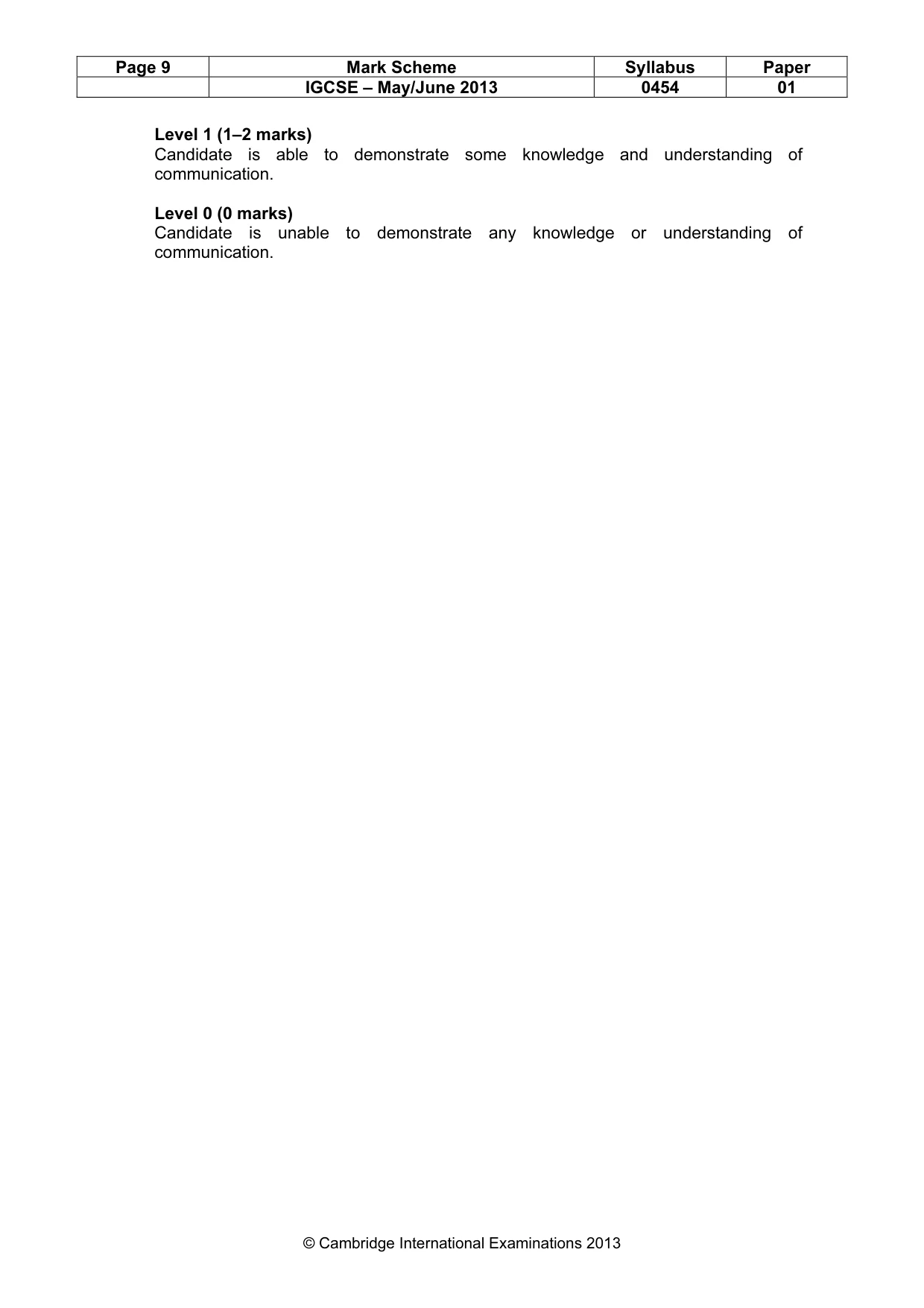
Page 9 Mark Scheme Syllabus Paper IGCSE – May/June 2013 0454 01 © Cambridge International Examinations 2013 Level 1 (1–2 marks) Candidate is able to demonstrate some knowledge and understanding of communication. Level 0 (0 marks) Candidate is unable to demonstrate any knowledge or understanding of communication.
What you needed in this session
Cambridge’s own grade thresholds for 2013 May/June, Paper 1 · Variant 1. A higher threshold means an easier paper — the bar moves with how the cohort did.