Cambridge IGCSE Enterprise 0454 — 2012 May/June Paper 1 · Variant 1
0454/11/M/J/12 · 100 marks · ≈113 min
The question paper and its mark scheme, free to read here and free to download. This is Cambridge’s own paper, exactly as it was sat.
Question paper12 pages



Mark scheme10 pages
Answers below. Sit the paper first if you are practising.
Paper as text
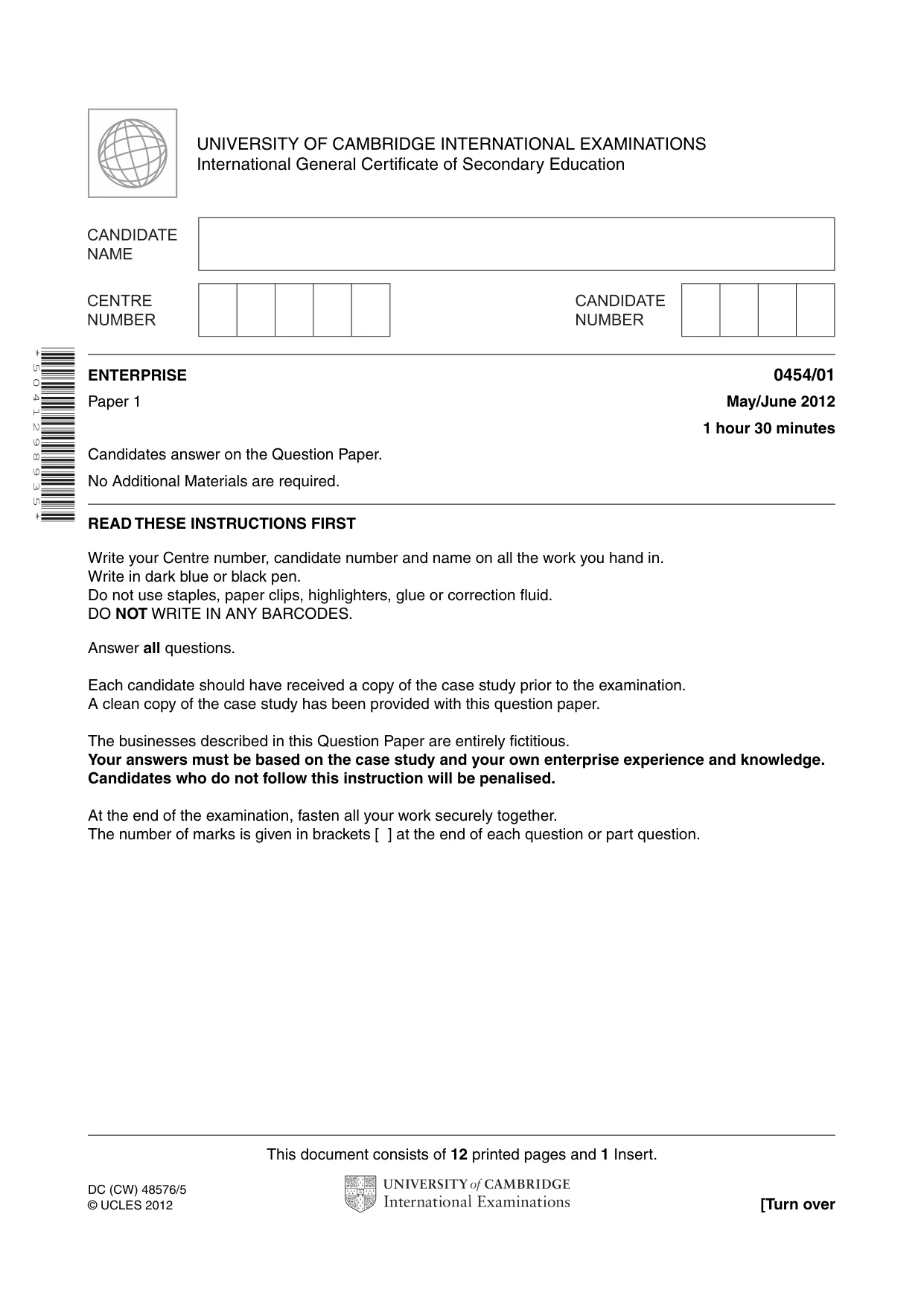
Question paper, page 1
This document consists of 12 printed pages and 1 Insert. DC (CW) 48576/5 © UCLES 2012 [Turn over UNIVERSITY OF CAMBRIDGE INTERNATIONAL EXAMINATIONS International General Certificate of Secondary Education * 5 0 4 1 2 9 8 9 3 5 * ENTERPRISE 0454/01 Paper 1 May/June 2012 1 hour 30 minutes Candidates answer on the Question Paper. No Additional Materials are required. READ THESE INSTRUCTIONS FIRST Write your Centre number, candidate number and name on all the work you hand in. Write in dark blue or black pen. Do not use staples, paper clips, highlighters, glue or correction fluid. DO NOT WRITE IN ANY BARCODES. Answer all questions. Each candidate should have received a copy of the case study prior to the examination. A clean copy of the case study has been provided with this question paper. The businesses described in this Question Paper are entirely fictitious. Your answers must be based on the case study and your own enterprise experience and knowledge. Candidates who do not follow this instruction will be penalised. At the end of the examination, fasten all your work securely together. The number of marks is given in brackets [ ] at the end of each question or part question.
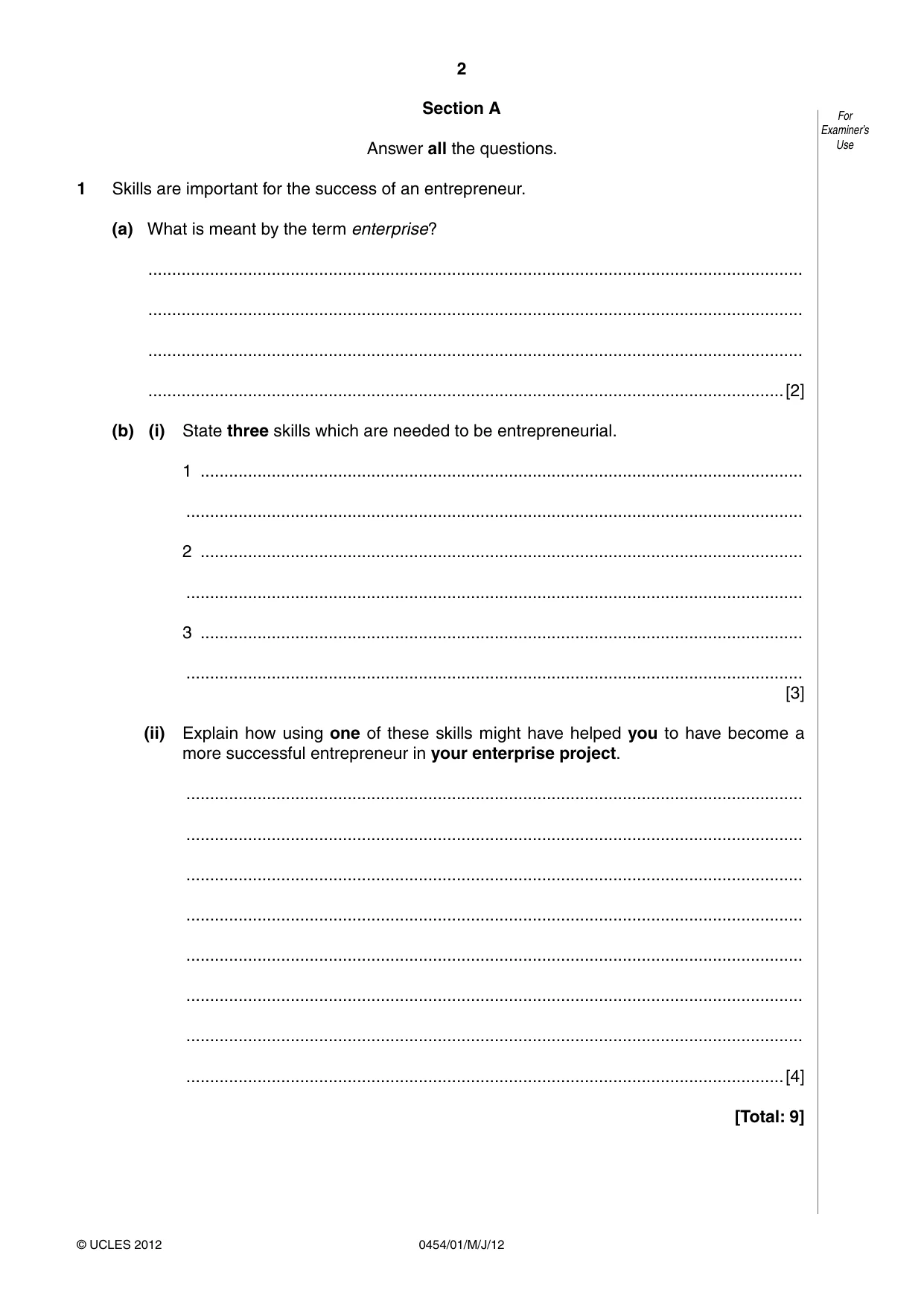
Question paper, page 2
2 0454/01/M/J/12 © UCLES 2012 For Examiner’s Use Section A Answer all the questions. 1 Skills are important for the success of an entrepreneur. (a) What is meant by the term enterprise? … … … …[2] (b) (i) State three skills which are needed to be entrepreneurial. 1 … … 2 … … 3 … … [3] (ii) Explain how using one of these skills might have helped you to have become a more successful entrepreneur in your enterprise project. … … … … … … … …[4] [Total: 9]
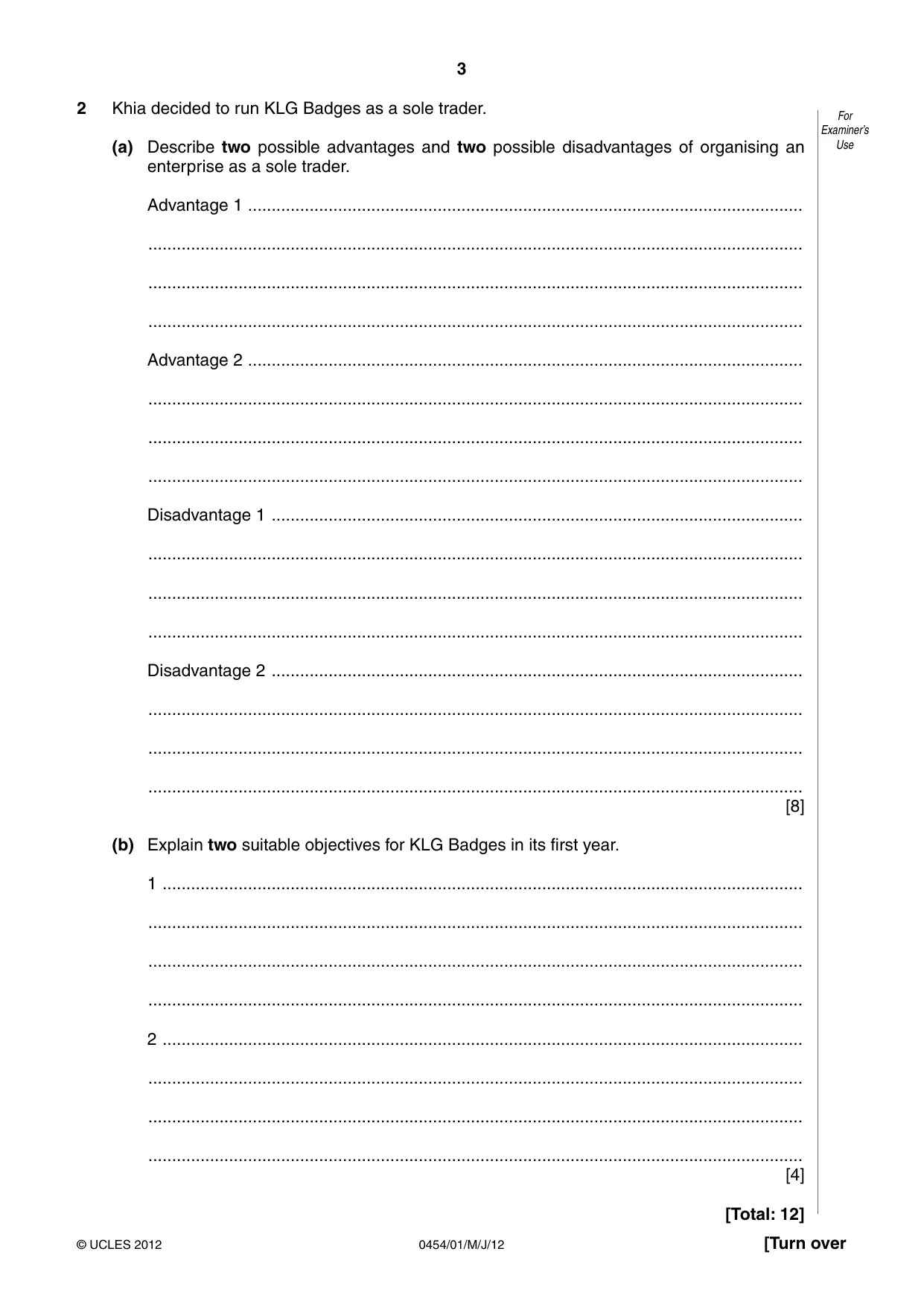
Question paper, page 3
3 0454/01/M/J/12 © UCLES 2012 [Turn over For Examiner’s Use 2 Khia decided to run KLG Badges as a sole trader. (a) Describe two possible advantages and two possible disadvantages of organising an enterprise as a sole trader. Advantage 1 … … … … Advantage 2 … … … … Disadvantage 1 … … … … Disadvantage 2 … … … … [8] (b) Explain two suitable objectives for KLG Badges in its first year. 1 … … … … 2 … … … … [4] [Total: 12]
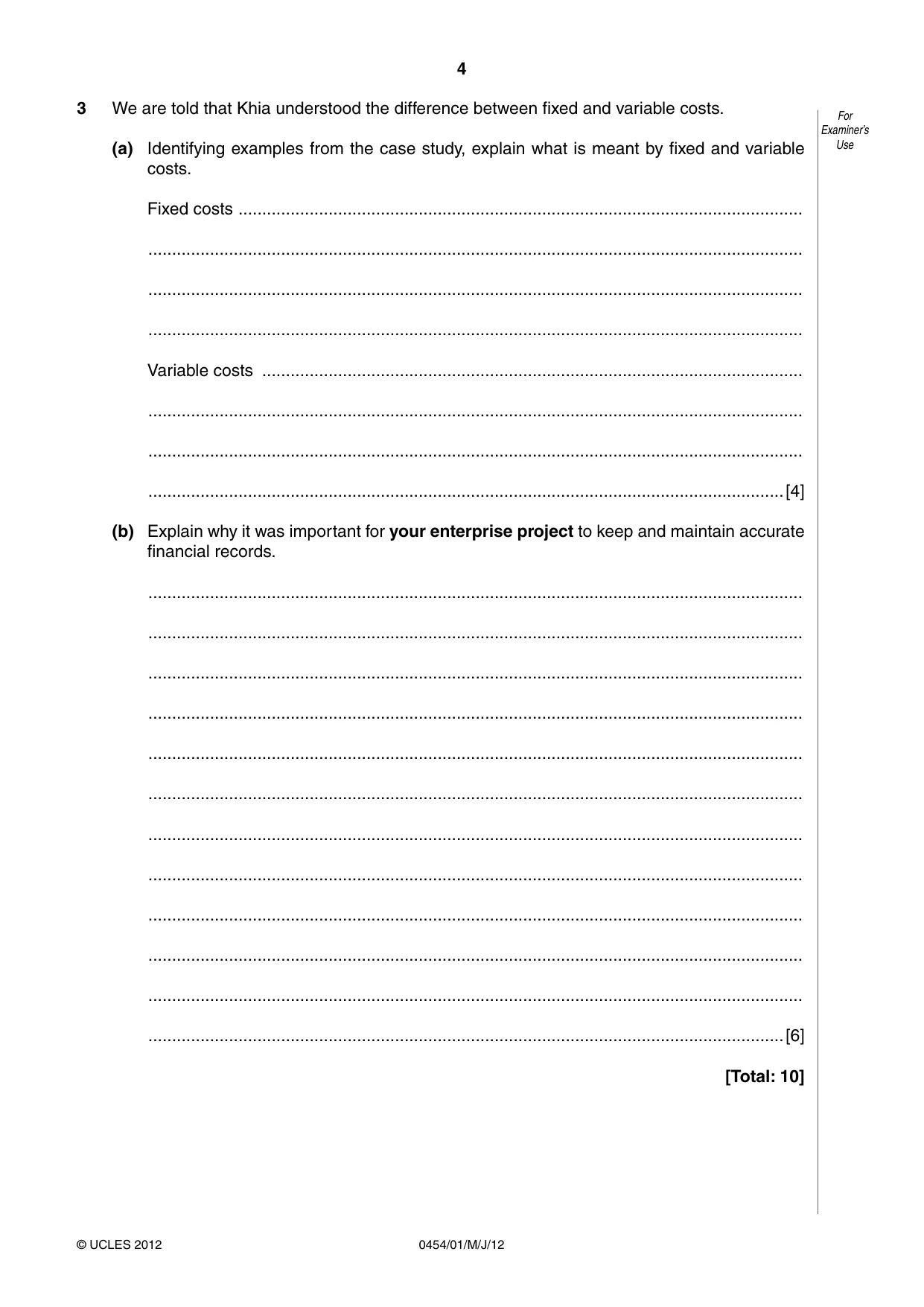
Question paper, page 4
4 0454/01/M/J/12 © UCLES 2012 For Examiner’s Use 3 We are told that Khia understood the difference between fixed and variable costs. (a) Identifying examples from the case study, explain what is meant by fixed and variable costs. Fixed costs … … … … Variable costs … … … …[4] (b) Explain why it was important for your enterprise project to keep and maintain accurate financial records. … … … … … … … … … … … …[6] [Total: 10]
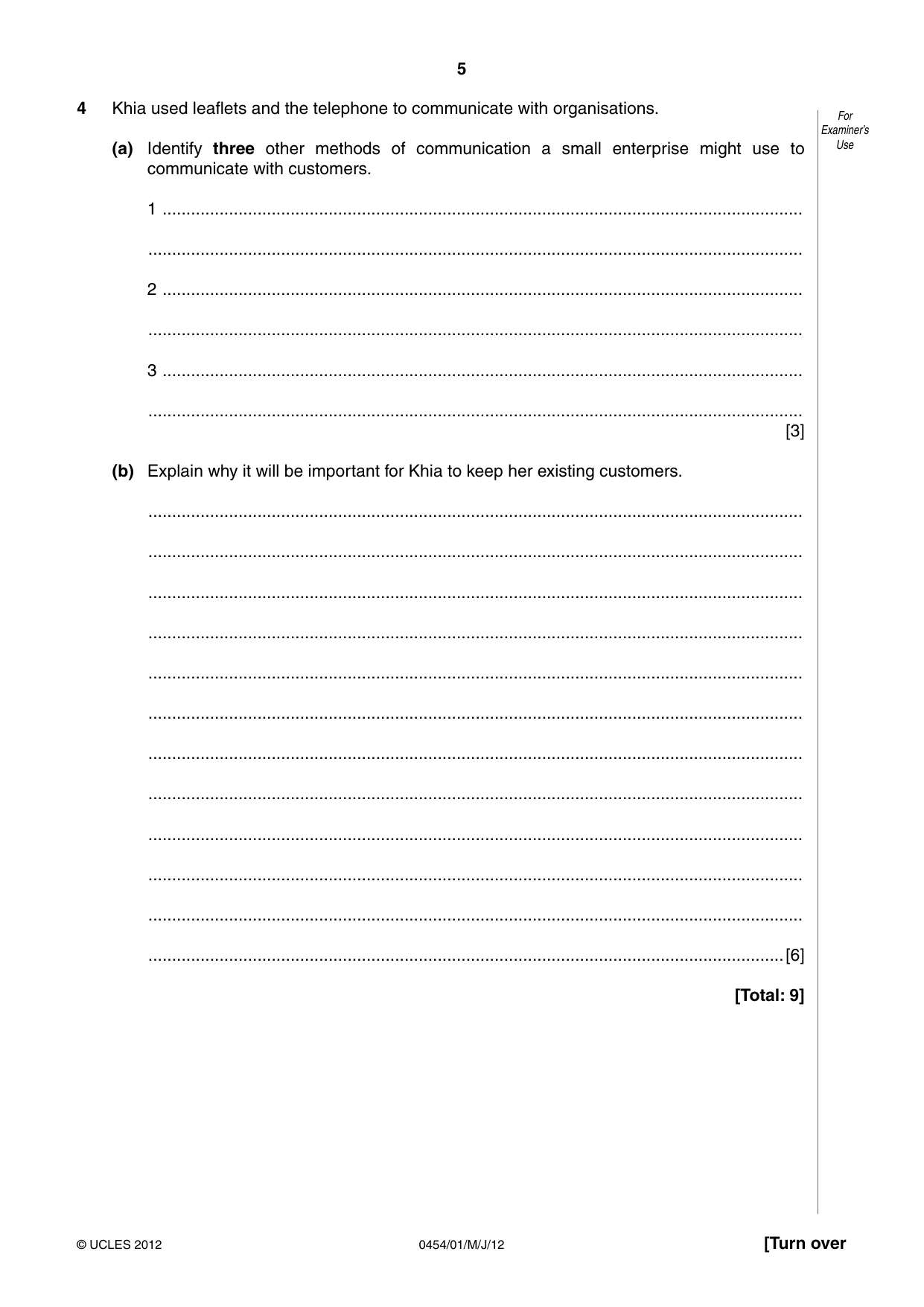
Question paper, page 5
5 0454/01/M/J/12 © UCLES 2012 [Turn over For Examiner’s Use 4 Khia used leaflets and the telephone to communicate with organisations. (a) Identify three other methods of communication a small enterprise might use to communicate with customers. 1 … … 2 … … 3 … … [3] (b) Explain why it will be important for Khia to keep her existing customers. … … … … … … … … … … … …[6] [Total: 9]
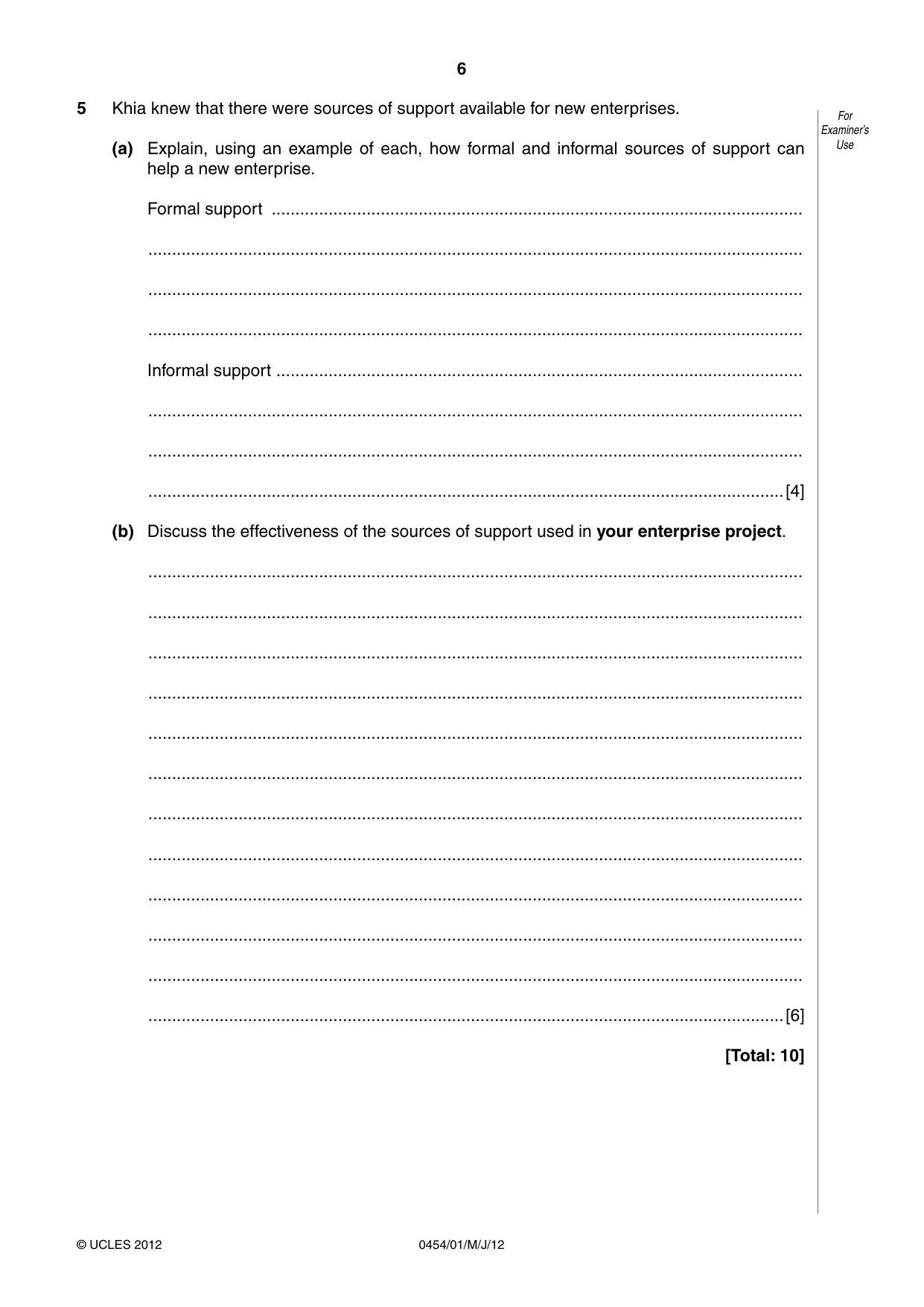
Question paper, page 6
6 0454/01/M/J/12 © UCLES 2012 For Examiner’s Use 5 Khia knew that there were sources of support available for new enterprises. (a) Explain, using an example of each, how formal and informal sources of support can help a new enterprise. Formal support … … … … Informal support … … … …[4] (b) Discuss the effectiveness of the sources of support used in your enterprise project. … … … … … … … … … … … …[6] [Total: 10]
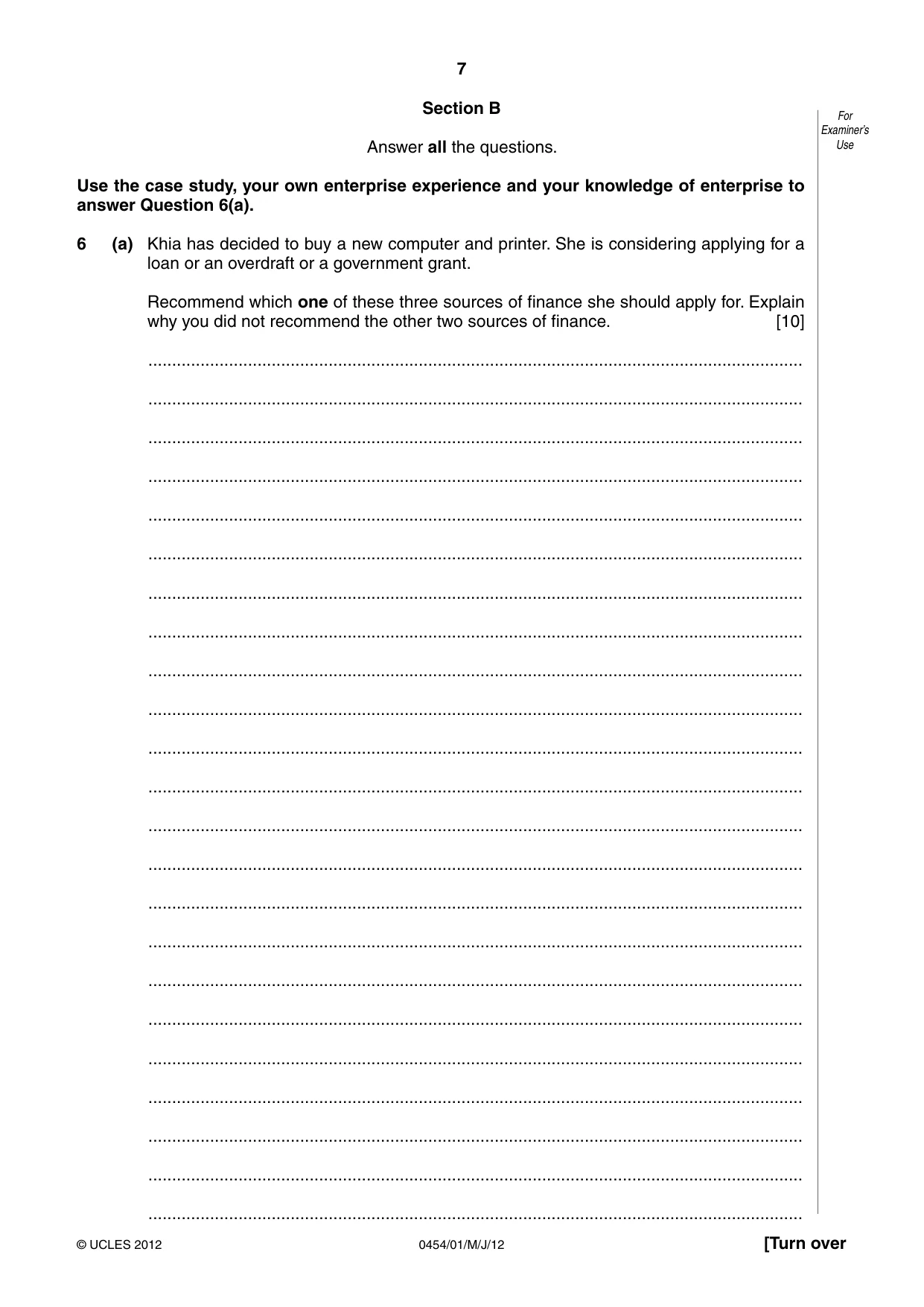
Question paper, page 7
7 0454/01/M/J/12 © UCLES 2012 [Turn over For Examiner’s Use Section B Answer all the questions. Use the case study, your own enterprise experience and your knowledge of enterprise to answer Question 6(a). 6 (a) Khia has decided to buy a new computer and printer. She is considering applying for a loan or an overdraft or a government grant. Recommend which one of these three sources of finance she should apply for. Explain why you did not recommend the other two sources of finance. [10] … … … … … … … … … … … … … … … … … … … … … … …
Question paper, page 8
8 0454/01/M/J/12 © UCLES 2012 For Examiner’s Use Use the case study, your own enterprise experience and your knowledge of enterprise to answer Question 6(b). (b) Discuss the importance of cash flow to the future survival of KLG Badges. [15] … … … … … … … … … … … … … … … … … … … … … … … … … …
Question paper, page 9
9 0454/01/M/J/12 © UCLES 2012 [Turn over For Examiner’s Use … … … … … … … … … … … … … … … … … … … … … … … … … … … …
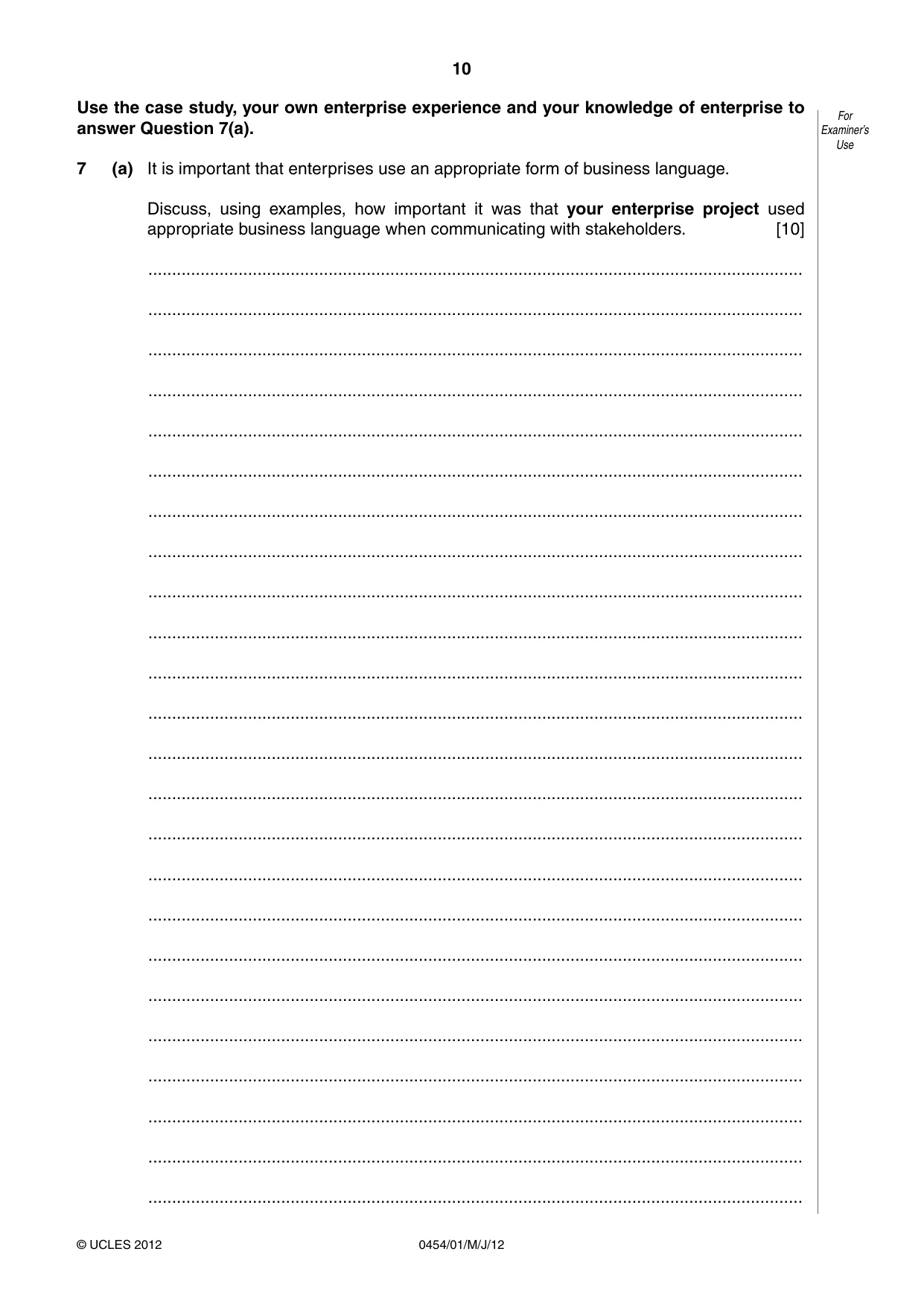
Question paper, page 10
10 0454/01/M/J/12 © UCLES 2012 For Examiner’s Use Use the case study, your own enterprise experience and your knowledge of enterprise to answer Question 7(a). 7 (a) It is important that enterprises use an appropriate form of business language. Discuss, using examples, how important it was that your enterprise project used appropriate business language when communicating with stakeholders. [10] … … … … … … … … … … … … … … … … … … … … … … … …
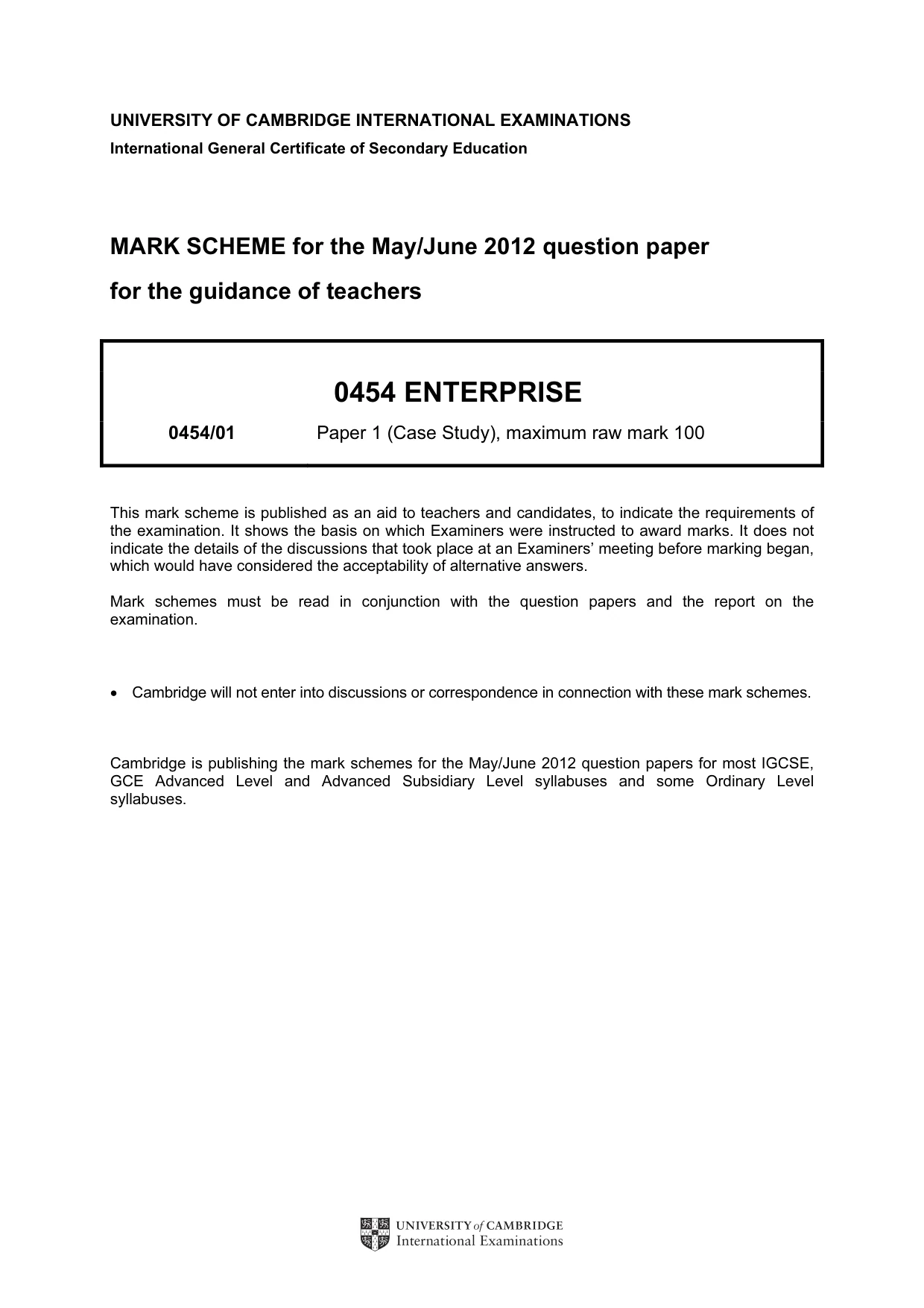
Question paper, page 11
11 0454/01/M/J/12 © UCLES 2012 [Turn over For Examiner’s Use Use the case study, your own enterprise experience and your knowledge of enterprise to answer Question 7(b). (b) Business plans are an important part of communication for an enterprise. Evaluate the importance of a business plan in the start-up of your enterprise project. [15] … … … … … … … … … … … … … … … … … … … … … … … … …
Question paper, page 12
12 0454/01/M/J/12 © UCLES 2012 For Examiner’s Use … … … … … … … … … … … … … … … … … … … … … … … … … Permission to reproduce items where third-party owned material protected by copyright is included has been sought and cleared where possible. Every reasonable effort has been made by the publisher (UCLES) to trace copyright holders, but if any items requiring clearance have unwittingly been included, the publisher will be pleased to make amends at the earliest possible opportunity. University of Cambridge International Examinations is part of the Cambridge Assessment Group. Cambridge Assessment is the brand name of University of Cambridge Local Examinations Syndicate (UCLES), which is itself a department of the University of Cambridge.
Mark scheme, page 1
UNIVERSITY OF CAMBRIDGE INTERNATIONAL EXAMINATIONS International General Certificate of Secondary Education MARK SCHEME for the May/June 2012 question paper for the guidance of teachers 0454 ENTERPRISE 0454/01 Paper 1 (Case Study), maximum raw mark 100 This mark scheme is published as an aid to teachers and candidates, to indicate the requirements of the examination. It shows the basis on which Examiners were instructed to award marks. It does not indicate the details of the discussions that took place at an Examiners’ meeting before marking began, which would have considered the acceptability of alternative answers. Mark schemes must be read in conjunction with the question papers and the report on the examination. • Cambridge will not enter into discussions or correspondence in connection with these mark schemes. Cambridge is publishing the mark schemes for the May/June 2012 question papers for most IGCSE, GCE Advanced Level and Advanced Subsidiary Level syllabuses and some Ordinary Level syllabuses.
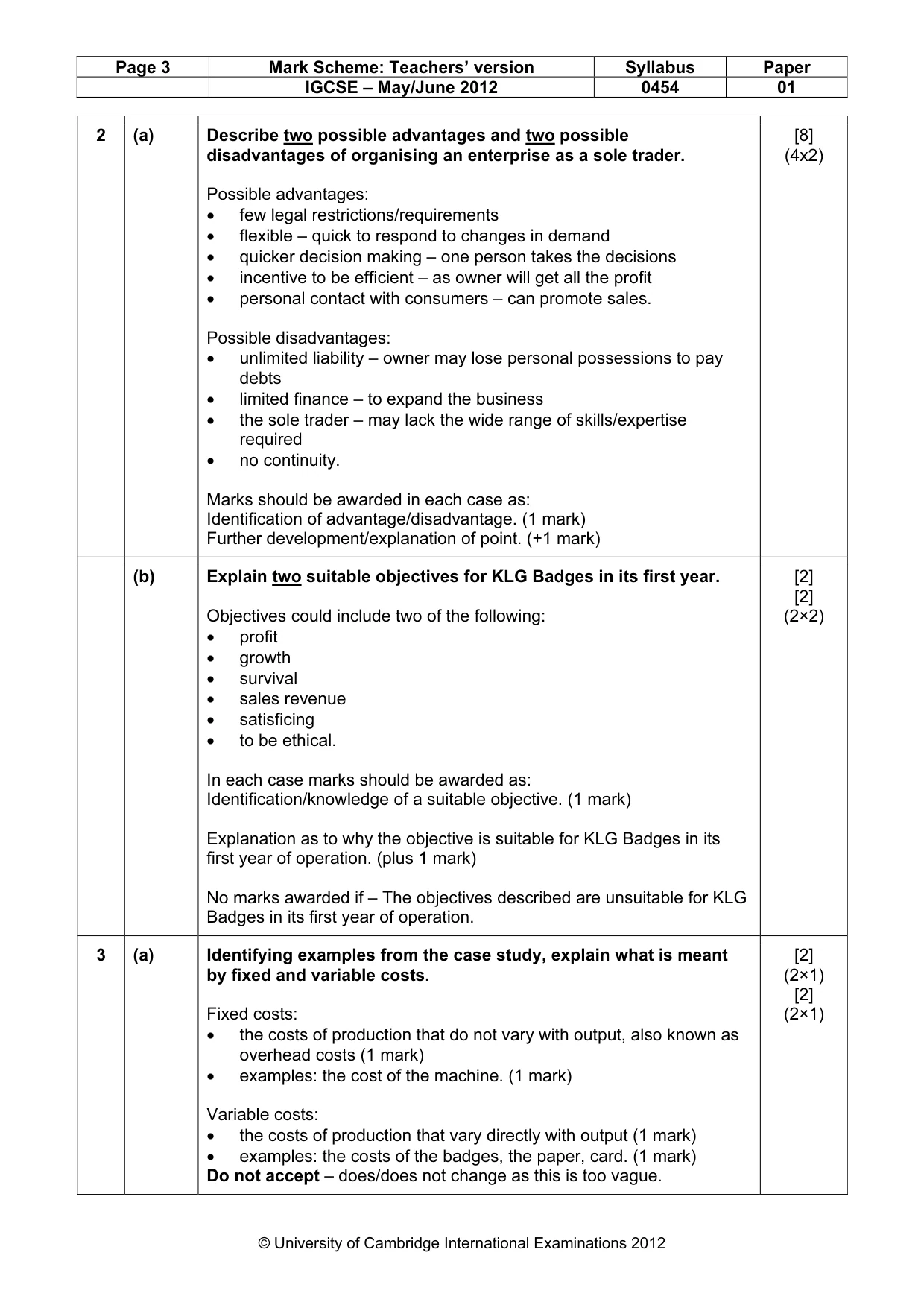
Mark scheme, page 2
Page 2 Mark Scheme: Teachers’ version Syllabus Paper IGCSE – May/June 2012 0454 01 © University of Cambridge International Examinations 2012 Marking guide Marks 1 (a) What is meant by the term enterprise? It involves: • making decisions • taking risks • bringing together all of the factors of production • the activity of providing goods and services i.e. business enterprise is acceptable. 2 marks A good definition showing clear knowledge and understanding. 1 mark A less precise definition showing some knowledge and understanding. (1×2) or (2×1) [2] (b) (i) State three skills which are needed to be entrepreneurial. Skills could include three of the following: • leadership • self confidence • innovation/new ideas • team building/co-ordination skills • determination/motivation to succeed • creativity • problem solving • resourcefulness • taking initiative • taking responsibility/decision maker • perseverance. NB – taking calculated risks not ‘taking risks’ alone as already credited in 1(a). Candidates only need to state three skills; they do not need to describe or explain them. (3×1) [3] (ii) Explain how using one of these skills might have helped you to have become a more successful entrepreneur in your enterprise project. Level 2 (3–4 marks) Candidate is able to explain how the skill might have helped him/her to have become a more successful entrepreneur in their enterprise project. There is a very clear link between the particular skill and the success of the candidate as an entrepreneur. Level 1 (1–2 marks) Candidate is able to apply a skill to the enterprise operated – maybe an attempt to link skill to success. NB – There are no marks available for the identification of a skill as this was rewarded in (b)(i). [2] [2]
Mark scheme, page 3
Page 3 Mark Scheme: Teachers’ version Syllabus Paper IGCSE – May/June 2012 0454 01 © University of Cambridge International Examinations 2012 2 (a) Describe two possible advantages and two possible disadvantages of organising an enterprise as a sole trader. Possible advantages: • few legal restrictions/requirements • flexible – quick to respond to changes in demand • quicker decision making – one person takes the decisions • incentive to be efficient – as owner will get all the profit • personal contact with consumers – can promote sales. Possible disadvantages: • unlimited liability – owner may lose personal possessions to pay debts • limited finance – to expand the business • the sole trader – may lack the wide range of skills/expertise required • no continuity. Marks should be awarded in each case as: Identification of advantage/disadvantage. (1 mark) Further development/explanation of point. (+1 mark) [8] (4x2) (b) Explain two suitable objectives for KLG Badges in its first year. Objectives could include two of the following: • profit • growth • survival • sales revenue • satisficing • to be ethical. In each case marks should be awarded as: Identification/knowledge of a suitable objective. (1 mark) Explanation as to why the objective is suitable for KLG Badges in its first year of operation. (plus 1 mark) No marks awarded if – The objectives described are unsuitable for KLG Badges in its first year of operation. [2] [2] (2×2) 3 (a) Identifying examples from the case study, explain what is meant by fixed and variable costs. Fixed costs: • the costs of production that do not vary with output, also known as overhead costs (1 mark) • examples: the cost of the machine. (1 mark) Variable costs: • the costs of production that vary directly with output (1 mark) • examples: the costs of the badges, the paper, card. (1 mark) Do not accept – does/does not change as this is too vague. [2] (2×1) [2] (2×1)
Mark scheme, page 4
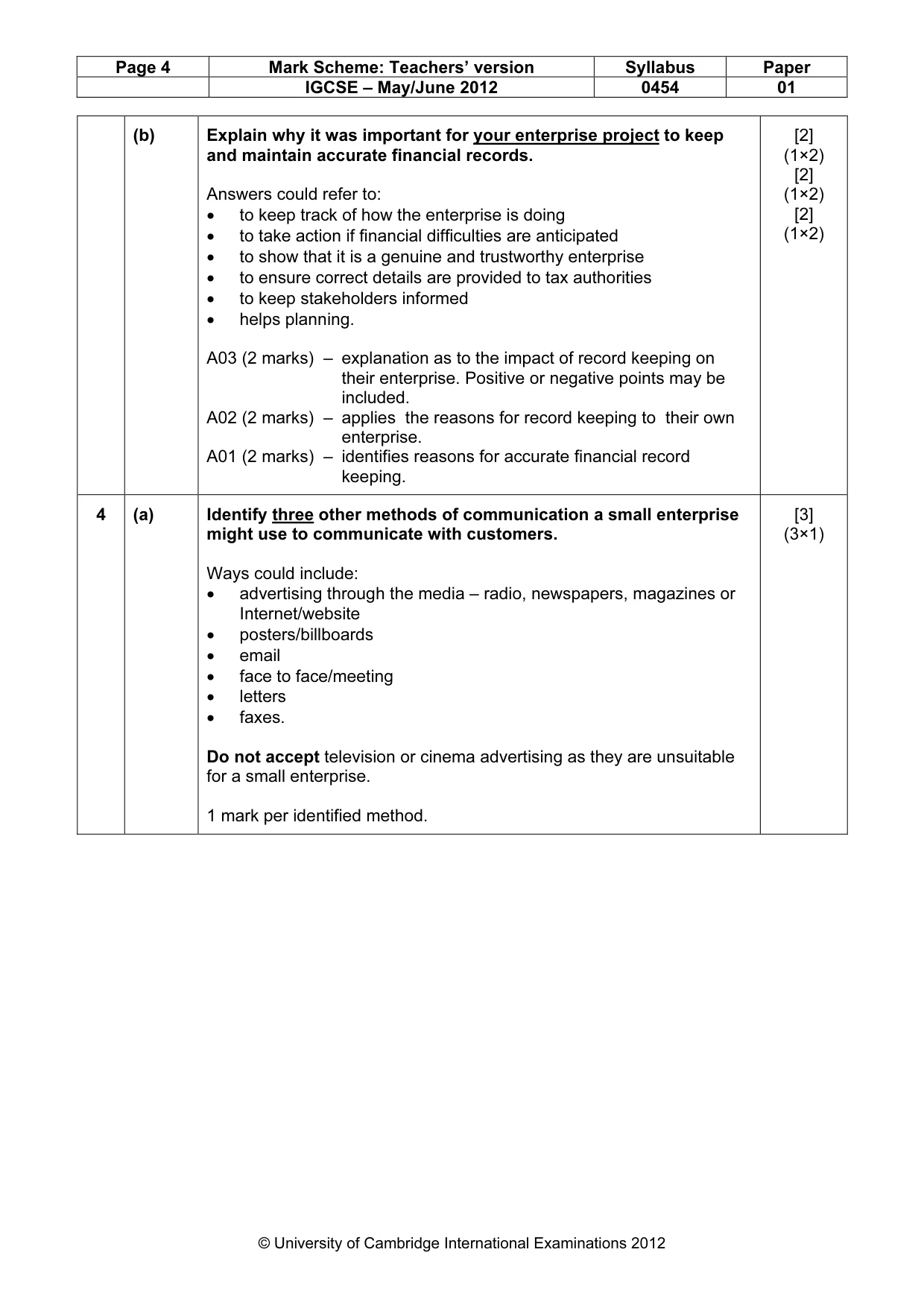
Page 4 Mark Scheme: Teachers’ version Syllabus Paper IGCSE – May/June 2012 0454 01 © University of Cambridge International Examinations 2012 (b) Explain why it was important for your enterprise project to keep and maintain accurate financial records. Answers could refer to: • to keep track of how the enterprise is doing • to take action if financial difficulties are anticipated • to show that it is a genuine and trustworthy enterprise • to ensure correct details are provided to tax authorities • to keep stakeholders informed • helps planning. A03 (2 marks) – explanation as to the impact of record keeping on their enterprise. Positive or negative points may be included. A02 (2 marks) – applies the reasons for record keeping to their own enterprise. A01 (2 marks) – identifies reasons for accurate financial record keeping. [2] (1×2) [2] (1×2) [2] (1×2) 4 (a) Identify three other methods of communication a small enterprise might use to communicate with customers. Ways could include: • advertising through the media – radio, newspapers, magazines or Internet/website • posters/billboards • email • face to face/meeting • letters • faxes. Do not accept television or cinema advertising as they are unsuitable for a small enterprise. 1 mark per identified method. [3] (3×1)
Mark scheme, page 5
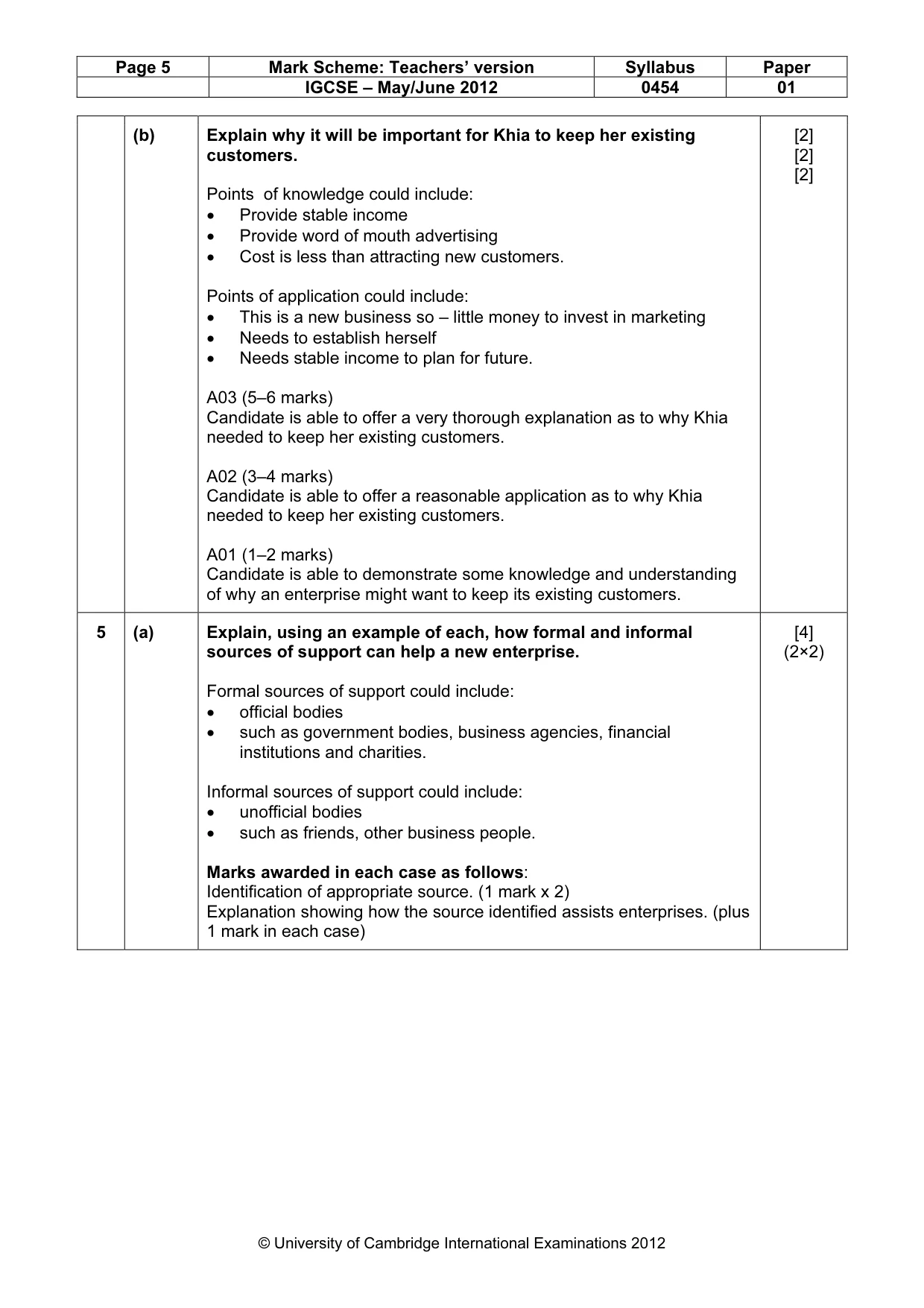
Page 5 Mark Scheme: Teachers’ version Syllabus Paper IGCSE – May/June 2012 0454 01 © University of Cambridge International Examinations 2012 (b) Explain why it will be important for Khia to keep her existing customers. Points of knowledge could include: • Provide stable income • Provide word of mouth advertising • Cost is less than attracting new customers. Points of application could include: • This is a new business so – little money to invest in marketing • Needs to establish herself • Needs stable income to plan for future. A03 (5–6 marks) Candidate is able to offer a very thorough explanation as to why Khia needed to keep her existing customers. A02 (3–4 marks) Candidate is able to offer a reasonable application as to why Khia needed to keep her existing customers. A01 (1–2 marks) Candidate is able to demonstrate some knowledge and understanding of why an enterprise might want to keep its existing customers. [2] [2] [2] 5 (a) Explain, using an example of each, how formal and informal sources of support can help a new enterprise. Formal sources of support could include: • official bodies • such as government bodies, business agencies, financial institutions and charities. Informal sources of support could include: • unofficial bodies • such as friends, other business people. Marks awarded in each case as follows: Identification of appropriate source. (1 mark x 2) Explanation showing how the source identified assists enterprises. (plus 1 mark in each case) [4] (2×2)
Mark scheme, page 6
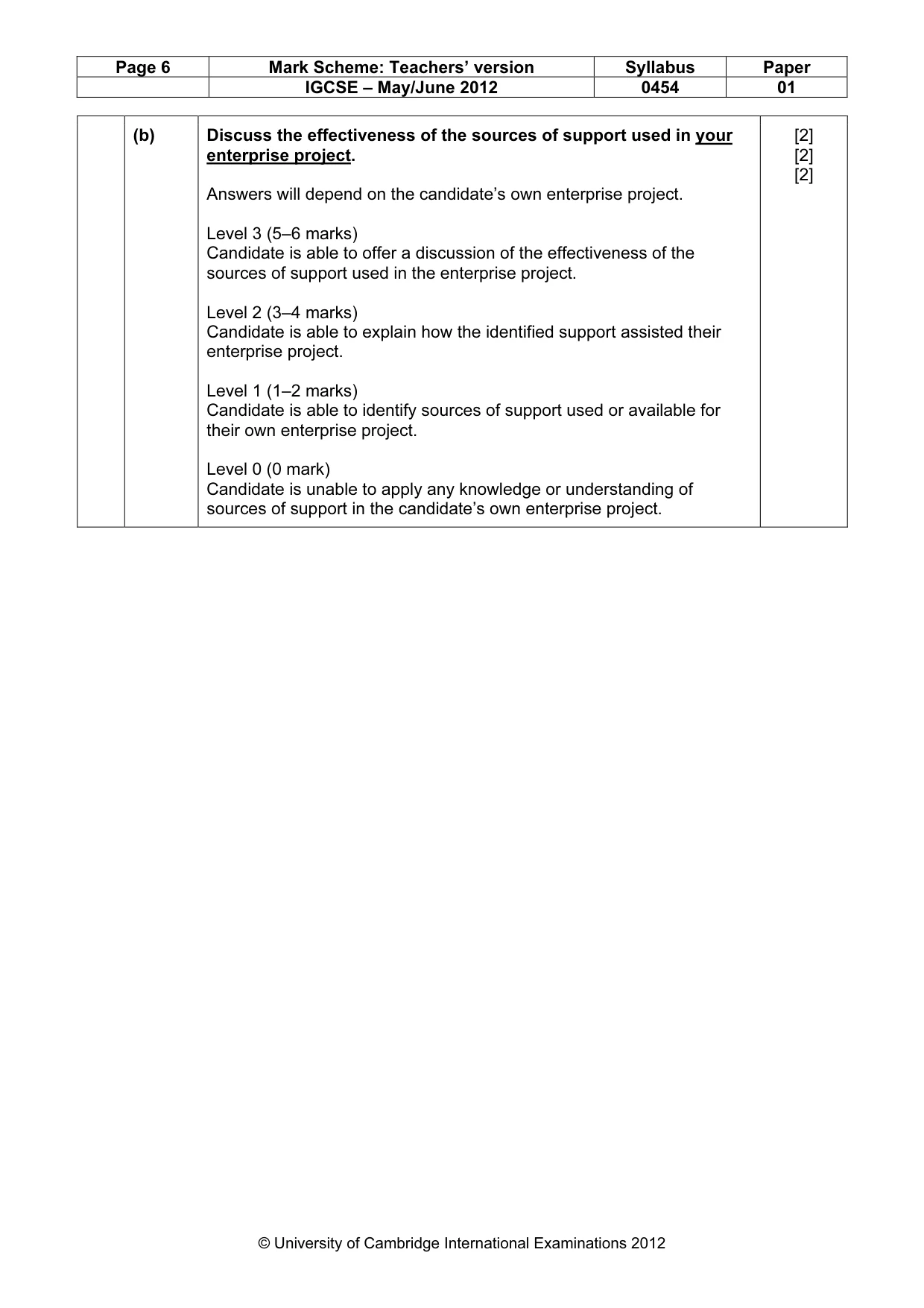
Page 6 Mark Scheme: Teachers’ version Syllabus Paper IGCSE – May/June 2012 0454 01 © University of Cambridge International Examinations 2012 (b) Discuss the effectiveness of the sources of support used in your enterprise project. Answers will depend on the candidate’s own enterprise project. Level 3 (5–6 marks) Candidate is able to offer a discussion of the effectiveness of the sources of support used in the enterprise project. Level 2 (3–4 marks) Candidate is able to explain how the identified support assisted their enterprise project. Level 1 (1–2 marks) Candidate is able to identify sources of support used or available for their own enterprise project. Level 0 (0 mark) Candidate is unable to apply any knowledge or understanding of sources of support in the candidate’s own enterprise project. [2] [2] [2]
Mark scheme, page 7
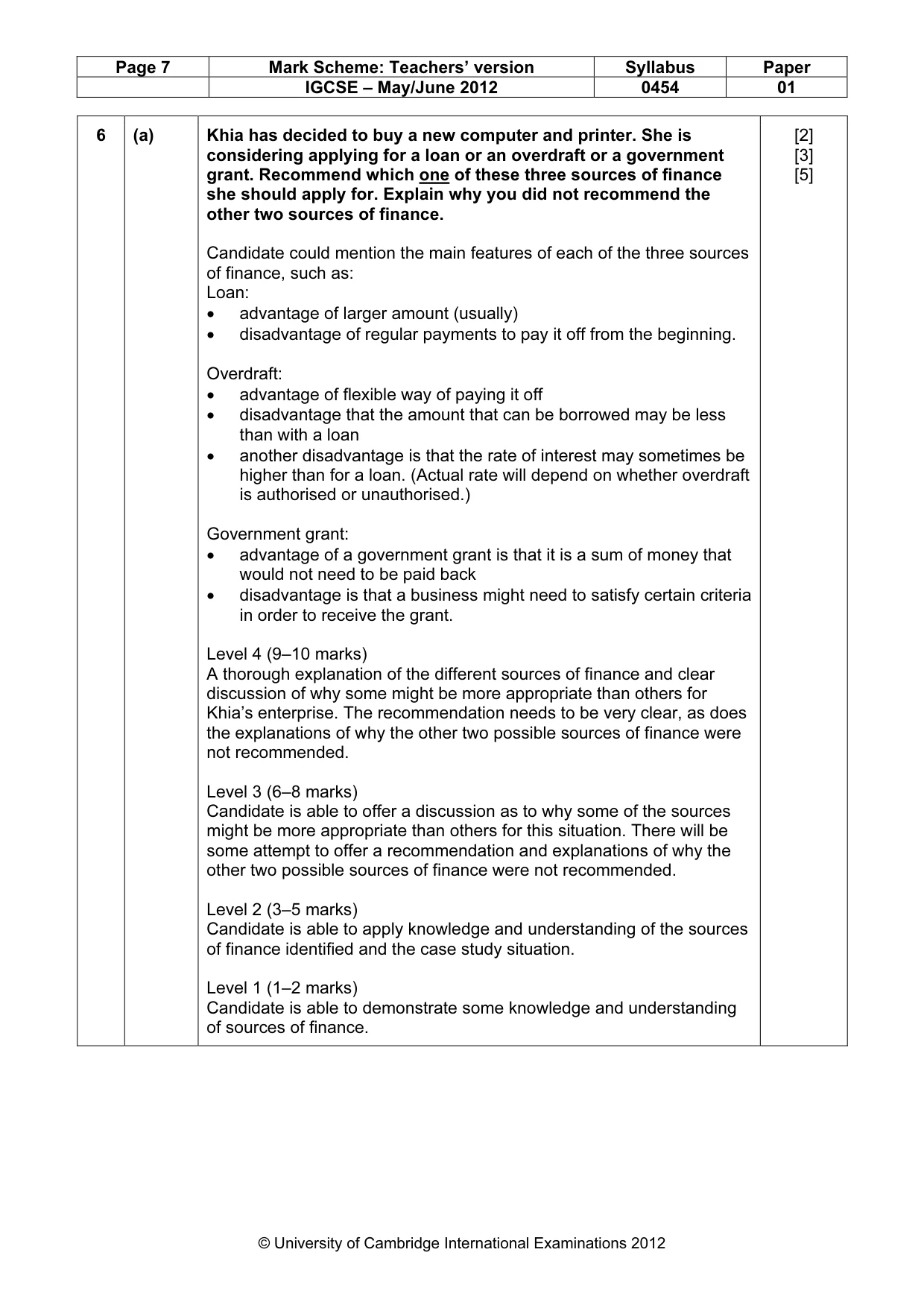
Page 7 Mark Scheme: Teachers’ version Syllabus Paper IGCSE – May/June 2012 0454 01 © University of Cambridge International Examinations 2012 6 (a) Khia has decided to buy a new computer and printer. She is considering applying for a loan or an overdraft or a government grant. Recommend which one of these three sources of finance she should apply for. Explain why you did not recommend the other two sources of finance. Candidate could mention the main features of each of the three sources of finance, such as: Loan: • advantage of larger amount (usually) • disadvantage of regular payments to pay it off from the beginning. Overdraft: • advantage of flexible way of paying it off • disadvantage that the amount that can be borrowed may be less than with a loan • another disadvantage is that the rate of interest may sometimes be higher than for a loan. (Actual rate will depend on whether overdraft is authorised or unauthorised.) Government grant: • advantage of a government grant is that it is a sum of money that would not need to be paid back • disadvantage is that a business might need to satisfy certain criteria in order to receive the grant. Level 4 (9–10 marks) A thorough explanation of the different sources of finance and clear discussion of why some might be more appropriate than others for Khia’s enterprise. The recommendation needs to be very clear, as does the explanations of why the other two possible sources of finance were not recommended. Level 3 (6–8 marks) Candidate is able to offer a discussion as to why some of the sources might be more appropriate than others for this situation. There will be some attempt to offer a recommendation and explanations of why the other two possible sources of finance were not recommended. Level 2 (3–5 marks) Candidate is able to apply knowledge and understanding of the sources of finance identified and the case study situation. Level 1 (1–2 marks) Candidate is able to demonstrate some knowledge and understanding of sources of finance. [2] [3] [5]
Mark scheme, page 8
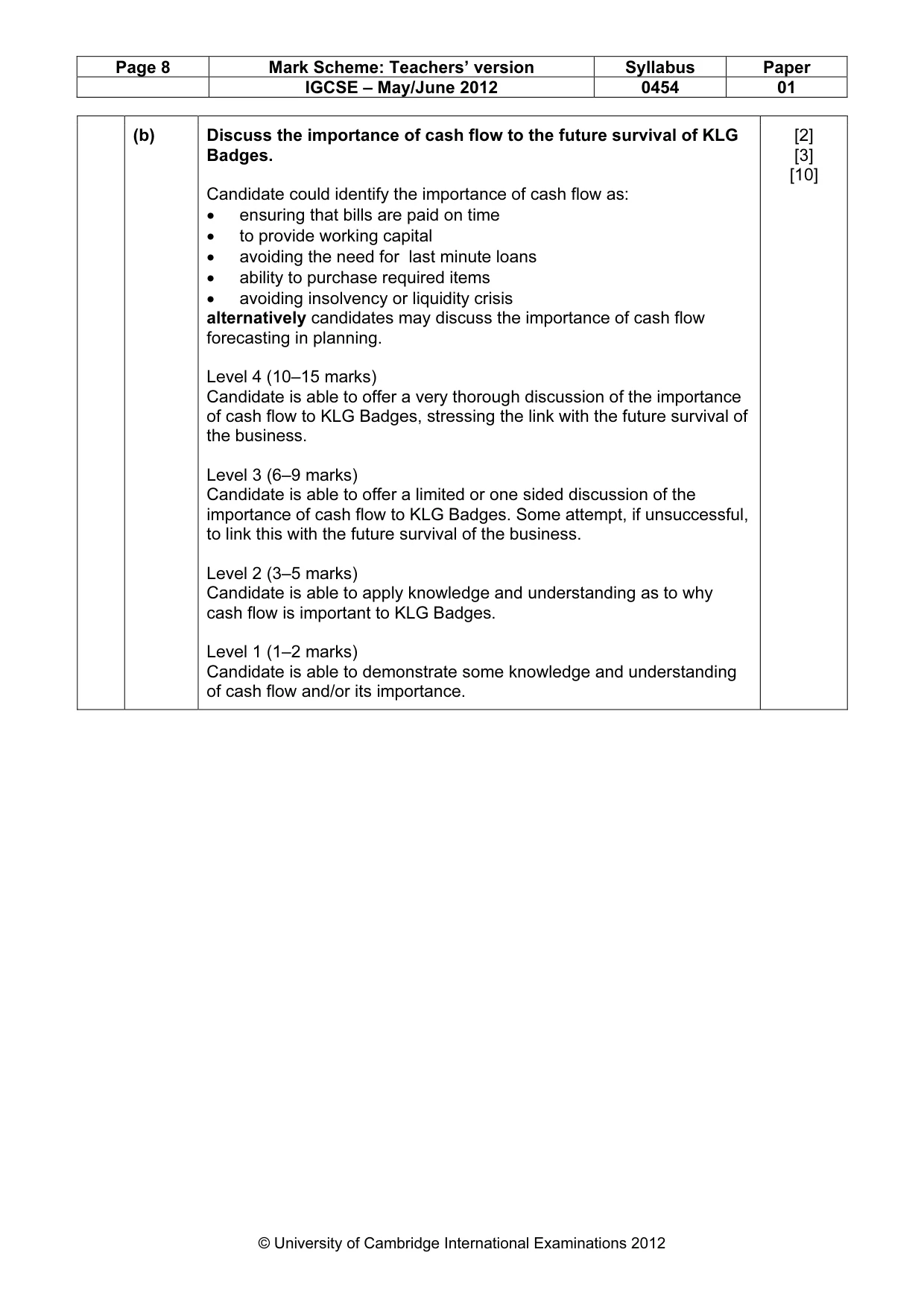
Page 8 Mark Scheme: Teachers’ version Syllabus Paper IGCSE – May/June 2012 0454 01 © University of Cambridge International Examinations 2012 (b) Discuss the importance of cash flow to the future survival of KLG Badges. Candidate could identify the importance of cash flow as: • ensuring that bills are paid on time • to provide working capital • avoiding the need for last minute loans • ability to purchase required items • avoiding insolvency or liquidity crisis alternatively candidates may discuss the importance of cash flow forecasting in planning. Level 4 (10–15 marks) Candidate is able to offer a very thorough discussion of the importance of cash flow to KLG Badges, stressing the link with the future survival of the business. Level 3 (6–9 marks) Candidate is able to offer a limited or one sided discussion of the importance of cash flow to KLG Badges. Some attempt, if unsuccessful, to link this with the future survival of the business. Level 2 (3–5 marks) Candidate is able to apply knowledge and understanding as to why cash flow is important to KLG Badges. Level 1 (1–2 marks) Candidate is able to demonstrate some knowledge and understanding of cash flow and/or its importance. [2] [3] [10]
Mark scheme, page 9
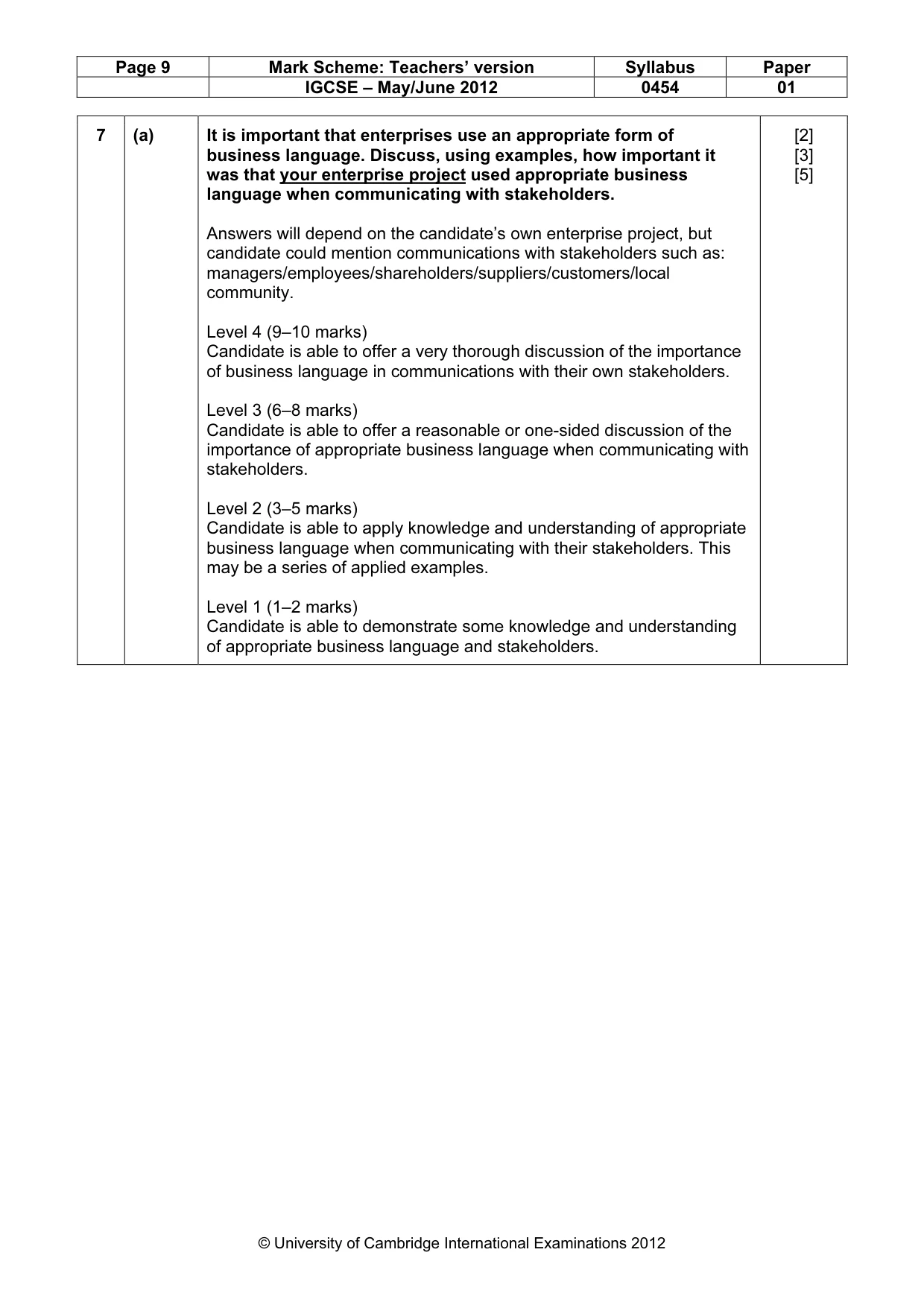
Page 9 Mark Scheme: Teachers’ version Syllabus Paper IGCSE – May/June 2012 0454 01 © University of Cambridge International Examinations 2012 7 (a) It is important that enterprises use an appropriate form of business language. Discuss, using examples, how important it was that your enterprise project used appropriate business language when communicating with stakeholders. Answers will depend on the candidate’s own enterprise project, but candidate could mention communications with stakeholders such as: managers/employees/shareholders/suppliers/customers/local community. Level 4 (9–10 marks) Candidate is able to offer a very thorough discussion of the importance of business language in communications with their own stakeholders. Level 3 (6–8 marks) Candidate is able to offer a reasonable or one-sided discussion of the importance of appropriate business language when communicating with stakeholders. Level 2 (3–5 marks) Candidate is able to apply knowledge and understanding of appropriate business language when communicating with their stakeholders. This may be a series of applied examples. Level 1 (1–2 marks) Candidate is able to demonstrate some knowledge and understanding of appropriate business language and stakeholders. [2] [3] [5]
Mark scheme, page 10
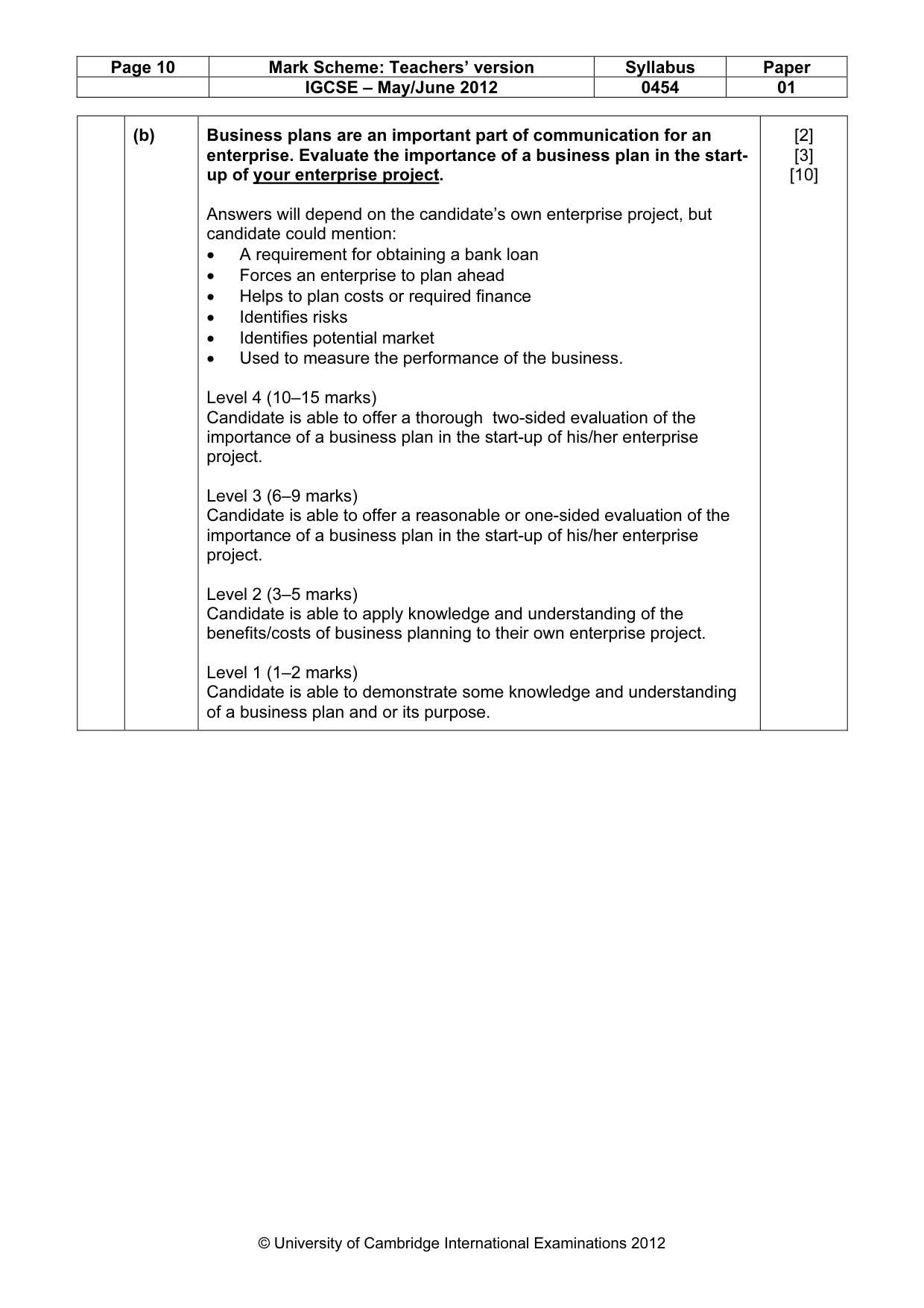
Page 10 Mark Scheme: Teachers’ version Syllabus Paper IGCSE – May/June 2012 0454 01 © University of Cambridge International Examinations 2012 (b) Business plans are an important part of communication for an enterprise. Evaluate the importance of a business plan in the start- up of your enterprise project. Answers will depend on the candidate’s own enterprise project, but candidate could mention: • A requirement for obtaining a bank loan • Forces an enterprise to plan ahead • Helps to plan costs or required finance • Identifies risks • Identifies potential market • Used to measure the performance of the business. Level 4 (10–15 marks) Candidate is able to offer a thorough two-sided evaluation of the importance of a business plan in the start-up of his/her enterprise project. Level 3 (6–9 marks) Candidate is able to offer a reasonable or one-sided evaluation of the importance of a business plan in the start-up of his/her enterprise project. Level 2 (3–5 marks) Candidate is able to apply knowledge and understanding of the benefits/costs of business planning to their own enterprise project. Level 1 (1–2 marks) Candidate is able to demonstrate some knowledge and understanding of a business plan and or its purpose. [2] [3] [10]
What you needed in this session
Cambridge’s own grade thresholds for 2012 May/June, Paper 1 · Variant 1. A higher threshold means an easier paper — the bar moves with how the cohort did.