Cambridge IGCSE Enterprise 0454 — 2011 Oct/Nov Paper 1 · Variant 1
0454/11/O/N/11 · 100 marks · ≈113 min
The question paper and its mark scheme, free to read here and free to download. This is Cambridge’s own paper, exactly as it was sat.
Question paper12 pages


Mark scheme12 pages
Answers below. Sit the paper first if you are practising.
Paper as text
Question paper, page 1
This document consists of 10 printed pages, 2 blank pages and 1 Insert. DC (CB (SE)) 44163/5 R © UCLES 2011 [Turn over UNIVERSITY OF CAMBRIDGE INTERNATIONAL EXAMINATIONS International General Certificate of Secondary Education * 3 6 6 9 5 0 6 0 8 6 * ENTERPRISE 0454/01 Paper 1 October/November 2011 1 hour 30 minutes Candidates answer on the Question Paper. No Additional Materials are required. READ THESE INSTRUCTIONS FIRST Write your Centre number, candidate number and name on all the work you hand in. Write in dark blue or black pen. Do not use staples, paper clips, highlighters, glue or correction fluid. DO NOT WRITE IN ANY BARCODES. Answer all questions. Each candidate should have received a copy of the case study prior to the examination. A clean copy of the case study has been provided with this question paper. The businesses described in this Question Paper are entirely fictitious. Your answers must be based on the case study and your own enterprise experience and knowledge. Candidates who do not follow this instruction will be penalised. At the end of the examination, fasten all your work securely together. The number of marks is given in brackets [ ] at the end of each question or part question.
Question paper, page 2
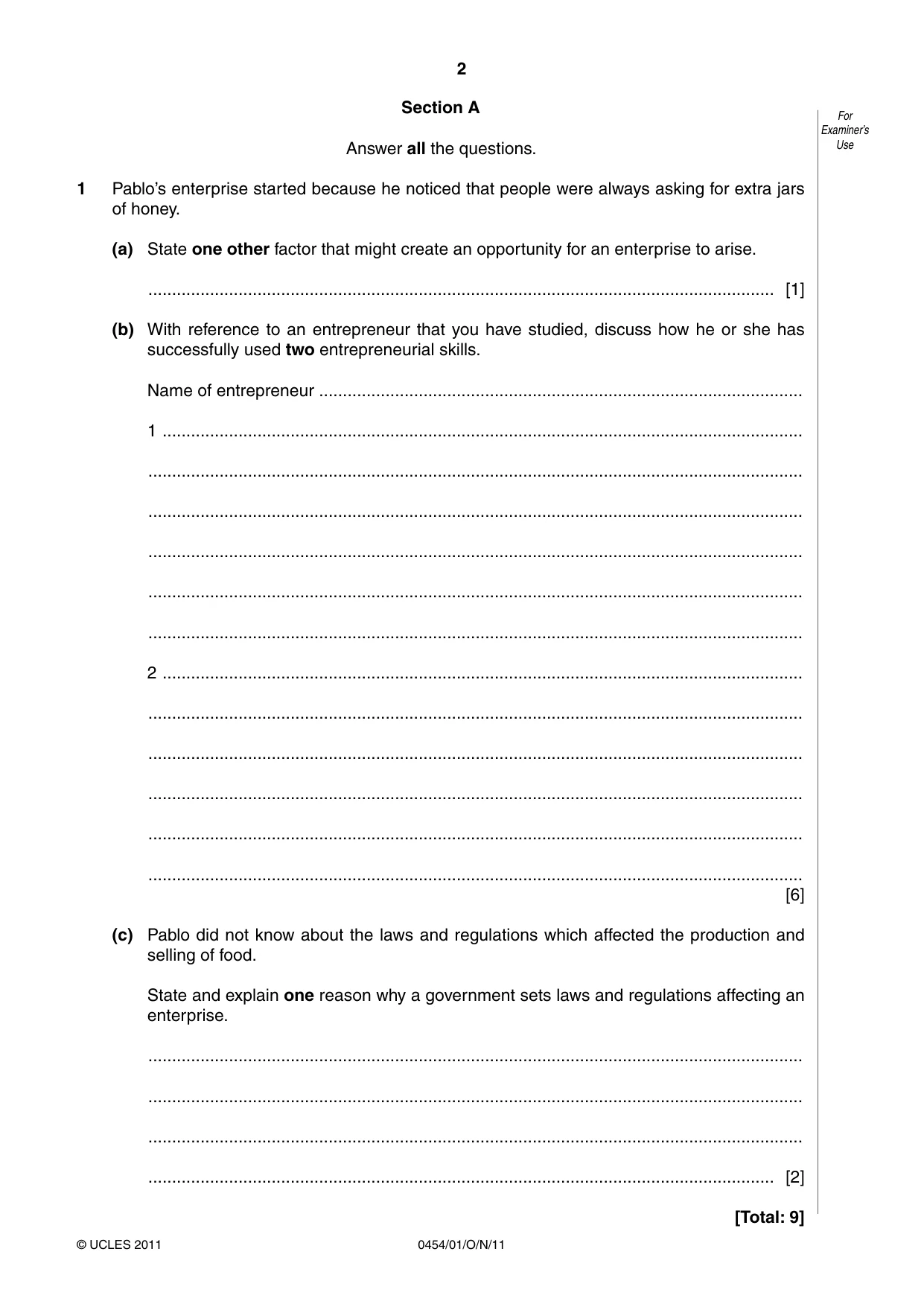
2 0454/01/O/N/11 © UCLES 2011 For Examiner’s Use Section A Answer all the questions. 1 Pablo’s enterprise started because he noticed that people were always asking for extra jars of honey. (a) State one other factor that might create an opportunity for an enterprise to arise. … [1] (b) With reference to an entrepreneur that you have studied, discuss how he or she has successfully used two entrepreneurial skills. Name of entrepreneur … 1 … … … … … … 2 … … … … … … [6] (c) Pablo did not know about the laws and regulations which affected the production and selling of food. State and explain one reason why a government sets laws and regulations affecting an enterprise. … … … … [2] [Total: 9]
Question paper, page 3
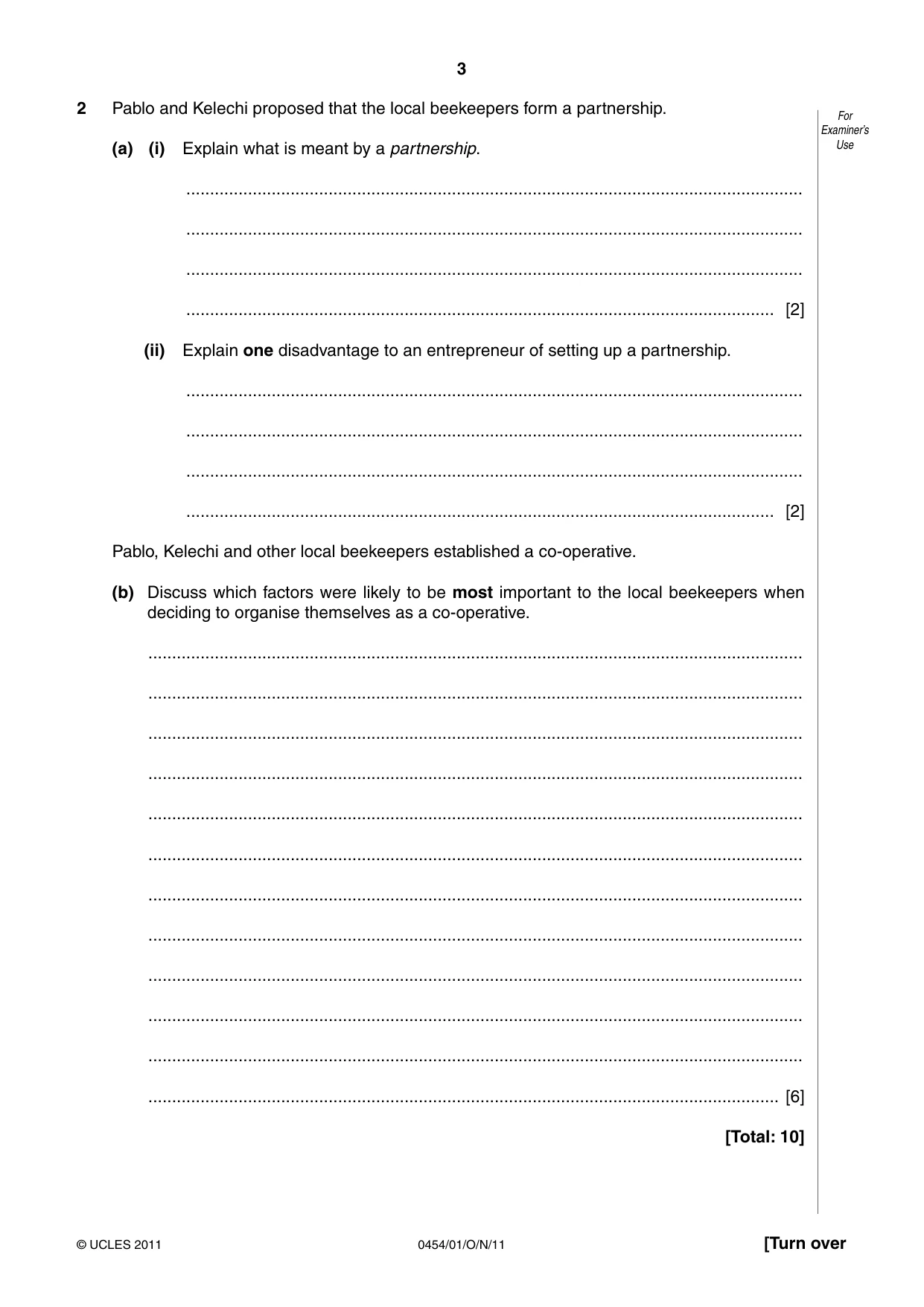
3 0454/01/O/N/11 © UCLES 2011 [Turn over For Examiner’s Use 2 Pablo and Kelechi proposed that the local beekeepers form a partnership. (a) (i) Explain what is meant by a partnership. … … … … [2] (ii) Explain one disadvantage to an entrepreneur of setting up a partnership. … … … … [2] Pablo, Kelechi and other local beekeepers established a co-operative. (b) Discuss which factors were likely to be most important to the local beekeepers when deciding to organise themselves as a co-operative. … … … … … … … … … … … … [6] [Total: 10]
Question paper, page 4
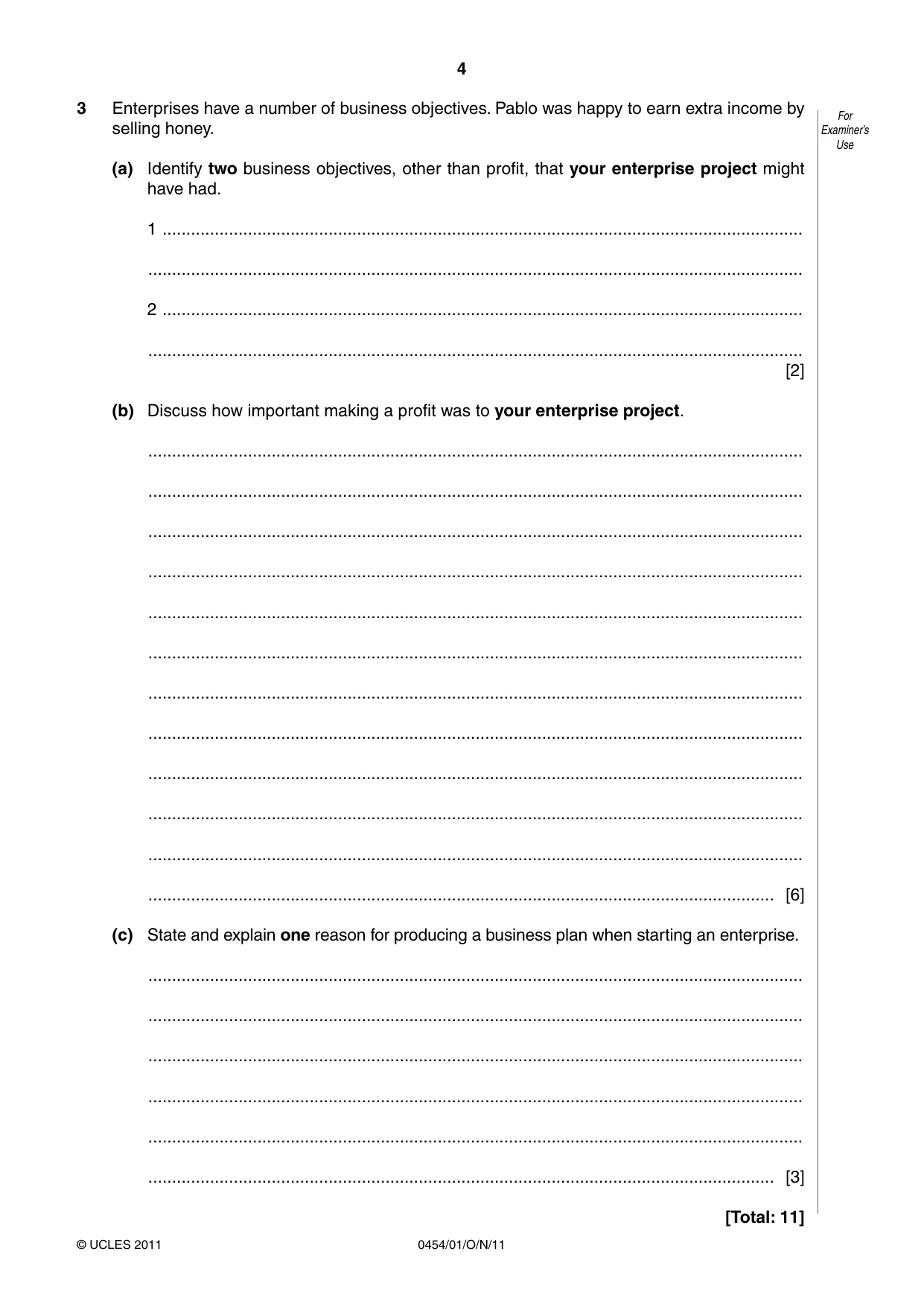
4 0454/01/O/N/11 © UCLES 2011 For Examiner’s Use 3 Enterprises have a number of business objectives. Pablo was happy to earn extra income by selling honey. (a) Identify two business objectives, other than profit, that your enterprise project might have had. 1 … … 2 … … [2] (b) Discuss how important making a profit was to your enterprise project. … … … … … … … … … … … … [6] (c) State and explain one reason for producing a business plan when starting an enterprise. … … … … … … [3] [Total: 11]
Question paper, page 5
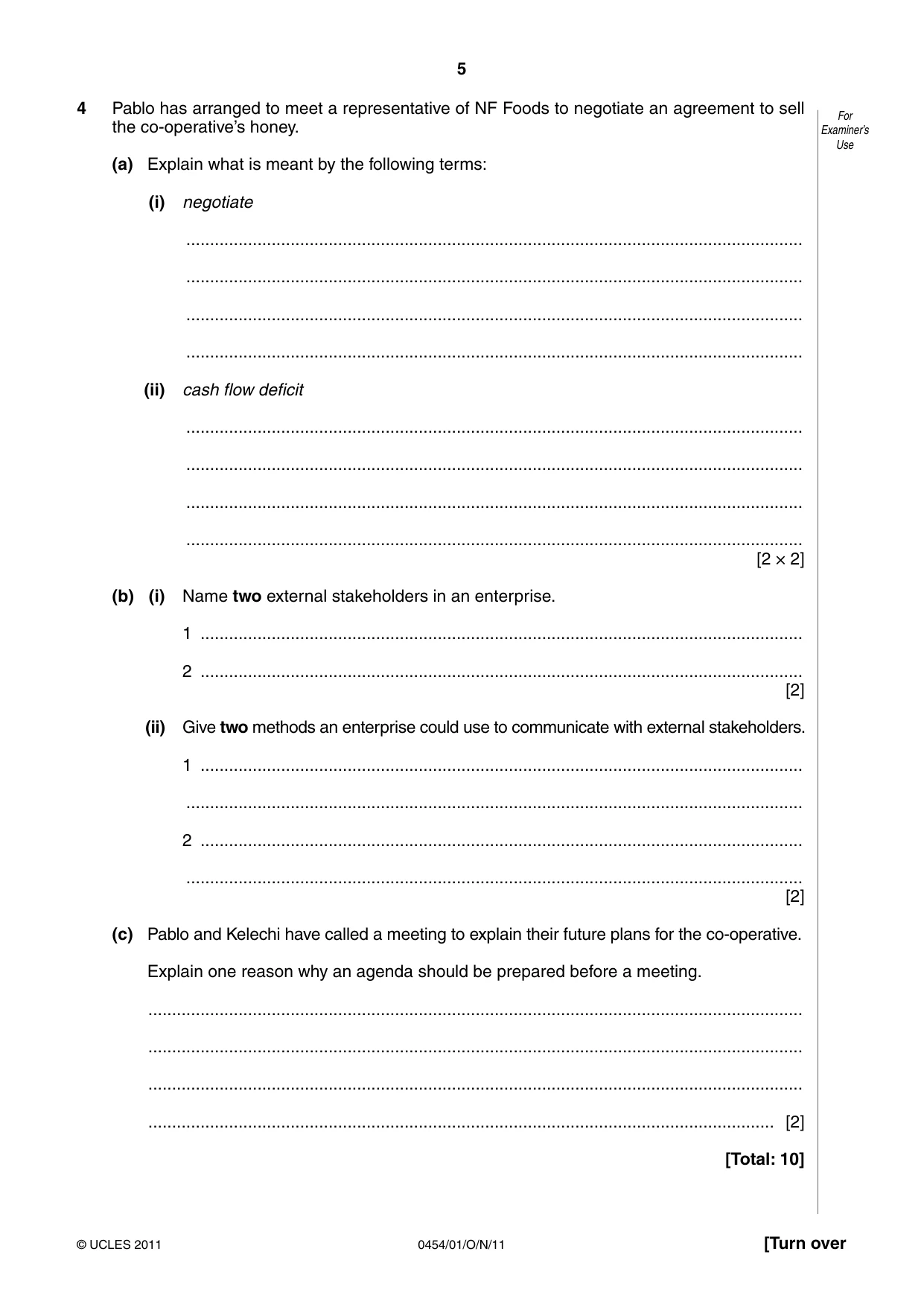
5 0454/01/O/N/11 © UCLES 2011 [Turn over For Examiner’s Use 4 Pablo has arranged to meet a representative of NF Foods to negotiate an agreement to sell the co-operative’s honey. (a) Explain what is meant by the following terms: (i) negotiate … … … … (ii) cash flow deficit … … … … [2 × 2] (b) (i) Name two external stakeholders in an enterprise. 1 … 2 … [2] (ii) Give two methods an enterprise could use to communicate with external stakeholders. 1 … … 2 … … [2] (c) Pablo and Kelechi have called a meeting to explain their future plans for the co-operative. Explain one reason why an agenda should be prepared before a meeting. … … … … [2] [Total: 10]
Question paper, page 6
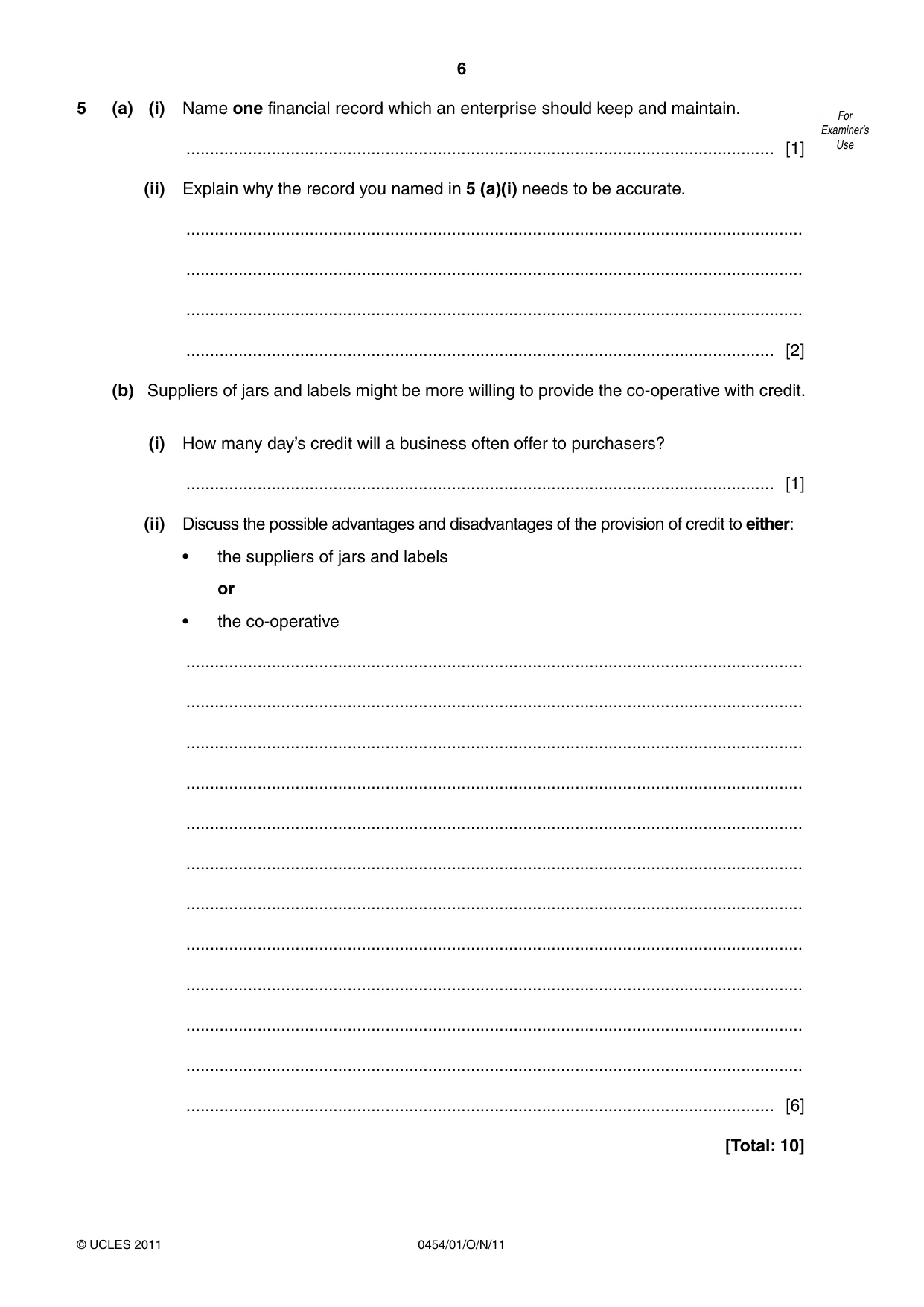
6 0454/01/O/N/11 © UCLES 2011 For Examiner’s Use 5 (a) (i) Name one financial record which an enterprise should keep and maintain. … [1] (ii) Explain why the record you named in 5 (a)(i) needs to be accurate. … … … … [2] (b) Suppliers of jars and labels might be more willing to provide the co-operative with credit. (i) How many day’s credit will a business often offer to purchasers? … [1] (ii) Discuss the possible advantages and disadvantages of the provision of credit to either: • the suppliers of jars and labels or • the co-operative … … … … … … … … … … … … [6] [Total: 10]
Question paper, page 7
7 0454/01/O/N/11 © UCLES 2011 [Turn over BLANK PAGE TURN OVER FOR SECTION B
Question paper, page 8
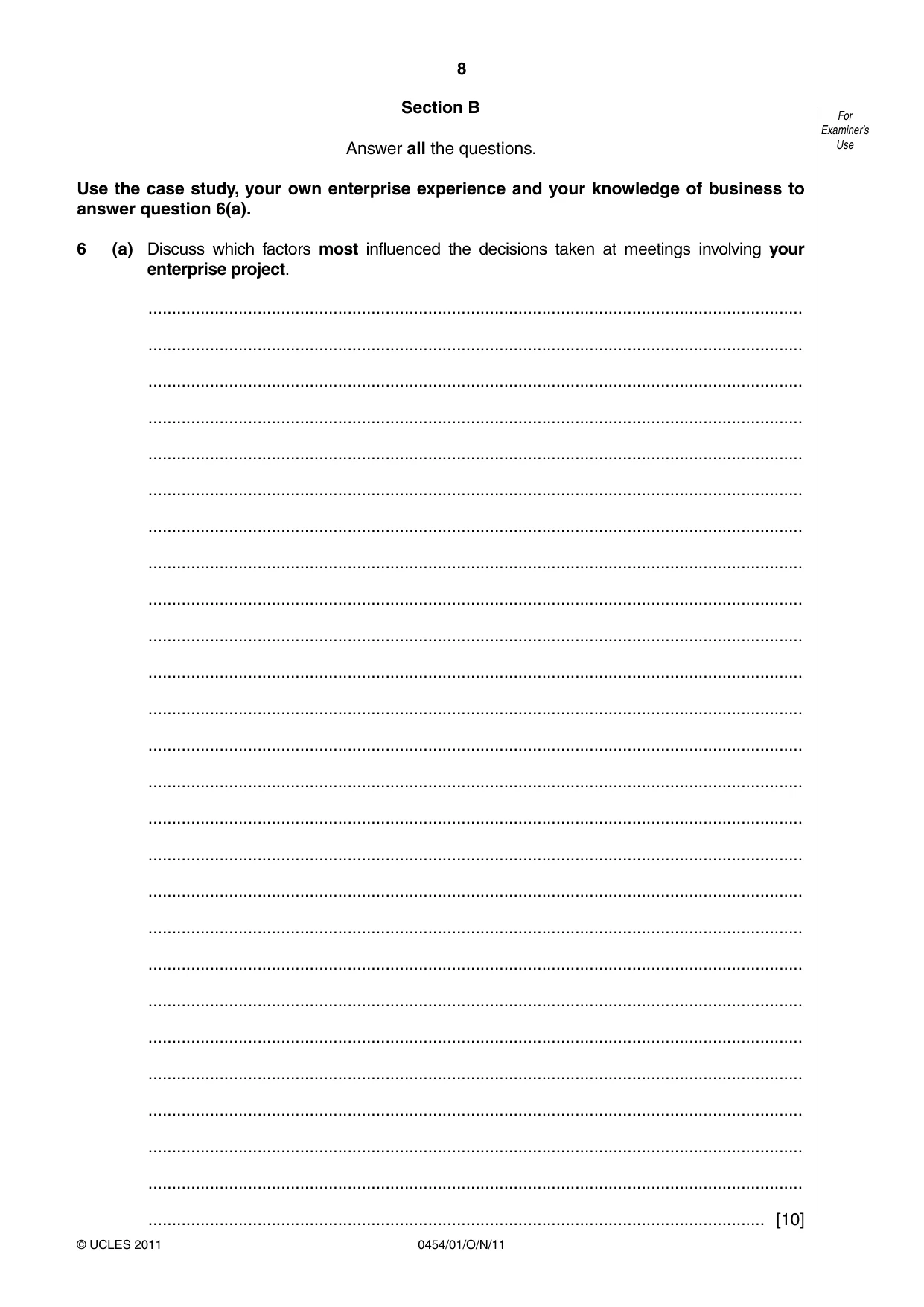
8 0454/01/O/N/11 © UCLES 2011 For Examiner’s Use Section B Answer all the questions. Use the case study, your own enterprise experience and your knowledge of business to answer question 6(a). 6 (a) Discuss which factors most influenced the decisions taken at meetings involving your enterprise project. … … … … … … … … … … … … … … … … … … … … … … … … … … [10]
Question paper, page 9
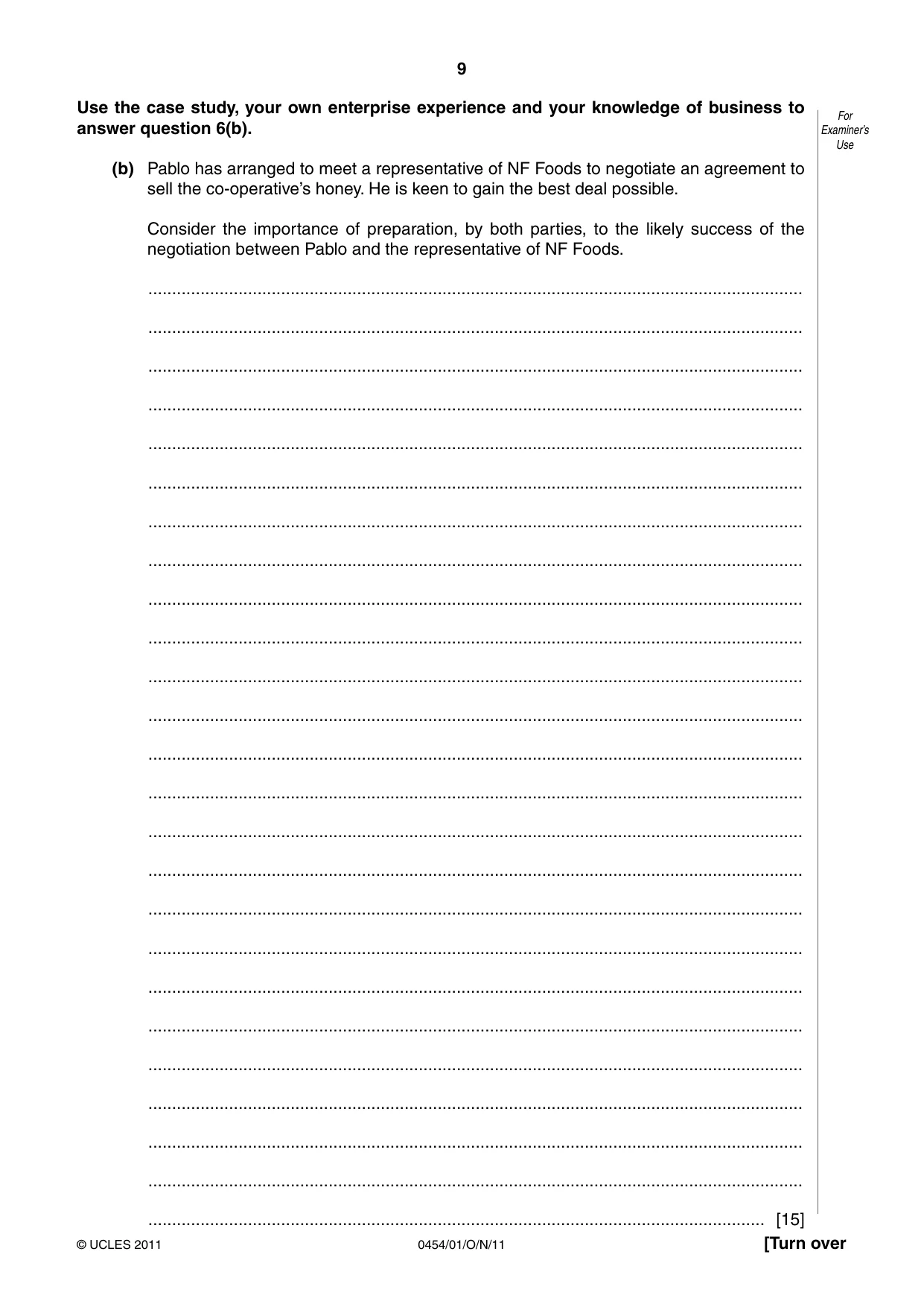
9 0454/01/O/N/11 © UCLES 2011 [Turn over For Examiner’s Use Use the case study, your own enterprise experience and your knowledge of business to answer question 6(b). (b) Pablo has arranged to meet a representative of NF Foods to negotiate an agreement to sell the co-operative’s honey. He is keen to gain the best deal possible. Consider the importance of preparation, by both parties, to the likely success of the negotiation between Pablo and the representative of NF Foods. … … … … … … … … … … … … … … … … … … … … … … … … … [15]
Question paper, page 10
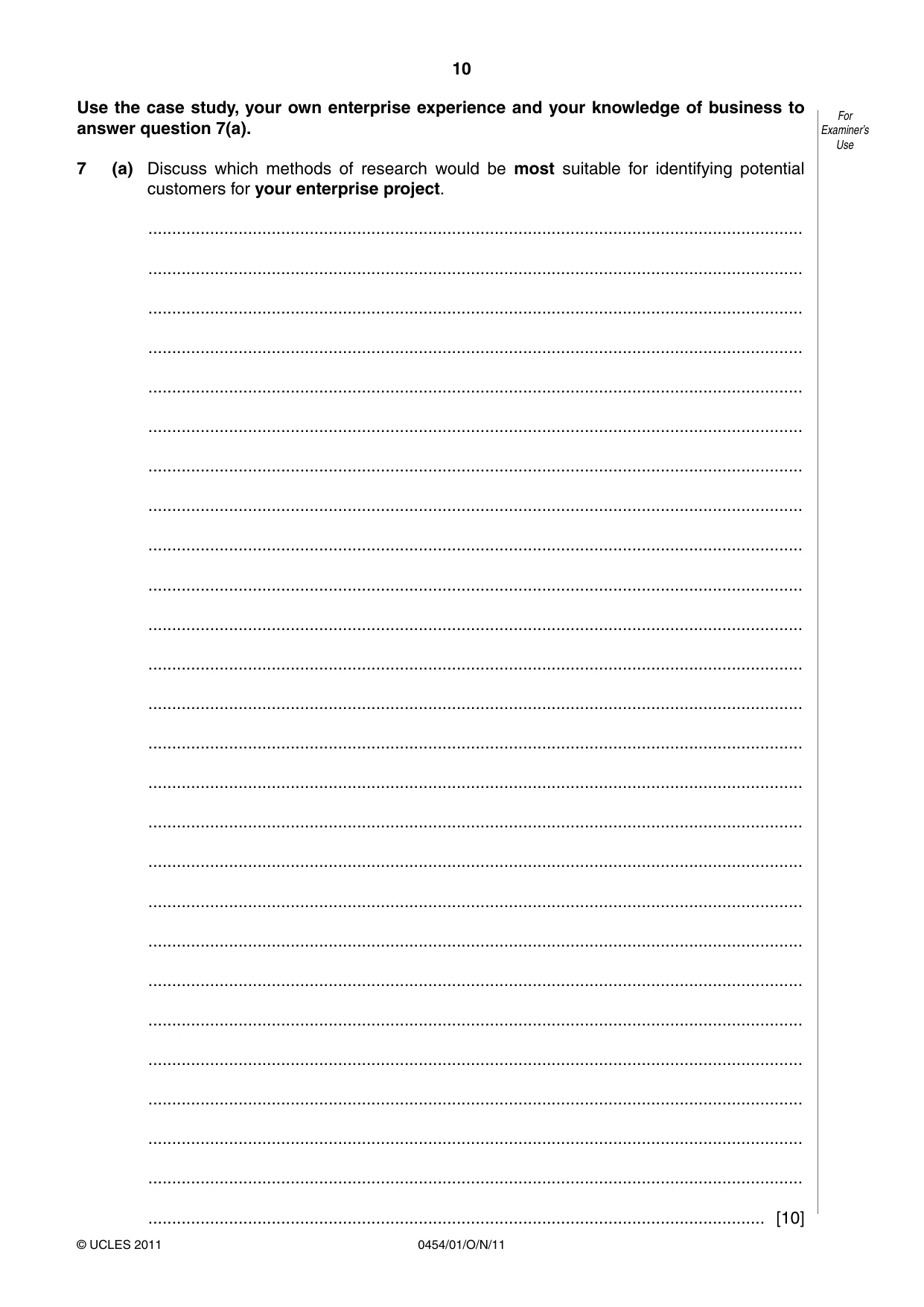
10 0454/01/O/N/11 © UCLES 2011 For Examiner’s Use Use the case study, your own enterprise experience and your knowledge of business to answer question 7(a). 7 (a) Discuss which methods of research would be most suitable for identifying potential customers for your enterprise project. … … … … … … … … … … … … … … … … … … … … … … … … … … [10]
Question paper, page 11
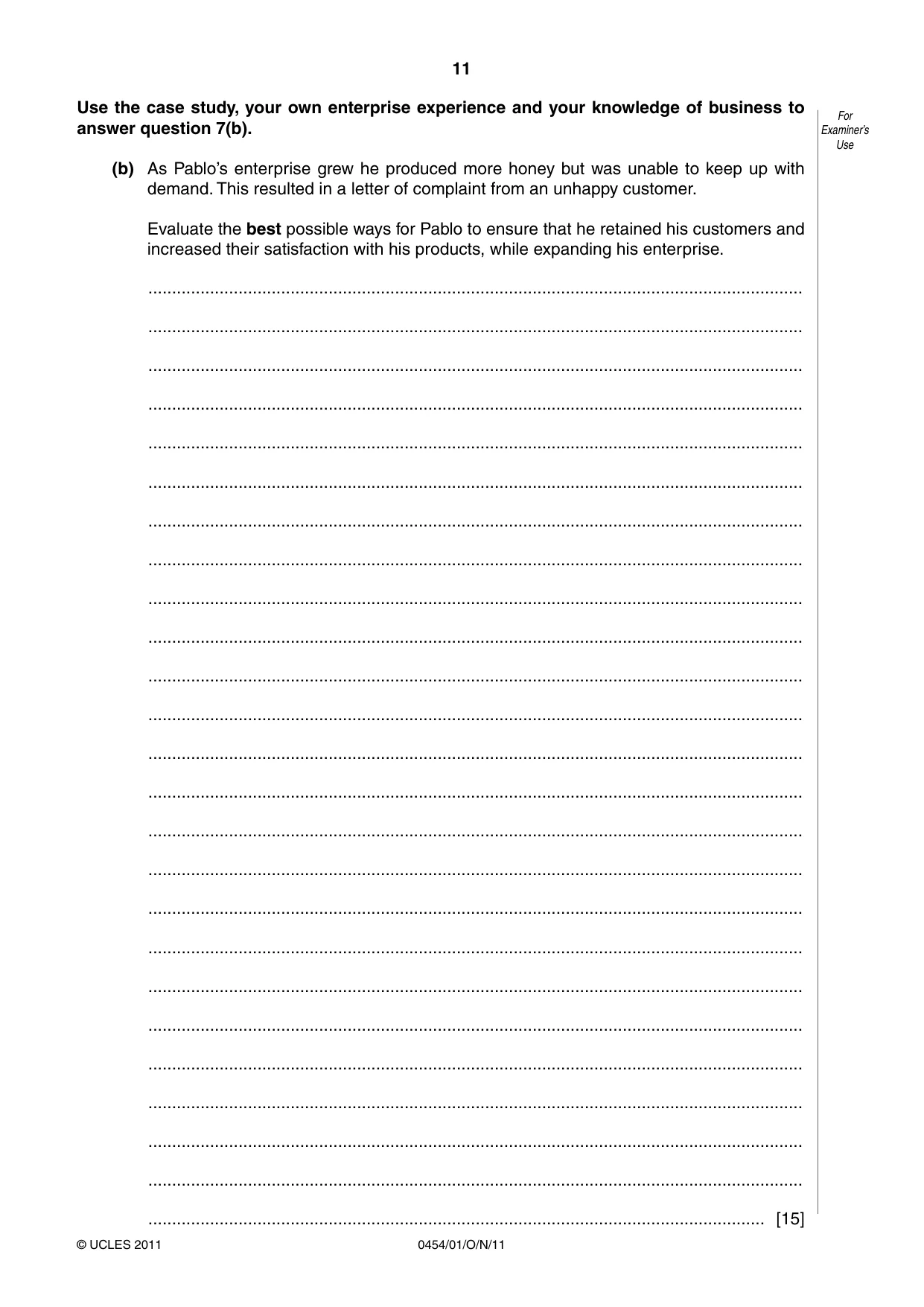
11 0454/01/O/N/11 © UCLES 2011 For Examiner’s Use Use the case study, your own enterprise experience and your knowledge of business to answer question 7(b). (b) As Pablo’s enterprise grew he produced more honey but was unable to keep up with demand. This resulted in a letter of complaint from an unhappy customer. Evaluate the best possible ways for Pablo to ensure that he retained his customers and increased their satisfaction with his products, while expanding his enterprise. … … … … … … … … … … … … … … … … … … … … … … … … … [15]
Question paper, page 12
12 0454/01/O/N/11 © UCLES 2011 Permission to reproduce items where third-party owned material protected by copyright is included has been sought and cleared where possible. Every reasonable effort has been made by the publisher (UCLES) to trace copyright holders, but if any items requiring clearance have unwittingly been included, the publisher will be pleased to make amends at the earliest possible opportunity. University of Cambridge International Examinations is part of the Cambridge Assessment Group. Cambridge Assessment is the brand name of University of Cambridge Local Examinations Syndicate (UCLES), which is itself a department of the University of Cambridge. BLANK PAGE
Mark scheme, page 1
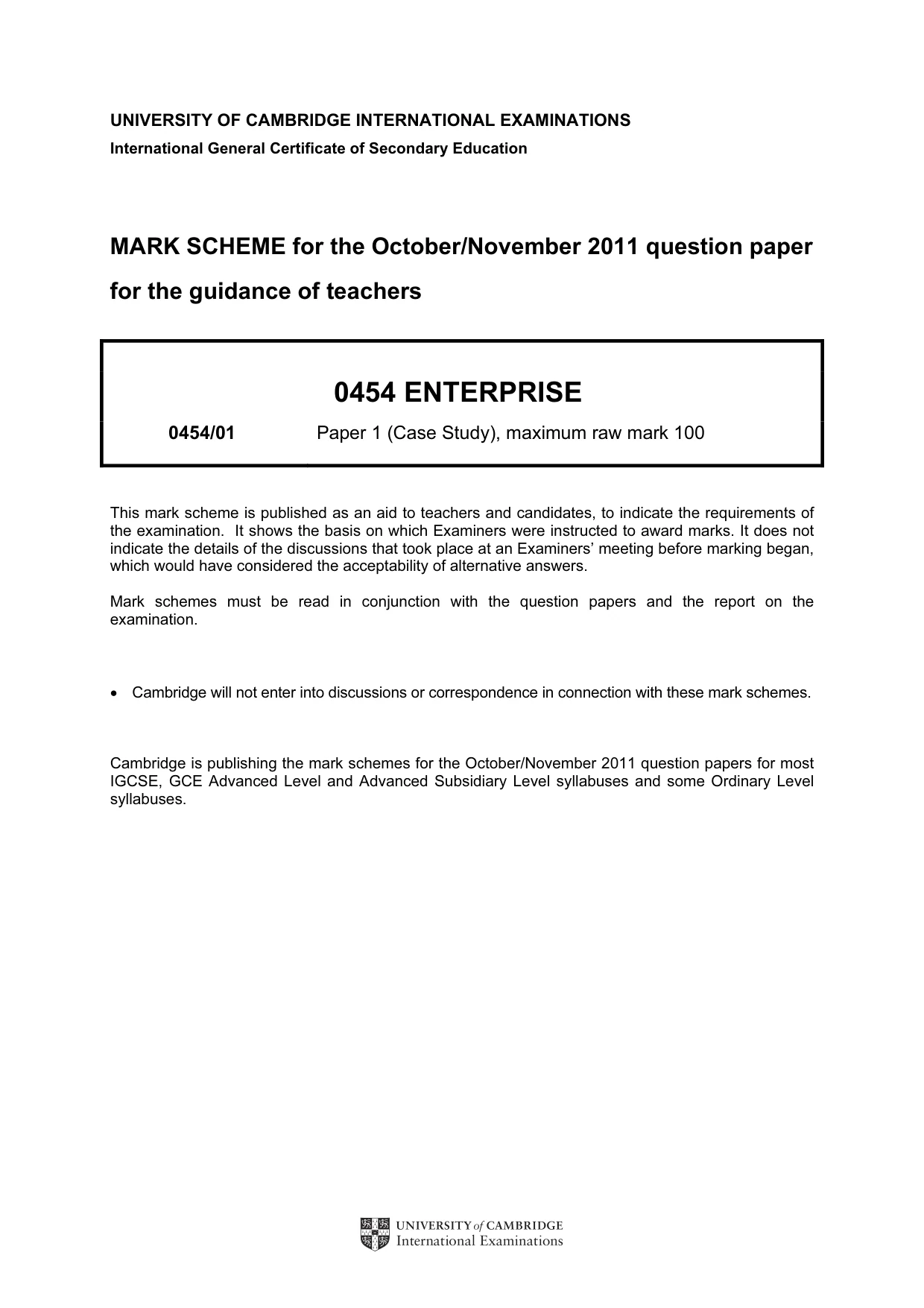
UNIVERSITY OF CAMBRIDGE INTERNATIONAL EXAMINATIONS International General Certificate of Secondary Education MARK SCHEME for the October/November 2011 question paper for the guidance of teachers 0454 ENTERPRISE 0454/01 Paper 1 (Case Study), maximum raw mark 100 This mark scheme is published as an aid to teachers and candidates, to indicate the requirements of the examination. It shows the basis on which Examiners were instructed to award marks. It does not indicate the details of the discussions that took place at an Examiners’ meeting before marking began, which would have considered the acceptability of alternative answers. Mark schemes must be read in conjunction with the question papers and the report on the examination. • Cambridge will not enter into discussions or correspondence in connection with these mark schemes. Cambridge is publishing the mark schemes for the October/November 2011 question papers for most IGCSE, GCE Advanced Level and Advanced Subsidiary Level syllabuses and some Ordinary Level syllabuses.
Mark scheme, page 2
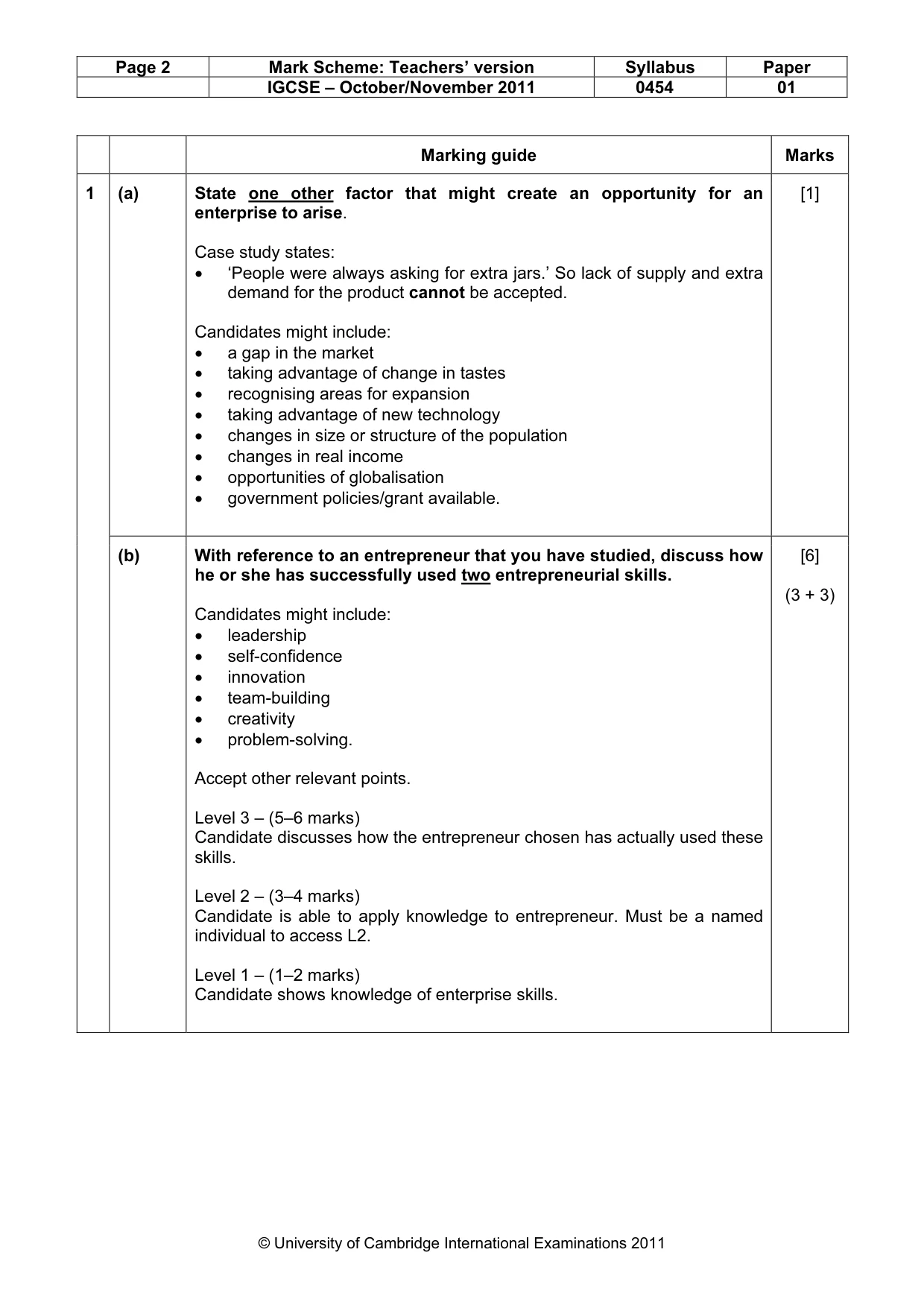
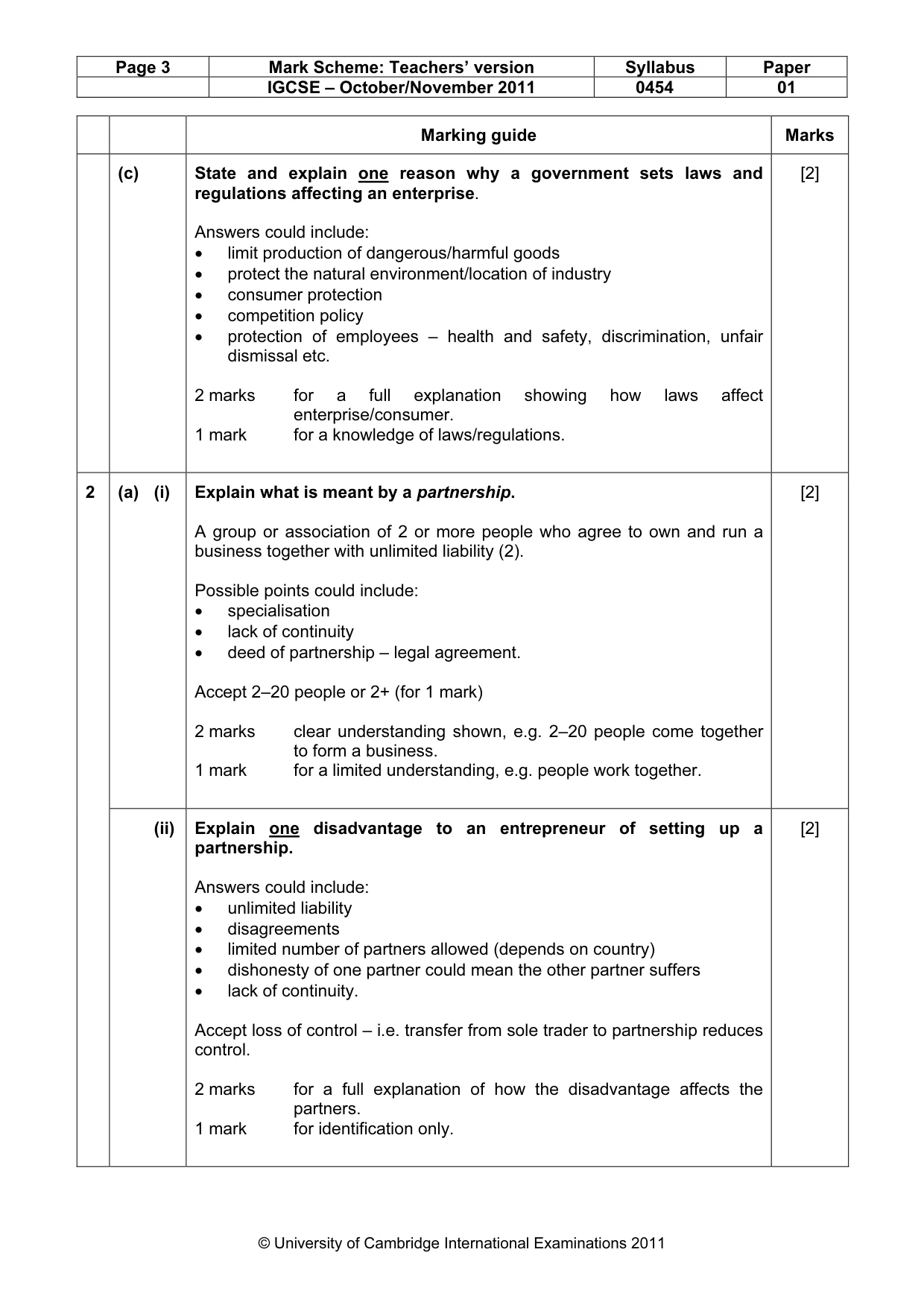
Page 2 Mark Scheme: Teachers’ version Syllabus Paper IGCSE – October/November 2011 0454 01 © University of Cambridge International Examinations 2011 Marking guide Marks (a) State one other factor that might create an opportunity for an enterprise to arise. Case study states: • ‘People were always asking for extra jars.’ So lack of supply and extra demand for the product cannot be accepted. Candidates might include: • a gap in the market • taking advantage of change in tastes • recognising areas for expansion • taking advantage of new technology • changes in size or structure of the population • changes in real income • opportunities of globalisation • government policies/grant available. [1] 1 (b) With reference to an entrepreneur that you have studied, discuss how he or she has successfully used two entrepreneurial skills. Candidates might include: • leadership • self-confidence • innovation • team-building • creativity • problem-solving. Accept other relevant points. Level 3 – (5–6 marks) Candidate discusses how the entrepreneur chosen has actually used these skills. Level 2 – (3–4 marks) Candidate is able to apply knowledge to entrepreneur. Must be a named individual to access L2. Level 1 – (1–2 marks) Candidate shows knowledge of enterprise skills. [6] (3 + 3)
Mark scheme, page 3
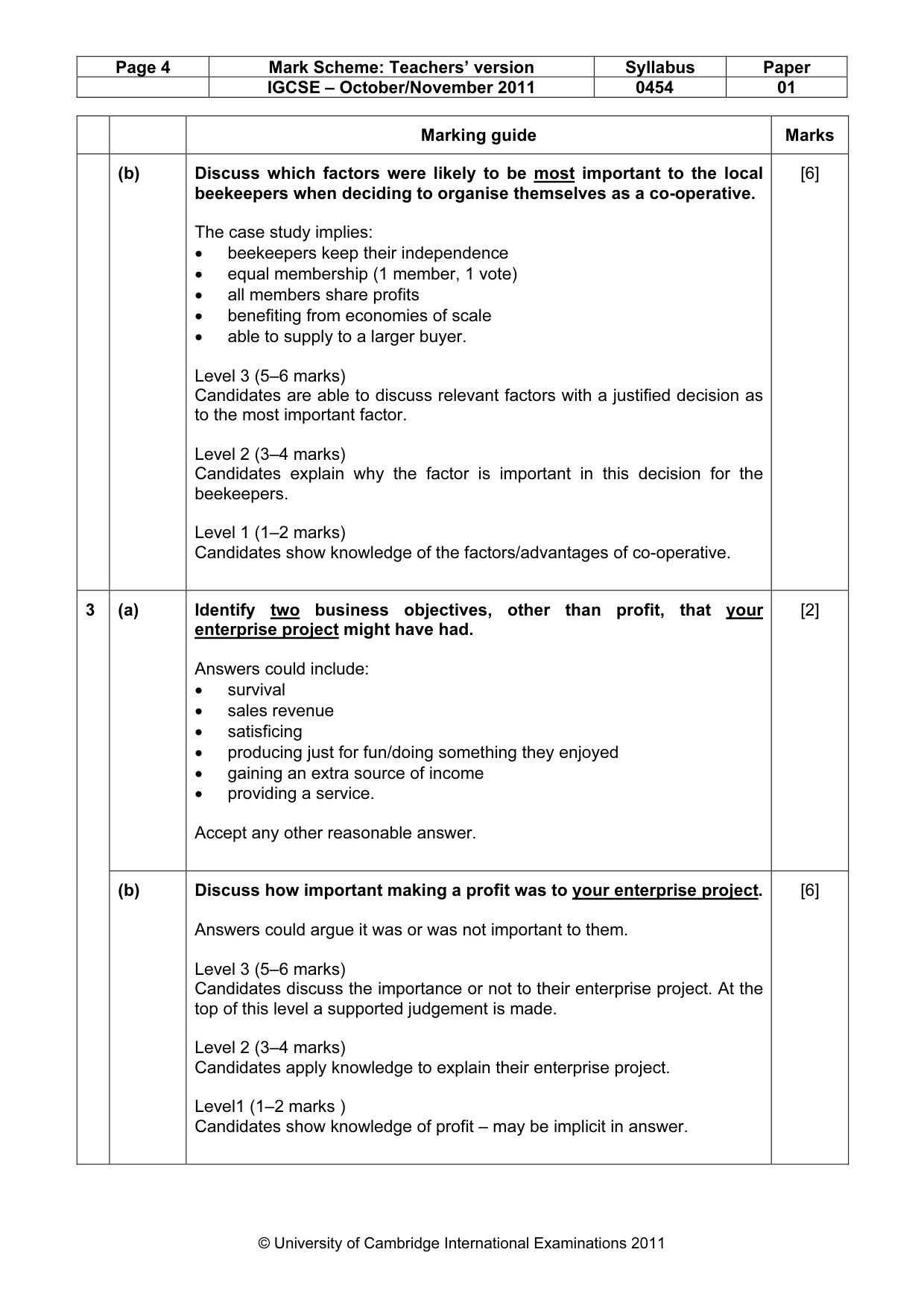
Page 3 Mark Scheme: Teachers’ version Syllabus Paper IGCSE – October/November 2011 0454 01 © University of Cambridge International Examinations 2011 Marking guide Marks (c) State and explain one reason why a government sets laws and regulations affecting an enterprise. Answers could include: • limit production of dangerous/harmful goods • protect the natural environment/location of industry • consumer protection • competition policy • protection of employees – health and safety, discrimination, unfair dismissal etc. 2 marks for a full explanation showing how laws affect enterprise/consumer. 1 mark for a knowledge of laws/regulations. [2] (a) (i) Explain what is meant by a partnership. A group or association of 2 or more people who agree to own and run a business together with unlimited liability (2). Possible points could include: • specialisation • lack of continuity • deed of partnership – legal agreement. Accept 2–20 people or 2+ (for 1 mark) 2 marks clear understanding shown, e.g. 2–20 people come together to form a business. 1 mark for a limited understanding, e.g. people work together. [2] 2 (ii) Explain one disadvantage to an entrepreneur of setting up a partnership. Answers could include: • unlimited liability • disagreements • limited number of partners allowed (depends on country) • dishonesty of one partner could mean the other partner suffers • lack of continuity. Accept loss of control – i.e. transfer from sole trader to partnership reduces control. 2 marks for a full explanation of how the disadvantage affects the partners. 1 mark for identification only. [2]
Mark scheme, page 4
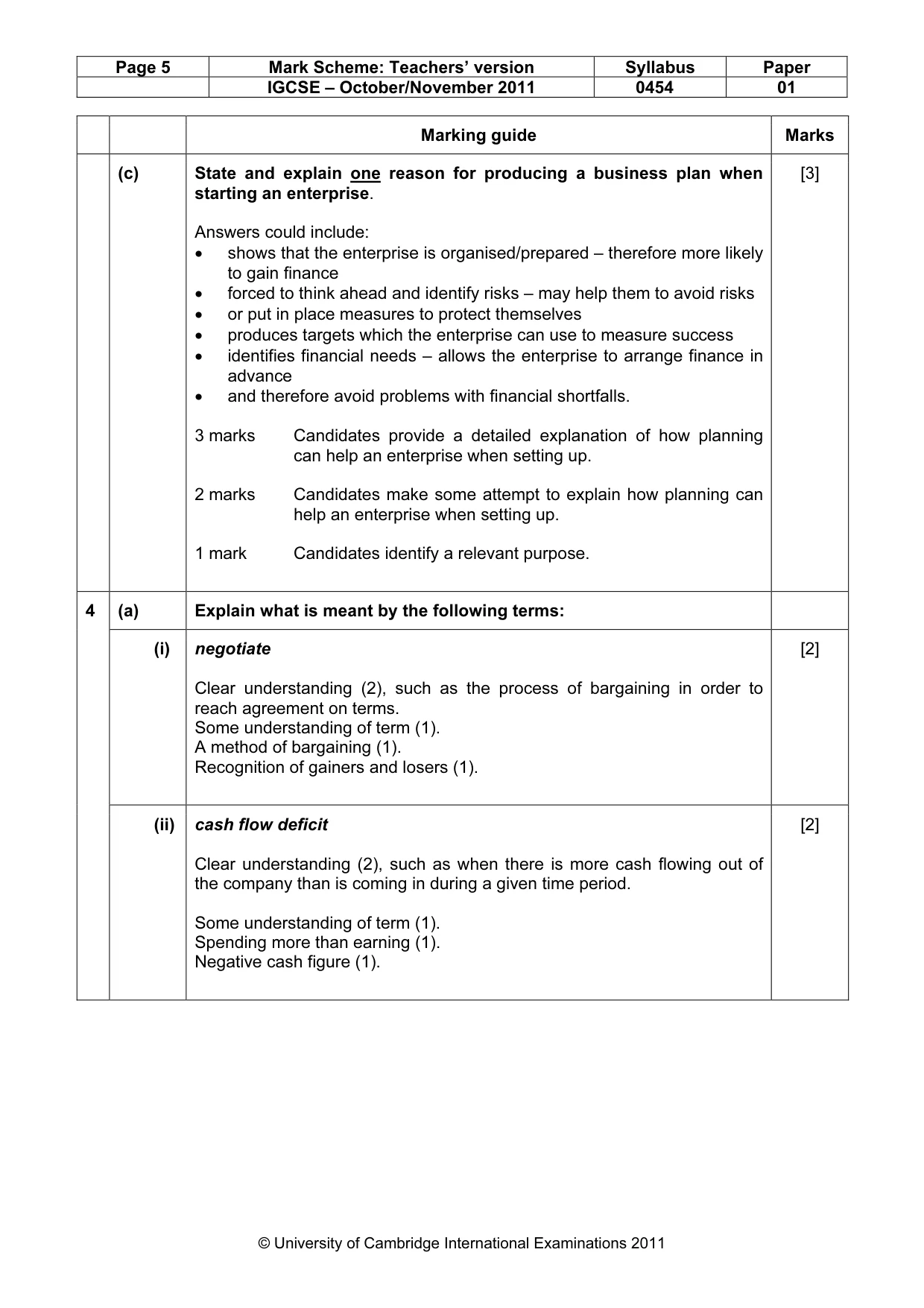
Page 4 Mark Scheme: Teachers’ version Syllabus Paper IGCSE – October/November 2011 0454 01 © University of Cambridge International Examinations 2011 Marking guide Marks (b) Discuss which factors were likely to be most important to the local beekeepers when deciding to organise themselves as a co-operative. The case study implies: • beekeepers keep their independence • equal membership (1 member, 1 vote) • all members share profits • benefiting from economies of scale • able to supply to a larger buyer. Level 3 (5–6 marks) Candidates are able to discuss relevant factors with a justified decision as to the most important factor. Level 2 (3–4 marks) Candidates explain why the factor is important in this decision for the beekeepers. Level 1 (1–2 marks) Candidates show knowledge of the factors/advantages of co-operative. [6] (a) Identify two business objectives, other than profit, that your enterprise project might have had. Answers could include: • survival • sales revenue • satisficing • producing just for fun/doing something they enjoyed • gaining an extra source of income • providing a service. Accept any other reasonable answer. [2] 3 (b) Discuss how important making a profit was to your enterprise project. Answers could argue it was or was not important to them. Level 3 (5–6 marks) Candidates discuss the importance or not to their enterprise project. At the top of this level a supported judgement is made. Level 2 (3–4 marks) Candidates apply knowledge to explain their enterprise project. Level1 (1–2 marks ) Candidates show knowledge of profit – may be implicit in answer. [6]
Mark scheme, page 5
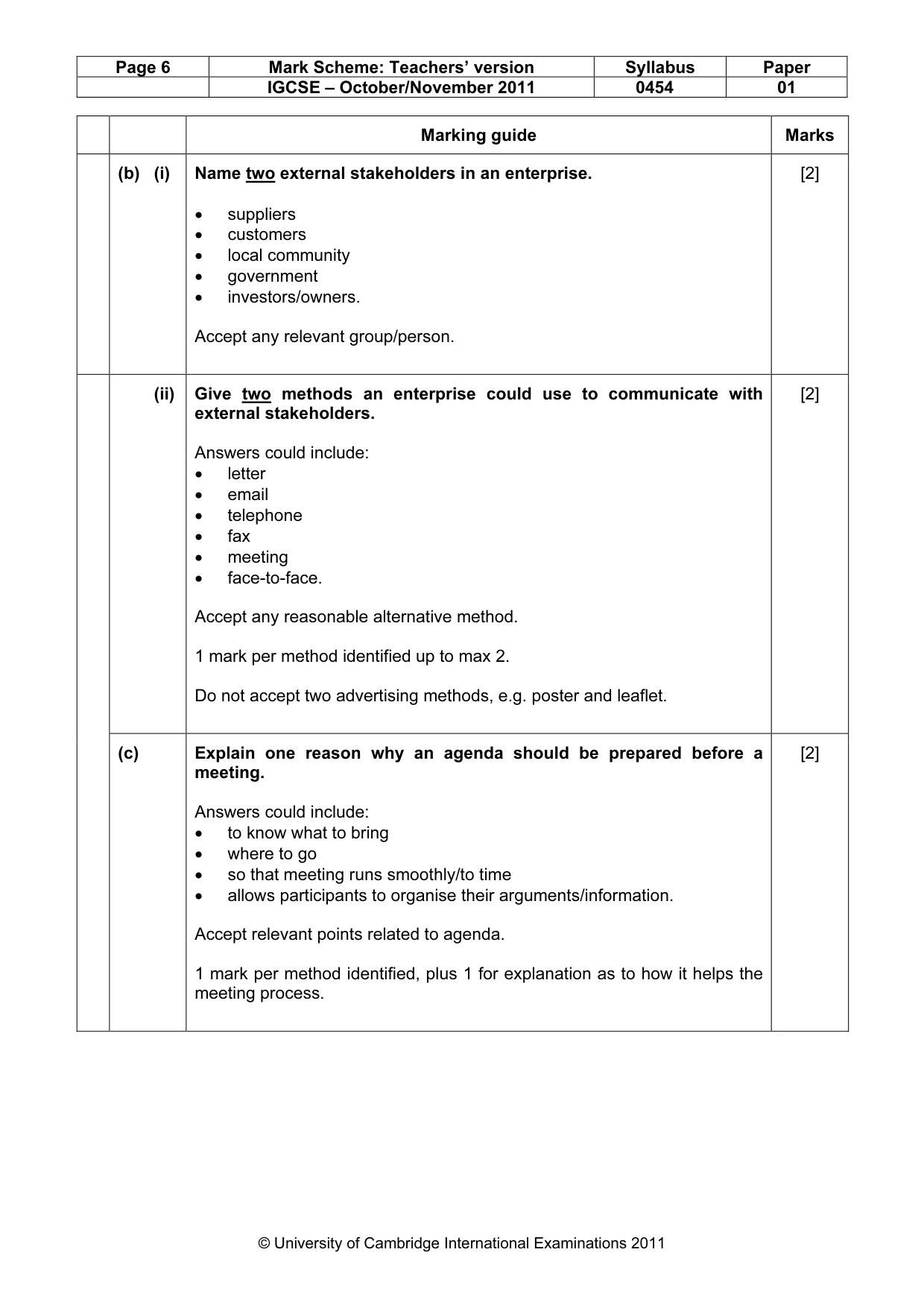
Page 5 Mark Scheme: Teachers’ version Syllabus Paper IGCSE – October/November 2011 0454 01 © University of Cambridge International Examinations 2011 Marking guide Marks (c) State and explain one reason for producing a business plan when starting an enterprise. Answers could include: • shows that the enterprise is organised/prepared – therefore more likely to gain finance • forced to think ahead and identify risks – may help them to avoid risks • or put in place measures to protect themselves • produces targets which the enterprise can use to measure success • identifies financial needs – allows the enterprise to arrange finance in advance • and therefore avoid problems with financial shortfalls. 3 marks Candidates provide a detailed explanation of how planning can help an enterprise when setting up. 2 marks Candidates make some attempt to explain how planning can help an enterprise when setting up. 1 mark Candidates identify a relevant purpose. [3] (a) Explain what is meant by the following terms: (i) negotiate Clear understanding (2), such as the process of bargaining in order to reach agreement on terms. Some understanding of term (1). A method of bargaining (1). Recognition of gainers and losers (1). [2] 4 (ii) cash flow deficit Clear understanding (2), such as when there is more cash flowing out of the company than is coming in during a given time period. Some understanding of term (1). Spending more than earning (1). Negative cash figure (1). [2]
Mark scheme, page 6
Page 6 Mark Scheme: Teachers’ version Syllabus Paper IGCSE – October/November 2011 0454 01 © University of Cambridge International Examinations 2011 Marking guide Marks (b) (i) Name two external stakeholders in an enterprise. • suppliers • customers • local community • government • investors/owners. Accept any relevant group/person. [2] (ii) Give two methods an enterprise could use to communicate with external stakeholders. Answers could include: • letter • email • telephone • fax • meeting • face-to-face. Accept any reasonable alternative method. 1 mark per method identified up to max 2. Do not accept two advertising methods, e.g. poster and leaflet. [2] (c) Explain one reason why an agenda should be prepared before a meeting. Answers could include: • to know what to bring • where to go • so that meeting runs smoothly/to time • allows participants to organise their arguments/information. Accept relevant points related to agenda. 1 mark per method identified, plus 1 for explanation as to how it helps the meeting process. [2]
Mark scheme, page 7
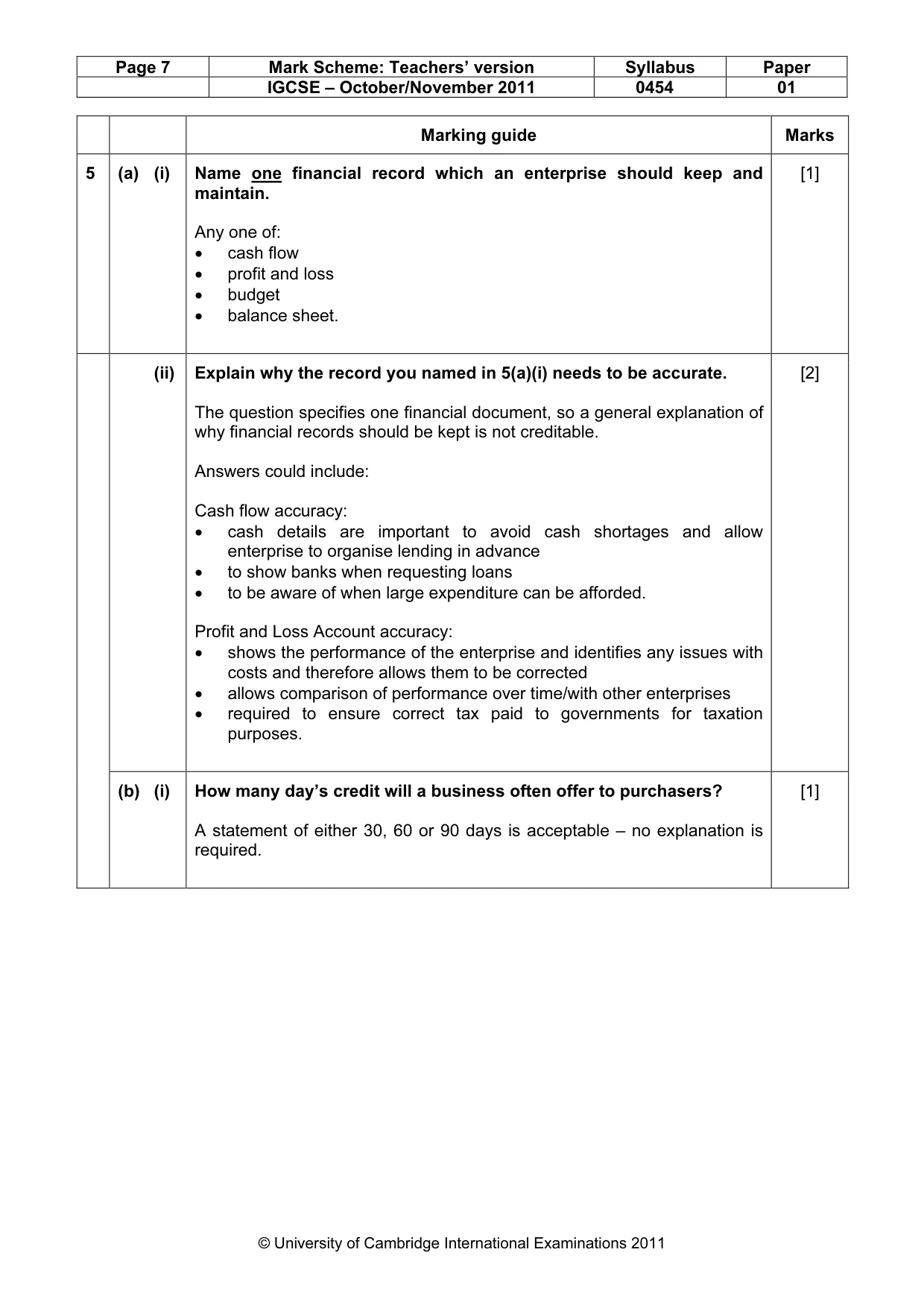
Page 7 Mark Scheme: Teachers’ version Syllabus Paper IGCSE – October/November 2011 0454 01 © University of Cambridge International Examinations 2011 Marking guide Marks 5 (a) (i) Name one financial record which an enterprise should keep and maintain. Any one of: • cash flow • profit and loss • budget • balance sheet. [1] (ii) Explain why the record you named in 5(a)(i) needs to be accurate. The question specifies one financial document, so a general explanation of why financial records should be kept is not creditable. Answers could include: Cash flow accuracy: • cash details are important to avoid cash shortages and allow enterprise to organise lending in advance • to show banks when requesting loans • to be aware of when large expenditure can be afforded. Profit and Loss Account accuracy: • shows the performance of the enterprise and identifies any issues with costs and therefore allows them to be corrected • allows comparison of performance over time/with other enterprises • required to ensure correct tax paid to governments for taxation purposes. [2] (b) (i) How many day’s credit will a business often offer to purchasers? A statement of either 30, 60 or 90 days is acceptable – no explanation is required. [1]
Mark scheme, page 8
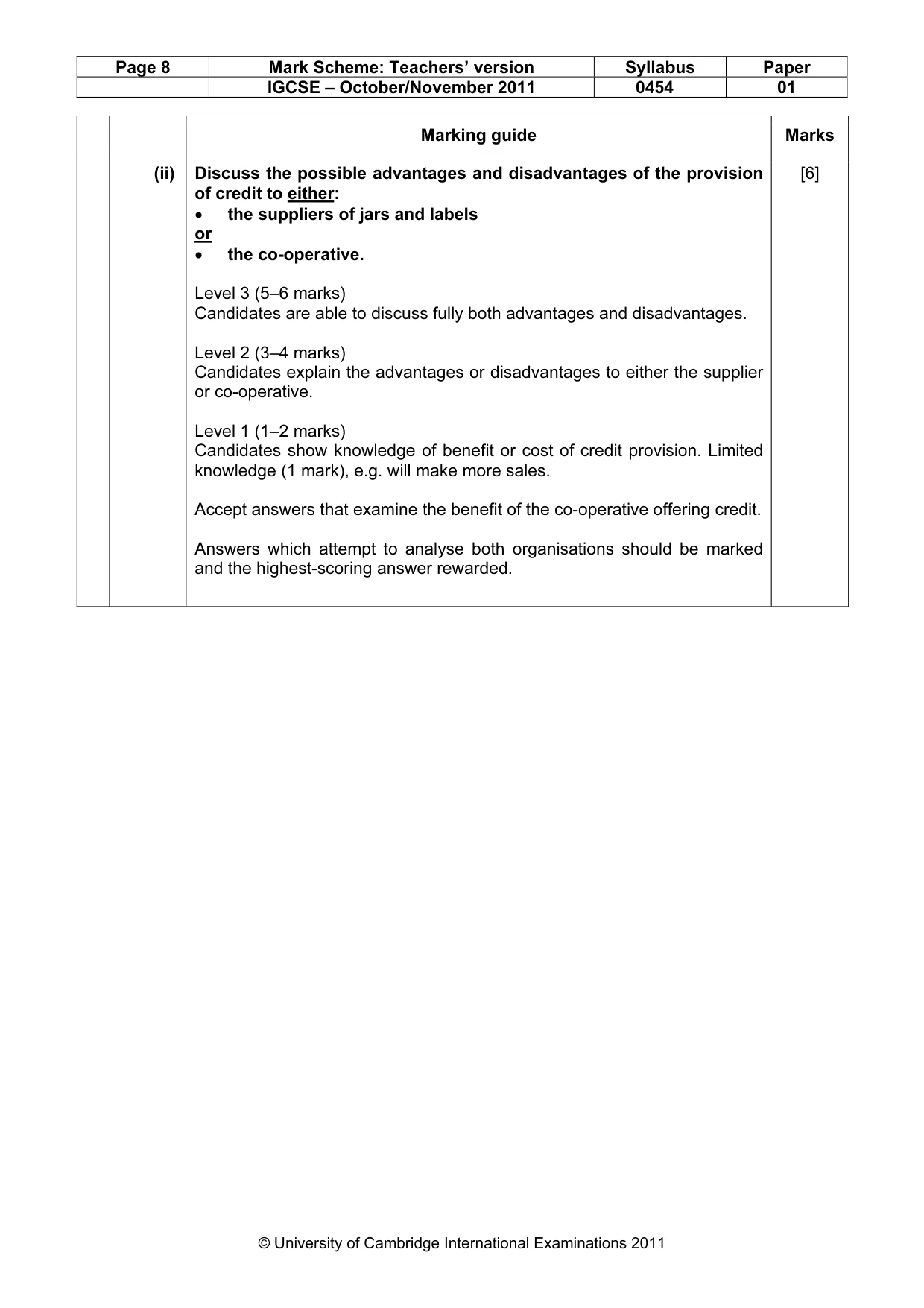
Page 8 Mark Scheme: Teachers’ version Syllabus Paper IGCSE – October/November 2011 0454 01 © University of Cambridge International Examinations 2011 Marking guide Marks (ii) Discuss the possible advantages and disadvantages of the provision of credit to either: • the suppliers of jars and labels or • the co-operative. Level 3 (5–6 marks) Candidates are able to discuss fully both advantages and disadvantages. Level 2 (3–4 marks) Candidates explain the advantages or disadvantages to either the supplier or co-operative. Level 1 (1–2 marks) Candidates show knowledge of benefit or cost of credit provision. Limited knowledge (1 mark), e.g. will make more sales. Accept answers that examine the benefit of the co-operative offering credit. Answers which attempt to analyse both organisations should be marked and the highest-scoring answer rewarded. [6]
Mark scheme, page 9
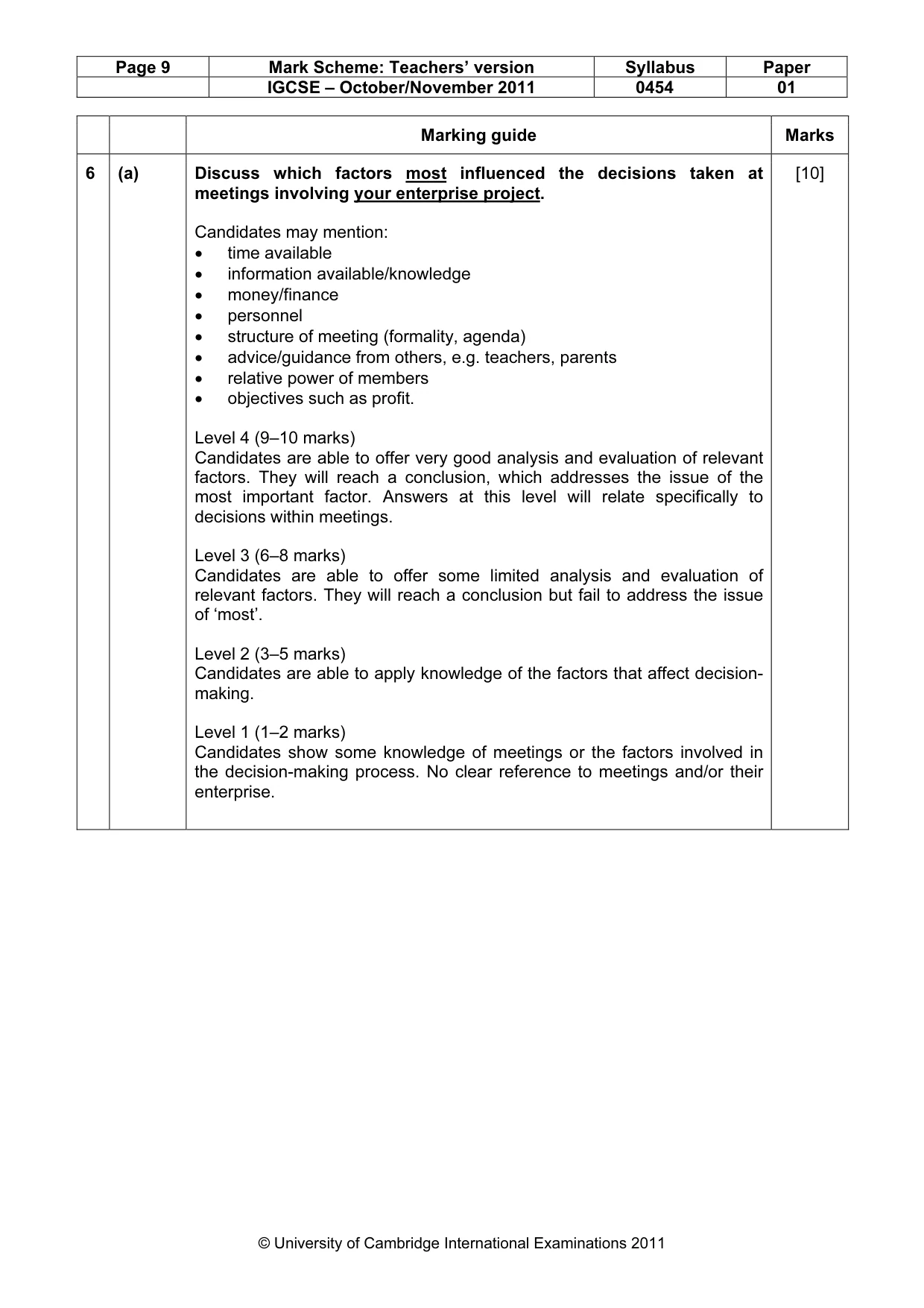
Page 9 Mark Scheme: Teachers’ version Syllabus Paper IGCSE – October/November 2011 0454 01 © University of Cambridge International Examinations 2011 Marking guide Marks 6 (a) Discuss which factors most influenced the decisions taken at meetings involving your enterprise project. Candidates may mention: • time available • information available/knowledge • money/finance • personnel • structure of meeting (formality, agenda) • advice/guidance from others, e.g. teachers, parents • relative power of members • objectives such as profit. Level 4 (9–10 marks) Candidates are able to offer very good analysis and evaluation of relevant factors. They will reach a conclusion, which addresses the issue of the most important factor. Answers at this level will relate specifically to decisions within meetings. Level 3 (6–8 marks) Candidates are able to offer some limited analysis and evaluation of relevant factors. They will reach a conclusion but fail to address the issue of ‘most’. Level 2 (3–5 marks) Candidates are able to apply knowledge of the factors that affect decision- making. Level 1 (1–2 marks) Candidates show some knowledge of meetings or the factors involved in the decision-making process. No clear reference to meetings and/or their enterprise. [10]
Mark scheme, page 10
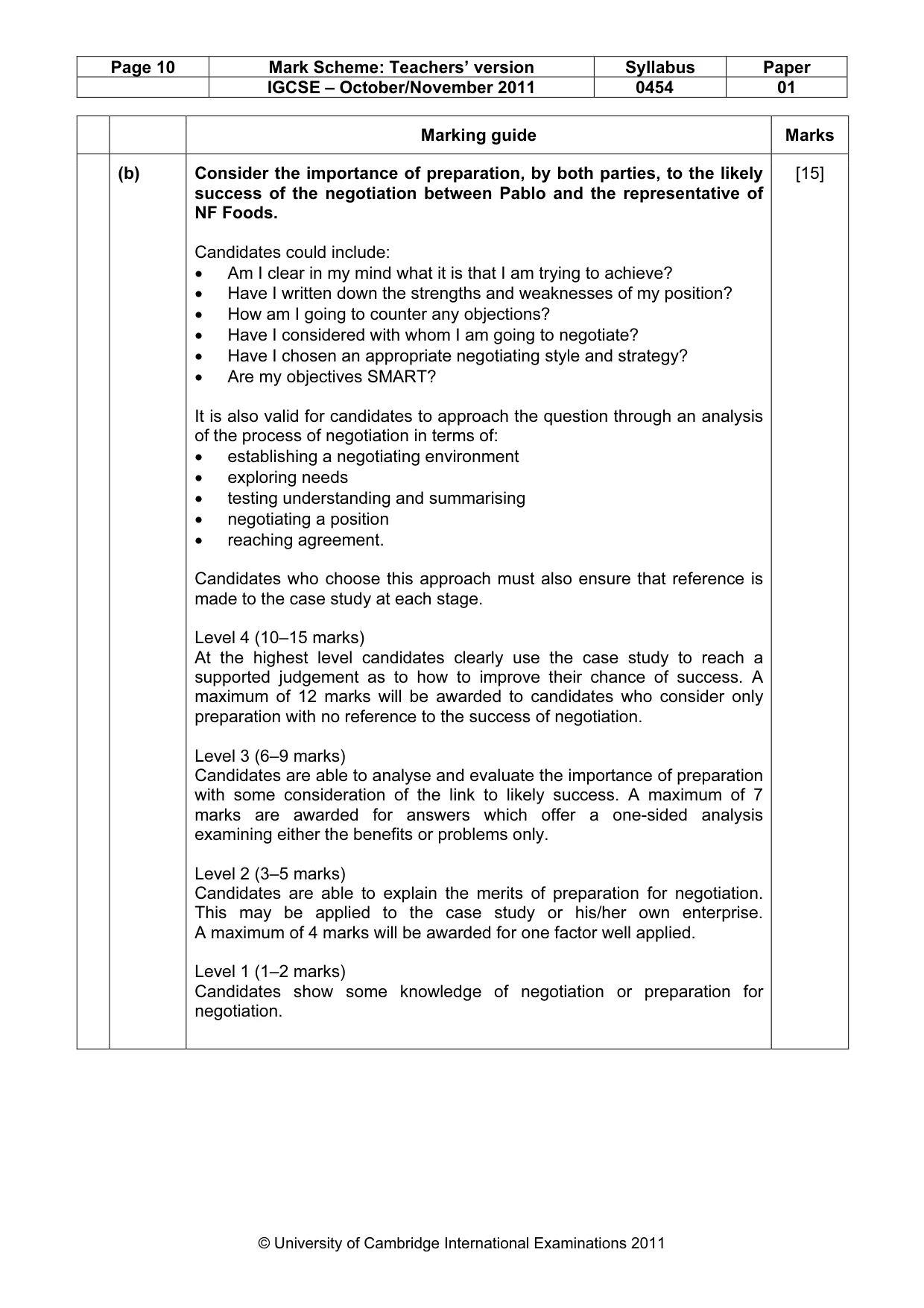
Page 10 Mark Scheme: Teachers’ version Syllabus Paper IGCSE – October/November 2011 0454 01 © University of Cambridge International Examinations 2011 Marking guide Marks (b) Consider the importance of preparation, by both parties, to the likely success of the negotiation between Pablo and the representative of NF Foods. Candidates could include: • Am I clear in my mind what it is that I am trying to achieve? • Have I written down the strengths and weaknesses of my position? • How am I going to counter any objections? • Have I considered with whom I am going to negotiate? • Have I chosen an appropriate negotiating style and strategy? • Are my objectives SMART? It is also valid for candidates to approach the question through an analysis of the process of negotiation in terms of: • establishing a negotiating environment • exploring needs • testing understanding and summarising • negotiating a position • reaching agreement. Candidates who choose this approach must also ensure that reference is made to the case study at each stage. Level 4 (10–15 marks) At the highest level candidates clearly use the case study to reach a supported judgement as to how to improve their chance of success. A maximum of 12 marks will be awarded to candidates who consider only preparation with no reference to the success of negotiation. Level 3 (6–9 marks) Candidates are able to analyse and evaluate the importance of preparation with some consideration of the link to likely success. A maximum of 7 marks are awarded for answers which offer a one-sided analysis examining either the benefits or problems only. Level 2 (3–5 marks) Candidates are able to explain the merits of preparation for negotiation. This may be applied to the case study or his/her own enterprise. A maximum of 4 marks will be awarded for one factor well applied. Level 1 (1–2 marks) Candidates show some knowledge of negotiation or preparation for negotiation. [15]
Mark scheme, page 11
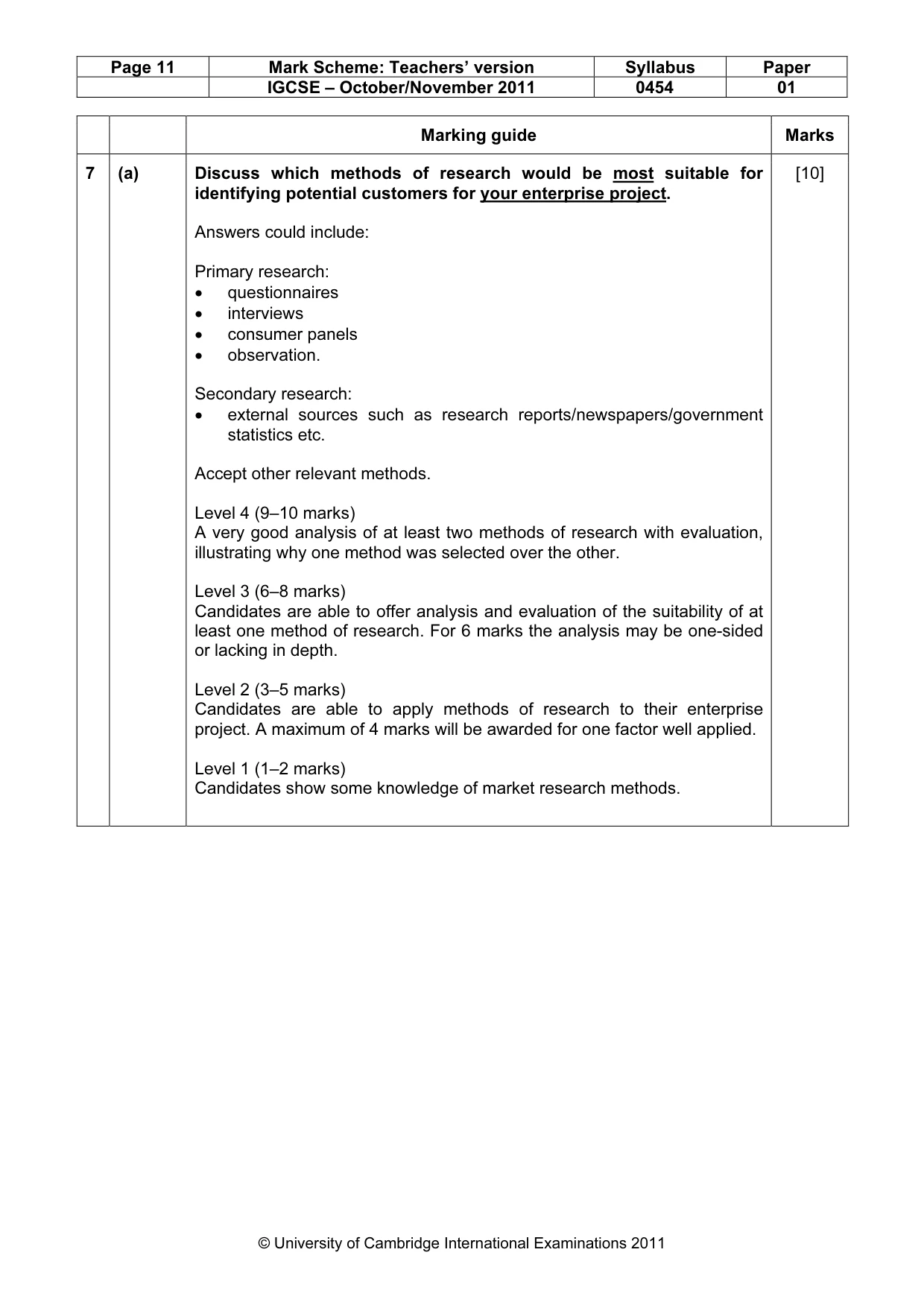
Page 11 Mark Scheme: Teachers’ version Syllabus Paper IGCSE – October/November 2011 0454 01 © University of Cambridge International Examinations 2011 Marking guide Marks 7 (a) Discuss which methods of research would be most suitable for identifying potential customers for your enterprise project. Answers could include: Primary research: • questionnaires • interviews • consumer panels • observation. Secondary research: • external sources such as research reports/newspapers/government statistics etc. Accept other relevant methods. Level 4 (9–10 marks) A very good analysis of at least two methods of research with evaluation, illustrating why one method was selected over the other. Level 3 (6–8 marks) Candidates are able to offer analysis and evaluation of the suitability of at least one method of research. For 6 marks the analysis may be one-sided or lacking in depth. Level 2 (3–5 marks) Candidates are able to apply methods of research to their enterprise project. A maximum of 4 marks will be awarded for one factor well applied. Level 1 (1–2 marks) Candidates show some knowledge of market research methods. [10]
Mark scheme, page 12
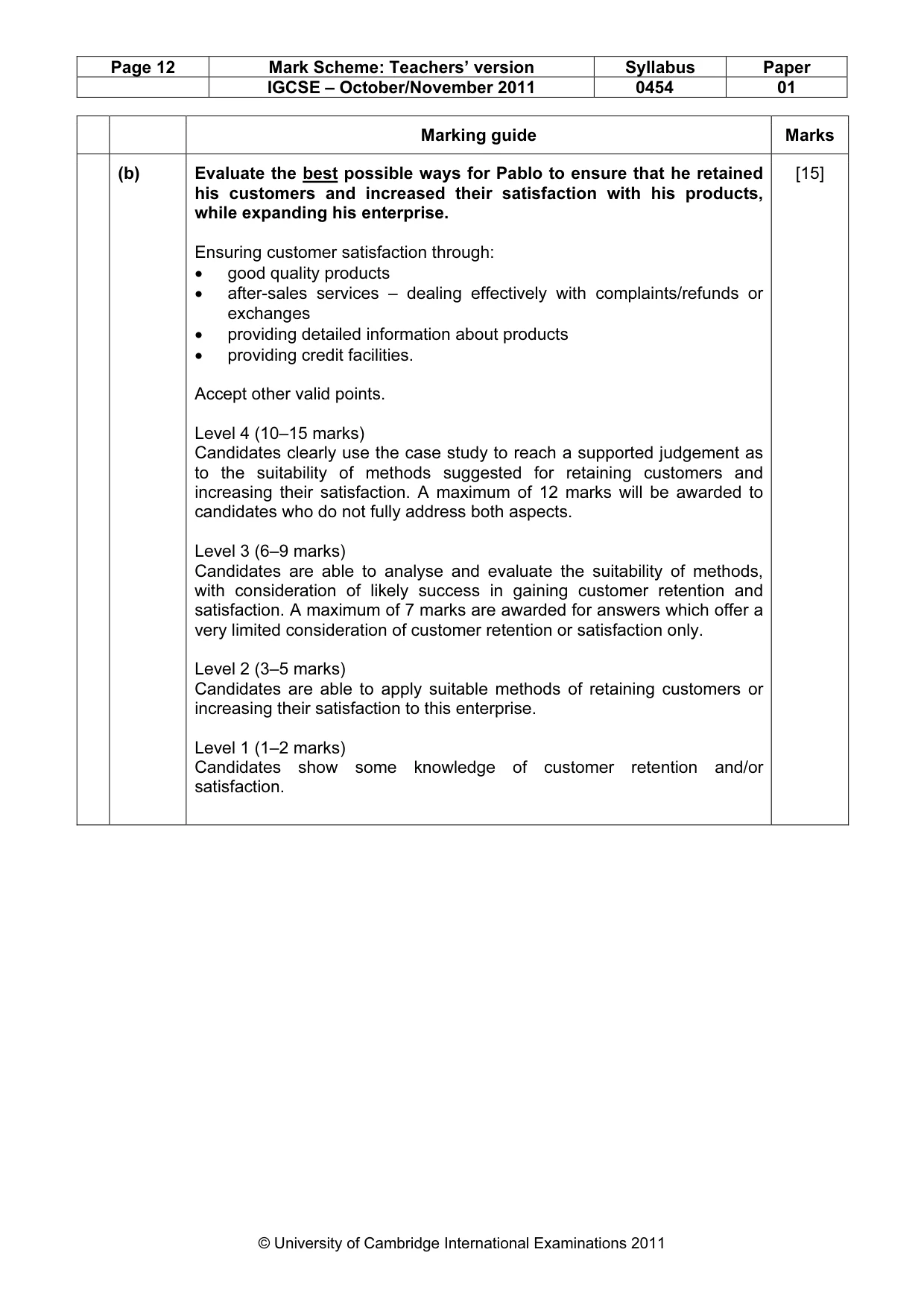
Page 12 Mark Scheme: Teachers’ version Syllabus Paper IGCSE – October/November 2011 0454 01 © University of Cambridge International Examinations 2011 Marking guide Marks (b) Evaluate the best possible ways for Pablo to ensure that he retained his customers and increased their satisfaction with his products, while expanding his enterprise. Ensuring customer satisfaction through: • good quality products • after-sales services – dealing effectively with complaints/refunds or exchanges • providing detailed information about products • providing credit facilities. Accept other valid points. Level 4 (10–15 marks) Candidates clearly use the case study to reach a supported judgement as to the suitability of methods suggested for retaining customers and increasing their satisfaction. A maximum of 12 marks will be awarded to candidates who do not fully address both aspects. Level 3 (6–9 marks) Candidates are able to analyse and evaluate the suitability of methods, with consideration of likely success in gaining customer retention and satisfaction. A maximum of 7 marks are awarded for answers which offer a very limited consideration of customer retention or satisfaction only. Level 2 (3–5 marks) Candidates are able to apply suitable methods of retaining customers or increasing their satisfaction to this enterprise. Level 1 (1–2 marks) Candidates show some knowledge of customer retention and/or satisfaction. [15]
What you needed in this session
Cambridge’s own grade thresholds for 2011 Oct/Nov, Paper 1 · Variant 1. A higher threshold means an easier paper — the bar moves with how the cohort did.