Cambridge IGCSE Enterprise 0454 — 2011 May/June Paper 1 · Variant 1
0454/11/M/J/11 · 100 marks · ≈113 min
The question paper and its mark scheme, free to read here and free to download. This is Cambridge’s own paper, exactly as it was sat.
Question paper12 pages
Mark scheme10 pages
Answers below. Sit the paper first if you are practising.
Paper as text
Question paper, page 1
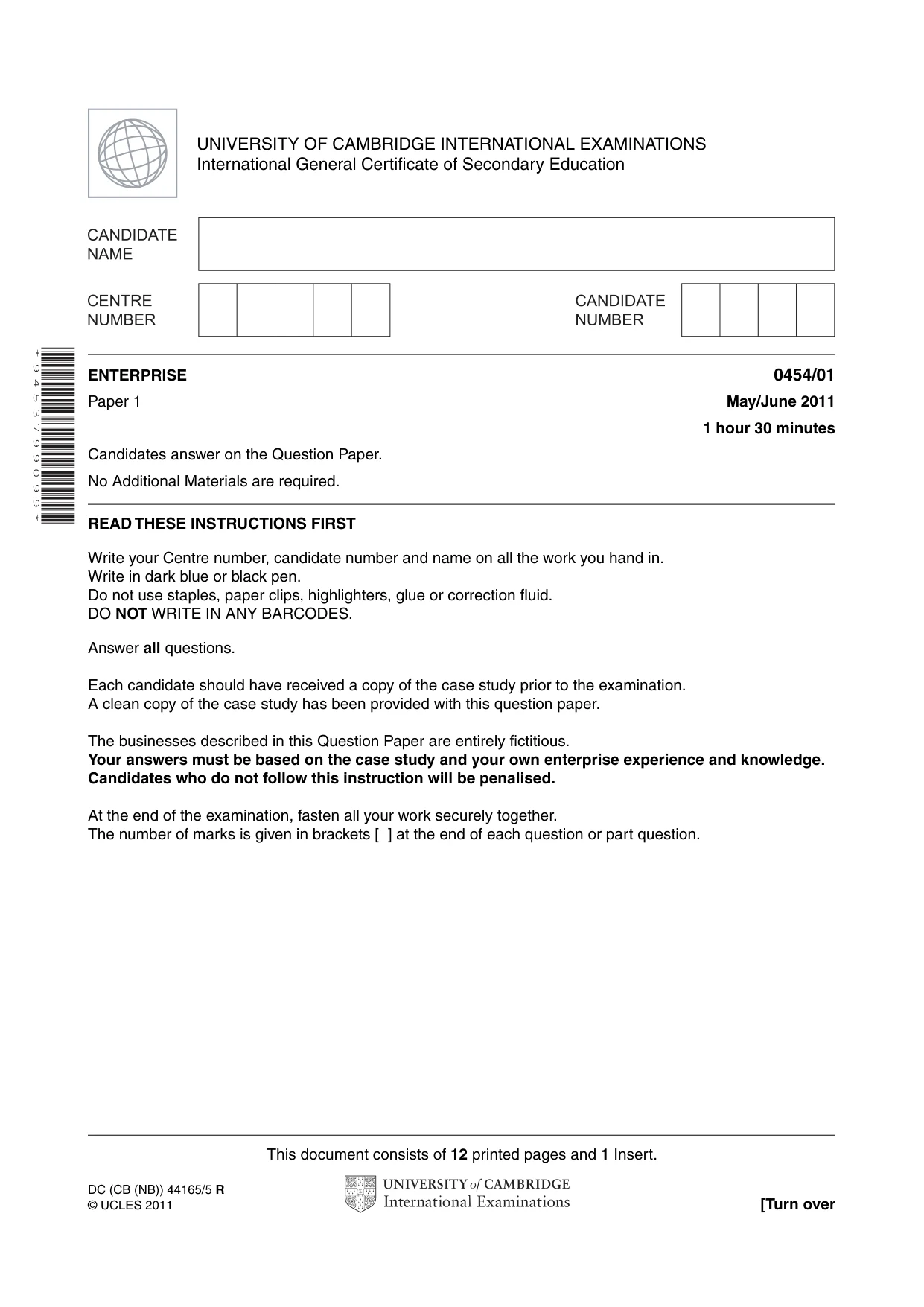
This document consists of 12 printed pages and 1 Insert. DC (CB (NB)) 44165/5 R © UCLES 2011 [Turn over UNIVERSITY OF CAMBRIDGE INTERNATIONAL EXAMINATIONS International General Certificate of Secondary Education * 9 4 5 3 7 9 9 0 9 9 * ENTERPRISE 0454/01 Paper 1 May/June 2011 1 hour 30 minutes Candidates answer on the Question Paper. No Additional Materials are required. READ THESE INSTRUCTIONS FIRST Write your Centre number, candidate number and name on all the work you hand in. Write in dark blue or black pen. Do not use staples, paper clips, highlighters, glue or correction fluid. DO NOT WRITE IN ANY BARCODES. Answer all questions. Each candidate should have received a copy of the case study prior to the examination. A clean copy of the case study has been provided with this question paper. The businesses described in this Question Paper are entirely fictitious. Your answers must be based on the case study and your own enterprise experience and knowledge. Candidates who do not follow this instruction will be penalised. At the end of the examination, fasten all your work securely together. The number of marks is given in brackets [ ] at the end of each question or part question.
Question paper, page 2
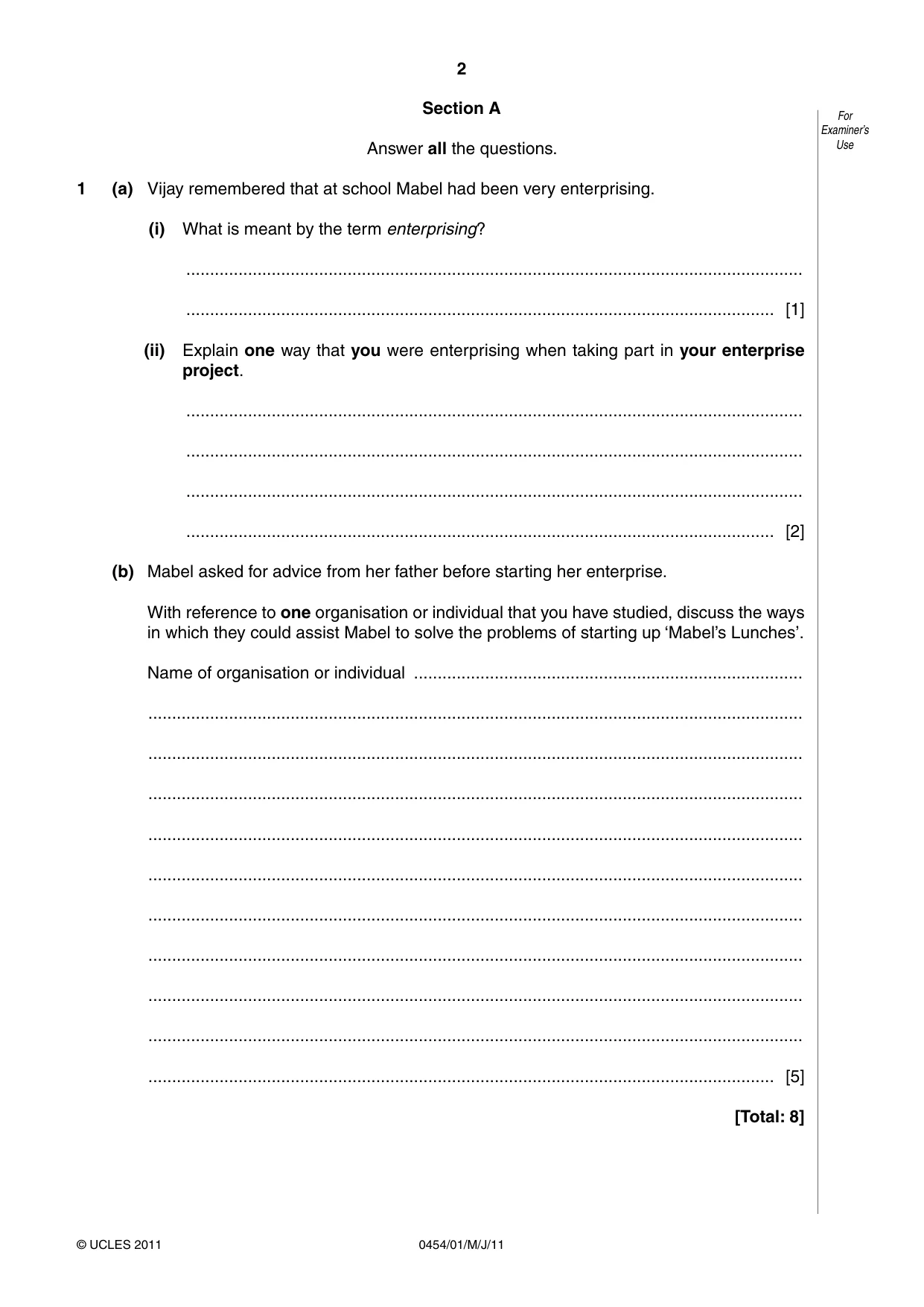
2 0454/01/M/J/11 © UCLES 2011 For Examiner’s Use Section A Answer all the questions. 1 (a) Vijay remembered that at school Mabel had been very enterprising. (i) What is meant by the term enterprising? … … [1] (ii) Explain one way that you were enterprising when taking part in your enterprise project. … … … … [2] (b) Mabel asked for advice from her father before starting her enterprise. With reference to one organisation or individual that you have studied, discuss the ways in which they could assist Mabel to solve the problems of starting up ‘Mabel’s Lunches’. Name of organisation or individual … … … … … … … … … … … [5] [Total: 8]
Question paper, page 3
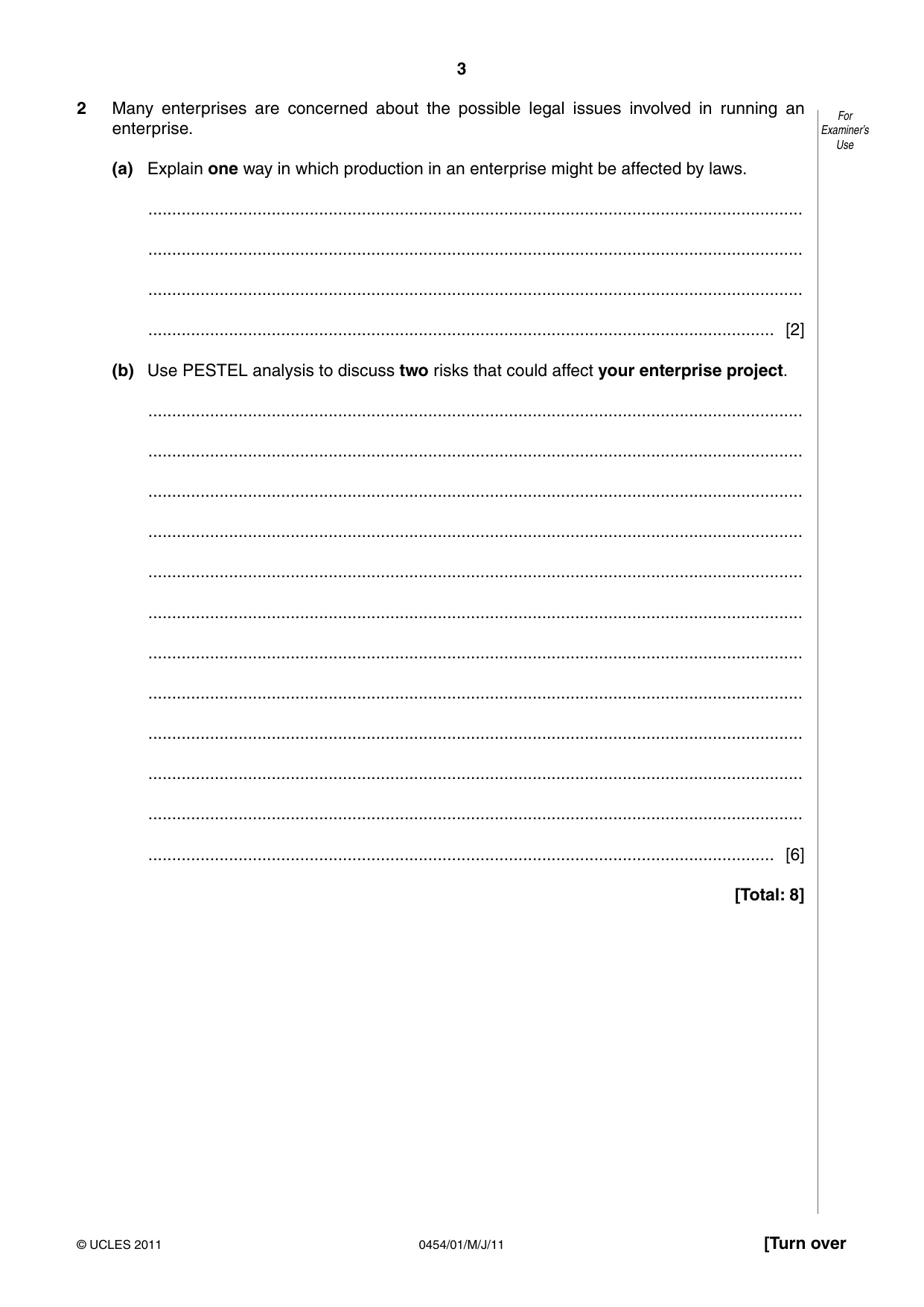
3 0454/01/M/J/11 © UCLES 2011 [Turn over For Examiner’s Use 2 Many enterprises are concerned about the possible legal issues involved in running an enterprise. (a) Explain one way in which production in an enterprise might be affected by laws. … … … … [2] (b) Use PESTEL analysis to discuss two risks that could affect your enterprise project. … … … … … … … … … … … … [6] [Total: 8]
Question paper, page 4
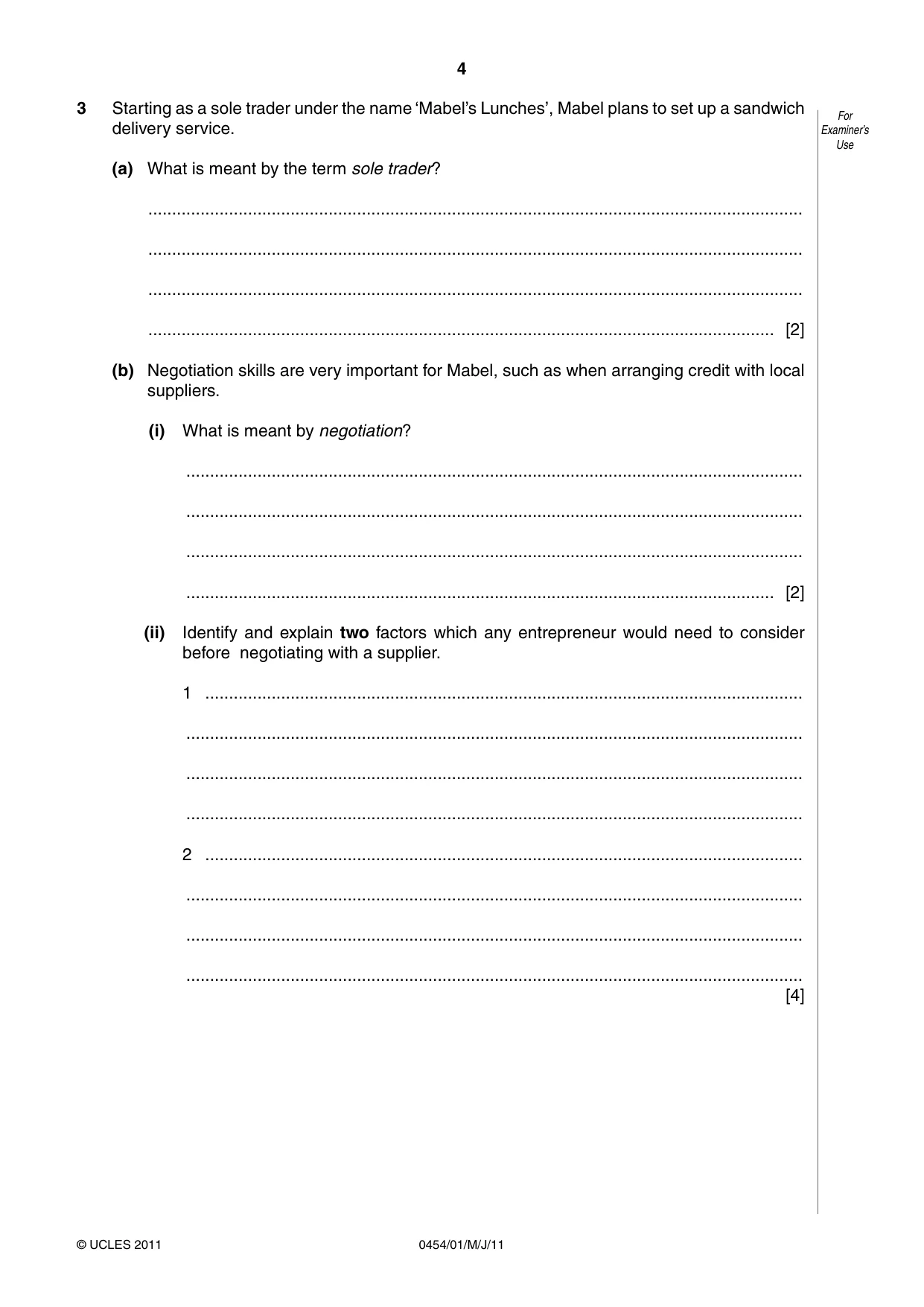
4 0454/01/M/J/11 © UCLES 2011 For Examiner’s Use 3 Starting as a sole trader under the name ‘Mabel’s Lunches’, Mabel plans to set up a sandwich delivery service. (a) What is meant by the term sole trader? … … … … [2] (b) Negotiation skills are very important for Mabel, such as when arranging credit with local suppliers. (i) What is meant by negotiation? … … … … [2] (ii) Identify and explain two factors which any entrepreneur would need to consider before negotiating with a supplier. 1 … … … … 2 … … … … [4]
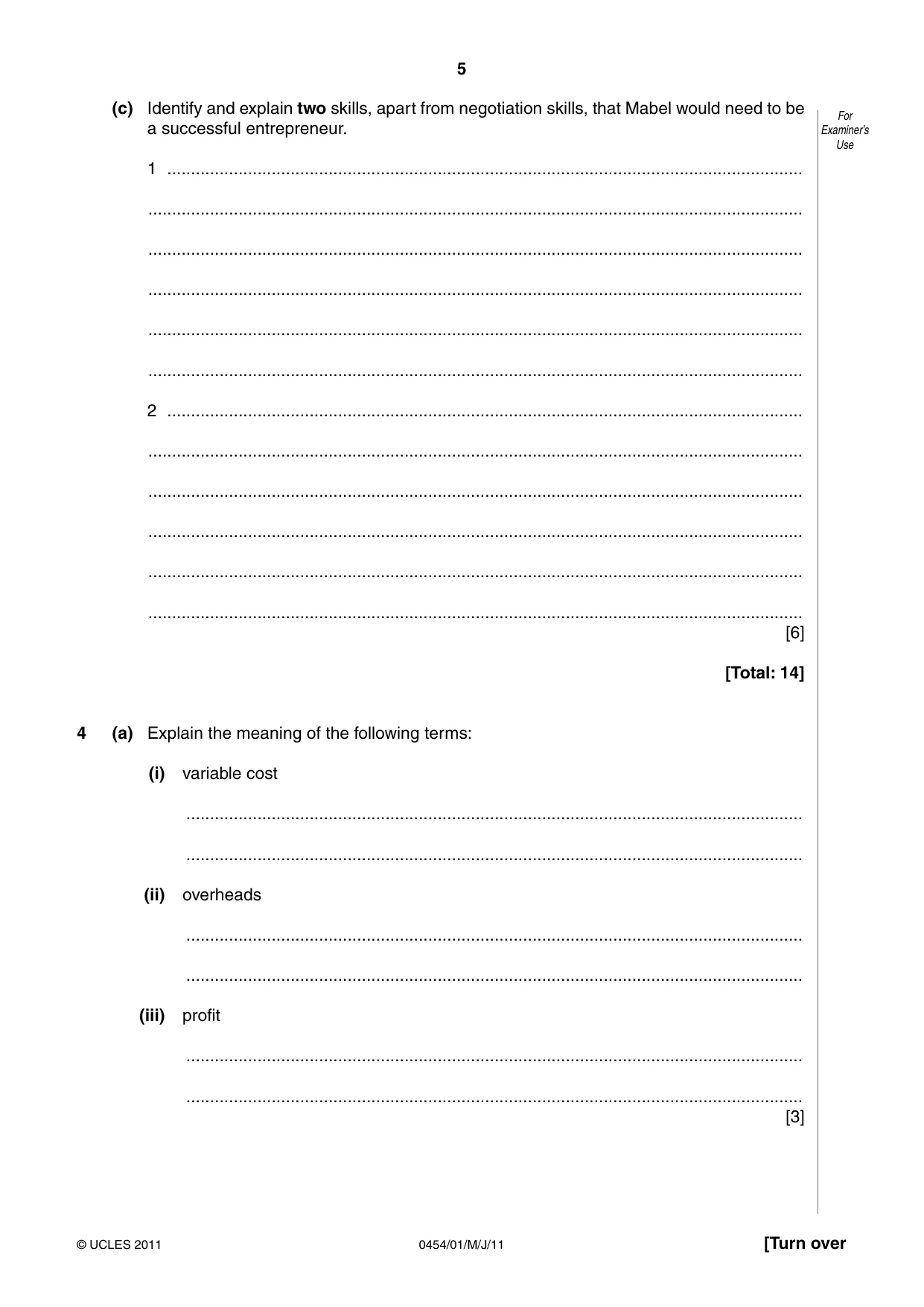
Question paper, page 5
5 0454/01/M/J/11 © UCLES 2011 [Turn over For Examiner’s Use (c) Identify and explain two skills, apart from negotiation skills, that Mabel would need to be a successful entrepreneur. 1 … … … … … … 2 … … … … … … [6] [Total: 14] 4 (a) Explain the meaning of the following terms: (i) variable cost … … (ii) overheads … … (iii) profit … … [3]
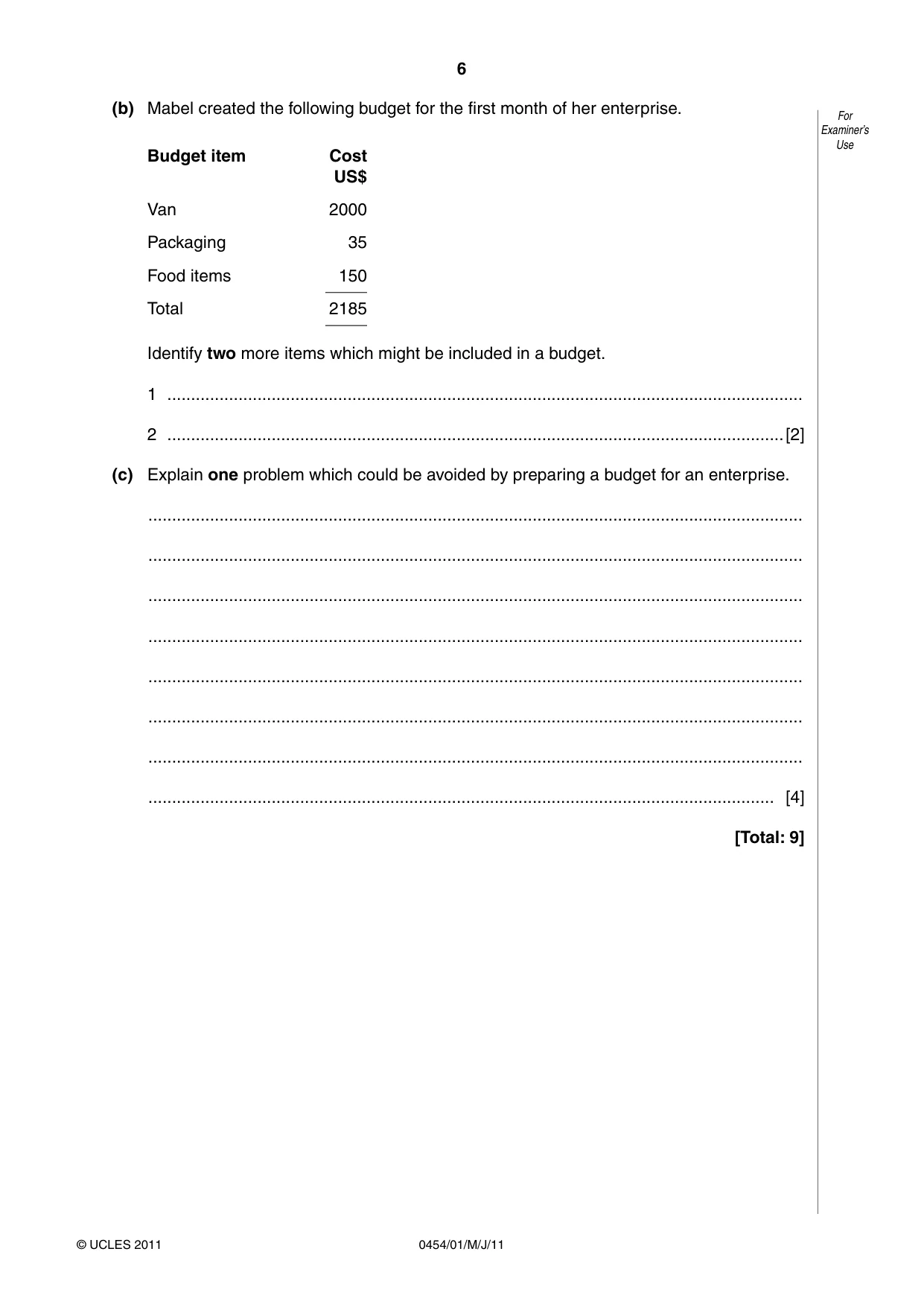
Question paper, page 6
6 0454/01/M/J/11 © UCLES 2011 For Examiner’s Use (b) Mabel created the following budget for the first month of her enterprise. Budget item Cost US$ Van 2000 Packaging 35 Food items 150 Total 2185 Identify two more items which might be included in a budget. 1 … 2 …[2] (c) Explain one problem which could be avoided by preparing a budget for an enterprise. … … … … … … … … [4] [Total: 9]
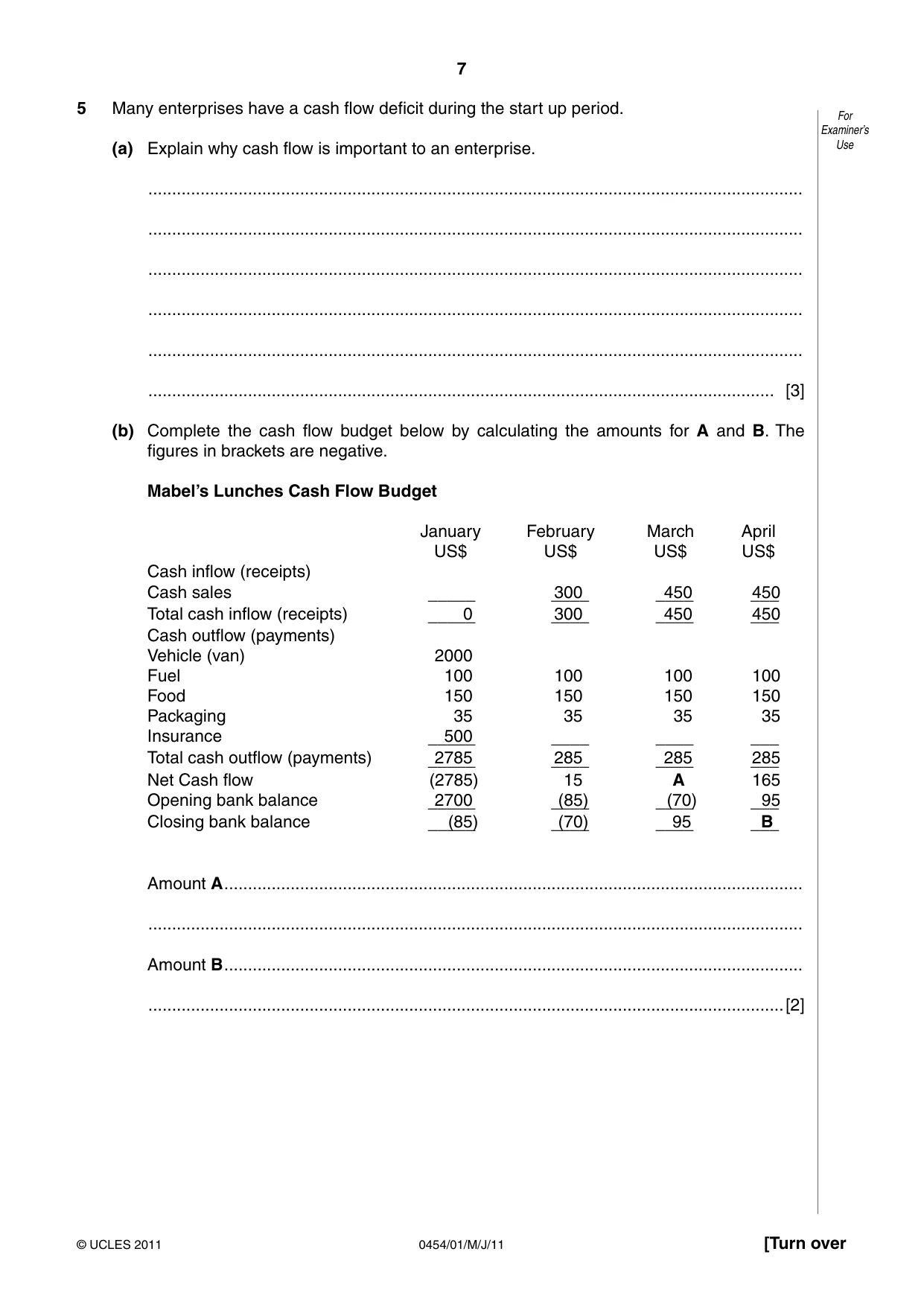
Question paper, page 7
7 0454/01/M/J/11 © UCLES 2011 [Turn over For Examiner’s Use 5 Many enterprises have a cash flow deficit during the start up period. (a) Explain why cash flow is important to an enterprise. … … … … … … [3] (b) Complete the cash flow budget below by calculating the amounts for A and B. The figures in brackets are negative. Mabel’s Lunches Cash Flow Budget January February March April US$ US$ US$ US$ Cash inflow (receipts) Cash sales 300 450 450 _____ ____ ____ ___ Total cash inflow (receipts) 0 300 450 450 _____ ____ ____ ___ Cash outflow (payments) Vehicle (van) 2000 Fuel 100 100 100 100 Food 150 150 150 150 Packaging 35 35 35 35 Insurance 500 _____ ____ ____ ___ Total cash outflow (payments) 2785 285 285 285 _____ ____ ____ ___ Net Cash flow (2785) 15 A 165 Opening bank balance 2700 (85) (70) 95 _____ ____ ____ ___ Closing bank balance (85) (70) 95 B _____ ____ ____ ___ Amount A … … Amount B … …[2]
Question paper, page 8
8 0454/01/M/J/11 © UCLES 2011 For Examiner’s Use (c) With reference to your enterprise project, explain the methods you used to try to avoid a cash flow deficit. … … … … … … … … … … … … [6] [Total: 11]
Question paper, page 9
9 0454/01/M/J/11 © UCLES 2011 [Turn over For Examiner’s Use Section B Answer all the questions. Use the case study, your own enterprise experience and your knowledge of business to answer question 6(a). 6 (a) Evaluate how the setting of business objectives would affect how your enterprise project operated. … … … … … … … … … … … … … … … … … … … … … … …[10]
Question paper, page 10
10 0454/01/M/J/11 © UCLES 2011 For Examiner’s Use Use the case study, your own enterprise experience and your knowledge of business to answer question 6(b). 6 (b) Discuss how business planning would enable Mabel to ensure the successful start up and long term growth of her enterprise. … … … … … … … … … … … … … … … … … … … … … … … … … … [15]
Question paper, page 11
11 0454/01/M/J/11 © UCLES 2011 [Turn over For Examiner’s Use Use the case study, your own enterprise experience and your knowledge of business to answer question 7(a). 7 (a) Evaluate the different methods of communication Mabel could have used to arrange credit with local suppliers. … … … … … … … … … … … … … … … … … … … … … … … … … … [10]
Question paper, page 12
12 0454/01/M/J/11 © UCLES 2011 For Examiner’s Use Use the case study, your own enterprise experience and your knowledge of business to answer question 7(b). 7 (b) When starting up, Mabel gave out leaflets to local businesses. She calculated the risks and responsibilities of attracting more customers. Discuss how Mabel could use marketing communication methods to attract more customers. … … … … … … … … … … … … … … … … … … … … … … [15] Permission to reproduce items where third-party owned material protected by copyright is included has been sought and cleared where possible. Every reasonable effort has been made by the publisher (UCLES) to trace copyright holders, but if any items requiring clearance have unwittingly been included, the publisher will be pleased to make amends at the earliest possible opportunity. University of Cambridge International Examinations is part of the Cambridge Assessment Group. Cambridge Assessment is the brand name of University of Cambridge Local Examinations Syndicate (UCLES), which is itself a department of the University of Cambridge.
Mark scheme, page 1
UNIVERSITY OF CAMBRIDGE INTERNATIONAL EXAMINATIONS International General Certificate of Secondary Education MARK SCHEME for the May/June 2011 question paper for the guidance of teachers 0454 ENTERPRISE 0454/01 Paper 1 (Case Study), maximum raw mark 100 This mark scheme is published as an aid to teachers and candidates, to indicate the requirements of the examination. It shows the basis on which Examiners were instructed to award marks. It does not indicate the details of the discussions that took place at an Examiners’ meeting before marking began, which would have considered the acceptability of alternative answers. Mark schemes must be read in conjunction with the question papers and the report on the examination. • Cambridge will not enter into discussions or correspondence in connection with these mark schemes. Cambridge is publishing the mark schemes for the May/June 2011 question papers for most IGCSE, GCE Advanced Level and Advanced Subsidiary Level syllabuses and some Ordinary Level syllabuses.
Mark scheme, page 2
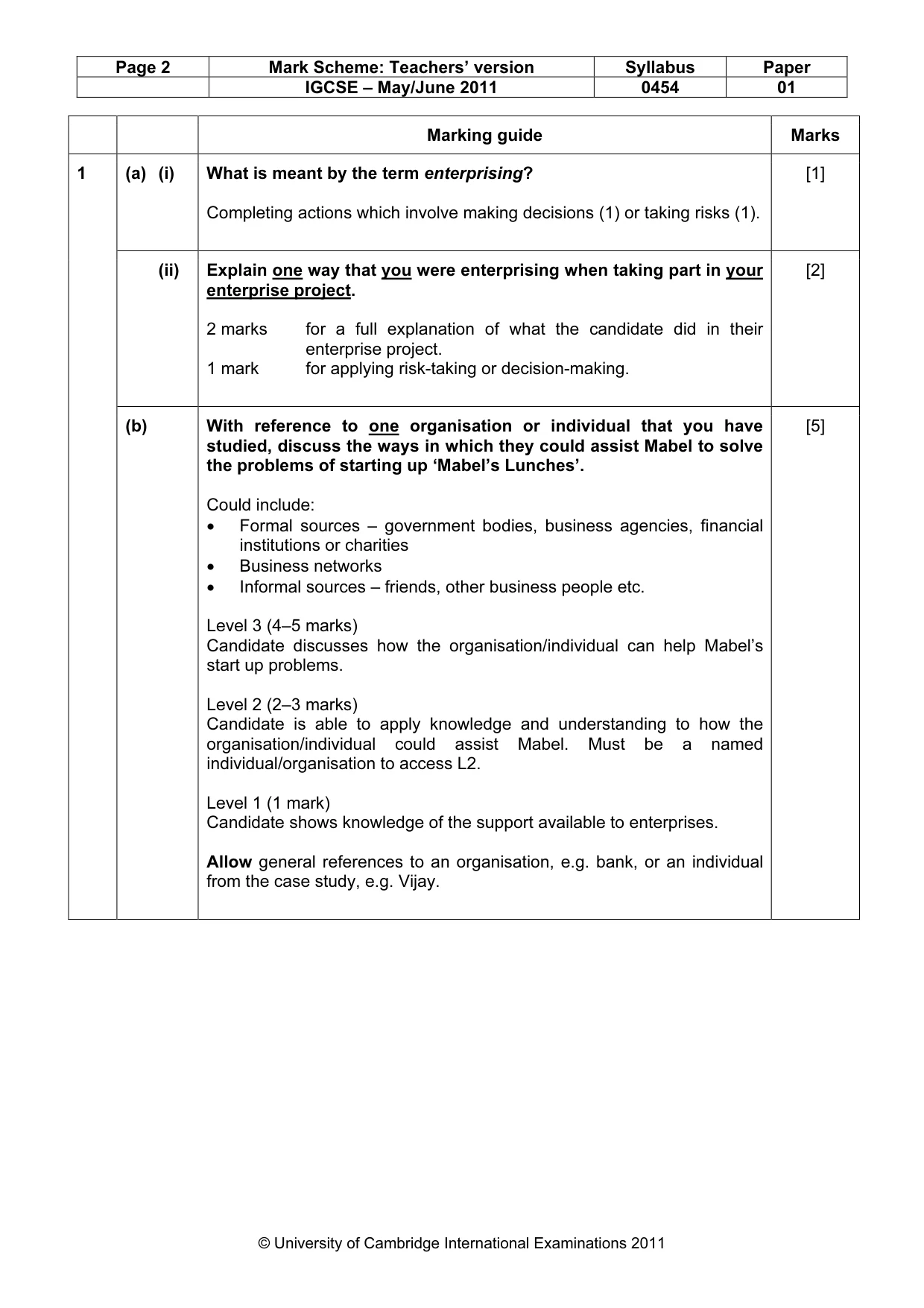
Page 2 Mark Scheme: Teachers’ version Syllabus Paper IGCSE – May/June 2011 0454 01 © University of Cambridge International Examinations 2011 Marking guide Marks (a) (i) What is meant by the term enterprising? Completing actions which involve making decisions (1) or taking risks (1). [1] (ii) Explain one way that you were enterprising when taking part in your enterprise project. 2 marks for a full explanation of what the candidate did in their enterprise project. 1 mark for applying risk-taking or decision-making. [2] 1 (b) With reference to one organisation or individual that you have studied, discuss the ways in which they could assist Mabel to solve the problems of starting up ‘Mabel’s Lunches’. Could include: • Formal sources – government bodies, business agencies, financial institutions or charities • Business networks • Informal sources – friends, other business people etc. Level 3 (4–5 marks) Candidate discusses how the organisation/individual can help Mabel’s start up problems. Level 2 (2–3 marks) Candidate is able to apply knowledge and understanding to how the organisation/individual could assist Mabel. Must be a named individual/organisation to access L2. Level 1 (1 mark) Candidate shows knowledge of the support available to enterprises. Allow general references to an organisation, e.g. bank, or an individual from the case study, e.g. Vijay. [5]
Mark scheme, page 3
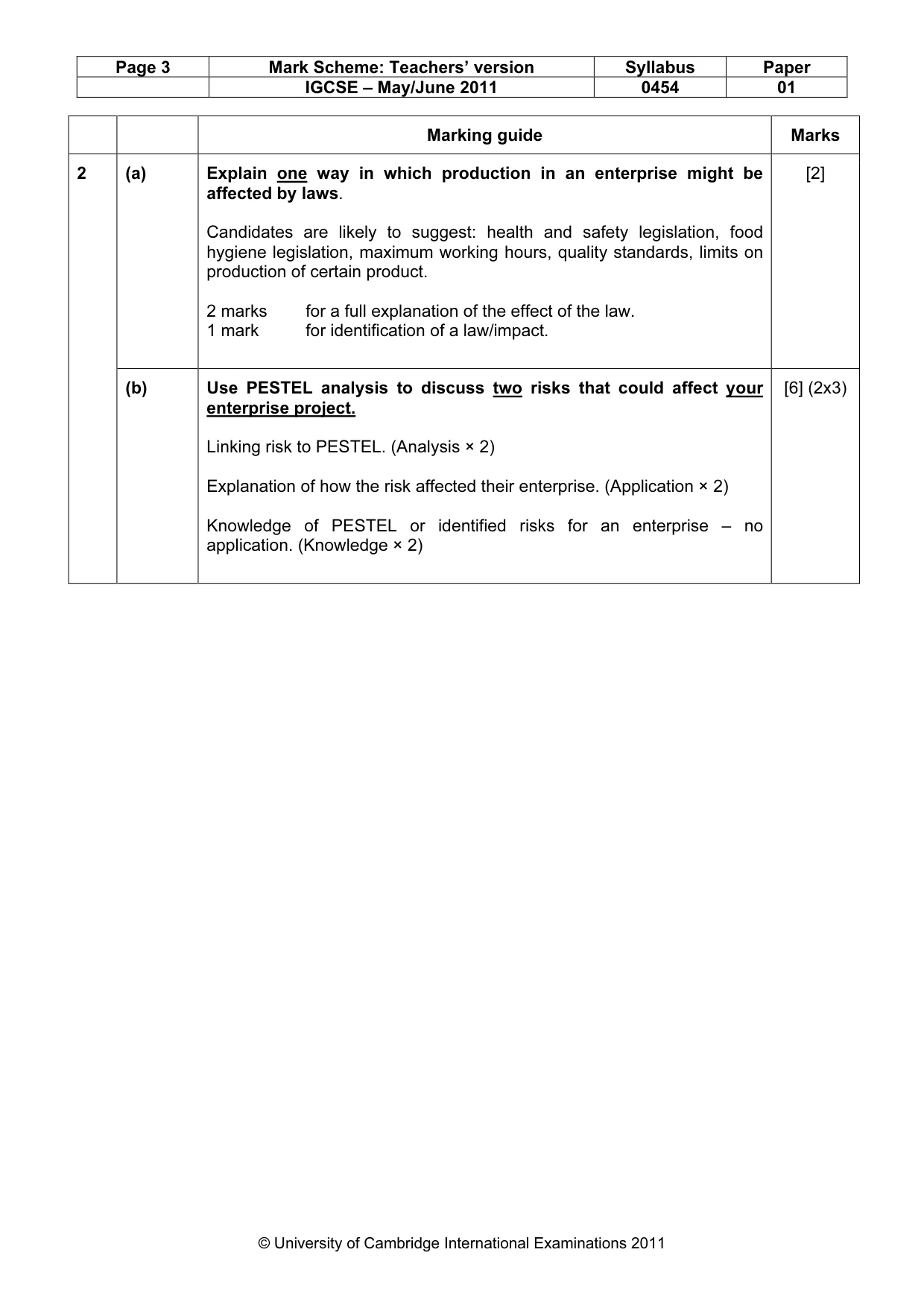
Page 3 Mark Scheme: Teachers’ version Syllabus Paper IGCSE – May/June 2011 0454 01 © University of Cambridge International Examinations 2011 Marking guide Marks (a) Explain one way in which production in an enterprise might be affected by laws. Candidates are likely to suggest: health and safety legislation, food hygiene legislation, maximum working hours, quality standards, limits on production of certain product. 2 marks for a full explanation of the effect of the law. 1 mark for identification of a law/impact. [2] 2 (b) Use PESTEL analysis to discuss two risks that could affect your enterprise project. Linking risk to PESTEL. (Analysis × 2) Explanation of how the risk affected their enterprise. (Application × 2) Knowledge of PESTEL or identified risks for an enterprise – no application. (Knowledge × 2) [6] (2x3)
Mark scheme, page 4
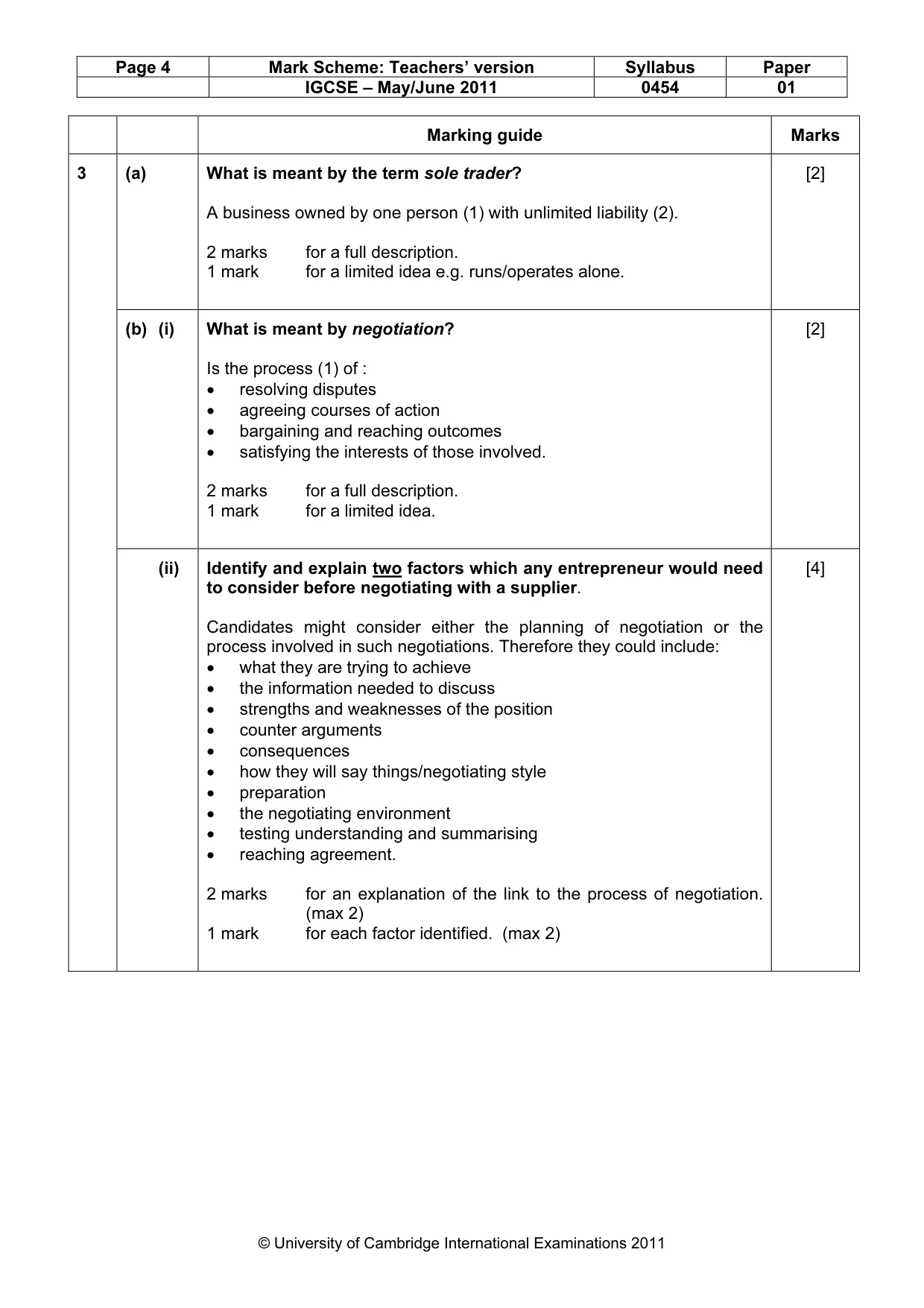
Page 4 Mark Scheme: Teachers’ version Syllabus Paper IGCSE – May/June 2011 0454 01 © University of Cambridge International Examinations 2011 Marking guide Marks (a) What is meant by the term sole trader? A business owned by one person (1) with unlimited liability (2). 2 marks for a full description. 1 mark for a limited idea e.g. runs/operates alone. [2] (b) (i) What is meant by negotiation? Is the process (1) of : • resolving disputes • agreeing courses of action • bargaining and reaching outcomes • satisfying the interests of those involved. 2 marks for a full description. 1 mark for a limited idea. [2] 3 (ii) Identify and explain two factors which any entrepreneur would need to consider before negotiating with a supplier. Candidates might consider either the planning of negotiation or the process involved in such negotiations. Therefore they could include: • what they are trying to achieve • the information needed to discuss • strengths and weaknesses of the position • counter arguments • consequences • how they will say things/negotiating style • preparation • the negotiating environment • testing understanding and summarising • reaching agreement. 2 marks for an explanation of the link to the process of negotiation. (max 2) 1 mark for each factor identified. (max 2) [4]
Mark scheme, page 5
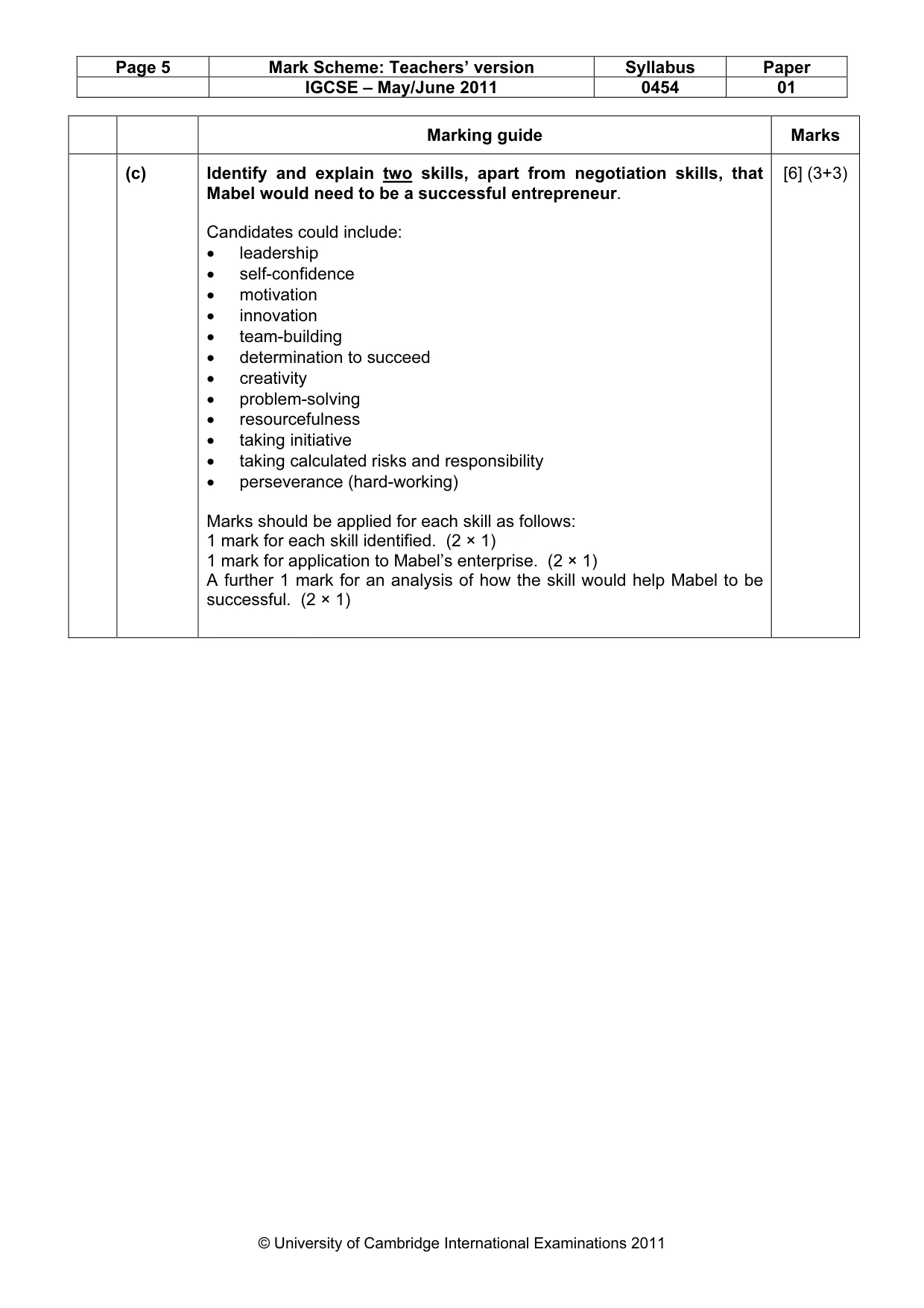
Page 5 Mark Scheme: Teachers’ version Syllabus Paper IGCSE – May/June 2011 0454 01 © University of Cambridge International Examinations 2011 Marking guide Marks (c) Identify and explain two skills, apart from negotiation skills, that Mabel would need to be a successful entrepreneur. Candidates could include: • leadership • self-confidence • motivation • innovation • team-building • determination to succeed • creativity • problem-solving • resourcefulness • taking initiative • taking calculated risks and responsibility • perseverance (hard-working) Marks should be applied for each skill as follows: 1 mark for each skill identified. (2 × 1) 1 mark for application to Mabel’s enterprise. (2 × 1) A further 1 mark for an analysis of how the skill would help Mabel to be successful. (2 × 1) [6] (3+3)
Mark scheme, page 6
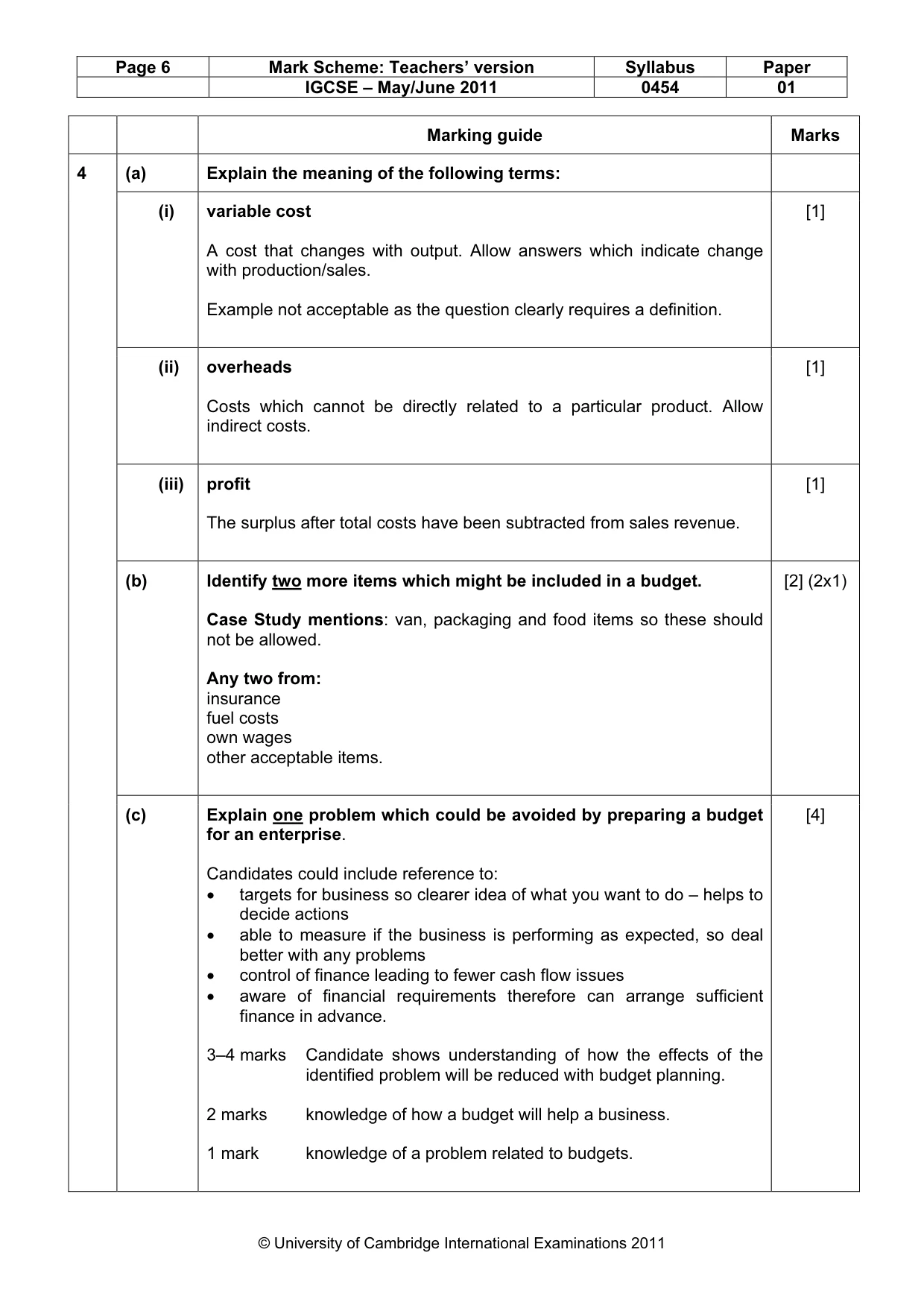
Page 6 Mark Scheme: Teachers’ version Syllabus Paper IGCSE – May/June 2011 0454 01 © University of Cambridge International Examinations 2011 Marking guide Marks (a) Explain the meaning of the following terms: (i) variable cost A cost that changes with output. Allow answers which indicate change with production/sales. Example not acceptable as the question clearly requires a definition. [1] (ii) overheads Costs which cannot be directly related to a particular product. Allow indirect costs. [1] (iii) profit The surplus after total costs have been subtracted from sales revenue. [1] (b) Identify two more items which might be included in a budget. Case Study mentions: van, packaging and food items so these should not be allowed. Any two from: insurance fuel costs own wages other acceptable items. [2] (2x1) 4 (c) Explain one problem which could be avoided by preparing a budget for an enterprise. Candidates could include reference to: • targets for business so clearer idea of what you want to do – helps to decide actions • able to measure if the business is performing as expected, so deal better with any problems • control of finance leading to fewer cash flow issues • aware of financial requirements therefore can arrange sufficient finance in advance. 3–4 marks Candidate shows understanding of how the effects of the identified problem will be reduced with budget planning. 2 marks knowledge of how a budget will help a business. 1 mark knowledge of a problem related to budgets. [4]
Mark scheme, page 7
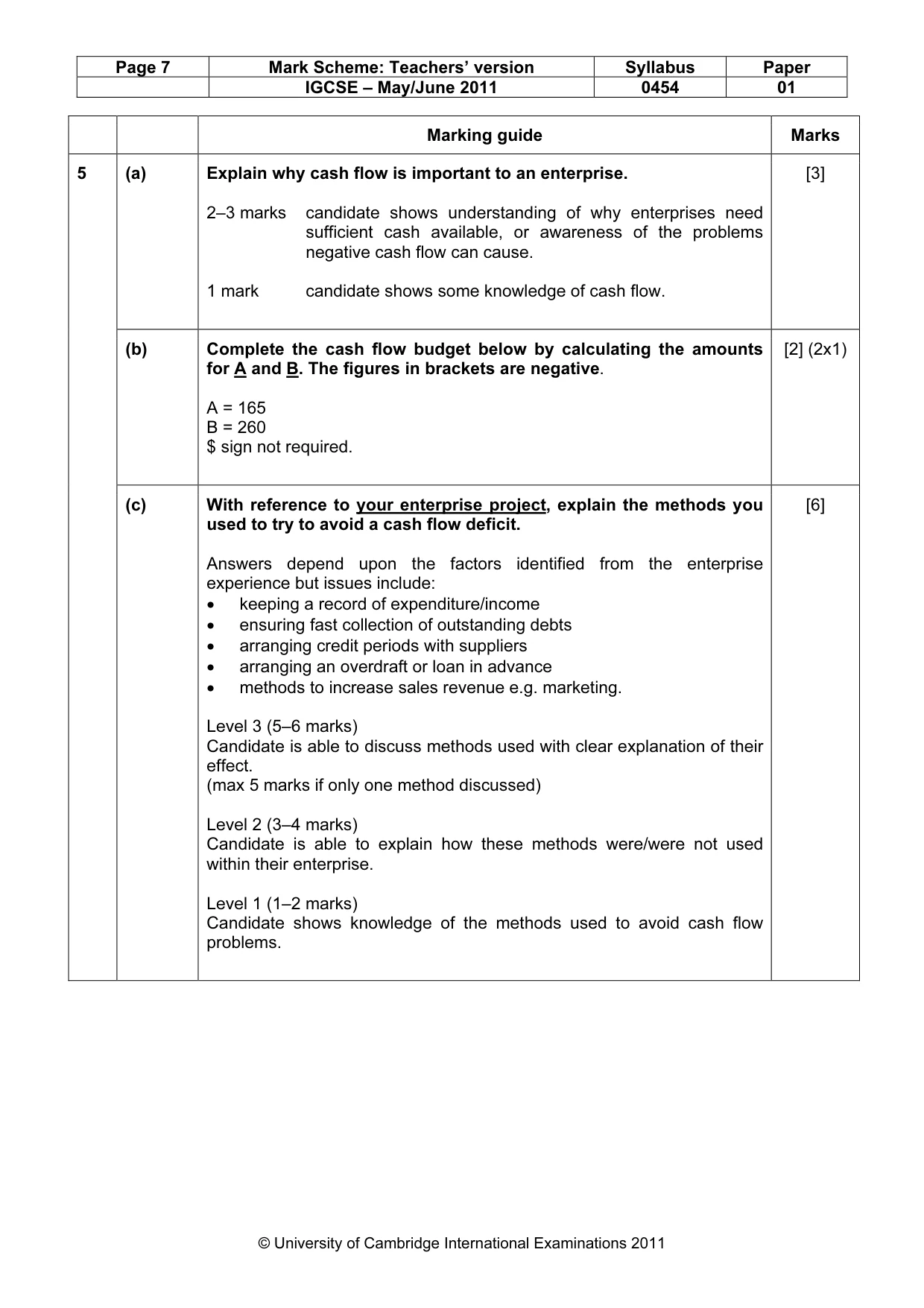
Page 7 Mark Scheme: Teachers’ version Syllabus Paper IGCSE – May/June 2011 0454 01 © University of Cambridge International Examinations 2011 Marking guide Marks (a) Explain why cash flow is important to an enterprise. 2–3 marks candidate shows understanding of why enterprises need sufficient cash available, or awareness of the problems negative cash flow can cause. 1 mark candidate shows some knowledge of cash flow. [3] (b) Complete the cash flow budget below by calculating the amounts for A and B. The figures in brackets are negative. A = 165 B = 260 $ sign not required. [2] (2x1) 5 (c) With reference to your enterprise project, explain the methods you used to try to avoid a cash flow deficit. Answers depend upon the factors identified from the enterprise experience but issues include: • keeping a record of expenditure/income • ensuring fast collection of outstanding debts • arranging credit periods with suppliers • arranging an overdraft or loan in advance • methods to increase sales revenue e.g. marketing. Level 3 (5–6 marks) Candidate is able to discuss methods used with clear explanation of their effect. (max 5 marks if only one method discussed) Level 2 (3–4 marks) Candidate is able to explain how these methods were/were not used within their enterprise. Level 1 (1–2 marks) Candidate shows knowledge of the methods used to avoid cash flow problems. [6]
Mark scheme, page 8
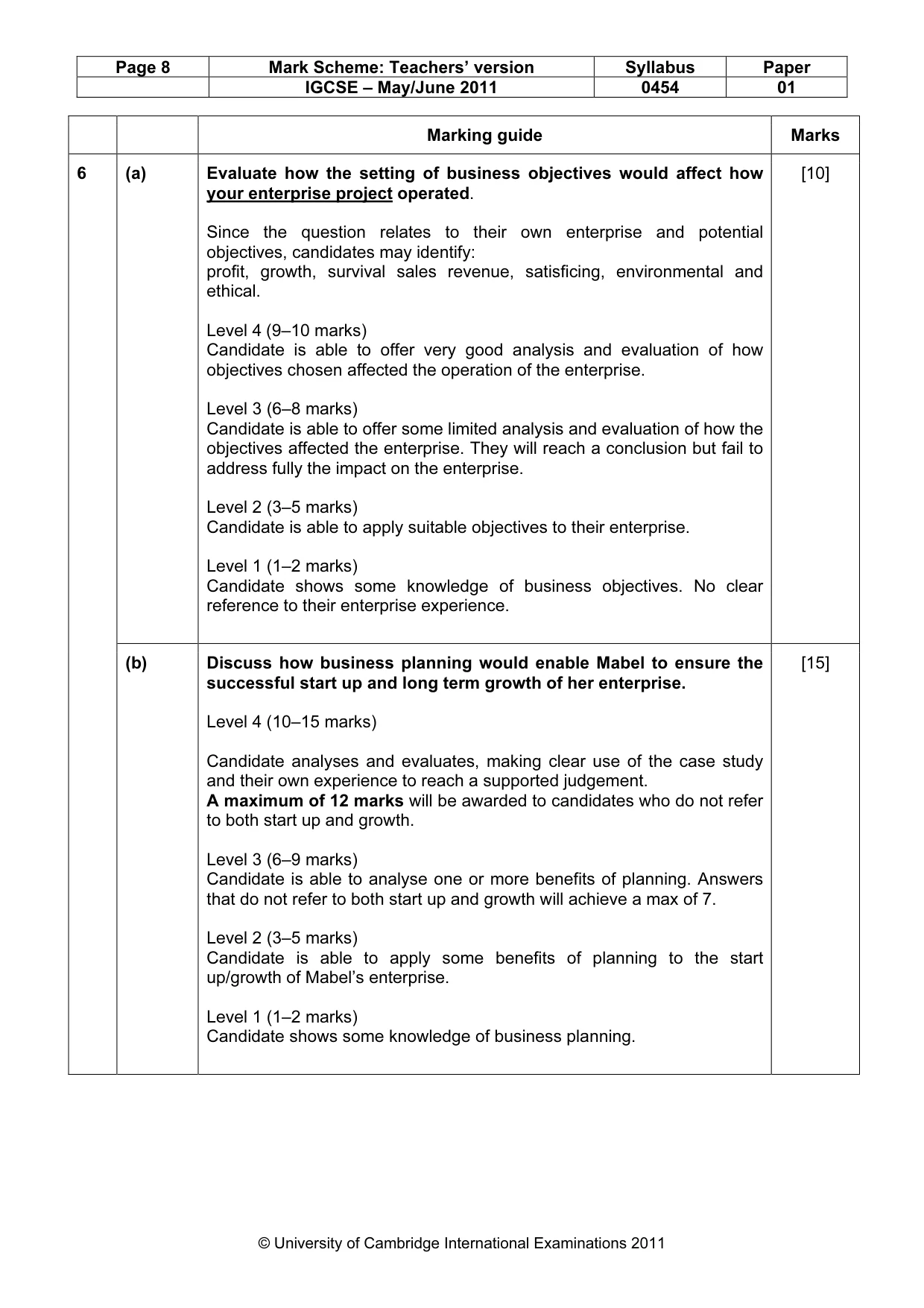
Page 8 Mark Scheme: Teachers’ version Syllabus Paper IGCSE – May/June 2011 0454 01 © University of Cambridge International Examinations 2011 Marking guide Marks (a) Evaluate how the setting of business objectives would affect how your enterprise project operated. Since the question relates to their own enterprise and potential objectives, candidates may identify: profit, growth, survival sales revenue, satisficing, environmental and ethical. Level 4 (9–10 marks) Candidate is able to offer very good analysis and evaluation of how objectives chosen affected the operation of the enterprise. Level 3 (6–8 marks) Candidate is able to offer some limited analysis and evaluation of how the objectives affected the enterprise. They will reach a conclusion but fail to address fully the impact on the enterprise. Level 2 (3–5 marks) Candidate is able to apply suitable objectives to their enterprise. Level 1 (1–2 marks) Candidate shows some knowledge of business objectives. No clear reference to their enterprise experience. [10] 6 (b) Discuss how business planning would enable Mabel to ensure the successful start up and long term growth of her enterprise. Level 4 (10–15 marks) Candidate analyses and evaluates, making clear use of the case study and their own experience to reach a supported judgement. A maximum of 12 marks will be awarded to candidates who do not refer to both start up and growth. Level 3 (6–9 marks) Candidate is able to analyse one or more benefits of planning. Answers that do not refer to both start up and growth will achieve a max of 7. Level 2 (3–5 marks) Candidate is able to apply some benefits of planning to the start up/growth of Mabel’s enterprise. Level 1 (1–2 marks) Candidate shows some knowledge of business planning. [15]
Mark scheme, page 9
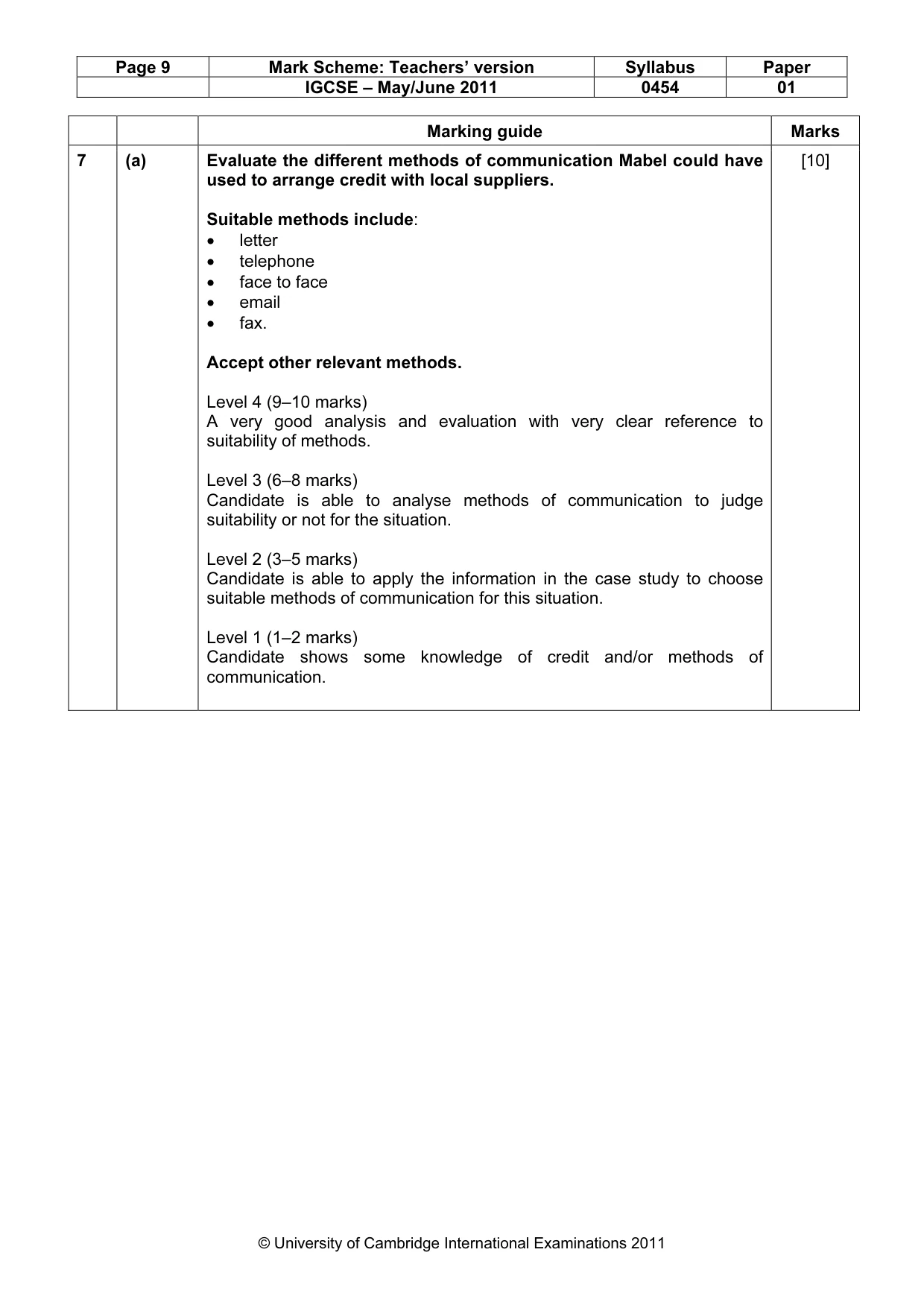
Page 9 Mark Scheme: Teachers’ version Syllabus Paper IGCSE – May/June 2011 0454 01 © University of Cambridge International Examinations 2011 Marking guide Marks 7 (a) Evaluate the different methods of communication Mabel could have used to arrange credit with local suppliers. Suitable methods include: • letter • telephone • face to face • email • fax. Accept other relevant methods. Level 4 (9–10 marks) A very good analysis and evaluation with very clear reference to suitability of methods. Level 3 (6–8 marks) Candidate is able to analyse methods of communication to judge suitability or not for the situation. Level 2 (3–5 marks) Candidate is able to apply the information in the case study to choose suitable methods of communication for this situation. Level 1 (1–2 marks) Candidate shows some knowledge of credit and/or methods of communication. [10]
Mark scheme, page 10
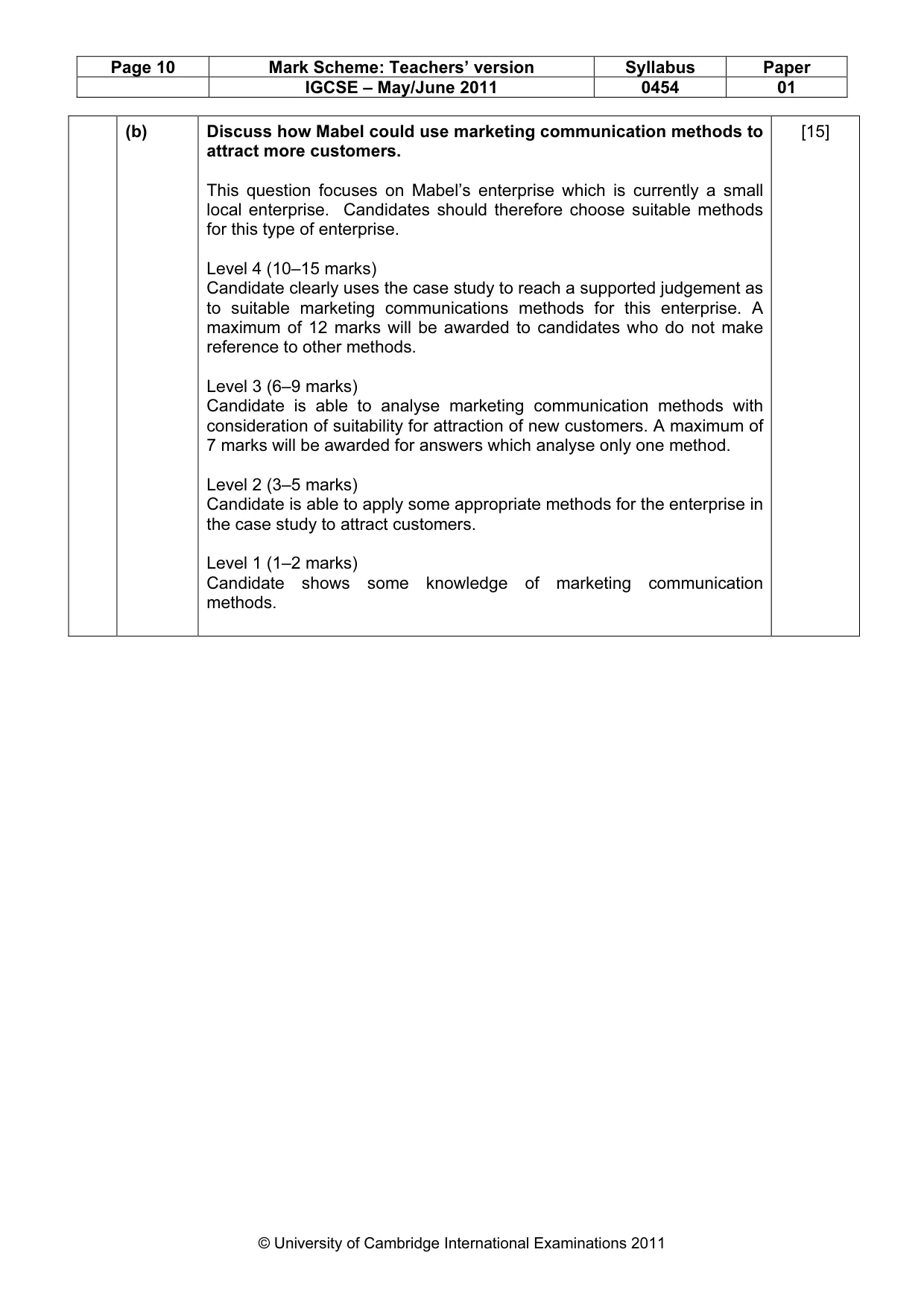
Page 10 Mark Scheme: Teachers’ version Syllabus Paper IGCSE – May/June 2011 0454 01 © University of Cambridge International Examinations 2011 (b) Discuss how Mabel could use marketing communication methods to attract more customers. This question focuses on Mabel’s enterprise which is currently a small local enterprise. Candidates should therefore choose suitable methods for this type of enterprise. Level 4 (10–15 marks) Candidate clearly uses the case study to reach a supported judgement as to suitable marketing communications methods for this enterprise. A maximum of 12 marks will be awarded to candidates who do not make reference to other methods. Level 3 (6–9 marks) Candidate is able to analyse marketing communication methods with consideration of suitability for attraction of new customers. A maximum of 7 marks will be awarded for answers which analyse only one method. Level 2 (3–5 marks) Candidate is able to apply some appropriate methods for the enterprise in the case study to attract customers. Level 1 (1–2 marks) Candidate shows some knowledge of marketing communication methods. [15]
What you needed in this session
Cambridge’s own grade thresholds for 2011 May/June, Paper 1 · Variant 1. A higher threshold means an easier paper — the bar moves with how the cohort did.