Cambridge IGCSE English Second Language (Speaking Endorsement) (9-1) 0993 — 2024 May/June Paper 2 · Variant 2
0993/22/M/J/24 · 40 marks · ≈45 min
The question paper and its mark scheme, free to read here and free to download. This is Cambridge’s own paper, exactly as it was sat.
Question paper16 pages


Mark scheme3 pages
Answers below. Sit the paper first if you are practising.
Paper as text
Question paper, page 1
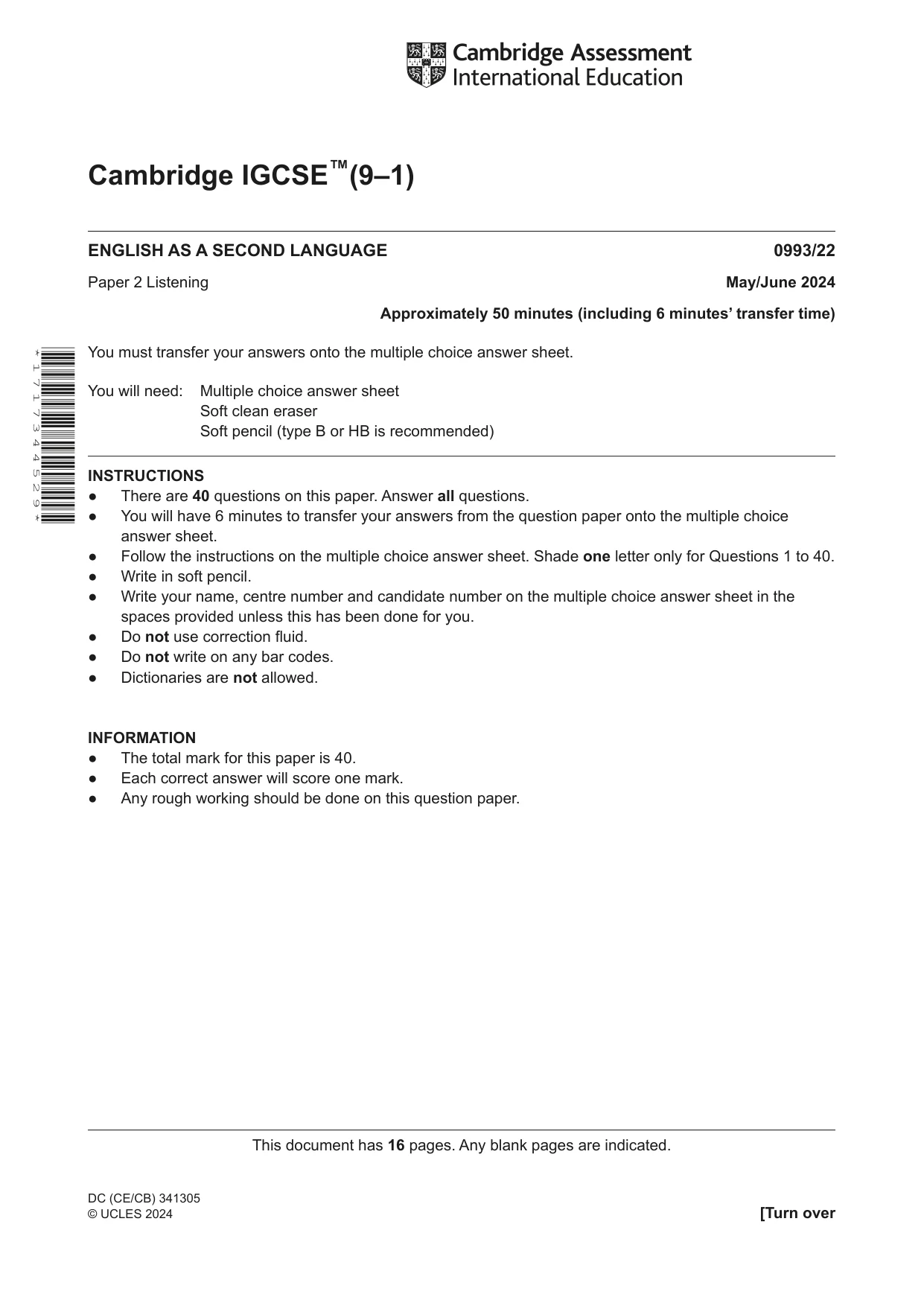
This document has 16 pages. Any blank pages are indicated. [Turn over Cambridge IGCSE™(9–1) ENGLISH AS A SECOND LANGUAGE 0993/22 Paper 2 Listening May/June 2024 Approximately 50 minutes (including 6 minutes’ transfer time) You must transfer your answers onto the multiple choice answer sheet. You will need: Multiple choice answer sheet Soft clean eraser Soft pencil (type B or HB is recommended) INSTRUCTIONS ● There are 40 questions on this paper. Answer all questions. ● You will have 6 minutes to transfer your answers from the question paper onto the multiple choice answer sheet. ● Follow the instructions on the multiple choice answer sheet. Shade one letter only for Questions 1 to 40. ● Write in soft pencil. ● Write your name, centre number and candidate number on the multiple choice answer sheet in the spaces provided unless this has been done for you. ● Do not use correction fluid. ● Do not write on any bar codes. ● Dictionaries are not allowed. INFORMATION ● The total mark for this paper is 40. ● Each correct answer will score one mark. ● Any rough working should be done on this question paper. * 1 7 1 7 3 4 4 5 2 9 * DC (CE/CB) 341305 © UCLES 2024
Question paper, page 2
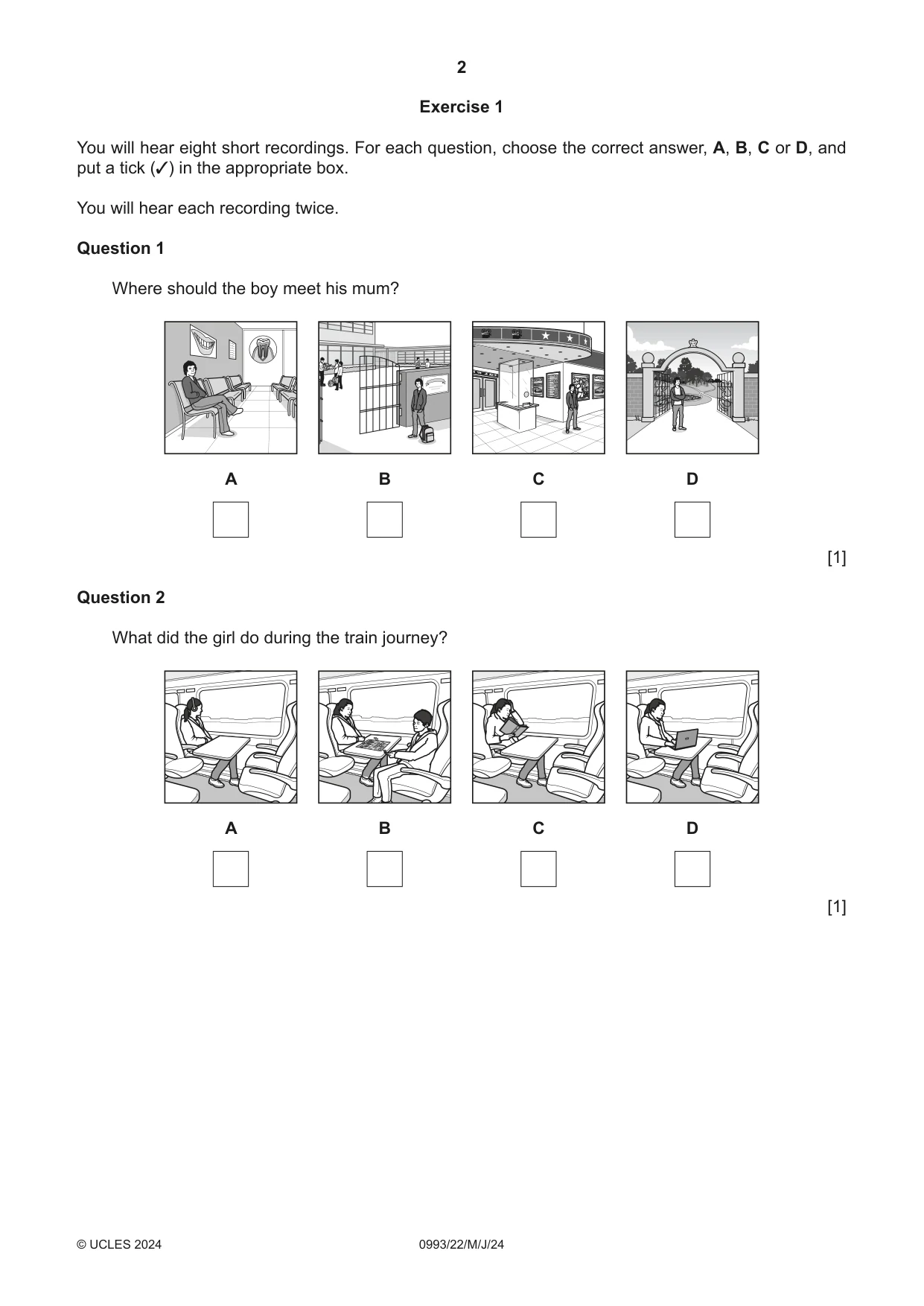
2 0993/22/ M/J/24 © UCLES 2024 Exercise 1 You will hear eight short recordings. For each question, choose the correct answer, A, B, C or D, and put a tick (3) in the appropriate box. You will hear each recording twice. Question 1 Where should the boy meet his mum? A B C D [1] Question 2 What did the girl do during the train journey? A B C D [1]
Question paper, page 3
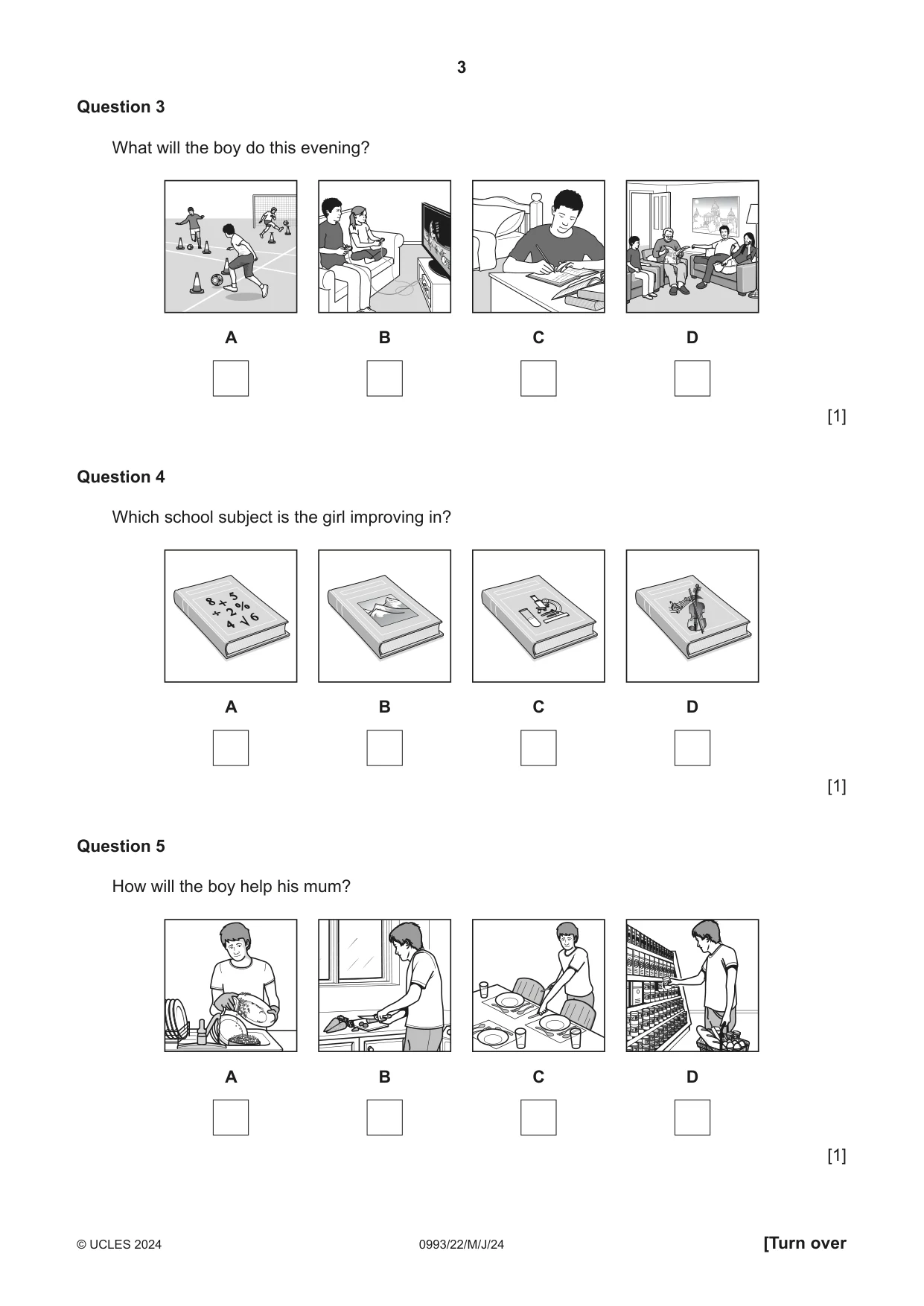
3 0993/22/ M/J/24 © UCLES 2024 [Turn over Question 3 What will the boy do this evening? A B C D [1] Question 4 Which school subject is the girl improving in? A B C D [1] Question 5 How will the boy help his mum? A B C D [1]
Question paper, page 4
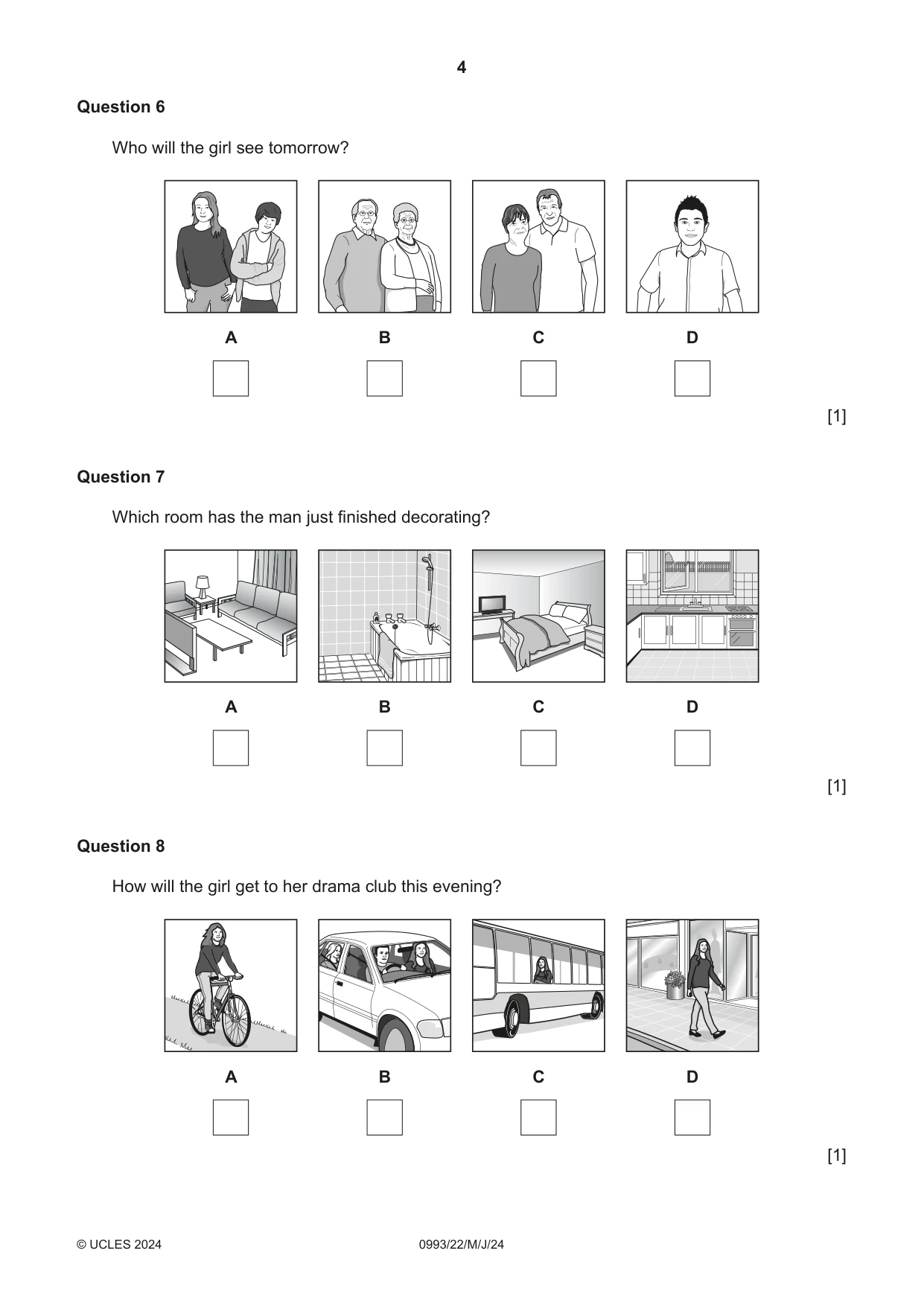
4 0993/22/ M/J/24 © UCLES 2024 Question 6 Who will the girl see tomorrow? A B C D [1] Question 7 Which room has the man just finished decorating? A B C D [1] Question 8 How will the girl get to her drama club this evening? A B C D [1]
Question paper, page 5
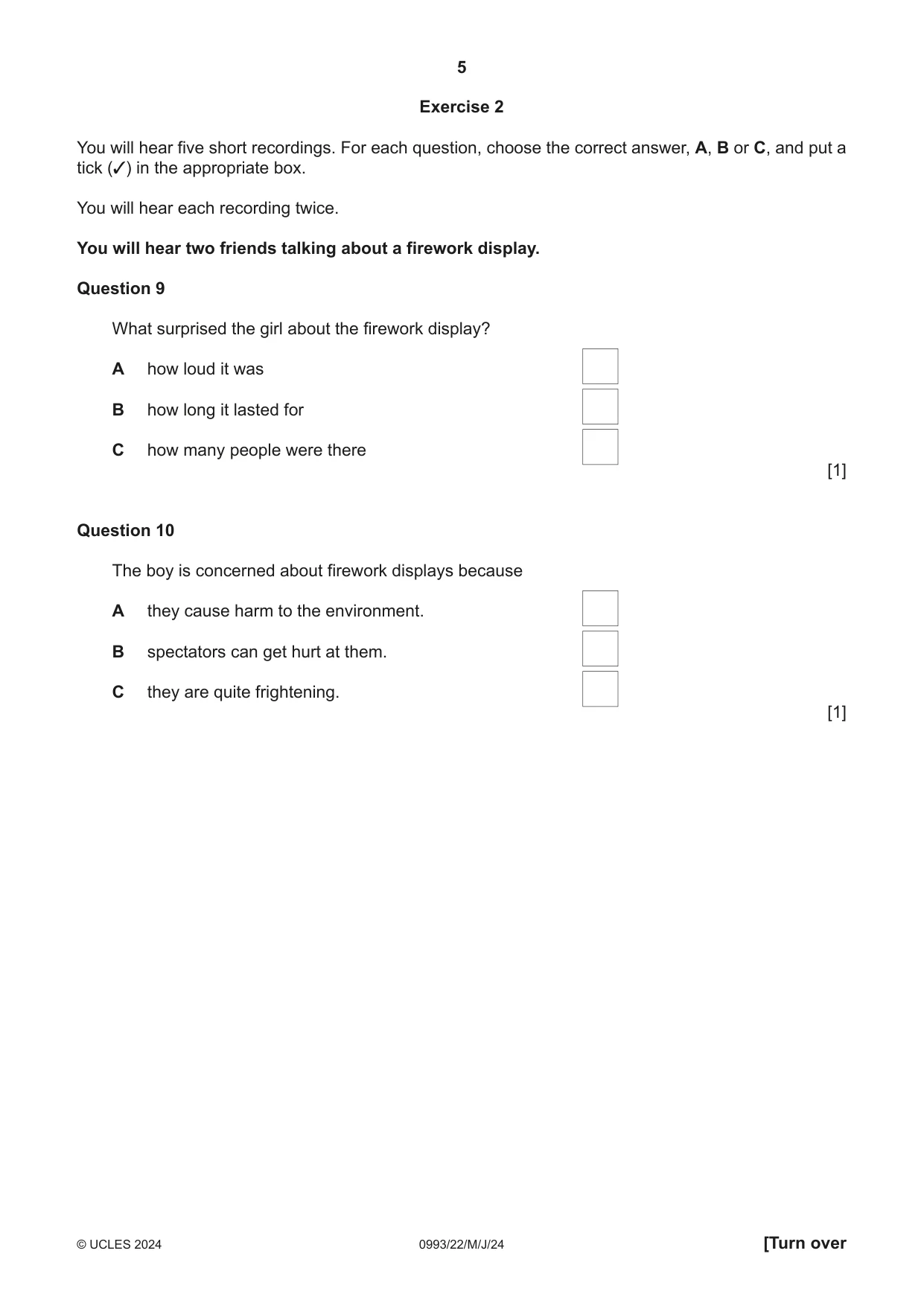
5 0993/22/M/J/24 © UCLES 2024 [Turn over Exercise 2 You will hear five short recordings. For each question, choose the correct answer, A, B or C, and put a tick (3) in the appropriate box. You will hear each recording twice. You will hear two friends talking about a firework display. Question 9 What surprised the girl about the firework display? A how loud it was B how long it lasted for C how many people were there [1] Question 10 The boy is concerned about firework displays because A they cause harm to the environment. B spectators can get hurt at them. C they are quite frightening. [1]
Question paper, page 6
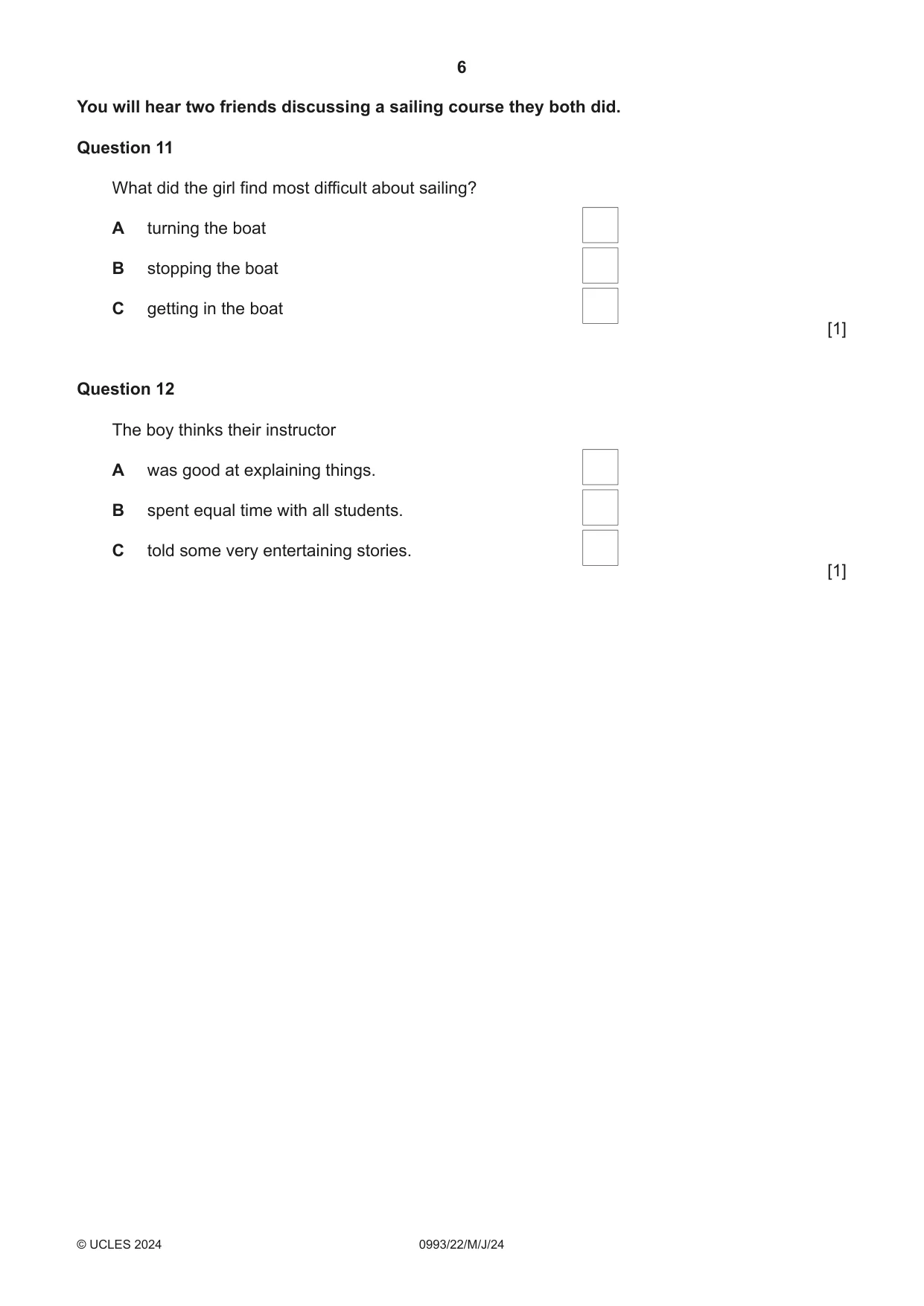
6 0993/22/M/J/24 © UCLES 2024 You will hear two friends discussing a sailing course they both did. Question 11 What did the girl find most difficult about sailing? A turning the boat B stopping the boat C getting in the boat [1] Question 12 The boy thinks their instructor A was good at explaining things. B spent equal time with all students. C told some very entertaining stories. [1]
Question paper, page 7
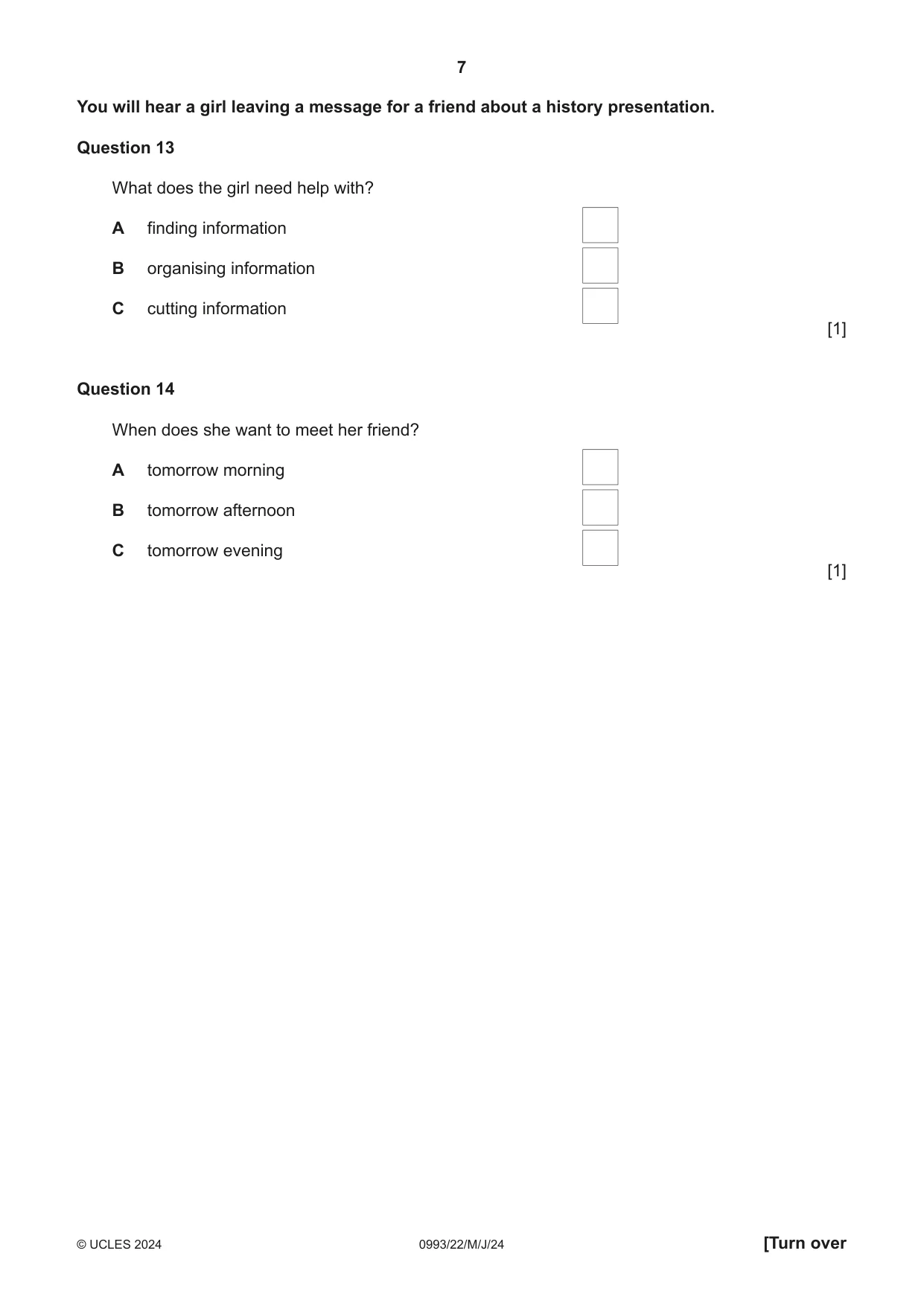
7 0993/22/M/J/24 © UCLES 2024 [Turn over You will hear a girl leaving a message for a friend about a history presentation. Question 13 What does the girl need help with? A finding information B organising information C cutting information [1] Question 14 When does she want to meet her friend? A tomorrow morning B tomorrow afternoon C tomorrow evening [1]
Question paper, page 8
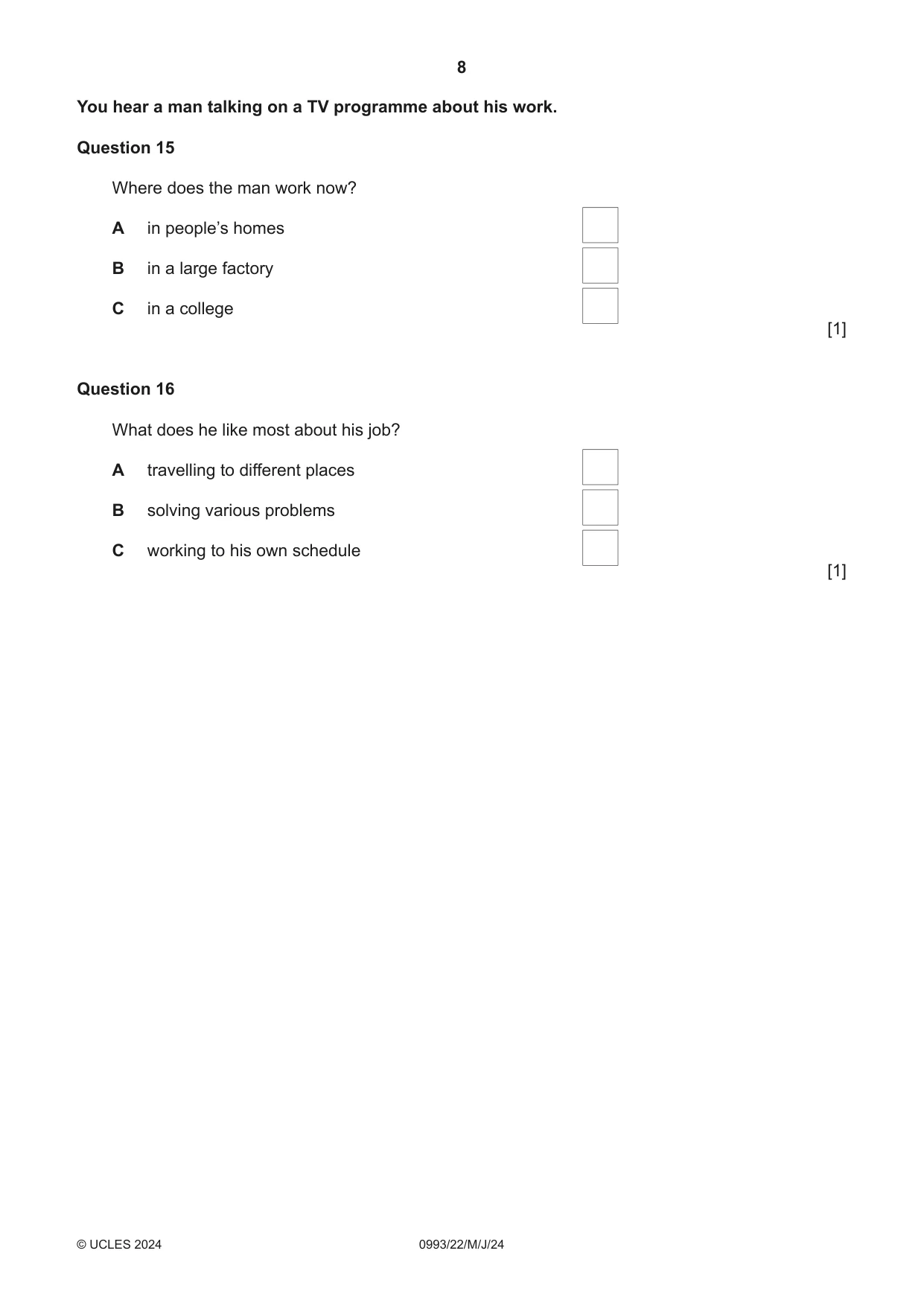
8 0993/22/M/J/24 © UCLES 2024 You hear a man talking on a TV programme about his work. Question 15 Where does the man work now? A in people’s homes B in a large factory C in a college [1] Question 16 What does he like most about his job? A travelling to different places B solving various problems C working to his own schedule [1]
Question paper, page 9
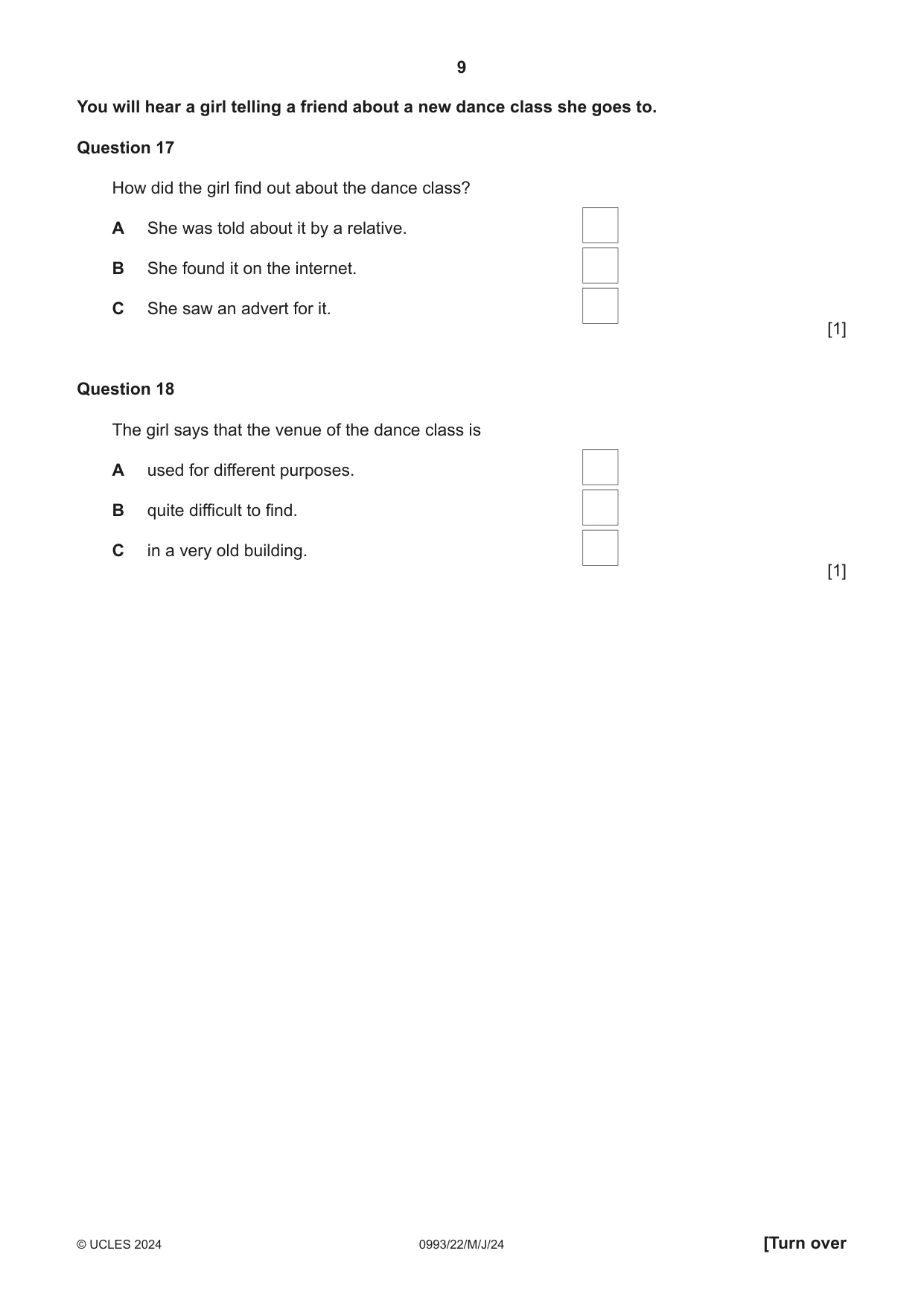
9 0993/22/M/J/24 © UCLES 2024 [Turn over You will hear a girl telling a friend about a new dance class she goes to. Question 17 How did the girl find out about the dance class? A She was told about it by a relative. B She found it on the internet. C She saw an advert for it. [1] Question 18 The girl says that the venue of the dance class is A used for different purposes. B quite difficult to find. C in a very old building. [1]
Question paper, page 10
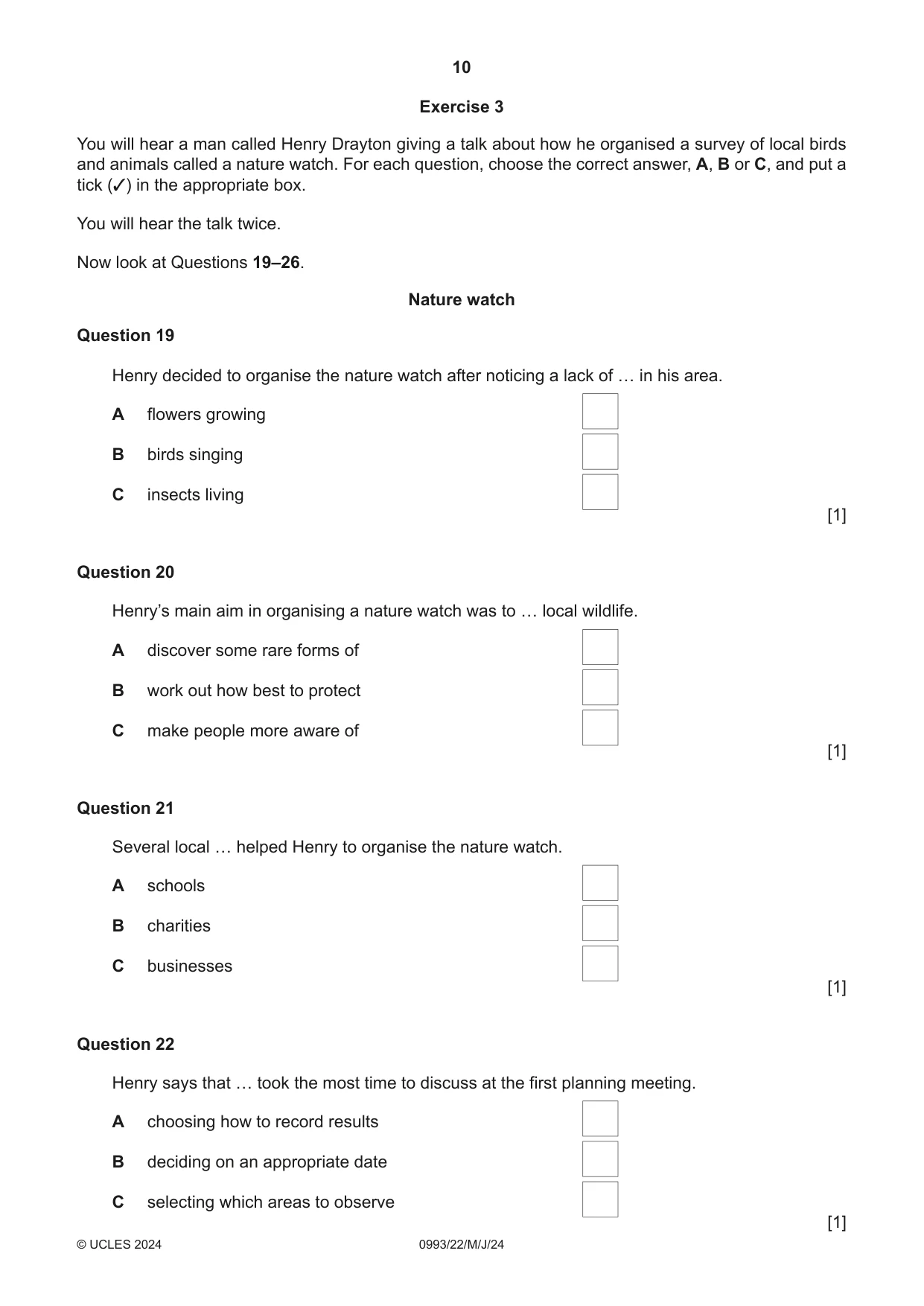
10 0993/22/M/J/24 © UCLES 2024 Exercise 3 You will hear a man called Henry Drayton giving a talk about how he organised a survey of local birds and animals called a nature watch. For each question, choose the correct answer, A, B or C, and put a tick (3) in the appropriate box. You will hear the talk twice. Now look at Questions 19–26. Nature watch Question 19 Henry decided to organise the nature watch after noticing a lack of … in his area. A flowers growing B birds singing C insects living [1] Question 20 Henry’s main aim in organising a nature watch was to … local wildlife. A discover some rare forms of B work out how best to protect C make people more aware of [1] Question 21 Several local … helped Henry to organise the nature watch. A schools B charities C businesses [1] Question 22 Henry says that … took the most time to discuss at the first planning meeting. A choosing how to record results B deciding on an appropriate date C selecting which areas to observe [1]
Question paper, page 11
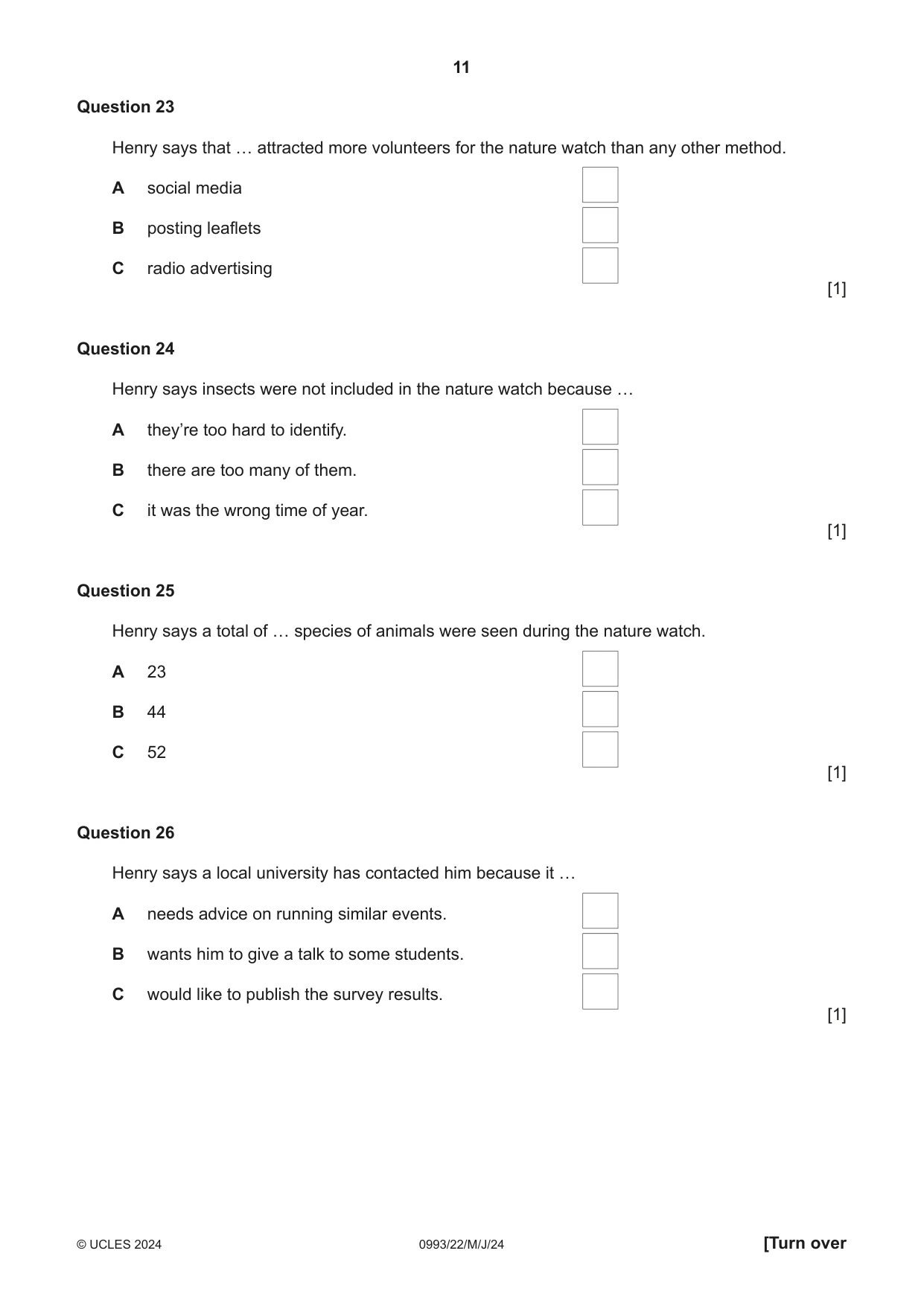
11 0993/22/M/J/24 © UCLES 2024 [Turn over Question 23 Henry says that … attracted more volunteers for the nature watch than any other method. A social media B posting leaflets C radio advertising [1] Question 24 Henry says insects were not included in the nature watch because … A they’re too hard to identify. B there are too many of them. C it was the wrong time of year. [1] Question 25 Henry says a total of … species of animals were seen during the nature watch. A 23 B 44 C 52 [1] Question 26 Henry says a local university has contacted him because it … A needs advice on running similar events. B wants him to give a talk to some students. C would like to publish the survey results. [1]
Question paper, page 12
12 0993/22/M/J/24 © UCLES 2024 BLANK PAGE
Question paper, page 13
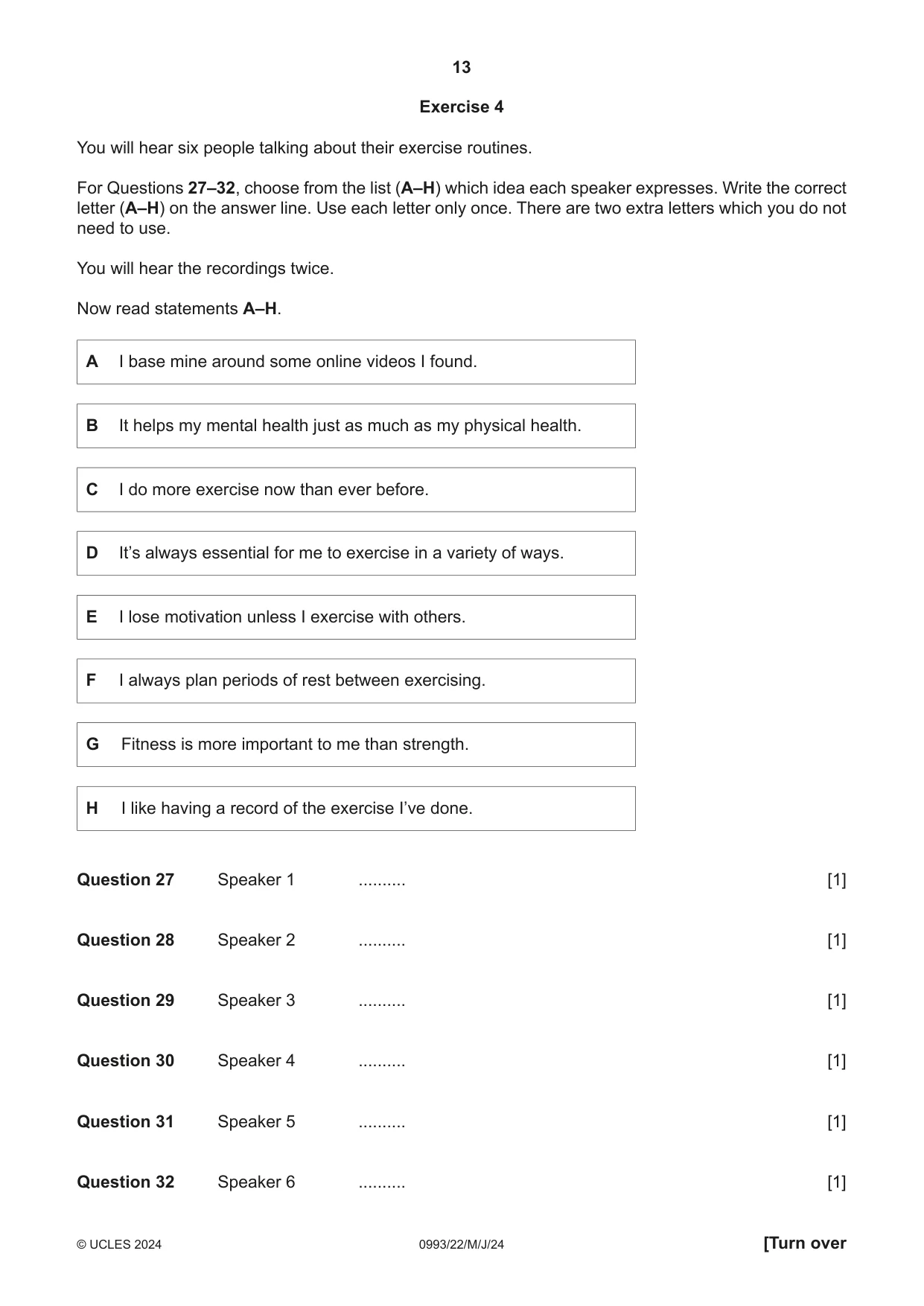
13 0993/22/M/J/24 © UCLES 2024 [Turn over Exercise 4 You will hear six people talking about their exercise routines. For Questions 27–32, choose from the list (A–H) which idea each speaker expresses. Write the correct letter (A–H) on the answer line. Use each letter only once. There are two extra letters which you do not need to use. You will hear the recordings twice. Now read statements A–H. A I base mine around some online videos I found. B It helps my mental health just as much as my physical health. C I do more exercise now than ever before. D It’s always essential for me to exercise in a variety of ways. E I lose motivation unless I exercise with others. F I always plan periods of rest between exercising. G Fitness is more important to me than strength. H I like having a record of the exercise I’ve done. Question 27 Speaker 1 … [1] Question 28 Speaker 2 … [1] Question 29 Speaker 3 … [1] Question 30 Speaker 4 … [1] Question 31 Speaker 5 … [1] Question 32 Speaker 6 … [1]
Question paper, page 14
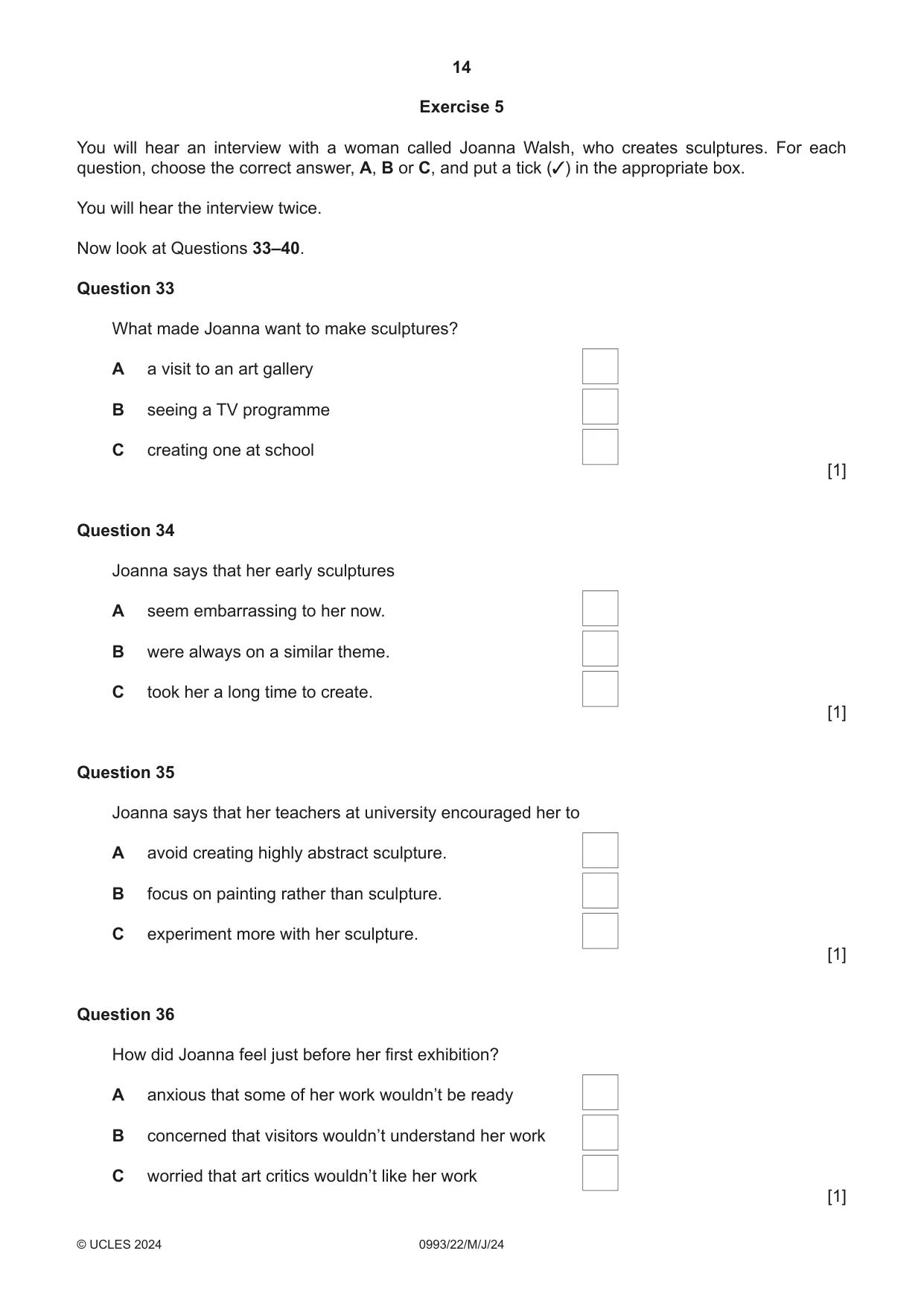
14 0993/22/M/J/24 © UCLES 2024 Exercise 5 You will hear an interview with a woman called Joanna Walsh, who creates sculptures. For each question, choose the correct answer, A, B or C, and put a tick (3) in the appropriate box. You will hear the interview twice. Now look at Questions 33–40. Question 33 What made Joanna want to make sculptures? A a visit to an art gallery B seeing a TV programme C creating one at school [1] Question 34 Joanna says that her early sculptures A seem embarrassing to her now. B were always on a similar theme. C took her a long time to create. [1] Question 35 Joanna says that her teachers at university encouraged her to A avoid creating highly abstract sculpture. B focus on painting rather than sculpture. C experiment more with her sculpture. [1] Question 36 How did Joanna feel just before her first exhibition? A anxious that some of her work wouldn’t be ready B concerned that visitors wouldn’t understand her work C worried that art critics wouldn’t like her work [1]
Question paper, page 15
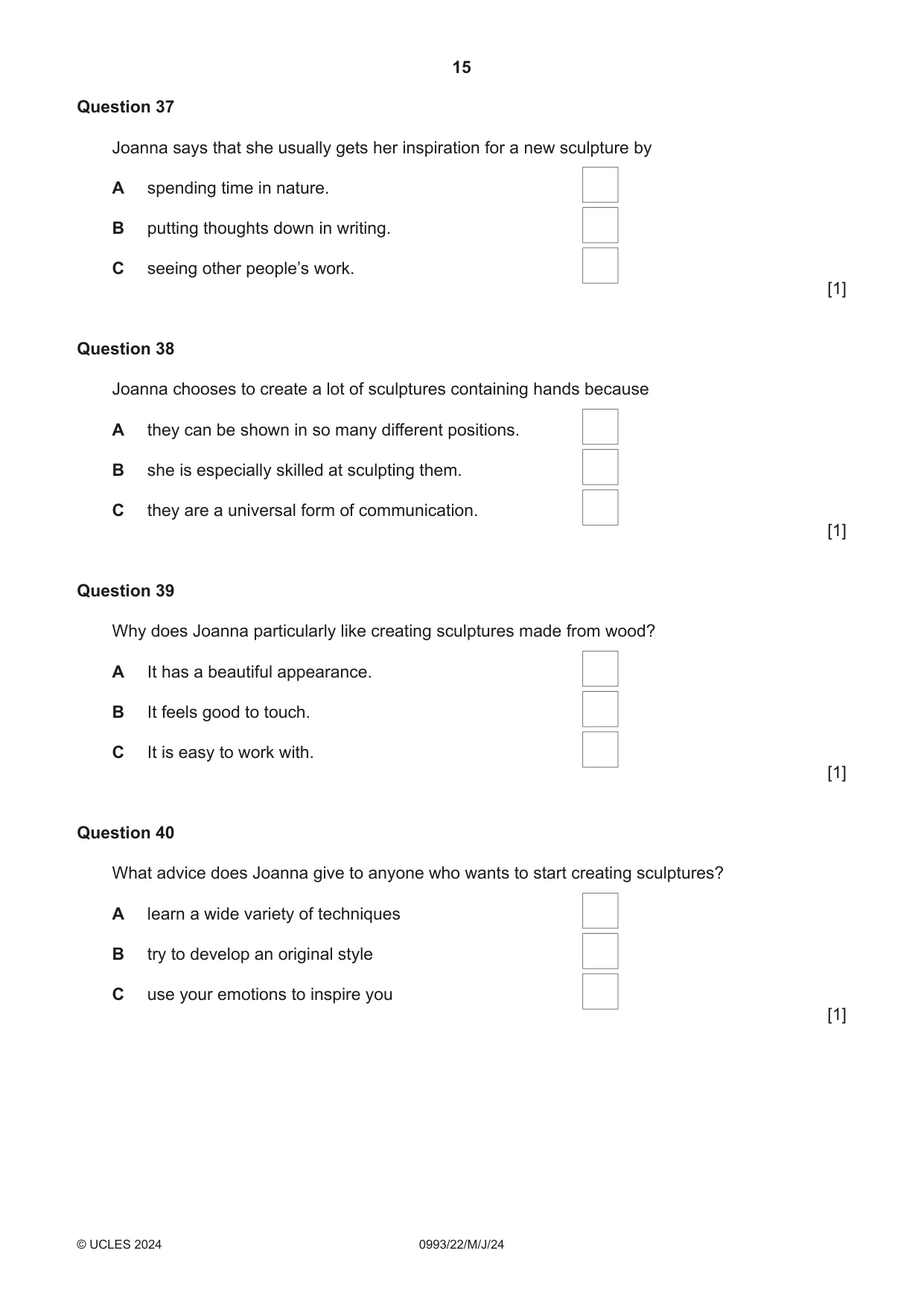
15 0993/22/M/J/24 © UCLES 2024 Question 37 Joanna says that she usually gets her inspiration for a new sculpture by A spending time in nature. B putting thoughts down in writing. C seeing other people’s work. [1] Question 38 Joanna chooses to create a lot of sculptures containing hands because A they can be shown in so many different positions. B she is especially skilled at sculpting them. C they are a universal form of communication. [1] Question 39 Why does Joanna particularly like creating sculptures made from wood? A It has a beautiful appearance. B It feels good to touch. C It is easy to work with. [1] Question 40 What advice does Joanna give to anyone who wants to start creating sculptures? A learn a wide variety of techniques B try to develop an original style C use your emotions to inspire you [1]
Question paper, page 16
16 0993/22/M/J/24 © UCLES 2024 Permission to reproduce items where third-party owned material protected by copyright is included has been sought and cleared where possible. Every reasonable effort has been made by the publisher (UCLES) to trace copyright holders, but if any items requiring clearance have unwittingly been included, the publisher will be pleased to make amends at the earliest possible opportunity. To avoid the issue of disclosure of answer-related information to candidates, all copyright acknowledgements are reproduced online in the Cambridge Assessment International Education Copyright Acknowledgements Booklet. This is produced for each series of examinations and is freely available to download at www.cambridgeinternational.org after the live examination series. Cambridge Assessment International Education is part of Cambridge Assessment. Cambridge Assessment is the brand name of the University of Cambridge Local Examinations Syndicate (UCLES), which is a department of the University of Cambridge. BLANK PAGE
Mark scheme, page 1
This document consists of 3 printed pages. © Cambridge University Press & Assessment 2024 [Turn over Cambridge IGCSE™ (9–1) ENGLISH AS A SECOND LANGUAGE 9–1 0993/22 Paper 2 Listening May/June 2024 MARK SCHEME Maximum Mark: 40 Published This mark scheme is published as an aid to teachers and candidates, to indicate the requirements of the examination. Mark schemes should be read in conjunction with the question paper and the Principal Examiner Report for Teachers. Cambridge International will not enter into discussions about these mark schemes. Cambridge International is publishing the mark schemes for the May/June 2024 series for most Cambridge IGCSE, Cambridge International A and AS Level and Cambridge Pre-U components, and some Cambridge O Level components.
Mark scheme, page 2
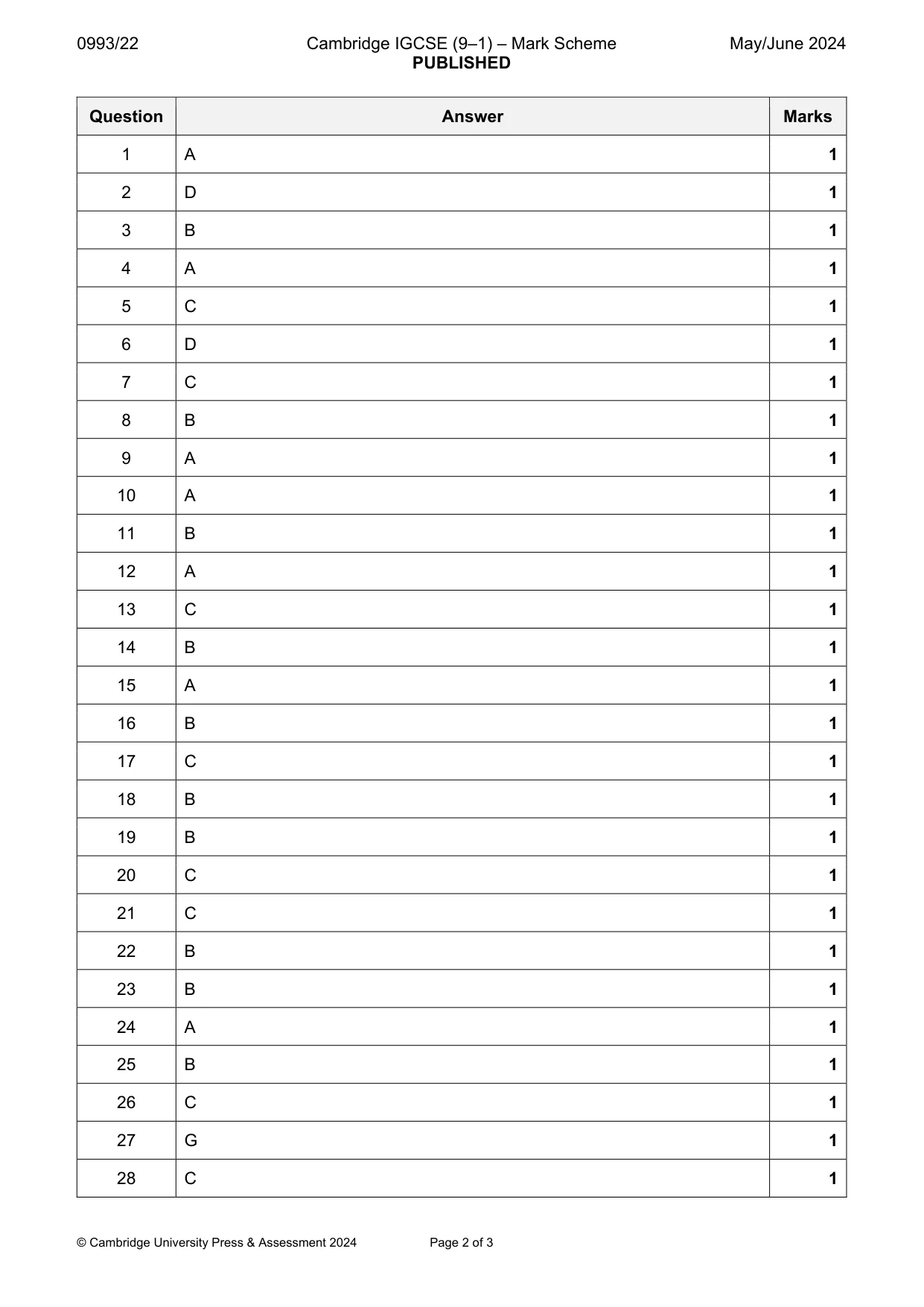
0993/22 Cambridge IGCSE (9–1) – Mark Scheme PUBLISHED May/June 2024 © Cambridge University Press & Assessment 2024 Page 2 of 3 Question Answer Marks 1 A 1 2 D 1 3 B 1 4 A 1 5 C 1 6 D 1 7 C 1 8 B 1 9 A 1 10 A 1 11 B 1 12 A 1 13 C 1 14 B 1 15 A 1 16 B 1 17 C 1 18 B 1 19 B 1 20 C 1 21 C 1 22 B 1 23 B 1 24 A 1 25 B 1 26 C 1 27 G 1 28 C 1
Mark scheme, page 3
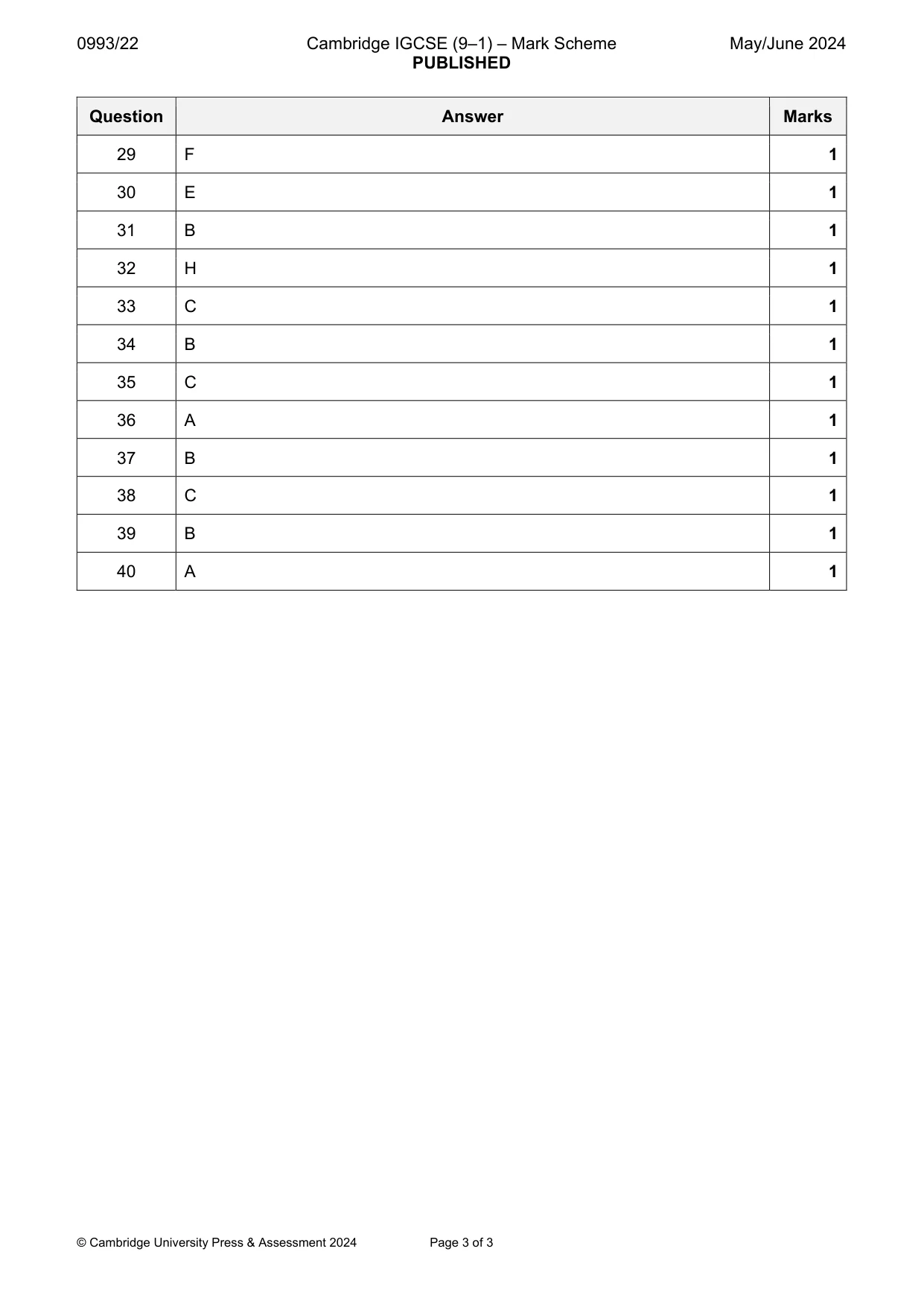
0993/22 Cambridge IGCSE (9–1) – Mark Scheme PUBLISHED May/June 2024 © Cambridge University Press & Assessment 2024 Page 3 of 3 Question Answer Marks 29 F 1 30 E 1 31 B 1 32 H 1 33 C 1 34 B 1 35 C 1 36 A 1 37 B 1 38 C 1 39 B 1 40 A 1
What you needed in this session
Cambridge’s own grade thresholds for 2024 May/June, Paper 2 · Variant 2. A higher threshold means an easier paper — the bar moves with how the cohort did.