Cambridge IGCSE English Second Language (Speaking Endorsement) (9-1) 0993 — 2020 May/June Paper 2 · Variant 2
0993/22/M/J/20
The question paper and its mark scheme, free to read here and free to download. This is Cambridge’s own paper, exactly as it was sat.
Question paper16 pages



Mark scheme10 pages
Answers below. Sit the paper first if you are practising.
Paper as text
Question paper, page 1
Cambridge IGCSE™(9–1) This document has 16 pages. Blank pages are indicated. DC (PQ) 197794 © UCLES 2020 [Turn over ENGLISH AS A SECOND LANGUAGE 0993/22 Paper 2 Reading and Writing (Extended) May/June 2020 2 hours You must answer on the question paper. No additional materials are needed. INSTRUCTIONS ● Answer all questions. ● Use a black or dark blue pen. ● Write your name, centre number and candidate number in the boxes at the top of the page. ● Write your answer to each question in the space provided. ● Do not use an erasable pen or correction fluid. ● Do not write on any bar codes. ● Dictionaries are not allowed. INFORMATION ● The total mark for this paper is 80. ● The number of marks for each question or part question is shown in brackets [ ]. * 2 9 8 0 3 2 5 8 8 3 *
Question paper, page 2
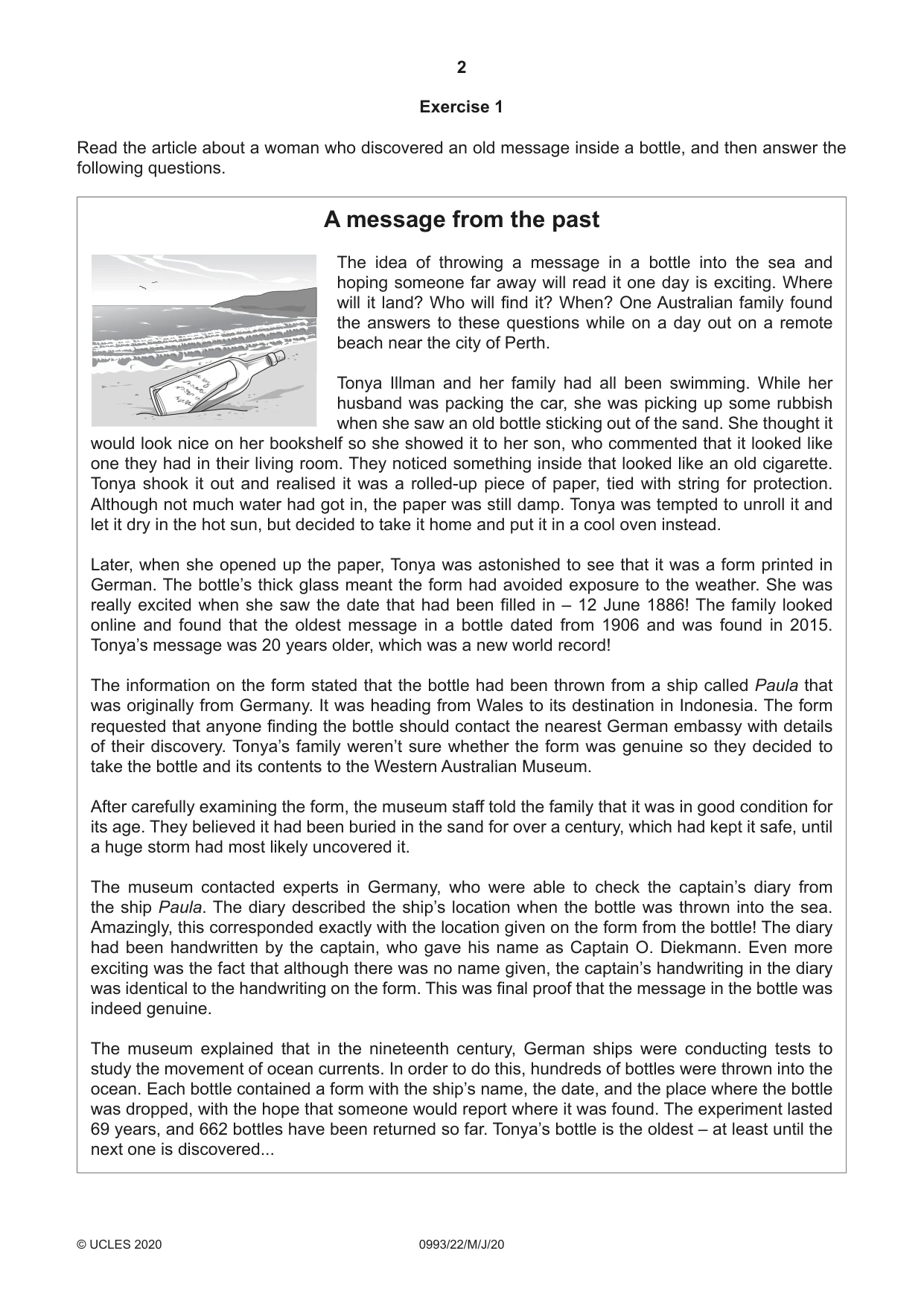
2 0993/22/M/J/20 © UCLES 2020 Exercise 1 Read the article about a woman who discovered an old message inside a bottle, and then answer the following questions. A message from the past The idea of throwing a message in a bottle into the sea and hoping someone far away will read it one day is exciting. Where will it land? Who will find it? When? One Australian family found the answers to these questions while on a day out on a remote beach near the city of Perth. Tonya Illman and her family had all been swimming. While her husband was packing the car, she was picking up some rubbish when she saw an old bottle sticking out of the sand. She thought it would look nice on her bookshelf so she showed it to her son, who commented that it looked like one they had in their living room. They noticed something inside that looked like an old cigarette. Tonya shook it out and realised it was a rolled-up piece of paper, tied with string for protection. Although not much water had got in, the paper was still damp. Tonya was tempted to unroll it and let it dry in the hot sun, but decided to take it home and put it in a cool oven instead. Later, when she opened up the paper, Tonya was astonished to see that it was a form printed in German. The bottle’s thick glass meant the form had avoided exposure to the weather. She was really excited when she saw the date that had been filled in – 12 June 1886! The family looked online and found that the oldest message in a bottle dated from 1906 and was found in 2015. Tonya’s message was 20 years older, which was a new world record! The information on the form stated that the bottle had been thrown from a ship called Paula that was originally from Germany. It was heading from Wales to its destination in Indonesia. The form requested that anyone finding the bottle should contact the nearest German embassy with details of their discovery. Tonya’s family weren’t sure whether the form was genuine so they decided to take the bottle and its contents to the Western Australian Museum. After carefully examining the form, the museum staff told the family that it was in good condition for its age. They believed it had been buried in the sand for over a century, which had kept it safe, until a huge storm had most likely uncovered it. The museum contacted experts in Germany, who were able to check the captain’s diary from the ship Paula. The diary described the ship’s location when the bottle was thrown into the sea. Amazingly, this corresponded exactly with the location given on the form from the bottle! The diary had been handwritten by the captain, who gave his name as Captain O. Diekmann. Even more exciting was the fact that although there was no name given, the captain’s handwriting in the diary was identical to the handwriting on the form. This was final proof that the message in the bottle was indeed genuine. The museum explained that in the nineteenth century, German ships were conducting tests to study the movement of ocean currents. In order to do this, hundreds of bottles were thrown into the ocean. Each bottle contained a form with the ship’s name, the date, and the place where the bottle was dropped, with the hope that someone would report where it was found. The experiment lasted 69 years, and 662 bottles have been returned so far. Tonya’s bottle is the oldest – at least until the next one is discovered...
Question paper, page 3
3 0993/22/M/J/20 © UCLES 2020 [Turn over 1 What was Tonya Illman doing when she found the bottle? … [1] 2 Where did Tonya plan to display the bottle when she got home? … [1] 3 How did Tonya dry the piece of paper? … [1] 4 What year was written on the form? … [1] 5 Where was the ship travelling to? … [1] 6 What was the person who found the form asked to do? … [1] 7 Which two details in the ship’s diary matched those on the form? … … [2] 8 What was the purpose of the German experiment? … [1] 9 Why was the form so well preserved? Give four reasons. … … … … [4] [Total: 13]
Question paper, page 4
4 0993/22/M/J/20 © UCLES 2020 Exercise 2 Read the article about four people (A–D) who live in very different environments. Then answer Question 10 (a)–(j). WHAT’S IT LIKE WHERE YOU LIVE? A Suraya Everyone in my city knows the problems that the rainy season brings, like being trapped at school by floods or falling over in heavy rain. At times like these, I wouldn’t recommend driving and I tend to use trains instead. They might be late and crowded, but at least you’re safer with other people around. Plus, you can usually find shelter at stations if you have to phone your family or wait for the rain to stop. Another problem that bothers me is mosquitoes, which are everywhere in the rainy season! It’s definitely advisable to cover up your arms to avoid being bitten when you go outside. Hot, humid weather can also easily upset your stomach so I try to stick to light food and keep away from anything that’s too oily. To be honest, I don’t like the rainy season but I know other people see the positives, like the dramatic colours of storm clouds. B Vincent Where I live, I’ve noticed that the fierce desert heat does sometimes get people down. You can’t do anything about it, so for a happy life it’s essential to change your attitude towards it. Instead of seeing the heat as your enemy, try to appreciate the things it can offer like the beautiful wild landscapes and the strange-looking desert plants. Yes, it’s true that life here can be difficult, but you soon learn ways to cope. For example, it might look a bit odd, but I now always keep a towel inside my car so I can use it to hold the steering wheel when it becomes too hot to touch. And before any long car journey, I always check that my mobile phone is fully charged as the battery runs out quickly inside a hot car. I must admit though, one thing I never do is wear long-sleeved shirts to keep the sun off my skin. They’re far too hot! I’d rather stay in the shade instead. C Harmony Average winter temperatures here are around minus 10 degrees Celsius but it can get as cold as minus 30 some days, so I guess everyday life is a bit different to that in other countries. One difference is that teenagers in other countries seem to text or take photos outside with their friends every five minutes. We definitely don’t do that here – your fingers would freeze and your phone would probably stop working! I’ve also noticed that people here generally worry less about the latest trends – that’s certainly the case for me. People here have come up with lots of ways to cope with the cold. For example, every Saturday morning I get together with my neighbours to help clear the snow from the pavement in our street. It’s quite hard work but it really warms me up. D Aki My city is at high altitude. Tourists coming here on holiday often rush into energetic mountain activities before they’ve had time to get used to being so high up, but then find themselves feeling sick and exhausted. Eating particular foods can help you feel better, but the most important thing is to adjust slowly. It’s not only people that feel worn out though: your mechanic will have to keep adjusting your car’s engine, but it will still lack power. Things just work differently at altitude – it’s a fact of life here. Unfortunately though, this rule also applies in the kitchen. Food reacts differently when you’re cooking, so beans seem to take ages to cook, cakes tend to sink and bread falls apart. I’ve tried to get used to it, but these problems constantly annoy me.
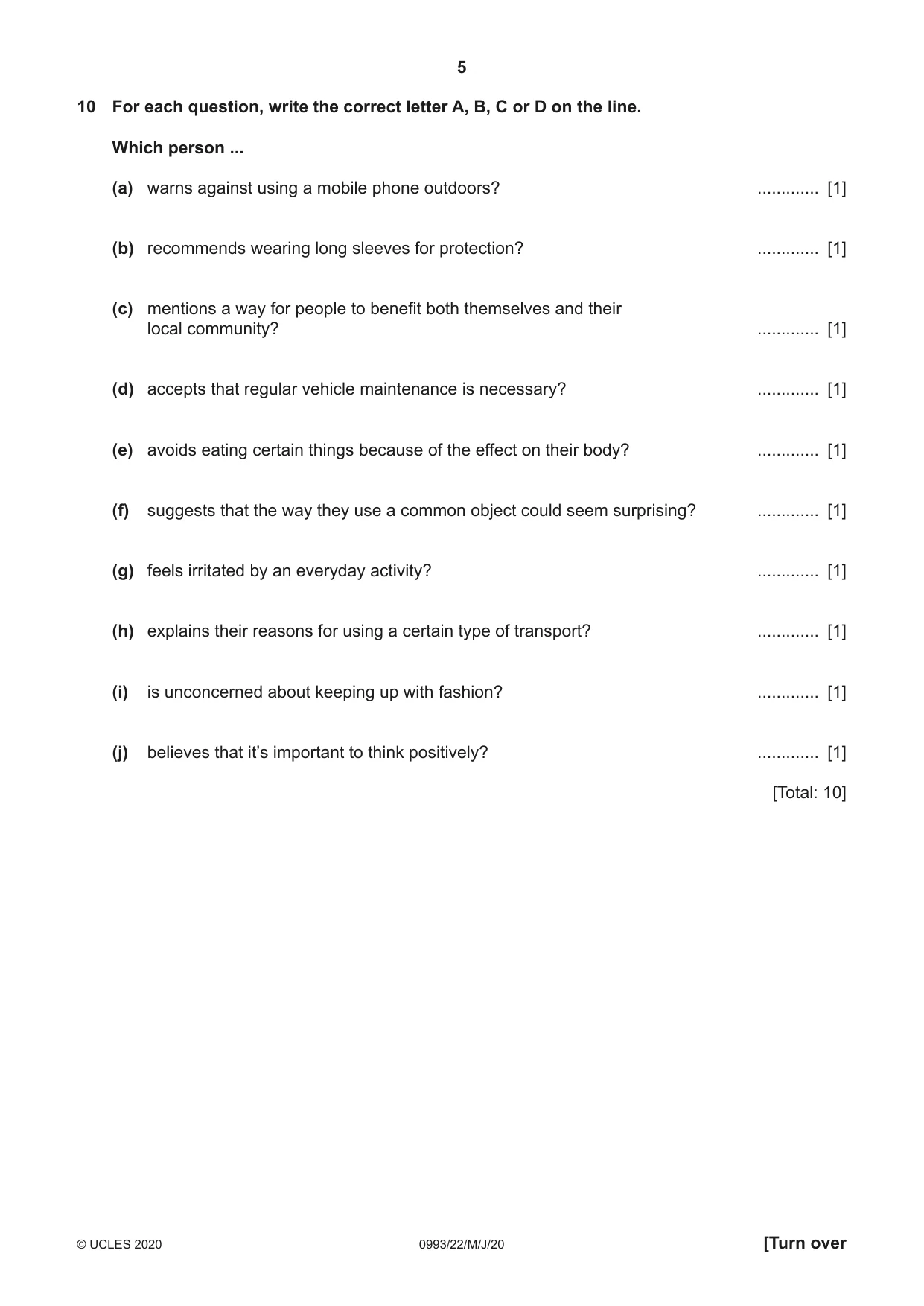
Question paper, page 5
5 0993/22/M/J/20 © UCLES 2020 [Turn over 10 For each question, write the correct letter A, B, C or D on the line. Which person ... (a) warns against using a mobile phone outdoors? … [1] (b) recommends wearing long sleeves for protection? … [1] (c) mentions a way for people to benefit both themselves and their local community? … [1] (d) accepts that regular vehicle maintenance is necessary? … [1] (e) avoids eating certain things because of the effect on their body? … [1] (f) suggests that the way they use a common object could seem surprising? … [1] (g) feels irritated by an everyday activity? … [1] (h) explains their reasons for using a certain type of transport? … [1] (i) is unconcerned about keeping up with fashion? … [1] (j) believes that it’s important to think positively? … [1] [Total: 10]
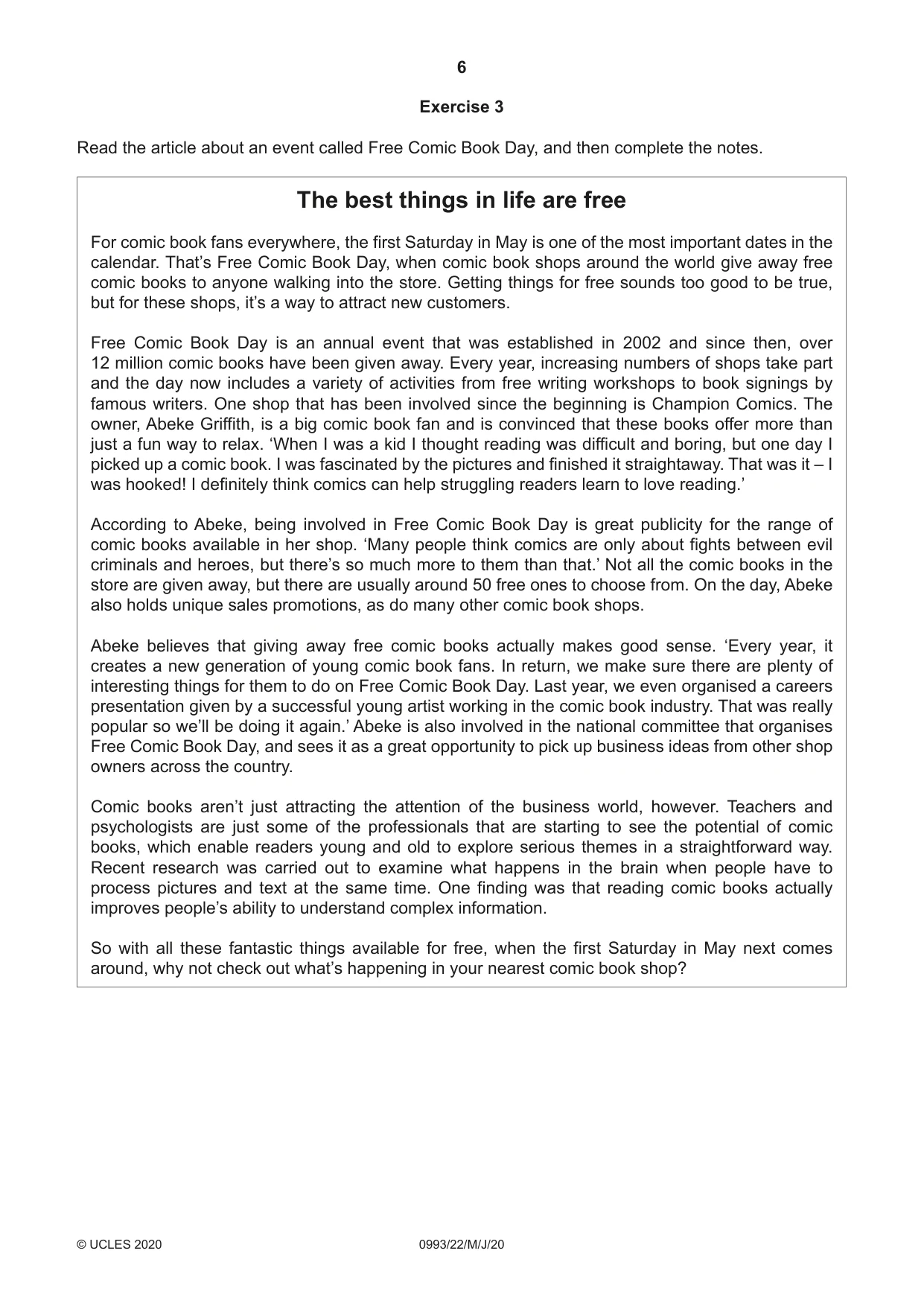
Question paper, page 6
6 0993/22/M/J/20 © UCLES 2020 Exercise 3 Read the article about an event called Free Comic Book Day, and then complete the notes. The best things in life are free For comic book fans everywhere, the first Saturday in May is one of the most important dates in the calendar. That’s Free Comic Book Day, when comic book shops around the world give away free comic books to anyone walking into the store. Getting things for free sounds too good to be true, but for these shops, it’s a way to attract new customers. Free Comic Book Day is an annual event that was established in 2002 and since then, over 12 million comic books have been given away. Every year, increasing numbers of shops take part and the day now includes a variety of activities from free writing workshops to book signings by famous writers. One shop that has been involved since the beginning is Champion Comics. The owner, Abeke Griffith, is a big comic book fan and is convinced that these books offer more than just a fun way to relax. ‘When I was a kid I thought reading was difficult and boring, but one day I picked up a comic book. I was fascinated by the pictures and finished it straightaway. That was it – I was hooked! I definitely think comics can help struggling readers learn to love reading.’ According to Abeke, being involved in Free Comic Book Day is great publicity for the range of comic books available in her shop. ‘Many people think comics are only about fights between evil criminals and heroes, but there’s so much more to them than that.’ Not all the comic books in the store are given away, but there are usually around 50 free ones to choose from. On the day, Abeke also holds unique sales promotions, as do many other comic book shops. Abeke believes that giving away free comic books actually makes good sense. ‘Every year, it creates a new generation of young comic book fans. In return, we make sure there are plenty of interesting things for them to do on Free Comic Book Day. Last year, we even organised a careers presentation given by a successful young artist working in the comic book industry. That was really popular so we’ll be doing it again.’ Abeke is also involved in the national committee that organises Free Comic Book Day, and sees it as a great opportunity to pick up business ideas from other shop owners across the country. Comic books aren’t just attracting the attention of the business world, however. Teachers and psychologists are just some of the professionals that are starting to see the potential of comic books, which enable readers young and old to explore serious themes in a straightforward way. Recent research was carried out to examine what happens in the brain when people have to process pictures and text at the same time. One finding was that reading comic books actually improves people’s ability to understand complex information. So with all these fantastic things available for free, when the first Saturday in May next comes around, why not check out what’s happening in your nearest comic book shop?
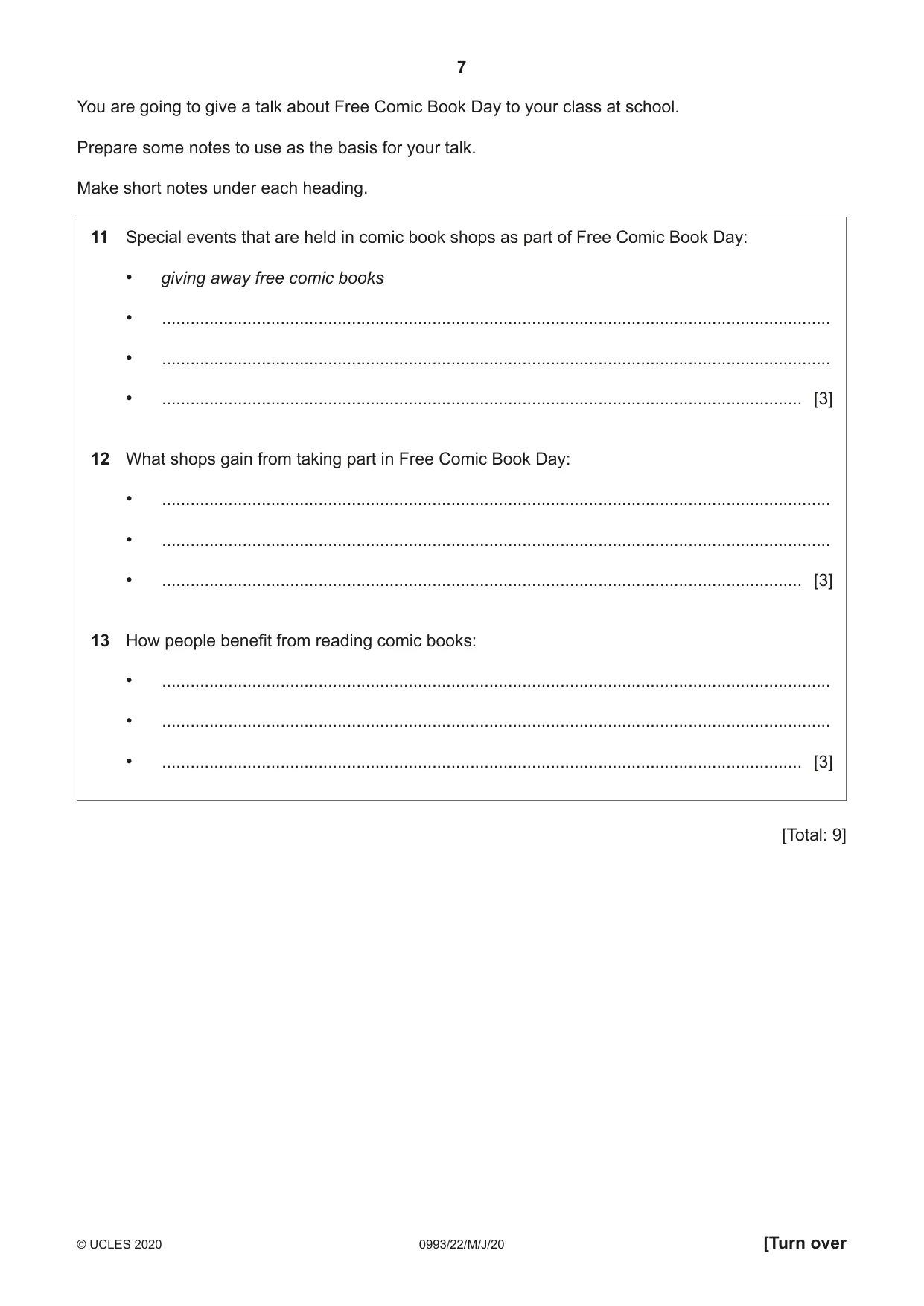
Question paper, page 7
7 0993/22/M/J/20 © UCLES 2020 [Turn over You are going to give a talk about Free Comic Book Day to your class at school. Prepare some notes to use as the basis for your talk. Make short notes under each heading. 11 Special events that are held in comic book shops as part of Free Comic Book Day: • giving away free comic books • … • … • … [3] 12 What shops gain from taking part in Free Comic Book Day: • … • … • … [3] 13 How people benefit from reading comic books: • … • … • … [3] [Total: 9]
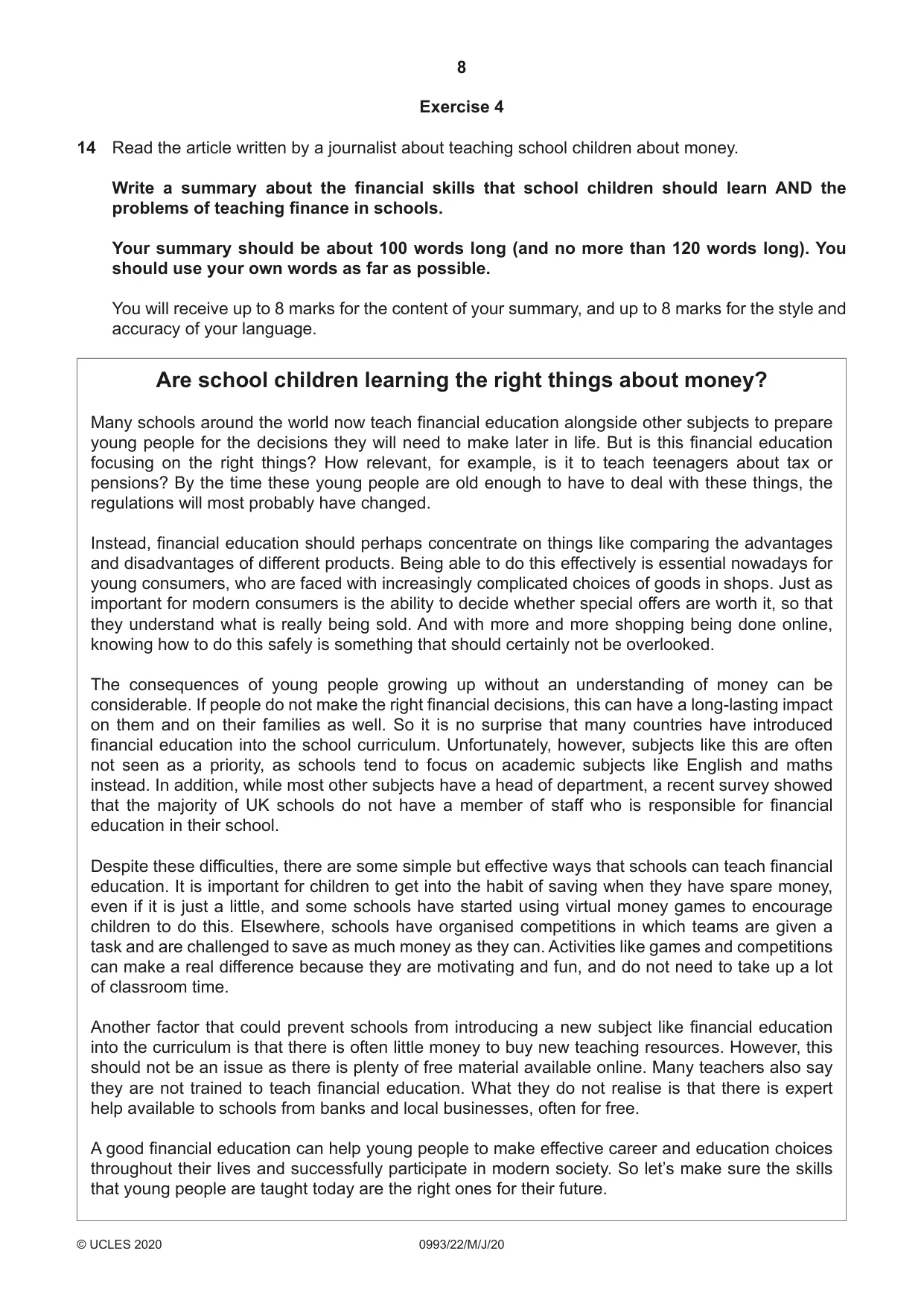
Question paper, page 8
8 0993/22/M/J/20 © UCLES 2020 Exercise 4 14 Read the article written by a journalist about teaching school children about money. Write a summary about the financial skills that school children should learn AND the problems of teaching finance in schools. Your summary should be about 100 words long (and no more than 120 words long). You should use your own words as far as possible. You will receive up to 8 marks for the content of your summary, and up to 8 marks for the style and accuracy of your language. Are school children learning the right things about money? Many schools around the world now teach financial education alongside other subjects to prepare young people for the decisions they will need to make later in life. But is this financial education focusing on the right things? How relevant, for example, is it to teach teenagers about tax or pensions? By the time these young people are old enough to have to deal with these things, the regulations will most probably have changed. Instead, financial education should perhaps concentrate on things like comparing the advantages and disadvantages of different products. Being able to do this effectively is essential nowadays for young consumers, who are faced with increasingly complicated choices of goods in shops. Just as important for modern consumers is the ability to decide whether special offers are worth it, so that they understand what is really being sold. And with more and more shopping being done online, knowing how to do this safely is something that should certainly not be overlooked. The consequences of young people growing up without an understanding of money can be considerable. If people do not make the right financial decisions, this can have a long-lasting impact on them and on their families as well. So it is no surprise that many countries have introduced financial education into the school curriculum. Unfortunately, however, subjects like this are often not seen as a priority, as schools tend to focus on academic subjects like English and maths instead. In addition, while most other subjects have a head of department, a recent survey showed that the majority of UK schools do not have a member of staff who is responsible for financial education in their school. Despite these difficulties, there are some simple but effective ways that schools can teach financial education. It is important for children to get into the habit of saving when they have spare money, even if it is just a little, and some schools have started using virtual money games to encourage children to do this. Elsewhere, schools have organised competitions in which teams are given a task and are challenged to save as much money as they can. Activities like games and competitions can make a real difference because they are motivating and fun, and do not need to take up a lot of classroom time. Another factor that could prevent schools from introducing a new subject like financial education into the curriculum is that there is often little money to buy new teaching resources. However, this should not be an issue as there is plenty of free material available online. Many teachers also say they are not trained to teach financial education. What they do not realise is that there is expert help available to schools from banks and local businesses, often for free. A good financial education can help young people to make effective career and education choices throughout their lives and successfully participate in modern society. So let’s make sure the skills that young people are taught today are the right ones for their future.
Question paper, page 9
9 0993/22/M/J/20 © UCLES 2020 [Turn over … … … … … … … … … … … … … … … … … … … … … … … … … … … [Total: 16]
Question paper, page 10
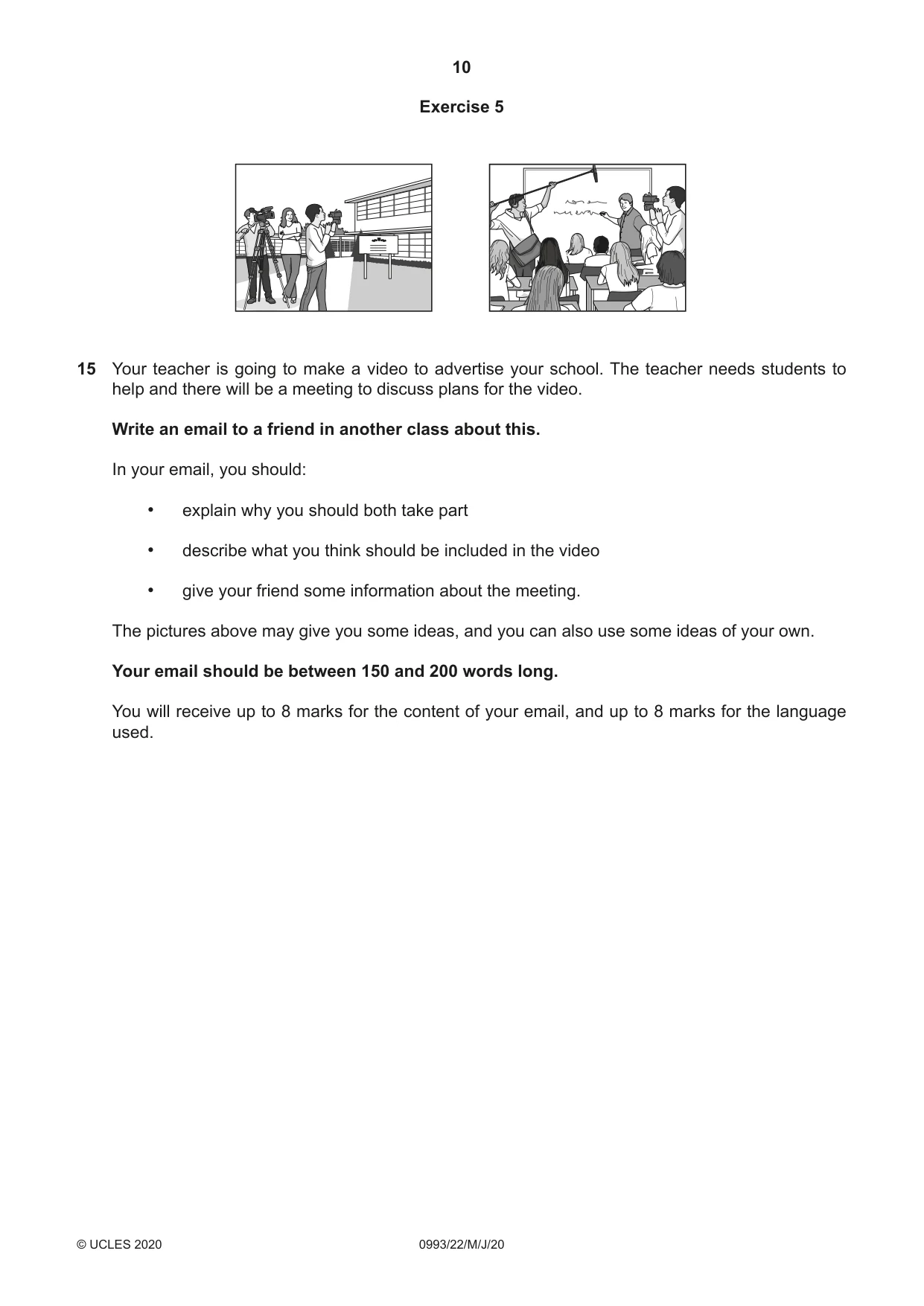
10 0993/22/M/J/20 © UCLES 2020 Exercise 5 15 Your teacher is going to make a video to advertise your school. The teacher needs students to help and there will be a meeting to discuss plans for the video. Write an email to a friend in another class about this. In your email, you should: • explain why you should both take part • describe what you think should be included in the video • give your friend some information about the meeting. The pictures above may give you some ideas, and you can also use some ideas of your own. Your email should be between 150 and 200 words long. You will receive up to 8 marks for the content of your email, and up to 8 marks for the language used.
Question paper, page 11
11 0993/22/M/J/20 © UCLES 2020 [Turn over … … … … … … … … … … … … … … … … … … … … … … … … … … … [Total: 16]
Question paper, page 12
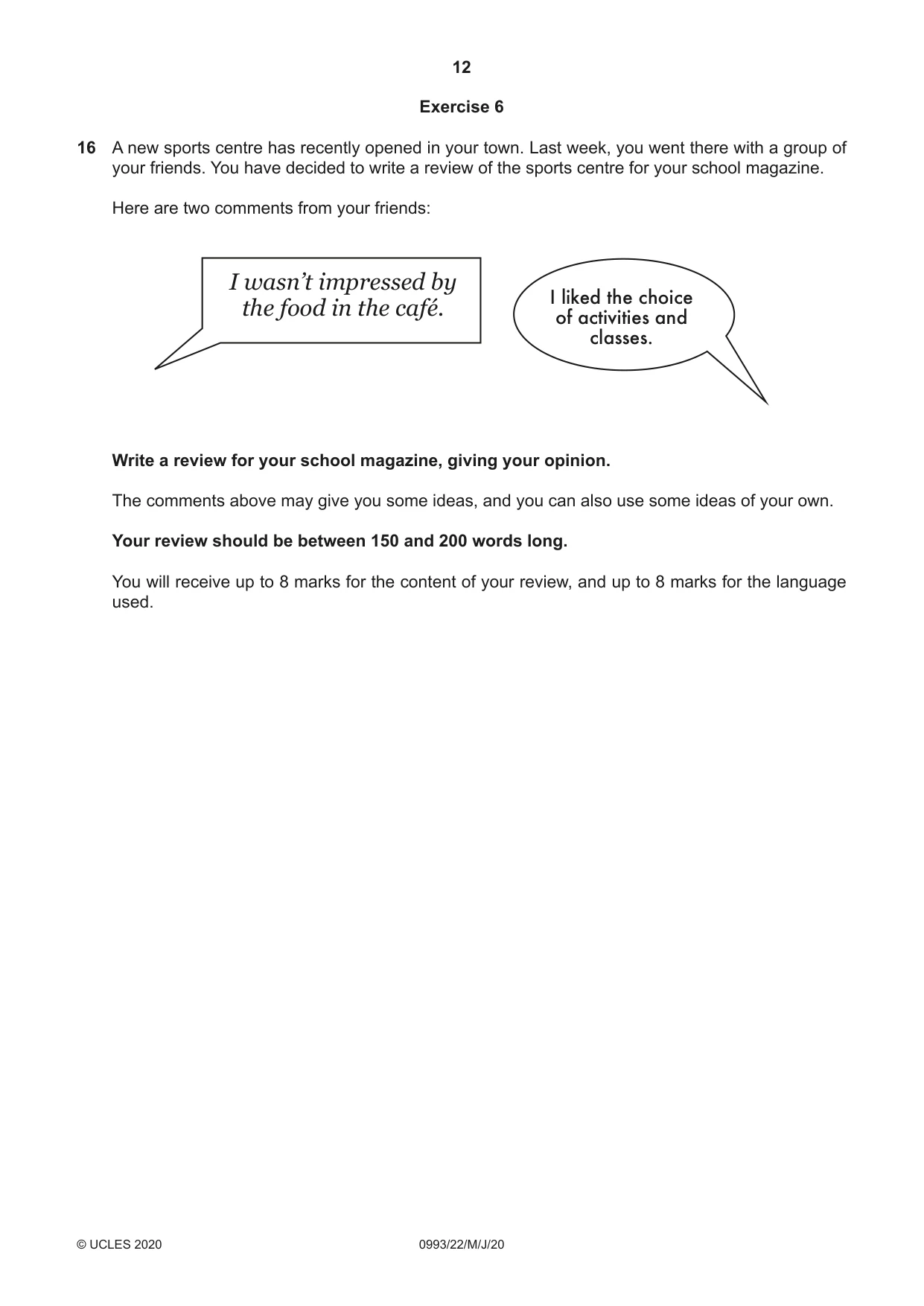
12 0993/22/M/J/20 © UCLES 2020 Exercise 6 16 A new sports centre has recently opened in your town. Last week, you went there with a group of your friends. You have decided to write a review of the sports centre for your school magazine. Here are two comments from your friends: I liked the choice of activities and classes. I wasn’t impressed by the food in the café. Write a review for your school magazine, giving your opinion. The comments above may give you some ideas, and you can also use some ideas of your own. Your review should be between 150 and 200 words long. You will receive up to 8 marks for the content of your review, and up to 8 marks for the language used.
Question paper, page 13
13 0993/22/M/J/20 © UCLES 2020 … … … … … … … … … … … … … … … … … … … … … … … … … … … [Total: 16]
Question paper, page 14
14 0993/22/M/J/20 © UCLES 2020 BLANK PAGE
Question paper, page 15
15 0993/22/M/J/20 © UCLES 2020 BLANK PAGE
Question paper, page 16
16 0993/22/M/J/20 © UCLES 2020 Permission to reproduce items where third-party owned material protected by copyright is included has been sought and cleared where possible. Every reasonable effort has been made by the publisher (UCLES) to trace copyright holders, but if any items requiring clearance have unwittingly been included, the publisher will be pleased to make amends at the earliest possible opportunity. To avoid the issue of disclosure of answer-related information to candidates, all copyright acknowledgements are reproduced online in the Cambridge Assessment International Education Copyright Acknowledgements Booklet. This is produced for each series of examinations and is freely available to download at www.cambridgeinternational.org after the live examination series. Cambridge Assessment International Education is part of the Cambridge Assessment Group. Cambridge Assessment is the brand name of the University of Cambridge Local Examinations Syndicate (UCLES), which itself is a department of the University of Cambridge. BLANK PAGE
Mark scheme, page 1
This document consists of 10 printed pages. © UCLES 2020 [Turn over Cambridge IGCSE™ (9–1) ENGLISH AS A SECOND LANGUAGE 9–1 (SPEAKING ENDORSEMENT) 0993/22 Paper 2 Reading and Writing (Extended) May/June 2020 MARK SCHEME Maximum Mark: 80 Published Students did not sit exam papers in the June 2020 series due to the Covid-19 global pandemic. This mark scheme is published to support teachers and students and should be read together with the question paper. It shows the requirements of the exam. The answer column of the mark scheme shows the proposed basis on which Examiners would award marks for this exam. Where appropriate, this column also provides the most likely acceptable alternative responses expected from students. Examiners usually review the mark scheme after they have seen student responses and update the mark scheme if appropriate. In the June series, Examiners were unable to consider the acceptability of alternative responses, as there were no student responses to consider. Mark schemes should usually be read together with the Principal Examiner Report for Teachers. However, because students did not sit exam papers, there is no Principal Examiner Report for Teachers for the June 2020 series. Cambridge International will not enter into discussions about these mark schemes. Cambridge International is publishing the mark schemes for the June 2020 series for most Cambridge IGCSE™ and Cambridge International A & AS Level components, and some Cambridge O Level components.
Mark scheme, page 2
0993/22 Cambridge IGCSE (9–1) – Mark Scheme PUBLISHED May/June 2020 © UCLES 2020 Page 2 of 10 Generic Marking Principles These general marking principles must be applied by all examiners when marking candidate answers. They should be applied alongside the specific content of the mark scheme or generic level descriptors for a question. Each question paper and mark scheme will also comply with these marking principles. GENERIC MARKING PRINCIPLE 1: Marks must be awarded in line with: • the specific content of the mark scheme or the generic level descriptors for the question • the specific skills defined in the mark scheme or in the generic level descriptors for the question • the standard of response required by a candidate as exemplified by the standardisation scripts. GENERIC MARKING PRINCIPLE 2: Marks awarded are always whole marks (not half marks, or other fractions). GENERIC MARKING PRINCIPLE 3: Marks must be awarded positively: • marks are awarded for correct/valid answers, as defined in the mark scheme. However, credit is given for valid answers which go beyond the scope of the syllabus and mark scheme, referring to your Team Leader as appropriate • marks are awarded when candidates clearly demonstrate what they know and can do • marks are not deducted for errors • marks are not deducted for omissions • answers should only be judged on the quality of spelling, punctuation and grammar when these features are specifically assessed by the question as indicated by the mark scheme. The meaning, however, should be unambiguous. GENERIC MARKING PRINCIPLE 4: Rules must be applied consistently e.g. in situations where candidates have not followed instructions or in the application of generic level descriptors. GENERIC MARKING PRINCIPLE 5: Marks should be awarded using the full range of marks defined in the mark scheme for the question (however; the use of the full mark range may be limited according to the quality of the candidate responses seen). GENERIC MARKING PRINCIPLE 6: Marks awarded are based solely on the requirements as defined in the mark scheme. Marks should not be awarded with grade thresholds or grade descriptors in mind.
Mark scheme, page 3
0993/22 Cambridge IGCSE (9–1) – Mark Scheme PUBLISHED May/June 2020 © UCLES 2020 Page 3 of 10 This component forms part of the Extended tier assessment of Cambridge IGCSE English as a Second Language and tests the following Assessment Objectives: AO1: Reading R1 identify and select relevant information R2 understand ideas, opinions and attitudes R3 show understanding of the connections between ideas, opinions and attitudes R4 understand what is implied but not directly stated, e.g. gist, writer’s purpose, intentions and feelings AO2: Writing W1 communicate information/ideas/opinions clearly, accurately and effectively W2 organise ideas into coherent paragraphs using a range of appropriate linking devices W3 use a range of grammatical structures accurately and effectively W4 show control of punctuation and spelling W5 use appropriate register and style/format for the given purpose and audience
Mark scheme, page 4
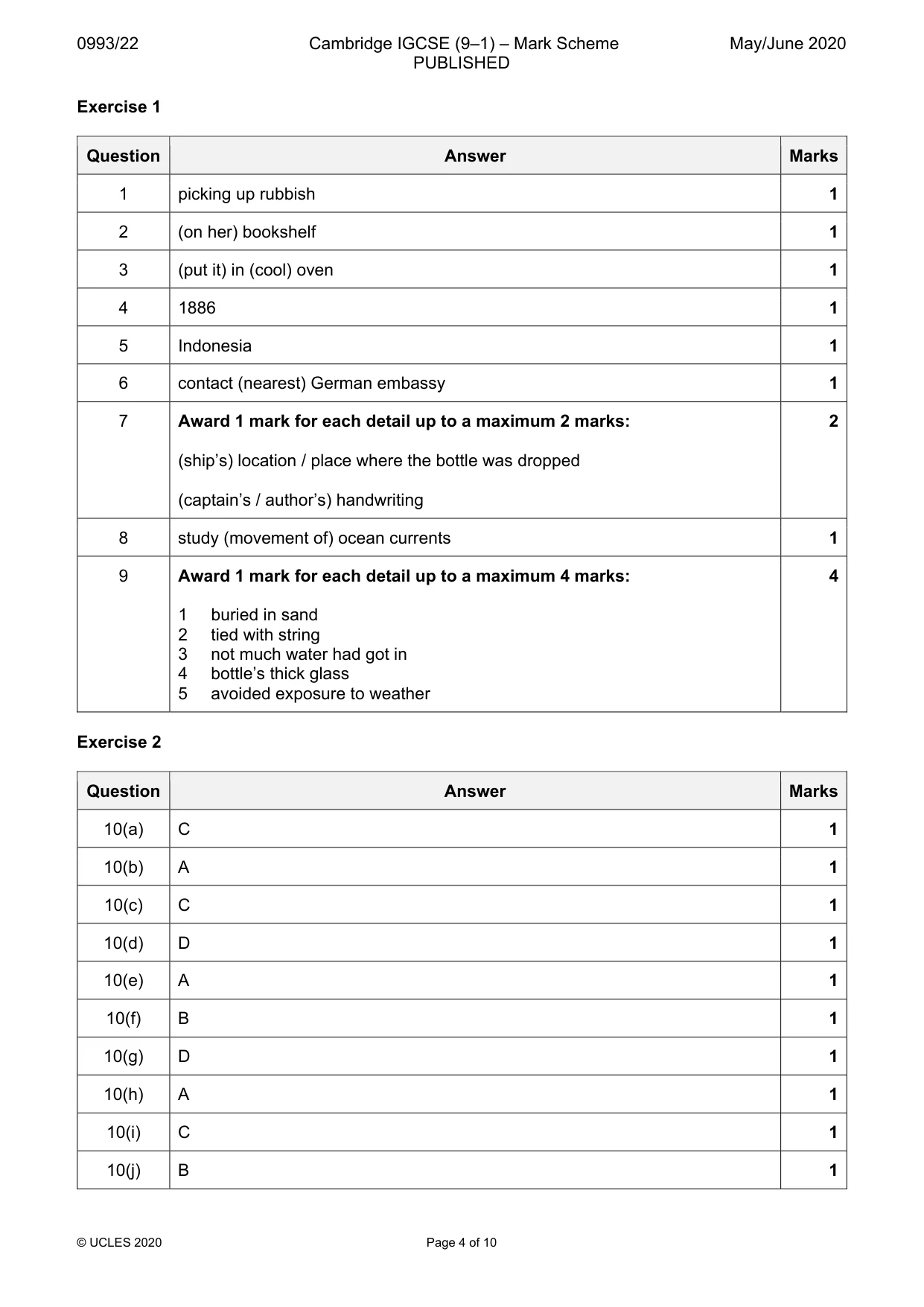
0993/22 Cambridge IGCSE (9–1) – Mark Scheme PUBLISHED May/June 2020 © UCLES 2020 Page 4 of 10 Exercise 1 Question Answer Marks 1 picking up rubbish 1 2 (on her) bookshelf 1 3 (put it) in (cool) oven 1 4 1886 1 5 Indonesia 1 6 contact (nearest) German embassy 1 7 Award 1 mark for each detail up to a maximum 2 marks: (ship’s) location / place where the bottle was dropped (captain’s / author’s) handwriting 2 8 study (movement of) ocean currents 1 9 Award 1 mark for each detail up to a maximum 4 marks: 1 buried in sand 2 tied with string 3 not much water had got in 4 bottle’s thick glass 5 avoided exposure to weather 4 Exercise 2 Question Answer Marks 10(a) C 1 10(b) A 1 10(c) C 1 10(d) D 1 10(e) A 1 10(f) B 1 10(g) D 1 10(h) A 1 10(i) C 1 10(j) B 1
Mark scheme, page 5
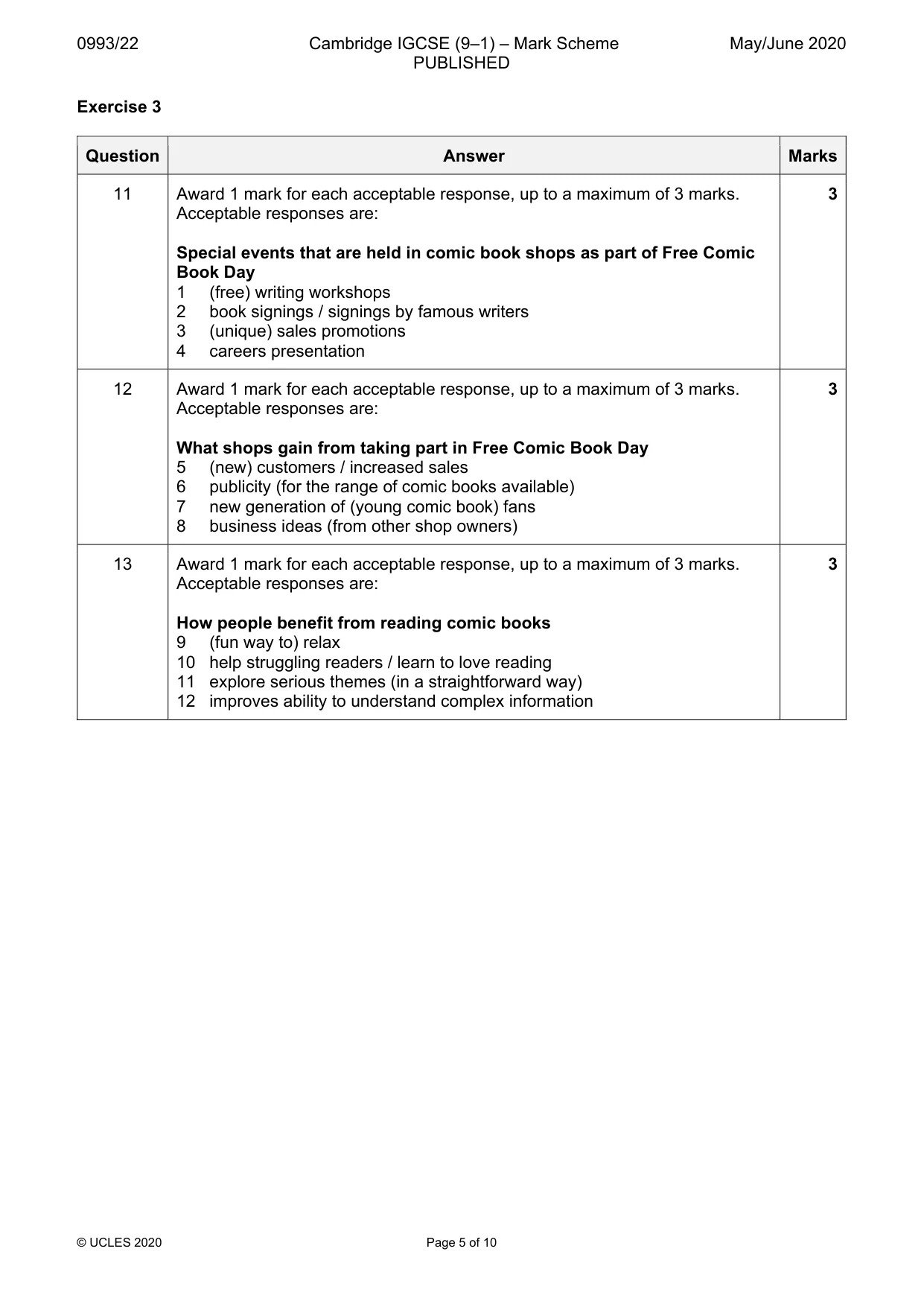
0993/22 Cambridge IGCSE (9–1) – Mark Scheme PUBLISHED May/June 2020 © UCLES 2020 Page 5 of 10 Exercise 3 Question Answer Marks 11 Award 1 mark for each acceptable response, up to a maximum of 3 marks. Acceptable responses are: Special events that are held in comic book shops as part of Free Comic Book Day 1 (free) writing workshops 2 book signings / signings by famous writers 3 (unique) sales promotions 4 careers presentation 3 12 Award 1 mark for each acceptable response, up to a maximum of 3 marks. Acceptable responses are: What shops gain from taking part in Free Comic Book Day 5 (new) customers / increased sales 6 publicity (for the range of comic books available) 7 new generation of (young comic book) fans 8 business ideas (from other shop owners) 3 13 Award 1 mark for each acceptable response, up to a maximum of 3 marks. Acceptable responses are: How people benefit from reading comic books 9 (fun way to) relax 10 help struggling readers / learn to love reading 11 explore serious themes (in a straightforward way) 12 improves ability to understand complex information 3
Mark scheme, page 6
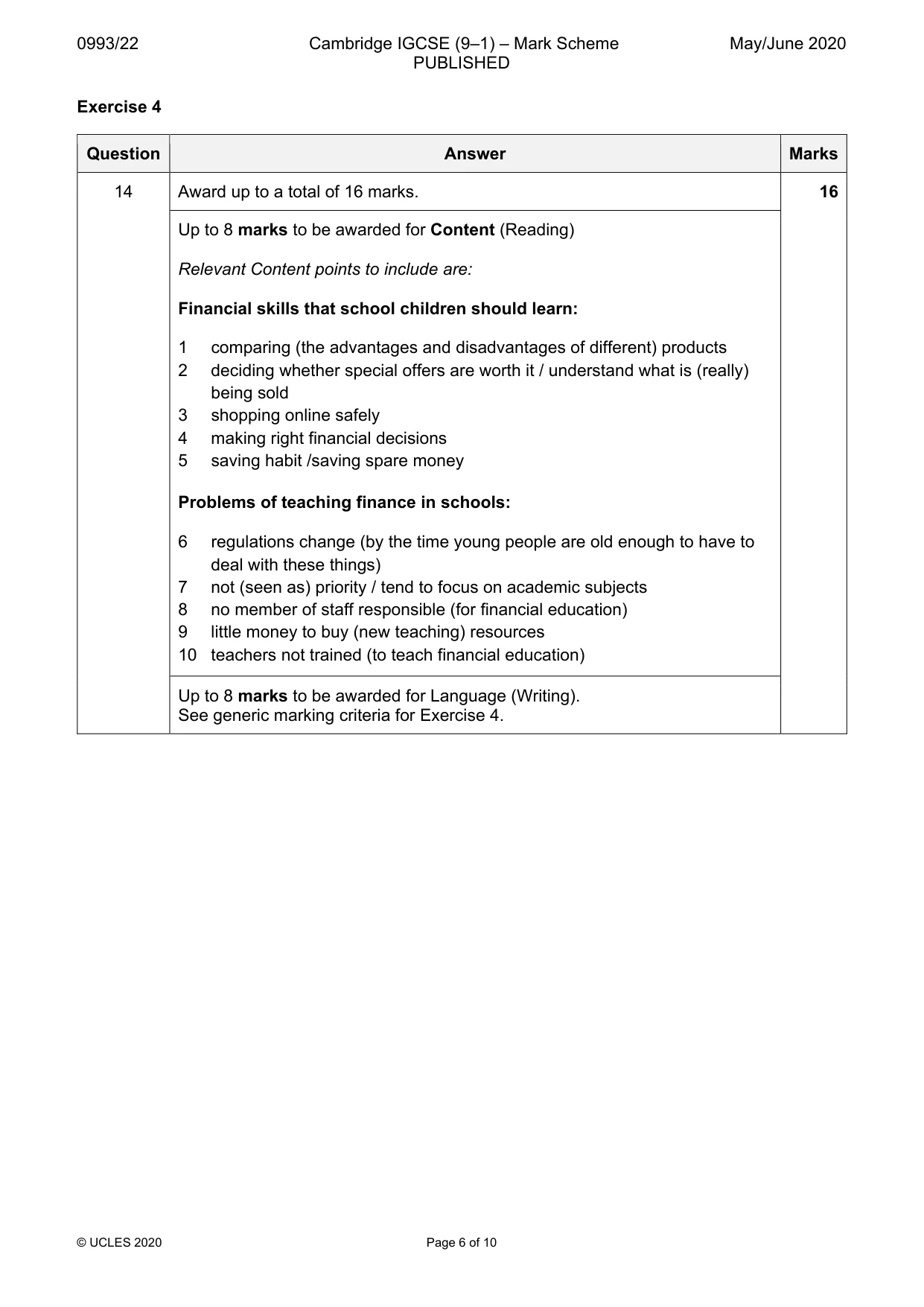
0993/22 Cambridge IGCSE (9–1) – Mark Scheme PUBLISHED May/June 2020 © UCLES 2020 Page 6 of 10 Exercise 4 Question Answer Marks 14 Award up to a total of 16 marks. 16 Up to 8 marks to be awarded for Content (Reading) Relevant Content points to include are: Financial skills that school children should learn: 1 comparing (the advantages and disadvantages of different) products 2 deciding whether special offers are worth it / understand what is (really) being sold 3 shopping online safely 4 making right financial decisions 5 saving habit /saving spare money Problems of teaching finance in schools: 6 regulations change (by the time young people are old enough to have to deal with these things) 7 not (seen as) priority / tend to focus on academic subjects 8 no member of staff responsible (for financial education) 9 little money to buy (new teaching) resources 10 teachers not trained (to teach financial education) Up to 8 marks to be awarded for Language (Writing). See generic marking criteria for Exercise 4.
Mark scheme, page 7
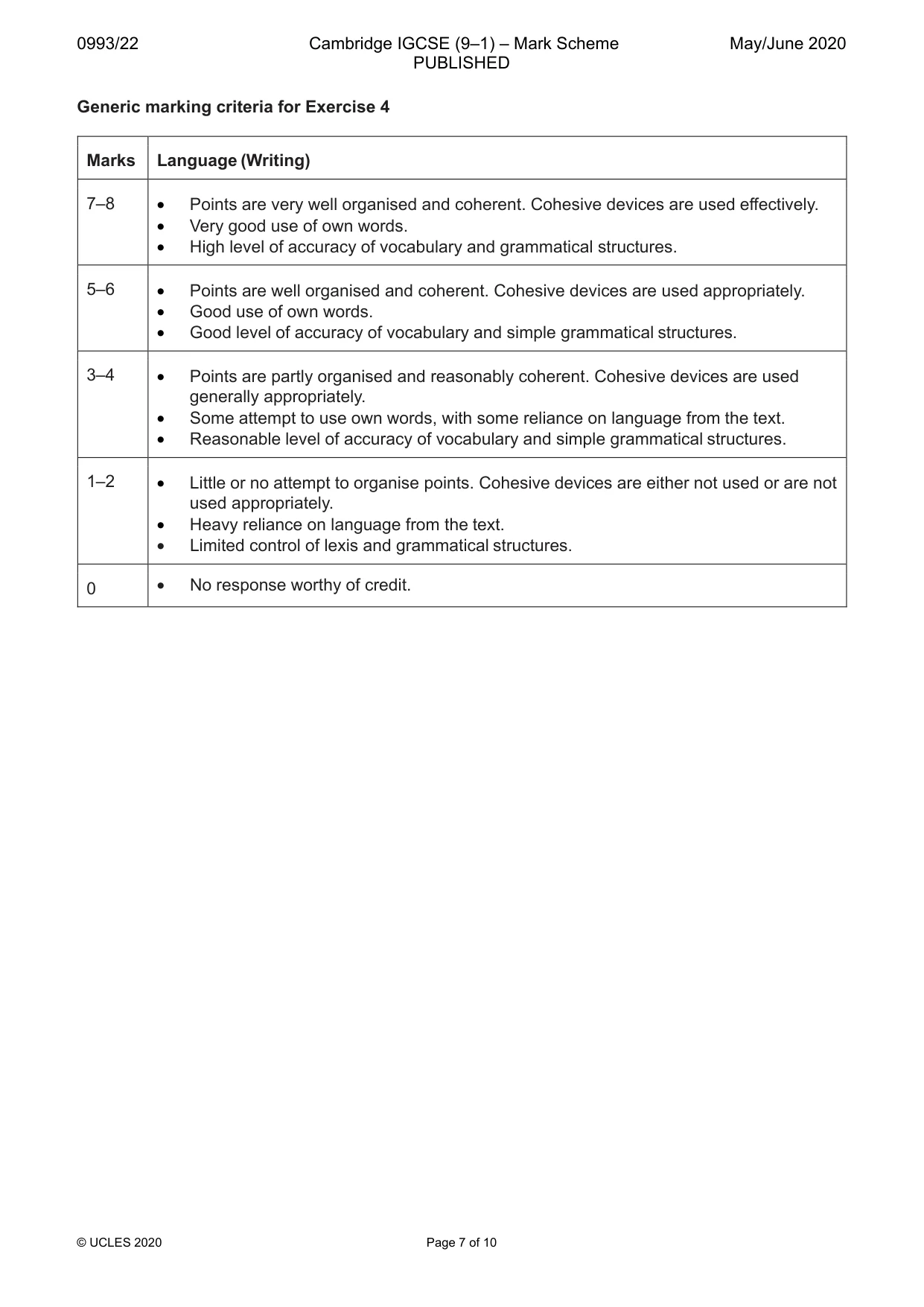
0993/22 Cambridge IGCSE (9–1) – Mark Scheme PUBLISHED May/June 2020 © UCLES 2020 Page 7 of 10 Generic marking criteria for Exercise 4 Marks Language (Writing) 7–8 • Points are very well organised and coherent. Cohesive devices are used effectively. • Very good use of own words. • High level of accuracy of vocabulary and grammatical structures. 5–6 • Points are well organised and coherent. Cohesive devices are used appropriately. • Good use of own words. • Good level of accuracy of vocabulary and simple grammatical structures. 3–4 • Points are partly organised and reasonably coherent. Cohesive devices are used generally appropriately. • Some attempt to use own words, with some reliance on language from the text. • Reasonable level of accuracy of vocabulary and simple grammatical structures. 1–2 • Little or no attempt to organise points. Cohesive devices are either not used or are not used appropriately. • Heavy reliance on language from the text. • Limited control of lexis and grammatical structures. 0 • No response worthy of credit.
Mark scheme, page 8
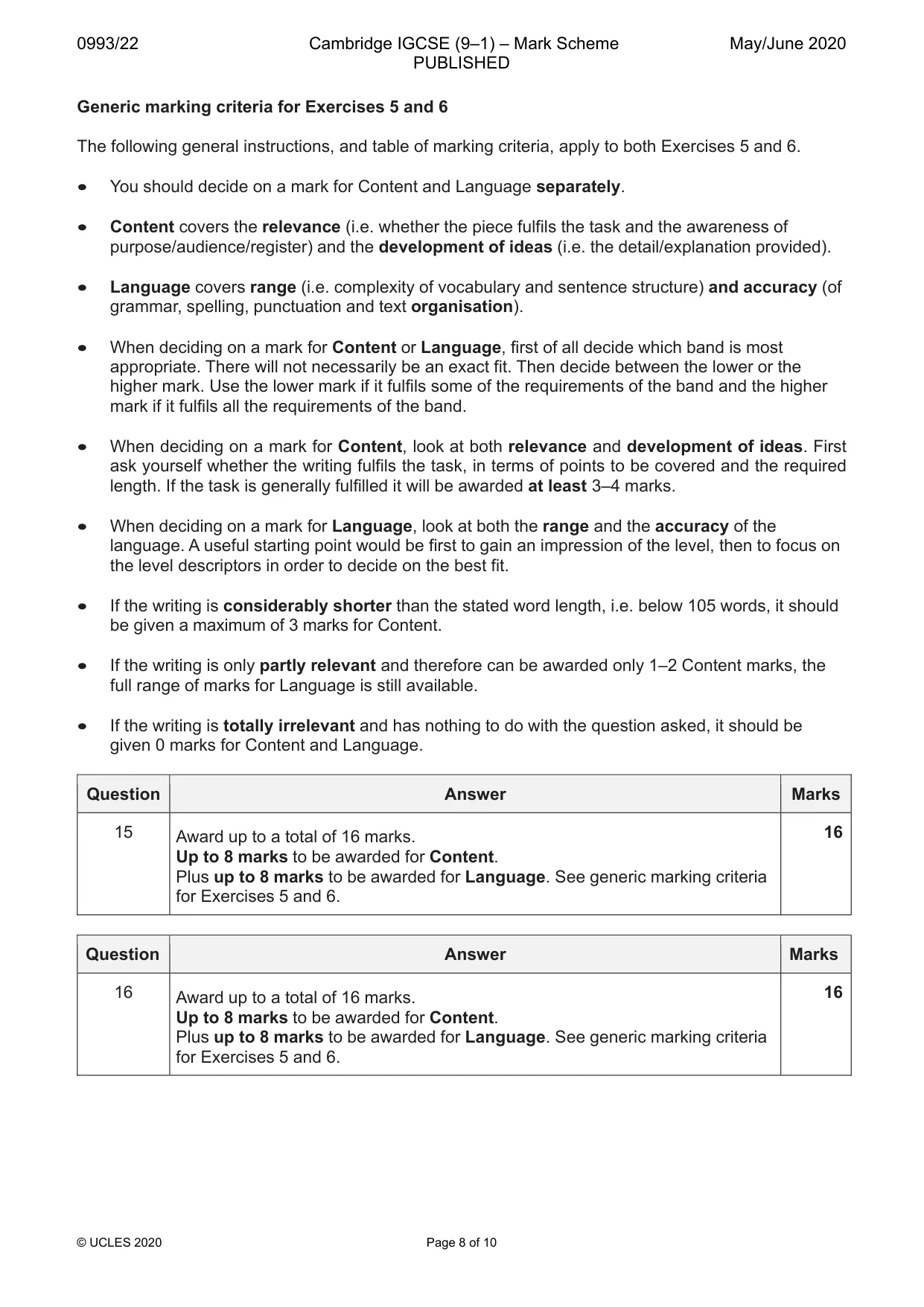
0993/22 Cambridge IGCSE (9–1) – Mark Scheme PUBLISHED May/June 2020 © UCLES 2020 Page 8 of 10 Generic marking criteria for Exercises 5 and 6 The following general instructions, and table of marking criteria, apply to both Exercises 5 and 6. • You should decide on a mark for Content and Language separately. • Content covers the relevance (i.e. whether the piece fulfils the task and the awareness of purpose/audience/register) and the development of ideas (i.e. the detail/explanation provided). • Language covers range (i.e. complexity of vocabulary and sentence structure) and accuracy (of grammar, spelling, punctuation and text organisation). • When deciding on a mark for Content or Language, first of all decide which band is most appropriate. There will not necessarily be an exact fit. Then decide between the lower or the higher mark. Use the lower mark if it fulfils some of the requirements of the band and the higher mark if it fulfils all the requirements of the band. • When deciding on a mark for Content, look at both relevance and development of ideas. First ask yourself whether the writing fulfils the task, in terms of points to be covered and the required length. If the task is generally fulfilled it will be awarded at least 3–4 marks. • When deciding on a mark for Language, look at both the range and the accuracy of the language. A useful starting point would be first to gain an impression of the level, then to focus on the level descriptors in order to decide on the best fit. • If the writing is considerably shorter than the stated word length, i.e. below 105 words, it should be given a maximum of 3 marks for Content. • If the writing is only partly relevant and therefore can be awarded only 1–2 Content marks, the full range of marks for Language is still available. • If the writing is totally irrelevant and has nothing to do with the question asked, it should be given 0 marks for Content and Language. Question Answer Marks 15 Award up to a total of 16 marks. Up to 8 marks to be awarded for Content. Plus up to 8 marks to be awarded for Language. See generic marking criteria for Exercises 5 and 6. 16 Question Answer Marks 16 Award up to a total of 16 marks. Up to 8 marks to be awarded for Content. Plus up to 8 marks to be awarded for Language. See generic marking criteria for Exercises 5 and 6. 16
Mark scheme, page 9
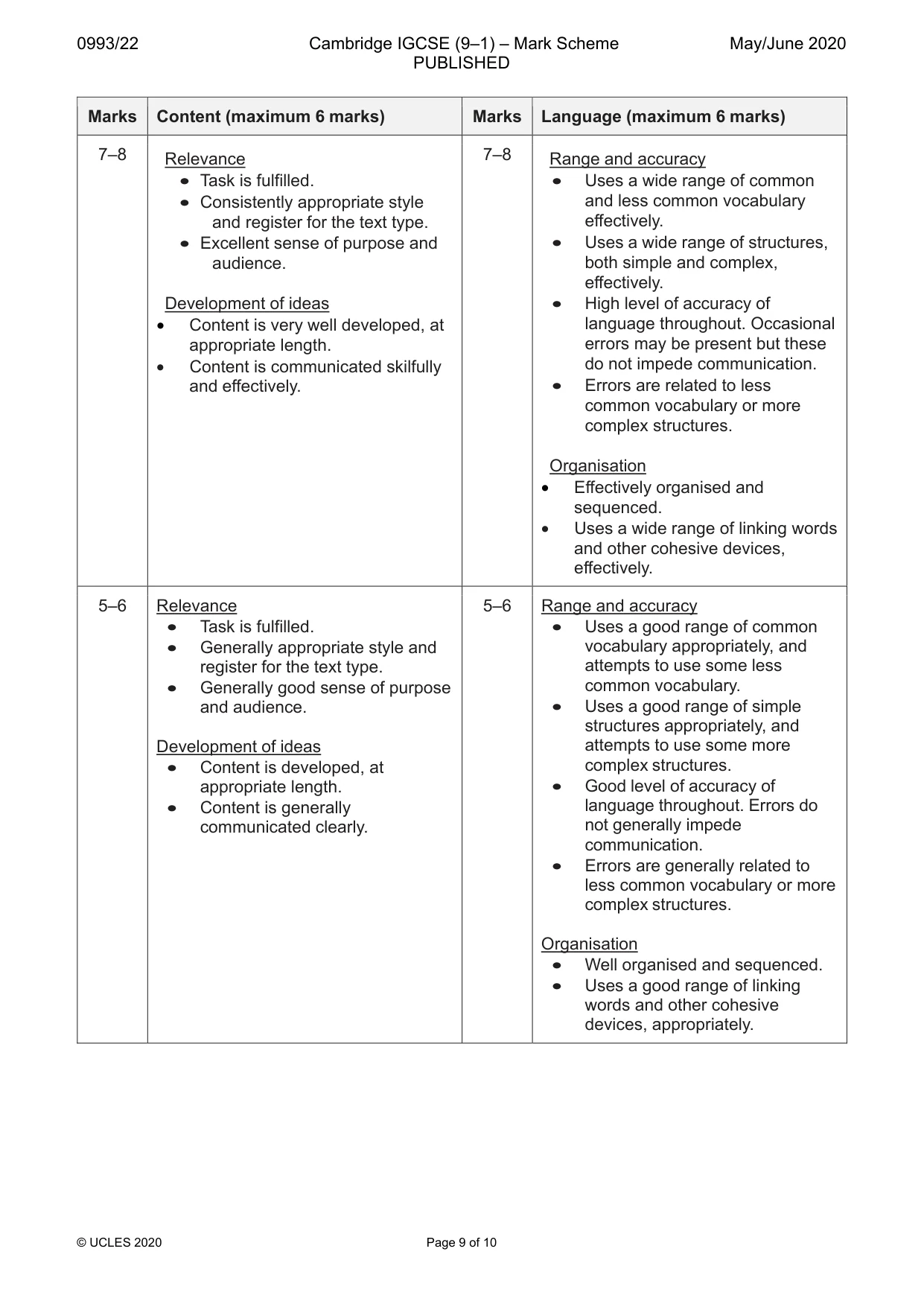
0993/22 Cambridge IGCSE (9–1) – Mark Scheme PUBLISHED May/June 2020 © UCLES 2020 Page 9 of 10 Marks Content (maximum 6 marks) Marks Language (maximum 6 marks) 7–8 Relevance • Task is fulfilled. • Consistently appropriate style and register for the text type. • Excellent sense of purpose and audience. Development of ideas • Content is very well developed, at appropriate length. • Content is communicated skilfully and effectively. 7–8 Range and accuracy • Uses a wide range of common and less common vocabulary effectively. • Uses a wide range of structures, both simple and complex, effectively. • High level of accuracy of language throughout. Occasional errors may be present but these do not impede communication. • Errors are related to less common vocabulary or more complex structures. Organisation • Effectively organised and sequenced. • Uses a wide range of linking words and other cohesive devices, effectively. 5–6 Relevance • Task is fulfilled. • Generally appropriate style and register for the text type. • Generally good sense of purpose and audience. Development of ideas • Content is developed, at appropriate length. • Content is generally communicated clearly. 5–6 Range and accuracy • Uses a good range of common vocabulary appropriately, and attempts to use some less common vocabulary. • Uses a good range of simple structures appropriately, and attempts to use some more complex structures. • Good level of accuracy of language throughout. Errors do not generally impede communication. • Errors are generally related to less common vocabulary or more complex structures. Organisation • Well organised and sequenced. • Uses a good range of linking words and other cohesive devices, appropriately.
Mark scheme, page 10
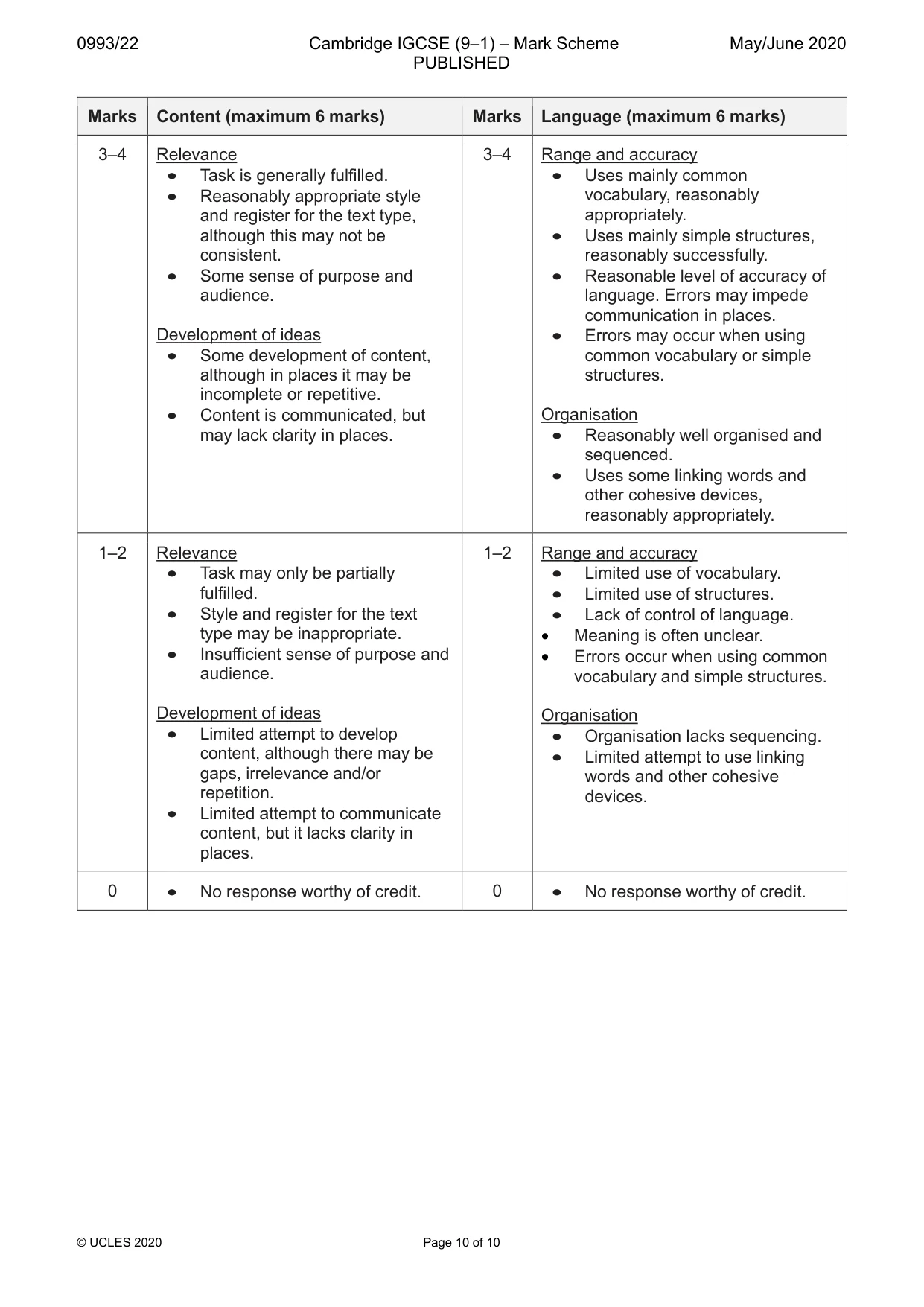
0993/22 Cambridge IGCSE (9–1) – Mark Scheme PUBLISHED May/June 2020 © UCLES 2020 Page 10 of 10 Marks Content (maximum 6 marks) Marks Language (maximum 6 marks) 3–4 Relevance • Task is generally fulfilled. • Reasonably appropriate style and register for the text type, although this may not be consistent. • Some sense of purpose and audience. Development of ideas • Some development of content, although in places it may be incomplete or repetitive. • Content is communicated, but may lack clarity in places. 3–4 Range and accuracy • Uses mainly common vocabulary, reasonably appropriately. • Uses mainly simple structures, reasonably successfully. • Reasonable level of accuracy of language. Errors may impede communication in places. • Errors may occur when using common vocabulary or simple structures. Organisation • Reasonably well organised and sequenced. • Uses some linking words and other cohesive devices, reasonably appropriately. 1–2 Relevance • Task may only be partially fulfilled. • Style and register for the text type may be inappropriate. • Insufficient sense of purpose and audience. Development of ideas • Limited attempt to develop content, although there may be gaps, irrelevance and/or repetition. • Limited attempt to communicate content, but it lacks clarity in places. 1–2 Range and accuracy • Limited use of vocabulary. • Limited use of structures. • Lack of control of language. • Meaning is often unclear. • Errors occur when using common vocabulary and simple structures. Organisation • Organisation lacks sequencing. • Limited attempt to use linking words and other cohesive devices. 0 • No response worthy of credit. 0 • No response worthy of credit.