Cambridge IGCSE English Second Language (Speaking Endorsement) (9-1) 0993 — 2021 Oct/Nov Paper 1 · Variant 1
0993/11/O/N/21 · 60 marks · ≈68 min
The question paper and its mark scheme, free to read here and free to download. This is Cambridge’s own paper, exactly as it was sat.
Question paper16 pages






Mark scheme9 pages
Answers below. Sit the paper first if you are practising.
Paper as text
Question paper, page 1
This document has 16 pages. Any blank pages are indicated. Cambridge IGCSE™(9–1) ENGLISH AS A SECOND LANGUAGE 0993/11 Paper 1 Reading and Writing (Core) October/November 2021 1 hour 30 minutes You must answer on the question paper. No additional materials are needed. INSTRUCTIONS ● Answer all questions. ● Use a black or dark blue pen. ● Write your name, centre number and candidate number in the boxes at the top of the page. ● Write your answer to each question in the space provided. ● Do not use an erasable pen or correction fluid. ● Do not write on any bar codes. ● Dictionaries are not allowed. INFORMATION ● The total mark for this paper is 60. ● The number of marks for each question or part question is shown in brackets [ ]. DC (SLM) 218393 © UCLES 2021 [Turn over * 1 4 7 0 0 0 6 0 9 9 *
Question paper, page 2
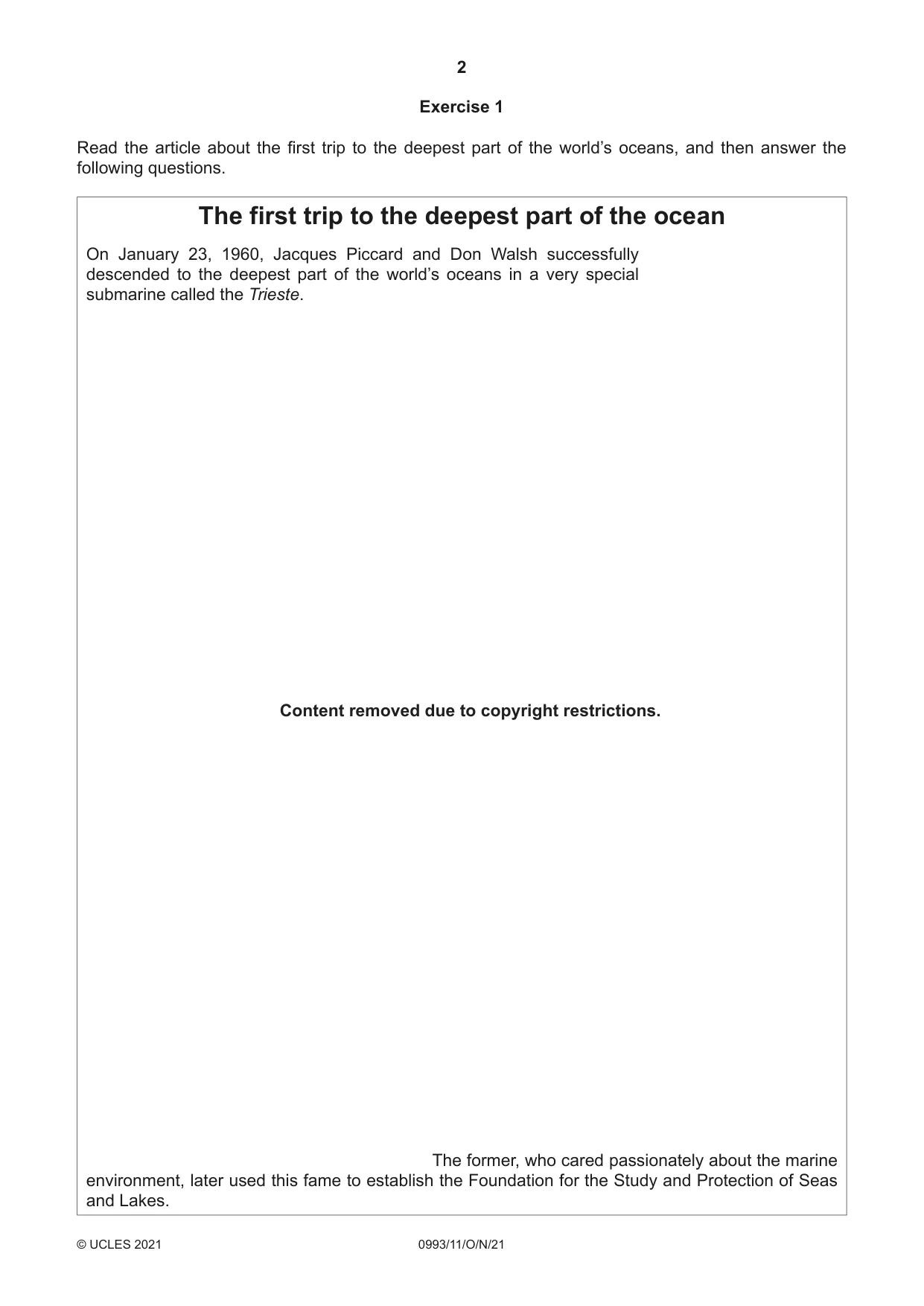
2 0993/11/O/N/21 © UCLES 2021 Exercise 1 Read the article about the first trip to the deepest part of the world’s oceans, and then answer the following questions. The first trip to the deepest part of the ocean On January 23, 1960, Jacques Piccard and Don Walsh successfully descended to the deepest part of the world’s oceans in a very special submarine called the Trieste. The former, who cared passionately about the marine environment, later used this fame to establish the Foundation for the Study and Protection of Seas and Lakes. Content removed due to copyright restrictions.
Question paper, page 3
3 0993/11/O/N/21 © UCLES 2021 [Turn over 1 Who designed the Trieste? … [1] 2 Where was the Trieste built? … [1] 3 What substance enabled the Trieste to rise to the surface? … [1] 4 What is the Challenger Deep named after? … [1] 5 What problems did the Trieste have on the way down? Give two details. … … [2] 6 What creature did Piccard and Walsh see at the bottom of the ocean? … [1] 7 How long did it take the Trieste to reach the surface after the dive? … [1] 8 What depth did the Trieste reach? … [1] [Total: 9]
Question paper, page 4
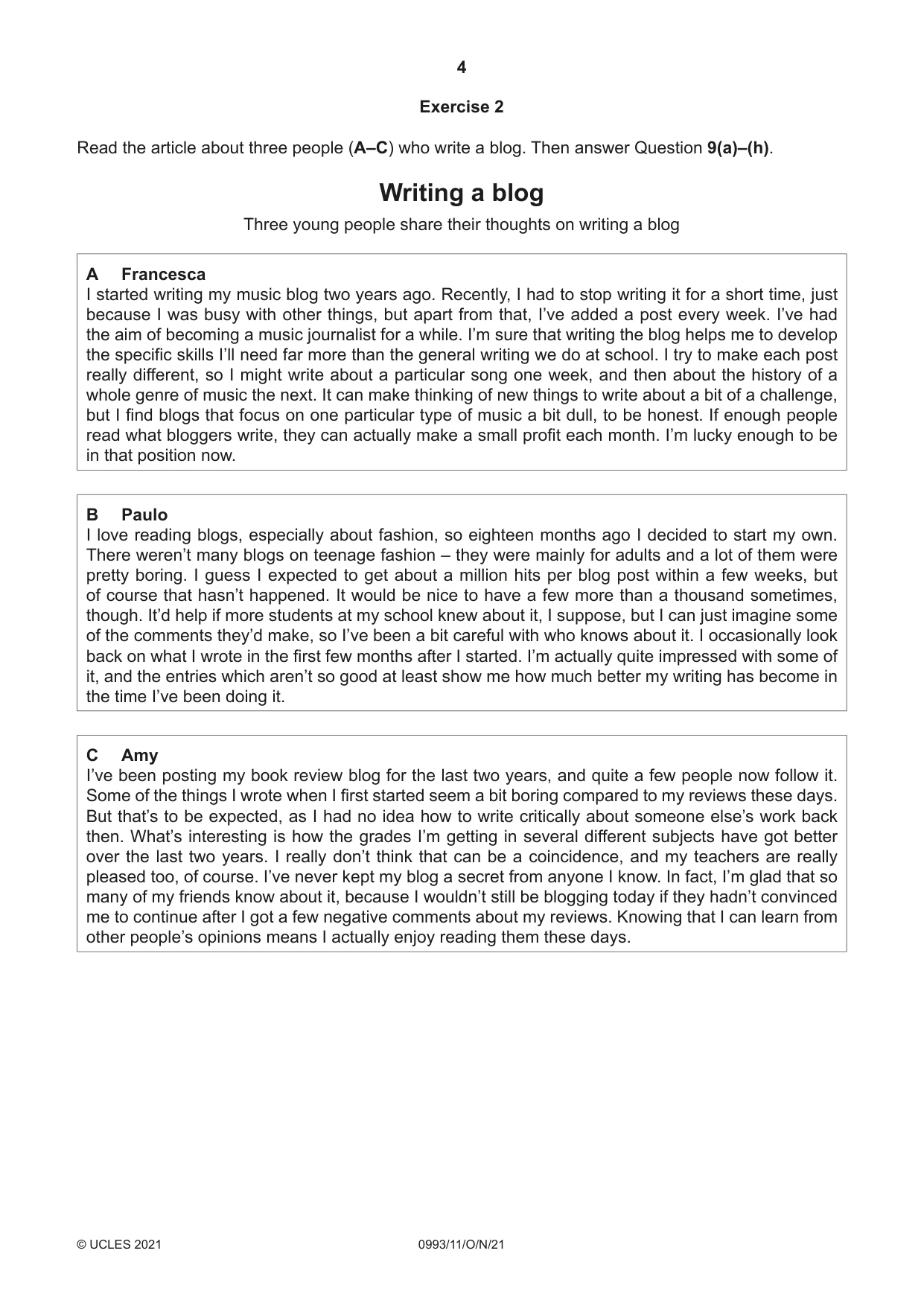
4 0993/11/O/N/21 © UCLES 2021 Exercise 2 Read the article about three people (A–C) who write a blog. Then answer Question 9(a)–(h). Writing a blog Three young people share their thoughts on writing a blog A Francesca I started writing my music blog two years ago. Recently, I had to stop writing it for a short time, just because I was busy with other things, but apart from that, I’ve added a post every week. I’ve had the aim of becoming a music journalist for a while. I’m sure that writing the blog helps me to develop the specific skills I’ll need far more than the general writing we do at school. I try to make each post really different, so I might write about a particular song one week, and then about the history of a whole genre of music the next. It can make thinking of new things to write about a bit of a challenge, but I find blogs that focus on one particular type of music a bit dull, to be honest. If enough people read what bloggers write, they can actually make a small profit each month. I’m lucky enough to be in that position now. B Paulo I love reading blogs, especially about fashion, so eighteen months ago I decided to start my own. There weren’t many blogs on teenage fashion – they were mainly for adults and a lot of them were pretty boring. I guess I expected to get about a million hits per blog post within a few weeks, but of course that hasn’t happened. It would be nice to have a few more than a thousand sometimes, though. It’d help if more students at my school knew about it, I suppose, but I can just imagine some of the comments they’d make, so I’ve been a bit careful with who knows about it. I occasionally look back on what I wrote in the first few months after I started. I’m actually quite impressed with some of it, and the entries which aren’t so good at least show me how much better my writing has become in the time I’ve been doing it. C Amy I’ve been posting my book review blog for the last two years, and quite a few people now follow it. Some of the things I wrote when I first started seem a bit boring compared to my reviews these days. But that’s to be expected, as I had no idea how to write critically about someone else’s work back then. What’s interesting is how the grades I’m getting in several different subjects have got better over the last two years. I really don’t think that can be a coincidence, and my teachers are really pleased too, of course. I’ve never kept my blog a secret from anyone I know. In fact, I’m glad that so many of my friends know about it, because I wouldn’t still be blogging today if they hadn’t convinced me to continue after I got a few negative comments about my reviews. Knowing that I can learn from other people’s opinions means I actually enjoy reading them these days.
Question paper, page 5
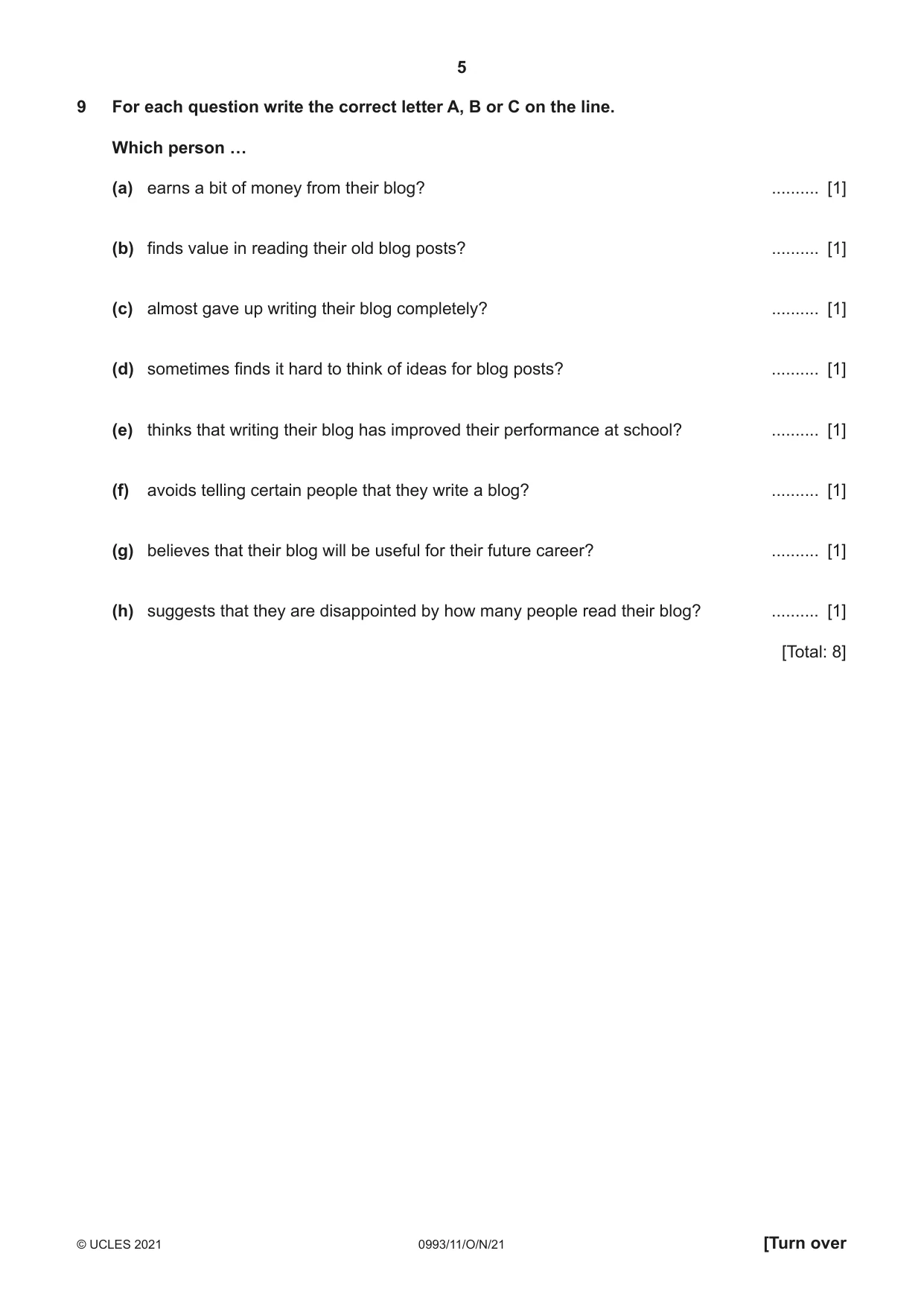
5 0993/11/O/N/21 © UCLES 2021 [Turn over 9 For each question write the correct letter A, B or C on the line. Which person … (a) earns a bit of money from their blog? … [1] (b) finds value in reading their old blog posts? … [1] (c) almost gave up writing their blog completely? … [1] (d) sometimes finds it hard to think of ideas for blog posts? … [1] (e) thinks that writing their blog has improved their performance at school? … [1] (f) avoids telling certain people that they write a blog? … [1] (g) believes that their blog will be useful for their future career? … [1] (h) suggests that they are disappointed by how many people read their blog? … [1] [Total: 8]
Question paper, page 6
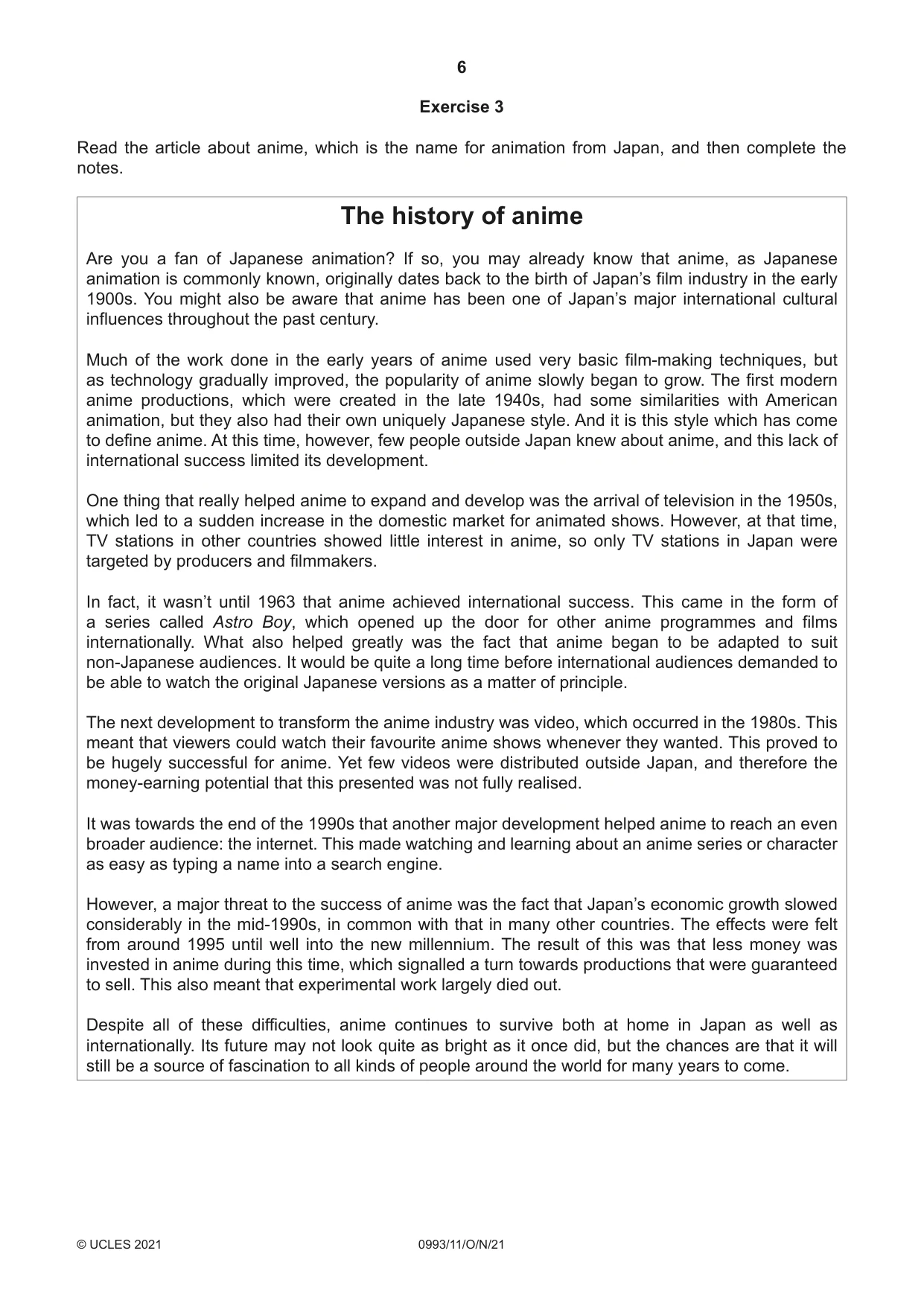
6 0993/11/O/N/21 © UCLES 2021 Exercise 3 Read the article about anime, which is the name for animation from Japan, and then complete the notes. The history of anime Are you a fan of Japanese animation? If so, you may already know that anime, as Japanese animation is commonly known, originally dates back to the birth of Japan’s film industry in the early 1900s. You might also be aware that anime has been one of Japan’s major international cultural influences throughout the past century. Much of the work done in the early years of anime used very basic film-making techniques, but as technology gradually improved, the popularity of anime slowly began to grow. The first modern anime productions, which were created in the late 1940s, had some similarities with American animation, but they also had their own uniquely Japanese style. And it is this style which has come to define anime. At this time, however, few people outside Japan knew about anime, and this lack of international success limited its development. One thing that really helped anime to expand and develop was the arrival of television in the 1950s, which led to a sudden increase in the domestic market for animated shows. However, at that time, TV stations in other countries showed little interest in anime, so only TV stations in Japan were targeted by producers and filmmakers. In fact, it wasn’t until 1963 that anime achieved international success. This came in the form of a series called Astro Boy, which opened up the door for other anime programmes and films internationally. What also helped greatly was the fact that anime began to be adapted to suit non-Japanese audiences. It would be quite a long time before international audiences demanded to be able to watch the original Japanese versions as a matter of principle. The next development to transform the anime industry was video, which occurred in the 1980s. This meant that viewers could watch their favourite anime shows whenever they wanted. This proved to be hugely successful for anime. Yet few videos were distributed outside Japan, and therefore the money-earning potential that this presented was not fully realised. It was towards the end of the 1990s that another major development helped anime to reach an even broader audience: the internet. This made watching and learning about an anime series or character as easy as typing a name into a search engine. However, a major threat to the success of anime was the fact that Japan’s economic growth slowed considerably in the mid-1990s, in common with that in many other countries. The effects were felt from around 1995 until well into the new millennium. The result of this was that less money was invested in anime during this time, which signalled a turn towards productions that were guaranteed to sell. This also meant that experimental work largely died out. Despite all of these difficulties, anime continues to survive both at home in Japan as well as internationally. Its future may not look quite as bright as it once did, but the chances are that it will still be a source of fascination to all kinds of people around the world for many years to come.
Question paper, page 7
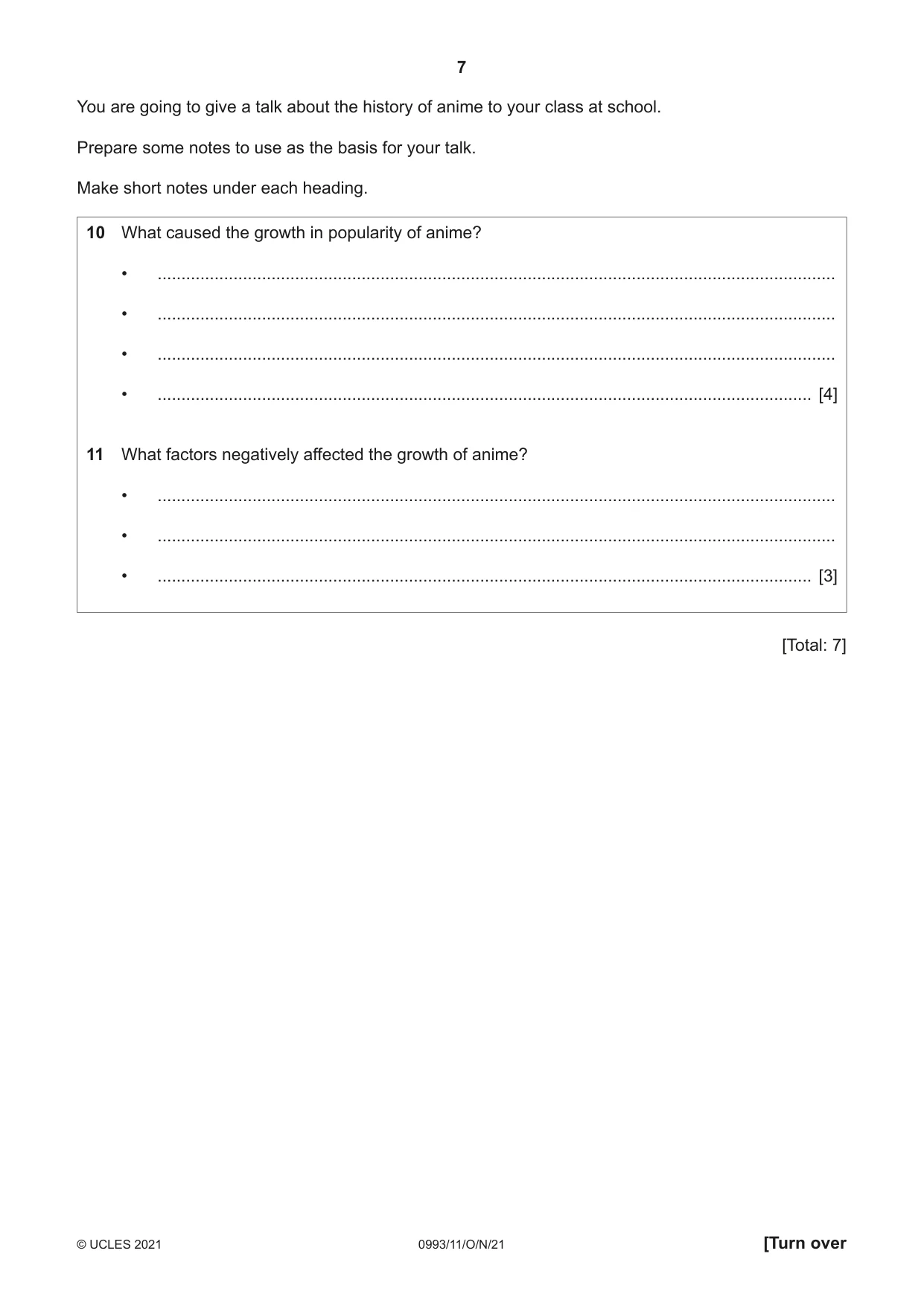
7 0993/11/O/N/21 © UCLES 2021 [Turn over You are going to give a talk about the history of anime to your class at school. Prepare some notes to use as the basis for your talk. Make short notes under each heading. 10 What caused the growth in popularity of anime? • … • … • … • … [4] 11 What factors negatively affected the growth of anime? • … • … • … [3] [Total: 7]
Question paper, page 8
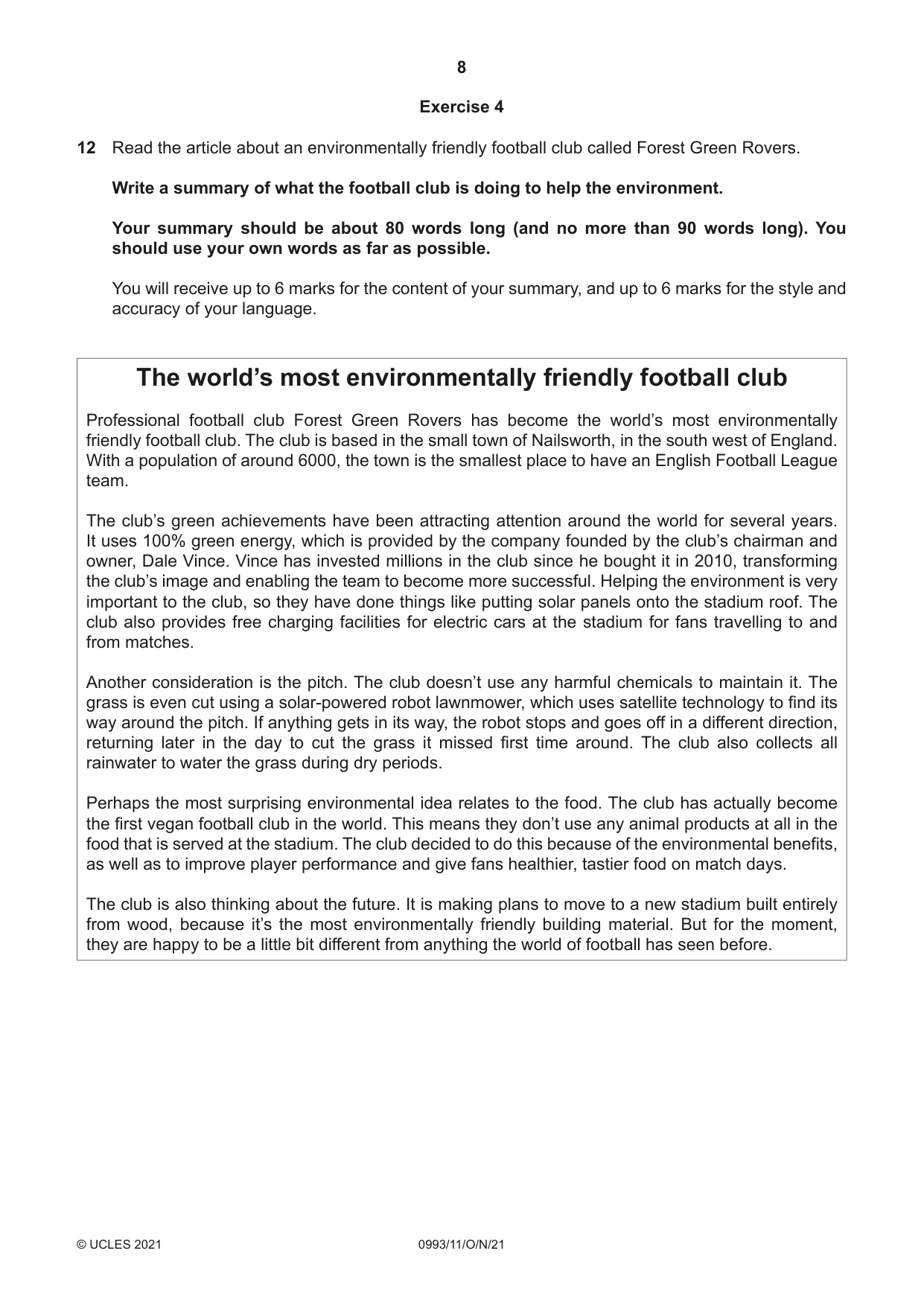
8 0993/11/O/N/21 © UCLES 2021 Exercise 4 12 Read the article about an environmentally friendly football club called Forest Green Rovers. Write a summary of what the football club is doing to help the environment. Your summary should be about 80 words long (and no more than 90 words long). You should use your own words as far as possible. You will receive up to 6 marks for the content of your summary, and up to 6 marks for the style and accuracy of your language. The world’s most environmentally friendly football club Professional football club Forest Green Rovers has become the world’s most environmentally friendly football club. The club is based in the small town of Nailsworth, in the south west of England. With a population of around 6000, the town is the smallest place to have an English Football League team. The club’s green achievements have been attracting attention around the world for several years. It uses 100% green energy, which is provided by the company founded by the club’s chairman and owner, Dale Vince. Vince has invested millions in the club since he bought it in 2010, transforming the club’s image and enabling the team to become more successful. Helping the environment is very important to the club, so they have done things like putting solar panels onto the stadium roof. The club also provides free charging facilities for electric cars at the stadium for fans travelling to and from matches. Another consideration is the pitch. The club doesn’t use any harmful chemicals to maintain it. The grass is even cut using a solar-powered robot lawnmower, which uses satellite technology to find its way around the pitch. If anything gets in its way, the robot stops and goes off in a different direction, returning later in the day to cut the grass it missed first time around. The club also collects all rainwater to water the grass during dry periods. Perhaps the most surprising environmental idea relates to the food. The club has actually become the first vegan football club in the world. This means they don’t use any animal products at all in the food that is served at the stadium. The club decided to do this because of the environmental benefits, as well as to improve player performance and give fans healthier, tastier food on match days. The club is also thinking about the future. It is making plans to move to a new stadium built entirely from wood, because it’s the most environmentally friendly building material. But for the moment, they are happy to be a little bit different from anything the world of football has seen before.
Question paper, page 9
9 0993/11/O/N/21 © UCLES 2021 [Turn over … … … … … … … … … … … … … … [Total: 12]
Question paper, page 10
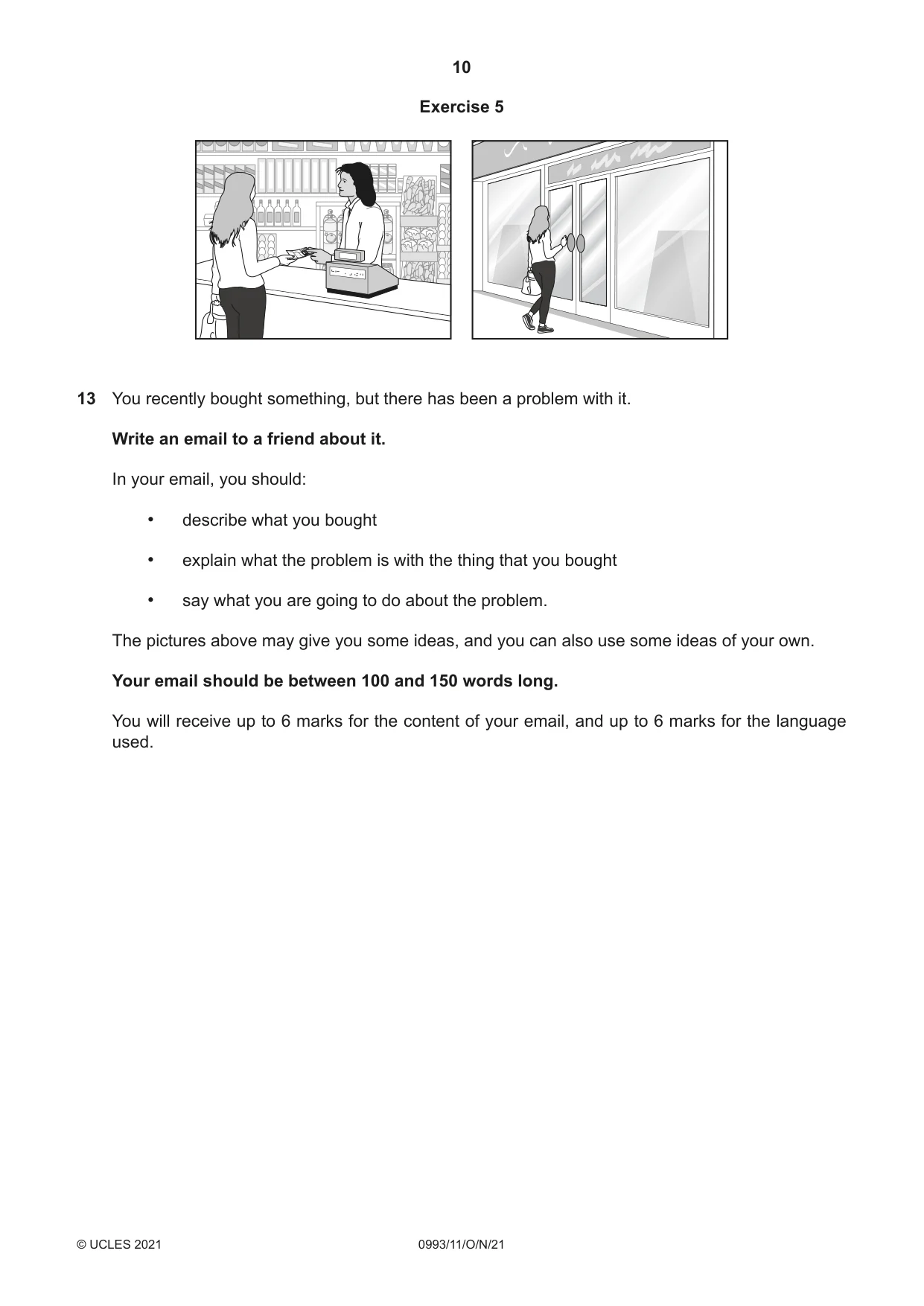
10 0993/11/ O/ N/21 © UCLES 2021 Exercise 5 13 You recently bought something, but there has been a problem with it. Write an email to a friend about it. In your email, you should: • describe what you bought • explain what the problem is with the thing that you bought • say what you are going to do about the problem. The pictures above may give you some ideas, and you can also use some ideas of your own. Your email should be between 100 and 150 words long. You will receive up to 6 marks for the content of your email, and up to 6 marks for the language used.
Question paper, page 11
11 0993/11/O/N/21 © UCLES 2021 [Turn over … … … … … … … … … … … … … … … … … … … … … … … … … … … [Total: 12]
Question paper, page 12
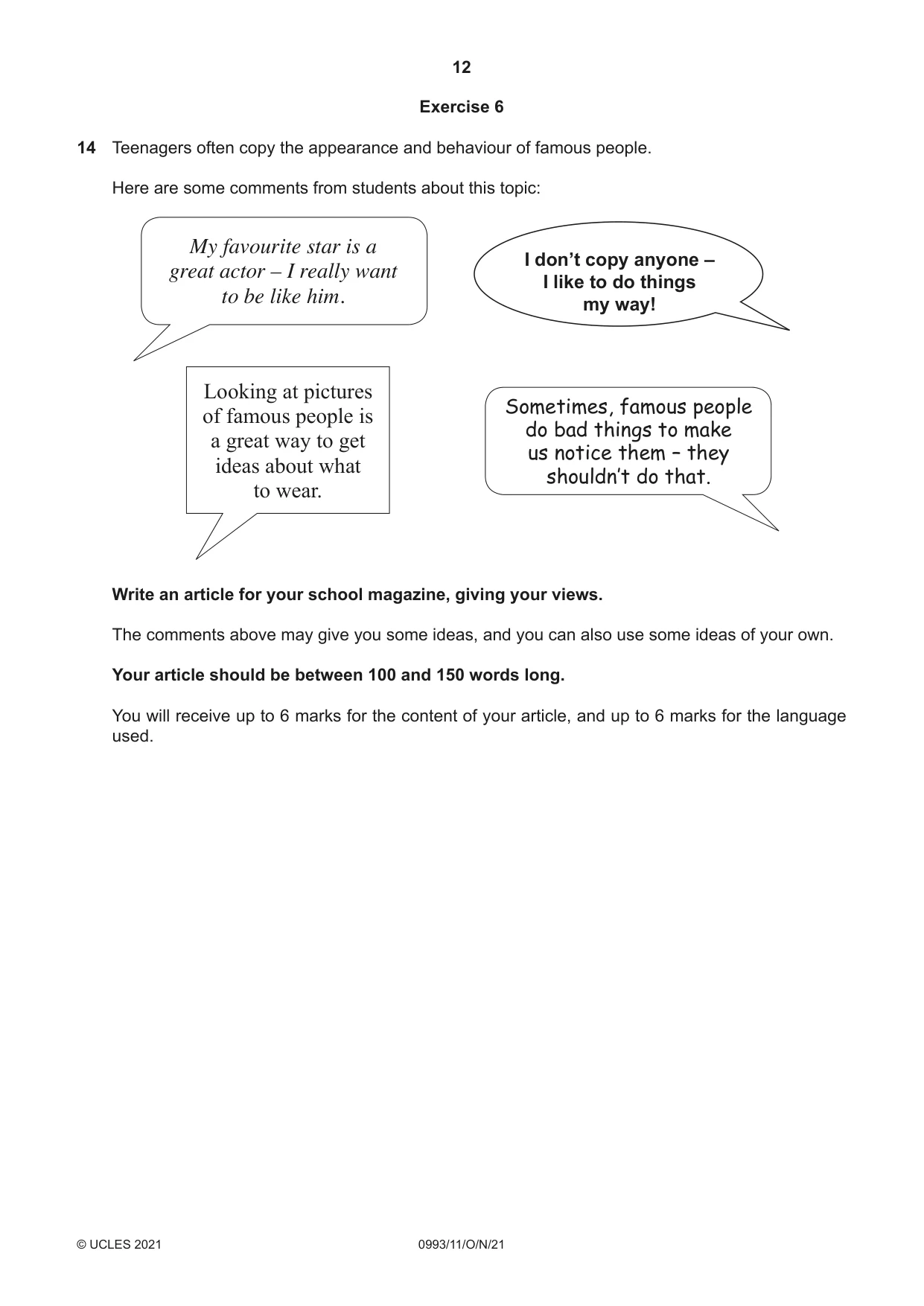
12 0993/11/O/N/21 © UCLES 2021 Exercise 6 14 Teenagers often copy the appearance and behaviour of famous people. Here are some comments from students about this topic: My favourite star is a great actor – I really want to be like him. Sometimes, famous people do bad things to make us notice them – they shouldn’t do that. I don’t copy anyone – I like to do things my way! Looking at pictures of famous people is a great way to get ideas about what to wear. Write an article for your school magazine, giving your views. The comments above may give you some ideas, and you can also use some ideas of your own. Your article should be between 100 and 150 words long. You will receive up to 6 marks for the content of your article, and up to 6 marks for the language used.
Question paper, page 13
13 0993/11/O/N/21 © UCLES 2021 … … … … … … … … … … … … … … … … … … … … … … … … … … … [Total: 12]
Question paper, page 14
14 0993/11/O/N/21 © UCLES 2021 BLANK PAGE
Question paper, page 15
15 0993/11/O/N/21 © UCLES 2021 BLANK PAGE
Question paper, page 16
16 0993/11/O/N/21 © UCLES 2021 Permission to reproduce items where third-party owned material protected by copyright is included has been sought and cleared where possible. Every reasonable effort has been made by the publisher (UCLES) to trace copyright holders, but if any items requiring clearance have unwittingly been included, the publisher will be pleased to make amends at the earliest possible opportunity. To avoid the issue of disclosure of answer-related information to candidates, all copyright acknowledgements are reproduced online in the Cambridge Assessment International Education Copyright Acknowledgements Booklet. This is produced for each series of examinations and is freely available to download at www.cambridgeinternational.org after the live examination series. Cambridge Assessment International Education is part of the Cambridge Assessment Group. Cambridge Assessment is the brand name of the University of Cambridge Local Examinations Syndicate (UCLES), which itself is a department of the University of Cambridge. BLANK PAGE
Mark scheme, page 1
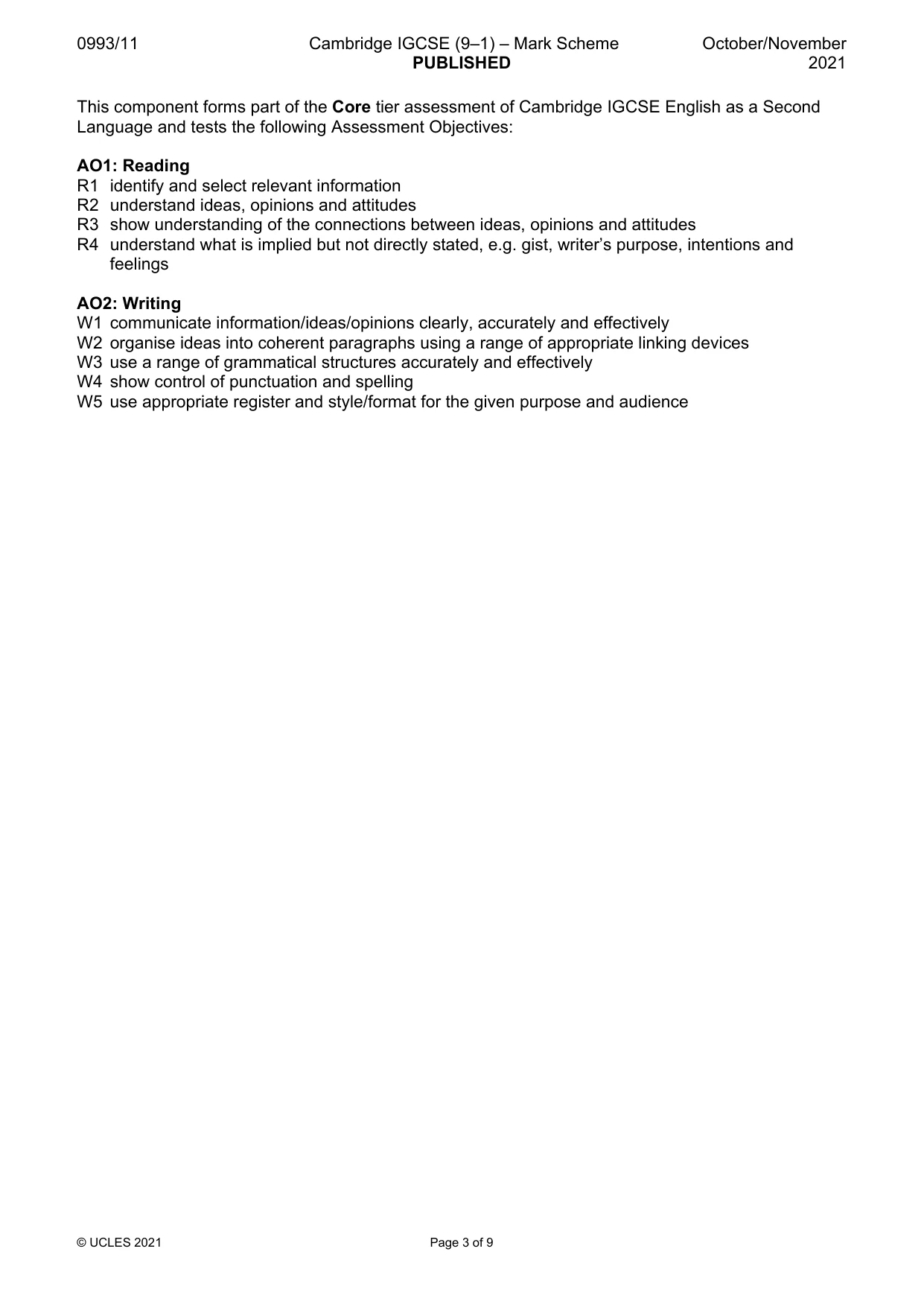
This document consists of 9 printed pages. © UCLES 2021 [Turn over Cambridge IGCSE™ (9–1) ENGLISH AS A SECOND LANGUAGE 0993/11 Paper 1 Reading and Writing (Core) October/November 2021 MARK SCHEME Maximum Mark: 60 Published This mark scheme is published as an aid to teachers and candidates, to indicate the requirements of the examination. It shows the basis on which Examiners were instructed to award marks. It does not indicate the details of the discussions that took place at an Examiners’ meeting before marking began, which would have considered the acceptability of alternative answers. Mark schemes should be read in conjunction with the question paper and the Principal Examiner Report for Teachers. Cambridge International will not enter into discussions about these mark schemes. Cambridge International is publishing the mark schemes for the October/November 2021 series for most Cambridge IGCSE™, Cambridge International A and AS Level components and some Cambridge O Level components.
Mark scheme, page 2
0993/11 Cambridge IGCSE (9–1) – Mark Scheme PUBLISHED October/November 2021 © UCLES 2021 Page 2 of 9 Generic Marking Principles These general marking principles must be applied by all examiners when marking candidate answers. They should be applied alongside the specific content of the mark scheme or generic level descriptors for a question. Each question paper and mark scheme will also comply with these marking principles. GENERIC MARKING PRINCIPLE 1: Marks must be awarded in line with: • the specific content of the mark scheme or the generic level descriptors for the question • the specific skills defined in the mark scheme or in the generic level descriptors for the question • the standard of response required by a candidate as exemplified by the standardisation scripts. GENERIC MARKING PRINCIPLE 2: Marks awarded are always whole marks (not half marks, or other fractions). GENERIC MARKING PRINCIPLE 3: Marks must be awarded positively: • marks are awarded for correct/valid answers, as defined in the mark scheme. However, credit is given for valid answers which go beyond the scope of the syllabus and mark scheme, referring to your Team Leader as appropriate • marks are awarded when candidates clearly demonstrate what they know and can do • marks are not deducted for errors • marks are not deducted for omissions • answers should only be judged on the quality of spelling, punctuation and grammar when these features are specifically assessed by the question as indicated by the mark scheme. The meaning, however, should be unambiguous. GENERIC MARKING PRINCIPLE 4: Rules must be applied consistently, e.g. in situations where candidates have not followed instructions or in the application of generic level descriptors. GENERIC MARKING PRINCIPLE 5: Marks should be awarded using the full range of marks defined in the mark scheme for the question (however; the use of the full mark range may be limited according to the quality of the candidate responses seen). GENERIC MARKING PRINCIPLE 6: Marks awarded are based solely on the requirements as defined in the mark scheme. Marks should not be awarded with grade thresholds or grade descriptors in mind.
Mark scheme, page 3
0993/11 Cambridge IGCSE (9–1) – Mark Scheme PUBLISHED October/November 2021 © UCLES 2021 Page 3 of 9 This component forms part of the Core tier assessment of Cambridge IGCSE English as a Second Language and tests the following Assessment Objectives: AO1: Reading R1 identify and select relevant information R2 understand ideas, opinions and attitudes R3 show understanding of the connections between ideas, opinions and attitudes R4 understand what is implied but not directly stated, e.g. gist, writer’s purpose, intentions and feelings AO2: Writing W1 communicate information/ideas/opinions clearly, accurately and effectively W2 organise ideas into coherent paragraphs using a range of appropriate linking devices W3 use a range of grammatical structures accurately and effectively W4 show control of punctuation and spelling W5 use appropriate register and style/format for the given purpose and audience
Mark scheme, page 4
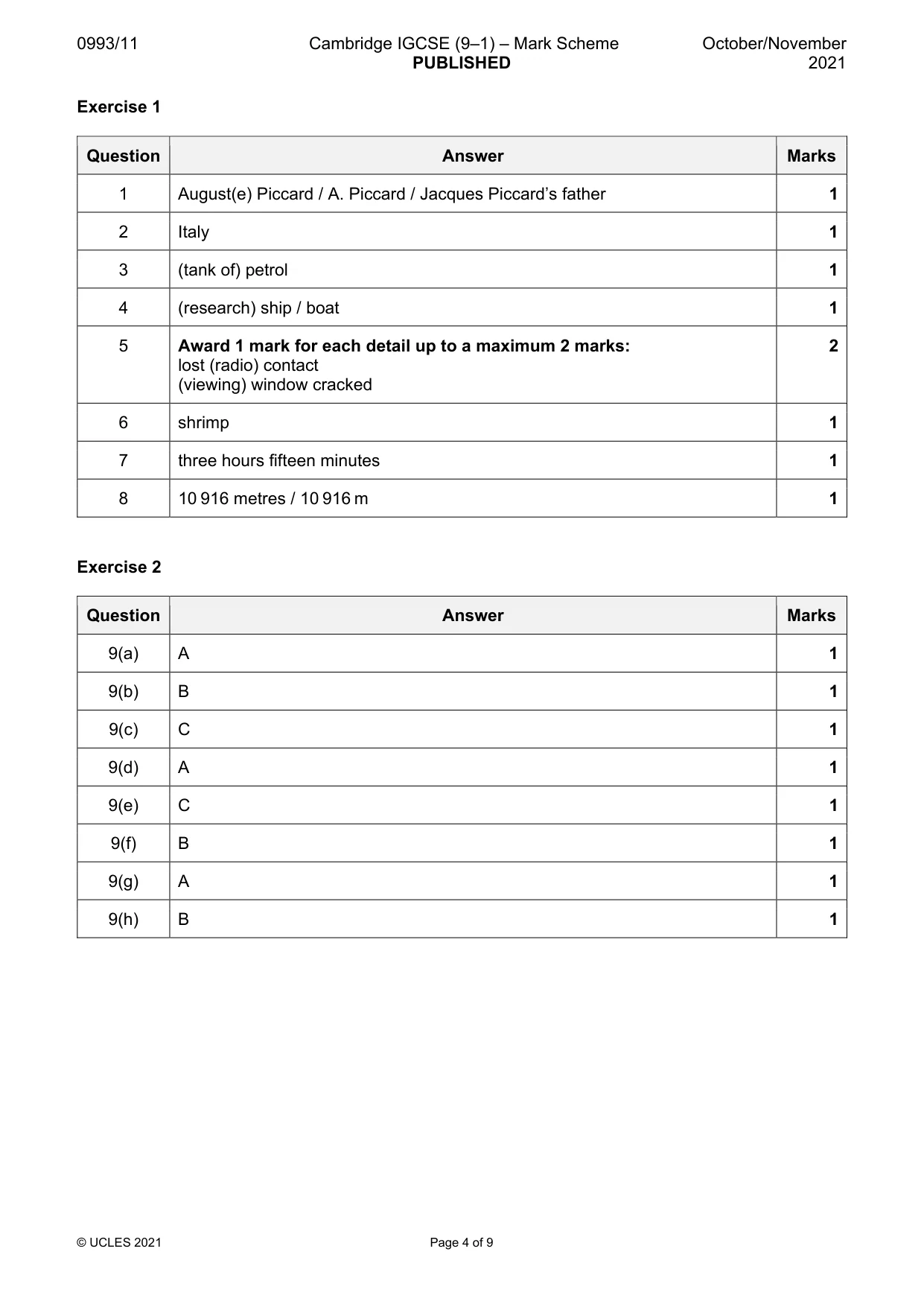
0993/11 Cambridge IGCSE (9–1) – Mark Scheme PUBLISHED October/November 2021 © UCLES 2021 Page 4 of 9 Exercise 1 Question Answer Marks 1 August(e) Piccard / A. Piccard / Jacques Piccard’s father 1 2 Italy 1 3 (tank of) petrol 1 4 (research) ship / boat 1 5 Award 1 mark for each detail up to a maximum 2 marks: lost (radio) contact (viewing) window cracked 2 6 shrimp 1 7 three hours fifteen minutes 1 8 10 916 metres / 10 916 m 1 Exercise 2 Question Answer Marks 9(a) A 1 9(b) B 1 9(c) C 1 9(d) A 1 9(e) C 1 9(f) B 1 9(g) A 1 9(h) B 1
Mark scheme, page 5
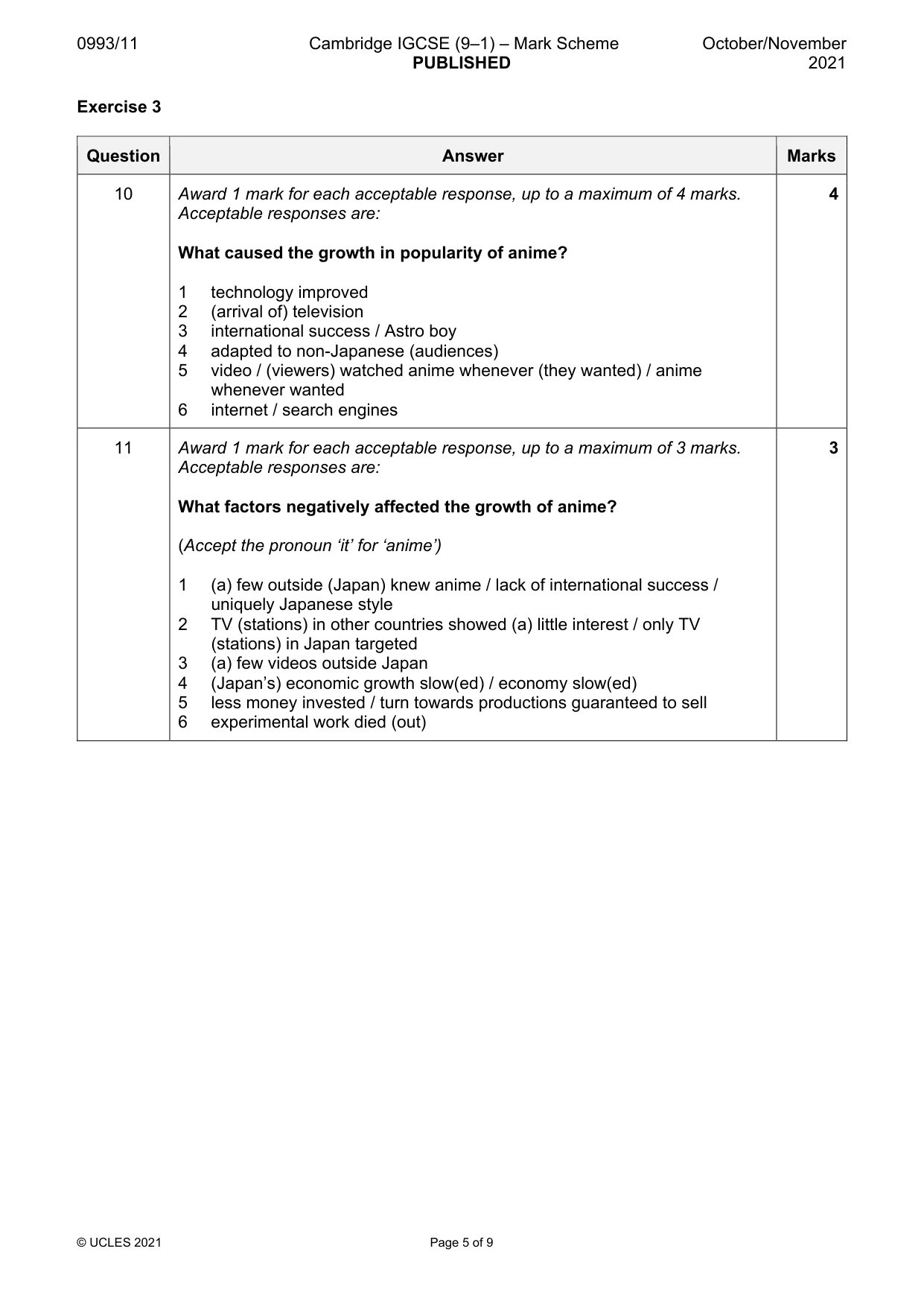
0993/11 Cambridge IGCSE (9–1) – Mark Scheme PUBLISHED October/November 2021 © UCLES 2021 Page 5 of 9 Exercise 3 Question Answer Marks 10 Award 1 mark for each acceptable response, up to a maximum of 4 marks. Acceptable responses are: What caused the growth in popularity of anime? 1 technology improved 2 (arrival of) television 3 international success / Astro boy 4 adapted to non-Japanese (audiences) 5 video / (viewers) watched anime whenever (they wanted) / anime whenever wanted 6 internet / search engines 4 11 Award 1 mark for each acceptable response, up to a maximum of 3 marks. Acceptable responses are: What factors negatively affected the growth of anime? (Accept the pronoun ‘it’ for ‘anime’) 1 (a) few outside (Japan) knew anime / lack of international success / uniquely Japanese style 2 TV (stations) in other countries showed (a) little interest / only TV (stations) in Japan targeted 3 (a) few videos outside Japan 4 (Japan’s) economic growth slow(ed) / economy slow(ed) 5 less money invested / turn towards productions guaranteed to sell 6 experimental work died (out) 3
Mark scheme, page 6
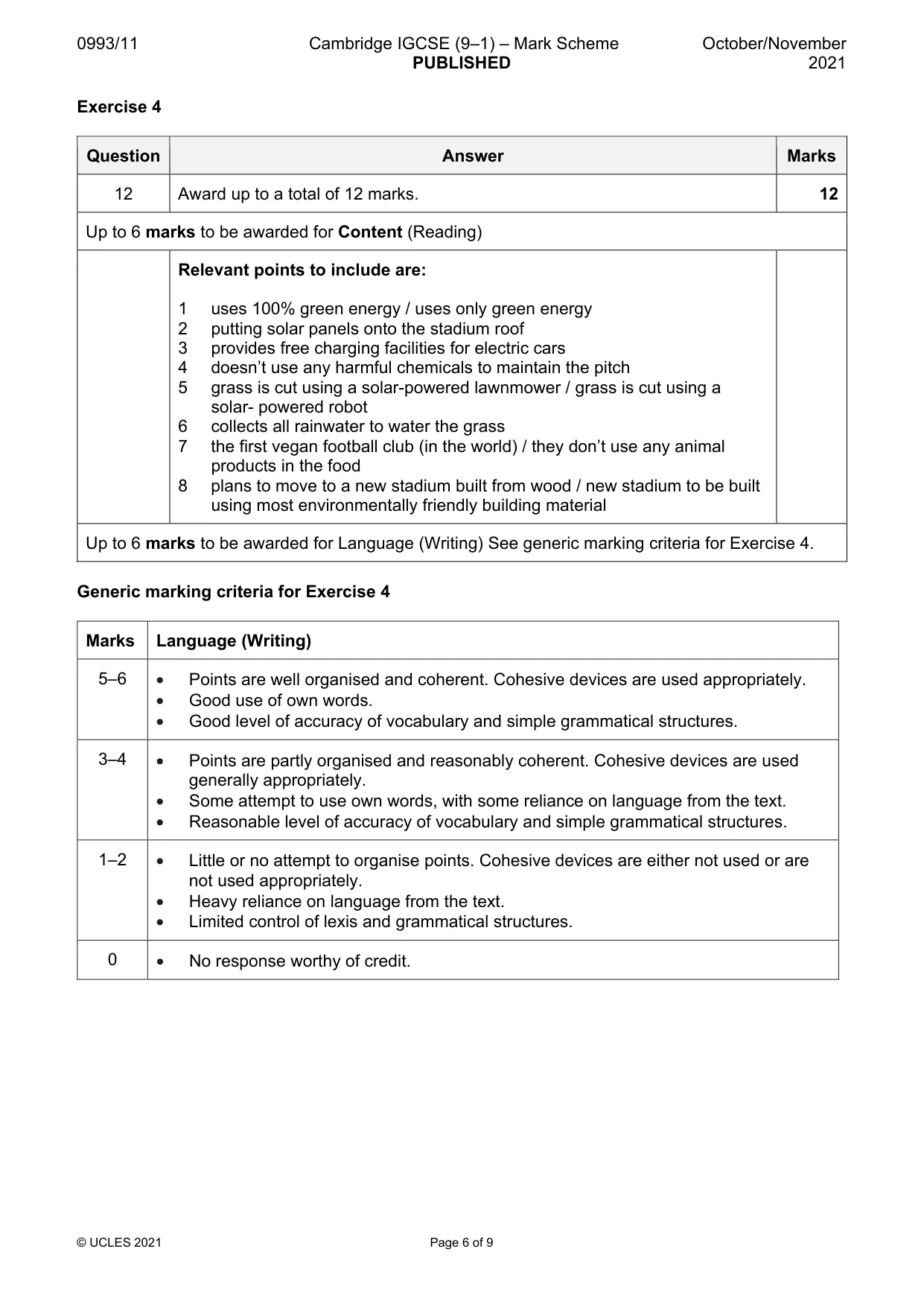
0993/11 Cambridge IGCSE (9–1) – Mark Scheme PUBLISHED October/November 2021 © UCLES 2021 Page 6 of 9 Exercise 4 Question Answer Marks 12 Award up to a total of 12 marks. 12 Up to 6 marks to be awarded for Content (Reading) Relevant points to include are: 1 uses 100% green energy / uses only green energy 2 putting solar panels onto the stadium roof 3 provides free charging facilities for electric cars 4 doesn’t use any harmful chemicals to maintain the pitch 5 grass is cut using a solar-powered lawnmower / grass is cut using a solar- powered robot 6 collects all rainwater to water the grass 7 the first vegan football club (in the world) / they don’t use any animal products in the food 8 plans to move to a new stadium built from wood / new stadium to be built using most environmentally friendly building material Up to 6 marks to be awarded for Language (Writing) See generic marking criteria for Exercise 4. Generic marking criteria for Exercise 4 Marks Language (Writing) 5–6 • Points are well organised and coherent. Cohesive devices are used appropriately. • Good use of own words. • Good level of accuracy of vocabulary and simple grammatical structures. 3–4 • Points are partly organised and reasonably coherent. Cohesive devices are used generally appropriately. • Some attempt to use own words, with some reliance on language from the text. • Reasonable level of accuracy of vocabulary and simple grammatical structures. 1–2 • Little or no attempt to organise points. Cohesive devices are either not used or are not used appropriately. • Heavy reliance on language from the text. • Limited control of lexis and grammatical structures. 0 • No response worthy of credit.
Mark scheme, page 7
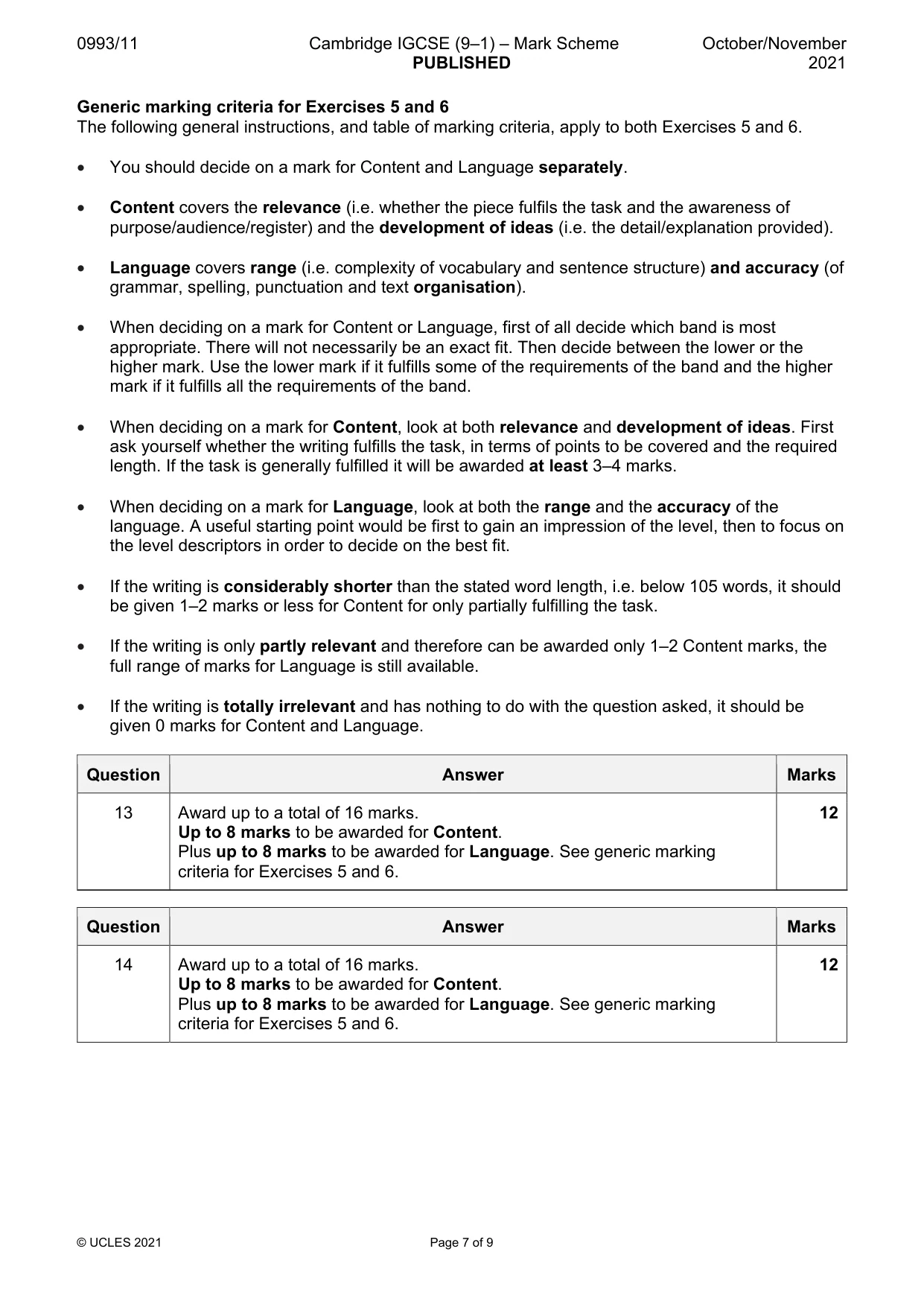
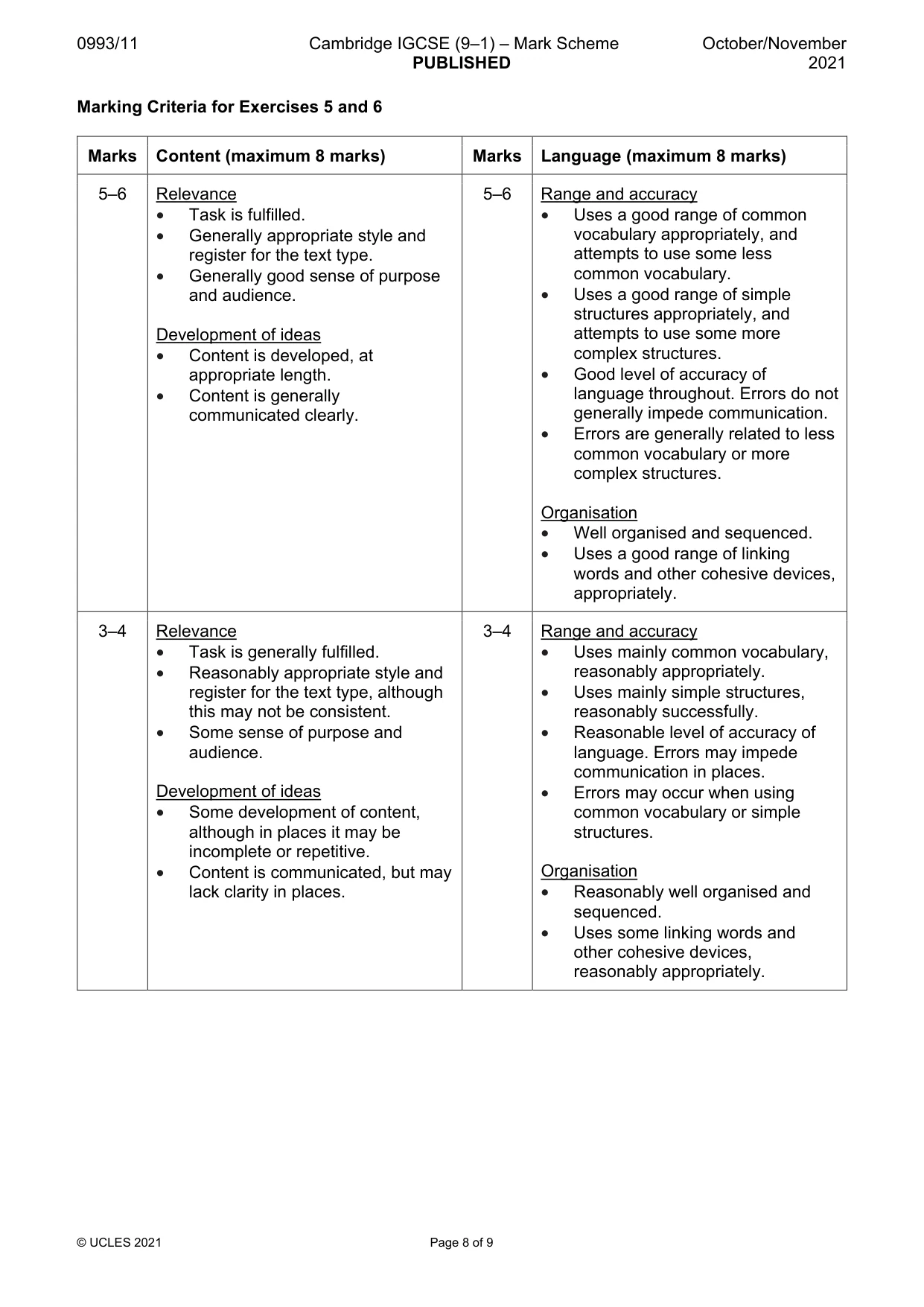
0993/11 Cambridge IGCSE (9–1) – Mark Scheme PUBLISHED October/November 2021 © UCLES 2021 Page 7 of 9 Generic marking criteria for Exercises 5 and 6 The following general instructions, and table of marking criteria, apply to both Exercises 5 and 6. • You should decide on a mark for Content and Language separately. • Content covers the relevance (i.e. whether the piece fulfils the task and the awareness of purpose/audience/register) and the development of ideas (i.e. the detail/explanation provided). • Language covers range (i.e. complexity of vocabulary and sentence structure) and accuracy (of grammar, spelling, punctuation and text organisation). • When deciding on a mark for Content or Language, first of all decide which band is most appropriate. There will not necessarily be an exact fit. Then decide between the lower or the higher mark. Use the lower mark if it fulfills some of the requirements of the band and the higher mark if it fulfills all the requirements of the band. • When deciding on a mark for Content, look at both relevance and development of ideas. First ask yourself whether the writing fulfills the task, in terms of points to be covered and the required length. If the task is generally fulfilled it will be awarded at least 3–4 marks. • When deciding on a mark for Language, look at both the range and the accuracy of the language. A useful starting point would be first to gain an impression of the level, then to focus on the level descriptors in order to decide on the best fit. • If the writing is considerably shorter than the stated word length, i.e. below 105 words, it should be given 1–2 marks or less for Content for only partially fulfilling the task. • If the writing is only partly relevant and therefore can be awarded only 1–2 Content marks, the full range of marks for Language is still available. • If the writing is totally irrelevant and has nothing to do with the question asked, it should be given 0 marks for Content and Language. Question Answer Marks 13 Award up to a total of 16 marks. Up to 8 marks to be awarded for Content. Plus up to 8 marks to be awarded for Language. See generic marking criteria for Exercises 5 and 6. 12 Question Answer Marks 14 Award up to a total of 16 marks. Up to 8 marks to be awarded for Content. Plus up to 8 marks to be awarded for Language. See generic marking criteria for Exercises 5 and 6. 12
Mark scheme, page 8
0993/11 Cambridge IGCSE (9–1) – Mark Scheme PUBLISHED October/November 2021 © UCLES 2021 Page 8 of 9 Marking Criteria for Exercises 5 and 6 Marks Content (maximum 8 marks) Marks Language (maximum 8 marks) 5–6 Relevance • Task is fulfilled. • Generally appropriate style and register for the text type. • Generally good sense of purpose and audience. Development of ideas • Content is developed, at appropriate length. • Content is generally communicated clearly. 5–6 Range and accuracy • Uses a good range of common vocabulary appropriately, and attempts to use some less common vocabulary. • Uses a good range of simple structures appropriately, and attempts to use some more complex structures. • Good level of accuracy of language throughout. Errors do not generally impede communication. • Errors are generally related to less common vocabulary or more complex structures. Organisation • Well organised and sequenced. • Uses a good range of linking words and other cohesive devices, appropriately. 3–4 Relevance • Task is generally fulfilled. • Reasonably appropriate style and register for the text type, although this may not be consistent. • Some sense of purpose and audience. Development of ideas • Some development of content, although in places it may be incomplete or repetitive. • Content is communicated, but may lack clarity in places. 3–4 Range and accuracy • Uses mainly common vocabulary, reasonably appropriately. • Uses mainly simple structures, reasonably successfully. • Reasonable level of accuracy of language. Errors may impede communication in places. • Errors may occur when using common vocabulary or simple structures. Organisation • Reasonably well organised and sequenced. • Uses some linking words and other cohesive devices, reasonably appropriately.
Mark scheme, page 9
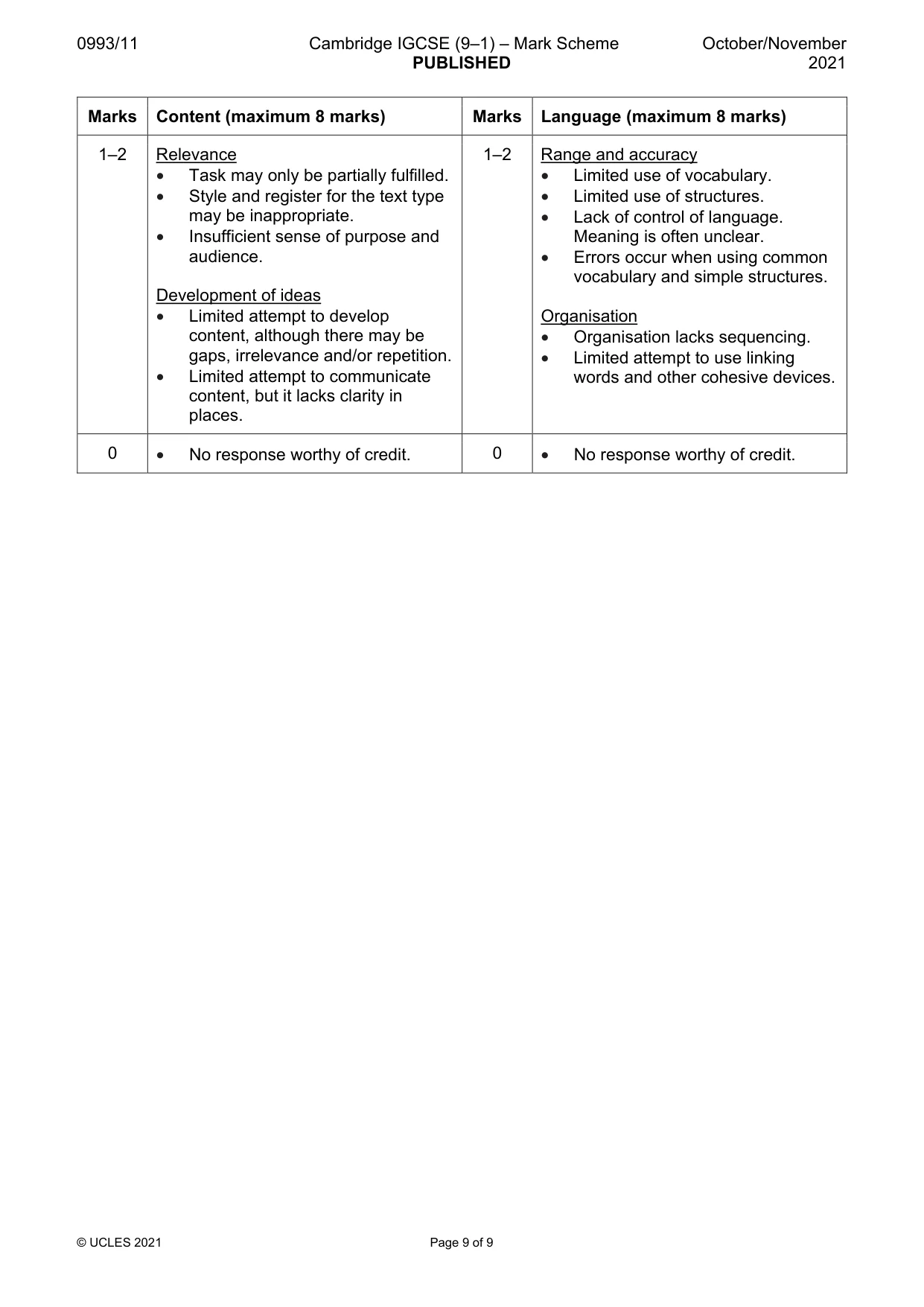
0993/11 Cambridge IGCSE (9–1) – Mark Scheme PUBLISHED October/November 2021 © UCLES 2021 Page 9 of 9 Marks Content (maximum 8 marks) Marks Language (maximum 8 marks) 1–2 Relevance • Task may only be partially fulfilled. • Style and register for the text type may be inappropriate. • Insufficient sense of purpose and audience. Development of ideas • Limited attempt to develop content, although there may be gaps, irrelevance and/or repetition. • Limited attempt to communicate content, but it lacks clarity in places. 1–2 Range and accuracy • Limited use of vocabulary. • Limited use of structures. • Lack of control of language. Meaning is often unclear. • Errors occur when using common vocabulary and simple structures. Organisation • Organisation lacks sequencing. • Limited attempt to use linking words and other cohesive devices. 0 • No response worthy of credit. 0 • No response worthy of credit.
What you needed in this session
Cambridge’s own grade thresholds for 2021 Oct/Nov, Paper 1 · Variant 1. A higher threshold means an easier paper — the bar moves with how the cohort did.