Cambridge IGCSE English Second Language (Speaking Endorsement) (9-1) 0993 — 2024 May/June Paper 1 · Variant 1
0993/11/M/J/24 · 60 marks · 120 min
The question paper and its mark scheme, free to read here and free to download. This is Cambridge’s own paper, exactly as it was sat.
Question paper16 pages



Mark scheme10 pages
Answers below. Sit the paper first if you are practising.
Paper as text
Question paper, page 1
This document has 16 pages. Any blank pages are indicated. [Turn over Cambridge IGCSE™(9–1) ENGLISH AS A SECOND LANGUAGE 0993/11 Paper 1 Reading and Writing May/June 2024 2 hours You must answer on the question paper. No additional materials are needed. INSTRUCTIONS ● Answer all questions. ● Use a black or dark blue pen. ● Write your name, centre number and candidate number in the boxes at the top of the page. ● Write your answer to each question in the space provided. ● Do not use an erasable pen or correction fluid. ● Do not write on any bar codes. ● Dictionaries are not allowed. INFORMATION ● The total mark for this paper is 60. ● The number of marks for each question or part question is shown in brackets [ ]. * 5 7 7 3 0 6 8 6 7 4 * DC (PQ) 341178 © UCLES 2024
Question paper, page 2
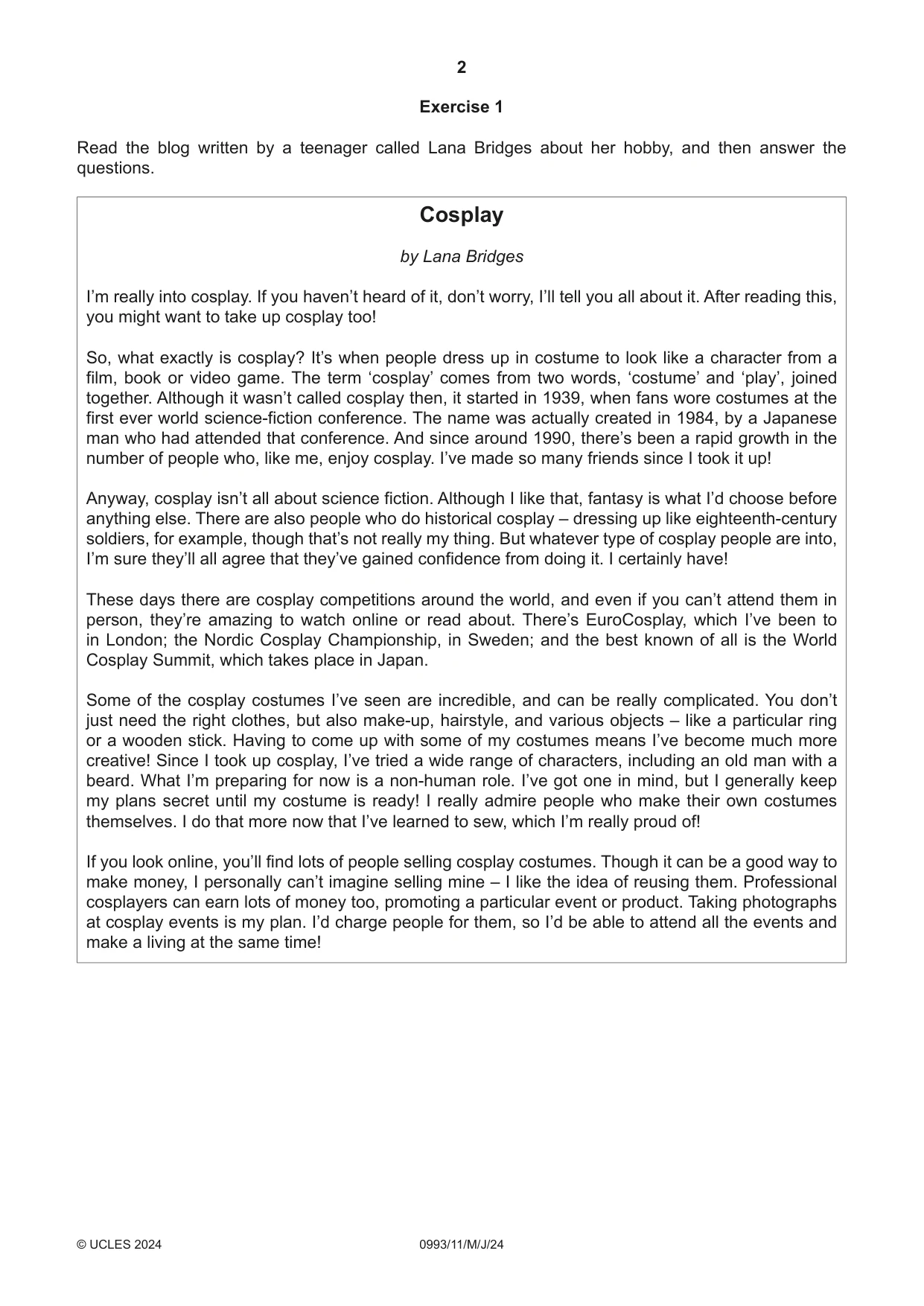
2 0993/11/M/J/24 © UCLES 2024 Exercise 1 Read the blog written by a teenager called Lana Bridges about her hobby, and then answer the questions. Cosplay by Lana Bridges I’m really into cosplay. If you haven’t heard of it, don’t worry, I’ll tell you all about it. After reading this, you might want to take up cosplay too! So, what exactly is cosplay? It’s when people dress up in costume to look like a character from a film, book or video game. The term ‘cosplay’ comes from two words, ‘costume’ and ‘play’, joined together. Although it wasn’t called cosplay then, it started in 1939, when fans wore costumes at the first ever world science-fiction conference. The name was actually created in 1984, by a Japanese man who had attended that conference. And since around 1990, there’s been a rapid growth in the number of people who, like me, enjoy cosplay. I’ve made so many friends since I took it up! Anyway, cosplay isn’t all about science fiction. Although I like that, fantasy is what I’d choose before anything else. There are also people who do historical cosplay – dressing up like eighteenth-century soldiers, for example, though that’s not really my thing. But whatever type of cosplay people are into, I’m sure they’ll all agree that they’ve gained confidence from doing it. I certainly have! These days there are cosplay competitions around the world, and even if you can’t attend them in person, they’re amazing to watch online or read about. There’s EuroCosplay, which I’ve been to in London; the Nordic Cosplay Championship, in Sweden; and the best known of all is the World Cosplay Summit, which takes place in Japan. Some of the cosplay costumes I’ve seen are incredible, and can be really complicated. You don’t just need the right clothes, but also make-up, hairstyle, and various objects – like a particular ring or a wooden stick. Having to come up with some of my costumes means I’ve become much more creative! Since I took up cosplay, I’ve tried a wide range of characters, including an old man with a beard. What I’m preparing for now is a non-human role. I’ve got one in mind, but I generally keep my plans secret until my costume is ready! I really admire people who make their own costumes themselves. I do that more now that I’ve learned to sew, which I’m really proud of! If you look online, you’ll find lots of people selling cosplay costumes. Though it can be a good way to make money, I personally can’t imagine selling mine – I like the idea of reusing them. Professional cosplayers can earn lots of money too, promoting a particular event or product. Taking photographs at cosplay events is my plan. I’d charge people for them, so I’d be able to attend all the events and make a living at the same time!
Question paper, page 3
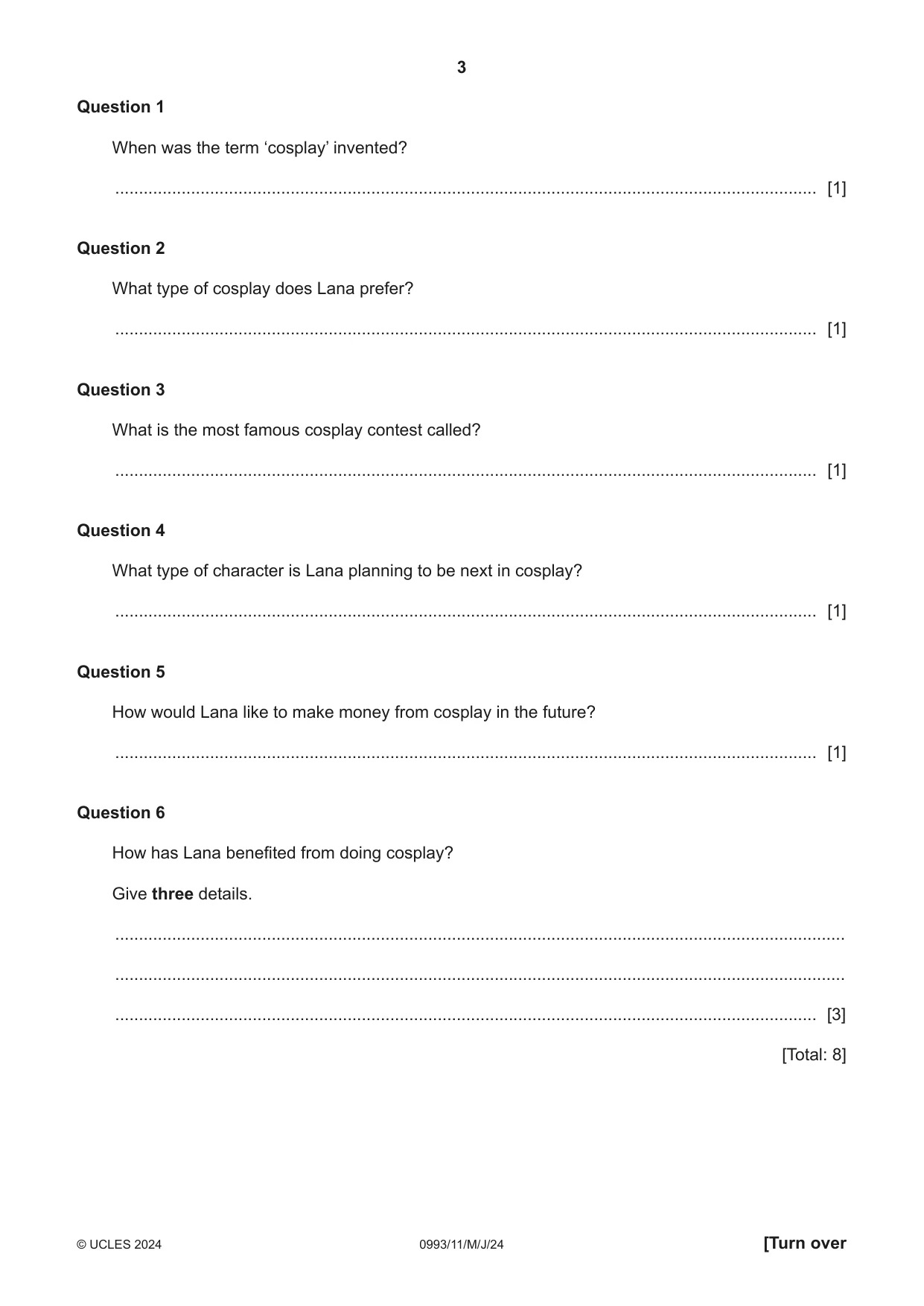
3 0993/11/M/J/24 © UCLES 2024 [Turn over Question 1 When was the term ‘cosplay’ invented? … [1] Question 2 What type of cosplay does Lana prefer? … [1] Question 3 What is the most famous cosplay contest called? … [1] Question 4 What type of character is Lana planning to be next in cosplay? … [1] Question 5 How would Lana like to make money from cosplay in the future? … [1] Question 6 How has Lana benefited from doing cosplay? Give three details. … … … [3] [Total: 8]
Question paper, page 4
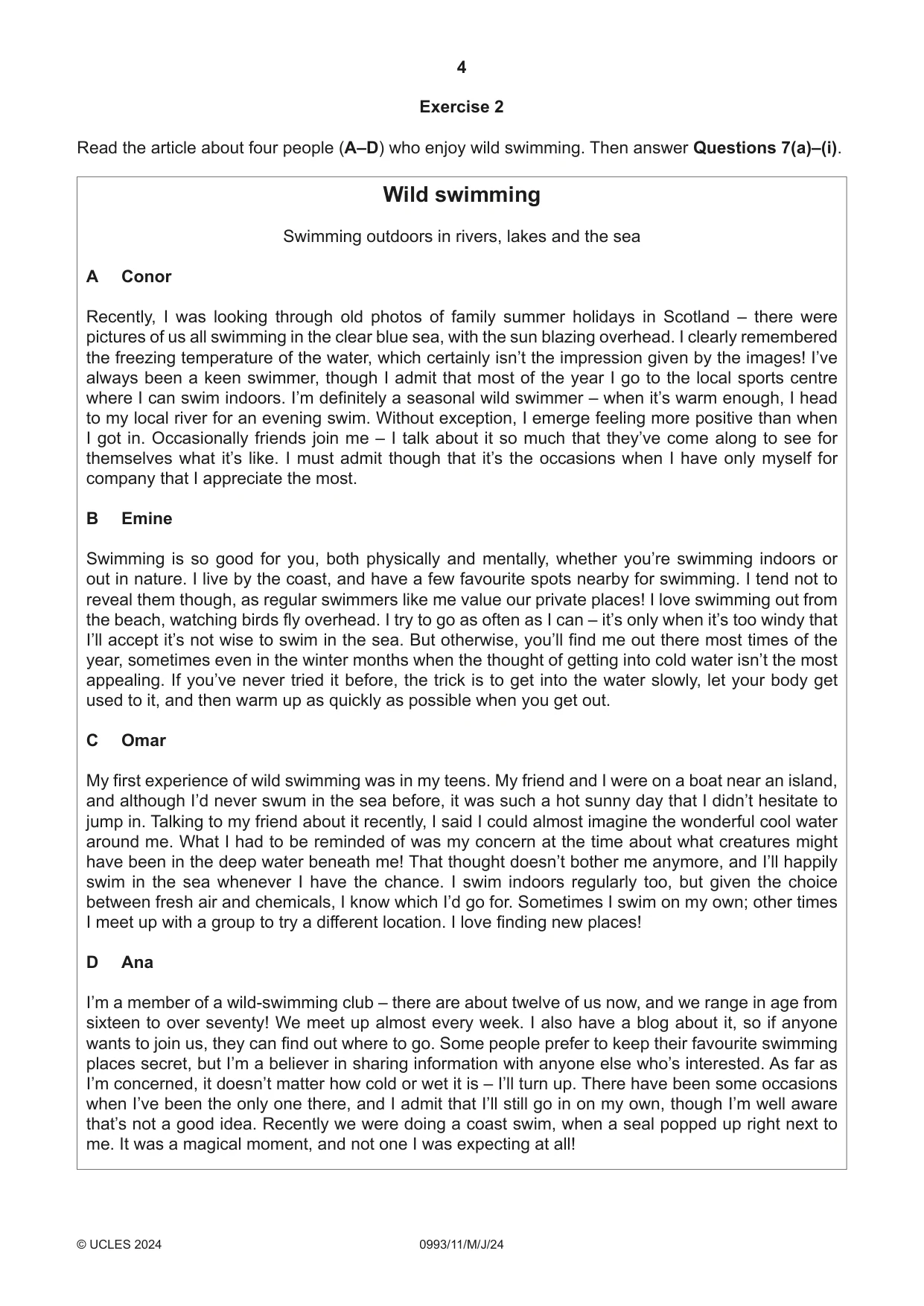
4 0993/11/M/J/24 © UCLES 2024 Exercise 2 Read the article about four people (A–D) who enjoy wild swimming. Then answer Questions 7(a)–(i). Wild swimming Swimming outdoors in rivers, lakes and the sea A Conor Recently, I was looking through old photos of family summer holidays in Scotland – there were pictures of us all swimming in the clear blue sea, with the sun blazing overhead. I clearly remembered the freezing temperature of the water, which certainly isn’t the impression given by the images! I’ve always been a keen swimmer, though I admit that most of the year I go to the local sports centre where I can swim indoors. I’m definitely a seasonal wild swimmer – when it’s warm enough, I head to my local river for an evening swim. Without exception, I emerge feeling more positive than when I got in. Occasionally friends join me – I talk about it so much that they’ve come along to see for themselves what it’s like. I must admit though that it’s the occasions when I have only myself for company that I appreciate the most. B Emine Swimming is so good for you, both physically and mentally, whether you’re swimming indoors or out in nature. I live by the coast, and have a few favourite spots nearby for swimming. I tend not to reveal them though, as regular swimmers like me value our private places! I love swimming out from the beach, watching birds fly overhead. I try to go as often as I can – it’s only when it’s too windy that I’ll accept it’s not wise to swim in the sea. But otherwise, you’ll find me out there most times of the year, sometimes even in the winter months when the thought of getting into cold water isn’t the most appealing. If you’ve never tried it before, the trick is to get into the water slowly, let your body get used to it, and then warm up as quickly as possible when you get out. C Omar My first experience of wild swimming was in my teens. My friend and I were on a boat near an island, and although I’d never swum in the sea before, it was such a hot sunny day that I didn’t hesitate to jump in. Talking to my friend about it recently, I said I could almost imagine the wonderful cool water around me. What I had to be reminded of was my concern at the time about what creatures might have been in the deep water beneath me! That thought doesn’t bother me anymore, and I’ll happily swim in the sea whenever I have the chance. I swim indoors regularly too, but given the choice between fresh air and chemicals, I know which I’d go for. Sometimes I swim on my own; other times I meet up with a group to try a different location. I love finding new places! D Ana I’m a member of a wild-swimming club – there are about twelve of us now, and we range in age from sixteen to over seventy! We meet up almost every week. I also have a blog about it, so if anyone wants to join us, they can find out where to go. Some people prefer to keep their favourite swimming places secret, but I’m a believer in sharing information with anyone else who’s interested. As far as I’m concerned, it doesn’t matter how cold or wet it is – I’ll turn up. There have been some occasions when I’ve been the only one there, and I admit that I’ll still go in on my own, though I’m well aware that’s not a good idea. Recently we were doing a coast swim, when a seal popped up right next to me. It was a magical moment, and not one I was expecting at all!
Question paper, page 5
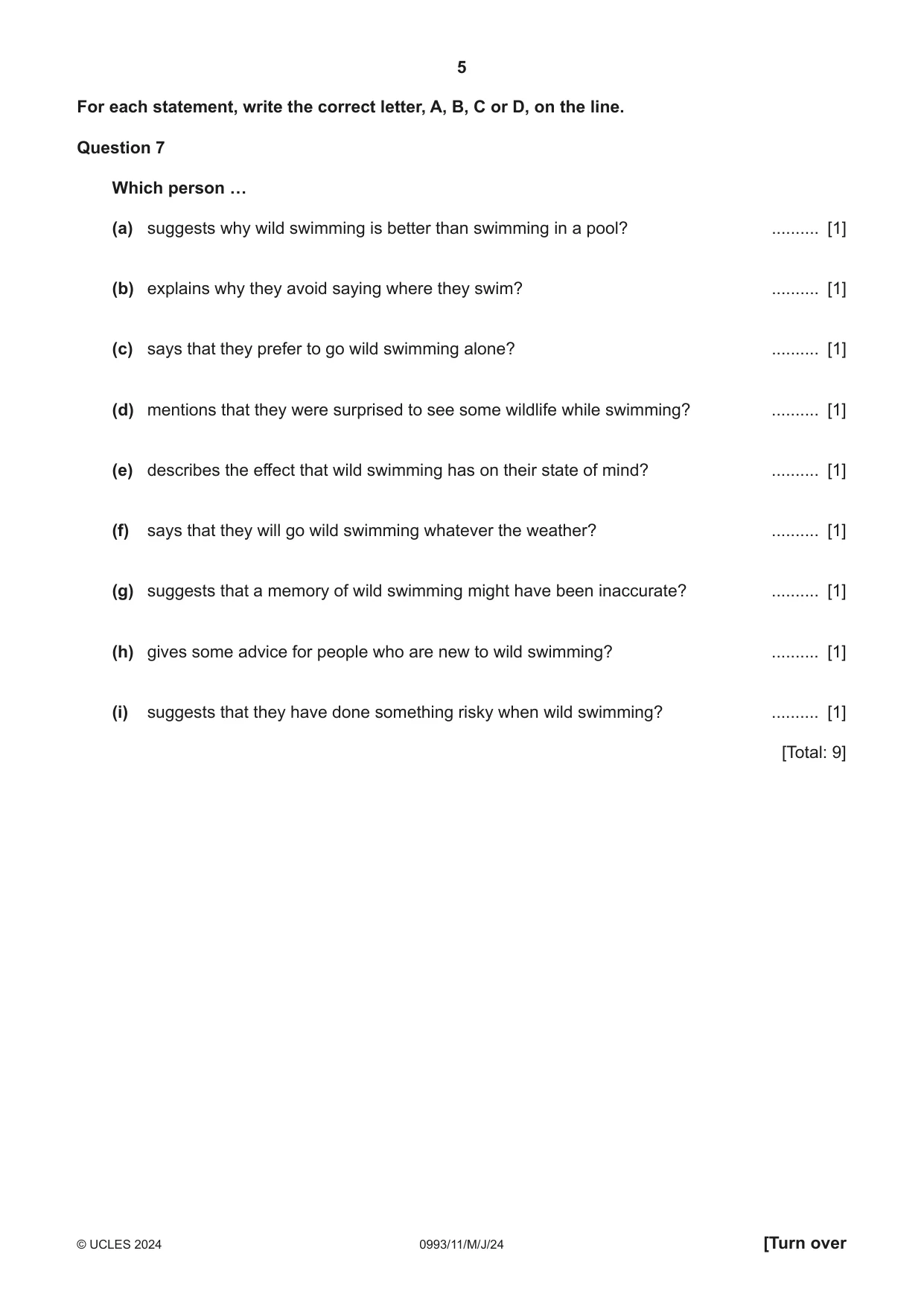
5 0993/11/M/J/24 © UCLES 2024 [Turn over For each statement, write the correct letter, A, B, C or D, on the line. Question 7 Which person … (a) suggests why wild swimming is better than swimming in a pool? … [1] (b) explains why they avoid saying where they swim? … [1] (c) says that they prefer to go wild swimming alone? … [1] (d) mentions that they were surprised to see some wildlife while swimming? … [1] (e) describes the effect that wild swimming has on their state of mind? … [1] (f) says that they will go wild swimming whatever the weather? … [1] (g) suggests that a memory of wild swimming might have been inaccurate? … [1] (h) gives some advice for people who are new to wild swimming? … [1] (i) suggests that they have done something risky when wild swimming? … [1] [Total: 9]
Question paper, page 6
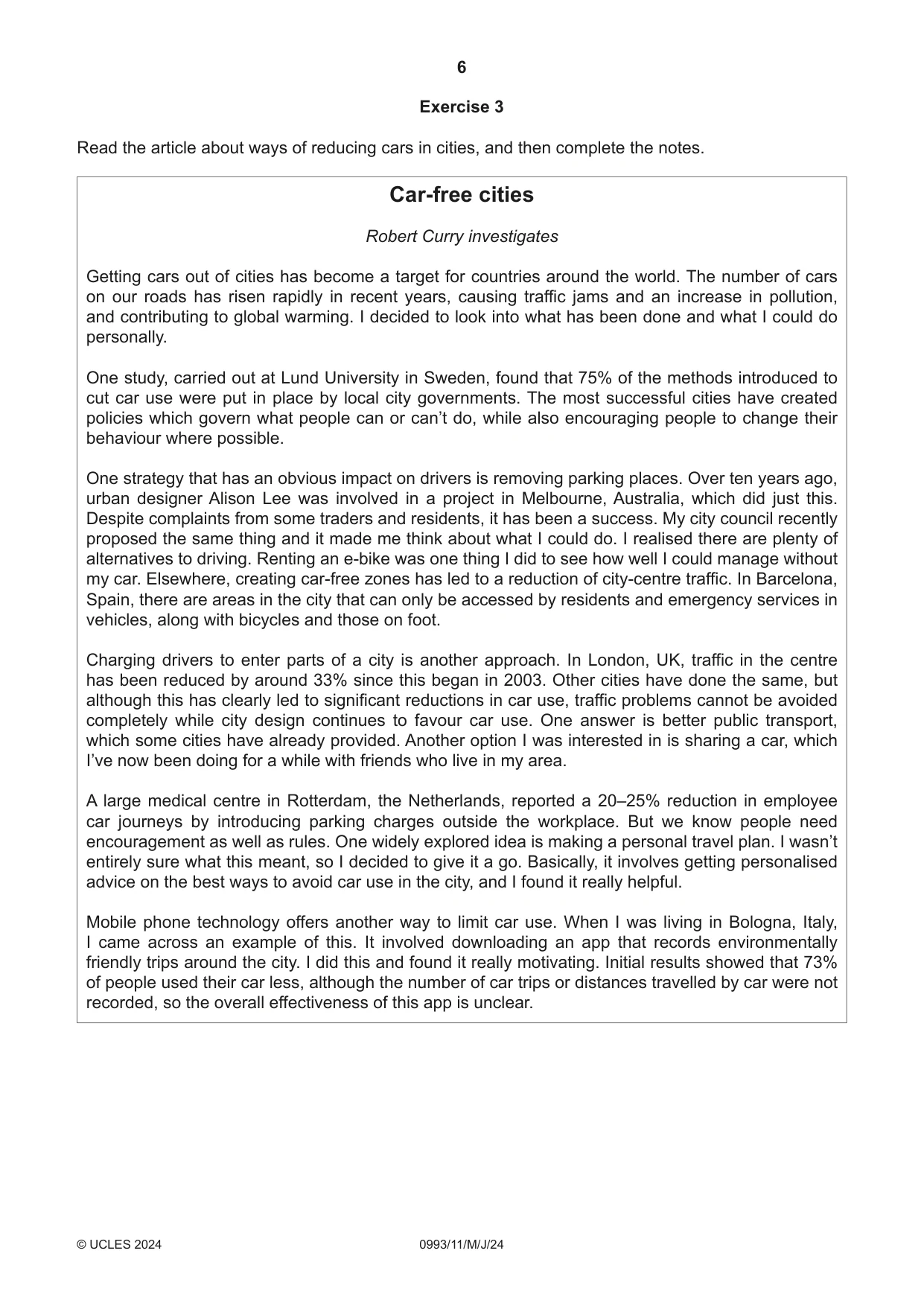
6 0993/11/M/J/24 © UCLES 2024 Exercise 3 Read the article about ways of reducing cars in cities, and then complete the notes. Car-free cities Robert Curry investigates Getting cars out of cities has become a target for countries around the world. The number of cars on our roads has risen rapidly in recent years, causing traffic jams and an increase in pollution, and contributing to global warming. I decided to look into what has been done and what I could do personally. One study, carried out at Lund University in Sweden, found that 75% of the methods introduced to cut car use were put in place by local city governments. The most successful cities have created policies which govern what people can or can’t do, while also encouraging people to change their behaviour where possible. One strategy that has an obvious impact on drivers is removing parking places. Over ten years ago, urban designer Alison Lee was involved in a project in Melbourne, Australia, which did just this. Despite complaints from some traders and residents, it has been a success. My city council recently proposed the same thing and it made me think about what I could do. I realised there are plenty of alternatives to driving. Renting an e-bike was one thing I did to see how well I could manage without my car. Elsewhere, creating car-free zones has led to a reduction of city-centre traffic. In Barcelona, Spain, there are areas in the city that can only be accessed by residents and emergency services in vehicles, along with bicycles and those on foot. Charging drivers to enter parts of a city is another approach. In London, UK, traffic in the centre has been reduced by around 33% since this began in 2003. Other cities have done the same, but although this has clearly led to significant reductions in car use, traffic problems cannot be avoided completely while city design continues to favour car use. One answer is better public transport, which some cities have already provided. Another option I was interested in is sharing a car, which I’ve now been doing for a while with friends who live in my area. A large medical centre in Rotterdam, the Netherlands, reported a 20–25% reduction in employee car journeys by introducing parking charges outside the workplace. But we know people need encouragement as well as rules. One widely explored idea is making a personal travel plan. I wasn’t entirely sure what this meant, so I decided to give it a go. Basically, it involves getting personalised advice on the best ways to avoid car use in the city, and I found it really helpful. Mobile phone technology offers another way to limit car use. When I was living in Bologna, Italy, I came across an example of this. It involved downloading an app that records environmentally friendly trips around the city. I did this and found it really motivating. Initial results showed that 73% of people used their car less, although the number of car trips or distances travelled by car were not recorded, so the overall effectiveness of this app is unclear.
Question paper, page 7
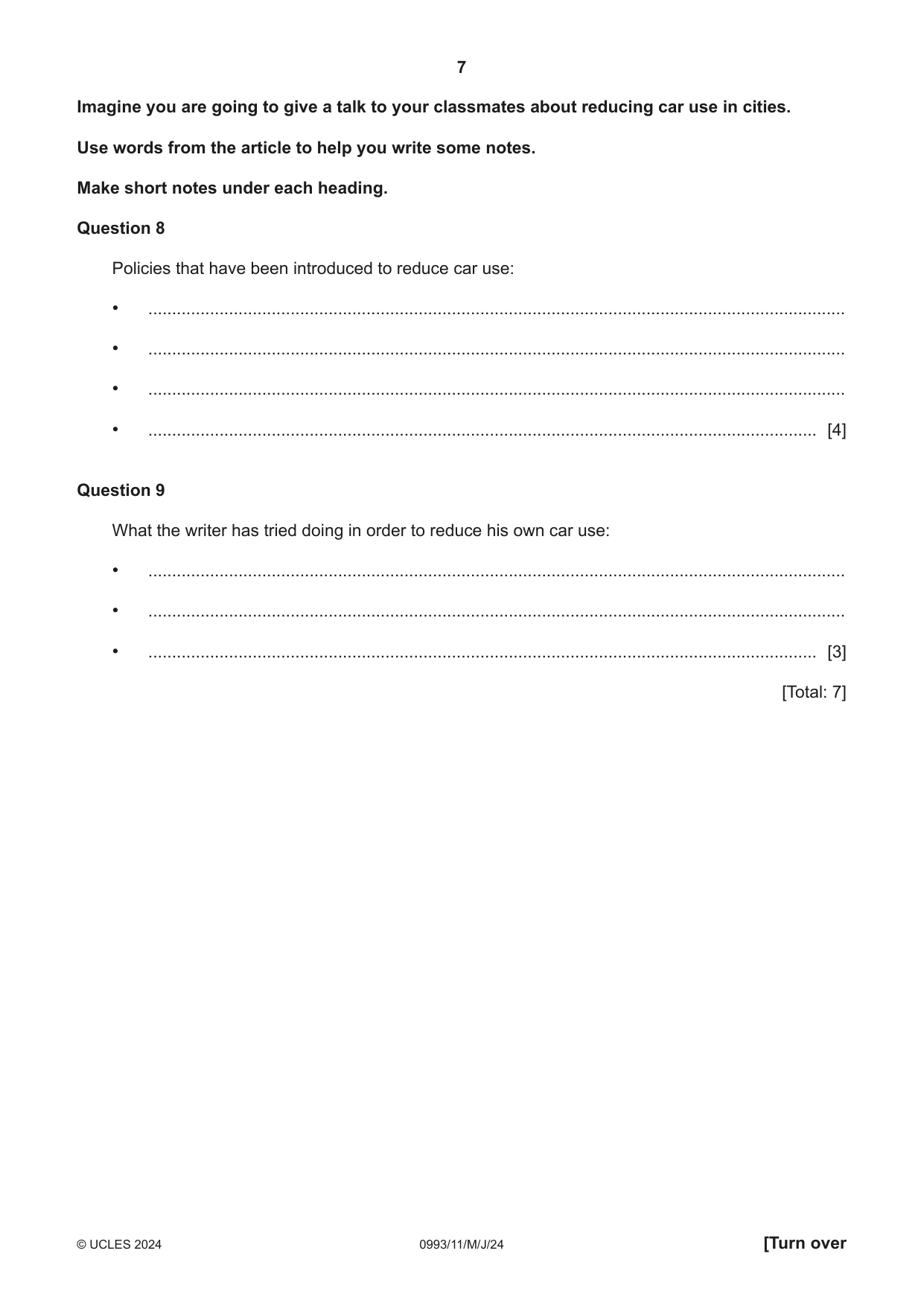
7 0993/11/M/J/24 © UCLES 2024 [Turn over Imagine you are going to give a talk to your classmates about reducing car use in cities. Use words from the article to help you write some notes. Make short notes under each heading. Question 8 Policies that have been introduced to reduce car use: • … • … • … • … [4] Question 9 What the writer has tried doing in order to reduce his own car use: • … • … • … [3] [Total: 7]
Question paper, page 8
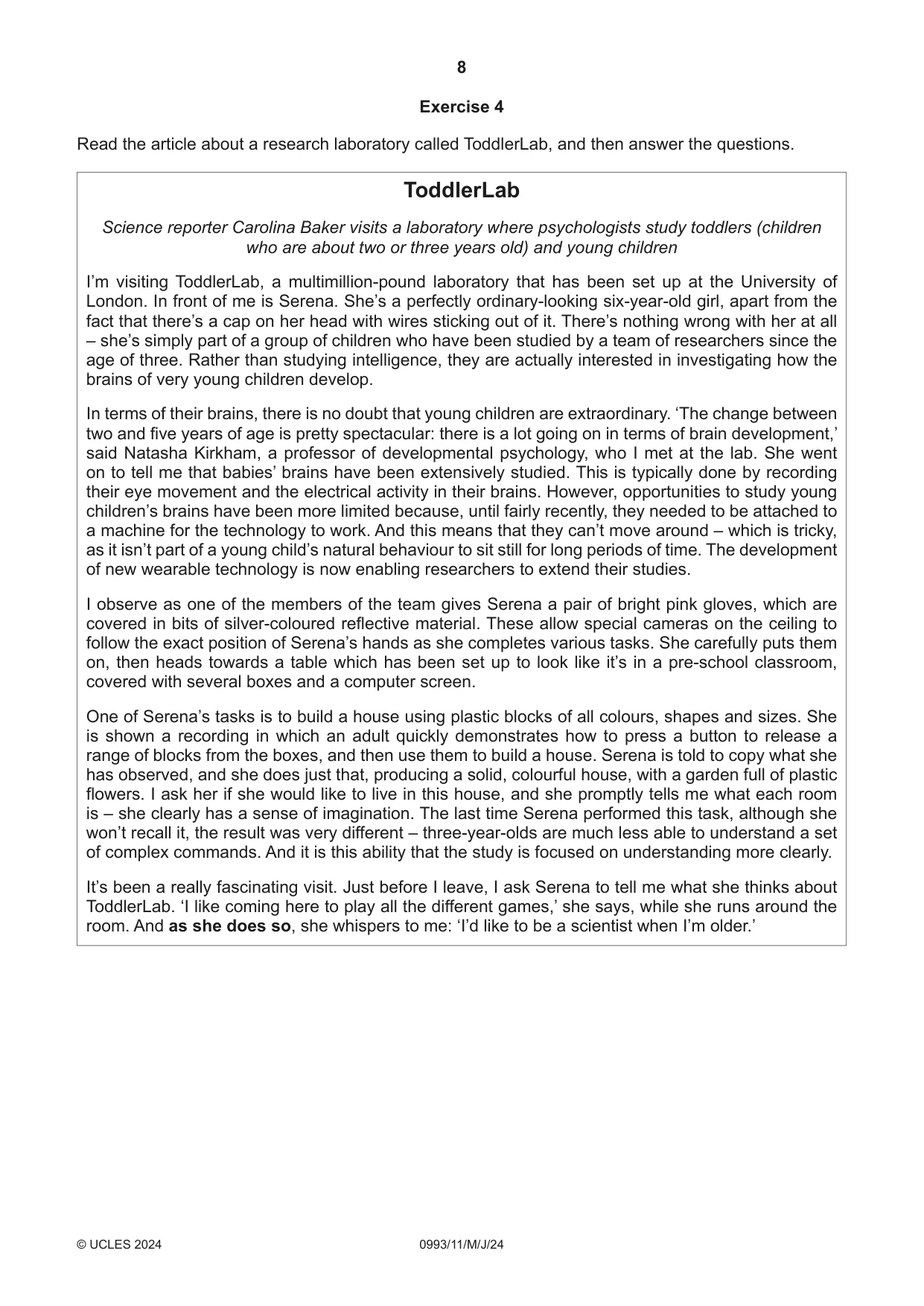
8 0993/11/M/J/24 © UCLES 2024 Exercise 4 Read the article about a research laboratory called ToddlerLab, and then answer the questions. ToddlerLab Science reporter Carolina Baker visits a laboratory where psychologists study toddlers (children who are about two or three years old) and young children I’m visiting ToddlerLab, a multimillion-pound laboratory that has been set up at the University of London. In front of me is Serena. She’s a perfectly ordinary-looking six-year-old girl, apart from the fact that there’s a cap on her head with wires sticking out of it. There’s nothing wrong with her at all – she’s simply part of a group of children who have been studied by a team of researchers since the age of three. Rather than studying intelligence, they are actually interested in investigating how the brains of very young children develop. In terms of their brains, there is no doubt that young children are extraordinary. ‘The change between two and five years of age is pretty spectacular: there is a lot going on in terms of brain development,’ said Natasha Kirkham, a professor of developmental psychology, who I met at the lab. She went on to tell me that babies’ brains have been extensively studied. This is typically done by recording their eye movement and the electrical activity in their brains. However, opportunities to study young children’s brains have been more limited because, until fairly recently, they needed to be attached to a machine for the technology to work. And this means that they can’t move around – which is tricky, as it isn’t part of a young child’s natural behaviour to sit still for long periods of time. The development of new wearable technology is now enabling researchers to extend their studies. I observe as one of the members of the team gives Serena a pair of bright pink gloves, which are covered in bits of silver-coloured reflective material. These allow special cameras on the ceiling to follow the exact position of Serena’s hands as she completes various tasks. She carefully puts them on, then heads towards a table which has been set up to look like it’s in a pre-school classroom, covered with several boxes and a computer screen. One of Serena’s tasks is to build a house using plastic blocks of all colours, shapes and sizes. She is shown a recording in which an adult quickly demonstrates how to press a button to release a range of blocks from the boxes, and then use them to build a house. Serena is told to copy what she has observed, and she does just that, producing a solid, colourful house, with a garden full of plastic flowers. I ask her if she would like to live in this house, and she promptly tells me what each room is – she clearly has a sense of imagination. The last time Serena performed this task, although she won’t recall it, the result was very different – three-year-olds are much less able to understand a set of complex commands. And it is this ability that the study is focused on understanding more clearly. It’s been a really fascinating visit. Just before I leave, I ask Serena to tell me what she thinks about ToddlerLab. ‘I like coming here to play all the different games,’ she says, while she runs around the room. And as she does so, she whispers to me: ‘I’d like to be a scientist when I’m older.’
Question paper, page 9
9 0993/11/M/J/24 © UCLES 2024 [Turn over For each question, choose the correct answer, A, B or C, and put a tick (3) in the appropriate box. Question 10 In the first paragraph, the writer suggests that Serena is interesting because A she’s unusually clever. B she’s wearing a special device. C she’s the only participant in an experiment. [1] Question 11 What information does the writer give in the second paragraph? A what has been learned from studying babies’ brains B how babies’ brains differ from those of young children C why young children’s brains have been harder to study [1] Question 12 Why is Serena asked to wear gloves? A to make her fingers more visible B to protect some equipment C to record her movements [1] Question 13 Serena begins her house-building task by A describing her design. B watching a short video. C choosing what material to use. [1]
Question paper, page 10
10 0993/11/M/J/24 © UCLES 2024 Question 14 Serena’s house-building task is part of research into how young children A follow instructions. B develop creativity. C remember details. [1] Question 15 The phrase ‘as she does so’ in paragraph 5 refers to A speaking quietly. B moving rapidly. C visiting the lab. [1] [Total: 6]
Question paper, page 11
11 0993/11/M/J/24 © UCLES 2024 [Turn over Please turn over for Exercise 5.
Question paper, page 12
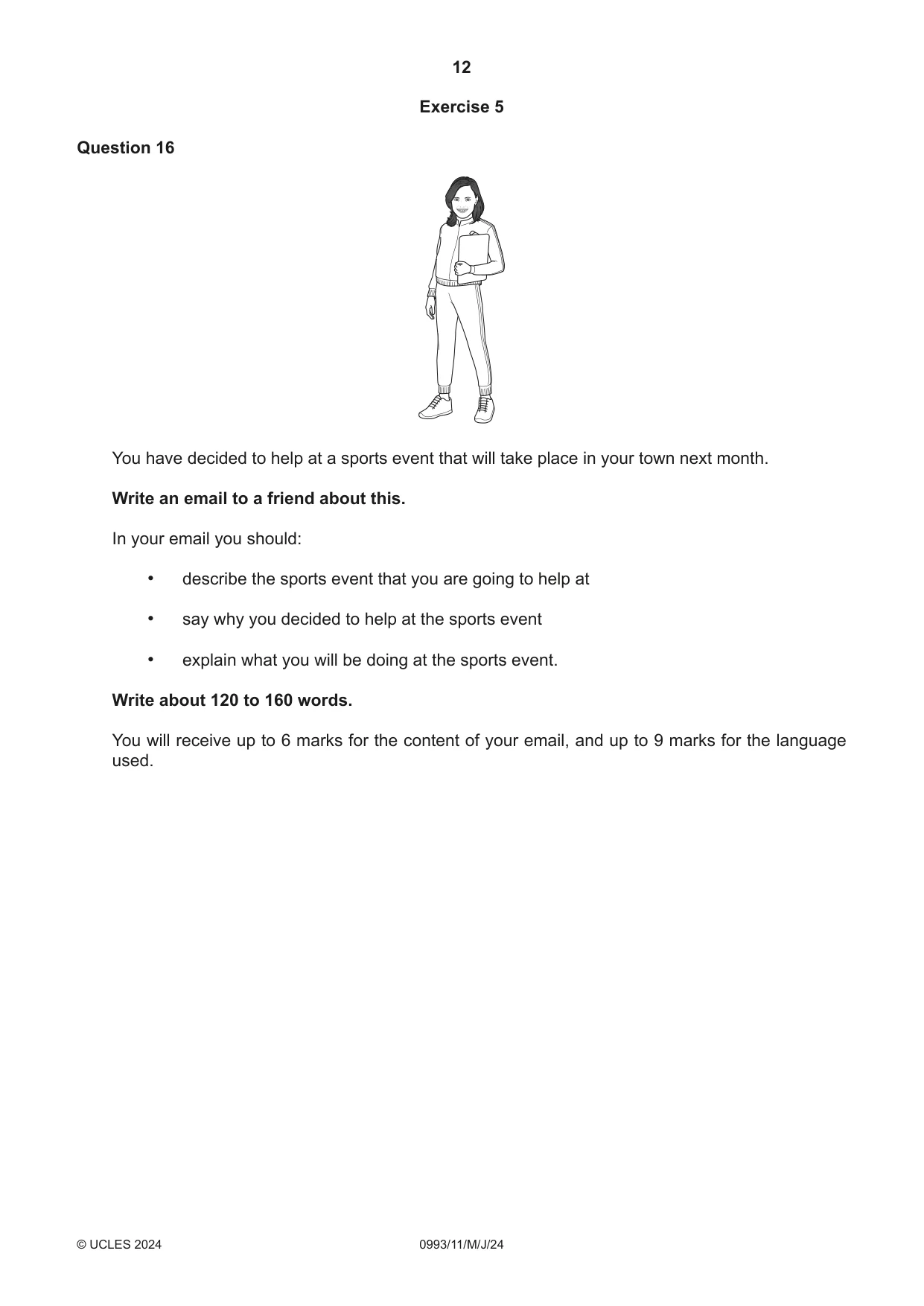
12 0993/11/M/J/24 © UCLES 2024 Exercise 5 Question 16 You have decided to help at a sports event that will take place in your town next month. Write an email to a friend about this. In your email you should: • describe the sports event that you are going to help at • say why you decided to help at the sports event • explain what you will be doing at the sports event. Write about 120 to 160 words. You will receive up to 6 marks for the content of your email, and up to 9 marks for the language used.
Question paper, page 13
13 0993/11/M/J/24 © UCLES 2024 [Turn over … … … … … … … … … … … … … … … … … … … … … … … … … … … [Total: 15]
Question paper, page 14
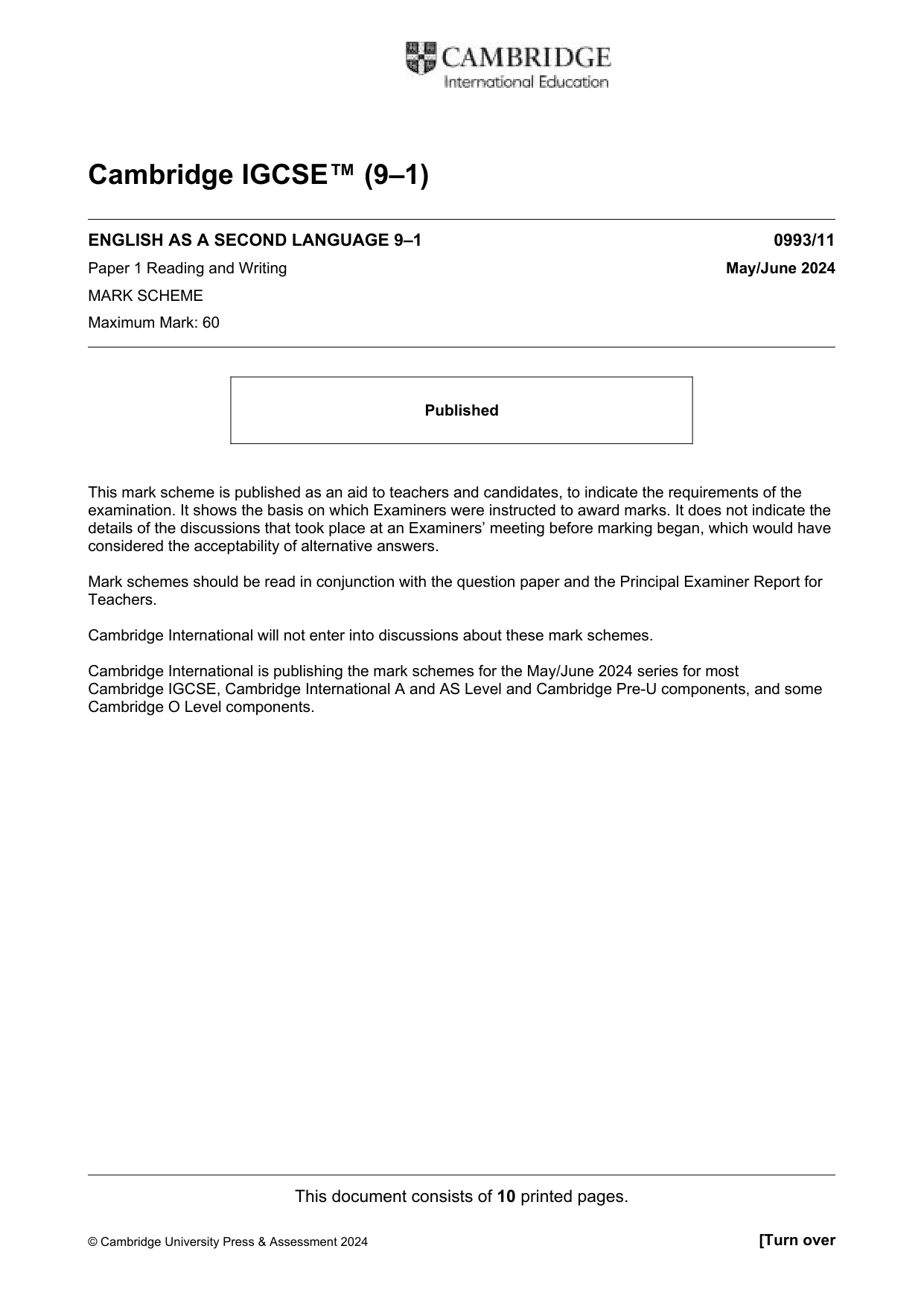
14 0993/11/M/J/24 © UCLES 2024 Exercise 6 Question 17 You recently bought a copy of a new magazine which is aimed at teenagers. You decide to review the magazine, and you will post the review on your school website. Here are some comments about the magazine from your friends: Now write a review of the new magazine. The comments above may give you some ideas, and you should also use some ideas of your own. Write about 120 to 160 words. You will receive up to 6 marks for the content of your review, and up to 9 marks for the language used. It’s quite expensive. I’d prefer longer articles. There are some interesting topics. I love the photos!
Question paper, page 15
15 0993/11/M/J/24 © UCLES 2024 … … … … … … … … … … … … … … … … … … … … … … … … … … … [Total: 15]
Question paper, page 16
16 0993/11/M/J/24 © UCLES 2024 Permission to reproduce items where third-party owned material protected by copyright is included has been sought and cleared where possible. Every reasonable effort has been made by the publisher (UCLES) to trace copyright holders, but if any items requiring clearance have unwittingly been included, the publisher will be pleased to make amends at the earliest possible opportunity. To avoid the issue of disclosure of answer-related information to candidates, all copyright acknowledgements are reproduced online in the Cambridge Assessment International Education Copyright Acknowledgements Booklet. This is produced for each series of examinations and is freely available to download at www.cambridgeinternational.org after the live examination series. Cambridge Assessment International Education is part of Cambridge Assessment. Cambridge Assessment is the brand name of the University of Cambridge Local Examinations Syndicate (UCLES), which is a department of the University of Cambridge. BLANK PAGE
Mark scheme, page 1
This document consists of 10 printed pages. © Cambridge University Press & Assessment 2024 [Turn over Cambridge IGCSE™ (9–1) ENGLISH AS A SECOND LANGUAGE 9–1 0993/11 Paper 1 Reading and Writing May/June 2024 MARK SCHEME Maximum Mark: 60 Published This mark scheme is published as an aid to teachers and candidates, to indicate the requirements of the examination. It shows the basis on which Examiners were instructed to award marks. It does not indicate the details of the discussions that took place at an Examiners’ meeting before marking began, which would have considered the acceptability of alternative answers. Mark schemes should be read in conjunction with the question paper and the Principal Examiner Report for Teachers. Cambridge International will not enter into discussions about these mark schemes. Cambridge International is publishing the mark schemes for the May/June 2024 series for most Cambridge IGCSE, Cambridge International A and AS Level and Cambridge Pre-U components, and some Cambridge O Level components.
Mark scheme, page 2
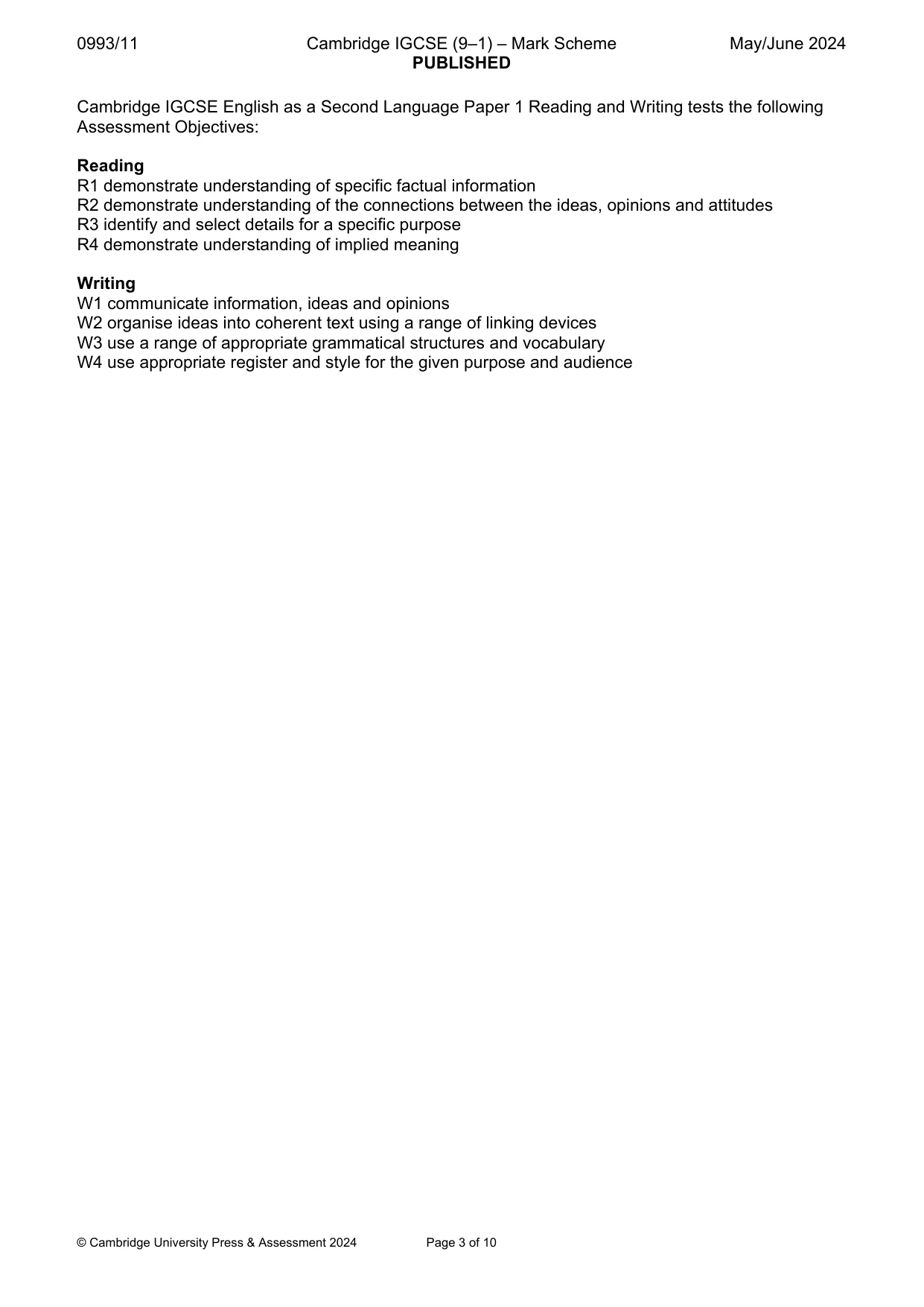
0993/11 Cambridge IGCSE (9–1) – Mark Scheme PUBLISHED May/June 2024 © Cambridge University Press & Assessment 2024 Page 2 of 10 Generic Marking Principles These general marking principles must be applied by all examiners when marking candidate answers. They should be applied alongside the specific content of the mark scheme or generic level descriptions for a question. Each question paper and mark scheme will also comply with these marking principles. GENERIC MARKING PRINCIPLE 1: Marks must be awarded in line with: the specific content of the mark scheme or the generic level descriptors for the question the specific skills defined in the mark scheme or in the generic level descriptors for the question the standard of response required by a candidate as exemplified by the standardisation scripts. GENERIC MARKING PRINCIPLE 2: Marks awarded are always whole marks (not half marks, or other fractions). GENERIC MARKING PRINCIPLE 3: Marks must be awarded positively: marks are awarded for correct/valid answers, as defined in the mark scheme. However, credit is given for valid answers which go beyond the scope of the syllabus and mark scheme, referring to your Team Leader as appropriate marks are awarded when candidates clearly demonstrate what they know and can do marks are not deducted for errors marks are not deducted for omissions answers should only be judged on the quality of spelling, punctuation and grammar when these features are specifically assessed by the question as indicated by the mark scheme. The meaning, however, should be unambiguous. GENERIC MARKING PRINCIPLE 4: Rules must be applied consistently, e.g. in situations where candidates have not followed instructions or in the application of generic level descriptors. GENERIC MARKING PRINCIPLE 5: Marks should be awarded using the full range of marks defined in the mark scheme for the question (however; the use of the full mark range may be limited according to the quality of the candidate responses seen). GENERIC MARKING PRINCIPLE 6: Marks awarded are based solely on the requirements as defined in the mark scheme. Marks should not be awarded with grade thresholds or grade descriptors in mind.
Mark scheme, page 3
0993/11 Cambridge IGCSE (9–1) – Mark Scheme PUBLISHED May/June 2024 © Cambridge University Press & Assessment 2024 Page 3 of 10 Cambridge IGCSE English as a Second Language Paper 1 Reading and Writing tests the following Assessment Objectives: Reading R1 demonstrate understanding of specific factual information R2 demonstrate understanding of the connections between the ideas, opinions and attitudes R3 identify and select details for a specific purpose R4 demonstrate understanding of implied meaning Writing W1 communicate information, ideas and opinions W2 organise ideas into coherent text using a range of linking devices W3 use a range of appropriate grammatical structures and vocabulary W4 use appropriate register and style for the given purpose and audience
Mark scheme, page 4
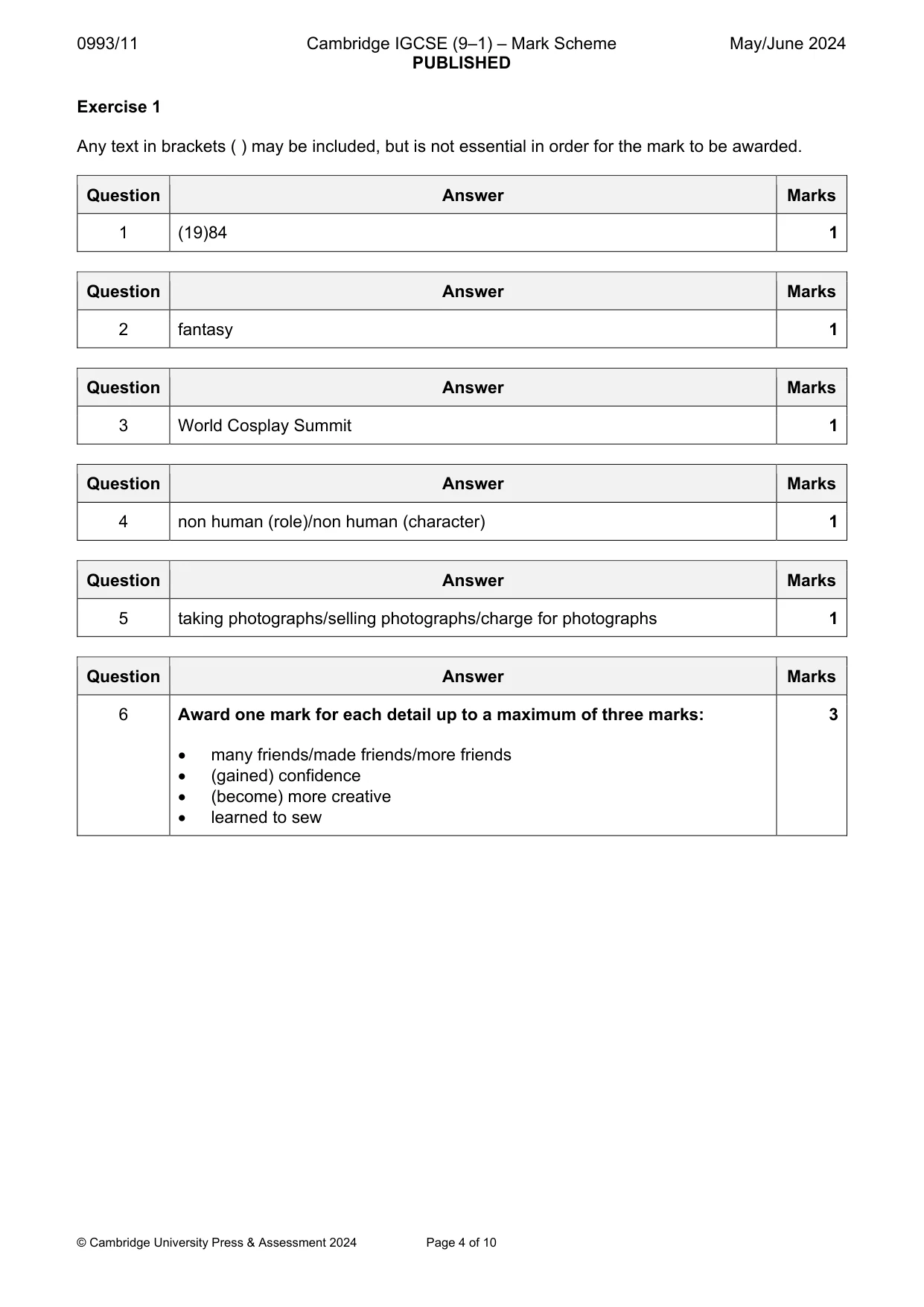
0993/11 Cambridge IGCSE (9–1) – Mark Scheme PUBLISHED May/June 2024 © Cambridge University Press & Assessment 2024 Page 4 of 10 Exercise 1 Any text in brackets ( ) may be included, but is not essential in order for the mark to be awarded. Question Answer Marks 1 (19)84 1 Question Answer Marks 2 fantasy 1 Question Answer Marks 3 World Cosplay Summit 1 Question Answer Marks 4 non human (role)/non human (character) 1 Question Answer Marks 5 taking photographs/selling photographs/charge for photographs 1 Question Answer Marks 6 Award one mark for each detail up to a maximum of three marks: many friends/made friends/more friends (gained) confidence (become) more creative learned to sew 3
Mark scheme, page 5
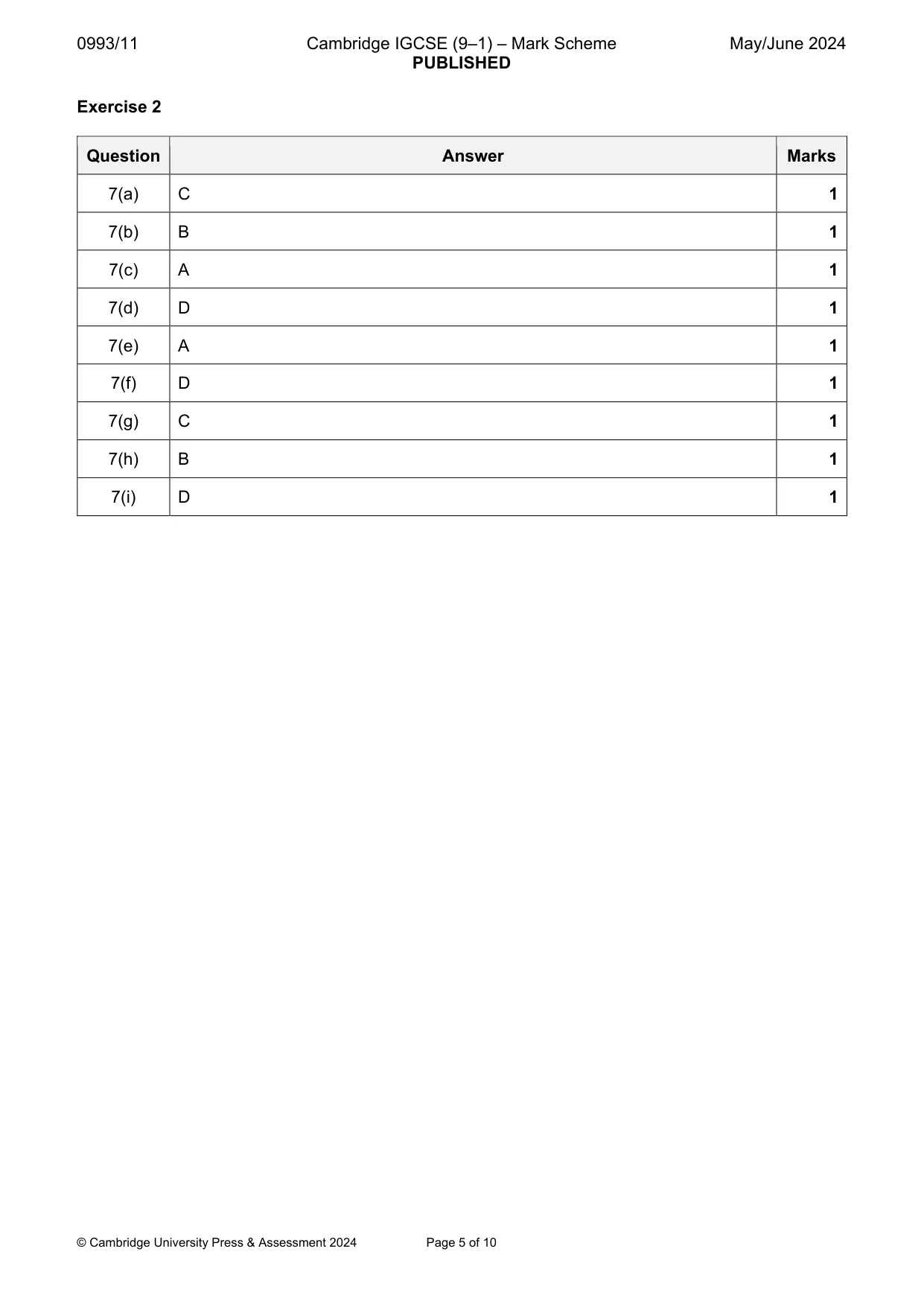
0993/11 Cambridge IGCSE (9–1) – Mark Scheme PUBLISHED May/June 2024 © Cambridge University Press & Assessment 2024 Page 5 of 10 Exercise 2 Question Answer Marks 7(a) C 1 7(b) B 1 7(c) A 1 7(d) D 1 7(e) A 1 7(f) D 1 7(g) C 1 7(h) B 1 7(i) D 1
Mark scheme, page 6
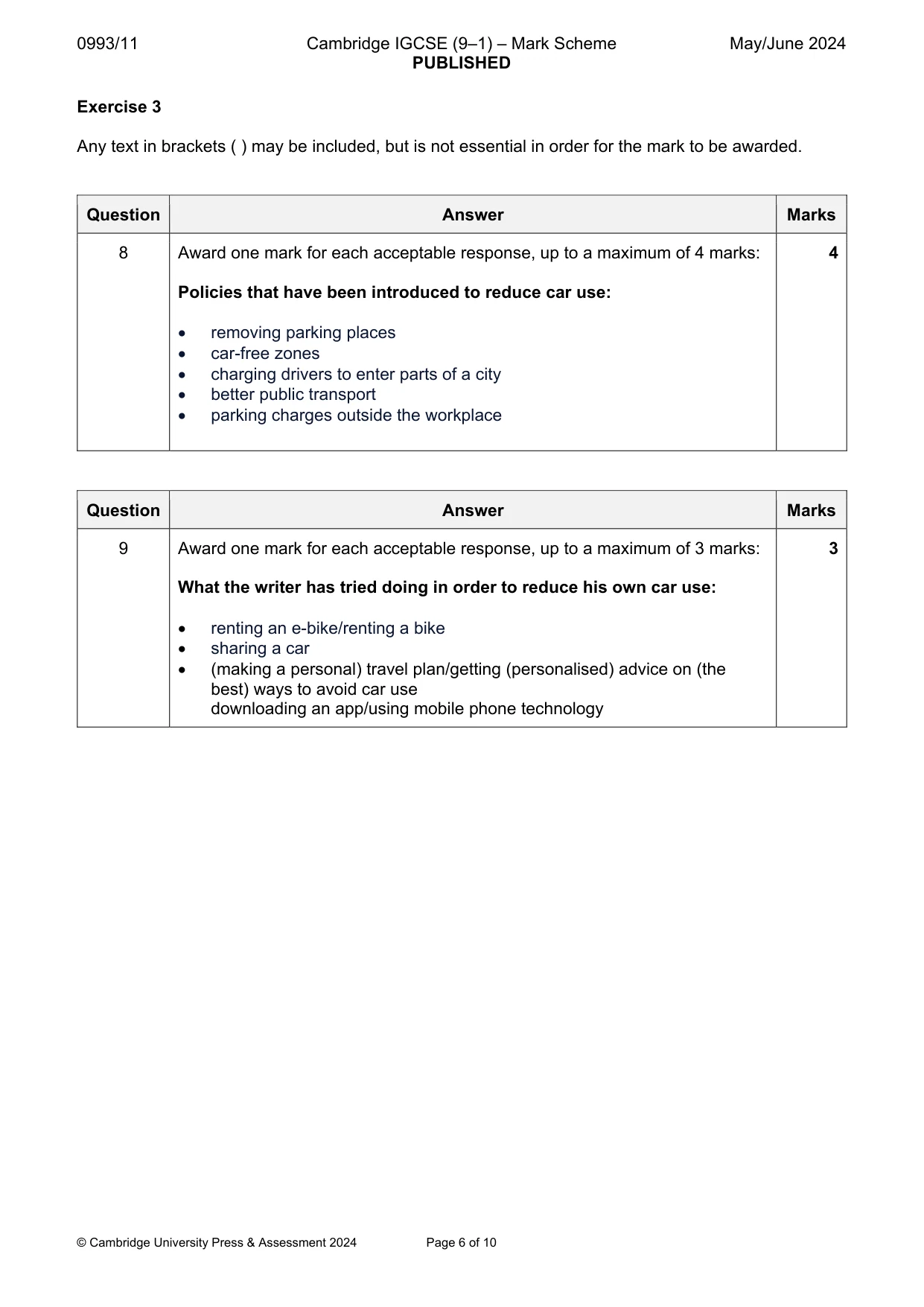
0993/11 Cambridge IGCSE (9–1) – Mark Scheme PUBLISHED May/June 2024 © Cambridge University Press & Assessment 2024 Page 6 of 10 Exercise 3 Any text in brackets ( ) may be included, but is not essential in order for the mark to be awarded. Question Answer Marks 8 Award one mark for each acceptable response, up to a maximum of 4 marks: Policies that have been introduced to reduce car use: removing parking places car-free zones charging drivers to enter parts of a city better public transport parking charges outside the workplace 4 Question Answer Marks 9 Award one mark for each acceptable response, up to a maximum of 3 marks: What the writer has tried doing in order to reduce his own car use: renting an e-bike/renting a bike sharing a car (making a personal) travel plan/getting (personalised) advice on (the best) ways to avoid car use downloading an app/using mobile phone technology 3
Mark scheme, page 7
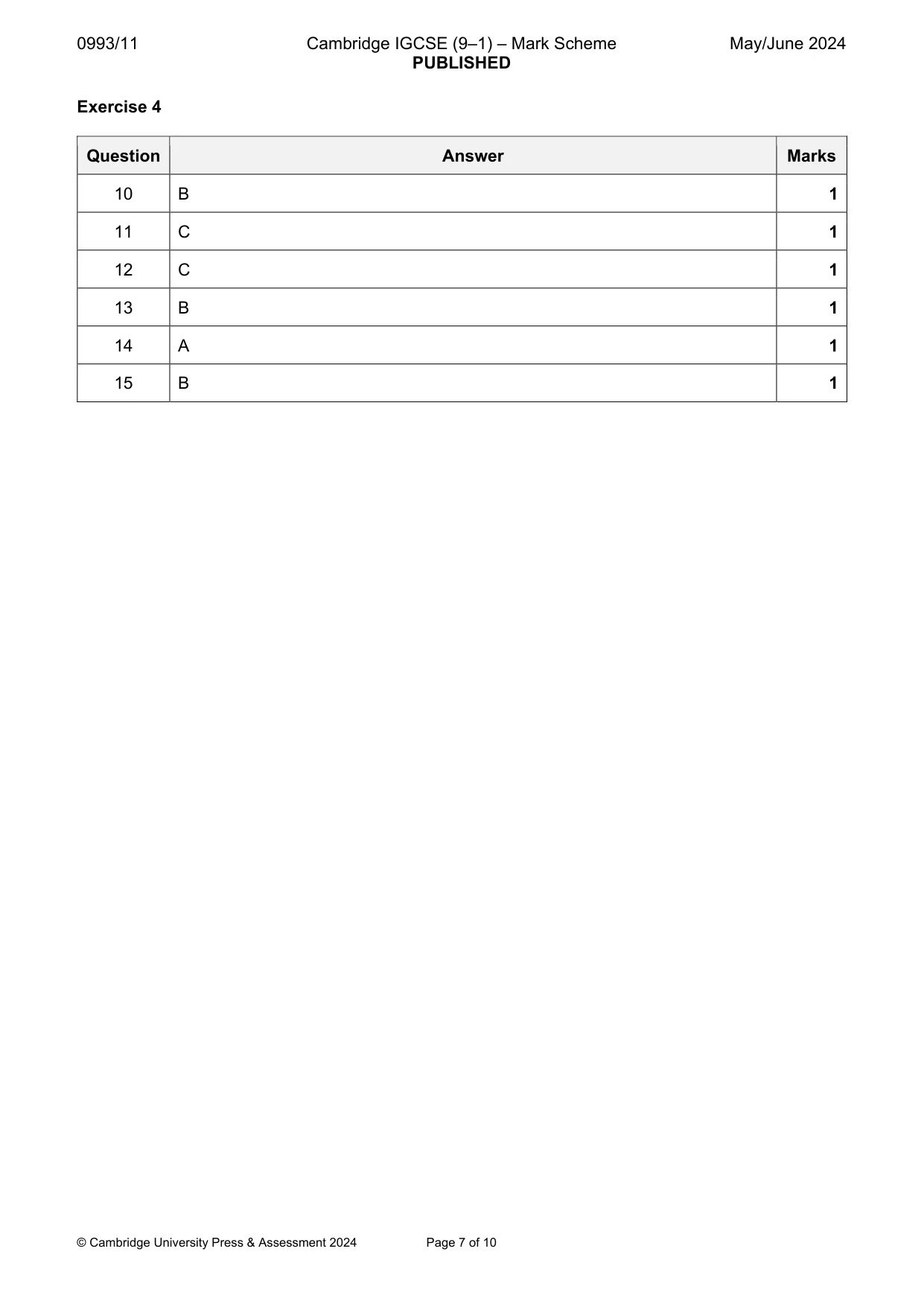
0993/11 Cambridge IGCSE (9–1) – Mark Scheme PUBLISHED May/June 2024 © Cambridge University Press & Assessment 2024 Page 7 of 10 Exercise 4 Question Answer Marks 10 B 1 11 C 1 12 C 1 13 B 1 14 A 1 15 B 1
Mark scheme, page 8
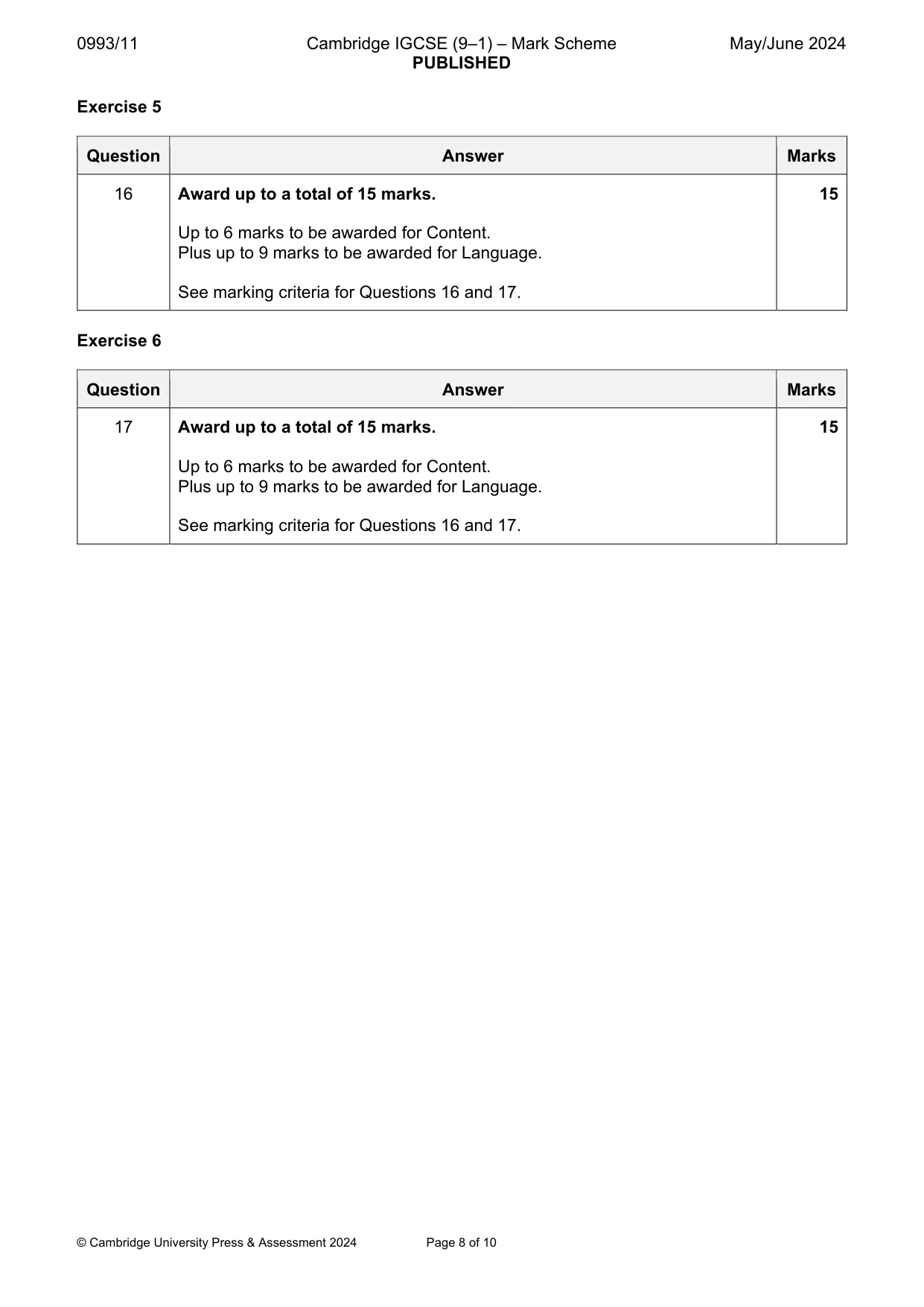
0993/11 Cambridge IGCSE (9–1) – Mark Scheme PUBLISHED May/June 2024 © Cambridge University Press & Assessment 2024 Page 8 of 10 Exercise 5 Question Answer Marks 16 Award up to a total of 15 marks. Up to 6 marks to be awarded for Content. Plus up to 9 marks to be awarded for Language. See marking criteria for Questions 16 and 17. 15 Exercise 6 Question Answer Marks 17 Award up to a total of 15 marks. Up to 6 marks to be awarded for Content. Plus up to 9 marks to be awarded for Language. See marking criteria for Questions 16 and 17. 15
Mark scheme, page 9
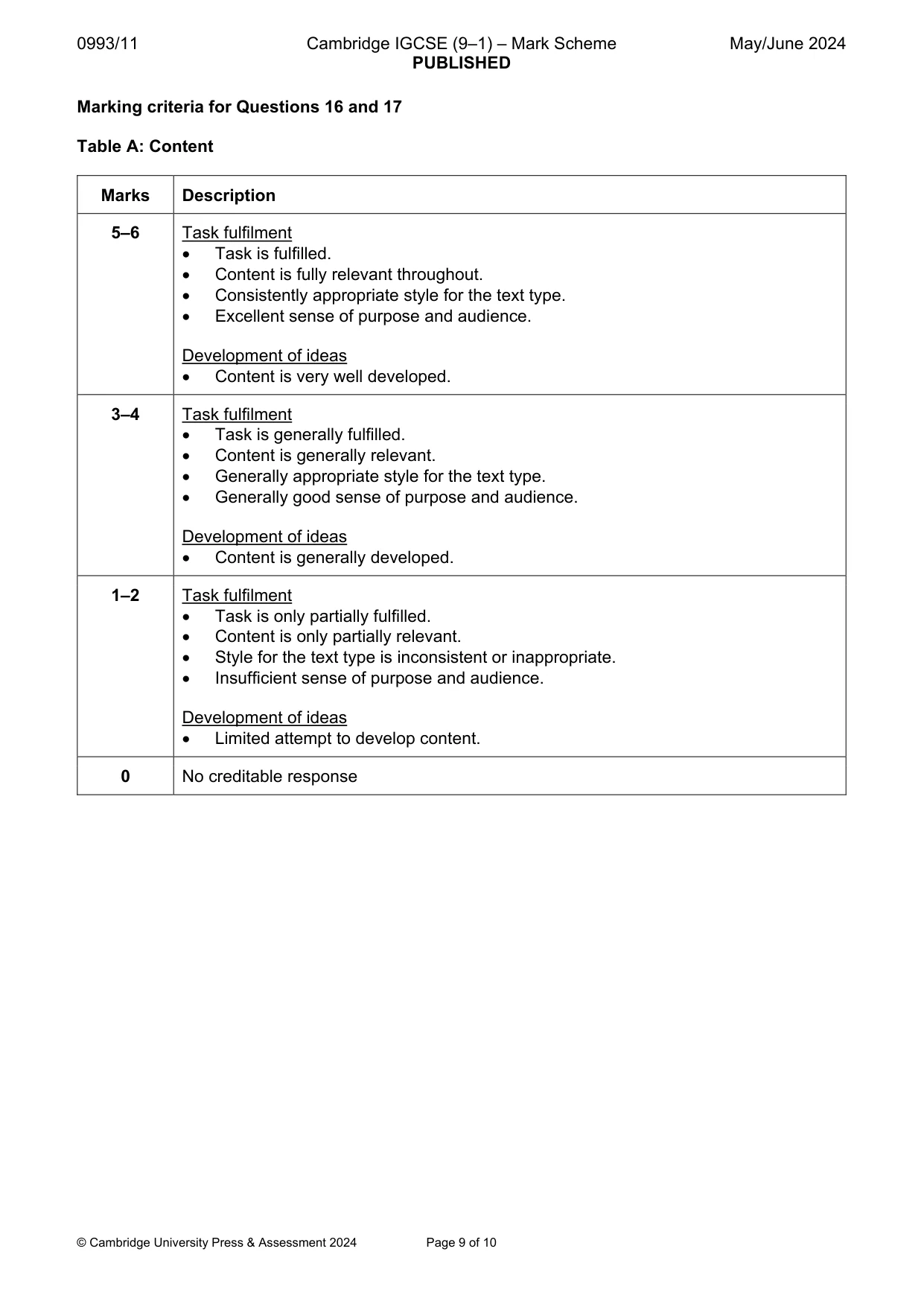
0993/11 Cambridge IGCSE (9–1) – Mark Scheme PUBLISHED May/June 2024 © Cambridge University Press & Assessment 2024 Page 9 of 10 Marking criteria for Questions 16 and 17 Table A: Content Marks Description 5–6 Task fulfilment Task is fulfilled. Content is fully relevant throughout. Consistently appropriate style for the text type. Excellent sense of purpose and audience. Development of ideas Content is very well developed. 3–4 Task fulfilment Task is generally fulfilled. Content is generally relevant. Generally appropriate style for the text type. Generally good sense of purpose and audience. Development of ideas Content is generally developed. 1–2 Task fulfilment Task is only partially fulfilled. Content is only partially relevant. Style for the text type is inconsistent or inappropriate. Insufficient sense of purpose and audience. Development of ideas Limited attempt to develop content. 0 No creditable response
Mark scheme, page 10
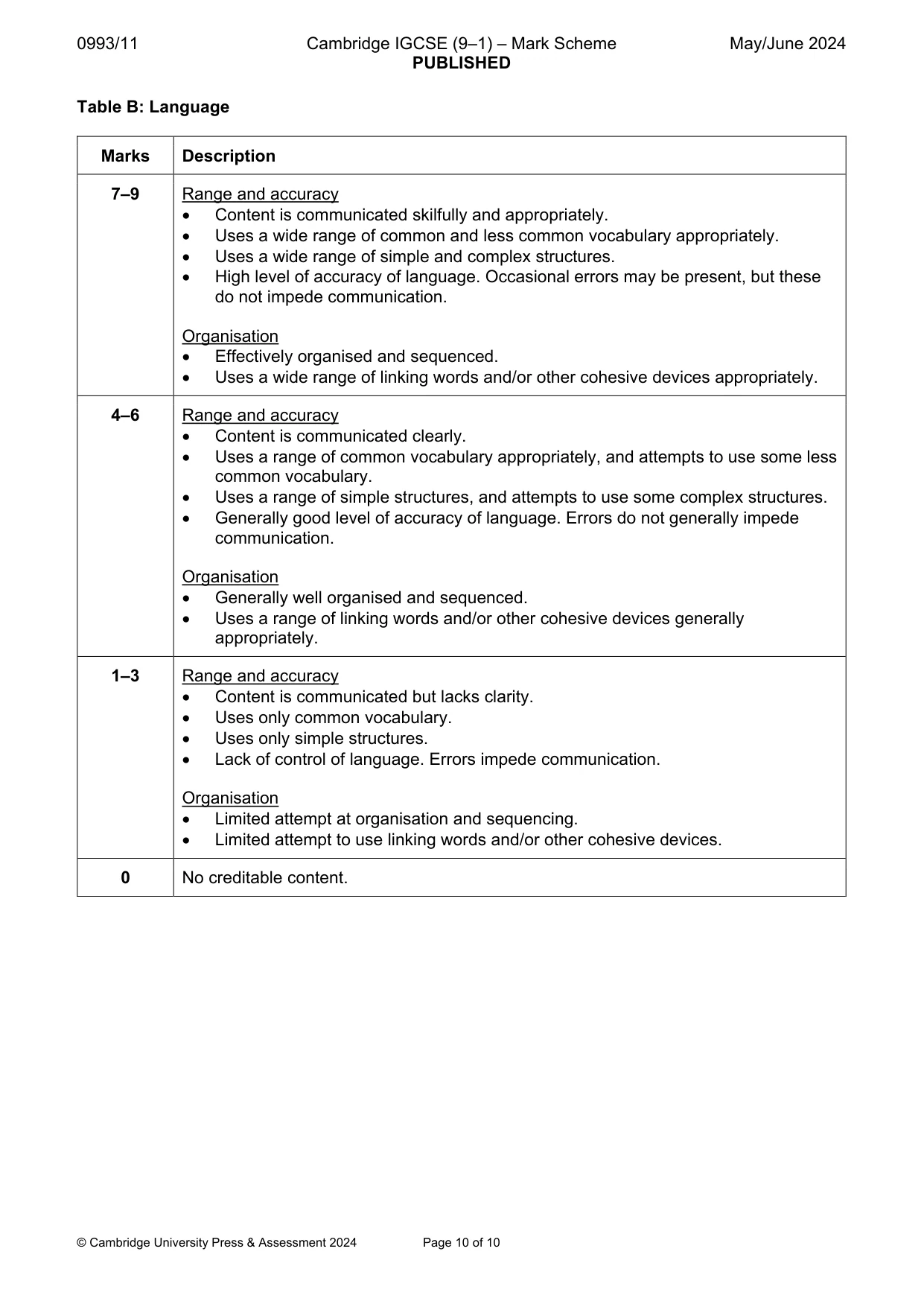
0993/11 Cambridge IGCSE (9–1) – Mark Scheme PUBLISHED May/June 2024 © Cambridge University Press & Assessment 2024 Page 10 of 10 Table B: Language Marks Description 7–9 Range and accuracy Content is communicated skilfully and appropriately. Uses a wide range of common and less common vocabulary appropriately. Uses a wide range of simple and complex structures. High level of accuracy of language. Occasional errors may be present, but these do not impede communication. Organisation Effectively organised and sequenced. Uses a wide range of linking words and/or other cohesive devices appropriately. 4–6 Range and accuracy Content is communicated clearly. Uses a range of common vocabulary appropriately, and attempts to use some less common vocabulary. Uses a range of simple structures, and attempts to use some complex structures. Generally good level of accuracy of language. Errors do not generally impede communication. Organisation Generally well organised and sequenced. Uses a range of linking words and/or other cohesive devices generally appropriately. 1–3 Range and accuracy Content is communicated but lacks clarity. Uses only common vocabulary. Uses only simple structures. Lack of control of language. Errors impede communication. Organisation Limited attempt at organisation and sequencing. Limited attempt to use linking words and/or other cohesive devices. 0 No creditable content.
What you needed in this session
Cambridge’s own grade thresholds for 2024 May/June, Paper 1 · Variant 1. A higher threshold means an easier paper — the bar moves with how the cohort did.