Cambridge IGCSE English Second Language (Speaking Endorsement) (9-1) 0993 — 2020 May/June Paper 1 · Variant 1
0993/11/M/J/20
The question paper and its mark scheme, free to read here and free to download. This is Cambridge’s own paper, exactly as it was sat.
Question paper16 pages






Mark scheme5 pages
Answers below. Sit the paper first if you are practising.
Paper as text
Question paper, page 1
Cambridge IGCSE™(9–1) DC (DH) 198353 © UCLES 2020 [Turn over This document has 16 pages. Blank pages are indicated. * 8 3 7 6 4 3 5 9 9 6 * ENGLISH AS A SECOND LANGUAGE 0993/11 Paper 1 Reading and Writing (Core) May/June 2020 1 hour 30 minutes You must answer on the question paper. No additional materials are needed. INSTRUCTIONS ● Answer all questions. ● Use a black or dark blue pen. ● Write your name, centre number and candidate number in the boxes at the top of the page. ● Write your answer to each question in the space provided. ● Do not use an erasable pen or correction fluid. ● Do not write on any bar codes. ● Dictionaries are not allowed. INFORMATION ● The total mark for this paper is 60. ● The number of marks for each question or part question is shown in brackets [ ].
Question paper, page 2
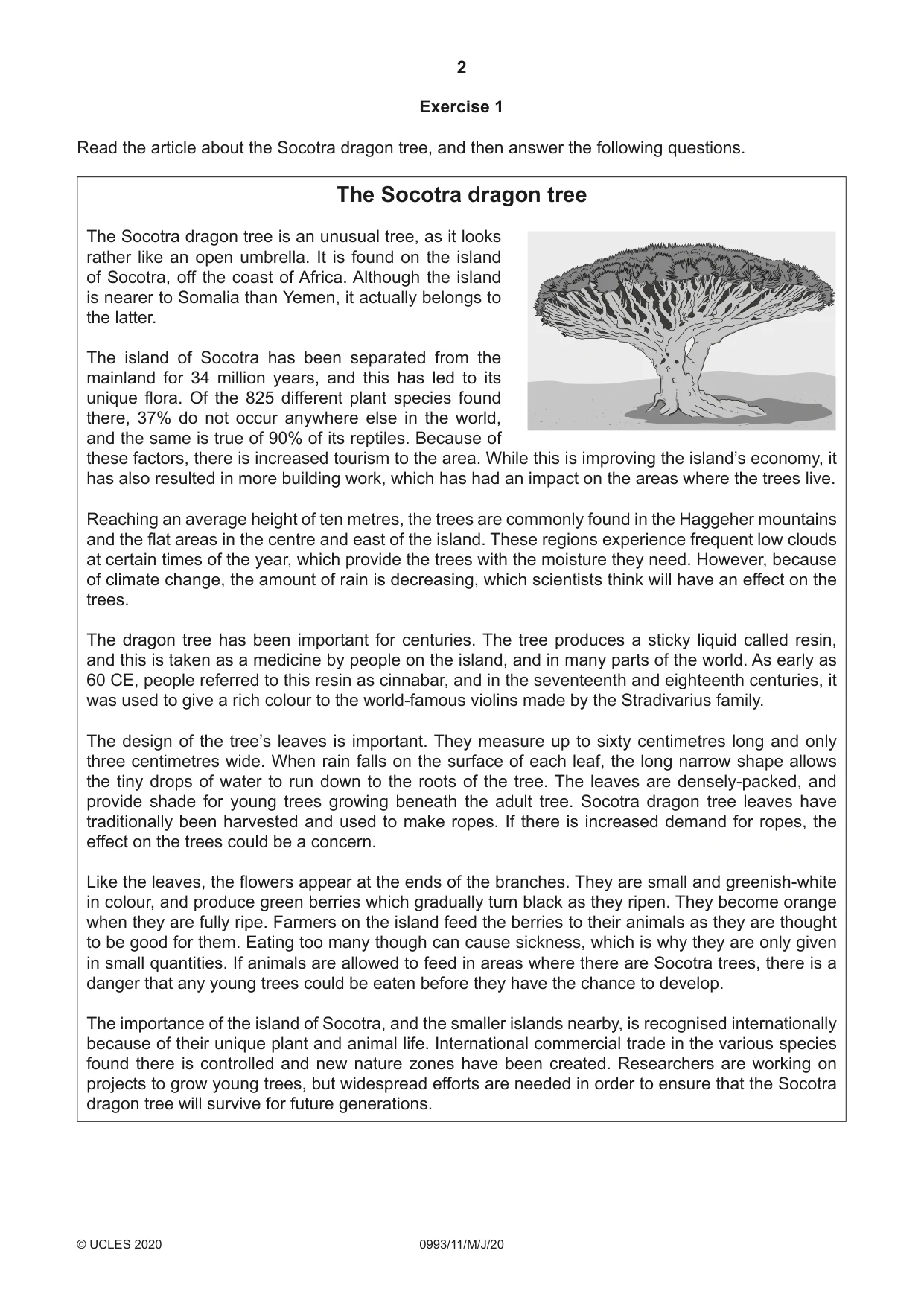
2 0993/11/M/J/20 © UCLES 2020 Exercise 1 Read the article about the Socotra dragon tree, and then answer the following questions. The Socotra dragon tree The Socotra dragon tree is an unusual tree, as it looks rather like an open umbrella. It is found on the island of Socotra, off the coast of Africa. Although the island is nearer to Somalia than Yemen, it actually belongs to the latter. The island of Socotra has been separated from the mainland for 34 million years, and this has led to its unique flora. Of the 825 different plant species found there, 37% do not occur anywhere else in the world, and the same is true of 90% of its reptiles. Because of these factors, there is increased tourism to the area. While this is improving the island’s economy, it has also resulted in more building work, which has had an impact on the areas where the trees live. Reaching an average height of ten metres, the trees are commonly found in the Haggeher mountains and the flat areas in the centre and east of the island. These regions experience frequent low clouds at certain times of the year, which provide the trees with the moisture they need. However, because of climate change, the amount of rain is decreasing, which scientists think will have an effect on the trees. The dragon tree has been important for centuries. The tree produces a sticky liquid called resin, and this is taken as a medicine by people on the island, and in many parts of the world. As early as 60 CE, people referred to this resin as cinnabar, and in the seventeenth and eighteenth centuries, it was used to give a rich colour to the world-famous violins made by the Stradivarius family. The design of the tree’s leaves is important. They measure up to sixty centimetres long and only three centimetres wide. When rain falls on the surface of each leaf, the long narrow shape allows the tiny drops of water to run down to the roots of the tree. The leaves are densely-packed, and provide shade for young trees growing beneath the adult tree. Socotra dragon tree leaves have traditionally been harvested and used to make ropes. If there is increased demand for ropes, the effect on the trees could be a concern. Like the leaves, the flowers appear at the ends of the branches. They are small and greenish-white in colour, and produce green berries which gradually turn black as they ripen. They become orange when they are fully ripe. Farmers on the island feed the berries to their animals as they are thought to be good for them. Eating too many though can cause sickness, which is why they are only given in small quantities. If animals are allowed to feed in areas where there are Socotra trees, there is a danger that any young trees could be eaten before they have the chance to develop. The importance of the island of Socotra, and the smaller islands nearby, is recognised internationally because of their unique plant and animal life. International commercial trade in the various species found there is controlled and new nature zones have been created. Researchers are working on projects to grow young trees, but widespread efforts are needed in order to ensure that the Socotra dragon tree will survive for future generations.
Question paper, page 3
3 0993/11/M/J/20 © UCLES 2020 [Turn over 1 Which country is the island of Socotra part of? … [1] 2 What percentage of Socotra’s plants can only be found on the island? … [1] 3 How tall do Socotra dragon trees typically grow? … [1] 4 What enables the Socotra dragon trees to grow well in particular locations on the island? … [1] 5 How is the substance that the Socotra dragon trees produce used today? … [1] 6 How do the trees’ leaves benefit Socotra dragon trees? Give two details. … … [2] 7 What colour are the Socotra dragon trees’ mature berries? … [1] 8 What problem must people be aware of when feeding berries to their animals? … [1] [Total: 9]
Question paper, page 4
4 0993/11/M/J/20 © UCLES 2020 Exercise 2 Read the article about three people (A–C) who are describing an activity they enjoy. Then answer Question 9 (a)–(h). My favourite activity A Tanya I enjoy different sports, but skateboarding is my absolute favourite. To me, it’s my sport, my hobby, and even my daily mode of transport! I don’t even own a bicycle any more! Skateboarding has shaped me into the person I am today. It’s taught me to always get up after I fall, to never give up, to stick with something until I get it right and to be proud of what I have achieved. When I was little, I used to go to the skate park near my home and practise simple things like turns and small jumps. I was this little kid skating around and accidentally getting in the way of all the bigger kids. But they never yelled at me to get out of the way or said anything rude to me at all. In fact, some of these kids even gave me tips and showed me how to do certain tricks. B Patricia When I was five, my parents enrolled me in a gymnastics programme. I remember being really nervous before the class, but my cousin decided to start with me, and that gave me confidence. I began by learning the basics – like how to walk across the balance beam, and how to do forward rolls for the floor exercise. After two years, I was good enough to join the team, and I had classes with the older, more advanced gymnasts. They were good role models, as I could see how hard they worked. Soon I was competing nationally, even winning some individual medals. As competitions got harder, I had to learn new skills, including something called a back handspring. I had difficulty getting it right, although I practised a lot. Then I fell and damaged my shoulder, so I didn’t enter anything for a year. I considered quitting, but actually, having a break for that year was good, and I decided to continue, which I know was the right move – I’m so happy I carried on. C Danni When I was about 11, I had no idea what sports I wanted to do. My sister did cross-country running at school and didn’t like it because she always came last, but I decided to have a go. So I joined the school cross-country running club. Running in the heat was really hard, but I kept going, and got picked for the team. This took a lot of commitment, as I had to get up very early to go on training runs. Strange as it may seem, though, I’ve always liked early mornings! I remember my first competition. I was anxious about finishing in last place. Once the race started, I felt better and managed to stay in 8th place almost the whole time and I was able to move up to finish in 6th place. After that, I was determined to keep improving, and even when I’m not training for a particular event, I still go running.
Question paper, page 5
5 0993/11/M/J/20 © UCLES 2020 [Turn over 9 For each question, write the correct letter A, B or C on the line. Which person … (a) gives a reason for not participating in competitions? … [1] (b) describes how she got advice from other people? … [1] (c) explains that she wasn’t put off doing an activity by someone else’s bad experience? … [1] (d) mentions positive characteristics she’s developed through her interest? … [1] (e) explains what she learned from watching other people? … [1] (f) mentions having a lack of confidence before a competition? … [1] (g) explains that the activity has a practical use in everyday life? … [1] (h) mentions that sharing a difficult experience was helpful? … [1] [Total: 8]
Question paper, page 6
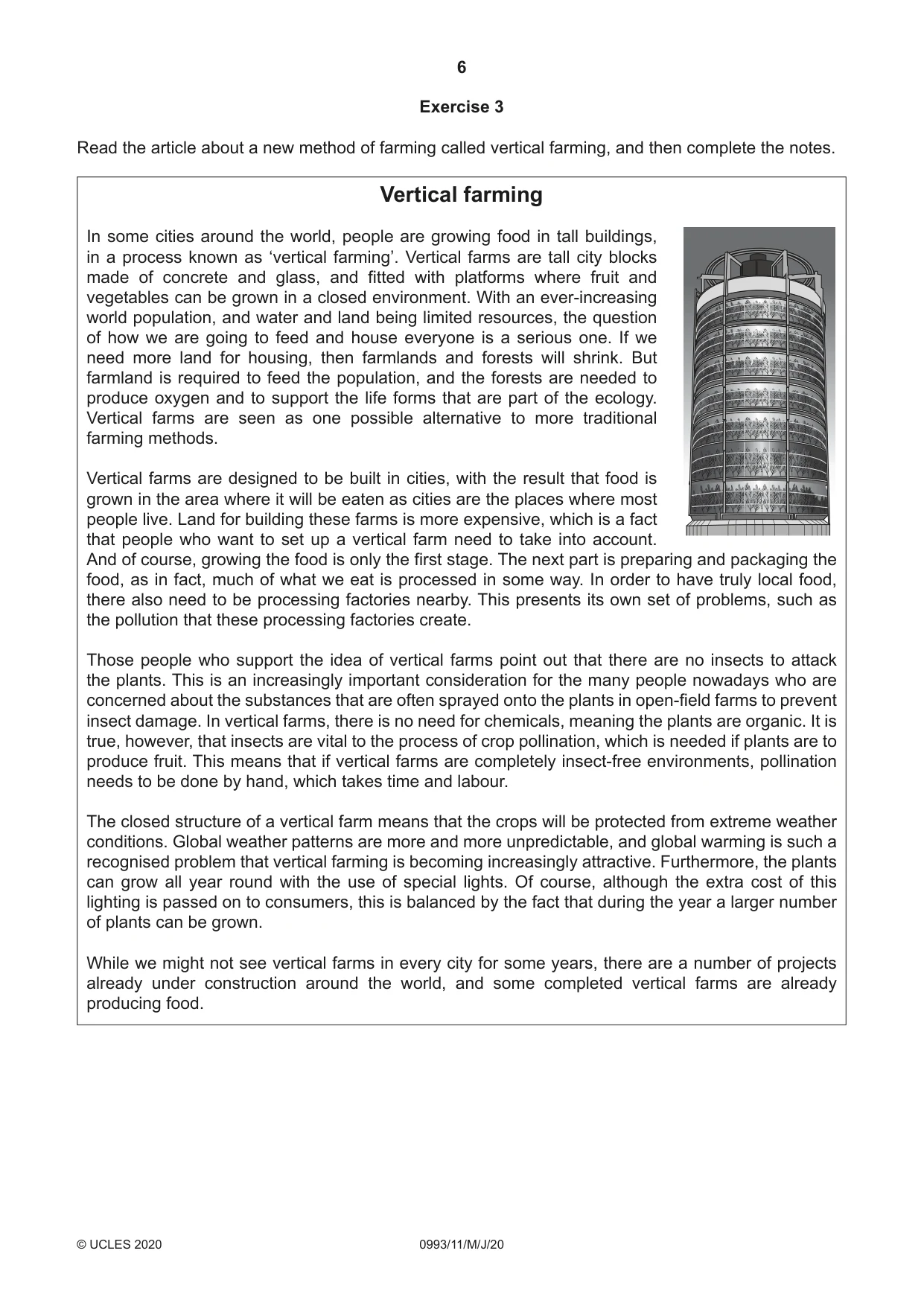
6 0993/11/M/J/20 © UCLES 2020 Exercise 3 Read the article about a new method of farming called vertical farming, and then complete the notes. Vertical farming In some cities around the world, people are growing food in tall buildings, in a process known as ‘vertical farming’. Vertical farms are tall city blocks made of concrete and glass, and fitted with platforms where fruit and vegetables can be grown in a closed environment. With an ever-increasing world population, and water and land being limited resources, the question of how we are going to feed and house everyone is a serious one. If we need more land for housing, then farmlands and forests will shrink. But farmland is required to feed the population, and the forests are needed to produce oxygen and to support the life forms that are part of the ecology. Vertical farms are seen as one possible alternative to more traditional farming methods. Vertical farms are designed to be built in cities, with the result that food is grown in the area where it will be eaten as cities are the places where most people live. Land for building these farms is more expensive, which is a fact that people who want to set up a vertical farm need to take into account. And of course, growing the food is only the first stage. The next part is preparing and packaging the food, as in fact, much of what we eat is processed in some way. In order to have truly local food, there also need to be processing factories nearby. This presents its own set of problems, such as the pollution that these processing factories create. Those people who support the idea of vertical farms point out that there are no insects to attack the plants. This is an increasingly important consideration for the many people nowadays who are concerned about the substances that are often sprayed onto the plants in open-field farms to prevent insect damage. In vertical farms, there is no need for chemicals, meaning the plants are organic. It is true, however, that insects are vital to the process of crop pollination, which is needed if plants are to produce fruit. This means that if vertical farms are completely insect-free environments, pollination needs to be done by hand, which takes time and labour. The closed structure of a vertical farm means that the crops will be protected from extreme weather conditions. Global weather patterns are more and more unpredictable, and global warming is such a recognised problem that vertical farming is becoming increasingly attractive. Furthermore, the plants can grow all year round with the use of special lights. Of course, although the extra cost of this lighting is passed on to consumers, this is balanced by the fact that during the year a larger number of plants can be grown. While we might not see vertical farms in every city for some years, there are a number of projects already under construction around the world, and some completed vertical farms are already producing food.
Question paper, page 7
7 0993/11/M/J/20 © UCLES 2020 [Turn over You are going to give a talk about the advantages and disadvantages of vertical farming to your class at school. Prepare some notes to use as the basis for your talk. Make short notes under each heading. 10 Advantages of vertical farming: • … • … • … • … • … [5] 11 Disadvantages of vertical farming: • … • … [2] [Total: 7]
Question paper, page 8
8 0993/11/M/J/20 © UCLES 2020 Exercise 4 12 Read the article about a place called the Arctic World Archive where data is stored. Write a summary about why the Arctic World Archive is a safe place for data to be stored. Your summary should be about 80 words long (and no more than 90 words long). You should use your own words as far as possible. You will receive up to 6 marks for the content of your summary, and up to 6 marks for the style and accuracy of your language. Keeping your data safe: the Arctic World Archive Nowadays, we all keep a huge amount of information on our computers and phones, like electronic messages and photos. If you’ve ever lost important information from your computer, or your phone, you’ll know how annoying this can be! Nowadays, however, governments, businesses and people who are concerned about losing valuable data or photos can relax a bit more. There is a large data storage facility, called the Arctic World Archive, which opened in March 2017. The archive is found on an island between mainland Norway and the North Pole. It is 300 metres below the ground, and protected from the Arctic conditions above. The temperature underground does not vary a great deal, and this makes it suitable for storing data securely. The fact that no extra energy is needed to maintain the temperature means there is no need for temperature control equipment. And because the island is in a very remote location, it is unlikely that anyone would try to access it. A company has developed the technology to store people’s data by transferring it onto special digital film which lasts 500 years. This is considerably longer than some other methods of data storage. The data on this digital film cannot be edited in any way by anyone. People wanting to use the archive send data to the company, and once it is stored, they can ask to get it back at any time. This is not an immediate process though. For extra security, the data held in the archive is not connected to the internet. When a request for stored information is made, staff at the archive have to go and physically collect the relevant digital film. This is then sent electronically using a special safe cable which is connected to the mainland. This procedure can take half an hour or more. But in these days of online security problems around the world, this is well worth the wait!
Question paper, page 9
9 0993/11/M/J/20 © UCLES 2020 [Turn over … … … … … … … … … … … … … … [Total: 12]
Question paper, page 10
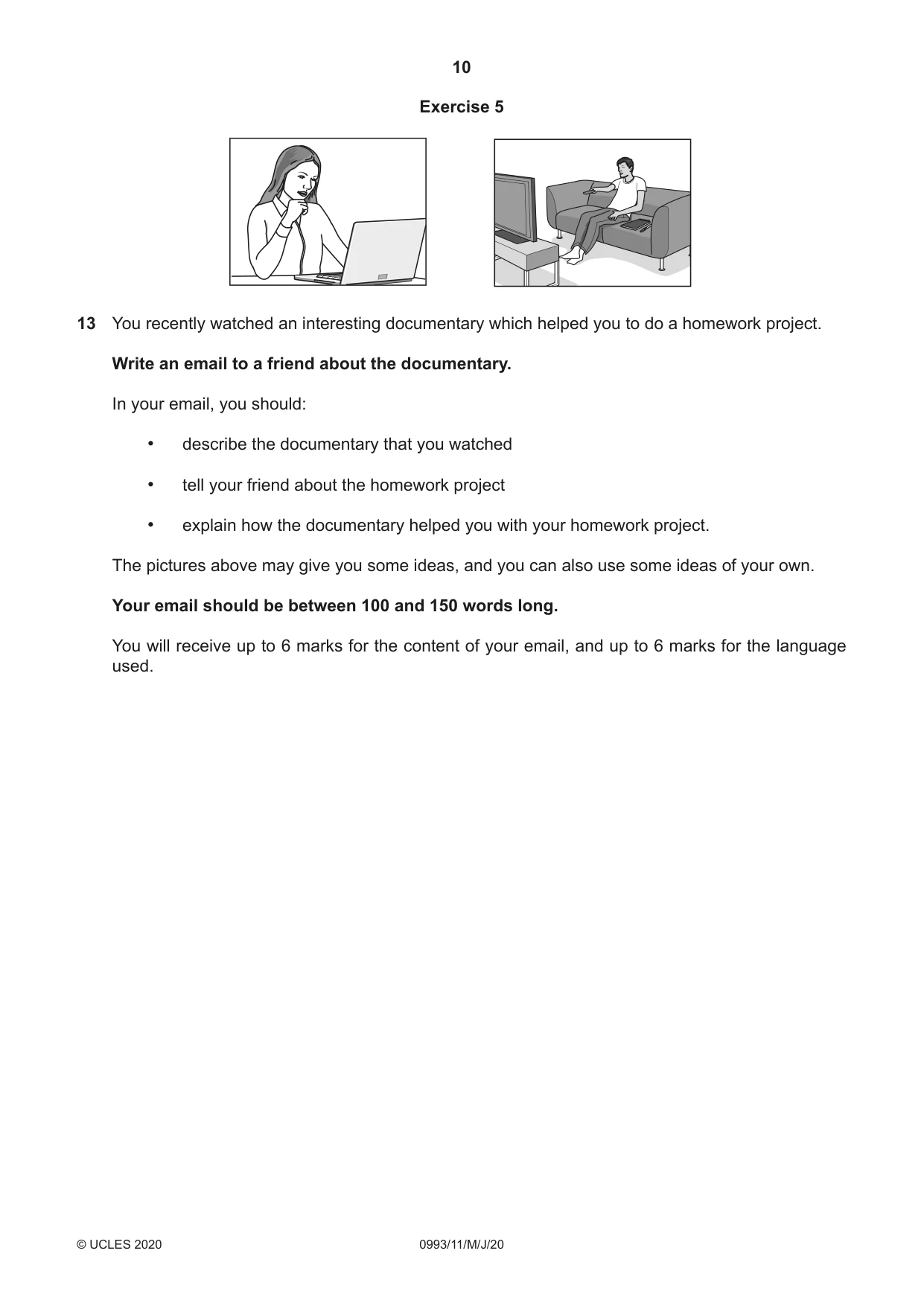
10 0993/11/M/J/20 © UCLES 2020 Exercise 5 13 You recently watched an interesting documentary which helped you to do a homework project. Write an email to a friend about the documentary. In your email, you should: • describe the documentary that you watched • tell your friend about the homework project • explain how the documentary helped you with your homework project. The pictures above may give you some ideas, and you can also use some ideas of your own. Your email should be between 100 and 150 words long. You will receive up to 6 marks for the content of your email, and up to 6 marks for the language used.
Question paper, page 11
11 0993/11/M/J/20 © UCLES 2020 [Turn over … … … … … … … … … … … … … … … … … … … … … … … … … … … [Total: 12]
Question paper, page 12
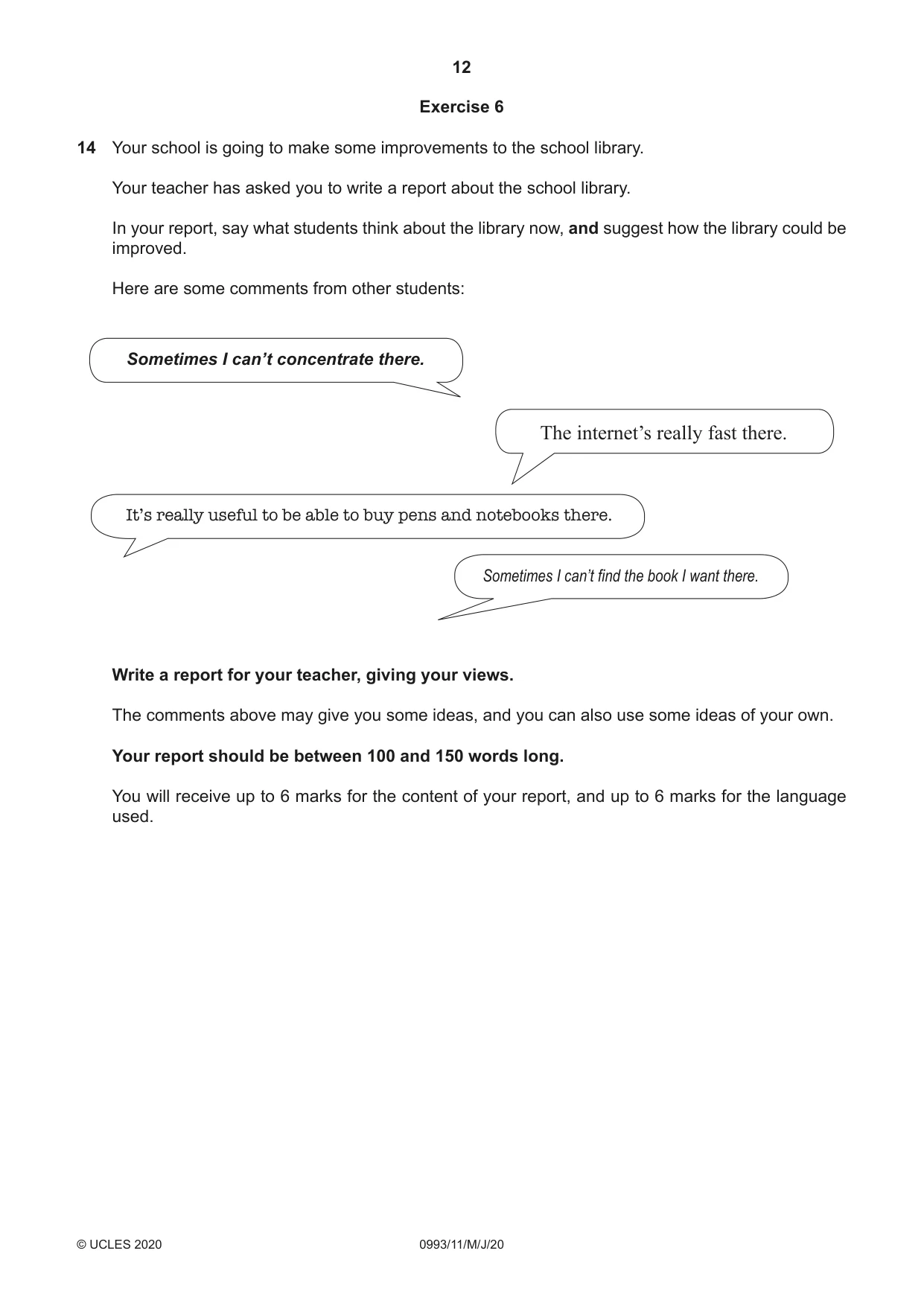
12 0993/11/M/J/20 © UCLES 2020 Exercise 6 14 Your school is going to make some improvements to the school library. Your teacher has asked you to write a report about the school library. In your report, say what students think about the library now, and suggest how the library could be improved. Here are some comments from other students: The internet’s really fast there. Sometimes I can’t concentrate there. Sometimes I can’t find the book I want there. It’s really useful to be able to buy pens and notebooks there. Write a report for your teacher, giving your views. The comments above may give you some ideas, and you can also use some ideas of your own. Your report should be between 100 and 150 words long. You will receive up to 6 marks for the content of your report, and up to 6 marks for the language used.
Question paper, page 13
13 0993/11/M/J/20 © UCLES 2020 … … … … … … … … … … … … … … … … … … … … … … … … … … … [Total: 12]
Question paper, page 14
14 0993/11/M/J/20 © UCLES 2020 BLANK PAGE
Question paper, page 15
15 0993/11/M/J/20 © UCLES 2020 BLANK PAGE
Question paper, page 16
16 0993/11/M/J/20 © UCLES 2020 Permission to reproduce items where third-party owned material protected by copyright is included has been sought and cleared where possible. Every reasonable effort has been made by the publisher (UCLES) to trace copyright holders, but if any items requiring clearance have unwittingly been included, the publisher will be pleased to make amends at the earliest possible opportunity. To avoid the issue of disclosure of answer-related information to candidates, all copyright acknowledgements are reproduced online in the Cambridge Assessment International Education Copyright Acknowledgements Booklet. This is produced for each series of examinations and is freely available to download at www.cambridgeinternational.org after the live examination series. Cambridge Assessment International Education is part of the Cambridge Assessment Group. Cambridge Assessment is the brand name of the University of Cambridge Local Examinations Syndicate (UCLES), which itself is a department of the University of Cambridge. BLANK PAGE
Mark scheme, page 1
This document consists of 10 printed pages. © UCLES 2020 [Turn over Cambridge IGCSE™ (9–1) ENGLISH AS A SECOND LANGUAGE 9–1 (SPEAKING ENDORSEMENT) 0993/11 Paper 1 Reading and Writing (Core) May/June 2020 MARK SCHEME Maximum Mark: 60 Published Students did not sit exam papers in the June 2020 series due to the Covid-19 global pandemic. This mark scheme is published to support teachers and students and should be read together with the question paper. It shows the requirements of the exam. The answer column of the mark scheme shows the proposed basis on which Examiners would award marks for this exam. Where appropriate, this column also provides the most likely acceptable alternative responses expected from students. Examiners usually review the mark scheme after they have seen student responses and update the mark scheme if appropriate. In the June series, Examiners were unable to consider the acceptability of alternative responses, as there were no student responses to consider. Mark schemes should usually be read together with the Principal Examiner Report for Teachers. However, because students did not sit exam papers, there is no Principal Examiner Report for Teachers for the June 2020 series. Cambridge International will not enter into discussions about these mark schemes. Cambridge International is publishing the mark schemes for the June 2020 series for most Cambridge IGCSE™ and Cambridge International A & AS Level components, and some Cambridge O Level components.
Mark scheme, page 2
0993/11 Cambridge IGCSE (9–1) – Mark Scheme PUBLISHED May/June 2020 © UCLES 2020 Page 2 of 10 Generic Marking Principles These general marking principles must be applied by all examiners when marking candidate answers. They should be applied alongside the specific content of the mark scheme or generic level descriptors for a question. Each question paper and mark scheme will also comply with these marking principles. GENERIC MARKING PRINCIPLE 1: Marks must be awarded in line with: • the specific content of the mark scheme or the generic level descriptors for the question • the specific skills defined in the mark scheme or in the generic level descriptors for the question • the standard of response required by a candidate as exemplified by the standardisation scripts. GENERIC MARKING PRINCIPLE 2: Marks awarded are always whole marks (not half marks, or other fractions). GENERIC MARKING PRINCIPLE 3: Marks must be awarded positively: • marks are awarded for correct/valid answers, as defined in the mark scheme. However, credit is given for valid answers which go beyond the scope of the syllabus and mark scheme, referring to your Team Leader as appropriate • marks are awarded when candidates clearly demonstrate what they know and can do • marks are not deducted for errors • marks are not deducted for omissions • answers should only be judged on the quality of spelling, punctuation and grammar when these features are specifically assessed by the question as indicated by the mark scheme. The meaning, however, should be unambiguous. GENERIC MARKING PRINCIPLE 4: Rules must be applied consistently e.g. in situations where candidates have not followed instructions or in the application of generic level descriptors. GENERIC MARKING PRINCIPLE 5: Marks should be awarded using the full range of marks defined in the mark scheme for the question (however; the use of the full mark range may be limited according to the quality of the candidate responses seen). GENERIC MARKING PRINCIPLE 6: Marks awarded are based solely on the requirements as defined in the mark scheme. Marks should not be awarded with grade thresholds or grade descriptors in mind.
Mark scheme, page 3
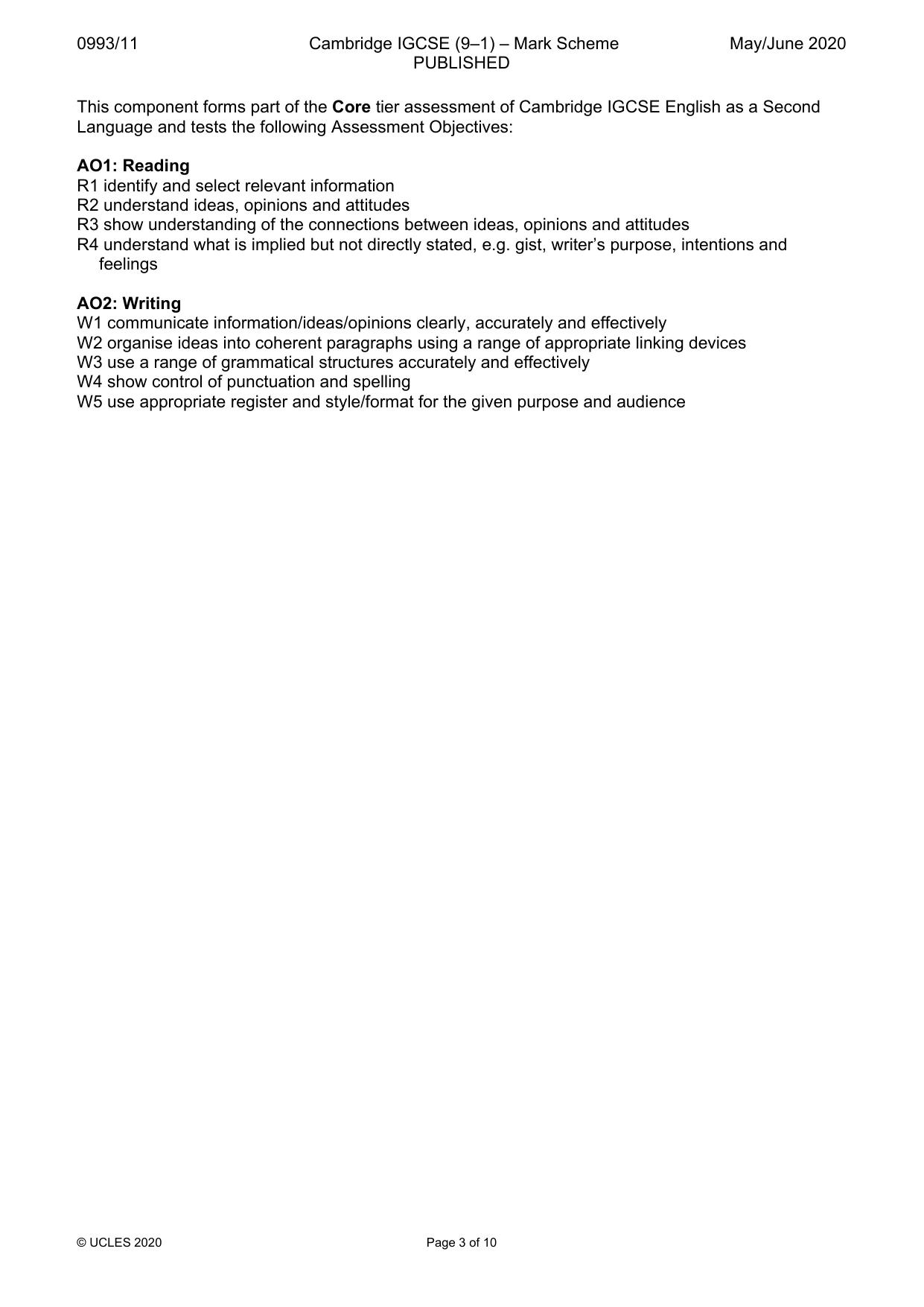
0993/11 Cambridge IGCSE (9–1) – Mark Scheme PUBLISHED May/June 2020 © UCLES 2020 Page 3 of 10 This component forms part of the Core tier assessment of Cambridge IGCSE English as a Second Language and tests the following Assessment Objectives: AO1: Reading R1 identify and select relevant information R2 understand ideas, opinions and attitudes R3 show understanding of the connections between ideas, opinions and attitudes R4 understand what is implied but not directly stated, e.g. gist, writer’s purpose, intentions and feelings AO2: Writing W1 communicate information/ideas/opinions clearly, accurately and effectively W2 organise ideas into coherent paragraphs using a range of appropriate linking devices W3 use a range of grammatical structures accurately and effectively W4 show control of punctuation and spelling W5 use appropriate register and style/format for the given purpose and audience
Mark scheme, page 4
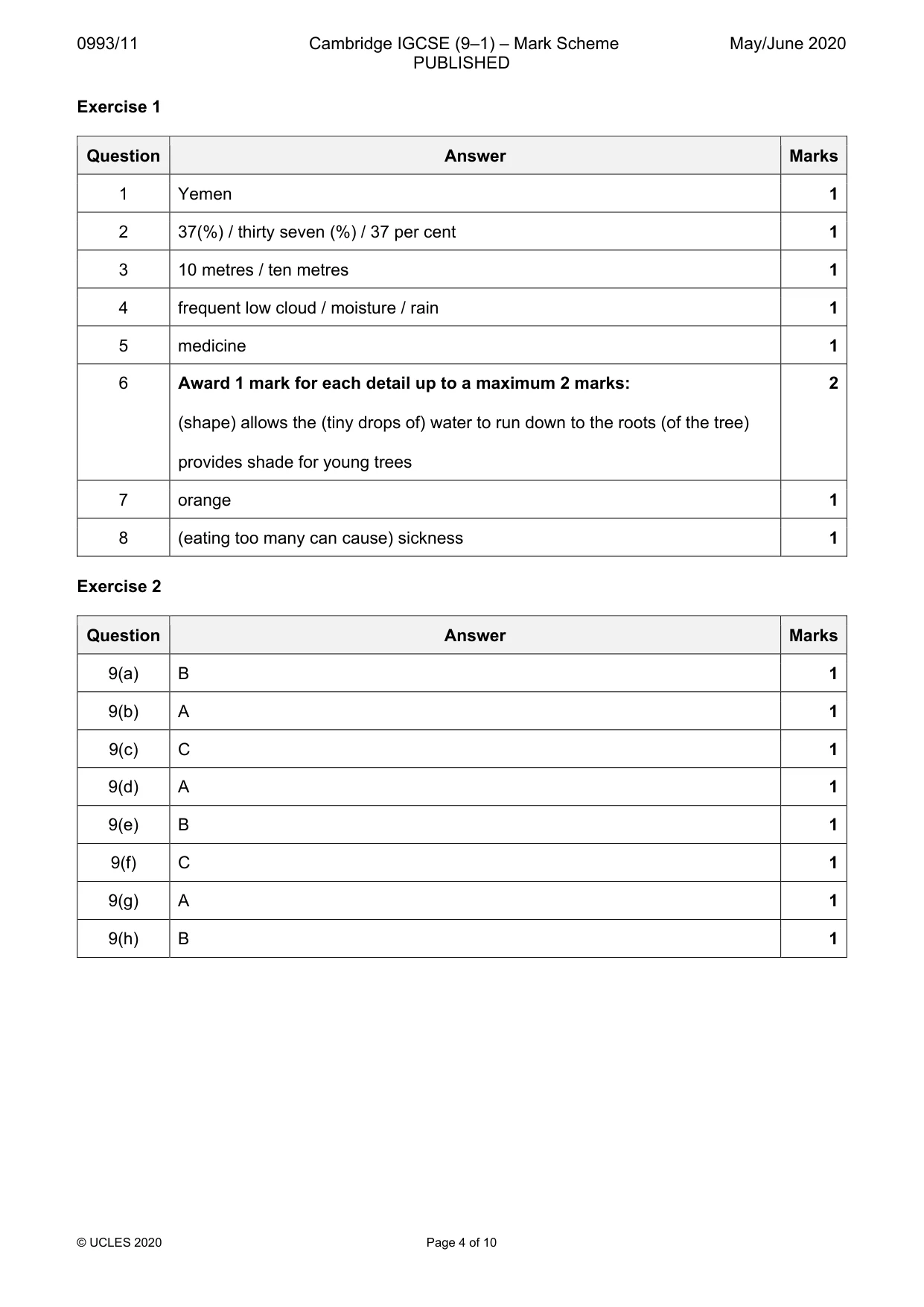
0993/11 Cambridge IGCSE (9–1) – Mark Scheme PUBLISHED May/June 2020 © UCLES 2020 Page 4 of 10 Exercise 1 Question Answer Marks 1 Yemen 1 2 37(%) / thirty seven (%) / 37 per cent 1 3 10 metres / ten metres 1 4 frequent low cloud / moisture / rain 1 5 medicine 1 6 Award 1 mark for each detail up to a maximum 2 marks: (shape) allows the (tiny drops of) water to run down to the roots (of the tree) provides shade for young trees 2 7 orange 1 8 (eating too many can cause) sickness 1 Exercise 2 Question Answer Marks 9(a) B 1 9(b) A 1 9(c) C 1 9(d) A 1 9(e) B 1 9(f) C 1 9(g) A 1 9(h) B 1
Mark scheme, page 5
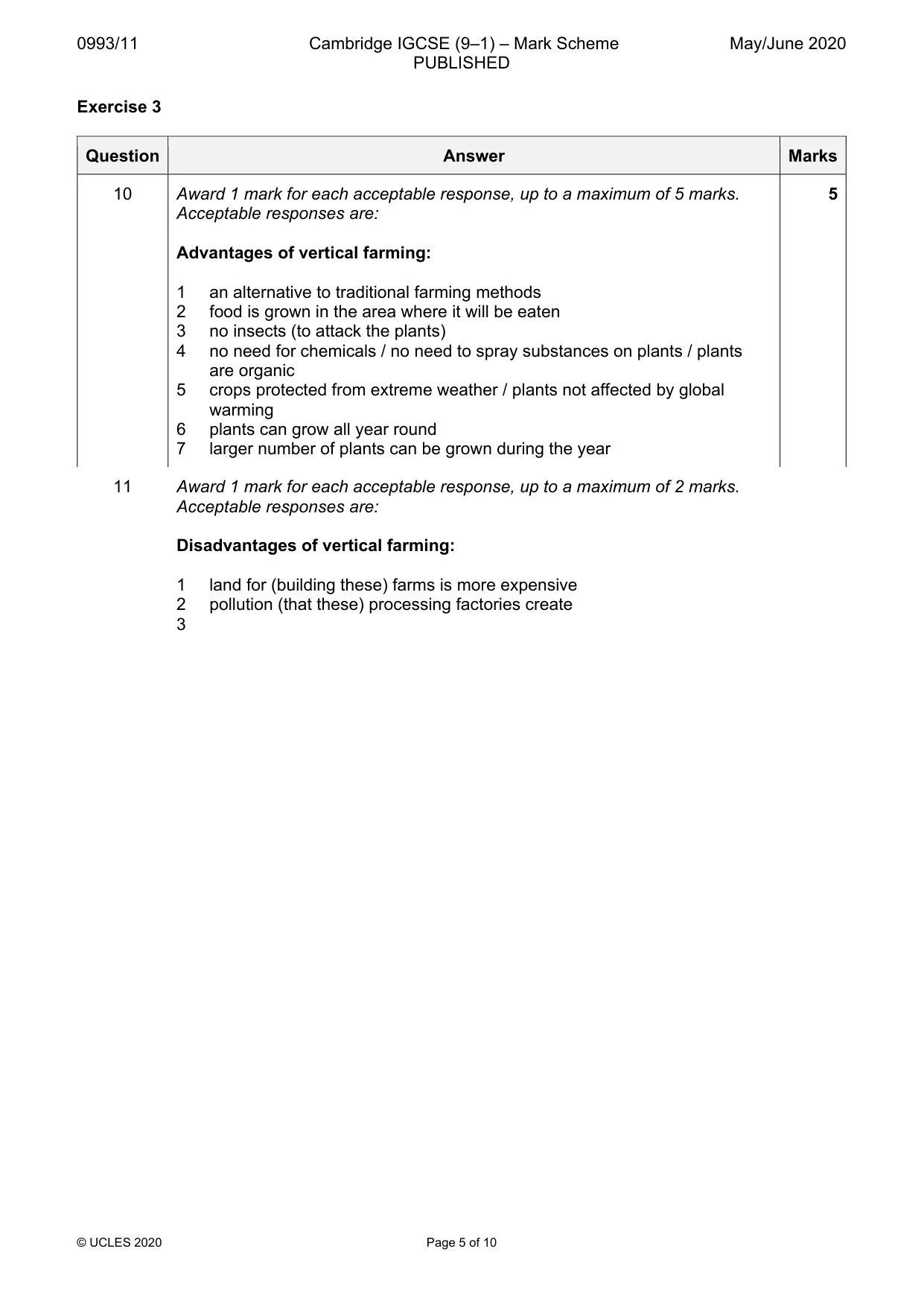
0993/11 Cambridge IGCSE (9–1) – Mark Scheme PUBLISHED May/June 2020 © UCLES 2020 Page 5 of 10 Exercise 3 Question Answer Marks 10 Award 1 mark for each acceptable response, up to a maximum of 5 marks. Acceptable responses are: Advantages of vertical farming: 1 an alternative to traditional farming methods 2 food is grown in the area where it will be eaten 3 no insects (to attack the plants) 4 no need for chemicals / no need to spray substances on plants / plants are organic 5 crops protected from extreme weather / plants not affected by global warming 6 plants can grow all year round 7 larger number of plants can be grown during the year 5 11 Award 1 mark for each acceptable response, up to a maximum of 2 marks. Acceptable responses are: Disadvantages of vertical farming: 1 land for (building these) farms is more expensive 2 pollution (that these) processing factories create 3