Cambridge IGCSE English Second Language (Speaking Endorsement) (9-1) 0993 — 2019 May/June Paper 1 · Variant 1
0993/11/M/J/19 · 60 marks · ≈68 min
The question paper and its mark scheme, free to read here and free to download. This is Cambridge’s own paper, exactly as it was sat.
Question paper16 pages






Mark scheme10 pages
Answers below. Sit the paper first if you are practising.
Paper as text
Question paper, page 1
This document consists of 13 printed pages and 3 blank pages. DC (KN) 182840 © UCLES 2019 [Turn over Cambridge Assessment International Education Cambridge International General Certificate of Secondary Education (9–1) * 1 9 9 8 1 0 8 1 3 3 * ENGLISH AS A SECOND LANGUAGE 0993/11 Paper 1 Reading and Writing (Core) May/June 2019 1 hour 30 minutes Candidates answer on the Question Paper. No Additional Materials are required. READ THESE INSTRUCTIONS FIRST Write your centre number, candidate number and name on all the work you hand in. Write in dark blue or black pen. Do not use staples, paper clips, glue or correction fluid. DO NOT WRITE IN ANY BARCODES. Answer all questions. Dictionaries are not allowed. At the end of the examination, fasten all your work securely together. The number of marks is given in brackets [ ] at the end of each question or part question.
Question paper, page 2
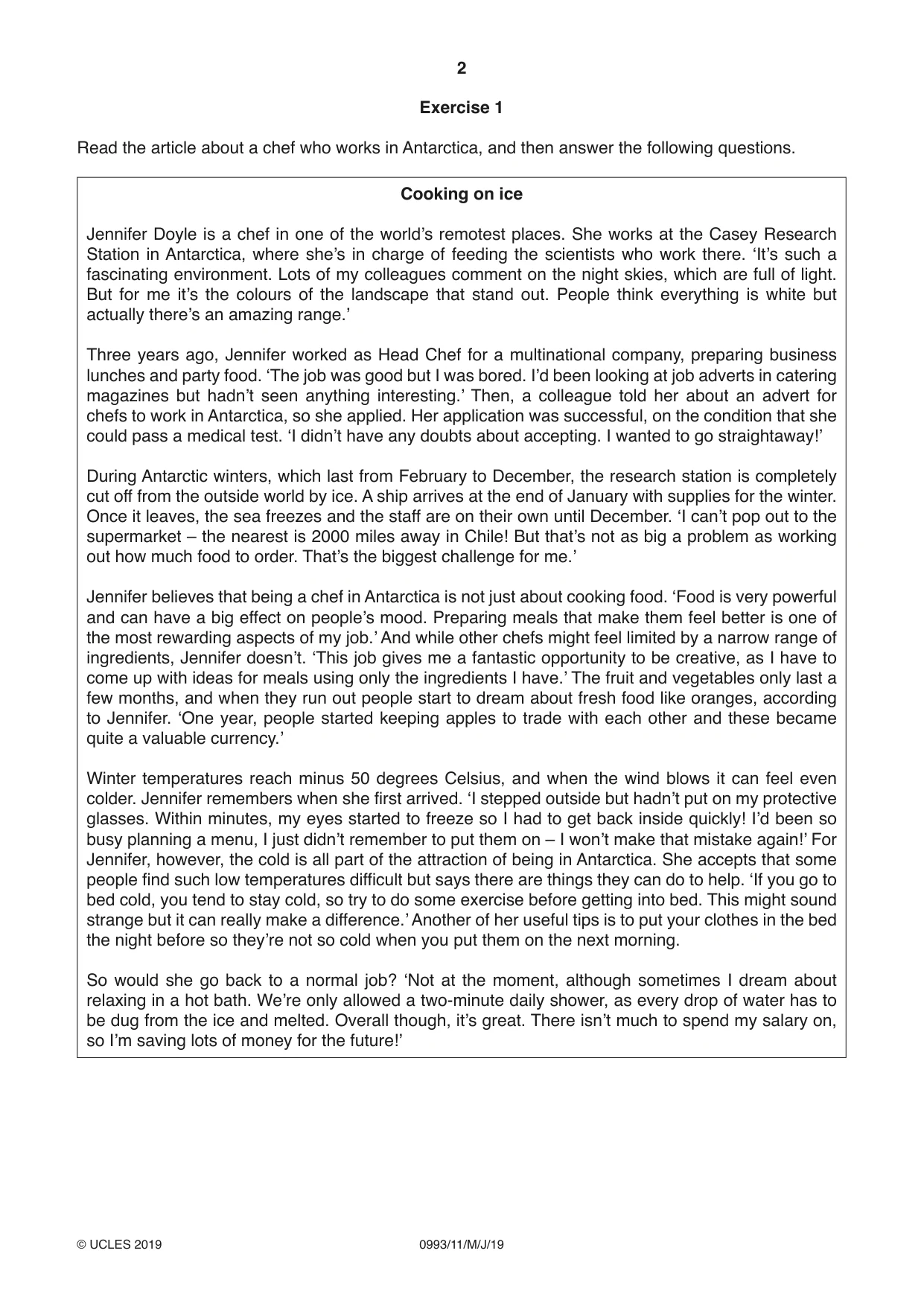
2 0993/11/M/J/19 © UCLES 2019 Exercise 1 Read the article about a chef who works in Antarctica, and then answer the following questions. Cooking on ice Jennifer Doyle is a chef in one of the world’s remotest places. She works at the Casey Research Station in Antarctica, where she’s in charge of feeding the scientists who work there. ‘It’s such a fascinating environment. Lots of my colleagues comment on the night skies, which are full of light. But for me it’s the colours of the landscape that stand out. People think everything is white but actually there’s an amazing range.’ Three years ago, Jennifer worked as Head Chef for a multinational company, preparing business lunches and party food. ‘The job was good but I was bored. I’d been looking at job adverts in catering magazines but hadn’t seen anything interesting.’ Then, a colleague told her about an advert for chefs to work in Antarctica, so she applied. Her application was successful, on the condition that she could pass a medical test. ‘I didn’t have any doubts about accepting. I wanted to go straightaway!’ During Antarctic winters, which last from February to December, the research station is completely cut off from the outside world by ice. A ship arrives at the end of January with supplies for the winter. Once it leaves, the sea freezes and the staff are on their own until December. ‘I can’t pop out to the supermarket – the nearest is 2000 miles away in Chile! But that’s not as big a problem as working out how much food to order. That’s the biggest challenge for me.’ Jennifer believes that being a chef in Antarctica is not just about cooking food. ‘Food is very powerful and can have a big effect on people’s mood. Preparing meals that make them feel better is one of the most rewarding aspects of my job.’ And while other chefs might feel limited by a narrow range of ingredients, Jennifer doesn’t. ‘This job gives me a fantastic opportunity to be creative, as I have to come up with ideas for meals using only the ingredients I have.’ The fruit and vegetables only last a few months, and when they run out people start to dream about fresh food like oranges, according to Jennifer. ‘One year, people started keeping apples to trade with each other and these became quite a valuable currency.’ Winter temperatures reach minus 50 degrees Celsius, and when the wind blows it can feel even colder. Jennifer remembers when she first arrived. ‘I stepped outside but hadn’t put on my protective glasses. Within minutes, my eyes started to freeze so I had to get back inside quickly! I’d been so busy planning a menu, I just didn’t remember to put them on – I won’t make that mistake again!’ For Jennifer, however, the cold is all part of the attraction of being in Antarctica. She accepts that some people find such low temperatures difficult but says there are things they can do to help. ‘If you go to bed cold, you tend to stay cold, so try to do some exercise before getting into bed. This might sound strange but it can really make a difference.’ Another of her useful tips is to put your clothes in the bed the night before so they’re not so cold when you put them on the next morning. So would she go back to a normal job? ‘Not at the moment, although sometimes I dream about relaxing in a hot bath. We’re only allowed a two-minute daily shower, as every drop of water has to be dug from the ice and melted. Overall though, it’s great. There isn’t much to spend my salary on, so I’m saving lots of money for the future!’
Question paper, page 3
3 0993/11/M/J/19 © UCLES 2019 [Turn over 1 How did Jennifer first find out about the job? … [1] 2 What did Jennifer have to do in order to accept the job offer? … [1] 3 When is food delivered to the research station? … [1] 4 What does Jennifer find most difficult about her job? … [1] 5 Which food did staff use to exchange for other things? … [1] 6 Why did Jennifer forget to wear glasses one day? … [1] 7 What advice does Jennifer give for keeping warm inside the research station? Give two details. … … [2] 8 What does Jennifer miss? … [1] [Total: 9]
Question paper, page 4
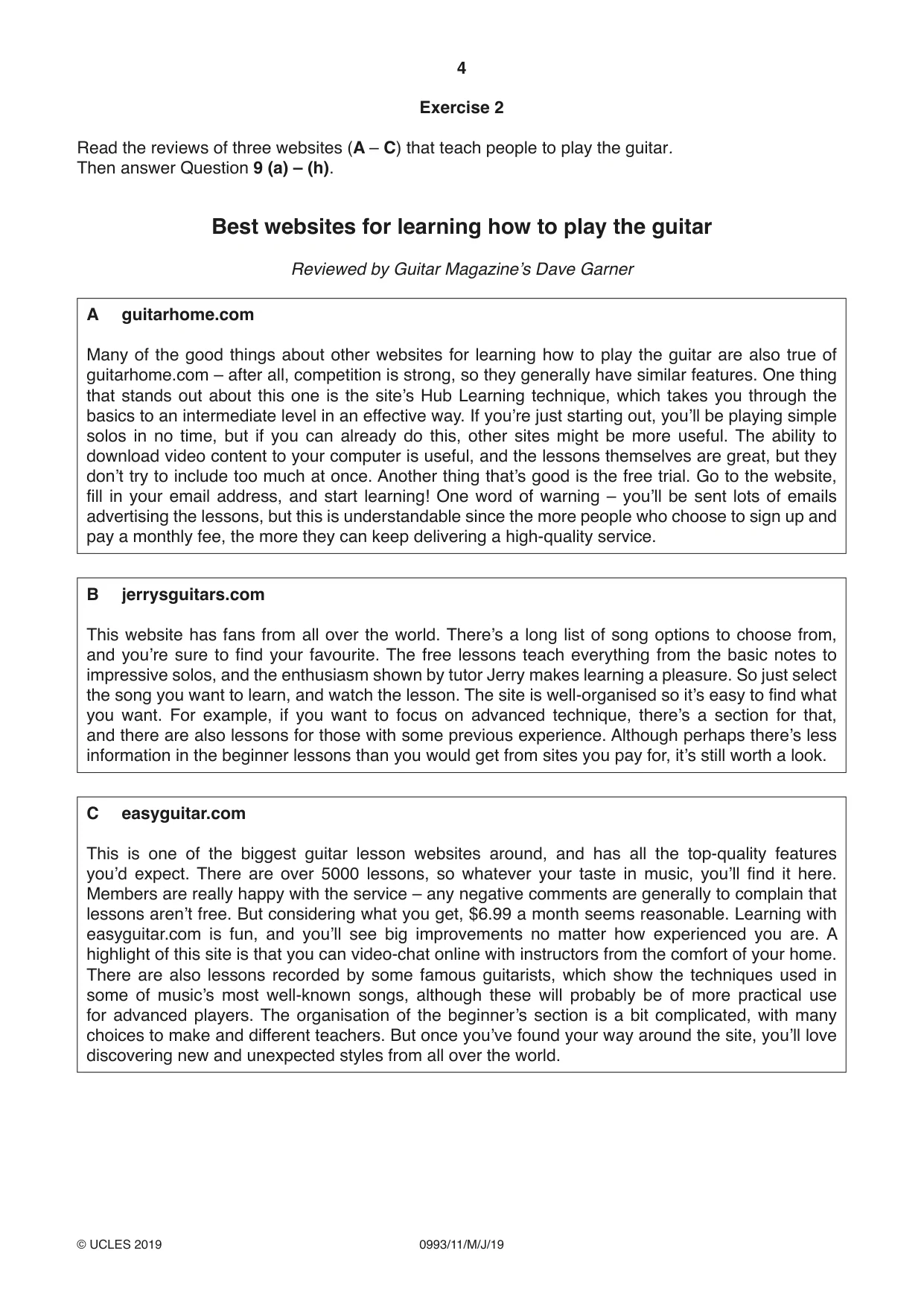
4 0993/11/M/J/19 © UCLES 2019 Exercise 2 Read the reviews of three websites (A – C) that teach people to play the guitar. Then answer Question 9 (a) – (h). Best websites for learning how to play the guitar Reviewed by Guitar Magazine’s Dave Garner A guitarhome.com Many of the good things about other websites for learning how to play the guitar are also true of guitarhome.com – after all, competition is strong, so they generally have similar features. One thing that stands out about this one is the site’s Hub Learning technique, which takes you through the basics to an intermediate level in an effective way. If you’re just starting out, you’ll be playing simple solos in no time, but if you can already do this, other sites might be more useful. The ability to download video content to your computer is useful, and the lessons themselves are great, but they don’t try to include too much at once. Another thing that’s good is the free trial. Go to the website, fill in your email address, and start learning! One word of warning – you’ll be sent lots of emails advertising the lessons, but this is understandable since the more people who choose to sign up and pay a monthly fee, the more they can keep delivering a high-quality service. B jerrysguitars.com This website has fans from all over the world. There’s a long list of song options to choose from, and you’re sure to find your favourite. The free lessons teach everything from the basic notes to impressive solos, and the enthusiasm shown by tutor Jerry makes learning a pleasure. So just select the song you want to learn, and watch the lesson. The site is well-organised so it’s easy to find what you want. For example, if you want to focus on advanced technique, there’s a section for that, and there are also lessons for those with some previous experience. Although perhaps there’s less information in the beginner lessons than you would get from sites you pay for, it’s still worth a look. C easyguitar.com This is one of the biggest guitar lesson websites around, and has all the top-quality features you’d expect. There are over 5000 lessons, so whatever your taste in music, you’ll find it here. Members are really happy with the service – any negative comments are generally to complain that lessons aren’t free. But considering what you get, $6.99 a month seems reasonable. Learning with easyguitar.com is fun, and you’ll see big improvements no matter how experienced you are. A highlight of this site is that you can video-chat online with instructors from the comfort of your home. There are also lessons recorded by some famous guitarists, which show the techniques used in some of music’s most well-known songs, although these will probably be of more practical use for advanced players. The organisation of the beginner’s section is a bit complicated, with many choices to make and different teachers. But once you’ve found your way around the site, you’ll love discovering new and unexpected styles from all over the world.
Question paper, page 5
5 0993/11/M/J/19 © UCLES 2019 [Turn over 9 For each question write the correct letter A, B or C on the line. Which review … (a) describes a service which allows learners to speak directly with teachers? … [1] (b) compares the amount of content in lessons with websites which are not free? … [1] (c) suggests that the site may not be suitable for more experienced players? … [1] (d) suggests that the number of options on the website for new players may be confusing? … [1] (e) remarks on the positive effect of the teacher’s personality? … [1] (f) comments that the lessons contain an appropriate amount of information? … [1] (g) mentions that guitar players of all levels will make progress? … [1] (h) comments that it is acceptable for the site to encourage membership? … [1] [Total: 8]
Question paper, page 6
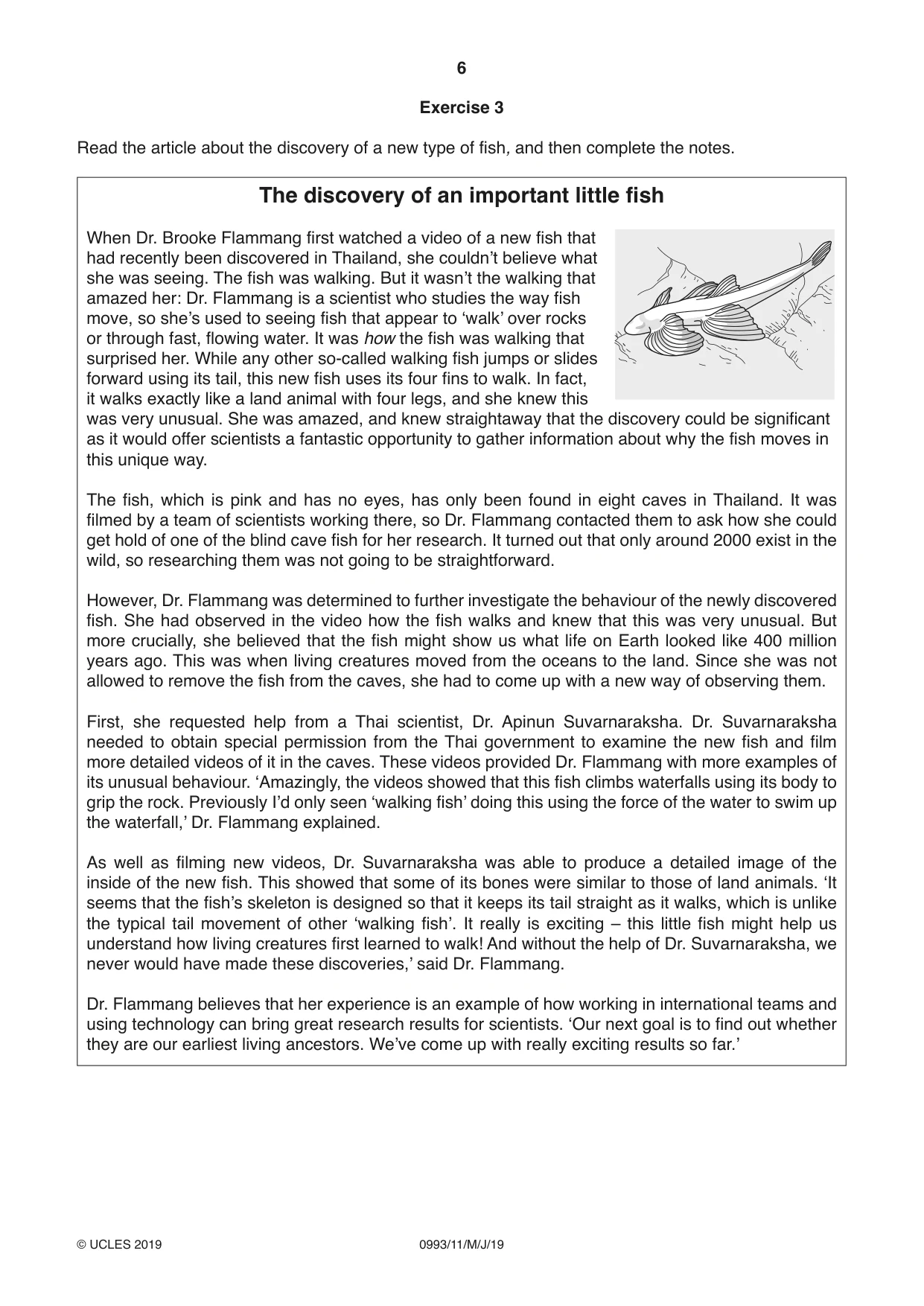
6 0993/11/M/J/19 © UCLES 2019 Exercise 3 Read the article about the discovery of a new type of fish, and then complete the notes. The discovery of an important little fish When Dr. Brooke Flammang first watched a video of a new fish that had recently been discovered in Thailand, she couldn’t believe what she was seeing. The fish was walking. But it wasn’t the walking that amazed her: Dr. Flammang is a scientist who studies the way fish move, so she’s used to seeing fish that appear to ‘walk’ over rocks or through fast, flowing water. It was how the fish was walking that surprised her. While any other so-called walking fish jumps or slides forward using its tail, this new fish uses its four fins to walk. In fact, it walks exactly like a land animal with four legs, and she knew this was very unusual. She was amazed, and knew straightaway that the discovery could be significant as it would offer scientists a fantastic opportunity to gather information about why the fish moves in this unique way. The fish, which is pink and has no eyes, has only been found in eight caves in Thailand. It was filmed by a team of scientists working there, so Dr. Flammang contacted them to ask how she could get hold of one of the blind cave fish for her research. It turned out that only around 2000 exist in the wild, so researching them was not going to be straightforward. However, Dr. Flammang was determined to further investigate the behaviour of the newly discovered fish. She had observed in the video how the fish walks and knew that this was very unusual. But more crucially, she believed that the fish might show us what life on Earth looked like 400 million years ago. This was when living creatures moved from the oceans to the land. Since she was not allowed to remove the fish from the caves, she had to come up with a new way of observing them. First, she requested help from a Thai scientist, Dr. Apinun Suvarnaraksha. Dr. Suvarnaraksha needed to obtain special permission from the Thai government to examine the new fish and film more detailed videos of it in the caves. These videos provided Dr. Flammang with more examples of its unusual behaviour. ‘Amazingly, the videos showed that this fish climbs waterfalls using its body to grip the rock. Previously I’d only seen ‘walking fish’ doing this using the force of the water to swim up the waterfall,’ Dr. Flammang explained. As well as filming new videos, Dr. Suvarnaraksha was able to produce a detailed image of the inside of the new fish. This showed that some of its bones were similar to those of land animals. ‘It seems that the fish’s skeleton is designed so that it keeps its tail straight as it walks, which is unlike the typical tail movement of other ‘walking fish’. It really is exciting – this little fish might help us understand how living creatures first learned to walk! And without the help of Dr. Suvarnaraksha, we never would have made these discoveries,’ said Dr. Flammang. Dr. Flammang believes that her experience is an example of how working in international teams and using technology can bring great research results for scientists. ‘Our next goal is to find out whether they are our earliest living ancestors. We’ve come up with really exciting results so far.’
Question paper, page 7
7 0993/11/M/J/19 © UCLES 2019 [Turn over You are going to give a talk about the discovery of the new fish to your class at school. Prepare some notes to use as the basis for your talk. Make short notes under each heading. 10 How this newly discovered fish behaves differently from other ‘walking fish’: • … • … • … [3] 11 What scientists might learn from the discovery of this new fish: • … • … [2] 12 Why it was difficult for scientists to study this new fish: • … • … [2] [Total: 7]
Question paper, page 8
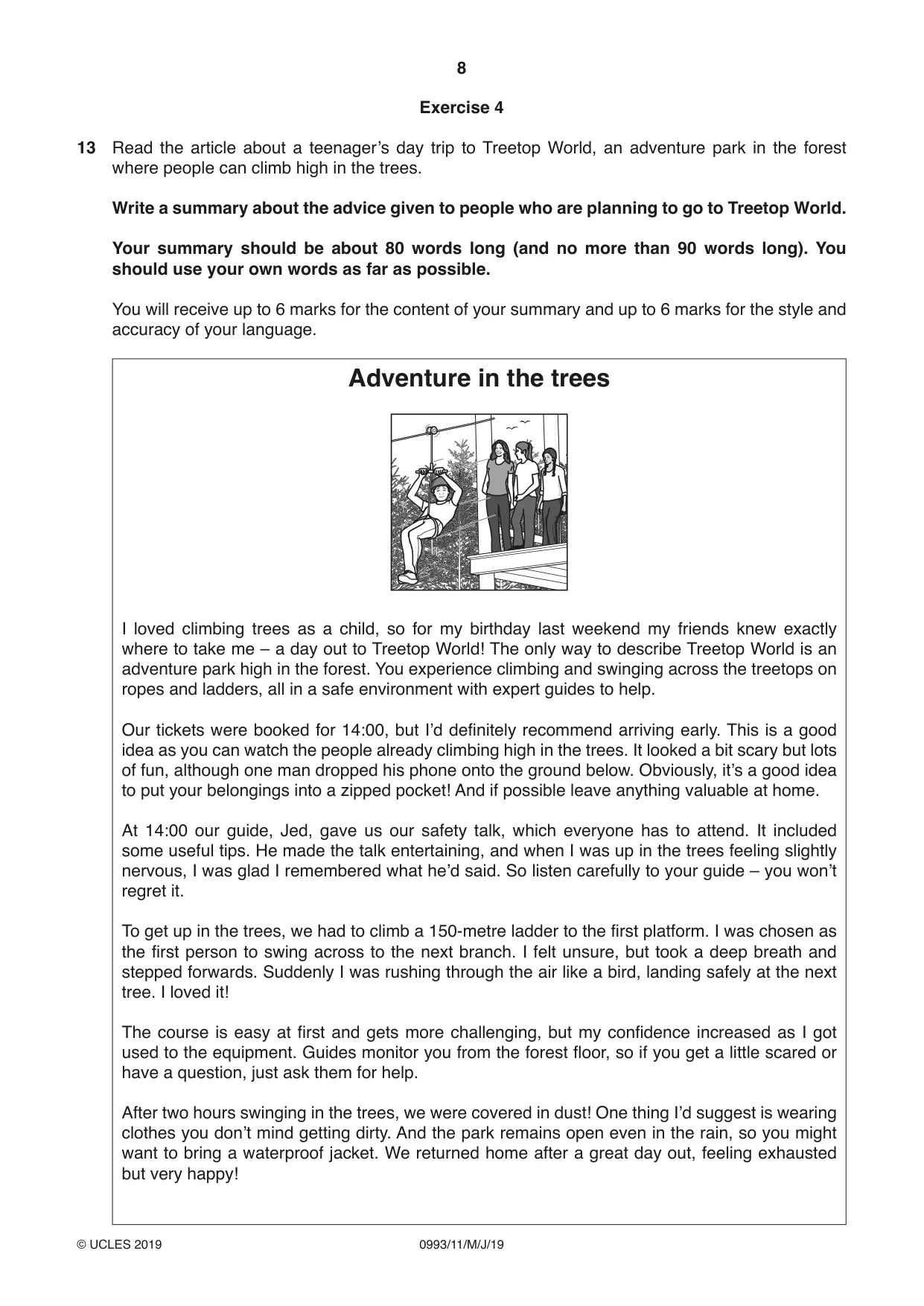
8 0993/11/M/J/19 © UCLES 2019 Exercise 4 13 Read the article about a teenager’s day trip to Treetop World, an adventure park in the forest where people can climb high in the trees. Write a summary about the advice given to people who are planning to go to Treetop World. Your summary should be about 80 words long (and no more than 90 words long). You should use your own words as far as possible. You will receive up to 6 marks for the content of your summary and up to 6 marks for the style and accuracy of your language. Adventure in the trees I loved climbing trees as a child, so for my birthday last weekend my friends knew exactly where to take me – a day out to Treetop World! The only way to describe Treetop World is an adventure park high in the forest. You experience climbing and swinging across the treetops on ropes and ladders, all in a safe environment with expert guides to help. Our tickets were booked for 14:00, but I’d definitely recommend arriving early. This is a good idea as you can watch the people already climbing high in the trees. It looked a bit scary but lots of fun, although one man dropped his phone onto the ground below. Obviously, it’s a good idea to put your belongings into a zipped pocket! And if possible leave anything valuable at home. At 14:00 our guide, Jed, gave us our safety talk, which everyone has to attend. It included some useful tips. He made the talk entertaining, and when I was up in the trees feeling slightly nervous, I was glad I remembered what he’d said. So listen carefully to your guide – you won’t regret it. To get up in the trees, we had to climb a 150-metre ladder to the first platform. I was chosen as the first person to swing across to the next branch. I felt unsure, but took a deep breath and stepped forwards. Suddenly I was rushing through the air like a bird, landing safely at the next tree. I loved it! The course is easy at first and gets more challenging, but my confidence increased as I got used to the equipment. Guides monitor you from the forest floor, so if you get a little scared or have a question, just ask them for help. After two hours swinging in the trees, we were covered in dust! One thing I’d suggest is wearing clothes you don’t mind getting dirty. And the park remains open even in the rain, so you might want to bring a waterproof jacket. We returned home after a great day out, feeling exhausted but very happy!
Question paper, page 9
9 0993/11/M/J/19 © UCLES 2019 [Turn over … … … … … … … … … … … … … … [Total: 12]
Question paper, page 10
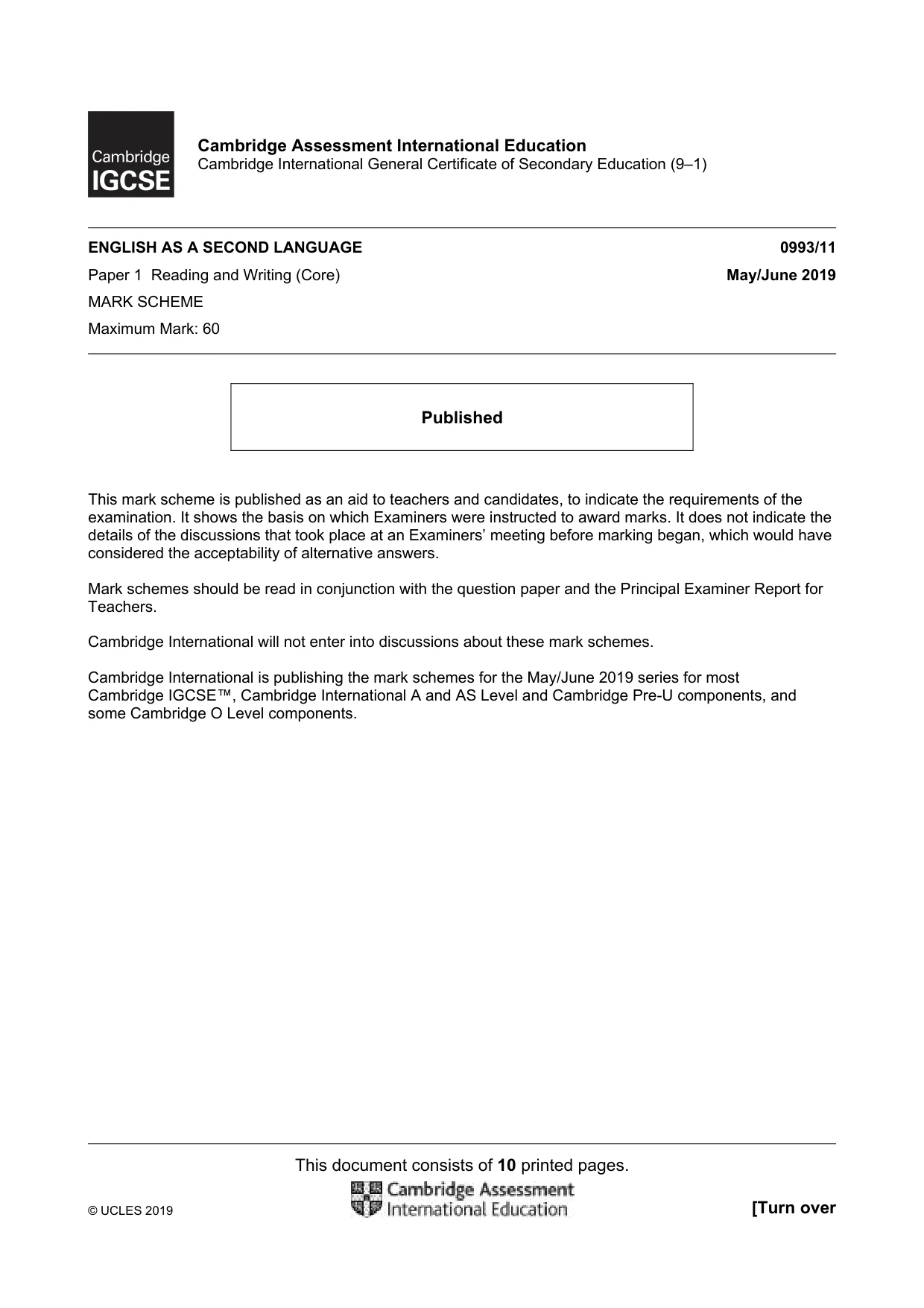
10 0993/11/M/J/19 © UCLES 2019 Exercise 5 14 Last month, you won a competition to meet a famous person. Yesterday, you finally met them. Write an email to a friend telling them about this. In your email, you should: • explain what you had to do to win the competition • describe your meeting with the famous person • say how you felt after meeting this person. The pictures above may give you some ideas, and you can also use some ideas of your own. Your email should be between 100 and 150 words long. You will receive up to 6 marks for the content of your email, and up to 6 marks for the language used.
Question paper, page 11
11 0993/11/M/J/19 © UCLES 2019 [Turn over … … … … … … … … … … … … … … … … … … … … … … … … … … … [Total: 12]
Question paper, page 12
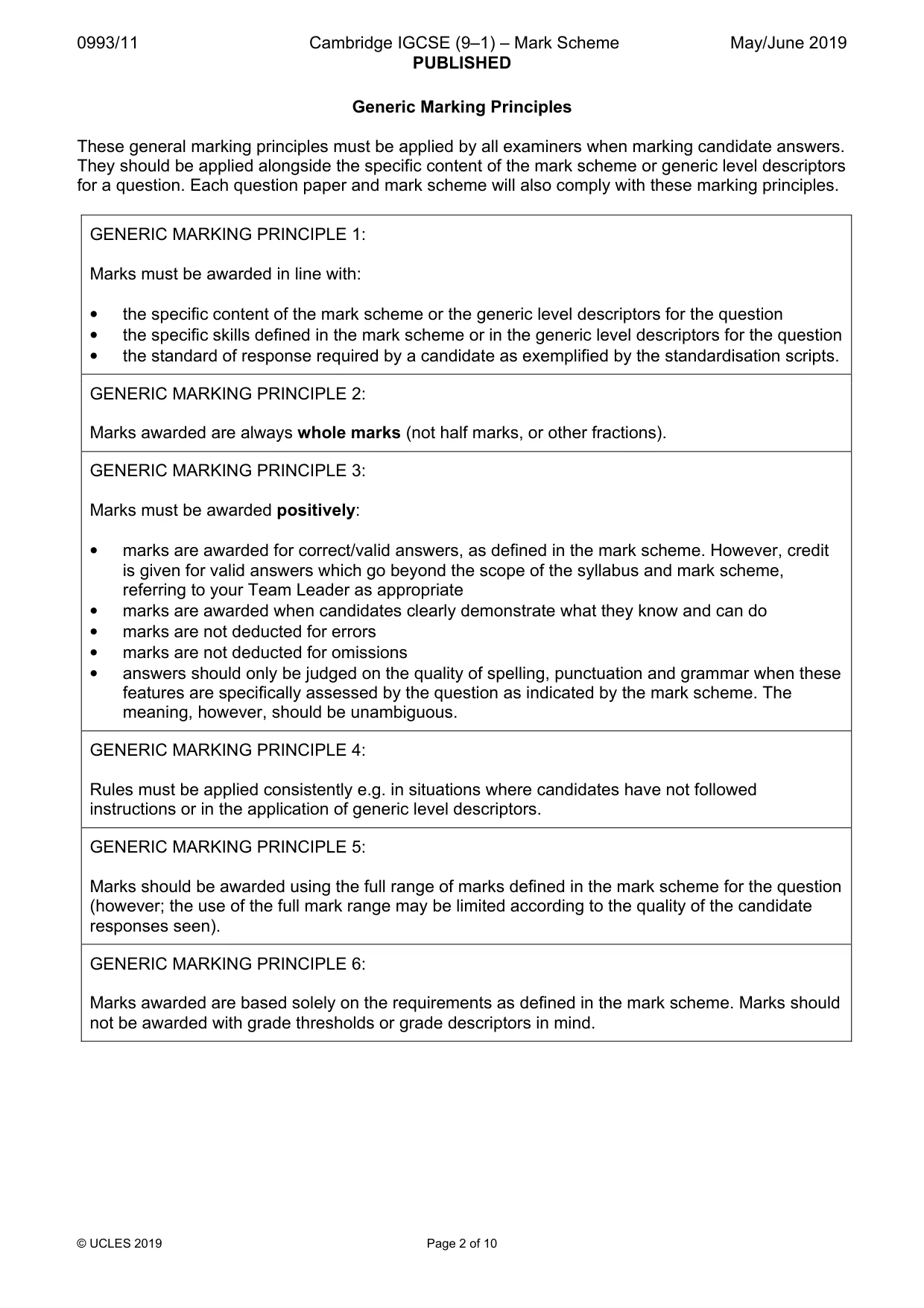
12 0993/11/M/J/19 © UCLES 2019 Exercise 6 15 In class you have been discussing whether it is important for all students to have music lessons at school. Here are some comments from your classmates: Music isn’t useful for what I want to do in life. There are more important things to do at school. I think I improve in my other subjects as a result. Well, I like the chance to do something creative. Write an article for your teacher, giving your views. The comments above may give you some ideas, and you can also use some ideas of your own. Your article should be between 100 and 150 words long. You will receive up to 6 marks for the content of your article, and up to 6 marks for the language used.
Question paper, page 13
13 0993/11/M/J/19 © UCLES 2019 … … … … … … … … … … … … … … … … … … … … … … … … … … … [Total: 12]
Question paper, page 14
14 0993/11/M/J/19 © UCLES 2019 BLANK PAGE
Question paper, page 15
15 0993/11/M/J/19 © UCLES 2019 BLANK PAGE
Question paper, page 16
16 0993/11/M/J/19 © UCLES 2019 Permission to reproduce items where third-party owned material protected by copyright is included has been sought and cleared where possible. Every reasonable effort has been made by the publisher (UCLES) to trace copyright holders, but if any items requiring clearance have unwittingly been included, the publisher will be pleased to make amends at the earliest possible opportunity. To avoid the issue of disclosure of answer-related information to candidates, all copyright acknowledgements are reproduced online in the Cambridge Assessment International Education Copyright Acknowledgements Booklet. This is produced for each series of examinations and is freely available to download at www.cambridgeinternational.org after the live examination series. Cambridge Assessment International Education is part of the Cambridge Assessment Group. Cambridge Assessment is the brand name of the University of Cambridge Local Examinations Syndicate (UCLES), which itself is a department of the University of Cambridge. BLANK PAGE
Mark scheme, page 1
This document consists of 10 printed pages. © UCLES 2019 [Turn over Cambridge Assessment International Education Cambridge International General Certificate of Secondary Education (9–1) ENGLISH AS A SECOND LANGUAGE 0993/11 Paper 1 Reading and Writing (Core) May/June 2019 MARK SCHEME Maximum Mark: 60 Published This mark scheme is published as an aid to teachers and candidates, to indicate the requirements of the examination. It shows the basis on which Examiners were instructed to award marks. It does not indicate the details of the discussions that took place at an Examiners’ meeting before marking began, which would have considered the acceptability of alternative answers. Mark schemes should be read in conjunction with the question paper and the Principal Examiner Report for Teachers. Cambridge International will not enter into discussions about these mark schemes. Cambridge International is publishing the mark schemes for the May/June 2019 series for most Cambridge IGCSE™, Cambridge International A and AS Level and Cambridge Pre-U components, and some Cambridge O Level components.
Mark scheme, page 2
0993/11 Cambridge IGCSE (9–1) – Mark Scheme PUBLISHED May/June 2019 © UCLES 2019 Page 2 of 10 Generic Marking Principles These general marking principles must be applied by all examiners when marking candidate answers. They should be applied alongside the specific content of the mark scheme or generic level descriptors for a question. Each question paper and mark scheme will also comply with these marking principles. GENERIC MARKING PRINCIPLE 1: Marks must be awarded in line with: • the specific content of the mark scheme or the generic level descriptors for the question • the specific skills defined in the mark scheme or in the generic level descriptors for the question • the standard of response required by a candidate as exemplified by the standardisation scripts. GENERIC MARKING PRINCIPLE 2: Marks awarded are always whole marks (not half marks, or other fractions). GENERIC MARKING PRINCIPLE 3: Marks must be awarded positively: • marks are awarded for correct/valid answers, as defined in the mark scheme. However, credit is given for valid answers which go beyond the scope of the syllabus and mark scheme, referring to your Team Leader as appropriate • marks are awarded when candidates clearly demonstrate what they know and can do • marks are not deducted for errors • marks are not deducted for omissions • answers should only be judged on the quality of spelling, punctuation and grammar when these features are specifically assessed by the question as indicated by the mark scheme. The meaning, however, should be unambiguous. GENERIC MARKING PRINCIPLE 4: Rules must be applied consistently e.g. in situations where candidates have not followed instructions or in the application of generic level descriptors. GENERIC MARKING PRINCIPLE 5: Marks should be awarded using the full range of marks defined in the mark scheme for the question (however; the use of the full mark range may be limited according to the quality of the candidate responses seen). GENERIC MARKING PRINCIPLE 6: Marks awarded are based solely on the requirements as defined in the mark scheme. Marks should not be awarded with grade thresholds or grade descriptors in mind.
Mark scheme, page 3
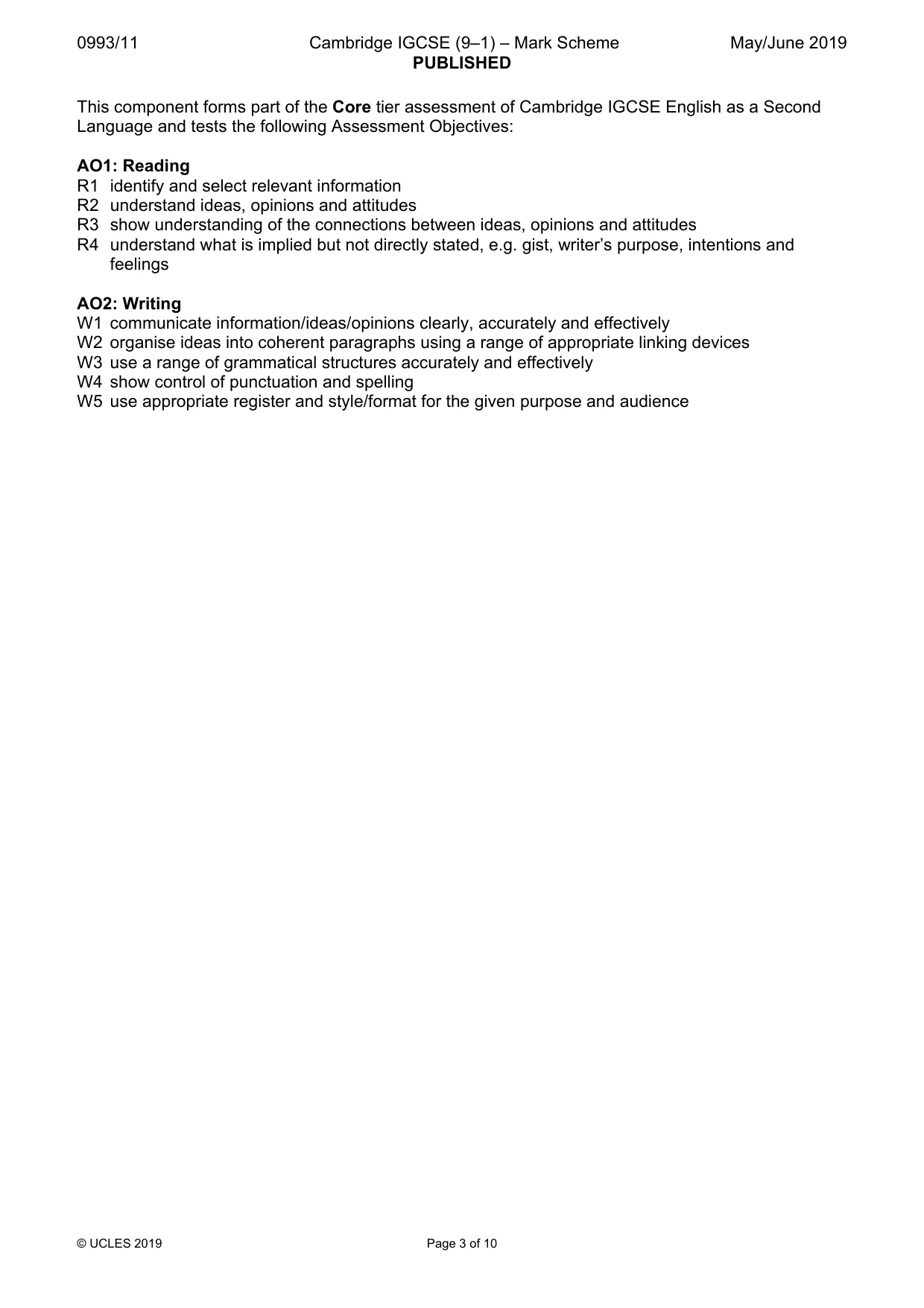
0993/11 Cambridge IGCSE (9–1) – Mark Scheme PUBLISHED May/June 2019 © UCLES 2019 Page 3 of 10 This component forms part of the Core tier assessment of Cambridge IGCSE English as a Second Language and tests the following Assessment Objectives: AO1: Reading R1 identify and select relevant information R2 understand ideas, opinions and attitudes R3 show understanding of the connections between ideas, opinions and attitudes R4 understand what is implied but not directly stated, e.g. gist, writer’s purpose, intentions and feelings AO2: Writing W1 communicate information/ideas/opinions clearly, accurately and effectively W2 organise ideas into coherent paragraphs using a range of appropriate linking devices W3 use a range of grammatical structures accurately and effectively W4 show control of punctuation and spelling W5 use appropriate register and style/format for the given purpose and audience
Mark scheme, page 4
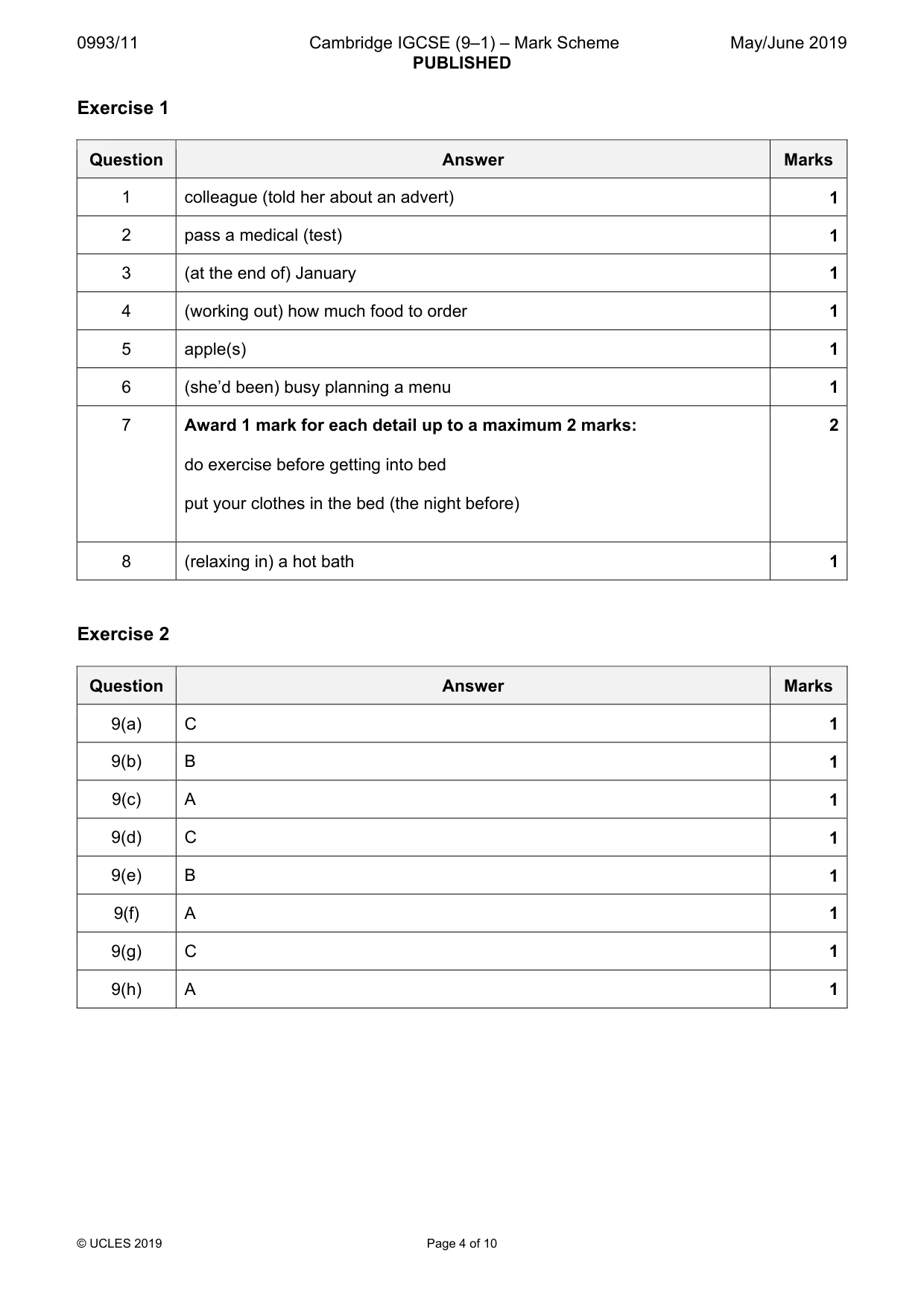
0993/11 Cambridge IGCSE (9–1) – Mark Scheme PUBLISHED May/June 2019 © UCLES 2019 Page 4 of 10 Exercise 1 Question Answer Marks 1 colleague (told her about an advert) 1 2 pass a medical (test) 1 3 (at the end of) January 1 4 (working out) how much food to order 1 5 apple(s) 1 6 (she’d been) busy planning a menu 1 7 Award 1 mark for each detail up to a maximum 2 marks: do exercise before getting into bed put your clothes in the bed (the night before) 2 8 (relaxing in) a hot bath 1 Exercise 2 Question Answer Marks 9(a) C 1 9(b) B 1 9(c) A 1 9(d) C 1 9(e) B 1 9(f) A 1 9(g) C 1 9(h) A 1
Mark scheme, page 5
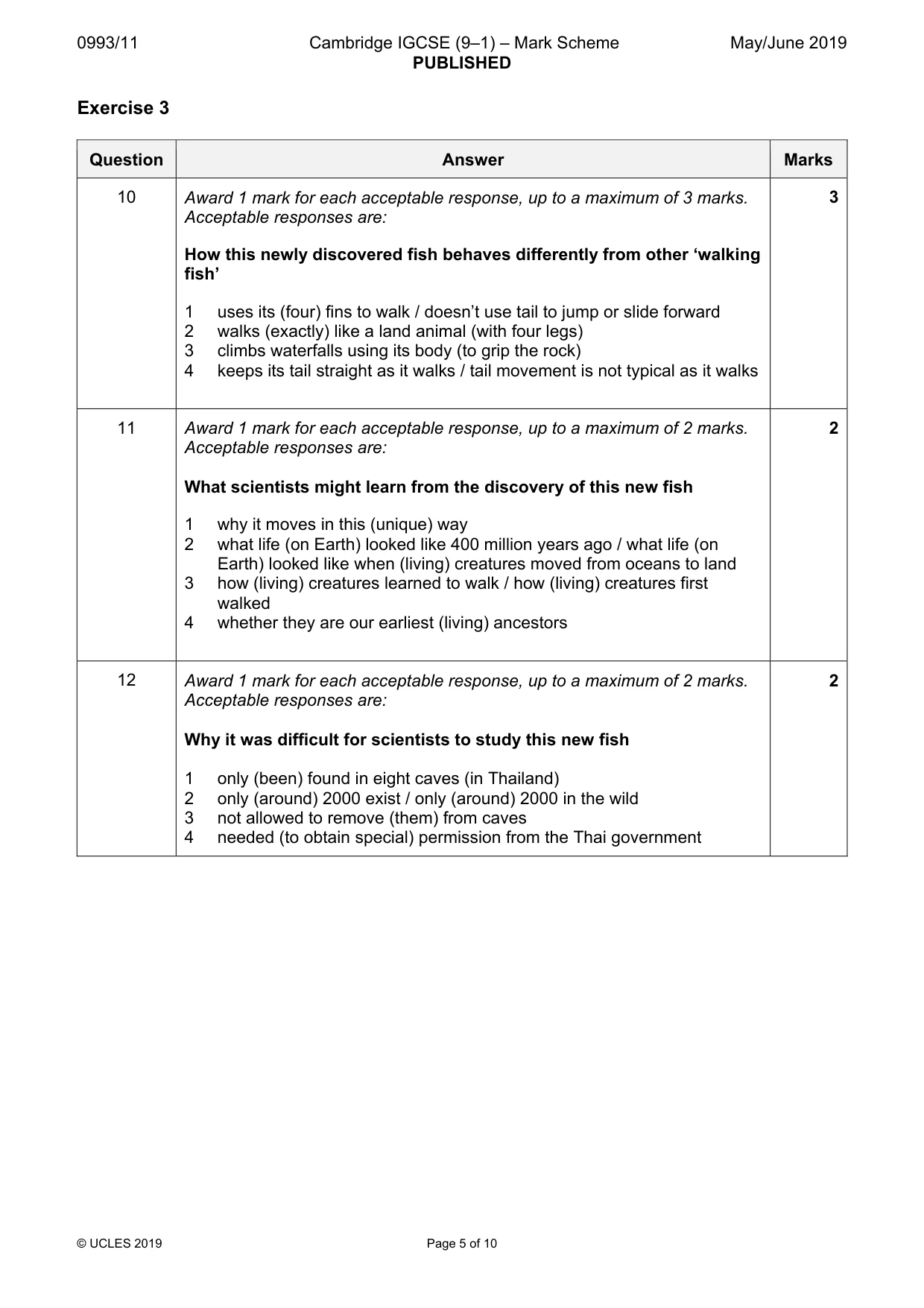
0993/11 Cambridge IGCSE (9–1) – Mark Scheme PUBLISHED May/June 2019 © UCLES 2019 Page 5 of 10 Exercise 3 Question Answer Marks 10 Award 1 mark for each acceptable response, up to a maximum of 3 marks. Acceptable responses are: How this newly discovered fish behaves differently from other ‘walking fish’ 1 uses its (four) fins to walk / doesn’t use tail to jump or slide forward 2 walks (exactly) like a land animal (with four legs) 3 climbs waterfalls using its body (to grip the rock) 4 keeps its tail straight as it walks / tail movement is not typical as it walks 3 11 Award 1 mark for each acceptable response, up to a maximum of 2 marks. Acceptable responses are: What scientists might learn from the discovery of this new fish 1 why it moves in this (unique) way 2 what life (on Earth) looked like 400 million years ago / what life (on Earth) looked like when (living) creatures moved from oceans to land 3 how (living) creatures learned to walk / how (living) creatures first walked 4 whether they are our earliest (living) ancestors 2 12 Award 1 mark for each acceptable response, up to a maximum of 2 marks. Acceptable responses are: Why it was difficult for scientists to study this new fish 1 only (been) found in eight caves (in Thailand) 2 only (around) 2000 exist / only (around) 2000 in the wild 3 not allowed to remove (them) from caves 4 needed (to obtain special) permission from the Thai government 2
Mark scheme, page 6
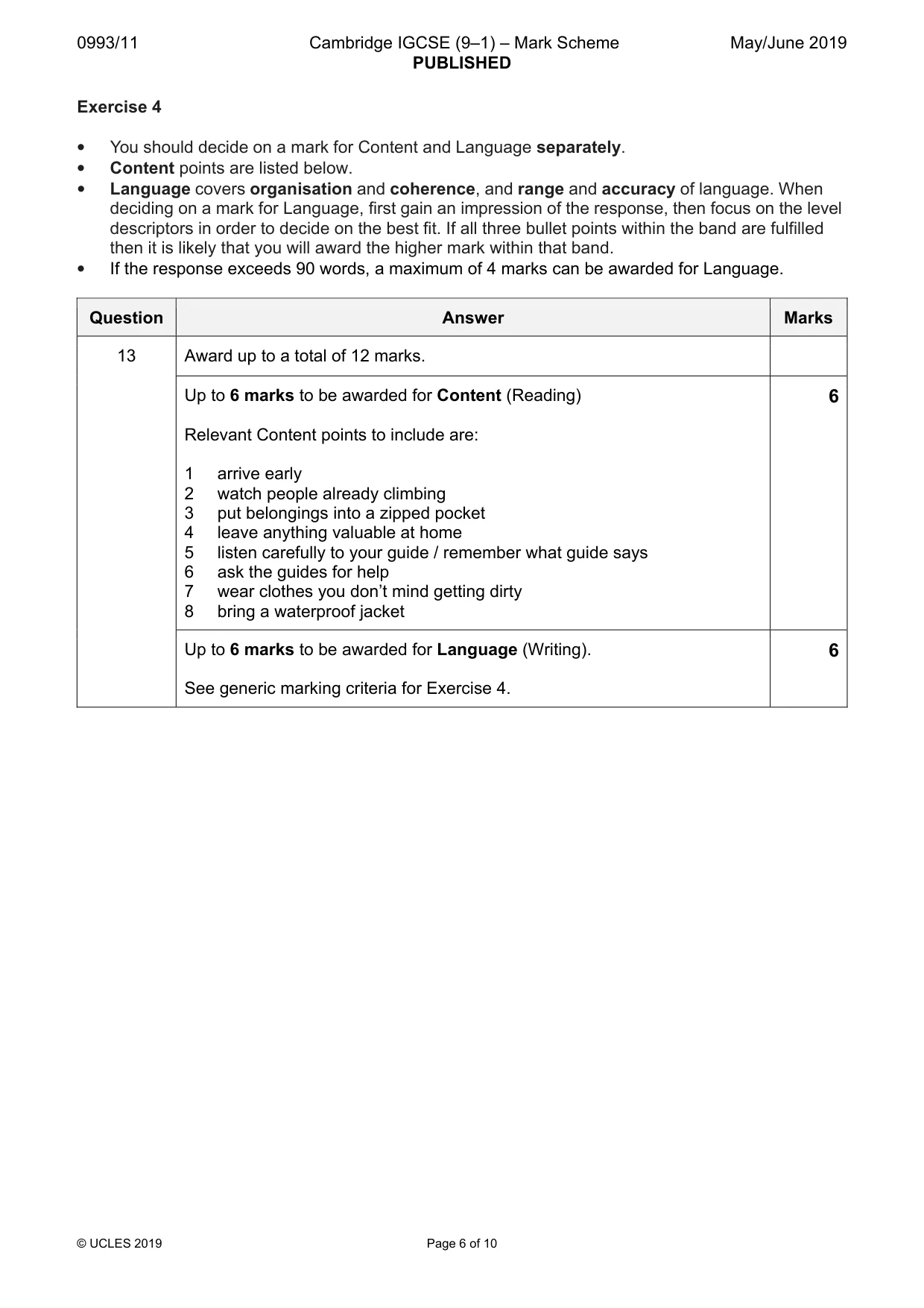
0993/11 Cambridge IGCSE (9–1) – Mark Scheme PUBLISHED May/June 2019 © UCLES 2019 Page 6 of 10 Exercise 4 • You should decide on a mark for Content and Language separately. • Content points are listed below. • Language covers organisation and coherence, and range and accuracy of language. When deciding on a mark for Language, first gain an impression of the response, then focus on the level descriptors in order to decide on the best fit. If all three bullet points within the band are fulfilled then it is likely that you will award the higher mark within that band. • If the response exceeds 90 words, a maximum of 4 marks can be awarded for Language. Question Answer Marks 13 Award up to a total of 12 marks. Up to 6 marks to be awarded for Content (Reading) Relevant Content points to include are: 1 arrive early 2 watch people already climbing 3 put belongings into a zipped pocket 4 leave anything valuable at home 5 listen carefully to your guide / remember what guide says 6 ask the guides for help 7 wear clothes you don’t mind getting dirty 8 bring a waterproof jacket 6 Up to 6 marks to be awarded for Language (Writing). See generic marking criteria for Exercise 4. 6
Mark scheme, page 7
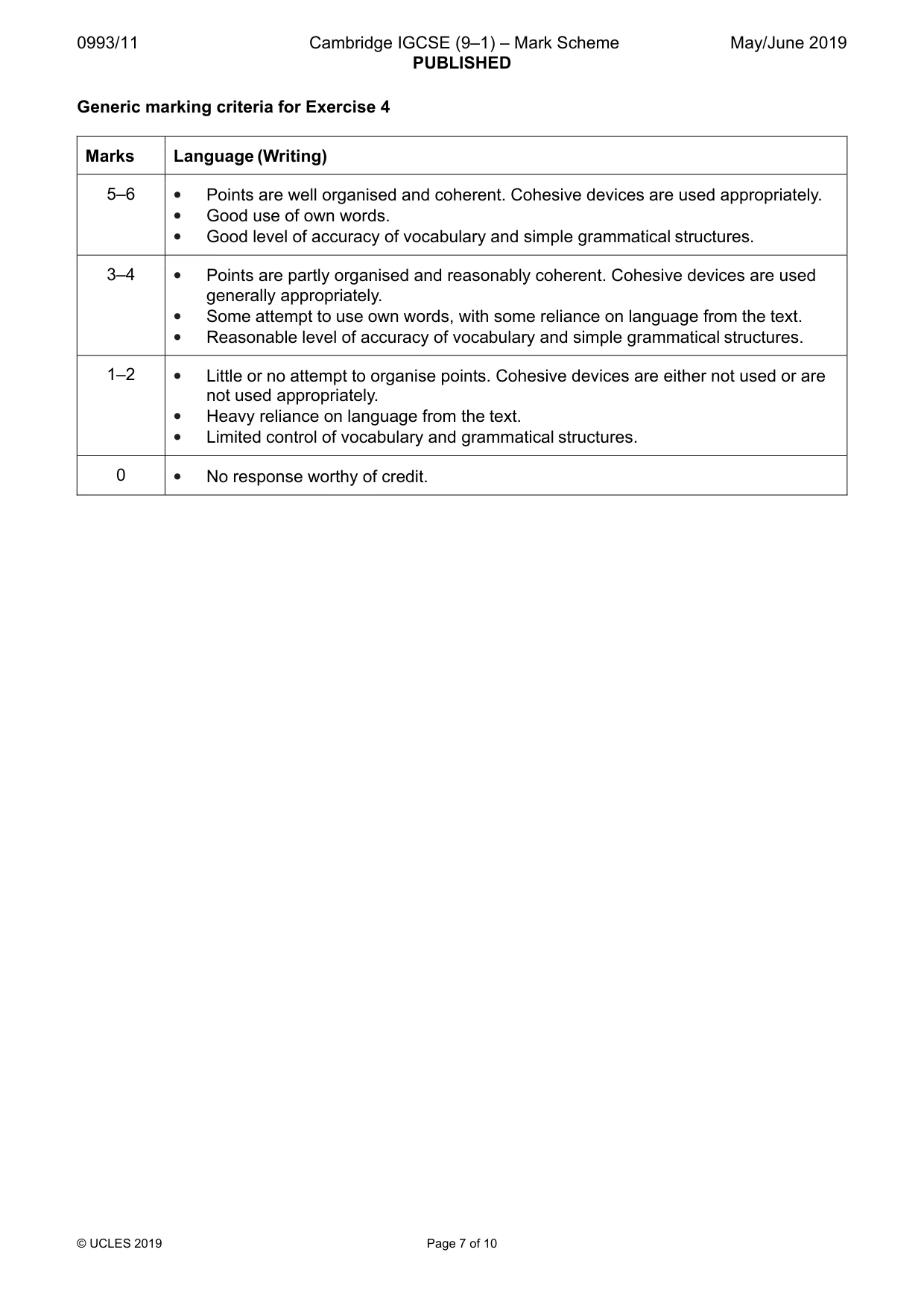
0993/11 Cambridge IGCSE (9–1) – Mark Scheme PUBLISHED May/June 2019 © UCLES 2019 Page 7 of 10 Generic marking criteria for Exercise 4 Marks Language (Writing) 5–6 • Points are well organised and coherent. Cohesive devices are used appropriately. • Good use of own words. • Good level of accuracy of vocabulary and simple grammatical structures. 3–4 • Points are partly organised and reasonably coherent. Cohesive devices are used generally appropriately. • Some attempt to use own words, with some reliance on language from the text. • Reasonable level of accuracy of vocabulary and simple grammatical structures. 1–2 • Little or no attempt to organise points. Cohesive devices are either not used or are not used appropriately. • Heavy reliance on language from the text. • Limited control of vocabulary and grammatical structures. 0 • No response worthy of credit.
Mark scheme, page 8
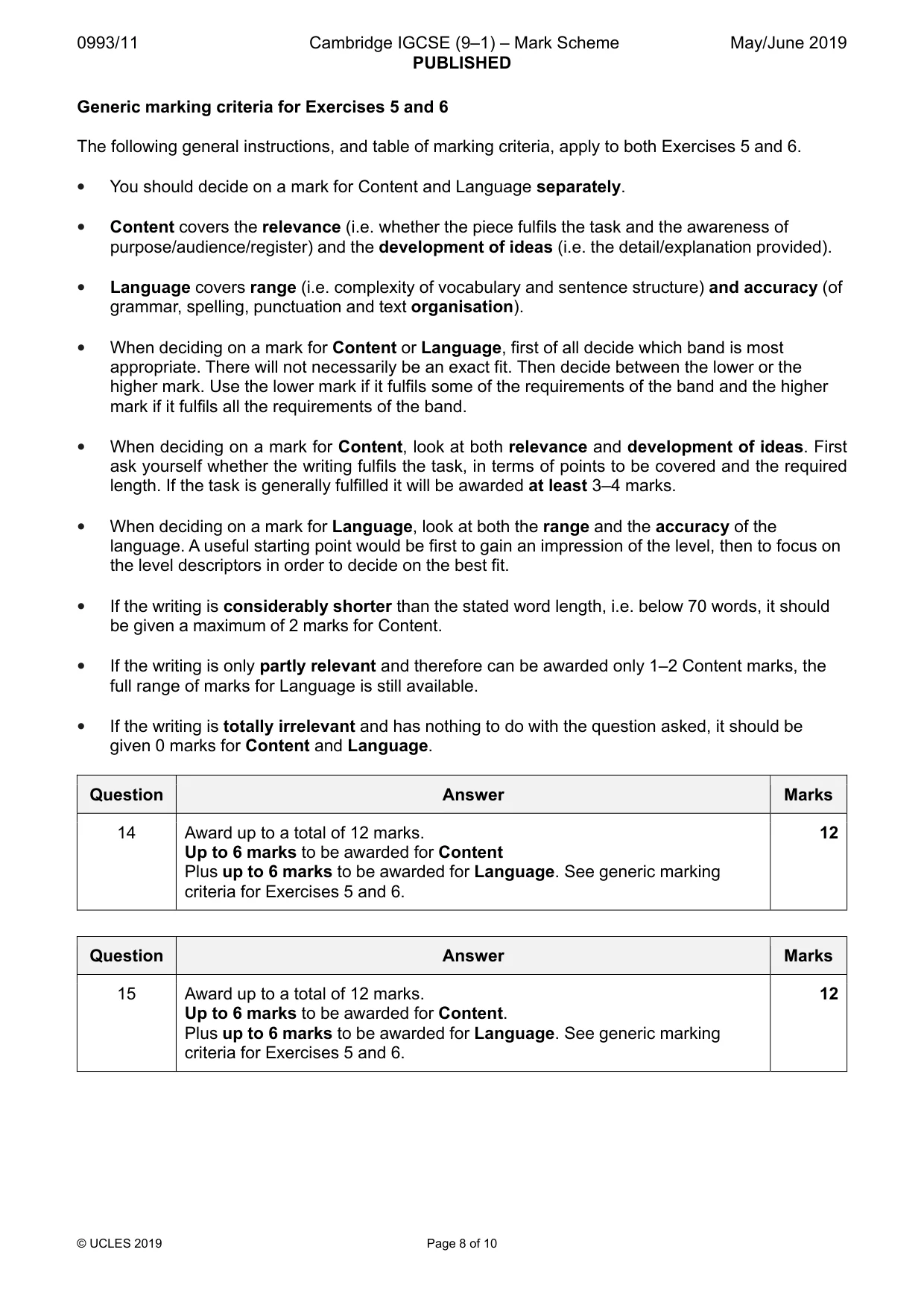
0993/11 Cambridge IGCSE (9–1) – Mark Scheme PUBLISHED May/June 2019 © UCLES 2019 Page 8 of 10 Generic marking criteria for Exercises 5 and 6 The following general instructions, and table of marking criteria, apply to both Exercises 5 and 6. • You should decide on a mark for Content and Language separately. • Content covers the relevance (i.e. whether the piece fulfils the task and the awareness of purpose/audience/register) and the development of ideas (i.e. the detail/explanation provided). • Language covers range (i.e. complexity of vocabulary and sentence structure) and accuracy (of grammar, spelling, punctuation and text organisation). • When deciding on a mark for Content or Language, first of all decide which band is most appropriate. There will not necessarily be an exact fit. Then decide between the lower or the higher mark. Use the lower mark if it fulfils some of the requirements of the band and the higher mark if it fulfils all the requirements of the band. • When deciding on a mark for Content, look at both relevance and development of ideas. First ask yourself whether the writing fulfils the task, in terms of points to be covered and the required length. If the task is generally fulfilled it will be awarded at least 3–4 marks. • When deciding on a mark for Language, look at both the range and the accuracy of the language. A useful starting point would be first to gain an impression of the level, then to focus on the level descriptors in order to decide on the best fit. • If the writing is considerably shorter than the stated word length, i.e. below 70 words, it should be given a maximum of 2 marks for Content. • If the writing is only partly relevant and therefore can be awarded only 1–2 Content marks, the full range of marks for Language is still available. • If the writing is totally irrelevant and has nothing to do with the question asked, it should be given 0 marks for Content and Language. Question Answer Marks 14 Award up to a total of 12 marks. Up to 6 marks to be awarded for Content Plus up to 6 marks to be awarded for Language. See generic marking criteria for Exercises 5 and 6. 12 Question Answer Marks 15 Award up to a total of 12 marks. Up to 6 marks to be awarded for Content. Plus up to 6 marks to be awarded for Language. See generic marking criteria for Exercises 5 and 6. 12
Mark scheme, page 9
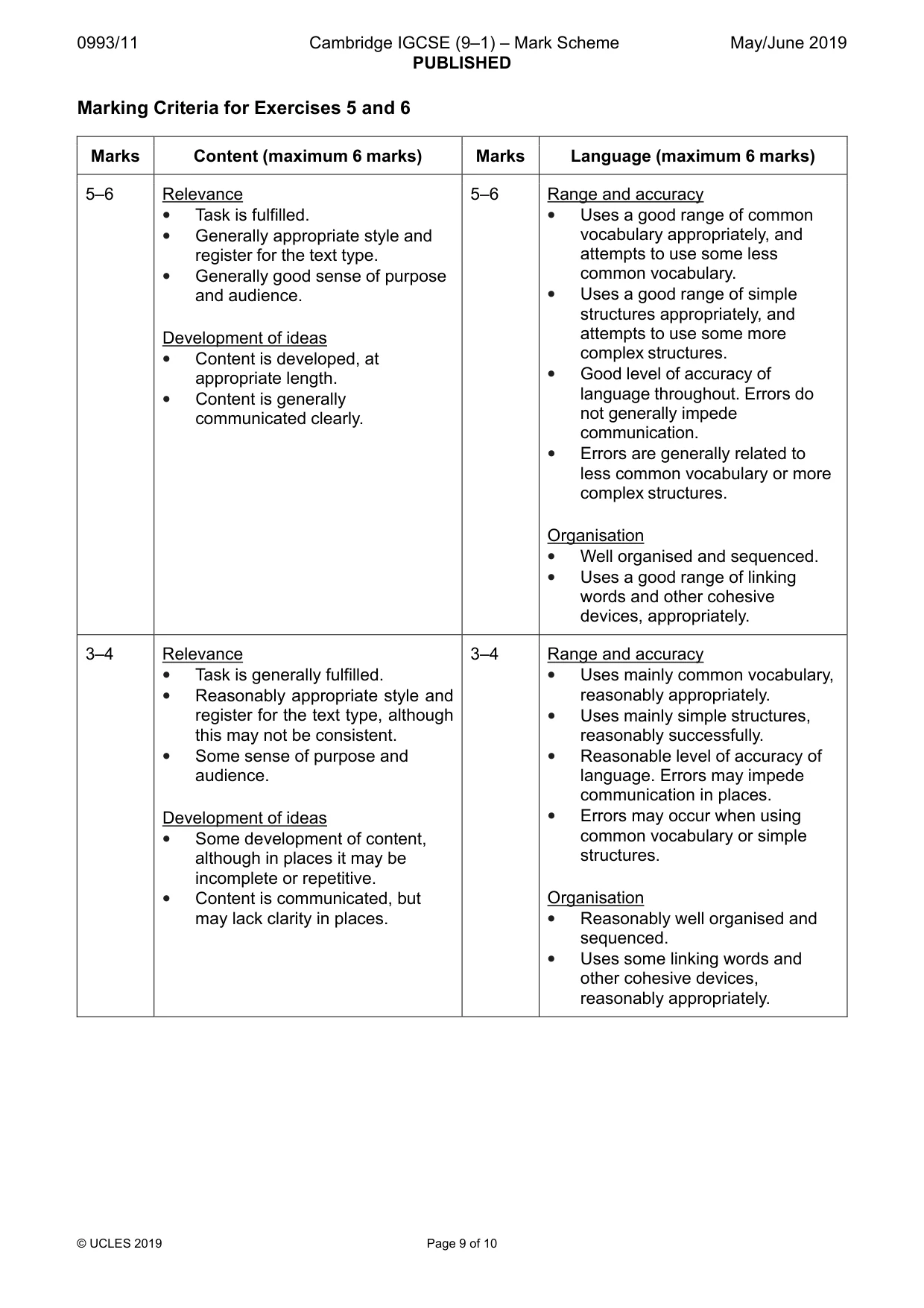
0993/11 Cambridge IGCSE (9–1) – Mark Scheme PUBLISHED May/June 2019 © UCLES 2019 Page 9 of 10 Marking Criteria for Exercises 5 and 6 Marks Content (maximum 6 marks) Marks Language (maximum 6 marks) 5–6 Relevance • Task is fulfilled. • Generally appropriate style and register for the text type. • Generally good sense of purpose and audience. Development of ideas • Content is developed, at appropriate length. • Content is generally communicated clearly. 5–6 Range and accuracy • Uses a good range of common vocabulary appropriately, and attempts to use some less common vocabulary. • Uses a good range of simple structures appropriately, and attempts to use some more complex structures. • Good level of accuracy of language throughout. Errors do not generally impede communication. • Errors are generally related to less common vocabulary or more complex structures. Organisation • Well organised and sequenced. • Uses a good range of linking words and other cohesive devices, appropriately. 3–4 Relevance • Task is generally fulfilled. • Reasonably appropriate style and register for the text type, although this may not be consistent. • Some sense of purpose and audience. Development of ideas • Some development of content, although in places it may be incomplete or repetitive. • Content is communicated, but may lack clarity in places. 3–4 Range and accuracy • Uses mainly common vocabulary, reasonably appropriately. • Uses mainly simple structures, reasonably successfully. • Reasonable level of accuracy of language. Errors may impede communication in places. • Errors may occur when using common vocabulary or simple structures. Organisation • Reasonably well organised and sequenced. • Uses some linking words and other cohesive devices, reasonably appropriately.
Mark scheme, page 10
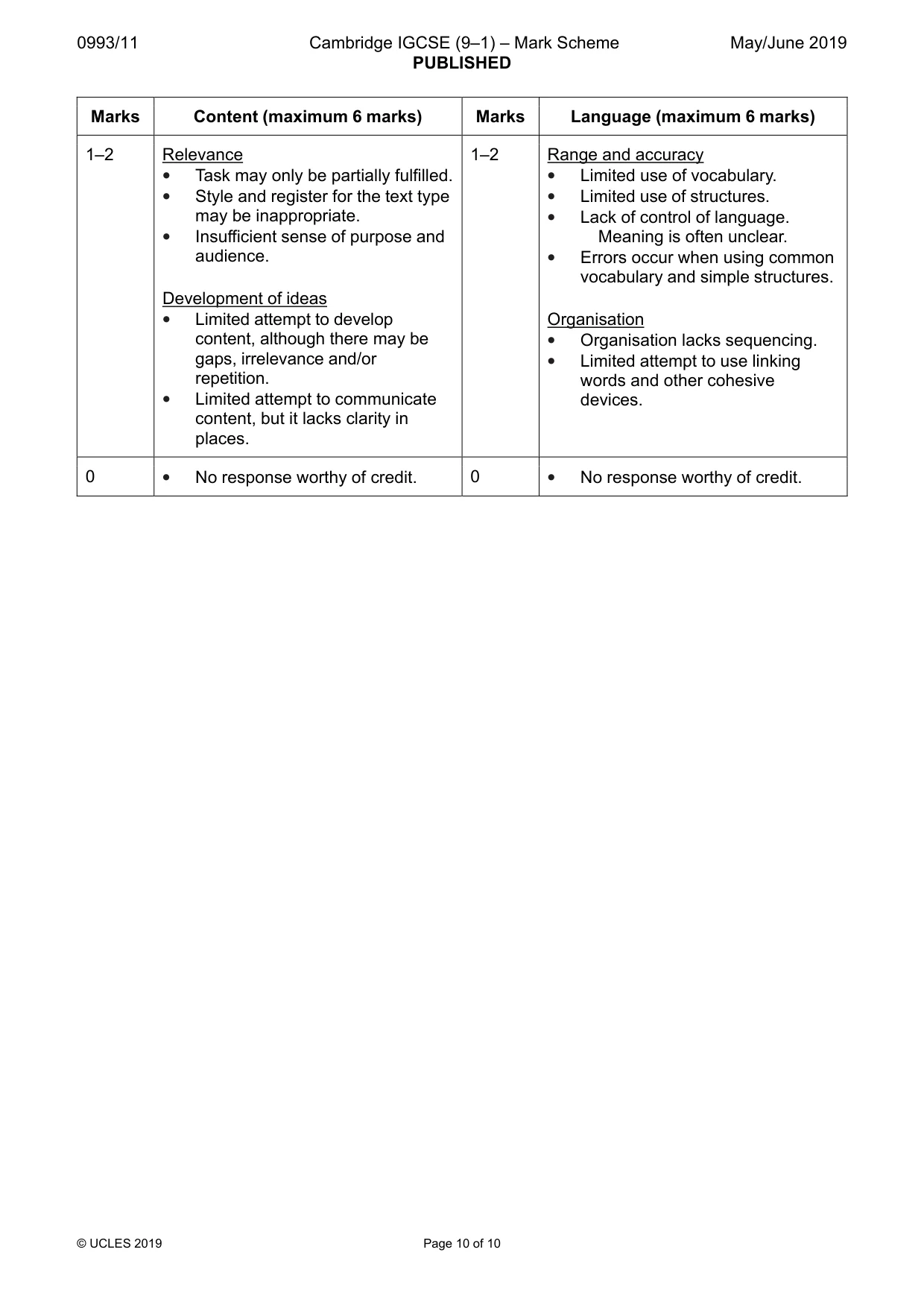
0993/11 Cambridge IGCSE (9–1) – Mark Scheme PUBLISHED May/June 2019 © UCLES 2019 Page 10 of 10 Marks Content (maximum 6 marks) Marks Language (maximum 6 marks) 1–2 Relevance • Task may only be partially fulfilled. • Style and register for the text type may be inappropriate. • Insufficient sense of purpose and audience. Development of ideas • Limited attempt to develop content, although there may be gaps, irrelevance and/or repetition. • Limited attempt to communicate content, but it lacks clarity in places. 1–2 Range and accuracy • Limited use of vocabulary. • Limited use of structures. • Lack of control of language. Meaning is often unclear. • Errors occur when using common vocabulary and simple structures. Organisation • Organisation lacks sequencing. • Limited attempt to use linking words and other cohesive devices. 0 • No response worthy of credit. 0 • No response worthy of credit.
What you needed in this session
Cambridge’s own grade thresholds for 2019 May/June, Paper 1 · Variant 1. A higher threshold means an easier paper — the bar moves with how the cohort did.