Cambridge IGCSE English - Second Language (oral endorsement) 0510 — 2023 May/June Paper 1 · Variant 2
0510/12/M/J/23 · 60 marks · ≈68 min
The question paper and its mark scheme, free to read here and free to download. This is Cambridge’s own paper, exactly as it was sat.
Question paper16 pages
Mark scheme11 pages
Answers below. Sit the paper first if you are practising.
Paper as text
Question paper, page 1
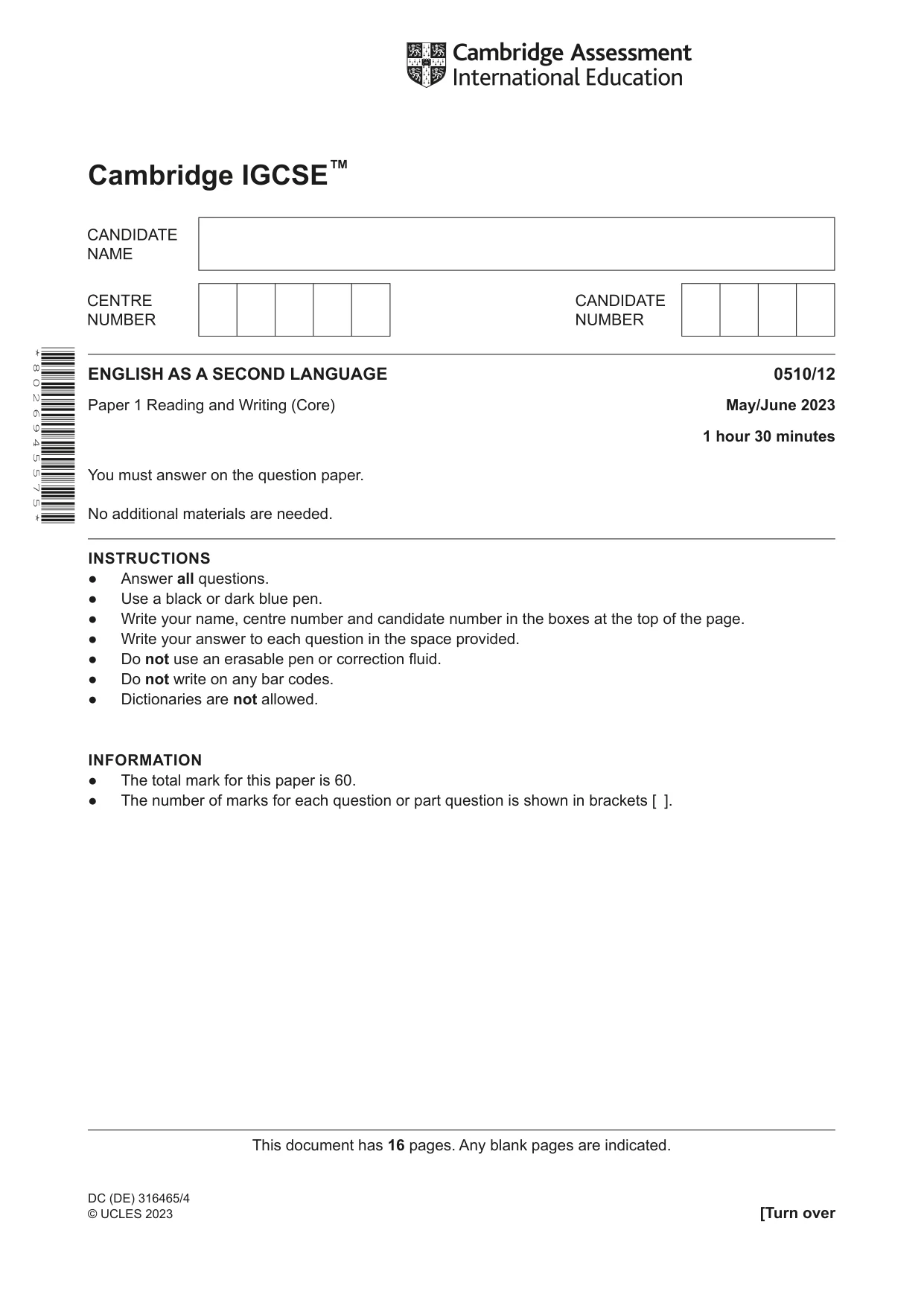
This document has 16 pages. Any blank pages are indicated. [Turn over * 8 0 2 6 9 4 5 5 7 5 * Cambridge IGCSE™ DC (DE) 316465/4 © UCLES 2023 ENGLISH AS A SECOND LANGUAGE 0510/12 Paper 1 Reading and Writing (Core) May/June 2023 1 hour 30 minutes You must answer on the question paper. No additional materials are needed. INSTRUCTIONS ● Answer all questions. ● Use a black or dark blue pen. ● Write your name, centre number and candidate number in the boxes at the top of the page. ● Write your answer to each question in the space provided. ● Do not use an erasable pen or correction fluid. ● Do not write on any bar codes. ● Dictionaries are not allowed. INFORMATION ● The total mark for this paper is 60. ● The number of marks for each question or part question is shown in brackets [ ].
Question paper, page 2
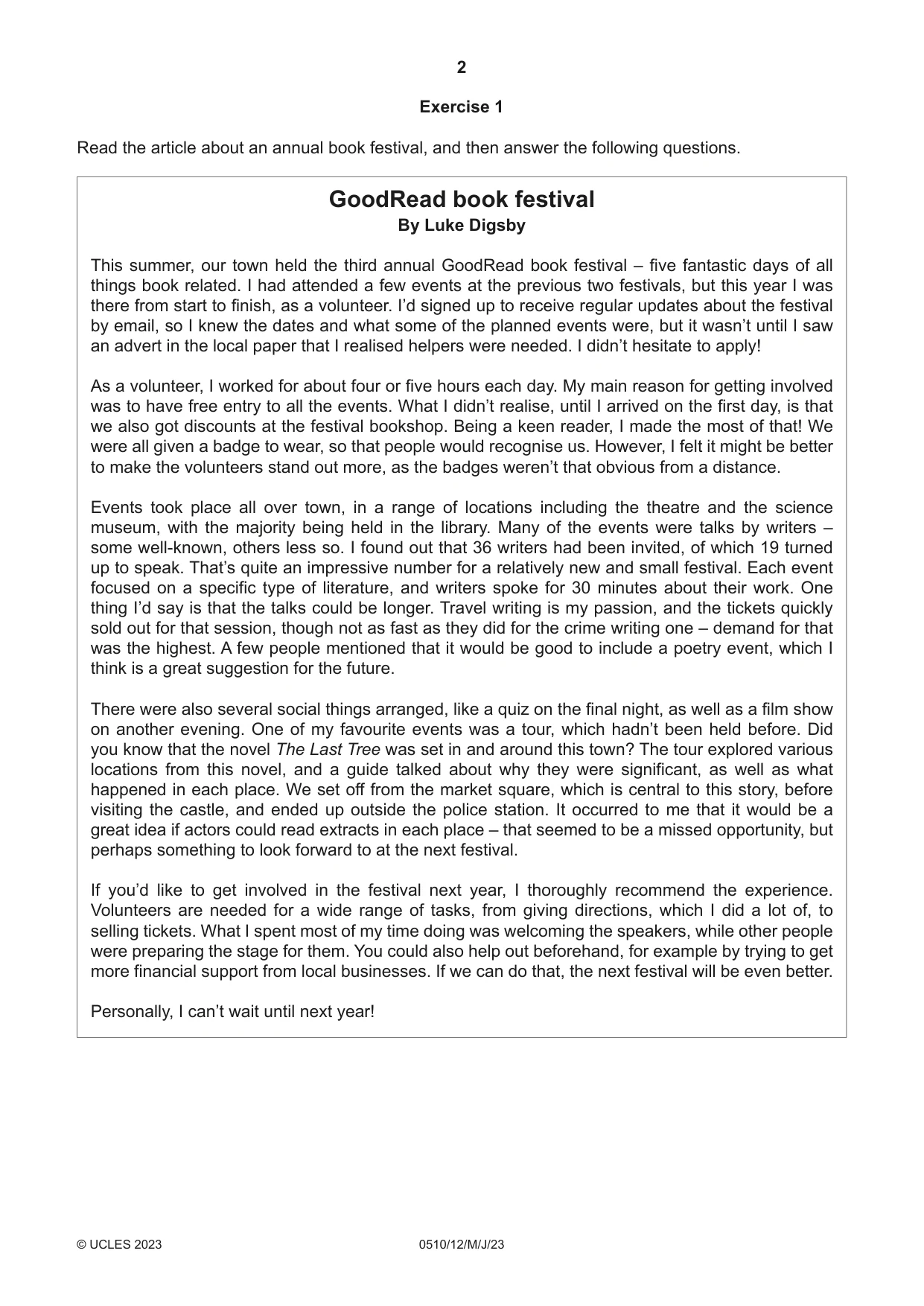
2 0510/12/M/J/23 © UCLES 2023 Exercise 1 Read the article about an annual book festival, and then answer the following questions. GoodRead book festival By Luke Digsby This summer, our town held the third annual GoodRead book festival – five fantastic days of all things book related. I had attended a few events at the previous two festivals, but this year I was there from start to finish, as a volunteer. I’d signed up to receive regular updates about the festival by email, so I knew the dates and what some of the planned events were, but it wasn’t until I saw an advert in the local paper that I realised helpers were needed. I didn’t hesitate to apply! As a volunteer, I worked for about four or five hours each day. My main reason for getting involved was to have free entry to all the events. What I didn’t realise, until I arrived on the first day, is that we also got discounts at the festival bookshop. Being a keen reader, I made the most of that! We were all given a badge to wear, so that people would recognise us. However, I felt it might be better to make the volunteers stand out more, as the badges weren’t that obvious from a distance. Events took place all over town, in a range of locations including the theatre and the science museum, with the majority being held in the library. Many of the events were talks by writers – some well-known, others less so. I found out that 36 writers had been invited, of which 19 turned up to speak. That’s quite an impressive number for a relatively new and small festival. Each event focused on a specific type of literature, and writers spoke for 30 minutes about their work. One thing I’d say is that the talks could be longer. Travel writing is my passion, and the tickets quickly sold out for that session, though not as fast as they did for the crime writing one – demand for that was the highest. A few people mentioned that it would be good to include a poetry event, which I think is a great suggestion for the future. There were also several social things arranged, like a quiz on the final night, as well as a film show on another evening. One of my favourite events was a tour, which hadn’t been held before. Did you know that the novel The Last Tree was set in and around this town? The tour explored various locations from this novel, and a guide talked about why they were significant, as well as what happened in each place. We set off from the market square, which is central to this story, before visiting the castle, and ended up outside the police station. It occurred to me that it would be a great idea if actors could read extracts in each place – that seemed to be a missed opportunity, but perhaps something to look forward to at the next festival. If you’d like to get involved in the festival next year, I thoroughly recommend the experience. Volunteers are needed for a wide range of tasks, from giving directions, which I did a lot of, to selling tickets. What I spent most of my time doing was welcoming the speakers, while other people were preparing the stage for them. You could also help out beforehand, for example by trying to get more financial support from local businesses. If we can do that, the next festival will be even better. Personally, I can’t wait until next year!
Question paper, page 3
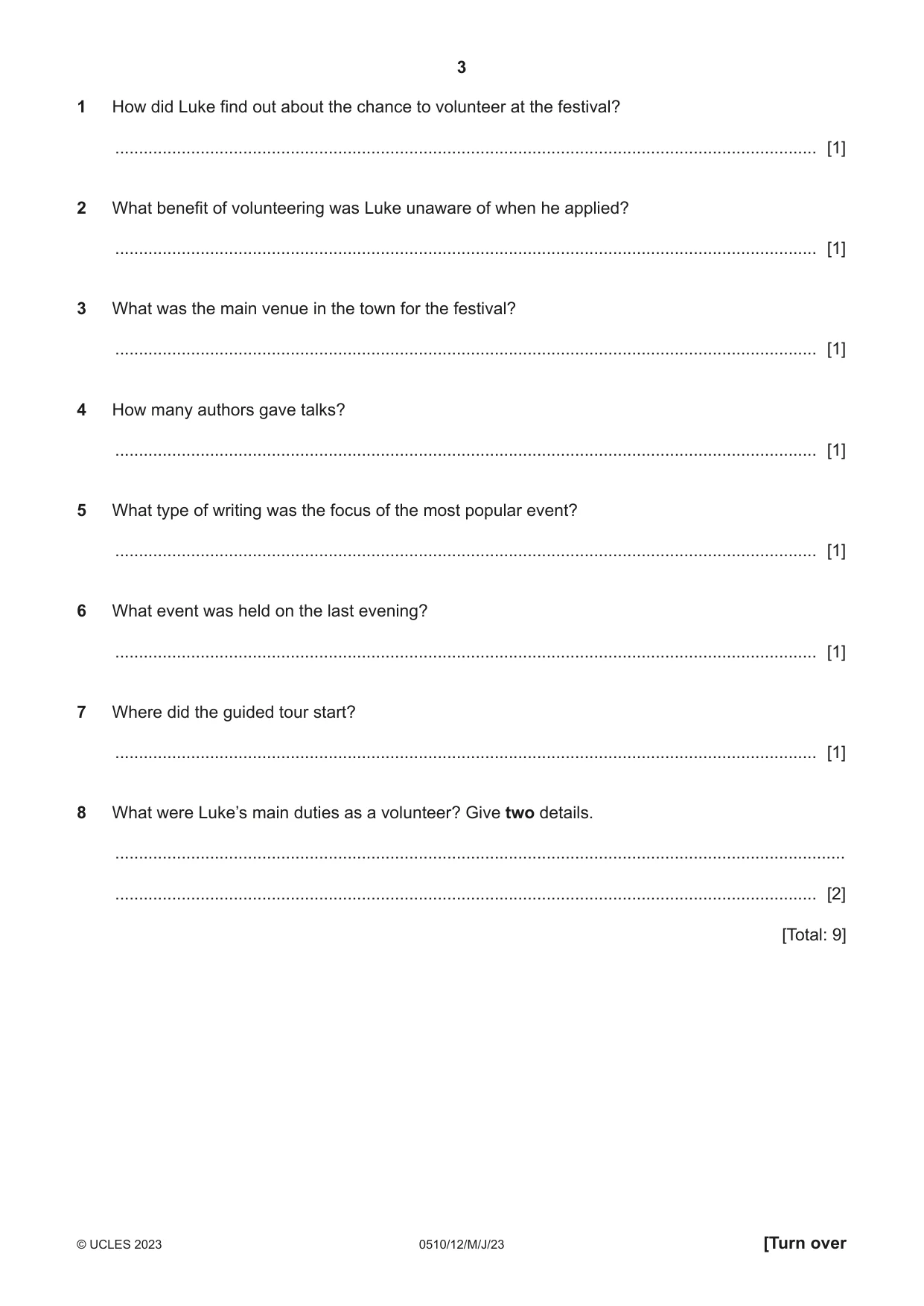
3 0510/12/M/J/23 © UCLES 2023 [Turn over 1 How did Luke find out about the chance to volunteer at the festival? … [1] 2 What benefit of volunteering was Luke unaware of when he applied? … [1] 3 What was the main venue in the town for the festival? … [1] 4 How many authors gave talks? … [1] 5 What type of writing was the focus of the most popular event? … [1] 6 What event was held on the last evening? … [1] 7 Where did the guided tour start? … [1] 8 What were Luke’s main duties as a volunteer? Give two details. … … [2] [Total: 9]
Question paper, page 4
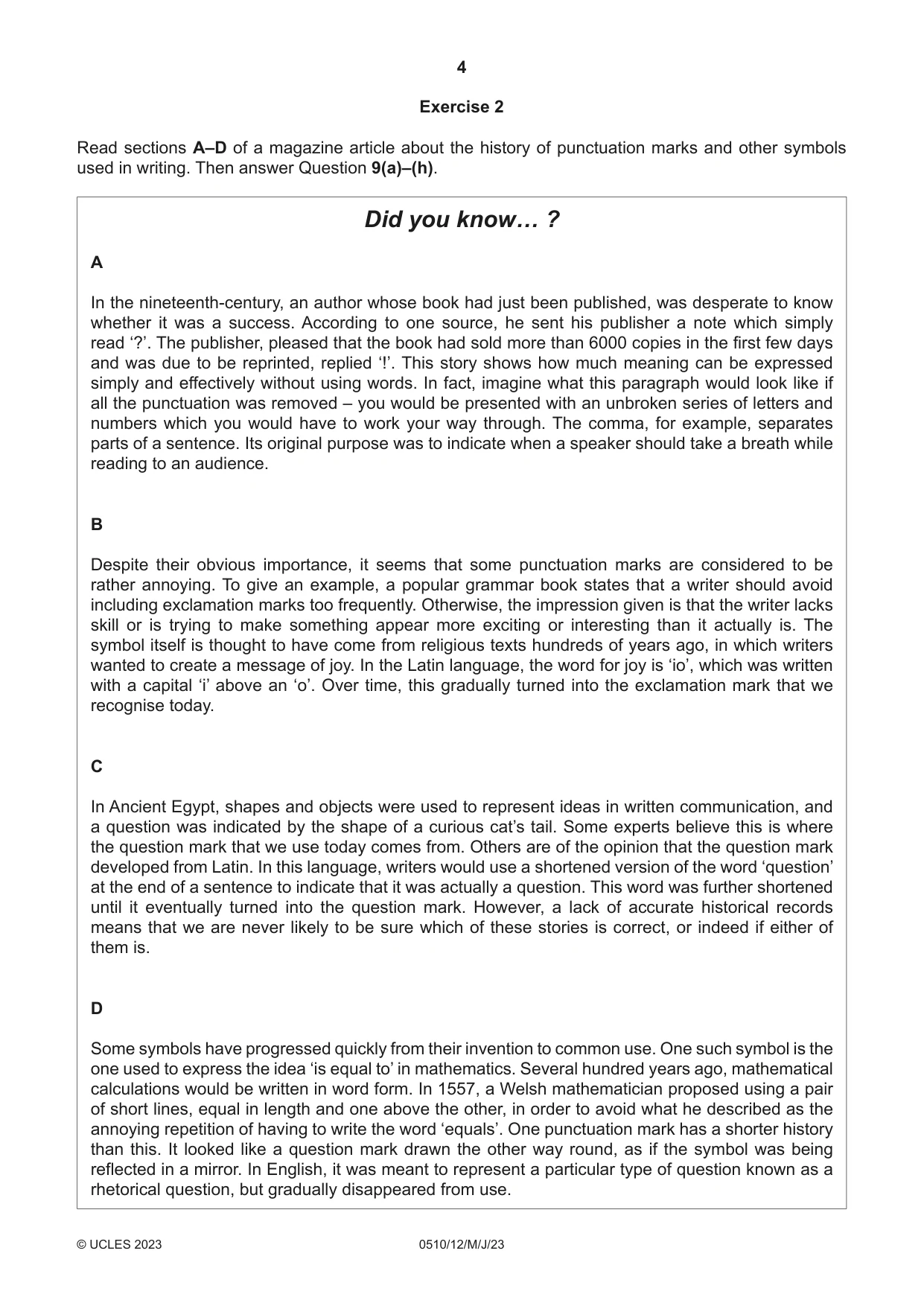
4 0510/12/M/J/23 © UCLES 2023 Exercise 2 Read sections A–D of a magazine article about the history of punctuation marks and other symbols used in writing. Then answer Question 9(a)–(h). Did you know… ? A In the nineteenth-century, an author whose book had just been published, was desperate to know whether it was a success. According to one source, he sent his publisher a note which simply read ‘?’. The publisher, pleased that the book had sold more than 6000 copies in the first few days and was due to be reprinted, replied ‘!’. This story shows how much meaning can be expressed simply and effectively without using words. In fact, imagine what this paragraph would look like if all the punctuation was removed – you would be presented with an unbroken series of letters and numbers which you would have to work your way through. The comma, for example, separates parts of a sentence. Its original purpose was to indicate when a speaker should take a breath while reading to an audience. B Despite their obvious importance, it seems that some punctuation marks are considered to be rather annoying. To give an example, a popular grammar book states that a writer should avoid including exclamation marks too frequently. Otherwise, the impression given is that the writer lacks skill or is trying to make something appear more exciting or interesting than it actually is. The symbol itself is thought to have come from religious texts hundreds of years ago, in which writers wanted to create a message of joy. In the Latin language, the word for joy is ‘io’, which was written with a capital ‘i’ above an ‘o’. Over time, this gradually turned into the exclamation mark that we recognise today. C In Ancient Egypt, shapes and objects were used to represent ideas in written communication, and a question was indicated by the shape of a curious cat’s tail. Some experts believe this is where the question mark that we use today comes from. Others are of the opinion that the question mark developed from Latin. In this language, writers would use a shortened version of the word ‘question’ at the end of a sentence to indicate that it was actually a question. This word was further shortened until it eventually turned into the question mark. However, a lack of accurate historical records means that we are never likely to be sure which of these stories is correct, or indeed if either of them is. D Some symbols have progressed quickly from their invention to common use. One such symbol is the one used to express the idea ‘is equal to’ in mathematics. Several hundred years ago, mathematical calculations would be written in word form. In 1557, a Welsh mathematician proposed using a pair of short lines, equal in length and one above the other, in order to avoid what he described as the annoying repetition of having to write the word ‘equals’. One punctuation mark has a shorter history than this. It looked like a question mark drawn the other way round, as if the symbol was being reflected in a mirror. In English, it was meant to represent a particular type of question known as a rhetorical question, but gradually disappeared from use.
Question paper, page 5
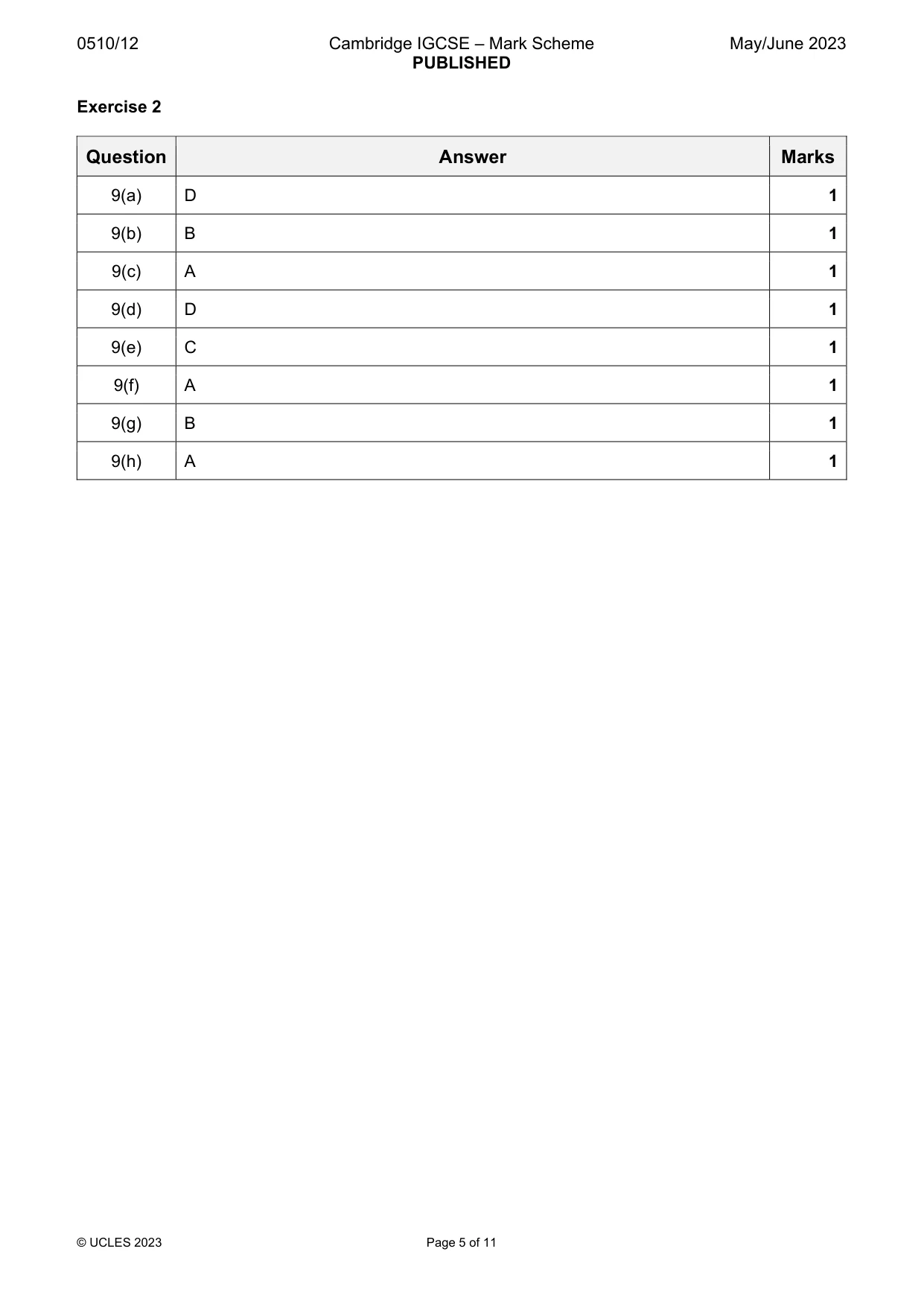
5 0510/12/M/J/23 © UCLES 2023 [Turn over 9 For each question write the correct letter A, B, C or D on the line. Which section includes the following information? (a) the suggestion that a symbol was created to reduce the feeling of frustration among writers … [1] (b) how the shape of a punctuation mark developed from two letters … [1] (c) the suggestion that it would be difficult to understand text without punctuation … [1] (d) an example of a punctuation mark which failed to become popular … [1] (e) theories which can’t be proved about the origin of a punctuation mark … [1] (f) an example of messages that consisted only of punctuation … [1] (g) the opinion that using a particular punctuation mark too much creates poor writing … [1] (h) a punctuation mark which was developed to help people read texts aloud … [1] [Total: 8]
Question paper, page 6
6 0510/12/M/J/23 © UCLES 2023 Exercise 3 Read the article about Kilian Jornet, a mountain runner who completed a difficult challenge called the Bob Graham Round, and then complete the notes. Running the Bob Graham Round Kilian Jornet is no stranger to mountains. His father was a mountain guide, and he grew up in the Pyrenees, the mountains on the border between France and Spain. In 2017, he climbed Mount Everest twice in a week, and he is able to run up and down Mont Blanc in under five hours. He is becoming one of the stars in the fast-growing world of adventure sports. In 2018, Kilian attempted to run what is known as the Bob Graham Round, a challenge which takes place in the Lake District, a popular tourist area in the northwest of England. The route is 66 miles (106 kilometres) long, which is one of the reasons why so few people are able to finish it, and it involves climbing and descending 42 peaks. If you think that sounds impossible, another rule is that it must be completed within 24 hours. About 2000 individuals have successfully completed the challenge, which is named after a local man called Bob Graham, who first ran the route in under 24 hours in 1932. When Kilian did it, he also made history with his 12-hour, 52-minute run, which cut the previous record by just over an hour. When asked about the experience, Kilian admitted that it had been really tough. He carried some energy drink with him, and spectators gave him water along the way. He also found some rivers in the mountains where he could quickly refill his bottle. He pointed out that there are no official route markings to show you the way. Instead, local people guided him, which enabled him to get around the route without any unnecessary delay. One of the rules of the challenge is that someone must accompany you to the top of each of the peaks. This is to prove that you have been there, and this person also keeps an accurate record of the time that you arrive at each one. Luckily for Kilian, some previous winners ran with him. A tradition of the challenge is that successful runners return to help other people who want to have a go at it. Will he do the same? ‘Yes! For sure!’ he says. ‘I have friends who want to do it. I hope they try soon – and can go faster than me!’ Around 100 people attempt the Bob Graham Round each year, but barely one third manage to finish. Although Kilian is a very experienced and fast runner, he admitted that the amount of climbing involved is huge, and that this made it one of the toughest runs of his career. Some sections are also very steep, so he was grateful that supporters turned out to encourage him. Was there one particularly hard moment? ‘It was more like the last four hours!’, he says. ‘What is so hard is that your legs get very tired, but you just have to keep going.’ But for Kilian, the beautiful scenery and good weather on the day helped to make the experience one to remember.
Question paper, page 7
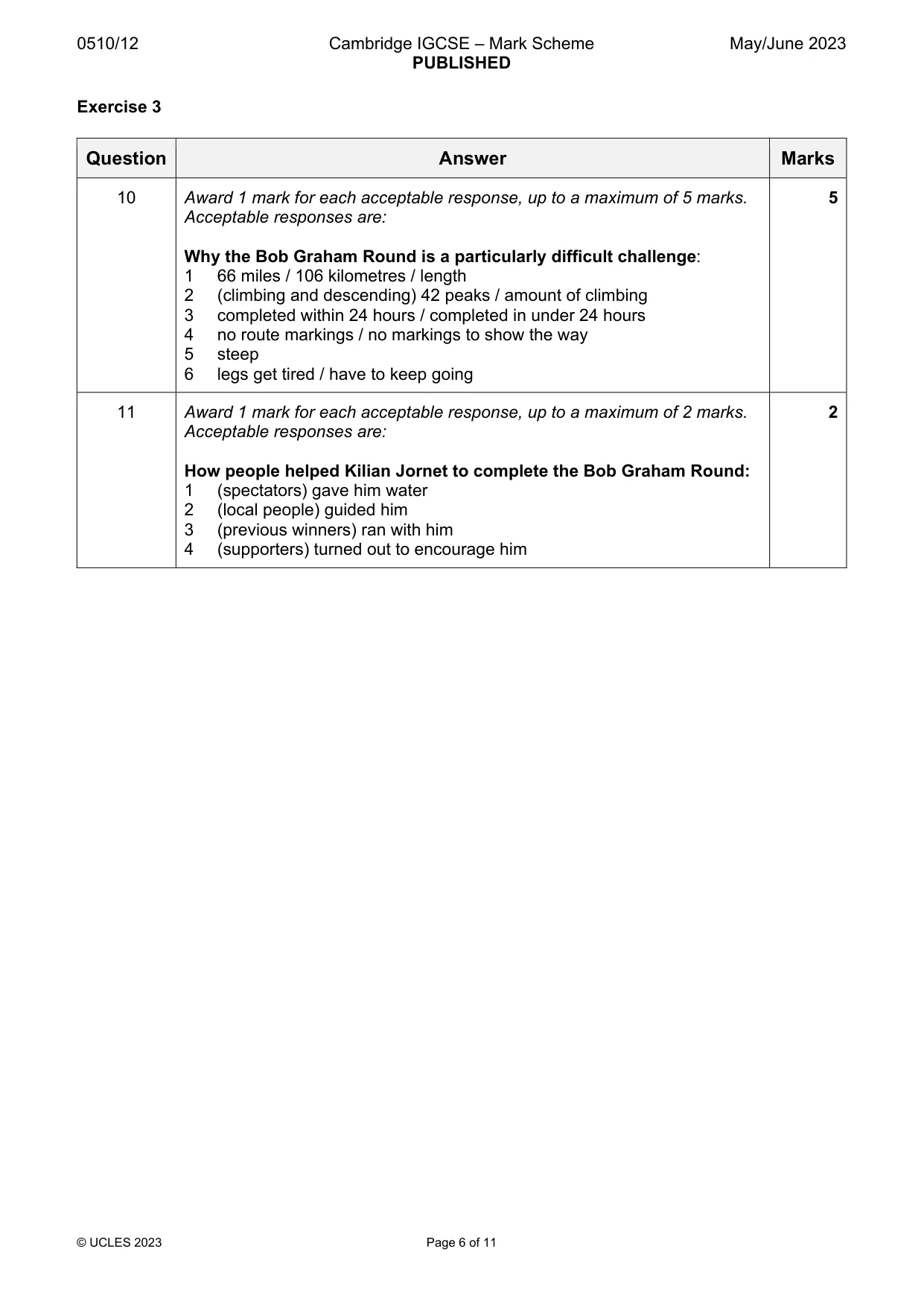
7 0510/12/M/J/23 © UCLES 2023 [Turn over You are going to give a talk to your class at school about Kilian Jornet’s challenge. Prepare some notes to use as the basis for your talk. Make short notes under each heading. 10 Why the Bob Graham Round is a particularly difficult challenge: • … • … • … • … • … [5] 11 How people helped Kilian Jornet to complete the Bob Graham Round: • … • … [2] [Total: 7]
Question paper, page 8
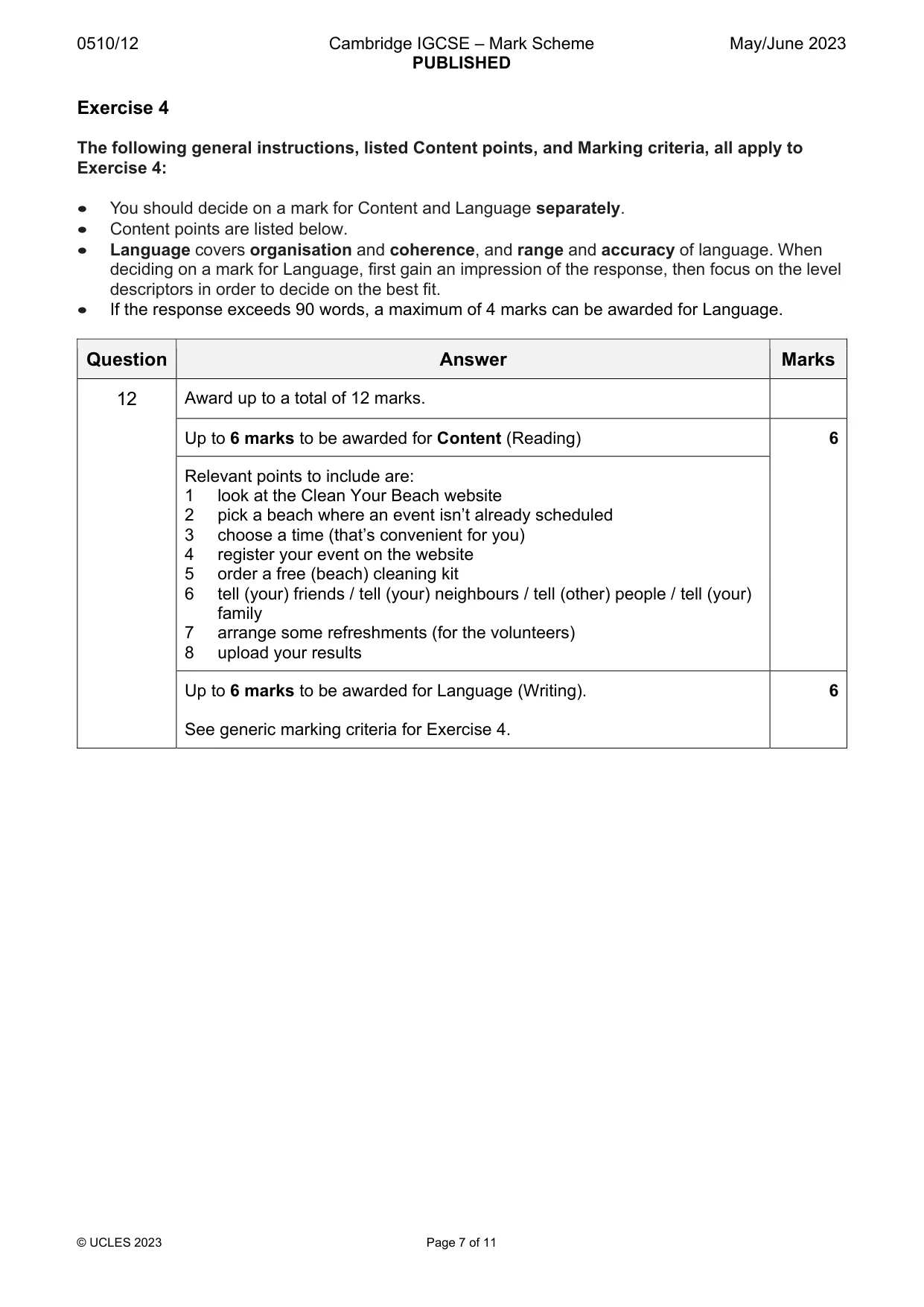
8 0510/12/M/J/23 © UCLES 2023 Exercise 4 12 Read the article about cleaning beaches. Write a summary about how to organise and run your own beach-cleaning event. Your summary should be about 80 words long (and no more than 90 words long). You should use your own words as far as possible. You will receive up to 6 marks for the content of your summary, and up to 6 marks for the style and accuracy of your language. Beach Cleaning www.cleanyourbeach.com Did you know that millions of tonnes of plastic are thrown into our oceans every year? Sadly, much of it ends up on beaches around the world. What can you do about this? One simple answer is to help clean a beach near you. You can take part in a beach-cleaning event that has already been organised, or, even better, organise one of your own! If you’d like to have a go at this, the first thing to do is look at the Clean Your Beach website. You’ll find all sorts of useful information there. Pick a beach where an event isn’t already scheduled – that way we can all make as big an impact as possible! You’ll need to choose a time that’s convenient for you, which could be a weekday or a weekend, morning, afternoon or evening. Then register your event on the website. If you do this, you can also order a free beach-cleaning kit, which contains enough equipment for 25 volunteers. Don’t forget to tell your friends and neighbours too. After all, you can’t clean an entire beach by yourself! There are so many reasons why you should organise a beach-cleaning event. You’ll get fresh air and exercise, and you’ll be doing something positive too. As well as being rewarding, it can be great fun too! We suggest that you arrange some refreshments for the volunteers – they’ll thank you for these after you’ve all finished cleaning the beach together. Then the only remaining thing to do is upload your results to the website. We’re keeping a record of what people find, and how much of it has been collected. So far, our events have removed just under 150 000 kilos of rubbish from our beaches. But there’s more to do. Our beaches need you – so why not do something about it today?
Question paper, page 9
9 0510/12/M/J/23 © UCLES 2023 [Turn over … … … … … … … … … … … … … … [Total: 12]
Question paper, page 10
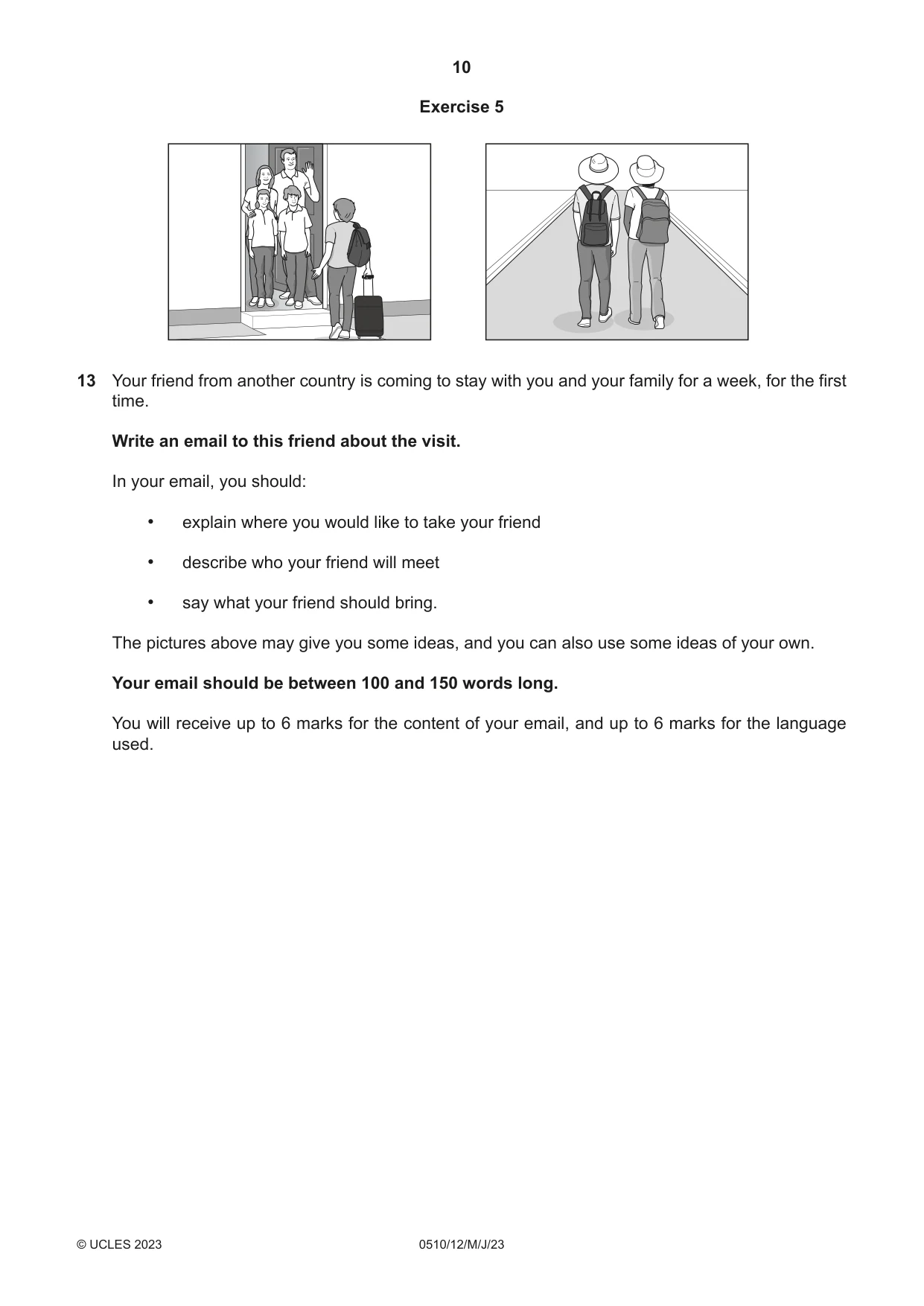
10 0510/12/ M / J /23 © UCLES 2023 Exercise 5 13 Your friend from another country is coming to stay with you and your family for a week, for the first time. Write an email to this friend about the visit. In your email, you should: • explain where you would like to take your friend • describe who your friend will meet • say what your friend should bring. The pictures above may give you some ideas, and you can also use some ideas of your own. Your email should be between 100 and 150 words long. You will receive up to 6 marks for the content of your email, and up to 6 marks for the language used.
Question paper, page 11
11 0510/12/M/J/23 © UCLES 2023 [Turn over … … … … … … … … … … … … … … … … … … … … … … … … … … … [Total: 12]
Question paper, page 12
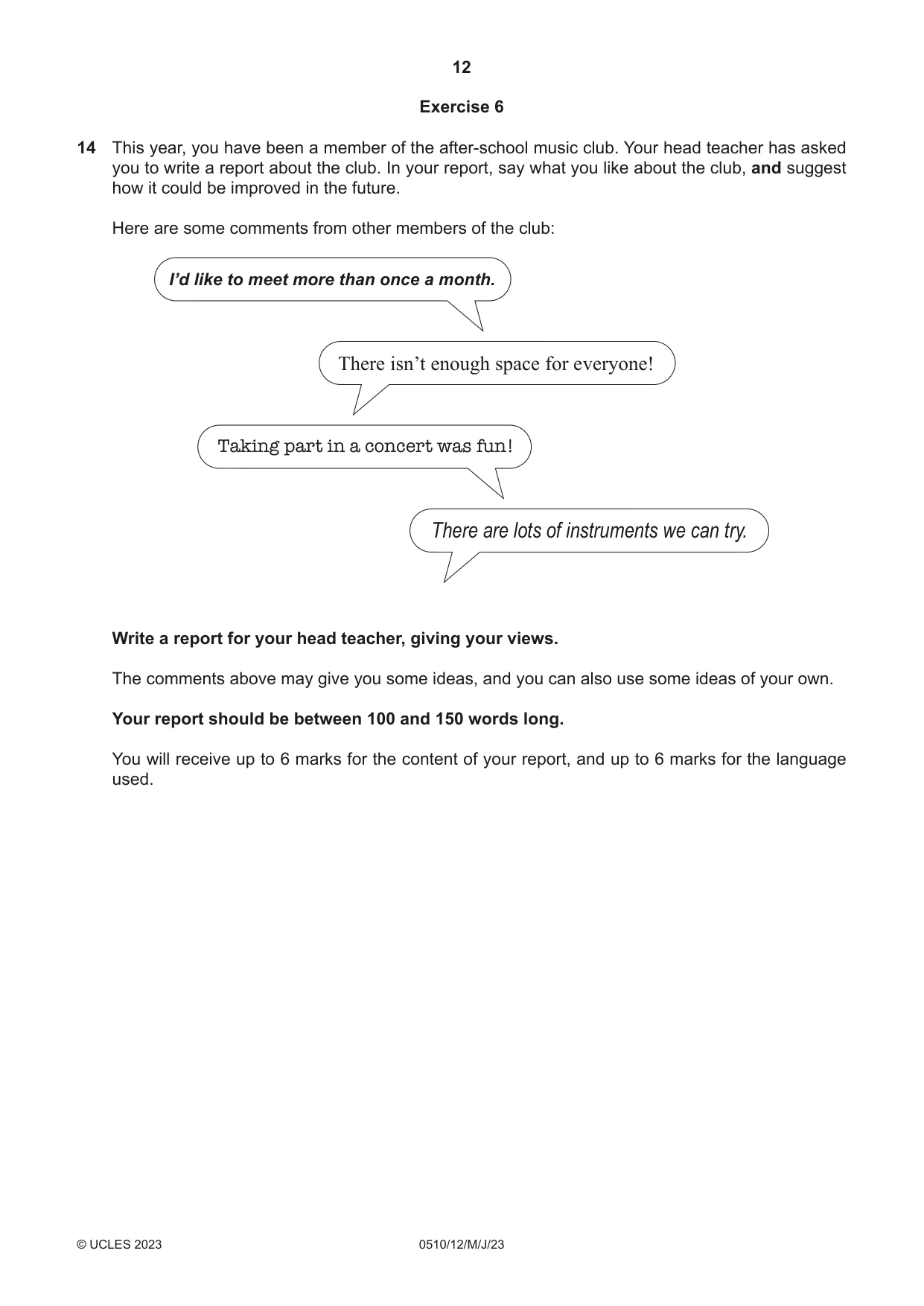
12 0510/12/M/J/23 © UCLES 2023 Exercise 6 14 This year, you have been a member of the after-school music club. Your head teacher has asked you to write a report about the club. In your report, say what you like about the club, and suggest how it could be improved in the future. Here are some comments from other members of the club: I’d like to meet more than once a month. There isn’t enough space for everyone! Taking part in a concert was fun! There are lots of instruments we can try. Write a report for your head teacher, giving your views. The comments above may give you some ideas, and you can also use some ideas of your own. Your report should be between 100 and 150 words long. You will receive up to 6 marks for the content of your report, and up to 6 marks for the language used.
Question paper, page 13
13 0510/12/M/J/23 © UCLES 2023 … … … … … … … … … … … … … … … … … … … … … … … … … … … [Total: 12]
Question paper, page 14
14 0510/12/M/J/23 © UCLES 2023 BLANK PAGE
Question paper, page 15
15 0510/12/M/J/23 © UCLES 2023 BLANK PAGE
Question paper, page 16
16 0510/12/M/J/23 © UCLES 2023 Permission to reproduce items where third-party owned material protected by copyright is included has been sought and cleared where possible. Every reasonable effort has been made by the publisher (UCLES) to trace copyright holders, but if any items requiring clearance have unwittingly been included, the publisher will be pleased to make amends at the earliest possible opportunity. To avoid the issue of disclosure of answer-related information to candidates, all copyright acknowledgements are reproduced online in the Cambridge Assessment International Education Copyright Acknowledgements Booklet. This is produced for each series of examinations and is freely available to download at www.cambridgeinternational.org after the live examination series. Cambridge Assessment International Education is part of Cambridge Assessment. Cambridge Assessment is the brand name of the University of Cambridge Local Examinations Syndicate (UCLES), which is a department of the University of Cambridge. BLANK PAGE
Mark scheme, page 1
This document consists of 11 printed pages. © UCLES 2023 [Turn over Cambridge IGCSE™ ENGLISH AS A SECOND LANGUAGE 0510/12 Paper 1 Reading and Writing (Core) May/June 2023 MARK SCHEME Maximum Mark: 60 Published This mark scheme is published as an aid to teachers and candidates, to indicate the requirements of the examination. It shows the basis on which Examiners were instructed to award marks. It does not indicate the details of the discussions that took place at an Examiners’ meeting before marking began, which would have considered the acceptability of alternative answers. Mark schemes should be read in conjunction with the question paper and the Principal Examiner Report for Teachers. Cambridge International will not enter into discussions about these mark schemes. Cambridge International is publishing the mark schemes for the May/June 2023 series for most Cambridge IGCSE, Cambridge International A and AS Level and Cambridge Pre-U components, and some Cambridge O Level components.
Mark scheme, page 2
0510/12 Cambridge IGCSE – Mark Scheme PUBLISHED May/June 2023 © UCLES 2023 Page 2 of 11 Generic Marking Principles These general marking principles must be applied by all examiners when marking candidate answers. They should be applied alongside the specific content of the mark scheme or generic level descriptors for a question. Each question paper and mark scheme will also comply with these marking principles. GENERIC MARKING PRINCIPLE 1: Marks must be awarded in line with: the specific content of the mark scheme or the generic level descriptors for the question the specific skills defined in the mark scheme or in the generic level descriptors for the question the standard of response required by a candidate as exemplified by the standardisation scripts. GENERIC MARKING PRINCIPLE 2: Marks awarded are always whole marks (not half marks, or other fractions). GENERIC MARKING PRINCIPLE 3: Marks must be awarded positively: marks are awarded for correct/valid answers, as defined in the mark scheme. However, credit is given for valid answers which go beyond the scope of the syllabus and mark scheme, referring to your Team Leader as appropriate marks are awarded when candidates clearly demonstrate what they know and can do marks are not deducted for errors marks are not deducted for omissions answers should only be judged on the quality of spelling, punctuation and grammar when these features are specifically assessed by the question as indicated by the mark scheme. The meaning, however, should be unambiguous. GENERIC MARKING PRINCIPLE 4: Rules must be applied consistently, e.g. in situations where candidates have not followed instructions or in the application of generic level descriptors. GENERIC MARKING PRINCIPLE 5: Marks should be awarded using the full range of marks defined in the mark scheme for the question (however; the use of the full mark range may be limited according to the quality of the candidate responses seen). GENERIC MARKING PRINCIPLE 6: Marks awarded are based solely on the requirements as defined in the mark scheme. Marks should not be awarded with grade thresholds or grade descriptors in mind.
Mark scheme, page 3
0510/12 Cambridge IGCSE – Mark Scheme PUBLISHED May/June 2023 © UCLES 2023 Page 3 of 11 This component forms part of the Core tier assessment of Cambridge IGCSE English as a Second Language and tests the following Assessment Objectives: AO1: Reading R1 identify and select relevant information R2 understand ideas, opinions and attitudes R3 show understanding of the connections between ideas, opinions and attitudes R4 understand what is implied but not directly stated, e.g. gist, writer’s purpose, intentions and feelings AO2: Writing W1 communicate information / ideas / opinions clearly, accurately and effectively W2 organise ideas into coherent paragraphs using a range of appropriate linking devices W3 use a range of grammatical structures accurately and effectively W4 show control of punctuation and spelling W5 use appropriate register and style / format for the given purpose and audience
Mark scheme, page 4
0510/12 Cambridge IGCSE – Mark Scheme PUBLISHED May/June 2023 © UCLES 2023 Page 4 of 11 Exercise 1 Question Answer Marks 1 advert / ad / local paper / newspaper 1 2 discounts (at festival bookshop) 1 3 library 1 4 19 / nineteen 1 5 crime (writing) 1 6 a quiz 1 7 the market square / marketplace 1 8 Award 1 mark for each detail up to a maximum 2 marks: giving directions welcoming speakers If three details are provided: two right and one wrong = 1 mark one right and two wrong = 0 marks 2
Mark scheme, page 5
0510/12 Cambridge IGCSE – Mark Scheme PUBLISHED May/June 2023 © UCLES 2023 Page 5 of 11 Exercise 2 Question Answer Marks 9(a) D 1 9(b) B 1 9(c) A 1 9(d) D 1 9(e) C 1 9(f) A 1 9(g) B 1 9(h) A 1
Mark scheme, page 6
0510/12 Cambridge IGCSE – Mark Scheme PUBLISHED May/June 2023 © UCLES 2023 Page 6 of 11 Exercise 3 Question Answer Marks 10 Award 1 mark for each acceptable response, up to a maximum of 5 marks. Acceptable responses are: Why the Bob Graham Round is a particularly difficult challenge: 1 66 miles / 106 kilometres / length 2 (climbing and descending) 42 peaks / amount of climbing 3 completed within 24 hours / completed in under 24 hours 4 no route markings / no markings to show the way 5 steep 6 legs get tired / have to keep going 5 11 Award 1 mark for each acceptable response, up to a maximum of 2 marks. Acceptable responses are: How people helped Kilian Jornet to complete the Bob Graham Round: 1 (spectators) gave him water 2 (local people) guided him 3 (previous winners) ran with him 4 (supporters) turned out to encourage him 2
Mark scheme, page 7
0510/12 Cambridge IGCSE – Mark Scheme PUBLISHED May/June 2023 © UCLES 2023 Page 7 of 11 Exercise 4 The following general instructions, listed Content points, and Marking criteria, all apply to Exercise 4: You should decide on a mark for Content and Language separately. Content points are listed below. Language covers organisation and coherence, and range and accuracy of language. When deciding on a mark for Language, first gain an impression of the response, then focus on the level descriptors in order to decide on the best fit. If the response exceeds 90 words, a maximum of 4 marks can be awarded for Language. Question Answer Marks 12 Award up to a total of 12 marks. Up to 6 marks to be awarded for Content (Reading) 6 Relevant points to include are: 1 look at the Clean Your Beach website 2 pick a beach where an event isn’t already scheduled 3 choose a time (that’s convenient for you) 4 register your event on the website 5 order a free (beach) cleaning kit 6 tell (your) friends / tell (your) neighbours / tell (other) people / tell (your) family 7 arrange some refreshments (for the volunteers) 8 upload your results Up to 6 marks to be awarded for Language (Writing). See generic marking criteria for Exercise 4. 6
Mark scheme, page 8
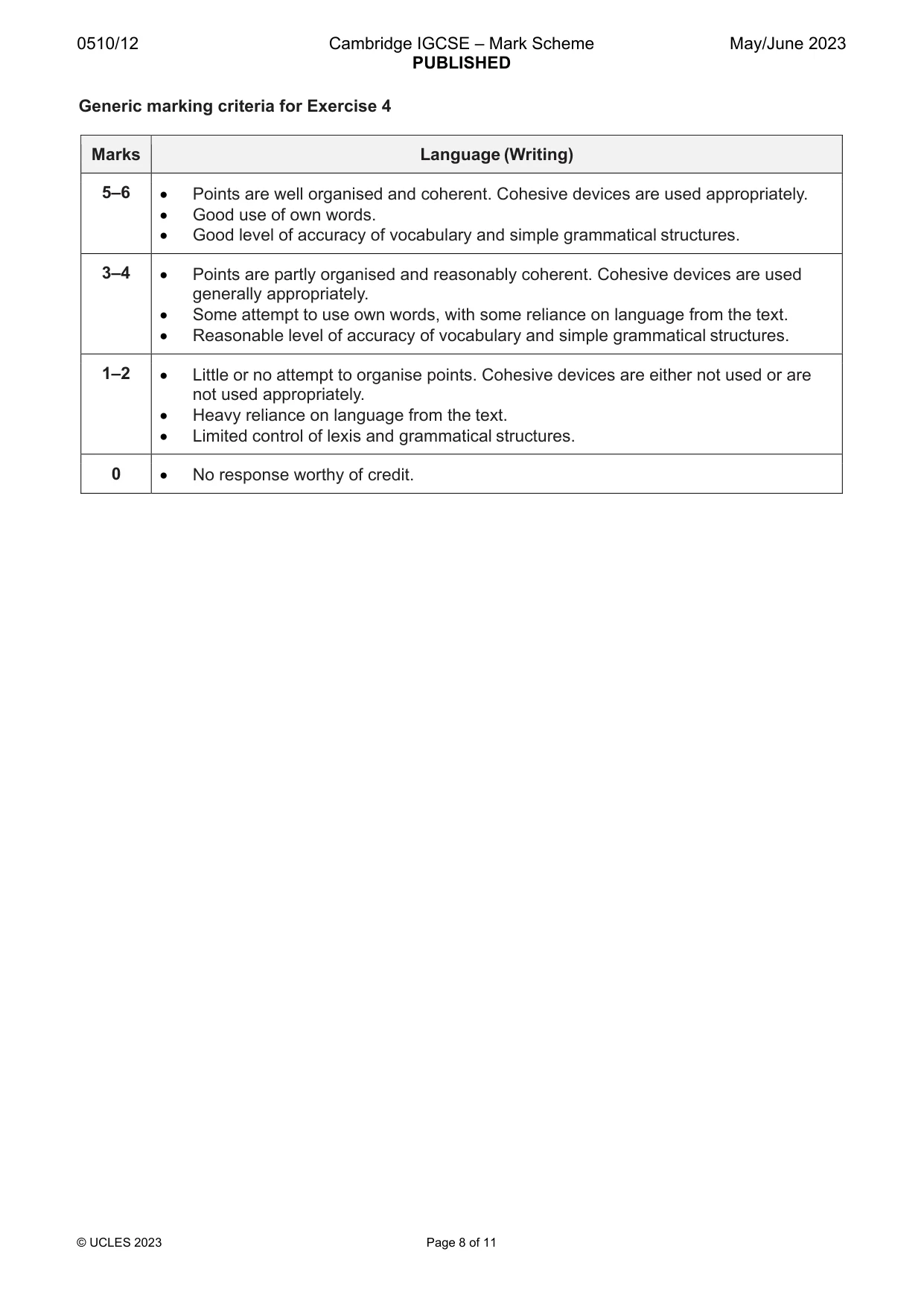
0510/12 Cambridge IGCSE – Mark Scheme PUBLISHED May/June 2023 © UCLES 2023 Page 8 of 11 Generic marking criteria for Exercise 4 Marks Language (Writing) 5–6 Points are well organised and coherent. Cohesive devices are used appropriately. Good use of own words. Good level of accuracy of vocabulary and simple grammatical structures. 3–4 Points are partly organised and reasonably coherent. Cohesive devices are used generally appropriately. Some attempt to use own words, with some reliance on language from the text. Reasonable level of accuracy of vocabulary and simple grammatical structures. 1–2 Little or no attempt to organise points. Cohesive devices are either not used or are not used appropriately. Heavy reliance on language from the text. Limited control of lexis and grammatical structures. 0 No response worthy of credit.
Mark scheme, page 9
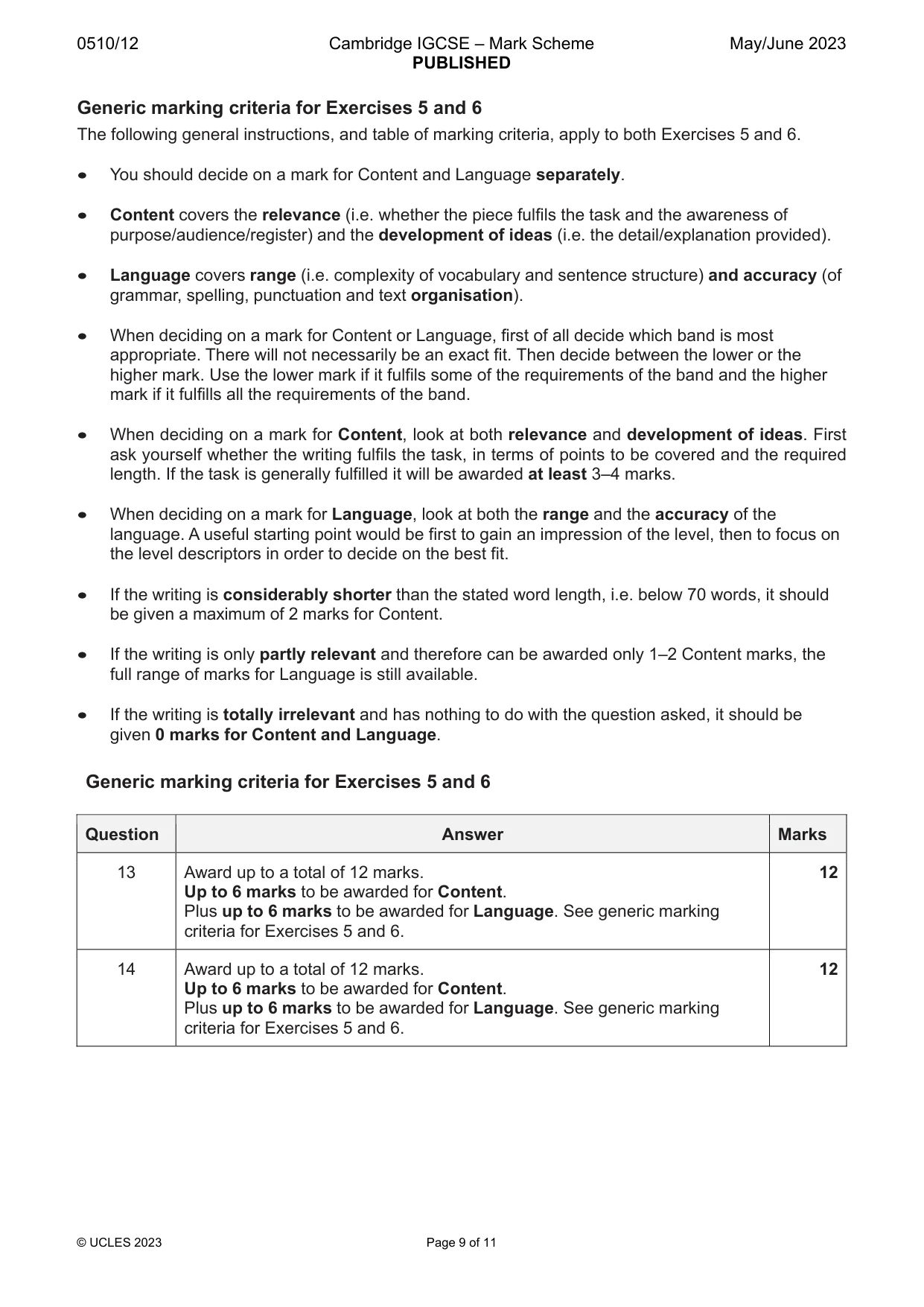
0510/12 Cambridge IGCSE – Mark Scheme PUBLISHED May/June 2023 © UCLES 2023 Page 9 of 11 Generic marking criteria for Exercises 5 and 6 The following general instructions, and table of marking criteria, apply to both Exercises 5 and 6. You should decide on a mark for Content and Language separately. Content covers the relevance (i.e. whether the piece fulfils the task and the awareness of purpose/audience/register) and the development of ideas (i.e. the detail/explanation provided). Language covers range (i.e. complexity of vocabulary and sentence structure) and accuracy (of grammar, spelling, punctuation and text organisation). When deciding on a mark for Content or Language, first of all decide which band is most appropriate. There will not necessarily be an exact fit. Then decide between the lower or the higher mark. Use the lower mark if it fulfils some of the requirements of the band and the higher mark if it fulfills all the requirements of the band. When deciding on a mark for Content, look at both relevance and development of ideas. First ask yourself whether the writing fulfils the task, in terms of points to be covered and the required length. If the task is generally fulfilled it will be awarded at least 3–4 marks. When deciding on a mark for Language, look at both the range and the accuracy of the language. A useful starting point would be first to gain an impression of the level, then to focus on the level descriptors in order to decide on the best fit. If the writing is considerably shorter than the stated word length, i.e. below 70 words, it should be given a maximum of 2 marks for Content. If the writing is only partly relevant and therefore can be awarded only 1–2 Content marks, the full range of marks for Language is still available. If the writing is totally irrelevant and has nothing to do with the question asked, it should be given 0 marks for Content and Language. Generic marking criteria for Exercises 5 and 6 Question Answer Marks 13 Award up to a total of 12 marks. Up to 6 marks to be awarded for Content. Plus up to 6 marks to be awarded for Language. See generic marking criteria for Exercises 5 and 6. 12 14 Award up to a total of 12 marks. Up to 6 marks to be awarded for Content. Plus up to 6 marks to be awarded for Language. See generic marking criteria for Exercises 5 and 6. 12
Mark scheme, page 10
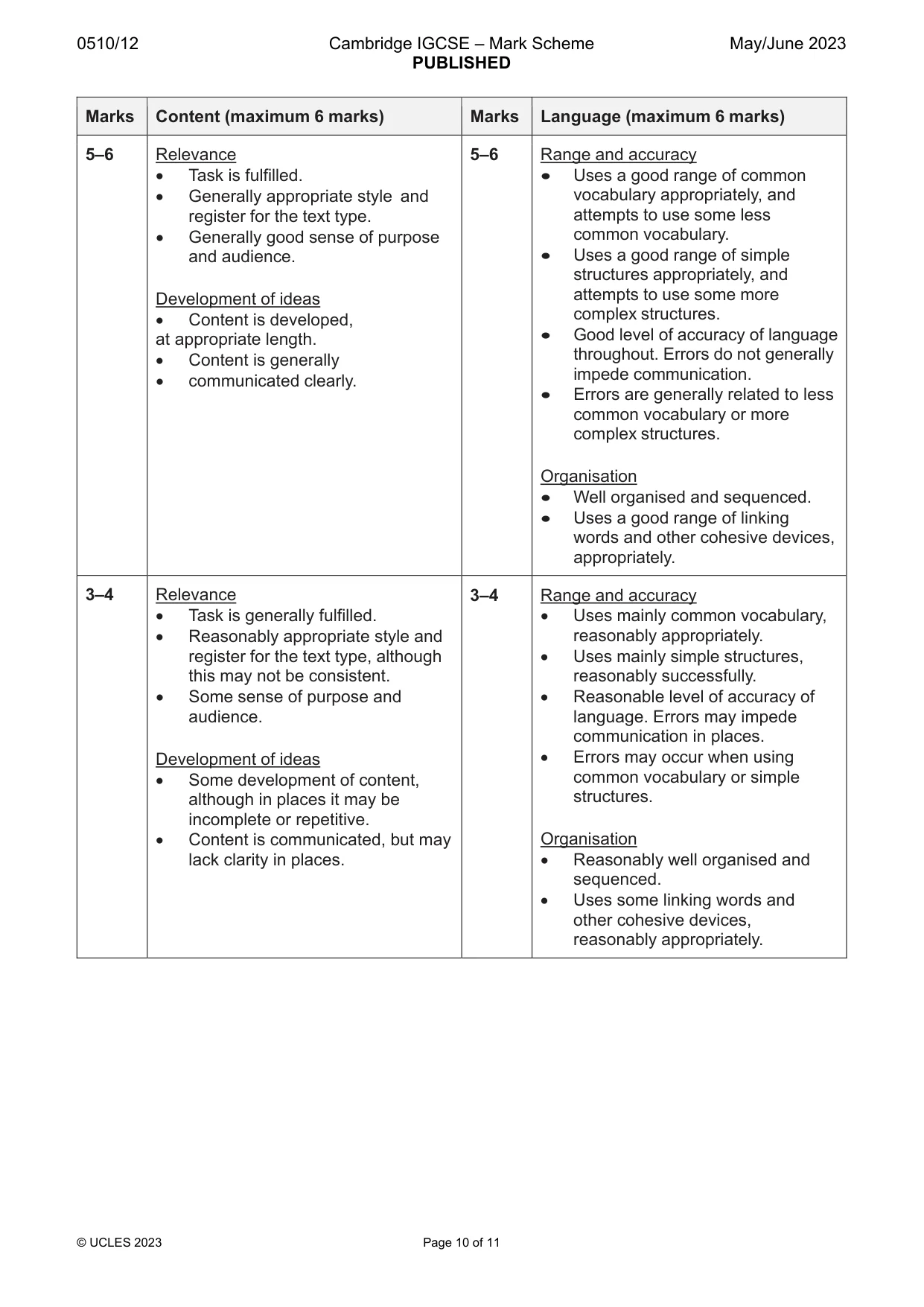
0510/12 Cambridge IGCSE – Mark Scheme PUBLISHED May/June 2023 © UCLES 2023 Page 10 of 11 Marks Content (maximum 6 marks) Marks Language (maximum 6 marks) 5–6 Relevance Task is fulfilled. Generally appropriate style and register for the text type. Generally good sense of purpose and audience. Development of ideas Content is developed, at appropriate length. Content is generally communicated clearly. 5–6 Range and accuracy Uses a good range of common vocabulary appropriately, and attempts to use some less common vocabulary. Uses a good range of simple structures appropriately, and attempts to use some more complex structures. Good level of accuracy of language throughout. Errors do not generally impede communication. Errors are generally related to less common vocabulary or more complex structures. Organisation Well organised and sequenced. Uses a good range of linking words and other cohesive devices, appropriately. 3–4 Relevance Task is generally fulfilled. Reasonably appropriate style and register for the text type, although this may not be consistent. Some sense of purpose and audience. Development of ideas Some development of content, although in places it may be incomplete or repetitive. Content is communicated, but may lack clarity in places. 3–4 Range and accuracy Uses mainly common vocabulary, reasonably appropriately. Uses mainly simple structures, reasonably successfully. Reasonable level of accuracy of language. Errors may impede communication in places. Errors may occur when using common vocabulary or simple structures. Organisation Reasonably well organised and sequenced. Uses some linking words and other cohesive devices, reasonably appropriately.
Mark scheme, page 11
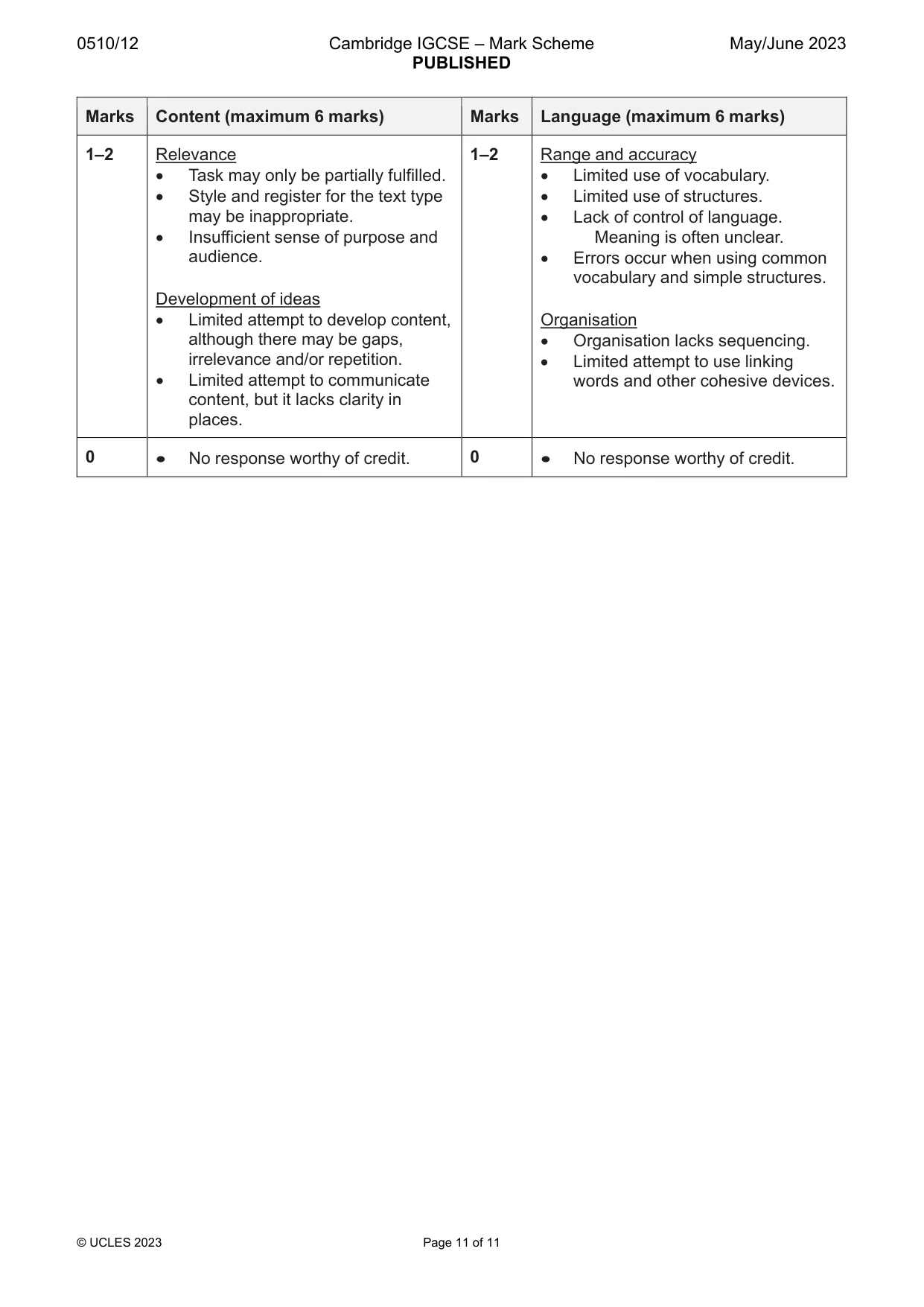
0510/12 Cambridge IGCSE – Mark Scheme PUBLISHED May/June 2023 © UCLES 2023 Page 11 of 11 Marks Content (maximum 6 marks) Marks Language (maximum 6 marks) 1–2 Relevance Task may only be partially fulfilled. Style and register for the text type may be inappropriate. Insufficient sense of purpose and audience. Development of ideas Limited attempt to develop content, although there may be gaps, irrelevance and/or repetition. Limited attempt to communicate content, but it lacks clarity in places. 1–2 Range and accuracy Limited use of vocabulary. Limited use of structures. Lack of control of language. Meaning is often unclear. Errors occur when using common vocabulary and simple structures. Organisation Organisation lacks sequencing. Limited attempt to use linking words and other cohesive devices. 0 No response worthy of credit. 0 No response worthy of credit.
What you needed in this session
Cambridge’s own grade thresholds for 2023 May/June, Paper 1 · Variant 2. A higher threshold means an easier paper — the bar moves with how the cohort did.