Cambridge IGCSE English - Second Language (oral endorsement) 0510 — 2023 Feb/March Paper 2 · Variant 2
0510/22/F/M/23 · 80 marks · ≈90 min
The question paper and its mark scheme, free to read here and free to download. This is Cambridge’s own paper, exactly as it was sat.
Question paper16 pages



Mark scheme10 pages
Answers below. Sit the paper first if you are practising.
Paper as text
Question paper, page 1
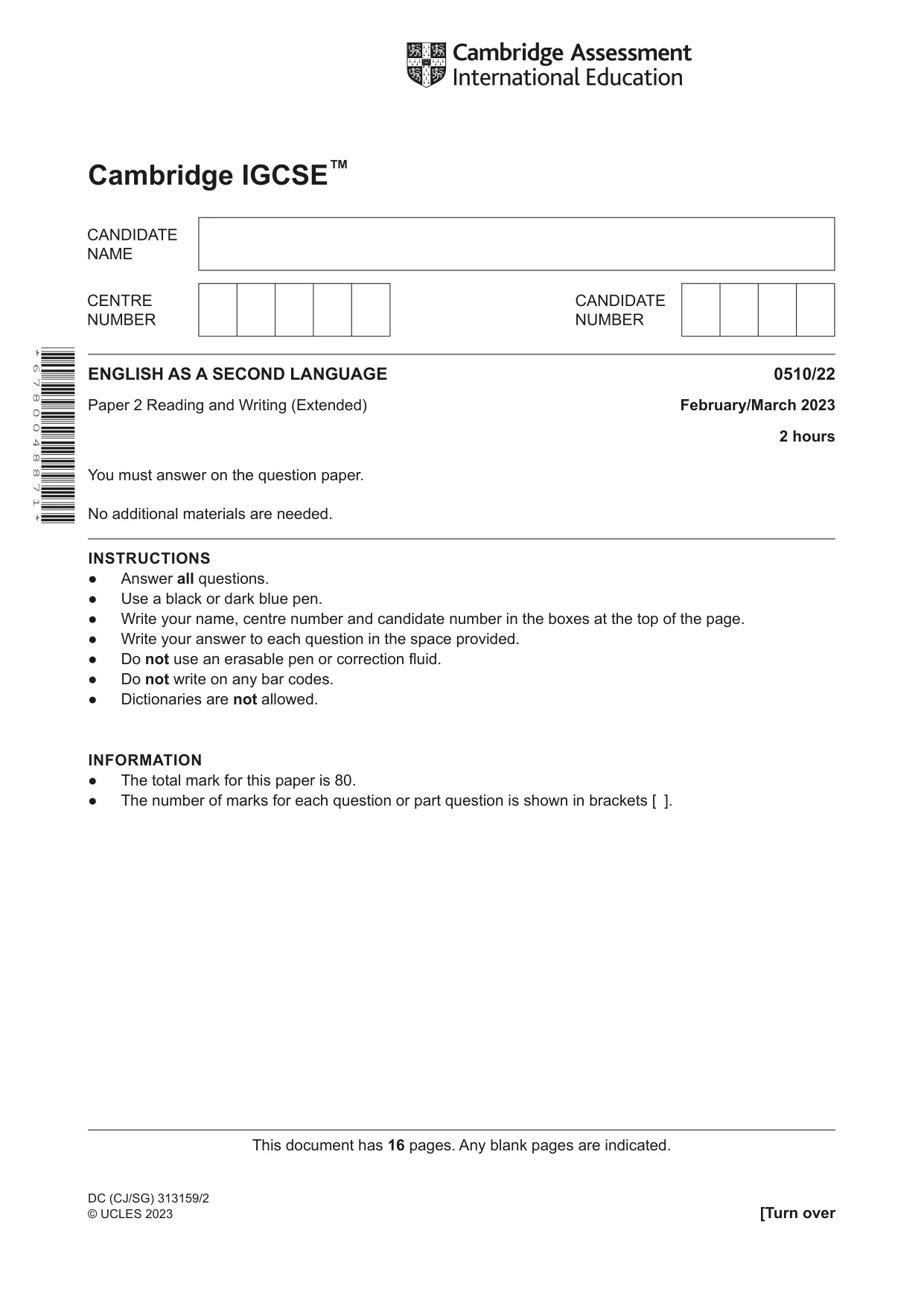
This document has 16 pages. Any blank pages are indicated. [Turn over Cambridge IGCSE™ ENGLISH AS A SECOND LANGUAGE 0510/22 Paper 2 Reading and Writing (Extended) February/March 2023 2 hours You must answer on the question paper. No additional materials are needed. INSTRUCTIONS ● Answer all questions. ● Use a black or dark blue pen. ● Write your name, centre number and candidate number in the boxes at the top of the page. ● Write your answer to each question in the space provided. ● Do not use an erasable pen or correction fluid. ● Do not write on any bar codes. ● Dictionaries are not allowed. INFORMATION ● The total mark for this paper is 80. ● The number of marks for each question or part question is shown in brackets [ ]. * 6 7 8 0 0 4 8 8 7 1 * DC (CJ/SG) 313159/2 © UCLES 2023
Question paper, page 2
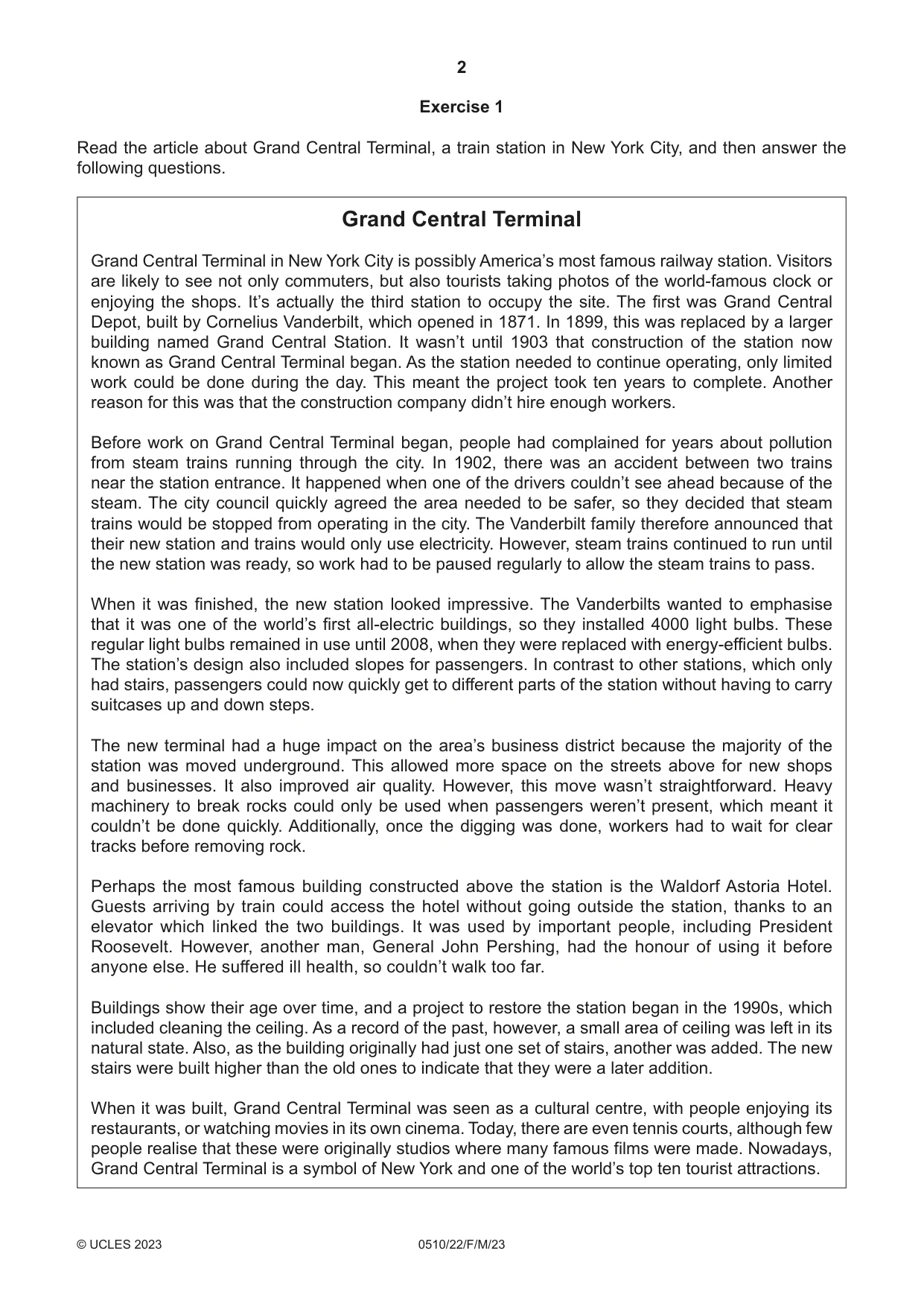
2 0510/22/F/M/23 © UCLES 2023 Exercise 1 Read the article about Grand Central Terminal, a train station in New York City, and then answer the following questions. Grand Central Terminal Grand Central Terminal in New York City is possibly America’s most famous railway station. Visitors are likely to see not only commuters, but also tourists taking photos of the world-famous clock or enjoying the shops. It’s actually the third station to occupy the site. The first was Grand Central Depot, built by Cornelius Vanderbilt, which opened in 1871. In 1899, this was replaced by a larger building named Grand Central Station. It wasn’t until 1903 that construction of the station now known as Grand Central Terminal began. As the station needed to continue operating, only limited work could be done during the day. This meant the project took ten years to complete. Another reason for this was that the construction company didn’t hire enough workers. Before work on Grand Central Terminal began, people had complained for years about pollution from steam trains running through the city. In 1902, there was an accident between two trains near the station entrance. It happened when one of the drivers couldn’t see ahead because of the steam. The city council quickly agreed the area needed to be safer, so they decided that steam trains would be stopped from operating in the city. The Vanderbilt family therefore announced that their new station and trains would only use electricity. However, steam trains continued to run until the new station was ready, so work had to be paused regularly to allow the steam trains to pass. When it was finished, the new station looked impressive. The Vanderbilts wanted to emphasise that it was one of the world’s first all-electric buildings, so they installed 4000 light bulbs. These regular light bulbs remained in use until 2008, when they were replaced with energy-efficient bulbs. The station’s design also included slopes for passengers. In contrast to other stations, which only had stairs, passengers could now quickly get to different parts of the station without having to carry suitcases up and down steps. The new terminal had a huge impact on the area’s business district because the majority of the station was moved underground. This allowed more space on the streets above for new shops and businesses. It also improved air quality. However, this move wasn’t straightforward. Heavy machinery to break rocks could only be used when passengers weren’t present, which meant it couldn’t be done quickly. Additionally, once the digging was done, workers had to wait for clear tracks before removing rock. Perhaps the most famous building constructed above the station is the Waldorf Astoria Hotel. Guests arriving by train could access the hotel without going outside the station, thanks to an elevator which linked the two buildings. It was used by important people, including President Roosevelt. However, another man, General John Pershing, had the honour of using it before anyone else. He suffered ill health, so couldn’t walk too far. Buildings show their age over time, and a project to restore the station began in the 1990s, which included cleaning the ceiling. As a record of the past, however, a small area of ceiling was left in its natural state. Also, as the building originally had just one set of stairs, another was added. The new stairs were built higher than the old ones to indicate that they were a later addition. When it was built, Grand Central Terminal was seen as a cultural centre, with people enjoying its restaurants, or watching movies in its own cinema. Today, there are even tennis courts, although few people realise that these were originally studios where many famous films were made. Nowadays, Grand Central Terminal is a symbol of New York and one of the world’s top ten tourist attractions.
Question paper, page 3
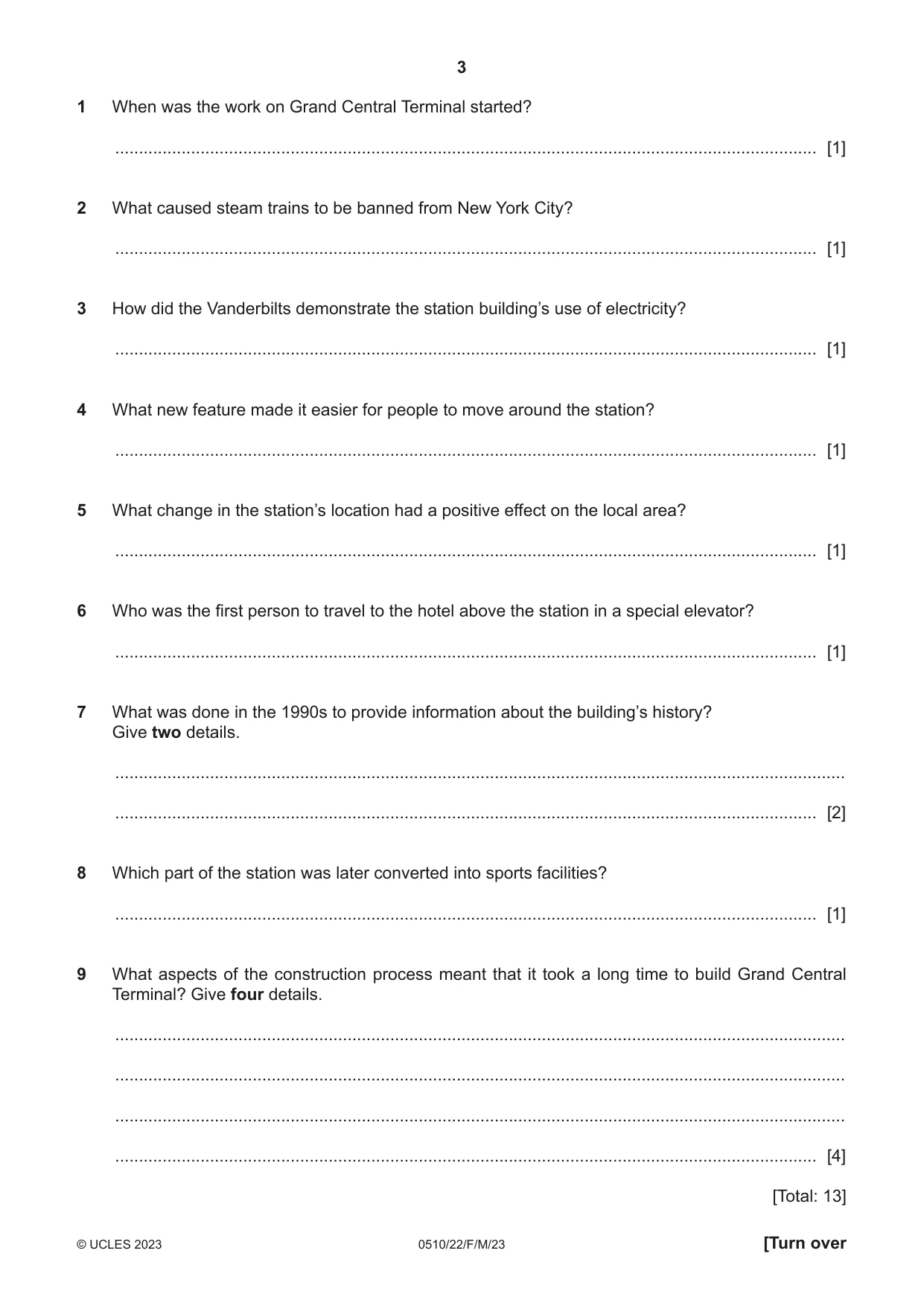
3 0510/22/F/M/23 © UCLES 2023 [Turn over 1 When was the work on Grand Central Terminal started? … [1] 2 What caused steam trains to be banned from New York City? … [1] 3 How did the Vanderbilts demonstrate the station building’s use of electricity? … [1] 4 What new feature made it easier for people to move around the station? … [1] 5 What change in the station’s location had a positive effect on the local area? … [1] 6 Who was the first person to travel to the hotel above the station in a special elevator? … [1] 7 What was done in the 1990s to provide information about the building’s history? Give two details. … … [2] 8 Which part of the station was later converted into sports facilities? … [1] 9 What aspects of the construction process meant that it took a long time to build Grand Central Terminal? Give four details. … … … … [4] [Total: 13]
Question paper, page 4
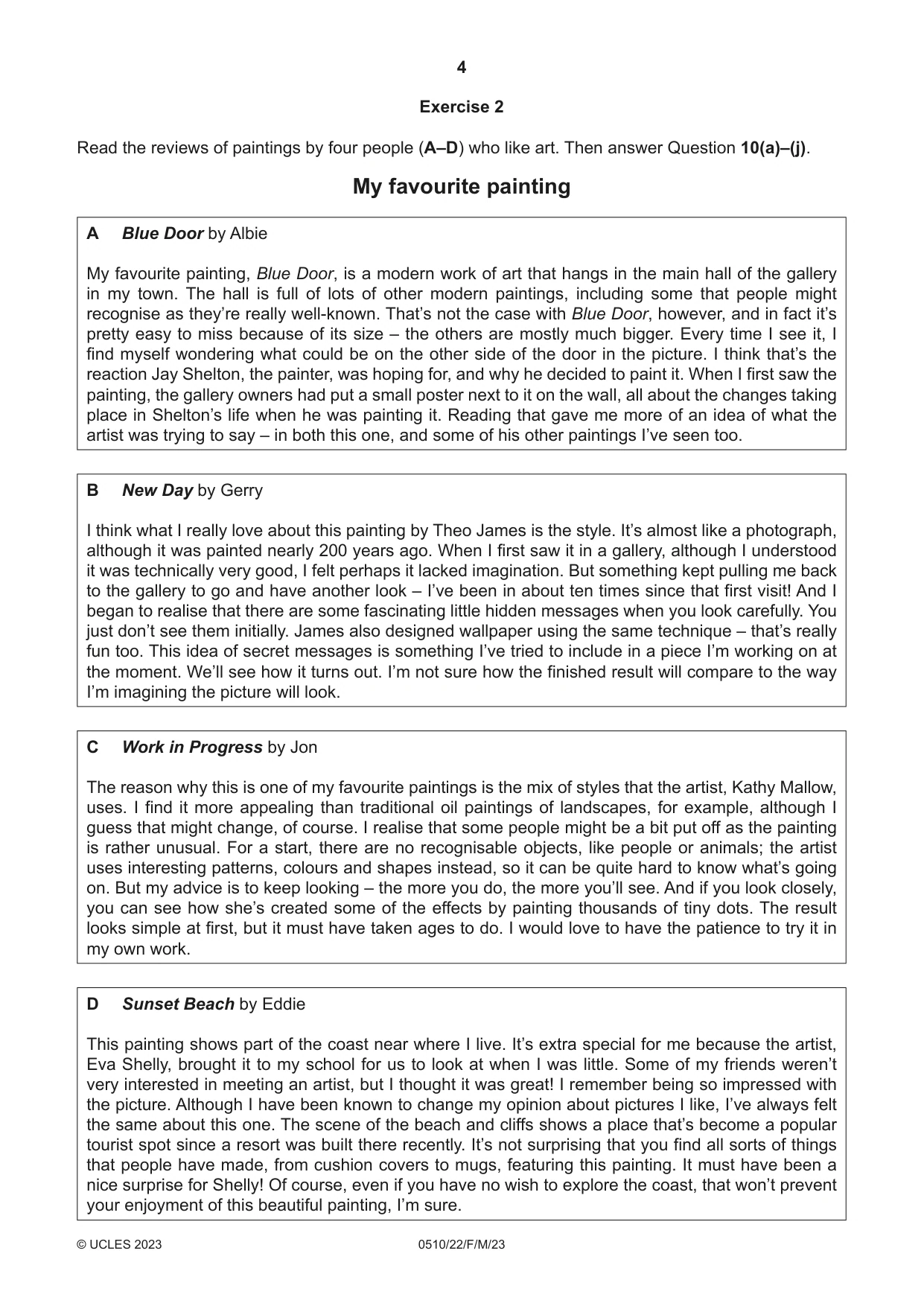
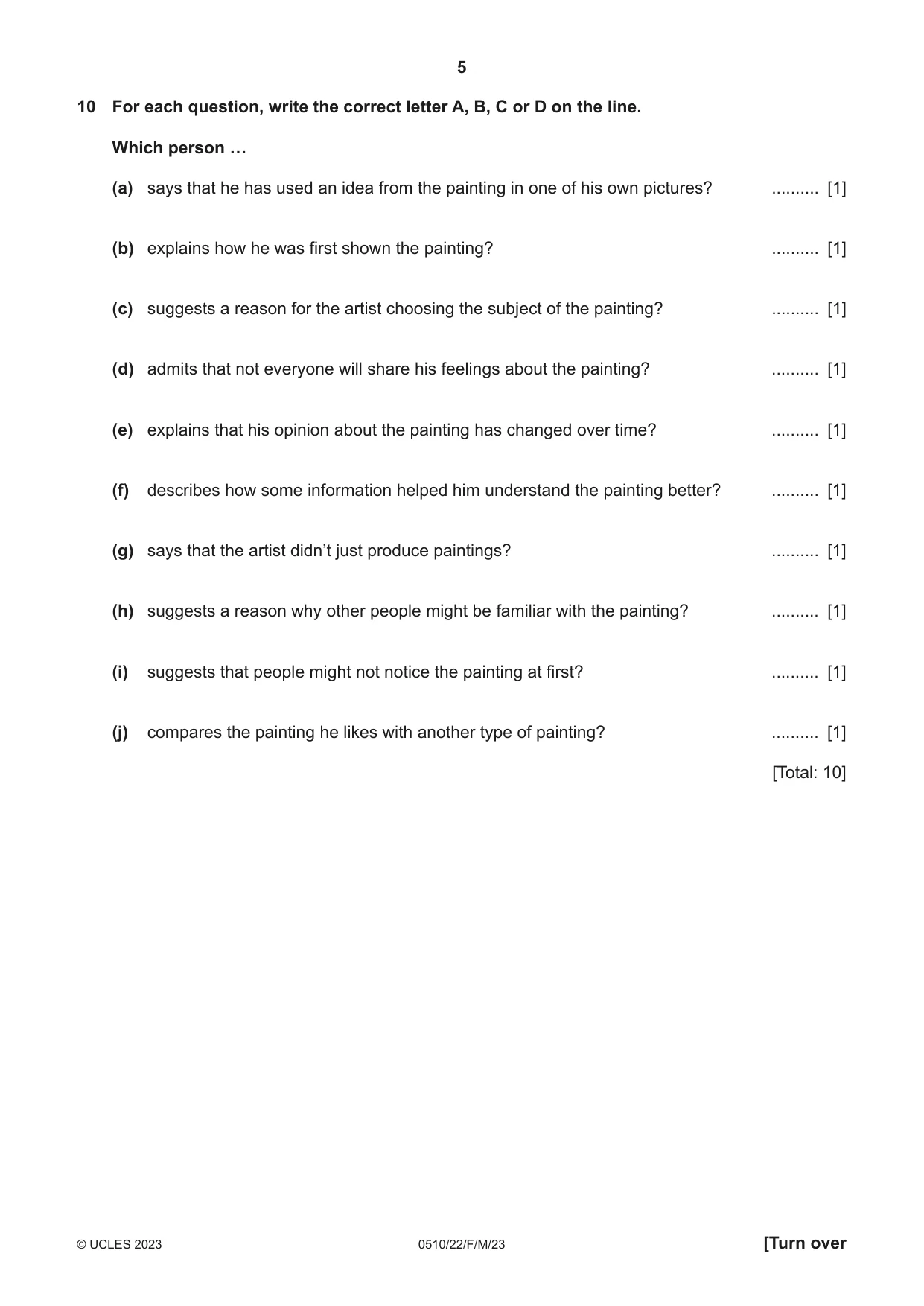
4 0510/22/F/M/23 © UCLES 2023 Exercise 2 Read the reviews of paintings by four people (A–D) who like art. Then answer Question 10(a)–(j). My favourite painting A Blue Door by Albie My favourite painting, Blue Door, is a modern work of art that hangs in the main hall of the gallery in my town. The hall is full of lots of other modern paintings, including some that people might recognise as they’re really well-known. That’s not the case with Blue Door, however, and in fact it’s pretty easy to miss because of its size – the others are mostly much bigger. Every time I see it, I find myself wondering what could be on the other side of the door in the picture. I think that’s the reaction Jay Shelton, the painter, was hoping for, and why he decided to paint it. When I first saw the painting, the gallery owners had put a small poster next to it on the wall, all about the changes taking place in Shelton’s life when he was painting it. Reading that gave me more of an idea of what the artist was trying to say – in both this one, and some of his other paintings I’ve seen too. B New Day by Gerry I think what I really love about this painting by Theo James is the style. It’s almost like a photograph, although it was painted nearly 200 years ago. When I first saw it in a gallery, although I understood it was technically very good, I felt perhaps it lacked imagination. But something kept pulling me back to the gallery to go and have another look – I’ve been in about ten times since that first visit! And I began to realise that there are some fascinating little hidden messages when you look carefully. You just don’t see them initially. James also designed wallpaper using the same technique – that’s really fun too. This idea of secret messages is something I’ve tried to include in a piece I’m working on at the moment. We’ll see how it turns out. I’m not sure how the finished result will compare to the way I’m imagining the picture will look. C Work in Progress by Jon The reason why this is one of my favourite paintings is the mix of styles that the artist, Kathy Mallow, uses. I find it more appealing than traditional oil paintings of landscapes, for example, although I guess that might change, of course. I realise that some people might be a bit put off as the painting is rather unusual. For a start, there are no recognisable objects, like people or animals; the artist uses interesting patterns, colours and shapes instead, so it can be quite hard to know what’s going on. But my advice is to keep looking – the more you do, the more you’ll see. And if you look closely, you can see how she’s created some of the effects by painting thousands of tiny dots. The result looks simple at first, but it must have taken ages to do. I would love to have the patience to try it in my own work. D Sunset Beach by Eddie This painting shows part of the coast near where I live. It’s extra special for me because the artist, Eva Shelly, brought it to my school for us to look at when I was little. Some of my friends weren’t very interested in meeting an artist, but I thought it was great! I remember being so impressed with the picture. Although I have been known to change my opinion about pictures I like, I’ve always felt the same about this one. The scene of the beach and cliffs shows a place that’s become a popular tourist spot since a resort was built there recently. It’s not surprising that you find all sorts of things that people have made, from cushion covers to mugs, featuring this painting. It must have been a nice surprise for Shelly! Of course, even if you have no wish to explore the coast, that won’t prevent your enjoyment of this beautiful painting, I’m sure.
Question paper, page 5
5 0510/22/F/M/23 © UCLES 2023 [Turn over 10 For each question, write the correct letter A, B, C or D on the line. Which person … (a) says that he has used an idea from the painting in one of his own pictures? … [1] (b) explains how he was first shown the painting? … [1] (c) suggests a reason for the artist choosing the subject of the painting? … [1] (d) admits that not everyone will share his feelings about the painting? … [1] (e) explains that his opinion about the painting has changed over time? … [1] (f) describes how some information helped him understand the painting better? … [1] (g) says that the artist didn’t just produce paintings? … [1] (h) suggests a reason why other people might be familiar with the painting? … [1] (i) suggests that people might not notice the painting at first? … [1] (j) compares the painting he likes with another type of painting? … [1] [Total: 10]
Question paper, page 6
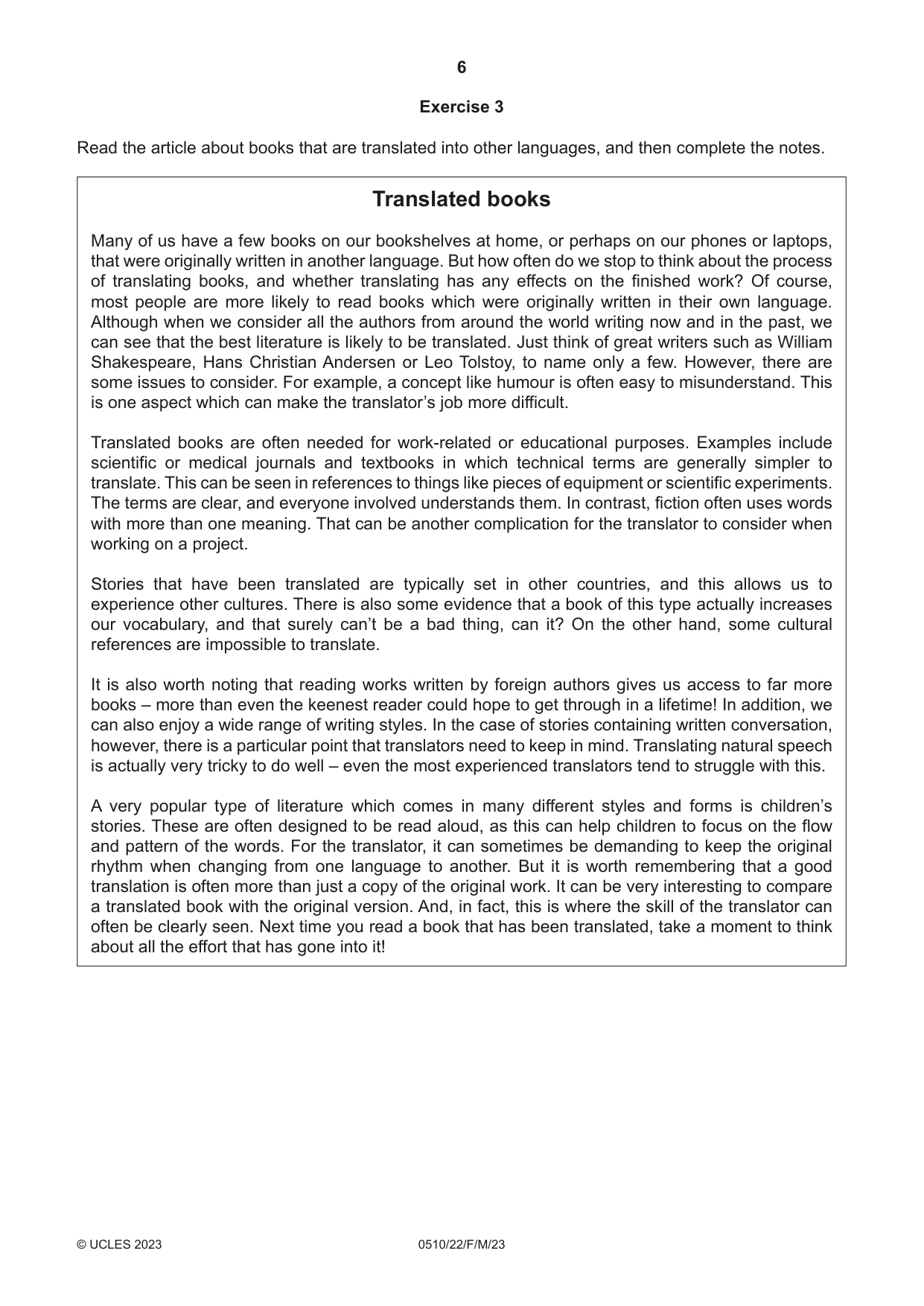
6 0510/22/F/M/23 © UCLES 2023 Exercise 3 Read the article about books that are translated into other languages, and then complete the notes. Translated books Many of us have a few books on our bookshelves at home, or perhaps on our phones or laptops, that were originally written in another language. But how often do we stop to think about the process of translating books, and whether translating has any effects on the finished work? Of course, most people are more likely to read books which were originally written in their own language. Although when we consider all the authors from around the world writing now and in the past, we can see that the best literature is likely to be translated. Just think of great writers such as William Shakespeare, Hans Christian Andersen or Leo Tolstoy, to name only a few. However, there are some issues to consider. For example, a concept like humour is often easy to misunderstand. This is one aspect which can make the translator’s job more difficult. Translated books are often needed for work-related or educational purposes. Examples include scientific or medical journals and textbooks in which technical terms are generally simpler to translate. This can be seen in references to things like pieces of equipment or scientific experiments. The terms are clear, and everyone involved understands them. In contrast, fiction often uses words with more than one meaning. That can be another complication for the translator to consider when working on a project. Stories that have been translated are typically set in other countries, and this allows us to experience other cultures. There is also some evidence that a book of this type actually increases our vocabulary, and that surely can’t be a bad thing, can it? On the other hand, some cultural references are impossible to translate. It is also worth noting that reading works written by foreign authors gives us access to far more books – more than even the keenest reader could hope to get through in a lifetime! In addition, we can also enjoy a wide range of writing styles. In the case of stories containing written conversation, however, there is a particular point that translators need to keep in mind. Translating natural speech is actually very tricky to do well – even the most experienced translators tend to struggle with this. A very popular type of literature which comes in many different styles and forms is children’s stories. These are often designed to be read aloud, as this can help children to focus on the flow and pattern of the words. For the translator, it can sometimes be demanding to keep the original rhythm when changing from one language to another. But it is worth remembering that a good translation is often more than just a copy of the original work. It can be very interesting to compare a translated book with the original version. And, in fact, this is where the skill of the translator can often be clearly seen. Next time you read a book that has been translated, take a moment to think about all the effort that has gone into it!
Question paper, page 7
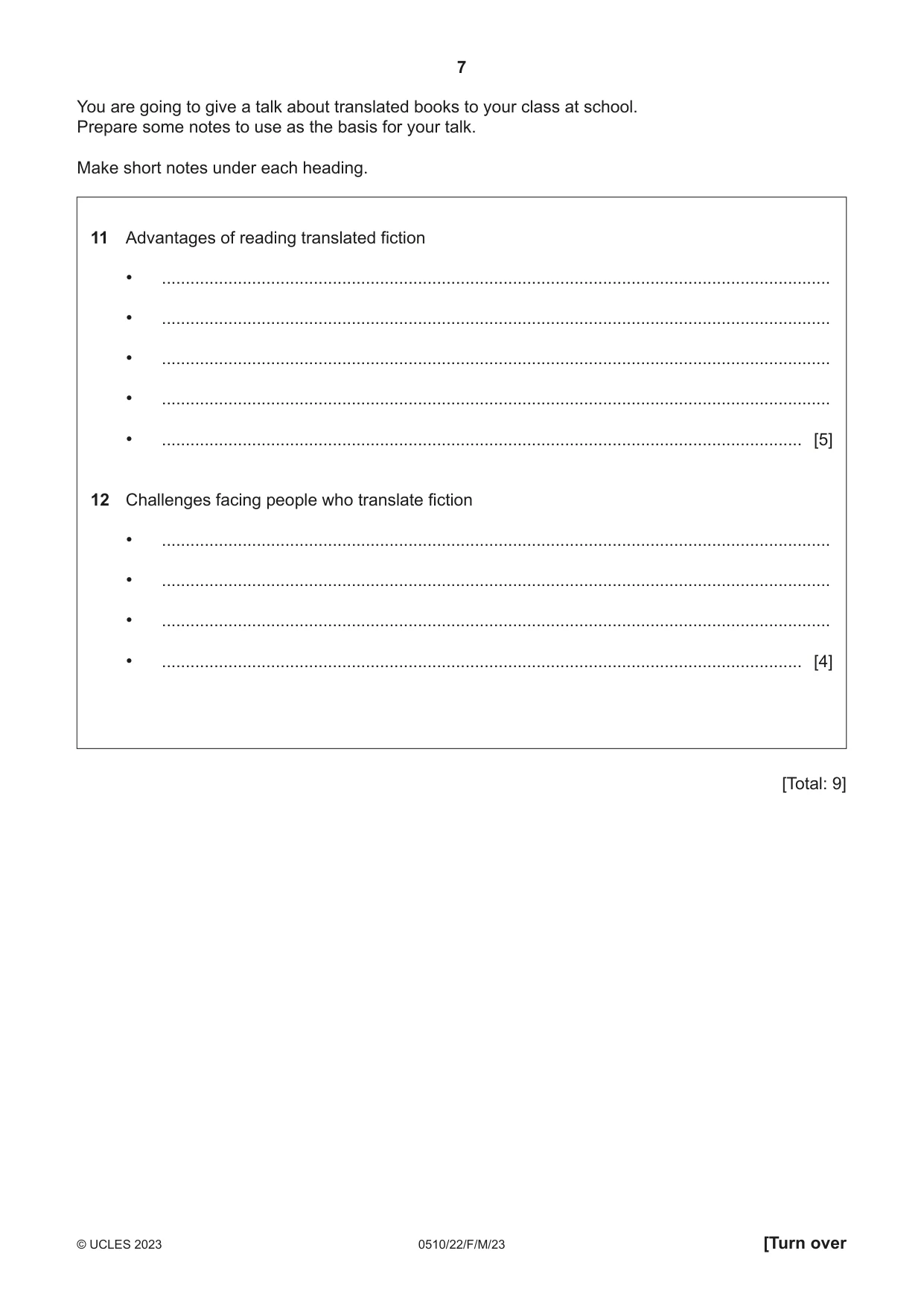
7 0510/22/F/M/23 © UCLES 2023 [Turn over You are going to give a talk about translated books to your class at school. Prepare some notes to use as the basis for your talk. Make short notes under each heading. 11 Advantages of reading translated fiction • … • … • … • … • … [5] 12 Challenges facing people who translate fiction • … • … • … • … [4] [Total: 9]
Question paper, page 8
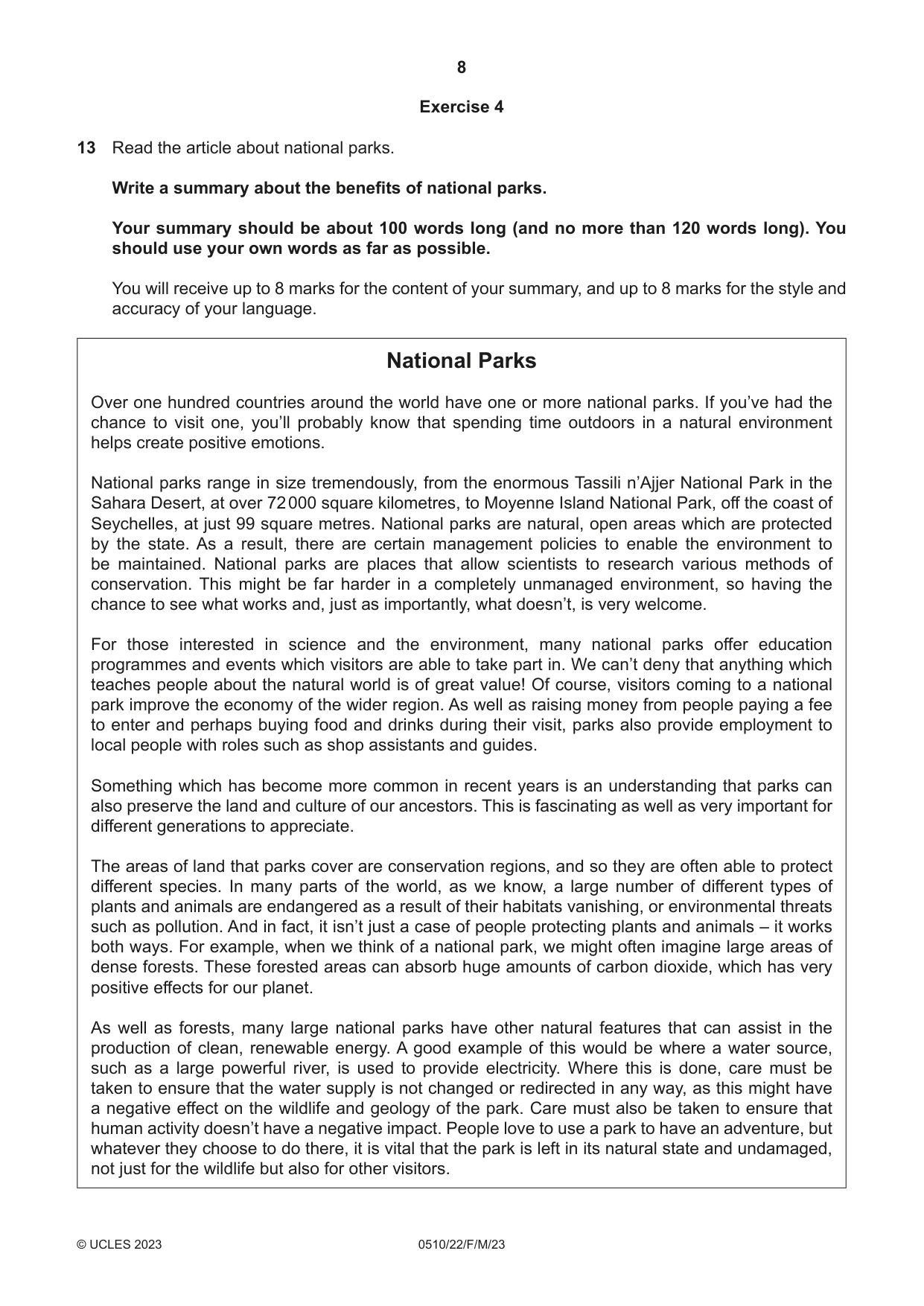
8 0510/22/F/M/23 © UCLES 2023 Exercise 4 13 Read the article about national parks. Write a summary about the benefits of national parks. Your summary should be about 100 words long (and no more than 120 words long). You should use your own words as far as possible. You will receive up to 8 marks for the content of your summary, and up to 8 marks for the style and accuracy of your language. National Parks Over one hundred countries around the world have one or more national parks. If you’ve had the chance to visit one, you’ll probably know that spending time outdoors in a natural environment helps create positive emotions. National parks range in size tremendously, from the enormous Tassili n’Ajjer National Park in the Sahara Desert, at over 72 000 square kilometres, to Moyenne Island National Park, off the coast of Seychelles, at just 99 square metres. National parks are natural, open areas which are protected by the state. As a result, there are certain management policies to enable the environment to be maintained. National parks are places that allow scientists to research various methods of conservation. This might be far harder in a completely unmanaged environment, so having the chance to see what works and, just as importantly, what doesn’t, is very welcome. For those interested in science and the environment, many national parks offer education programmes and events which visitors are able to take part in. We can’t deny that anything which teaches people about the natural world is of great value! Of course, visitors coming to a national park improve the economy of the wider region. As well as raising money from people paying a fee to enter and perhaps buying food and drinks during their visit, parks also provide employment to local people with roles such as shop assistants and guides. Something which has become more common in recent years is an understanding that parks can also preserve the land and culture of our ancestors. This is fascinating as well as very important for different generations to appreciate. The areas of land that parks cover are conservation regions, and so they are often able to protect different species. In many parts of the world, as we know, a large number of different types of plants and animals are endangered as a result of their habitats vanishing, or environmental threats such as pollution. And in fact, it isn’t just a case of people protecting plants and animals – it works both ways. For example, when we think of a national park, we might often imagine large areas of dense forests. These forested areas can absorb huge amounts of carbon dioxide, which has very positive effects for our planet. As well as forests, many large national parks have other natural features that can assist in the production of clean, renewable energy. A good example of this would be where a water source, such as a large powerful river, is used to provide electricity. Where this is done, care must be taken to ensure that the water supply is not changed or redirected in any way, as this might have a negative effect on the wildlife and geology of the park. Care must also be taken to ensure that human activity doesn’t have a negative impact. People love to use a park to have an adventure, but whatever they choose to do there, it is vital that the park is left in its natural state and undamaged, not just for the wildlife but also for other visitors.
Question paper, page 9
9 0510/22/F/M/23 © UCLES 2023 [Turn over … … … … … … … … … … … … … … … … … … … … … … … … … … … [Total: 16]
Question paper, page 10
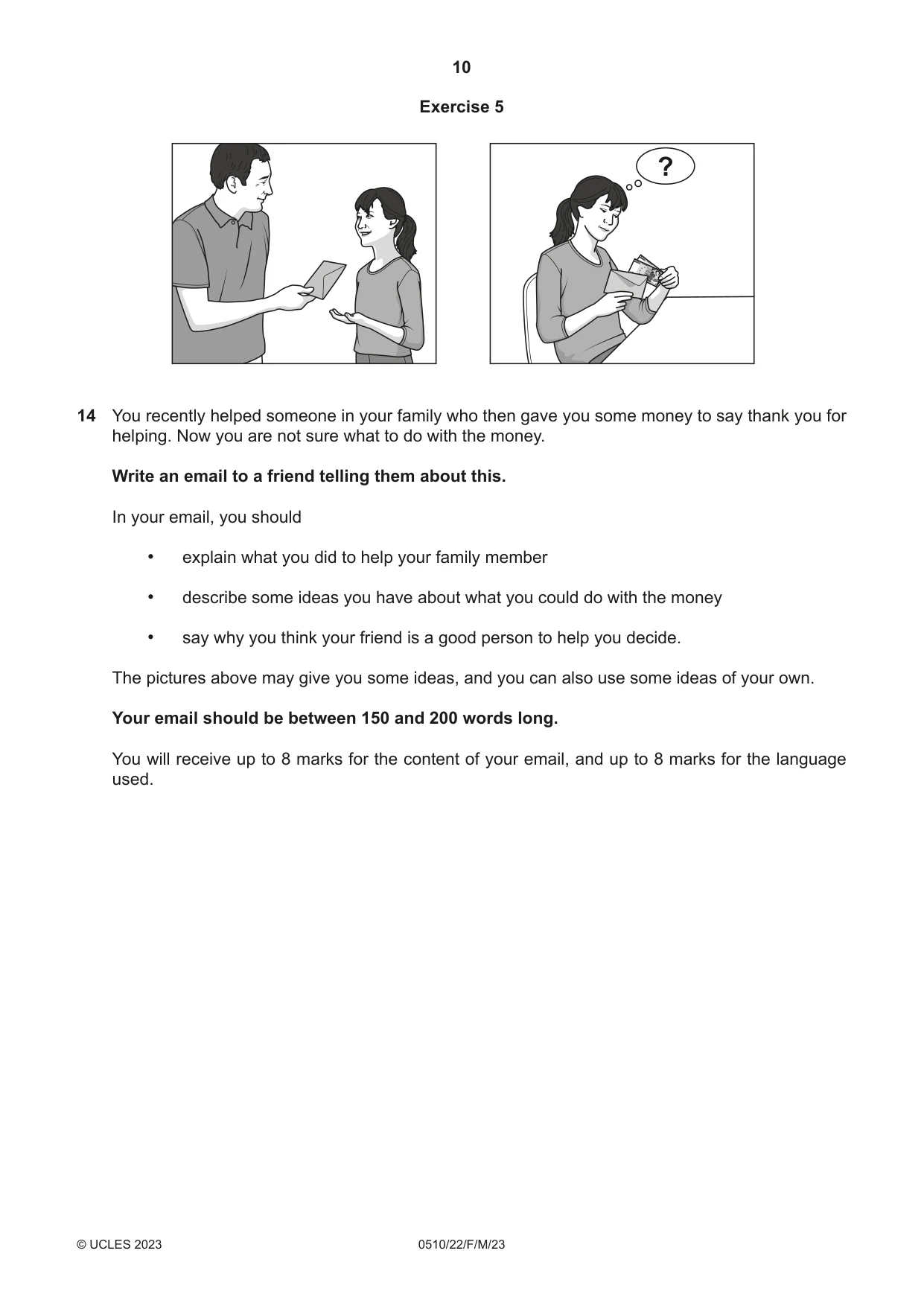
10 0510/22/F/M/23 © UCLES 2023 Exercise 5 ? 14 You recently helped someone in your family who then gave you some money to say thank you for helping. Now you are not sure what to do with the money. Write an email to a friend telling them about this. In your email, you should • explain what you did to help your family member • describe some ideas you have about what you could do with the money • say why you think your friend is a good person to help you decide. The pictures above may give you some ideas, and you can also use some ideas of your own. Your email should be between 150 and 200 words long. You will receive up to 8 marks for the content of your email, and up to 8 marks for the language used.
Question paper, page 11
11 0510/22/F/M/23 © UCLES 2023 [Turn over … … … … … … … … … … … … … … … … … … … … … … … … … … … [Total: 16]
Question paper, page 12
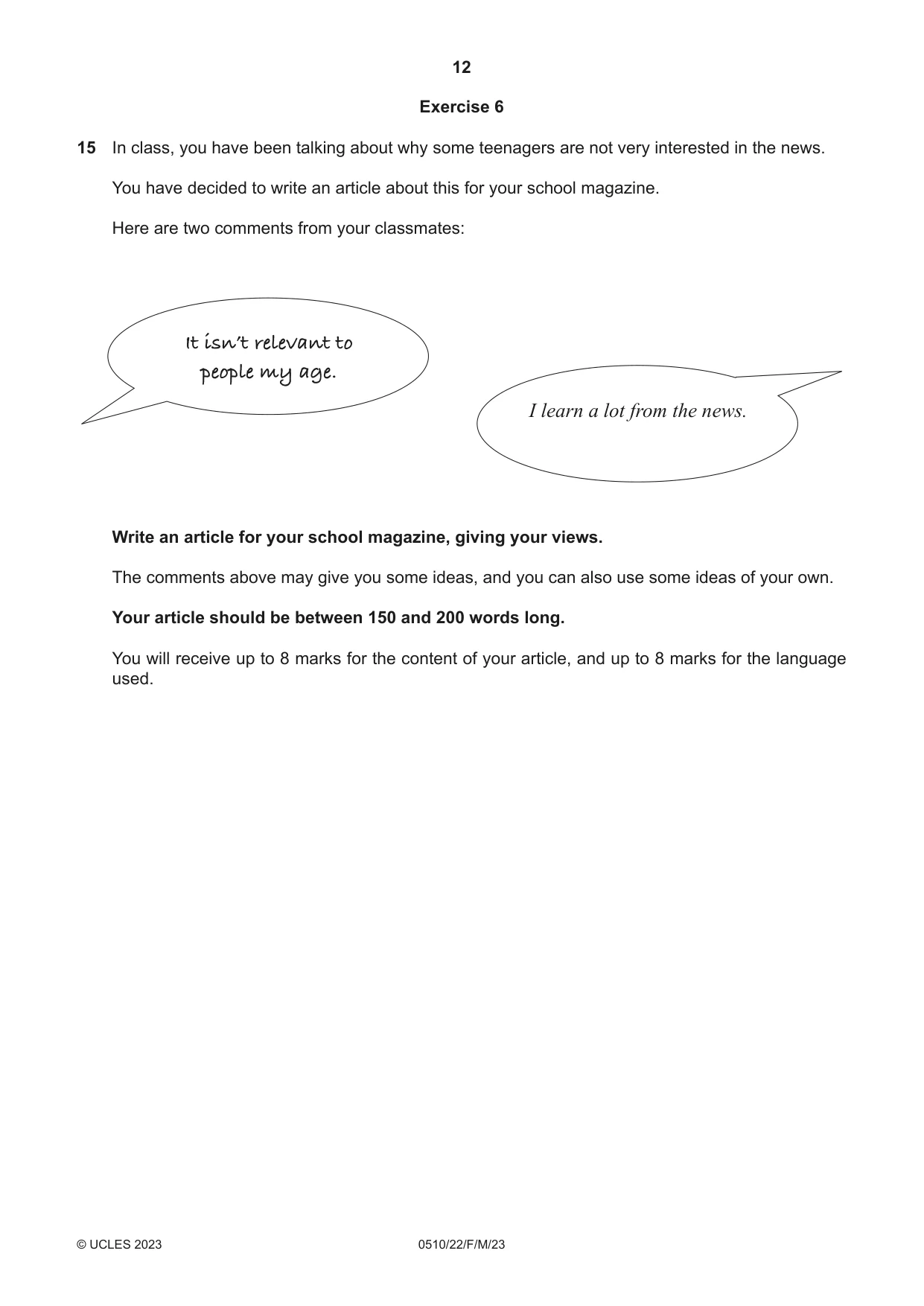
12 0510/22/F/M/23 © UCLES 2023 Exercise 6 15 In class, you have been talking about why some teenagers are not very interested in the news. You have decided to write an article about this for your school magazine. Here are two comments from your classmates: It isn’t relevant to people my age. I learn a lot from the news. Write an article for your school magazine, giving your views. The comments above may give you some ideas, and you can also use some ideas of your own. Your article should be between 150 and 200 words long. You will receive up to 8 marks for the content of your article, and up to 8 marks for the language used.
Question paper, page 13
13 0510/22/F/M/23 © UCLES 2023 … … … … … … … … … … … … … … … … … … … … … … … … … … … [Total: 16]
Question paper, page 14
14 0510/22/F/M/23 © UCLES 2023 BLANK PAGE
Question paper, page 15
15 0510/22/F/M/23 © UCLES 2023 BLANK PAGE
Question paper, page 16
16 0510/22/F/M/23 © UCLES 2023 Permission to reproduce items where third-party owned material protected by copyright is included has been sought and cleared where possible. Every reasonable effort has been made by the publisher (UCLES) to trace copyright holders, but if any items requiring clearance have unwittingly been included, the publisher will be pleased to make amends at the earliest possible opportunity. To avoid the issue of disclosure of answer-related information to candidates, all copyright acknowledgements are reproduced online in the Cambridge Assessment International Education Copyright Acknowledgements Booklet. This is produced for each series of examinations and is freely available to download at www.cambridgeinternational.org after the live examination series. Cambridge Assessment International Education is part of Cambridge Assessment. Cambridge Assessment is the brand name of the University of Cambridge Local Examinations Syndicate (UCLES), which is a department of the University of Cambridge. BLANK PAGE
Mark scheme, page 1
This document consists of 10 printed pages. © UCLES 2023 [Turn over Cambridge IGCSE™ ENGLISH AS A SECOND LANGUAGE 0510/22 Paper 2 Reading and Writing (Extended) February/March 2023 MARK SCHEME Maximum Mark: 80 Published This mark scheme is published as an aid to teachers and candidates, to indicate the requirements of the examination. It shows the basis on which Examiners were instructed to award marks. It does not indicate the details of the discussions that took place at an Examiners’ meeting before marking began, which would have considered the acceptability of alternative answers. Mark schemes should be read in conjunction with the question paper and the Principal Examiner Report for Teachers. Cambridge International will not enter into discussions about these mark schemes. Cambridge International is publishing the mark schemes for the February/March 2023 series for most Cambridge IGCSE™, Cambridge International A and AS Level components and some Cambridge O Level components.
Mark scheme, page 2
0510/22 Cambridge IGCSE – Mark Scheme PUBLISHED February/March 2023 © UCLES 2023 Page 2 of 10 This component forms part of the Extended tier assessment of Cambridge IGCSE English as a Second Language and tests the following Assessment Objectives: AO1: Reading R1 identify and select relevant information R2 understand ideas, opinions and attitudes R3 show understanding of the connections between ideas, opinions and attitudes R4 understand what is implied but not directly stated, e.g. gist, writer’s purpose, intentions and feelings AO2: Writing W1 communicate information/ideas/opinions clearly, accurately and effectively W2 organise ideas into coherent paragraphs using a range of appropriate linking devices W3 use a range of grammatical structures accurately and effectively W4 show control of punctuation and spelling W5 use appropriate register and style/format for the given purpose and audience
Mark scheme, page 3
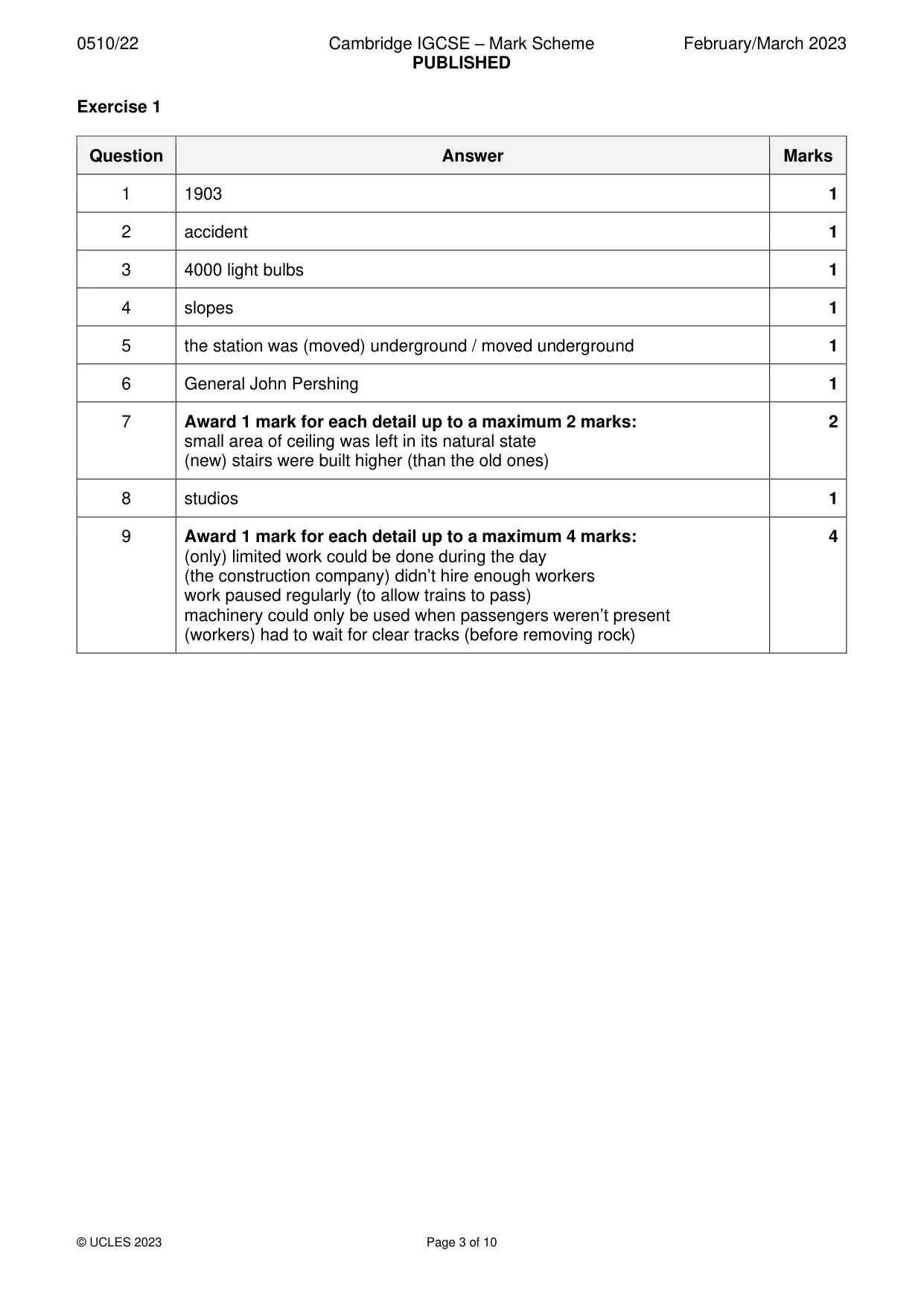
0510/22 Cambridge IGCSE – Mark Scheme PUBLISHED February/March 2023 © UCLES 2023 Page 3 of 10 Exercise 1 Question Answer Marks 1 1903 1 2 accident 1 3 4000 light bulbs 1 4 slopes 1 5 the station was (moved) underground / moved underground 1 6 General John Pershing 1 7 Award 1 mark for each detail up to a maximum 2 marks: small area of ceiling was left in its natural state (new) stairs were built higher (than the old ones) 2 8 studios 1 9 Award 1 mark for each detail up to a maximum 4 marks: (only) limited work could be done during the day (the construction company) didn’t hire enough workers work paused regularly (to allow trains to pass) machinery could only be used when passengers weren’t present (workers) had to wait for clear tracks (before removing rock) 4
Mark scheme, page 4
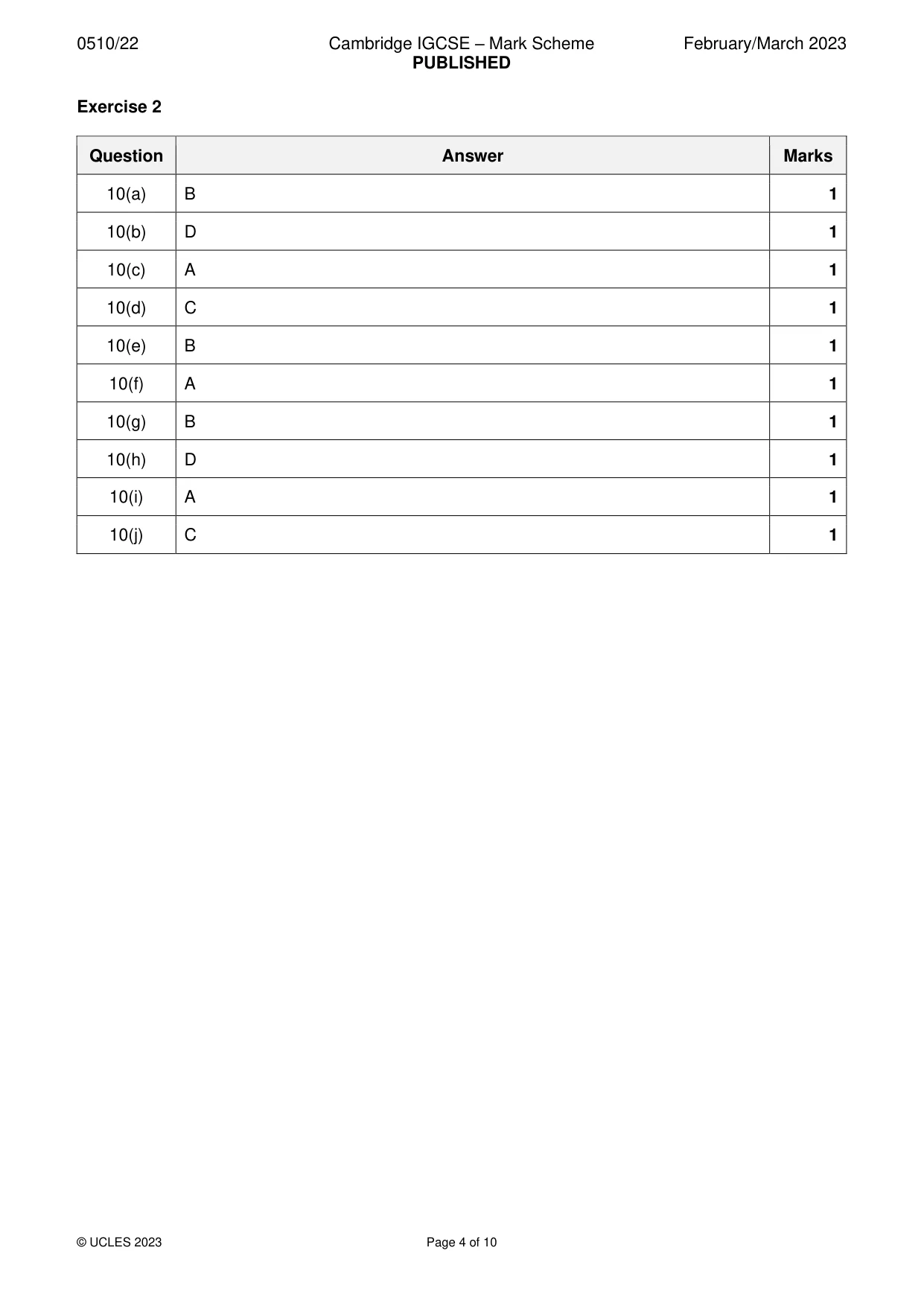
0510/22 Cambridge IGCSE – Mark Scheme PUBLISHED February/March 2023 © UCLES 2023 Page 4 of 10 Exercise 2 Question Answer Marks 10(a) B 1 10(b) D 1 10(c) A 1 10(d) C 1 10(e) B 1 10(f) A 1 10(g) B 1 10(h) D 1 10(i) A 1 10(j) C 1
Mark scheme, page 5
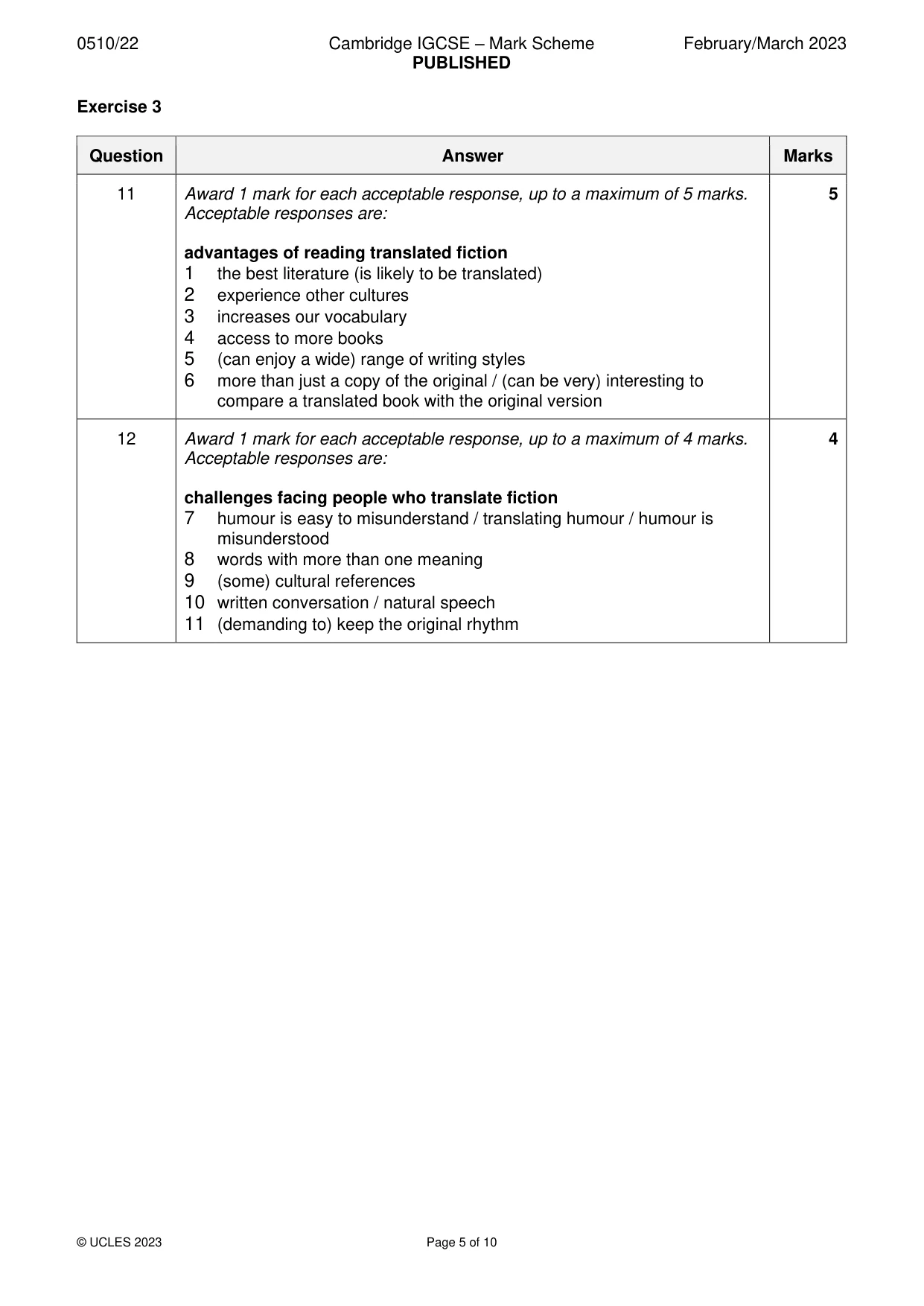
0510/22 Cambridge IGCSE – Mark Scheme PUBLISHED February/March 2023 © UCLES 2023 Page 5 of 10 Exercise 3 Question Answer Marks 11 Award 1 mark for each acceptable response, up to a maximum of 5 marks. Acceptable responses are: advantages of reading translated fiction 1 the best literature (is likely to be translated) 2 experience other cultures 3 increases our vocabulary 4 access to more books 5 (can enjoy a wide) range of writing styles 6 more than just a copy of the original / (can be very) interesting to compare a translated book with the original version 5 12 Award 1 mark for each acceptable response, up to a maximum of 4 marks. Acceptable responses are: challenges facing people who translate fiction 7 humour is easy to misunderstand / translating humour / humour is misunderstood 8 words with more than one meaning 9 (some) cultural references 10 written conversation / natural speech 11 (demanding to) keep the original rhythm 4
Mark scheme, page 6
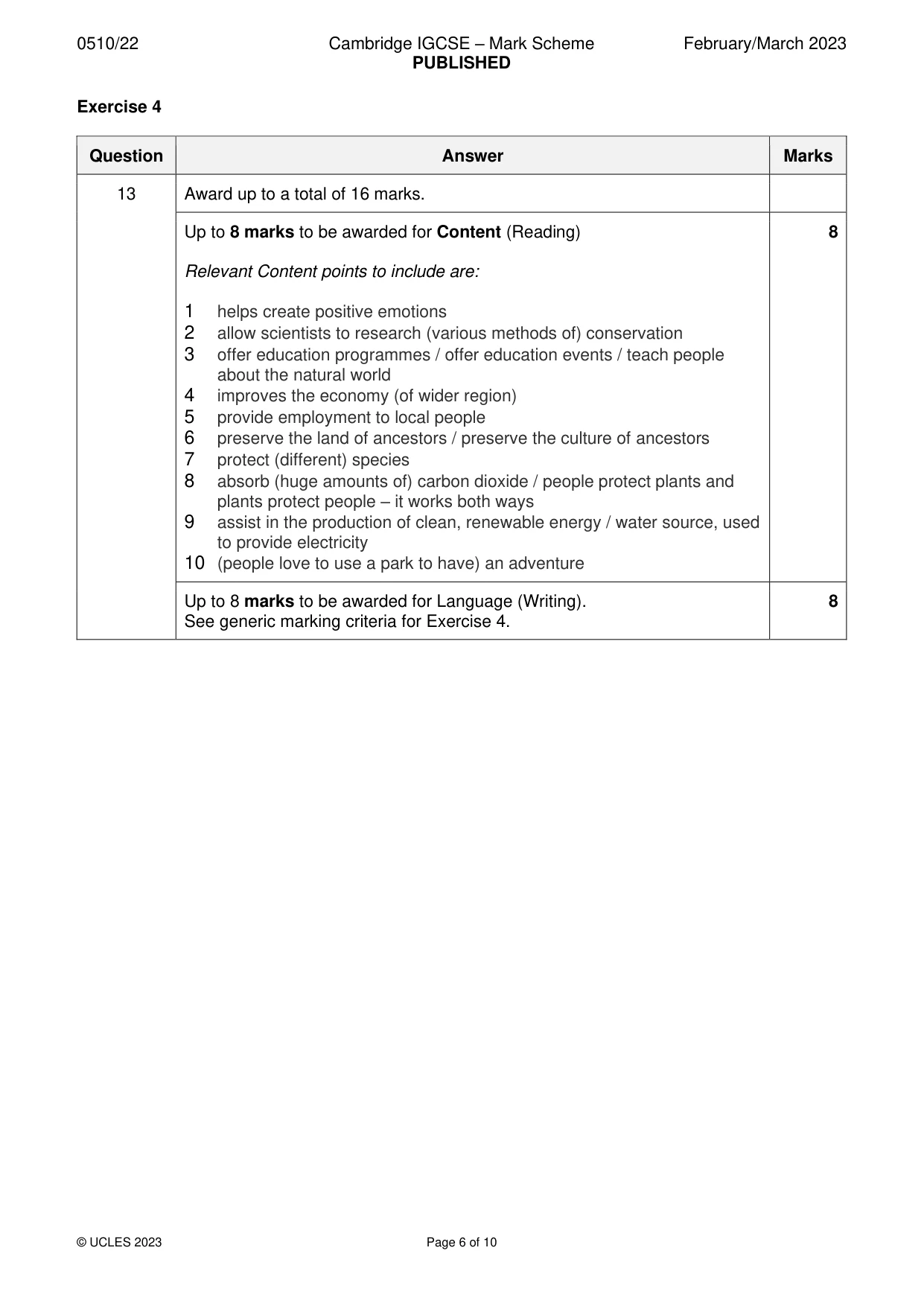
0510/22 Cambridge IGCSE – Mark Scheme PUBLISHED February/March 2023 © UCLES 2023 Page 6 of 10 Exercise 4 Question Answer Marks 13 Award up to a total of 16 marks. Up to 8 marks to be awarded for Content (Reading) Relevant Content points to include are: 1 helps create positive emotions 2 allow scientists to research (various methods of) conservation 3 offer education programmes / offer education events / teach people about the natural world 4 improves the economy (of wider region) 5 provide employment to local people 6 preserve the land of ancestors / preserve the culture of ancestors 7 protect (different) species 8 absorb (huge amounts of) carbon dioxide / people protect plants and plants protect people – it works both ways 9 assist in the production of clean, renewable energy / water source, used to provide electricity 10 (people love to use a park to have) an adventure 8 Up to 8 marks to be awarded for Language (Writing). See generic marking criteria for Exercise 4. 8
Mark scheme, page 7
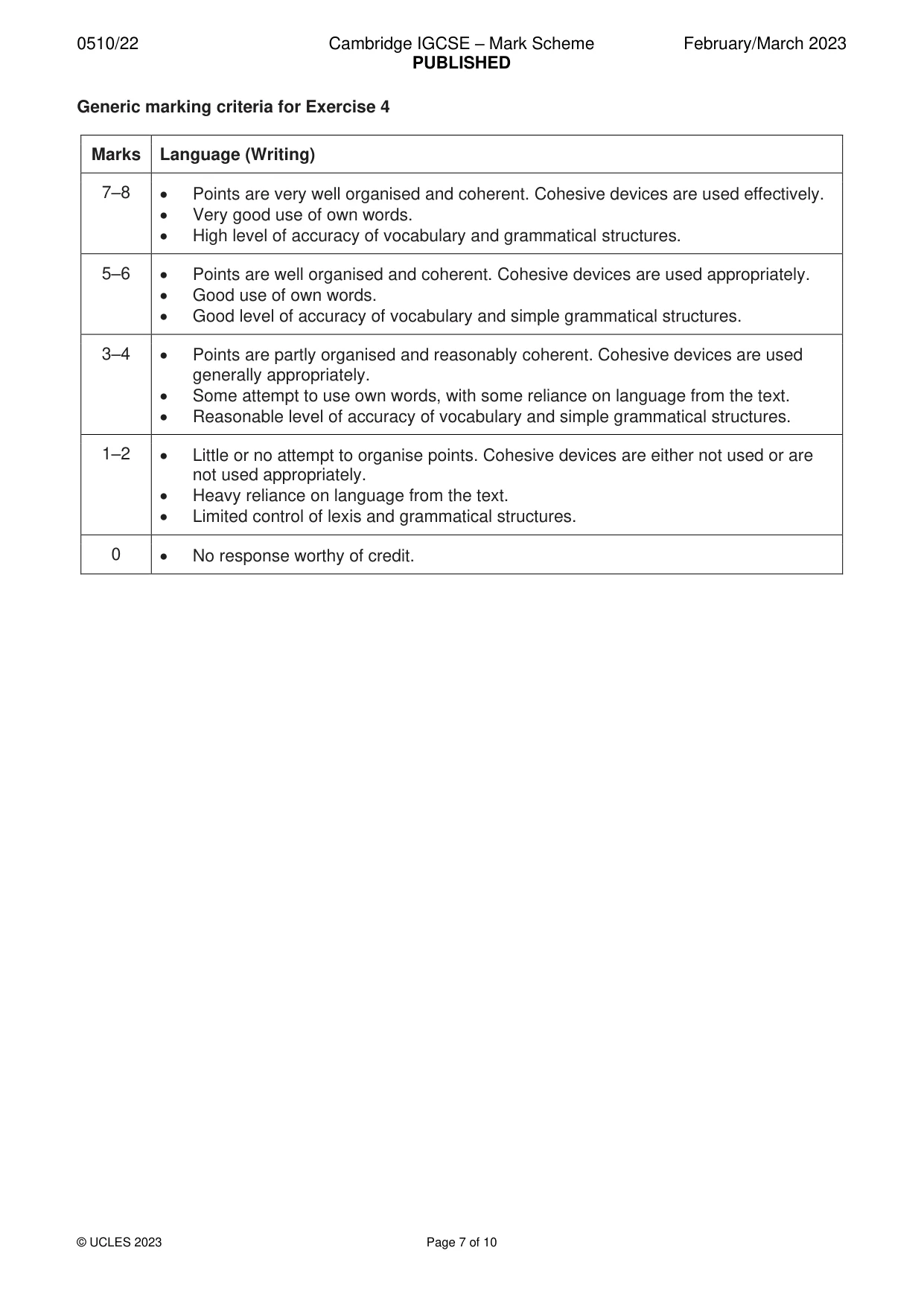
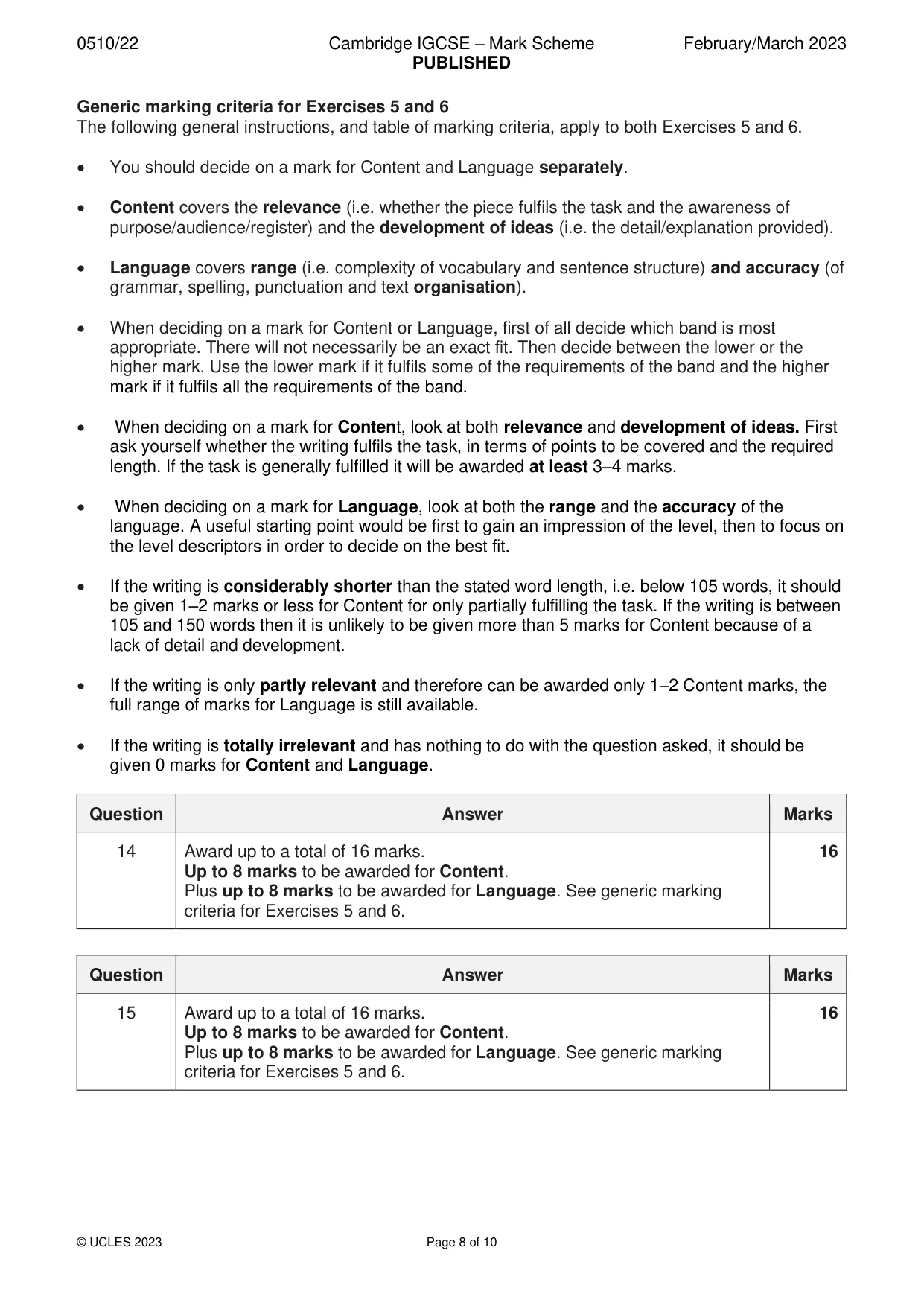
0510/22 Cambridge IGCSE – Mark Scheme PUBLISHED February/March 2023 © UCLES 2023 Page 7 of 10 Generic marking criteria for Exercise 4 Marks Language (Writing) 7–8 • Points are very well organised and coherent. Cohesive devices are used effectively. • Very good use of own words. • High level of accuracy of vocabulary and grammatical structures. 5–6 • Points are well organised and coherent. Cohesive devices are used appropriately. • Good use of own words. • Good level of accuracy of vocabulary and simple grammatical structures. 3–4 • Points are partly organised and reasonably coherent. Cohesive devices are used generally appropriately. • Some attempt to use own words, with some reliance on language from the text. • Reasonable level of accuracy of vocabulary and simple grammatical structures. 1–2 • Little or no attempt to organise points. Cohesive devices are either not used or are not used appropriately. • Heavy reliance on language from the text. • Limited control of lexis and grammatical structures. 0 • No response worthy of credit.
Mark scheme, page 8
0510/22 Cambridge IGCSE – Mark Scheme PUBLISHED February/March 2023 © UCLES 2023 Page 8 of 10 Generic marking criteria for Exercises 5 and 6 The following general instructions, and table of marking criteria, apply to both Exercises 5 and 6. • You should decide on a mark for Content and Language separately. • Content covers the relevance (i.e. whether the piece fulfils the task and the awareness of purpose/audience/register) and the development of ideas (i.e. the detail/explanation provided). • Language covers range (i.e. complexity of vocabulary and sentence structure) and accuracy (of grammar, spelling, punctuation and text organisation). • When deciding on a mark for Content or Language, first of all decide which band is most appropriate. There will not necessarily be an exact fit. Then decide between the lower or the higher mark. Use the lower mark if it fulfils some of the requirements of the band and the higher mark if it fulfils all the requirements of the band. • When deciding on a mark for Content, look at both relevance and development of ideas. First ask yourself whether the writing fulfils the task, in terms of points to be covered and the required length. If the task is generally fulfilled it will be awarded at least 3–4 marks. • When deciding on a mark for Language, look at both the range and the accuracy of the language. A useful starting point would be first to gain an impression of the level, then to focus on the level descriptors in order to decide on the best fit. • If the writing is considerably shorter than the stated word length, i.e. below 105 words, it should be given 1–2 marks or less for Content for only partially fulfilling the task. If the writing is between 105 and 150 words then it is unlikely to be given more than 5 marks for Content because of a lack of detail and development. • If the writing is only partly relevant and therefore can be awarded only 1–2 Content marks, the full range of marks for Language is still available. • If the writing is totally irrelevant and has nothing to do with the question asked, it should be given 0 marks for Content and Language. Question Answer Marks 14 Award up to a total of 16 marks. Up to 8 marks to be awarded for Content. Plus up to 8 marks to be awarded for Language. See generic marking criteria for Exercises 5 and 6. 16 Question Answer Marks 15 Award up to a total of 16 marks. Up to 8 marks to be awarded for Content. Plus up to 8 marks to be awarded for Language. See generic marking criteria for Exercises 5 and 6. 16
Mark scheme, page 9
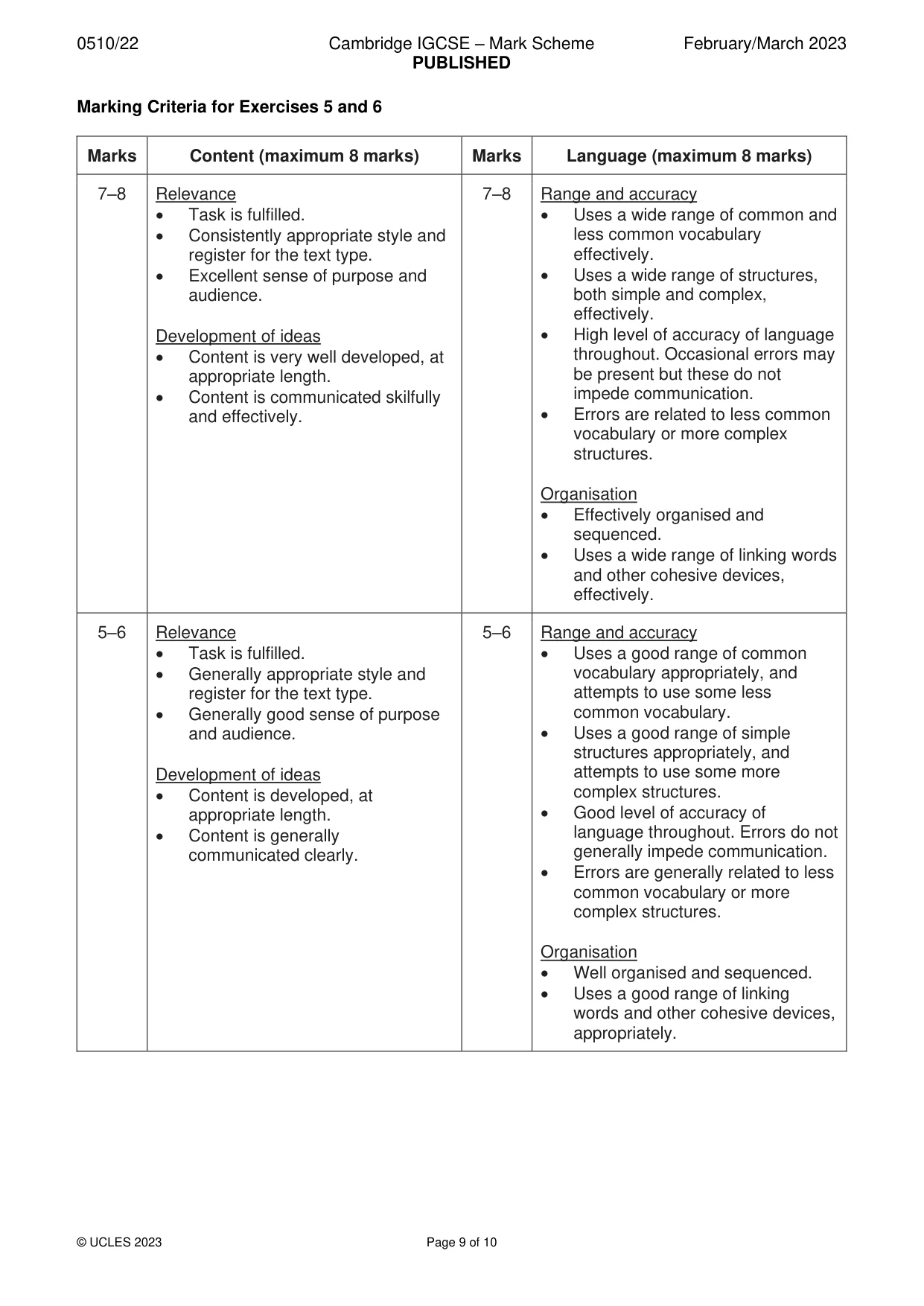
0510/22 Cambridge IGCSE – Mark Scheme PUBLISHED February/March 2023 © UCLES 2023 Page 9 of 10 Marking Criteria for Exercises 5 and 6 Marks Content (maximum 8 marks) Marks Language (maximum 8 marks) 7–8 Relevance • Task is fulfilled. • Consistently appropriate style and register for the text type. • Excellent sense of purpose and audience. Development of ideas • Content is very well developed, at appropriate length. • Content is communicated skilfully and effectively. 7–8 Range and accuracy • Uses a wide range of common and less common vocabulary effectively. • Uses a wide range of structures, both simple and complex, effectively. • High level of accuracy of language throughout. Occasional errors may be present but these do not impede communication. • Errors are related to less common vocabulary or more complex structures. Organisation • Effectively organised and sequenced. • Uses a wide range of linking words and other cohesive devices, effectively. 5–6 Relevance • Task is fulfilled. • Generally appropriate style and register for the text type. • Generally good sense of purpose and audience. Development of ideas • Content is developed, at appropriate length. • Content is generally communicated clearly. 5–6 Range and accuracy • Uses a good range of common vocabulary appropriately, and attempts to use some less common vocabulary. • Uses a good range of simple structures appropriately, and attempts to use some more complex structures. • Good level of accuracy of language throughout. Errors do not generally impede communication. • Errors are generally related to less common vocabulary or more complex structures. Organisation • Well organised and sequenced. • Uses a good range of linking words and other cohesive devices, appropriately.
Mark scheme, page 10
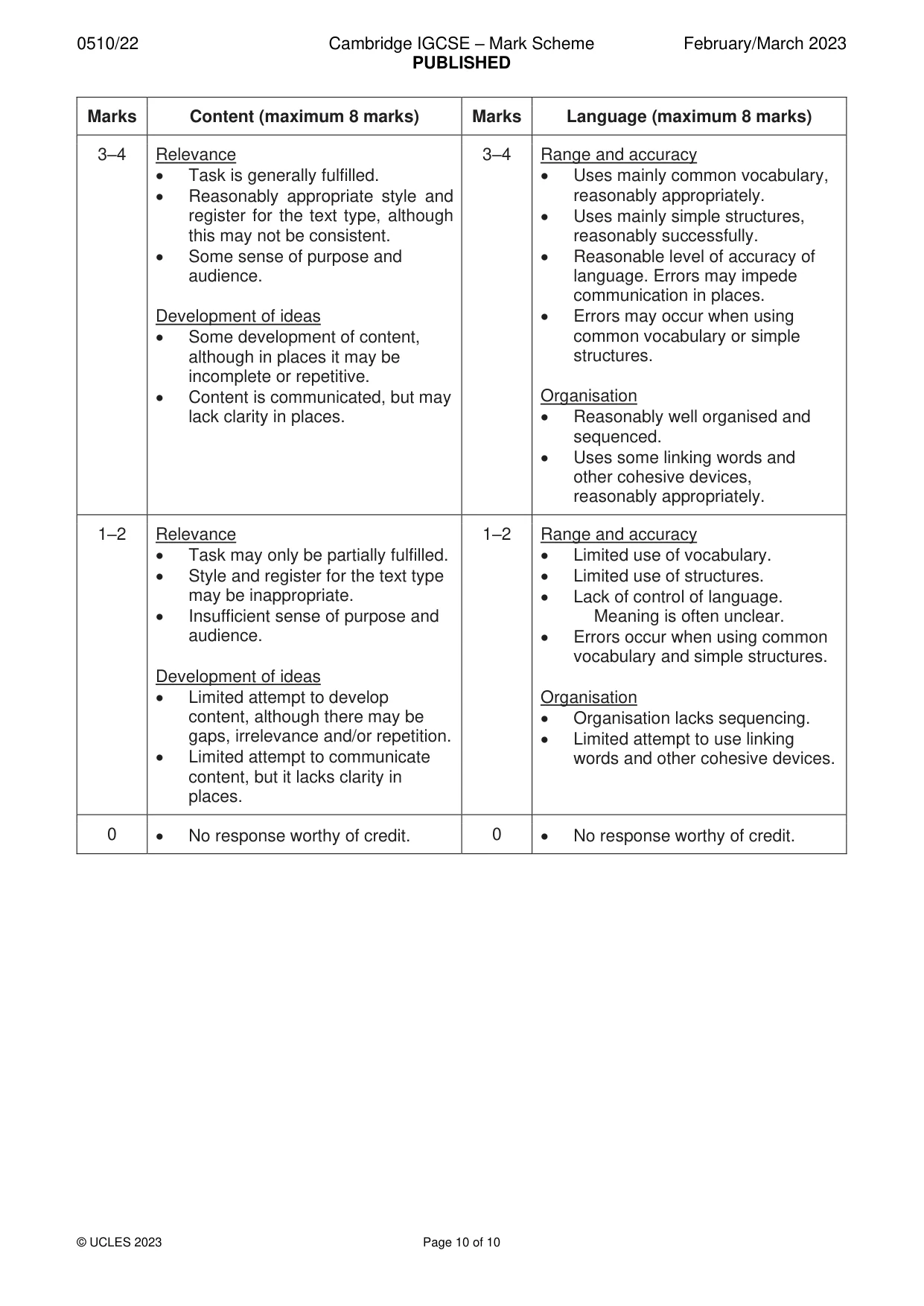
0510/22 Cambridge IGCSE – Mark Scheme PUBLISHED February/March 2023 © UCLES 2023 Page 10 of 10 Marks Content (maximum 8 marks) Marks Language (maximum 8 marks) 3–4 Relevance • Task is generally fulfilled. • Reasonably appropriate style and register for the text type, although this may not be consistent. • Some sense of purpose and audience. Development of ideas • Some development of content, although in places it may be incomplete or repetitive. • Content is communicated, but may lack clarity in places. 3–4 Range and accuracy • Uses mainly common vocabulary, reasonably appropriately. • Uses mainly simple structures, reasonably successfully. • Reasonable level of accuracy of language. Errors may impede communication in places. • Errors may occur when using common vocabulary or simple structures. Organisation • Reasonably well organised and sequenced. • Uses some linking words and other cohesive devices, reasonably appropriately. 1–2 Relevance • Task may only be partially fulfilled. • Style and register for the text type may be inappropriate. • Insufficient sense of purpose and audience. Development of ideas • Limited attempt to develop content, although there may be gaps, irrelevance and/or repetition. • Limited attempt to communicate content, but it lacks clarity in places. 1–2 Range and accuracy • Limited use of vocabulary. • Limited use of structures. • Lack of control of language. Meaning is often unclear. • Errors occur when using common vocabulary and simple structures. Organisation • Organisation lacks sequencing. • Limited attempt to use linking words and other cohesive devices. 0 • No response worthy of credit. 0 • No response worthy of credit.
What you needed in this session
Cambridge’s own grade thresholds for 2023 Feb/March, Paper 2 · Variant 2. A higher threshold means an easier paper — the bar moves with how the cohort did.