Cambridge IGCSE English - Second Language (oral endorsement) 0510 — 2022 Oct/Nov Paper 2 · Variant 2
0510/22/O/N/22 · 80 marks · ≈90 min
The question paper and its mark scheme, free to read here and free to download. This is Cambridge’s own paper, exactly as it was sat.
Question paper16 pages






Mark scheme11 pages
Answers below. Sit the paper first if you are practising.
Paper as text
Question paper, page 1
This document has 16 pages. Any blank pages are indicated. [Turn over Cambridge IGCSE™ ENGLISH AS A SECOND LANGUAGE 0510/22 Paper 2 Reading and Writing (Extended) October/November 2022 2 hours You must answer on the question paper. No additional materials are needed. INSTRUCTIONS ● Answer all questions. ● Use a black or dark blue pen. ● Write your name, centre number and candidate number in the boxes at the top of the page. ● Write your answer to each question in the space provided. ● Do not use an erasable pen or correction fluid. ● Do not write on any bar codes. ● Dictionaries are not allowed. INFORMATION ● The total mark for this paper is 80. ● The number of marks for each question or part question is shown in brackets [ ]. DC (LK/SG) 302607/3 © UCLES 2022 * 7 5 0 2 0 9 3 7 8 8 *
Question paper, page 2
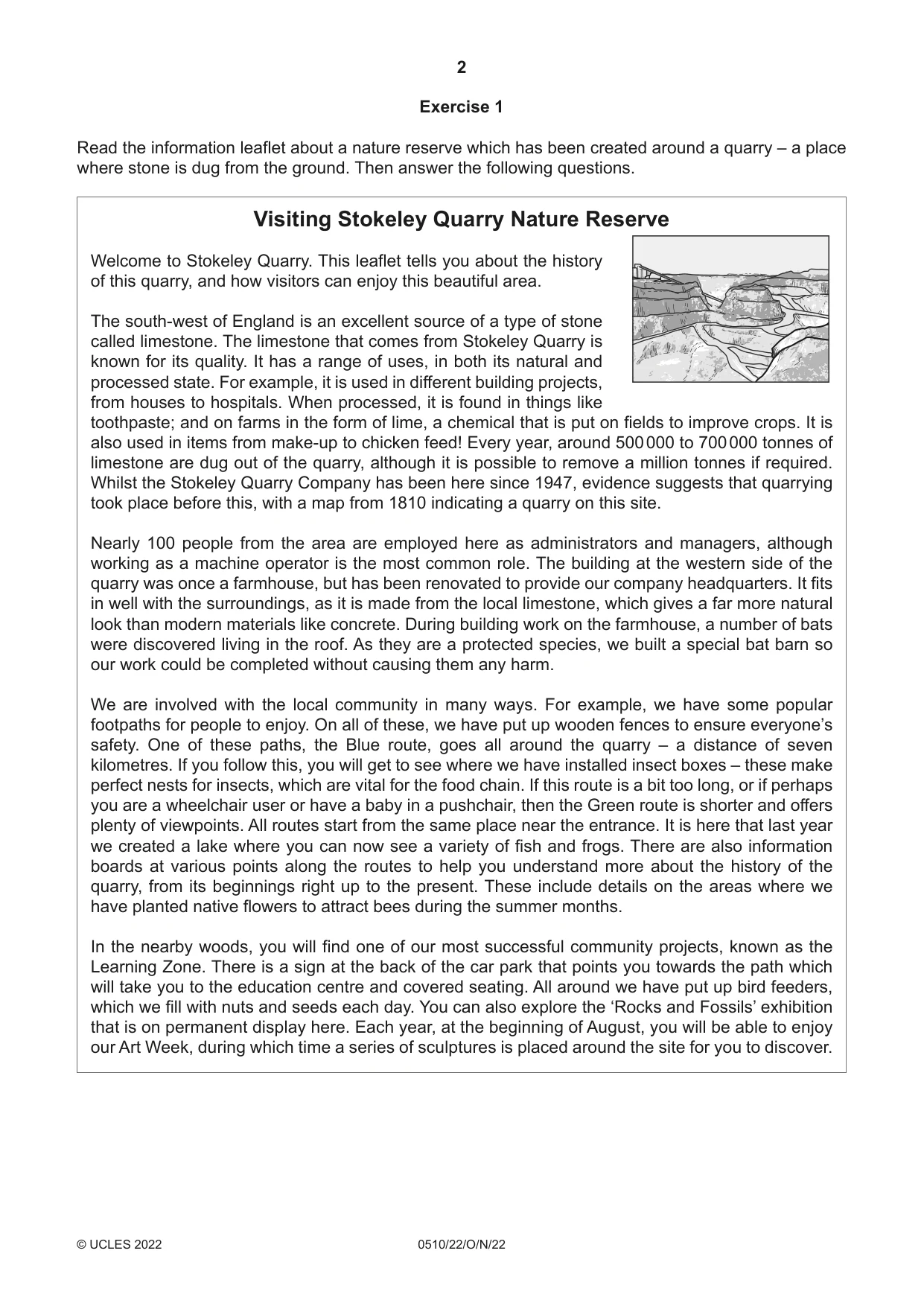
2 0510/22/O/N/22 © UCLES 2022 Exercise 1 Read the information leaflet about a nature reserve which has been created around a quarry – a place where stone is dug from the ground. Then answer the following questions. Visiting Stokeley Quarry Nature Reserve Welcome to Stokeley Quarry. This leaflet tells you about the history of this quarry, and how visitors can enjoy this beautiful area. The south-west of England is an excellent source of a type of stone called limestone. The limestone that comes from Stokeley Quarry is known for its quality. It has a range of uses, in both its natural and processed state. For example, it is used in different building projects, from houses to hospitals. When processed, it is found in things like toothpaste; and on farms in the form of lime, a chemical that is put on fields to improve crops. It is also used in items from make-up to chicken feed! Every year, around 500 000 to 700 000 tonnes of limestone are dug out of the quarry, although it is possible to remove a million tonnes if required. Whilst the Stokeley Quarry Company has been here since 1947, evidence suggests that quarrying took place before this, with a map from 1810 indicating a quarry on this site. Nearly 100 people from the area are employed here as administrators and managers, although working as a machine operator is the most common role. The building at the western side of the quarry was once a farmhouse, but has been renovated to provide our company headquarters. It fits in well with the surroundings, as it is made from the local limestone, which gives a far more natural look than modern materials like concrete. During building work on the farmhouse, a number of bats were discovered living in the roof. As they are a protected species, we built a special bat barn so our work could be completed without causing them any harm. We are involved with the local community in many ways. For example, we have some popular footpaths for people to enjoy. On all of these, we have put up wooden fences to ensure everyone’s safety. One of these paths, the Blue route, goes all around the quarry – a distance of seven kilometres. If you follow this, you will get to see where we have installed insect boxes – these make perfect nests for insects, which are vital for the food chain. If this route is a bit too long, or if perhaps you are a wheelchair user or have a baby in a pushchair, then the Green route is shorter and offers plenty of viewpoints. All routes start from the same place near the entrance. It is here that last year we created a lake where you can now see a variety of fish and frogs. There are also information boards at various points along the routes to help you understand more about the history of the quarry, from its beginnings right up to the present. These include details on the areas where we have planted native flowers to attract bees during the summer months. In the nearby woods, you will find one of our most successful community projects, known as the Learning Zone. There is a sign at the back of the car park that points you towards the path which will take you to the education centre and covered seating. All around we have put up bird feeders, which we fill with nuts and seeds each day. You can also explore the ‘Rocks and Fossils’ exhibition that is on permanent display here. Each year, at the beginning of August, you will be able to enjoy our Art Week, during which time a series of sculptures is placed around the site for you to discover.
Question paper, page 3
3 0510/22/O/N/22 © UCLES 2022 [Turn over 1 Which household products contain a substance found in stone taken from the quarry? Give two details. … … [2] 2 What is the maximum amount of limestone, in tonnes, that the Stokeley Quarry Company can extract each year? … [1] 3 When do records first show that there was a quarry in the area? … [1] 4 What job do the majority of people do at the quarry? … [1] 5 What feature was constructed to keep visitors from danger? … [1] 6 What is the name of the footpath that is most suitable for people with young children? … [1] 7 Where is the Learning Zone located? … [1] 8 What is the name of the annual public event at the quarry? … [1] 9 What has the quarry company done to help the local wildlife? Give four details. … … … … [4] [Total: 13]
Question paper, page 4
4 0510/22/O/N/22 © UCLES 2022 Exercise 2 Read the reviews from four people (A–D) who have visited a natural history museum. Then answer Question 10(a)–(j). Museum reviews A Eliza This museum is said to be one of the oldest in the world, and with one of the largest numbers of exhibits for everyone to enjoy, there’s always something to see. In fact, there’s way too much to look at in one go, not just because of how long it takes to physically walk around the building, but just as importantly, because of how much your brain has to take in! We knew this was the case before we went, so when we arrived, we checked the floor plan and the list of galleries, and picked the top three we wanted to see. Of course, it was impossible to stick to just those – there were always things that tempted us into other rooms. But even so, I know that by having a route planned, we made the most of our time there. We’re already planning our next visit! B Nazir I love museums, and like to go to one in every new city I visit. Luckily, my family feel the same. A lot of people avoid museums because they think they’re a bit dull, but I’d say if you haven’t been to one for a while, you really should give it a go! You see, museum displays nowadays try really hard to appeal to younger visitors, and this one is no exception. Plus, the museum is really beautiful to walk around – it was designed over 100 years ago, and it has wonderful ceilings and sculptures of a whole range of animals around the tops of all the walls, so don’t forget to look up while you’re there! Something that’s helpful for those with limited time is the printed guide, available for a small charge. It recommends the main highlights, with interesting facts about each thing you’ll see. C Lily My mum and I went to the museum last Saturday. We arrived before the opening time, so we wouldn’t have to worry about limiting our time there. Once we got in, we headed straight for the top floor of the building. This is where there are some really great displays of shells and some weird deep-sea creatures. It’s the one area I’d tell anyone who’s visiting not to miss and I’m sure I’ll go there again sometime in the future. Even though the museum is the city’s top attraction, visiting during the peak of the school holidays wasn’t a problem – the size of the halls meant that everyone was able to spread out. We got to see everything we wanted to. On a previous visit, we explored the rooms with a guide who told us exactly what we were seeing, and of course we could ask him any questions. That really made a big difference. You can’t book this in advance, so make sure you arrive early to get one of the available places. D Pedro Before we arrived, we’d reserved tickets for a behind-the-scenes tour. It was simple to do this online, and I’m so glad we did. We were given headphones at the ticket office, which had recorded information about the projects that go on there. We were able to explore areas that regular visitors don’t get to see. We were even able to observe scientists at work through a large viewing window, which I really enjoyed because a career in science is something I’m considering at the moment. The recorded information on the headphones was actually nearly as good as having an expert there to explain things – I certainly learned a lot anyway! There was plenty to see back in the main part of the museum, and while some bits were more interesting than others, I’d recommend it to anyone who wants to know more about the natural world.
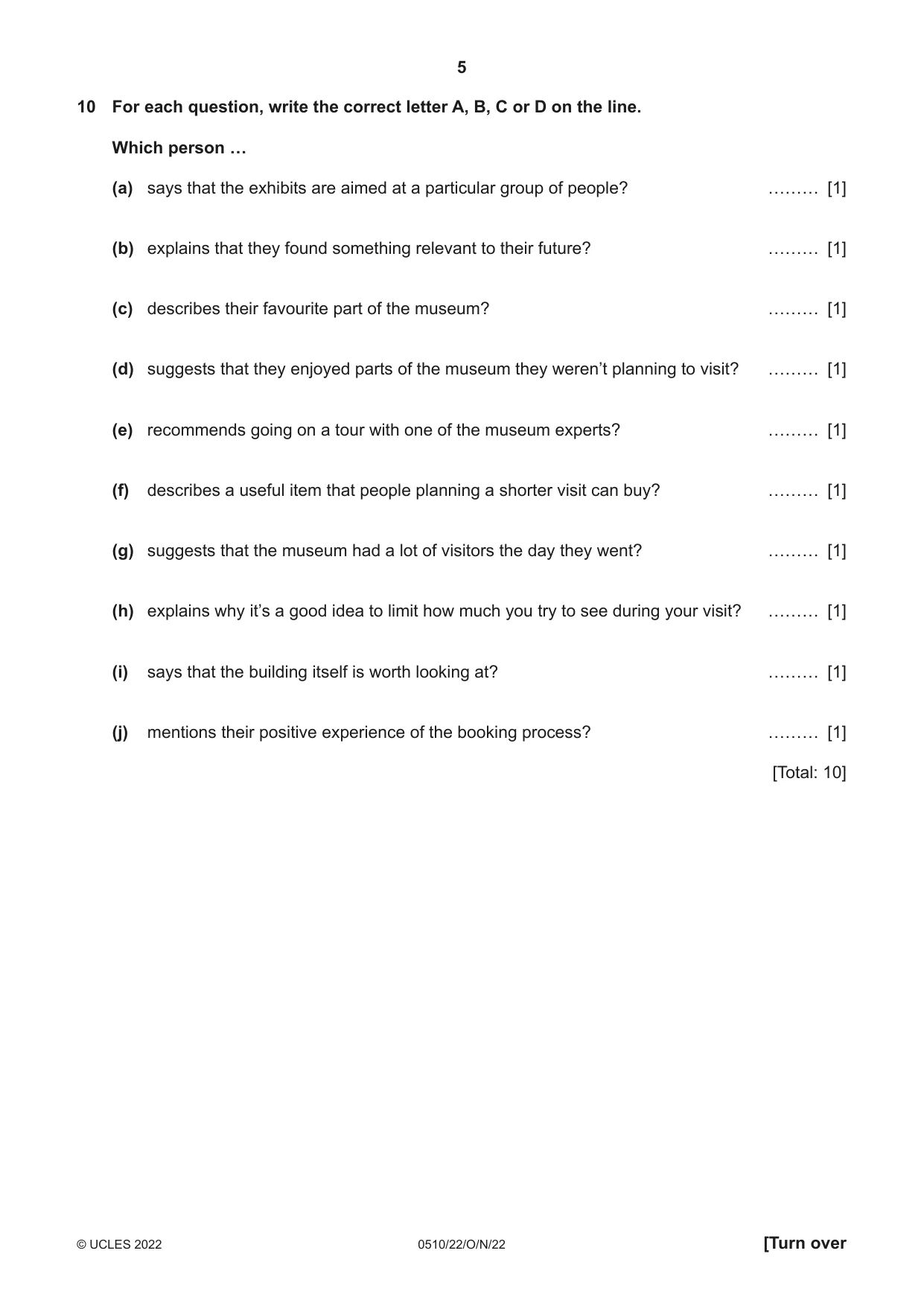
Question paper, page 5
5 0510/22/O/N/22 © UCLES 2022 [Turn over 10 For each question, write the correct letter A, B, C or D on the line. Which person … (a) says that the exhibits are aimed at a particular group of people? ……… [1] (b) explains that they found something relevant to their future? ……… [1] (c) describes their favourite part of the museum? ……… [1] (d) suggests that they enjoyed parts of the museum they weren’t planning to visit? ……… [1] (e) recommends going on a tour with one of the museum experts? ……… [1] (f) describes a useful item that people planning a shorter visit can buy? ……… [1] (g) suggests that the museum had a lot of visitors the day they went? ……… [1] (h) explains why it’s a good idea to limit how much you try to see during your visit? ……… [1] (i) says that the building itself is worth looking at? ……… [1] (j) mentions their positive experience of the booking process? ……… [1] [Total: 10]
Question paper, page 6
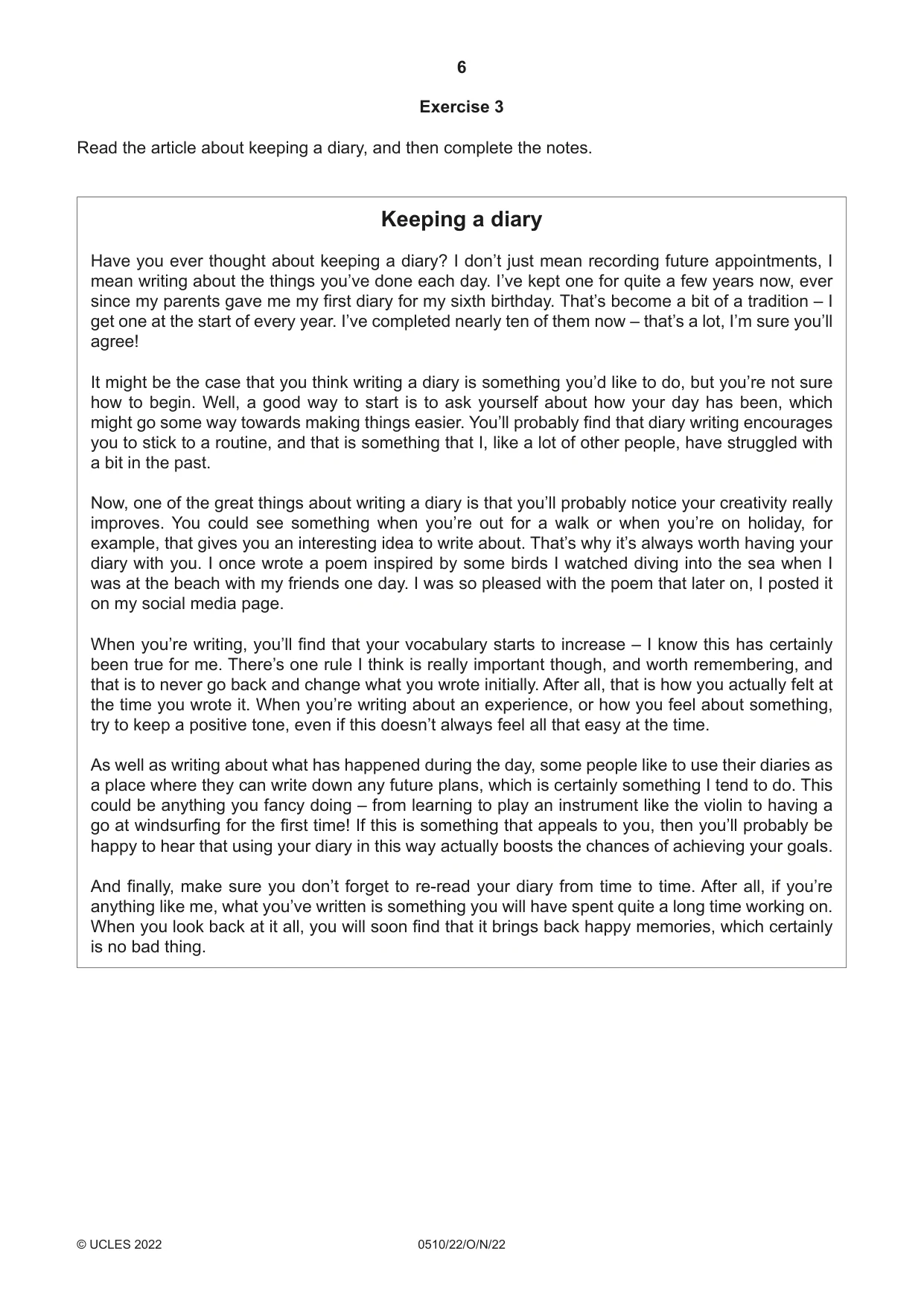
6 0510/22/O/N/22 © UCLES 2022 Exercise 3 Read the article about keeping a diary, and then complete the notes. Keeping a diary Have you ever thought about keeping a diary? I don’t just mean recording future appointments, I mean writing about the things you’ve done each day. I’ve kept one for quite a few years now, ever since my parents gave me my first diary for my sixth birthday. That’s become a bit of a tradition – I get one at the start of every year. I’ve completed nearly ten of them now – that’s a lot, I’m sure you’ll agree! It might be the case that you think writing a diary is something you’d like to do, but you’re not sure how to begin. Well, a good way to start is to ask yourself about how your day has been, which might go some way towards making things easier. You’ll probably find that diary writing encourages you to stick to a routine, and that is something that I, like a lot of other people, have struggled with a bit in the past. Now, one of the great things about writing a diary is that you’ll probably notice your creativity really improves. You could see something when you’re out for a walk or when you’re on holiday, for example, that gives you an interesting idea to write about. That’s why it’s always worth having your diary with you. I once wrote a poem inspired by some birds I watched diving into the sea when I was at the beach with my friends one day. I was so pleased with the poem that later on, I posted it on my social media page. When you’re writing, you’ll find that your vocabulary starts to increase – I know this has certainly been true for me. There’s one rule I think is really important though, and worth remembering, and that is to never go back and change what you wrote initially. After all, that is how you actually felt at the time you wrote it. When you’re writing about an experience, or how you feel about something, try to keep a positive tone, even if this doesn’t always feel all that easy at the time. As well as writing about what has happened during the day, some people like to use their diaries as a place where they can write down any future plans, which is certainly something I tend to do. This could be anything you fancy doing – from learning to play an instrument like the violin to having a go at windsurfing for the first time! If this is something that appeals to you, then you’ll probably be happy to hear that using your diary in this way actually boosts the chances of achieving your goals. And finally, make sure you don’t forget to re-read your diary from time to time. After all, if you’re anything like me, what you’ve written is something you will have spent quite a long time working on. When you look back at it all, you will soon find that it brings back happy memories, which certainly is no bad thing.
Question paper, page 7
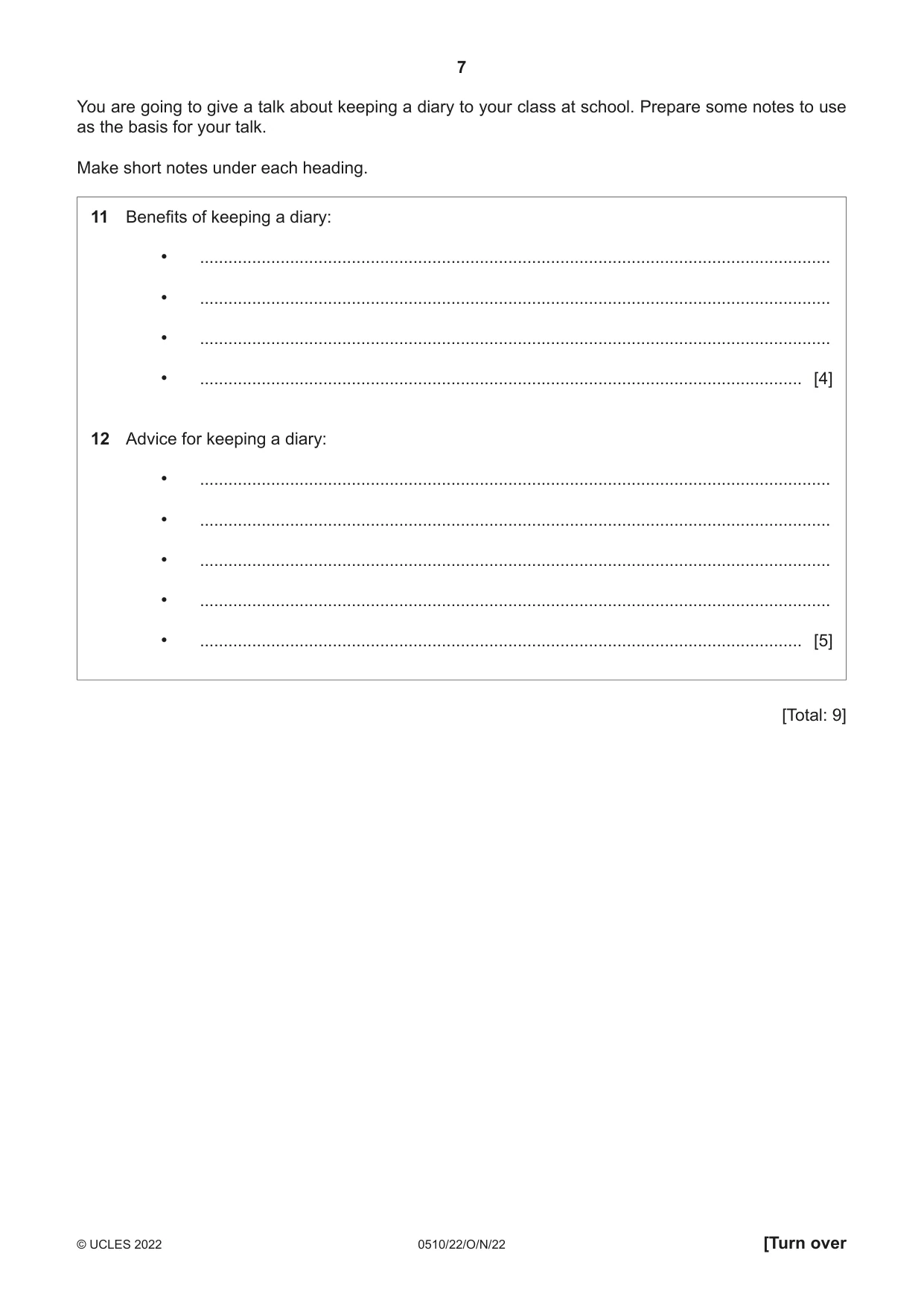
7 0510/22/O/N/22 © UCLES 2022 [Turn over You are going to give a talk about keeping a diary to your class at school. Prepare some notes to use as the basis for your talk. Make short notes under each heading. 11 Benefits of keeping a diary: • … • … • … • … [4] 12 Advice for keeping a diary: • … • … • … • … • … [5] [Total: 9]
Question paper, page 8
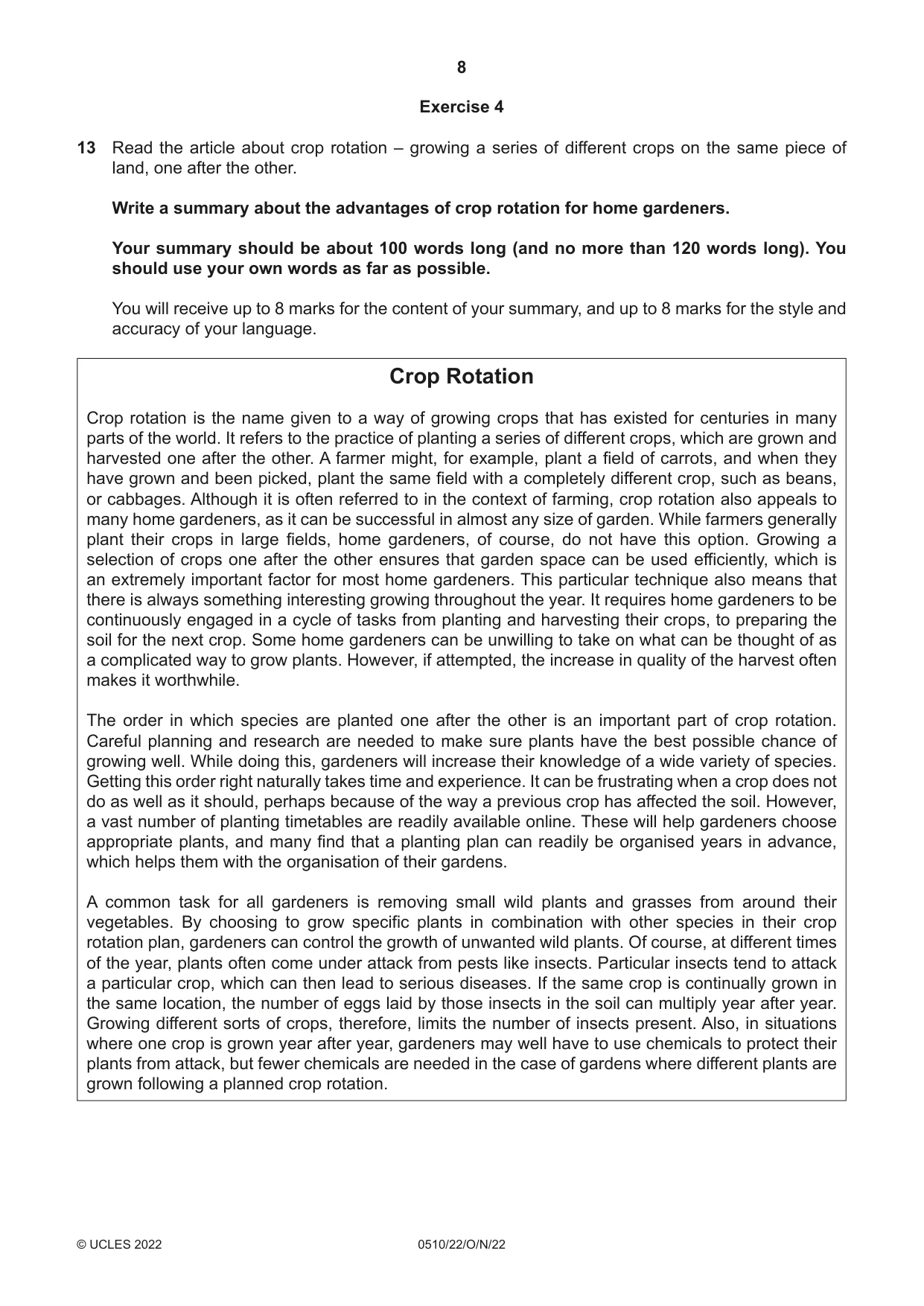
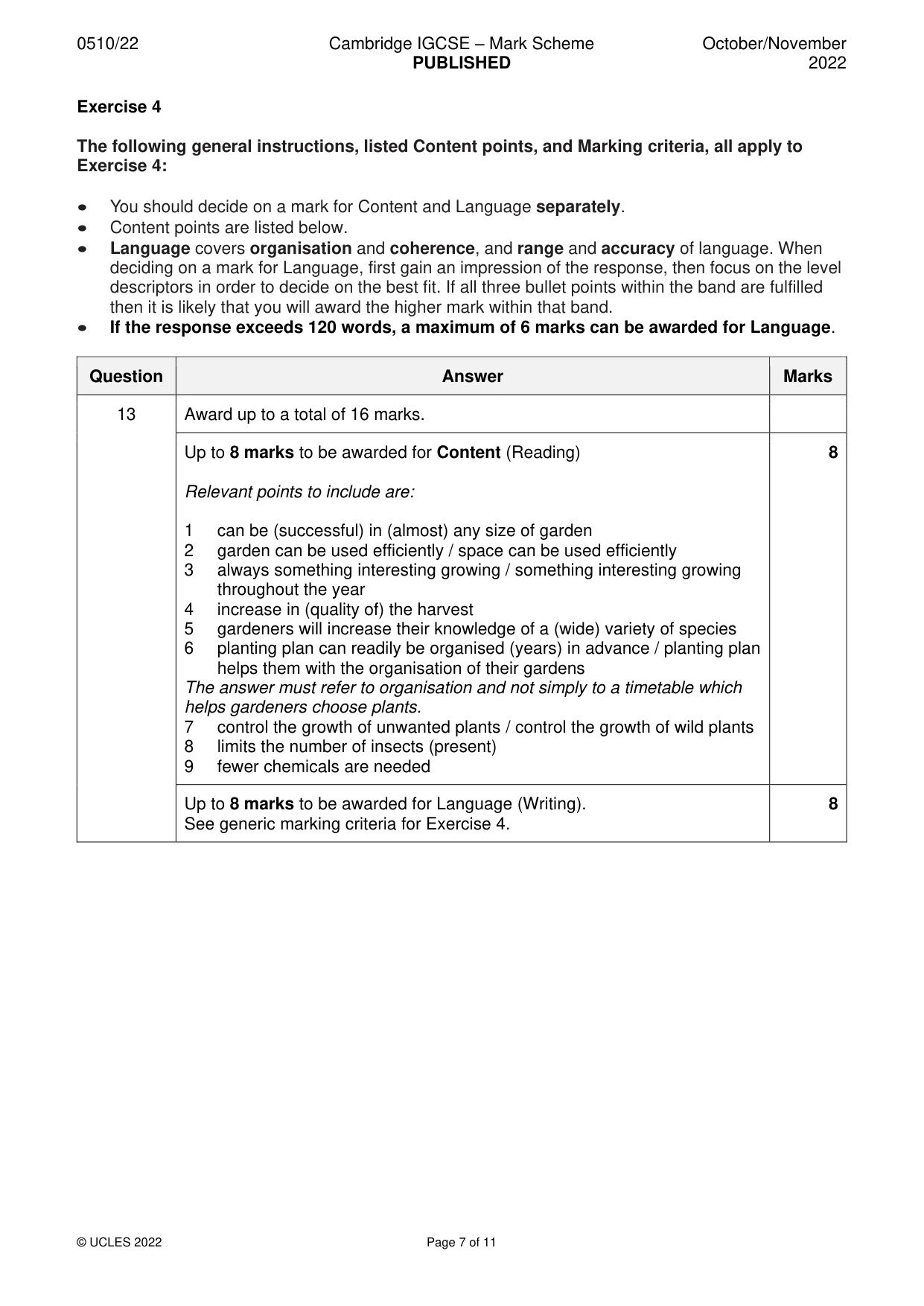
8 0510/22/O/N/22 © UCLES 2022 Exercise 4 13 Read the article about crop rotation – growing a series of different crops on the same piece of land, one after the other. Write a summary about the advantages of crop rotation for home gardeners. Your summary should be about 100 words long (and no more than 120 words long). You should use your own words as far as possible. You will receive up to 8 marks for the content of your summary, and up to 8 marks for the style and accuracy of your language. Crop Rotation Crop rotation is the name given to a way of growing crops that has existed for centuries in many parts of the world. It refers to the practice of planting a series of different crops, which are grown and harvested one after the other. A farmer might, for example, plant a field of carrots, and when they have grown and been picked, plant the same field with a completely different crop, such as beans, or cabbages. Although it is often referred to in the context of farming, crop rotation also appeals to many home gardeners, as it can be successful in almost any size of garden. While farmers generally plant their crops in large fields, home gardeners, of course, do not have this option. Growing a selection of crops one after the other ensures that garden space can be used efficiently, which is an extremely important factor for most home gardeners. This particular technique also means that there is always something interesting growing throughout the year. It requires home gardeners to be continuously engaged in a cycle of tasks from planting and harvesting their crops, to preparing the soil for the next crop. Some home gardeners can be unwilling to take on what can be thought of as a complicated way to grow plants. However, if attempted, the increase in quality of the harvest often makes it worthwhile. The order in which species are planted one after the other is an important part of crop rotation. Careful planning and research are needed to make sure plants have the best possible chance of growing well. While doing this, gardeners will increase their knowledge of a wide variety of species. Getting this order right naturally takes time and experience. It can be frustrating when a crop does not do as well as it should, perhaps because of the way a previous crop has affected the soil. However, a vast number of planting timetables are readily available online. These will help gardeners choose appropriate plants, and many find that a planting plan can readily be organised years in advance, which helps them with the organisation of their gardens. A common task for all gardeners is removing small wild plants and grasses from around their vegetables. By choosing to grow specific plants in combination with other species in their crop rotation plan, gardeners can control the growth of unwanted wild plants. Of course, at different times of the year, plants often come under attack from pests like insects. Particular insects tend to attack a particular crop, which can then lead to serious diseases. If the same crop is continually grown in the same location, the number of eggs laid by those insects in the soil can multiply year after year. Growing different sorts of crops, therefore, limits the number of insects present. Also, in situations where one crop is grown year after year, gardeners may well have to use chemicals to protect their plants from attack, but fewer chemicals are needed in the case of gardens where different plants are grown following a planned crop rotation.
Question paper, page 9
9 0510/22/O/N/22 © UCLES 2022 [Turn over … … … … … … … … … … … … … … … … … … … … … … … … … … … [Total: 16]
Question paper, page 10
10 0510/22/O/N/22 © UCLES 2022 Exercise 5 ? 14 You recently changed something about your bedroom at home. Write an email to a friend. In your email, you should: • describe what you changed • explain how you made the change • say how you feel about the change. The pictures above may give you some ideas, and you can also use some ideas of your own. Your email should be between 150 and 200 words long. You will receive up to 8 marks for the content of your email, and up to 8 marks for the language used.
Question paper, page 11
11 0510/22/O/N/22 © UCLES 2022 [Turn over … … … … … … … … … … … … … … … … … … … … … … … … … … … [Total: 16]
Question paper, page 12
12 0510/22/O/N/22 © UCLES 2022 Exercise 6 15 Your class recently had a debate about the advantages and disadvantages of homework. Your teacher would like you to write an article for your school magazine, giving your opinions. Here are two comments from your classmates: Homework takes up far too much of my free time. In some ways, I learn better when I’m at home. Write an article for your school magazine, giving your views. The comments above may give you some ideas, and you can also use some ideas of your own. Your article should be between 150 and 200 words long. You will receive up to 8 marks for the content of your article, and up to 8 marks for the language used.
Question paper, page 13
13 0510/22/O/N/22 © UCLES 2022 … … … … … … … … … … … … … … … … … … … … … … … … … … … [Total: 16]
Question paper, page 14
14 0510/22/O/N/22 © UCLES 2022 BLANK PAGE
Question paper, page 15
15 0510/22/O/N/22 © UCLES 2022 BLANK PAGE
Question paper, page 16
16 0510/22/O/N/22 © UCLES 2022 Permission to reproduce items where third-party owned material protected by copyright is included has been sought and cleared where possible. Every reasonable effort has been made by the publisher (UCLES) to trace copyright holders, but if any items requiring clearance have unwittingly been included, the publisher will be pleased to make amends at the earliest possible opportunity. To avoid the issue of disclosure of answer-related information to candidates, all copyright acknowledgements are reproduced online in the Cambridge Assessment International Education Copyright Acknowledgements Booklet. This is produced for each series of examinations and is freely available to download at www.cambridgeinternational.org after the live examination series. Cambridge Assessment International Education is part of Cambridge Assessment. Cambridge Assessment is the brand name of the University of Cambridge Local Examinations Syndicate (UCLES), which is a department of the University of Cambridge. BLANK PAGE
Mark scheme, page 1
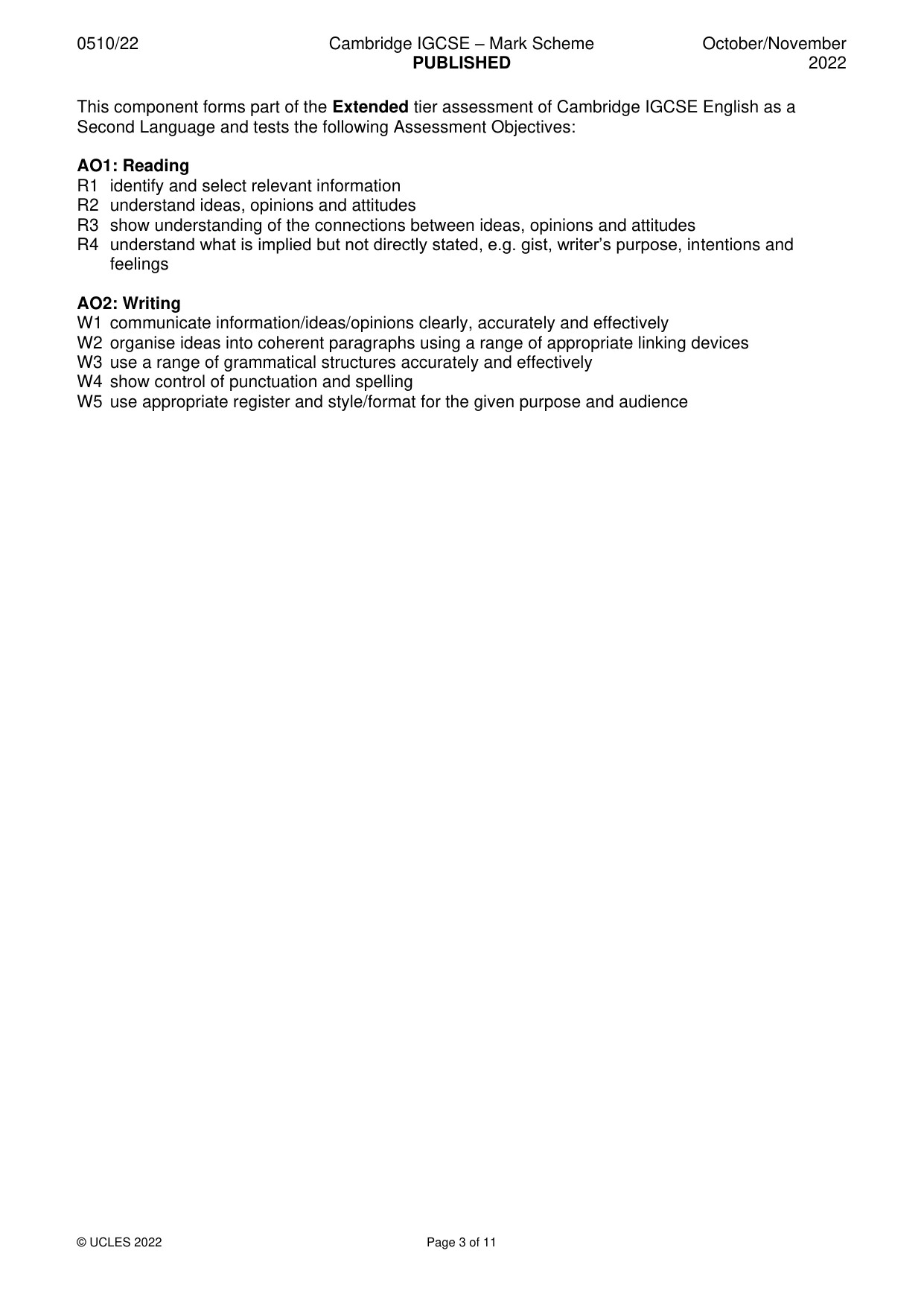
This document consists of 11 printed pages. © UCLES 2022 [Turn over Cambridge IGCSE™ ENGLISH AS A SECOND LANGUAGE 0510/22 Paper 2 Reading and Writing (Extended) October/November 2022 MARK SCHEME Maximum Mark: 80 Published This mark scheme is published as an aid to teachers and candidates, to indicate the requirements of the examination. It shows the basis on which Examiners were instructed to award marks. It does not indicate the details of the discussions that took place at an Examiners’ meeting before marking began, which would have considered the acceptability of alternative answers. Mark schemes should be read in conjunction with the question paper and the Principal Examiner Report for Teachers. Cambridge International will not enter into discussions about these mark schemes. Cambridge International is publishing the mark schemes for the October/November 2022 series for most Cambridge IGCSE™, Cambridge International A and AS Level components and some Cambridge O Level components.
Mark scheme, page 2
0510/22 Cambridge IGCSE – Mark Scheme PUBLISHED October/November 2022 © UCLES 2022 Page 2 of 11 Generic Marking Principles These general marking principles must be applied by all examiners when marking candidate answers. They should be applied alongside the specific content of the mark scheme or generic level descriptors for a question. Each question paper and mark scheme will also comply with these marking principles. GENERIC MARKING PRINCIPLE 1: Marks must be awarded in line with: • the specific content of the mark scheme or the generic level descriptors for the question • the specific skills defined in the mark scheme or in the generic level descriptors for the question • the standard of response required by a candidate as exemplified by the standardisation scripts. GENERIC MARKING PRINCIPLE 2: Marks awarded are always whole marks (not half marks, or other fractions). GENERIC MARKING PRINCIPLE 3: Marks must be awarded positively: • marks are awarded for correct/valid answers, as defined in the mark scheme. However, credit is given for valid answers which go beyond the scope of the syllabus and mark scheme, referring to your Team Leader as appropriate • marks are awarded when candidates clearly demonstrate what they know and can do • marks are not deducted for errors • marks are not deducted for omissions • answers should only be judged on the quality of spelling, punctuation and grammar when these features are specifically assessed by the question as indicated by the mark scheme. The meaning, however, should be unambiguous. GENERIC MARKING PRINCIPLE 4: Rules must be applied consistently, e.g. in situations where candidates have not followed instructions or in the application of generic level descriptors. GENERIC MARKING PRINCIPLE 5: Marks should be awarded using the full range of marks defined in the mark scheme for the question (however; the use of the full mark range may be limited according to the quality of the candidate responses seen). GENERIC MARKING PRINCIPLE 6: Marks awarded are based solely on the requirements as defined in the mark scheme. Marks should not be awarded with grade thresholds or grade descriptors in mind.
Mark scheme, page 3
0510/22 Cambridge IGCSE – Mark Scheme PUBLISHED October/November 2022 © UCLES 2022 Page 3 of 11 This component forms part of the Extended tier assessment of Cambridge IGCSE English as a Second Language and tests the following Assessment Objectives: AO1: Reading R1 identify and select relevant information R2 understand ideas, opinions and attitudes R3 show understanding of the connections between ideas, opinions and attitudes R4 understand what is implied but not directly stated, e.g. gist, writer’s purpose, intentions and feelings AO2: Writing W1 communicate information/ideas/opinions clearly, accurately and effectively W2 organise ideas into coherent paragraphs using a range of appropriate linking devices W3 use a range of grammatical structures accurately and effectively W4 show control of punctuation and spelling W5 use appropriate register and style/format for the given purpose and audience
Mark scheme, page 4
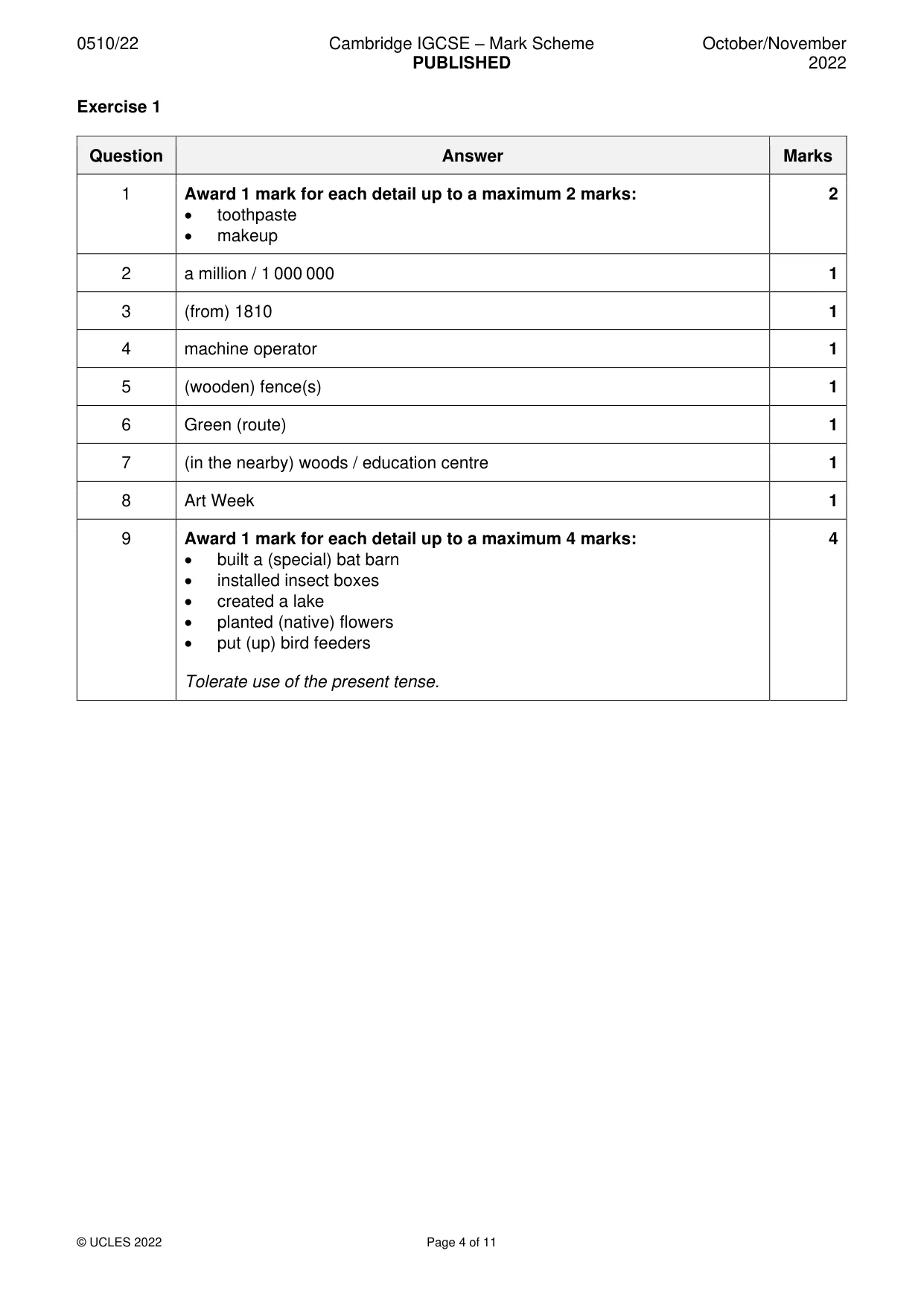
0510/22 Cambridge IGCSE – Mark Scheme PUBLISHED October/November 2022 © UCLES 2022 Page 4 of 11 Exercise 1 Question Answer Marks 1 Award 1 mark for each detail up to a maximum 2 marks: • toothpaste • makeup 2 2 a million / 1 000 000 1 3 (from) 1810 1 4 machine operator 1 5 (wooden) fence(s) 1 6 Green (route) 1 7 (in the nearby) woods / education centre 1 8 Art Week 1 9 Award 1 mark for each detail up to a maximum 4 marks: • built a (special) bat barn • installed insect boxes • created a lake • planted (native) flowers • put (up) bird feeders Tolerate use of the present tense. 4
Mark scheme, page 5
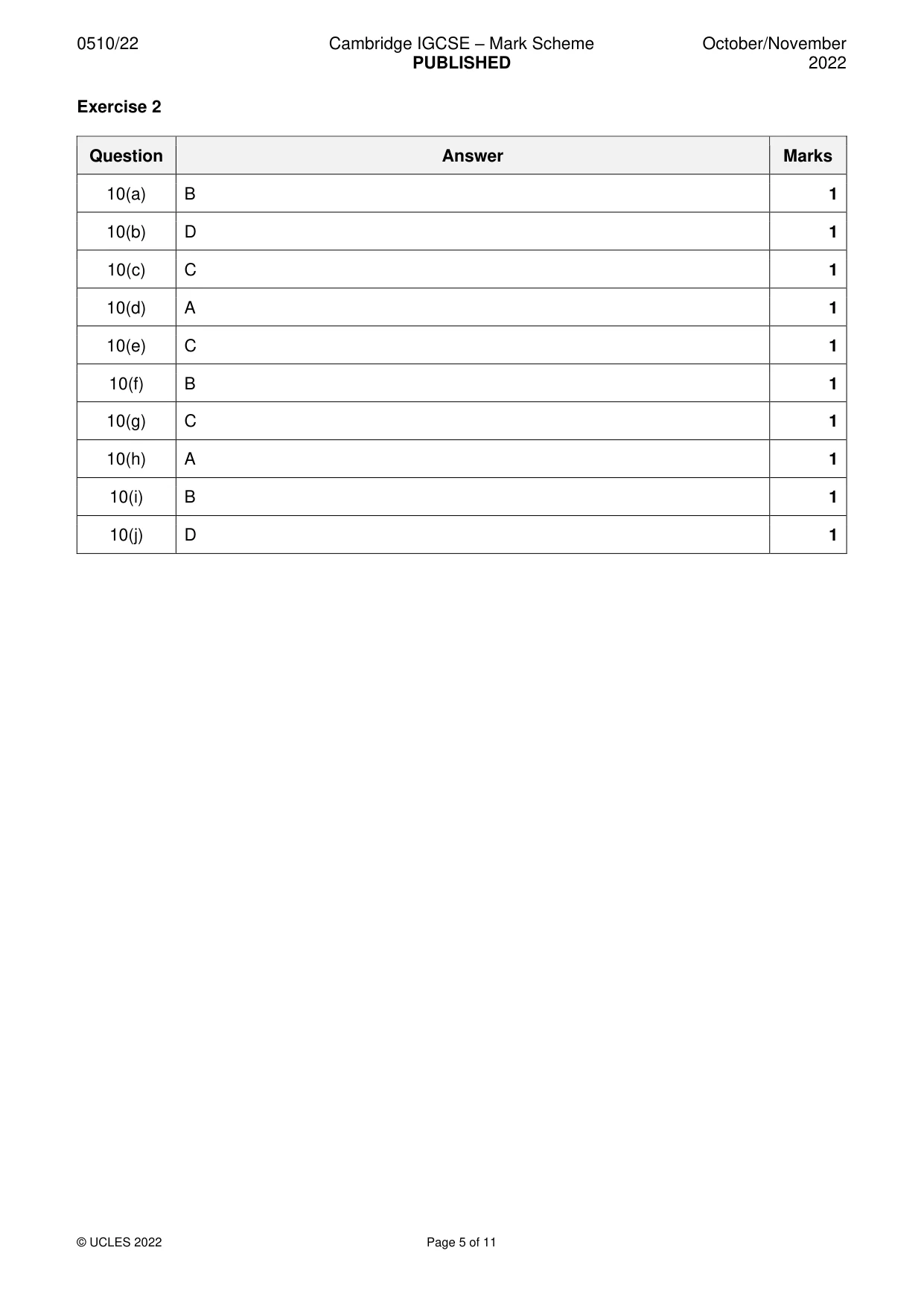
0510/22 Cambridge IGCSE – Mark Scheme PUBLISHED October/November 2022 © UCLES 2022 Page 5 of 11 Exercise 2 Question Answer Marks 10(a) B 1 10(b) D 1 10(c) C 1 10(d) A 1 10(e) C 1 10(f) B 1 10(g) C 1 10(h) A 1 10(i) B 1 10(j) D 1
Mark scheme, page 6
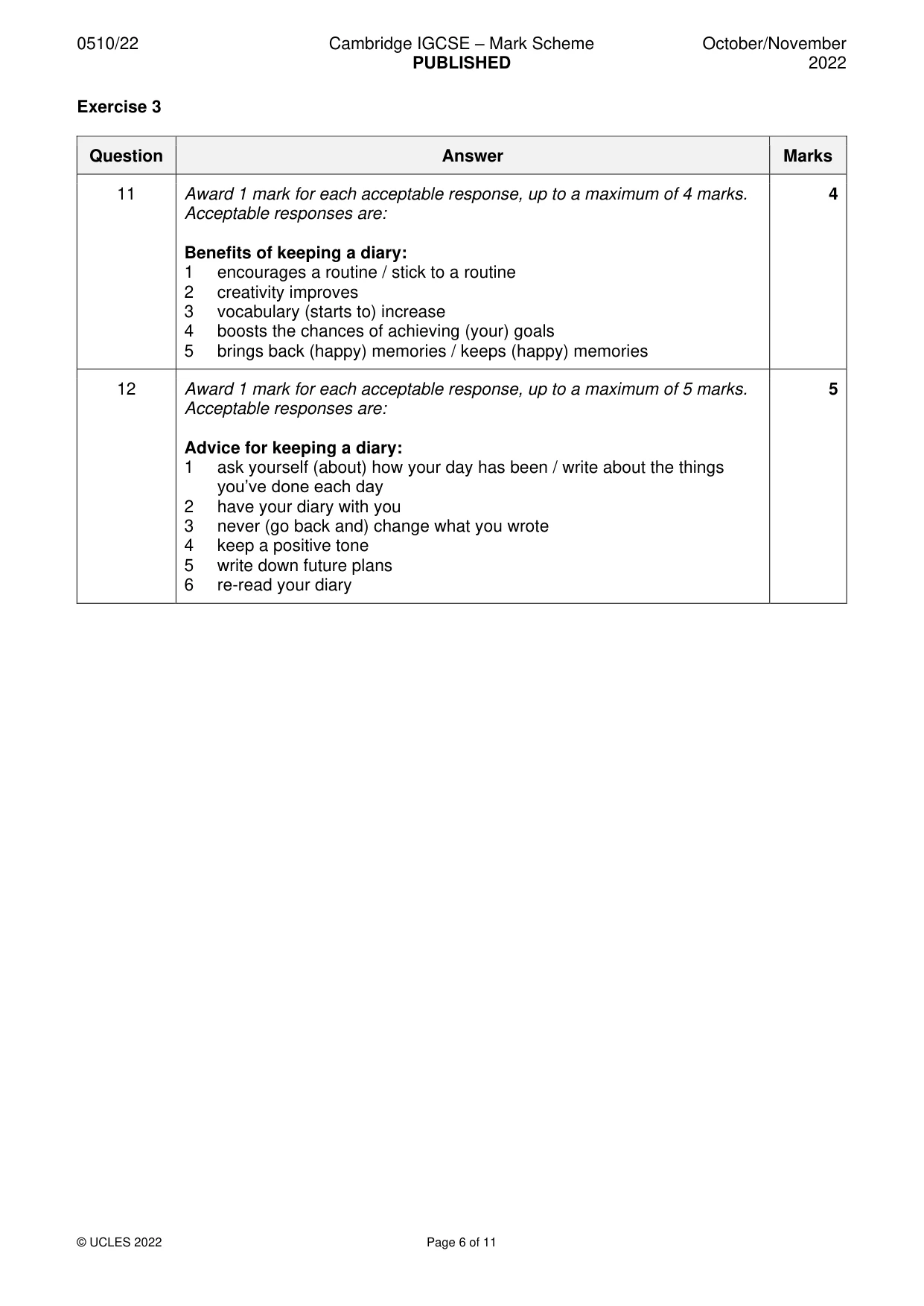
0510/22 Cambridge IGCSE – Mark Scheme PUBLISHED October/November 2022 © UCLES 2022 Page 6 of 11 Exercise 3 Question Answer Marks 11 Award 1 mark for each acceptable response, up to a maximum of 4 marks. Acceptable responses are: Benefits of keeping a diary: 1 encourages a routine / stick to a routine 2 creativity improves 3 vocabulary (starts to) increase 4 boosts the chances of achieving (your) goals 5 brings back (happy) memories / keeps (happy) memories 4 12 Award 1 mark for each acceptable response, up to a maximum of 5 marks. Acceptable responses are: Advice for keeping a diary: 1 ask yourself (about) how your day has been / write about the things you’ve done each day 2 have your diary with you 3 never (go back and) change what you wrote 4 keep a positive tone 5 write down future plans 6 re-read your diary 5
Mark scheme, page 7
0510/22 Cambridge IGCSE – Mark Scheme PUBLISHED October/November 2022 © UCLES 2022 Page 7 of 11 Exercise 4 The following general instructions, listed Content points, and Marking criteria, all apply to Exercise 4: • You should decide on a mark for Content and Language separately. • Content points are listed below. • Language covers organisation and coherence, and range and accuracy of language. When deciding on a mark for Language, first gain an impression of the response, then focus on the level descriptors in order to decide on the best fit. If all three bullet points within the band are fulfilled then it is likely that you will award the higher mark within that band. • If the response exceeds 120 words, a maximum of 6 marks can be awarded for Language. Question Answer Marks 13 Award up to a total of 16 marks. Up to 8 marks to be awarded for Content (Reading) Relevant points to include are: 1 can be (successful) in (almost) any size of garden 2 garden can be used efficiently / space can be used efficiently 3 always something interesting growing / something interesting growing throughout the year 4 increase in (quality of) the harvest 5 gardeners will increase their knowledge of a (wide) variety of species 6 planting plan can readily be organised (years) in advance / planting plan helps them with the organisation of their gardens The answer must refer to organisation and not simply to a timetable which helps gardeners choose plants. 7 control the growth of unwanted plants / control the growth of wild plants 8 limits the number of insects (present) 9 fewer chemicals are needed 8 Up to 8 marks to be awarded for Language (Writing). See generic marking criteria for Exercise 4. 8
Mark scheme, page 8
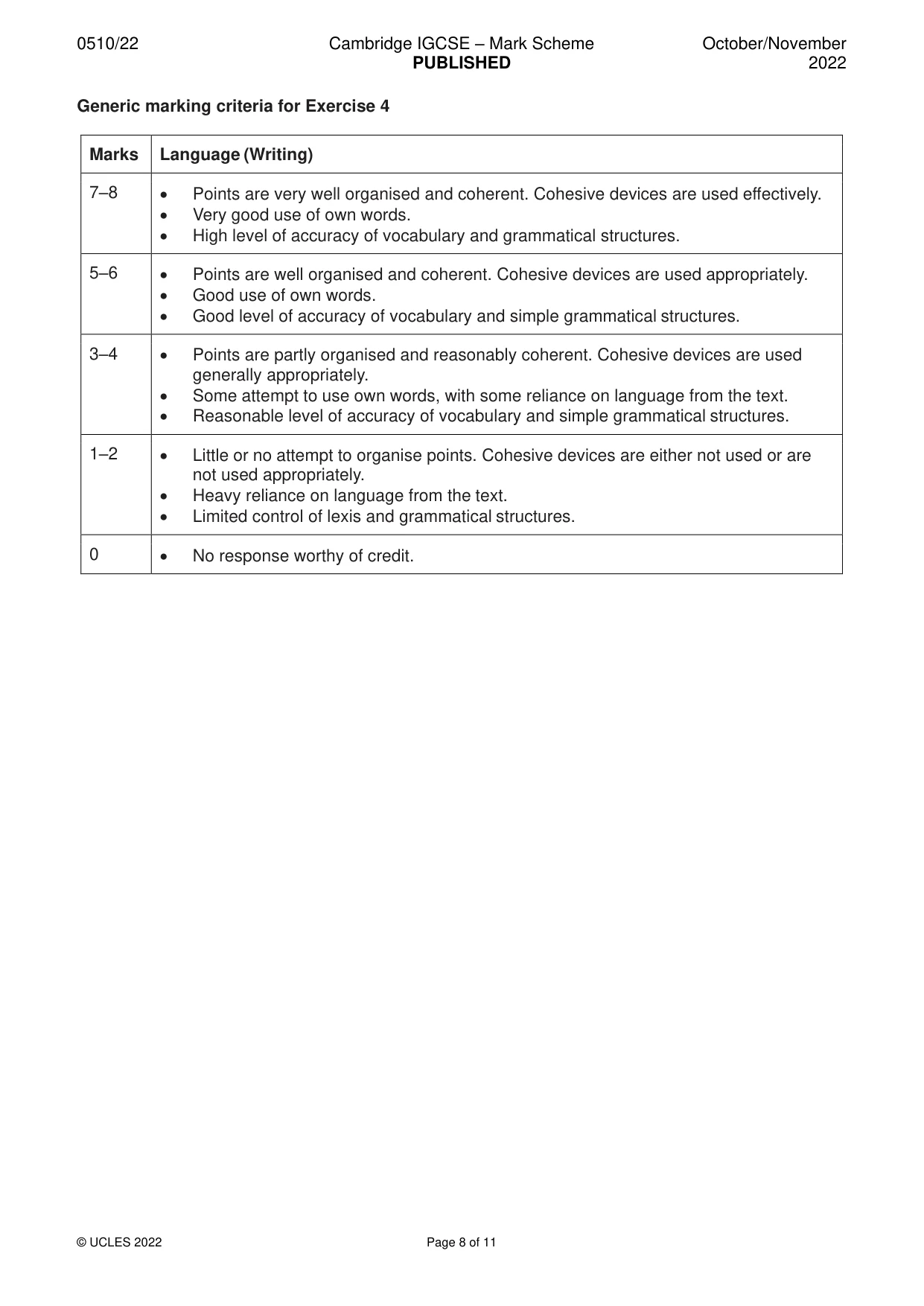
0510/22 Cambridge IGCSE – Mark Scheme PUBLISHED October/November 2022 © UCLES 2022 Page 8 of 11 Generic marking criteria for Exercise 4 Marks Language (Writing) 7–8 • Points are very well organised and coherent. Cohesive devices are used effectively. • Very good use of own words. • High level of accuracy of vocabulary and grammatical structures. 5–6 • Points are well organised and coherent. Cohesive devices are used appropriately. • Good use of own words. • Good level of accuracy of vocabulary and simple grammatical structures. 3–4 • Points are partly organised and reasonably coherent. Cohesive devices are used generally appropriately. • Some attempt to use own words, with some reliance on language from the text. • Reasonable level of accuracy of vocabulary and simple grammatical structures. 1–2 • Little or no attempt to organise points. Cohesive devices are either not used or are not used appropriately. • Heavy reliance on language from the text. • Limited control of lexis and grammatical structures. 0 • No response worthy of credit.
Mark scheme, page 9
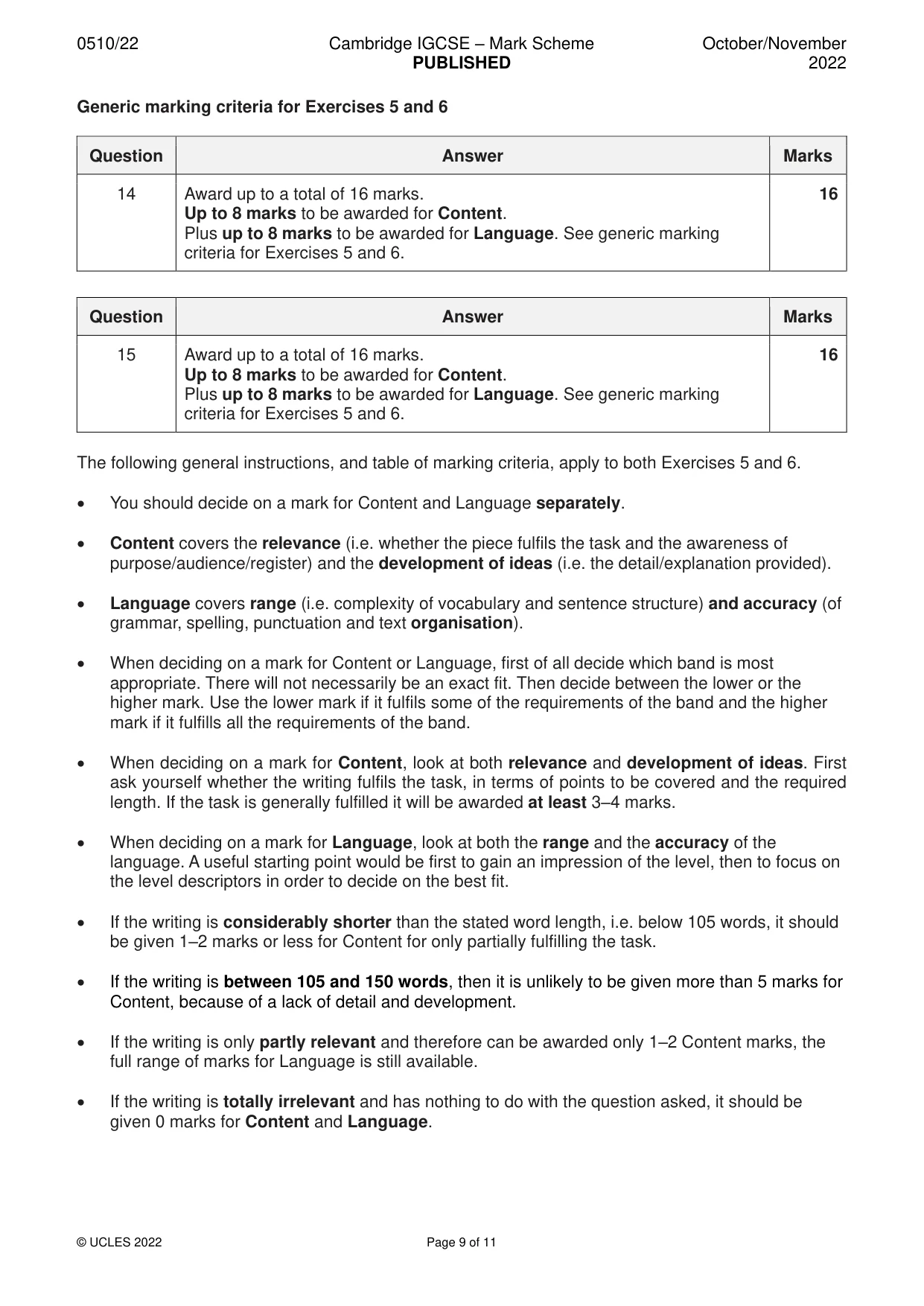
0510/22 Cambridge IGCSE – Mark Scheme PUBLISHED October/November 2022 © UCLES 2022 Page 9 of 11 Generic marking criteria for Exercises 5 and 6 Question Answer Marks 14 Award up to a total of 16 marks. Up to 8 marks to be awarded for Content. Plus up to 8 marks to be awarded for Language. See generic marking criteria for Exercises 5 and 6. 16 Question Answer Marks 15 Award up to a total of 16 marks. Up to 8 marks to be awarded for Content. Plus up to 8 marks to be awarded for Language. See generic marking criteria for Exercises 5 and 6. 16 The following general instructions, and table of marking criteria, apply to both Exercises 5 and 6. • You should decide on a mark for Content and Language separately. • Content covers the relevance (i.e. whether the piece fulfils the task and the awareness of purpose/audience/register) and the development of ideas (i.e. the detail/explanation provided). • Language covers range (i.e. complexity of vocabulary and sentence structure) and accuracy (of grammar, spelling, punctuation and text organisation). • When deciding on a mark for Content or Language, first of all decide which band is most appropriate. There will not necessarily be an exact fit. Then decide between the lower or the higher mark. Use the lower mark if it fulfils some of the requirements of the band and the higher mark if it fulfills all the requirements of the band. • When deciding on a mark for Content, look at both relevance and development of ideas. First ask yourself whether the writing fulfils the task, in terms of points to be covered and the required length. If the task is generally fulfilled it will be awarded at least 3–4 marks. • When deciding on a mark for Language, look at both the range and the accuracy of the language. A useful starting point would be first to gain an impression of the level, then to focus on the level descriptors in order to decide on the best fit. • If the writing is considerably shorter than the stated word length, i.e. below 105 words, it should be given 1–2 marks or less for Content for only partially fulfilling the task. • If the writing is between 105 and 150 words, then it is unlikely to be given more than 5 marks for Content, because of a lack of detail and development. • If the writing is only partly relevant and therefore can be awarded only 1–2 Content marks, the full range of marks for Language is still available. • If the writing is totally irrelevant and has nothing to do with the question asked, it should be given 0 marks for Content and Language.
Mark scheme, page 10
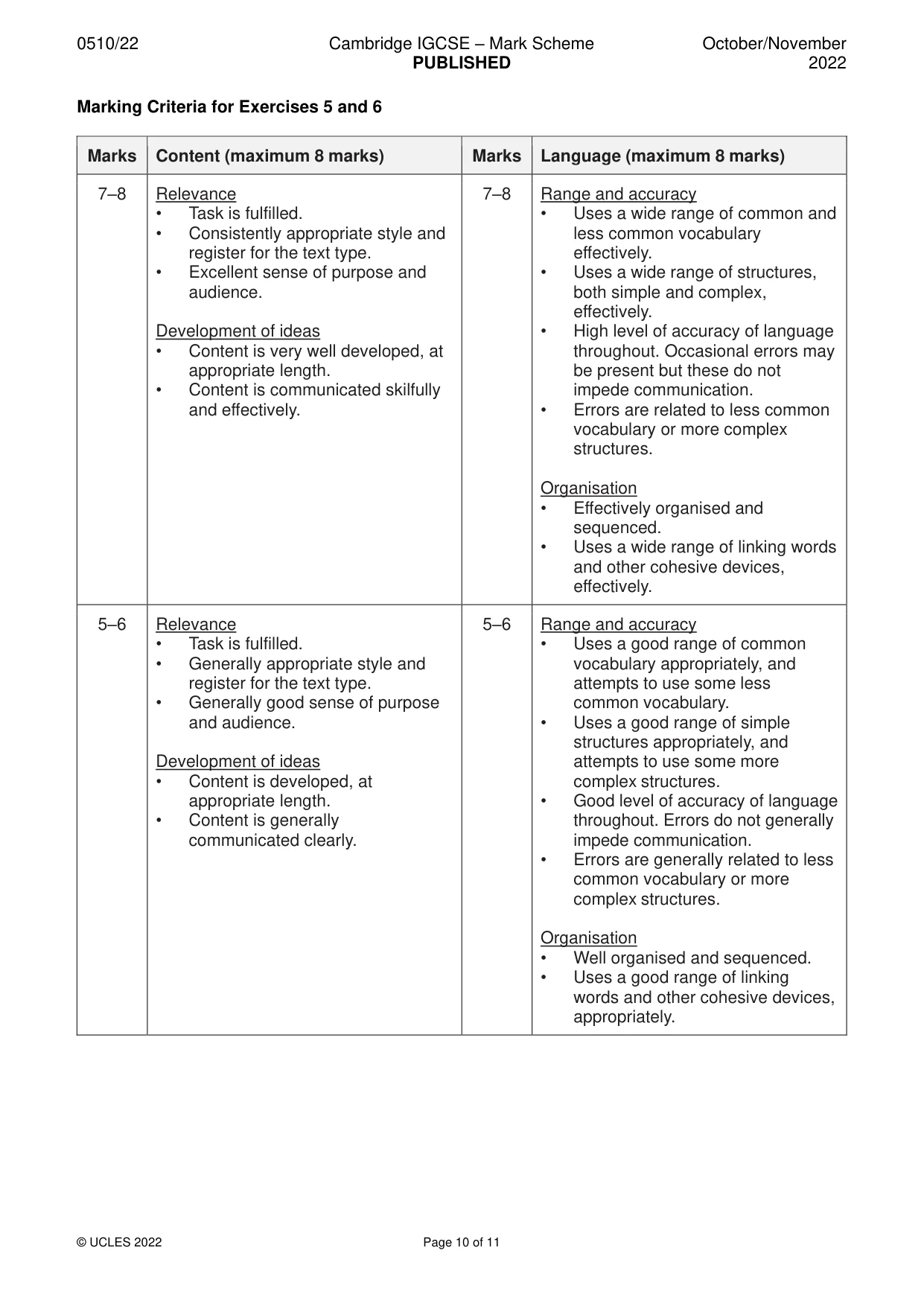
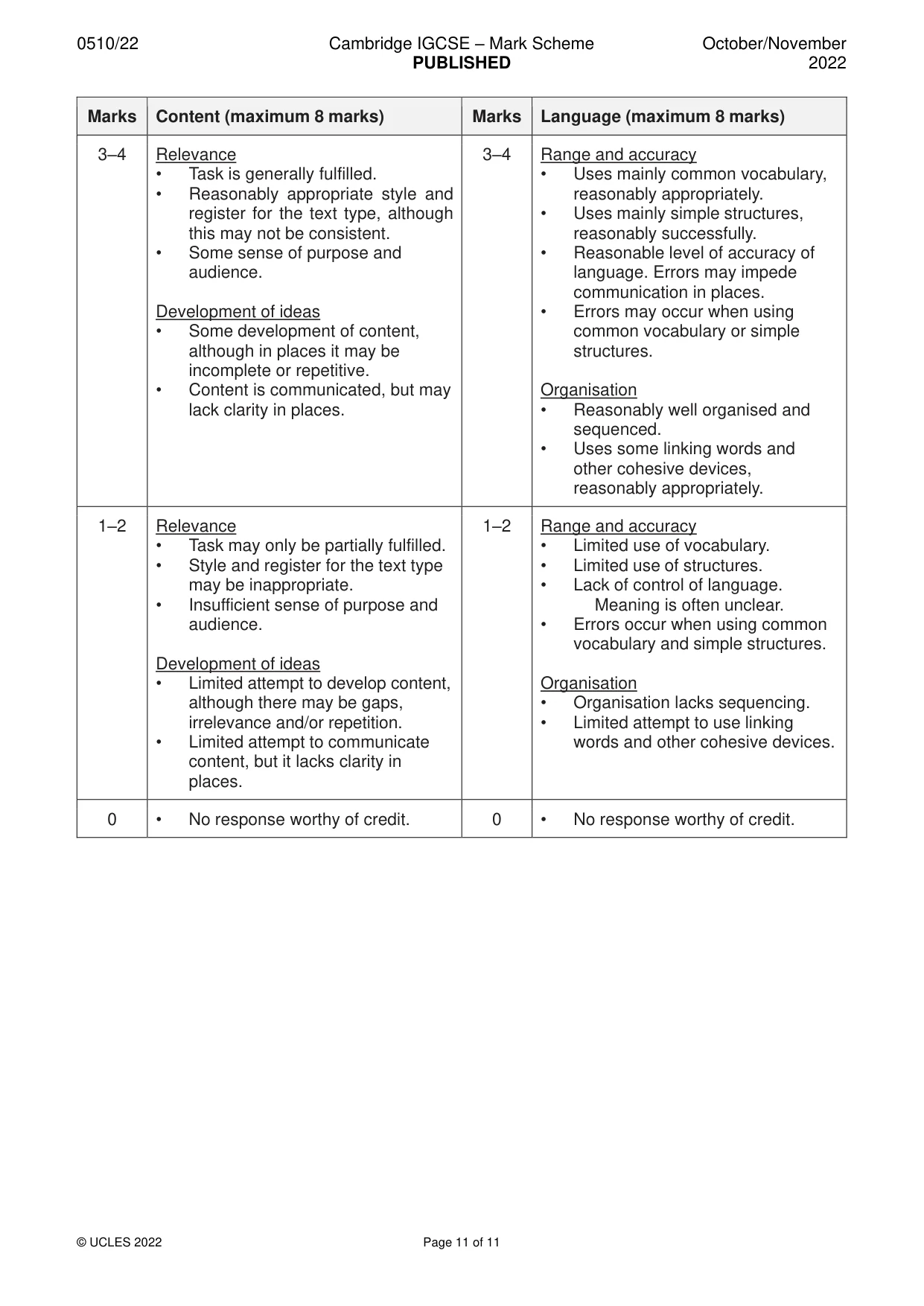
0510/22 Cambridge IGCSE – Mark Scheme PUBLISHED October/November 2022 © UCLES 2022 Page 10 of 11 Marking Criteria for Exercises 5 and 6 Marks Content (maximum 8 marks) Marks Language (maximum 8 marks) 7–8 Relevance • Task is fulfilled. • Consistently appropriate style and register for the text type. • Excellent sense of purpose and audience. Development of ideas • Content is very well developed, at appropriate length. • Content is communicated skilfully and effectively. 7–8 Range and accuracy • Uses a wide range of common and less common vocabulary effectively. • Uses a wide range of structures, both simple and complex, effectively. • High level of accuracy of language throughout. Occasional errors may be present but these do not impede communication. • Errors are related to less common vocabulary or more complex structures. Organisation • Effectively organised and sequenced. • Uses a wide range of linking words and other cohesive devices, effectively. 5–6 Relevance • Task is fulfilled. • Generally appropriate style and register for the text type. • Generally good sense of purpose and audience. Development of ideas • Content is developed, at appropriate length. • Content is generally communicated clearly. 5–6 Range and accuracy • Uses a good range of common vocabulary appropriately, and attempts to use some less common vocabulary. • Uses a good range of simple structures appropriately, and attempts to use some more complex structures. • Good level of accuracy of language throughout. Errors do not generally impede communication. • Errors are generally related to less common vocabulary or more complex structures. Organisation • Well organised and sequenced. • Uses a good range of linking words and other cohesive devices, appropriately.
Mark scheme, page 11
0510/22 Cambridge IGCSE – Mark Scheme PUBLISHED October/November 2022 © UCLES 2022 Page 11 of 11 Marks Content (maximum 8 marks) Marks Language (maximum 8 marks) 3–4 Relevance • Task is generally fulfilled. • Reasonably appropriate style and register for the text type, although this may not be consistent. • Some sense of purpose and audience. Development of ideas • Some development of content, although in places it may be incomplete or repetitive. • Content is communicated, but may lack clarity in places. 3–4 Range and accuracy • Uses mainly common vocabulary, reasonably appropriately. • Uses mainly simple structures, reasonably successfully. • Reasonable level of accuracy of language. Errors may impede communication in places. • Errors may occur when using common vocabulary or simple structures. Organisation • Reasonably well organised and sequenced. • Uses some linking words and other cohesive devices, reasonably appropriately. 1–2 Relevance • Task may only be partially fulfilled. • Style and register for the text type may be inappropriate. • Insufficient sense of purpose and audience. Development of ideas • Limited attempt to develop content, although there may be gaps, irrelevance and/or repetition. • Limited attempt to communicate content, but it lacks clarity in places. 1–2 Range and accuracy • Limited use of vocabulary. • Limited use of structures. • Lack of control of language. Meaning is often unclear. • Errors occur when using common vocabulary and simple structures. Organisation • Organisation lacks sequencing. • Limited attempt to use linking words and other cohesive devices. 0 • No response worthy of credit. 0 • No response worthy of credit.
What you needed in this session
Cambridge’s own grade thresholds for 2022 Oct/Nov, Paper 2 · Variant 2. A higher threshold means an easier paper — the bar moves with how the cohort did.