Cambridge IGCSE English - Second Language (oral endorsement) 0510 — 2022 Feb/March Paper 2 · Variant 2
0510/22/F/M/22 · 80 marks · ≈90 min
The question paper and its mark scheme, free to read here and free to download. This is Cambridge’s own paper, exactly as it was sat.
Question paper16 pages






Mark scheme9 pages
Answers below. Sit the paper first if you are practising.
Paper as text
Question paper, page 1
[Turn over DC (NF/JG) 303564/2 © UCLES 2022 This document has 16 pages. Any blank pages are indicated. * 8 0 4 5 0 4 0 5 1 9 * ENGLISH AS A SECOND LANGUAGE 0510/22 Paper 2 Reading and Writing (Extended) February/March 2022 2 hours You must answer on the question paper. No additional materials are needed. INSTRUCTIONS ● Answer all questions. ● Use a black or dark blue pen. ● Write your name, centre number and candidate number in the boxes at the top of the page. ● Write your answer to each question in the space provided. ● Do not use an erasable pen or correction fluid. ● Do not write on any bar codes. ● Dictionaries are not allowed. INFORMATION ● The total mark for this paper is 80. ● The number of marks for each question or part question is shown in brackets [ ]. Cambridge IGCSE™
Question paper, page 2
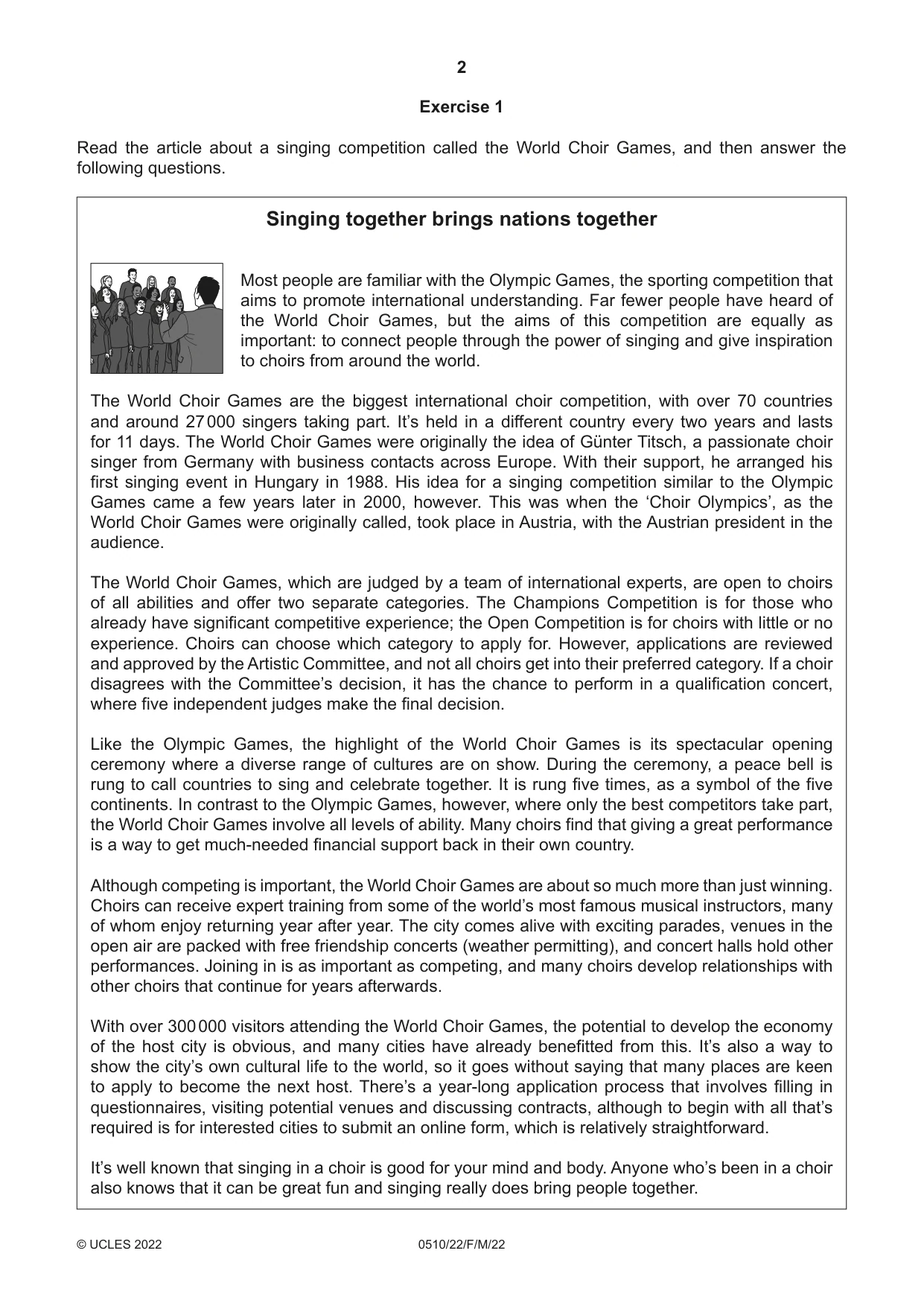
2 0510/22/F/M/22 © UCLES 2022 Exercise 1 Read the article about a singing competition called the World Choir Games, and then answer the following questions. Singing together brings nations together Most people are familiar with the Olympic Games, the sporting competition that aims to promote international understanding. Far fewer people have heard of the World Choir Games, but the aims of this competition are equally as important: to connect people through the power of singing and give inspiration to choirs from around the world. The World Choir Games are the biggest international choir competition, with over 70 countries and around 27 000 singers taking part. It’s held in a different country every two years and lasts for 11 days. The World Choir Games were originally the idea of Günter Titsch, a passionate choir singer from Germany with business contacts across Europe. With their support, he arranged his first singing event in Hungary in 1988. His idea for a singing competition similar to the Olympic Games came a few years later in 2000, however. This was when the ‘Choir Olympics’, as the World Choir Games were originally called, took place in Austria, with the Austrian president in the audience. The World Choir Games, which are judged by a team of international experts, are open to choirs of all abilities and offer two separate categories. The Champions Competition is for those who already have significant competitive experience; the Open Competition is for choirs with little or no experience. Choirs can choose which category to apply for. However, applications are reviewed and approved by the Artistic Committee, and not all choirs get into their preferred category. If a choir disagrees with the Committee’s decision, it has the chance to perform in a qualification concert, where five independent judges make the final decision. Like the Olympic Games, the highlight of the World Choir Games is its spectacular opening ceremony where a diverse range of cultures are on show. During the ceremony, a peace bell is rung to call countries to sing and celebrate together. It is rung five times, as a symbol of the five continents. In contrast to the Olympic Games, however, where only the best competitors take part, the World Choir Games involve all levels of ability. Many choirs find that giving a great performance is a way to get much-needed financial support back in their own country. Although competing is important, the World Choir Games are about so much more than just winning. Choirs can receive expert training from some of the world’s most famous musical instructors, many of whom enjoy returning year after year. The city comes alive with exciting parades, venues in the open air are packed with free friendship concerts (weather permitting), and concert halls hold other performances. Joining in is as important as competing, and many choirs develop relationships with other choirs that continue for years afterwards. With over 300 000 visitors attending the World Choir Games, the potential to develop the economy of the host city is obvious, and many cities have already benefitted from this. It’s also a way to show the city’s own cultural life to the world, so it goes without saying that many places are keen to apply to become the next host. There’s a year-long application process that involves filling in questionnaires, visiting potential venues and discussing contracts, although to begin with all that’s required is for interested cities to submit an online form, which is relatively straightforward. It’s well known that singing in a choir is good for your mind and body. Anyone who’s been in a choir also knows that it can be great fun and singing really does bring people together.
Question paper, page 3
3 0510/22/F/M/22 © UCLES 2022 [Turn over 1 Who helped Günter Titsch with his initial idea? … [1] 2 When were the first World Choir Games held? … [1] 3 Who decides which category of competition a choir can join? Give two details. … … [2] 4 What does the ringing of the peace bell at the opening ceremony represent? … [1] 5 Where do ‘friendship concerts’ typically take place? … [1] 6 What opportunities does holding the World Choir Games give to a city? Give two details. … … [2] 7 What is the first thing that cities have to complete in order to hold the World Choir Games? … [1] 8 What can choirs gain from taking part in the World Choir Games? Give four details. … … … … [4] [Total: 13]
Question paper, page 4
4 0510/22/F/M/22 © UCLES 2022 Exercise 2 Read the article about five people (A–E) who are doing a job they love. Then answer Question 9(a)–(j). I’ve found my dream job! A Samuel, Voice actor In every school report, my teachers always said I talked too much. Now, as a successful voice actor, I get paid to talk! Of course, there’s more to it than that – I’m very artistic and love using my voice in different ways, whether that’s recording a radio advert or working on an animation film. The first time I went into a recording studio, I felt completely at home and that feeling’s never gone away. Because I’m self-employed, there’s always paperwork to complete unfortunately, but I’d never do any other job. I’ve learned a lot over the years and seen some changes. Voice acting used to be seen as second best to the world of movie acting, but now even Hollywood actors realise what a great job it is and want to get involved. B Raymond, Racing car driving instructor When I was at high school, I helped out at my local race track every weekend. I’d do anything – wash cars, tidy tools – just to be around cars. For me, everything was a chance to learn. You see, because I didn’t come from a wealthy family, I knew that if I wanted something I needed to make it happen. The job of racing car driving instructor didn’t use to exist a decade ago, but it’s quite popular now. I teach all kinds of customers, from young people looking to become professional to experienced drivers wanting to change their bad driving habits. The best part of working here is that I can practise for free every day and follow my dream to become a professional racing driver myself. C Mina, Cruise ship director It’s hard to describe my job as it’s different every day, but essentially I have to ensure my passengers have fun. Eight months a year, I work on cruise ships. It’s hard work but I love it! I do everything from arranging parties to preparing daily newsletters and filling in forms, or meeting the captain to get the latest safety rules. As they’re always changing, it’s sometimes a battle to make sure I’m following the correct regulations, but it is essential. I’m always being stopped by passengers asking questions and I love to talk to as many of them as possible. They often want recommendations for things to do on shore, and I’m not afraid to give my honest opinion if it means they enjoy themselves on a tour or at a local restaurant. D Tamir, Toy inventor I’ve been inventing toys for about 15 years, selling my ideas to major toy manufacturers. I feel real pride knowing that my creations are bringing joy to children around the world. My friends think my job just involves playing all day, but that’s certainly not true! Whilst I do enjoy the freedom of coming up with fantastic new ideas, the best thing for me is the challenge of then making them work. The hardest thing is having a big toy company reject an idea. This doesn’t mean it’s bad – perhaps the timing just isn’t right, so it’s important not to doubt yourself. I usually take what I can from their comments to keep adapting and improving the design. E Ester, Chocolatier People ask me if I get bored of tasting chocolate – of course I don’t! When I wake up, my first thought is about chocolate, perhaps a new flavour combination I’m working on or an exclusive cake I’m designing for a celebrity. I tend to spend the first couple of hours on emails and bills, which then frees me up to spend the rest of the day doing what I love in the kitchen. Before I became a chocolatier, I’d been a chef for 20 years. I was finding my work quite easy and wanted a change of direction. It was chocolate that finally inspired me to change jobs. It can be adapted in so many ways with limitless possibilities – who wouldn’t want to work with it?
Question paper, page 5
5 0510/22/F/M/22 © UCLES 2022 [Turn over 9 For each question, write the correct letter A, B, C, D or E on the line. Which person … (a) sees negative feedback as an opportunity to learn? … [1] (b) was attracted to their career by the potential for creativity? … [1] (c) sees their job as a way to achieve their ambition? … [1] (d) believes it’s sometimes necessary to be critical of other businesses? … [1] (e) likes to deal with the paperwork before doing anything else? … [1] (f) feels their industry is more respected than it used to be? … [1] (g) admits it can be a challenge to keep their professional knowledge up to date? … [1] (h) has always felt comfortable in their workplace? … [1] (i) realised early on that they would have to work hard to succeed? … [1] (j) gets satisfaction from the pleasure that their work gives people? … [1] [Total: 10]
Question paper, page 6
6 0510/22/F/M/22 © UCLES 2022 Exercise 3 Read the article about a visitor centre that has a huge collection of children’s books, and then complete the notes. The National Centre for Children’s Books – a story of success The National Centre for Children’s Books has just won an award for Best UK Visitor Attraction of the Year – it has certainly come a long way since its opening in 2002! The centre was originally the idea of two authors, who had noticed that children’s books were becoming popular with private collectors. They decided that what was needed to protect the country’s literary treasure was a centre devoted to children’s literature. The National Centre for Children’s Books was born! From the very beginning, the centre has worked to build up its book collection, which now contains many thousands of books. There are works by over 250 authors, some of whom make regular donations to the centre. As its reputation grew, people started to give the centre their childhood books rather than throw them away, and some of these have proved to be very rare indeed. By 2010, the collection had become so large that a new location was needed. Rather than move to a modern building in the heart of the city, the centre chose a site in an industrial part of town. Their intention was to give local children free access to books, something it remains very proud of today. Since the move, the centre has continued to expand. It now occupies all five floors of a factory building that used to manufacture toys. ‘This building is so appropriate for us’, says the centre manager. ‘Fifty years ago, the country’s favourite children’s toys were being made here, and it’s still a place that’s all about children. That’s not to say that adults aren’t important too. We welcome help from anyone who wants to become a volunteer. In return, the volunteers often gain useful skills and get to feel part of their local community.’ The centre has also built up successful links with schools. According to the centre manager, one of their key ambitions right from the start was to deliver reading workshops in as many schools as possible. ‘It’s a really important part of our work’, she says, ‘and something that our staff love doing. We work closely with teachers in schools all around the country, and they often raise money for us through school book sales. And of course, the children love what we do.’ As the centre has expanded, so the cost of running it has increased and it has therefore had to come up with original ways of financing itself. For a small annual fee, anyone can become a ‘Friend of the Centre’ and get regular newsletters and free entry to certain exhibitions and VIP events. The centre now has over two hundred ‘Friends’. Local business owners play their part too, and can sponsor exhibitions at the centre, in return for which their staff get discounted tickets for centre events. With such loyal involvement, the centre’s future looks bright. Its mission has always been to encourage children to develop a love of books, but it seems that with its continuing success, it has the potential to achieve so much more.
Question paper, page 7
7 0510/22/F/M/22 © UCLES 2022 [Turn over You are going to give a talk about The National Centre for Children’s Books to your class at school. Prepare some notes to use as the basis for your talk. Make short notes under each heading. 10 The aims of The National Centre for Children’s Books: • … • … • … • … [4] 11 How people can support The National Centre for Children’s Books: • … • … • … • … • … [5] [Total: 9]
Question paper, page 8
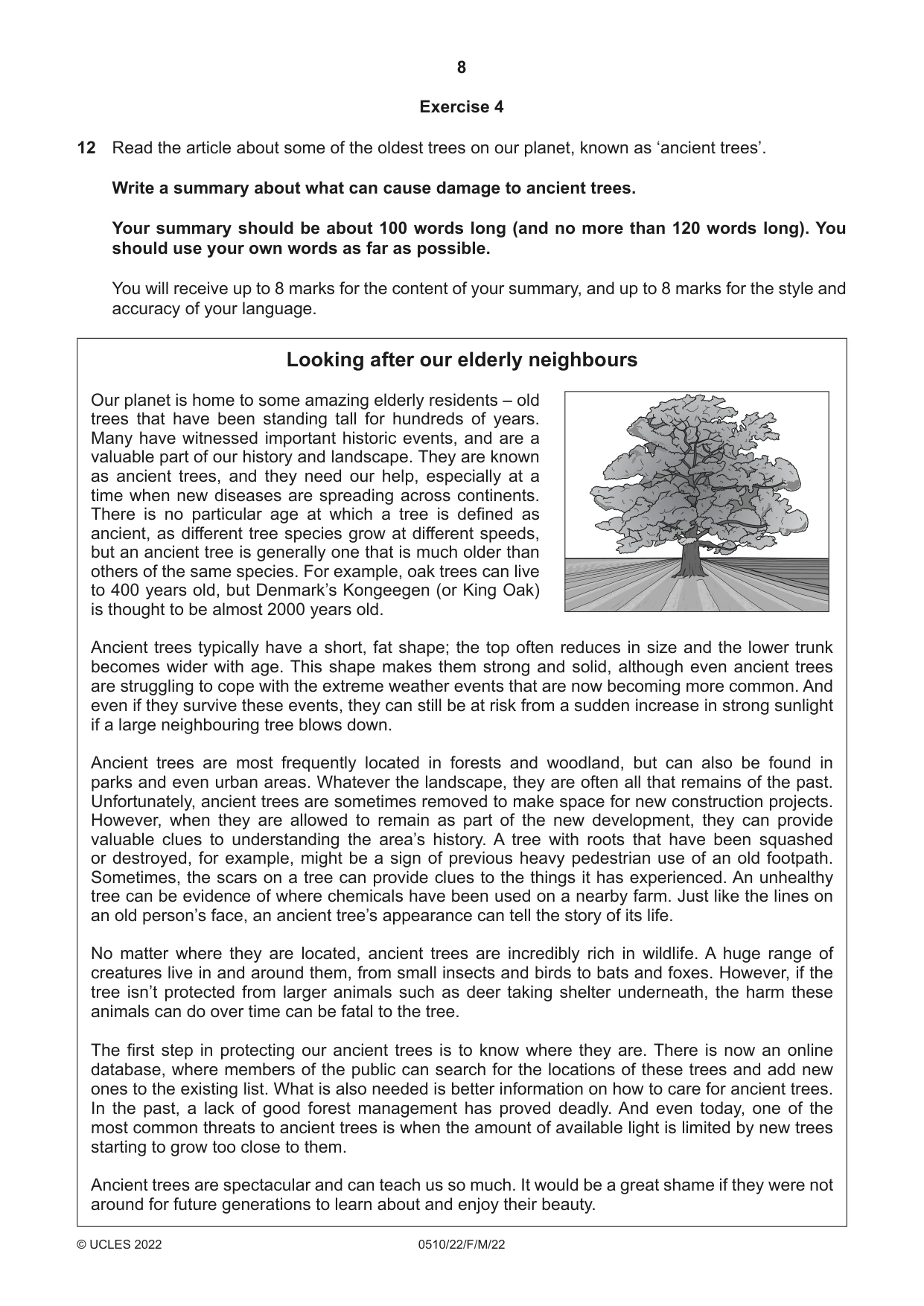
8 0510/22/F/M/22 © UCLES 2022 Exercise 4 12 Read the article about some of the oldest trees on our planet, known as ‘ancient trees’. Write a summary about what can cause damage to ancient trees. Your summary should be about 100 words long (and no more than 120 words long). You should use your own words as far as possible. You will receive up to 8 marks for the content of your summary, and up to 8 marks for the style and accuracy of your language. Looking after our elderly neighbours Our planet is home to some amazing elderly residents – old trees that have been standing tall for hundreds of years. Many have witnessed important historic events, and are a valuable part of our history and landscape. They are known as ancient trees, and they need our help, especially at a time when new diseases are spreading across continents. There is no particular age at which a tree is defined as ancient, as different tree species grow at different speeds, but an ancient tree is generally one that is much older than others of the same species. For example, oak trees can live to 400 years old, but Denmark’s Kongeegen (or King Oak) is thought to be almost 2000 years old. Ancient trees typically have a short, fat shape; the top often reduces in size and the lower trunk becomes wider with age. This shape makes them strong and solid, although even ancient trees are struggling to cope with the extreme weather events that are now becoming more common. And even if they survive these events, they can still be at risk from a sudden increase in strong sunlight if a large neighbouring tree blows down. Ancient trees are most frequently located in forests and woodland, but can also be found in parks and even urban areas. Whatever the landscape, they are often all that remains of the past. Unfortunately, ancient trees are sometimes removed to make space for new construction projects. However, when they are allowed to remain as part of the new development, they can provide valuable clues to understanding the area’s history. A tree with roots that have been squashed or destroyed, for example, might be a sign of previous heavy pedestrian use of an old footpath. Sometimes, the scars on a tree can provide clues to the things it has experienced. An unhealthy tree can be evidence of where chemicals have been used on a nearby farm. Just like the lines on an old person’s face, an ancient tree’s appearance can tell the story of its life. No matter where they are located, ancient trees are incredibly rich in wildlife. A huge range of creatures live in and around them, from small insects and birds to bats and foxes. However, if the tree isn’t protected from larger animals such as deer taking shelter underneath, the harm these animals can do over time can be fatal to the tree. The first step in protecting our ancient trees is to know where they are. There is now an online database, where members of the public can search for the locations of these trees and add new ones to the existing list. What is also needed is better information on how to care for ancient trees. In the past, a lack of good forest management has proved deadly. And even today, one of the most common threats to ancient trees is when the amount of available light is limited by new trees starting to grow too close to them. Ancient trees are spectacular and can teach us so much. It would be a great shame if they were not around for future generations to learn about and enjoy their beauty.
Question paper, page 9
9 0510/22/F/M/22 © UCLES 2022 [Turn over … … … … … … … … … … … … … … … … … … … … … … … … … … … [Total: 16]
Question paper, page 10
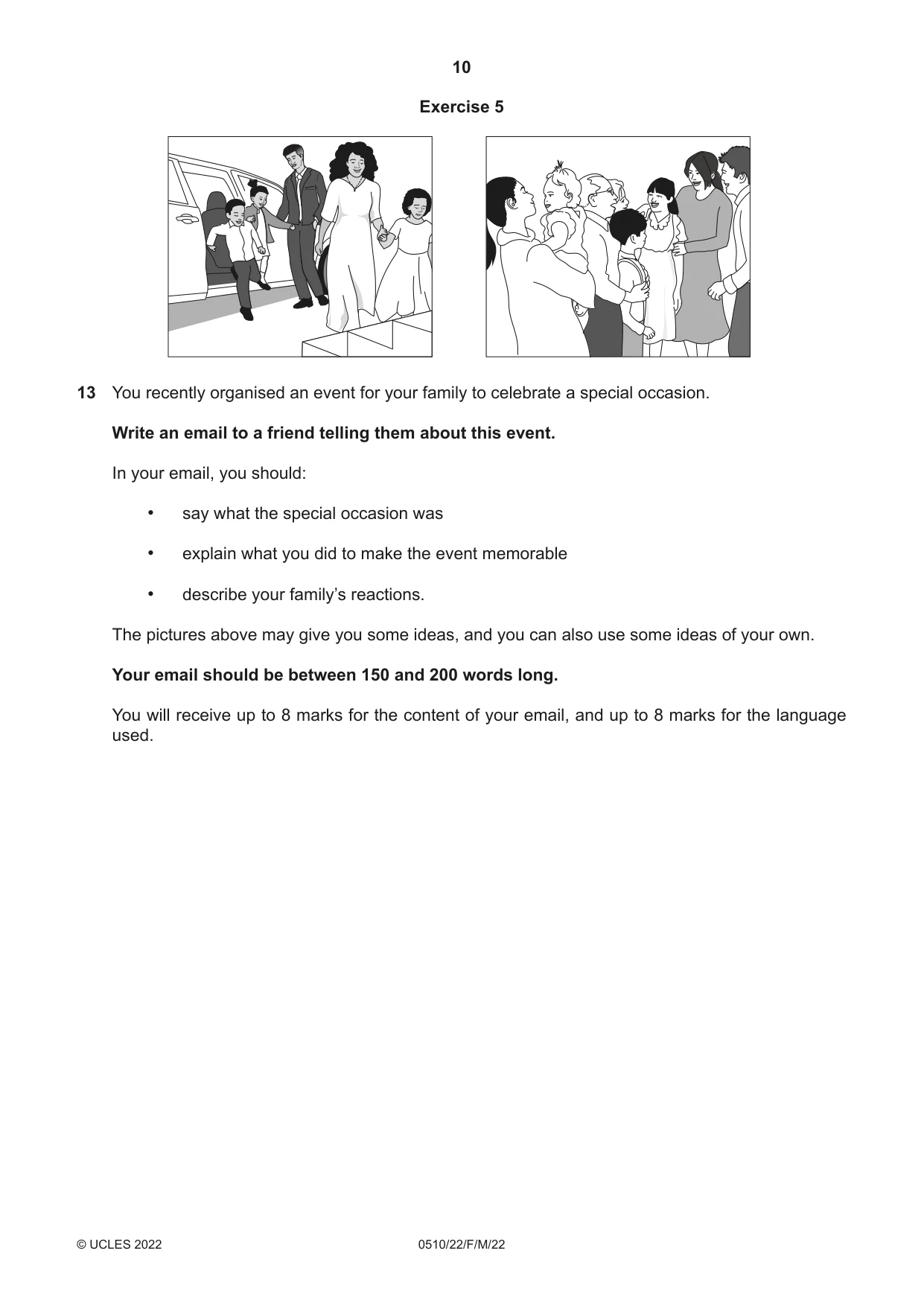
10 0510/22/F/M/22 © UCLES 2022 Exercise 5 13 You recently organised an event for your family to celebrate a special occasion. Write an email to a friend telling them about this event. In your email, you should: • say what the special occasion was • explain what you did to make the event memorable • describe your family’s reactions. The pictures above may give you some ideas, and you can also use some ideas of your own. Your email should be between 150 and 200 words long. You will receive up to 8 marks for the content of your email, and up to 8 marks for the language used.
Question paper, page 11
11 0510/22/F/M/22 © UCLES 2022 [Turn over … … … … … … … … … … … … … … … … … … … … … … … … … … … [Total: 16]
Question paper, page 12
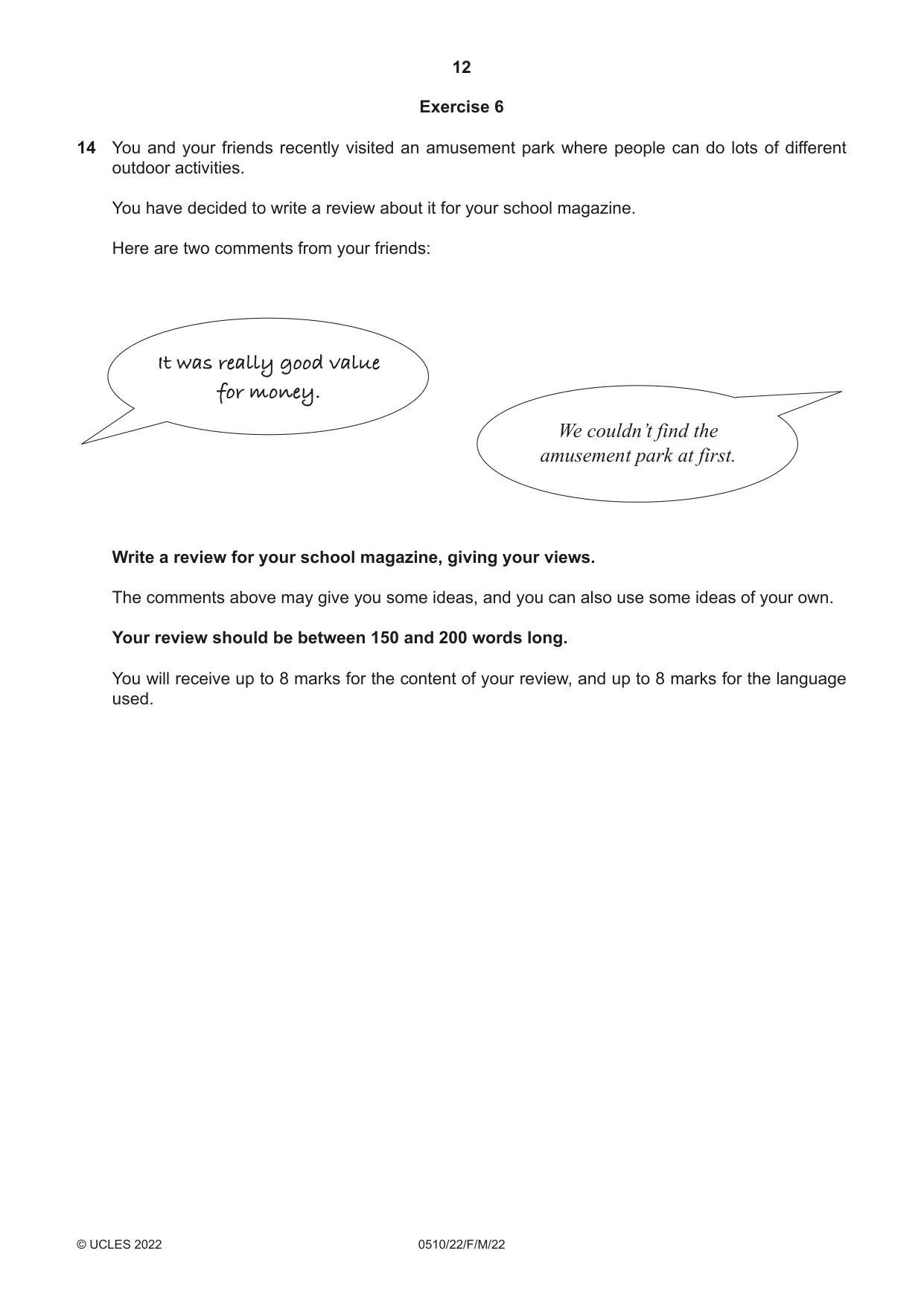
12 0510/22/F/M/22 © UCLES 2022 Exercise 6 14 You and your friends recently visited an amusement park where people can do lots of different outdoor activities. You have decided to write a review about it for your school magazine. Here are two comments from your friends: It was really good value for money. We couldn’t find the amusement park at first. Write a review for your school magazine, giving your views. The comments above may give you some ideas, and you can also use some ideas of your own. Your review should be between 150 and 200 words long. You will receive up to 8 marks for the content of your review, and up to 8 marks for the language used.
Question paper, page 13
13 0510/22/F/M/22 © UCLES 2022 … … … … … … … … … … … … … … … … … … … … … … … … … … … [Total: 16]
Question paper, page 14
14 0510/22/F/M/22 © UCLES 2022 BLANK PAGE
Question paper, page 15
15 0510/22/F/M/22 © UCLES 2022 BLANK PAGE
Question paper, page 16
16 0510/22/F/M/22 © UCLES 2022 Permission to reproduce items where third-party owned material protected by copyright is included has been sought and cleared where possible. Every reasonable effort has been made by the publisher (UCLES) to trace copyright holders, but if any items requiring clearance have unwittingly been included, the publisher will be pleased to make amends at the earliest possible opportunity. To avoid the issue of disclosure of answer-related information to candidates, all copyright acknowledgements are reproduced online in the Cambridge Assessment International Education Copyright Acknowledgements Booklet. This is produced for each series of examinations and is freely available to download at www.cambridgeinternational.org after the live examination series. Cambridge Assessment International Education is part of Cambridge Assessment. Cambridge Assessment is the brand name of the University of Cambridge Local Examinations Syndicate (UCLES), which is a department of the University of Cambridge. BLANK PAGE
Mark scheme, page 1
This document consists of 9 printed pages. © UCLES 2022 [Turn over Cambridge IGCSE™ ENGLISH AS A SECOND LANGUAGE 0510/22 Paper 2 Reading and Writing (Extended) February/March 2022 MARK SCHEME Maximum Mark: 80 Published This mark scheme is published as an aid to teachers and candidates, to indicate the requirements of the examination. It shows the basis on which Examiners were instructed to award marks. It does not indicate the details of the discussions that took place at an Examiners’ meeting before marking began, which would have considered the acceptability of alternative answers. Mark schemes should be read in conjunction with the question paper and the Principal Examiner Report for Teachers. Cambridge International will not enter into discussions about these mark schemes. Cambridge International is publishing the mark schemes for the February/March 2022 series for most Cambridge IGCSE™, Cambridge International A and AS Level components and some Cambridge O Level components.
Mark scheme, page 2
0510/22 Cambridge IGCSE – Mark Scheme PUBLISHED February/March 2022 © UCLES 2022 Page 2 of 9 This component forms part of the Extended tier assessment of Cambridge IGCSE English as a Second Language and tests the following Assessment Objectives: AO1: Reading R1 identify and select relevant information R2 understand ideas, opinions and attitudes R3 show understanding of the connections between ideas, opinions and attitudes R4 understand what is implied but not directly stated, e.g. gist, writer’s purpose, intentions and feelings AO2: Writing W1 communicate information/ideas/opinions clearly, accurately and effectively W2 organise ideas into coherent paragraphs using a range of appropriate linking devices W3 use a range of grammatical structures accurately and effectively W4 show control of punctuation and spelling W5 use appropriate register and style/format for the given purpose and audience
Mark scheme, page 3
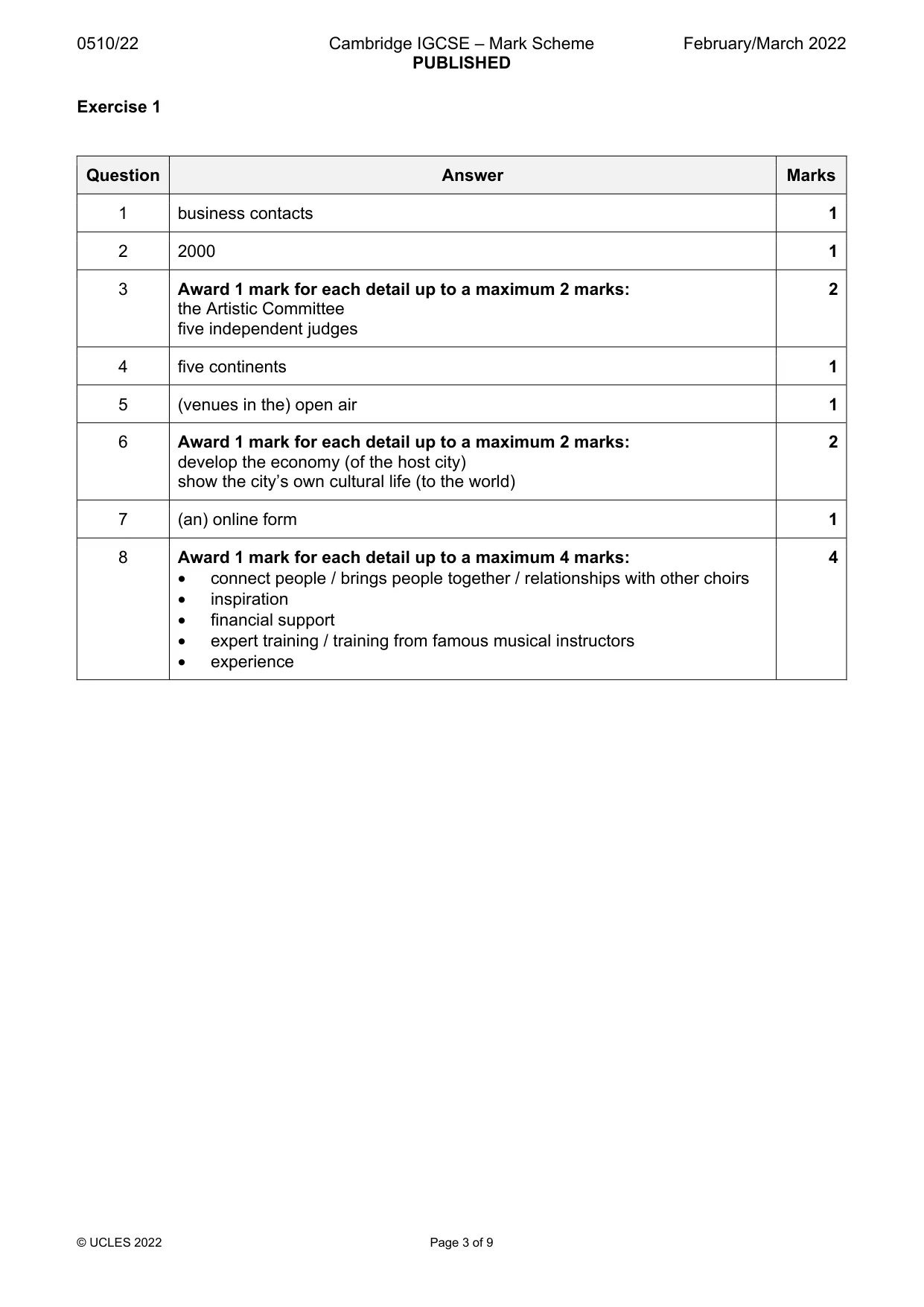
0510/22 Cambridge IGCSE – Mark Scheme PUBLISHED February/March 2022 © UCLES 2022 Page 3 of 9 Exercise 1 Question Answer Marks 1 business contacts 1 2 2000 1 3 Award 1 mark for each detail up to a maximum 2 marks: the Artistic Committee five independent judges 2 4 five continents 1 5 (venues in the) open air 1 6 Award 1 mark for each detail up to a maximum 2 marks: develop the economy (of the host city) show the city’s own cultural life (to the world) 2 7 (an) online form 1 8 Award 1 mark for each detail up to a maximum 4 marks: • connect people / brings people together / relationships with other choirs • inspiration • financial support • expert training / training from famous musical instructors • experience 4
Mark scheme, page 4
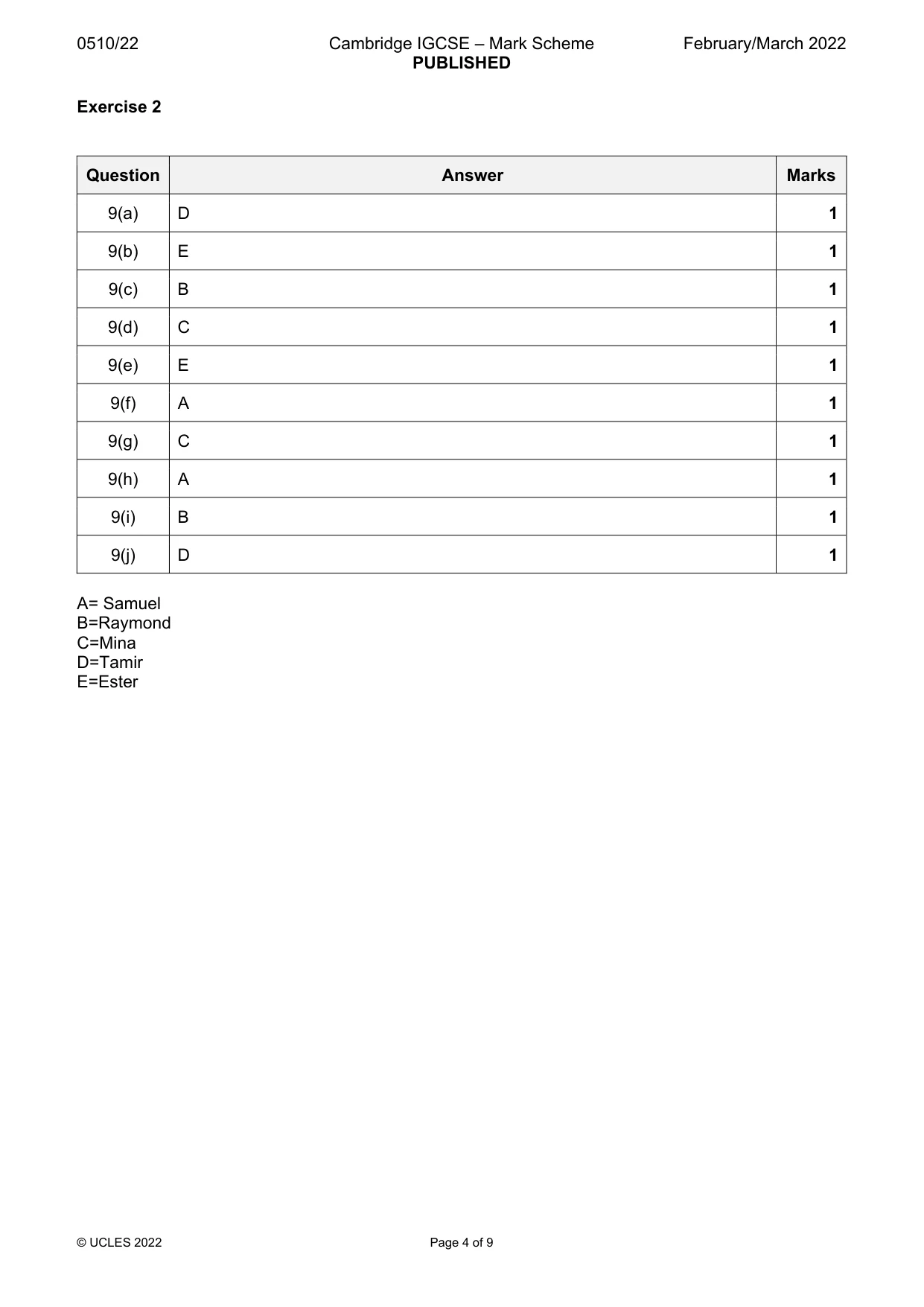
0510/22 Cambridge IGCSE – Mark Scheme PUBLISHED February/March 2022 © UCLES 2022 Page 4 of 9 Exercise 2 Question Answer Marks 9(a) D 1 9(b) E 1 9(c) B 1 9(d) C 1 9(e) E 1 9(f) A 1 9(g) C 1 9(h) A 1 9(i) B 1 9(j) D 1 A= Samuel B=Raymond C=Mina D=Tamir E=Ester
Mark scheme, page 5
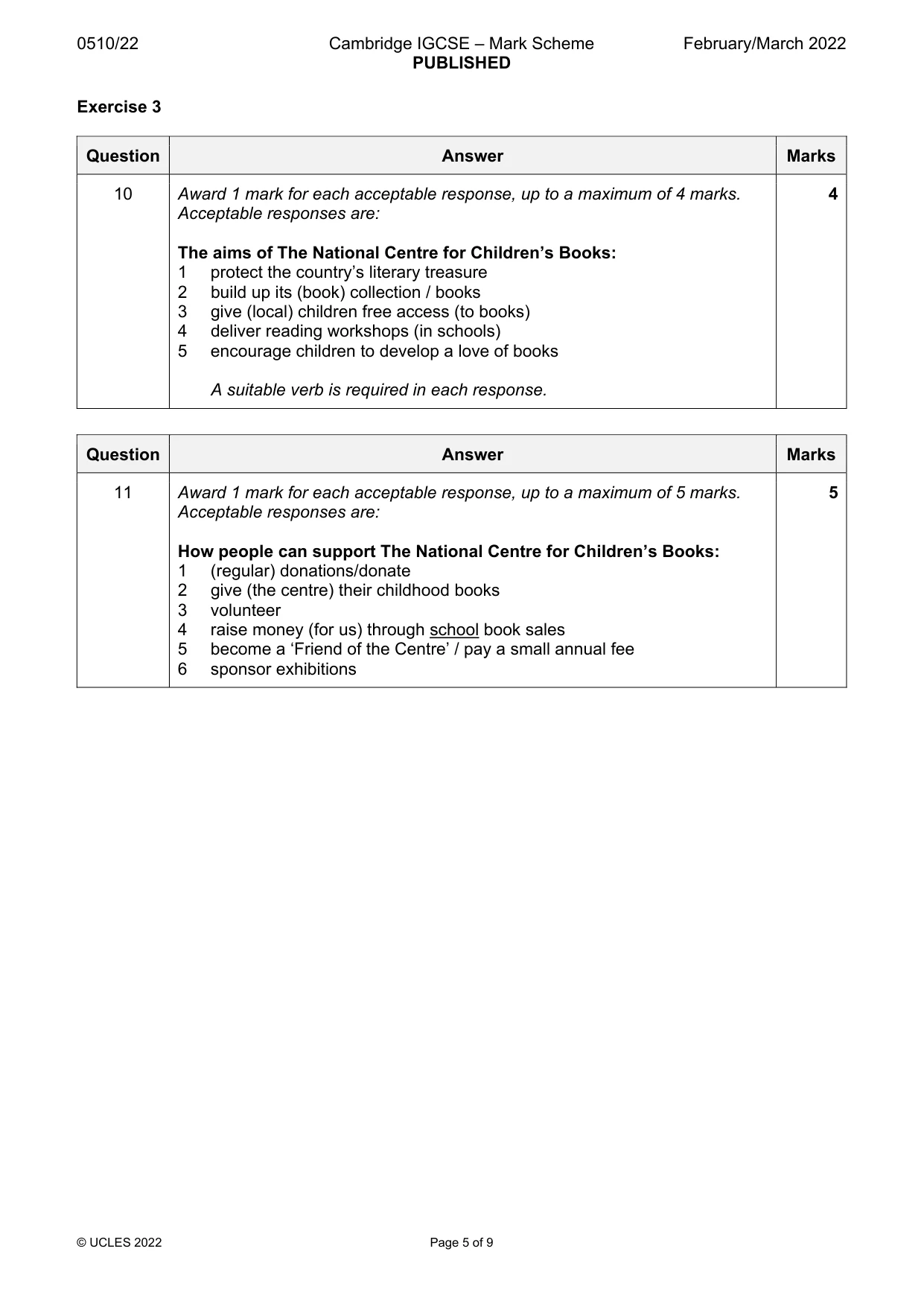
0510/22 Cambridge IGCSE – Mark Scheme PUBLISHED February/March 2022 © UCLES 2022 Page 5 of 9 Exercise 3 Question Answer Marks 10 Award 1 mark for each acceptable response, up to a maximum of 4 marks. Acceptable responses are: The aims of The National Centre for Children’s Books: 1 protect the country’s literary treasure 2 build up its (book) collection / books 3 give (local) children free access (to books) 4 deliver reading workshops (in schools) 5 encourage children to develop a love of books A suitable verb is required in each response. 4 Question Answer Marks 11 Award 1 mark for each acceptable response, up to a maximum of 5 marks. Acceptable responses are: How people can support The National Centre for Children’s Books: 1 (regular) donations/donate 2 give (the centre) their childhood books 3 volunteer 4 raise money (for us) through school book sales 5 become a ‘Friend of the Centre’ / pay a small annual fee 6 sponsor exhibitions 5
Mark scheme, page 6
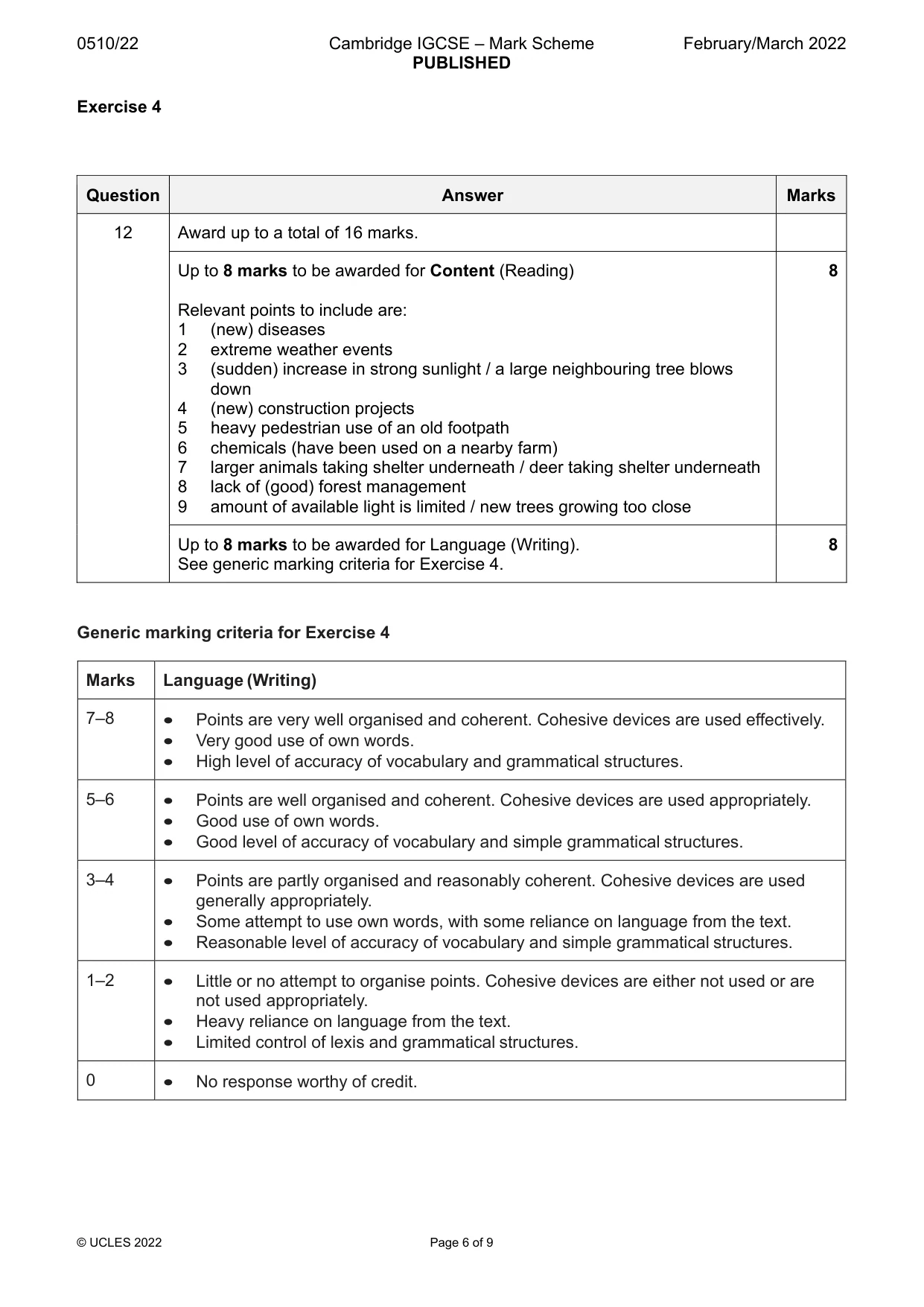
0510/22 Cambridge IGCSE – Mark Scheme PUBLISHED February/March 2022 © UCLES 2022 Page 6 of 9 Exercise 4 Question Answer Marks 12 Award up to a total of 16 marks. Up to 8 marks to be awarded for Content (Reading) Relevant points to include are: 1 (new) diseases 2 extreme weather events 3 (sudden) increase in strong sunlight / a large neighbouring tree blows down 4 (new) construction projects 5 heavy pedestrian use of an old footpath 6 chemicals (have been used on a nearby farm) 7 larger animals taking shelter underneath / deer taking shelter underneath 8 lack of (good) forest management 9 amount of available light is limited / new trees growing too close 8 Up to 8 marks to be awarded for Language (Writing). See generic marking criteria for Exercise 4. 8 Generic marking criteria for Exercise 4 Marks Language (Writing) 7–8 • Points are very well organised and coherent. Cohesive devices are used effectively. • Very good use of own words. • High level of accuracy of vocabulary and grammatical structures. 5–6 • Points are well organised and coherent. Cohesive devices are used appropriately. • Good use of own words. • Good level of accuracy of vocabulary and simple grammatical structures. 3–4 • Points are partly organised and reasonably coherent. Cohesive devices are used generally appropriately. • Some attempt to use own words, with some reliance on language from the text. • Reasonable level of accuracy of vocabulary and simple grammatical structures. 1–2 • Little or no attempt to organise points. Cohesive devices are either not used or are not used appropriately. • Heavy reliance on language from the text. • Limited control of lexis and grammatical structures. 0 • No response worthy of credit.
Mark scheme, page 7
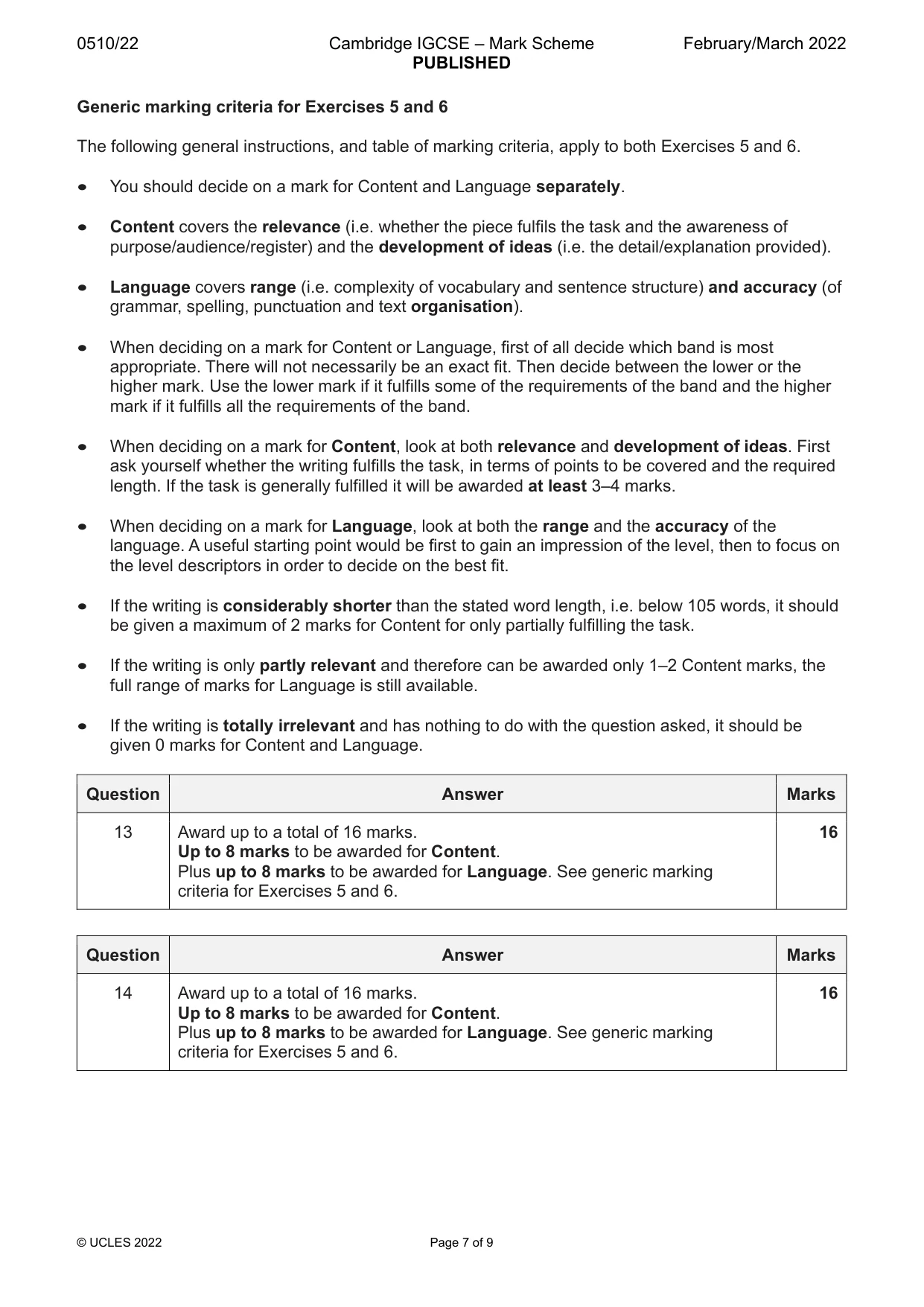
0510/22 Cambridge IGCSE – Mark Scheme PUBLISHED February/March 2022 © UCLES 2022 Page 7 of 9 Generic marking criteria for Exercises 5 and 6 The following general instructions, and table of marking criteria, apply to both Exercises 5 and 6. • You should decide on a mark for Content and Language separately. • Content covers the relevance (i.e. whether the piece fulfils the task and the awareness of purpose/audience/register) and the development of ideas (i.e. the detail/explanation provided). • Language covers range (i.e. complexity of vocabulary and sentence structure) and accuracy (of grammar, spelling, punctuation and text organisation). • When deciding on a mark for Content or Language, first of all decide which band is most appropriate. There will not necessarily be an exact fit. Then decide between the lower or the higher mark. Use the lower mark if it fulfills some of the requirements of the band and the higher mark if it fulfills all the requirements of the band. • When deciding on a mark for Content, look at both relevance and development of ideas. First ask yourself whether the writing fulfills the task, in terms of points to be covered and the required length. If the task is generally fulfilled it will be awarded at least 3–4 marks. • When deciding on a mark for Language, look at both the range and the accuracy of the language. A useful starting point would be first to gain an impression of the level, then to focus on the level descriptors in order to decide on the best fit. • If the writing is considerably shorter than the stated word length, i.e. below 105 words, it should be given a maximum of 2 marks for Content for only partially fulfilling the task. • If the writing is only partly relevant and therefore can be awarded only 1–2 Content marks, the full range of marks for Language is still available. • If the writing is totally irrelevant and has nothing to do with the question asked, it should be given 0 marks for Content and Language. Question Answer Marks 13 Award up to a total of 16 marks. Up to 8 marks to be awarded for Content. Plus up to 8 marks to be awarded for Language. See generic marking criteria for Exercises 5 and 6. 16 Question Answer Marks 14 Award up to a total of 16 marks. Up to 8 marks to be awarded for Content. Plus up to 8 marks to be awarded for Language. See generic marking criteria for Exercises 5 and 6. 16
Mark scheme, page 8
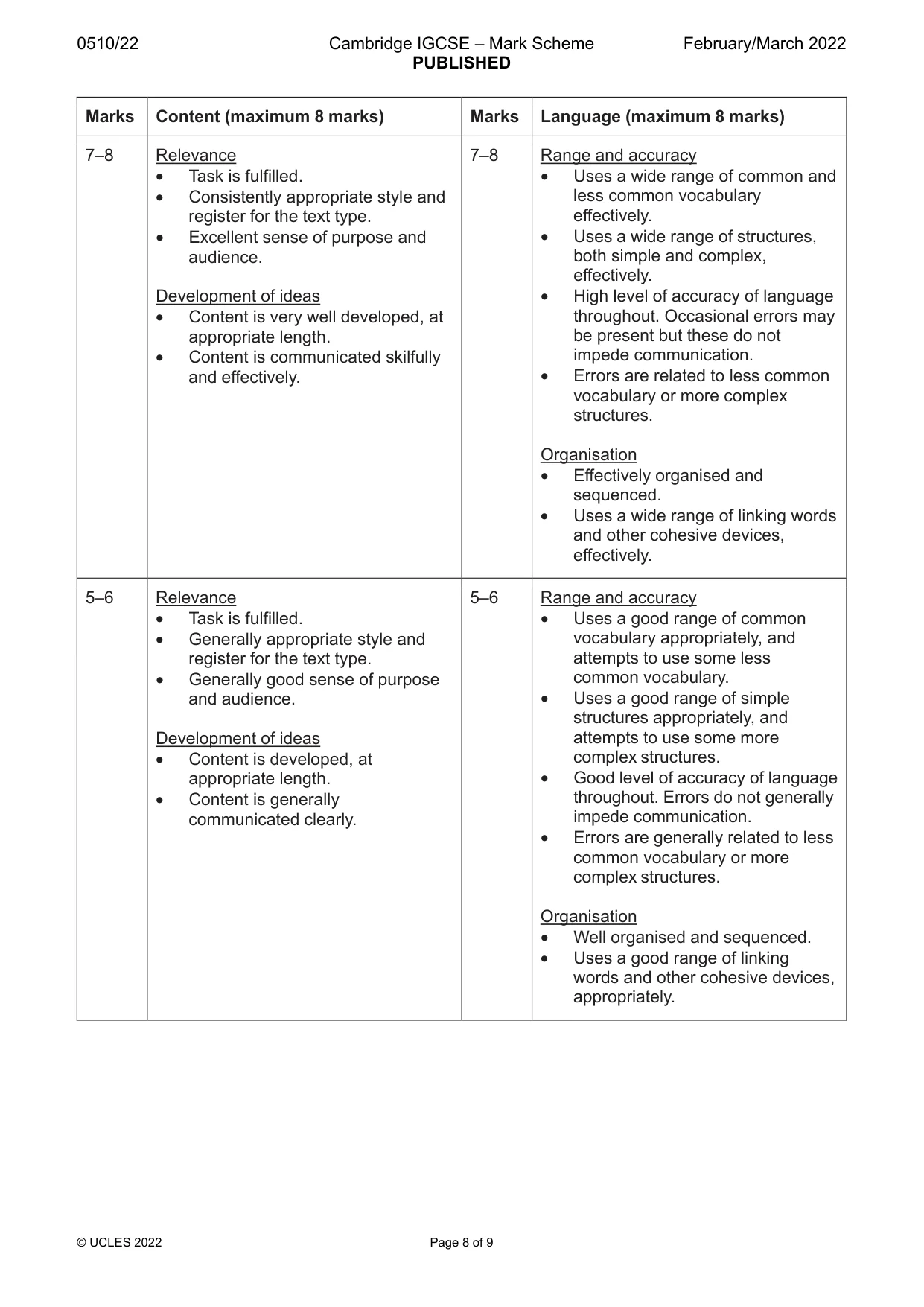
0510/22 Cambridge IGCSE – Mark Scheme PUBLISHED February/March 2022 © UCLES 2022 Page 8 of 9 Marks Content (maximum 8 marks) Marks Language (maximum 8 marks) 7–8 Relevance • Task is fulfilled. • Consistently appropriate style and register for the text type. • Excellent sense of purpose and audience. Development of ideas • Content is very well developed, at appropriate length. • Content is communicated skilfully and effectively. 7–8 Range and accuracy • Uses a wide range of common and less common vocabulary effectively. • Uses a wide range of structures, both simple and complex, effectively. • High level of accuracy of language throughout. Occasional errors may be present but these do not impede communication. • Errors are related to less common vocabulary or more complex structures. Organisation • Effectively organised and sequenced. • Uses a wide range of linking words and other cohesive devices, effectively. 5–6 Relevance • Task is fulfilled. • Generally appropriate style and register for the text type. • Generally good sense of purpose and audience. Development of ideas • Content is developed, at appropriate length. • Content is generally communicated clearly. 5–6 Range and accuracy • Uses a good range of common vocabulary appropriately, and attempts to use some less common vocabulary. • Uses a good range of simple structures appropriately, and attempts to use some more complex structures. • Good level of accuracy of language throughout. Errors do not generally impede communication. • Errors are generally related to less common vocabulary or more complex structures. Organisation • Well organised and sequenced. • Uses a good range of linking words and other cohesive devices, appropriately.
Mark scheme, page 9
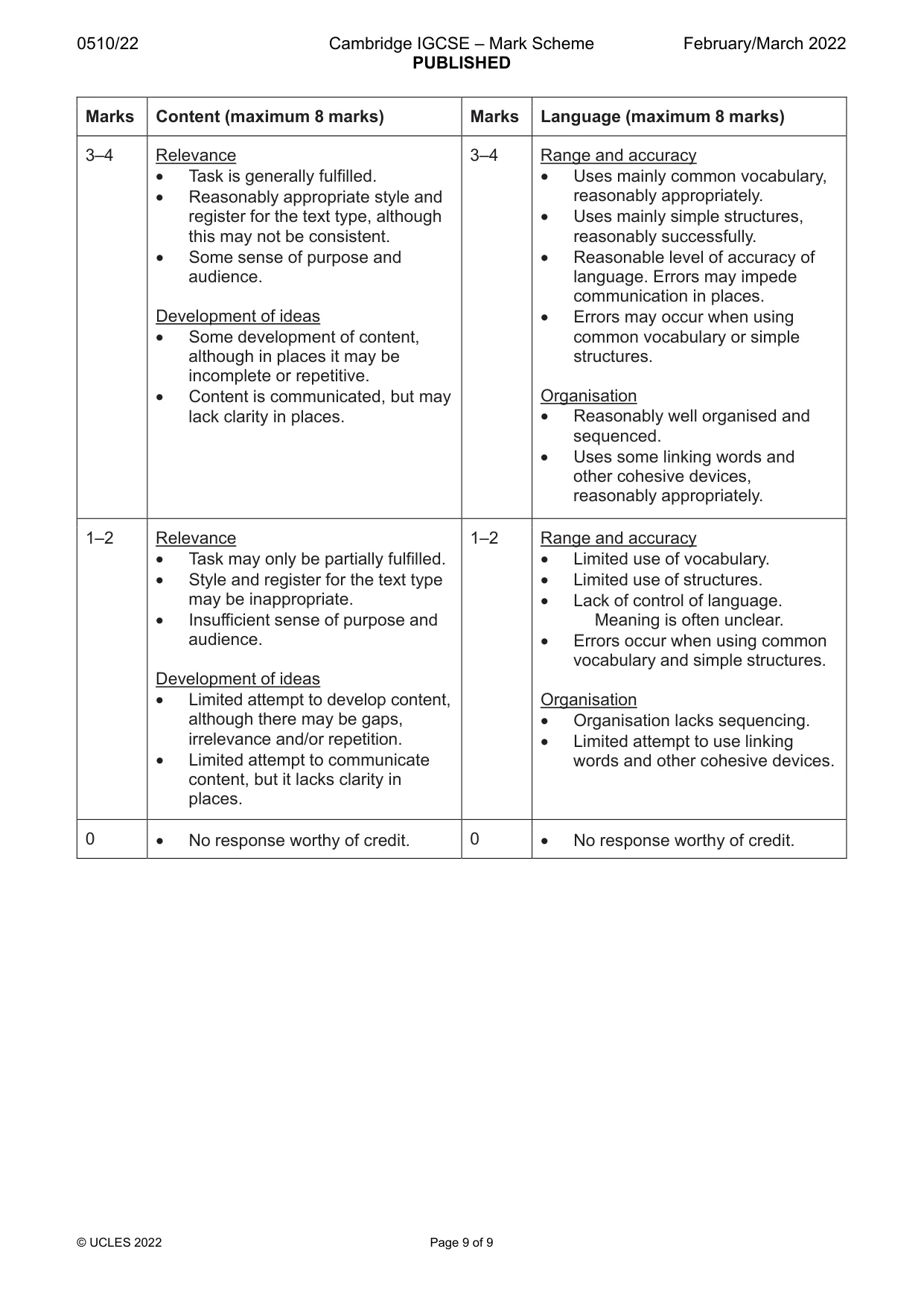
0510/22 Cambridge IGCSE – Mark Scheme PUBLISHED February/March 2022 © UCLES 2022 Page 9 of 9 Marks Content (maximum 8 marks) Marks Language (maximum 8 marks) 3–4 Relevance • Task is generally fulfilled. • Reasonably appropriate style and register for the text type, although this may not be consistent. • Some sense of purpose and audience. Development of ideas • Some development of content, although in places it may be incomplete or repetitive. • Content is communicated, but may lack clarity in places. 3–4 Range and accuracy • Uses mainly common vocabulary, reasonably appropriately. • Uses mainly simple structures, reasonably successfully. • Reasonable level of accuracy of language. Errors may impede communication in places. • Errors may occur when using common vocabulary or simple structures. Organisation • Reasonably well organised and sequenced. • Uses some linking words and other cohesive devices, reasonably appropriately. 1–2 Relevance • Task may only be partially fulfilled. • Style and register for the text type may be inappropriate. • Insufficient sense of purpose and audience. Development of ideas • Limited attempt to develop content, although there may be gaps, irrelevance and/or repetition. • Limited attempt to communicate content, but it lacks clarity in places. 1–2 Range and accuracy • Limited use of vocabulary. • Limited use of structures. • Lack of control of language. Meaning is often unclear. • Errors occur when using common vocabulary and simple structures. Organisation • Organisation lacks sequencing. • Limited attempt to use linking words and other cohesive devices. 0 • No response worthy of credit. 0 • No response worthy of credit.
What you needed in this session
Cambridge’s own grade thresholds for 2022 Feb/March, Paper 2 · Variant 2. A higher threshold means an easier paper — the bar moves with how the cohort did.