Cambridge IGCSE English - Second Language (oral endorsement) 0510 — 2021 Oct/Nov Paper 1 · Variant 2
0510/12/O/N/21 · 60 marks · ≈68 min
The question paper and its mark scheme, free to read here and free to download. This is Cambridge’s own paper, exactly as it was sat.
Question paper16 pages



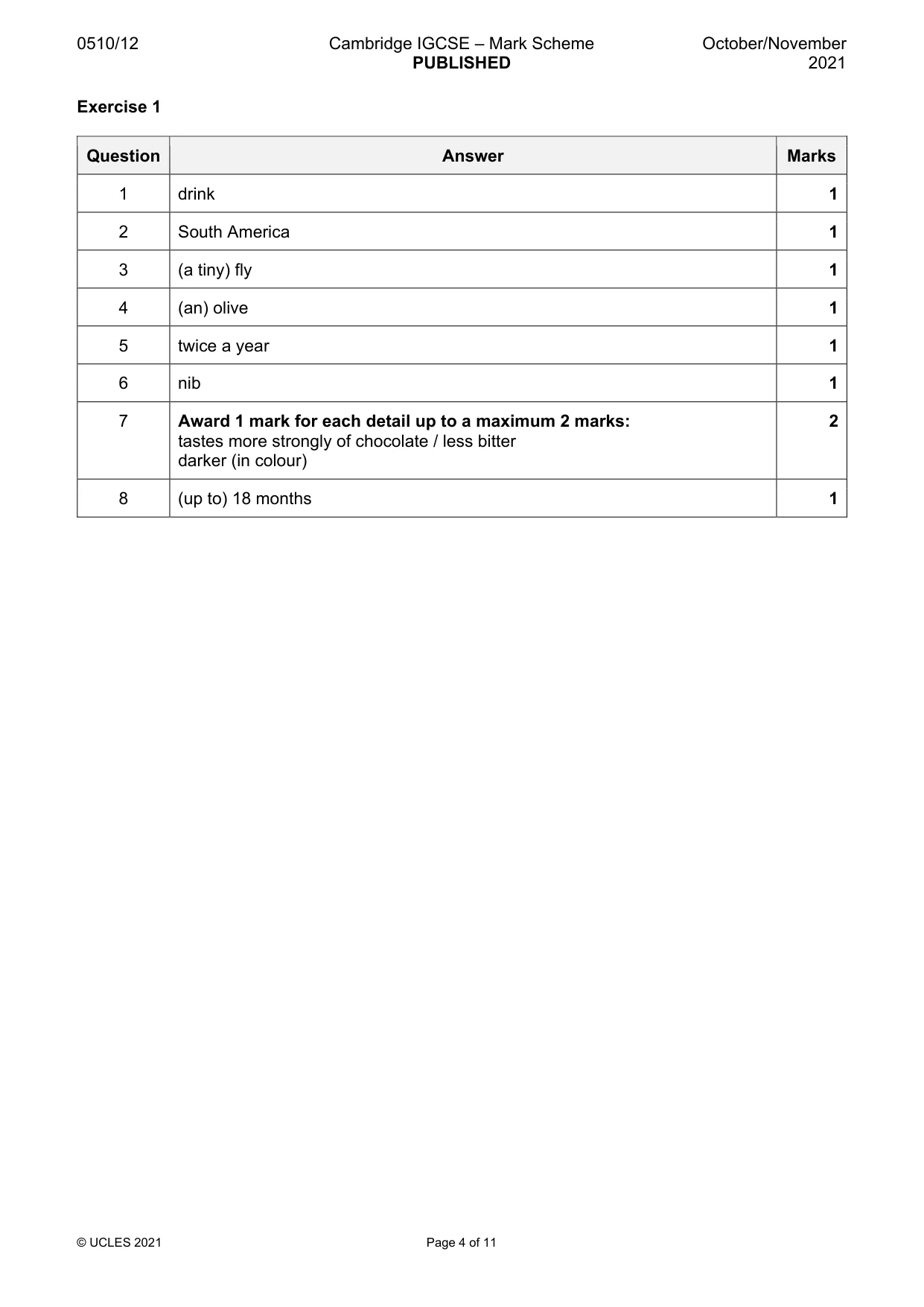
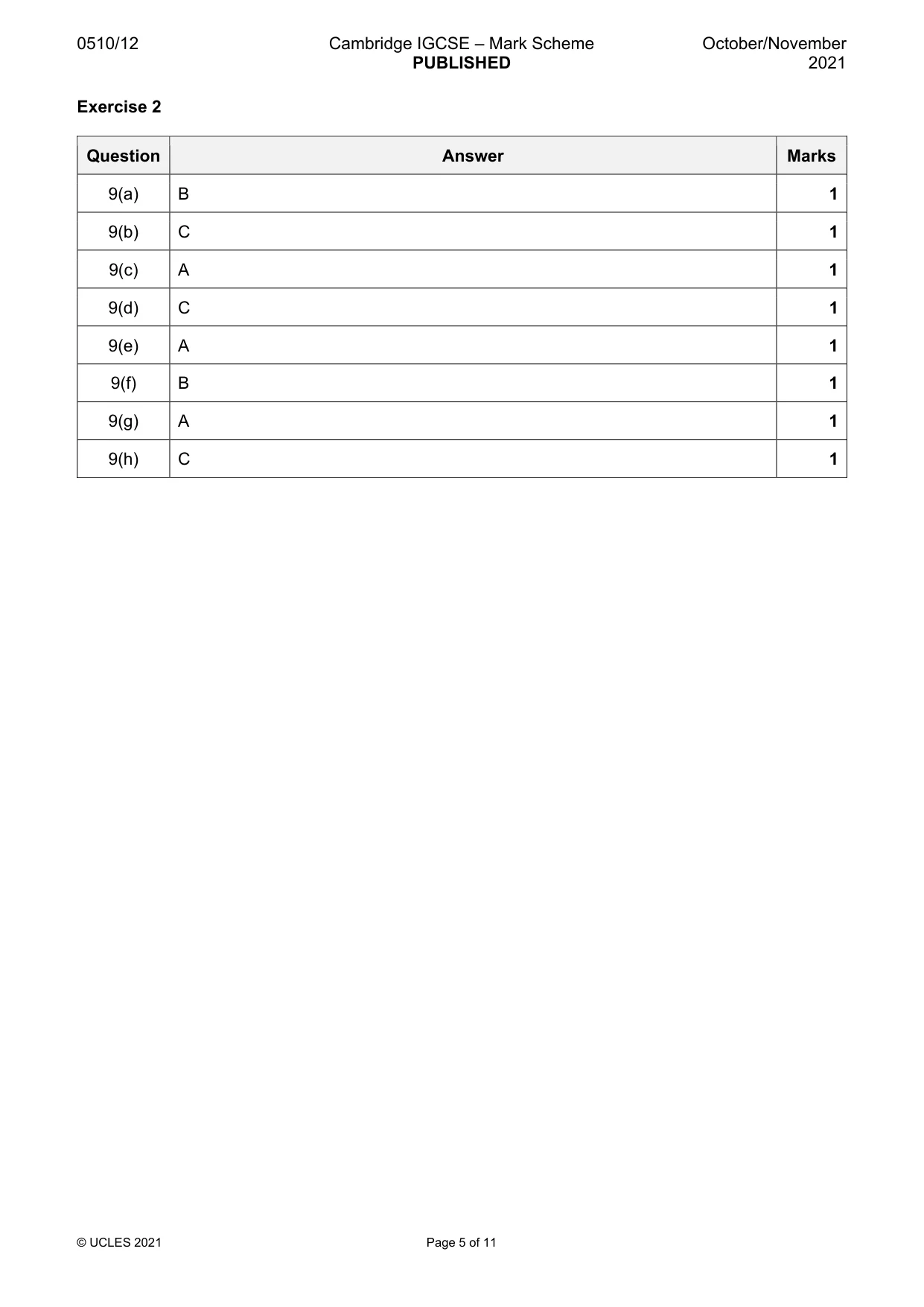
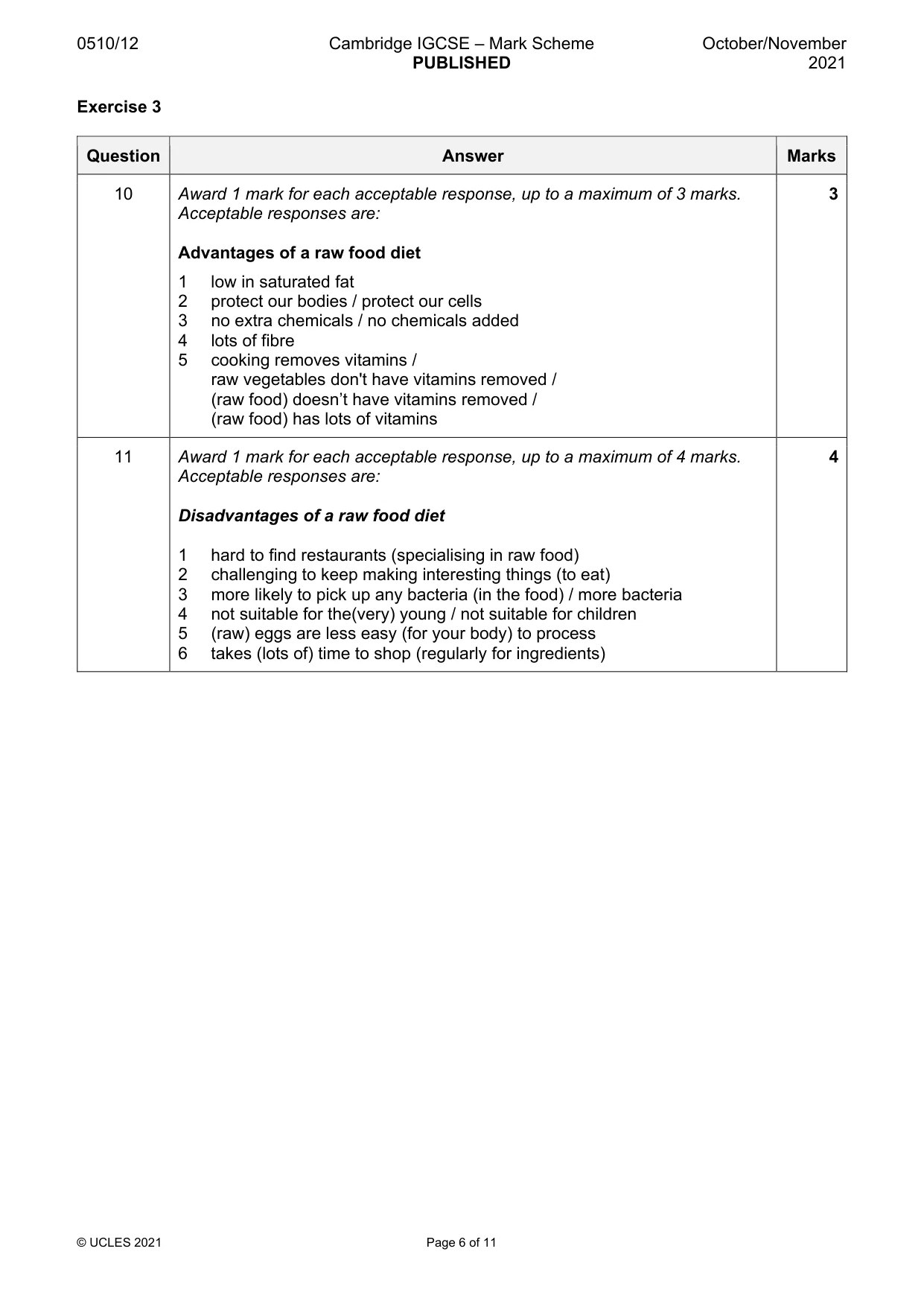
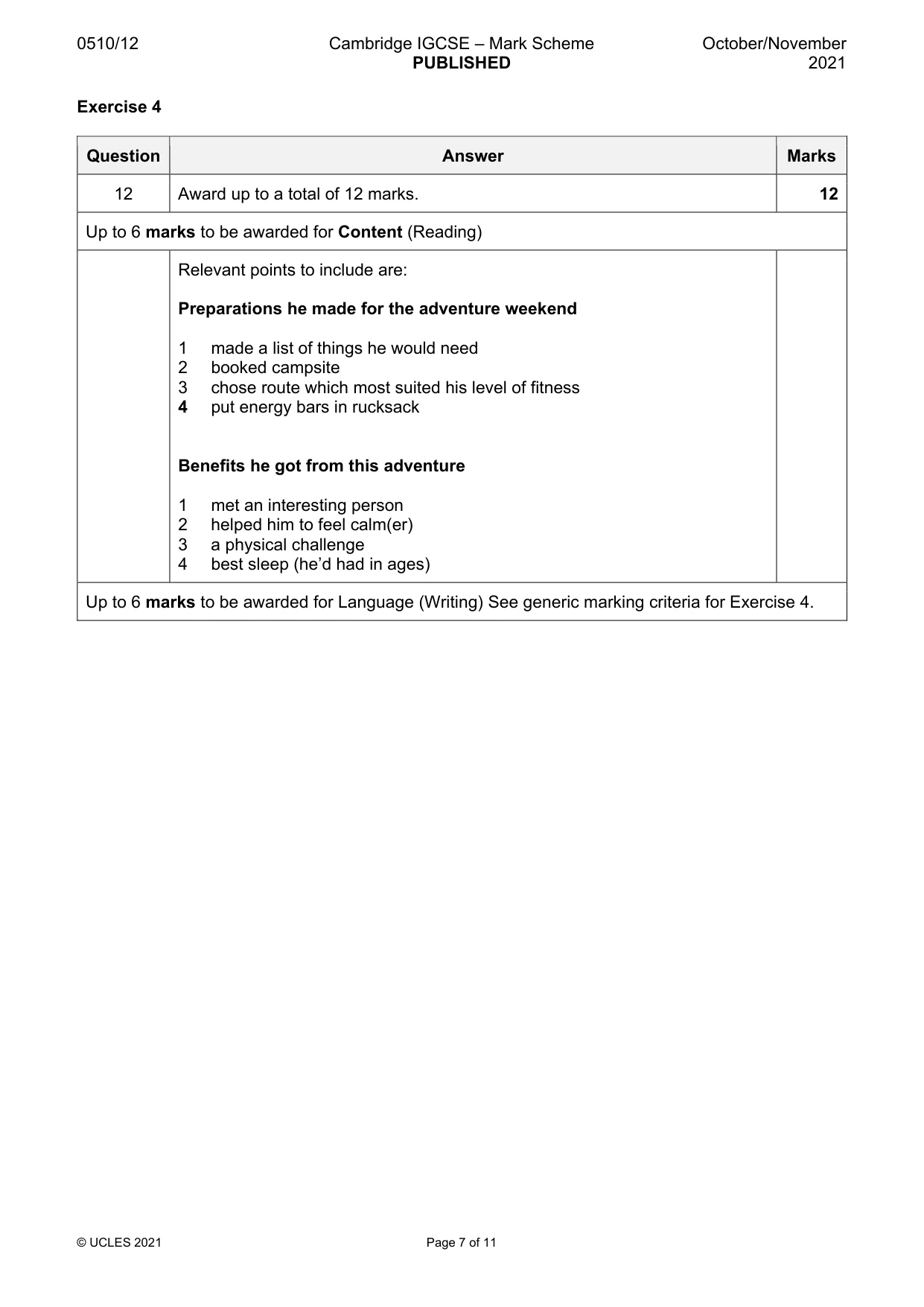
Mark scheme11 pages
Answers below. Sit the paper first if you are practising.
Paper as text
Question paper, page 1
This document has 16 pages. Any blank pages are indicated. Cambridge IGCSE™ DC (PQ/SG) 205047/2 © UCLES 2021 [Turn over * 3 6 7 3 2 5 7 4 2 0 * ENGLISH AS A SECOND LANGUAGE 0510/12 Paper 1 Reading and Writing (Core) October/November 2021 1 hour 30 minutes You must answer on the question paper. No additional materials are needed. INSTRUCTIONS ● Answer all questions. ● Use a black or dark blue pen. ● Write your name, centre number and candidate number in the boxes at the top of the page. ● Write your answer to each question in the space provided. ● Do not use an erasable pen or correction fluid. ● Do not write on any bar codes. ● Dictionaries are not allowed. INFORMATION ● The total mark for this paper is 60. ● The number of marks for each question or part question is shown in brackets [ ].
Question paper, page 2
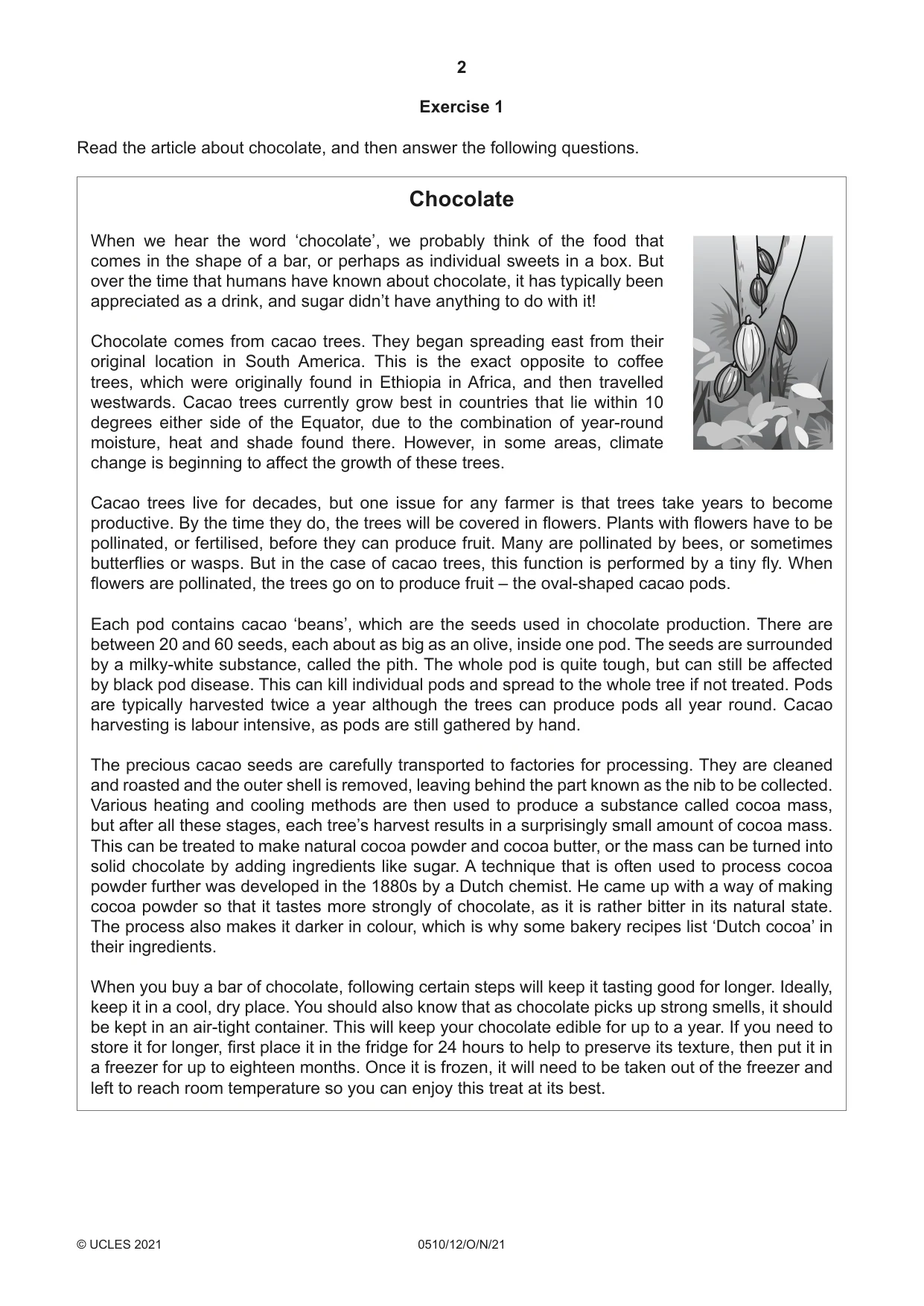
2 0510/12/O/N/21 © UCLES 2021 Exercise 1 Read the article about chocolate, and then answer the following questions. Chocolate When we hear the word ‘chocolate’, we probably think of the food that comes in the shape of a bar, or perhaps as individual sweets in a box. But over the time that humans have known about chocolate, it has typically been appreciated as a drink, and sugar didn’t have anything to do with it! Chocolate comes from cacao trees. They began spreading east from their original location in South America. This is the exact opposite to coffee trees, which were originally found in Ethiopia in Africa, and then travelled westwards. Cacao trees currently grow best in countries that lie within 10 degrees either side of the Equator, due to the combination of year-round moisture, heat and shade found there. However, in some areas, climate change is beginning to affect the growth of these trees. Cacao trees live for decades, but one issue for any farmer is that trees take years to become productive. By the time they do, the trees will be covered in flowers. Plants with flowers have to be pollinated, or fertilised, before they can produce fruit. Many are pollinated by bees, or sometimes butterflies or wasps. But in the case of cacao trees, this function is performed by a tiny fly. When flowers are pollinated, the trees go on to produce fruit – the oval-shaped cacao pods. Each pod contains cacao ‘beans’, which are the seeds used in chocolate production. There are between 20 and 60 seeds, each about as big as an olive, inside one pod. The seeds are surrounded by a milky-white substance, called the pith. The whole pod is quite tough, but can still be affected by black pod disease. This can kill individual pods and spread to the whole tree if not treated. Pods are typically harvested twice a year although the trees can produce pods all year round. Cacao harvesting is labour intensive, as pods are still gathered by hand. The precious cacao seeds are carefully transported to factories for processing. They are cleaned and roasted and the outer shell is removed, leaving behind the part known as the nib to be collected. Various heating and cooling methods are then used to produce a substance called cocoa mass, but after all these stages, each tree’s harvest results in a surprisingly small amount of cocoa mass. This can be treated to make natural cocoa powder and cocoa butter, or the mass can be turned into solid chocolate by adding ingredients like sugar. A technique that is often used to process cocoa powder further was developed in the 1880s by a Dutch chemist. He came up with a way of making cocoa powder so that it tastes more strongly of chocolate, as it is rather bitter in its natural state. The process also makes it darker in colour, which is why some bakery recipes list ‘Dutch cocoa’ in their ingredients. When you buy a bar of chocolate, following certain steps will keep it tasting good for longer. Ideally, keep it in a cool, dry place. You should also know that as chocolate picks up strong smells, it should be kept in an air-tight container. This will keep your chocolate edible for up to a year. If you need to store it for longer, first place it in the fridge for 24 hours to help to preserve its texture, then put it in a freezer for up to eighteen months. Once it is frozen, it will need to be taken out of the freezer and left to reach room temperature so you can enjoy this treat at its best.
Question paper, page 3
3 0510/12/O/N/21 © UCLES 2021 [Turn over 1 What form of chocolate has been most commonly enjoyed throughout its history? … [1] 2 On which continent were cacao trees first found? … [1] 3 Which type of insect is needed in order for cacao trees to produce fruit? … [1] 4 What is a seed compared with in terms of its size? … [1] 5 How often are the pods picked from cacao trees? … [1] 6 Which part of the seed is kept after the roasting process? … [1] 7 What changes are made to cocoa powder by a method that was invented in the 1880s? Give two details. … … [2] 8 What is the recommended maximum time to keep chocolate frozen? … [1] [Total: 9]
Question paper, page 4
4 0510/12/O/N/21 © UCLES 2021 Exercise 2 Read the article about three people (A–C) who are interested in photography. Then answer Question 9(a)–(h). Why I love photography Three young people tell us about their hobby A Vikki I’ve been taking photos for as long as I can remember. I really think it helps me show my creative side. As digital photography has become common, and cameras have got smaller and more powerful, what was once an expensive hobby has become something that large numbers of people regularly enjoy. I’m lucky enough to have a top-of-the-range camera now. Of course, I didn’t have anything expensive at first, but I still got a huge amount of enjoyment from my first simple camera, and that’s what got me interested. There have been some displays from really famous photographers in the city where I live, and although I love looking at their pictures, I try not to let them influence me too much. I think it’s important to focus on taking pictures in my own way – that’s what keeps things interesting for me! B Tomas I really love photography, and being creative with my images. I can take pictures of almost anything and make them look better by managing settings on my camera or using computer software. It’s really fun, although I think my approach is a bit more advanced than the typical things most people do for social media posts. People are also constantly taking pictures to boast about what they’re doing! I’m more serious about my hobby. When I want to take pictures, mostly at weekends, I pack up my camera and go and plan my shots carefully. I’m not someone who takes hundreds of photos hoping that one will be good. I know taking pictures is something I do well, and it might sound strange, but this has made me feel that I can take on all sorts of other challenges too, like sports, for example. C Sasha I have a passion for photography for various reasons. Firstly, photos tell stories about places people have been to, or things they’ve done. I’m sure my friends get a much clearer idea of what I’ve been doing when I show them my photos. People say ‘a picture paints a thousand words’ after all! Photography has also helped open my mind by encouraging me to consider common objects in new and unexpected ways, as I like taking pictures from unusual angles, or strange close-ups – things people don’t expect. I read a lot about famous photographers, and the more I read, the more I’m amazed at the different styles, ideas and techniques. There are more than enough to keep me busy! If you’re interested in taking up photography as a hobby, I’d say the best thing to do is to just get out there and start taking pictures of different things as soon as you can!
Question paper, page 5
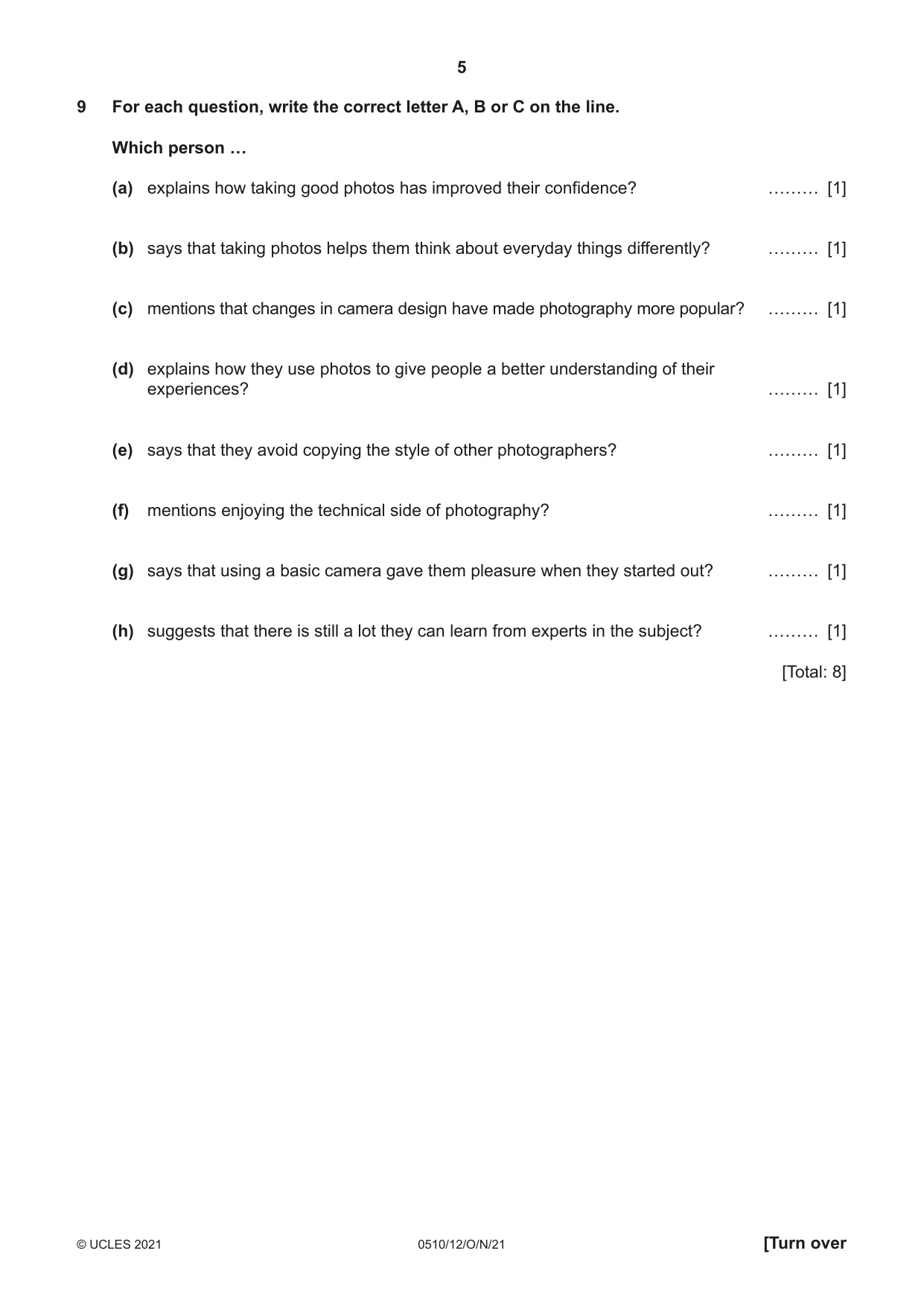
5 0510/12/O/N/21 © UCLES 2021 [Turn over 9 For each question, write the correct letter A, B or C on the line. Which person … (a) explains how taking good photos has improved their confidence? ……… [1] (b) says that taking photos helps them think about everyday things differently? ……… [1] (c) mentions that changes in camera design have made photography more popular? ……… [1] (d) explains how they use photos to give people a better understanding of their experiences? ……… [1] (e) says that they avoid copying the style of other photographers? ……… [1] (f) mentions enjoying the technical side of photography? ……… [1] (g) says that using a basic camera gave them pleasure when they started out? ……… [1] (h) suggests that there is still a lot they can learn from experts in the subject? ……… [1] [Total: 8]
Question paper, page 6
6 0510/12/O/N/21 © UCLES 2021 Exercise 3 Read the article about a raw food diet, and then complete the notes. A raw food diet People nowadays are generally very interested in learning about how their diet – the food that they eat on a day-to-day basis – can make them healthy, and they are often keen to find out about different diets. Perhaps the best idea could be to aim for a combination or balance of different ways of eating, finding the one that best suits your situation and needs at the time, and of course – and very importantly – your personal taste. Content removed due to copyright restrictions.
Question paper, page 7
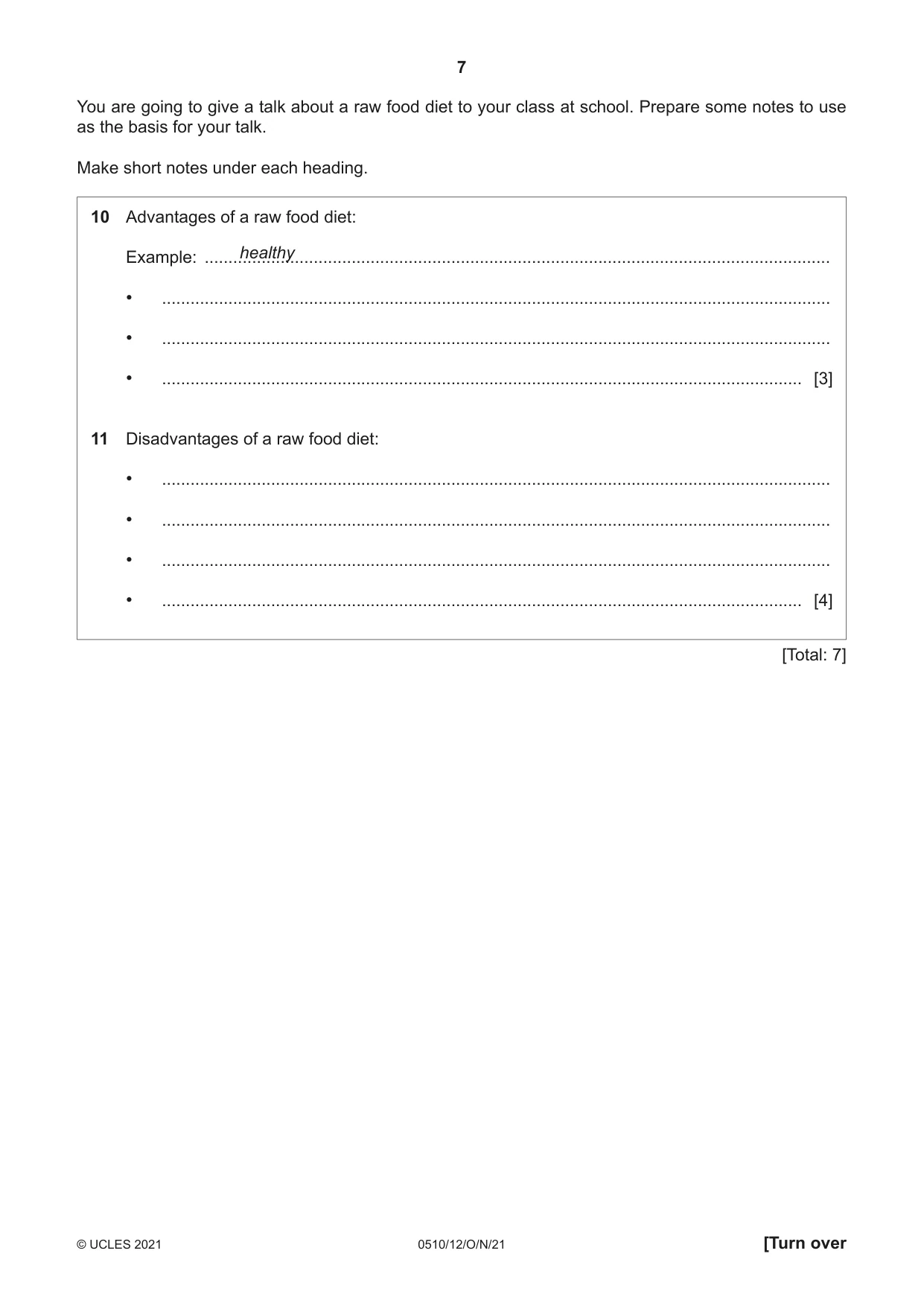
7 0510/12/O/N/21 © UCLES 2021 [Turn over You are going to give a talk about a raw food diet to your class at school. Prepare some notes to use as the basis for your talk. Make short notes under each heading. 10 Advantages of a raw food diet: healthy Example: … • … • … • … [3] 11 Disadvantages of a raw food diet: • … • … • … • … [4] [Total: 7]
Question paper, page 8
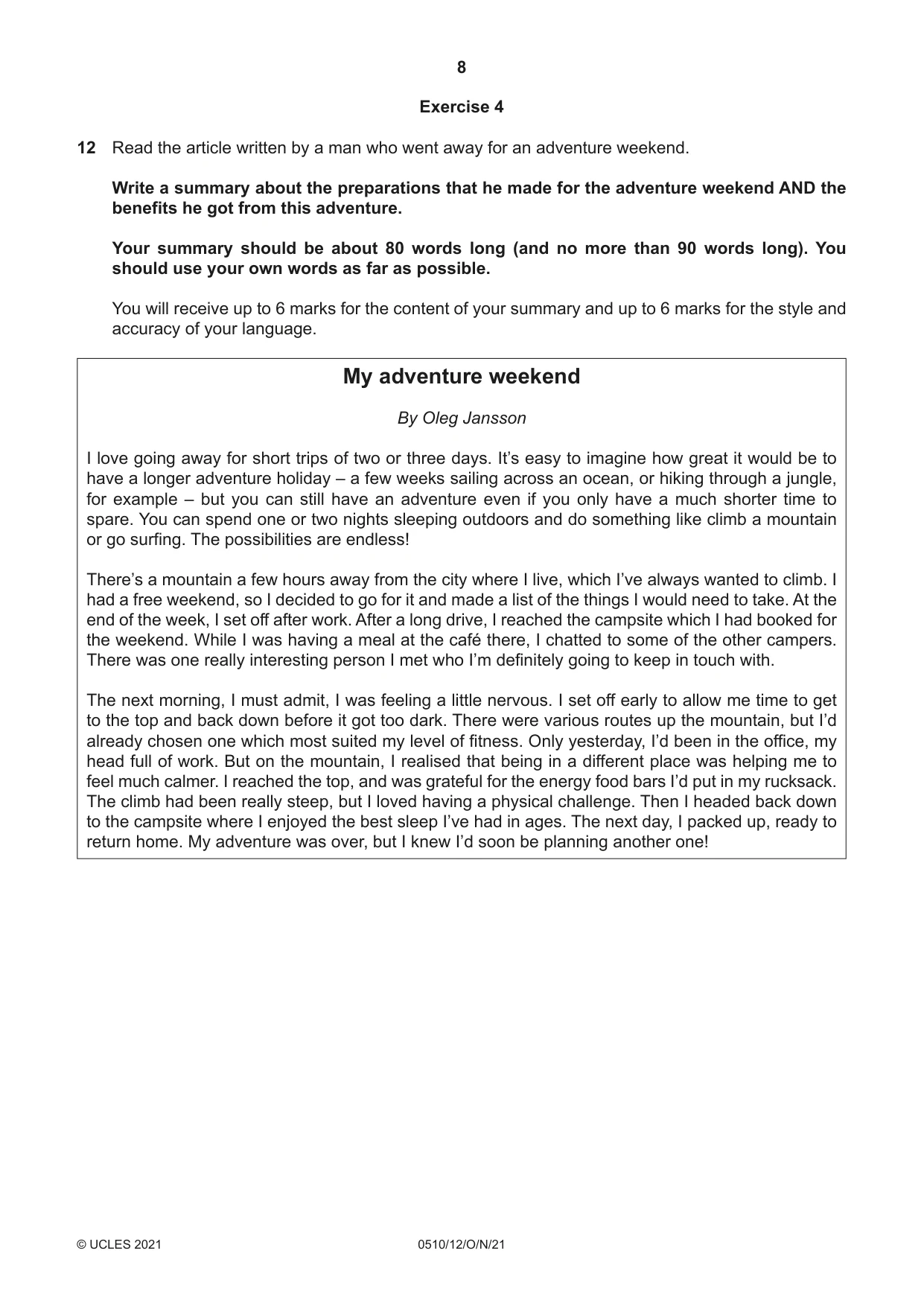
8 0510/12/O/N/21 © UCLES 2021 Exercise 4 12 Read the article written by a man who went away for an adventure weekend. Write a summary about the preparations that he made for the adventure weekend AND the benefits he got from this adventure. Your summary should be about 80 words long (and no more than 90 words long). You should use your own words as far as possible. You will receive up to 6 marks for the content of your summary and up to 6 marks for the style and accuracy of your language. My adventure weekend By Oleg Jansson I love going away for short trips of two or three days. It’s easy to imagine how great it would be to have a longer adventure holiday – a few weeks sailing across an ocean, or hiking through a jungle, for example – but you can still have an adventure even if you only have a much shorter time to spare. You can spend one or two nights sleeping outdoors and do something like climb a mountain or go surfing. The possibilities are endless! There’s a mountain a few hours away from the city where I live, which I’ve always wanted to climb. I had a free weekend, so I decided to go for it and made a list of the things I would need to take. At the end of the week, I set off after work. After a long drive, I reached the campsite which I had booked for the weekend. While I was having a meal at the café there, I chatted to some of the other campers. There was one really interesting person I met who I’m definitely going to keep in touch with. The next morning, I must admit, I was feeling a little nervous. I set off early to allow me time to get to the top and back down before it got too dark. There were various routes up the mountain, but I’d already chosen one which most suited my level of fitness. Only yesterday, I’d been in the office, my head full of work. But on the mountain, I realised that being in a different place was helping me to feel much calmer. I reached the top, and was grateful for the energy food bars I’d put in my rucksack. The climb had been really steep, but I loved having a physical challenge. Then I headed back down to the campsite where I enjoyed the best sleep I’ve had in ages. The next day, I packed up, ready to return home. My adventure was over, but I knew I’d soon be planning another one!
Question paper, page 9
9 0510/12/O/N/21 © UCLES 2021 [Turn over … … … … … … … … … … … … … … [Total: 12]
Question paper, page 10
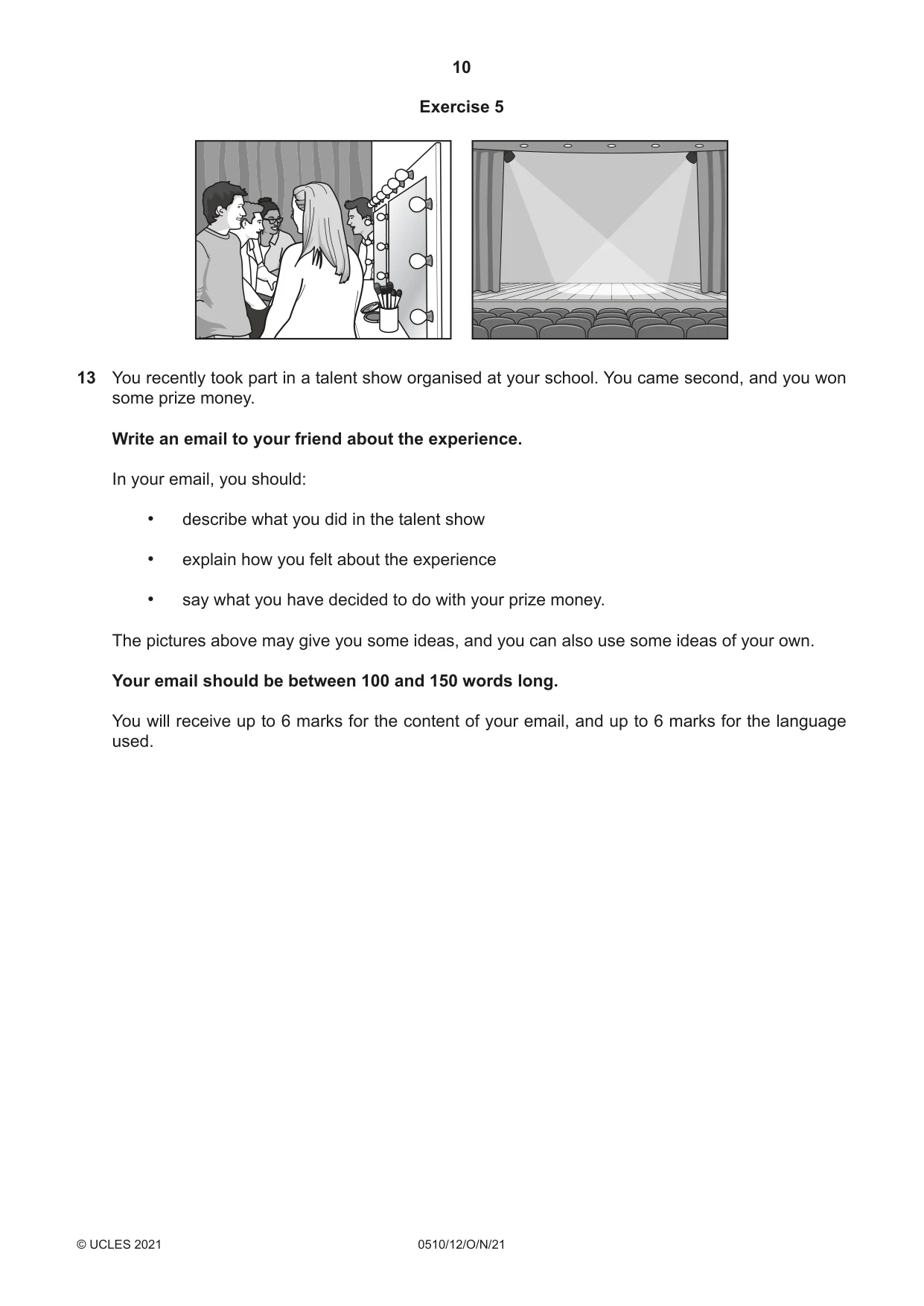
10 0510/12/ O/ N/21 © UCLES 2021 Exercise 5 13 You recently took part in a talent show organised at your school. You came second, and you won some prize money. Write an email to your friend about the experience. In your email, you should: • describe what you did in the talent show • explain how you felt about the experience • say what you have decided to do with your prize money. The pictures above may give you some ideas, and you can also use some ideas of your own. Your email should be between 100 and 150 words long. You will receive up to 6 marks for the content of your email, and up to 6 marks for the language used.
Question paper, page 11
11 0510/12/O/N/21 © UCLES 2021 [Turn over … … … … … … … … … … … … … … … … … … … … … … … … … … … [Total: 12]
Question paper, page 12
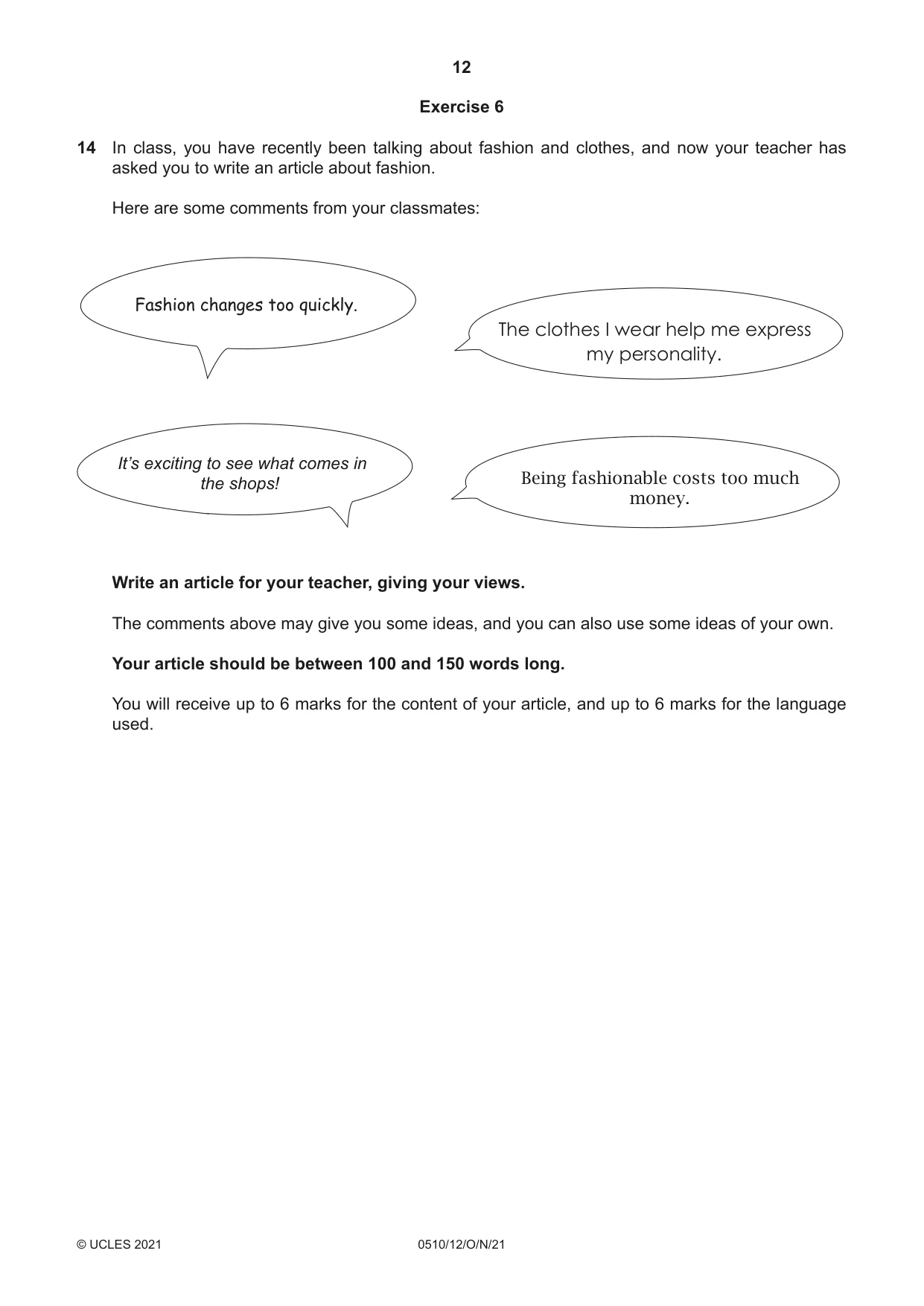
12 0510/12/O/N/21 © UCLES 2021 Exercise 6 14 In class, you have recently been talking about fashion and clothes, and now your teacher has asked you to write an article about fashion. Here are some comments from your classmates: Fashion changes too quickly. The clothes I wear help me express my personality. It’s exciting to see what comes in the shops! Being fashionable costs too much money. Write an article for your teacher, giving your views. The comments above may give you some ideas, and you can also use some ideas of your own. Your article should be between 100 and 150 words long. You will receive up to 6 marks for the content of your article, and up to 6 marks for the language used.
Question paper, page 13
13 0510/12/O/N/21 © UCLES 2021 … … … … … … … … … … … … … … … … … … … … … … … … … … … [Total: 12]
Question paper, page 14
14 0510/12/O/N/21 © UCLES 2021 BLANK PAGE
Question paper, page 15
15 0510/12/O/N/21 © UCLES 2021 BLANK PAGE
Question paper, page 16
16 0510/12/O/N/21 © UCLES 2021 Permission to reproduce items where third-party owned material protected by copyright is included has been sought and cleared where possible. Every reasonable effort has been made by the publisher (UCLES) to trace copyright holders, but if any items requiring clearance have unwittingly been included, the publisher will be pleased to make amends at the earliest possible opportunity. To avoid the issue of disclosure of answer-related information to candidates, all copyright acknowledgements are reproduced online in the Cambridge Assessment International Education Copyright Acknowledgements Booklet. This is produced for each series of examinations and is freely available to download at www.cambridgeinternational.org after the live examination series. Cambridge Assessment International Education is part of the Cambridge Assessment Group. Cambridge Assessment is the brand name of the University of Cambridge Local Examinations Syndicate (UCLES), which itself is a department of the University of Cambridge. BLANK PAGE
Mark scheme, page 1
This document consists of 11 printed pages. © UCLES 2021 [Turn over Cambridge IGCSE™ ENGLISH AS A SECOND LANGUAGE 0510/12 Paper 1 Reading and Writing (Core) October/November 2021 MARK SCHEME Maximum Mark: 60 Published This mark scheme is published as an aid to teachers and candidates, to indicate the requirements of the examination. It shows the basis on which Examiners were instructed to award marks. It does not indicate the details of the discussions that took place at an Examiners’ meeting before marking began, which would have considered the acceptability of alternative answers. Mark schemes should be read in conjunction with the question paper and the Principal Examiner Report for Teachers. Cambridge International will not enter into discussions about these mark schemes. Cambridge International is publishing the mark schemes for the October/November 2021 series for most Cambridge IGCSE™, Cambridge International A and AS Level components and some Cambridge O Level components.
Mark scheme, page 2
0510/12 Cambridge IGCSE – Mark Scheme PUBLISHED October/November 2021 © UCLES 2021 Page 2 of 11 Generic Marking Principles These general marking principles must be applied by all examiners when marking candidate answers. They should be applied alongside the specific content of the mark scheme or generic level descriptors for a question. Each question paper and mark scheme will also comply with these marking principles. GENERIC MARKING PRINCIPLE 1: Marks must be awarded in line with: • the specific content of the mark scheme or the generic level descriptors for the question • the specific skills defined in the mark scheme or in the generic level descriptors for the question • the standard of response required by a candidate as exemplified by the standardisation scripts. GENERIC MARKING PRINCIPLE 2: Marks awarded are always whole marks (not half marks, or other fractions). GENERIC MARKING PRINCIPLE 3: Marks must be awarded positively: • marks are awarded for correct/valid answers, as defined in the mark scheme. However, credit is given for valid answers which go beyond the scope of the syllabus and mark scheme, referring to your Team Leader as appropriate • marks are awarded when candidates clearly demonstrate what they know and can do • marks are not deducted for errors • marks are not deducted for omissions • answers should only be judged on the quality of spelling, punctuation and grammar when these features are specifically assessed by the question as indicated by the mark scheme. The meaning, however, should be unambiguous. GENERIC MARKING PRINCIPLE 4: Rules must be applied consistently, e.g. in situations where candidates have not followed instructions or in the application of generic level descriptors. GENERIC MARKING PRINCIPLE 5: Marks should be awarded using the full range of marks defined in the mark scheme for the question (however; the use of the full mark range may be limited according to the quality of the candidate responses seen). GENERIC MARKING PRINCIPLE 6: Marks awarded are based solely on the requirements as defined in the mark scheme. Marks should not be awarded with grade thresholds or grade descriptors in mind.
Mark scheme, page 3
0510/12 Cambridge IGCSE – Mark Scheme PUBLISHED October/November 2021 © UCLES 2021 Page 3 of 11 This component forms part of the Core tier assessment of Cambridge IGCSE English as a Second Language and tests the following Assessment Objectives: AO1: Reading R1 identify and select relevant information R2 understand ideas, opinions and attitudes R3 show understanding of the connections between ideas, opinions and attitudes R4 understand what is implied but not directly stated, e.g. gist, writer’s purpose, intentions and feelings AO2: Writing W1 communicate information/ideas/opinions clearly, accurately and effectively W2 organise ideas into coherent paragraphs using a range of appropriate linking devices W3 use a range of grammatical structures accurately and effectively W4 show control of punctuation and spelling W5 use appropriate register and style/format for the given purpose and audience
Mark scheme, page 4
0510/12 Cambridge IGCSE – Mark Scheme PUBLISHED October/November 2021 © UCLES 2021 Page 4 of 11 Exercise 1 Question Answer Marks 1 drink 1 2 South America 1 3 (a tiny) fly 1 4 (an) olive 1 5 twice a year 1 6 nib 1 7 Award 1 mark for each detail up to a maximum 2 marks: tastes more strongly of chocolate / less bitter darker (in colour) 2 8 (up to) 18 months 1
Mark scheme, page 5
0510/12 Cambridge IGCSE – Mark Scheme PUBLISHED October/November 2021 © UCLES 2021 Page 5 of 11 Exercise 2 Question Answer Marks 9(a) B 1 9(b) C 1 9(c) A 1 9(d) C 1 9(e) A 1 9(f) B 1 9(g) A 1 9(h) C 1
Mark scheme, page 6
0510/12 Cambridge IGCSE – Mark Scheme PUBLISHED October/November 2021 © UCLES 2021 Page 6 of 11 Exercise 3 Question Answer Marks 10 Award 1 mark for each acceptable response, up to a maximum of 3 marks. Acceptable responses are: Advantages of a raw food diet 1 low in saturated fat 2 protect our bodies / protect our cells 3 no extra chemicals / no chemicals added 4 lots of fibre 5 cooking removes vitamins / raw vegetables don't have vitamins removed / (raw food) doesn’t have vitamins removed / (raw food) has lots of vitamins 3 11 Award 1 mark for each acceptable response, up to a maximum of 4 marks. Acceptable responses are: Disadvantages of a raw food diet 1 hard to find restaurants (specialising in raw food) 2 challenging to keep making interesting things (to eat) 3 more likely to pick up any bacteria (in the food) / more bacteria 4 not suitable for the(very) young / not suitable for children 5 (raw) eggs are less easy (for your body) to process 6 takes (lots of) time to shop (regularly for ingredients) 4
Mark scheme, page 7
0510/12 Cambridge IGCSE – Mark Scheme PUBLISHED October/November 2021 © UCLES 2021 Page 7 of 11 Exercise 4 Question Answer Marks 12 Award up to a total of 12 marks. 12 Up to 6 marks to be awarded for Content (Reading) Relevant points to include are: Preparations he made for the adventure weekend 1 made a list of things he would need 2 booked campsite 3 chose route which most suited his level of fitness 4 put energy bars in rucksack Benefits he got from this adventure 1 met an interesting person 2 helped him to feel calm(er) 3 a physical challenge 4 best sleep (he’d had in ages) Up to 6 marks to be awarded for Language (Writing) See generic marking criteria for Exercise 4.
Mark scheme, page 8
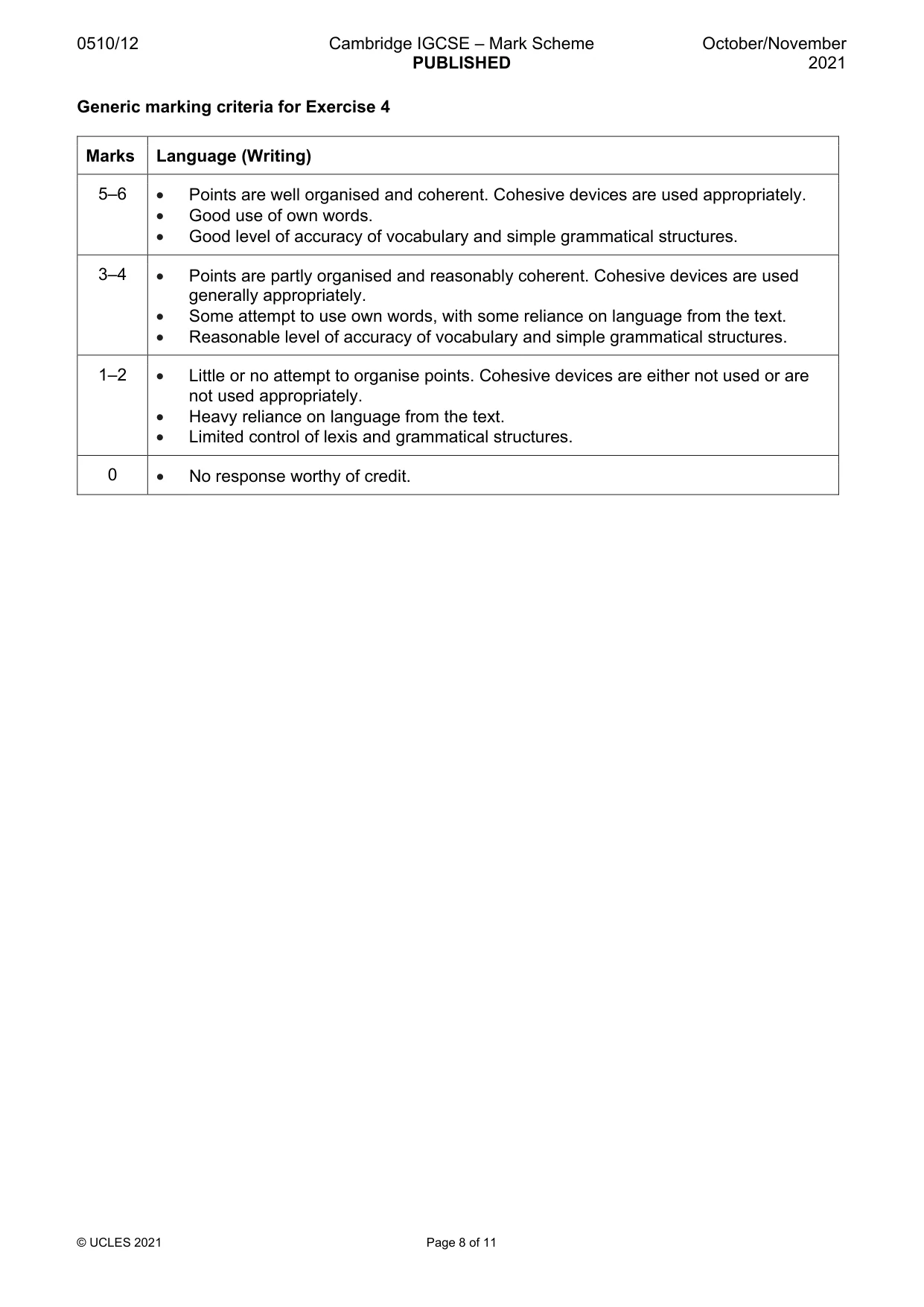
0510/12 Cambridge IGCSE – Mark Scheme PUBLISHED October/November 2021 © UCLES 2021 Page 8 of 11 Generic marking criteria for Exercise 4 Marks Language (Writing) 5–6 • Points are well organised and coherent. Cohesive devices are used appropriately. • Good use of own words. • Good level of accuracy of vocabulary and simple grammatical structures. 3–4 • Points are partly organised and reasonably coherent. Cohesive devices are used generally appropriately. • Some attempt to use own words, with some reliance on language from the text. • Reasonable level of accuracy of vocabulary and simple grammatical structures. 1–2 • Little or no attempt to organise points. Cohesive devices are either not used or are not used appropriately. • Heavy reliance on language from the text. • Limited control of lexis and grammatical structures. 0 • No response worthy of credit.
Mark scheme, page 9
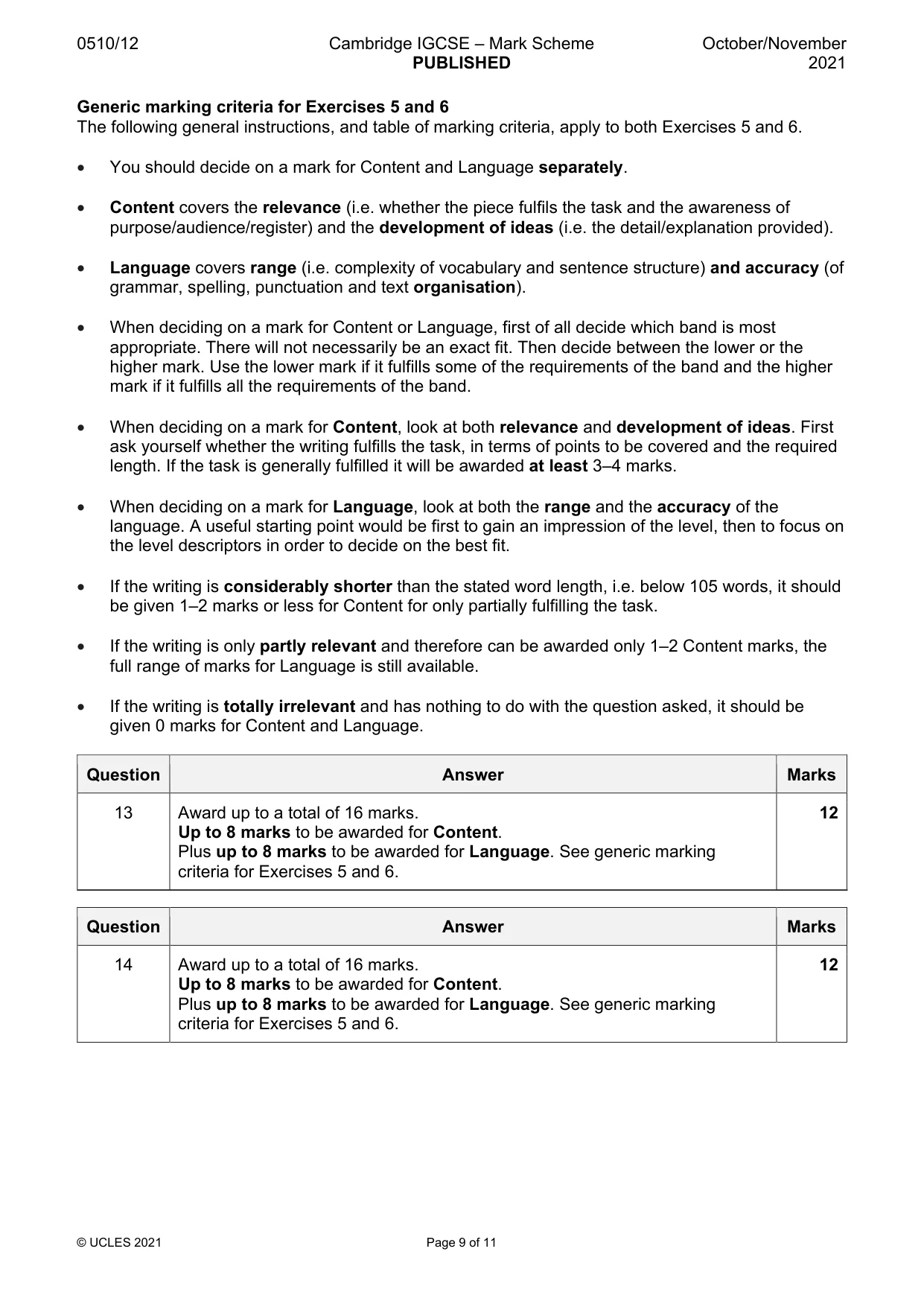
0510/12 Cambridge IGCSE – Mark Scheme PUBLISHED October/November 2021 © UCLES 2021 Page 9 of 11 Generic marking criteria for Exercises 5 and 6 The following general instructions, and table of marking criteria, apply to both Exercises 5 and 6. • You should decide on a mark for Content and Language separately. • Content covers the relevance (i.e. whether the piece fulfils the task and the awareness of purpose/audience/register) and the development of ideas (i.e. the detail/explanation provided). • Language covers range (i.e. complexity of vocabulary and sentence structure) and accuracy (of grammar, spelling, punctuation and text organisation). • When deciding on a mark for Content or Language, first of all decide which band is most appropriate. There will not necessarily be an exact fit. Then decide between the lower or the higher mark. Use the lower mark if it fulfills some of the requirements of the band and the higher mark if it fulfills all the requirements of the band. • When deciding on a mark for Content, look at both relevance and development of ideas. First ask yourself whether the writing fulfills the task, in terms of points to be covered and the required length. If the task is generally fulfilled it will be awarded at least 3–4 marks. • When deciding on a mark for Language, look at both the range and the accuracy of the language. A useful starting point would be first to gain an impression of the level, then to focus on the level descriptors in order to decide on the best fit. • If the writing is considerably shorter than the stated word length, i.e. below 105 words, it should be given 1–2 marks or less for Content for only partially fulfilling the task. • If the writing is only partly relevant and therefore can be awarded only 1–2 Content marks, the full range of marks for Language is still available. • If the writing is totally irrelevant and has nothing to do with the question asked, it should be given 0 marks for Content and Language. Question Answer Marks 13 Award up to a total of 16 marks. Up to 8 marks to be awarded for Content. Plus up to 8 marks to be awarded for Language. See generic marking criteria for Exercises 5 and 6. 12 Question Answer Marks 14 Award up to a total of 16 marks. Up to 8 marks to be awarded for Content. Plus up to 8 marks to be awarded for Language. See generic marking criteria for Exercises 5 and 6. 12
Mark scheme, page 10
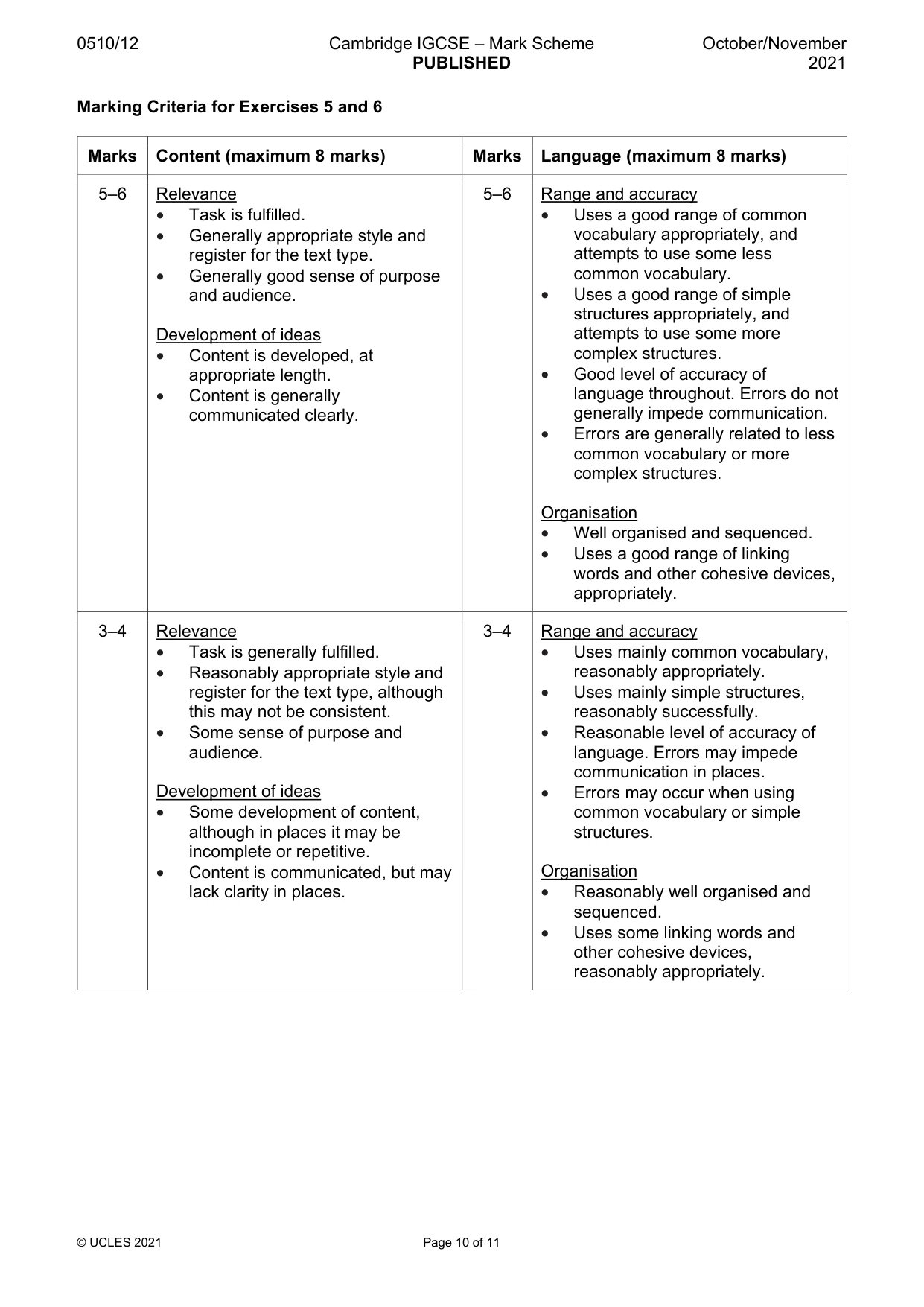
0510/12 Cambridge IGCSE – Mark Scheme PUBLISHED October/November 2021 © UCLES 2021 Page 10 of 11 Marking Criteria for Exercises 5 and 6 Marks Content (maximum 8 marks) Marks Language (maximum 8 marks) 5–6 Relevance • Task is fulfilled. • Generally appropriate style and register for the text type. • Generally good sense of purpose and audience. Development of ideas • Content is developed, at appropriate length. • Content is generally communicated clearly. 5–6 Range and accuracy • Uses a good range of common vocabulary appropriately, and attempts to use some less common vocabulary. • Uses a good range of simple structures appropriately, and attempts to use some more complex structures. • Good level of accuracy of language throughout. Errors do not generally impede communication. • Errors are generally related to less common vocabulary or more complex structures. Organisation • Well organised and sequenced. • Uses a good range of linking words and other cohesive devices, appropriately. 3–4 Relevance • Task is generally fulfilled. • Reasonably appropriate style and register for the text type, although this may not be consistent. • Some sense of purpose and audience. Development of ideas • Some development of content, although in places it may be incomplete or repetitive. • Content is communicated, but may lack clarity in places. 3–4 Range and accuracy • Uses mainly common vocabulary, reasonably appropriately. • Uses mainly simple structures, reasonably successfully. • Reasonable level of accuracy of language. Errors may impede communication in places. • Errors may occur when using common vocabulary or simple structures. Organisation • Reasonably well organised and sequenced. • Uses some linking words and other cohesive devices, reasonably appropriately.
Mark scheme, page 11
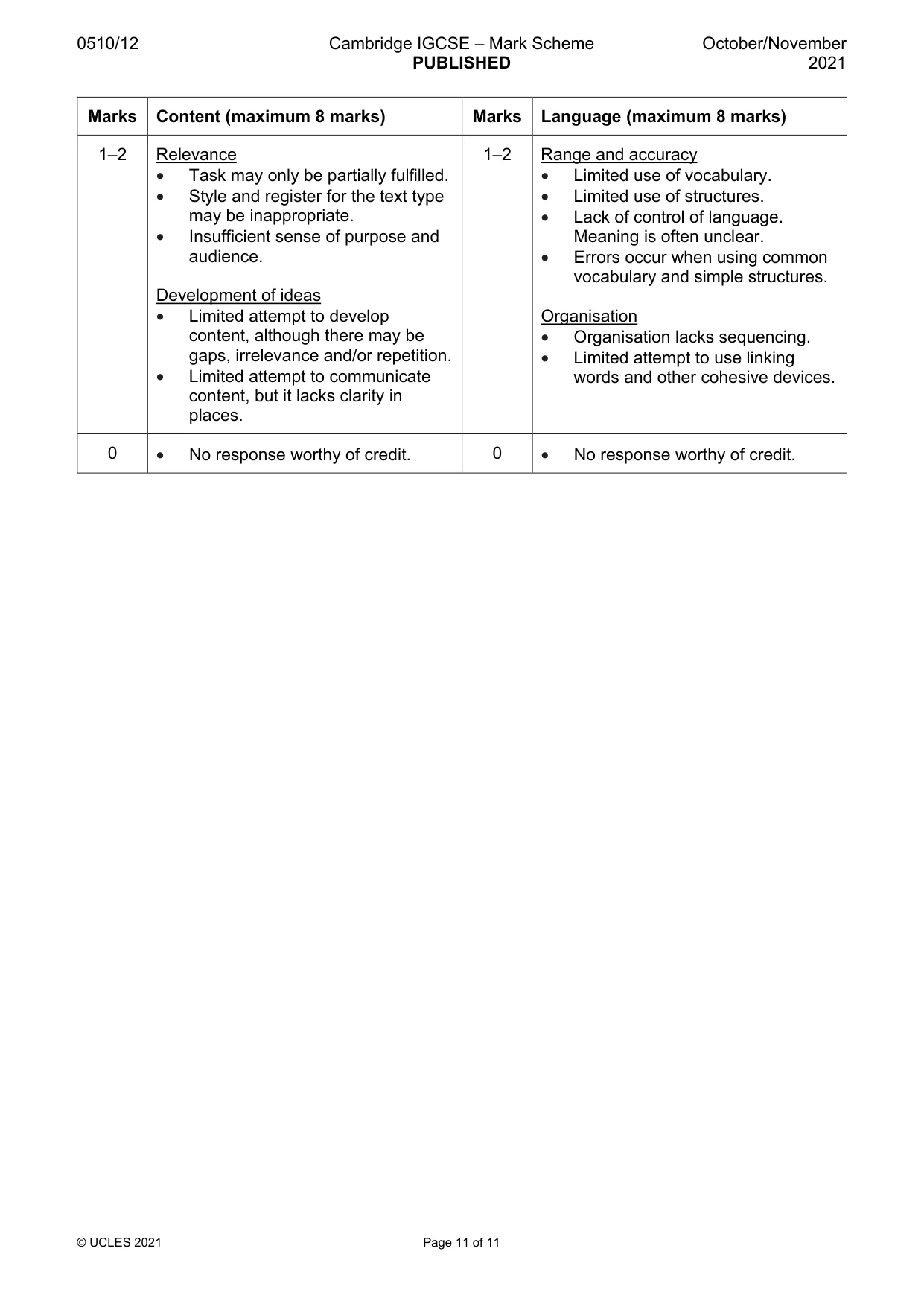
0510/12 Cambridge IGCSE – Mark Scheme PUBLISHED October/November 2021 © UCLES 2021 Page 11 of 11 Marks Content (maximum 8 marks) Marks Language (maximum 8 marks) 1–2 Relevance • Task may only be partially fulfilled. • Style and register for the text type may be inappropriate. • Insufficient sense of purpose and audience. Development of ideas • Limited attempt to develop content, although there may be gaps, irrelevance and/or repetition. • Limited attempt to communicate content, but it lacks clarity in places. 1–2 Range and accuracy • Limited use of vocabulary. • Limited use of structures. • Lack of control of language. Meaning is often unclear. • Errors occur when using common vocabulary and simple structures. Organisation • Organisation lacks sequencing. • Limited attempt to use linking words and other cohesive devices. 0 • No response worthy of credit. 0 • No response worthy of credit.
What you needed in this session
Cambridge’s own grade thresholds for 2021 Oct/Nov, Paper 1 · Variant 2. A higher threshold means an easier paper — the bar moves with how the cohort did.