Cambridge IGCSE English - Second Language (oral endorsement) 0510 — 2021 Feb/March Paper 2 · Variant 2
0510/22/F/M/21
The question paper and its mark scheme, free to read here and free to download. This is Cambridge’s own paper, exactly as it was sat.
Question paper16 pages






Mark scheme12 pages
Answers below. Sit the paper first if you are practising.
Paper as text
Question paper, page 1
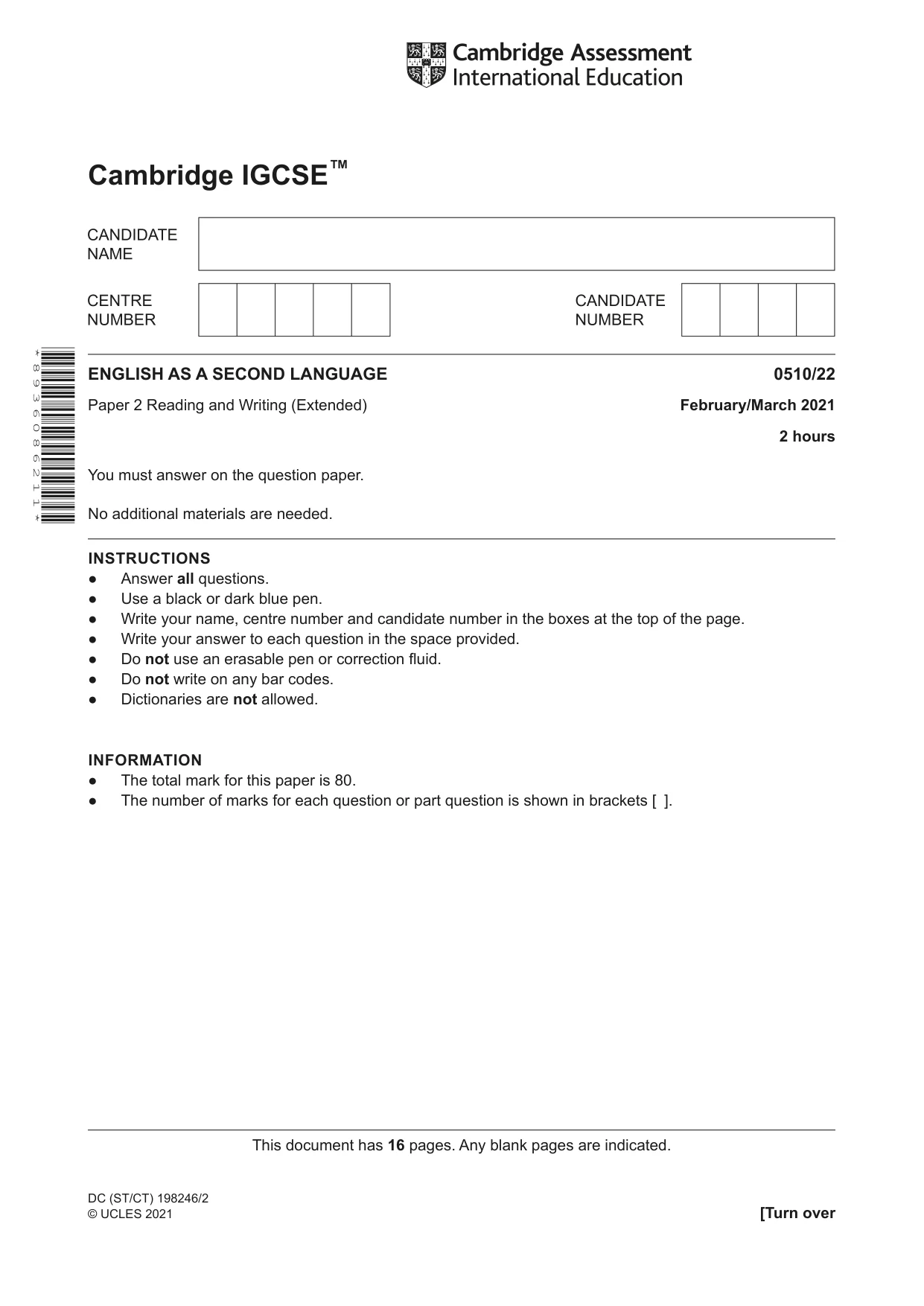
This document has 16 pages. Any blank pages are indicated. Cambridge IGCSE™ ENGLISH AS A SECOND LANGUAGE 0510/22 Paper 2 Reading and Writing (Extended) February/March 2021 2 hours You must answer on the question paper. No additional materials are needed. INSTRUCTIONS ● Answer all questions. ● Use a black or dark blue pen. ● Write your name, centre number and candidate number in the boxes at the top of the page. ● Write your answer to each question in the space provided. ● Do not use an erasable pen or correction fluid. ● Do not write on any bar codes. ● Dictionaries are not allowed. INFORMATION ● The total mark for this paper is 80. ● The number of marks for each question or part question is shown in brackets [ ]. * 8 9 3 6 0 8 6 2 1 1 * DC (ST/CT) 198246/2 © UCLES 2021 [Turn over
Question paper, page 2
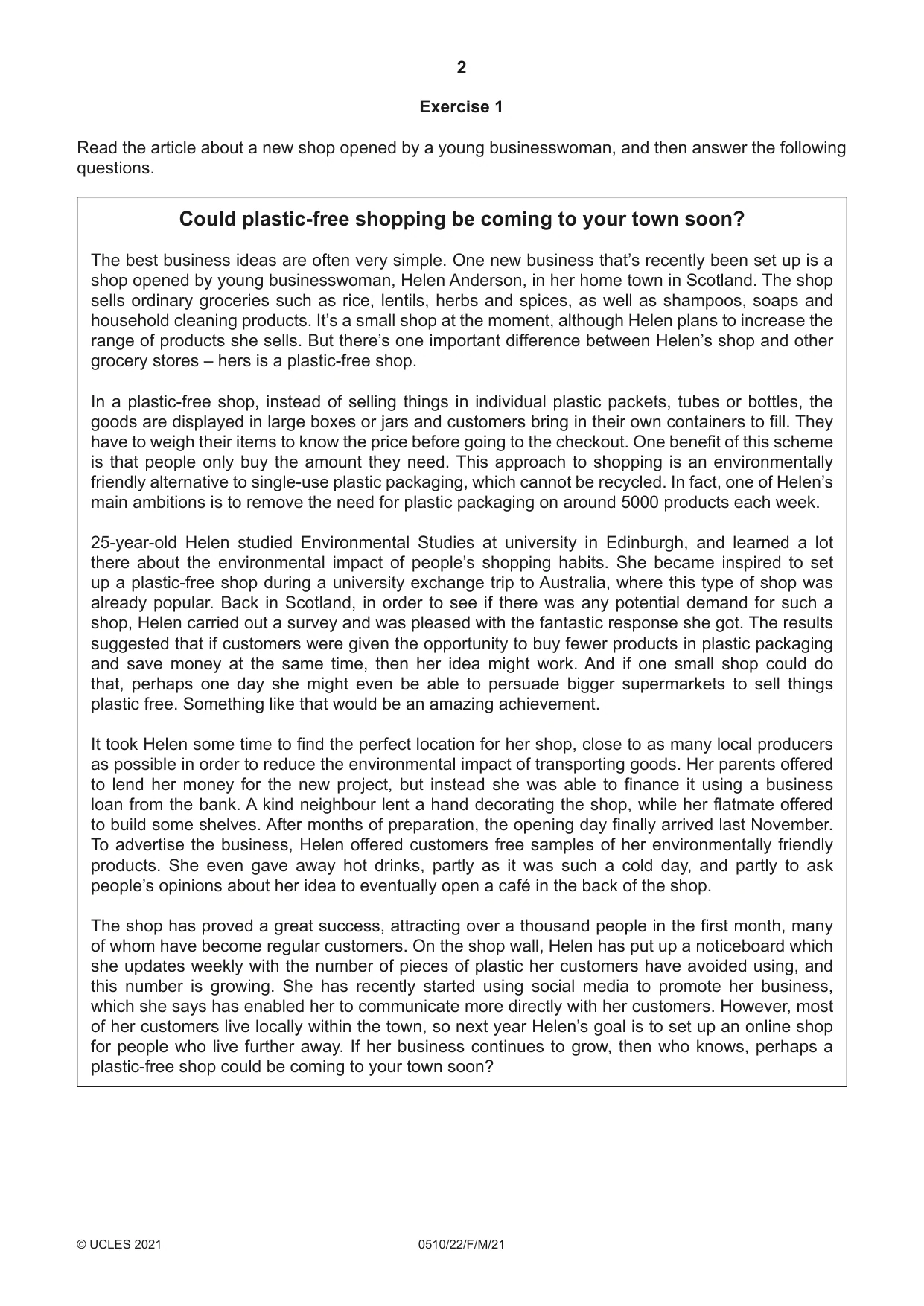
2 0510/22/F/M/21 © UCLES 2021 Exercise 1 Read the article about a new shop opened by a young businesswoman, and then answer the following questions. Could plastic-free shopping be coming to your town soon? The best business ideas are often very simple. One new business that’s recently been set up is a shop opened by young businesswoman, Helen Anderson, in her home town in Scotland. The shop sells ordinary groceries such as rice, lentils, herbs and spices, as well as shampoos, soaps and household cleaning products. It’s a small shop at the moment, although Helen plans to increase the range of products she sells. But there’s one important difference between Helen’s shop and other grocery stores – hers is a plastic-free shop. In a plastic-free shop, instead of selling things in individual plastic packets, tubes or bottles, the goods are displayed in large boxes or jars and customers bring in their own containers to fill. They have to weigh their items to know the price before going to the checkout. One benefit of this scheme is that people only buy the amount they need. This approach to shopping is an environmentally friendly alternative to single-use plastic packaging, which cannot be recycled. In fact, one of Helen’s main ambitions is to remove the need for plastic packaging on around 5000 products each week. 25-year-old Helen studied Environmental Studies at university in Edinburgh, and learned a lot there about the environmental impact of people’s shopping habits. She became inspired to set up a plastic-free shop during a university exchange trip to Australia, where this type of shop was already popular. Back in Scotland, in order to see if there was any potential demand for such a shop, Helen carried out a survey and was pleased with the fantastic response she got. The results suggested that if customers were given the opportunity to buy fewer products in plastic packaging and save money at the same time, then her idea might work. And if one small shop could do that, perhaps one day she might even be able to persuade bigger supermarkets to sell things plastic free. Something like that would be an amazing achievement. It took Helen some time to find the perfect location for her shop, close to as many local producers as possible in order to reduce the environmental impact of transporting goods. Her parents offered to lend her money for the new project, but instead she was able to finance it using a business loan from the bank. A kind neighbour lent a hand decorating the shop, while her flatmate offered to build some shelves. After months of preparation, the opening day finally arrived last November. To advertise the business, Helen offered customers free samples of her environmentally friendly products. She even gave away hot drinks, partly as it was such a cold day, and partly to ask people’s opinions about her idea to eventually open a café in the back of the shop. The shop has proved a great success, attracting over a thousand people in the first month, many of whom have become regular customers. On the shop wall, Helen has put up a noticeboard which she updates weekly with the number of pieces of plastic her customers have avoided using, and this number is growing. She has recently started using social media to promote her business, which she says has enabled her to communicate more directly with her customers. However, most of her customers live locally within the town, so next year Helen’s goal is to set up an online shop for people who live further away. If her business continues to grow, then who knows, perhaps a plastic-free shop could be coming to your town soon?
Question paper, page 3
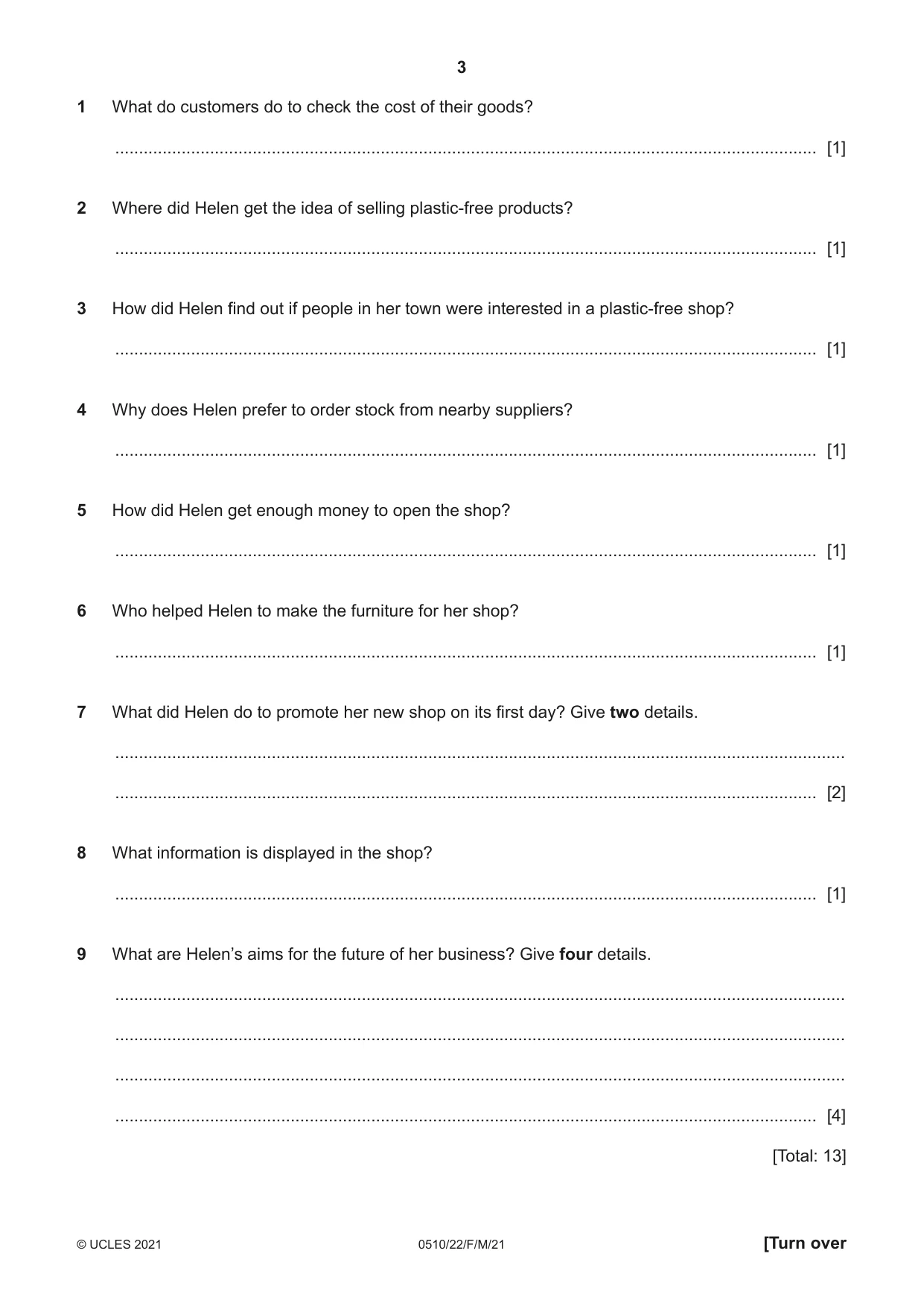
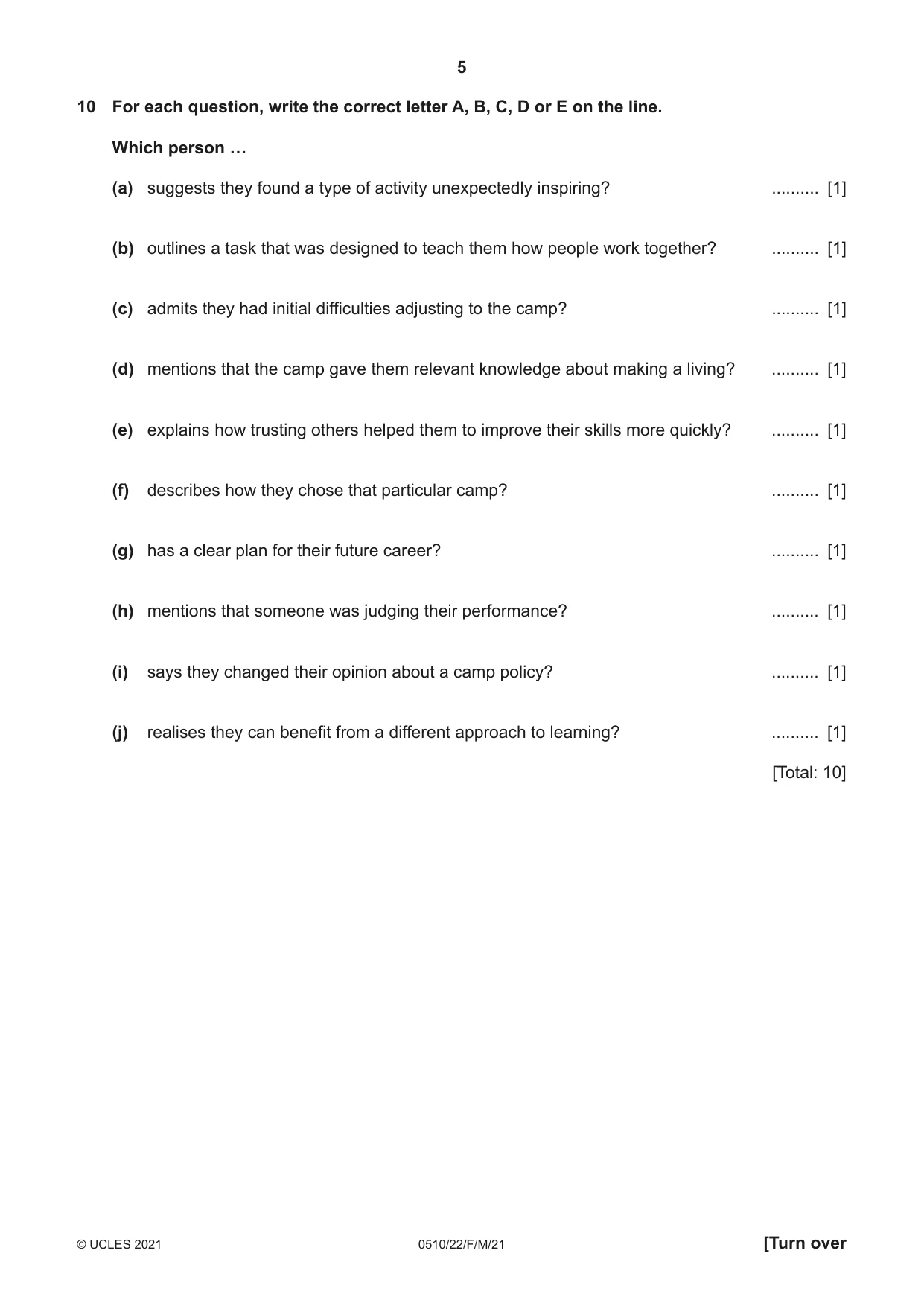
3 0510/22/F/M/21 © UCLES 2021 [Turn over 1 What do customers do to check the cost of their goods? … [1] 2 Where did Helen get the idea of selling plastic-free products? … [1] 3 How did Helen find out if people in her town were interested in a plastic-free shop? … [1] 4 Why does Helen prefer to order stock from nearby suppliers? … [1] 5 How did Helen get enough money to open the shop? … [1] 6 Who helped Helen to make the furniture for her shop? … [1] 7 What did Helen do to promote her new shop on its first day? Give two details. … … [2] 8 What information is displayed in the shop? … [1] 9 What are Helen’s aims for the future of her business? Give four details. … … … … [4] [Total: 13]
Question paper, page 4
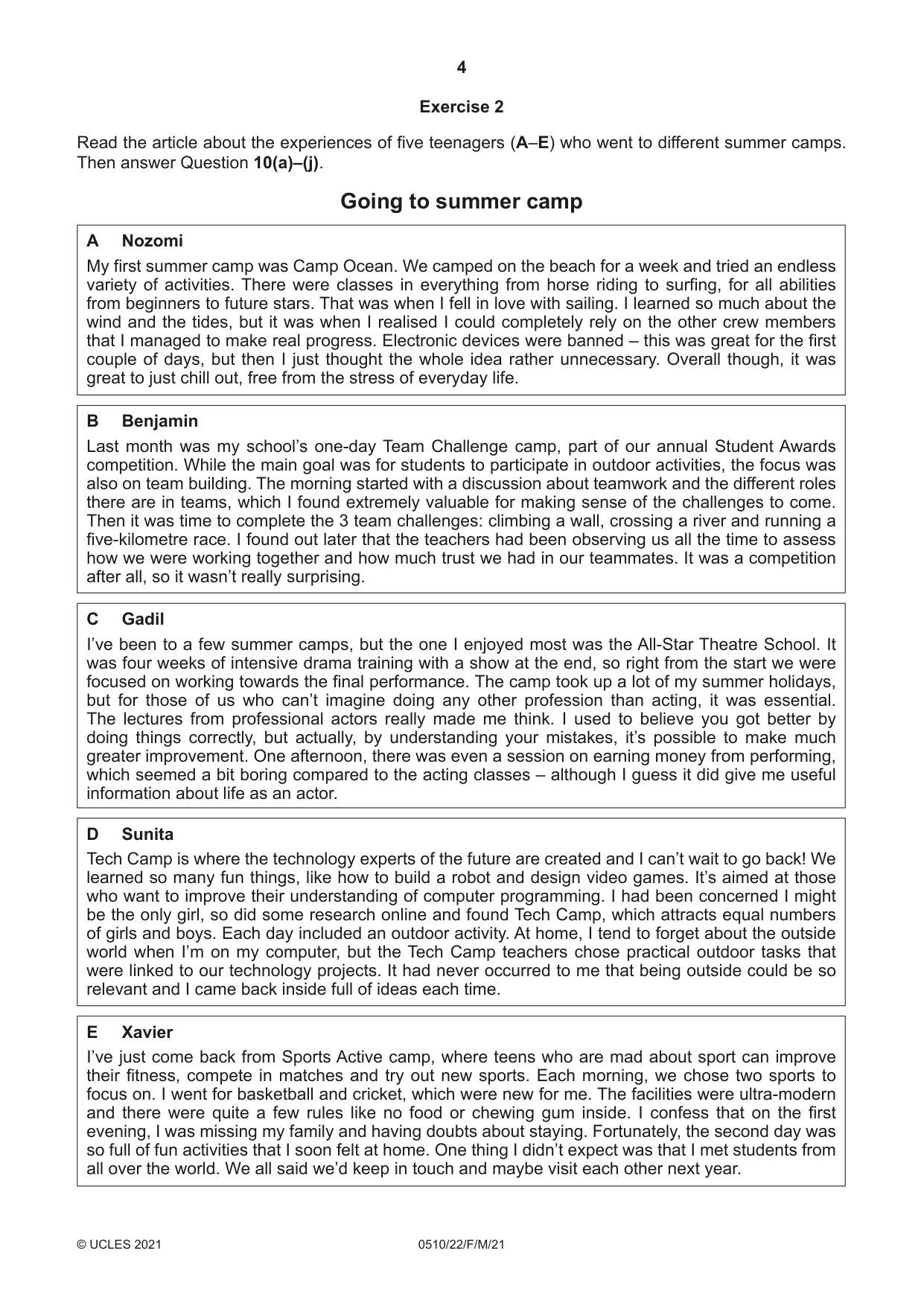
4 0510/22/F/M/21 © UCLES 2021 Exercise 2 Read the article about the experiences of five teenagers (A–E) who went to different summer camps. Then answer Question 10(a)–(j). Going to summer camp A Nozomi My first summer camp was Camp Ocean. We camped on the beach for a week and tried an endless variety of activities. There were classes in everything from horse riding to surfing, for all abilities from beginners to future stars. That was when I fell in love with sailing. I learned so much about the wind and the tides, but it was when I realised I could completely rely on the other crew members that I managed to make real progress. Electronic devices were banned – this was great for the first couple of days, but then I just thought the whole idea rather unnecessary. Overall though, it was great to just chill out, free from the stress of everyday life. B Benjamin Last month was my school’s one-day Team Challenge camp, part of our annual Student Awards competition. While the main goal was for students to participate in outdoor activities, the focus was also on team building. The morning started with a discussion about teamwork and the different roles there are in teams, which I found extremely valuable for making sense of the challenges to come. Then it was time to complete the 3 team challenges: climbing a wall, crossing a river and running a five-kilometre race. I found out later that the teachers had been observing us all the time to assess how we were working together and how much trust we had in our teammates. It was a competition after all, so it wasn’t really surprising. C Gadil I’ve been to a few summer camps, but the one I enjoyed most was the All-Star Theatre School. It was four weeks of intensive drama training with a show at the end, so right from the start we were focused on working towards the final performance. The camp took up a lot of my summer holidays, but for those of us who can’t imagine doing any other profession than acting, it was essential. The lectures from professional actors really made me think. I used to believe you got better by doing things correctly, but actually, by understanding your mistakes, it’s possible to make much greater improvement. One afternoon, there was even a session on earning money from performing, which seemed a bit boring compared to the acting classes – although I guess it did give me useful information about life as an actor. D Sunita Tech Camp is where the technology experts of the future are created and I can’t wait to go back! We learned so many fun things, like how to build a robot and design video games. It’s aimed at those who want to improve their understanding of computer programming. I had been concerned I might be the only girl, so did some research online and found Tech Camp, which attracts equal numbers of girls and boys. Each day included an outdoor activity. At home, I tend to forget about the outside world when I’m on my computer, but the Tech Camp teachers chose practical outdoor tasks that were linked to our technology projects. It had never occurred to me that being outside could be so relevant and I came back inside full of ideas each time. E Xavier I’ve just come back from Sports Active camp, where teens who are mad about sport can improve their fitness, compete in matches and try out new sports. Each morning, we chose two sports to focus on. I went for basketball and cricket, which were new for me. The facilities were ultra-modern and there were quite a few rules like no food or chewing gum inside. I confess that on the first evening, I was missing my family and having doubts about staying. Fortunately, the second day was so full of fun activities that I soon felt at home. One thing I didn’t expect was that I met students from all over the world. We all said we’d keep in touch and maybe visit each other next year.
Question paper, page 5
5 0510/22/F/M/21 © UCLES 2021 [Turn over 10 For each question, write the correct letter A, B, C, D or E on the line. Which person … (a) suggests they found a type of activity unexpectedly inspiring? … [1] (b) outlines a task that was designed to teach them how people work together? … [1] (c) admits they had initial difficulties adjusting to the camp? … [1] (d) mentions that the camp gave them relevant knowledge about making a living? … [1] (e) explains how trusting others helped them to improve their skills more quickly? … [1] (f) describes how they chose that particular camp? … [1] (g) has a clear plan for their future career? … [1] (h) mentions that someone was judging their performance? … [1] (i) says they changed their opinion about a camp policy? … [1] (j) realises they can benefit from a different approach to learning? … [1] [Total: 10]
Question paper, page 6
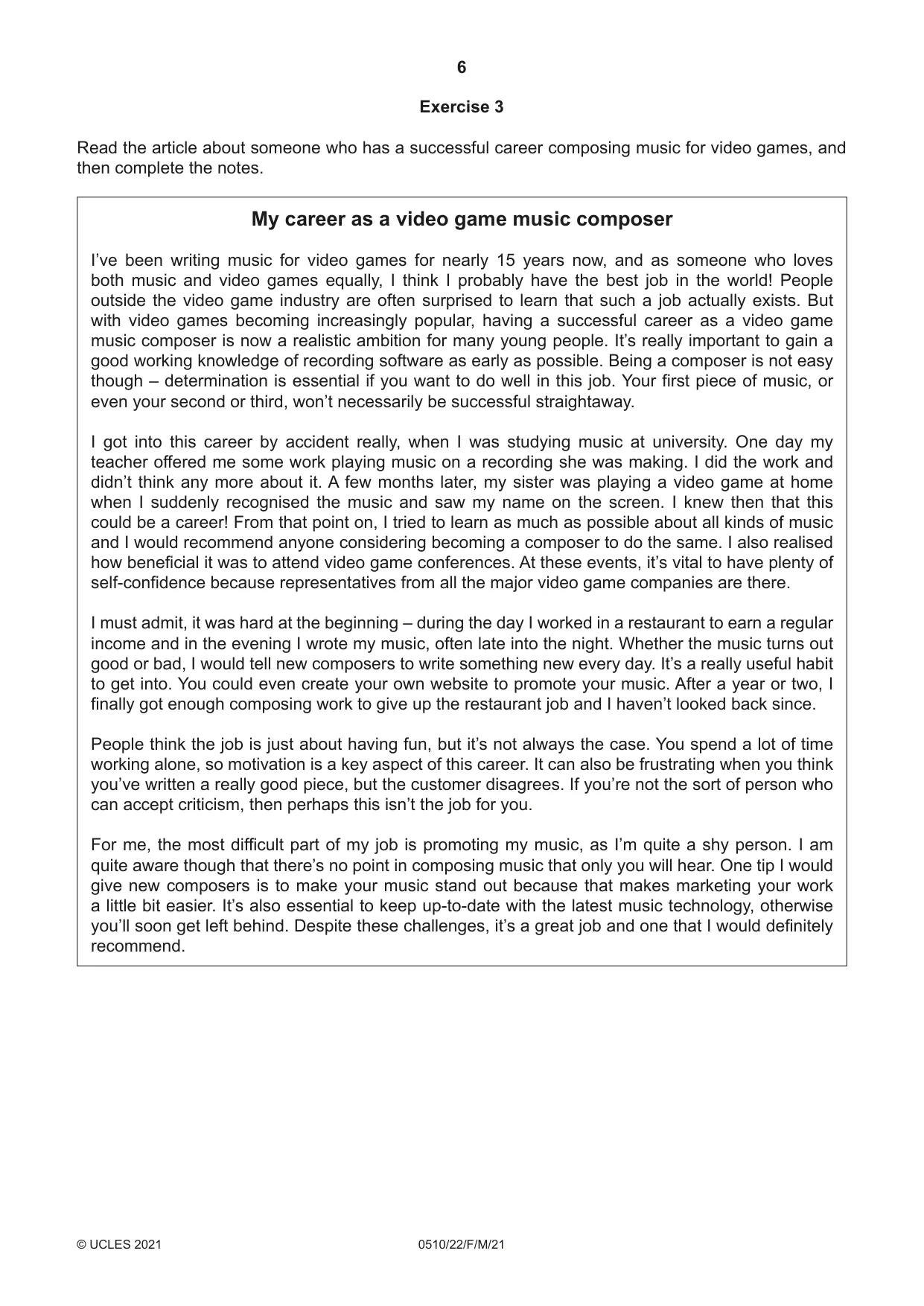
6 0510/22/F/M/21 © UCLES 2021 Exercise 3 Read the article about someone who has a successful career composing music for video games, and then complete the notes. My career as a video game music composer I’ve been writing music for video games for nearly 15 years now, and as someone who loves both music and video games equally, I think I probably have the best job in the world! People outside the video game industry are often surprised to learn that such a job actually exists. But with video games becoming increasingly popular, having a successful career as a video game music composer is now a realistic ambition for many young people. It’s really important to gain a good working knowledge of recording software as early as possible. Being a composer is not easy though – determination is essential if you want to do well in this job. Your first piece of music, or even your second or third, won’t necessarily be successful straightaway. I got into this career by accident really, when I was studying music at university. One day my teacher offered me some work playing music on a recording she was making. I did the work and didn’t think any more about it. A few months later, my sister was playing a video game at home when I suddenly recognised the music and saw my name on the screen. I knew then that this could be a career! From that point on, I tried to learn as much as possible about all kinds of music and I would recommend anyone considering becoming a composer to do the same. I also realised how beneficial it was to attend video game conferences. At these events, it’s vital to have plenty of self-confidence because representatives from all the major video game companies are there. I must admit, it was hard at the beginning – during the day I worked in a restaurant to earn a regular income and in the evening I wrote my music, often late into the night. Whether the music turns out good or bad, I would tell new composers to write something new every day. It’s a really useful habit to get into. You could even create your own website to promote your music. After a year or two, I finally got enough composing work to give up the restaurant job and I haven’t looked back since. People think the job is just about having fun, but it’s not always the case. You spend a lot of time working alone, so motivation is a key aspect of this career. It can also be frustrating when you think you’ve written a really good piece, but the customer disagrees. If you’re not the sort of person who can accept criticism, then perhaps this isn’t the job for you. For me, the most difficult part of my job is promoting my music, as I’m quite a shy person. I am quite aware though that there’s no point in composing music that only you will hear. One tip I would give new composers is to make your music stand out because that makes marketing your work a little bit easier. It’s also essential to keep up-to-date with the latest music technology, otherwise you’ll soon get left behind. Despite these challenges, it’s a great job and one that I would definitely recommend.
Question paper, page 7
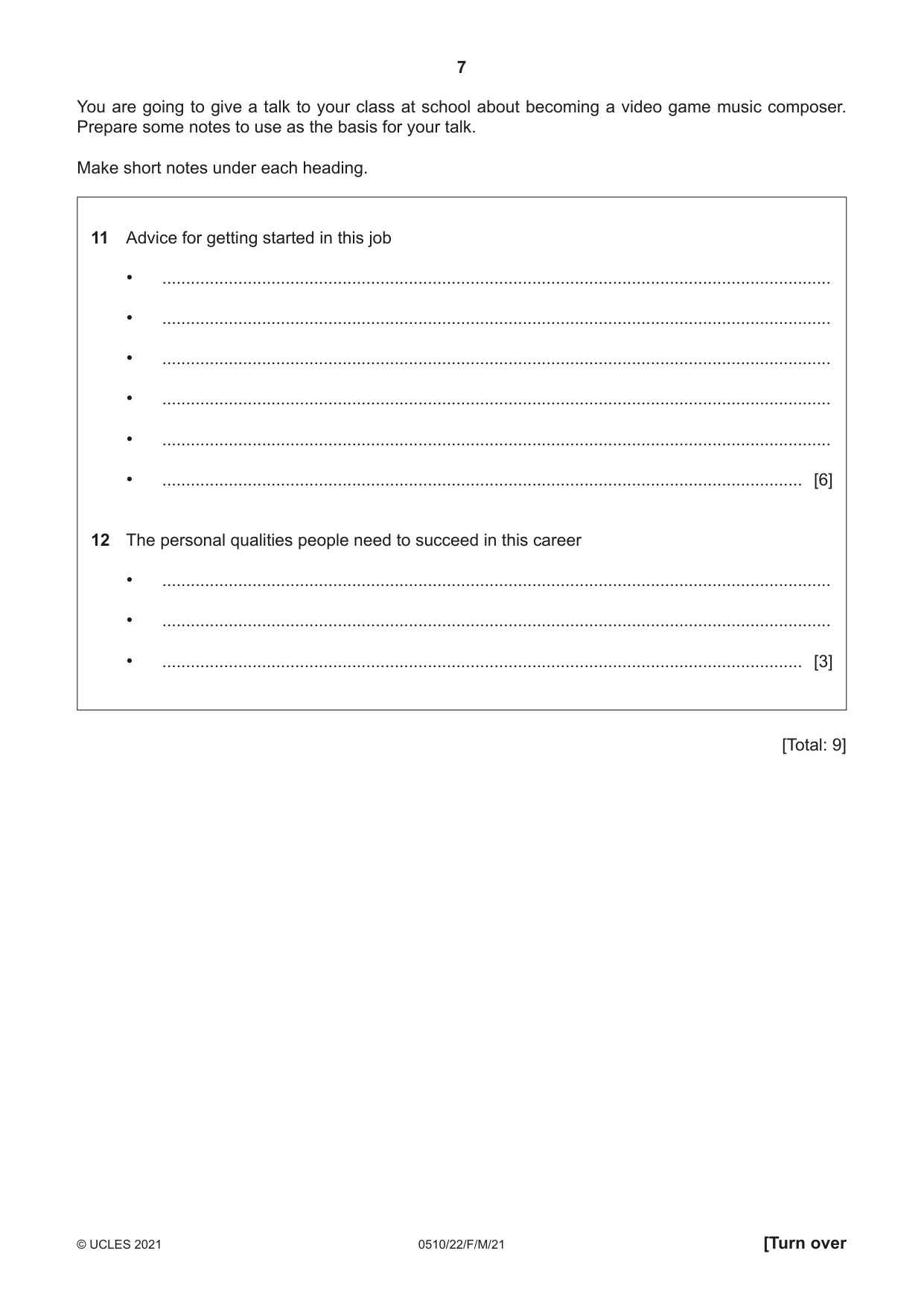
7 0510/22/F/M/21 © UCLES 2021 [Turn over You are going to give a talk to your class at school about becoming a video game music composer. Prepare some notes to use as the basis for your talk. Make short notes under each heading. 11 Advice for getting started in this job • … • … • … • … • … • … [6] 12 The personal qualities people need to succeed in this career • … • … • … [3] [Total: 9]
Question paper, page 8
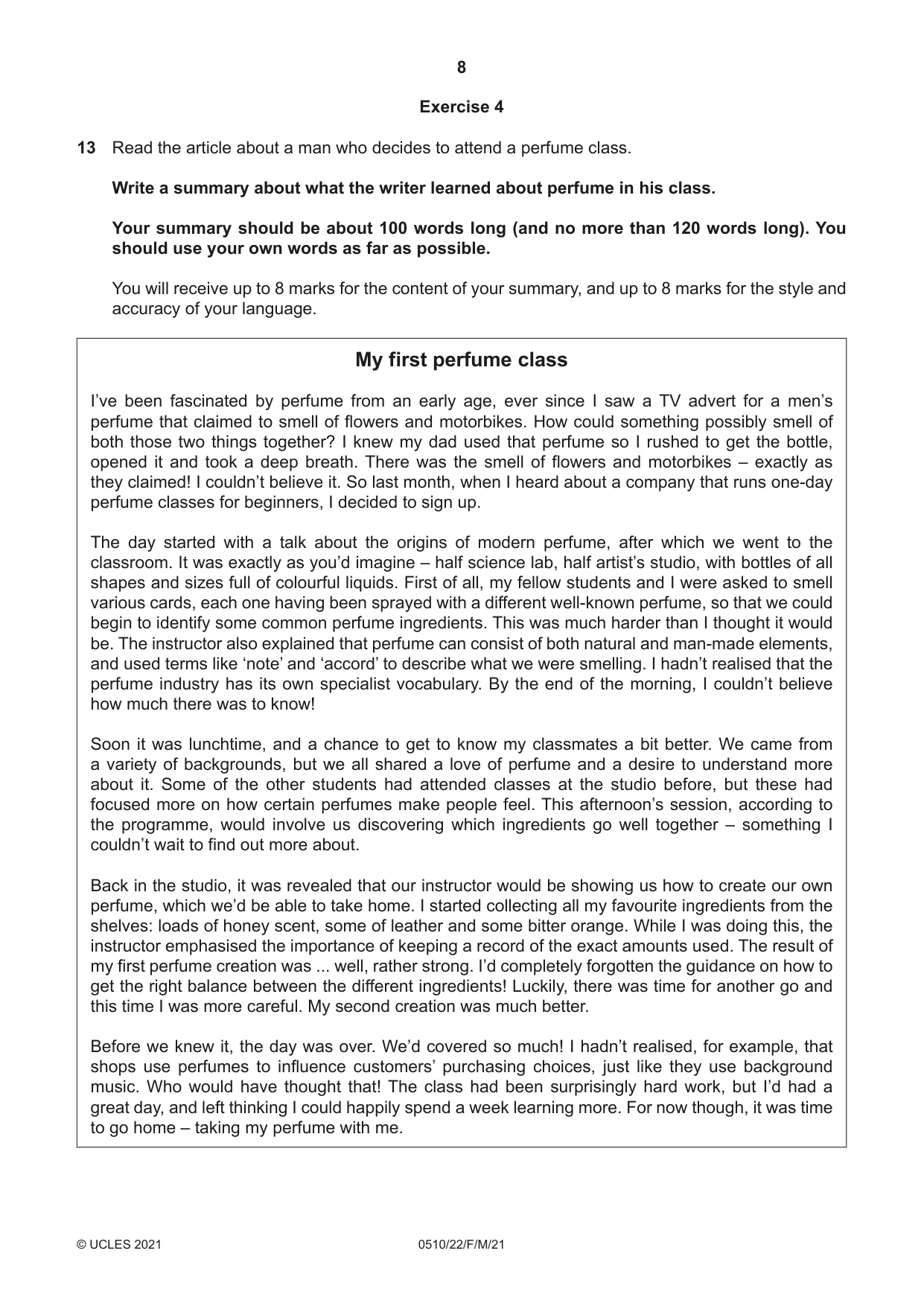
8 0510/22/F/M/21 © UCLES 2021 Exercise 4 13 Read the article about a man who decides to attend a perfume class. Write a summary about what the writer learned about perfume in his class. Your summary should be about 100 words long (and no more than 120 words long). You should use your own words as far as possible. You will receive up to 8 marks for the content of your summary, and up to 8 marks for the style and accuracy of your language. My first perfume class I’ve been fascinated by perfume from an early age, ever since I saw a TV advert for a men’s perfume that claimed to smell of flowers and motorbikes. How could something possibly smell of both those two things together? I knew my dad used that perfume so I rushed to get the bottle, opened it and took a deep breath. There was the smell of flowers and motorbikes – exactly as they claimed! I couldn’t believe it. So last month, when I heard about a company that runs one-day perfume classes for beginners, I decided to sign up. The day started with a talk about the origins of modern perfume, after which we went to the classroom. It was exactly as you’d imagine – half science lab, half artist’s studio, with bottles of all shapes and sizes full of colourful liquids. First of all, my fellow students and I were asked to smell various cards, each one having been sprayed with a different well-known perfume, so that we could begin to identify some common perfume ingredients. This was much harder than I thought it would be. The instructor also explained that perfume can consist of both natural and man-made elements, and used terms like ‘note’ and ‘accord’ to describe what we were smelling. I hadn’t realised that the perfume industry has its own specialist vocabulary. By the end of the morning, I couldn’t believe how much there was to know! Soon it was lunchtime, and a chance to get to know my classmates a bit better. We came from a variety of backgrounds, but we all shared a love of perfume and a desire to understand more about it. Some of the other students had attended classes at the studio before, but these had focused more on how certain perfumes make people feel. This afternoon’s session, according to the programme, would involve us discovering which ingredients go well together – something I couldn’t wait to find out more about. Back in the studio, it was revealed that our instructor would be showing us how to create our own perfume, which we’d be able to take home. I started collecting all my favourite ingredients from the shelves: loads of honey scent, some of leather and some bitter orange. While I was doing this, the instructor emphasised the importance of keeping a record of the exact amounts used. The result of my first perfume creation was ... well, rather strong. I’d completely forgotten the guidance on how to get the right balance between the different ingredients! Luckily, there was time for another go and this time I was more careful. My second creation was much better. Before we knew it, the day was over. We’d covered so much! I hadn’t realised, for example, that shops use perfumes to influence customers’ purchasing choices, just like they use background music. Who would have thought that! The class had been surprisingly hard work, but I’d had a great day, and left thinking I could happily spend a week learning more. For now though, it was time to go home – taking my perfume with me.
Question paper, page 9
9 0510/22/F/M/21 © UCLES 2021 [Turn over … … … … … … … … … … … … … … … … … … … … … … … … … … … [Total: 16]
Question paper, page 10
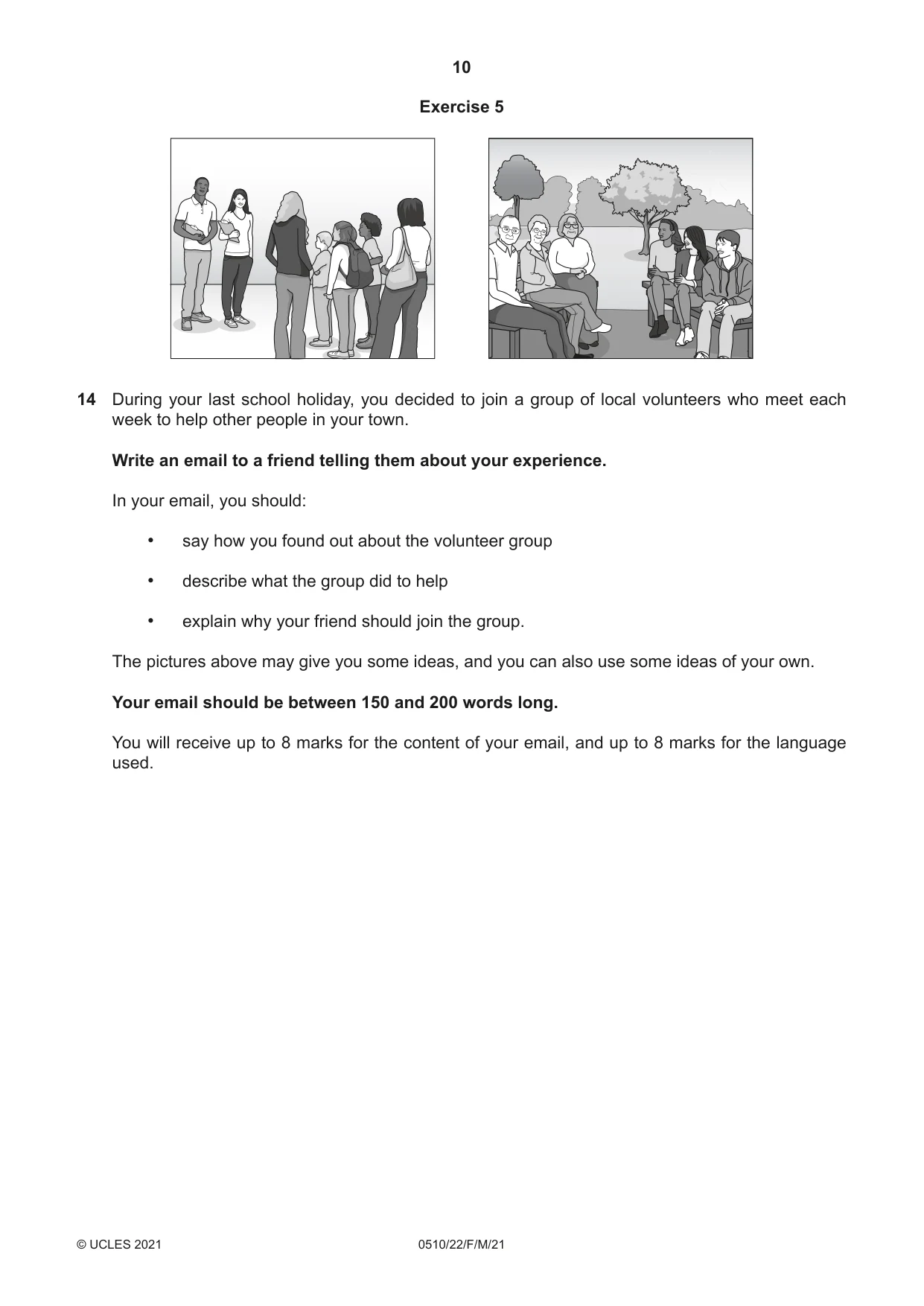
10 0510/22/F/M/21 © UCLES 2021 Exercise 5 14 During your last school holiday, you decided to join a group of local volunteers who meet each week to help other people in your town. Write an email to a friend telling them about your experience. In your email, you should: • say how you found out about the volunteer group • describe what the group did to help • explain why your friend should join the group. The pictures above may give you some ideas, and you can also use some ideas of your own. Your email should be between 150 and 200 words long. You will receive up to 8 marks for the content of your email, and up to 8 marks for the language used.
Question paper, page 11
11 0510/22/F/M/21 © UCLES 2021 [Turn over … … … … … … … … … … … … … … … … … … … … … … … … … … … [Total: 16]
Question paper, page 12
12 0510/22/F/M/21 © UCLES 2021 Exercise 6 15 You have heard about a school that allows the children to decide which subjects they are taught. You have decided to write an article giving your views about this idea for your school magazine. Here are two comments from other young people: I only want to study things that interest me. It’s just not practical in a large school. Write an article for your school magazine, giving your views. The comments above may give you some ideas, and you can also use some ideas of your own. Your article should be between 150 and 200 words long. You will receive up to 8 marks for the content of your article, and up to 8 marks for the language used.
Question paper, page 13
13 0510/22/F/M/21 © UCLES 2021 … … … … … … … … … … … … … … … … … … … … … … … … … … … [Total: 16]
Question paper, page 14
14 0510/22/F/M/21 © UCLES 2021 BLANK PAGE
Question paper, page 15
15 0510/22/F/M/21 © UCLES 2021 BLANK PAGE
Question paper, page 16
16 0510/22/F/M/21 © UCLES 2021 Permission to reproduce items where third-party owned material protected by copyright is included has been sought and cleared where possible. Every reasonable effort has been made by the publisher (UCLES) to trace copyright holders, but if any items requiring clearance have unwittingly been included, the publisher will be pleased to make amends at the earliest possible opportunity. To avoid the issue of disclosure of answer-related information to candidates, all copyright acknowledgements are reproduced online in the Cambridge Assessment International Education Copyright Acknowledgements Booklet. This is produced for each series of examinations and is freely available to download at www.cambridgeinternational.org after the live examination series. Cambridge Assessment International Education is part of the Cambridge Assessment Group. Cambridge Assessment is the brand name of the University of Cambridge Local Examinations Syndicate (UCLES), which itself is a department of the University of Cambridge. BLANK PAGE
Mark scheme, page 1
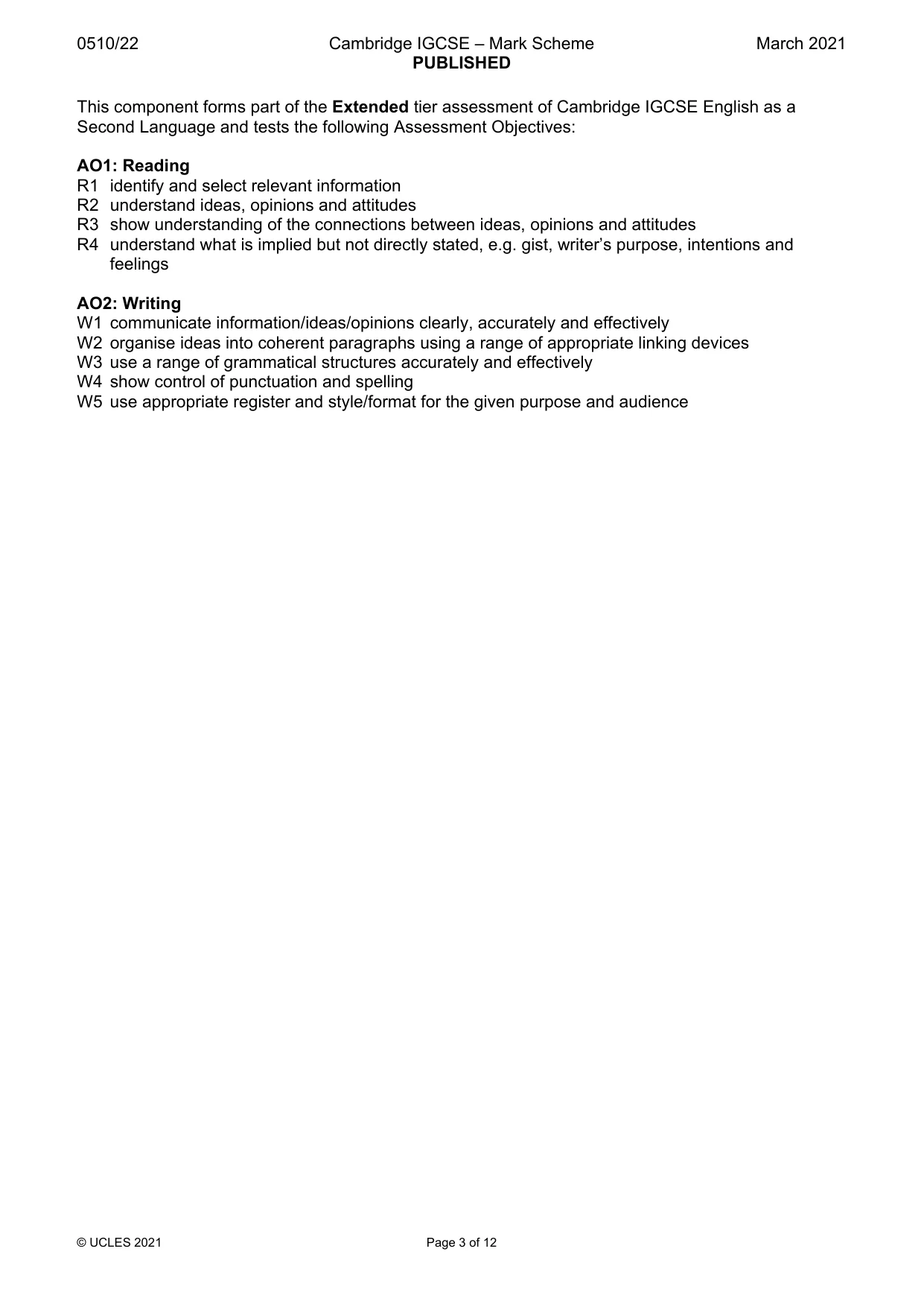
This document consists of 12 printed pages. © UCLES 2021 [Turn over Cambridge IGCSE™ ENGLISH AS A SECOND LANGUAGE 0510/22 Paper 2 Reading and Writing (Extended) March 2021 MARK SCHEME Maximum Mark: 80 Published This mark scheme is published as an aid to teachers and candidates, to indicate the requirements of the examination. It shows the basis on which Examiners were instructed to award marks. It does not indicate the details of the discussions that took place at an Examiners’ meeting before marking began, which would have considered the acceptability of alternative answers. Mark schemes should be read in conjunction with the question paper and the Principal Examiner Report for Teachers. Cambridge International will not enter into discussions about these mark schemes. Cambridge International is publishing the mark schemes for the March 2021 series for most Cambridge IGCSE™, Cambridge International A and AS Level components and some Cambridge O Level components.
Mark scheme, page 2
0510/22 Cambridge IGCSE – Mark Scheme PUBLISHED March 2021 © UCLES 2021 Page 2 of 12 Generic Marking Principles These general marking principles must be applied by all examiners when marking candidate answers. They should be applied alongside the specific content of the mark scheme or generic level descriptors for a question. Each question paper and mark scheme will also comply with these marking principles. GENERIC MARKING PRINCIPLE 1: Marks must be awarded in line with: • the specific content of the mark scheme or the generic level descriptors for the question • the specific skills defined in the mark scheme or in the generic level descriptors for the question • the standard of response required by a candidate as exemplified by the standardisation scripts. GENERIC MARKING PRINCIPLE 2: Marks awarded are always whole marks (not half marks, or other fractions). GENERIC MARKING PRINCIPLE 3: Marks must be awarded positively: • marks are awarded for correct/valid answers, as defined in the mark scheme. However, credit is given for valid answers which go beyond the scope of the syllabus and mark scheme, referring to your Team Leader as appropriate • marks are awarded when candidates clearly demonstrate what they know and can do • marks are not deducted for errors • marks are not deducted for omissions • answers should only be judged on the quality of spelling, punctuation and grammar when these features are specifically assessed by the question as indicated by the mark scheme. The meaning, however, should be unambiguous. GENERIC MARKING PRINCIPLE 4: Rules must be applied consistently, e.g. in situations where candidates have not followed instructions or in the application of generic level descriptors. GENERIC MARKING PRINCIPLE 5: Marks should be awarded using the full range of marks defined in the mark scheme for the question (however; the use of the full mark range may be limited according to the quality of the candidate responses seen). GENERIC MARKING PRINCIPLE 6: Marks awarded are based solely on the requirements as defined in the mark scheme. Marks should not be awarded with grade thresholds or grade descriptors in mind.
Mark scheme, page 3
0510/22 Cambridge IGCSE – Mark Scheme PUBLISHED March 2021 © UCLES 2021 Page 3 of 12 This component forms part of the Extended tier assessment of Cambridge IGCSE English as a Second Language and tests the following Assessment Objectives: AO1: Reading R1 identify and select relevant information R2 understand ideas, opinions and attitudes R3 show understanding of the connections between ideas, opinions and attitudes R4 understand what is implied but not directly stated, e.g. gist, writer’s purpose, intentions and feelings AO2: Writing W1 communicate information/ideas/opinions clearly, accurately and effectively W2 organise ideas into coherent paragraphs using a range of appropriate linking devices W3 use a range of grammatical structures accurately and effectively W4 show control of punctuation and spelling W5 use appropriate register and style/format for the given purpose and audience
Mark scheme, page 4
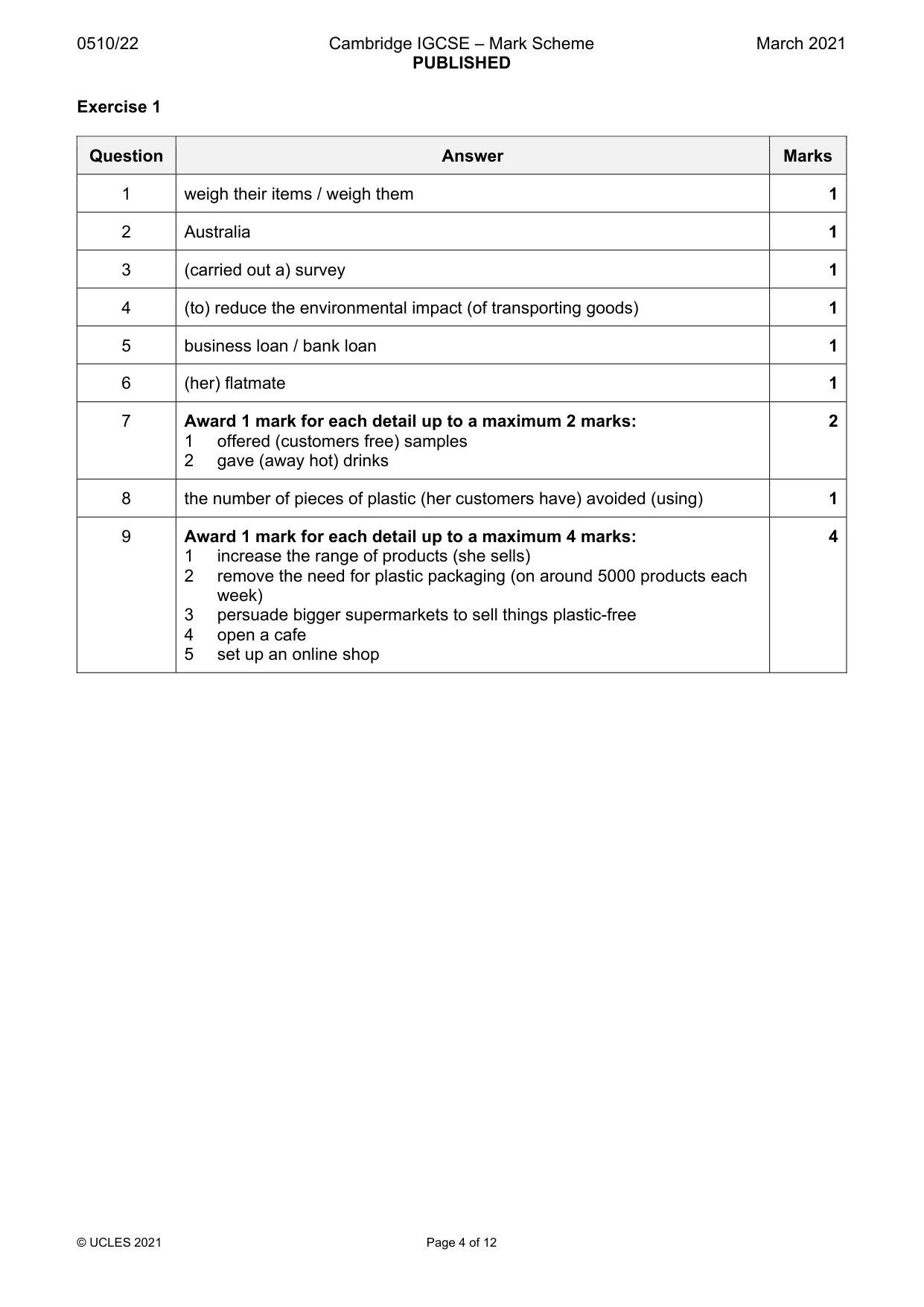
0510/22 Cambridge IGCSE – Mark Scheme PUBLISHED March 2021 © UCLES 2021 Page 4 of 12 Exercise 1 Question Answer Marks 1 weigh their items / weigh them 1 2 Australia 1 3 (carried out a) survey 1 4 (to) reduce the environmental impact (of transporting goods) 1 5 business loan / bank loan 1 6 (her) flatmate 1 7 Award 1 mark for each detail up to a maximum 2 marks: 1 offered (customers free) samples 2 gave (away hot) drinks 2 8 the number of pieces of plastic (her customers have) avoided (using) 1 9 Award 1 mark for each detail up to a maximum 4 marks: 1 increase the range of products (she sells) 2 remove the need for plastic packaging (on around 5000 products each week) 3 persuade bigger supermarkets to sell things plastic-free 4 open a cafe 5 set up an online shop 4
Mark scheme, page 5
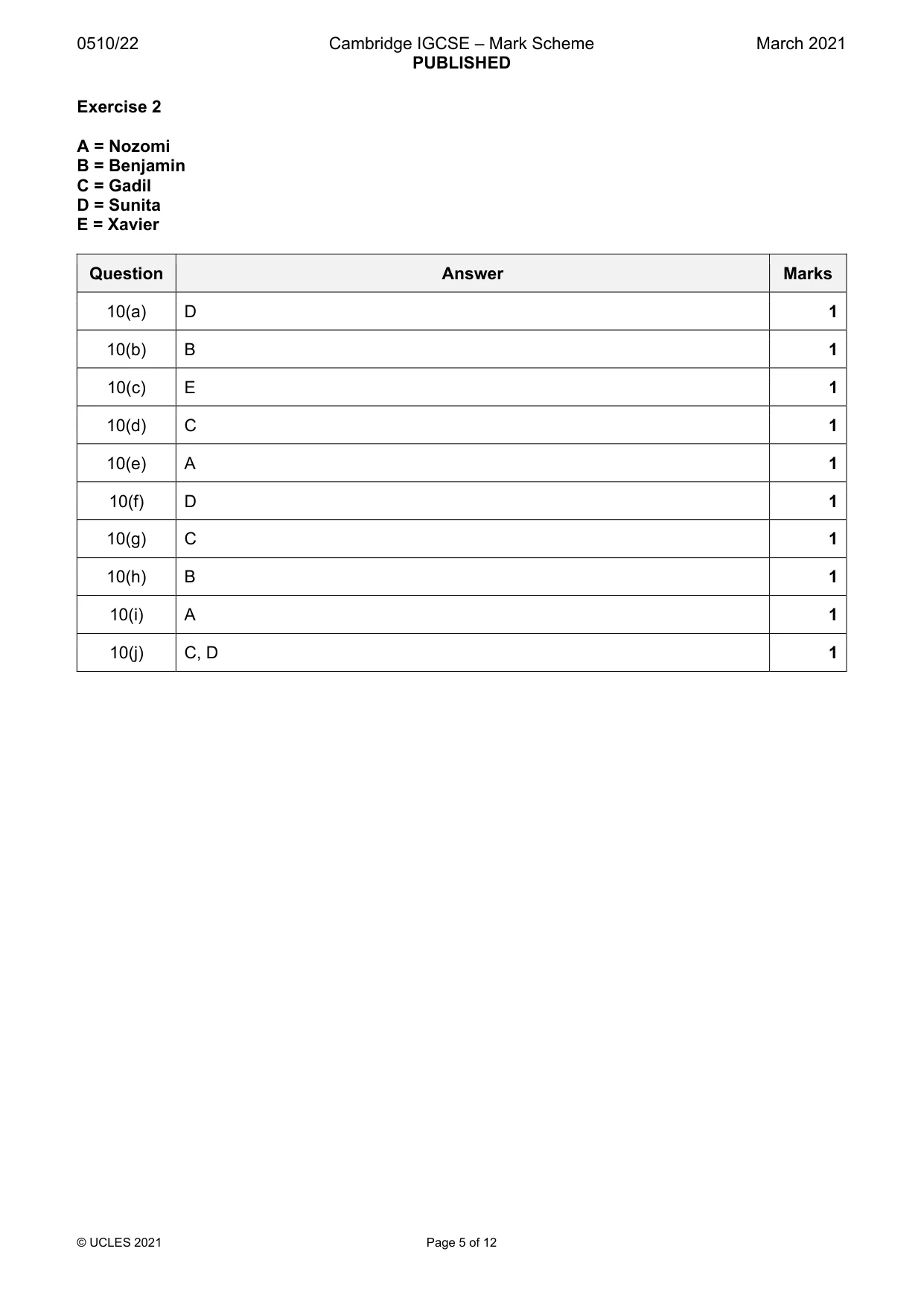
0510/22 Cambridge IGCSE – Mark Scheme PUBLISHED March 2021 © UCLES 2021 Page 5 of 12 Exercise 2 A = Nozomi B = Benjamin C = Gadil D = Sunita E = Xavier Question Answer Marks 10(a) D 1 10(b) B 1 10(c) E 1 10(d) C 1 10(e) A 1 10(f) D 1 10(g) C 1 10(h) B 1 10(i) A 1 10(j) C, D 1
Mark scheme, page 6
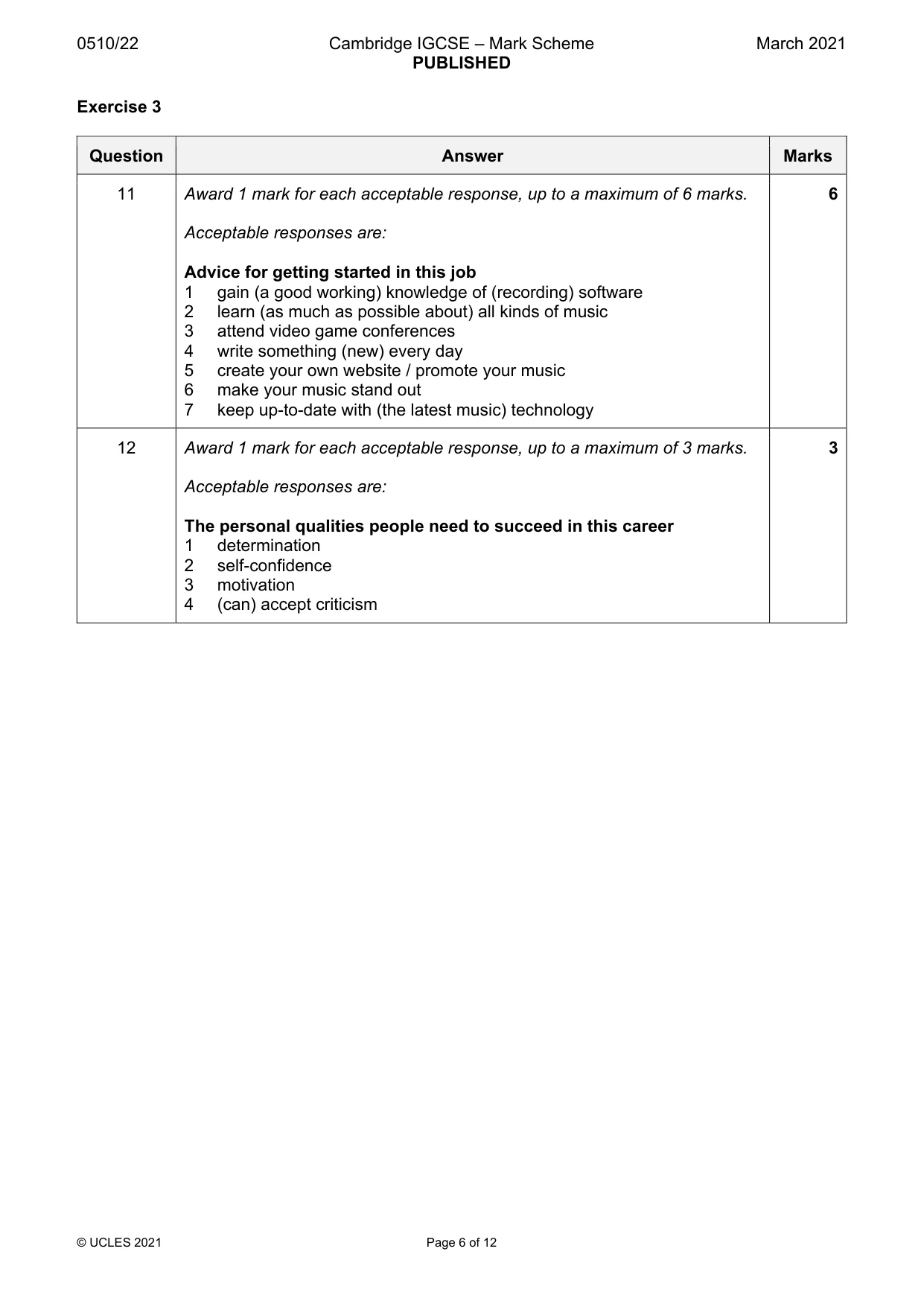
0510/22 Cambridge IGCSE – Mark Scheme PUBLISHED March 2021 © UCLES 2021 Page 6 of 12 Exercise 3 Question Answer Marks 11 Award 1 mark for each acceptable response, up to a maximum of 6 marks. Acceptable responses are: Advice for getting started in this job 1 gain (a good working) knowledge of (recording) software 2 learn (as much as possible about) all kinds of music 3 attend video game conferences 4 write something (new) every day 5 create your own website / promote your music 6 make your music stand out 7 keep up-to-date with (the latest music) technology 6 12 Award 1 mark for each acceptable response, up to a maximum of 3 marks. Acceptable responses are: The personal qualities people need to succeed in this career 1 determination 2 self-confidence 3 motivation 4 (can) accept criticism 3
Mark scheme, page 7
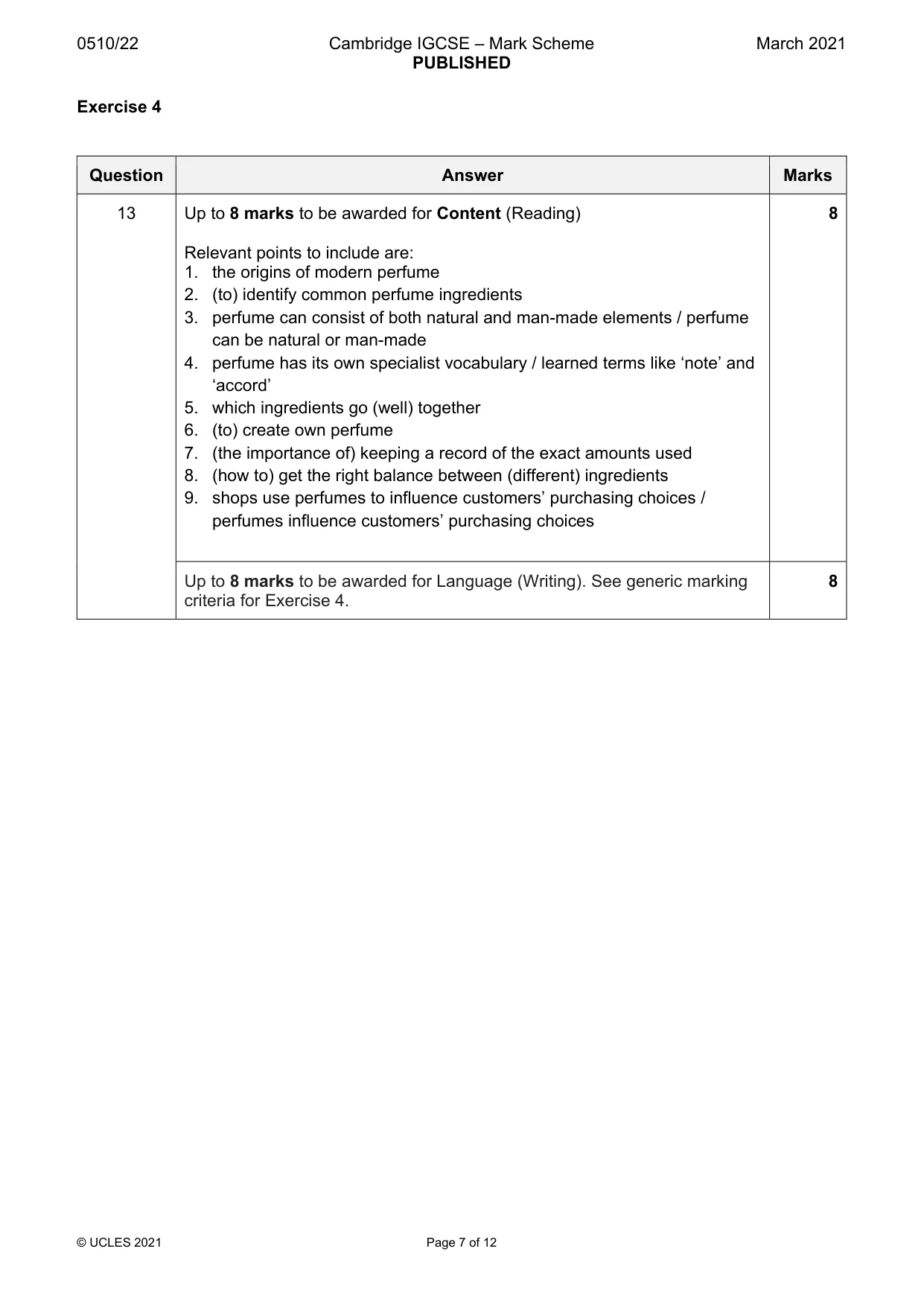
0510/22 Cambridge IGCSE – Mark Scheme PUBLISHED March 2021 © UCLES 2021 Page 7 of 12 Exercise 4 Question Answer Marks 13 Up to 8 marks to be awarded for Content (Reading) Relevant points to include are: 1. the origins of modern perfume 2. (to) identify common perfume ingredients 3. perfume can consist of both natural and man-made elements / perfume can be natural or man-made 4. perfume has its own specialist vocabulary / learned terms like ‘note’ and ‘accord’ 5. which ingredients go (well) together 6. (to) create own perfume 7. (the importance of) keeping a record of the exact amounts used 8. (how to) get the right balance between (different) ingredients 9. shops use perfumes to influence customers’ purchasing choices / perfumes influence customers’ purchasing choices 8 Up to 8 marks to be awarded for Language (Writing). See generic marking criteria for Exercise 4. 8
Mark scheme, page 8
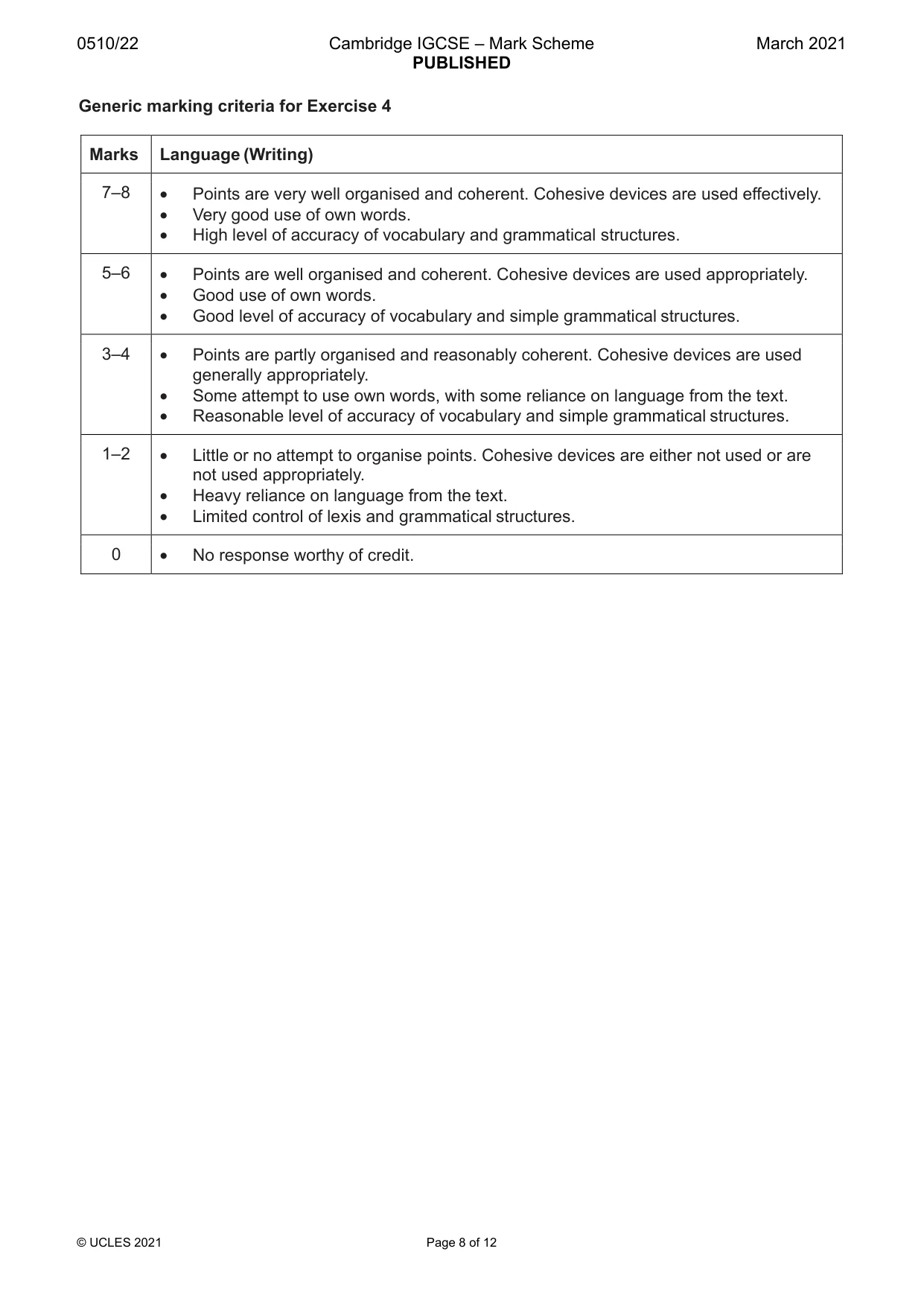
0510/22 Cambridge IGCSE – Mark Scheme PUBLISHED March 2021 © UCLES 2021 Page 8 of 12 Generic marking criteria for Exercise 4 Marks Language (Writing) 7–8 • Points are very well organised and coherent. Cohesive devices are used effectively. • Very good use of own words. • High level of accuracy of vocabulary and grammatical structures. 5–6 • Points are well organised and coherent. Cohesive devices are used appropriately. • Good use of own words. • Good level of accuracy of vocabulary and simple grammatical structures. 3–4 • Points are partly organised and reasonably coherent. Cohesive devices are used generally appropriately. • Some attempt to use own words, with some reliance on language from the text. • Reasonable level of accuracy of vocabulary and simple grammatical structures. 1–2 • Little or no attempt to organise points. Cohesive devices are either not used or are not used appropriately. • Heavy reliance on language from the text. • Limited control of lexis and grammatical structures. 0 • No response worthy of credit.
Mark scheme, page 9
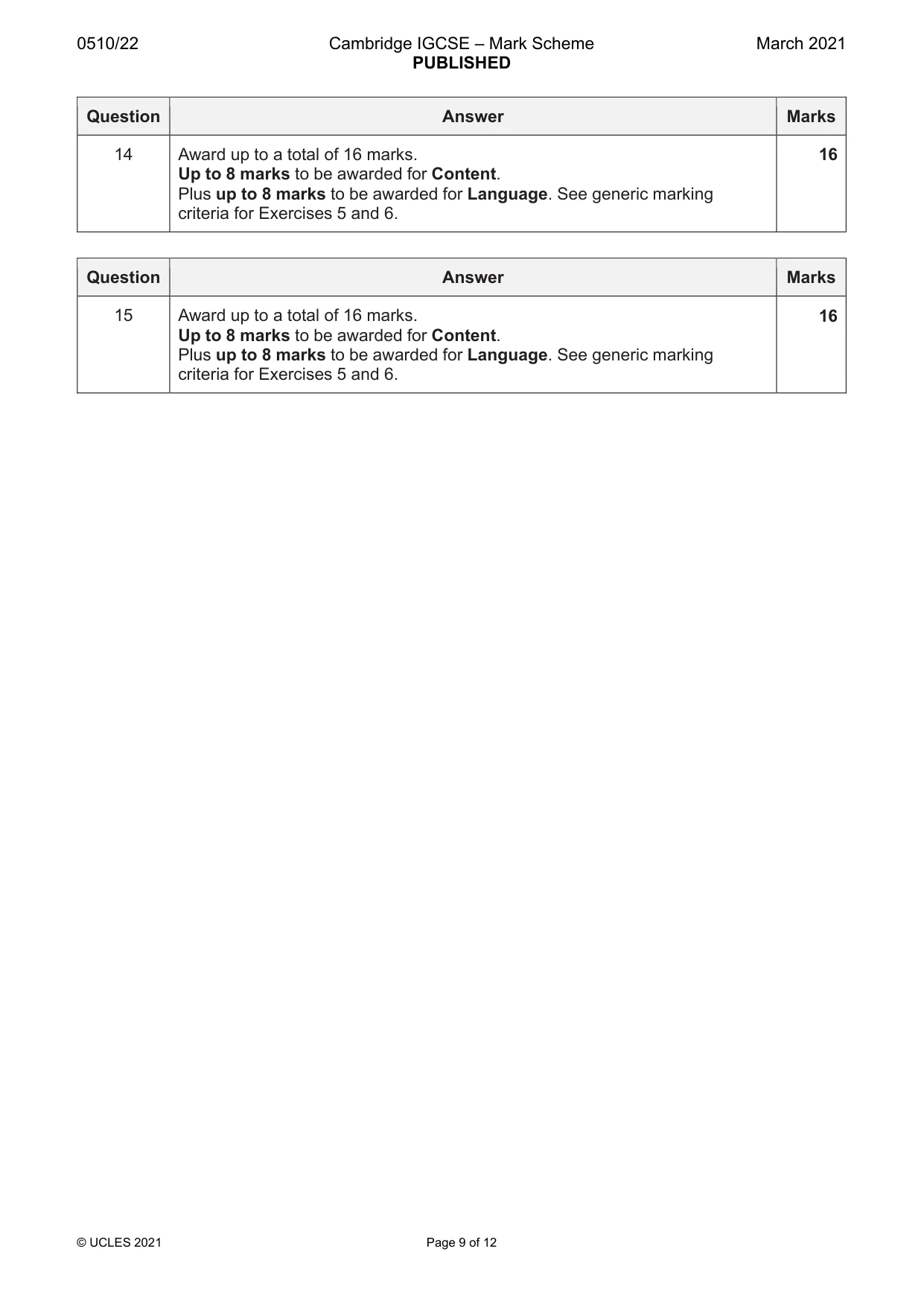
0510/22 Cambridge IGCSE – Mark Scheme PUBLISHED March 2021 © UCLES 2021 Page 9 of 12 Question Answer Marks 14 Award up to a total of 16 marks. Up to 8 marks to be awarded for Content. Plus up to 8 marks to be awarded for Language. See generic marking criteria for Exercises 5 and 6. 16 Question Answer Marks 15 Award up to a total of 16 marks. Up to 8 marks to be awarded for Content. Plus up to 8 marks to be awarded for Language. See generic marking criteria for Exercises 5 and 6. 16
Mark scheme, page 10
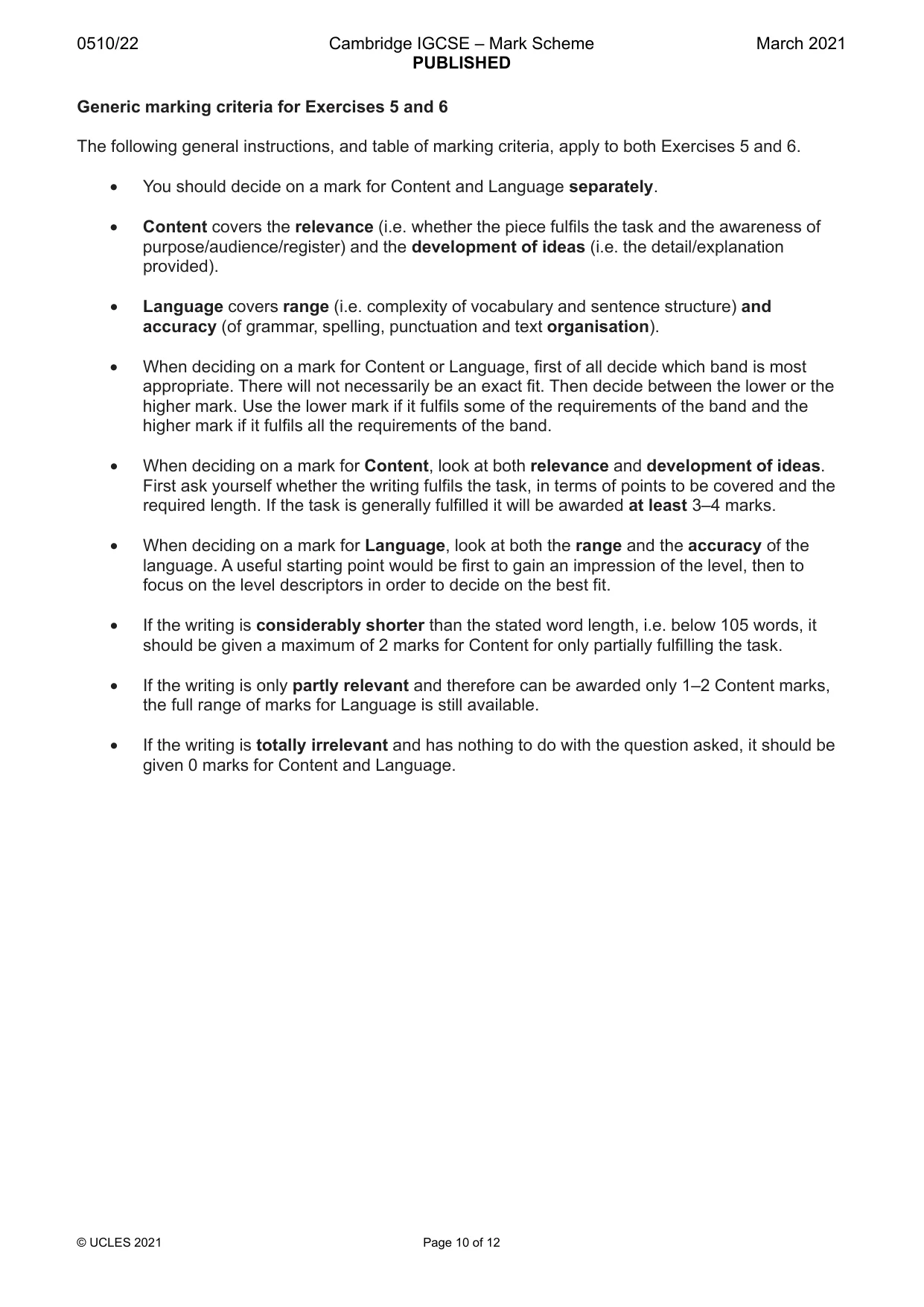
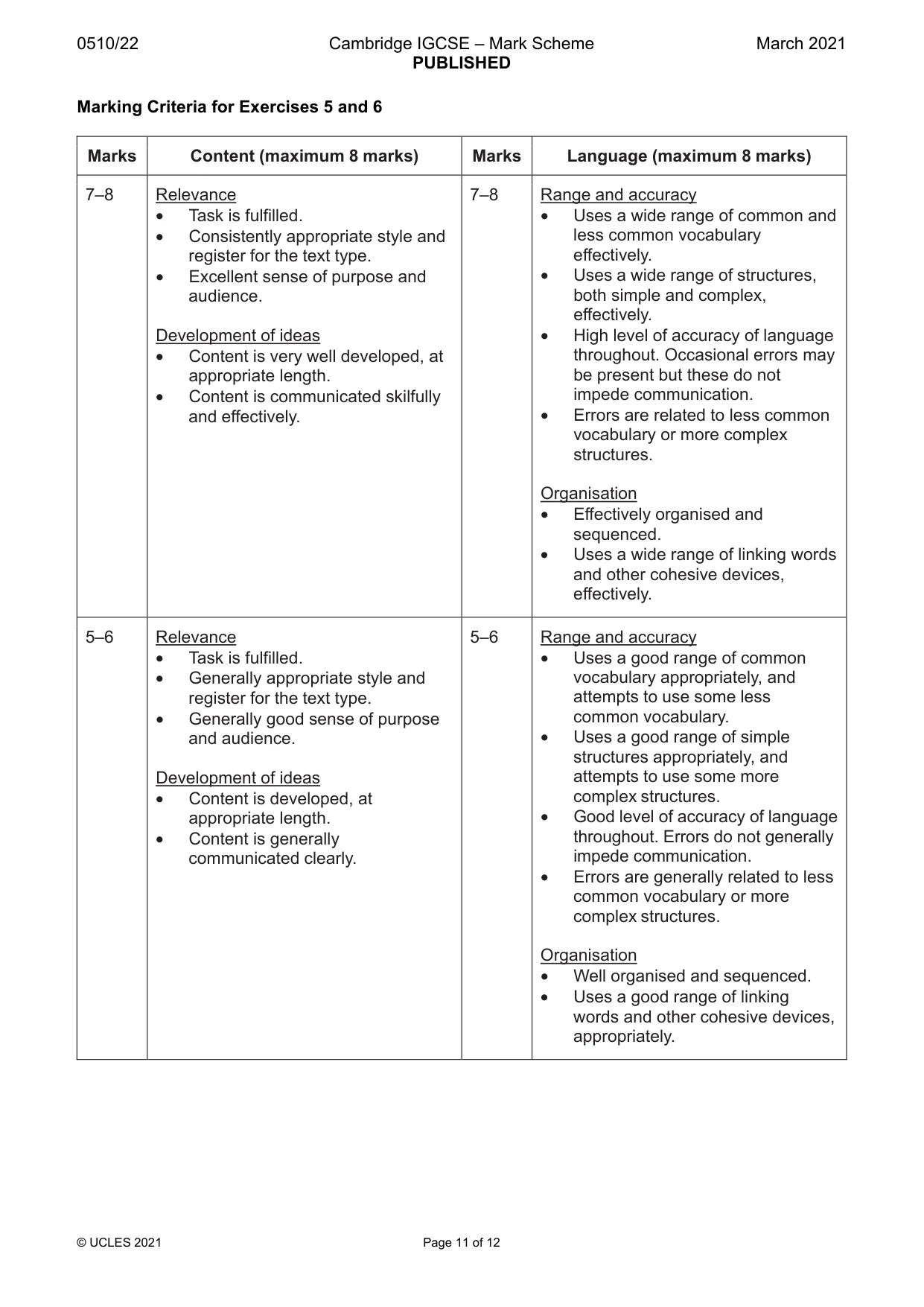
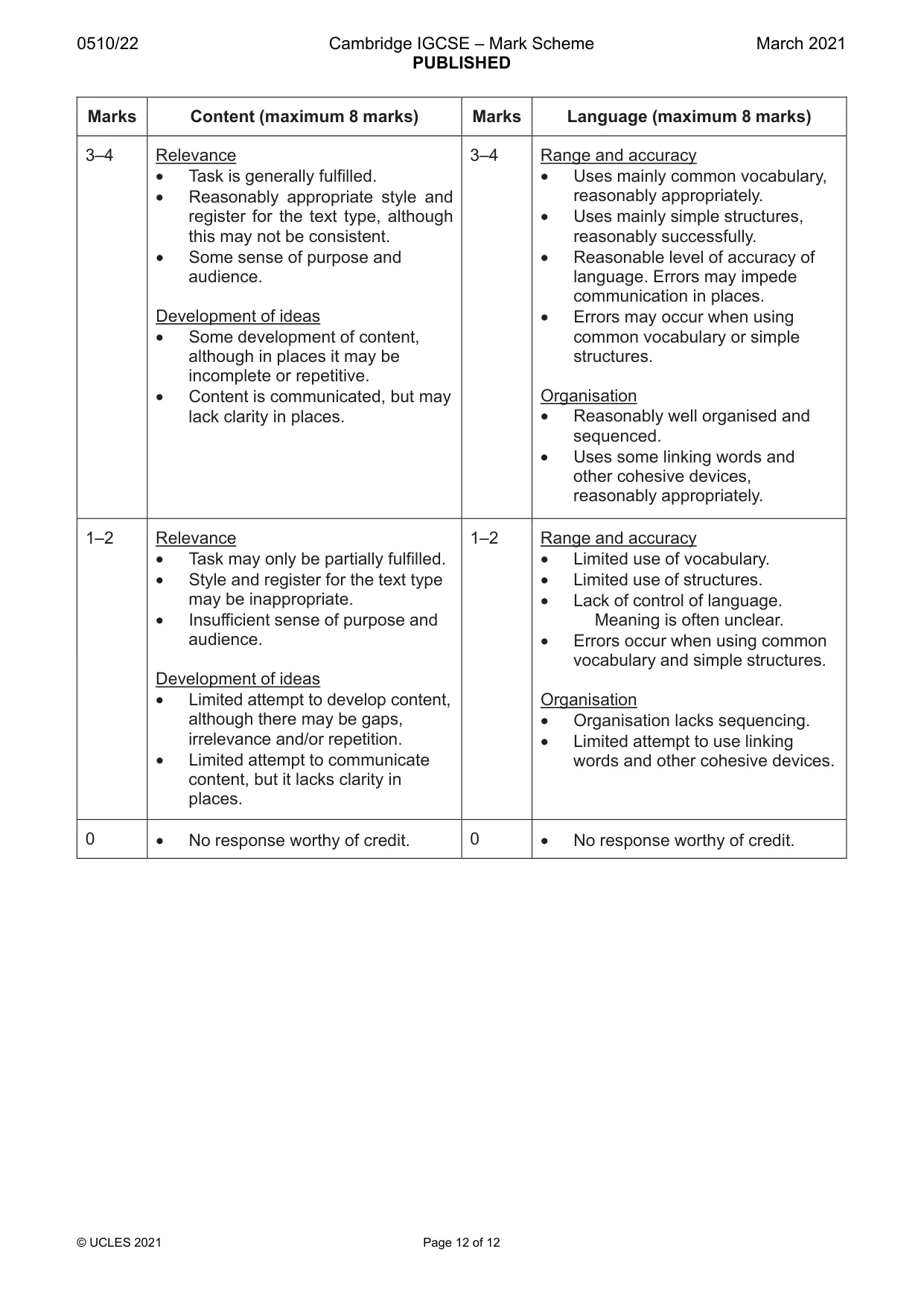
0510/22 Cambridge IGCSE – Mark Scheme PUBLISHED March 2021 © UCLES 2021 Page 10 of 12 Generic marking criteria for Exercises 5 and 6 The following general instructions, and table of marking criteria, apply to both Exercises 5 and 6. • You should decide on a mark for Content and Language separately. • Content covers the relevance (i.e. whether the piece fulfils the task and the awareness of purpose/audience/register) and the development of ideas (i.e. the detail/explanation provided). • Language covers range (i.e. complexity of vocabulary and sentence structure) and accuracy (of grammar, spelling, punctuation and text organisation). • When deciding on a mark for Content or Language, first of all decide which band is most appropriate. There will not necessarily be an exact fit. Then decide between the lower or the higher mark. Use the lower mark if it fulfils some of the requirements of the band and the higher mark if it fulfils all the requirements of the band. • When deciding on a mark for Content, look at both relevance and development of ideas. First ask yourself whether the writing fulfils the task, in terms of points to be covered and the required length. If the task is generally fulfilled it will be awarded at least 3–4 marks. • When deciding on a mark for Language, look at both the range and the accuracy of the language. A useful starting point would be first to gain an impression of the level, then to focus on the level descriptors in order to decide on the best fit. • If the writing is considerably shorter than the stated word length, i.e. below 105 words, it should be given a maximum of 2 marks for Content for only partially fulfilling the task. • If the writing is only partly relevant and therefore can be awarded only 1–2 Content marks, the full range of marks for Language is still available. • If the writing is totally irrelevant and has nothing to do with the question asked, it should be given 0 marks for Content and Language.
Mark scheme, page 11
0510/22 Cambridge IGCSE – Mark Scheme PUBLISHED March 2021 © UCLES 2021 Page 11 of 12 Marking Criteria for Exercises 5 and 6 Marks Content (maximum 8 marks) Marks Language (maximum 8 marks) 7–8 Relevance • Task is fulfilled. • Consistently appropriate style and register for the text type. • Excellent sense of purpose and audience. Development of ideas • Content is very well developed, at appropriate length. • Content is communicated skilfully and effectively. 7–8 Range and accuracy • Uses a wide range of common and less common vocabulary effectively. • Uses a wide range of structures, both simple and complex, effectively. • High level of accuracy of language throughout. Occasional errors may be present but these do not impede communication. • Errors are related to less common vocabulary or more complex structures. Organisation • Effectively organised and sequenced. • Uses a wide range of linking words and other cohesive devices, effectively. 5–6 Relevance • Task is fulfilled. • Generally appropriate style and register for the text type. • Generally good sense of purpose and audience. Development of ideas • Content is developed, at appropriate length. • Content is generally communicated clearly. 5–6 Range and accuracy • Uses a good range of common vocabulary appropriately, and attempts to use some less common vocabulary. • Uses a good range of simple structures appropriately, and attempts to use some more complex structures. • Good level of accuracy of language throughout. Errors do not generally impede communication. • Errors are generally related to less common vocabulary or more complex structures. Organisation • Well organised and sequenced. • Uses a good range of linking words and other cohesive devices, appropriately.
Mark scheme, page 12
0510/22 Cambridge IGCSE – Mark Scheme PUBLISHED March 2021 © UCLES 2021 Page 12 of 12 Marks Content (maximum 8 marks) Marks Language (maximum 8 marks) 3–4 Relevance • Task is generally fulfilled. • Reasonably appropriate style and register for the text type, although this may not be consistent. • Some sense of purpose and audience. Development of ideas • Some development of content, although in places it may be incomplete or repetitive. • Content is communicated, but may lack clarity in places. 3–4 Range and accuracy • Uses mainly common vocabulary, reasonably appropriately. • Uses mainly simple structures, reasonably successfully. • Reasonable level of accuracy of language. Errors may impede communication in places. • Errors may occur when using common vocabulary or simple structures. Organisation • Reasonably well organised and sequenced. • Uses some linking words and other cohesive devices, reasonably appropriately. 1–2 Relevance • Task may only be partially fulfilled. • Style and register for the text type may be inappropriate. • Insufficient sense of purpose and audience. Development of ideas • Limited attempt to develop content, although there may be gaps, irrelevance and/or repetition. • Limited attempt to communicate content, but it lacks clarity in places. 1–2 Range and accuracy • Limited use of vocabulary. • Limited use of structures. • Lack of control of language. Meaning is often unclear. • Errors occur when using common vocabulary and simple structures. Organisation • Organisation lacks sequencing. • Limited attempt to use linking words and other cohesive devices. 0 • No response worthy of credit. 0 • No response worthy of credit.