Cambridge IGCSE English - Second Language (oral endorsement) 0510 — 2020 May/June Paper 1 · Variant 3
0510/13/M/J/20
The question paper and its mark scheme, free to read here and free to download. This is Cambridge’s own paper, exactly as it was sat.
Question paper16 pages



Mark scheme9 pages
Answers below. Sit the paper first if you are practising.
Paper as text
Question paper, page 1
Cambridge IGCSE™ ENGLISH AS A SECOND LANGUAGE 0510/13 Paper 1 Reading and Writing (Core) May/June 2020 1 hour 30 minutes You must answer on the question paper. No additional materials are needed. INSTRUCTIONS ● Answer all questions. ● Use a black or dark blue pen. ● Write your name, centre number and candidate number in the boxes at the top of the page. ● Write your answer to each question in the space provided. ● Do not use an erasable pen or correction fluid. ● Do not write on any bar codes. ● Dictionaries are not allowed. INFORMATION ● The total mark for this paper is 60. ● The number of marks for each question or part question is shown in brackets [ ]. This document has 16 pages. Blank pages are indicated. DC (RCL/GO) 189622/3 © UCLES 2020 [Turn over * 4 7 5 1 8 8 6 5 7 0 *
Question paper, page 2
2 0510/13/M/J/20 © UCLES 2020 Exercise 1 Read the article about the Guinness World Records, and then answer the following questions. Guinness World Records The Guinness Book of Records began as a book of facts which people could refer to if they wanted to check a world record. However, they say it’s to give students an unforgettable memory – which the 3875 students who achieved the record for the largest water pistol fight in 2013 will certainly have! Content removed due to copyright restrictions.
Question paper, page 3
3 0510/13/M/J/20 © UCLES 2020 [Turn over 1 What question led to the idea of producing the first Guinness Book of Records? … [1] 2 Who wrote the first Guinness Book of Records? … [1] 3 In which year was the first Guinness Book of Records published? … [1] 4 Why are some proposals for setting new records rejected? Give two details. … … [2] 5 What was the world’s largest T-shirt made from? … [1] 6 What do you receive if you break a record? … [1] 7 What reasons does a Californian university give for attempting to break a world record every year? Give two details. … … [2] [Total: 9]
Question paper, page 4
4 0510/13/M/J/20 © UCLES 2020 Exercise 2 Read the article about three people (A–C) who decided to stop using their mobile phones for a week. Then answer Question 8 (a)–(h). Could you live without your phone for a week? Three students accept the challenge! A Gina Freeman I’ve had a smartphone since I was twelve, so I regard it as a really important part of my life. However, I’m also aware that I’m possibly too dependent on it, so when my friend read about a week-long challenge to stop using your phone, and suggested we give it a go, I thought it wouldn’t be a bad idea. The rules for the week build up from simply leaving your phone outside your bedroom on the first night, to switching it off and putting it away completely for the final two days. If I’d had to do that on day one, I don’t think I could’ve managed it! One thing I noticed during the week was that I started talking to my friend on the bus to college – usually I’d be on social media or trying out a new app. The other thing was that I didn’t bother wearing make-up for the last two days, I guess because I wasn’t posting any selfies! B Karl Schultz Some of my friends are on social media all the time, which doesn’t bother me, but I’m not like that. Although there are a few websites and apps that I find really useful, I’m not permanently looking at my phone, and actually I don’t always take it with me when I go out. So when my dad suggested this challenge, I did have my doubts about whether it’d be worth it, even though I didn’t think I’d find it that hard to do. Anyway, I actually quite enjoyed the first couple of days. Waking up and not immediately looking at my phone let me think about the day ahead and decide what I wanted to do. Towards the end though, I kept reaching for where my phone would usually be, then realising it wasn’t there – I found that hard to deal with. It’s made me think about doing the whole thing again next month. Perhaps it’ll be easier if I know what to expect? C Deniz Osman I didn’t realise quite how much I used my mobile phone until I downloaded an app which measures the time you spend looking at your screen and how often you pick up your phone each day. That’s when I decided I should try this challenge! I followed the rules for the week, and although it might sound easy, I actually found the whole experience quite hard to cope with. For example, knowing you can’t check social media and find out what’s going on makes you feel like you’re missing something, even though I know I’d just be wasting time looking at pictures posted by people who I hardly even know. Having completed the challenge, I thought I’d be able to cut down on my phone use, even if it was only slightly. However, I discovered the opposite happened. One friend suggested I should do the challenge again, though once was enough for me!
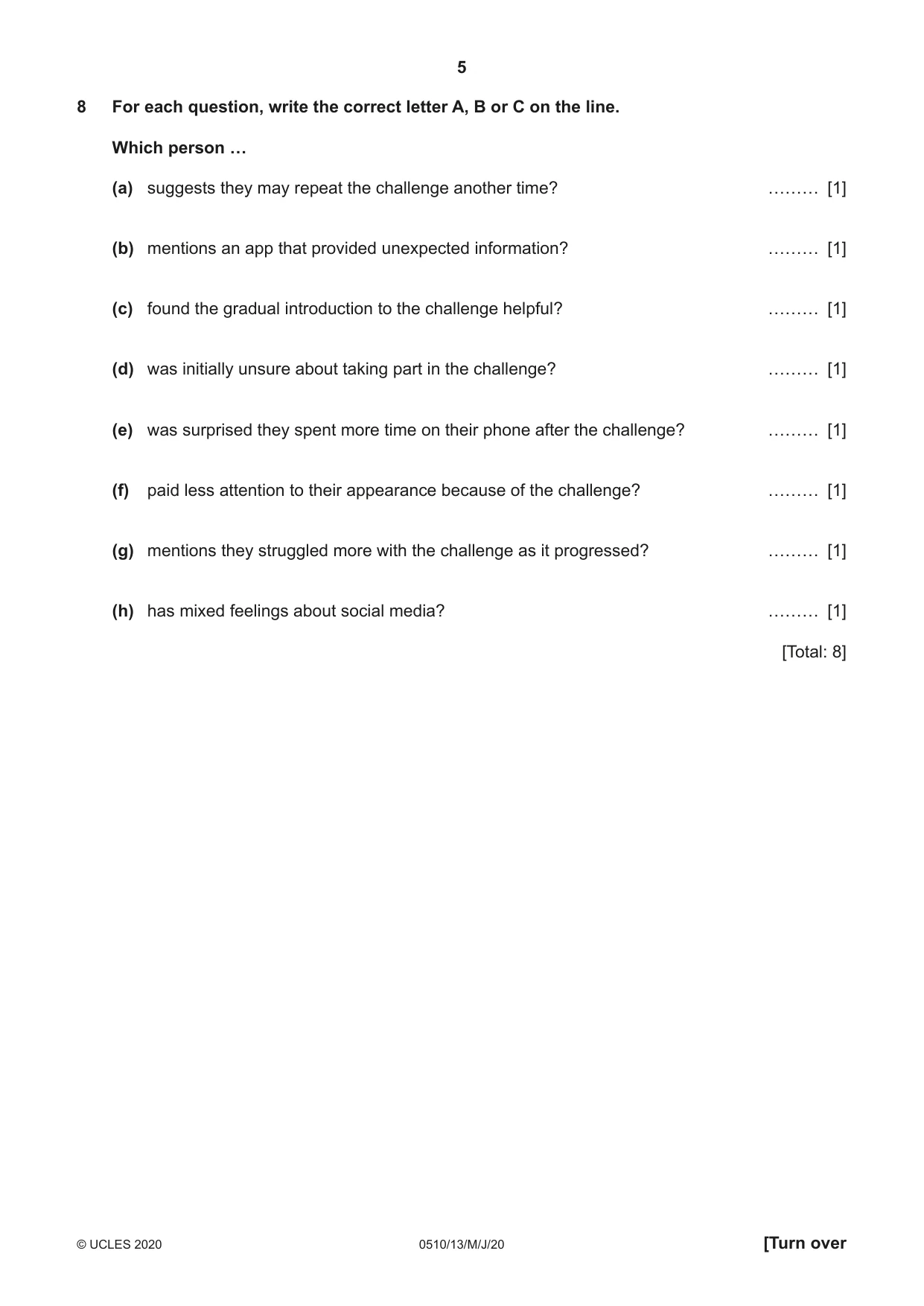
Question paper, page 5
5 0510/13/M/J/20 © UCLES 2020 [Turn over 8 For each question, write the correct letter A, B or C on the line. Which person … (a) suggests they may repeat the challenge another time? ……… [1] (b) mentions an app that provided unexpected information? ……… [1] (c) found the gradual introduction to the challenge helpful? ……… [1] (d) was initially unsure about taking part in the challenge? ……… [1] (e) was surprised they spent more time on their phone after the challenge? ……… [1] (f) paid less attention to their appearance because of the challenge? ……… [1] (g) mentions they struggled more with the challenge as it progressed? ……… [1] (h) has mixed feelings about social media? ……… [1] [Total: 8]
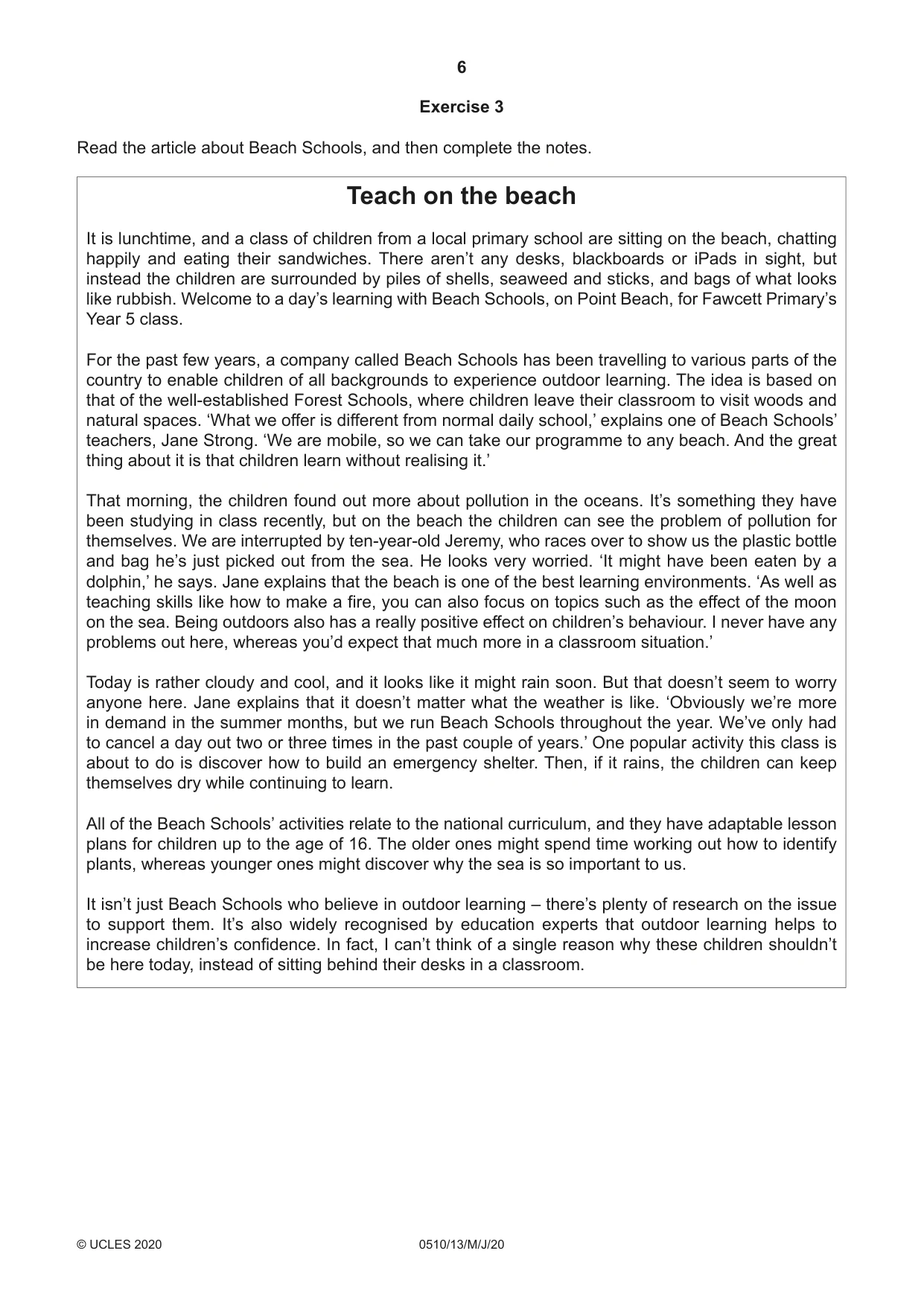
Question paper, page 6
6 0510/13/M/J/20 © UCLES 2020 Exercise 3 Read the article about Beach Schools, and then complete the notes. Teach on the beach It is lunchtime, and a class of children from a local primary school are sitting on the beach, chatting happily and eating their sandwiches. There aren’t any desks, blackboards or iPads in sight, but instead the children are surrounded by piles of shells, seaweed and sticks, and bags of what looks like rubbish. Welcome to a day’s learning with Beach Schools, on Point Beach, for Fawcett Primary’s Year 5 class. For the past few years, a company called Beach Schools has been travelling to various parts of the country to enable children of all backgrounds to experience outdoor learning. The idea is based on that of the well-established Forest Schools, where children leave their classroom to visit woods and natural spaces. ‘What we offer is different from normal daily school,’ explains one of Beach Schools’ teachers, Jane Strong. ‘We are mobile, so we can take our programme to any beach. And the great thing about it is that children learn without realising it.’ That morning, the children found out more about pollution in the oceans. It’s something they have been studying in class recently, but on the beach the children can see the problem of pollution for themselves. We are interrupted by ten-year-old Jeremy, who races over to show us the plastic bottle and bag he’s just picked out from the sea. He looks very worried. ‘It might have been eaten by a dolphin,’ he says. Jane explains that the beach is one of the best learning environments. ‘As well as teaching skills like how to make a fire, you can also focus on topics such as the effect of the moon on the sea. Being outdoors also has a really positive effect on children’s behaviour. I never have any problems out here, whereas you’d expect that much more in a classroom situation.’ Today is rather cloudy and cool, and it looks like it might rain soon. But that doesn’t seem to worry anyone here. Jane explains that it doesn’t matter what the weather is like. ‘Obviously we’re more in demand in the summer months, but we run Beach Schools throughout the year. We’ve only had to cancel a day out two or three times in the past couple of years.’ One popular activity this class is about to do is discover how to build an emergency shelter. Then, if it rains, the children can keep themselves dry while continuing to learn. All of the Beach Schools’ activities relate to the national curriculum, and they have adaptable lesson plans for children up to the age of 16. The older ones might spend time working out how to identify plants, whereas younger ones might discover why the sea is so important to us. It isn’t just Beach Schools who believe in outdoor learning – there’s plenty of research on the issue to support them. It’s also widely recognised by education experts that outdoor learning helps to increase children’s confidence. In fact, I can’t think of a single reason why these children shouldn’t be here today, instead of sitting behind their desks in a classroom.
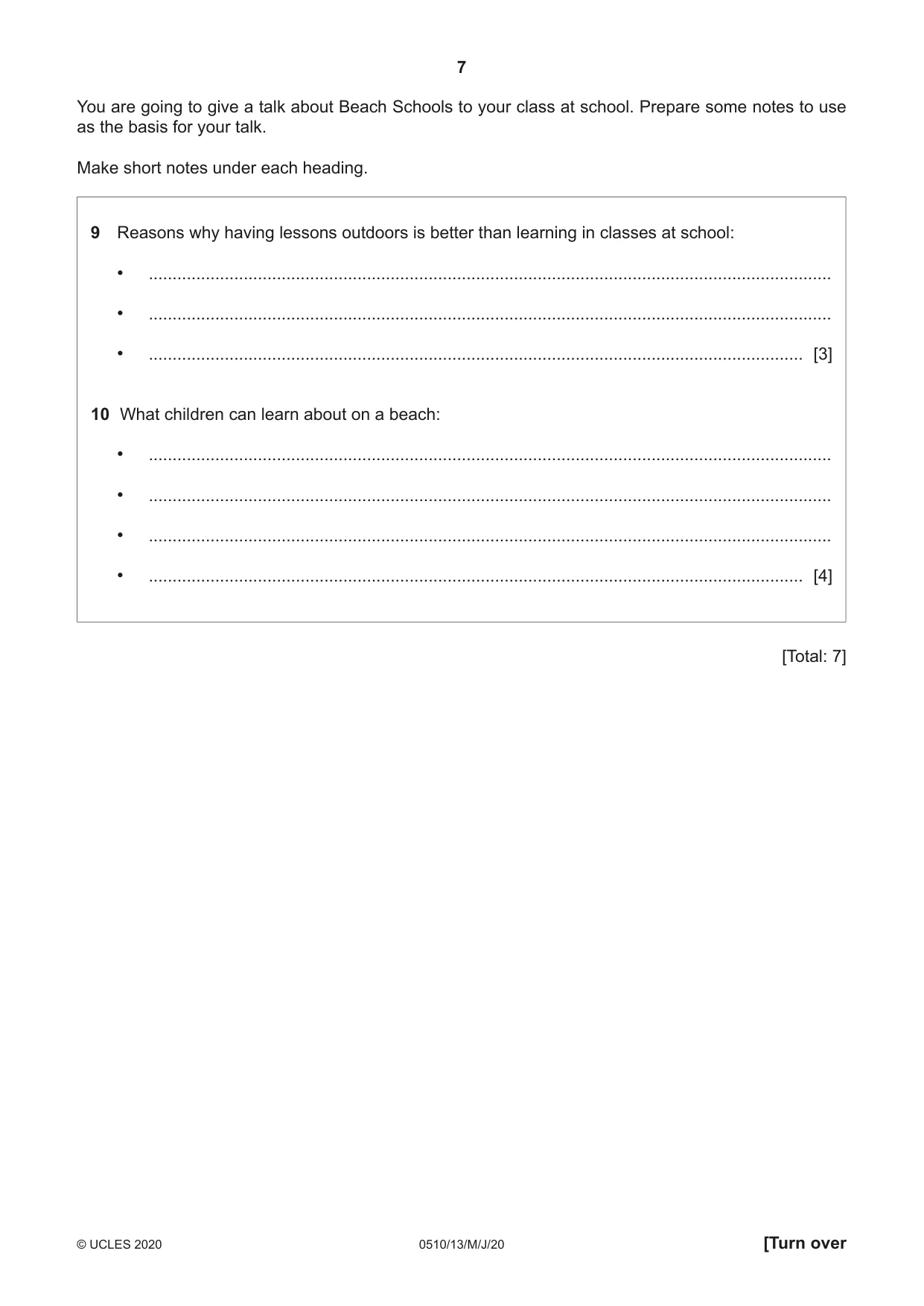
Question paper, page 7
7 0510/13/M/J/20 © UCLES 2020 [Turn over You are going to give a talk about Beach Schools to your class at school. Prepare some notes to use as the basis for your talk. Make short notes under each heading. 9 Reasons why having lessons outdoors is better than learning in classes at school: • … • … • … [3] 10 What children can learn about on a beach: • … • … • … • … [4] [Total: 7]
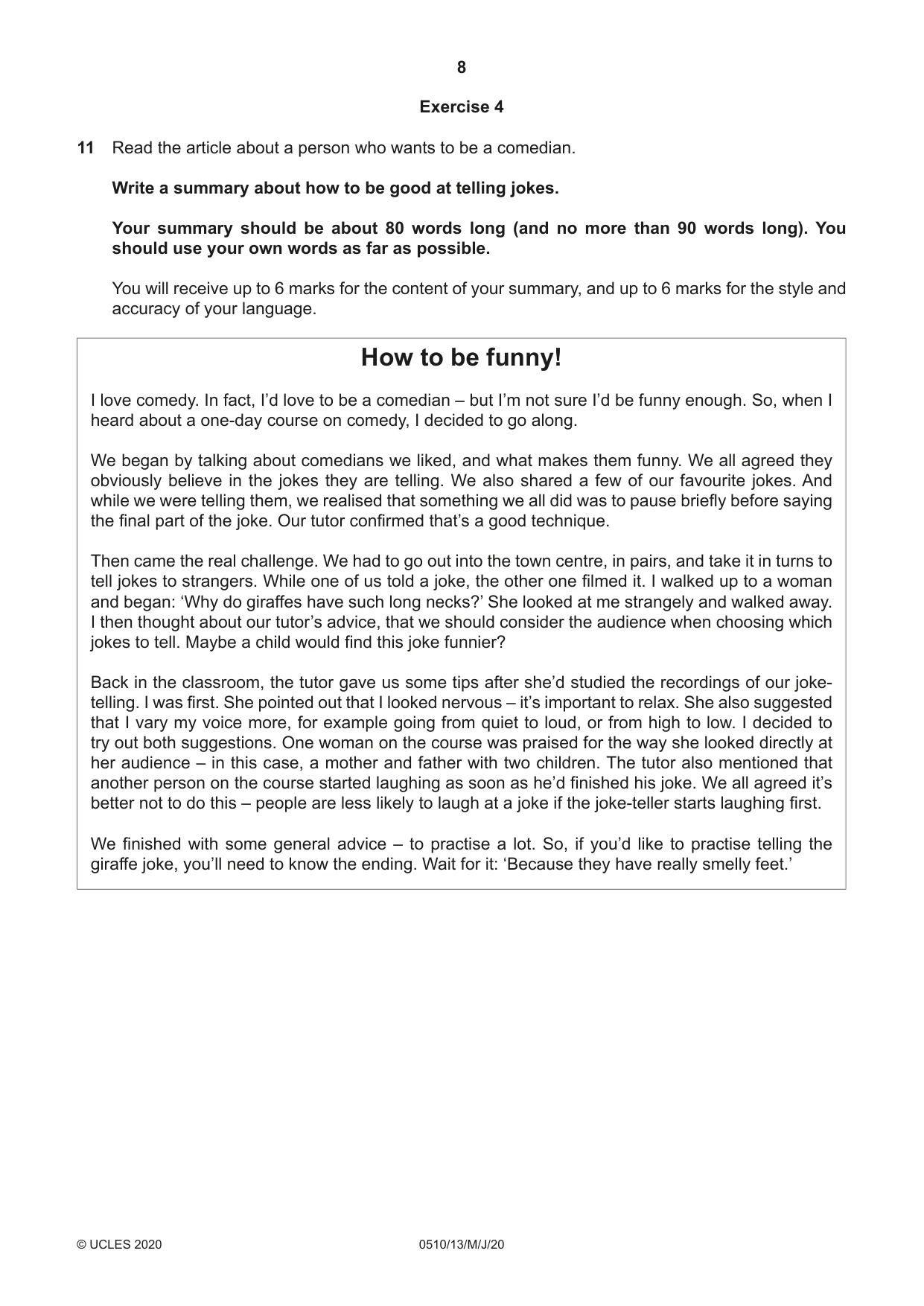
Question paper, page 8
8 0510/13/M/J/20 © UCLES 2020 Exercise 4 11 Read the article about a person who wants to be a comedian. Write a summary about how to be good at telling jokes. Your summary should be about 80 words long (and no more than 90 words long). You should use your own words as far as possible. You will receive up to 6 marks for the content of your summary, and up to 6 marks for the style and accuracy of your language. How to be funny! I love comedy. In fact, I’d love to be a comedian – but I’m not sure I’d be funny enough. So, when I heard about a one-day course on comedy, I decided to go along. We began by talking about comedians we liked, and what makes them funny. We all agreed they obviously believe in the jokes they are telling. We also shared a few of our favourite jokes. And while we were telling them, we realised that something we all did was to pause briefly before saying the final part of the joke. Our tutor confirmed that’s a good technique. Then came the real challenge. We had to go out into the town centre, in pairs, and take it in turns to tell jokes to strangers. While one of us told a joke, the other one filmed it. I walked up to a woman and began: ‘Why do giraffes have such long necks?’ She looked at me strangely and walked away. I then thought about our tutor’s advice, that we should consider the audience when choosing which jokes to tell. Maybe a child would find this joke funnier? Back in the classroom, the tutor gave us some tips after she’d studied the recordings of our joke- telling. I was first. She pointed out that I looked nervous – it’s important to relax. She also suggested that I vary my voice more, for example going from quiet to loud, or from high to low. I decided to try out both suggestions. One woman on the course was praised for the way she looked directly at her audience – in this case, a mother and father with two children. The tutor also mentioned that another person on the course started laughing as soon as he’d finished his joke. We all agreed it’s better not to do this – people are less likely to laugh at a joke if the joke-teller starts laughing first. We finished with some general advice – to practise a lot. So, if you’d like to practise telling the giraffe joke, you’ll need to know the ending. Wait for it: ‘Because they have really smelly feet.’
Question paper, page 9
9 0510/13/M/J/20 © UCLES 2020 [Turn over … … … … … … … … … … … … … … [Total: 12]
Question paper, page 10
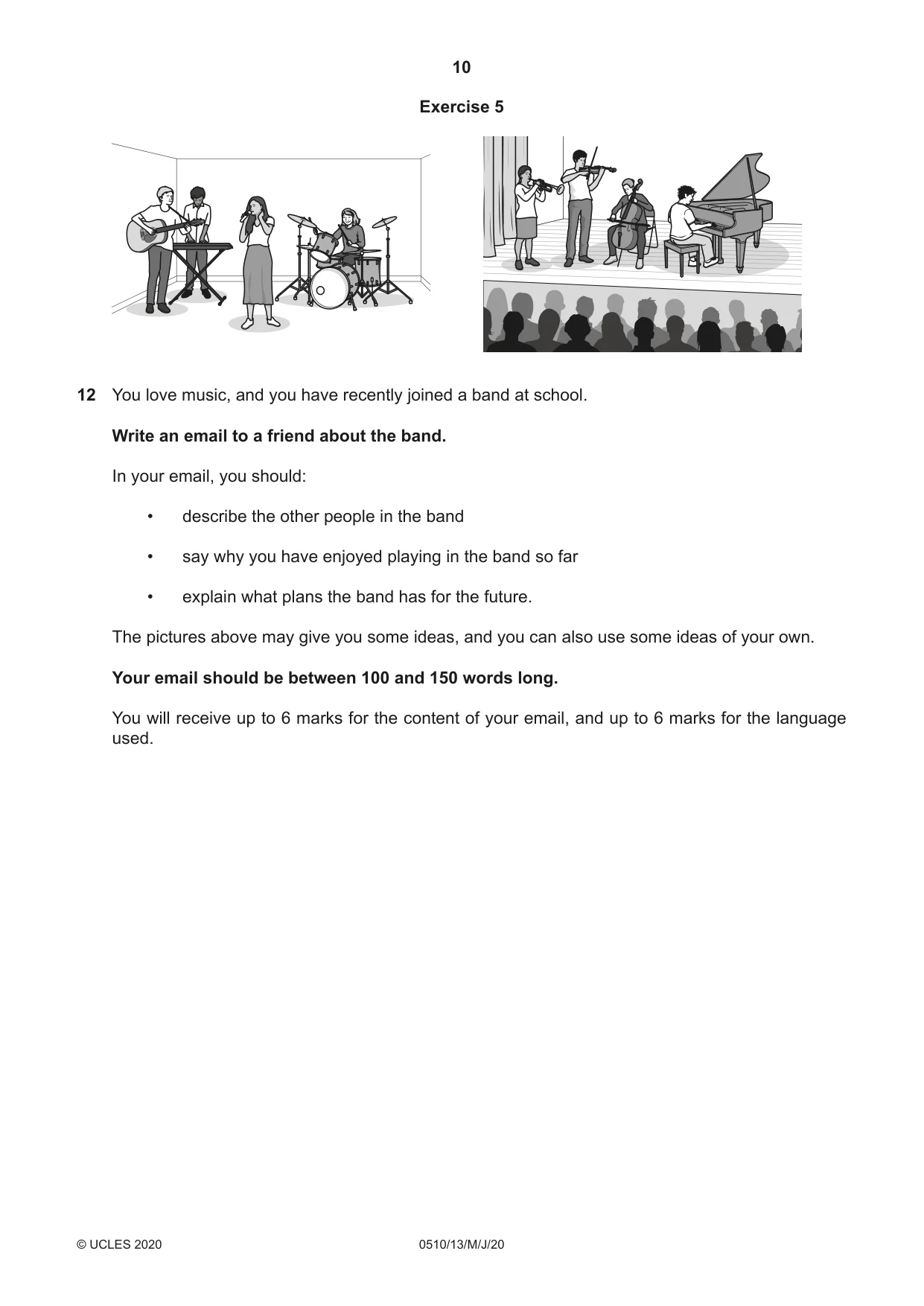
10 0510/13/M/J/20 © UCLES 2020 Exercise 5 12 You love music, and you have recently joined a band at school. Write an email to a friend about the band. In your email, you should: • describe the other people in the band • say why you have enjoyed playing in the band so far • explain what plans the band has for the future. The pictures above may give you some ideas, and you can also use some ideas of your own. Your email should be between 100 and 150 words long. You will receive up to 6 marks for the content of your email, and up to 6 marks for the language used.
Question paper, page 11
11 0510/13/M/J/20 © UCLES 2020 [Turn over … … … … … … … … … … … … … … … … … … … … … … … … … … … [Total: 12]
Question paper, page 12
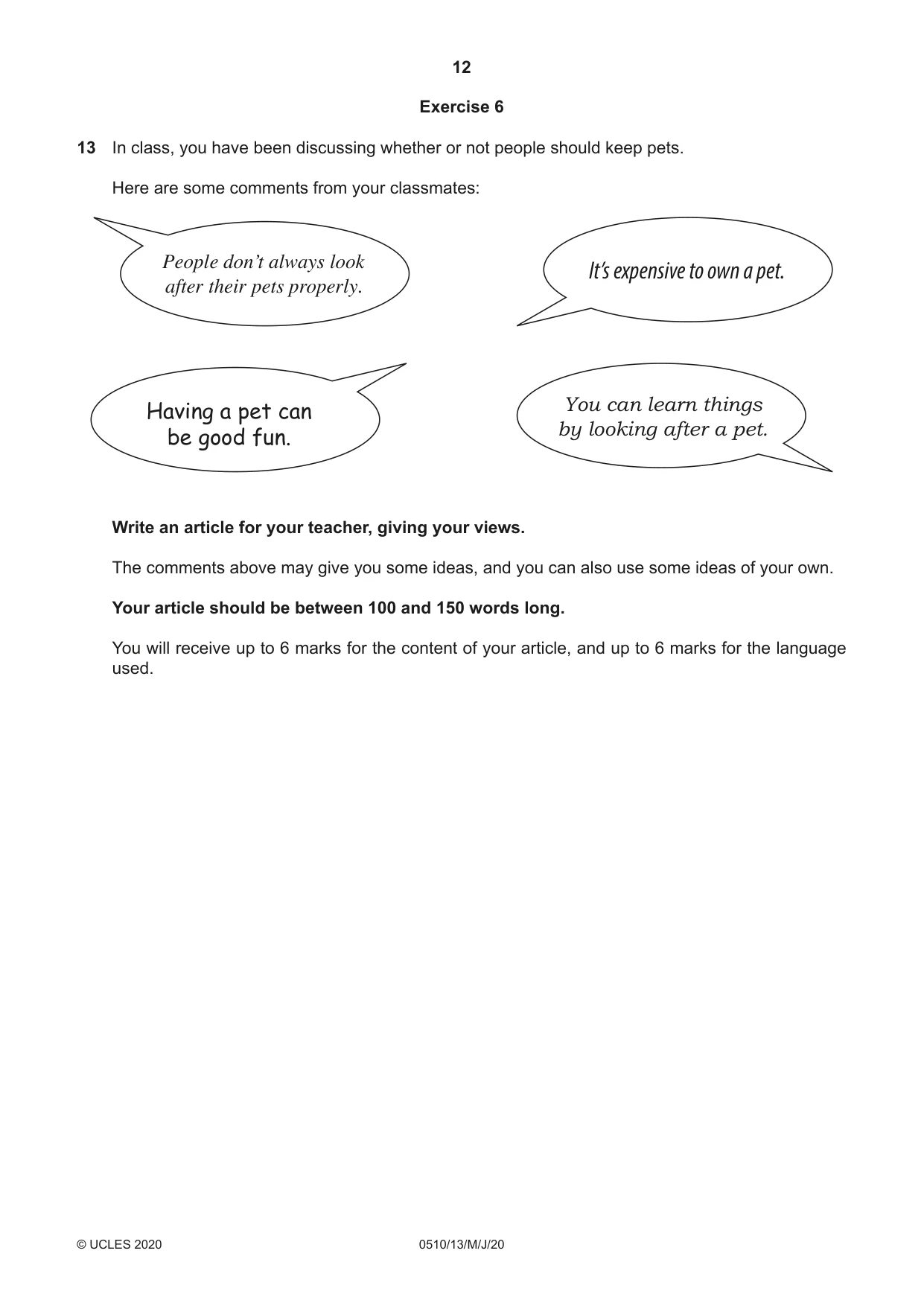
12 0510/13/M/J/20 © UCLES 2020 Exercise 6 13 In class, you have been discussing whether or not people should keep pets. Here are some comments from your classmates: People don’t always look after their pets properly. Having a pet can be good fun. It’s expensive to own a pet. You can learn things by looking after a pet. Write an article for your teacher, giving your views. The comments above may give you some ideas, and you can also use some ideas of your own. Your article should be between 100 and 150 words long. You will receive up to 6 marks for the content of your article, and up to 6 marks for the language used.
Question paper, page 13
13 0510/13/M/J/20 © UCLES 2020 … … … … … … … … … … … … … … … … … … … … … … … … … … … [Total: 12]
Question paper, page 14
14 0510/13/M/J/20 © UCLES 2020 BLANK PAGE
Question paper, page 15
15 0510/13/M/J/20 © UCLES 2020 BLANK PAGE
Question paper, page 16
16 0510/13/M/J/20 © UCLES 2020 Permission to reproduce items where third-party owned material protected by copyright is included has been sought and cleared where possible. Every reasonable effort has been made by the publisher (UCLES) to trace copyright holders, but if any items requiring clearance have unwittingly been included, the publisher will be pleased to make amends at the earliest possible opportunity. To avoid the issue of disclosure of answer-related information to candidates, all copyright acknowledgements are reproduced online in the Cambridge Assessment International Education Copyright Acknowledgements Booklet. This is produced for each series of examinations and is freely available to download at www.cambridgeinternational.org after the live examination series. Cambridge Assessment International Education is part of the Cambridge Assessment Group. Cambridge Assessment is the brand name of the University of Cambridge Local Examinations Syndicate (UCLES), which itself is a department of the University of Cambridge. BLANK PAGE
Mark scheme, page 1
This document consists of 9 printed pages. © UCLES 2020 [Turn over Cambridge IGCSE™ ENGLISH AS A SECOND LANGUAGE (SPEAKING ENDORSEMENT) 0510/13 Paper 1 Reading and Writing (Core) May/June 2020 MARK SCHEME Maximum Mark: 60 Published Students did not sit exam papers in the June 2020 series due to the Covid-19 global pandemic. This mark scheme is published to support teachers and students and should be read together with the question paper. It shows the requirements of the exam. The answer column of the mark scheme shows the proposed basis on which Examiners would award marks for this exam. Where appropriate, this column also provides the most likely acceptable alternative responses expected from students. Examiners usually review the mark scheme after they have seen student responses and update the mark scheme if appropriate. In the June series, Examiners were unable to consider the acceptability of alternative responses, as there were no student responses to consider. Mark schemes should usually be read together with the Principal Examiner Report for Teachers. However, because students did not sit exam papers, there is no Principal Examiner Report for Teachers for the June 2020 series. Cambridge International will not enter into discussions about these mark schemes. Cambridge International is publishing the mark schemes for the June 2020 series for most Cambridge IGCSE™ and Cambridge International A & AS Level components, and some Cambridge O Level components.
Mark scheme, page 2
0510/13 Cambridge IGCSE – Mark Scheme PUBLISHED May/June 2020 © UCLES 2020 Page 2 of 9 Generic Marking Principles These general marking principles must be applied by all examiners when marking candidate answers. They should be applied alongside the specific content of the mark scheme or generic level descriptors for a question. Each question paper and mark scheme will also comply with these marking principles. GENERIC MARKING PRINCIPLE 1: Marks must be awarded in line with: • the specific content of the mark scheme or the generic level descriptors for the question • the specific skills defined in the mark scheme or in the generic level descriptors for the question • the standard of response required by a candidate as exemplified by the standardisation scripts. GENERIC MARKING PRINCIPLE 2: Marks awarded are always whole marks (not half marks, or other fractions). GENERIC MARKING PRINCIPLE 3: Marks must be awarded positively: • marks are awarded for correct/valid answers, as defined in the mark scheme. However, credit is given for valid answers which go beyond the scope of the syllabus and mark scheme, referring to your Team Leader as appropriate • marks are awarded when candidates clearly demonstrate what they know and can do • marks are not deducted for errors • marks are not deducted for omissions • answers should only be judged on the quality of spelling, punctuation and grammar when these features are specifically assessed by the question as indicated by the mark scheme. The meaning, however, should be unambiguous. GENERIC MARKING PRINCIPLE 4: Rules must be applied consistently e.g. in situations where candidates have not followed instructions or in the application of generic level descriptors. GENERIC MARKING PRINCIPLE 5: Marks should be awarded using the full range of marks defined in the mark scheme for the question (however; the use of the full mark range may be limited according to the quality of the candidate responses seen). GENERIC MARKING PRINCIPLE 6: Marks awarded are based solely on the requirements as defined in the mark scheme. Marks should not be awarded with grade thresholds or grade descriptors in mind.
Mark scheme, page 3
0510/13 Cambridge IGCSE – Mark Scheme PUBLISHED May/June 2020 © UCLES 2020 Page 3 of 9 This component forms part of the Core tier assessment of Cambridge IGCSE English as a Second Language and tests the following Assessment Objectives: AO1: Reading R1 identify and select relevant information R2 understand ideas, opinions and attitudes R3 show understanding of the connections between ideas, opinions and attitudes R4 understand what is implied but not directly stated, e.g. gist, writer’s purpose, intentions and feelings AO2: Writing W1 communicate information/ideas/opinions clearly, accurately and effectively W2 organise ideas into coherent paragraphs using a range of appropriate linking devices W3 use a range of grammatical structures accurately and effectively W4 show control of punctuation and spelling W5 use appropriate register and style/format for the given purpose and audience
Mark scheme, page 4
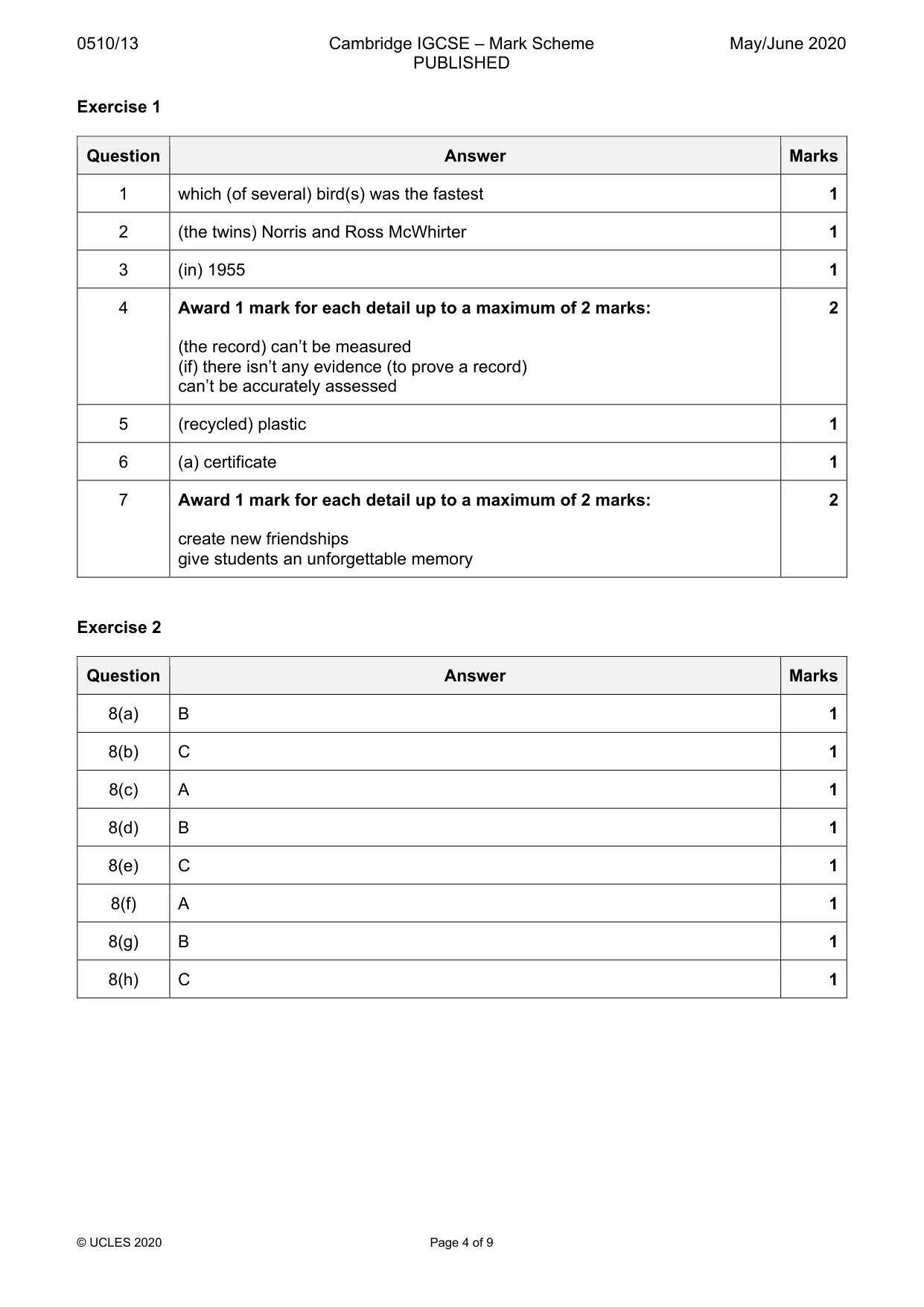
0510/13 Cambridge IGCSE – Mark Scheme PUBLISHED May/June 2020 © UCLES 2020 Page 4 of 9 Exercise 1 Question Answer Marks 1 which (of several) bird(s) was the fastest 1 2 (the twins) Norris and Ross McWhirter 1 3 (in) 1955 1 4 Award 1 mark for each detail up to a maximum of 2 marks: (the record) can’t be measured (if) there isn’t any evidence (to prove a record) can’t be accurately assessed 2 5 (recycled) plastic 1 6 (a) certificate 1 7 Award 1 mark for each detail up to a maximum of 2 marks: create new friendships give students an unforgettable memory 2 Exercise 2 Question Answer Marks 8(a) B 1 8(b) C 1 8(c) A 1 8(d) B 1 8(e) C 1 8(f) A 1 8(g) B 1 8(h) C 1
Mark scheme, page 5
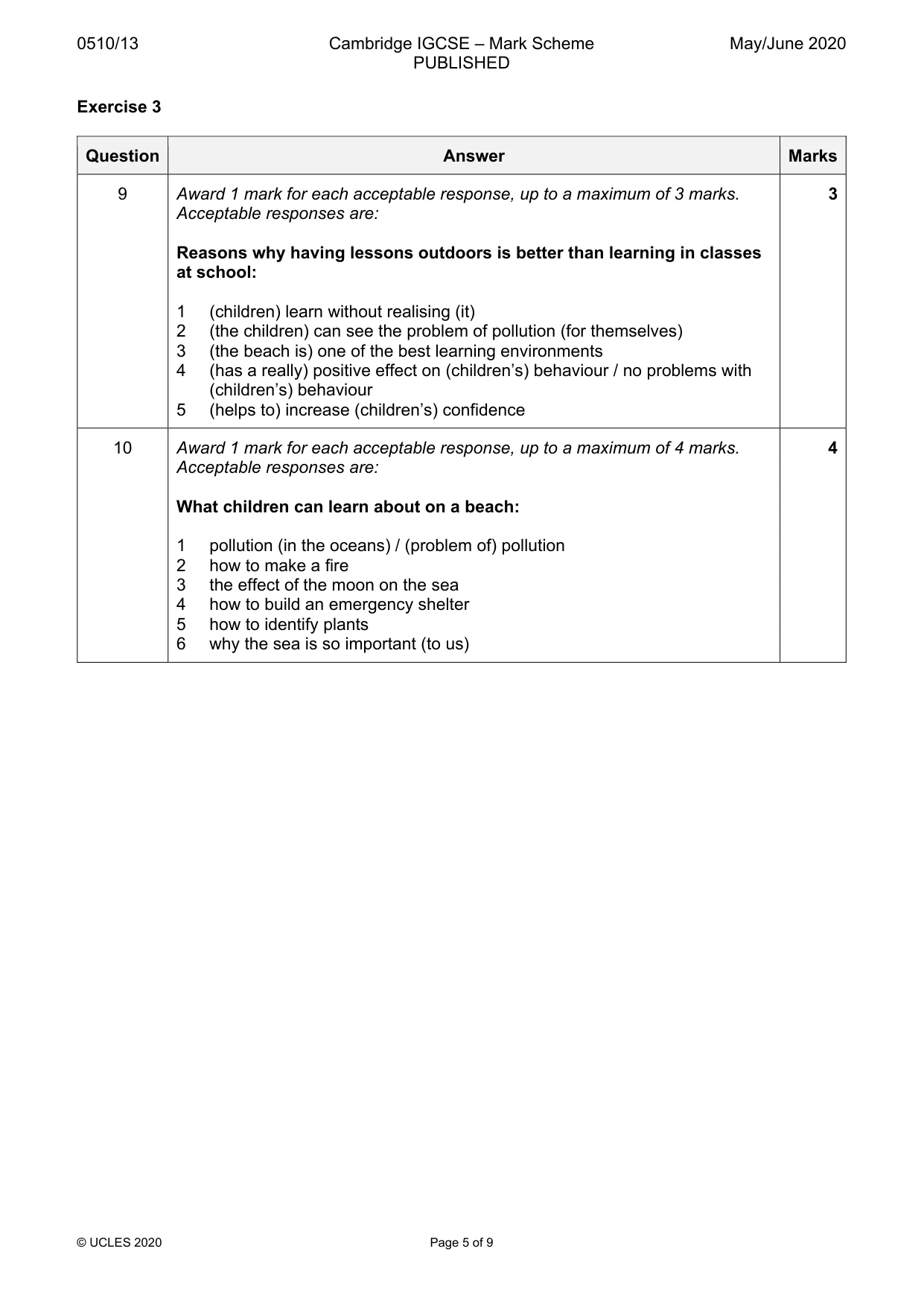
0510/13 Cambridge IGCSE – Mark Scheme PUBLISHED May/June 2020 © UCLES 2020 Page 5 of 9 Exercise 3 Question Answer Marks 9 Award 1 mark for each acceptable response, up to a maximum of 3 marks. Acceptable responses are: Reasons why having lessons outdoors is better than learning in classes at school: 1 (children) learn without realising (it) 2 (the children) can see the problem of pollution (for themselves) 3 (the beach is) one of the best learning environments 4 (has a really) positive effect on (children’s) behaviour / no problems with (children’s) behaviour 5 (helps to) increase (children’s) confidence 3 10 Award 1 mark for each acceptable response, up to a maximum of 4 marks. Acceptable responses are: What children can learn about on a beach: 1 pollution (in the oceans) / (problem of) pollution 2 how to make a fire 3 the effect of the moon on the sea 4 how to build an emergency shelter 5 how to identify plants 6 why the sea is so important (to us) 4
Mark scheme, page 6
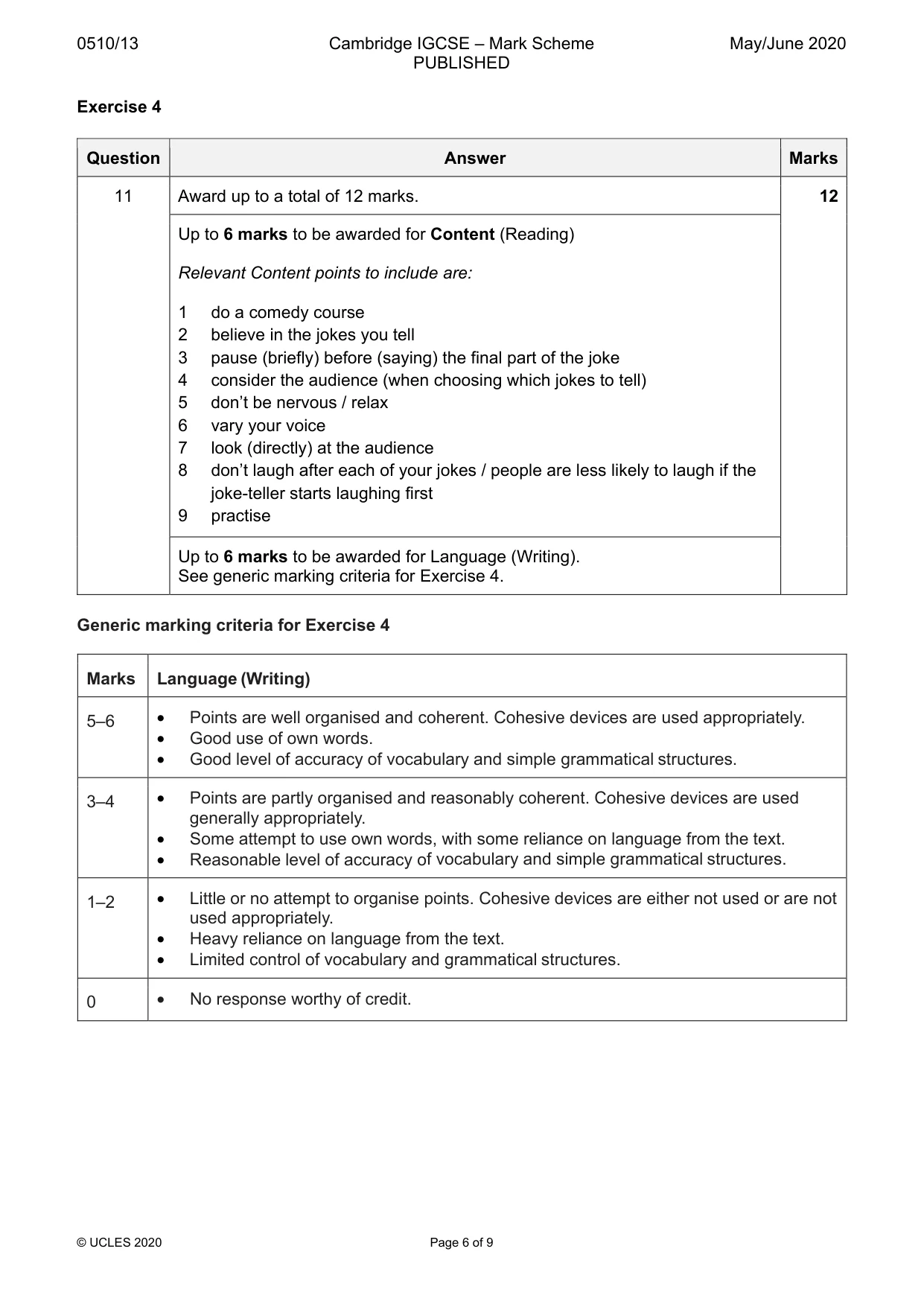
0510/13 Cambridge IGCSE – Mark Scheme PUBLISHED May/June 2020 © UCLES 2020 Page 6 of 9 Exercise 4 Generic marking criteria for Exercise 4 Marks Language (Writing) 5–6 • Points are well organised and coherent. Cohesive devices are used appropriately. • Good use of own words. • Good level of accuracy of vocabulary and simple grammatical structures. 3–4 • Points are partly organised and reasonably coherent. Cohesive devices are used generally appropriately. • Some attempt to use own words, with some reliance on language from the text. • Reasonable level of accuracy of vocabulary and simple grammatical structures. 1–2 • Little or no attempt to organise points. Cohesive devices are either not used or are not used appropriately. • Heavy reliance on language from the text. • Limited control of vocabulary and grammatical structures. 0 • No response worthy of credit. Question Answer Marks 11 Award up to a total of 12 marks. 12 Up to 6 marks to be awarded for Content (Reading) Relevant Content points to include are: 1 do a comedy course 2 believe in the jokes you tell 3 pause (briefly) before (saying) the final part of the joke 4 consider the audience (when choosing which jokes to tell) 5 don’t be nervous / relax 6 vary your voice 7 look (directly) at the audience 8 don’t laugh after each of your jokes / people are less likely to laugh if the joke-teller starts laughing first 9 practise Up to 6 marks to be awarded for Language (Writing). See generic marking criteria for Exercise 4.
Mark scheme, page 7
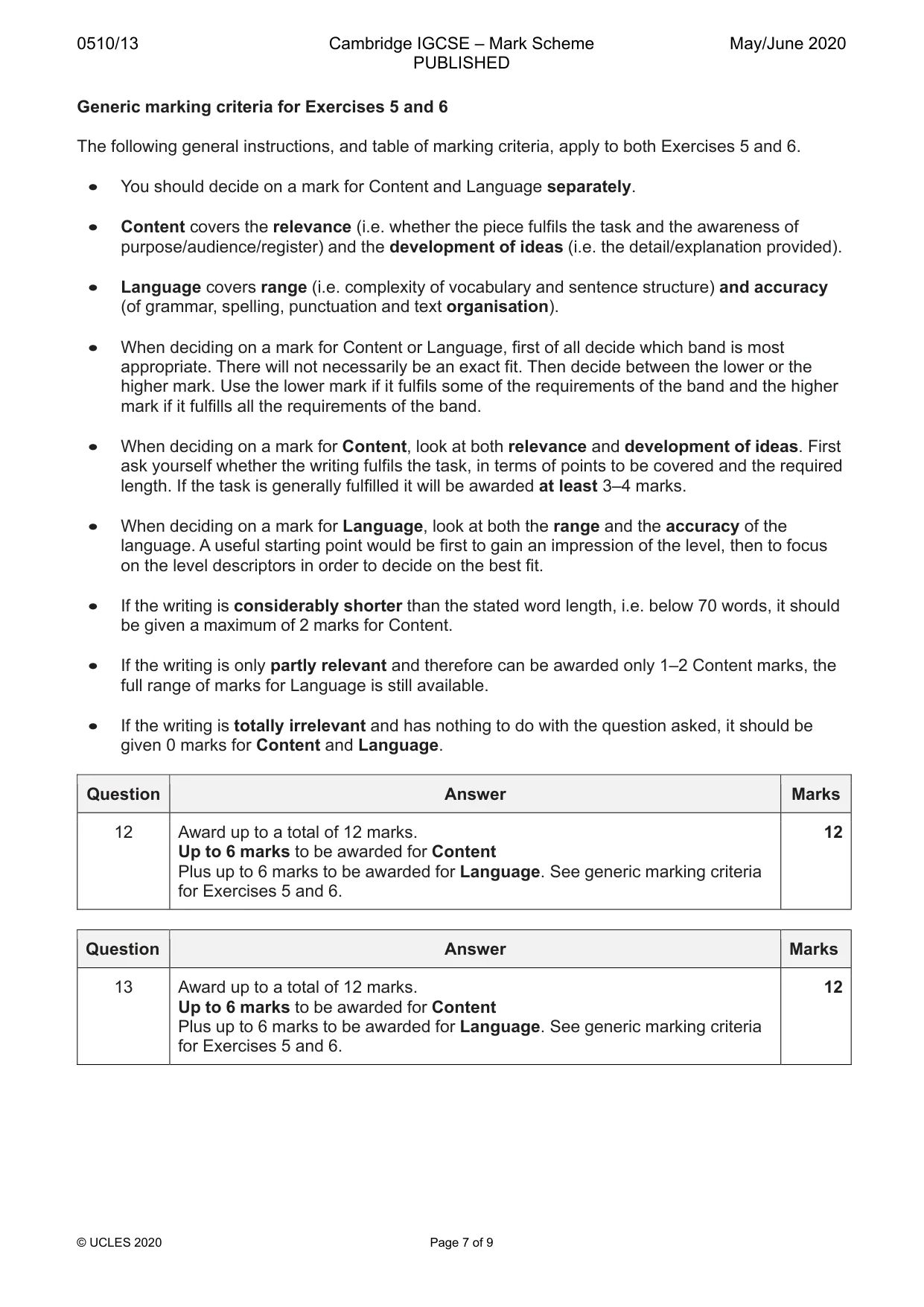
0510/13 Cambridge IGCSE – Mark Scheme PUBLISHED May/June 2020 © UCLES 2020 Page 7 of 9 Generic marking criteria for Exercises 5 and 6 The following general instructions, and table of marking criteria, apply to both Exercises 5 and 6. • You should decide on a mark for Content and Language separately. • Content covers the relevance (i.e. whether the piece fulfils the task and the awareness of purpose/audience/register) and the development of ideas (i.e. the detail/explanation provided). • Language covers range (i.e. complexity of vocabulary and sentence structure) and accuracy (of grammar, spelling, punctuation and text organisation). • When deciding on a mark for Content or Language, first of all decide which band is most appropriate. There will not necessarily be an exact fit. Then decide between the lower or the higher mark. Use the lower mark if it fulfils some of the requirements of the band and the higher mark if it fulfills all the requirements of the band. • When deciding on a mark for Content, look at both relevance and development of ideas. First ask yourself whether the writing fulfils the task, in terms of points to be covered and the required length. If the task is generally fulfilled it will be awarded at least 3–4 marks. • When deciding on a mark for Language, look at both the range and the accuracy of the language. A useful starting point would be first to gain an impression of the level, then to focus on the level descriptors in order to decide on the best fit. • If the writing is considerably shorter than the stated word length, i.e. below 70 words, it should be given a maximum of 2 marks for Content. • If the writing is only partly relevant and therefore can be awarded only 1–2 Content marks, the full range of marks for Language is still available. • If the writing is totally irrelevant and has nothing to do with the question asked, it should be given 0 marks for Content and Language. Question Answer Marks 12 Award up to a total of 12 marks. Up to 6 marks to be awarded for Content Plus up to 6 marks to be awarded for Language. See generic marking criteria for Exercises 5 and 6. 12 Question Answer Marks 13 Award up to a total of 12 marks. Up to 6 marks to be awarded for Content Plus up to 6 marks to be awarded for Language. See generic marking criteria for Exercises 5 and 6. 12
Mark scheme, page 8
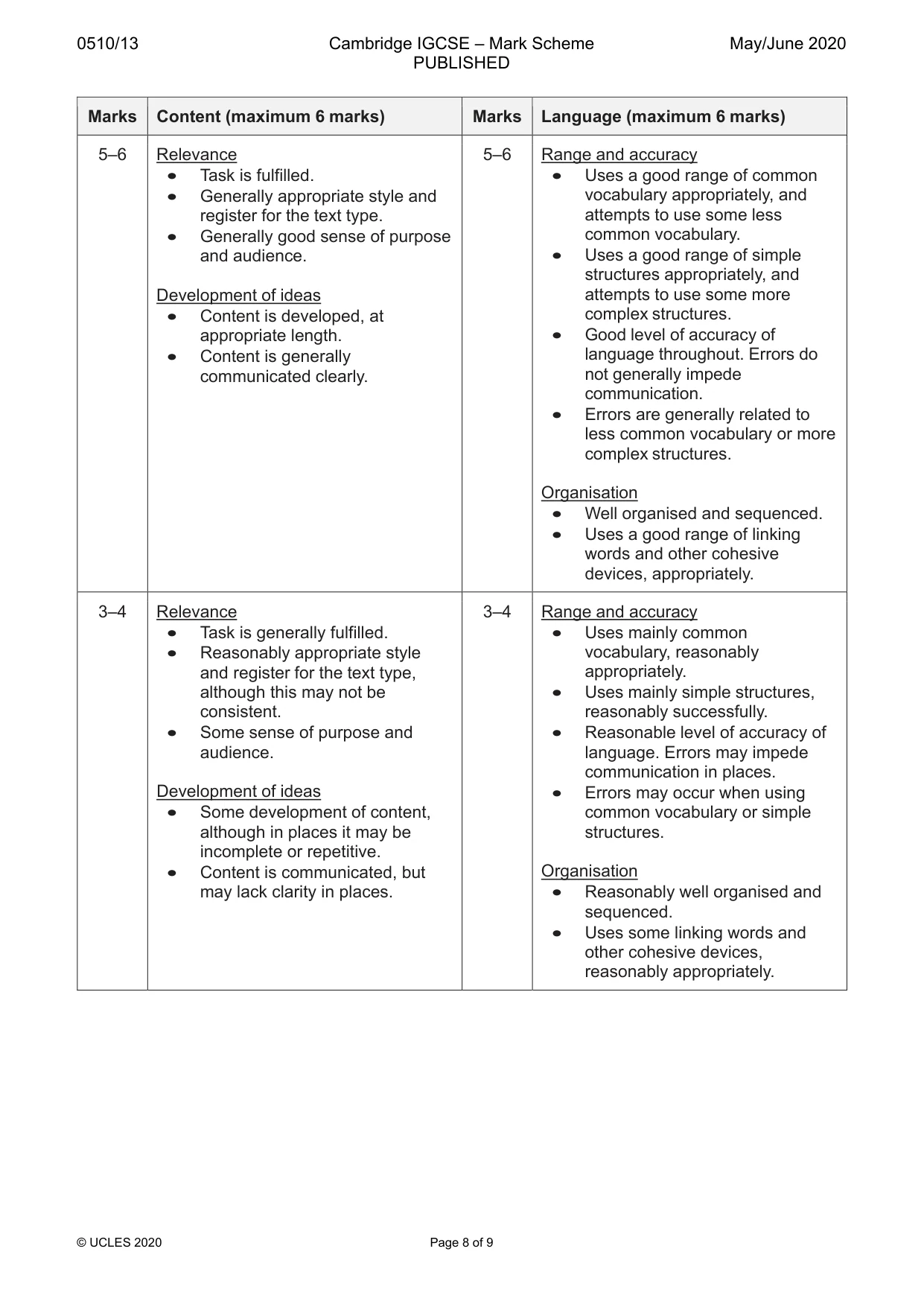
0510/13 Cambridge IGCSE – Mark Scheme PUBLISHED May/June 2020 © UCLES 2020 Page 8 of 9 Marks Content (maximum 6 marks) Marks Language (maximum 6 marks) 5–6 Relevance • Task is fulfilled. • Generally appropriate style and register for the text type. • Generally good sense of purpose and audience. Development of ideas • Content is developed, at appropriate length. • Content is generally communicated clearly. 5–6 Range and accuracy • Uses a good range of common vocabulary appropriately, and attempts to use some less common vocabulary. • Uses a good range of simple structures appropriately, and attempts to use some more complex structures. • Good level of accuracy of language throughout. Errors do not generally impede communication. • Errors are generally related to less common vocabulary or more complex structures. Organisation • Well organised and sequenced. • Uses a good range of linking words and other cohesive devices, appropriately. 3–4 Relevance • Task is generally fulfilled. • Reasonably appropriate style and register for the text type, although this may not be consistent. • Some sense of purpose and audience. Development of ideas • Some development of content, although in places it may be incomplete or repetitive. • Content is communicated, but may lack clarity in places. 3–4 Range and accuracy • Uses mainly common vocabulary, reasonably appropriately. • Uses mainly simple structures, reasonably successfully. • Reasonable level of accuracy of language. Errors may impede communication in places. • Errors may occur when using common vocabulary or simple structures. Organisation • Reasonably well organised and sequenced. • Uses some linking words and other cohesive devices, reasonably appropriately.
Mark scheme, page 9
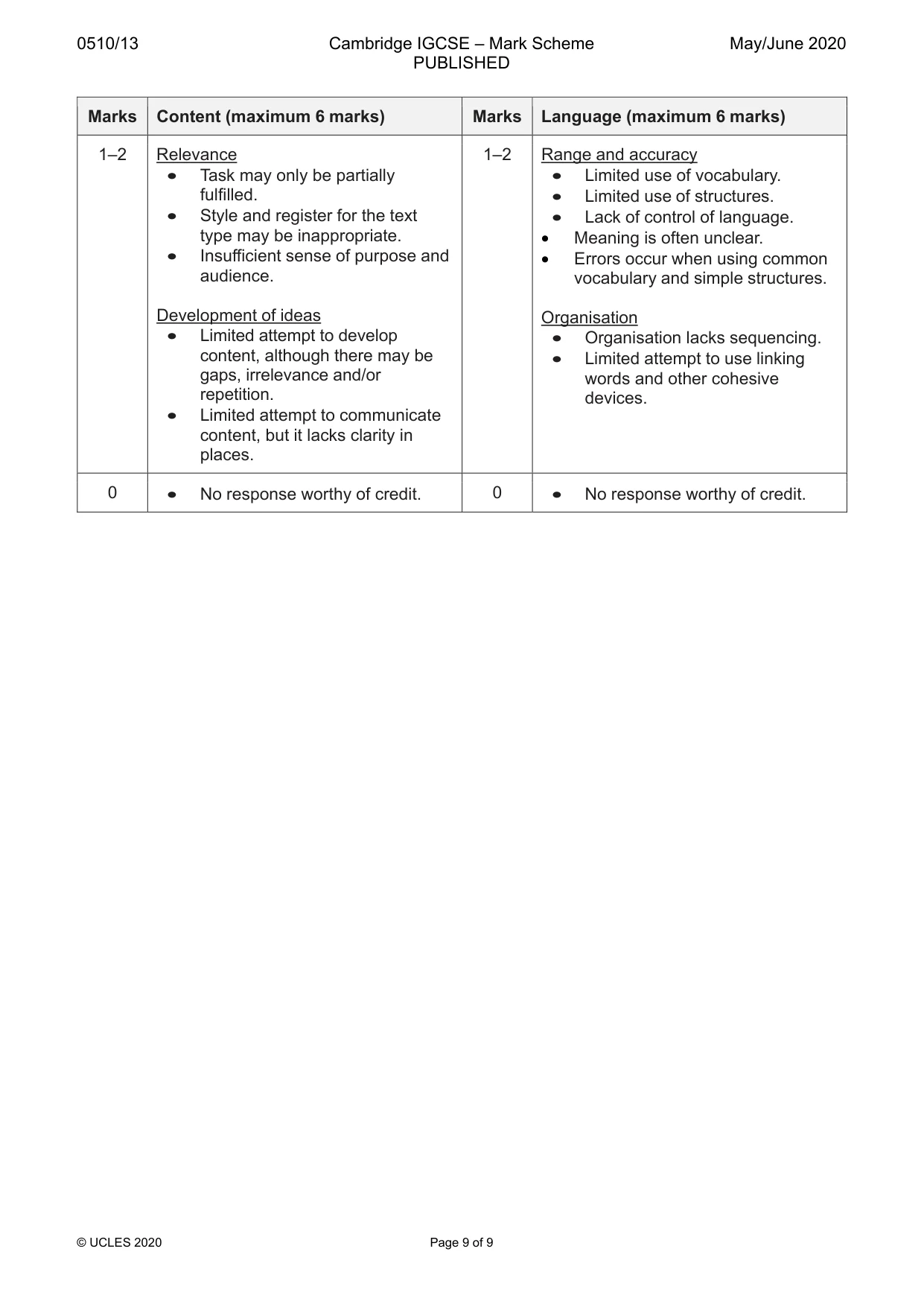
0510/13 Cambridge IGCSE – Mark Scheme PUBLISHED May/June 2020 © UCLES 2020 Page 9 of 9 Marks Content (maximum 6 marks) Marks Language (maximum 6 marks) 1–2 Relevance • Task may only be partially fulfilled. • Style and register for the text type may be inappropriate. • Insufficient sense of purpose and audience. Development of ideas • Limited attempt to develop content, although there may be gaps, irrelevance and/or repetition. • Limited attempt to communicate content, but it lacks clarity in places. 1–2 Range and accuracy • Limited use of vocabulary. • Limited use of structures. • Lack of control of language. • Meaning is often unclear. • Errors occur when using common vocabulary and simple structures. Organisation • Organisation lacks sequencing. • Limited attempt to use linking words and other cohesive devices. 0 • No response worthy of credit. 0 • No response worthy of credit.