Cambridge IGCSE English - Second Language (oral endorsement) 0510 — 2020 Feb/March Paper 1 · Variant 2
0510/12/F/M/20 · 60 marks · ≈68 min
The question paper and its mark scheme, free to read here and free to download. This is Cambridge’s own paper, exactly as it was sat.
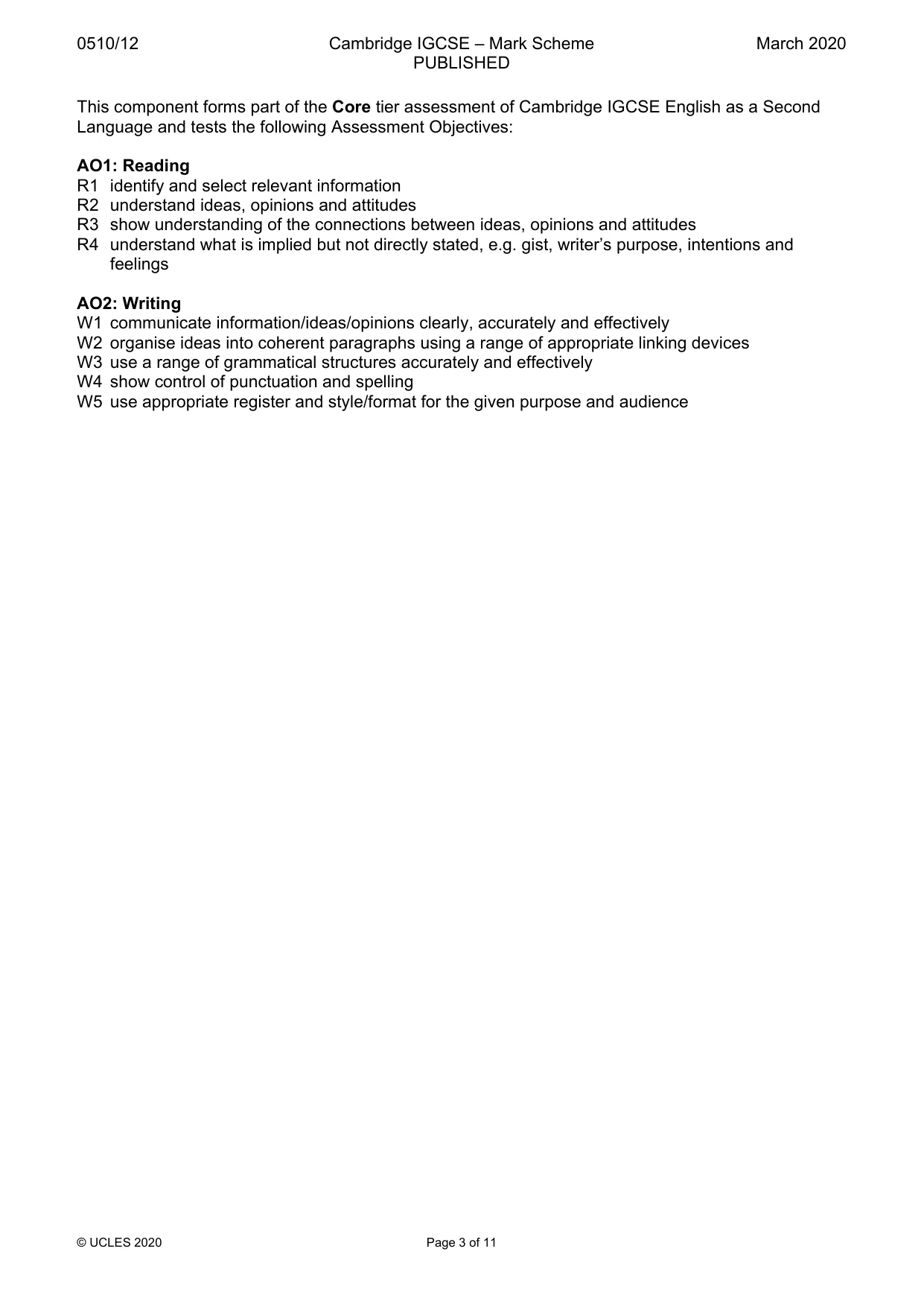
Question paper16 pages






Mark scheme11 pages
Answers below. Sit the paper first if you are practising.
Paper as text
Question paper, page 1
Cambridge IGCSE™ This document has 16 pages. Blank pages are indicated. DC (ST/CT) 186208/4 © UCLES 2020 [Turn over ENGLISH AS A SECOND LANGUAGE 0510/12 Paper 1 Reading and Writing (Core) February/March 2020 1 hour 30 minutes You must answer on the question paper. No additional materials are needed. INSTRUCTIONS ● Answer all questions. ● Use a black or dark blue pen. ● Write your name, centre number and candidate number in the boxes at the top of the page. ● Write your answer to each question in the space provided. ● Do not use an erasable pen or correction fluid. ● Do not write on any bar codes. ● Dictionaries are not allowed. INFORMATION ● The total mark for this paper is 60. ● The number of marks for each question or part question is shown in brackets [ ]. * 9 5 9 0 5 5 0 3 2 6 *
Question paper, page 2
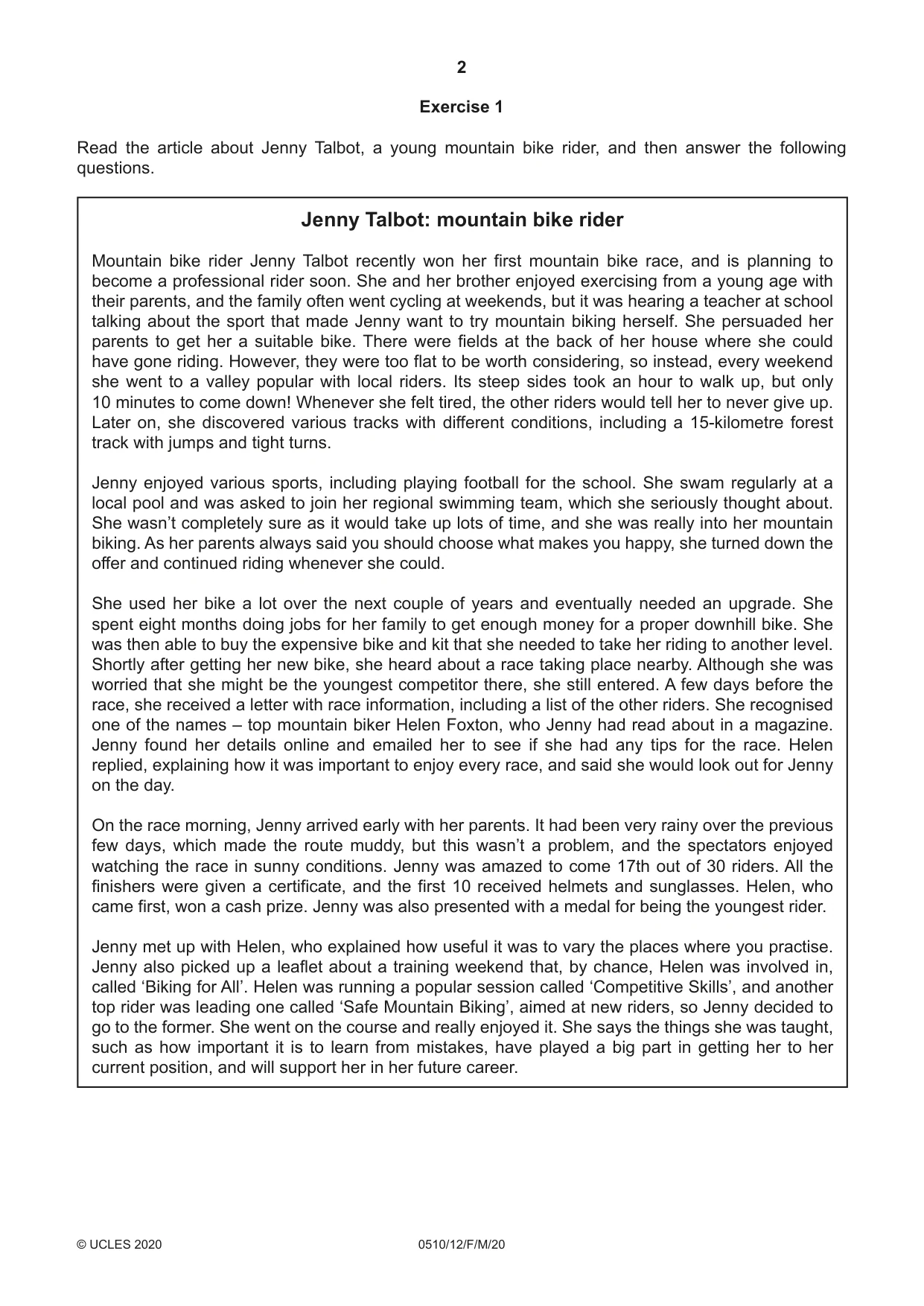
2 0510/12/F/M/20 © UCLES 2020 Exercise 1 Read the article about Jenny Talbot, a young mountain bike rider, and then answer the following questions. Jenny Talbot: mountain bike rider Mountain bike rider Jenny Talbot recently won her first mountain bike race, and is planning to become a professional rider soon. She and her brother enjoyed exercising from a young age with their parents, and the family often went cycling at weekends, but it was hearing a teacher at school talking about the sport that made Jenny want to try mountain biking herself. She persuaded her parents to get her a suitable bike. There were fields at the back of her house where she could have gone riding. However, they were too flat to be worth considering, so instead, every weekend she went to a valley popular with local riders. Its steep sides took an hour to walk up, but only 10 minutes to come down! Whenever she felt tired, the other riders would tell her to never give up. Later on, she discovered various tracks with different conditions, including a 15-kilometre forest track with jumps and tight turns. Jenny enjoyed various sports, including playing football for the school. She swam regularly at a local pool and was asked to join her regional swimming team, which she seriously thought about. She wasn’t completely sure as it would take up lots of time, and she was really into her mountain biking. As her parents always said you should choose what makes you happy, she turned down the offer and continued riding whenever she could. She used her bike a lot over the next couple of years and eventually needed an upgrade. She spent eight months doing jobs for her family to get enough money for a proper downhill bike. She was then able to buy the expensive bike and kit that she needed to take her riding to another level. Shortly after getting her new bike, she heard about a race taking place nearby. Although she was worried that she might be the youngest competitor there, she still entered. A few days before the race, she received a letter with race information, including a list of the other riders. She recognised one of the names – top mountain biker Helen Foxton, who Jenny had read about in a magazine. Jenny found her details online and emailed her to see if she had any tips for the race. Helen replied, explaining how it was important to enjoy every race, and said she would look out for Jenny on the day. On the race morning, Jenny arrived early with her parents. It had been very rainy over the previous few days, which made the route muddy, but this wasn’t a problem, and the spectators enjoyed watching the race in sunny conditions. Jenny was amazed to come 17th out of 30 riders. All the finishers were given a certificate, and the first 10 received helmets and sunglasses. Helen, who came first, won a cash prize. Jenny was also presented with a medal for being the youngest rider. Jenny met up with Helen, who explained how useful it was to vary the places where you practise. Jenny also picked up a leaflet about a training weekend that, by chance, Helen was involved in, called ‘Biking for All’. Helen was running a popular session called ‘Competitive Skills’, and another top rider was leading one called ‘Safe Mountain Biking’, aimed at new riders, so Jenny decided to go to the former. She went on the course and really enjoyed it. She says the things she was taught, such as how important it is to learn from mistakes, have played a big part in getting her to her current position, and will support her in her future career.
Question paper, page 3
3 0510/12/F/M/20 © UCLES 2020 [Turn over 1 Who introduced Jenny to mountain biking? … [1] 2 Where did Jenny prefer to practise mountain biking at first? … [1] 3 Which team was Jenny a member of at school? … [1] 4 How long did it take Jenny to save up money for a better bike? … [1] 5 Where did Jenny get the information she needed to contact Helen Foxton? … [1] 6 What was the weather like when Jenny was competing in the race? … [1] 7 What things did Jenny get to take home with her after the race? Give two details. … … [2] 8 Which part of the cycling training course did Helen teach? … [1] [Total: 9]
Question paper, page 4
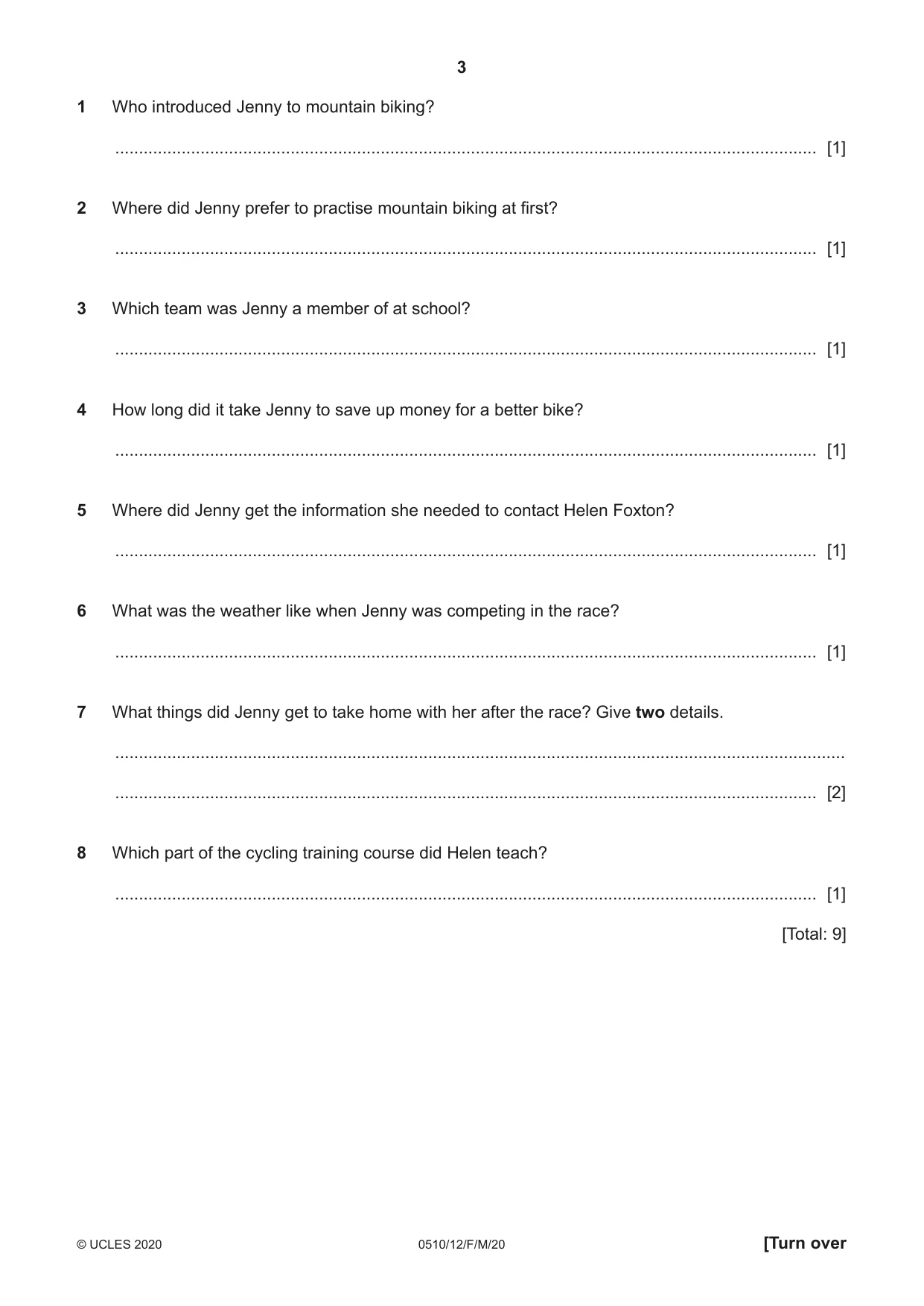
4 0510/12/F/M/20 © UCLES 2020 Exercise 2 Read the article about three people (A–C) who have reached the final of the Young Musician competition. Then answer Question 9(a)–(h). Young Musician Competition Find out more about this year’s finalists in their own words A Max: cellist I honestly can’t remember the exact age I started playing, but I guess I was about three or four. I begged my parents to let me play the violin, which I did for a year. Then I was invited to a cello concert, where to my surprise, I fell in love with the instrument – it has the perfect balance of sounds. When I was eight, I got into a music school on the other side of the country. This meant moving away from my parents’ home and living at school during the week. At first, it was difficult only seeing my parents at weekends. It was a long drive and we spent hours in the car. But it’s been worth it – studying there has really helped me mature as a musician, as well as make some great friends in my class. I’m busy preparing for the Young Musician competition now, as well as for school exams. I have to say there’s been more music practice than revision, but the competition will be over soon and I can focus more on studying. B Louis: pianist Well, the Young Musician competition is taking place in my hometown, and I’ve actually performed in the place where the competition is happening, so that’s making me feel less nervous! I was born in the US, but came to the UK while my parents were working at City University. During this time, I got the chance to have private lessons with one of the best teachers in the country, and although we’d decided to return to the US, I was making such good progress with my piano that we stayed in the UK! As well as playing the piano, I love reading, and I’ve taken up the violin because I needed to do something more social like joining an orchestra, although I haven’t had time to actually do that yet! For the competition I’ll be playing a piece that I hope the audience will like – it has a good balance of exciting fast bits and some beautiful slower sections too, which are full of emotion. C Rob: clarinettist I was amazed when I found out I was in the final. I didn’t think I’d get that far so I didn’t start practising the piece I’ll be performing until I got the news. Most of the other competitors have been rehearsing for much longer! I’m the oldest competitor, and I’ve been playing for a long time. I only started playing music at primary school because that was just what everyone else did. Lots of us played a simple wind instrument, called a recorder, at an after-school club. Then, as my friends started to give up, I kept going. I only stopped when my teacher suggested I moved on to the clarinet. After a few years, I got a place at the Royal Music School. I have a clarinet lesson every day, and I spend four hours playing and preparing for it. It’s hard to fit that in around my studies, but I manage. One of the best things about being at the school is that I get the chance to listen to other performers.
Question paper, page 5
5 0510/12/F/M/20 © UCLES 2020 [Turn over 9 For each question, write the correct letter A, B or C on the line. Which young musician … (a) says that he decided to start playing because of his classmates? … [1] (b) suggests that he needs to spend more time on his schoolwork? … [1] (c) describes how his family changed a decision to help support his music? … [1] (d) mentions the amount of preparation he’s done compared to other people? … [1] (e) explains that his choice of instrument was unexpected? … [1] (f) gives a reason why he also plays an additional instrument? … [1] (g) describes the way in which being at his music school has changed him? … [1] (h) mentions a past event he thinks will help his confidence? … [1] [Total: 8]
Question paper, page 6
6 0510/12/F/M/20 © UCLES 2020 Exercise 3 Read the article about a type of grass called bamboo, and then complete the notes. Bamboo Bamboo is the largest member of the grass family. It comes in various sizes, and the plant is noted for its long woody stems. As a domestic plant, it is a beautiful addition to many gardens, and the young bamboo shoots can be picked and enjoyed in a wide variety of popular dishes – they are a low-fat food, and taste delicious! Many people associate bamboo with pandas, as it is their main source of food. However, other animals also benefit from the way that bamboo grows, as the dense cover of the leaves provides shelter for many different species. Bamboo grows in many different climates and soil types. Its stems are found in an amazing range of colours, including green, yellow, red and even blue. There are bamboo species that have striped stems, and others that have a texture. The strong and durable stems are ideal for creating many household items such as kitchenware. Unlike products made from plastics which are difficult to get rid of, bamboo has only a minimal effect on the pollution levels of our planet. As well as the stems, the bamboo leaves also come in a wide variety of shades of green and can also display interesting patterns. The leaves, which range in length from around 6 millimetres to 60 centimetres, are a very useful tool in the fight against global warming because they absorb harmful greenhouse gases. What makes bamboo particularly important is that it releases far more oxygen into the atmosphere than many types of tree. When bamboo is grown as a commercial crop, it requires no chemicals in order to grow well, unlike cotton, which is one of the most intensely sprayed crops. This means that there is no need for additional fertilisers which could pollute local water supplies and upset the balance of nature. Bamboo is very fast-growing, and some varieties can reach full maturity in 1 to 5 years. In contrast, certain trees called hardwoods can take 30 to 40 years to mature, so bamboo is the only woody plant that grows quickly enough to keep up with demand. In a bamboo plantation, because the roots remain after harvesting, the root system prevents the soil from being washed or blown away. New plants start to grow from these roots, quickly producing the next crop. In contrast, after a hardwood forest is cleared, the soil is exposed and eventually washes away into the rivers and streams. Bamboo contains a substance which is anti-bacterial in its natural form, which means it is protected from disease. Additionally, bamboo can be made into clothes which have similar benefits and are excellent at absorbing moisture so help to keep the skin dry. There are well over 1400 species of bamboo worldwide and many more are still being discovered each year. There is a bamboo that grows on every continent on the planet, and some bamboo species reach towering heights of as much as 30 metres. It is a strong and readily available building material, commonly found in the construction industry. Certain species of bamboo can even grow over 90 centimetres in one day, and amazingly, it is even possible to watch some species grow before your eyes!
Question paper, page 7
7 0510/12/F/M/20 © UCLES 2020 [Turn over You are going to give a talk about bamboo to your class at school. Prepare some notes to use as the basis for your talk. Make short notes under each heading. 10 Why bamboo is good for the environment: • … • … • … • … [4] 11 What bamboo products are used for: • … • … • … [3] [Total: 7]
Question paper, page 8
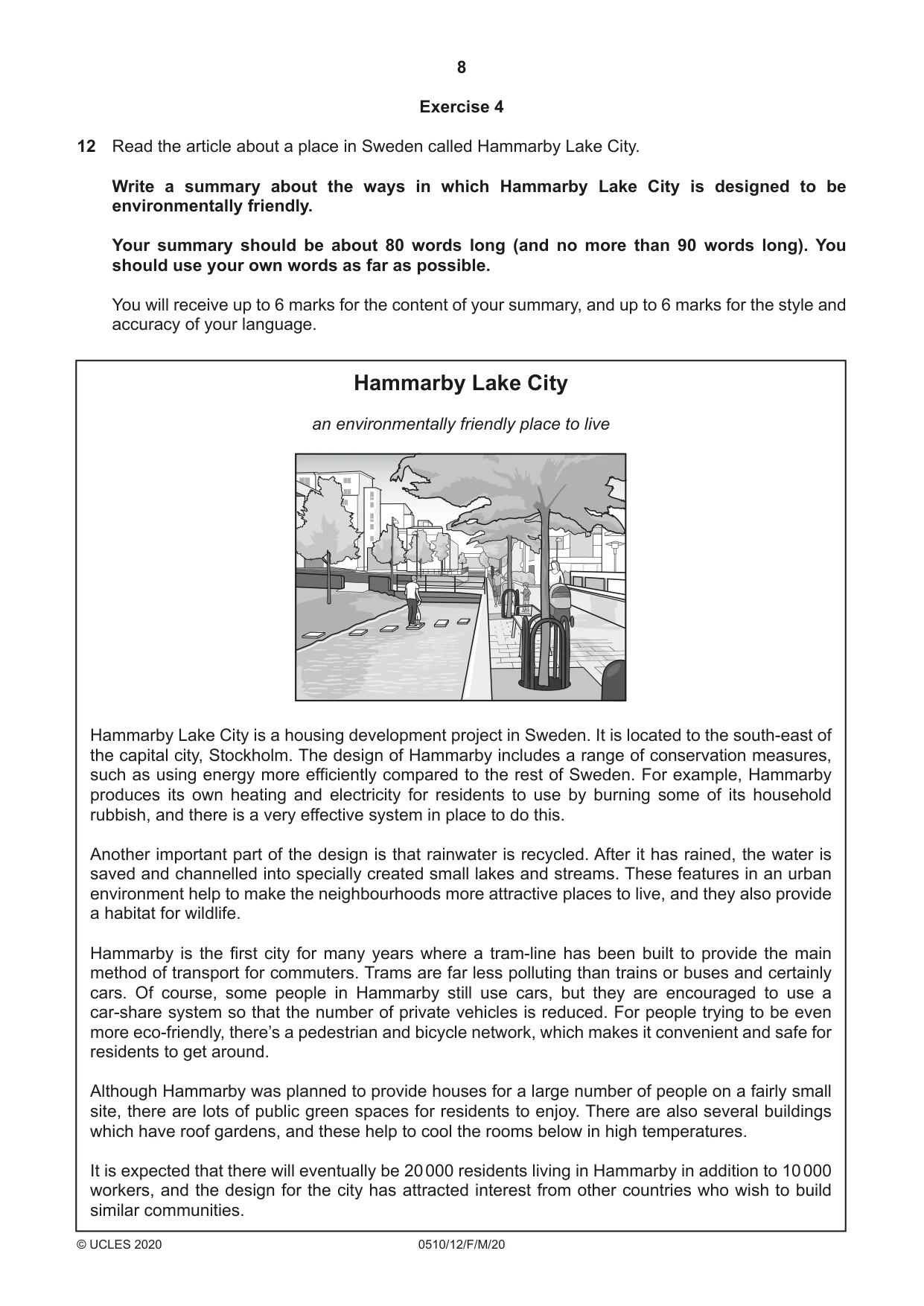
8 0510/12/F/M/20 © UCLES 2020 Exercise 4 12 Read the article about a place in Sweden called Hammarby Lake City. Write a summary about the ways in which Hammarby Lake City is designed to be environmentally friendly. Your summary should be about 80 words long (and no more than 90 words long). You should use your own words as far as possible. You will receive up to 6 marks for the content of your summary, and up to 6 marks for the style and accuracy of your language. Hammarby Lake City an environmentally friendly place to live Hammarby Lake City is a housing development project in Sweden. It is located to the south-east of the capital city, Stockholm. The design of Hammarby includes a range of conservation measures, such as using energy more efficiently compared to the rest of Sweden. For example, Hammarby produces its own heating and electricity for residents to use by burning some of its household rubbish, and there is a very effective system in place to do this. Another important part of the design is that rainwater is recycled. After it has rained, the water is saved and channelled into specially created small lakes and streams. These features in an urban environment help to make the neighbourhoods more attractive places to live, and they also provide a habitat for wildlife. Hammarby is the first city for many years where a tram-line has been built to provide the main method of transport for commuters. Trams are far less polluting than trains or buses and certainly cars. Of course, some people in Hammarby still use cars, but they are encouraged to use a car-share system so that the number of private vehicles is reduced. For people trying to be even more eco-friendly, there’s a pedestrian and bicycle network, which makes it convenient and safe for residents to get around. Although Hammarby was planned to provide houses for a large number of people on a fairly small site, there are lots of public green spaces for residents to enjoy. There are also several buildings which have roof gardens, and these help to cool the rooms below in high temperatures. It is expected that there will eventually be 20 000 residents living in Hammarby in addition to 10 000 workers, and the design for the city has attracted interest from other countries who wish to build similar communities.
Question paper, page 9
9 0510/12/F/M/20 © UCLES 2020 [Turn over … … … … … … … … … … … … … … [Total: 12]
Question paper, page 10
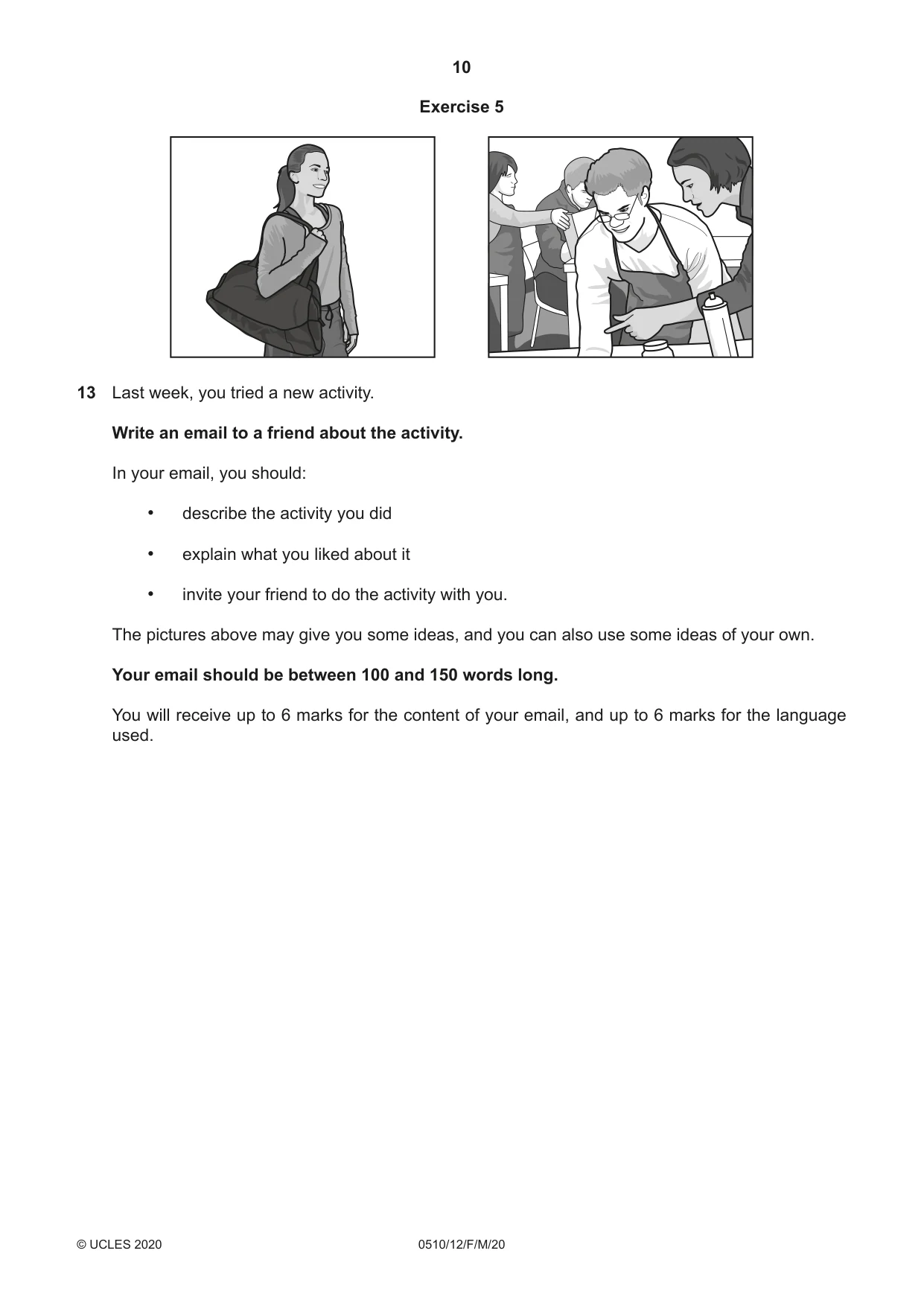
10 0510/12/F/M/20 © UCLES 2020 Exercise 5 13 Last week, you tried a new activity. Write an email to a friend about the activity. In your email, you should: • describe the activity you did • explain what you liked about it • invite your friend to do the activity with you. The pictures above may give you some ideas, and you can also use some ideas of your own. Your email should be between 100 and 150 words long. You will receive up to 6 marks for the content of your email, and up to 6 marks for the language used.
Question paper, page 11
11 0510/12/F/M/20 © UCLES 2020 [Turn over … … … … … … … … … … … … … … … … … … … … … … … … … … … [Total: 12]
Question paper, page 12
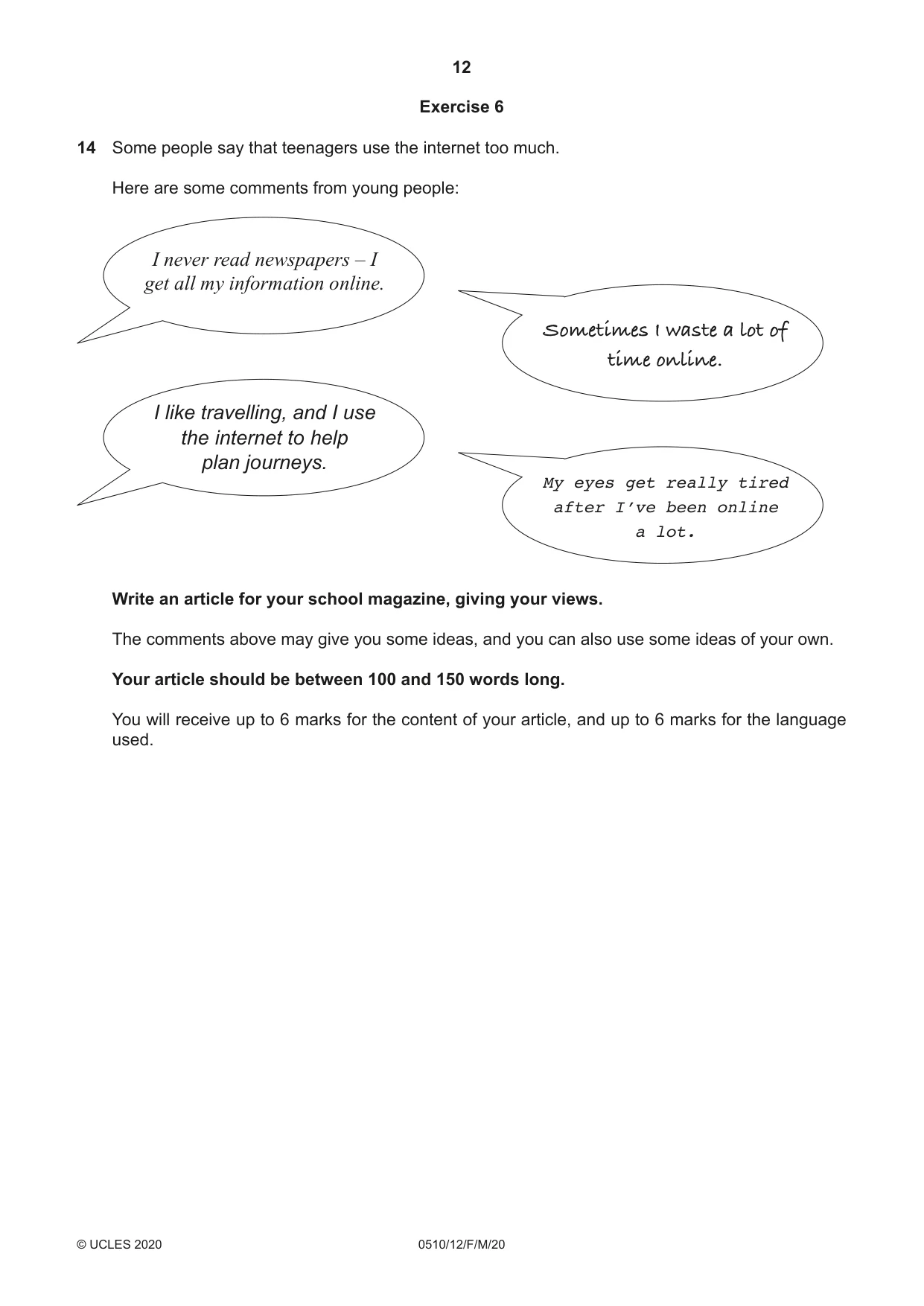
12 0510/12/F/M/20 © UCLES 2020 Exercise 6 14 Some people say that teenagers use the internet too much. Here are some comments from young people: I never read newspapers – I get all my information online. I like travelling, and I use the internet to help plan journeys. Sometimes I waste a lot of time online. My eyes get really tired after I’ve been online a lot. Write an article for your school magazine, giving your views. The comments above may give you some ideas, and you can also use some ideas of your own. Your article should be between 100 and 150 words long. You will receive up to 6 marks for the content of your article, and up to 6 marks for the language used.
Question paper, page 13
13 0510/12/F/M/20 © UCLES 2020 … … … … … … … … … … … … … … … … … … … … … … … … … … … [Total: 12]
Question paper, page 14
14 0510/12/F/M/20 © UCLES 2020 BLANK PAGE
Question paper, page 15
15 0510/12/F/M/20 © UCLES 2020 BLANK PAGE
Question paper, page 16
16 0510/12/F/M/20 © UCLES 2020 Permission to reproduce items where third-party owned material protected by copyright is included has been sought and cleared where possible. Every reasonable effort has been made by the publisher (UCLES) to trace copyright holders, but if any items requiring clearance have unwittingly been included, the publisher will be pleased to make amends at the earliest possible opportunity. To avoid the issue of disclosure of answer-related information to candidates, all copyright acknowledgements are reproduced online in the Cambridge Assessment International Education Copyright Acknowledgements Booklet. This is produced for each series of examinations and is freely available to download at www.cambridgeinternational.org after the live examination series. Cambridge Assessment International Education is part of the Cambridge Assessment Group. Cambridge Assessment is the brand name of the University of Cambridge Local Examinations Syndicate (UCLES), which itself is a department of the University of Cambridge. BLANK PAGE
Mark scheme, page 1
This document consists of 11 printed pages. © UCLES 2020 [Turn over Cambridge IGCSE™ ENGLISH AS A SECOND LANGUAGE (SPEAKING ENDORSEMENT) 0510/12 Paper 1 Reading and Writing (Core) March 2020 MARK SCHEME Maximum Mark: 60 Published This mark scheme is published as an aid to teachers and candidates, to indicate the requirements of the examination. It shows the basis on which Examiners were instructed to award marks. It does not indicate the details of the discussions that took place at an Examiners’ meeting before marking began, which would have considered the acceptability of alternative answers. Mark schemes should be read in conjunction with the question paper and the Principal Examiner Report for Teachers. Cambridge International will not enter into discussions about these mark schemes. Cambridge International is publishing the mark schemes for the March 2020 series for most Cambridge IGCSE™, Cambridge International A and AS Level components and some Cambridge O Level components.
Mark scheme, page 2
0510/12 Cambridge IGCSE – Mark Scheme PUBLISHED March 2020 © UCLES 2020 Page 2 of 11 Generic Marking Principles These general marking principles must be applied by all examiners when marking candidate answers. They should be applied alongside the specific content of the mark scheme or generic level descriptors for a question. Each question paper and mark scheme will also comply with these marking principles. GENERIC MARKING PRINCIPLE 1: Marks must be awarded in line with: • the specific content of the mark scheme or the generic level descriptors for the question • the specific skills defined in the mark scheme or in the generic level descriptors for the question • the standard of response required by a candidate as exemplified by the standardisation scripts. GENERIC MARKING PRINCIPLE 2: Marks awarded are always whole marks (not half marks, or other fractions). GENERIC MARKING PRINCIPLE 3: Marks must be awarded positively: • marks are awarded for correct/valid answers, as defined in the mark scheme. However, credit is given for valid answers which go beyond the scope of the syllabus and mark scheme, referring to your Team Leader as appropriate • marks are awarded when candidates clearly demonstrate what they know and can do • marks are not deducted for errors • marks are not deducted for omissions • answers should only be judged on the quality of spelling, punctuation and grammar when these features are specifically assessed by the question as indicated by the mark scheme. The meaning, however, should be unambiguous. GENERIC MARKING PRINCIPLE 4: Rules must be applied consistently e.g. in situations where candidates have not followed instructions or in the application of generic level descriptors. GENERIC MARKING PRINCIPLE 5: Marks should be awarded using the full range of marks defined in the mark scheme for the question (however; the use of the full mark range may be limited according to the quality of the candidate responses seen). GENERIC MARKING PRINCIPLE 6: Marks awarded are based solely on the requirements as defined in the mark scheme. Marks should not be awarded with grade thresholds or grade descriptors in mind.
Mark scheme, page 3
0510/12 Cambridge IGCSE – Mark Scheme PUBLISHED March 2020 © UCLES 2020 Page 3 of 11 This component forms part of the Core tier assessment of Cambridge IGCSE English as a Second Language and tests the following Assessment Objectives: AO1: Reading R1 identify and select relevant information R2 understand ideas, opinions and attitudes R3 show understanding of the connections between ideas, opinions and attitudes R4 understand what is implied but not directly stated, e.g. gist, writer’s purpose, intentions and feelings AO2: Writing W1 communicate information/ideas/opinions clearly, accurately and effectively W2 organise ideas into coherent paragraphs using a range of appropriate linking devices W3 use a range of grammatical structures accurately and effectively W4 show control of punctuation and spelling W5 use appropriate register and style/format for the given purpose and audience
Mark scheme, page 4
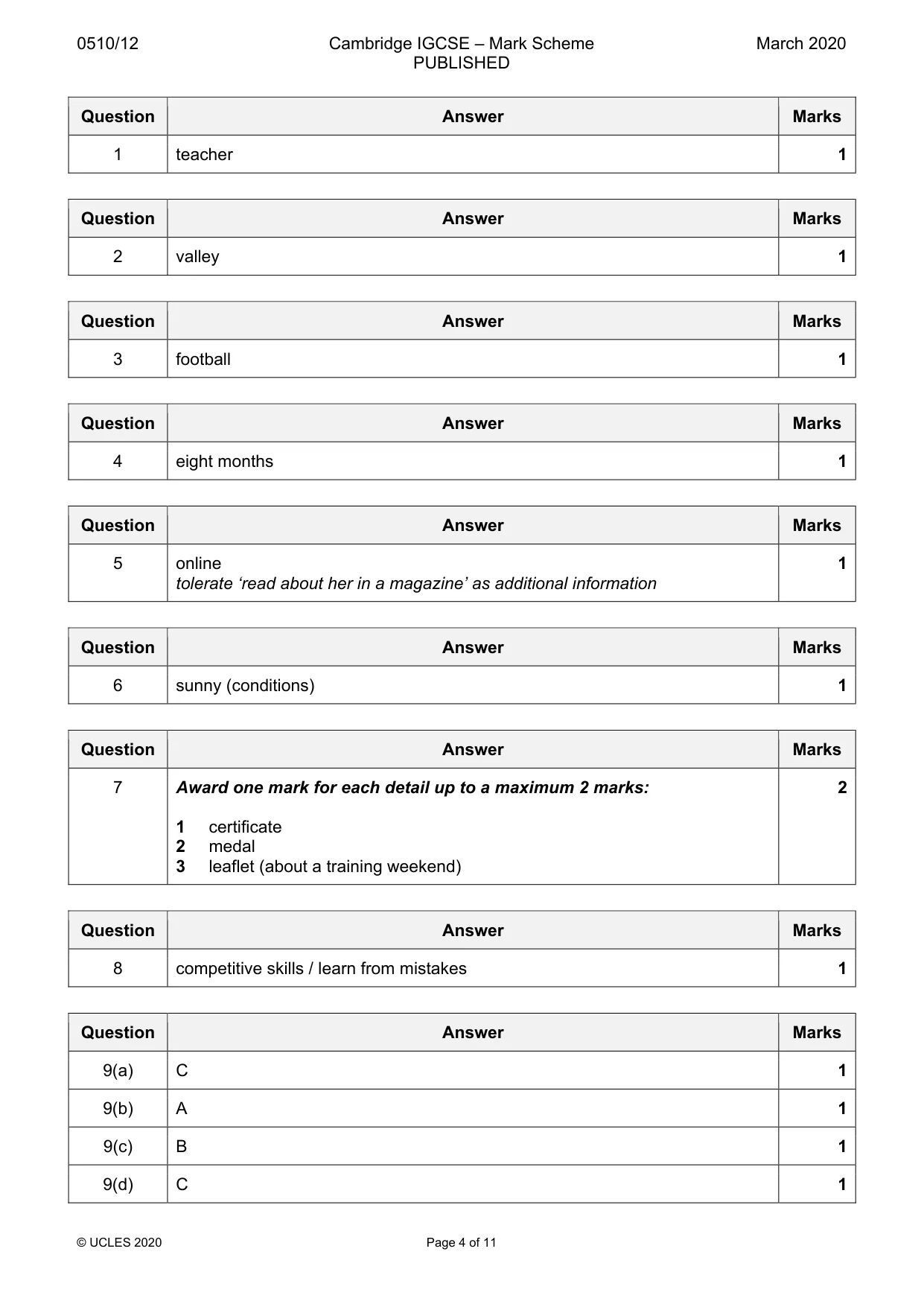
0510/12 Cambridge IGCSE – Mark Scheme PUBLISHED March 2020 © UCLES 2020 Page 4 of 11 Question Answer Marks 1 teacher 1 Question Answer Marks 2 valley 1 Question Answer Marks 3 football 1 Question Answer Marks 4 eight months 1 Question Answer Marks 5 online tolerate ‘read about her in a magazine’ as additional information 1 Question Answer Marks 6 sunny (conditions) 1 Question Answer Marks 7 Award one mark for each detail up to a maximum 2 marks: 1 certificate 2 medal 3 leaflet (about a training weekend) 2 Question Answer Marks 8 competitive skills / learn from mistakes 1 Question Answer Marks 9(a) C 1 9(b) A 1 9(c) B 1 9(d) C 1
Mark scheme, page 5
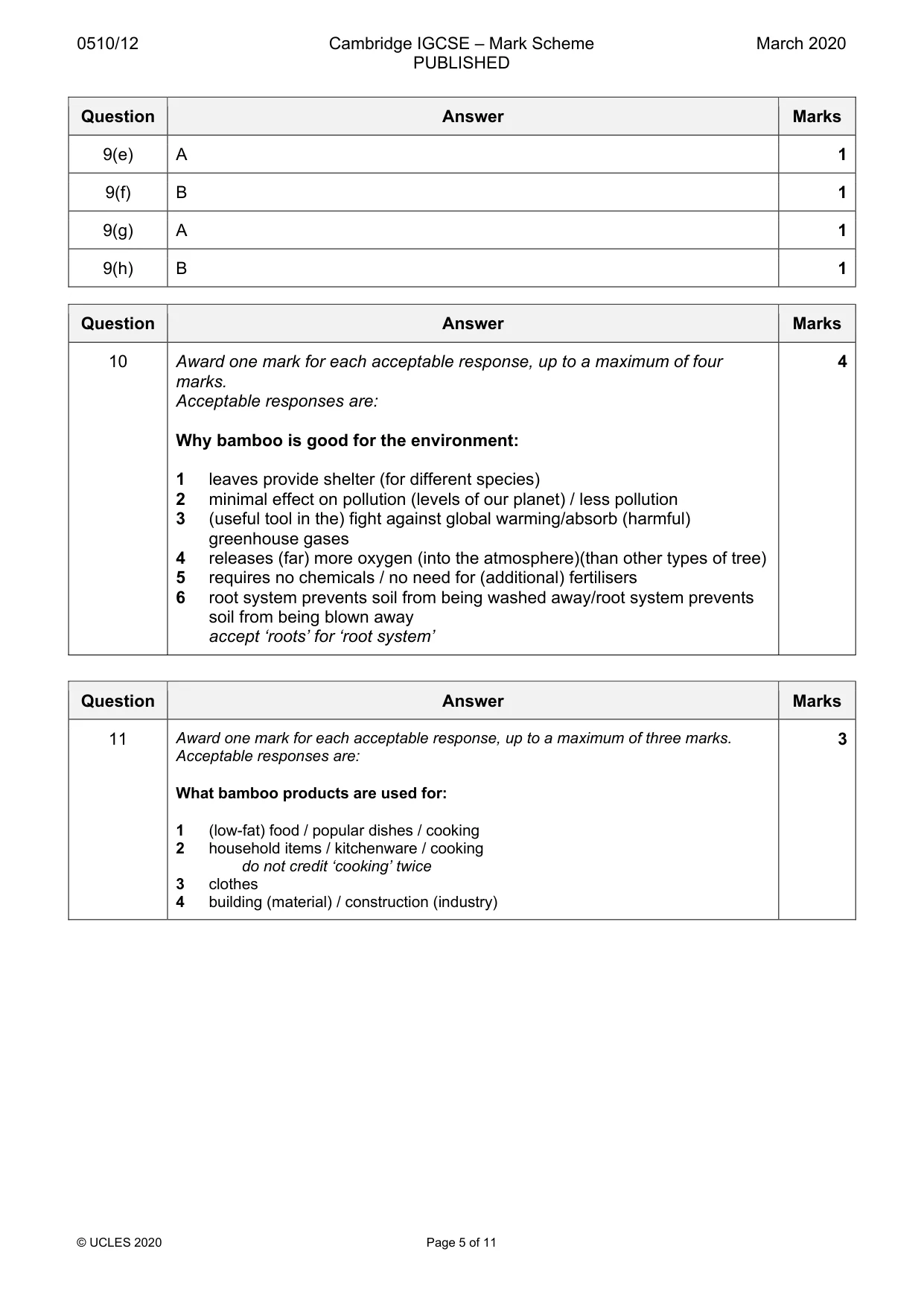
0510/12 Cambridge IGCSE – Mark Scheme PUBLISHED March 2020 © UCLES 2020 Page 5 of 11 Question Answer Marks 9(e) A 1 9(f) B 1 9(g) A 1 9(h) B 1 Question Answer Marks 10 Award one mark for each acceptable response, up to a maximum of four marks. Acceptable responses are: Why bamboo is good for the environment: 1 leaves provide shelter (for different species) 2 minimal effect on pollution (levels of our planet) / less pollution 3 (useful tool in the) fight against global warming/absorb (harmful) greenhouse gases 4 releases (far) more oxygen (into the atmosphere)(than other types of tree) 5 requires no chemicals / no need for (additional) fertilisers 6 root system prevents soil from being washed away/root system prevents soil from being blown away accept ‘roots’ for ‘root system’ 4 Question Answer Marks 11 Award one mark for each acceptable response, up to a maximum of three marks. Acceptable responses are: What bamboo products are used for: 1 (low-fat) food / popular dishes / cooking 2 household items / kitchenware / cooking do not credit ‘cooking’ twice 3 clothes 4 building (material) / construction (industry) 3
Mark scheme, page 6
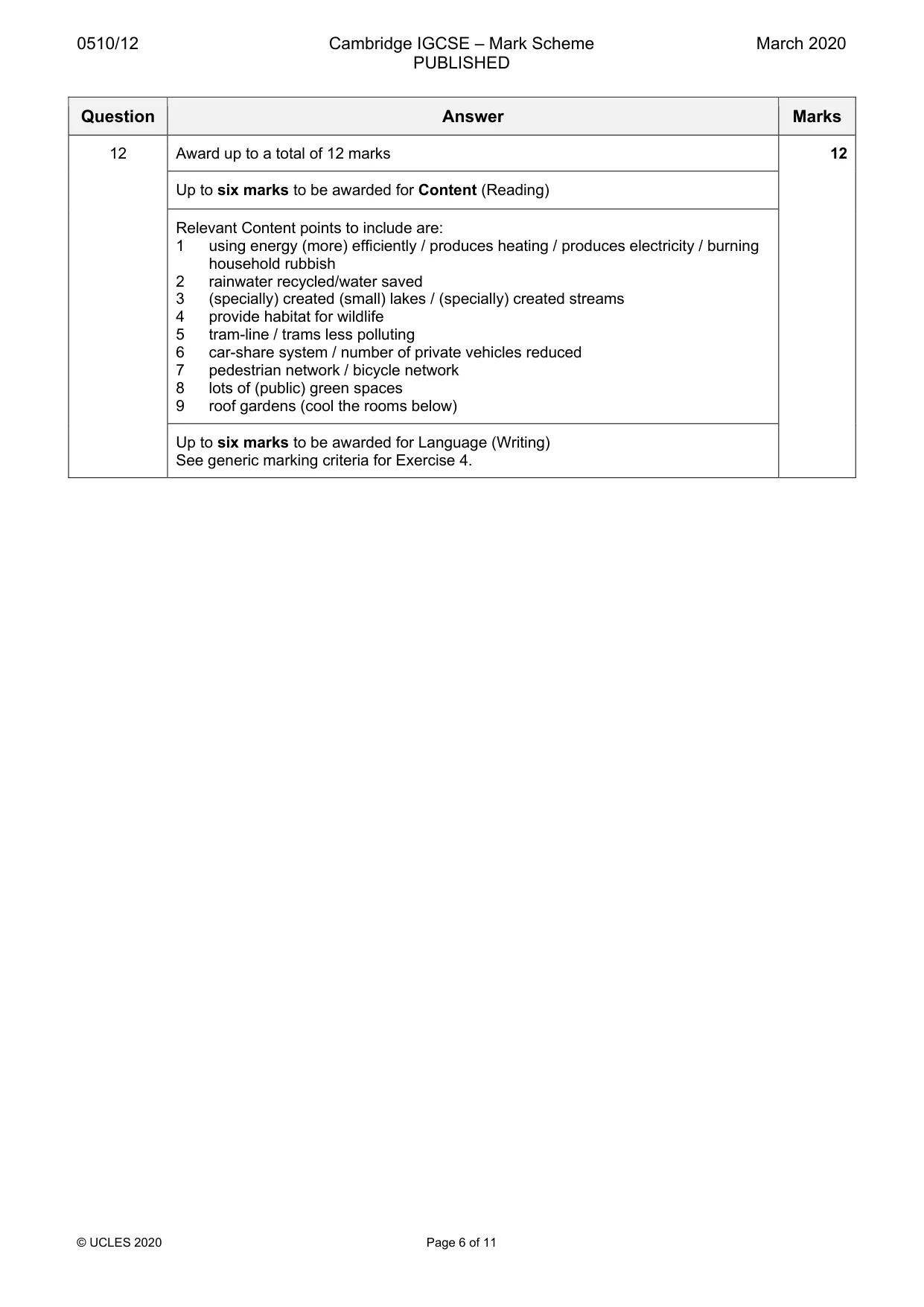
0510/12 Cambridge IGCSE – Mark Scheme PUBLISHED March 2020 © UCLES 2020 Page 6 of 11 Question Answer Marks 12 Award up to a total of 12 marks 12 Up to six marks to be awarded for Content (Reading) Relevant Content points to include are: 1 using energy (more) efficiently / produces heating / produces electricity / burning household rubbish 2 rainwater recycled/water saved 3 (specially) created (small) lakes / (specially) created streams 4 provide habitat for wildlife 5 tram-line / trams less polluting 6 car-share system / number of private vehicles reduced 7 pedestrian network / bicycle network 8 lots of (public) green spaces 9 roof gardens (cool the rooms below) Up to six marks to be awarded for Language (Writing) See generic marking criteria for Exercise 4.
Mark scheme, page 7
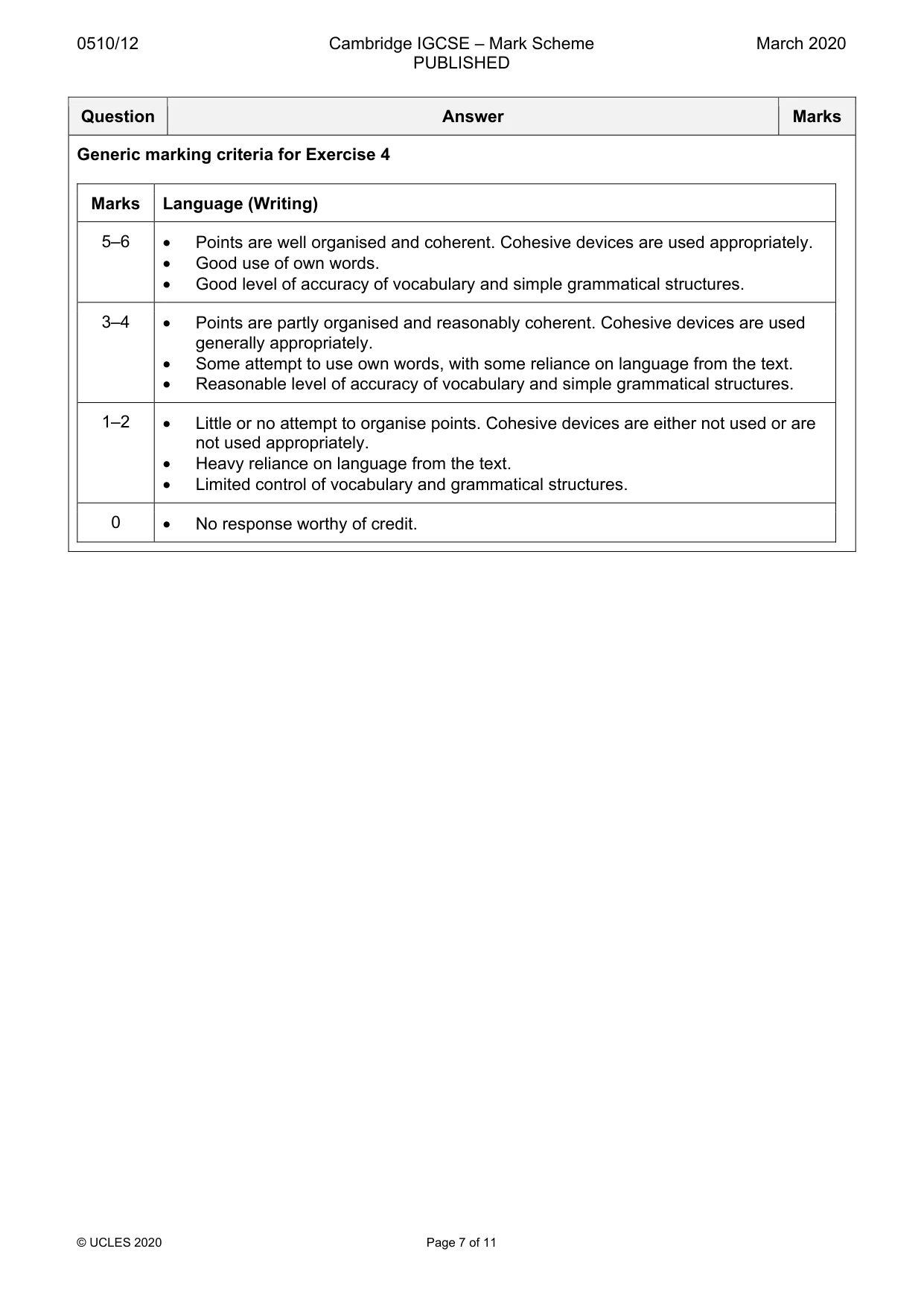
0510/12 Cambridge IGCSE – Mark Scheme PUBLISHED March 2020 © UCLES 2020 Page 7 of 11 Question Answer Marks Generic marking criteria for Exercise 4 Marks Language (Writing) 5–6 • Points are well organised and coherent. Cohesive devices are used appropriately. • Good use of own words. • Good level of accuracy of vocabulary and simple grammatical structures. 3–4 • Points are partly organised and reasonably coherent. Cohesive devices are used generally appropriately. • Some attempt to use own words, with some reliance on language from the text. • Reasonable level of accuracy of vocabulary and simple grammatical structures. 1–2 • Little or no attempt to organise points. Cohesive devices are either not used or are not used appropriately. • Heavy reliance on language from the text. • Limited control of vocabulary and grammatical structures. 0 • No response worthy of credit.
Mark scheme, page 8
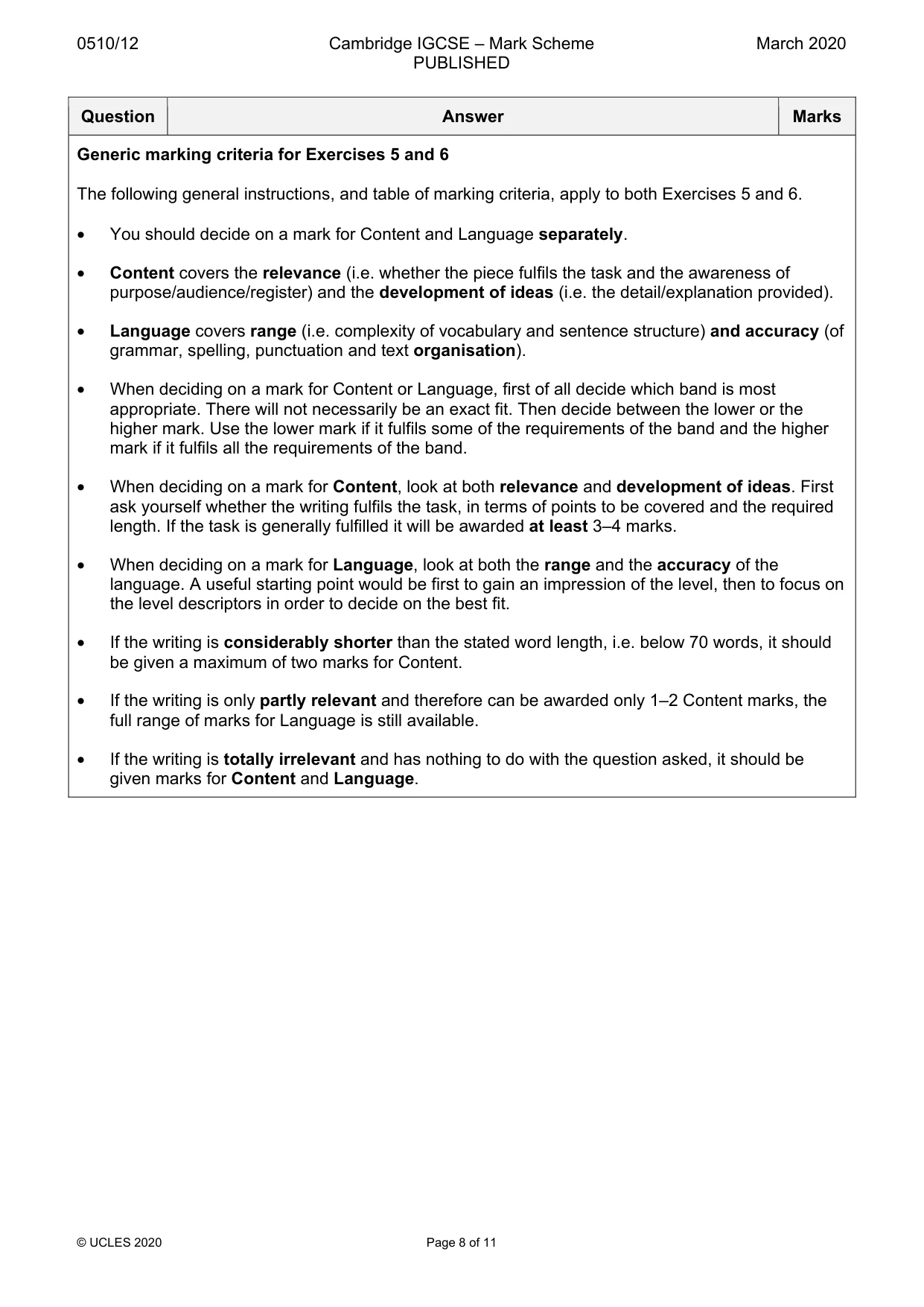
0510/12 Cambridge IGCSE – Mark Scheme PUBLISHED March 2020 © UCLES 2020 Page 8 of 11 Question Answer Marks Generic marking criteria for Exercises 5 and 6 The following general instructions, and table of marking criteria, apply to both Exercises 5 and 6. • You should decide on a mark for Content and Language separately. • Content covers the relevance (i.e. whether the piece fulfils the task and the awareness of purpose/audience/register) and the development of ideas (i.e. the detail/explanation provided). • Language covers range (i.e. complexity of vocabulary and sentence structure) and accuracy (of grammar, spelling, punctuation and text organisation). • When deciding on a mark for Content or Language, first of all decide which band is most appropriate. There will not necessarily be an exact fit. Then decide between the lower or the higher mark. Use the lower mark if it fulfils some of the requirements of the band and the higher mark if it fulfils all the requirements of the band. • When deciding on a mark for Content, look at both relevance and development of ideas. First ask yourself whether the writing fulfils the task, in terms of points to be covered and the required length. If the task is generally fulfilled it will be awarded at least 3–4 marks. • When deciding on a mark for Language, look at both the range and the accuracy of the language. A useful starting point would be first to gain an impression of the level, then to focus on the level descriptors in order to decide on the best fit. • If the writing is considerably shorter than the stated word length, i.e. below 70 words, it should be given a maximum of two marks for Content. • If the writing is only partly relevant and therefore can be awarded only 1–2 Content marks, the full range of marks for Language is still available. • If the writing is totally irrelevant and has nothing to do with the question asked, it should be given marks for Content and Language.
Mark scheme, page 9
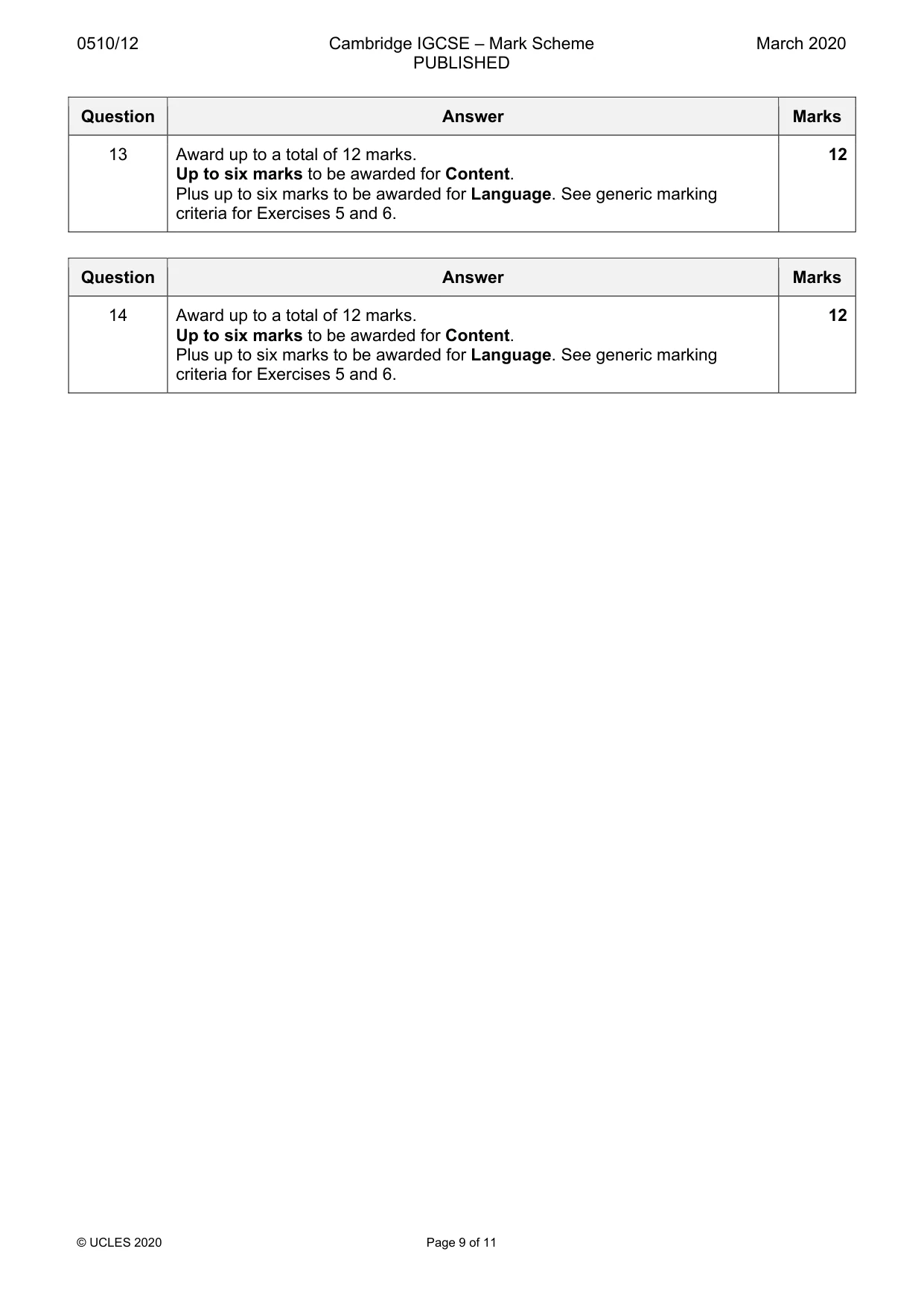
0510/12 Cambridge IGCSE – Mark Scheme PUBLISHED March 2020 © UCLES 2020 Page 9 of 11 Question Answer Marks 13 Award up to a total of 12 marks. Up to six marks to be awarded for Content. Plus up to six marks to be awarded for Language. See generic marking criteria for Exercises 5 and 6. 12 Question Answer Marks 14 Award up to a total of 12 marks. Up to six marks to be awarded for Content. Plus up to six marks to be awarded for Language. See generic marking criteria for Exercises 5 and 6. 12
Mark scheme, page 10
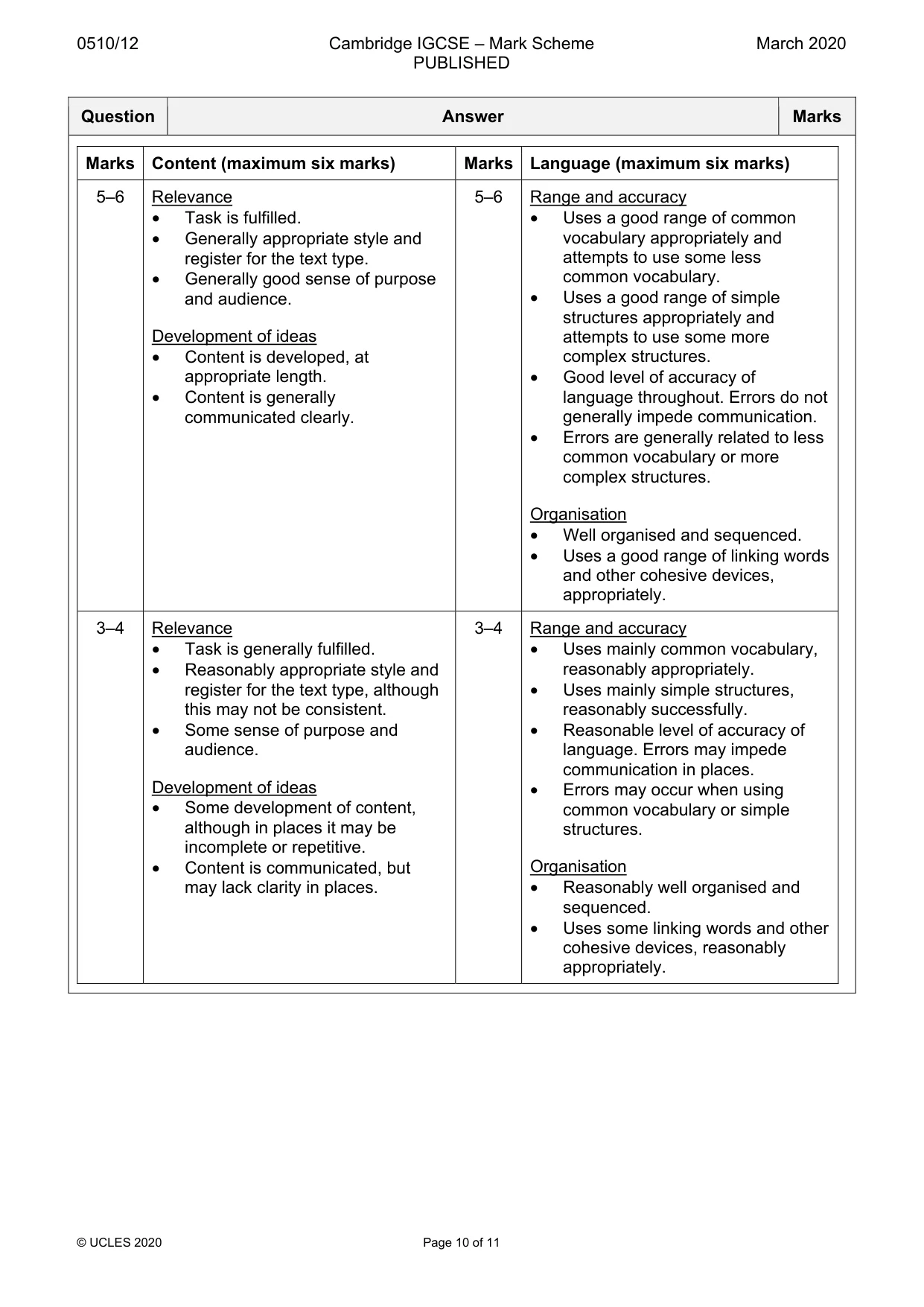
0510/12 Cambridge IGCSE – Mark Scheme PUBLISHED March 2020 © UCLES 2020 Page 10 of 11 Question Answer Marks Marks Content (maximum six marks) Marks Language (maximum six marks) 5–6 Relevance • Task is fulfilled. • Generally appropriate style and register for the text type. • Generally good sense of purpose and audience. Development of ideas • Content is developed, at appropriate length. • Content is generally communicated clearly. 5–6 Range and accuracy • Uses a good range of common vocabulary appropriately and attempts to use some less common vocabulary. • Uses a good range of simple structures appropriately and attempts to use some more complex structures. • Good level of accuracy of language throughout. Errors do not generally impede communication. • Errors are generally related to less common vocabulary or more complex structures. Organisation • Well organised and sequenced. • Uses a good range of linking words and other cohesive devices, appropriately. 3–4 Relevance • Task is generally fulfilled. • Reasonably appropriate style and register for the text type, although this may not be consistent. • Some sense of purpose and audience. Development of ideas • Some development of content, although in places it may be incomplete or repetitive. • Content is communicated, but may lack clarity in places. 3–4 Range and accuracy • Uses mainly common vocabulary, reasonably appropriately. • Uses mainly simple structures, reasonably successfully. • Reasonable level of accuracy of language. Errors may impede communication in places. • Errors may occur when using common vocabulary or simple structures. Organisation • Reasonably well organised and sequenced. • Uses some linking words and other cohesive devices, reasonably appropriately.
Mark scheme, page 11
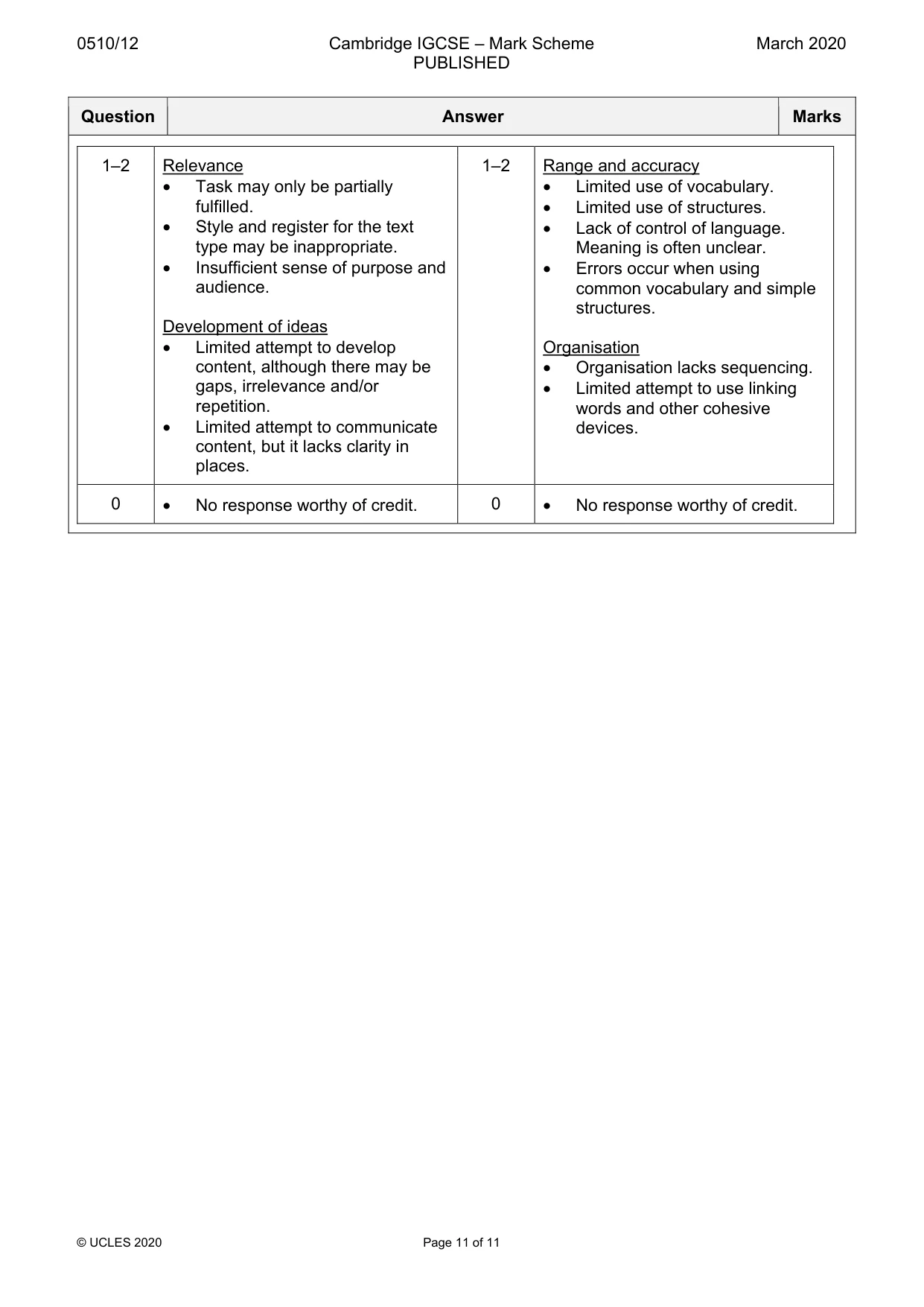
0510/12 Cambridge IGCSE – Mark Scheme PUBLISHED March 2020 © UCLES 2020 Page 11 of 11 Question Answer Marks 1–2 Relevance • Task may only be partially fulfilled. • Style and register for the text type may be inappropriate. • Insufficient sense of purpose and audience. Development of ideas • Limited attempt to develop content, although there may be gaps, irrelevance and/or repetition. • Limited attempt to communicate content, but it lacks clarity in places. 1–2 Range and accuracy • Limited use of vocabulary. • Limited use of structures. • Lack of control of language. Meaning is often unclear. • Errors occur when using common vocabulary and simple structures. Organisation • Organisation lacks sequencing. • Limited attempt to use linking words and other cohesive devices. 0 • No response worthy of credit. 0 • No response worthy of credit.
What you needed in this session
Cambridge’s own grade thresholds for 2020 Feb/March, Paper 1 · Variant 2. A higher threshold means an easier paper — the bar moves with how the cohort did.