Cambridge IGCSE English - Second Language (oral endorsement) 0510 — 2019 Oct/Nov Paper 2 · Variant 2
0510/22/O/N/19 · 80 marks · ≈90 min
The question paper and its mark scheme, free to read here and free to download. This is Cambridge’s own paper, exactly as it was sat.
Question paper16 pages






Mark scheme9 pages
Answers below. Sit the paper first if you are practising.
Paper as text
Question paper, page 1
This document consists of 13 printed pages and 3 blank pages. DC (ST) 172352/3 © UCLES 2019 [Turn over * 7 9 2 0 5 0 7 9 8 9 * ENGLISH AS A SECOND LANGUAGE 0510/22 Paper 2 Reading and Writing (Extended) October/November 2019 2 hours Candidates answer on the Question Paper. No Additional Materials are required. READ THESE INSTRUCTIONS FIRST Write your centre number, candidate number and name on all the work you hand in. Write in dark blue or black pen. Do not use staples, paper clips, glue or correction fluid. DO NOT WRITE IN ANY BARCODES. Answer all questions. Dictionaries are not allowed. At the end of the examination, fasten all your work securely together. The number of marks is given in brackets [ ] at the end of each question or part question. Cambridge Assessment International Education Cambridge International General Certificate of Secondary Education
Question paper, page 2
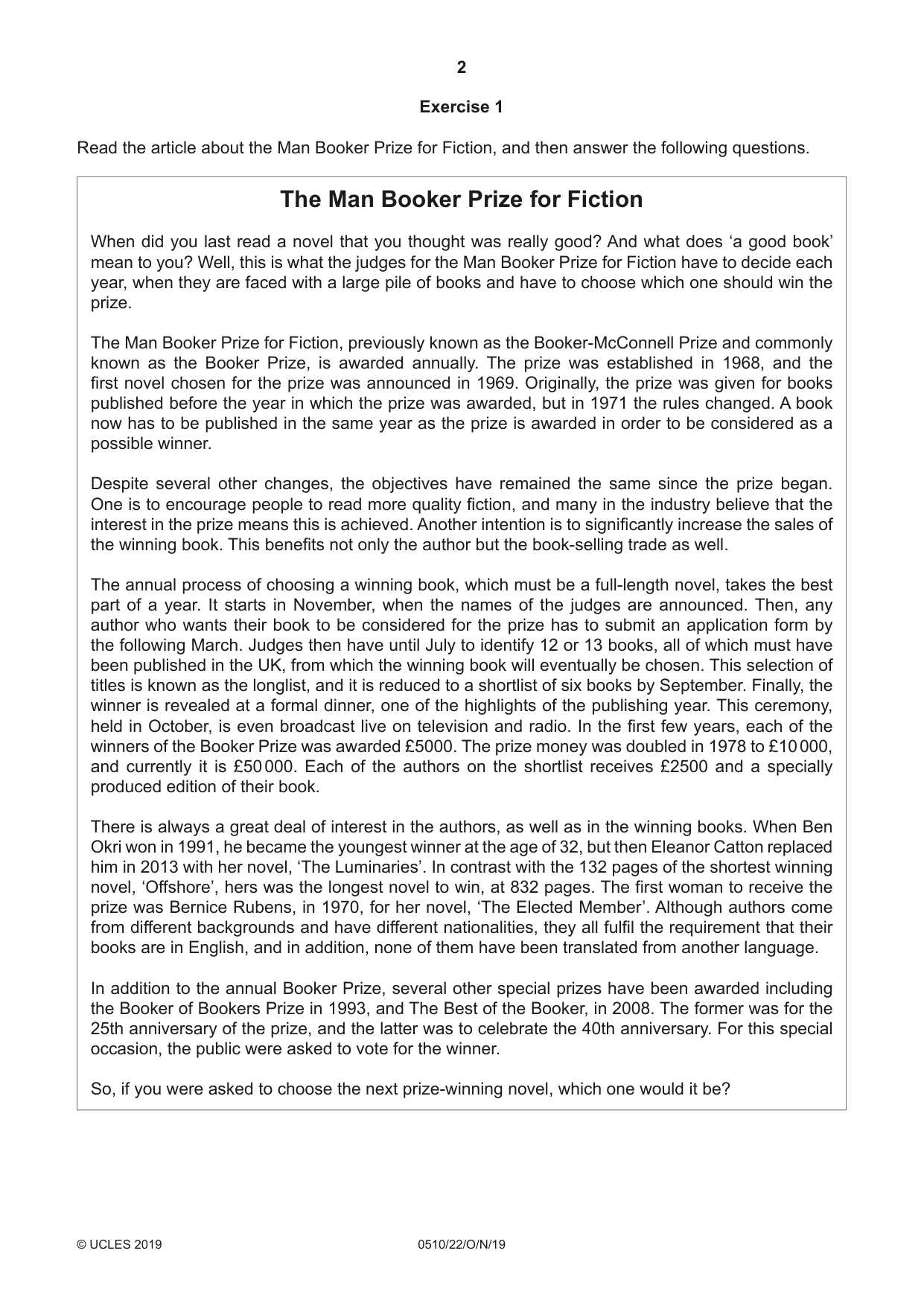
2 0510/22/O/N/19 © UCLES 2019 Exercise 1 Read the article about the Man Booker Prize for Fiction, and then answer the following questions. The Man Booker Prize for Fiction When did you last read a novel that you thought was really good? And what does ‘a good book’ mean to you? Well, this is what the judges for the Man Booker Prize for Fiction have to decide each year, when they are faced with a large pile of books and have to choose which one should win the prize. The Man Booker Prize for Fiction, previously known as the Booker-McConnell Prize and commonly known as the Booker Prize, is awarded annually. The prize was established in 1968, and the first novel chosen for the prize was announced in 1969. Originally, the prize was given for books published before the year in which the prize was awarded, but in 1971 the rules changed. A book now has to be published in the same year as the prize is awarded in order to be considered as a possible winner. Despite several other changes, the objectives have remained the same since the prize began. One is to encourage people to read more quality fiction, and many in the industry believe that the interest in the prize means this is achieved. Another intention is to significantly increase the sales of the winning book. This benefits not only the author but the book-selling trade as well. The annual process of choosing a winning book, which must be a full-length novel, takes the best part of a year. It starts in November, when the names of the judges are announced. Then, any author who wants their book to be considered for the prize has to submit an application form by the following March. Judges then have until July to identify 12 or 13 books, all of which must have been published in the UK, from which the winning book will eventually be chosen. This selection of titles is known as the longlist, and it is reduced to a shortlist of six books by September. Finally, the winner is revealed at a formal dinner, one of the highlights of the publishing year. This ceremony, held in October, is even broadcast live on television and radio. In the first few years, each of the winners of the Booker Prize was awarded £5000. The prize money was doubled in 1978 to £10 000, and currently it is £50 000. Each of the authors on the shortlist receives £2500 and a specially produced edition of their book. There is always a great deal of interest in the authors, as well as in the winning books. When Ben Okri won in 1991, he became the youngest winner at the age of 32, but then Eleanor Catton replaced him in 2013 with her novel, ‘The Luminaries’. In contrast with the 132 pages of the shortest winning novel, ‘Offshore’, hers was the longest novel to win, at 832 pages. The first woman to receive the prize was Bernice Rubens, in 1970, for her novel, ‘The Elected Member’. Although authors come from different backgrounds and have different nationalities, they all fulfil the requirement that their books are in English, and in addition, none of them have been translated from another language. In addition to the annual Booker Prize, several other special prizes have been awarded including the Booker of Bookers Prize in 1993, and The Best of the Booker, in 2008. The former was for the 25th anniversary of the prize, and the latter was to celebrate the 40th anniversary. For this special occasion, the public were asked to vote for the winner. So, if you were asked to choose the next prize-winning novel, which one would it be?
Question paper, page 3
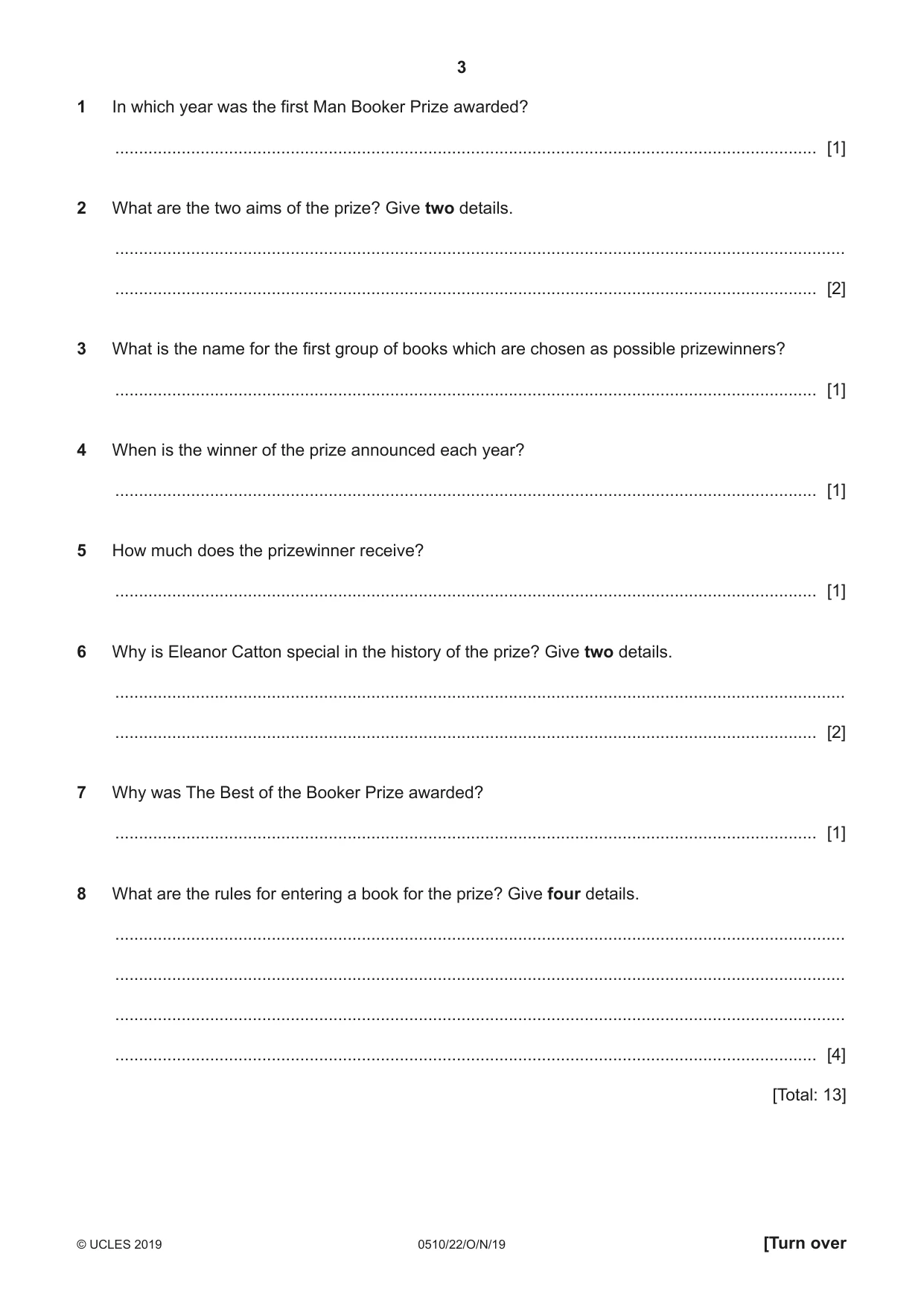
3 0510/22/O/N/19 © UCLES 2019 [Turn over 1 In which year was the first Man Booker Prize awarded? … [1] 2 What are the two aims of the prize? Give two details. … … [2] 3 What is the name for the first group of books which are chosen as possible prizewinners? … [1] 4 When is the winner of the prize announced each year? … [1] 5 How much does the prizewinner receive? … [1] 6 Why is Eleanor Catton special in the history of the prize? Give two details. … … [2] 7 Why was The Best of the Booker Prize awarded? … [1] 8 What are the rules for entering a book for the prize? Give four details. … … … … [4] [Total: 13]
Question paper, page 4
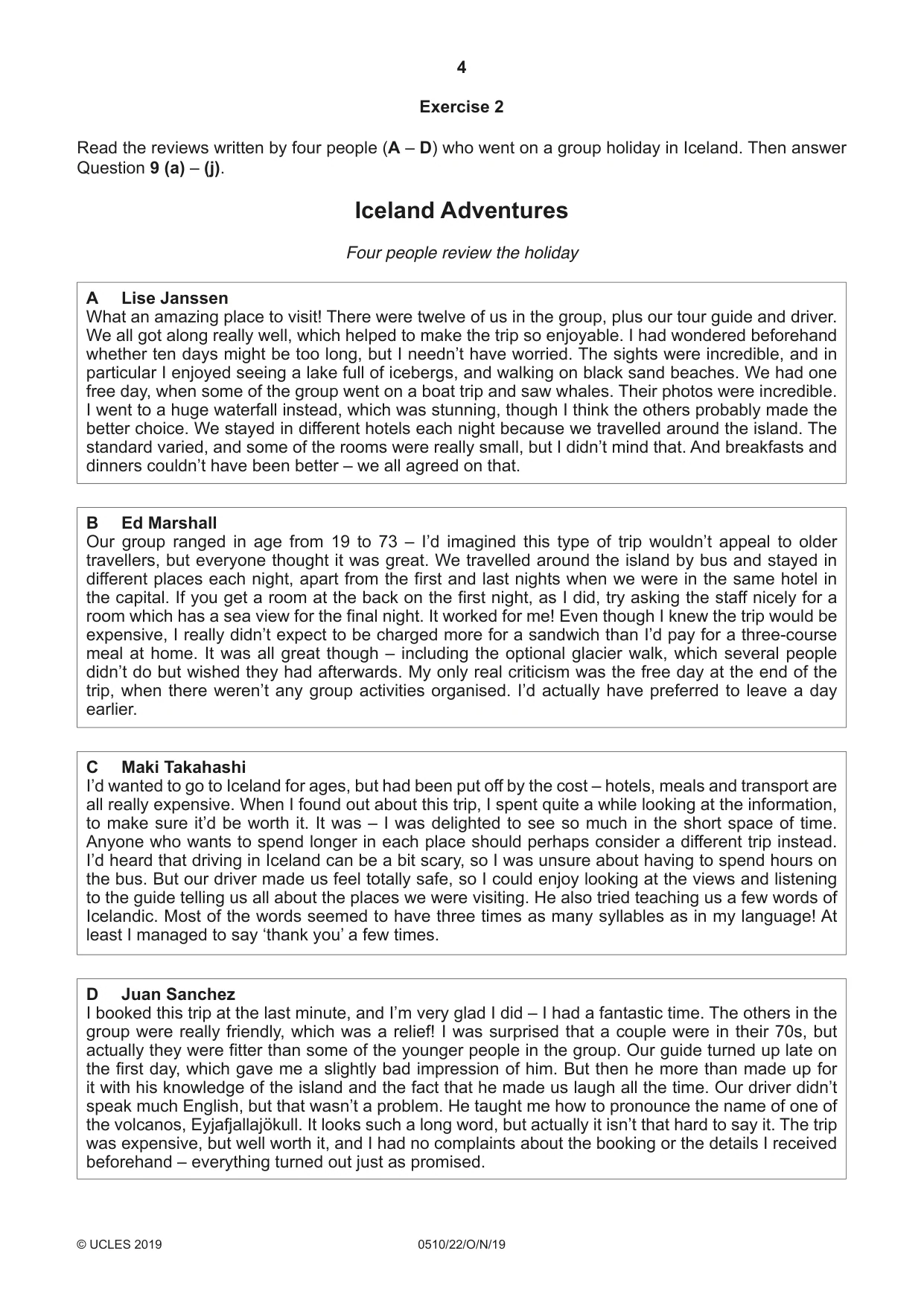
4 0510/22/O/N/19 © UCLES 2019 Exercise 2 Read the reviews written by four people (A – D) who went on a group holiday in Iceland. Then answer Question 9 (a) – (j). Iceland Adventures Four people review the holiday A Lise Janssen What an amazing place to visit! There were twelve of us in the group, plus our tour guide and driver. We all got along really well, which helped to make the trip so enjoyable. I had wondered beforehand whether ten days might be too long, but I needn’t have worried. The sights were incredible, and in particular I enjoyed seeing a lake full of icebergs, and walking on black sand beaches. We had one free day, when some of the group went on a boat trip and saw whales. Their photos were incredible. I went to a huge waterfall instead, which was stunning, though I think the others probably made the better choice. We stayed in different hotels each night because we travelled around the island. The standard varied, and some of the rooms were really small, but I didn’t mind that. And breakfasts and dinners couldn’t have been better – we all agreed on that. B Ed Marshall Our group ranged in age from 19 to 73 – I’d imagined this type of trip wouldn’t appeal to older travellers, but everyone thought it was great. We travelled around the island by bus and stayed in different places each night, apart from the first and last nights when we were in the same hotel in the capital. If you get a room at the back on the first night, as I did, try asking the staff nicely for a room which has a sea view for the final night. It worked for me! Even though I knew the trip would be expensive, I really didn’t expect to be charged more for a sandwich than I’d pay for a three-course meal at home. It was all great though – including the optional glacier walk, which several people didn’t do but wished they had afterwards. My only real criticism was the free day at the end of the trip, when there weren’t any group activities organised. I’d actually have preferred to leave a day earlier. C Maki Takahashi I’d wanted to go to Iceland for ages, but had been put off by the cost – hotels, meals and transport are all really expensive. When I found out about this trip, I spent quite a while looking at the information, to make sure it’d be worth it. It was – I was delighted to see so much in the short space of time. Anyone who wants to spend longer in each place should perhaps consider a different trip instead. I’d heard that driving in Iceland can be a bit scary, so I was unsure about having to spend hours on the bus. But our driver made us feel totally safe, so I could enjoy looking at the views and listening to the guide telling us all about the places we were visiting. He also tried teaching us a few words of Icelandic. Most of the words seemed to have three times as many syllables as in my language! At least I managed to say ‘thank you’ a few times. D Juan Sanchez I booked this trip at the last minute, and I’m very glad I did – I had a fantastic time. The others in the group were really friendly, which was a relief! I was surprised that a couple were in their 70s, but actually they were fitter than some of the younger people in the group. Our guide turned up late on the first day, which gave me a slightly bad impression of him. But then he more than made up for it with his knowledge of the island and the fact that he made us laugh all the time. Our driver didn’t speak much English, but that wasn’t a problem. He taught me how to pronounce the name of one of the volcanos, Eyjafjallajökull. It looks such a long word, but actually it isn’t that hard to say it. The trip was expensive, but well worth it, and I had no complaints about the booking or the details I received beforehand – everything turned out just as promised.
Question paper, page 5
5 0510/22/O/N/19 © UCLES 2019 [Turn over 9 For each question, write the correct letter A, B, C or D on the line. Which person… (a) makes a suggestion regarding accommodation? ……… [1] (b) mentions having confidence in the bus driver’s ability? ……… [1] (c) admits to being surprised about costs in Iceland? ……… [1] (d) comments on the accuracy of the information sent before the trip? ……… [1] (e) was particularly impressed by the meals included in the trip? ……… [1] (f) feels that the length of the trip should be altered? ……… [1] (g) suggests that the language was difficult to cope with? ……… [1] (h) comments on an appealing characteristic of the tour guide? ……… [1] (i) regrets not taking part in one activity during the trip? ……… [1] (j) suggests that the holiday might be unsuitable for certain people? ……… [1] [Total: 10]
Question paper, page 6
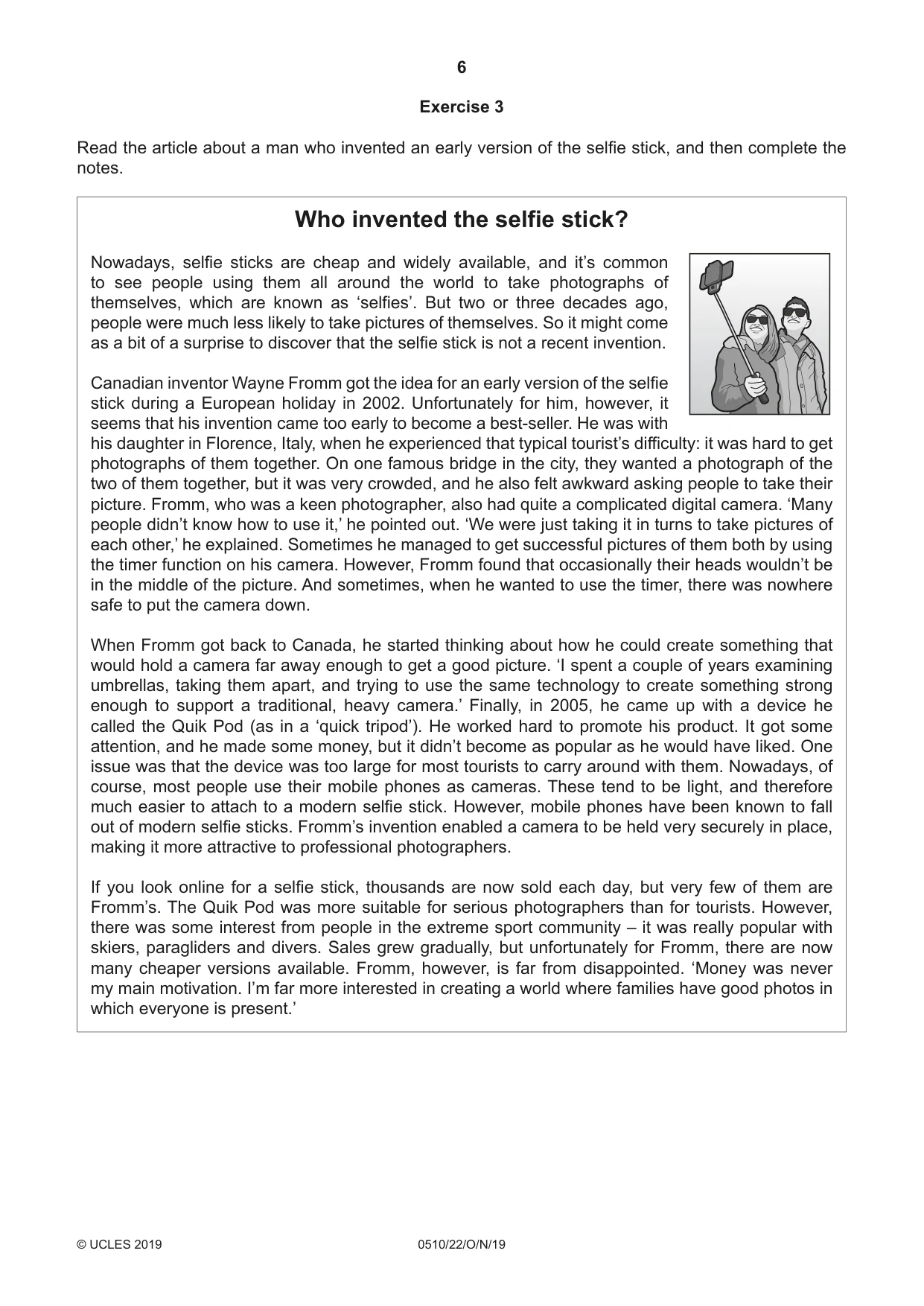
6 0510/22/O/N/19 © UCLES 2019 Exercise 3 Read the article about a man who invented an early version of the selfie stick, and then complete the notes. Who invented the selfie stick? Nowadays, selfie sticks are cheap and widely available, and it’s common to see people using them all around the world to take photographs of themselves, which are known as ‘selfies’. But two or three decades ago, people were much less likely to take pictures of themselves. So it might come as a bit of a surprise to discover that the selfie stick is not a recent invention. Canadian inventor Wayne Fromm got the idea for an early version of the selfie stick during a European holiday in 2002. Unfortunately for him, however, it seems that his invention came too early to become a best-seller. He was with his daughter in Florence, Italy, when he experienced that typical tourist’s difficulty: it was hard to get photographs of them together. On one famous bridge in the city, they wanted a photograph of the two of them together, but it was very crowded, and he also felt awkward asking people to take their picture. Fromm, who was a keen photographer, also had quite a complicated digital camera. ‘Many people didn’t know how to use it,’ he pointed out. ‘We were just taking it in turns to take pictures of each other,’ he explained. Sometimes he managed to get successful pictures of them both by using the timer function on his camera. However, Fromm found that occasionally their heads wouldn’t be in the middle of the picture. And sometimes, when he wanted to use the timer, there was nowhere safe to put the camera down. When Fromm got back to Canada, he started thinking about how he could create something that would hold a camera far away enough to get a good picture. ‘I spent a couple of years examining umbrellas, taking them apart, and trying to use the same technology to create something strong enough to support a traditional, heavy camera.’ Finally, in 2005, he came up with a device he called the Quik Pod (as in a ‘quick tripod’). He worked hard to promote his product. It got some attention, and he made some money, but it didn’t become as popular as he would have liked. One issue was that the device was too large for most tourists to carry around with them. Nowadays, of course, most people use their mobile phones as cameras. These tend to be light, and therefore much easier to attach to a modern selfie stick. However, mobile phones have been known to fall out of modern selfie sticks. Fromm’s invention enabled a camera to be held very securely in place, making it more attractive to professional photographers. If you look online for a selfie stick, thousands are now sold each day, but very few of them are Fromm’s. The Quik Pod was more suitable for serious photographers than for tourists. However, there was some interest from people in the extreme sport community – it was really popular with skiers, paragliders and divers. Sales grew gradually, but unfortunately for Fromm, there are now many cheaper versions available. Fromm, however, is far from disappointed. ‘Money was never my main motivation. I’m far more interested in creating a world where families have good photos in which everyone is present.’
Question paper, page 7
7 0510/22/O/N/19 © UCLES 2019 [Turn over You are going to give a talk to your class at school about the invention of the Quik Pod, an early version of the selfie stick. Prepare some notes to use as the basis for your talk. Make short notes under each heading. 10 Problems that Wayne Fromm had when taking family photographs on holiday: • … • … • … • … • … [5] 11 Why the Quik Pod failed to be a great success with the general public: • … • … • … • … [4] [Total: 9]
Question paper, page 8
8 0510/22/O/N/19 © UCLES 2019 Exercise 4 12 Read the article about tourism in the Galapagos Islands. Write a summary about the problems tourism can cause AND the measures put in place to deal with these problems. Your summary should be about 100 words long (and no more than 120 words long). You should use your own words as far as possible. You will receive up to 8 marks for the content of your summary, and up to 8 marks for the style and accuracy of your language. Tourism in the Galapagos Islands With over 150 000 tourists visiting each year, the Galapagos Islands, situated off the west coast of South America, are an extremely attractive holiday destination. Many visitors want to come to these beautiful islands to experience their unique wildlife including giant tortoises, marine iguanas and penguins, as well as the stunning landscapes. But what impact do all these visitors have, and how can they continue to visit the islands without destroying them in the process? When people first started visiting the islands on holiday many years ago, they tended to sleep and eat on their cruise ships. These ships brought all the supplies that were essential for keeping their customers happy for the duration of their holiday. Today, however, there are so many people visiting who choose to stay on the islands instead that local farmers and fishermen cannot produce enough food to keep up with their requirements. Food is therefore imported to the islands from the mainland in order to solve this problem. Increased competition among providers of island accommodation has meant that it is now cheaper to stay in an island hotel than ever before. When tourists do stay on the Galapagos Islands, they spend money in the local community, and provide employment opportunities for locals. However, the increasing number of tourists staying has resulted in growing concerns about the amount of rubbish being created. As more and more people visit the islands, international investors have been interested in building there in order to get a share of the lucrative tourism industry. While the islands’ National Park areas are protected from development of this kind, the areas outside them are not, and many new buildings have been constructed. This helps the islands to cope with visitors, but there is always the risk that nearby wildlife is put in danger. For visitors who are staying on board a cruise ship, the authorities closely control the routes these ships can take when touring the islands. If badly maintained, the ships can pollute the seawater with oil. In order to monitor them closely, all boats and ships must have a licence, which is given out by the National Park authorities. The majority of cruise ship companies, however, run well-organised trips, and they do their best to provide their customers with a memorable, once-in-a-lifetime experience. Wherever visitors choose to stay, a tour guide is required for each group that is exploring a particular area. This is of course an advantage to the visitors themselves, as they can find out far more about the amazing creatures they’re seeing than they would do alone. More recently, tourists have been drawn to activity-based holidays. In the Galapagos, this demand has seen the development of holidays featuring a range of activities, such as horseback riding, camping, sport fishing and kayaking, which are proving to be very popular. This unique and beautiful area is certain to continue to be a fascinating destination for visitors from all over the world.
Question paper, page 9
9 0510/22/O/N/19 © UCLES 2019 [Turn over … … … … … … … … … … … … … … … … … … … … … … … … … … … [Total: 16]
Question paper, page 10
10 0510/22/O/N/19 © UCLES 2019 Exercise 5 13 Your school recently organised a ‘work experience week’, when each student in your class spent the week working in a local business of their choice. Write an email to your friend about your work experience week. In your email, you should: • explain which type of business you worked in • describe what you had to do each day • say how this has helped you with your career plans. The pictures above may give you some ideas, and you can also use some ideas of your own. Your email should be between 150 and 200 words long. You will receive up to 8 marks for the content of your email, and up to 8 marks for the language used.
Question paper, page 11
11 0510/22/O/N/19 © UCLES 2019 [Turn over … … … … … … … … … … … … … … … … … … … … … … … … … … … [Total: 16]
Question paper, page 12
12 0510/22/O/N/19 © UCLES 2019 Exercise 6 14 Students at your school have been arriving late to classes recently. Your teacher has asked you to write a report about this, explaining how this affects your lessons and suggesting what you think can be done about it. Here are two comments from your classmates: It would be good if our lessons started later. Our teacher has to repeat everything. Write a report for your teacher, giving your views. The comments above may give you some ideas, and you can also use some ideas of your own. Your report should be between 150 and 200 words long. You will receive up to 8 marks for the content of your report, and up to 8 marks for the language used.
Question paper, page 13
13 0510/22/O/N/19 © UCLES 2019 … … … … … … … … … … … … … … … … … … … … … … … … … … … [Total: 16]
Question paper, page 14
14 0510/22/O/N/19 © UCLES 2019 BLANK PAGE
Question paper, page 15
15 0510/22/O/N/19 © UCLES 2019 BLANK PAGE
Question paper, page 16
16 0510/22/O/N/19 © UCLES 2019 BLANK PAGE Permission to reproduce items where third-party owned material protected by copyright is included has been sought and cleared where possible. Every reasonable effort has been made by the publisher (UCLES) to trace copyright holders, but if any items requiring clearance have unwittingly been included, the publisher will be pleased to make amends at the earliest possible opportunity. To avoid the issue of disclosure of answer-related information to candidates, all copyright acknowledgements are reproduced online in the Cambridge Assessment International Education Copyright Acknowledgements Booklet. This is produced for each series of examinations and is freely available to download at www.cambridgeinternational.org after the live examination series. Cambridge Assessment International Education is part of the Cambridge Assessment Group. Cambridge Assessment is the brand name of the University of Cambridge Local Examinations Syndicate (UCLES), which itself is a department of the University of Cambridge.
Mark scheme, page 1
This document consists of 9 printed pages. © UCLES 2019 [Turn over Cambridge Assessment International Education Cambridge International General Certificate of Secondary Education ENGLISH AS A SECOND LANGUAGE (SPEAKING ENDORSEMENT) 0510/22 Paper 2 Reading and Writing (Extended) October/November 2019 MARK SCHEME Maximum Mark: 80 Published This mark scheme is published as an aid to teachers and candidates, to indicate the requirements of the examination. It shows the basis on which Examiners were instructed to award marks. It does not indicate the details of the discussions that took place at an Examiners’ meeting before marking began, which would have considered the acceptability of alternative answers. Mark schemes should be read in conjunction with the question paper and the Principal Examiner Report for Teachers. Cambridge International will not enter into discussions about these mark schemes. Cambridge International is publishing the mark schemes for the October/November 2019 series for most Cambridge IGCSE™, Cambridge International A and AS Level components and some Cambridge O Level components.
Mark scheme, page 2
0510/22 Cambridge IGCSE – Mark Scheme PUBLISHED October/November 2019 © UCLES 2019 Page 2 of 9 Generic Marking Principles These general marking principles must be applied by all examiners when marking candidate answers. They should be applied alongside the specific content of the mark scheme or generic level descriptors for a question. Each question paper and mark scheme will also comply with these marking principles. GENERIC MARKING PRINCIPLE 1: Marks must be awarded in line with: • the specific content of the mark scheme or the generic level descriptors for the question • the specific skills defined in the mark scheme or in the generic level descriptors for the question • the standard of response required by a candidate as exemplified by the standardisation scripts. GENERIC MARKING PRINCIPLE 2: Marks awarded are always whole marks (not half marks, or other fractions). GENERIC MARKING PRINCIPLE 3: Marks must be awarded positively: • marks are awarded for correct/valid answers, as defined in the mark scheme. However, credit is given for valid answers which go beyond the scope of the syllabus and mark scheme, referring to your Team Leader as appropriate • marks are awarded when candidates clearly demonstrate what they know and can do • marks are not deducted for errors • marks are not deducted for omissions • answers should only be judged on the quality of spelling, punctuation and grammar when these features are specifically assessed by the question as indicated by the mark scheme. The meaning, however, should be unambiguous. GENERIC MARKING PRINCIPLE 4: Rules must be applied consistently e.g. in situations where candidates have not followed instructions or in the application of generic level descriptors. GENERIC MARKING PRINCIPLE 5: Marks should be awarded using the full range of marks defined in the mark scheme for the question (however; the use of the full mark range may be limited according to the quality of the candidate responses seen). GENERIC MARKING PRINCIPLE 6: Marks awarded are based solely on the requirements as defined in the mark scheme. Marks should not be awarded with grade thresholds or grade descriptors in mind.
Mark scheme, page 3
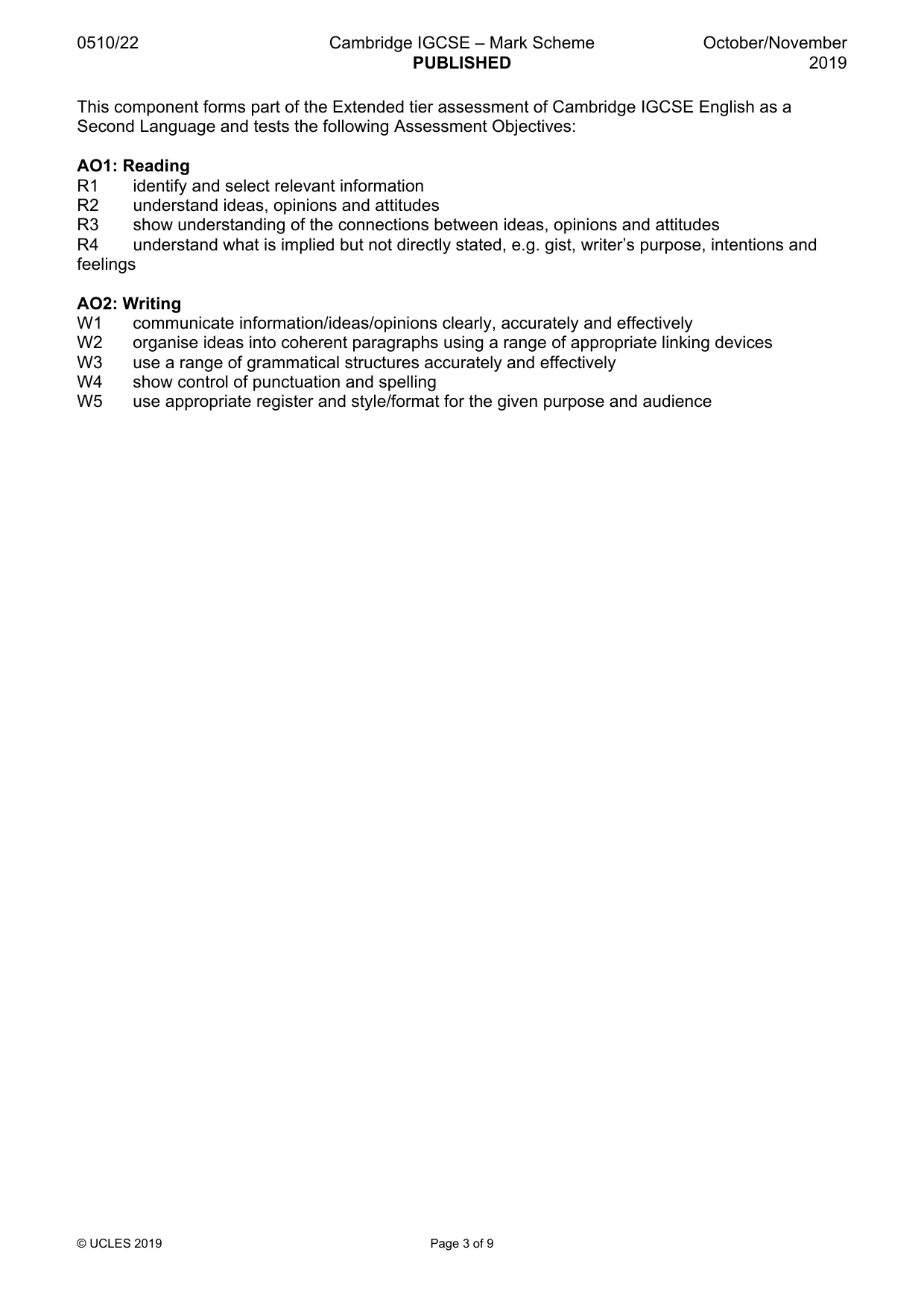
0510/22 Cambridge IGCSE – Mark Scheme PUBLISHED October/November 2019 © UCLES 2019 Page 3 of 9 This component forms part of the Extended tier assessment of Cambridge IGCSE English as a Second Language and tests the following Assessment Objectives: AO1: Reading R1 identify and select relevant information R2 understand ideas, opinions and attitudes R3 show understanding of the connections between ideas, opinions and attitudes R4 understand what is implied but not directly stated, e.g. gist, writer’s purpose, intentions and feelings AO2: Writing W1 communicate information/ideas/opinions clearly, accurately and effectively W2 organise ideas into coherent paragraphs using a range of appropriate linking devices W3 use a range of grammatical structures accurately and effectively W4 show control of punctuation and spelling W5 use appropriate register and style/format for the given purpose and audience
Mark scheme, page 4
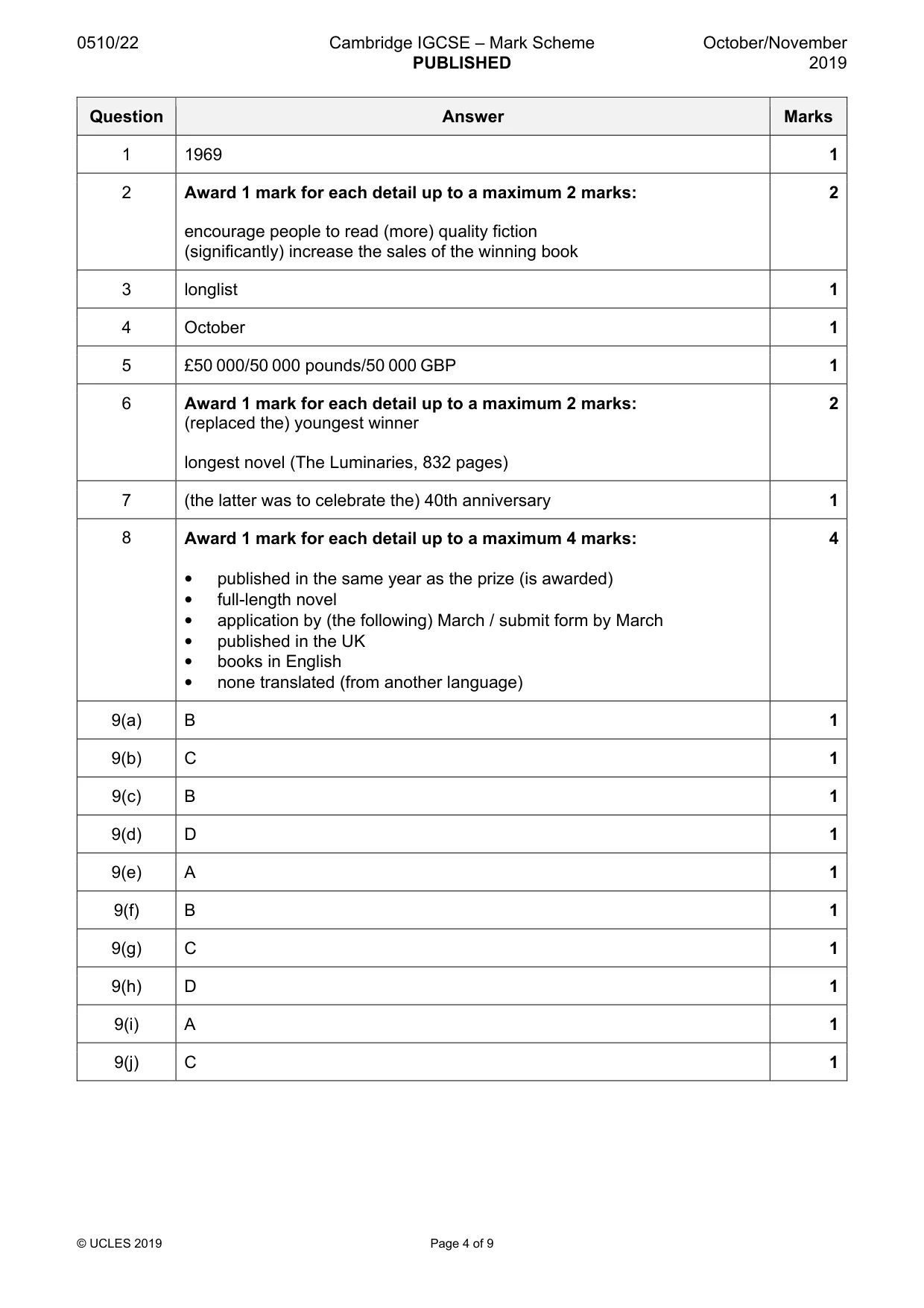
0510/22 Cambridge IGCSE – Mark Scheme PUBLISHED October/November 2019 © UCLES 2019 Page 4 of 9 Question Answer Marks 1 1969 1 2 Award 1 mark for each detail up to a maximum 2 marks: encourage people to read (more) quality fiction (significantly) increase the sales of the winning book 2 3 longlist 1 4 October 1 5 £50 000/50 000 pounds/50 000 GBP 1 6 Award 1 mark for each detail up to a maximum 2 marks: (replaced the) youngest winner longest novel (The Luminaries, 832 pages) 2 7 (the latter was to celebrate the) 40th anniversary 1 8 Award 1 mark for each detail up to a maximum 4 marks: • published in the same year as the prize (is awarded) • full-length novel • application by (the following) March / submit form by March • published in the UK • books in English • none translated (from another language) 4 9(a) B 1 9(b) C 1 9(c) B 1 9(d) D 1 9(e) A 1 9(f) B 1 9(g) C 1 9(h) D 1 9(i) A 1 9(j) C 1
Mark scheme, page 5
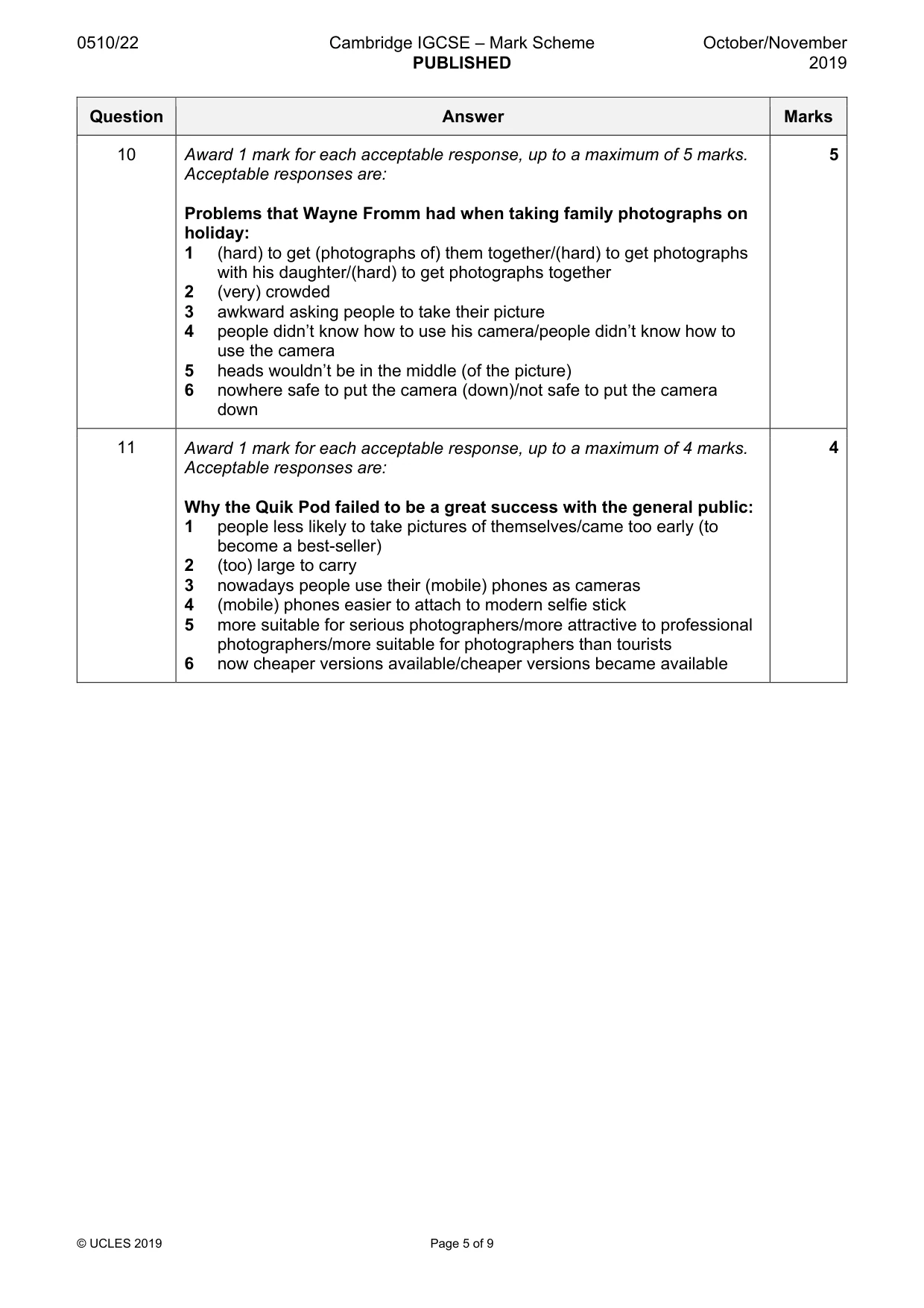
0510/22 Cambridge IGCSE – Mark Scheme PUBLISHED October/November 2019 © UCLES 2019 Page 5 of 9 Question Answer Marks 10 Award 1 mark for each acceptable response, up to a maximum of 5 marks. Acceptable responses are: Problems that Wayne Fromm had when taking family photographs on holiday: 1 (hard) to get (photographs of) them together/(hard) to get photographs with his daughter/(hard) to get photographs together 2 (very) crowded 3 awkward asking people to take their picture 4 people didn’t know how to use his camera/people didn’t know how to use the camera 5 heads wouldn’t be in the middle (of the picture) 6 nowhere safe to put the camera (down)/not safe to put the camera down 5 11 Award 1 mark for each acceptable response, up to a maximum of 4 marks. Acceptable responses are: Why the Quik Pod failed to be a great success with the general public: 1 people less likely to take pictures of themselves/came too early (to become a best-seller) 2 (too) large to carry 3 nowadays people use their (mobile) phones as cameras 4 (mobile) phones easier to attach to modern selfie stick 5 more suitable for serious photographers/more attractive to professional photographers/more suitable for photographers than tourists 6 now cheaper versions available/cheaper versions became available 4
Mark scheme, page 6
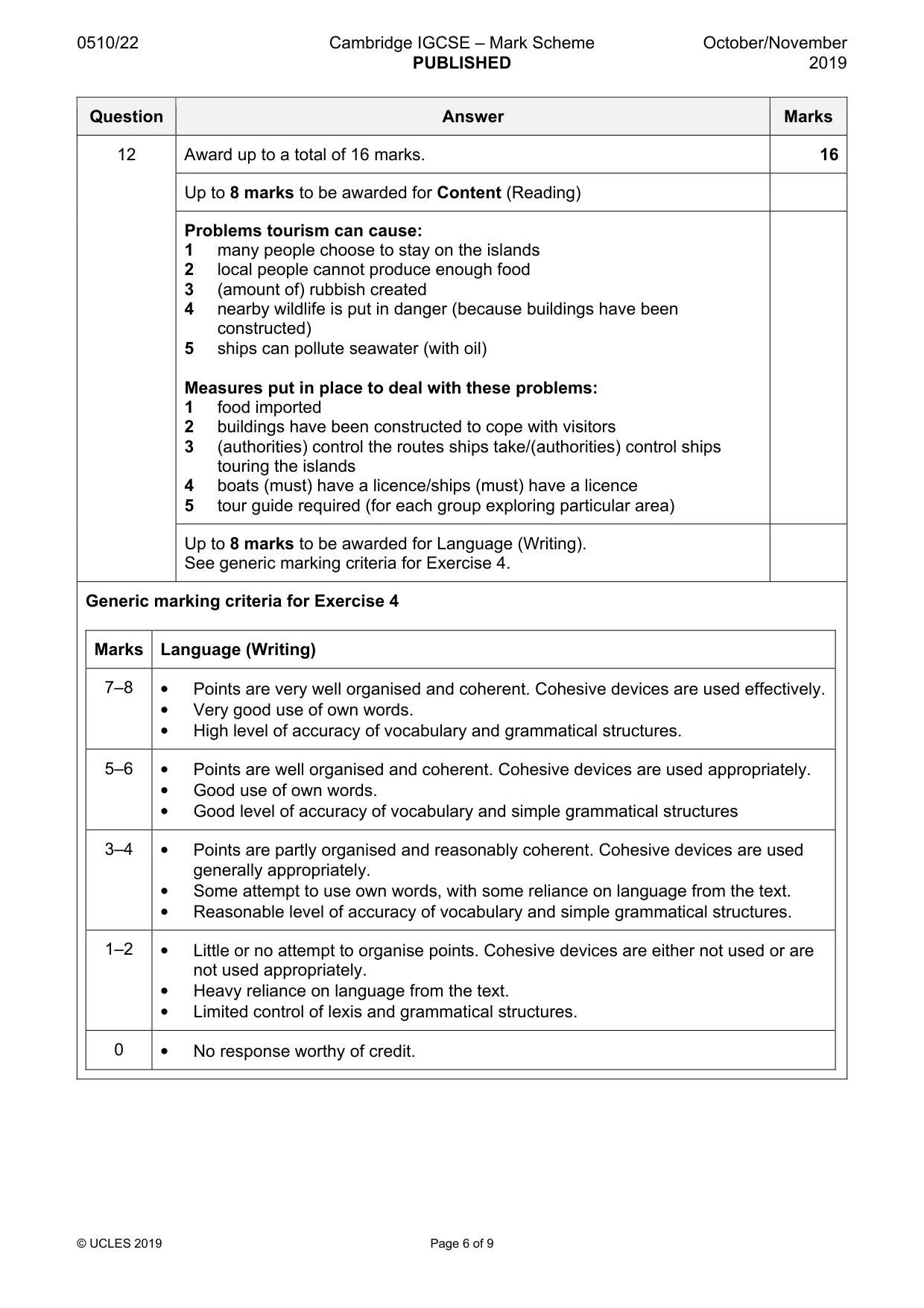
0510/22 Cambridge IGCSE – Mark Scheme PUBLISHED October/November 2019 © UCLES 2019 Page 6 of 9 Question Answer Marks 12 Award up to a total of 16 marks. 16 Up to 8 marks to be awarded for Content (Reading) Problems tourism can cause: 1 many people choose to stay on the islands 2 local people cannot produce enough food 3 (amount of) rubbish created 4 nearby wildlife is put in danger (because buildings have been constructed) 5 ships can pollute seawater (with oil) Measures put in place to deal with these problems: 1 food imported 2 buildings have been constructed to cope with visitors 3 (authorities) control the routes ships take/(authorities) control ships touring the islands 4 boats (must) have a licence/ships (must) have a licence 5 tour guide required (for each group exploring particular area) Up to 8 marks to be awarded for Language (Writing). See generic marking criteria for Exercise 4. Generic marking criteria for Exercise 4 Marks Language (Writing) 7–8 • Points are very well organised and coherent. Cohesive devices are used effectively. • Very good use of own words. • High level of accuracy of vocabulary and grammatical structures. 5–6 • Points are well organised and coherent. Cohesive devices are used appropriately. • Good use of own words. • Good level of accuracy of vocabulary and simple grammatical structures 3–4 • Points are partly organised and reasonably coherent. Cohesive devices are used generally appropriately. • Some attempt to use own words, with some reliance on language from the text. • Reasonable level of accuracy of vocabulary and simple grammatical structures. 1–2 • Little or no attempt to organise points. Cohesive devices are either not used or are not used appropriately. • Heavy reliance on language from the text. • Limited control of lexis and grammatical structures. 0 • No response worthy of credit.
Mark scheme, page 7
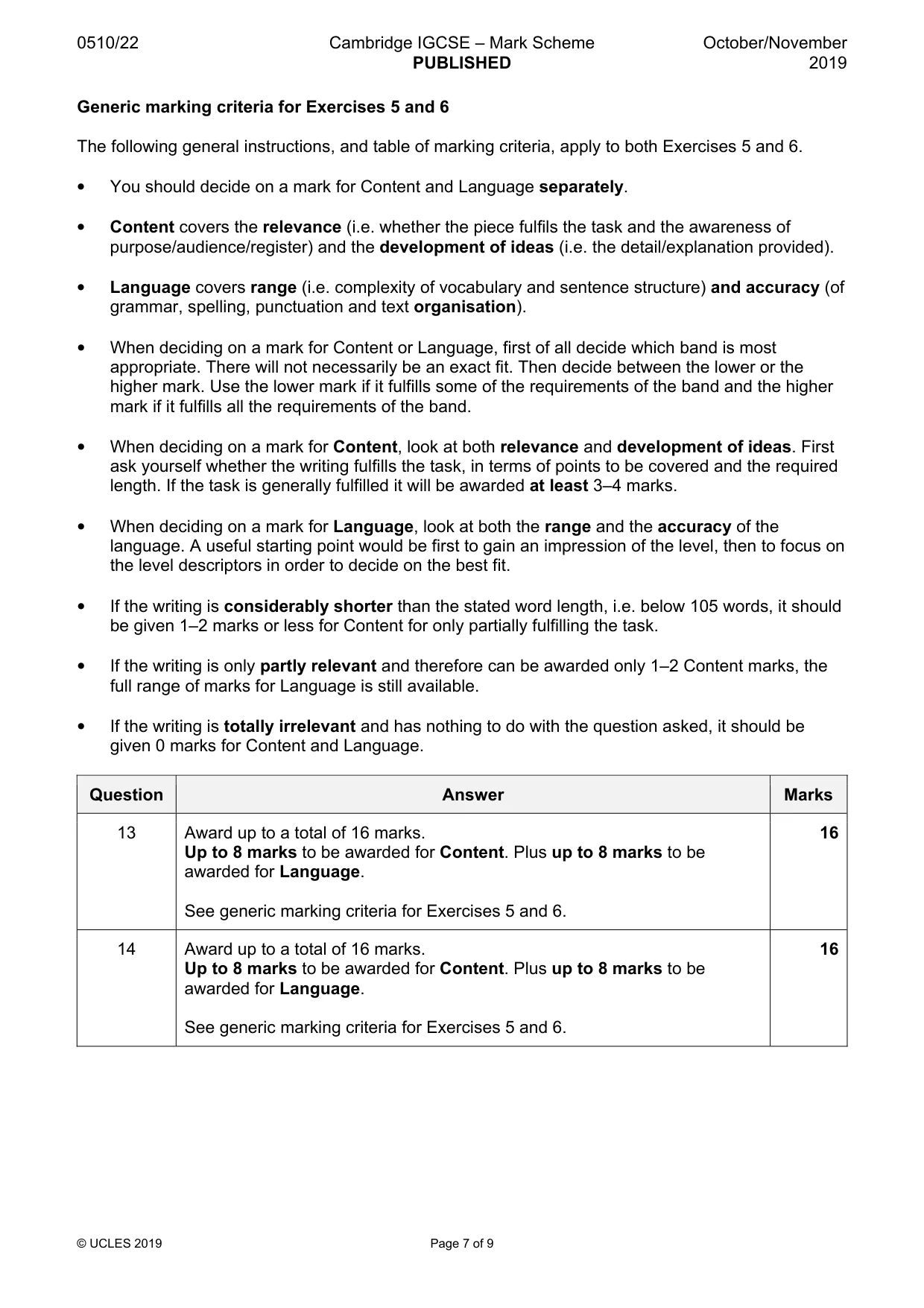
0510/22 Cambridge IGCSE – Mark Scheme PUBLISHED October/November 2019 © UCLES 2019 Page 7 of 9 Generic marking criteria for Exercises 5 and 6 The following general instructions, and table of marking criteria, apply to both Exercises 5 and 6. • You should decide on a mark for Content and Language separately. • Content covers the relevance (i.e. whether the piece fulfils the task and the awareness of purpose/audience/register) and the development of ideas (i.e. the detail/explanation provided). • Language covers range (i.e. complexity of vocabulary and sentence structure) and accuracy (of grammar, spelling, punctuation and text organisation). • When deciding on a mark for Content or Language, first of all decide which band is most appropriate. There will not necessarily be an exact fit. Then decide between the lower or the higher mark. Use the lower mark if it fulfills some of the requirements of the band and the higher mark if it fulfills all the requirements of the band. • When deciding on a mark for Content, look at both relevance and development of ideas. First ask yourself whether the writing fulfills the task, in terms of points to be covered and the required length. If the task is generally fulfilled it will be awarded at least 3–4 marks. • When deciding on a mark for Language, look at both the range and the accuracy of the language. A useful starting point would be first to gain an impression of the level, then to focus on the level descriptors in order to decide on the best fit. • If the writing is considerably shorter than the stated word length, i.e. below 105 words, it should be given 1–2 marks or less for Content for only partially fulfilling the task. • If the writing is only partly relevant and therefore can be awarded only 1–2 Content marks, the full range of marks for Language is still available. • If the writing is totally irrelevant and has nothing to do with the question asked, it should be given 0 marks for Content and Language. Question Answer Marks 13 Award up to a total of 16 marks. Up to 8 marks to be awarded for Content. Plus up to 8 marks to be awarded for Language. See generic marking criteria for Exercises 5 and 6. 16 14 Award up to a total of 16 marks. Up to 8 marks to be awarded for Content. Plus up to 8 marks to be awarded for Language. See generic marking criteria for Exercises 5 and 6. 16
Mark scheme, page 8
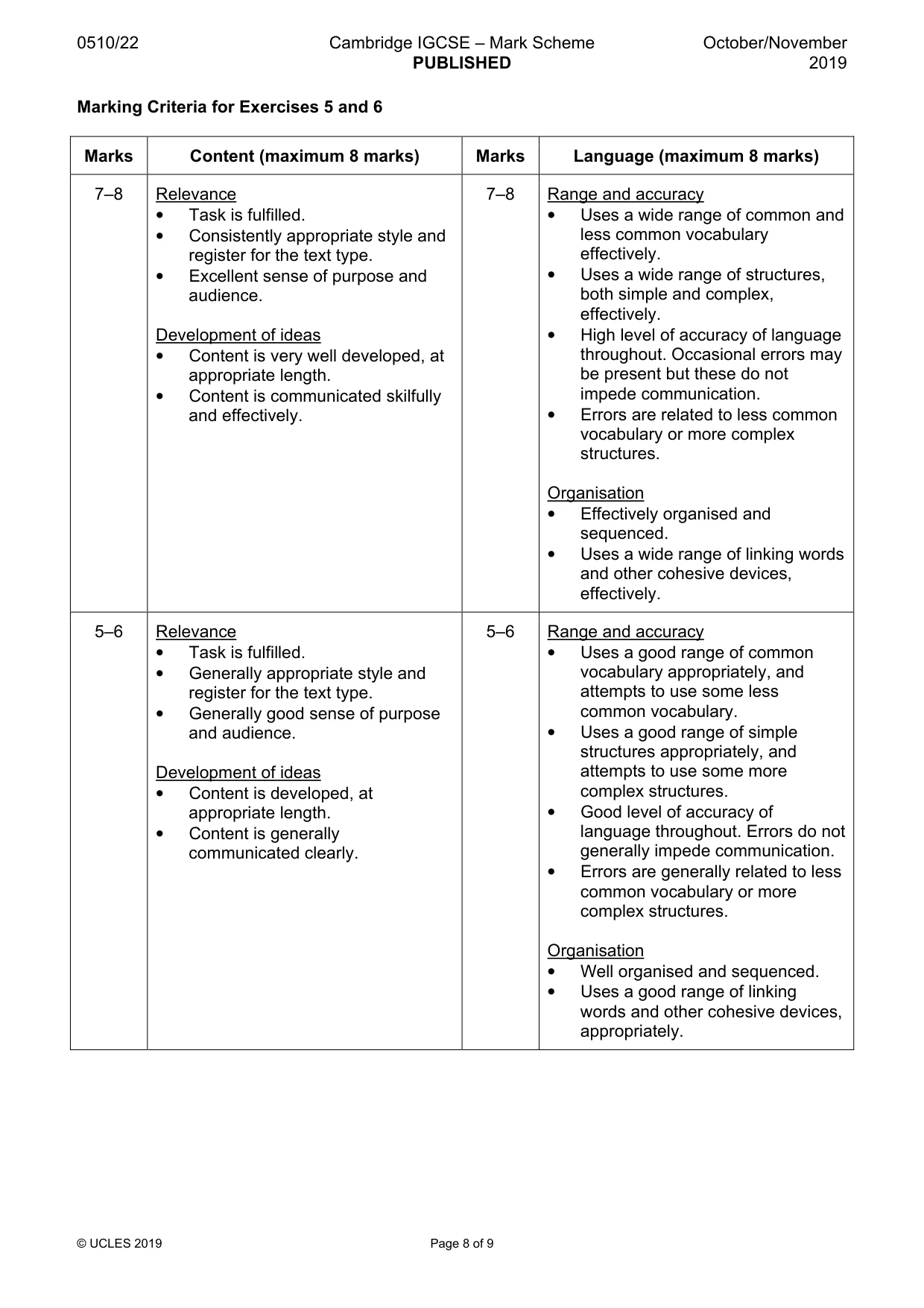
0510/22 Cambridge IGCSE – Mark Scheme PUBLISHED October/November 2019 © UCLES 2019 Page 8 of 9 Marking Criteria for Exercises 5 and 6 Marks Content (maximum 8 marks) Marks Language (maximum 8 marks) 7–8 Relevance • Task is fulfilled. • Consistently appropriate style and register for the text type. • Excellent sense of purpose and audience. Development of ideas • Content is very well developed, at appropriate length. • Content is communicated skilfully and effectively. 7–8 Range and accuracy • Uses a wide range of common and less common vocabulary effectively. • Uses a wide range of structures, both simple and complex, effectively. • High level of accuracy of language throughout. Occasional errors may be present but these do not impede communication. • Errors are related to less common vocabulary or more complex structures. Organisation • Effectively organised and sequenced. • Uses a wide range of linking words and other cohesive devices, effectively. 5–6 Relevance • Task is fulfilled. • Generally appropriate style and register for the text type. • Generally good sense of purpose and audience. Development of ideas • Content is developed, at appropriate length. • Content is generally communicated clearly. 5–6 Range and accuracy • Uses a good range of common vocabulary appropriately, and attempts to use some less common vocabulary. • Uses a good range of simple structures appropriately, and attempts to use some more complex structures. • Good level of accuracy of language throughout. Errors do not generally impede communication. • Errors are generally related to less common vocabulary or more complex structures. Organisation • Well organised and sequenced. • Uses a good range of linking words and other cohesive devices, appropriately.
Mark scheme, page 9
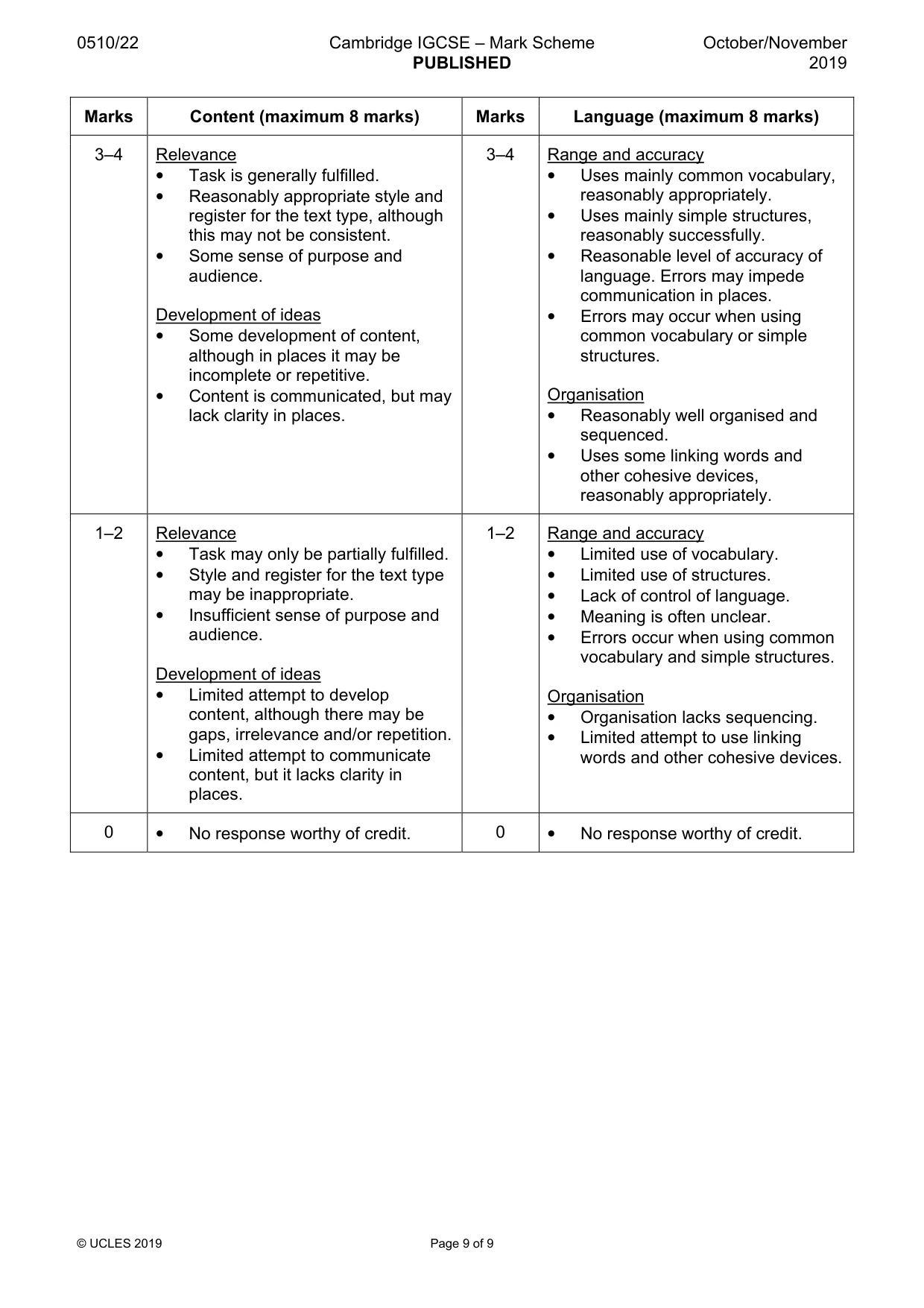
0510/22 Cambridge IGCSE – Mark Scheme PUBLISHED October/November 2019 © UCLES 2019 Page 9 of 9 Marks Content (maximum 8 marks) Marks Language (maximum 8 marks) 3–4 Relevance • Task is generally fulfilled. • Reasonably appropriate style and register for the text type, although this may not be consistent. • Some sense of purpose and audience. Development of ideas • Some development of content, although in places it may be incomplete or repetitive. • Content is communicated, but may lack clarity in places. 3–4 Range and accuracy • Uses mainly common vocabulary, reasonably appropriately. • Uses mainly simple structures, reasonably successfully. • Reasonable level of accuracy of language. Errors may impede communication in places. • Errors may occur when using common vocabulary or simple structures. Organisation • Reasonably well organised and sequenced. • Uses some linking words and other cohesive devices, reasonably appropriately. 1–2 Relevance • Task may only be partially fulfilled. • Style and register for the text type may be inappropriate. • Insufficient sense of purpose and audience. Development of ideas • Limited attempt to develop content, although there may be gaps, irrelevance and/or repetition. • Limited attempt to communicate content, but it lacks clarity in places. 1–2 Range and accuracy • Limited use of vocabulary. • Limited use of structures. • Lack of control of language. • Meaning is often unclear. • Errors occur when using common vocabulary and simple structures. Organisation • Organisation lacks sequencing. • Limited attempt to use linking words and other cohesive devices. 0 • No response worthy of credit. 0 • No response worthy of credit.
What you needed in this session
Cambridge’s own grade thresholds for 2019 Oct/Nov, Paper 2 · Variant 2. A higher threshold means an easier paper — the bar moves with how the cohort did.