Cambridge IGCSE English - Second Language (oral endorsement) 0510 — 2019 Oct/Nov Paper 1 · Variant 3
0510/13/O/N/19 · 60 marks · ≈68 min
The question paper and its mark scheme, free to read here and free to download. This is Cambridge’s own paper, exactly as it was sat.
Question paper16 pages






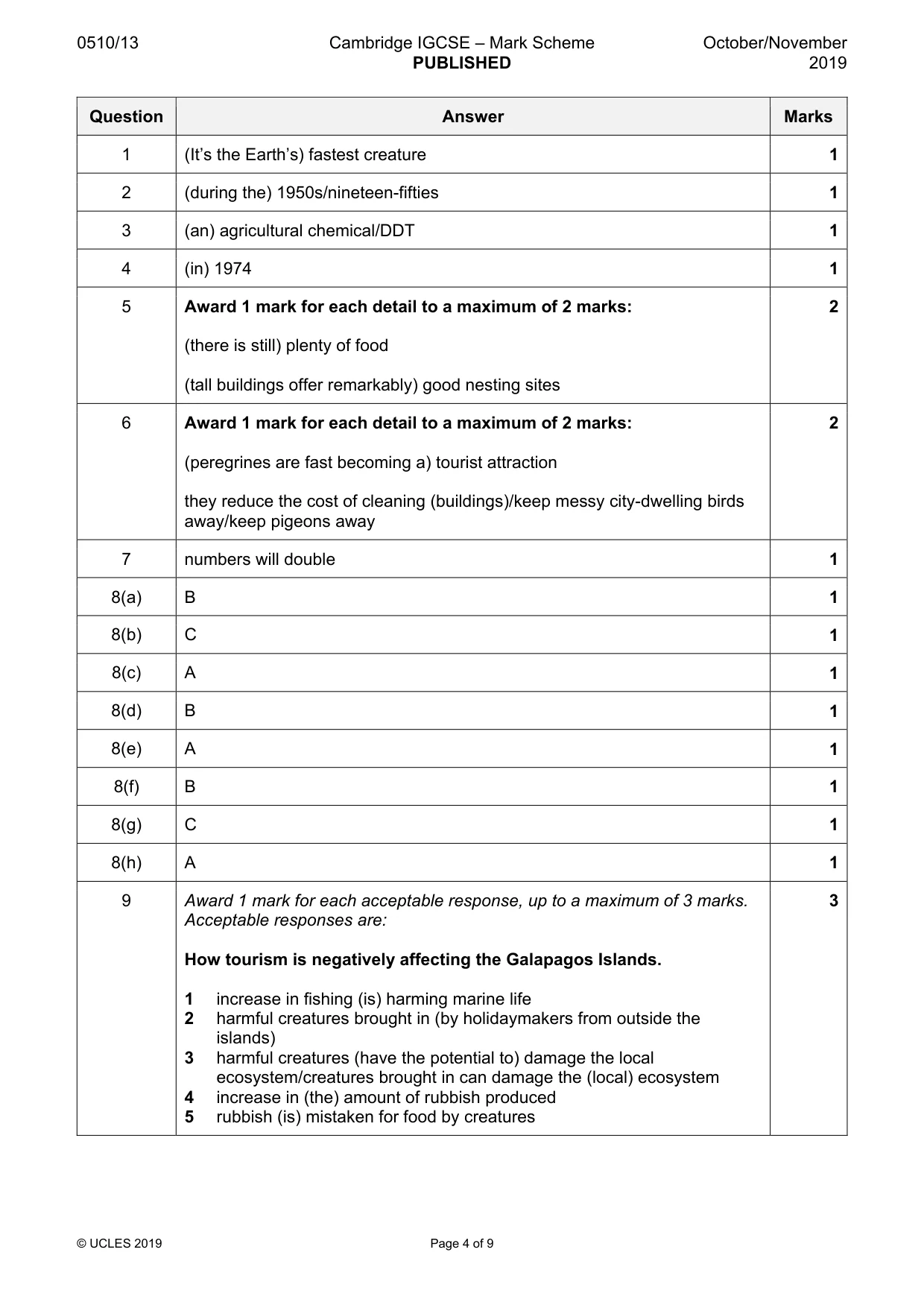
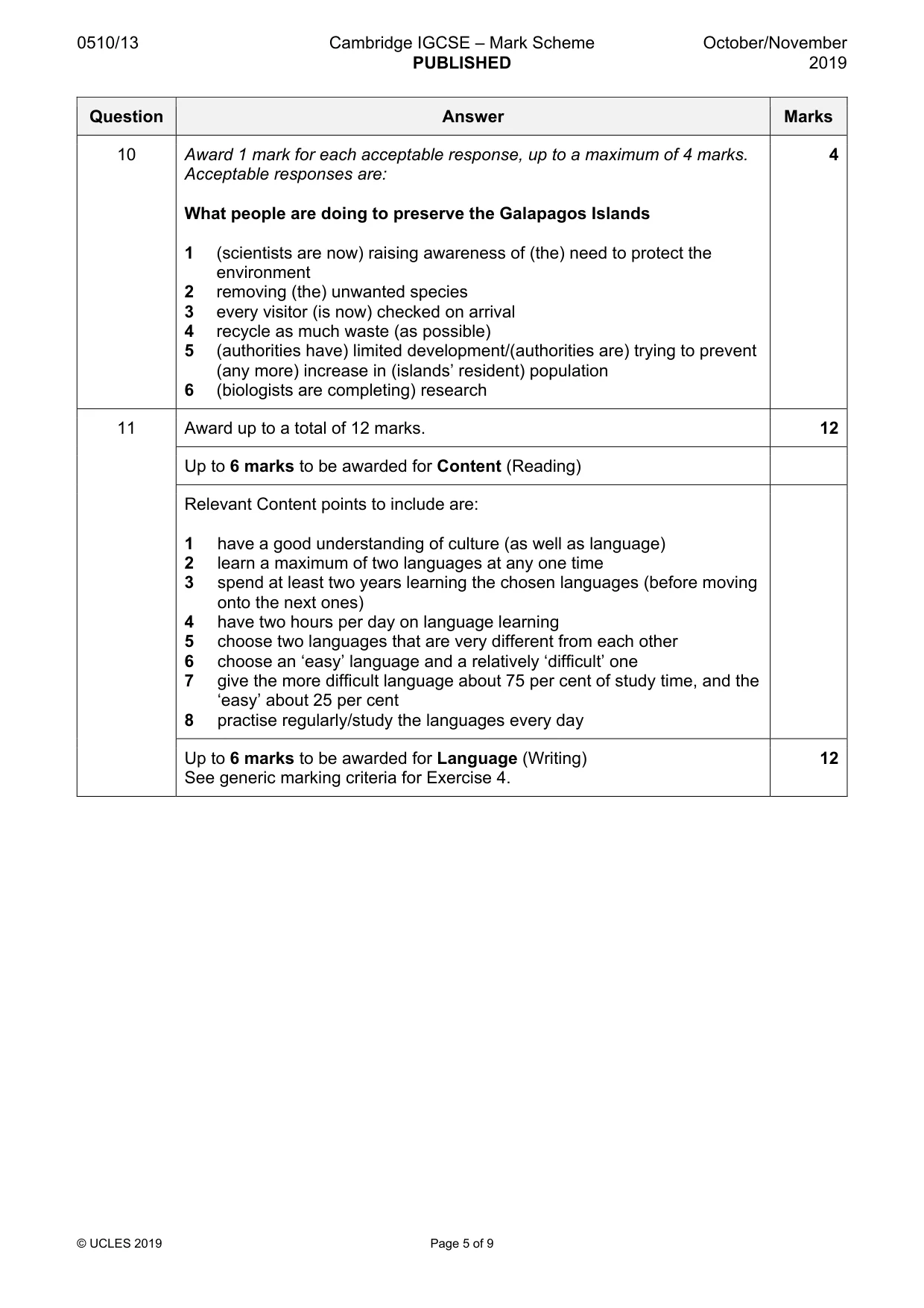
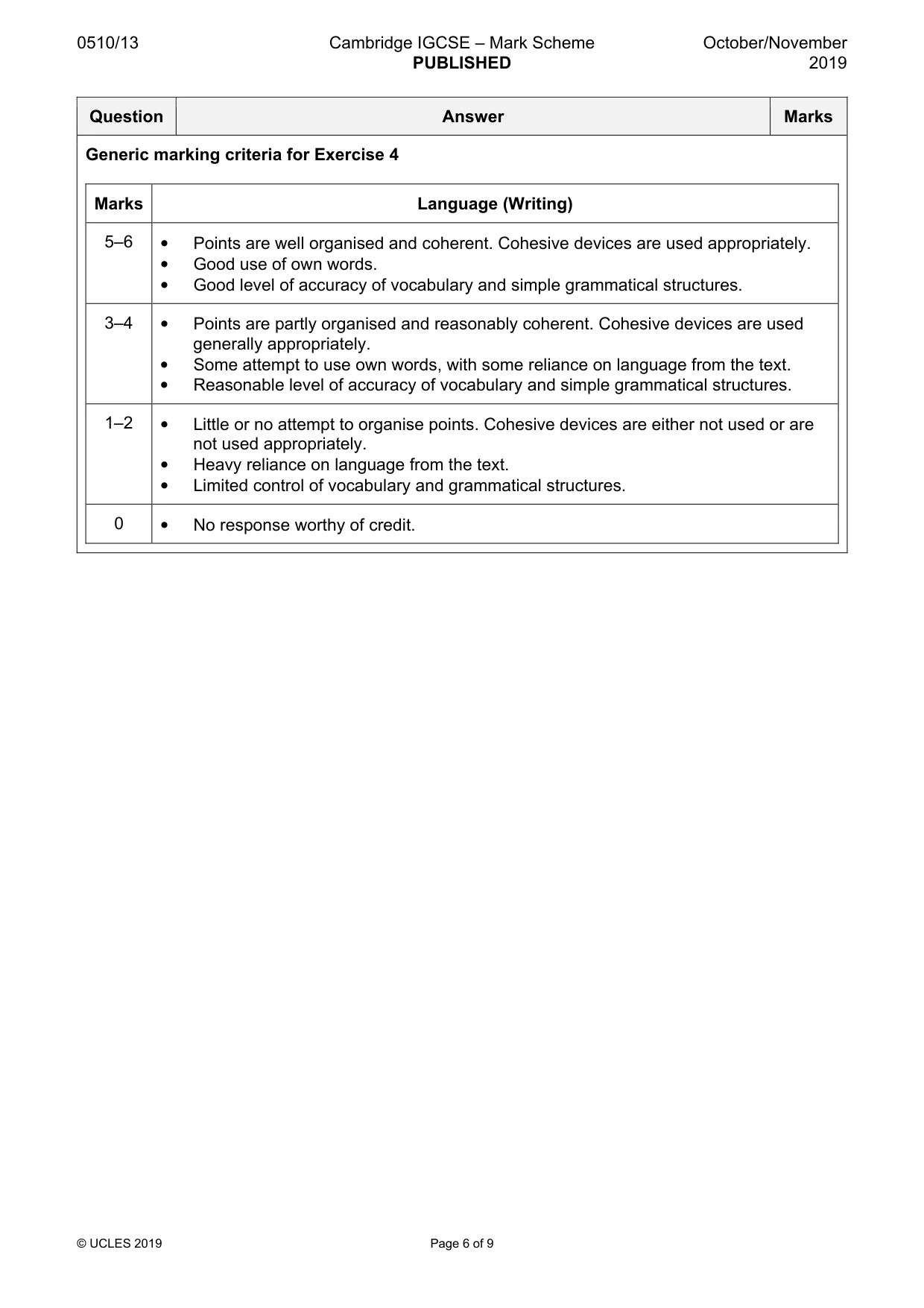
Mark scheme9 pages
Answers below. Sit the paper first if you are practising.
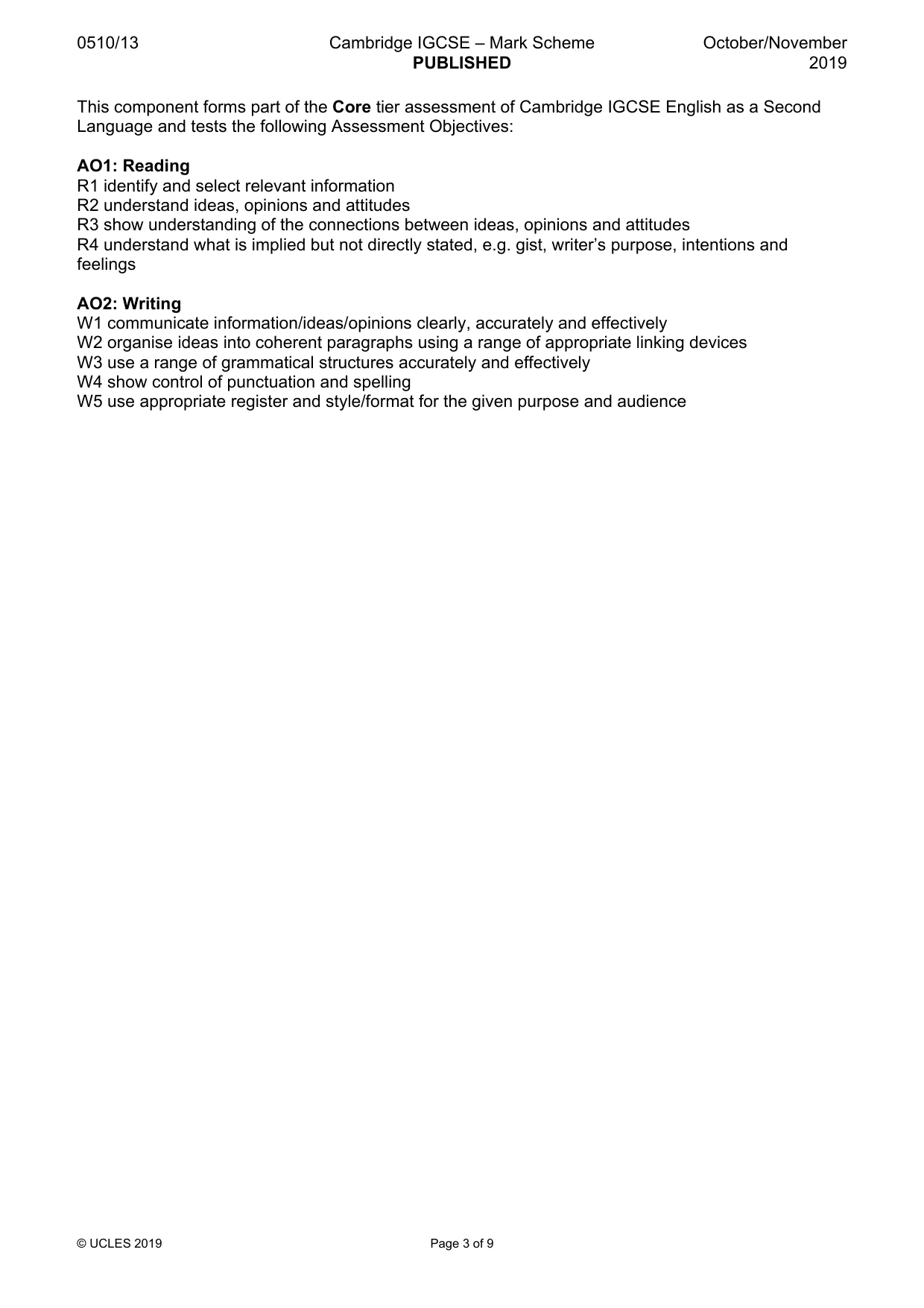
Paper as text
Question paper, page 1
* 6 4 3 3 1 7 7 1 2 5 * Cambridge Assessment International Education Cambridge International General Certificate of Secondary Education This document consists of 13 printed pages and 3 blank pages. DC (NF/CB) 166447/3 © UCLES 2019 [Turn over ENGLISH AS A SECOND LANGUAGE 0510/13 Paper 1 Reading and Writing (Core) October/November 2019 1 hour 30 minutes Candidates answer on the Question Paper. No Additional Materials are required. READ THESE INSTRUCTIONS FIRST Write your centre number, candidate number and name on all the work you hand in. Write in dark blue or black pen. Do not use staples, paper clips, glue or correction fluid. DO NOT WRITE IN ANY BARCODES. Answer all questions. Dictionaries are not allowed. At the end of the examination, fasten all your work securely together. The number of marks is given in brackets [ ] at the end of each question or part question.
Question paper, page 2
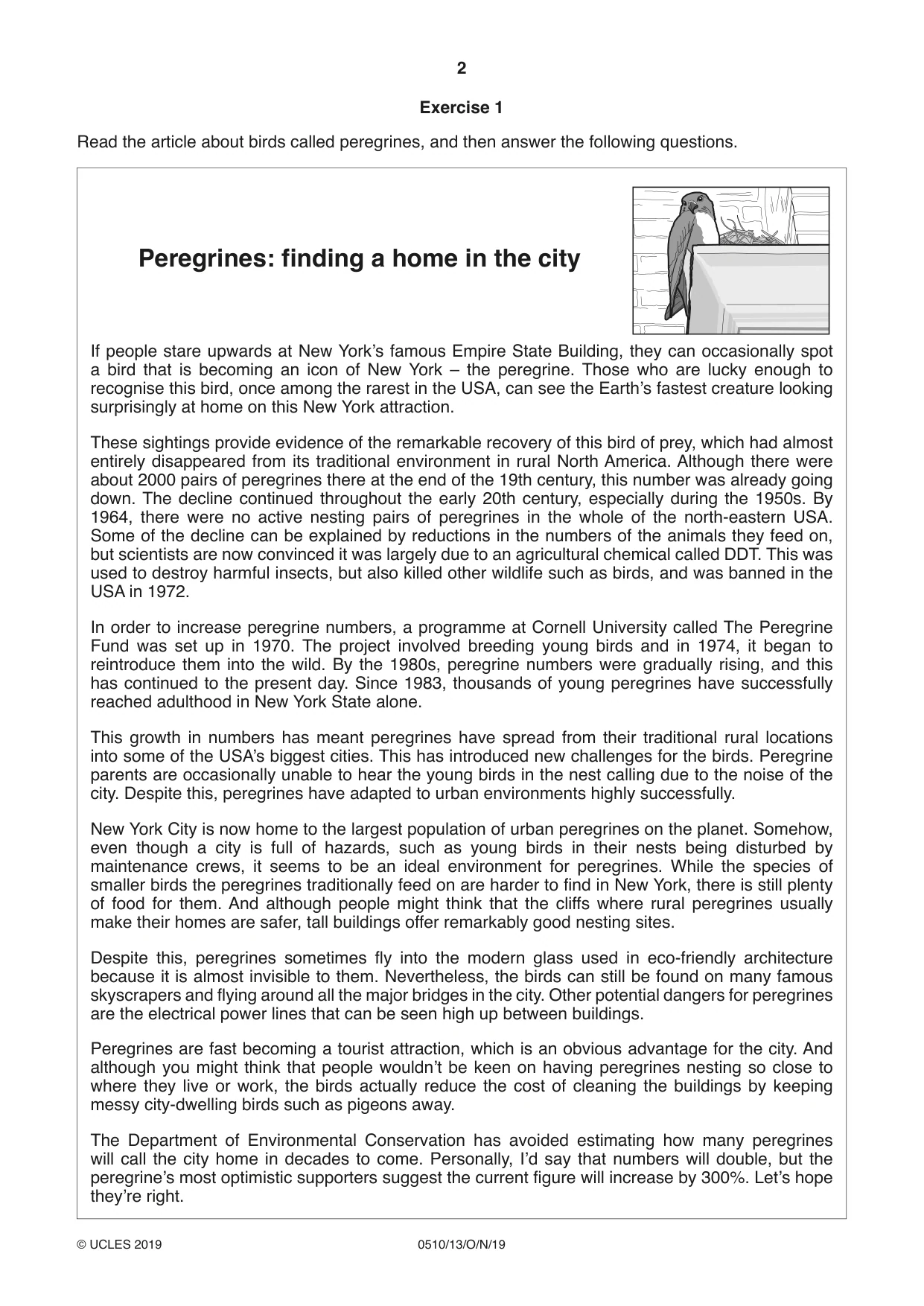
2 0510/13/O/N/19 © UCLES 2019 Exercise 1 Read the article about birds called peregrines, and then answer the following questions. Peregrines: finding a home in the city If people stare upwards at New York’s famous Empire State Building, they can occasionally spot a bird that is becoming an icon of New York – the peregrine. Those who are lucky enough to recognise this bird, once among the rarest in the USA, can see the Earth’s fastest creature looking surprisingly at home on this New York attraction. These sightings provide evidence of the remarkable recovery of this bird of prey, which had almost entirely disappeared from its traditional environment in rural North America. Although there were about 2000 pairs of peregrines there at the end of the 19th century, this number was already going down. The decline continued throughout the early 20th century, especially during the 1950s. By 1964, there were no active nesting pairs of peregrines in the whole of the north-eastern USA. Some of the decline can be explained by reductions in the numbers of the animals they feed on, but scientists are now convinced it was largely due to an agricultural chemical called DDT. This was used to destroy harmful insects, but also killed other wildlife such as birds, and was banned in the USA in 1972. In order to increase peregrine numbers, a programme at Cornell University called The Peregrine Fund was set up in 1970. The project involved breeding young birds and in 1974, it began to reintroduce them into the wild. By the 1980s, peregrine numbers were gradually rising, and this has continued to the present day. Since 1983, thousands of young peregrines have successfully reached adulthood in New York State alone. This growth in numbers has meant peregrines have spread from their traditional rural locations into some of the USA’s biggest cities. This has introduced new challenges for the birds. Peregrine parents are occasionally unable to hear the young birds in the nest calling due to the noise of the city. Despite this, peregrines have adapted to urban environments highly successfully. New York City is now home to the largest population of urban peregrines on the planet. Somehow, even though a city is full of hazards, such as young birds in their nests being disturbed by maintenance crews, it seems to be an ideal environment for peregrines. While the species of smaller birds the peregrines traditionally feed on are harder to find in New York, there is still plenty of food for them. And although people might think that the cliffs where rural peregrines usually make their homes are safer, tall buildings offer remarkably good nesting sites. Despite this, peregrines sometimes fly into the modern glass used in eco-friendly architecture because it is almost invisible to them. Nevertheless, the birds can still be found on many famous skyscrapers and flying around all the major bridges in the city. Other potential dangers for peregrines are the electrical power lines that can be seen high up between buildings. Peregrines are fast becoming a tourist attraction, which is an obvious advantage for the city. And although you might think that people wouldn’t be keen on having peregrines nesting so close to where they live or work, the birds actually reduce the cost of cleaning the buildings by keeping messy city-dwelling birds such as pigeons away. The Department of Environmental Conservation has avoided estimating how many peregrines will call the city home in decades to come. Personally, I’d say that numbers will double, but the peregrine’s most optimistic supporters suggest the current figure will increase by 300%. Let’s hope they’re right.
Question paper, page 3
3 0510/13/O/N/19 © UCLES 2019 [Turn over 1 Which world record do peregrines hold? … [1] 2 When did peregrine numbers decrease most quickly in the USA? … [1] 3 What was the main cause of the decrease in numbers of peregrines? … [1] 4 When did The Peregrine Fund release its first birds? … [1] 5 Why are cities good places for peregrines to live? Give two details. … … [2] 6 How does having peregrines in New York City benefit its residents? Give two details. … … [2] 7 What prediction does the writer make about peregrines living in New York City? … [1] [Total: 9]
Question paper, page 4
4 0510/13/O/N/19 © UCLES 2019 Exercise 2 Read the article about three young people (A–C) who have busy lives. Then answer Question 8(a)–(h). MANAGING BUSY LIVES Three young people share their thoughts on managing their busy lives A Azar Hakimi I think teenagers these days have so many more activities to choose from than previous generations did. My parents often had very little to do on their days off school and say that those days seemed to pass too slowly, but I never have time to feel like that and prefer it this way. It’s a similar story in the evening after school. I want to go to university, so I take my school studies seriously and I do a couple of hours of homework every day. I’m really into kickboxing too, so I have training twice a week for that. I don’t think anyone my age could survive without planning their time well – I’d certainly be lost without my weekly planner. Ideally, I’d like to get a weekend job to help pay for my future college studies. With the amount of free time I have, though, there’s more chance of me finding the money in the street than that happening! B Dylan Pope I think if you have any interests at all other than school, you’re going to be running from one thing to the next! I sometimes find it quite hard to believe how busy I am on a typical weekday. My parents reckon they had fewer opportunities when they were my age, but it’s different now. I’d much rather have too much to do than too little, but the amount of time that school work takes up each evening is getting ridiculous. I love football and cricket, and other games too, but I’ve had to limit myself to playing just one of them because I haven’t got sufficient time to do more. Some of my classmates keep detailed written planners to help them organise their weeks more effectively. I’ve always managed to be in the right place at the right time up to now, but I may well need to start writing everything down if I get any busier. C Rokia Mokama I tend to divide up my weekly activities into the things I have to do and the things I want to do, and I’m often surprised by how short the first of those lists is. The second list, though, is usually quite lengthy, so although my friends can’t quite believe it, I’m actually quite relieved to let my mum and dad decide whether I have time for hockey practice or chess club. They started doing this when I took on too many voluntary work commitments for a few months, which didn’t leave enough time for everything else. That’s changed for the better now, though. I’m hoping to be the first person in my family ever to go to university so it’s important for me to get my priorities right. It’s great to do things for other people, as I was doing with the voluntary work, but it shouldn’t be more important than seeing friends or doing well at school. It’s good to have a nice balance between work and play.
Question paper, page 5
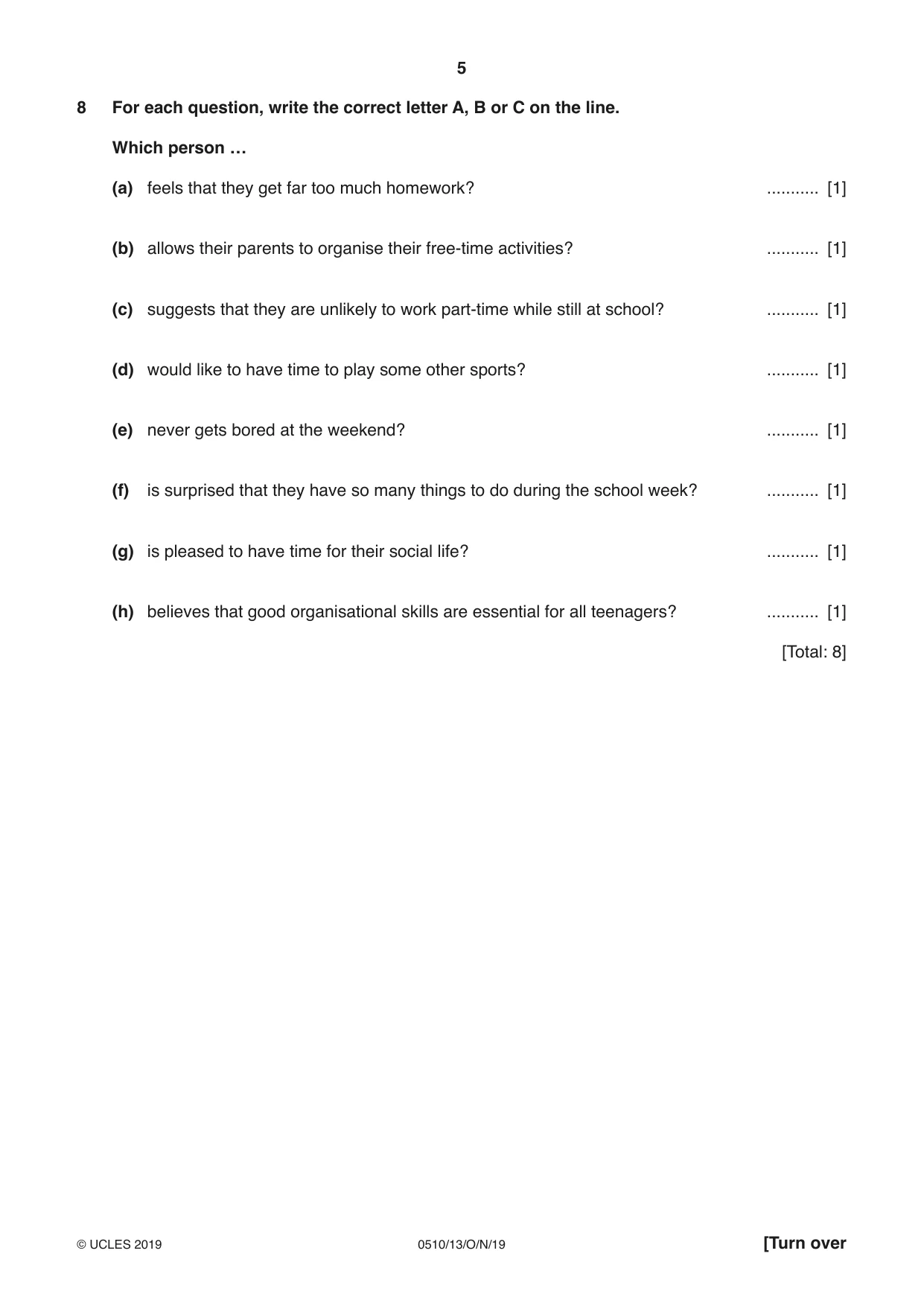
5 0510/13/O/N/19 © UCLES 2019 [Turn over 8 For each question, write the correct letter A, B or C on the line. Which person … (a) feels that they get far too much homework? … [1] (b) allows their parents to organise their free-time activities? … [1] (c) suggests that they are unlikely to work part-time while still at school? … [1] (d) would like to have time to play some other sports? … [1] (e) never gets bored at the weekend? … [1] (f) is surprised that they have so many things to do during the school week? … [1] (g) is pleased to have time for their social life? … [1] (h) believes that good organisational skills are essential for all teenagers? … [1] [Total: 8]
Question paper, page 6
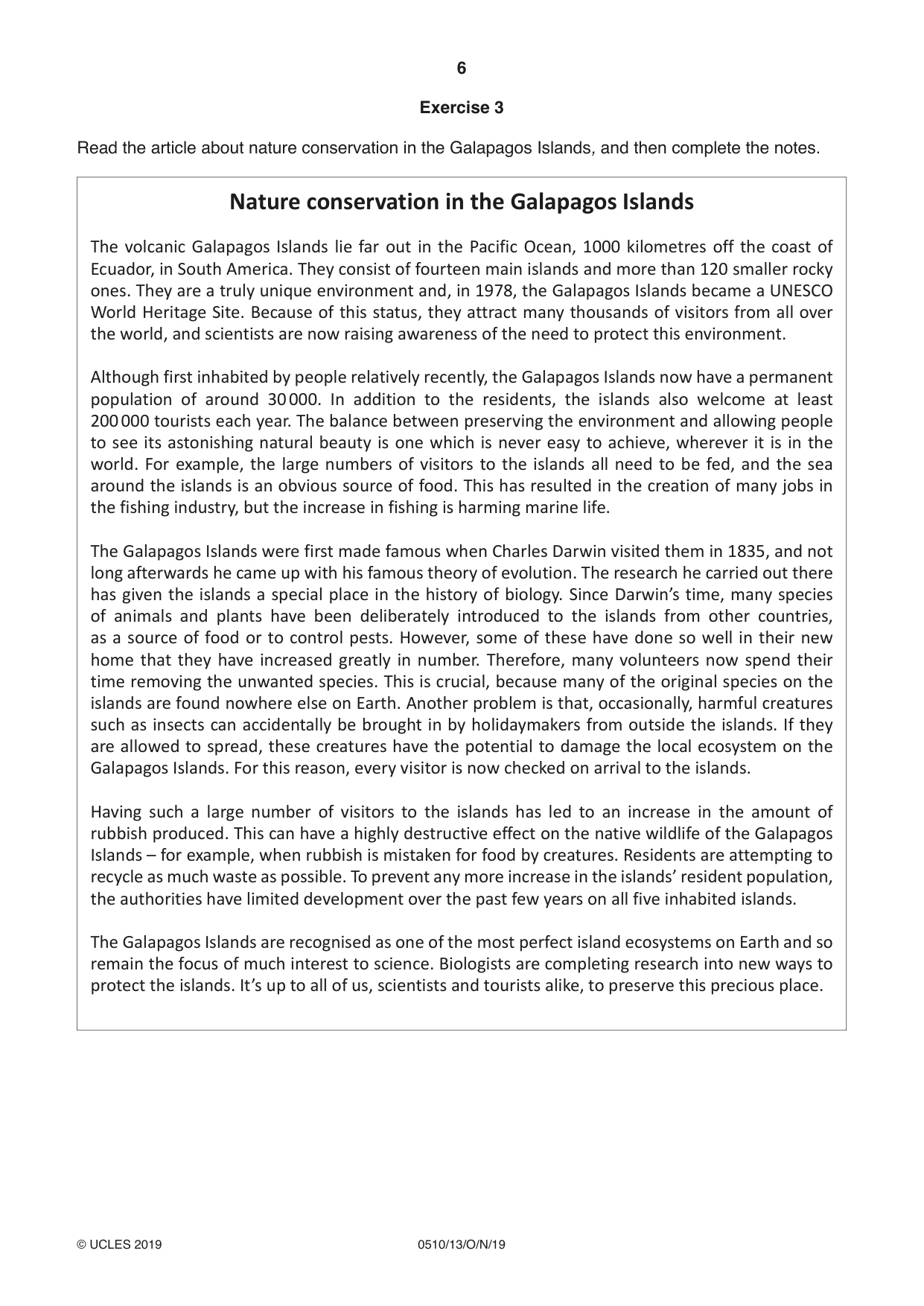
6 0510/13/O/N/19 © UCLES 2019 Exercise 3 Read the article about nature conservation in the Galapagos Islands, and then complete the notes. Nature conservation in the Galapagos Islands The volcanic Galapagos Islands lie far out in the Pacific Ocean, 1000 kilometres off the coast of Ecuador, in South America. They consist of fourteen main islands and more than 120 smaller rocky ones. They are a truly unique environment and, in 1978, the Galapagos Islands became a UNESCO World Heritage Site. Because of this status, they attract many thousands of visitors from all over the world, and scientists are now raising awareness of the need to protect this environment. Although first inhabited by people relatively recently, the Galapagos Islands now have a permanent population of around 30 000. In addition to the residents, the islands also welcome at least 200 000 tourists each year. The balance between preserving the environment and allowing people to see its astonishing natural beauty is one which is never easy to achieve, wherever it is in the world. For example, the large numbers of visitors to the islands all need to be fed, and the sea around the islands is an obvious source of food. This has resulted in the creation of many jobs in the fishing industry, but the increase in fishing is harming marine life. The Galapagos Islands were first made famous when Charles Darwin visited them in 1835, and not long afterwards he came up with his famous theory of evolution. The research he carried out there has given the islands a special place in the history of biology. Since Darwin’s time, many species of animals and plants have been deliberately introduced to the islands from other countries, as a source of food or to control pests. However, some of these have done so well in their new home that they have increased greatly in number. Therefore, many volunteers now spend their time removing the unwanted species. This is crucial, because many of the original species on the islands are found nowhere else on Earth. Another problem is that, occasionally, harmful creatures such as insects can accidentally be brought in by holidaymakers from outside the islands. If they are allowed to spread, these creatures have the potential to damage the local ecosystem on the Galapagos Islands. For this reason, every visitor is now checked on arrival to the islands. Having such a large number of visitors to the islands has led to an increase in the amount of rubbish produced. This can have a highly destructive effect on the native wildlife of the Galapagos Islands – for example, when rubbish is mistaken for food by creatures. Residents are attempting to recycle as much waste as possible. To prevent any more increase in the islands’ resident population, the authorities have limited development over the past few years on all five inhabited islands. The Galapagos Islands are recognised as one of the most perfect island ecosystems on Earth and so remain the focus of much interest to science. Biologists are completing research into new ways to protect the islands. It’s up to all of us, scientists and tourists alike, to preserve this precious place.
Question paper, page 7
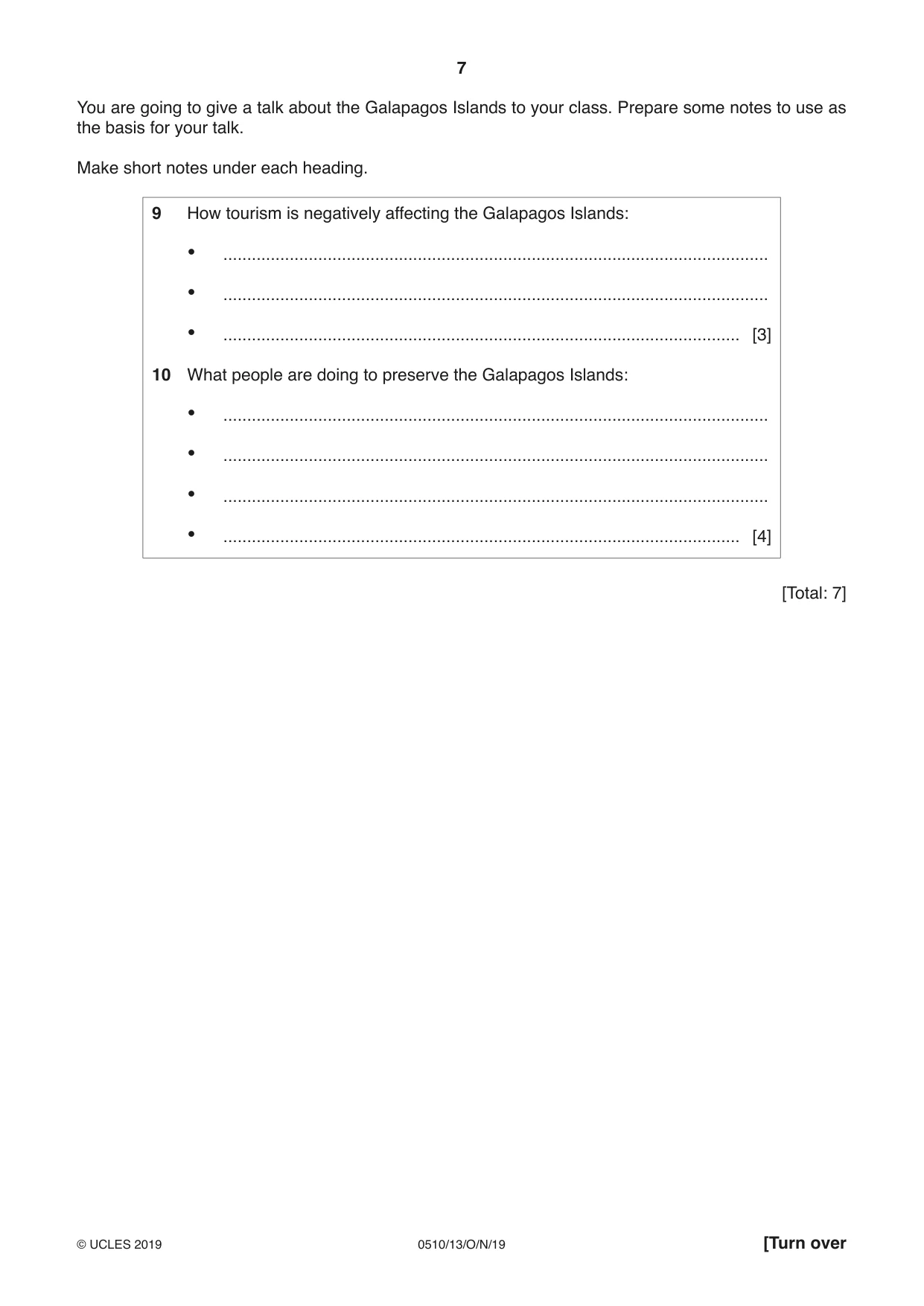
7 0510/13/O/N/19 © UCLES 2019 [Turn over You are going to give a talk about the Galapagos Islands to your class. Prepare some notes to use as the basis for your talk. Make short notes under each heading. 9 How tourism is negatively affecting the Galapagos Islands: • … • … • … [3] 10 What people are doing to preserve the Galapagos Islands: • … • … • … • … [4] [Total: 7]
Question paper, page 8
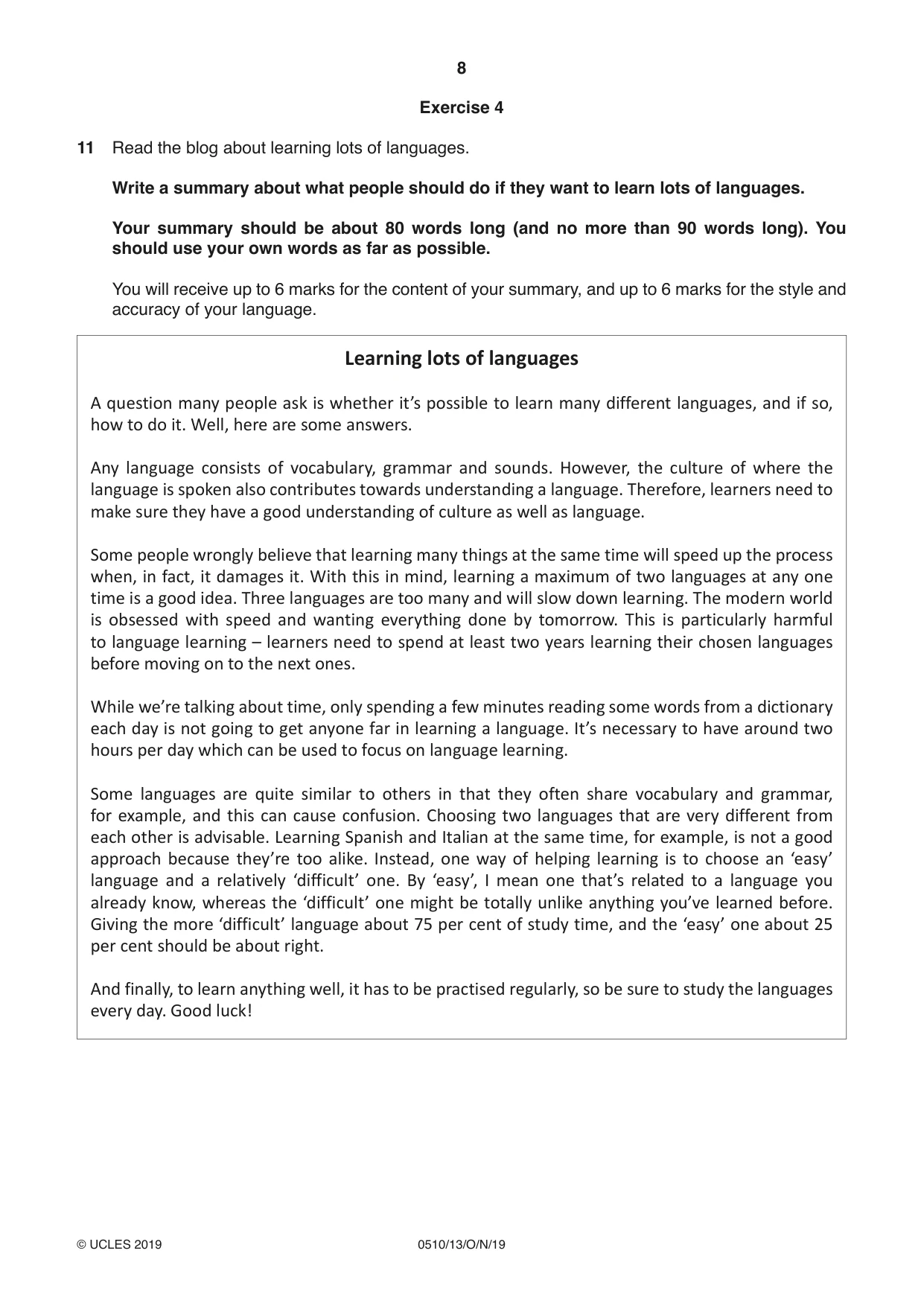
8 0510/13/O/N/19 © UCLES 2019 Exercise 4 11 Read the blog about learning lots of languages. Write a summary about what people should do if they want to learn lots of languages. Your summary should be about 80 words long (and no more than 90 words long). You should use your own words as far as possible. You will receive up to 6 marks for the content of your summary, and up to 6 marks for the style and accuracy of your language. Learning lots of languages A question many people ask is whether it’s possible to learn many different languages, and if so, how to do it. Well, here are some answers. Any language consists of vocabulary, grammar and sounds. However, the culture of where the language is spoken also contributes towards understanding a language. Therefore, learners need to make sure they have a good understanding of culture as well as language. Some people wrongly believe that learning many things at the same time will speed up the process when, in fact, it damages it. With this in mind, learning a maximum of two languages at any one time is a good idea. Three languages are too many and will slow down learning. The modern world is obsessed with speed and wanting everything done by tomorrow. This is particularly harmful to language learning – learners need to spend at least two years learning their chosen languages before moving on to the next ones. While we’re talking about time, only spending a few minutes reading some words from a dictionary each day is not going to get anyone far in learning a language. It’s necessary to have around two hours per day which can be used to focus on language learning. Some languages are quite similar to others in that they often share vocabulary and grammar, for example, and this can cause confusion. Choosing two languages that are very different from each other is advisable. Learning Spanish and Italian at the same time, for example, is not a good approach because they’re too alike. Instead, one way of helping learning is to choose an ‘easy’ language and a relatively ‘difficult’ one. By ‘easy’, I mean one that’s related to a language you already know, whereas the ‘difficult’ one might be totally unlike anything you’ve learned before. Giving the more ‘difficult’ language about 75 per cent of study time, and the ‘easy’ one about 25 per cent should be about right. And finally, to learn anything well, it has to be practised regularly, so be sure to study the languages every day. Good luck!
Question paper, page 9
9 0510/13/O/N/19 © UCLES 2019 [Turn over … … … … … … … … … … … … … … [Total: 12]
Question paper, page 10
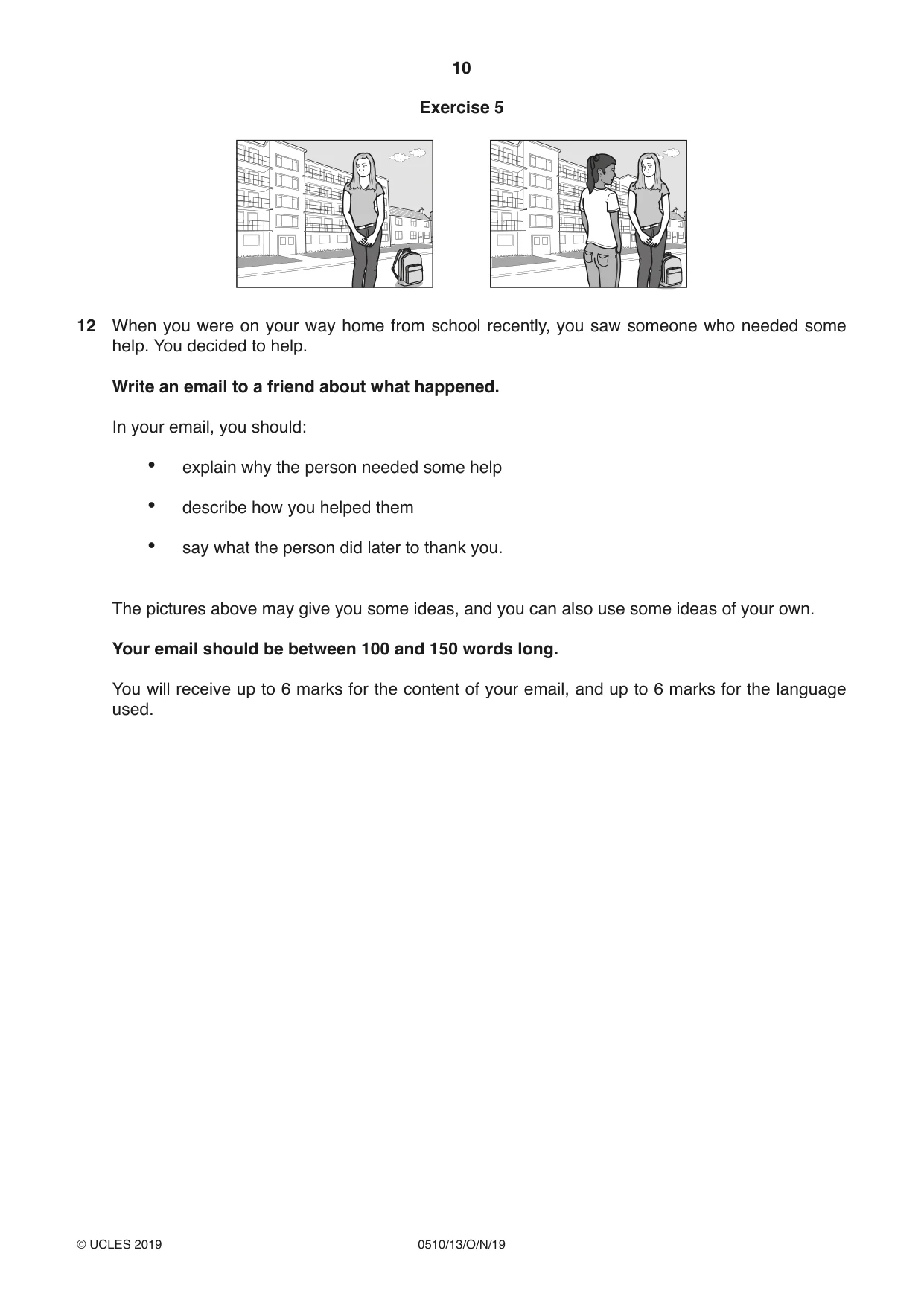
10 0510/13/O/N/19 © UCLES 2019 Exercise 5 12 When you were on your way home from school recently, you saw someone who needed some help. You decided to help. Write an email to a friend about what happened. In your email, you should: • explain why the person needed some help • describe how you helped them • say what the person did later to thank you. The pictures above may give you some ideas, and you can also use some ideas of your own. Your email should be between 100 and 150 words long. You will receive up to 6 marks for the content of your email, and up to 6 marks for the language used.
Question paper, page 11
11 0510/13/O/N/19 © UCLES 2019 [Turn over … … … … … … … … … … … … … … … … … … … … … … … … … … … [Total: 12]
Question paper, page 12
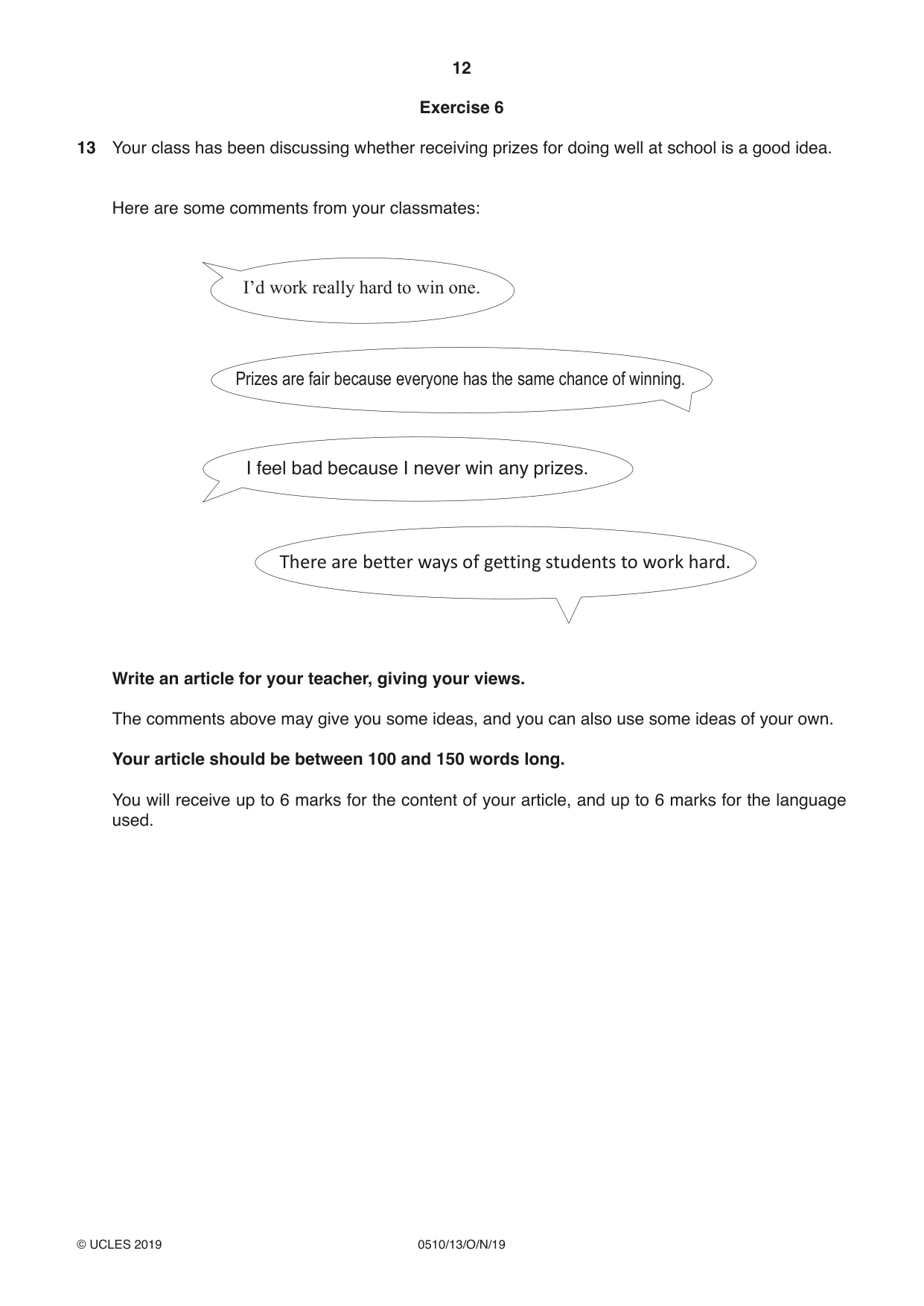
12 0510/13/O/N/19 © UCLES 2019 Exercise 6 13 Your class has been discussing whether receiving prizes for doing well at school is a good idea. Here are some comments from your classmates: I’d work really hard to win one. Prizes are fair because everyone has the same chance of winning. I feel bad because I never win any prizes. There are better ways of getting students to work hard. Write an article for your teacher, giving your views. The comments above may give you some ideas, and you can also use some ideas of your own. Your article should be between 100 and 150 words long. You will receive up to 6 marks for the content of your article, and up to 6 marks for the language used.
Question paper, page 13
13 0510/13/O/N/19 © UCLES 2019 … … … … … … … … … … … … … … … … … … … … … … … … … … … [Total: 12]
Question paper, page 14
14 0510/13/O/N/19 © UCLES 2019 BLANK PAGE
Question paper, page 15
15 0510/13/O/N/19 © UCLES 2019 BLANK PAGE
Question paper, page 16
16 0510/13/O/N/19 © UCLES 2019 Permission to reproduce items where third-party owned material protected by copyright is included has been sought and cleared where possible. Every reasonable effort has been made by the publisher (UCLES) to trace copyright holders, but if any items requiring clearance have unwittingly been included, the publisher will be pleased to make amends at the earliest possible opportunity. To avoid the issue of disclosure of answer-related information to candidates, all copyright acknowledgements are reproduced online in the Cambridge Assessment International Education Copyright Acknowledgements Booklet. This is produced for each series of examinations and is freely available to download at www.cambridgeinternational.org after the live examination series. Cambridge Assessment International Education is part of the Cambridge Assessment Group. Cambridge Assessment is the brand name of the University of Cambridge Local Examinations Syndicate (UCLES), which itself is a department of the University of Cambridge. BLANK PAGE
Mark scheme, page 1
This document consists of 9 printed pages. © UCLES 2019 [Turn over Cambridge Assessment International Education Cambridge International General Certificate of Secondary Education ENGLISH AS A SECOND LANGUAGE (SPEAKING ENDORSEMENT) 0510/13 Paper 1 Reading and Writing (Core) October/November 2019 MARK SCHEME Maximum Mark: 60 Published This mark scheme is published as an aid to teachers and candidates, to indicate the requirements of the examination. It shows the basis on which Examiners were instructed to award marks. It does not indicate the details of the discussions that took place at an Examiners’ meeting before marking began, which would have considered the acceptability of alternative answers. Mark schemes should be read in conjunction with the question paper and the Principal Examiner Report for Teachers. Cambridge International will not enter into discussions about these mark schemes. Cambridge International is publishing the mark schemes for the October/November 2019 series for most Cambridge IGCSE™, Cambridge International A and AS Level components and some Cambridge O Level components.
Mark scheme, page 2
0510/13 Cambridge IGCSE – Mark Scheme PUBLISHED October/November 2019 © UCLES 2019 Page 2 of 9 Generic Marking Principles These general marking principles must be applied by all examiners when marking candidate answers. They should be applied alongside the specific content of the mark scheme or generic level descriptors for a question. Each question paper and mark scheme will also comply with these marking principles. GENERIC MARKING PRINCIPLE 1: Marks must be awarded in line with: • the specific content of the mark scheme or the generic level descriptors for the question • the specific skills defined in the mark scheme or in the generic level descriptors for the question • the standard of response required by a candidate as exemplified by the standardisation scripts. GENERIC MARKING PRINCIPLE 2: Marks awarded are always whole marks (not half marks, or other fractions). GENERIC MARKING PRINCIPLE 3: Marks must be awarded positively: • marks are awarded for correct/valid answers, as defined in the mark scheme. However, credit is given for valid answers which go beyond the scope of the syllabus and mark scheme, referring to your Team Leader as appropriate • marks are awarded when candidates clearly demonstrate what they know and can do • marks are not deducted for errors • marks are not deducted for omissions • answers should only be judged on the quality of spelling, punctuation and grammar when these features are specifically assessed by the question as indicated by the mark scheme. The meaning, however, should be unambiguous. GENERIC MARKING PRINCIPLE 4: Rules must be applied consistently e.g. in situations where candidates have not followed instructions or in the application of generic level descriptors. GENERIC MARKING PRINCIPLE 5: Marks should be awarded using the full range of marks defined in the mark scheme for the question (however; the use of the full mark range may be limited according to the quality of the candidate responses seen). GENERIC MARKING PRINCIPLE 6: Marks awarded are based solely on the requirements as defined in the mark scheme. Marks should not be awarded with grade thresholds or grade descriptors in mind.
Mark scheme, page 3
0510/13 Cambridge IGCSE – Mark Scheme PUBLISHED October/November 2019 © UCLES 2019 Page 3 of 9 This component forms part of the Core tier assessment of Cambridge IGCSE English as a Second Language and tests the following Assessment Objectives: AO1: Reading R1 identify and select relevant information R2 understand ideas, opinions and attitudes R3 show understanding of the connections between ideas, opinions and attitudes R4 understand what is implied but not directly stated, e.g. gist, writer’s purpose, intentions and feelings AO2: Writing W1 communicate information/ideas/opinions clearly, accurately and effectively W2 organise ideas into coherent paragraphs using a range of appropriate linking devices W3 use a range of grammatical structures accurately and effectively W4 show control of punctuation and spelling W5 use appropriate register and style/format for the given purpose and audience
Mark scheme, page 4
0510/13 Cambridge IGCSE – Mark Scheme PUBLISHED October/November 2019 © UCLES 2019 Page 4 of 9 Question Answer Marks 1 (It’s the Earth’s) fastest creature 1 2 (during the) 1950s/nineteen-fifties 1 3 (an) agricultural chemical/DDT 1 4 (in) 1974 1 5 Award 1 mark for each detail to a maximum of 2 marks: (there is still) plenty of food (tall buildings offer remarkably) good nesting sites 2 6 Award 1 mark for each detail to a maximum of 2 marks: (peregrines are fast becoming a) tourist attraction they reduce the cost of cleaning (buildings)/keep messy city-dwelling birds away/keep pigeons away 2 7 numbers will double 1 8(a) B 1 8(b) C 1 8(c) A 1 8(d) B 1 8(e) A 1 8(f) B 1 8(g) C 1 8(h) A 1 9 Award 1 mark for each acceptable response, up to a maximum of 3 marks. Acceptable responses are: How tourism is negatively affecting the Galapagos Islands. 1 increase in fishing (is) harming marine life 2 harmful creatures brought in (by holidaymakers from outside the islands) 3 harmful creatures (have the potential to) damage the local ecosystem/creatures brought in can damage the (local) ecosystem 4 increase in (the) amount of rubbish produced 5 rubbish (is) mistaken for food by creatures 3
Mark scheme, page 5
0510/13 Cambridge IGCSE – Mark Scheme PUBLISHED October/November 2019 © UCLES 2019 Page 5 of 9 Question Answer Marks 10 Award 1 mark for each acceptable response, up to a maximum of 4 marks. Acceptable responses are: What people are doing to preserve the Galapagos Islands 1 (scientists are now) raising awareness of (the) need to protect the environment 2 removing (the) unwanted species 3 every visitor (is now) checked on arrival 4 recycle as much waste (as possible) 5 (authorities have) limited development/(authorities are) trying to prevent (any more) increase in (islands’ resident) population 6 (biologists are completing) research 4 11 Award up to a total of 12 marks. 12 Up to 6 marks to be awarded for Content (Reading) Relevant Content points to include are: 1 have a good understanding of culture (as well as language) 2 learn a maximum of two languages at any one time 3 spend at least two years learning the chosen languages (before moving onto the next ones) 4 have two hours per day on language learning 5 choose two languages that are very different from each other 6 choose an ‘easy’ language and a relatively ‘difficult’ one 7 give the more difficult language about 75 per cent of study time, and the ‘easy’ about 25 per cent 8 practise regularly/study the languages every day Up to 6 marks to be awarded for Language (Writing) See generic marking criteria for Exercise 4. 12
Mark scheme, page 6
0510/13 Cambridge IGCSE – Mark Scheme PUBLISHED October/November 2019 © UCLES 2019 Page 6 of 9 Question Answer Marks Generic marking criteria for Exercise 4 Marks Language (Writing) 5–6 • Points are well organised and coherent. Cohesive devices are used appropriately. • Good use of own words. • Good level of accuracy of vocabulary and simple grammatical structures. 3–4 • Points are partly organised and reasonably coherent. Cohesive devices are used generally appropriately. • Some attempt to use own words, with some reliance on language from the text. • Reasonable level of accuracy of vocabulary and simple grammatical structures. 1–2 • Little or no attempt to organise points. Cohesive devices are either not used or are not used appropriately. • Heavy reliance on language from the text. • Limited control of vocabulary and grammatical structures. 0 • No response worthy of credit.
Mark scheme, page 7
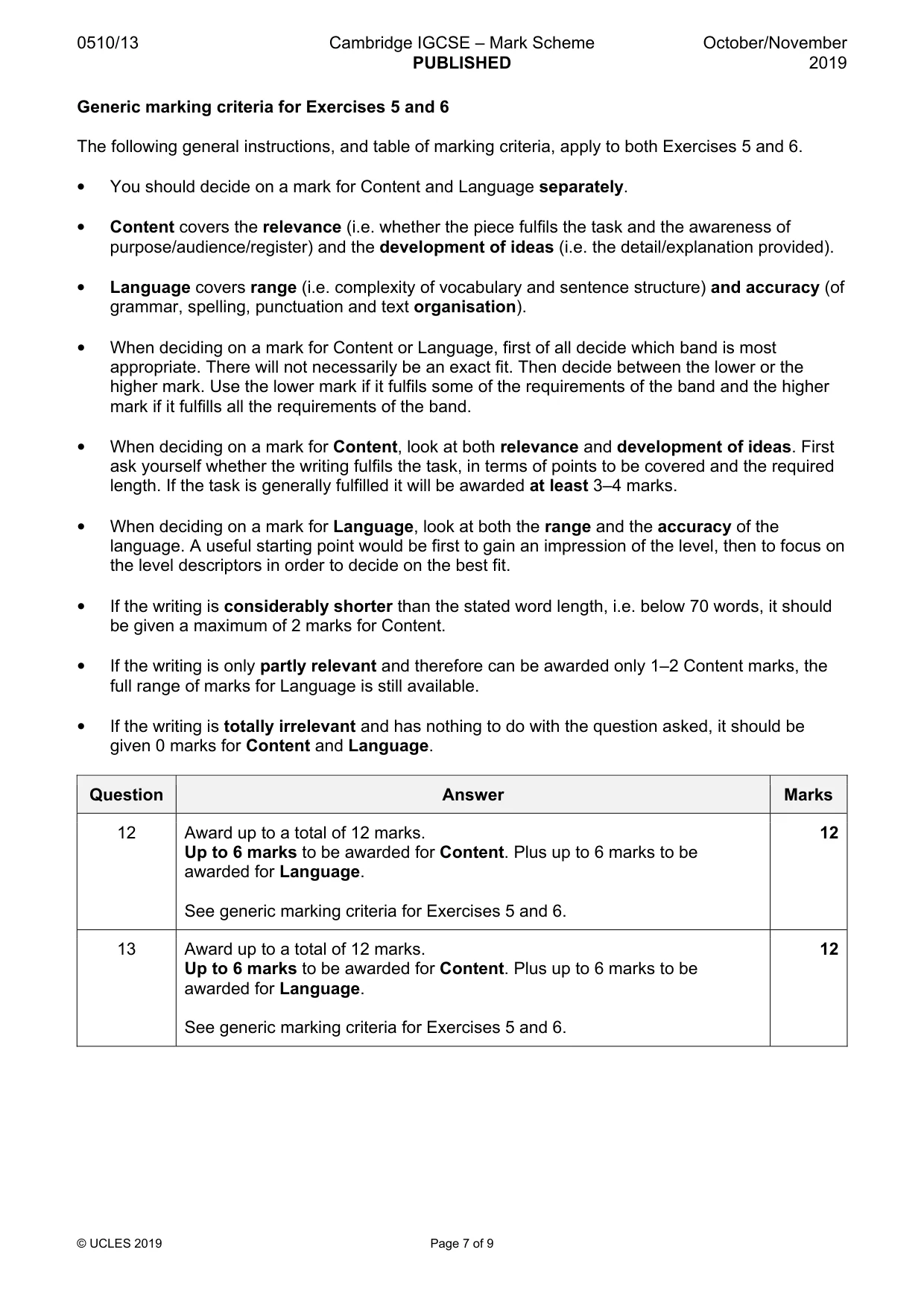
0510/13 Cambridge IGCSE – Mark Scheme PUBLISHED October/November 2019 © UCLES 2019 Page 7 of 9 Generic marking criteria for Exercises 5 and 6 The following general instructions, and table of marking criteria, apply to both Exercises 5 and 6. • You should decide on a mark for Content and Language separately. • Content covers the relevance (i.e. whether the piece fulfils the task and the awareness of purpose/audience/register) and the development of ideas (i.e. the detail/explanation provided). • Language covers range (i.e. complexity of vocabulary and sentence structure) and accuracy (of grammar, spelling, punctuation and text organisation). • When deciding on a mark for Content or Language, first of all decide which band is most appropriate. There will not necessarily be an exact fit. Then decide between the lower or the higher mark. Use the lower mark if it fulfils some of the requirements of the band and the higher mark if it fulfills all the requirements of the band. • When deciding on a mark for Content, look at both relevance and development of ideas. First ask yourself whether the writing fulfils the task, in terms of points to be covered and the required length. If the task is generally fulfilled it will be awarded at least 3–4 marks. • When deciding on a mark for Language, look at both the range and the accuracy of the language. A useful starting point would be first to gain an impression of the level, then to focus on the level descriptors in order to decide on the best fit. • If the writing is considerably shorter than the stated word length, i.e. below 70 words, it should be given a maximum of 2 marks for Content. • If the writing is only partly relevant and therefore can be awarded only 1–2 Content marks, the full range of marks for Language is still available. • If the writing is totally irrelevant and has nothing to do with the question asked, it should be given 0 marks for Content and Language. Question Answer Marks 12 Award up to a total of 12 marks. Up to 6 marks to be awarded for Content. Plus up to 6 marks to be awarded for Language. See generic marking criteria for Exercises 5 and 6. 12 13 Award up to a total of 12 marks. Up to 6 marks to be awarded for Content. Plus up to 6 marks to be awarded for Language. See generic marking criteria for Exercises 5 and 6. 12
Mark scheme, page 8
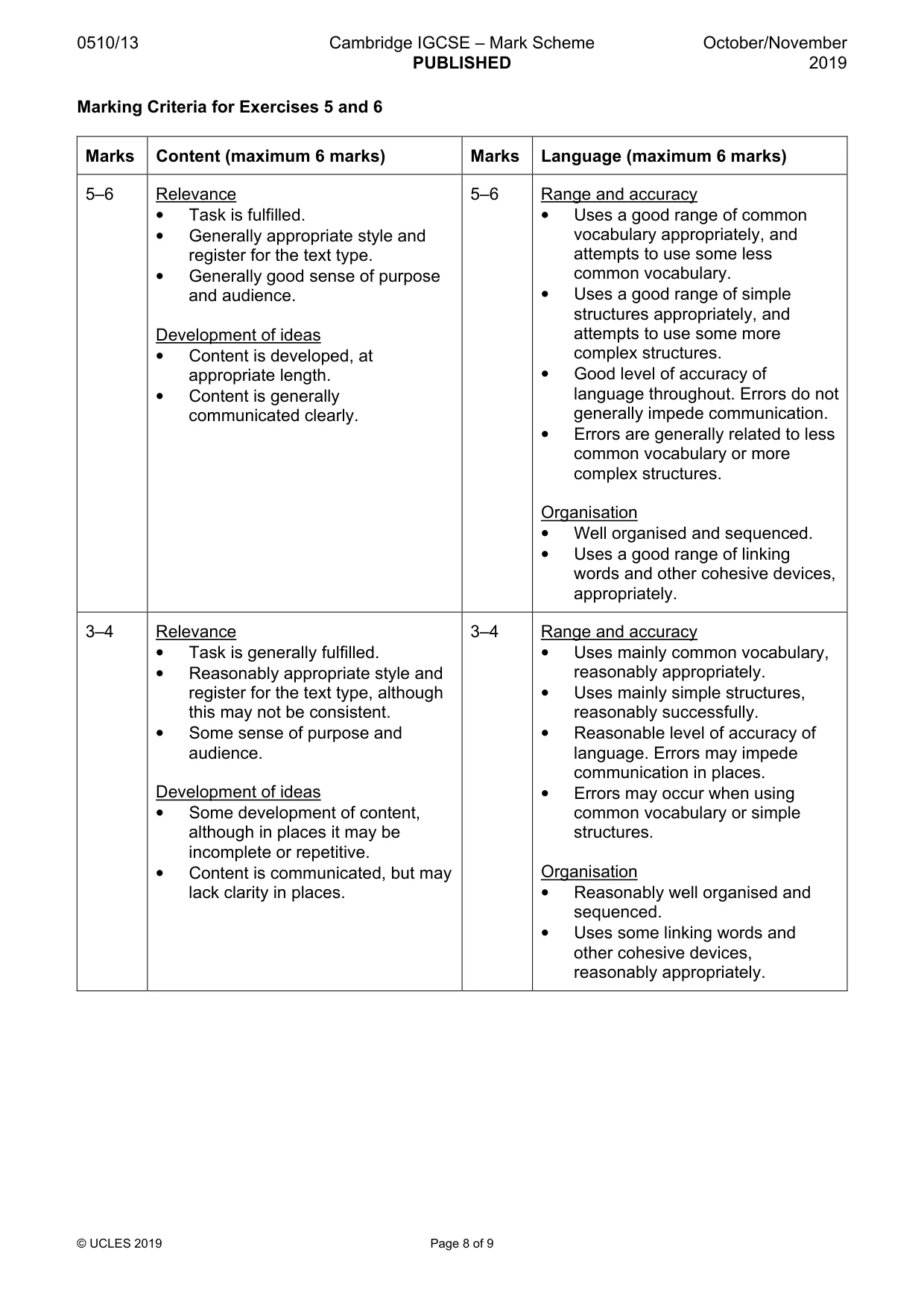
0510/13 Cambridge IGCSE – Mark Scheme PUBLISHED October/November 2019 © UCLES 2019 Page 8 of 9 Marking Criteria for Exercises 5 and 6 Marks Content (maximum 6 marks) Marks Language (maximum 6 marks) 5–6 Relevance • Task is fulfilled. • Generally appropriate style and register for the text type. • Generally good sense of purpose and audience. Development of ideas • Content is developed, at appropriate length. • Content is generally communicated clearly. 5–6 Range and accuracy • Uses a good range of common vocabulary appropriately, and attempts to use some less common vocabulary. • Uses a good range of simple structures appropriately, and attempts to use some more complex structures. • Good level of accuracy of language throughout. Errors do not generally impede communication. • Errors are generally related to less common vocabulary or more complex structures. Organisation • Well organised and sequenced. • Uses a good range of linking words and other cohesive devices, appropriately. 3–4 Relevance • Task is generally fulfilled. • Reasonably appropriate style and register for the text type, although this may not be consistent. • Some sense of purpose and audience. Development of ideas • Some development of content, although in places it may be incomplete or repetitive. • Content is communicated, but may lack clarity in places. 3–4 Range and accuracy • Uses mainly common vocabulary, reasonably appropriately. • Uses mainly simple structures, reasonably successfully. • Reasonable level of accuracy of language. Errors may impede communication in places. • Errors may occur when using common vocabulary or simple structures. Organisation • Reasonably well organised and sequenced. • Uses some linking words and other cohesive devices, reasonably appropriately.
Mark scheme, page 9
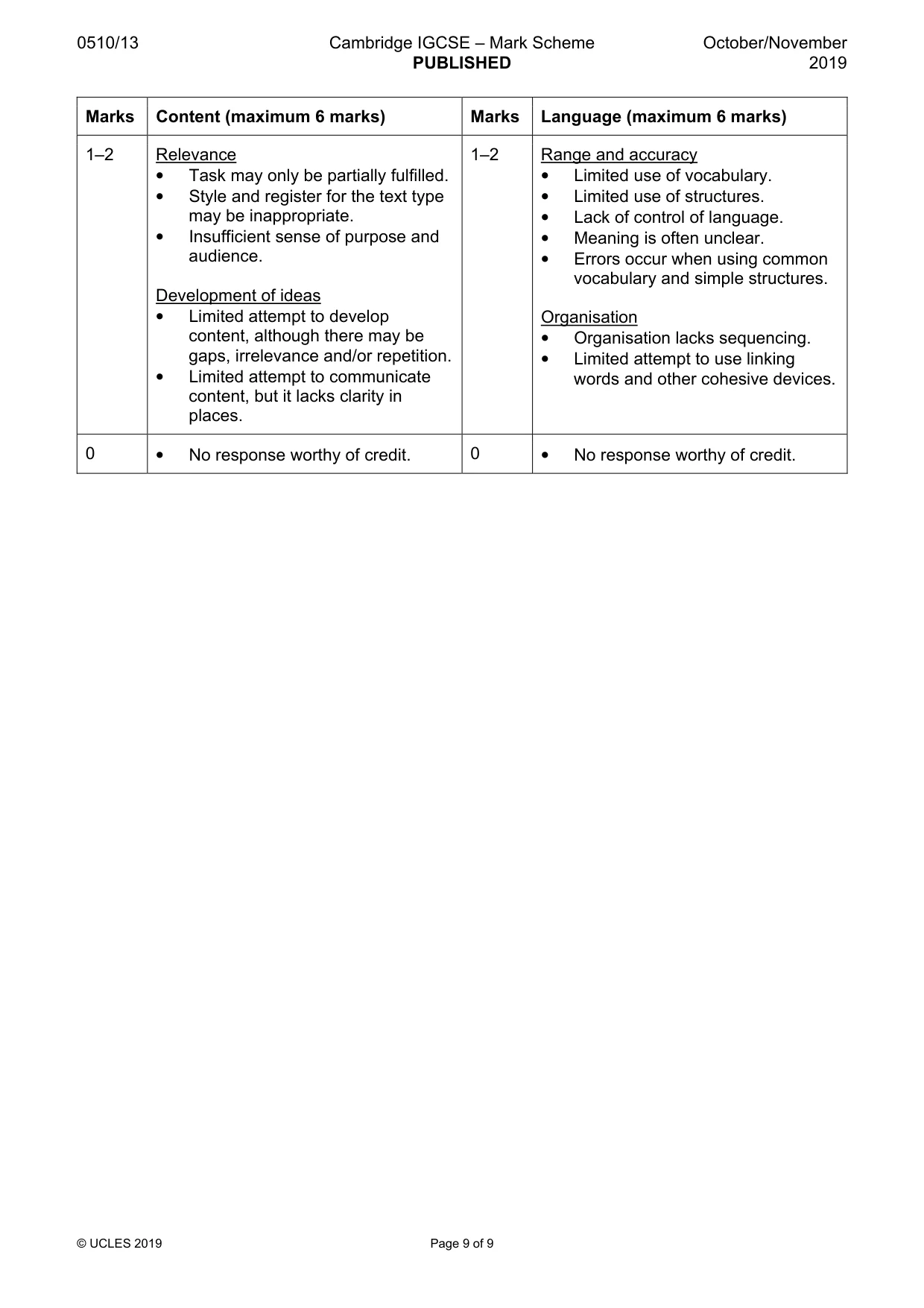
0510/13 Cambridge IGCSE – Mark Scheme PUBLISHED October/November 2019 © UCLES 2019 Page 9 of 9 Marks Content (maximum 6 marks) Marks Language (maximum 6 marks) 1–2 Relevance • Task may only be partially fulfilled. • Style and register for the text type may be inappropriate. • Insufficient sense of purpose and audience. Development of ideas • Limited attempt to develop content, although there may be gaps, irrelevance and/or repetition. • Limited attempt to communicate content, but it lacks clarity in places. 1–2 Range and accuracy • Limited use of vocabulary. • Limited use of structures. • Lack of control of language. • Meaning is often unclear. • Errors occur when using common vocabulary and simple structures. Organisation • Organisation lacks sequencing. • Limited attempt to use linking words and other cohesive devices. 0 • No response worthy of credit. 0 • No response worthy of credit.
What you needed in this session
Cambridge’s own grade thresholds for 2019 Oct/Nov, Paper 1 · Variant 3. A higher threshold means an easier paper — the bar moves with how the cohort did.