Cambridge IGCSE English - Second Language (oral endorsement) 0510 — 2019 May/June Paper 1 · Variant 2
0510/12/M/J/19 · 60 marks · ≈68 min
The question paper and its mark scheme, free to read here and free to download. This is Cambridge’s own paper, exactly as it was sat.
Question paper16 pages





Mark scheme10 pages
Answers below. Sit the paper first if you are practising.
Paper as text
Question paper, page 1
This document consists of 13 printed pages and 3 blank pages. DC (KS/TP) 165145/6 © UCLES 2019 [Turn over Cambridge Assessment International Education Cambridge International General Certificate of Secondary Education * 3 9 9 9 9 3 4 3 9 4 * ENGLISH AS A SECOND LANGUAGE 0510/12 Paper 1 Reading and Writing (Core) May/June 2019 1 hour 30 minutes Candidates answer on the Question Paper. No Additional Materials are required. READ THESE INSTRUCTIONS FIRST Write your centre number, candidate number and name on all the work you hand in. Write in dark blue or black pen. Do not use staples, paper clips, glue or correction fluid. DO NOT WRITE IN ANY BARCODES. Answer all questions. Dictionaries are not allowed. At the end of the examination, fasten all your work securely together. The number of marks is given in brackets [ ] at the end of each question or part question.
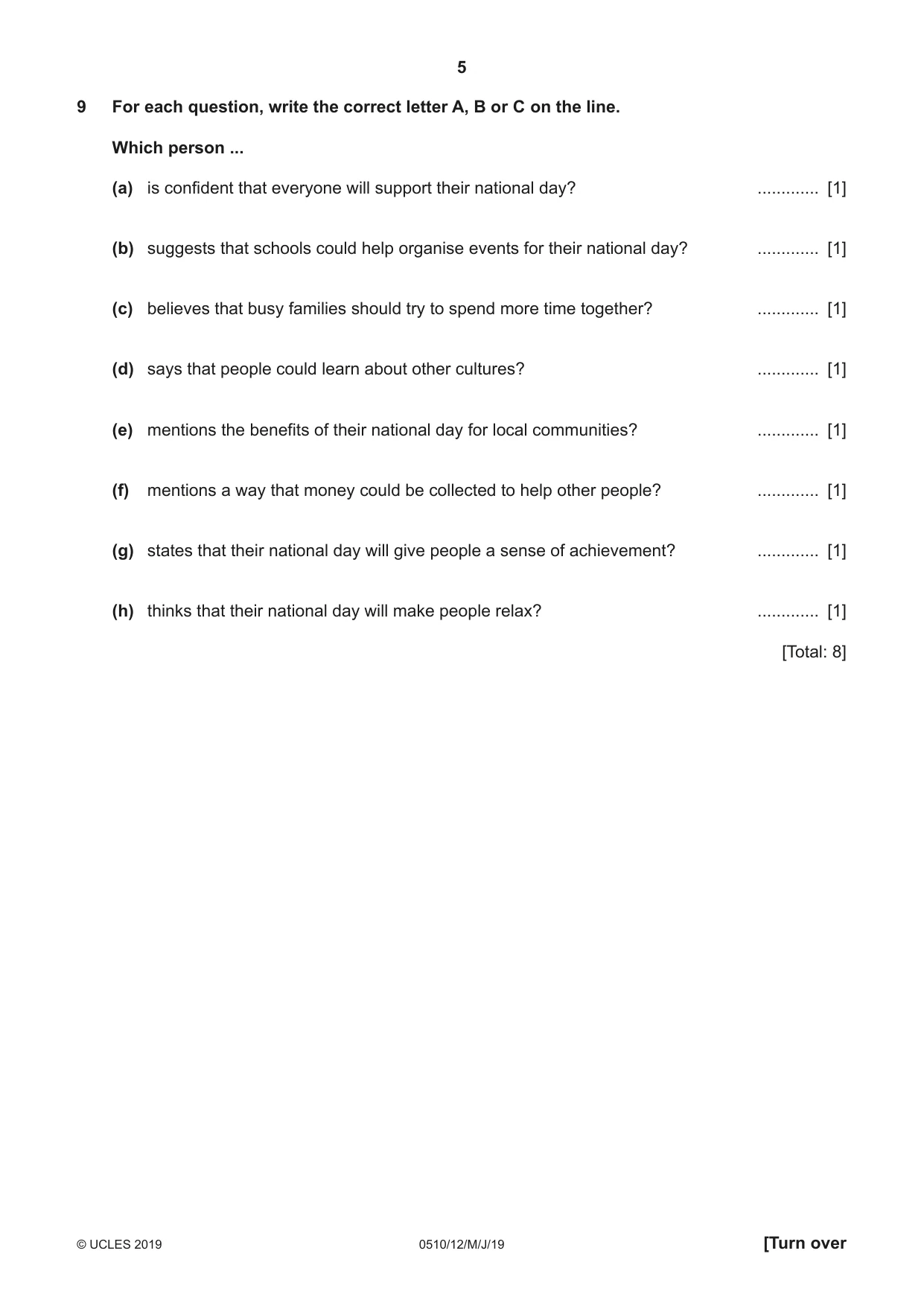
Question paper, page 2
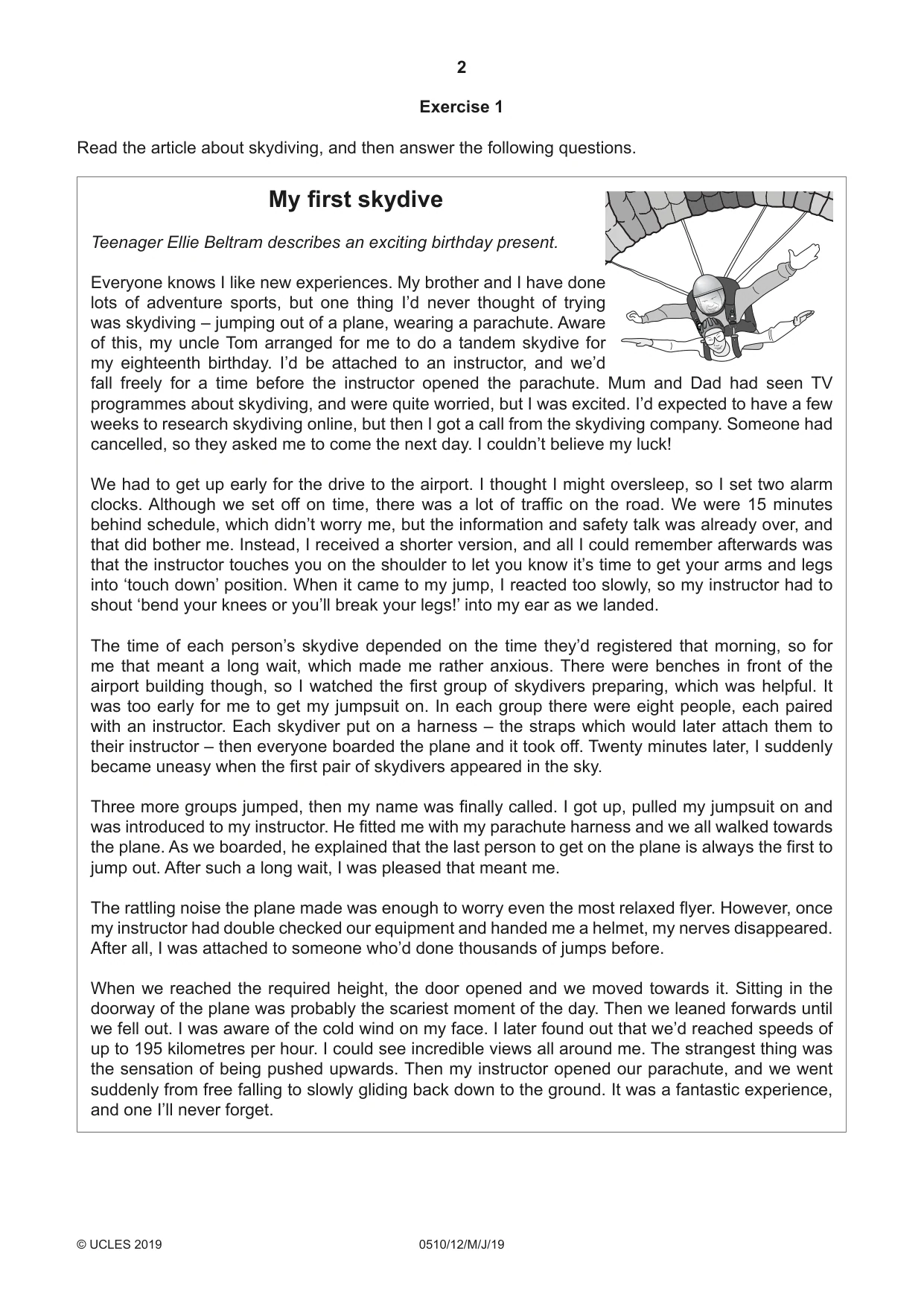
2 0510/12/M/J/19 © UCLES 2019 Exercise 1 Read the article about skydiving, and then answer the following questions. My first skydive Teenager Ellie Beltram describes an exciting birthday present. Everyone knows I like new experiences. My brother and I have done lots of adventure sports, but one thing I’d never thought of trying was skydiving – jumping out of a plane, wearing a parachute. Aware of this, my uncle Tom arranged for me to do a tandem skydive for my eighteenth birthday. I’d be attached to an instructor, and we’d fall freely for a time before the instructor opened the parachute. Mum and Dad had seen TV programmes about skydiving, and were quite worried, but I was excited. I’d expected to have a few weeks to research skydiving online, but then I got a call from the skydiving company. Someone had cancelled, so they asked me to come the next day. I couldn’t believe my luck! We had to get up early for the drive to the airport. I thought I might oversleep, so I set two alarm clocks. Although we set off on time, there was a lot of traffic on the road. We were 15 minutes behind schedule, which didn’t worry me, but the information and safety talk was already over, and that did bother me. Instead, I received a shorter version, and all I could remember afterwards was that the instructor touches you on the shoulder to let you know it’s time to get your arms and legs into ‘touch down’ position. When it came to my jump, I reacted too slowly, so my instructor had to shout ‘bend your knees or you’ll break your legs!’ into my ear as we landed. The time of each person’s skydive depended on the time they’d registered that morning, so for me that meant a long wait, which made me rather anxious. There were benches in front of the airport building though, so I watched the first group of skydivers preparing, which was helpful. It was too early for me to get my jumpsuit on. In each group there were eight people, each paired with an instructor. Each skydiver put on a harness – the straps which would later attach them to their instructor – then everyone boarded the plane and it took off. Twenty minutes later, I suddenly became uneasy when the first pair of skydivers appeared in the sky. Three more groups jumped, then my name was finally called. I got up, pulled my jumpsuit on and was introduced to my instructor. He fitted me with my parachute harness and we all walked towards the plane. As we boarded, he explained that the last person to get on the plane is always the first to jump out. After such a long wait, I was pleased that meant me. The rattling noise the plane made was enough to worry even the most relaxed flyer. However, once my instructor had double checked our equipment and handed me a helmet, my nerves disappeared. After all, I was attached to someone who’d done thousands of jumps before. When we reached the required height, the door opened and we moved towards it. Sitting in the doorway of the plane was probably the scariest moment of the day. Then we leaned forwards until we fell out. I was aware of the cold wind on my face. I later found out that we’d reached speeds of up to 195 kilometres per hour. I could see incredible views all around me. The strangest thing was the sensation of being pushed upwards. Then my instructor opened our parachute, and we went suddenly from free falling to slowly gliding back down to the ground. It was a fantastic experience, and one I’ll never forget.
Question paper, page 3
3 0510/12/M/J/19 © UCLES 2019 [Turn over 1 Who had the idea for Ellie to try skydiving? … [1] 2 What had Ellie planned to do before the day of her skydive? … [1] 3 Why did Ellie arrive late for her skydive? … [1] 4 How does the instructor usually indicate that it is time to prepare for landing? … [1] 5 What did Ellie spend her time doing while she was sitting outside? … [1] 6 Why did Ellie have to do her skydive before the other people in her group? … [1] 7 What did Ellie have to put on just before she left the plane? … [1] 8 What could Ellie feel during the free fall part of the skydive? Give two details. … … [2] [Total: 9]
Question paper, page 4
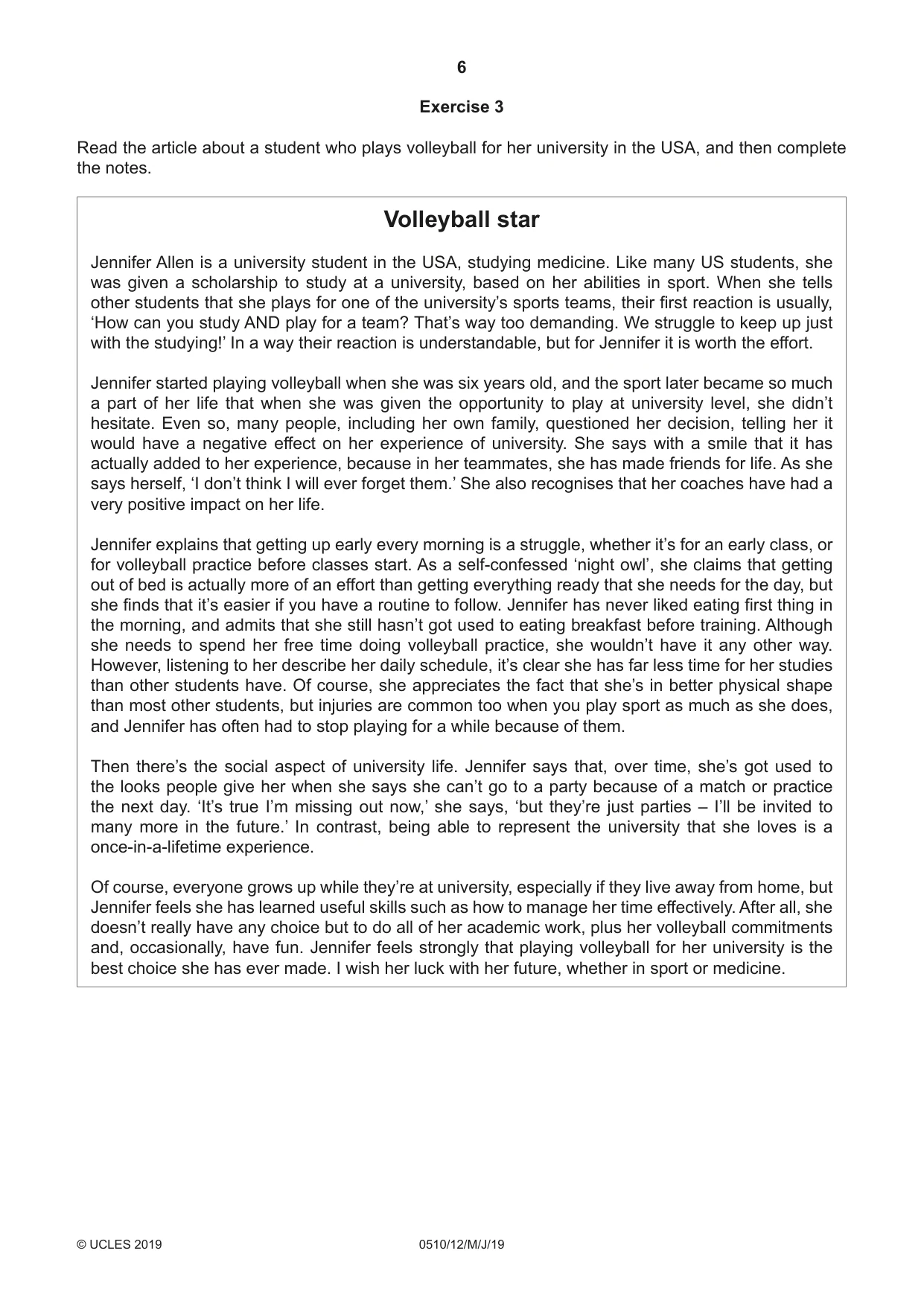
4 0510/12/M/J/19 © UCLES 2019 Exercise 2 Read the article about three people (A – C) who have an idea for a new national holiday. Then answer Question 9 (a) – (h). If you could invent a new public holiday, what would it be? A Samuel Akinta If I could choose a new public holiday in my country, I’d create National Switched Off Day, where all electronic devices like mobile phones, tablets, computers and TVs would have to be turned off for the whole day. I know we all love being connected to our friends 24 hours a day, but sometimes we forget to talk to the people around us. Parents and kids have such non-stop lives nowadays, with work and school, clubs and hobbies, that it’s really important for them to stop staring at their screens sometimes and just hang out with each other instead. Otherwise we risk just rushing around all the time, cut off in our own little worlds. National Switched Off Day would make us take a break. I’m aware that not all teenagers would be particularly interested in taking part, but if they gave it a go I think they might enjoy getting some proper rest every once in a while. B Yasmina Al Ansari My suggestion for a new public holiday is National Get Involved Day. This holiday would allow everyone to take a day off from their daily routine at work or college and get together to help those in the area where they live. This would make us all feel much more connected to, and be part of, our neighbourhood. Around me, there are quite a few elderly people who live alone and always need help with lots of little jobs around the house. Other people might like to bake a cake to share or pick up rubbish from their street together. Of course, not all younger people will be that interested, but it could be a good opportunity for teachers to get their students involved by setting up a project. Helping others doesn’t need to be just about giving money to charity – your time is just as valuable. And it’s a well-known fact that helping others can often increase people’s happiness and self-confidence – you could be really proud of having done something good on that day. C Kristie Cheng How about having a National Rhythm Day? That would be my suggestion for a new public holiday. Everybody enjoys music, so what could be better than having a public holiday with the single purpose of listening and dancing to music? Music is an incredibly powerful force in our lives. It cheers people up if they’re feeling down and makes even the worst day feel better, so imagine what a great day it would be if everyone was singing and dancing to all their favourite music! There’s no way anyone would disagree with that. And National Rhythm Day wouldn’t just have to be about listening to music. Musicians could show their friends or family how to play a particular musical instrument, or they could even organise a concert and give all of the profits to charity. And why stop there? You could also learn how to make your own musical instrument or discover more about other countries by listening to music from around the world. I think that’d be fantastic.
Question paper, page 5
5 0510/12/M/J/19 © UCLES 2019 [Turn over 9 For each question, write the correct letter A, B or C on the line. Which person ... (a) is confident that everyone will support their national day? … [1] (b) suggests that schools could help organise events for their national day? … [1] (c) believes that busy families should try to spend more time together? … [1] (d) says that people could learn about other cultures? … [1] (e) mentions the benefits of their national day for local communities? … [1] (f) mentions a way that money could be collected to help other people? … [1] (g) states that their national day will give people a sense of achievement? … [1] (h) thinks that their national day will make people relax? … [1] [Total: 8]
Question paper, page 6
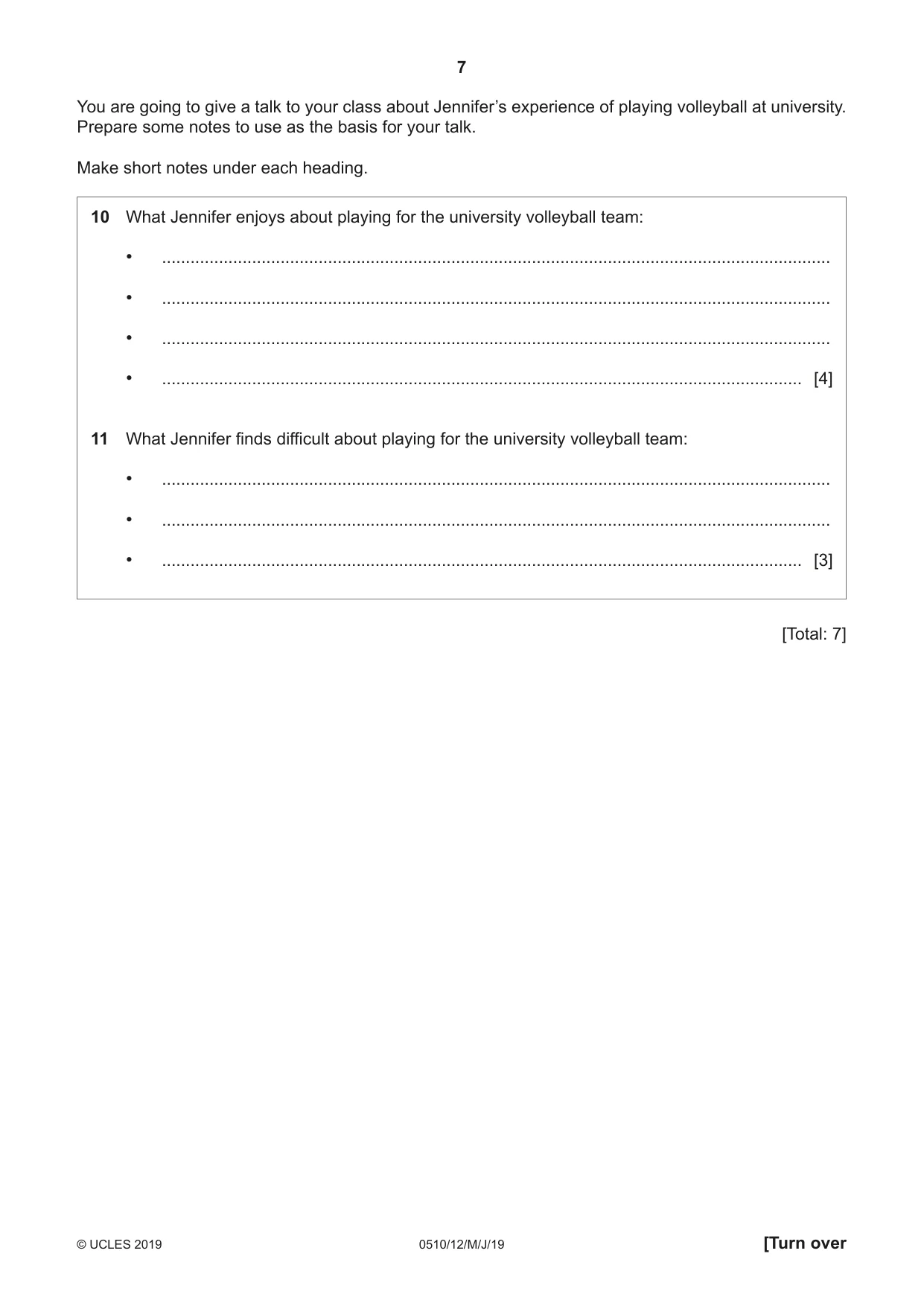
6 0510/12/M/J/19 © UCLES 2019 Exercise 3 Read the article about a student who plays volleyball for her university in the USA, and then complete the notes. Volleyball star Jennifer Allen is a university student in the USA, studying medicine. Like many US students, she was given a scholarship to study at a university, based on her abilities in sport. When she tells other students that she plays for one of the university’s sports teams, their first reaction is usually, ‘How can you study AND play for a team? That’s way too demanding. We struggle to keep up just with the studying!’ In a way their reaction is understandable, but for Jennifer it is worth the effort. Jennifer started playing volleyball when she was six years old, and the sport later became so much a part of her life that when she was given the opportunity to play at university level, she didn’t hesitate. Even so, many people, including her own family, questioned her decision, telling her it would have a negative effect on her experience of university. She says with a smile that it has actually added to her experience, because in her teammates, she has made friends for life. As she says herself, ‘I don’t think I will ever forget them.’ She also recognises that her coaches have had a very positive impact on her life. Jennifer explains that getting up early every morning is a struggle, whether it’s for an early class, or for volleyball practice before classes start. As a self-confessed ‘night owl’, she claims that getting out of bed is actually more of an effort than getting everything ready that she needs for the day, but she finds that it’s easier if you have a routine to follow. Jennifer has never liked eating first thing in the morning, and admits that she still hasn’t got used to eating breakfast before training. Although she needs to spend her free time doing volleyball practice, she wouldn’t have it any other way. However, listening to her describe her daily schedule, it’s clear she has far less time for her studies than other students have. Of course, she appreciates the fact that she’s in better physical shape than most other students, but injuries are common too when you play sport as much as she does, and Jennifer has often had to stop playing for a while because of them. Then there’s the social aspect of university life. Jennifer says that, over time, she’s got used to the looks people give her when she says she can’t go to a party because of a match or practice the next day. ‘It’s true I’m missing out now,’ she says, ‘but they’re just parties – I’ll be invited to many more in the future.’ In contrast, being able to represent the university that she loves is a once-in-a-lifetime experience. Of course, everyone grows up while they’re at university, especially if they live away from home, but Jennifer feels she has learned useful skills such as how to manage her time effectively. After all, she doesn’t really have any choice but to do all of her academic work, plus her volleyball commitments and, occasionally, have fun. Jennifer feels strongly that playing volleyball for her university is the best choice she has ever made. I wish her luck with her future, whether in sport or medicine.
Question paper, page 7
7 0510/12/M/J/19 © UCLES 2019 [Turn over You are going to give a talk to your class about Jennifer’s experience of playing volleyball at university. Prepare some notes to use as the basis for your talk. Make short notes under each heading. 10 What Jennifer enjoys about playing for the university volleyball team: • … • … • … • … [4] 11 What Jennifer finds difficult about playing for the university volleyball team: • … • … • … [3] [Total: 7]
Question paper, page 8
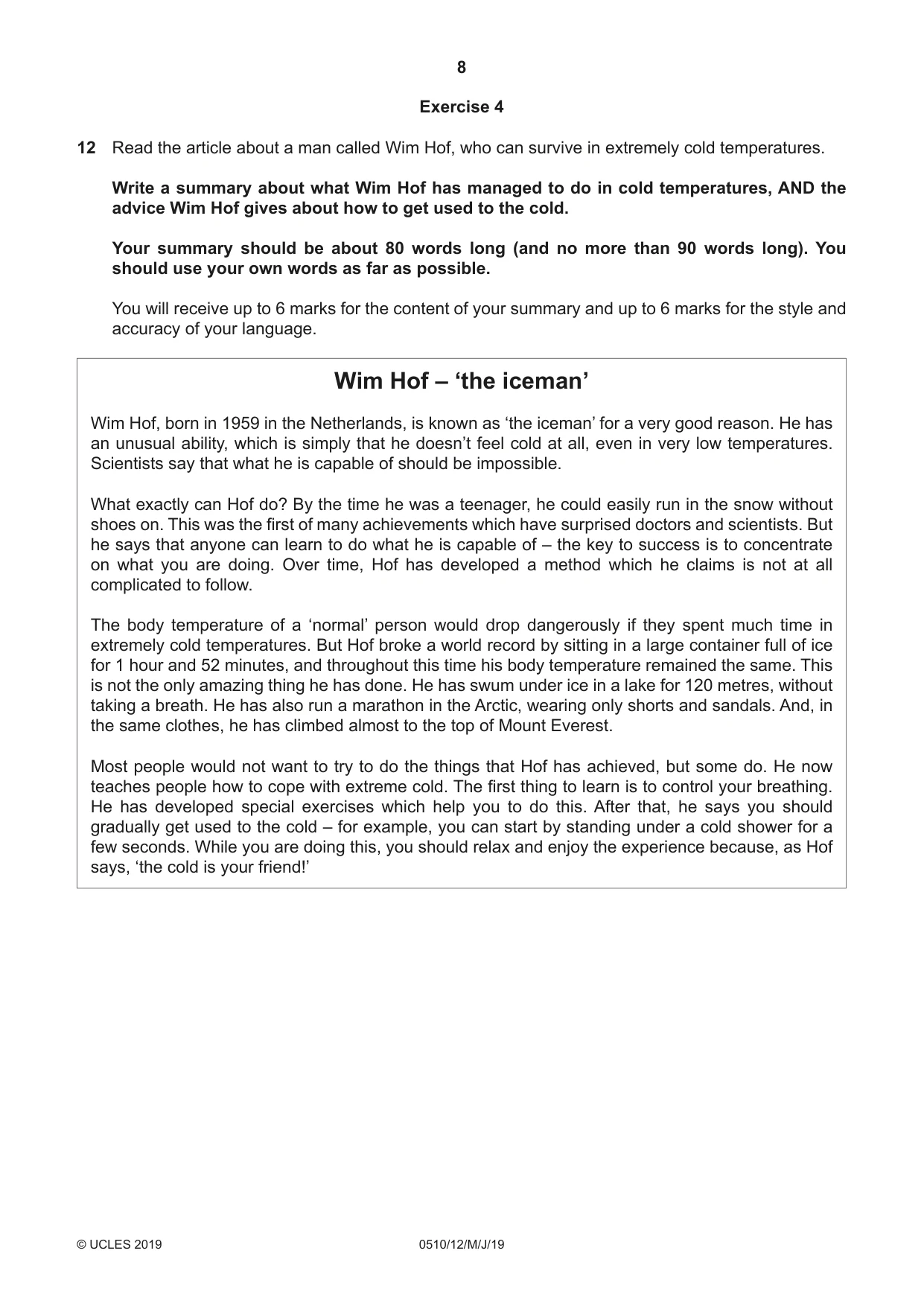
8 0510/12/M/J/19 © UCLES 2019 Exercise 4 12 Read the article about a man called Wim Hof, who can survive in extremely cold temperatures. Write a summary about what Wim Hof has managed to do in cold temperatures, AND the advice Wim Hof gives about how to get used to the cold. Your summary should be about 80 words long (and no more than 90 words long). You should use your own words as far as possible. You will receive up to 6 marks for the content of your summary and up to 6 marks for the style and accuracy of your language. Wim Hof – ‘the iceman’ Wim Hof, born in 1959 in the Netherlands, is known as ‘the iceman’ for a very good reason. He has an unusual ability, which is simply that he doesn’t feel cold at all, even in very low temperatures. Scientists say that what he is capable of should be impossible. What exactly can Hof do? By the time he was a teenager, he could easily run in the snow without shoes on. This was the first of many achievements which have surprised doctors and scientists. But he says that anyone can learn to do what he is capable of – the key to success is to concentrate on what you are doing. Over time, Hof has developed a method which he claims is not at all complicated to follow. The body temperature of a ‘normal’ person would drop dangerously if they spent much time in extremely cold temperatures. But Hof broke a world record by sitting in a large container full of ice for 1 hour and 52 minutes, and throughout this time his body temperature remained the same. This is not the only amazing thing he has done. He has swum under ice in a lake for 120 metres, without taking a breath. He has also run a marathon in the Arctic, wearing only shorts and sandals. And, in the same clothes, he has climbed almost to the top of Mount Everest. Most people would not want to try to do the things that Hof has achieved, but some do. He now teaches people how to cope with extreme cold. The first thing to learn is to control your breathing. He has developed special exercises which help you to do this. After that, he says you should gradually get used to the cold – for example, you can start by standing under a cold shower for a few seconds. While you are doing this, you should relax and enjoy the experience because, as Hof says, ‘the cold is your friend!’
Question paper, page 9
9 0510/12/M/J/19 © UCLES 2019 [Turn over … … … … … … … … … … … … … … [Total: 12]
Question paper, page 10
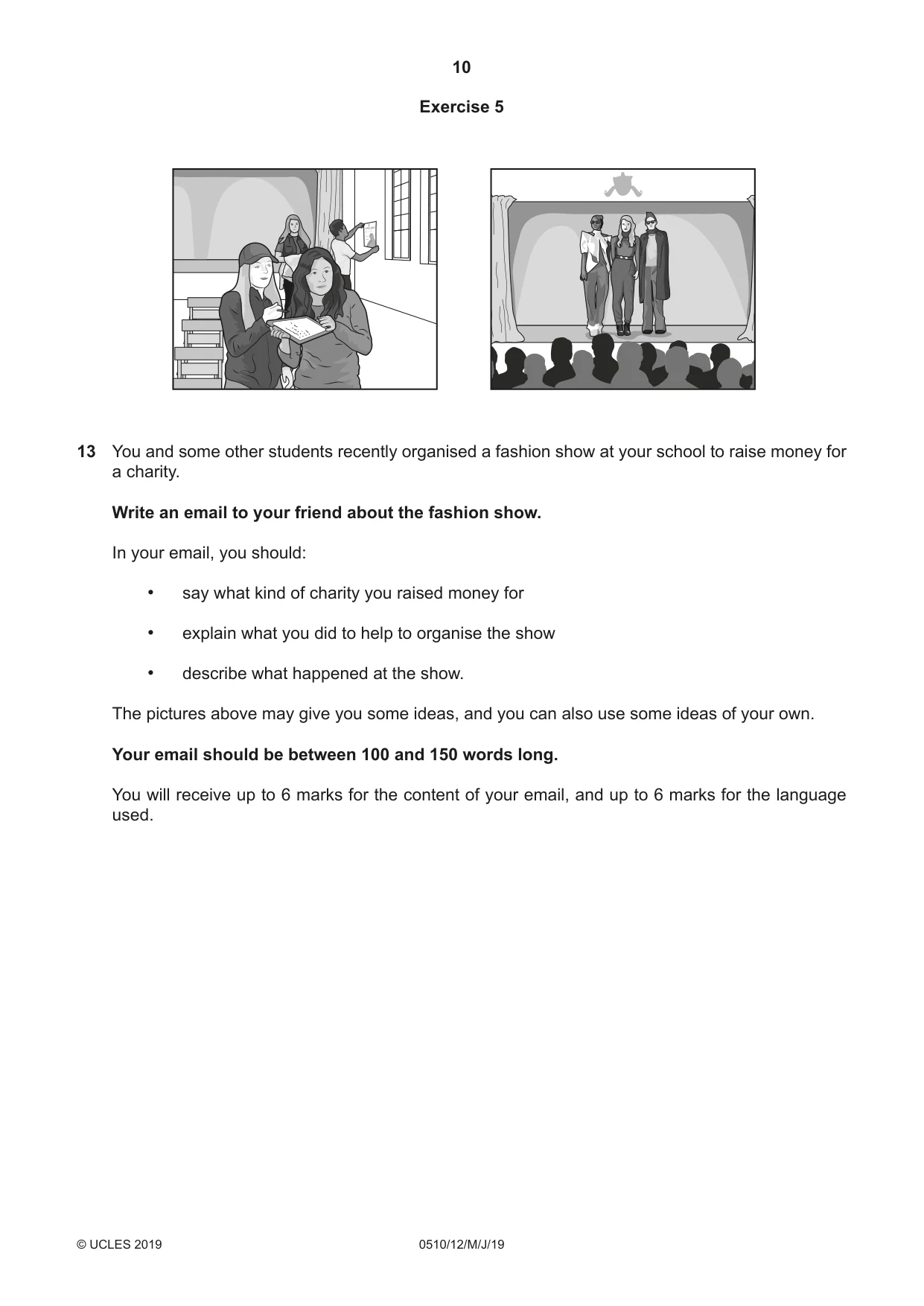
10 0510/12/M/J/19 © UCLES 2019 Exercise 5 13 You and some other students recently organised a fashion show at your school to raise money for a charity. Write an email to your friend about the fashion show. In your email, you should: • say what kind of charity you raised money for • explain what you did to help to organise the show • describe what happened at the show. The pictures above may give you some ideas, and you can also use some ideas of your own. Your email should be between 100 and 150 words long. You will receive up to 6 marks for the content of your email, and up to 6 marks for the language used.
Question paper, page 11
11 0510/12/M/J/19 © UCLES 2019 [Turn over … … … … … … … … … … … … … … … … … … … … … … … … … … … [Total: 12]
Question paper, page 12
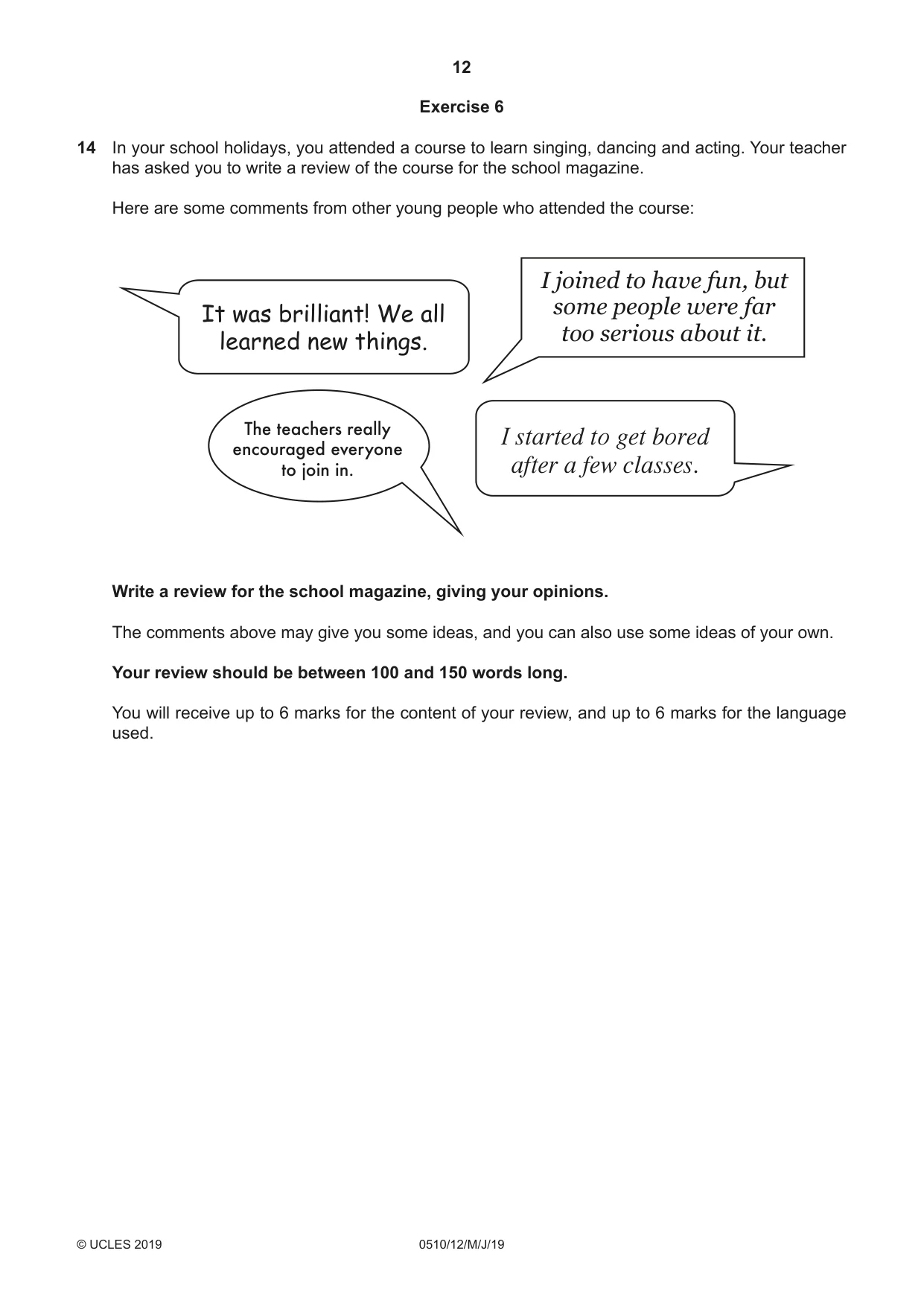
12 0510/12/M/J/19 © UCLES 2019 Exercise 6 14 In your school holidays, you attended a course to learn singing, dancing and acting. Your teacher has asked you to write a review of the course for the school magazine. Here are some comments from other young people who attended the course: I started to get bored after a few classes. It was brilliant! We all learned new things. The teachers really encouraged everyone to join in. I joined to have fun, but some people were far too serious about it. Write a review for the school magazine, giving your opinions. The comments above may give you some ideas, and you can also use some ideas of your own. Your review should be between 100 and 150 words long. You will receive up to 6 marks for the content of your review, and up to 6 marks for the language used.
Question paper, page 13
13 0510/12/M/J/19 © UCLES 2019 … … … … … … … … … … … … … … … … … … … … … … … … … … … [Total: 12]
Question paper, page 14
14 0510/12/M/J/19 © UCLES 2019 BLANK PAGE
Question paper, page 15
15 0510/12/M/J/19 © UCLES 2019 BLANK PAGE
Question paper, page 16
16 0510/12/M/J/19 © UCLES 2019 Permission to reproduce items where third-party owned material protected by copyright is included has been sought and cleared where possible. Every reasonable effort has been made by the publisher (UCLES) to trace copyright holders, but if any items requiring clearance have unwittingly been included, the publisher will be pleased to make amends at the earliest possible opportunity. To avoid the issue of disclosure of answer-related information to candidates, all copyright acknowledgements are reproduced online in the Cambridge Assessment International Education Copyright Acknowledgements Booklet. This is produced for each series of examinations and is freely available to download at www.cambridgeinternational.org after the live examination series. Cambridge Assessment International Education is part of the Cambridge Assessment Group. Cambridge Assessment is the brand name of the University of Cambridge Local Examinations Syndicate (UCLES), which itself is a department of the University of Cambridge. BLANK PAGE
Mark scheme, page 1
This document consists of 10 printed pages. © UCLES 2019 [Turn over Cambridge Assessment International Education Cambridge International General Certificate of Secondary Education ENGLISH AS A SECOND LANGUAGE 0510/12 Paper 1 Reading and Writing (Core) May/June 2019 MARK SCHEME Maximum Mark: 60 Published This mark scheme is published as an aid to teachers and candidates, to indicate the requirements of the examination. It shows the basis on which Examiners were instructed to award marks. It does not indicate the details of the discussions that took place at an Examiners’ meeting before marking began, which would have considered the acceptability of alternative answers. Mark schemes should be read in conjunction with the question paper and the Principal Examiner Report for Teachers. Cambridge International will not enter into discussions about these mark schemes. Cambridge International is publishing the mark schemes for the May/June 2019 series for most Cambridge IGCSE™, Cambridge International A and AS Level and Cambridge Pre-U components, and some Cambridge O Level components.
Mark scheme, page 2
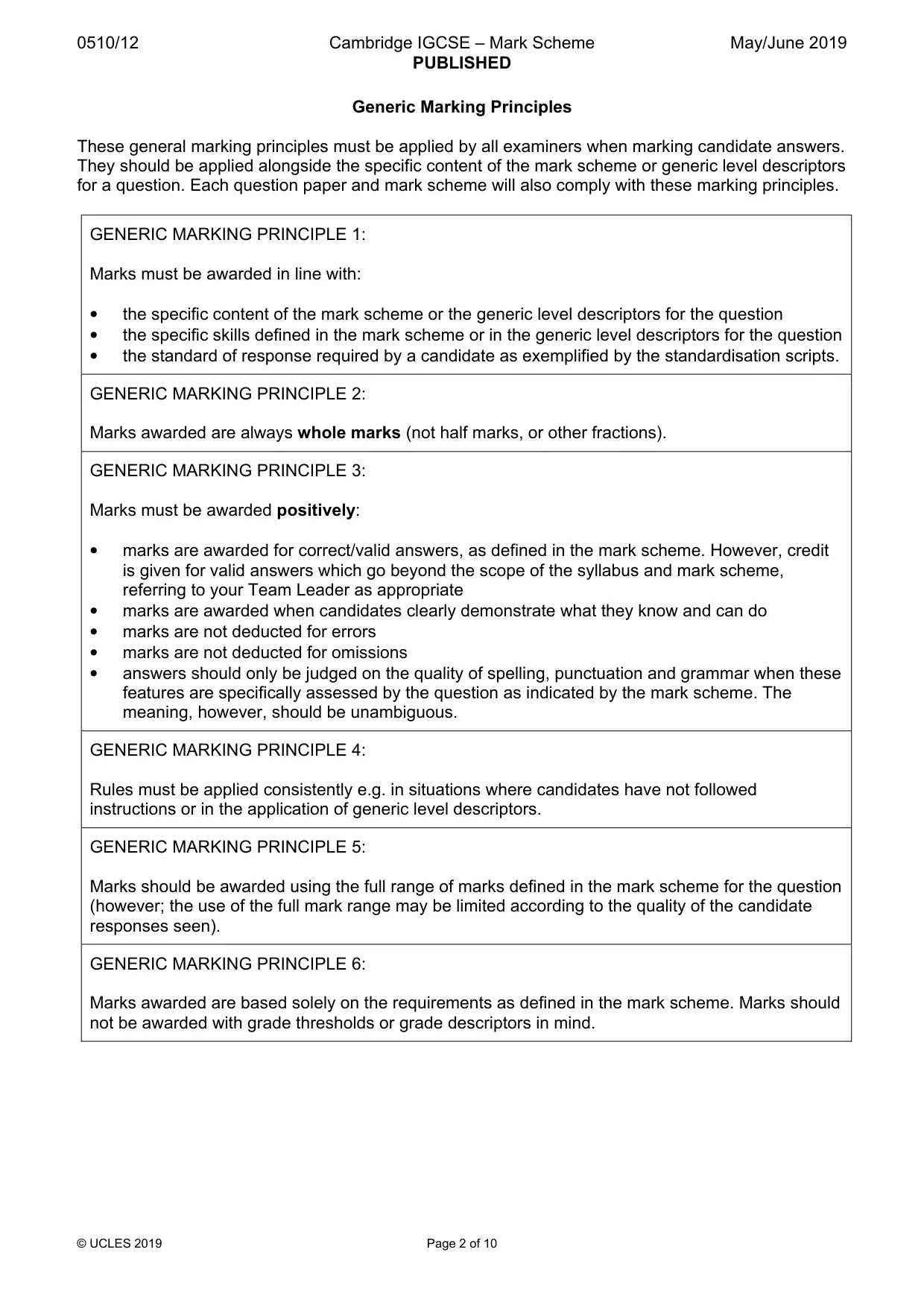
0510/12 Cambridge IGCSE – Mark Scheme PUBLISHED May/June 2019 © UCLES 2019 Page 2 of 10 Generic Marking Principles These general marking principles must be applied by all examiners when marking candidate answers. They should be applied alongside the specific content of the mark scheme or generic level descriptors for a question. Each question paper and mark scheme will also comply with these marking principles. GENERIC MARKING PRINCIPLE 1: Marks must be awarded in line with: • the specific content of the mark scheme or the generic level descriptors for the question • the specific skills defined in the mark scheme or in the generic level descriptors for the question • the standard of response required by a candidate as exemplified by the standardisation scripts. GENERIC MARKING PRINCIPLE 2: Marks awarded are always whole marks (not half marks, or other fractions). GENERIC MARKING PRINCIPLE 3: Marks must be awarded positively: • marks are awarded for correct/valid answers, as defined in the mark scheme. However, credit is given for valid answers which go beyond the scope of the syllabus and mark scheme, referring to your Team Leader as appropriate • marks are awarded when candidates clearly demonstrate what they know and can do • marks are not deducted for errors • marks are not deducted for omissions • answers should only be judged on the quality of spelling, punctuation and grammar when these features are specifically assessed by the question as indicated by the mark scheme. The meaning, however, should be unambiguous. GENERIC MARKING PRINCIPLE 4: Rules must be applied consistently e.g. in situations where candidates have not followed instructions or in the application of generic level descriptors. GENERIC MARKING PRINCIPLE 5: Marks should be awarded using the full range of marks defined in the mark scheme for the question (however; the use of the full mark range may be limited according to the quality of the candidate responses seen). GENERIC MARKING PRINCIPLE 6: Marks awarded are based solely on the requirements as defined in the mark scheme. Marks should not be awarded with grade thresholds or grade descriptors in mind.
Mark scheme, page 3
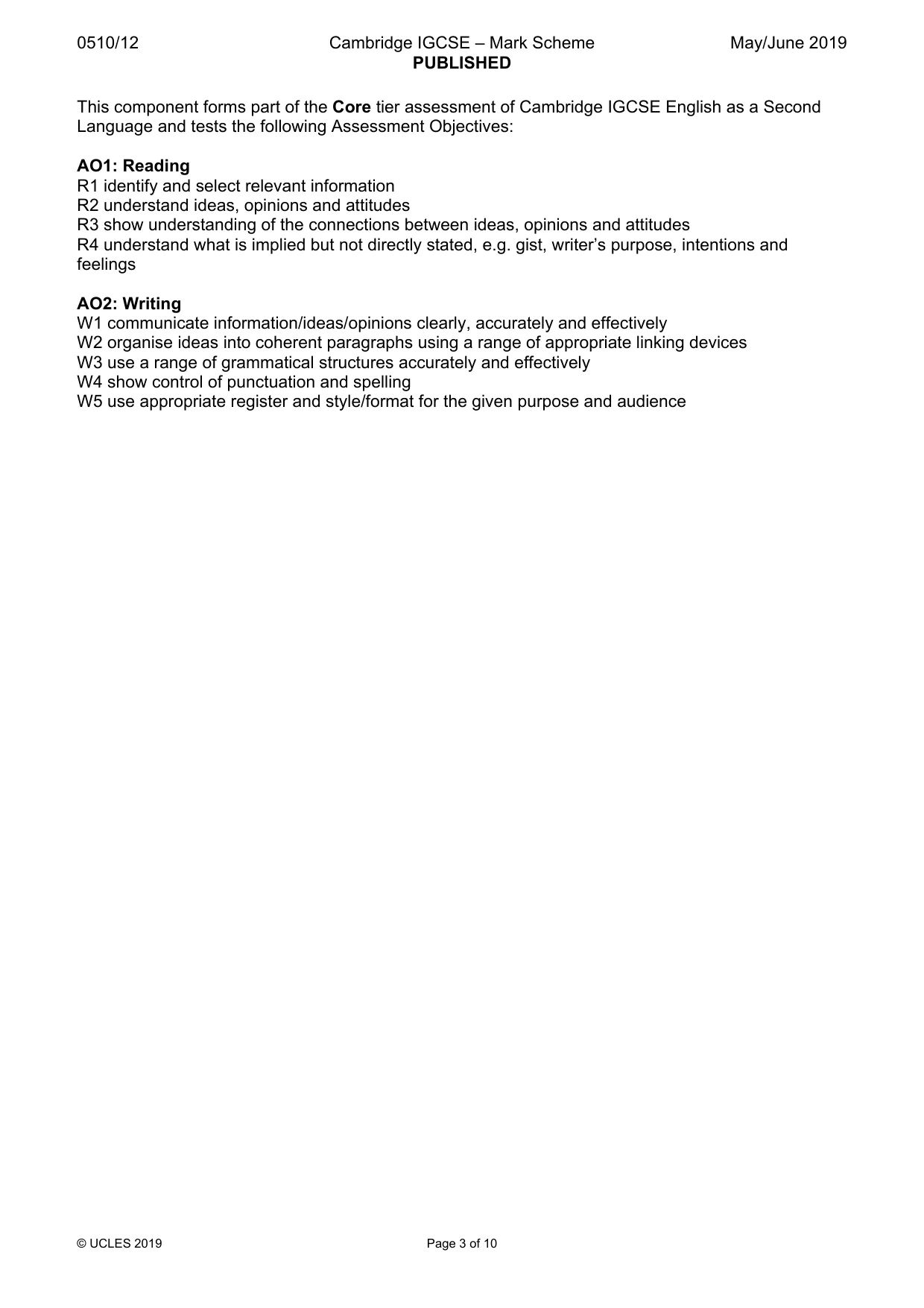
0510/12 Cambridge IGCSE – Mark Scheme PUBLISHED May/June 2019 © UCLES 2019 Page 3 of 10 This component forms part of the Core tier assessment of Cambridge IGCSE English as a Second Language and tests the following Assessment Objectives: AO1: Reading R1 identify and select relevant information R2 understand ideas, opinions and attitudes R3 show understanding of the connections between ideas, opinions and attitudes R4 understand what is implied but not directly stated, e.g. gist, writer’s purpose, intentions and feelings AO2: Writing W1 communicate information/ideas/opinions clearly, accurately and effectively W2 organise ideas into coherent paragraphs using a range of appropriate linking devices W3 use a range of grammatical structures accurately and effectively W4 show control of punctuation and spelling W5 use appropriate register and style/format for the given purpose and audience
Mark scheme, page 4
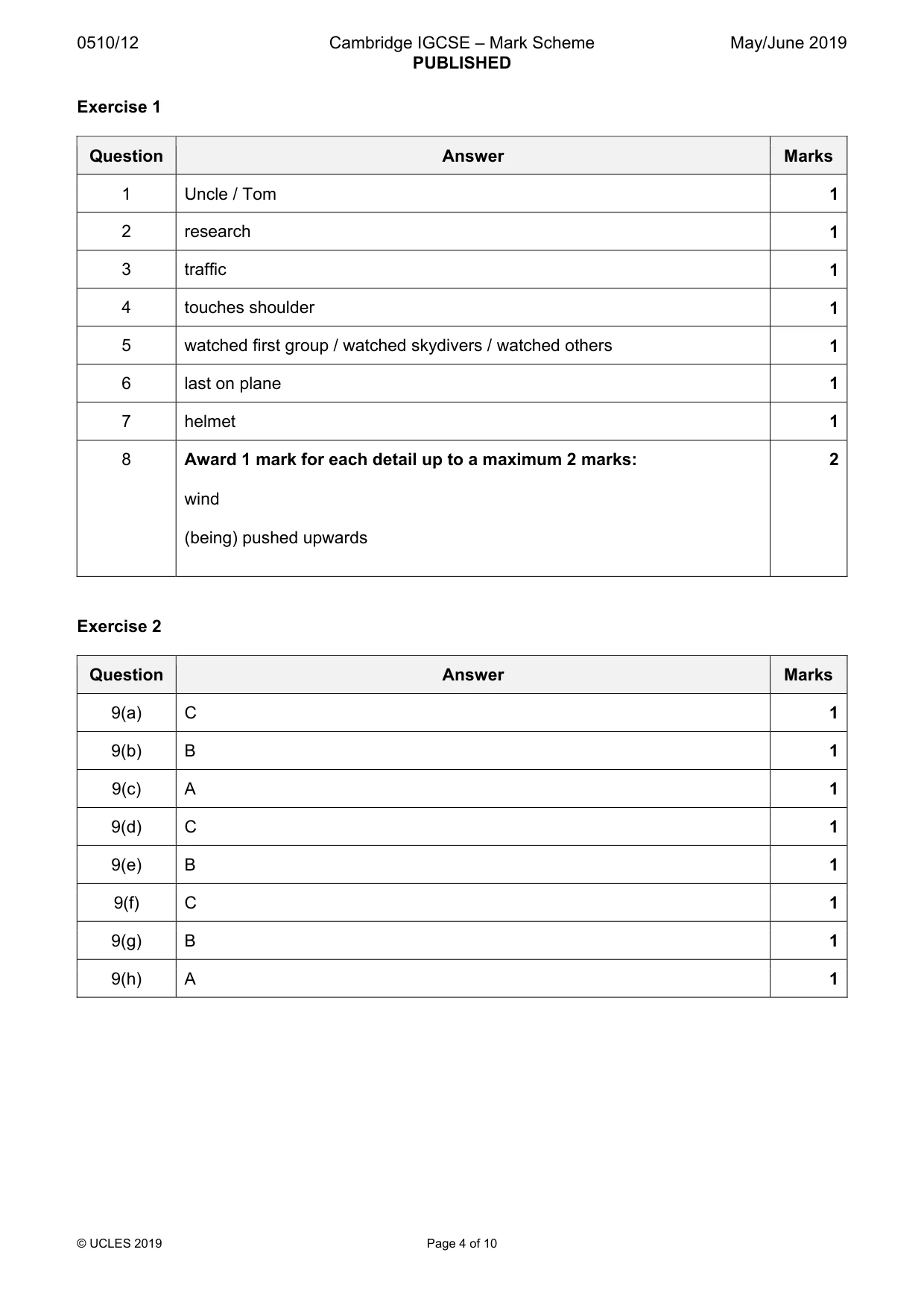
0510/12 Cambridge IGCSE – Mark Scheme PUBLISHED May/June 2019 © UCLES 2019 Page 4 of 10 Exercise 1 Question Answer Marks 1 Uncle / Tom 1 2 research 1 3 traffic 1 4 touches shoulder 1 5 watched first group / watched skydivers / watched others 1 6 last on plane 1 7 helmet 1 8 Award 1 mark for each detail up to a maximum 2 marks: wind (being) pushed upwards 2 Exercise 2 Question Answer Marks 9(a) C 1 9(b) B 1 9(c) A 1 9(d) C 1 9(e) B 1 9(f) C 1 9(g) B 1 9(h) A 1
Mark scheme, page 5
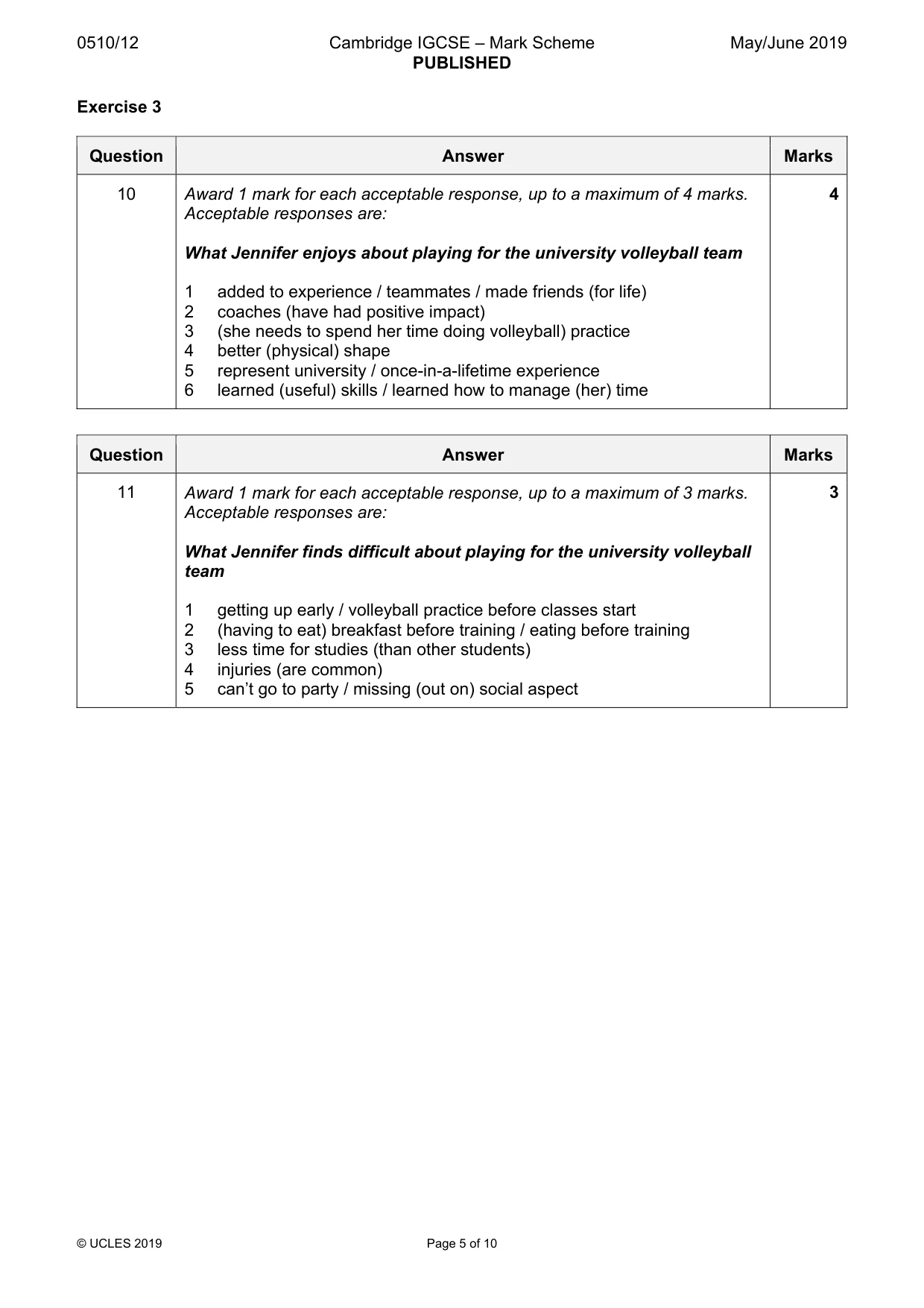
0510/12 Cambridge IGCSE – Mark Scheme PUBLISHED May/June 2019 © UCLES 2019 Page 5 of 10 Exercise 3 Question Answer Marks 10 Award 1 mark for each acceptable response, up to a maximum of 4 marks. Acceptable responses are: What Jennifer enjoys about playing for the university volleyball team 1 added to experience / teammates / made friends (for life) 2 coaches (have had positive impact) 3 (she needs to spend her time doing volleyball) practice 4 better (physical) shape 5 represent university / once-in-a-lifetime experience 6 learned (useful) skills / learned how to manage (her) time 4 Question Answer Marks 11 Award 1 mark for each acceptable response, up to a maximum of 3 marks. Acceptable responses are: What Jennifer finds difficult about playing for the university volleyball team 1 getting up early / volleyball practice before classes start 2 (having to eat) breakfast before training / eating before training 3 less time for studies (than other students) 4 injuries (are common) 5 can’t go to party / missing (out on) social aspect 3
Mark scheme, page 6
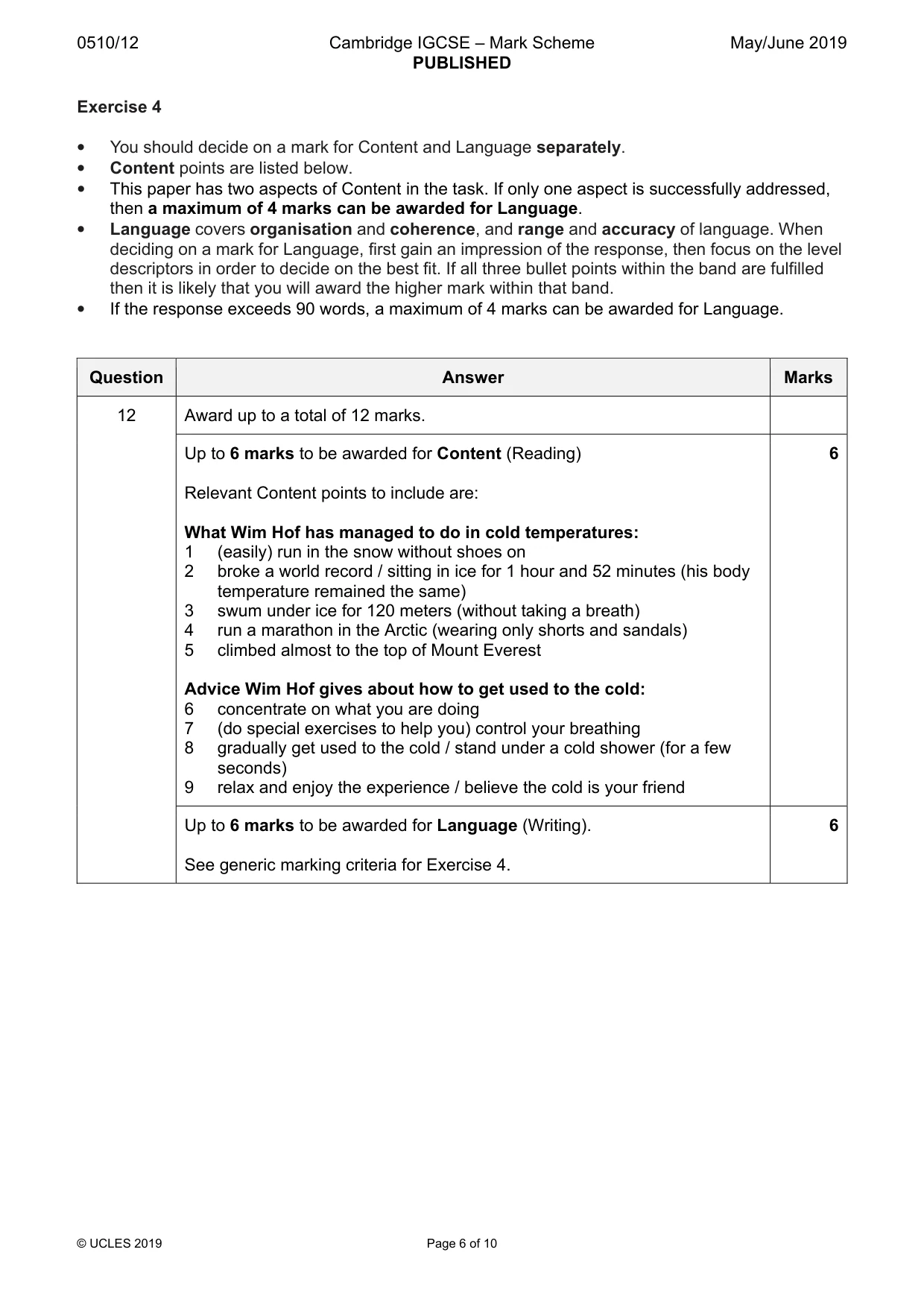
0510/12 Cambridge IGCSE – Mark Scheme PUBLISHED May/June 2019 © UCLES 2019 Page 6 of 10 Exercise 4 • You should decide on a mark for Content and Language separately. • Content points are listed below. • This paper has two aspects of Content in the task. If only one aspect is successfully addressed, then a maximum of 4 marks can be awarded for Language. • Language covers organisation and coherence, and range and accuracy of language. When deciding on a mark for Language, first gain an impression of the response, then focus on the level descriptors in order to decide on the best fit. If all three bullet points within the band are fulfilled then it is likely that you will award the higher mark within that band. • If the response exceeds 90 words, a maximum of 4 marks can be awarded for Language. Question Answer Marks 12 Award up to a total of 12 marks. Up to 6 marks to be awarded for Content (Reading) Relevant Content points to include are: What Wim Hof has managed to do in cold temperatures: 1 (easily) run in the snow without shoes on 2 broke a world record / sitting in ice for 1 hour and 52 minutes (his body temperature remained the same) 3 swum under ice for 120 meters (without taking a breath) 4 run a marathon in the Arctic (wearing only shorts and sandals) 5 climbed almost to the top of Mount Everest Advice Wim Hof gives about how to get used to the cold: 6 concentrate on what you are doing 7 (do special exercises to help you) control your breathing 8 gradually get used to the cold / stand under a cold shower (for a few seconds) 9 relax and enjoy the experience / believe the cold is your friend 6 Up to 6 marks to be awarded for Language (Writing). See generic marking criteria for Exercise 4. 6
Mark scheme, page 7
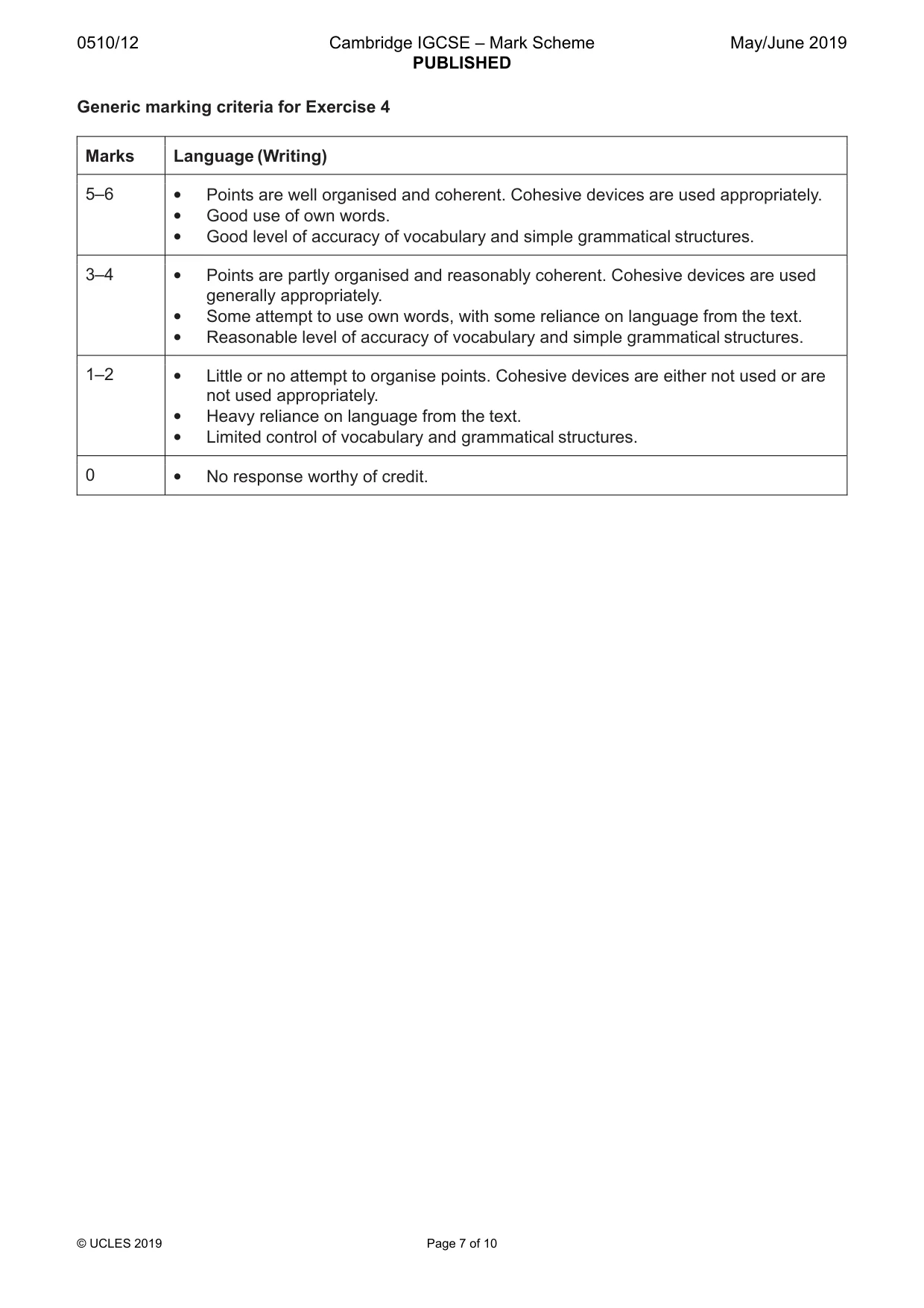
0510/12 Cambridge IGCSE – Mark Scheme PUBLISHED May/June 2019 © UCLES 2019 Page 7 of 10 Generic marking criteria for Exercise 4 Marks Language (Writing) 5–6 • Points are well organised and coherent. Cohesive devices are used appropriately. • Good use of own words. • Good level of accuracy of vocabulary and simple grammatical structures. 3–4 • Points are partly organised and reasonably coherent. Cohesive devices are used generally appropriately. • Some attempt to use own words, with some reliance on language from the text. • Reasonable level of accuracy of vocabulary and simple grammatical structures. 1–2 • Little or no attempt to organise points. Cohesive devices are either not used or are not used appropriately. • Heavy reliance on language from the text. • Limited control of vocabulary and grammatical structures. 0 • No response worthy of credit.
Mark scheme, page 8
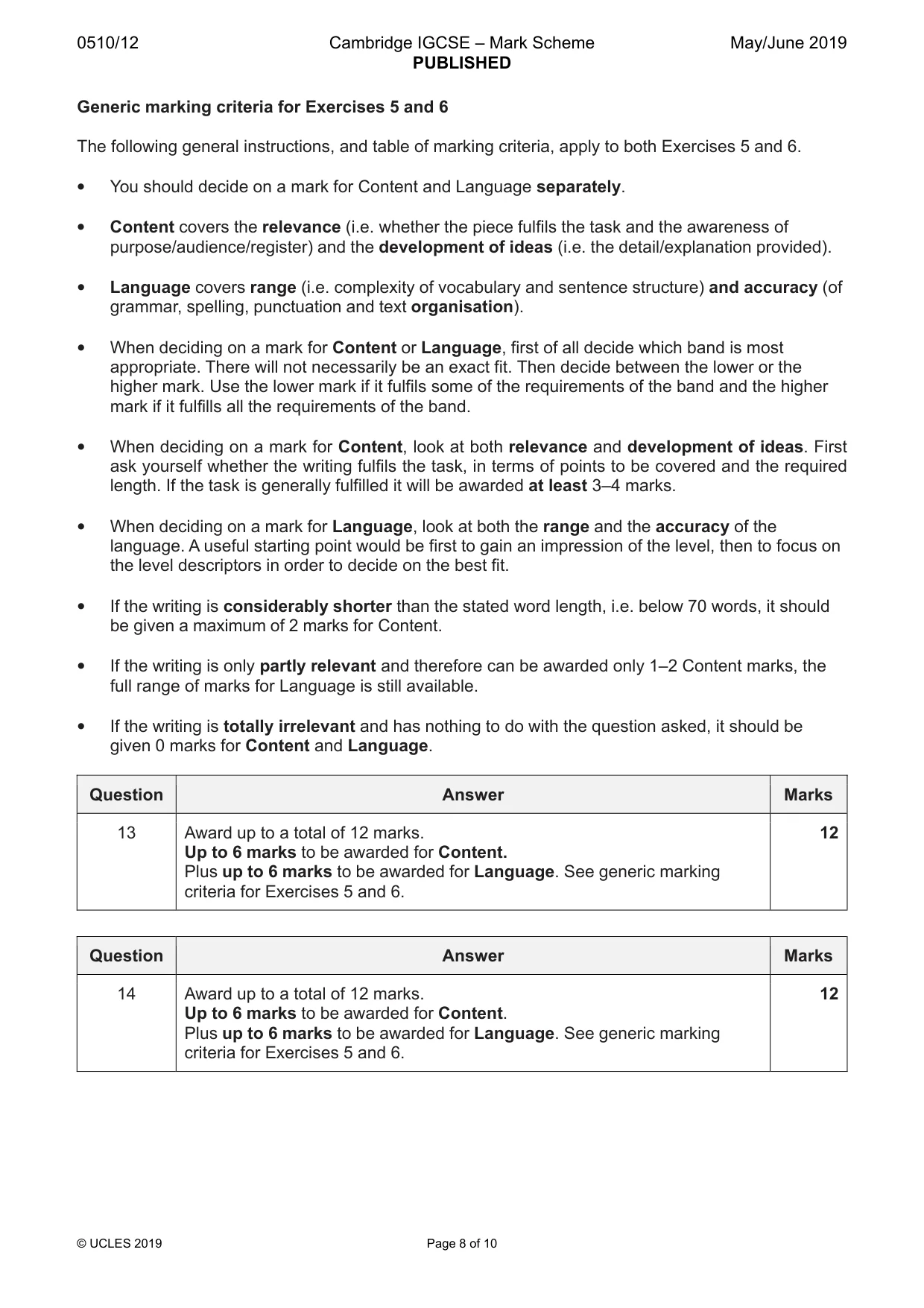
0510/12 Cambridge IGCSE – Mark Scheme PUBLISHED May/June 2019 © UCLES 2019 Page 8 of 10 Generic marking criteria for Exercises 5 and 6 The following general instructions, and table of marking criteria, apply to both Exercises 5 and 6. • You should decide on a mark for Content and Language separately. • Content covers the relevance (i.e. whether the piece fulfils the task and the awareness of purpose/audience/register) and the development of ideas (i.e. the detail/explanation provided). • Language covers range (i.e. complexity of vocabulary and sentence structure) and accuracy (of grammar, spelling, punctuation and text organisation). • When deciding on a mark for Content or Language, first of all decide which band is most appropriate. There will not necessarily be an exact fit. Then decide between the lower or the higher mark. Use the lower mark if it fulfils some of the requirements of the band and the higher mark if it fulfills all the requirements of the band. • When deciding on a mark for Content, look at both relevance and development of ideas. First ask yourself whether the writing fulfils the task, in terms of points to be covered and the required length. If the task is generally fulfilled it will be awarded at least 3–4 marks. • When deciding on a mark for Language, look at both the range and the accuracy of the language. A useful starting point would be first to gain an impression of the level, then to focus on the level descriptors in order to decide on the best fit. • If the writing is considerably shorter than the stated word length, i.e. below 70 words, it should be given a maximum of 2 marks for Content. • If the writing is only partly relevant and therefore can be awarded only 1–2 Content marks, the full range of marks for Language is still available. • If the writing is totally irrelevant and has nothing to do with the question asked, it should be given 0 marks for Content and Language. Question Answer Marks 13 Award up to a total of 12 marks. Up to 6 marks to be awarded for Content. Plus up to 6 marks to be awarded for Language. See generic marking criteria for Exercises 5 and 6. 12 Question Answer Marks 14 Award up to a total of 12 marks. Up to 6 marks to be awarded for Content. Plus up to 6 marks to be awarded for Language. See generic marking criteria for Exercises 5 and 6. 12
Mark scheme, page 9
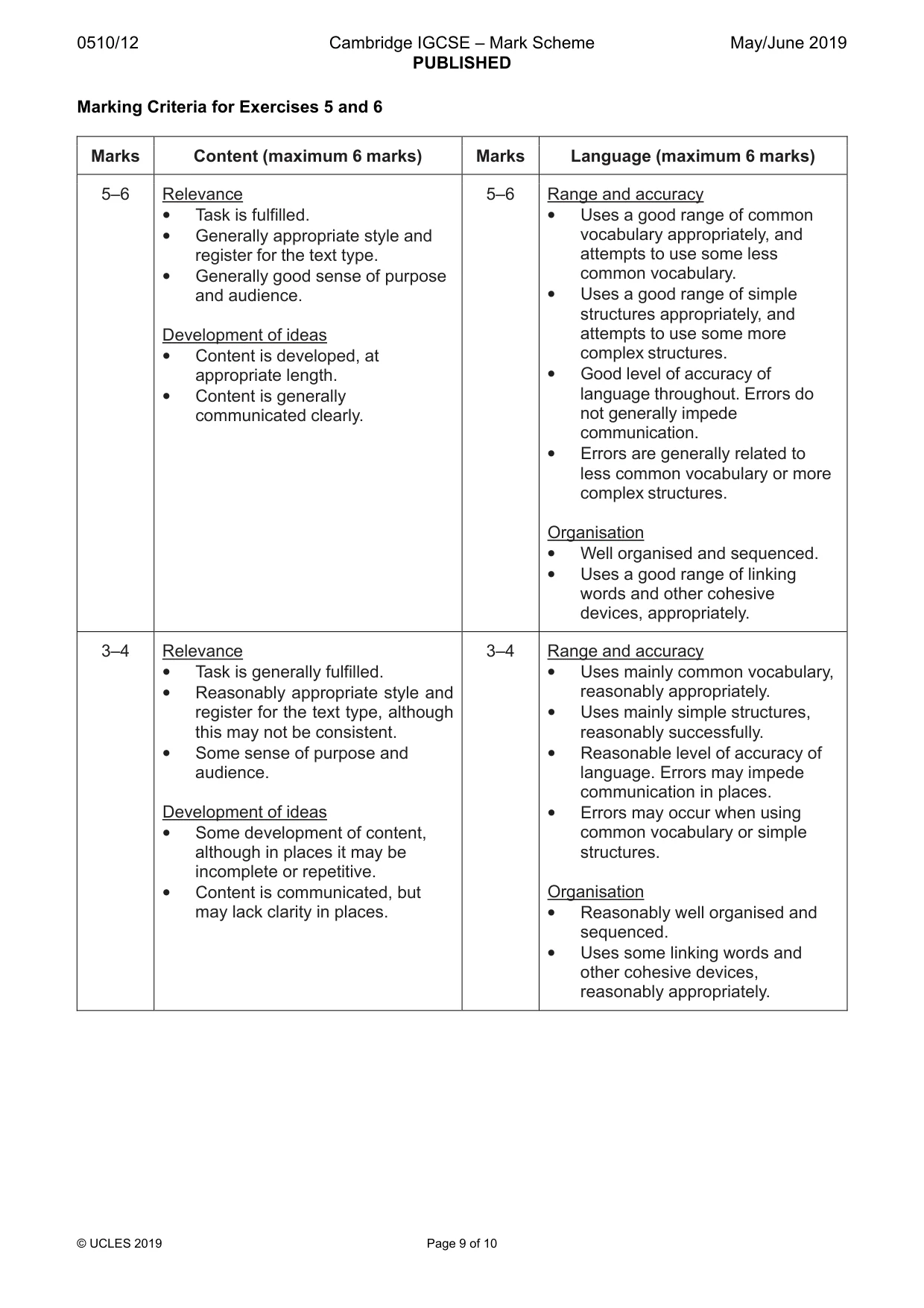
0510/12 Cambridge IGCSE – Mark Scheme PUBLISHED May/June 2019 © UCLES 2019 Page 9 of 10 Marking Criteria for Exercises 5 and 6 Marks Content (maximum 6 marks) Marks Language (maximum 6 marks) 5–6 Relevance • Task is fulfilled. • Generally appropriate style and register for the text type. • Generally good sense of purpose and audience. Development of ideas • Content is developed, at appropriate length. • Content is generally communicated clearly. 5–6 Range and accuracy • Uses a good range of common vocabulary appropriately, and attempts to use some less common vocabulary. • Uses a good range of simple structures appropriately, and attempts to use some more complex structures. • Good level of accuracy of language throughout. Errors do not generally impede communication. • Errors are generally related to less common vocabulary or more complex structures. Organisation • Well organised and sequenced. • Uses a good range of linking words and other cohesive devices, appropriately. 3–4 Relevance • Task is generally fulfilled. • Reasonably appropriate style and register for the text type, although this may not be consistent. • Some sense of purpose and audience. Development of ideas • Some development of content, although in places it may be incomplete or repetitive. • Content is communicated, but may lack clarity in places. 3–4 Range and accuracy • Uses mainly common vocabulary, reasonably appropriately. • Uses mainly simple structures, reasonably successfully. • Reasonable level of accuracy of language. Errors may impede communication in places. • Errors may occur when using common vocabulary or simple structures. Organisation • Reasonably well organised and sequenced. • Uses some linking words and other cohesive devices, reasonably appropriately.
Mark scheme, page 10
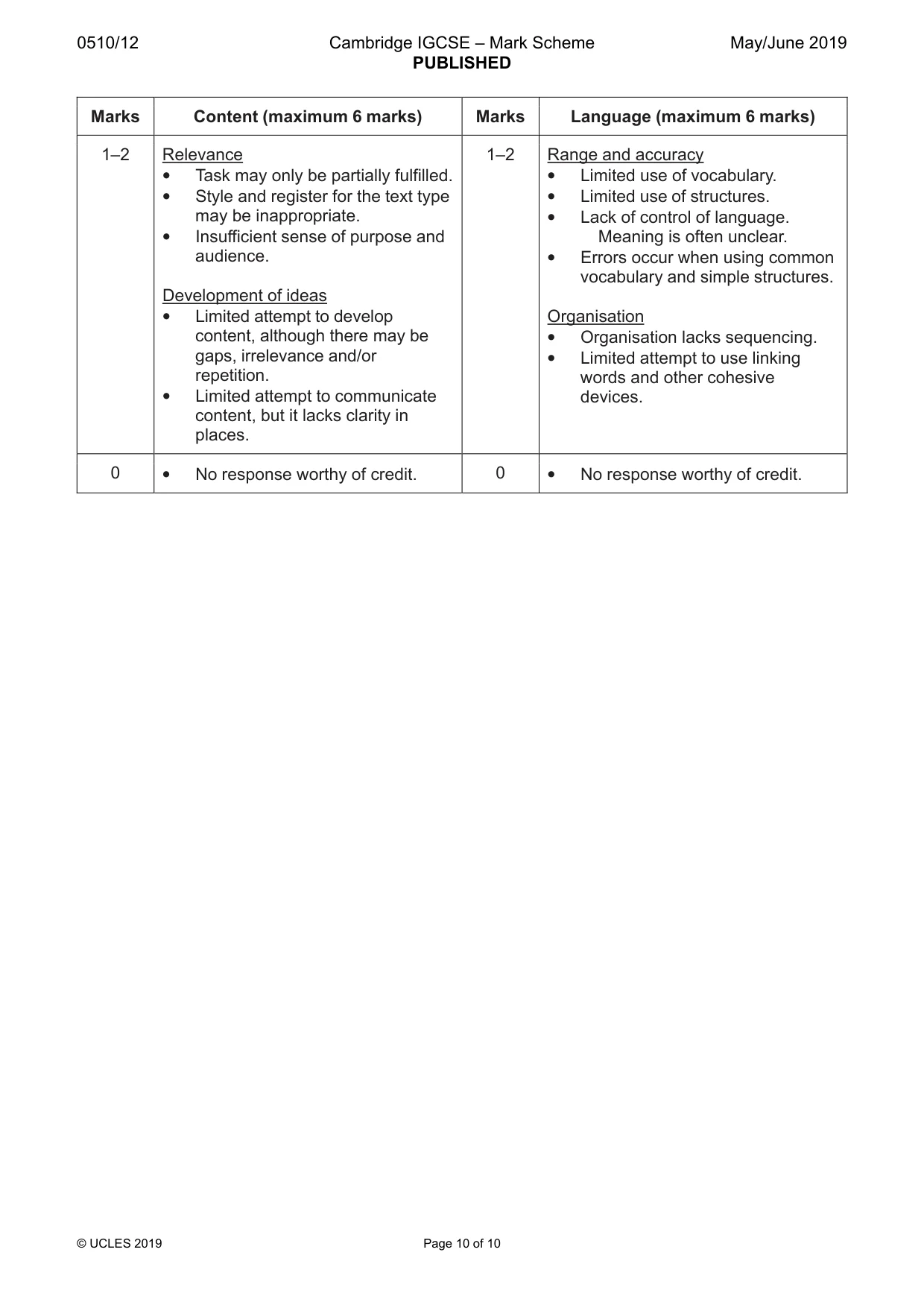
0510/12 Cambridge IGCSE – Mark Scheme PUBLISHED May/June 2019 © UCLES 2019 Page 10 of 10 Marks Content (maximum 6 marks) Marks Language (maximum 6 marks) 1–2 Relevance • Task may only be partially fulfilled. • Style and register for the text type may be inappropriate. • Insufficient sense of purpose and audience. Development of ideas • Limited attempt to develop content, although there may be gaps, irrelevance and/or repetition. • Limited attempt to communicate content, but it lacks clarity in places. 1–2 Range and accuracy • Limited use of vocabulary. • Limited use of structures. • Lack of control of language. Meaning is often unclear. • Errors occur when using common vocabulary and simple structures. Organisation • Organisation lacks sequencing. • Limited attempt to use linking words and other cohesive devices. 0 • No response worthy of credit. 0 • No response worthy of credit.
What you needed in this session
Cambridge’s own grade thresholds for 2019 May/June, Paper 1 · Variant 2. A higher threshold means an easier paper — the bar moves with how the cohort did.