Cambridge IGCSE English - Second Language (oral endorsement) 0510 — 2019 Feb/March Paper 1 · Variant 2
0510/12/F/M/19 · 60 marks · ≈68 min
The question paper and its mark scheme, free to read here and free to download. This is Cambridge’s own paper, exactly as it was sat.
Question paper16 pages




Mark scheme10 pages
Answers below. Sit the paper first if you are practising.
Paper as text
Question paper, page 1
This document consists of 13 printed pages and 3 blank pages. DC (ST/CT) 165150/3 © UCLES 2019 [Turn over Cambridge Assessment International Education Cambridge International General Certificate of Secondary Education * 9 5 1 7 2 7 6 8 3 1 * ENGLISH AS A SECOND LANGUAGE 0510/12 Paper 1 Reading and Writing (Core) February/March 2019 1 hour 30 minutes Candidates answer on the Question Paper. No Additional Materials are required. READ THESE INSTRUCTIONS FIRST Write your centre number, candidate number and name in the spaces at the top of this page. Write in dark blue or black pen. Do not use staples, paper clips, glue or correction fluid. DO NOT WRITE IN ANY BARCODES. Answer all questions. Dictionaries are not allowed. The number of marks is given in brackets [ ] at the end of each question or part question.
Question paper, page 2
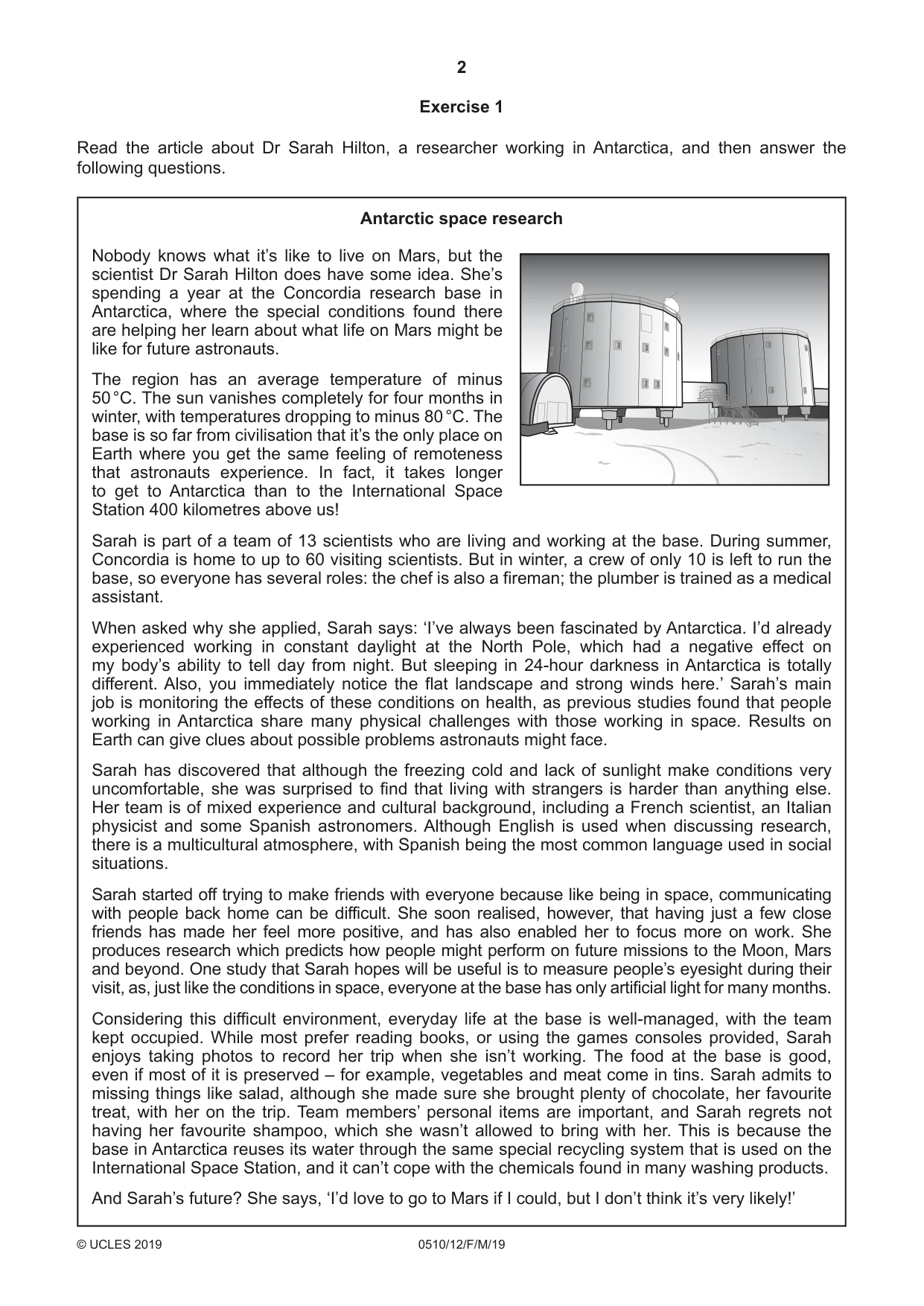
2 0510/12/F/M/19 © UCLES 2019 Exercise 1 Read the article about Dr Sarah Hilton, a researcher working in Antarctica, and then answer the following questions. Antarctic space research Nobody knows what it’s like to live on Mars, but the scientist Dr Sarah Hilton does have some idea. She’s spending a year at the Concordia research base in Antarctica, where the special conditions found there are helping her learn about what life on Mars might be like for future astronauts. The region has an average temperature of minus 50 °C. The sun vanishes completely for four months in winter, with temperatures dropping to minus 80 °C. The base is so far from civilisation that it’s the only place on Earth where you get the same feeling of remoteness that astronauts experience. In fact, it takes longer to get to Antarctica than to the International Space Station 400 kilometres above us! Sarah is part of a team of 13 scientists who are living and working at the base. During summer, Concordia is home to up to 60 visiting scientists. But in winter, a crew of only 10 is left to run the base, so everyone has several roles: the chef is also a fireman; the plumber is trained as a medical assistant. When asked why she applied, Sarah says: ‘I’ve always been fascinated by Antarctica. I’d already experienced working in constant daylight at the North Pole, which had a negative effect on my body’s ability to tell day from night. But sleeping in 24-hour darkness in Antarctica is totally different. Also, you immediately notice the flat landscape and strong winds here.’ Sarah’s main job is monitoring the effects of these conditions on health, as previous studies found that people working in Antarctica share many physical challenges with those working in space. Results on Earth can give clues about possible problems astronauts might face. Sarah has discovered that although the freezing cold and lack of sunlight make conditions very uncomfortable, she was surprised to find that living with strangers is harder than anything else. Her team is of mixed experience and cultural background, including a French scientist, an Italian physicist and some Spanish astronomers. Although English is used when discussing research, there is a multicultural atmosphere, with Spanish being the most common language used in social situations. Sarah started off trying to make friends with everyone because like being in space, communicating with people back home can be difficult. She soon realised, however, that having just a few close friends has made her feel more positive, and has also enabled her to focus more on work. She produces research which predicts how people might perform on future missions to the Moon, Mars and beyond. One study that Sarah hopes will be useful is to measure people’s eyesight during their visit, as, just like the conditions in space, everyone at the base has only artificial light for many months. Considering this difficult environment, everyday life at the base is well-managed, with the team kept occupied. While most prefer reading books, or using the games consoles provided, Sarah enjoys taking photos to record her trip when she isn’t working. The food at the base is good, even if most of it is preserved – for example, vegetables and meat come in tins. Sarah admits to missing things like salad, although she made sure she brought plenty of chocolate, her favourite treat, with her on the trip. Team members’ personal items are important, and Sarah regrets not having her favourite shampoo, which she wasn’t allowed to bring with her. This is because the base in Antarctica reuses its water through the same special recycling system that is used on the International Space Station, and it can’t cope with the chemicals found in many washing products. And Sarah’s future? She says, ‘I’d love to go to Mars if I could, but I don’t think it’s very likely!’
Question paper, page 3
3 0510/12/F/M/19 © UCLES 2019 [Turn over 1 What is the coldest the weather can get where Sarah is working? … [1] 2 How many members of staff remain to manage the base after the summer? … [1] 3 Which job does the cook at the base also do? … [1] 4 What environmental factor meant that Sarah had difficulty sleeping in a previous job? … [1] 5 What is the biggest challenge that Sarah has to deal with at the base? … [1] 6 Which language do the scientists speak when they are not working? … [1] 7 What has helped to make Sarah’s life at the base easier? … [1] 8 What does Sarah like doing while at the base? … [1] 9 What particular food does Sarah wish she could eat while at the base? … [1] [Total: 9]
Question paper, page 4
4 0510/12/F/M/19 © UCLES 2019 Exercise 2 Read the article about three people (A–C) who are reviewing computer games that they’ve played. Then answer Question 10 (a)–(h). Computer game reviews A Tom In Rune Island, a brother and sister start out on a remote island. The aim of the game is to follow clues and solve puzzles to reach the highest point of the island, where a mysterious scientist awaits. You can play either as the boy or girl throughout, and as each character has special abilities, it’s worth changing between the two as you play. During the game, you climb things, push objects around and even use sunlight to activate switches that open doors. To start with, it’s nothing more than a gentle game with some nice music, but as time goes on, you get more involved in the action. I really love puzzle games, and I assumed I’d feel the same about Rune Island. I like it, but it rarely offers anything tricky, although there were a few tasks that left me feeling satisfied when I’d solved them. You can only climb certain rocks, marked by their colour, and while this shows you where to go, it means you won’t bother to explore the other areas much, which is a shame. B Lionel In Farspace, you choose which character you want to be, and try to escape from a distant planet. One of the fun things about difficult games is advancing through a hard level. Unfortunately, in Farspace, you need more than skill, as all too often, success is based on chance. At any point you might meet an enemy that seems impossible to beat – and if you don’t win, you have to start again. One tip is to listen to the soundtrack, as the style of the music is often a clue to what might be around the corner. You might get lucky and find some items to help, but then you don’t know which character can use them. As you can’t change characters mid-game, you have to start again to find out. The characters look great, and although you won’t be exploring the surrounding landscape – the game is based in the city – the stunning video-clips remind you that you’re in another world. C Lizzie Snowscape is an extreme winter-sports game in the mountains of Switzerland. Open ‘map view’ and you fly around a realistic 3D model of the mountains and find somewhere to land. To start snowboarding, skiing or paragliding, just bring up a menu, choose the sport, and you’re off, straight into the action. There are various events that you can repeat to improve your skill, like races and time trials – so many, in fact, that I spent more time deciding what to do next, rather than enjoying the game. My favourite event is one that marks a distant point, maybe the peak of a mountain, then simply asks you to reach it. Here the freedom of being able to switch sports really works. It’s exciting not to be limited to following a particular path, and you soon find out which sport is best for travelling through forests and valleys and over peaks to reach your goal.
Question paper, page 5
5 0510/12/F/M/19 © UCLES 2019 [Turn over 10 For each question, write the correct letter A, B or C on the line. Which reviewer (a) mentions that they enjoy choosing their own routes through the game? … [1] (b) recommends that players try out the skills that different characters possess? … [1] (c) explains how the music can help players make progress? … [1] (d) suggests that there are too many things to choose from in the game? … [1] (e) says that the game becomes more interesting the longer you play it? … [1] (f) mentions that changing between the different options in the game is quick? … [1] (g) says that just being good at the game is not enough to complete it? … [1] (h) feels that the level of the challenges in the game is often not hard enough? … [1] [Total: 8]
Question paper, page 6
6 0510/12/F/M/19 © UCLES 2019 Exercise 3 Read the article about making energy from the sea, and then complete the notes. Wave power: creating energy from the sea Wave power is a source of energy that is created from the movement of the waves in the sea as they roll towards the shore then back out again. This regular movement means it is easy to predict how much energy will be produced. Equipment to collect the energy from the waves is already in place along many coastal regions including the United States, Canada, Scotland and Australia. At a time when we understand that the remaining supplies of fossil fuels such as coal are very low in some places, it is good to know that wave power will never run out. The seas which have been a constant feature of our planet for billions of years are a vital part of our lives. While there is no doubt that we have a need for power, we must protect our planet from destructive human activities. In contrast to the way that fossil fuels are produced, no harmful waste is created in the process of obtaining energy from the waves. There are some problems, however. As parts of the equipment use chemicals to keep them running smoothly, there is always the possibility that these chemicals might spill into the water nearby and cause pollution. For countries which have coastlines, major coastal cities are often important destinations for large cargo ships and recreational boats. As wave-power equipment is often situated just off the coastline, it can cause disruption to shipping, so governments and private companies that want to invest in wave power must consider the needs of those they may be disturbing. In addition, they have to take into account the fact that the energy produced by the waves can only be used in urban areas close to the sea. Wave-power generators are large machines that may be unpleasant to look at for people living in coastal regions. They may be found in places that rely on holidaymakers, which could therefore have a damaging effect on the local tourist economy. Being situated close to the land could also be a problem in terms of noise from the machinery. Fortunately, the noise they make is covered by the natural sound of the waves, which is actually louder than the equipment. Those who choose to invest in wave power do so in the knowledge that, unlike the situation with fossil fuels, wave power causes minimal damage to the Earth. While it can’t be denied that to some extent the machinery can disturb the creatures that live on the seabed, for many people, this is preferable to something like coal mining. Here, the extraction process can cause considerable damage to the landscape. Furthermore, the construction and management of wave-power sites can provide opportunities for creating ‘green jobs’ in the local community. Most people would consider this as a positive step. Anyone who is interested in using waves to create power must examine both sides of the argument. What is certain is that traditional methods of fuelling the planet need to change, in response to both global climate conditions and the availability of the fuels we have relied on for years.
Question paper, page 7
7 0510/12/F/M/19 © UCLES 2019 [Turn over You are going to give a talk about wave power to your class. Prepare some notes to use as the basis for your talk. Make short notes under each heading. 11 Benefits of wave power: • … • … • … • … [4] 12 Disadvantages of wave power: • … • … • … [3] [Total: 7]
Question paper, page 8
8 0510/12/F/M/19 © UCLES 2019 Exercise 4 13 Read the article about the Golden Gate Bridge in San Francisco, USA. Write a summary about the reasons why some people did not want the bridge AND the challenges in building it. Your summary should be about 80 words long (and no more than 90 words long). You should use your own words as far as possible. You will receive up to 6 marks for the content of your summary and up to 6 marks for the style and accuracy of your language. The Golden Gate Bridge In 1933, construction started on what is now one of America’s most famous structures: the Golden Gate Bridge in the city of San Francisco. Despite opposition from city officials who were unhappy with the cost of the project, it was completed in 1937. Since opening to the public, it has proved hugely popular. This is in contrast to the initial concern that the bridge was unnecessary, as not enough vehicles would use it. The bridge’s name comes from the Golden Gate Strait, the area of water where the San Francisco Bay opens into the Pacific Ocean. The beauty of this region encouraged a group of nature-lovers, who described the area as one of ‘nature’s perfect pictures’, to write to the local newspaper. They claimed that building a bridge would spoil the view. The bridge crosses the Golden Gate Strait to connect the northern part of San Francisco to Marin County, California. Before its construction, the only way to travel between these two areas was by ferry boat, and the ferry operators were naturally very unhappy about the effect the bridge would have on their businesses. Although people objected to the bridge, plans were made, and construction started. Some members of the engineering community believed that the construction would be very complicated because of the width of the bay. They were also concerned about the sea conditions due to the strong movements of tides through the bay, and the fact that workers would have to cope with working in the heavy winds in Golden Gate Strait. Constructing a bridge of this size was never going to be straightforward, and engineers had to design new construction machinery. However, despite the difficulties, the Golden Gate Bridge was completed and thousands came to celebrate. The plan was to make money by charging cars to cross the bridge, and when it first opened, the cost was 50 cents each way. Today, more than 41 million vehicles use it each year.
Question paper, page 9
9 0510/12/F/M/19 © UCLES 2019 [Turn over … … … … … … … … … … … … … … [Total: 12]
Question paper, page 10
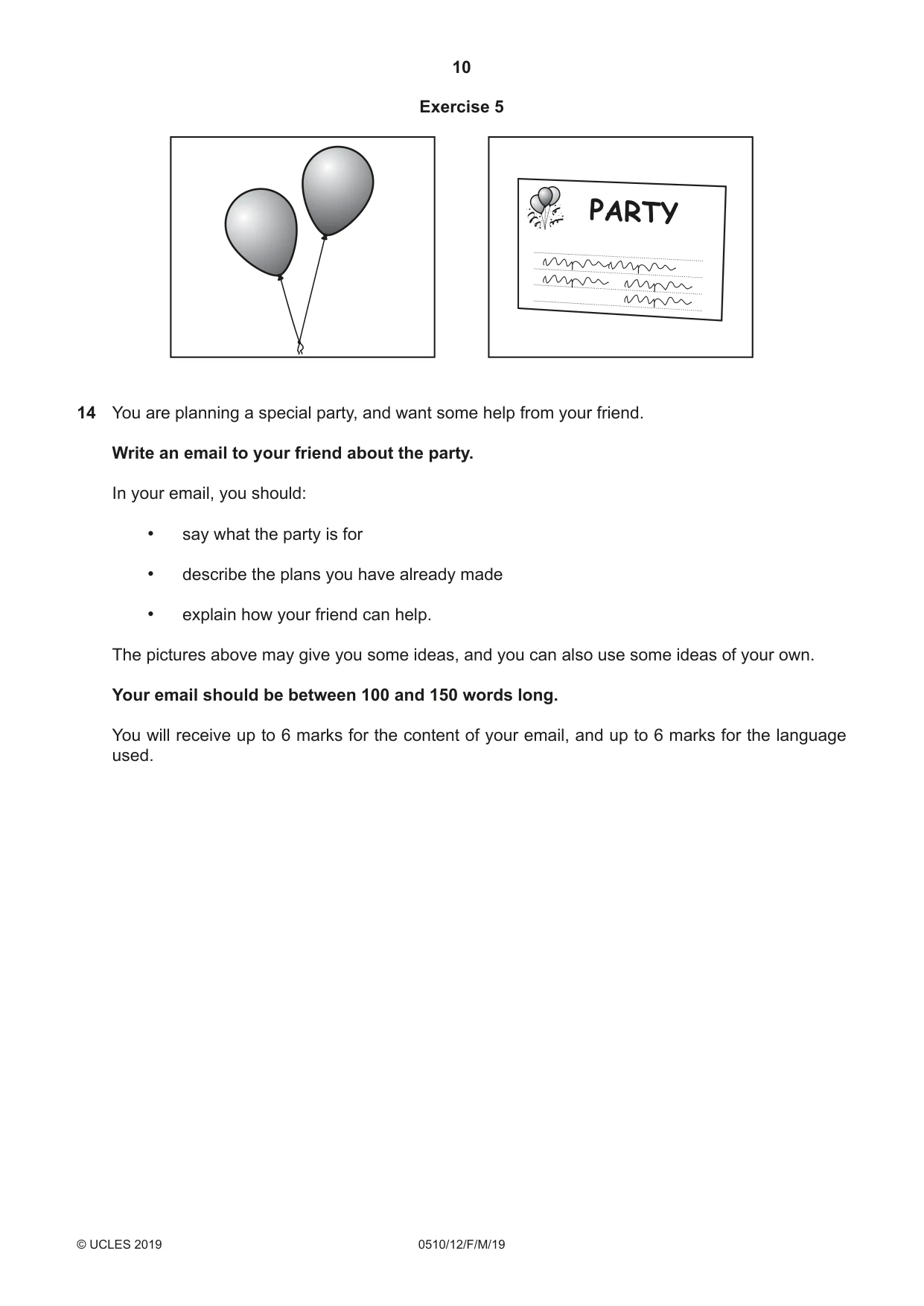
10 0510/12/F/M/19 © UCLES 2019 Exercise 5 14 You are planning a special party, and want some help from your friend. Write an email to your friend about the party. In your email, you should: • say what the party is for • describe the plans you have already made • explain how your friend can help. The pictures above may give you some ideas, and you can also use some ideas of your own. Your email should be between 100 and 150 words long. You will receive up to 6 marks for the content of your email, and up to 6 marks for the language used.
Question paper, page 11
11 0510/12/F/M/19 © UCLES 2019 [Turn over … … … … … … … … … … … … … … … … … … … … … … … … … … … [Total: 12]
Question paper, page 12
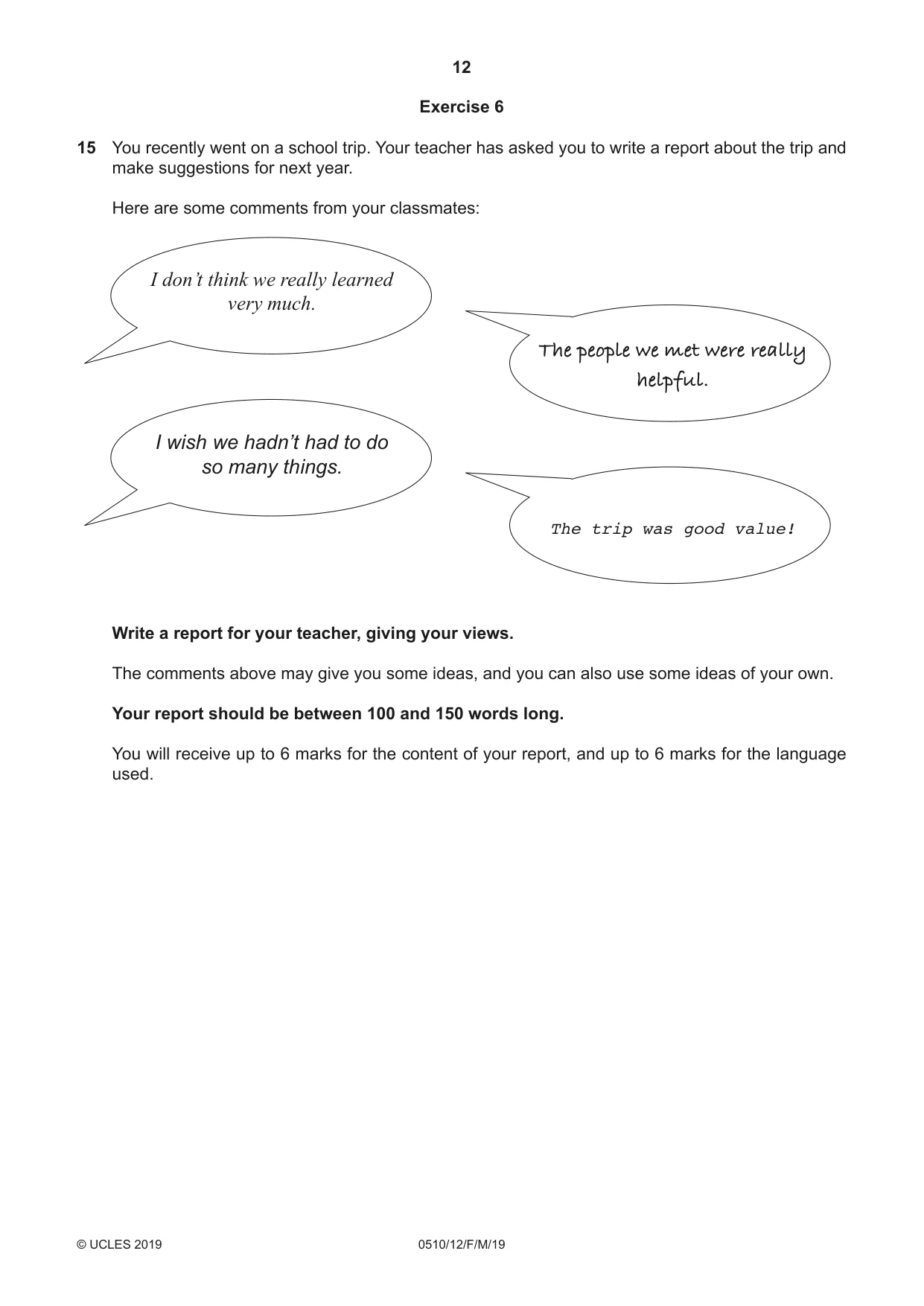
12 0510/12/F/M/19 © UCLES 2019 Exercise 6 15 You recently went on a school trip. Your teacher has asked you to write a report about the trip and make suggestions for next year. Here are some comments from your classmates: I don’t think we really learned very much. I wish we hadn’t had to do so many things. The people we met were really helpful. The trip was good value! Write a report for your teacher, giving your views. The comments above may give you some ideas, and you can also use some ideas of your own. Your report should be between 100 and 150 words long. You will receive up to 6 marks for the content of your report, and up to 6 marks for the language used.
Question paper, page 13
13 0510/12/F/M/19 © UCLES 2019 … … … … … … … … … … … … … … … … … … … … … … … … … … … [Total: 12]
Question paper, page 14
14 0510/12/F/M/19 © UCLES 2019 BLANK PAGE
Question paper, page 15
15 0510/12/F/M/19 © UCLES 2019 BLANK PAGE
Question paper, page 16
16 0510/12/F/M/19 © UCLES 2019 Permission to reproduce items where third-party owned material protected by copyright is included has been sought and cleared where possible. Every reasonable effort has been made by the publisher (UCLES) to trace copyright holders, but if any items requiring clearance have unwittingly been included, the publisher will be pleased to make amends at the earliest possible opportunity. To avoid the issue of disclosure of answer-related information to candidates, all copyright acknowledgements are reproduced online in the Cambridge Assessment International Education Copyright Acknowledgements Booklet. This is produced for each series of examinations and is freely available to download at www.cambridgeinternational.org after the live examination series. Cambridge Assessment International Education is part of the Cambridge Assessment Group. Cambridge Assessment is the brand name of the University of Cambridge Local Examinations Syndicate (UCLES), which itself is a department of the University of Cambridge. BLANK PAGE
Mark scheme, page 1
This document consists of 10 printed pages. © UCLES 2019 [Turn over Cambridge Assessment International Education Cambridge International General Certificate of Secondary Education ENGLISH AS A SECOND LANGUAGE 0510/12 Paper 1 Reading and Writing (Core) March 2019 MARK SCHEME Maximum Mark: 60 Published This mark scheme is published as an aid to teachers and candidates, to indicate the requirements of the examination. It shows the basis on which Examiners were instructed to award marks. It does not indicate the details of the discussions that took place at an Examiners’ meeting before marking began, which would have considered the acceptability of alternative answers. Mark schemes should be read in conjunction with the question paper and the Principal Examiner Report for Teachers. Cambridge International will not enter into discussions about these mark schemes. Cambridge International is publishing the mark schemes for the March 2019 series for most Cambridge IGCSE™, Cambridge International A and AS Level components and some Cambridge O Level components.
Mark scheme, page 2
0510/12 Cambridge IGCSE – Mark Scheme PUBLISHED March 2019 © UCLES 2019 Page 2 of 10 Generic Marking Principles These general marking principles must be applied by all examiners when marking candidate answers. They should be applied alongside the specific content of the mark scheme or generic level descriptors for a question. Each question paper and mark scheme will also comply with these marking principles. GENERIC MARKING PRINCIPLE 1: Marks must be awarded in line with: • the specific content of the mark scheme or the generic level descriptors for the question • the specific skills defined in the mark scheme or in the generic level descriptors for the question • the standard of response required by a candidate as exemplified by the standardisation scripts. GENERIC MARKING PRINCIPLE 2: Marks awarded are always whole marks (not half marks, or other fractions). GENERIC MARKING PRINCIPLE 3: Marks must be awarded positively: • marks are awarded for correct/valid answers, as defined in the mark scheme. However, credit is given for valid answers which go beyond the scope of the syllabus and mark scheme, referring to your Team Leader as appropriate • marks are awarded when candidates clearly demonstrate what they know and can do • marks are not deducted for errors • marks are not deducted for omissions • answers should only be judged on the quality of spelling, punctuation and grammar when these features are specifically assessed by the question as indicated by the mark scheme. The meaning, however, should be unambiguous. GENERIC MARKING PRINCIPLE 4: Rules must be applied consistently e.g. in situations where candidates have not followed instructions or in the application of generic level descriptors. GENERIC MARKING PRINCIPLE 5: Marks should be awarded using the full range of marks defined in the mark scheme for the question (however; the use of the full mark range may be limited according to the quality of the candidate responses seen). GENERIC MARKING PRINCIPLE 6: Marks awarded are based solely on the requirements as defined in the mark scheme. Marks should not be awarded with grade thresholds or grade descriptors in mind.
Mark scheme, page 3
0510/12 Cambridge IGCSE – Mark Scheme PUBLISHED March 2019 © UCLES 2019 Page 3 of 10 This component forms part of the Core tier assessment of Cambridge IGCSE English as a Second Language and tests the following Assessment Objectives: AO1: Reading R1 identify and select relevant information R2 understand ideas, opinions and attitudes R3 show understanding of the connections between ideas, opinions and attitudes R4 understand what is implied but not directly stated, e.g. gist, writer’s purpose, intentions and feelings AO2: Writing W1 communicate information/ideas/opinions clearly, accurately and effectively W2 organise ideas into coherent paragraphs using a range of appropriate linking devices W3 use a range of grammatical structures accurately and effectively W4 show control of punctuation and spelling W5 use appropriate register and style/format for the given purpose and audience
Mark scheme, page 4
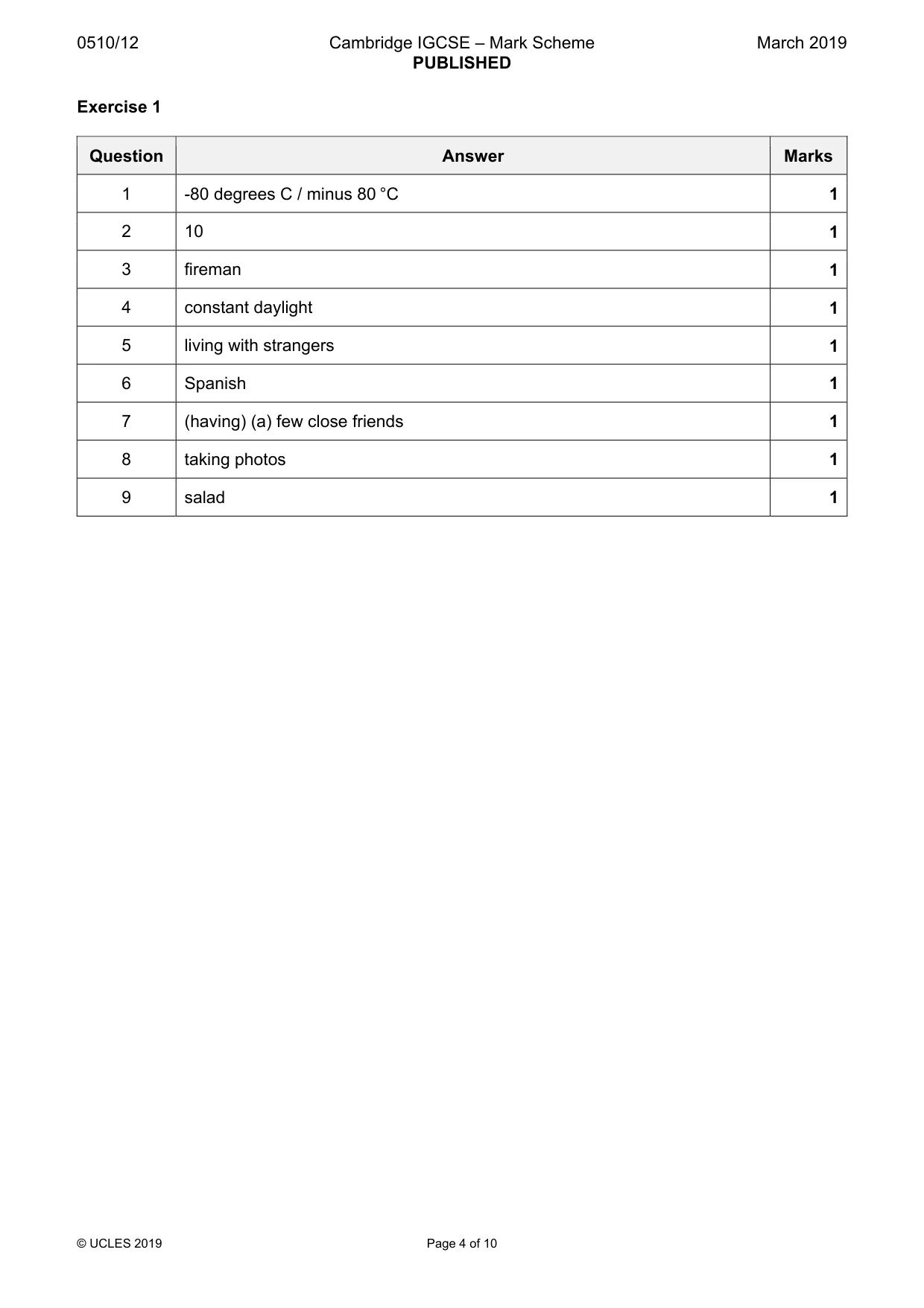
0510/12 Cambridge IGCSE – Mark Scheme PUBLISHED March 2019 © UCLES 2019 Page 4 of 10 Exercise 1 Question Answer Marks 1 -80 degrees C / minus 80 °C 1 2 10 1 3 fireman 1 4 constant daylight 1 5 living with strangers 1 6 Spanish 1 7 (having) (a) few close friends 1 8 taking photos 1 9 salad 1
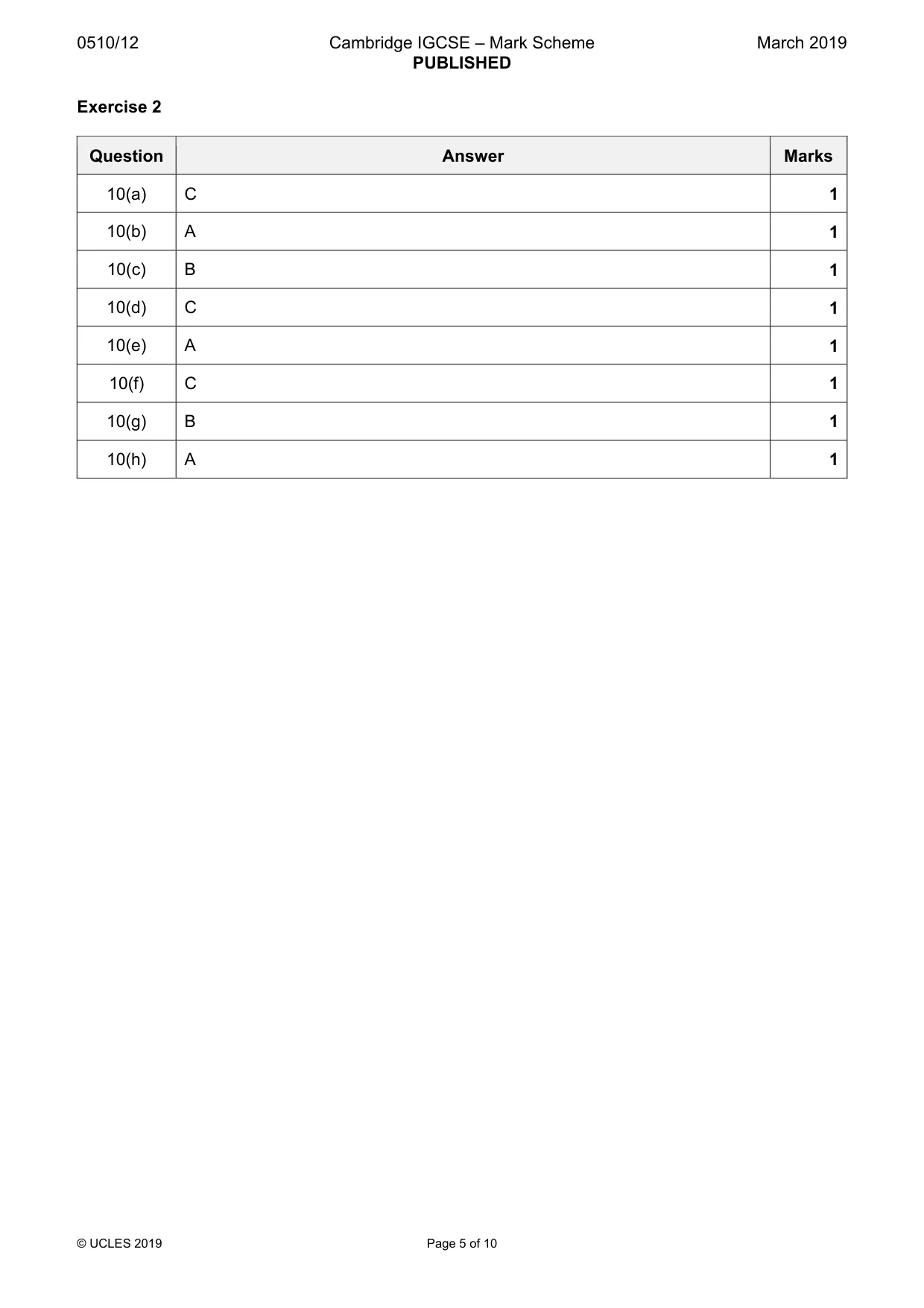
Mark scheme, page 5
0510/12 Cambridge IGCSE – Mark Scheme PUBLISHED March 2019 © UCLES 2019 Page 5 of 10 Exercise 2 Question Answer Marks 10(a) C 1 10(b) A 1 10(c) B 1 10(d) C 1 10(e) A 1 10(f) C 1 10(g) B 1 10(h) A 1
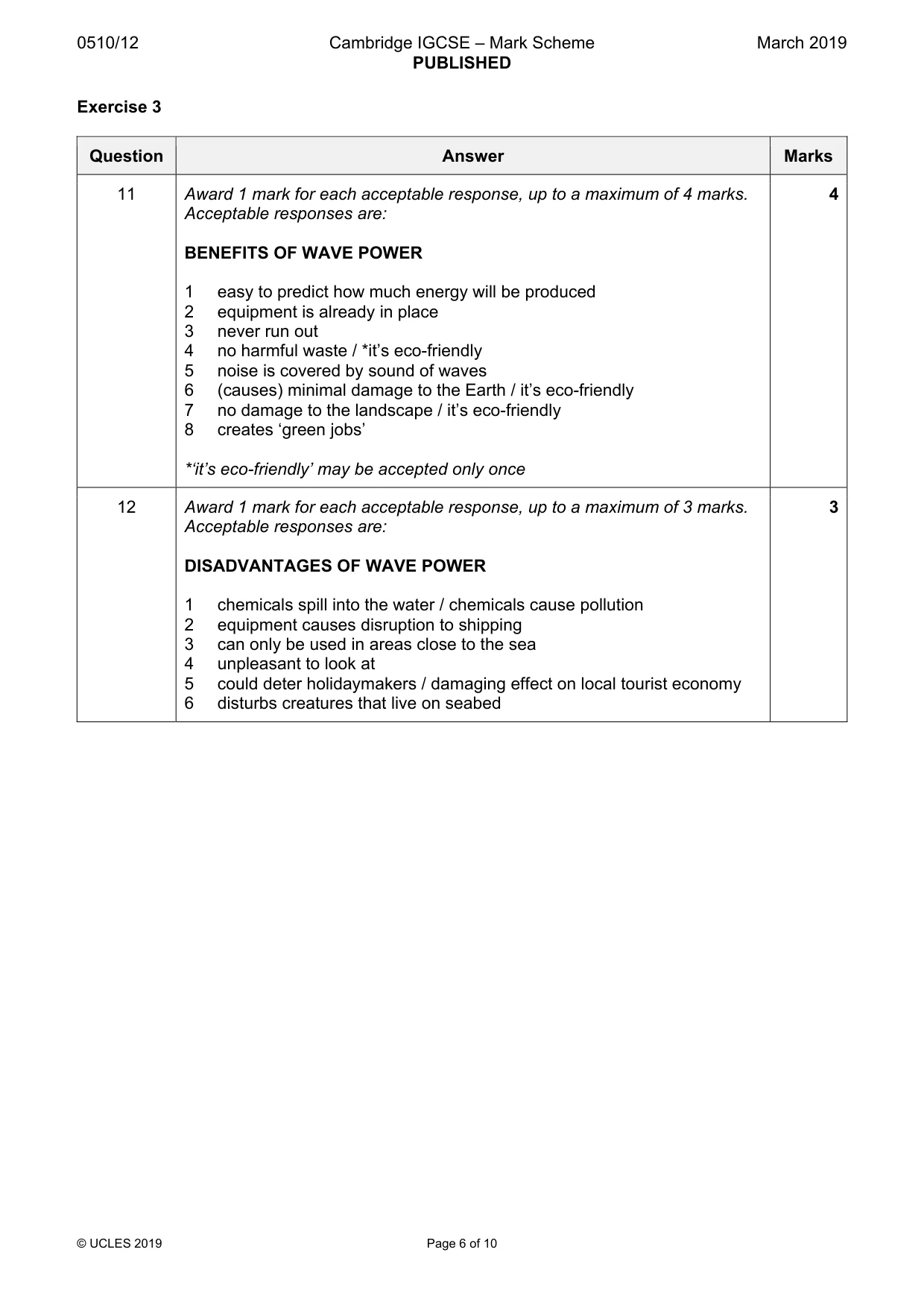
Mark scheme, page 6
0510/12 Cambridge IGCSE – Mark Scheme PUBLISHED March 2019 © UCLES 2019 Page 6 of 10 Exercise 3 Question Answer Marks 11 Award 1 mark for each acceptable response, up to a maximum of 4 marks. Acceptable responses are: BENEFITS OF WAVE POWER 1 easy to predict how much energy will be produced 2 equipment is already in place 3 never run out 4 no harmful waste / *it’s eco-friendly 5 noise is covered by sound of waves 6 (causes) minimal damage to the Earth / it’s eco-friendly 7 no damage to the landscape / it’s eco-friendly 8 creates ‘green jobs’ *‘it’s eco-friendly’ may be accepted only once 4 12 Award 1 mark for each acceptable response, up to a maximum of 3 marks. Acceptable responses are: DISADVANTAGES OF WAVE POWER 1 chemicals spill into the water / chemicals cause pollution 2 equipment causes disruption to shipping 3 can only be used in areas close to the sea 4 unpleasant to look at 5 could deter holidaymakers / damaging effect on local tourist economy 6 disturbs creatures that live on seabed 3
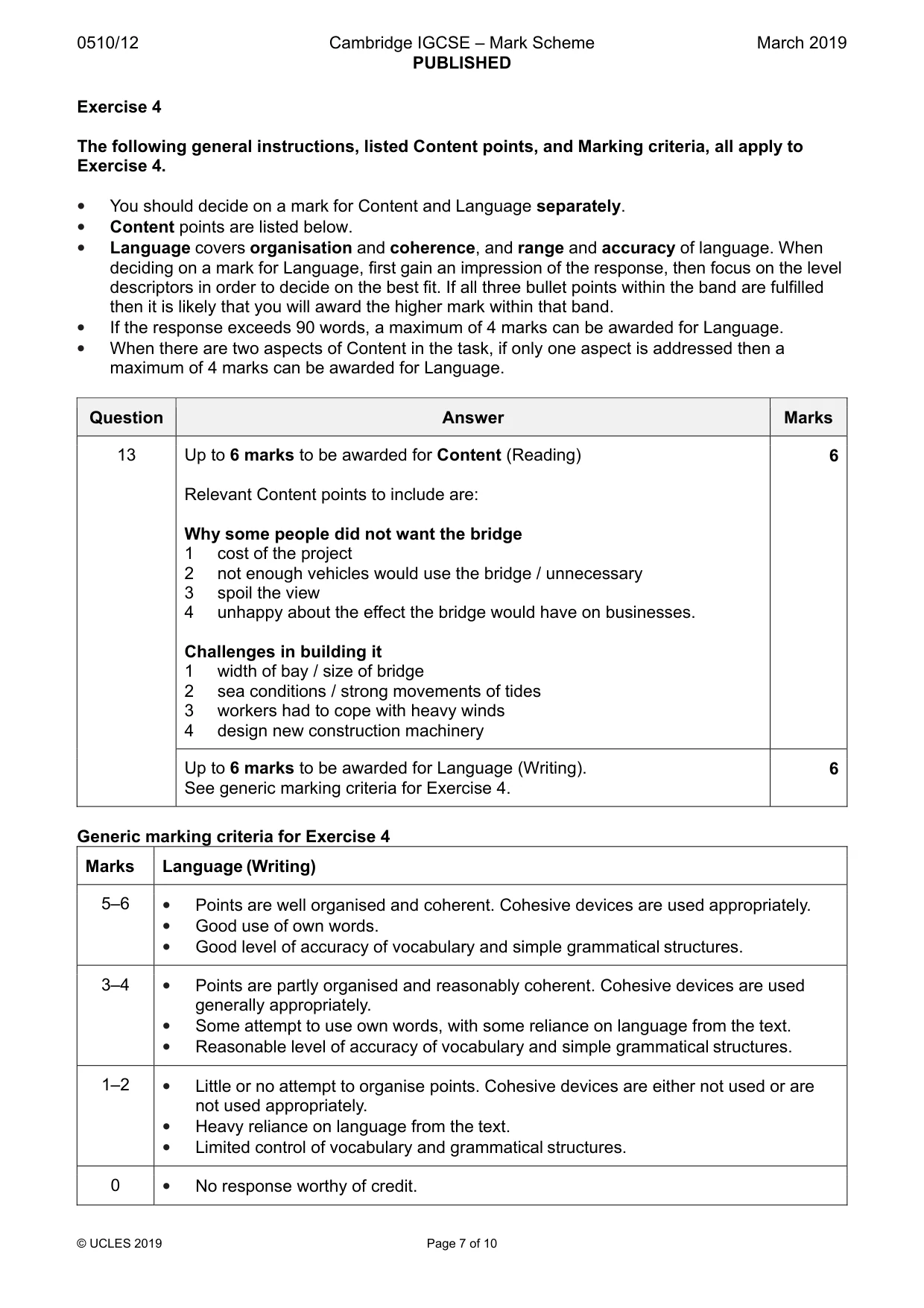
Mark scheme, page 7
0510/12 Cambridge IGCSE – Mark Scheme PUBLISHED March 2019 © UCLES 2019 Page 7 of 10 Exercise 4 The following general instructions, listed Content points, and Marking criteria, all apply to Exercise 4. • You should decide on a mark for Content and Language separately. • Content points are listed below. • Language covers organisation and coherence, and range and accuracy of language. When deciding on a mark for Language, first gain an impression of the response, then focus on the level descriptors in order to decide on the best fit. If all three bullet points within the band are fulfilled then it is likely that you will award the higher mark within that band. • If the response exceeds 90 words, a maximum of 4 marks can be awarded for Language. • When there are two aspects of Content in the task, if only one aspect is addressed then a maximum of 4 marks can be awarded for Language. Question Answer Marks 13 Up to 6 marks to be awarded for Content (Reading) Relevant Content points to include are: Why some people did not want the bridge 1 cost of the project 2 not enough vehicles would use the bridge / unnecessary 3 spoil the view 4 unhappy about the effect the bridge would have on businesses. Challenges in building it 1 width of bay / size of bridge 2 sea conditions / strong movements of tides 3 workers had to cope with heavy winds 4 design new construction machinery 6 Up to 6 marks to be awarded for Language (Writing). See generic marking criteria for Exercise 4. 6 Generic marking criteria for Exercise 4 Marks Language (Writing) 5–6 • Points are well organised and coherent. Cohesive devices are used appropriately. • Good use of own words. • Good level of accuracy of vocabulary and simple grammatical structures. 3–4 • Points are partly organised and reasonably coherent. Cohesive devices are used generally appropriately. • Some attempt to use own words, with some reliance on language from the text. • Reasonable level of accuracy of vocabulary and simple grammatical structures. 1–2 • Little or no attempt to organise points. Cohesive devices are either not used or are not used appropriately. • Heavy reliance on language from the text. • Limited control of vocabulary and grammatical structures. 0 • No response worthy of credit.
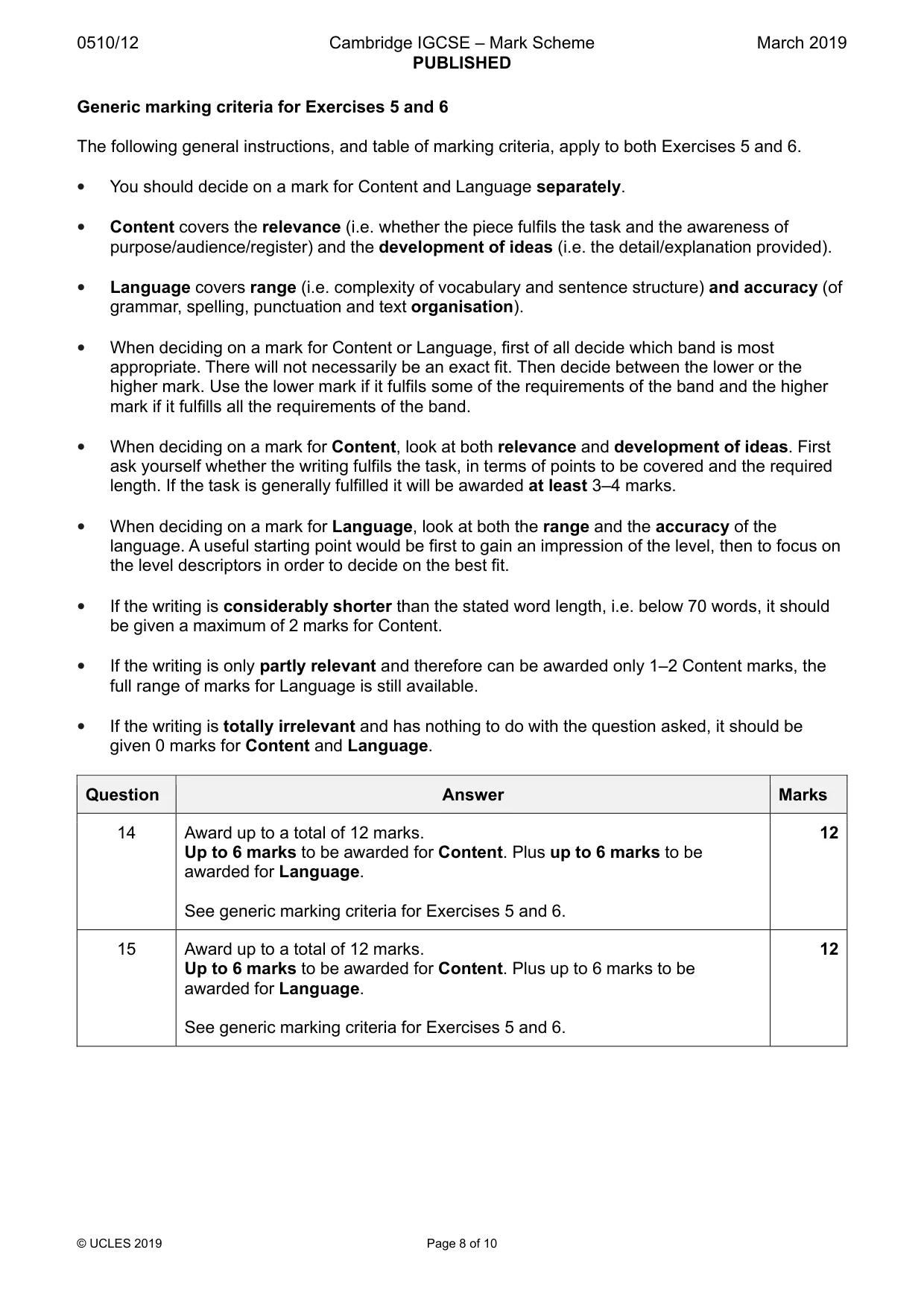
Mark scheme, page 8
0510/12 Cambridge IGCSE – Mark Scheme PUBLISHED March 2019 © UCLES 2019 Page 8 of 10 Generic marking criteria for Exercises 5 and 6 The following general instructions, and table of marking criteria, apply to both Exercises 5 and 6. • You should decide on a mark for Content and Language separately. • Content covers the relevance (i.e. whether the piece fulfils the task and the awareness of purpose/audience/register) and the development of ideas (i.e. the detail/explanation provided). • Language covers range (i.e. complexity of vocabulary and sentence structure) and accuracy (of grammar, spelling, punctuation and text organisation). • When deciding on a mark for Content or Language, first of all decide which band is most appropriate. There will not necessarily be an exact fit. Then decide between the lower or the higher mark. Use the lower mark if it fulfils some of the requirements of the band and the higher mark if it fulfills all the requirements of the band. • When deciding on a mark for Content, look at both relevance and development of ideas. First ask yourself whether the writing fulfils the task, in terms of points to be covered and the required length. If the task is generally fulfilled it will be awarded at least 3–4 marks. • When deciding on a mark for Language, look at both the range and the accuracy of the language. A useful starting point would be first to gain an impression of the level, then to focus on the level descriptors in order to decide on the best fit. • If the writing is considerably shorter than the stated word length, i.e. below 70 words, it should be given a maximum of 2 marks for Content. • If the writing is only partly relevant and therefore can be awarded only 1–2 Content marks, the full range of marks for Language is still available. • If the writing is totally irrelevant and has nothing to do with the question asked, it should be given 0 marks for Content and Language. Question Answer Marks 14 Award up to a total of 12 marks. Up to 6 marks to be awarded for Content. Plus up to 6 marks to be awarded for Language. See generic marking criteria for Exercises 5 and 6. 12 15 Award up to a total of 12 marks. Up to 6 marks to be awarded for Content. Plus up to 6 marks to be awarded for Language. See generic marking criteria for Exercises 5 and 6. 12
Mark scheme, page 9
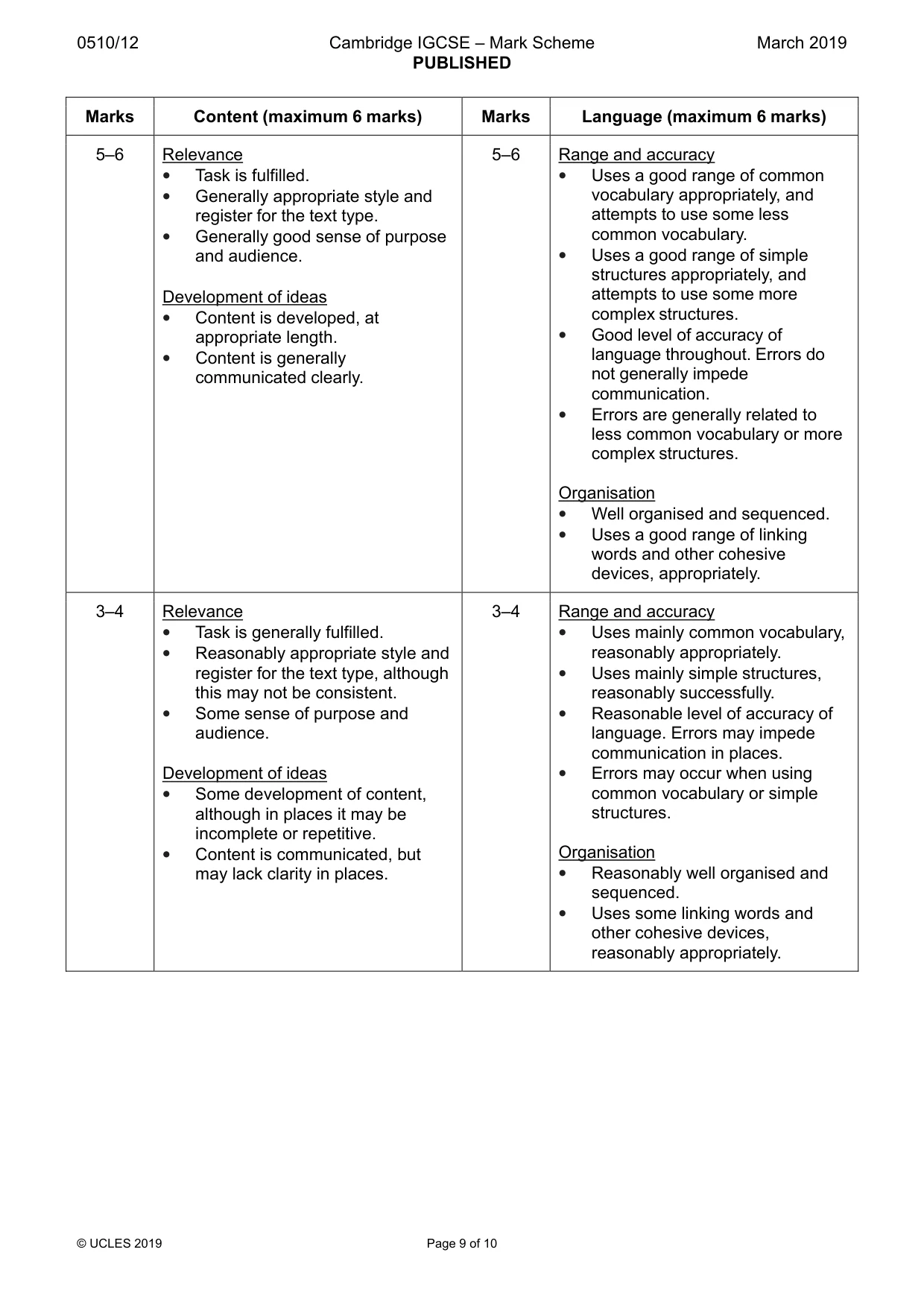
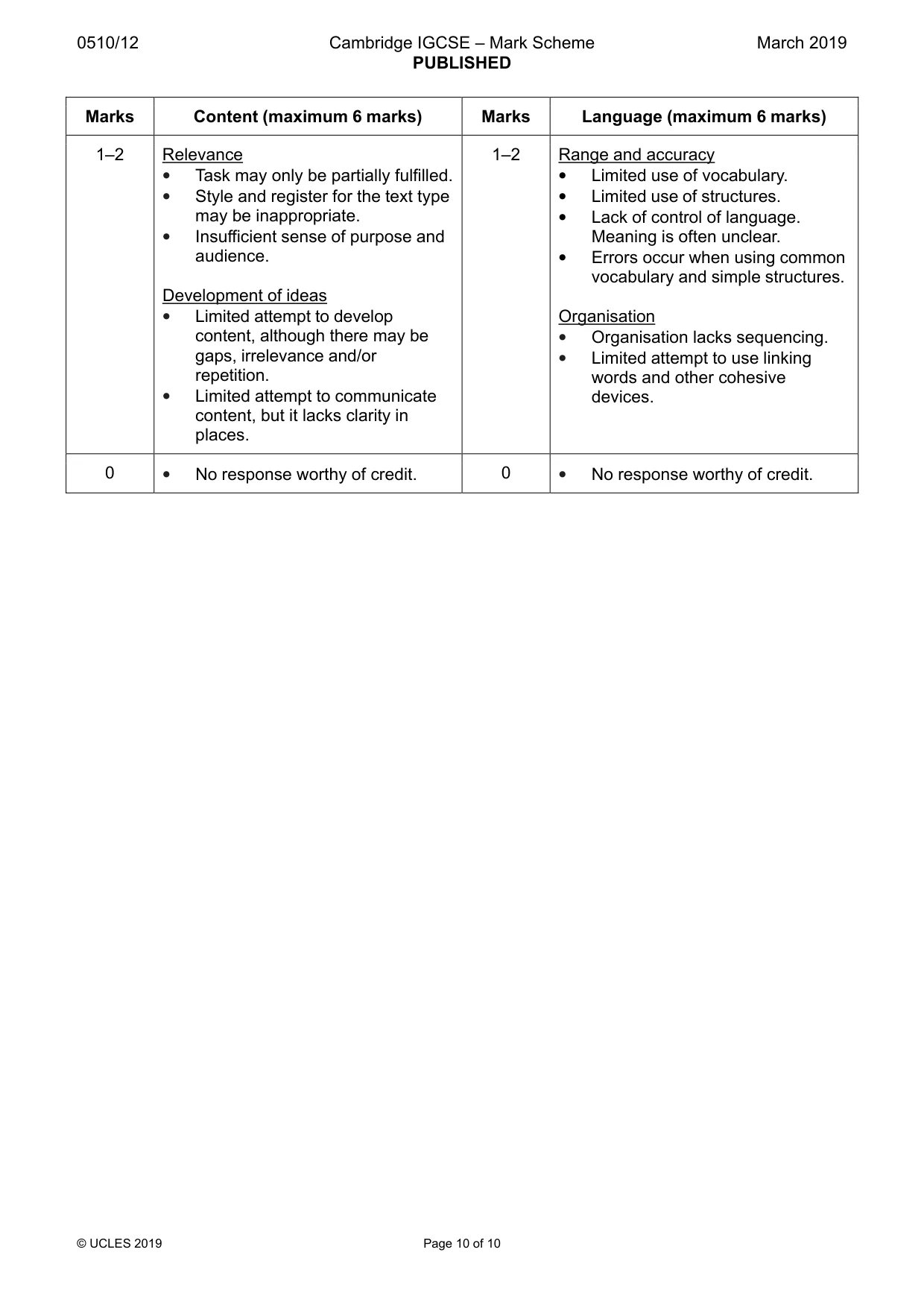
0510/12 Cambridge IGCSE – Mark Scheme PUBLISHED March 2019 © UCLES 2019 Page 9 of 10 Marks Content (maximum 6 marks) Marks Language (maximum 6 marks) 5–6 Relevance • Task is fulfilled. • Generally appropriate style and register for the text type. • Generally good sense of purpose and audience. Development of ideas • Content is developed, at appropriate length. • Content is generally communicated clearly. 5–6 Range and accuracy • Uses a good range of common vocabulary appropriately, and attempts to use some less common vocabulary. • Uses a good range of simple structures appropriately, and attempts to use some more complex structures. • Good level of accuracy of language throughout. Errors do not generally impede communication. • Errors are generally related to less common vocabulary or more complex structures. Organisation • Well organised and sequenced. • Uses a good range of linking words and other cohesive devices, appropriately. 3–4 Relevance • Task is generally fulfilled. • Reasonably appropriate style and register for the text type, although this may not be consistent. • Some sense of purpose and audience. Development of ideas • Some development of content, although in places it may be incomplete or repetitive. • Content is communicated, but may lack clarity in places. 3–4 Range and accuracy • Uses mainly common vocabulary, reasonably appropriately. • Uses mainly simple structures, reasonably successfully. • Reasonable level of accuracy of language. Errors may impede communication in places. • Errors may occur when using common vocabulary or simple structures. Organisation • Reasonably well organised and sequenced. • Uses some linking words and other cohesive devices, reasonably appropriately.
Mark scheme, page 10
0510/12 Cambridge IGCSE – Mark Scheme PUBLISHED March 2019 © UCLES 2019 Page 10 of 10 Marks Content (maximum 6 marks) Marks Language (maximum 6 marks) 1–2 Relevance • Task may only be partially fulfilled. • Style and register for the text type may be inappropriate. • Insufficient sense of purpose and audience. Development of ideas • Limited attempt to develop content, although there may be gaps, irrelevance and/or repetition. • Limited attempt to communicate content, but it lacks clarity in places. 1–2 Range and accuracy • Limited use of vocabulary. • Limited use of structures. • Lack of control of language. Meaning is often unclear. • Errors occur when using common vocabulary and simple structures. Organisation • Organisation lacks sequencing. • Limited attempt to use linking words and other cohesive devices. 0 • No response worthy of credit. 0 • No response worthy of credit.
What you needed in this session
Cambridge’s own grade thresholds for 2019 Feb/March, Paper 1 · Variant 2. A higher threshold means an easier paper — the bar moves with how the cohort did.