Cambridge IGCSE English - Second Language (oral endorsement) 0510 — 2017 Feb/March Paper 1 · Variant 2
0510/12/F/M/17 · 70 marks · ≈79 min
The question paper and its mark scheme, free to read here and free to download. This is Cambridge’s own paper, exactly as it was sat.
Question paper16 pages



Mark scheme12 pages
Answers below. Sit the paper first if you are practising.
Paper as text
Question paper, page 1
This document consists of 13 printed pages and 3 blank pages. DC (NH/AR) 126274/4 © UCLES 2017 [Turn over * 9 9 6 9 8 7 2 7 3 2 * ENGLISH AS A SECOND LANGUAGE 0510/12 Paper 1 Reading and Writing (Core) February/March 2017 1 hour 30 minutes Candidates answer on the Question Paper. No Additional Materials are required. READ THESE INSTRUCTIONS FIRST Write your Centre number, candidate number and name on all the work you hand in. Write in dark blue or black pen. Do not use staples, paper clips, glue or correction fluid. DO NOT WRITE IN ANY BARCODES. Answer all questions. Dictionaries are not allowed. At the end of the examination, fasten all your work securely together. The number of marks is given in brackets [ ] at the end of each question or part question. Cambridge International Examinations Cambridge International General Certificate of Secondary Education
Question paper, page 2
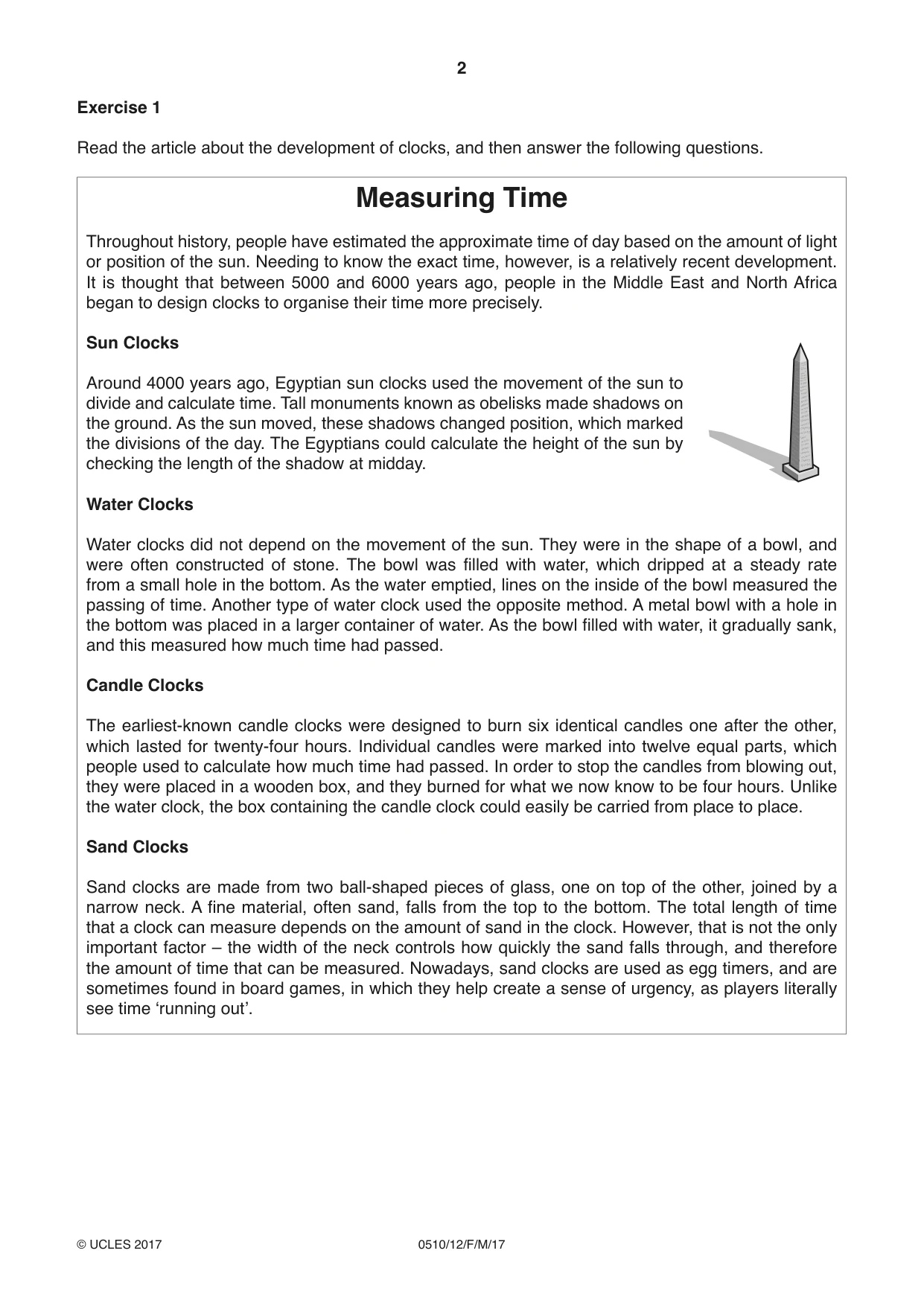
2 0510/12/F/M/17 © UCLES 2017 Exercise 1 Read the article about the development of clocks, and then answer the following questions. Measuring Time Throughout history, people have estimated the approximate time of day based on the amount of light or position of the sun. Needing to know the exact time, however, is a relatively recent development. It is thought that between 5000 and 6000 years ago, people in the Middle East and North Africa began to design clocks to organise their time more precisely. Sun Clocks Around 4000 years ago, Egyptian sun clocks used the movement of the sun to divide and calculate time. Tall monuments known as obelisks made shadows on the ground. As the sun moved, these shadows changed position, which marked the divisions of the day. The Egyptians could calculate the height of the sun by checking the length of the shadow at midday. Water Clocks Water clocks did not depend on the movement of the sun. They were in the shape of a bowl, and were often constructed of stone. The bowl was filled with water, which dripped at a steady rate from a small hole in the bottom. As the water emptied, lines on the inside of the bowl measured the passing of time. Another type of water clock used the opposite method. A metal bowl with a hole in the bottom was placed in a larger container of water. As the bowl filled with water, it gradually sank, and this measured how much time had passed. Candle Clocks The earliest-known candle clocks were designed to burn six identical candles one after the other, which lasted for twenty-four hours. Individual candles were marked into twelve equal parts, which people used to calculate how much time had passed. In order to stop the candles from blowing out, they were placed in a wooden box, and they burned for what we now know to be four hours. Unlike the water clock, the box containing the candle clock could easily be carried from place to place. Sand Clocks Sand clocks are made from two ball-shaped pieces of glass, one on top of the other, joined by a narrow neck. A fine material, often sand, falls from the top to the bottom. The total length of time that a clock can measure depends on the amount of sand in the clock. However, that is not the only important factor – the width of the neck controls how quickly the sand falls through, and therefore the amount of time that can be measured. Nowadays, sand clocks are used as egg timers, and are sometimes found in board games, in which they help create a sense of urgency, as players literally see time ‘running out’.
Question paper, page 3
3 0510/12/F/M/17 © UCLES 2017 [Turn over (a) When did ancient people start to measure time using clocks? …[1] (b) What information was provided by measuring the shadow in the middle of the day? …[1] (c) What material was used to make water clocks? …[1] (d) How many sections were there on each candle in a candle clock? …[1] (e) What affects the measurement of time in a sand clock? Give two details. … …[2] (f) How do people use sand clocks today? …[1] [Total: 7]
Question paper, page 4
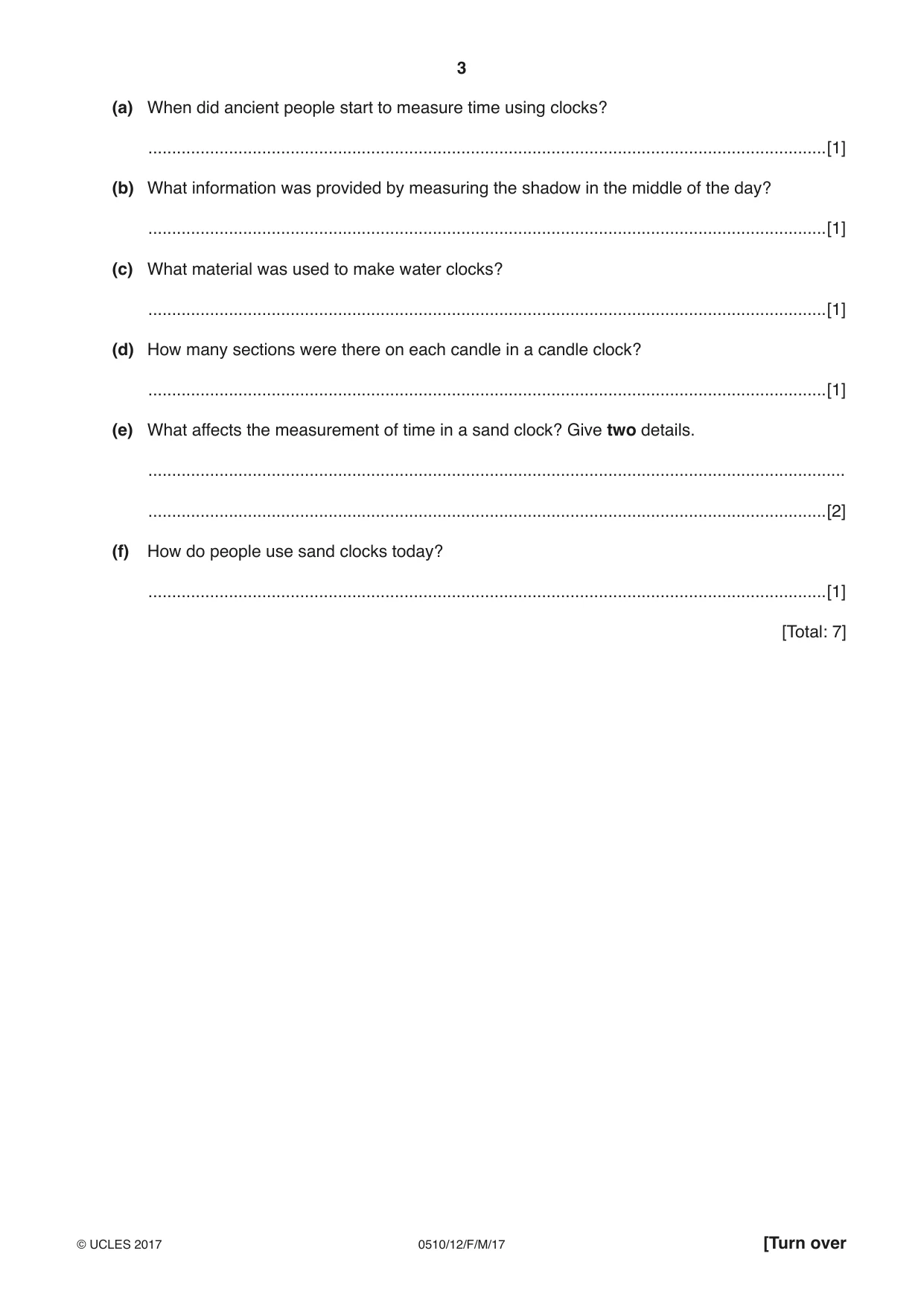
4 0510/12/F/M/17 © UCLES 2017 Exercise 2 Read the article about a swimming holiday in Croatia, and then answer the following questions. In at the deep end Here, journalist Peter Taylor writes about a new and different holiday experience. “I had never heard of open-water swimming in seas, lakes and rivers, until a friend told me about his holiday with a company called VacationSwim. The company provides guided swimming trips in Europe and surfing holidays in Australia. Listening to my friend persuaded me that I should try something new and exciting. So here I was in Croatia. I had decided that three days would be too short, so I chose to spend seven days swimming between some small islands around the coast. The clear Adriatic Sea surrounding the tiny island of Prvic, which was the base for the holiday, looked beautiful. However, the huge expanse of blue sea was worrying me, and made me question my decision to choose this holiday. I had failed to complete the recommended six-week training plan, so I realised that I wasn’t as fit as I could be. However, when I spoke to my fellow swimmers and we compared our fitness levels, I felt better. Our group included people of all nationalities and ages, but everyone was looking for adventure. We had individual requirements too – some wanted to explore a new area, and others wanted professional swimming tips. On the first morning, our guides Maria and Robbie greeted us, and gave us swimming hats and goggles. They asked us to swim around the harbour so that they could observe our technique and divide us into ability groups. Then we were ready to go. The swimming hats helped keep us warm, and when we got in the water, it was easy to see the logic of choosing such brightly-coloured hats – it was much easier for our guides to keep an eye on us from the safety boat. After 10 minutes of splashing around, I started to get used to the new environment. I had previously swum in a pool of course, but the combination of waves, salt and depth was a new and unfamiliar experience. However, I soon settled into a regular rhythm, and having people in the water near me was comforting. I could see the beach where we were heading in the distance, and the guides kept watch from the safety boat. When we got tired, we stopped swimming. We hung onto the side of the boat and had some high-calorie sports drinks so that we could get our strength back. Then we were off again, and I focused on staying with my group. Before long, we reached the beach on the island of Tijat, and looked back in delight at the impressive distance that we had swum. The weather during our stay played an important part in the experience. Fortunately, the lack of wind meant that the sea wasn’t rough – big waves can cause problems for swimmers. I would recommend anyone to check the sea temperature before booking, because it can vary throughout the year. My confidence grew daily. I managed the longest single swim of 3 kilometres with no problem, and although a few people swam more than 30 kilometres, I was thrilled to have covered a total of 20 kilometres. I never completely lost my childhood fear of the creatures that could be swimming below me, but it didn’t hold me back. The guides encouraged us and were very supportive throughout. We were even filmed underwater, and our movements were examined in slow motion, which taught us how to swim more efficiently. When I described the trip to some of my friends, they said, “It doesn’t sound like much of a holiday!” I loved it though, and now I’m saving for another trip!” 35 30 25 20 15 10 5 Temperature – degrees C Month Air °C Sea °C April May June July August Average summer temperatures in Croatia
Question paper, page 5
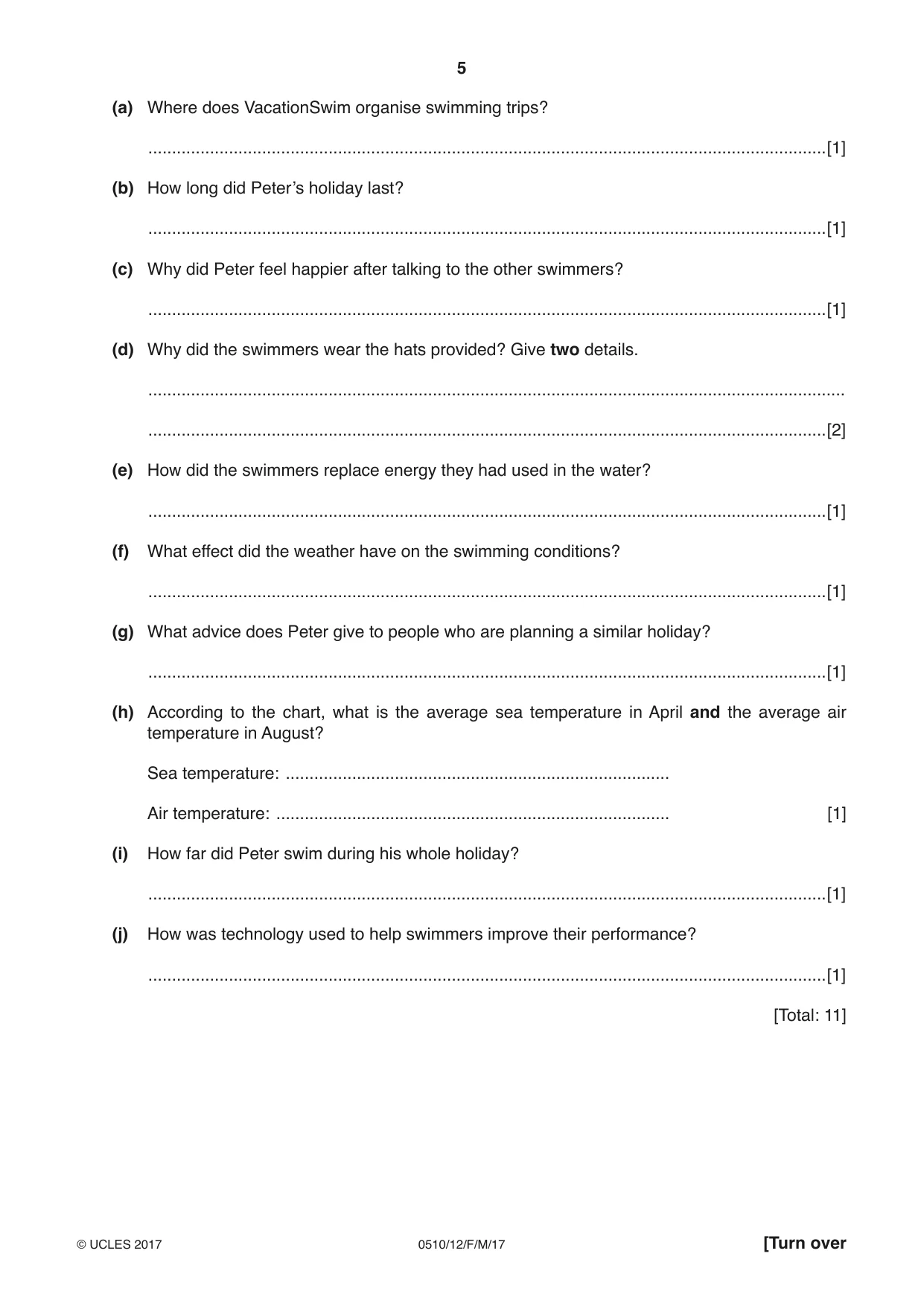
5 0510/12/F/M/17 © UCLES 2017 [Turn over (a) Where does VacationSwim organise swimming trips? …[1] (b) How long did Peter’s holiday last? …[1] (c) Why did Peter feel happier after talking to the other swimmers? …[1] (d) Why did the swimmers wear the hats provided? Give two details. … …[2] (e) How did the swimmers replace energy they had used in the water? …[1] (f) What effect did the weather have on the swimming conditions? …[1] (g) What advice does Peter give to people who are planning a similar holiday? …[1] (h) According to the chart, what is the average sea temperature in April and the average air temperature in August? Sea temperature: … Air temperature: … [1] (i) How far did Peter swim during his whole holiday? …[1] (j) How was technology used to help swimmers improve their performance? …[1] [Total: 11]
Question paper, page 6
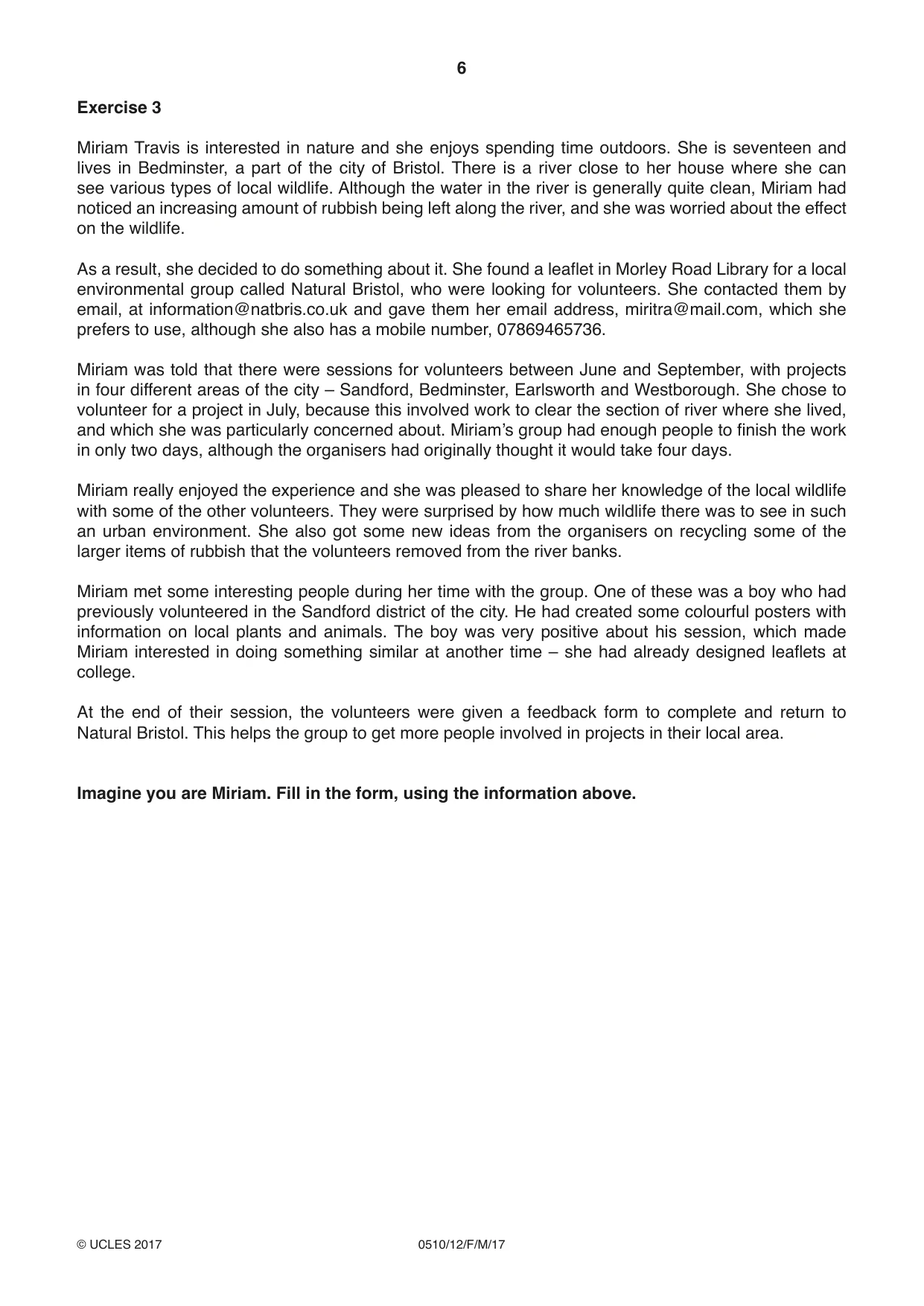
6 0510/12/F/M/17 © UCLES 2017 Exercise 3 Miriam Travis is interested in nature and she enjoys spending time outdoors. She is seventeen and lives in Bedminster, a part of the city of Bristol. There is a river close to her house where she can see various types of local wildlife. Although the water in the river is generally quite clean, Miriam had noticed an increasing amount of rubbish being left along the river, and she was worried about the effect on the wildlife. As a result, she decided to do something about it. She found a leaflet in Morley Road Library for a local environmental group called Natural Bristol, who were looking for volunteers. She contacted them by email, at information@natbris.co.uk and gave them her email address, miritra@mail.com, which she prefers to use, although she also has a mobile number, 07869465736. Miriam was told that there were sessions for volunteers between June and September, with projects in four different areas of the city – Sandford, Bedminster, Earlsworth and Westborough. She chose to volunteer for a project in July, because this involved work to clear the section of river where she lived, and which she was particularly concerned about. Miriam’s group had enough people to finish the work in only two days, although the organisers had originally thought it would take four days. Miriam really enjoyed the experience and she was pleased to share her knowledge of the local wildlife with some of the other volunteers. They were surprised by how much wildlife there was to see in such an urban environment. She also got some new ideas from the organisers on recycling some of the larger items of rubbish that the volunteers removed from the river banks. Miriam met some interesting people during her time with the group. One of these was a boy who had previously volunteered in the Sandford district of the city. He had created some colourful posters with information on local plants and animals. The boy was very positive about his session, which made Miriam interested in doing something similar at another time – she had already designed leaflets at college. At the end of their session, the volunteers were given a feedback form to complete and return to Natural Bristol. This helps the group to get more people involved in projects in their local area. Imagine you are Miriam. Fill in the form, using the information above.
Question paper, page 7
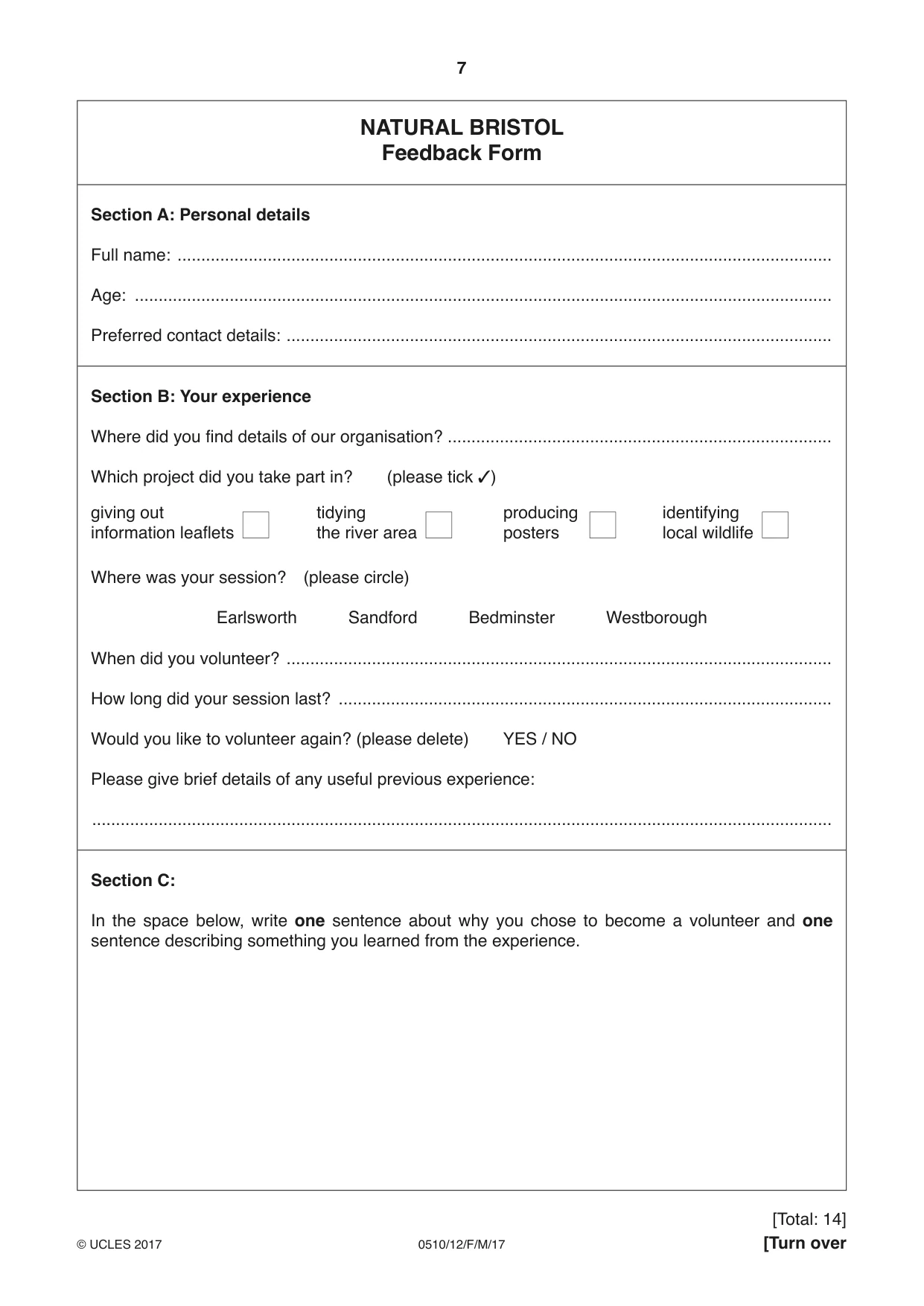
7 0510/12/F/M/17 © UCLES 2017 [Turn over NATURAL BRISTOL Feedback Form Section A: Personal details Full name: … Age: … Preferred contact details: … Section B: Your experience Where did you find details of our organisation? … Which project did you take part in? (please tick ✓) giving out information leaflets tidying the river area identifying local wildlife producing posters Where was your session? (please circle) Earlsworth Sandford Bedminster Westborough When did you volunteer? … How long did your session last? … Would you like to volunteer again? (please delete) YES / NO Please give brief details of any useful previous experience: … Section C: In the space below, write one sentence about why you chose to become a volunteer and one sentence describing something you learned from the experience. [Total: 14]
Question paper, page 8
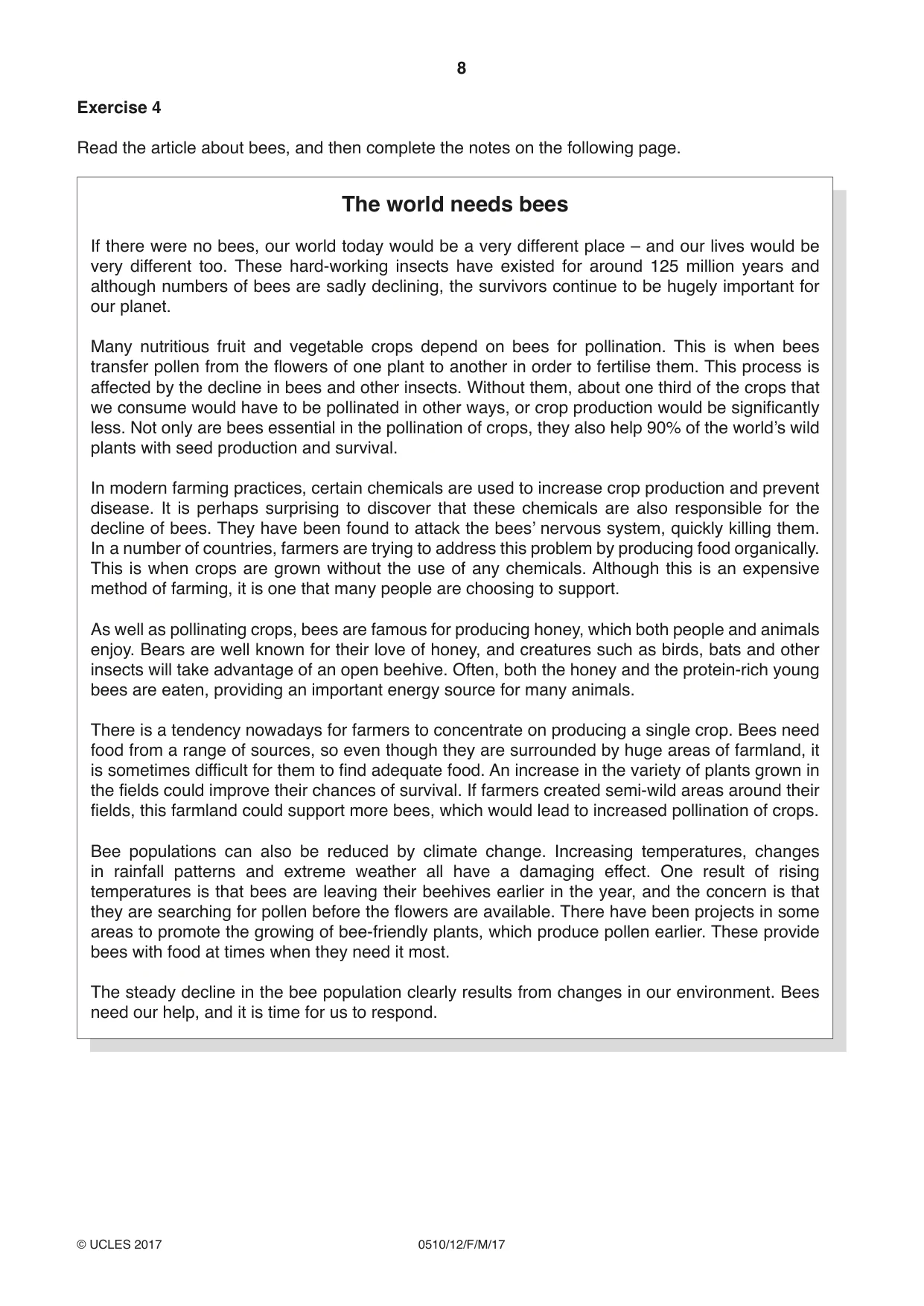
8 0510/12/F/M/17 © UCLES 2017 Exercise 4 Read the article about bees, and then complete the notes on the following page. The world needs bees If there were no bees, our world today would be a very different place – and our lives would be very different too. These hard-working insects have existed for around 125 million years and although numbers of bees are sadly declining, the survivors continue to be hugely important for our planet. Many nutritious fruit and vegetable crops depend on bees for pollination. This is when bees transfer pollen from the flowers of one plant to another in order to fertilise them. This process is affected by the decline in bees and other insects. Without them, about one third of the crops that we consume would have to be pollinated in other ways, or crop production would be significantly less. Not only are bees essential in the pollination of crops, they also help 90% of the world’s wild plants with seed production and survival. In modern farming practices, certain chemicals are used to increase crop production and prevent disease. It is perhaps surprising to discover that these chemicals are also responsible for the decline of bees. They have been found to attack the bees’ nervous system, quickly killing them. In a number of countries, farmers are trying to address this problem by producing food organically. This is when crops are grown without the use of any chemicals. Although this is an expensive method of farming, it is one that many people are choosing to support. As well as pollinating crops, bees are famous for producing honey, which both people and animals enjoy. Bears are well known for their love of honey, and creatures such as birds, bats and other insects will take advantage of an open beehive. Often, both the honey and the protein-rich young bees are eaten, providing an important energy source for many animals. There is a tendency nowadays for farmers to concentrate on producing a single crop. Bees need food from a range of sources, so even though they are surrounded by huge areas of farmland, it is sometimes difficult for them to find adequate food. An increase in the variety of plants grown in the fields could improve their chances of survival. If farmers created semi-wild areas around their fields, this farmland could support more bees, which would lead to increased pollination of crops. Bee populations can also be reduced by climate change. Increasing temperatures, changes in rainfall patterns and extreme weather all have a damaging effect. One result of rising temperatures is that bees are leaving their beehives earlier in the year, and the concern is that they are searching for pollen before the flowers are available. There have been projects in some areas to promote the growing of bee-friendly plants, which produce pollen earlier. These provide bees with food at times when they need it most. The steady decline in the bee population clearly results from changes in our environment. Bees need our help, and it is time for us to respond.
Question paper, page 9
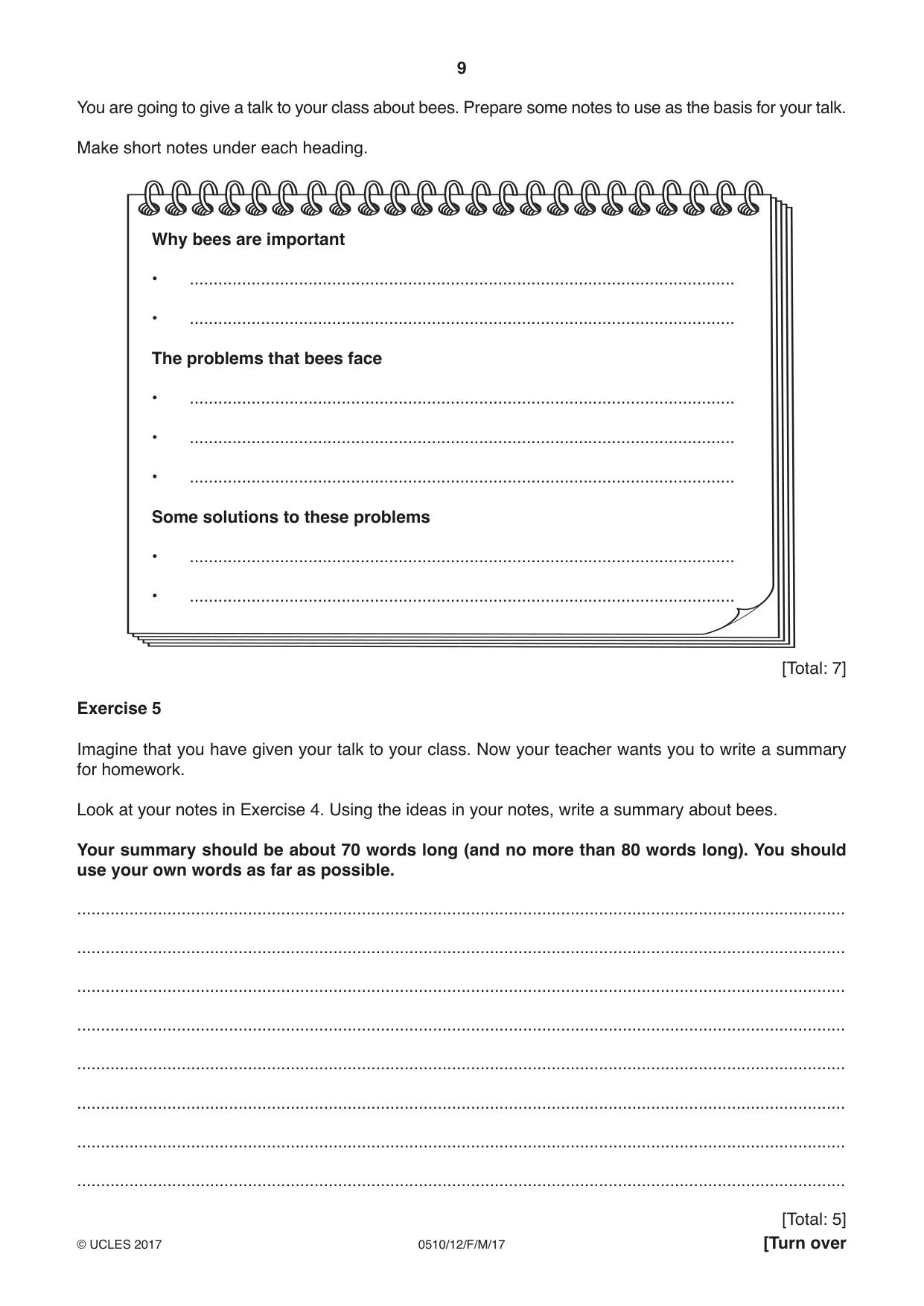
9 0510/12/F/M/17 © UCLES 2017 [Turn over You are going to give a talk to your class about bees. Prepare some notes to use as the basis for your talk. Make short notes under each heading. Why bees are important • … • … The problems that bees face • … • … • … Some solutions to these problems • … • … [Total: 7] Exercise 5 Imagine that you have given your talk to your class. Now your teacher wants you to write a summary for homework. Look at your notes in Exercise 4. Using the ideas in your notes, write a summary about bees. Your summary should be about 70 words long (and no more than 80 words long). You should use your own words as far as possible. … … … … … … … … [Total: 5]
Question paper, page 10
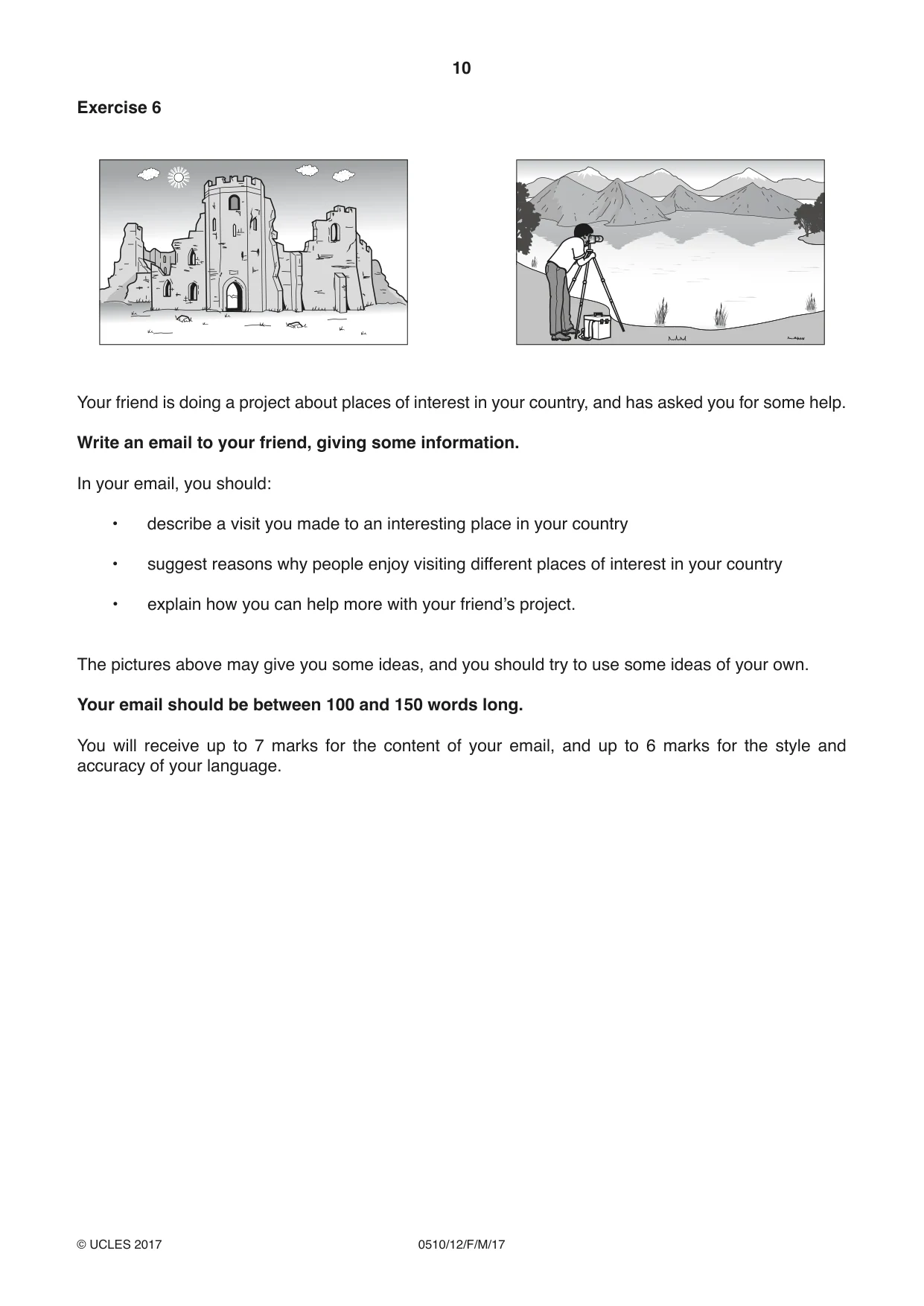
10 0510/12/F/M/17 © UCLES 2017 Exercise 6 Your friend is doing a project about places of interest in your country, and has asked you for some help. Write an email to your friend, giving some information. In your email, you should: • describe a visit you made to an interesting place in your country • suggest reasons why people enjoy visiting different places of interest in your country • explain how you can help more with your friend’s project. The pictures above may give you some ideas, and you should try to use some ideas of your own. Your email should be between 100 and 150 words long. You will receive up to 7 marks for the content of your email, and up to 6 marks for the style and accuracy of your language.
Question paper, page 11
11 0510/12/F/M/17 © UCLES 2017 [Turn over … … … … … … … … … … … … … … … … … … … … … … … … … … … [Total: 13]
Question paper, page 12
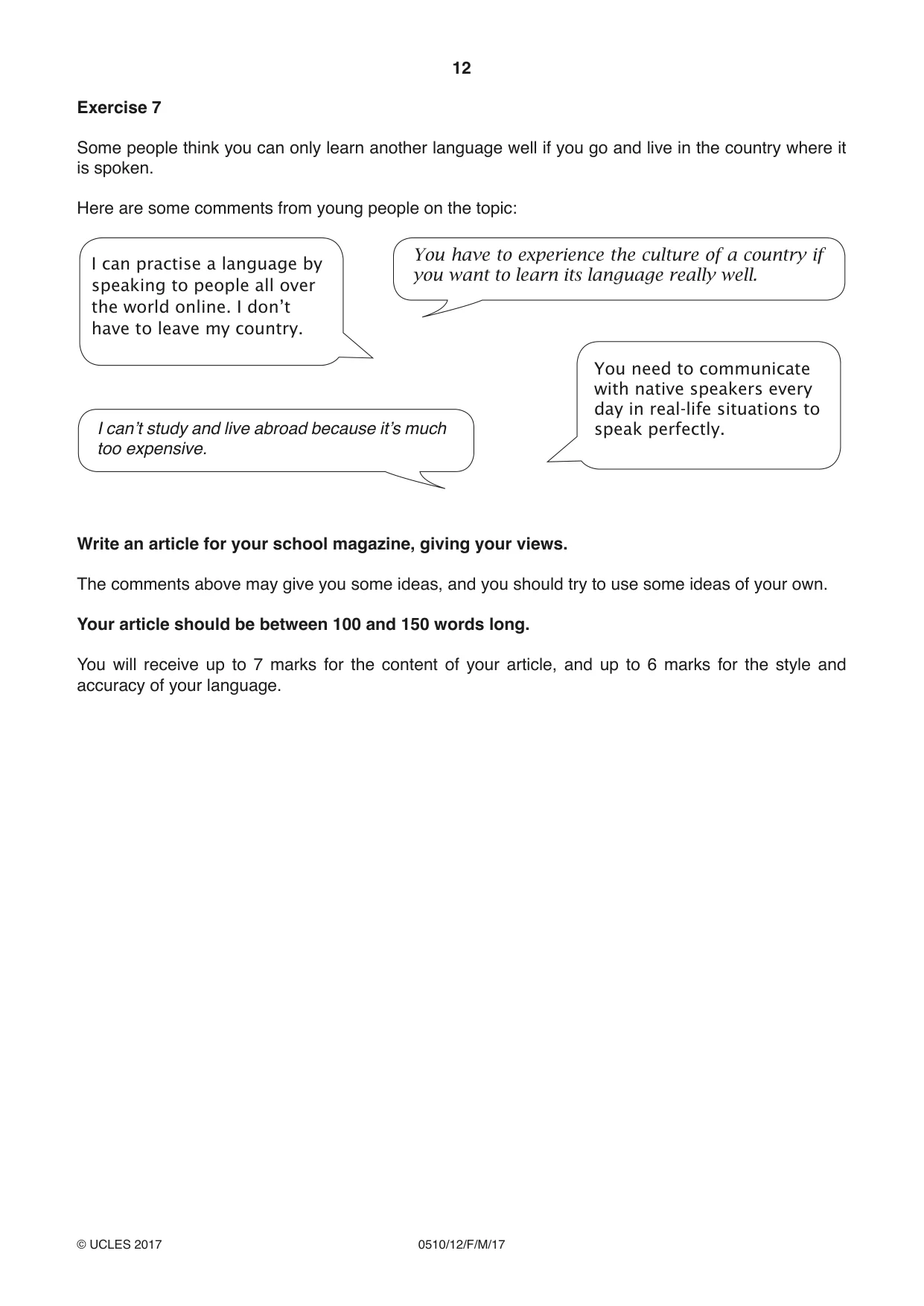
12 0510/12/F/M/17 © UCLES 2017 Exercise 7 Some people think you can only learn another language well if you go and live in the country where it is spoken. Here are some comments from young people on the topic: You have to experience the culture of a country if you want to learn its language really well. I can’t study and live abroad because it’s much too expensive. I can practise a language by speaking to people all over the world online. I don’t have to leave my country. You need to communicate with native speakers every day in real-life situations to speak perfectly. Write an article for your school magazine, giving your views. The comments above may give you some ideas, and you should try to use some ideas of your own. Your article should be between 100 and 150 words long. You will receive up to 7 marks for the content of your article, and up to 6 marks for the style and accuracy of your language.
Question paper, page 13
13 0510/12/F/M/17 © UCLES 2017 … … … … … … … … … … … … … … … … … … … … … … … … … … … [Total: 13]
Question paper, page 14
14 0510/12/F/M/17 © UCLES 2017 BLANK PAGE
Question paper, page 15
15 0510/12/F/M/17 © UCLES 2017 BLANK PAGE
Question paper, page 16
16 0510/12/F/M/17 © UCLES 2017 Permission to reproduce items where third-party owned material protected by copyright is included has been sought and cleared where possible. Every reasonable effort has been made by the publisher (UCLES) to trace copyright holders, but if any items requiring clearance have unwittingly been included, the publisher will be pleased to make amends at the earliest possible opportunity. To avoid the issue of disclosure of answer-related information to candidates, all copyright acknowledgements are reproduced online in the Cambridge International Examinations Copyright Acknowledgements Booklet. This is produced for each series of examinations and is freely available to download at www.cie.org.uk after the live examination series. Cambridge International Examinations is part of the Cambridge Assessment Group. Cambridge Assessment is the brand name of University of Cambridge Local Examinations Syndicate (UCLES), which is itself a department of the University of Cambridge. BLANK PAGE
Mark scheme, page 1
® IGCSE is a registered trademark. This document consists of 12 printed pages. © UCLES 2017 [Turn over Cambridge International Examinations Cambridge International General Certificate of Secondary Education ENGLISH AS A SECOND LANGUAGE 0510/12 Paper 1 Reading and Writing (Core) March 2017 MARK SCHEME Maximum Mark: 70 Published This mark scheme is published as an aid to teachers and candidates, to indicate the requirements of the examination. It shows the basis on which Examiners were instructed to award marks. It does not indicate the details of the discussions that took place at an Examiners’ meeting before marking began, which would have considered the acceptability of alternative answers. Mark schemes should be read in conjunction with the question paper and the Principal Examiner Report for Teachers. Cambridge will not enter into discussions about these mark schemes. Cambridge is publishing the mark schemes for the March 2017 series for most Cambridge IGCSE®, Cambridge International A and AS Level components and some Cambridge O Level components.
Mark scheme, page 2
0510/12 Cambridge IGCSE – Mark Scheme PUBLISHED March 2017 © UCLES 2017 Page 2 of 12 IGCSE English as a Second Language Core tier Reading/Writing (Paper 1) This component forms part of the Core tier assessment of IGCSE English as a Second Language and tests the following Assessment Objectives: AO1: Reading R1 identify and retrieve facts and details R2 understand and select relevant information R3 recognise, understand ideas, opinions and attitudes and the connections between the related ideas R4 understand what is implied but not actually written, eg. gist, relationships, writer’s purpose/intention, writer’s feelings, situation or place AO2: Writing W1 communicate clearly, accurately and appropriately W2 convey information and express opinions effectively W3 employ and control a variety of grammatical structures W4 demonstrate knowledge and understanding of a range of appropriate vocabulary W5 observe conventions of paragraphing, punctuation and spelling W6 employ appropriate register/style Overview of exercises on Paper 1 Reading objectives tested Marks for reading objectives Writing objectives tested Marks for writing objectives Total available marks Exercise 1 Reading (1) R1, R2 7 – 7 Exercise 2 Reading (2) R1, R2, R4 11 – 11 Exercise 3 Information transfer R1, R2 10 W1, W5 4 14 Exercise 4 Note- making R1, R2, R3 7 – 7 Exercise 5 Summary – W1, W2, W3, W4, W5 5 5 Exercise 6 Writing (1) – W1, W2, W3, W4, W5, W6 13 13 Exercise 7 Writing (2) – W1, W2, W3, W4, W5, W6 13 13 70
Mark scheme, page 3
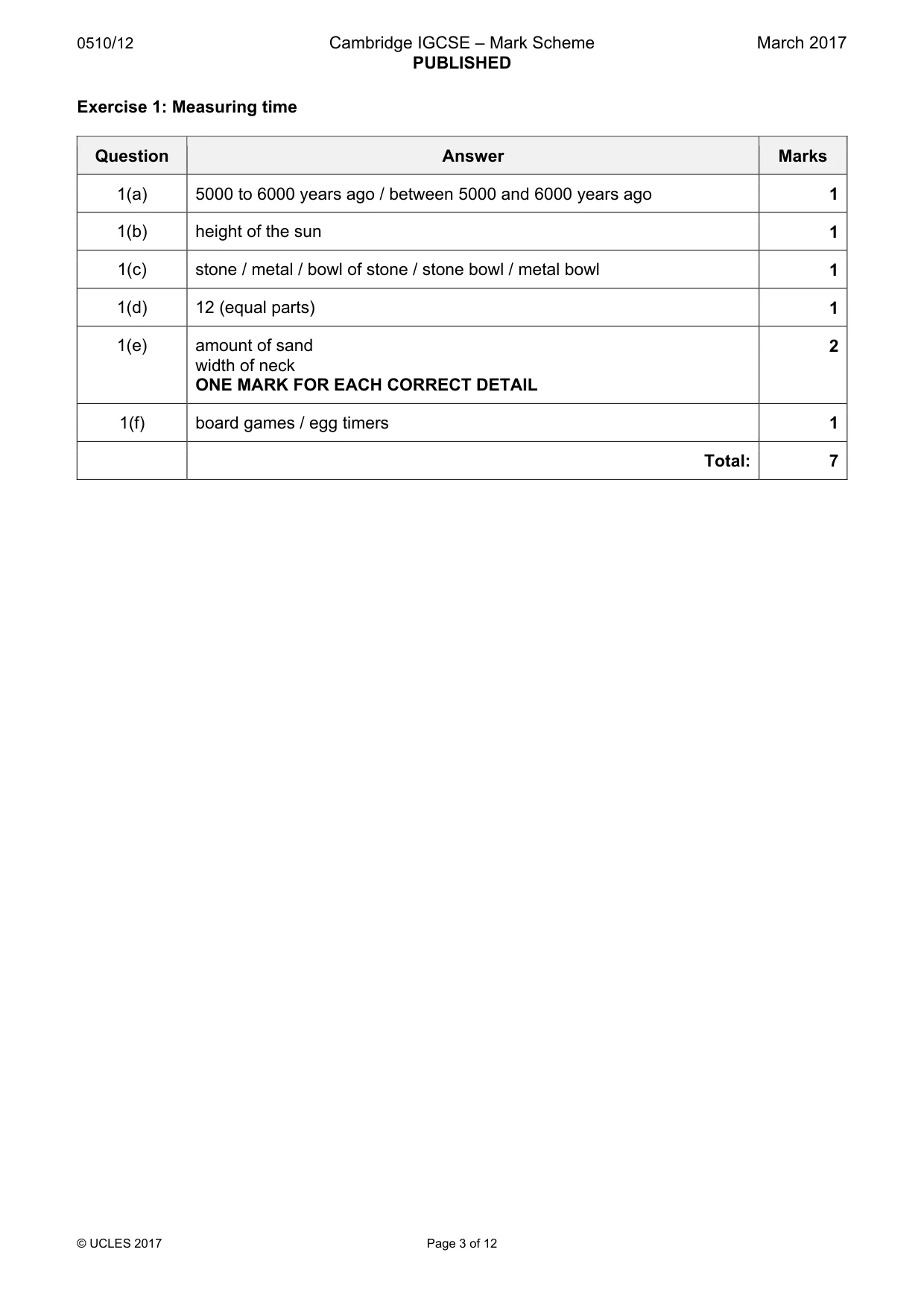
0510/12 Cambridge IGCSE – Mark Scheme PUBLISHED March 2017 © UCLES 2017 Page 3 of 12 Exercise 1: Measuring time Question Answer Marks 1(a) 5000 to 6000 years ago / between 5000 and 6000 years ago 1 1(b) height of the sun 1 1(c) stone / metal / bowl of stone / stone bowl / metal bowl 1 1(d) 12 (equal parts) 1 1(e) amount of sand width of neck ONE MARK FOR EACH CORRECT DETAIL 2 1(f) board games / egg timers 1 Total: 7
Mark scheme, page 4
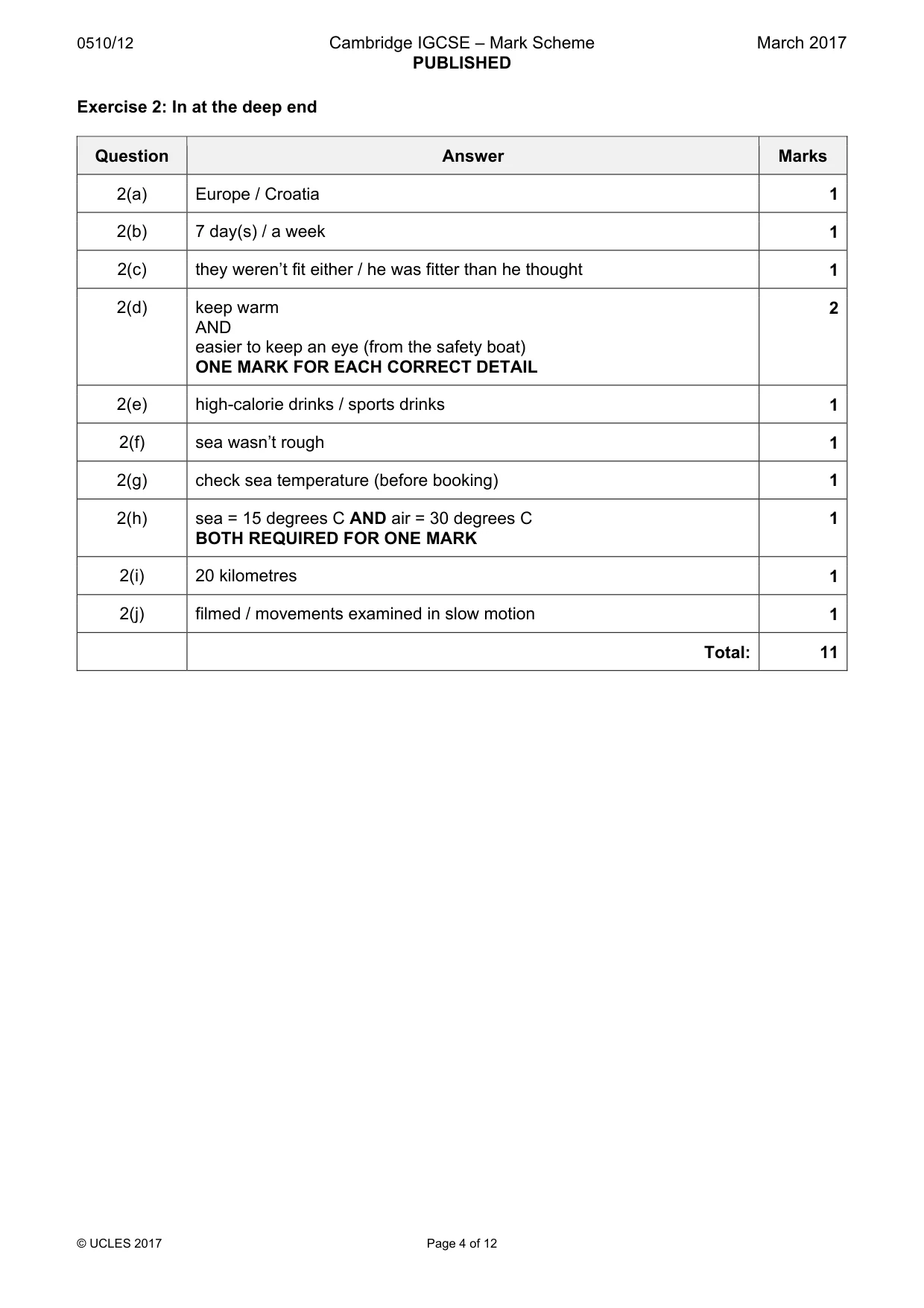
0510/12 Cambridge IGCSE – Mark Scheme PUBLISHED March 2017 © UCLES 2017 Page 4 of 12 Exercise 2: In at the deep end Question Answer Marks 2(a) Europe / Croatia 1 2(b) 7 day(s) / a week 1 2(c) they weren’t fit either / he was fitter than he thought 1 2(d) keep warm AND easier to keep an eye (from the safety boat) ONE MARK FOR EACH CORRECT DETAIL 2 2(e) high-calorie drinks / sports drinks 1 2(f) sea wasn’t rough 1 2(g) check sea temperature (before booking) 1 2(h) sea = 15 degrees C AND air = 30 degrees C BOTH REQUIRED FOR ONE MARK 1 2(i) 20 kilometres 1 2(j) filmed / movements examined in slow motion 1 Total: 11
Mark scheme, page 5
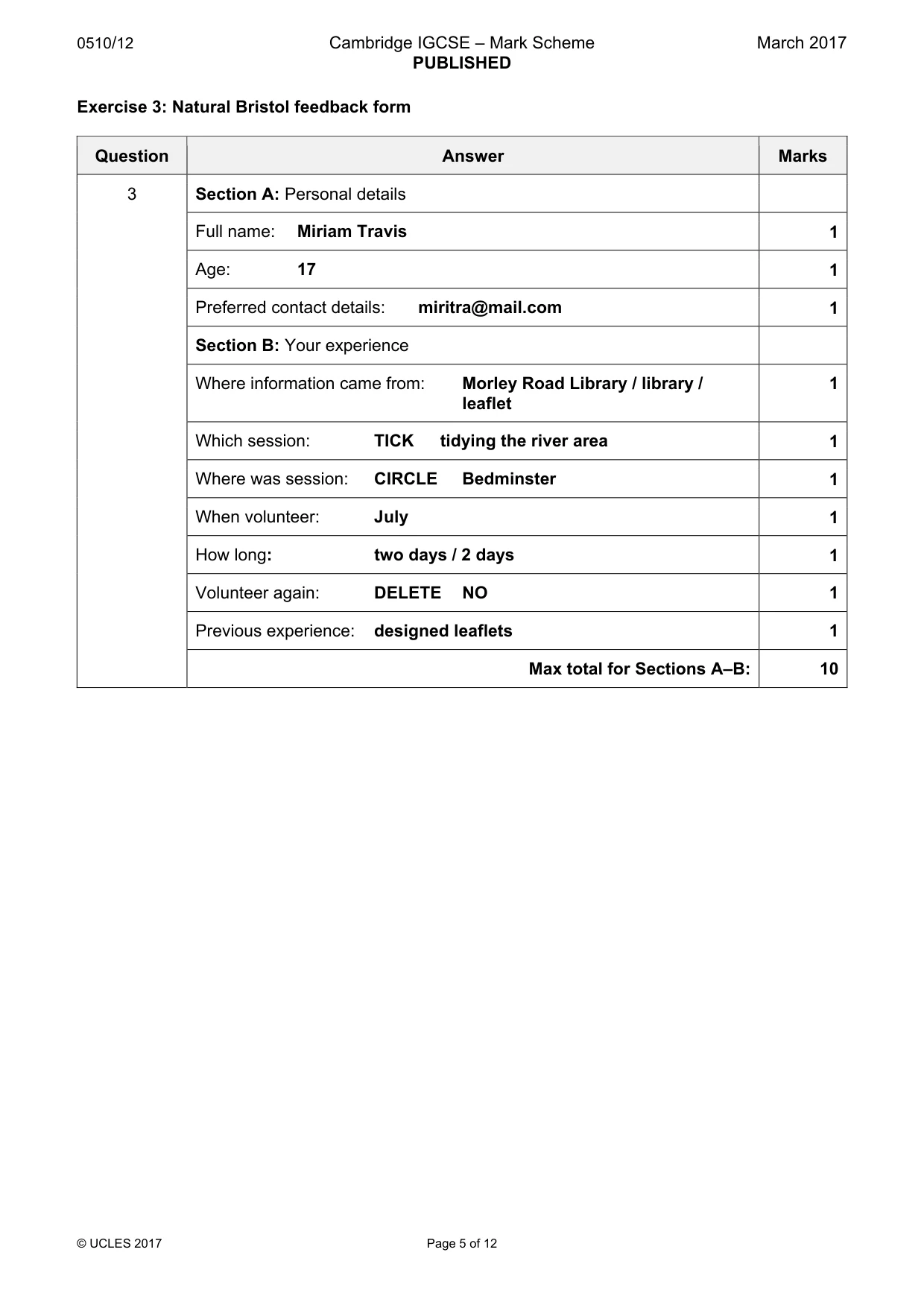
0510/12 Cambridge IGCSE – Mark Scheme PUBLISHED March 2017 © UCLES 2017 Page 5 of 12 Exercise 3: Natural Bristol feedback form Question Answer Marks 3 Section A: Personal details Full name: Miriam Travis 1 Age: 17 1 Preferred contact details: miritra@mail.com 1 Section B: Your experience Where information came from: Morley Road Library / library / leaflet 1 Which session: TICK tidying the river area 1 Where was session: CIRCLE Bedminster 1 When volunteer: July 1 How long: two days / 2 days 1 Volunteer again: DELETE NO 1 Previous experience: designed leaflets 1 Max total for Sections A–B: 10
Mark scheme, page 6
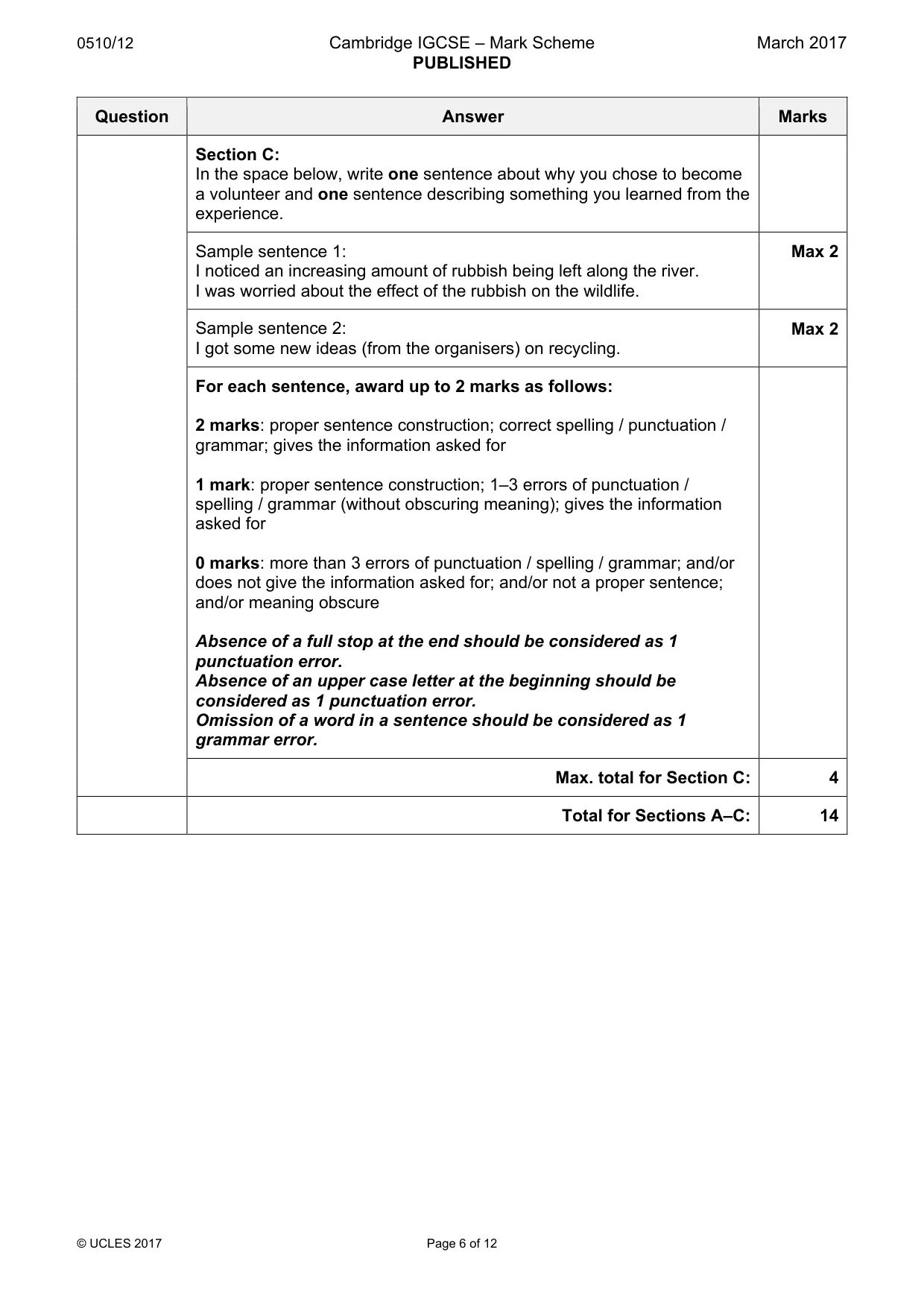
0510/12 Cambridge IGCSE – Mark Scheme PUBLISHED March 2017 © UCLES 2017 Page 6 of 12 Question Answer Marks Section C: In the space below, write one sentence about why you chose to become a volunteer and one sentence describing something you learned from the experience. Sample sentence 1: I noticed an increasing amount of rubbish being left along the river. I was worried about the effect of the rubbish on the wildlife. Max 2 Sample sentence 2: I got some new ideas (from the organisers) on recycling. Max 2 For each sentence, award up to 2 marks as follows: 2 marks: proper sentence construction; correct spelling / punctuation / grammar; gives the information asked for 1 mark: proper sentence construction; 1–3 errors of punctuation / spelling / grammar (without obscuring meaning); gives the information asked for 0 marks: more than 3 errors of punctuation / spelling / grammar; and/or does not give the information asked for; and/or not a proper sentence; and/or meaning obscure Absence of a full stop at the end should be considered as 1 punctuation error. Absence of an upper case letter at the beginning should be considered as 1 punctuation error. Omission of a word in a sentence should be considered as 1 grammar error. Max. total for Section C: 4 Total for Sections A–C: 14
Mark scheme, page 7
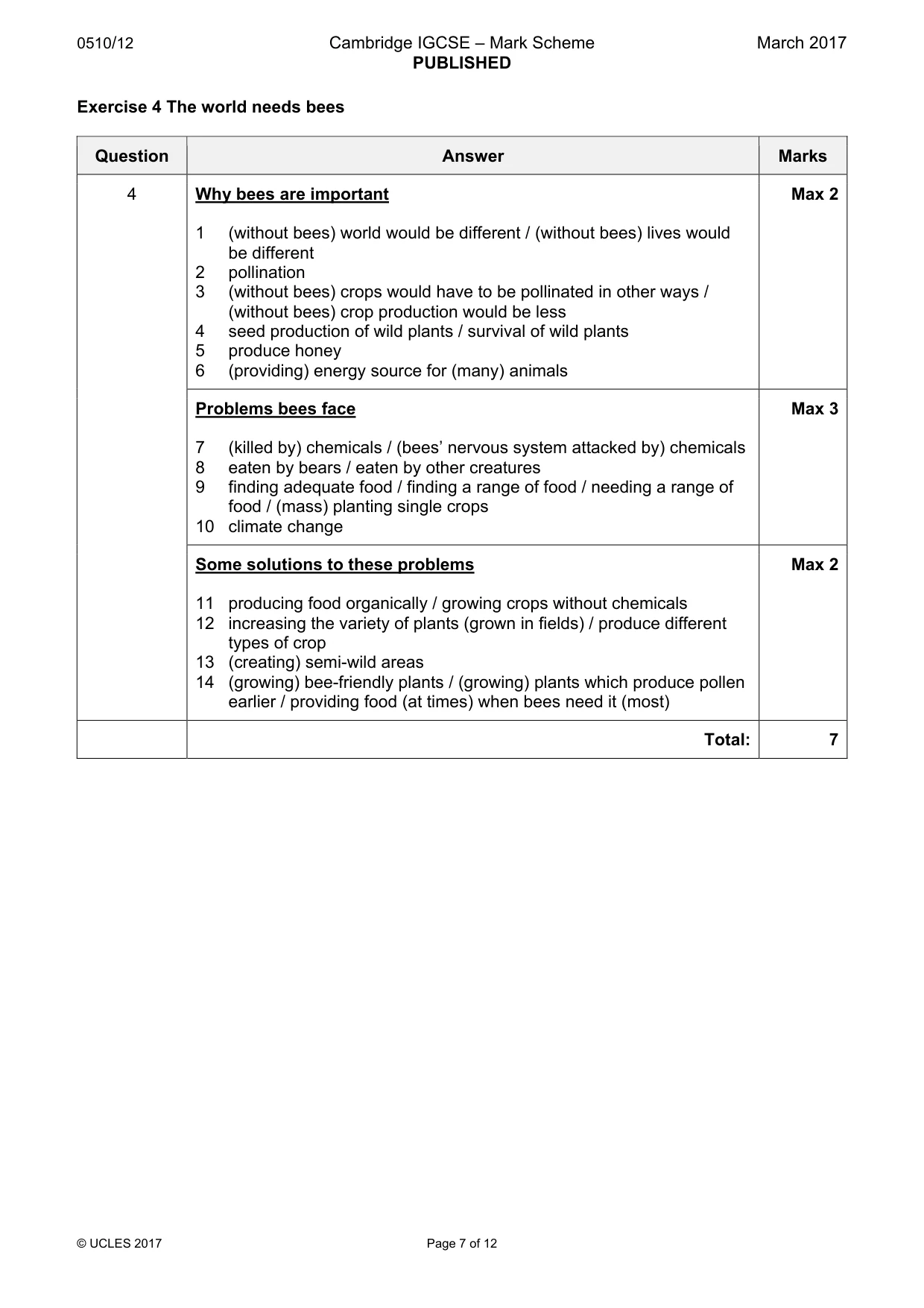
0510/12 Cambridge IGCSE – Mark Scheme PUBLISHED March 2017 © UCLES 2017 Page 7 of 12 Exercise 4 The world needs bees Question Answer Marks 4 Why bees are important 1 (without bees) world would be different / (without bees) lives would be different 2 pollination 3 (without bees) crops would have to be pollinated in other ways / (without bees) crop production would be less 4 seed production of wild plants / survival of wild plants 5 produce honey 6 (providing) energy source for (many) animals Max 2 Problems bees face 7 (killed by) chemicals / (bees’ nervous system attacked by) chemicals 8 eaten by bears / eaten by other creatures 9 finding adequate food / finding a range of food / needing a range of food / (mass) planting single crops 10 climate change Max 3 Some solutions to these problems 11 producing food organically / growing crops without chemicals 12 increasing the variety of plants (grown in fields) / produce different types of crop 13 (creating) semi-wild areas 14 (growing) bee-friendly plants / (growing) plants which produce pollen earlier / providing food (at times) when bees need it (most) Max 2 Total: 7
Mark scheme, page 8
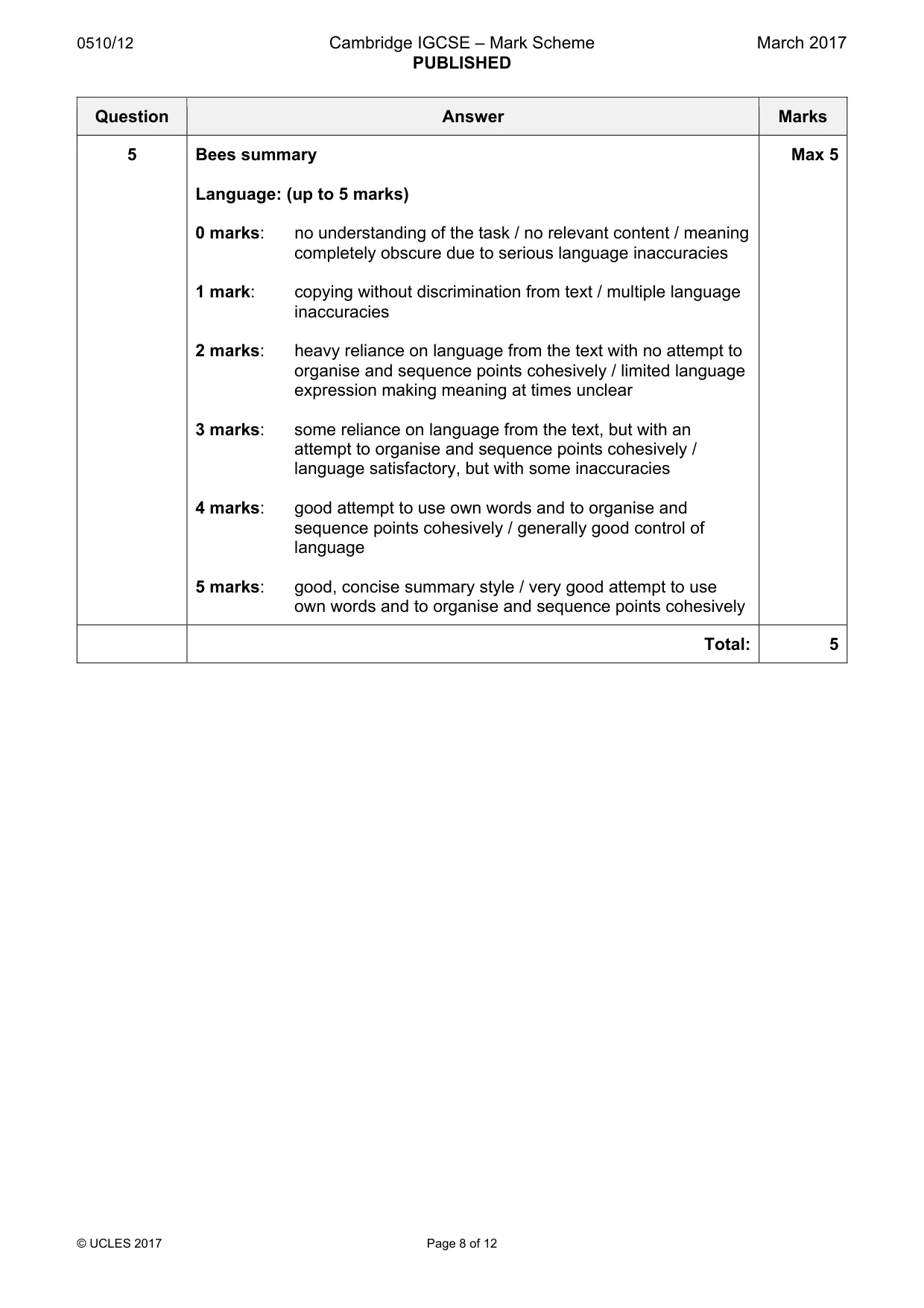
0510/12 Cambridge IGCSE – Mark Scheme PUBLISHED March 2017 © UCLES 2017 Page 8 of 12 Question Answer Marks 5 Bees summary Language: (up to 5 marks) 0 marks: no understanding of the task / no relevant content / meaning completely obscure due to serious language inaccuracies 1 mark: copying without discrimination from text / multiple language inaccuracies 2 marks: heavy reliance on language from the text with no attempt to organise and sequence points cohesively / limited language expression making meaning at times unclear 3 marks: some reliance on language from the text, but with an attempt to organise and sequence points cohesively / language satisfactory, but with some inaccuracies 4 marks: good attempt to use own words and to organise and sequence points cohesively / generally good control of language 5 marks: good, concise summary style / very good attempt to use own words and to organise and sequence points cohesively Max 5 Total: 5
Mark scheme, page 9
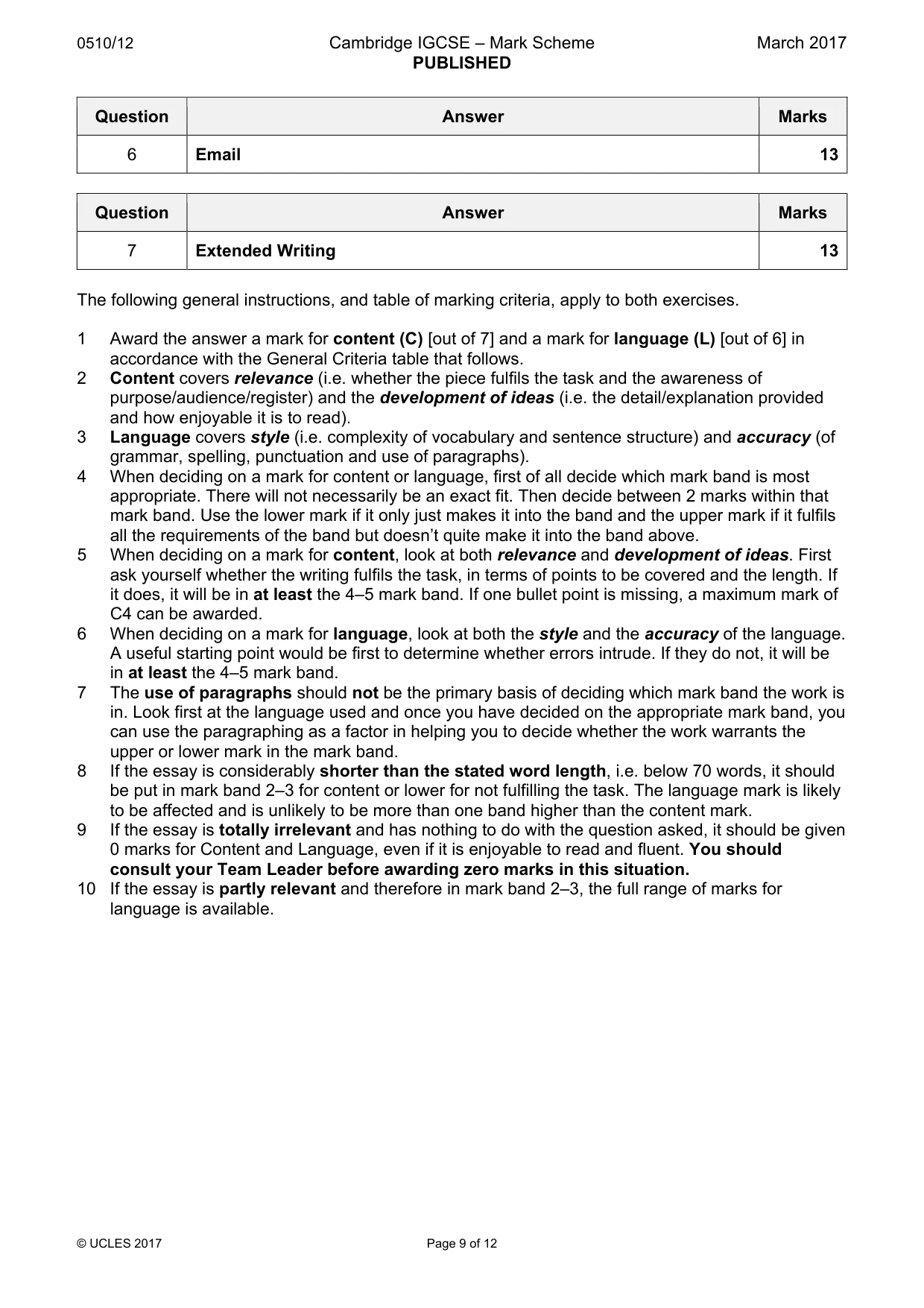
0510/12 Cambridge IGCSE – Mark Scheme PUBLISHED March 2017 © UCLES 2017 Page 9 of 12 Question Answer Marks 6 Email 13 Question Answer Marks 7 Extended Writing 13 The following general instructions, and table of marking criteria, apply to both exercises. 1 Award the answer a mark for content (C) [out of 7] and a mark for language (L) [out of 6] in accordance with the General Criteria table that follows. 2 Content covers relevance (i.e. whether the piece fulfils the task and the awareness of purpose/audience/register) and the development of ideas (i.e. the detail/explanation provided and how enjoyable it is to read). 3 Language covers style (i.e. complexity of vocabulary and sentence structure) and accuracy (of grammar, spelling, punctuation and use of paragraphs). 4 When deciding on a mark for content or language, first of all decide which mark band is most appropriate. There will not necessarily be an exact fit. Then decide between 2 marks within that mark band. Use the lower mark if it only just makes it into the band and the upper mark if it fulfils all the requirements of the band but doesn’t quite make it into the band above. 5 When deciding on a mark for content, look at both relevance and development of ideas. First ask yourself whether the writing fulfils the task, in terms of points to be covered and the length. If it does, it will be in at least the 4–5 mark band. If one bullet point is missing, a maximum mark of C4 can be awarded. 6 When deciding on a mark for language, look at both the style and the accuracy of the language. A useful starting point would be first to determine whether errors intrude. If they do not, it will be in at least the 4–5 mark band. 7 The use of paragraphs should not be the primary basis of deciding which mark band the work is in. Look first at the language used and once you have decided on the appropriate mark band, you can use the paragraphing as a factor in helping you to decide whether the work warrants the upper or lower mark in the mark band. 8 If the essay is considerably shorter than the stated word length, i.e. below 70 words, it should be put in mark band 2–3 for content or lower for not fulfilling the task. The language mark is likely to be affected and is unlikely to be more than one band higher than the content mark. 9 If the essay is totally irrelevant and has nothing to do with the question asked, it should be given 0 marks for Content and Language, even if it is enjoyable to read and fluent. You should consult your Team Leader before awarding zero marks in this situation. 10 If the essay is partly relevant and therefore in mark band 2–3, the full range of marks for language is available.
Mark scheme, page 10
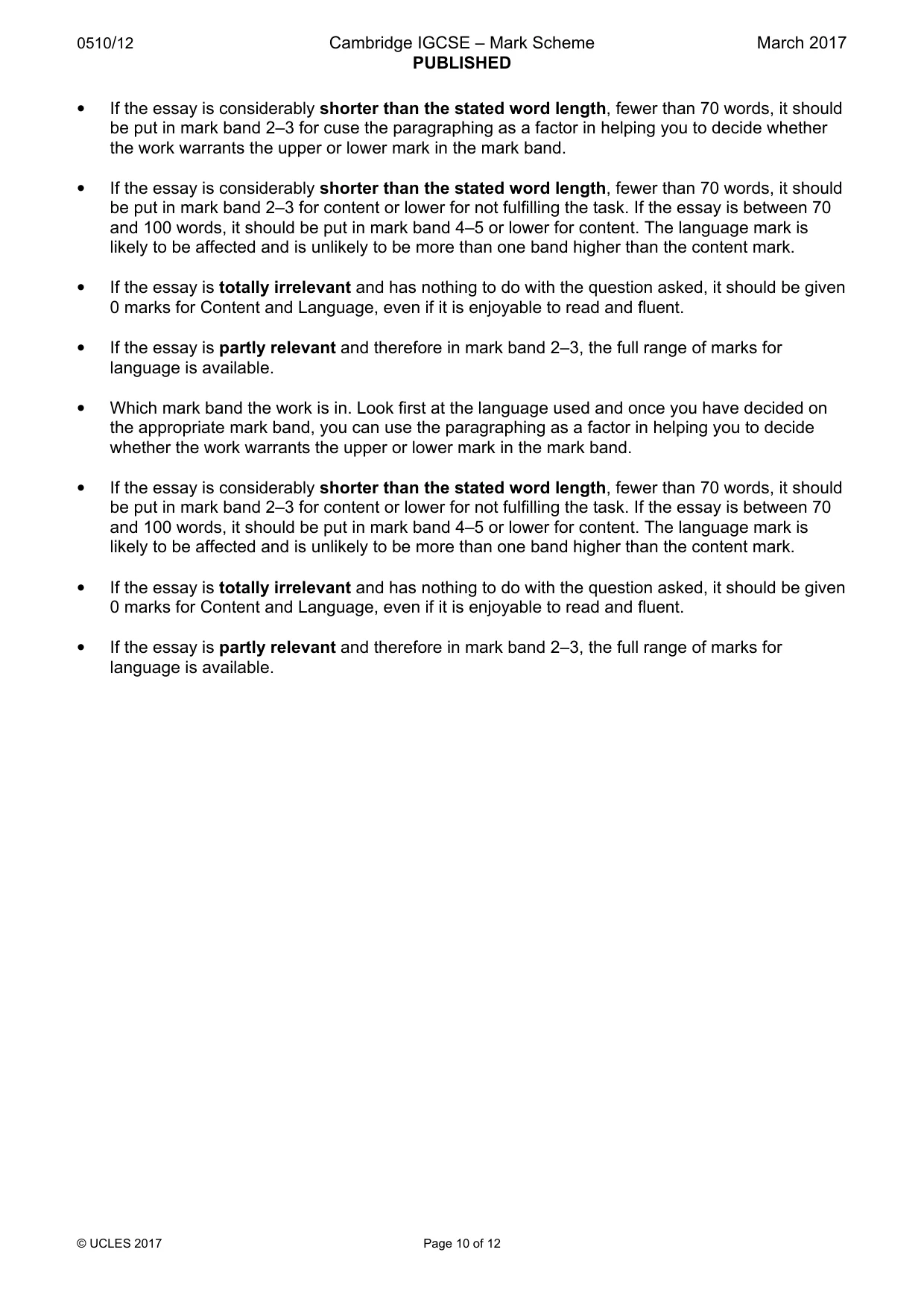
0510/12 Cambridge IGCSE – Mark Scheme PUBLISHED March 2017 © UCLES 2017 Page 10 of 12 • If the essay is considerably shorter than the stated word length, fewer than 70 words, it should be put in mark band 2–3 for cuse the paragraphing as a factor in helping you to decide whether the work warrants the upper or lower mark in the mark band. • If the essay is considerably shorter than the stated word length, fewer than 70 words, it should be put in mark band 2–3 for content or lower for not fulfilling the task. If the essay is between 70 and 100 words, it should be put in mark band 4–5 or lower for content. The language mark is likely to be affected and is unlikely to be more than one band higher than the content mark. • If the essay is totally irrelevant and has nothing to do with the question asked, it should be given 0 marks for Content and Language, even if it is enjoyable to read and fluent. • If the essay is partly relevant and therefore in mark band 2–3, the full range of marks for language is available. • Which mark band the work is in. Look first at the language used and once you have decided on the appropriate mark band, you can use the paragraphing as a factor in helping you to decide whether the work warrants the upper or lower mark in the mark band. • If the essay is considerably shorter than the stated word length, fewer than 70 words, it should be put in mark band 2–3 for content or lower for not fulfilling the task. If the essay is between 70 and 100 words, it should be put in mark band 4–5 or lower for content. The language mark is likely to be affected and is unlikely to be more than one band higher than the content mark. • If the essay is totally irrelevant and has nothing to do with the question asked, it should be given 0 marks for Content and Language, even if it is enjoyable to read and fluent. • If the essay is partly relevant and therefore in mark band 2–3, the full range of marks for language is available.
Mark scheme, page 11
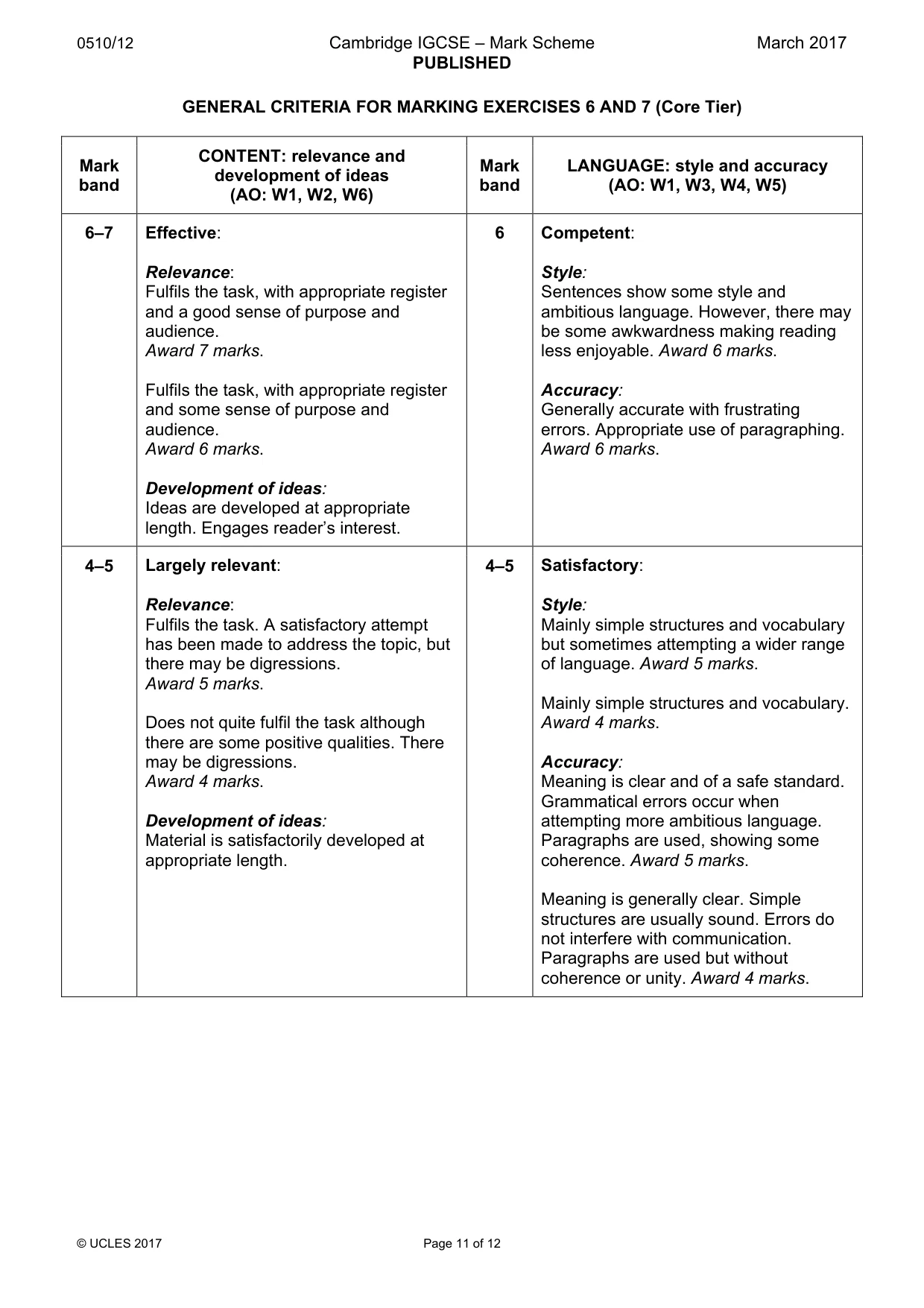
0510/12 Cambridge IGCSE – Mark Scheme PUBLISHED March 2017 © UCLES 2017 Page 11 of 12 GENERAL CRITERIA FOR MARKING EXERCISES 6 AND 7 (Core Tier) Mark band CONTENT: relevance and development of ideas (AO: W1, W2, W6) Mark band LANGUAGE: style and accuracy (AO: W1, W3, W4, W5) 6–7 Effective: Relevance: Fulfils the task, with appropriate register and a good sense of purpose and audience. Award 7 marks. Fulfils the task, with appropriate register and some sense of purpose and audience. Award 6 marks. Development of ideas: Ideas are developed at appropriate length. Engages reader’s interest. 6 Competent: Style: Sentences show some style and ambitious language. However, there may be some awkwardness making reading less enjoyable. Award 6 marks. Accuracy: Generally accurate with frustrating errors. Appropriate use of paragraphing. Award 6 marks. 4–5 Largely relevant: Relevance: Fulfils the task. A satisfactory attempt has been made to address the topic, but there may be digressions. Award 5 marks. Does not quite fulfil the task although there are some positive qualities. There may be digressions. Award 4 marks. Development of ideas: Material is satisfactorily developed at appropriate length. 4–5 Satisfactory: Style: Mainly simple structures and vocabulary but sometimes attempting a wider range of language. Award 5 marks. Mainly simple structures and vocabulary. Award 4 marks. Accuracy: Meaning is clear and of a safe standard. Grammatical errors occur when attempting more ambitious language. Paragraphs are used, showing some coherence. Award 5 marks. Meaning is generally clear. Simple structures are usually sound. Errors do not interfere with communication. Paragraphs are used but without coherence or unity. Award 4 marks.
Mark scheme, page 12
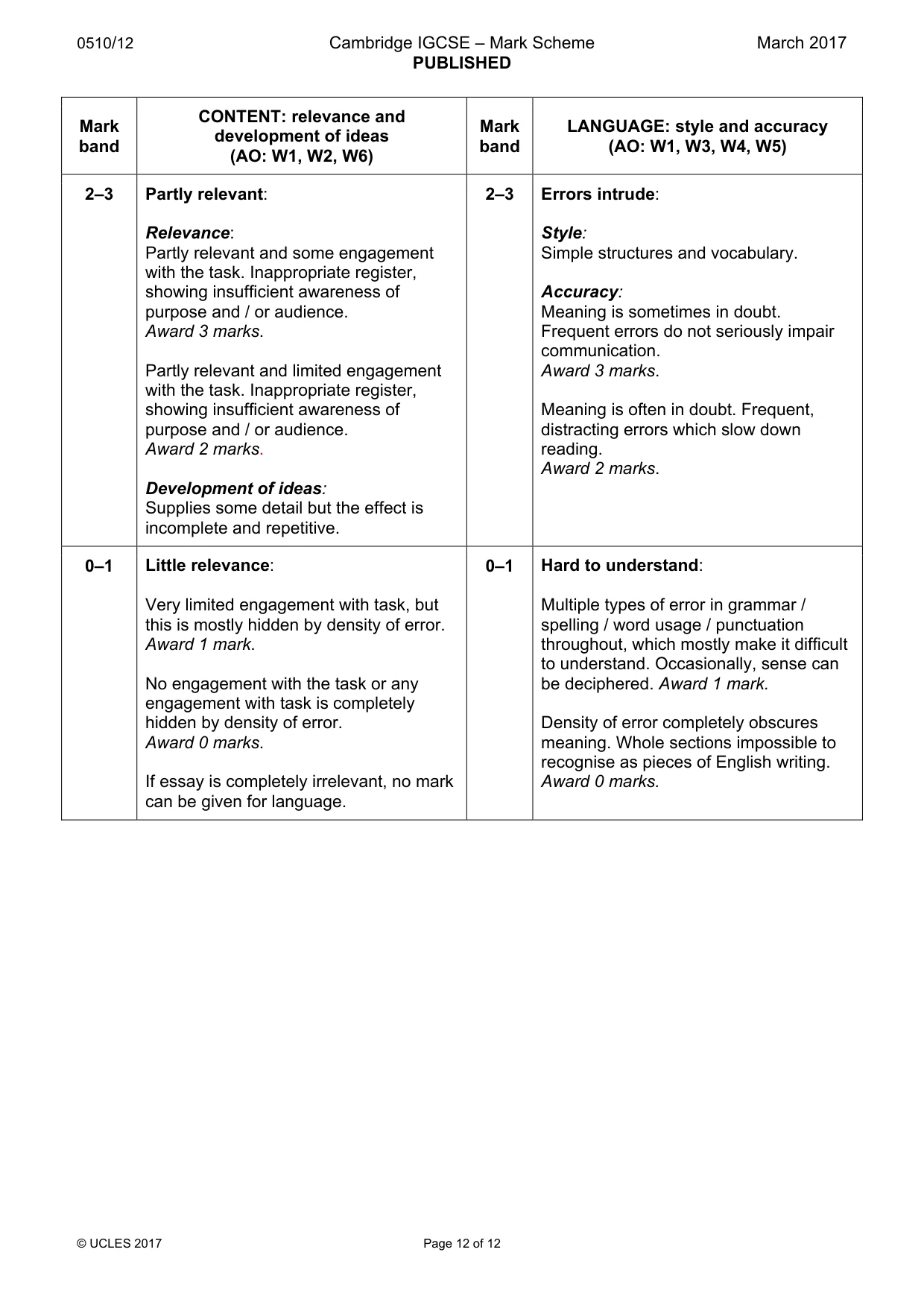
0510/12 Cambridge IGCSE – Mark Scheme PUBLISHED March 2017 © UCLES 2017 Page 12 of 12 Mark band CONTENT: relevance and development of ideas (AO: W1, W2, W6) Mark band LANGUAGE: style and accuracy (AO: W1, W3, W4, W5) 2–3 Partly relevant: Relevance: Partly relevant and some engagement with the task. Inappropriate register, showing insufficient awareness of purpose and / or audience. Award 3 marks. Partly relevant and limited engagement with the task. Inappropriate register, showing insufficient awareness of purpose and / or audience. Award 2 marks. Development of ideas: Supplies some detail but the effect is incomplete and repetitive. 2–3 Errors intrude: Style: Simple structures and vocabulary. Accuracy: Meaning is sometimes in doubt. Frequent errors do not seriously impair communication. Award 3 marks. Meaning is often in doubt. Frequent, distracting errors which slow down reading. Award 2 marks. 0–1 Little relevance: Very limited engagement with task, but this is mostly hidden by density of error. Award 1 mark. No engagement with the task or any engagement with task is completely hidden by density of error. Award 0 marks. If essay is completely irrelevant, no mark can be given for language. 0–1 Hard to understand: Multiple types of error in grammar / spelling / word usage / punctuation throughout, which mostly make it difficult to understand. Occasionally, sense can be deciphered. Award 1 mark. Density of error completely obscures meaning. Whole sections impossible to recognise as pieces of English writing. Award 0 marks.
What you needed in this session
Cambridge’s own grade thresholds for 2017 Feb/March, Paper 1 · Variant 2. A higher threshold means an easier paper — the bar moves with how the cohort did.