Cambridge IGCSE English - Second Language (oral endorsement) 0510 — 2016 Oct/Nov Paper 2 · Variant 2
0510/22/O/N/16 · 90 marks · ≈101 min
The question paper and its mark scheme, free to read here and free to download. This is Cambridge’s own paper, exactly as it was sat.
Question paper16 pages
Mark scheme11 pages
Answers below. Sit the paper first if you are practising.
Paper as text
Question paper, page 1
This document consists of 15 printed pages and 1 blank page. DC (NF/FD) 119340/5 © UCLES 2016 [Turn over * 3 2 1 8 6 6 6 9 0 0 * ENGLISH AS A SECOND LANGUAGE 0510/22 Paper 2 Reading and Writing (Extended) October/November 2016 2 hours Candidates answer on the Question Paper. No Additional Materials are required. READ THESE INSTRUCTIONS FIRST Write your Centre number, candidate number and name on all the work you hand in. Write in dark blue or black pen. Do not use staples, paper clips, glue or correction fluid. DO NOT WRITE IN ANY BARCODES. Answer all questions. Dictionaries are not allowed. At the end of the examination, fasten all your work securely together. The number of marks is given in brackets [ ] at the end of each question or part question. Cambridge International Examinations Cambridge International General Certificate of Secondary Education
Question paper, page 2
2 0510/22/O/N/16 © UCLES 2016 Exercise 1 Read the article about beautiful buildings around the world, and then answer the following questions. Beautiful buildings around the world Potala Palace, Tibet High above the city of Lhasa is Potala Palace where, in the past, the Tibetan government worked. This huge construction is 13 floors high and contains thousands of rooms. It was designed like a traditional Buddhist temple, but is much more decorative. More than 7000 workers were involved in building it in the 7th century CE. Potala Palace has now been placed on the UNESCO World Heritage List because it is a building of great significance. Alexandrina Library, Egypt The Alexandrina Library, situated next to the sea in the city of Alexandria, was the first great design of the new millennium. Many people feel the design of the library makes it look like a giant plate which has landed at an angle, or even an enormous light switch. However, the architect of this modern building intended the design to symbolise a second sun rising beside the Mediterranean. The building was completed in 2002. It was inspired by the first Alexandrina Library, which was constructed in the 3rd century BCE, and was regarded as the greatest of all libraries in the world. The vast interior space of this 21st-century building can hold eight million books. Imam Mosque, Iran The Imam Mosque in Esfahan, Iran, is an impressive 17th-century building in the main square. The mosque was not built in line with the other buildings on the square, but at an angle, so that it faced Mecca. It is completely covered, inside and out, with pale blue and yellow ceramic tiles. These tiles appear to change colour depending on the light conditions. The main dome is 54 metres high and is covered in a detailed floral-patterned mosaic. Winter Palace, Russia The Winter Palace was originally the home of the Russian royal family, but is now best known as the State Hermitage Museum. Visitors come to admire the many famous paintings which are on display in the State Rooms. This pale green building on the banks of the Neva River in St Petersburg was designed by Francesco Rastrelli. It is highly decorated, with statues which line the edges of its roof. It is the showpiece of the city and is very popular with tourists. Aya Sofya, Turkey Aya Sofya is a great architectural landmark at the heart of Istanbul. It has four towers, known as minarets, which point up to the sky. It was constructed in the 6th century CE as a church, and later became a mosque. Since 1935, it has been a museum. The enormous structure was built in just five years, and its magnificent dome can be seen from a great distance. The base of the dome has windows all around it, so that when you are inside the dome and look up, the top of the dome seems to hover above the building.
Question paper, page 3
3 0510/22/O/N/16 © UCLES 2016 [Turn over (a) Who once used Potala Palace? … [1] (b) How do we know that Potala Palace is considered to be an important building today? … [1] (c) What did the designer of the Alexandrina Library want the building to represent? … [1] (d) When was the original Alexandrina Library built? … [1] (e) Why is the Imam Mosque in a different position from the other buildings on the square? … [1] (f) What is the effect of light on the tiles of the Imam Mosque? … [1] (g) Give two details about the appearance of the Winter Palace in Russia. … … [2] (h) What was Aya Sofya before it became a mosque? … [1] [Total: 9]
Question paper, page 4
4 0510/22/O/N/16 © UCLES 2016 Exercise 2 Read the article about keeping teeth clean, and then answer the following questions. Cleaning teeth The first thing that most of us do in the morning and the last thing we do at night is clean our teeth. For most of us, cleaning our teeth is such a familiar routine that we hardly ever consider it. Some people also clean their teeth after every meal. Have you ever asked yourself if everyone around the world does it in the same way as you do? It was not so long ago that toothpaste was invented. Have you ever looked at a tube of toothpaste and wondered what people did before it was invented? The first toothbrushes, which were made from animal hair, are believed to have come from China around 1600 BCE and were brought back to Europe by traders, but they were not used by many people. However, since the invention of nylon toothbrushes in 1938, enormous amounts of money have been spent on these products; Americans alone invested $9.1 billion on teeth-cleaning products in just one year. This is quickly becoming a multi-million dollar industry. USA sugar consumption 48 sugar consumption (kilos / person) 44 40 36 32 28 24 20 16 decade 12 8 0 4 1920s 1930s1940s1950s 1960s1970s1980s1990s Although dental hygiene has become a profitable business in some countries, most of the world’s population still uses traditional techniques to keep their teeth in good condition. In many regions of the world, people clean their teeth with small pieces of wood from locally found trees. A stick is broken in half, one end is softened and that end is rubbed on the teeth to clean them. It is traditional in some countries to use a teeth-cleaning stick called miswak which is made from the arak tree and contains antiseptic. It can be argued that using such natural resources is considerably more environmentally friendly than using toothbrushes and toothpaste containers which are not easily recycled. It is interesting to consider whether the more traditional sticks that are used in many countries today are better than toothbrushes and toothpaste. We can see that even the ordinary toothbrush has changed. The electric toothbrush was first developed in 1954, but it was not until the 1960s that a portable electric toothbrush first became available. However, they were not as popular as they are nowadays because they were not rechargeable. The idea of using a silk thread to clean between your teeth started to catch on just before the beginning of the twentieth century. This process, known as flossing, has become widespread. However, no matter which method we use to clean our teeth, it is the food that we eat which is more important for healthy teeth. Ambreen Hussein, a nutrition expert, explains: “In societies that have diets which do not include processed sugars, many people have healthy teeth even though tooth brushing is rare. However, tooth decay becomes evident very quickly when people adopt a more western-style diet, and consume more processed food.” Dentists report that it is fashionable to make teeth appear whiter. Generally, dentists will whiten a patient’s teeth to match or be slightly lighter than the white’s of a patient’s eyes. This ensures that the teeth look more natural. Clean teeth are essential to our overall health so make sure you look after them.
Question paper, page 5
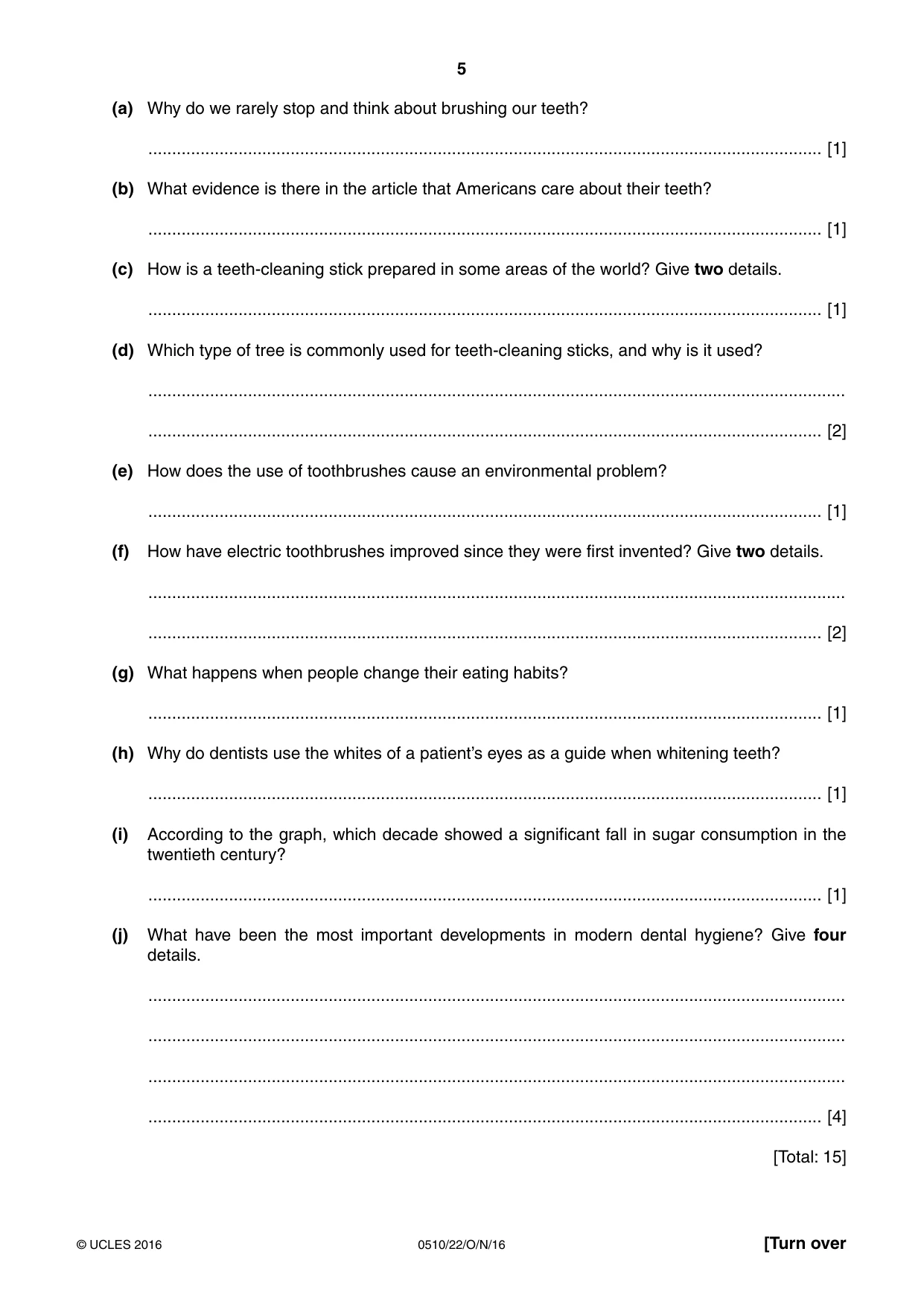
5 0510/22/O/N/16 © UCLES 2016 [Turn over (a) Why do we rarely stop and think about brushing our teeth? … [1] (b) What evidence is there in the article that Americans care about their teeth? … [1] (c) How is a teeth-cleaning stick prepared in some areas of the world? Give two details. … [1] (d) Which type of tree is commonly used for teeth-cleaning sticks, and why is it used? … … [2] (e) How does the use of toothbrushes cause an environmental problem? … [1] (f) How have electric toothbrushes improved since they were first invented? Give two details. … … [2] (g) What happens when people change their eating habits? … [1] (h) Why do dentists use the whites of a patient’s eyes as a guide when whitening teeth? … [1] (i) According to the graph, which decade showed a significant fall in sugar consumption in the twentieth century? … [1] (j) What have been the most important developments in modern dental hygiene? Give four details. … … … … [4] [Total: 15]
Question paper, page 6
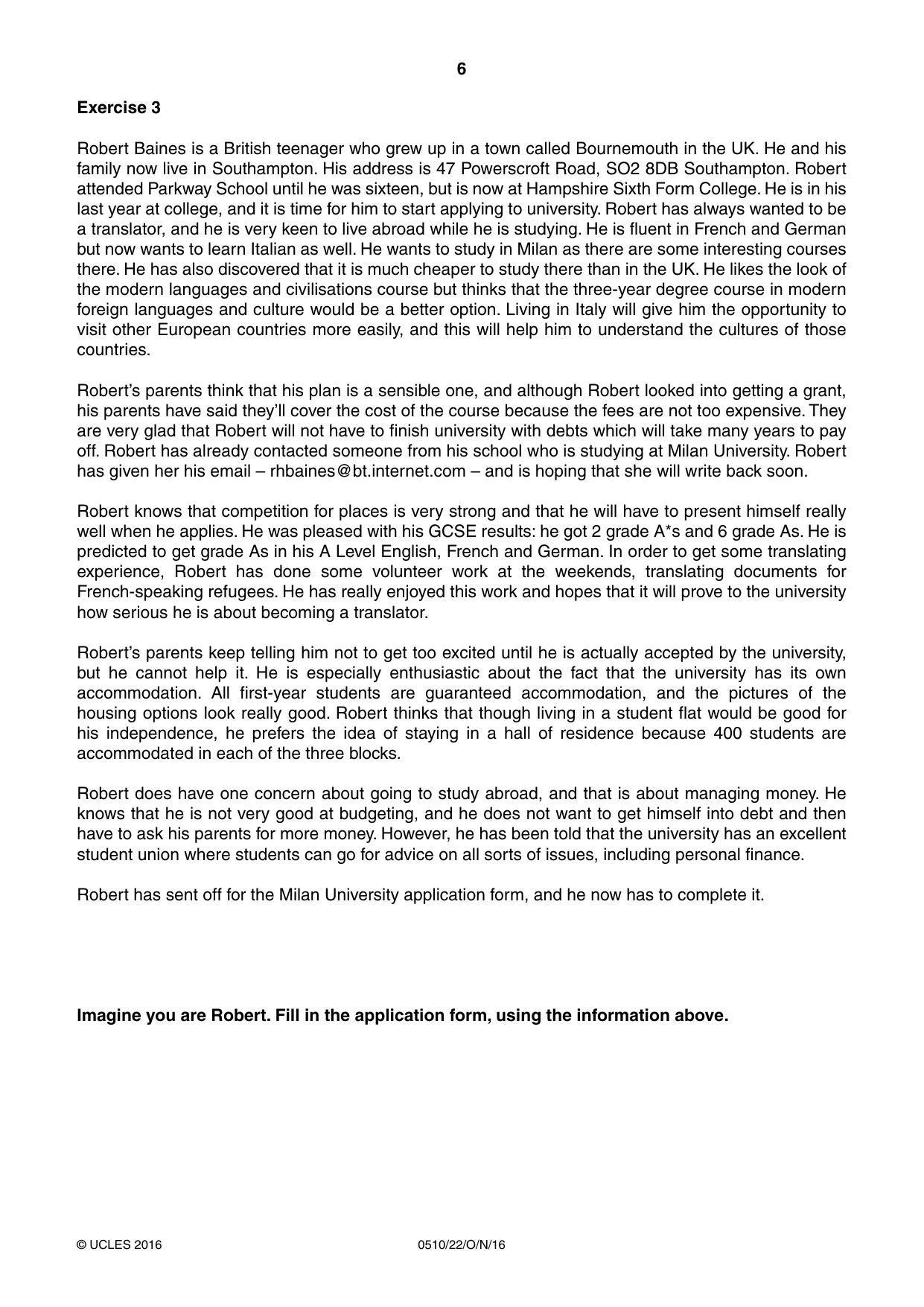
6 0510/22/O/N/16 © UCLES 2016 Exercise 3 Robert Baines is a British teenager who grew up in a town called Bournemouth in the UK. He and his family now live in Southampton. His address is 47 Powerscroft Road, SO2 8DB Southampton. Robert attended Parkway School until he was sixteen, but is now at Hampshire Sixth Form College. He is in his last year at college, and it is time for him to start applying to university. Robert has always wanted to be a translator, and he is very keen to live abroad while he is studying. He is fluent in French and German but now wants to learn Italian as well. He wants to study in Milan as there are some interesting courses there. He has also discovered that it is much cheaper to study there than in the UK. He likes the look of the modern languages and civilisations course but thinks that the three-year degree course in modern foreign languages and culture would be a better option. Living in Italy will give him the opportunity to visit other European countries more easily, and this will help him to understand the cultures of those countries. Robert’s parents think that his plan is a sensible one, and although Robert looked into getting a grant, his parents have said they’ll cover the cost of the course because the fees are not too expensive. They are very glad that Robert will not have to finish university with debts which will take many years to pay off. Robert has already contacted someone from his school who is studying at Milan University. Robert has given her his email – rhbaines@bt.internet.com – and is hoping that she will write back soon. Robert knows that competition for places is very strong and that he will have to present himself really well when he applies. He was pleased with his GCSE results: he got 2 grade A*s and 6 grade As. He is predicted to get grade As in his A Level English, French and German. In order to get some translating experience, Robert has done some volunteer work at the weekends, translating documents for French-speaking refugees. He has really enjoyed this work and hopes that it will prove to the university how serious he is about becoming a translator. Robert’s parents keep telling him not to get too excited until he is actually accepted by the university, but he cannot help it. He is especially enthusiastic about the fact that the university has its own accommodation. All first-year students are guaranteed accommodation, and the pictures of the housing options look really good. Robert thinks that though living in a student flat would be good for his independence, he prefers the idea of staying in a hall of residence because 400 students are accommodated in each of the three blocks. Robert does have one concern about going to study abroad, and that is about managing money. He knows that he is not very good at budgeting, and he does not want to get himself into debt and then have to ask his parents for more money. However, he has been told that the university has an excellent student union where students can go for advice on all sorts of issues, including personal finance. Robert has sent off for the Milan University application form, and he now has to complete it. Imagine you are Robert. Fill in the application form, using the information above.
Question paper, page 7
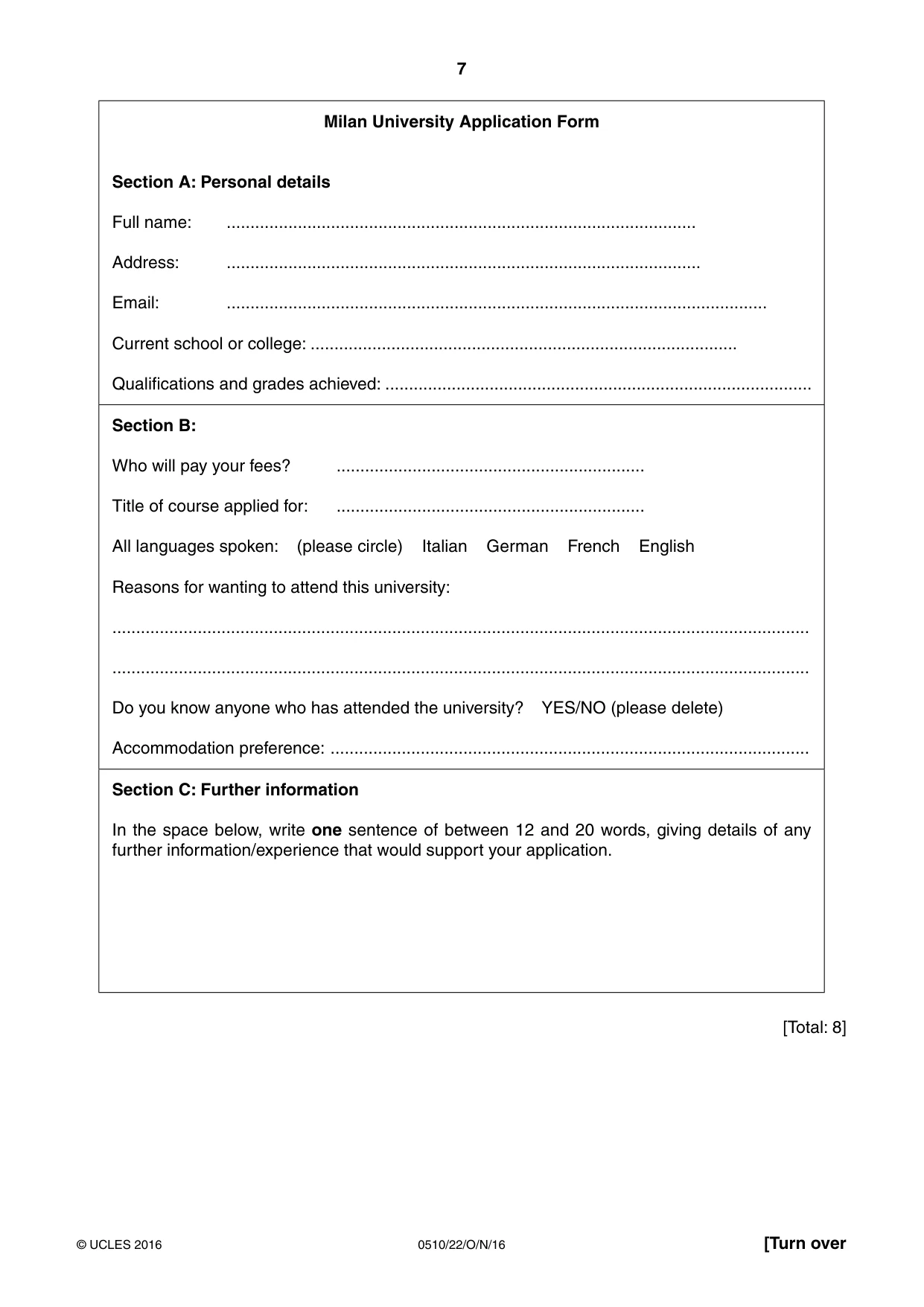
7 0510/22/O/N/16 © UCLES 2016 [Turn over Milan University Application Form Section A: Personal details Full name: … Address: … Email: … Current school or college: … Qualifications and grades achieved: … Section B: Who will pay your fees? … Title of course applied for: … All languages spoken: (please circle) Italian German French English Reasons for wanting to attend this university: … … Do you know anyone who has attended the university? YES/NO (please delete) Accommodation preference: … Section C: Further information In the space below, write one sentence of between 12 and 20 words, giving details of any further information/experience that would support your application. [Total: 8]
Question paper, page 8
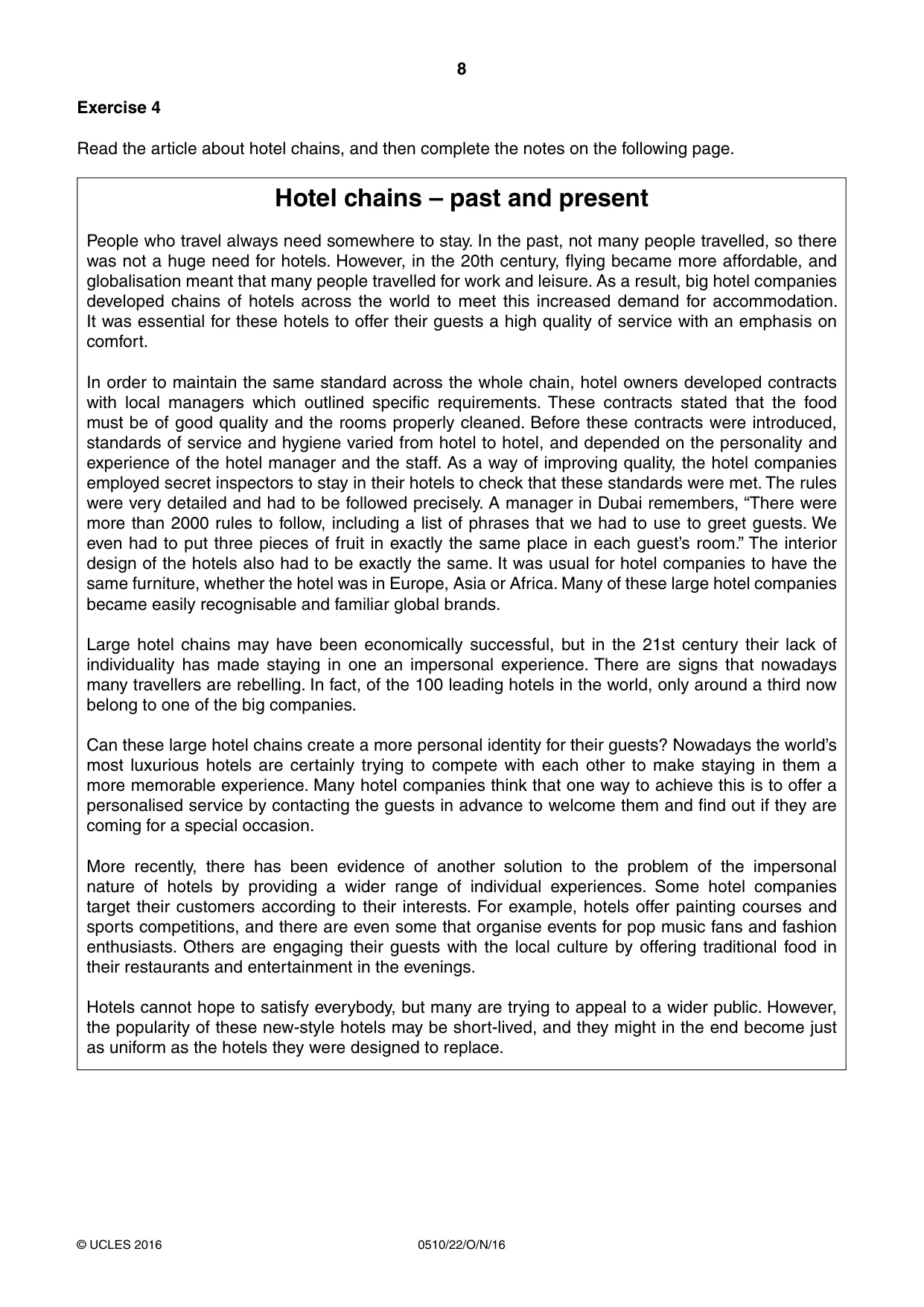
8 0510/22/O/N/16 © UCLES 2016 Exercise 4 Read the article about hotel chains, and then complete the notes on the following page. Hotel chains – past and present People who travel always need somewhere to stay. In the past, not many people travelled, so there was not a huge need for hotels. However, in the 20th century, flying became more affordable, and globalisation meant that many people travelled for work and leisure. As a result, big hotel companies developed chains of hotels across the world to meet this increased demand for accommodation. It was essential for these hotels to offer their guests a high quality of service with an emphasis on comfort. In order to maintain the same standard across the whole chain, hotel owners developed contracts with local managers which outlined specific requirements. These contracts stated that the food must be of good quality and the rooms properly cleaned. Before these contracts were introduced, standards of service and hygiene varied from hotel to hotel, and depended on the personality and experience of the hotel manager and the staff. As a way of improving quality, the hotel companies employed secret inspectors to stay in their hotels to check that these standards were met. The rules were very detailed and had to be followed precisely. A manager in Dubai remembers, “There were more than 2000 rules to follow, including a list of phrases that we had to use to greet guests. We even had to put three pieces of fruit in exactly the same place in each guest’s room.” The interior design of the hotels also had to be exactly the same. It was usual for hotel companies to have the same furniture, whether the hotel was in Europe, Asia or Africa. Many of these large hotel companies became easily recognisable and familiar global brands. Large hotel chains may have been economically successful, but in the 21st century their lack of individuality has made staying in one an impersonal experience. There are signs that nowadays many travellers are rebelling. In fact, of the 100 leading hotels in the world, only around a third now belong to one of the big companies. Can these large hotel chains create a more personal identity for their guests? Nowadays the world’s most luxurious hotels are certainly trying to compete with each other to make staying in them a more memorable experience. Many hotel companies think that one way to achieve this is to offer a personalised service by contacting the guests in advance to welcome them and find out if they are coming for a special occasion. More recently, there has been evidence of another solution to the problem of the impersonal nature of hotels by providing a wider range of individual experiences. Some hotel companies target their customers according to their interests. For example, hotels offer painting courses and sports competitions, and there are even some that organise events for pop music fans and fashion enthusiasts. Others are engaging their guests with the local culture by offering traditional food in their restaurants and entertainment in the evenings. Hotels cannot hope to satisfy everybody, but many are trying to appeal to a wider public. However, the popularity of these new-style hotels may be short-lived, and they might in the end become just as uniform as the hotels they were designed to replace.
Question paper, page 9
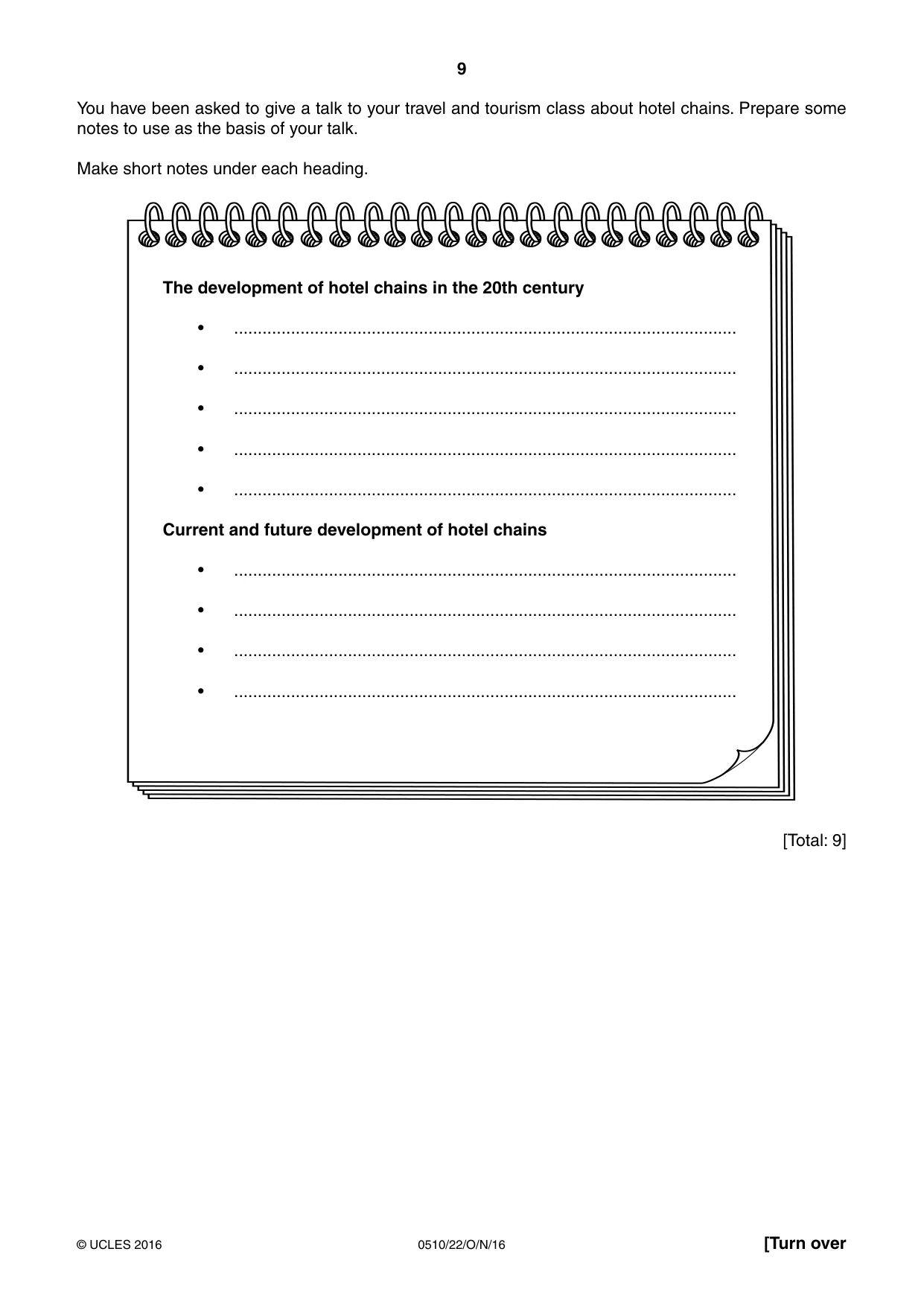
9 0510/22/O/N/16 © UCLES 2016 [Turn over You have been asked to give a talk to your travel and tourism class about hotel chains. Prepare some notes to use as the basis of your talk. Make short notes under each heading. The development of hotel chains in the 20th century • … • … • … • … • … Current and future development of hotel chains • … • … • … • … [Total: 9]
Question paper, page 10
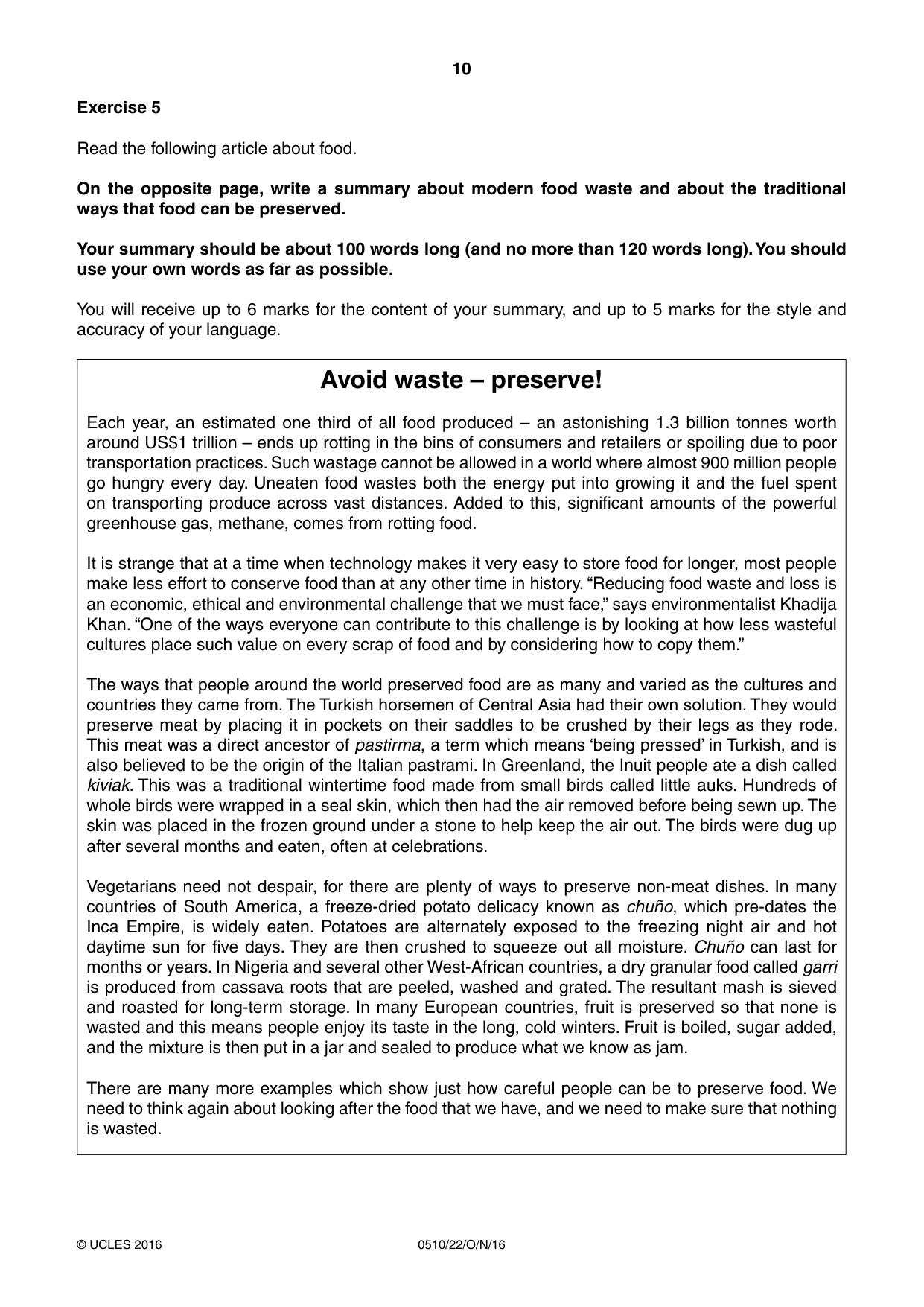
10 0510/22/O/N/16 © UCLES 2016 Exercise 5 Read the following article about food. On the opposite page, write a summary about modern food waste and about the traditional ways that food can be preserved. Your summary should be about 100 words long (and no more than 120 words long). You should use your own words as far as possible. You will receive up to 6 marks for the content of your summary, and up to 5 marks for the style and accuracy of your language. Avoid waste – preserve! Each year, an estimated one third of all food produced – an astonishing 1.3 billion tonnes worth around US$1 trillion – ends up rotting in the bins of consumers and retailers or spoiling due to poor transportation practices. Such wastage cannot be allowed in a world where almost 900 million people go hungry every day. Uneaten food wastes both the energy put into growing it and the fuel spent on transporting produce across vast distances. Added to this, significant amounts of the powerful greenhouse gas, methane, comes from rotting food. It is strange that at a time when technology makes it very easy to store food for longer, most people make less effort to conserve food than at any other time in history. “Reducing food waste and loss is an economic, ethical and environmental challenge that we must face,” says environmentalist Khadija Khan. “One of the ways everyone can contribute to this challenge is by looking at how less wasteful cultures place such value on every scrap of food and by considering how to copy them.” The ways that people around the world preserved food are as many and varied as the cultures and countries they came from. The Turkish horsemen of Central Asia had their own solution. They would preserve meat by placing it in pockets on their saddles to be crushed by their legs as they rode. This meat was a direct ancestor of pastirma, a term which means ‘being pressed’ in Turkish, and is also believed to be the origin of the Italian pastrami. In Greenland, the Inuit people ate a dish called kiviak. This was a traditional wintertime food made from small birds called little auks. Hundreds of whole birds were wrapped in a seal skin, which then had the air removed before being sewn up. The skin was placed in the frozen ground under a stone to help keep the air out. The birds were dug up after several months and eaten, often at celebrations. Vegetarians need not despair, for there are plenty of ways to preserve non-meat dishes. In many countries of South America, a freeze-dried potato delicacy known as chuño, which pre-dates the Inca Empire, is widely eaten. Potatoes are alternately exposed to the freezing night air and hot daytime sun for five days. They are then crushed to squeeze out all moisture. Chuño can last for months or years. In Nigeria and several other West-African countries, a dry granular food called garri is produced from cassava roots that are peeled, washed and grated. The resultant mash is sieved and roasted for long-term storage. In many European countries, fruit is preserved so that none is wasted and this means people enjoy its taste in the long, cold winters. Fruit is boiled, sugar added, and the mixture is then put in a jar and sealed to produce what we know as jam. There are many more examples which show just how careful people can be to preserve food. We need to think again about looking after the food that we have, and we need to make sure that nothing is wasted.
Question paper, page 11
11 0510/22/O/N/16 © UCLES 2016 [Turn over … … … … … … … … … … … … … … … … … … … … … … … … … … … [Total: 11]
Question paper, page 12
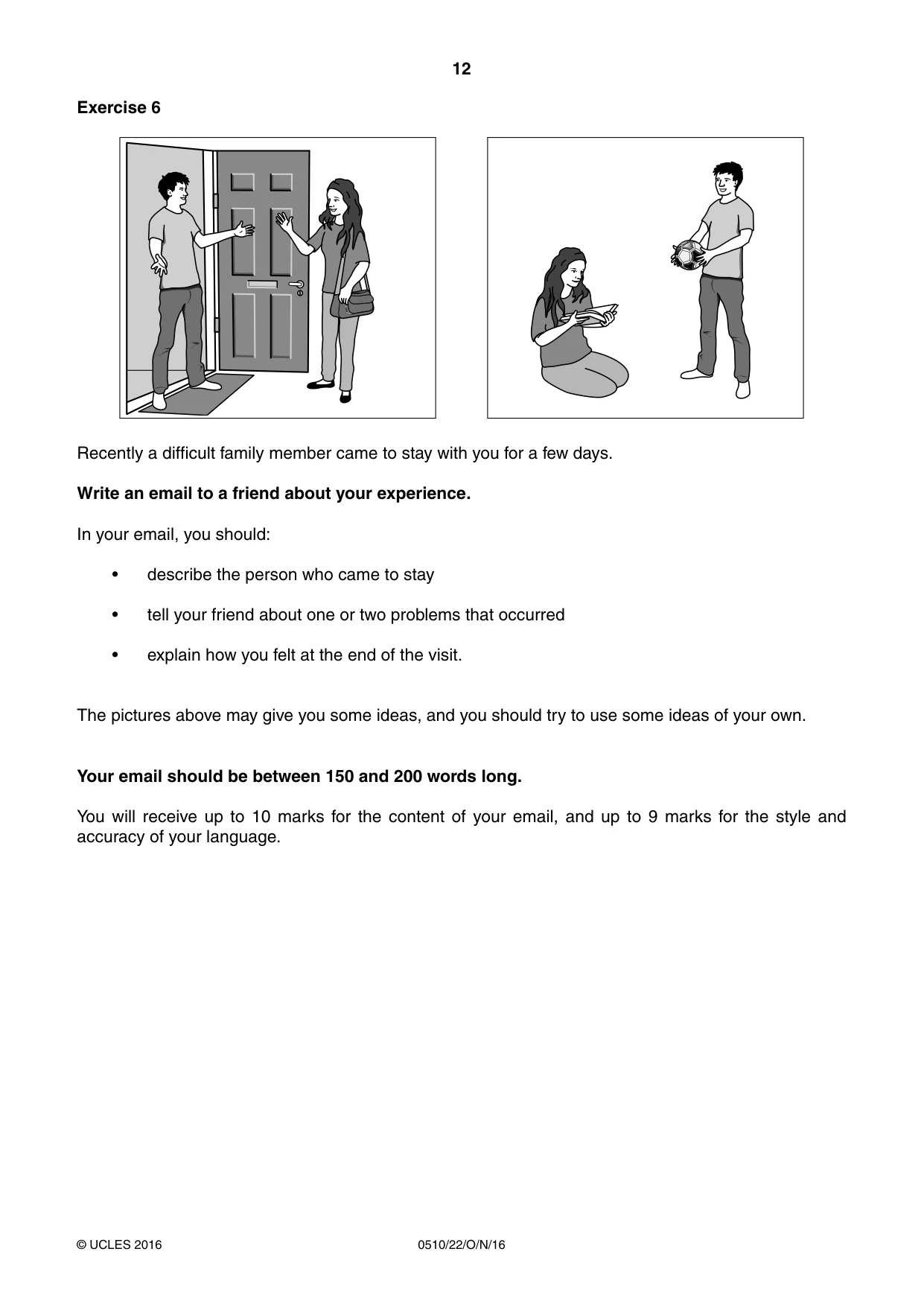
12 0510/22/O/N/16 © UCLES 2016 Exercise 6 Recently a difficult family member came to stay with you for a few days. Write an email to a friend about your experience. In your email, you should: • describe the person who came to stay • tell your friend about one or two problems that occurred • explain how you felt at the end of the visit. The pictures above may give you some ideas, and you should try to use some ideas of your own. Your email should be between 150 and 200 words long. You will receive up to 10 marks for the content of your email, and up to 9 marks for the style and accuracy of your language.
Question paper, page 13
13 0510/22/O/N/16 © UCLES 2016 [Turn over … … … … … … … … … … … … … … … … … … … … … … … … … … … [Total: 19]
Question paper, page 14
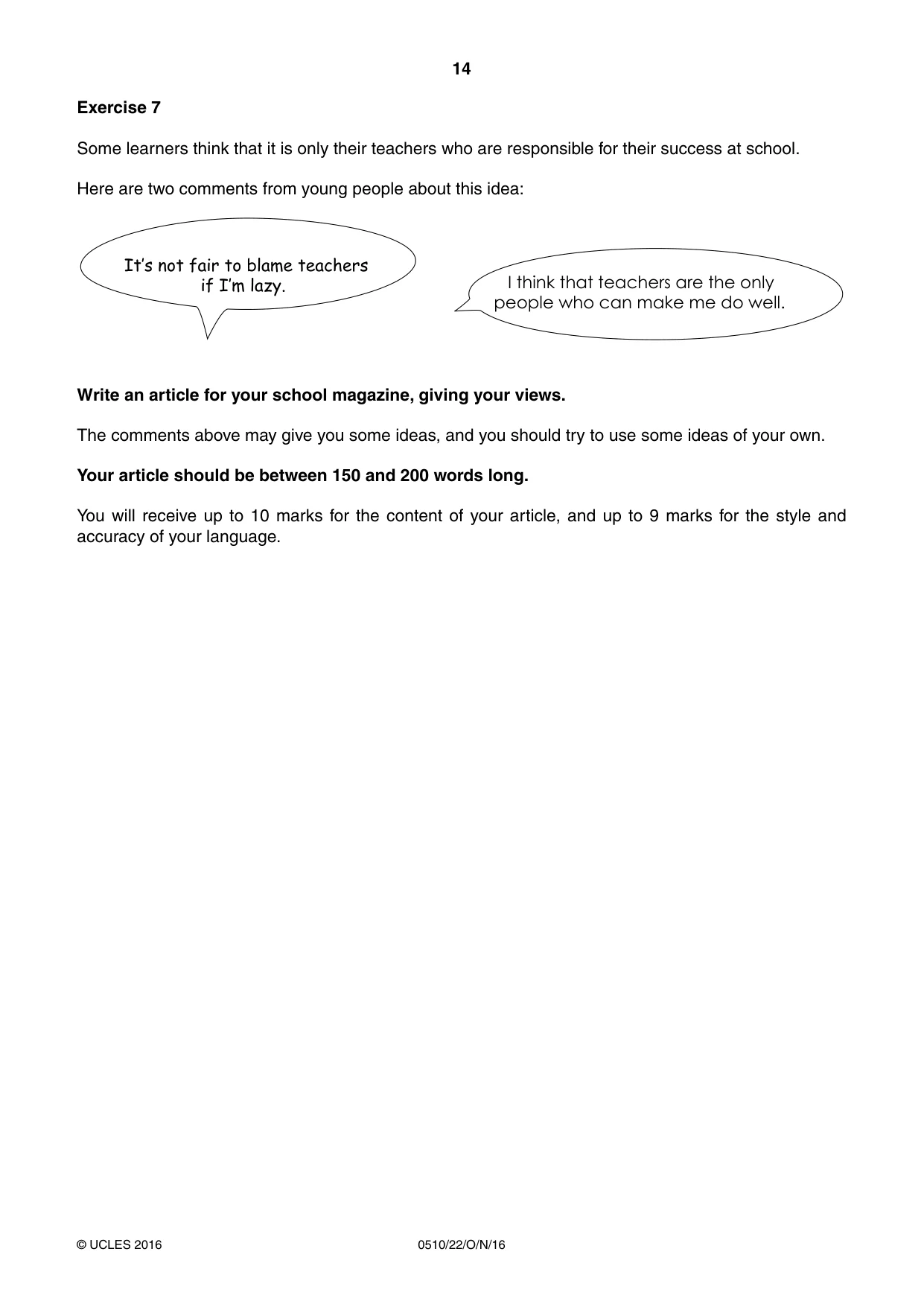
14 0510/22/O/N/16 © UCLES 2016 Exercise 7 Some learners think that it is only their teachers who are responsible for their success at school. Here are two comments from young people about this idea: It‛s not fair to blame teachers if I‛m lazy. I think that teachers are the only people who can make me do well. Write an article for your school magazine, giving your views. The comments above may give you some ideas, and you should try to use some ideas of your own. Your article should be between 150 and 200 words long. You will receive up to 10 marks for the content of your article, and up to 9 marks for the style and accuracy of your language.
Question paper, page 15
15 0510/22/O/N/16 © UCLES 2016 … … … … … … … … … … … … … … … … … … … … … … … … … … … [Total: 19]
Question paper, page 16
16 0510/22/O/N/16 © UCLES 2016 Permission to reproduce items where third-party owned material protected by copyright is included has been sought and cleared where possible. Every reasonable effort has been made by the publisher (UCLES) to trace copyright holders, but if any items requiring clearance have unwittingly been included, the publisher will be pleased to make amends at the earliest possible opportunity. To avoid the issue of disclosure of answer-related information to candidates, all copyright acknowledgements are reproduced online in the Cambridge International Examinations Copyright Acknowledgements Booklet. This is produced for each series of examinations and is freely available to download at www.cie.org.uk after the live examination series. Cambridge International Examinations is part of the Cambridge Assessment Group. Cambridge Assessment is the brand name of University of Cambridge Local Examinations Syndicate (UCLES), which is itself a department of the University of Cambridge. BLANK PAGE
Mark scheme, page 1
® IGCSE is the registered trademark of Cambridge International Examinations. This document consists of 11 printed pages. © UCLES 2016 [Turn over Cambridge International Examinations Cambridge International General Certificate of Secondary Education ENGLISH AS A SECOND LANGUAGE 0510/22 Paper 2 Reading and Writing (Extended) October/November 2016 MARK SCHEME Maximum Mark: 90 Published This mark scheme is published as an aid to teachers and candidates, to indicate the requirements of the examination. It shows the basis on which Examiners were instructed to award marks. It does not indicate the details of the discussions that took place at an Examiners’ meeting before marking began, which would have considered the acceptability of alternative answers. Mark schemes should be read in conjunction with the question paper and the Principal Examiner Report for Teachers. Cambridge will not enter into discussions about these mark schemes. Cambridge is publishing the mark schemes for the October/November 2016 series for most Cambridge IGCSE®, Cambridge International A and AS Level components and some Cambridge O Level components.
Mark scheme, page 2
Page 2 Mark Scheme Syllabus Paper Cambridge IGCSE – October/November 2016 0510 22 © UCLES 2016 IGCSE English as a Second Language Extended tier Reading/Writing (Paper 2) This component forms part of the Extended tier assessment of IGCSE English as a Second Language and tests the following Assessment Objectives: AO1: Reading R1 identify and retrieve facts and details R2 understand and select relevant information R3 recognise, understand ideas, opinions and attitudes and the connections between the related ideas R4 understand what is implied but not actually written, e.g. gist, relationships, writer’s purpose/intention, writer’s feelings, situation or place AO2: Writing W1 communicate clearly, accurately and appropriately W2 convey information and express opinions effectively W3 employ and control a variety of grammatical structures W4 demonstrate knowledge and understanding of a range of appropriate vocabulary W5 observe conventions of paragraphing, punctuation and spelling W6 employ appropriate register/style Overview of exercises on Paper 2 Reading objectives tested Marks for reading objectives Writing objectives tested Marks for writing objectives Total available marks Exercise 1 Reading (1) R1, R2 9 – 9 Exercise 2 Reading (2) R1, R2, R4 15 – 15 Exercise 3 Information transfer R1, R2, R4, 6 W1, W5 2 8 Exercise 4 Note- making R1, R2, R3 9 – 9 Exercise 5 Summary R1, R2, R3 6 W1, W2, W3, W4, W5 5 11 Exercise 6 Writing (1) – W1, W2, W3, W4, W5, W6 19 19 Exercise 7 Writing (2) – W1, W2, W3, W4, W5, W6 19 19 90
Mark scheme, page 3
Page 3 Mark Scheme Syllabus Paper Cambridge IGCSE – October/November 2016 0510 22 © UCLES 2016 Exercise 1 Beautiful buildings around the world (a) Tibetan government [1] (b) UNESCO World Heritage (list) [1] (c) second sun rising [1] (d) 3rd century BCE [1] (e) faces Mecca [1] (f) appear to change colour [1] (g) pale green / highly decorated / statues on roof / showpiece of the city [2] ONE MARK FOR EACH CORRECT DETAIL (h) church [1] [Max total for Exercise 1: 9 marks]
Mark scheme, page 4
Page 4 Mark Scheme Syllabus Paper Cambridge IGCSE – October/November 2016 0510 22 © UCLES 2016 Exercise 2 Clean teeth (a) routine / familiar routine [1] (b) invested $9.1 billion on products in one year [1] (c) broken in half AND softened (one end) [1] BOTH REQUIRED FOR ONE MARK (d) arak AND antiseptic [2] ONE MARK FOR EACH CORRECT DETAIL (e) not easily recycled [1] (f) portable [2] AND rechargeable ONE MARK FOR EACH CORRECT DETAIL (g) tooth decay [1] (h) look (more) natural [1] (i) 1940s / 1940–1950 [1] (j) (tubes of) toothpaste nylon toothbrush(es) electric toothbrush(es) / rechargeable toothbrush(es) flossing / using a (silk) thread to clean between teeth ONE MARK FOR EACH CORRECT DETAIL [4] [Max total for Exercise 2: 15 marks]
Mark scheme, page 5
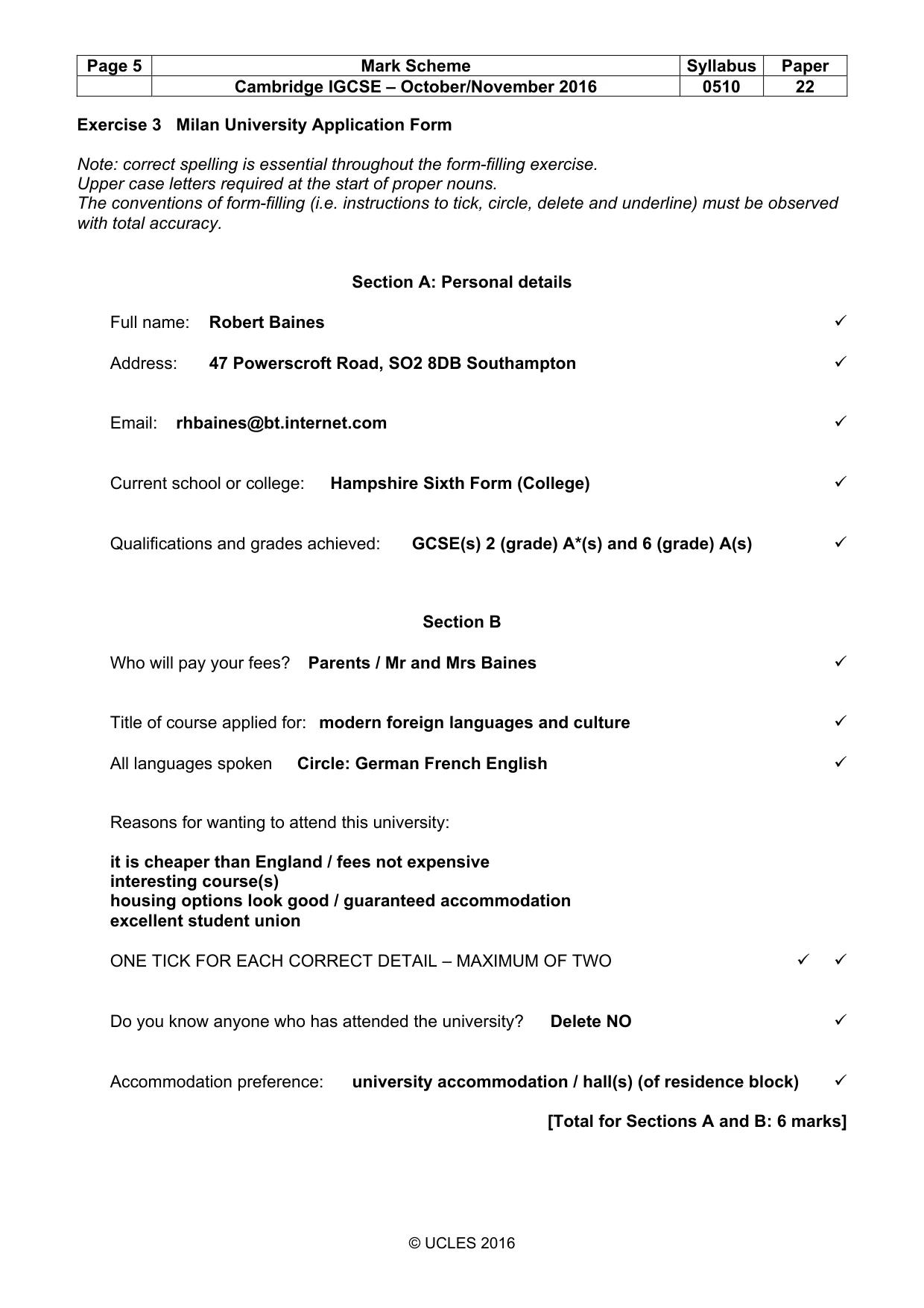
Page 5 Mark Scheme Syllabus Paper Cambridge IGCSE – October/November 2016 0510 22 © UCLES 2016 Exercise 3 Milan University Application Form Note: correct spelling is essential throughout the form-filling exercise. Upper case letters required at the start of proper nouns. The conventions of form-filling (i.e. instructions to tick, circle, delete and underline) must be observed with total accuracy. Section A: Personal details Full name: Robert Baines 9 Address: 47 Powerscroft Road, SO2 8DB Southampton 9 Email: rhbaines@bt.internet.com 9 Current school or college: Hampshire Sixth Form (College) 9 Qualifications and grades achieved: GCSE(s) 2 (grade) A*(s) and 6 (grade) A(s) 9 Section B Who will pay your fees? Parents / Mr and Mrs Baines 9 Title of course applied for: modern foreign languages and culture 9 All languages spoken Circle: German French English 9 Reasons for wanting to attend this university: it is cheaper than England / fees not expensive interesting course(s) housing options look good / guaranteed accommodation excellent student union ONE TICK FOR EACH CORRECT DETAIL – MAXIMUM OF TWO 9 9 Do you know anyone who has attended the university? Delete NO 9 Accommodation preference: university accommodation / hall(s) (of residence block) 9 [Total for Sections A and B: 6 marks]
Mark scheme, page 6
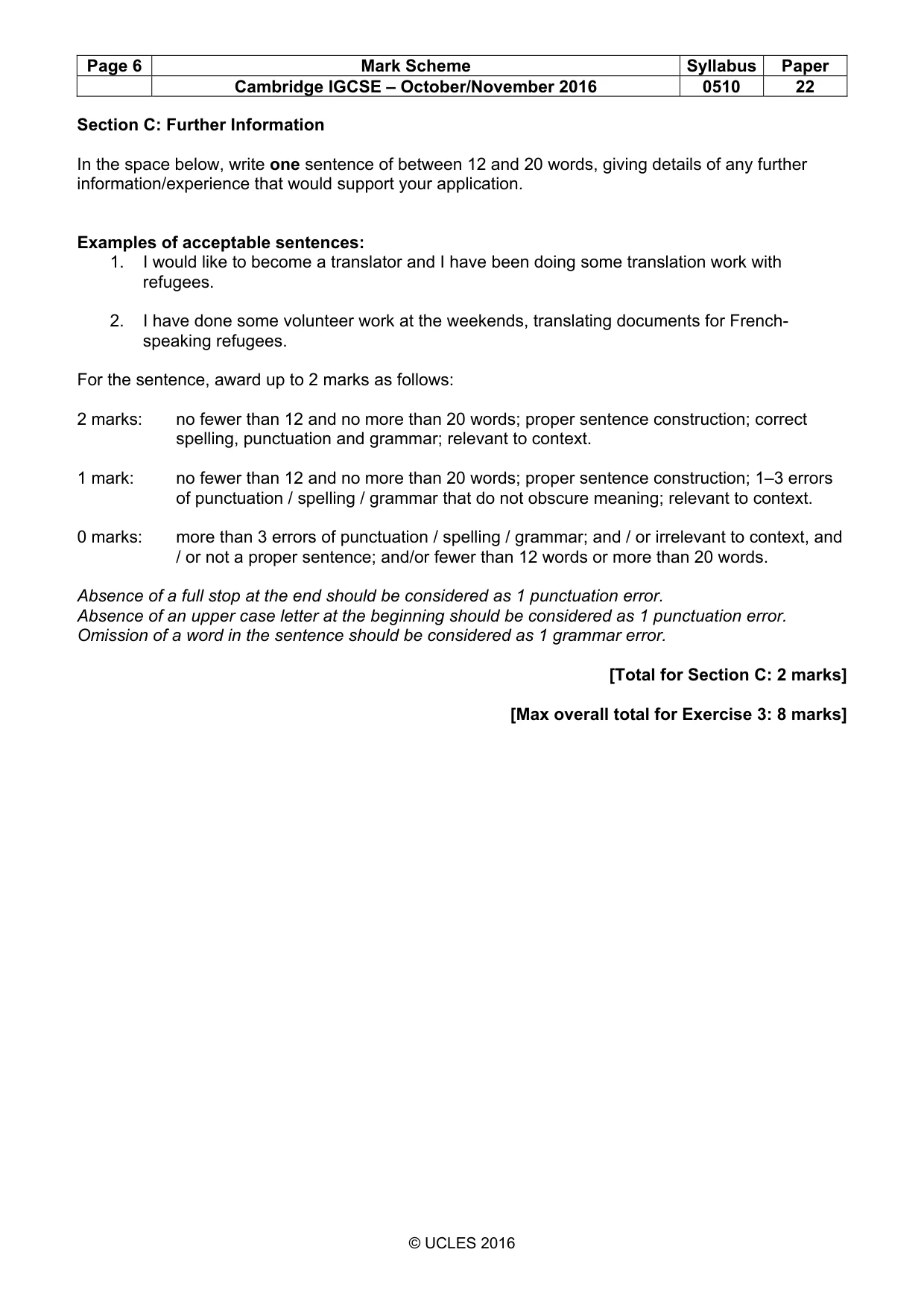
Page 6 Mark Scheme Syllabus Paper Cambridge IGCSE – October/November 2016 0510 22 © UCLES 2016 Section C: Further Information In the space below, write one sentence of between 12 and 20 words, giving details of any further information/experience that would support your application. Examples of acceptable sentences: 1. I would like to become a translator and I have been doing some translation work with refugees. 2. I have done some volunteer work at the weekends, translating documents for French- speaking refugees. For the sentence, award up to 2 marks as follows: 2 marks: no fewer than 12 and no more than 20 words; proper sentence construction; correct spelling, punctuation and grammar; relevant to context. 1 mark: no fewer than 12 and no more than 20 words; proper sentence construction; 1–3 errors of punctuation / spelling / grammar that do not obscure meaning; relevant to context. 0 marks: more than 3 errors of punctuation / spelling / grammar; and / or irrelevant to context, and / or not a proper sentence; and/or fewer than 12 words or more than 20 words. Absence of a full stop at the end should be considered as 1 punctuation error. Absence of an upper case letter at the beginning should be considered as 1 punctuation error. Omission of a word in the sentence should be considered as 1 grammar error. [Total for Section C: 2 marks] [Max overall total for Exercise 3: 8 marks]
Mark scheme, page 7
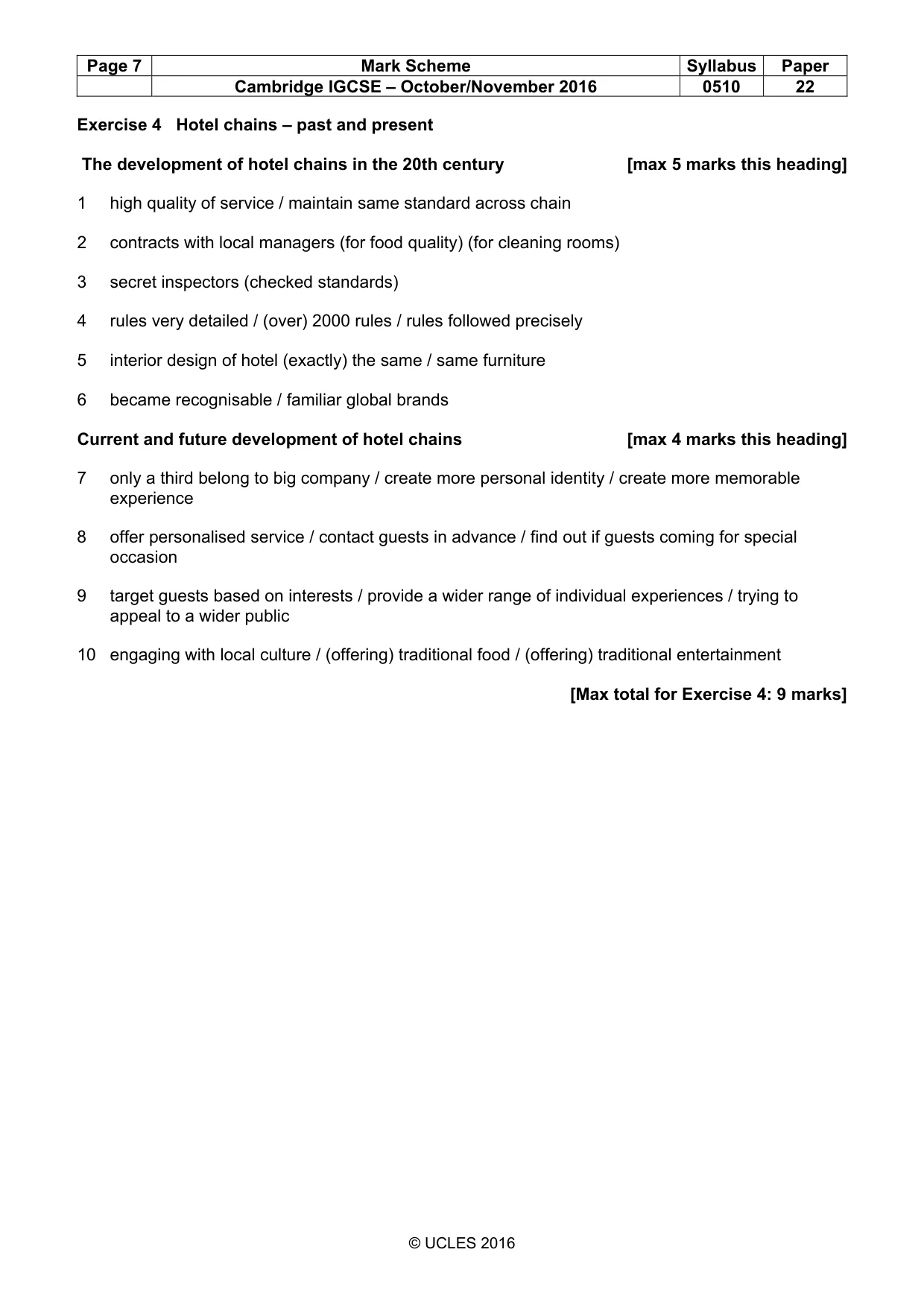
Page 7 Mark Scheme Syllabus Paper Cambridge IGCSE – October/November 2016 0510 22 © UCLES 2016 Exercise 4 Hotel chains – past and present The development of hotel chains in the 20th century [max 5 marks this heading] 1 high quality of service / maintain same standard across chain 2 contracts with local managers (for food quality) (for cleaning rooms) 3 secret inspectors (checked standards) 4 rules very detailed / (over) 2000 rules / rules followed precisely 5 interior design of hotel (exactly) the same / same furniture 6 became recognisable / familiar global brands Current and future development of hotel chains [max 4 marks this heading] 7 only a third belong to big company / create more personal identity / create more memorable experience 8 offer personalised service / contact guests in advance / find out if guests coming for special occasion 9 target guests based on interests / provide a wider range of individual experiences / trying to appeal to a wider public 10 engaging with local culture / (offering) traditional food / (offering) traditional entertainment [Max total for Exercise 4: 9 marks]
Mark scheme, page 8
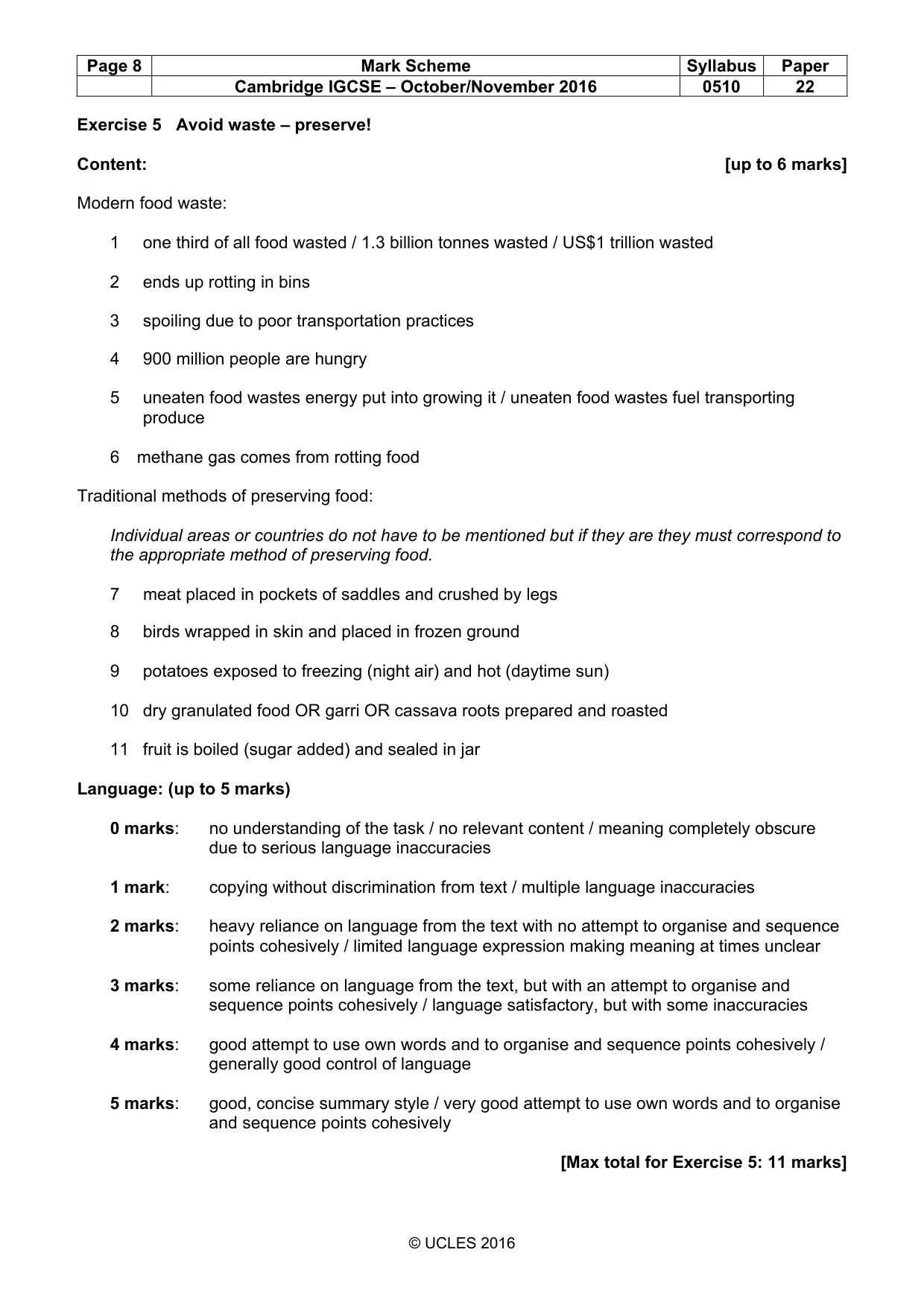
Page 8 Mark Scheme Syllabus Paper Cambridge IGCSE – October/November 2016 0510 22 © UCLES 2016 Exercise 5 Avoid waste – preserve! Content: [up to 6 marks] Modern food waste: 1 one third of all food wasted / 1.3 billion tonnes wasted / US$1 trillion wasted 2 ends up rotting in bins 3 spoiling due to poor transportation practices 4 900 million people are hungry 5 uneaten food wastes energy put into growing it / uneaten food wastes fuel transporting produce 6 methane gas comes from rotting food Traditional methods of preserving food: Individual areas or countries do not have to be mentioned but if they are they must correspond to the appropriate method of preserving food. 7 meat placed in pockets of saddles and crushed by legs 8 birds wrapped in skin and placed in frozen ground 9 potatoes exposed to freezing (night air) and hot (daytime sun) 10 dry granulated food OR garri OR cassava roots prepared and roasted 11 fruit is boiled (sugar added) and sealed in jar Language: (up to 5 marks) 0 marks: no understanding of the task / no relevant content / meaning completely obscure due to serious language inaccuracies 1 mark: copying without discrimination from text / multiple language inaccuracies 2 marks: heavy reliance on language from the text with no attempt to organise and sequence points cohesively / limited language expression making meaning at times unclear 3 marks: some reliance on language from the text, but with an attempt to organise and sequence points cohesively / language satisfactory, but with some inaccuracies 4 marks: good attempt to use own words and to organise and sequence points cohesively / generally good control of language 5 marks: good, concise summary style / very good attempt to use own words and to organise and sequence points cohesively [Max total for Exercise 5: 11 marks]
Mark scheme, page 9
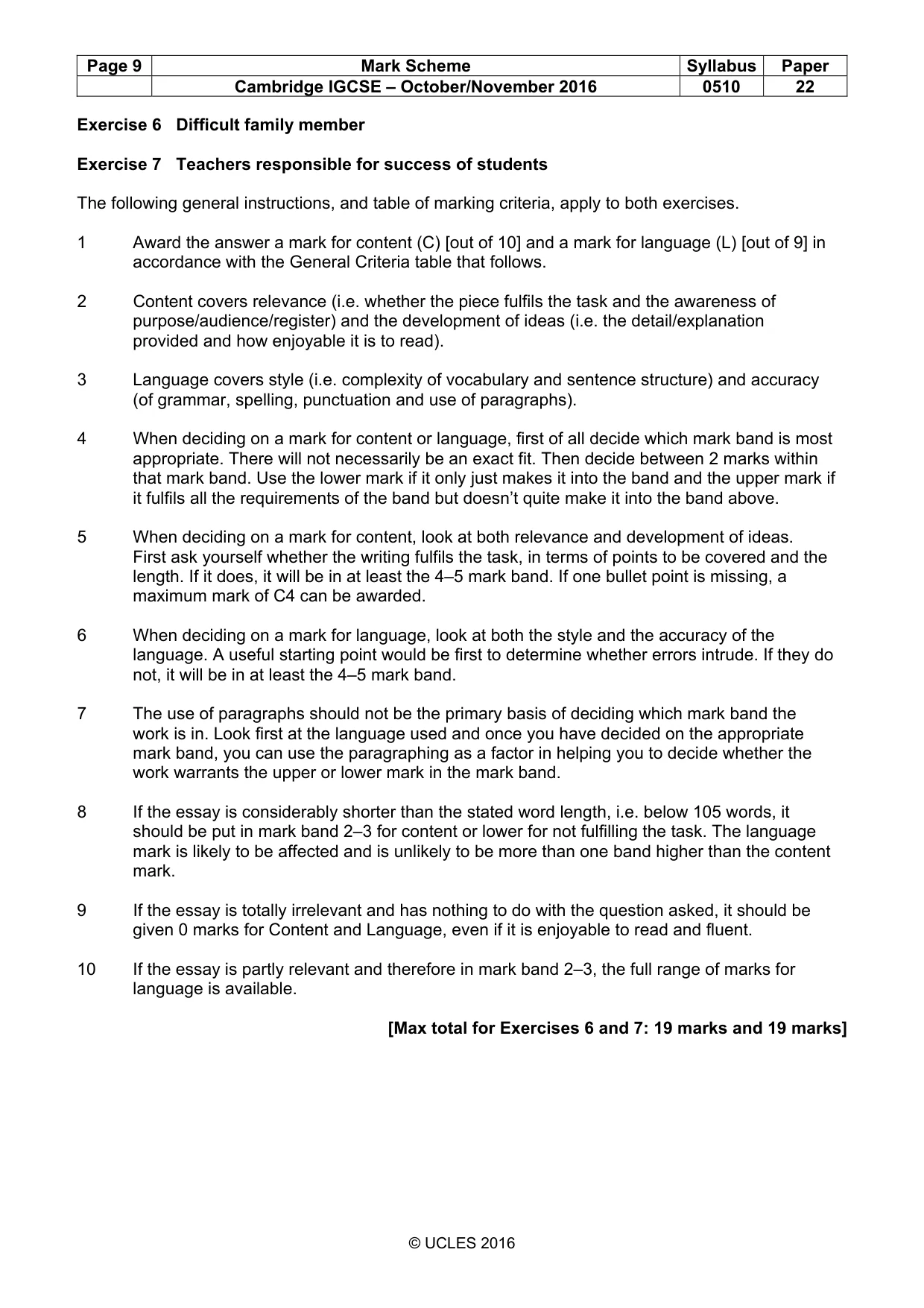
Page 9 Mark Scheme Syllabus Paper Cambridge IGCSE – October/November 2016 0510 22 © UCLES 2016 Exercise 6 Difficult family member Exercise 7 Teachers responsible for success of students The following general instructions, and table of marking criteria, apply to both exercises. 1 Award the answer a mark for content (C) [out of 10] and a mark for language (L) [out of 9] in accordance with the General Criteria table that follows. 2 Content covers relevance (i.e. whether the piece fulfils the task and the awareness of purpose/audience/register) and the development of ideas (i.e. the detail/explanation provided and how enjoyable it is to read). 3 Language covers style (i.e. complexity of vocabulary and sentence structure) and accuracy (of grammar, spelling, punctuation and use of paragraphs). 4 When deciding on a mark for content or language, first of all decide which mark band is most appropriate. There will not necessarily be an exact fit. Then decide between 2 marks within that mark band. Use the lower mark if it only just makes it into the band and the upper mark if it fulfils all the requirements of the band but doesn’t quite make it into the band above. 5 When deciding on a mark for content, look at both relevance and development of ideas. First ask yourself whether the writing fulfils the task, in terms of points to be covered and the length. If it does, it will be in at least the 4–5 mark band. If one bullet point is missing, a maximum mark of C4 can be awarded. 6 When deciding on a mark for language, look at both the style and the accuracy of the language. A useful starting point would be first to determine whether errors intrude. If they do not, it will be in at least the 4–5 mark band. 7 The use of paragraphs should not be the primary basis of deciding which mark band the work is in. Look first at the language used and once you have decided on the appropriate mark band, you can use the paragraphing as a factor in helping you to decide whether the work warrants the upper or lower mark in the mark band. 8 If the essay is considerably shorter than the stated word length, i.e. below 105 words, it should be put in mark band 2–3 for content or lower for not fulfilling the task. The language mark is likely to be affected and is unlikely to be more than one band higher than the content mark. 9 If the essay is totally irrelevant and has nothing to do with the question asked, it should be given 0 marks for Content and Language, even if it is enjoyable to read and fluent. 10 If the essay is partly relevant and therefore in mark band 2–3, the full range of marks for language is available. [Max total for Exercises 6 and 7: 19 marks and 19 marks]
Mark scheme, page 10
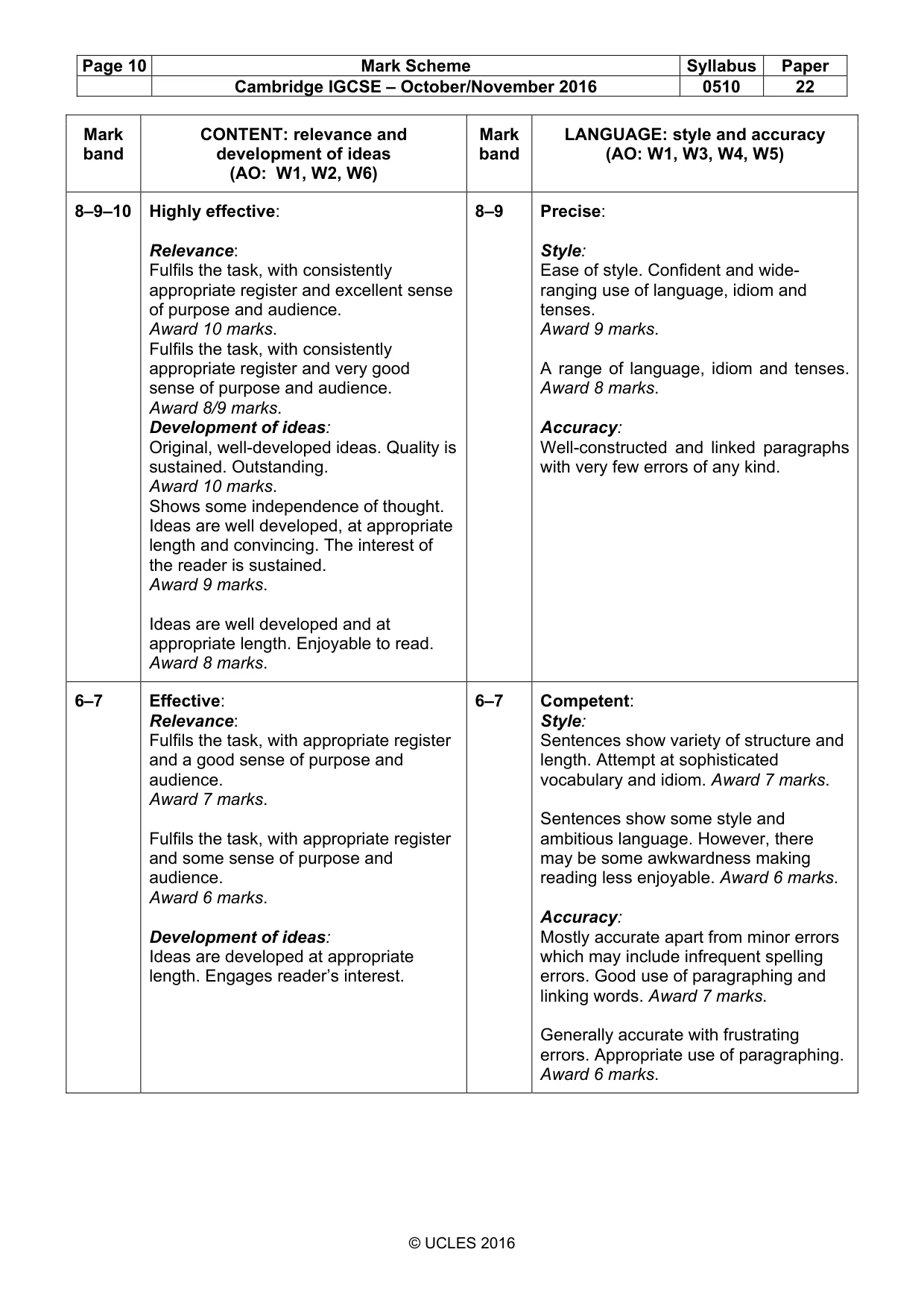
Page 10 Mark Scheme Syllabus Paper Cambridge IGCSE – October/November 2016 0510 22 © UCLES 2016 Mark band CONTENT: relevance and development of ideas (AO: W1, W2, W6) Mark band LANGUAGE: style and accuracy (AO: W1, W3, W4, W5) 8–9–10 Highly effective: Relevance: Fulfils the task, with consistently appropriate register and excellent sense of purpose and audience. Award 10 marks. Fulfils the task, with consistently appropriate register and very good sense of purpose and audience. Award 8/9 marks. Development of ideas: Original, well-developed ideas. Quality is sustained. Outstanding. Award 10 marks. Shows some independence of thought. Ideas are well developed, at appropriate length and convincing. The interest of the reader is sustained. Award 9 marks. Ideas are well developed and at appropriate length. Enjoyable to read. Award 8 marks. 8–9 Precise: Style: Ease of style. Confident and wide- ranging use of language, idiom and tenses. Award 9 marks. A range of language, idiom and tenses. Award 8 marks. Accuracy: Well-constructed and linked paragraphs with very few errors of any kind. 6–7 Effective: Relevance: Fulfils the task, with appropriate register and a good sense of purpose and audience. Award 7 marks. Fulfils the task, with appropriate register and some sense of purpose and audience. Award 6 marks. Development of ideas: Ideas are developed at appropriate length. Engages reader’s interest. 6–7 Competent: Style: Sentences show variety of structure and length. Attempt at sophisticated vocabulary and idiom. Award 7 marks. Sentences show some style and ambitious language. However, there may be some awkwardness making reading less enjoyable. Award 6 marks. Accuracy: Mostly accurate apart from minor errors which may include infrequent spelling errors. Good use of paragraphing and linking words. Award 7 marks. Generally accurate with frustrating errors. Appropriate use of paragraphing. Award 6 marks.
Mark scheme, page 11
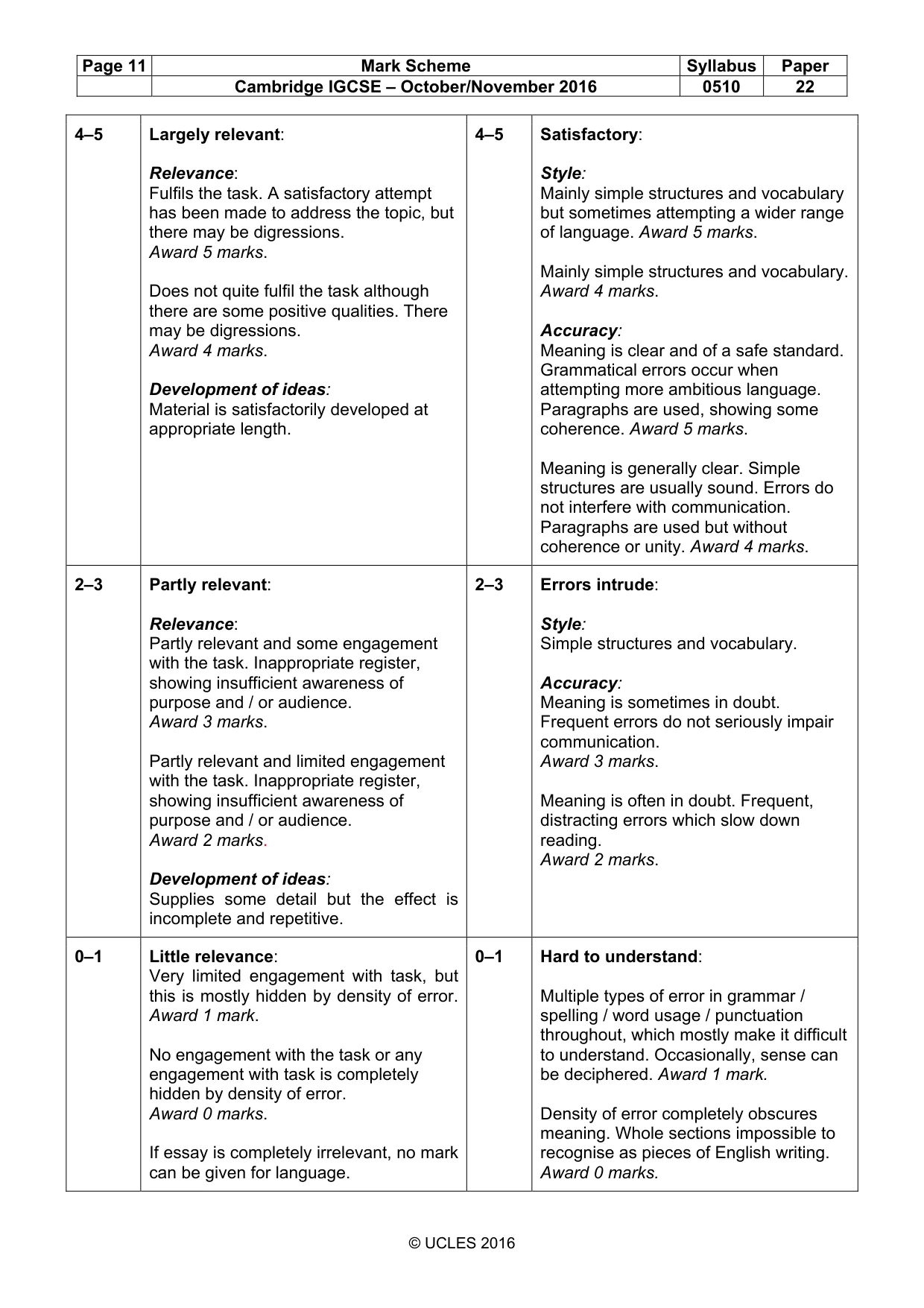
Page 11 Mark Scheme Syllabus Paper Cambridge IGCSE – October/November 2016 0510 22 © UCLES 2016 4–5 Largely relevant: Relevance: Fulfils the task. A satisfactory attempt has been made to address the topic, but there may be digressions. Award 5 marks. Does not quite fulfil the task although there are some positive qualities. There may be digressions. Award 4 marks. Development of ideas: Material is satisfactorily developed at appropriate length. 4–5 Satisfactory: Style: Mainly simple structures and vocabulary but sometimes attempting a wider range of language. Award 5 marks. Mainly simple structures and vocabulary. Award 4 marks. Accuracy: Meaning is clear and of a safe standard. Grammatical errors occur when attempting more ambitious language. Paragraphs are used, showing some coherence. Award 5 marks. Meaning is generally clear. Simple structures are usually sound. Errors do not interfere with communication. Paragraphs are used but without coherence or unity. Award 4 marks. 2–3 Partly relevant: Relevance: Partly relevant and some engagement with the task. Inappropriate register, showing insufficient awareness of purpose and / or audience. Award 3 marks. Partly relevant and limited engagement with the task. Inappropriate register, showing insufficient awareness of purpose and / or audience. Award 2 marks. Development of ideas: Supplies some detail but the effect is incomplete and repetitive. 2–3 Errors intrude: Style: Simple structures and vocabulary. Accuracy: Meaning is sometimes in doubt. Frequent errors do not seriously impair communication. Award 3 marks. Meaning is often in doubt. Frequent, distracting errors which slow down reading. Award 2 marks. 0–1 Little relevance: Very limited engagement with task, but this is mostly hidden by density of error. Award 1 mark. No engagement with the task or any engagement with task is completely hidden by density of error. Award 0 marks. If essay is completely irrelevant, no mark can be given for language. 0–1 Hard to understand: Multiple types of error in grammar / spelling / word usage / punctuation throughout, which mostly make it difficult to understand. Occasionally, sense can be deciphered. Award 1 mark. Density of error completely obscures meaning. Whole sections impossible to recognise as pieces of English writing. Award 0 marks.
What you needed in this session
Cambridge’s own grade thresholds for 2016 Oct/Nov, Paper 2 · Variant 2. A higher threshold means an easier paper — the bar moves with how the cohort did.