Cambridge IGCSE English - Second Language (oral endorsement) 0510 — 2015 May/June Paper 2 · Variant 2
0510/22/M/J/15 · 90 marks · ≈101 min
The question paper and its mark scheme, free to read here and free to download. This is Cambridge’s own paper, exactly as it was sat.
Question paper16 pages
Mark scheme11 pages
Answers below. Sit the paper first if you are practising.
Paper as text
Question paper, page 1
This document consists of 15 printed pages and 1 blank page. DC (ST/SW) 107904/4R © UCLES 2015 [Turn over Cambridge International Examinations Cambridge International General Certificate of Secondary Education * 3 0 5 3 2 1 6 6 5 3 * ENGLISH AS A SECOND LANGUAGE 0510/22 Paper 2 Reading and Writing (Extended) May/June 2015 2 hours Candidates answer on the Question Paper. No Additional Materials are required. READ THESE INSTRUCTIONS FIRST Write your Centre number, candidate number and name on all the work you hand in. Write in dark blue or black pen. Do not use staples, paper clips, glue or correction fluid. DO NOT WRITE IN ANY BARCODES. Answer all questions. Dictionaries are not allowed. At the end of the examination, fasten all your work securely together. The number of marks is given in brackets [ ] at the end of each question or part question.
Question paper, page 2
2 0510/22/M/J/15 © UCLES 2015 Exercise 1 Read the following article about birthday celebrations, and then answer the questions on the opposite page. Happy Birthday! People around the world celebrate their birthdays in many different ways. Here are some examples of customs from different countries: United Kingdom: A special cake is made and small candles are put on the top. The person celebrating their birthday has to blow out all the candles at the same time if their wishes are to come true. Then all their family and friends sing a song wishing them a happy birthday. Some people also like to give the birthday boy or girl ‘the bumps’. This means that one person holds their legs, another person holds their arms, and then they lift them up and down, bumping them each time they touch the ground. The number of bumps is the same as the person’s age, and then one extra bump is given for good luck. Germany: Small candles are placed in a special birthday candle holder and put on the dining table. Then a large, beautifully decorated candle is placed in the centre. The candles are lit early in the morning and kept burning until the evening, when the birthday boy or girl has to try and blow out all the candles with one breath. One interesting custom involves single men celebrating their 30th birthday. They have to take a brush and sweep the steps of the city hall. At the same time, some friends throw rubbish onto the steps, making them more difficult to clean. In this way, all the women can see which man is still single at 30, and they can find out whether he is good at cleaning. Brazil: On their birthday, Brazilian children usually enjoy eating sweets which are in the shape of fruit and vegetables. Their homes are decorated with banners and brightly coloured flowers. Adults and older children pull the ears of the birthday boy or girl, one pull for every year of their age. There is a cake and the birthday boy or girl has to give the first slice to their most special friend or relative. Mexico: A model of an animal is made out of papier-mâché. It is filled with sweets and good things to eat, and then hung from the ceiling. The birthday boy’s or girl’s eyes are then covered up, and they try to hit the animal shape until it breaks open and the sweets fall out. Then they share the contents with family and friends and they all sing a birthday song. Canada: In Canada, it is traditional for Canadians to cover the birthday boy’s or girl’s nose with butter. The idea is that the greasy nose makes it too slippery for bad luck to stick to them. They hope that only good luck will follow them for a year.
Question paper, page 3
3 0510/22/M/J/15 © UCLES 2015 [Turn over (a) In the UK, why do people try to blow out all their birthday candles at the same time? …[1] (b) How many bumps are given to someone on their birthday in the UK? …[1] (c) In Germany, when are the candles lit on a person’s birthday? …[1] (d) What can women discover about men on their 30th birthday in Germany? Give two details. … …[2] (e) What sort of sweets do Brazilian children have on their birthday? …[1] (f) In Brazil, how do you benefit when your best friend has a birthday? …[1] (g) What do Mexicans do to get sweets on their birthday? …[1] (h) What do Canadians do to people on their birthdays? …[1] [Total: 9]
Question paper, page 4
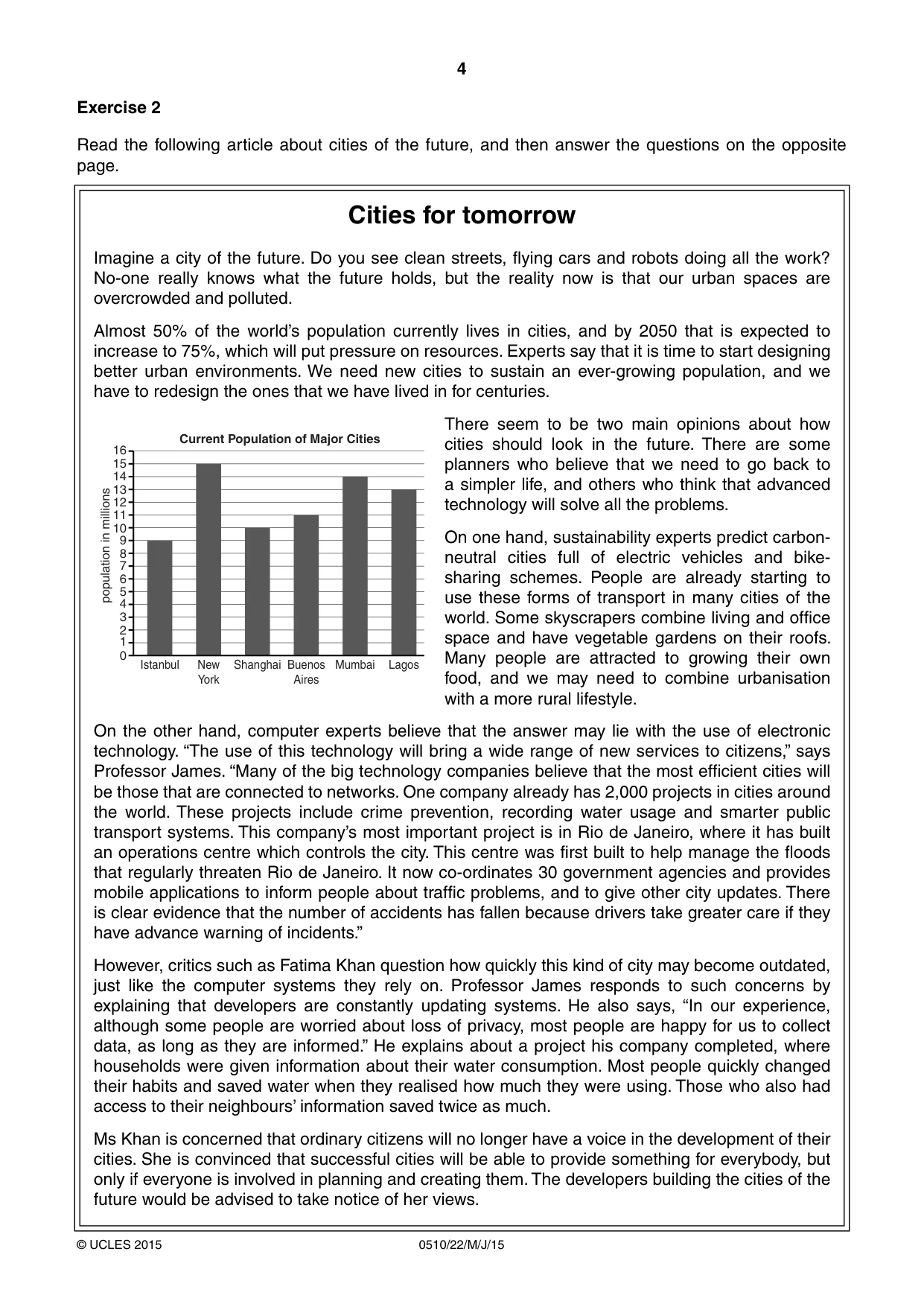
4 0510/22/M/J/15 © UCLES 2015 Exercise 2 Read the following article about cities of the future, and then answer the questions on the opposite page. Cities for tomorrow Imagine a city of the future. Do you see clean streets, flying cars and robots doing all the work? No-one really knows what the future holds, but the reality now is that our urban spaces are overcrowded and polluted. Almost 50% of the world’s population currently lives in cities, and by 2050 that is expected to increase to 75%, which will put pressure on resources. Experts say that it is time to start designing better urban environments. We need new cities to sustain an ever-growing population, and we have to redesign the ones that we have lived in for centuries. There seem to be two main opinions about how cities should look in the future. There are some planners who believe that we need to go back to a simpler life, and others who think that advanced technology will solve all the problems. On one hand, sustainability experts predict carbon- neutral cities full of electric vehicles and bike- sharing schemes. People are already starting to use these forms of transport in many cities of the world. Some skyscrapers combine living and office space and have vegetable gardens on their roofs. Many people are attracted to growing their own food, and we may need to combine urbanisation with a more rural lifestyle. On the other hand, computer experts believe that the answer may lie with the use of electronic technology. “The use of this technology will bring a wide range of new services to citizens,” says Professor James. “Many of the big technology companies believe that the most efficient cities will be those that are connected to networks. One company already has 2,000 projects in cities around the world. These projects include crime prevention, recording water usage and smarter public transport systems. This company’s most important project is in Rio de Janeiro, where it has built an operations centre which controls the city. This centre was first built to help manage the floods that regularly threaten Rio de Janeiro. It now co-ordinates 30 government agencies and provides mobile applications to inform people about traffic problems, and to give other city updates. There is clear evidence that the number of accidents has fallen because drivers take greater care if they have advance warning of incidents.” However, critics such as Fatima Khan question how quickly this kind of city may become outdated, just like the computer systems they rely on. Professor James responds to such concerns by explaining that developers are constantly updating systems. He also says, “In our experience, although some people are worried about loss of privacy, most people are happy for us to collect data, as long as they are informed.” He explains about a project his company completed, where households were given information about their water consumption. Most people quickly changed their habits and saved water when they realised how much they were using. Those who also had access to their neighbours’ information saved twice as much. Ms Khan is concerned that ordinary citizens will no longer have a voice in the development of their cities. She is convinced that successful cities will be able to provide something for everybody, but only if everyone is involved in planning and creating them. The developers building the cities of the future would be advised to take notice of her views. 16 15 14 12 13 10 9 8 7 6 5 4 3 2 1 0 11 population in millions Istanbul New York Shanghai Current Population of Major Cities Buenos Aires Mumbai Lagos
Question paper, page 5
5 0510/22/M/J/15 © UCLES 2015 [Turn over (a) What is true about today’s cities? …[1] (b) According to the graph, which city has the second highest population? How many people live there? …[1] (c) What are the two different views about how to plan future cities? … …[2] (d) How will people travel in an environmentally-friendly city? Give two details. …[1] (e) What traditional activity is likely to continue in future cities? …[1] (f) What practical benefits could internet networks bring to cities of the future? Give two details. … …[2] (g) What proof is there in Rio de Janeiro that shows that internet networks are effective? …[1] (h) In Professor James’s project, which group of people saved the most water? …[1] (i) What does Ms Khan believe is necessary for cities to be successful? …[1] (j) Give four concerns that people have about life in future cities. … … … …[4] [Total: 15]
Question paper, page 6
6 0510/22/M/J/15 © UCLES 2015 Exercise 3 Emergency Loan Robert Harley is a 19-year-old British student who is nearly at the end of his second year at university. He is studying World Literature at the University of Portsmouth and hopes to get a Bachelor of Arts degree when he finishes his three-year course. It had always been his dream to go to university but he has been worried about the cost of it. His mother, who is a widow, has worked very hard to support him and his two sisters, and he does not want to ask her for any money. He applied for a student loan to pay his fees and accommodation costs, and he was awarded the maximum amount available. He managed the first year very well, without having to ask for any help. He had hoped to get a job in the holidays after his first year, but he found it impossible. During term time, he shares a house with three other students at 48, Hook Lane, Portsmouth PO13 7AG. Last year, he was in a hall of residence, and he preferred living there because the cost was very straightforward and included all the bills. This year, Robert has found it quite difficult to manage his money in a sensible way, and now he is very worried because he is starting to fall into debt. When he started to share a house, he forgot to calculate how much he would have to pay for heating and water. Robert also had a very big expense when he went to France for three days to attend a conference on European Literature. He had to borrow £100 from one of his friends when they were in France, because everything was much more expensive than he had expected. He now owes £300 in rent, and he knows that he does not have enough money to pay his share of the electricity bill, which is £40. He has just had a bill for £50 for his phone, number 07358469654, and he does not know how he will pay that. His bank account, number 975300 at The National Bank in Portsmouth, is practically empty, and he will not get his next student loan payment until September. Robert hopes that he will be able to find a job this summer, but he knows that he will not be able to make enough money to pay off his debts and support himself. He refuses to tell his mother about his problems because he does not want to worry her. Last week, he went to the Student Advice Centre and explained that he was £490 in debt. The advisor there was very helpful. He gave Robert some information about a special scheme that the university has, to help students who are in financial difficulty. Robert discovered that he can apply for an emergency loan from the university, and so he has decided to see if he can get £1,000 to help sort himself out before next term. Imagine you are Robert. Fill in the form on the opposite page, using the information above.
Question paper, page 7
7 0510/22/M/J/15 © UCLES 2015 [Turn over Emergency Loan Application Form Section A: Personal details Full name: … Nationality: … Term-time address: … Phone number: … Section B: University details Course title: … Current year of course: … Type of accommodation: (please circle) Hall of residence Family home Shared student house Other Section C: Finances Name of bank and account number: … Current debt: … What financial support do you receive? … Are you currently employed? (please delete) YES / NO How much money do you want to borrow? … Section D In the space below, write one sentence of between 12 and 20 words, explaining the main reasons why you are in debt. [Total: 8]
Question paper, page 8
8 0510/22/M/J/15 © UCLES 2015 Exercise 4 Read the following article about second-hand markets in the UK, and then complete the notes on the opposite page. Second-hand Markets The second-hand market has now become a very popular British event. It is not complicated; you load your car with things you no longer want, drive to a field and park next to other people doing the same thing. Then open the back of your car, take out the goods you want to sell and put them on a table. As these second-hand markets have developed, they have become more sophisticated, but it is still inexpensive items that most shoppers are looking for. Buyers know that the starting price will probably not be the final price they have to pay, and for many buyers, half the fun is bargaining over the price. If you are a seller, it is very important to be friendly to your customers, because if you can engage a customer in conversation, it is amazing what they will buy. For example, at a sale a few weeks ago, an old chess set, with some pieces missing, was sold to a very happy customer. One seller happily reported he had made an impressive £118 profit, even though he had to pay £6 to park his car, and another £3 for the hot chocolate that he bought to warm himself up. It was a bitterly cold day and he had forgotten to bring along a piece of cardboard to stand on, a well-known trick of the regular sellers to keep their feet warm. There are some amazing stories, such as the one about a valuable vase which was sold at a market for £1 in 2008, and which later sold for £32,450 at an antiques auction. Jane Smith, a regular visitor to second-hand markets, has her own story to tell. “It is a good idea to arrive early to try to get the best goods. Once I bought a ring for £2 and I later discovered it was real gold and diamonds, valued at £1,200. I didn’t sell it; I now wear it as a good luck charm!” Sellers are always advised to check that they are not selling something at a give-away price which is actually very valuable. If a seller asks for too much money, customers will move on. However, if you ask for too little, they might still move on. Once, a woman had some nicely packaged soap. Several women stopped and asked, “What scent is it?” When the woman could not tell them, they walked away. Even at a second-hand market, customers want to be sure that the people who are selling items have some knowledge of their goods. There is a great sense of fun at second-hand markets. Buyers should enjoy looking at the variety of goods without feeling disappointed if they do not actually purchase anything. Sellers also enjoy doing something different for a few hours, and they know it is best to go for the fun rather than with a serious intention to make a lot of money. There are no rules and regulations, buyers must understand they have no rights to return faulty goods. Moreover, you can always be sure of finding someone stretching the idea of the second-hand market to its limit. Recently there was a man who was not only selling the contents of the back of his car, but also the car itself.
Question paper, page 9
9 0510/22/M/J/15 © UCLES 2015 [Turn over You are going to give a talk to your business class about second-hand markets. Prepare some notes to use as the basis of your talk. Make short notes under each heading. Advice for sellers • … • … • … • … • … Advice for buyers • … • … • … • … [Total: 9]
Question paper, page 10
10 0510/22/M/J/15 © UCLES 2015 Exercise 5 Read the following article about exams and revision. On the opposite page, write a summary about the different things that students can do to ensure exam success. Your summary should be about 100 words long (and no more than 120 words long). You should use your own words as far as possible. You will receive up to 6 marks for the content of your summary, and up to 5 marks for the style and accuracy of your language. EXAM SUCCESS Some people read textbooks in the bath when revising for exams, while others surround themselves with notelets covered in facts. There are many ways to revise, but there is no magic formula guaranteeing exam success. There are a few shortcuts that can make a big difference, but the exact approach can only be decided by the person who is sitting the exam. According to Dr. Viv Harman, a specialist in educational assessment from a local university, the first and most basic point is to make a solid revision plan. She explains, “Research on undergraduates shows that those who have a working style based on breaking down tasks into small, manageable parts end up with better degrees.” Revision should never simply be seen as soaking up knowledge. Pupils should try to get involved in what they are studying so that they become genuinely interested in the topics. If you are interested in something, you are more likely to remember it. The number of subjects that students have to study nowadays is considerable. It is a lot to expect that a young person should find every topic of every subject fascinating. Some students say that they struggle to find even half the subjects that they have to learn of any interest at all. Parents often worry when their children say that they want to revise with a friend. They fear that when the friends get together, they will start talking about anything other than their studies. But parents should not necessarily stop their children from revising with a friend, if they are explaining concepts to one another. This can be one of the best ways to understand a complicated subject. Explaining something to someone else can often help to clarify your own thinking. If parents try to intervene too strongly, they may end up turning revision into a battleground. The best way for mothers and fathers to help is by being supportive. During the final few hours before an exam, they should do everything to help students to feel relaxed. Thirty years ago, teachers often complained that they did not have much information about how examinations were marked, and so they found it difficult to help students do the right thing in an examination. Nowadays, exam boards publish a lot of information about what they expect. They even publish their mark schemes, and so everyone knows exactly what the examiners want to see. Anyone who is sitting an exam needs to have a good knowledge of the mark schemes. Teachers should pass these on to students because they help to show exactly what the difference is between an A and a C grade. Students regularly ask their teachers how much revision they should do. Geoffrey Till, author of the booklet ‘How to Succeed in Exams’, advises students to start revising early. “For most students, the hardest thing is getting started. It’s best to study about 10 minutes a night and build up to doing more revision later,” he says. Many students find that it is advisable to have an intensive study period followed by a short break. Different people can concentrate for different lengths of time, but it is important that each student knows what works best for them. Most students try their best, but they can also take some comfort in remembering that history is full of famous people who did not do well in exams, but who achieved great things in later life.
Question paper, page 11
11 0510/22/M/J/15 © UCLES 2015 [Turn over … … … … … … … … … … … … … … … … … … … … [Total: 11]
Question paper, page 12
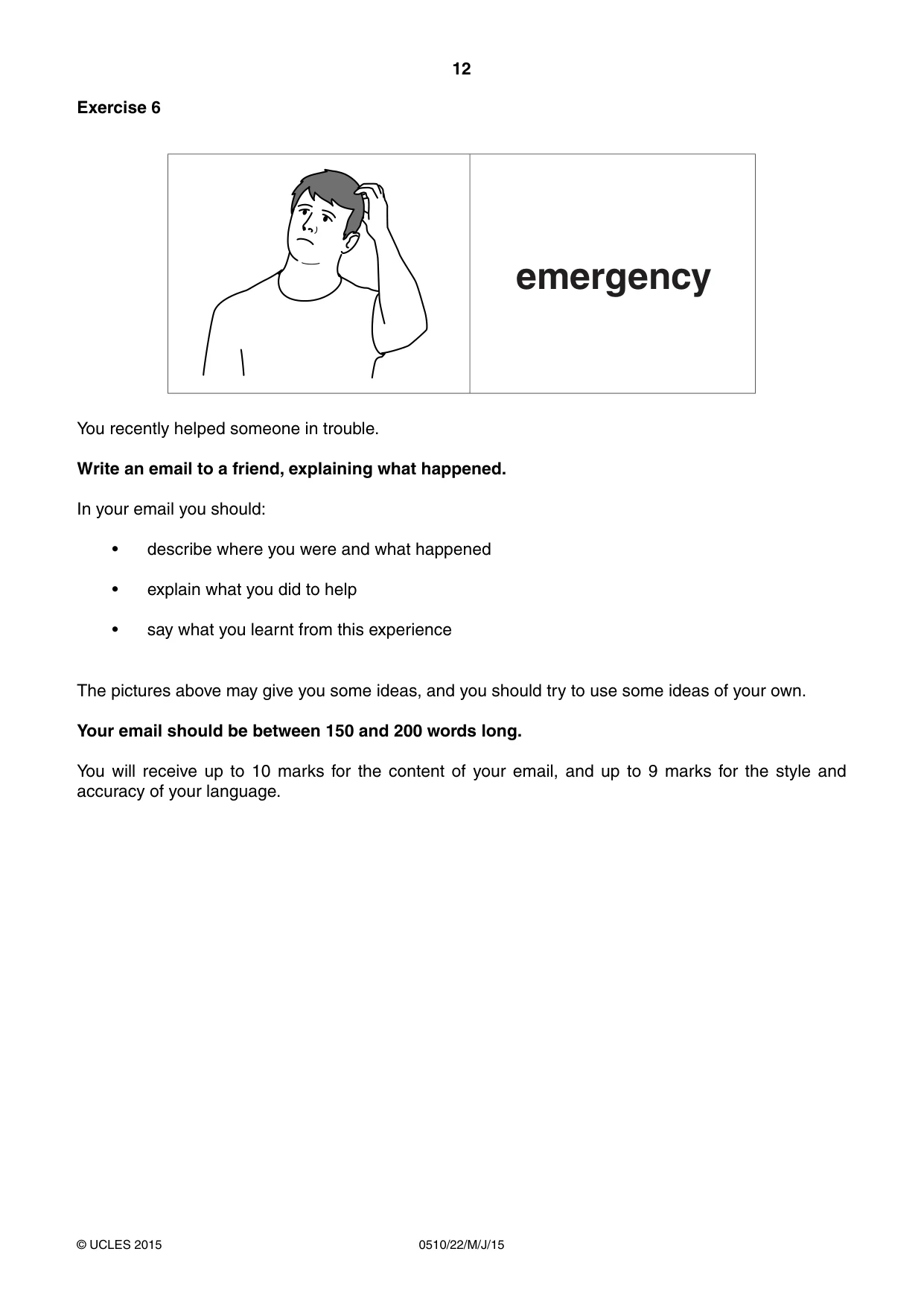
12 0510/22/M/J/15 © UCLES 2015 Exercise 6 emergency You recently helped someone in trouble. Write an email to a friend, explaining what happened. In your email you should: • describe where you were and what happened • explain what you did to help • say what you learnt from this experience The pictures above may give you some ideas, and you should try to use some ideas of your own. Your email should be between 150 and 200 words long. You will receive up to 10 marks for the content of your email, and up to 9 marks for the style and accuracy of your language.
Question paper, page 13
13 0510/22/M/J/15 © UCLES 2015 [Turn over … … … … … … … … … … … … … … … … … … … … … … … … … [Total: 19]
Question paper, page 14
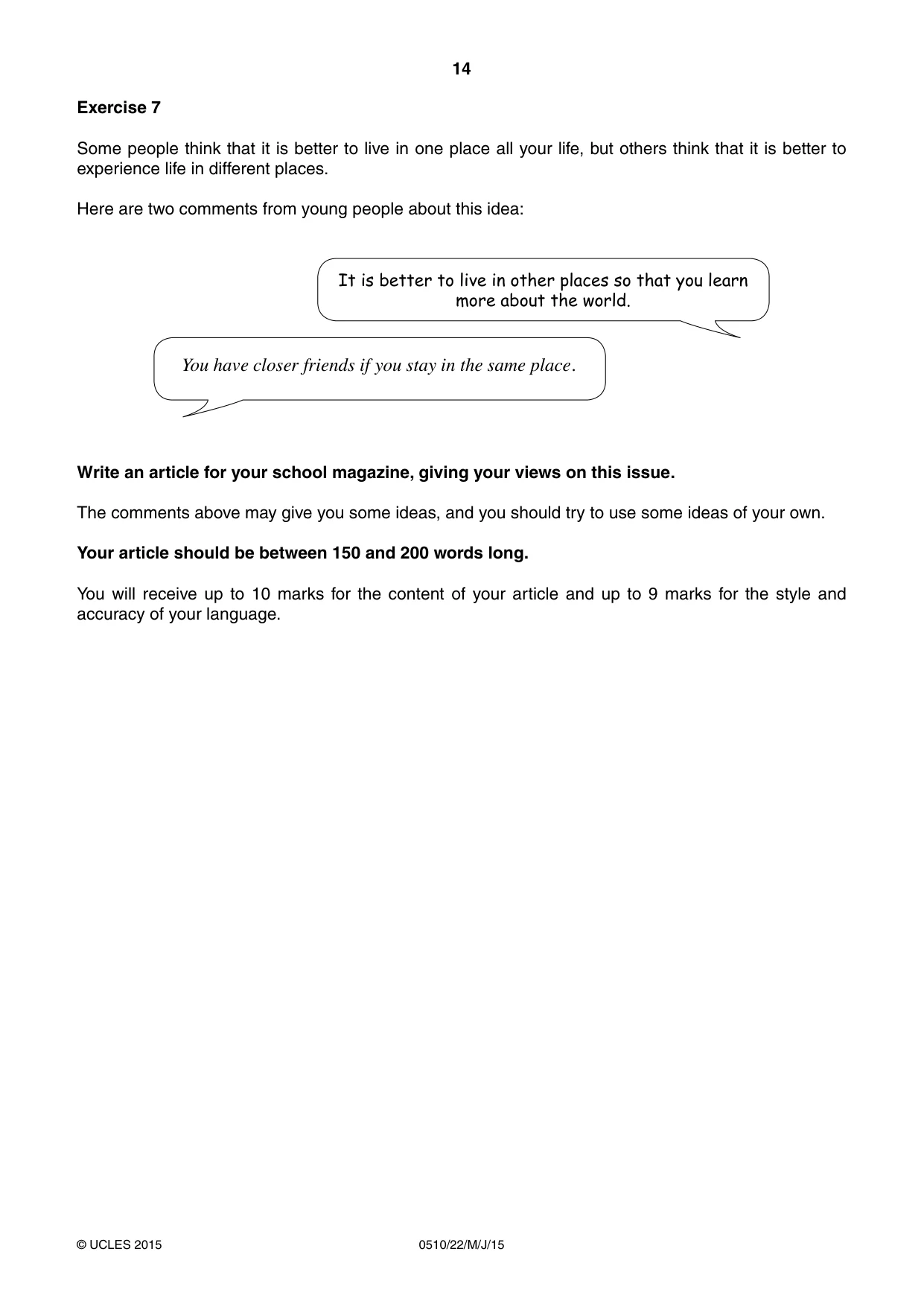
14 0510/22/M/J/15 © UCLES 2015 Exercise 7 Some people think that it is better to live in one place all your life, but others think that it is better to experience life in different places. Here are two comments from young people about this idea: It is better to live in other places so that you learn more about the world. You have closer friends if you stay in the same place. Write an article for your school magazine, giving your views on this issue. The comments above may give you some ideas, and you should try to use some ideas of your own. Your article should be between 150 and 200 words long. You will receive up to 10 marks for the content of your article and up to 9 marks for the style and accuracy of your language.
Question paper, page 15
15 0510/22/M/J/15 © UCLES 2015 … … … … … … … … … … … … … … … … … … … … … … … … … [Total: 19]
Question paper, page 16
16 0510/22/M/J/15 © UCLES 2015 BLANK PAGE Permission to reproduce items where third-party owned material protected by copyright is included has been sought and cleared where possible. Every reasonable effort has been made by the publisher (UCLES) to trace copyright holders, but if any items requiring clearance have unwittingly been included, the publisher will be pleased to make amends at the earliest possible opportunity. To avoid the issue of disclosure of answer-related information to candidates, all copyright acknowledgements are reproduced online in the Cambridge International Examinations Copyright Acknowledgements Booklet. This is produced for each series of examinations and is freely available to download at www.cie.org.uk after the live examination series. Cambridge International Examinations is part of the Cambridge Assessment Group. Cambridge Assessment is the brand name of University of Cambridge Local Examinations Syndicate (UCLES), which is itself a department of the University of Cambridge.
Mark scheme, page 1
® IGCSE is the registered trademark of Cambridge International Examinations. CAMBRIDGE INTERNATIONAL EXAMINATIONS Cambridge International General Certificate of Secondary Education MARK SCHEME for the May/June 2015 series 0510 ENGLISH AS A SECOND LANGUAGE 0510/22 Paper 2 (Reading and Writing – Extended), maximum raw mark 90 This mark scheme is published as an aid to teachers and candidates, to indicate the requirements of the examination. It shows the basis on which Examiners were instructed to award marks. It does not indicate the details of the discussions that took place at an Examiners’ meeting before marking began, which would have considered the acceptability of alternative answers. Mark schemes should be read in conjunction with the question paper and the Principal Examiner Report for Teachers. Cambridge will not enter into discussions about these mark schemes. Cambridge is publishing the mark schemes for the May/June 2015 series for most Cambridge IGCSE®, Cambridge International A and AS Level components and some Cambridge O Level components.
Mark scheme, page 2
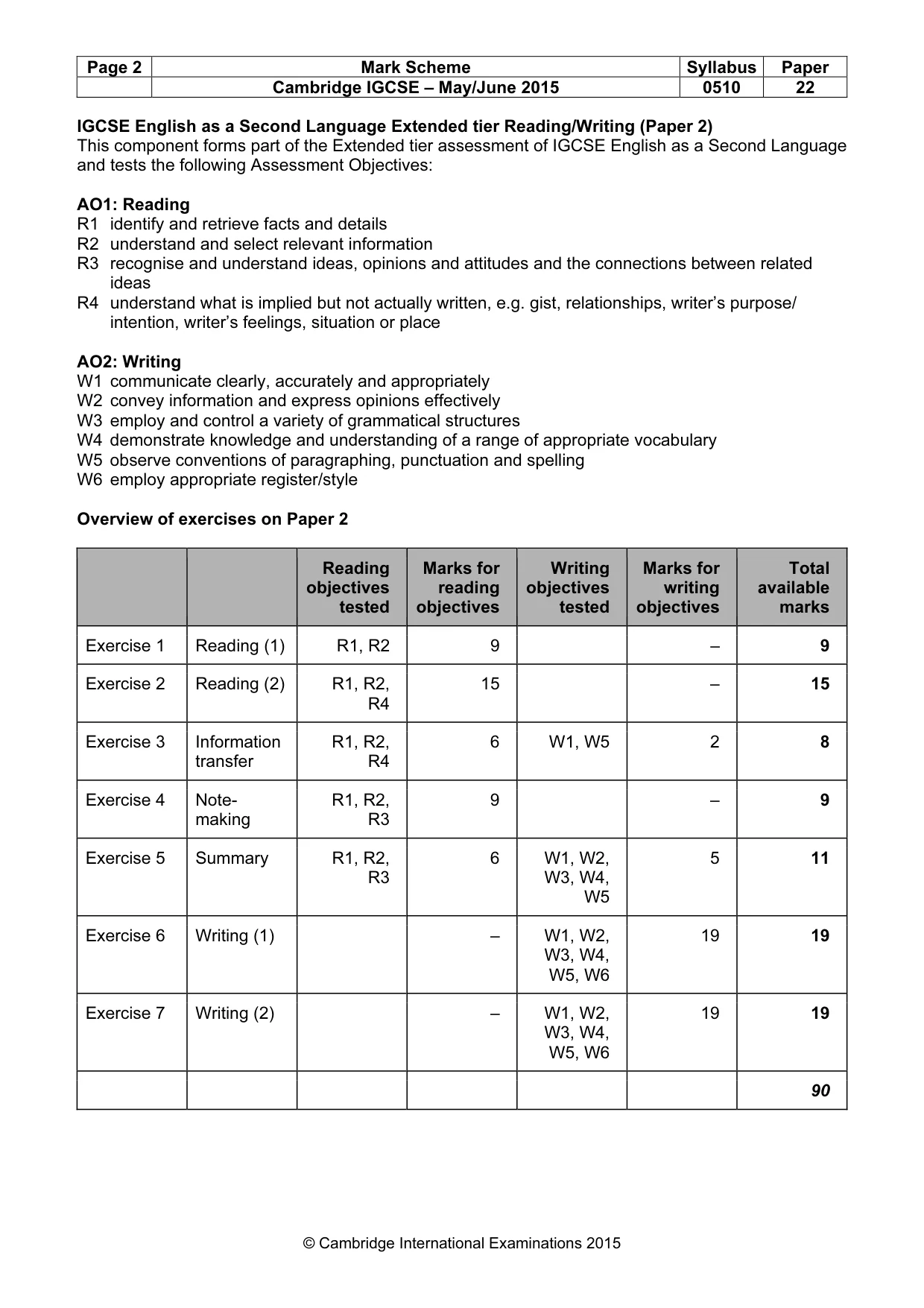
Page 2 Mark Scheme Syllabus Paper Cambridge IGCSE – May/June 2015 0510 22 © Cambridge International Examinations 2015 IGCSE English as a Second Language Extended tier Reading/Writing (Paper 2) This component forms part of the Extended tier assessment of IGCSE English as a Second Language and tests the following Assessment Objectives: AO1: Reading R1 identify and retrieve facts and details R2 understand and select relevant information R3 recognise and understand ideas, opinions and attitudes and the connections between related ideas R4 understand what is implied but not actually written, e.g. gist, relationships, writer’s purpose/ intention, writer’s feelings, situation or place AO2: Writing W1 communicate clearly, accurately and appropriately W2 convey information and express opinions effectively W3 employ and control a variety of grammatical structures W4 demonstrate knowledge and understanding of a range of appropriate vocabulary W5 observe conventions of paragraphing, punctuation and spelling W6 employ appropriate register/style Overview of exercises on Paper 2 Reading objectives tested Marks for reading objectives Writing objectives tested Marks for writing objectives Total available marks Exercise 1 Reading (1) R1, R2 9 – 9 Exercise 2 Reading (2) R1, R2, R4 15 – 15 Exercise 3 Information transfer R1, R2, R4 6 W1, W5 2 8 Exercise 4 Note- making R1, R2, R3 9 – 9 Exercise 5 Summary R1, R2, R3 6 W1, W2, W3, W4, W5 5 11 Exercise 6 Writing (1) – W1, W2, W3, W4, W5, W6 19 19 Exercise 7 Writing (2) – W1, W2, W3, W4, W5, W6 19 19 90
Mark scheme, page 3
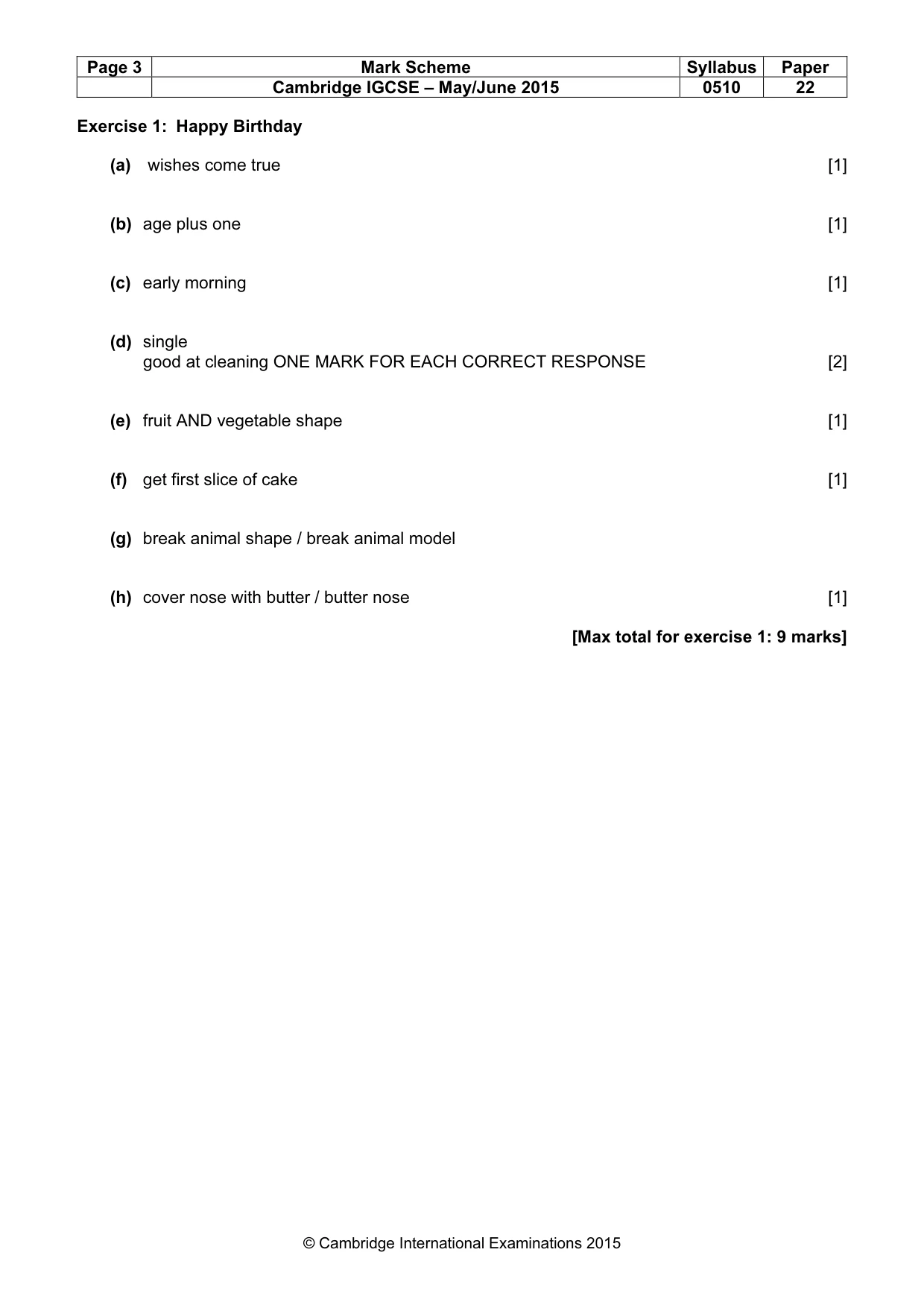
Page 3 Mark Scheme Syllabus Paper Cambridge IGCSE – May/June 2015 0510 22 © Cambridge International Examinations 2015 Exercise 1: Happy Birthday (a) wishes come true [1] (b) age plus one [1] (c) early morning [1] (d) single good at cleaning ONE MARK FOR EACH CORRECT RESPONSE [2] (e) fruit AND vegetable shape [1] (f) get first slice of cake [1] (g) break animal shape / break animal model (h) cover nose with butter / butter nose [1] [Max total for exercise 1: 9 marks]
Mark scheme, page 4
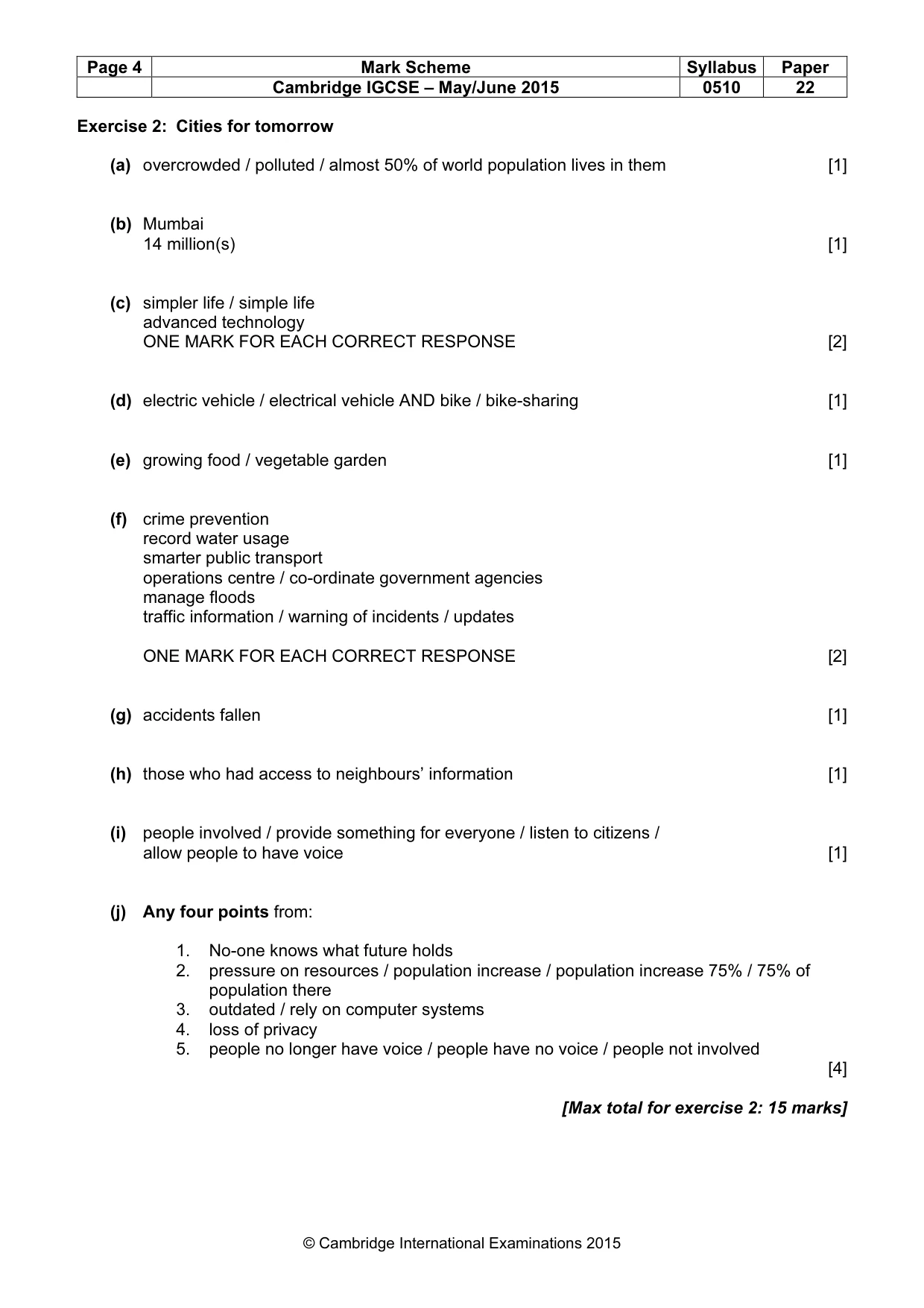
Page 4 Mark Scheme Syllabus Paper Cambridge IGCSE – May/June 2015 0510 22 © Cambridge International Examinations 2015 Exercise 2: Cities for tomorrow (a) overcrowded / polluted / almost 50% of world population lives in them [1] (b) Mumbai 14 million(s) [1] (c) simpler life / simple life advanced technology ONE MARK FOR EACH CORRECT RESPONSE [2] (d) electric vehicle / electrical vehicle AND bike / bike-sharing [1] (e) growing food / vegetable garden [1] (f) crime prevention record water usage smarter public transport operations centre / co-ordinate government agencies manage floods traffic information / warning of incidents / updates ONE MARK FOR EACH CORRECT RESPONSE [2] (g) accidents fallen [1] (h) those who had access to neighbours’ information [1] (i) people involved / provide something for everyone / listen to citizens / allow people to have voice [1] (j) Any four points from: 1. No-one knows what future holds 2. pressure on resources / population increase / population increase 75% / 75% of population there 3. outdated / rely on computer systems 4. loss of privacy 5. people no longer have voice / people have no voice / people not involved [4] [Max total for exercise 2: 15 marks]
Mark scheme, page 5
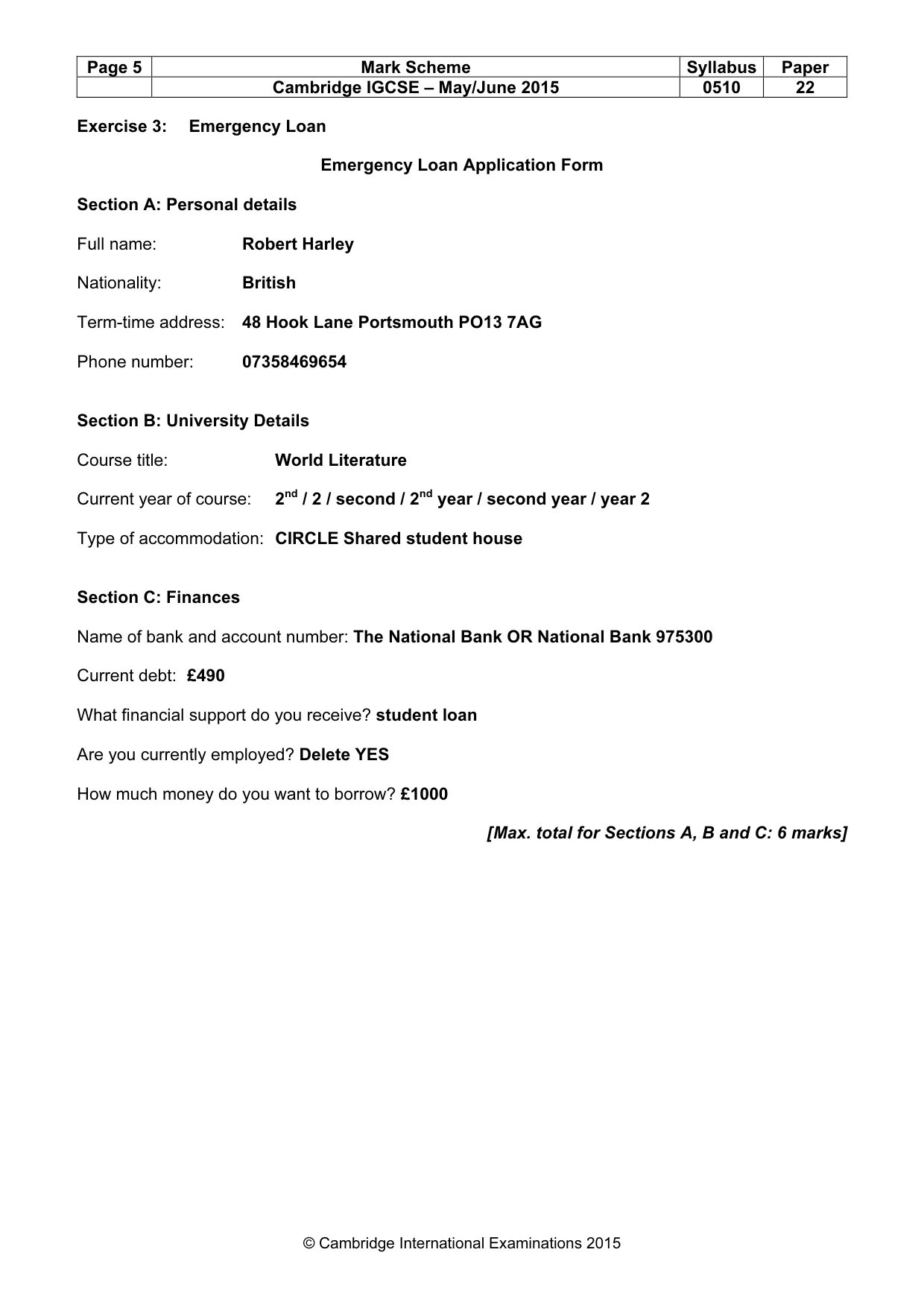
Page 5 Mark Scheme Syllabus Paper Cambridge IGCSE – May/June 2015 0510 22 © Cambridge International Examinations 2015 Exercise 3: Emergency Loan Emergency Loan Application Form Section A: Personal details Full name: Robert Harley Nationality: British Term-time address: 48 Hook Lane Portsmouth PO13 7AG Phone number: 07358469654 Section B: University Details Course title: World Literature Current year of course: 2nd / 2 / second / 2nd year / second year / year 2 Type of accommodation: CIRCLE Shared student house Section C: Finances Name of bank and account number: The National Bank OR National Bank 975300 Current debt: £490 What financial support do you receive? student loan Are you currently employed? Delete YES How much money do you want to borrow? £1000 [Max. total for Sections A, B and C: 6 marks]
Mark scheme, page 6
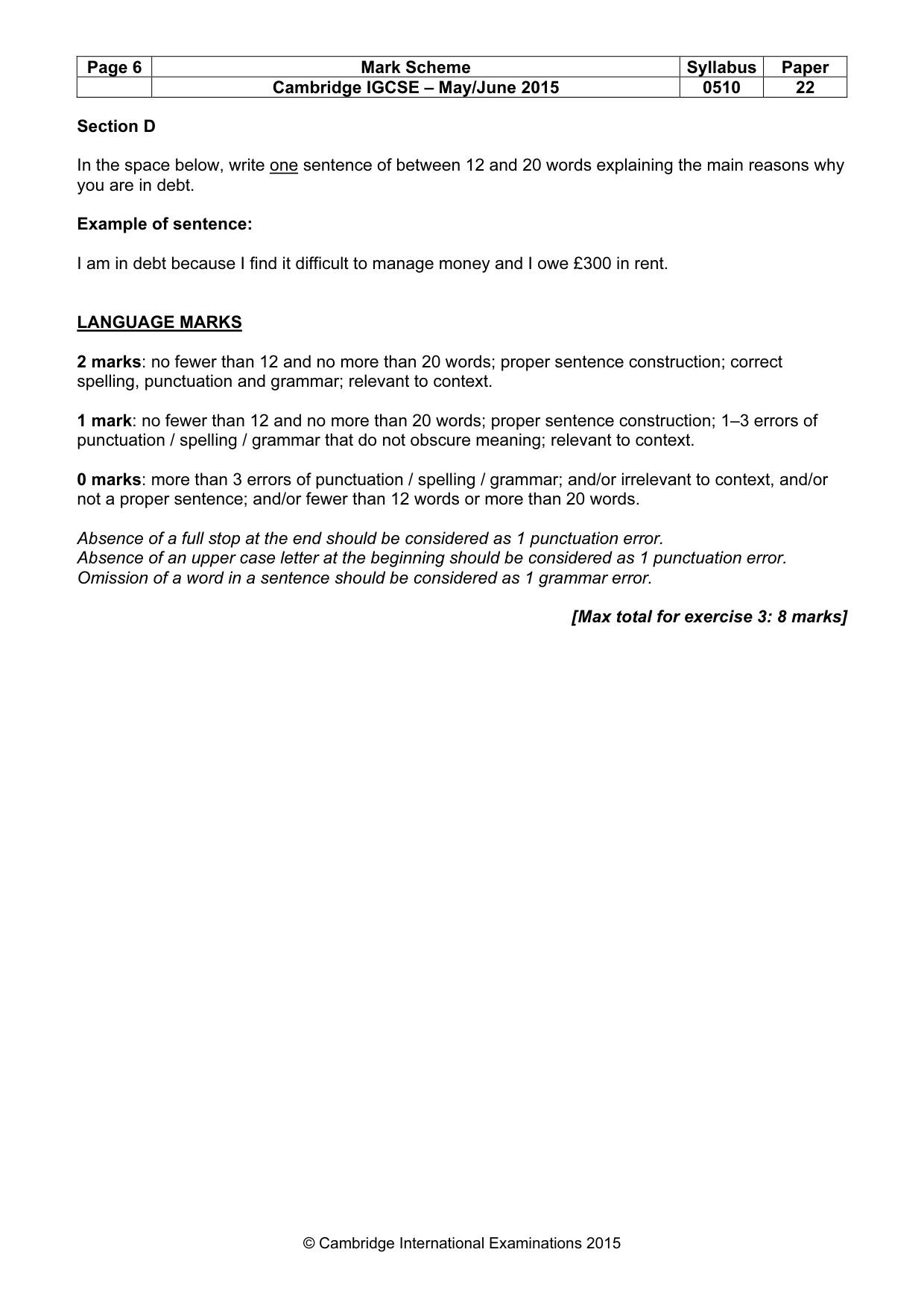
Page 6 Mark Scheme Syllabus Paper Cambridge IGCSE – May/June 2015 0510 22 © Cambridge International Examinations 2015 Section D In the space below, write one sentence of between 12 and 20 words explaining the main reasons why you are in debt. Example of sentence: I am in debt because I find it difficult to manage money and I owe £300 in rent. LANGUAGE MARKS 2 marks: no fewer than 12 and no more than 20 words; proper sentence construction; correct spelling, punctuation and grammar; relevant to context. 1 mark: no fewer than 12 and no more than 20 words; proper sentence construction; 1–3 errors of punctuation / spelling / grammar that do not obscure meaning; relevant to context. 0 marks: more than 3 errors of punctuation / spelling / grammar; and/or irrelevant to context, and/or not a proper sentence; and/or fewer than 12 words or more than 20 words. Absence of a full stop at the end should be considered as 1 punctuation error. Absence of an upper case letter at the beginning should be considered as 1 punctuation error. Omission of a word in a sentence should be considered as 1 grammar error. [Max total for exercise 3: 8 marks]
Mark scheme, page 7
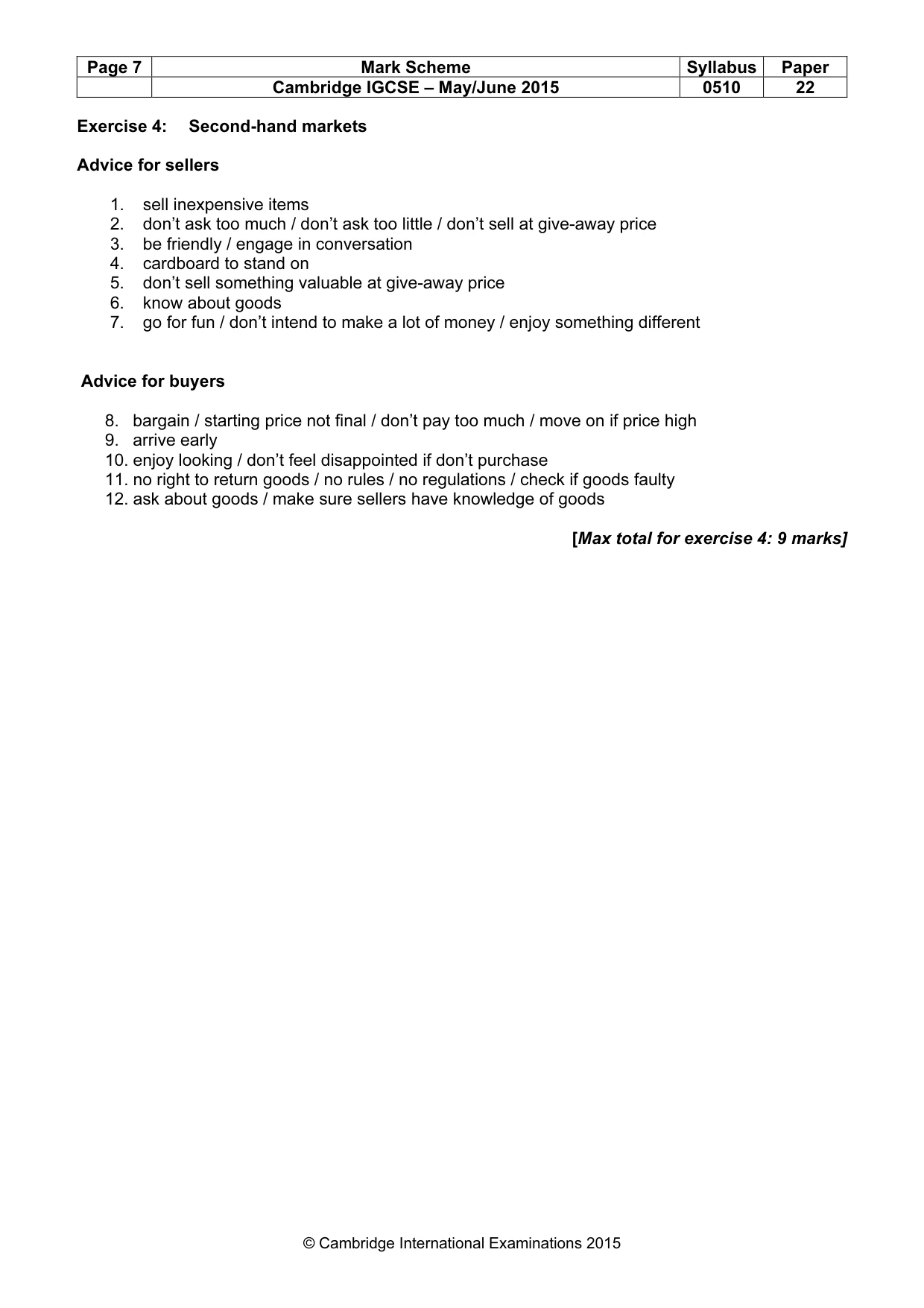
Page 7 Mark Scheme Syllabus Paper Cambridge IGCSE – May/June 2015 0510 22 © Cambridge International Examinations 2015 Exercise 4: Second-hand markets Advice for sellers 1. sell inexpensive items 2. don’t ask too much / don’t ask too little / don’t sell at give-away price 3. be friendly / engage in conversation 4. cardboard to stand on 5. don’t sell something valuable at give-away price 6. know about goods 7. go for fun / don’t intend to make a lot of money / enjoy something different Advice for buyers 8. bargain / starting price not final / don’t pay too much / move on if price high 9. arrive early 10. enjoy looking / don’t feel disappointed if don’t purchase 11. no right to return goods / no rules / no regulations / check if goods faulty 12. ask about goods / make sure sellers have knowledge of goods [Max total for exercise 4: 9 marks]
Mark scheme, page 8
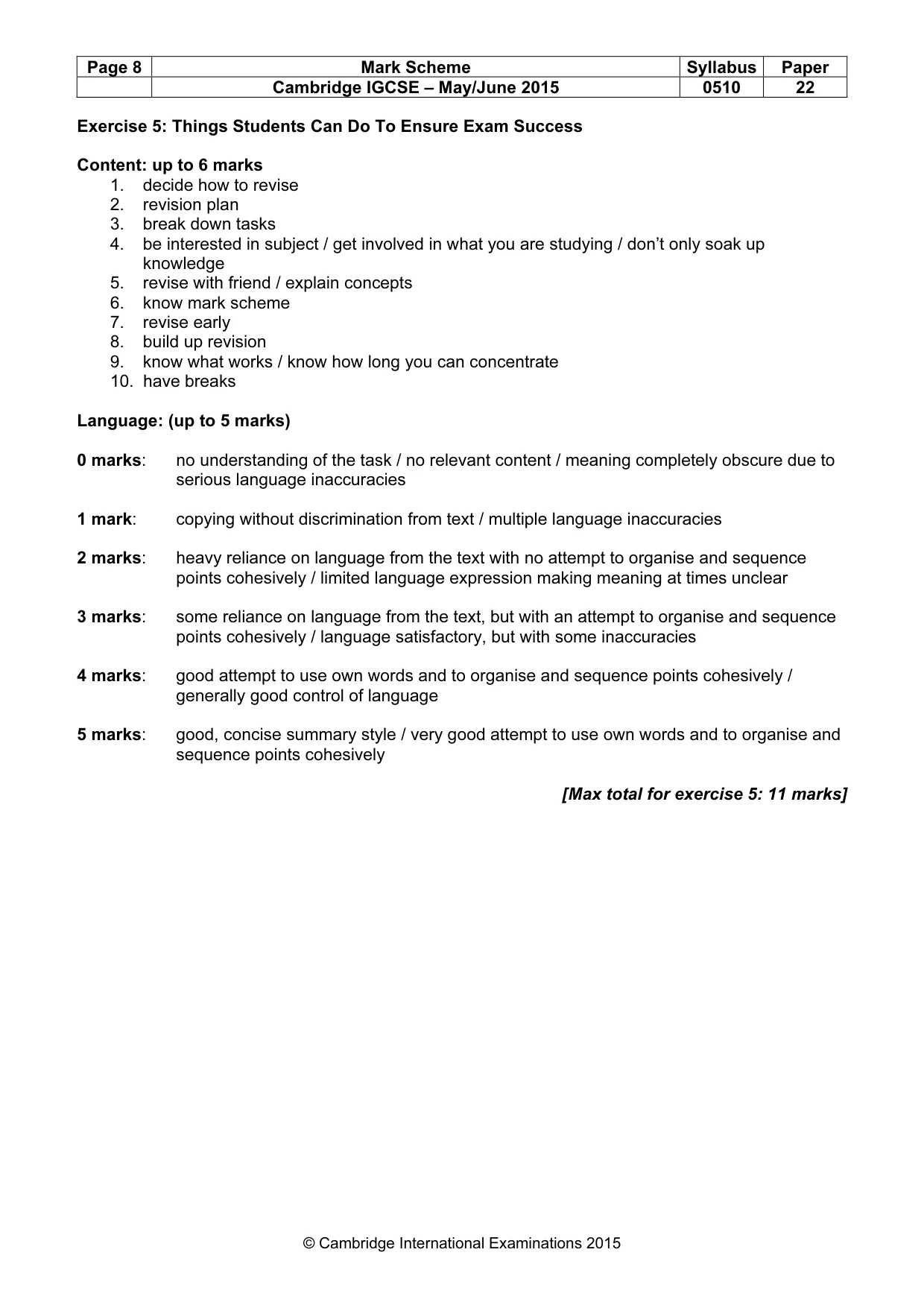
Page 8 Mark Scheme Syllabus Paper Cambridge IGCSE – May/June 2015 0510 22 © Cambridge International Examinations 2015 Exercise 5: Things Students Can Do To Ensure Exam Success Content: up to 6 marks 1. decide how to revise 2. revision plan 3. break down tasks 4. be interested in subject / get involved in what you are studying / don’t only soak up knowledge 5. revise with friend / explain concepts 6. know mark scheme 7. revise early 8. build up revision 9. know what works / know how long you can concentrate 10. have breaks Language: (up to 5 marks) 0 marks: no understanding of the task / no relevant content / meaning completely obscure due to serious language inaccuracies 1 mark: copying without discrimination from text / multiple language inaccuracies 2 marks: heavy reliance on language from the text with no attempt to organise and sequence points cohesively / limited language expression making meaning at times unclear 3 marks: some reliance on language from the text, but with an attempt to organise and sequence points cohesively / language satisfactory, but with some inaccuracies 4 marks: good attempt to use own words and to organise and sequence points cohesively / generally good control of language 5 marks: good, concise summary style / very good attempt to use own words and to organise and sequence points cohesively [Max total for exercise 5: 11 marks]
Mark scheme, page 9
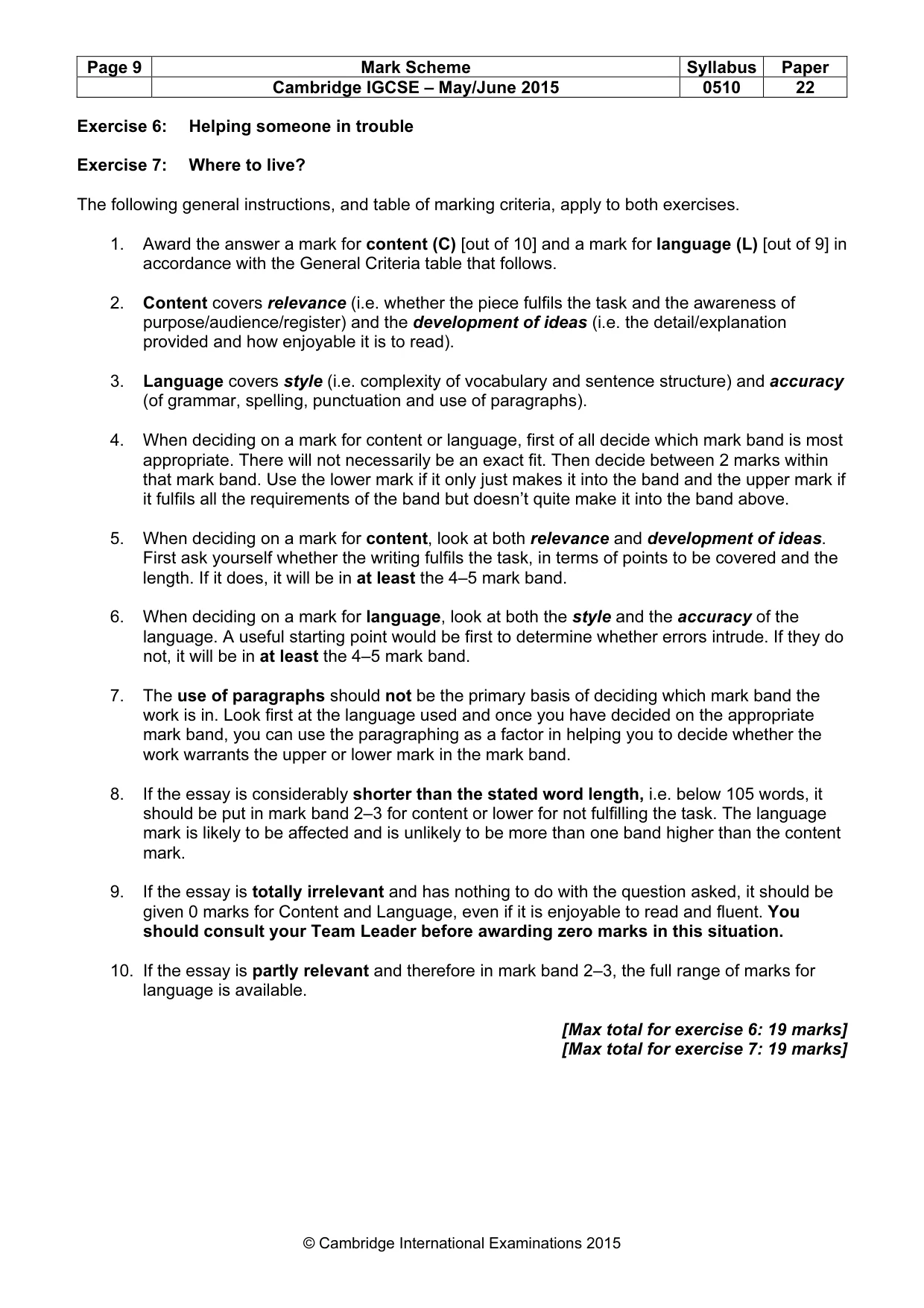
Page 9 Mark Scheme Syllabus Paper Cambridge IGCSE – May/June 2015 0510 22 © Cambridge International Examinations 2015 Exercise 6: Helping someone in trouble Exercise 7: Where to live? The following general instructions, and table of marking criteria, apply to both exercises. 1. Award the answer a mark for content (C) [out of 10] and a mark for language (L) [out of 9] in accordance with the General Criteria table that follows. 2. Content covers relevance (i.e. whether the piece fulfils the task and the awareness of purpose/audience/register) and the development of ideas (i.e. the detail/explanation provided and how enjoyable it is to read). 3. Language covers style (i.e. complexity of vocabulary and sentence structure) and accuracy (of grammar, spelling, punctuation and use of paragraphs). 4. When deciding on a mark for content or language, first of all decide which mark band is most appropriate. There will not necessarily be an exact fit. Then decide between 2 marks within that mark band. Use the lower mark if it only just makes it into the band and the upper mark if it fulfils all the requirements of the band but doesn’t quite make it into the band above. 5. When deciding on a mark for content, look at both relevance and development of ideas. First ask yourself whether the writing fulfils the task, in terms of points to be covered and the length. If it does, it will be in at least the 4–5 mark band. 6. When deciding on a mark for language, look at both the style and the accuracy of the language. A useful starting point would be first to determine whether errors intrude. If they do not, it will be in at least the 4–5 mark band. 7. The use of paragraphs should not be the primary basis of deciding which mark band the work is in. Look first at the language used and once you have decided on the appropriate mark band, you can use the paragraphing as a factor in helping you to decide whether the work warrants the upper or lower mark in the mark band. 8. If the essay is considerably shorter than the stated word length, i.e. below 105 words, it should be put in mark band 2–3 for content or lower for not fulfilling the task. The language mark is likely to be affected and is unlikely to be more than one band higher than the content mark. 9. If the essay is totally irrelevant and has nothing to do with the question asked, it should be given 0 marks for Content and Language, even if it is enjoyable to read and fluent. You should consult your Team Leader before awarding zero marks in this situation. 10. If the essay is partly relevant and therefore in mark band 2–3, the full range of marks for language is available. [Max total for exercise 6: 19 marks] [Max total for exercise 7: 19 marks]
Mark scheme, page 10
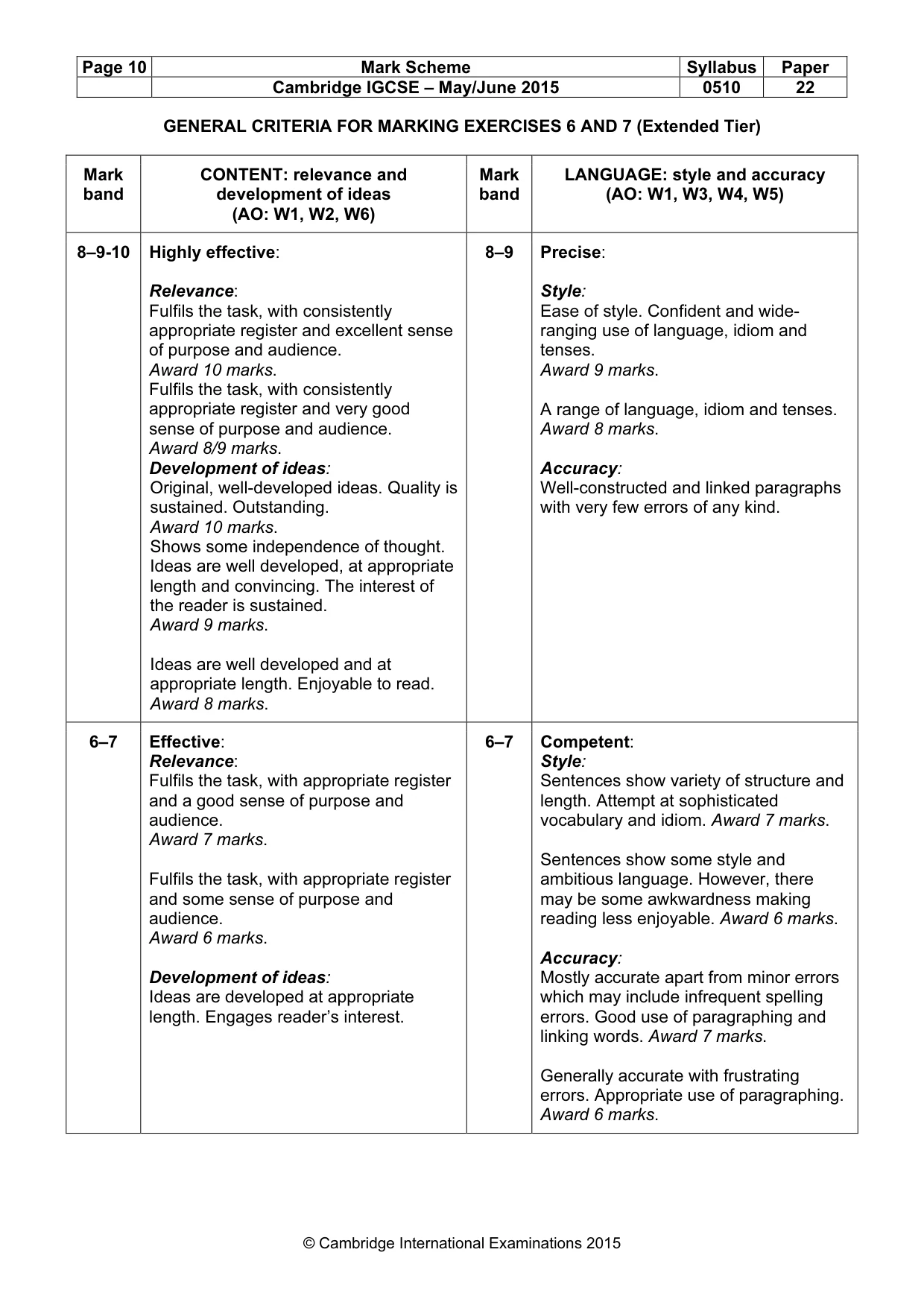
Page 10 Mark Scheme Syllabus Paper Cambridge IGCSE – May/June 2015 0510 22 © Cambridge International Examinations 2015 GENERAL CRITERIA FOR MARKING EXERCISES 6 AND 7 (Extended Tier) Mark band CONTENT: relevance and development of ideas (AO: W1, W2, W6) Mark band LANGUAGE: style and accuracy (AO: W1, W3, W4, W5) 8–9-10 Highly effective: Relevance: Fulfils the task, with consistently appropriate register and excellent sense of purpose and audience. Award 10 marks. Fulfils the task, with consistently appropriate register and very good sense of purpose and audience. Award 8/9 marks. Development of ideas: Original, well-developed ideas. Quality is sustained. Outstanding. Award 10 marks. Shows some independence of thought. Ideas are well developed, at appropriate length and convincing. The interest of the reader is sustained. Award 9 marks. Ideas are well developed and at appropriate length. Enjoyable to read. Award 8 marks. 8–9 Precise: Style: Ease of style. Confident and wide- ranging use of language, idiom and tenses. Award 9 marks. A range of language, idiom and tenses. Award 8 marks. Accuracy: Well-constructed and linked paragraphs with very few errors of any kind. 6–7 Effective: Relevance: Fulfils the task, with appropriate register and a good sense of purpose and audience. Award 7 marks. Fulfils the task, with appropriate register and some sense of purpose and audience. Award 6 marks. Development of ideas: Ideas are developed at appropriate length. Engages reader’s interest. 6–7 Competent: Style: Sentences show variety of structure and length. Attempt at sophisticated vocabulary and idiom. Award 7 marks. Sentences show some style and ambitious language. However, there may be some awkwardness making reading less enjoyable. Award 6 marks. Accuracy: Mostly accurate apart from minor errors which may include infrequent spelling errors. Good use of paragraphing and linking words. Award 7 marks. Generally accurate with frustrating errors. Appropriate use of paragraphing. Award 6 marks.
Mark scheme, page 11
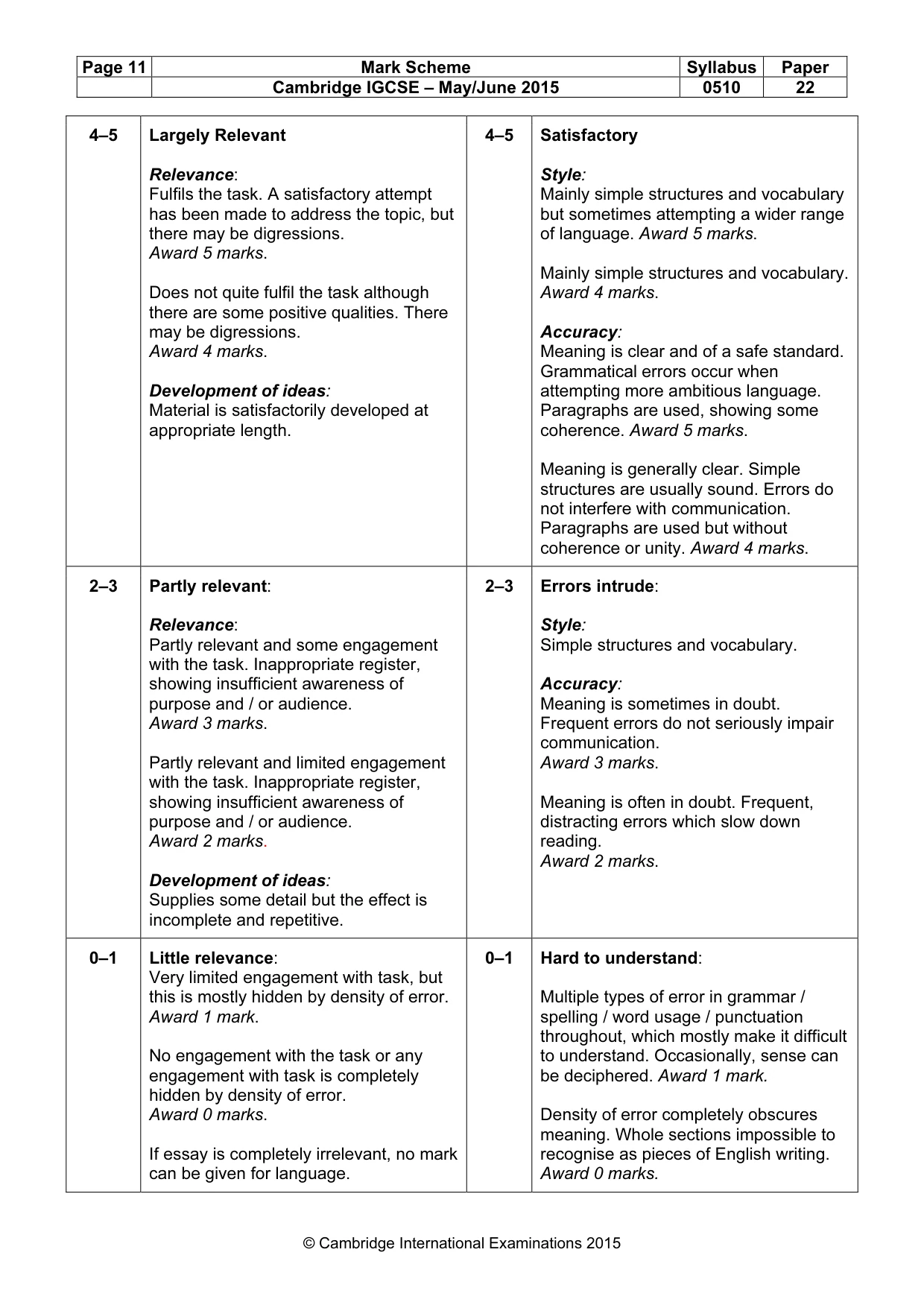
Page 11 Mark Scheme Syllabus Paper Cambridge IGCSE – May/June 2015 0510 22 © Cambridge International Examinations 2015 4–5 Largely Relevant Relevance: Fulfils the task. A satisfactory attempt has been made to address the topic, but there may be digressions. Award 5 marks. Does not quite fulfil the task although there are some positive qualities. There may be digressions. Award 4 marks. Development of ideas: Material is satisfactorily developed at appropriate length. 4–5 Satisfactory Style: Mainly simple structures and vocabulary but sometimes attempting a wider range of language. Award 5 marks. Mainly simple structures and vocabulary. Award 4 marks. Accuracy: Meaning is clear and of a safe standard. Grammatical errors occur when attempting more ambitious language. Paragraphs are used, showing some coherence. Award 5 marks. Meaning is generally clear. Simple structures are usually sound. Errors do not interfere with communication. Paragraphs are used but without coherence or unity. Award 4 marks. 2–3 Partly relevant: Relevance: Partly relevant and some engagement with the task. Inappropriate register, showing insufficient awareness of purpose and / or audience. Award 3 marks. Partly relevant and limited engagement with the task. Inappropriate register, showing insufficient awareness of purpose and / or audience. Award 2 marks. Development of ideas: Supplies some detail but the effect is incomplete and repetitive. 2–3 Errors intrude: Style: Simple structures and vocabulary. Accuracy: Meaning is sometimes in doubt. Frequent errors do not seriously impair communication. Award 3 marks. Meaning is often in doubt. Frequent, distracting errors which slow down reading. Award 2 marks. 0–1 Little relevance: Very limited engagement with task, but this is mostly hidden by density of error. Award 1 mark. No engagement with the task or any engagement with task is completely hidden by density of error. Award 0 marks. If essay is completely irrelevant, no mark can be given for language. 0–1 Hard to understand: Multiple types of error in grammar / spelling / word usage / punctuation throughout, which mostly make it difficult to understand. Occasionally, sense can be deciphered. Award 1 mark. Density of error completely obscures meaning. Whole sections impossible to recognise as pieces of English writing. Award 0 marks.
What you needed in this session
Cambridge’s own grade thresholds for 2015 May/June, Paper 2 · Variant 2. A higher threshold means an easier paper — the bar moves with how the cohort did.