Cambridge IGCSE English - Second Language (oral endorsement) 0510 — 2014 Oct/Nov Paper 4 · Variant 1
0510/41/O/N/14 · 36 marks · ≈41 min
The question paper and its mark scheme, free to read here and free to download. This is Cambridge’s own paper, exactly as it was sat.
Question paper8 pages


Mark scheme14 pages
Answers below. Sit the paper first if you are practising.
Paper as text
Question paper, page 1
This document consists of 6 printed pages and 2 blank pages. DC (LEG/JG) 94738/3 © UCLES 2014 [Turn over Cambridge International Examinations Cambridge International General Certificate of Secondary Education * 1 5 8 0 1 6 9 0 7 0 * ENGLISH AS A SECOND LANGUAGE 0510/41 Paper 4 Listening (Extended) October/November 2014 Approx. 45 minutes Candidates answer on the Question Paper. Additional Materials: As listed in Instructions to Supervisors. READ THESE INSTRUCTIONS FIRST Write your Centre number, candidate number and name on all the work you hand in. Write in dark blue or black pen. Do not use staples, paper clips, highlighters, glue or correction fluid. DO NOT WRITE IN ANY BARCODES. Answer all questions. Dictionaries are not permitted. At the end of the examination, fasten all your work securely together. The number of marks is given in brackets [ ] at the end of each question or part question.
Question paper, page 2
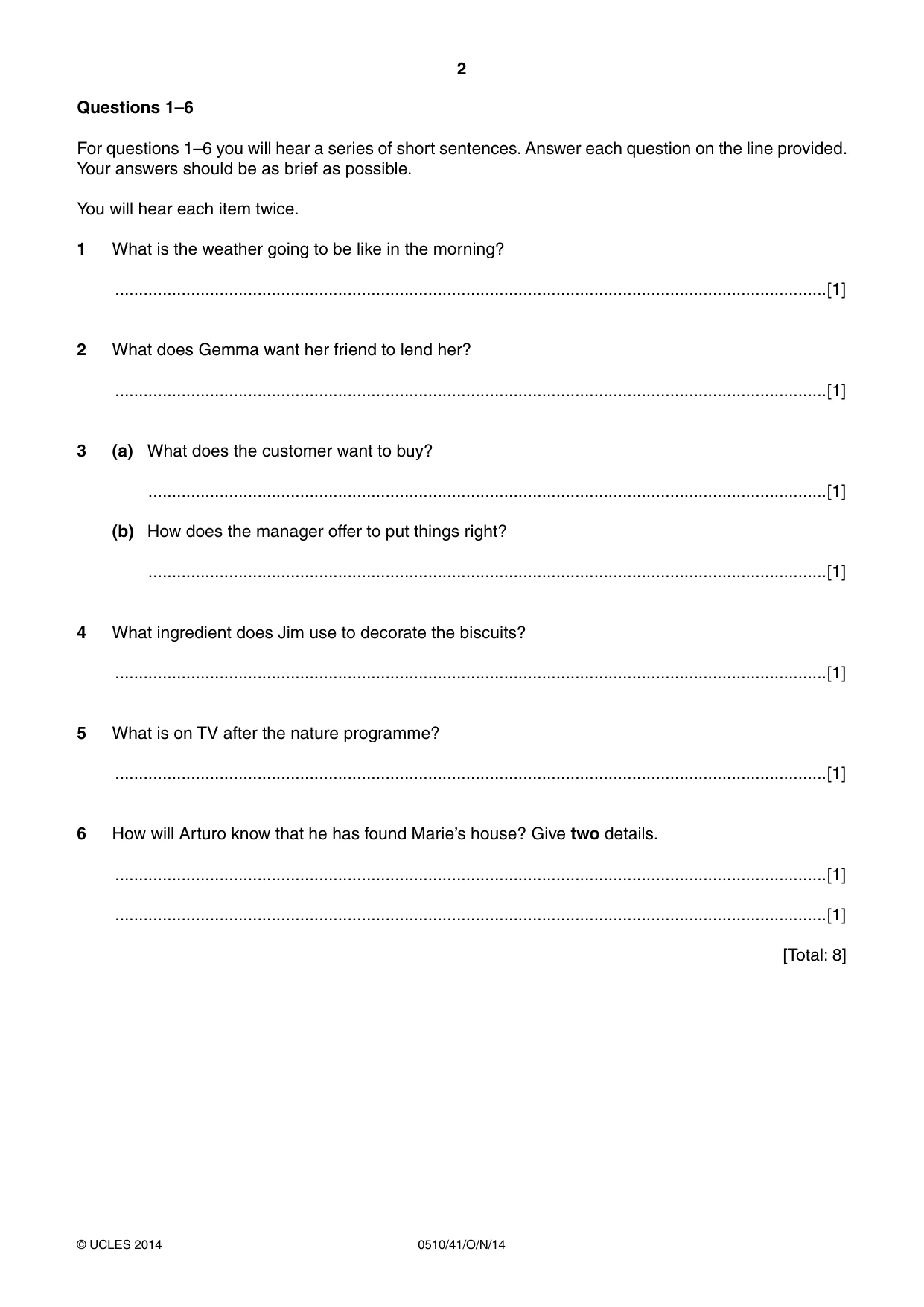
2 0510/41/O/N/14 © UCLES 2014 Questions 1–6 For questions 1–6 you will hear a series of short sentences. Answer each question on the line provided. Your answers should be as brief as possible. You will hear each item twice. 1 What is the weather going to be like in the morning? …[1] 2 What does Gemma want her friend to lend her? …[1] 3 (a) What does the customer want to buy? …[1] (b) How does the manager offer to put things right? …[1] 4 What ingredient does Jim use to decorate the biscuits? …[1] 5 What is on TV after the nature programme? …[1] 6 How will Arturo know that he has found Marie’s house? Give two details. …[1] …[1] [Total: 8]
Question paper, page 3
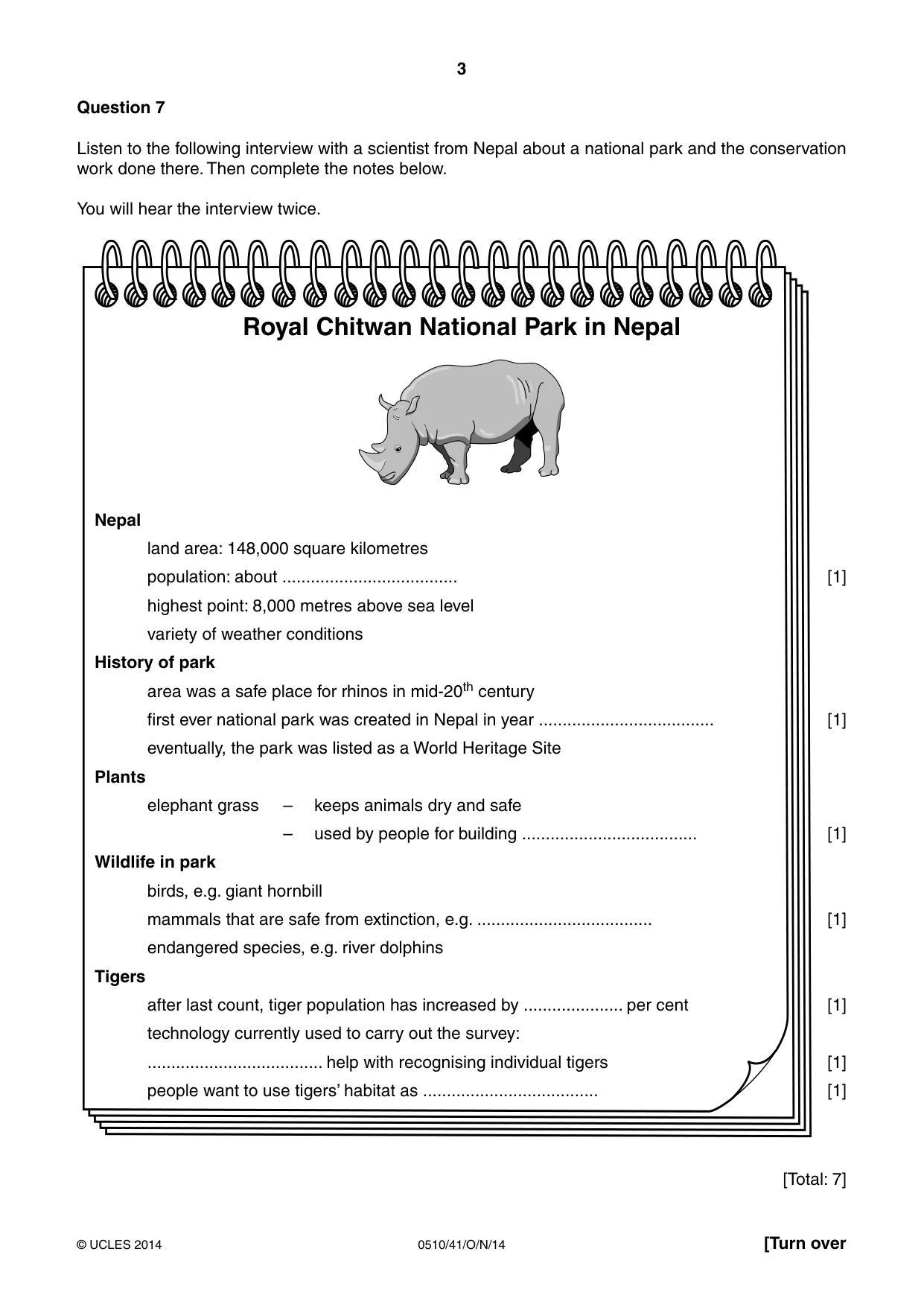
3 0510/41/O/N/14 © UCLES 2014 [Turn over Question 7 Listen to the following interview with a scientist from Nepal about a national park and the conservation work done there. Then complete the notes below. You will hear the interview twice. Royal Chitwan National Park in Nepal Nepal land area: 148,000 square kilometres population: about … [1] highest point: 8,000 metres above sea level variety of weather conditions History of park area was a safe place for rhinos in mid-20th century first ever national park was created in Nepal in year … [1] eventually, the park was listed as a World Heritage Site Plants elephant grass – keeps animals dry and safe – used by people for building … [1] Wildlife in park birds, e.g. giant hornbill mammals that are safe from extinction, e.g. … [1] endangered species, e.g. river dolphins Tigers after last count, tiger population has increased by … per cent [1] technology currently used to carry out the survey: … help with recognising individual tigers [1] people want to use tigers’ habitat as … [1] [Total: 7]
Question paper, page 4
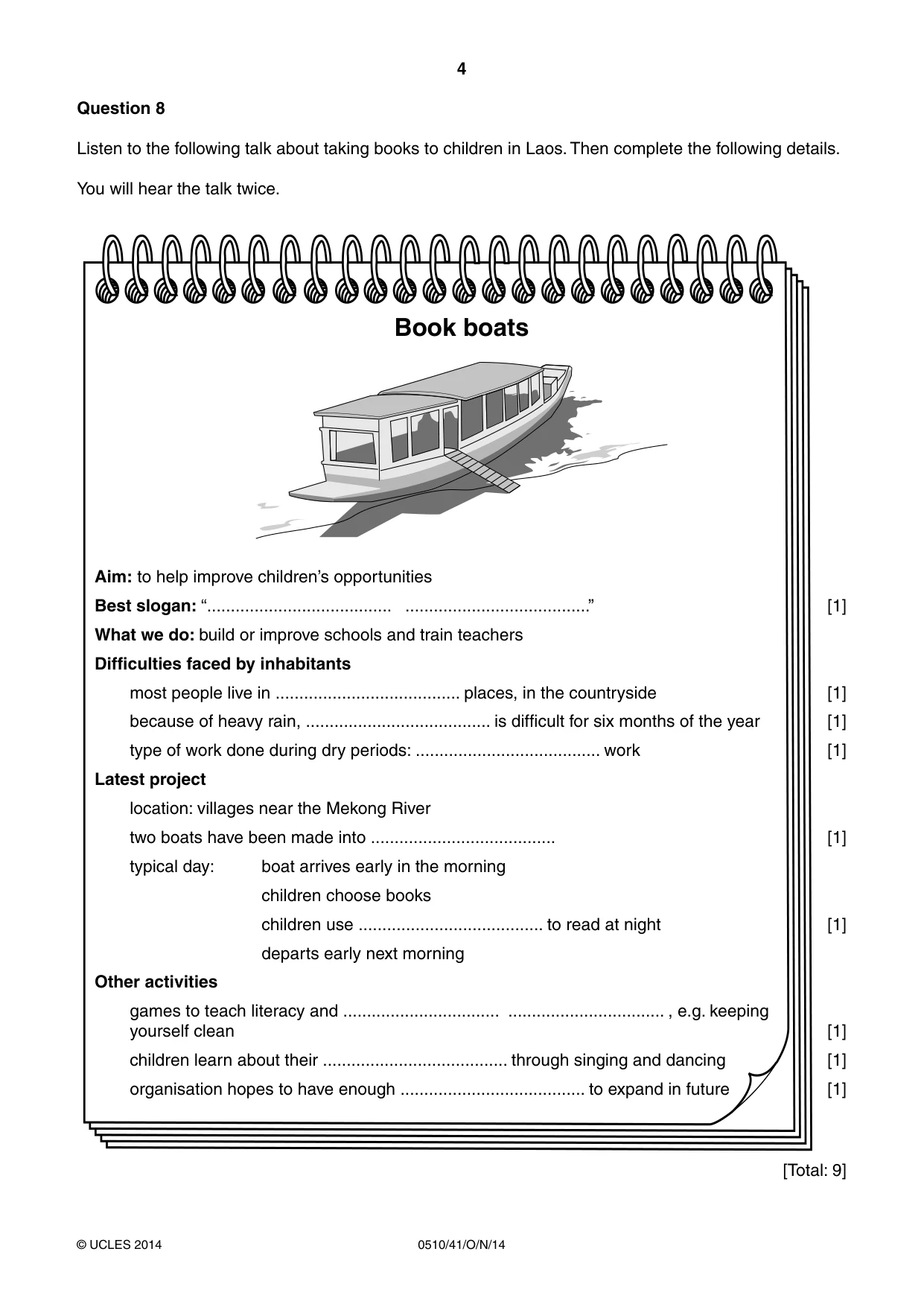
4 0510/41/O/N/14 © UCLES 2014 Question 8 Listen to the following talk about taking books to children in Laos. Then complete the following details. You will hear the talk twice. Book boats Aim: to help improve children’s opportunities Best slogan: “… …” [1] What we do: build or improve schools and train teachers Difficulties faced by inhabitants most people live in … places, in the countryside [1] because of heavy rain, … is difficult for six months of the year [1] type of work done during dry periods: … work [1] Latest project location: villages near the Mekong River two boats have been made into … [1] typical day: boat arrives early in the morning children choose books children use … to read at night [1] departs early next morning Other activities games to teach literacy and … … , e.g. keeping yourself clean [1] children learn about their … through singing and dancing [1] organisation hopes to have enough … to expand in future [1] [Total: 9]
Question paper, page 5
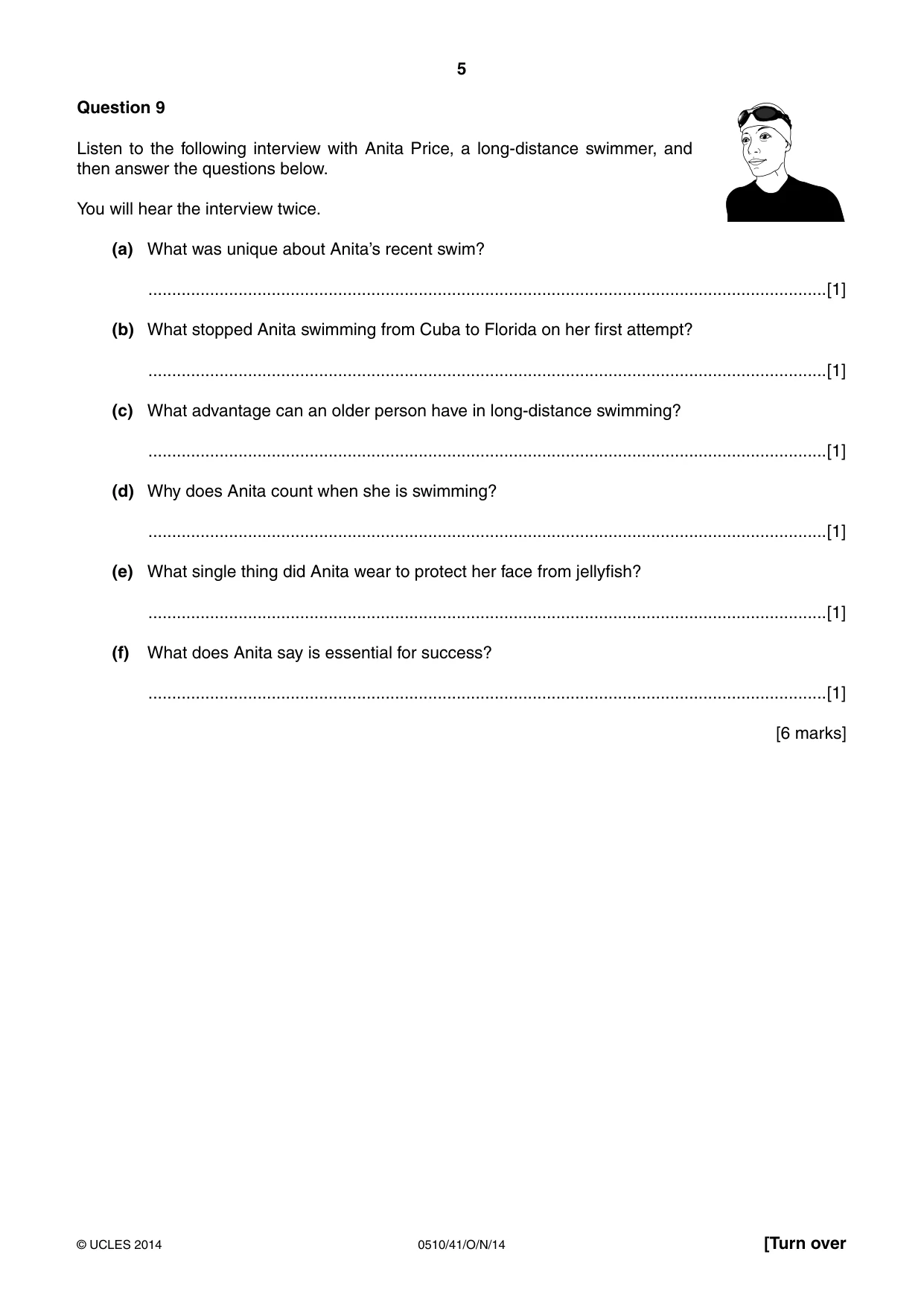
5 0510/41/O/N/14 © UCLES 2014 [Turn over Question 9 Listen to the following interview with Anita Price, a long-distance swimmer, and then answer the questions below. You will hear the interview twice. (a) What was unique about Anita’s recent swim? …[1] (b) What stopped Anita swimming from Cuba to Florida on her first attempt? …[1] (c) What advantage can an older person have in long-distance swimming? …[1] (d) Why does Anita count when she is swimming? …[1] (e) What single thing did Anita wear to protect her face from jellyfish? …[1] (f) What does Anita say is essential for success? …[1] [6 marks]
Question paper, page 6
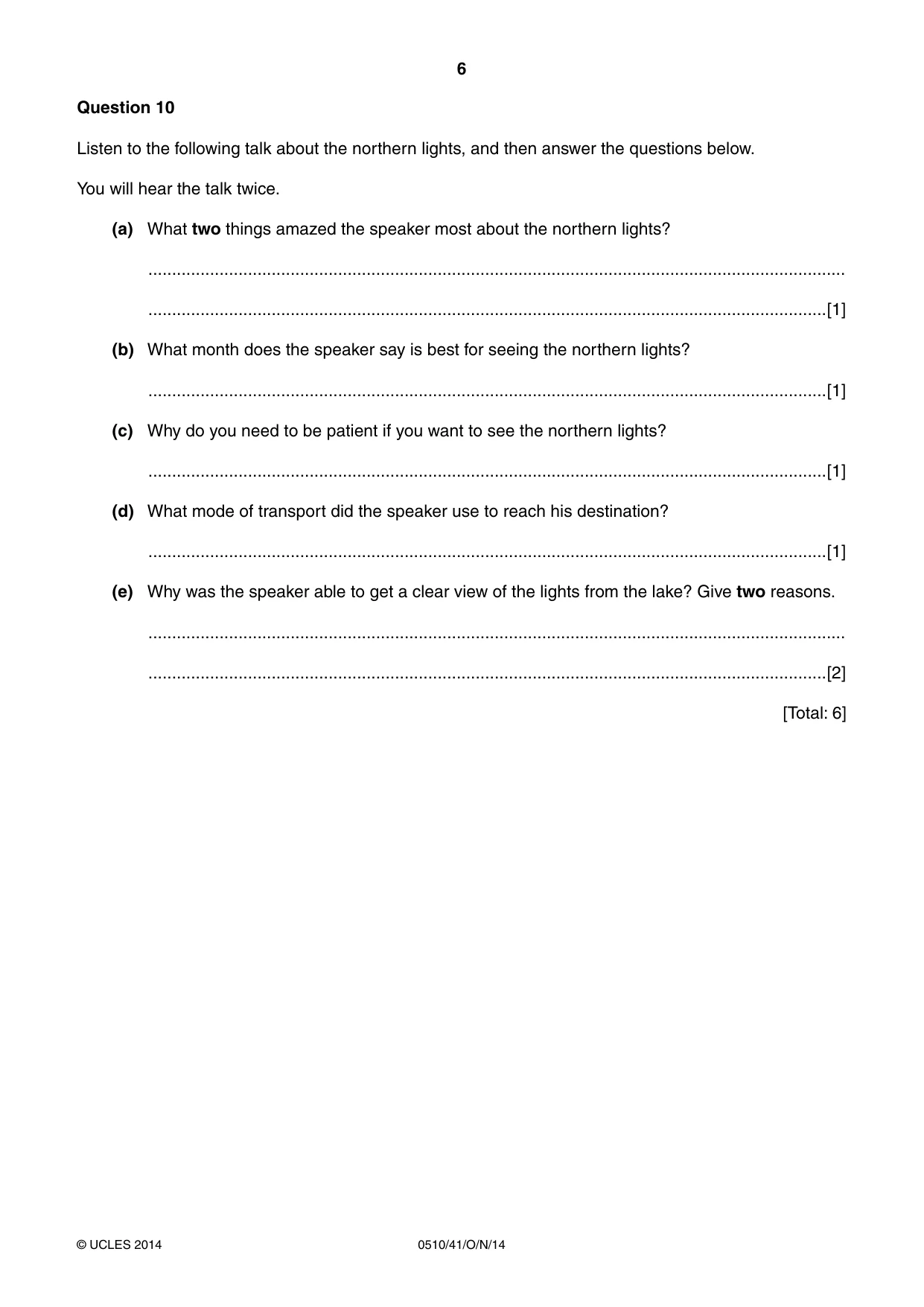
6 0510/41/O/N/14 © UCLES 2014 Question 10 Listen to the following talk about the northern lights, and then answer the questions below. You will hear the talk twice. (a) What two things amazed the speaker most about the northern lights? … …[1] (b) What month does the speaker say is best for seeing the northern lights? …[1] (c) Why do you need to be patient if you want to see the northern lights? …[1] (d) What mode of transport did the speaker use to reach his destination? …[1] (e) Why was the speaker able to get a clear view of the lights from the lake? Give two reasons. … …[2] [Total: 6]
Question paper, page 7
7 0510/41/O/N/14 © UCLES 2014 BLANK PAGE
Question paper, page 8
8 0510/41/O/N/14 © UCLES 2014 Permission to reproduce items where third-party owned material protected by copyright is included has been sought and cleared where possible. Every reasonable effort has been made by the publisher (UCLES) to trace copyright holders, but if any items requiring clearance have unwittingly been included, the publisher will be pleased to make amends at the earliest possible opportunity. Cambridge International Examinations is part of the Cambridge Assessment Group. Cambridge Assessment is the brand name of University of Cambridge Local Examinations Syndicate (UCLES), which is itself a department of the University of Cambridge. BLANK PAGE
Mark scheme, page 1
® IGCSE is the registered trademark of Cambridge International Examinations. CAMBRIDGE INTERNATIONAL EXAMINATIONS Cambridge International General Certificate of Secondary Education MARK SCHEME for the October/November 2014 series 0510 ENGLISH AS A SECOND LANGUAGE 0510/41 Paper 4 (Listening – Extended), maximum raw mark 36 This mark scheme is published as an aid to teachers and candidates, to indicate the requirements of the examination. It shows the basis on which Examiners were instructed to award marks. It does not indicate the details of the discussions that took place at an Examiners’ meeting before marking began, which would have considered the acceptability of alternative answers. Mark schemes should be read in conjunction with the question paper and the Principal Examiner Report for Teachers. Cambridge will not enter into discussions about these mark schemes. Cambridge is publishing the mark schemes for the October/November 2014 series for most Cambridge IGCSE®, Cambridge International A and AS Level components and some Cambridge O Level components.
Mark scheme, page 2
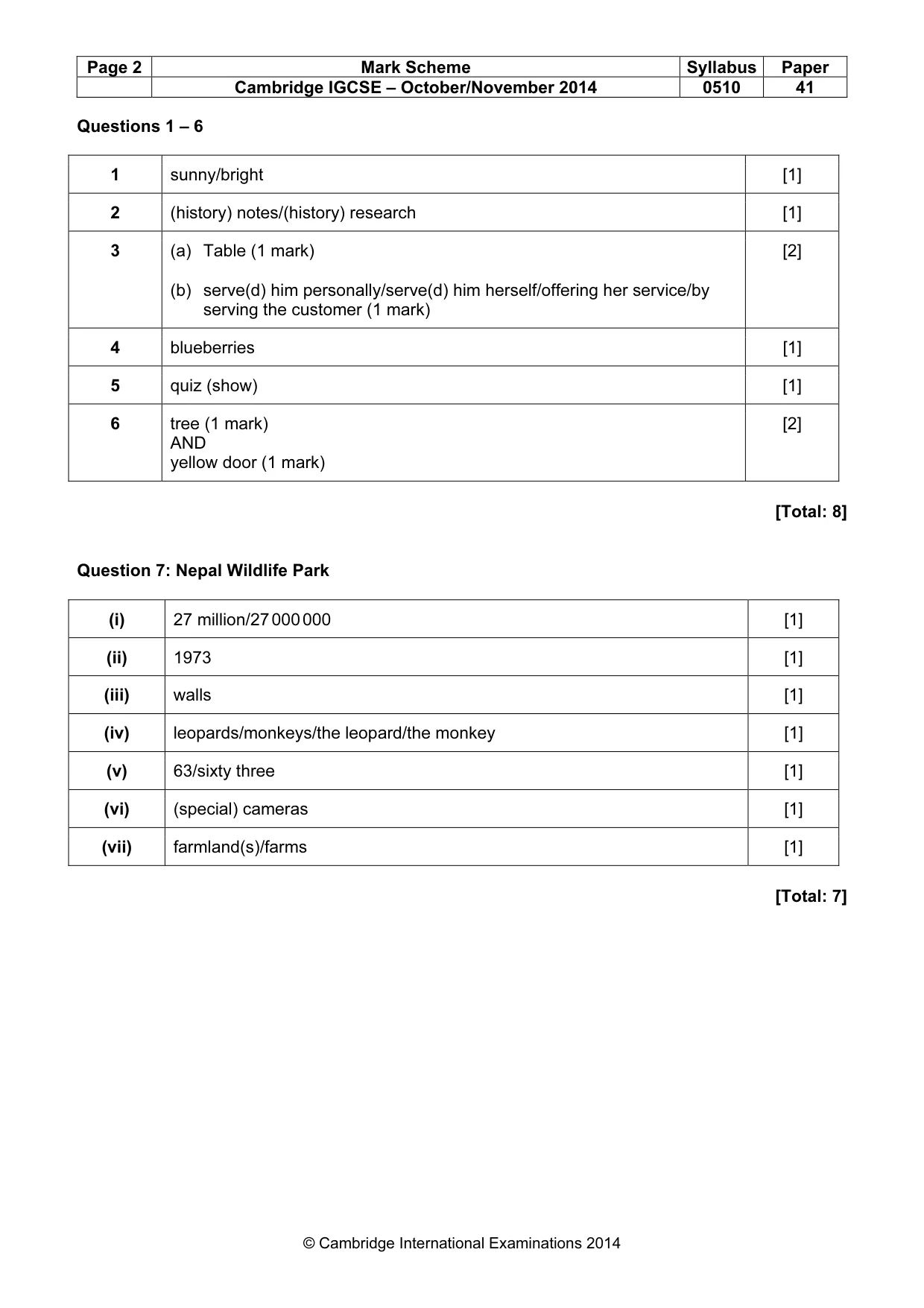
Page 2 Mark Scheme Syllabus Paper Cambridge IGCSE – October/November 2014 0510 41 © Cambridge International Examinations 2014 Questions 1 – 6 1 sunny/bright [1] 2 (history) notes/(history) research [1] 3 (a) Table (1 mark) (b) serve(d) him personally/serve(d) him herself/offering her service/by serving the customer (1 mark) [2] 4 blueberries [1] 5 quiz (show) [1] 6 tree (1 mark) AND yellow door (1 mark) [2] [Total: 8] Question 7: Nepal Wildlife Park (i) 27 million/27 000 000 [1] (ii) 1973 [1] (iii) walls [1] (iv) leopards/monkeys/the leopard/the monkey [1] (v) 63/sixty three [1] (vi) (special) cameras [1] (vii) farmland(s)/farms [1] [Total: 7]
Mark scheme, page 3
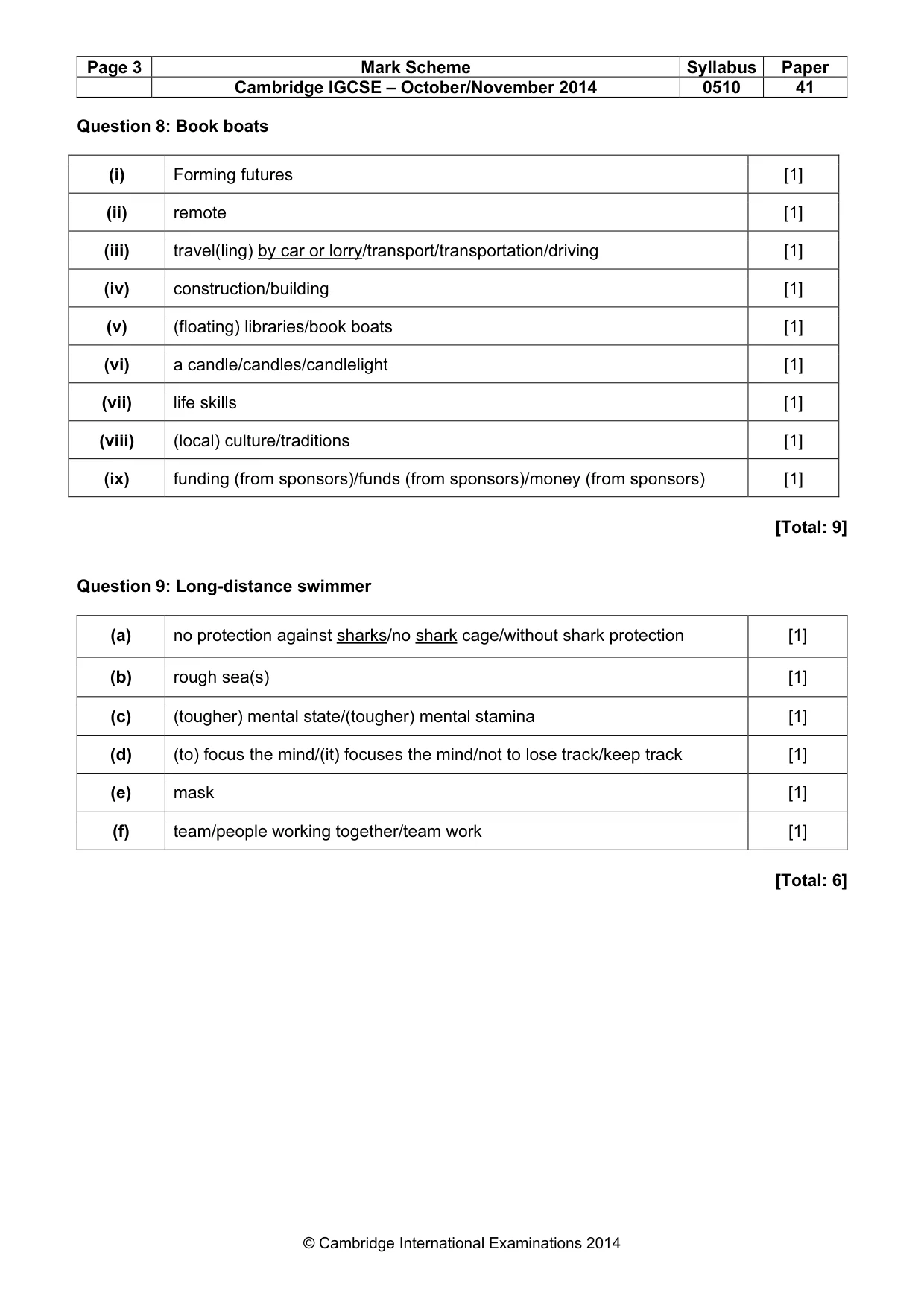
Page 3 Mark Scheme Syllabus Paper Cambridge IGCSE – October/November 2014 0510 41 © Cambridge International Examinations 2014 Question 8: Book boats (i) Forming futures [1] (ii) remote [1] (iii) travel(ling) by car or lorry/transport/transportation/driving [1] (iv) construction/building [1] (v) (floating) libraries/book boats [1] (vi) a candle/candles/candlelight [1] (vii) life skills [1] (viii) (local) culture/traditions [1] (ix) funding (from sponsors)/funds (from sponsors)/money (from sponsors) [1] [Total: 9] Question 9: Long-distance swimmer (a) no protection against sharks/no shark cage/without shark protection [1] (b) rough sea(s) [1] (c) (tougher) mental state/(tougher) mental stamina [1] (d) (to) focus the mind/(it) focuses the mind/not to lose track/keep track [1] (e) mask [1] (f) team/people working together/team work [1] [Total: 6]
Mark scheme, page 4
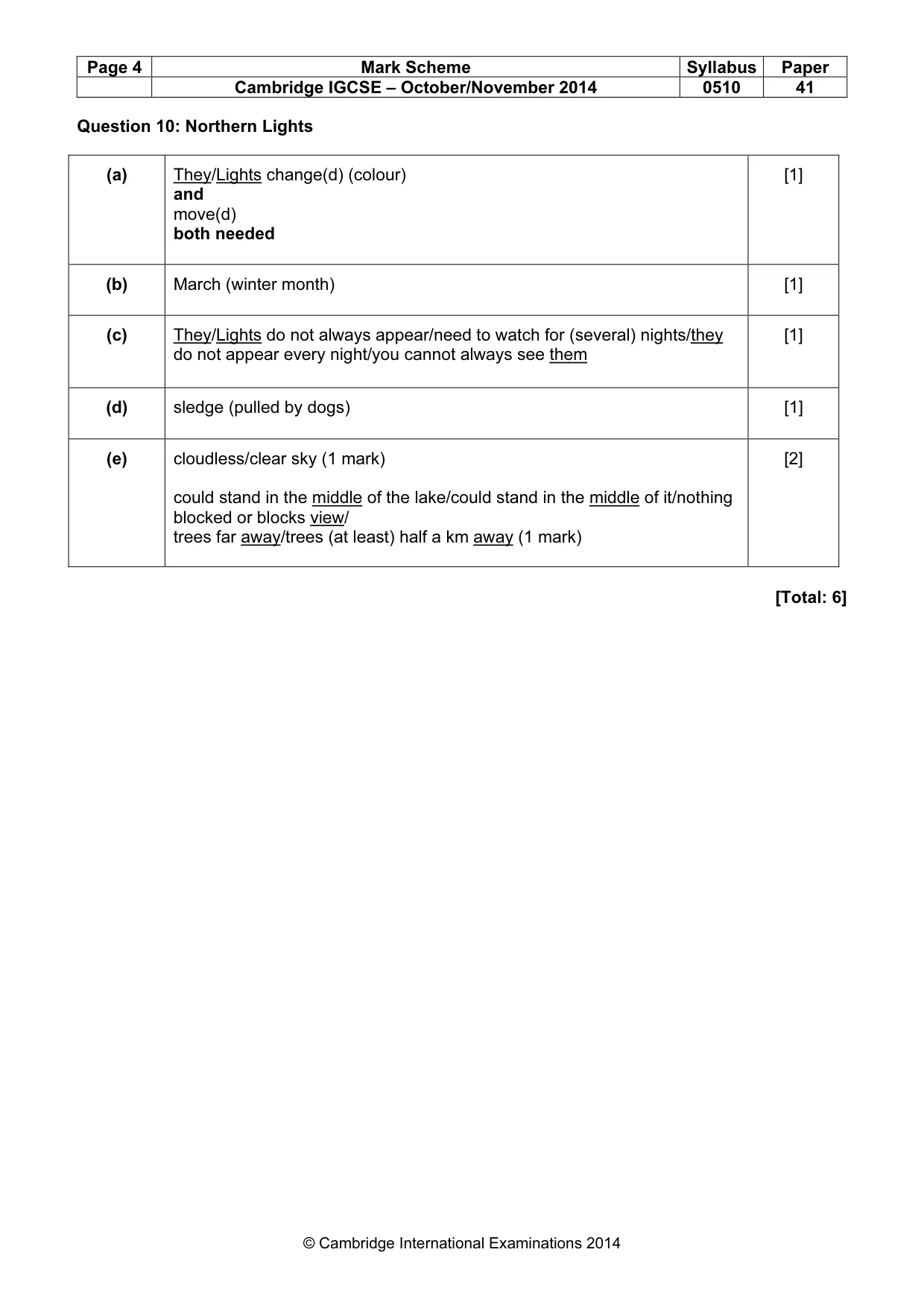
Page 4 Mark Scheme Syllabus Paper Cambridge IGCSE – October/November 2014 0510 41 © Cambridge International Examinations 2014 Question 10: Northern Lights (a) They/Lights change(d) (colour) and move(d) both needed [1] (b) March (winter month) [1] (c) They/Lights do not always appear/need to watch for (several) nights/they do not appear every night/you cannot always see them [1] (d) sledge (pulled by dogs) [1] (e) cloudless/clear sky (1 mark) could stand in the middle of the lake/could stand in the middle of it/nothing blocked or blocks view/ trees far away/trees (at least) half a km away (1 mark) [2] [Total: 6]
Mark scheme, page 5
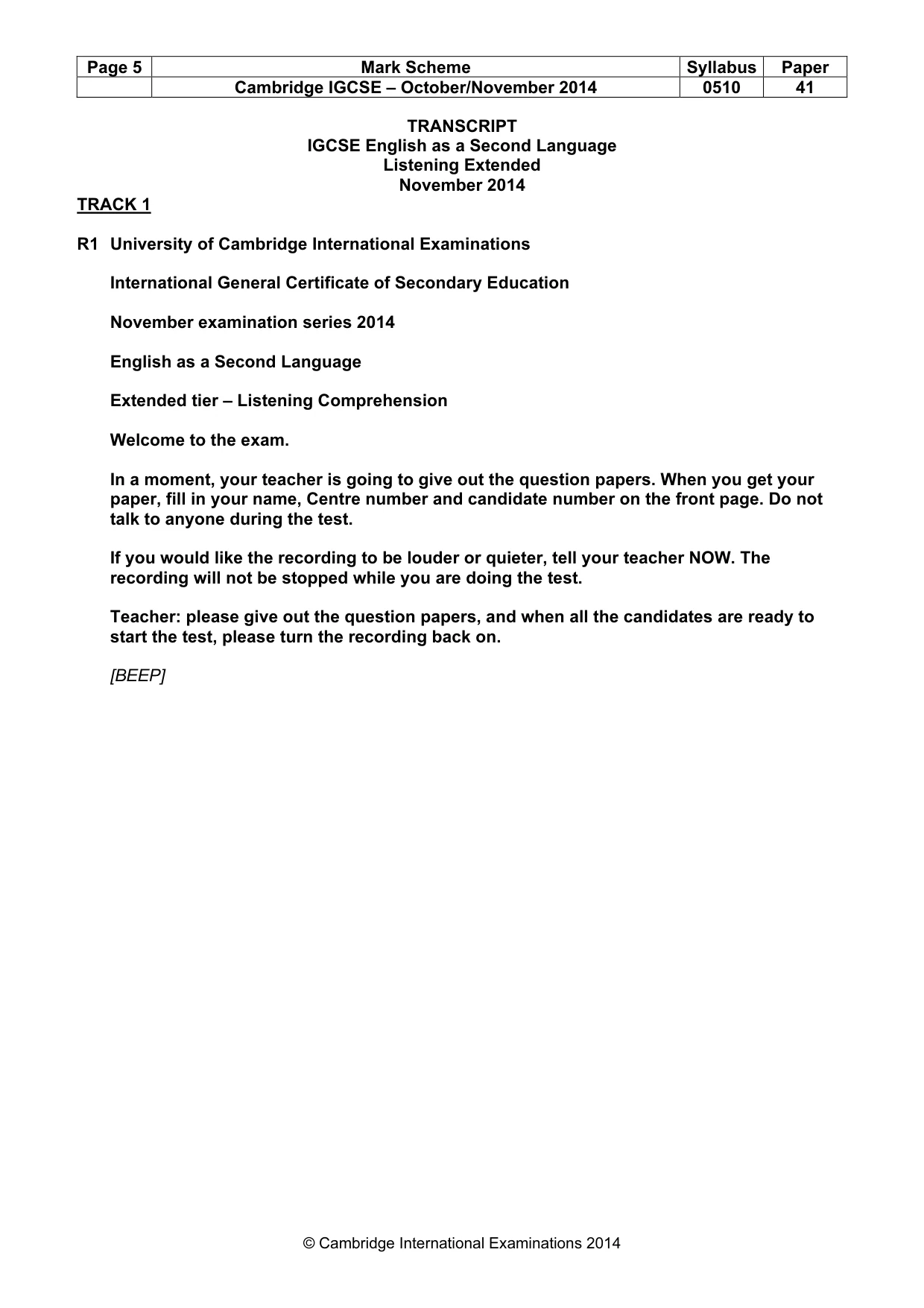
Page 5 Mark Scheme Syllabus Paper Cambridge IGCSE – October/November 2014 0510 41 © Cambridge International Examinations 2014 TRANSCRIPT IGCSE English as a Second Language Listening Extended November 2014 TRACK 1 R1 University of Cambridge International Examinations International General Certificate of Secondary Education November examination series 2014 English as a Second Language Extended tier – Listening Comprehension Welcome to the exam. In a moment, your teacher is going to give out the question papers. When you get your paper, fill in your name, Centre number and candidate number on the front page. Do not talk to anyone during the test. If you would like the recording to be louder or quieter, tell your teacher NOW. The recording will not be stopped while you are doing the test. Teacher: please give out the question papers, and when all the candidates are ready to start the test, please turn the recording back on. [BEEP]
Mark scheme, page 6
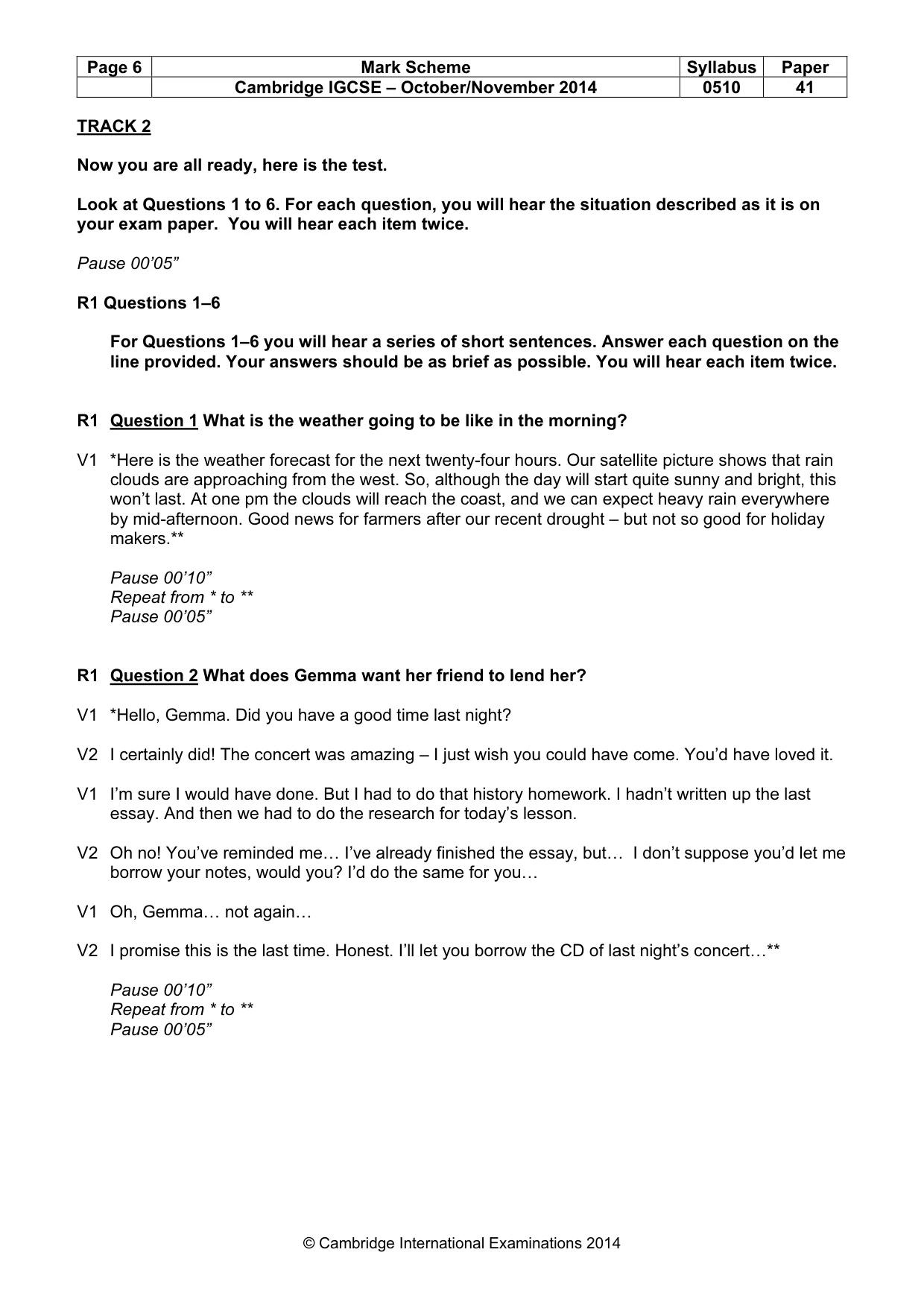
Page 6 Mark Scheme Syllabus Paper Cambridge IGCSE – October/November 2014 0510 41 © Cambridge International Examinations 2014 TRACK 2 Now you are all ready, here is the test. Look at Questions 1 to 6. For each question, you will hear the situation described as it is on your exam paper. You will hear each item twice. Pause 00’05” R1 Questions 1–6 For Questions 1–6 you will hear a series of short sentences. Answer each question on the line provided. Your answers should be as brief as possible. You will hear each item twice. R1 Question 1 What is the weather going to be like in the morning? V1 *Here is the weather forecast for the next twenty-four hours. Our satellite picture shows that rain clouds are approaching from the west. So, although the day will start quite sunny and bright, this won’t last. At one pm the clouds will reach the coast, and we can expect heavy rain everywhere by mid-afternoon. Good news for farmers after our recent drought – but not so good for holiday makers.** Pause 00’10” Repeat from * to ** Pause 00’05” R1 Question 2 What does Gemma want her friend to lend her? V1 *Hello, Gemma. Did you have a good time last night? V2 I certainly did! The concert was amazing – I just wish you could have come. You’d have loved it. V1 I’m sure I would have done. But I had to do that history homework. I hadn’t written up the last essay. And then we had to do the research for today’s lesson. V2 Oh no! You’ve reminded me… I’ve already finished the essay, but… I don’t suppose you’d let me borrow your notes, would you? I’d do the same for you… V1 Oh, Gemma… not again… V2 I promise this is the last time. Honest. I’ll let you borrow the CD of last night’s concert…** Pause 00’10” Repeat from * to ** Pause 00’05”
Mark scheme, page 7
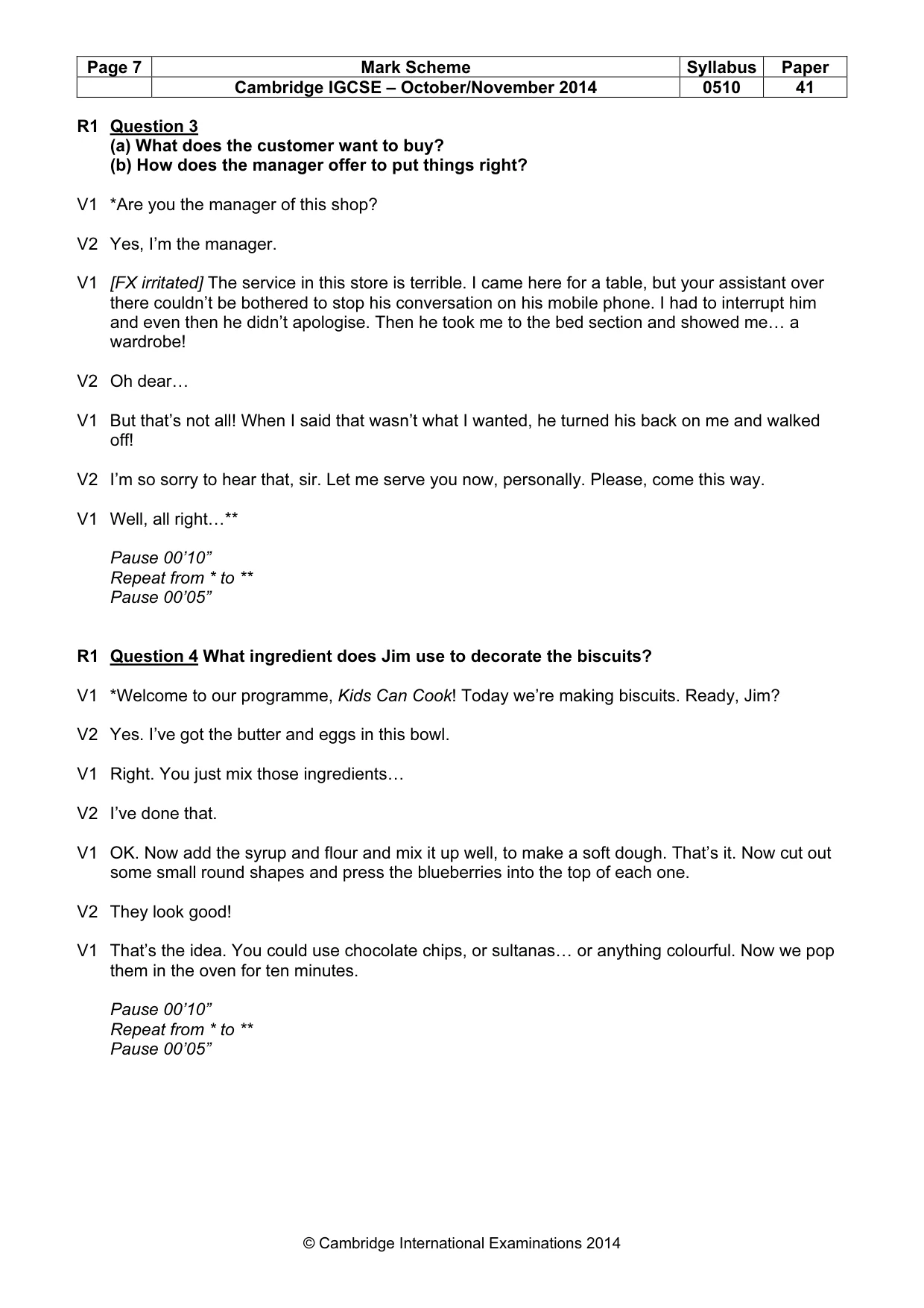
Page 7 Mark Scheme Syllabus Paper Cambridge IGCSE – October/November 2014 0510 41 © Cambridge International Examinations 2014 R1 Question 3 (a) What does the customer want to buy? (b) How does the manager offer to put things right? V1 *Are you the manager of this shop? V2 Yes, I’m the manager. V1 [FX irritated] The service in this store is terrible. I came here for a table, but your assistant over there couldn’t be bothered to stop his conversation on his mobile phone. I had to interrupt him and even then he didn’t apologise. Then he took me to the bed section and showed me… a wardrobe! V2 Oh dear… V1 But that’s not all! When I said that wasn’t what I wanted, he turned his back on me and walked off! V2 I’m so sorry to hear that, sir. Let me serve you now, personally. Please, come this way. V1 Well, all right…** Pause 00’10” Repeat from * to ** Pause 00’05” R1 Question 4 What ingredient does Jim use to decorate the biscuits? V1 *Welcome to our programme, Kids Can Cook! Today we’re making biscuits. Ready, Jim? V2 Yes. I’ve got the butter and eggs in this bowl. V1 Right. You just mix those ingredients… V2 I’ve done that. V1 OK. Now add the syrup and flour and mix it up well, to make a soft dough. That’s it. Now cut out some small round shapes and press the blueberries into the top of each one. V2 They look good! V1 That’s the idea. You could use chocolate chips, or sultanas… or anything colourful. Now we pop them in the oven for ten minutes. Pause 00’10” Repeat from * to ** Pause 00’05”
Mark scheme, page 8
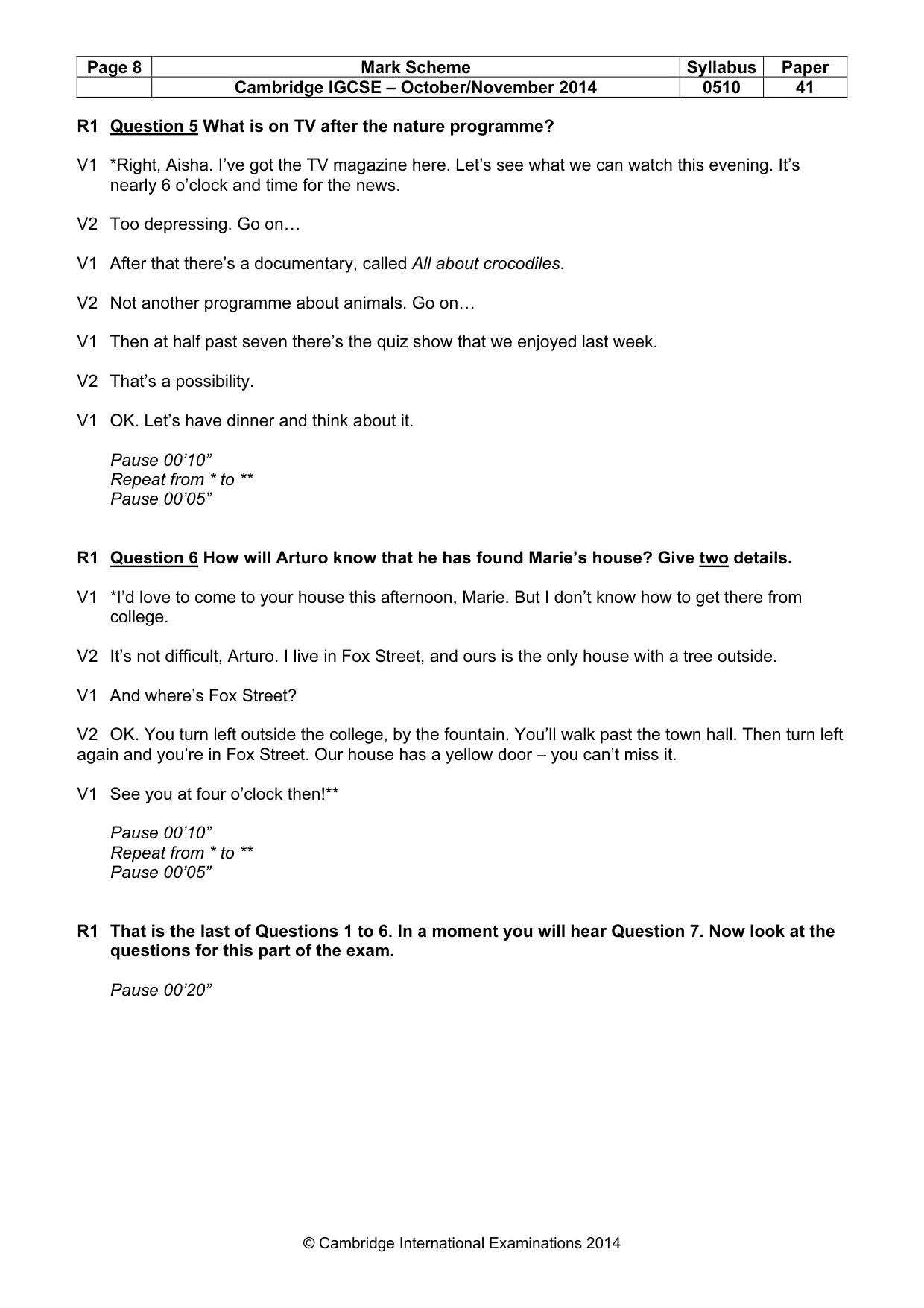
Page 8 Mark Scheme Syllabus Paper Cambridge IGCSE – October/November 2014 0510 41 © Cambridge International Examinations 2014 R1 Question 5 What is on TV after the nature programme? V1 *Right, Aisha. I’ve got the TV magazine here. Let’s see what we can watch this evening. It’s nearly 6 o’clock and time for the news. V2 Too depressing. Go on… V1 After that there’s a documentary, called All about crocodiles. V2 Not another programme about animals. Go on… V1 Then at half past seven there’s the quiz show that we enjoyed last week. V2 That’s a possibility. V1 OK. Let’s have dinner and think about it. Pause 00’10” Repeat from * to ** Pause 00’05” R1 Question 6 How will Arturo know that he has found Marie’s house? Give two details. V1 *I’d love to come to your house this afternoon, Marie. But I don’t know how to get there from college. V2 It’s not difficult, Arturo. I live in Fox Street, and ours is the only house with a tree outside. V1 And where’s Fox Street? V2 OK. You turn left outside the college, by the fountain. You’ll walk past the town hall. Then turn left again and you’re in Fox Street. Our house has a yellow door – you can’t miss it. V1 See you at four o’clock then!** Pause 00’10” Repeat from * to ** Pause 00’05” R1 That is the last of Questions 1 to 6. In a moment you will hear Question 7. Now look at the questions for this part of the exam. Pause 00’20”
Mark scheme, page 9
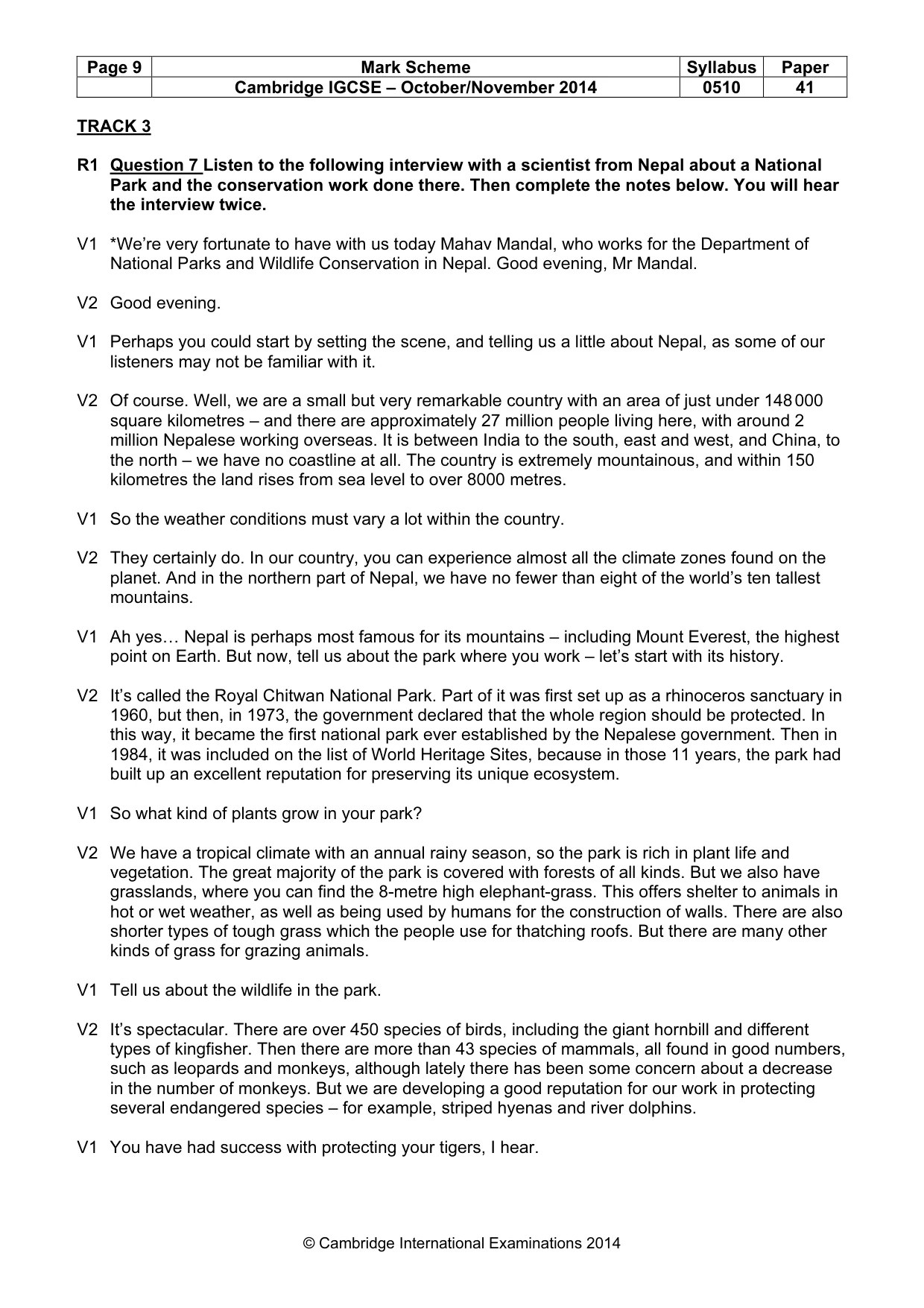
Page 9 Mark Scheme Syllabus Paper Cambridge IGCSE – October/November 2014 0510 41 © Cambridge International Examinations 2014 TRACK 3 R1 Question 7 Listen to the following interview with a scientist from Nepal about a National Park and the conservation work done there. Then complete the notes below. You will hear the interview twice. V1 *We’re very fortunate to have with us today Mahav Mandal, who works for the Department of National Parks and Wildlife Conservation in Nepal. Good evening, Mr Mandal. V2 Good evening. V1 Perhaps you could start by setting the scene, and telling us a little about Nepal, as some of our listeners may not be familiar with it. V2 Of course. Well, we are a small but very remarkable country with an area of just under 148 000 square kilometres – and there are approximately 27 million people living here, with around 2 million Nepalese working overseas. It is between India to the south, east and west, and China, to the north – we have no coastline at all. The country is extremely mountainous, and within 150 kilometres the land rises from sea level to over 8000 metres. V1 So the weather conditions must vary a lot within the country. V2 They certainly do. In our country, you can experience almost all the climate zones found on the planet. And in the northern part of Nepal, we have no fewer than eight of the world’s ten tallest mountains. V1 Ah yes… Nepal is perhaps most famous for its mountains – including Mount Everest, the highest point on Earth. But now, tell us about the park where you work – let’s start with its history. V2 It’s called the Royal Chitwan National Park. Part of it was first set up as a rhinoceros sanctuary in 1960, but then, in 1973, the government declared that the whole region should be protected. In this way, it became the first national park ever established by the Nepalese government. Then in 1984, it was included on the list of World Heritage Sites, because in those 11 years, the park had built up an excellent reputation for preserving its unique ecosystem. V1 So what kind of plants grow in your park? V2 We have a tropical climate with an annual rainy season, so the park is rich in plant life and vegetation. The great majority of the park is covered with forests of all kinds. But we also have grasslands, where you can find the 8-metre high elephant-grass. This offers shelter to animals in hot or wet weather, as well as being used by humans for the construction of walls. There are also shorter types of tough grass which the people use for thatching roofs. But there are many other kinds of grass for grazing animals. V1 Tell us about the wildlife in the park. V2 It’s spectacular. There are over 450 species of birds, including the giant hornbill and different types of kingfisher. Then there are more than 43 species of mammals, all found in good numbers, such as leopards and monkeys, although lately there has been some concern about a decrease in the number of monkeys. But we are developing a good reputation for our work in protecting several endangered species – for example, striped hyenas and river dolphins. V1 You have had success with protecting your tigers, I hear.
Mark scheme, page 10
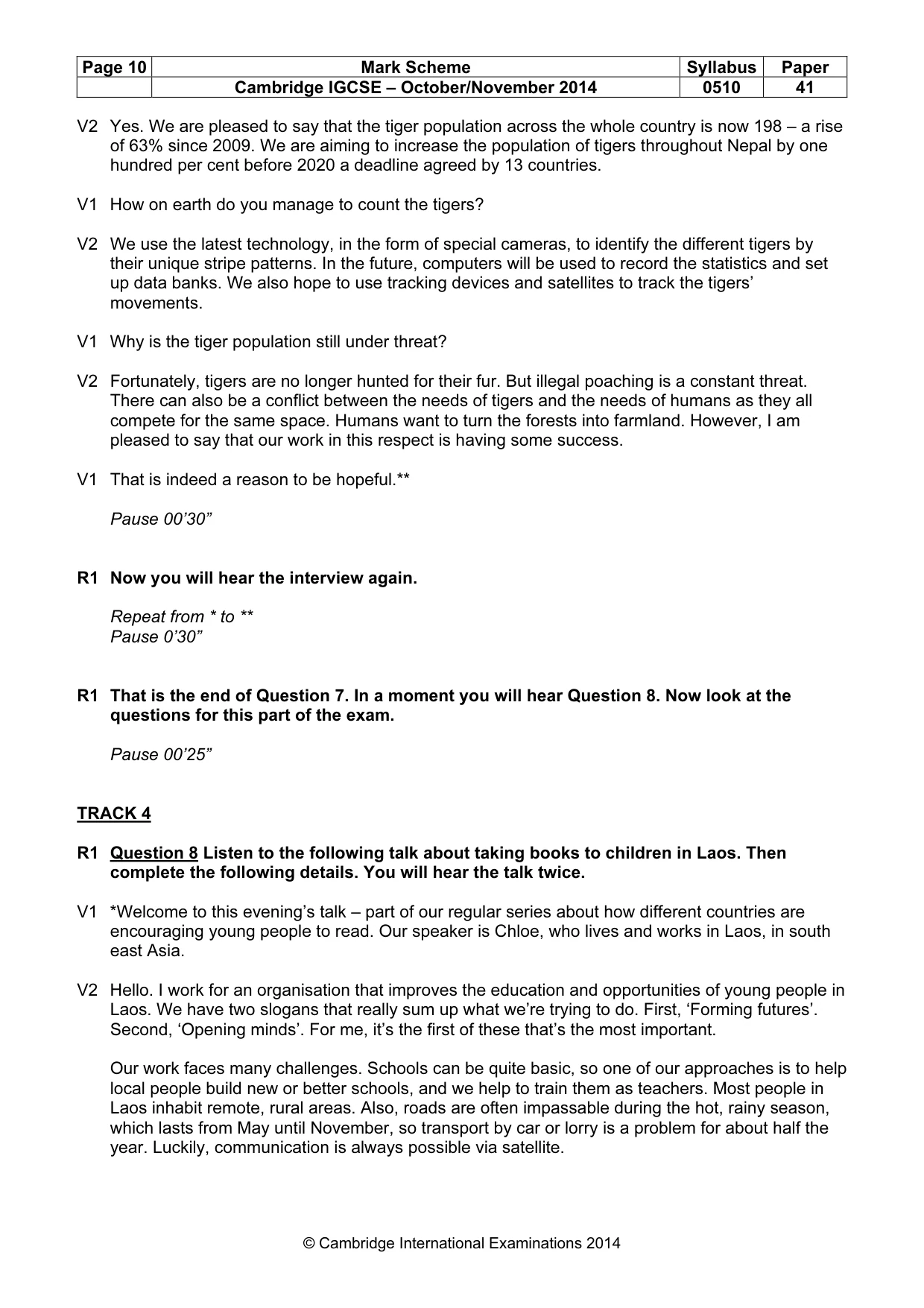
Page 10 Mark Scheme Syllabus Paper Cambridge IGCSE – October/November 2014 0510 41 © Cambridge International Examinations 2014 V2 Yes. We are pleased to say that the tiger population across the whole country is now 198 – a rise of 63% since 2009. We are aiming to increase the population of tigers throughout Nepal by one hundred per cent before 2020 a deadline agreed by 13 countries. V1 How on earth do you manage to count the tigers? V2 We use the latest technology, in the form of special cameras, to identify the different tigers by their unique stripe patterns. In the future, computers will be used to record the statistics and set up data banks. We also hope to use tracking devices and satellites to track the tigers’ movements. V1 Why is the tiger population still under threat? V2 Fortunately, tigers are no longer hunted for their fur. But illegal poaching is a constant threat. There can also be a conflict between the needs of tigers and the needs of humans as they all compete for the same space. Humans want to turn the forests into farmland. However, I am pleased to say that our work in this respect is having some success. V1 That is indeed a reason to be hopeful.** Pause 00’30” R1 Now you will hear the interview again. Repeat from * to ** Pause 0’30” R1 That is the end of Question 7. In a moment you will hear Question 8. Now look at the questions for this part of the exam. Pause 00’25” TRACK 4 R1 Question 8 Listen to the following talk about taking books to children in Laos. Then complete the following details. You will hear the talk twice. V1 *Welcome to this evening’s talk – part of our regular series about how different countries are encouraging young people to read. Our speaker is Chloe, who lives and works in Laos, in south east Asia. V2 Hello. I work for an organisation that improves the education and opportunities of young people in Laos. We have two slogans that really sum up what we’re trying to do. First, ‘Forming futures’. Second, ‘Opening minds’. For me, it’s the first of these that’s the most important. Our work faces many challenges. Schools can be quite basic, so one of our approaches is to help local people build new or better schools, and we help to train them as teachers. Most people in Laos inhabit remote, rural areas. Also, roads are often impassable during the hot, rainy season, which lasts from May until November, so transport by car or lorry is a problem for about half the year. Luckily, communication is always possible via satellite.
Mark scheme, page 11
Page 11 Mark Scheme Syllabus Paper Cambridge IGCSE – October/November 2014 0510 41 © Cambridge International Examinations 2014 All the problems limit what we can do. Because of the climate, construction work can only take place during the drier season, December to April. November is a particularly hectic time for us as we are busy preparing materials and loading our trucks. But I’ve come to talk to you mainly about our new project. I work with the people who live in more than a hundred small villages along the banks of the Mekong River. We have set up two floating libraries – boats that each carry more than a thousand books. There are no other ways of getting books – like bookshops or colleges or resource centres. Over ten thousand Lao children depend totally on these boats for access to books. Let me tell you about a typical visit of the book boat. It usually arrives in the village in the morning. The children go aboard to choose books, then sit nearby and read intently. The boat stays overnight at the village and children continue to borrow books well past dark. They have to read by candlelight because there are no electric lights or gas lamps in their homes. In the morning, the books are collected and the boat goes to the next village. The boats do not just bring books. The boat staff organise active learning games for part of the day. These games are designed to emphasize the importance and fun of reading, as well as teaching life skills, such as the importance of cleanliness and hand washing. The staff also encourage the preservation of the local culture through teaching traditional dancing and singing. There are, of course, the normal celebrations throughout the year that the children enjoy, but the book boat visits are still a highlight for them. Looking ahead, we hope to expand our programme by buying two more boats, if funding is available. We had hoped to find sponsors but we haven’t made much progress in that direction yet. If you are interested in helping us, you could visit our website for more information… (FADE) Pause 00’30” R1 Now you will hear the talk again. Repeat from * to ** Pause 0’30” R1 That is the end of Question 8. In a moment you will hear Question 9. Now look at the questions for this part of the exam. Pause 00’35”
Mark scheme, page 12
Page 12 Mark Scheme Syllabus Paper Cambridge IGCSE – October/November 2014 0510 41 © Cambridge International Examinations 2014 TRACK 5 R1 Question 9 Listen to the following interview with Anita Price, a female long-distance swimmer, and then answer the questions below. You will hear the interview twice. V1 *Today we welcome the long-distance swimmer Anita Price. Hello, Anita. V2 Hello. V1 Perhaps you could tell us about your latest record-breaking achievement. V2 Well, I’ve just returned from swimming over one hundred and sixty kilometres from Cuba to Florida. I knew that had been done several times before, so I wanted to do something different. I decided to become the first person ever to do this swim without any protection against the sharks that infest those waters. I knew that all swimmers previously had used shark cages – a cage they swim inside for their own protection. V1 I know that you made several attempts when you were younger. What happened the first time? V2 Well, when I was in my twenties, I was a keen long-distance swimmer and I broke the world distance-swimming record by swimming 165 kilometres from the Bahamas to Florida. I’d managed to ignore the jellyfish and overcome my fear of sharks. Then, in 1978, I tried to swim from Cuba to Florida. It was a disaster – rough seas forced me to stop. After that, I gave up long- distance swimming for 30 years. V1 What made you think about taking it up again? V2 Well, when I reached sixty, I started thinking about my life and what I had achieved. I knew I needed something a challenge in my life. I didn’t see my age as a problem. At sixty, my body was almost as strong as ever, and my mental state was much tougher. I knew I could do it. V1 How did you prepare for this latest attempt? V2 I had to raise 300 000 dollars to hire a support team and buy all the equipment. I had to have a medical team with me as I knew from previous experience that there were many dangers to face. And I had to arrange all the paperwork – visas and so on. But most importantly, I had to build up my swimming stamina. V1 You must have trained really hard to be able to swim such a distance. Tell us about how you did that. Did you have some special routines to follow? V2 I swam for four hours a day in a pool, and I counted the laps in my head – in four different languages. The goal is to focus the mind by doing the same thing over and over again. But when I swim in the ocean for a long time, I have a different tactic. I’ll sing a song 10 times. I know each one I sing really well how many seconds each takes, how many strokes. I never lose track. V1 It obviously works. Did you find the swim straightforward this time? V2 [FX laughing] Definitely not, and this wasn’t my first attempt. V1 So what happened?
Mark scheme, page 13
Page 13 Mark Scheme Syllabus Paper Cambridge IGCSE – October/November 2014 0510 41 © Cambridge International Examinations 2014 V2 The first time, in 2010, I had to stop after eighty kilometres because of an asthma attack. In 2012, the next attempt was stopped because of jellyfish – they paralysed my shoulders. In this last, successful swim, I wore a skin-tight bodysuit, a face mask for protection against their stings, and goggles for my eyes. Thank goodness this worked, and I was able to keep going. V1 One hundred and sixty kilometres through shark-infested water – what an achievement. Are there any important lessons that you can pass on to us? V2 There are things that I want to tell everyone who asks. One is that you should never give up. Two is that you are never too old to chase your dreams. And three, most important of all, is that any success depends on a team of people working together. V1 Anita, thank you for coming along today. An inspiring story…** Pause 00’30” R1 Now you will hear the interview again. Repeat from * to ** Pause 0’30” R1 That is the end of Question 9. In a moment you will hear Question 10. Now look at the questions for this part of the exam. Pause 00’35”
Mark scheme, page 14
Page 14 Mark Scheme Syllabus Paper Cambridge IGCSE – October/November 2014 0510 41 © Cambridge International Examinations 2014 TRACK 6 R1 Question 10 Listen to the following talk about the Northern Lights, and then answer the questions below. You will hear the talk twice. V1 *Thank you for inviting me to speak to you this afternoon. I’m going to talk to you about my recent trip to Lapland to see the Northern Lights. You might think that in winter this snow-covered area of the world is a dull scene of black, grey and white. In fact, nothing could be further from the truth. On a clear night, the sky is filled with light in shades of green and blue, sometimes red or purple. I was expecting the colours, but I was not prepared for the way the Lights changed and moved. In the North Pole region, the Northern Lights can be best seen in the winter months. The Arctic winter nights are long, so the best time to go to have a good chance of seeing the Lights, is between late August and early April. The skies are the clearest in March and we had some great viewings. Time and patience are needed if you want to see the Lights. They do not always make an appearance, and you may need to persist for several nights in a row to be sure of experiencing them. And standing outside in the bitter cold requires several layers of clothing. But when you do see the Lights, all that effort is worthwhile. The memory of my trip will always stay with me. You can reach the area on skis or by snowmobile. But we were lucky enough to go on a sledge pulled by dogs, a much more interesting way to travel than by car. We passed swiftly across the snowy landscape until we arrived at the viewing area a huge lake. There were about six of us, prepared to spend several hours just watching and waiting. The lake was frozen and we were able to walk and then stand in the middle of it, with nothing to block our view as we gazed up. The trees were at least half a kilometre away. It was a cold but cloudless night, and in total silence we watched the beautiful ribbons of green light... (FADE)** Pause 00’30” R1 Now you will hear the talk again. Repeat from * to ** Pause 00’.30” R1 That is the end of Question 10, and of the test. In a moment your teacher will collect your papers. Please check that you have written your name, Centre number and candidate number on the front of your question paper. Remember, you must not talk until all the papers have been collected. Pause 00’10” R1 Teacher, please collect all the papers. Thank you, everyone.
What you needed in this session
Cambridge’s own grade thresholds for 2014 Oct/Nov, Paper 4 · Variant 1. A higher threshold means an easier paper — the bar moves with how the cohort did.