Cambridge IGCSE English - Second Language (oral endorsement) 0510 — 2013 May/June Paper 1 · Variant 2
0510/12/M/J/13
The question paper and its mark scheme, free to read here and free to download. This is Cambridge’s own paper, exactly as it was sat.
Question paper16 pages



Mark scheme11 pages
Answers below. Sit the paper first if you are practising.
Paper as text
Question paper, page 1
This document consists of 13 printed pages and 3 blank pages. DC (NH/JG) 59163/4 © UCLES 2013 [Turn over UNIVERSITY OF CAMBRIDGE INTERNATIONAL EXAMINATIONS International General Certificate of Secondary Education * 3 3 8 7 8 7 9 8 0 1 * ENGLISH AS A SECOND LANGUAGE 0510/12 Paper 1 Reading and Writing (Core) May/June 2013 1 hour 30 minutes Candidates answer on the Question Paper. No Additional Materials are required. READ THESE INSTRUCTIONS FIRST Write your Centre number, candidate number and name on all the work you hand in. Write in dark blue or black pen. Do not use staples, paper clips, highlighters, glue or correction fluid. DO NOT WRITE IN ANY BARCODES. Answer all questions. Dictionaries are not allowed. At the end of the examination, fasten all your work securely together. The number of marks is given in brackets [ ] at the end of each question or part question.
Question paper, page 2
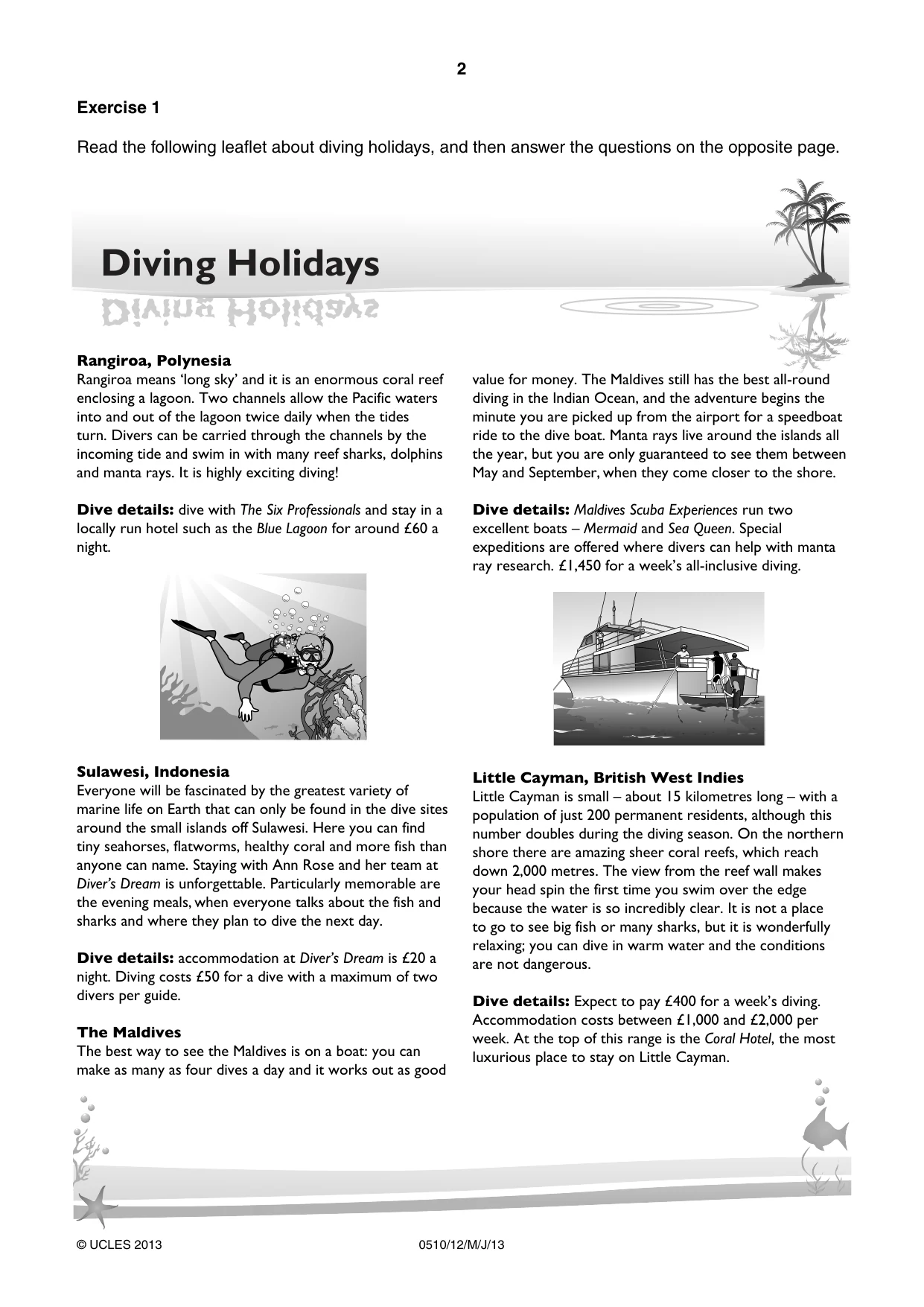
2 0510/12/M/J/13 © UCLES 2013 Exercise 1 Read the following leaflet about diving holidays, and then answer the questions on the opposite page. Diving Holidays Rangiroa, Polynesia Rangiroa means ‘long sky’ and it is an enormous coral reef enclosing a lagoon. Two channels allow the Pacific waters into and out of the lagoon twice daily when the tides turn. Divers can be carried through the channels by the incoming tide and swim in with many reef sharks, dolphins and manta rays. It is highly exciting diving! Dive details: dive with The Six Professionals and stay in a locally run hotel such as the Blue Lagoon for around £60 a night. Sulawesi, Indonesia Everyone will be fascinated by the greatest variety of marine life on Earth that can only be found in the dive sites around the small islands off Sulawesi. Here you can find tiny seahorses, flatworms, healthy coral and more fish than anyone can name. Staying with Ann Rose and her team at Diver’s Dream is unforgettable. Particularly memorable are the evening meals, when everyone talks about the fish and sharks and where they plan to dive the next day. Dive details: accommodation at Diver’s Dream is £20 a night. Diving costs £50 for a dive with a maximum of two divers per guide. The Maldives The best way to see the Maldives is on a boat: you can make as many as four dives a day and it works out as good value for money. The Maldives still has the best all-round diving in the Indian Ocean, and the adventure begins the minute you are picked up from the airport for a speedboat ride to the dive boat. Manta rays live around the islands all the year, but you are only guaranteed to see them between May and September, when they come closer to the shore. Dive details: Maldives Scuba Experiences run two excellent boats – Mermaid and Sea Queen. Special expeditions are offered where divers can help with manta ray research. £1,450 for a week’s all-inclusive diving. Little Cayman, British West Indies Little Cayman is small – about 15 kilometres long – with a population of just 200 permanent residents, although this number doubles during the diving season. On the northern shore there are amazing sheer coral reefs, which reach down 2,000 metres. The view from the reef wall makes your head spin the first time you swim over the edge because the water is so incredibly clear. It is not a place to go to see big fish or many sharks, but it is wonderfully relaxing; you can dive in warm water and the conditions are not dangerous. Dive details: Expect to pay £400 for a week’s diving. Accommodation costs between £1,000 and £2,000 per week. At the top of this range is the Coral Hotel, the most luxurious place to stay on Little Cayman.
Question paper, page 3
3 0510/12/M/J/13 © UCLES 2013 [Turn over For Examiner’s Use (a) According to the leaflet, which three sea creatures are carried into the Rangiroa lagoon on the tide? …[1] (b) How much does it cost to stay at the Blue Lagoon for one night? …[1] (c) What is unique about the dive sites around Sulawesi? …[1] (d) What do guests discuss during meals at Diver’s Dream? …[1] (e) How do you travel from the airport to the dive boat in the Maldives? …[1] (f) When can you be sure of seeing manta rays in the Maldives? …[1] (g) When does the population of Little Cayman increase? …[1] [Total: 7]
Question paper, page 4
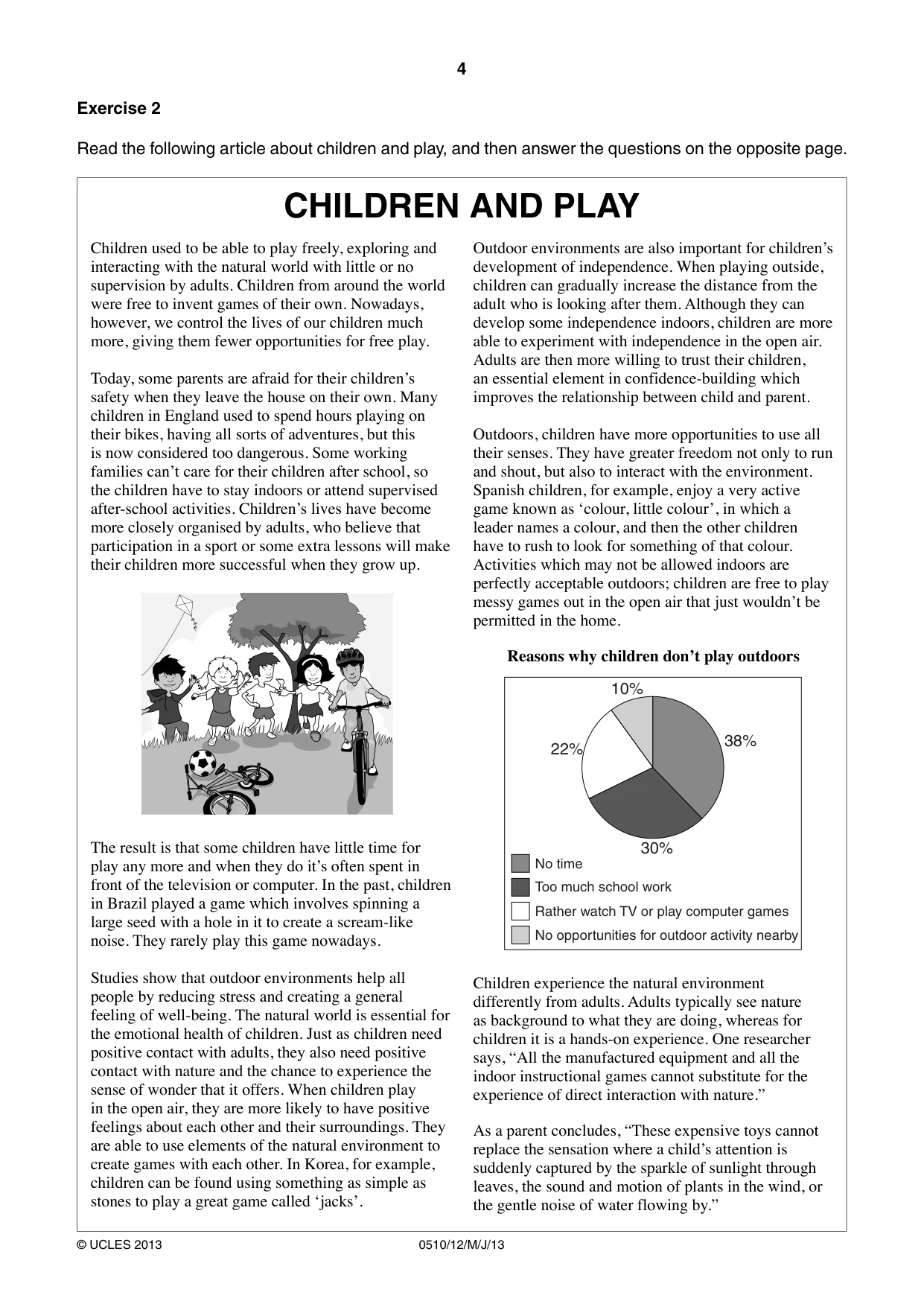
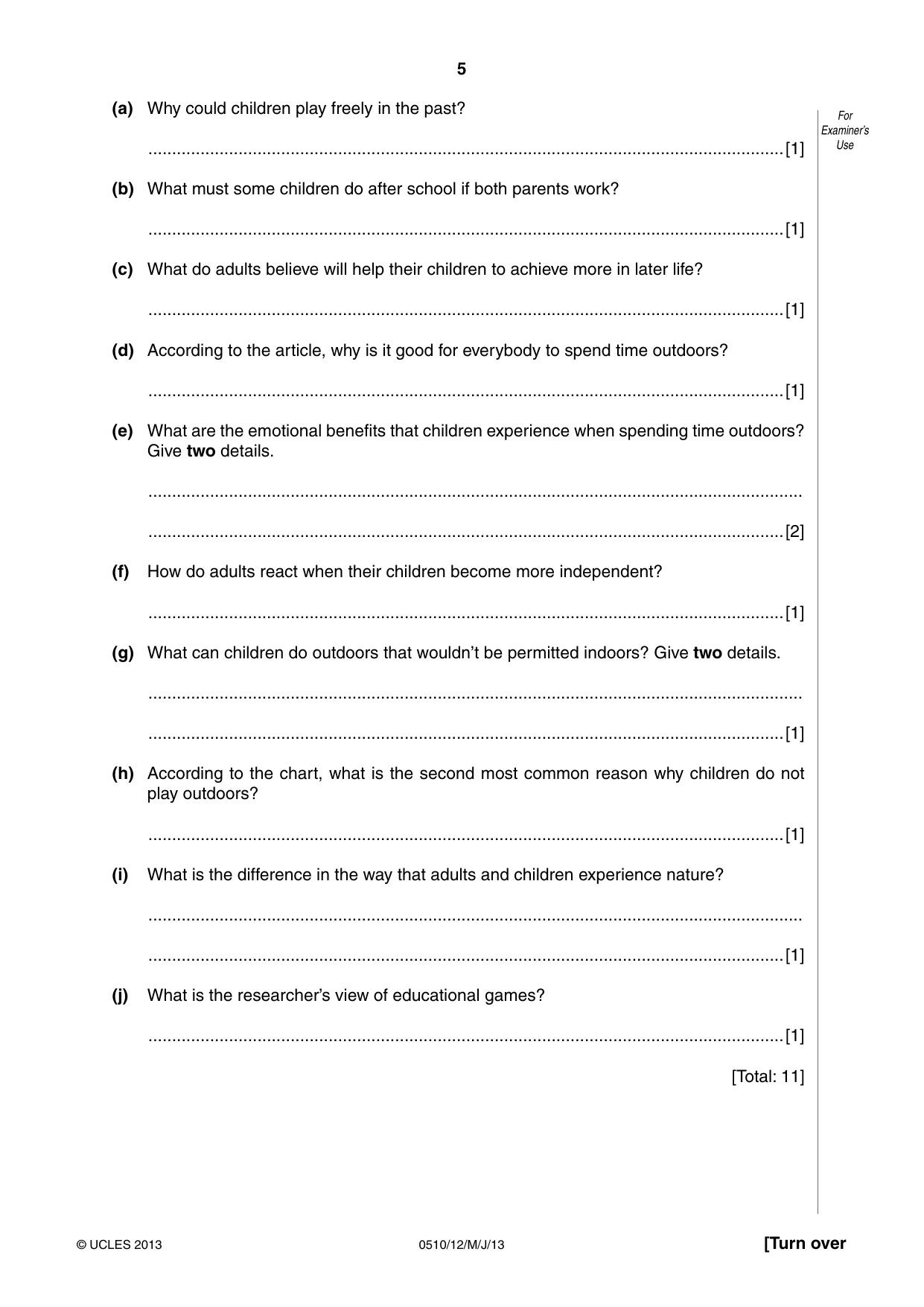
4 0510/12/M/J/13 © UCLES 2013 Exercise 2 Read the following article about children and play, and then answer the questions on the opposite page. CHILDREN AND PLAY Children used to be able to play freely, exploring and interacting with the natural world with little or no supervision by adults. Children from around the world were free to invent games of their own. Nowadays, however, we control the lives of our children much more, giving them fewer opportunities for free play. Today, some parents are afraid for their children’s safety when they leave the house on their own. Many children in England used to spend hours playing on their bikes, having all sorts of adventures, but this is now considered too dangerous. Some working families can’t care for their children after school, so the children have to stay indoors or attend supervised after-school activities. Children’s lives have become more closely organised by adults, who believe that participation in a sport or some extra lessons will make their children more successful when they grow up. The result is that some children have little time for play any more and when they do it’s often spent in front of the television or computer. In the past, children in Brazil played a game which involves spinning a large seed with a hole in it to create a scream-like noise. They rarely play this game nowadays. Studies show that outdoor environments help all people by reducing stress and creating a general feeling of well-being. The natural world is essential for the emotional health of children. Just as children need positive contact with adults, they also need positive contact with nature and the chance to experience the sense of wonder that it offers. When children play in the open air, they are more likely to have positive feelings about each other and their surroundings. They are able to use elements of the natural environment to create games with each other. In Korea, for example, children can be found using something as simple as stones to play a great game called ‘jacks’. Outdoor environments are also important for children’s development of independence. When playing outside, children can gradually increase the distance from the adult who is looking after them. Although they can develop some independence indoors, children are more able to experiment with independence in the open air. Adults are then more willing to trust their children, an essential element in confidence-building which improves the relationship between child and parent. Outdoors, children have more opportunities to use all their senses. They have greater freedom not only to run and shout, but also to interact with the environment. Spanish children, for example, enjoy a very active game known as ‘colour, little colour’, in which a leader names a colour, and then the other children have to rush to look for something of that colour. Activities which may not be allowed indoors are perfectly acceptable outdoors; children are free to play messy games out in the open air that just wouldn’t be permitted in the home. Reasons why children don’t play outdoors 10% 30% 38% 22% No time Too much school work Rather watch TV or play computer games No opportunities for outdoor activity nearby Children experience the natural environment differently from adults. Adults typically see nature as background to what they are doing, whereas for children it is a hands-on experience. One researcher says, “All the manufactured equipment and all the indoor instructional games cannot substitute for the experience of direct interaction with nature.” As a parent concludes, “These expensive toys cannot replace the sensation where a child’s attention is suddenly captured by the sparkle of sunlight through leaves, the sound and motion of plants in the wind, or the gentle noise of water flowing by.”
Question paper, page 5
5 0510/12/M/J/13 © UCLES 2013 [Turn over For Examiner’s Use (a) Why could children play freely in the past? …[1] (b) What must some children do after school if both parents work? …[1] (c) What do adults believe will help their children to achieve more in later life? …[1] (d) According to the article, why is it good for everybody to spend time outdoors? …[1] (e) What are the emotional benefits that children experience when spending time outdoors? Give two details. … …[2] (f) How do adults react when their children become more independent? …[1] (g) What can children do outdoors that wouldn’t be permitted indoors? Give two details. … …[1] (h) According to the chart, what is the second most common reason why children do not play outdoors? …[1] (i) What is the difference in the way that adults and children experience nature? … …[1] (j) What is the researcher’s view of educational games? …[1] [Total: 11]
Question paper, page 6
6 0510/12/M/J/13 © UCLES 2013 Exercise 3 Nanami Hokkaido is planning to do some voluntary work in her community. This will involve helping a local project without being paid for it. She lives in a very nice part of Japan at 431 Akasaka, Minato Ku, Tokyo 107. Nanami has always felt very lucky to live in a comfortable home with all sorts of facilities close by. She would like to get involved in activities that offer opportunities to people who do not have all of the advantages that she enjoys. Nanami is 18 and still at school, taking her A Levels. She attends the Cambridge International School, but will be leaving soon and so the best time for her to work on a project will be during the summer holidays. Nanami wants to become a child psychiatrist. She is very interested in having the chance to work on a drama project with children who live in a very disadvantaged part of town. She read about the volunteer projects in the local newspaper and asked for further details to be sent to her email address, azuredesk@ezweb.com. Nanami is studying drama at A Level and she directed the last school play, an experience which she found exhausting but fascinating. She was amazed to see all of the different behaviours of people when they were under stress, preparing for the performance. However, she was equally delighted to see how team-work could really bring out the best in people. She noticed that even very shy students became more confident. Nanami has never volunteered to do anything outside school before. She got all of the information about the project so that she could discuss it with her parents and make sure that they were happy with her applying to be a volunteer. Her mother was a little concerned that she would have no time to rest after her exams and before starting university, but her father said that it is better to be busy than not have enough to do. Nanami also thinks that it will be very good for her to gain more experience of working with children. Imagine you are Nanami. Fill in the form on the opposite page, using the information above.
Question paper, page 7
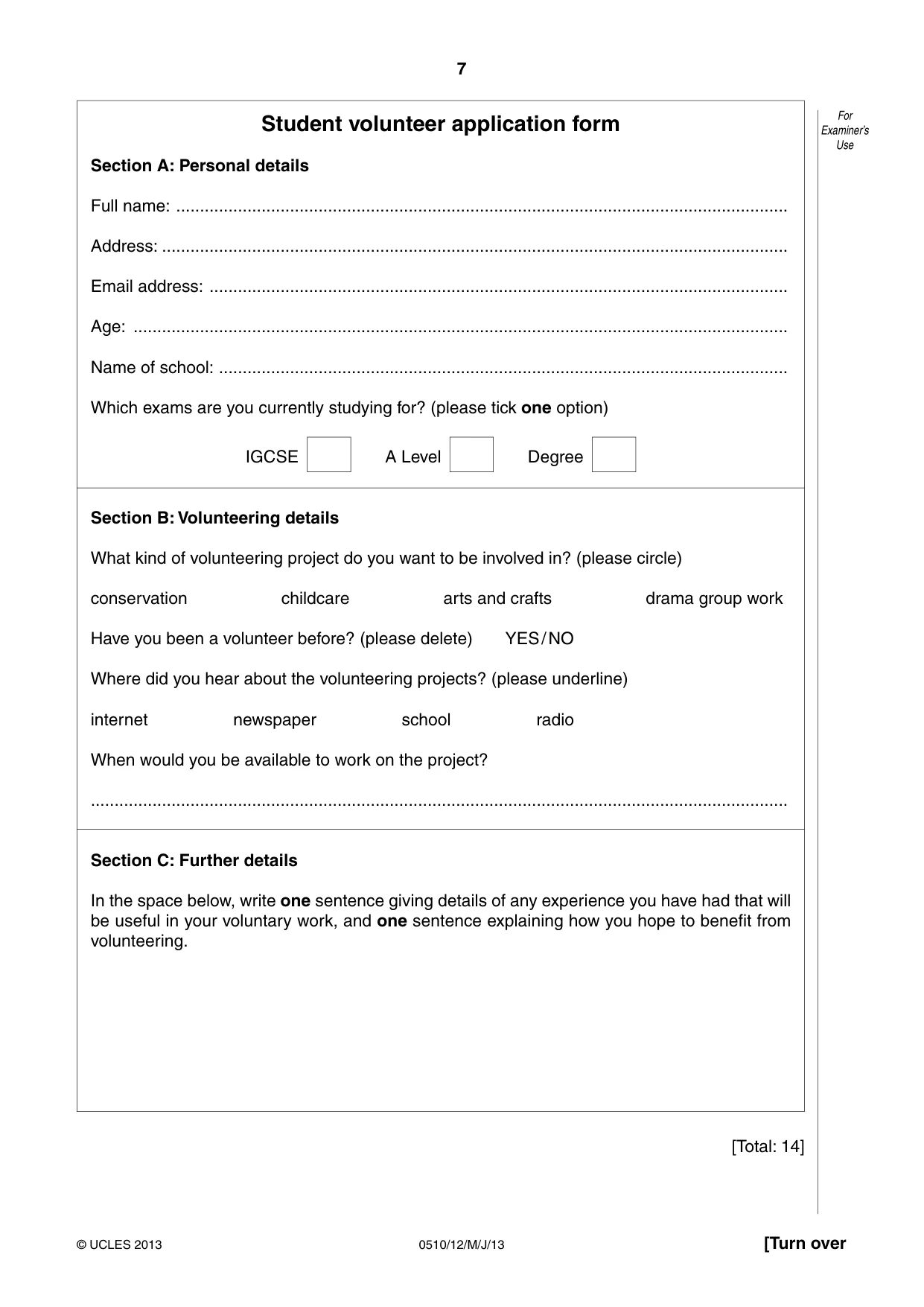
7 0510/12/M/J/13 © UCLES 2013 [Turn over For Examiner’s Use Student volunteer application form Section A: Personal details Full name: … Address: … Email address: … Age: … Name of school: … Which exams are you currently studying for? (please tick one option) IGCSE A Level Degree Section B: Volunteering details What kind of volunteering project do you want to be involved in? (please circle) conservation childcare arts and crafts drama group work Have you been a volunteer before? (please delete) YES / NO Where did you hear about the volunteering projects? (please underline) internet newspaper school radio When would you be available to work on the project? … Section C: Further details In the space below, write one sentence giving details of any experience you have had that will be useful in your voluntary work, and one sentence explaining how you hope to benefit from volunteering. [Total: 14]
Question paper, page 8
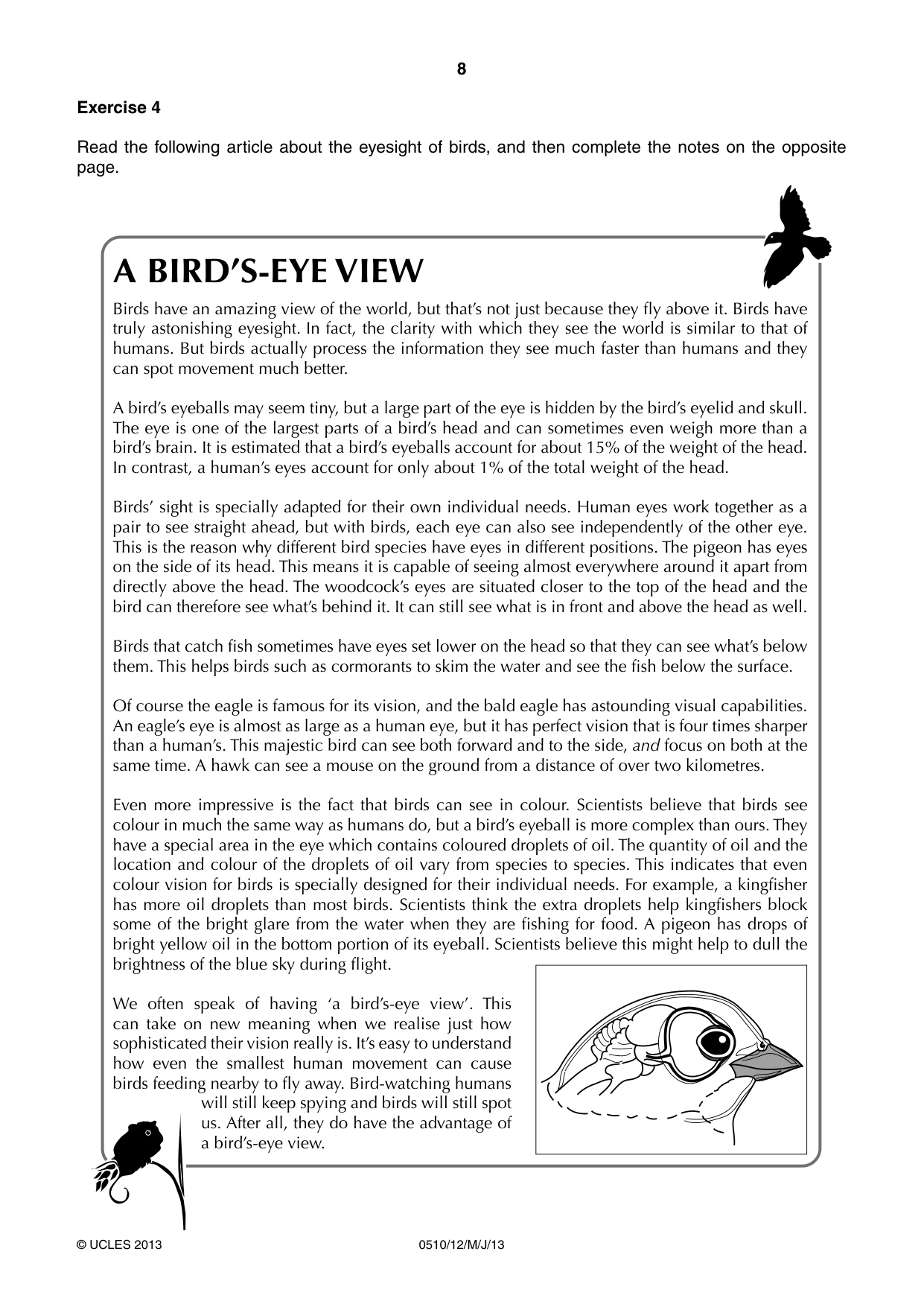
8 0510/12/M/J/13 © UCLES 2013 Exercise 4 Read the following article about the eyesight of birds, and then complete the notes on the opposite page. A BIRD’S-EYE VIEW Birds have an amazing view of the world, but that’s not just because they fly above it. Birds have truly astonishing eyesight. In fact, the clarity with which they see the world is similar to that of humans. But birds actually process the information they see much faster than humans and they can spot movement much better. A bird’s eyeballs may seem tiny, but a large part of the eye is hidden by the bird’s eyelid and skull. The eye is one of the largest parts of a bird’s head and can sometimes even weigh more than a bird’s brain. It is estimated that a bird’s eyeballs account for about 15% of the weight of the head. In contrast, a human’s eyes account for only about 1% of the total weight of the head. Birds’ sight is specially adapted for their own individual needs. Human eyes work together as a pair to see straight ahead, but with birds, each eye can also see independently of the other eye. This is the reason why different bird species have eyes in different positions. The pigeon has eyes on the side of its head. This means it is capable of seeing almost everywhere around it apart from directly above the head. The woodcock’s eyes are situated closer to the top of the head and the bird can therefore see what’s behind it. It can still see what is in front and above the head as well. Birds that catch fish sometimes have eyes set lower on the head so that they can see what’s below them. This helps birds such as cormorants to skim the water and see the fish below the surface. Of course the eagle is famous for its vision, and the bald eagle has astounding visual capabilities. An eagle’s eye is almost as large as a human eye, but it has perfect vision that is four times sharper than a human’s. This majestic bird can see both forward and to the side, and focus on both at the same time. A hawk can see a mouse on the ground from a distance of over two kilometres. Even more impressive is the fact that birds can see in colour. Scientists believe that birds see colour in much the same way as humans do, but a bird’s eyeball is more complex than ours. They have a special area in the eye which contains coloured droplets of oil. The quantity of oil and the location and colour of the droplets of oil vary from species to species. This indicates that even colour vision for birds is specially designed for their individual needs. For example, a kingfisher has more oil droplets than most birds. Scientists think the extra droplets help kingfishers block some of the bright glare from the water when they are fishing for food. A pigeon has drops of bright yellow oil in the bottom portion of its eyeball. Scientists believe this might help to dull the brightness of the blue sky during flight. We often speak of having ‘a bird’s-eye view’. This can take on new meaning when we realise just how sophisticated their vision really is. It’s easy to understand how even the smallest human movement can cause birds feeding nearby to fly away. Bird-watching humans will still keep spying and birds will still spot us. After all, they do have the advantage of a bird’s-eye view.
Question paper, page 9
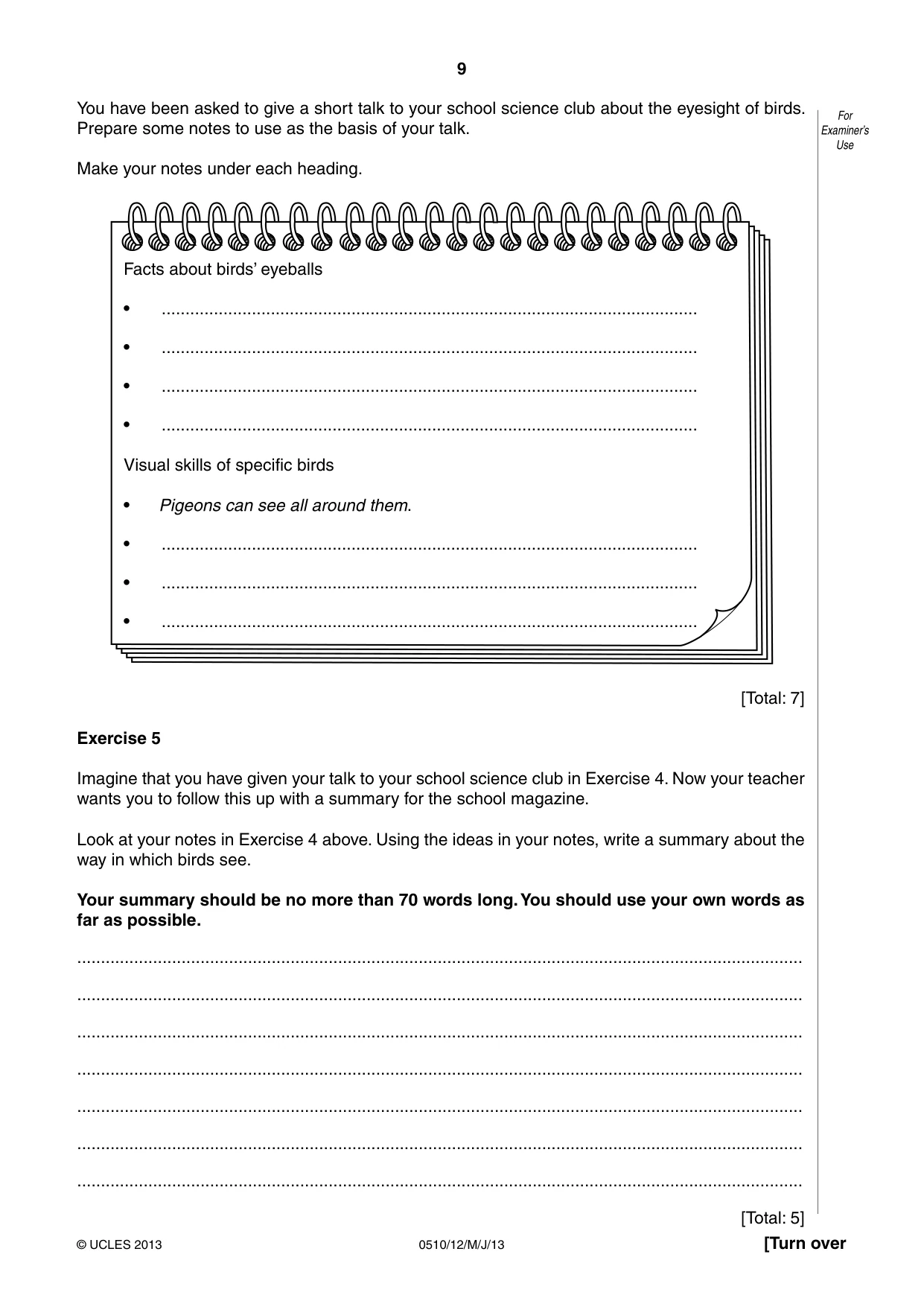
9 0510/12/M/J/13 © UCLES 2013 [Turn over For Examiner’s Use You have been asked to give a short talk to your school science club about the eyesight of birds. Prepare some notes to use as the basis of your talk. Make your notes under each heading. Facts about birds’ eyeballs • … • … • … • … Visual skills of specific birds • Pigeons can see all around them. • … • … • … [Total: 7] Exercise 5 Imagine that you have given your talk to your school science club in Exercise 4. Now your teacher wants you to follow this up with a summary for the school magazine. Look at your notes in Exercise 4 above. Using the ideas in your notes, write a summary about the way in which birds see. Your summary should be no more than 70 words long. You should use your own words as far as possible. … … … … … … … [Total: 5]
Question paper, page 10
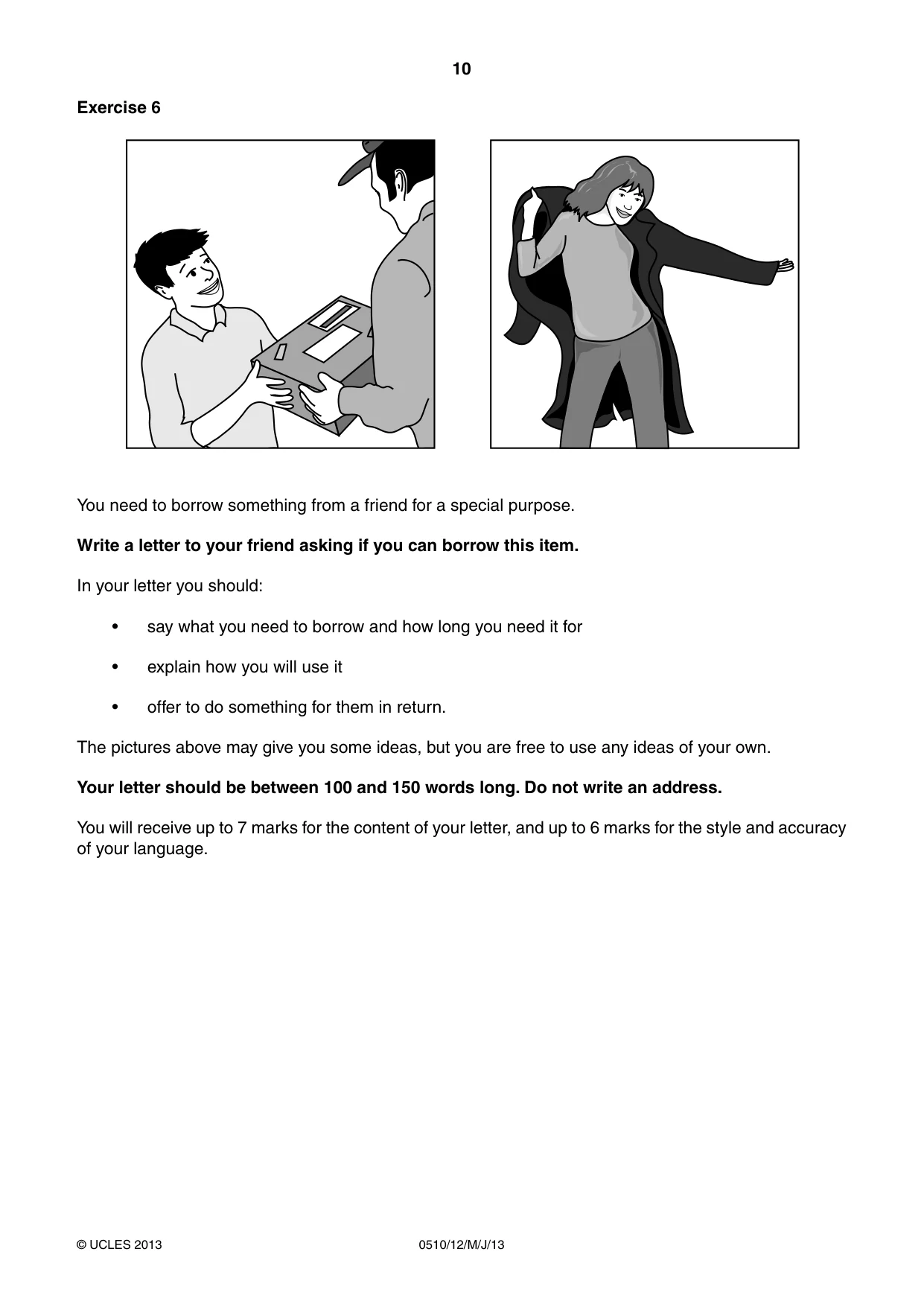
10 0510/12/M/J/13 © UCLES 2013 Exercise 6 You need to borrow something from a friend for a special purpose. Write a letter to your friend asking if you can borrow this item. In your letter you should: • say what you need to borrow and how long you need it for • explain how you will use it • offer to do something for them in return. The pictures above may give you some ideas, but you are free to use any ideas of your own. Your letter should be between 100 and 150 words long. Do not write an address. You will receive up to 7 marks for the content of your letter, and up to 6 marks for the style and accuracy of your language.
Question paper, page 11
11 0510/12/M/J/13 © UCLES 2013 [Turn over For Examiner’s Use … … … … … … … … … … … … … … … … … … … … [Total: 13]
Question paper, page 12
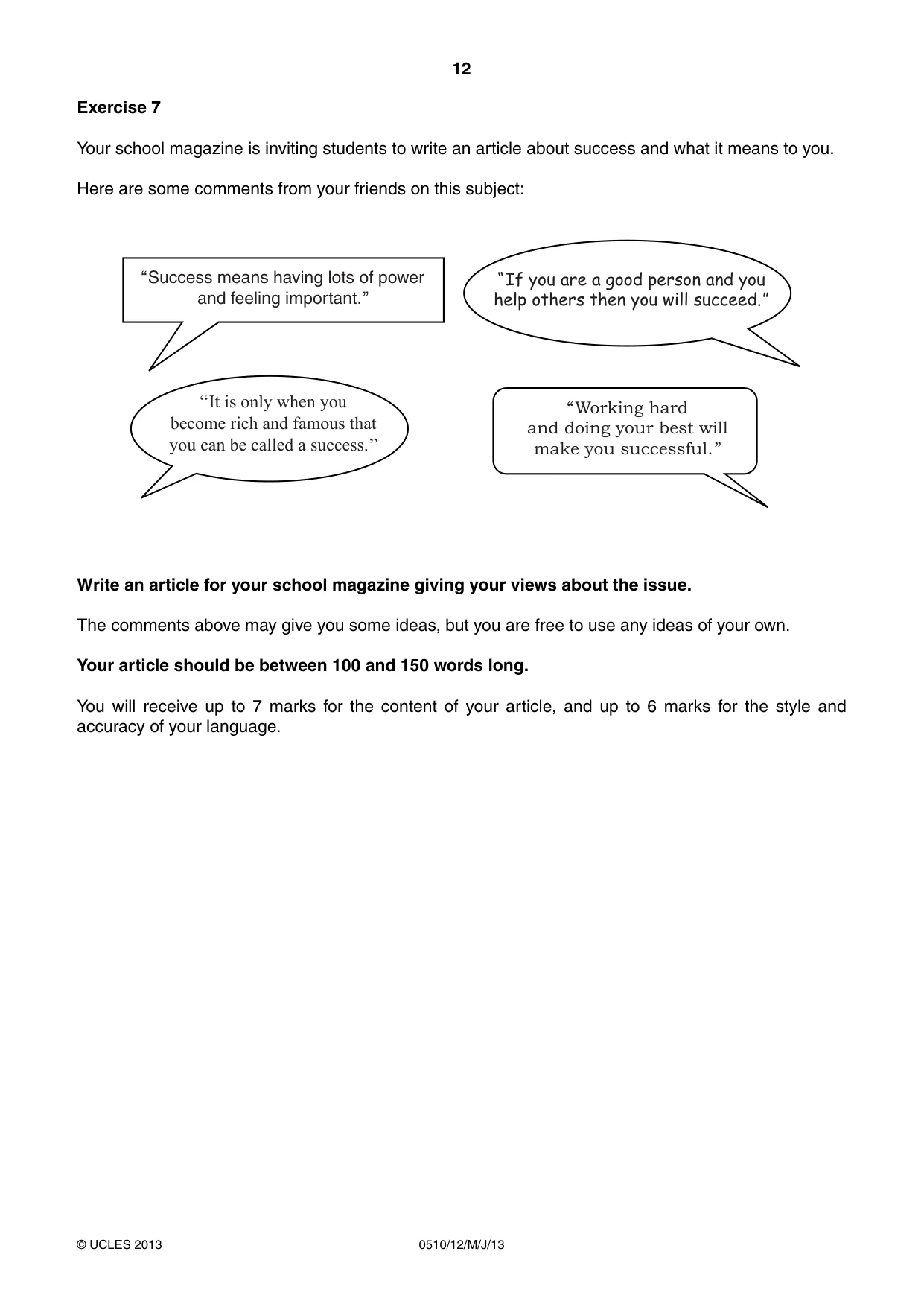
12 0510/12/M/J/13 © UCLES 2013 Exercise 7 Your school magazine is inviting students to write an article about success and what it means to you. Here are some comments from your friends on this subject: “ Success means having lots of power and feeling important. ” “ If you are a good person and you help others then you will succeed. ” “ It is only when you become rich and famous that you can be called a success. ” “ Working hard and doing your best will make you successful. ” Write an article for your school magazine giving your views about the issue. The comments above may give you some ideas, but you are free to use any ideas of your own. Your article should be between 100 and 150 words long. You will receive up to 7 marks for the content of your article, and up to 6 marks for the style and accuracy of your language.
Question paper, page 13
13 0510/12/M/J/13 © UCLES 2013 For Examiner’s Use … … … … … … … … … … … … … … … … … … … … [Total: 13]
Question paper, page 14
14 0510/12/M/J/13 © UCLES 2013 BLANK PAGE
Question paper, page 15
15 0510/12/M/J/13 © UCLES 2013 BLANK PAGE
Question paper, page 16
16 0510/12/M/J/13 © UCLES 2013 Permission to reproduce items where third-party owned material protected by copyright is included has been sought and cleared where possible. Every reasonable effort has been made by the publisher (UCLES) to trace copyright holders, but if any items requiring clearance have unwittingly been included, the publisher will be pleased to make amends at the earliest possible opportunity. University of Cambridge International Examinations is part of the Cambridge Assessment Group. Cambridge Assessment is the brand name of University of Cambridge Local Examinations Syndicate (UCLES), which is itself a department of the University of Cambridge. BLANK PAGE
Mark scheme, page 1
CAMBRIDGE INTERNATIONAL EXAMINATIONS International General Certificate of Secondary Education MARK SCHEME for the May/June 2013 series 0510 ENGLISH AS A SECOND LANGUAGE 0510/12 Paper 1 (Reading and Writing – Core), maximum raw mark 70 This mark scheme is published as an aid to teachers and candidates, to indicate the requirements of the examination. It shows the basis on which Examiners were instructed to award marks. It does not indicate the details of the discussions that took place at an Examiners’ meeting before marking began, which would have considered the acceptability of alternative answers. Mark schemes should be read in conjunction with the question paper and the Principal Examiner Report for Teachers. Cambridge will not enter into discussions about these mark schemes. Cambridge is publishing the mark schemes for the May/June 2013 series for most IGCSE, GCE Advanced Level and Advanced Subsidiary Level components and some Ordinary Level components.
Mark scheme, page 2
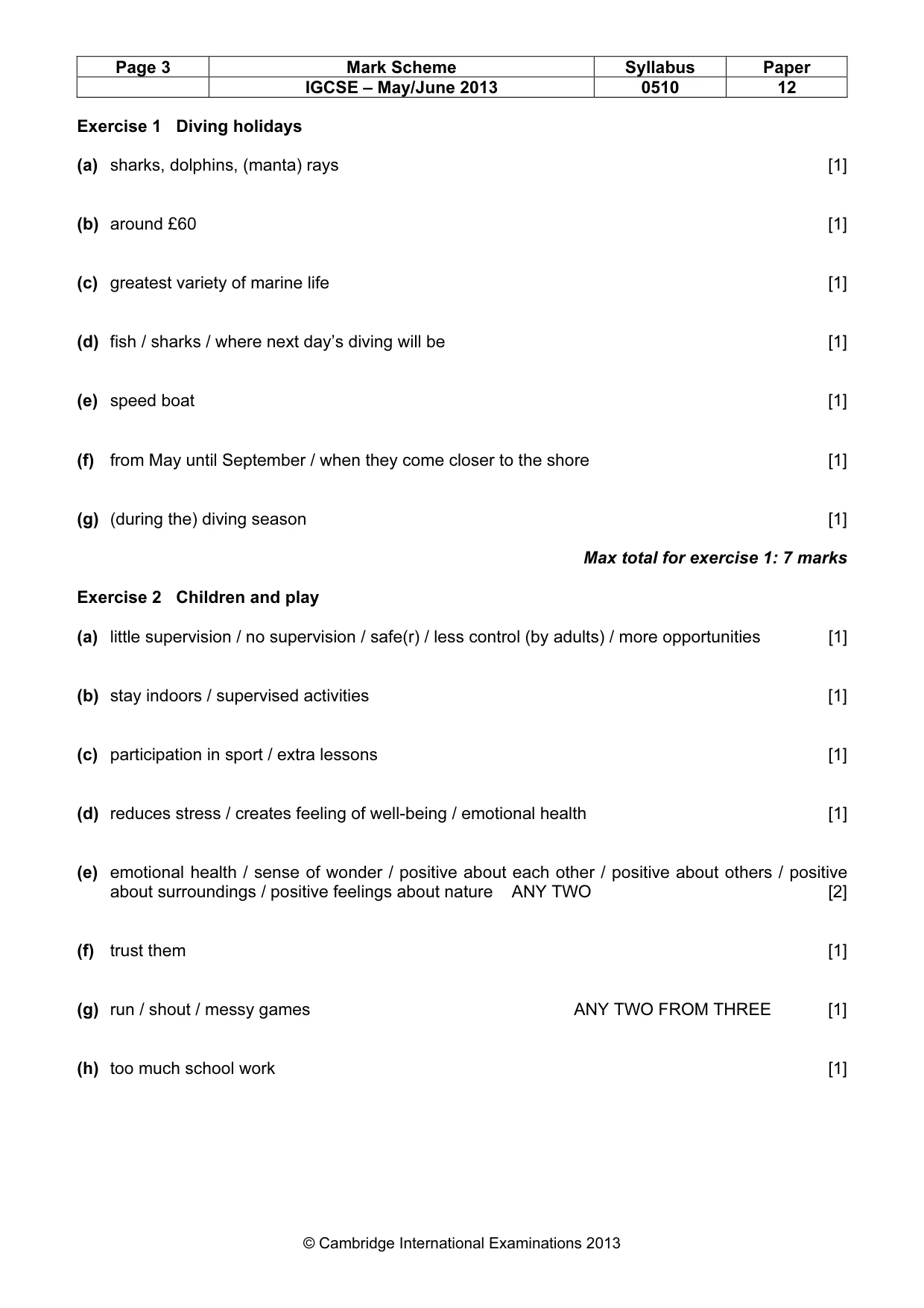
Page 2 Mark Scheme Syllabus Paper IGCSE – May/June 2013 0510 12 © Cambridge International Examinations 2013 This component forms part of the Core tier assessment of IGCSE English as a Second Language and tests the following Assessment Objectives: AO1: Reading R1 understand and respond to information presented in a variety of forms R2 select and organise material relevant to specific purposes R3 recognise, understand and distinguish between facts, ideas and opinions AO2: Writing W1 communicate clearly, accurately and appropriately W2 convey information and express opinions effectively W3 employ and control a variety of grammatical structures W4 demonstrate knowledge and understanding of a range of appropriate vocabulary W5 observe conventions of paragraphing, punctuation and spelling W6 employ appropriate register/style Overview of exercises on Paper 1 Reading objectives tested Marks for reading objectives Writing objectives tested Marks for writing objectives Total available marks Exercise 1 Reading (1) R1 7 --- 7 Exercise 2 Reading (2) R1 11 --- 11 Exercise 3 Information transfer R1, R2 10 W1, W5 4 14 Exercise 4 Note- making R1, R2, R3 7 --- 7 Exercise 5 Summary --- W1, W2, W3, W4, W5 5 5 Exercise 6 Writing (1) --- W1, W2, W3, W4, W5, W6 13 13 Exercise 7 Writing (2) --- W1, W2, W3, W4, W5, W6 13 13 70
Mark scheme, page 3
Page 3 Mark Scheme Syllabus Paper IGCSE – May/June 2013 0510 12 © Cambridge International Examinations 2013 Exercise 1 Diving holidays (a) sharks, dolphins, (manta) rays [1] (b) around £60 [1] (c) greatest variety of marine life [1] (d) fish / sharks / where next day’s diving will be [1] (e) speed boat [1] (f) from May until September / when they come closer to the shore [1] (g) (during the) diving season [1] Max total for exercise 1: 7 marks Exercise 2 Children and play (a) little supervision / no supervision / safe(r) / less control (by adults) / more opportunities [1] (b) stay indoors / supervised activities [1] (c) participation in sport / extra lessons [1] (d) reduces stress / creates feeling of well-being / emotional health [1] (e) emotional health / sense of wonder / positive about each other / positive about others / positive about surroundings / positive feelings about nature ANY TWO [2] (f) trust them [1] (g) run / shout / messy games ANY TWO FROM THREE [1] (h) too much school work [1]
Mark scheme, page 4
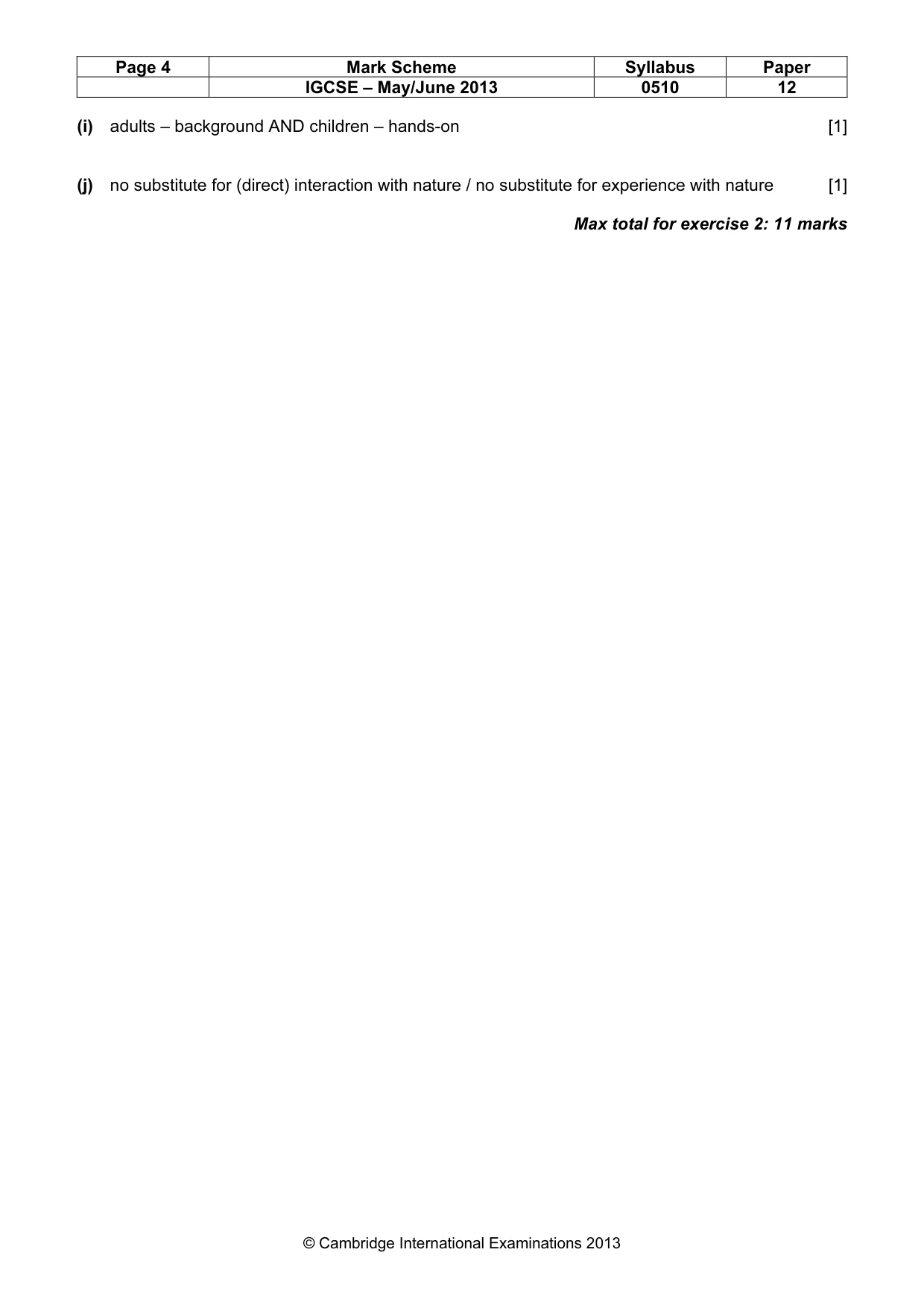
Page 4 Mark Scheme Syllabus Paper IGCSE – May/June 2013 0510 12 © Cambridge International Examinations 2013 (i) adults – background AND children – hands-on [1] (j) no substitute for (direct) interaction with nature / no substitute for experience with nature [1] Max total for exercise 2: 11 marks
Mark scheme, page 5
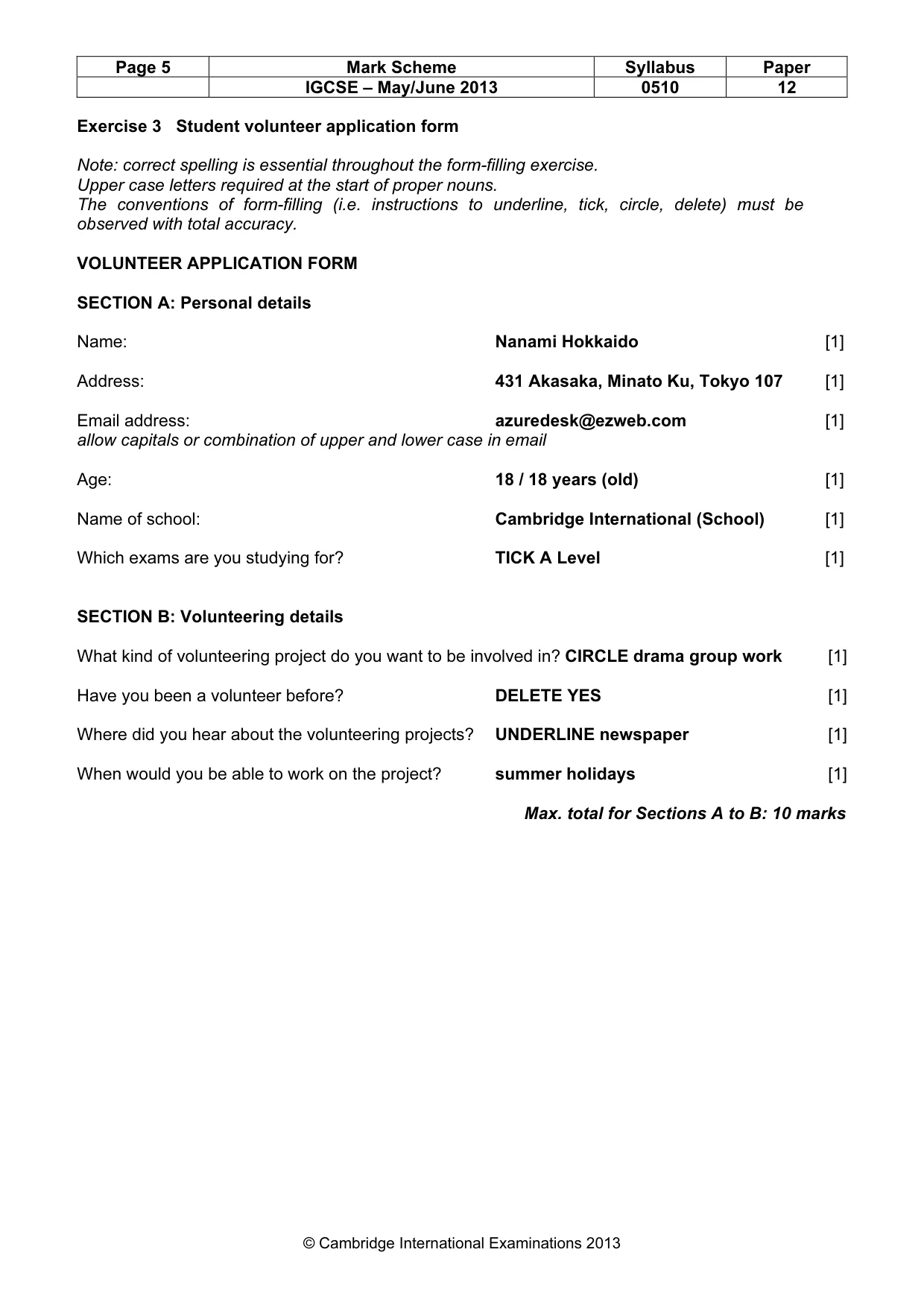
Page 5 Mark Scheme Syllabus Paper IGCSE – May/June 2013 0510 12 © Cambridge International Examinations 2013 Exercise 3 Student volunteer application form Note: correct spelling is essential throughout the form-filling exercise. Upper case letters required at the start of proper nouns. The conventions of form-filling (i.e. instructions to underline, tick, circle, delete) must be observed with total accuracy. VOLUNTEER APPLICATION FORM SECTION A: Personal details Name: Nanami Hokkaido [1] Address: 431 Akasaka, Minato Ku, Tokyo 107 [1] Email address: azuredesk@ezweb.com [1] allow capitals or combination of upper and lower case in email Age: 18 / 18 years (old) [1] Name of school: Cambridge International (School) [1] Which exams are you studying for? TICK A Level [1] SECTION B: Volunteering details What kind of volunteering project do you want to be involved in? CIRCLE drama group work [1] Have you been a volunteer before? DELETE YES [1] Where did you hear about the volunteering projects? UNDERLINE newspaper [1] When would you be able to work on the project? summer holidays [1] Max. total for Sections A to B: 10 marks
Mark scheme, page 6
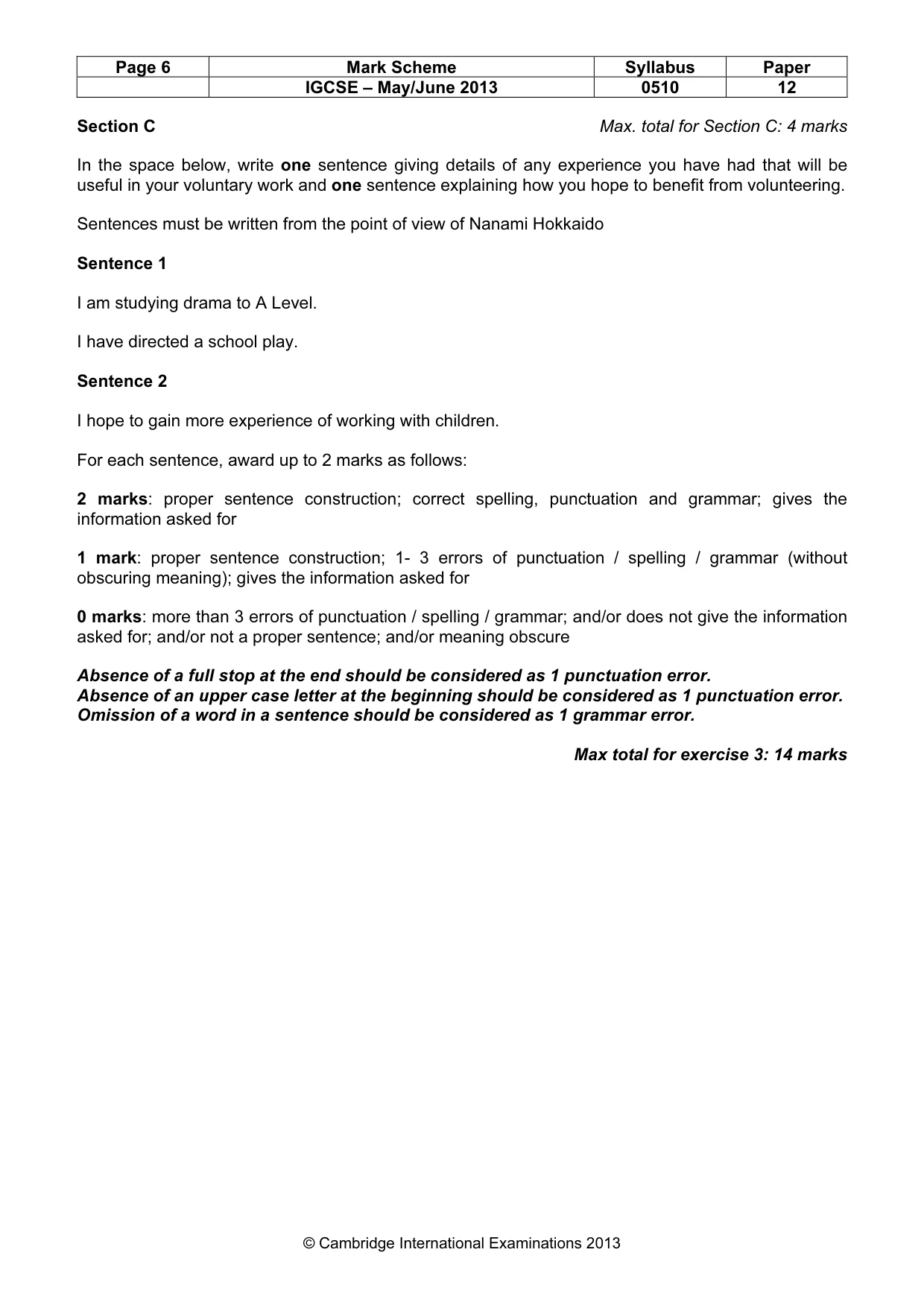
Page 6 Mark Scheme Syllabus Paper IGCSE – May/June 2013 0510 12 © Cambridge International Examinations 2013 Section C Max. total for Section C: 4 marks In the space below, write one sentence giving details of any experience you have had that will be useful in your voluntary work and one sentence explaining how you hope to benefit from volunteering. Sentences must be written from the point of view of Nanami Hokkaido Sentence 1 I am studying drama to A Level. I have directed a school play. Sentence 2 I hope to gain more experience of working with children. For each sentence, award up to 2 marks as follows: 2 marks: proper sentence construction; correct spelling, punctuation and grammar; gives the information asked for 1 mark: proper sentence construction; 1- 3 errors of punctuation / spelling / grammar (without obscuring meaning); gives the information asked for 0 marks: more than 3 errors of punctuation / spelling / grammar; and/or does not give the information asked for; and/or not a proper sentence; and/or meaning obscure Absence of a full stop at the end should be considered as 1 punctuation error. Absence of an upper case letter at the beginning should be considered as 1 punctuation error. Omission of a word in a sentence should be considered as 1 grammar error. Max total for exercise 3: 14 marks
Mark scheme, page 7
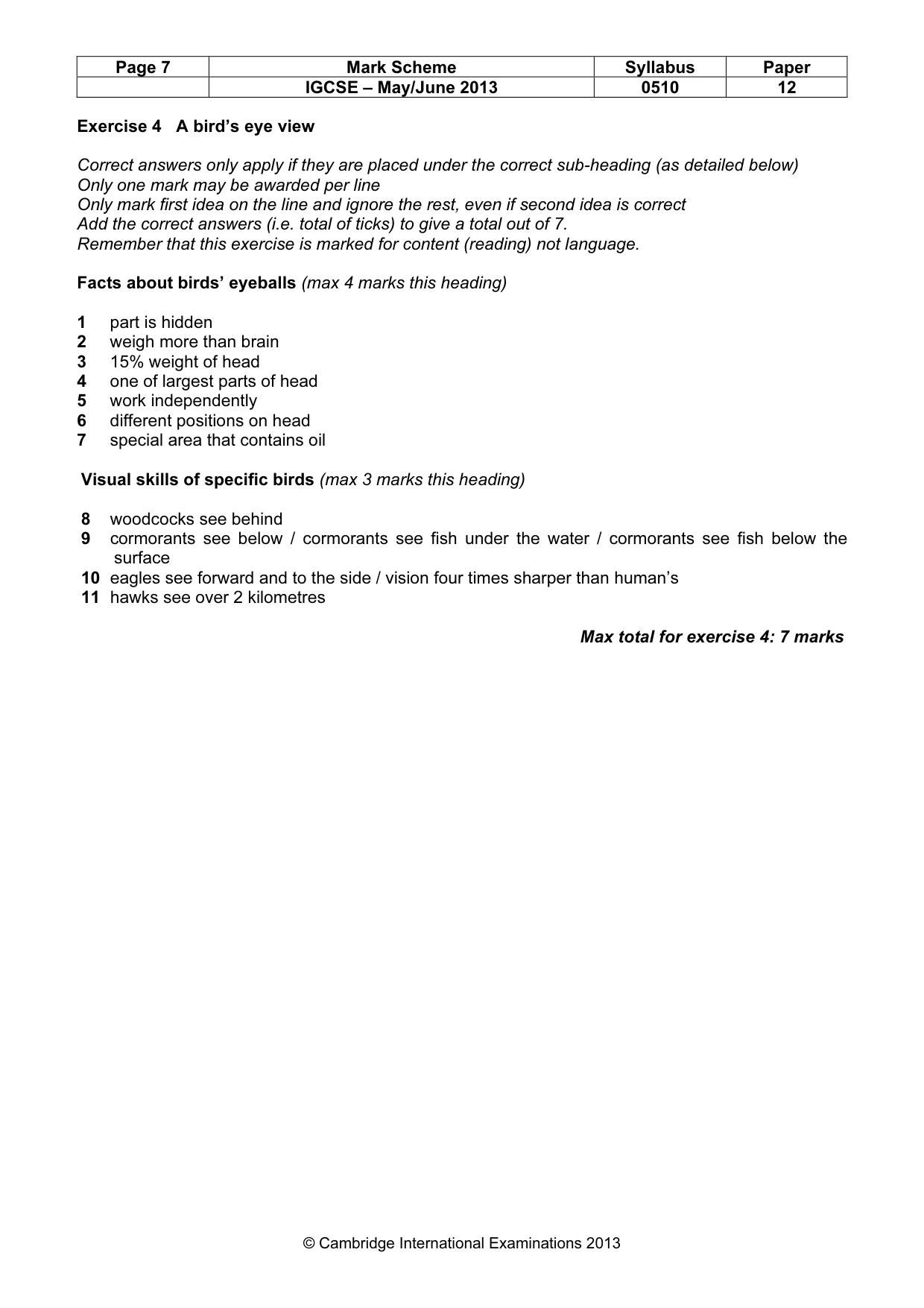
Page 7 Mark Scheme Syllabus Paper IGCSE – May/June 2013 0510 12 © Cambridge International Examinations 2013 Exercise 4 A bird’s eye view Correct answers only apply if they are placed under the correct sub-heading (as detailed below) Only one mark may be awarded per line Only mark first idea on the line and ignore the rest, even if second idea is correct Add the correct answers (i.e. total of ticks) to give a total out of 7. Remember that this exercise is marked for content (reading) not language. Facts about birds’ eyeballs (max 4 marks this heading) 1 part is hidden 2 weigh more than brain 3 15% weight of head 4 one of largest parts of head 5 work independently 6 different positions on head 7 special area that contains oil Visual skills of specific birds (max 3 marks this heading) 8 woodcocks see behind 9 cormorants see below / cormorants see fish under the water / cormorants see fish below the surface 10 eagles see forward and to the side / vision four times sharper than human’s 11 hawks see over 2 kilometres Max total for exercise 4: 7 marks
Mark scheme, page 8
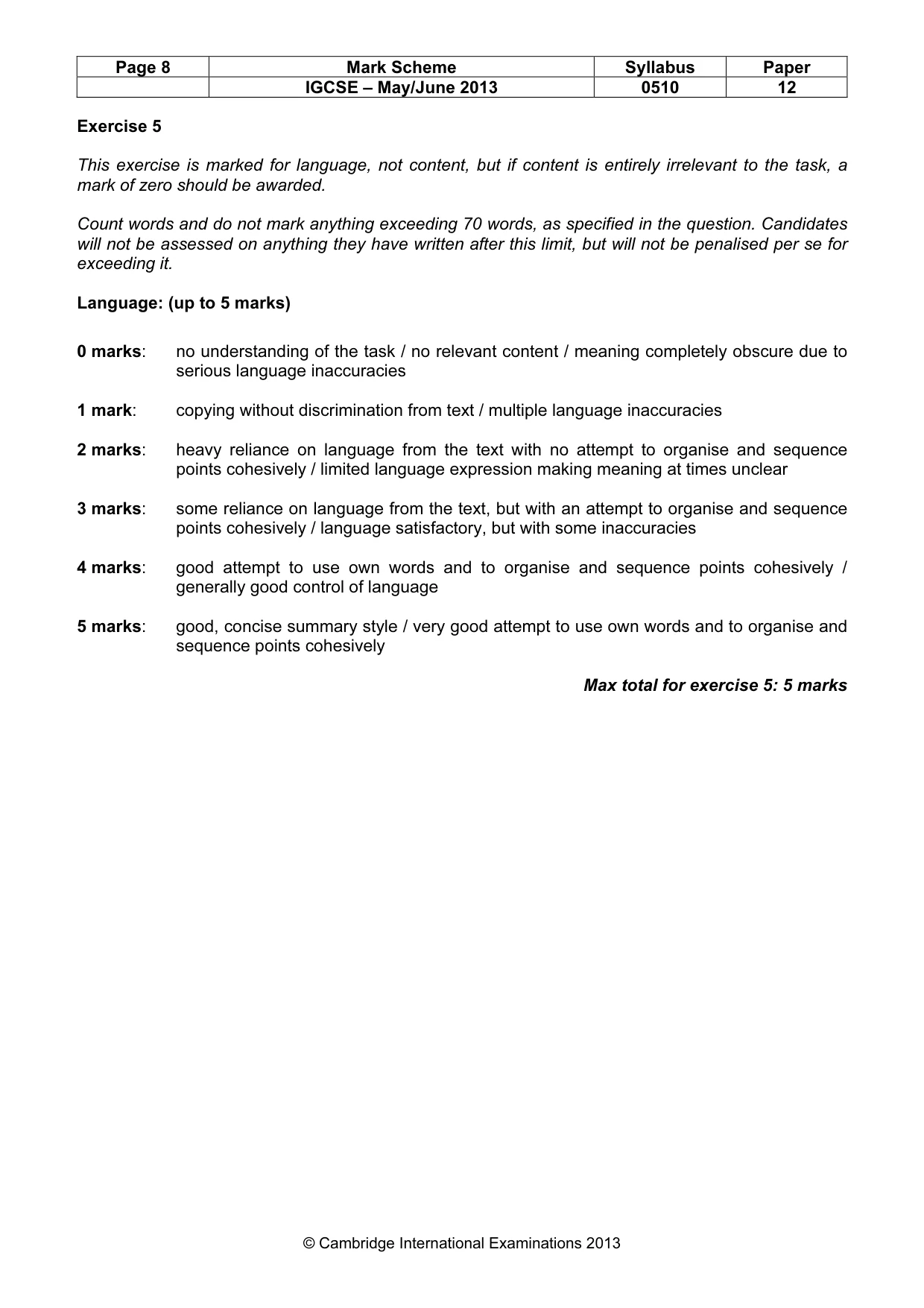
Page 8 Mark Scheme Syllabus Paper IGCSE – May/June 2013 0510 12 © Cambridge International Examinations 2013 Exercise 5 This exercise is marked for language, not content, but if content is entirely irrelevant to the task, a mark of zero should be awarded. Count words and do not mark anything exceeding 70 words, as specified in the question. Candidates will not be assessed on anything they have written after this limit, but will not be penalised per se for exceeding it. Language: (up to 5 marks) 0 marks: no understanding of the task / no relevant content / meaning completely obscure due to serious language inaccuracies 1 mark: copying without discrimination from text / multiple language inaccuracies 2 marks: heavy reliance on language from the text with no attempt to organise and sequence points cohesively / limited language expression making meaning at times unclear 3 marks: some reliance on language from the text, but with an attempt to organise and sequence points cohesively / language satisfactory, but with some inaccuracies 4 marks: good attempt to use own words and to organise and sequence points cohesively / generally good control of language 5 marks: good, concise summary style / very good attempt to use own words and to organise and sequence points cohesively Max total for exercise 5: 5 marks
Mark scheme, page 9
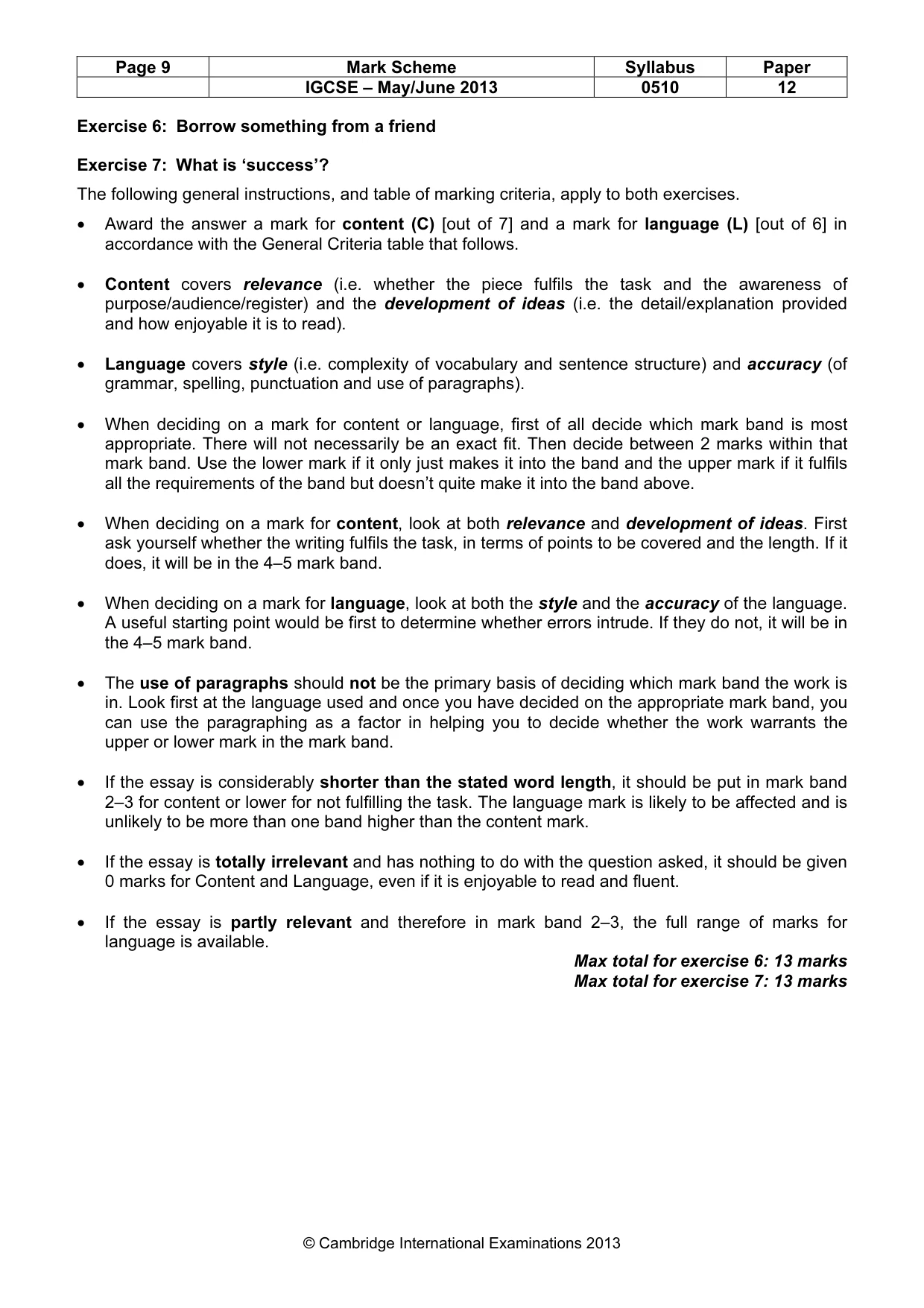
Page 9 Mark Scheme Syllabus Paper IGCSE – May/June 2013 0510 12 © Cambridge International Examinations 2013 Exercise 6: Borrow something from a friend Exercise 7: What is ‘success’? The following general instructions, and table of marking criteria, apply to both exercises. • Award the answer a mark for content (C) [out of 7] and a mark for language (L) [out of 6] in accordance with the General Criteria table that follows. • Content covers relevance (i.e. whether the piece fulfils the task and the awareness of purpose/audience/register) and the development of ideas (i.e. the detail/explanation provided and how enjoyable it is to read). • Language covers style (i.e. complexity of vocabulary and sentence structure) and accuracy (of grammar, spelling, punctuation and use of paragraphs). • When deciding on a mark for content or language, first of all decide which mark band is most appropriate. There will not necessarily be an exact fit. Then decide between 2 marks within that mark band. Use the lower mark if it only just makes it into the band and the upper mark if it fulfils all the requirements of the band but doesn’t quite make it into the band above. • When deciding on a mark for content, look at both relevance and development of ideas. First ask yourself whether the writing fulfils the task, in terms of points to be covered and the length. If it does, it will be in the 4–5 mark band. • When deciding on a mark for language, look at both the style and the accuracy of the language. A useful starting point would be first to determine whether errors intrude. If they do not, it will be in the 4–5 mark band. • The use of paragraphs should not be the primary basis of deciding which mark band the work is in. Look first at the language used and once you have decided on the appropriate mark band, you can use the paragraphing as a factor in helping you to decide whether the work warrants the upper or lower mark in the mark band. • If the essay is considerably shorter than the stated word length, it should be put in mark band 2–3 for content or lower for not fulfilling the task. The language mark is likely to be affected and is unlikely to be more than one band higher than the content mark. • If the essay is totally irrelevant and has nothing to do with the question asked, it should be given 0 marks for Content and Language, even if it is enjoyable to read and fluent. • If the essay is partly relevant and therefore in mark band 2–3, the full range of marks for language is available. Max total for exercise 6: 13 marks Max total for exercise 7: 13 marks
Mark scheme, page 10
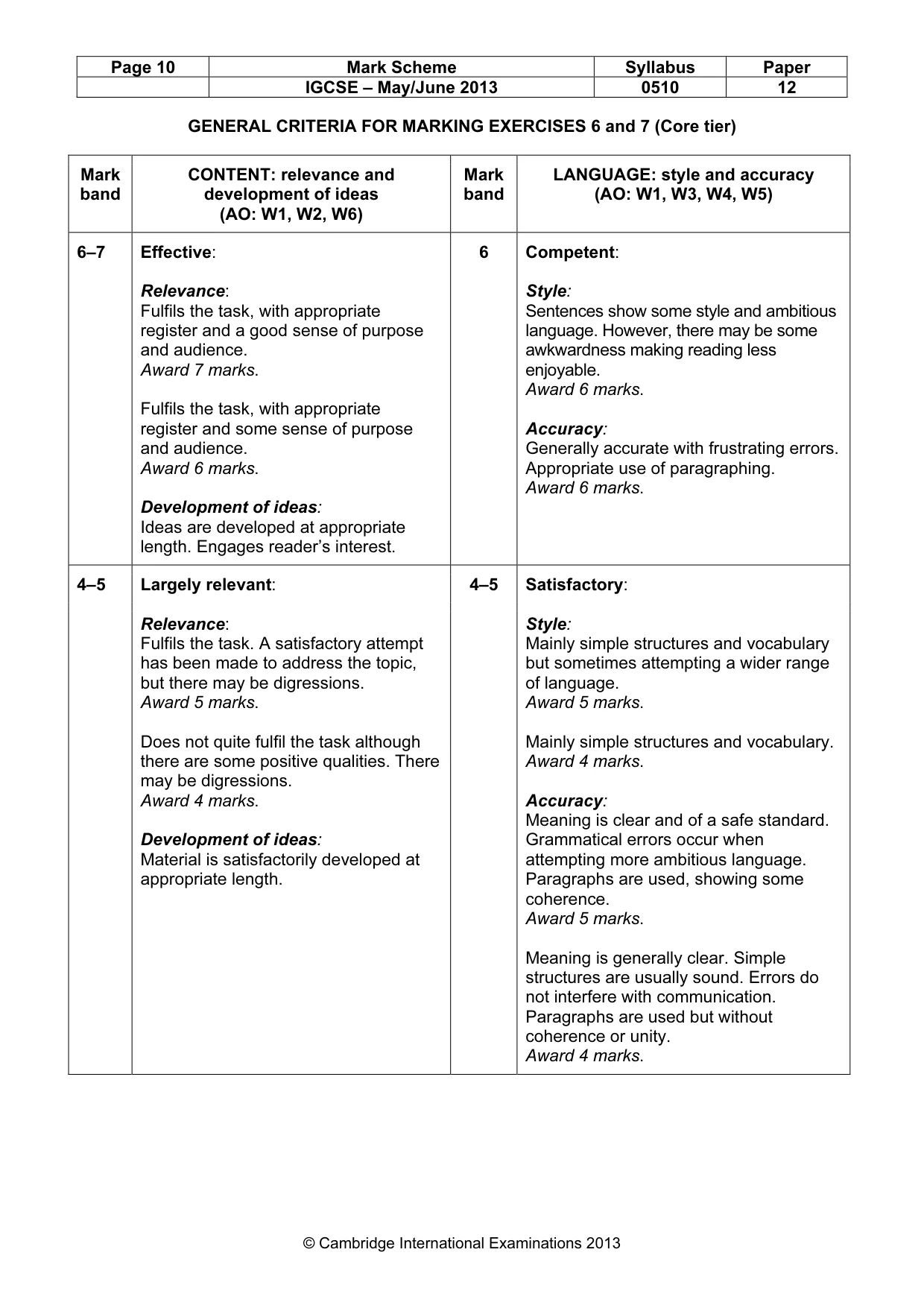
Page 10 Mark Scheme Syllabus Paper IGCSE – May/June 2013 0510 12 © Cambridge International Examinations 2013 GENERAL CRITERIA FOR MARKING EXERCISES 6 and 7 (Core tier) Mark band CONTENT: relevance and development of ideas (AO: W1, W2, W6) Mark band LANGUAGE: style and accuracy (AO: W1, W3, W4, W5) 6–7 Effective: Relevance: Fulfils the task, with appropriate register and a good sense of purpose and audience. Award 7 marks. Fulfils the task, with appropriate register and some sense of purpose and audience. Award 6 marks. Development of ideas: Ideas are developed at appropriate length. Engages reader’s interest. 6 Competent: Style: Sentences show some style and ambitious language. However, there may be some awkwardness making reading less enjoyable. Award 6 marks. Accuracy: Generally accurate with frustrating errors. Appropriate use of paragraphing. Award 6 marks. 4–5 Largely relevant: Relevance: Fulfils the task. A satisfactory attempt has been made to address the topic, but there may be digressions. Award 5 marks. Does not quite fulfil the task although there are some positive qualities. There may be digressions. Award 4 marks. Development of ideas: Material is satisfactorily developed at appropriate length. 4–5 Satisfactory: Style: Mainly simple structures and vocabulary but sometimes attempting a wider range of language. Award 5 marks. Mainly simple structures and vocabulary. Award 4 marks. Accuracy: Meaning is clear and of a safe standard. Grammatical errors occur when attempting more ambitious language. Paragraphs are used, showing some coherence. Award 5 marks. Meaning is generally clear. Simple structures are usually sound. Errors do not interfere with communication. Paragraphs are used but without coherence or unity. Award 4 marks.
Mark scheme, page 11
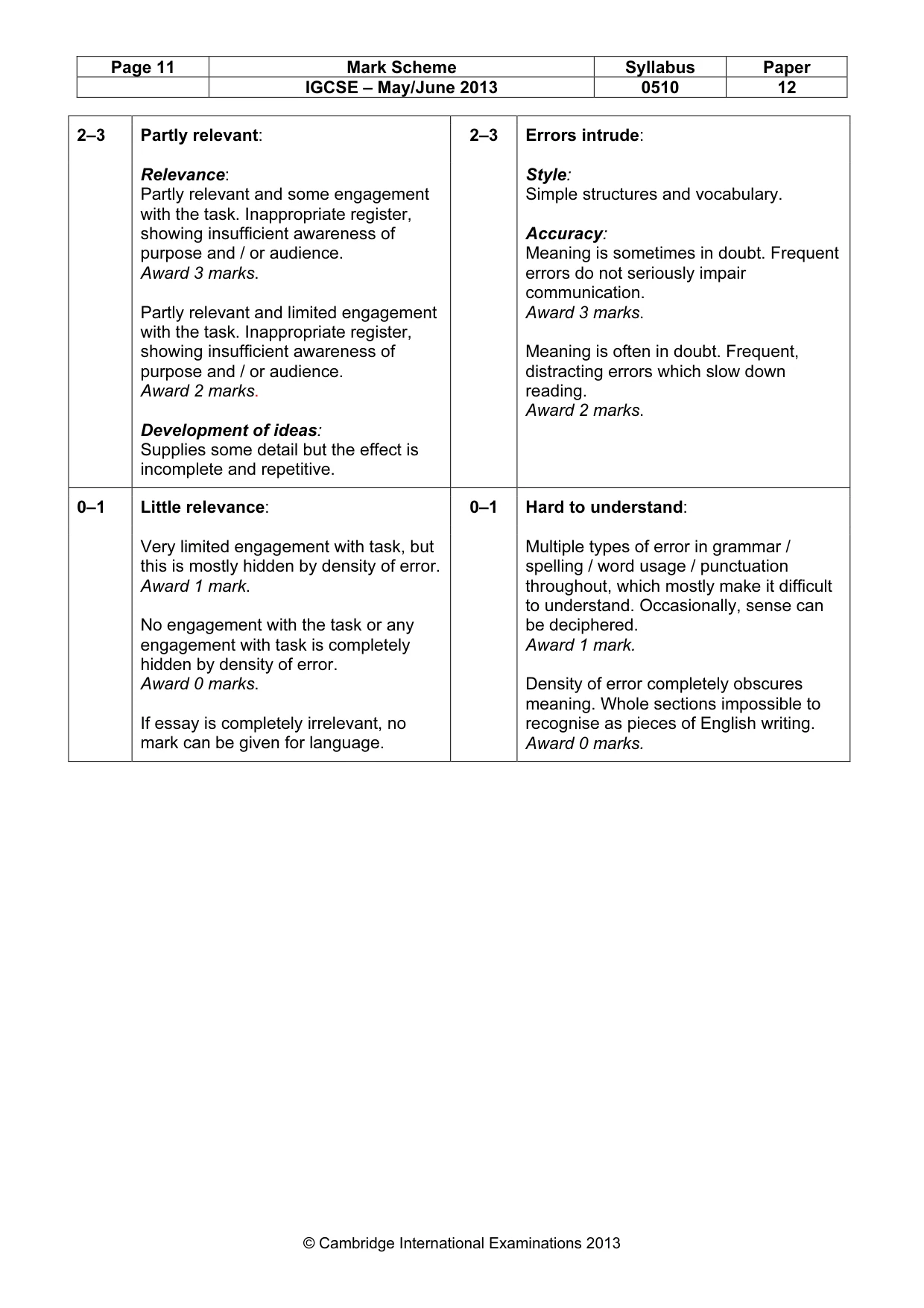
Page 11 Mark Scheme Syllabus Paper IGCSE – May/June 2013 0510 12 © Cambridge International Examinations 2013 2–3 Partly relevant: Relevance: Partly relevant and some engagement with the task. Inappropriate register, showing insufficient awareness of purpose and / or audience. Award 3 marks. Partly relevant and limited engagement with the task. Inappropriate register, showing insufficient awareness of purpose and / or audience. Award 2 marks. Development of ideas: Supplies some detail but the effect is incomplete and repetitive. 2–3 Errors intrude: Style: Simple structures and vocabulary. Accuracy: Meaning is sometimes in doubt. Frequent errors do not seriously impair communication. Award 3 marks. Meaning is often in doubt. Frequent, distracting errors which slow down reading. Award 2 marks. 0–1 Little relevance: Very limited engagement with task, but this is mostly hidden by density of error. Award 1 mark. No engagement with the task or any engagement with task is completely hidden by density of error. Award 0 marks. If essay is completely irrelevant, no mark can be given for language. 0–1 Hard to understand: Multiple types of error in grammar / spelling / word usage / punctuation throughout, which mostly make it difficult to understand. Occasionally, sense can be deciphered. Award 1 mark. Density of error completely obscures meaning. Whole sections impossible to recognise as pieces of English writing. Award 0 marks.