Cambridge IGCSE English - Second Language (oral endorsement) 0510 — 2012 May/June Paper 4 · Variant 1
0510/41/M/J/12 · 36 marks · ≈41 min
The question paper and its mark scheme, free to read here and free to download. This is Cambridge’s own paper, exactly as it was sat.
Question paper8 pages


Mark scheme14 pages
Answers below. Sit the paper first if you are practising.
Paper as text
Question paper, page 1
This document consists of 6 printed pages and 2 blank pages. IB12 06_0510_41/2RP © UCLES 2012 [Turn over *9227631267* For Examiner's Use Questions 1-6 Question 7 Question 8 Question 9 Question 10 Total UNIVERSITY OF CAMBRIDGE INTERNATIONAL EXAMINATIONS International General Certificate of Secondary Education ENGLISH AS A SECOND LANGUAGE 0510/41 Paper 4 Listening (Extended) May/June 2012 Approx. 45 minutes Candidates answer on the Question Paper. Additional Materials: As listed in Instructions to Supervisors. READ THESE INSTRUCTIONS FIRST Write your Centre number, candidate number and name on all the work you hand in. Write in dark blue or black pen. Do not use staples, paper clips, highlighters, glue or correction fluid. DO NOT WRITE IN ANY BARCODES. Answer all questions. Dictionaries are not permitted. The number of marks is given in brackets [ ] at the end of each question or part question. www.XtremePapers.com
Question paper, page 2
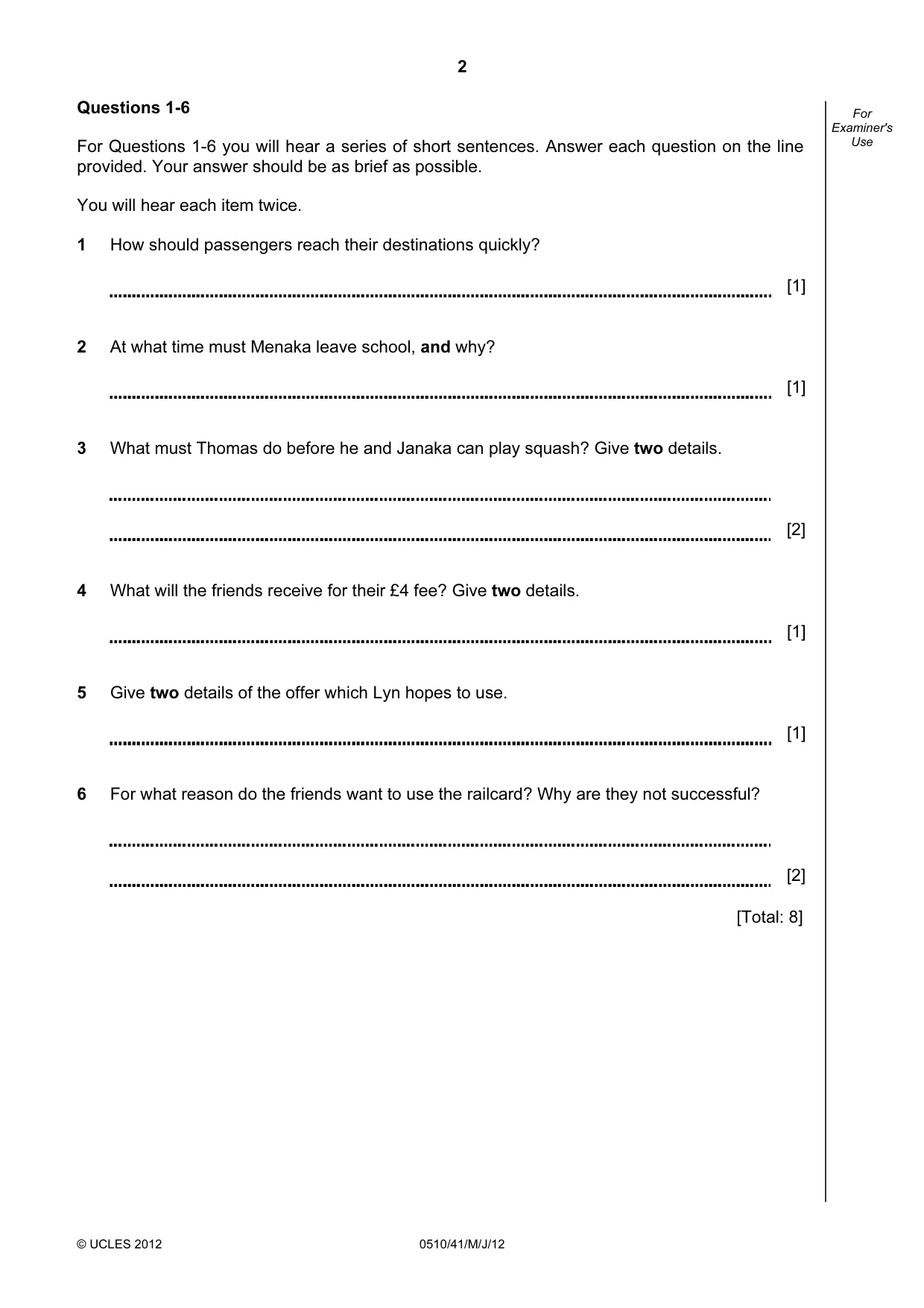
2 © UCLES 2012 0510/41/M/J/12 For Examiner's Use Questions 1-6 For Questions 1-6 you will hear a series of short sentences. Answer each question on the line provided. Your answer should be as brief as possible. You will hear each item twice. 1 How should passengers reach their destinations quickly? [1] 2 At what time must Menaka leave school, and why? [1] 3 What must Thomas do before he and Janaka can play squash? Give two details. [2] 4 What will the friends receive for their £4 fee? Give two details. [1] 5 Give two details of the offer which Lyn hopes to use. [1] 6 For what reason do the friends want to use the railcard? Why are they not successful? [2] [Total: 8]
Question paper, page 3
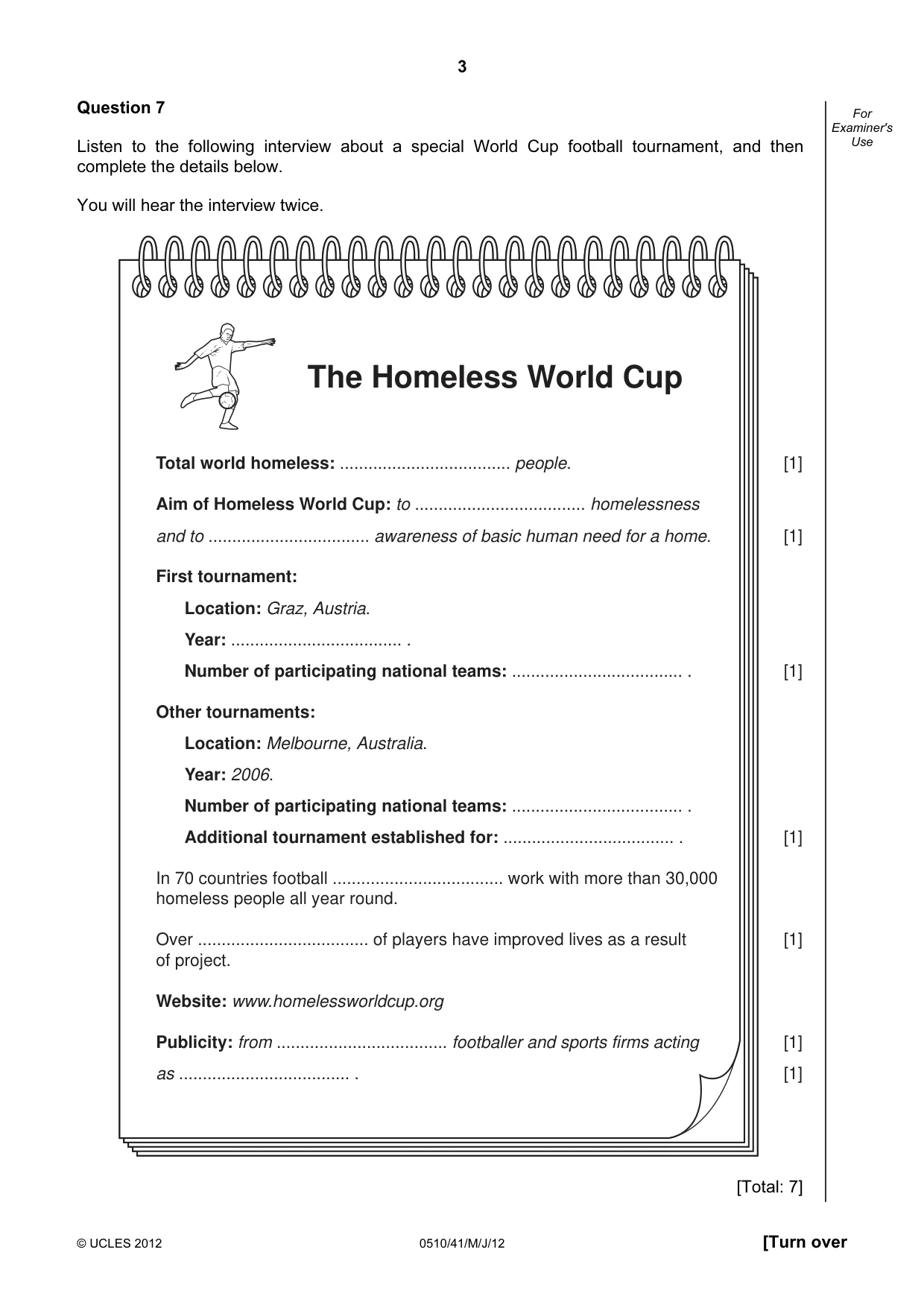
3 © UCLES 2012 0510/41/M/J/12 [Turn over For Examiner's Use Question 7 Listen to the following interview about a special World Cup football tournament, and then complete the details below. You will hear the interview twice. The Homeless World Cup Total world homeless: … people. [1] Aim of Homeless World Cup: to … homelessness and to … awareness of basic human need for a home. [1] First tournament: Location: Graz, Austria. Year: … . Number of participating national teams: … . [1] Other tournaments: Location: Melbourne, Australia. Year: 2006. Number of participating national teams: … . Additional tournament established for: … . [1] In 70 countries football … work with more than 30,000 homeless people all year round. Over … of players have improved lives as a result [1] of project. Website: www.homelessworldcup.org Publicity: from … footballer and sports firms acting [1] as … . [1] [Total: 7]
Question paper, page 4
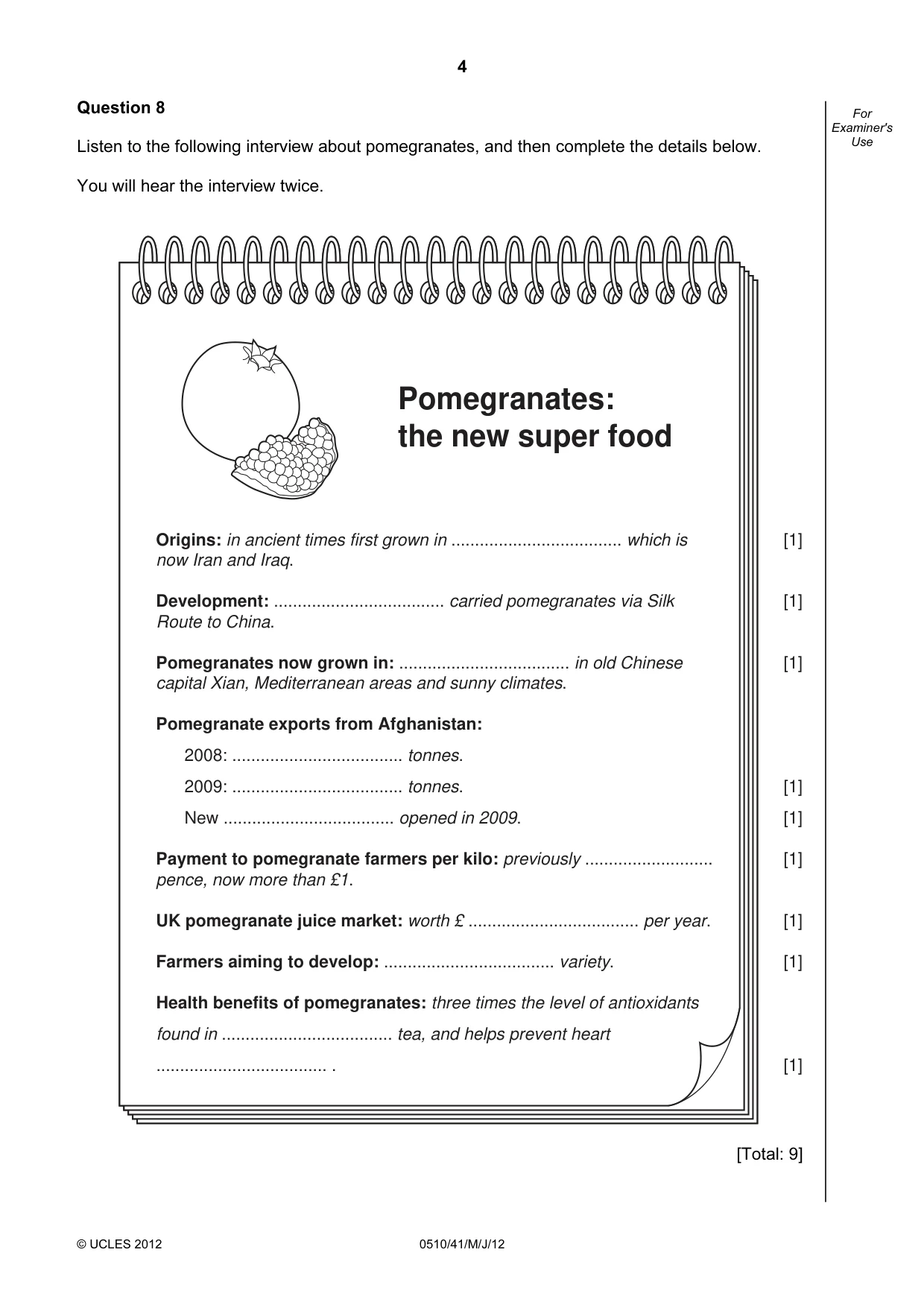
4 © UCLES 2012 0510/41/M/J/12 For Examiner's Use Question 8 Listen to the following interview about pomegranates, and then complete the details below. You will hear the interview twice. Pomegranates: the new super food Origins: in ancient times first grown in … which is [1] now Iran and Iraq. Development: … carried pomegranates via Silk [1] Route to China. Pomegranates now grown in: … in old Chinese [1] capital Xian, Mediterranean areas and sunny climates. Pomegranate exports from Afghanistan: 2008: … tonnes. 2009: … tonnes. [1] New … opened in 2009. [1] Payment to pomegranate farmers per kilo: previously … [1] pence, now more than £1. UK pomegranate juice market: worth £ … per year. [1] Farmers aiming to develop: … variety. [1] Health benefits of pomegranates: three times the level of antioxidants found in … tea, and helps prevent heart … . [1] [Total: 9]
Question paper, page 5
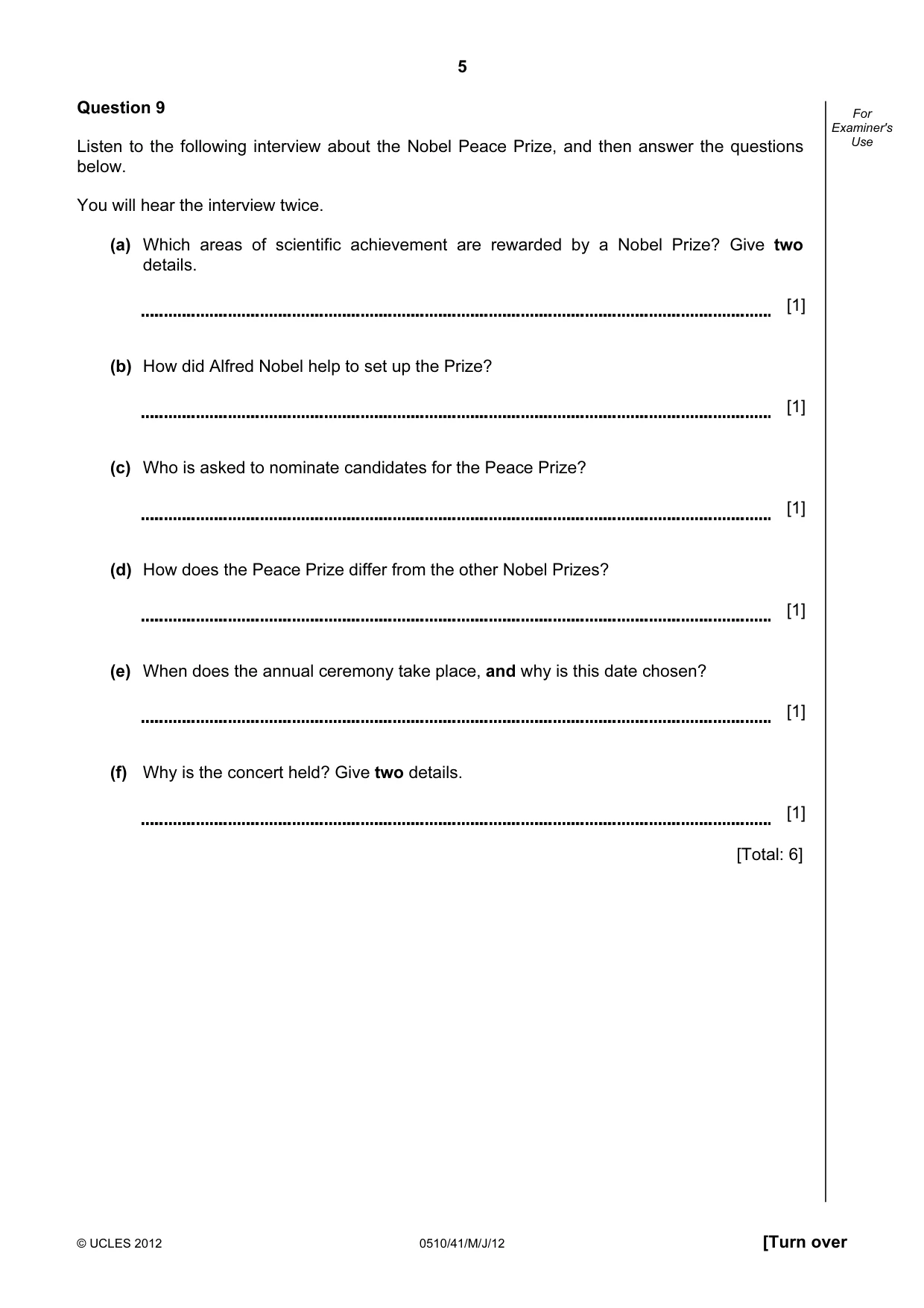
5 © UCLES 2012 0510/41/M/J/12 [Turn over For Examiner's Use Question 9 Listen to the following interview about the Nobel Peace Prize, and then answer the questions below. You will hear the interview twice. (a) Which areas of scientific achievement are rewarded by a Nobel Prize? Give two details. [1] (b) How did Alfred Nobel help to set up the Prize? [1] (c) Who is asked to nominate candidates for the Peace Prize? [1] (d) How does the Peace Prize differ from the other Nobel Prizes? [1] (e) When does the annual ceremony take place, and why is this date chosen? [1] (f) Why is the concert held? Give two details. [1] [Total: 6]
Question paper, page 6
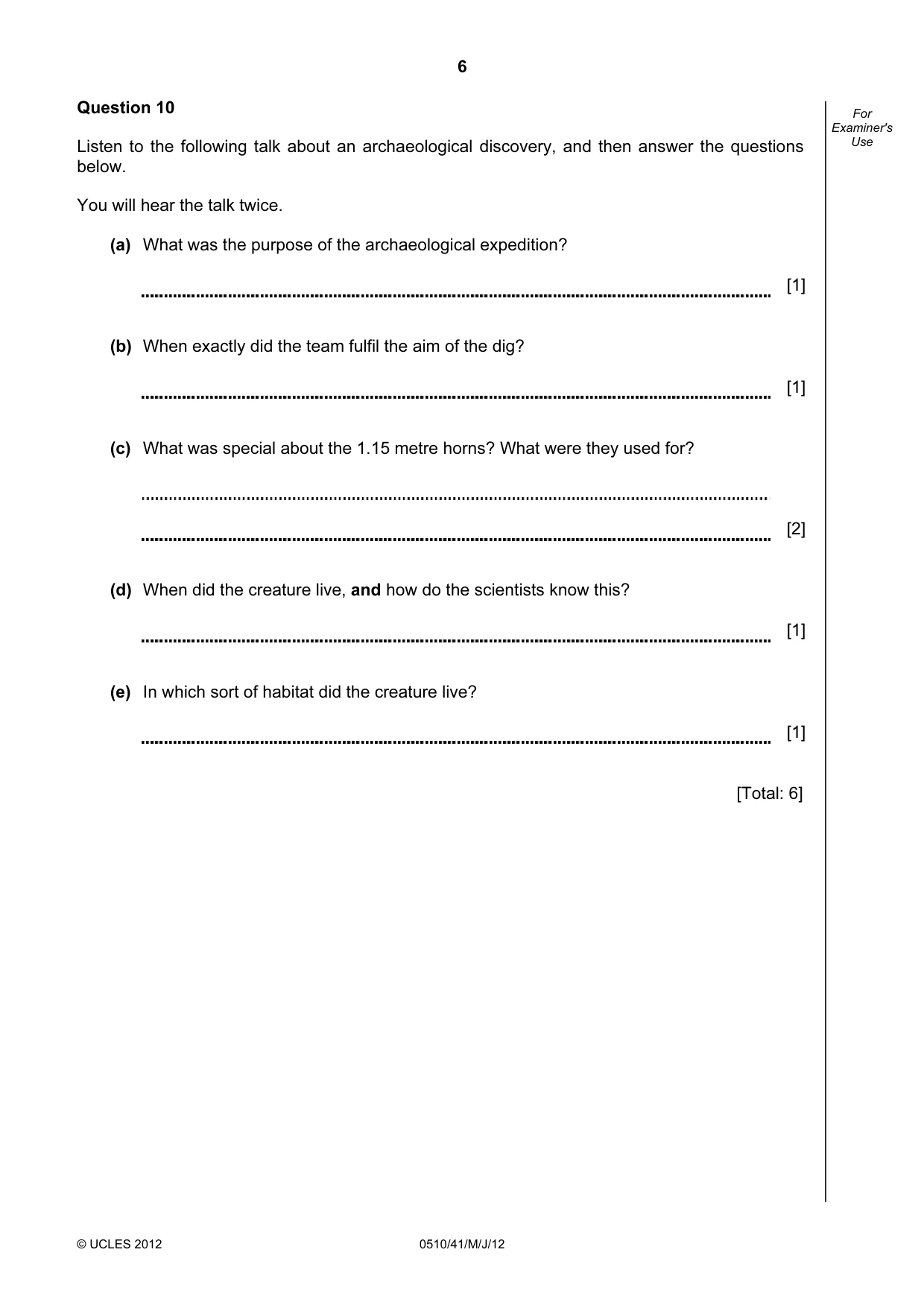
6 © UCLES 2012 0510/41/M/J/12 For Examiner's Use Question 10 Listen to the following talk about an archaeological discovery, and then answer the questions below. You will hear the talk twice. (a) What was the purpose of the archaeological expedition? [1] (b) When exactly did the team fulfil the aim of the dig? [1] (c) What was special about the 1.15 metre horns? What were they used for? [2] (d) When did the creature live, and how do the scientists know this? [1] (e) In which sort of habitat did the creature live? [1] [Total: 6]
Question paper, page 7
7 © UCLES 2012 0510/41/M/J/12 BLANK PAGE
Question paper, page 8
8 Permission to reproduce items where third-party owned material protected by copyright is included has been sought and cleared where possible. Every reasonable effort has been made by the publisher (UCLES) to trace copyright holders, but if any items requiring clearance have unwittingly been included, the publisher will be pleased to make amends at the earliest possible opportunity. University of Cambridge International Examinations is part of the Cambridge Assessment Group. Cambridge Assessment is the brand name of University of Cambridge Local Examinations Syndicate (UCLES), which is itself a department of the University of Cambridge. © UCLES 2012 0510/41/M/J/12 BLANK PAGE
Mark scheme, page 1
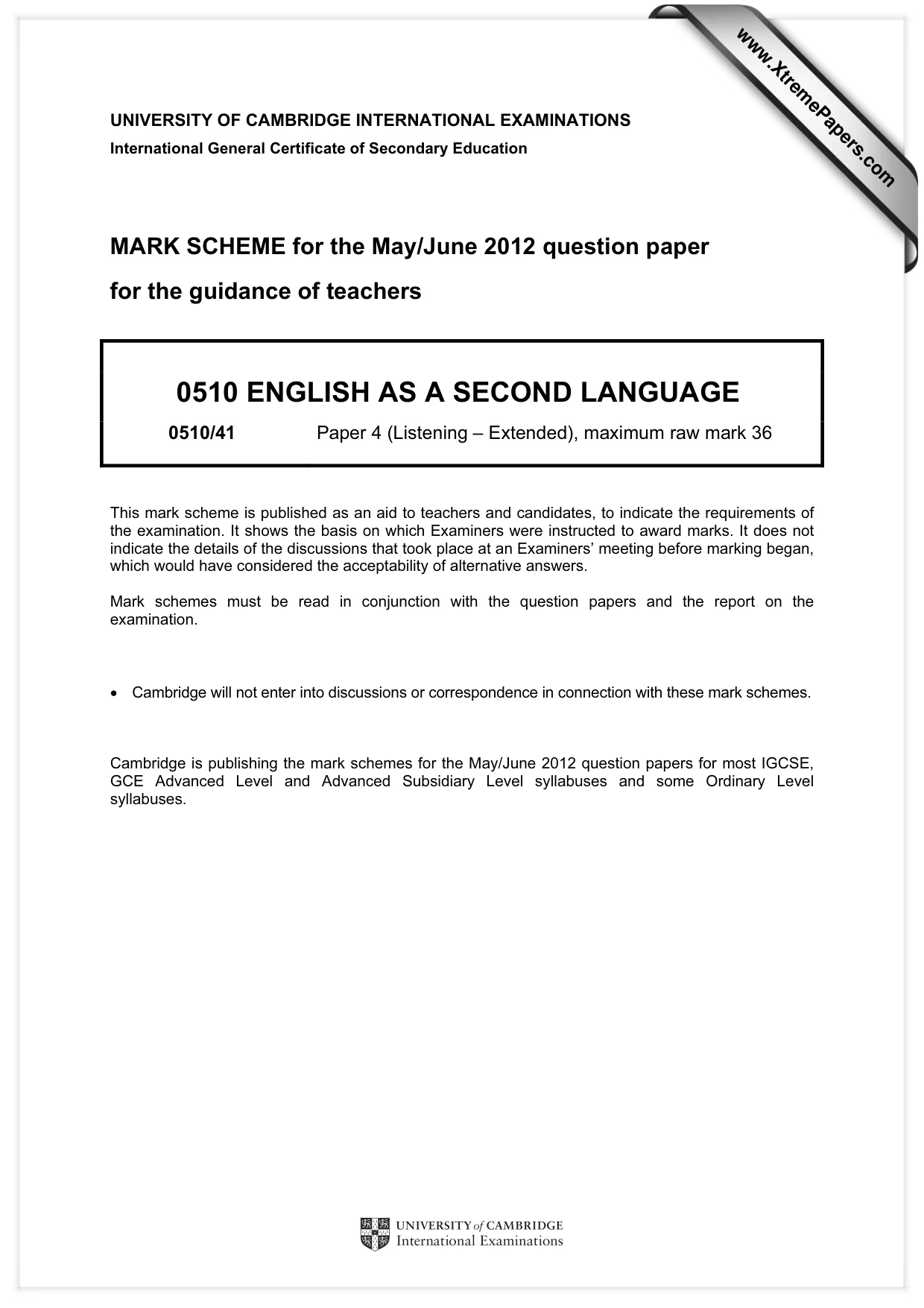
UNIVERSITY OF CAMBRIDGE INTERNATIONAL EXAMINATIONS International General Certificate of Secondary Education MARK SCHEME for the May/June 2012 question paper for the guidance of teachers 0510 ENGLISH AS A SECOND LANGUAGE 0510/41 Paper 4 (Listening – Extended), maximum raw mark 36 This mark scheme is published as an aid to teachers and candidates, to indicate the requirements of the examination. It shows the basis on which Examiners were instructed to award marks. It does not indicate the details of the discussions that took place at an Examiners’ meeting before marking began, which would have considered the acceptability of alternative answers. Mark schemes must be read in conjunction with the question papers and the report on the examination. • Cambridge will not enter into discussions or correspondence in connection with these mark schemes. Cambridge is publishing the mark schemes for the May/June 2012 question papers for most IGCSE, GCE Advanced Level and Advanced Subsidiary Level syllabuses and some Ordinary Level syllabuses. www.XtremePapers.com
Mark scheme, page 2
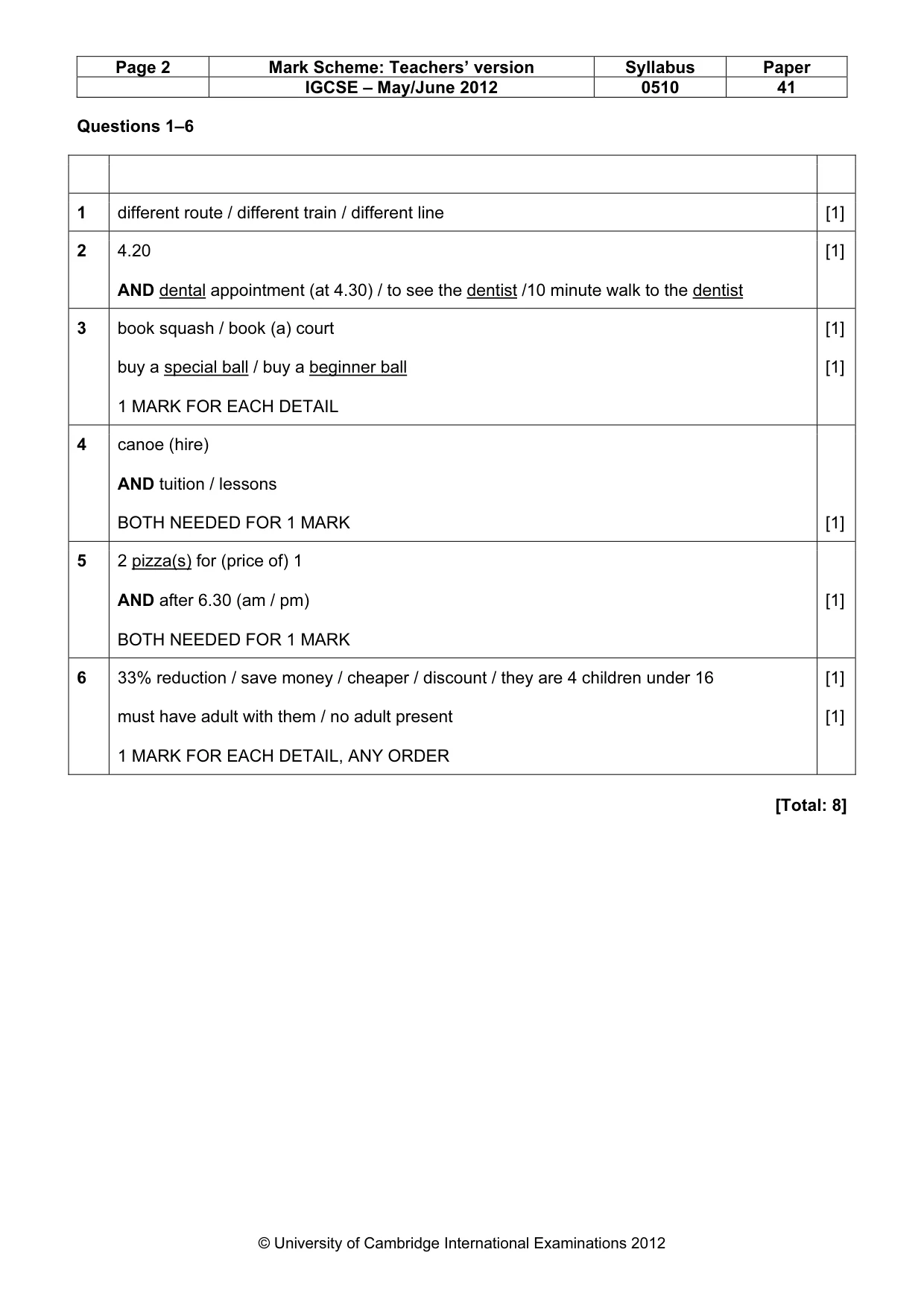
Page 2 Mark Scheme: Teachers’ version Syllabus Paper IGCSE – May/June 2012 0510 41 © University of Cambridge International Examinations 2012 Questions 1–6 1 different route / different train / different line [1] 2 4.20 AND dental appointment (at 4.30) / to see the dentist /10 minute walk to the dentist [1] 3 book squash / book (a) court buy a special ball / buy a beginner ball 1 MARK FOR EACH DETAIL [1] [1] 4 canoe (hire) AND tuition / lessons BOTH NEEDED FOR 1 MARK [1] 5 2 pizza(s) for (price of) 1 AND after 6.30 (am / pm) BOTH NEEDED FOR 1 MARK [1] 6 33% reduction / save money / cheaper / discount / they are 4 children under 16 must have adult with them / no adult present 1 MARK FOR EACH DETAIL, ANY ORDER [1] [1] [Total: 8]
Mark scheme, page 3
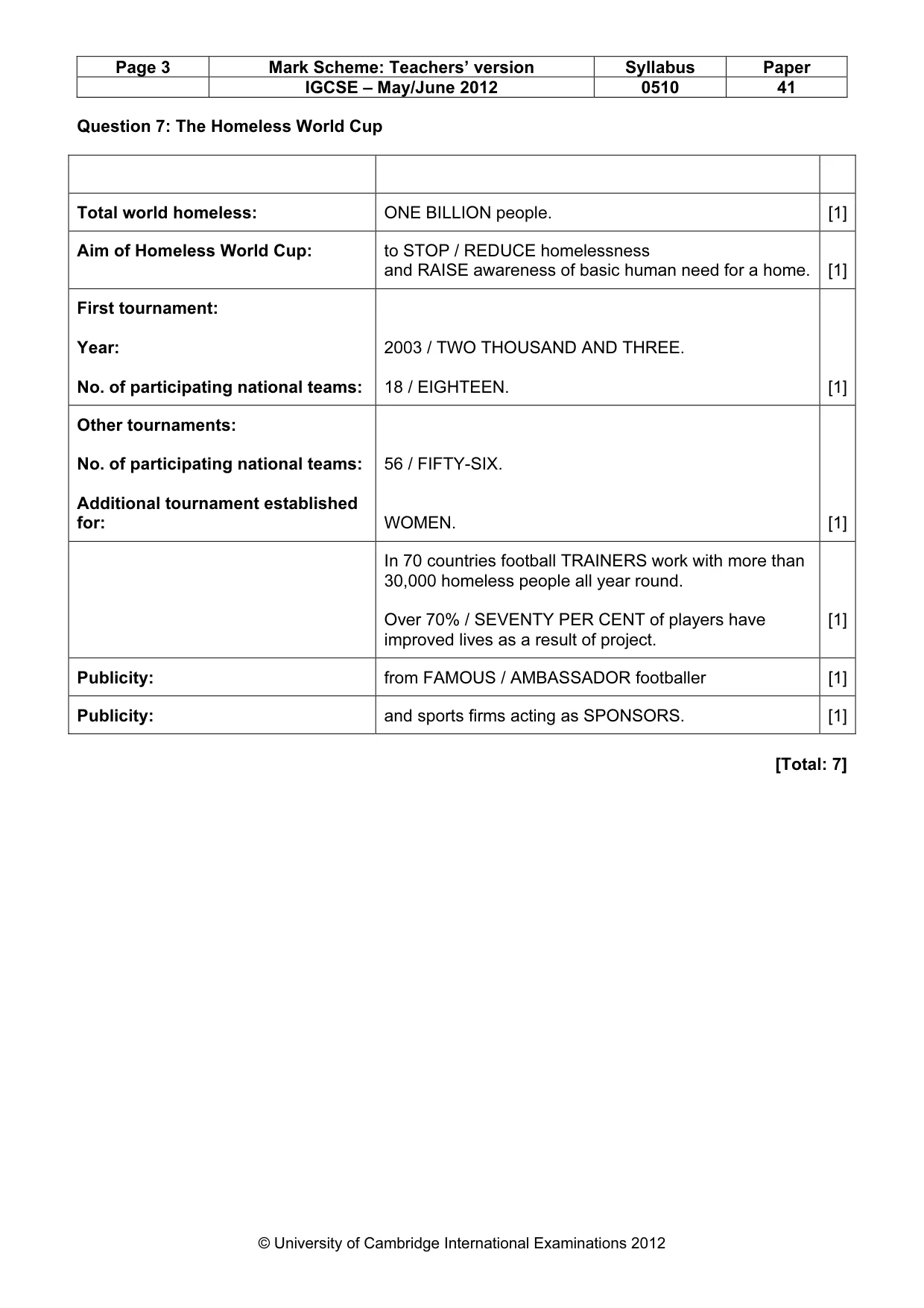
Page 3 Mark Scheme: Teachers’ version Syllabus Paper IGCSE – May/June 2012 0510 41 © University of Cambridge International Examinations 2012 Question 7: The Homeless World Cup Total world homeless: ONE BILLION people. [1] Aim of Homeless World Cup: to STOP / REDUCE homelessness and RAISE awareness of basic human need for a home. [1] First tournament: Year: No. of participating national teams: 2003 / TWO THOUSAND AND THREE. 18 / EIGHTEEN. [1] Other tournaments: No. of participating national teams: Additional tournament established for: 56 / FIFTY-SIX. WOMEN. [1] In 70 countries football TRAINERS work with more than 30,000 homeless people all year round. Over 70% / SEVENTY PER CENT of players have improved lives as a result of project. [1] Publicity: from FAMOUS / AMBASSADOR footballer [1] Publicity: and sports firms acting as SPONSORS. [1] [Total: 7]
Mark scheme, page 4
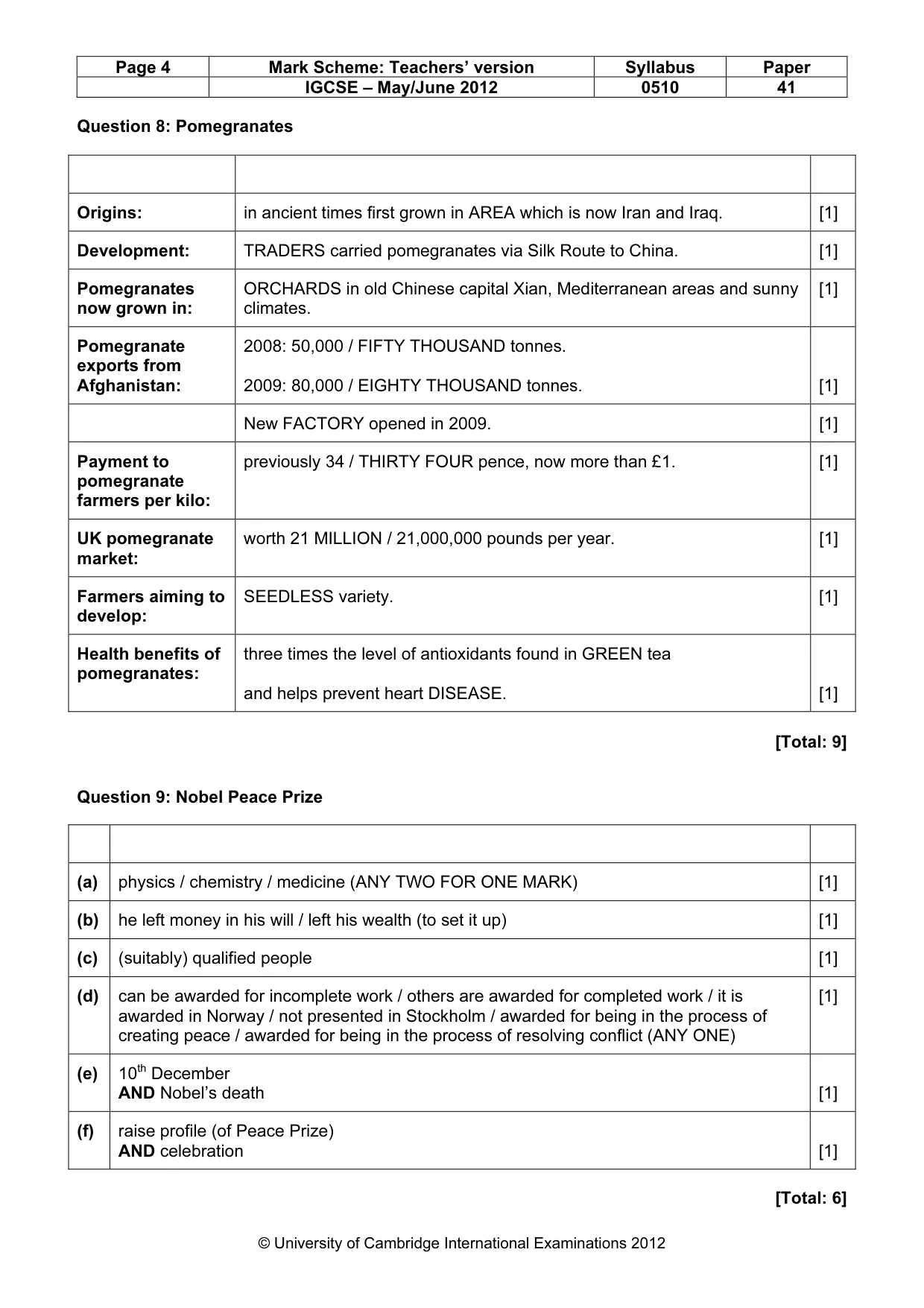
Page 4 Mark Scheme: Teachers’ version Syllabus Paper IGCSE – May/June 2012 0510 41 © University of Cambridge International Examinations 2012 Question 8: Pomegranates Origins: in ancient times first grown in AREA which is now Iran and Iraq. [1] Development: TRADERS carried pomegranates via Silk Route to China. [1] Pomegranates now grown in: ORCHARDS in old Chinese capital Xian, Mediterranean areas and sunny climates. [1] Pomegranate exports from Afghanistan: 2008: 50,000 / FIFTY THOUSAND tonnes. 2009: 80,000 / EIGHTY THOUSAND tonnes. [1] New FACTORY opened in 2009. [1] Payment to pomegranate farmers per kilo: previously 34 / THIRTY FOUR pence, now more than £1. [1] UK pomegranate market: worth 21 MILLION / 21,000,000 pounds per year. [1] Farmers aiming to develop: SEEDLESS variety. [1] Health benefits of pomegranates: three times the level of antioxidants found in GREEN tea and helps prevent heart DISEASE. [1] [Total: 9] Question 9: Nobel Peace Prize (a) physics / chemistry / medicine (ANY TWO FOR ONE MARK) [1] (b) he left money in his will / left his wealth (to set it up) [1] (c) (suitably) qualified people [1] (d) can be awarded for incomplete work / others are awarded for completed work / it is awarded in Norway / not presented in Stockholm / awarded for being in the process of creating peace / awarded for being in the process of resolving conflict (ANY ONE) [1] (e) 10th December AND Nobel’s death [1] (f) raise profile (of Peace Prize) AND celebration [1] [Total: 6]
Mark scheme, page 5
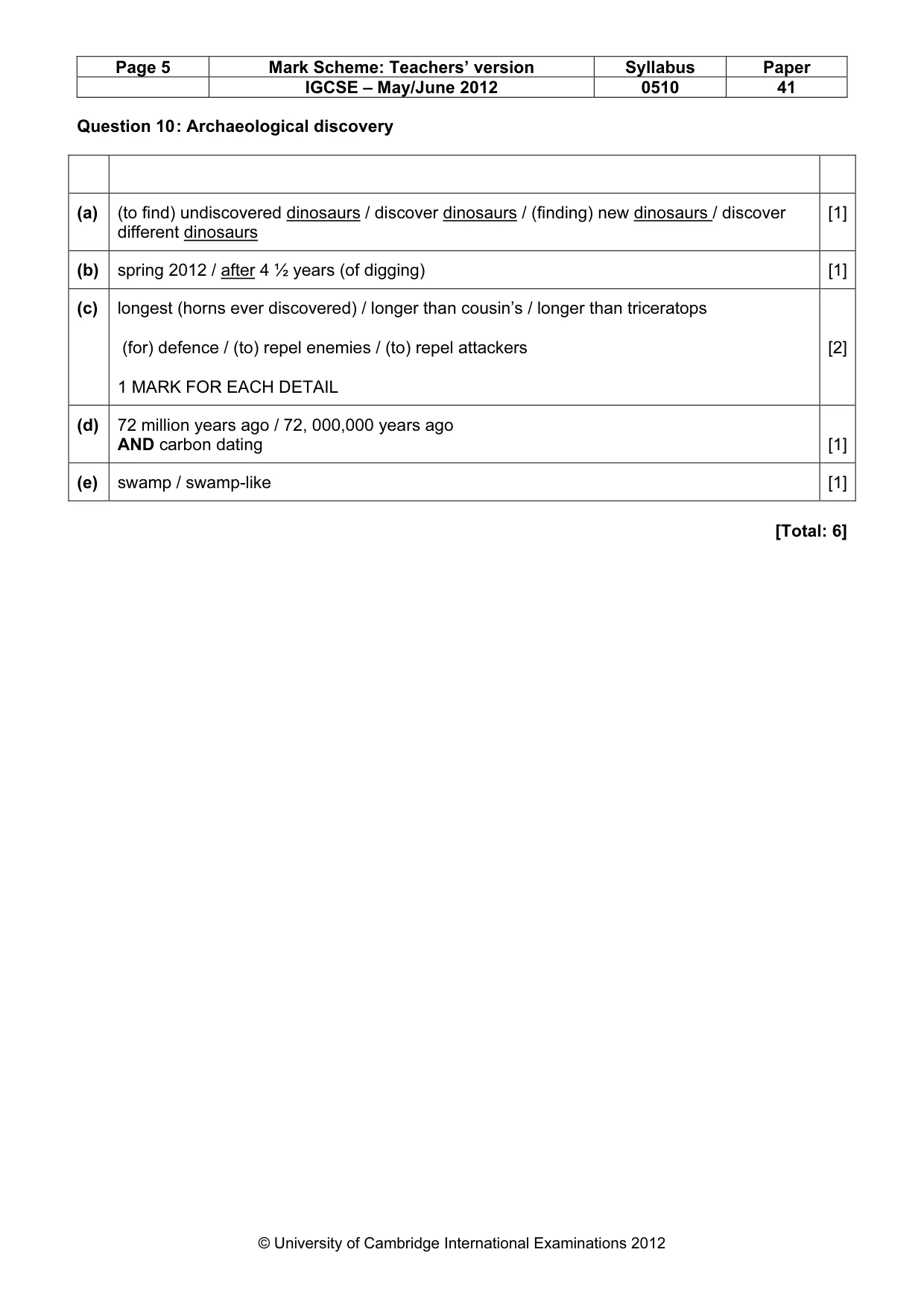
Page 5 Mark Scheme: Teachers’ version Syllabus Paper IGCSE – May/June 2012 0510 41 © University of Cambridge International Examinations 2012 Question 10 : Archaeological discovery (a) (to find) undiscovered dinosaurs / discover dinosaurs / (finding) new dinosaurs / discover different dinosaurs [1] (b) spring 2012 / after 4 ½ years (of digging) [1] (c) longest (horns ever discovered) / longer than cousin’s / longer than triceratops (for) defence / (to) repel enemies / (to) repel attackers 1 MARK FOR EACH DETAIL [2] (d) 72 million years ago / 72, 000,000 years ago AND carbon dating [1] (e) swamp / swamp-like [1] [Total: 6]
Mark scheme, page 6
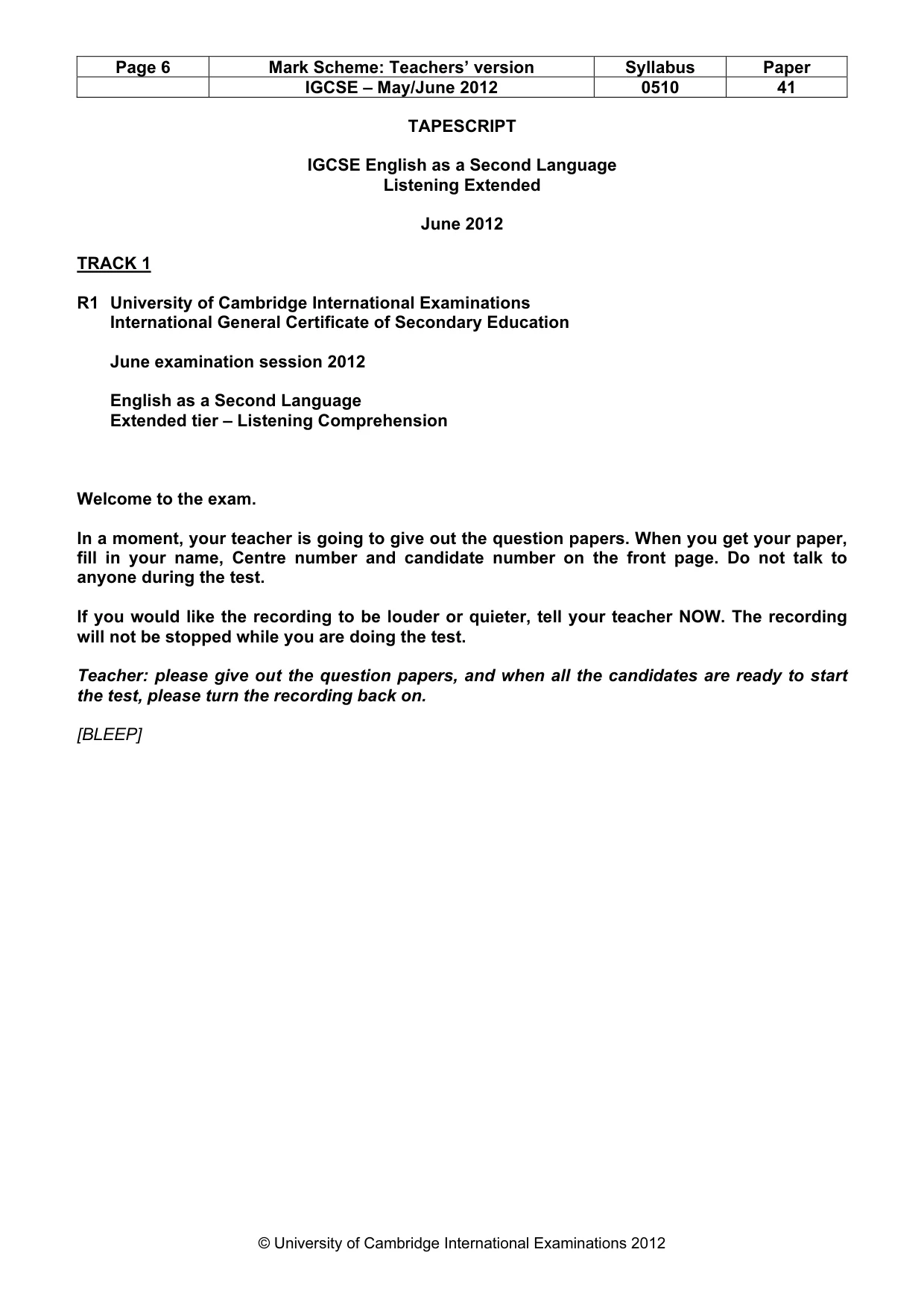
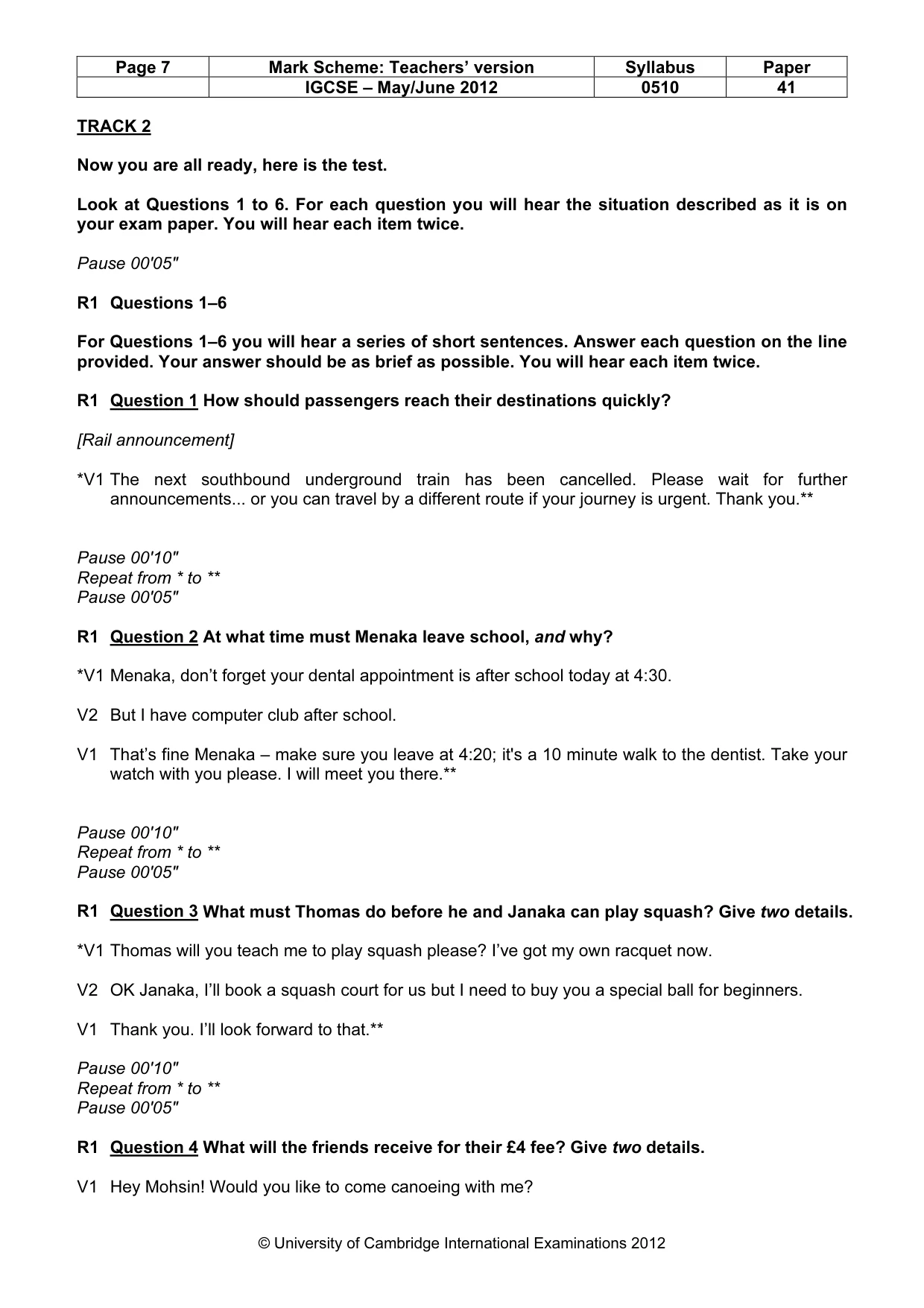
Page 6 Mark Scheme: Teachers’ version Syllabus Paper IGCSE – May/June 2012 0510 41 © University of Cambridge International Examinations 2012 TAPESCRIPT IGCSE English as a Second Language Listening Extended June 2012 TRACK 1 R1 University of Cambridge International Examinations International General Certificate of Secondary Education June examination session 2012 English as a Second Language Extended tier – Listening Comprehension Welcome to the exam. In a moment, your teacher is going to give out the question papers. When you get your paper, fill in your name, Centre number and candidate number on the front page. Do not talk to anyone during the test. If you would like the recording to be louder or quieter, tell your teacher NOW. The recording will not be stopped while you are doing the test. Teacher: please give out the question papers, and when all the candidates are ready to start the test, please turn the recording back on. [BLEEP]
Mark scheme, page 7
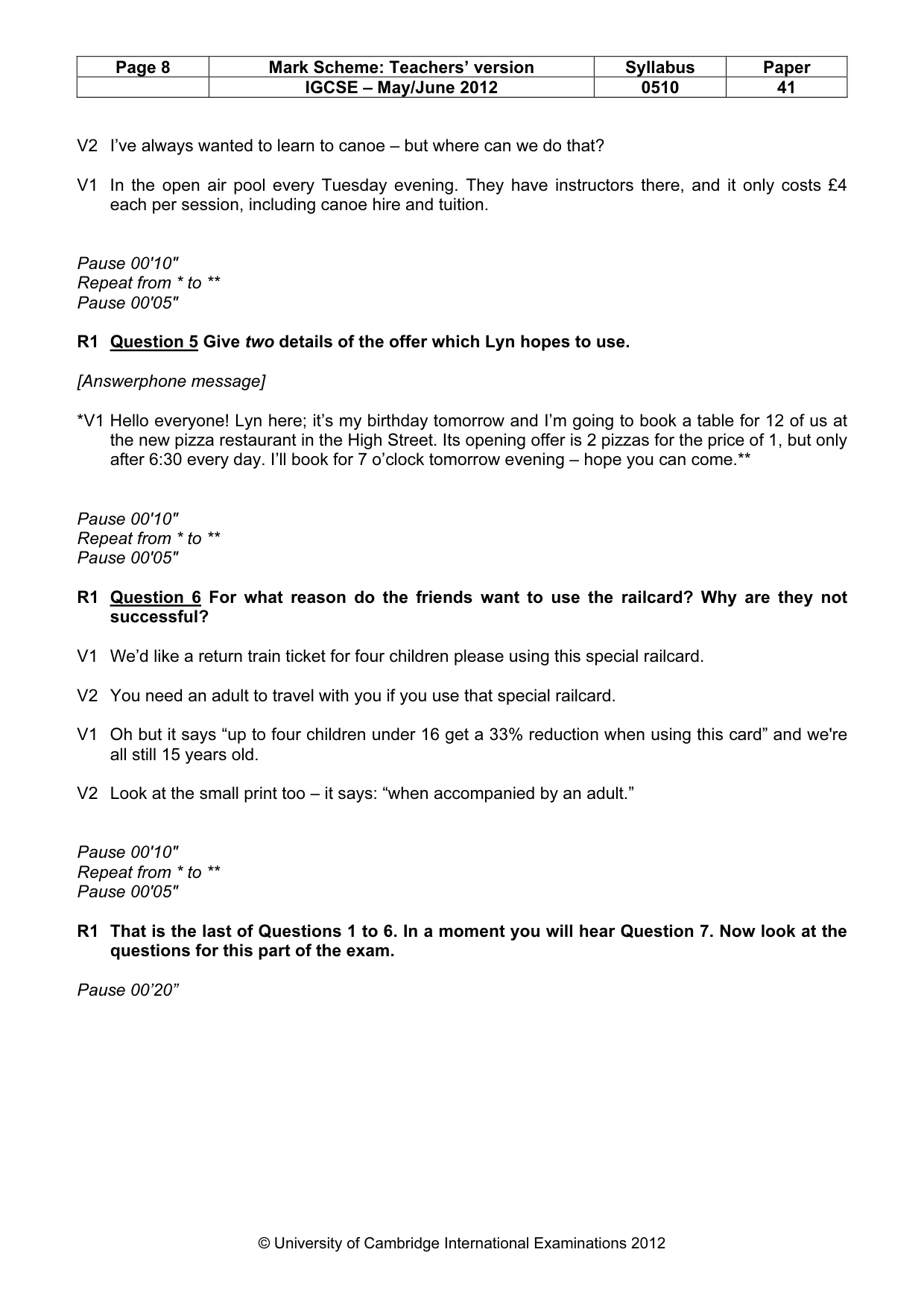
Page 7 Mark Scheme: Teachers’ version Syllabus Paper IGCSE – May/June 2012 0510 41 © University of Cambridge International Examinations 2012 TRACK 2 Now you are all ready, here is the test. Look at Questions 1 to 6. For each question you will hear the situation described as it is on your exam paper. You will hear each item twice. Pause 00'05" R1 Questions 1–6 For Questions 1–6 you will hear a series of short sentences. Answer each question on the line provided. Your answer should be as brief as possible. You will hear each item twice. R1 Question 1 How should passengers reach their destinations quickly? [Rail announcement] *V1 The next southbound underground train has been cancelled. Please wait for further announcements... or you can travel by a different route if your journey is urgent. Thank you.** Pause 00'10" Repeat from * to ** Pause 00'05" R1 Question 2 At what time must Menaka leave school, and why? *V1 Menaka, don’t forget your dental appointment is after school today at 4:30. V2 But I have computer club after school. V1 That’s fine Menaka – make sure you leave at 4:20; it's a 10 minute walk to the dentist. Take your watch with you please. I will meet you there.** Pause 00'10" Repeat from * to ** Pause 00'05" R1 Question 3 What must Thomas do before he and Janaka can play squash? Give two details. *V1 Thomas will you teach me to play squash please? I’ve got my own racquet now. V2 OK Janaka, I’ll book a squash court for us but I need to buy you a special ball for beginners. V1 Thank you. I’ll look forward to that.** Pause 00'10" Repeat from * to ** Pause 00'05" R1 Question 4 What will the friends receive for their £4 fee? Give two details. V1 Hey Mohsin! Would you like to come canoeing with me?
Mark scheme, page 8
Page 8 Mark Scheme: Teachers’ version Syllabus Paper IGCSE – May/June 2012 0510 41 © University of Cambridge International Examinations 2012 V2 I’ve always wanted to learn to canoe – but where can we do that? V1 In the open air pool every Tuesday evening. They have instructors there, and it only costs £4 each per session, including canoe hire and tuition. Pause 00'10" Repeat from * to ** Pause 00'05" R1 Question 5 Give two details of the offer which Lyn hopes to use. [Answerphone message] *V1 Hello everyone! Lyn here; it’s my birthday tomorrow and I’m going to book a table for 12 of us at the new pizza restaurant in the High Street. Its opening offer is 2 pizzas for the price of 1, but only after 6:30 every day. I’ll book for 7 o’clock tomorrow evening – hope you can come.** Pause 00'10" Repeat from * to ** Pause 00'05" R1 Question 6 For what reason do the friends want to use the railcard? Why are they not successful? V1 We’d like a return train ticket for four children please using this special railcard. V2 You need an adult to travel with you if you use that special railcard. V1 Oh but it says “up to four children under 16 get a 33% reduction when using this card” and we're all still 15 years old. V2 Look at the small print too – it says: “when accompanied by an adult.” Pause 00'10" Repeat from * to ** Pause 00'05" R1 That is the last of Questions 1 to 6. In a moment you will hear Question 7. Now look at the questions for this part of the exam. Pause 00’20”
Mark scheme, page 9
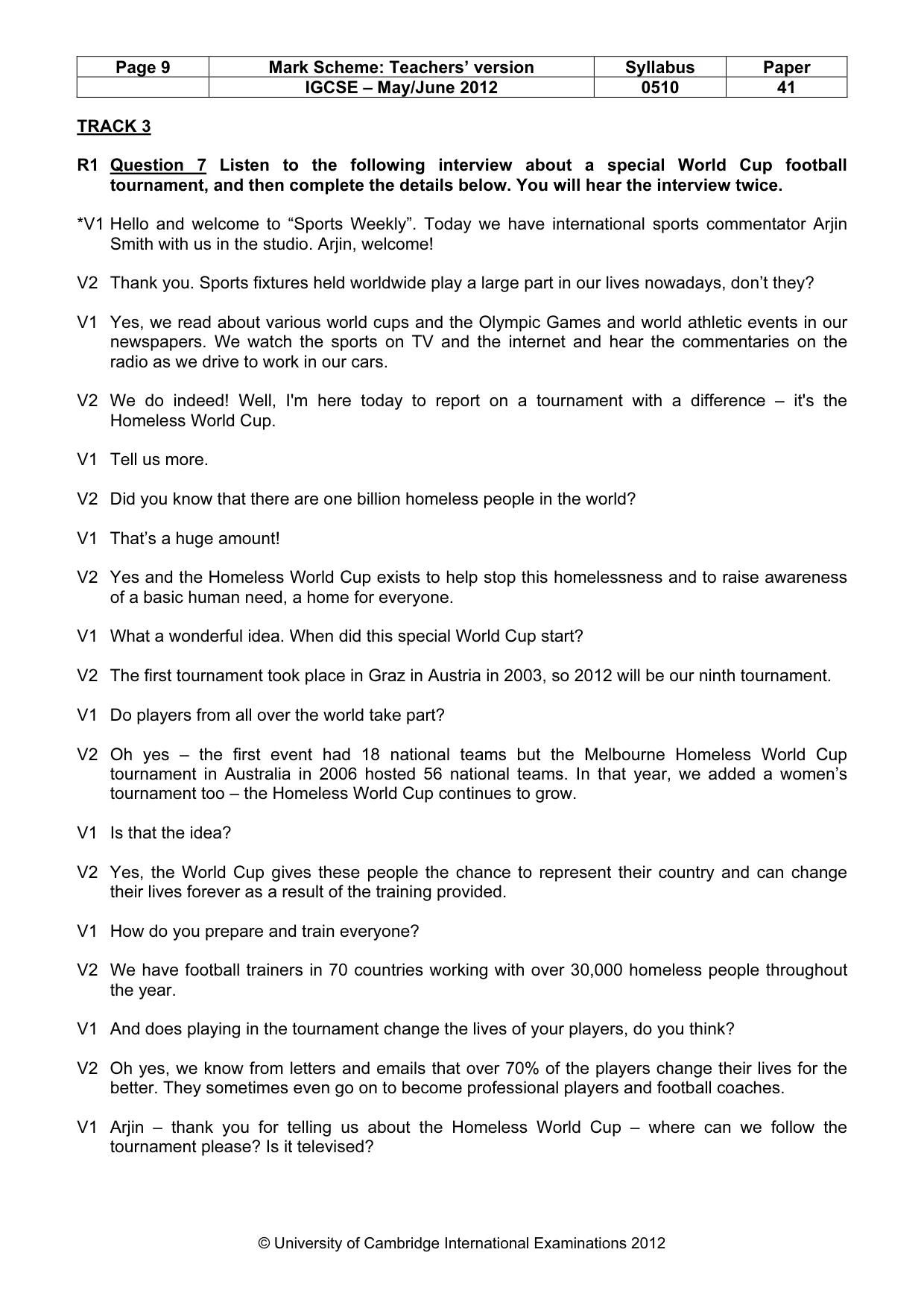
Page 9 Mark Scheme: Teachers’ version Syllabus Paper IGCSE – May/June 2012 0510 41 © University of Cambridge International Examinations 2012 TRACK 3 R1 Question 7 Listen to the following interview about a special World Cup football tournament, and then complete the details below. You will hear the interview twice. *V1 Hello and welcome to “Sports Weekly”. Today we have international sports commentator Arjin Smith with us in the studio. Arjin, welcome! V2 Thank you. Sports fixtures held worldwide play a large part in our lives nowadays, don’t they? V1 Yes, we read about various world cups and the Olympic Games and world athletic events in our newspapers. We watch the sports on TV and the internet and hear the commentaries on the radio as we drive to work in our cars. V2 We do indeed! Well, I'm here today to report on a tournament with a difference – it's the Homeless World Cup. V1 Tell us more. V2 Did you know that there are one billion homeless people in the world? V1 That’s a huge amount! V2 Yes and the Homeless World Cup exists to help stop this homelessness and to raise awareness of a basic human need, a home for everyone. V1 What a wonderful idea. When did this special World Cup start? V2 The first tournament took place in Graz in Austria in 2003, so 2012 will be our ninth tournament. V1 Do players from all over the world take part? V2 Oh yes – the first event had 18 national teams but the Melbourne Homeless World Cup tournament in Australia in 2006 hosted 56 national teams. In that year, we added a women’s tournament too – the Homeless World Cup continues to grow. V1 Is that the idea? V2 Yes, the World Cup gives these people the chance to represent their country and can change their lives forever as a result of the training provided. V1 How do you prepare and train everyone? V2 We have football trainers in 70 countries working with over 30,000 homeless people throughout the year. V1 And does playing in the tournament change the lives of your players, do you think? V2 Oh yes, we know from letters and emails that over 70% of the players change their lives for the better. They sometimes even go on to become professional players and football coaches. V1 Arjin – thank you for telling us about the Homeless World Cup – where can we follow the tournament please? Is it televised?
Mark scheme, page 10
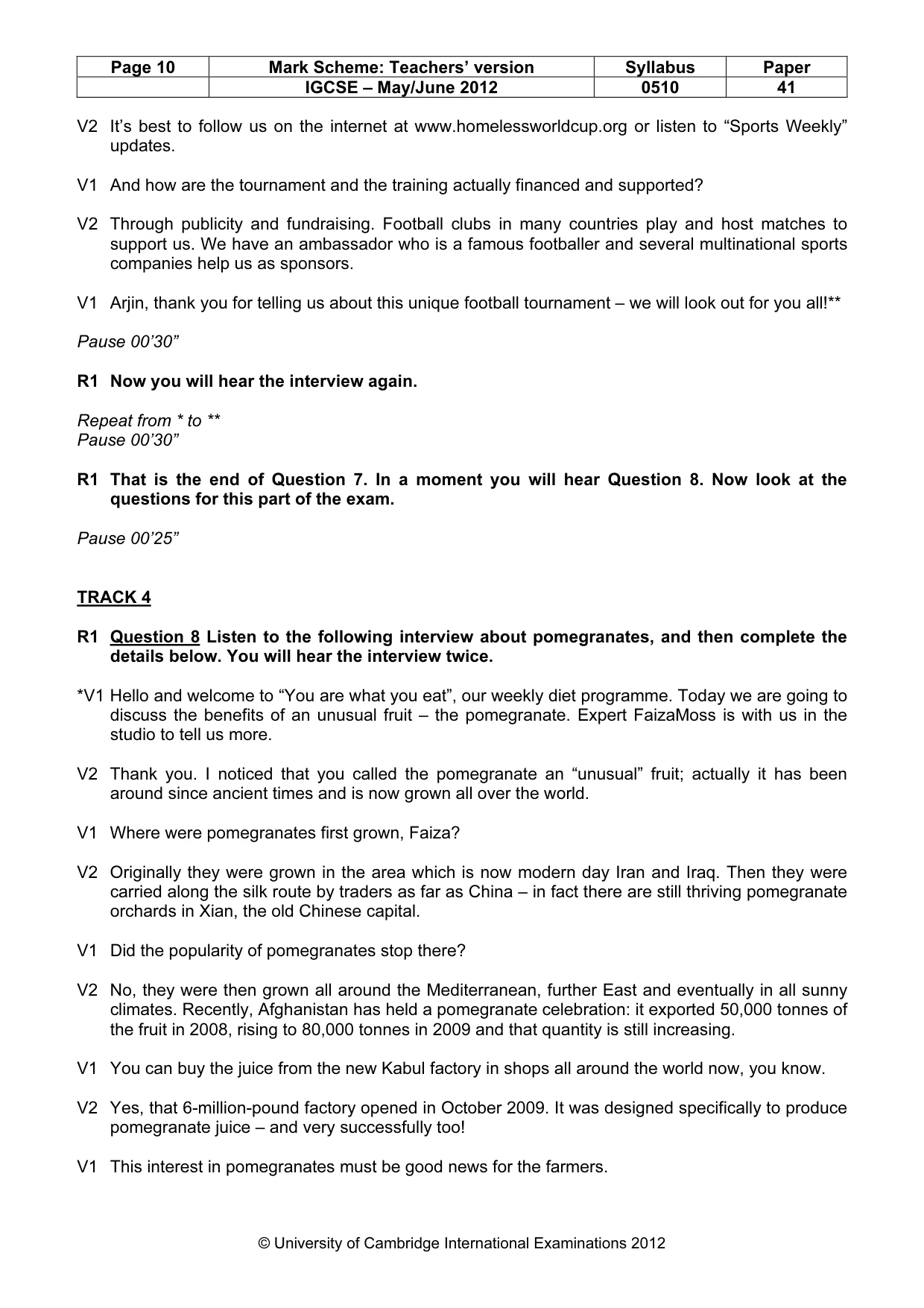
Page 10 Mark Scheme: Teachers’ version Syllabus Paper IGCSE – May/June 2012 0510 41 © University of Cambridge International Examinations 2012 V2 It’s best to follow us on the internet at www.homelessworldcup.org or listen to “Sports Weekly” updates. V1 And how are the tournament and the training actually financed and supported? V2 Through publicity and fundraising. Football clubs in many countries play and host matches to support us. We have an ambassador who is a famous footballer and several multinational sports companies help us as sponsors. V1 Arjin, thank you for telling us about this unique football tournament – we will look out for you all!** Pause 00’30” R1 Now you will hear the interview again. Repeat from * to ** Pause 00’30” R1 That is the end of Question 7. In a moment you will hear Question 8. Now look at the questions for this part of the exam. Pause 00’25” TRACK 4 R1 Question 8 Listen to the following interview about pomegranates, and then complete the details below. You will hear the interview twice. *V1 Hello and welcome to “You are what you eat”, our weekly diet programme. Today we are going to discuss the benefits of an unusual fruit – the pomegranate. Expert FaizaMoss is with us in the studio to tell us more. V2 Thank you. I noticed that you called the pomegranate an “unusual” fruit; actually it has been around since ancient times and is now grown all over the world. V1 Where were pomegranates first grown, Faiza? V2 Originally they were grown in the area which is now modern day Iran and Iraq. Then they were carried along the silk route by traders as far as China – in fact there are still thriving pomegranate orchards in Xian, the old Chinese capital. V1 Did the popularity of pomegranates stop there? V2 No, they were then grown all around the Mediterranean, further East and eventually in all sunny climates. Recently, Afghanistan has held a pomegranate celebration: it exported 50,000 tonnes of the fruit in 2008, rising to 80,000 tonnes in 2009 and that quantity is still increasing. V1 You can buy the juice from the new Kabul factory in shops all around the world now, you know. V2 Yes, that 6-million-pound factory opened in October 2009. It was designed specifically to produce pomegranate juice – and very successfully too! V1 This interest in pomegranates must be good news for the farmers.
Mark scheme, page 11
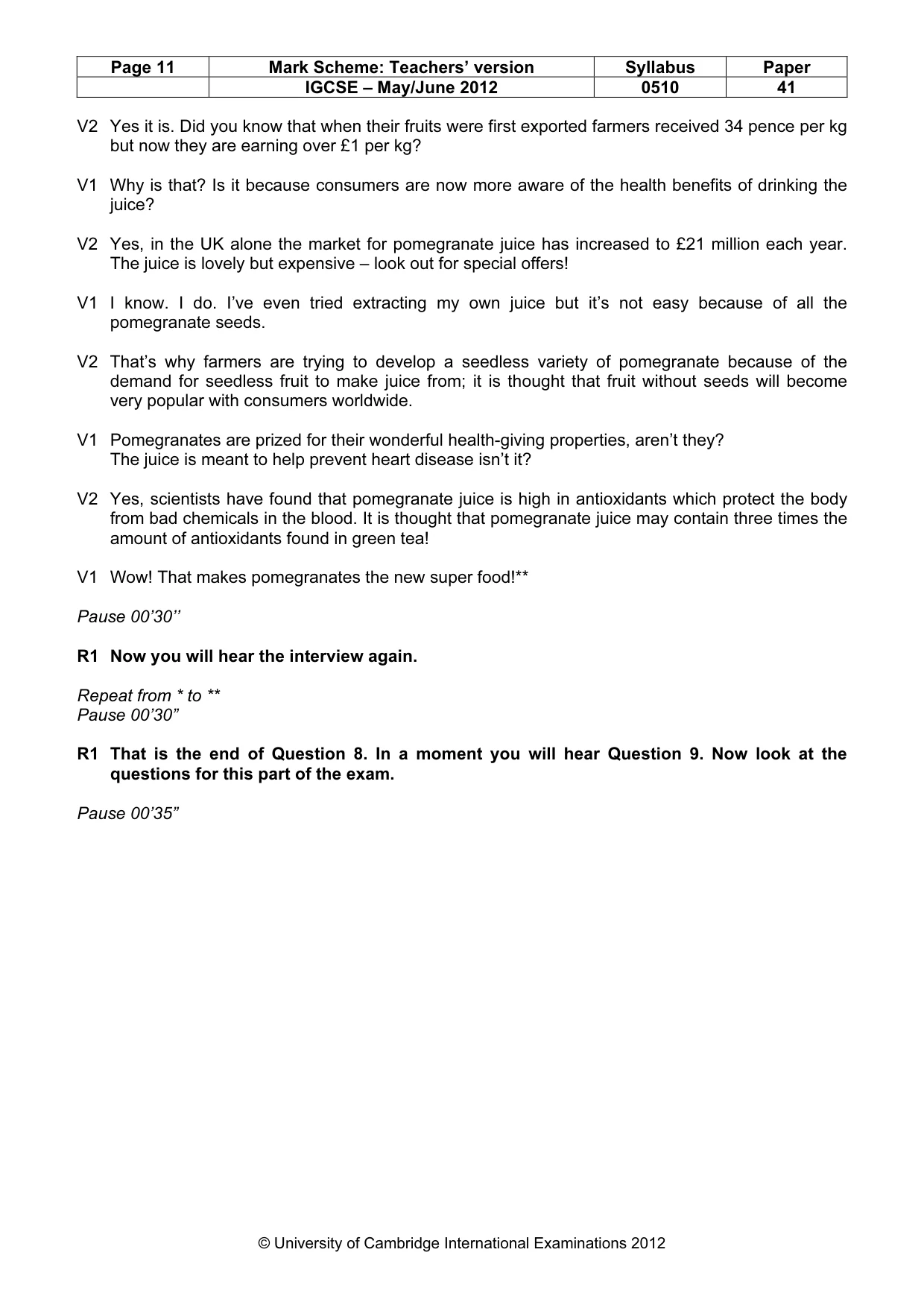
Page 11 Mark Scheme: Teachers’ version Syllabus Paper IGCSE – May/June 2012 0510 41 © University of Cambridge International Examinations 2012 V2 Yes it is. Did you know that when their fruits were first exported farmers received 34 pence per kg but now they are earning over £1 per kg? V1 Why is that? Is it because consumers are now more aware of the health benefits of drinking the juice? V2 Yes, in the UK alone the market for pomegranate juice has increased to £21 million each year. The juice is lovely but expensive – look out for special offers! V1 I know. I do. I’ve even tried extracting my own juice but it’s not easy because of all the pomegranate seeds. V2 That’s why farmers are trying to develop a seedless variety of pomegranate because of the demand for seedless fruit to make juice from; it is thought that fruit without seeds will become very popular with consumers worldwide. V1 Pomegranates are prized for their wonderful health-giving properties, aren’t they? The juice is meant to help prevent heart disease isn’t it? V2 Yes, scientists have found that pomegranate juice is high in antioxidants which protect the body from bad chemicals in the blood. It is thought that pomegranate juice may contain three times the amount of antioxidants found in green tea! V1 Wow! That makes pomegranates the new super food!** Pause 00’30’’ R1 Now you will hear the interview again. Repeat from * to ** Pause 00’30” R1 That is the end of Question 8. In a moment you will hear Question 9. Now look at the questions for this part of the exam. Pause 00’35”
Mark scheme, page 12
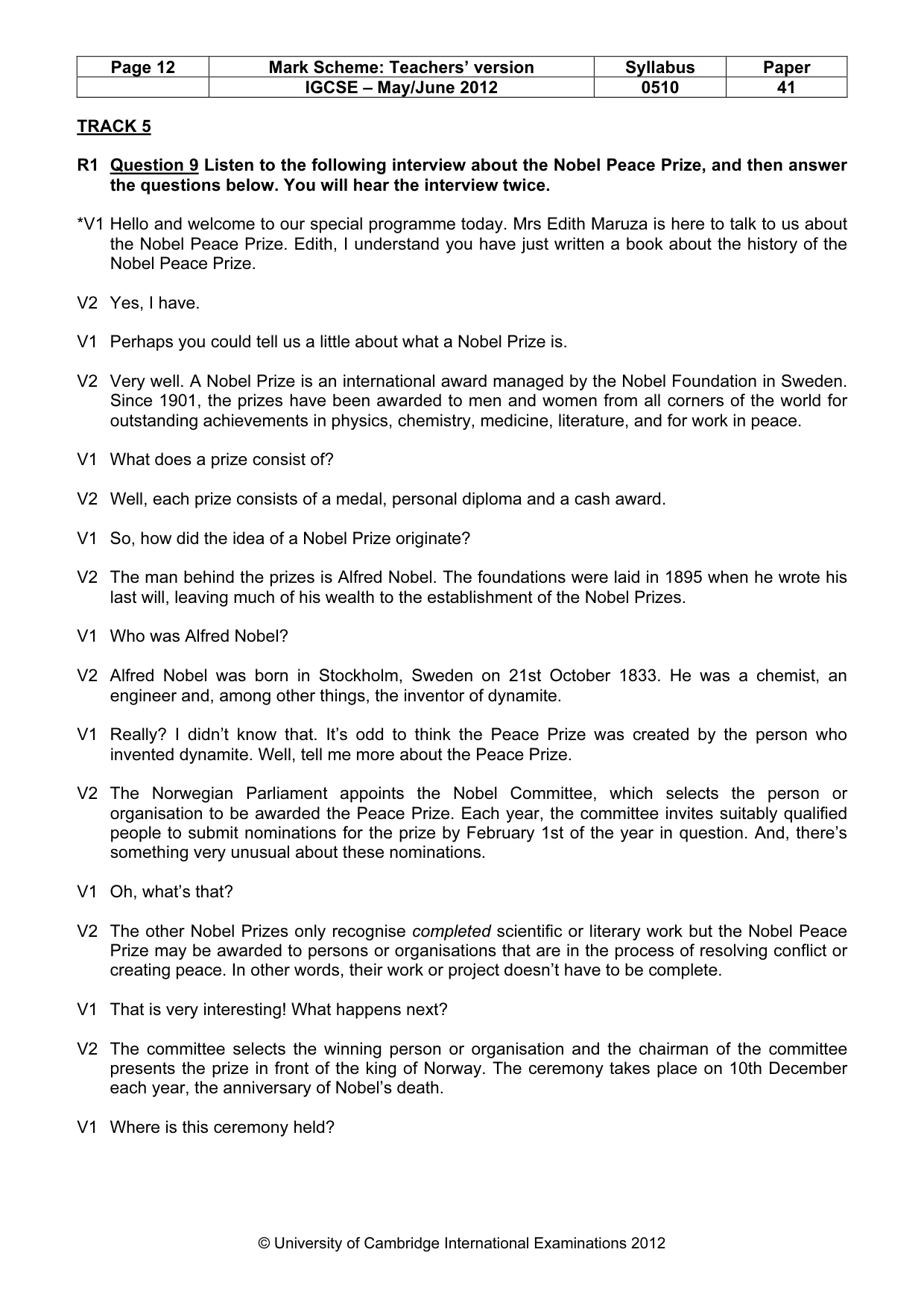
Page 12 Mark Scheme: Teachers’ version Syllabus Paper IGCSE – May/June 2012 0510 41 © University of Cambridge International Examinations 2012 TRACK 5 R1 Question 9 Listen to the following interview about the Nobel Peace Prize, and then answer the questions below. You will hear the interview twice. *V1 Hello and welcome to our special programme today. Mrs Edith Maruza is here to talk to us about the Nobel Peace Prize. Edith, I understand you have just written a book about the history of the Nobel Peace Prize. V2 Yes, I have. V1 Perhaps you could tell us a little about what a Nobel Prize is. V2 Very well. A Nobel Prize is an international award managed by the Nobel Foundation in Sweden. Since 1901, the prizes have been awarded to men and women from all corners of the world for outstanding achievements in physics, chemistry, medicine, literature, and for work in peace. V1 What does a prize consist of? V2 Well, each prize consists of a medal, personal diploma and a cash award. V1 So, how did the idea of a Nobel Prize originate? V2 The man behind the prizes is Alfred Nobel. The foundations were laid in 1895 when he wrote his last will, leaving much of his wealth to the establishment of the Nobel Prizes. V1 Who was Alfred Nobel? V2 Alfred Nobel was born in Stockholm, Sweden on 21st October 1833. He was a chemist, an engineer and, among other things, the inventor of dynamite. V1 Really? I didn’t know that. It’s odd to think the Peace Prize was created by the person who invented dynamite. Well, tell me more about the Peace Prize. V2 The Norwegian Parliament appoints the Nobel Committee, which selects the person or organisation to be awarded the Peace Prize. Each year, the committee invites suitably qualified people to submit nominations for the prize by February 1st of the year in question. And, there’s something very unusual about these nominations. V1 Oh, what’s that? V2 The other Nobel Prizes only recognise completed scientific or literary work but the Nobel Peace Prize may be awarded to persons or organisations that are in the process of resolving conflict or creating peace. In other words, their work or project doesn’t have to be complete. V1 That is very interesting! What happens next? V2 The committee selects the winning person or organisation and the chairman of the committee presents the prize in front of the king of Norway. The ceremony takes place on 10th December each year, the anniversary of Nobel’s death. V1 Where is this ceremony held?
Mark scheme, page 13
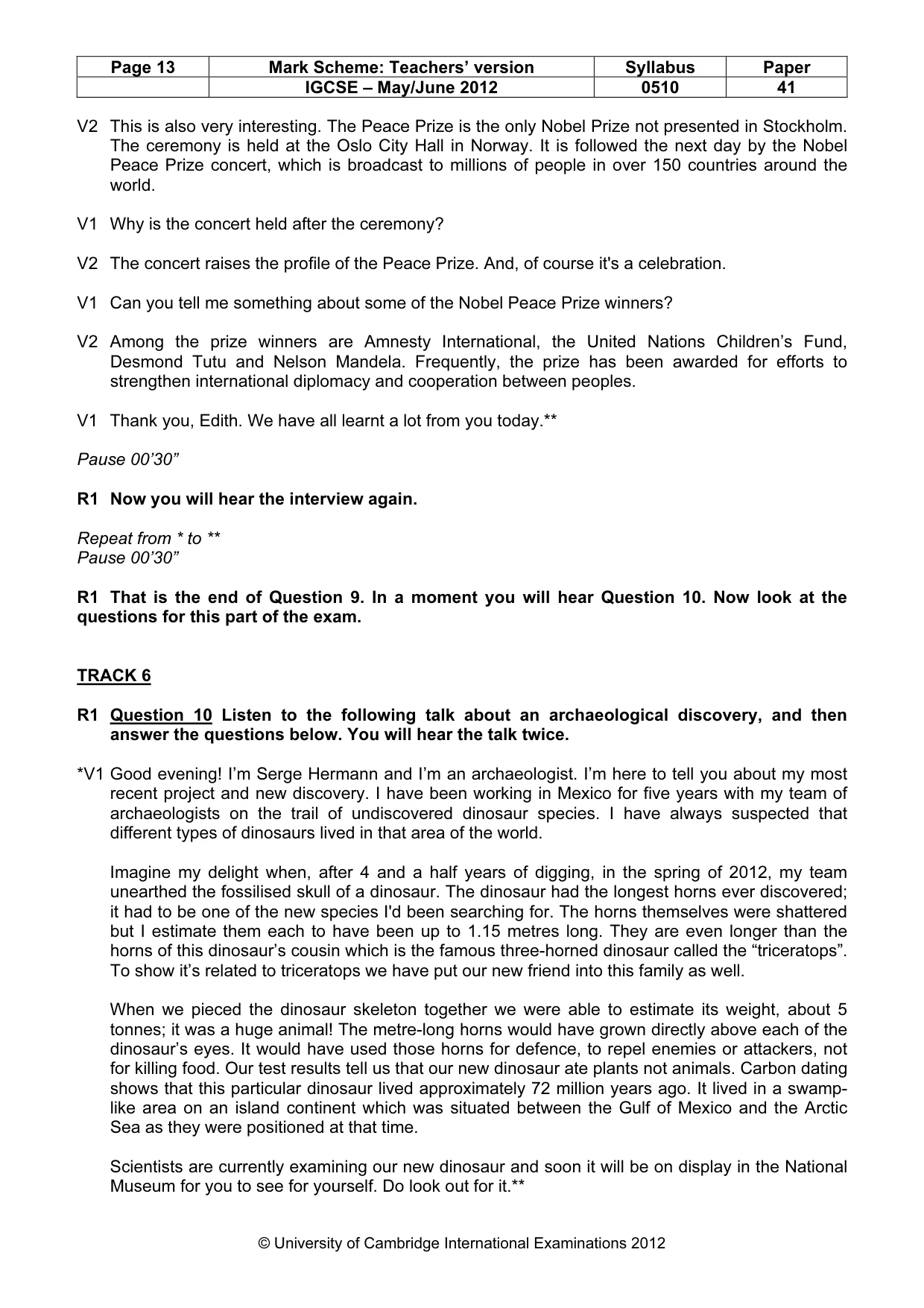
Page 13 Mark Scheme: Teachers’ version Syllabus Paper IGCSE – May/June 2012 0510 41 © University of Cambridge International Examinations 2012 V2 This is also very interesting. The Peace Prize is the only Nobel Prize not presented in Stockholm. The ceremony is held at the Oslo City Hall in Norway. It is followed the next day by the Nobel Peace Prize concert, which is broadcast to millions of people in over 150 countries around the world. V1 Why is the concert held after the ceremony? V2 The concert raises the profile of the Peace Prize. And, of course it's a celebration. V1 Can you tell me something about some of the Nobel Peace Prize winners? V2 Among the prize winners are Amnesty International, the United Nations Children’s Fund, Desmond Tutu and Nelson Mandela. Frequently, the prize has been awarded for efforts to strengthen international diplomacy and cooperation between peoples. V1 Thank you, Edith. We have all learnt a lot from you today.** Pause 00’30” R1 Now you will hear the interview again. Repeat from * to ** Pause 00’30” R1 That is the end of Question 9. In a moment you will hear Question 10. Now look at the questions for this part of the exam. TRACK 6 R1 Question 10 Listen to the following talk about an archaeological discovery, and then answer the questions below. You will hear the talk twice. *V1 Good evening! I’m Serge Hermann and I’m an archaeologist. I’m here to tell you about my most recent project and new discovery. I have been working in Mexico for five years with my team of archaeologists on the trail of undiscovered dinosaur species. I have always suspected that different types of dinosaurs lived in that area of the world. Imagine my delight when, after 4 and a half years of digging, in the spring of 2012, my team unearthed the fossilised skull of a dinosaur. The dinosaur had the longest horns ever discovered; it had to be one of the new species I'd been searching for. The horns themselves were shattered but I estimate them each to have been up to 1.15 metres long. They are even longer than the horns of this dinosaur’s cousin which is the famous three-horned dinosaur called the “triceratops”. To show it’s related to triceratops we have put our new friend into this family as well. When we pieced the dinosaur skeleton together we were able to estimate its weight, about 5 tonnes; it was a huge animal! The metre-long horns would have grown directly above each of the dinosaur’s eyes. It would have used those horns for defence, to repel enemies or attackers, not for killing food. Our test results tell us that our new dinosaur ate plants not animals. Carbon dating shows that this particular dinosaur lived approximately 72 million years ago. It lived in a swamp- like area on an island continent which was situated between the Gulf of Mexico and the Arctic Sea as they were positioned at that time. Scientists are currently examining our new dinosaur and soon it will be on display in the National Museum for you to see for yourself. Do look out for it.**
Mark scheme, page 14
Page 14 Mark Scheme: Teachers’ version Syllabus Paper IGCSE – May/June 2012 0510 41 © University of Cambridge International Examinations 2012 Pause 00’30” R1 Now you will hear the talk again. Repeat from * to ** Pause 00’30” R1 That is the end of Question 10, and of the test. In a moment your teacher will collect your papers. Please check that you have written your name, Centre number and candidate number on the front of your question paper. Remember, you must not talk until all the papers have been collected. Pause 00’10” R1 Teacher, please collect all the papers. Thank you everyone.
What you needed in this session
Cambridge’s own grade thresholds for 2012 May/June, Paper 4 · Variant 1. A higher threshold means an easier paper — the bar moves with how the cohort did.