Cambridge IGCSE English - Second Language (oral endorsement) 0510 — 2012 May/June Paper 2 · Variant 2
0510/22/M/J/12 · 84 marks · ≈95 min
The question paper and its mark scheme, free to read here and free to download. This is Cambridge’s own paper, exactly as it was sat.
Question paper16 pages




Mark scheme11 pages
Answers below. Sit the paper first if you are practising.
Paper as text
Question paper, page 1
This document consists of 15 printed pages and 1 blank page. IB12 06_0510_22/3RP © UCLES 2012 [Turn over *2374644611* For Examiner's Use Exercise 1 Exercise 2 Exercise 3 Exercise 4 Exercise 5 Exercise 6 Exercise 7 Total UNIVERSITY OF CAMBRIDGE INTERNATIONAL EXAMINATIONS International General Certificate of Secondary Education ENGLISH AS A SECOND LANGUAGE 0510/22 Paper 2 Reading and Writing (Extended) May/June 2012 2 hours Candidates answer on the Question Paper. No Additional Materials are required. READ THESE INSTRUCTIONS FIRST Write your Centre number, candidate number and name on all the work you hand in. Write in dark blue or black pen. Do not use staples, paper clips, highlighters, glue or correction fluid. DO NOT WRITE IN ANY BARCODES. Answer all questions. Dictionaries are not allowed. The number of marks is given in brackets [ ] at the end of each question or part question. www.XtremePapers.com
Question paper, page 2
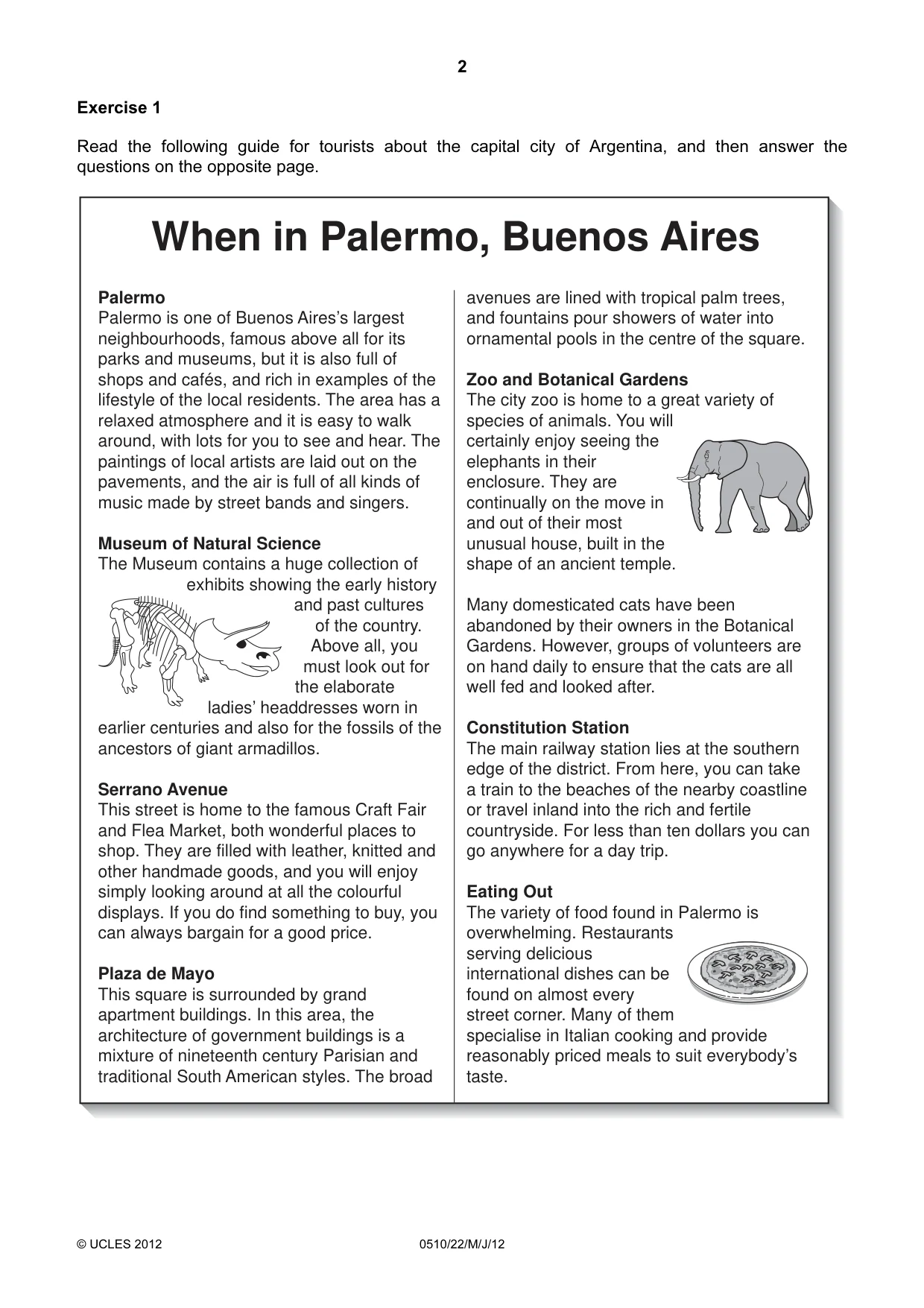
2 © UCLES 2012 0510/22/M/J/12 Exercise 1 Read the following guide for tourists about the capital city of Argentina, and then answer the questions on the opposite page. When in Palermo, Buenos Aires Palermo Palermo is one of Buenos Aires’s largest neighbourhoods, famous above all for its parks and museums, but it is also full of shops and cafés, and rich in examples of the lifestyle of the local residents. The area has a relaxed atmosphere and it is easy to walk around, with lots for you to see and hear. The paintings of local artists are laid out on the pavements, and the air is full of all kinds of music made by street bands and singers. Museum of Natural Science The Museum contains a huge collection of exhibits showing the early history and past cultures of the country. Above all, you must look out for the elaborate ladies’ headdresses worn in earlier centuries and also for the fossils of the ancestors of giant armadillos. Serrano Avenue This street is home to the famous Craft Fair and Flea Market, both wonderful places to shop. They are filled with leather, knitted and other handmade goods, and you will enjoy simply looking around at all the colourful displays. If you do find something to buy, you can always bargain for a good price. Plaza de Mayo This square is surrounded by grand apartment buildings. In this area, the architecture of government buildings is a mixture of nineteenth century Parisian and traditional South American styles. The broad avenues are lined with tropical palm trees, and fountains pour showers of water into ornamental pools in the centre of the square. Zoo and Botanical Gardens The city zoo is home to a great variety of species of animals. You will certainly enjoy seeing the elephants in their enclosure. They are continually on the move in and out of their most unusual house, built in the shape of an ancient temple. Many domesticated cats have been abandoned by their owners in the Botanical Gardens. However, groups of volunteers are on hand daily to ensure that the cats are all well fed and looked after. Constitution Station The main railway station lies at the southern edge of the district. From here, you can take a train to the beaches of the nearby coastline or travel inland into the rich and fertile countryside. For less than ten dollars you can go anywhere for a day trip. Eating Out The variety of food found in Palermo is overwhelming. Restaurants serving delicious international dishes can be found on almost every street corner. Many of them specialise in Italian cooking and provide reasonably priced meals to suit everybody’s taste.
Question paper, page 3
3 © UCLES 2012 0510/22/M/J/12 [Turn over For Examiner's Use (a) What is Palermo best known for? [1] (b) Where do artists in Palermo display their work? [1] (c) What are you recommended to see in the Museum of Natural Science? Give two details. [1] (d) How can you make sure you are not charged too much when you shop in the Flea Market? [1] (e) In what type of accommodation do the residents of Plaza de Mayo live? [1] (f) What does the elephant house in the zoo look like? [1] (g) Who cares for unwanted cats in the Botanical Gardens, and how? [1] (h) How much does it cost to go on a short train ride out of town? [1] [Total: 8]
Question paper, page 4
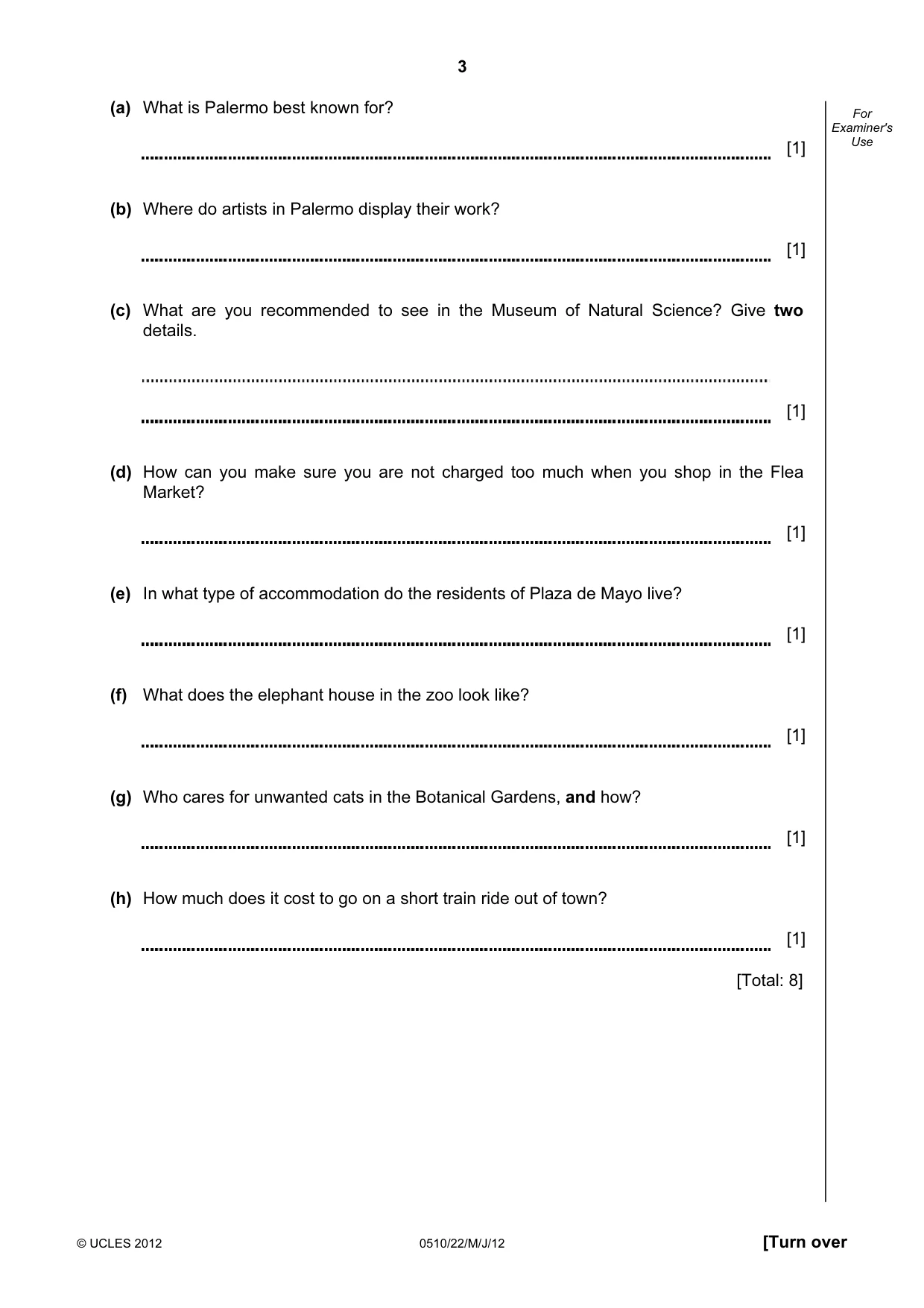
4 © UCLES 2012 0510/22/M/J/12 Exercise 2 Read the following article about a working holiday in a country park, and then answer the questions on the opposite page. , Rest and Play William Derbyshire had always regarded the phrase “working holiday” as a contradiction in terms. He thought that holidays were for relaxing, not working. But when he heard about working holidays run by the National Trust, he wondered if he should find out more. So he obtained a brochure and discovered that the National Trust organises hundreds of working holidays in some of the most beautiful places in the UK. The Trust provides cheap accommodation and food, and as William was short of money at the time, he reckoned that this could be a way for him to take a break without having to spend too much. William chose to go to a big country park, to help a group of other volunteers to clear some of the surrounding woodland. He was met there by the group leader, who immediately told him he had already made his first mistake. The trainers William was wearing were quite unsuitable for outdoor work. It says so in the brochure, in bold type, but somehow he had missed that detail. Luckily, the leader had a pair of smart green boots for him to borrow. Then they headed off into the forest to meet the other volunteers. The forest was full of all kinds of trees but had become overgrown with thick bushes and tangled weeds. The volunteers’ task was to clear these, to give the trees more room, and to plant a few more in the empty spaces. The National Trust is a charity and receives no money from the government. Without the help of volunteers, work like this would not be done. The other volunteers had been there for a week, and they had already cleared an area the size of several tennis courts. The volunteers ranged from teenagers to pensioners, from a retired postman to several students working for an award. There was also a surveyor, a civil servant, a teacher and a chef. A few were first-timers, but most of them had been on lots of these holidays before. After volunteers have done several working holidays, they get the chance to go on a brief training course and become a volunteer leader. In exchange for a few extra duties, such as driving the minibus and buying the food, leaders receive their holiday completely free. However, even though it was a cheap way to spend a week, it was clear that most of them were there just for the love of it. They enjoyed meeting new people and doing useful work together. Although they did not boast about it, William could tell they were keen to play their part in making their corner of the world a better place. The leader cut down some bushes with a chainsaw and then showed William how to use an axe to do the same work. William found the task hard, but he liked the fact that he was free to work at his own pace. As on any holiday, it was good to make new friends. Clearing woodland is not the only thing you can do on a National Trust working holiday. Activities range from gardening to archaeology, picking fruit and vegetables, looking after farm animals or cataloguing books in the library of a historic house. William had his meals in a cabin with the other volunteers and slept in the men’s dormitory. He did not sleep too well because the room was cold. Nevertheless, he loved every other aspect of the holiday and would be happy to go back again next year. 13-19 20-35 36-50 51-65 over 65 Age ranges (in years) of volunteers attending National Trust working holidays in 2011
Question paper, page 5
5 © UCLES 2012 0510/22/M/J/12 [Turn over For Examiner's Use (a) What had William Derbyshire previously thought was the purpose of a holiday? [1] (b) Why is a National Trust working holiday suitable for people with little money? [1] (c) What had William failed to take notice of in the brochure? [1] (d) For what purpose was it necessary to remove the weeds and bushes that had overgrown the forest? [1] (e) Why does the National Trust have to get volunteers to do this kind of work? [1] (f) According to the chart, apart from teenagers, which age range group provides most volunteers for National Trust working holidays? [1] (g) What is the greatest benefit of becoming a volunteer leader? [1] (h) Why was William content with his own work even though it was difficult for him? [1] (i) What indoor work can a volunteer do on a National Trust holiday? [1] (j) What kept William awake at night? [1] (k) Apart from the low cost, why do so many people choose a National Trust working holiday? Give four reasons. [4] [Total: 14]
Question paper, page 6
6 © UCLES 2012 0510/22/M/J/12 Exercise 3 In October 2010, at the age of 17, Shokat Aziz took part in the Red Sea Water Sports Tournament, held every three years off the coast of the Egyptian resort of Sharm el Sheikh. On that occasion, Shokat won a bronze medal, coming third in the junior deep-sea diving competition. Since early childhood, Shokat has loved practising every kind of water sport. As he lives in Saudi Arabia, in the port city of Jeddah, he has easy access to the shallow lagoons on the coast as well as to the deep water beyond the coral reef. By now he is an expert swimmer and diver and also proficient in rowing, sailing and water skiing. His favourite activity, however, is windsurfing, and he is fully equipped with a state-of-the-art surf board, a mast and a sail. Shokat lives with his family at 84 Gabel Souk, Jeddah, in an apartment above a jewellery shop which is managed by his father. Since leaving school in 2011, Shokat has joined the business as a trainee goldsmith and he will soon complete his apprenticeship and become a qualified jeweller. Nevertheless, his real ambition is to be a water sports instructor. The Red Sea Water Sports Tournament will be held again in October 2013, and the organisers are already advertising for participants. By that time, Shokat will have had his twentieth birthday, so he will be old enough to compete in the senior events. He could choose diving once more and thinks he would also be eligible for swimming and sailing, but he has no doubt that his best chance of a medal this time will be in windsurfing. He has requested an application form, which he has now received. For a response to his application, he can use the family business email: jewelcase@mosnet.sa. Most competitors stay either in a local hostel or a nearby hotel. Fortunately, Shokat’s father has relatives who own a holiday apartment in Sharm el Sheikh. They have kindly offered this accommodation to Shokat for the period of the tournament, and his father has agreed to pay his entry fee and travel costs. He will travel by ferry to Suez and then by bus all the way down the Sinai peninsula. Shokat hopes to raise enough money for his living expenses by asking some of the regular customers of his father’s shop to sponsor him. If he is successful in the 2013 competition, Shokat plans to try for a scholarship to Cairns in Australia, close to the Great Barrier Reef, where he can be trained as a water sports instructor. After that he would be able to obtain paid employment teaching a variety of activities on rivers, lakes or oceans. He thinks this will be a far more stimulating occupation and a more satisfactory way of life than making and selling gold jewellery. Imagine you are Shokat. Fill in the application form on the opposite page, using the information above.
Question paper, page 7
7 © UCLES 2012 0510/22/M/J/12 [Turn over For Examiner's Use Fifth Red Sea International Water Sports Tournament Sharm el Sheikh, Egypt, 15-28 October 2013 Application Form Section A Personal details Full name: … Age (on 15 October 2013): … Occupation: … Address (including country): … Email address: … Section B Competition details What is your age category? (please underline one) Junior (16-19) Senior (20-25) Veteran (over 25) Name of the sport you wish to compete in: … Do you have the equipment you need? (please delete one) YES / NO Give details of your participation in any of our previous tournaments (dates, events, results): … Please indicate who will pay the 500 dollar entrance fee: … Section C Travel and accommodation How do you intend to travel to Sharm el Sheikh? … Where do you plan to stay during the tournament? (please tick one box) Campsite Hostel Hotel Other Section D In the space below, write one sentence of between 12 and 20 words, describing your future plans in water sports. [Total: 8]
Question paper, page 8
8 © UCLES 2012 0510/22/M/J/12 Exercise 4 Read the following talk about a project to encourage primary school children to play football, and then complete the notes on the opposite page. Game On I work in a primary school, where I teach music and mathematics to students aged five to ten. Although I knew very little about sport, I was recently asked to coach the children in the football team. Fortunately, I heard about a new opportunity for people like myself. It is called the “Premier Skills Project”, and its purpose is to help new sports coaches to learn valuable skills to teach young children to play football, or soccer as it is called in many parts of the world. My experience with children’s football was limited and so I really wanted to improve my ability as a coach. At the time, football was not well developed for the pupils in my school. Many of them did not even know that they had to kick the ball. I remember one child picking up the ball and running away with it. Sometimes they would try to hit the ball with their hands or punch it with their fists. They even let it strike them in the face or on the nose – with the result that the school medical room was kept very busy! Some children often refused to play at all because they just didn’t know what to do. I needed to learn how to help them understand the game so that they got better at playing it. Through this new project, I hoped to discover how to deliver the basic skills of soccer to young people who had never even kicked a ball. I am often asked what I learnt on the “Premier Skills Project” training course I attended and how I am now applying this in my job as a coach. I reply that I learnt how to deal with young players, and what appropriate activities to give them. I learnt many training skills and now know what to do at each stage of training. The most important lesson is that children need to enjoy the game and to have fun while they are playing it. Nowadays, I always try to keep the focus on enjoyment. Even when we lose a match, we still return home happy. I have come to realise that young children do not like being shouted at, so now I walk over to them and speak to them without raising my voice. As a result, I am a much better organised coach. Even when I am not present, everything can be done because I list all the activities in my session plan. I try to keep everyone involved, and my coaching has become interactive. I encourage the players to lead some of the training activities, so I can focus on the interests and abilities of individual boys and girls. The children too are more respectful to each other. They do not argue as much as they used to. They are better organised now. They plan ahead for their school day and try to make time for their soccer training. They are much better at making friends and have therefore become popular members of their communities.
Question paper, page 9
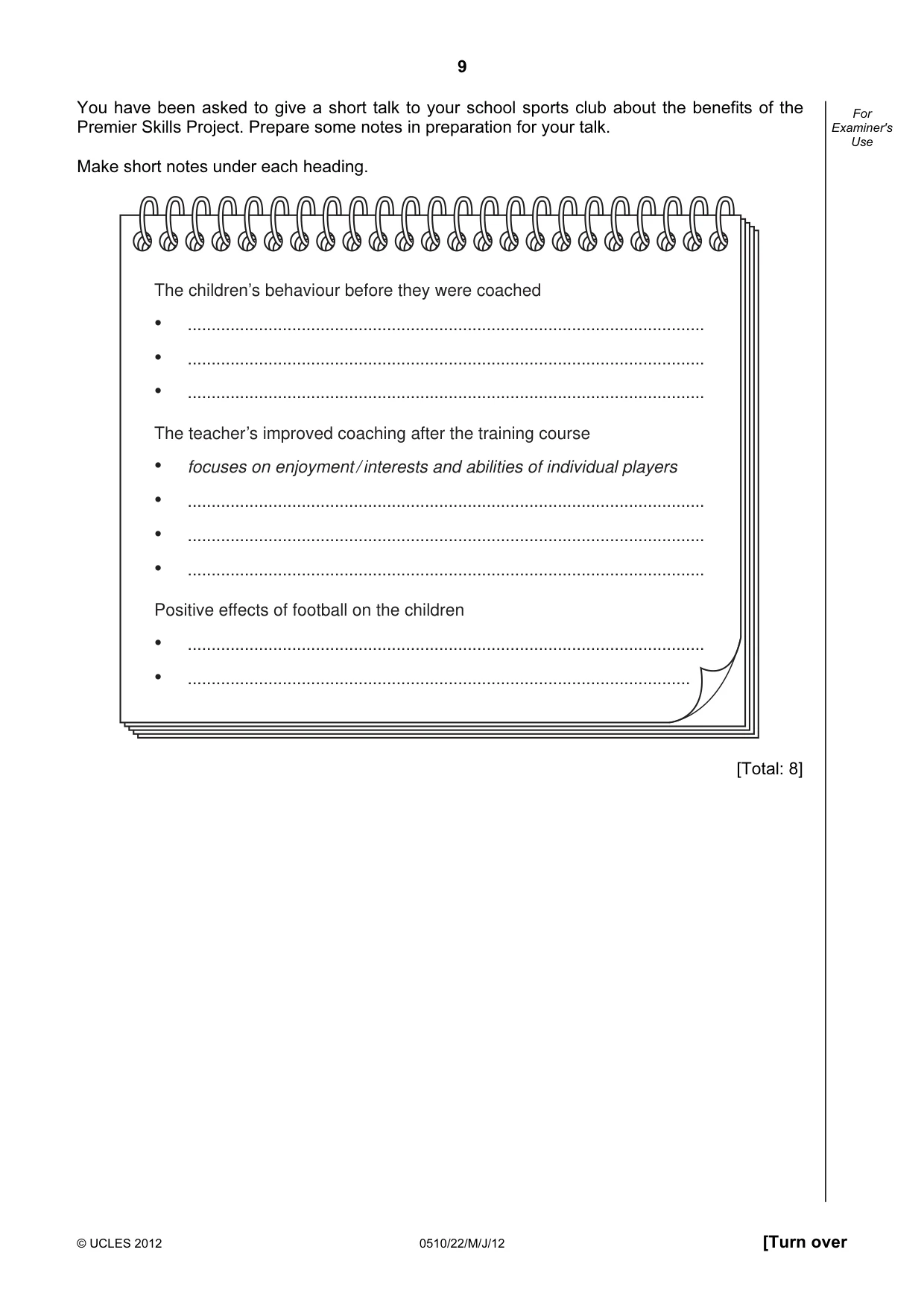
9 © UCLES 2012 0510/22/M/J/12 [Turn over For Examiner's Use You have been asked to give a short talk to your school sports club about the benefits of the Premier Skills Project. Prepare some notes in preparation for your talk. Make short notes under each heading. The children’s behaviour before they were coached • … • … • … The teacher’s improved coaching after the training course • focuses on enjoyment / interests and abilities of individual players • … • … • … Positive effects of football on the children • … • … [Total: 8]
Question paper, page 10
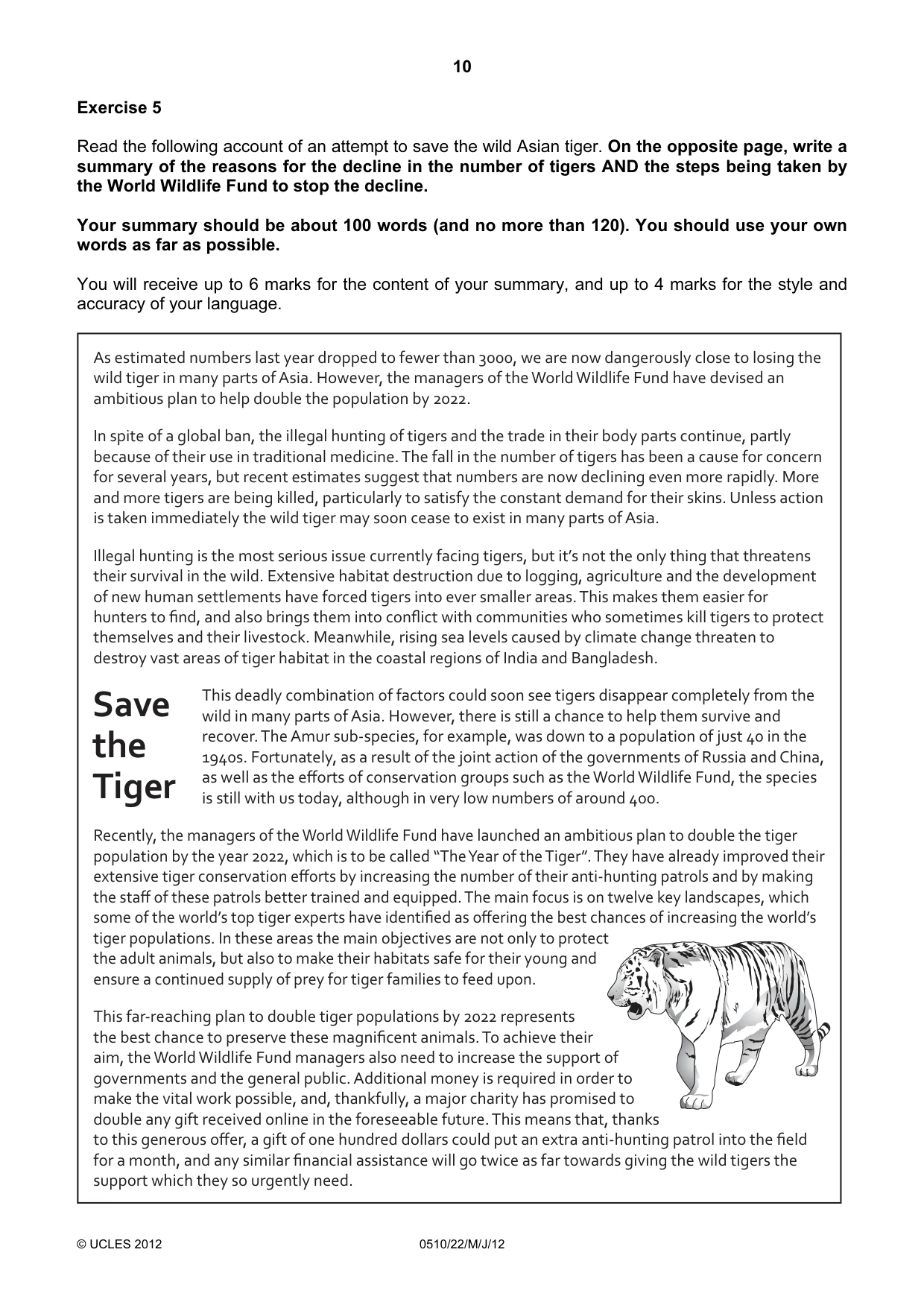
10 © UCLES 2012 0510/22/M/J/12 Exercise 5 Read the following account of an attempt to save the wild Asian tiger. On the opposite page, write a summary of the reasons for the decline in the number of tigers AND the steps being taken by the World Wildlife Fund to stop the decline. Your summary should be about 100 words (and no more than 120). You should use your own words as far as possible. You will receive up to 6 marks for the content of your summary, and up to 4 marks for the style and accuracy of your language. As estimated numbers last year dropped to fewer than 3000, we are now dangerously close to losing the wild tiger in many parts of Asia. However, the managers of the World Wildlife Fund have devised an ambitious plan to help double the population by 2022. In spite of a global ban, the illegal hunting of tigers and the trade in their body parts continue, partly because of their use in traditional medicine. The fall in the number of tigers has been a cause for concern for several years, but recent estimates suggest that numbers are now declining even more rapidly. More and more tigers are being killed, particularly to satisfy the constant demand for their skins. Unless action is taken immediately the wild tiger may soon cease to exist in many parts of Asia. Illegal hunting is the most serious issue currently facing tigers, but it’s not the only thing that threatens their survival in the wild. Extensive habitat destruction due to logging, agriculture and the development of new human settlements have forced tigers into ever smaller areas. This makes them easier for hunters to find, and also brings them into conflict with communities who sometimes kill tigers to protect themselves and their livestock. Meanwhile, rising sea levels caused by climate change threaten to destroy vast areas of tiger habitat in the coastal regions of India and Bangladesh. This deadly combination of factors could soon see tigers disappear completely from the wild in many parts of Asia. However, there is still a chance to help them survive and recover. The Amur sub-species, for example, was down to a population of just 40 in the 1940s. Fortunately, as a result of the joint action of the governments of Russia and China, as well as the efforts of conservation groups such as the World Wildlife Fund, the species is still with us today, although in very low numbers of around 400. Recently, the managers of the World Wildlife Fund have launched an ambitious plan to double the tiger population by the year 2022, which is to be called “The Year of the Tiger”. They have already improved their extensive tiger conservation efforts by increasing the number of their anti-hunting patrols and by making the staff of these patrols better trained and equipped. The main focus is on twelve key landscapes, which some of the world’s top tiger experts have identified as offering the best chances of increasing the world’s tiger populations. In these areas the main objectives are not only to protect the adult animals, but also to make their habitats safe for their young and ensure a continued supply of prey for tiger families to feed upon. This far-reaching plan to double tiger populations by 2022 represents the best chance to preserve these magnificent animals. To achieve their aim, the World Wildlife Fund managers also need to increase the support of governments and the general public. Additional money is required in order to make the vital work possible, and, thankfully, a major charity has promised to double any gift received online in the foreseeable future. This means that, thanks to this generous offer, a gift of one hundred dollars could put an extra anti-hunting patrol into the field for a month, and any similar financial assistance will go twice as far towards giving the wild tigers the support which they so urgently need. Save the Tiger
Question paper, page 11
11 © UCLES 2012 0510/22/M/J/12 [Turn over For Examiner's Use [Total: 10]
Question paper, page 12
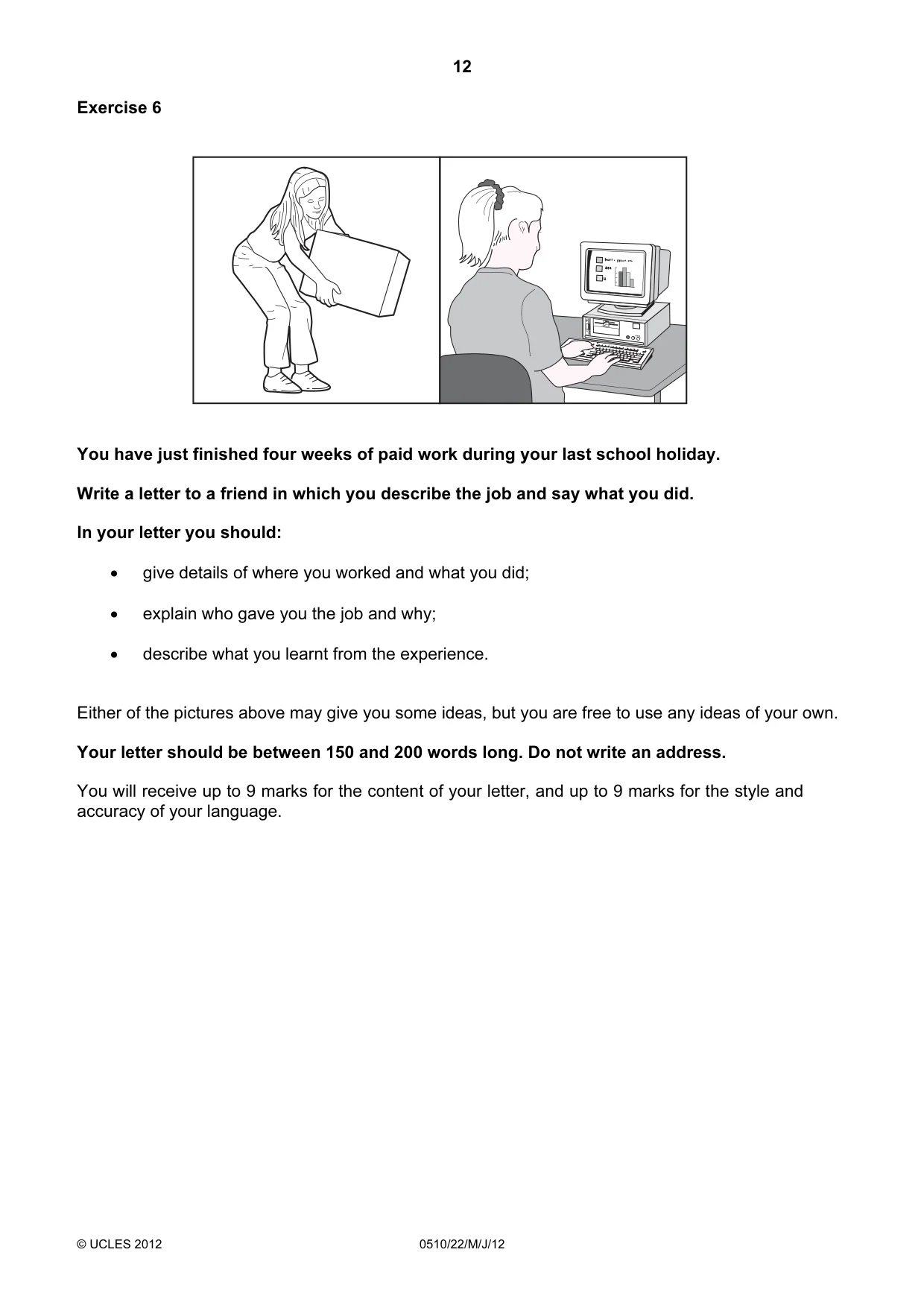
12 © UCLES 2012 0510/22/M/J/12 Exercise 6 You have just finished four weeks of paid work during your last school holiday. Write a letter to a friend in which you describe the job and say what you did. In your letter you should: • give details of where you worked and what you did; • explain who gave you the job and why; • describe what you learnt from the experience. Either of the pictures above may give you some ideas, but you are free to use any ideas of your own. Your letter should be between 150 and 200 words long. Do not write an address. You will receive up to 9 marks for the content of your letter, and up to 9 marks for the style and accuracy of your language.
Question paper, page 13
13 © UCLES 2012 0510/22/M/J/12 [Turn over For Examiner's Use [Total: 18]
Question paper, page 14
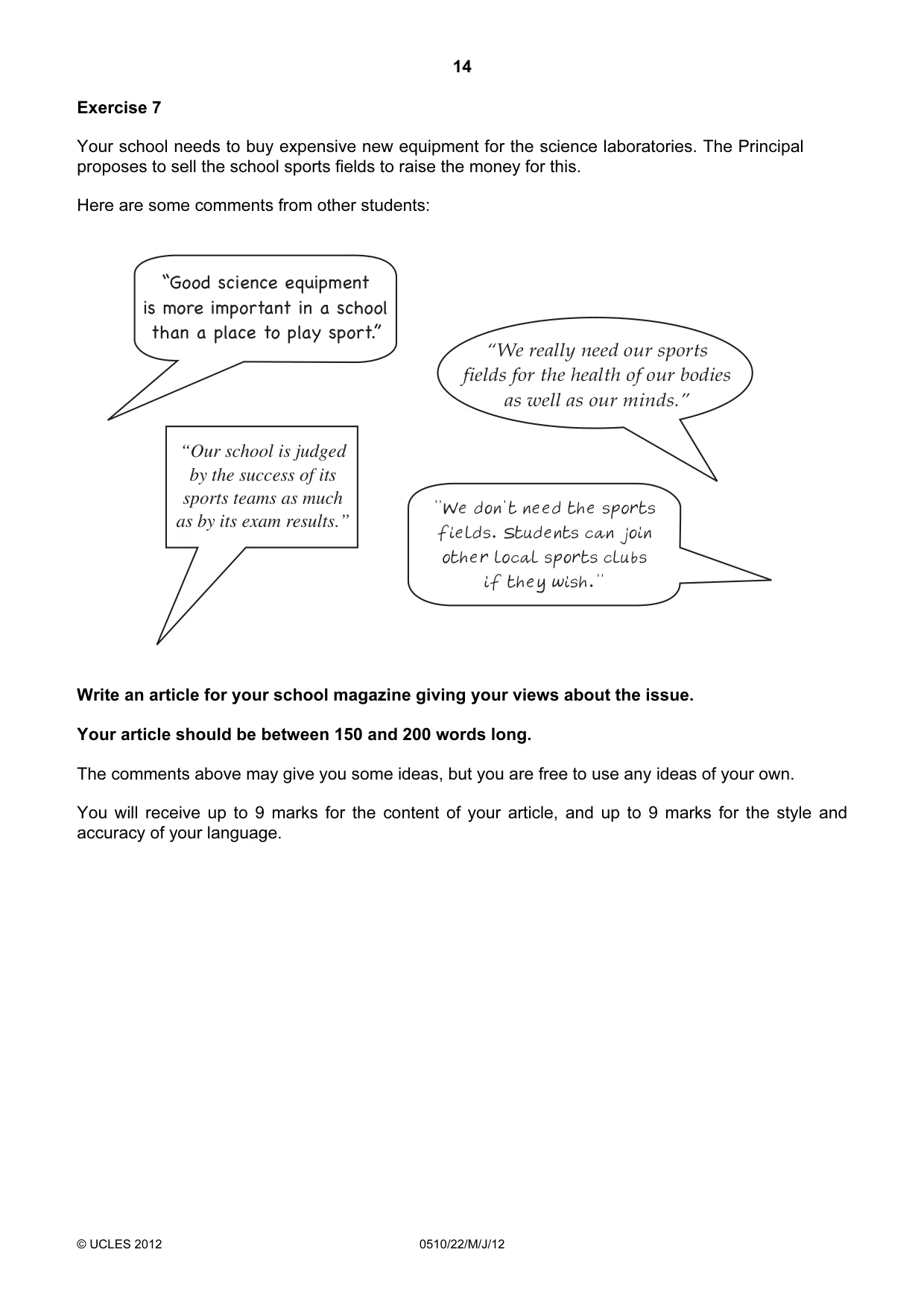
14 © UCLES 2012 0510/22/M/J/12 Exercise 7 Your school needs to buy expensive new equipment for the science laboratories. The Principal proposes to sell the school sports fields to raise the money for this. Here are some comments from other students: “Good science equipment is more important in a school than a place to play sport.” “We really need our sports fields for the health of our bodies as well as our minds.” “Our school is judged by the success of its sports teams as much as by its exam results.” “We don’t need the sports fields. Students can join other local sports clubs if they wish.” Write an article for your school magazine giving your views about the issue. Your article should be between 150 and 200 words long. The comments above may give you some ideas, but you are free to use any ideas of your own. You will receive up to 9 marks for the content of your article, and up to 9 marks for the style and accuracy of your language.
Question paper, page 15
15 © UCLES 2012 0510/22/M/J/12 For Examiner's Use [Total: 18]
Question paper, page 16
16 Permission to reproduce items where third-party owned material protected by copyright is included has been sought and cleared where possible. Every reasonable effort has been made by the publisher (UCLES) to trace copyright holders, but if any items requiring clearance have unwittingly been included, the publisher will be pleased to make amends at the earliest possible opportunity. University of Cambridge International Examinations is part of the Cambridge Assessment Group. Cambridge Assessment is the brand name of University of Cambridge Local Examinations Syndicate (UCLES), which is itself a department of the University of Cambridge. © UCLES 2012 0510/22/M/J/12 BLANK PAGE
Mark scheme, page 1
UNIVERSITY OF CAMBRIDGE INTERNATIONAL EXAMINATIONS International General Certificate of Secondary Education MARK SCHEME for the May/June 2012 question paper for the guidance of teachers 0510 ENGLISH AS A SECOND LANGUAGE 0510/22 Paper 2 (Reading and Writing – Extended), maximum raw mark 84 This mark scheme is published as an aid to teachers and candidates, to indicate the requirements of the examination. It shows the basis on which Examiners were instructed to award marks. It does not indicate the details of the discussions that took place at an Examiners’ meeting before marking began, which would have considered the acceptability of alternative answers. Mark schemes must be read in conjunction with the question papers and the report on the examination. • Cambridge will not enter into discussions or correspondence in connection with these mark schemes. Cambridge is publishing the mark schemes for the May/June 2012 question papers for most IGCSE, GCE Advanced Level and Advanced Subsidiary Level syllabuses and some Ordinary Level syllabuses. www.XtremePapers.com
Mark scheme, page 2
Page 2 Mark Scheme: Teachers’ version Syllabus Paper IGCSE – May/June 2012 0510 22 © University of Cambridge International Examinations 2012 This component forms part of the Extended tier assessment of IGCSE English as a Second Language and tests the following Assessment Objectives: AO1: Reading R1 understand and respond to information presented in a variety of forms R2 select and organise material relevant to specific purposes R3 recognise, understand and distinguish between facts, ideas and opinions R4 infer information from texts AO2: Writing W1 communicate clearly, accurately and appropriately W2 convey information and express opinions effectively W3 employ and control a variety of grammatical structures W4 demonstrate knowledge and understanding of a range of appropriate vocabulary W5 observe conventions of paragraphing, punctuation and spelling W6 employ appropriate register/style Overview of exercises on Paper 2 Reading objectives tested Marks for reading objectives Writing objectives tested Marks for writing objectives Total available marks Exercise 1 Reading (1) R1 8 --- 8 Exercise 2 Reading (2) R1 14 --- 14 Exercise 3 Information transfer R1, R2 6 W1, W5 2 8 Exercise 4 Note- making R1, R2, R3 8 --- 8 Exercise 5 Summary R1, R2, R3 6 W1, W2, W3, W4, W5 4 10 Exercise 6 Writing (1) --- W1, W2, W3, W4, W5, W6 18 18 Exercise 7 Writing (2) --- W1, W2, W3, W4, W5, W6 18 18 84
Mark scheme, page 3
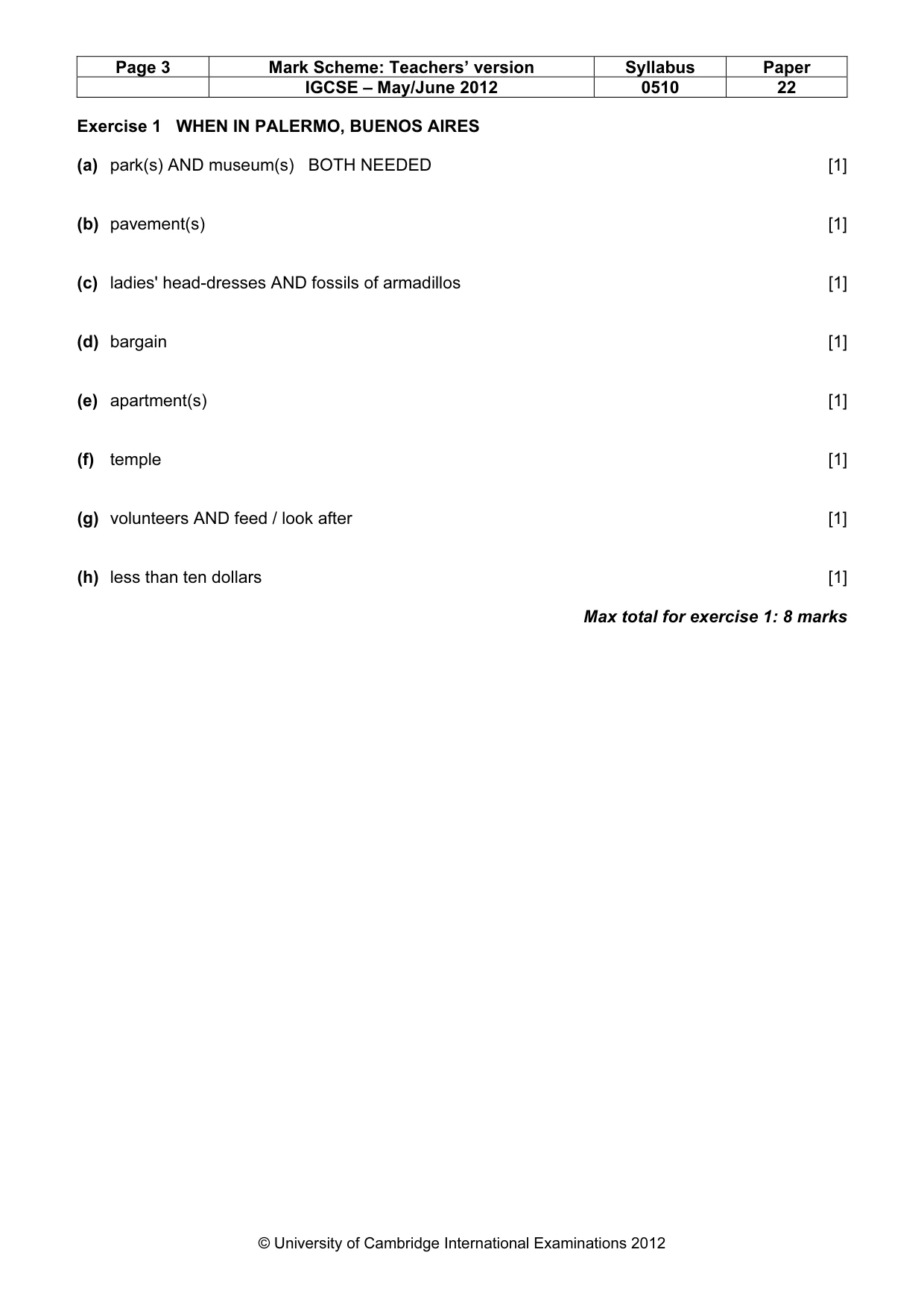
Page 3 Mark Scheme: Teachers’ version Syllabus Paper IGCSE – May/June 2012 0510 22 © University of Cambridge International Examinations 2012 Exercise 1 WHEN IN PALERMO, BUENOS AIRES (a) park(s) AND museum(s) BOTH NEEDED [1] (b) pavement(s) [1] (c) ladies' head-dresses AND fossils of armadillos [1] (d) bargain [1] (e) apartment(s) [1] (f) temple [1] (g) volunteers AND feed / look after [1] (h) less than ten dollars [1] Max total for exercise 1: 8 marks
Mark scheme, page 4
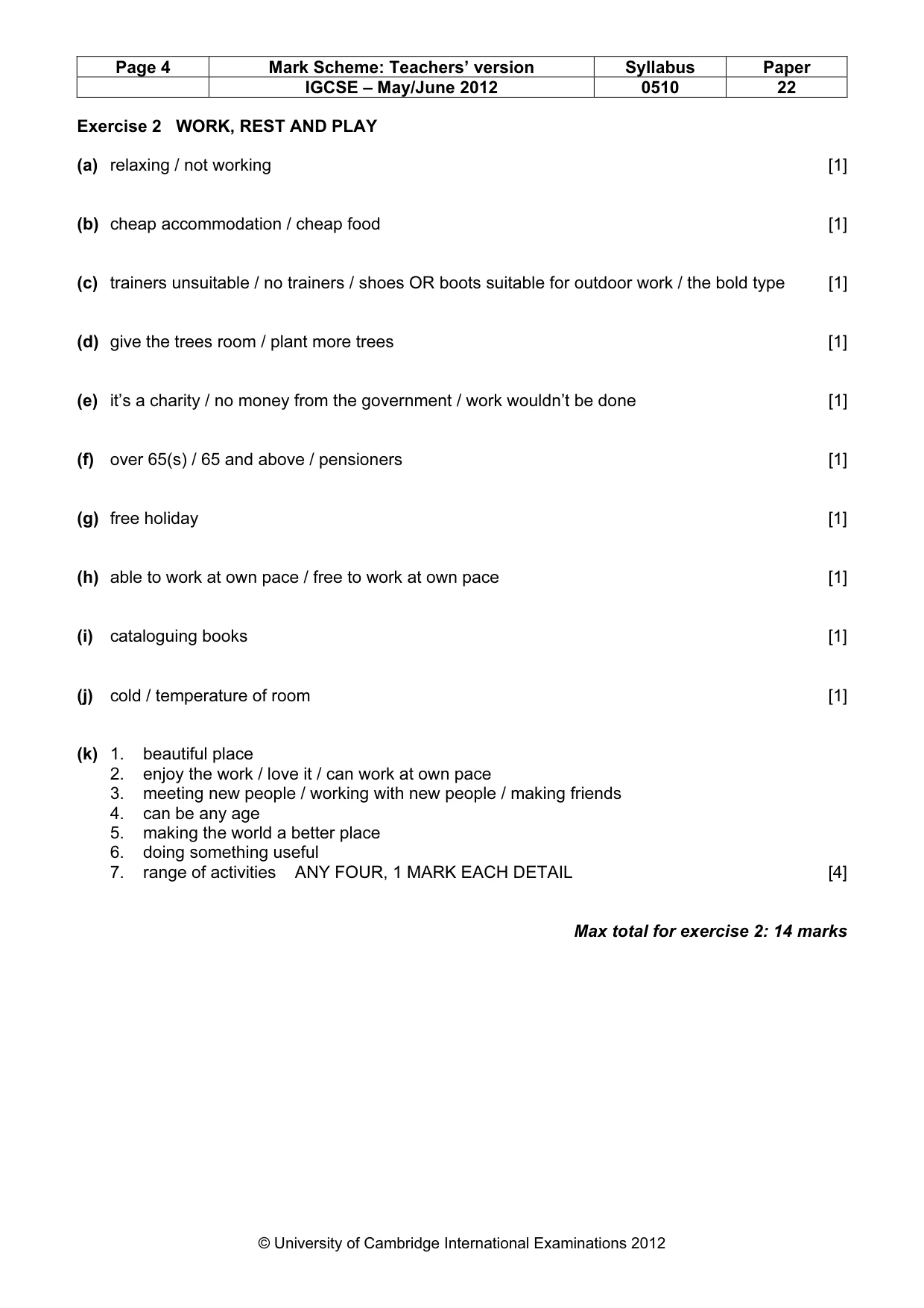
Page 4 Mark Scheme: Teachers’ version Syllabus Paper IGCSE – May/June 2012 0510 22 © University of Cambridge International Examinations 2012 Exercise 2 WORK, REST AND PLAY (a) relaxing / not working [1] (b) cheap accommodation / cheap food [1] (c) trainers unsuitable / no trainers / shoes OR boots suitable for outdoor work / the bold type [1] (d) give the trees room / plant more trees [1] (e) it’s a charity / no money from the government / work wouldn’t be done [1] (f) over 65(s) / 65 and above / pensioners [1] (g) free holiday [1] (h) able to work at own pace / free to work at own pace [1] (i) cataloguing books [1] (j) cold / temperature of room [1] (k) 1. beautiful place 2. enjoy the work / love it / can work at own pace 3. meeting new people / working with new people / making friends 4. can be any age 5. making the world a better place 6. doing something useful 7. range of activities ANY FOUR, 1 MARK EACH DETAIL [4] Max total for exercise 2: 14 marks
Mark scheme, page 5
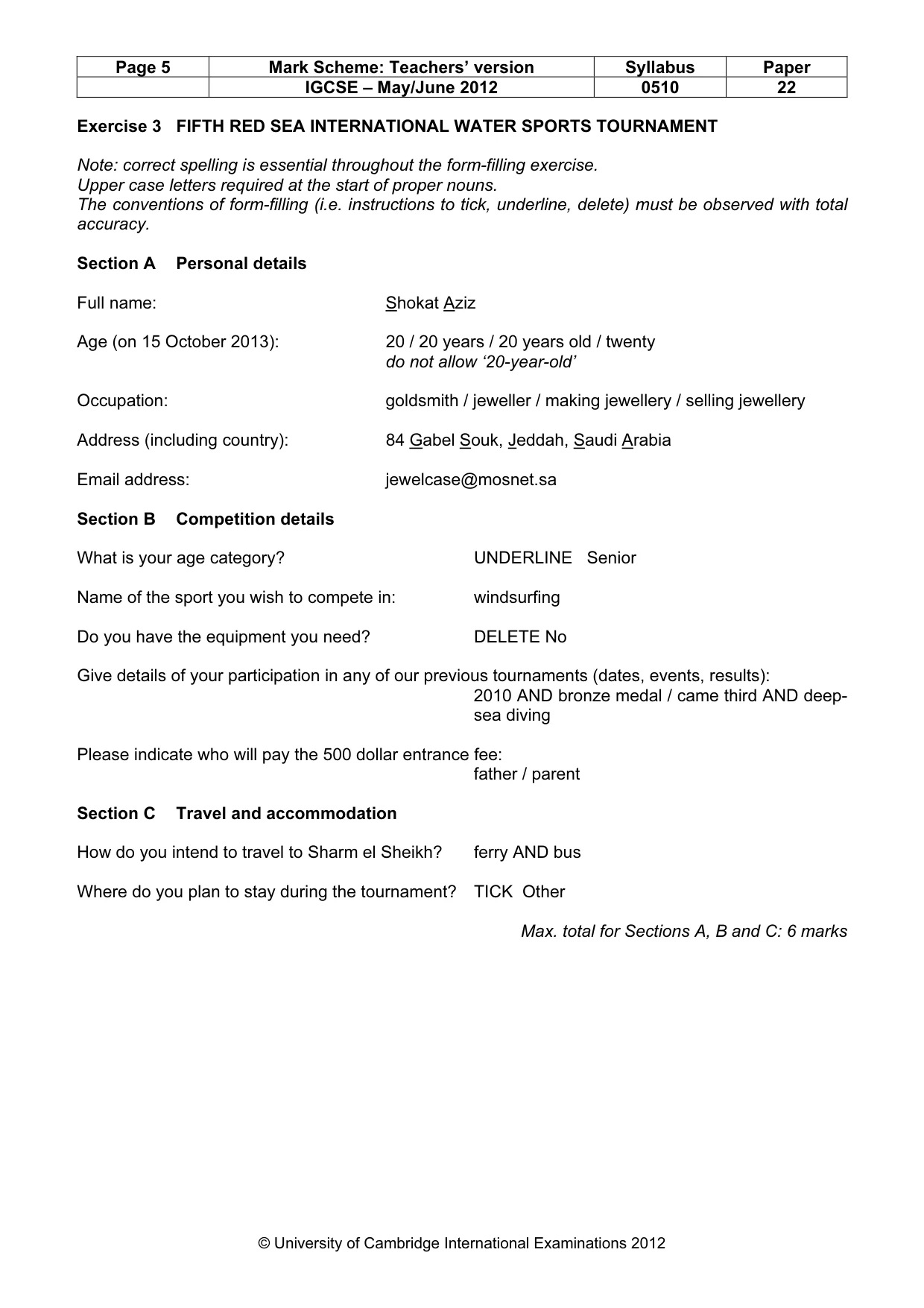
Page 5 Mark Scheme: Teachers’ version Syllabus Paper IGCSE – May/June 2012 0510 22 © University of Cambridge International Examinations 2012 Exercise 3 FIFTH RED SEA INTERNATIONAL WATER SPORTS TOURNAMENT Note: correct spelling is essential throughout the form-filling exercise. Upper case letters required at the start of proper nouns. The conventions of form-filling (i.e. instructions to tick, underline, delete) must be observed with total accuracy. Section A Personal details Full name: Shokat Aziz Age (on 15 October 2013): 20 / 20 years / 20 years old / twenty do not allow ‘20-year-old’ Occupation: goldsmith / jeweller / making jewellery / selling jewellery Address (including country): 84 Gabel Souk, Jeddah, Saudi Arabia Email address: jewelcase@mosnet.sa Section B Competition details What is your age category? UNDERLINE Senior Name of the sport you wish to compete in: windsurfing Do you have the equipment you need? DELETE No Give details of your participation in any of our previous tournaments (dates, events, results): 2010 AND bronze medal / came third AND deep- sea diving Please indicate who will pay the 500 dollar entrance fee: father / parent Section C Travel and accommodation How do you intend to travel to Sharm el Sheikh? ferry AND bus Where do you plan to stay during the tournament? TICK Other Max. total for Sections A, B and C: 6 marks
Mark scheme, page 6
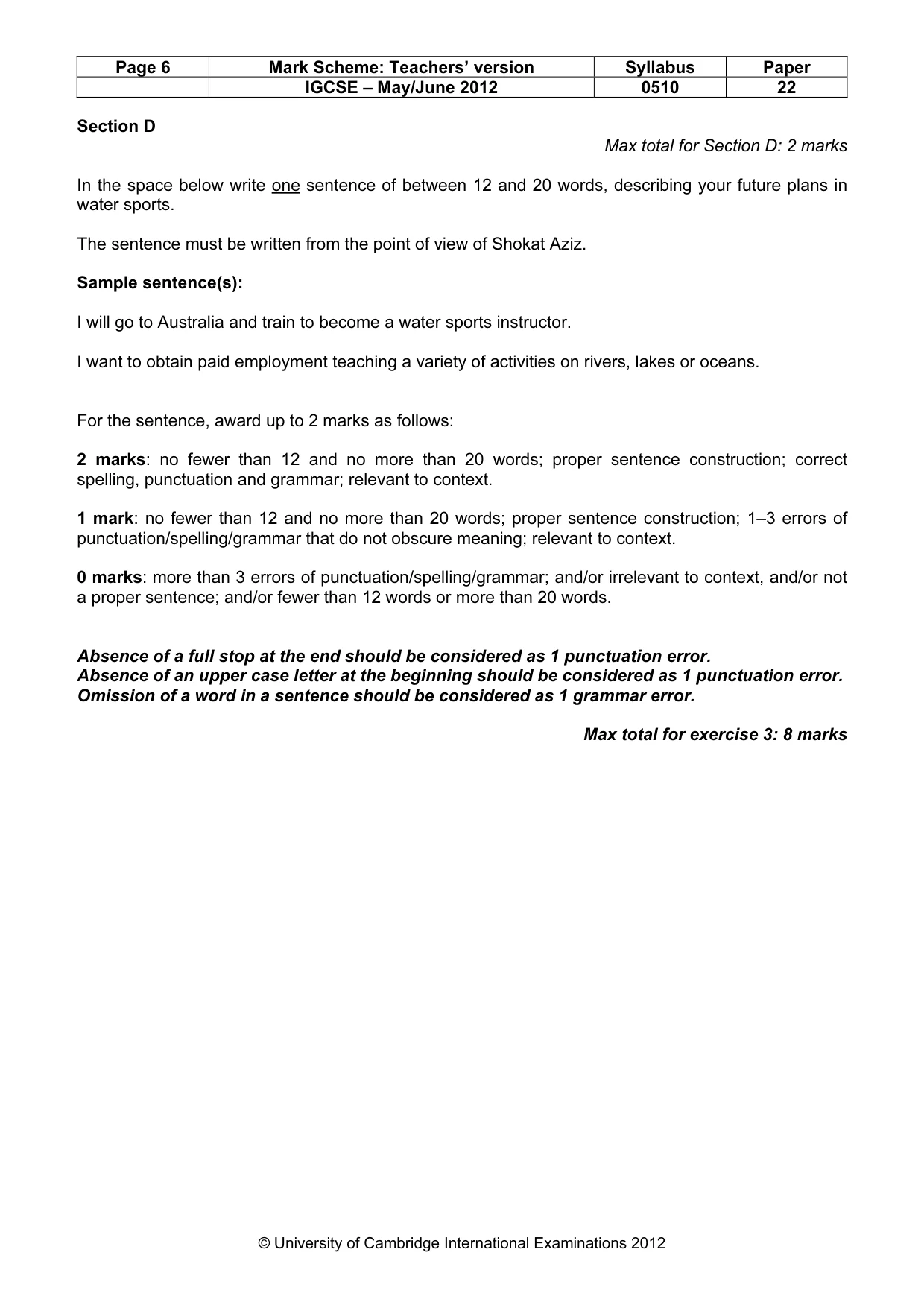
Page 6 Mark Scheme: Teachers’ version Syllabus Paper IGCSE – May/June 2012 0510 22 © University of Cambridge International Examinations 2012 Section D Max total for Section D: 2 marks In the space below write one sentence of between 12 and 20 words, describing your future plans in water sports. The sentence must be written from the point of view of Shokat Aziz. Sample sentence(s): I will go to Australia and train to become a water sports instructor. I want to obtain paid employment teaching a variety of activities on rivers, lakes or oceans. For the sentence, award up to 2 marks as follows: 2 marks: no fewer than 12 and no more than 20 words; proper sentence construction; correct spelling, punctuation and grammar; relevant to context. 1 mark: no fewer than 12 and no more than 20 words; proper sentence construction; 1–3 errors of punctuation/spelling/grammar that do not obscure meaning; relevant to context. 0 marks: more than 3 errors of punctuation/spelling/grammar; and/or irrelevant to context, and/or not a proper sentence; and/or fewer than 12 words or more than 20 words. Absence of a full stop at the end should be considered as 1 punctuation error. Absence of an upper case letter at the beginning should be considered as 1 punctuation error. Omission of a word in a sentence should be considered as 1 grammar error. Max total for exercise 3: 8 marks
Mark scheme, page 7
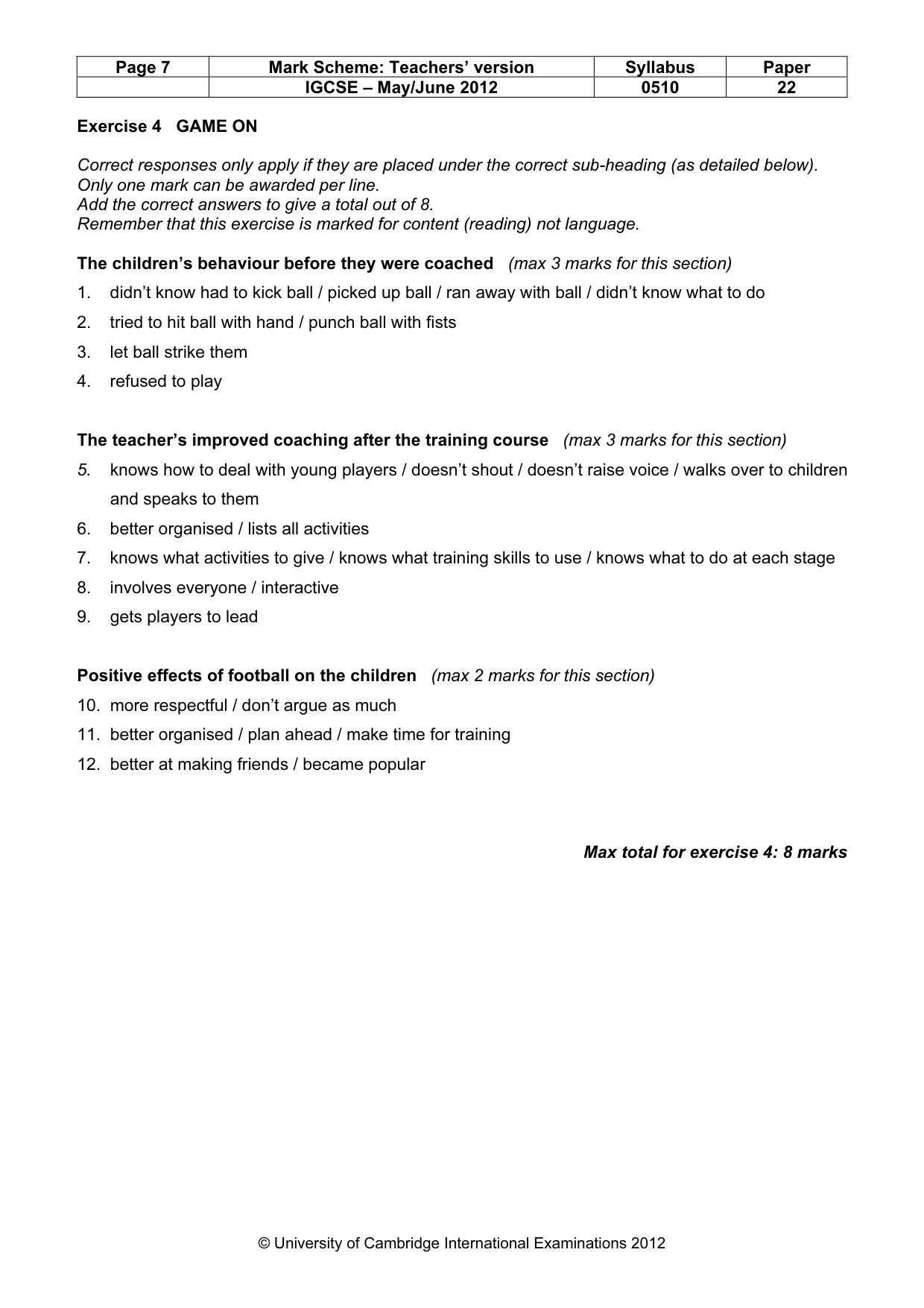
Page 7 Mark Scheme: Teachers’ version Syllabus Paper IGCSE – May/June 2012 0510 22 © University of Cambridge International Examinations 2012 Exercise 4 GAME ON Correct responses only apply if they are placed under the correct sub-heading (as detailed below). Only one mark can be awarded per line. Add the correct answers to give a total out of 8. Remember that this exercise is marked for content (reading) not language. The children’s behaviour before they were coached (max 3 marks for this section) 1. didn’t know had to kick ball / picked up ball / ran away with ball / didn’t know what to do 2. tried to hit ball with hand / punch ball with fists 3. let ball strike them 4. refused to play The teacher’s improved coaching after the training course (max 3 marks for this section) 5. knows how to deal with young players / doesn’t shout / doesn’t raise voice / walks over to children and speaks to them 6. better organised / lists all activities 7. knows what activities to give / knows what training skills to use / knows what to do at each stage 8. involves everyone / interactive 9. gets players to lead Positive effects of football on the children (max 2 marks for this section) 10. more respectful / don’t argue as much 11. better organised / plan ahead / make time for training 12. better at making friends / became popular Max total for exercise 4: 8 marks
Mark scheme, page 8
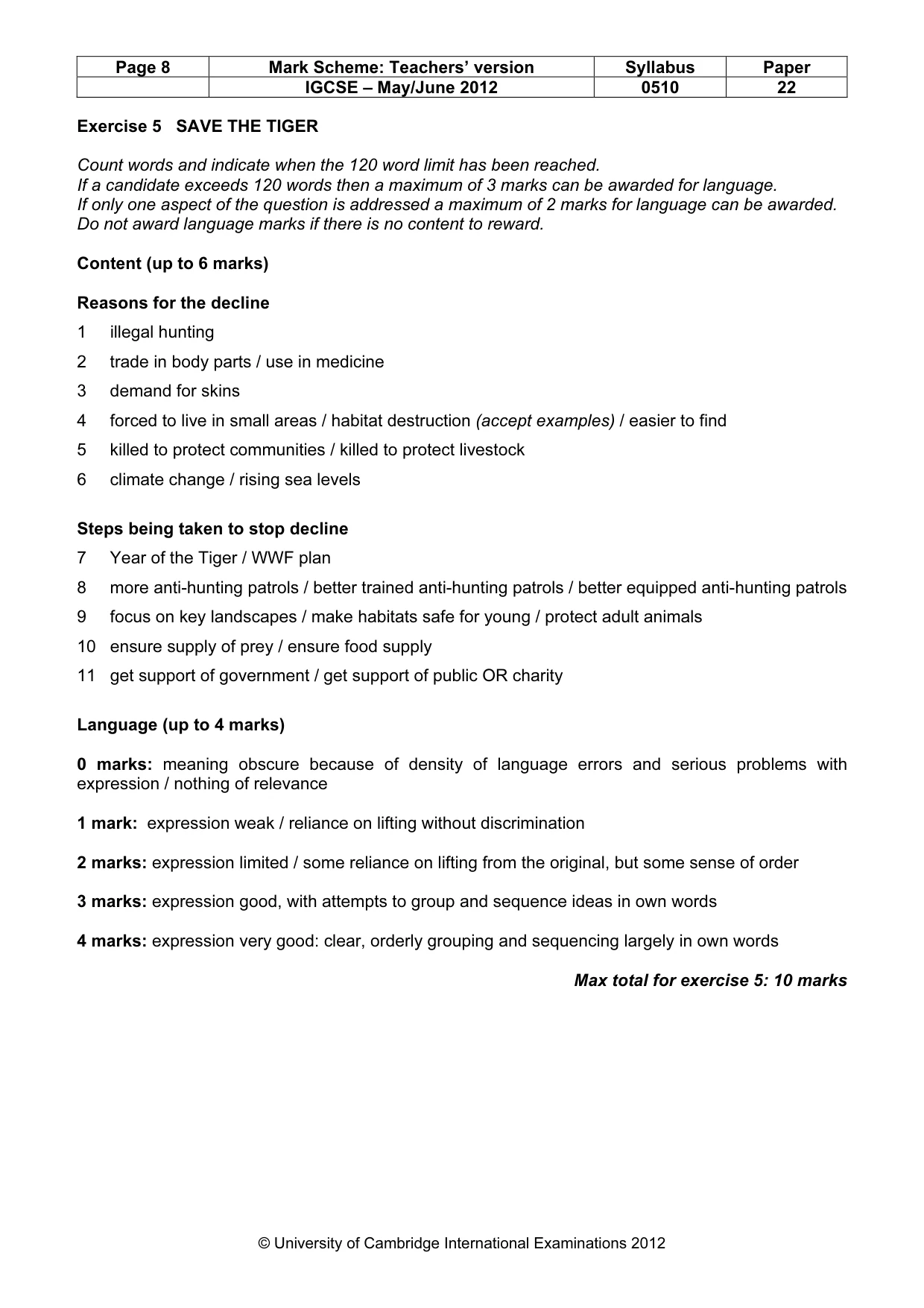
Page 8 Mark Scheme: Teachers’ version Syllabus Paper IGCSE – May/June 2012 0510 22 © University of Cambridge International Examinations 2012 Exercise 5 SAVE THE TIGER Count words and indicate when the 120 word limit has been reached. If a candidate exceeds 120 words then a maximum of 3 marks can be awarded for language. If only one aspect of the question is addressed a maximum of 2 marks for language can be awarded. Do not award language marks if there is no content to reward. Content (up to 6 marks) Reasons for the decline 1 illegal hunting 2 trade in body parts / use in medicine 3 demand for skins 4 forced to live in small areas / habitat destruction (accept examples) / easier to find 5 killed to protect communities / killed to protect livestock 6 climate change / rising sea levels Steps being taken to stop decline 7 Year of the Tiger / WWF plan 8 more anti-hunting patrols / better trained anti-hunting patrols / better equipped anti-hunting patrols 9 focus on key landscapes / make habitats safe for young / protect adult animals 10 ensure supply of prey / ensure food supply 11 get support of government / get support of public OR charity Language (up to 4 marks) 0 marks: meaning obscure because of density of language errors and serious problems with expression / nothing of relevance 1 mark: expression weak / reliance on lifting without discrimination 2 marks: expression limited / some reliance on lifting from the original, but some sense of order 3 marks: expression good, with attempts to group and sequence ideas in own words 4 marks: expression very good: clear, orderly grouping and sequencing largely in own words Max total for exercise 5: 10 marks
Mark scheme, page 9
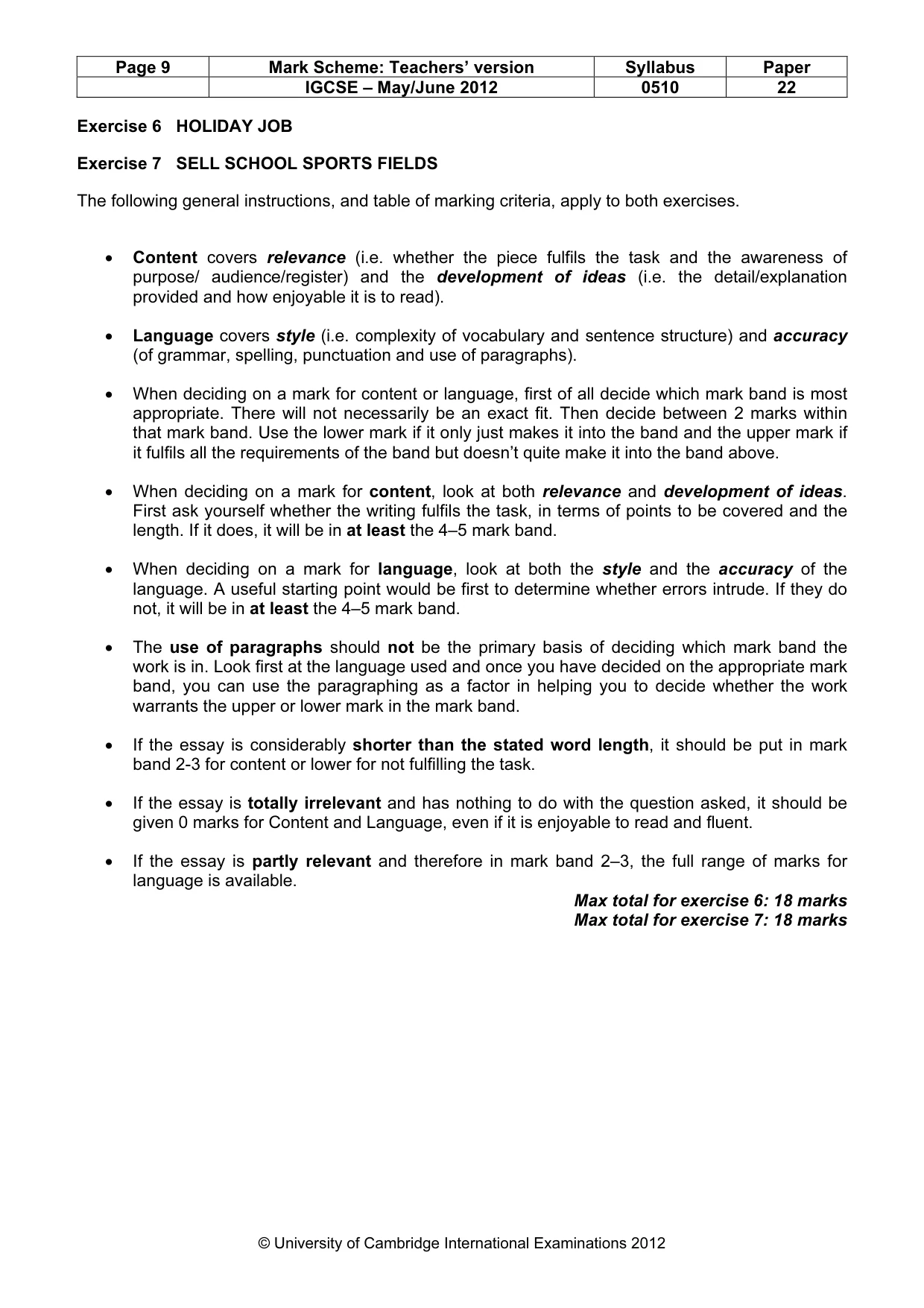
Page 9 Mark Scheme: Teachers’ version Syllabus Paper IGCSE – May/June 2012 0510 22 © University of Cambridge International Examinations 2012 Exercise 6 HOLIDAY JOB Exercise 7 SELL SCHOOL SPORTS FIELDS The following general instructions, and table of marking criteria, apply to both exercises. • Content covers relevance (i.e. whether the piece fulfils the task and the awareness of purpose/ audience/register) and the development of ideas (i.e. the detail/explanation provided and how enjoyable it is to read). • Language covers style (i.e. complexity of vocabulary and sentence structure) and accuracy (of grammar, spelling, punctuation and use of paragraphs). • When deciding on a mark for content or language, first of all decide which mark band is most appropriate. There will not necessarily be an exact fit. Then decide between 2 marks within that mark band. Use the lower mark if it only just makes it into the band and the upper mark if it fulfils all the requirements of the band but doesn’t quite make it into the band above. • When deciding on a mark for content, look at both relevance and development of ideas. First ask yourself whether the writing fulfils the task, in terms of points to be covered and the length. If it does, it will be in at least the 4–5 mark band. • When deciding on a mark for language, look at both the style and the accuracy of the language. A useful starting point would be first to determine whether errors intrude. If they do not, it will be in at least the 4–5 mark band. • The use of paragraphs should not be the primary basis of deciding which mark band the work is in. Look first at the language used and once you have decided on the appropriate mark band, you can use the paragraphing as a factor in helping you to decide whether the work warrants the upper or lower mark in the mark band. • If the essay is considerably shorter than the stated word length, it should be put in mark band 2-3 for content or lower for not fulfilling the task. • If the essay is totally irrelevant and has nothing to do with the question asked, it should be given 0 marks for Content and Language, even if it is enjoyable to read and fluent. • If the essay is partly relevant and therefore in mark band 2–3, the full range of marks for language is available. Max total for exercise 6: 18 marks Max total for exercise 7: 18 marks
Mark scheme, page 10
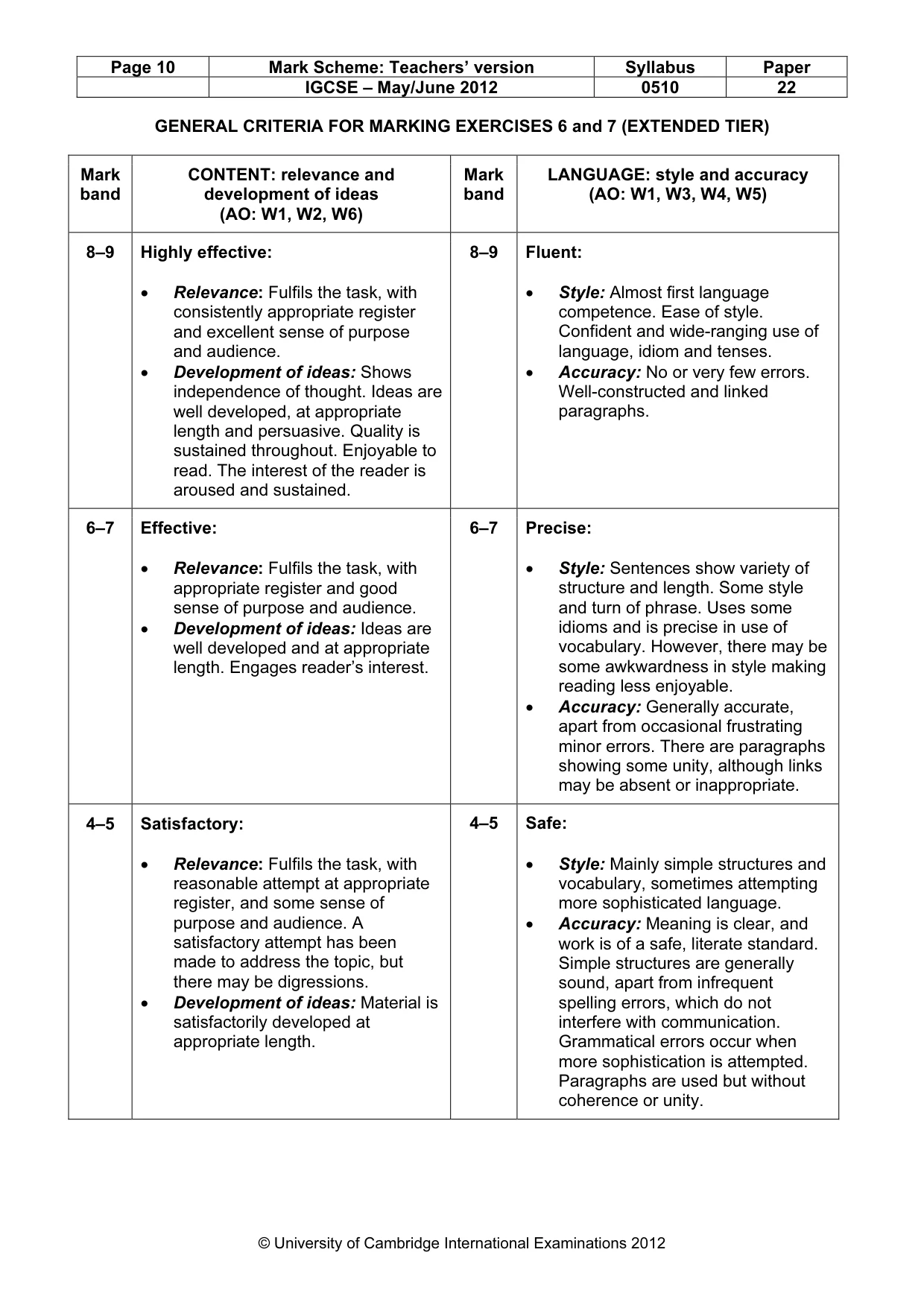
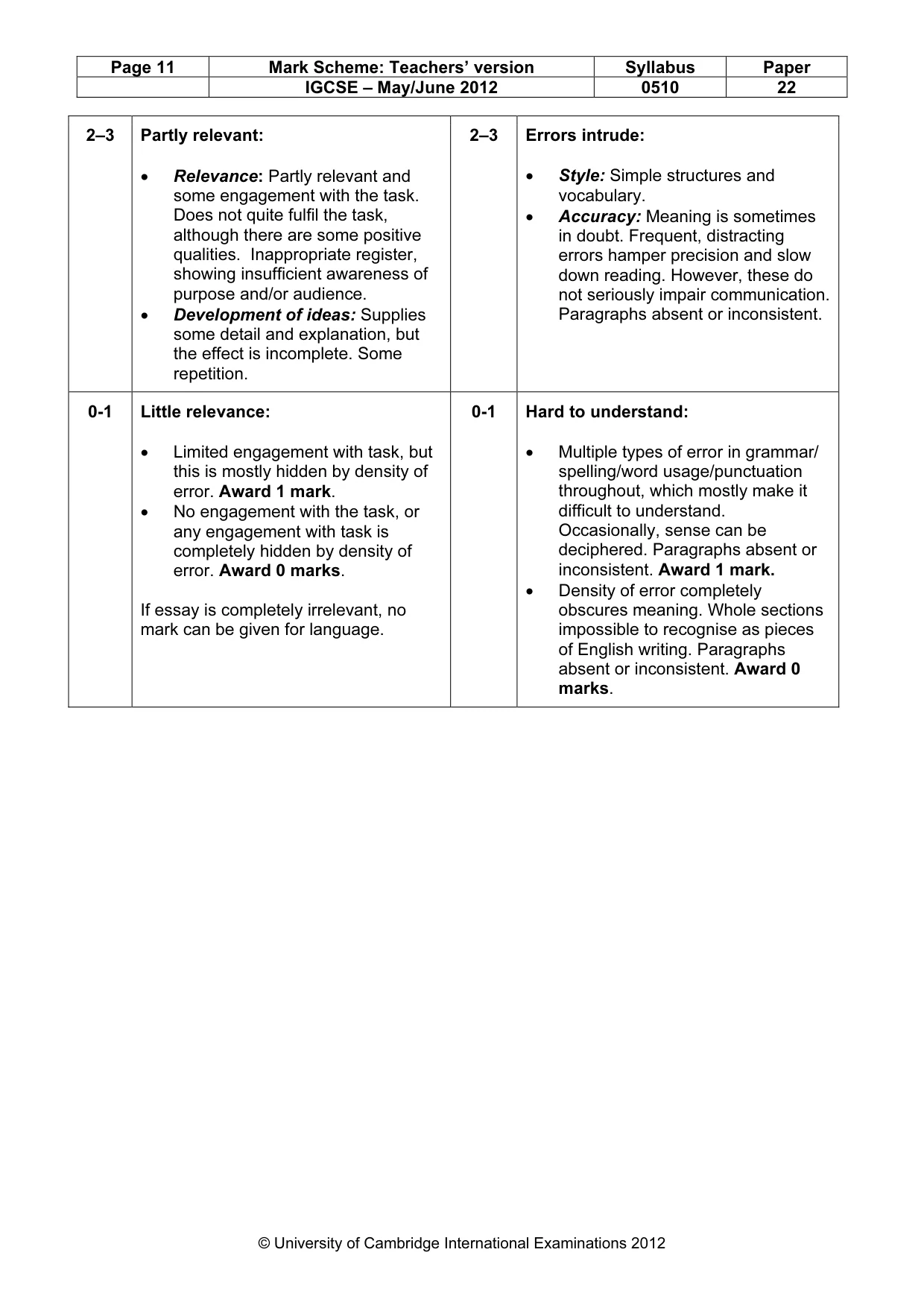
Page 10 Mark Scheme: Teachers’ version Syllabus Paper IGCSE – May/June 2012 0510 22 © University of Cambridge International Examinations 2012 GENERAL CRITERIA FOR MARKING EXERCISES 6 and 7 (EXTENDED TIER) Mark band CONTENT: relevance and development of ideas (AO: W1, W2, W6) Mark band LANGUAGE: style and accuracy (AO: W1, W3, W4, W5) 8–9 Highly effective: • Relevance: Fulfils the task, with consistently appropriate register and excellent sense of purpose and audience. • Development of ideas: Shows independence of thought. Ideas are well developed, at appropriate length and persuasive. Quality is sustained throughout. Enjoyable to read. The interest of the reader is aroused and sustained. 8–9 Fluent: • Style: Almost first language competence. Ease of style. Confident and wide-ranging use of language, idiom and tenses. • Accuracy: No or very few errors. Well-constructed and linked paragraphs. 6–7 Effective: • Relevance: Fulfils the task, with appropriate register and good sense of purpose and audience. • Development of ideas: Ideas are well developed and at appropriate length. Engages reader’s interest. 6–7 Precise: • Style: Sentences show variety of structure and length. Some style and turn of phrase. Uses some idioms and is precise in use of vocabulary. However, there may be some awkwardness in style making reading less enjoyable. • Accuracy: Generally accurate, apart from occasional frustrating minor errors. There are paragraphs showing some unity, although links may be absent or inappropriate. 4–5 Satisfactory: • Relevance: Fulfils the task, with reasonable attempt at appropriate register, and some sense of purpose and audience. A satisfactory attempt has been made to address the topic, but there may be digressions. • Development of ideas: Material is satisfactorily developed at appropriate length. 4–5 Safe: • Style: Mainly simple structures and vocabulary, sometimes attempting more sophisticated language. • Accuracy: Meaning is clear, and work is of a safe, literate standard. Simple structures are generally sound, apart from infrequent spelling errors, which do not interfere with communication. Grammatical errors occur when more sophistication is attempted. Paragraphs are used but without coherence or unity.
Mark scheme, page 11
Page 11 Mark Scheme: Teachers’ version Syllabus Paper IGCSE – May/June 2012 0510 22 © University of Cambridge International Examinations 2012 2–3 Partly relevant: • Relevance: Partly relevant and some engagement with the task. Does not quite fulfil the task, although there are some positive qualities. Inappropriate register, showing insufficient awareness of purpose and/or audience. • Development of ideas: Supplies some detail and explanation, but the effect is incomplete. Some repetition. 2–3 Errors intrude: • Style: Simple structures and vocabulary. • Accuracy: Meaning is sometimes in doubt. Frequent, distracting errors hamper precision and slow down reading. However, these do not seriously impair communication. Paragraphs absent or inconsistent. 0-1 Little relevance: • Limited engagement with task, but this is mostly hidden by density of error. Award 1 mark. • No engagement with the task, or any engagement with task is completely hidden by density of error. Award 0 marks. If essay is completely irrelevant, no mark can be given for language. 0-1 Hard to understand: • Multiple types of error in grammar/ spelling/word usage/punctuation throughout, which mostly make it difficult to understand. Occasionally, sense can be deciphered. Paragraphs absent or inconsistent. Award 1 mark. • Density of error completely obscures meaning. Whole sections impossible to recognise as pieces of English writing. Paragraphs absent or inconsistent. Award 0 marks.
What you needed in this session
Cambridge’s own grade thresholds for 2012 May/June, Paper 2 · Variant 2. A higher threshold means an easier paper — the bar moves with how the cohort did.