Cambridge IGCSE English - Second Language (oral endorsement) 0510 — 2011 May/June Paper 3 · Variant 2
0510/32/M/J/11 · 30 marks · ≈34 min
The question paper and its mark scheme, free to read here and free to download. This is Cambridge’s own paper, exactly as it was sat.
Question paper8 pages


Mark scheme13 pages
Answers below. Sit the paper first if you are practising.
Paper as text
Question paper, page 1
This document consists of 6 printed pages and 2 blank pages. IB11 06_0510_32/RP © UCLES 2011 [Turn over *5894046678* UNIVERSITY OF CAMBRIDGE INTERNATIONAL EXAMINATIONS International General Certificate of Secondary Education ENGLISH AS A SECOND LANGUAGE 0510/32 Paper 3 Listening (Core) May/June 2011 Approx. 30 – 40 minutes Candidates answer on the Question Paper. Additional Materials: As listed in Instructions to Supervisors. READ THESE INSTRUCTIONS FIRST Write your Centre number, candidate number and name on all the work you hand in. Write in dark blue or black pen. Do not use staples, paper clips, highlighters, glue or correction fluid. DO NOT WRITE IN ANY BARCODES. Answer all questions. Dictionaries are not permitted. The number of marks is given in brackets [ ] at the end of each question or part question. www.XtremePapers.com
Question paper, page 2
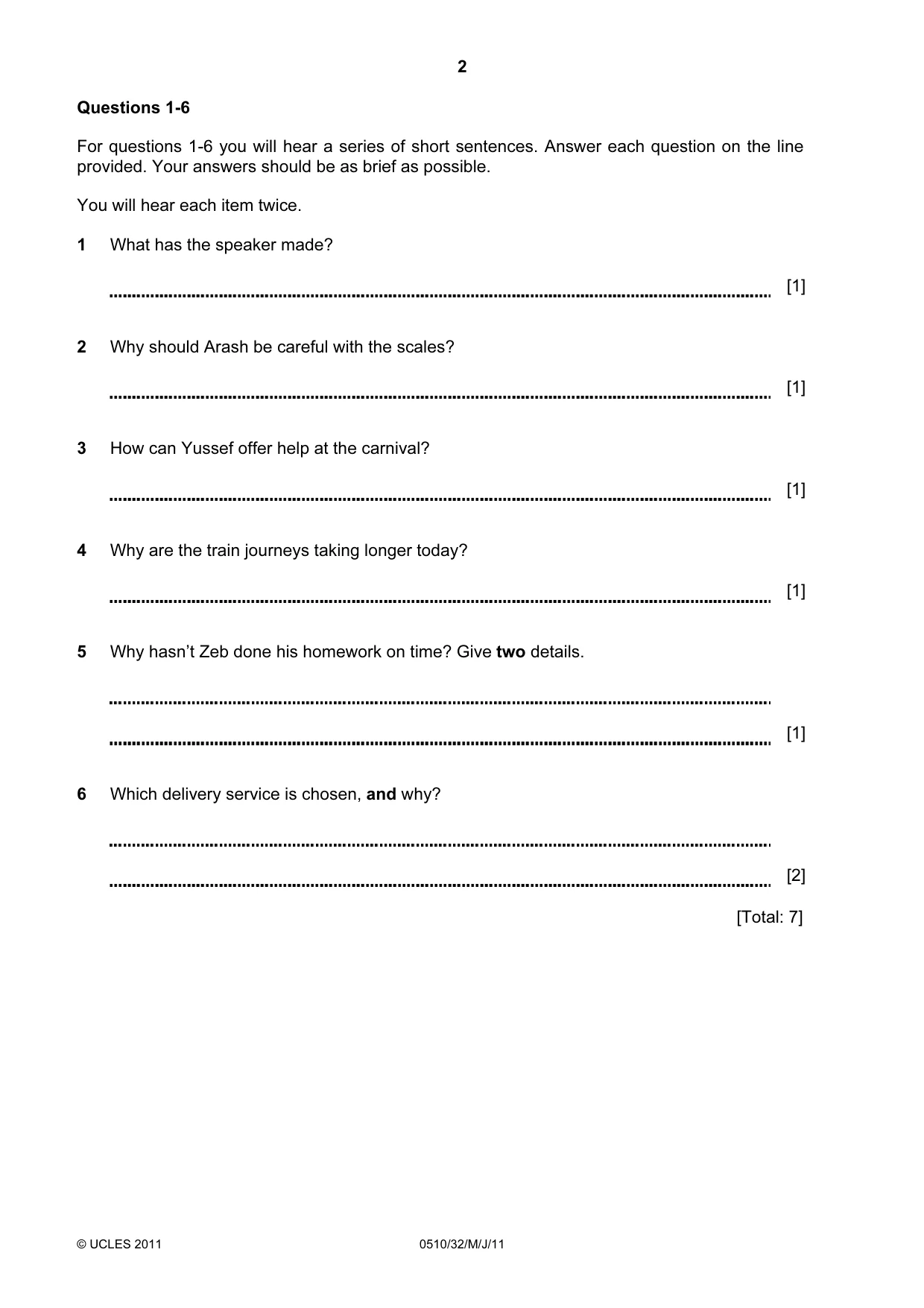
2 © UCLES 2011 0510/32/M/J/11 Questions 1-6 For questions 1-6 you will hear a series of short sentences. Answer each question on the line provided. Your answers should be as brief as possible. You will hear each item twice. 1 What has the speaker made? [1] 2 Why should Arash be careful with the scales? [1] 3 How can Yussef offer help at the carnival? [1] 4 Why are the train journeys taking longer today? [1] 5 Why hasn’t Zeb done his homework on time? Give two details. [1] 6 Which delivery service is chosen, and why? [2] [Total: 7]
Question paper, page 3
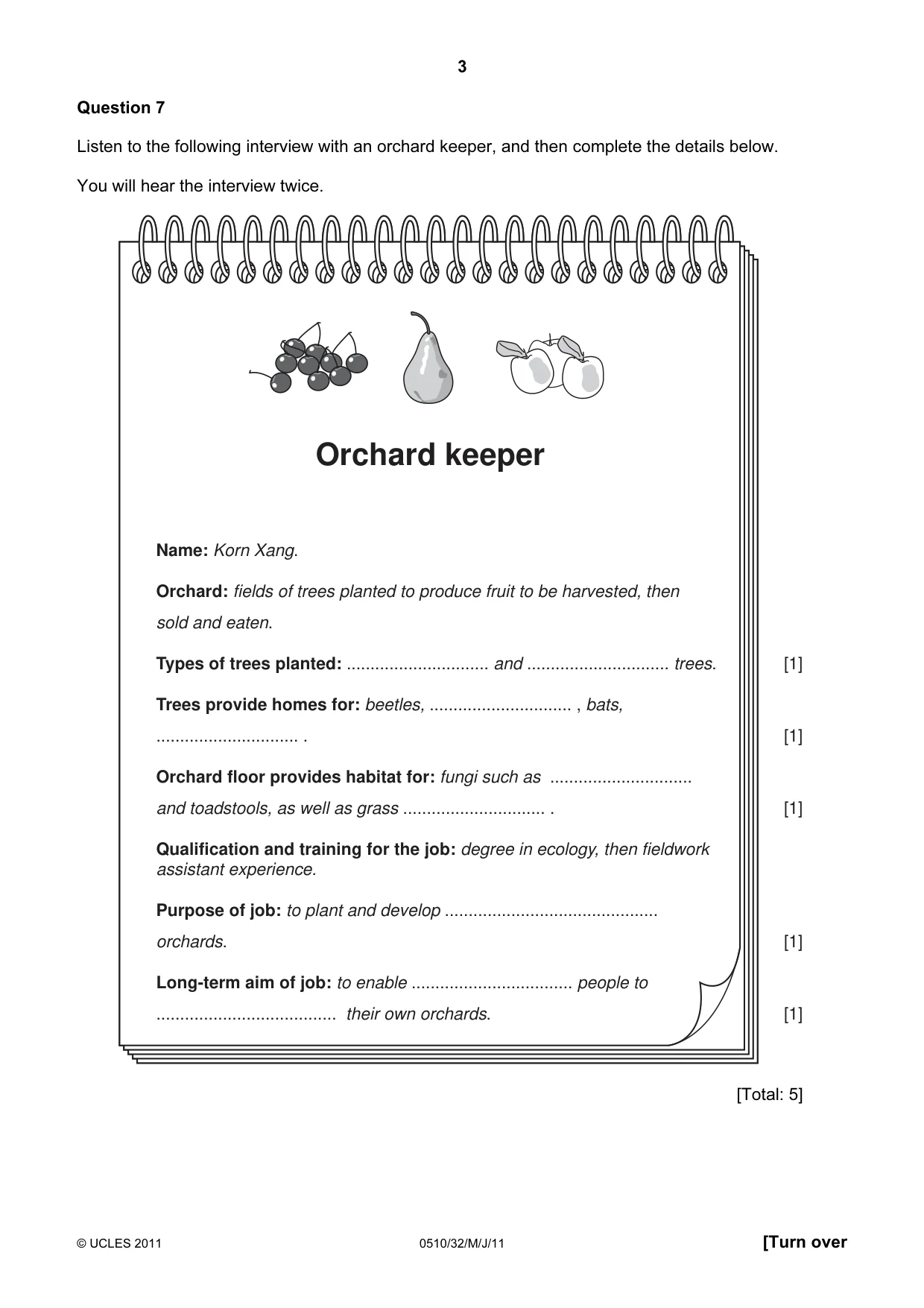
3 © UCLES 2011 0510/32/M/J/11 [Turn over Question 7 Listen to the following interview with an orchard keeper, and then complete the details below. You will hear the interview twice. Orchard keeper Name: Korn Xang. Orchard: fields of trees planted to produce fruit to be harvested, then sold and eaten. Types of trees planted: … and … trees. [1] Trees provide homes for: beetles, … , bats, … . [1] Orchard floor provides habitat for: fungi such as … and toadstools, as well as grass … . [1] Qualification and training for the job: degree in ecology, then fieldwork assistant experience. Purpose of job: to plant and develop … orchards. [1] Long-term aim of job: to enable … people to … their own orchards. [1] [Total: 5]
Question paper, page 4
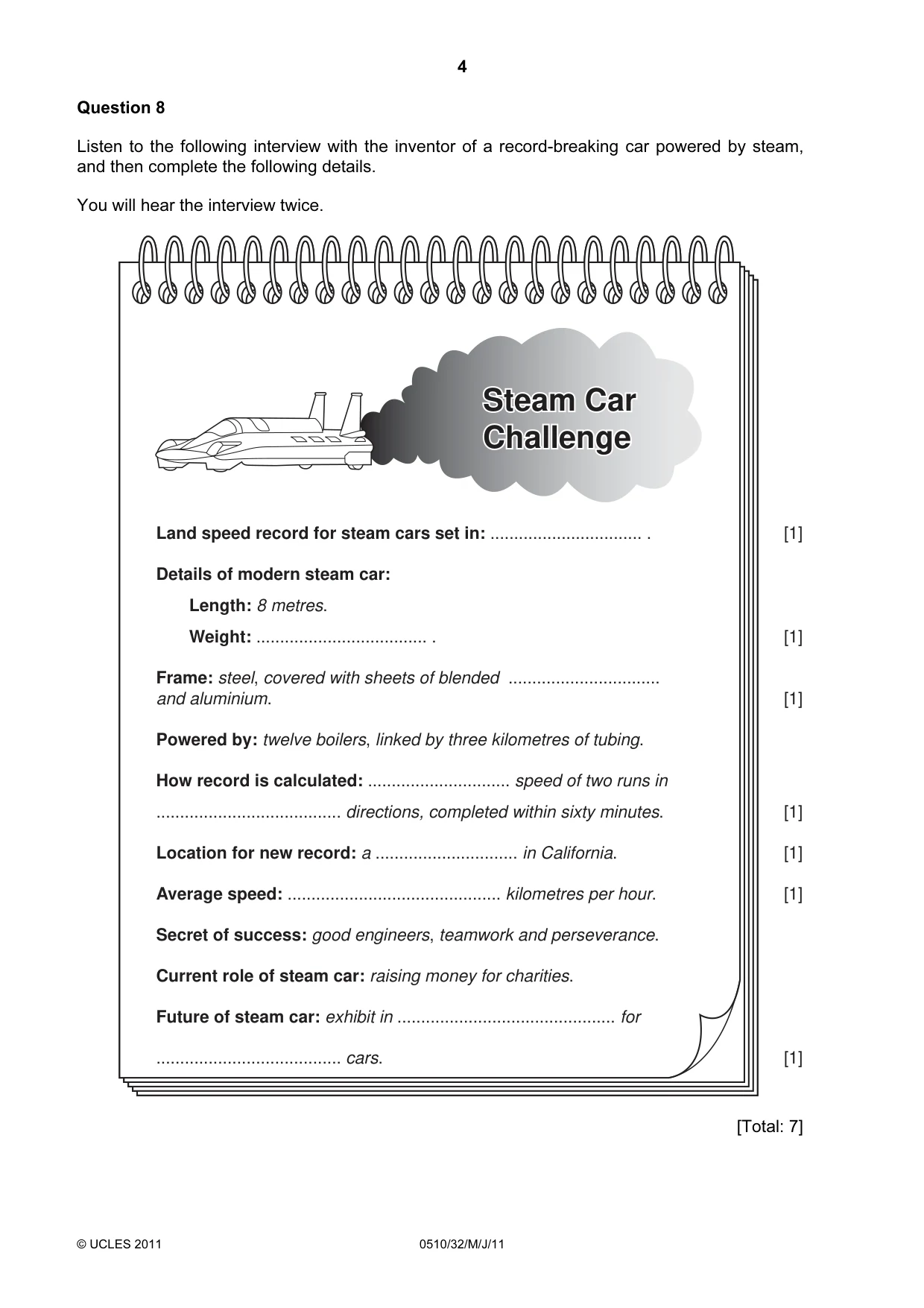
4 © UCLES 2011 0510/32/M/J/11 Question 8 Listen to the following interview with the inventor of a record-breaking car powered by steam, and then complete the following details. You will hear the interview twice. Land speed record for steam cars set in: … . [1] Details of modern steam car: Length: 8 metres. Weight: … . [1] Frame: steel, covered with sheets of blended … and aluminium. [1] Powered by: twelve boilers, linked by three kilometres of tubing. How record is calculated: … speed of two runs in … directions, completed within sixty minutes. [1] Location for new record: a … in California. [1] Average speed: … kilometres per hour. [1] Secret of success: good engineers, teamwork and perseverance. Current role of steam car: raising money for charities. Future of steam car: exhibit in … for … cars. [1] Steam Car Steam Car Challenge Challenge Steam Car Challenge [Total: 7]
Question paper, page 5
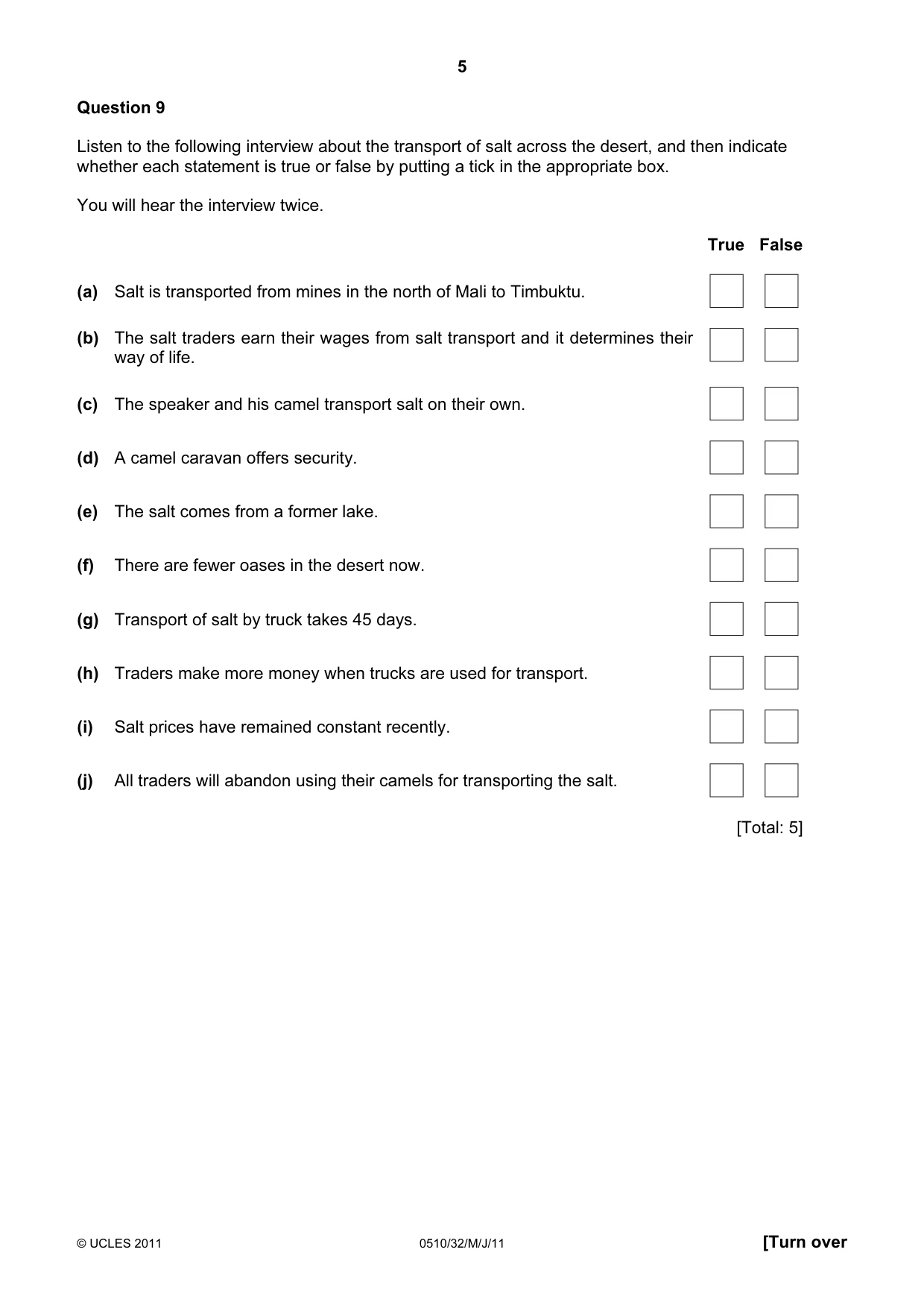
5 © UCLES 2011 0510/32/M/J/11 [Turn over Question 9 Listen to the following interview about the transport of salt across the desert, and then indicate whether each statement is true or false by putting a tick in the appropriate box. You will hear the interview twice. True False (a) Salt is transported from mines in the north of Mali to Timbuktu. (b) The salt traders earn their wages from salt transport and it determines their way of life. (c) The speaker and his camel transport salt on their own. (d) A camel caravan offers security. (e) The salt comes from a former lake. (f) There are fewer oases in the desert now. (g) Transport of salt by truck takes 45 days. (h) Traders make more money when trucks are used for transport. (i) Salt prices have remained constant recently. (j) All traders will abandon using their camels for transporting the salt. [Total: 5]
Question paper, page 6
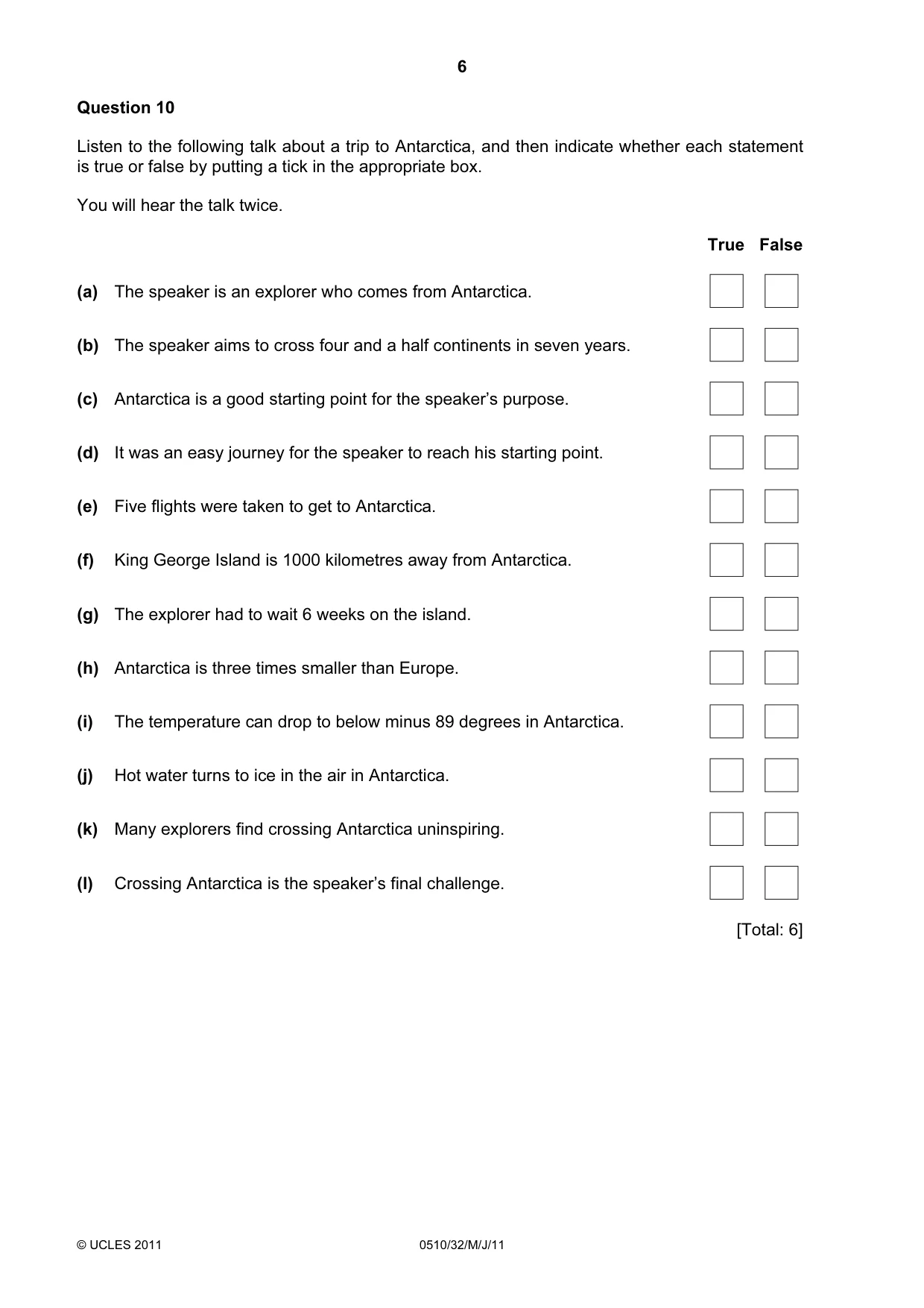
6 © UCLES 2011 0510/32/M/J/11 Question 10 Listen to the following talk about a trip to Antarctica, and then indicate whether each statement is true or false by putting a tick in the appropriate box. You will hear the talk twice. True False (a) The speaker is an explorer who comes from Antarctica. (b) The speaker aims to cross four and a half continents in seven years. (c) Antarctica is a good starting point for the speaker’s purpose. (d) It was an easy journey for the speaker to reach his starting point. (e) Five flights were taken to get to Antarctica. (f) King George Island is 1000 kilometres away from Antarctica. (g) The explorer had to wait 6 weeks on the island. (h) Antarctica is three times smaller than Europe. (i) The temperature can drop to below minus 89 degrees in Antarctica. (j) Hot water turns to ice in the air in Antarctica. (k) Many explorers find crossing Antarctica uninspiring. (l) Crossing Antarctica is the speaker’s final challenge. [Total: 6]
Question paper, page 7
7 © UCLES 2011 0510/32/M/J/11 BLANK PAGE
Question paper, page 8
8 Permission to reproduce items where third-party owned material protected by copyright is included has been sought and cleared where possible. Every reasonable effort has been made by the publisher (UCLES) to trace copyright holders, but if any items requiring clearance have unwittingly been included, the publisher will be pleased to make amends at the earliest possible opportunity. University of Cambridge International Examinations is part of the Cambridge Assessment Group. Cambridge Assessment is the brand name of University of Cambridge Local Examinations Syndicate (UCLES), which is itself a department of the University of Cambridge. © UCLES 2011 0510/32/M/J/11 BLANK PAGE
Mark scheme, page 1
UNIVERSITY OF CAMBRIDGE INTERNATIONAL EXAMINATIONS International General Certificate of Secondary Education MARK SCHEME for the May/June 2011 question paper for the guidance of teachers 0510 ENGLISH AS A SECOND LANGUAGE 0510/32 Paper 3 (Listening – Core), maximum raw mark 30 This mark scheme is published as an aid to teachers and candidates, to indicate the requirements of the examination. It shows the basis on which Examiners were instructed to award marks. It does not indicate the details of the discussions that took place at an Examiners’ meeting before marking began, which would have considered the acceptability of alternative answers. Mark schemes must be read in conjunction with the question papers and the report on the examination. • Cambridge will not enter into discussions or correspondence in connection with these mark schemes. Cambridge is publishing the mark schemes for the May/June 2011 question papers for most IGCSE, GCE Advanced Level and Advanced Subsidiary Level syllabuses and some Ordinary Level syllabuses. www.XtremePapers.com
Mark scheme, page 2
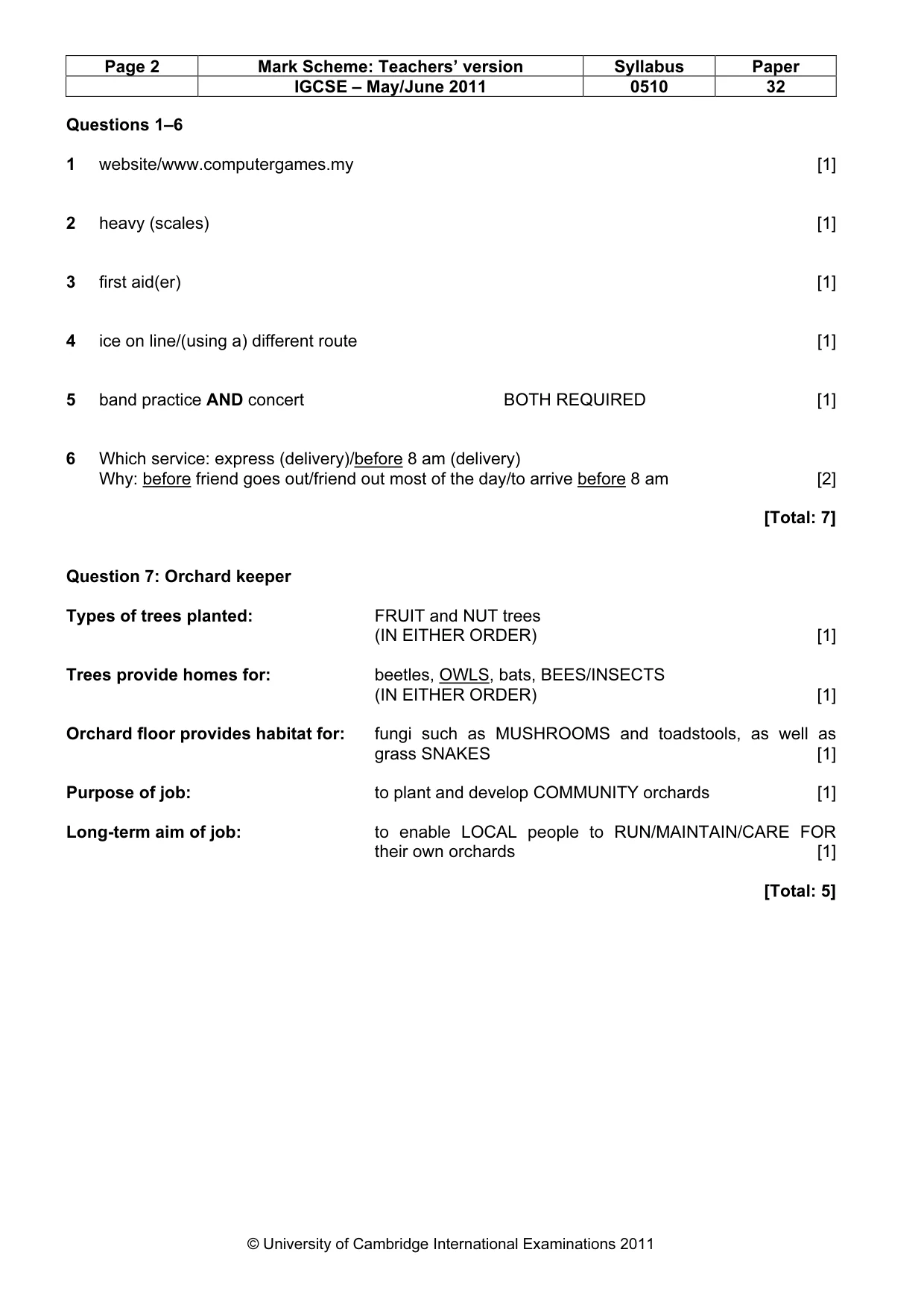
Page 2 Mark Scheme: Teachers’ version Syllabus Paper IGCSE – May/June 2011 0510 32 © University of Cambridge International Examinations 2011 Questions 1–6 1 website/www.computergames.my [1] 2 heavy (scales) [1] 3 first aid(er) [1] 4 ice on line/(using a) different route [1] 5 band practice AND concert BOTH REQUIRED [1] 6 Which service: express (delivery)/before 8 am (delivery) Why: before friend goes out/friend out most of the day/to arrive before 8 am [2] [Total: 7] Question 7: Orchard keeper Types of trees planted: FRUIT and NUT trees (IN EITHER ORDER) [1] Trees provide homes for: beetles, OWLS, bats, BEES/INSECTS (IN EITHER ORDER) [1] Orchard floor provides habitat for: fungi such as MUSHROOMS and toadstools, as well as grass SNAKES [1] Purpose of job: to plant and develop COMMUNITY orchards [1] Long-term aim of job: to enable LOCAL people to RUN/MAINTAIN/CARE FOR their own orchards [1] [Total: 5]
Mark scheme, page 3
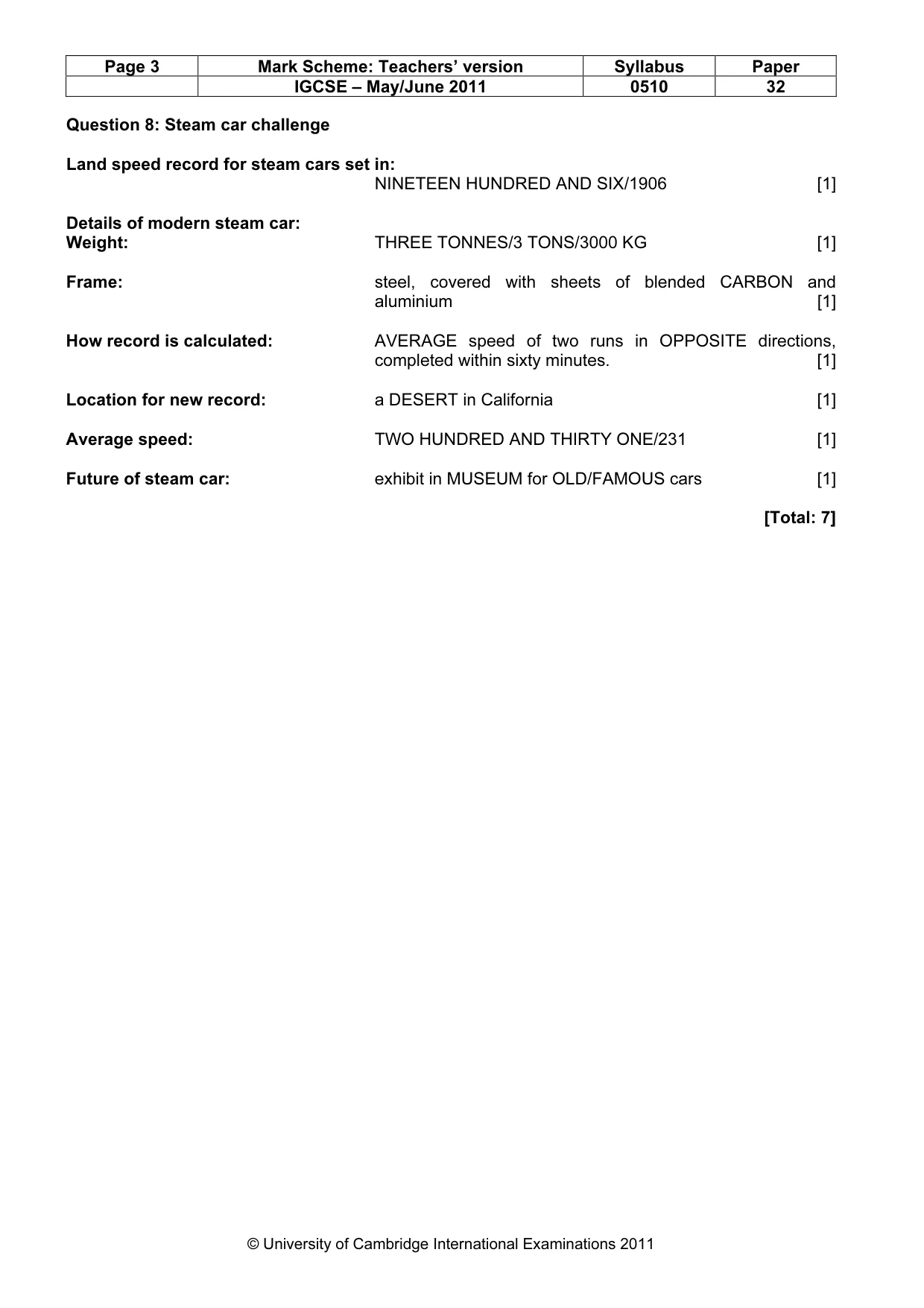
Page 3 Mark Scheme: Teachers’ version Syllabus Paper IGCSE – May/June 2011 0510 32 © University of Cambridge International Examinations 2011 Question 8: Steam car challenge Land speed record for steam cars set in: NINETEEN HUNDRED AND SIX/1906 [1] Details of modern steam car: Weight: THREE TONNES/3 TONS/3000 KG [1] Frame: steel, covered with sheets of blended CARBON and aluminium [1] How record is calculated: AVERAGE speed of two runs in OPPOSITE directions, completed within sixty minutes. [1] Location for new record: a DESERT in California [1] Average speed: TWO HUNDRED AND THIRTY ONE/231 [1] Future of steam car: exhibit in MUSEUM for OLD/FAMOUS cars [1] [Total: 7]
Mark scheme, page 4
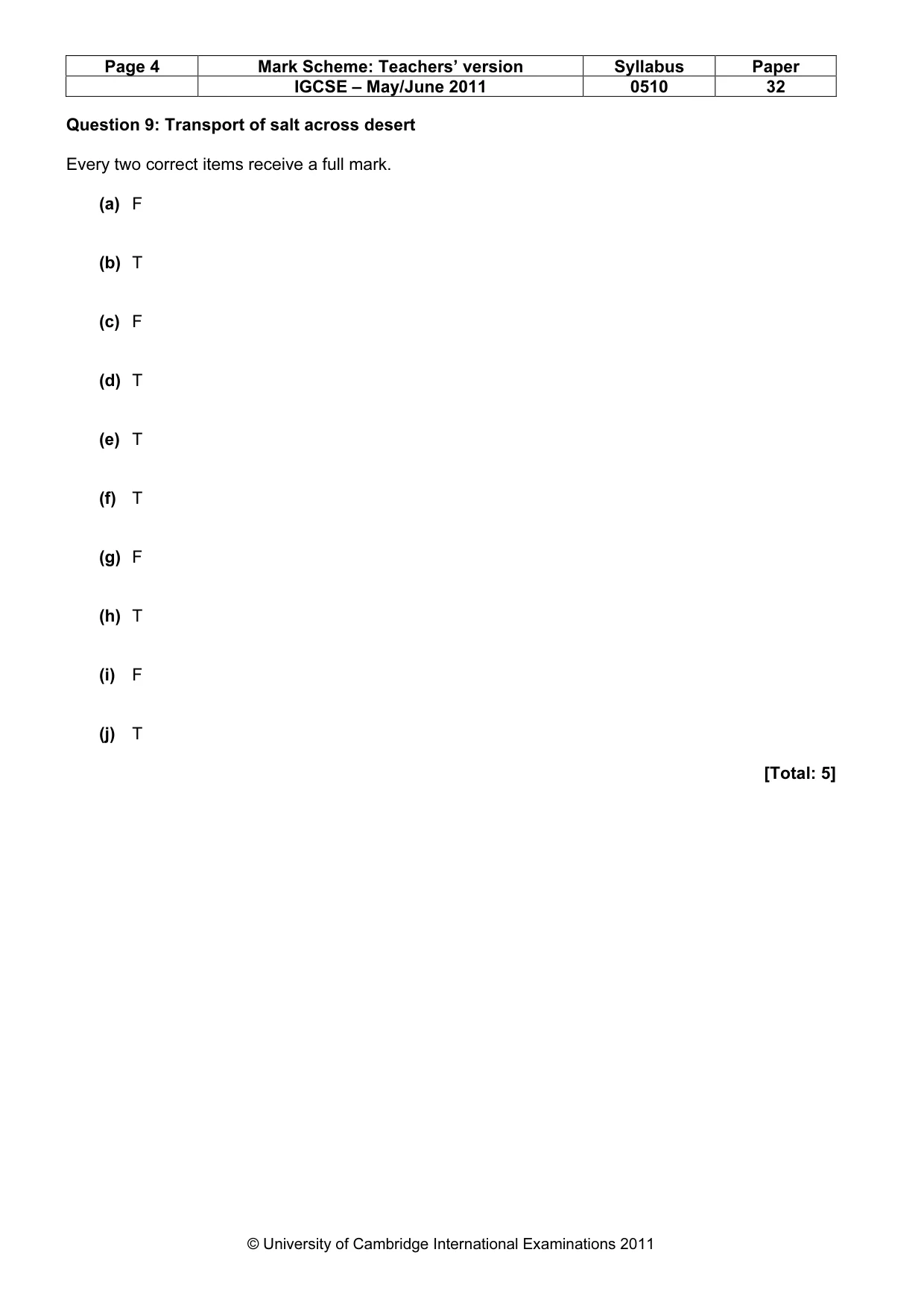
Page 4 Mark Scheme: Teachers’ version Syllabus Paper IGCSE – May/June 2011 0510 32 © University of Cambridge International Examinations 2011 Question 9: Transport of salt across desert Every two correct items receive a full mark. (a) F (b) T (c) F (d) T (e) T (f) T (g) F (h) T (i) F (j) T [Total: 5]
Mark scheme, page 5
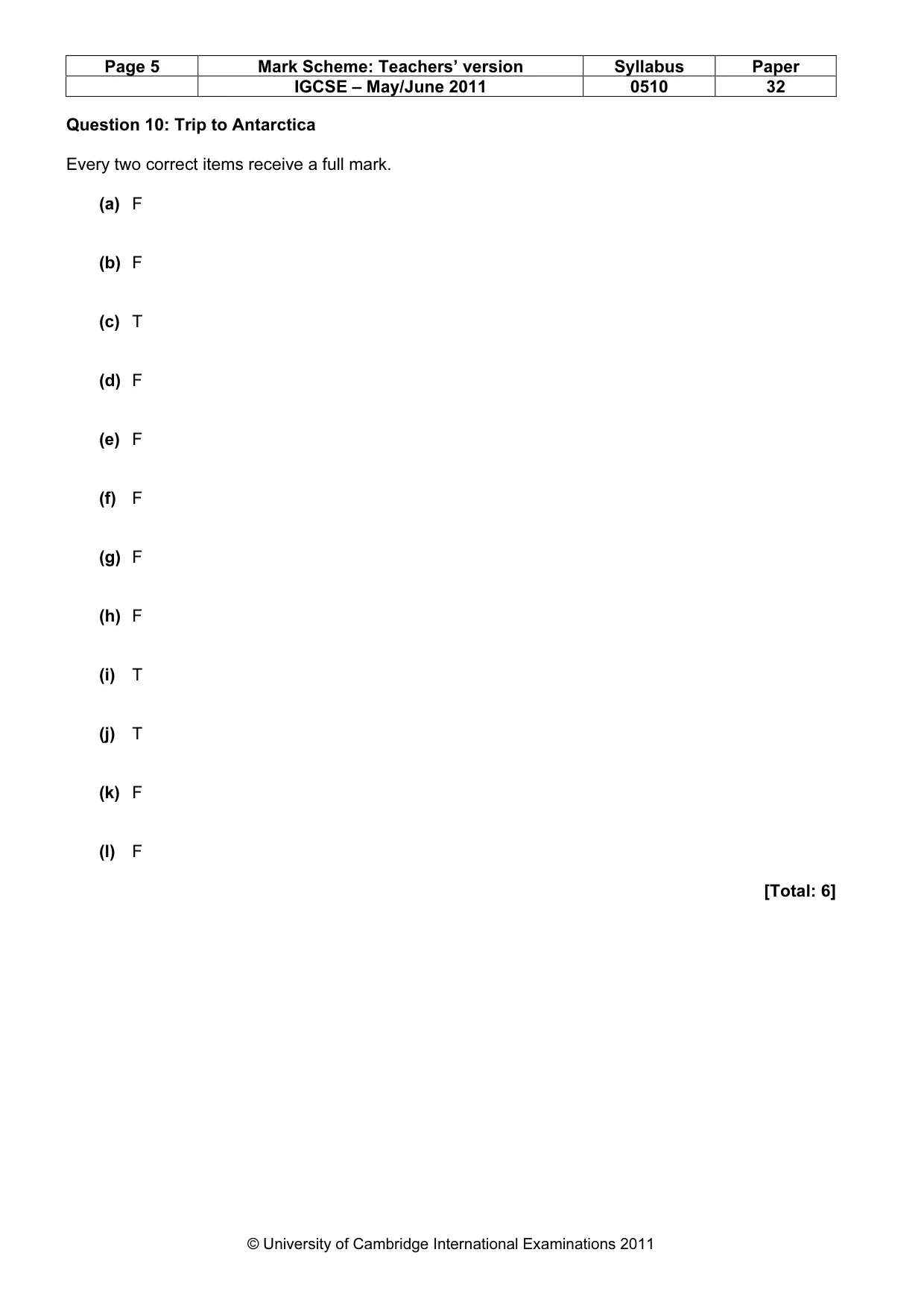
Page 5 Mark Scheme: Teachers’ version Syllabus Paper IGCSE – May/June 2011 0510 32 © University of Cambridge International Examinations 2011 Question 10: Trip to Antarctica Every two correct items receive a full mark. (a) F (b) F (c) T (d) F (e) F (f) F (g) F (h) F (i) T (j) T (k) F (l) F [Total: 6]
Mark scheme, page 6
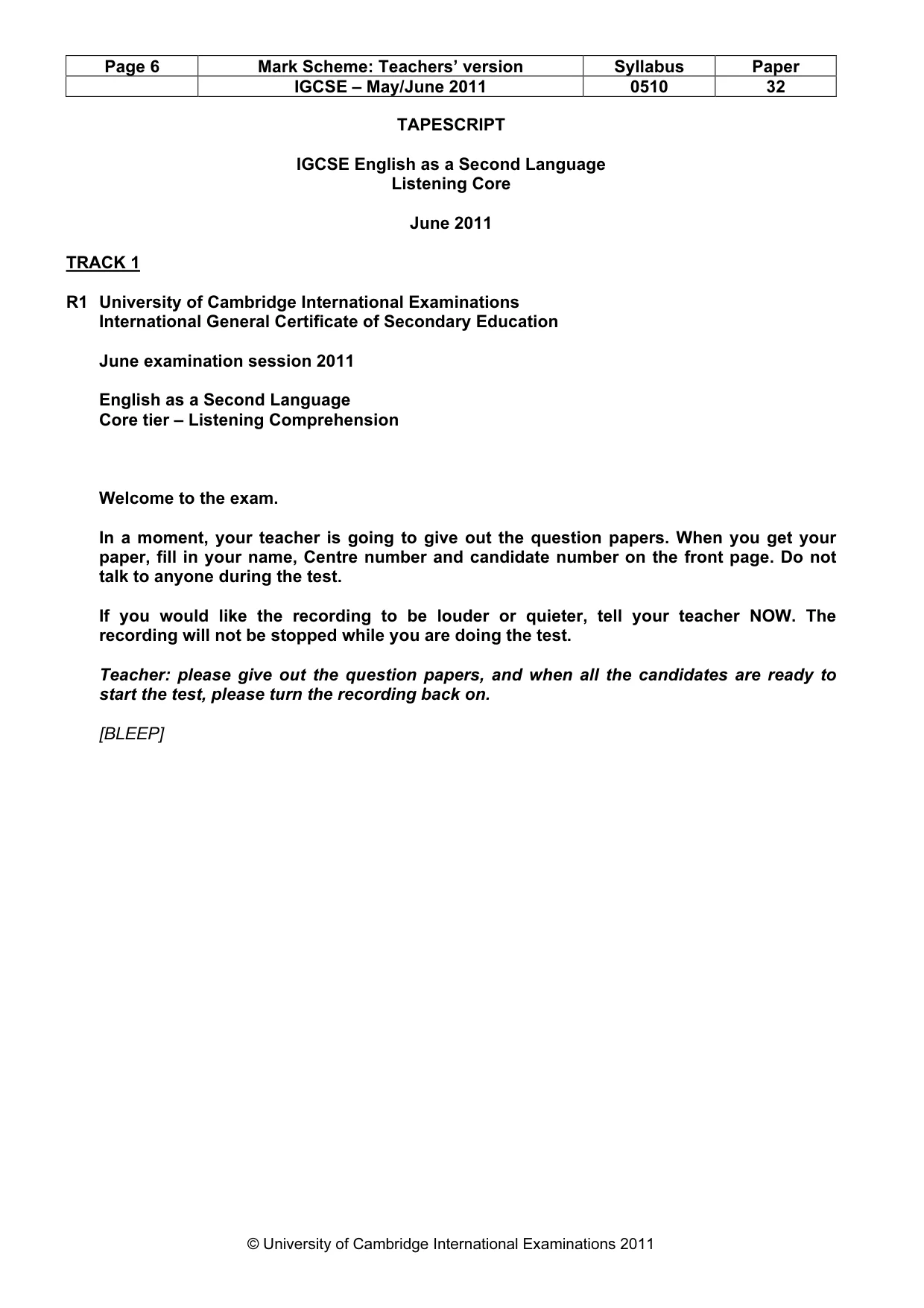
Page 6 Mark Scheme: Teachers’ version Syllabus Paper IGCSE – May/June 2011 0510 32 © University of Cambridge International Examinations 2011 TAPESCRIPT IGCSE English as a Second Language Listening Core June 2011 TRACK 1 R1 University of Cambridge International Examinations International General Certificate of Secondary Education June examination session 2011 English as a Second Language Core tier – Listening Comprehension Welcome to the exam. In a moment, your teacher is going to give out the question papers. When you get your paper, fill in your name, Centre number and candidate number on the front page. Do not talk to anyone during the test. If you would like the recording to be louder or quieter, tell your teacher NOW. The recording will not be stopped while you are doing the test. Teacher: please give out the question papers, and when all the candidates are ready to start the test, please turn the recording back on. [BLEEP]
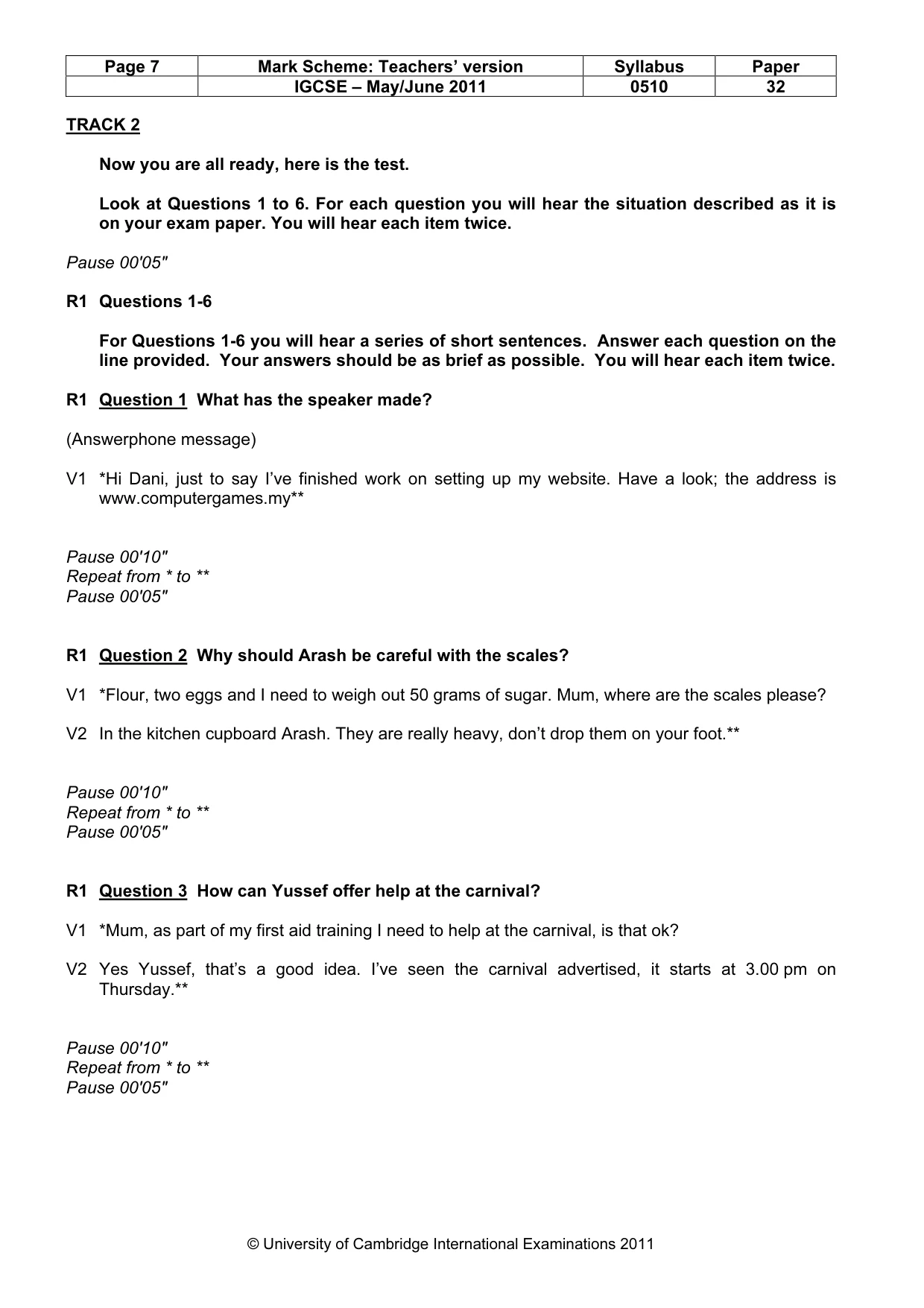
Mark scheme, page 7
Page 7 Mark Scheme: Teachers’ version Syllabus Paper IGCSE – May/June 2011 0510 32 © University of Cambridge International Examinations 2011 TRACK 2 Now you are all ready, here is the test. Look at Questions 1 to 6. For each question you will hear the situation described as it is on your exam paper. You will hear each item twice. Pause 00'05" R1 Questions 1-6 For Questions 1-6 you will hear a series of short sentences. Answer each question on the line provided. Your answers should be as brief as possible. You will hear each item twice. R1 Question 1 What has the speaker made? (Answerphone message) V1 *Hi Dani, just to say I’ve finished work on setting up my website. Have a look; the address is www.computergames.my** Pause 00'10" Repeat from * to ** Pause 00'05" R1 Question 2 Why should Arash be careful with the scales? V1 *Flour, two eggs and I need to weigh out 50 grams of sugar. Mum, where are the scales please? V2 In the kitchen cupboard Arash. They are really heavy, don’t drop them on your foot.** Pause 00'10" Repeat from * to ** Pause 00'05" R1 Question 3 How can Yussef offer help at the carnival? V1 *Mum, as part of my first aid training I need to help at the carnival, is that ok? V2 Yes Yussef, that’s a good idea. I’ve seen the carnival advertised, it starts at 3.00 pm on Thursday.** Pause 00'10" Repeat from * to ** Pause 00'05"
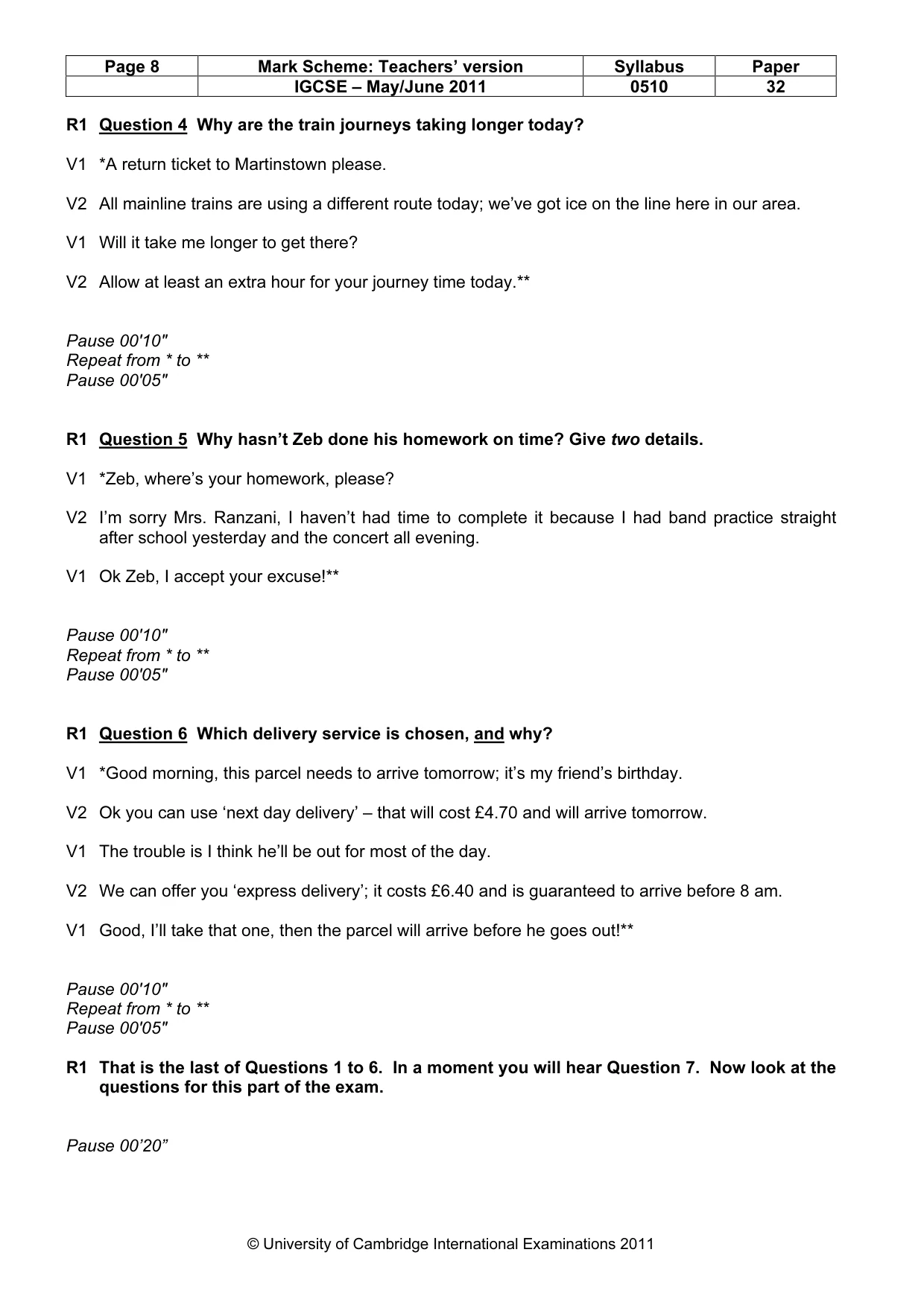
Mark scheme, page 8
Page 8 Mark Scheme: Teachers’ version Syllabus Paper IGCSE – May/June 2011 0510 32 © University of Cambridge International Examinations 2011 R1 Question 4 Why are the train journeys taking longer today? V1 *A return ticket to Martinstown please. V2 All mainline trains are using a different route today; we’ve got ice on the line here in our area. V1 Will it take me longer to get there? V2 Allow at least an extra hour for your journey time today.** Pause 00'10" Repeat from * to ** Pause 00'05" R1 Question 5 Why hasn’t Zeb done his homework on time? Give two details. V1 *Zeb, where’s your homework, please? V2 I’m sorry Mrs. Ranzani, I haven’t had time to complete it because I had band practice straight after school yesterday and the concert all evening. V1 Ok Zeb, I accept your excuse!** Pause 00'10" Repeat from * to ** Pause 00'05" R1 Question 6 Which delivery service is chosen, and why? V1 *Good morning, this parcel needs to arrive tomorrow; it’s my friend’s birthday. V2 Ok you can use ‘next day delivery’ – that will cost £4.70 and will arrive tomorrow. V1 The trouble is I think he’ll be out for most of the day. V2 We can offer you ‘express delivery’; it costs £6.40 and is guaranteed to arrive before 8 am. V1 Good, I’ll take that one, then the parcel will arrive before he goes out!** Pause 00'10" Repeat from * to ** Pause 00'05" R1 That is the last of Questions 1 to 6. In a moment you will hear Question 7. Now look at the questions for this part of the exam. Pause 00’20”
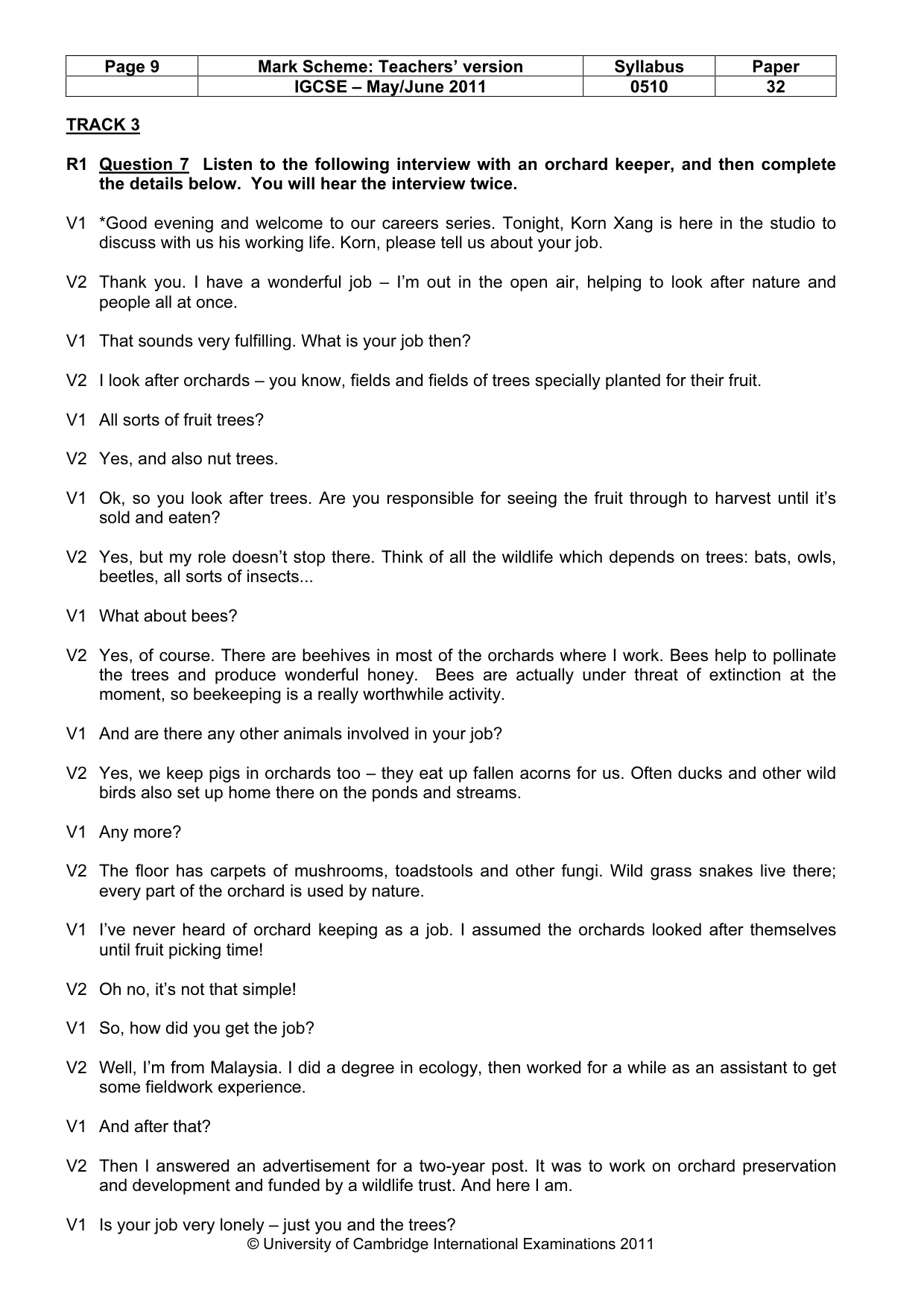
Mark scheme, page 9
Page 9 Mark Scheme: Teachers’ version Syllabus Paper IGCSE – May/June 2011 0510 32 © University of Cambridge International Examinations 2011 TRACK 3 R1 Question 7 Listen to the following interview with an orchard keeper, and then complete the details below. You will hear the interview twice. V1 *Good evening and welcome to our careers series. Tonight, Korn Xang is here in the studio to discuss with us his working life. Korn, please tell us about your job. V2 Thank you. I have a wonderful job – I’m out in the open air, helping to look after nature and people all at once. V1 That sounds very fulfilling. What is your job then? V2 I look after orchards – you know, fields and fields of trees specially planted for their fruit. V1 All sorts of fruit trees? V2 Yes, and also nut trees. V1 Ok, so you look after trees. Are you responsible for seeing the fruit through to harvest until it’s sold and eaten? V2 Yes, but my role doesn’t stop there. Think of all the wildlife which depends on trees: bats, owls, beetles, all sorts of insects... V1 What about bees? V2 Yes, of course. There are beehives in most of the orchards where I work. Bees help to pollinate the trees and produce wonderful honey. Bees are actually under threat of extinction at the moment, so beekeeping is a really worthwhile activity. V1 And are there any other animals involved in your job? V2 Yes, we keep pigs in orchards too – they eat up fallen acorns for us. Often ducks and other wild birds also set up home there on the ponds and streams. V1 Any more? V2 The floor has carpets of mushrooms, toadstools and other fungi. Wild grass snakes live there; every part of the orchard is used by nature. V1 I’ve never heard of orchard keeping as a job. I assumed the orchards looked after themselves until fruit picking time! V2 Oh no, it’s not that simple! V1 So, how did you get the job? V2 Well, I’m from Malaysia. I did a degree in ecology, then worked for a while as an assistant to get some fieldwork experience. V1 And after that? V2 Then I answered an advertisement for a two-year post. It was to work on orchard preservation and development and funded by a wildlife trust. And here I am. V1 Is your job very lonely – just you and the trees?
Mark scheme, page 10
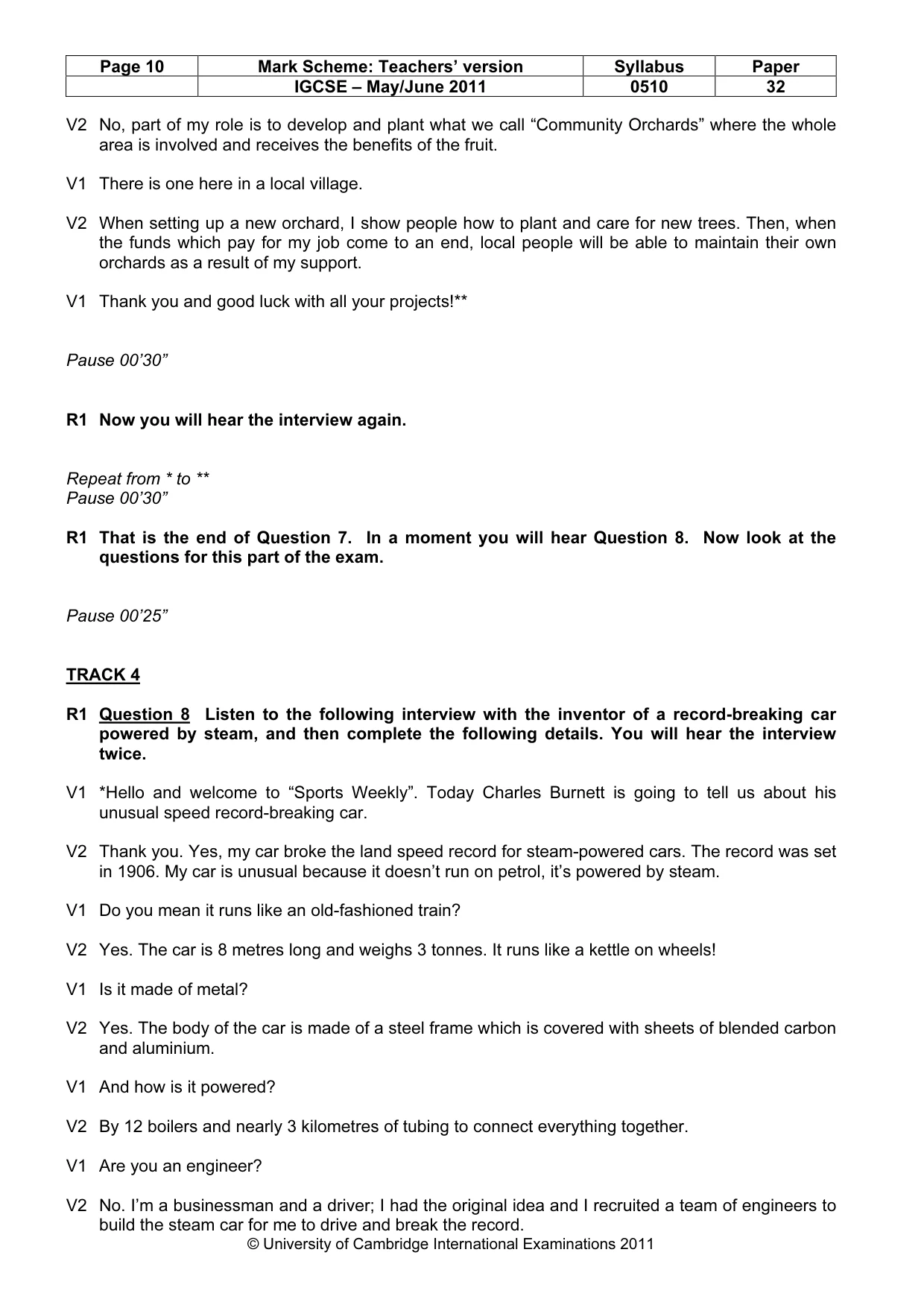
Page 10 Mark Scheme: Teachers’ version Syllabus Paper IGCSE – May/June 2011 0510 32 © University of Cambridge International Examinations 2011 V2 No, part of my role is to develop and plant what we call “Community Orchards” where the whole area is involved and receives the benefits of the fruit. V1 There is one here in a local village. V2 When setting up a new orchard, I show people how to plant and care for new trees. Then, when the funds which pay for my job come to an end, local people will be able to maintain their own orchards as a result of my support. V1 Thank you and good luck with all your projects!** Pause 00’30” R1 Now you will hear the interview again. Repeat from * to ** Pause 00’30” R1 That is the end of Question 7. In a moment you will hear Question 8. Now look at the questions for this part of the exam. Pause 00’25” TRACK 4 R1 Question 8 Listen to the following interview with the inventor of a record-breaking car powered by steam, and then complete the following details. You will hear the interview twice. V1 *Hello and welcome to “Sports Weekly”. Today Charles Burnett is going to tell us about his unusual speed record-breaking car. V2 Thank you. Yes, my car broke the land speed record for steam-powered cars. The record was set in 1906. My car is unusual because it doesn’t run on petrol, it’s powered by steam. V1 Do you mean it runs like an old-fashioned train? V2 Yes. The car is 8 metres long and weighs 3 tonnes. It runs like a kettle on wheels! V1 Is it made of metal? V2 Yes. The body of the car is made of a steel frame which is covered with sheets of blended carbon and aluminium. V1 And how is it powered? V2 By 12 boilers and nearly 3 kilometres of tubing to connect everything together. V1 Are you an engineer? V2 No. I’m a businessman and a driver; I had the original idea and I recruited a team of engineers to build the steam car for me to drive and break the record.
Mark scheme, page 11
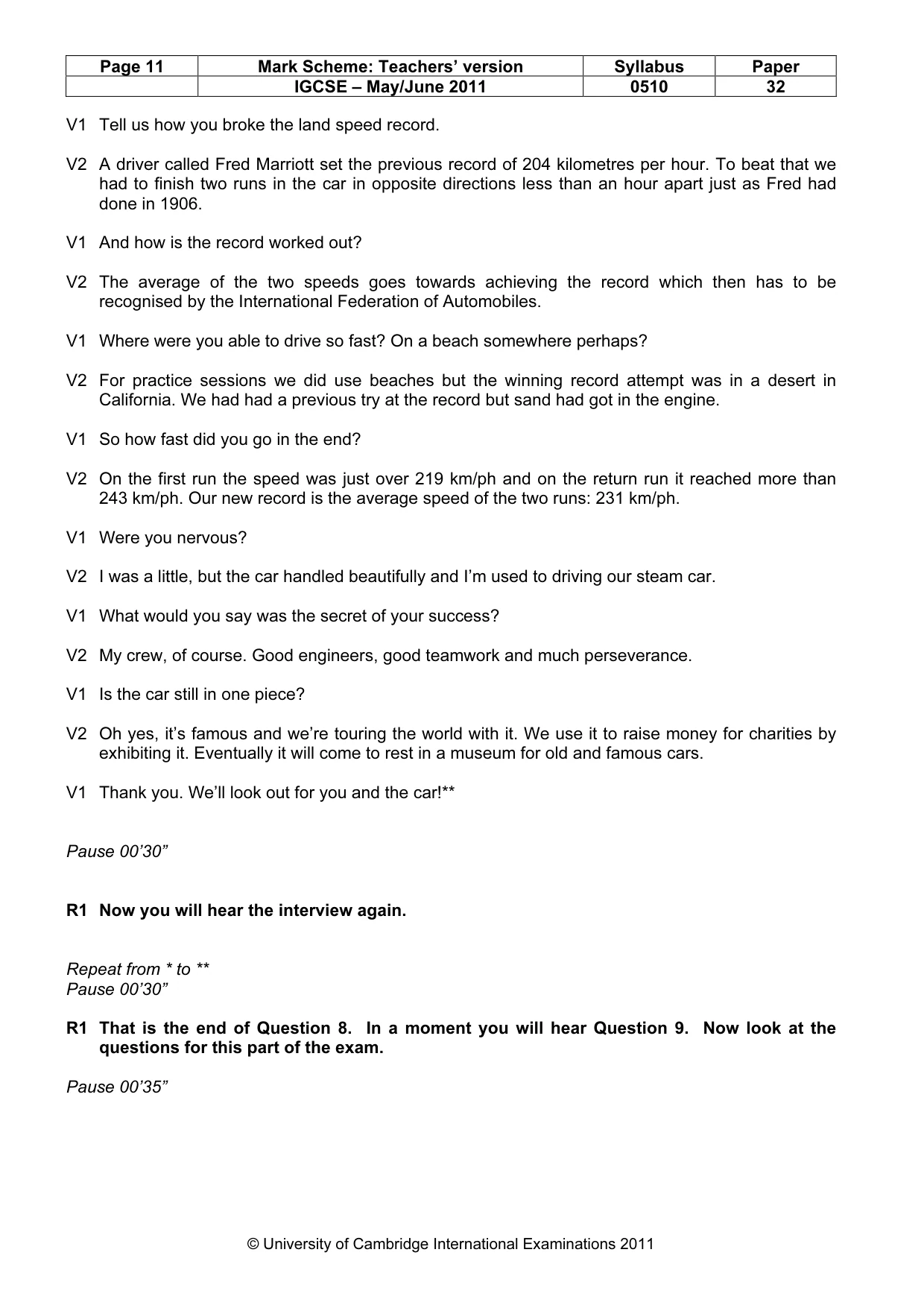
Page 11 Mark Scheme: Teachers’ version Syllabus Paper IGCSE – May/June 2011 0510 32 © University of Cambridge International Examinations 2011 V1 Tell us how you broke the land speed record. V2 A driver called Fred Marriott set the previous record of 204 kilometres per hour. To beat that we had to finish two runs in the car in opposite directions less than an hour apart just as Fred had done in 1906. V1 And how is the record worked out? V2 The average of the two speeds goes towards achieving the record which then has to be recognised by the International Federation of Automobiles. V1 Where were you able to drive so fast? On a beach somewhere perhaps? V2 For practice sessions we did use beaches but the winning record attempt was in a desert in California. We had had a previous try at the record but sand had got in the engine. V1 So how fast did you go in the end? V2 On the first run the speed was just over 219 km/ph and on the return run it reached more than 243 km/ph. Our new record is the average speed of the two runs: 231 km/ph. V1 Were you nervous? V2 I was a little, but the car handled beautifully and I’m used to driving our steam car. V1 What would you say was the secret of your success? V2 My crew, of course. Good engineers, good teamwork and much perseverance. V1 Is the car still in one piece? V2 Oh yes, it’s famous and we’re touring the world with it. We use it to raise money for charities by exhibiting it. Eventually it will come to rest in a museum for old and famous cars. V1 Thank you. We’ll look out for you and the car!** Pause 00’30” R1 Now you will hear the interview again. Repeat from * to ** Pause 00’30” R1 That is the end of Question 8. In a moment you will hear Question 9. Now look at the questions for this part of the exam. Pause 00’35”
Mark scheme, page 12
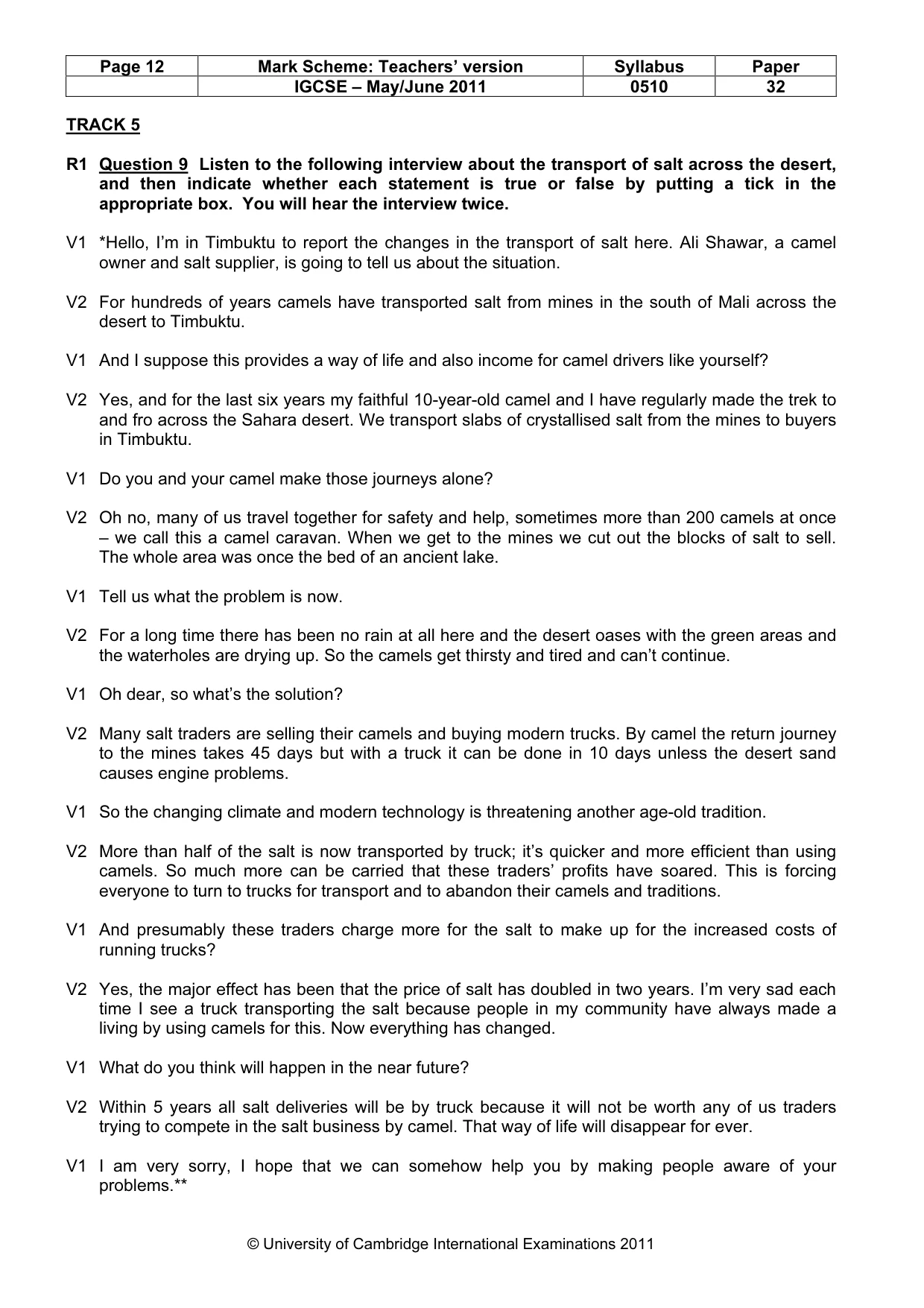
Page 12 Mark Scheme: Teachers’ version Syllabus Paper IGCSE – May/June 2011 0510 32 © University of Cambridge International Examinations 2011 TRACK 5 R1 Question 9 Listen to the following interview about the transport of salt across the desert, and then indicate whether each statement is true or false by putting a tick in the appropriate box. You will hear the interview twice. V1 *Hello, I’m in Timbuktu to report the changes in the transport of salt here. Ali Shawar, a camel owner and salt supplier, is going to tell us about the situation. V2 For hundreds of years camels have transported salt from mines in the south of Mali across the desert to Timbuktu. V1 And I suppose this provides a way of life and also income for camel drivers like yourself? V2 Yes, and for the last six years my faithful 10-year-old camel and I have regularly made the trek to and fro across the Sahara desert. We transport slabs of crystallised salt from the mines to buyers in Timbuktu. V1 Do you and your camel make those journeys alone? V2 Oh no, many of us travel together for safety and help, sometimes more than 200 camels at once – we call this a camel caravan. When we get to the mines we cut out the blocks of salt to sell. The whole area was once the bed of an ancient lake. V1 Tell us what the problem is now. V2 For a long time there has been no rain at all here and the desert oases with the green areas and the waterholes are drying up. So the camels get thirsty and tired and can’t continue. V1 Oh dear, so what’s the solution? V2 Many salt traders are selling their camels and buying modern trucks. By camel the return journey to the mines takes 45 days but with a truck it can be done in 10 days unless the desert sand causes engine problems. V1 So the changing climate and modern technology is threatening another age-old tradition. V2 More than half of the salt is now transported by truck; it’s quicker and more efficient than using camels. So much more can be carried that these traders’ profits have soared. This is forcing everyone to turn to trucks for transport and to abandon their camels and traditions. V1 And presumably these traders charge more for the salt to make up for the increased costs of running trucks? V2 Yes, the major effect has been that the price of salt has doubled in two years. I’m very sad each time I see a truck transporting the salt because people in my community have always made a living by using camels for this. Now everything has changed. V1 What do you think will happen in the near future? V2 Within 5 years all salt deliveries will be by truck because it will not be worth any of us traders trying to compete in the salt business by camel. That way of life will disappear for ever. V1 I am very sorry, I hope that we can somehow help you by making people aware of your problems.**
Mark scheme, page 13
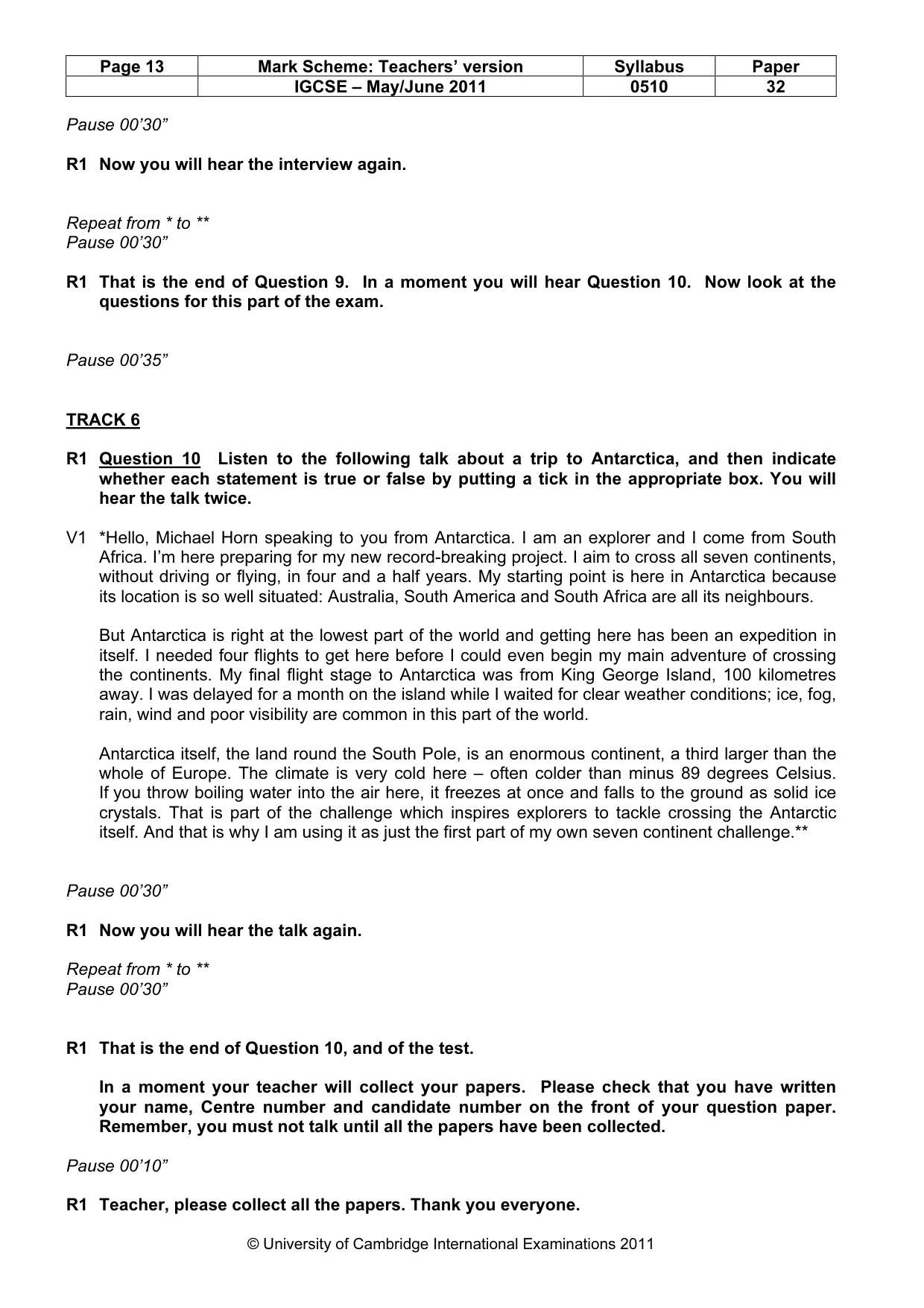
Page 13 Mark Scheme: Teachers’ version Syllabus Paper IGCSE – May/June 2011 0510 32 © University of Cambridge International Examinations 2011 Pause 00’30” R1 Now you will hear the interview again. Repeat from * to ** Pause 00’30” R1 That is the end of Question 9. In a moment you will hear Question 10. Now look at the questions for this part of the exam. Pause 00’35” TRACK 6 R1 Question 10 Listen to the following talk about a trip to Antarctica, and then indicate whether each statement is true or false by putting a tick in the appropriate box. You will hear the talk twice. V1 *Hello, Michael Horn speaking to you from Antarctica. I am an explorer and I come from South Africa. I’m here preparing for my new record-breaking project. I aim to cross all seven continents, without driving or flying, in four and a half years. My starting point is here in Antarctica because its location is so well situated: Australia, South America and South Africa are all its neighbours. But Antarctica is right at the lowest part of the world and getting here has been an expedition in itself. I needed four flights to get here before I could even begin my main adventure of crossing the continents. My final flight stage to Antarctica was from King George Island, 100 kilometres away. I was delayed for a month on the island while I waited for clear weather conditions; ice, fog, rain, wind and poor visibility are common in this part of the world. Antarctica itself, the land round the South Pole, is an enormous continent, a third larger than the whole of Europe. The climate is very cold here – often colder than minus 89 degrees Celsius. If you throw boiling water into the air here, it freezes at once and falls to the ground as solid ice crystals. That is part of the challenge which inspires explorers to tackle crossing the Antarctic itself. And that is why I am using it as just the first part of my own seven continent challenge.** Pause 00’30” R1 Now you will hear the talk again. Repeat from * to ** Pause 00’30” R1 That is the end of Question 10, and of the test. In a moment your teacher will collect your papers. Please check that you have written your name, Centre number and candidate number on the front of your question paper. Remember, you must not talk until all the papers have been collected. Pause 00’10” R1 Teacher, please collect all the papers. Thank you everyone.
What you needed in this session
Cambridge’s own grade thresholds for 2011 May/June, Paper 3 · Variant 2. A higher threshold means an easier paper — the bar moves with how the cohort did.