Cambridge IGCSE English - Second Language (oral endorsement) 0510 — 2011 May/June Paper 2 · Variant 2
0510/22/M/J/11 · 84 marks · ≈95 min
The question paper and its mark scheme, free to read here and free to download. This is Cambridge’s own paper, exactly as it was sat.
Question paper16 pages




Mark scheme10 pages
Answers below. Sit the paper first if you are practising.
Paper as text
Question paper, page 1
This document consists of 15 printed pages and 1 blank page. IB11 06_0510_22/4RP © UCLES 2011 [Turn over *0102205791* UNIVERSITY OF CAMBRIDGE INTERNATIONAL EXAMINATIONS International General Certificate of Secondary Education ENGLISH AS A SECOND LANGUAGE 0510/22 Paper 2 Reading and Writing (Extended) May/June 2011 2 hours Candidates answer on the Question Paper. No Additional Materials are required. READ THESE INSTRUCTIONS FIRST Write your Centre number, candidate number and name on all the work you hand in. Write in dark blue or black pen. Do not use staples, paper clips, highlighters, glue or correction fluid. DO NOT WRITE IN ANY BARCODES. Answer all questions. Dictionaries are not allowed. The number of marks is given in brackets [ ] at the end of each question or part question. www.XtremePapers.com
Question paper, page 2
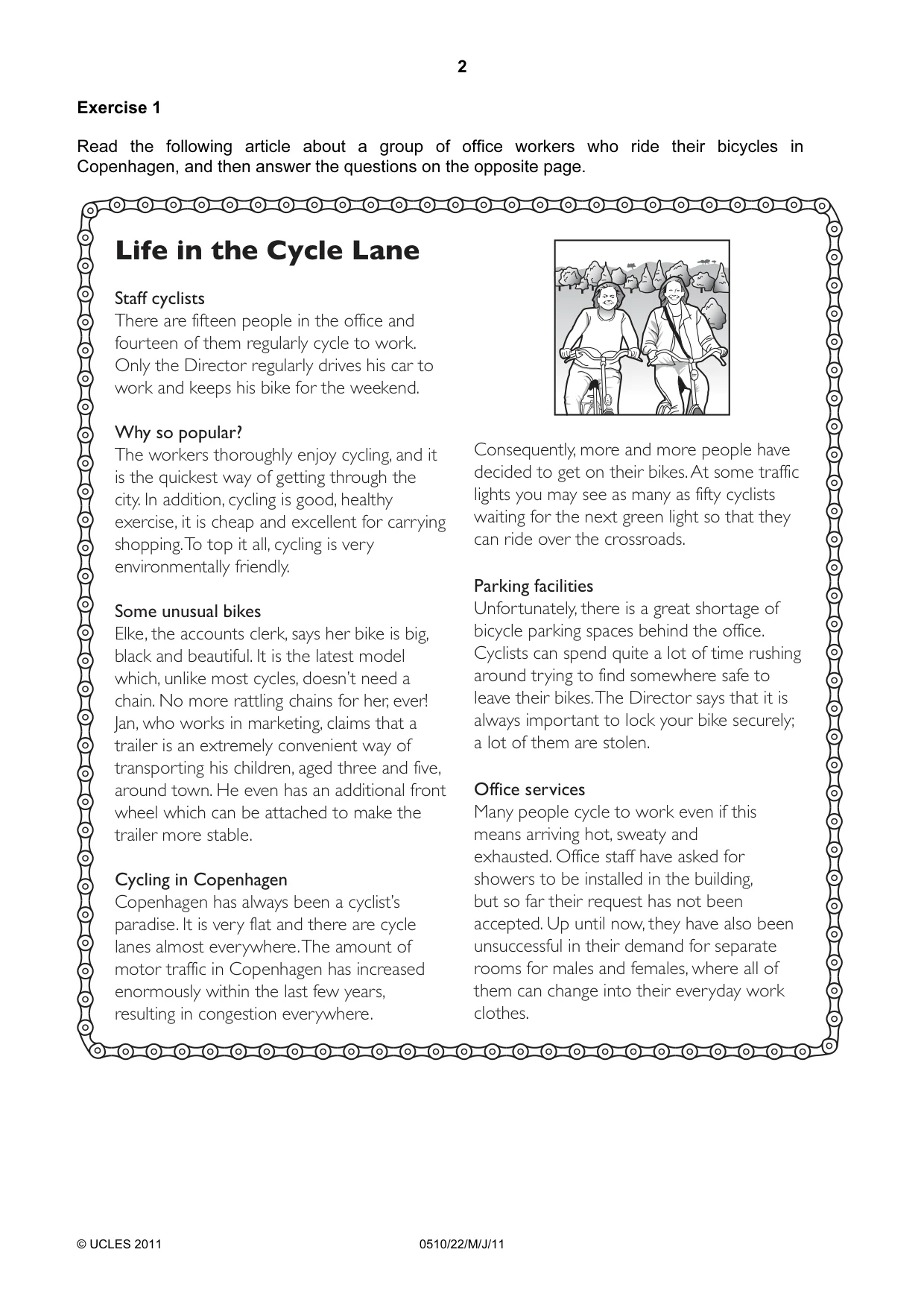
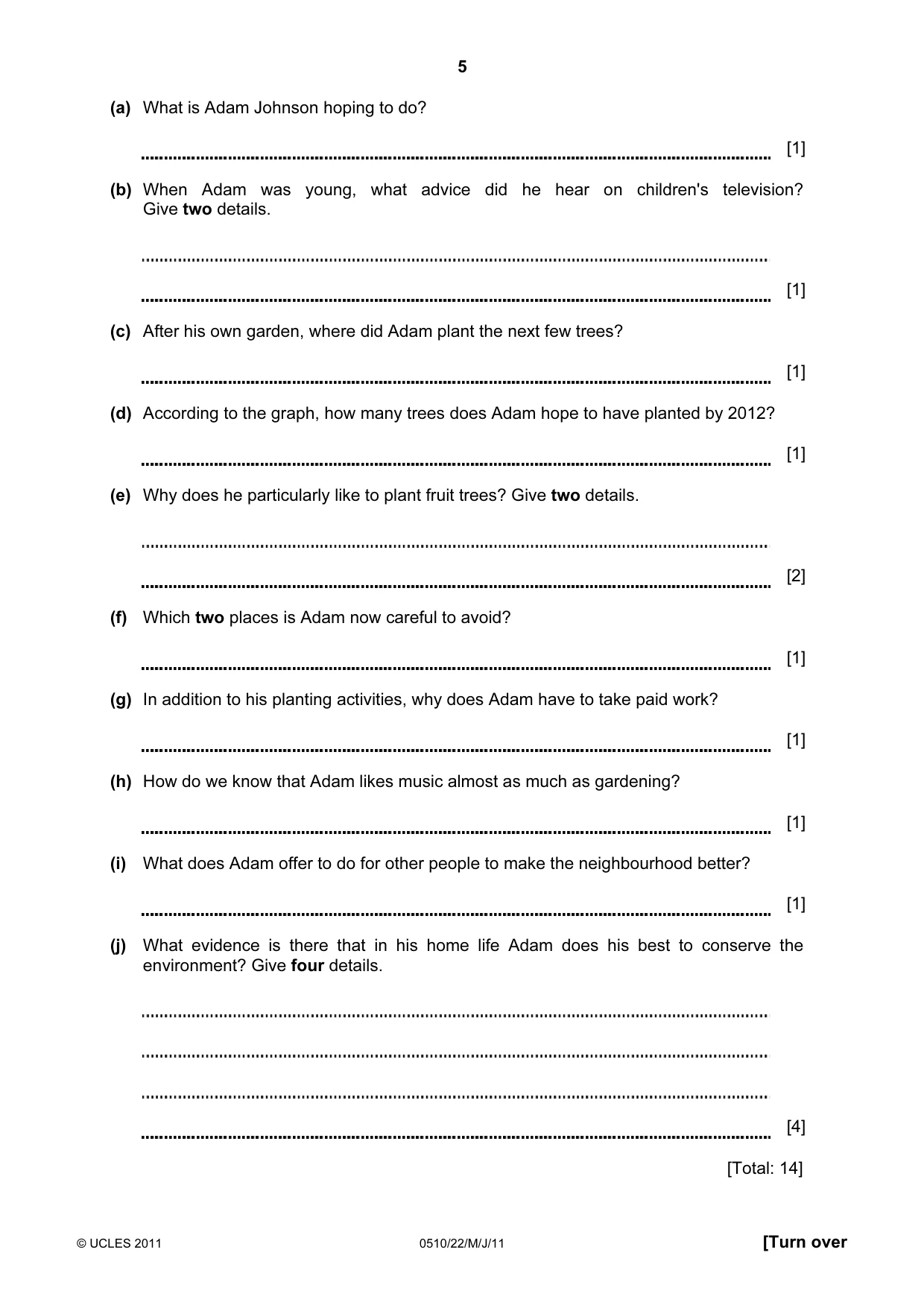
2 © UCLES 2011 0510/22/M/J/11 Exercise 1 Read the following article about a group of office workers who ride their bicycles in Copenhagen, and then answer the questions on the opposite page. Life in the Cycle Lane Staff cyclists There are fifteen people in the office and fourteen of them regularly cycle to work. Only the Director regularly drives his car to work and keeps his bike for the weekend. Why so popular? The workers thoroughly enjoy cycling, and it is the quickest way of getting through the city. In addition, cycling is good, healthy exercise, it is cheap and excellent for carrying shopping. To top it all, cycling is very environmentally friendly. Some unusual bikes Elke, the accounts clerk, says her bike is big, black and beautiful. It is the latest model which, unlike most cycles, doesn’t need a chain. No more rattling chains for her, ever! Jan, who works in marketing, claims that a trailer is an extremely convenient way of transporting his children, aged three and five, around town. He even has an additional front wheel which can be attached to make the trailer more stable. Cycling in Copenhagen Copenhagen has always been a cyclist’s paradise. It is very flat and there are cycle lanes almost everywhere. The amount of motor traffic in Copenhagen has increased enormously within the last few years, resulting in congestion everywhere. Consequently, more and more people have decided to get on their bikes. At some traffic lights you may see as many as fifty cyclists waiting for the next green light so that they can ride over the crossroads. Parking facilities Unfortunately, there is a great shortage of bicycle parking spaces behind the office. Cyclists can spend quite a lot of time rushing around trying to find somewhere safe to leave their bikes. The Director says that it is always important to lock your bike securely; a lot of them are stolen. Office services Many people cycle to work even if this means arriving hot, sweaty and exhausted. Office staff have asked for showers to be installed in the building, but so far their request has not been accepted. Up until now, they have also been unsuccessful in their demand for separate rooms for males and females, where all of them can change into their everyday work clothes.
Question paper, page 3
3 © UCLES 2011 0510/22/M/J/11 [Turn over (a) When does the Director go cycling in Copenhagen? [1] (b) Apart from speed, what are the advantages of cycling in Copenhagen? Give two details. [1] (c) What is unusual about the design of Elke's bicycle? [1] (d) What does Jan use his trailer for? [1] (e) Why have so many people recently started cycling in the city? [1] (f) What causes cyclists to waste their time on arrival at the office? [1] (g) What improvements to working conditions would cyclists like to see? Give two details. [2] [Total: 8]
Question paper, page 4
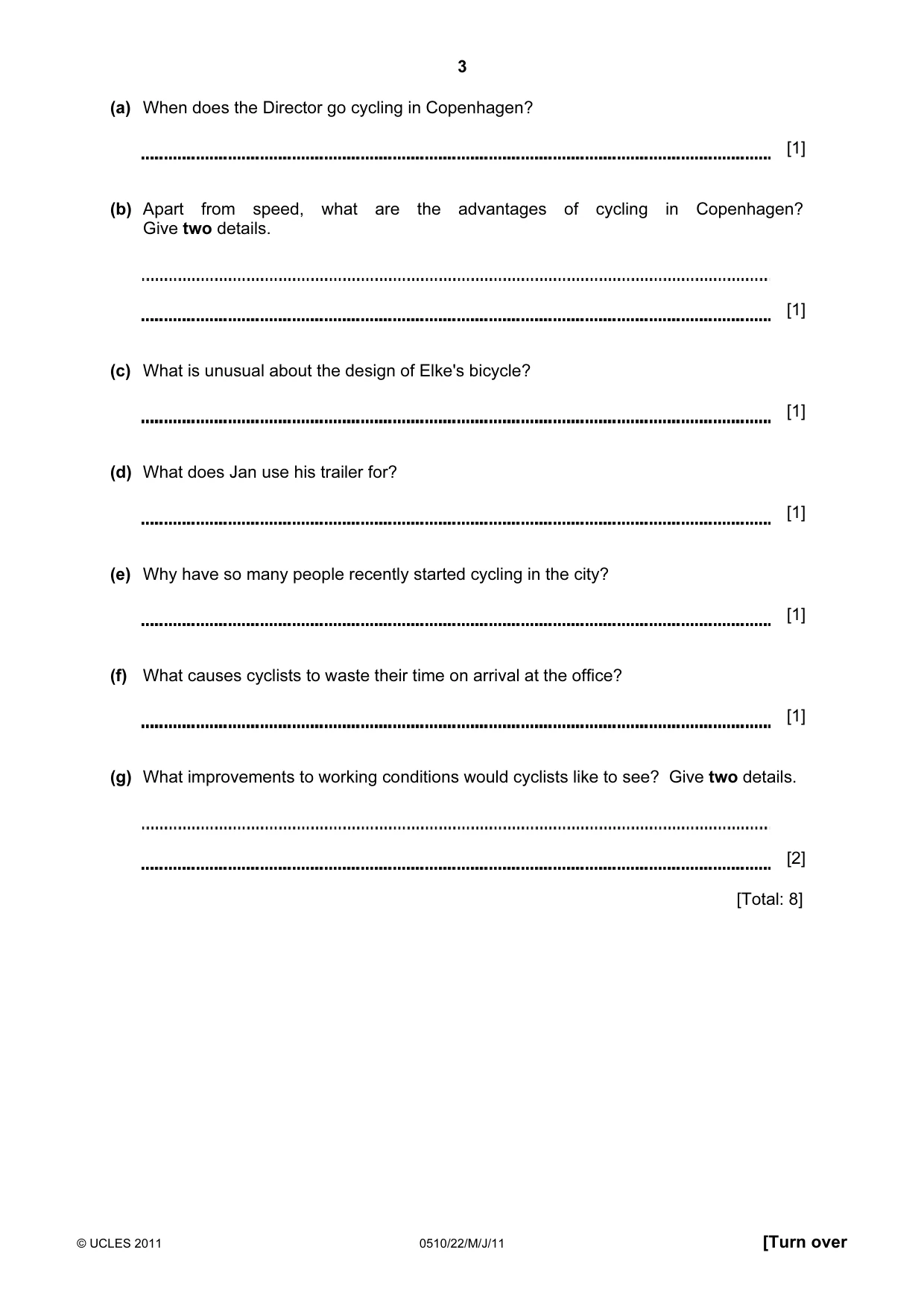
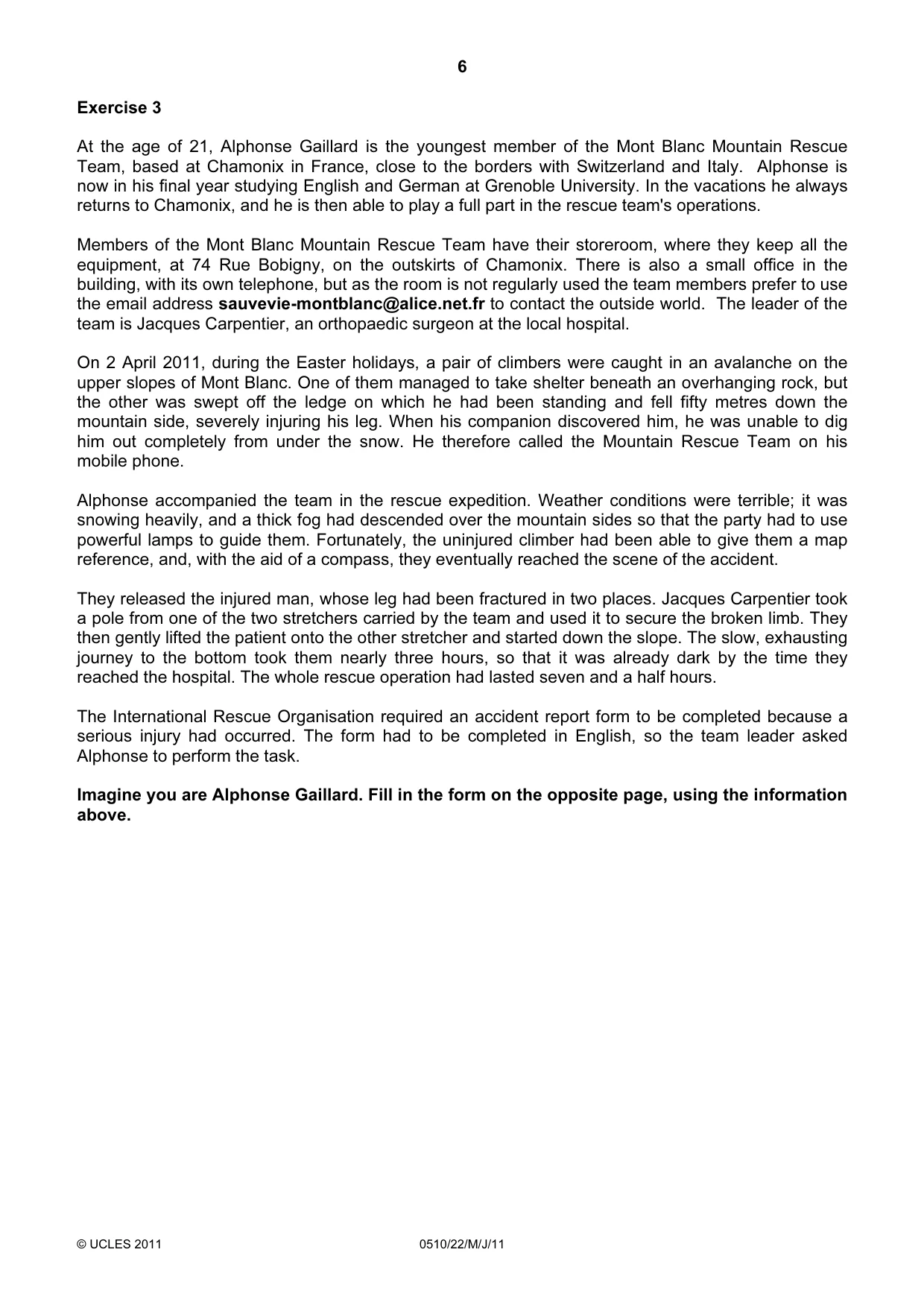
4 © UCLES 2011 0510/22/M/J/11 Exercise 2 Read the following article about a gardener who plants trees in his home town, and then answer the questions on the opposite page. We can all make a difference ! D F C B G A @ H 8 6 I G H U I J S K L Q E M N P O P O Q R N c b M a Z L Y X K W W Adam Johnson’s tree planting programme 2013 2012 2011 2010 2009 2008 0 1000 900 800 700 600 500 400 300 200 100 number of trees planted actual expected ho really cares about the community? For some people, brightening up their environment or helping and supporting others is all in a day’s work. Adam Johnson is a gardener. He has always loved trees and says that his ambition is to plant a thousand trees within a period of five years. He asks us to imagine what it would be like if all the gardeners in the world were to work together: they could plant a rain forest. Adam has always been interested in the environment. As a child, he used to visit his grandfather, who grew vegetables, and that was what inspired him to love gardening. He grew up at a time when a number of children’s television programmes were encouraging young people to cultivate their gardens and recycle their rubbish. He started gardening about three years ago. To start with, he planted a tree in his own garden. Then he suddenly thought it would be a good idea to put a few more around the neighbourhood. So he started planting them in his friends’ gardens and began to look around to see if there were any local areas that would benefit from the presence of a few trees. There were, and since then he has planted trees all over the town. Adam usually plants fruit trees, apples, pears and plums, because they are the easiest trees to plant. When they produce their fruit, he says he can pick some for himself, and other people can do the same. The public parks are well looked after by the local authorities and Adam does not want to interfere with their efforts. At the moment, he is working on a hospital garden and he is always on the lookout for new places, but he no longer goes into private gardens. He has his eye on a local government compound which he would like to brighten up, but he is not sure if he will be given permission. As well as his gardening activities, Adam also does whatever paid work he can so that he can earn money to buy more trees. He lives a simple life. He grows his own vegetables and what he cannot grow himself he buys from his local co-operative food store. He likes this shop because it supports local farmers. At home, he uses a wood fire and puts the ash from it on the garden. He uses low-energy light bulbs and does not have a car or computer. If he needs to use the internet, he goes to the library as that is another way to support the community. The one thing he does own is an MP3 player because, after gardening, music is the love of his life. Adam says that when it comes to the environment, we must constantly look for solutions. “You’ve got to keep positive and give people answers. Let’s see if we can save what we can and do what we can. My ambitions are simple; I like to care for my local community and improve the environment. We can all do something towards that. We could all plant a fruit tree or a native tree. I wish I could plant more myself. But if any people in my community want to buy trees, I’ll happily plant them.”
Question paper, page 5
5 © UCLES 2011 0510/22/M/J/11 [Turn over (a) What is Adam Johnson hoping to do? [1] (b) When Adam was young, what advice did he hear on children's television? Give two details. [1] (c) After his own garden, where did Adam plant the next few trees? [1] (d) According to the graph, how many trees does Adam hope to have planted by 2012? [1] (e) Why does he particularly like to plant fruit trees? Give two details. [2] (f) Which two places is Adam now careful to avoid? [1] (g) In addition to his planting activities, why does Adam have to take paid work? [1] (h) How do we know that Adam likes music almost as much as gardening? [1] (i) What does Adam offer to do for other people to make the neighbourhood better? [1] (j) What evidence is there that in his home life Adam does his best to conserve the environment? Give four details. [4] [Total: 14]
Question paper, page 6
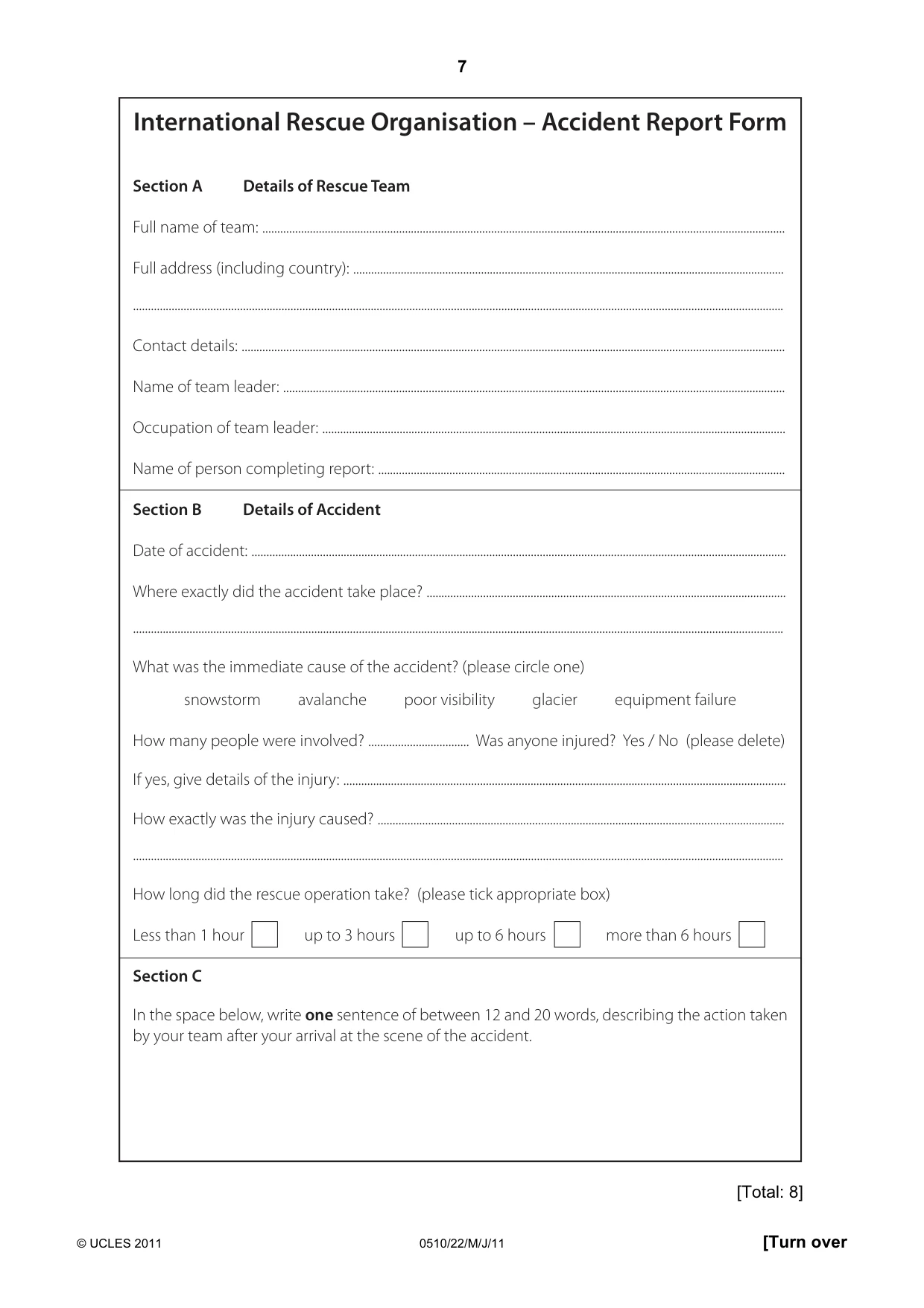
6 © UCLES 2011 0510/22/M/J/11 Exercise 3 At the age of 21, Alphonse Gaillard is the youngest member of the Mont Blanc Mountain Rescue Team, based at Chamonix in France, close to the borders with Switzerland and Italy. Alphonse is now in his final year studying English and German at Grenoble University. In the vacations he always returns to Chamonix, and he is then able to play a full part in the rescue team's operations. Members of the Mont Blanc Mountain Rescue Team have their storeroom, where they keep all the equipment, at 74 Rue Bobigny, on the outskirts of Chamonix. There is also a small office in the building, with its own telephone, but as the room is not regularly used the team members prefer to use the email address sauvevie-montblanc@alice.net.fr to contact the outside world. The leader of the team is Jacques Carpentier, an orthopaedic surgeon at the local hospital. On 2 April 2011, during the Easter holidays, a pair of climbers were caught in an avalanche on the upper slopes of Mont Blanc. One of them managed to take shelter beneath an overhanging rock, but the other was swept off the ledge on which he had been standing and fell fifty metres down the mountain side, severely injuring his leg. When his companion discovered him, he was unable to dig him out completely from under the snow. He therefore called the Mountain Rescue Team on his mobile phone. Alphonse accompanied the team in the rescue expedition. Weather conditions were terrible; it was snowing heavily, and a thick fog had descended over the mountain sides so that the party had to use powerful lamps to guide them. Fortunately, the uninjured climber had been able to give them a map reference, and, with the aid of a compass, they eventually reached the scene of the accident. They released the injured man, whose leg had been fractured in two places. Jacques Carpentier took a pole from one of the two stretchers carried by the team and used it to secure the broken limb. They then gently lifted the patient onto the other stretcher and started down the slope. The slow, exhausting journey to the bottom took them nearly three hours, so that it was already dark by the time they reached the hospital. The whole rescue operation had lasted seven and a half hours. The International Rescue Organisation required an accident report form to be completed because a serious injury had occurred. The form had to be completed in English, so the team leader asked Alphonse to perform the task. Imagine you are Alphonse Gaillard. Fill in the form on the opposite page, using the information above.
Question paper, page 7
7 © UCLES 2011 0510/22/M/J/11 [Turn over International Rescue Organisation – Accident Report Form Section A Details of Rescue Team Full name of team: … Full address (including country): … … Contact details: … Name of team leader: … Occupation of team leader: … Name of person completing report: … Section B Details of Accident Date of accident: … Where exactly did the accident take place? … … What was the immediate cause of the accident? (please circle one) snowstorm avalanche poor visibility glacier equipment failure How many people were involved? … Was anyone injured? Yes / No (please delete) If yes, give details of the injury: … How exactly was the injury caused? … … How long did the rescue operation take? (please tick appropriate box) Less than 1 hour up to 3 hours up to 6 hours more than 6 hours Section C In the space below, write one sentence of between 12 and 20 words, describing the action taken by your team after your arrival at the scene of the accident. [Total: 8]
Question paper, page 8
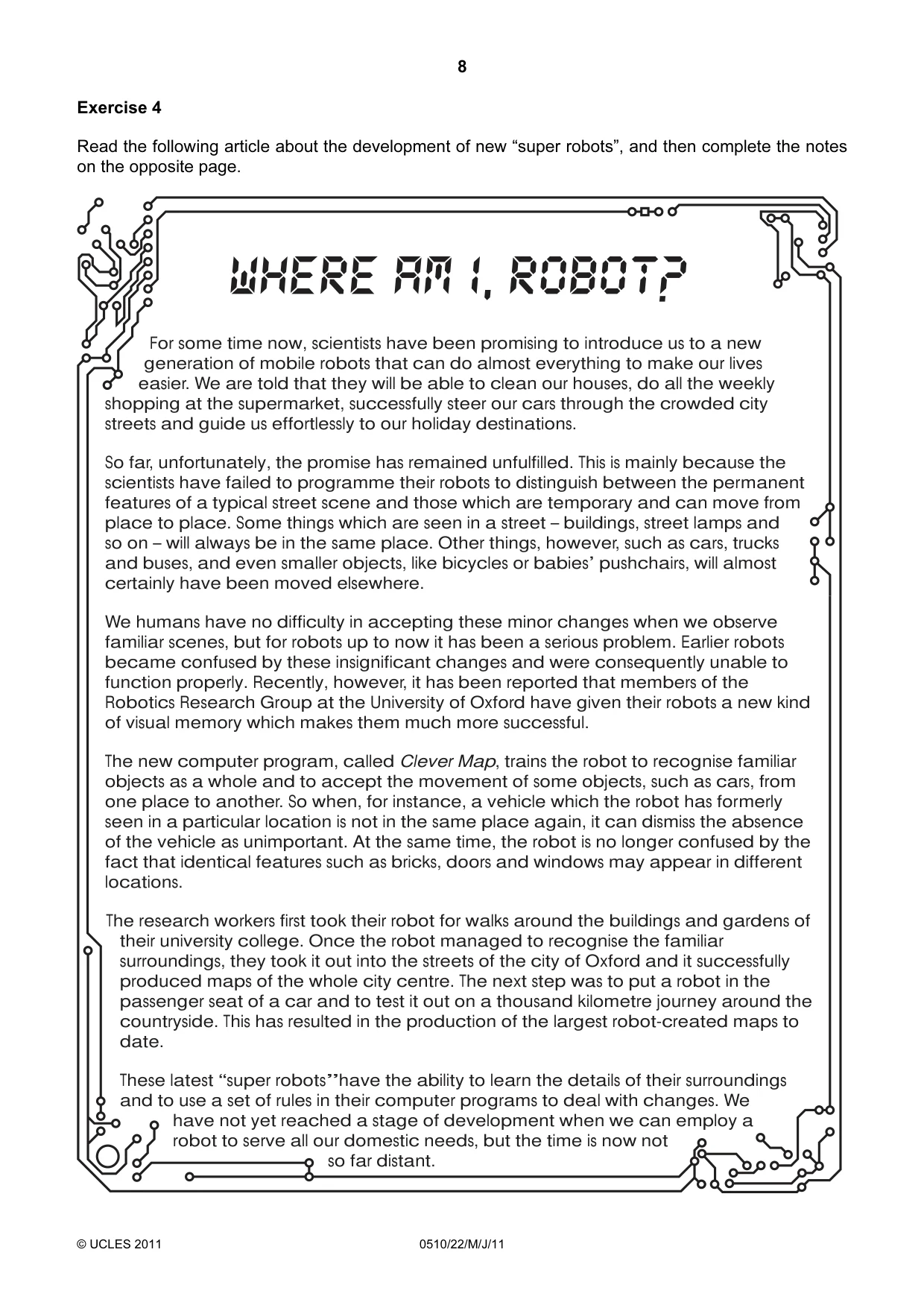
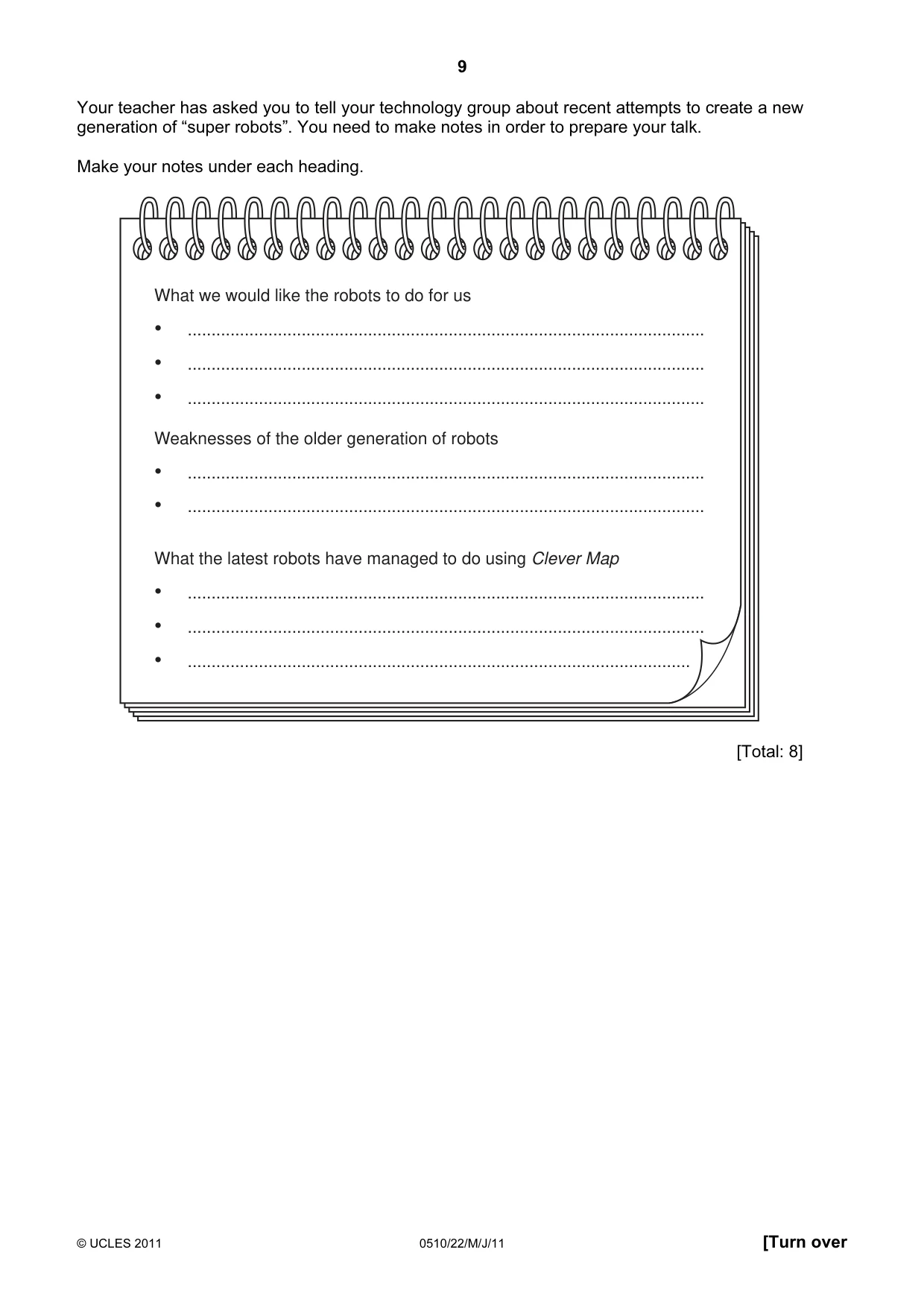
8 © UCLES 2011 0510/22/M/J/11 Exercise 4 Read the following article about the development of new “super robots”, and then complete the notes on the opposite page. For some time now, scientists have been promising to introduce us to a new generation of mobile robots that can do almost everything to make our lives easier. We are told that they will be able to clean our houses, do all the weekly shopping at the supermarket, successfully steer our cars through the crowded city streets and guide us effortlessly to our holiday destinations. So far, unfortunately, the promise has remained unfulfilled. This is mainly because the scientists have failed to programme their robots to distinguish between the permanent features of a typical street scene and those which are temporary and can move from place to place. Some things which are seen in a street – buildings, street lamps and so on – will always be in the same place. Other things, however, such as cars, trucks and buses, and even smaller objects, like bicycles or babies’ pushchairs, will almost certainly have been moved elsewhere. We humans have no difficulty in accepting these minor changes when we observe familiar scenes, but for robots up to now it has been a serious problem. Earlier robots became confused by these insignificant changes and were consequently unable to function properly. Recently, however, it has been reported that members of the Robotics Research Group at the University of Oxford have given their robots a new kind of visual memory which makes them much more successful. The new computer program, called Clever Map, trains the robot to recognise familiar objects as a whole and to accept the movement of some objects, such as cars, from one place to another. So when, for instance, a vehicle which the robot has formerly seen in a particular location is not in the same place again, it can dismiss the absence of the vehicle as unimportant. At the same time, the robot is no longer confused by the fact that identical features such as bricks, doors and windows may appear in different locations. The research workers first took their robot for walks around the buildings and gardens of their university college. Once the robot managed to recognise the familiar surroundings, they took it out into the streets of the city of Oxford and it successfully produced maps of the whole city centre. The next step was to put a robot in the passenger seat of a car and to test it out on a thousand kilometre journey around the countryside. This has resulted in the production of the largest robot-created maps to date. These latest “super robots” have the ability to learn the details of their surroundings and to use a set of rules in their computer programs to deal with changes. We have not yet reached a stage of development when we can employ a robot to serve all our domestic needs, but the time is now not so far distant.
Question paper, page 9
9 © UCLES 2011 0510/22/M/J/11 [Turn over Your teacher has asked you to tell your technology group about recent attempts to create a new generation of “super robots”. You need to make notes in order to prepare your talk. Make your notes under each heading. What we would like the robots to do for us • … • … • … Weaknesses of the older generation of robots • … • … What the latest robots have managed to do using Clever Map • … • … • … [Total: 8]
Question paper, page 10
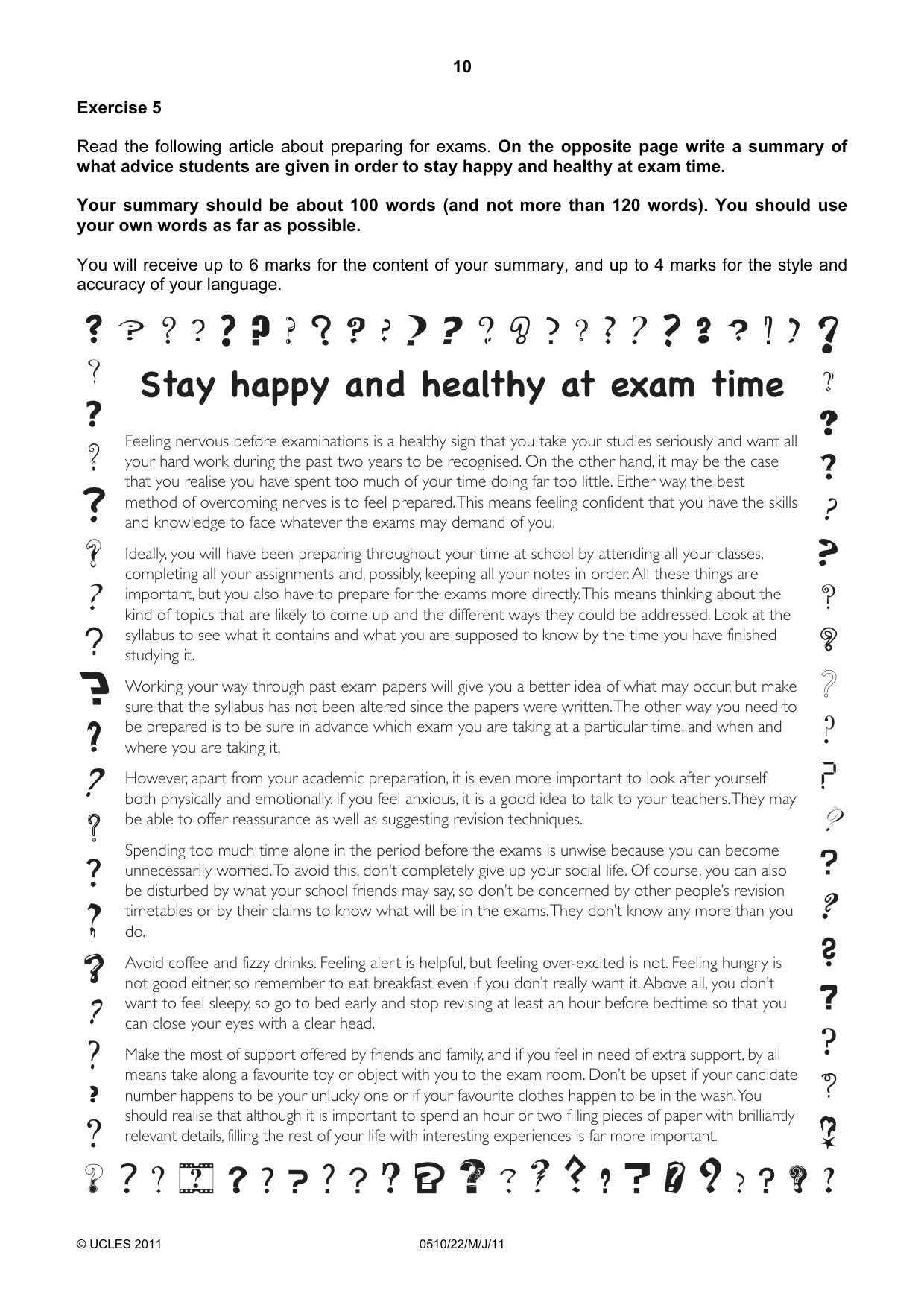
10 © UCLES 2011 0510/22/M/J/11 Exercise 5 Read the following article about preparing for exams. On the opposite page write a summary of what advice students are given in order to stay happy and healthy at exam time. Your summary should be about 100 words (and not more than 120 words). You should use your own words as far as possible. You will receive up to 6 marks for the content of your summary, and up to 4 marks for the style and accuracy of your language. Stay happy and healthy at exam time Feeling nervous before examinations is a healthy sign that you take your studies seriously and want all your hard work during the past two years to be recognised. On the other hand, it may be the case that you realise you have spent too much of your time doing far too little. Either way, the best method of overcoming nerves is to feel prepared. This means feeling confident that you have the skills and knowledge to face whatever the exams may demand of you. Ideally, you will have been preparing throughout your time at school by attending all your classes, completing all your assignments and, possibly, keeping all your notes in order. All these things are important, but you also have to prepare for the exams more directly. This means thinking about the kind of topics that are likely to come up and the different ways they could be addressed. Look at the syllabus to see what it contains and what you are supposed to know by the time you have finished studying it. Working your way through past exam papers will give you a better idea of what may occur, but make sure that the syllabus has not been altered since the papers were written. The other way you need to be prepared is to be sure in advance which exam you are taking at a particular time, and when and where you are taking it. However, apart from your academic preparation, it is even more important to look after yourself both physically and emotionally. If you feel anxious, it is a good idea to talk to your teachers. They may be able to offer reassurance as well as suggesting revision techniques. Spending too much time alone in the period before the exams is unwise because you can become unnecessarily worried. To avoid this, don’t completely give up your social life. Of course, you can also be disturbed by what your school friends may say, so don’t be concerned by other people’s revision timetables or by their claims to know what will be in the exams. They don’t know any more than you do. Avoid coffee and fizzy drinks. Feeling alert is helpful, but feeling over-excited is not. Feeling hungry is not good either, so remember to eat breakfast even if you don’t really want it. Above all, you don’t want to feel sleepy, so go to bed early and stop revising at least an hour before bedtime so that you can close your eyes with a clear head. Make the most of support offered by friends and family, and if you feel in need of extra support, by all means take along a favourite toy or object with you to the exam room. Don’t be upset if your candidate number happens to be your unlucky one or if your favourite clothes happen to be in the wash. You should realise that although it is important to spend an hour or two filling pieces of paper with brilliantly relevant details, filling the rest of your life with interesting experiences is far more important.
Question paper, page 11
11 © UCLES 2011 0510/22/M/J/11 [Turn over [Total: 10]
Question paper, page 12
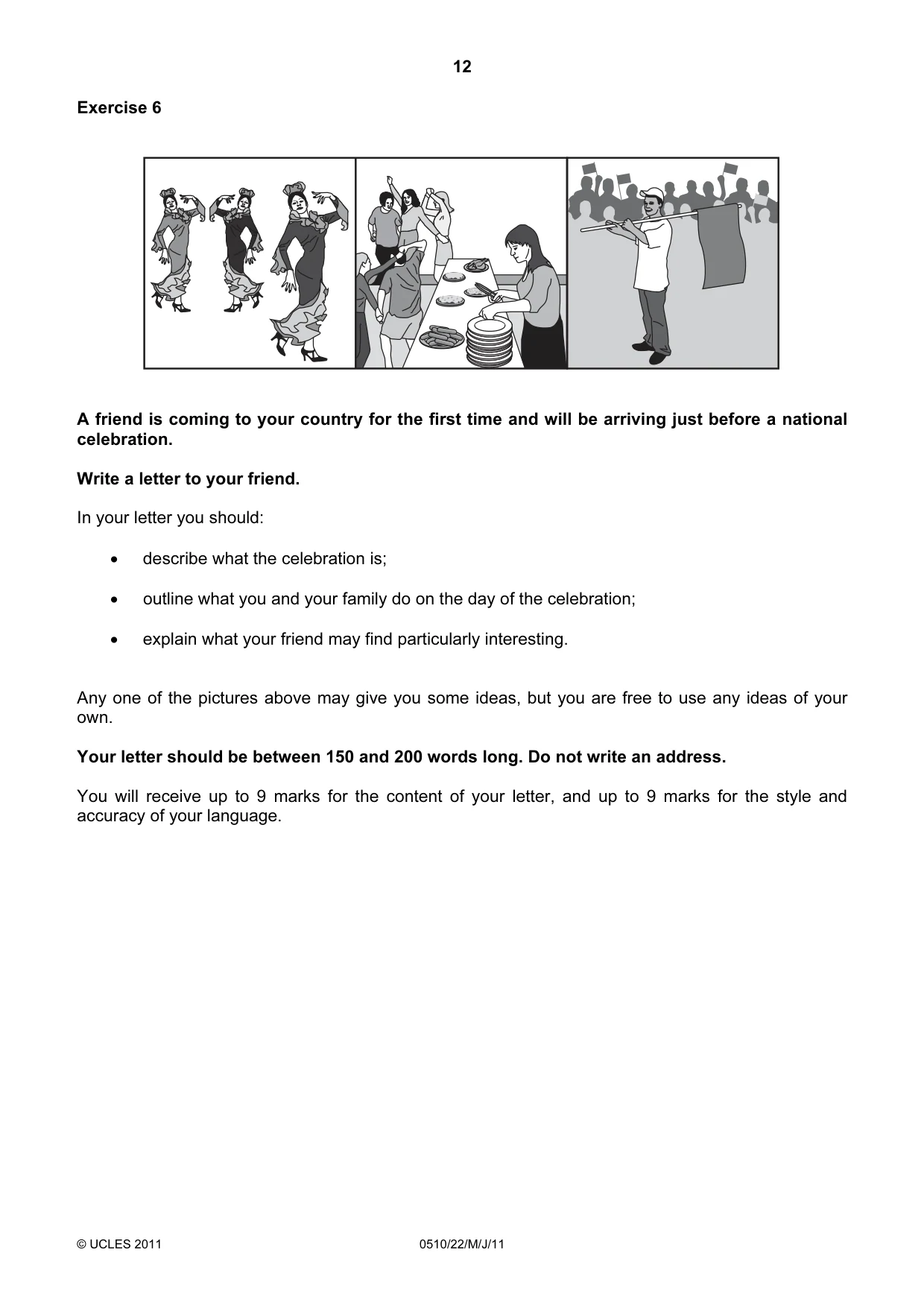
12 © UCLES 2011 0510/22/M/J/11 Exercise 6 A friend is coming to your country for the first time and will be arriving just before a national celebration. Write a letter to your friend. In your letter you should: • describe what the celebration is; • outline what you and your family do on the day of the celebration; • explain what your friend may find particularly interesting. Any one of the pictures above may give you some ideas, but you are free to use any ideas of your own. Your letter should be between 150 and 200 words long. Do not write an address. You will receive up to 9 marks for the content of your letter, and up to 9 marks for the style and accuracy of your language.
Question paper, page 13
13 © UCLES 2011 0510/22/M/J/11 [Turn over [Total: 18]
Question paper, page 14
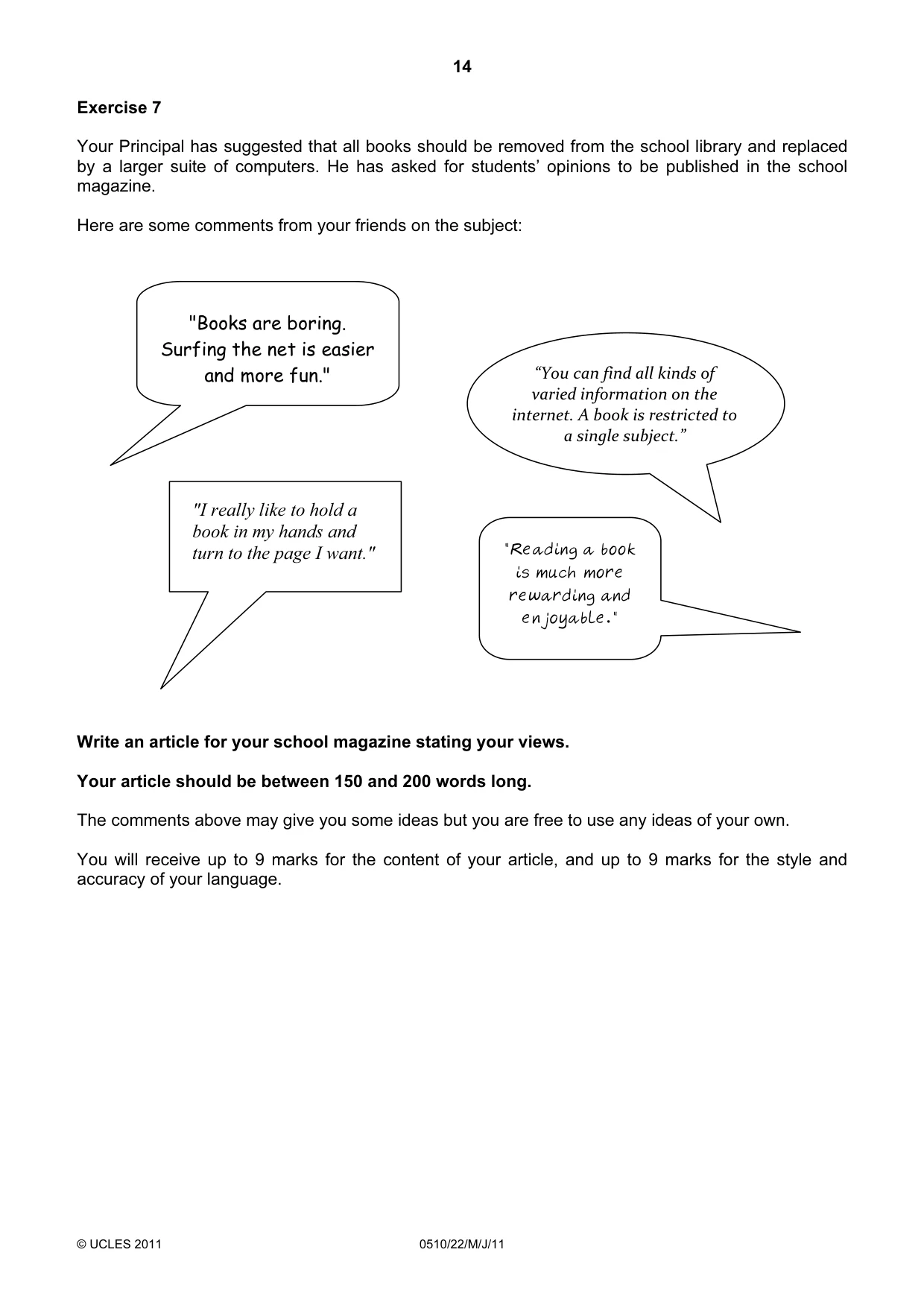
14 © UCLES 2011 0510/22/M/J/11 Exercise 7 Your Principal has suggested that all books should be removed from the school library and replaced by a larger suite of computers. He has asked for students’ opinions to be published in the school magazine. Here are some comments from your friends on the subject: Write an article for your school magazine stating your views. Your article should be between 150 and 200 words long. The comments above may give you some ideas but you are free to use any ideas of your own. You will receive up to 9 marks for the content of your article, and up to 9 marks for the style and accuracy of your language. "Books are boring. Surfing the net is easier and more fun." “You can find all kinds of varied information on the internet. A book is restricted to a single subject.” "I really like to hold a book in my hands and turn to the page I want." "Reading a book is much more rewarding and enjoyable."
Question paper, page 15
15 © UCLES 2011 0510/22/M/J/11 [Total: 18]
Question paper, page 16
16 Permission to reproduce items where third-party owned material protected by copyright is included has been sought and cleared where possible. Every reasonable effort has been made by the publisher (UCLES) to trace copyright holders, but if any items requiring clearance have unwittingly been included, the publisher will be pleased to make amends at the earliest possible opportunity. University of Cambridge International Examinations is part of the Cambridge Assessment Group. Cambridge Assessment is the brand name of University of Cambridge Local Examinations Syndicate (UCLES), which is itself a department of the University of Cambridge. © UCLES 2011 0510/22/M/J/11 BLANK PAGE
Mark scheme, page 1
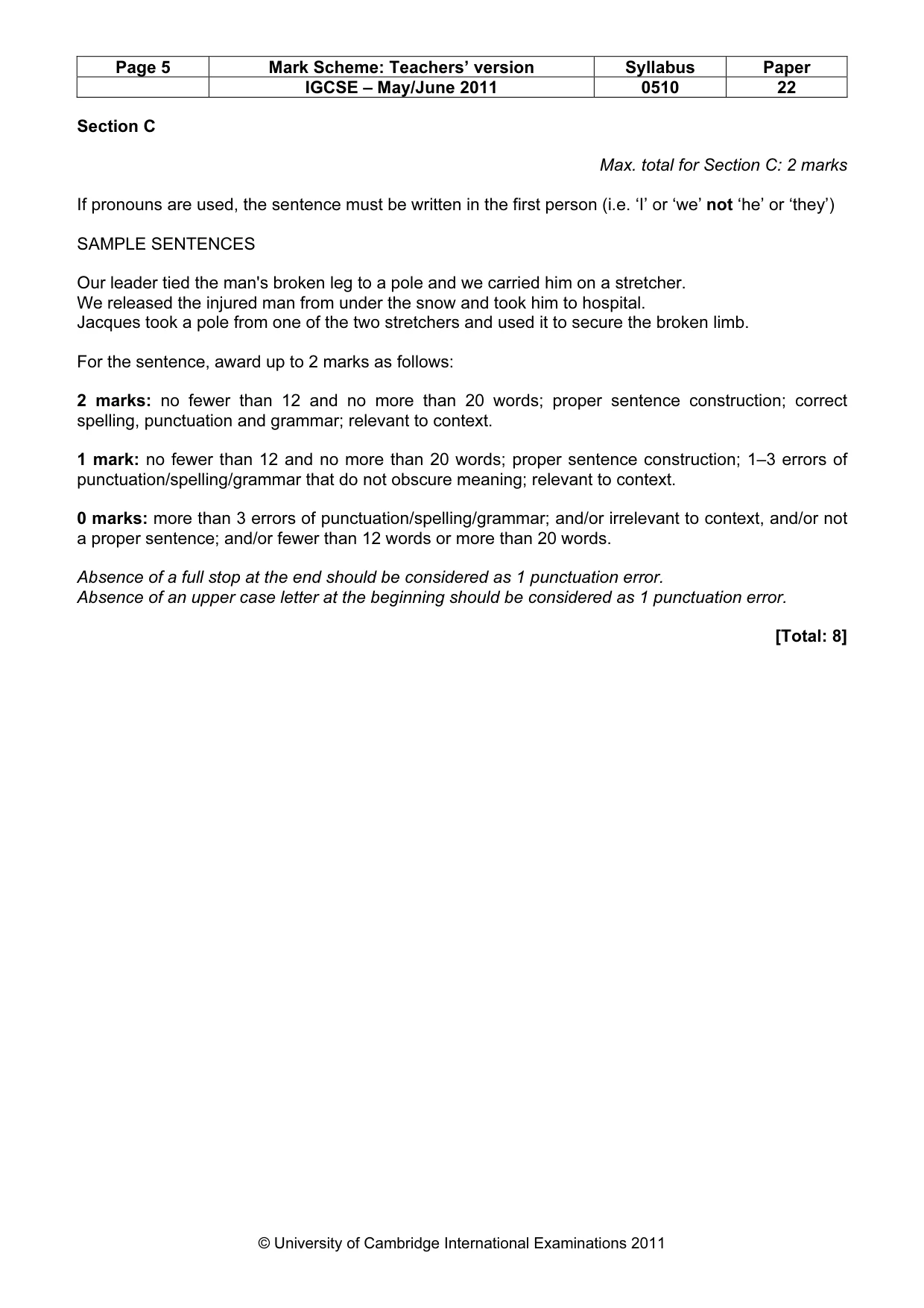
UNIVERSITY OF CAMBRIDGE INTERNATIONAL EXAMINATIONS International General Certificate of Secondary Education MARK SCHEME for the May/June 2011 question paper for the guidance of teachers 0510 ENGLISH AS A SECOND LANGUAGE 0510/22 Paper 2 (Reading and Writing – Extended), maximum raw mark 84 This mark scheme is published as an aid to teachers and candidates, to indicate the requirements of the examination. It shows the basis on which Examiners were instructed to award marks. It does not indicate the details of the discussions that took place at an Examiners’ meeting before marking began, which would have considered the acceptability of alternative answers. Mark schemes must be read in conjunction with the question papers and the report on the examination. • Cambridge will not enter into discussions or correspondence in connection with these mark schemes. Cambridge is publishing the mark schemes for the May/June 2011 question papers for most IGCSE, GCE Advanced Level and Advanced Subsidiary Level syllabuses and some Ordinary Level syllabuses. www.XtremePapers.com
Mark scheme, page 2
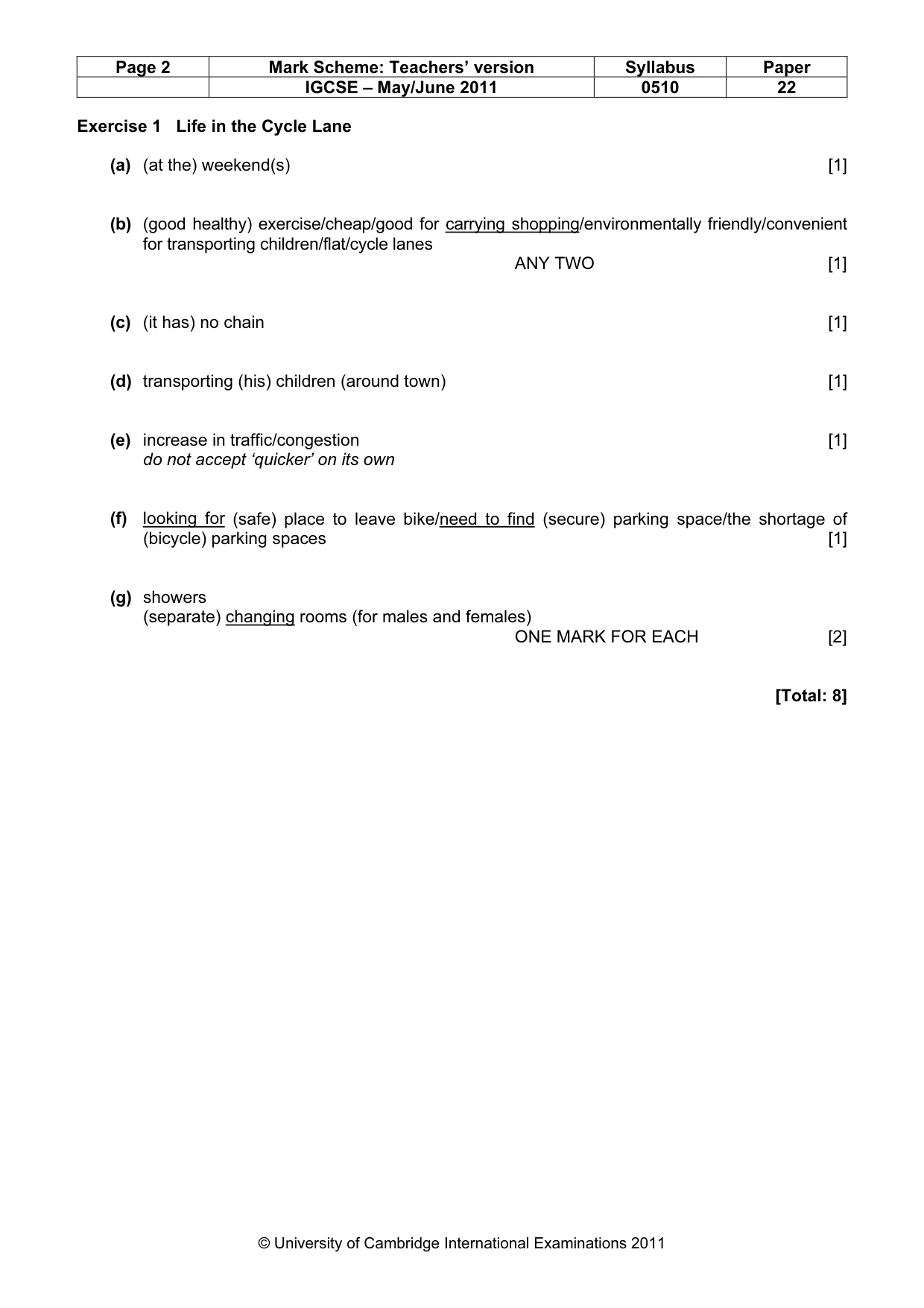
Page 2 Mark Scheme: Teachers’ version Syllabus Paper IGCSE – May/June 2011 0510 22 © University of Cambridge International Examinations 2011 Exercise 1 Life in the Cycle Lane (a) (at the) weekend(s) [1] (b) (good healthy) exercise/cheap/good for carrying shopping/environmentally friendly/convenient for transporting children/flat/cycle lanes ANY TWO [1] (c) (it has) no chain [1] (d) transporting (his) children (around town) [1] (e) increase in traffic/congestion [1] do not accept ‘quicker’ on its own (f) looking for (safe) place to leave bike/need to find (secure) parking space/the shortage of (bicycle) parking spaces [1] (g) showers (separate) changing rooms (for males and females) ONE MARK FOR EACH [2] [Total: 8]
Mark scheme, page 3
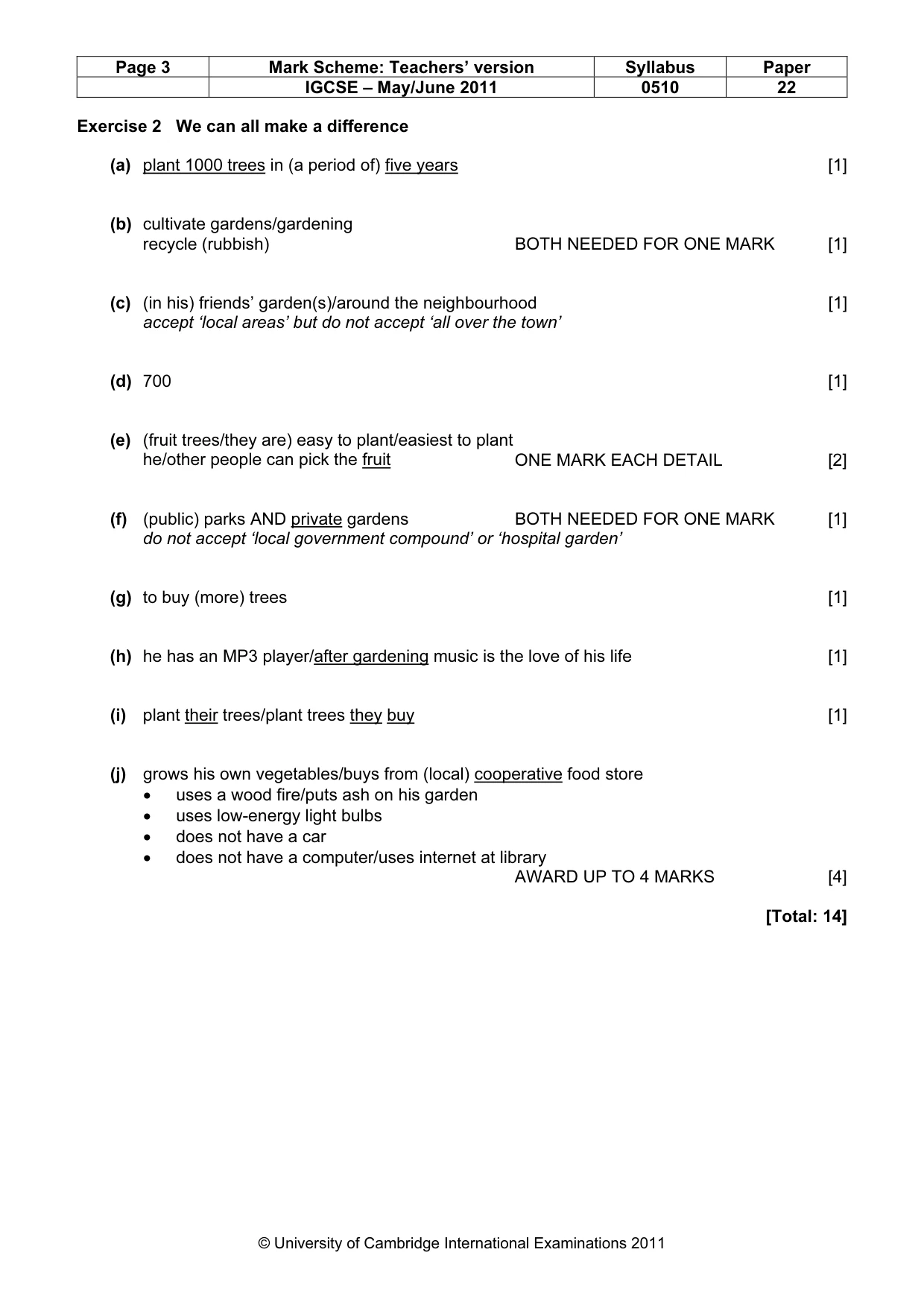
Page 3 Mark Scheme: Teachers’ version Syllabus Paper IGCSE – May/June 2011 0510 22 © University of Cambridge International Examinations 2011 Exercise 2 We can all make a difference (a) plant 1000 trees in (a period of) five years [1] (b) cultivate gardens/gardening recycle (rubbish) BOTH NEEDED FOR ONE MARK [1] (c) (in his) friends’ garden(s)/around the neighbourhood [1] accept ‘local areas’ but do not accept ‘all over the town’ (d) 700 [1] (e) (fruit trees/they are) easy to plant/easiest to plant he/other people can pick the fruit ONE MARK EACH DETAIL [2] (f) (public) parks AND private gardens BOTH NEEDED FOR ONE MARK [1] do not accept ‘local government compound’ or ‘hospital garden’ (g) to buy (more) trees [1] (h) he has an MP3 player/after gardening music is the love of his life [1] (i) plant their trees/plant trees they buy [1] (j) grows his own vegetables/buys from (local) cooperative food store • uses a wood fire/puts ash on his garden • uses low-energy light bulbs • does not have a car • does not have a computer/uses internet at library AWARD UP TO 4 MARKS [4] [Total: 14]
Mark scheme, page 4
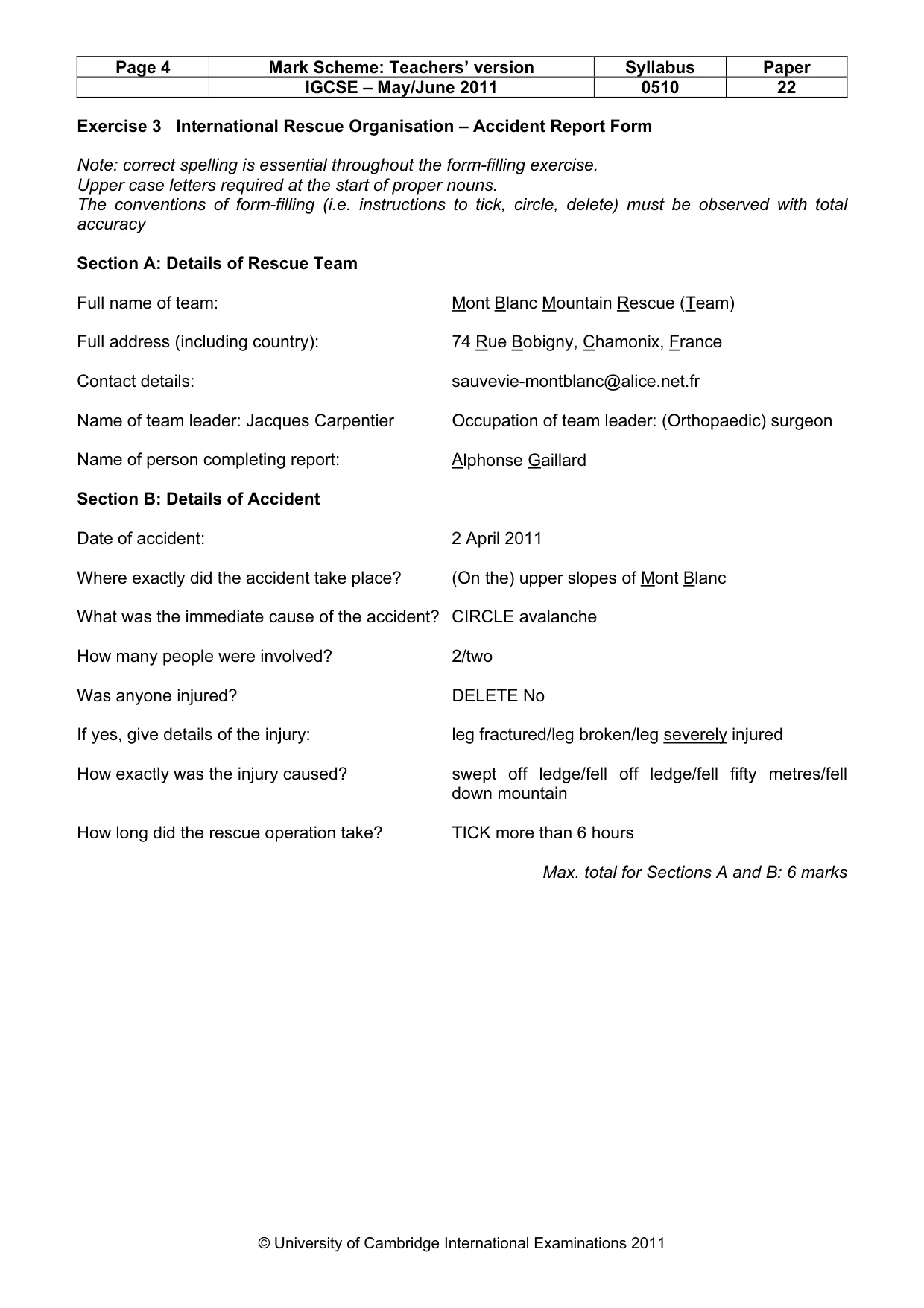
Page 4 Mark Scheme: Teachers’ version Syllabus Paper IGCSE – May/June 2011 0510 22 © University of Cambridge International Examinations 2011 Exercise 3 International Rescue Organisation – Accident Report Form Note: correct spelling is essential throughout the form-filling exercise. Upper case letters required at the start of proper nouns. The conventions of form-filling (i.e. instructions to tick, circle, delete) must be observed with total accuracy Section A: Details of Rescue Team Full name of team: Mont Blanc Mountain Rescue (Team) Full address (including country): 74 Rue Bobigny, Chamonix, France Contact details: sauvevie-montblanc@alice.net.fr Name of team leader: Jacques Carpentier Occupation of team leader: (Orthopaedic) surgeon Name of person completing report: Alphonse Gaillard Section B: Details of Accident Date of accident: 2 April 2011 Where exactly did the accident take place? (On the) upper slopes of Mont Blanc What was the immediate cause of the accident? CIRCLE avalanche How many people were involved? 2/two Was anyone injured? DELETE No If yes, give details of the injury: leg fractured/leg broken/leg severely injured How exactly was the injury caused? swept off ledge/fell off ledge/fell fifty metres/fell down mountain How long did the rescue operation take? TICK more than 6 hours Max. total for Sections A and B: 6 marks
Mark scheme, page 5
Page 5 Mark Scheme: Teachers’ version Syllabus Paper IGCSE – May/June 2011 0510 22 © University of Cambridge International Examinations 2011 Section C Max. total for Section C: 2 marks If pronouns are used, the sentence must be written in the first person (i.e. ‘I’ or ‘we’ not ‘he’ or ‘they’) SAMPLE SENTENCES Our leader tied the man's broken leg to a pole and we carried him on a stretcher. We released the injured man from under the snow and took him to hospital. Jacques took a pole from one of the two stretchers and used it to secure the broken limb. For the sentence, award up to 2 marks as follows: 2 marks: no fewer than 12 and no more than 20 words; proper sentence construction; correct spelling, punctuation and grammar; relevant to context. 1 mark: no fewer than 12 and no more than 20 words; proper sentence construction; 1–3 errors of punctuation/spelling/grammar that do not obscure meaning; relevant to context. 0 marks: more than 3 errors of punctuation/spelling/grammar; and/or irrelevant to context, and/or not a proper sentence; and/or fewer than 12 words or more than 20 words. Absence of a full stop at the end should be considered as 1 punctuation error. Absence of an upper case letter at the beginning should be considered as 1 punctuation error. [Total: 8]
Mark scheme, page 6
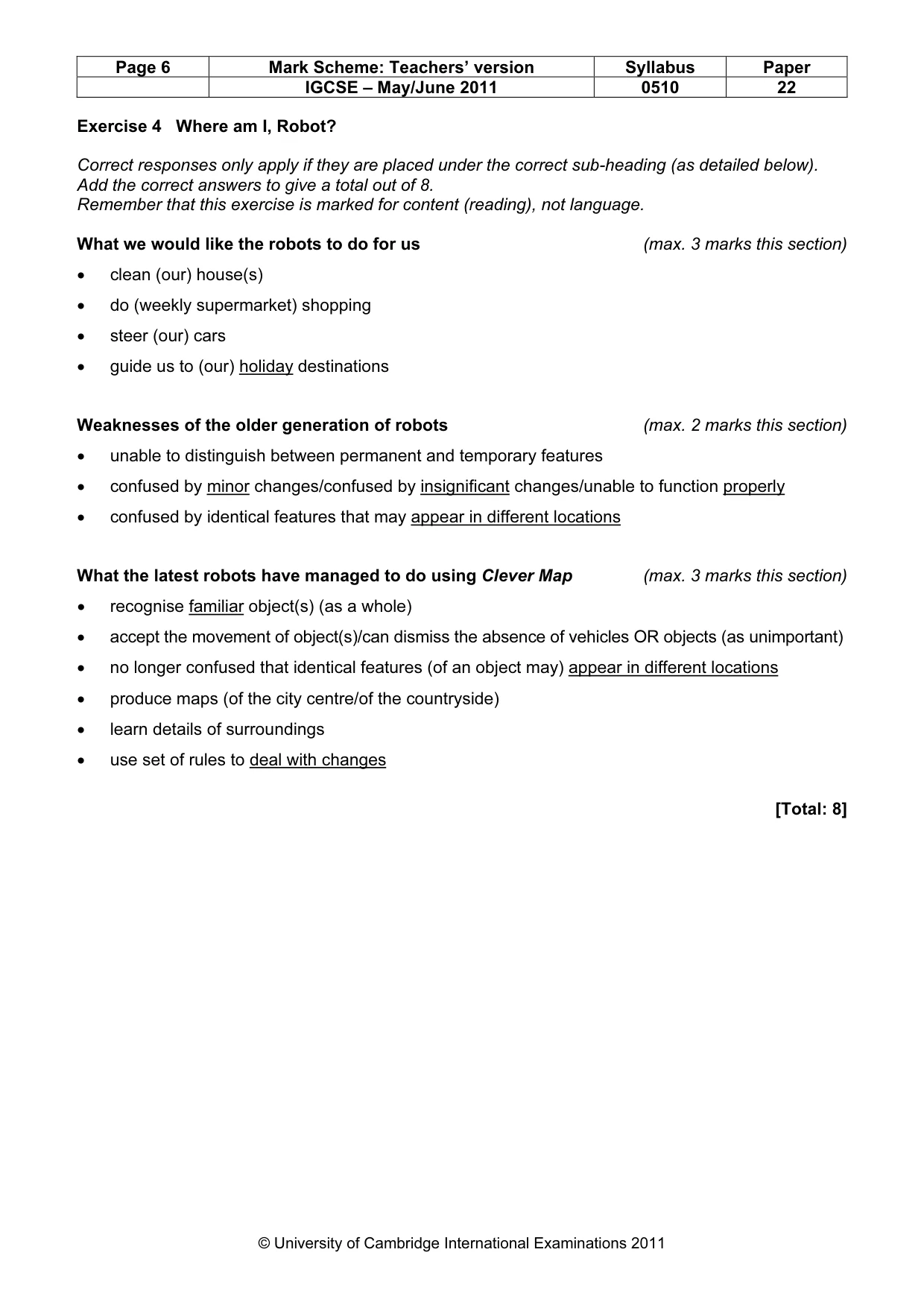
Page 6 Mark Scheme: Teachers’ version Syllabus Paper IGCSE – May/June 2011 0510 22 © University of Cambridge International Examinations 2011 Exercise 4 Where am I, Robot? Correct responses only apply if they are placed under the correct sub-heading (as detailed below). Add the correct answers to give a total out of 8. Remember that this exercise is marked for content (reading), not language. What we would like the robots to do for us (max. 3 marks this section) • clean (our) house(s) • do (weekly supermarket) shopping • steer (our) cars • guide us to (our) holiday destinations Weaknesses of the older generation of robots (max. 2 marks this section) • unable to distinguish between permanent and temporary features • confused by minor changes/confused by insignificant changes/unable to function properly • confused by identical features that may appear in different locations What the latest robots have managed to do using Clever Map (max. 3 marks this section) • recognise familiar object(s) (as a whole) • accept the movement of object(s)/can dismiss the absence of vehicles OR objects (as unimportant) • no longer confused that identical features (of an object may) appear in different locations • produce maps (of the city centre/of the countryside) • learn details of surroundings • use set of rules to deal with changes [Total: 8]
Mark scheme, page 7
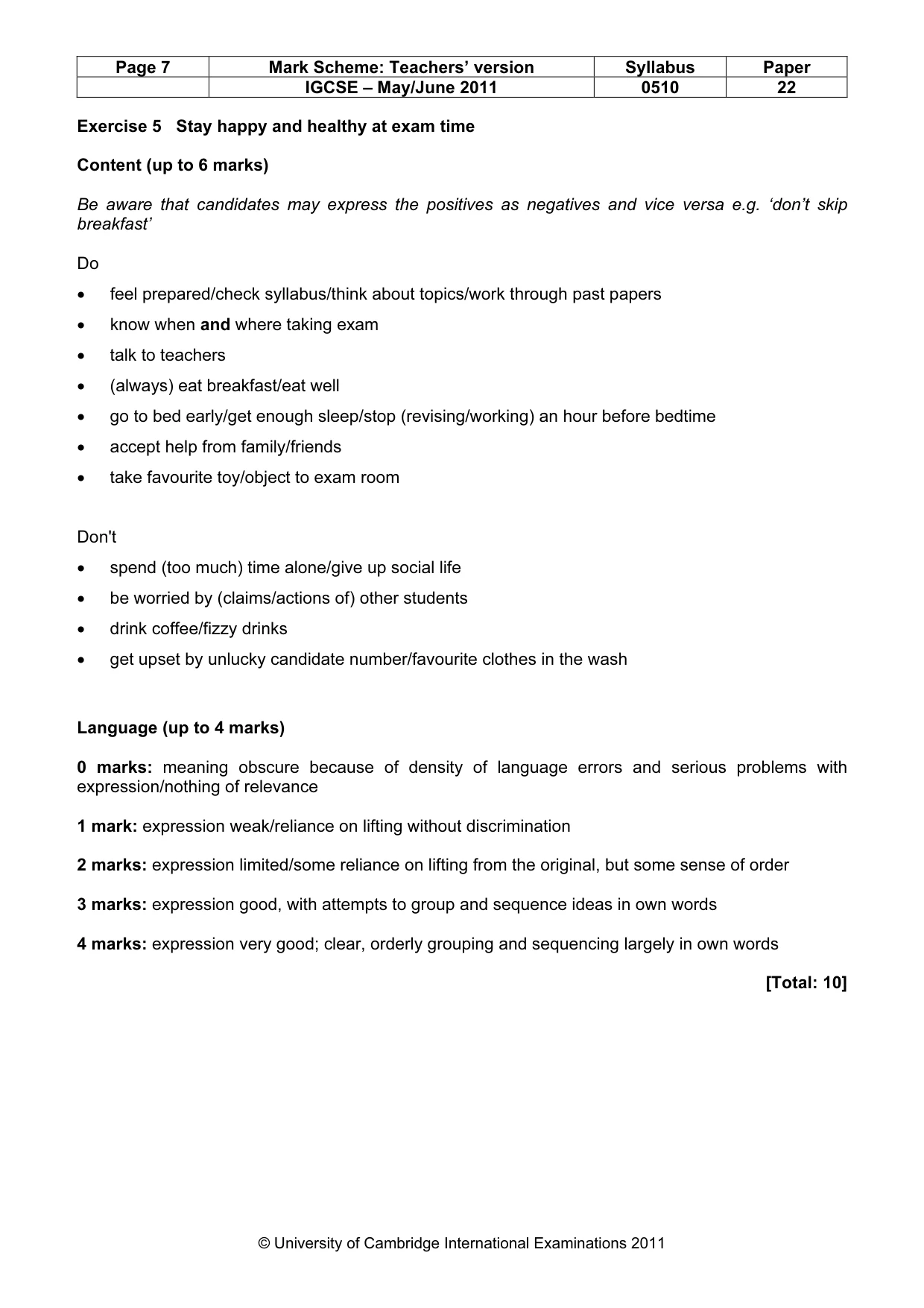
Page 7 Mark Scheme: Teachers’ version Syllabus Paper IGCSE – May/June 2011 0510 22 © University of Cambridge International Examinations 2011 Exercise 5 Stay happy and healthy at exam time Content (up to 6 marks) Be aware that candidates may express the positives as negatives and vice versa e.g. ‘don’t skip breakfast’ Do • feel prepared/check syllabus/think about topics/work through past papers • know when and where taking exam • talk to teachers • (always) eat breakfast/eat well • go to bed early/get enough sleep/stop (revising/working) an hour before bedtime • accept help from family/friends • take favourite toy/object to exam room Don't • spend (too much) time alone/give up social life • be worried by (claims/actions of) other students • drink coffee/fizzy drinks • get upset by unlucky candidate number/favourite clothes in the wash Language (up to 4 marks) 0 marks: meaning obscure because of density of language errors and serious problems with expression/nothing of relevance 1 mark: expression weak/reliance on lifting without discrimination 2 marks: expression limited/some reliance on lifting from the original, but some sense of order 3 marks: expression good, with attempts to group and sequence ideas in own words 4 marks: expression very good; clear, orderly grouping and sequencing largely in own words [Total: 10]
Mark scheme, page 8
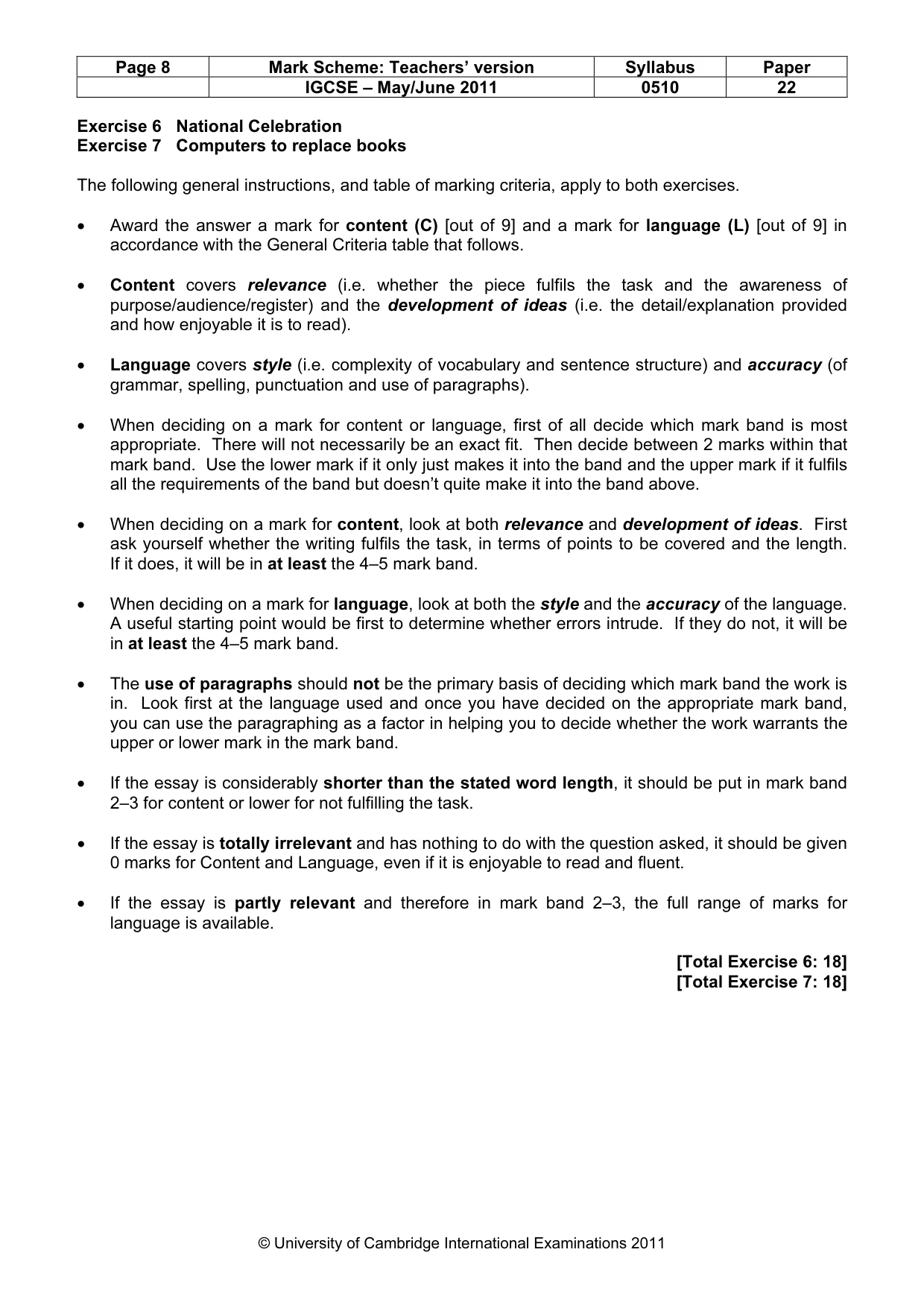
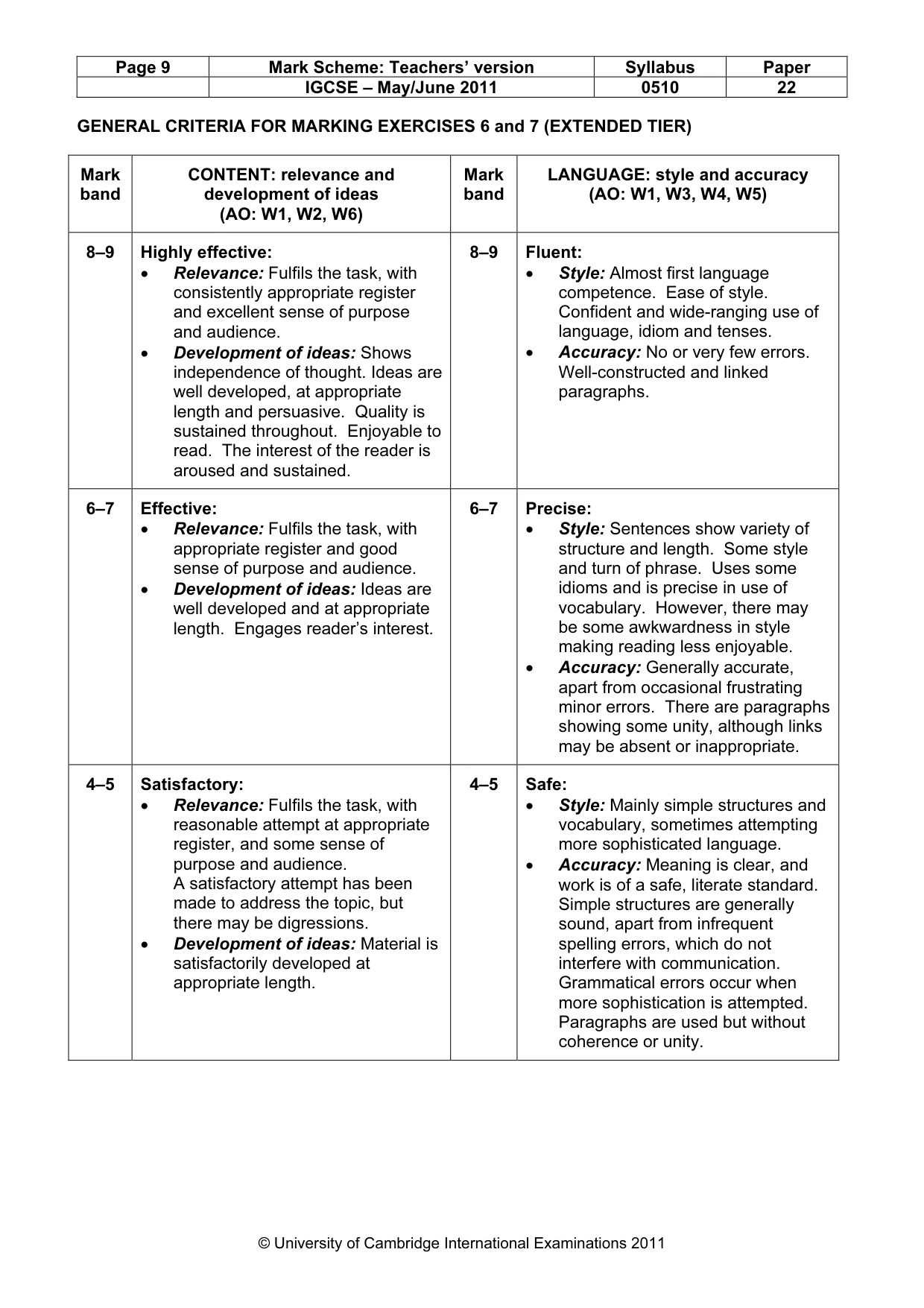
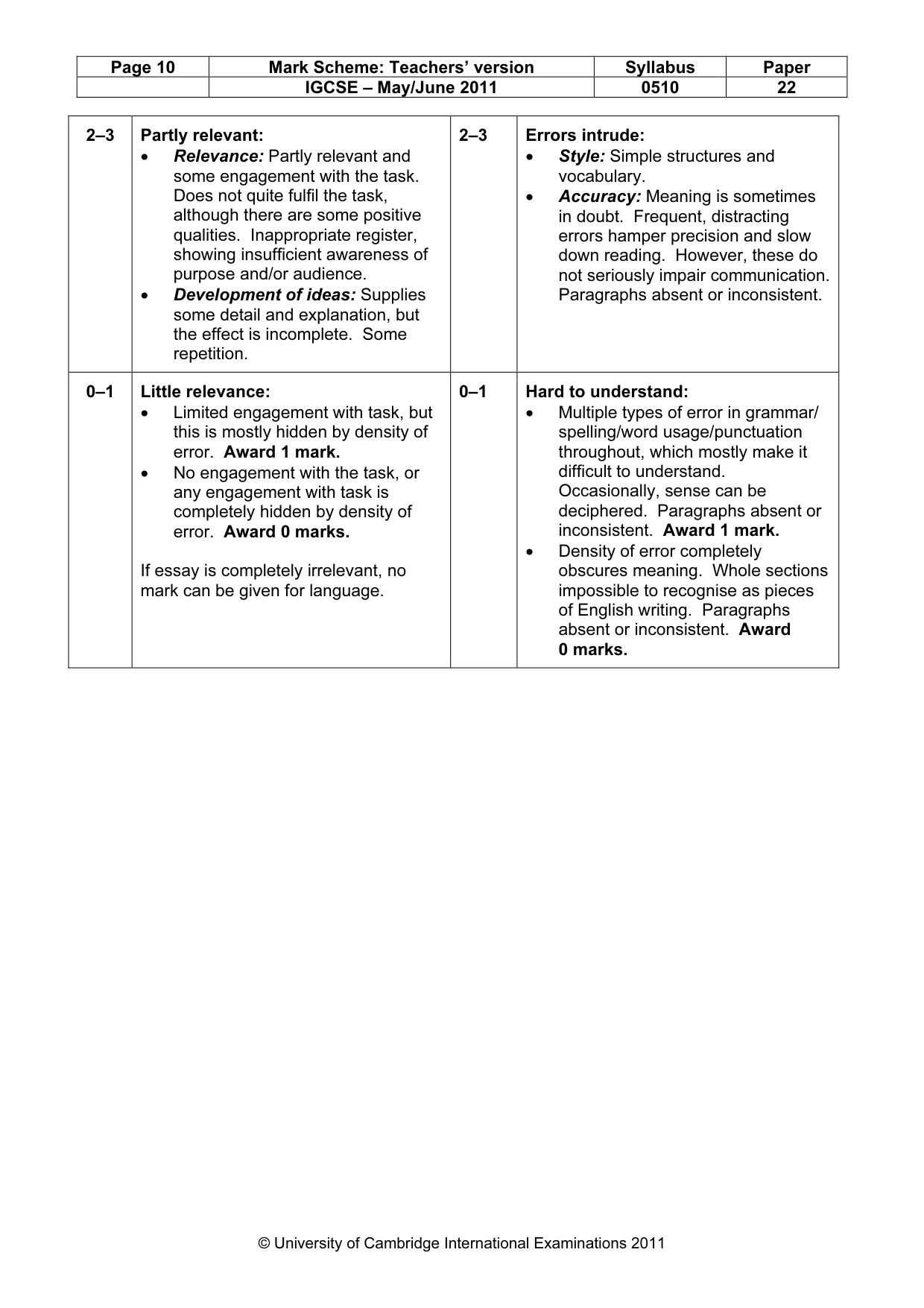
Page 8 Mark Scheme: Teachers’ version Syllabus Paper IGCSE – May/June 2011 0510 22 © University of Cambridge International Examinations 2011 Exercise 6 National Celebration Exercise 7 Computers to replace books The following general instructions, and table of marking criteria, apply to both exercises. • Award the answer a mark for content (C) [out of 9] and a mark for language (L) [out of 9] in accordance with the General Criteria table that follows. • Content covers relevance (i.e. whether the piece fulfils the task and the awareness of purpose/audience/register) and the development of ideas (i.e. the detail/explanation provided and how enjoyable it is to read). • Language covers style (i.e. complexity of vocabulary and sentence structure) and accuracy (of grammar, spelling, punctuation and use of paragraphs). • When deciding on a mark for content or language, first of all decide which mark band is most appropriate. There will not necessarily be an exact fit. Then decide between 2 marks within that mark band. Use the lower mark if it only just makes it into the band and the upper mark if it fulfils all the requirements of the band but doesn’t quite make it into the band above. • When deciding on a mark for content, look at both relevance and development of ideas. First ask yourself whether the writing fulfils the task, in terms of points to be covered and the length. If it does, it will be in at least the 4–5 mark band. • When deciding on a mark for language, look at both the style and the accuracy of the language. A useful starting point would be first to determine whether errors intrude. If they do not, it will be in at least the 4–5 mark band. • The use of paragraphs should not be the primary basis of deciding which mark band the work is in. Look first at the language used and once you have decided on the appropriate mark band, you can use the paragraphing as a factor in helping you to decide whether the work warrants the upper or lower mark in the mark band. • If the essay is considerably shorter than the stated word length, it should be put in mark band 2–3 for content or lower for not fulfilling the task. • If the essay is totally irrelevant and has nothing to do with the question asked, it should be given 0 marks for Content and Language, even if it is enjoyable to read and fluent. • If the essay is partly relevant and therefore in mark band 2–3, the full range of marks for language is available. [Total Exercise 6: 18] [Total Exercise 7: 18]
Mark scheme, page 9
Page 9 Mark Scheme: Teachers’ version Syllabus Paper IGCSE – May/June 2011 0510 22 © University of Cambridge International Examinations 2011 GENERAL CRITERIA FOR MARKING EXERCISES 6 and 7 (EXTENDED TIER) Mark band CONTENT: relevance and development of ideas (AO: W1, W2, W6) Mark band LANGUAGE: style and accuracy (AO: W1, W3, W4, W5) 8–9 Highly effective: • Relevance: Fulfils the task, with consistently appropriate register and excellent sense of purpose and audience. • Development of ideas: Shows independence of thought. Ideas are well developed, at appropriate length and persuasive. Quality is sustained throughout. Enjoyable to read. The interest of the reader is aroused and sustained. 8–9 Fluent: • Style: Almost first language competence. Ease of style. Confident and wide-ranging use of language, idiom and tenses. • Accuracy: No or very few errors. Well-constructed and linked paragraphs. 6–7 Effective: • Relevance: Fulfils the task, with appropriate register and good sense of purpose and audience. • Development of ideas: Ideas are well developed and at appropriate length. Engages reader’s interest. 6–7 Precise: • Style: Sentences show variety of structure and length. Some style and turn of phrase. Uses some idioms and is precise in use of vocabulary. However, there may be some awkwardness in style making reading less enjoyable. • Accuracy: Generally accurate, apart from occasional frustrating minor errors. There are paragraphs showing some unity, although links may be absent or inappropriate. 4–5 Satisfactory: • Relevance: Fulfils the task, with reasonable attempt at appropriate register, and some sense of purpose and audience. A satisfactory attempt has been made to address the topic, but there may be digressions. • Development of ideas: Material is satisfactorily developed at appropriate length. 4–5 Safe: • Style: Mainly simple structures and vocabulary, sometimes attempting more sophisticated language. • Accuracy: Meaning is clear, and work is of a safe, literate standard. Simple structures are generally sound, apart from infrequent spelling errors, which do not interfere with communication. Grammatical errors occur when more sophistication is attempted. Paragraphs are used but without coherence or unity.
Mark scheme, page 10
Page 10 Mark Scheme: Teachers’ version Syllabus Paper IGCSE – May/June 2011 0510 22 © University of Cambridge International Examinations 2011 2–3 Partly relevant: • Relevance: Partly relevant and some engagement with the task. Does not quite fulfil the task, although there are some positive qualities. Inappropriate register, showing insufficient awareness of purpose and/or audience. • Development of ideas: Supplies some detail and explanation, but the effect is incomplete. Some repetition. 2–3 Errors intrude: • Style: Simple structures and vocabulary. • Accuracy: Meaning is sometimes in doubt. Frequent, distracting errors hamper precision and slow down reading. However, these do not seriously impair communication. Paragraphs absent or inconsistent. 0–1 Little relevance: • Limited engagement with task, but this is mostly hidden by density of error. Award 1 mark. • No engagement with the task, or any engagement with task is completely hidden by density of error. Award 0 marks. If essay is completely irrelevant, no mark can be given for language. 0–1 Hard to understand: • Multiple types of error in grammar/ spelling/word usage/punctuation throughout, which mostly make it difficult to understand. Occasionally, sense can be deciphered. Paragraphs absent or inconsistent. Award 1 mark. • Density of error completely obscures meaning. Whole sections impossible to recognise as pieces of English writing. Paragraphs absent or inconsistent. Award 0 marks.
What you needed in this session
Cambridge’s own grade thresholds for 2011 May/June, Paper 2 · Variant 2. A higher threshold means an easier paper — the bar moves with how the cohort did.