Cambridge IGCSE English - Second Language (oral endorsement) 0510 — 2010 Oct/Nov Paper 4 · Variant 1
0510/41/O/N/10 · 36 marks · ≈41 min
The question paper and its mark scheme, free to read here and free to download. This is Cambridge’s own paper, exactly as it was sat.
Question paper8 pages


Mark scheme14 pages
Answers below. Sit the paper first if you are practising.
Paper as text
Question paper, page 1
This document consists of 6 printed pages and 2 blank pages. IB10 11_0510_41/6RP © UCLES 2010 [Turn over *8048203026* For Examiner's Use Questions 1-6 Question 7 Question 8 Question 9 Question 10 Total UNIVERSITY OF CAMBRIDGE INTERNATIONAL EXAMINATIONS International General Certificate of Secondary Education ENGLISH AS A SECOND LANGUAGE 0510/41 Paper 4 Listening (Extended) October/November 2010 Approx. 45 minutes Candidates answer on the Question Paper. Additional Materials: As listed in Instructions to Supervisors. READ THESE INSTRUCTIONS FIRST Write your Centre number, candidate number and name on all the work you hand in. Write in dark blue or black pen. Do not use staples, paper clips, highlighters, glue or correction fluid. DO NOT WRITE IN ANY BARCODES. Answer all questions. Dictionaries are not permitted. At the end of the examination, fasten all your work securely together. The number of marks is given in brackets [ ] at the end of each question or part question.
Question paper, page 2
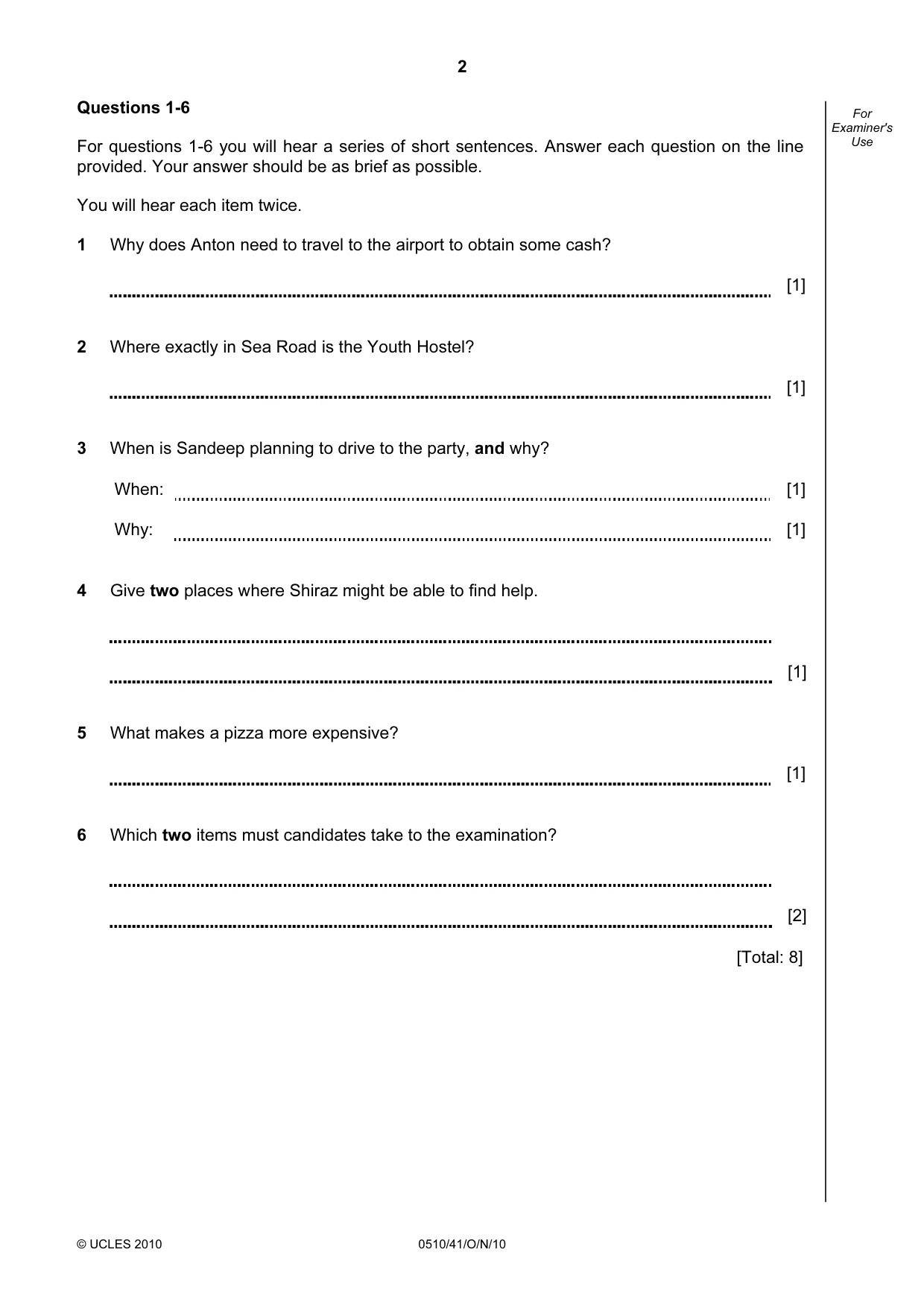
2 © UCLES 2010 0510/41/O/N/10 For Examiner's Use Questions 1-6 For questions 1-6 you will hear a series of short sentences. Answer each question on the line provided. Your answer should be as brief as possible. You will hear each item twice. 1 Why does Anton need to travel to the airport to obtain some cash? [1] 2 Where exactly in Sea Road is the Youth Hostel? [1] 3 When is Sandeep planning to drive to the party, and why? When: [1] Why: [1] 4 Give two places where Shiraz might be able to find help. [1] 5 What makes a pizza more expensive? [1] 6 Which two items must candidates take to the examination? [2] [Total: 8]
Question paper, page 3
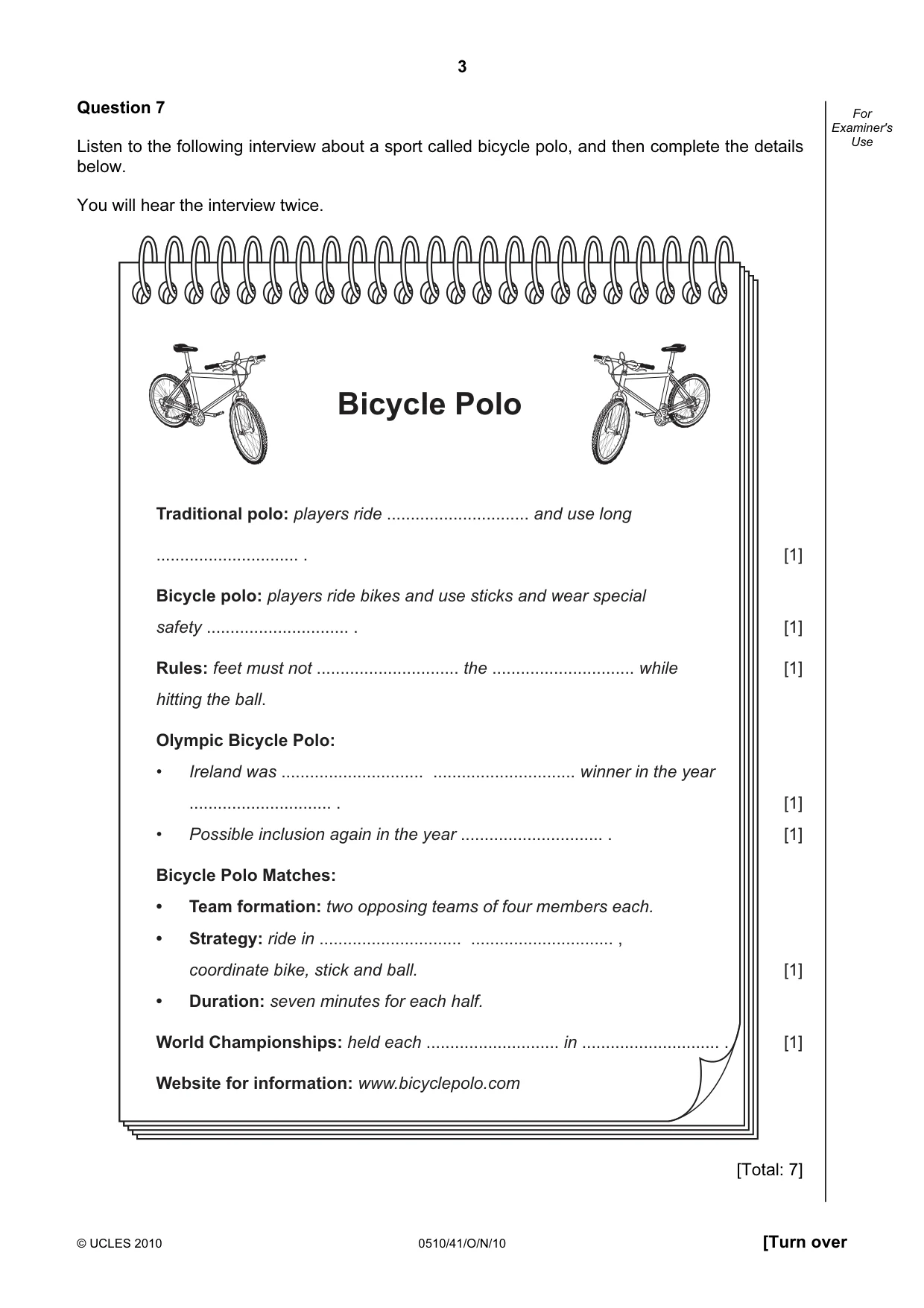
3 © UCLES 2010 0510/41/O/N/10 [Turn over For Examiner's Use Question 7 Listen to the following interview about a sport called bicycle polo, and then complete the details below. You will hear the interview twice. Bicycle Polo Traditional polo: players ride … and use long … . [1] Bicycle polo: players ride bikes and use sticks and wear special safety … . [1] Rules: feet must not … the … while [1] hitting the ball. Olympic Bicycle Polo: • Ireland was … … winner in the year … . [1] • Possible inclusion again in the year … . [1] Bicycle Polo Matches: • Team formation: two opposing teams of four members each. • Strategy: ride in … … , coordinate bike, stick and ball. [1] • Duration: seven minutes for each half. World Championships: held each … in … . [1] Website for information: www.bicyclepolo.com [Total: 7]
Question paper, page 4
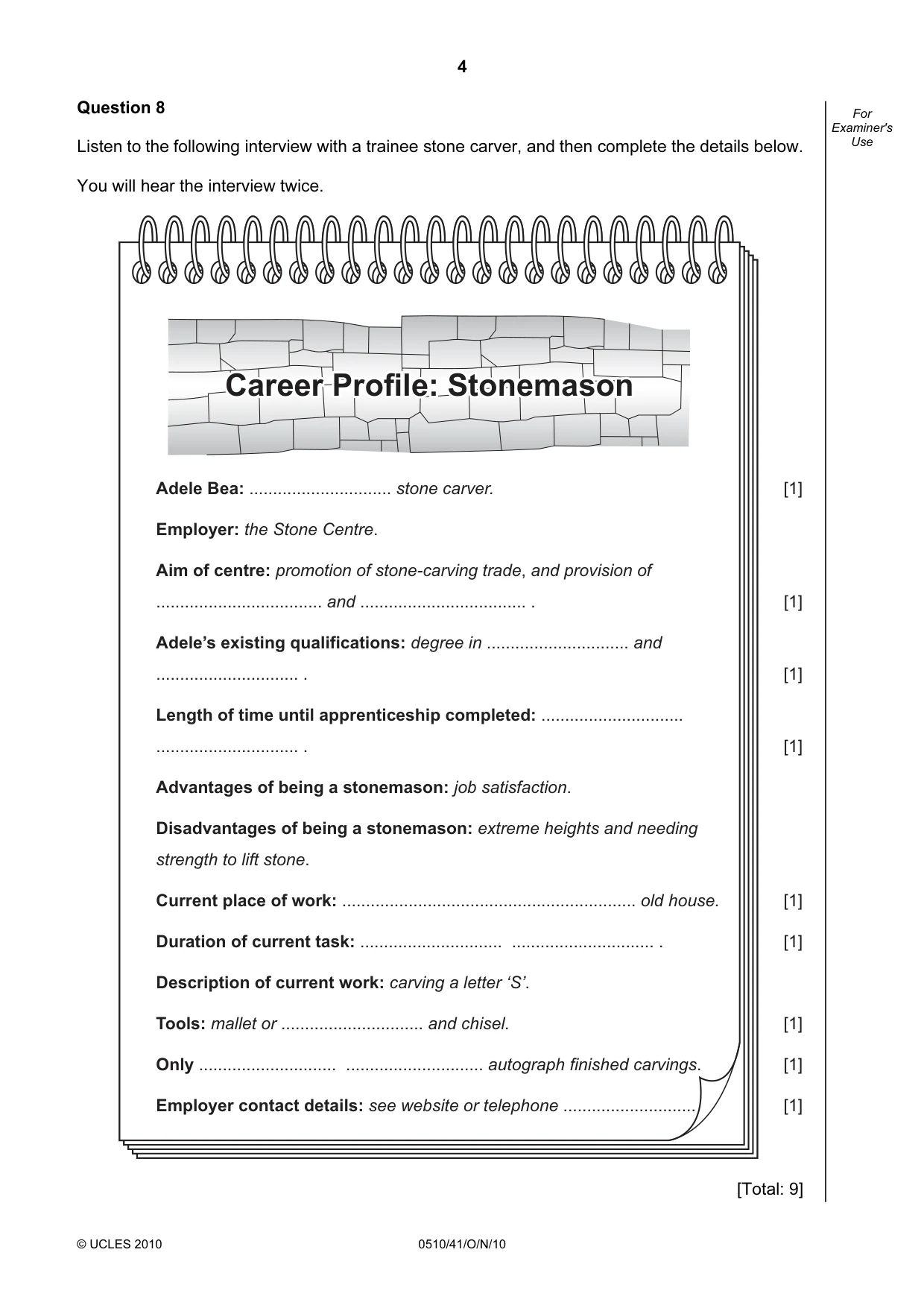
4 © UCLES 2010 0510/41/O/N/10 For Examiner's Use Question 8 Listen to the following interview with a trainee stone carver, and then complete the details below. You will hear the interview twice. Career Profile: Stonemason Career Profile: Stonemason Career Profile: Stonemason Adele Bea: … stone carver. [1] Employer: the Stone Centre. Aim of centre: promotion of stone-carving trade, and provision of … and … . [1] Adele’s existing qualifications: degree in … and … . [1] Length of time until apprenticeship completed: … … . [1] Advantages of being a stonemason: job satisfaction. Disadvantages of being a stonemason: extreme heights and needing strength to lift stone. Current place of work: … old house. [1] Duration of current task: … … . [1] Description of current work: carving a letter ‘S’. Tools: mallet or … and chisel. [1] Only … … autograph finished carvings. [1] Employer contact details: see website or telephone … [1] [Total: 9]
Question paper, page 5
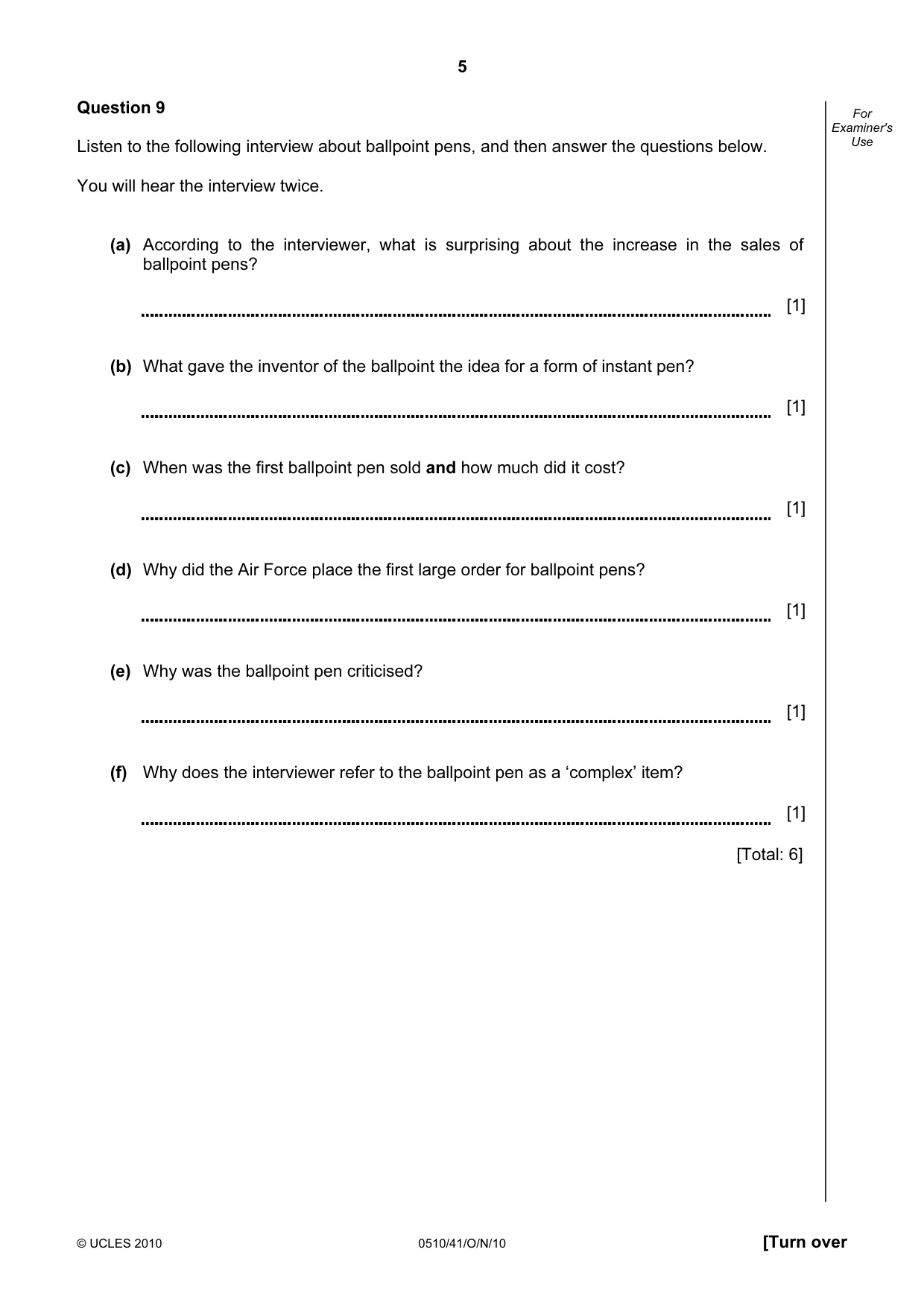
5 © UCLES 2010 0510/41/O/N/10 [Turn over For Examiner's Use Question 9 Listen to the following interview about ballpoint pens, and then answer the questions below. You will hear the interview twice. (a) According to the interviewer, what is surprising about the increase in the sales of ballpoint pens? [1] (b) What gave the inventor of the ballpoint the idea for a form of instant pen? [1] (c) When was the first ballpoint pen sold and how much did it cost? [1] (d) Why did the Air Force place the first large order for ballpoint pens? [1] (e) Why was the ballpoint pen criticised? [1] (f) Why does the interviewer refer to the ballpoint pen as a ‘complex’ item? [1] [Total: 6]
Question paper, page 6
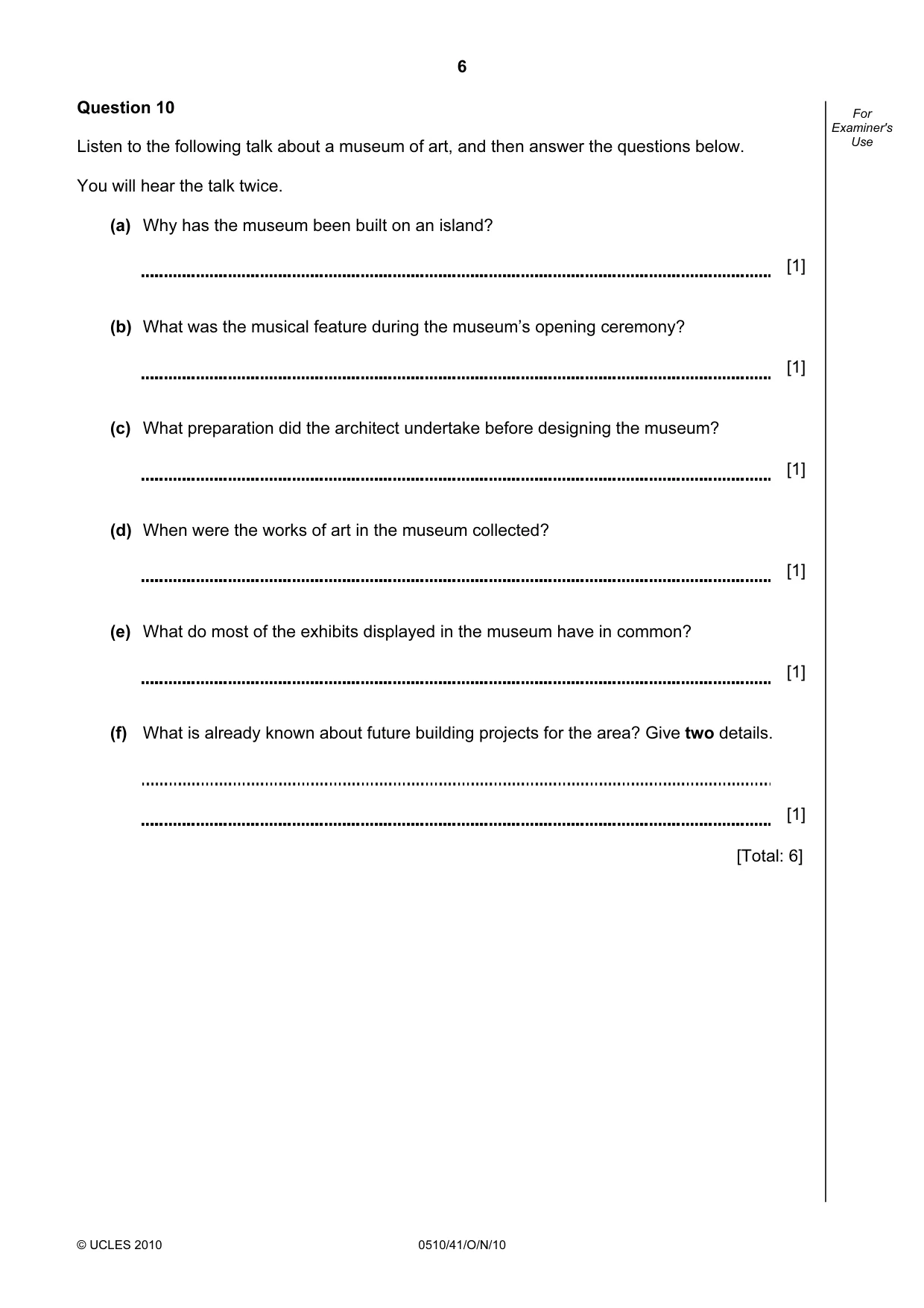
6 © UCLES 2010 0510/41/O/N/10 For Examiner's Use Question 10 Listen to the following talk about a museum of art, and then answer the questions below. You will hear the talk twice. (a) Why has the museum been built on an island? [1] (b) What was the musical feature during the museum’s opening ceremony? [1] (c) What preparation did the architect undertake before designing the museum? [1] (d) When were the works of art in the museum collected? [1] (e) What do most of the exhibits displayed in the museum have in common? [1] (f) What is already known about future building projects for the area? Give two details. [1] [Total: 6]
Question paper, page 7
7 © UCLES 2010 0510/41/O/N/10 BLANK PAGE
Question paper, page 8
8 Permission to reproduce items where third-party owned material protected by copyright is included has been sought and cleared where possible. Every reasonable effort has been made by the publisher (UCLES) to trace copyright holders, but if any items requiring clearance have unwittingly been included, the publisher will be pleased to make amends at the earliest possible opportunity. University of Cambridge International Examinations is part of the Cambridge Assessment Group. Cambridge Assessment is the brand name of University of Cambridge Local Examinations Syndicate (UCLES), which is itself a department of the University of Cambridge. © UCLES 2010 0510/41/O/N/10 BLANK PAGE
Mark scheme, page 1
UNIVERSITY OF CAMBRIDGE INTERNATIONAL EXAMINATIONS International General Certificate of Secondary Education MARK SCHEME for the October/November 2010 question paper for the guidance of teachers 0510 ENGLISH AS A SECOND LANGUAGE 0510/41 Paper 4 (Listening – Extended), maximum raw mark 36 This mark scheme is published as an aid to teachers and candidates, to indicate the requirements of the examination. It shows the basis on which Examiners were instructed to award marks. It does not indicate the details of the discussions that took place at an Examiners’ meeting before marking began, which would have considered the acceptability of alternative answers. Mark schemes must be read in conjunction with the question papers and the report on the examination. • CIE will not enter into discussions or correspondence in connection with these mark schemes. CIE is publishing the mark schemes for the October/November 2010 question papers for most IGCSE, GCE Advanced Level and Advanced Subsidiary Level syllabuses and some Ordinary Level syllabuses.
Mark scheme, page 2
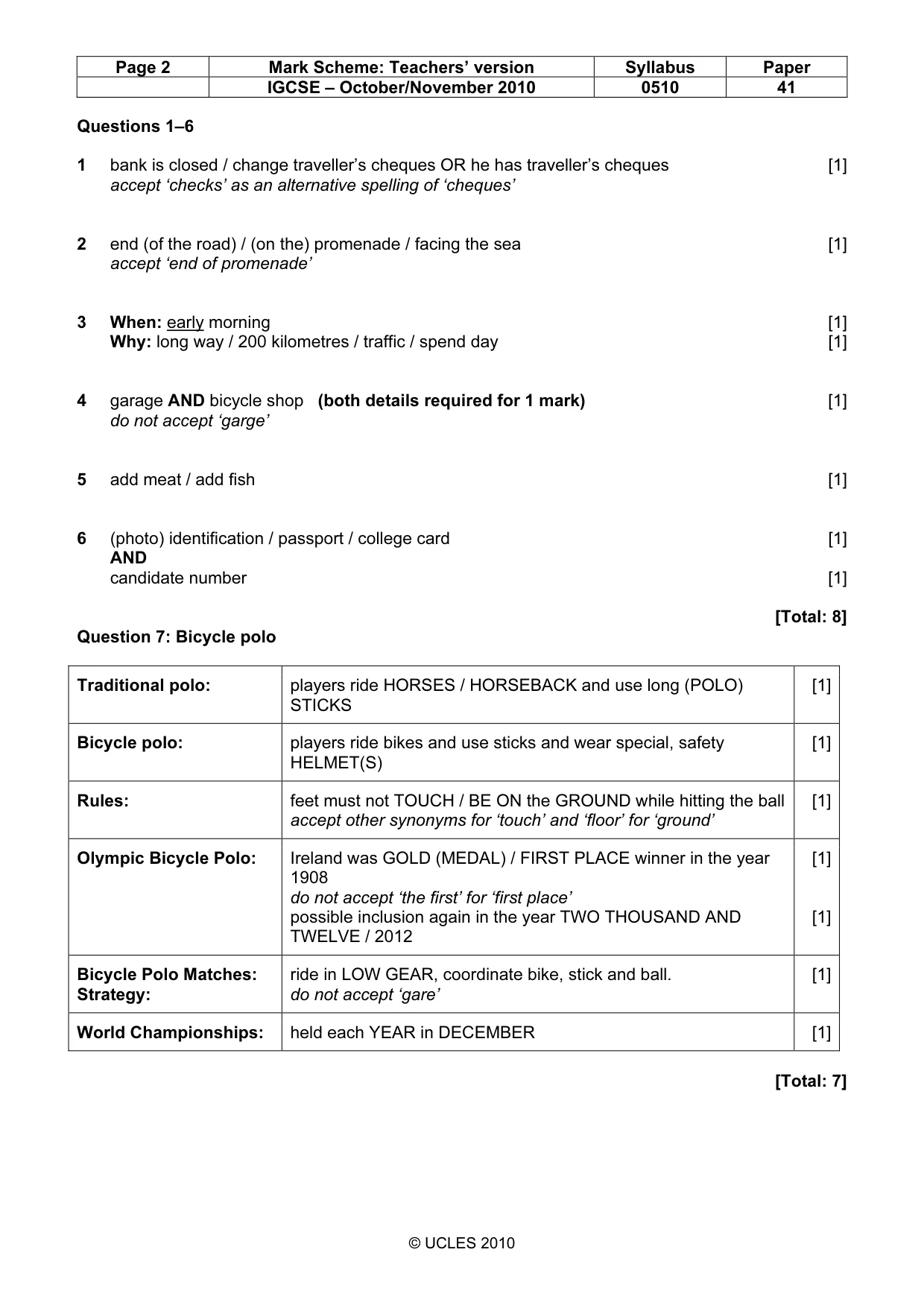
Page 2 Mark Scheme: Teachers’ version Syllabus Paper IGCSE – October/November 2010 0510 41 © UCLES 2010 Questions 1–6 1 bank is closed / change traveller’s cheques OR he has traveller’s cheques [1] accept ‘checks’ as an alternative spelling of ‘cheques’ 2 end (of the road) / (on the) promenade / facing the sea [1] accept ‘end of promenade’ 3 When: early morning [1] Why: long way / 200 kilometres / traffic / spend day [1] 4 garage AND bicycle shop (both details required for 1 mark) [1] do not accept ‘garge’ 5 add meat / add fish [1] 6 (photo) identification / passport / college card [1] AND candidate number [1] [Total: 8] Question 7: Bicycle polo Traditional polo: players ride HORSES / HORSEBACK and use long (POLO) STICKS [1] Bicycle polo: players ride bikes and use sticks and wear special, safety HELMET(S) [1] Rules: feet must not TOUCH / BE ON the GROUND while hitting the ball accept other synonyms for ‘touch’ and ‘floor’ for ‘ground’ [1] Olympic Bicycle Polo: Ireland was GOLD (MEDAL) / FIRST PLACE winner in the year 1908 do not accept ‘the first’ for ‘first place’ possible inclusion again in the year TWO THOUSAND AND TWELVE / 2012 [1] [1] Bicycle Polo Matches: Strategy: ride in LOW GEAR, coordinate bike, stick and ball. do not accept ‘gare’ [1] World Championships: held each YEAR in DECEMBER [1] [Total: 7]
Mark scheme, page 3
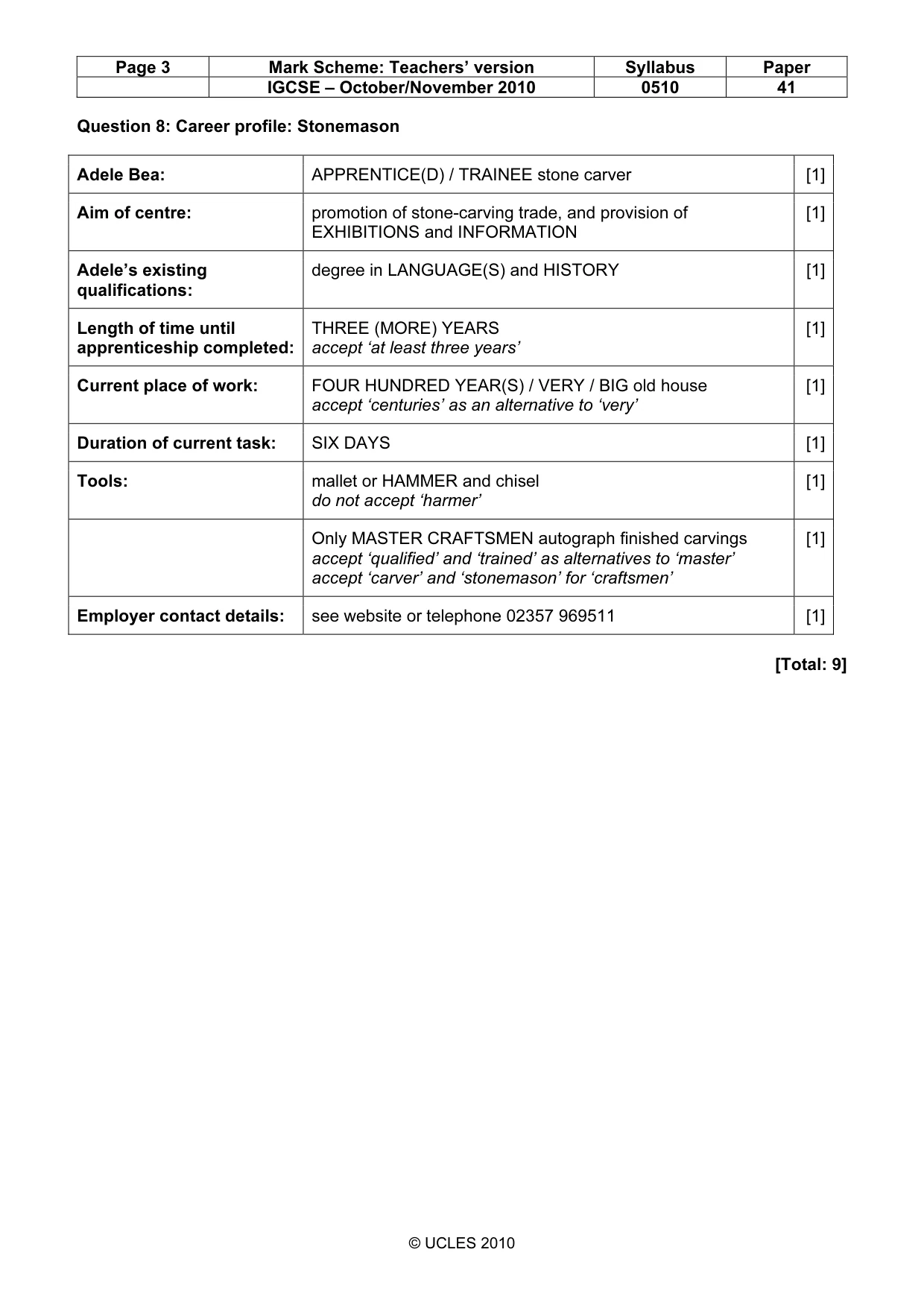
Page 3 Mark Scheme: Teachers’ version Syllabus Paper IGCSE – October/November 2010 0510 41 © UCLES 2010 Question 8: Career profile: Stonemason Adele Bea: APPRENTICE(D) / TRAINEE stone carver [1] Aim of centre: promotion of stone-carving trade, and provision of EXHIBITIONS and INFORMATION [1] Adele’s existing qualifications: degree in LANGUAGE(S) and HISTORY [1] Length of time until apprenticeship completed: THREE (MORE) YEARS accept ‘at least three years’ [1] Current place of work: FOUR HUNDRED YEAR(S) / VERY / BIG old house accept ‘centuries’ as an alternative to ‘very’ [1] Duration of current task: SIX DAYS [1] Tools: mallet or HAMMER and chisel do not accept ‘harmer’ [1] Only MASTER CRAFTSMEN autograph finished carvings accept ‘qualified’ and ‘trained’ as alternatives to ‘master’ accept ‘carver’ and ‘stonemason’ for ‘craftsmen’ [1] Employer contact details: see website or telephone 02357 969511 [1] [Total: 9]
Mark scheme, page 4
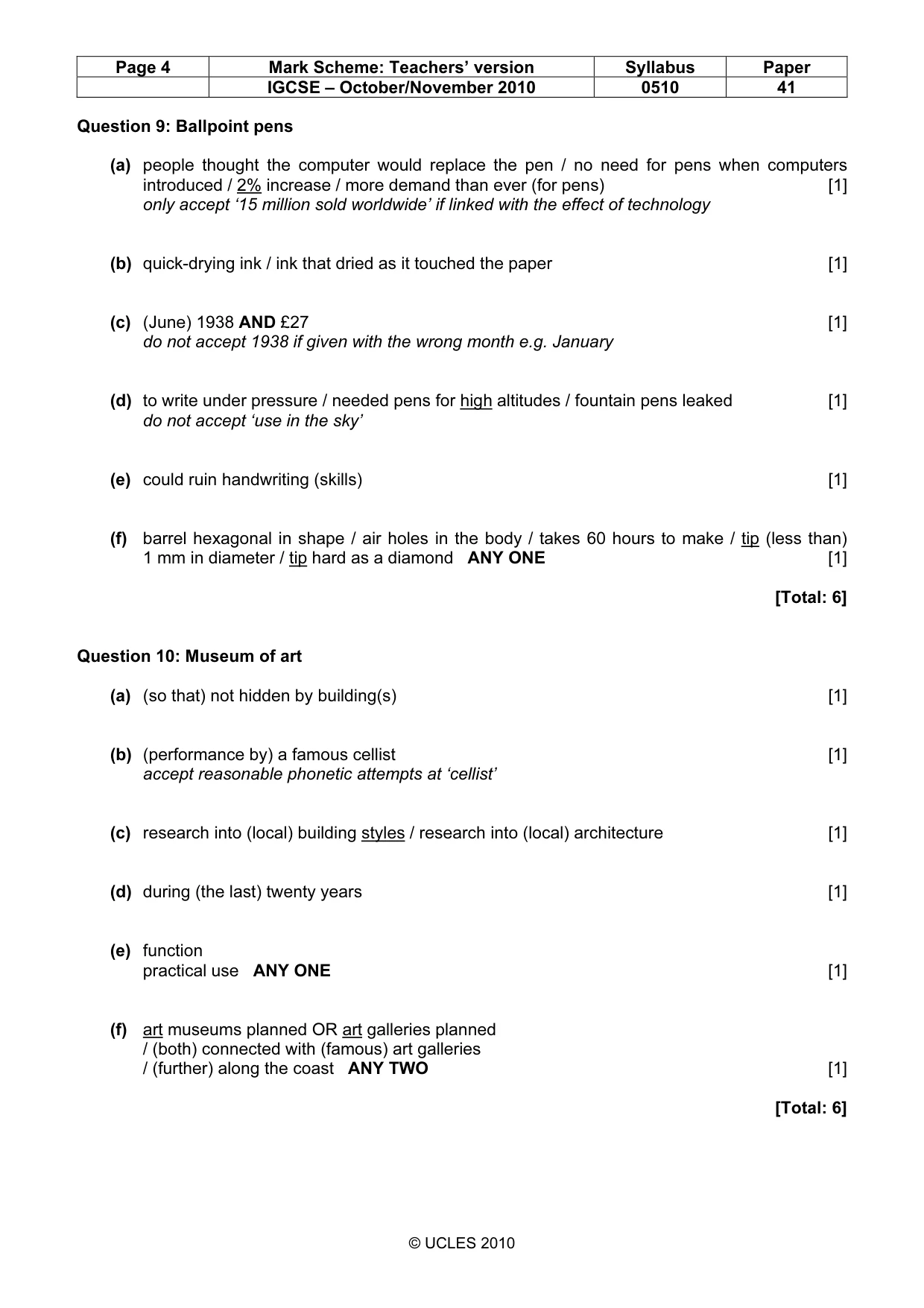
Page 4 Mark Scheme: Teachers’ version Syllabus Paper IGCSE – October/November 2010 0510 41 © UCLES 2010 Question 9: Ballpoint pens (a) people thought the computer would replace the pen / no need for pens when computers introduced / 2% increase / more demand than ever (for pens) [1] only accept ‘15 million sold worldwide’ if linked with the effect of technology (b) quick-drying ink / ink that dried as it touched the paper [1] (c) (June) 1938 AND £27 [1] do not accept 1938 if given with the wrong month e.g. January (d) to write under pressure / needed pens for high altitudes / fountain pens leaked [1] do not accept ‘use in the sky’ (e) could ruin handwriting (skills) [1] (f) barrel hexagonal in shape / air holes in the body / takes 60 hours to make / tip (less than) 1 mm in diameter / tip hard as a diamond ANY ONE [1] [Total: 6] Question 10: Museum of art (a) (so that) not hidden by building(s) [1] (b) (performance by) a famous cellist [1] accept reasonable phonetic attempts at ‘cellist’ (c) research into (local) building styles / research into (local) architecture [1] (d) during (the last) twenty years [1] (e) function practical use ANY ONE [1] (f) art museums planned OR art galleries planned / (both) connected with (famous) art galleries / (further) along the coast ANY TWO [1] [Total: 6]
Mark scheme, page 5
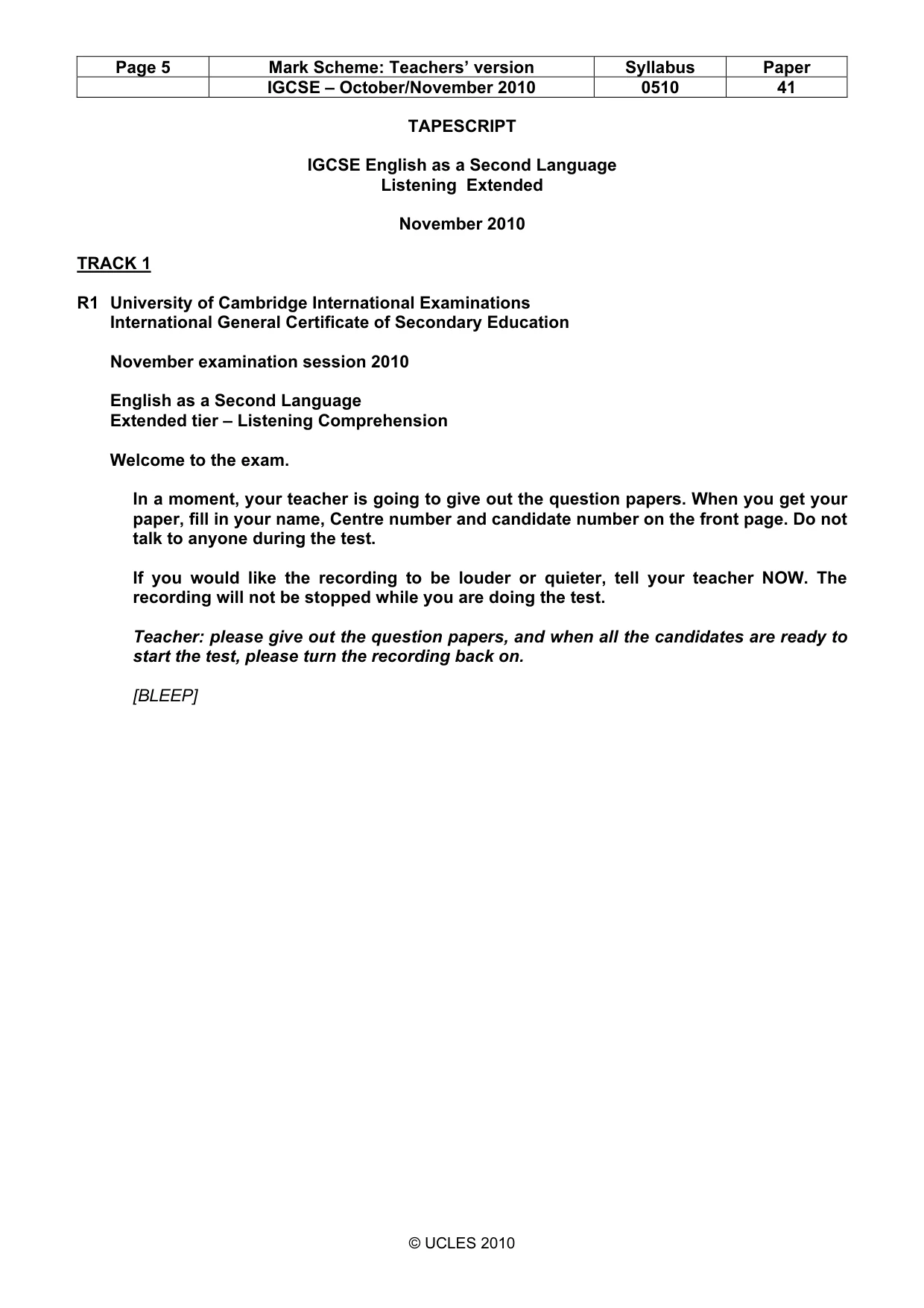
Page 5 Mark Scheme: Teachers’ version Syllabus Paper IGCSE – October/November 2010 0510 41 © UCLES 2010 TAPESCRIPT IGCSE English as a Second Language Listening Extended November 2010 TRACK 1 R1 University of Cambridge International Examinations International General Certificate of Secondary Education November examination session 2010 English as a Second Language Extended tier – Listening Comprehension Welcome to the exam. In a moment, your teacher is going to give out the question papers. When you get your paper, fill in your name, Centre number and candidate number on the front page. Do not talk to anyone during the test. If you would like the recording to be louder or quieter, tell your teacher NOW. The recording will not be stopped while you are doing the test. Teacher: please give out the question papers, and when all the candidates are ready to start the test, please turn the recording back on. [BLEEP]
Mark scheme, page 6
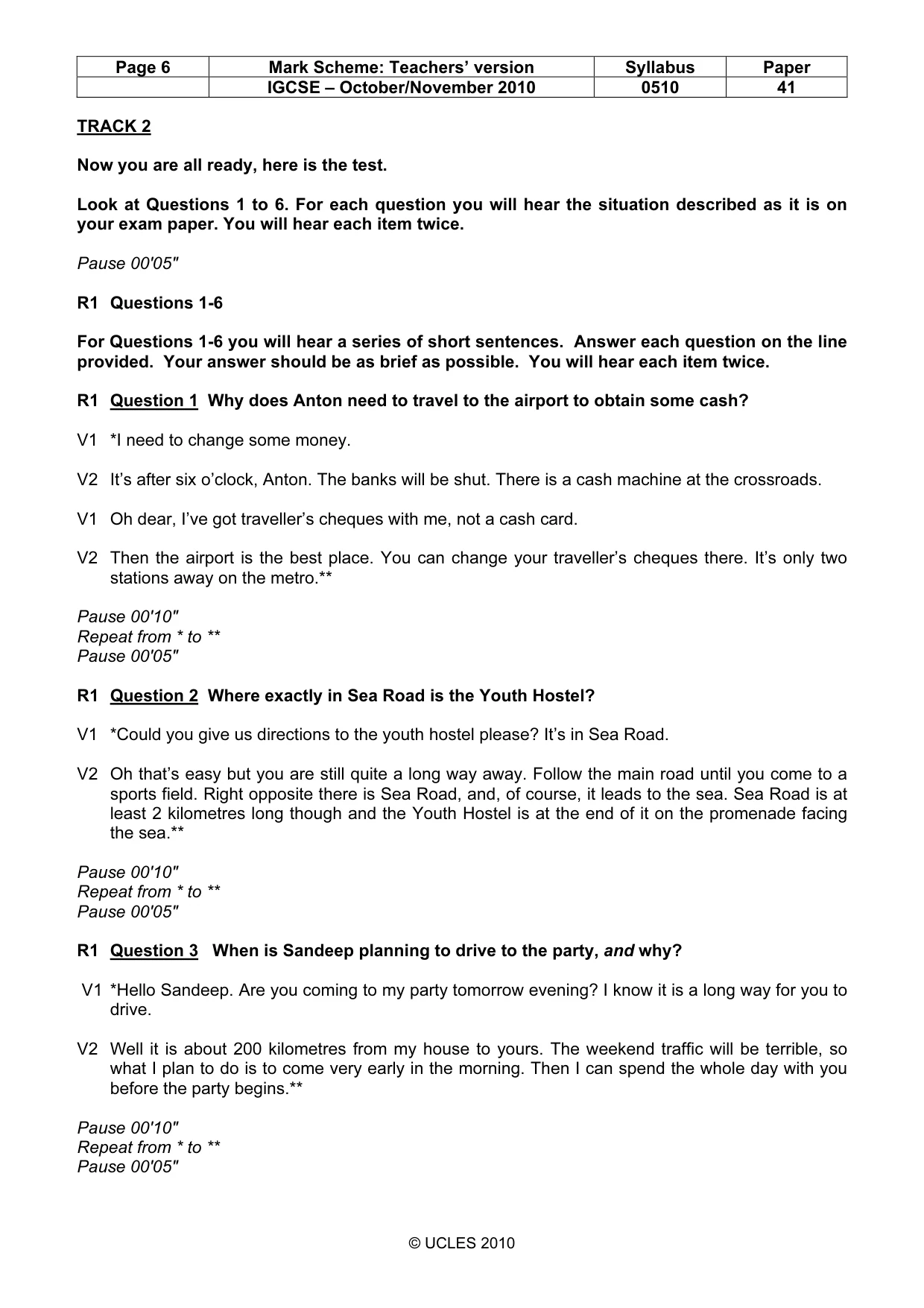
Page 6 Mark Scheme: Teachers’ version Syllabus Paper IGCSE – October/November 2010 0510 41 © UCLES 2010 TRACK 2 Now you are all ready, here is the test. Look at Questions 1 to 6. For each question you will hear the situation described as it is on your exam paper. You will hear each item twice. Pause 00'05" R1 Questions 1-6 For Questions 1-6 you will hear a series of short sentences. Answer each question on the line provided. Your answer should be as brief as possible. You will hear each item twice. R1 Question 1 Why does Anton need to travel to the airport to obtain some cash? V1 *I need to change some money. V2 It’s after six o’clock, Anton. The banks will be shut. There is a cash machine at the crossroads. V1 Oh dear, I’ve got traveller’s cheques with me, not a cash card. V2 Then the airport is the best place. You can change your traveller’s cheques there. It’s only two stations away on the metro.** Pause 00'10" Repeat from * to ** Pause 00'05" R1 Question 2 Where exactly in Sea Road is the Youth Hostel? V1 *Could you give us directions to the youth hostel please? It’s in Sea Road. V2 Oh that’s easy but you are still quite a long way away. Follow the main road until you come to a sports field. Right opposite there is Sea Road, and, of course, it leads to the sea. Sea Road is at least 2 kilometres long though and the Youth Hostel is at the end of it on the promenade facing the sea.** Pause 00'10" Repeat from * to ** Pause 00'05" R1 Question 3 When is Sandeep planning to drive to the party, and why? V1 *Hello Sandeep. Are you coming to my party tomorrow evening? I know it is a long way for you to drive. V2 Well it is about 200 kilometres from my house to yours. The weekend traffic will be terrible, so what I plan to do is to come very early in the morning. Then I can spend the whole day with you before the party begins.** Pause 00'10" Repeat from * to ** Pause 00'05"
Mark scheme, page 7
Page 7 Mark Scheme: Teachers’ version Syllabus Paper IGCSE – October/November 2010 0510 41 © UCLES 2010 R1 Question 4 Give TWO places where Shiraz might be able to find help. V1 *Oh dear. I’ve got a puncture in my bicycle tyre. Where do you think I can get it repaired? V2 Perhaps at that garage just over there, Shiraz. If they can’t help, they might know where you can get help. There is a bicycle shop in the village.** Pause 00'10" Repeat from * to ** Pause 00'05" R1 Question 5 What makes a pizza more expensive? V1 *Let’s organise a group of us to go to that new pizza restaurant in town. V2 That’s a good idea. How much do their pizzas cost? V1 I read the price list yesterday – a large cheese and tomato pizza is £6.99, and the price goes up by 50 pence if you add meat or fish. V2 I see, then the same size pizza will cost £7.49. ** Pause 00'10" Repeat from * to ** Pause 00'05" R1 Question 6 Which TWO items must candidates take to the examination? V1 *Here are the exam instructions for tomorrow morning. All candidates should be seated by 8.30am. Bring some identification to the examination – a passport or college card with a photograph on it to prove your identity to the invigilator. And don’t forget your candidate number. No bags may be taken into the examination room, please leave them at reception.** Pause 00'10" Repeat from * to ** Pause 00'05" R1 That is the last of Questions 1 to 6. In a moment you will hear Question 7. Now look at the questions for this part of the exam. Pause 00'20"
Mark scheme, page 8
Page 8 Mark Scheme: Teachers’ version Syllabus Paper IGCSE – October/November 2010 0510 41 © UCLES 2010 TRACK 3 R1 Question 7 Listen to the following interview about a sport called bicycle polo, and then complete the details below. You will hear the interview twice. V1 *Hello and welcome to “Sports Hour”. Today we continue to focus on unusual sports, with bicycle polo. Whatever is that, you may well ask. Isabella Bernier is our bicycle polo expert and is here to explain this sport to us. V2 Traditional polo is played on horseback all over the world. There are two teams, and each rider carries a long polo stick, which reaches to the ground. The players use their polo sticks to hit a ball towards a goal. V1 Just like hockey. V2 Yes, polo is a very popular sport, and bicycle polo is very similar, but… V1 The horses are replaced by bicycles? V2 Exactly. The players all ride bikes and the object of the game is still to score by hitting a ball into a goal using a long stick. V1 Are the rules the same as for horseback polo? V2 There are a few extra rules for bicycle polo. For example, all players have to wear specially adapted safety helmets, as it’s much faster and more dangerous than traditional polo. Players are not allowed to put a foot on the ground while hitting the ball. V1 The sticks must be shorter too, as the rider is nearer the ground on a bicycle than on the back of a horse. V2 And that is exactly what makes the sport so much faster and more dangerous. It’s much easier to get hit over the head by a stick. Our polo pitches are usually grass, not tarmac, so at least players have a soft landing if they are knocked off their bikes. Some clubs choose to play on hard surfaces, and this makes the game very, very fast and much more dangerous. V1 It sounds like one of these new sports to me, a kind of “extreme” polo or a more dangerous form of hockey. V2 But bicycle polo is not modern at all; it was included in the Olympics in 1908. Ireland won the gold medal on that occasion. V1 Really? V2 Yes, and there is a campaign to bring bicycle polo back into the next Olympic games in 2012. V1 So how many people are there in a bicycle polo team? V2 Four, and it’s not as easy as you think. The players need to stay in low gear, to be able to coordinate bike, stick and ball. V1 Is there a special uniform? V2 Oh no, shorts and T-shirt, and, of course, a safety helmet.
Mark scheme, page 9
Page 9 Mark Scheme: Teachers’ version Syllabus Paper IGCSE – October/November 2010 0510 41 © UCLES 2010 V1 So how does a game start off? V2 Two teams of four line up on their bikes. The umpire throws in the ball and each half of the match lasts for seven minutes. It’s just like playing football or hockey. The team with the most goals wins, and offside and penalty rules apply. V1 And do bicycle polo teams exist all over the world? I’ve never heard of them. V2 Yes, the World Championships are held every December. In 2008, for example, the venue was in Argentina. V1 Do you need more players? Presumably anyone who can ride a bike can have a go? V2 Yes, indeed. We would like to encourage everyone to have a go at bicycle polo. All you need is an old bicycle, the older the better, as you won’t want to damage your bright, shiny new one. Then look up your nearest team on www.bicyclepolo.com and come along to a practice session and join in.** Pause 00'30" R1 Now you will hear the interview again. Repeat from * to ** Pause 00'30" R1 That is the end of Question 7. In a moment you will hear Question 8. Now look at the questions for this part of the exam. Pause 00'25"
Mark scheme, page 10
Page 10 Mark Scheme: Teachers’ version Syllabus Paper IGCSE – October/November 2010 0510 41 © UCLES 2010 TRACK 4 R1 Question 8 Listen to the following interview with a trainee stone carver, and then complete the details below. You will hear the interview twice. V1 *Welcome to our career programme. Today we are going to talk to Adele Bea who is an apprentice stone carver. That means that she’s training to become a stonemason. Adele is employed by the Stone Centre, which raises awareness of this age-old trade, by hosting exhibitions and providing information. Adele, what actually does your job involve? V2 I am a stone carver. I work anywhere that people need stone carved to a specific shape and design; for example, in old houses, in churches or temples or graveyards, or in town centres and public gardens, perhaps for fountains and monuments. I could go on and on with the list of places where you can see the art of a stonemason! V1 Have you always wanted to carve stone since you were a young child? V2 Oh no. I went to university and studied Languages and History. After I obtained my degree, I worked on several restoration projects in old stone buildings, and that was how I got interested. V1 So you are a trainee? V2 Yes, I am still learning how to carve stone, and will not become a qualified stonemason for three more years. At the moment, for example, I am helping to restore the stonework on a big old house, and I’m living on site there. V1 Do you earn a lot? V2 Hardly anything as an apprentice, but I do have job satisfaction. V1 Would you say that there any disadvantages to the job? V2 Only if you’re scared of heights. At my interview for the apprenticeship I had to climb some scaffolding. Often we work on rooftops, you see. V1 So tell us about a typical day’s work. V2 I begin work early, at dawn in fact, because I need to make the most of the daylight hours. I’m working on a four hundred year old house, and for the last six days I have been carving a large letter “S” which will go on its roof. V1 Mm, that sounds a heavy job. V2 A stonemason has to be strong; there are often pieces of stone to lift. Sometimes I help to get the stone into workable size blocks, sometimes I work on carving and sometimes, but very rarely, I will take on the role of “fixer” putting a finished piece securely into place. V1 How do you actually carve the stone? Is it like carving wooden animals from pieces of wood? V2 Um, it’s the same principle, but stone is different to work with than wood, and we use special tools for the actual carving. V1 What are your tools called?
Mark scheme, page 11
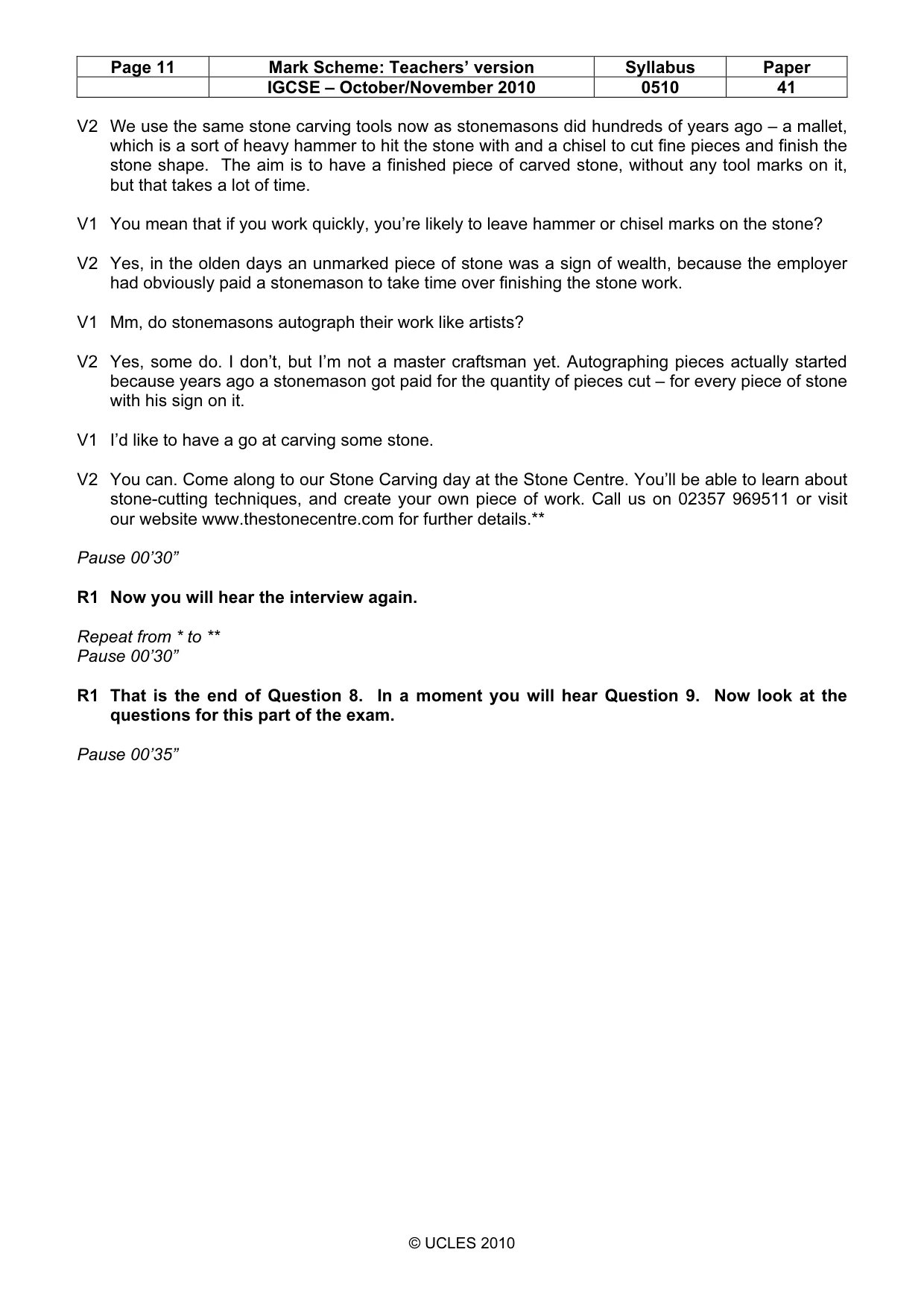
Page 11 Mark Scheme: Teachers’ version Syllabus Paper IGCSE – October/November 2010 0510 41 © UCLES 2010 V2 We use the same stone carving tools now as stonemasons did hundreds of years ago – a mallet, which is a sort of heavy hammer to hit the stone with and a chisel to cut fine pieces and finish the stone shape. The aim is to have a finished piece of carved stone, without any tool marks on it, but that takes a lot of time. V1 You mean that if you work quickly, you’re likely to leave hammer or chisel marks on the stone? V2 Yes, in the olden days an unmarked piece of stone was a sign of wealth, because the employer had obviously paid a stonemason to take time over finishing the stone work. V1 Mm, do stonemasons autograph their work like artists? V2 Yes, some do. I don’t, but I’m not a master craftsman yet. Autographing pieces actually started because years ago a stonemason got paid for the quantity of pieces cut – for every piece of stone with his sign on it. V1 I’d like to have a go at carving some stone. V2 You can. Come along to our Stone Carving day at the Stone Centre. You’ll be able to learn about stone-cutting techniques, and create your own piece of work. Call us on 02357 969511 or visit our website www.thestonecentre.com for further details.** Pause 00’30” R1 Now you will hear the interview again. Repeat from * to ** Pause 00’30” R1 That is the end of Question 8. In a moment you will hear Question 9. Now look at the questions for this part of the exam. Pause 00’35”
Mark scheme, page 12
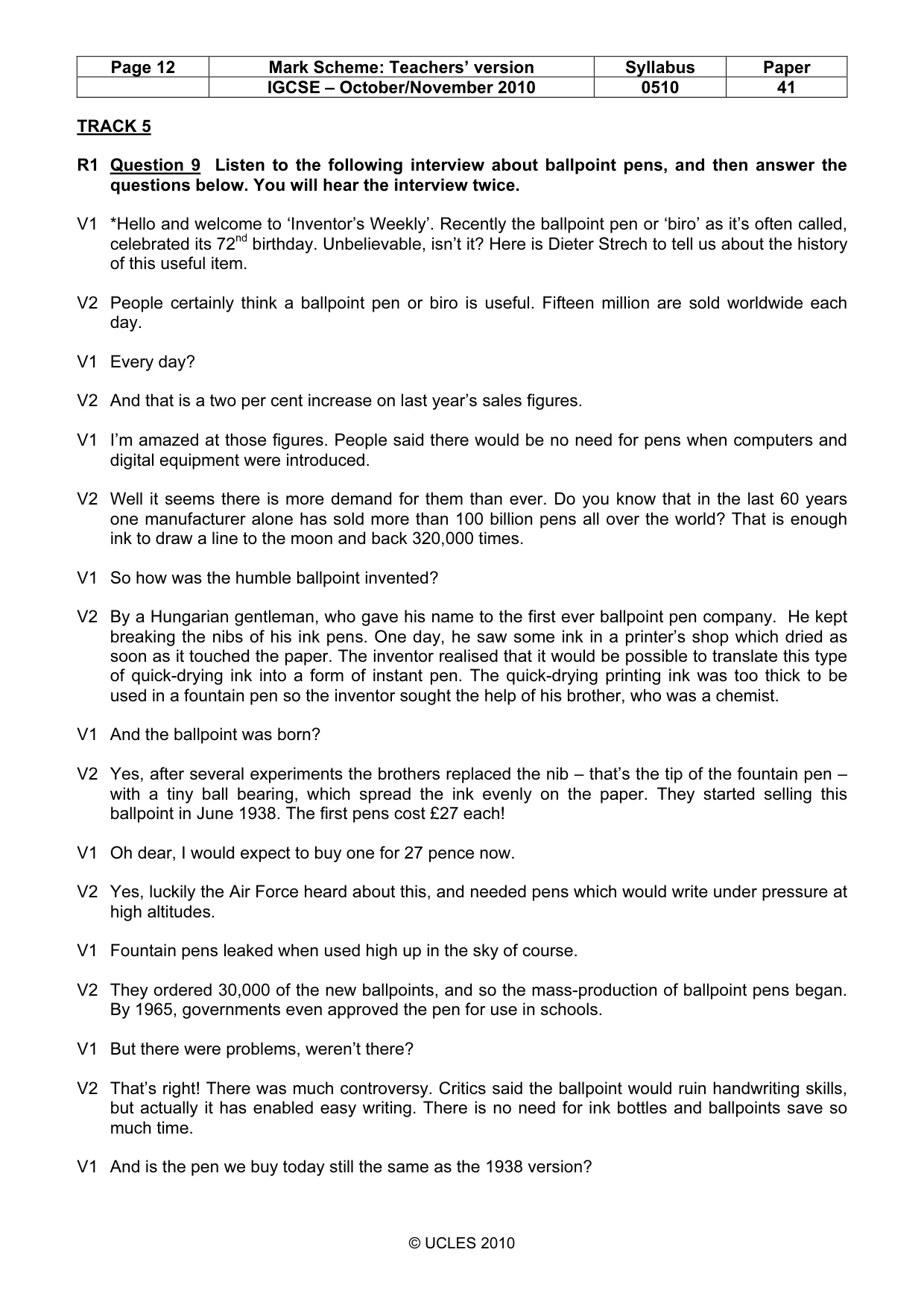
Page 12 Mark Scheme: Teachers’ version Syllabus Paper IGCSE – October/November 2010 0510 41 © UCLES 2010 TRACK 5 R1 Question 9 Listen to the following interview about ballpoint pens, and then answer the questions below. You will hear the interview twice. V1 *Hello and welcome to ‘Inventor’s Weekly’. Recently the ballpoint pen or ‘biro’ as it’s often called, celebrated its 72nd birthday. Unbelievable, isn’t it? Here is Dieter Strech to tell us about the history of this useful item. V2 People certainly think a ballpoint pen or biro is useful. Fifteen million are sold worldwide each day. V1 Every day? V2 And that is a two per cent increase on last year’s sales figures. V1 I’m amazed at those figures. People said there would be no need for pens when computers and digital equipment were introduced. V2 Well it seems there is more demand for them than ever. Do you know that in the last 60 years one manufacturer alone has sold more than 100 billion pens all over the world? That is enough ink to draw a line to the moon and back 320,000 times. V1 So how was the humble ballpoint invented? V2 By a Hungarian gentleman, who gave his name to the first ever ballpoint pen company. He kept breaking the nibs of his ink pens. One day, he saw some ink in a printer’s shop which dried as soon as it touched the paper. The inventor realised that it would be possible to translate this type of quick-drying ink into a form of instant pen. The quick-drying printing ink was too thick to be used in a fountain pen so the inventor sought the help of his brother, who was a chemist. V1 And the ballpoint was born? V2 Yes, after several experiments the brothers replaced the nib – that’s the tip of the fountain pen – with a tiny ball bearing, which spread the ink evenly on the paper. They started selling this ballpoint in June 1938. The first pens cost £27 each! V1 Oh dear, I would expect to buy one for 27 pence now. V2 Yes, luckily the Air Force heard about this, and needed pens which would write under pressure at high altitudes. V1 Fountain pens leaked when used high up in the sky of course. V2 They ordered 30,000 of the new ballpoints, and so the mass-production of ballpoint pens began. By 1965, governments even approved the pen for use in schools. V1 But there were problems, weren’t there? V2 That’s right! There was much controversy. Critics said the ballpoint would ruin handwriting skills, but actually it has enabled easy writing. There is no need for ink bottles and ballpoints save so much time. V1 And is the pen we buy today still the same as the 1938 version?
Mark scheme, page 13
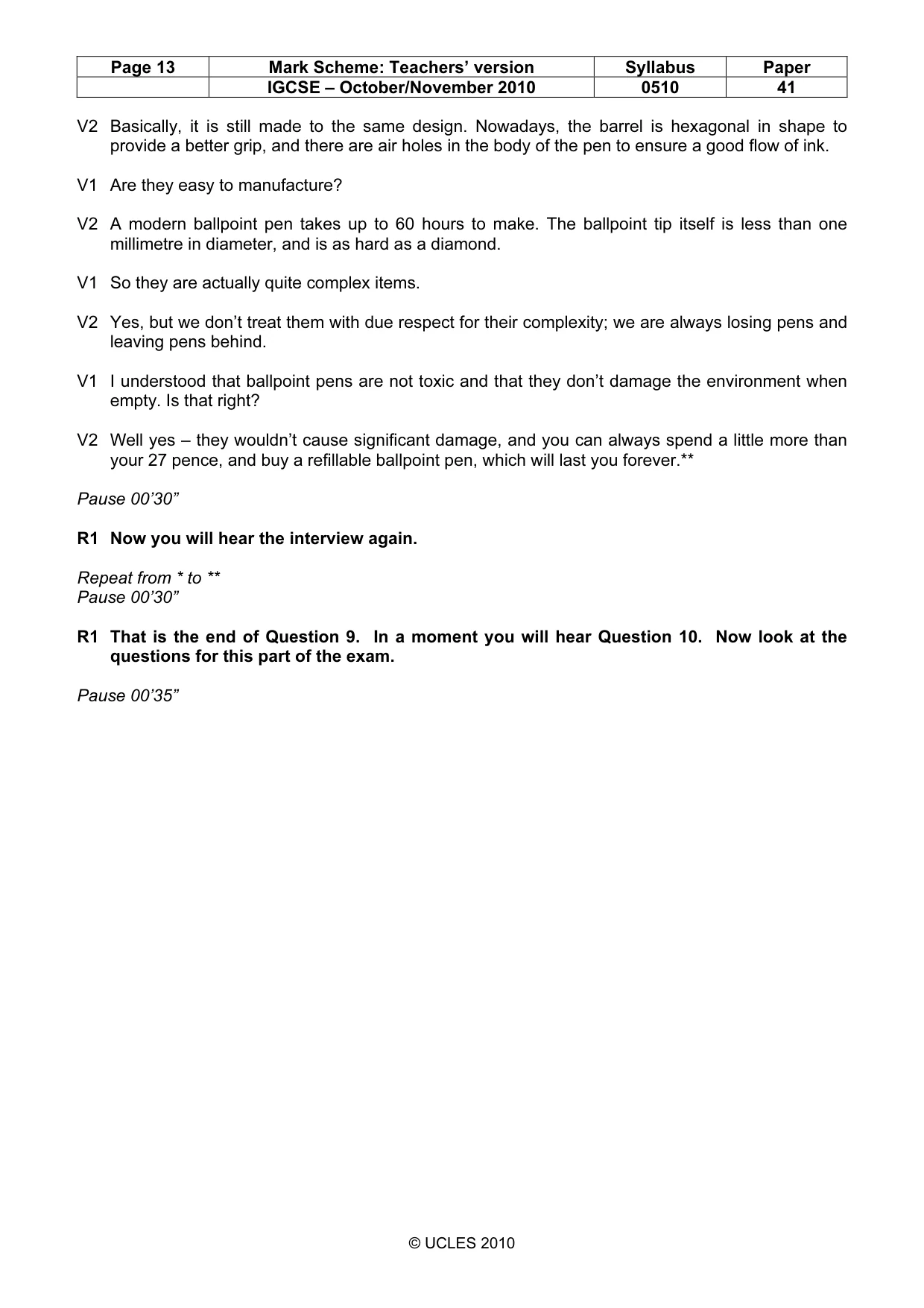
Page 13 Mark Scheme: Teachers’ version Syllabus Paper IGCSE – October/November 2010 0510 41 © UCLES 2010 V2 Basically, it is still made to the same design. Nowadays, the barrel is hexagonal in shape to provide a better grip, and there are air holes in the body of the pen to ensure a good flow of ink. V1 Are they easy to manufacture? V2 A modern ballpoint pen takes up to 60 hours to make. The ballpoint tip itself is less than one millimetre in diameter, and is as hard as a diamond. V1 So they are actually quite complex items. V2 Yes, but we don’t treat them with due respect for their complexity; we are always losing pens and leaving pens behind. V1 I understood that ballpoint pens are not toxic and that they don’t damage the environment when empty. Is that right? V2 Well yes – they wouldn’t cause significant damage, and you can always spend a little more than your 27 pence, and buy a refillable ballpoint pen, which will last you forever.** Pause 00’30” R1 Now you will hear the interview again. Repeat from * to ** Pause 00’30” R1 That is the end of Question 9. In a moment you will hear Question 10. Now look at the questions for this part of the exam. Pause 00’35”
Mark scheme, page 14
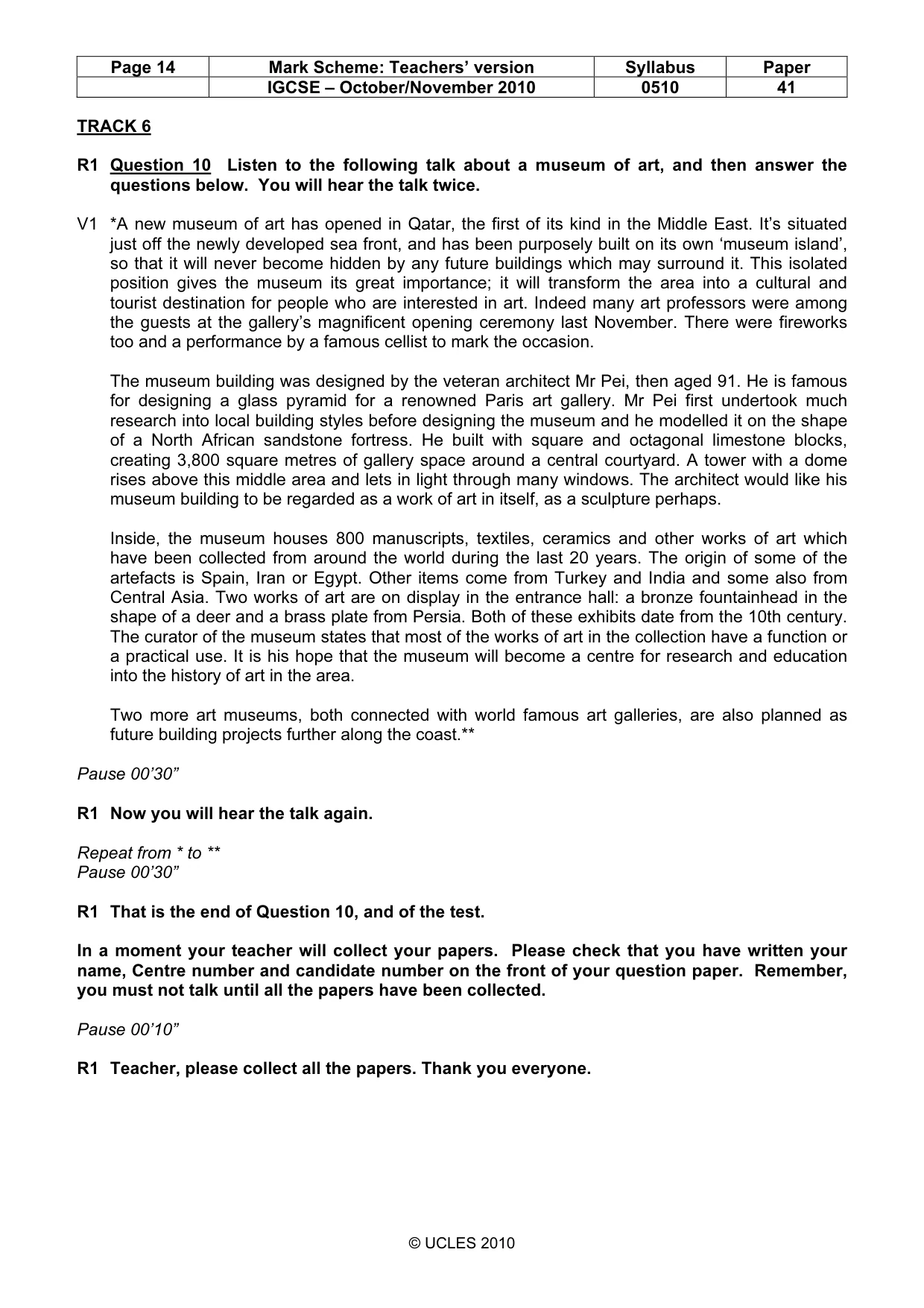
Page 14 Mark Scheme: Teachers’ version Syllabus Paper IGCSE – October/November 2010 0510 41 © UCLES 2010 TRACK 6 R1 Question 10 Listen to the following talk about a museum of art, and then answer the questions below. You will hear the talk twice. V1 *A new museum of art has opened in Qatar, the first of its kind in the Middle East. It’s situated just off the newly developed sea front, and has been purposely built on its own ‘museum island’, so that it will never become hidden by any future buildings which may surround it. This isolated position gives the museum its great importance; it will transform the area into a cultural and tourist destination for people who are interested in art. Indeed many art professors were among the guests at the gallery’s magnificent opening ceremony last November. There were fireworks too and a performance by a famous cellist to mark the occasion. The museum building was designed by the veteran architect Mr Pei, then aged 91. He is famous for designing a glass pyramid for a renowned Paris art gallery. Mr Pei first undertook much research into local building styles before designing the museum and he modelled it on the shape of a North African sandstone fortress. He built with square and octagonal limestone blocks, creating 3,800 square metres of gallery space around a central courtyard. A tower with a dome rises above this middle area and lets in light through many windows. The architect would like his museum building to be regarded as a work of art in itself, as a sculpture perhaps. Inside, the museum houses 800 manuscripts, textiles, ceramics and other works of art which have been collected from around the world during the last 20 years. The origin of some of the artefacts is Spain, Iran or Egypt. Other items come from Turkey and India and some also from Central Asia. Two works of art are on display in the entrance hall: a bronze fountainhead in the shape of a deer and a brass plate from Persia. Both of these exhibits date from the 10th century. The curator of the museum states that most of the works of art in the collection have a function or a practical use. It is his hope that the museum will become a centre for research and education into the history of art in the area. Two more art museums, both connected with world famous art galleries, are also planned as future building projects further along the coast.** Pause 00’30” R1 Now you will hear the talk again. Repeat from * to ** Pause 00’30” R1 That is the end of Question 10, and of the test. In a moment your teacher will collect your papers. Please check that you have written your name, Centre number and candidate number on the front of your question paper. Remember, you must not talk until all the papers have been collected. Pause 00’10” R1 Teacher, please collect all the papers. Thank you everyone.
What you needed in this session
Cambridge’s own grade thresholds for 2010 Oct/Nov, Paper 4 · Variant 1. A higher threshold means an easier paper — the bar moves with how the cohort did.