Cambridge IGCSE English - Second Language (oral endorsement) 0510 — 2005 May/June Paper 4 · Variant 1
0510/41/M/J/05
The question paper and its mark scheme, free to read here and free to download. This is Cambridge’s own paper, exactly as it was sat.
Question paper8 pages


Mark scheme14 pages
Answers below. Sit the paper first if you are practising.
Paper as text
Question paper, page 1
Centre Number Candidate Number Name UNIVERSITY OF CAMBRIDGE INTERNATIONAL EXAMINATIONS International General Certificate of Secondary Education ENGLISH AS A SECOND LANGUAGE 0510/04 Paper 4 Listening May/June 2005 Candidates answer on the Question Paper. Approx. 45 minutes Additional Materials: As listed in Instructions to Supervisors READ THESE INSTRUCTIONS FIRST Write your Centre number, candidate number and name on all the work you hand in. Write in dark blue or black pen in the spaces provided on the Question Paper. Do not use staples, paper clips, highlighters, glue or correction fluid. Answer all questions. At the end of the examination, fasten all your work securely together. The number of marks is given in brackets [ ] at the end of each question or part question. Dictionaries are not permitted. FOR EXAMINER’S USE Part 1 Part 2 Part 3 TOTAL This document consists of 6 printed pages and 2 blank pages. IB05 06_0510_04/4RP UCLES 2005 [Turn over If you have been given a label, look at the details. If any details are incorrect or missing, please fill in your correct details in the space given at the top of this page. Stick your personal label here, if provided. www.XtremePapers.com
Question paper, page 2
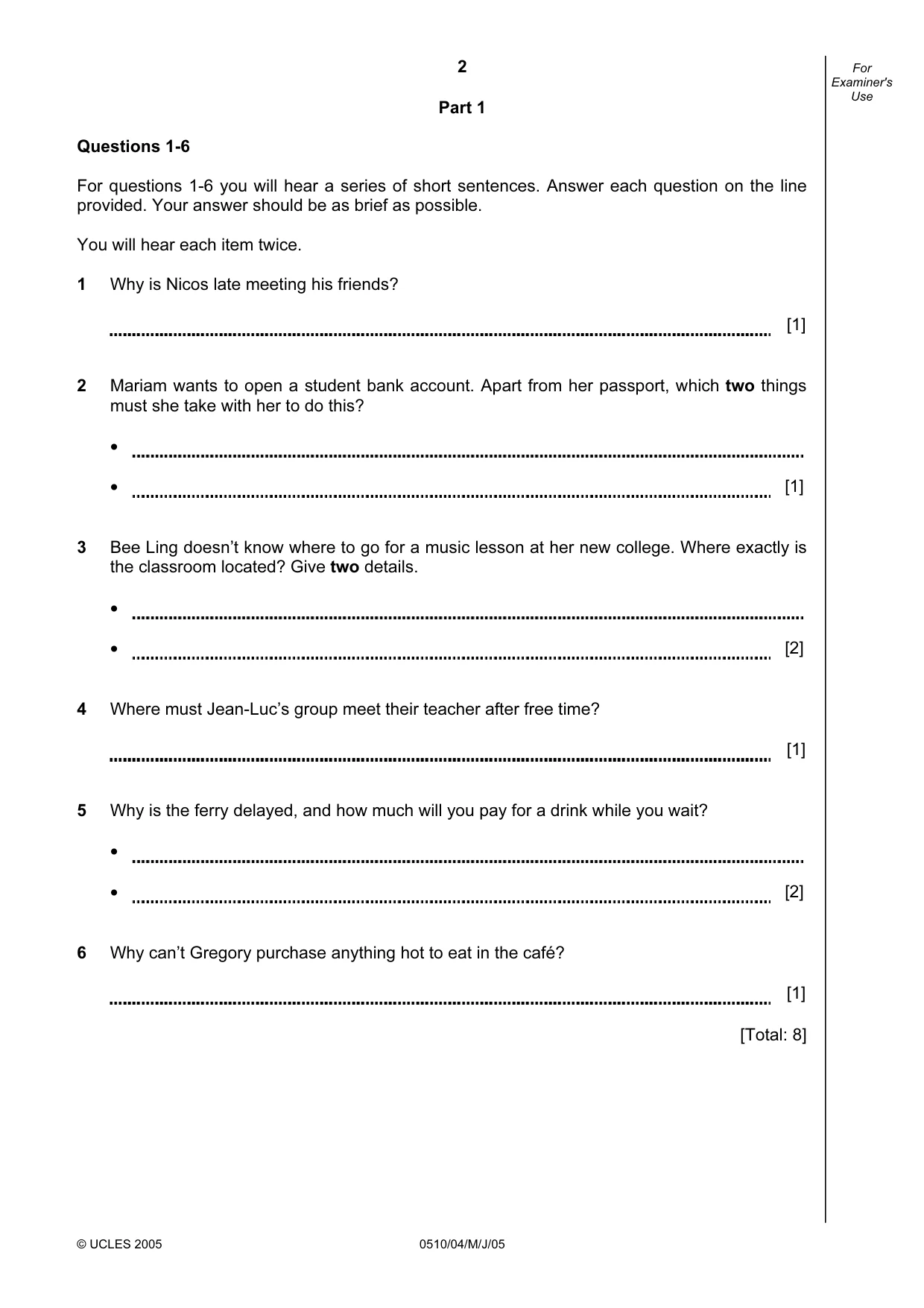
2 © UCLES 2005 0510/04/M/J/05 For Examiner's Use Part 1 Questions 1-6 For questions 1-6 you will hear a series of short sentences. Answer each question on the line provided. Your answer should be as brief as possible. You will hear each item twice. 1 Why is Nicos late meeting his friends? [1] 2 Mariam wants to open a student bank account. Apart from her passport, which two things must she take with her to do this? • • [1] 3 Bee Ling doesn’t know where to go for a music lesson at her new college. Where exactly is the classroom located? Give two details. • • [2] 4 Where must Jean-Luc’s group meet their teacher after free time? [1] 5 Why is the ferry delayed, and how much will you pay for a drink while you wait? • • [2] 6 Why can’t Gregory purchase anything hot to eat in the café? [1] [Total: 8]
Question paper, page 3
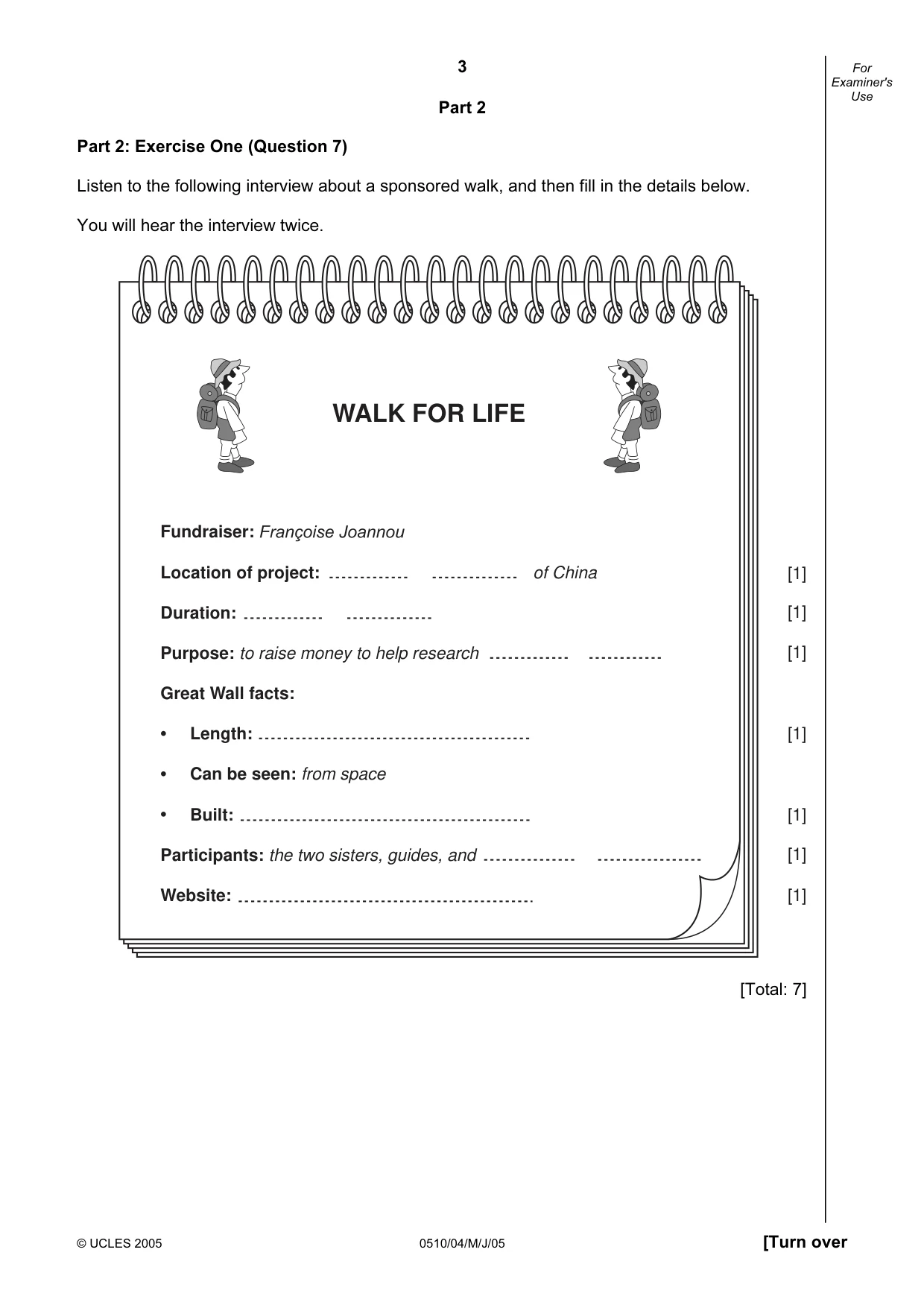
3 © UCLES 2005 0510/04/M/J/05 [Turn over For Examiner's Use Part 2 Part 2: Exercise One (Question 7) Listen to the following interview about a sponsored walk, and then fill in the details below. You will hear the interview twice. [1] [1] [1] [1] [1] [1] [1] WALK FOR LIFE Fundraiser: Location of project: of China Duration: Purpose: to raise money to help research Great Wall facts: Length: Can be seen: from space Built: Participants: the two sisters, guides, and Website: [Total: 7]
Question paper, page 4
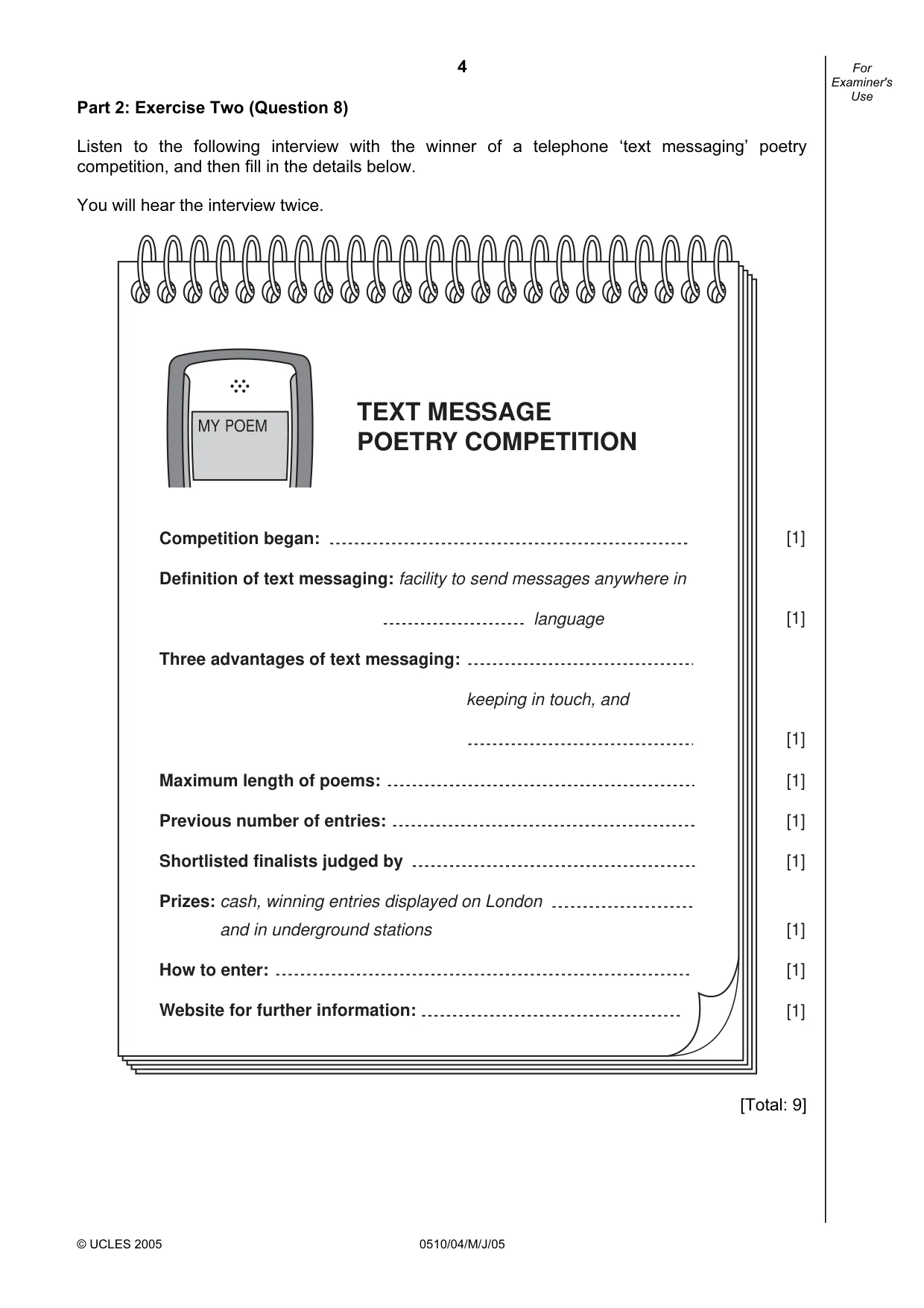
4 © UCLES 2005 0510/04/M/J/05 For Examiner's Use Part 2: Exercise Two (Question 8) Listen to the following interview with the winner of a telephone ‘text messaging’ poetry competition, and then fill in the details below. You will hear the interview twice. [1] [1] [1] [1] [1] [1] [1] [1] TEXT MESSAGE POETRY COMPETITION Competition began: Definition of text messaging: facility to send messages anywhere in language Three advantages of text messaging: keeping in touch, and Maximum length of poems: Previous number of entries: Shortlisted finalists judged by Prizes: cash, winning entries displayed on London and in underground stations How to enter: Website for further information: [1] MY POEM [Total: 9]
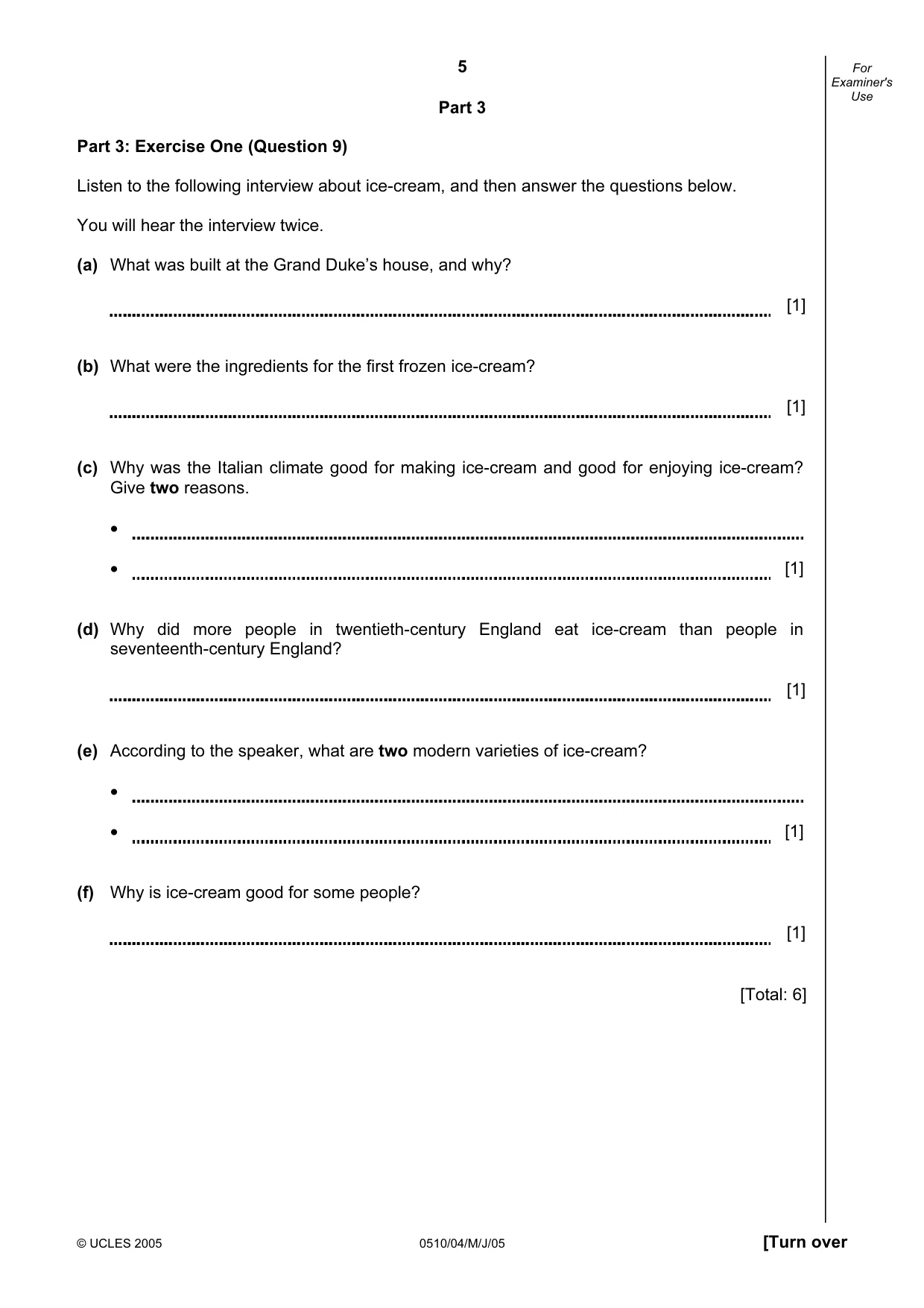
Question paper, page 5
5 © UCLES 2005 0510/04/M/J/05 [Turn over For Examiner's Use Part 3 Part 3: Exercise One (Question 9) Listen to the following interview about ice-cream, and then answer the questions below. You will hear the interview twice. (a) What was built at the Grand Duke’s house, and why? [1] (b) What were the ingredients for the first frozen ice-cream? [1] (c) Why was the Italian climate good for making ice-cream and good for enjoying ice-cream? Give two reasons. • • [1] (d) Why did more people in twentieth-century England eat ice-cream than people in seventeenth-century England? [1] (e) According to the speaker, what are two modern varieties of ice-cream? • • [1] (f) Why is ice-cream good for some people? [1] [Total: 6]
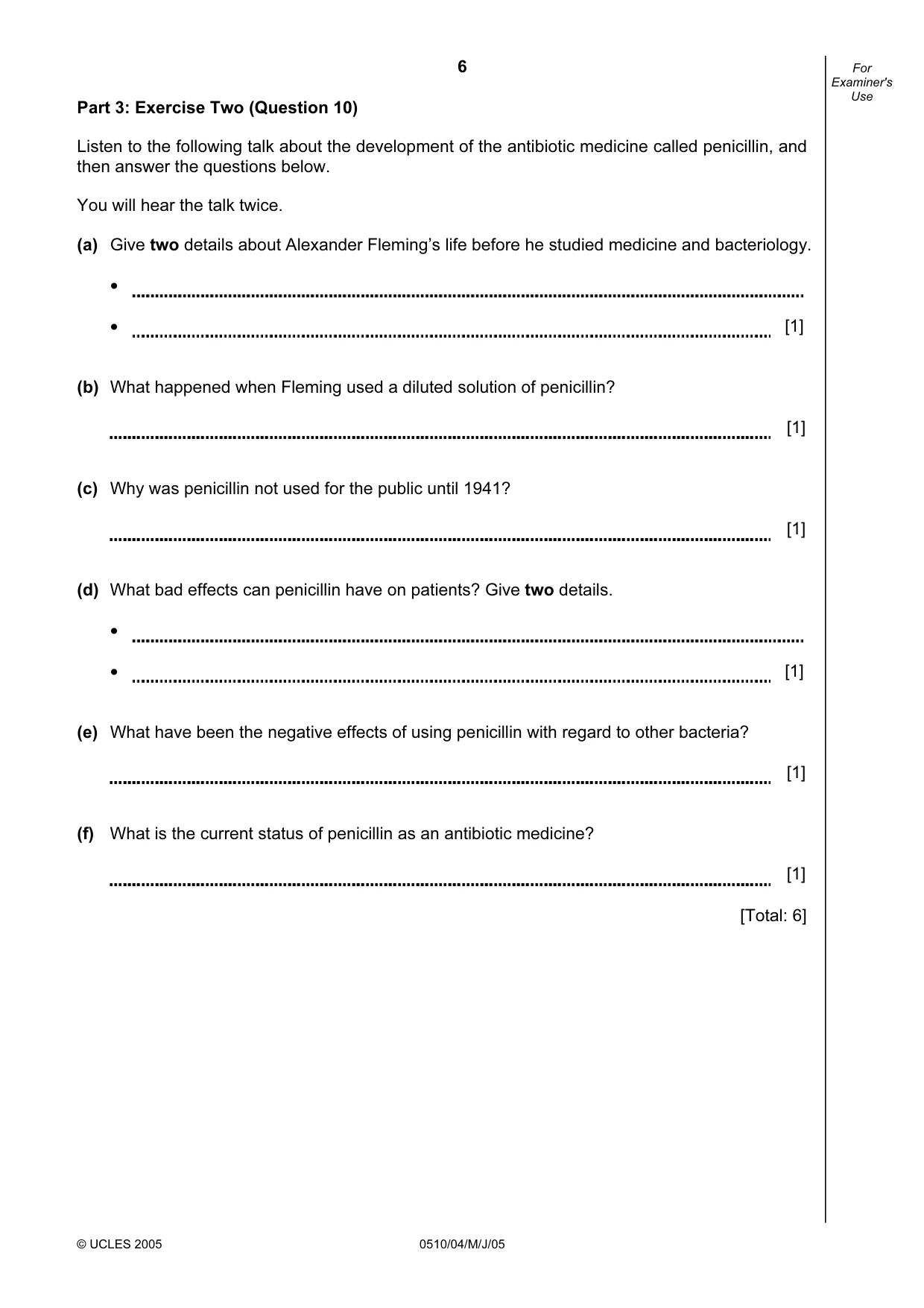
Question paper, page 6
6 © UCLES 2005 0510/04/M/J/05 For Examiner's Use Part 3: Exercise Two (Question 10) Listen to the following talk about the development of the antibiotic medicine called penicillin, and then answer the questions below. You will hear the talk twice. (a) Give two details about Alexander Fleming’s life before he studied medicine and bacteriology. • • [1] (b) What happened when Fleming used a diluted solution of penicillin? [1] (c) Why was penicillin not used for the public until 1941? [1] (d) What bad effects can penicillin have on patients? Give two details. • • [1] (e) What have been the negative effects of using penicillin with regard to other bacteria? [1] (f) What is the current status of penicillin as an antibiotic medicine? [1] [Total: 6]
Question paper, page 8
8 Permission to reproduce items where third-party owned material protected by copyright is included has been sought and cleared where possible. Every reasonable effort has been made by the publisher (UCLES) to trace copyright holders, but if any items requiring clearance have unwittingly been included, the publisher will be pleased to make amends at the earliest possible opportunity. University of Cambridge International Examinations is part of the University of Cambridge Local Examinations Syndicate (UCLES), which is itself a department of the University of Cambridge. 0510/04/M/J/05 BLANK PAGE
Mark scheme, page 1
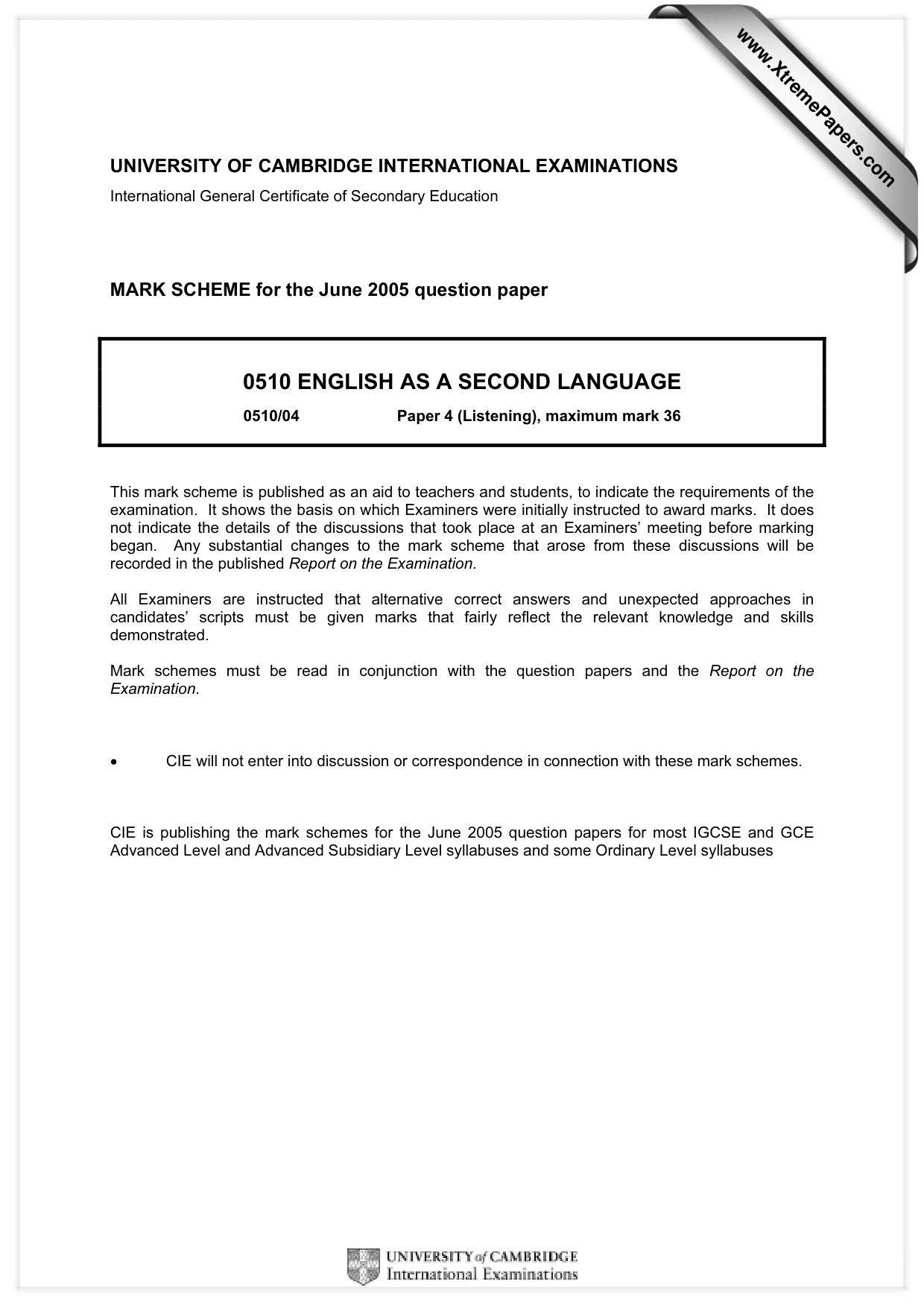
UNIVERSITY OF CAMBRIDGE INTERNATIONAL EXAMINATIONS International General Certificate of Secondary Education MARK SCHEME for the June 2005 question paper 0510 ENGLISH AS A SECOND LANGUAGE 0510/04 Paper 4 (Listening), maximum mark 36 This mark scheme is published as an aid to teachers and students, to indicate the requirements of the examination. It shows the basis on which Examiners were initially instructed to award marks. It does not indicate the details of the discussions that took place at an Examiners’ meeting before marking began. Any substantial changes to the mark scheme that arose from these discussions will be recorded in the published Report on the Examination. All Examiners are instructed that alternative correct answers and unexpected approaches in candidates’ scripts must be given marks that fairly reflect the relevant knowledge and skills demonstrated. Mark schemes must be read in conjunction with the question papers and the Report on the Examination. • CIE will not enter into discussion or correspondence in connection with these mark schemes. CIE is publishing the mark schemes for the June 2005 question papers for most IGCSE and GCE Advanced Level and Advanced Subsidiary Level syllabuses and some Ordinary Level syllabuses www.XtremePapers.com
Mark scheme, page 2
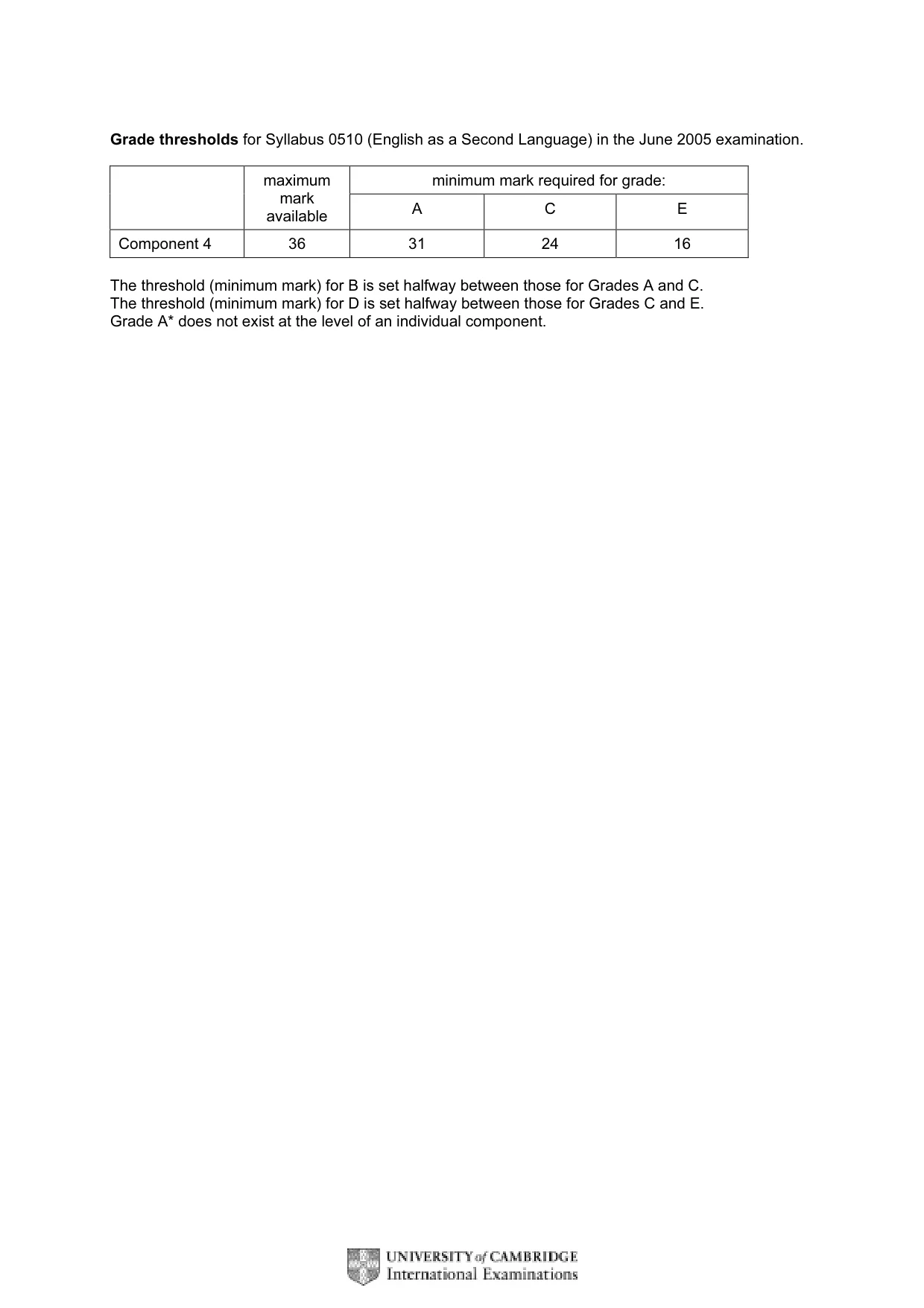
Grade thresholds for Syllabus 0510 (English as a Second Language) in the June 2005 examination. minimum mark required for grade: maximum mark available A C E Component 4 36 31 24 16 The threshold (minimum mark) for B is set halfway between those for Grades A and C. The threshold (minimum mark) for D is set halfway between those for Grades C and E. Grade A* does not exist at the level of an individual component.
Mark scheme, page 3
June 2005 IGCSE MARK SCHEME Including Tapescript MAXIMUM MARK: 36 SYLLABUS/COMPONENT: 0510/04 ENGLISH AS A SECOND LANGUAGE Paper 4 (Listening)
Mark scheme, page 4
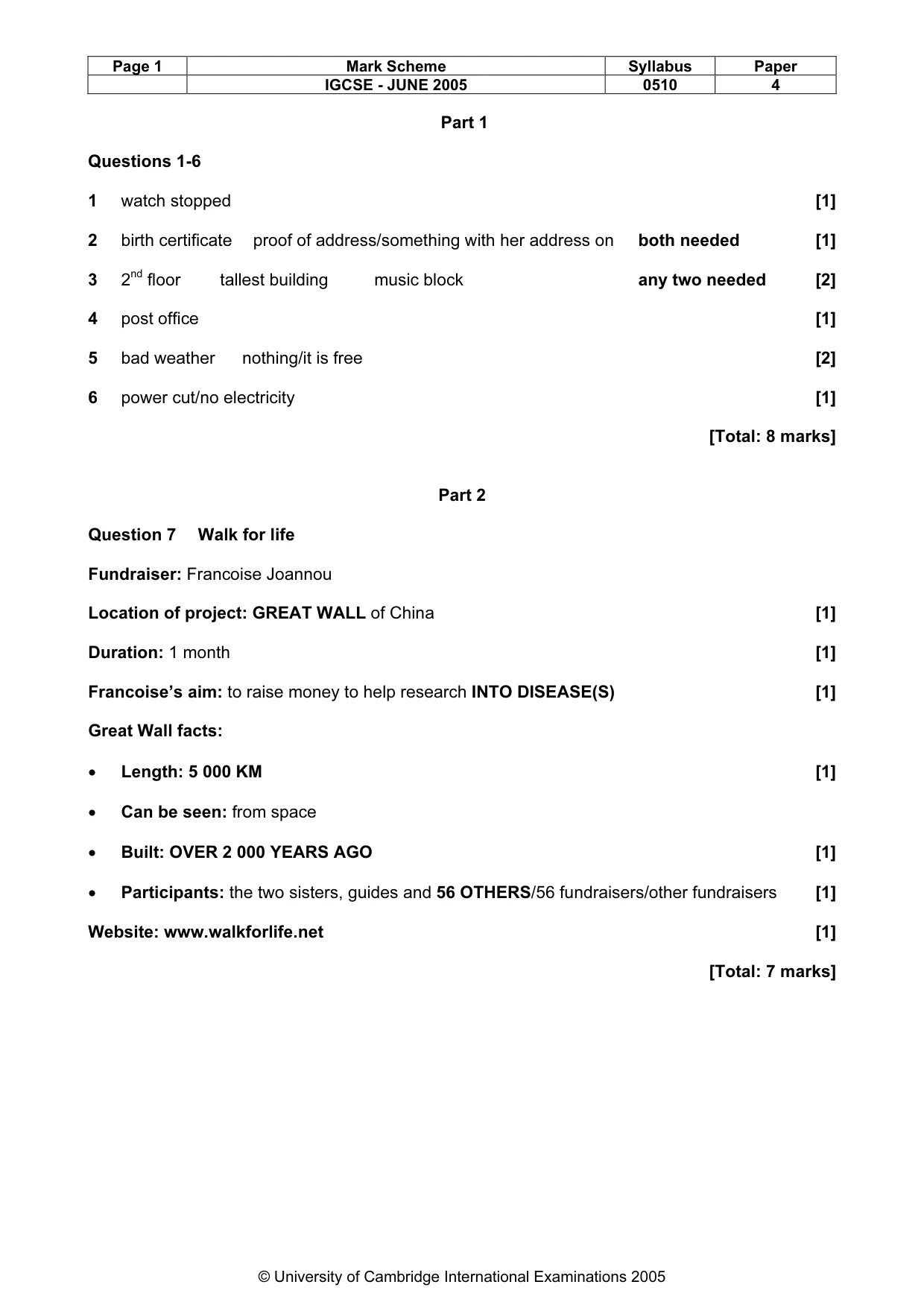
Page 1 Mark Scheme Syllabus Paper IGCSE - JUNE 2005 0510 4 © University of Cambridge International Examinations 2005 Part 1 Questions 1-6 1 watch stopped [1] 2 birth certificate proof of address/something with her address on both needed [1] 3 2nd floor tallest building music block any two needed [2] 4 post office [1] 5 bad weather nothing/it is free [2] 6 power cut/no electricity [1] [Total: 8 marks] Part 2 Question 7 Walk for life Fundraiser: Francoise Joannou Location of project: GREAT WALL of China [1] Duration: 1 month [1] Francoise’s aim: to raise money to help research INTO DISEASE(S) [1] Great Wall facts: • Length: 5 000 KM [1] • Can be seen: from space • Built: OVER 2 000 YEARS AGO [1] • Participants: the two sisters, guides and 56 OTHERS/56 fundraisers/other fundraisers [1] Website: www.walkforlife.net [1] [Total: 7 marks]
Mark scheme, page 5
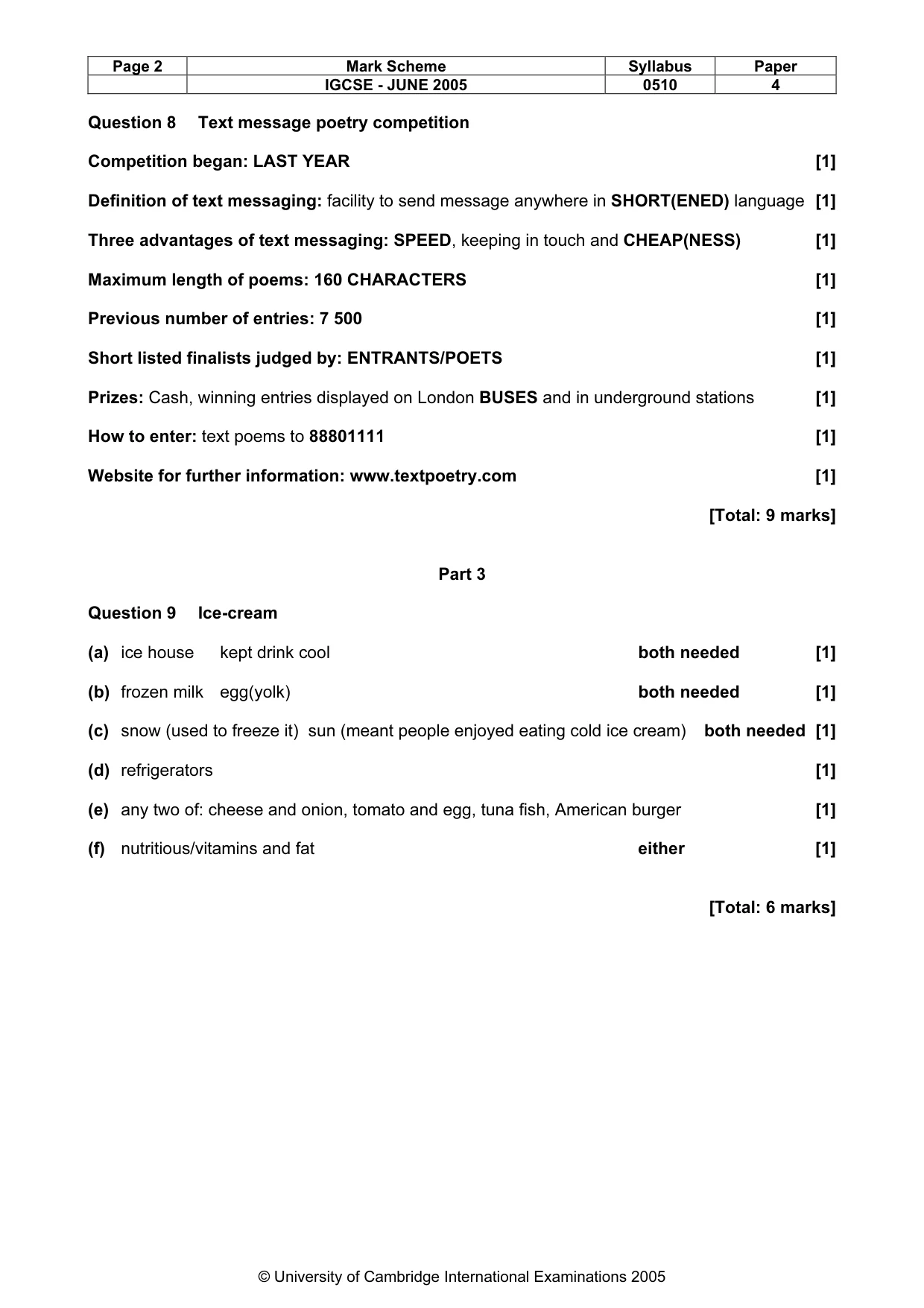
Page 2 Mark Scheme Syllabus Paper IGCSE - JUNE 2005 0510 4 © University of Cambridge International Examinations 2005 Question 8 Text message poetry competition Competition began: LAST YEAR [1] Definition of text messaging: facility to send message anywhere in SHORT(ENED) language [1] Three advantages of text messaging: SPEED, keeping in touch and CHEAP(NESS) [1] Maximum length of poems: 160 CHARACTERS [1] Previous number of entries: 7 500 [1] Short listed finalists judged by: ENTRANTS/POETS [1] Prizes: Cash, winning entries displayed on London BUSES and in underground stations [1] How to enter: text poems to 88801111 [1] Website for further information: www.textpoetry.com [1] [Total: 9 marks] Part 3 Question 9 Ice-cream (a) ice house kept drink cool both needed [1] (b) frozen milk egg(yolk) both needed [1] (c) snow (used to freeze it) sun (meant people enjoyed eating cold ice cream) both needed [1] (d) refrigerators [1] (e) any two of: cheese and onion, tomato and egg, tuna fish, American burger [1] (f) nutritious/vitamins and fat either [1] [Total: 6 marks]
Mark scheme, page 6
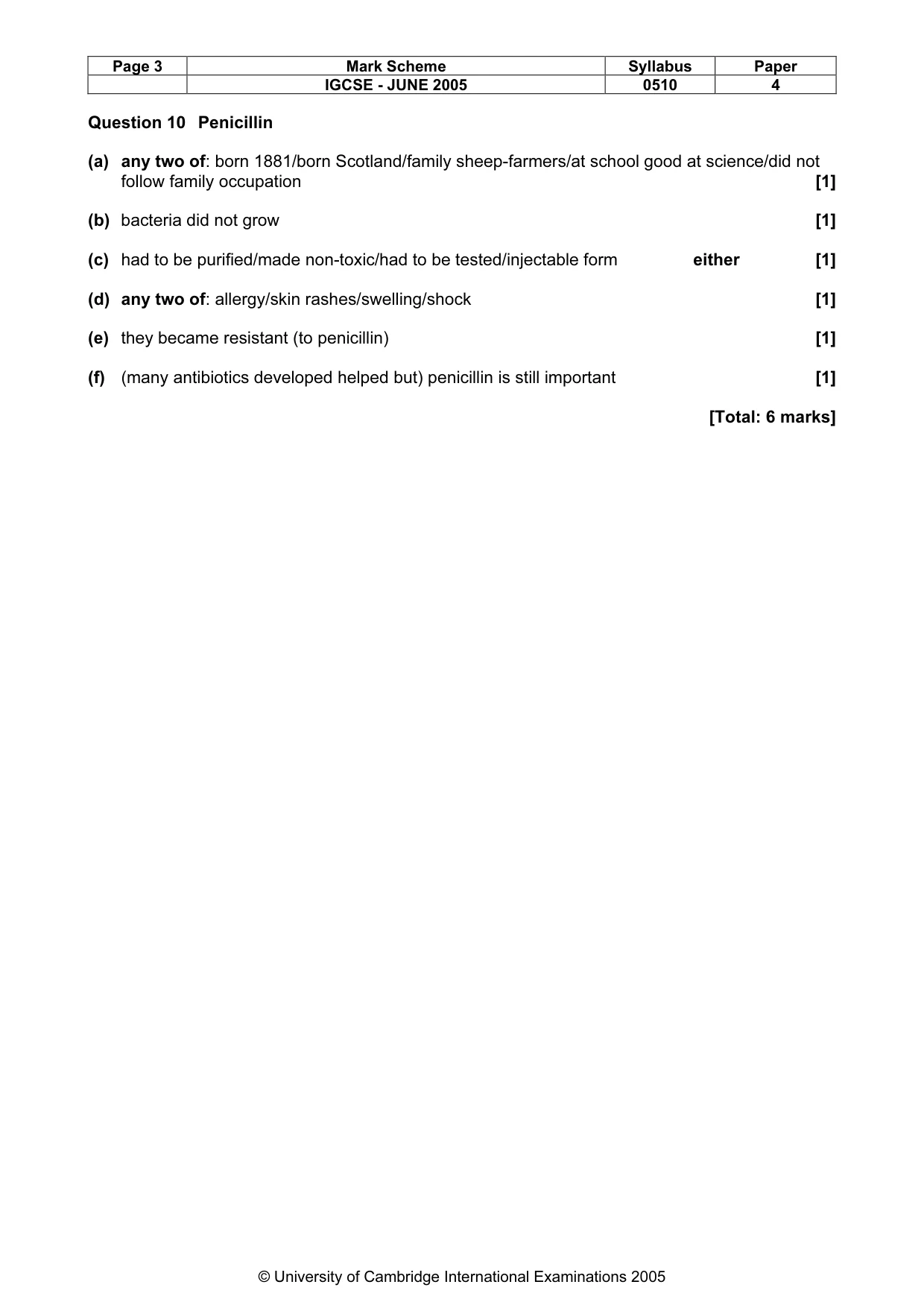
Page 3 Mark Scheme Syllabus Paper IGCSE - JUNE 2005 0510 4 © University of Cambridge International Examinations 2005 Question 10 Penicillin (a) any two of: born 1881/born Scotland/family sheep-farmers/at school good at science/did not follow family occupation [1] (b) bacteria did not grow [1] (c) had to be purified/made non-toxic/had to be tested/injectable form either [1] (d) any two of: allergy/skin rashes/swelling/shock [1] (e) they became resistant (to penicillin) [1] (f) (many antibiotics developed helped but) penicillin is still important [1] [Total: 6 marks]
Mark scheme, page 7
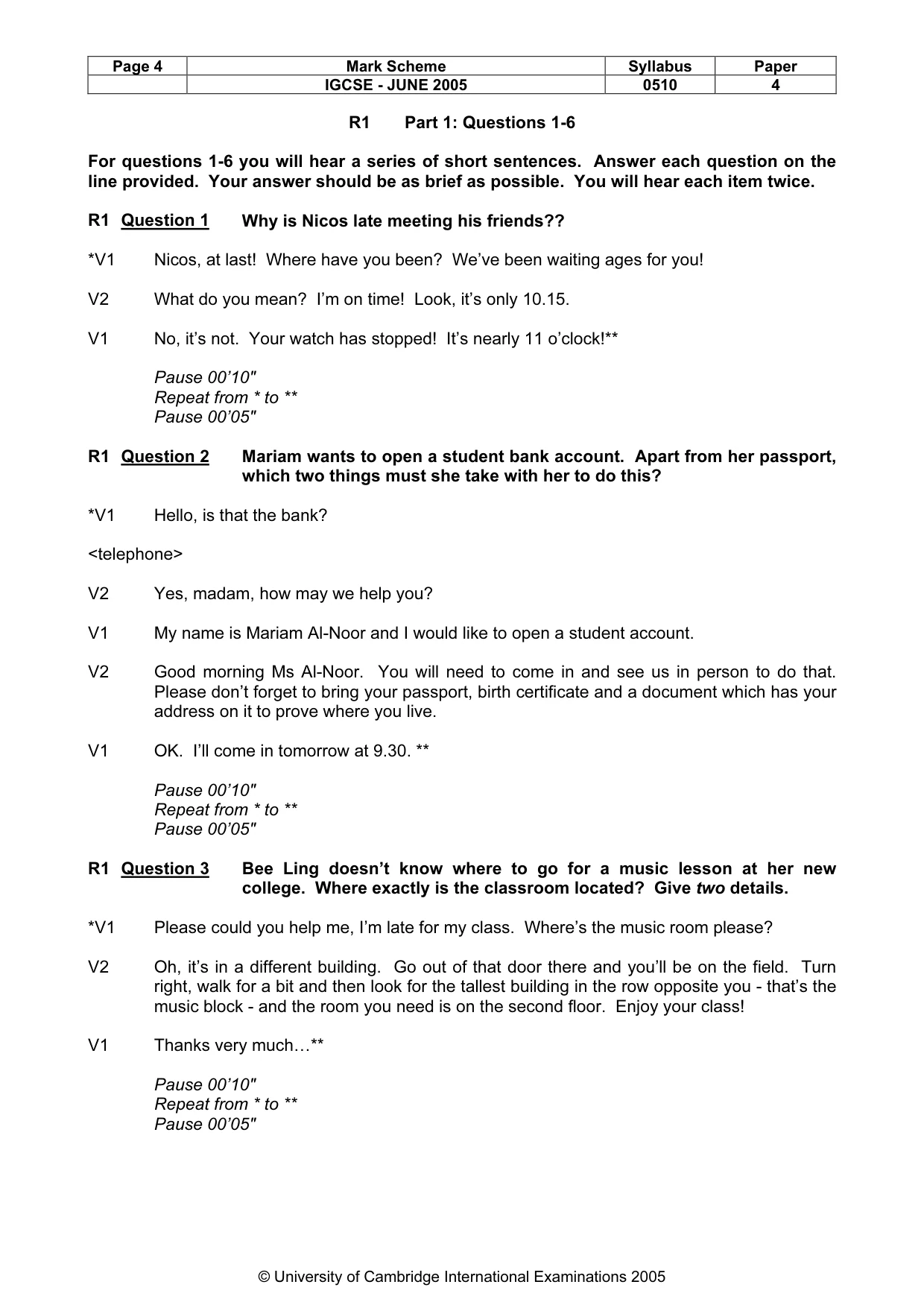
Page 4 Mark Scheme Syllabus Paper IGCSE - JUNE 2005 0510 4 © University of Cambridge International Examinations 2005 R1 Part 1: Questions 1-6 For questions 1-6 you will hear a series of short sentences. Answer each question on the line provided. Your answer should be as brief as possible. You will hear each item twice. R1 Question 1 Why is Nicos late meeting his friends?? *V1 Nicos, at last! Where have you been? We’ve been waiting ages for you! V2 What do you mean? I’m on time! Look, it’s only 10.15. V1 No, it’s not. Your watch has stopped! It’s nearly 11 o’clock!** Pause 00’10" Repeat from * to ** Pause 00’05" R1 Question 2 Mariam wants to open a student bank account. Apart from her passport, which two things must she take with her to do this? *V1 Hello, is that the bank? <telephone> V2 Yes, madam, how may we help you? V1 My name is Mariam Al-Noor and I would like to open a student account. V2 Good morning Ms Al-Noor. You will need to come in and see us in person to do that. Please don’t forget to bring your passport, birth certificate and a document which has your address on it to prove where you live. V1 OK. I’ll come in tomorrow at 9.30. ** Pause 00’10" Repeat from * to ** Pause 00’05" R1 Question 3 Bee Ling doesn’t know where to go for a music lesson at her new college. Where exactly is the classroom located? Give two details. *V1 Please could you help me, I’m late for my class. Where’s the music room please? V2 Oh, it’s in a different building. Go out of that door there and you’ll be on the field. Turn right, walk for a bit and then look for the tallest building in the row opposite you - that’s the music block - and the room you need is on the second floor. Enjoy your class! V1 Thanks very much…** Pause 00’10" Repeat from * to ** Pause 00’05"
Mark scheme, page 8
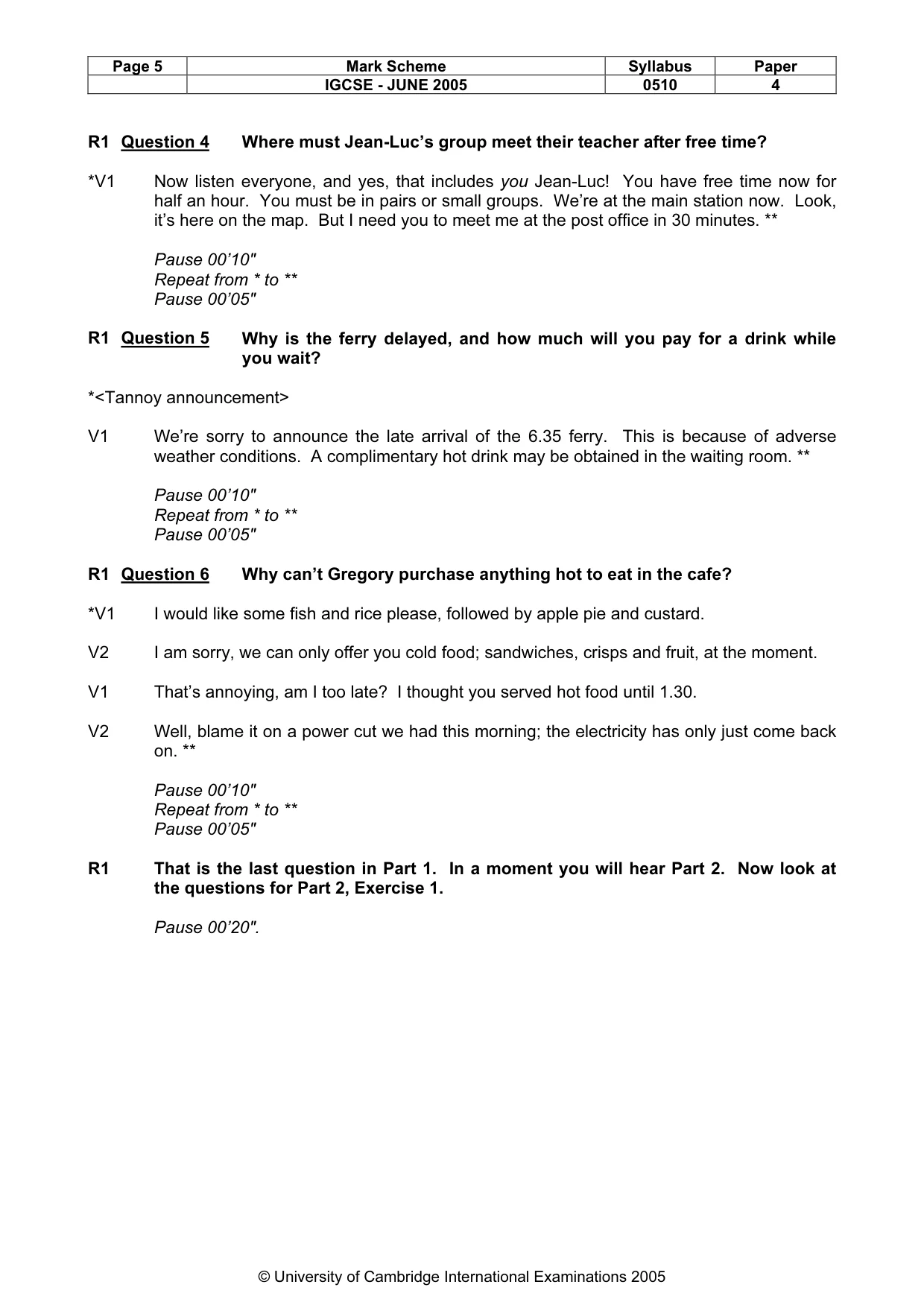
Page 5 Mark Scheme Syllabus Paper IGCSE - JUNE 2005 0510 4 © University of Cambridge International Examinations 2005 R1 Question 4 Where must Jean-Luc’s group meet their teacher after free time? *V1 Now listen everyone, and yes, that includes you Jean-Luc! You have free time now for half an hour. You must be in pairs or small groups. We’re at the main station now. Look, it’s here on the map. But I need you to meet me at the post office in 30 minutes. ** Pause 00’10" Repeat from * to ** Pause 00’05" R1 Question 5 Why is the ferry delayed, and how much will you pay for a drink while you wait? *<Tannoy announcement> V1 We’re sorry to announce the late arrival of the 6.35 ferry. This is because of adverse weather conditions. A complimentary hot drink may be obtained in the waiting room. ** Pause 00’10" Repeat from * to ** Pause 00’05" R1 Question 6 Why can’t Gregory purchase anything hot to eat in the cafe? *V1 I would like some fish and rice please, followed by apple pie and custard. V2 I am sorry, we can only offer you cold food; sandwiches, crisps and fruit, at the moment. V1 That’s annoying, am I too late? I thought you served hot food until 1.30. V2 Well, blame it on a power cut we had this morning; the electricity has only just come back on. ** Pause 00’10" Repeat from * to ** Pause 00’05" R1 That is the last question in Part 1. In a moment you will hear Part 2. Now look at the questions for Part 2, Exercise 1. Pause 00’20".
Mark scheme, page 9
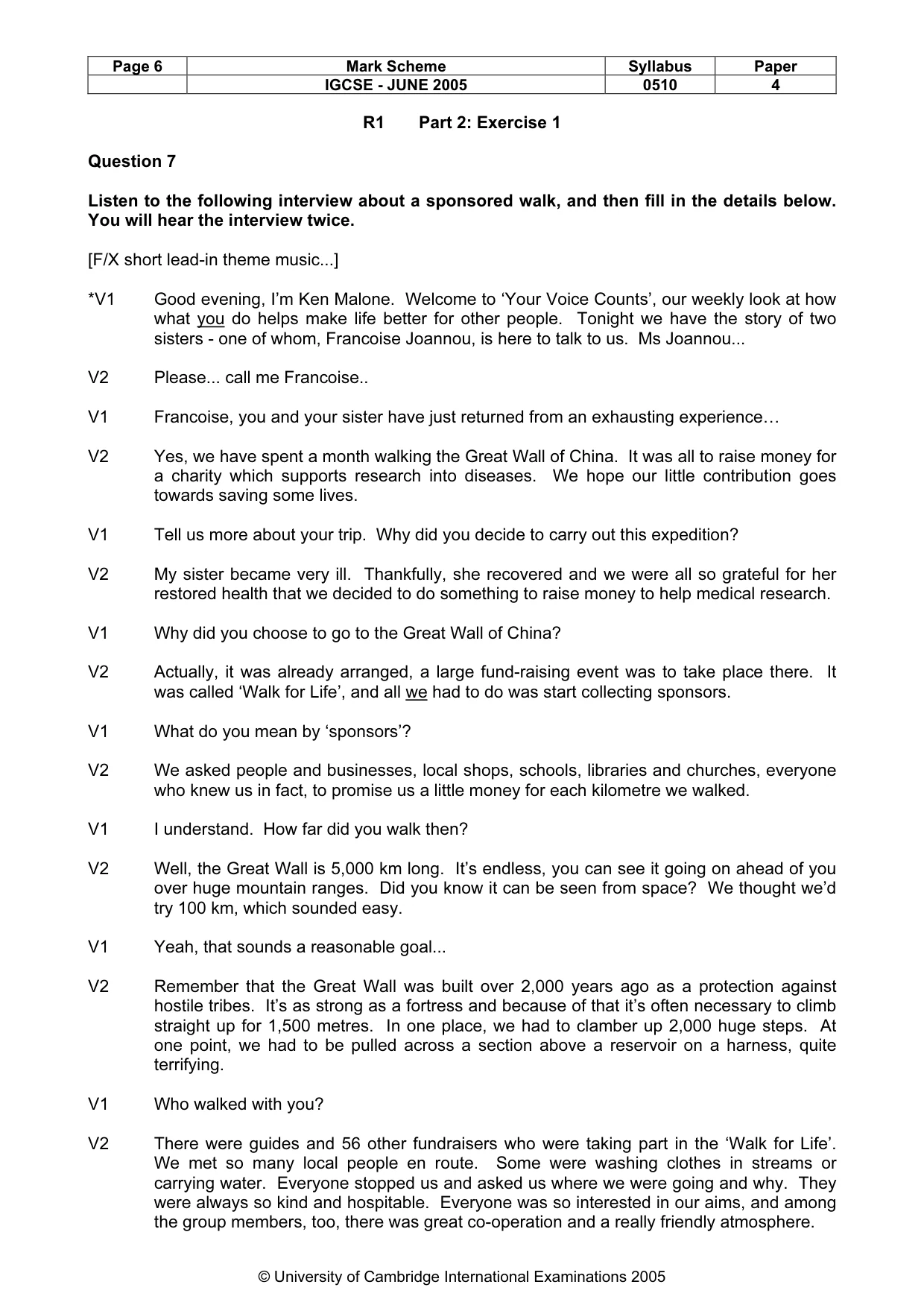
Page 6 Mark Scheme Syllabus Paper IGCSE - JUNE 2005 0510 4 © University of Cambridge International Examinations 2005 R1 Part 2: Exercise 1 Question 7 Listen to the following interview about a sponsored walk, and then fill in the details below. You will hear the interview twice. [F/X short lead-in theme music...] *V1 Good evening, I’m Ken Malone. Welcome to ‘Your Voice Counts’, our weekly look at how what you do helps make life better for other people. Tonight we have the story of two sisters - one of whom, Francoise Joannou, is here to talk to us. Ms Joannou... V2 Please... call me Francoise.. V1 Francoise, you and your sister have just returned from an exhausting experience… V2 Yes, we have spent a month walking the Great Wall of China. It was all to raise money for a charity which supports research into diseases. We hope our little contribution goes towards saving some lives. V1 Tell us more about your trip. Why did you decide to carry out this expedition? V2 My sister became very ill. Thankfully, she recovered and we were all so grateful for her restored health that we decided to do something to raise money to help medical research. V1 Why did you choose to go to the Great Wall of China? V2 Actually, it was already arranged, a large fund-raising event was to take place there. It was called ‘Walk for Life’, and all we had to do was start collecting sponsors. V1 What do you mean by ‘sponsors’? V2 We asked people and businesses, local shops, schools, libraries and churches, everyone who knew us in fact, to promise us a little money for each kilometre we walked. V1 I understand. How far did you walk then? V2 Well, the Great Wall is 5,000 km long. It’s endless, you can see it going on ahead of you over huge mountain ranges. Did you know it can be seen from space? We thought we’d try 100 km, which sounded easy. V1 Yeah, that sounds a reasonable goal... V2 Remember that the Great Wall was built over 2,000 years ago as a protection against hostile tribes. It’s as strong as a fortress and because of that it’s often necessary to climb straight up for 1,500 metres. In one place, we had to clamber up 2,000 huge steps. At one point, we had to be pulled across a section above a reservoir on a harness, quite terrifying. V1 Who walked with you? V2 There were guides and 56 other fundraisers who were taking part in the ‘Walk for Life’. We met so many local people en route. Some were washing clothes in streams or carrying water. Everyone stopped us and asked us where we were going and why. They were always so kind and hospitable. Everyone was so interested in our aims, and among the group members, too, there was great co-operation and a really friendly atmosphere.
Mark scheme, page 10
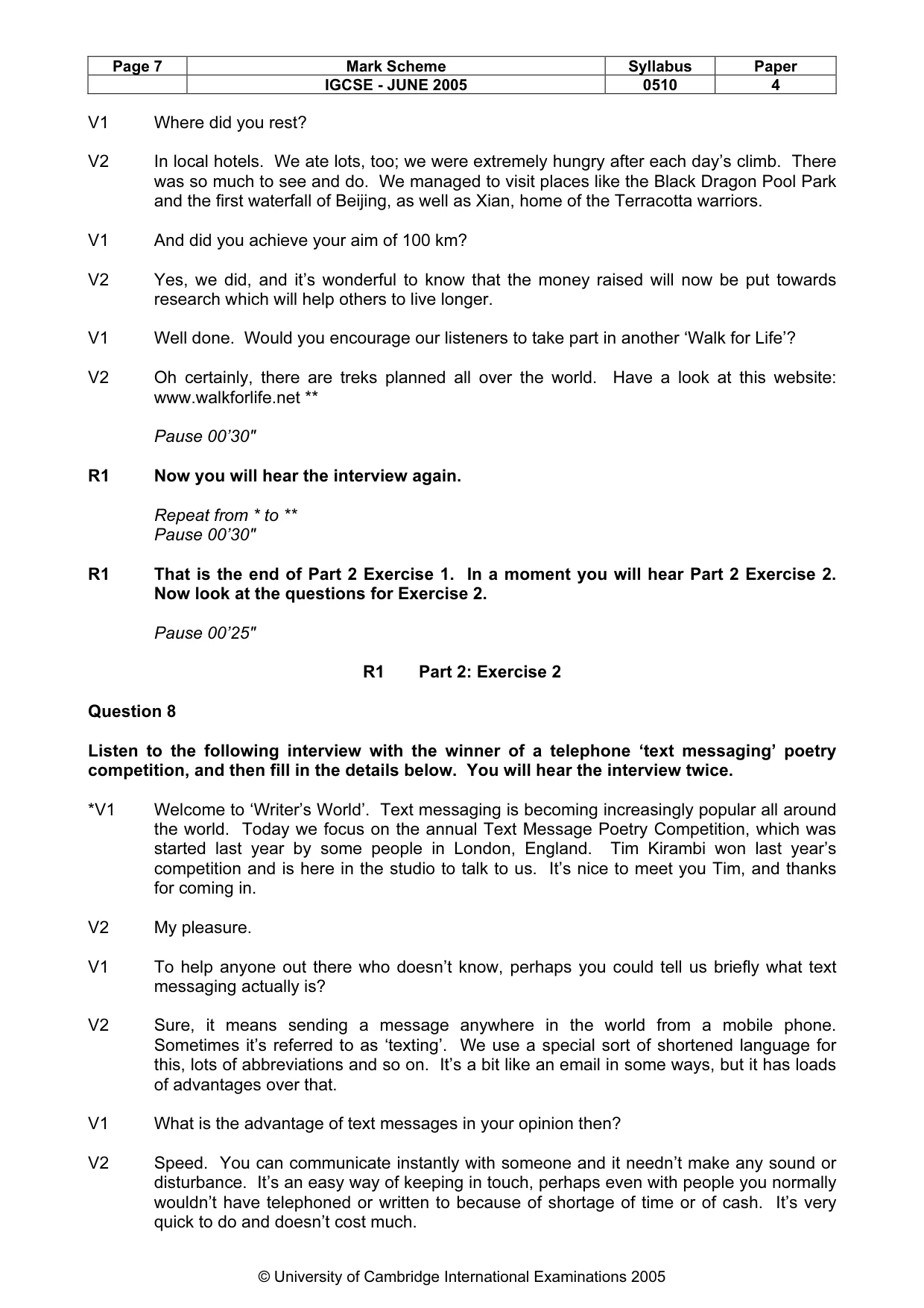
Page 7 Mark Scheme Syllabus Paper IGCSE - JUNE 2005 0510 4 © University of Cambridge International Examinations 2005 V1 Where did you rest? V2 In local hotels. We ate lots, too; we were extremely hungry after each day’s climb. There was so much to see and do. We managed to visit places like the Black Dragon Pool Park and the first waterfall of Beijing, as well as Xian, home of the Terracotta warriors. V1 And did you achieve your aim of 100 km? V2 Yes, we did, and it’s wonderful to know that the money raised will now be put towards research which will help others to live longer. V1 Well done. Would you encourage our listeners to take part in another ‘Walk for Life’? V2 Oh certainly, there are treks planned all over the world. Have a look at this website: www.walkforlife.net ** Pause 00’30" R1 Now you will hear the interview again. Repeat from * to ** Pause 00’30" R1 That is the end of Part 2 Exercise 1. In a moment you will hear Part 2 Exercise 2. Now look at the questions for Exercise 2. Pause 00’25" R1 Part 2: Exercise 2 Question 8 Listen to the following interview with the winner of a telephone ‘text messaging’ poetry competition, and then fill in the details below. You will hear the interview twice. *V1 Welcome to ‘Writer’s World’. Text messaging is becoming increasingly popular all around the world. Today we focus on the annual Text Message Poetry Competition, which was started last year by some people in London, England. Tim Kirambi won last year’s competition and is here in the studio to talk to us. It’s nice to meet you Tim, and thanks for coming in. V2 My pleasure. V1 To help anyone out there who doesn’t know, perhaps you could tell us briefly what text messaging actually is? V2 Sure, it means sending a message anywhere in the world from a mobile phone. Sometimes it’s referred to as ‘texting’. We use a special sort of shortened language for this, lots of abbreviations and so on. It’s a bit like an email in some ways, but it has loads of advantages over that. V1 What is the advantage of text messages in your opinion then? V2 Speed. You can communicate instantly with someone and it needn’t make any sound or disturbance. It’s an easy way of keeping in touch, perhaps even with people you normally wouldn’t have telephoned or written to because of shortage of time or of cash. It’s very quick to do and doesn’t cost much.
Mark scheme, page 11
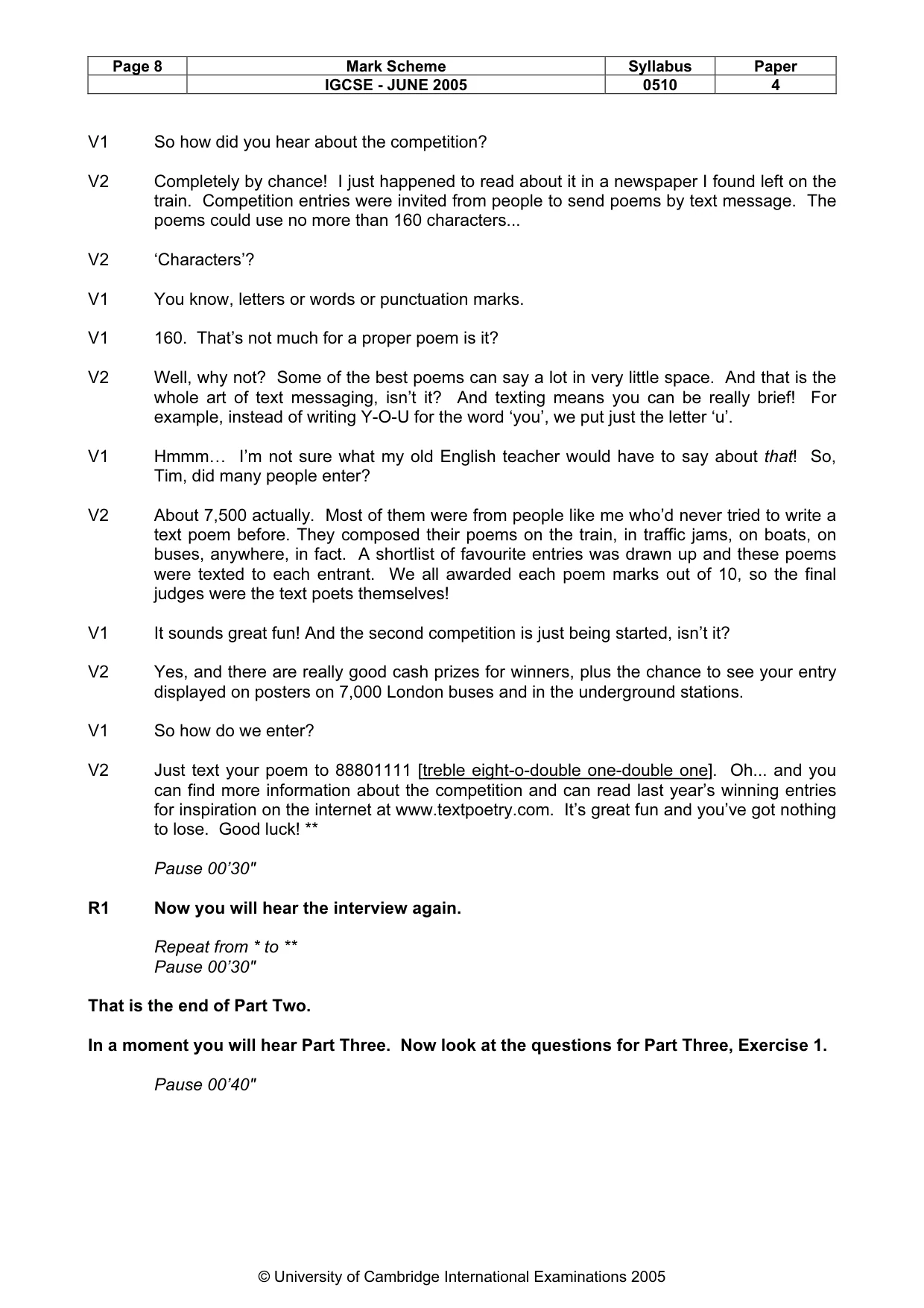
Page 8 Mark Scheme Syllabus Paper IGCSE - JUNE 2005 0510 4 © University of Cambridge International Examinations 2005 V1 So how did you hear about the competition? V2 Completely by chance! I just happened to read about it in a newspaper I found left on the train. Competition entries were invited from people to send poems by text message. The poems could use no more than 160 characters... V2 ‘Characters’? V1 You know, letters or words or punctuation marks. V1 160. That’s not much for a proper poem is it? V2 Well, why not? Some of the best poems can say a lot in very little space. And that is the whole art of text messaging, isn’t it? And texting means you can be really brief! For example, instead of writing Y-O-U for the word ‘you’, we put just the letter ‘u’. V1 Hmmm… I’m not sure what my old English teacher would have to say about that! So, Tim, did many people enter? V2 About 7,500 actually. Most of them were from people like me who’d never tried to write a text poem before. They composed their poems on the train, in traffic jams, on boats, on buses, anywhere, in fact. A shortlist of favourite entries was drawn up and these poems were texted to each entrant. We all awarded each poem marks out of 10, so the final judges were the text poets themselves! V1 It sounds great fun! And the second competition is just being started, isn’t it? V2 Yes, and there are really good cash prizes for winners, plus the chance to see your entry displayed on posters on 7,000 London buses and in the underground stations. V1 So how do we enter? V2 Just text your poem to 88801111 [treble eight-o-double one-double one]. Oh... and you can find more information about the competition and can read last year’s winning entries for inspiration on the internet at www.textpoetry.com. It’s great fun and you’ve got nothing to lose. Good luck! ** Pause 00’30" R1 Now you will hear the interview again. Repeat from * to ** Pause 00’30" That is the end of Part Two. In a moment you will hear Part Three. Now look at the questions for Part Three, Exercise 1. Pause 00’40"
Mark scheme, page 12
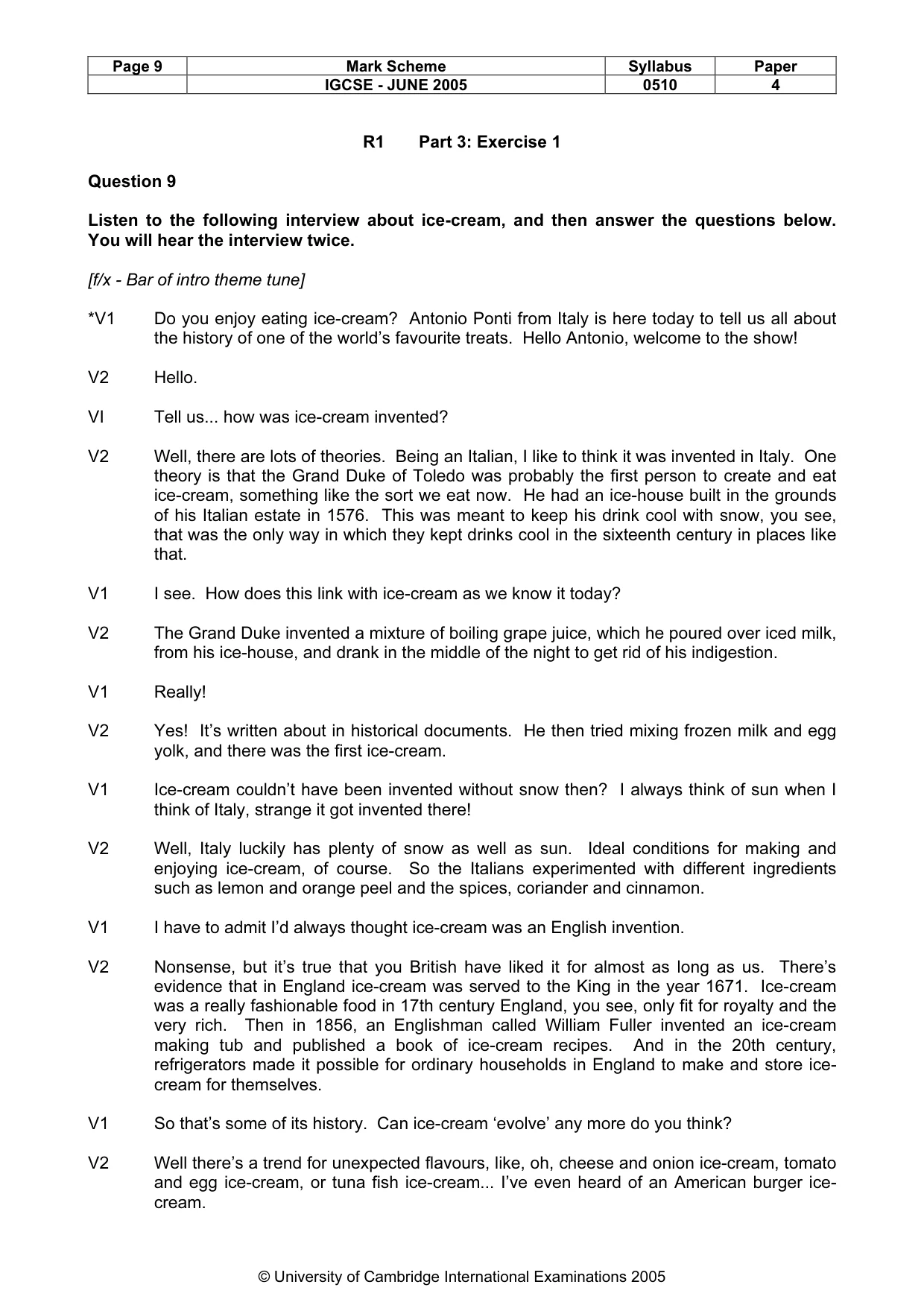
Page 9 Mark Scheme Syllabus Paper IGCSE - JUNE 2005 0510 4 © University of Cambridge International Examinations 2005 R1 Part 3: Exercise 1 Question 9 Listen to the following interview about ice-cream, and then answer the questions below. You will hear the interview twice. [f/x - Bar of intro theme tune] *V1 Do you enjoy eating ice-cream? Antonio Ponti from Italy is here today to tell us all about the history of one of the world’s favourite treats. Hello Antonio, welcome to the show! V2 Hello. VI Tell us... how was ice-cream invented? V2 Well, there are lots of theories. Being an Italian, I like to think it was invented in Italy. One theory is that the Grand Duke of Toledo was probably the first person to create and eat ice-cream, something like the sort we eat now. He had an ice-house built in the grounds of his Italian estate in 1576. This was meant to keep his drink cool with snow, you see, that was the only way in which they kept drinks cool in the sixteenth century in places like that. V1 I see. How does this link with ice-cream as we know it today? V2 The Grand Duke invented a mixture of boiling grape juice, which he poured over iced milk, from his ice-house, and drank in the middle of the night to get rid of his indigestion. V1 Really! V2 Yes! It’s written about in historical documents. He then tried mixing frozen milk and egg yolk, and there was the first ice-cream. V1 Ice-cream couldn’t have been invented without snow then? I always think of sun when I think of Italy, strange it got invented there! V2 Well, Italy luckily has plenty of snow as well as sun. Ideal conditions for making and enjoying ice-cream, of course. So the Italians experimented with different ingredients such as lemon and orange peel and the spices, coriander and cinnamon. V1 I have to admit I’d always thought ice-cream was an English invention. V2 Nonsense, but it’s true that you British have liked it for almost as long as us. There’s evidence that in England ice-cream was served to the King in the year 1671. Ice-cream was a really fashionable food in 17th century England, you see, only fit for royalty and the very rich. Then in 1856, an Englishman called William Fuller invented an ice-cream making tub and published a book of ice-cream recipes. And in the 20th century, refrigerators made it possible for ordinary households in England to make and store ice- cream for themselves. V1 So that’s some of its history. Can ice-cream ‘evolve’ any more do you think? V2 Well there’s a trend for unexpected flavours, like, oh, cheese and onion ice-cream, tomato and egg ice-cream, or tuna fish ice-cream... I’ve even heard of an American burger ice- cream.
Mark scheme, page 13
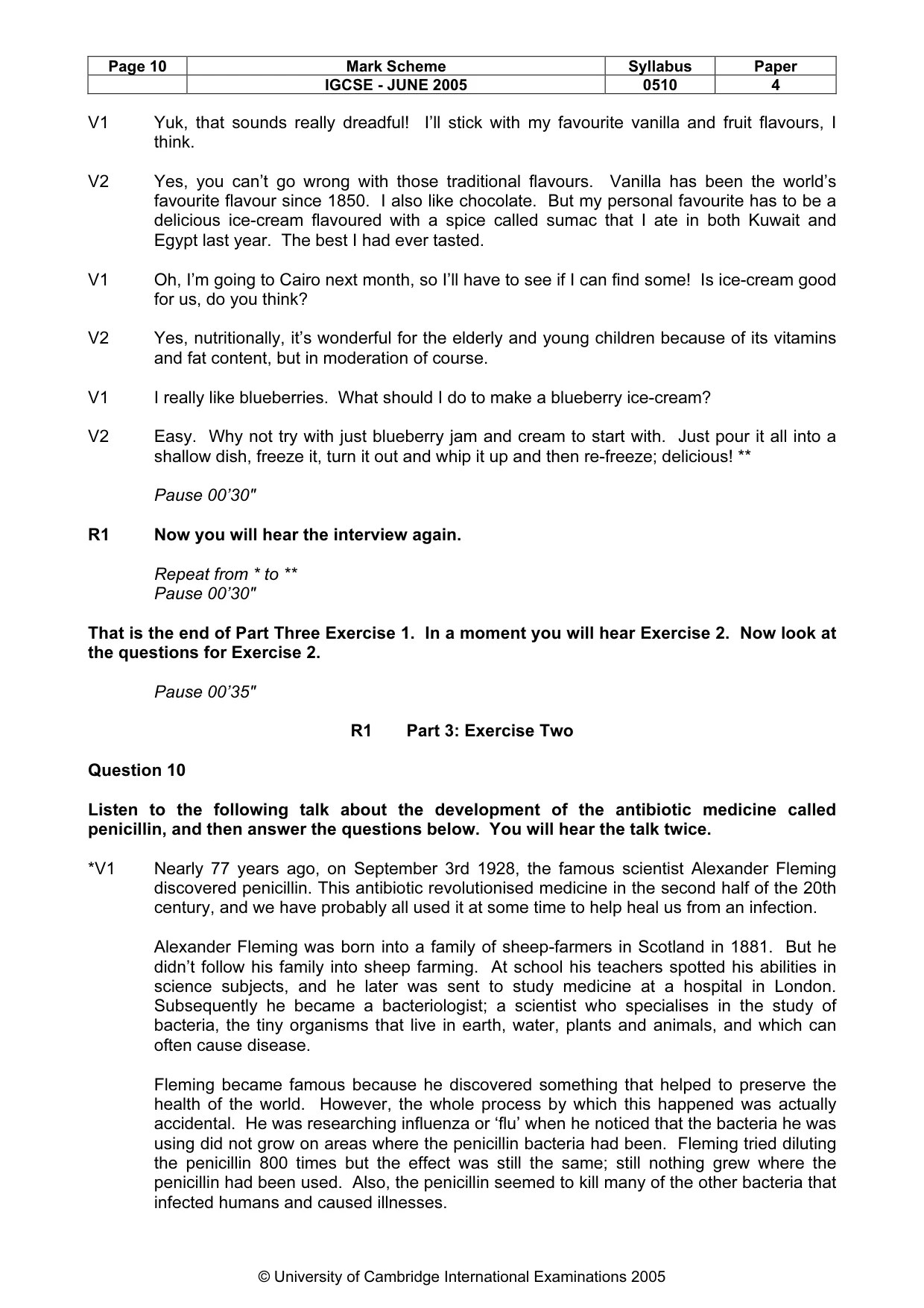
Page 10 Mark Scheme Syllabus Paper IGCSE - JUNE 2005 0510 4 © University of Cambridge International Examinations 2005 V1 Yuk, that sounds really dreadful! I’ll stick with my favourite vanilla and fruit flavours, I think. V2 Yes, you can’t go wrong with those traditional flavours. Vanilla has been the world’s favourite flavour since 1850. I also like chocolate. But my personal favourite has to be a delicious ice-cream flavoured with a spice called sumac that I ate in both Kuwait and Egypt last year. The best I had ever tasted. V1 Oh, I’m going to Cairo next month, so I’ll have to see if I can find some! Is ice-cream good for us, do you think? V2 Yes, nutritionally, it’s wonderful for the elderly and young children because of its vitamins and fat content, but in moderation of course. V1 I really like blueberries. What should I do to make a blueberry ice-cream? V2 Easy. Why not try with just blueberry jam and cream to start with. Just pour it all into a shallow dish, freeze it, turn it out and whip it up and then re-freeze; delicious! ** Pause 00’30" R1 Now you will hear the interview again. Repeat from * to ** Pause 00’30" That is the end of Part Three Exercise 1. In a moment you will hear Exercise 2. Now look at the questions for Exercise 2. Pause 00’35" R1 Part 3: Exercise Two Question 10 Listen to the following talk about the development of the antibiotic medicine called penicillin, and then answer the questions below. You will hear the talk twice. *V1 Nearly 77 years ago, on September 3rd 1928, the famous scientist Alexander Fleming discovered penicillin. This antibiotic revolutionised medicine in the second half of the 20th century, and we have probably all used it at some time to help heal us from an infection. Alexander Fleming was born into a family of sheep-farmers in Scotland in 1881. But he didn’t follow his family into sheep farming. At school his teachers spotted his abilities in science subjects, and he later was sent to study medicine at a hospital in London. Subsequently he became a bacteriologist; a scientist who specialises in the study of bacteria, the tiny organisms that live in earth, water, plants and animals, and which can often cause disease. Fleming became famous because he discovered something that helped to preserve the health of the world. However, the whole process by which this happened was actually accidental. He was researching influenza or ‘flu’ when he noticed that the bacteria he was using did not grow on areas where the penicillin bacteria had been. Fleming tried diluting the penicillin 800 times but the effect was still the same; still nothing grew where the penicillin had been used. Also, the penicillin seemed to kill many of the other bacteria that infected humans and caused illnesses.
Mark scheme, page 14
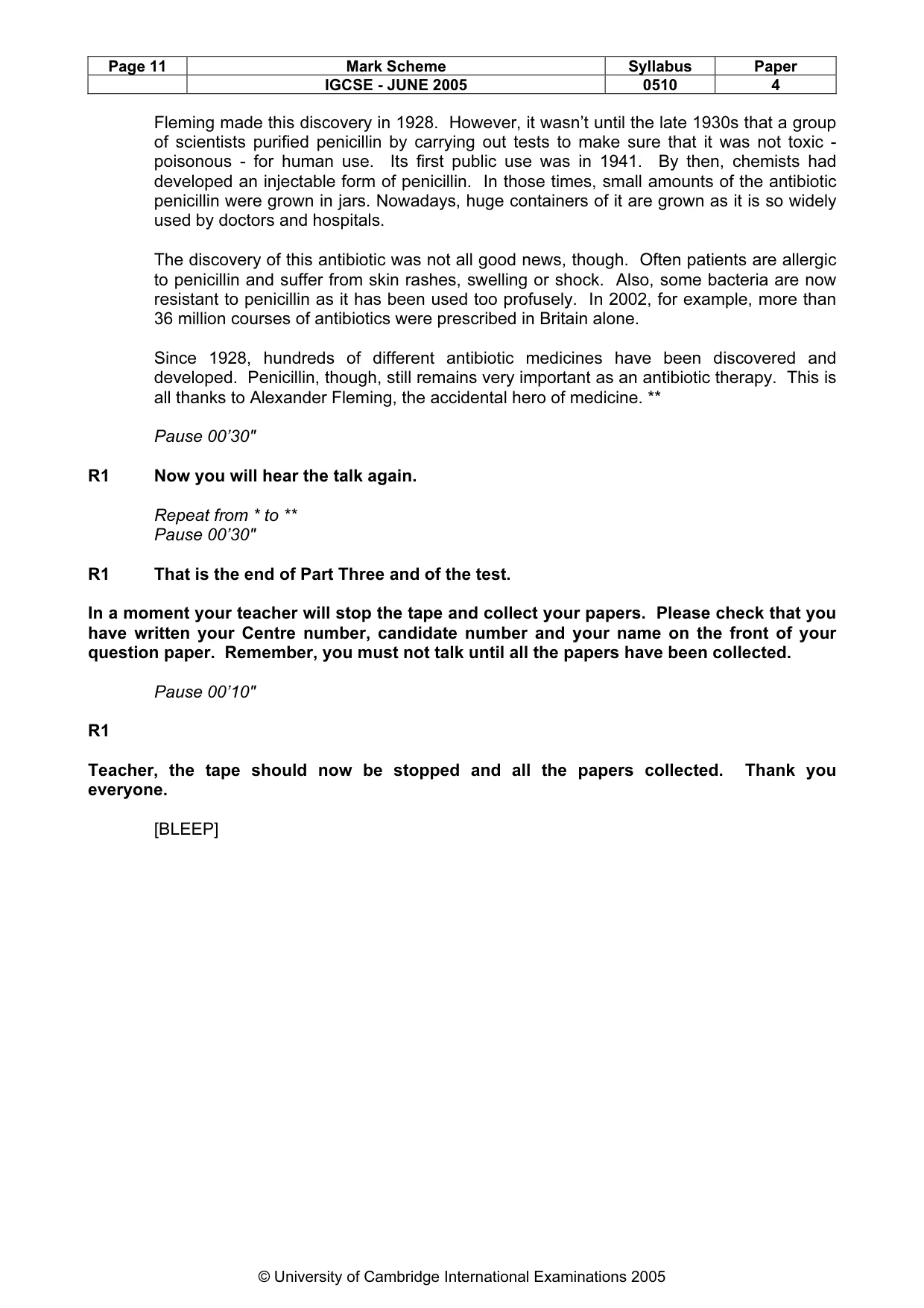
Page 11 Mark Scheme Syllabus Paper IGCSE - JUNE 2005 0510 4 © University of Cambridge International Examinations 2005 Fleming made this discovery in 1928. However, it wasn’t until the late 1930s that a group of scientists purified penicillin by carrying out tests to make sure that it was not toxic - poisonous - for human use. Its first public use was in 1941. By then, chemists had developed an injectable form of penicillin. In those times, small amounts of the antibiotic penicillin were grown in jars. Nowadays, huge containers of it are grown as it is so widely used by doctors and hospitals. The discovery of this antibiotic was not all good news, though. Often patients are allergic to penicillin and suffer from skin rashes, swelling or shock. Also, some bacteria are now resistant to penicillin as it has been used too profusely. In 2002, for example, more than 36 million courses of antibiotics were prescribed in Britain alone. Since 1928, hundreds of different antibiotic medicines have been discovered and developed. Penicillin, though, still remains very important as an antibiotic therapy. This is all thanks to Alexander Fleming, the accidental hero of medicine. ** Pause 00’30" R1 Now you will hear the talk again. Repeat from * to ** Pause 00’30" R1 That is the end of Part Three and of the test. In a moment your teacher will stop the tape and collect your papers. Please check that you have written your Centre number, candidate number and your name on the front of your question paper. Remember, you must not talk until all the papers have been collected. Pause 00’10" R1 Teacher, the tape should now be stopped and all the papers collected. Thank you everyone. [BLEEP]