Cambridge IGCSE English - Second Language (oral endorsement) 0510 — 2002 Oct/Nov Paper 4 · Variant 1
0510/41/O/N/02
The question paper and its mark scheme, free to read here and free to download. This is Cambridge’s own paper, exactly as it was sat.
Question paper8 pages


Mark scheme14 pages
Answers below. Sit the paper first if you are practising.
Paper as text
Question paper, page 1
This question paper consists of 6 printed pages and 2 blank pages. SP (NF/JB) S19358/2 © CIE 2002 [Turn over International General Certificate of Secondary Education CAMBRIDGE INTERNATIONAL EXAMINATIONS ENGLISH AS A SECOND LANGUAGE 0510/4 PAPER 4 Listening OCTOBER/NOVEMBER SESSION 2002 Approx. 45 minutes Candidates answer on the question paper. No additional materials are required. TIME Approx. 45 minutes INSTRUCTIONS TO CANDIDATES Write your name, Centre number and candidate number in the spaces at the top of this page. Answer all questions. Write your answers in the spaces provided on the question paper. INFORMATION FOR CANDIDATES The number of marks is given in brackets [ ] at the end of each question or part question. Dictionaries are not permitted. Candidate Centre Number Number Candidate Name FOR EXAMINER’S USE Part 1 Part 2 Part 3 TOTAL www.XtremePapers.com
Question paper, page 2
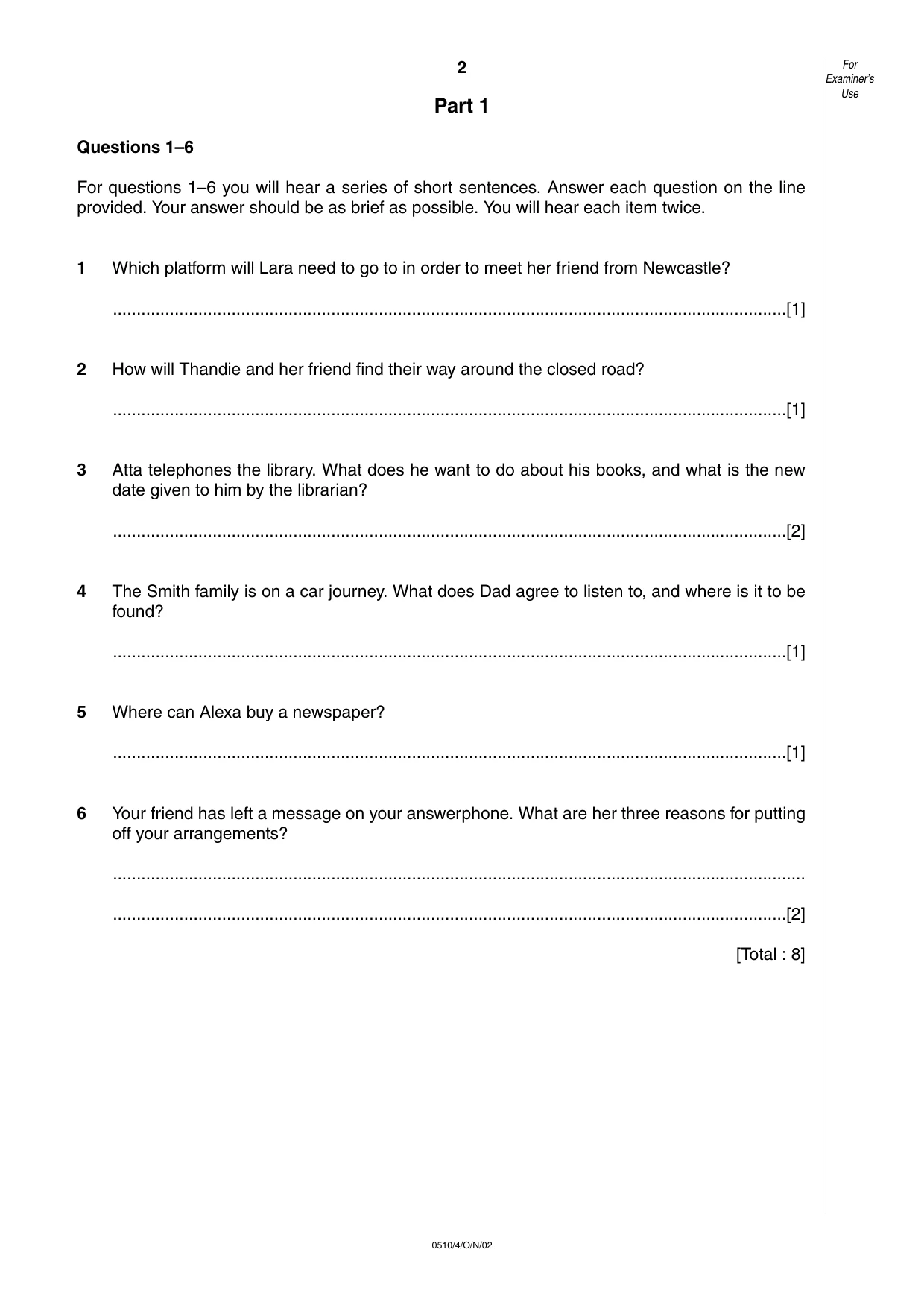
2 0510/4/O/N/02 Part 1 Questions 1–6 For questions 1–6 you will hear a series of short sentences. Answer each question on the line provided. Your answer should be as brief as possible. You will hear each item twice. 1 Which platform will Lara need to go to in order to meet her friend from Newcastle? …[1] 2 How will Thandie and her friend find their way around the closed road? …[1] 3 Atta telephones the library. What does he want to do about his books, and what is the new date given to him by the librarian? …[2] 4 The Smith family is on a car journey. What does Dad agree to listen to, and where is it to be found? …[1] 5 Where can Alexa buy a newspaper? …[1] 6 Your friend has left a message on your answerphone. What are her three reasons for putting off your arrangements? … …[2] [Total : 8] For Examiner’s Use
Question paper, page 3
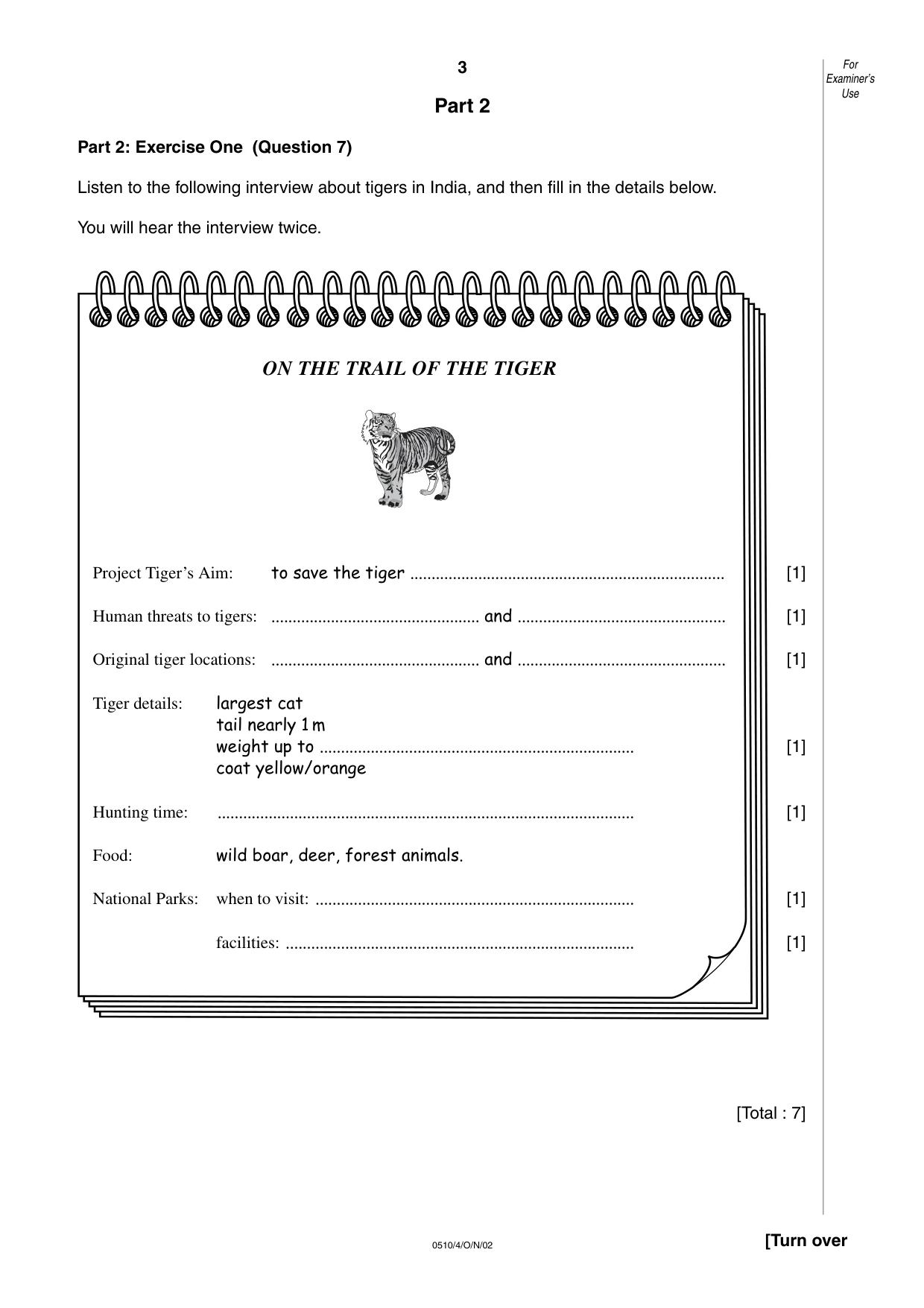
3 0510/4/O/N/02 [Turn over Part 2 Part 2: Exercise One (Question 7) Listen to the following interview about tigers in India, and then fill in the details below. You will hear the interview twice. [1] [1] [1] [1] [1] [1] [1] [Total : 7] For Examiner’s Use ON THE TRAIL OF THE TIGER Project Tiger’s Aim: to save the tiger … Human threats to tigers: … and … Original tiger locations: … and … Tiger details: largest cat tail nearly 1 m weight up to … coat yellow/orange Hunting time: … Food: wild boar, deer, forest animals. National Parks: when to visit: … facilities: …
Question paper, page 4
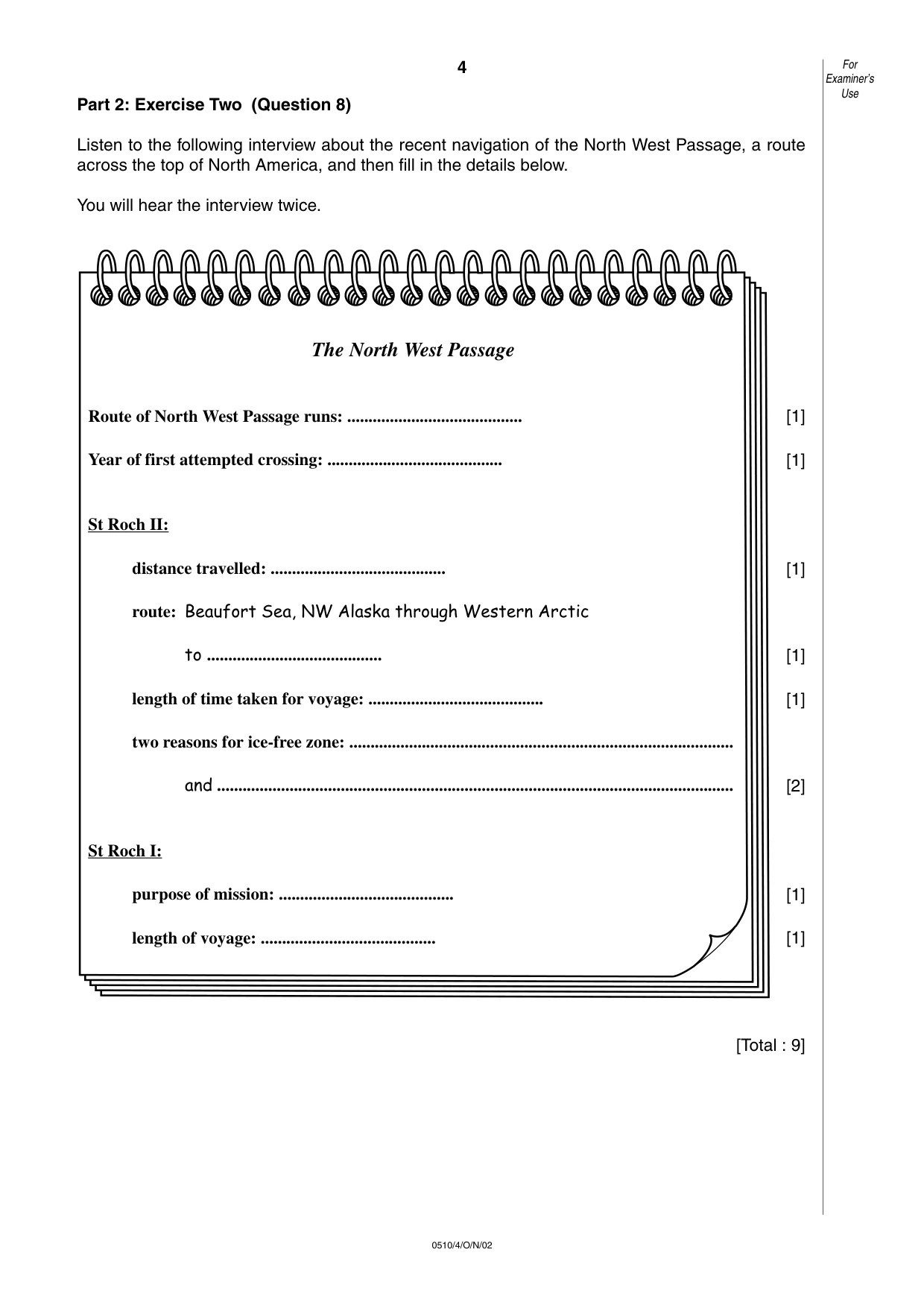
4 0510/4/O/N/02 Part 2: Exercise Two (Question 8) Listen to the following interview about the recent navigation of the North West Passage, a route across the top of North America, and then fill in the details below. You will hear the interview twice. [1] [1] [1] [1] [1] [2] [1] [1] [Total : 9] For Examiner’s Use The North West Passage Route of North West Passage runs: … Year of first attempted crossing: … St Roch II: distance travelled: … route: Beaufort Sea, NW Alaska through Western Arctic to … length of time taken for voyage: … two reasons for ice-free zone: … and … St Roch I: purpose of mission: … length of voyage: …
Question paper, page 5
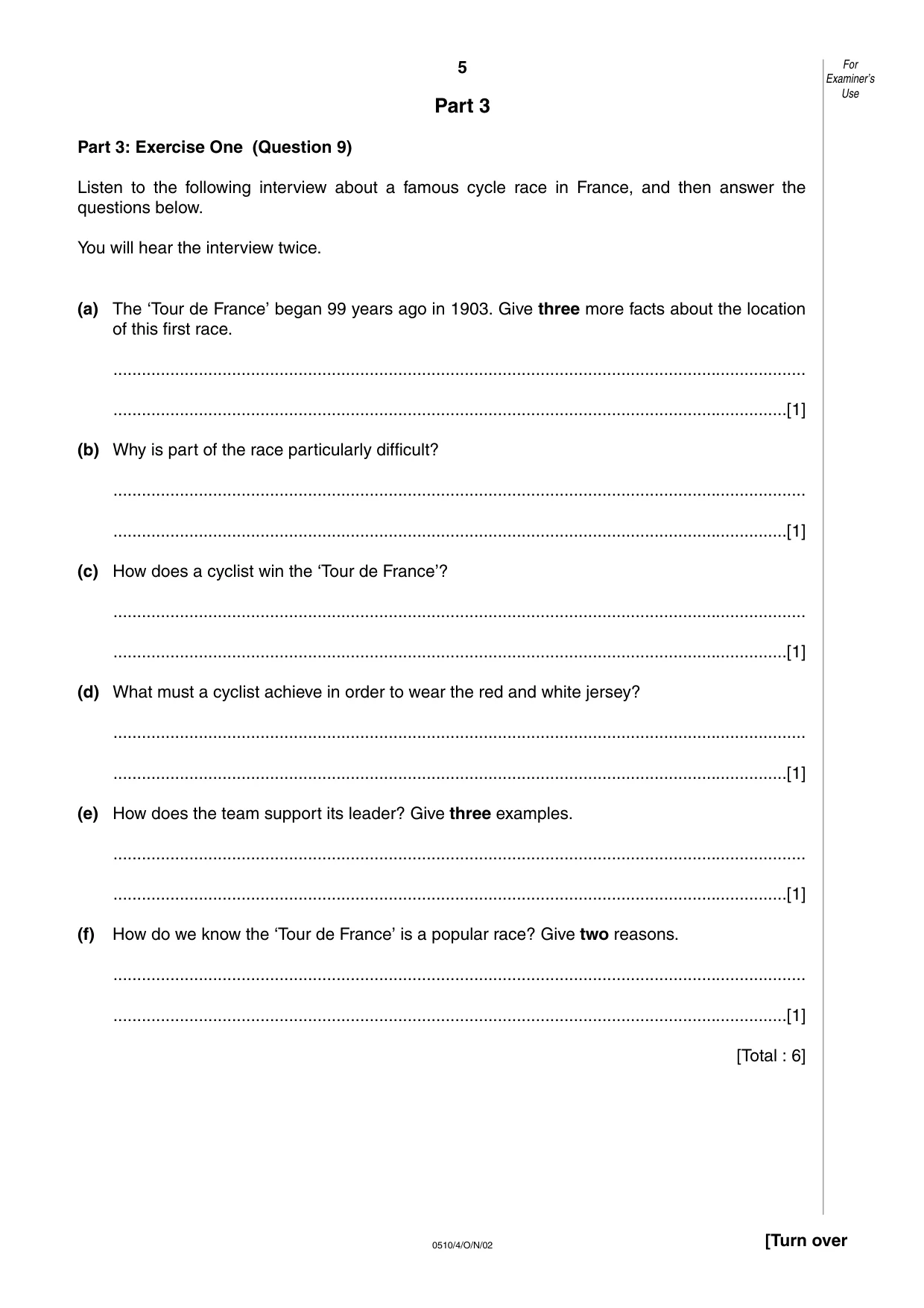
5 0510/4/O/N/02 [Turn over Part 3 Part 3: Exercise One (Question 9) Listen to the following interview about a famous cycle race in France, and then answer the questions below. You will hear the interview twice. (a) The ‘Tour de France’ began 99 years ago in 1903. Give three more facts about the location of this first race. … …[1] (b) Why is part of the race particularly difficult? … …[1] (c) How does a cyclist win the ‘Tour de France’? … …[1] (d) What must a cyclist achieve in order to wear the red and white jersey? … …[1] (e) How does the team support its leader? Give three examples. … …[1] (f) How do we know the ‘Tour de France’ is a popular race? Give two reasons. … …[1] [Total : 6] For Examiner’s Use
Question paper, page 6
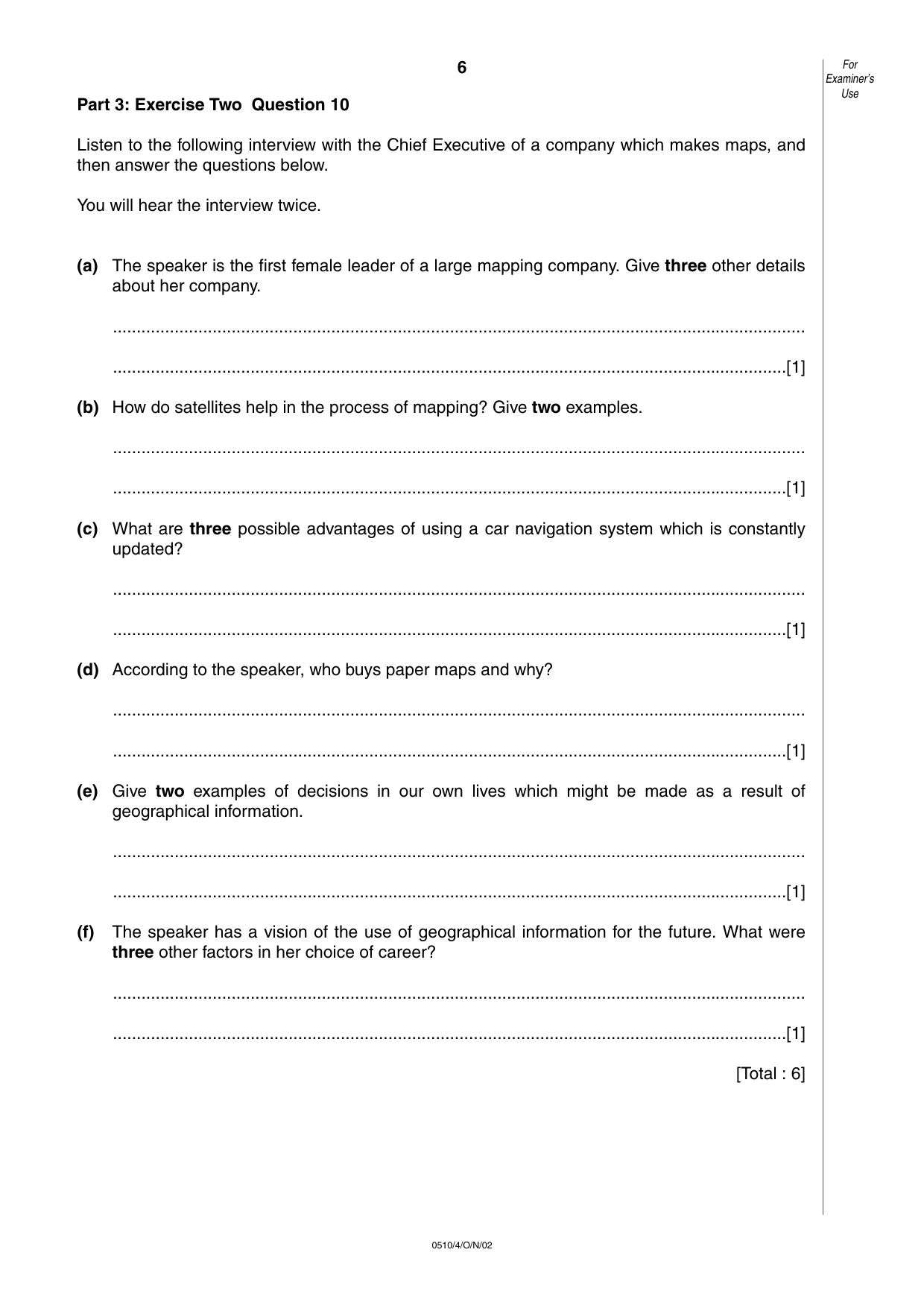
6 0510/4/O/N/02 Part 3: Exercise Two Question 10 Listen to the following interview with the Chief Executive of a company which makes maps, and then answer the questions below. You will hear the interview twice. (a) The speaker is the first female leader of a large mapping company. Give three other details about her company. … …[1] (b) How do satellites help in the process of mapping? Give two examples. … …[1] (c) What are three possible advantages of using a car navigation system which is constantly updated? … …[1] (d) According to the speaker, who buys paper maps and why? … …[1] (e) Give two examples of decisions in our own lives which might be made as a result of geographical information. … …[1] (f) The speaker has a vision of the use of geographical information for the future. What were three other factors in her choice of career? … …[1] [Total : 6] For Examiner’s Use
Mark scheme, page 1
CONFIDENTIAL October/November session 2002 IGCSE ENGLISH AS A SECOND LANGUAGE PAPER 4: LISTENING COMPREHENSION Mark scheme (and tape transcript)
Mark scheme, page 2
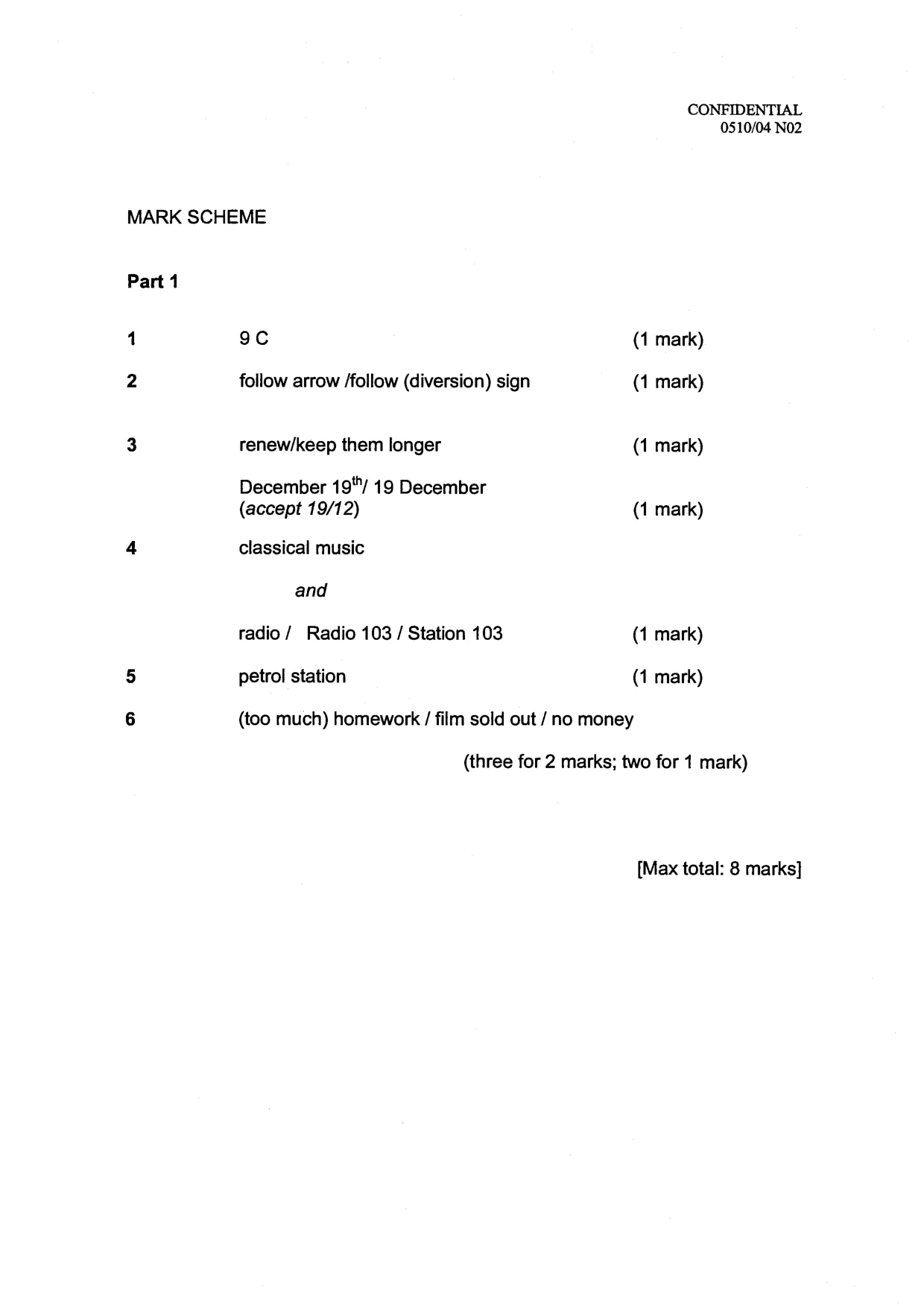
CONFIDENTIAL MARK SCHEME Part 1 41 9c (1 mark) 2 follow arrow /follow (diversion) sign (1 mark) 3 renew/keep them longer (1 mark) December 19"/ 19 December (accept 19/12) (1 mark) 4 classical music and radio / Radio 103 / Station 103 (1 mark) 5 petrol station (1 mark) 6 (too much) homework / film sold out / no money 0510/04 NO2 (three for 2 marks; two for 1 mark) [Max total: 8 marks]
Mark scheme, page 3
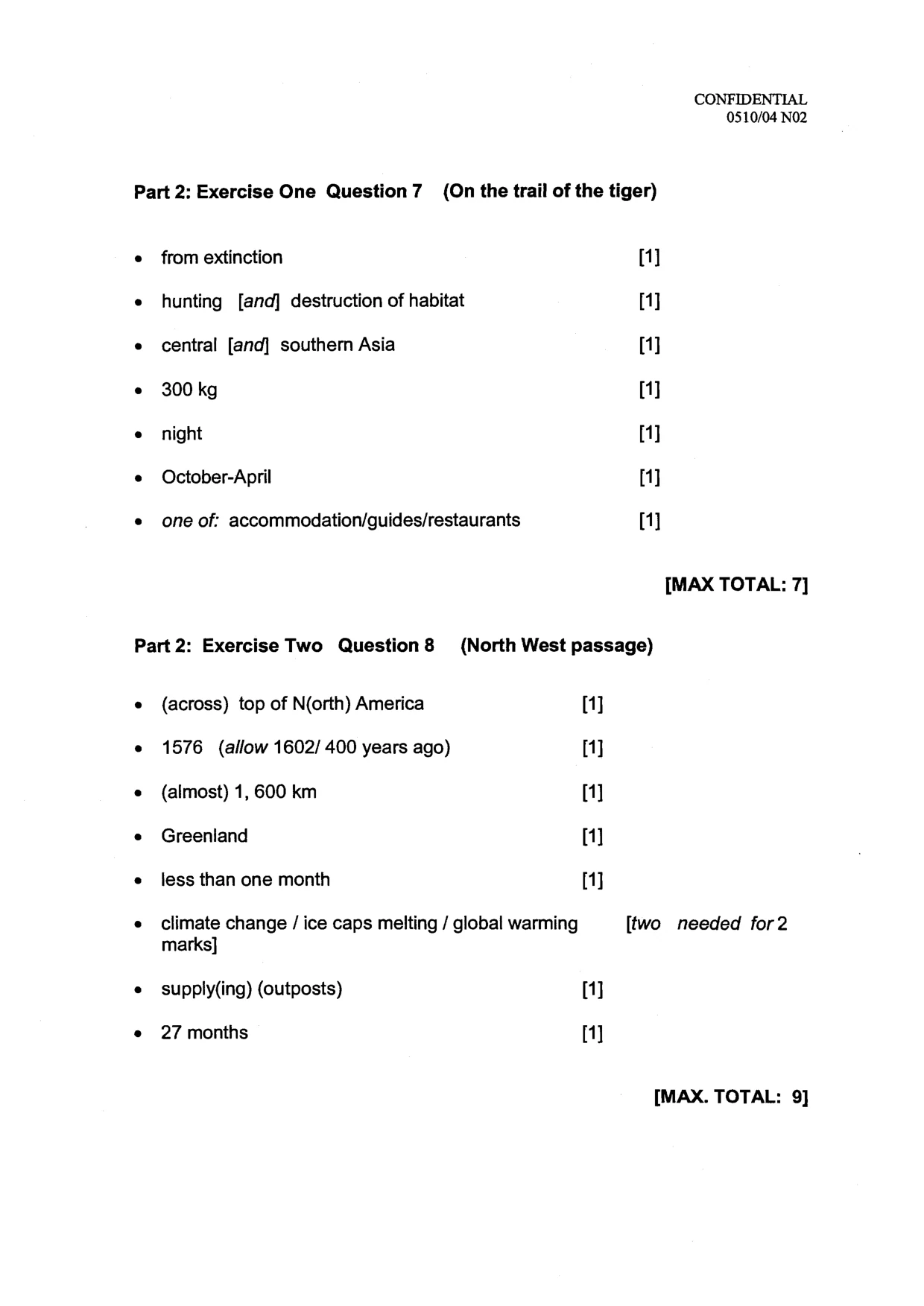
CONFIDENTIAL 0510/04 NO2 Part 2: Exercise One Question 7 (On the trail of the tiger) from extinction e hunting [and] destruction of habitat e central [and] southern Asia ¢ 300 kg e night e October-April ¢ one of: accommodation/guides/restaurants (] [1] [1] [1] [1] [1] (1] [MAX TOTAL: 7] Part 2: Exercise Two Question8 (North West passage) e (across) top of N(orth) America [1] e 1576 (allow 1602/ 400 years ago) [1] e (almost) 1,600 km [1] e Greenland [1] e less than one month [1] e climate change / ice caps melting / global warming marks] e supply(ing) (outposts) [1] e 27 months 11] [two needed for2 [MAX. TOTAL: 9]
Mark scheme, page 4
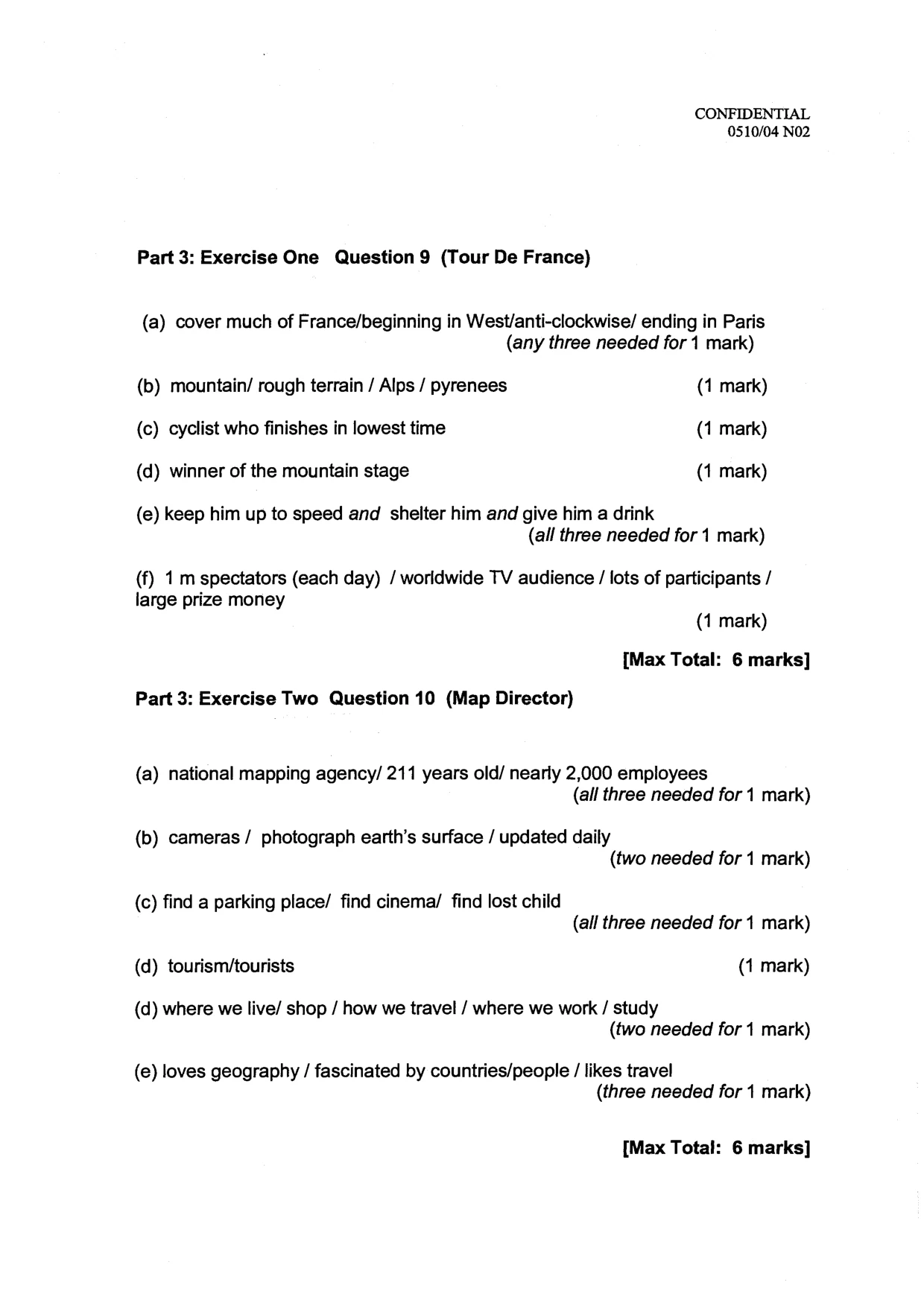
CONFIDENTIAL 0510/04 NO2 Part 3: Exercise One Question 9 (Tour De France) (a) cover much of France/beginning in West/anti-clockwise/ ending in Paris (any three needed for 1 mark) (b) mountain/ rough terrain / Alps / pyrenees (1 mark) (c) cyclist who finishes in lowest time (1 mark) (d) winner of the mountain stage (1 mark) (e) keep him up to speed and shelter him and give him a drink (all three needed for 1 mark) (f) 1m spectators (each day) / worldwide TV audience / lots of participants / large prize money (1 mark) [Max Total: 6 marks] Part 3: Exercise Two Question 10 (Map Director) (a) national mapping agency/ 211 years old/ nearly 2,000 employees (all three needed for 1 mark) (b) cameras / photograph earth’s surface / updated daily (two needed for 1 mark) (c) find a parking place/ find cinema/ find lost child (all three needed for 1 mark) (d) tourism/tourists (1 mark) (d) where we live/ shop / how we travel / where we work / study (two needed for 1 mark) (e) loves geography / fascinated by countries/people / likes travel (three needed for 1 mark) [Max Total: 6 marks]
Mark scheme, page 5
v1 V1 CONFIDENTIAL 0510/04 NO2 TAPESCRIPT IGCSE ENGLISH AS A SECOND LANGUAGE (0510/4) LISTENING COMPREHENSION TAPE SCRIPT OCTOBER/NOVEMBER SESSION 2002 This is the University of Cambridge Local Examinations Syndicate International General Certificate of Secondary Education November 2002 Examination in English as a Second Language. Paper Four - Listening Comprehension. Welcome to the exam. In a moment, your teacher is going to give out the question papers. When you get your paper, fill in your name, Centre number and candidate number on the front page. Do not talk to anyone during the test. If you would like the tape to be louder, tell your teacher NOW. The tape will not be stopped while you are doing the test. Teacher: please give out the question papers, and when all the candidates are ready to start the test, please turn the tape back on. {BLEEP] Now you are all ready, here is the test. Look at the questions for Part One. There are six questions in this part of the exam. For each question you will hear the situation described as it is on your exam paper. You will hear each question twice. Pause 00'05"
Mark scheme, page 6
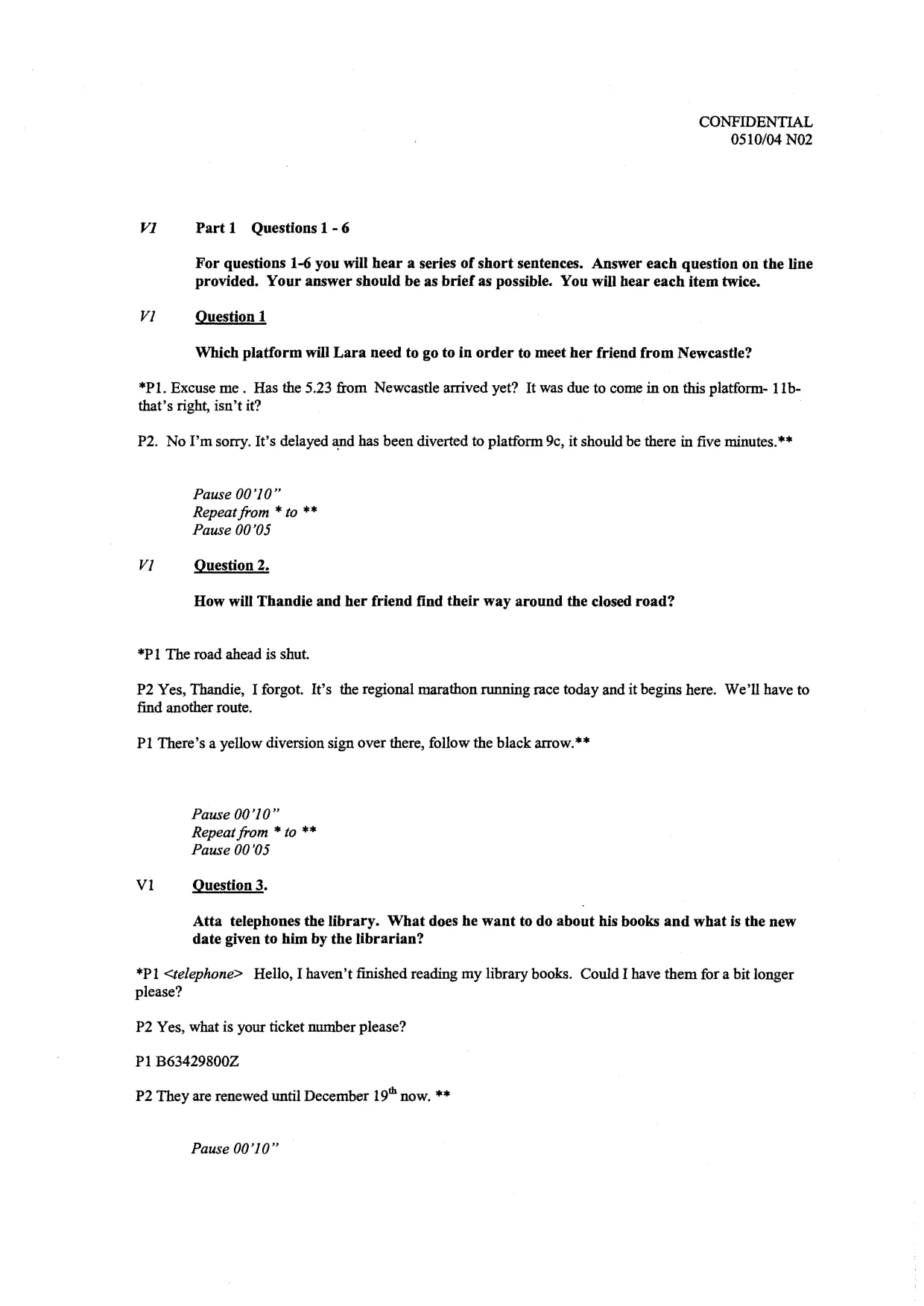
VI vi CONFIDENTIAL 0510/04 NO2 Part1 Questions 1-6 For questions 1-6 you will hear a series of short sentences. Answer each question on the line provided. Your answer should be as brief as possible. You will hear each item twice. Question 1 Which platform will Lara need to go to in order to meet her friend from Newcastle? *P1. Excuse me . Has the 5.23 from Newcastle arrived yet? It was due to come in on this platform- 11b- that’s right, isn’t it? P2. NoI’msorry. It’s delayed and has been diverted to platform 9c, it should be there in five minutes.** v1 Pause 00’10” Repeat from * to ** Pause 00°05 Question 2. How will Thandie and her friend find their way around the closed road? *P1 The road ahead is shut. P2 Yes, Thandie, I forgot. It’s the regional marathon running race today and it begins here. We’ll have to find another route. P1 There’s a yellow diversion sign over there, follow the black arrow.** v1 Pause 00°10” Repeat from * to ** Pause 00°05 Question 3. Atta telephones the library. What does he want to do about his books and what is the new date given to him by the librarian? *P1<telephone> Hello, I haven’t finished reading my library books. Could I have them for a bit longer please? P2 Yes, what is your ticket number please? P1 B63429800Z P2 They are renewed until December 19 now. ** Pause 00’10”
Mark scheme, page 7
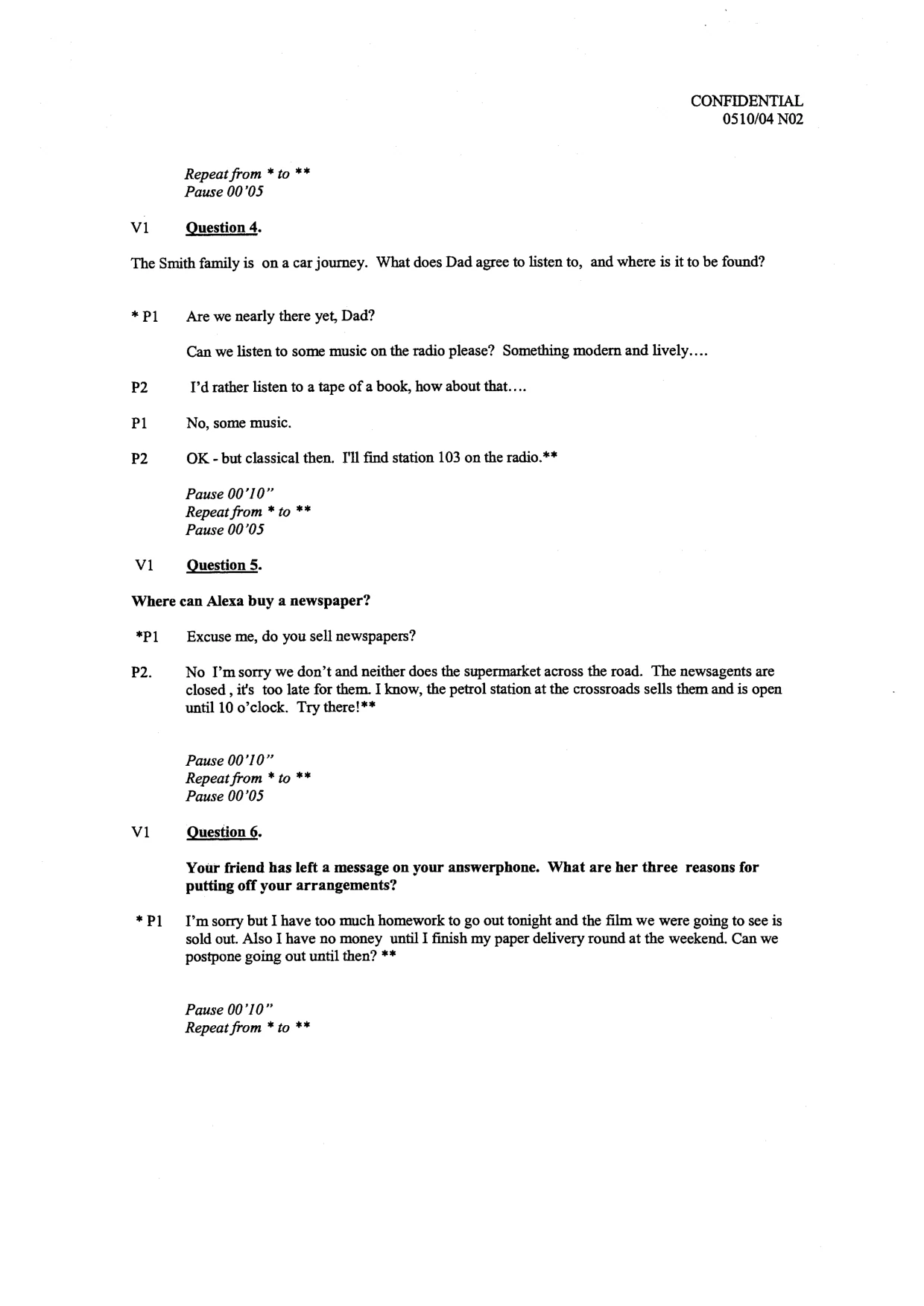
vil CONFIDENTIAL 0510/04 NO2 Repeat from * to ** Pause 00°05 Question 4. The Smith family is on a car journey. What does Dad agree to listen to, and where is it to be found? *Pl P2 Pl P2 vil Are we nearly there yet, Dad? Can we listen to some music on the radio please? Something modern and lively... T’d rather listen to a tape of a book, how about that… No, some music. OK - but classical then. I'll find station 103 on the radio.** Pause 00’10” Repeat from * to ** Pause 00°05 juestion 5. Where can Alexa buy a newspaper? *PL P2. vl *Pl Excuse me, do you sell newspapers? No I’m sorry we don’t and neither does the supermarket across the road. The newsagents are closed , it's too late for them. I know, the petrol station at the crossroads sells them and is open until 10 o’clock. Try there!** Pause 00°10” Repeat from * to ** Pause 00°05 Question 6, Your friend has left a message on your answerphone. What are her three reasons for putting off your arrangements? T’m sorry but I have too much homework to go out tonight and the film we were going to see is sold out. Also I have no money until I finish my paper delivery round at the weekend. Can we postpone going out until then? ** Pause 00°10” Repeat from * to **
Mark scheme, page 8
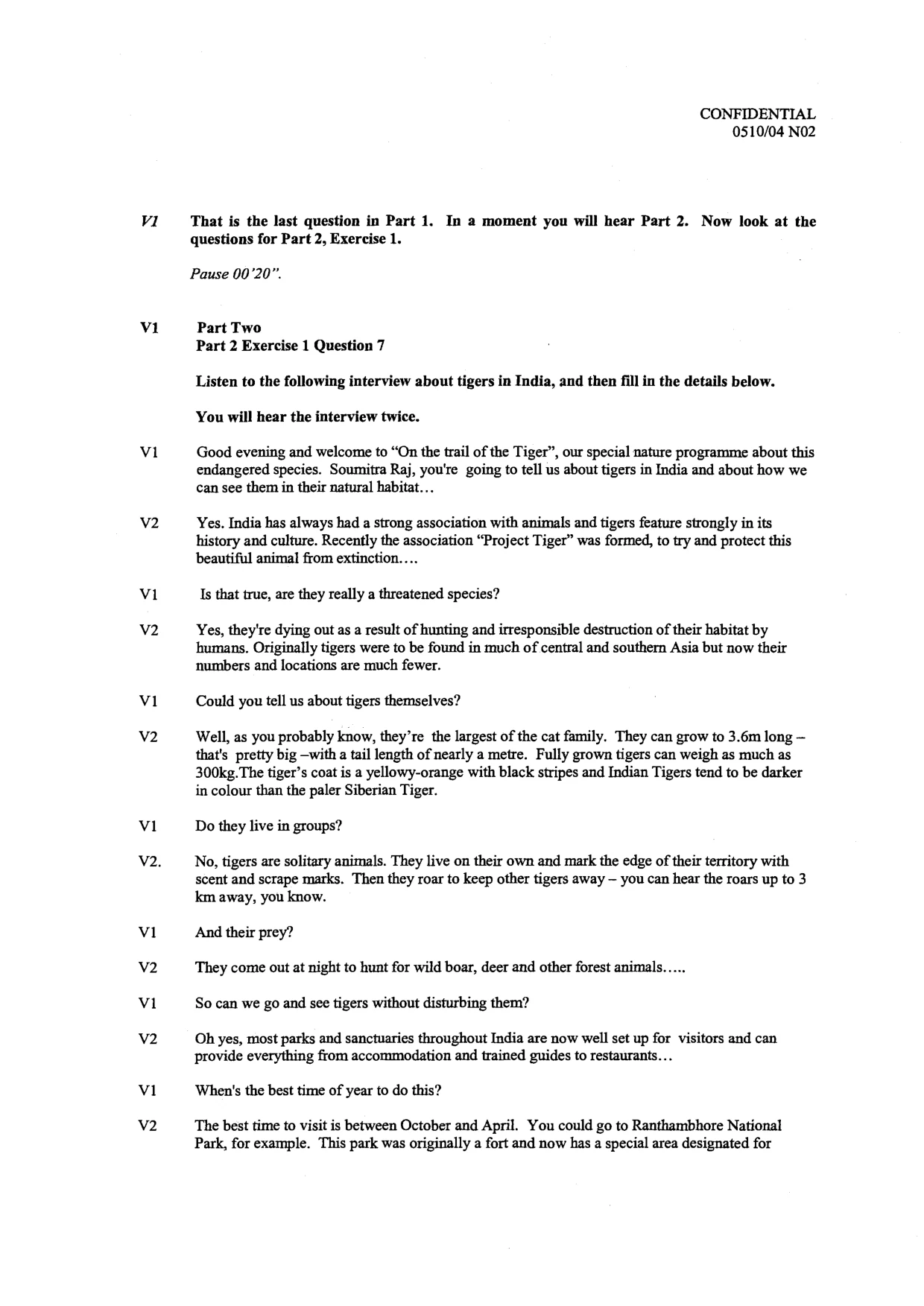
VI Vi vl v2 vi v2 vi v2 vl v2. vi v2 vi v2 vi v2 CONFIDENTIAL 0510/04 NO2 That is the last question in Part 1. In a moment you will hear Part 2. Now look at the questions for Part 2, Exercise 1. Pause 00°20”. Part Two Part 2 Exercise 1 Question 7 Listen to the following interview about tigers in India, and then fill in the details below. You will hear the interview twice. Good evening and welcome to “On the trail of the Tiger”, our special nature programme about this endangered species. Soumitra Raj, you're going to tell us about tigers in India and about how we can see them in their natural habitat... Yes. India has always had a strong association with animals and tigers feature strongly in its history and culture. Recently the association “Project Tiger” was formed, to try and protect this beautiful animal from extinction... Is that true, are they really a threatened species? Yes, they're dying out as a result of hunting and irresponsible destruction of their habitat by humans. Originally tigers were to be found in much of central and southern Asia but now their numbers and locations are much fewer. Could you tell us about tigers themselves? Well, as you probably know, they’re the largest of the cat family. They can grow to 3.6m long — that's pretty big —with a tail length of nearly a metre. Fully grown tigers can weigh as much as 300kg.The tiger’s coat is a yellowy-orange with black stripes and Indian Tigers tend to be darker in colour than the paler Siberian Tiger. Do they live in groups? No, tigers are solitary animals. They live on their own and mark the edge of their territory with scent and scrape marks. Then they roar to keep other tigers away — you can hear the roars up to 3 km away, you know. And their prey? They come out at night to hunt for wild boar, deer and other forest animals… So can we go and see tigers without disturbing them? Oh yes, most parks and sanctuaries throughout India are now well set up for visitors and can provide everything from accommodation and trained guides to restaurants... When's the best time of year to do this? The best time to visit is between October and April. You could go to Ranthambhore National Park, for example. This park was originally a fort and now has a special area designated for
Mark scheme, page 9
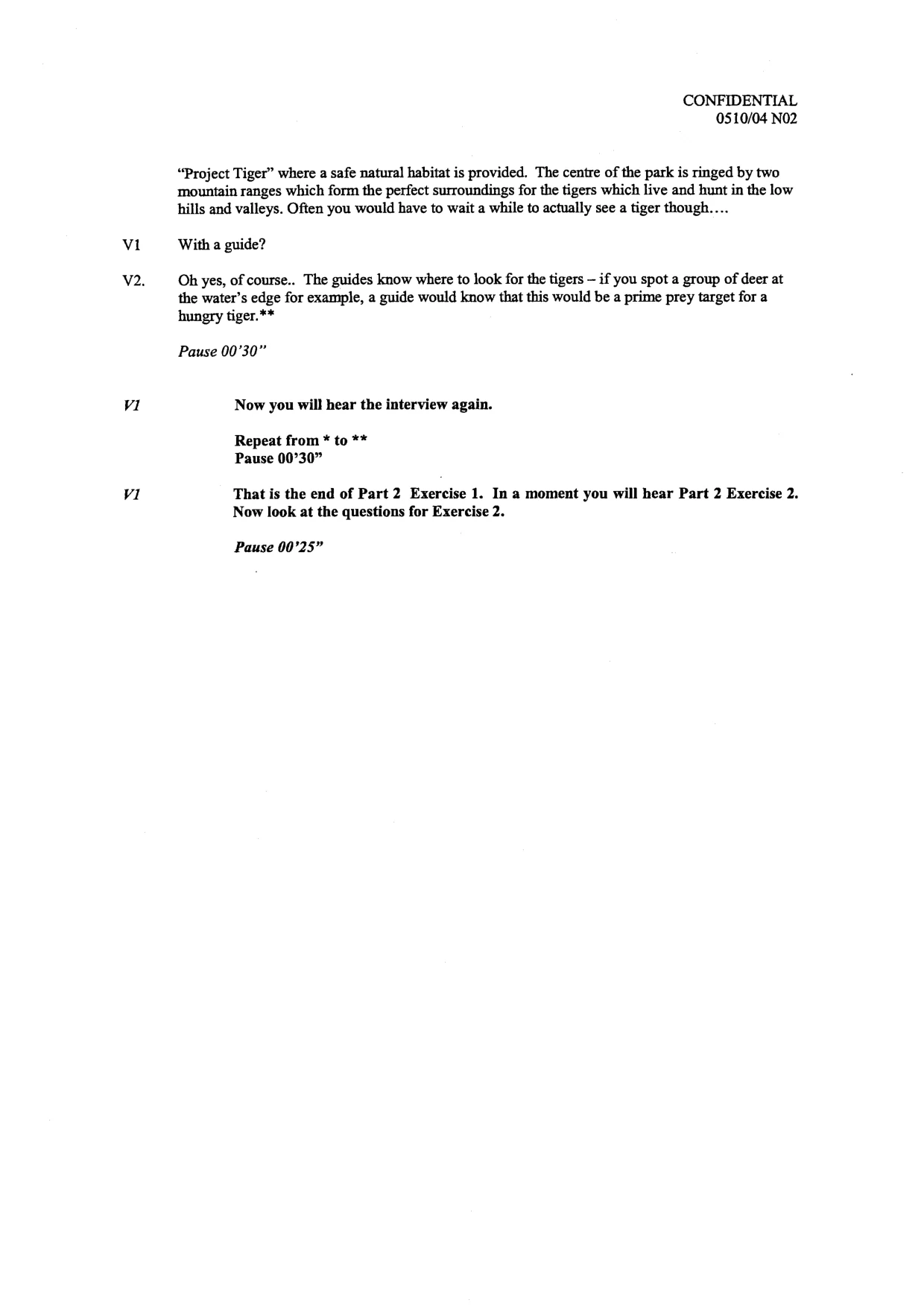
vi v2. Vi VI CONFIDENTIAL 0510/04 NO2 “Project Tiger” where a safe natural habitat is provided. The centre of the park is ringed by two mountain ranges which form the perfect surroundings for the tigers which live and hunt in the low hills and valleys. Often you would have to wait a while to actually see a tiger though... With a guide? Oh yes, of course.. The guides know where to look for the tigers — if you spot a group of deer at the water’s edge for example, a guide would know that this would be a prime prey target for a hungry tiger.** Pause 00°30” Now you will hear the interview again. Repeat from * to ** Pause 00°30” That is the end of Part 2 Exercise 1. In a moment you will hear Part 2 Exercise 2. Now look at the questions for Exercise 2. Pause 00’25”
Mark scheme, page 10
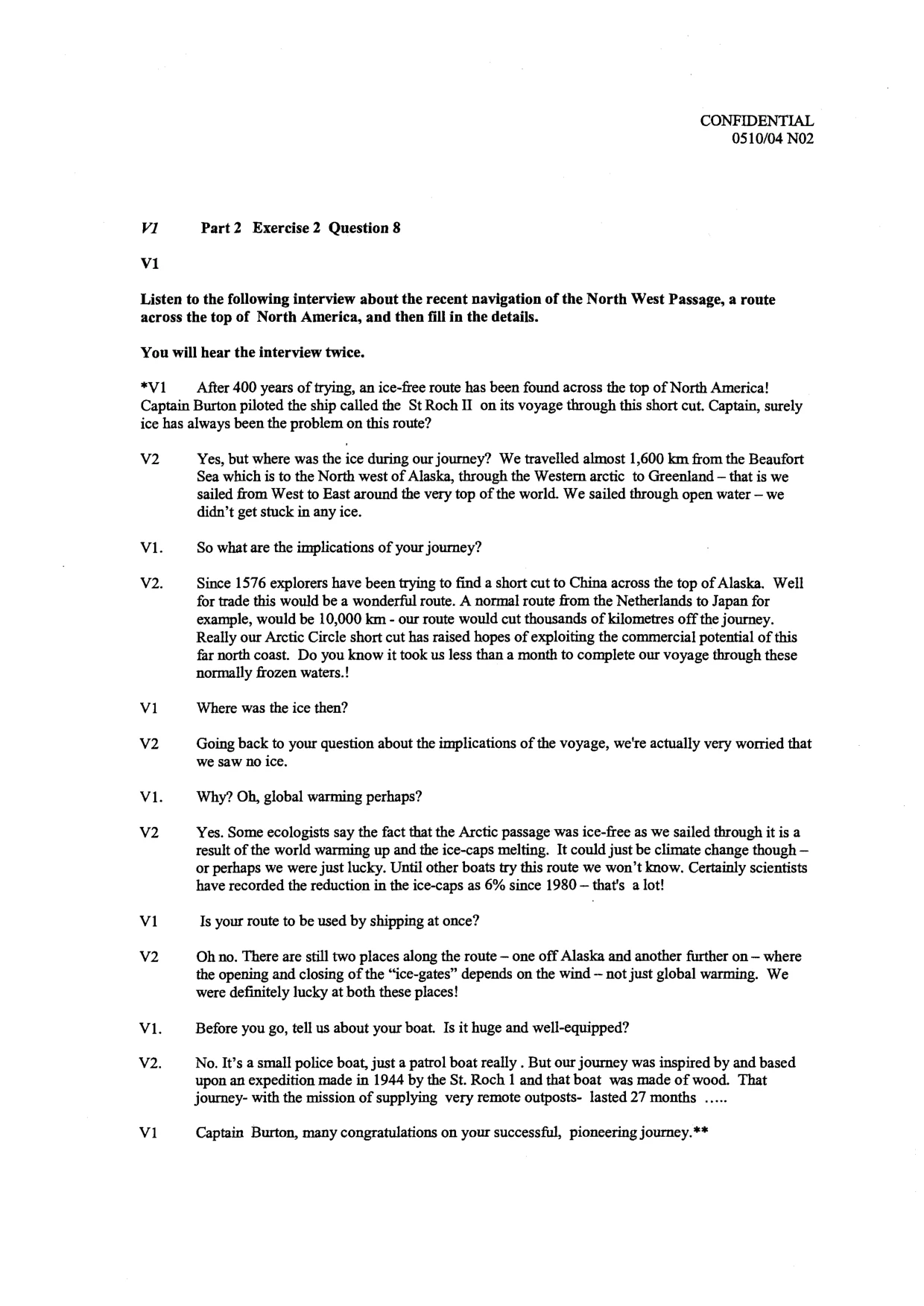
CONFIDENTIAL 0510/04 NO2 VI Part 2 Exercise 2 Question 8 vi Listen to the following interview about the recent navigation of the North West Passage, a route across the top of North America, and then fill in the details. You will hear the interview twice. *V1 After 400 years of trying, an ice-free route has been found across the top of North America! Captain Burton piloted the ship called the St Roch II on its voyage through this short cut. Captain, surely ice has always been the problem on this route? v2 Yes, but where was the ice during our journey? We travelled almost 1,600 km from the Beaufort Sea which is to the North west of Alaska, through the Westem arctic to Greenland — that is we sailed from West to East around the very top of the world. We sailed through open water — we didn’t get stuck in any ice. vi. So what are the implications of your journey? v2. Since 1576 explorers have been trying to find a short cut to China across the top of Alaska. Well for trade this would be a wonderful route. A normal route from the Netherlands to Japan for example, would be 10,000 km - our route would cut thousands of kilometres off the journey. Really our Arctic Circle short cut has raised hopes of exploiting the commercial potential of this far north coast. Do you know it took us less than a month to complete our voyage through these normally frozen waters.! v1 Where was the ice then? v2 Going back to your question about the implications of the voyage, we're actually very worried that we saw no ice. Vi. Why? Oh, global warming perhaps? v2 Yes. Some ecologists say the fact that the Arctic passage was ice-free as we sailed through it is a result of the world warming up and the ice-caps melting. It could just be climate change though — or perhaps we were just lucky. Until other boats try this route we won’t know. Certainly scientists have recorded the reduction in the ice-caps as 6% since 1980 — that's a lot! v1 Is your route to be used by shipping at once? v2 Oh no. There are still two places along the route — one off Alaska and another further on — where the opening and closing of the “ice-gates” depends on the wind — not just global warming. We were definitely lucky at both these places! Vi. Before you go, tell us about your boat. Is it huge and well-equipped? v2. No. It’s a small police boat, just a patrol boat really . But our journey was inspired by and based upon an expedition made in 1944 by the St. Roch 1 and that boat was made of wood. That journey- with the mission of supplying very remote outposts- lasted 27 months … Vi Captain Burton, many congratulations on your successful, pioneering journey.**
Mark scheme, page 11
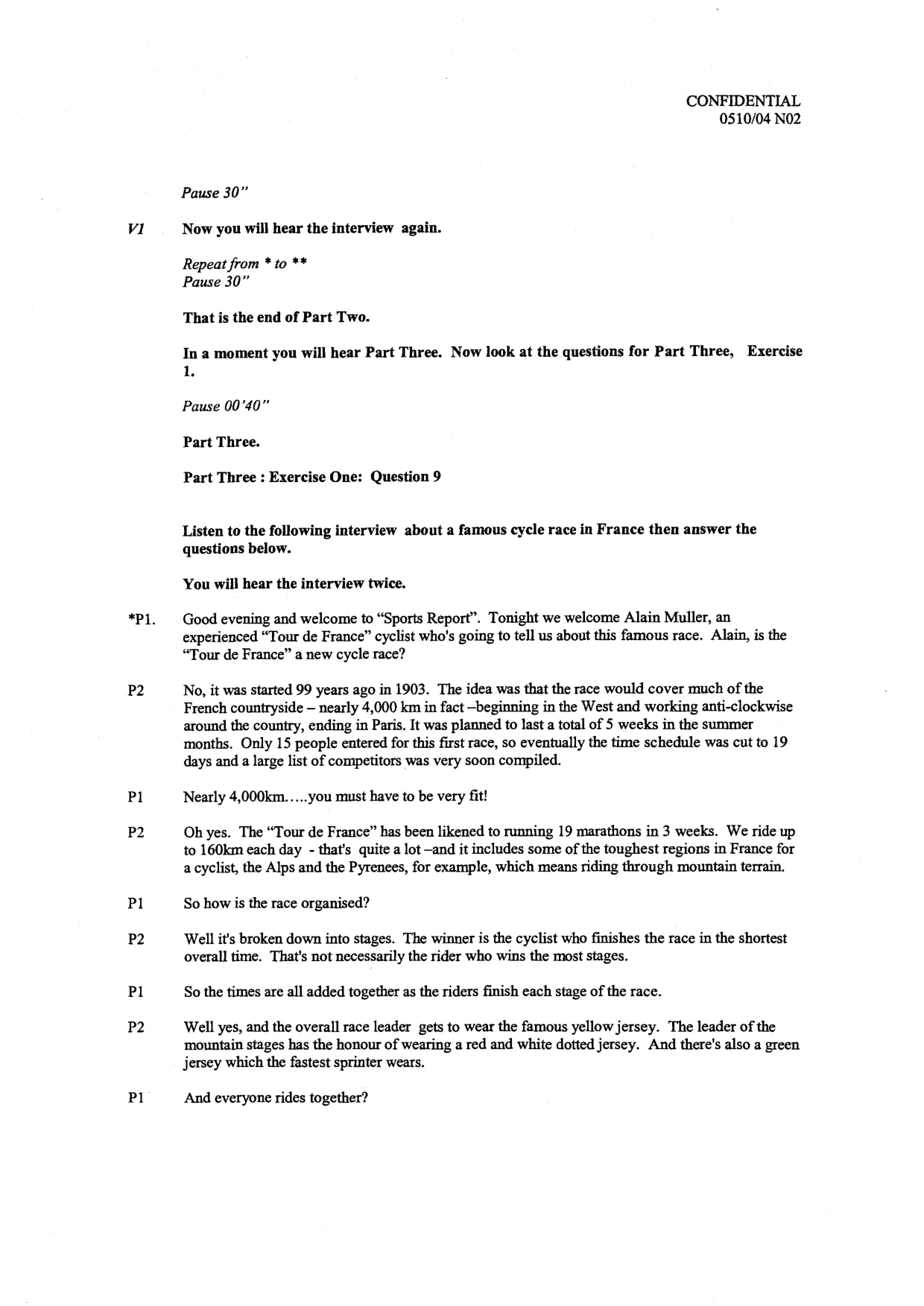
VI *P1. P2 Pl P2 Pl P2 Pl P2 Pl CONFIDENTIAL 0510/04 NO2 Pause 30” Now you will hear the interview again. Repeat from * to ** Pause 30” That is the end of Part Two. In a moment you will hear Part Three. Now look at the questions for Part Three, Exercise 1. Pause 00’40” Part Three. Part Three : Exercise One: Question 9 Listen to the following interview about a famous cycle race in France then answer the questions below. You will hear the interview twice. Good evening and welcome to “Sports Report”. Tonight we welcome Alain Muller, an experienced “Tour de France” cyclist who's going to tell us about this famous race. Alain, is the “Tour de France” a new cycle race? No, it was started 99 years ago in 1903. The idea was that the race would cover much of the French countryside — nearly 4,000 km in fact —beginning in the West and working anti-clockwise around the country, ending in Paris. It was planned to last a total of 5 weeks in the summer months. Only 15 people entered for this first race, so eventually the time schedule was cut to 19 days and a large list of competitors was very soon compiled. Nearly 4,000km…you must have to be very fit! Oh yes. The “Tour de France” has been likened to running 19 marathons in 3 weeks. We ride up to 160km each day - that's quite a lot and it includes some of the toughest regions in France for a cyclist, the Alps and the Pyrenees, for example, which means riding through mountain terrain. So how is the race organised? Well it's broken down into stages. The winner is the cyclist who finishes the race in the shortest overall time. That's not necessarily the rider who wins the most stages. So the times are all added together as the riders finish each stage of the race. Well yes, and the overall race leader gets to wear the famous yellow jersey. The leader of the mountain stages has the honour of wearing a red and white dotted jersey. And there's also a green jersey which the fastest sprinter wears. And everyone rides together?
Mark scheme, page 12
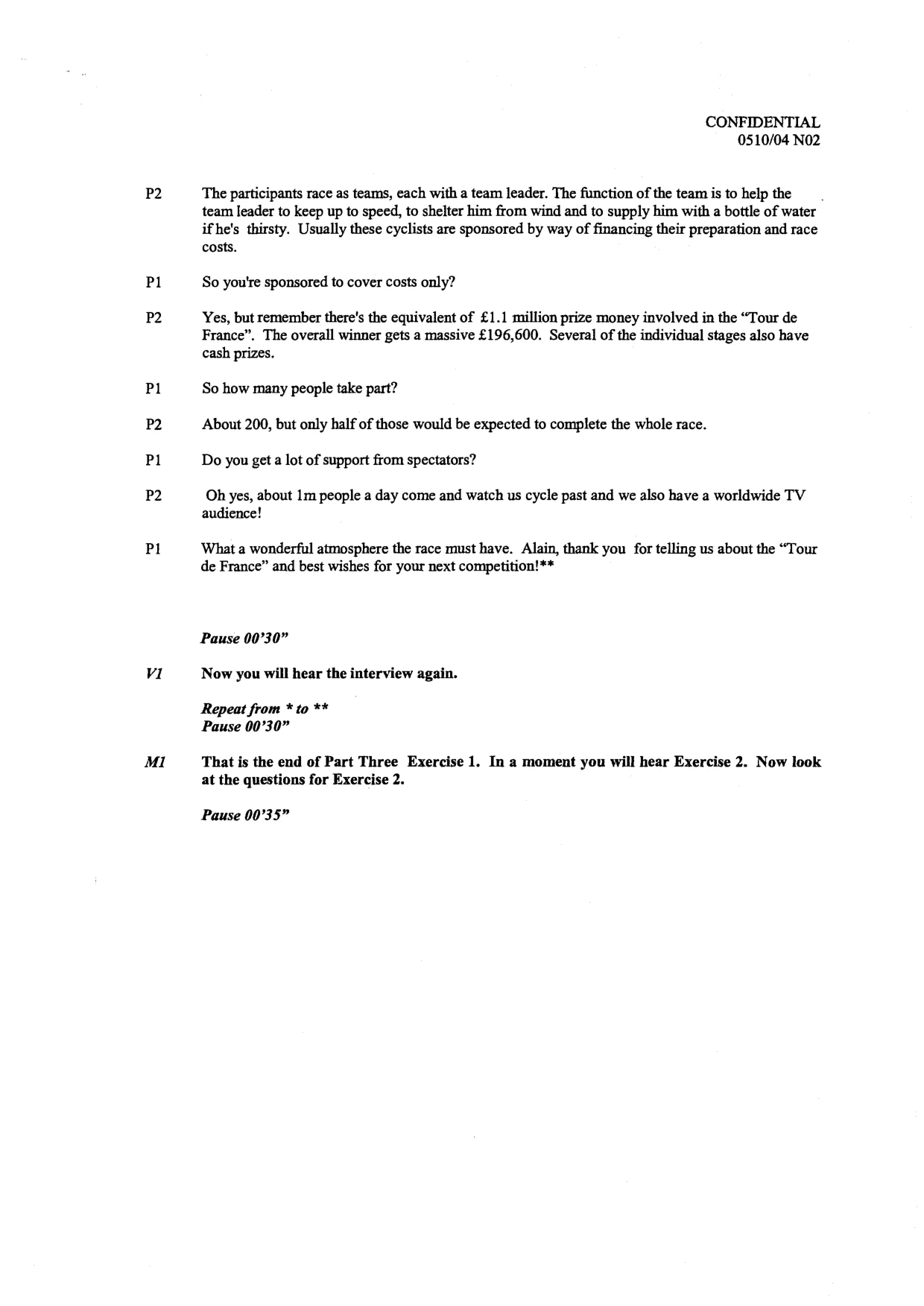
P2 Pl P2 Pl P2 Pl P2 Pl VI MI CONFIDENTIAL 0510/04 N02 The participants race as teams, each with a team leader. The function of the team is to help the team leader to keep up to speed, to shelter him from wind and to supply him with a bottle of water ifhe's thirsty. Usually these cyclists are sponsored by way of financing their preparation and race costs. So you're sponsored to cover costs only? Yes, but remember there's the equivalent of £1.1 million prize money involved in the “Tour de France”. The overall winner gets a massive £196,600. Several of the individual stages also have cash prizes. So how many people take part? About 200, but only half of those would be expected to complete the whole race. Do you get a lot of support from spectators? Oh yes, about 1m people a day come and watch us cycle past and we also have a worldwide TV audience! What a wonderful atmosphere the race must have. Alain, thank you for telling us about the “Tour de France” and best wishes for your next competition!** Pause 00°30” Now you will hear the interview again. Repeat from * to ** Pause 00°30” That is the end of Part Three Exercise 1. In a moment you will hear Exercise 2. Now look at the questions for Exercise 2. Pause 00°35”
Mark scheme, page 13
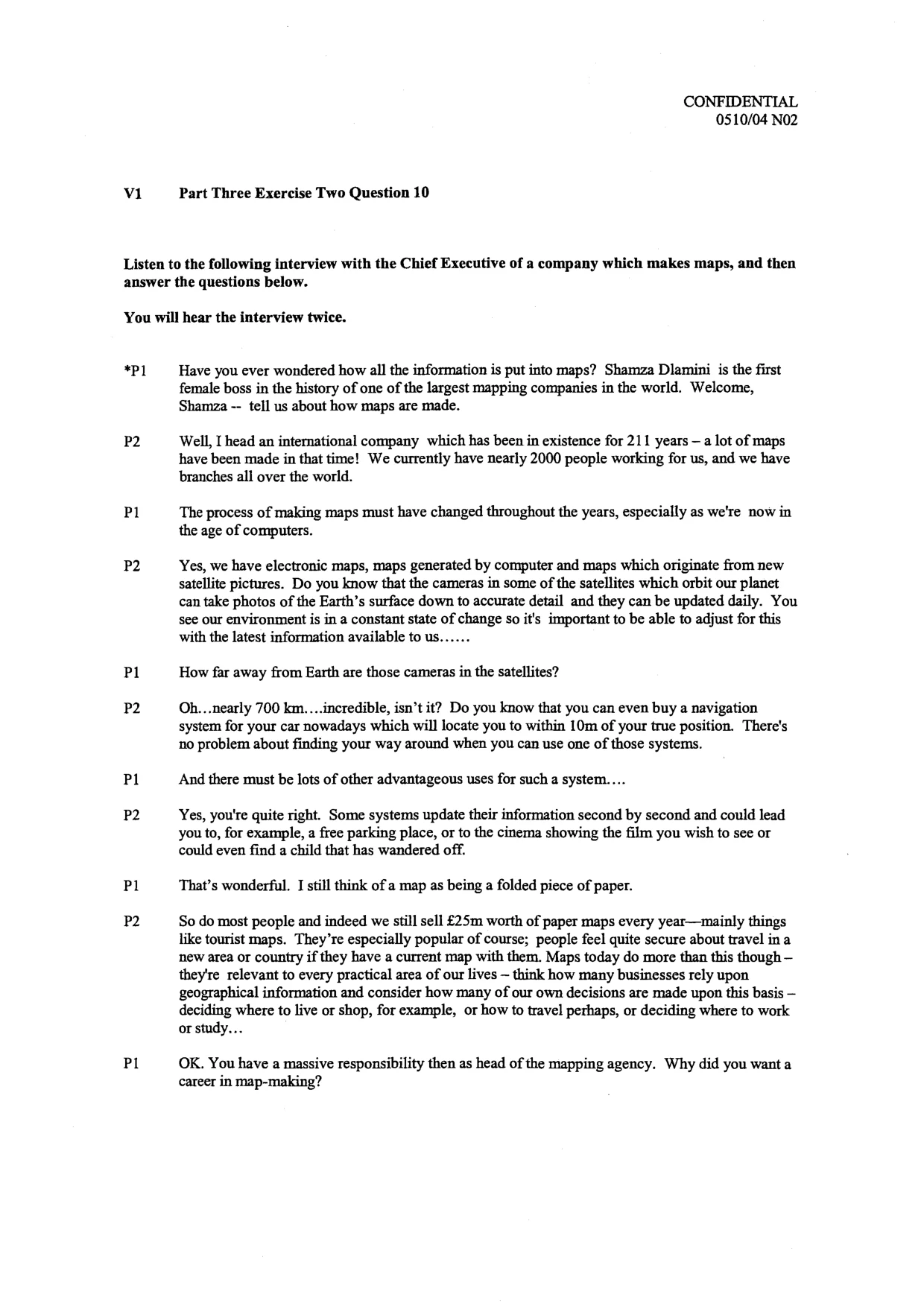
v1 CONFIDENTIAL 0510/04 NO2 Part Three Exercise Two Question 10 Listen to the following interview with the Chief Executive of a company which makes maps, and then answer the questions below. You will hear the interview twice. *Pl P2 Pl P2 Pl P2 Pl P2 Pl P2 Pl Have you ever wondered how all the information is put into maps? Shamza Dlamini is the first female boss in the history of one of the largest mapping companies in the world. Welcome, Shamza -- tell us about how maps are made. Well, I head an international company which has been in existence for 211 years — a lot of maps have been made in that time! We currently have nearly 2000 people working for us, and we have branches all over the world. The process of making maps must have changed throughout the years, especially as we're now in the age of computers. Yes, we have electronic maps, maps generated by computer and maps which originate from new satellite pictures. Do you know that the cameras in some of the satellites which orbit our planet can take photos of the Earth’s surface down to accurate detail and they can be updated daily. You see our environment is in a constant state of change so it's important to be able to adjust for this with the latest information available to us… How far away from Earth are those cameras in the satellites? Oh...nearly 700 km…incredible, isn’t it? Do you know that you can even buy a navigation system for your car nowadays which will locate you to within 10m of your true position. There's no problem about finding your way around when you can use one of those systems. And there must be lots of other advantageous uses for such a system… Yes, you're quite right. Some systems update their information second by second and could lead you to, for example, a free parking place, or to the cinema showing the film you wish to see or could even find a child that has wandered off. That’s wonderful. I still think of a map as being a folded piece of paper. So do most people and indeed we still sell £25m worth of paper maps every year—mainly things like tourist maps. They’re especially popular of course; people feel quite secure about travel in a new area or country if they have a current map with them. Maps today do more than this though — they're relevant to every practical area of our lives — think how many businesses rely upon geographical information and consider how many of our own decisions are made upon this basis — deciding where to live or shop, for example, or how to travel perhaps, or deciding where to work or study... OK. You have a massive responsibility then as head of the mapping agency. Why did you want a career in map-making?
Mark scheme, page 14
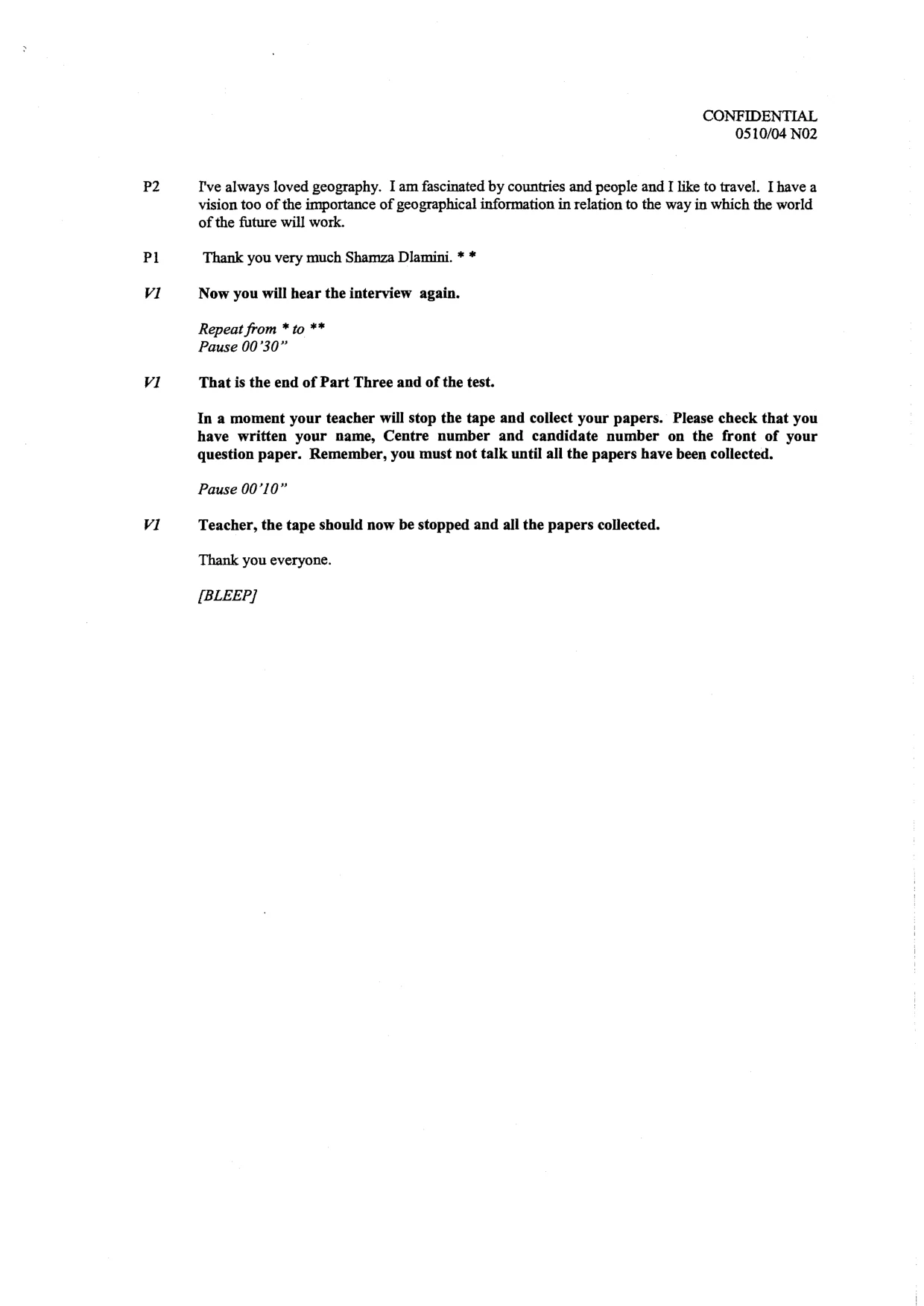
P2 Pl VI VI VI CONFIDENTIAL 0510/04 N02 T've always loved geography. I am fascinated by countries and people and I like to travel. Ihave a vision too of the importance of geographical information in relation to the way in which the world of the future will work. Thank you very much Shamza Dlamini. * * Now you will hear the interview again. Repeat from * to ** Pause 00°30” That is the end of Part Three and of the test. In a moment your teacher will stop the tape and collect your papers. Please check that you have written your name, Centre number and candidate number on the front of your question paper. Remember, you must not talk until all the papers have been collected. Pause 00°10” Teacher, the tape should now be stopped and all the papers collected. Thank you everyone. [BLEEP]