Cambridge IGCSE English - Second Language (count-in oral) 0511 — 2016 Oct/Nov Paper 2 · Variant 3
0511/23/O/N/16 · 90 marks · ≈101 min
The question paper and its mark scheme, free to read here and free to download. This is Cambridge’s own paper, exactly as it was sat.
Question paper16 pages

Mark scheme10 pages
Answers below. Sit the paper first if you are practising.
Paper as text
Question paper, page 1
This document consists of 15 printed pages and 1 blank page. DC (AL) 131930 © UCLES 2016 [Turn over Cambridge International Examinations Cambridge International General Certificate of Secondary Education * 0 6 6 0 9 6 1 8 2 1 * ENGLISH AS A SECOND LANGUAGE 0511/23 Paper 2 Reading and Writing (Extended) October/November 2016 2 hours Candidates answer on the Question Paper. No Additional Materials are required. READ THESE INSTRUCTIONS FIRST Write your Centre number, candidate number and name on all the work you hand in. Write in dark blue or black pen. Do not use staples, paper clips, glue or correction fluid. DO NOT WRITE IN ANY BARCODES. Answer all questions. Dictionaries are not allowed. At the end of the examination, fasten all your work securely together. The number of marks is given in brackets [ ] at the end of each question or part question. The syllabus is approved for use in England, Wales and Northern Ireland as a Cambridge International Level 1/Level 2 Certificate.
Question paper, page 2
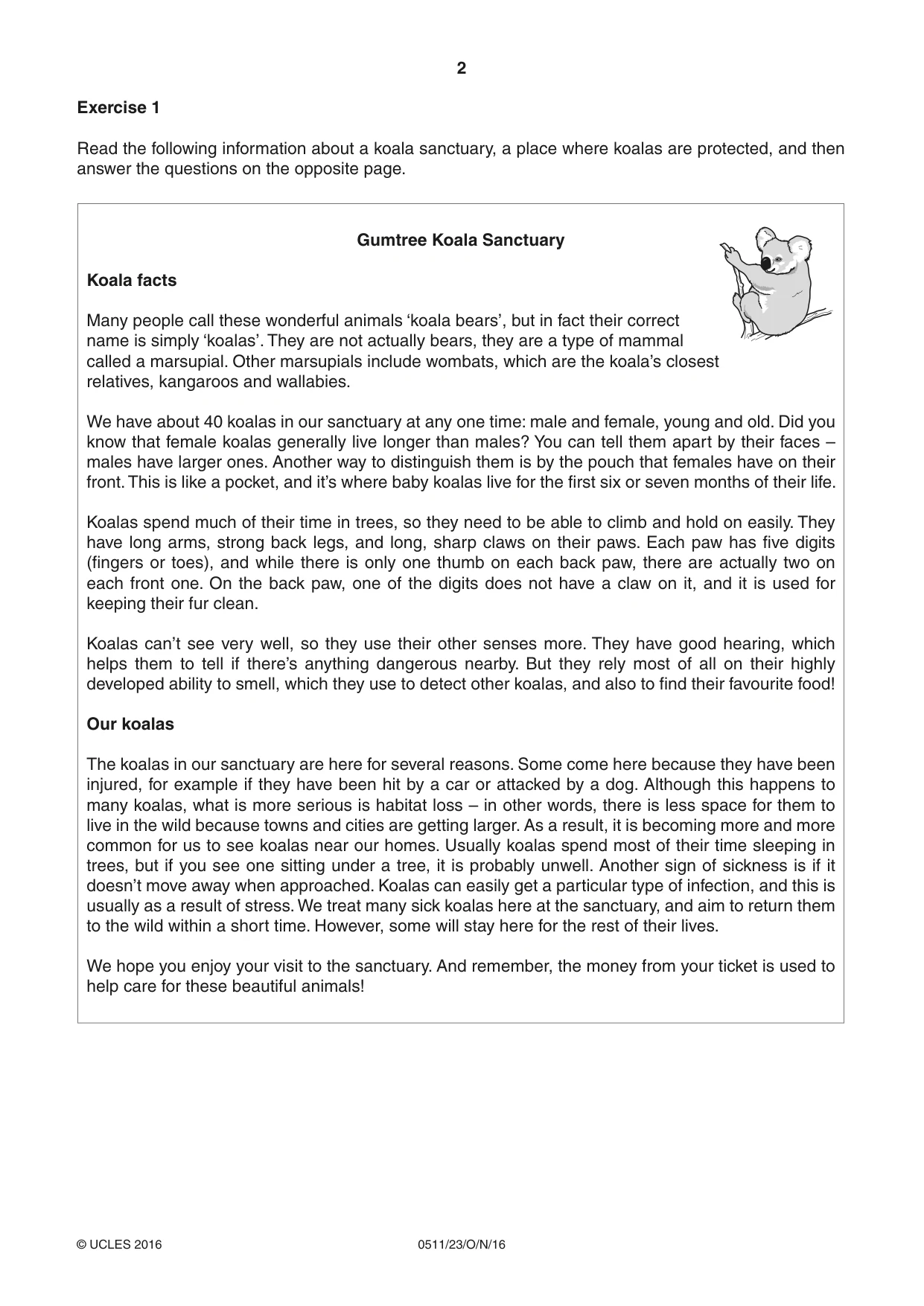
2 0511/23/O/N/16 © UCLES 2016 Exercise 1 Read the following information about a koala sanctuary, a place where koalas are protected, and then answer the questions on the opposite page. Gumtree Koala Sanctuary Koala facts Many people call these wonderful animals ‘koala bears’, but in fact their correct name is simply ‘koalas’. They are not actually bears, they are a type of mammal called a marsupial. Other marsupials include wombats, which are the koala’s closest relatives, kangaroos and wallabies. We have about 40 koalas in our sanctuary at any one time: male and female, young and old. Did you know that female koalas generally live longer than males? You can tell them apart by their faces – males have larger ones. Another way to distinguish them is by the pouch that females have on their front. This is like a pocket, and it’s where baby koalas live for the first six or seven months of their life. Koalas spend much of their time in trees, so they need to be able to climb and hold on easily. They have long arms, strong back legs, and long, sharp claws on their paws. Each paw has five digits (fingers or toes), and while there is only one thumb on each back paw, there are actually two on each front one. On the back paw, one of the digits does not have a claw on it, and it is used for keeping their fur clean. Koalas can’t see very well, so they use their other senses more. They have good hearing, which helps them to tell if there’s anything dangerous nearby. But they rely most of all on their highly developed ability to smell, which they use to detect other koalas, and also to find their favourite food! Our koalas The koalas in our sanctuary are here for several reasons. Some come here because they have been injured, for example if they have been hit by a car or attacked by a dog. Although this happens to many koalas, what is more serious is habitat loss – in other words, there is less space for them to live in the wild because towns and cities are getting larger. As a result, it is becoming more and more common for us to see koalas near our homes. Usually koalas spend most of their time sleeping in trees, but if you see one sitting under a tree, it is probably unwell. Another sign of sickness is if it doesn’t move away when approached. Koalas can easily get a particular type of infection, and this is usually as a result of stress. We treat many sick koalas here at the sanctuary, and aim to return them to the wild within a short time. However, some will stay here for the rest of their lives. We hope you enjoy your visit to the sanctuary. And remember, the money from your ticket is used to help care for these beautiful animals!
Question paper, page 3
3 0511/23/O/N/16 © UCLES 2016 [Turn over (a) Which species are koalas most closely related to? …[1] (b) How do male and female koalas differ in appearance? Give two details. … …[2] (c) What is unusual about koalas’ front paws? …[1] (d) Which is the koala’s strongest sense? …[1] (e) What is the biggest threat to koalas nowadays? …[1] (f) How can you tell if a koala is ill? Give two details. … …[2] (g) What commonly causes many koalas to get an infection? …[1] [Total: 9]
Question paper, page 4
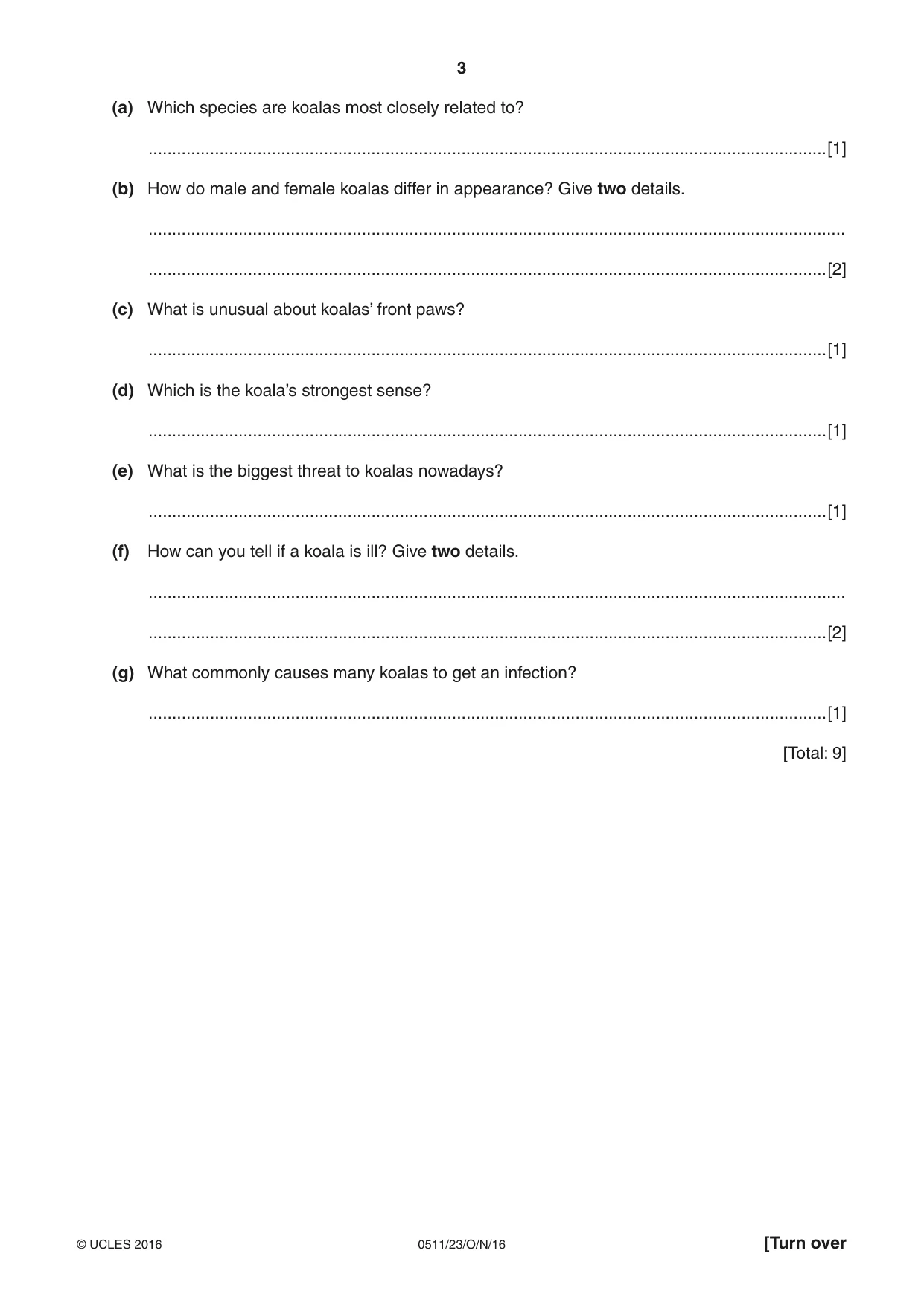
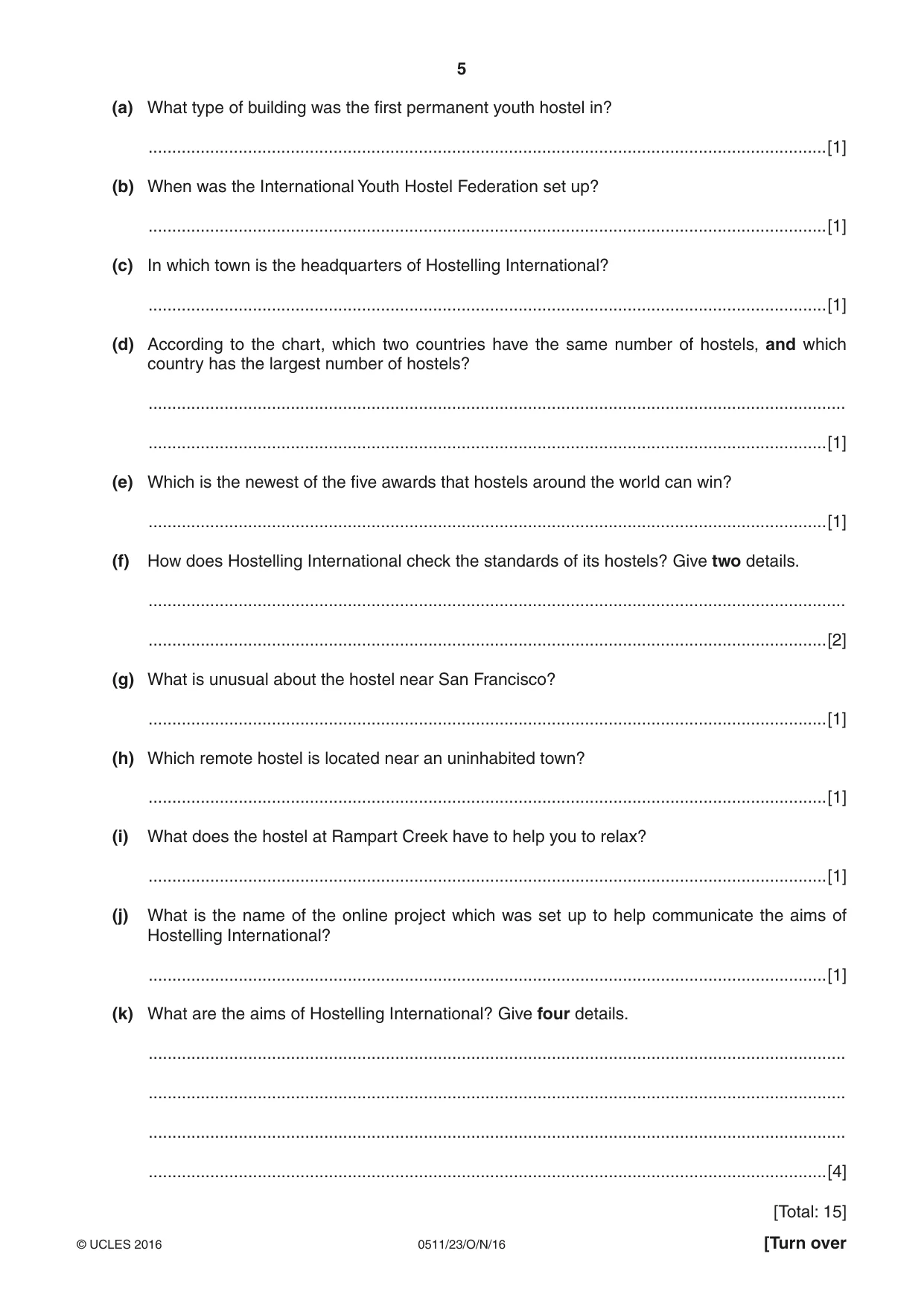
4 0511/23/O/N/16 © UCLES 2016 Exercise 2 Read the following article about an organisation called Hostelling International, and then answer the questions on the opposite page. Hostelling International The idea of opening youth hostels first came from Germany in 1909, when a teacher called Richard Schirrmann saw the need for overnight accommodation for students on school trips to the countryside. This teacher’s own school was the first building to be used as a youth hostel during the holidays, with classrooms being temporarily converted to accommodate beds. Soon after this, he opened a hostel that could be used throughout the year, in a castle in the same town. 90 80 70 60 50 40 30 20 10 Brazil Number of hostels Colombia Ireland Italy Japan New Zealand Russia Scotland The idea of youth hostels quickly spread across Germany, and in 1919, Schirrmann founded the German Youth Hostel Association. By 1932, the movement had spread worldwide, and the International Youth Hostel Federation came into existence in that year. It wasn’t until 2006 that this became Hostelling International (HI), as the organisation is now known. Despite the change in name, the organisation has the same values, and its purpose remains to provide accommodation around the world that young people can afford. The head office of the organisation is currently based in a town just outside London, in Welwyn Garden City, and more than 70 national youth hostel associations are members, with more than 4000 hostels worldwide. This number continues to grow, supporting another aim of the organisation, which is to enable young people to experience different cultures. Every year, awards are given to hostels, in five different categories. These include Most Comfortable Hostel, Friendliest Hostel and Best Hostel. In 2012, the Green Award was introduced. There is also an award for Best Country, which was won by the USA in 2013. In order to find out what the hostels are really like, guests are asked to give feedback. There are also regular inspections by the HI team. The intention of the organisation is that all hostels should provide the same high standards for their guests. Hostels are always interesting places to stay in because of the variety of people you meet in them. It’s a great way to develop a better understanding of other people – which is another of the organisation’s objectives. But some hostels are interesting for other reasons too. For example, the accommodation is not always what you might expect. You can stay in a jumbo jet in Stockholm, or in a lighthouse in California, just 25 miles south of San Francisco. And if you like getting away from it all and staying in the middle of nowhere, that is possible too. After all, another intention of the organisation is to encourage young people to look after the countryside. The top five remote hostels include Loch Ossian Hostel in the Scottish highlands, and Hostel Ytra Lón, in Iceland, where the nearest town now has a population of zero. But being remote doesn’t necessarily mean that a hostel will be basic or uncomfortable. At Rampart Creek Hostel, Canada, for example, after a hard day of trekking in the mountains, you can unwind in the hostel sauna, while you plan your next day’s adventures. One of the best ways to find out about the organisation and its hostels is to go online, at www.hihostels.com In 2013, the organisation developed The Big Blog Exchange on its website, as a way to engage with people all around the world and of course to broadcast their aims to a wider audience.
Question paper, page 5
5 0511/23/O/N/16 © UCLES 2016 [Turn over (a) What type of building was the first permanent youth hostel in? …[1] (b) When was the International Youth Hostel Federation set up? …[1] (c) In which town is the headquarters of Hostelling International? …[1] (d) According to the chart, which two countries have the same number of hostels, and which country has the largest number of hostels? … …[1] (e) Which is the newest of the five awards that hostels around the world can win? …[1] (f) How does Hostelling International check the standards of its hostels? Give two details. … …[2] (g) What is unusual about the hostel near San Francisco? …[1] (h) Which remote hostel is located near an uninhabited town? …[1] (i) What does the hostel at Rampart Creek have to help you to relax? …[1] (j) What is the name of the online project which was set up to help communicate the aims of Hostelling International? …[1] (k) What are the aims of Hostelling International? Give four details. … … … …[4] [Total: 15]
Question paper, page 6
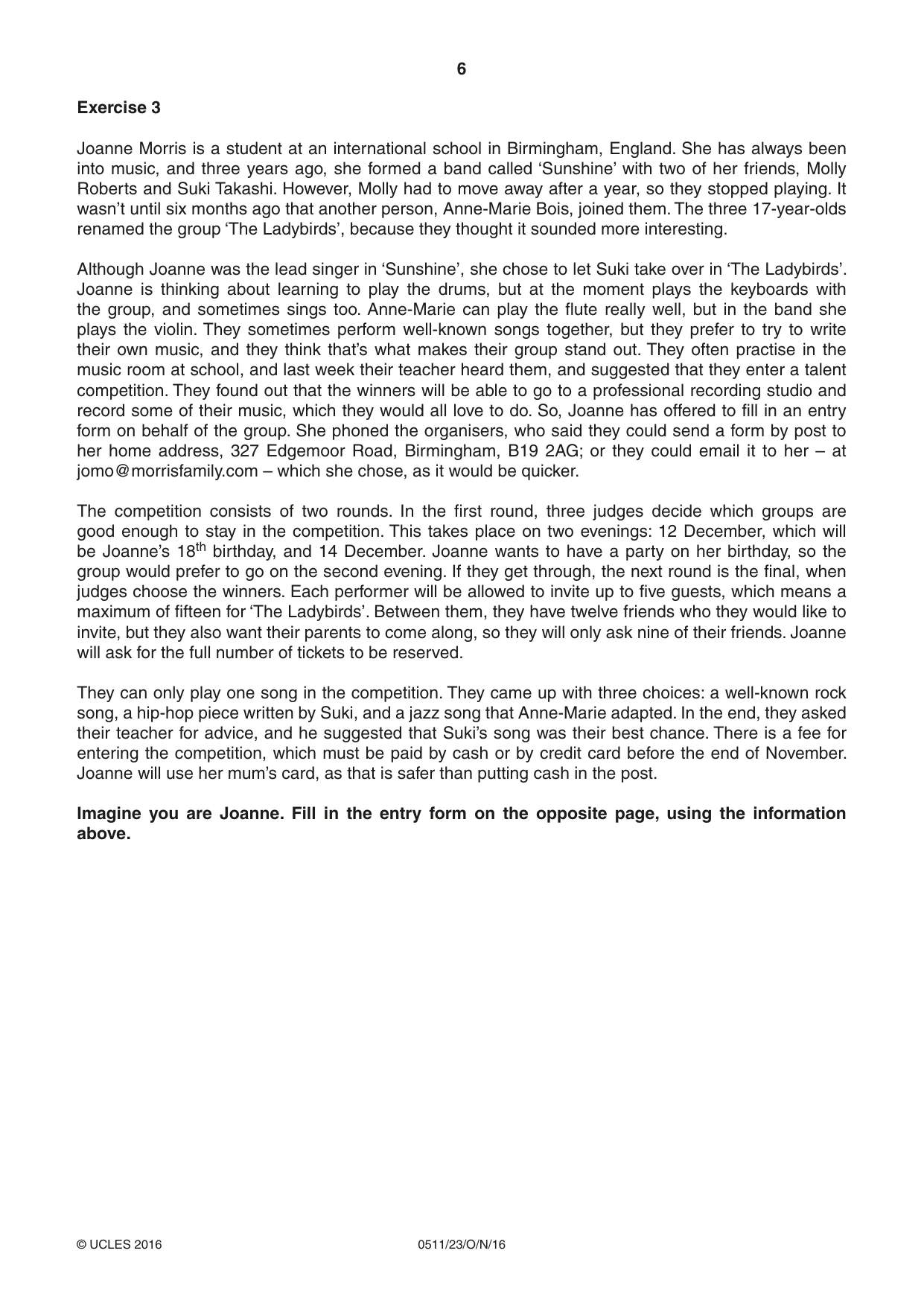
6 0511/23/O/N/16 © UCLES 2016 Exercise 3 Joanne Morris is a student at an international school in Birmingham, England. She has always been into music, and three years ago, she formed a band called ‘Sunshine’ with two of her friends, Molly Roberts and Suki Takashi. However, Molly had to move away after a year, so they stopped playing. It wasn’t until six months ago that another person, Anne-Marie Bois, joined them. The three 17-year-olds renamed the group ‘The Ladybirds’, because they thought it sounded more interesting. Although Joanne was the lead singer in ‘Sunshine’, she chose to let Suki take over in ‘The Ladybirds’. Joanne is thinking about learning to play the drums, but at the moment plays the keyboards with the group, and sometimes sings too. Anne-Marie can play the flute really well, but in the band she plays the violin. They sometimes perform well-known songs together, but they prefer to try to write their own music, and they think that’s what makes their group stand out. They often practise in the music room at school, and last week their teacher heard them, and suggested that they enter a talent competition. They found out that the winners will be able to go to a professional recording studio and record some of their music, which they would all love to do. So, Joanne has offered to fill in an entry form on behalf of the group. She phoned the organisers, who said they could send a form by post to her home address, 327 Edgemoor Road, Birmingham, B19 2AG; or they could email it to her – at jomo@morrisfamily.com – which she chose, as it would be quicker. The competition consists of two rounds. In the first round, three judges decide which groups are good enough to stay in the competition. This takes place on two evenings: 12 December, which will be Joanne’s 18th birthday, and 14 December. Joanne wants to have a party on her birthday, so the group would prefer to go on the second evening. If they get through, the next round is the final, when judges choose the winners. Each performer will be allowed to invite up to five guests, which means a maximum of fifteen for ‘The Ladybirds’. Between them, they have twelve friends who they would like to invite, but they also want their parents to come along, so they will only ask nine of their friends. Joanne will ask for the full number of tickets to be reserved. They can only play one song in the competition. They came up with three choices: a well-known rock song, a hip-hop piece written by Suki, and a jazz song that Anne-Marie adapted. In the end, they asked their teacher for advice, and he suggested that Suki’s song was their best chance. There is a fee for entering the competition, which must be paid by cash or by credit card before the end of November. Joanne will use her mum’s card, as that is safer than putting cash in the post. Imagine you are Joanne. Fill in the entry form on the opposite page, using the information above.
Question paper, page 7
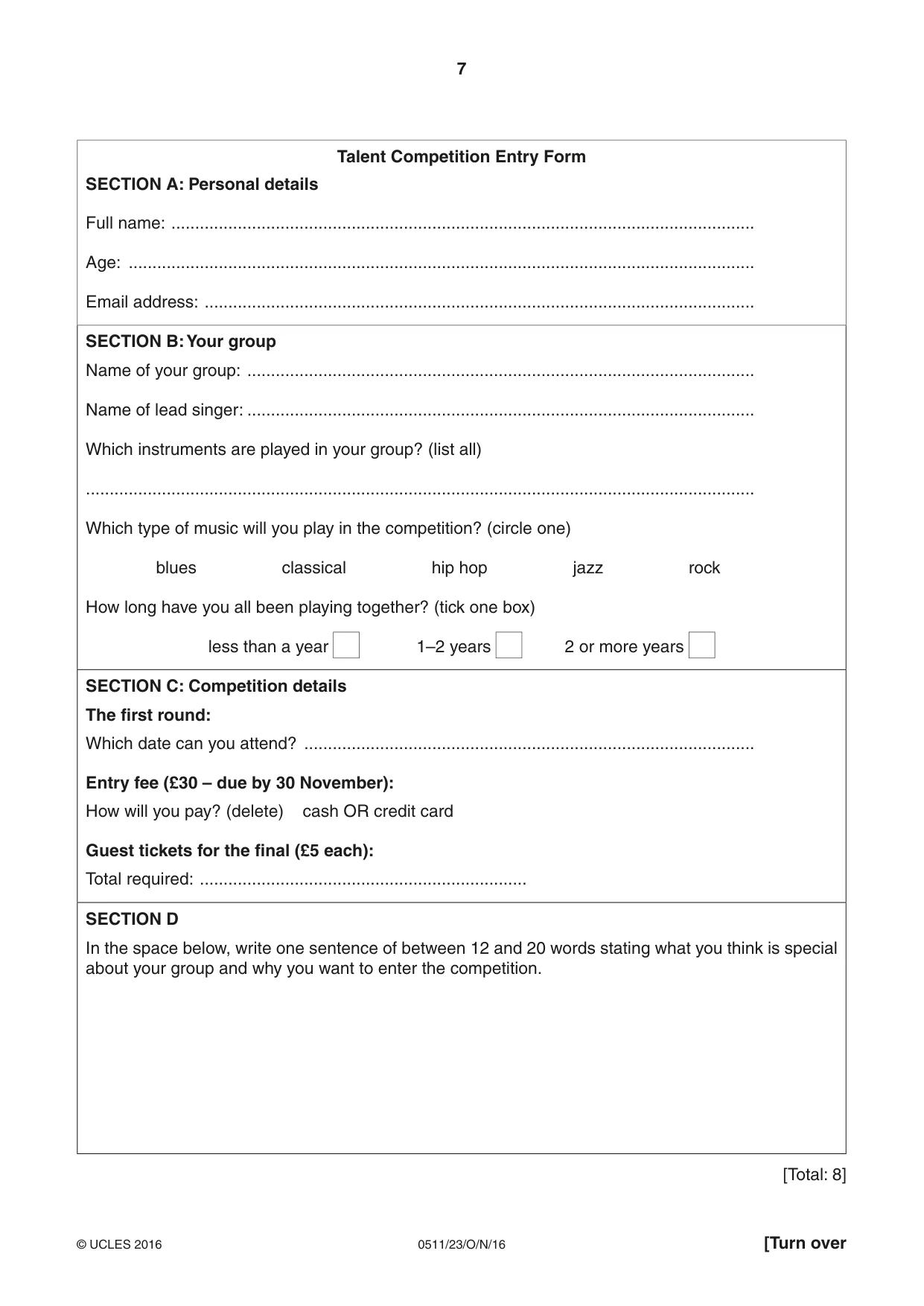
7 0511/23/O/N/16 © UCLES 2016 [Turn over Talent Competition Entry Form SECTION A: Personal details Full name: … Age: … Email address: … SECTION B: Your group Name of your group: … Name of lead singer: … Which instruments are played in your group? (list all) … Which type of music will you play in the competition? (circle one) blues classical hip hop jazz rock How long have you all been playing together? (tick one box) less than a year 1–2 years 2 or more years SECTION C: Competition details The first round: Which date can you attend? … Entry fee (£30 – due by 30 November): How will you pay? (delete) cash OR credit card Guest tickets for the final (£5 each): Total required: … SECTION D In the space below, write one sentence of between 12 and 20 words stating what you think is special about your group and why you want to enter the competition. [Total: 8]
Question paper, page 8
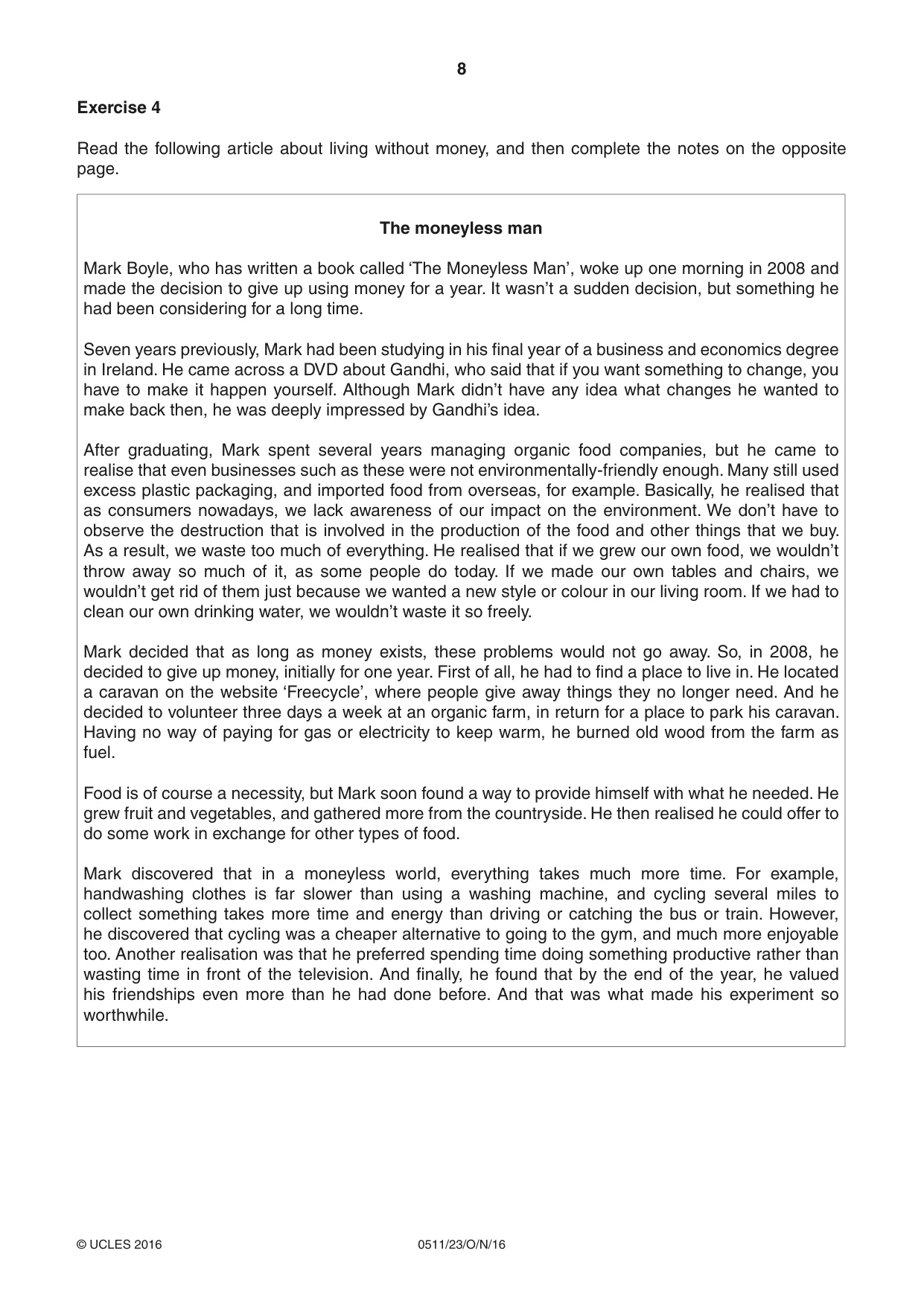
8 0511/23/O/N/16 © UCLES 2016 Exercise 4 Read the following article about living without money, and then complete the notes on the opposite page. The moneyless man Mark Boyle, who has written a book called ‘The Moneyless Man’, woke up one morning in 2008 and made the decision to give up using money for a year. It wasn’t a sudden decision, but something he had been considering for a long time. Seven years previously, Mark had been studying in his final year of a business and economics degree in Ireland. He came across a DVD about Gandhi, who said that if you want something to change, you have to make it happen yourself. Although Mark didn’t have any idea what changes he wanted to make back then, he was deeply impressed by Gandhi’s idea. After graduating, Mark spent several years managing organic food companies, but he came to realise that even businesses such as these were not environmentally-friendly enough. Many still used excess plastic packaging, and imported food from overseas, for example. Basically, he realised that as consumers nowadays, we lack awareness of our impact on the environment. We don’t have to observe the destruction that is involved in the production of the food and other things that we buy. As a result, we waste too much of everything. He realised that if we grew our own food, we wouldn’t throw away so much of it, as some people do today. If we made our own tables and chairs, we wouldn’t get rid of them just because we wanted a new style or colour in our living room. If we had to clean our own drinking water, we wouldn’t waste it so freely. Mark decided that as long as money exists, these problems would not go away. So, in 2008, he decided to give up money, initially for one year. First of all, he had to find a place to live in. He located a caravan on the website ‘Freecycle’, where people give away things they no longer need. And he decided to volunteer three days a week at an organic farm, in return for a place to park his caravan. Having no way of paying for gas or electricity to keep warm, he burned old wood from the farm as fuel. Food is of course a necessity, but Mark soon found a way to provide himself with what he needed. He grew fruit and vegetables, and gathered more from the countryside. He then realised he could offer to do some work in exchange for other types of food. Mark discovered that in a moneyless world, everything takes much more time. For example, handwashing clothes is far slower than using a washing machine, and cycling several miles to collect something takes more time and energy than driving or catching the bus or train. However, he discovered that cycling was a cheaper alternative to going to the gym, and much more enjoyable too. Another realisation was that he preferred spending time doing something productive rather than wasting time in front of the television. And finally, he found that by the end of the year, he valued his friendships even more than he had done before. And that was what made his experiment so worthwhile.
Question paper, page 9
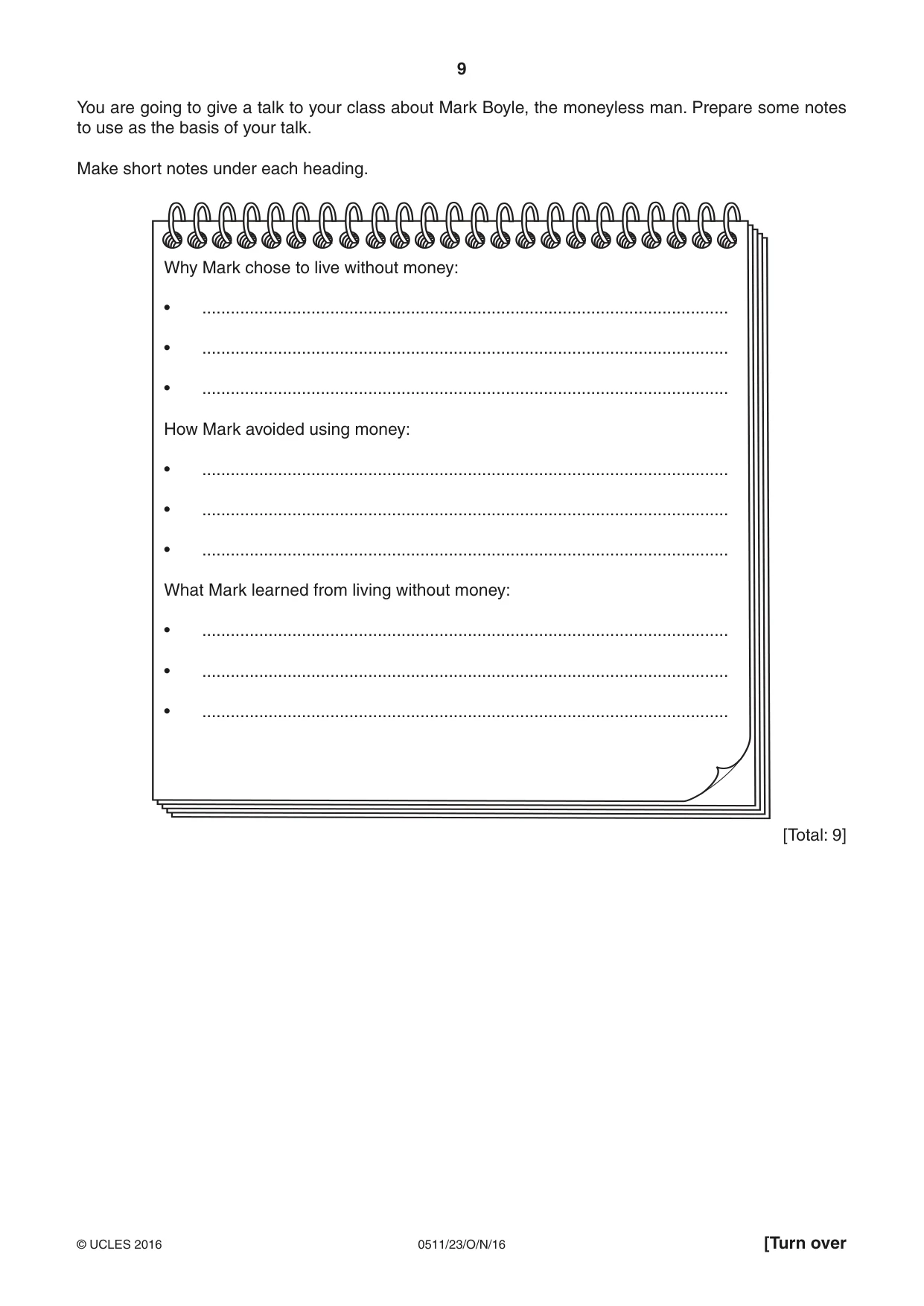
9 0511/23/O/N/16 © UCLES 2016 [Turn over You are going to give a talk to your class about Mark Boyle, the moneyless man. Prepare some notes to use as the basis of your talk. Make short notes under each heading. Why Mark chose to live without money: • … • … • … How Mark avoided using money: • … • … • … What Mark learned from living without money: • … • … • … [Total: 9]
Question paper, page 10
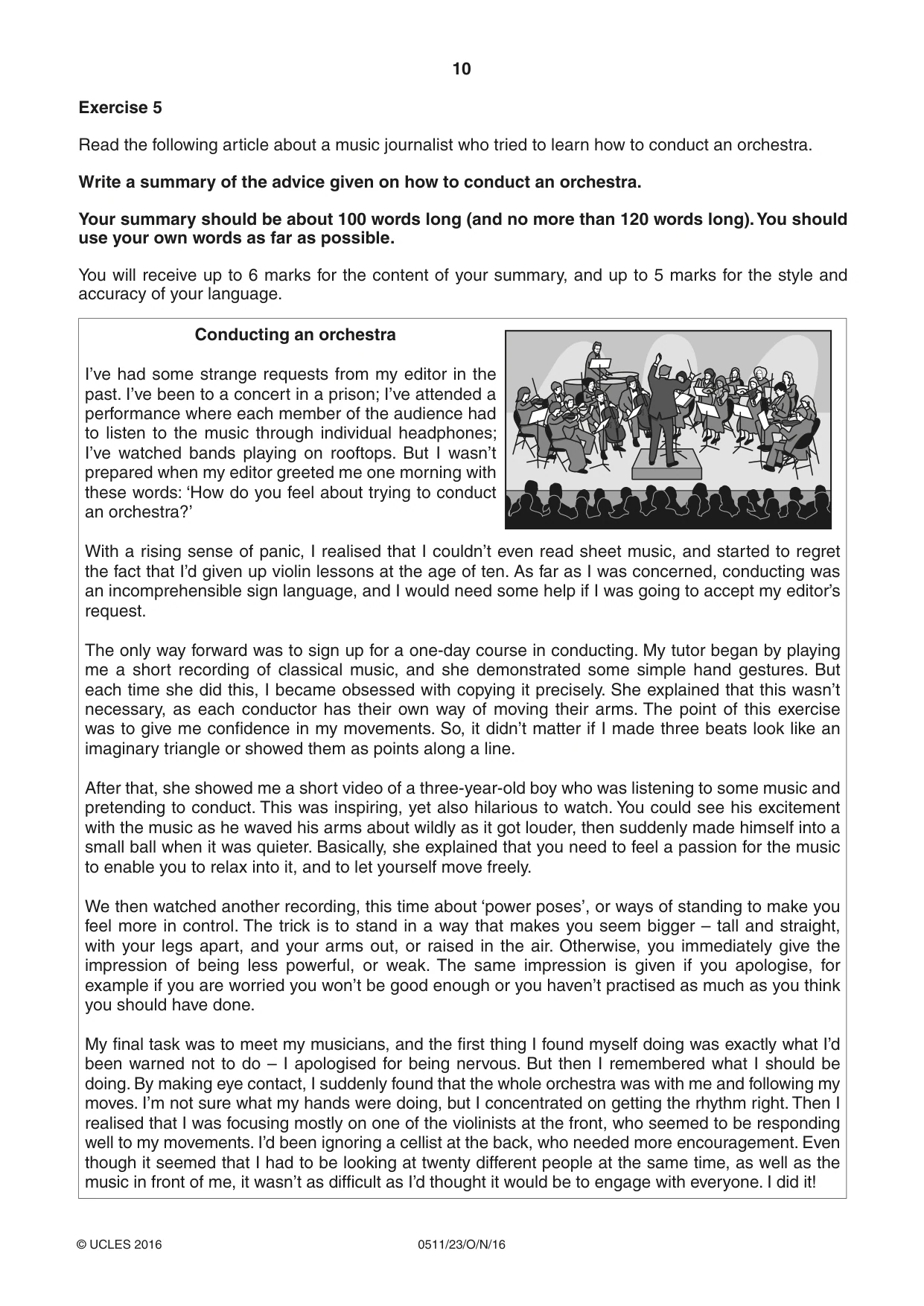
10 0511/23/O/N/16 © UCLES 2016 Exercise 5 Read the following article about a music journalist who tried to learn how to conduct an orchestra. Write a summary of the advice given on how to conduct an orchestra. Your summary should be about 100 words long (and no more than 120 words long). You should use your own words as far as possible. You will receive up to 6 marks for the content of your summary, and up to 5 marks for the style and accuracy of your language. Conducting an orchestra I’ve had some strange requests from my editor in the past. I’ve been to a concert in a prison; I’ve attended a performance where each member of the audience had to listen to the music through individual headphones; I’ve watched bands playing on rooftops. But I wasn’t prepared when my editor greeted me one morning with these words: ‘How do you feel about trying to conduct an orchestra?’ With a rising sense of panic, I realised that I couldn’t even read sheet music, and started to regret the fact that I’d given up violin lessons at the age of ten. As far as I was concerned, conducting was an incomprehensible sign language, and I would need some help if I was going to accept my editor’s request. The only way forward was to sign up for a one-day course in conducting. My tutor began by playing me a short recording of classical music, and she demonstrated some simple hand gestures. But each time she did this, I became obsessed with copying it precisely. She explained that this wasn’t necessary, as each conductor has their own way of moving their arms. The point of this exercise was to give me confidence in my movements. So, it didn’t matter if I made three beats look like an imaginary triangle or showed them as points along a line. After that, she showed me a short video of a three-year-old boy who was listening to some music and pretending to conduct. This was inspiring, yet also hilarious to watch. You could see his excitement with the music as he waved his arms about wildly as it got louder, then suddenly made himself into a small ball when it was quieter. Basically, she explained that you need to feel a passion for the music to enable you to relax into it, and to let yourself move freely. We then watched another recording, this time about ‘power poses’, or ways of standing to make you feel more in control. The trick is to stand in a way that makes you seem bigger – tall and straight, with your legs apart, and your arms out, or raised in the air. Otherwise, you immediately give the impression of being less powerful, or weak. The same impression is given if you apologise, for example if you are worried you won’t be good enough or you haven’t practised as much as you think you should have done. My final task was to meet my musicians, and the first thing I found myself doing was exactly what I’d been warned not to do – I apologised for being nervous. But then I remembered what I should be doing. By making eye contact, I suddenly found that the whole orchestra was with me and following my moves. I’m not sure what my hands were doing, but I concentrated on getting the rhythm right. Then I realised that I was focusing mostly on one of the violinists at the front, who seemed to be responding well to my movements. I’d been ignoring a cellist at the back, who needed more encouragement. Even though it seemed that I had to be looking at twenty different people at the same time, as well as the music in front of me, it wasn’t as difficult as I’d thought it would be to engage with everyone. I did it!
Question paper, page 11
11 0511/23/O/N/16 © UCLES 2016 [Turn over … … … … … … … … … … … … … … … … … … … … … … … … … … [Total: 11]
Question paper, page 12
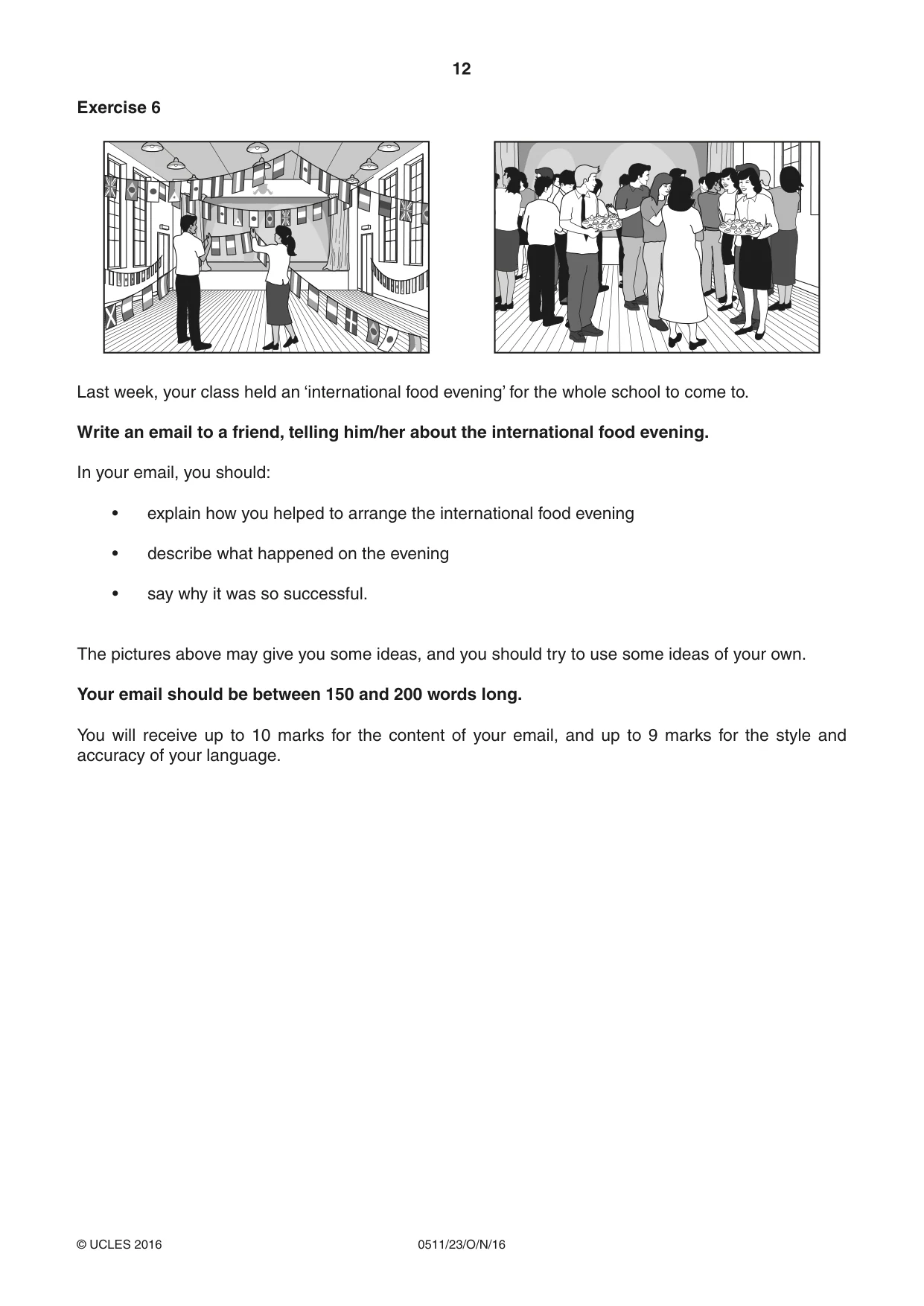
12 0511/23/O/N/16 © UCLES 2016 Exercise 6 Last week, your class held an ‘international food evening’ for the whole school to come to. Write an email to a friend, telling him/her about the international food evening. In your email, you should: • explain how you helped to arrange the international food evening • describe what happened on the evening • say why it was so successful. The pictures above may give you some ideas, and you should try to use some ideas of your own. Your email should be between 150 and 200 words long. You will receive up to 10 marks for the content of your email, and up to 9 marks for the style and accuracy of your language.
Question paper, page 13
13 0511/23/O/N/16 © UCLES 2016 [Turn over … … … … … … … … … … … … … … … … … … … … … … … … … … [Total: 19]
Question paper, page 14
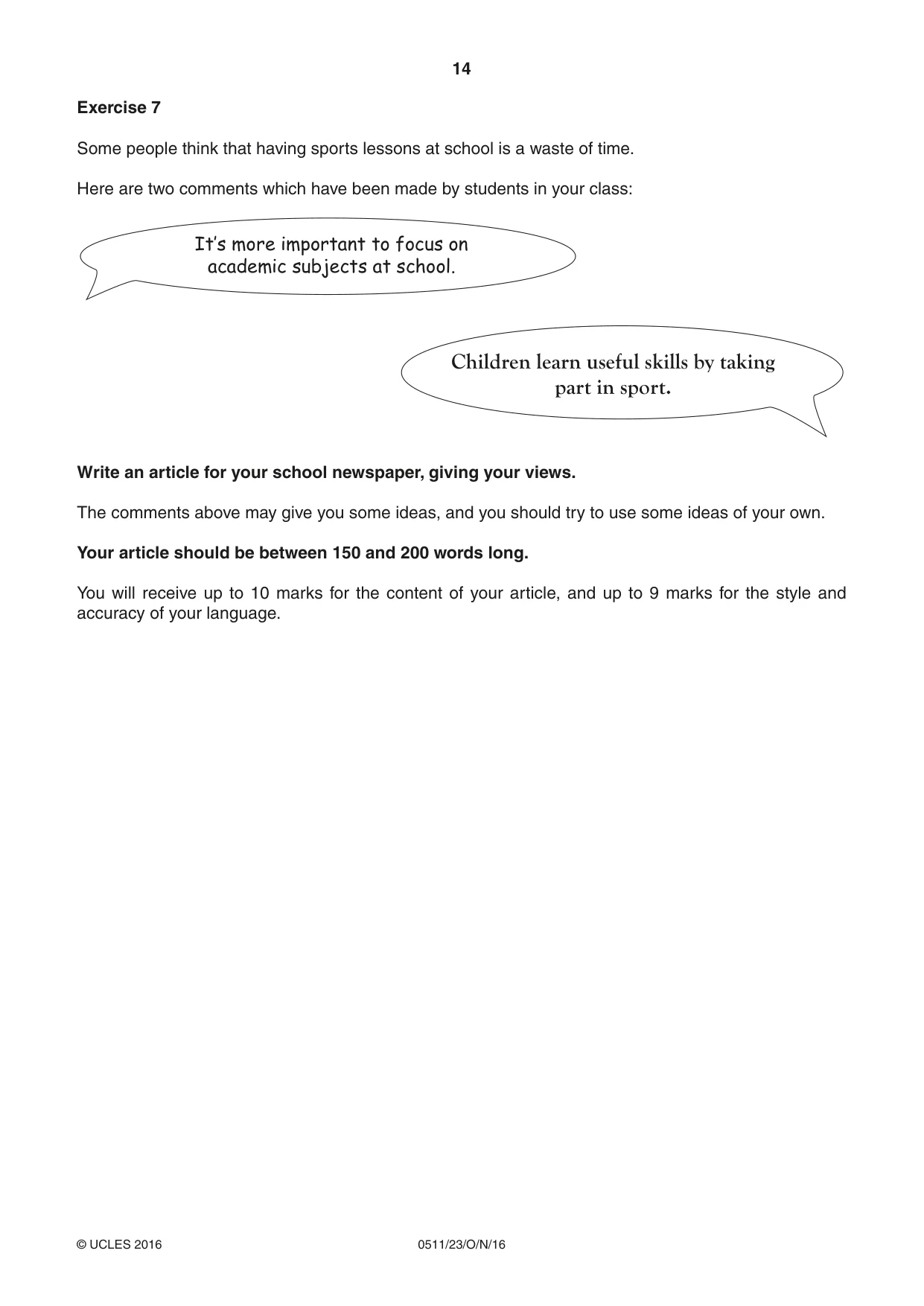
14 0511/23/O/N/16 © UCLES 2016 Exercise 7 Some people think that having sports lessons at school is a waste of time. Here are two comments which have been made by students in your class: It’s more important to focus on academic subjects at school. Children learn useful skills by taking part in sport. Write an article for your school newspaper, giving your views. The comments above may give you some ideas, and you should try to use some ideas of your own. Your article should be between 150 and 200 words long. You will receive up to 10 marks for the content of your article, and up to 9 marks for the style and accuracy of your language.
Question paper, page 15
15 0511/23/O/N/16 © UCLES 2016 … … … … … … … … … … … … … … … … … … … … … … … … … … [Total: 19]
Question paper, page 16
16 0511/23/O/N/16 © UCLES 2016 Permission to reproduce items where third-party owned material protected by copyright is included has been sought and cleared where possible. Every reasonable effort has been made by the publisher (UCLES) to trace copyright holders, but if any items requiring clearance have unwittingly been included, the publisher will be pleased to make amends at the earliest possible opportunity. To avoid the issue of disclosure of answer-related information to candidates, all copyright acknowledgements are reproduced online in the Cambridge International Examinations Copyright Acknowledgements Booklet. This is produced for each series of examinations and is freely available to download at www.cie.org.uk after the live examination series. Cambridge International Examinations is part of the Cambridge Assessment Group. Cambridge Assessment is the brand name of University of Cambridge Local Examinations Syndicate (UCLES), which is itself a department of the University of Cambridge. BLANK PAGE
Mark scheme, page 1
® IGCSE is the registered trademark of Cambridge International Examinations. This syllabus is approved for use in England, Wales and Northern Ireland as a Cambridge International Level 1/Level 2 Certificate. This document consists of 10 printed pages. © UCLES 2016 [Turn over Cambridge International Examinations Cambridge International General Certificate of Secondary Education ENGLISH AS A SECOND LANGUAGE 0511/23 Paper 2 Reading and Writing (Extended) October/November 2016 MARK SCHEME Maximum Mark: 90 Published This mark scheme is published as an aid to teachers and candidates, to indicate the requirements of the examination. It shows the basis on which Examiners were instructed to award marks. It does not indicate the details of the discussions that took place at an Examiners’ meeting before marking began, which would have considered the acceptability of alternative answers. Mark schemes should be read in conjunction with the question paper and the Principal Examiner Report for Teachers. Cambridge will not enter into discussions about these mark schemes. Cambridge is publishing the mark schemes for the October/November 2016 series for most Cambridge IGCSE®, Cambridge International A and AS Level components and some Cambridge O Level components.
Mark scheme, page 2
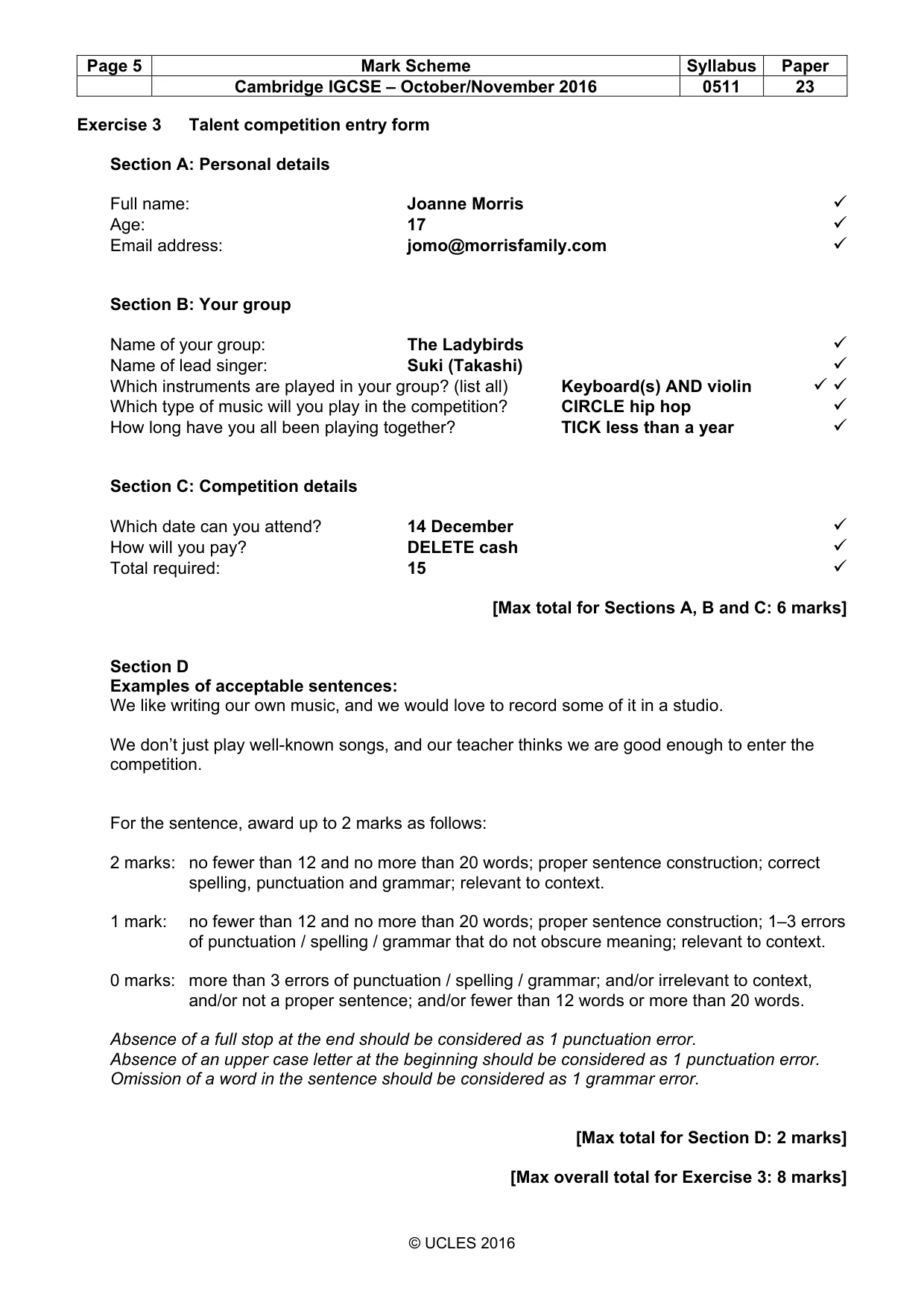
Page 2 Mark Scheme Syllabus Paper Cambridge IGCSE – October/November 2016 0511 23 © UCLES 2016 IGCSE English as a Second Language Extended tier Reading/Writing (Paper 2) This component forms part of the Extended tier assessment of IGCSE English as a Second Language and tests the following Assessment Objectives: AO1: Reading R1 identify and retrieve facts and details R2 understand and select relevant information R3 recognise and understand ideas, opinions and attitudes and the connections between related ideas R4 understand what is implied but not actually written, e.g. gist, relationships, writer’s purpose/ intention, writer’s feelings, situation or place AO2: Writing W1 communicate clearly, accurately and appropriately W2 convey information and express opinions effectively W3 employ and control a variety of grammatical structures W4 demonstrate knowledge and understanding of a range of appropriate vocabulary W5 observe conventions of paragraphing, punctuation and spelling W6 employ appropriate register/style Overview of exercises on Paper 2 Reading objectives tested Marks for reading objectives Writing objectives tested Marks for writing objectives Total available marks Exercise 1 Reading (1) R1, R2 9 – 9 Exercise 2 Reading (2) R1, R2, R4 15 – 15 Exercise 3 Information transfer R1, R2, R4 6 W1, W5 2 8 Exercise 4 Note- making R1, R2, R3 9 – 9 Exercise 5 Summary R1, R2, R3 6 W1, W2, W3, W4, W5 5 11 Exercise 6 Writing (1) – W1, W2, W3, W4, W5, W6 19 19 Exercise 7 Writing (2) – W1, W2, W3, W4, W5, W6 19 19 90
Mark scheme, page 3
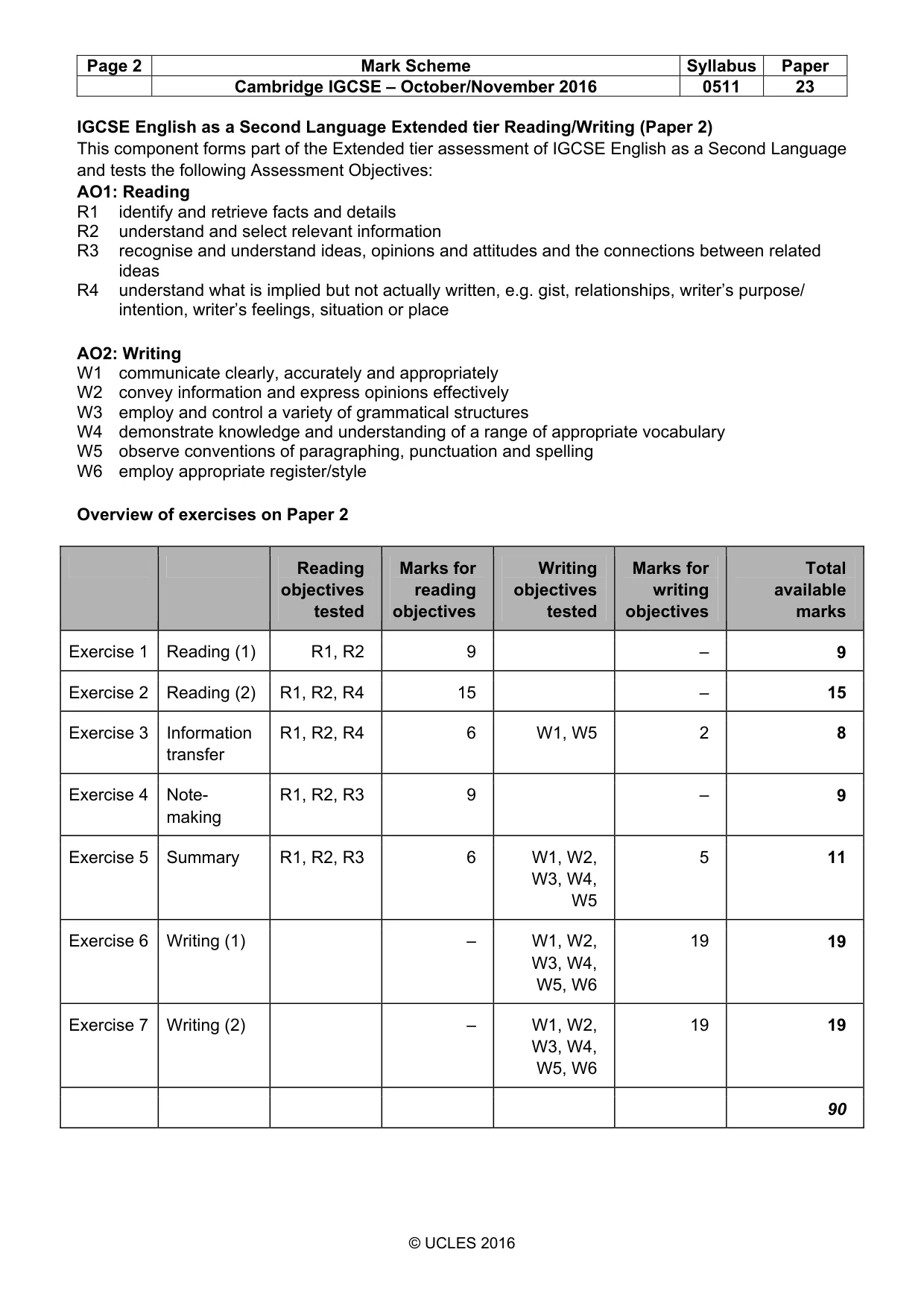
Page 3 Mark Scheme Syllabus Paper Cambridge IGCSE – October/November 2016 0511 23 © UCLES 2016 Exercise 1 Koala Sanctuary (a) wombats [1] (b) males have larger faces / females have smaller faces [2] females have a pouch (on their front) / males don’t have a pouch (on their front) ONE MARK FOR EACH DETAIL (c) two thumbs [1] (d) smell [1] (e) habitat loss / less space to live in wild [1] (f) sitting under a tree [2] doesn’t move away when approached ONE MARK FOR EACH DETAIL (g) stress [1] [Maximum total for Exercise 1: 9 marks]
Mark scheme, page 4
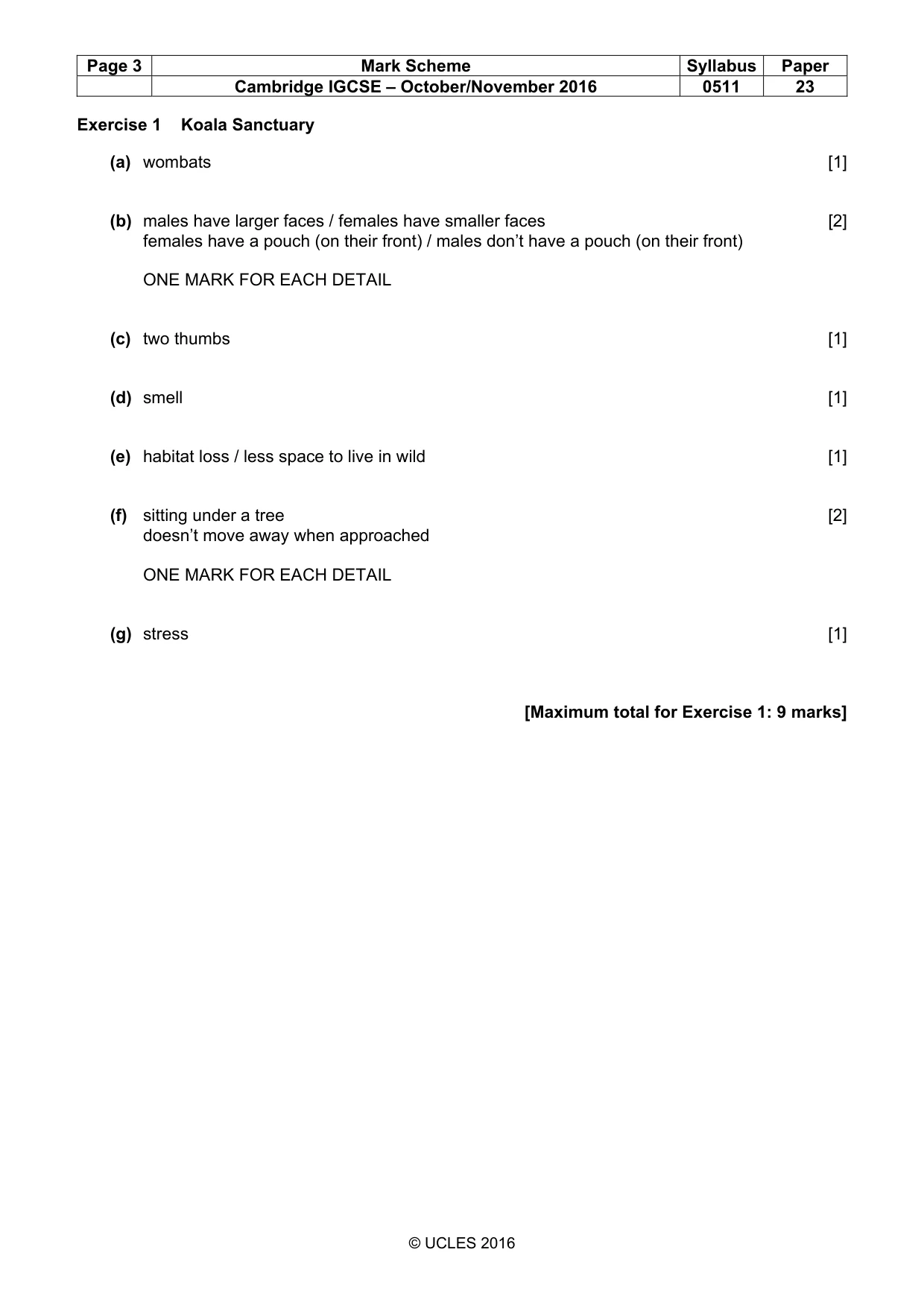
Page 4 Mark Scheme Syllabus Paper Cambridge IGCSE – October/November 2016 0511 23 © UCLES 2016 Exercise 2 Hostelling International (a) castle [1] (b) 1932 [1] (c) Welwyn Garden City [1] (d) Colombia and Russia, AND Brazil [1] ALL REQUIRED FOR ONE MARK (e) (the) Green Award [1] (f) guests give feedback regular inspections [2] ONE MARK FOR EACH DETAIL (g) a lighthouse [1] (h) (Hostel) Ytra Lón [1] (i) sauna [1] (j) The Big Blog Exchange [1] (k) to provide accommodation around the world that young people can afford to enable young people to experience different cultures provide (the same) high standards to develop a better understanding of other people to encourage young people to look after the countryside ONE MARK EACH DETAIL - ANY FOUR FROM FIVE [4] [Maximum total for Exercise 2: 15 marks]
Mark scheme, page 5
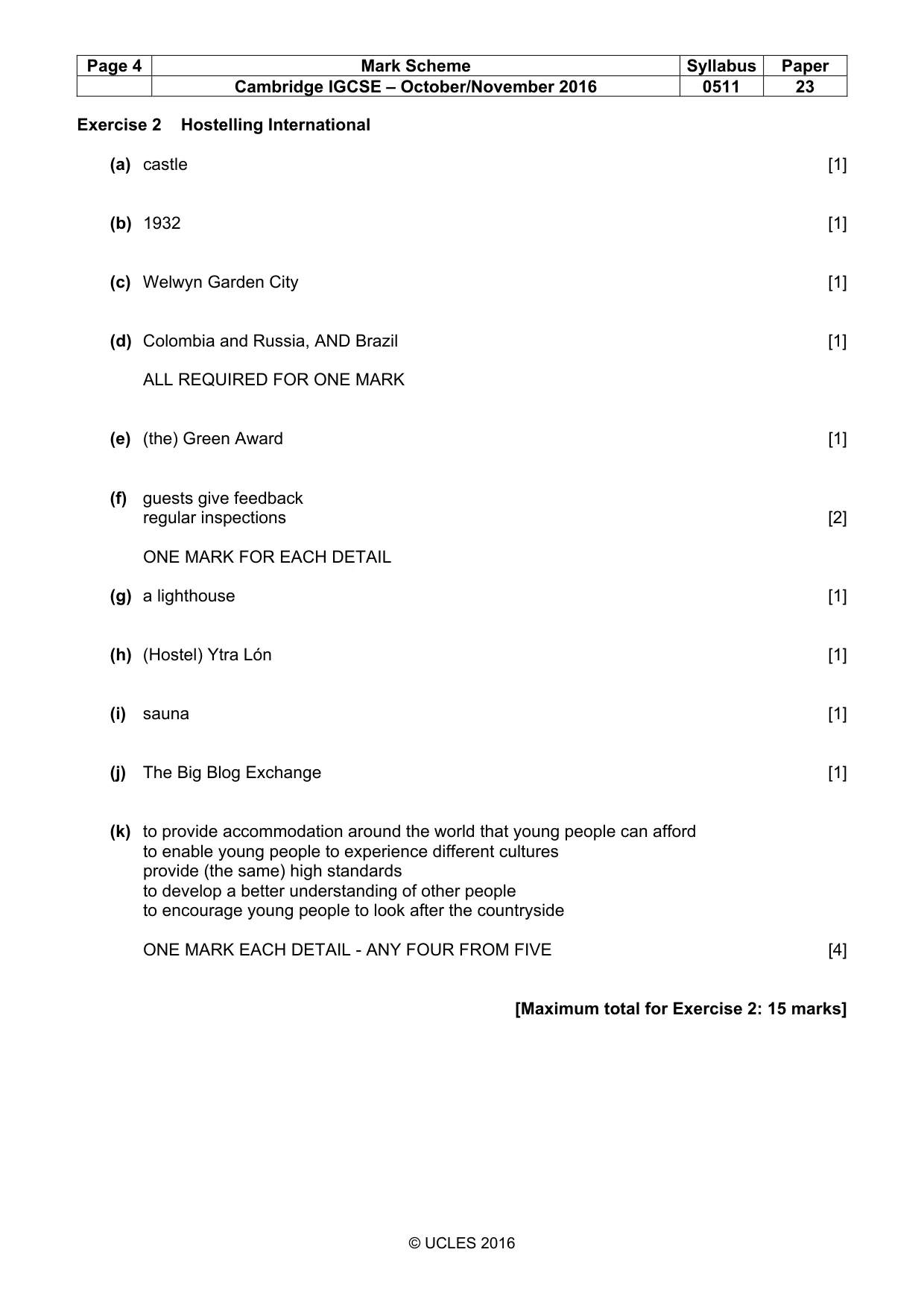
Page 5 Mark Scheme Syllabus Paper Cambridge IGCSE – October/November 2016 0511 23 © UCLES 2016 Exercise 3 Talent competition entry form Section A: Personal details Full name: Joanne Morris 9 Age: 17 9 Email address: jomo@morrisfamily.com 9 Section B: Your group Name of your group: The Ladybirds 9 Name of lead singer: Suki (Takashi) 9 Which instruments are played in your group? (list all) Keyboard(s) AND violin 9 9 Which type of music will you play in the competition? CIRCLE hip hop 9 How long have you all been playing together? TICK less than a year 9 Section C: Competition details Which date can you attend? 14 December 9 How will you pay? DELETE cash 9 Total required: 15 9 [Max total for Sections A, B and C: 6 marks] Section D Examples of acceptable sentences: We like writing our own music, and we would love to record some of it in a studio. We don’t just play well-known songs, and our teacher thinks we are good enough to enter the competition. For the sentence, award up to 2 marks as follows: 2 marks: no fewer than 12 and no more than 20 words; proper sentence construction; correct spelling, punctuation and grammar; relevant to context. 1 mark: no fewer than 12 and no more than 20 words; proper sentence construction; 1–3 errors of punctuation / spelling / grammar that do not obscure meaning; relevant to context. 0 marks: more than 3 errors of punctuation / spelling / grammar; and/or irrelevant to context, and/or not a proper sentence; and/or fewer than 12 words or more than 20 words. Absence of a full stop at the end should be considered as 1 punctuation error. Absence of an upper case letter at the beginning should be considered as 1 punctuation error. Omission of a word in the sentence should be considered as 1 grammar error. [Max total for Section D: 2 marks] [Max overall total for Exercise 3: 8 marks]
Mark scheme, page 6
Page 6 Mark Scheme Syllabus Paper Cambridge IGCSE – October/November 2016 0511 23 © UCLES 2016 Exercise 4 The moneyless man Why Mark chose to live without money: [max 3 marks for this heading] 1. he was impressed by Gandhi / because of Gandhi’s ideas / Gandhi said that if you want something to change, make it happen / he wanted to make a change 2. consumers / businesses / we lack awareness of (their/our) impact on the environment / are not environmentally–friendly enough 3. we waste too much 4. as long as money exists, environmental problems would not go away / money causes environmental problems How Mark avoided using money: [max 3 marks for this heading] 5. located caravan on freecycle website / got a caravan from someone who didn’t want it anymore 6. volunteered at a farm in return for place to park his caravan 7. burned old wood as fuel 8. grew fruit and vegetables / gathered fruit and vegetables from the countryside 9. offered to work in exchange for other types of food What Mark learned from living without money: [max 3 marks for this heading] 10. everything takes more time / handwashing clothes is slower than using a machine/cycling takes more time than driving 11. cycling is cheaper / more enjoyable than (going to) gym 12. preferred spending time doing something (productive) / watching TV is a waste of time 13. valued his friendships more [Maximum total for Exercise 4: 9 marks]
Mark scheme, page 7
Page 7 Mark Scheme Syllabus Paper Cambridge IGCSE – October/November 2016 0511 23 © UCLES 2016 Exercise 5 How to conduct an orchestra Content: [up to 6 marks] 1. Do a course in conducting / watch a video 2. Don’t try to copy movements precisely / find your own way to move your arms 3. Be confident (in your movements) 4. Be passionate about the music / relax into the music/move freely with the music 5. Practise power poses / don’t give the impression of being weak / stand in a way that makes you seem bigger 6. Don’t apologise 7. Make eye contact 8. Have good rhythm 9. Look at everyone / don’t ignore anyone / engage with everyone Language: [up to 5 marks] 0 marks: no understanding of the task/no relevant content / meaning completely obscure due to serious language inaccuracies 1 mark: copying without discrimination from text/multiple language inaccuracies 2 marks: heavy reliance on language from the text with no attempt to organise and sequence points cohesively/limited language expression making meaning at times unclear 3 marks: some reliance on language from the text, but with an attempt to organise and sequence points cohesively/language satisfactory, but with some inaccuracies 4 marks: good attempt to use own words and to organise and sequence points cohesively generally good control of language 5 marks: good, concise summary style / very good attempt to use own words and to organise and sequence points cohesively [Maximum total for Exercise 5: 11 marks]
Mark scheme, page 8
Page 8 Mark Scheme Syllabus Paper Cambridge IGCSE – October/November 2016 0511 23 © UCLES 2016 Exercise 6 School international evening Exercise 7 Sports lessons at school a waste of time The following general instructions, and table of marking criteria, apply to both exercises. 1. Award the answer a mark for content (C) [out of 10] and a mark for language (L) [out of 9] in accordance with the General Criteria table that follows. 2. Content covers relevance (i.e. whether the piece fulfils the task and the awareness of purpose/ audience/register) and the development of ideas (i.e. the detail/explanation provided and how enjoyable it is to read). 3. Language covers style (i.e. complexity of vocabulary and sentence structure) and accuracy (of grammar, spelling, punctuation and use of paragraphs). 4. When deciding on a mark for content or language, first of all decide which mark band is most appropriate. There will not necessarily be an exact fit. Then decide between 2 marks within that mark band. Use the lower mark if it only just makes it into the band and the upper mark if it fulfils all the requirements of the band but doesn’t quite make it into the band above. 5. When deciding on a mark for content, look at both relevance and development of ideas. First ask yourself whether the writing fulfils the task, in terms of points to be covered and the length. If it does, it will be in at least the 4–5 mark band. If one bullet point is missing, a maximum mark of C4 can be awarded. 6. When deciding on a mark for language, look at both the style and the accuracy of the language. A useful starting point would be first to determine whether errors intrude. If they do not, it will be in at least the 4–5 mark band. 7. The use of paragraphs should not be the primary basis of deciding which mark band the work is in. Look first at the language used and once you have decided on the appropriate mark band, you can use the paragraphing as a factor in helping you to decide whether the work warrants the upper or lower mark in the mark band. 8. If the essay is considerably shorter than the stated word length, i.e. below 105 words, it should be put in mark band 2–3 for content or lower for not fulfilling the task. The language mark is likely to be affected and is unlikely to be more than one band higher than the content mark. 9. If the essay is totally irrelevant and has nothing to do with the question asked, it should be given 0 marks for Content and Language, even if it is enjoyable to read and fluent. 10. If the essay is partly relevant and therefore in mark band 2–3, the full range of marks for language is available. [Max total for Exercises 6 and 7: 19 marks and 19 marks] GENERAL CRITERIA FOR MARKING EXERCISES 6 AND 7 (Extended Tier)
Mark scheme, page 9
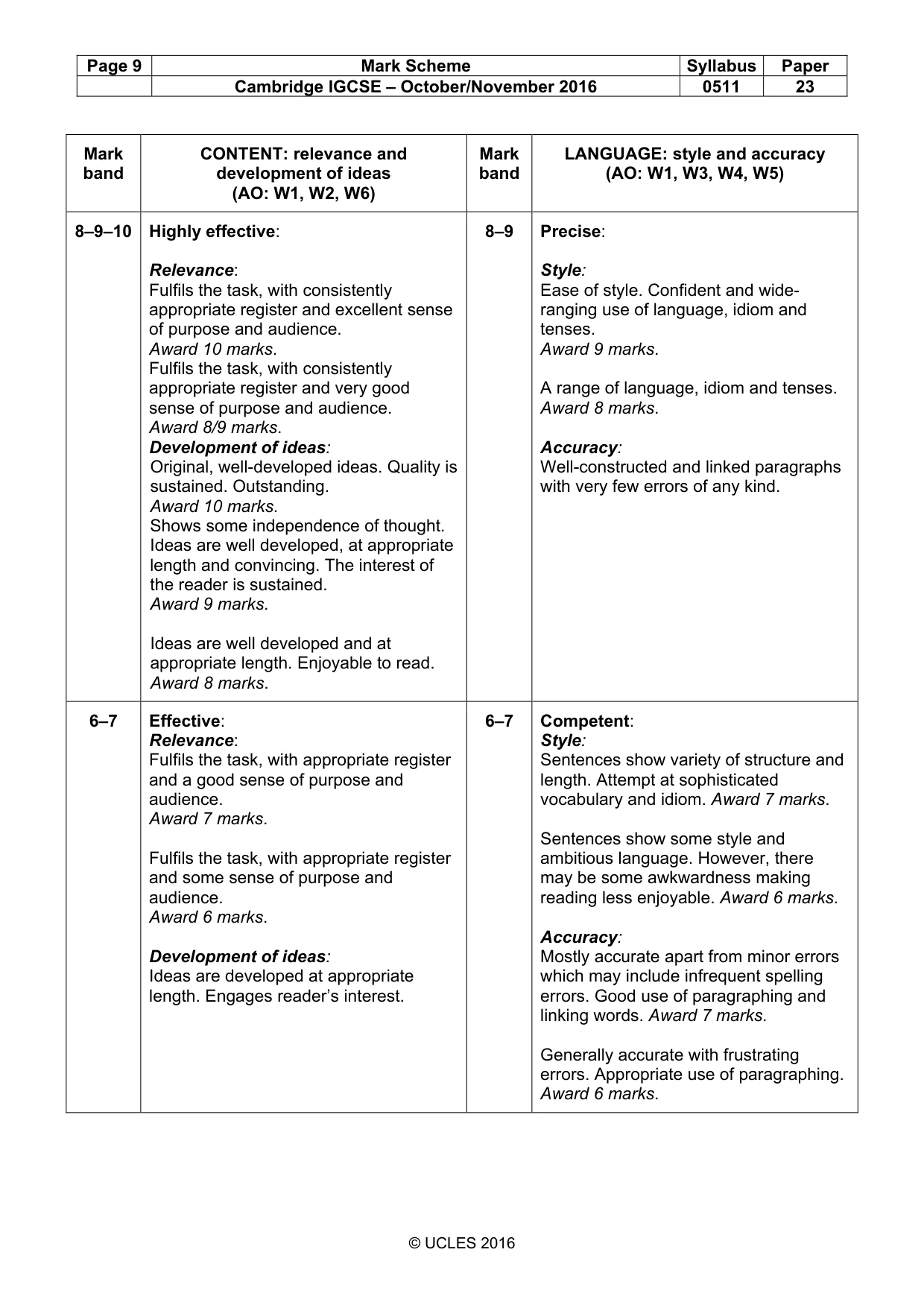
Page 9 Mark Scheme Syllabus Paper Cambridge IGCSE – October/November 2016 0511 23 © UCLES 2016 Mark band CONTENT: relevance and development of ideas (AO: W1, W2, W6) Mark band LANGUAGE: style and accuracy (AO: W1, W3, W4, W5) 8–9–10 Highly effective: Relevance: Fulfils the task, with consistently appropriate register and excellent sense of purpose and audience. Award 10 marks. Fulfils the task, with consistently appropriate register and very good sense of purpose and audience. Award 8/9 marks. Development of ideas: Original, well-developed ideas. Quality is sustained. Outstanding. Award 10 marks. Shows some independence of thought. Ideas are well developed, at appropriate length and convincing. The interest of the reader is sustained. Award 9 marks. Ideas are well developed and at appropriate length. Enjoyable to read. Award 8 marks. 8–9 Precise: Style: Ease of style. Confident and wide- ranging use of language, idiom and tenses. Award 9 marks. A range of language, idiom and tenses. Award 8 marks. Accuracy: Well-constructed and linked paragraphs with very few errors of any kind. 6–7 Effective: Relevance: Fulfils the task, with appropriate register and a good sense of purpose and audience. Award 7 marks. Fulfils the task, with appropriate register and some sense of purpose and audience. Award 6 marks. Development of ideas: Ideas are developed at appropriate length. Engages reader’s interest. 6–7 Competent: Style: Sentences show variety of structure and length. Attempt at sophisticated vocabulary and idiom. Award 7 marks. Sentences show some style and ambitious language. However, there may be some awkwardness making reading less enjoyable. Award 6 marks. Accuracy: Mostly accurate apart from minor errors which may include infrequent spelling errors. Good use of paragraphing and linking words. Award 7 marks. Generally accurate with frustrating errors. Appropriate use of paragraphing. Award 6 marks.
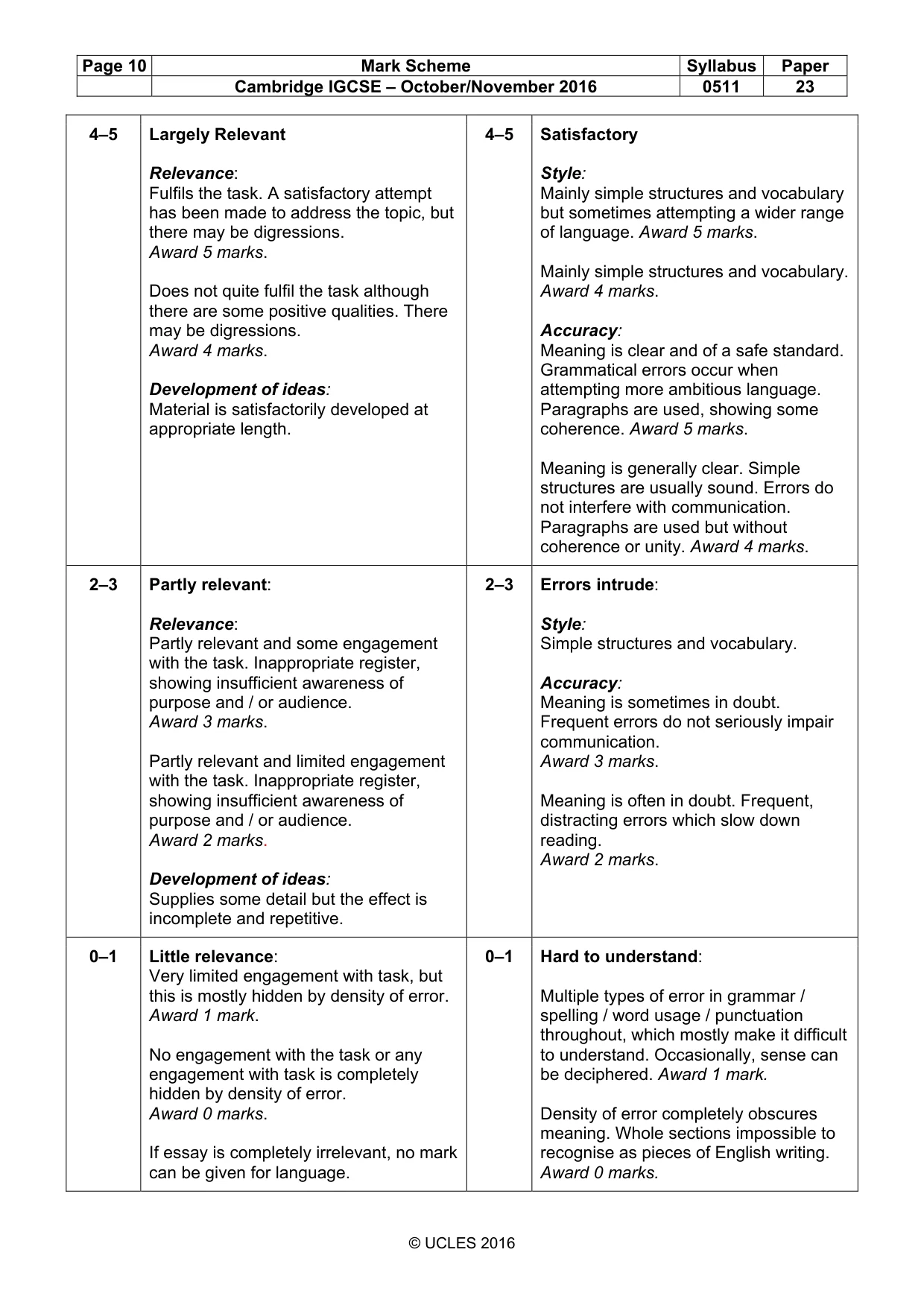
Mark scheme, page 10
Page 10 Mark Scheme Syllabus Paper Cambridge IGCSE – October/November 2016 0511 23 © UCLES 2016 4–5 Largely Relevant Relevance: Fulfils the task. A satisfactory attempt has been made to address the topic, but there may be digressions. Award 5 marks. Does not quite fulfil the task although there are some positive qualities. There may be digressions. Award 4 marks. Development of ideas: Material is satisfactorily developed at appropriate length. 4–5 Satisfactory Style: Mainly simple structures and vocabulary but sometimes attempting a wider range of language. Award 5 marks. Mainly simple structures and vocabulary. Award 4 marks. Accuracy: Meaning is clear and of a safe standard. Grammatical errors occur when attempting more ambitious language. Paragraphs are used, showing some coherence. Award 5 marks. Meaning is generally clear. Simple structures are usually sound. Errors do not interfere with communication. Paragraphs are used but without coherence or unity. Award 4 marks. 2–3 Partly relevant: Relevance: Partly relevant and some engagement with the task. Inappropriate register, showing insufficient awareness of purpose and / or audience. Award 3 marks. Partly relevant and limited engagement with the task. Inappropriate register, showing insufficient awareness of purpose and / or audience. Award 2 marks. Development of ideas: Supplies some detail but the effect is incomplete and repetitive. 2–3 Errors intrude: Style: Simple structures and vocabulary. Accuracy: Meaning is sometimes in doubt. Frequent errors do not seriously impair communication. Award 3 marks. Meaning is often in doubt. Frequent, distracting errors which slow down reading. Award 2 marks. 0–1 Little relevance: Very limited engagement with task, but this is mostly hidden by density of error. Award 1 mark. No engagement with the task or any engagement with task is completely hidden by density of error. Award 0 marks. If essay is completely irrelevant, no mark can be given for language. 0–1 Hard to understand: Multiple types of error in grammar / spelling / word usage / punctuation throughout, which mostly make it difficult to understand. Occasionally, sense can be deciphered. Award 1 mark. Density of error completely obscures meaning. Whole sections impossible to recognise as pieces of English writing. Award 0 marks.
What you needed in this session
Cambridge’s own grade thresholds for 2016 Oct/Nov, Paper 2 · Variant 3. A higher threshold means an easier paper — the bar moves with how the cohort did.