Cambridge IGCSE English - Second Language (count-in oral) 0511 — 2015 Oct/Nov Paper 1 · Variant 2
0511/12/O/N/15 · 70 marks · ≈79 min
The question paper and its mark scheme, free to read here and free to download. This is Cambridge’s own paper, exactly as it was sat.
Question paper16 pages


Mark scheme11 pages
Answers below. Sit the paper first if you are practising.
Paper as text
Question paper, page 1
This document consists of 13 printed pages and 3 blank pages. DC (RW) 115382/1 © UCLES 2015 [Turn over Cambridge International Examinations Cambridge International General Certificate of Secondary Education * 4 8 6 0 3 6 6 9 7 6 * ENGLISH AS A SECOND LANGUAGE 0511/12 Paper 1 Reading and Writing (Core) October/November 2015 1 hour 30 minutes Candidates answer on the Question Paper. No Additional Materials are required. READ THESE INSTRUCTIONS FIRST Write your Centre number, candidate number and name on all the work you hand in. Write in dark blue or black pen. Do not use staples, paper clips, glue or correction fluid. DO NOT WRITE IN ANY BARCODES. Answer all questions. Dictionaries are not allowed. At the end of the examination, fasten all your work securely together. The number of marks is given in brackets [ ] at the end of each question or part question. The syllabus is approved for use in England, Wales and Northern Ireland as a Cambridge International Level 1/Level 2 Certificate.
Question paper, page 2
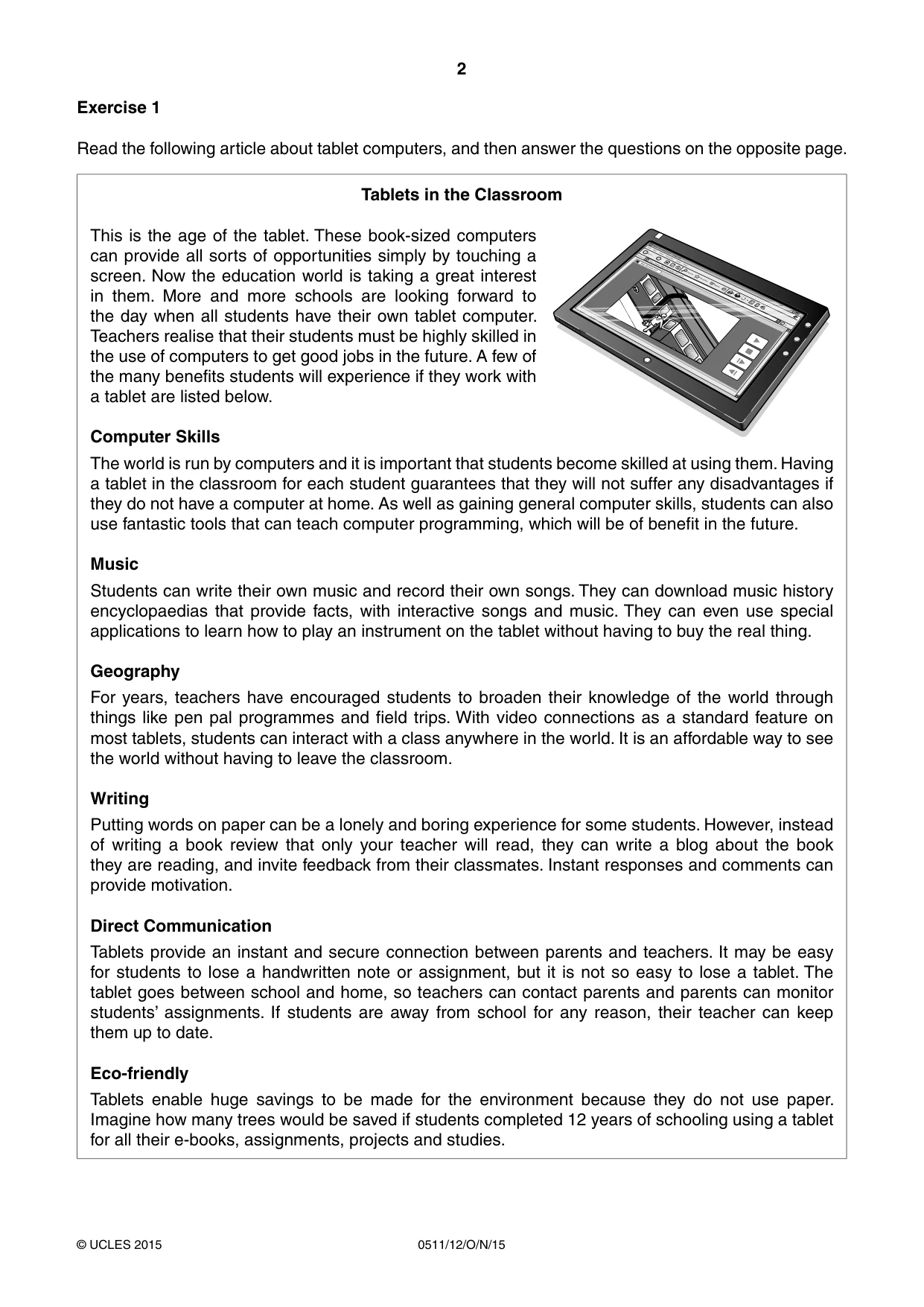
2 0511/12/O/N/15 © UCLES 2015 Exercise 1 Read the following article about tablet computers, and then answer the questions on the opposite page. Tablets in the Classroom Go Address Back Search Favorites Media Web Browser101– Internet File Edit View Tools Help Favorites http://www.Web Browser101.com Web Browser101 This is the age of the tablet. These book-sized computers can provide all sorts of opportunities simply by touching a screen. Now the education world is taking a great interest in them. More and more schools are looking forward to the day when all students have their own tablet computer. Teachers realise that their students must be highly skilled in the use of computers to get good jobs in the future. A few of the many benefits students will experience if they work with a tablet are listed below. Computer Skills The world is run by computers and it is important that students become skilled at using them. Having a tablet in the classroom for each student guarantees that they will not suffer any disadvantages if they do not have a computer at home. As well as gaining general computer skills, students can also use fantastic tools that can teach computer programming, which will be of benefit in the future. Music Students can write their own music and record their own songs. They can download music history encyclopaedias that provide facts, with interactive songs and music. They can even use special applications to learn how to play an instrument on the tablet without having to buy the real thing. Geography For years, teachers have encouraged students to broaden their knowledge of the world through things like pen pal programmes and field trips. With video connections as a standard feature on most tablets, students can interact with a class anywhere in the world. It is an affordable way to see the world without having to leave the classroom. Writing Putting words on paper can be a lonely and boring experience for some students. However, instead of writing a book review that only your teacher will read, they can write a blog about the book they are reading, and invite feedback from their classmates. Instant responses and comments can provide motivation. Direct Communication Tablets provide an instant and secure connection between parents and teachers. It may be easy for students to lose a handwritten note or assignment, but it is not so easy to lose a tablet. The tablet goes between school and home, so teachers can contact parents and parents can monitor students’ assignments. If students are away from school for any reason, their teacher can keep them up to date. Eco-friendly Tablets enable huge savings to be made for the environment because they do not use paper. Imagine how many trees would be saved if students completed 12 years of schooling using a tablet for all their e-books, assignments, projects and studies.
Question paper, page 3
3 0511/12/O/N/15 © UCLES 2015 [Turn over (a) What do schools hope will happen in the near future? …[1] (b) How can a tablet help students to access information about music? …[1] (c) How can a music student save money by using a tablet? …[1] (d) What is available now that can replace pen pal programmes? …[1] (e) How can a tablet make communication easier between schools and students? Give two details. … …[2] (f) Why are tablets considered to be eco-friendly? …[1] [Total: 7]
Question paper, page 4
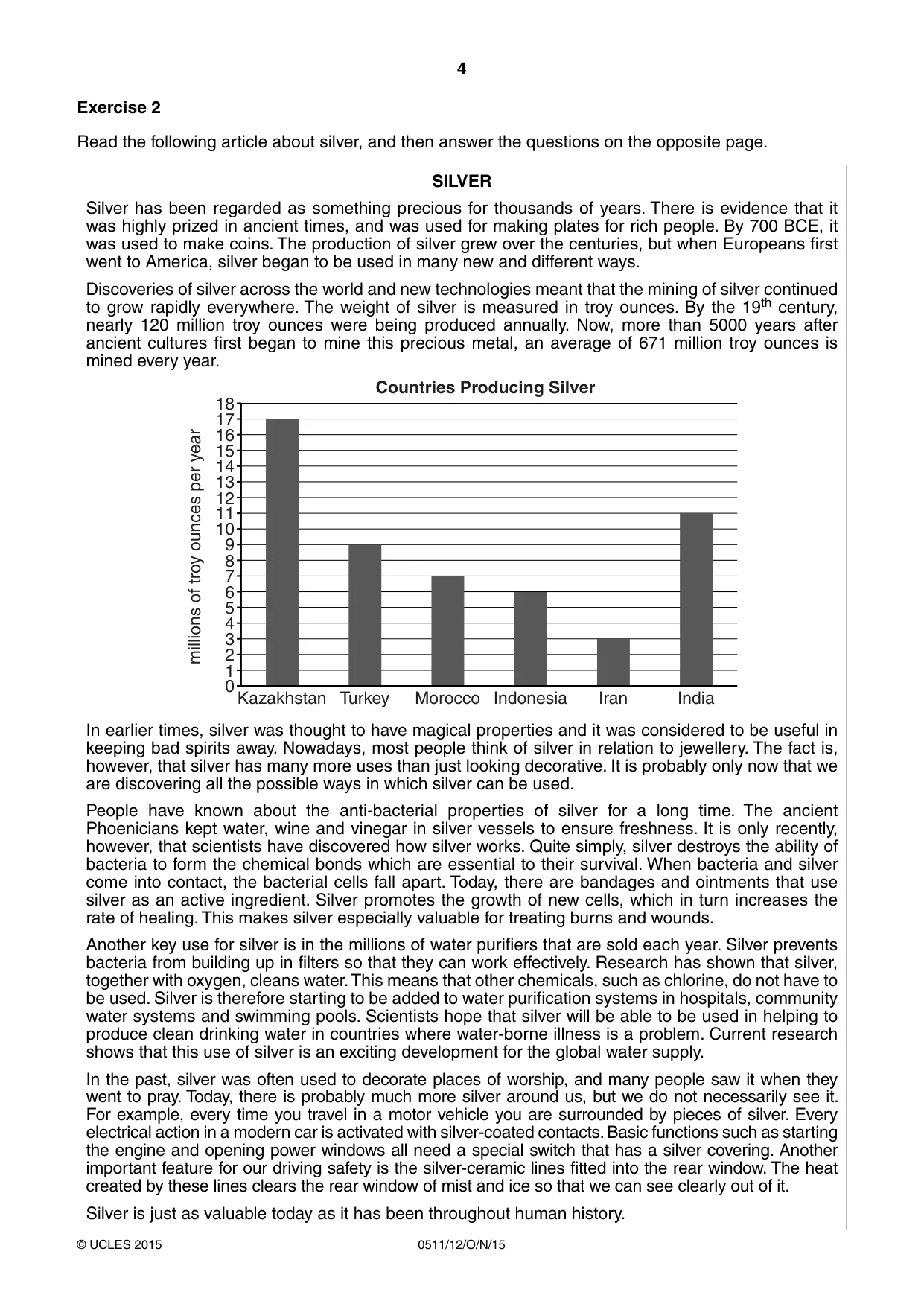
4 0511/12/O/N/15 © UCLES 2015 Exercise 2 Read the following article about silver, and then answer the questions on the opposite page. SILVER Silver has been regarded as something precious for thousands of years. There is evidence that it was highly prized in ancient times, and was used for making plates for rich people. By 700 BCE, it was used to make coins. The production of silver grew over the centuries, but when Europeans first went to America, silver began to be used in many new and different ways. Discoveries of silver across the world and new technologies meant that the mining of silver continued to grow rapidly everywhere. The weight of silver is measured in troy ounces. By the 19th century, nearly 120 million troy ounces were being produced annually. Now, more than 5000 years after ancient cultures first began to mine this precious metal, an average of 671 million troy ounces is mined every year. 18 17 16 15 14 13 12 11 Kazakhstan 10 9 8 7 6 5 4 millions of troy ounces per year 3 2 1 0 Turkey Morocco Countries Producing Silver Indonesia Iran India In earlier times, silver was thought to have magical properties and it was considered to be useful in keeping bad spirits away. Nowadays, most people think of silver in relation to jewellery. The fact is, however, that silver has many more uses than just looking decorative. It is probably only now that we are discovering all the possible ways in which silver can be used. People have known about the anti-bacterial properties of silver for a long time. The ancient Phoenicians kept water, wine and vinegar in silver vessels to ensure freshness. It is only recently, however, that scientists have discovered how silver works. Quite simply, silver destroys the ability of bacteria to form the chemical bonds which are essential to their survival. When bacteria and silver come into contact, the bacterial cells fall apart. Today, there are bandages and ointments that use silver as an active ingredient. Silver promotes the growth of new cells, which in turn increases the rate of healing. This makes silver especially valuable for treating burns and wounds. Another key use for silver is in the millions of water purifiers that are sold each year. Silver prevents bacteria from building up in filters so that they can work effectively. Research has shown that silver, together with oxygen, cleans water. This means that other chemicals, such as chlorine, do not have to be used. Silver is therefore starting to be added to water purification systems in hospitals, community water systems and swimming pools. Scientists hope that silver will be able to be used in helping to produce clean drinking water in countries where water-borne illness is a problem. Current research shows that this use of silver is an exciting development for the global water supply. In the past, silver was often used to decorate places of worship, and many people saw it when they went to pray. Today, there is probably much more silver around us, but we do not necessarily see it. For example, every time you travel in a motor vehicle you are surrounded by pieces of silver. Every electrical action in a modern car is activated with silver-coated contacts. Basic functions such as starting the engine and opening power windows all need a special switch that has a silver covering. Another important feature for our driving safety is the silver-ceramic lines fitted into the rear window. The heat created by these lines clears the rear window of mist and ice so that we can see clearly out of it. Silver is just as valuable today as it has been throughout human history.
Question paper, page 5
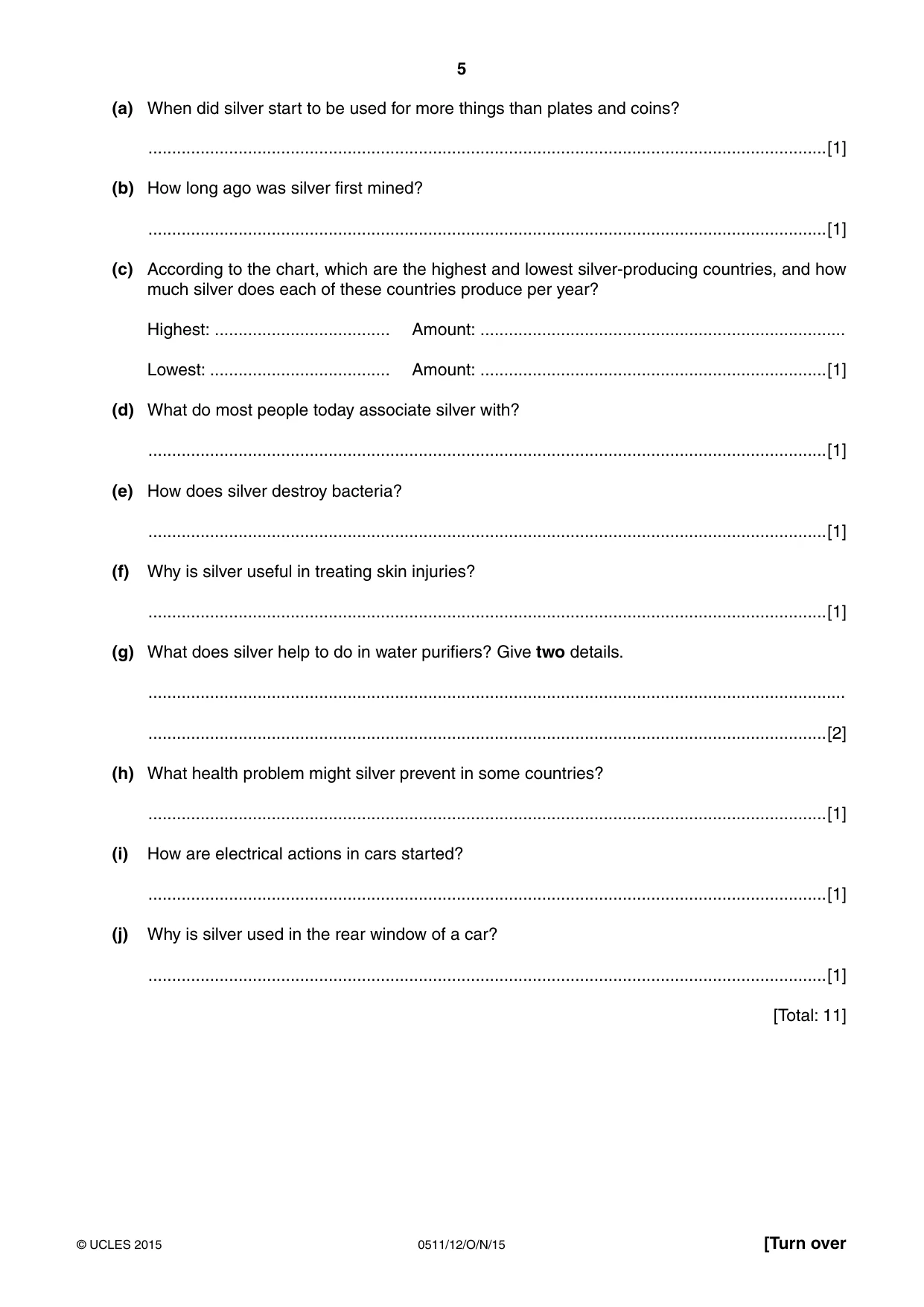
5 0511/12/O/N/15 © UCLES 2015 [Turn over (a) When did silver start to be used for more things than plates and coins? …[1] (b) How long ago was silver first mined? …[1] (c) According to the chart, which are the highest and lowest silver-producing countries, and how much silver does each of these countries produce per year? Highest: … Amount: … Lowest: … Amount: …[1] (d) What do most people today associate silver with? …[1] (e) How does silver destroy bacteria? …[1] (f) Why is silver useful in treating skin injuries? …[1] (g) What does silver help to do in water purifiers? Give two details. … …[2] (h) What health problem might silver prevent in some countries? …[1] (i) How are electrical actions in cars started? …[1] (j) Why is silver used in the rear window of a car? …[1] [Total: 11]
Question paper, page 6
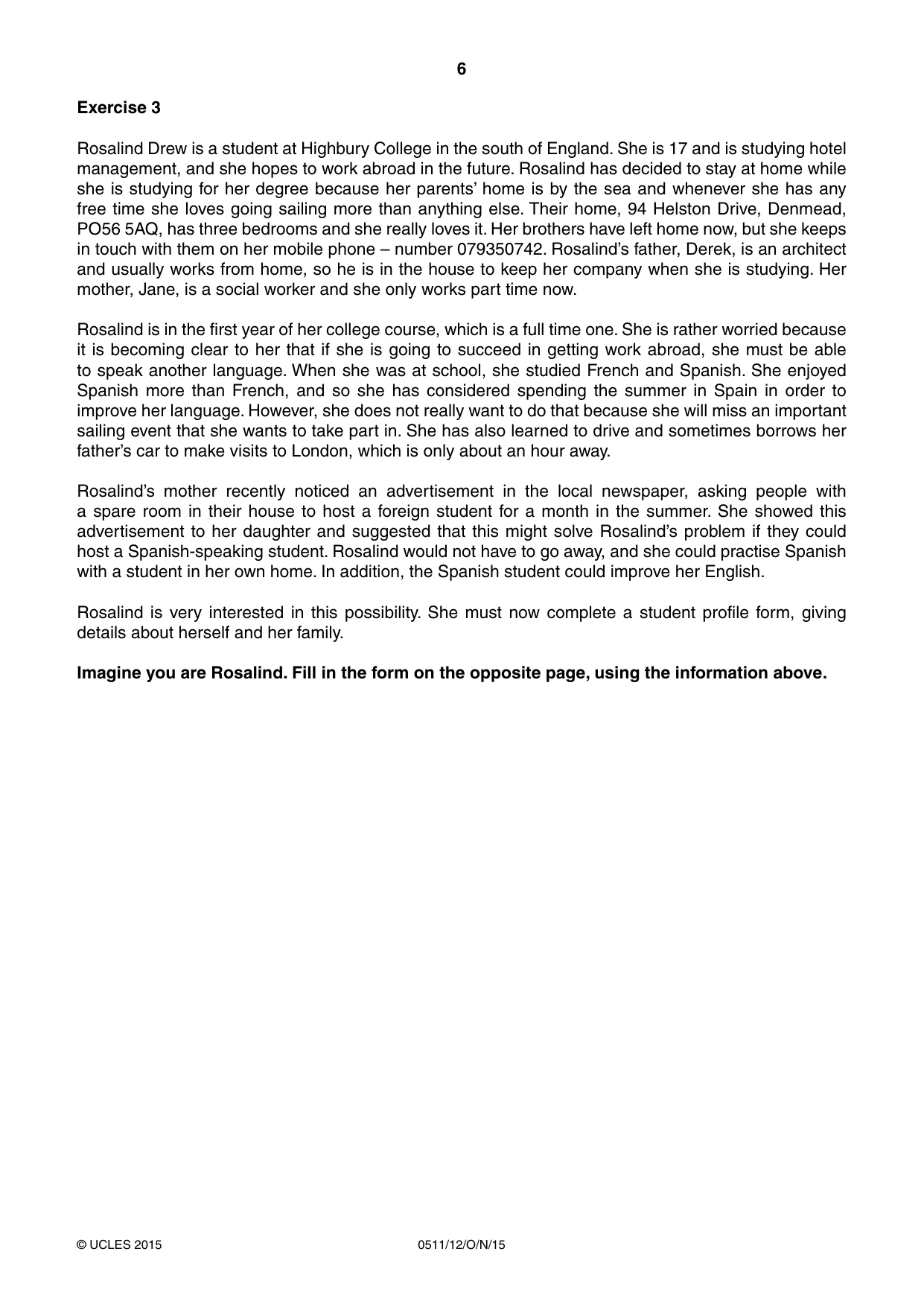
6 0511/12/O/N/15 © UCLES 2015 Exercise 3 Rosalind Drew is a student at Highbury College in the south of England. She is 17 and is studying hotel management, and she hopes to work abroad in the future. Rosalind has decided to stay at home while she is studying for her degree because her parents’ home is by the sea and whenever she has any free time she loves going sailing more than anything else. Their home, 94 Helston Drive, Denmead, PO56 5AQ, has three bedrooms and she really loves it. Her brothers have left home now, but she keeps in touch with them on her mobile phone – number 079350742. Rosalind’s father, Derek, is an architect and usually works from home, so he is in the house to keep her company when she is studying. Her mother, Jane, is a social worker and she only works part time now. Rosalind is in the first year of her college course, which is a full time one. She is rather worried because it is becoming clear to her that if she is going to succeed in getting work abroad, she must be able to speak another language. When she was at school, she studied French and Spanish. She enjoyed Spanish more than French, and so she has considered spending the summer in Spain in order to improve her language. However, she does not really want to do that because she will miss an important sailing event that she wants to take part in. She has also learned to drive and sometimes borrows her father’s car to make visits to London, which is only about an hour away. Rosalind’s mother recently noticed an advertisement in the local newspaper, asking people with a spare room in their house to host a foreign student for a month in the summer. She showed this advertisement to her daughter and suggested that this might solve Rosalind’s problem if they could host a Spanish-speaking student. Rosalind would not have to go away, and she could practise Spanish with a student in her own home. In addition, the Spanish student could improve her English. Rosalind is very interested in this possibility. She must now complete a student profile form, giving details about herself and her family. Imagine you are Rosalind. Fill in the form on the opposite page, using the information above.
Question paper, page 7
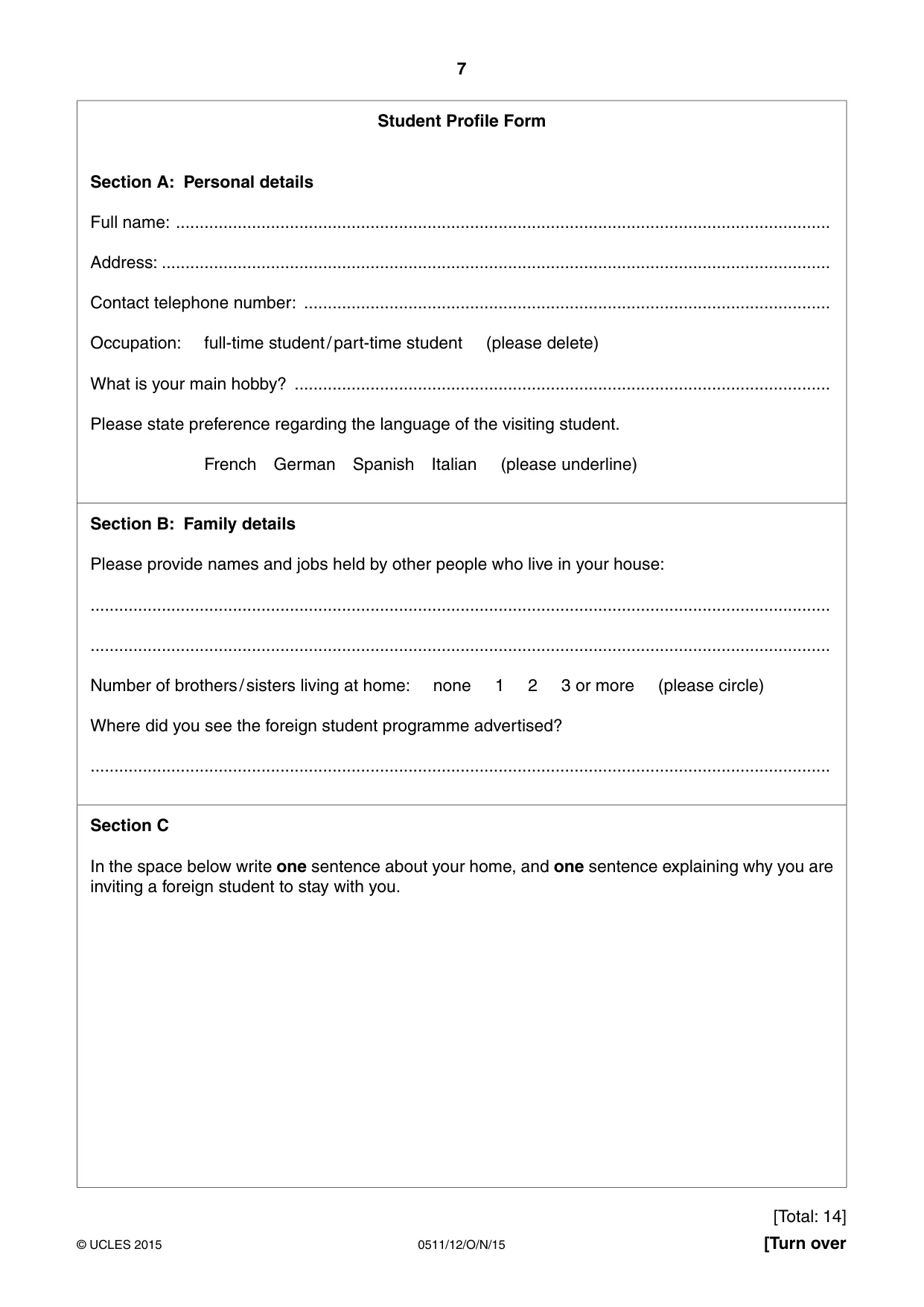
7 0511/12/O/N/15 © UCLES 2015 [Turn over Student Profile Form Section A: Personal details Full name: … Address: … Contact telephone number: … Occupation: full-time student / part-time student (please delete) What is your main hobby? … Please state preference regarding the language of the visiting student. French German Spanish Italian (please underline) Section B: Family details Please provide names and jobs held by other people who live in your house: … … Number of brothers / sisters living at home: none 1 2 3 or more (please circle) Where did you see the foreign student programme advertised? … Section C In the space below write one sentence about your home, and one sentence explaining why you are inviting a foreign student to stay with you. [Total: 14]
Question paper, page 8
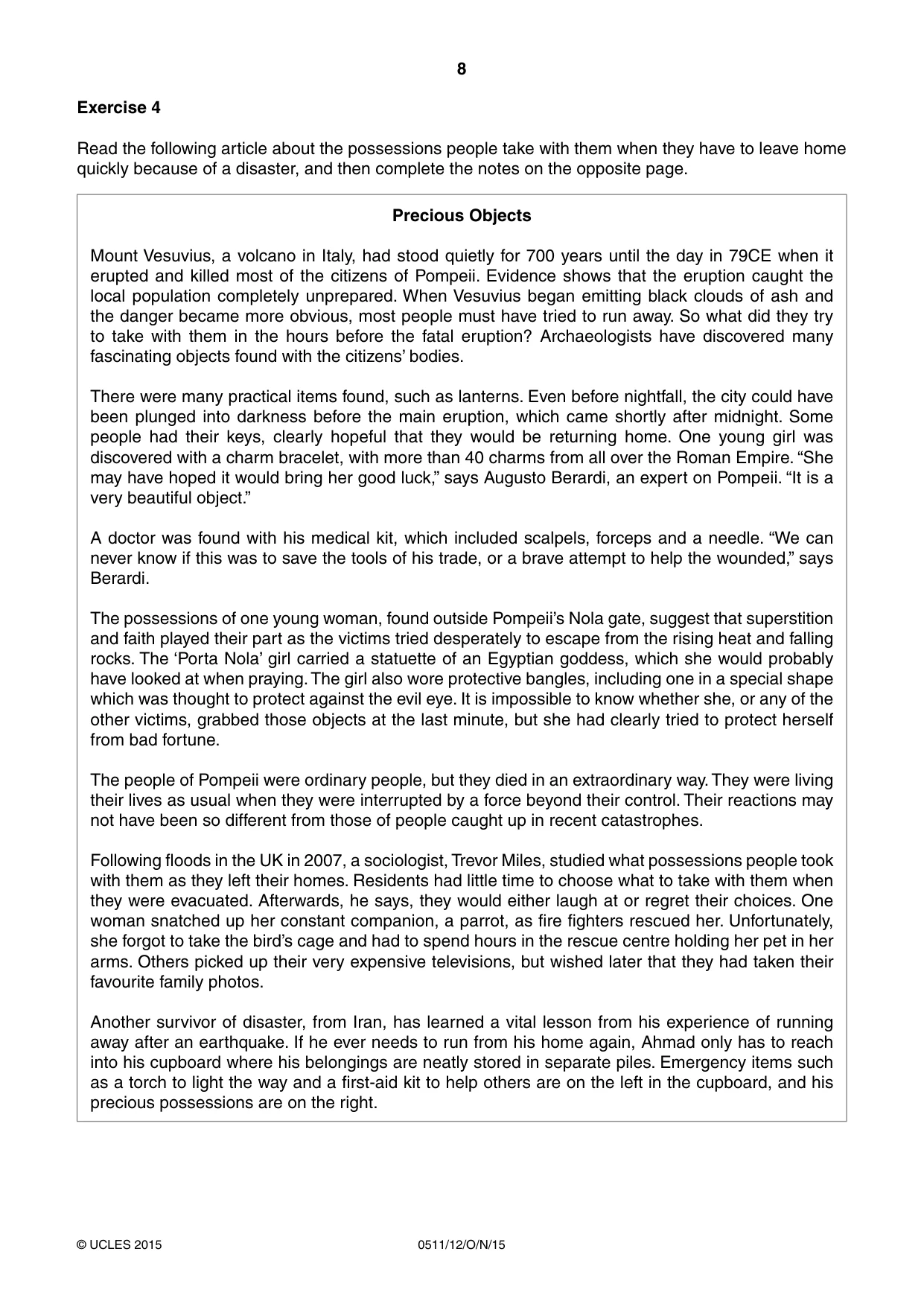
8 0511/12/O/N/15 © UCLES 2015 Exercise 4 Read the following article about the possessions people take with them when they have to leave home quickly because of a disaster, and then complete the notes on the opposite page. Precious Objects Mount Vesuvius, a volcano in Italy, had stood quietly for 700 years until the day in 79CE when it erupted and killed most of the citizens of Pompeii. Evidence shows that the eruption caught the local population completely unprepared. When Vesuvius began emitting black clouds of ash and the danger became more obvious, most people must have tried to run away. So what did they try to take with them in the hours before the fatal eruption? Archaeologists have discovered many fascinating objects found with the citizens’ bodies. There were many practical items found, such as lanterns. Even before nightfall, the city could have been plunged into darkness before the main eruption, which came shortly after midnight. Some people had their keys, clearly hopeful that they would be returning home. One young girl was discovered with a charm bracelet, with more than 40 charms from all over the Roman Empire. “She may have hoped it would bring her good luck,” says Augusto Berardi, an expert on Pompeii. “It is a very beautiful object.” A doctor was found with his medical kit, which included scalpels, forceps and a needle. “We can never know if this was to save the tools of his trade, or a brave attempt to help the wounded,” says Berardi. The possessions of one young woman, found outside Pompeii’s Nola gate, suggest that superstition and faith played their part as the victims tried desperately to escape from the rising heat and falling rocks. The ‘Porta Nola’ girl carried a statuette of an Egyptian goddess, which she would probably have looked at when praying. The girl also wore protective bangles, including one in a special shape which was thought to protect against the evil eye. It is impossible to know whether she, or any of the other victims, grabbed those objects at the last minute, but she had clearly tried to protect herself from bad fortune. The people of Pompeii were ordinary people, but they died in an extraordinary way. They were living their lives as usual when they were interrupted by a force beyond their control. Their reactions may not have been so different from those of people caught up in recent catastrophes. Following floods in the UK in 2007, a sociologist, Trevor Miles, studied what possessions people took with them as they left their homes. Residents had little time to choose what to take with them when they were evacuated. Afterwards, he says, they would either laugh at or regret their choices. One woman snatched up her constant companion, a parrot, as fire fighters rescued her. Unfortunately, she forgot to take the bird’s cage and had to spend hours in the rescue centre holding her pet in her arms. Others picked up their very expensive televisions, but wished later that they had taken their favourite family photos. Another survivor of disaster, from Iran, has learned a vital lesson from his experience of running away after an earthquake. If he ever needs to run from his home again, Ahmad only has to reach into his cupboard where his belongings are neatly stored in separate piles. Emergency items such as a torch to light the way and a first-aid kit to help others are on the left in the cupboard, and his precious possessions are on the right.
Question paper, page 9
9 0511/12/O/N/15 © UCLES 2015 [Turn over You are going to give a talk to your class about the objects people take with them in a disaster situation. Prepare some notes to use as the basis of your talk. Make short notes under each heading. Objects taken by the residents of Pompeii, and possible reasons for their choice • Lanterns, to see in the darkness • … • … • … • … Objects valued by modern disaster survivors, and reasons for their choice • … • … • … [Total: 7] Exercise 5 Imagine that you have given your talk to your class. Now your teacher has asked you to follow up these notes with a short written report. Look at your notes in Exercise 4 above. Using the ideas in your notes, write a summary about the objects people take with them in a disaster situation and why. Your summary should be about 70 words long (and no more than 80 words long). You should use your own words as far as possible. … … … … … … … … [Total: 5]
Question paper, page 10
10 0511/12/O/N/15 © UCLES 2015 Exercise 6 Your parents were unexpectedly delayed abroad and missed your younger brother’s birthday. You had to organise a party for him. Write a letter to a friend, telling them about your experience. In your letter, you should: • describe how you felt when you realised that you had to organise the party yourself • tell your friend about the party • say whether you thought the party was a success. The pictures above may give you some ideas, and you should try to use some ideas of your own. Your letter should be between 100 and 150 words long. Do not write an address. You will receive up to 7 marks for the content of your letter, and up to 6 marks for the style and accuracy of your language.
Question paper, page 11
11 0511/12/O/N/15 © UCLES 2015 [Turn over … … … … … … … … … … … … … … … … … … … … … … … … … [Total: 13]
Question paper, page 12
12 0511/12/O/N/15 © UCLES 2015 Exercise 7 Some students think that they should not have homework, but others believe that it is important. Here are some comments about this idea: The school day is already long enough. Homework helps us get better results. We need time to relax. Homework allows me to learn at my own speed. Write an article for your school magazine, giving your views. The comments above may give you some ideas, and you should try to include ideas of your own. Your article should be between 100 and 150 words long. You will receive up to 7 marks for the content of your article, and up to 6 marks for the style and accuracy of your language.
Question paper, page 13
13 0511/12/O/N/15 © UCLES 2015 … … … … … … … … … … … … … … … … … … … … … … … … … [Total: 13]
Question paper, page 14
14 0511/12/O/N/15 © UCLES 2015 BLANK PAGE
Question paper, page 15
15 0511/12/O/N/15 © UCLES 2015 BLANK PAGE
Question paper, page 16
16 0511/12/O/N/15 © UCLES 2015 Permission to reproduce items where third-party owned material protected by copyright is included has been sought and cleared where possible. Every reasonable effort has been made by the publisher (UCLES) to trace copyright holders, but if any items requiring clearance have unwittingly been included, the publisher will be pleased to make amends at the earliest possible opportunity. To avoid the issue of disclosure of answer-related information to candidates, all copyright acknowledgements are reproduced online in the Cambridge International Examinations Copyright Acknowledgements Booklet. This is produced for each series of examinations and is freely available to download at www.cie.org.uk after the live examination series. Cambridge International Examinations is part of the Cambridge Assessment Group. Cambridge Assessment is the brand name of University of Cambridge Local Examinations Syndicate (UCLES), which is itself a department of the University of Cambridge. BLANK PAGE
Mark scheme, page 1
® IGCSE is the registered trademark of Cambridge International Examinations. CAMBRIDGE INTERNATIONAL EXAMINATIONS Cambridge International General Certificate of Secondary Education MARK SCHEME for the October/November 2015 series 0511 ENGLISH AS A SECOND LANGUAGE 0511/12 Paper 1 (Reading and Writing – Core), maximum raw mark 70 This mark scheme is published as an aid to teachers and candidates, to indicate the requirements of the examination. It shows the basis on which Examiners were instructed to award marks. It does not indicate the details of the discussions that took place at an Examiners’ meeting before marking began, which would have considered the acceptability of alternative answers. Mark schemes should be read in conjunction with the question paper and the Principal Examiner Report for Teachers. Cambridge will not enter into discussions about these mark schemes. Cambridge is publishing the mark schemes for the October/November 2015 series for most Cambridge IGCSE®, Cambridge International A and AS Level components and some Cambridge O Level components.
Mark scheme, page 2
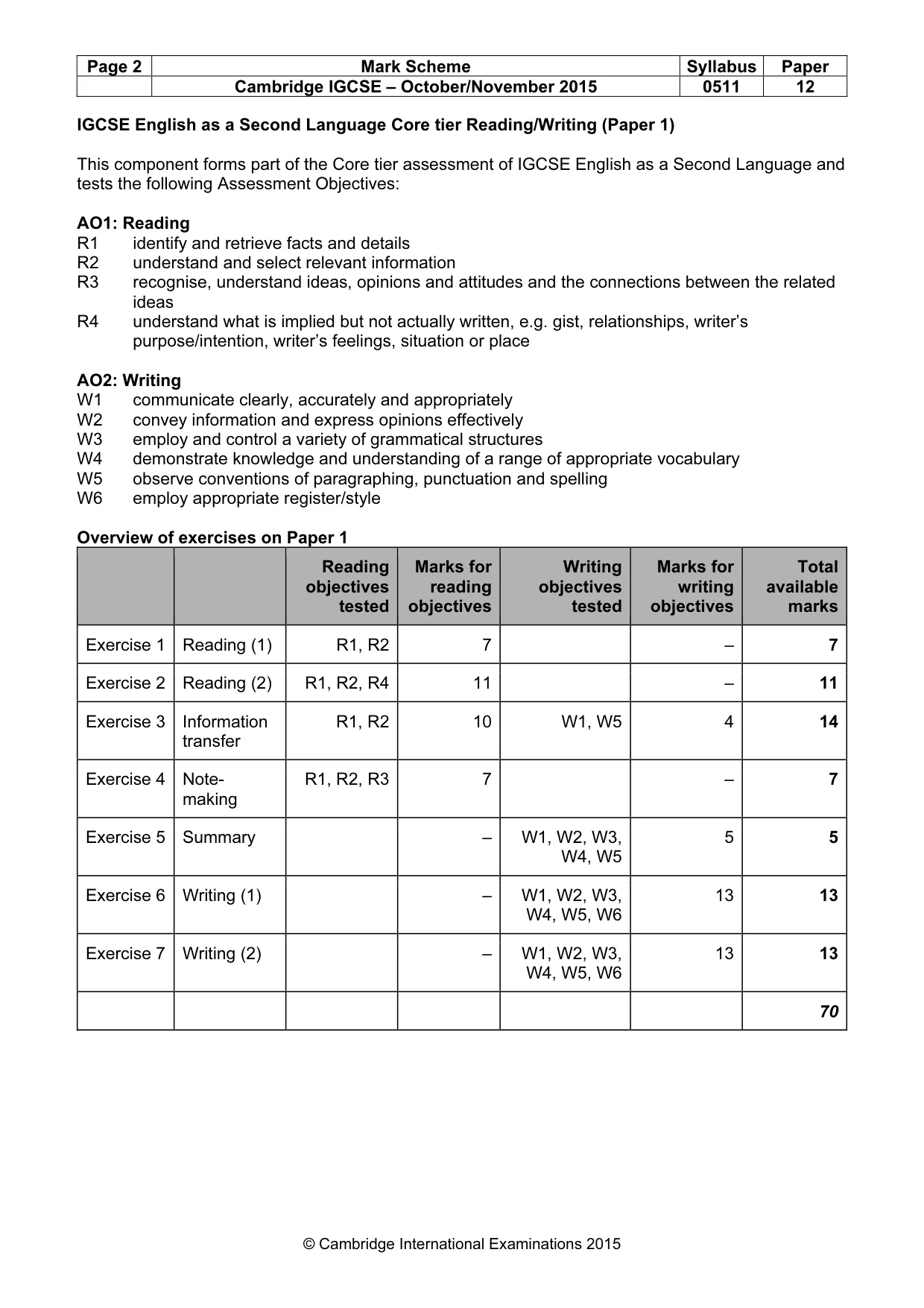
Page 2 Mark Scheme Syllabus Paper Cambridge IGCSE – October/November 2015 0511 12 © Cambridge International Examinations 2015 IGCSE English as a Second Language Core tier Reading/Writing (Paper 1) This component forms part of the Core tier assessment of IGCSE English as a Second Language and tests the following Assessment Objectives: AO1: Reading R1 identify and retrieve facts and details R2 understand and select relevant information R3 recognise, understand ideas, opinions and attitudes and the connections between the related ideas R4 understand what is implied but not actually written, e.g. gist, relationships, writer’s purpose/intention, writer’s feelings, situation or place AO2: Writing W1 communicate clearly, accurately and appropriately W2 convey information and express opinions effectively W3 employ and control a variety of grammatical structures W4 demonstrate knowledge and understanding of a range of appropriate vocabulary W5 observe conventions of paragraphing, punctuation and spelling W6 employ appropriate register/style Overview of exercises on Paper 1 Reading objectives tested Marks for reading objectives Writing objectives tested Marks for writing objectives Total available marks Exercise 1 Reading (1) R1, R2 7 – 7 Exercise 2 Reading (2) R1, R2, R4 11 – 11 Exercise 3 Information transfer R1, R2 10 W1, W5 4 14 Exercise 4 Note- making R1, R2, R3 7 – 7 Exercise 5 Summary – W1, W2, W3, W4, W5 5 5 Exercise 6 Writing (1) – W1, W2, W3, W4, W5, W6 13 13 Exercise 7 Writing (2) – W1, W2, W3, W4, W5, W6 13 13 70
Mark scheme, page 3
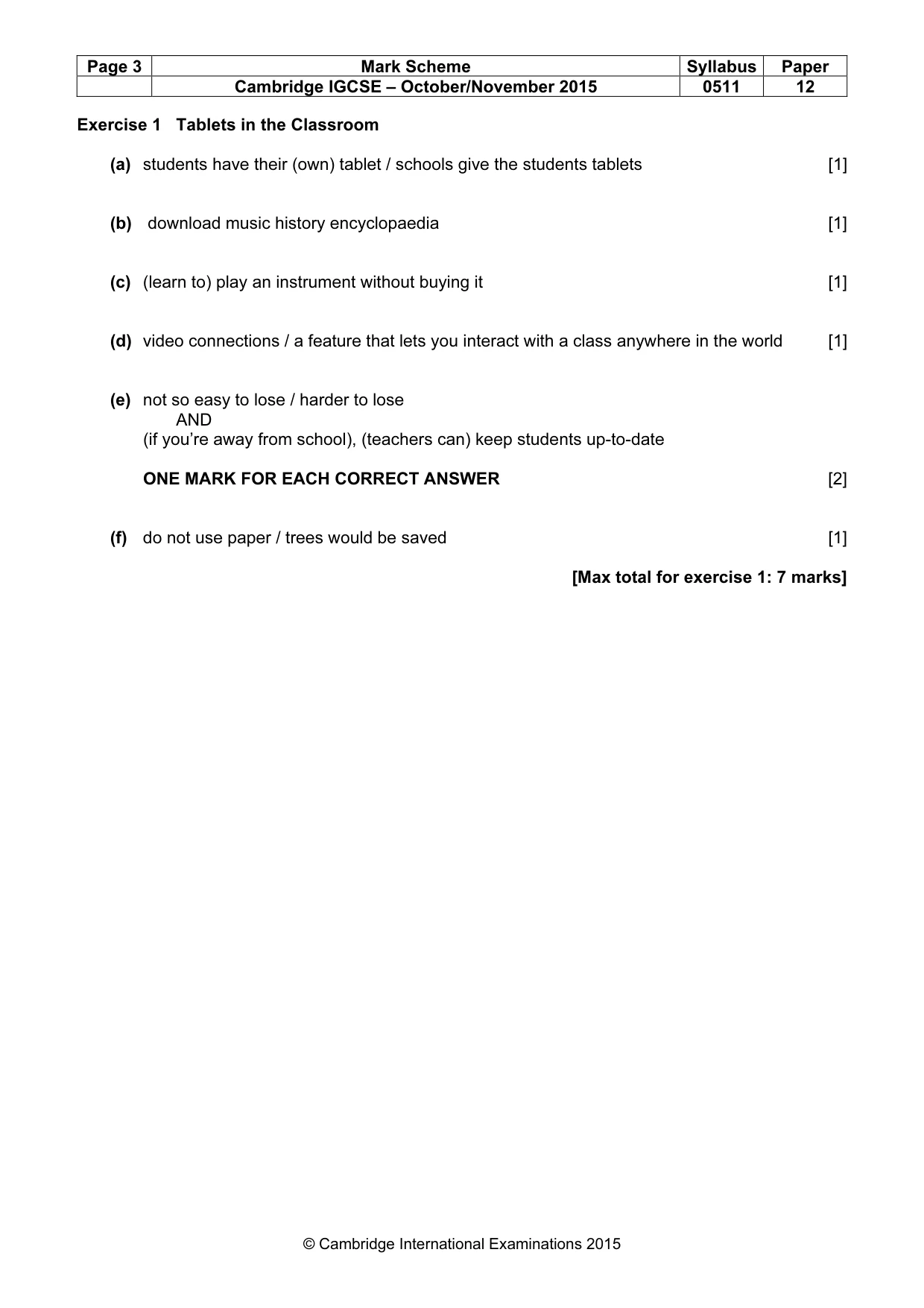
Page 3 Mark Scheme Syllabus Paper Cambridge IGCSE – October/November 2015 0511 12 © Cambridge International Examinations 2015 Exercise 1 Tablets in the Classroom (a) students have their (own) tablet / schools give the students tablets [1] (b) download music history encyclopaedia [1] (c) (learn to) play an instrument without buying it [1] (d) video connections / a feature that lets you interact with a class anywhere in the world [1] (e) not so easy to lose / harder to lose AND (if you’re away from school), (teachers can) keep students up-to-date ONE MARK FOR EACH CORRECT ANSWER [2] (f) do not use paper / trees would be saved [1] [Max total for exercise 1: 7 marks]
Mark scheme, page 4
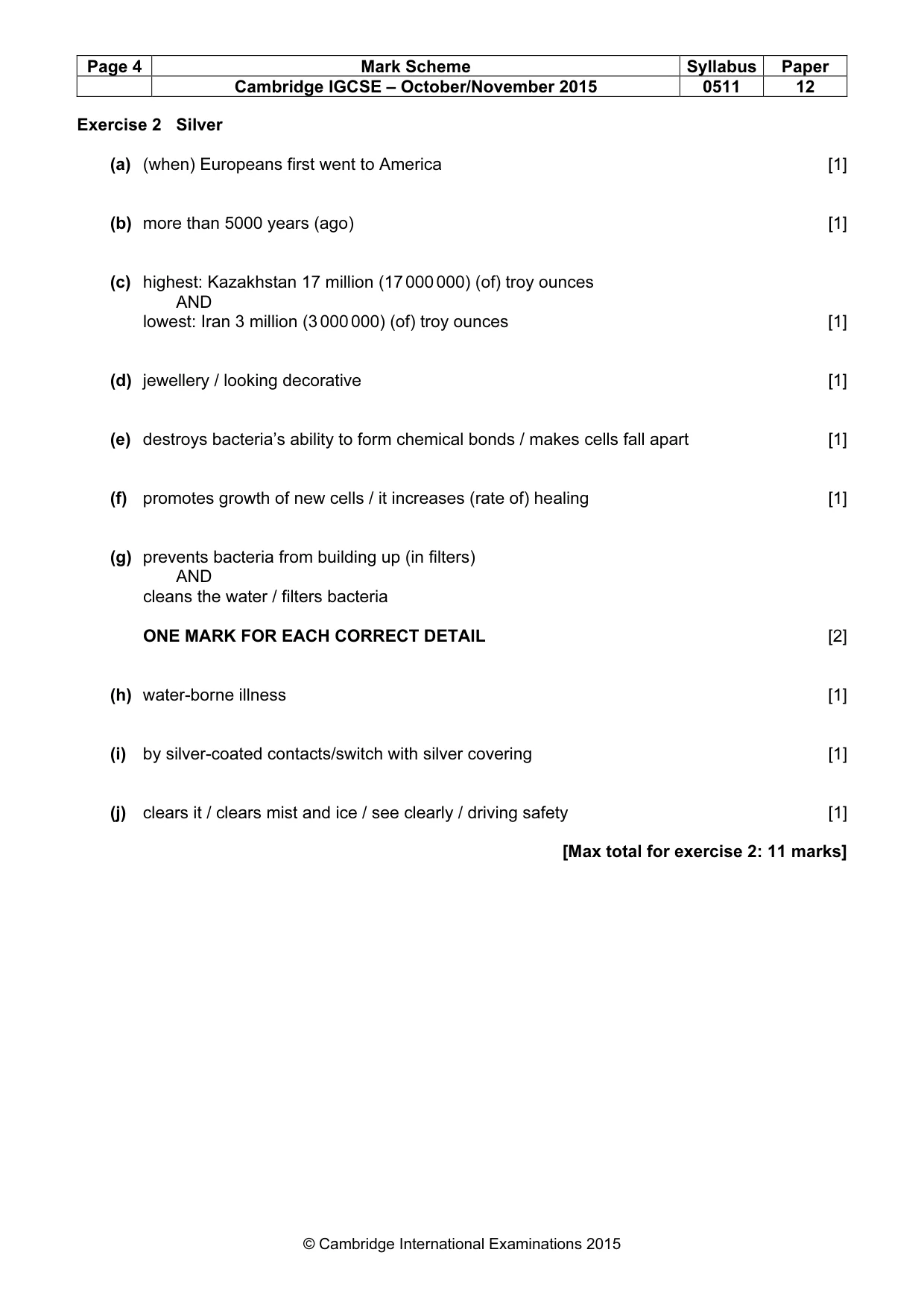
Page 4 Mark Scheme Syllabus Paper Cambridge IGCSE – October/November 2015 0511 12 © Cambridge International Examinations 2015 Exercise 2 Silver (a) (when) Europeans first went to America [1] (b) more than 5000 years (ago) [1] (c) highest: Kazakhstan 17 million (17 000 000) (of) troy ounces AND lowest: Iran 3 million (3 000 000) (of) troy ounces [1] (d) jewellery / looking decorative [1] (e) destroys bacteria’s ability to form chemical bonds / makes cells fall apart [1] (f) promotes growth of new cells / it increases (rate of) healing [1] (g) prevents bacteria from building up (in filters) AND cleans the water / filters bacteria ONE MARK FOR EACH CORRECT DETAIL [2] (h) water-borne illness [1] (i) by silver-coated contacts/switch with silver covering [1] (j) clears it / clears mist and ice / see clearly / driving safety [1] [Max total for exercise 2: 11 marks]
Mark scheme, page 5
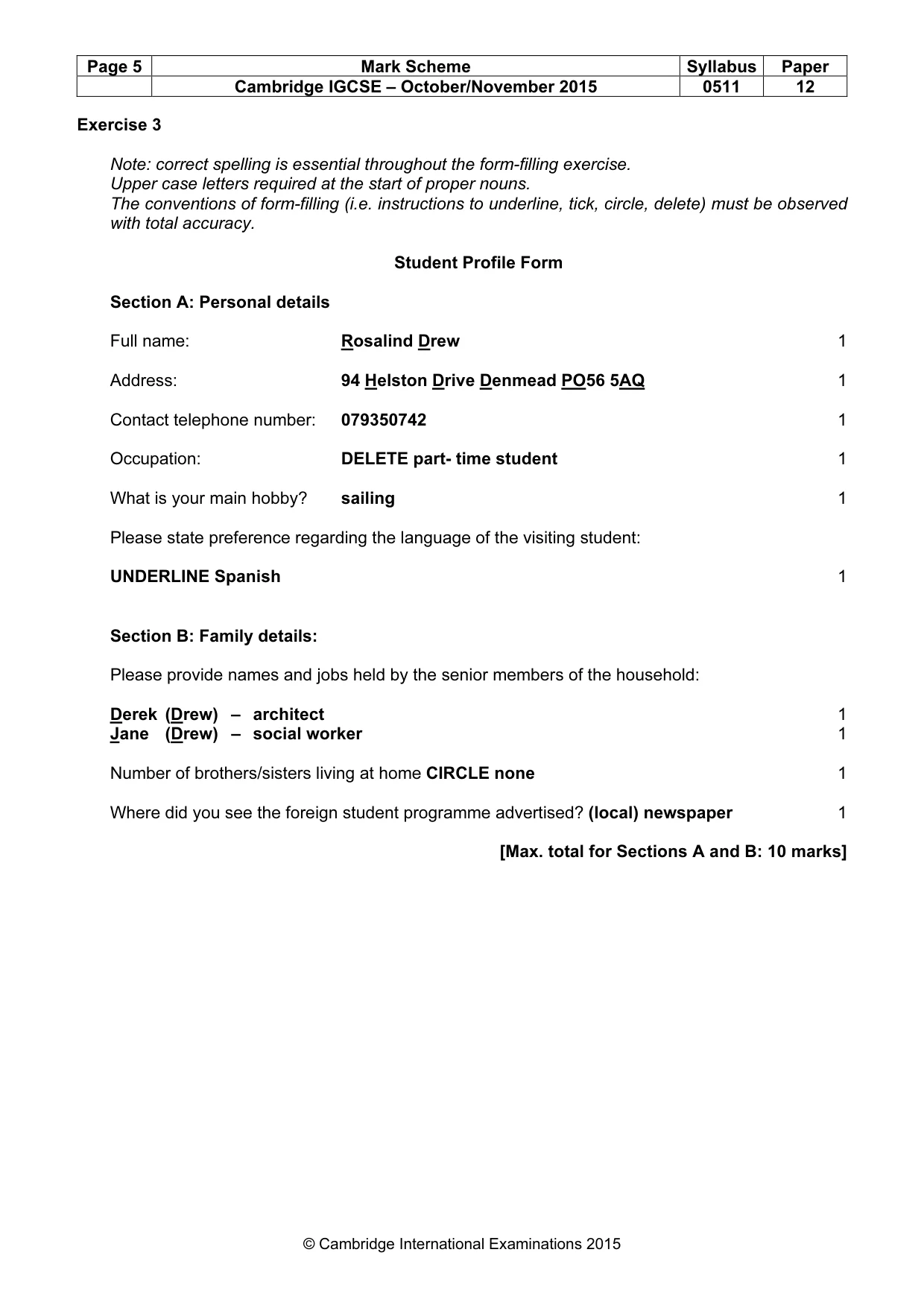
Page 5 Mark Scheme Syllabus Paper Cambridge IGCSE – October/November 2015 0511 12 © Cambridge International Examinations 2015 Exercise 3 Note: correct spelling is essential throughout the form-filling exercise. Upper case letters required at the start of proper nouns. The conventions of form-filling (i.e. instructions to underline, tick, circle, delete) must be observed with total accuracy. Student Profile Form Section A: Personal details Full name: Rosalind Drew 1 Address: 94 Helston Drive Denmead PO56 5AQ 1 Contact telephone number: 079350742 1 Occupation: DELETE part- time student 1 What is your main hobby? sailing 1 Please state preference regarding the language of the visiting student: UNDERLINE Spanish 1 Section B: Family details: Please provide names and jobs held by the senior members of the household: Derek (Drew) – architect 1 Jane (Drew) – social worker 1 Number of brothers/sisters living at home CIRCLE none 1 Where did you see the foreign student programme advertised? (local) newspaper 1 [Max. total for Sections A and B: 10 marks]
Mark scheme, page 6
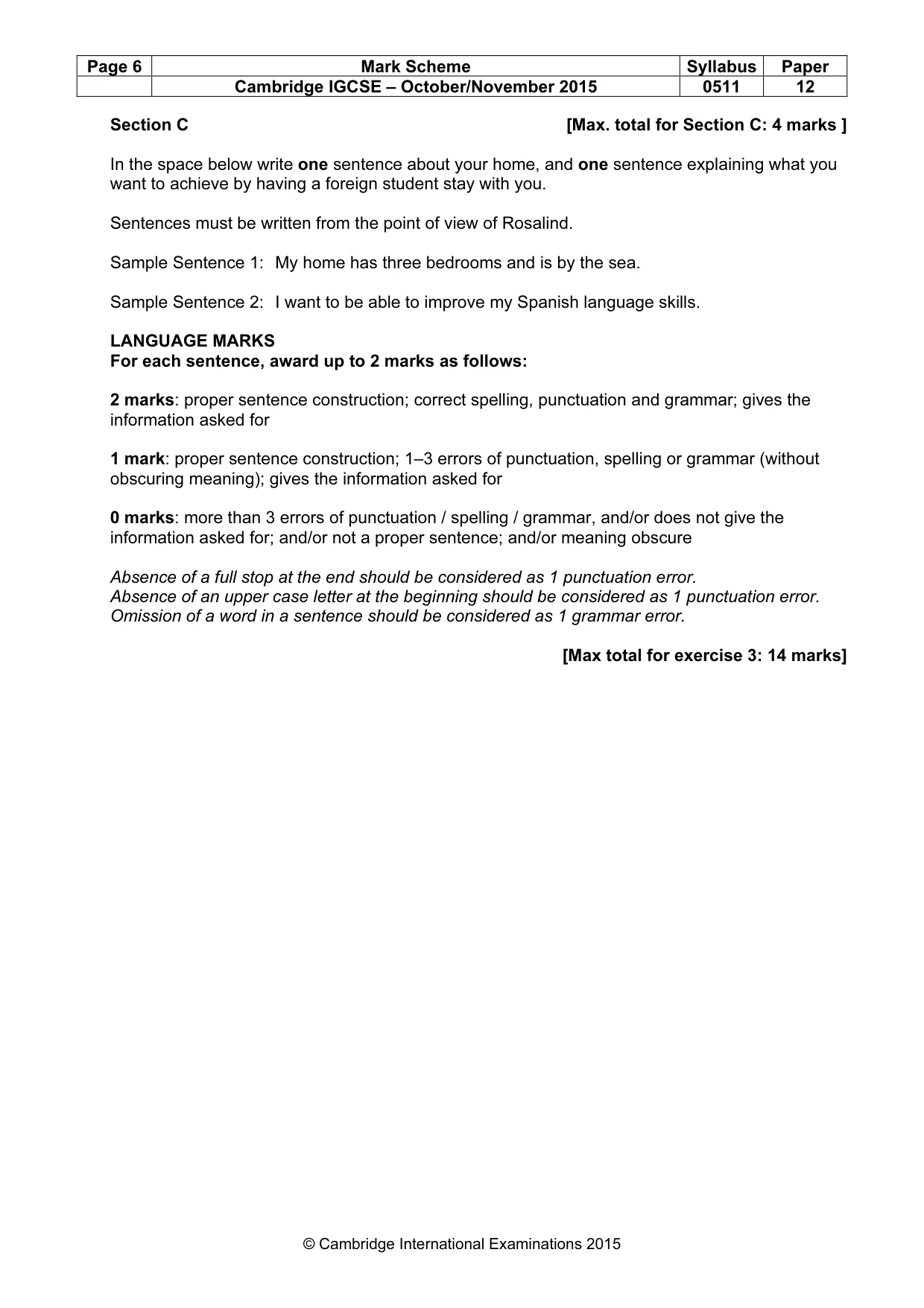
Page 6 Mark Scheme Syllabus Paper Cambridge IGCSE – October/November 2015 0511 12 © Cambridge International Examinations 2015 Section C [Max. total for Section C: 4 marks ] In the space below write one sentence about your home, and one sentence explaining what you want to achieve by having a foreign student stay with you. Sentences must be written from the point of view of Rosalind. Sample Sentence 1: My home has three bedrooms and is by the sea. Sample Sentence 2: I want to be able to improve my Spanish language skills. LANGUAGE MARKS For each sentence, award up to 2 marks as follows: 2 marks: proper sentence construction; correct spelling, punctuation and grammar; gives the information asked for 1 mark: proper sentence construction; 1–3 errors of punctuation, spelling or grammar (without obscuring meaning); gives the information asked for 0 marks: more than 3 errors of punctuation / spelling / grammar, and/or does not give the information asked for; and/or not a proper sentence; and/or meaning obscure Absence of a full stop at the end should be considered as 1 punctuation error. Absence of an upper case letter at the beginning should be considered as 1 punctuation error. Omission of a word in a sentence should be considered as 1 grammar error. [Max total for exercise 3: 14 marks]
Mark scheme, page 7
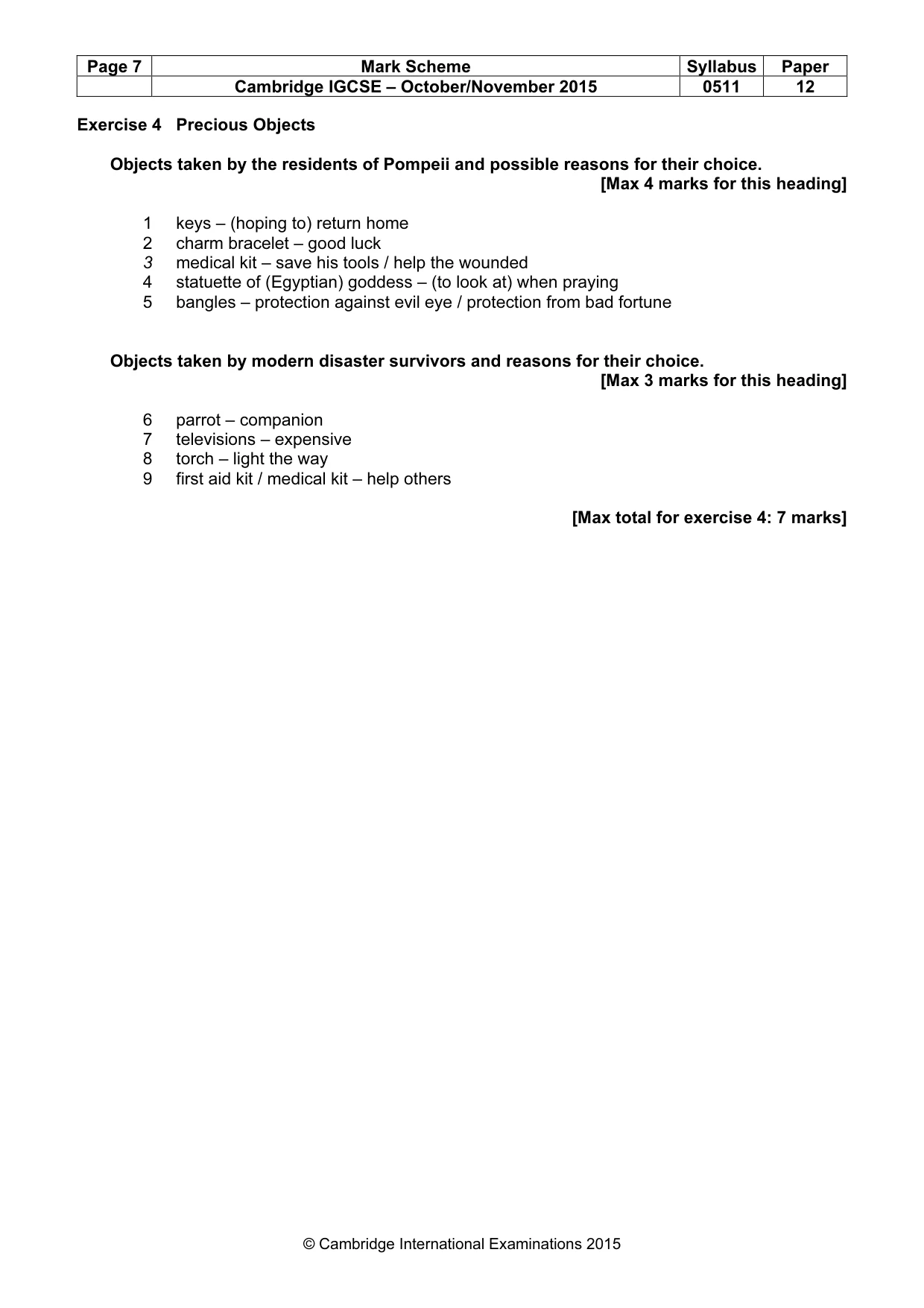
Page 7 Mark Scheme Syllabus Paper Cambridge IGCSE – October/November 2015 0511 12 © Cambridge International Examinations 2015 Exercise 4 Precious Objects Objects taken by the residents of Pompeii and possible reasons for their choice. [Max 4 marks for this heading] 1 keys – (hoping to) return home 2 charm bracelet – good luck 3 medical kit – save his tools / help the wounded 4 statuette of (Egyptian) goddess – (to look at) when praying 5 bangles – protection against evil eye / protection from bad fortune Objects taken by modern disaster survivors and reasons for their choice. [Max 3 marks for this heading] 6 parrot – companion 7 televisions – expensive 8 torch – light the way 9 first aid kit / medical kit – help others [Max total for exercise 4: 7 marks]
Mark scheme, page 8
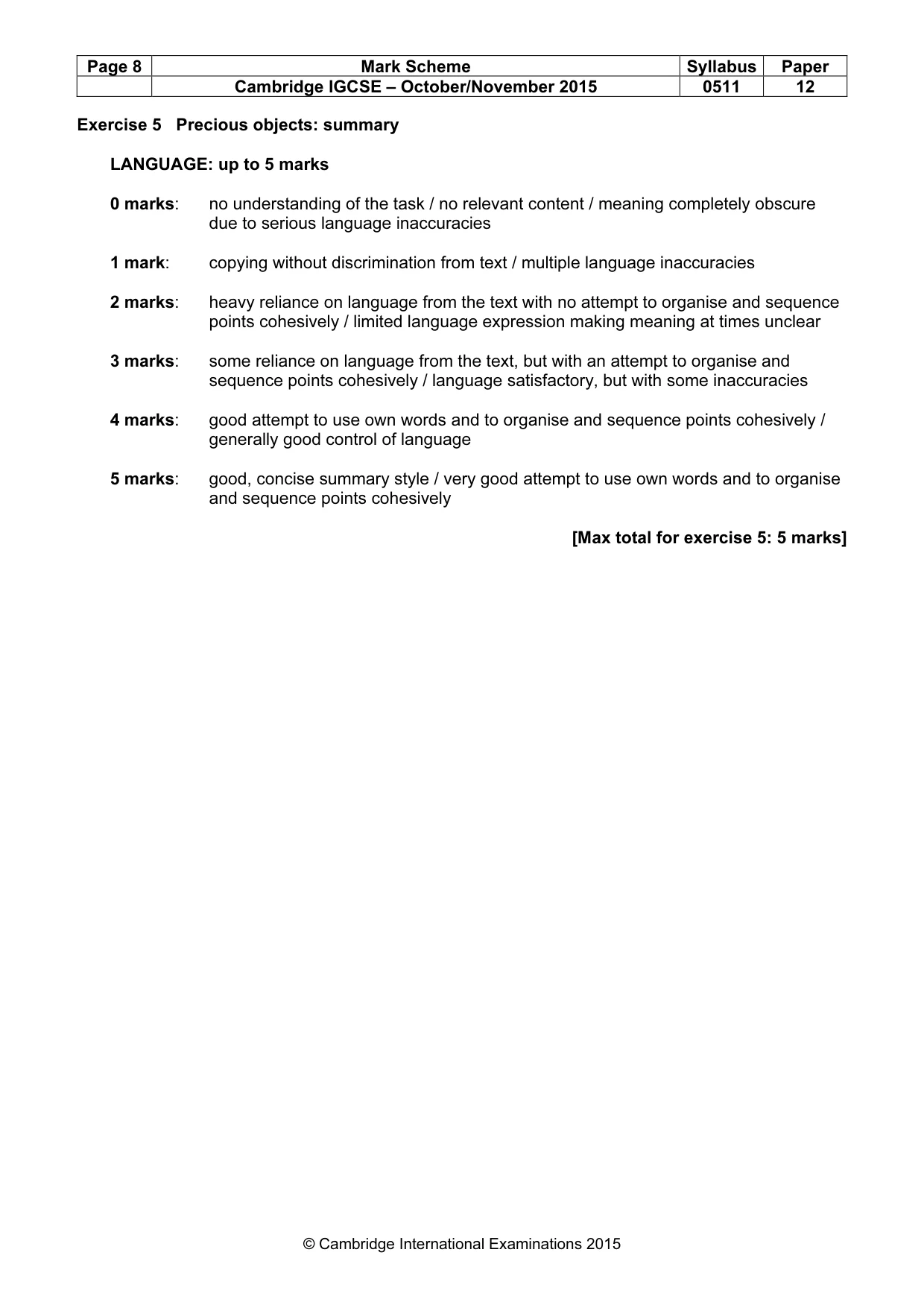
Page 8 Mark Scheme Syllabus Paper Cambridge IGCSE – October/November 2015 0511 12 © Cambridge International Examinations 2015 Exercise 5 Precious objects: summary LANGUAGE: up to 5 marks 0 marks: no understanding of the task / no relevant content / meaning completely obscure due to serious language inaccuracies 1 mark: copying without discrimination from text / multiple language inaccuracies 2 marks: heavy reliance on language from the text with no attempt to organise and sequence points cohesively / limited language expression making meaning at times unclear 3 marks: some reliance on language from the text, but with an attempt to organise and sequence points cohesively / language satisfactory, but with some inaccuracies 4 marks: good attempt to use own words and to organise and sequence points cohesively / generally good control of language 5 marks: good, concise summary style / very good attempt to use own words and to organise and sequence points cohesively [Max total for exercise 5: 5 marks]
Mark scheme, page 9
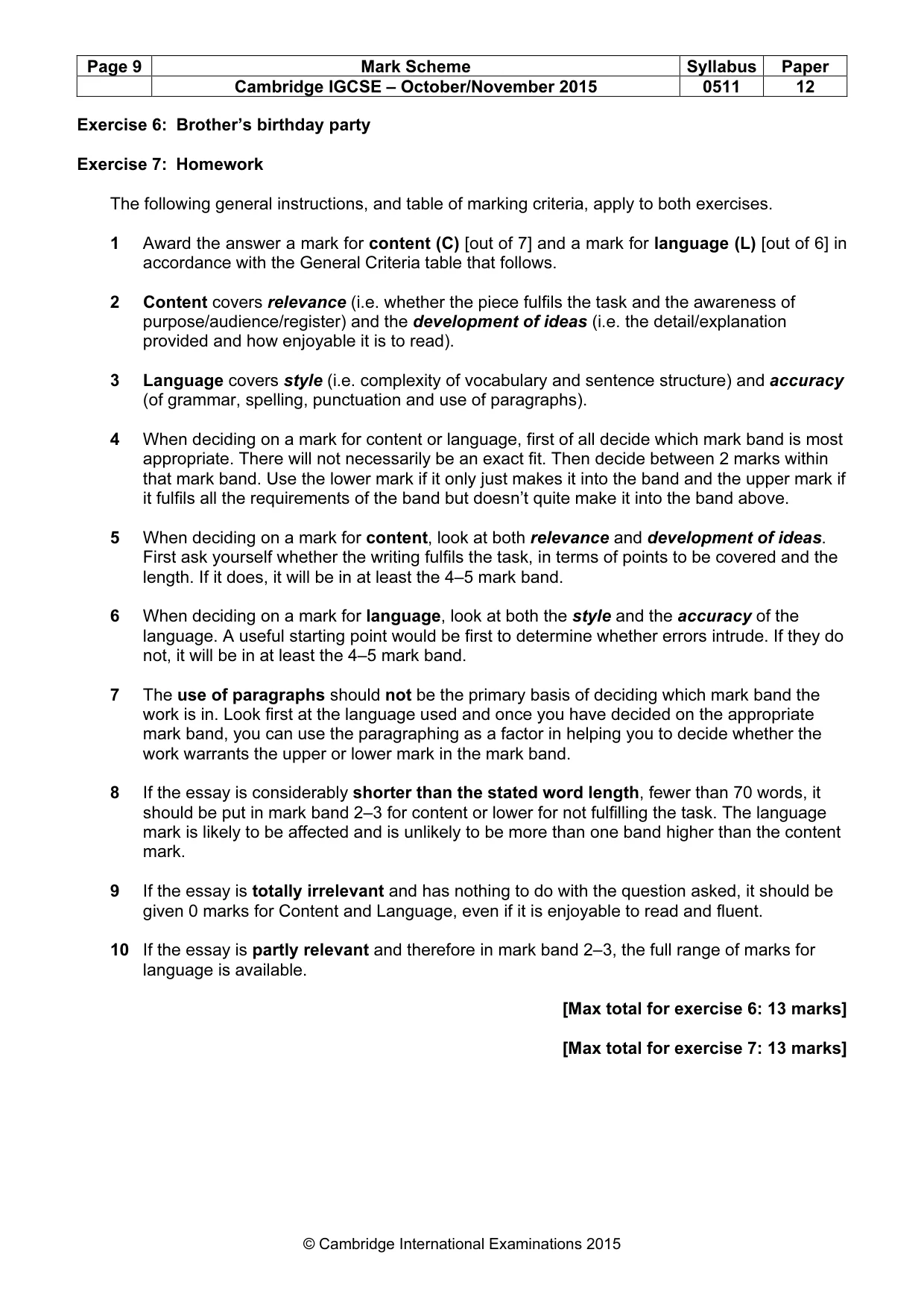
Page 9 Mark Scheme Syllabus Paper Cambridge IGCSE – October/November 2015 0511 12 © Cambridge International Examinations 2015 Exercise 6: Brother’s birthday party Exercise 7: Homework The following general instructions, and table of marking criteria, apply to both exercises. 1 Award the answer a mark for content (C) [out of 7] and a mark for language (L) [out of 6] in accordance with the General Criteria table that follows. 2 Content covers relevance (i.e. whether the piece fulfils the task and the awareness of purpose/audience/register) and the development of ideas (i.e. the detail/explanation provided and how enjoyable it is to read). 3 Language covers style (i.e. complexity of vocabulary and sentence structure) and accuracy (of grammar, spelling, punctuation and use of paragraphs). 4 When deciding on a mark for content or language, first of all decide which mark band is most appropriate. There will not necessarily be an exact fit. Then decide between 2 marks within that mark band. Use the lower mark if it only just makes it into the band and the upper mark if it fulfils all the requirements of the band but doesn’t quite make it into the band above. 5 When deciding on a mark for content, look at both relevance and development of ideas. First ask yourself whether the writing fulfils the task, in terms of points to be covered and the length. If it does, it will be in at least the 4–5 mark band. 6 When deciding on a mark for language, look at both the style and the accuracy of the language. A useful starting point would be first to determine whether errors intrude. If they do not, it will be in at least the 4–5 mark band. 7 The use of paragraphs should not be the primary basis of deciding which mark band the work is in. Look first at the language used and once you have decided on the appropriate mark band, you can use the paragraphing as a factor in helping you to decide whether the work warrants the upper or lower mark in the mark band. 8 If the essay is considerably shorter than the stated word length, fewer than 70 words, it should be put in mark band 2–3 for content or lower for not fulfilling the task. The language mark is likely to be affected and is unlikely to be more than one band higher than the content mark. 9 If the essay is totally irrelevant and has nothing to do with the question asked, it should be given 0 marks for Content and Language, even if it is enjoyable to read and fluent. 10 If the essay is partly relevant and therefore in mark band 2–3, the full range of marks for language is available. [Max total for exercise 6: 13 marks] [Max total for exercise 7: 13 marks]
Mark scheme, page 10
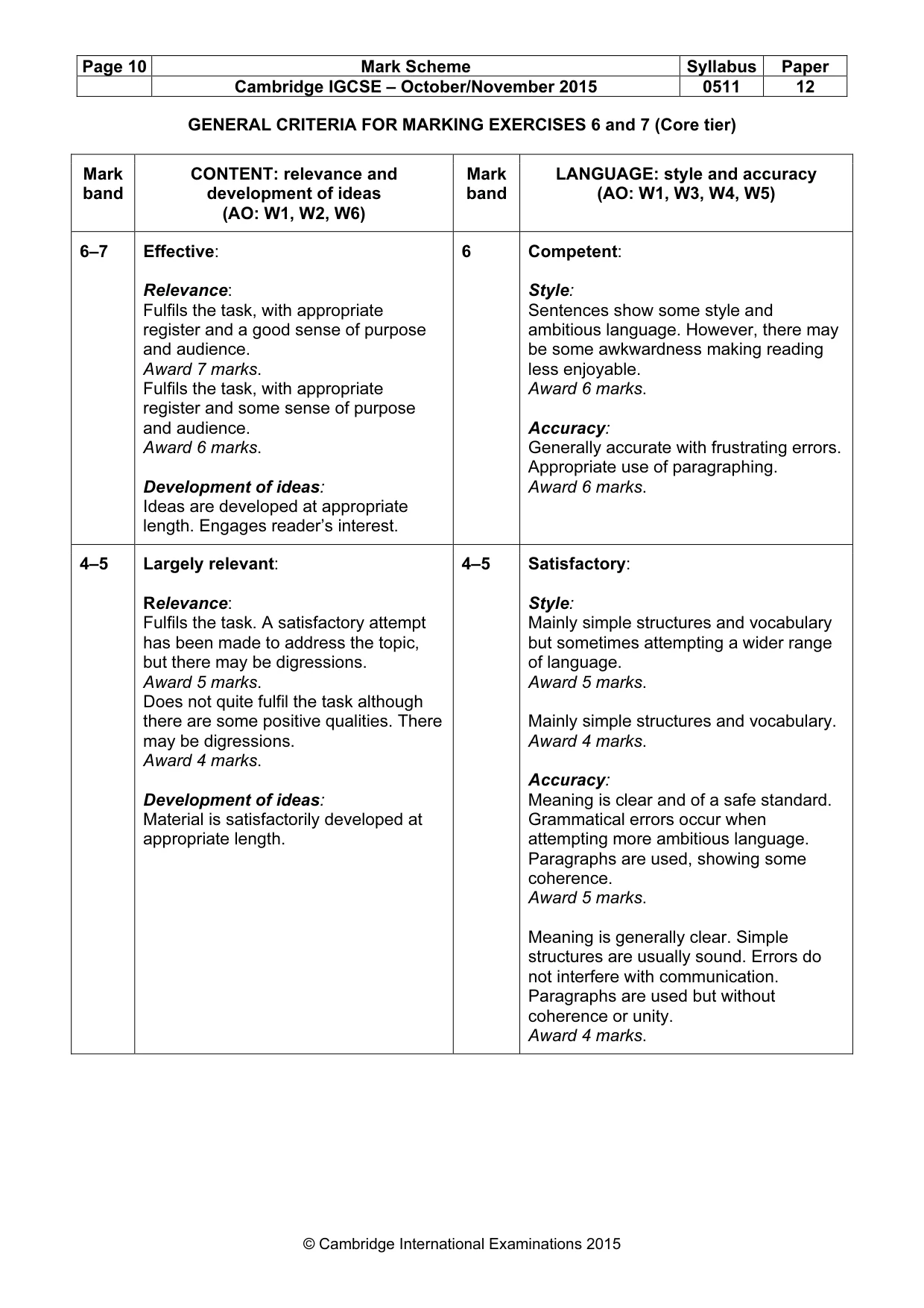
Page 10 Mark Scheme Syllabus Paper Cambridge IGCSE – October/November 2015 0511 12 © Cambridge International Examinations 2015 GENERAL CRITERIA FOR MARKING EXERCISES 6 and 7 (Core tier) Mark band CONTENT: relevance and development of ideas (AO: W1, W2, W6) Mark band LANGUAGE: style and accuracy (AO: W1, W3, W4, W5) 6–7 Effective: Relevance: Fulfils the task, with appropriate register and a good sense of purpose and audience. Award 7 marks. Fulfils the task, with appropriate register and some sense of purpose and audience. Award 6 marks. Development of ideas: Ideas are developed at appropriate length. Engages reader’s interest. 6 Competent: Style: Sentences show some style and ambitious language. However, there may be some awkwardness making reading less enjoyable. Award 6 marks. Accuracy: Generally accurate with frustrating errors. Appropriate use of paragraphing. Award 6 marks. 4–5 Largely relevant: Relevance: Fulfils the task. A satisfactory attempt has been made to address the topic, but there may be digressions. Award 5 marks. Does not quite fulfil the task although there are some positive qualities. There may be digressions. Award 4 marks. Development of ideas: Material is satisfactorily developed at appropriate length. 4–5 Satisfactory: Style: Mainly simple structures and vocabulary but sometimes attempting a wider range of language. Award 5 marks. Mainly simple structures and vocabulary. Award 4 marks. Accuracy: Meaning is clear and of a safe standard. Grammatical errors occur when attempting more ambitious language. Paragraphs are used, showing some coherence. Award 5 marks. Meaning is generally clear. Simple structures are usually sound. Errors do not interfere with communication. Paragraphs are used but without coherence or unity. Award 4 marks.
Mark scheme, page 11
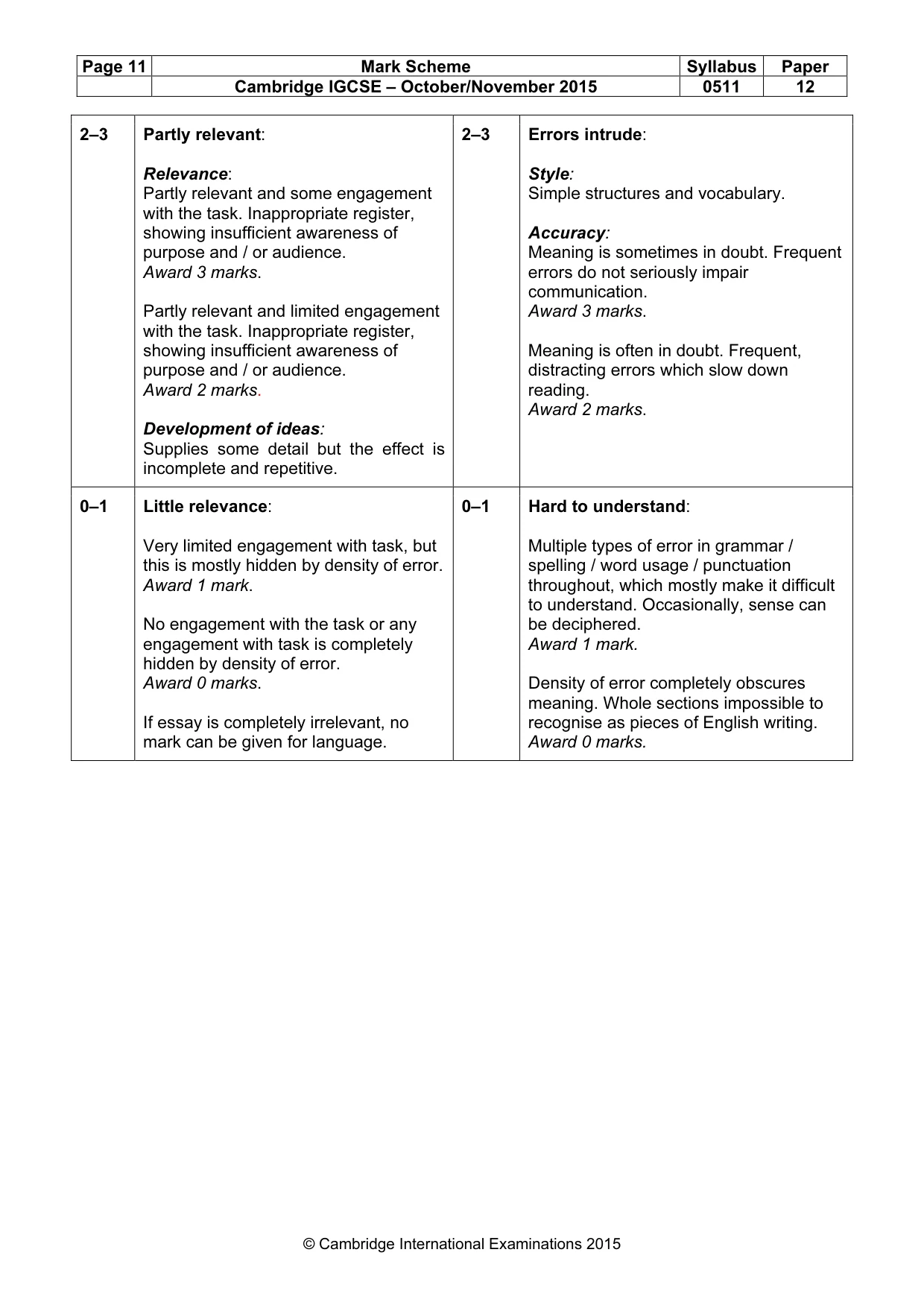
Page 11 Mark Scheme Syllabus Paper Cambridge IGCSE – October/November 2015 0511 12 © Cambridge International Examinations 2015 2–3 Partly relevant: Relevance: Partly relevant and some engagement with the task. Inappropriate register, showing insufficient awareness of purpose and / or audience. Award 3 marks. Partly relevant and limited engagement with the task. Inappropriate register, showing insufficient awareness of purpose and / or audience. Award 2 marks. Development of ideas: Supplies some detail but the effect is incomplete and repetitive. 2–3 Errors intrude: Style: Simple structures and vocabulary. Accuracy: Meaning is sometimes in doubt. Frequent errors do not seriously impair communication. Award 3 marks. Meaning is often in doubt. Frequent, distracting errors which slow down reading. Award 2 marks. 0–1 Little relevance: Very limited engagement with task, but this is mostly hidden by density of error. Award 1 mark. No engagement with the task or any engagement with task is completely hidden by density of error. Award 0 marks. If essay is completely irrelevant, no mark can be given for language. 0–1 Hard to understand: Multiple types of error in grammar / spelling / word usage / punctuation throughout, which mostly make it difficult to understand. Occasionally, sense can be deciphered. Award 1 mark. Density of error completely obscures meaning. Whole sections impossible to recognise as pieces of English writing. Award 0 marks.
What you needed in this session
Cambridge’s own grade thresholds for 2015 Oct/Nov, Paper 1 · Variant 2. A higher threshold means an easier paper — the bar moves with how the cohort did.