Cambridge IGCSE English - Second Language (count-in oral) 0511 — 2015 Oct/Nov Paper 1 · Variant 1
0511/11/O/N/15 · 70 marks · ≈79 min
The question paper and its mark scheme, free to read here and free to download. This is Cambridge’s own paper, exactly as it was sat.
Question paper16 pages





Mark scheme11 pages
Answers below. Sit the paper first if you are practising.
Paper as text
Question paper, page 1
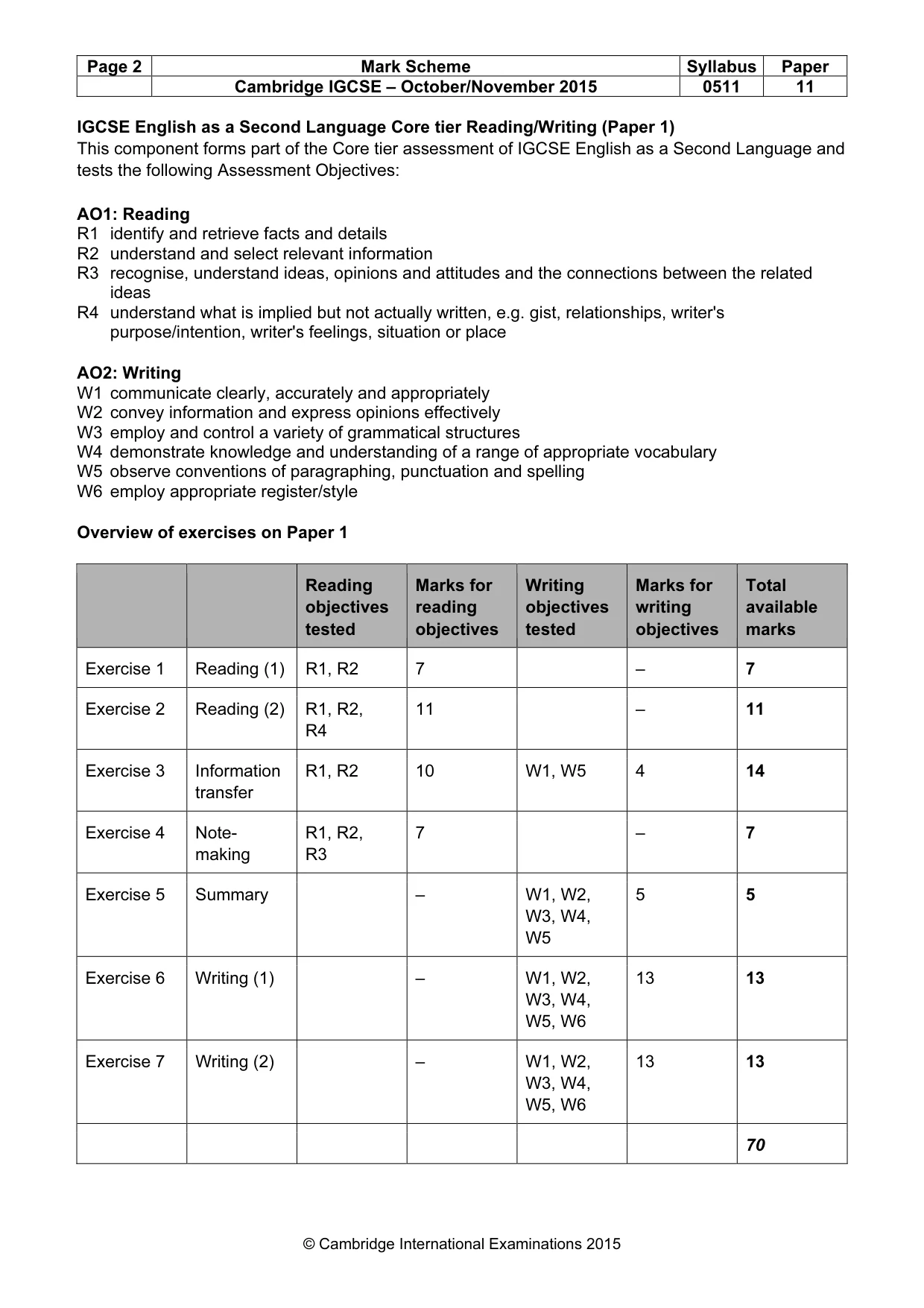
This document consists of 13 printed pages and 3 blank pages. DC (SLM) 113585/1 © UCLES 2015 [Turn over Cambridge International Examinations Cambridge International General Certificate of Secondary Education * 2 8 2 3 9 5 5 3 8 6 * ENGLISH AS A SECOND LANGUAGE 0511/11 Paper 1 Reading and Writing (Core) October/November 2015 1 hour 30 minutes Candidates answer on the Question Paper. No Additional Materials are required. READ THESE INSTRUCTIONS FIRST Write your Centre number, candidate number and name on all the work you hand in. Write in dark blue or black pen. Do not use staples, paper clips, glue or correction fluid. DO NOT WRITE IN ANY BARCODES. Answer all questions. Dictionaries are not allowed. At the end of the examination, fasten all your work securely together. The number of marks is given in brackets [ ] at the end of each question or part question. The syllabus is approved for use in England, Wales and Northern Ireland as a Cambridge International Level 1/Level 2 Certificate.
Question paper, page 2
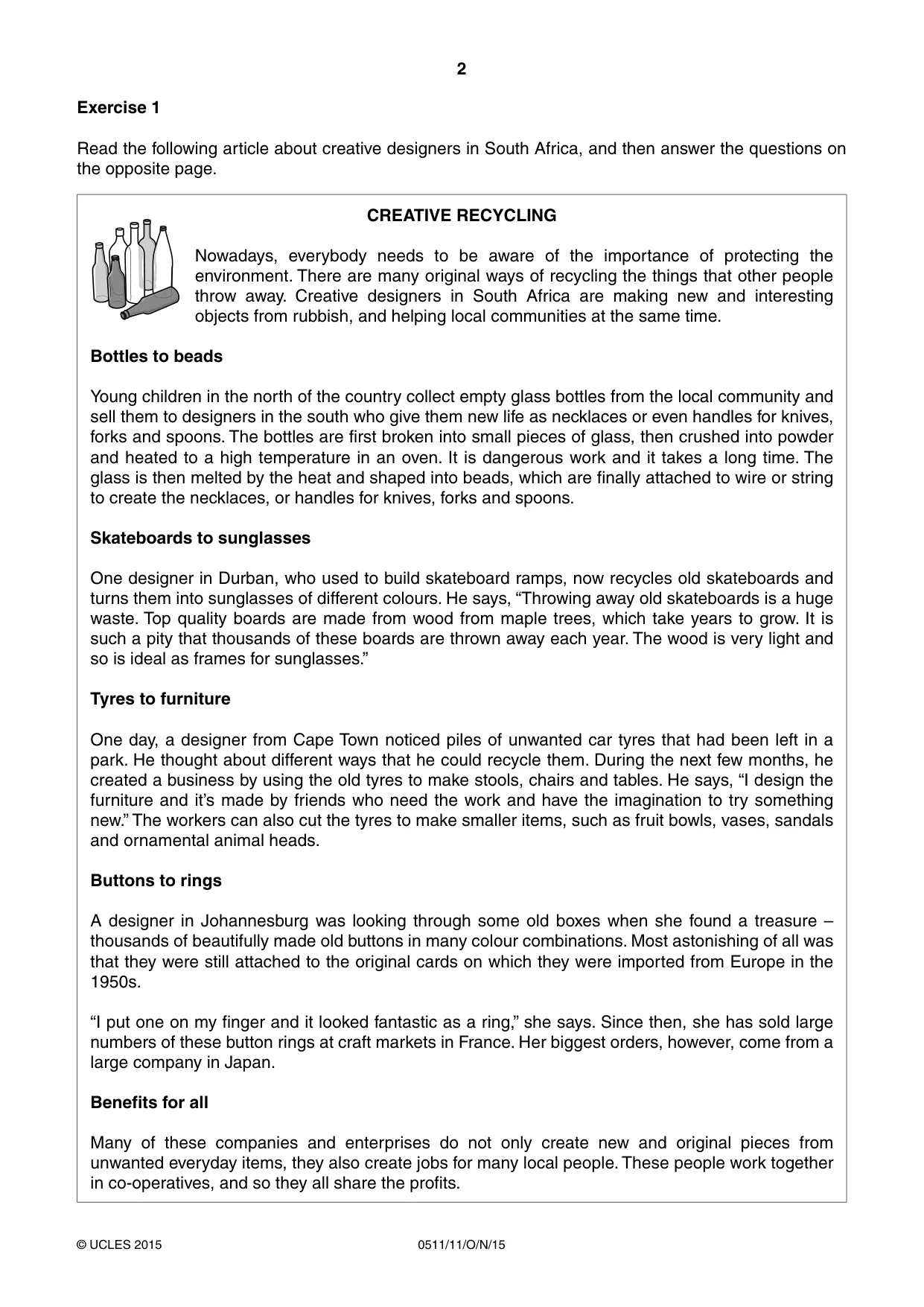
2 0511/11/O/N/15 © UCLES 2015 Exercise 1 Read the following article about creative designers in South Africa, and then answer the questions on the opposite page. CREATIVE RECYCLING Nowadays, everybody needs to be aware of the importance of protecting the environment. There are many original ways of recycling the things that other people throw away. Creative designers in South Africa are making new and interesting objects from rubbish, and helping local communities at the same time. Bottles to beads Young children in the north of the country collect empty glass bottles from the local community and sell them to designers in the south who give them new life as necklaces or even handles for knives, forks and spoons. The bottles are first broken into small pieces of glass, then crushed into powder and heated to a high temperature in an oven. It is dangerous work and it takes a long time. The glass is then melted by the heat and shaped into beads, which are finally attached to wire or string to create the necklaces, or handles for knives, forks and spoons. Skateboards to sunglasses One designer in Durban, who used to build skateboard ramps, now recycles old skateboards and turns them into sunglasses of different colours. He says, “Throwing away old skateboards is a huge waste. Top quality boards are made from wood from maple trees, which take years to grow. It is such a pity that thousands of these boards are thrown away each year. The wood is very light and so is ideal as frames for sunglasses.” Tyres to furniture One day, a designer from Cape Town noticed piles of unwanted car tyres that had been left in a park. He thought about different ways that he could recycle them. During the next few months, he created a business by using the old tyres to make stools, chairs and tables. He says, “I design the furniture and it’s made by friends who need the work and have the imagination to try something new.” The workers can also cut the tyres to make smaller items, such as fruit bowls, vases, sandals and ornamental animal heads. Buttons to rings A designer in Johannesburg was looking through some old boxes when she found a treasure – thousands of beautifully made old buttons in many colour combinations. Most astonishing of all was that they were still attached to the original cards on which they were imported from Europe in the 1950s. “I put one on my finger and it looked fantastic as a ring,” she says. Since then, she has sold large numbers of these button rings at craft markets in France. Her biggest orders, however, come from a large company in Japan. Benefits for all Many of these companies and enterprises do not only create new and original pieces from unwanted everyday items, they also create jobs for many local people. These people work together in co-operatives, and so they all share the profits.
Question paper, page 3
3 0511/11/O/N/15 © UCLES 2015 [Turn over (a) How are designers in South Africa helping the environment? …[1] (b) Where in South Africa do they create necklaces from bottles? …[1] (c) What are the disadvantages of working with glass bottles? Give two details. … …[1] (d) What is the last stage in the process of making necklaces? …[1] (e) Why is maple wood suitable for making sunglasses? …[1] (f) Where does the Johannesburg designer export most of her work to? …[1] (g) How do people benefit from working in a co-operative? …[1] [Total: 7]
Question paper, page 4
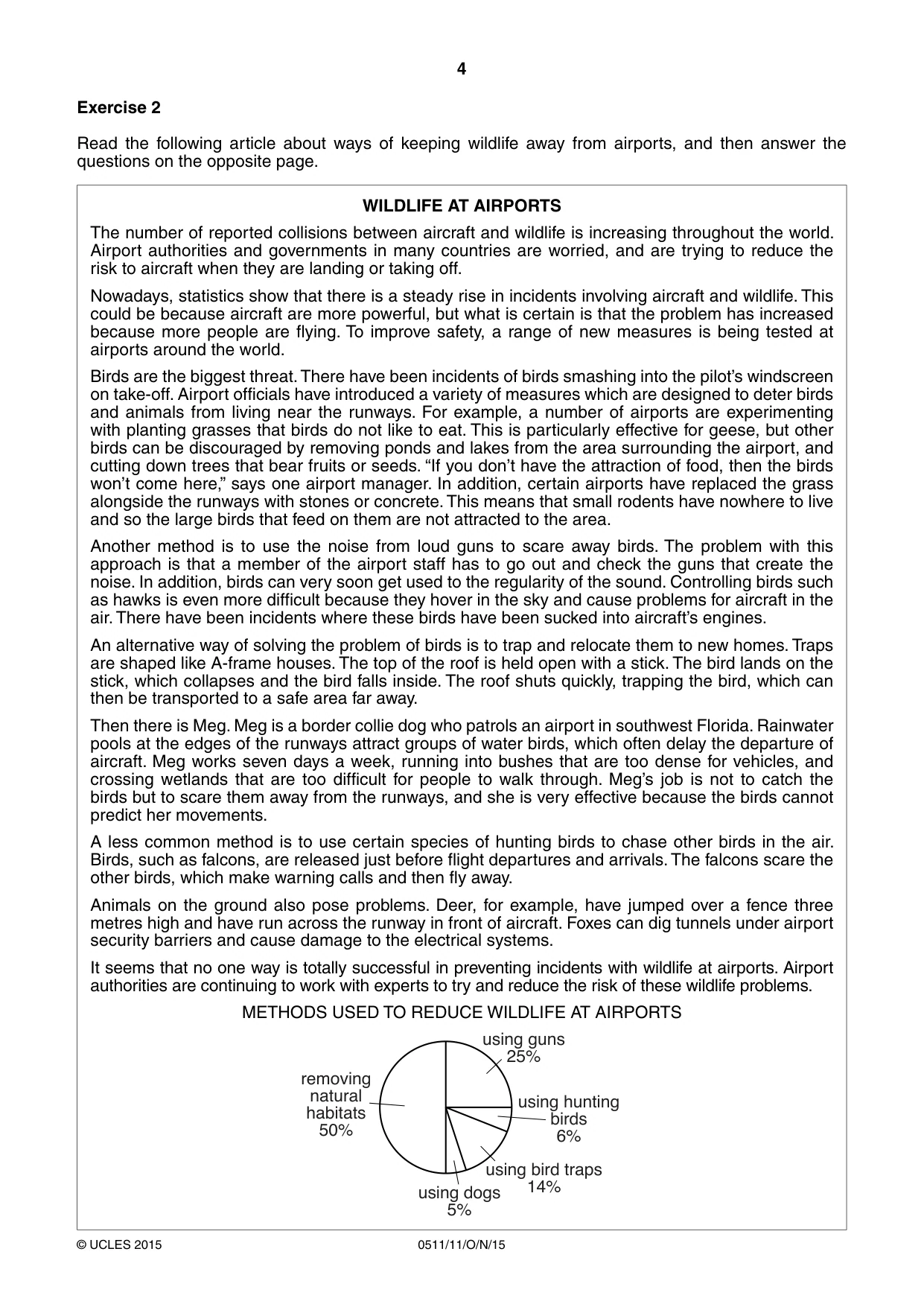
4 0511/11/O/N/15 © UCLES 2015 Exercise 2 Read the following article about ways of keeping wildlife away from airports, and then answer the questions on the opposite page. WILDLIFE AT AIRPORTS The number of reported collisions between aircraft and wildlife is increasing throughout the world. Airport authorities and governments in many countries are worried, and are trying to reduce the risk to aircraft when they are landing or taking off. Nowadays, statistics show that there is a steady rise in incidents involving aircraft and wildlife. This could be because aircraft are more powerful, but what is certain is that the problem has increased because more people are flying. To improve safety, a range of new measures is being tested at airports around the world. Birds are the biggest threat. There have been incidents of birds smashing into the pilot’s windscreen on take-off. Airport officials have introduced a variety of measures which are designed to deter birds and animals from living near the runways. For example, a number of airports are experimenting with planting grasses that birds do not like to eat. This is particularly effective for geese, but other birds can be discouraged by removing ponds and lakes from the area surrounding the airport, and cutting down trees that bear fruits or seeds. “If you don’t have the attraction of food, then the birds won’t come here,” says one airport manager. In addition, certain airports have replaced the grass alongside the runways with stones or concrete. This means that small rodents have nowhere to live and so the large birds that feed on them are not attracted to the area. Another method is to use the noise from loud guns to scare away birds. The problem with this approach is that a member of the airport staff has to go out and check the guns that create the noise. In addition, birds can very soon get used to the regularity of the sound. Controlling birds such as hawks is even more difficult because they hover in the sky and cause problems for aircraft in the air. There have been incidents where these birds have been sucked into aircraft’s engines. An alternative way of solving the problem of birds is to trap and relocate them to new homes. Traps are shaped like A-frame houses. The top of the roof is held open with a stick. The bird lands on the stick, which collapses and the bird falls inside. The roof shuts quickly, trapping the bird, which can then be transported to a safe area far away. Then there is Meg. Meg is a border collie dog who patrols an airport in southwest Florida. Rainwater pools at the edges of the runways attract groups of water birds, which often delay the departure of aircraft. Meg works seven days a week, running into bushes that are too dense for vehicles, and crossing wetlands that are too difficult for people to walk through. Meg’s job is not to catch the birds but to scare them away from the runways, and she is very effective because the birds cannot predict her movements. A less common method is to use certain species of hunting birds to chase other birds in the air. Birds, such as falcons, are released just before flight departures and arrivals. The falcons scare the other birds, which make warning calls and then fly away. Animals on the ground also pose problems. Deer, for example, have jumped over a fence three metres high and have run across the runway in front of aircraft. Foxes can dig tunnels under airport security barriers and cause damage to the electrical systems. It seems that no one way is totally successful in preventing incidents with wildlife at airports. Airport authorities are continuing to work with experts to try and reduce the risk of these wildlife problems. METHODS USED TO REDUCE WILDLIFE AT AIRPORTS using guns 25% removing natural habitats 50% using dogs 5% using bird traps 14% using hunting birds 6%
Question paper, page 5
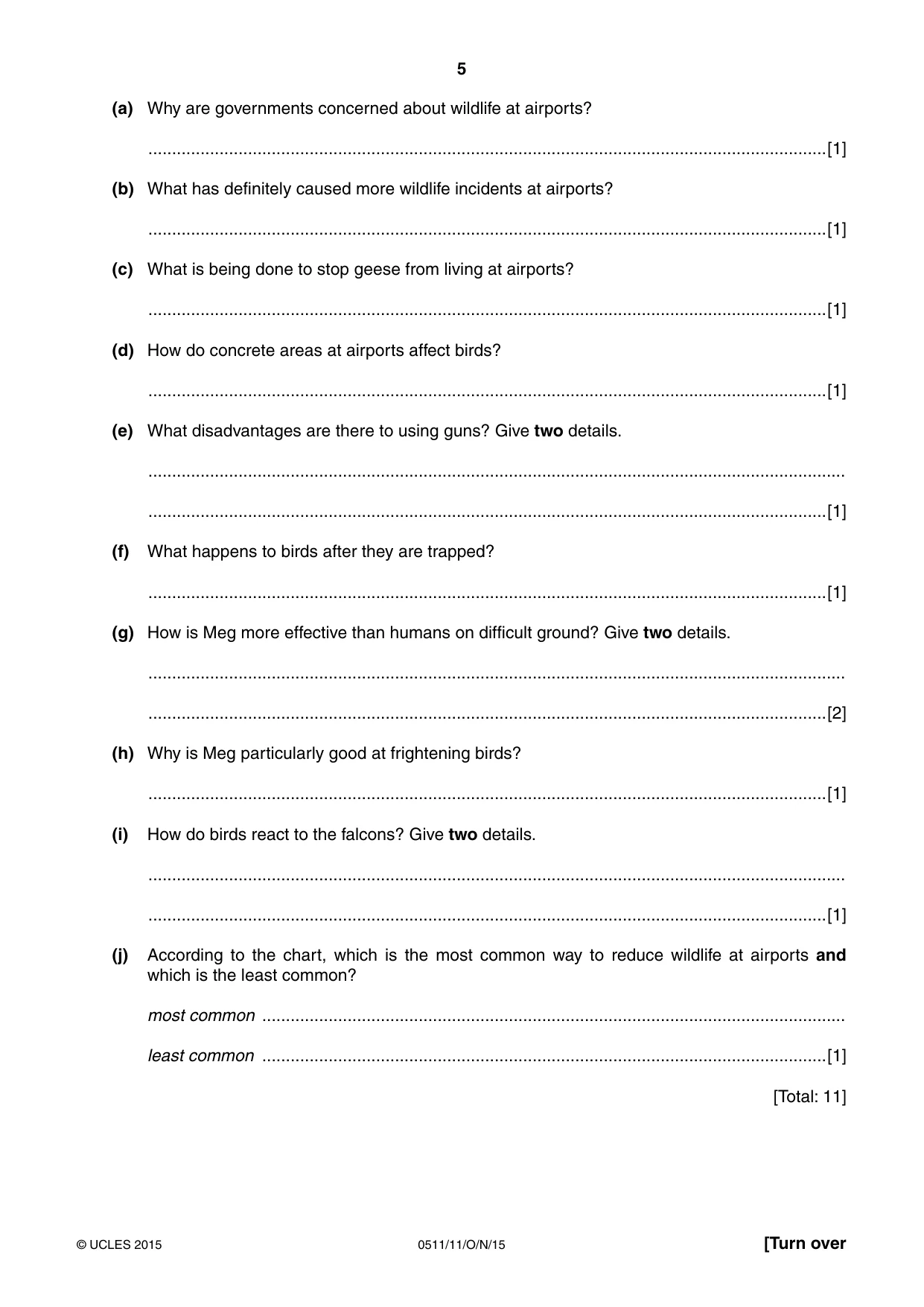
5 0511/11/O/N/15 © UCLES 2015 [Turn over (a) Why are governments concerned about wildlife at airports? …[1] (b) What has definitely caused more wildlife incidents at airports? …[1] (c) What is being done to stop geese from living at airports? …[1] (d) How do concrete areas at airports affect birds? …[1] (e) What disadvantages are there to using guns? Give two details. … …[1] (f) What happens to birds after they are trapped? …[1] (g) How is Meg more effective than humans on difficult ground? Give two details. … …[2] (h) Why is Meg particularly good at frightening birds? …[1] (i) How do birds react to the falcons? Give two details. … …[1] (j) According to the chart, which is the most common way to reduce wildlife at airports and which is the least common? most common … least common …[1] [Total: 11]
Question paper, page 6
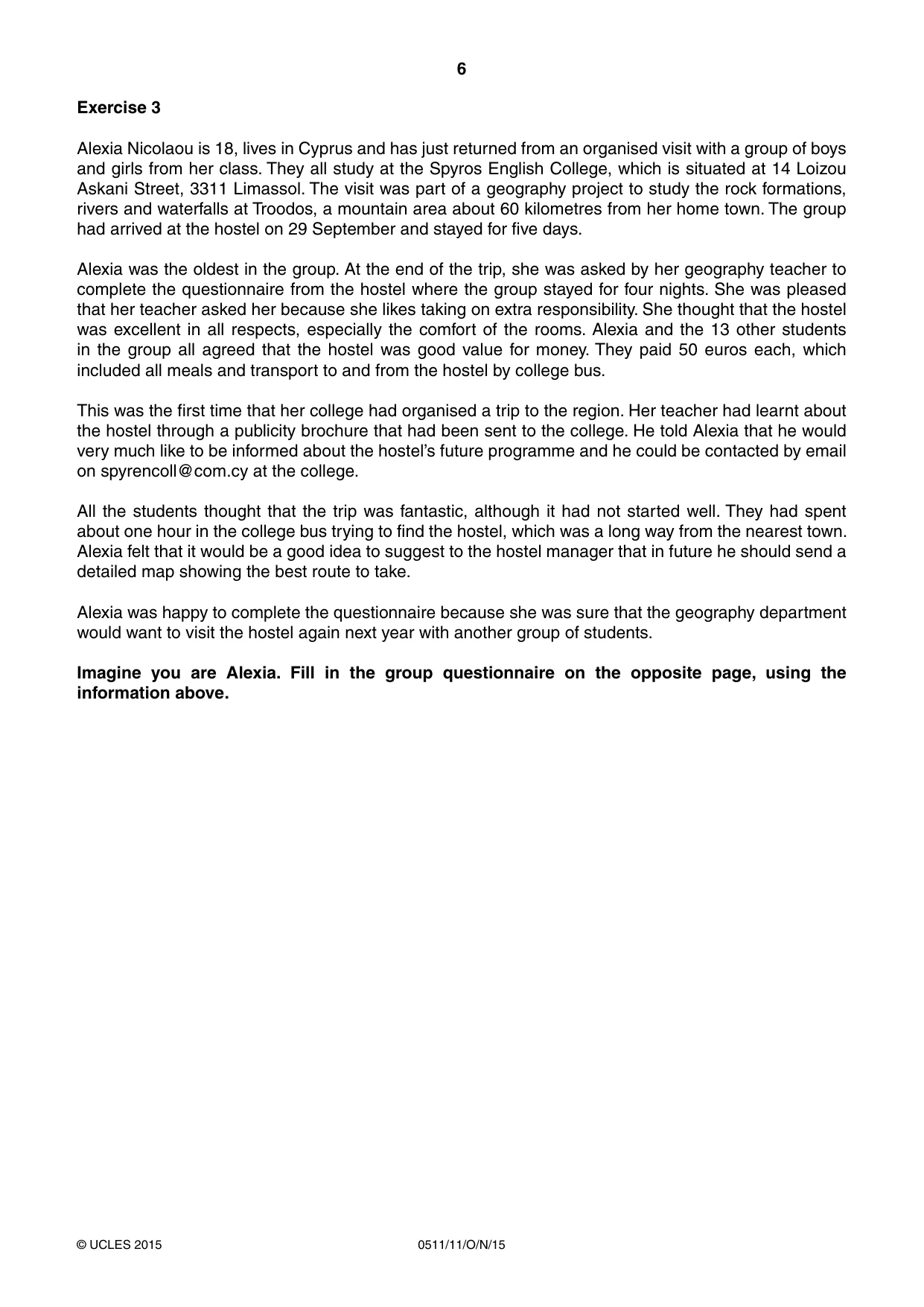
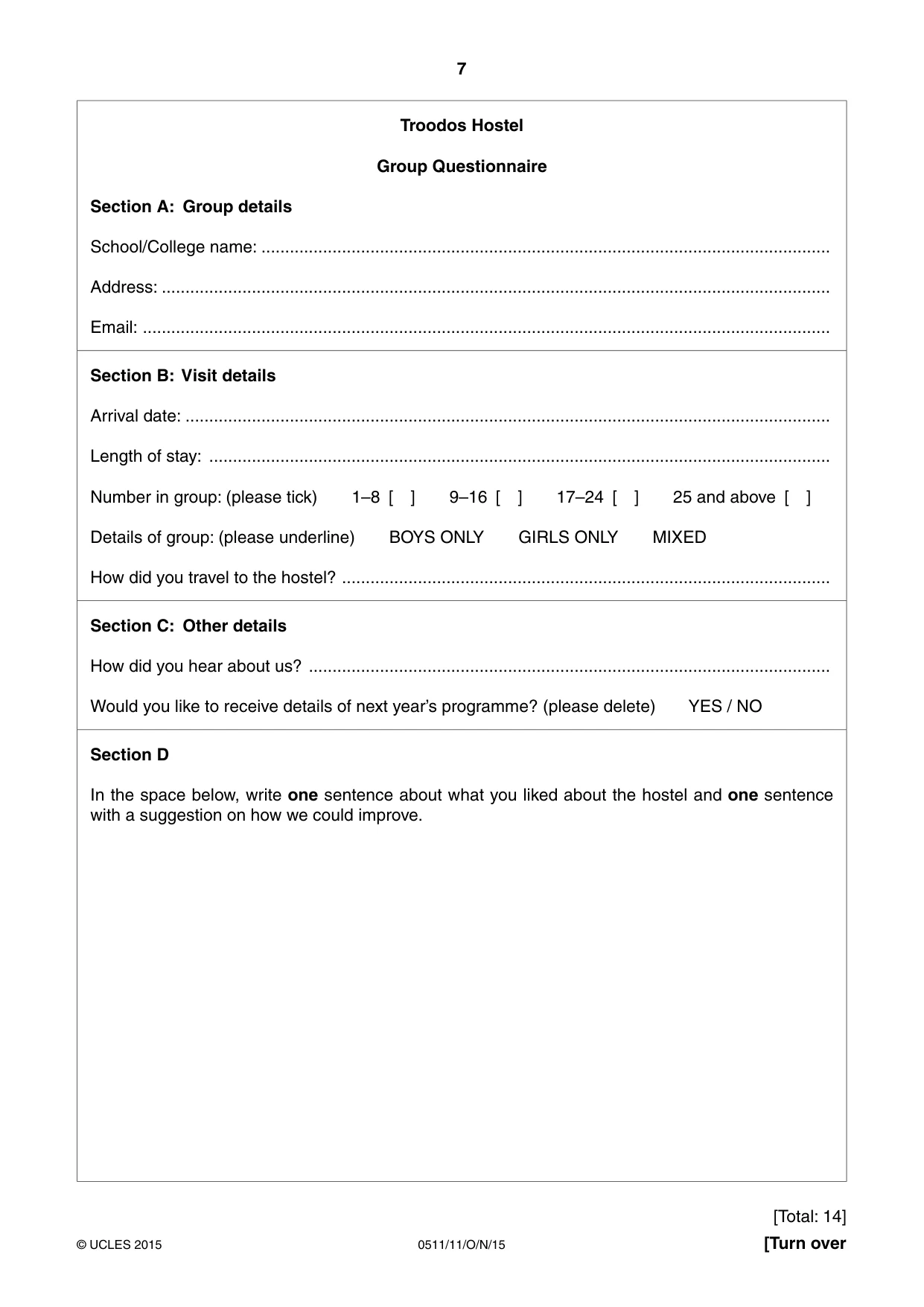
6 0511/11/O/N/15 © UCLES 2015 Exercise 3 Alexia Nicolaou is 18, lives in Cyprus and has just returned from an organised visit with a group of boys and girls from her class. They all study at the Spyros English College, which is situated at 14 Loizou Askani Street, 3311 Limassol. The visit was part of a geography project to study the rock formations, rivers and waterfalls at Troodos, a mountain area about 60 kilometres from her home town. The group had arrived at the hostel on 29 September and stayed for five days. Alexia was the oldest in the group. At the end of the trip, she was asked by her geography teacher to complete the questionnaire from the hostel where the group stayed for four nights. She was pleased that her teacher asked her because she likes taking on extra responsibility. She thought that the hostel was excellent in all respects, especially the comfort of the rooms. Alexia and the 13 other students in the group all agreed that the hostel was good value for money. They paid 50 euros each, which included all meals and transport to and from the hostel by college bus. This was the first time that her college had organised a trip to the region. Her teacher had learnt about the hostel through a publicity brochure that had been sent to the college. He told Alexia that he would very much like to be informed about the hostel’s future programme and he could be contacted by email on spyrencoll@com.cy at the college. All the students thought that the trip was fantastic, although it had not started well. They had spent about one hour in the college bus trying to find the hostel, which was a long way from the nearest town. Alexia felt that it would be a good idea to suggest to the hostel manager that in future he should send a detailed map showing the best route to take. Alexia was happy to complete the questionnaire because she was sure that the geography department would want to visit the hostel again next year with another group of students. Imagine you are Alexia. Fill in the group questionnaire on the opposite page, using the information above.
Question paper, page 7
7 0511/11/O/N/15 © UCLES 2015 [Turn over Troodos Hostel Group Questionnaire Section A: Group details School/College name: … Address: … Email: … Section B: Visit details Arrival date: … Length of stay: … Number in group: (please tick) 1–8 [ ] 9–16 [ ] 17–24 [ ] 25 and above [ ] Details of group: (please underline) BOYS ONLY GIRLS ONLY MIXED How did you travel to the hostel? … Section C: Other details How did you hear about us? … Would you like to receive details of next year’s programme? (please delete) YES / NO Section D In the space below, write one sentence about what you liked about the hostel and one sentence with a suggestion on how we could improve. [Total: 14]
Question paper, page 8
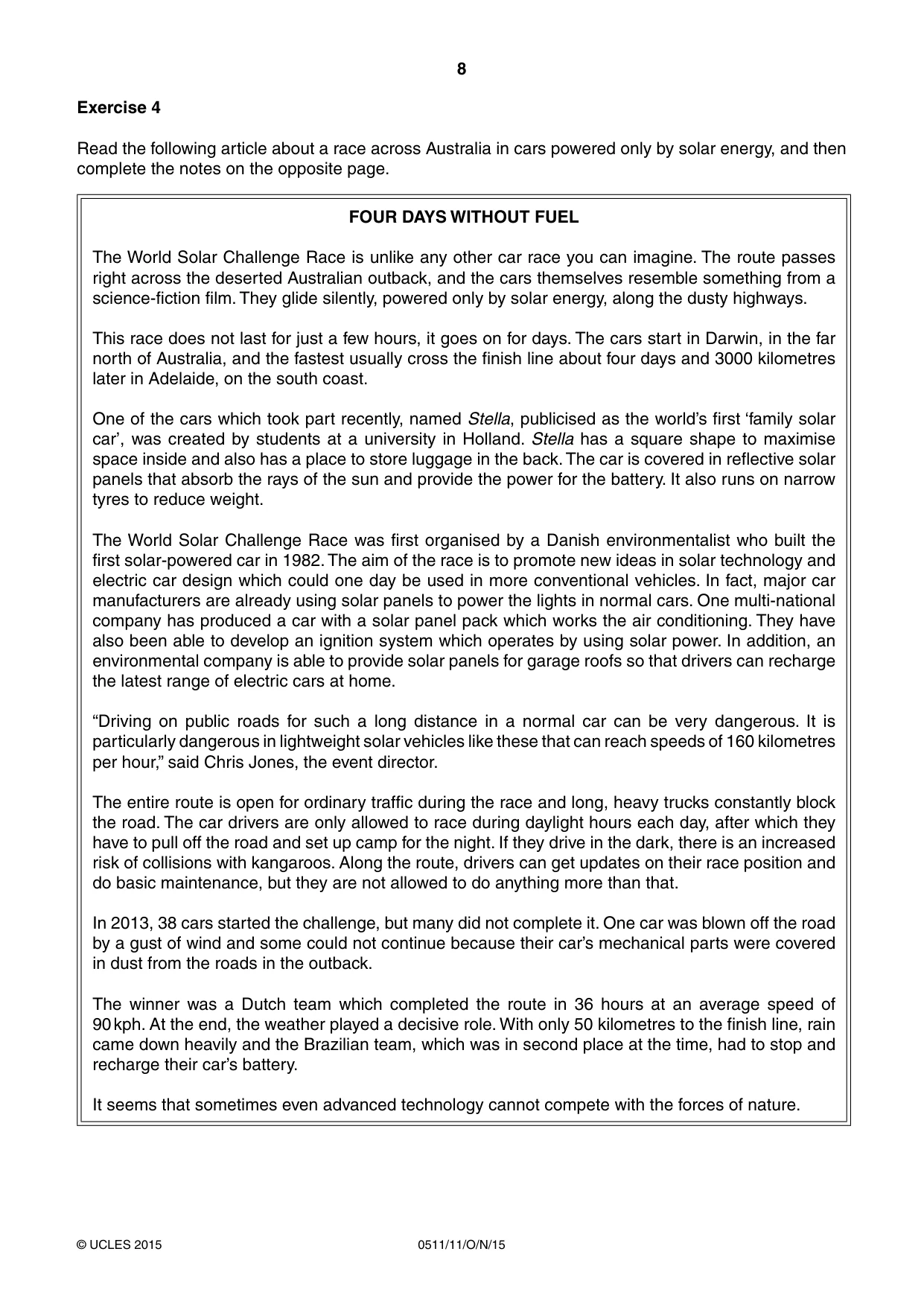
8 0511/11/O/N/15 © UCLES 2015 Exercise 4 Read the following article about a race across Australia in cars powered only by solar energy, and then complete th e notes on the opposite page. FOUR DAYS WITHOUT FUEL The World Solar Challenge Race is unlike any other car race you can imagine. The route passes right across the deserted Australian outback, and the cars themselves resemble something from a science-fiction film. They glide silently, powered only by solar energy, along the dusty highways. This race does not last for just a few hours, it goes on for days. The cars start in Darwin, in the far north of Australia, and the fastest usually cross the finish line about four days and 3000 kilometres later in Adelaide, on the south coast. One of the cars which took part recently, named Stella, publicised as the world’s first ‘family solar car’, was created by students at a university in Holland. Stella has a square shape to maximise space inside and also has a place to store luggage in the back. The car is covered in reflective solar panels that absorb the rays of the sun and provide the power for the battery. It also runs on narrow tyres to reduce weight. The World Solar Challenge Race was first organised by a Danish environmentalist who built the first solar-powered car in 1982. The aim of the race is to promote new ideas in solar technology and electric car design which could one day be used in more conventional vehicles. In fact, major car manufacturers are already using solar panels to power the lights in normal cars. One multi-national company has produced a car with a solar panel pack which works the air conditioning. They have also been able to develop an ignition system which operates by using solar power. In addition, an environmental company is able to provide solar panels for garage roofs so that drivers can recharge the latest range of electric cars at home. “Driving on public roads for such a long distance in a normal car can be very dangerous. It is particularly dangerous in lightweight solar vehicles like these that can reach speeds of 160 kilometres per hour,” said Chris Jones, the event director. The entire route is open for ordinary traffic during the race and long, heavy trucks constantly block the road. The car drivers are only allowed to race during daylight hours each day, after which they have to pull off the road and set up camp for the night. If they drive in the dark, there is an increased risk of collisions with kangaroos. Along the route, drivers can get updates on their race position and do basic maintenance, but they are not allowed to do anything more than that. In 2013, 38 cars started the challenge, but many did not complete it. One car was blown off the road by a gust of wind and some could not continue because their car’s mechanical parts were covered in dust from the roads in the outback. The winner was a Dutch team which completed the route in 36 hours at an average speed of 90 kph. At the end, the weather played a decisive role. With only 50 kilometres to the finish line, rain came down heavily and the Brazilian team, which was in second place at the time, had to stop and recharge their car’s battery. It seems that sometimes even advanced technology cannot compete with the forces of nature.
Question paper, page 9
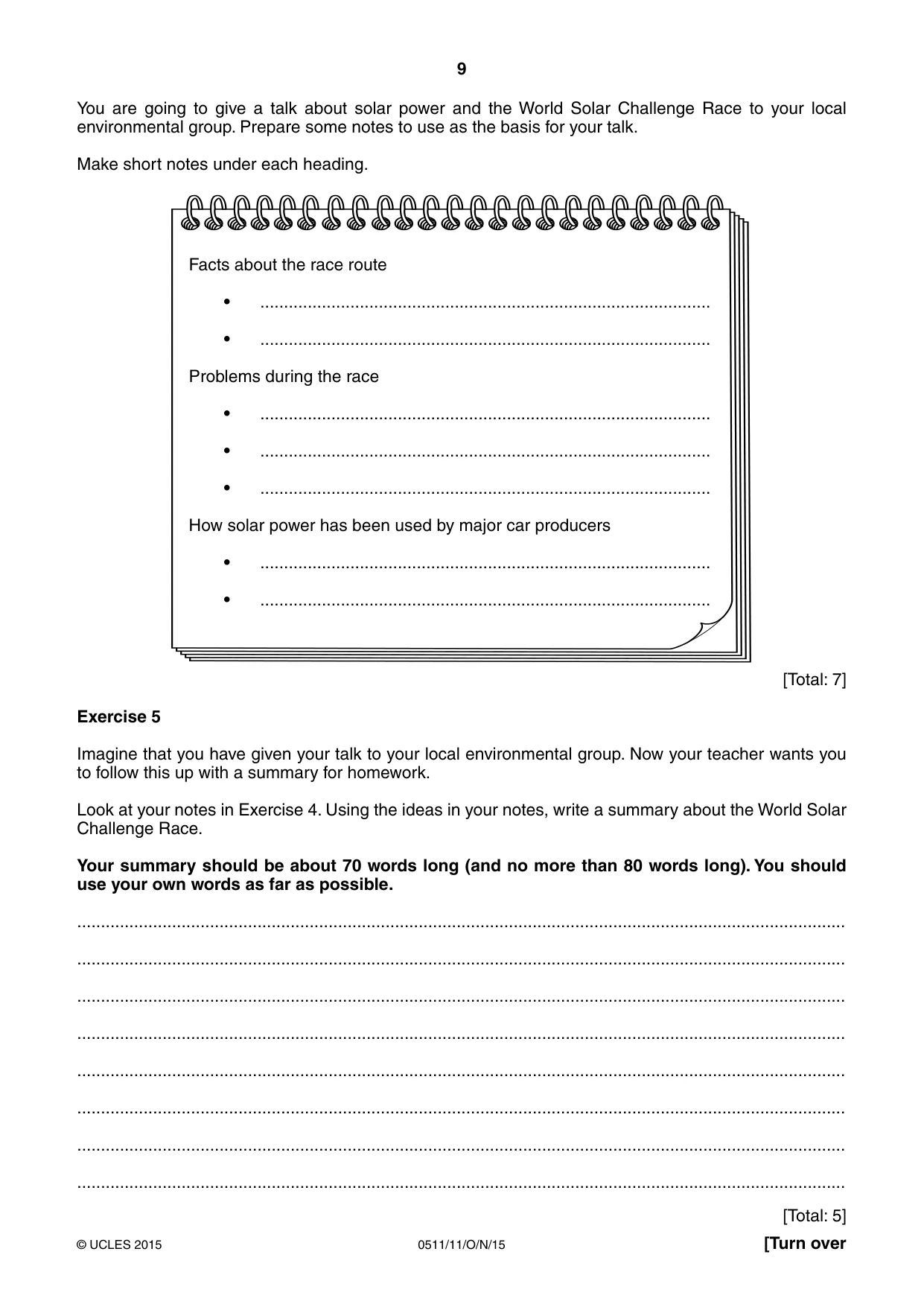
9 0511/11/O/N/15 © UCLES 2015 [Turn over You are going to give a talk about solar power and the World Solar Challenge Race to your local environmental group. Prepare some notes to use as the basis for your talk. Make short notes under each heading. Facts about the race route • … • … Problems during the race • … • … • … How solar power has been used by major car producers • … • … [Total: 7] Exercise 5 Imagine that you have given your talk to your local environmental group. Now your teacher wants you to follow this up with a summary for homework. Look at your notes in Exercise 4. Using the ideas in your notes, write a summary about the World Solar Challenge Race. Your summary should be about 70 words long (and no more than 80 words long). You should use your own words as far as possible. … … … … … … … … [Total: 5]
Question paper, page 10
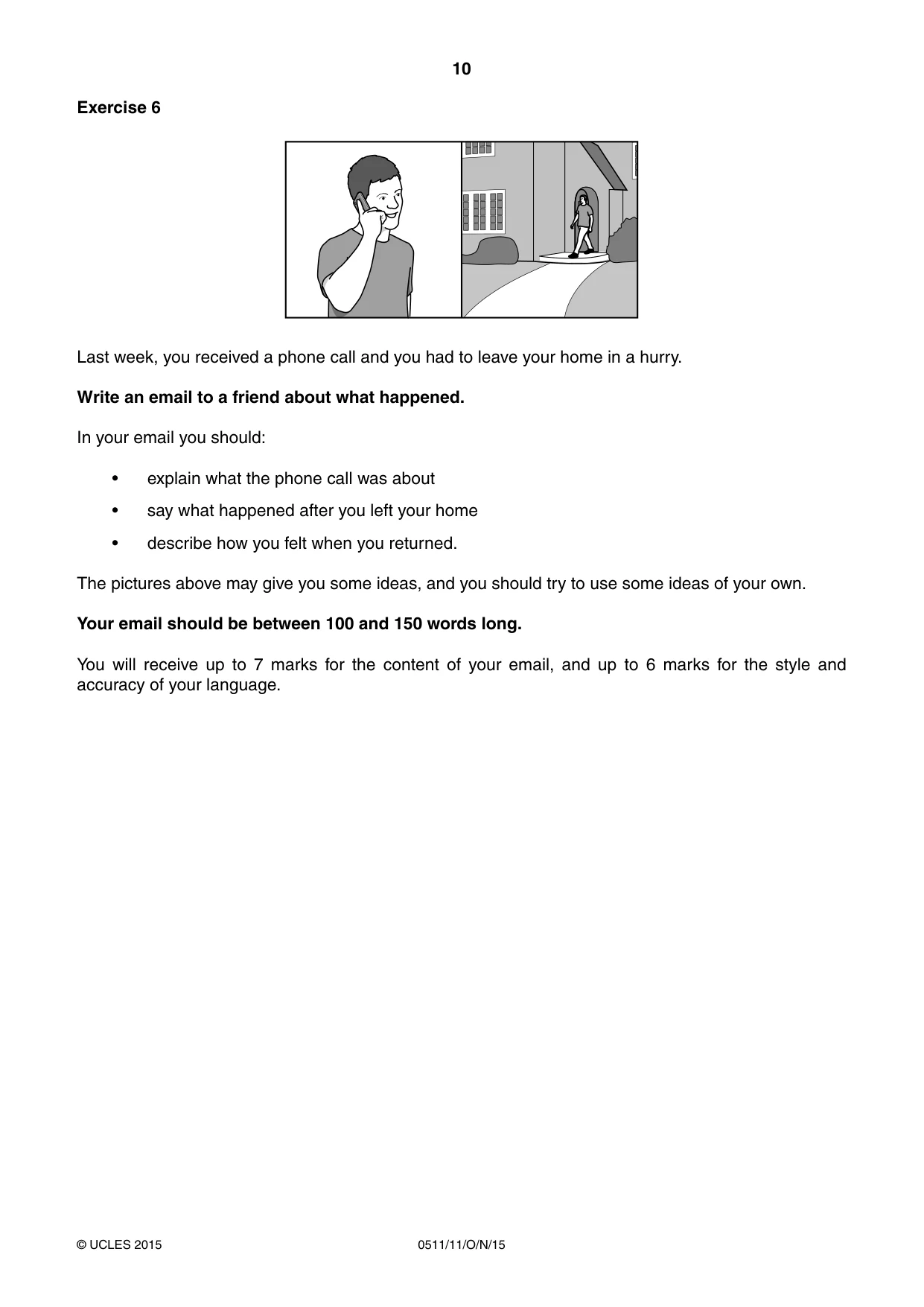
10 0511/11/O/N/15 © UCLES 2015 Exercise 6 Last week, you received a phone call and you had to leave your home in a hurry. Write an email to a friend about what happened. In your email you should: • explain what the phone call was about • say what happened after you left your home • describe how you felt when you returned. The pictures above may give you some ideas, and you should try to use some ideas of your own. Your email should be between 100 and 150 words long. You will receive up to 7 marks for the content of your email, and up to 6 marks for the style and accuracy of your language.
Question paper, page 11
11 0511/11/O/N/15 © UCLES 2015 [Turn over … … … … … … … … … … … … … … … … … … … … … … … … … … … [Total: 13]
Question paper, page 12
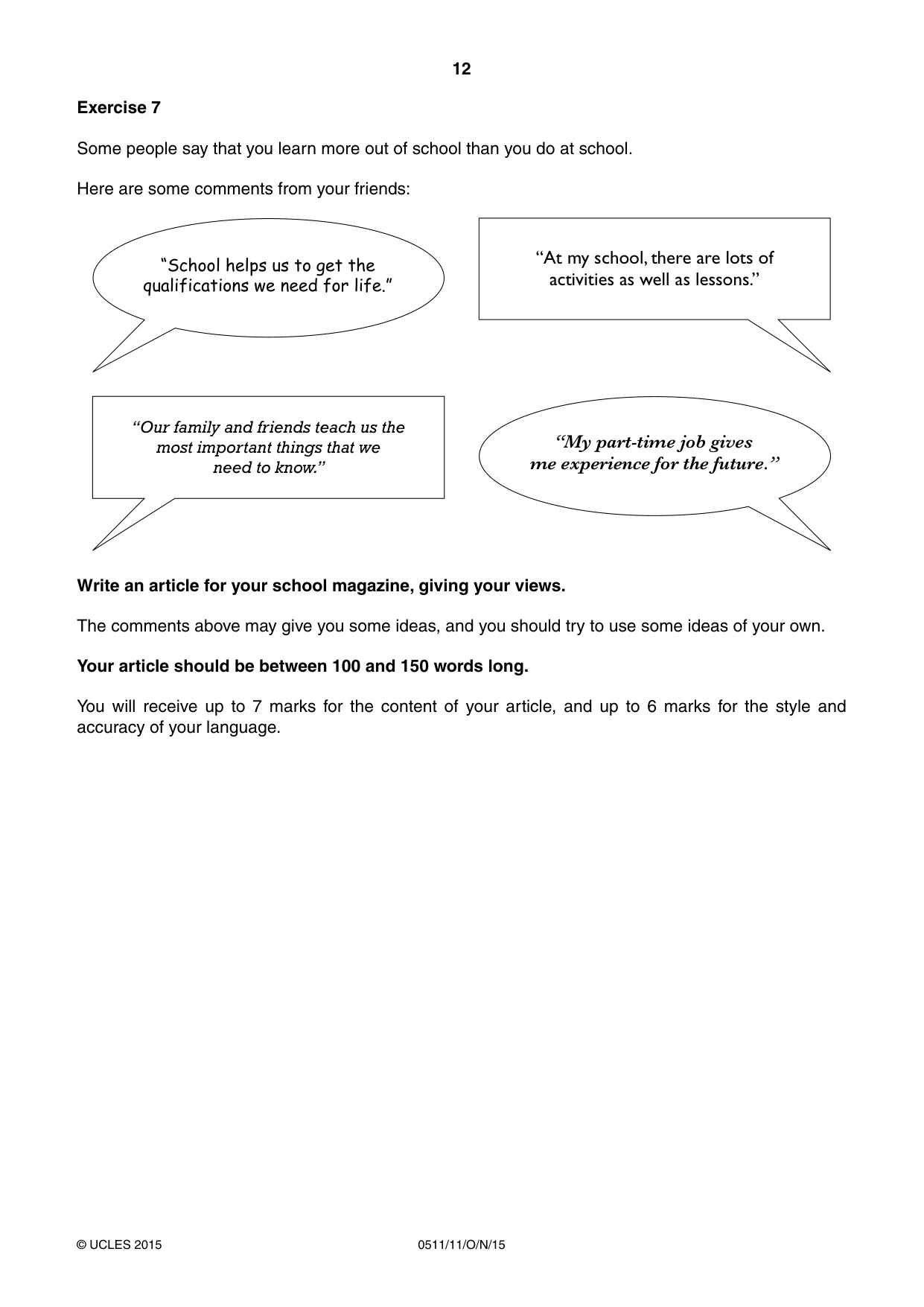
12 0511/11/O/N/15 © UCLES 2015 Exercise 7 Some people say that you learn more out of school than you do at school. Here are some comments from your friends: “School helps us to get the qualifications we need for life.” “At my school, there are lots of activities as well as lessons.” “Our family and friends teach us the most important things that we need to know.” “My part-time job gives me experience for the future.” Write an article for your school magazine, giving your views. The comments above may give you some ideas, and you should try to use some ideas of your own. Your article should be between 100 and 150 words long. You will receive up to 7 marks for the content of your article, and up to 6 marks for the style and accuracy of your language.
Question paper, page 13
13 0511/11/O/N/15 © UCLES 2015 … … … … … … … … … … … … … … … … … … … … … … … … … … … [Total: 13]
Question paper, page 14
14 0511/11/O/N/15 © UCLES 2015 BLANK PAGE
Question paper, page 15
15 0511/11/O/N/15 © UCLES 2015 BLANK PAGE
Question paper, page 16
16 0511/11/O/N/15 © UCLES 2015 Permission to reproduce items where third-party owned material protected by copyright is included has been sought and cleared where possible. Every reasonable effort has been made by the publisher (UCLES) to trace copyright holders, but if any items requiring clearance have unwittingly been included, the publisher will be pleased to make amends at the earliest possible opportunity. To avoid the issue of disclosure of answer-related information to candidates, all copyright acknowledgements are reproduced online in the Cambridge International Examinations Copyright Acknowledgements Booklet. This is produced for each series of examinations and is freely available to download at www.cie.org.uk after the live examination series. Cambridge International Examinations is part of the Cambridge Assessment Group. Cambridge Assessment is the brand name of University of Cambridge Local Examinations Syndicate (UCLES), which is itself a department of the University of Cambridge. BLANK PAGE
Mark scheme, page 1
® IGCSE is the registered trademark of Cambridge International Examinations. CAMBRIDGE INTERNATIONAL EXAMINATIONS Cambridge International General Certificate of Secondary Education MARK SCHEME for the October/November 2015 series 0511 ENGLISH AS A SECOND LANGUAGE 0511/11 Paper 1 (Reading and Writing – Core), maximum raw mark 70 This mark scheme is published as an aid to teachers and candidates, to indicate the requirements of the examination. It shows the basis on which Examiners were instructed to award marks. It does not indicate the details of the discussions that took place at an Examiners’ meeting before marking began, which would have considered the acceptability of alternative answers. Mark schemes should be read in conjunction with the question paper and the Principal Examiner Report for Teachers. Cambridge will not enter into discussions about these mark schemes. Cambridge is publishing the mark schemes for the October/November 2015 series for most Cambridge IGCSE®, Cambridge International A and AS Level components and some Cambridge O Level components.
Mark scheme, page 2
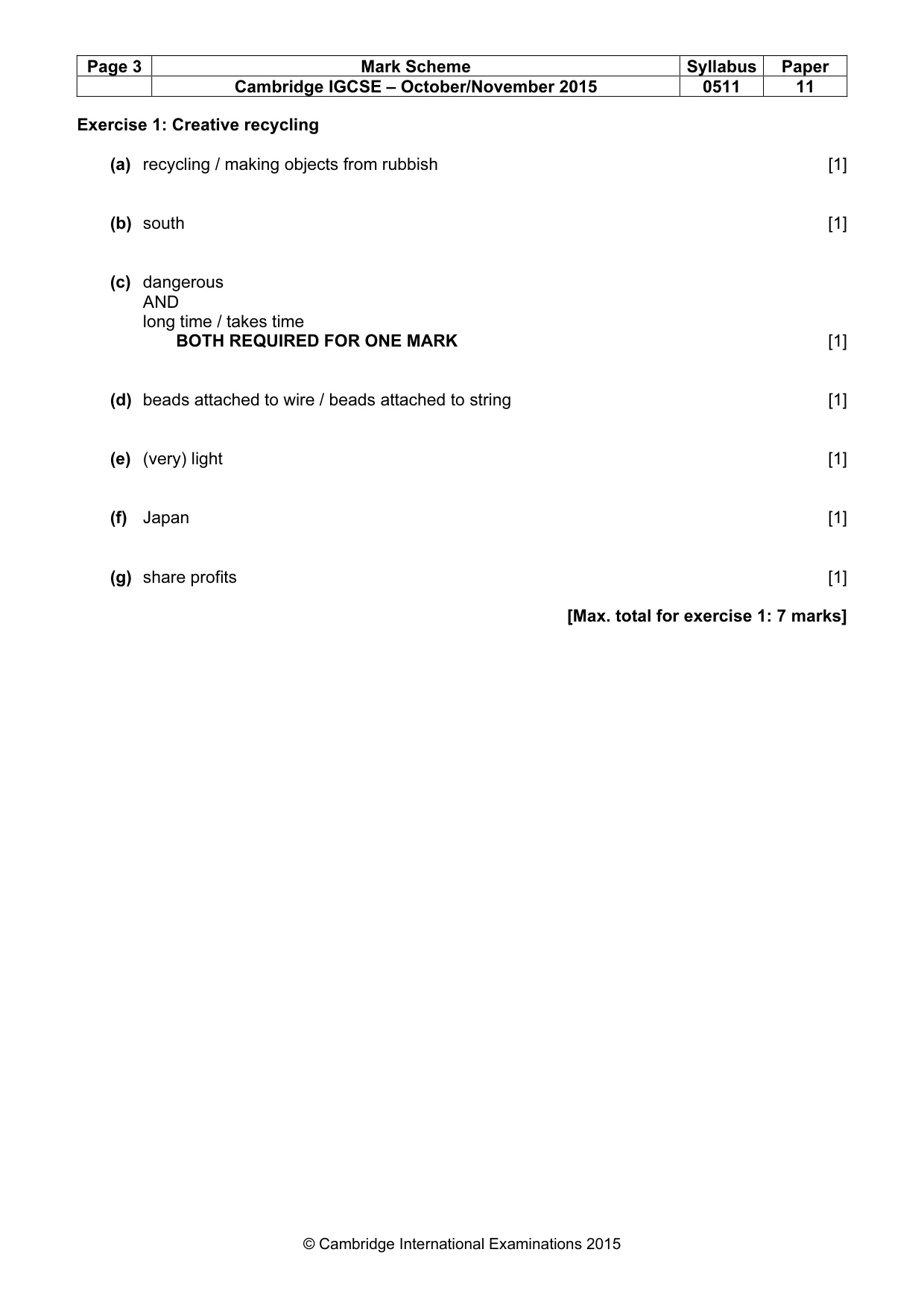
Page 2 Mark Scheme Syllabus Paper Cambridge IGCSE – October/November 2015 0511 11 © Cambridge International Examinations 2015 IGCSE English as a Second Language Core tier Reading/Writing (Paper 1) This component forms part of the Core tier assessment of IGCSE English as a Second Language and tests the following Assessment Objectives: AO1: Reading R1 identify and retrieve facts and details R2 understand and select relevant information R3 recognise, understand ideas, opinions and attitudes and the connections between the related ideas R4 understand what is implied but not actually written, e.g. gist, relationships, writer's purpose/intention, writer's feelings, situation or place AO2: Writing W1 communicate clearly, accurately and appropriately W2 convey information and express opinions effectively W3 employ and control a variety of grammatical structures W4 demonstrate knowledge and understanding of a range of appropriate vocabulary W5 observe conventions of paragraphing, punctuation and spelling W6 employ appropriate register/style Overview of exercises on Paper 1 Reading objectives tested Marks for reading objectives Writing objectives tested Marks for writing objectives Total available marks Exercise 1 Reading (1) R1, R2 7 – 7 Exercise 2 Reading (2) R1, R2, R4 11 – 11 Exercise 3 Information transfer R1, R2 10 W1, W5 4 14 Exercise 4 Note- making R1, R2, R3 7 – 7 Exercise 5 Summary – W1, W2, W3, W4, W5 5 5 Exercise 6 Writing (1) – W1, W2, W3, W4, W5, W6 13 13 Exercise 7 Writing (2) – W1, W2, W3, W4, W5, W6 13 13 70
Mark scheme, page 3
Page 3 Mark Scheme Syllabus Paper Cambridge IGCSE – October/November 2015 0511 11 © Cambridge International Examinations 2015 Exercise 1: Creative recycling (a) recycling / making objects from rubbish [1] (b) south [1] (c) dangerous AND long time / takes time BOTH REQUIRED FOR ONE MARK [1] (d) beads attached to wire / beads attached to string [1] (e) (very) light [1] (f) Japan [1] (g) share profits [1] [Max. total for exercise 1: 7 marks]
Mark scheme, page 4
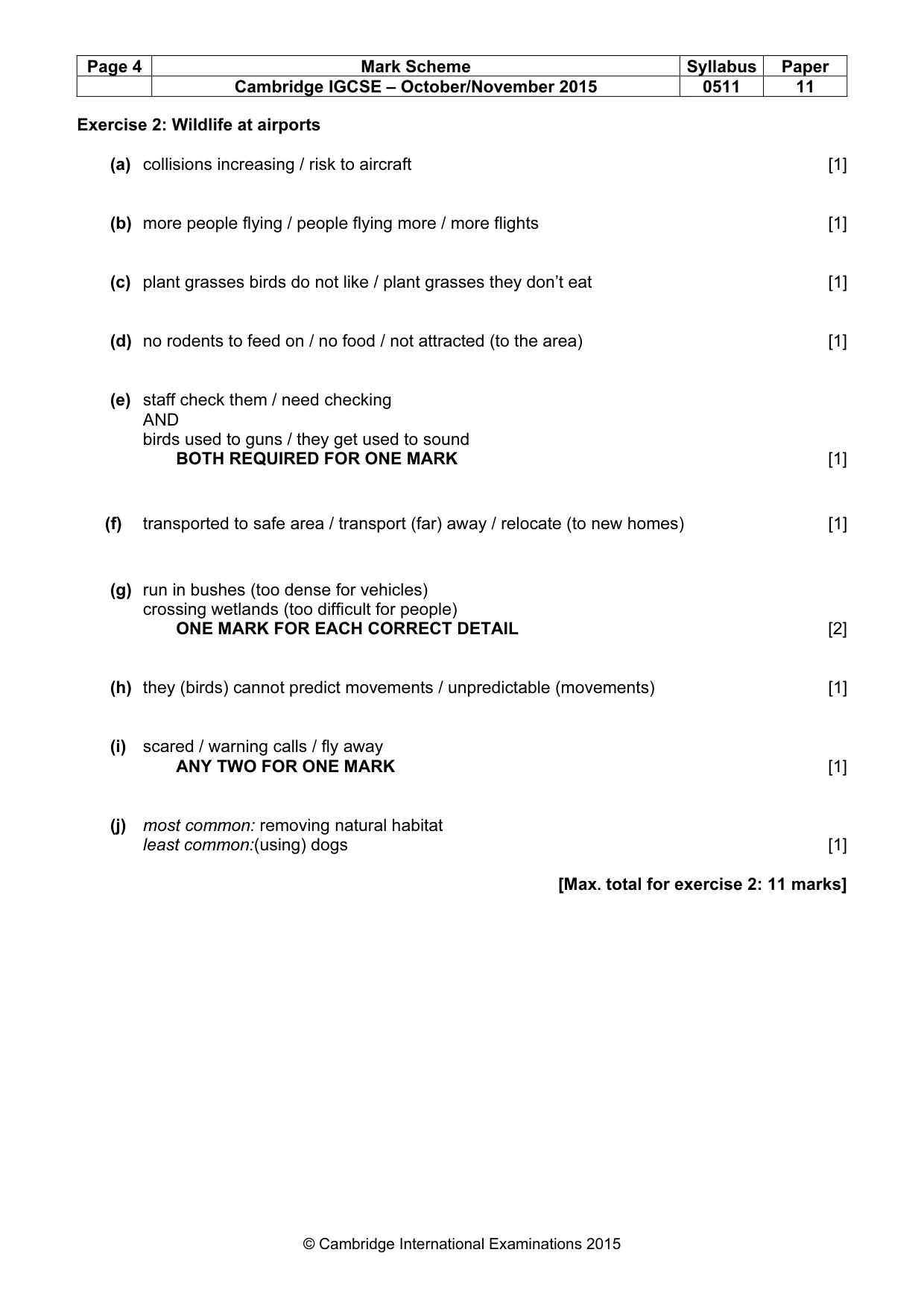
Page 4 Mark Scheme Syllabus Paper Cambridge IGCSE – October/November 2015 0511 11 © Cambridge International Examinations 2015 Exercise 2: Wildlife at airports (a) collisions increasing / risk to aircraft [1] (b) more people flying / people flying more / more flights [1] (c) plant grasses birds do not like / plant grasses they don’t eat [1] (d) no rodents to feed on / no food / not attracted (to the area) [1] (e) staff check them / need checking AND birds used to guns / they get used to sound BOTH REQUIRED FOR ONE MARK [1] (f) transported to safe area / transport (far) away / relocate (to new homes) [1] (g) run in bushes (too dense for vehicles) crossing wetlands (too difficult for people) ONE MARK FOR EACH CORRECT DETAIL [2] (h) they (birds) cannot predict movements / unpredictable (movements) [1] (i) scared / warning calls / fly away ANY TWO FOR ONE MARK [1] (j) most common: removing natural habitat least common:(using) dogs [1] [Max. total for exercise 2: 11 marks]
Mark scheme, page 5
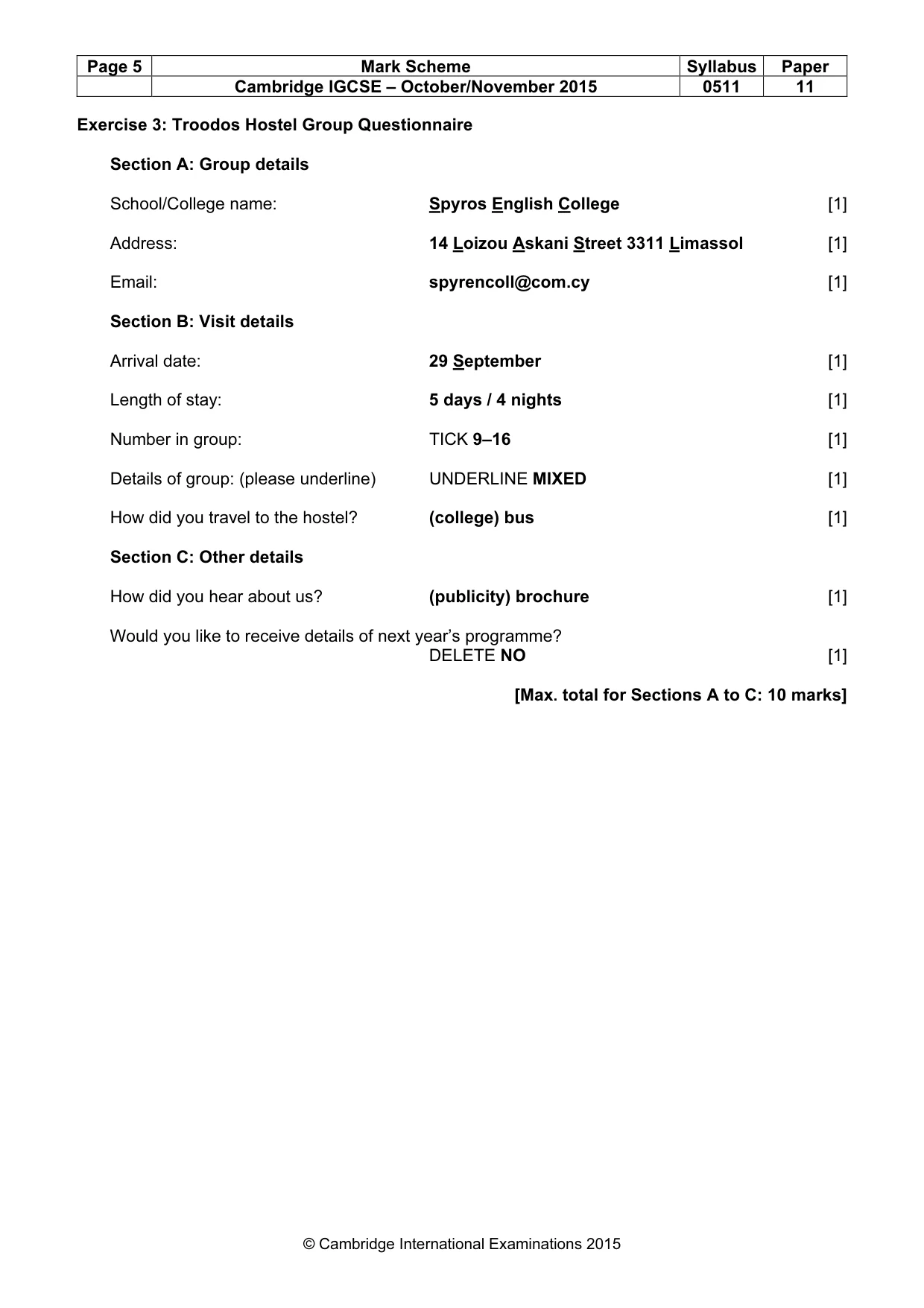
Page 5 Mark Scheme Syllabus Paper Cambridge IGCSE – October/November 2015 0511 11 © Cambridge International Examinations 2015 Exercise 3: Troodos Hostel Group Questionnaire Section A: Group details School/College name: Spyros English College [1] Address: 14 Loizou Askani Street 3311 Limassol [1] Email: spyrencoll@com.cy [1] Section B: Visit details Arrival date: 29 September [1] Length of stay: 5 days / 4 nights [1] Number in group: TICK 9–16 [1] Details of group: (please underline) UNDERLINE MIXED [1] How did you travel to the hostel? (college) bus [1] Section C: Other details How did you hear about us? (publicity) brochure [1] Would you like to receive details of next year’s programme? DELETE NO [1] [Max. total for Sections A to C: 10 marks]
Mark scheme, page 6
Page 6 Mark Scheme Syllabus Paper Cambridge IGCSE – October/November 2015 0511 11 © Cambridge International Examinations 2015 Section D In the space below, write one sentence about what you liked about the hostel and one sentence with a suggestion on how we could improve. Sentences must be written from the point of view of Alexia. Sample sentence 1: I liked the comfort of the room. The hostel was excellent in all respects. The hostel was good value for money. Sample sentence 2: In future the hostel should send a detailed map. Could you send a detailed map in future? For each sentence, award up to 2 marks as follows: 2 marks: proper sentence construction; correct spelling, punctuation and grammar; gives the information asked for 1 mark: proper sentence construction; 1–3 errors of punctuation/spelling/grammar (without obscuring meaning); gives the information asked for 0 marks: more than 3 errors of punctuation/spelling/grammar; and/or does not give the information asked for; and/or not a proper sentence; and/or meaning obscure Absence of a full stop at the end should be considered as 1 punctuation error. Absence of an upper case letter at the beginning should be considered as 1 punctuation error. Omission of a word in a sentence should be considered as 1 grammar error. [Max. total for Section D: 4 marks] [Max. total for exercise 3: 14 marks]
Mark scheme, page 7
Page 7 Mark Scheme Syllabus Paper Cambridge IGCSE – October/November 2015 0511 11 © Cambridge International Examinations 2015 Exercise 4: Four days without fuel Facts about the race route [Max. 2 marks this heading] 1 outback / dusty 2 start in Darwin / from Darwin / start in north Australia 3 (about) 3 thousand km / takes (about) four days 4 finish in Adelaide / to Adelaide / finish south coast 5 public roads/ open to traffic Problems during the race [Max. 3 marks this heading] 1 danger / dangerous 2 wind / blown off road / weather / forces of nature 3 (cars covered in) dust (do not accept ‘dusty’ here) 4 trucks block road / ordinary traffic 5 (risk of colliding with) kangaroos 6 rain / weather / forces of nature / recharge battery How solar power has been used by major car producers [Max. 2 marks this heading] 1 power lights / for lights 2 power air-conditioning / for air-conditioning 3 operate ignition / power ignition [Max. total for exercise 4: 7 marks]
Mark scheme, page 8
Page 8 Mark Scheme Syllabus Paper Cambridge IGCSE – October/November 2015 0511 11 © Cambridge International Examinations 2015 Exercise 5: World Solar Challenge Race – summary Language: up to 5 marks 0 marks no understanding of the task / no relevant content / meaning completely obscure due to serious language inaccuracies 1 mark copying without discrimination from text / multiple language inaccuracies 2 marks heavy reliance on language from the text with no attempt to organise and sequence points cohesively / limited language expression making meaning at times unclear. 3 marks some reliance on language from the text, but with an attempt to organise and sequence points cohesively / language satisfactory, but with some inaccuracies 4 marks good attempt to use own words and to organise and sequence points cohesively / generally good control of language 5 marks good, concise summary style / very good attempt to use own words and to organise and sequence points cohesively [Max. total for exercise 5: 5 marks]
Mark scheme, page 9
Page 9 Mark Scheme Syllabus Paper Cambridge IGCSE – October/November 2015 0511 11 © Cambridge International Examinations 2015 Exercise 6: Email to a friend about what happened when you received a phone call Exercise 7: Some people say you learn more out of school than you do at school The following general instructions, and table of marking criteria, apply to both exercises. 1 Award the answer a mark for content (C) [out of 7] and a mark for language (L) [out of 6] in accordance with the General Criteria table that follows. 2 Content covers relevance (i.e. whether the piece fulfils the task and the awareness of purpose/audience/register) and the development of ideas (i.e. the detail/explanation provided and how enjoyable it is to read). 3 Language covers style (i.e. complexity of vocabulary and sentence structure) and accuracy (of grammar, spelling, punctuation and use of paragraphs). 4 When deciding on a mark for content or language, first of all decide which mark band is most appropriate. There will not necessarily be an exact fit. Then decide between 2 marks within that mark band. Use the lower mark if it only just makes it into the band and the upper mark if it fulfils all the requirements of the band but doesn’t quite make it into the band above. 5 When deciding on a mark for content, look at both relevance and development of ideas. First ask yourself whether the writing fulfils the task, in terms of points to be covered and the length. If it does, it will be in at least the 4–5 mark band. 6 When deciding on a mark for language, look at both the style and the accuracy of the language. A useful starting point would be first to determine whether errors intrude. If they do not, it will be in at least the 4–5 mark band. 7 The use of paragraphs should not be the primary basis of deciding which mark band the work is in. Look first at the language used and once you have decided on the appropriate mark band, you can use the paragraphing as a factor in helping you to decide whether the work warrants the upper or lower mark in the mark band. 8 If the essay is considerably shorter than the stated word length, fewer than 70 words, it should be put in mark band 2–3 for content or lower for not fulfilling the task. If the essay is between 70 and 100 words, it should be put in mark band 4–5 for content or lower. The language mark is likely to be affected and is unlikely to be more than one band higher than the content mark. 9 If the essay is totally irrelevant and has nothing to do with the question asked, it should be given 0 marks for Content and Language, even if it is enjoyable to read and fluent. 10 If the essay is partly relevant and therefore in mark band 2–3, the full range of marks for language is available. [Max. total for exercise 6: 3marks] [Max. total for exercise 7: 13 marks]
Mark scheme, page 10
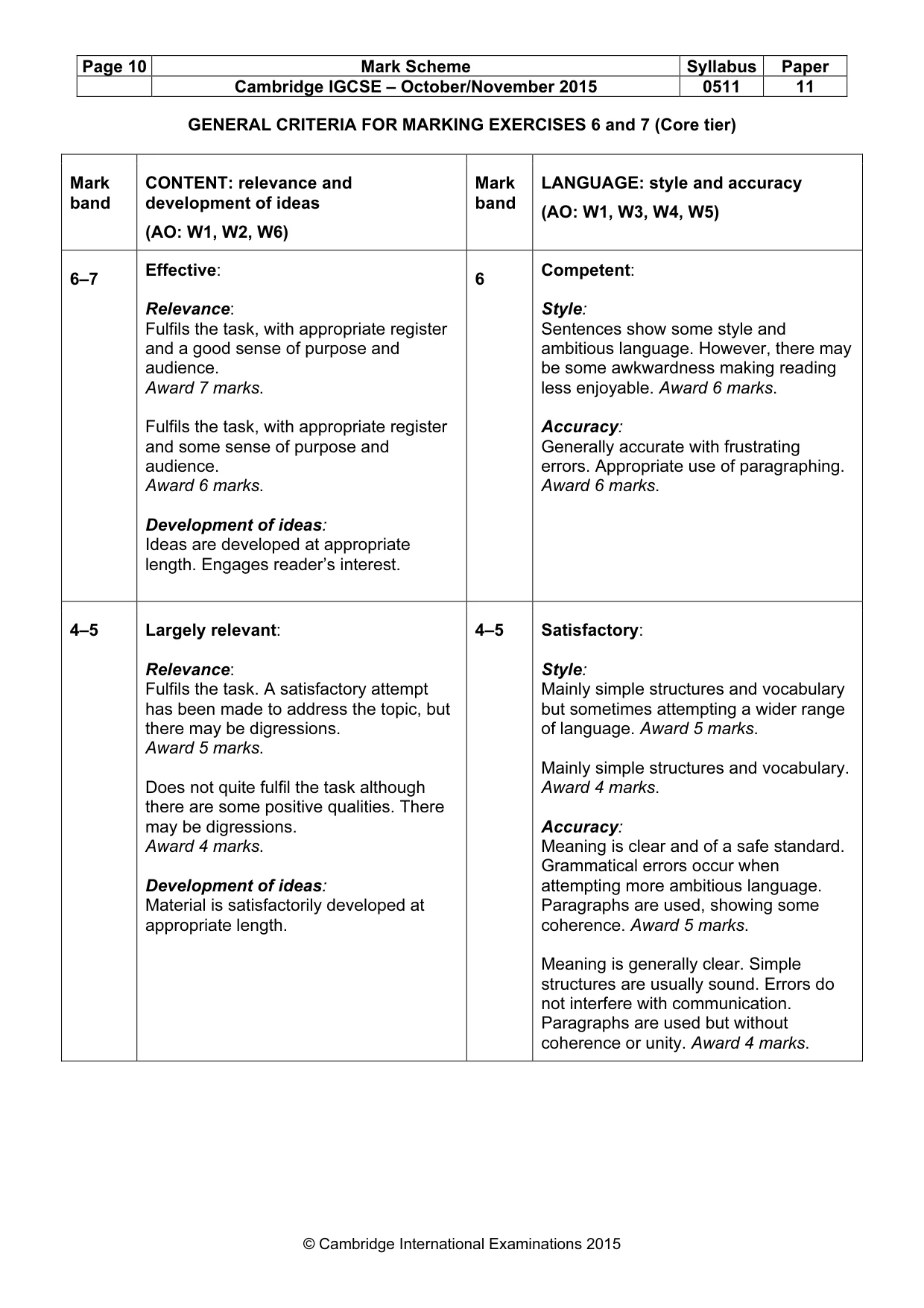
Page 10 Mark Scheme Syllabus Paper Cambridge IGCSE – October/November 2015 0511 11 © Cambridge International Examinations 2015 GENERAL CRITERIA FOR MARKING EXERCISES 6 and 7 (Core tier) Mark band CONTENT: relevance and development of ideas (AO: W1, W2, W6) Mark band LANGUAGE: style and accuracy (AO: W1, W3, W4, W5) 6–7 Effective: Relevance: Fulfils the task, with appropriate register and a good sense of purpose and audience. Award 7 marks. Fulfils the task, with appropriate register and some sense of purpose and audience. Award 6 marks. Development of ideas: Ideas are developed at appropriate length. Engages reader’s interest. 6 Competent: Style: Sentences show some style and ambitious language. However, there may be some awkwardness making reading less enjoyable. Award 6 marks. Accuracy: Generally accurate with frustrating errors. Appropriate use of paragraphing. Award 6 marks. 4–5 Largely relevant: Relevance: Fulfils the task. A satisfactory attempt has been made to address the topic, but there may be digressions. Award 5 marks. Does not quite fulfil the task although there are some positive qualities. There may be digressions. Award 4 marks. Development of ideas: Material is satisfactorily developed at appropriate length. 4–5 Satisfactory: Style: Mainly simple structures and vocabulary but sometimes attempting a wider range of language. Award 5 marks. Mainly simple structures and vocabulary. Award 4 marks. Accuracy: Meaning is clear and of a safe standard. Grammatical errors occur when attempting more ambitious language. Paragraphs are used, showing some coherence. Award 5 marks. Meaning is generally clear. Simple structures are usually sound. Errors do not interfere with communication. Paragraphs are used but without coherence or unity. Award 4 marks.
Mark scheme, page 11
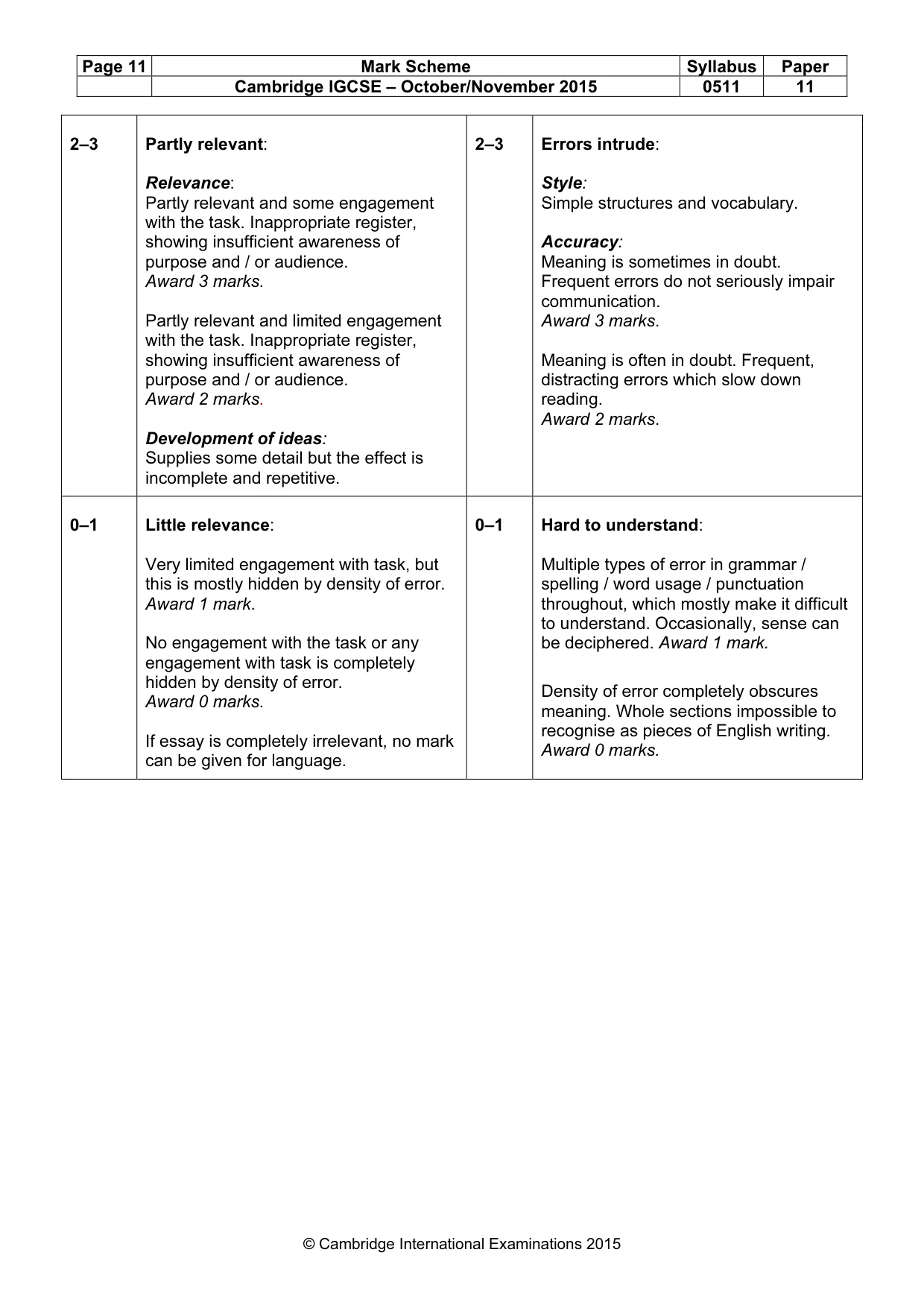
Page 11 Mark Scheme Syllabus Paper Cambridge IGCSE – October/November 2015 0511 11 © Cambridge International Examinations 2015 2–3 Partly relevant: Relevance: Partly relevant and some engagement with the task. Inappropriate register, showing insufficient awareness of purpose and / or audience. Award 3 marks. Partly relevant and limited engagement with the task. Inappropriate register, showing insufficient awareness of purpose and / or audience. Award 2 marks. Development of ideas: Supplies some detail but the effect is incomplete and repetitive. 2–3 Errors intrude: Style: Simple structures and vocabulary. Accuracy: Meaning is sometimes in doubt. Frequent errors do not seriously impair communication. Award 3 marks. Meaning is often in doubt. Frequent, distracting errors which slow down reading. Award 2 marks. 0–1 Little relevance: Very limited engagement with task, but this is mostly hidden by density of error. Award 1 mark. No engagement with the task or any engagement with task is completely hidden by density of error. Award 0 marks. If essay is completely irrelevant, no mark can be given for language. 0–1 Hard to understand: Multiple types of error in grammar / spelling / word usage / punctuation throughout, which mostly make it difficult to understand. Occasionally, sense can be deciphered. Award 1 mark. Density of error completely obscures meaning. Whole sections impossible to recognise as pieces of English writing. Award 0 marks.
What you needed in this session
Cambridge’s own grade thresholds for 2015 Oct/Nov, Paper 1 · Variant 1. A higher threshold means an easier paper — the bar moves with how the cohort did.